The Hero Of Maida, Maida Vale

The Hero Of Maida closed in early 2024 and has since opened as a new pub, helpfully called The Hero but run by completely different people. I’ve left the review up for posterity.

Despite the name, over six and a half years I’ve reviewed lots of restaurants which aren’t in Reading. To paraphrase David Brent, my world doesn’t end with these four walls. When I’m finished with Reading, there’s Henley, Windsor, Wokingham. You know. Newbury. Goring. Because I am my own boss.

Bracknell.

But I’ve always steered clear of reviewing London restaurants. I suppose part of that is analysis paralysis: how would you even go about picking which restaurants to visit? There are hundreds of London restaurant bloggers (not to mention influencers) swarming around all the hottest new restaurants, all the must-visit openings, so it’s hard to imagine anybody would be interested in my (provincial) opinion. And how useful would it be to my regular readers? You might be in London from time to time, but how likely would you be to go out of your way to try somewhere on my say-so? That’s why I’ve always stayed in my lane, remaining local with the occasional foray further afield on the train.

So what changed? Well, recently one of the restaurant bloggers I read wrote a review of a little Malaysian restaurant just round the corner from Paddington Station. It did what, in an ideal world, all restaurant reviews would do: it made me feel like checking the place out. After all, I’m in London reasonably often, I nearly always come home via Paddington and having decent food options to explore while I wait for an off peak train would be a very welcome development. I Retweeted the review, plenty of people showed an interest and at that point I decided: there would be no harm in adding the occasional review of venues in and around Paddington, to help out if you are in London and want to try out a good restaurant before coming home.

I picked Maida Vale for my first London review because that area has always been one of my favourite parts of the city. You leave Paddington by the exit that takes you right out onto the Grand Union Canal, turn left and meander past all the boats and the offices of Paddington Basin, the fancy gleaming bars and restaurants that have sprung up to cater for all those workers. Cross one of the pretty bridges you come to and you’re in Little Venice, ten minutes’ walk or a single Tube stop from Paddington but a world away in all important respects.

It’s loveliest in summer, but at any time it’s a house envy-inducing stroll. The Warwick Castle, tucked away on a sidestreet, is a lovely mews pub and not far from there is the equally gorgeous Formosa Street with the Prince Alfred, a cracking public house with little booths where you have to duck under a low door to pass from one to the next. If I didn’t have such a magnificent local already, I might well spend my days wishing it was mine.

The Hero Of Maida is just a little further out, on the border between Little Venice and Maida Vale, and in a previous incarnation it used to be called the Truscott Arms. I had a friend who worked in London and I used to go down after work on a Friday afternoon to meet her for a boozy dinner in that neck of the woods. We’d always stop for one last snifter at the Truscott Arms – it closed later than other establishments – before weaving back to the station and drunkenly going our separate ways, me on the Burger King Express back to Reading and her on a terrifying-sounding night bus to Tooting.

I was sad when the Truscott Arms closed but when I heard it had reopened as the Hero Of Maida under the supervision of Henry Harris (of legendary Knightsbridge restaurant Racine) offering a take on classic French cooking, I made a mental note to visit one day. So on a sunny weekday lunchtime my friend John and I paid it a visit, to finally break my London reviewing duck.

It’s a very handsome, light, airy room that instantly draws you in – tasteful muted tones, an attractive wooden floor, gorgeous tiles and a long, curving zinc bar. There’s a separate restaurant area upstairs (open in the evenings but not at lunchtime) but I didn’t feel I was missing out. Lovely tables, too, with button-backed banquettes looking out. It was quiet when we turned up, with a solitary customer plugged in and tapping away on his computer. We sat at the front by the windows, making the most of the afternoon light, although I did wish after a while that we’d grabbed a banquette. On the plus side it means my photographs are better than usual, but the drawback was that poor John was caught in a direct shaft of sun for some of the meal and had to keep shuffling his chair to one side.

The menu changes regularly and on the day we visited it was compact and appealing – just five starters, four mains and a sharing dish (pie for two, an offer I always find hard to refuse). A blackboard behind the bar offered a few other dishes, and although they were listed as bar food they seemed equally restauranty to me. Crucially, one was the same pie in an individual portion: a great relief, because it meant I didn’t have to implore John to change his mind. On another day I would have gone for another special: crispy lamb breast with salsa verde, six almost unimprovable words. “It’s National Pie Week”, our waiter told me, and in the end that made my decision for me.

There was a good selection of beers and we were slightly early for our booking so we started with a pint. My Notting Helles was pleasant enough, if not the most imaginative choice, but John enthused about his pint of Peckham Rye, a very nice-looking amber ale. Later I wished I’d gone for the coffee stout by Magic Rock, but we’d moved on to wine by then. It was a pretty decent wine list too, with plenty available by the carafe, but we settled on a chardonnay from the Languedoc which came in at just over thirty pounds for a bottle. It sounds odd to praise a wine based on all the things it wasn’t, but at the risk of sounding like Goldilocks it somehow seemed appropriate: not too dry, not too sweet, not too oaky, not too expensive. The list said it was a good alternative to a white Burgundy, and I thought that was spot on.

I’d been sorely tempted by the steak tartare, but with a pie on the way I decided to balance light and shade a bit by choosing a more delicate starter. Ibériko tomatoes with burrata felt more a test of sourcing than cooking, but even so I really enjoyed it.

The tomatoes weren’t as good as ones I’d rhapsodised over in Spain but they were close enough, with plenty of freshness and a judicious spot of salt. The burrata felt more like mozzarella to me – completely firm in the middle without any of the glorious creamy messiness of a good burrata – but that struck me rather than irked me. The salsa verde brought it all together, as did some greenery which wasn’t listed and which I didn’t recognise. It had a slightly vinegary bite but I couldn’t place what it was – not samphire, not salty fingers, not (I think) monk’s beard, but a perfect match in any event. Winning enough to overcome a couple of slight missteps: a dish, in many ways, emblematic of the whole meal.

John had chosen grilled mackerel with ‘nduja which, again, is a combination that sat up and begged to be chosen. I thought it looked fantastic, with a generous whack of the fiery, brick-red good stuff. John liked it, but not without reservations.

“I like the skin to be crispy, and this is a bit, well, flaccid. Flaccid is never a good word, is it?”

“No, it’s like damp. ‘Moist’ can be a good thing, but ‘damp’ never is.”

“There’s always ‘wipe down with a damp cloth’, I suppose” said John, equably. “Something else about this dish isn’t quite right. This stuff.”

That’s how we discovered that John, like me, is not a fan of radicchio – although, as a man who gets a vegetable box weekly, he’s very fortunate to only just be figuring that out. I understood though – again, the radicchio wasn’t mentioned on the menu and it did slightly skew the dish. I didn’t get to taste it, but from the look of the plate, also strewn with wild garlic and capers, I think I would have enjoyed it. John did find a few sizeable bones which had escaped the filleting process, though, another glitch that rankled.

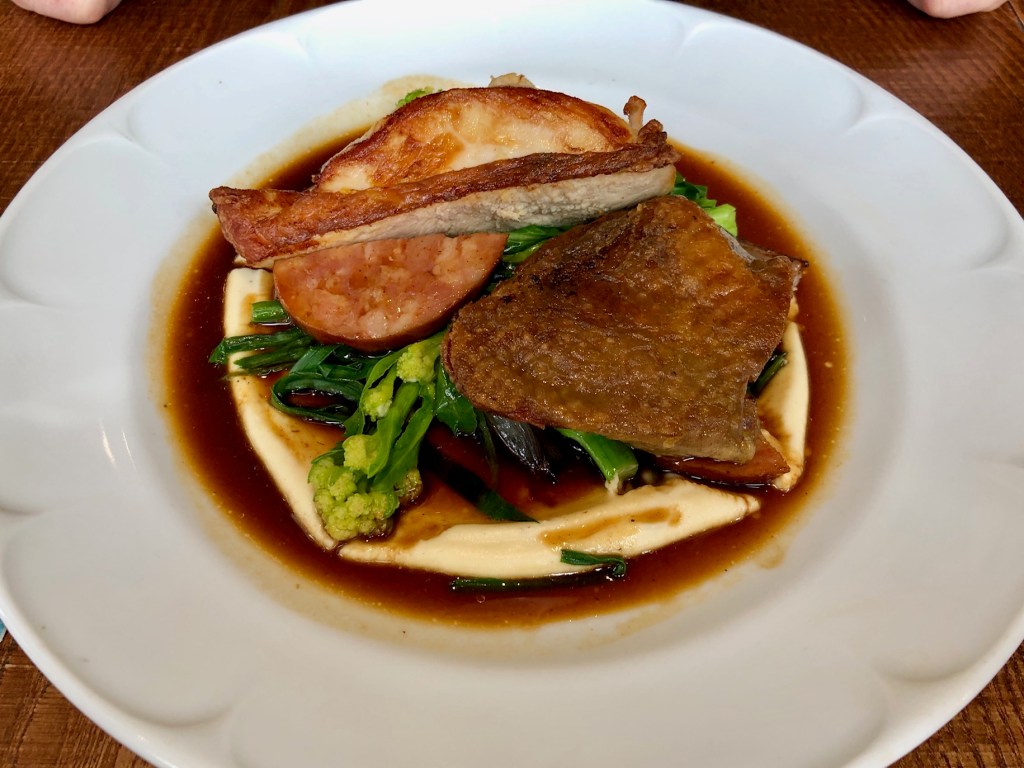
John was properly delighted with his main course, though. Guinea fowl came two ways, with a hefty piece of the breast and a gorgeous-looking thigh complete with crispy skin. It was all on top of some silky celeriac puree, along with a big, coarse wedge of smoked Morteau sausage – we Googled it to make sure it was nothing like andouillette – and, apparently, “tropea onion”.

“This is lovely. I’m usually more of a starters man and main courses can feel like a bit of a let-down, so it’s a real pleasure to get such a good main course. And it’s a really big portion of guinea fowl, I wasn’t expecting that.”

I thought that was a good point – this didn’t feel like a little, cheffy plate assembled with tweezers but a proper, hearty dish put together with the diner firmly in mind. Good value at nineteen pounds, too.
My pie was, as so often, more a casserole wearing a hat and the pastry lacked the indulgence of a good suet crust. But underneath, you hit paydirt: a sticky tangle of slow-cooked lamb shoulder and a rich, savoury sauce, punctuated by coarsely chopped garlic and carrot. The greens that came with it were nice enough taken for a swim in the pie filling, but hardly the feature attraction. The whole thing was delicious but it just didn’t feel as much like a proper pie as I’d hoped; it was best described as high-ceilinged, with plenty of breathing space between the filling and the crust.

Many of these niggles were redeemed by the Hero Of Maida’s chips, which were as good as any I’ve had – huge, ragged-edged things, all crunch and fluff. I was initially dubious because they came skin-on, but even that didn’t detract. They were four pounds a portion, and I was relieved that John and I had the foresight (or greed) to order one each. I used mine to absorb every last molecule of the sauce left in my pie dish.

The dessert menu was also compact – just the four options – but we were on a roll and had no intention of letting that stop us. The list of dessert wines was equally streamlined, but we found a Coteaux de L’Aubance on it which was stunning, the colour of late summer afternoons with a clean, poised sweetness. The first sip was one of those little heavenly moments you want to remember for ages: our food so far had been lovely, the only plans for the rest of the day were a bimble from pub to pub talking about all sorts and, in my mind, I was an honorary resident of Maida Vale already.

Desserts were inconsistent in the same way as the starters, but the kitchen had garnered enough brownie points by then to earn some latitude. So for instance, my lemon posset was all out of kilter: far too big, and too cloying without the sharpness it badly needed to cut through. Instead, it felt like a big bowl of something very close to clotted cream and the crumbled amaretti biscuits all over it didn’t do enough to counteract that. It wasn’t what I ordered, or what I really wanted, but on the other hand there are worse things to do in life than eat a large bowl of clotted cream and, when push came to shove, I found I didn’t mind at all.

John’s rhubarb and custard pavlova sounded terrific on paper but again, wasn’t quite there. The rhubarb, John said, was delicious and he really enjoyed the hazelnut praline which played an equally starring role. “But this meringue”, he said, “I hate to say this but it feels shop-bought.” I saw him struggle to break it up and it seemed to be lacking any of the chewiness which would have made the dish perfect. Even so, I looked at his dessert and thought that I would gladly have ordered it myself.

Service, from one chap who seemed to be doing everything that lunchtime, was friendly without being faux-matey, knowledgeable and happy to talk about the dishes and offer recommendations. Again, it might be that if you came to the Hero Of Maida of an evening or on a busy Sunday lunchtime you might have a different experience, but I thought we were really well looked after. Three courses, a couple of pints, a bottle of white wine and two glasses of dessert wine came to just over a hundred and fifty pounds, including that old chestnut the “optional” twelve and a half per cent service charge. You could eat here for less, but I thought it was decent value.

You’ll have read all of this and you’ll already have an idea about whether the Hero Of Maida is the kind of place for you. You might think it’s ever so slightly too far from Paddington or a little too expensive, but I really enjoyed the place. And to save you the effort of questioning my verdict, I’ve already asked myself: was I being charitable because I was having such a nice afternoon? Was I letting the restaurant off the hook when, closer to home, I might have been harsher?

I don’t know. It’s possible. Maybe I was looking at the world through dessert wine-tinted glasses but if so, all I can say is that I thoroughly recommend doing so. Next time you’re in London and you’re on an off-peak ticket you could do a lot worse than booking the Hero Of Maida, especially when summer comes, and crossing the canal to treat yourself to something different before riding the rails back to Gare du ‘Ding. Make sure you get some chips: you’ll thank me for it.

The Hero Of Maida – 7.5
55 Shirland Road, London, W9 2JD
020 39609109

https://theheromaidavale.co.uk
Zest

Zest closed in August 2022. I’ve left the review up for posterity.

How good is your memory for faces? I was in Brighton over the summer, sitting outside a particularly patchouli-scented café in the Lanes, when I thought I recognised the woman walking past my table and nipping inside. It bugged me for about five minutes until I realised where I knew her from: she’d served me in Workhouse Coffee what must have been a couple of years ago. Reading is a small town, and the longer you live there the more chances you get to accumulate memories, or scraps of memories, and to spot people you dimly recognise from your past: that person used to work at the same office as me a few years ago; that person was briefly my housemate in 2001 and never used the shower; there’s a friend I lost in the divorce.

The reason I mention this is that when we turned up at Zest on an icy winter’s evening, the owner recognised me immediately as a former customer of hers. I used to eat at Zest’s town centre sibling restaurant, the sadly-missed LSQ2 (where Handmade Burger is now), but even so it was an impressive feat of recall: I frequented LSQ2 the best part of ten years ago, and I expect she has seen hundreds of diners since then. And yet here we both were – her still trading nicely out at Green Park and me a few pounds heavier, far older and greyer (if not necessarily wiser) but still alive and kicking.

LSQ2 closed in 2012 (the GetReading article announcing the news tried to suggest that every cloud had a silver lining because Cosmo was about to open on Broad Street) but Tony and Sally Cole’s first restaurant, since rebranded as Zest, has been operating at Green Park for fifteen years, offering a combination of classic modern British food and dishes which reflect their time spent in Australia and New Zealand. I still remember a dish of sashimi-grade tuna with a slick of sesame that LSQ2 used to do – I ordered it every time I went there, until they took it off the menu because they felt the tuna wasn’t sustainable.

There are a few reasons why I’d never got round to reviewing Zest before now. It never quite made it to the top of my to do list, and I think that’s because I always got the distinct impression that it was more intended for people working on the business park, and corporate diners, than members of the public. The opening hours, not entirely clear from the website, didn’t help. It’s only generally open Monday to Friday, but you get mixed messages – in one place on the site it says it’s open 5 until late, in another it says their menu is served until 9pm and if you try to book online the latest table it will give you is at 8pm (with a clear instruction that you need to place your order by 8.15, because the kitchen closes).

Arriving at half seven with my other half Zoë didn’t necessarily alter that impression – there were a few tables occupied, one of them a large booking, but all seemed to be coming to the end of their meals: we were the last new customers that evening. Zest is actually quite an attractive space, all dark wood and big windows looking out over water. In the thick fog, with light trying to break through from the nearby offices and car parks, it was all a bit Blade Runner, and if the furniture felt slightly chain hotel it didn’t put me off. The lighting, as you’ll see from the photos, was a little more intimate than I’d like, although it didn’t help that a few bulbs were out.

Zest was running a reduced à la carte menu alongside a Christmas menu when I visited, although the prices weren’t unreasonable for either and you were allowed to mix and match. The only real difference was that mains on the Christmas menu were a few pounds more expensive and came with roasted vegetables and Brussels sprouts, whether they went with the dish or not (but more of that later).

In general starters were seven or eight pounds and, if you visit outside the festive season, most mains will cost you around fifteen. It was a very good menu with more than a few tempting choices, and I’m glad to say that no compromises were made in bringing you this review. There’s definitely an Asian influence to an otherwise modern European menu with Thai and Indonesian dishes sitting alongside more traditional ones – we tried a little from both, in the interests of balance.

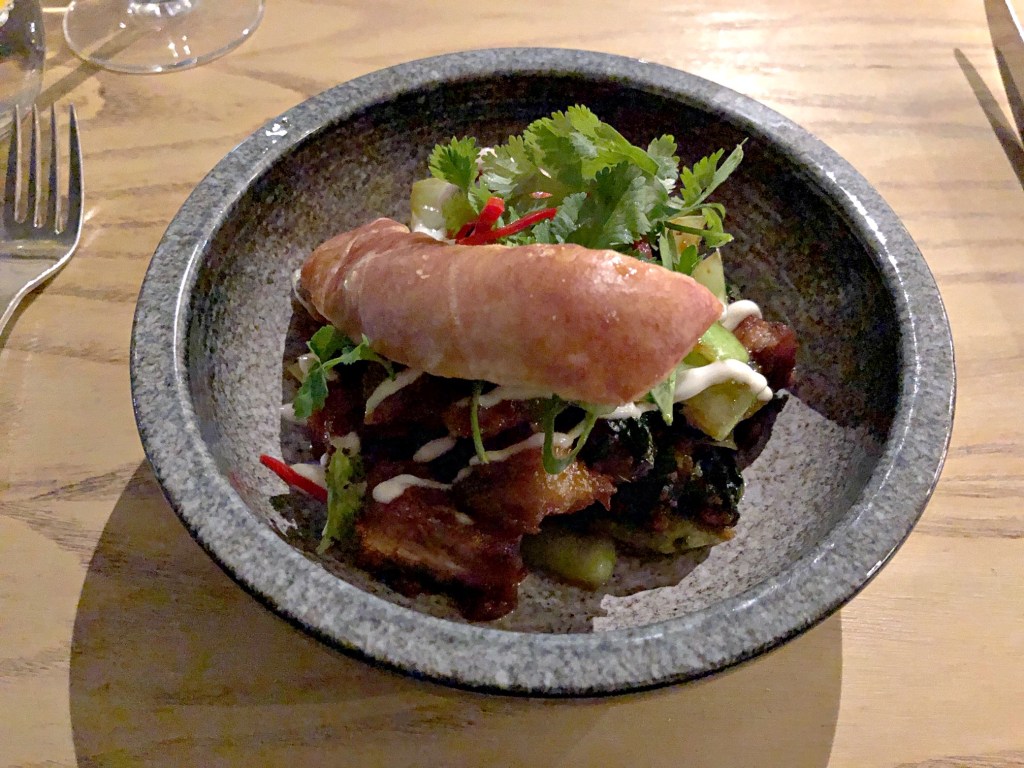
My starter was one of the nicest things I’ve eaten this year. Pork belly (triple-cooked according to the menu, although I saw no real evidence of that) came in generous cubes with tender meat and glossy fat, all coated in a gloriously funky, fishy XO sauce, with pak choi, spring onion and big, fragrant coriander leaves. There was a lime aioli advertised, and something that looked like that was definitely drizzled over the pork, but it couldn’t break through the stronger flavours in the dish, not that I cared in the slightest.

The only misfire was the crackling on top, which left me fearing for my fillings. A lighter touch would have been better, and in honesty the dish wouldn’t have missed it: it also ruined the picture below, or at least that’s my excuse. In any case, I was too delighted with everything else to mind. I let Zoë try a couple of pieces, partly because it was the season of goodwill but mainly because food that good deserves to be shared, regardless of whether it’s December or June.

I had a sneaking suspicion that I’d won at starters, but Zoë was very happy with hers. “I want to try the Scotch egg because I’d had a few to compare it to”, she said, and it was a very attractive specimen, served on what was called “curry mayonnaise” but felt to me more like a katsu sauce, more fruity than fiery. It could have done with more of the advertised coriander salsa verde but even so I thought it was a really good example – what felt like panko breadcrumbs, beautiful texture, peppery sausagemeat and yolk at just the right consistency.

“Is it better than the Lyndhurst’s?” I asked Zoë.

“Better than the one they do now, and up there with the one the previous owners did” was the reply.

The wine list at Zest may reflect the fact that most of their diners drive home afterwards, with a compact selection: most of it is available by the glass, and only a couple of bottles north of thirty pounds. We had a very drinkable French pinot noir for twenty-eight pounds which I thoroughly enjoyed – although our waiter intervened to stop me pouring it myself, which felt a little unnecessary. He was the only person looking after us all evening and I couldn’t quite shift the fear that he resented us for making him work late: nice enough, but a little distant and slightly lacking in warmth.

Our main courses, both from the Christmas menu, came out a little quicker than I might have liked, adding to the feeling that we were keeping staff from their loved ones. It’s never easy, I suppose, for a kitchen to sit on their hands when they only have two dishes left to prepare, but I do wish they’d left it a little longer.

However, again, that felt like a minor quibble once I started eating the food. My beef rendang was truly beautiful. My previous experience of this dish had been at Newbury’s now-defunct Wau, and at the time I thought I’d had a very good rendang. This, though, was streets ahead – not sickly-sweet and overreliant on coconut but complex and aromatic, shot through with hints of star anise. Similarly, the beef hadn’t been cooked into mush – it was still in distinct pieces which only fell apart when you tried to load them onto a fork. Again, there was plenty of coriander and the sharp crunch of ribbons of lightly pickled carrot on top was an excellent touch.

This was a marvellous dish, perfect on a Baltic Reading evening, and I am pretty sure it is usually on Zest’s à la carte menu, so try it if you go. As it was on the Christmas menu it was served with a fair few roasted heritage carrots (many of them a pleasingly deep shade of purple), and although they didn’t go in the slightest with an Indonesian curry it didn’t stop them being delicious.

Zoë’s lamb shank was a more conventionally Christmassy affair, and very good it was too – a gigantic piece of meat, cooked into soft surrender. The sauce was deep, with a little sweetness from balsamic vinegar and soft onions and the mash was suitably creamy and smooth. This went much better with the roasted vegetables and with the surprisingly good Brussels sprouts, sliced thinly and served with cream and a little speckle of pancetta. I wouldn’t be at all surprised if this dish also features on the menu all year round, and it’s well worth ordering. I would have liked the advertised mint salsa to make an appearance, but the dish managed fine without it.

It took a while for the waiter to ask us if we wanted to look at the dessert menu, and I felt guilty about saying yes: he asked in the same way that I ask Zoë if she wants help hanging the laundry out i.e. hoping against hope that the answer will be no. But if they don’t want people to order dessert, Zest will have to make the menu a lot less tempting – even the usual suspects had twists that made you want to find out how they looked off the page and on the plate. It’s also worth mentioning that Zest’s cheeseboard is a veritable Greatest Hits of local cheeses – Barkham Blue, Waterloo, Wigmore and Spenwood, all for eight pounds fifty.

My dessert was probably the weak link of the meal. Chocolate tart with meringue and Clementine sorbet sounded beautiful, and the flavours were all present, correct and harmonious. But the texture was wrong – the chocolate was not the solid ganache I was expecting, but a molten pool, as if it had escaped from a fondant. It didn’t stop it being enjoyable, a rarified Terry’s chocolate orange encased in light buttery pastry, but it wasn’t quite what I had hoped.

If I’d won out on starters, Zoë drew level with dessert. I feared a white chocolate and Bailey’s cheesecake would be too sickly but actually it was sweet but not excessively so, a big block of indulgence heavy on filling and light on base. The passionfruit curd underneath stopped the whole thing being too one-dimensional, but given that I was only allowed one small forkful it’s hard to comment further, beyond wishing that I’d ordered it myself.

Dinner for two, including a pre-added 10% service charge, came to just over a hundred pounds – and actually, ordering off the á la carte isn’t any more or less expensive than the three-courses-for-thirty-pounds festive menu. To my mind, that makes the latter remarkably generous and I left the restaurant with a full stomach, a spring in my step and a couple of money off vouchers for next month which I may well end up using.

It’s easy to get jaded when you review a restaurant every fortnight, easier still when it’s a Cozze, a Lemoni or a Pantry. So I’m delighted that, even if by accident rather than design, I’ve saved one of the best meals of 2019 until almost the very last. I didn’t come away from Zest convinced that they were necessarily packed on most weekday evenings, and that lack of clarity probably goes some way to explaining why the pacing of the meal was a little rushed and the service sometimes felt a tad diffident.

But – and this is far more important – I did come away from Zest wishing I had visited a long time ago, and convinced that I might have unearthed one of the best local restaurants you’ve never considered going to. It’s easily accessible by bus from the town centre, it’s affordable by taxi on the way home and it serves delicious, interesting food (it’s as if they’ve been doing it, without much fanfare, for the best part of fifteen years). There’s absolutely nothing wrong with Zest that a buzzier room full of more customers wouldn’t solve – and personally, I plan to play my own small role in helping with that in the New Year. I suspect if you went you’d find it memorable: chances are, they’d come to remember you too.

Zest – 8.0
Lime Square, 220 South Oak Way, Green Park, RG2 6UP
0118 9873702

http://www.zestatlimesquare.co.uk/home.html

The Lyndhurst

The Lyndhurst closed under this management team in May 2024: click here to read a review of the food under the current management. I’ve left the review up for posterity.

I’m always reminded of the cyclical nature of things at this time of year. My Instagram, so recently full of everybody’s envy-inducing holiday photos, has given way to my Facebook news feed, with pictures of everybody’s kids going back to school. The Reading Festival, seen by many as the last event of the summer, is over. The magnolia tree in my garden is beginning to turn, and the leaves will slowly become golden in the weeks ahead. And in town, everybody is in jeans, their shorts packed away for another year, dusting off coats they had almost forgotten they needed.

This time of year is part of cycles for me personally, too. Three years ago, I wrote my final blog post announcing that I was taking a break. And when I came back in 2017, my first review was of the Lyndhurst, a pub I’ve always loved, on the edge of the Village, the conservation area between Eldon Square and Watlington Street. Around this time last year they hosted a lunch for my readers and we packed the place out – over thirty of us, eating a set menu they’d designed for the occasion. It was a lovely afternoon; I made a lot of new friends at that lunch, some of whom have become especially dear to me.

That I’m reviewing it again, in 2019, is a sign of another of those cycles: restaurants open, close and change hands. Kris Dorward left the pub in June, just as the previous landlord had in June 2016. One of the chefs has since moved to the Fisherman’s Cottage (let’s hope the management treat him better than they did the previous team to occupy the kitchen there) and for a little while the pub sat there, empty and sad. One of its regulars even took to sitting at the tables outside in the sunshine, like a dog waiting for its owner to return.

Things looked bleak, but a new team took over at the end of July making all the right noises about continuing to serve excellent food. I was there with friends for a few drinks the night they reopened and although things were a little chaotic, it was brilliant to have the pub back (true to form, Berkshire Live reported the “news” nearly three weeks later).

I didn’t eat there that night, but I was itching to try out the new menu and so, a month after they opened, I turned up with my friend Reggie to give it a whirl. It wasn’t Reggie’s first choice (“the menu looks a bit limited”, he told me) but Caribbean restaurant Vibes was closed on Tuesday nights, so the Lyndhurst it was.

The interior suggested that the new management was aiming for evolution rather than revolution, because apart from being slightly more spartan it looked exactly as it had before. Still a long thin room with the bar down one side, still the same mixture of chairs and pews, still the same warm glow. Reggie said that it reminded him of the pub in Peaky Blinders and I, having never watched it, nodded as if I knew exactly what he was talking about. Reggie, all coiffed hair and Massimo Dutti shirts, might well fit in on the set of Peaky Blinders: I most definitely would not.

The menu offered further encouraging signs, as it had already changed from the original menu online which had underwhelmed Reggie. A bit confusing, though, as the paper menu had starters and mains while the blackboard on the wall also listed nibbles and small plates. Starters and small plates hovered around the seven pound mark, all but a couple of the mains were less than twelve pounds. Most things on the menu still fell into the bracket of pub food but there were interesting cheffy touches here and there: sauce gribiche with the asparagus, a whole spiced chicken to share, black pudding bonbons and chicken katsu burgers.

Reggie and I decided to try a bit of everything, so we made a selection from the snacks and small plates and tried to pick more straightforward and complex main courses to test the range of the kitchen. I let him pick first, as I do with all my dining companions, and he picked everything I wanted to order, as my dining companions inevitably do. “Sorry mate” he said, clearly not sorry at all.

In its previous incarnation, the Lyndhurst’s Scotch egg had been a reference dish, so it seemed like a good test to order it here. It came with less whistles and bells than its predecessor – no wooden board, no tangle of pea shoots sprinkled with salt, no brown sauce accompaniment. Instead it was served simply on a plate with a little salad, some radish and a blob of sweet sauce (the menu said mustard, Reggie thought it was more like chutney). But crucially, it was really very tasty. The yolk could have been a little less solid, ideally, but otherwise it was spot on with a great coarse texture and plenty of seasoning. Not only that, but at just under four pounds, this was almost half the price of the old Scotch egg at the Lyndhurst – genuinely priced to be a beer snack rather than a starter.

My chilli beef nachos, from the small plates section, were neither small nor served on a plate. Not that I was complaining – it was a crazily generous portion of robust tortilla chips topped with plenty of chilli, made with slow-cooked shredded beef rather than mince. I really liked the chilli; Reggie found it a little underseasoned.

The whole thing was a tad unwieldy: it was very hard to eat with your hands, not helped by plonking a gigantic lettuce leaf on top. And the promised guacamole wasn’t really guacamole but just chunks of gorgeously ripe avocado, although there’s a place for that too (there was also a terrific fresh tomato salsa in the mix). But honestly, those minor criticisms aside it was a really lovely, if messy, way to start a meal. I think after eating this I understood better why it wasn’t on the starters menu: you could easily turn up for a few drinks and just get one of these to share with your drinking buddies.

Even after the starters I was happy but well on my way to pleasantly full (Reggie, irritatingly whippet-thin in the way only twentysomethings can be, obviously had plenty in the tank). Despite being a pub the Lyndhurst was offering table service like a restaurant, and the chap looking after us was friendly and polite – if slightly lacking in confidence – and seemed genuinely pleased that we liked our food. We also had a couple of pints on the go – the Lyndhurst’s drinks selection, again, hasn’t changed drastically with the handover so it was Orchard Pig for me and Camden Hells (a favourite of mine on a hot day) for Reggie.

“I’d never come here before I read your last review, and when I did I kind of wished it was my local” he added. That made sense: technically Reggie’s local is the Castle Tap but like practically everyone in West Reading he’d rather pretend it’s the Nag’s Head. Technically, my local is the Retreat but I did feel lucky that the Lyndhurst was such a short walk from my house. Would that enthusiasm survive the main courses, I wondered?

Reggie had picked the fancier of the main courses – pork belly, pig’s cheek and black pudding bonbon, with boulangere potatoes. If that sounds like it had a lot going on it’s because it did, but it really did live up to its promise. The pork belly was beautifully done with no wobbly fat, the cheeks were tender and meaty, free from disturbingly gelatinous bits. And the black pudding bonbon, itself impressively generous, was gorgeous, earthy stuff.

To have all that and boulangere potatoes studded with sweet onion was nice enough, but to add rainbow chars and crispy cavolo nero, reminiscent of seaweed, topped it all off nicely. The only misfires were the apple sauce, which felt a bit like it had wandered in from the Sunday lunch menu, and a slight lack of jus, but the fact remained that for less than fifteen pounds this dish represented formidable value. Reggie was a fan, and from the bit he let me try I was practically an evangelist.

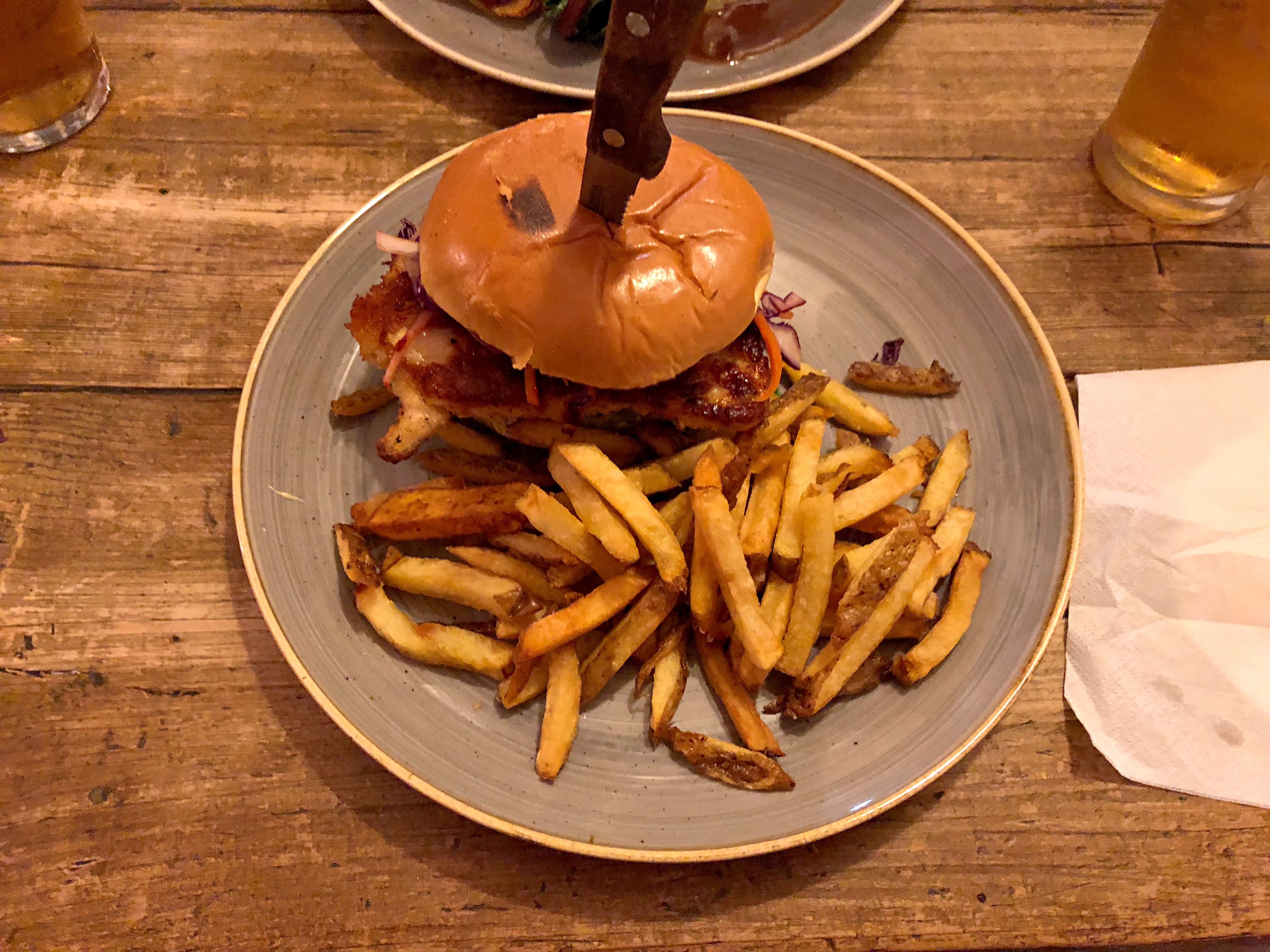
I had to slum it at the more pubby end of the menu, but even there I managed to find something interesting to order. My chicken katsu burger was a very respectable effort – I think it was breadcrumbed, but the coating wasn’t quite strong enough to stand up to the surprisingly punchy curry sauce. Either way, it was a lovely fillet cooked well and the whole thing was elevated by a really well done – please accept my apologies in advance for using this word, I feel every bit as dirty writing it as you do reading it – “slaw”, zingy and piquant and crunchy with carrot.

As so often with burgers these days, it was a sloppy, messy affair – the sort where every bite at one end pushes the contents out of the bun at the other until what’s left is hanging over the edge like the coach in the Italian Job. But it was very enjoyable all the same – as were the chips, which were some of the best I’ve had in a while. The menu says they’re hand-cut and I could well believe it, although if you look closely at my photo you might see one which clearly looked like a refugee from another batch entirely.

Portions were pretty generous (especially my starter), so neither of us had any room for dessert. The Lyndhurst’s dessert menu is possibly not where their strengths lie – just a brûlée, a lemon posset, a brownie and a cheesecake – so I’m not sure I was missing out quite so much. Our dinner – two courses and a pint each – came to forty-six pounds not including tip, which I thought was excellent value.

I’m always lamenting the fact that Reading doesn’t have a pub in the centre that does really good food, and for a long time the previous incarnation of the Lyndhurst filled that gap as well as anyone had. That’s why there was genuine sadness when they closed. I’m delighted to be able to report that, after a slightly shaky start, the new owners are definitely on the right lines. The menu is pretty wide, but they seem to be able to execute all of it. It’s well-judged, with a good range of options for sharing, snacking or eating a full meal. They’ve already started to change the launch menu, which shows that they care about their food and are looking to improve.

I think they’ll only grow in confidence (and the service needs to, ever so slightly) but it will be fascinating to see where the new management takes the place. One thing that really struck me about the previous owners was how little they did on social media to promote the pub and the food: fingers crossed the current team take that more seriously. But for now, let’s just be grateful that the Lyndhurst is back, and trying the right things.

The following day I did a bit of Googling and found that Vibes, the other candidate for this week’s review, closed permanently in August. There’s that cycle for you again: if you don’t use it, don’t complain if further down the line you lose it. One to bear in mind in the months ahead, when places like the Lyndhurst are going to need customers more than ever.

The Lyndhurst – 7.8
88 Queens Road, RG1 4DG
0118 9503888

https://www.thelyndhurstreading.co.uk/

Cozze

This branch of Cozze closed for good in July 2022 and was replaced by San Sicario, which also subsequently closed. Masakali is there now. I’ve left this review up for posterity.

I’ve been reading a lot of other restaurant bloggers recently, and it’s made me think. These are proper restaurant reviewers in big cities, and they use impressive words like “bosky” and “friable” – both of which, I’m ashamed to say, I had to look up in a dictionary.

The other thing these reviewers do, which I’ve never done, is write in the present tense e.g. I bite into the burger. It has the deep flavour of well-tended cow and so on. This is a very striking way to write about food and it makes you feel like you’re there, in the moment, experiencing that bite with them.

I, on the other hand, tend to write in the past tense e.g. the burger was a bit bland. Recounting an event which has already happened makes it feel like you’re telling someone a story down the pub, but perhaps it lacks that immediacy. Maybe it puts a gap between the writer and the reader.

So does the traditional structure of a restaurant review. Here is why I’m reviewing this place, my reviews tend to begin, followed by this is what the room is like and here’s what I ordered and what it tasted like followed, as night follows day, by here’s what the service was like, here’s how much it cost and, last but not least, this is my verdict. Add the rating, the address and the website, repeat until dead. Job’s a good’un.

One thing those other restaurant reviewers and I agree on is that the best reviews to write are the rave reviews, followed by the hatchet jobs. The ones everybody dreads are the middling, the mediocre, the it was dull enough eating it, but heavens, now I have to write about it ones.

So, I ought to start by explaining that Cozze, the Italian restaurant on the roundabout at the bottom of the Caversham Road, has been on my to do list for literally years, and that whenever I ask people on Facebook where they’d like me to go next someone always pipes up and suggests it.

I should add that it started in Woodley before adding a second branch in central Reading with a third one just opened in Pangbourne. I should then say something like “well, a successful independent chain is a very unusual thing in Reading so I owed it to myself to see what all the fuss was about so I went there one night with my partner Zoë” and there you go, the scene is set.

But really, and maybe this will build some of the immediacy my reviews might sometimes lack, what I really want to tell you is how exceptionally bored I was by having dinner at Cozze.

Take the spaghetti carbonara I had as my starter. A good carbonara should be golden, the sauce should hug the pasta, it should be resplendent with egg, it should be salty and sinful and fun. The pancetta (although ideally it might even be guanciale) should be almost crispy and add its own whack of salt to proceedings. It shouldn’t be like this.

It shouldn’t be a pasty albino of a thing, swimming in cream with scant evidence that it’s ever seen an egg. You shouldn’t be dredging through the lake of liquid once you’ve finished, picking out highlighter-pink cubes of bouncy bacon and wondering why you bothered. It shouldn’t be worse than eating at Carluccio’s, for goodness’ sake. It shouldn’t feel like a dish cooked by people who don’t especially care for food or know how it’s meant to taste.

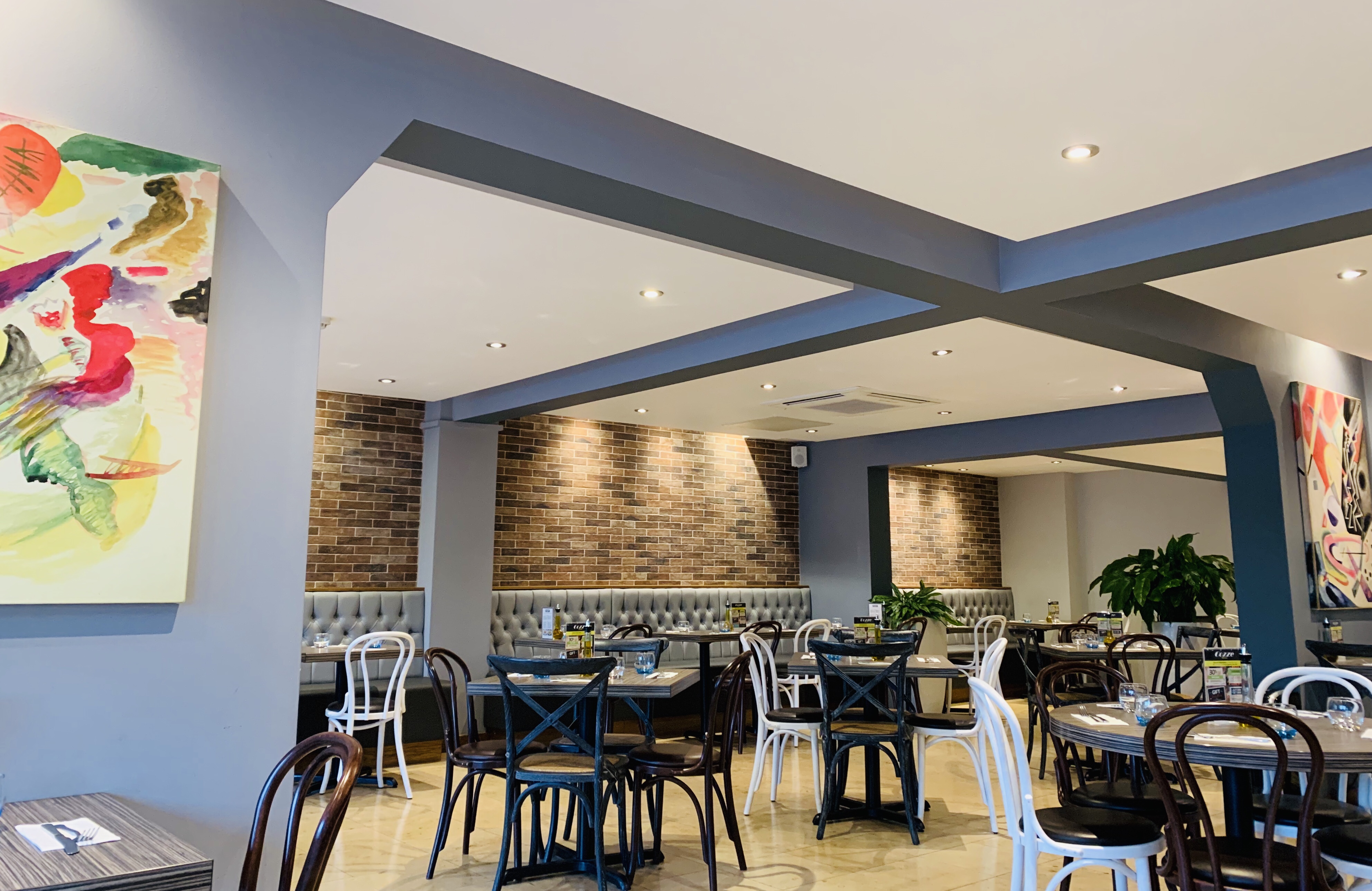
The sad thing is that the room itself is quite nice – a big airy space with nice furniture and vaguely Kandinsky-esque paintings on the wall. And the staff were lovely – really bright and friendly as they brought middling plate after middling plate to our table. We were the only people there when we arrived, although by the end three other tables were occupied. One big group appeared to be regulars, which makes me wonder if they’ve ever considered trying other restaurants. They might like them.

Zoë thinks I am being a little grumpy, and to be fair she ordered better than I did. But her stuffed mushrooms, laid out as if by a serial killer, might have been pleasant enough but I wasn’t sure they were elevated from anything you could pick up and do yourself in M&S. The ones at Papa Gee, in the heart of Caversham, at least have blue cheese in them to give some salt and tang and flavour: no such luck here. The dip seemed to be mayo. Who dips stuffed mushrooms in mayo? Why not just stick a bottle of salad cream on the table and have done with it?

God, and the desserts. White chocolate covered profiteroles filled with Prosecco and raspberry ice cream sounded like they might at least be interesting, but turned out to be one of the ickiest things I’ve had in a long time. They were filled not with ice cream but with cream that tasted of nothing much. The white chocolate was sickly enough, but the Barbie-pink raspberry gloop on top, and the scoop of raspberry ripple ice cream in which almost no raspberry was evident, completed the spectacle. Again, Zoë’s dessert, a honeycomb cheesecake, was a little better but still every other ingredient was shouted down by sugar.

I’d had my doubts about Cozze before going, which mainly came down to looking at the menu several times over the years. Part of that came from my suspicion that they’d taken a kitchen sink approach – would an Italian restaurant really offer chicken wings, moules frites, baby back ribs and peri-peri chicken? Would they really do four different burgers, accompanied by the wording all our burgers some (sic) with fries and are fully cooked? I mean, I know what they were trying to say, but even so.

But more than that, my real problem with the menu was just how many things on it were also on the menu at Prezzo (ironically Cozze has seen Prezzo off in Woodley: that branch has now closed). If you’re a chain, why set yourself up to be a rival to a place like Prezzo? Should that be the place you set your sights on? Again, it says you’re interested in making money, but not particularly interested in food. But if anything, Prezzo’s menu reflects some recentish food trends – there’s burrata, there’s ‘nduja and so on. Cozze’s menu, with none of that to be seen, feels like an Italian chain menu from about ten years ago.

My main was better, although it still wasn’t anywhere near the best pizza in Reading. It had goats cheese (not enough), leeks, four bits of semi-dried tomatoes and three bits of artichoke. Like most of the other things at Cozze it wasn’t actively unpleasant, just objectionably unexceptional. I drizzled some chilli oil over it to try and make it taste of something. The chilli oil appeared to have very little chilli in it – crap as a condiment, perfect as an analogy.

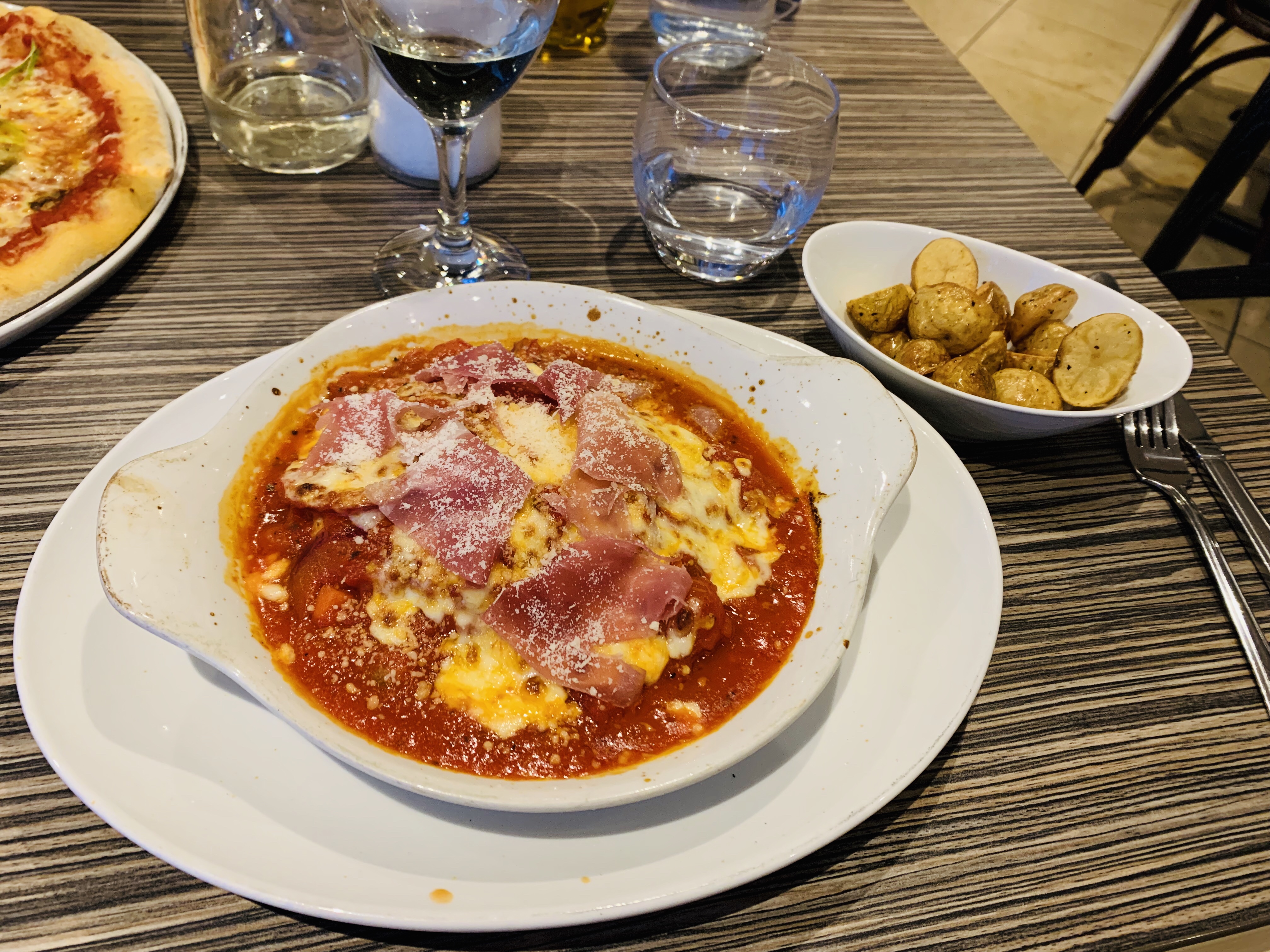
For completeness’ sake, before you or I drop off, I should also tell you about Zoë’s main course which was pollo prosciutto with pomodoro sauce and baby roast potatoes. Pepe Sale does a beautiful pollo prosciutto – a fillet wrapped in Parma ham and stuffed with cheese which you have with seasonal vegetables. It’s perfect: a few ingredients treated simply and with respect. For some reason, they choose not to drown it in chopped tomatoes and serve it in a bowl hotter than the sun like some kind of glorified ready meal. For some reason, Cozze does choose to do exactly that.

I had a mouthful and wasn’t clamouring for more. My advice, if you ever accidentally order this dish, is to eat it doing your very best to pretend you’re instead eating at Pepe Sale. But if your imagination is that good, you could probably enjoy eating pretty much anything. I used to have a brother in law with nasal polyps so bad he couldn’t taste anything: he’d probably quite like Cozze.

Don’t worry. We’re nearly there and our suffering is almost at an end. It just remains for me to tell you that we shared a five hundred millilitre carafe of Italian Sauvignon blanc which was slightly sweet and perfectly decent and that our meal came to fifty-six pounds, not including tip. That includes a discount because Cozze usually has offers through their website, so if you’re considering eating at Cozze you should definitely make use of them. Although if you’re considering eating at Cozze at this moment, I’ve probably failed as a restaurant reviewer.

You might feel that they caught me on a bad day. You might feel they’re unfortunate to be reviewed the week after I’ve written about eating in Bologna, having truly phenomenal pizza, pasta and gelato. And it’s not that Cozze is bad, to be fair. Nobody died, I wasn’t poisoned, nothing they do is inedible.

It’s just that if Cozze is that answer then “where can we go for dinner that nobody could possibly have any strong opinions about whatsoever?” is the question. The poverty of ambition is the thing I find a terrible shame. Although maybe that’s not fair either: Cozze aspires to mediocrity and, in that respect at least, it has to be considered a towering success. There are worse places to eat, of course. But there will always, easily, be somewhere far, far better.

Cozze – 6.3
93-97 Caversham Road, RG1 8AN
0118 9591459

https://www.cozzerestaurants.co.uk/

Global Café Kitchen

N.B. RISC announced in June 2021 that the Global Café Kitchen would remain closed until 2022 and that when it reopened it would be run by RISC, so this review is defunct. I’ve left it up for posterity.

Reading’s vegetarians and vegans have never been served terribly well. Back in the day there was Café Iguana, which I still miss (my order was usually a Roma toasted sandwich and their delicious, if whiffy, garlic and herb fries). It was scuzzy but lovable, the service was haphazard and the whole thing was distinctly, well, nineties, but I was very sad when it closed. For a long time after that, the only destination for vegetarians was the brilliant and unsung Bhel Puri House, and plenty of people didn’t even know it existed.

It’s only in the last couple of years that things have started to shift. We’ve seen restaurants raise their game: now there are many places with credible meat-free (or plant-based, or whatever you want to call it this month) options. So now we have Pho where most of the menu can be made vegetarian or vegan, Clay’s Hyderabadi Kitchen which has an excellent vegan selection, and Honest which first introduced an excellent vegetarian fritter and then added a trailblazing vegan burger. I keep meaning to do a round-up of the best places for vegetarians in Reading – another gap in the market – and the main thing that delays it is the growing plethora of options.

In parallel, Reading saw two completely meat-free venues open this year. The first, Miami Burger, offered a vegan take on American fast food and closed its doors last week shortly after announcing a deal to sell its products in Morrisons. A cynic could almost believe that the restaurant was always just a shop window to land that kind of contract (a conspiracy theory hardly helped by Miami Burger rewriting history to describe the Reading restaurant as a “test kitchen”).

Either way I never visited Miami Burger – known to some as “Brexit Burger” because of the political views of its owner, a man who left the Tories for UKIP and once pondered on his blog whether the unemployed should have their votes taken away – and I’m not convinced I’ve missed much. Besides, for five pounds you can get one of Bhel Puri’s amazing vada pav, and that’s more than enough veggie burger for me.

The second meat-free restaurant is a more interesting proposition. Global Café for many years was home to Tutu’s Ethiopian Kitchen, a much-celebrated Reading establishment which left me baffled when I visited it on duty many years ago. Tutu left this year to take over a site in Palmer Park which used to belong to the Chalkboard Café, and as a result Global Café has taken on a new chef and is offering a regularly changing vegetarian and vegan menu under the moniker Global Café Kitchen.

I was having a drink at Global Café with my mother and my stepfather the fateful night we went to review Lemoni, and looking at their menu I was very tempted to change our plans and eat there instead. It was small (four or five main courses and a couple of starters) and reasonably priced (mains were around a tenner). But most crucially, it all looked worth eating: from a tempura mushroom burger to a vegetarian rendang, from Sri Lankan dahl to a halloumi and tabbouleh salad, I could happily have ordered practically anything on the menu. I wasn’t alone, either; my mother in particular would much rather have eaten at Global Café than Lemoni, so much so that we agreed to come back the following week and give it a whirl, with my stepfather in tow.

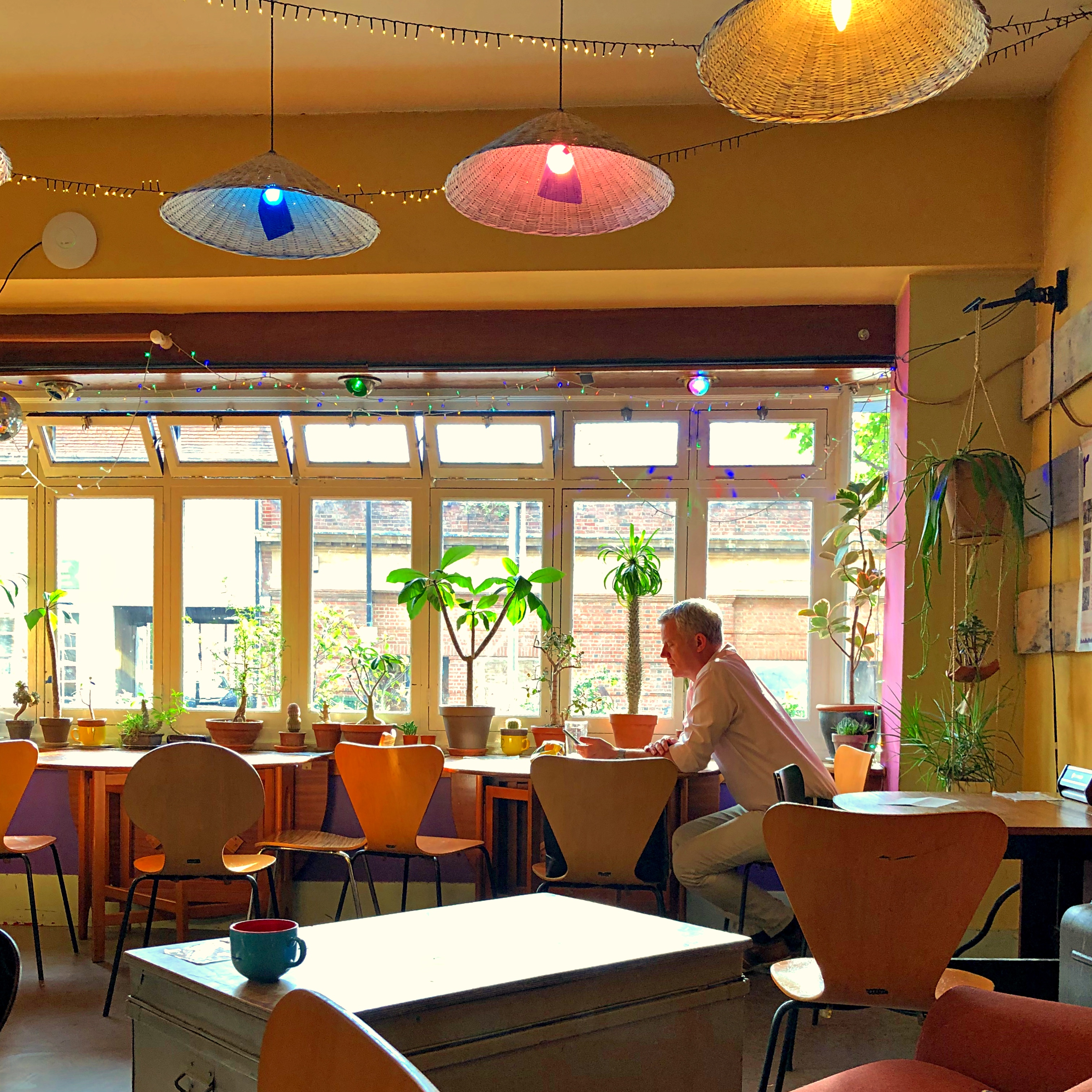
The Global Café hasn’t changed in many years, and I suspect you either think it’s one of the last great Reading institutions or an anachronism you haven’t felt the need to visit for a very long time. I veer more towards the former – even though it’s a tad on the scruffy side I’ve always had a soft spot for it. The area at the front, near the bar, gets lots of light from the lovely big windows and if all the tables and chairs don’t match and don’t seem to be designed for eating at or drinking at, it doesn’t necessarily matter. Nor does it matter that there’s a sofa randomly plonked there, with a big metal trunk serving as a table. It’s Global Café: that’s just how it is.

My stepfather found the long trip downstairs to the loos genuinely alarming (“it smells of damp down there”) and was a bit baffled by the different-coloured lights in the wicker lightshades (“you’d think they’d be LED bulbs, wouldn’t you?”) but I wouldn’t describe him as the target market for this kind of place. He was more impressed with the selection of local beers, as was I, but because it was a school night the three of us opted for an alcohol-free Erdinger Blue apiece while we decided what to order. It’s my top tip for anyone who likes the taste of beer and wants to cut down on their alcohol intake – and it cost less than £3 a bottle, considerably cheaper than the crazy prices charged at some of Reading’s pubs.

There were only a handful of starters, but all the mains from our previous visit were still on the menu, along with a couple of specials – a spiced potato and cheese “Bombay burger” and what was described as a “Banana Blossom burger”.

“What’s the banana blossom burger?” I asked the dreadlocked chap behind the bar (no table service, so that’s where you place your order).

“It’s not made from banana, it’s another part of the banana tree. It sort of has the same texture as chicken.”

“Sounds interesting.”

“They’re changing the menu all the time. I’m not even a vegetarian, but I really like the food here.”

“How long have you been running the new menu?”

“About three months, we’re still getting used to it really.”

I wasn’t sure whether this exchange inspired confidence or eroded it – but I liked his honesty and I liked the sound of the banana blossom burger, so I changed my mind about what to eat and ordered it instead.

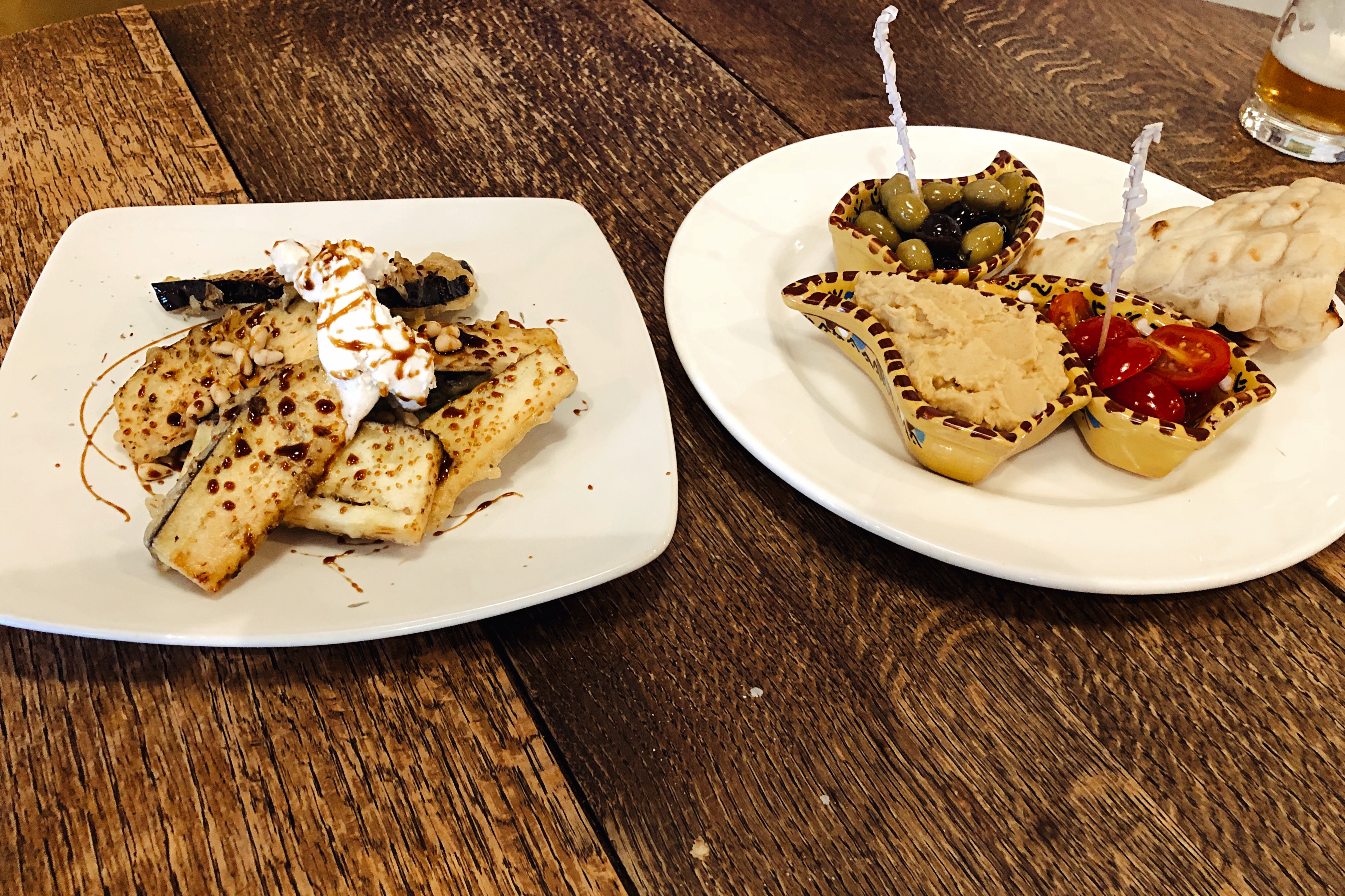
Our starters arrived reasonably quickly, brought I think by the chef. The menu had three, one of which was soup, so we ordered the other two planning to share them. The best of them was the crispy fried aubergine, cooked with a beautifully light touch and free of all the stodge and mulch I associate with aubergine done badly.

This stuff was better than versions I’ve had of the same dish, berenjanas con miel, in Andalusia and the little tweaks to make the dish vegan only added to the appeal: vegan labneh had a very pleasing touch of coconut, and the miel de cana (vegan honey) was hard to distinguish from any other kind of honey. We all ever so politely made sure we had our fair share before nicely bargaining over the final piece. A really good dish, although at six pounds it felt like it should have been a bigger portion. “I could have eaten one of those on my own” said my mother, echoing my feelings. Still, I guess that’s what happens when you share two starters between three: if you go, order your own.

The other starter was a very different kettle of quinoa. Flatbread with marinated tomatoes, olives and dip sounds like just the thing to graze on while you wait for your food to arrive, but this was a lukewarm warm-up act. The tomatoes – cherry tomatoes halved – were pleasant enough, and the olives, small and pitted, were the kind of thing you could get in any supermarket.

The houmous, though, was worse than anything you could get in a supermarket – I’ve no doubt they made it themselves, but it had no lightness, no evidence of olive oil or garlic or tahini. Calling it a dip was optimistic because it didn’t have the texture for dipping: you’d have had more luck using it to cement a wall. We did our best to scoop it on to the heavy, unremarkable flatbread.

This rogue’s gallery came to four pounds – for the same money you could have a much bigger bowl of the best houmous in Reading just up the road at Bakery House, and they’d throw in piping hot, fresh-from-the-oven pitta bread into the bargain. It felt like the restaurant had bought those little, weird-shaped dishes, and then struggled to decide what to serve in them. The answer, I think, is Not this.

The themes of the starters – glimmers of talent, inconsistency and slightly sharp pricing – followed through to the main courses (which arrived pretty quickly), although these were generally far better. My mother’s choice, the parippu – Sri Lankan dahl – was earthy and creamy with a nicely gradual heat. Her verdict was that it was “a bit monotonous” – although I suspect that, texturally at least, that’s always the way with dahl. The toasted coconut on top helped, but it needed something like toasted seeds for texture and what it really needed was plenty of fresh coriander. The rice was somewhat clumpy – brown rice might have been better – and the flatbread wasn’t required: there wasn’t enough of the dish to be able to use it. If that all sounds like faint praise, it shouldn’t entirely – I enjoyed it, but even at eight pounds it felt like it could have been a little bigger and better.

My stepfather had chosen the rendang – in this case a chickpea curry with aubergines and courgettes. I’m used to rendang being made with long-cooked, sticky strands of beef and having an intensely savoury taste. This dish didn’t have any of that, feeling more like a massaman or a Thai curry with as much sweetness as heat, if not more. Again, I liked it, and again I felt that it was a little keenly priced: eleven pounds for this one. My stepfather seemed to enjoy it, too, and polished it off in short order.

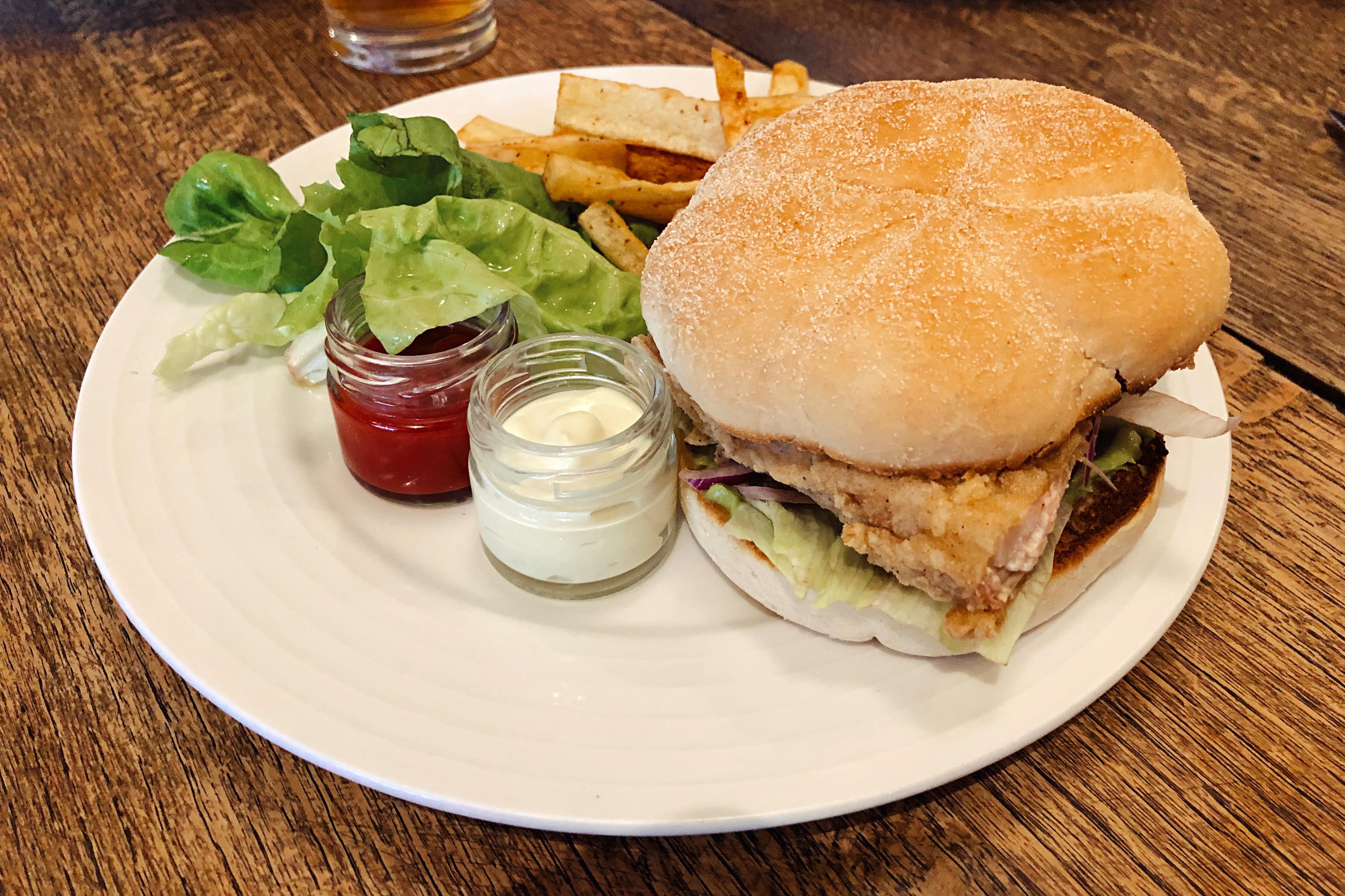
This brings us to the appropriately alliterative banana blossom burger, which I’m delighted to say was an eye opener. It didn’t have the texture of chicken, after all that: it reminded me more of artichoke hearts, and you got a couple of pieces rather than a single patty. But the coating around the banana blossom was very good – salty and savoury, reminiscent of shame-free KFC. The bun was strong enough to stand up to everything in it (so unlike, say, Honest’s buns which always seem to go soggy at the bottom) and the ripe avocado and mango mayo in it finished it off nicely.

This was a revelation to me, and I hope Global Café Kitchen moves it off the specials menu so more people can try it. A chap at the table next to me ordered it and when it arrived at his table I butted in to enthuse to him about how much I’d liked it. “It’s a bit like KFC!” I said, to which he mournfully replied “I’ve never had KFC” (I asked him his verdict as we were leaving: he thought it was too salty, so Christ knows what the poor guy would actually make of KFC).

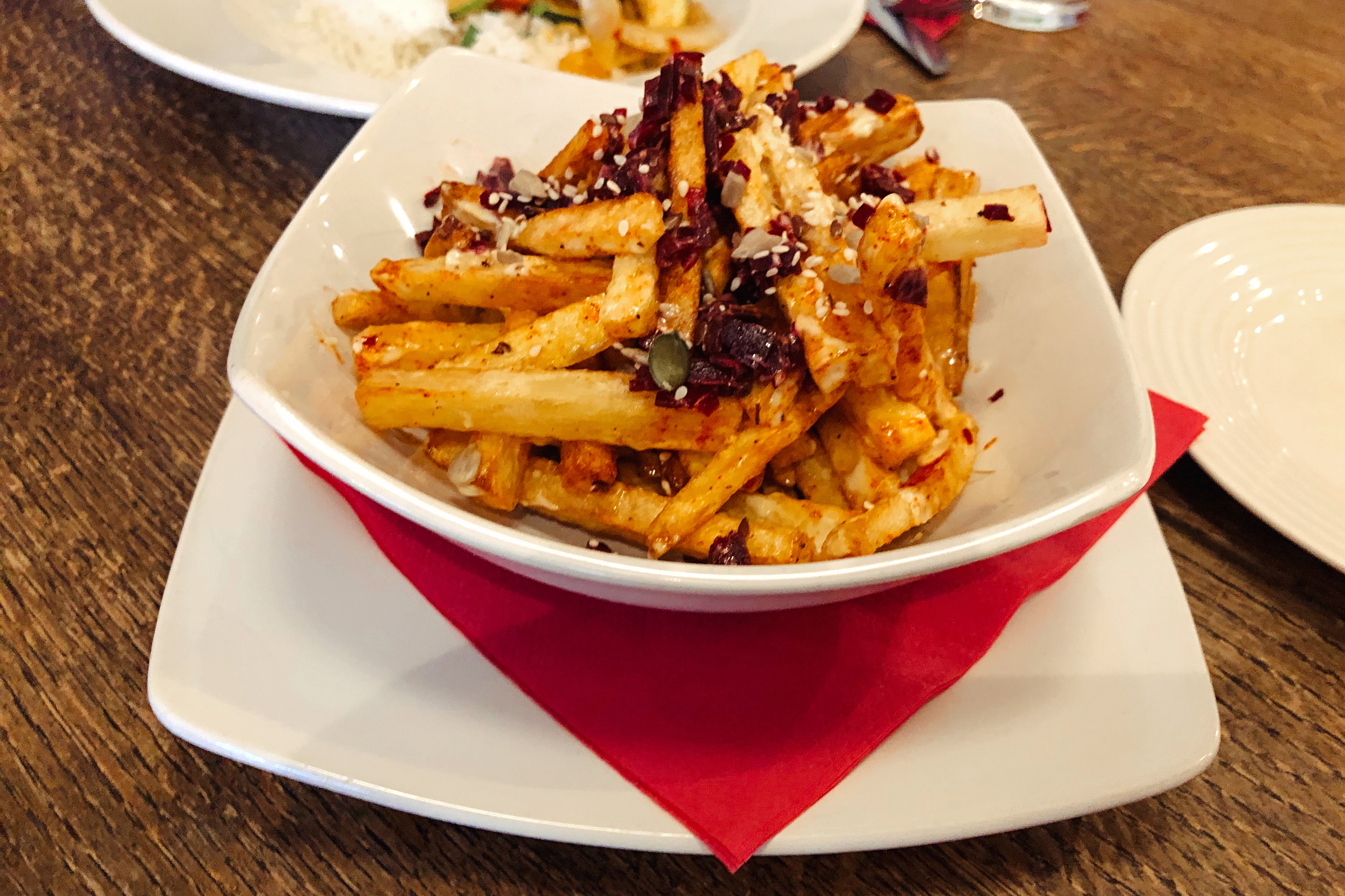
Also, I really liked Global Café Kitchen’s fries – clearly hand-cut and prepared on the premises – and the sweet tomato sauce and (presumably) vegan mayo they came with were both tasty, too. My stepfather had some “dirty fries” although it wasn’t clear what made them so sinful or indulgent: the “beetroot aioli” mainly seemed to be finely diced beetroot and the sesame seeds felt a bit unnecessary. They were still very good, though, because their fries are very good.

There isn’t much more to say about Global Café Kitchen than that – there was no dessert section, and we’d been fed so quickly and efficiently that there was nothing more to do but to head out. Our whole meal – two starters, three mains, those extra fries and three beers – came to almost bang on fifty pounds, not including service.

Service was really friendly and likeable but had a general air that they were still getting the hang of things. We had to ask for side plates, for instance, and the speed with which our mains came out gave the impression that the restaurant didn’t have masses of customers, so was used to just cooking things and getting them out of the door almost straight away. Three months should be long enough to get those teething troubles under control but, much like everything else about Global Café, I was prepared to overlook some of the less polished aspects.

Reviews like this are the hardest to conclude. A hatchet job writes itself, a rave review also builds to a natural, logical crescendo, a rallying cry of sorts. It’s far more difficult to write the sort of nuanced summary that makes half your readers think the mark at the end is far too harsh and the other half believe that you’ve let a restaurant off the hook. All the same, here goes: much of what I ate at Global Café Kitchen wasn’t perfect, and much of what I liked felt too small or too expensive (or ever so slightly beige) but in terms of imagination and range there is still plenty to celebrate.

They offer a genuine vegan menu (nearly all the dishes are vegan, and they say the rest can be made vegan on request) which offers a wide range of dishes, tries different meat substitutes rather than just doling out the same old tofu and – most crucially – offers real and interesting choices. I could have ordered any of the main courses we tried that night, and a couple we didn’t, without feeling like I was missing meat at all. There’s a lot to be said for that – whether you’re vegetarian or vegan, or know somebody who is that you’d actually like to have dinner with once in a while. Or, for that matter, if you’d just like to do your bit to eat more sensibly and help the planet from time to time. That you can do so without donning a hair shirt is quite an achievement, even if in 2019 it shouldn’t feel that way.

I never made it to Miami Burger – deliberately, I’m afraid – but the one thing I heard about it from my vegan followers was how nice it was just to have somewhere where they could order everything on the menu. Those people should make their way to Global Café and support a kitchen that may not be doing everything right quite yet but definitely has the right idea. And the rest of us? We should consider following suit from time to time, and supporting a Reading institution – one which, it seems to me, has picked up the torch from Café Iguana and is doing its best to carry it forward into an uncertain future.

Global Café Kitchen – 6.9
35-39 London Street, RG1 4PS
0118 9583555

https://www.risc.org.uk/global-cafe/global-cafe-kitchen