There’s an exhibition on at the Willis Museum in Basingstoke called I Grew Up 90s, and speaking as someone who tried and failed to grow up back then I felt I had to go and experience it, even if it was tantamount to enthusiastically massaging salt into the gaping wound of my middle age.
I never thought I would see the day when the Nineties came back into fashion, in much the same way no doubt that my parents rolled their eyes when kids decided to revive the Sixties. It had an air of ‘kill me now’ about it, as far as I was concerned. I can’t believe you like all that crap from back then people like me could reasonably say, although I now realise – with the perspective of thirty years’ distance – that what we really mean is Jesus, I am so old.
The Willis Museum is housed in the former town hall, an attractive building at the top of a gentle hill in the older part of Basingstoke, past the purgatory of Festival Place. On the way there a strip of street food stalls was doing a brisk trade – a sizeable queue outside the Thai stall suggested, as did the aromas, that it was decent – and in the market place outside voluble traders were flogging veg from trestle tables. The graceful early Victorian architecture was impressively incongruous, I thought, as I passed between the pillars of the entrance, ready to do some time travel.
Inside, the placard on the wall made an interesting case for the decade, depicting it as a strange bubble of time that history had forgotten. And I think there’s truth in that. It was a strangely innocent time, after the fall of the Berlin Wall, the Gulf War and the release of Nelson Mandela but before 9/11 and the credit crunch. In the Eighties we were scared of the bomb, or AIDS, but in the Nineties we weren’t scared of anything. We were lucky, but of course we didn’t know that.
The exhibition aimed to remind visitors of the Nineties through over 200 objects and artworks. It was the decade of Girl Power and Cool Britannia, the introductory blurb said. On the Internet we asked Jeeves, and on the streets we paged each other (incidentally, my favourite Easter egg of the time was that if you asked Jeeves “are you gay?” he always produced the result “I prefer the word jovial“: and to think people reckon they’re so original nowadays asking Siri to tell them a joke).
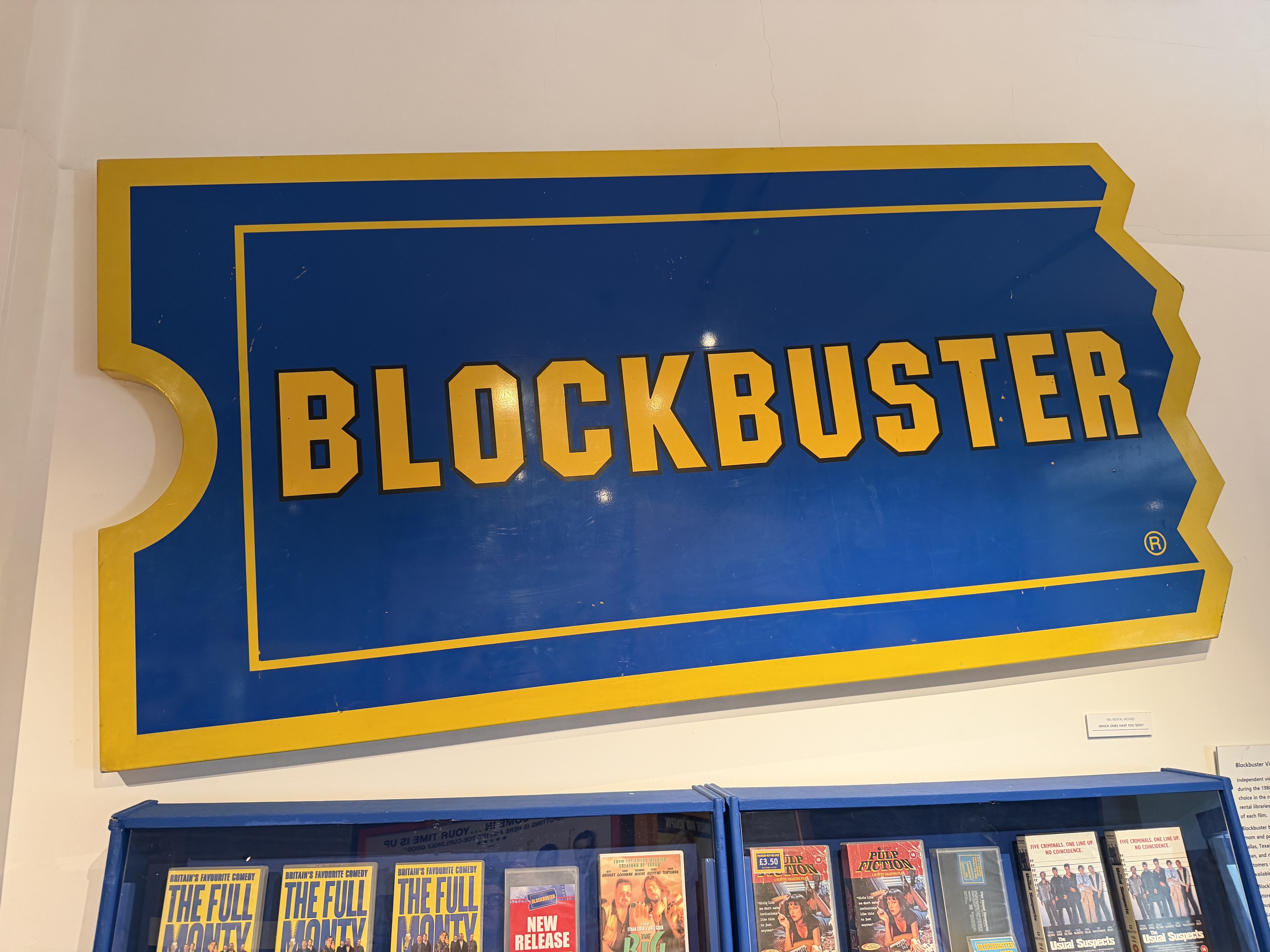
There were no smartphones, social media or reality TV to distract us, but we might occasionally have returned a tape late to Blockbusters, concluded the introduction. And wandering round it, feeling simultaneously old, young, comforted and sad I noticed they did have a huge Blockbuster logo on one wall, and a cabinet full of VHS tapes: Notting Hill; Ace Ventura; True Lies; Basic Instinct.
An HMV carrier bag was framed on another wall. “God, the number of those I must have handled” said Zoë, who worked there when the Nineties were already almost a decade in the rear view mirror, the shop still flogging CDs ahead of the death rattle caused by iPods, iPhones and streaming. I wondered how many times I’d come home from the Oracle on New Release Monday with one of those.
Other cabinets were full of reminders of other aspects of that forgotten age, trying hard to present it as halcyon. The Cadbury’s Spira bar – which I still miss, I don’t mind telling you – and a tub of Gino Ginelli ice cream. A giant foam finger from the original series of Gladiators. Cartman, Beavis and Butt-Head, arguably the most puerile firm of solicitors there never was. Purple Ronnie and the very first Nokias and Motorolas, a loaf of Mighty White and a recipe book for Chicken Tonight. The posters for Four Weddings, Reservoir Dogs and Trainspotting. A can of Tab Clear (“trial offer 23p”), a bottle of Two Dogs and a Hooch branded glass.
You could even buy a Tamagotchi from the gift shop, which reminded me that once in the Nineties, when my brother went to some insurance conference in Manchester overnight, he asked me to take care of his Tamagotchi which, of course, promptly died. I’m not sure what the electronic equivalent of getting another almost identical one from the pet shop was, but I remember fessing up to him in the Flier & Firkin – which is what the Oakford is now – and him taking it much more personally than I expected.
Standing there in the gift shop, seeing the packaging for ‘the original virtual reality pet’ I took a photo and sent it to him, knowing that even on the other side of the world in New South Wales, his Saturday night drawing to an end, he was one of the only people I knew who would understand what I was experiencing. Sorry again that I killed your Tamagotchi my message said. You’re forgiven came the response, hours later when I was fast asleep.
All that nostalgia left me badly needing to eat my feelings, and Zoë and I had plans for a late lunch at Mono Pizza, the Basingstoke restaurant highest on my radar. Now, at this point I need to apologise if you’re a reader living in Basingstoke, but my research on where to eat there resulted in fairly slim pickings. There’s taco spot El Bigote, which looks like it’s al fresco only, there’s Nigerian restaurant Afrizi, which I hear is rather good, and there’s Mono.
Beyond that, I didn’t find evidence of a burgeoning food culture in Basingstoke. I suspect Festival Place’s best days may be behind it, and the imminent closure of its Apple Store would suggest as much, but the presence of the likes of ASK Italian, Pizza Hut and Wimpy suggests that even Reading has it good compared to some places. By all means correct me if I’m wrong, because I really do love an underdog.
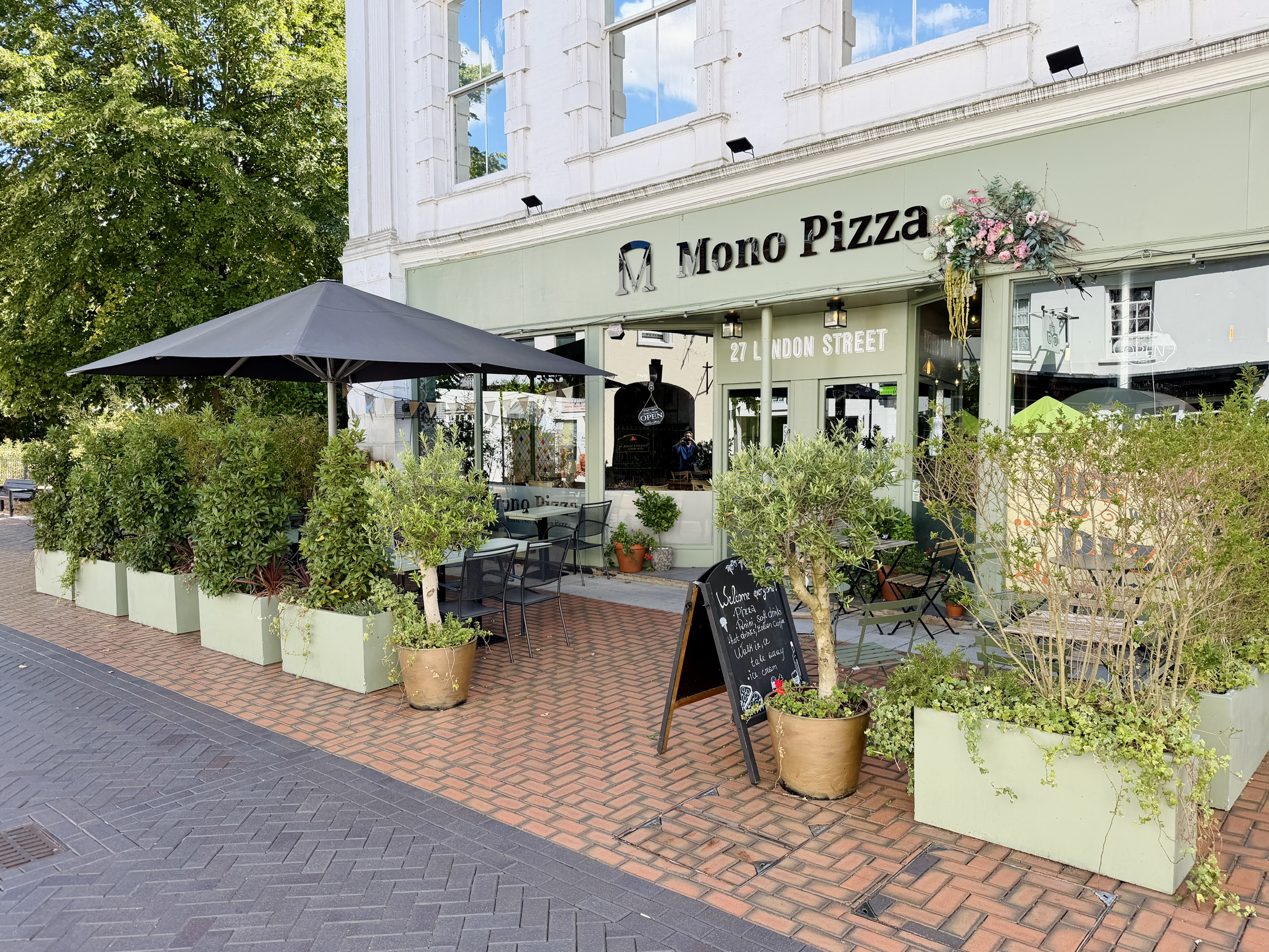
Anyway, Mono was the spot that jumped out at me. Run by married couple Timofei and Veronica Dragan, Mono took the tried and tested route to where it is now: starting out as a pizza van in late 2023, then parking up at a permanent pitch at Festival Place the following spring. And then, almost exactly two years later at the beginning of March, Mono moved to a permanent site just round the corner from the Willis Museum, taking over the ground floor of a handsome building in a spot that used to be a bar.
Plaudits followed when Mono – still a van at this stage – won Best Pizzeria last summer at something called Slice-o-Mania. Now, you can be sniffy about an event of that kind and say that it’s largely attended by people who think pizza is a separate food group, and you might have some justification for thinking that. But the fact remains that a huge amount of big names in the U.K. were there, and for an unsung food van from Hampshire, after trading for less than two years, to win big in that company is a truly impressive result.
And all of my research suggested that Mono was an interesting proposition: that Dragan was from Naples, that he sourced all of his ingredients obsessively from Italy, all the things you’d really want to hear about this kind of establishment. I like a pizza as much as the next normal person, and the bottom has rather fallen out of Reading’s pizza scene since Sarv’s Slice left, Amò closed and reopened and Dough Bros changed hands, so as I approached Mono’s tasteful, sage green edifice I found myself rather hoping for the best.
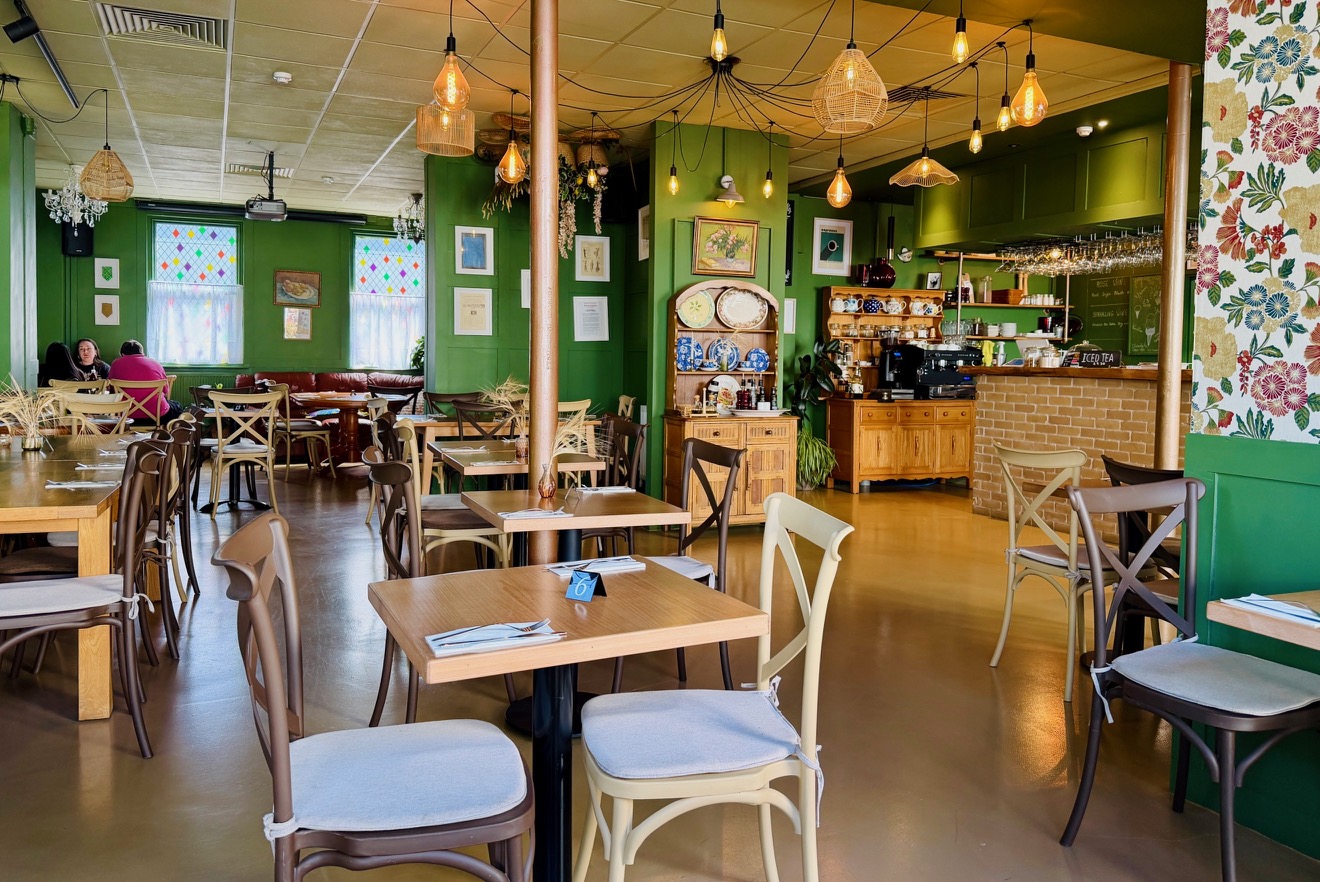
The interior was really rather nice. Big, in a they-might-have-bitten-off-more-than-they-can-chew sort of a way, but nice nonetheless. It was all green walls and well-proportioned tables, with one panel of fake greenery and a few slightly random Welsh dressers dotted around the place. It worried me slightly how quiet it was, though: we were there admittedly after the lunchtime rush had passed, but apart from one table outside and a few occupied within it was almost empty. Maybe everyone was in the queue for Thai street food, or lost in the time machine just down the street.
Over an Aperol Spritz – not bad, perhaps slightly watery – we had a good squizz at the menu. It is, and this is a good thing, very stripped down, not like some pizza menus that go overboard on filler. One antipasti option, three panini, ten pizzas and nothing else: if you don’t fancy that, go elsewhere. And the pizza options were also very restrained – no wacky combinations and not even the anchovy, caper and olive combo that’s inevitably my first choice. There was a simplicity to it: pizza by a purist, for purists.
We began with the only starter on offer, the selection of antipasti to share. In a way, this is just a deconstruction of all the things you might see chucked on a base and scorched in the oven. But it’s a good fishing expedition if you want to get a picture of what a pizzeria’s raw materials are like: it proved to be very illuminating as far as Mono was concerned.
When you consider that this was £15.50 for two, it was ridiculously generous and enormously likeable. The Parma ham, with that slight sheen of the incarcerated in plastic, was pleasant but unmemorable. But everything else was better than it looked, better than I expected. A very good prosciutto cotto was miles better, really good quality and very tasty indeed. And the spicy salami, about which I had my reservations, was knockout stuff: coarse, not at all suspect and with an enormous chilli kick. Quite marvellous.
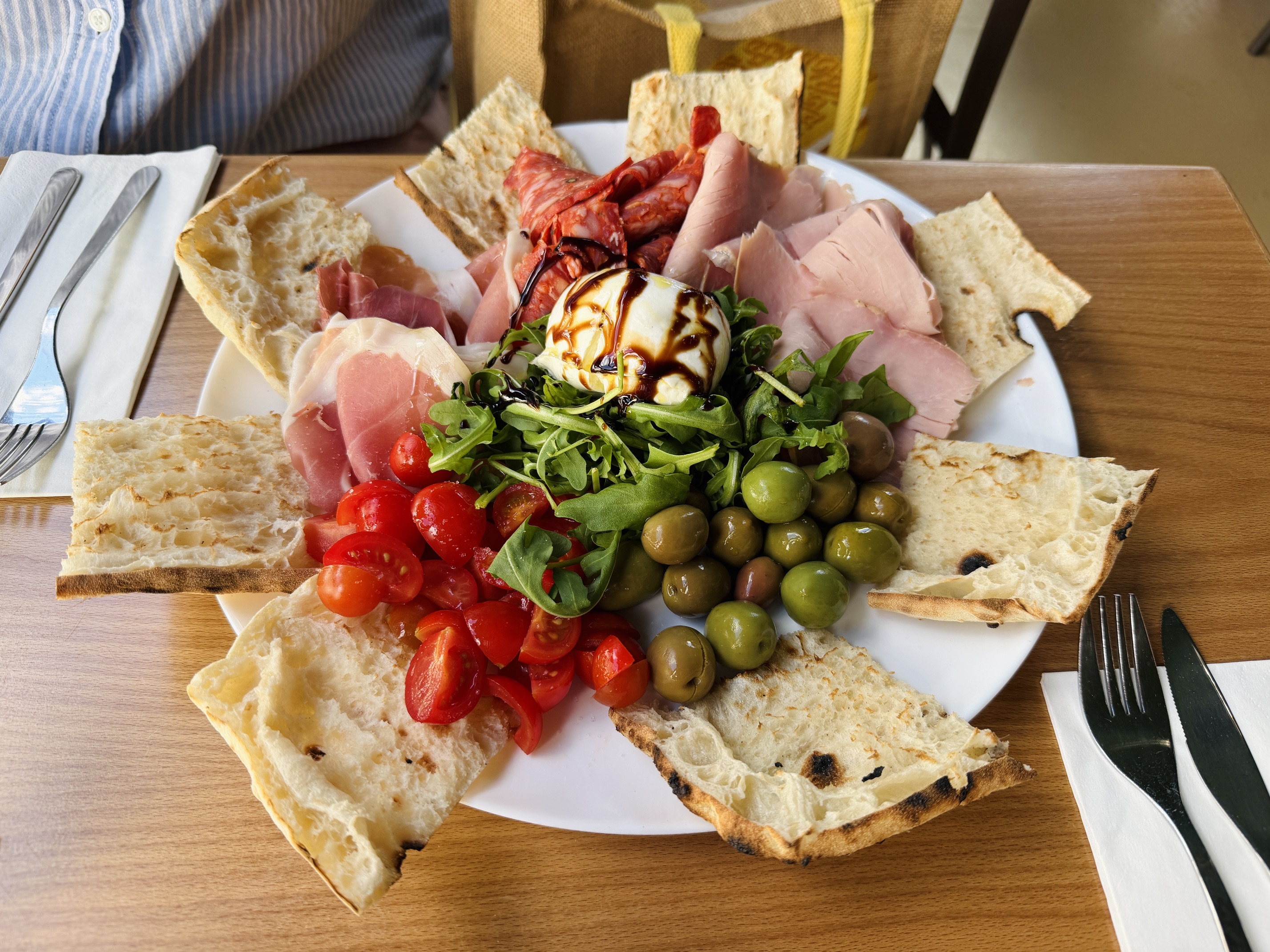
That’s before we get to the olives, which were good but not great, or the cherry tomatoes, sweet and bursting with contrast. Or the mozzarella. Hats off to Mono for not just wheeling out the ubiquitous burrata. I think I’ve always preferred mozzarella to burrata and I’m prepared to wait as long as it takes – it could be longer than a decade, the way things are going – for public opinion to catch up with me. But in many ways, the real bellwether was the bread – little squares of the stuff, like scraps of panino. They were light, airy, salty, just the ticket with any combination of the rest of the dish. In short, they boded well.
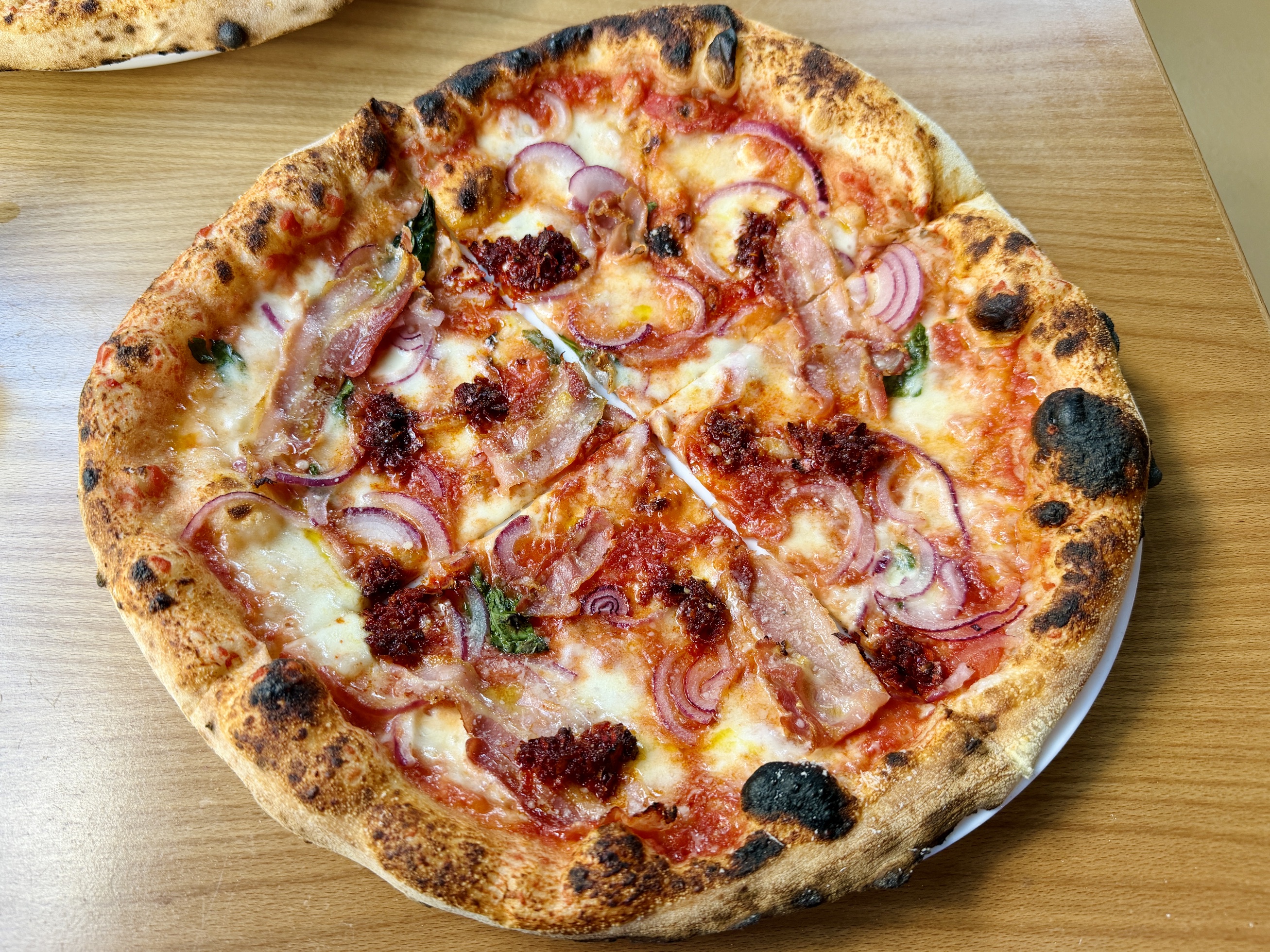
When my pizza, the ‘Pizza Rebby’, came out twenty minutes later it built on the potential of all that had gone before and synthesised it into a magical whole. That base was the final boss of dough, its evolutionary pinnacle, so light and well-done, so judiciously bubbled and blackened. I have got quite tired of the prevalence on social media of New York pizza, or New Haven pizza, or whatever “tavern style pizza” is, or London pizza. I’ve got tired of seeing mockneys on Instagram jabbering about how great it is. This. This is what good pizza looks like.
And the other cleverness of Mono is not just to have a small menu but not to do too much with any of those pizzas. This was not overloaded: potent clusters of punchy ‘nduja, translucent strips of pancetta gleaming away, ambrosial slivers of red onion, a surprisingly effective smattering of torn basil.
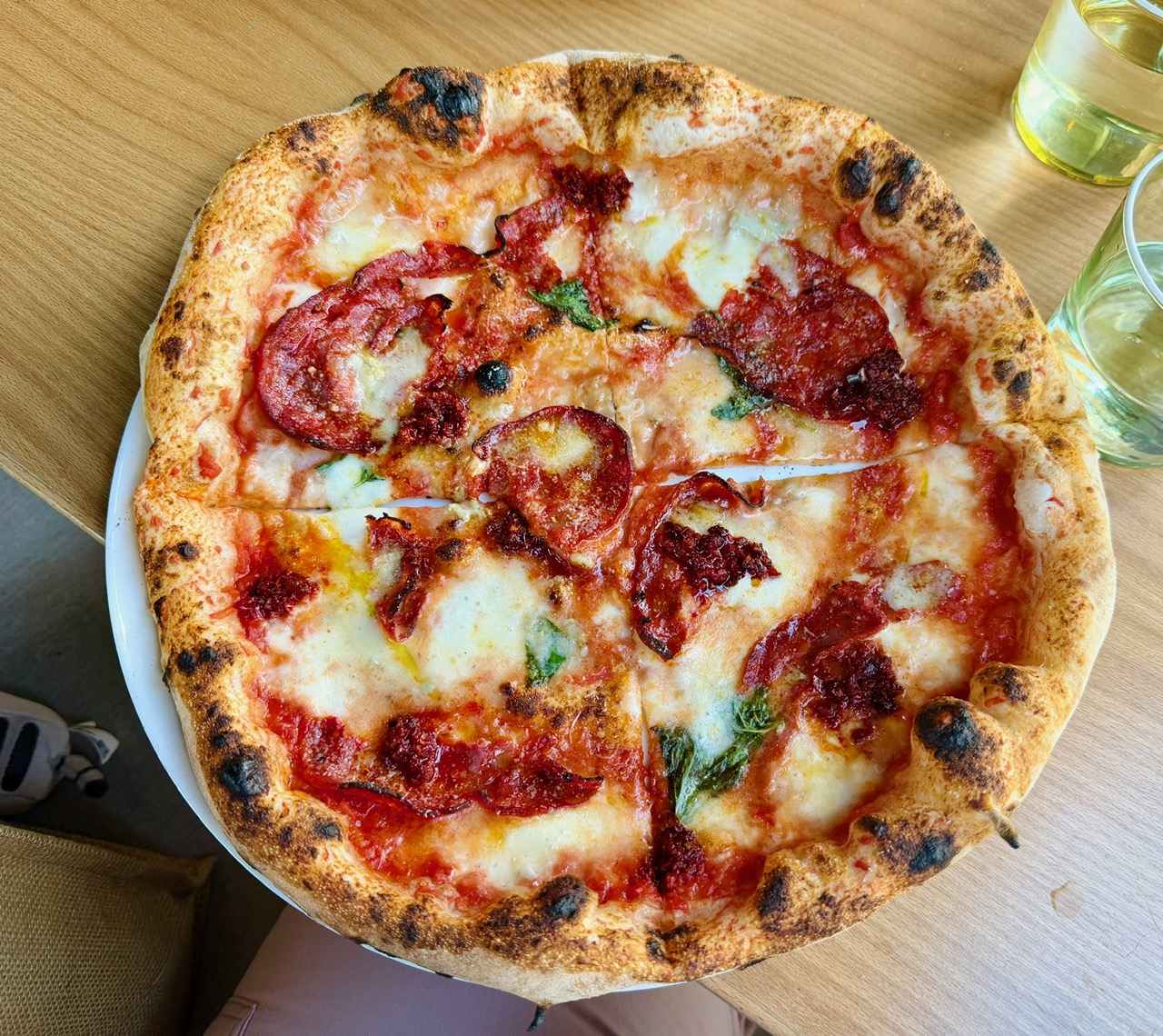
Zoë had chosen another classic, the Diavola, a variation on that theme with the spicy salami from earlier on taking the place of my pancetta. And, because it’s Zoë and she likes to tinker, she had asked to have gorgonzola added to it (“it’s the ‘Diavola plus'” she said to me, clearly pleased with her ingenuity). I would like to say that she was wrong, that she had offended the simplicity of Mono’s menu. But, because it’s Zoë, it elevated what was already an excellent pizza into a world-beater. The fire of both types of meat would have been enough – and again, you have to love Mono for refusing to touch hot honey with a twelve foot pole – but if it did need anything it was the pungent whack of salt from that blue cheese.
“I could come here every week” said Zoë, and I couldn’t agree more. I wasn’t sure, without that exhibition, that I had any other reason to visit Basingstoke: there’s nothing in the way of independent retail, one indie coffee shop, no craft beer. But you would travel for this.
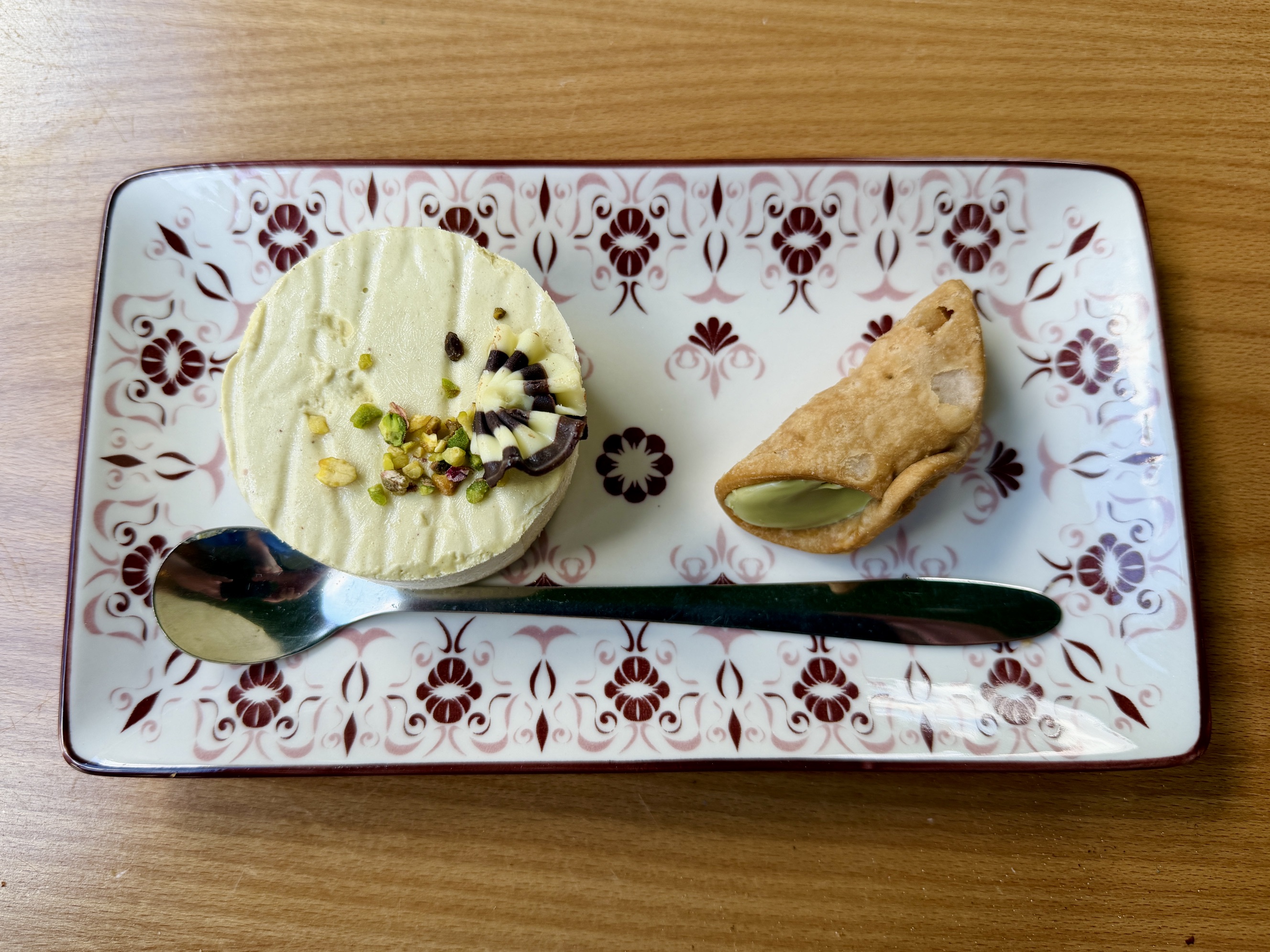
We had to have dessert, and Mono’s menu is so concise that between us we ate everything on it. I’d asked what the “Mono pistachio” was and was told it was like a cross between an ice cream and a mousse. That doesn’t do it justice, and nor does the blurb on the menu that reads like a list of ingredients: pistachio cream with milk, pistachio paste, egg, cream, white chocolate and biscuit notes. So if you go, throw all that in the metaphorical bin and order it anyway.
What it actually is is something closer to a pistachio and white chocolate parfait, with a biscuit base, somehow at the middle of a Venn diagram of ice cream, cheesecake and doubtless many other treats. I adored it: it was delicious at first, rock hard and challenging to eat with the long, slender teaspoon. But as it softened, everything just came together. I had it with a pistachio cannolo which was maybe the least impressive thing I ate that day: the shell a little heavy but the filling miles more complex than my dessert. It was still more than decent. £7 for these two, would you believe.
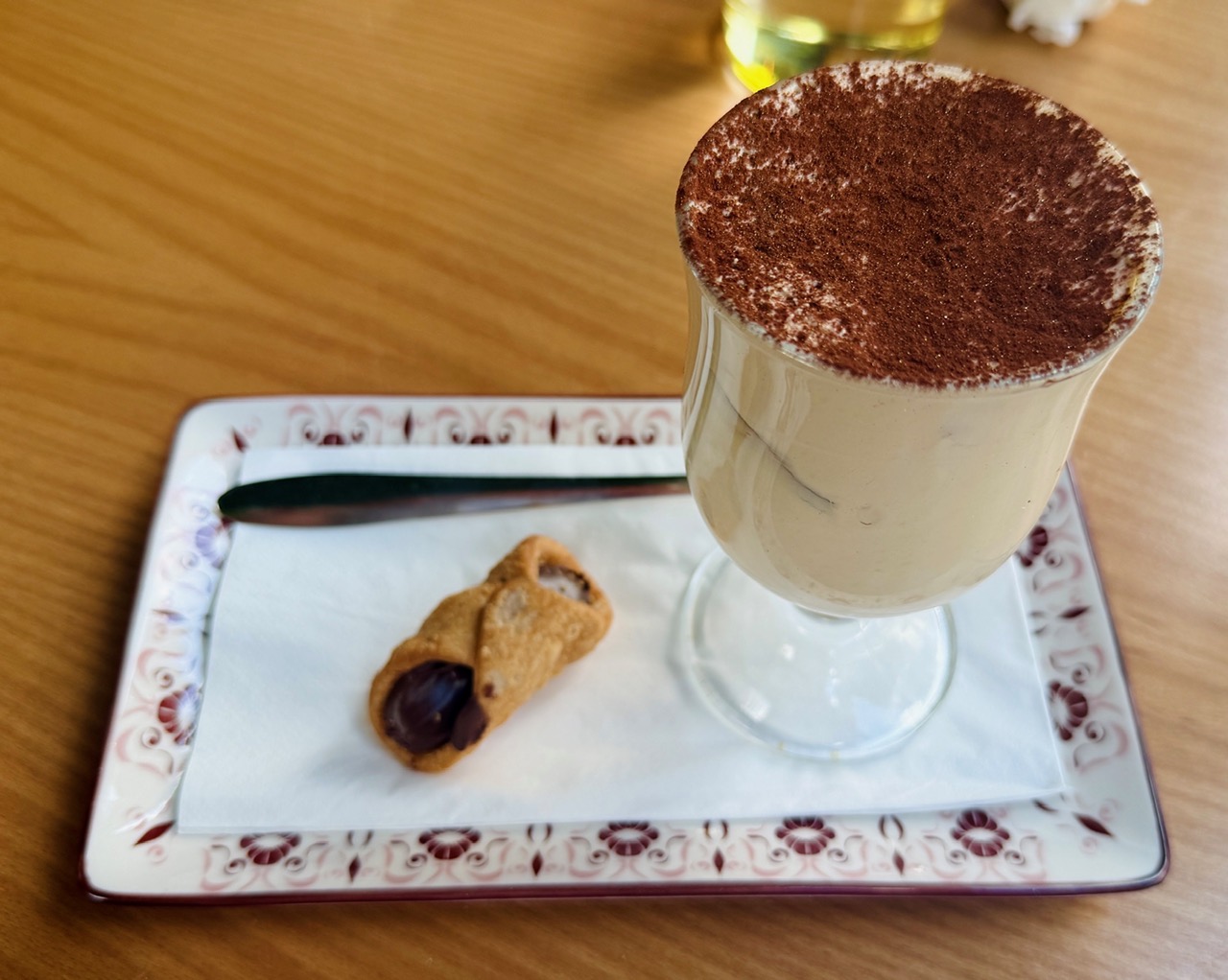
Zoë loved her tiramisu, served grandly in a little chalice. It was relatively delicate, airy and boozy and she made quick work of it. It didn’t quite reach the dizzying heights of the very best – Paesino’s, say, or Ragù’s – but it was very, very close. “Besides, once you’ve had a heavy pizza you want something this light” she added. I’m told the hazelnut cannolo was also thoroughly agreeable.
Although there were few diners when we started our meal, I was reassured to see a regular trickle of people coming in to eat. The couple who had been eating outside when we arrived came in to specifically tell Dragan how much they’d enjoyed their meal, that it was their second visit so far but it wouldn’t be their last.
Our bill came to something like £86 for three courses and a drink apiece, not including service. There might be cheaper options: Mono’s pizzas generally cost between £15 and £20 but believe me, you get what you pay for. And service, from a trio of servers including Dragan, was bright, friendly and really winning. At one point the phone rang and I heard them take a reservation for a large table, and I remember thinking that those people were in for a really terrific evening.
The Internet is full of people who will tell you that every pizza they eat is the Best. Pizza. Ever, or every burger the Best. Burger. Ever. It gets a bit much, it jades you and the biggest cardinal sin of all: it’s so boring. If everything is special then nothing is. So I don’t say this all the time, but here goes: Mono’s pizza is the best I can remember having in this country. Better than Papa Gee, Knead, Paesino, or Amò at its peak. Better than wonderful pizzas I’ve had in Bristol, or at Blue Collar, or from Sarv. It’s really that good.
That’s the funny thing about my visit to Basingstoke, a journey that simultaneously showed me life thirty years ago and gave me a glimpse of my future. Because in the Nineties, my idea of a great pizza was a San Marco from Misselbrook & Weston, the little supermarket nearest to my suburban Woodley home. They were kept in the freezer section, and I could pick one up for something ridiculous like £3, bung it in the oven and think I was eating like a king. If Future Me appeared in a vision to Nineties Me and offered him a single slice of Mono’s Pizza Rebby, I think Nineties Me’s brain might melt.
That’s the thing about the past: it can be a lovely place, but you can’t live there. Besides, the food is way better here in the present.
Mono Pizza – 8.7
27 London St, Basingstoke, RG21 7PG
01256 280093
https://monopizzabasingstoke.co.uk
Since January 2025, Edible Reading is partly supported by subscribers – click here if you want to read more about that, or click below to subscribe. By doing so you enable me to carry on doing what I do, and you also get access to subscriber only content. Whether you’re a subscriber or not, thanks for reading.