
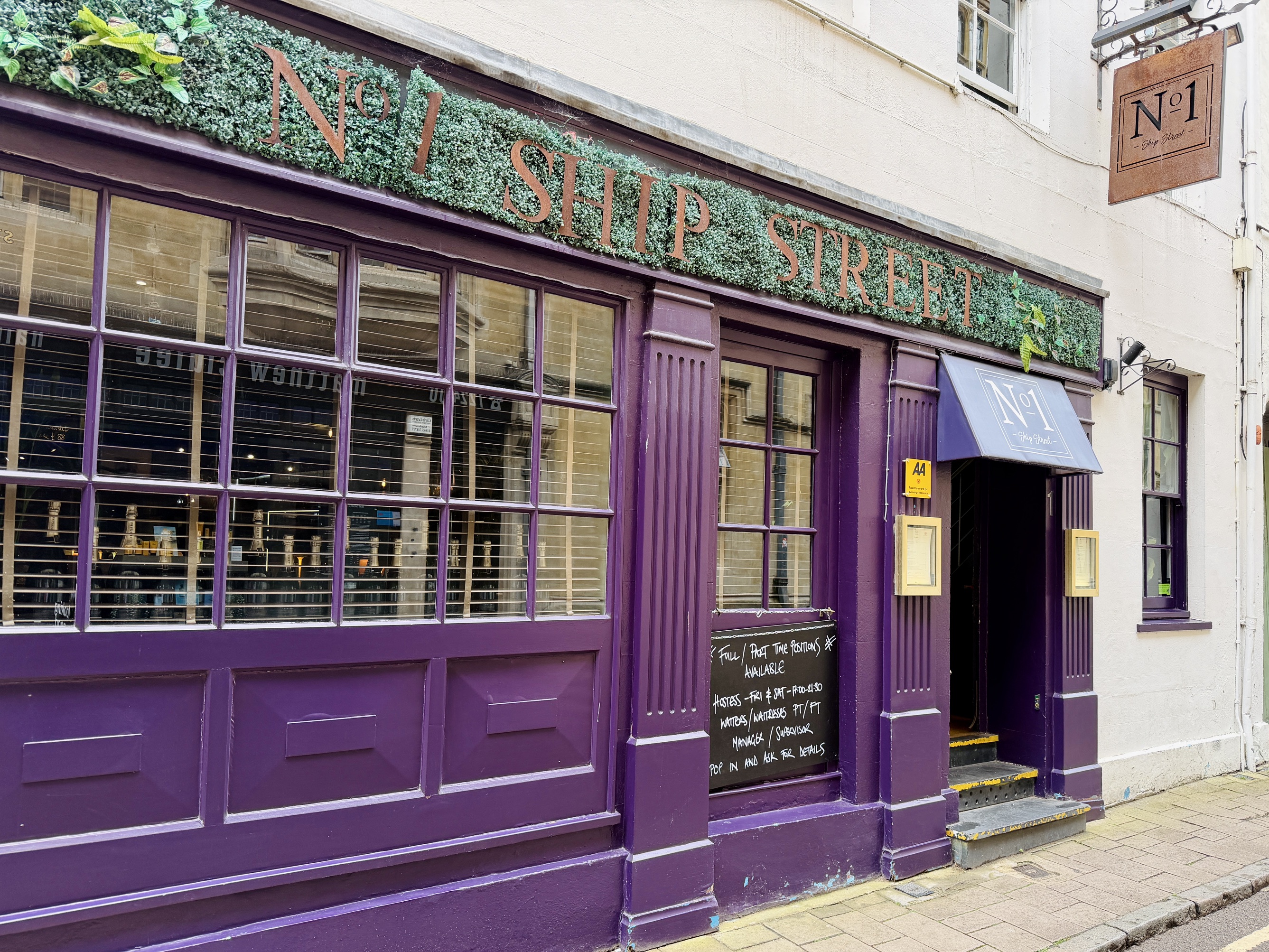
Oxford, probably my favourite city in which to review restaurants, ostensibly has little in common with Reading. One has pretty old buildings and winding lanes, a shopping mall that doesn’t bump off your will to live in the space of five minutes, a bustling market with food, drink, coffee and cheese and shedloads of independent retail. The other has Forbury Gardens and a very good bus network.
That sounds like I’m doing Reading down. Perhaps it’s more accurate to say that Oxford complements Reading nicely: if there’s something you wish Reading had, you may well find it thirty minutes down the train tracks. And to be fair to Reading, Oxford may beat it for wine bars – because it has some and no, Vino Vita doesn’t count – and it has some lovely old pubs, but Reading is streets ahead when it comes to craft beer. Oxford is brilliant, but it has no Nag’s Head.
One thing they do have in common, though, is that their best restaurants are rarely found in the centre. Reading has some solid restaurants inside the IDR – your Me Kongs, and Mama’s Ways – but they’re the exception rather than the rule: it’s mostly chains and I suspect it always has been. The independent restaurants chasing that status right in the centre are probably London Street Brasserie and The Reading Room, neither of which quite pulls it off, but beyond that you might find yourself heading north of the river, or west down the Oxford Road.
Oxford is similar. If you overlaid the Oxford restaurants I’ve reviewed over a map of the place, it would look like my metaphorical attempts to hit a bullseye down the pub: everything everywhere but in the middle. Out east you have the Cowley Road, Iffley Road and St Clements, all with great places to eat, and Headington beyond that. Head north and you reach Little Clarendon Street before the myriad of choices available in Jericho or Summertown. But what about the centre?
Oxford has a mall, the Westgate, and it’s nicer than the Oracle. But that means it still gets chains, just fancier ones. It has the kind Reading doesn’t attract: Mowgli; Shoryu Ramen; Six By Nico. Notably it has a branch of award-winning small chain Beefy Boys – it would have been a coup, if they had chosen Reading. But in the rest of the centre it’s largely a mix of chains we have, chains we used to have and chains we can probably live without. It has Cosy Club, for people who wish the Lounge group were fancier, and The Ivy, for people who wish Cosy Club was, I don’t know, more showy.
Oxford readers would probably be the first to tell me that’s a slight oversimplification. Oxford has a few long-standing central restaurants with a durable fan following, like Chiang Mai Kitchen or Edamame: it tells you something about their longevity that I’ve eaten at both, each case long before I started writing this blog. It has a branch of Permit Room, the Dishoom offshoot that is so far limited to a mere five locations nationwide.
Beyond that, if you’re talking more upmarket restaurants, it has Quod, a buzzy brasserie on the ground floor of the Old Bank Hotel owned by the same group as Gee’s. And the conversion of the old Boswell’s department store into a hotel has given the city Treadwell, a new all-day restaurant whose menu looks a bit like somebody took Quod’s, gave it to the kitchen and said “make it quirkier”: whether fish and chips needs kimchi tartar sauce is anybody’s guess.
Having lost all my Reading readers with seven paragraphs about Oxford, and all my Oxford readers with seven paragraphs which aren’t about the restaurant I’m reviewing this week, let’s finally get to the point and talk about No. 1 Ship Street, the subject of this week’s review. It’s resolutely small and independent, it’s been open for nine years this summer and it’s very much in the city centre, just off the pedestrianised hellscape of Cornmarket Street, just around the corner from the Covered Market.
Chef Owen Little has been there from the very start, and No. 1 Ship Street shows no signs of slowing down as it reaches the end of its first decade, having been named last November as one of OpenTable’s Top 100 U.K. restaurants: to put this in perspective, nowhere in Reading featured on that list, and nowhere else in Oxford did either. I explained all this – fortunately for him in far less depth than I have here – to my dear friend Jerry as we had a pre-prandial beer in Teardrop, the tiny pub in the Covered Market.
Owner Ross Drummond apparently celebrated winning that award from OpenTable by giving the place a refurb for the New Year. I think it was a subtle one, because the bones of the dining room were already there: beautiful racing green walls, well-spaced tables, the whole thing sleek, luxe and unfussy. They’ve removed the slightly tacky spider lights and the tables now are gorgeous and copper-topped: Jerry, mentally making notes for his flat, was taken with those.
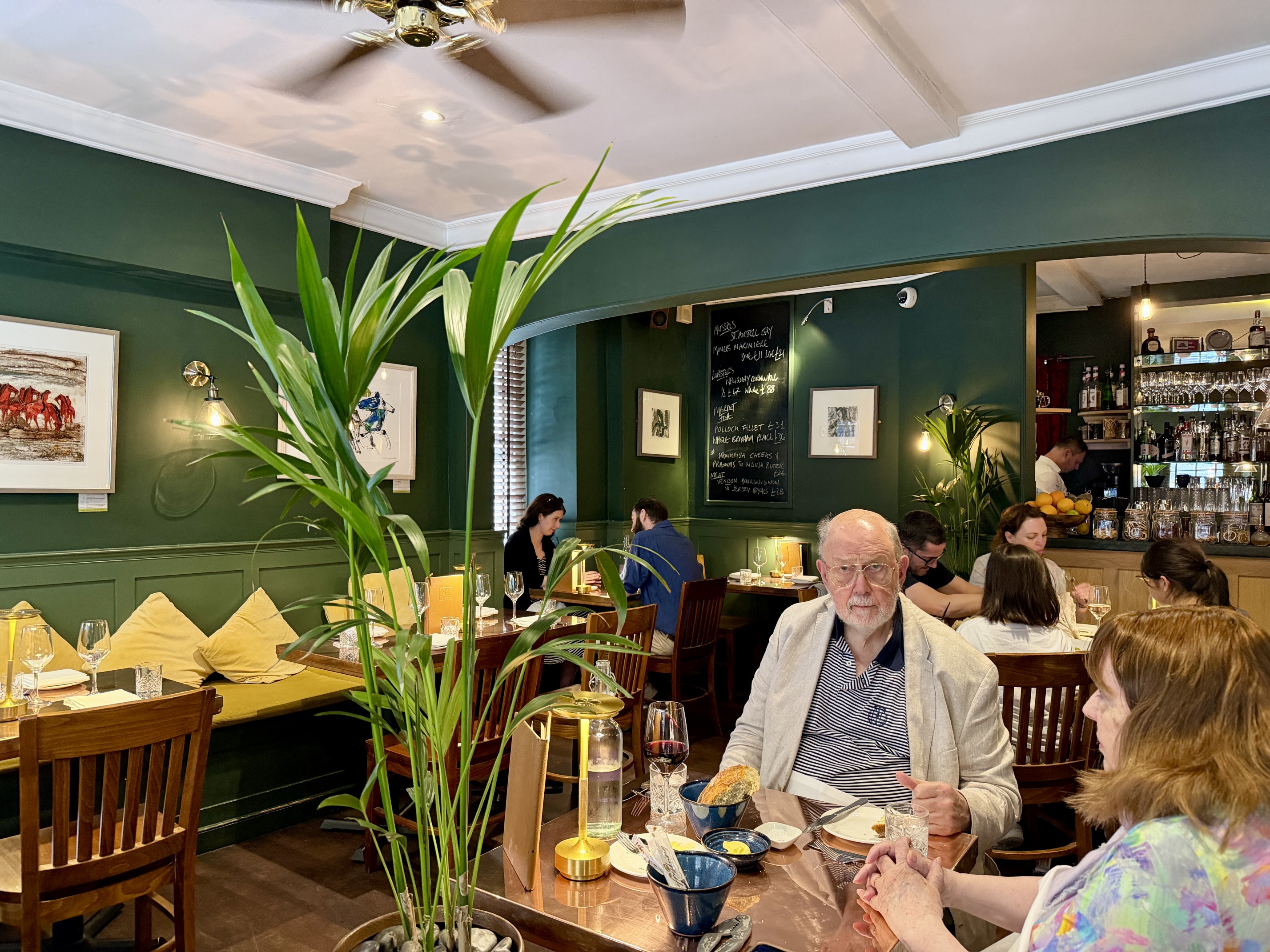
It was difficult to believe that the horrors of Cornmarket Street were a stone’s throw away, but No. 1 Ship Street had created a beautiful, grown-up oasis dangerously close to its borders. I should say that we asked to be seated in the main dining room: I’m sure the one on the other side of the entrance is lovely of an evening, but I didn’t want to lunch in a windowless room on a June afternoon.
After a disappointing run of small-plates-for-sharing restaurants, some honestly described and some far less so, No. 1 Ship Street’s menu came as a blessed relief. Terms like appetisers, starters and mains might be increasingly recherché out there in the wild, but in this restaurant they were alive and well. There was no spiel about the concept, because the concept was “remember how restaurants used to be?” and the conversational gambit wasn’t “do you need me to explain the menu?” but instead my personal favourite, “are you ready to order?”
Not that we were, at first, because No. 1 Ship Street’s menu was just tricky enough. The starters seemed to be where the more experimental bent came out – burnt aubergine soup, foie gras crème brûlée, frog’s legs and the like – while the mains were more conventional. So yes, there was a burger, and a steak, and a risotto. I guess you don’t survive nearly a decade in the centre of Oxford by taking massive risks.
Starters clustered between £10 and £16, mains began at £20 and climbed up from there. If you wanted oysters, lobster, a tomahawk or the restaurant’s surf and turf (which combined the latter two and cost £160) you could spend an awful lot more, and a specials board introduced about half a dozen other options, nearly all of them fish and seafood.
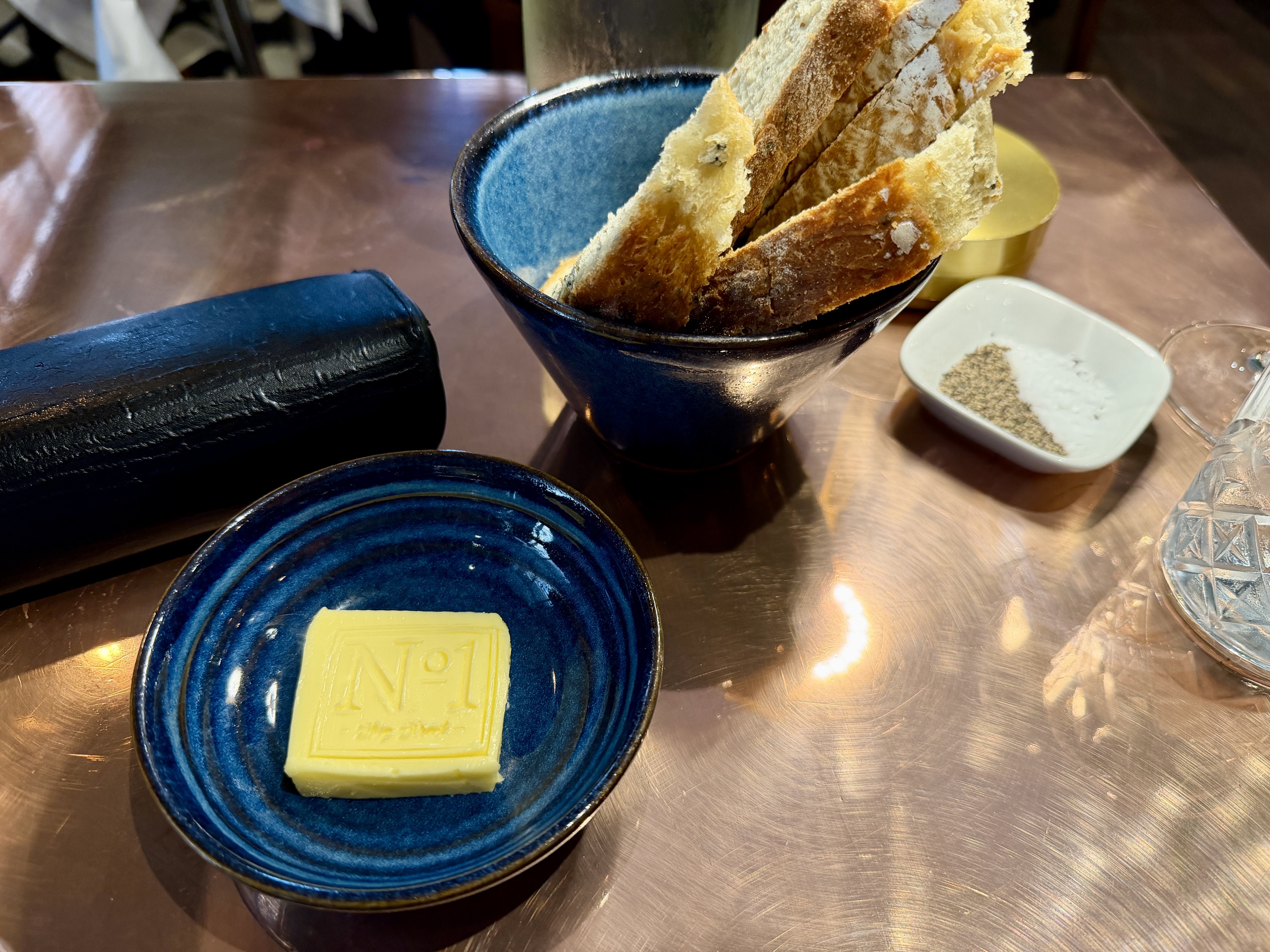
It was difficult enough that we ordered some appetisers and apéritifs while we decided – and No. 1 Ship Street is that happy kind of restaurant that brings them and gives you the time and space you need for that. Jerry’s bread was good and generous, speckled with nigella seeds and very enjoyable. Good salted butter at room temperature, embossed with the name of the restaurant, was a nice touch. For £6, the bread needed to be this good, and gladly it was.
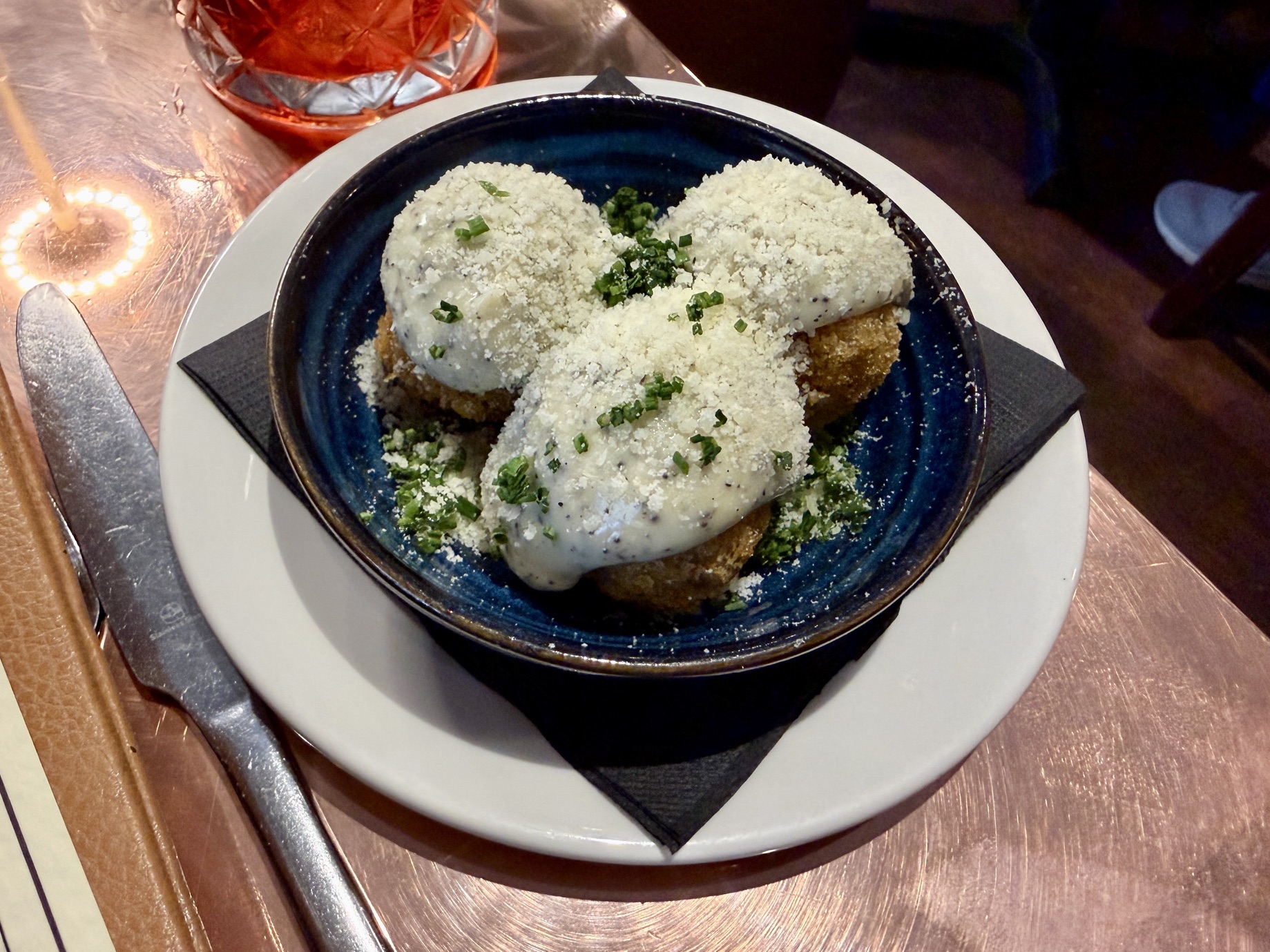
My truffle and porcini arancini were the first evidence that the kitchen might quite like being tricksy for the sake of it. They were very good, the texture acceptably crunchy and the inside studded with mushroom. Not indecent value at £6 for three either. Whether they needed to be submerged in some kind of hot truffle mayo and then carpeted in Parmesan was another matter. I thought less might have been more in this instance.
Jerry tried a bit but revealed to me that he really wasn’t a fan of truffle. And I was reminded of the recent meal where I discovered he had been humouring me all these years by drinking white wine when he only really liked red wine. It turned out that my happy memory in lockdown of sitting on a park bench with Jerry demolishing a bottle of red and inhaling a packet of Torres’ superlative truffle crisps was actually more evidence of Jerry being too nice to say he didn’t enjoy something. Let’s hope that somewhere out there he isn’t writing a blog telling the world what a terrible dining companion I am.
Never mind. The apéritifs, by the way, were knockout: mine a variant on a negroni sweetened and mollified with the substitution of amaro for vermouth and Jerry’s a champagne cocktail with a little cognac in the mix, sugar cube effortlessly effervescing at the bottom like buried treasure. We followed this up with an excellent South African Chardonnay – yes, a white – recommended by the very knowledgeable server, from the Elgin Valley. It had plenty of citrus and elegance, it was £48, and I liked it a lot. Jerry said he did too, and hopefully he meant it.
Starters were where things started to wobble. Jerry was torn between a number of options, one of which was the foie gras.
“I love it, but I know I shouldn’t, so I don’t order it these days” he told me. And I’m afraid I took that as an opportunity to deliver a tone deaf homily about not denying yourself things you like – I wish I could say it was the negroni talking, but such conduct is me all over – and so he chose it.
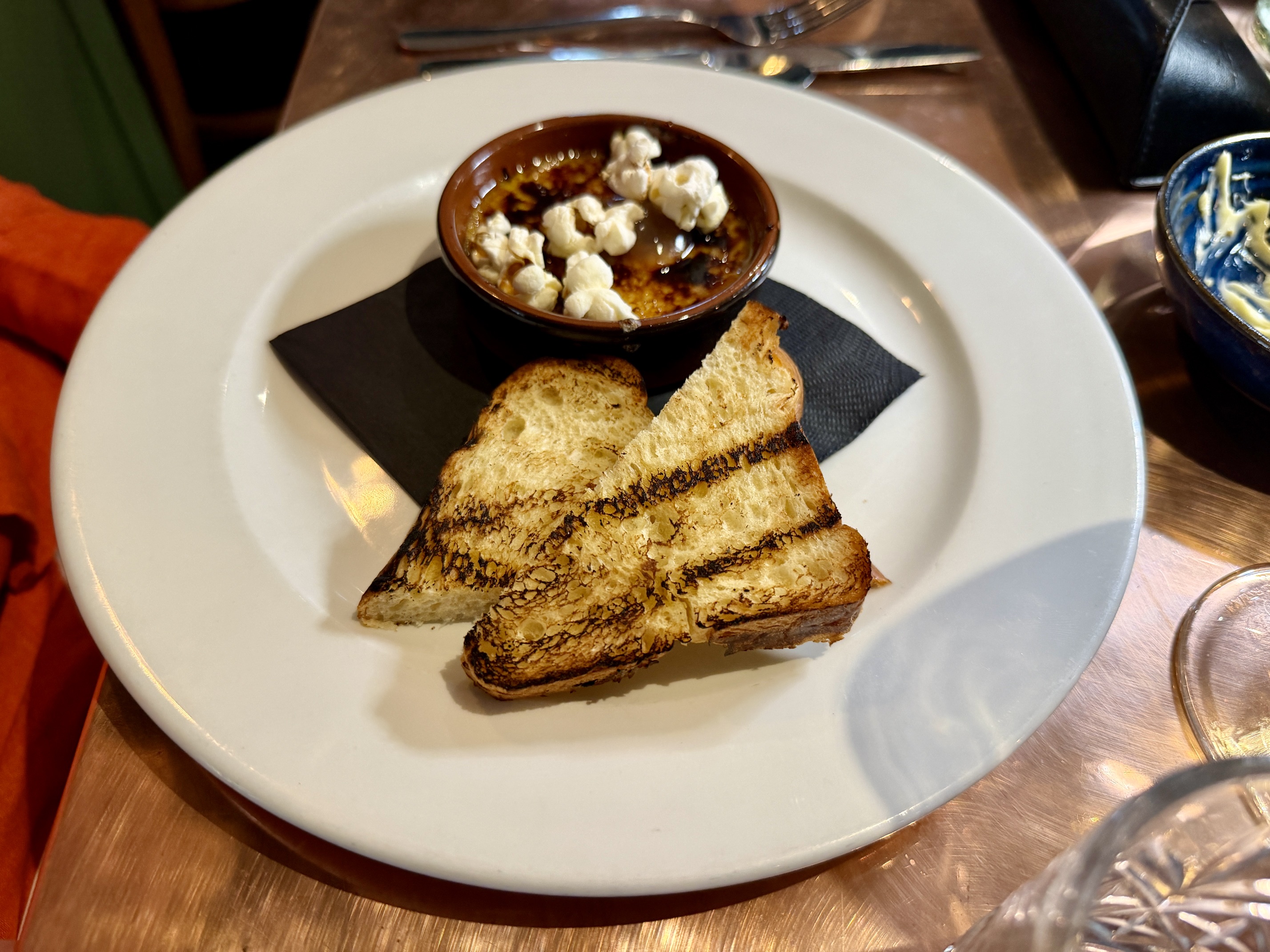
It was meant to be a foie gras crème brûlée with vin jaune gel and toasted brioche, and I’m sorry to say this, but the resemblance stops at the photograph, and possibly before that. A crème brûlée is meant to have a satisfying burnt top and be set underneath. It’s not meant to be a murky puddle of bumf. And it’s not meant to taste so little of foie gras that you wonder, as Jerry did, whether he’d accidentally been given something from the dessert section, a theory lent credence by the pointless popcorn on top.
Poor Jerry – all the guilt of having ordered foie gras without the corresponding enjoyment of getting to eat the bastard stuff. I felt personally responsible.
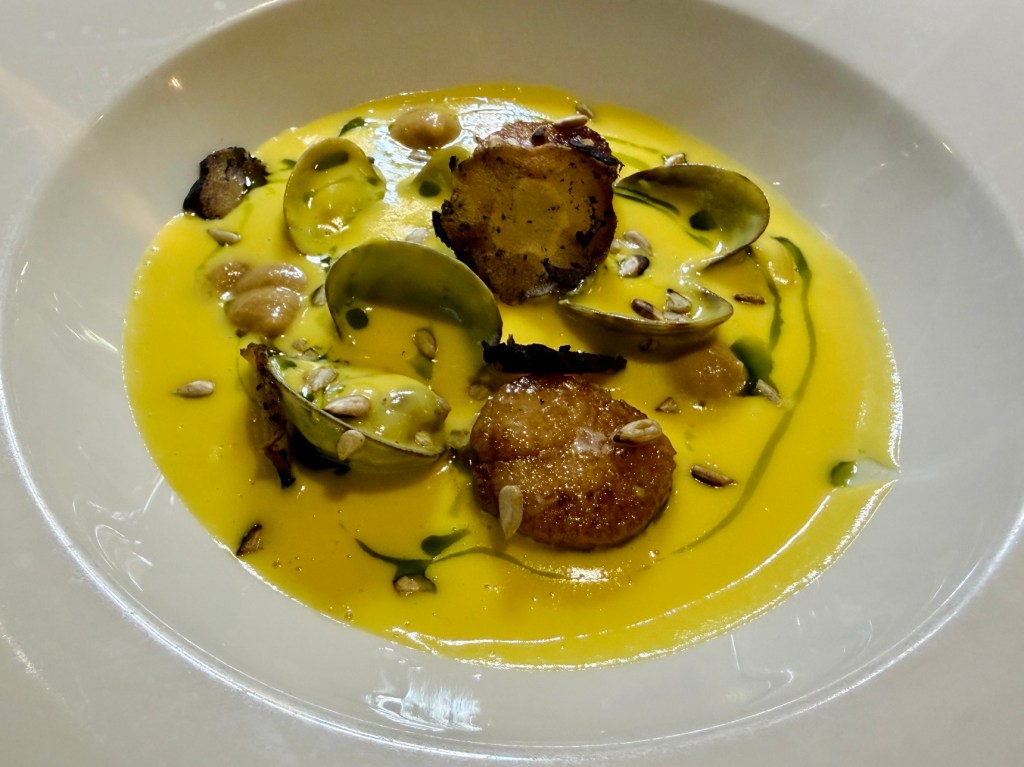
I felt less bad about it, though, because my starter was also disappointing. What was billed as seared scallops with clam velouté and parsnips was in fact a thin puddle of soup with a single scallop, cut in half, three clams and a crispy disc of perpendicular parsnip.
The overall effect, apart from masterful cost control in a £16 starter, was an oversweetened, unsubtle cacophony of a dish. Just like the foie gras crème brûlée, what turned up wasn’t in the slightest what the menu implied you would be tucking into. No wonder they brought you a spoon with this one. I once ate at Oxford restaurant Gees and wondered if I’d accidentally wandered into the U.K.’s most expensive salad bar. No. 1 Ship Street, by contrast, was beginning to feel like a spenny soup kitchen in disguise.
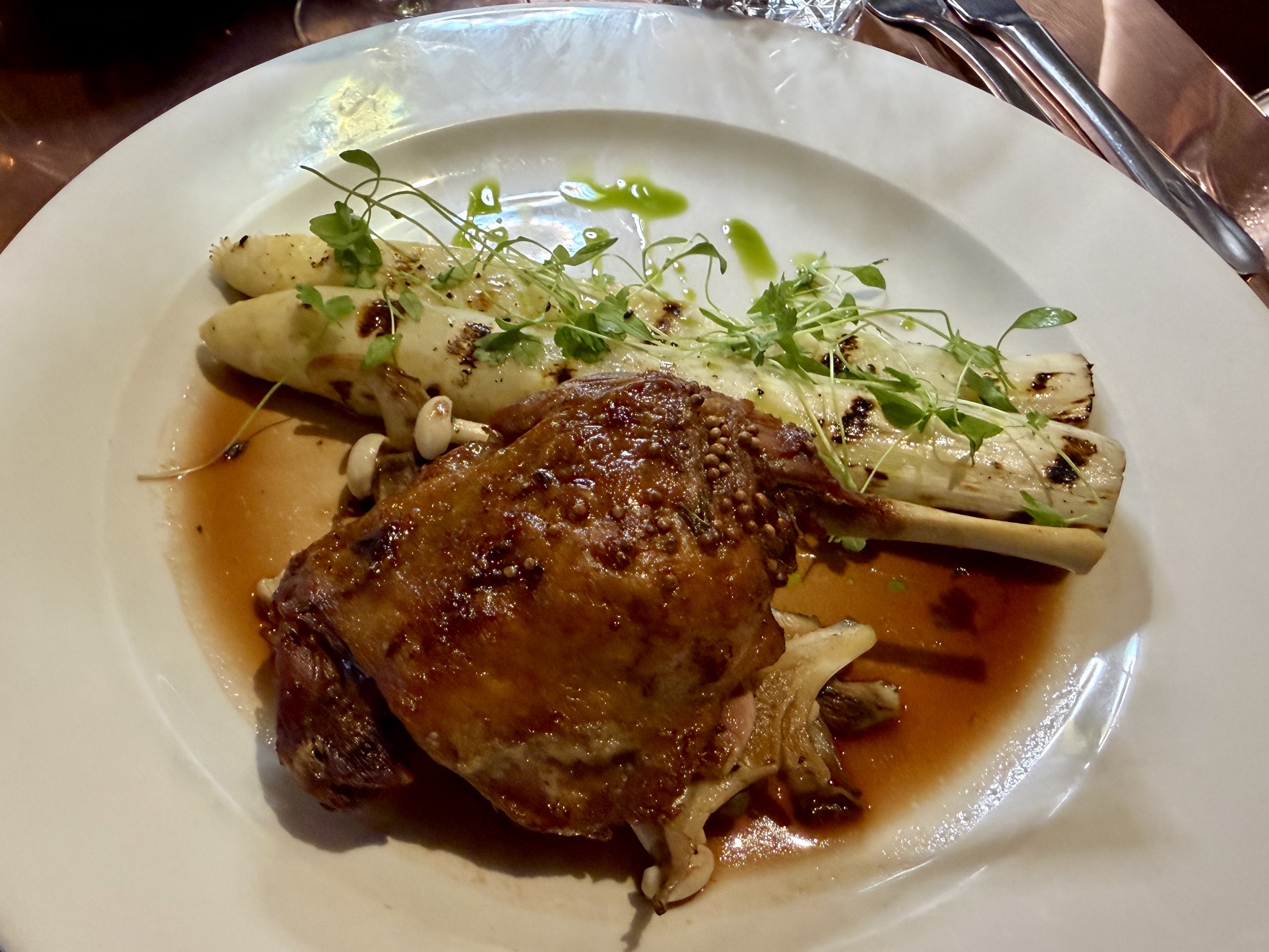
Were the mains, when the restaurant stayed closer to the mainstream, any better? Mostly, I would say. My confit duck almost worked: the skin was gloriously crisp, the fat rendered and the flesh underneath giving in all the right ways. Perching it on a pile of wild mushrooms, enjoyable ones at that, was a bit like giving the dish platform shoes: it made it look like you got far more duck than you did.
The white asparagus was thick and generous, with just enough bite, beautifully cooked to avoid the bitterness this variety can sometimes have. “It looks like a pair of dildos” was Jerry’s unvarnished take: I laughed like a drain and warned him that I planned to quote him verbatim. This is the bit in the description where I’d love to say and a plum jus brought it all together beautifully but instead I have to say that there was a thin drizzle of blandness that didn’t add enough moisture or flavour.
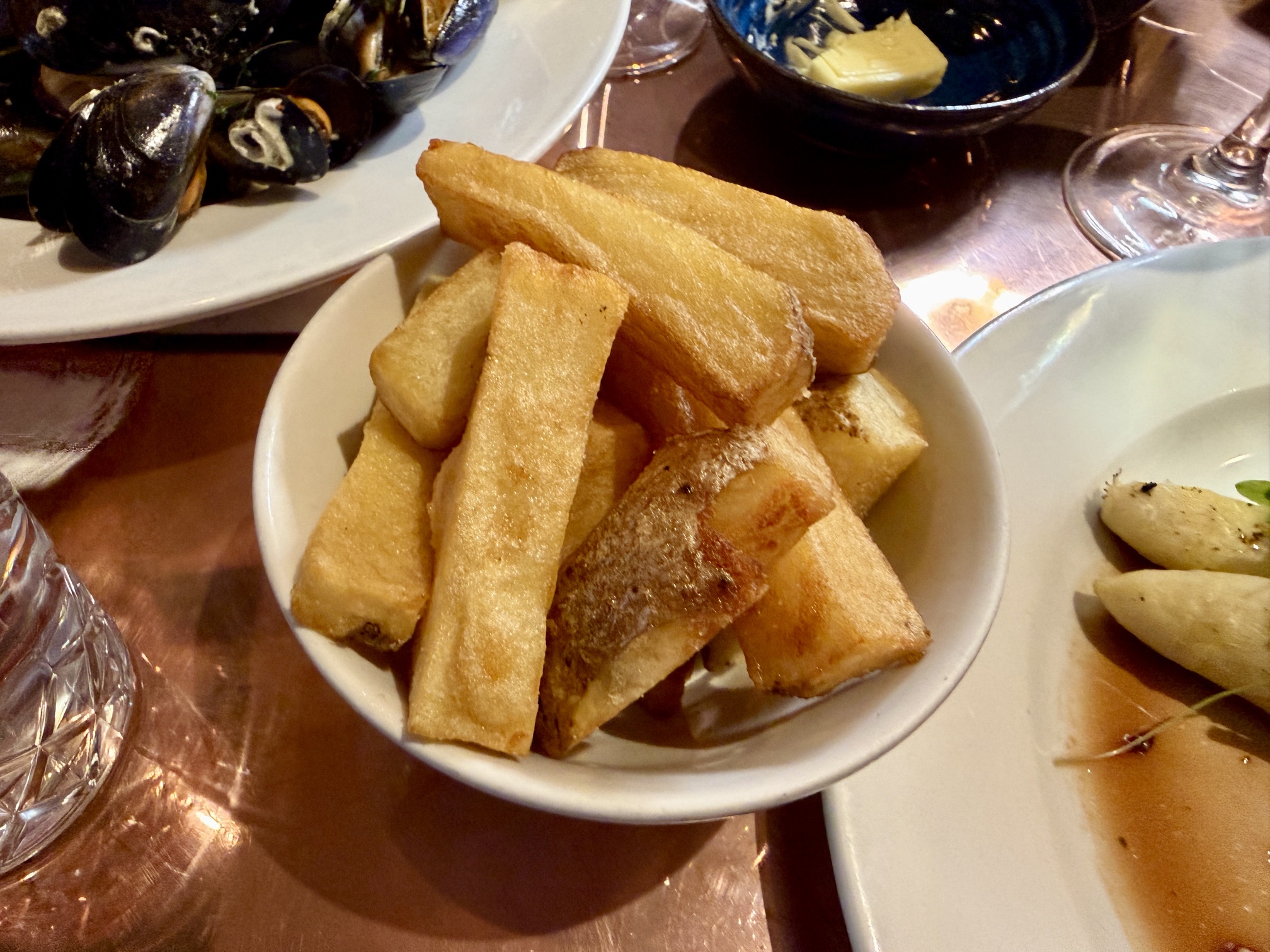
This dish needed carbs and didn’t have them, so I ordered some chunky chips. And these were well done, but with the main course so unrelentingly dry there was nothing for these to soak up, or act as a vehicle for. It also means that my duck dish, with chips on the side, cost £30. That’s a lot for not quite enough, there’s no way around that.
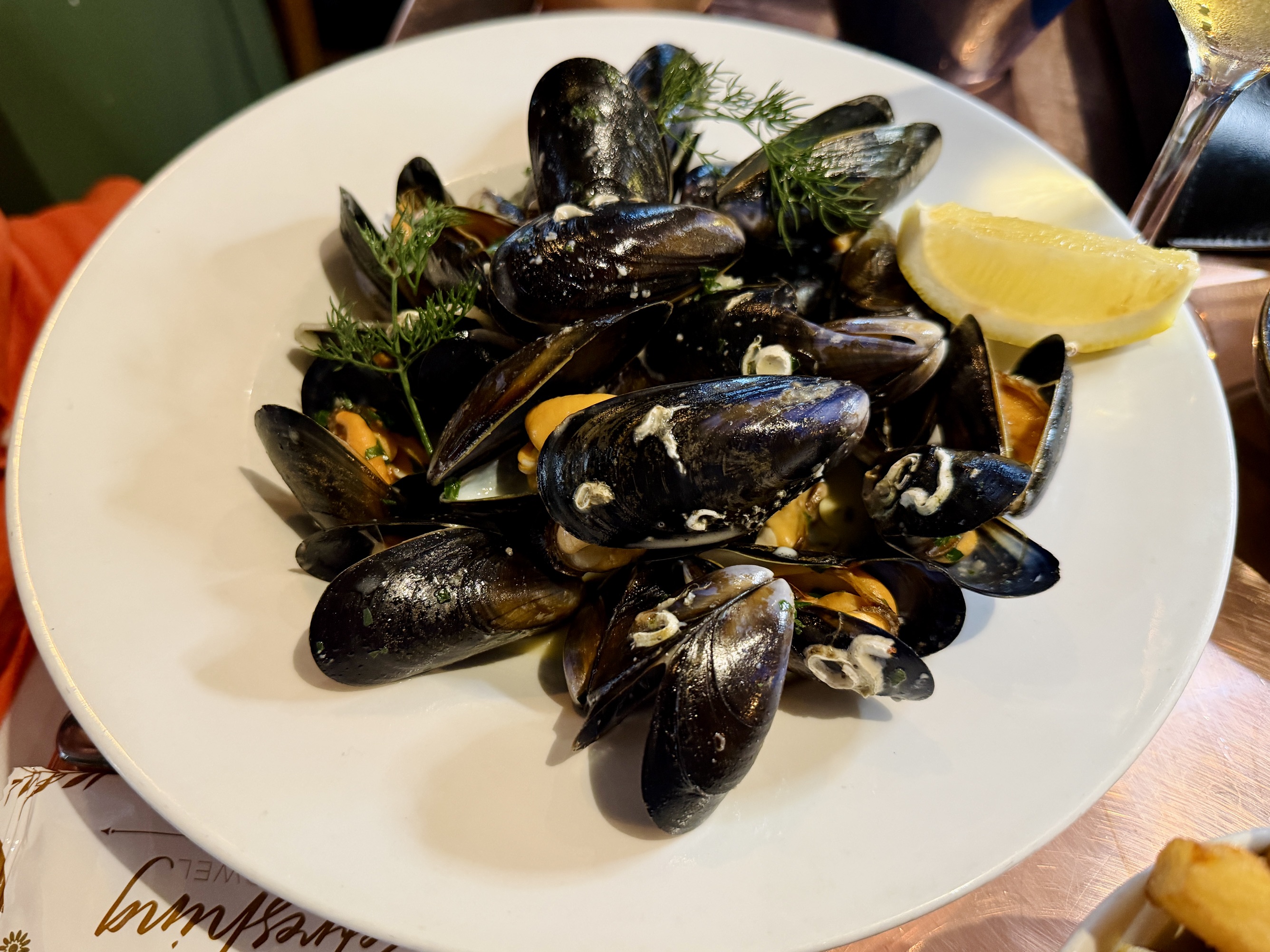
Jerry picked better I think, moules marinière from the specials. They were plump specimens, from St Austell Bay according to the blackboard, and Jerry thoroughly enjoyed them. They came with frites, and as with No. 1 Ship Street’s chips they were well executed.
But ironically, for me, this dish had the converse problem to both those starters. The mussels were high and dry, clustered in a wide-brimmed bowl. The joy of moules marinière is the bit at the end, when all the shells have been vanquished and you’re left with a bowl of that creamy liquor, to trawl with a spoon, picking up stray mussels, to drink like broth, to dab with bread or to tip your frites into. It makes it two meals in one.
But here, that last stage was a bit like some people I see prancing around on Instagram, too shallow to be worth persevering with. It seems that No. 1 Ship Street only dished up soup when you didn’t want it to. Jerry, mind you, loved it.
Despite all that, and perhaps paradoxically, we stopped for dessert. Because despite the food not being spectacular, and in some cases being downright weird, we were still having a lovely time. No. 1 Ship Street somehow, through its gorgeous, calming room, its very pleasing booze and unstintingly charming staff, created a space where you knew, on some level, that things could and should be better but didn’t mind as much as you should.
In that sense, it was almost the inverse of so many experiences I’ve had on duty lately, restaurants I ought to have liked more than I did. Here, instead, I found myself almost willing to suspend critical judgment. Only in the moment, really, and as I write this I remember all the things they got wrong. But weirdly, remembering them is almost like trying to recall a dream. I wonder how many people No. 1 Ship Street has pulled that trick on over nearly a decade. I’m not seeking to denigrate: it’s a neat trick.
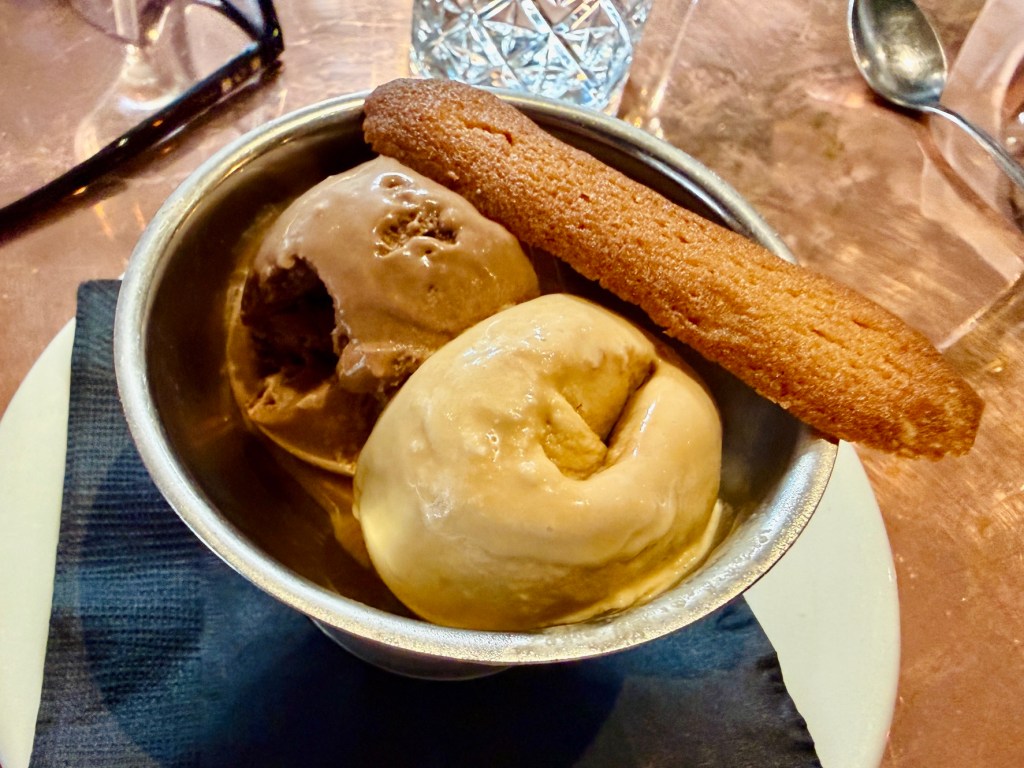
Anyway, they saved some of the best for last. They make their own ice cream, and both the chocolate and salted caramel were smooth, rich, crystal-free and as good as anything you could get in George & Davis, if not quite the standard of Swoon on the High. The range of flavours was quite pedestrian, which surprised me: they save the cheffy stuff, the rose and rhubarb ice cream or the basil sorbet, to accompany Actual Desserts. £6 for two scoops with a beautifully light langue de chat was probably the bargain of the day.
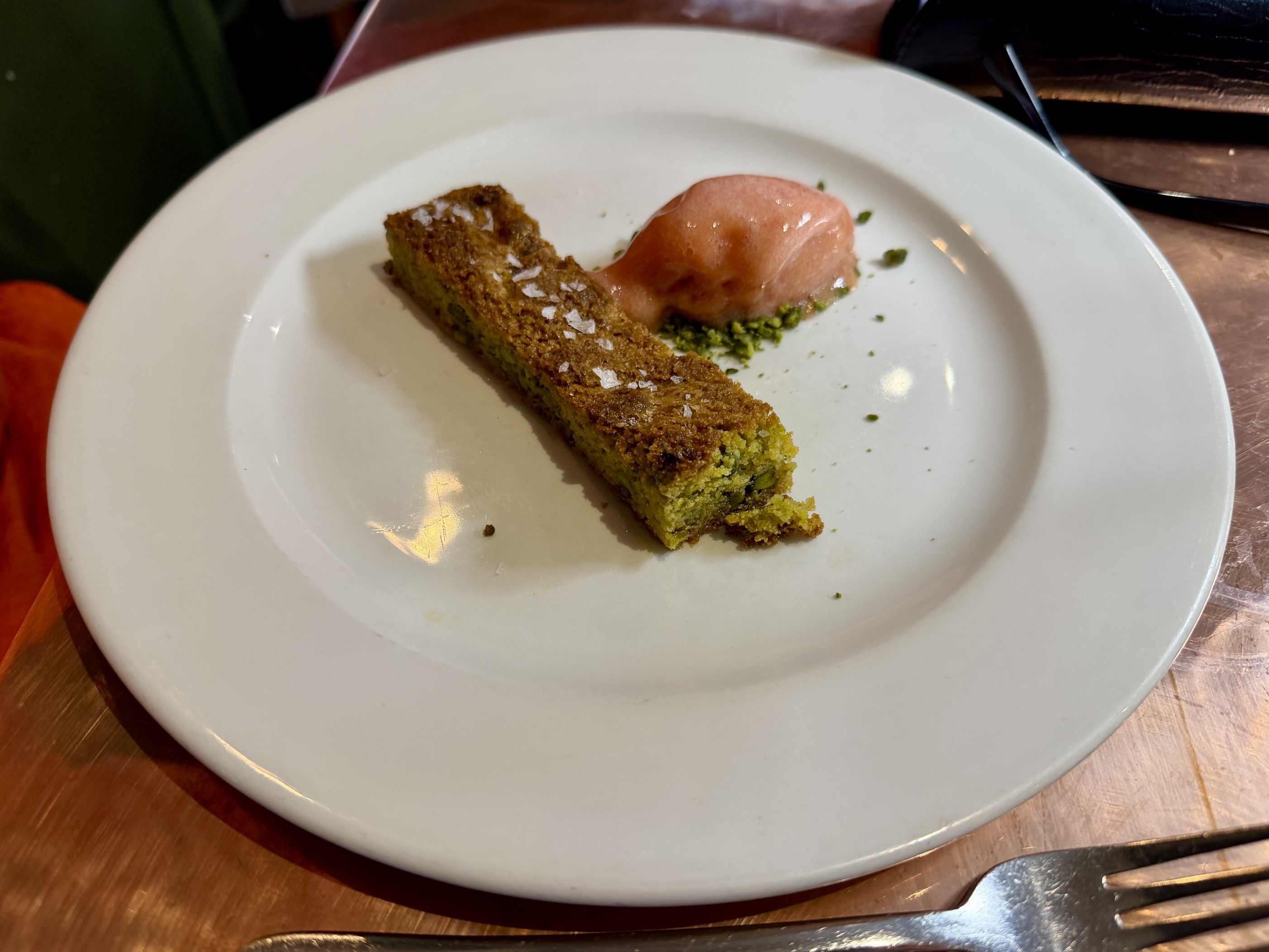
Jerry was happy with his pistachio cake. I don’t know if I would have been, it was a thin, uneven slab of the stuff with something that did not look like basil sorbet. Maybe it was grape and basil sorbet – the menu, as so often, made it difficult to work out what you were going to get.
And again, that’s not necessarily a problem. In a restaurant where the words on a menu are just a jumping-off point, in the hands of the right kitchen, a meal can be a life of surprises. Underpromising and overdelivering is one of the great talents of hospitality done well, and the thing that makes memories – as much as anything does, over and above the people you bring with you. The problem with No. 1 Ship Street, for all I keep saying that it’s not a bad restaurant, is that none of the surprises, on balance, were good ones.
All that set us back £214, including the standard 12.5% tip, and more than usual I couldn’t really work out whether I’d been stiffed or not. We were there for the best part of two and a half hours, we had a marvellous time – although for me, lunching with Jerry, that was a given – and we were very well looked after.
Perhaps in the centre of Oxford, given the alternatives, No. 1 Ship Street is as good as it needs to be. Or maybe it had a bad day when I went, or I was too finicky. But I was left again marvelling at their powers of misdirection: how could they have created the semblance of a fantastic meal from such inconsistent food? Appropriately, it had the feel of being through the looking glass about it.
But I didn’t feel that way at the time, I only feel it now. At the time, Jerry and I agreed that we’d had a lovely meal, and off we strolled to the Rose & Crown to enjoy the refurbished outside space and improved beer offering. It had been another classic visit to Oxford, and if something was niggling at me it would take a couple of weeks for my reservations to fully germinate.
Restaurant reviewers are pontificators by nature, and never miss an opportunity to tell you what a restaurant Means, what it is All About. I’ve read a couple of think pieces lately about how it’s okay for a restaurant to be just good enough, in defence of the unspectacular, the “fine” or “ordinary”. Well, I suppose it’s one way to try and jazz up a boring meal, or meet your latest deadline at the Financial Times. You’ve got to have an angle.
But for the rest of us, who spend our own money, that’s not the axis you plot things on. It’s not unremarkable versus showy, hyped versus anonymous. Most of us deal in good or bad, or perhaps good enough and not good enough. No. 1 Ship Street’s failing is to try and show off, when it could just get the basics very right and send a lot of people away very happy indeed. It has the room, it has the service, it has all the ingredients to do that.
But somehow, for some reason, it chooses not to and, to give it credit, it almost gets away with it. But what do I know? If you clock up a decade slap bang in the centre of Oxford, even with the dearth of competition, you must know a thing or two. Even so, I can’t help feeling their second decade might prove more difficult.
No. 1 Ship Street – 7.0
1 Ship Street, Oxford, OX1 3DA
01865 806637
Since January 2025, Edible Reading is partly supported by subscribers – click here if you want to read more about that, or click below to subscribe. By doing so you enable me to carry on doing what I do, and you also get access to subscriber only content. Whether you’re a subscriber or not, thanks for reading.
 Edible Reading
Loved the review. Hope you’re having a good time
I personally don’t think much of No.1. I have always found the menu uninspiring and overpriced. Sure, the atmosphere is nice and it’s well paced, but that doesn’t make up for it’s short comings in my opinion.
Reading your review, i think you’ve been too generous with your score of 7 compared to the scores you’ve given elsewhere that you seemed to like more.