Restaurant review: Angelo’s

Have you been to Angelo’s, the new Italian restaurant in the town centre, yet?

And have you been asked whether you’ve been there yet?

The thing is, people keep asking me if I’ve eaten there, to the point where it seems like Angelo’s is the only Reading restaurant anybody is interested in. I had a readers’ lunch at the Moderation a couple of Saturdays ago and I was asked so many times I lost count – although it was a pretty boozy afternoon, so that just means “more than three times”.

Not only that, but many of the folks asking me already had an opinion: pretty ordinary, said one person that afternoon, unmoved by the wild boar ragu. Really rather good was another verdict, also delivered at the readers’ lunch. And don’t think you have to have been in order to pitch in: I saw some pictures earlier and thought ‘I can do better than that at home‘, one of my readers told me on Instagram. 

That felt like a bit of a slap across Angelo’s figurative face: I mean, I can do better than Cozze at home, but that says more about Cozze than my talents in the kitchen.

It’s easy to understand, though, why Angelo’s is such a big event. In 2024 the biggest openings of the year were the Rising Sun and Siren RG1, a chain trying to look like an independent and an independent with all the polish of a chain. Both were underwhelming at best. Last year, the headlines were grabbed by Rosa’s Thai and Cosy Club, desperately middling middle of the road fare for Reading’s middle classes, with Nua and Pho 86 quietly flying the flag for new indies in the town centre.

But this year? Unless you’re very excited about Shake Shack – in which case I’m afraid you’ve come to the wrong place – Angelo’s is not only the most interesting thing to open in the town centre but, in truth, the only interesting thing to open here. It’s shiny and new, it’s very central on the Station Hill development and it’s independent: the owner is also behind Ruchetta in Wokingham, which has also now been rebranded as Angelo’s. Although he’s doubtless sunk a lot of money into this high risk endeavour, there appears to be no venture capital involved.

That would be enough to make it worth checking out, but it’s also the kind of restaurant many people think Reading is sorely missing: an Italian restaurant. Not a specialist pizza restaurant like Zia Lucia, not a place that only does pasta like London’s trendsetters Padella and Bancone, or Maidenhead’s pale imitation Sauce and Flour. And not an entry level defroster like Prezzo, Zizzi or Bella Italia, either: a proper Italian restaurant. The kind we haven’t had since we lost San Sicario, the kind we were blessed with for decades when Pepe Sale was at the height of its powers.

It helps that Angelo’s kept us waiting. They signed a lease last April, and everybody expected them to open before the New Year. But due to unspecified delays an opening date never materialised; the infrequent updates on the restaurant’s Instagram page gave more of a sinking feeling than a growing sense of excitement. Finally, they opened at the end of June and the early signs were not encouraging. A very minimalist website was one thing, but a menu strewn with more typos than AI slop – who knew there were so many ways to misspell ‘mozzarella’? – was another altogether.

Fortunately both have now been amended, but Angelo’s still feels slightly like it’s fixing things as it goes along: at the time of writing it’s walk-ins only for tables of fewer than six people, and the phone number has only just been added to their Google listing. All of that, though, can add up to creating a feeling of demand – it’s good to make people work for it, sometimes – and when Zoë and I sauntered up just after six on a Thursday evening all but a couple of tables inside were already occupied.

The space is neat and compact. There’s a front section with high tables and a bar that maybe sits ten or so people, and then a dining room out back which can accommodate twenty. It was tasteful, if maybe a little lacking in character, although I liked the little booths and teal banquettes.

But the restaurant had the best accessory of all: customers. On one side of me a pair of happy friends were catching up, on the other a group of three was having an absolute ball, all loud and infectious laughter. From my seat I could see out the window across Garrard Street, to a part of town that used to look so very different. I liked this space, fashioned out of nowhere. It reminded me a little bit of Me Kong.

Angelo’s menu bore little resemblance to the typo-strewn mess that first appeared online, in more ways than one. First, it was cleaner, professional, read very well. Secondly, and this is a little strange, the points of difference were more than mere spelling errors – perhaps ten dishes have survived from that original menu, just over a month ago, and the remainder have been replaced. Was the initial menu a beta test that should never have seen the light of day, or had the restaurant already figured out that some of its dishes didn’t work? 

The other big alteration was the deletion of pizza: Angelo’s original menu offered eight, this one had removed them entirely. I think I read somewhere that this was the consequence of necessity, but I rather hope they have the courage of their convictions and stick to it: Reading has plenty of places to get pizza, but next to nowhere to get good pasta or antipasti. The menu I ordered from that night filled a yawning gap in the market – pizza, however well done, might dilute that.

Even truncated, it represented a good and interesting range, of both options and price points. The ten starters ranged from £7 to £15, and the dozen or so pasta dishes were almost uniformly between £16 and £18, unless you were itching for the black fettucine with seafood. A relatively modest six secondi were pricier, starting just below the £20 mark and marching north from there, but even so nothing seemed extortionate or unreasonable. I had loved Ruchetta when I went there on duty in 2014 but, even then, its dishes there were about as expensive as those on Angelo’s menu twelve years later.

We started with a pair of cracking Aperol spritzes, because it was summer, and the one thing on the antipasti menu that felt like a great shareable start to the meal. Zucchini fritti had survived the great menu cull, and I’d seen from other writeups that Angelo’s served these as thin, round slices rather than batons, almost creating the sensation of exceptionally upmarket chips and dip.

Did that work? Well, it did, but it could have worked a lot better. The advantage of strips is all that surface area to crisp up: these, by contrast, were limp enough that they were droopy when you picked them up. They weren’t much cop when it came to dipping them into what really was an exemplary lemon aioli. 

So there is scope to perfect them, yes, but I was surprised by how enjoyable they were, even short of perfect. The seasoning on them was excellent, brilliantly judged, and if it meant you had to use a fork and load that aioli on with cutlery – far too evolved, for food of this kind – it didn’t stop them being a particular kind of wonderful.

We made short work of them, we made short work of our spritzes and slowly the sun went about the business of setting outside. “I really want this to be good” said Zoë, out of nowhere.

I totally understood what she meant. After a couple of years of disappointing big names opening in the town centre, Reading could badly do with a win. I looked round this fresh, new room and these fresh, new customers, took in the bright and chatty service happening all around me. No pressure, I thought to myself.

But all those were good signs, weren’t they? And the wine list was a good sign, too: sizeable, fascinating, covering price points from entry level – including 425ml carafes, if you wanted to be moderate and affordable – all the way up to eye-watering. Moreover, it was 100% Italian, covering so many different regions you just don’t see on wine lists in Reading: Umbria; Calabria; Piedmont; Sardinia.

Looking at it made me realise, again, how much I missed Pepe Sale – and how glad I was not to have to visit Vino Vita ever again. We ordered a bottle of pinot noir from Pesaro, a place of which I’d never heard, and I really loved it – silky, fruity and balanced enough to make a fist of going with everything we ate. It was £56, and what I could find online suggests you could buy it retail for just under half that: if every markup on Angelo’s wine list is in that ballpark, wine buffs are going to have some fantastic evenings there.

My starter was sheer joy. Four handsome scallops, cooked to just the right side of jellied, could have been enough of an attraction on their own. But tumbled with sweet roasted peppers and crispy matchsticks of pancetta, they were forkful after forkful of fun. I wasn’t prepared for how much I would enjoy this dish, or how simple, how superbly done it was.

The transformative element, though, was the salmoriglio, the bright Calabrian sauce of olive oil and lemon juice that perked up a dish which was plenty perky already. The whole thing was daytime TV presenter cheerful, without the artificiality that comes priced in with that. I could eat it again and again, although it also made me look forward to the day when Angelo’s has swordfish on its menu.

This starter was £15, and yet when I compared it to the masterpiece of eking out that was, say, No. 1 Ship Street’s more expensive scallop starter, I felt as if I was robbing Angelo’s blind, not the other way round.

Zoë was equally happy with her choice, another salutary lesson in the virtues of buying good stuff and leaving it as unfucked with as possible. A generous mosaic of pink and marbled beef carpaccio, sliced almost to translucence, was laid out and scattered with rocket and Parmesan. So little to it, but so much to enjoy.

“I could have gobbled three plates of it”, she told me later. “You can quote me on that.”

Also, and I know this is an aside, but how nice it was to eat in a genuine Italian restaurant that uses balsamic vinegar, not some gloopy, sugary glaze, and only uses it sparingly when appropriate, rather than festooning everything with thick ribbons of it to make something that would otherwise taste of nothing taste of something worse. I had almost forgotten how much I liked eating in an Italian restaurant in Reading that treated its customers like adults.

Pacing was faultless – there’s a sentence you haven’t seen me write much this year – and something like twenty-five minutes later, when I was still basking in the afterglow of my starter and enjoying the warm fuzzy feeling that comes with a great bottle of red, our main courses came out. We’d ordered from the deep and the shallow ends of the menu here, more by accident than design, but I think it speaks volumes about what Angelo’s has to offer that both were equally superb in different ways.

I loved my main course so much I can’t even tell you, and I loved the fact that it was a mere pound more expensive than my starter. Carbonara is a good test of an Italian restaurant, but I doubt many pass it with flying colours the way Angelo’s did. The golden colour of a Brazil shirt, pasta impeccably al dente, the sauce clinging to every strand, full of depth and saline complexity. This was a textbook carbonara: egg yolk, pecorino, no cream, no adulteration of any kind. Purists might object that it was pancetta not guanciale, but those purists need to get out more. Besides, that thatch of bronzed strips was heaven.

By the end of it I wasn’t only planning when I could go back to Angelo’s, I was planning when I could go back to specifically eat this again. Surely I had a free evening next week to slink off for a bowl of it? If I had my way, the people behind Cozze would be sentenced to come to Angelo’s, try this once and then have to eat their subpar albino version every evening for a month. That would teach them, or at least it would if they liked food better than margins.

Zoë, as regular readers will know, has an annoying habit of ordering better than me. But I thought she’d erred ordering the most expensive and pedestrian-looking dish on the menu. Ribeye, mushroom, cream and brandy sauce and chunky chips. Sounds a bit blah, I told myself, and at £33 it would have to be really, really good: everything in peak condition, everything in balance, everything coming together.

So of course, to my mixed delight and irritation, it was precisely that. Steak cooked perfectly medium as requested (I’d have had it pinker, but I don’t judge) a sauce of dreams – and more than enough of it, too – and some knockout, golden, crisp-edged and nicely irregular chips. I was happy for her, even if this dish felt about as Italian as I am, but I was just as happy, if not more so, for Angelo’s. Because this was high stakes, and they had not missed. Even her side dish, spot-on tenderstem broccoli positively infused with garlic and chilli, was a winner, not an afterthought.

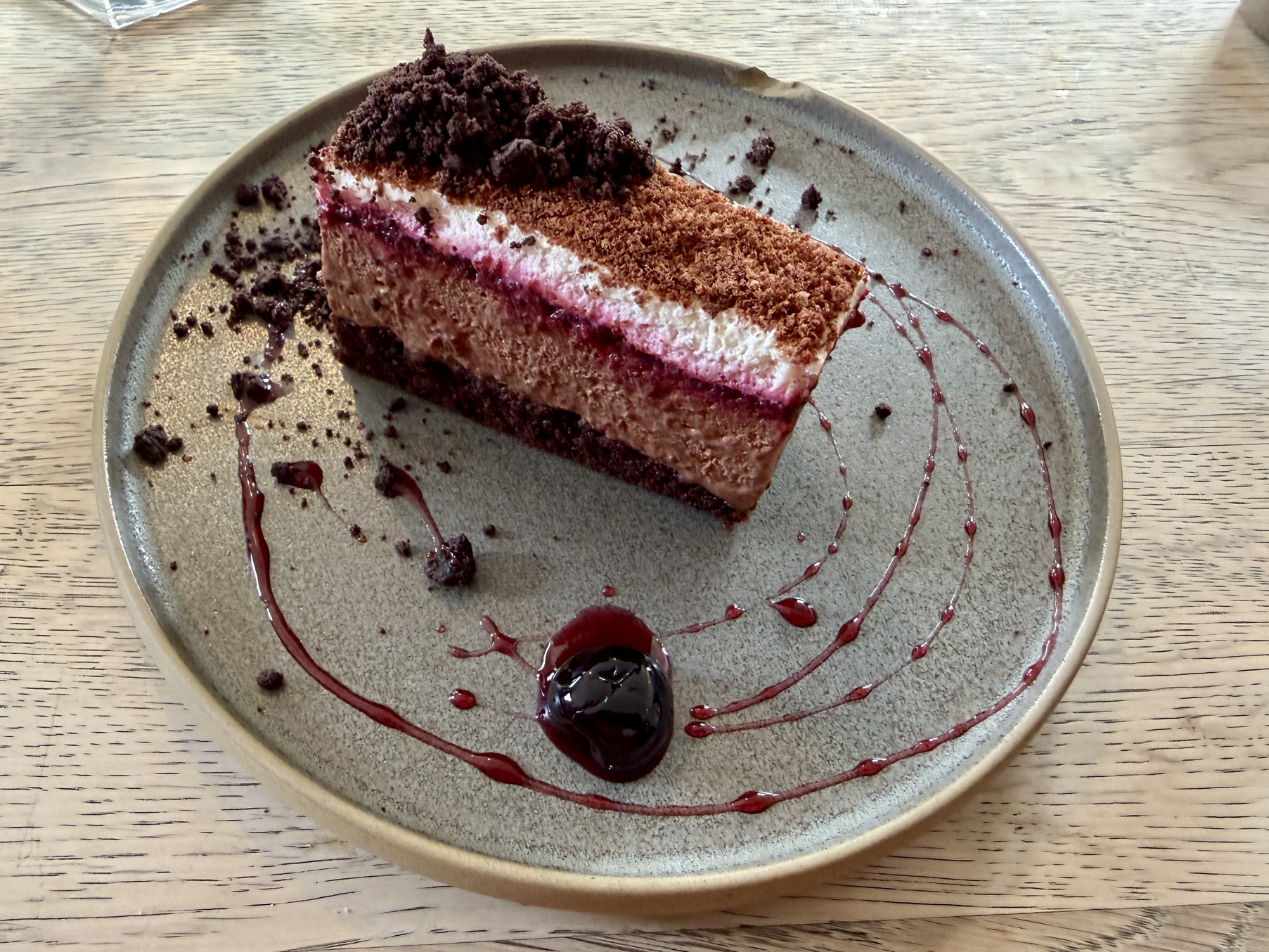
I had to have dessert after two magical courses like that; I wanted to give Angelo’s the chance of the kind of clean sweep that propels that rating at the bottom into the upper echelons. It was a flab-free dessert menu with limited options but, again, they were the choices you would want to see: a tiramisu, a panna cotta, an affogato, a rum baba which turned up at the table next to me and looked positively immense, in every sense of the word.

But we both, in the end, went for the tartufo cioccolato and, yet again, Angelo’s pulled something out of the top drawer. I have had these before where they’ve felt a little anonymous, like a freezer ready fancy-schmancy choc ice, something to finish your meal with when you lack the imagination for a proper dessert. I’ve had them at Pepe Sale, and even as I’ve enjoyed them, I’ve known I was slightly short changing myself. But nobody ordering this at Angelo’s is doing anything other than treating themselves in a big way.

It was a huge, cocoa-powder dusted puck of a thing, crowned with ice crystals, and we waited for our dessert wine to turn up before we made inroads. But when we did, it was just glorious. Have you heard how Wall’s ruined the iconic Feast ice cream earlier this year by swapping its chocolate ice cream for vanilla while leaving that disconcertingly nostalgic core of plasticky chocolate intact? Angelo’s has performed that trick in reverse, so at the centre of its tartufo is a core of zabaglione. It is, and I don’t use these words lightly, life-alteringly good.

So, by the way, was the dessert wine. Angelo’s offers five by the 50ml glass, and none of them are cheap. But in for a penny in for a pounding, as my wife is wont to say, so we tried the priciest, the muffato from Umbria. It was the same gold I associate with all of the meal: the gold of the summer sunshine outside, the gold of the salmoriglio, the gold of my carbonara, of that zabaglione. Maybe everything Angelo’s touches turns to gold – in truth, it was beginning to feel that way.

It was, as I said, it was a costly way to end the meal – £13.50 a glass – but I quite liked Angelo’s pricing. It felt democratic rather than random, that you could have a main course that cost the same as your starter, or a glass of dessert wine that cost almost twice as much as the dessert accompanying it. I think you could come here and eat very well indeed, yet spend more or less than we did. I’m absolutely certain that the oenophiles among you could badly bruise your debit cards at Angelo’s. But it would all happen so nicely, and you’d come away so happy, that you wouldn’t mind one bit.

Our meal for two – and bear in mind we had nibbles, and aperitivi, and dessert wines and a metric fuckton of good times – came to £200 on the nail. Personally I don’t begrudge a penny of it, and it’s worth mentioning that they leave the question of service entirely up to you. I hope they get the tips they deserve, because service was delightful from beginning to end.

I don’t want to patronise Angelo’s by saying I was not only ecstatic but relieved that eating there was such a stellar experience. But it doesn’t pay to be dishonest, so I should admit that I was relieved. I didn’t want to put the boot into yet another big money signing for the town centre, especially an independent. Even if it is underneath Ebb & Flow, a collection of performative if well-appointed shoebox apartments whose main purpose seems to be to make wealthy buy-to-let landlords wealthier still.

I wanted something to buck the trend of unremitting meh that seems to afflict the RG1 postcode. I really, really did. But if I wanted Angelo’s to be decent, it was beyond my hopes that it would turn out to be quite this good. It is the best thing to happen to central Reading for ages, and the best thing to happen to a reviewer of central Reading restaurants, arguably, for even longer. So, has my enthusiasm been infectious? Does it make you want to go?

It’s worth it, believe me. I may be the latest person to ask you if you’ve eaten there yet, but I have a feeling I won’t be the last.

Angelo’s – 8.8
9 Friar’s Walk, Station Hill Square, Reading, RG1 1HP
0118 3042885

https://www.angelosdine.com

Since January 2025, Edible Reading is partly supported by subscribers – click here if you want to read more about that, or click below to subscribe. By doing so you enable me to carry on doing what I do, and you also get access to subscriber only content. Whether you’re a subscriber or not, thanks for reading.
Restaurant review: Le Champignon Sauvage, Cheltenham

A few Fridays ago I was sitting in a café called Suffolk Coffee in Cheltenham, drinking a latte and feeling something I don’t generally experience before going somewhere on duty: genuine anticipation.

Because I don’t often review a Michelin starred restaurant for this blog – it’s only happened twice so far, and the last time was over 10 years ago. Reviewing somewhere like that is a test of the reviewer every bit as much as it is a test of the restaurant: is my palate up to the task of appreciating it? Is my writing up to the task of capturing it? Just as footballers want to play against the best opposition, reviewers want to review the good stuff. It’s why you’d never find one worth their salt on a hyperbolic quest to find, I don’t know, the best burger in the U.K. We bore too easily for that.

The anticipation was heightened by the fact that I was about to have lunch at one of the restaurants on my bucket list, Le Champignon Sauvage. Amid all the ebbs and flows of gastronomic fashion, Le Champignon Sauvage has held a Michelin star since 1995: only three U.K. restaurants have held one longer.

In those thirty-one years, Michelin has changed its mind about the kind of restaurants it wants to celebrate, accepted bungs from tourist associations to extend its guide to godforsaken places like Dubai, introduced its pointless Green Star and scrapped it. And for eighteen of those years Le Champignon Sauvage held two stars, until Michelin took the second one away in 2018. Nobody knows why.

Nobody ever does, by the way. I’ve eaten in some great restaurants, like 5 North Street in Winchcombe or Chelsea’s Medlar, which lost stars for reasons that pass all understanding. And I’ve eaten in restaurants that held a star with no idea how they managed to blag one in the first place. It is the great enigma, and for all the pontification online about restaurants that should have one, or should have two, for all the episodes of that Apple TV show with Gordon Ramsay and the posho from Topjaw I suspect it will remain an enigma for a long time.

But anyway, it’s food for thought: on a personal level, when Le Champignon Sauvage first won its star I was just about to leave university. Blogs didn’t exist. Nor did smartphones, and I wouldn’t have an email address for a few more years. Just to channel my own version of We Didn’t Start The Fire: New Labour; 9/11; the credit crunch; Covid; Will Young winning Pop Idol; President Obama; President Trump. All these seismic things would come to pass, they just hadn’t yet.

And in terms of food, St John had only just opened the year before: the food revolution in this country, such as it was, was in its crib. But this piece of history is even more striking: Le Champignon Sauvage has been run by a husband and wife team – Helen Everitt-Matthias running the front of house and her husband David in the kitchen – ever since it first opened in 1987.

Not for them chopping and changing, expanding to a group of restaurants and appointing new head chefs here and there. Instead, the two of them have put this restaurant on the map and kept it there for nearly forty years. In a country that changes its mind with the frequency of somebody whose attention span has been rotted by social media, a nation that swaps Prime Ministers like it’s bored and changing the channel, it feels like we won’t see Le Champignon Sauvage’s like again.

And the final evidence of that unique status is the thing Le Champignon Sauvage might be most famous for: David Everitt-Mathias is always in the kitchen. If he isn’t there, the restaurant is closed. He doesn’t do TV, and he has published three books in forty years. That’s it. If you eat in his restaurant, you know he has cooked your food. That’s unlike so many starred restaurants in the U.K. So I wanted to go there, while I still could, on a expedition to somewhere that embodied hospitality as a calling more than any other restaurant I could imagine.

Subscribe to continue reading

Become a paid subscriber to get access to the rest of this post and other exclusive content.

Restaurant review: Spitiko

Having written about and celebrated Reading and its independent scene for nearly 13 years, one thing that has always irritated me is people who live to run the place down. You see them popping up on the comments section of the Reading Chronicle all the time, people who say that the town is all vape shops and money laundering, who hate the halal butchers and the global superstores and the mosque. 

We all know what’s behind that, and it’s not really about Reading: it’s about wanting to take the country back to some rose-tinted past that wasn’t even that crash hot first time around. One where women were paid sod all – if they had jobs at all – and where nobody could be gay, or trans, or brown. One with three TV channels and everything closed on Sundays. One where youngsters knew their place. 

It’s a land where those people still live in their heads, and if a country like that really existed I’d be all for them emigrating there. Reading – multicultural and vibrant – just happens to be in the crosshairs because it embodies so many things they’d change. But even though I despise that viewpoint, lately when I’ve gone into the centre of town I’ve felt weary, because the town I love is getting harder and harder to champion.

Rough sleepers are everywhere, begging feels more apparent than at any time I can remember. Friar Street is lined with vacant shop fronts and when new things open, they’re always chains and often the kind you wouldn’t choose. Shake Shack is on Broad Street now, next to Fat Face, and people who get excited about that kind of thing are beside themselves. 

Also new is Amorino, which I visited recently for a gelato. You had to order using a big touchscreen which tried to upsell you every step of the way: that irked me when the people sticking gelato in your paper tub were right there. My ice cream took ages because the member of staff doing it kept weighing it, adding a tiny amount more, weighing it again. Because, in case you’d forgotten, it’s 2026. 

But it tasted nice, even if eating it I realised that, for a long time, it had felt like Reading was always the bridesmaid, never the bride. We always got Amorino, never Swoon. We always got Wendy’s and Shake Shack, never Patty & Bun or Beefy Boys. Always the town, never the city. So for this week’s review I decided to visit the one part of Reading that seems fairly immune to the general worsening of things, and Friday night found Zoë and me in Spill, drinking pints of Parka ahead of a short amble along Prospect Street to Spitiko. 

Yes, that’s right: it was time for a date night in Caversham.

I got into all sorts of trouble a long time ago for asking the simple question Why isn’t Caversham nicer?, but whether you thought it was nice or not in 2017 is rather beside the point these days. Because since then – and especially since the pandemic, when people spent money closer to where they lived – Caversham has flourished in a way that the rest of Reading simply has not. 

It has acquired two excellent cafés, in the shape of Geo Café and The Collective. It boasts lifestyle stores and bakeries, bookshops and bars. It has a great pub with outside space in the shape of The Last Crumb, and one of Reading’s most distinctive restaurants in the form of Vegivores. And of course, to the detriment of the town centre it has arguably Reading’s best restaurant, Clay’s Kitchen.

Sitting in Spill with a beer, looking over at the outside tables filled with happy, prosperous people, Caversham had a certain affluent glow that you don’t generally see in the RG1 postcode. Friends were catching up, a couple were engaged in a fierce cribbage contest that reminded me of a former life. And seeing all that, drinking it in along with my cold pint of Parka, I got it: I understood why people in Caversham always seemed so happy with their lot in life. That was why Caversham residents, like wild swimmers or vegans, volunteered the information within five minutes of meeting you. Who can blame them?

Spitiko, technically, pre-dates Caversham’s renaissance. For many years 6 Prospect Street was home to Kyrenia, a Cypriot restaurant. Then at some point in 2016 it changed hands, and the new owner called it Ketty’s Taste Of Cyprus. Kyrenia’s legendary front of house Ihor left – the last time I saw him he was working at Papa Gee – and then, around the time of the pandemic, the restaurant rebranded again, this time to Spitiko – a Greek restaurant, rather than a Cypriot one.

I think one of the reasons I held fire on reviewing Spitiko for so long was that I loved Kyrenia so very much. I’ve written before about how it was one of the saddest closures in my time writing this blog, and talked at length about how often I went there. But it hasn’t been Kyrenia for a very long time, ten years or so, and it felt like time to try Spitiko afresh, as free of preconceptions as possible. 

That’s also why I will try, as best I can, not to use the K word again in this review. Because having started this review railing against them, I don’t want to be one of those awful people who thinks everything was infinitely better in the past.

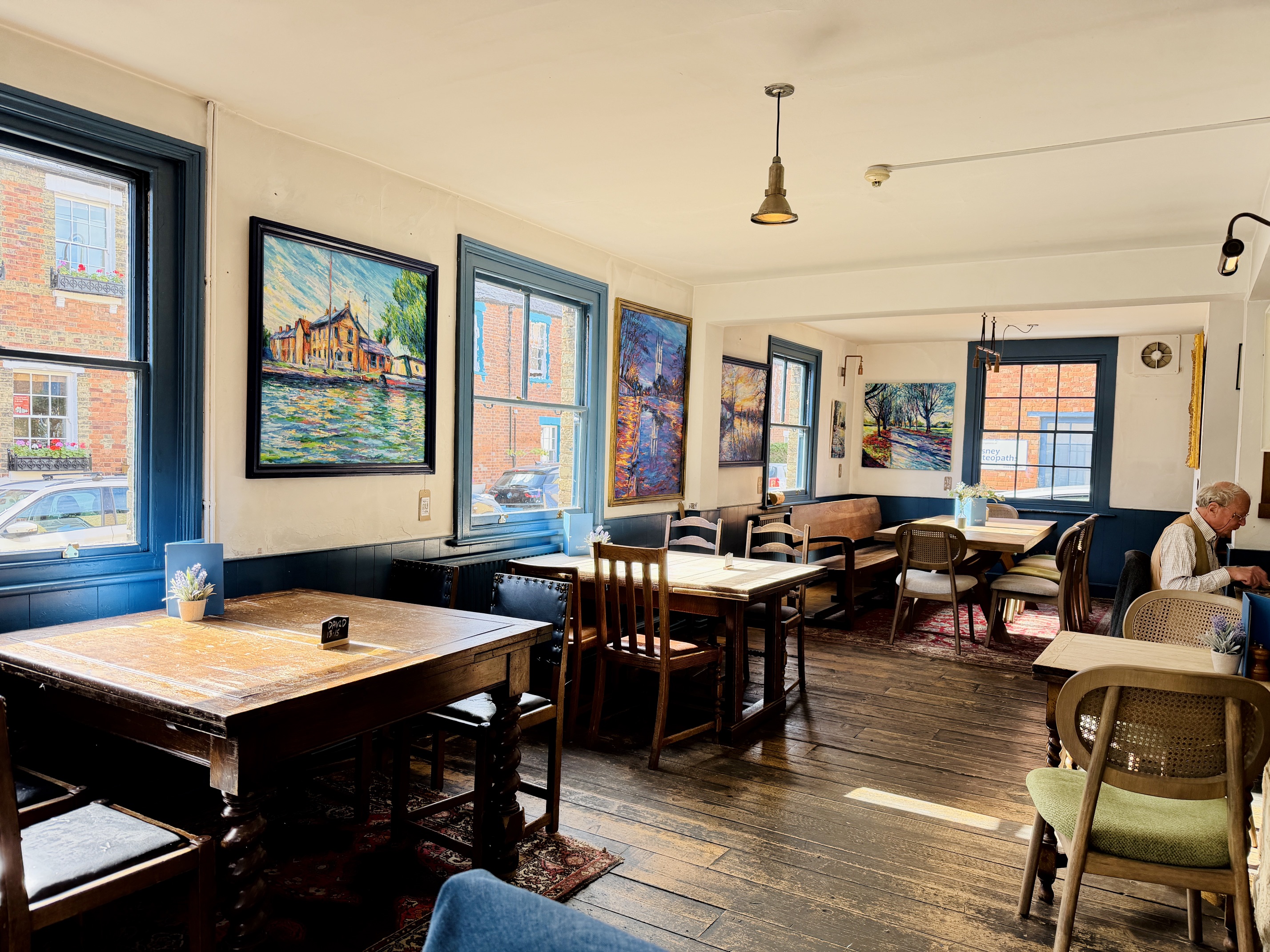
Spitiko’s dining room was spacious and airy, with plain tables and chairs and a pale wooden floor. Huge paintings of the windmills of Mykonos and the blue-domed churches of Santorini took up one wall, a bouzouki was propped up on a window sill. The only other flash of colour was the distinctive Hellenic cyan edging the windows and doors. The ground floor dining room was doing reasonably well on a Friday night, with over half its tables occupied.

One thing we did realise right away, though, was that it was deafening. Whoever designed that dining room was either in their early twenties or had never tried to eat in it: the lack of soft furnishings or sound insulation made it an incredibly loud place to sit and eat. Every table had to keep talking louder because every table was struggling to be heard, an escalating state of affairs that made it a very difficult space in which to spend time. Zoë, who has a coping strategy in these circumstances, took out her hearing aids: I had no such luxury.

Spitiko’s menu covers a lot of ground, and blends both Greek and Cypriot specialities. Feta and halloumi both feature, and the restaurant serves sheftalia, which is distinctly Cypriot. But it calls its stuffed vine leaves dolmades, the Greek name, rather than koupepia, even though they contain mince which is more common in Cyprus. 

In any event, you have an enormous amount of choices – something like twenty-five appetisers and nearly as many mains. You also have the option of choosing a meat, seafood or vegetarian meze selection, for between £31 and £36 a person, but we decided against that because it’s the kind of order I might have placed in this building in the past. So we picked a selection of starters to share, and a main each, and tried to make ourselves heard above the hubbub.

But first we ordered wine, and this was where the first alarm bells rang. Greek wine, very underrated, offers a great range of excellent whites and reds. If you’re at a restaurant with a good wine list, it’s always worth looking out for a xinomavro or an assyrtiko because they often punch above their weight. 

Spitiko, I’m afraid, is not that restaurant. They do have half a dozen reds and whites from Greece and Cyprus, but many are from a single producer. Nothing will set you back more than £30, but that means that most of the wines cost £10 retail. I looked most of them up on Vivino, the wine app, and I didn’t realise you could buy wines with ratings that low. So we ordered the best of a bad bunch, a bottle of Kouros Patras – straw-coloured, chilled and forgettable, if not actively offensive.

This is as good a point as any, by the way, to make reference to Spitiko’s greatest asset, the chap who looked after us. He was wiry, high-energy and full of charm – he told us he was Irish, although I didn’t get that from his accent – and he was undoubtedly the single best thing about eating there. I hope one day I bump into him again, at a better restaurant.

One thing I always associate with eating in Greece itself, rather than in a Greek restaurant here, is the wonderful sense of leisureliness that always accompanies food in a taverna. The air still has the warmth of the day, the al fresco tables around you are full of happy people, and later on your walk back to your room will be accompanied by the music of crickets and the glimmer of fireflies. 

Not so in Caversham, where our four starters were banged down in front of us about ten minutes after we ordered them. They were each, in their way, the epitome of middling.

First up there was houmous, adorned with a single olive and a meagre drizzle of an olive oil so yellow and pale that it couldn’t add any joy to proceedings. The houmous itself, scooped onto scorched, bought-in pitta bread, wasn’t actively unpleasant but had nothing about it to elevate it from stuff you could buy in a tub for £2 from any supermarket in the land. 

Here it was £6.25, and I did think the main thing you were probably paying for was the act of decanting. The menu talks about garlic, lemon juice, tahini: all things this should have contained but somehow tasted as if it had never seen.

Equally underwhelming, if not more so, were the dolmades. £7.25 got you three small ones, all in varying stages of falling apart. I didn’t have to cast my mind back far to think of better ones – for all their faults, the stuffed vine leaves at Antep Kitchen were far better than this – but also, they were meant to contain mince and if they did, subtle isn’t even close to the right word. But also these were served hot, and the speed, the heat and the texture all made me wonder if a microwave was involved. If it wasn’t, there would have to be another excuse for these being so disappointing.

Lamb kofta also couldn’t live up to the promise of seeing those words on the menu. What was going on here? Two worryingly uniform cylinders of dense, compacted meat, each cut into worryingly uniform halves. No irregularity, no char, no coarseness. There was no sign that these had been threaded onto a skewer, no sign that they had been formed by hand. No sign, in honesty, that they hadn’t come out of a packet. 

Last of all, one of the dishes I always make a beeline for in Greece, feta saganaki. Deep fried cheese should be a genuine treat, whether it comes with honey and sesame seeds to offset the saltiness or is brought to the table flaming, doused in ouzo. This was neither, it was just a slab with a bit of a tougher exterior but no real evidence of crispiness or contrast. How could you take feta, deep fry it and produce something that was so far from fun? It felt like a betrayal – of Greek food, of our hopes, of all that and more besides. 

There was sad salad on the side, as there was underneath the kofta and the dolmades. Technically I guess it was sadder salad, because it was all sad.

Could our main courses rescue matters? You mightn’t be amazed to hear that we found out pretty damned quick: fifteen minutes after our starters turned up, out came the mains. You may, however, be surprised to hear that I wasn’t as outraged as I could be. By this time I regarded the rest of the meal a bit like the way I think of a blood test: I knew it had to happen, but I didn’t mind getting it out of the way as fast as possible.

That wasn’t entirely fair, though, because the mains showed that Spitiko could cook – just not a whole dish, and not consistently.

Take my sheftalia – which are meant to be coarse sausages wrapped in caul fat. I was so looking forward to these, at the start of the meal anyway, and by the time they arrived they managed to surpass my successively lowered expectations. Unlike everything else so far, they felt made by hand – irregular, nicely stocky things with a crinkled exterior. And they tasted good. I’d had enough of Spitiko’s humdrum tzatziki by then, and fortunately these didn’t need it.

But even here, with one of the best things they did, they couldn’t nail the landing. First of all, sheftalia can be made with pork, beef or lamb and Spitiko’s menu promises pork. So why was one of the four clearly completely different? It tasted of beef and red wine, and I didn’t mind it at all but it was bizarre how it didn’t match the other three. If I’d had two of each, or the menu had said they were a mixture, I probably would have been delighted: without that, it just added to the sense of chaos.

And the accompaniments were barely worth bothering with. A fairly dull Greek salad with four cubes of oregano-speckled feta, no olives and – would any plate be complete without it? – more limp iceberg lettuce added very little. Even worse was a big helping of faintly yellow rice studded with eerily uniform bits of veg: peas, green beans and so on. Its texture was surprisingly clumpy and, again, it felt as likely to have been made by Batchelors. I ate all of my sheftalia, I snaffled the feta, I left most of the rest.

Zoë’s kleftiko was a similar story. The lamb itself was good, tender, beautifully fatty and a cinch to ease away from the bone. I was allowed to try a bit, and it wasn’t half bad: ironically a far better deal than the very expensive equivalent I’d tried at Queen’s Park’s Carmel earlier in the year. I have had better kleftiko in Reading, although I’ve boxed myself into a corner whereby I can’t tell you where, but it was pretty decent.

But again, the stuff that came with the kleftiko was irrelevant rather than elevating. The roast potatoes looked like perfectly acceptable waxy specimens, with no real sign of roasting or glorious crisp shells. The vegetables – broccoli, carrots – were bland ballast. It’s perfectly fine to make the sheftalia or the kleftiko the centre of the dish, but the stuff on the perimeter should cheer, not heckle.

By this point some of the tables had left, the absolute racket had died down a little and I tried to find ways to look on the bright side. You should have tried this place back in the day, I said to Zoë, except of course back in the day it wasn’t this place. Just another one to file away in the long list of things I wish I’d discovered and experienced with my wife, thwarted by our chronology and the fact that we had to spend all those years living our lives and becoming the people we did so that we could meet and fall in love and, hopefully, live happily ever after. 

But as I keep saying in this review, you can’t live in the past – even if it was a past when I weighed five stone less, hadn’t lost loved ones, hadn’t broken my arm. The accumulation of damage, bad decisions and disappointment helps make you who you are: wish it away, and you wish you were somebody else. All far too deep to bring up at a date night in Caversham, I decided.

We would have had dessert, because the wine list included two Greek dessert wines, both of which I absolutely love. Our ever-charming server wandered off and came back effusive and apologetic: they’d run out of one, and they had about a glass of the other, but in a bottle which had been opened and not kept in the fridge. We waved it at us, we asked for the bill. £122 with a 12.5% service charge, which was the only element that felt like value. 

We called an Uber back to Katesgrove and ate ice cream in front of the telly, catching up on Top Of The Pops. It’s nice to go to Greece, it can even be nice to go to Caversham, but it’s nicer still to go home.

I really wanted to love Spitiko, and I really wanted to prove my hypothesis that bits of Reading are still getting better and better despite the naysayers. It’s tempting to feel deflated, and think that neither of those things happened. But I don’t know about that. I think it’s more the case that Caversham continues to flourish and buzz, and that places like Vegivores, Spill, Clay’s, even BKRY demonstrate that future. 

Put that way, Spitiko feels like part of the Caversham that predates all of that change. I hope they aren’t left behind, and that when their race is run one day there will be people who meet for dinner somewhere else, in that building or another one, and say “Remember Spitiko? That was a restaurant. God, the evenings we had there.” Sadly, though, I won’t be one of them.

Spitiko – 6.6
6 Prospect St, Reading, RG4 8JG
0118 9476444

https://spitiko.uk

Since January 2025, Edible Reading is partly supported by subscribers – click here if you want to read more about that, or click below to subscribe. By doing so you enable me to carry on doing what I do, and you also get access to subscriber only content. Whether you’re a subscriber or not, thanks for reading.
Restaurant review: Antep Kitchen, Oxford

Taking a Friday off and meeting my old friend Dave for lunch in Oxford felt like such a good idea when we made our plans. There’s something magical about a long lunch – and especially one on a Friday, starting your weekend before most people, knowing there’s no rush to anything and that, if you choose, you still have two lazy days and lie-ins in your future. What’s not to love about that?

Reality, unfortunately, had other plans. Because the Friday we chose, a couple of weeks ago, was at the height of the latest heatwave and everything was brutal. There seemed to be no other word for it. The rail network struggled, with a slew of cancellations: my train was delayed, Dave’s stopped outside Didcot for what felt like an eternity. Finally disembarking at Oxford it felt, if that were possible, hotter even than Reading – a cruel, searing heat with no respite. All the times that anybody had ever complained about Britain’s indifferent summers were coming back to bite us: I’d say be careful what you wish for, but nobody wished for this.

I grabbed a table outside Society Café with a latte that I immediately realised was the wrong order altogether, and waited for Dave. It turned out that even being in the shade didn’t make matters much more bearable. My little John Lewis fan whirred away, its efforts close to futile, and I got sympathetic looks from the ladies at the next table: I like to say I’m built for comfort, not speed, but I was definitely not built for heat.

When Dave arrived we quickly ruled out any more hot beverages and decided on a drink before lunch, opting to get our schlep into East Oxford out of the way first and reward ourselves with a pint. We ruled out taking a bus on the basis that they would be purgatorial, but it’s hard to imagine they could have been more punishing than the walk we did. The High, wide and handsome, was frying in the sunshine with no relief to be found anywhere. We headed over Magdalen Bridge, hot and bothered, and I could already feel the ghost impression of the sunburn on my forehead yet to come.

It didn’t help that Dave’s first choice of watering hole turned out to be closed until 4, or that my backup plan didn’t open until an hour even after that. So eventually, a full three quarters of an hour later, we wound up in the almost-shady and very fetching terrace of the Rusty Bicycle while I drank a pint of cider with indecent haste and wondered if I would ever stop sweating.

Huge, gorgeous-looking chicken burgers turned up at the adjacent tables and I was very tempted to junk this whole restaurant reviewing lark for the day and stay there. Have a burger, drink some of Dodo Pubs’ excellent peach lager, chat and resolve to move no further than walking to the bar or the loo, until it was time to go home. And I nearly suggested it, too, because something about that gruelling heat made doing anything – moving, thinking, deciding – close to impossible.

But we had an appointment with Turkish restaurant Antep Kitchen on the Cowley Road, a place that had been on my list to visit for well over five years. In lockdown, when reviewing restaurants was out of the question, I ran a series of interviews on my blog with some of the great and the good of Reading. It was my tribute to the weekly Q&A in the Guardian, which I read without fail every Saturday.

One of the questions I asked was What one restaurant do you wish you could pick up and drop in Reading?, and when I interviewed Mohamad Skeik, then manager of Reading institution Bakery House, Antep Kitchen was one of the places he chose. And I remember thinking that if the manager of Bakery House said somewhere in Oxford could match it for grilled meats I really should go there one day.

Six years on Skeik has parted company with Bakery House, but his recommendation had always stayed with me and gradually, as I worked my way through reviewing restaurants in Oxford, it moved closer and closer to the top of the list.

It’s been open for nearly 9 years, the name being taken from Gaziantep, the Turkish city widely thought to be the culinary capital of the country and the birthplace of owner Bilal Gilgil. Going inside my first overwhelming sentiment was relief, because despite a huge charcoal grill the full length of the open kitchen, the aircon was on full blast and I experienced a feeling of coolness for the first and only time that day.

Once that euphoria had worn off, I took in my surroundings. It’s quite an attractive restaurant, busy on a Friday lunchtime, with tasteful banquettes and tables, bare brick walls and a plethora of woven lightshades descending from the ceiling in the bigger back room, the one with booths and less natural light. I imagine that space comes in very handy on a hectic Friday or Saturday night – I also imagine it would be hard to hear yourself think there – but I was glad they’d put us in the smaller front room. There’s even a little terrace on the pavement, although you’d have to be certifiable to have eaten there that day.

The thing that really struck me was the sheer diversity of the clientele at Antep Kitchen – all ages, all demographics, all types and sizes of groups seemed to be taking the opportunity to lunch here, from friends to couples to families: they even managed to find space for a pair of middle-aged men on the verge of heatstroke. I was especially impressed by the number of solo diners I saw, all women, who came in, took a table on their own, ordered something off the grill, read a book, ate their food, paid their bills and went on their way.

If Antep Kitchen was anywhere near me I’d be sorely tempted to follow their excellent example of a lunchtime, especially as you can get a two course set menu until 4pm for £14, and they throw in a soft drink with that. But we hadn’t travelled all that way in such arduous circumstances to pick off the set menu, so we immersed ourselves in Antep’s full repertoire. It is a huge menu full of familiar sights, which makes the whole process harder than you’d think. Cold mezze cost no more than £6.50, hot mezze max out at £8.50 and unless you’re having a Turkish pide most of the mains range between £17 and £25.

The majority of those come off the grill, as you’d expect, but there are other options like moussaka, kleftiko and güveç, or Turkish casserole: I doubt Antep Kitchen was shifting many of those, though, on a very hot day. And although there were a couple of vegetarian mains on the menu – vegetable kebab, vegetable güveç – I don’t honestly think you’d bring a vegetarian here unless you didn’t much care for them.

That said, it just so happens that both of our starters were vegetarian. Stuffed vine leaves have been a weakness of mine since that first childhood family holiday to Corfu in 1987 – yes, I am that old – and I’ve always been a sucker for a well-executed one, that freshness of rice and mint, that tang of lemon, that taut green casing.

They always catapult me back to that summer, when I was so skinny, so nerdy and so very English and was suddenly confronted with a different life of heat, indolence and amazing food. But powerful though nostalgia is, I could see through it and realise that these were perfectly good but not amazing. Allegedly they feature both pine nuts and blackcurrant: I could only discern the former, but didn’t miss the latter.

Antep’s falafel were good, too, but felt like an exercise in portion control. Four dense nuggets, very different from their crisp-shelled Lebanese cousins, were genuinely very nice – made with chickpea and broad bean and with the hugely enjoyable surprise of huge, firm chickpeas in their core. I liked them a lot, and they came perched on a smear of houmous that I also quite liked. A little basket of pleasing airy pide came along shortly after, and the whole thing worked well. But at £7.50 did I expect a few more falafel and maybe a little less padding, like the handful of salad from a bag whose main purpose was to squat on half the plate? Possibly.

None of that felt enormously important at the time. We were cool, at last – have I mentioned that it was a hot day? – and we had food in front of us, and a cold beer. An Efe Draft which, confusingly, is not on draft but actually comes in a squat, round glass bottle. And besides we had pushed the boat out for our main, a sharing platter that served two to three people, which meant that as two ravenous people we were about to eat very well indeed.

But being the day it was, nothing had gone completely to plan and nor did this. I will say that the platter which came out was so huge, and our table so packed, that some serious Tetris had to take place to fit everything on, removing some of our starter plates, shifting beer glasses and water glasses and so on. But that might tell you more about the size of the tables, on reflection.

It also tells you something about pacing – this came out five minutes after our starters, which came out ten minutes after our order. Usually I know I’d have a right old whinge about that but I do sometimes know how to read the room, and this kind of room, menu and pricing are for unapologetically casual dining. So my knickers remained untwisted, which under the circumstances was probably for the best.

Here it is. It rather flattered to deceive.

Now, in fairness there was much to like here. It was a greatest hits trawl through the grill section, so you got a skewer of chicken shish, a skewer of lamb shish, a lamb kofte, a skewer of lamb ribs and what might have been two skewers of chicken wings. In terms of quality, you would struggle to fault any of it. The chicken wings were surprisingly good, with excellent char: I broke the habit of a lifetime and ate them with my fingers, without my usual prissiness. And the chicken shish was better still, the marination working its magic.

And those were probably the least impressive things on offer. Lamb ribs were a new one on me but rewarded the effort, the fat glossy and sweet, the whole affair genuinely succulent and a proper revelation; it made me wonder just how good Antep Kitchen’s lamb chops might be, and whether they matched the masterpieces down the train line at Didcot’s Zigana. The kofte was another standout: coarse, gnarly, expertly seasoned and with caramelisation that wasn’t to the detriment of the core.

But the real surprise package for me was the lamb shish: I am so used, even in Greek or Lebanese restaurants that I rate, to making excuses for the shish, finding it more leather-adjacent than I would like. I won’t do that any more, because Antep Kitchen proves that it absolutely doesn’t have to be that way: these were expertly marinated and cooked, with phenomenal texture and a little blush, and I could order and eat them all the live long day.

But again, that padding reared its head. The way it was dished up, with a sheaf of unnecessary rocket heaped on top, felt like it was meant to distract you slightly from the way the protein had been rationed. It came with a single grilled chilli, which I liked, and half a tomato which was distinctly under. And you got both rice and grains: the latter, giant couscous with a faint red hue and, again, whole chickpeas here and there, was well worth the time. The rice less so.

And then there was the salad, which was good but huge, topped with pomegranate and sumac, with a certain pleasing heat and grit. But at the end of the meal there was a lot of salad left, and quite a lot of rice, and that made me think it was out of kilter. It made me wonder whether, if you’d had that shish as your main, you’d have got one skewer or two, because the five things we had felt only just enough between two. I wouldn’t have wanted to split that between three – not unless one of them was a vegetarian, in which case I’d have gladly donated my salad.

Dave tended to agree, I think, and he isn’t as much of a gannet as I am. He liked it, though (“this is far more my kind of thing than fine dining” he said, which made me wonder if he’d quite forgiven me for lunch at Juliet). We did agree, on balance, that it was perhaps another kofte away from being truly satisfying. At least it left room for dessert, I told myself.

Before that, though, we looked at the drinks menu. Neither of us felt like chugging another Efe, but I was intrigued by a few of the things in the soft drinks section. I asked about ayran first, as I’ve always rather liked it, only to be told that they didn’t have any. So that left something called Salgam, billed as refreshing Turkish turnip juice. Did I dare give it a go? I asked one of the brigade of dapper, waistcoated servers.

“The Salgam – is it sweet?”

He gave me the kind of smile that’s hard to read.

“No, it’s spicy.”

How bad could it be, I thought? So I ordered it. And then I found out.

Salgam comes in a bottle with TURNIB on it in block capitals, and an illustration of a barrel with what looks like some kind of mutant cross between a turnip and a giant spider ominously climbing out of it. Tasting it, it didn’t really taste of turnip at all, but of pickle juice. Which I don’t necessarily mind, in its place, but this didn’t feel like its place. I took a slurp with my straw, and Dave enjoyed my discomfort in the way only a very old friend can.

“It’s sort of like a Bloody Mary where they’ve forgotten the vodka and swapped the tomato for, err, turnip.”

“You’re selling it to me, mate.”

“I think for solidarity you should drink what’s left in bottle.” He reluctantly agreed, and took about as long to finish it as I did my whole glass. Maybe it was delirium from the long walk to the restaurant, but I found myself laughing uncontrollably.

“They have a barrel on the bottle” I told Dave, “but this has clearly been made by scraping the bottom of it.”

“It’s not great.”

“The thing is, the more I have of it, the worse it gets.”

I thought to myself that ordering the Salgam was the right decision. It’s what Anthony Bourdain would have told you to do, I suppose, although I’m not sure how good a role model he turned out to be. Anyway, by the time I’d finished it I didn’t dislike it so much, although that might just have been the Gaziantep equivalent of Stockholm Syndrome. Subsequent research has shown that it isn’t even primarily made of turnip, instead being largely the fermented juice of pickled carrots “flavoured with aromatic turnip”, which is surely the best kind of turnip.

I’m glad I tried it, anyway, and that’s more than I can say about, for example, the novels of Zadie Smith.

We closed with desserts which were variations on a single theme but, between them, were strong enough to redeem some of the flaws that had gone before. Dave’s kadayifi was a brick of that familiar Shredded-Wheat-a-like, baked in sweet syrup and carpet-bombed with pistachio, topped with a scoop of good vanilla ice cream. It looked the part, and tasted good enough that Dave didn’t envy the baklava turning up at the next table: four generous pieces, clustered round more of the ice cream.

I think, uncharacteristically, I did better. I’d seen a video of the restaurant making their künefe on social media and it completely sold me on it: two layers of that crispy fried dough sandwiching a gooey core of stretchy cheese. The same syrup – the whole thing swimming in it, instead – and the same festooning of pistachio, but for me an infinitely more satisfying dessert. One of more contrasts and extremes, the syrup heightening the peaks of sweetness and yet, somehow, the cheese adding an almost savoury note that stopped it all being oppressive.

Our bill for two came to £113.30, not including service – and I thought the service was very good, even if they didn’t stage an intervention when I tried to order fermented pickled carrot juice. You could eat there for less, especially on the set, but I think there are probably better ways to spend money there than ours. Have a main each, stay away from the platter and maybe make the most of the wine list: Antep Kitchen stocks half a dozen Turkish wines, and none will set you back more than £30 a bottle. As we left the restaurant I saw, out on the pavement, a huge pallet loaded with charcoal, and I wondered whether the coals would get hotter than I’d felt.

Our day in Oxford ended as it began: stagger to a pub, have a pint in the beer garden and find that the beer garden is intolerable. Take the pint inside and find that inside is also intolerable. In the end we wound up drinking alcohol free beer at the Tap Social pub in the Covered Market, finding that “least hellish” was the best we could settle for. Dave’s train home stopped in Didcot for reasons that were never explained beyond the general inadequacy of our rail network, he took two hours to get home and missed some of the evening’s World Cup match. It was not our finest meal out together, but we concluded that it was still a better way to spend Friday than being at work.

And Antep Kitchen played a part in that: not only because of its excellent air conditioning but because it’s a brilliant illustration of, as Mohamad Skeik said in 2020, a restaurant you would love to pick up and drop on your doorstep. Any neighbourhood would be lucky to have it, and its neighbourhood definitely is. But is it worth crossing the country to visit? Much as I liked it I am less sure of that, but I’m really glad I’ve tried it. Just bear in mind some of the other things I’ve said that about recently: Salgam, I’m looking at you.

Antep Kitchen – 7.5
228-230 Cowley Road, Oxford, OX4 1UH
01865 247555

https://www.antepkitchen.co.uk

Since January 2025, Edible Reading is partly supported by subscribers – click here if you want to read more about that, or click below to subscribe. By doing so you enable me to carry on doing what I do, and you also get access to subscriber only content. Whether you’re a subscriber or not, thanks for reading.
Restaurant review: No. 1 Ship Street, Oxford

Oxford, probably my favourite city in which to review restaurants, ostensibly has little in common with Reading. One has pretty old buildings and winding lanes, a shopping mall that doesn’t bump off your will to live in the space of five minutes, a bustling market with food, drink, coffee and cheese and shedloads of independent retail. The other has Forbury Gardens and a very good bus network.

That sounds like I’m doing Reading down. Perhaps it’s more accurate to say that Oxford complements Reading nicely: if there’s something you wish Reading had, you may well find it thirty minutes down the train tracks. And to be fair to Reading, Oxford may beat it for wine bars – because it has some and no, Vino Vita doesn’t count – and it has some lovely old pubs, but Reading is streets ahead when it comes to craft beer. Oxford is brilliant, but it has no Nag’s Head.

One thing they do have in common, though, is that their best restaurants are rarely found in the centre. Reading has some solid restaurants inside the IDR – your Me Kongs, and Mama’s Ways – but they’re the exception rather than the rule: it’s mostly chains and I suspect it always has been. The independent restaurants chasing that status right in the centre are probably London Street Brasserie and The Reading Room, neither of which quite pulls it off, but beyond that you might find yourself heading north of the river, or west down the Oxford Road.

Oxford is similar. If you overlaid the Oxford restaurants I’ve reviewed over a map of the place, it would look like my metaphorical attempts to hit a bullseye down the pub: everything everywhere but in the middle. Out east you have the Cowley Road, Iffley Road and St Clements, all with great places to eat, and Headington beyond that. Head north and you reach Little Clarendon Street before the myriad of choices available in Jericho or Summertown. But what about the centre?

Oxford has a mall, the Westgate, and it’s nicer than the Oracle. But that means it still gets chains, just fancier ones. It has the kind Reading doesn’t attract: Mowgli; Shoryu Ramen; Six By Nico. Notably it has a branch of award-winning small chain Beefy Boys – it would have been a coup, if they had chosen Reading. But in the rest of the centre it’s largely a mix of chains we have, chains we used to have and chains we can probably live without. It has Cosy Club, for people who wish the Lounge group were fancier, and The Ivy, for people who wish Cosy Club was, I don’t know, more showy.

Oxford readers would probably be the first to tell me that’s a slight oversimplification. Oxford has a few long-standing central restaurants with a durable fan following, like Chiang Mai Kitchen or Edamame: it tells you something about their longevity that I’ve eaten at both, each case long before I started writing this blog. It has a branch of Permit Room, the Dishoom offshoot that is so far limited to a mere five locations nationwide.

Beyond that, if you’re talking more upmarket restaurants, it has Quod, a buzzy brasserie on the ground floor of the Old Bank Hotel owned by the same group as Gee’s. And the conversion of the old Boswell’s department store into a hotel has given the city Treadwell, a new all-day restaurant whose menu looks a bit like somebody took Quod’s, gave it to the kitchen and said “make it quirkier”: whether fish and chips needs kimchi tartar sauce is anybody’s guess.

Having lost all my Reading readers with seven paragraphs about Oxford, and all my Oxford readers with seven paragraphs which aren’t about the restaurant I’m reviewing this week, let’s finally get to the point and talk about No. 1 Ship Street, the subject of this week’s review. It’s resolutely small and independent, it’s been open for nine years this summer and it’s very much in the city centre, just off the pedestrianised hellscape of Cornmarket Street, just around the corner from the Covered Market.

Chef Owen Little has been there from the very start, and No. 1 Ship Street shows no signs of slowing down as it reaches the end of its first decade, having been named last November as one of OpenTable’s Top 100 U.K. restaurants: to put this in perspective, nowhere in Reading featured on that list, and nowhere else in Oxford did either. I explained all this – fortunately for him in far less depth than I have here – to my dear friend Jerry as we had a pre-prandial beer in Teardrop, the tiny pub in the Covered Market.

Owner Ross Drummond apparently celebrated winning that award from OpenTable by giving the place a refurb for the New Year. I think it was a subtle one, because the bones of the dining room were already there: beautiful racing green walls, well-spaced tables, the whole thing sleek, luxe and unfussy. They’ve removed the slightly tacky spider lights and the tables now are gorgeous and copper-topped: Jerry, mentally making notes for his flat, was taken with those. 

It was difficult to believe that the horrors of Cornmarket Street were a stone’s throw away, but No. 1 Ship Street had created a beautiful, grown-up oasis dangerously close to its borders. I should say that we asked to be seated in the main dining room: I’m sure the one on the other side of the entrance is lovely of an evening, but I didn’t want to lunch in a windowless room on a June afternoon.

After a disappointing run of small-plates-for-sharing restaurants, some honestly described and some far less so, No. 1 Ship Street’s menu came as a blessed relief. Terms like appetisers, starters and mains might be increasingly recherché out there in the wild, but in this restaurant they were alive and well. There was no spiel about the concept, because the concept was “remember how restaurants used to be?” and the conversational gambit wasn’t “do you need me to explain the menu?” but instead my personal favourite, “are you ready to order?”

Not that we were, at first, because No. 1 Ship Street’s menu was just tricky enough. The starters seemed to be where the more experimental bent came out – burnt aubergine soup, foie gras crème brûlée, frog’s legs and the like – while the mains were more conventional. So yes, there was a burger, and a steak, and a risotto. I guess you don’t survive nearly a decade in the centre of Oxford by taking massive risks.

Starters clustered between £10 and £16, mains began at £20 and climbed up from there. If you wanted oysters, lobster, a tomahawk or the restaurant’s surf and turf (which combined the latter two and cost £160) you could spend an awful lot more, and a specials board introduced about half a dozen other options, nearly all of them fish and seafood.

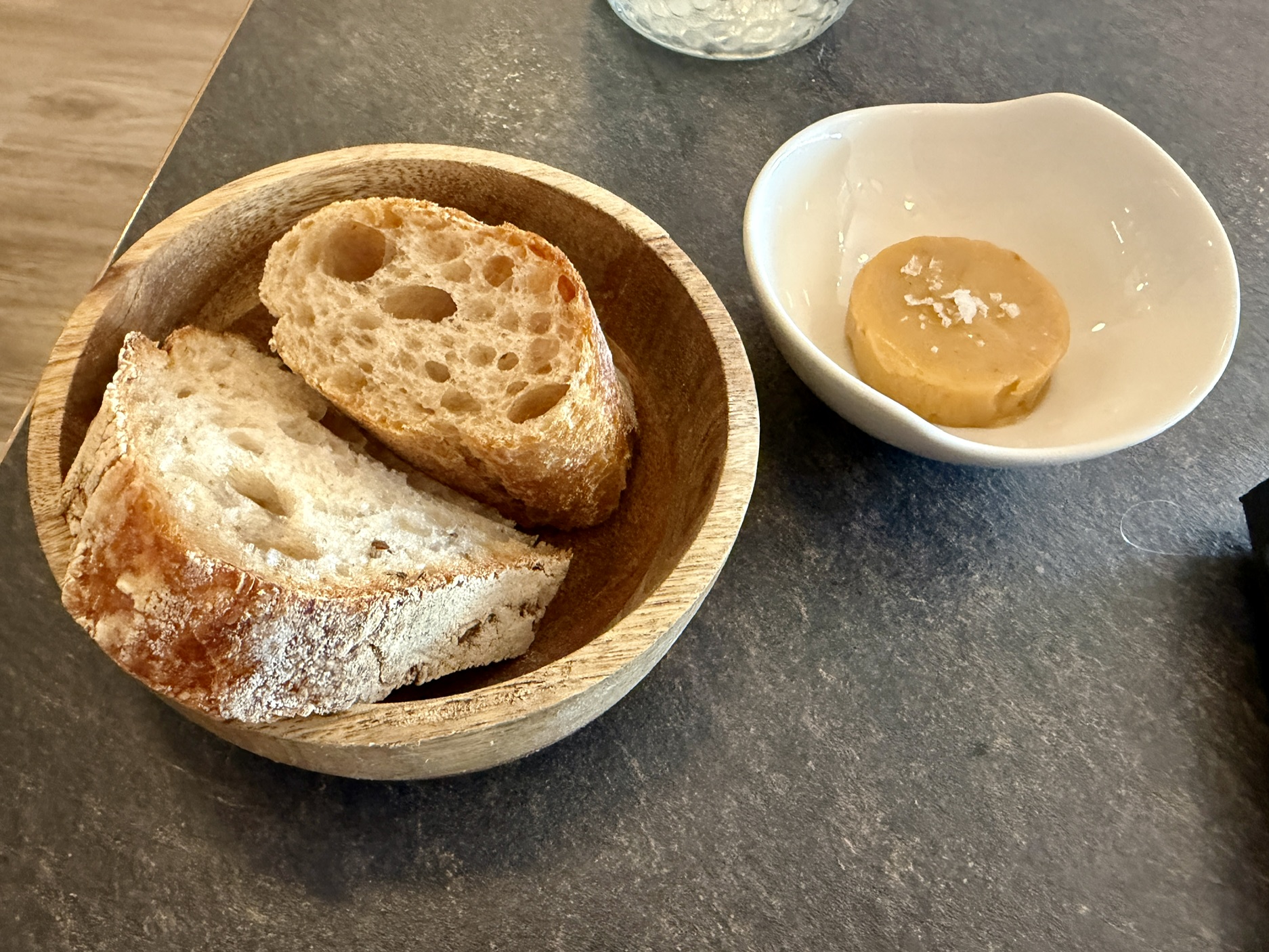
It was difficult enough that we ordered some appetisers and apéritifs while we decided – and No. 1 Ship Street is that happy kind of restaurant that brings them and gives you the time and space you need for that. Jerry’s bread was good and generous, speckled with nigella seeds and very enjoyable. Good salted butter at room temperature, embossed with the name of the restaurant, was a nice touch. For £6, the bread needed to be this good, and gladly it was.

My truffle and porcini arancini were the first evidence that the kitchen might quite like being tricksy for the sake of it. They were very good, the texture acceptably crunchy and the inside studded with mushroom. Not indecent value at £6 for three either. Whether they needed to be submerged in some kind of hot truffle mayo and then carpeted in Parmesan was another matter. I thought less might have been more in this instance.

Jerry tried a bit but revealed to me that he really wasn’t a fan of truffle. And I was reminded of the recent meal where I discovered he had been humouring me all these years by drinking white wine when he only really liked red wine. It turned out that my happy memory in lockdown of sitting on a park bench with Jerry demolishing a bottle of red and inhaling a packet of Torres’ superlative truffle crisps was actually more evidence of Jerry being too nice to say he didn’t enjoy something. Let’s hope that somewhere out there he isn’t writing a blog telling the world what a terrible dining companion I am.

Never mind. The apéritifs, by the way, were knockout: mine a variant on a negroni sweetened and mollified with the substitution of amaro for vermouth and Jerry’s a champagne cocktail with a little cognac in the mix, sugar cube effortlessly effervescing at the bottom like buried treasure. We followed this up with an excellent South African Chardonnay – yes, a white – recommended by the very knowledgeable server, from the Elgin Valley. It had plenty of citrus and elegance, it was £48, and I liked it a lot. Jerry said he did too, and hopefully he meant it.

Starters were where things started to wobble. Jerry was torn between a number of options, one of which was the foie gras.

“I love it, but I know I shouldn’t, so I don’t order it these days” he told me. And I’m afraid I took that as an opportunity to deliver a tone deaf homily about not denying yourself things you like – I wish I could say it was the negroni talking, but such conduct is me all over – and so he chose it.

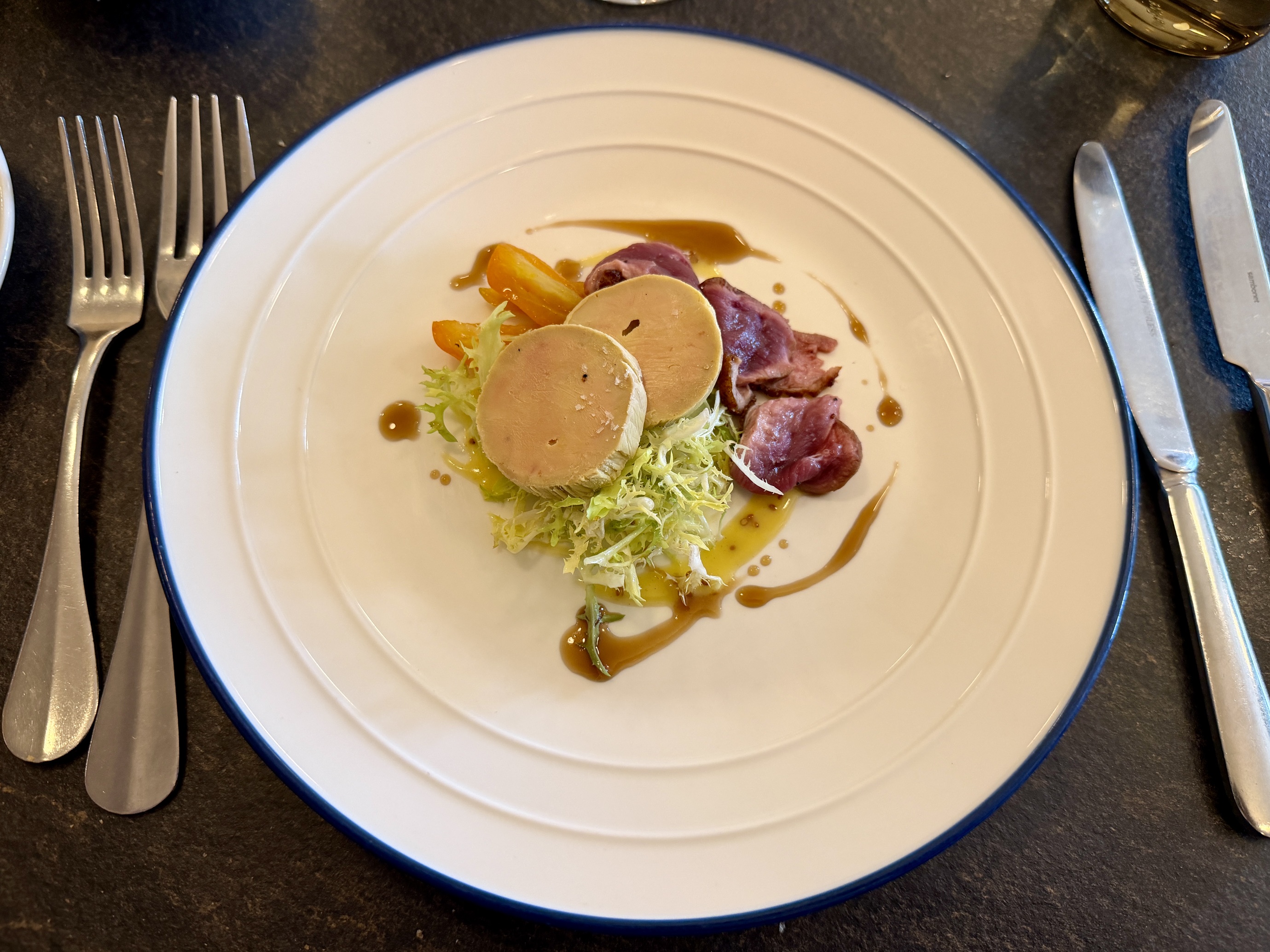
It was meant to be a foie gras crème brûlée with vin jaune gel and toasted brioche, and I’m sorry to say this, but the resemblance stops at the photograph, and possibly before that. A crème brûlée is meant to have a satisfying burnt top and be set underneath. It’s not meant to be a murky puddle of bumf. And it’s not meant to taste so little of foie gras that you wonder, as Jerry did, whether he’d accidentally been given something from the dessert section, a theory lent credence by the pointless popcorn on top.

Poor Jerry – all the guilt of having ordered foie gras without the corresponding enjoyment of getting to eat the bastard stuff. I felt personally responsible.

I felt less bad about it, though, because my starter was also disappointing. What was billed as seared scallops with clam velouté and parsnips was in fact a thin puddle of soup with a single scallop, cut in half, three clams and a crispy disc of perpendicular parsnip.

The overall effect, apart from masterful cost control in a £16 starter, was an oversweetened, unsubtle cacophony of a dish. Just like the foie gras crème brûlée, what turned up wasn’t in the slightest what the menu implied you would be tucking into. No wonder they brought you a spoon with this one. I once ate at Oxford restaurant Gees and wondered if I’d accidentally wandered into the U.K.’s most expensive salad bar. No. 1 Ship Street, by contrast, was beginning to feel like a spenny soup kitchen in disguise.

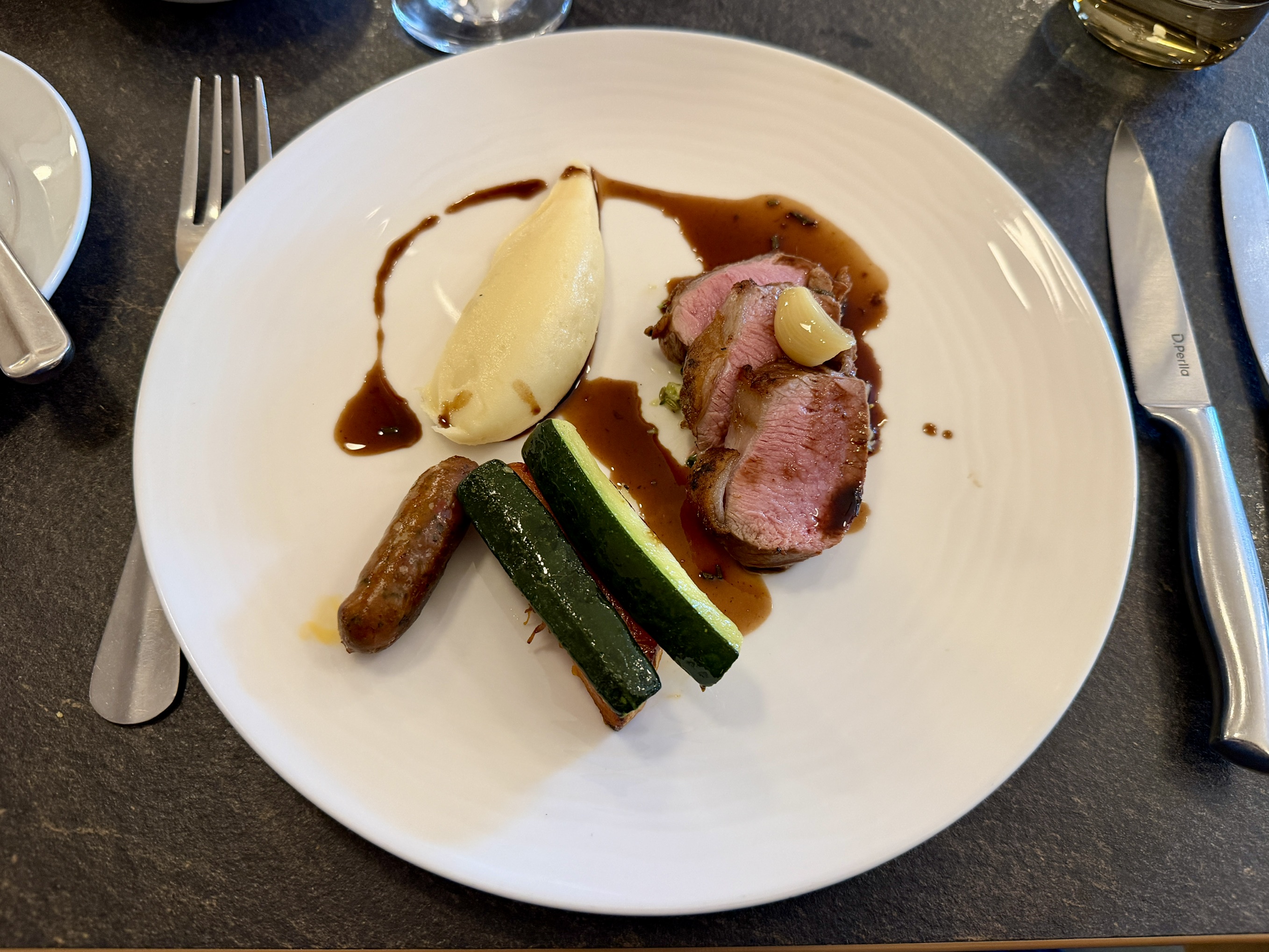
Were the mains, when the restaurant stayed closer to the mainstream, any better? Mostly, I would say. My confit duck almost worked: the skin was gloriously crisp, the fat rendered and the flesh underneath giving in all the right ways. Perching it on a pile of wild mushrooms, enjoyable ones at that, was a bit like giving the dish platform shoes: it made it look like you got far more duck than you did.

The white asparagus was thick and generous, with just enough bite, beautifully cooked to avoid the bitterness this variety can sometimes have. “It looks like a pair of dildos” was Jerry’s unvarnished take: I laughed like a drain and warned him that I planned to quote him verbatim. This is the bit in the description where I’d love to say and a plum jus brought it all together beautifully but instead I have to say that there was a thin drizzle of blandness that didn’t add enough moisture or flavour.

This dish needed carbs and didn’t have them, so I ordered some chunky chips. And these were well done, but with the main course so unrelentingly dry there was nothing for these to soak up, or act as a vehicle for. It also means that my duck dish, with chips on the side, cost £30. That’s a lot for not quite enough, there’s no way around that.

Jerry picked better I think, moules marinière from the specials. They were plump specimens, from St Austell Bay according to the blackboard, and Jerry thoroughly enjoyed them. They came with frites, and as with No. 1 Ship Street’s chips they were well executed.

But ironically, for me, this dish had the converse problem to both those starters. The mussels were high and dry, clustered in a wide-brimmed bowl. The joy of moules marinière is the bit at the end, when all the shells have been vanquished and you’re left with a bowl of that creamy liquor, to trawl with a spoon, picking up stray mussels, to drink like broth, to dab with bread or to tip your frites into. It makes it two meals in one.

But here, that last stage was a bit like some people I see prancing around on Instagram, too shallow to be worth persevering with. It seems that No. 1 Ship Street only dished up soup when you didn’t want it to. Jerry, mind you, loved it.

Despite all that, and perhaps paradoxically, we stopped for dessert. Because despite the food not being spectacular, and in some cases being downright weird, we were still having a lovely time. No. 1 Ship Street somehow, through its gorgeous, calming room, its very pleasing booze and unstintingly charming staff, created a space where you knew, on some level, that things could and should be better but didn’t mind as much as you should.

In that sense, it was almost the inverse of so many experiences I’ve had on duty lately, restaurants I ought to have liked more than I did. Here, instead, I found myself almost willing to suspend critical judgment. Only in the moment, really, and as I write this I remember all the things they got wrong. But weirdly, remembering them is almost like trying to recall a dream. I wonder how many people No. 1 Ship Street has pulled that trick on over nearly a decade. I’m not seeking to denigrate: it’s a neat trick.

Anyway, they saved some of the best for last. They make their own ice cream, and both the chocolate and salted caramel were smooth, rich, crystal-free and as good as anything you could get in George & Davis, if not quite the standard of Swoon on the High. The range of flavours was quite pedestrian, which surprised me: they save the cheffy stuff, the rose and rhubarb ice cream or the basil sorbet, to accompany Actual Desserts. £6 for two scoops with a beautifully light langue de chat was probably the bargain of the day.

Jerry was happy with his pistachio cake. I don’t know if I would have been, it was a thin, uneven slab of the stuff with something that did not look like basil sorbet. Maybe it was grape and basil sorbet – the menu, as so often, made it difficult to work out what you were going to get.

And again, that’s not necessarily a problem. In a restaurant where the words on a menu are just a jumping-off point, in the hands of the right kitchen, a meal can be a life of surprises. Underpromising and overdelivering is one of the great talents of hospitality done well, and the thing that makes memories – as much as anything does, over and above the people you bring with you. The problem with No. 1 Ship Street, for all I keep saying that it’s not a bad restaurant, is that none of the surprises, on balance, were good ones.

All that set us back £214, including the standard 12.5% tip, and more than usual I couldn’t really work out whether I’d been stiffed or not. We were there for the best part of two and a half hours, we had a marvellous time – although for me, lunching with Jerry, that was a given – and we were very well looked after.

Perhaps in the centre of Oxford, given the alternatives, No. 1 Ship Street is as good as it needs to be. Or maybe it had a bad day when I went, or I was too finicky. But I was left again marvelling at their powers of misdirection: how could they have created the semblance of a fantastic meal from such inconsistent food? Appropriately, it had the feel of being through the looking glass about it.

But I didn’t feel that way at the time, I only feel it now. At the time, Jerry and I agreed that we’d had a lovely meal, and off we strolled to the Rose & Crown to enjoy the refurbished outside space and improved beer offering. It had been another classic visit to Oxford, and if something was niggling at me it would take a couple of weeks for my reservations to fully germinate.

Restaurant reviewers are pontificators by nature, and never miss an opportunity to tell you what a restaurant Means, what it is All About. I’ve read a couple of think pieces lately about how it’s okay for a restaurant to be just good enough, in defence of the unspectacular, the “fine” or “ordinary”. Well, I suppose it’s one way to try and jazz up a boring meal, or meet your latest deadline at the Financial Times. You’ve got to have an angle.

But for the rest of us, who spend our own money, that’s not the axis you plot things on. It’s not unremarkable versus showy, hyped versus anonymous. Most of us deal in good or bad, or perhaps good enough and not good enough. No. 1 Ship Street’s failing is to try and show off, when it could just get the basics very right and send a lot of people away very happy indeed. It has the room, it has the service, it has all the ingredients to do that.

But somehow, for some reason, it chooses not to and, to give it credit, it almost gets away with it. But what do I know? If you clock up a decade slap bang in the centre of Oxford, even with the dearth of competition, you must know a thing or two. Even so, I can’t help feeling their second decade might prove more difficult.

No. 1 Ship Street – 7.0
1 Ship Street, Oxford, OX1 3DA
01865 806637

https://www.no1shipstreet.com

Since January 2025, Edible Reading is partly supported by subscribers – click here if you want to read more about that, or click below to subscribe. By doing so you enable me to carry on doing what I do, and you also get access to subscriber only content. Whether you’re a subscriber or not, thanks for reading.