
The conventional wisdom is that food trends start out in London and, like the light from a dying star, by the time they reach Reading they are just memories of something that is no longer there. Something about the eternity it takes them to hobble down the M4 strips them of any interest or novelty value, and it’s the same for restaurant chains: with a few encouraging historical exceptions, like Honest or Pho, by the time anyone opens a branch in the RG1 postcode the Fonz, waterskis strapped on, has well and truly cleared the shark.
The truth is, if anything, more nuanced and even more cheerless than that. First of all, most food trends never become a thing anyway. Every January the broadsheet food Stattos, a wan bunch of gastronomic psephologists, proclaim what the big trends of the next 12 months will be, and the majority of them never come to pass. Just as life is what happens when you’re making other plans, food trends tend to ambush everybody: nobody sees most of them coming.
Secondly, most of them never make it to Reading. You could wait a lifetime for a small plates restaurant, a tapas spot, a natural wine bar, a chop house or anything else for that matter. I don’t know what it is about our mixture of attractive affordable buildings with plenty of outside space that catch the sun, our kindly and philanthropic landlords and our imaginative and not remotely complacent local authority, but for some reason entrepreneurs look at all that and say Nah, you’re all right. What spoilsports they are.
Instead we get a Cosy Club, and a Rosa’s Thai, and a Popeyes, and a Taco Bell, and a regular attack of the glums whenever we set foot inside the IDR. Lucky, lucky us. So it goes: head to Oxford, Swindon or Newbury for tapas, small plates or natural wine, because you’re not getting that stuff in Reading.
As a result we get our own micro trends which often seem to have nothing to do with what’s going on anywhere else, like the year we got a glut of sushi restaurants, or biryani places, or pizza spots. And the funny thing is, the result of everyone trying to jump on those bandwagons is that nothing is sustainable. Biryani Mama closed recently on St Mary’s Butts, and Biryani Boyzzz has been fined shitloads of cash for poor hygiene: perhaps all those Zs are reflective of the fact that they fell asleep at the wheel.
And remember our influx of great pizza restaurants last year? By all accounts Paesinos has sacked its chef, Amò is still closed due to challenges with the building for nearly five months and counting (read into that what you will) and since Dough Bros has changed hands it’s removed all pork and ‘nduja from its menu, leaving you instead with turkey ham and “spicy beef chunks”. Fair play to them, I suppose, but that’s not Dough Bros any more. All that’s left is Zi Tore, which is the gastronomic equivalent of Ringo being the last surviving Beatle.
This year’s Reading trends are, to me at least, profoundly depressing because they reflect a poverty of culinary imagination, of degradation disguised as progress. You might get excited about vans serving jacket potatoes, and Reading now has a couple, but I remember when the Broad Street Mall having a Spud-U-Like made it a figure of fun, not a lifestyle destination. Are we really meant to see this as an improvement? Did people ever really think “fuck an affordable bistro, what this town really needs is a jacket spud loaded with tuna and cheese?” I hope not.
The other Reading food trend this year has been the munch box, a phenomenon with its own Wikipedia page, highlighting its origins in Scotland (“the selection of foods included in some boxes has been criticised for being nutritionally poor” Wikipedia says, with a talent for understatement). So naturally, for the times when a baked potato is too cheap and cheerful and you want to splash out, why not go crazy and buy a munch box? Treat yourself.
“I’ve found the best munch box in Reading” said some goon on Instagram recently, coming to you live from a car park. That’s great: I’m sure the whole town will sleep easier now. It’s all very low rent, but that’s 2026 for you. Nobody can afford rent.
A trend which emerged last year in London was one I would dearly love to see in Reading: rotisserie chicken. The Observer called it about this time last year and, late to the party as ever, the Telegraph chimed in to that effect in January. Both mentioned London venues like Borough Market’s Café François and Shoreditch’s Knave Of Clubs along with Bébé Bob, which so underwhelmed me a couple of years ago. “The rise of luxe rotisserie chicken”, enthused the Observer. “How France’s most famous market food became a cult British hit” was the Telegraph‘s summary.
It’s true, though. Rotisserie chicken is huge on the continent, and nowhere to be seen in Blighty and I personally consider that a terrible pity. When I remember Montpellier, where the twice weekly food market under the aqueduct boasts multiple traders, all selling delectable looking chicken, I think it’s a great shame that it’s never caught on here. And that’s just markets, but the restaurants! When I recall the glories of eating at Montpellier’s Les Freres Poulard or Lisbon’s Bonjardim I wonder what’s taken this movement so long to even consider crossing the water.
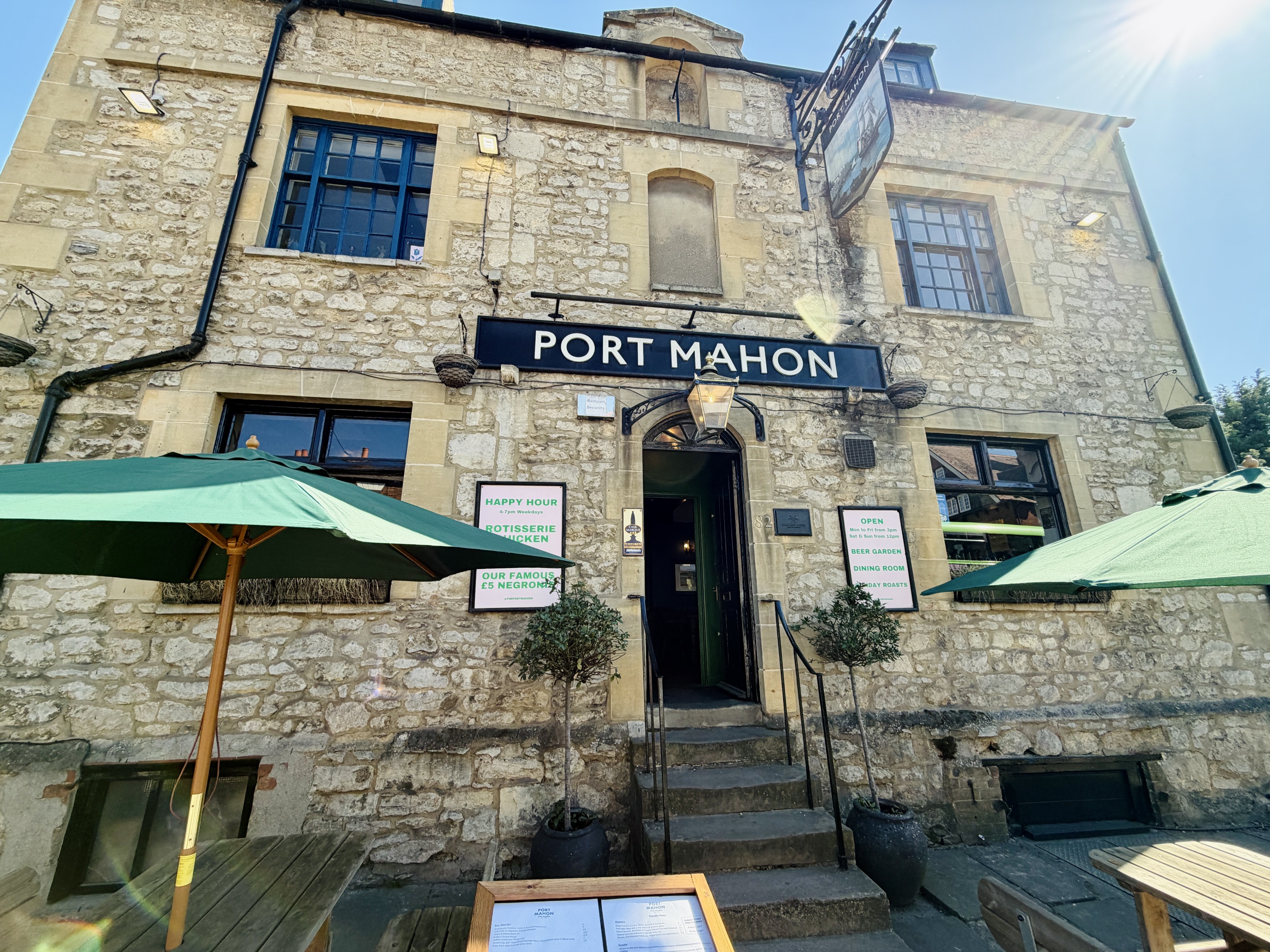
So imagine my surprise earlier in the month when I discovered that this particular trend – with lightning speed, in the scheme of things – had bypassed Reading completely and taken root in Oxford. I’d just had lunch at Cuttlefish with my dear friend Jerry and, on the way to our pub for the afternoon, we walked past another pub, the Port Mahon. I’m incapable of doing that kind of thing without rubbernecking for a menu and there, on a sign out the front, it boasted ROTISSERIE CHICKEN and, come to think of it, OUR FAMOUS £5 NEGRONIS. They had me at the chicken, the negronis were just a bonus: I made a mental note to investigate further.
Back home I did some research and the pub looked promising. Although it’s been around since 1710, it seems that a couple of years ago it came under new ownership and, by the looks of it, decided to focus on food, taking on chef Paolo Cangiano. A new dining room followed last year, as did positive reviews on both of the main Oxford food websites. Although the majority of those visits were comped: Bitten Oxford extracted 3 free meals from the Port Mahon in the space of 7 months but, of course, all views remain their own.
Nonetheless I saw enough to nudge it to the top of my list so last week, on the most glorious Saturday the U.K. has seen so far this year, Zoë and I hopped on a train to investigate, stopping only to collect a lot of cheese in the Covered Market, sample one of Hamblin Bakery’s excellent sausage rolls and grab a pre-lunch coffee in Peloton Espresso’s wonderful back garden. Spring had well and truly arrived, and I’d had my first sunshine pints in the Last Crumb the weekend before, after a brilliant and buzzing readers lunch. So this is what al fresco life in Britain can be like, I remembered thinking.
The pub is actually very handsome. I think it’s a Greene King (although that isn’t necessarily an obstacle to doing amazing food) and the labyrinth of rooms inside, all on slightly different levels, is cosy and attractive, all bentwood chairs, pews and red curtains. On my wander through I managed to somehow miss the dedicated dining room completely, but from the pictures I’ve seen it’s also a lovely, grown-up space.
That makes the Port Mahon somewhere you could go for food or just for drinks, and from the interior I could easily imagine doing either. But we were greeted by Cangiano himself and asked where we fancied sitting, and the outside space called to us. Again, it’s surprisingly large and much of it catches the sun, and it was a thoroughly agreeable spot with bunting, covered areas and a real feeling of lightness and buzz.
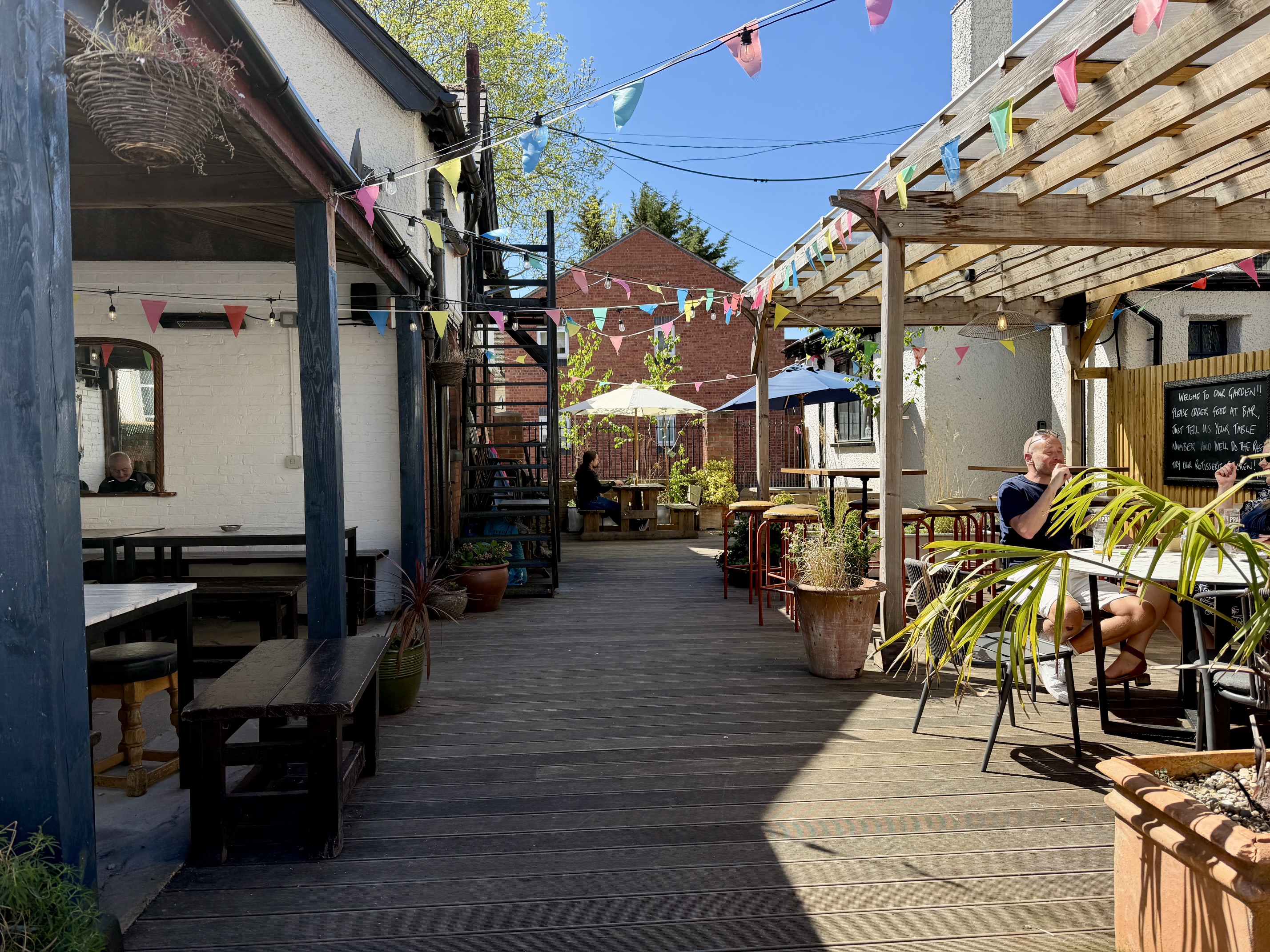
It reminded me – in Oxford terms – of the sadly departed Jam Factory, which used to be one of my favourite spots to stop for a pint before catching a train home: I still miss that place. It also reminded me, to talk about Reading for a moment, that nowhere in Reading boasts outside seating this pleasing where you can also get really good food. The Nag’s has a great beer garden but limited food, Park House is pleasant enough for both but not stellar. That the Rising Sun is as good as it gets rather sums up the state of affairs: I haven’t updated my guide to al fresco dining in Reading since 2022, but perhaps I’ll just put up a page saying Don’t bother.
It was too hot a day for those £5 negronis, and a pint of something cold and refreshing was required. I was pleasantly surprised by the Port Mahon’s selection, so although it had macro lagers and ciders in spades there were just enough pales to make it interesting: the sessionable A Little Faith by Northern Monk and Pale Fire by Pressure Drop. The latter was our choice and it was absolutely what the moment demanded. The sun beat down, and our first sip – this was rather a late kick-off given a happy time at StageCraft the night before – made everything right, all grievances forgotten.
The Port Mahon has, I would say, pulled together a very pleasing menu. A good array of snacks, all of which lend themselves to sharing, five starters and eight mains sent out all the right signals about not trying to do too much, and if I hadn’t gone with rotisserie chicken on my mind I could have tried countless other dishes. Next time, perhaps I’ll try the meatball pappardelle or the butterflied seabream with orange and fennel salad. But it also gave me confidence that next time the menu might well be different: after all, this set of dishes was very different to the one I’d seen online.
You could potentially argue that the pricing was slightly wayward, with some of the snacks coming in more expensive than the starters, but I thought that was to suggest they were bigger portions to share. Again, a pub where you could drink great IPAs in the sunshine and keep yourself topped up on beer snacks sounded like something I would love in Reading. And nothing was expensive, really: starters maxed out at £8.50, only a couple of mains were north of £20.
One dish that seemed to have been on the Port Mahon’s menu since they reopened and Cangione came on board was the pub’s pork belly bites in soy, honey and sesame and, rotisserie chicken aside, they were the first name on the team sheet. They were a winner, a tumble of nicely caramelised cubes, fat rendered enough and the glaze sticky, sweet and potent with a slight building heat. I would have put these in the beer snacks section, personally, but what do I know about menu taxonomy?
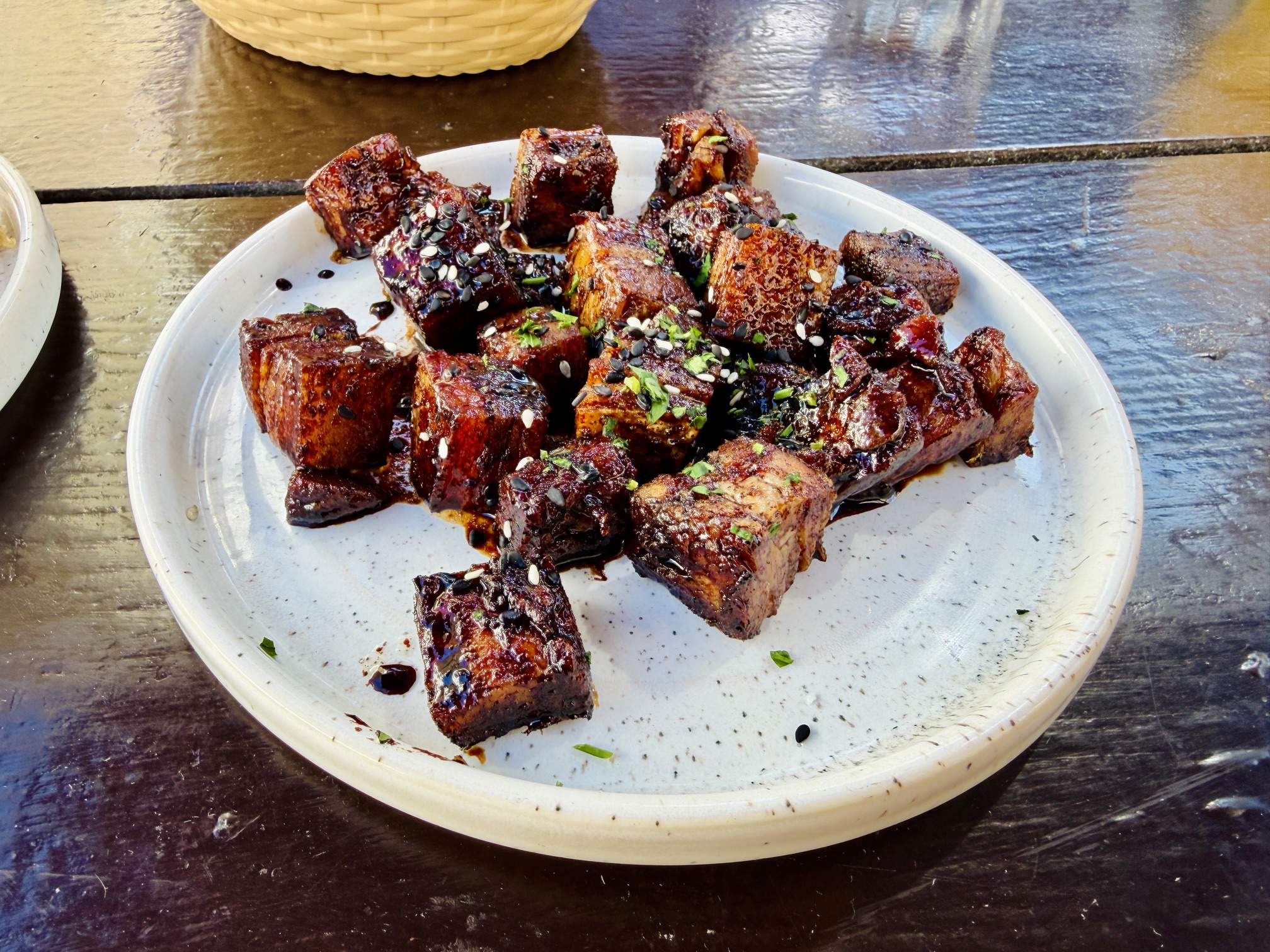
Either way these were a real pleasure and the kind of dish any menu could find room for somewhere: about as different from their siblings last week at the Jolly Cricketers as I am from my sibling but, just like me and my own sibling, equally lovable. Also they were £8.50, so better value than either of us.
We also went for the buffalo cauliflower wings, from the snack section of the menu. These were a bit pricier at £12.50 but, as I’d suspected, very much sized to share. They were very close to spot on, but with something like this it’s human nature to focus on how they fall short. So I really loved the pub’s buffalo sauce, which had exactly the kind of acrid, vinegary heat I’m looking for. The little bits of what I thought were fried onion on top were a nice touch, along with a little verdant flash of herbs. And the cauliflower was nicely done, not too soft, not too unyielding.
If I’d known in advance that it would be a sort of mulch of cooked cauliflower in a superlative buffalo sauce I might have still ordered it and, as I did, I would have enjoyed it. But I’d like the coating to have crunch and to adhere, and for the whole thing to be tossed in the sauce at the end and brought to me tout suite before everything started to go awry and soggy. That didn’t happen here, I don’t think, and it was the only thing marring what would otherwise have been another perfect beer snack.
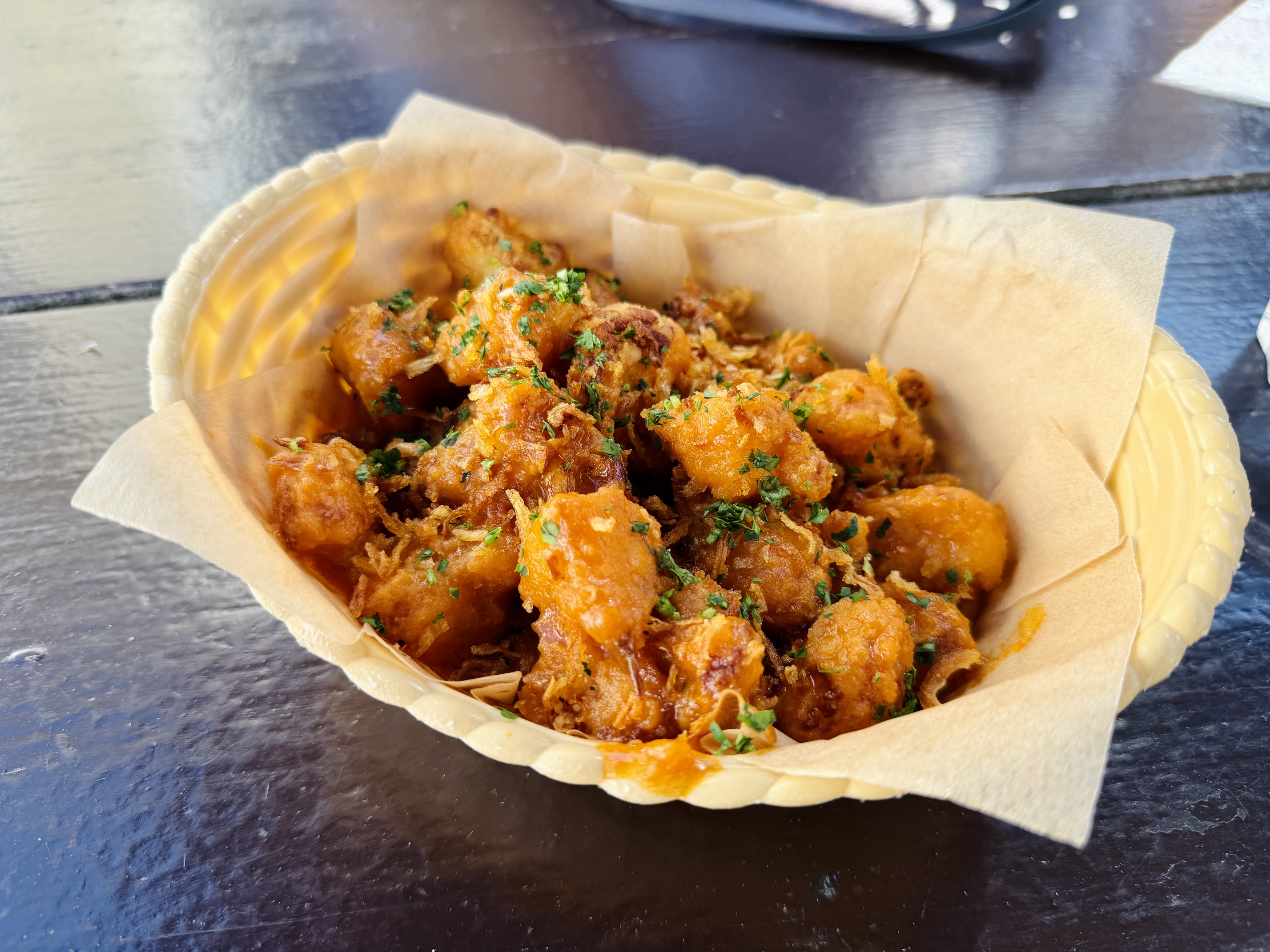
The chicken wings, at the same price, might have pulled this off better but I really couldn’t be doing with all the faff. I would have these again in the hope that the pub pulls them off, and if it didn’t I would be a little disappointed but, as I did this time, I would still eat every last morsel.
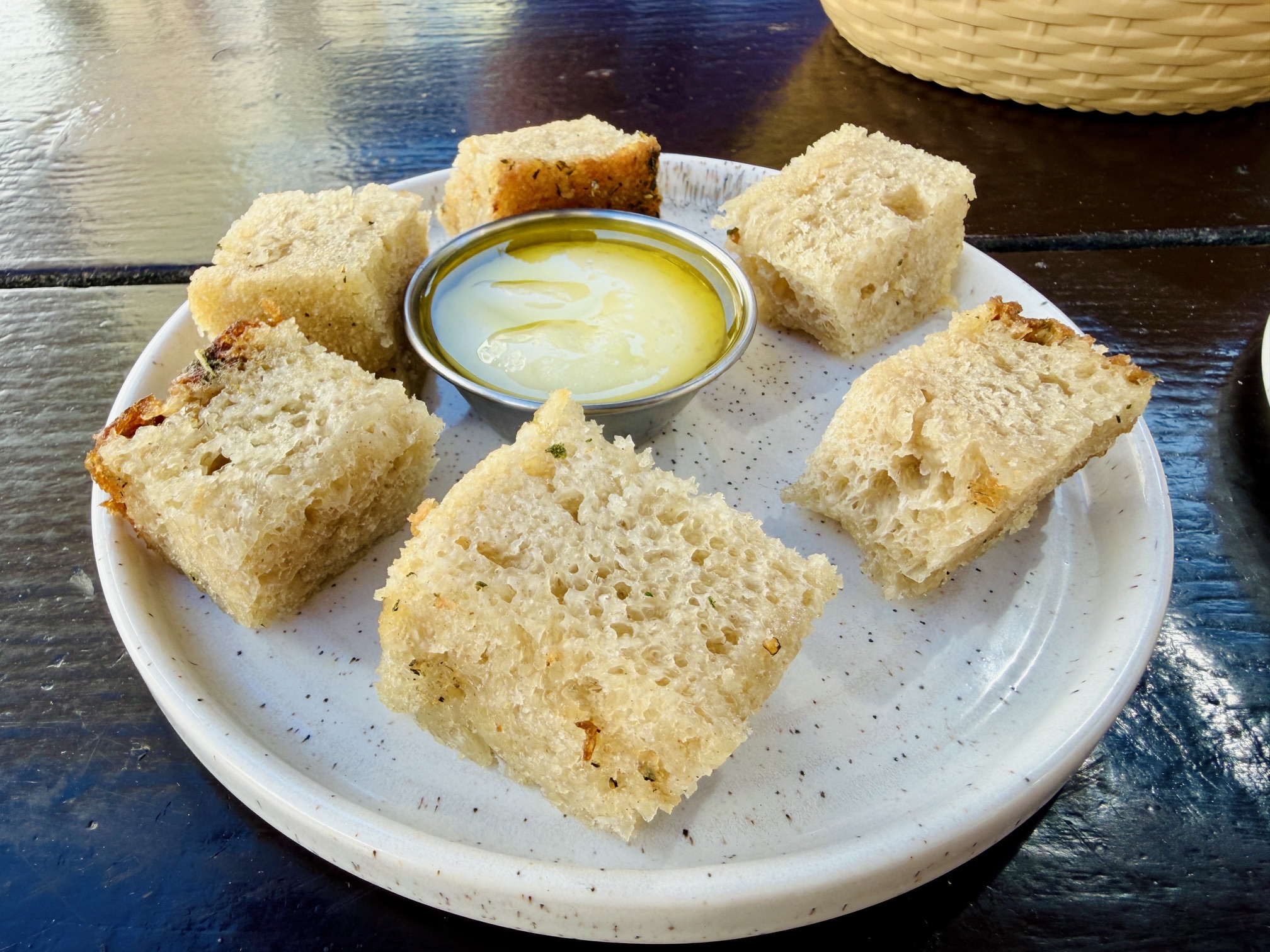
The biggest disappointment, for me, was the focaccia. It was, to be fair, only £4 but it was dense and doughy, no air, no crust and no crackle, just some spongey, cakelike cuboids that were a little bit too much like hard work. I’m not sure what the dip in the middle was: it looked like mayo but had a sizeable whack of vinegar. But the focaccia had a job to do anyway ensuring that not an iota of the buffalo sauce, or the soy and honey glaze, went to waste. No harm done, ultimately.
Service from everybody in the pub, from the chef to the cheery chap behind the bar to the servers who brought our food out, was bright and infectious, and the Port Mahon gave the impression of being a happy little brigade. We were asked whether we wanted our main course straight away or wanted to wait a while and – rather uncharacteristically, I guess – we told them to bring it on. That’s rotisserie chicken for you: it realigns the priorities.
Sometimes, when I eat on duty without Zoë, we play this little game where I send her pictures of my food and ask her to guess whether it was good or not. Let’s play it now: what do you reckon to this?
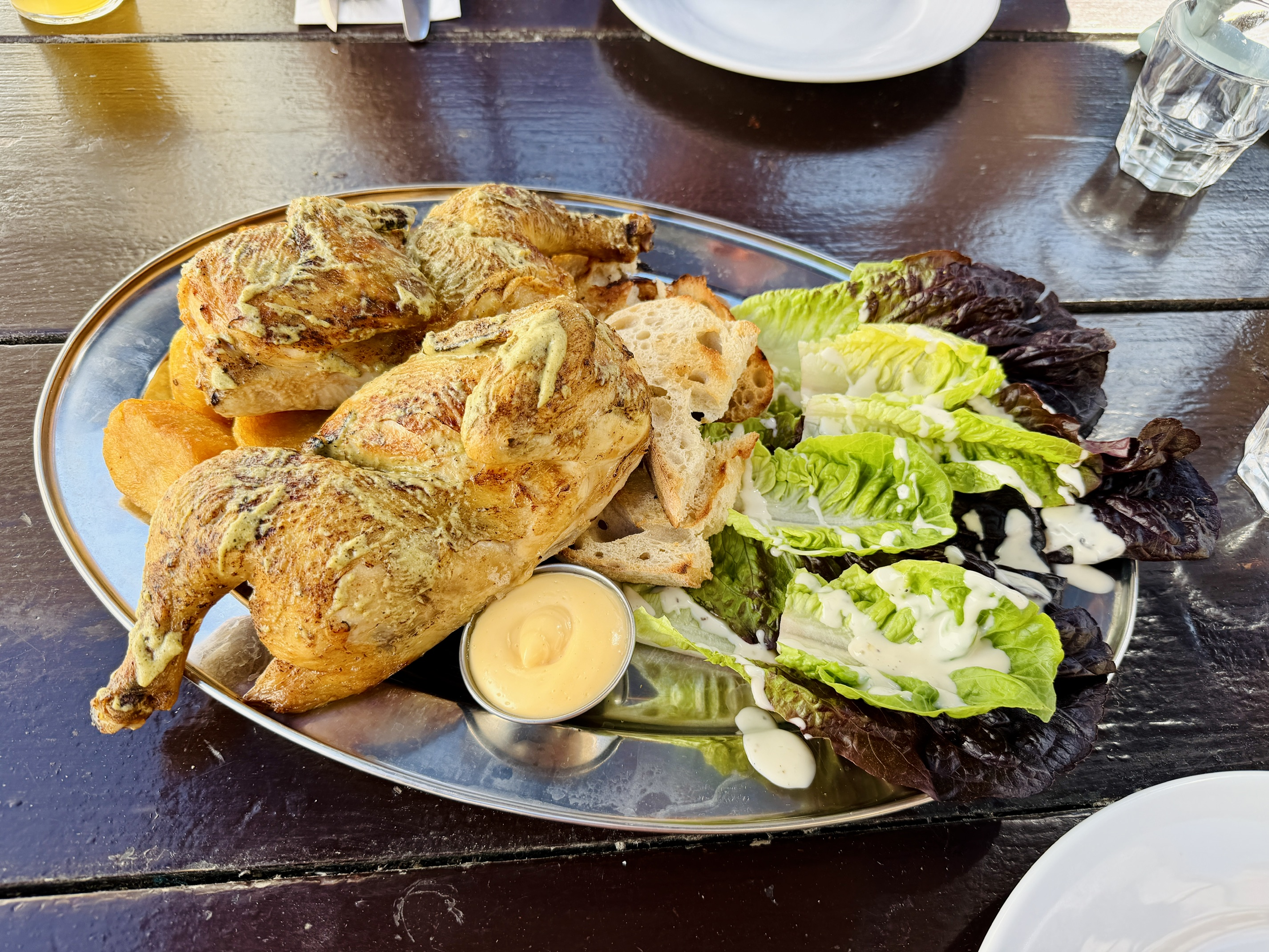
First things first: this is a really generous plate of chicken and gubbins for two people, for just over £32. I think the Port Mahon has taken a tip or two from the Chester Arms’ legendary steak platter without, like Headington’s Six Bells, ripping it off lock, stock and barrel. So you get everything you could possibly want on that steel plate, no need for sides or add-ons.
And everything that goes with it is corking: the big, handsome lettuce leaves pooled with Caesar dressing, the substantial croutons with just enough give, the little sunshine-yellow ramekin of what they call ‘Mahon mayo’ (surely Mahonnaise?), they’re all marvellous. You could almost make yourself a Caesar salad with this, although the menu already boasts one which also includes eggs, bacon and anchovies and a healthy dose of I-almost-wish-I’d-ordered-that.
But the Caesar salad would omit the chicken fat potatoes, and they really are very nice indeed. The texture of them was ideal, the crunch to fluff ratio almost impossible to fault. I’d have liked that chicken fat to make its presence more felt, I’d have liked them saltier, but I’d like many things I won’t get and that, in some way I don’t fully grasp, will eventually make me a better person. Possibly.
That’s all well and good, you’re asking, but what about the chicken? And well you might. Well, like a lot of it, it was a lot of the way there. The leg meat was a tiny bit tough, almost gamey, and there wasn’t perhaps as much of it as I’d hoped. But the succulence of the breast made up for that, and the flavour that had permeated it did too: I don’t know whether the Port Mahon brines it, but I got lemon and I enjoyed the green sauce that had been sparingly drizzled over it. All that was truly serviceable, and then some.
But the other thing it really missed, the thing that makes rotisserie chicken so miraculous, was crispy skin. If you get that right, a lot of the other stuff either falls into place or, more likely, just doesn’t seem so important. It was the single biggest thing that the Port Mahon needs to work on, whether that’s by rubbing with salt and lubricating with butter or any other form of chicken-centric witchcraft, but a rotisserie chicken with slightly elastic skin is one that hasn’t lived up to its potential. Trust me on this: as someone with a lifelong track record of not living up to mine, in the words of Jason Lee in Mallrats, we can smell our own.
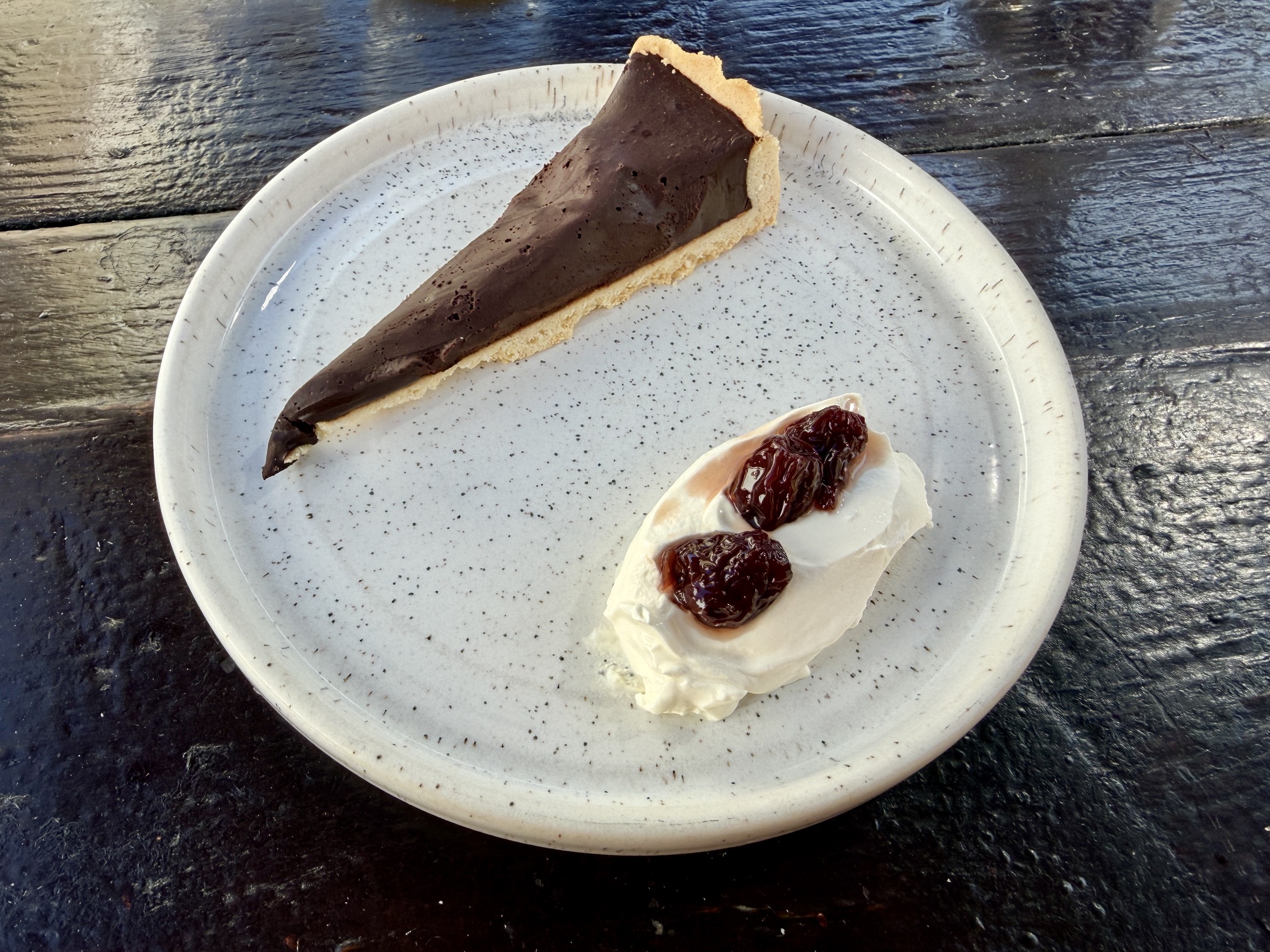
The dessert menu just has three items on it, and despite the retro appeal of a raspberry ripple Arctic Roll, the chocolate tart got both our votes. What a strange dessert it turned out to be! I mean, it was delicious: the ganache rich and pleasingly irregular, the pastry dense if perhaps slightly underbaked. I really loved the boozy cherries, both of them, and the little heap of crème fraîche they perched on: crème fraîche would always be my accompaniment for a dessert this rich.
But the size of it was just so strange, such a thin sliver. I know it was only £6.50, and perhaps that’s how the Port Mahon keeps it at that price, but it felt jarring. Somebody had a protractor in that kitchen, and they liked it slightly more than they liked customers: considering the manifest generosity on display everywhere else on the menu, this felt like a blip.
I might have stayed longer and ordered more drinks but Oxford’s best beer garden, in the shape of the Star on Rectory Road, was beckoning and I was conscious that Zoë had never been there before. So we settled our bill – £95, including service charge – and were on our merry way.
The rest of the day was another reminder of everything that makes Oxford a great city – pints of Steady Rolling Man at the Star, a sneaky Swoon gelato on the way to the station and a beer at Tap Social in the Covered Market when we realised we had time before taking the train we wanted. I am very lucky that my Oxford reviews always do quite well in terms of readership, but then it’s never a chore to write about somewhere with such abundant charm.
Reading’s part-time visiting academic and full time transphobe Julie Bindel recently wrote a laughable article in the Spectator – of course it was the Spectator – about how she couldn’t stand gastropubs. It was so full of bad, inaccurate observations that at first I mistook it for a Michael McIntyre routine, but Bindel’s central assertion, under the sophisticated and nuanced headline I hate gastropubs, was that pubs should stick to cheese sandwiches and Scotch eggs, and of course she had a swipe at sourdough and triple-cooked chips, because apparently it’s still 2010.
Just to generalise further about a world Bindel doesn’t actually live in, these pubs are apparently all staffed by “blokes with sleeve tattoos and beard oil”: it’s a wonder she didn’t throw in the word ‘new-fangled’ while she was at it. To be fair, her article also included the quote “As a rule, I am not a fan of pubs” which rather makes you wonder why the Spectator paid her to write an article that is essentially a big steaming heap of Bean Soup Theory.
Still, it’s nice to know that Bindel can be wrong on multiple topics: I guess the Brexiteer ghouls who read the Speccie lap all that up. The point is, call them pubs or call them gastropubs – who really cares? – but either way they are, in all their forms, a big part of how people eat in this country in 2026. And when they’re done well, they are terrific places to eat and drink, or just drink, or pick at snacks with a really good pint. Getting hung up on what you call them completely misses the point that they’re an essential element of food culture here.
Whether they are the centre of village life, like the Jolly Cricketers, or bravely trying to do something else with a centuries-old boozer like the Port Mahon, they matter. And even if the Port Mahon doesn’t get everything right, it does enough to deserve plenty of support while it works on the rest. I liked it a lot, I’m rooting for it and I’m sad that Reading, for all its pubs, doesn’t have anyone even trying to offer something like this.
That’s another food trend that hasn’t really bothered with our town. I’d love an excellent independent food pub, I would really love somewhere doing rotisserie chicken like the very best of the stuff on the continent. Both of them in a single venue? Don’t be ridiculous: it will never happen.
The Port Mahon – 7.7
82 St Clements St, Oxford, OX4 1AW
Since January 2025, Edible Reading is partly supported by subscribers – click here if you want to read more about that, or click below to subscribe. By doing so you enable me to carry on doing what I do, and you also get access to subscriber only content. Whether you’re a subscriber or not, thanks for reading.

