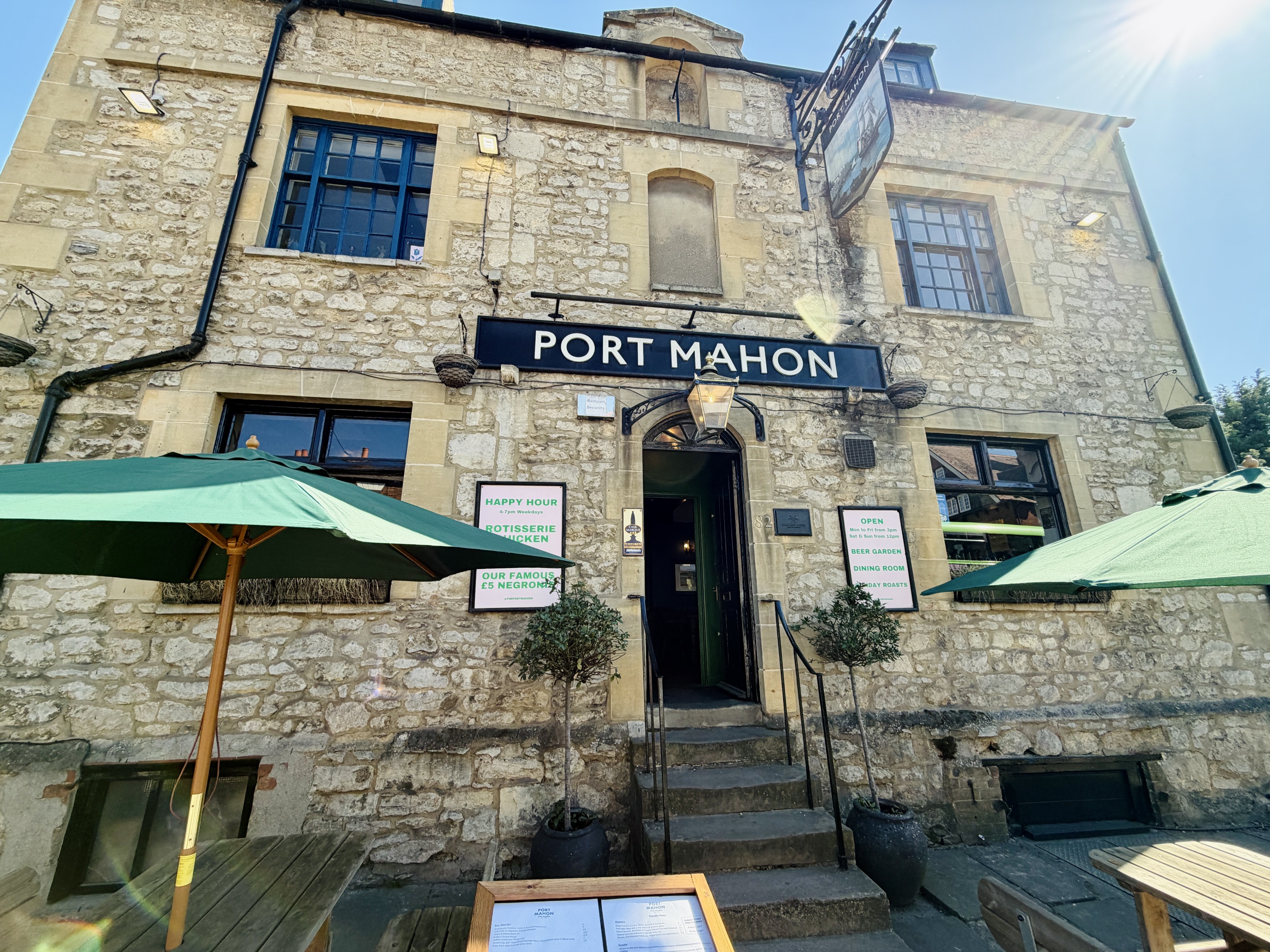
Pub review: The Port Mahon, Oxford

The conventional wisdom is that food trends start out in London and, like the light from a dying star, by the time they reach Reading they are just memories of something that is no longer there. Something about the eternity it takes them to hobble down the M4 strips them of any interest or novelty value, and it’s the same for restaurant chains: with a few encouraging historical exceptions, like Honest or Pho, by the time anyone opens a branch in the RG1 postcode the Fonz, waterskis strapped on, has well and truly cleared the shark.

The truth is, if anything, more nuanced and even more cheerless than that. First of all, most food trends never become a thing anyway. Every January the broadsheet food Stattos, a wan bunch of gastronomic psephologists, proclaim what the big trends of the next 12 months will be, and the majority of them never come to pass. Just as life is what happens when you’re making other plans, food trends tend to ambush everybody: nobody sees most of them coming.

Secondly, most of them never make it to Reading. You could wait a lifetime for a small plates restaurant, a tapas spot, a natural wine bar, a chop house or anything else for that matter. I don’t know what it is about our mixture of attractive affordable buildings with plenty of outside space that catch the sun, our kindly and philanthropic landlords and our imaginative and not remotely complacent local authority, but for some reason entrepreneurs look at all that and say Nah, you’re all right. What spoilsports they are.

Instead we get a Cosy Club, and a Rosa’s Thai, and a Popeyes, and a Taco Bell, and a regular attack of the glums whenever we set foot inside the IDR. Lucky, lucky us. So it goes: head to Oxford, Swindon or Newbury for tapas, small plates or natural wine, because you’re not getting that stuff in Reading.

As a result we get our own micro trends which often seem to have nothing to do with what’s going on anywhere else, like the year we got a glut of sushi restaurants, or biryani places, or pizza spots. And the funny thing is, the result of everyone trying to jump on those bandwagons is that nothing is sustainable. Biryani Mama closed recently on St Mary’s Butts, and Biryani Boyzzz has been fined shitloads of cash for poor hygiene: perhaps all those Zs are reflective of the fact that they fell asleep at the wheel.

And remember our influx of great pizza restaurants last year? By all accounts Paesinos has sacked its chef, Amò is still closed due to challenges with the building for nearly five months and counting (read into that what you will) and since Dough Bros has changed hands it’s removed all pork and ‘nduja from its menu, leaving you instead with turkey ham and “spicy beef chunks”. Fair play to them, I suppose, but that’s not Dough Bros any more. All that’s left is Zi Tore, which is the gastronomic equivalent of Ringo being the last surviving Beatle.

This year’s Reading trends are, to me at least, profoundly depressing because they reflect a poverty of culinary imagination, of degradation disguised as progress. You might get excited about vans serving jacket potatoes, and Reading now has a couple, but I remember when the Broad Street Mall having a Spud-U-Like made it a figure of fun, not a lifestyle destination. Are we really meant to see this as an improvement? Did people ever really think “fuck an affordable bistro, what this town really needs is a jacket spud loaded with tuna and cheese?” I hope not.

The other Reading food trend this year has been the munch box, a phenomenon with its own Wikipedia page, highlighting its origins in Scotland (“the selection of foods included in some boxes has been criticised for being nutritionally poor” Wikipedia says, with a talent for understatement). So naturally, for the times when a baked potato is too cheap and cheerful and you want to splash out, why not go crazy and buy a munch box? Treat yourself.

“I’ve found the best munch box in Reading” said some goon on Instagram recently, coming to you live from a car park. That’s great: I’m sure the whole town will sleep easier now. It’s all very low rent, but that’s 2026 for you. Nobody can afford rent.

A trend which emerged last year in London was one I would dearly love to see in Reading: rotisserie chicken. The Observer called it about this time last year and, late to the party as ever, the Telegraph chimed in to that effect in January. Both mentioned London venues like Borough Market’s Café François and Shoreditch’s Knave Of Clubs along with Bébé Bob, which so underwhelmed me a couple of years ago. “The rise of luxe rotisserie chicken”, enthused the Observer. “How France’s most famous market food became a cult British hit” was the Telegraph‘s summary.

It’s true, though. Rotisserie chicken is huge on the continent, and nowhere to be seen in Blighty and I personally consider that a terrible pity. When I remember Montpellier, where the twice weekly food market under the aqueduct boasts multiple traders, all selling delectable looking chicken, I think it’s a great shame that it’s never caught on here. And that’s just markets, but the restaurants! When I recall the glories of eating at Montpellier’s Les Freres Poulard or Lisbon’s Bonjardim I wonder what’s taken this movement so long to even consider crossing the water.

So imagine my surprise earlier in the month when I discovered that this particular trend – with lightning speed, in the scheme of things – had bypassed Reading completely and taken root in Oxford. I’d just had lunch at Cuttlefish with my dear friend Jerry and, on the way to our pub for the afternoon, we walked past another pub, the Port Mahon. I’m incapable of doing that kind of thing without rubbernecking for a menu and there, on a sign out the front, it boasted ROTISSERIE CHICKEN and, come to think of it, OUR FAMOUS £5 NEGRONIS. They had me at the chicken, the negronis were just a bonus: I made a mental note to investigate further.

Back home I did some research and the pub looked promising. Although it’s been around since 1710, it seems that a couple of years ago it came under new ownership and, by the looks of it, decided to focus on food, taking on chef Paolo Cangiano. A new dining room followed last year, as did positive reviews on both of the main Oxford food websites. Although the majority of those visits were comped: Bitten Oxford extracted 3 free meals from the Port Mahon in the space of 7 months but, of course, all views remain their own.

Nonetheless I saw enough to nudge it to the top of my list so last week, on the most glorious Saturday the U.K. has seen so far this year, Zoë and I hopped on a train to investigate, stopping only to collect a lot of cheese in the Covered Market, sample one of Hamblin Bakery’s excellent sausage rolls and grab a pre-lunch coffee in Peloton Espresso’s wonderful back garden. Spring had well and truly arrived, and I’d had my first sunshine pints in the Last Crumb the weekend before, after a brilliant and buzzing readers lunch. So this is what al fresco life in Britain can be like, I remembered thinking.

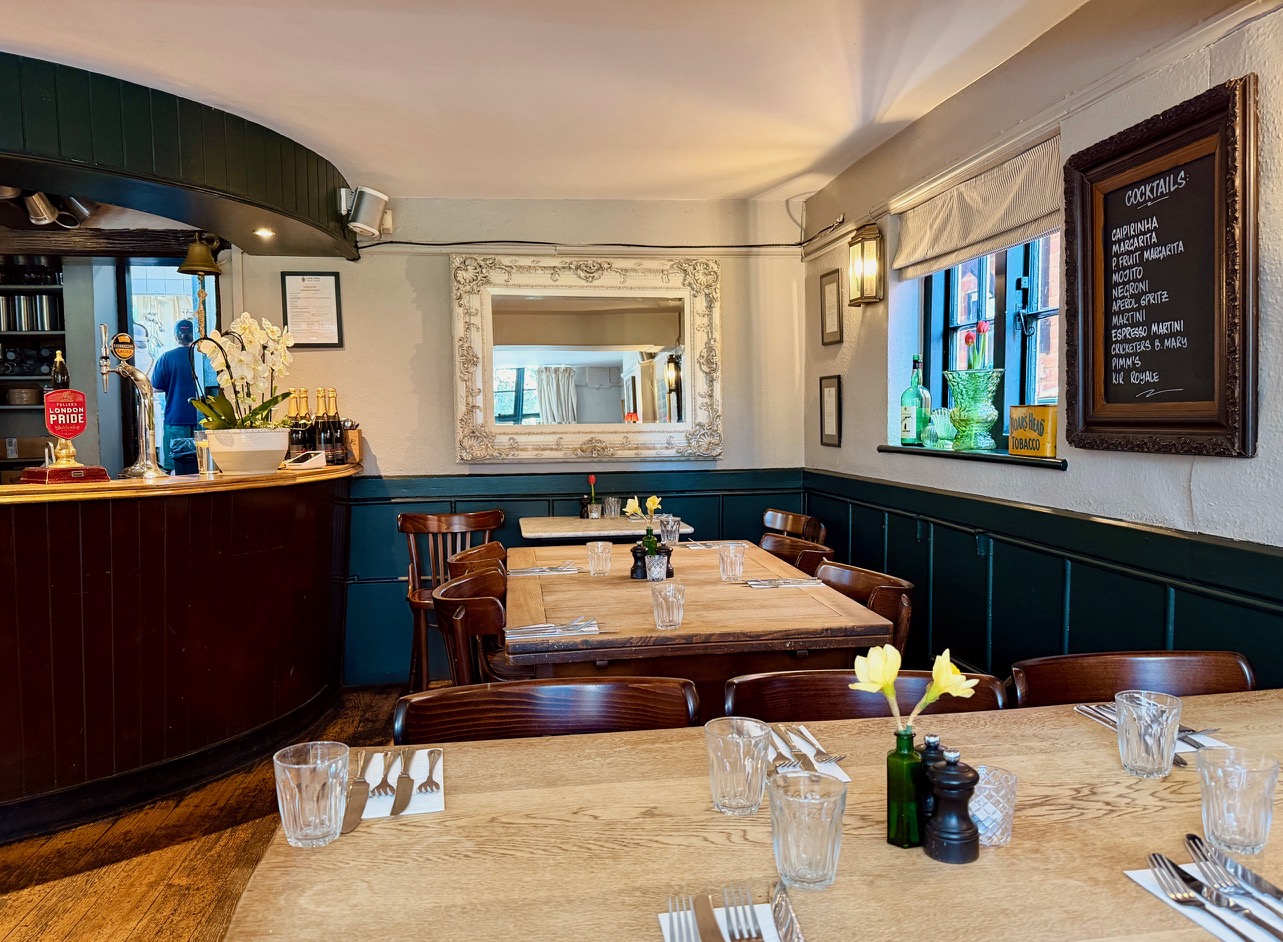
The pub is actually very handsome. I think it’s a Greene King (although that isn’t necessarily an obstacle to doing amazing food) and the labyrinth of rooms inside, all on slightly different levels, is cosy and attractive, all bentwood chairs, pews and red curtains. On my wander through I managed to somehow miss the dedicated dining room completely, but from the pictures I’ve seen it’s also a lovely, grown-up space.

That makes the Port Mahon somewhere you could go for food or just for drinks, and from the interior I could easily imagine doing either. But we were greeted by Cangiano himself and asked where we fancied sitting, and the outside space called to us. Again, it’s surprisingly large and much of it catches the sun, and it was a thoroughly agreeable spot with bunting, covered areas and a real feeling of lightness and buzz.
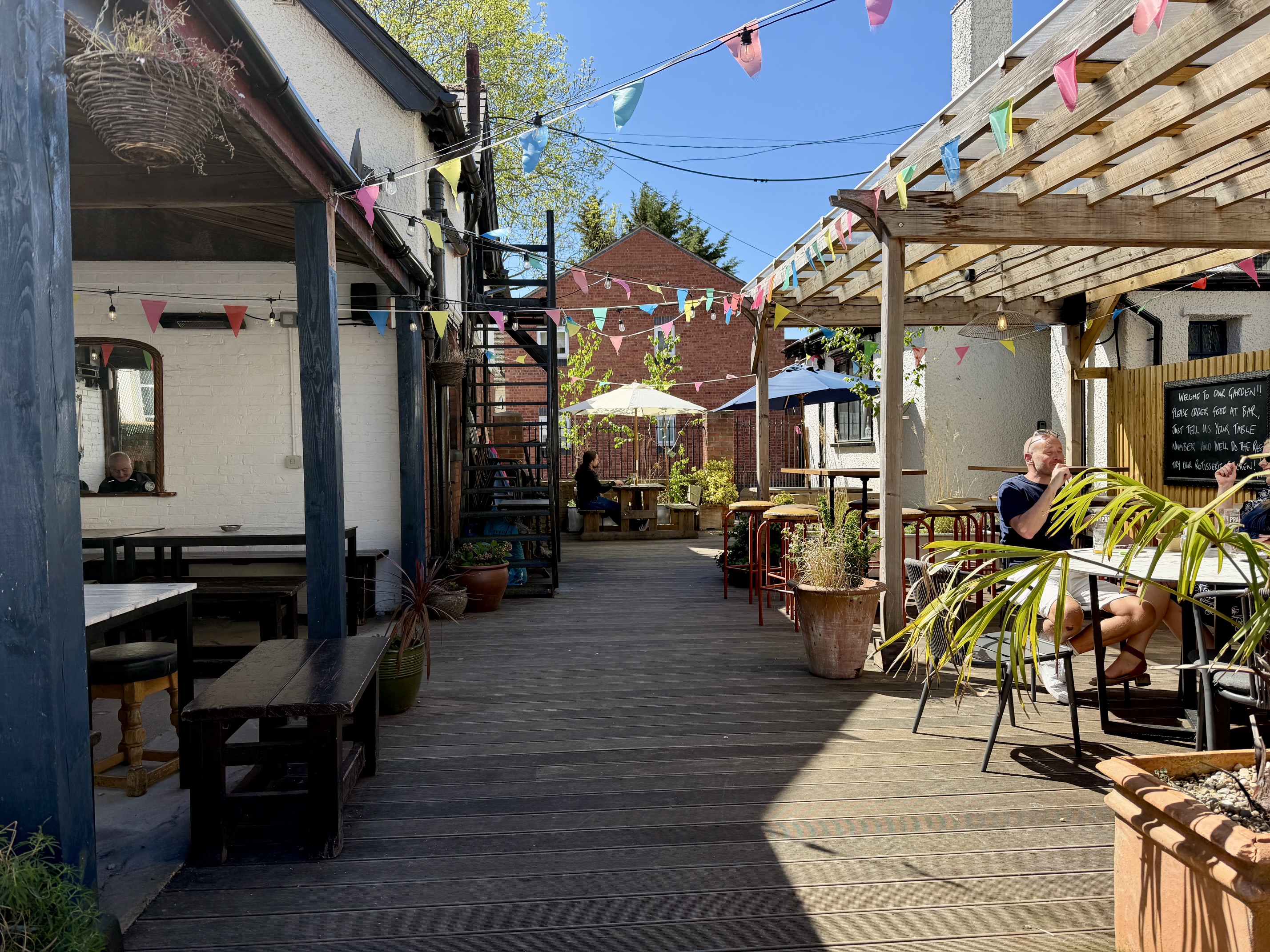
It reminded me – in Oxford terms – of the sadly departed Jam Factory, which used to be one of my favourite spots to stop for a pint before catching a train home: I still miss that place. It also reminded me, to talk about Reading for a moment, that nowhere in Reading boasts outside seating this pleasing where you can also get really good food. The Nag’s has a great beer garden but limited food, Park House is pleasant enough for both but not stellar. That the Rising Sun is as good as it gets rather sums up the state of affairs: I haven’t updated my guide to al fresco dining in Reading since 2022, but perhaps I’ll just put up a page saying Don’t bother.

It was too hot a day for those £5 negronis, and a pint of something cold and refreshing was required. I was pleasantly surprised by the Port Mahon’s selection, so although it had macro lagers and ciders in spades there were just enough pales to make it interesting: the sessionable A Little Faith by Northern Monk and Pale Fire by Pressure Drop. The latter was our choice and it was absolutely what the moment demanded. The sun beat down, and our first sip – this was rather a late kick-off given a happy time at StageCraft the night before – made everything right, all grievances forgotten.

The Port Mahon has, I would say, pulled together a very pleasing menu. A good array of snacks, all of which lend themselves to sharing, five starters and eight mains sent out all the right signals about not trying to do too much, and if I hadn’t gone with rotisserie chicken on my mind I could have tried countless other dishes. Next time, perhaps I’ll try the meatball pappardelle or the butterflied seabream with orange and fennel salad. But it also gave me confidence that next time the menu might well be different: after all, this set of dishes was very different to the one I’d seen online.

You could potentially argue that the pricing was slightly wayward, with some of the snacks coming in more expensive than the starters, but I thought that was to suggest they were bigger portions to share. Again, a pub where you could drink great IPAs in the sunshine and keep yourself topped up on beer snacks sounded like something I would love in Reading. And nothing was expensive, really: starters maxed out at £8.50, only a couple of mains were north of £20.

One dish that seemed to have been on the Port Mahon’s menu since they reopened and Cangione came on board was the pub’s pork belly bites in soy, honey and sesame and, rotisserie chicken aside, they were the first name on the team sheet. They were a winner, a tumble of nicely caramelised cubes, fat rendered enough and the glaze sticky, sweet and potent with a slight building heat. I would have put these in the beer snacks section, personally, but what do I know about menu taxonomy?
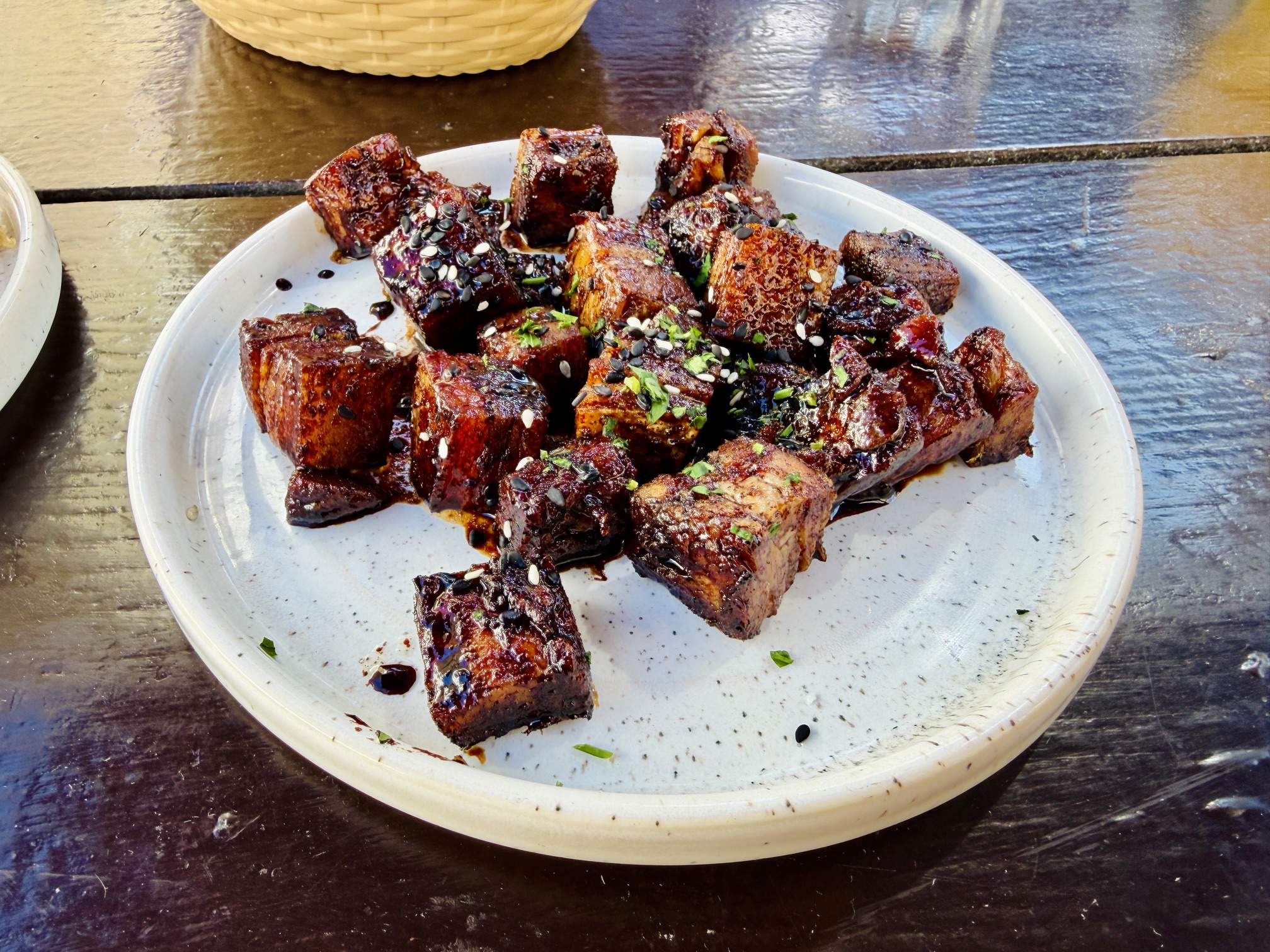
Either way these were a real pleasure and the kind of dish any menu could find room for somewhere: about as different from their siblings last week at the Jolly Cricketers as I am from my sibling but, just like me and my own sibling, equally lovable. Also they were £8.50, so better value than either of us.

We also went for the buffalo cauliflower wings, from the snack section of the menu. These were a bit pricier at £12.50 but, as I’d suspected, very much sized to share. They were very close to spot on, but with something like this it’s human nature to focus on how they fall short. So I really loved the pub’s buffalo sauce, which had exactly the kind of acrid, vinegary heat I’m looking for. The little bits of what I thought were fried onion on top were a nice touch, along with a little verdant flash of herbs. And the cauliflower was nicely done, not too soft, not too unyielding.

If I’d known in advance that it would be a sort of mulch of cooked cauliflower in a superlative buffalo sauce I might have still ordered it and, as I did, I would have enjoyed it. But I’d like the coating to have crunch and to adhere, and for the whole thing to be tossed in the sauce at the end and brought to me tout suite before everything started to go awry and soggy. That didn’t happen here, I don’t think, and it was the only thing marring what would otherwise have been another perfect beer snack.
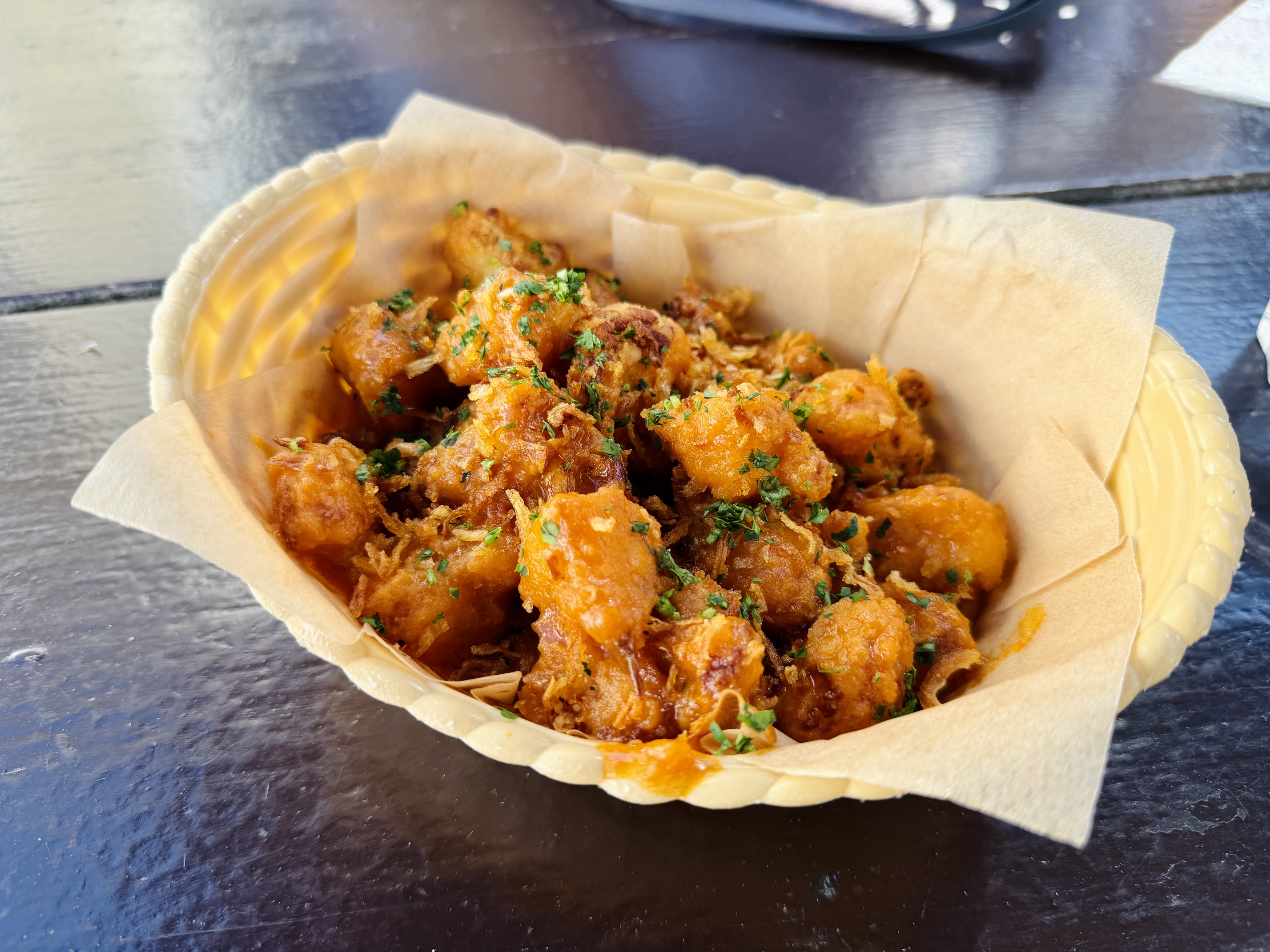
The chicken wings, at the same price, might have pulled this off better but I really couldn’t be doing with all the faff. I would have these again in the hope that the pub pulls them off, and if it didn’t I would be a little disappointed but, as I did this time, I would still eat every last morsel.

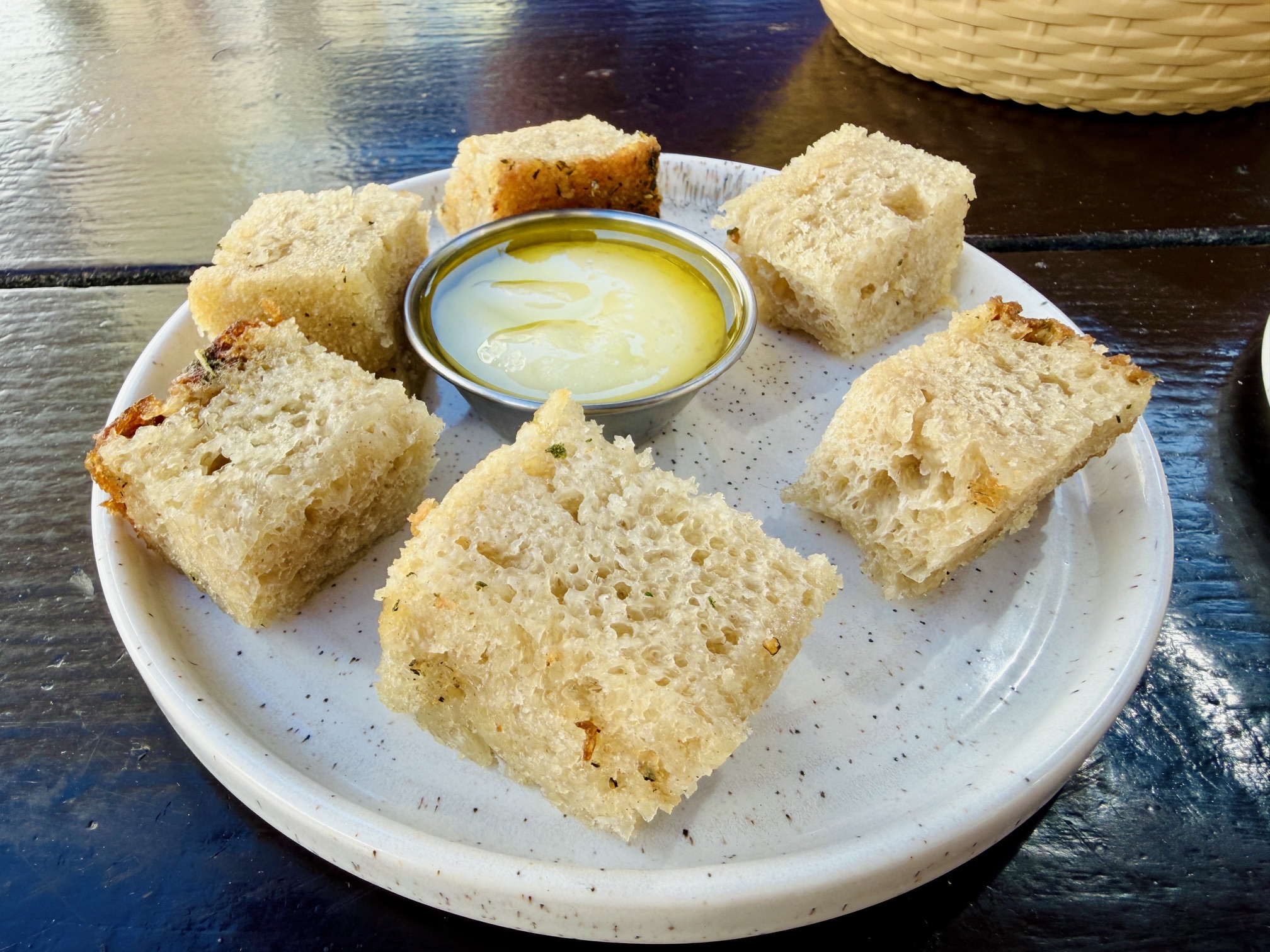
The biggest disappointment, for me, was the focaccia. It was, to be fair, only £4 but it was dense and doughy, no air, no crust and no crackle, just some spongey, cakelike cuboids that were a little bit too much like hard work. I’m not sure what the dip in the middle was: it looked like mayo but had a sizeable whack of vinegar. But the focaccia had a job to do anyway ensuring that not an iota of the buffalo sauce, or the soy and honey glaze, went to waste. No harm done, ultimately.
Service from everybody in the pub, from the chef to the cheery chap behind the bar to the servers who brought our food out, was bright and infectious, and the Port Mahon gave the impression of being a happy little brigade. We were asked whether we wanted our main course straight away or wanted to wait a while and – rather uncharacteristically, I guess – we told them to bring it on. That’s rotisserie chicken for you: it realigns the priorities.

Sometimes, when I eat on duty without Zoë, we play this little game where I send her pictures of my food and ask her to guess whether it was good or not. Let’s play it now: what do you reckon to this?
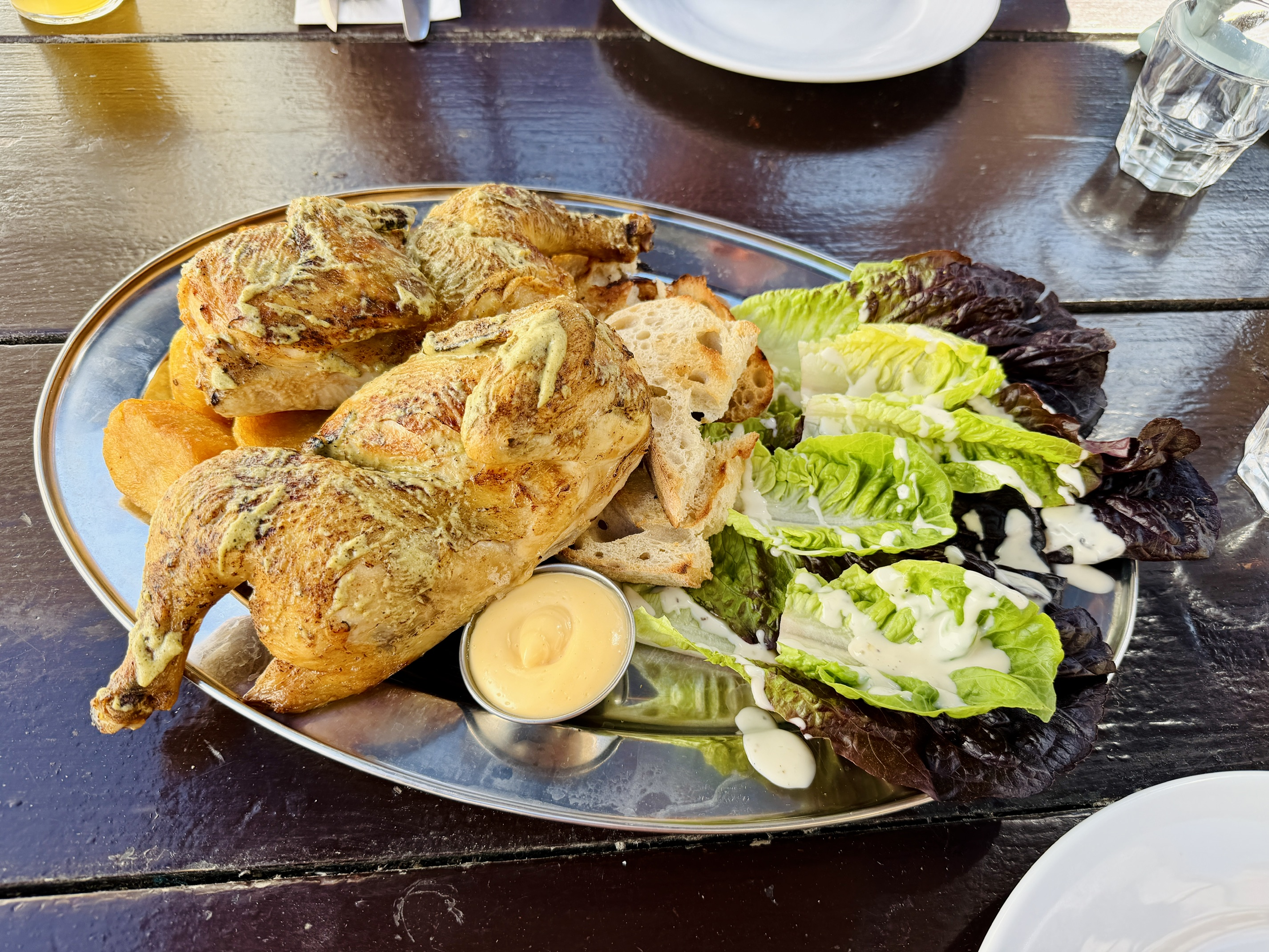
First things first: this is a really generous plate of chicken and gubbins for two people, for just over £32. I think the Port Mahon has taken a tip or two from the Chester Arms’ legendary steak platter without, like Headington’s Six Bells, ripping it off lock, stock and barrel. So you get everything you could possibly want on that steel plate, no need for sides or add-ons.

And everything that goes with it is corking: the big, handsome lettuce leaves pooled with Caesar dressing, the substantial croutons with just enough give, the little sunshine-yellow ramekin of what they call ‘Mahon mayo’ (surely Mahonnaise?), they’re all marvellous. You could almost make yourself a Caesar salad with this, although the menu already boasts one which also includes eggs, bacon and anchovies and a healthy dose of I-almost-wish-I’d-ordered-that.

But the Caesar salad would omit the chicken fat potatoes, and they really are very nice indeed. The texture of them was ideal, the crunch to fluff ratio almost impossible to fault. I’d have liked that chicken fat to make its presence more felt, I’d have liked them saltier, but I’d like many things I won’t get and that, in some way I don’t fully grasp, will eventually make me a better person. Possibly.

That’s all well and good, you’re asking, but what about the chicken? And well you might. Well, like a lot of it, it was a lot of the way there. The leg meat was a tiny bit tough, almost gamey, and there wasn’t perhaps as much of it as I’d hoped. But the succulence of the breast made up for that, and the flavour that had permeated it did too: I don’t know whether the Port Mahon brines it, but I got lemon and I enjoyed the green sauce that had been sparingly drizzled over it. All that was truly serviceable, and then some.

But the other thing it really missed, the thing that makes rotisserie chicken so miraculous, was crispy skin. If you get that right, a lot of the other stuff either falls into place or, more likely, just doesn’t seem so important. It was the single biggest thing that the Port Mahon needs to work on, whether that’s by rubbing with salt and lubricating with butter or any other form of chicken-centric witchcraft, but a rotisserie chicken with slightly elastic skin is one that hasn’t lived up to its potential. Trust me on this: as someone with a lifelong track record of not living up to mine, in the words of Jason Lee in Mallrats, we can smell our own.

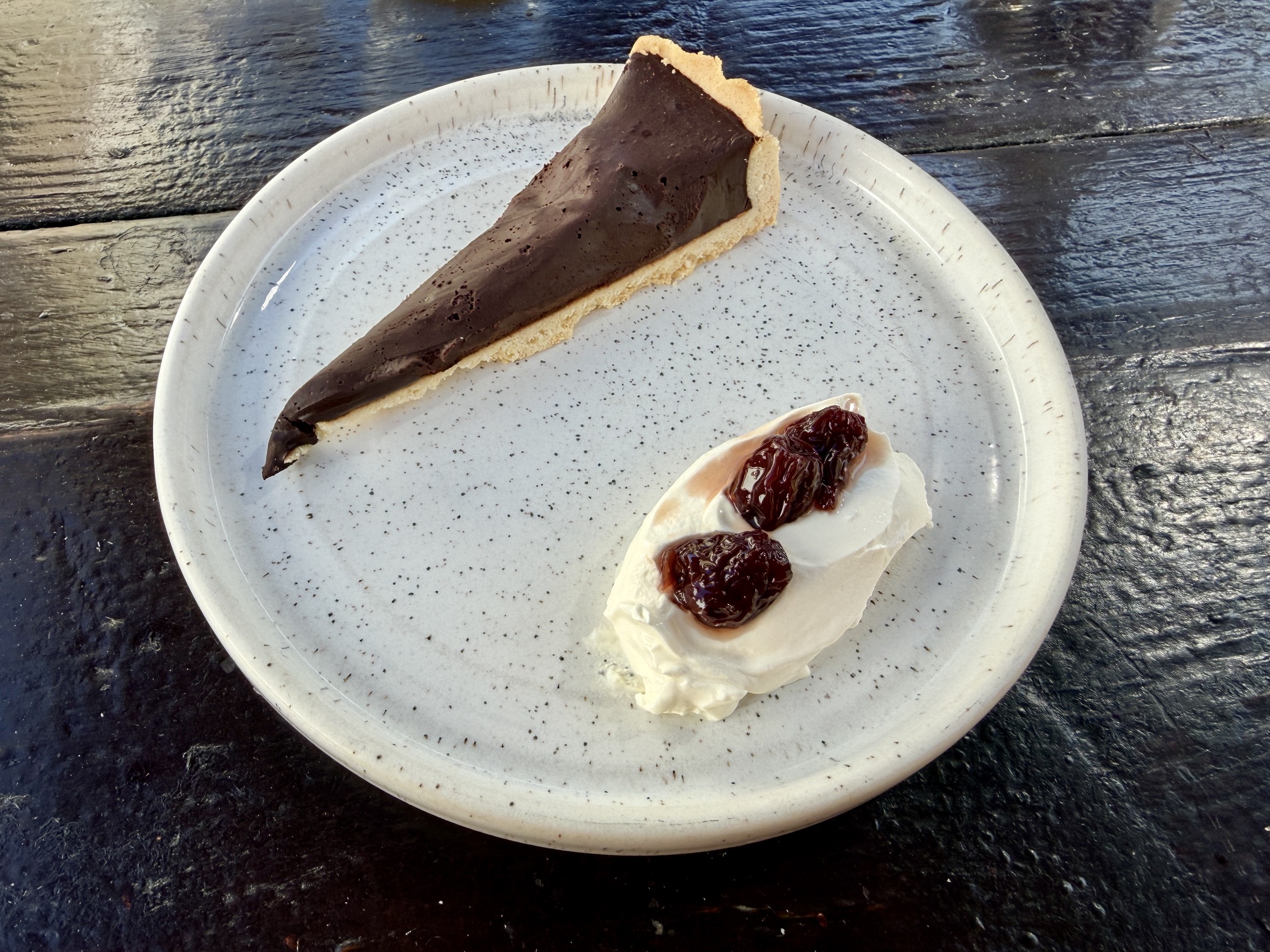
The dessert menu just has three items on it, and despite the retro appeal of a raspberry ripple Arctic Roll, the chocolate tart got both our votes. What a strange dessert it turned out to be! I mean, it was delicious: the ganache rich and pleasingly irregular, the pastry dense if perhaps slightly underbaked. I really loved the boozy cherries, both of them, and the little heap of crème fraîche they perched on: crème fraîche would always be my accompaniment for a dessert this rich.

But the size of it was just so strange, such a thin sliver. I know it was only £6.50, and perhaps that’s how the Port Mahon keeps it at that price, but it felt jarring. Somebody had a protractor in that kitchen, and they liked it slightly more than they liked customers: considering the manifest generosity on display everywhere else on the menu, this felt like a blip.
I might have stayed longer and ordered more drinks but Oxford’s best beer garden, in the shape of the Star on Rectory Road, was beckoning and I was conscious that Zoë had never been there before. So we settled our bill – £95, including service charge – and were on our merry way.

The rest of the day was another reminder of everything that makes Oxford a great city – pints of Steady Rolling Man at the Star, a sneaky Swoon gelato on the way to the station and a beer at Tap Social in the Covered Market when we realised we had time before taking the train we wanted. I am very lucky that my Oxford reviews always do quite well in terms of readership, but then it’s never a chore to write about somewhere with such abundant charm.

Reading’s part-time visiting academic and full time transphobe Julie Bindel recently wrote a laughable article in the Spectator – of course it was the Spectator – about how she couldn’t stand gastropubs. It was so full of bad, inaccurate observations that at first I mistook it for a Michael McIntyre routine, but Bindel’s central assertion, under the sophisticated and nuanced headline I hate gastropubs, was that pubs should stick to cheese sandwiches and Scotch eggs, and of course she had a swipe at sourdough and triple-cooked chips, because apparently it’s still 2010.

Just to generalise further about a world Bindel doesn’t actually live in, these pubs are apparently all staffed by “blokes with sleeve tattoos and beard oil”: it’s a wonder she didn’t throw in the word ‘new-fangled’ while she was at it. To be fair, her article also included the quote “As a rule, I am not a fan of pubs” which rather makes you wonder why the Spectator paid her to write an article that is essentially a big steaming heap of Bean Soup Theory.

Still, it’s nice to know that Bindel can be wrong on multiple topics: I guess the Brexiteer ghouls who read the Speccie lap all that up. The point is, call them pubs or call them gastropubs – who really cares? – but either way they are, in all their forms, a big part of how people eat in this country in 2026. And when they’re done well, they are terrific places to eat and drink, or just drink, or pick at snacks with a really good pint. Getting hung up on what you call them completely misses the point that they’re an essential element of food culture here.

Whether they are the centre of village life, like the Jolly Cricketers, or bravely trying to do something else with a centuries-old boozer like the Port Mahon, they matter. And even if the Port Mahon doesn’t get everything right, it does enough to deserve plenty of support while it works on the rest. I liked it a lot, I’m rooting for it and I’m sad that Reading, for all its pubs, doesn’t have anyone even trying to offer something like this.

That’s another food trend that hasn’t really bothered with our town. I’d love an excellent independent food pub, I would really love somewhere doing rotisserie chicken like the very best of the stuff on the continent. Both of them in a single venue? Don’t be ridiculous: it will never happen.

The Port Mahon – 7.7
82 St Clements St, Oxford, OX4 1AW

https://www.theportmahon.com

Since January 2025, Edible Reading is partly supported by subscribers – click here if you want to read more about that, or click below to subscribe. By doing so you enable me to carry on doing what I do, and you also get access to subscriber only content. Whether you’re a subscriber or not, thanks for reading.
Pub review: The Jolly Cricketers, Seer Green

There are many restaurants I would love to visit but know, realistically, that I never will. You only have so many hours in the day, weeks of annual leave and pounds in your current account. I may never eat in San Francisco, or New York. I might never get back to Montreal, a city I loved nearly twenty-five years ago, to eat my way round it.

Zoë and I try to do at least one trip every year to a place we’ve never been together: in 2024 that was Lisbon, last year Oviedo. This year – next month, in fact – it’s Glasgow: if you have any Glasgow recommendations, put them in the comments. But that’s slow progress, and the list of places I would like to go will see me out, even if I were to devote myself to that and nothing else.

In this country, right at the top of that list sits the Parkers Arms, a pub in Lancashire’s Forest of Bowland, a beautiful part of the country by all accounts. I would defy you to look at the Parkers Arms’ Instagram or read any of the many breathless reviews of the place online and not want to eat everything proprietor Stosie Madi cooks up, from pies to langoustine, from pasta to partridge. Clay’s owners Nandana and Sharat are enormous fans, and when people who cook that well admire somebody’s work you do rather sit up and pay attention.

But I am not a driver, and if you live in this part of the country getting to Newton-In-Bowland is a challenge to put it lightly. By the looks of it, if I caught the bus from outside my house at just past 1 o’clock and absolutely everything went my way, I could be there just in time for dinner. I’d be absolutely broke, have nowhere to stay and no way to get home, but I guess I could just about do it.

Plus of course if I ate there once – me being me – I would be devastated at all the things on the menu I’d missed out on, and then I’d wonder how I could manage to do it again. Sadly the likes of Bruges and Málaga are quicker, easier and cheaper to get to than bits of our own country: that’s public transport for you.

But as it happens, Madi is indirectly responsible, via a strange chain of events, for this week’s review. For the last couple of years she’s been incredibly supportive of my writing, which I think she discovered through my slightly crabby review of Planque, Vittles‘ favourite London restaurant, and occasionally she’s recommended reviews of mine through her own social media. That led to me being followed on Instagram by the Jolly Cricketers, a pub in the Chilterns that I’ve always known of by reputation.

Then, one day last month, the Jolly Cricketers contacted me and asked if I’d ever consider reviewing them. Owner Amanda told me that she had run the pub, at the heart of its village, for coming up to eighteen years and said that any friend of the Parkers Arms was a friend of theirs. I said I would see what I could do, but that it wasn’t the easiest place to get to by public transport, and they said they completely understood. “Maybe one Friday you’ll find I’ve eaten at yours, when the review goes up”, I told them. “Maybe one day”, they said.

That did make me think. After all, the Jolly Cricketers was a darned sight easier to get to than the Parkers Arms, so perhaps I owed it to both pubs – and myself, of course – to make the bloody effort to get to the one I could reach. It was less than an hour in the car, or I could take a couple of trains. It took two hours, but what else was I going to do on a Saturday?

And then life took one of those unexpected turns. My dad died, and the venue we picked for his celebration of life – we didn’t, as a matter of policy, use the F word – was a lovely venue halfway between Beaconsfield and Gerrard’s Cross, deep in the Chilterns. When I looked it up on Google Maps, I couldn’t help but notice, because in the midst of death we are in life, a couple of minutes’ drive north of the venue… was that the village the Jolly Cricketers was in? It was, and so I booked a table for the day after my old man’s sendoff. I told myself it’s what he would have wanted.

By the time the day came, it was exactly what I needed. And that’s not to say that his sendoff the day before, the day he would have turned 80, hadn’t been lovely, because it was. The music, picked with expert assistance from Zoë, was spot on (a bit of Dylan, James Taylor, Scottish folk singer Archie Fisher and Fantasia On A Theme By Thomas Tallis). The pictures of my dad captured him just right: there he was looking suspiciously down the lens at me in one; holding one of his extensive collection of fountain pens in another; behind the wheel of his beloved Mustang in a third.

My brother Matthew, back from Australia, made a beautiful speech, and I read a poem my dad had written in anticipation of the day he left us, feeling like a pale imitation. And there were people from every stage of his life: his family, all the way back from his childhood in Bristol; friends from his badminton era; his tango era; his performance poetry era; neighbours; my mum and my stepfather, paying their respects.

It was as good an event as those events can possibly be, and when we had drinks afterwards in the nearby hotel it became clear that everybody had learned at least something new about my father, a complicated cryptic crossword of a man at the best of times. “I never knew about the poetry” said my cousin Wayne, sipping his cider from the bottle. “I didn’t know him that well” said a neighbour of his, “and after today, hearing all that, I wish I’d known him better.”

You and me both, I almost said, but I was glad that the celebration of his life had made people realise it was a life worth celebrating. Afterwards, when everyone had taken their leave Matthew, my stepmother Tricia, Zoë and I had a late meal in the hotel restaurant and agreed that we had done a good job of honouring his memory. The question of what next? hung there unspoken: that was for the future.

But when I woke up the following morning, wrestling with an unfamiliar shower in the hotel bathroom, it hit me: he was gone. He’d been gone already, of course, but now he was gone gone. And I felt that flatness everybody told me I would inevitably feel at some point. I congratulated past me on booking somewhere nice for lunch for this new phase, this unfamiliar landscape. Even if it hadn’t been what my dad would have wanted, it was what I needed.

But first my brother, Zoë and I did something rather magical. A short walk from the centre of Beaconsfield is Bekonscot, the oldest model village in the world. It’s close to celebrating its centenary, and I found it enormously touching that it had survived all this time, a little time capsule of Merrie England in the Thirties which managed to be wholesome and beautiful rather than some kind of billboard for the bullshit Britain Brexiteers want us to return to. My dad wasn’t even born when it welcomed its first visitors, and wouldn’t be for over sixteen years.

I’ve spent much of the winter and spring watching Gilmore Girls and Zoë would quite like to live in Stars Hollow rather than Reading (although I’d run out of places to review very quickly). But Bekonscot might give it a run for its money: at the risk of channelling my inner Bill Bryson, it is an utterly magnificent place and I rather feel everybody should go there and experience the sense of wonder at least once.

Everywhere I looked the attention to detail was incredible – there was a railway with multiple stations, a cable car, a harbour, a pier, a gorgeous deco Tube station. A football match played out by the riverbank, the picture house advertised a motion picture starring Oscar Winna and Carrie Zmatik, folks danced round the maypole outside a handsome church, the little train chuffed from one stop to the next, adults and kids towered over every diorama, peering, fascinated, taking photos.

And there I was with my brother, on the first day of this new phase, going round a model village together, somehow a lot more adult than we had been a couple of days before, or the month before that. That makes it all sound sad, which it wasn’t completely, but it was poignant all the same. Would my dad have enjoyed Bekonscot? He was an engineer, he would have appreciated the precision. But the answer is that I didn’t know, and now I had no way of finding out: now that, that is sad.

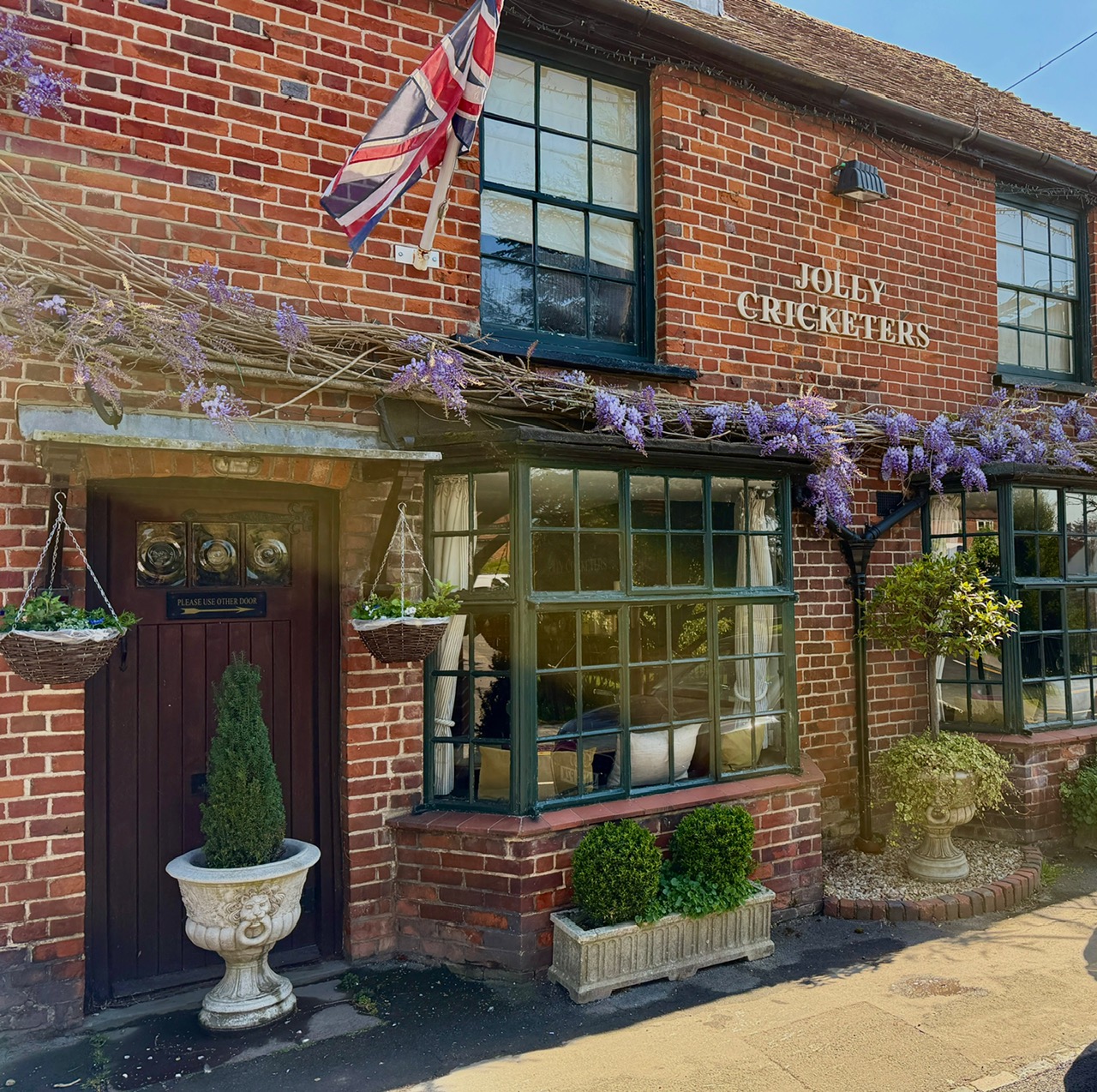
It’s just over a five minute drive from Bekonscot to Seer Green, proudly proclaimed on the signs as “The Cherry Pie Village”. It really is a gorgeous place, and the Jolly Cricketers is in a beautiful spot one side of the churchyard. Even the church, in the sunshine, was delightful: tables and chairs out in case you wanted to stop and rest, a cafe inside with its own Instagram account. And the pub was a picture postcard perfect spot, wisteria running along the top of the racing green window frames. It could easily have belonged in Bekonscot too, if only it had been a lot smaller.

It was made up of two rooms, a larger bar and a smaller dining room, although I imagine you can eat in either. The staff told us it was a quiet lunchtime so we could sit anywhere, and they very kindly let us expand into a table that would ordinarily seat six, my brother, my stepmother, Zoë and me. Sun poured through the windows, and the cricketing theme was worn lightly: a ball on the mantelpiece, the menu broken into sections saying Warm Ups, Openers, Main Play. It was an extraordinarily handsome space, somehow a very classic dining room transplanted into a gorgeous old pub without remotely jarring.

One of the nice things about going to a place like the Jolly Cricketers in a large group is being freed of the tyranny of having to choose something different to everybody else. And – I can’t imagine why – all four of us were in the mood to eat our feelings that day, so we attacked every section of the menu and gave ourselves permission to order without fear of hesitation or repetition.

My brother had an alcohol free beer, Zoë and my stepmother tried the alcohol free gin and tonic and I, the sole drinker, regretted not being able to order a bottle from the wine list, especially because the pub stocked fascinating-looking natural wines from Woodfine, a winery in the village. I consoled myself during the meal with a Spanish Chardonnay which was extremely good and a Rioja which was even better. Even so I suspected that the real treats were further down the wine list – especially a Saperavi and a Xinomavro, both around the £50 mark.

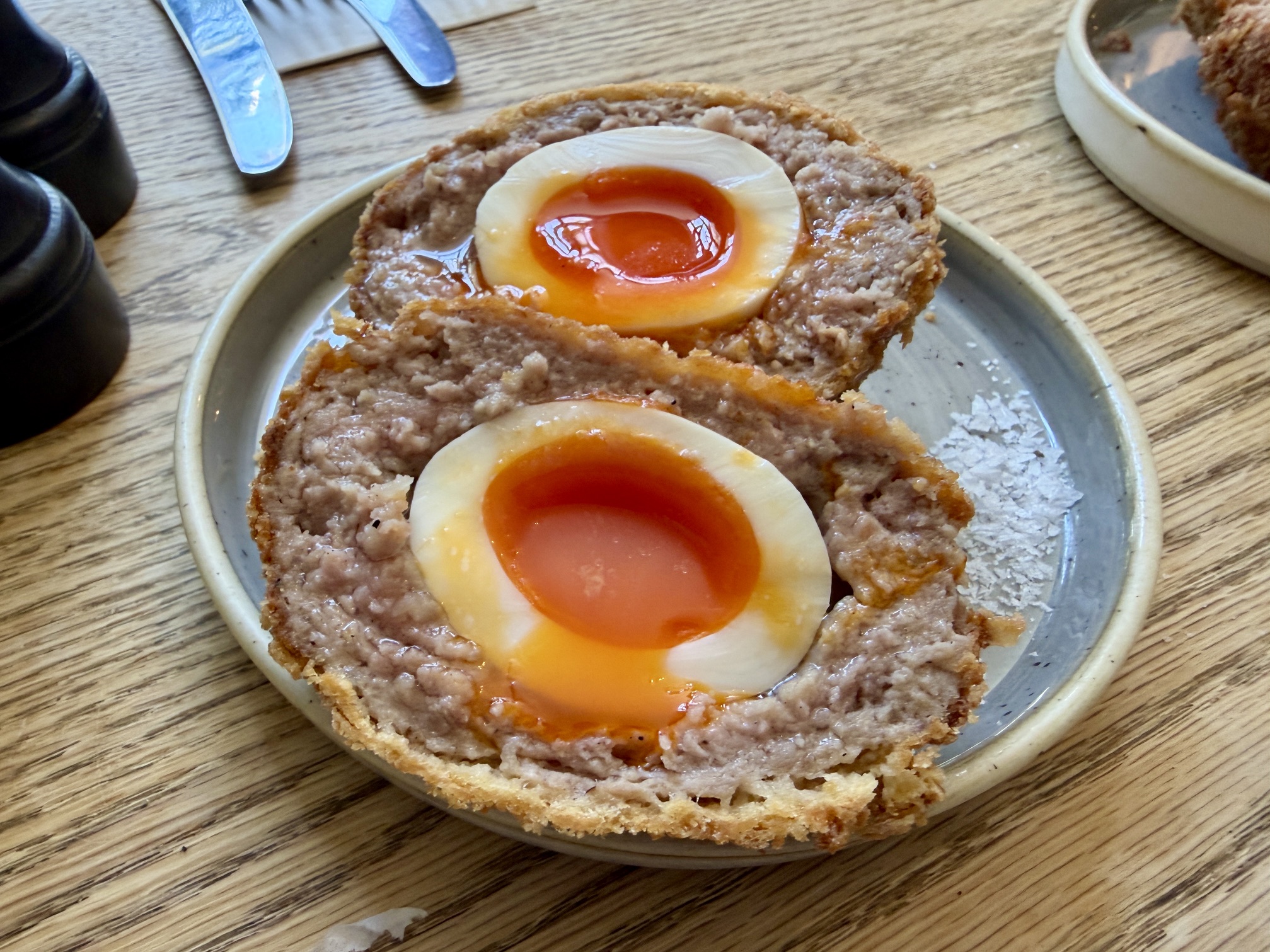
Now, on to the food – and before you judge, I’d just like to say again that it was a very particular set of circumstances. First, the Scotch egg. We had two of these between the four of us and I absolutely adored it, the pork coarse and judiciously seasoned, the Burford Browns spilling golden secrets, a smattering of salt flakes to sprinkle on top. It took me back to the glory days of the Lyndhurst, and made me wish I had a pub doing food like this within walking distance. The yolk was a little runny for my stepmother’s personal taste, the lack of brown sauce or any other condiments won Zoë’s seal of approval: on balance, a palpable hit.

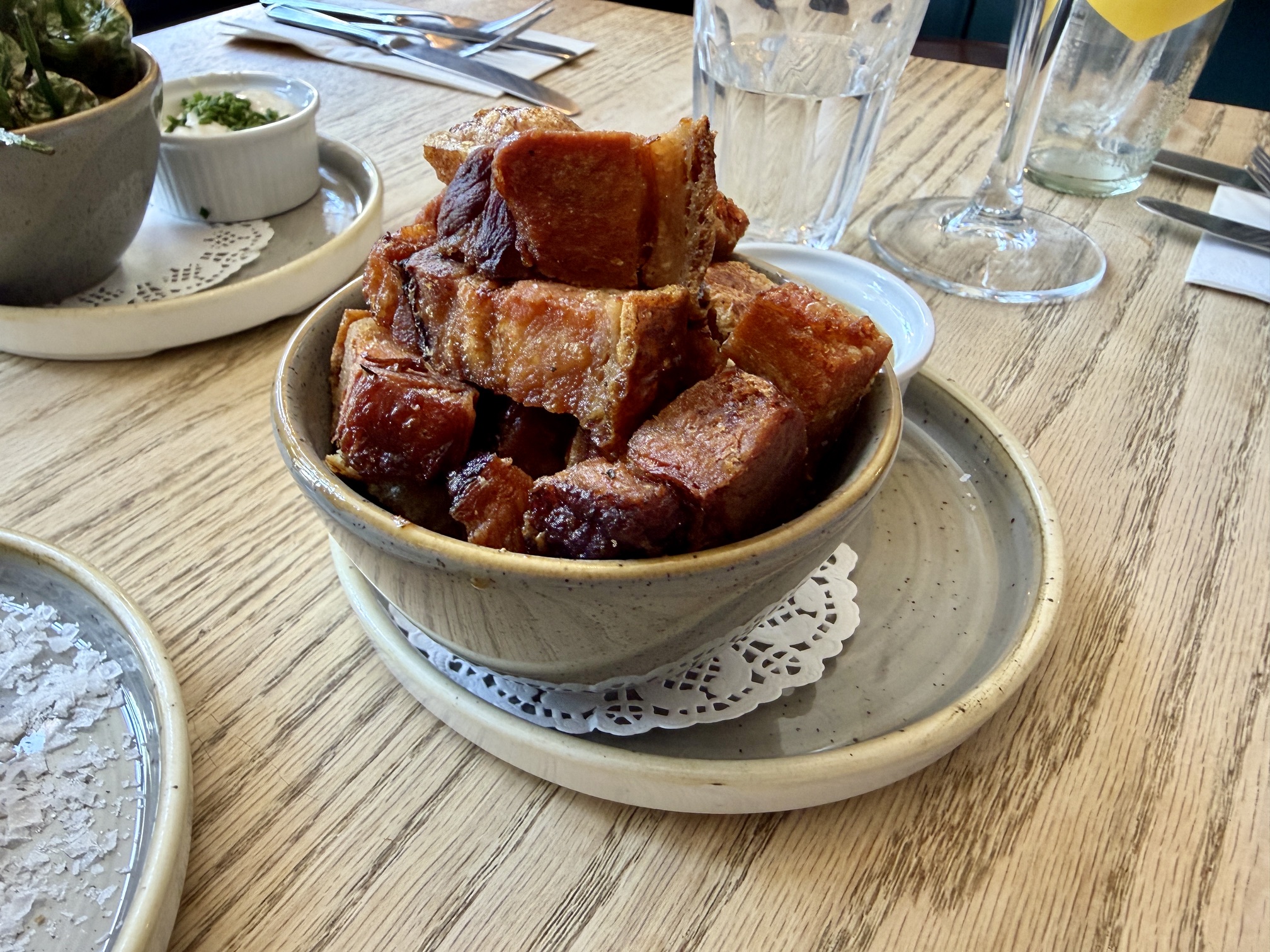
Even better were the cubes of crispy Chiltern pork in a cairn with a little bowl of apple sauce for dipping. These were simple, bronzed and moreish beyond measure, and if I ever sweep to power every licensed establishment will have to offer this dish or something like it. I doubt many would make it seem as easy as the Jolly Cricketers did, though: such simplicity, just pork, salt and apple.

I regret the fact that we only ordered one portion of these, and I stand by that despite the sheer quantity of what we got through, but it was indisputably excellent value at £8.50.

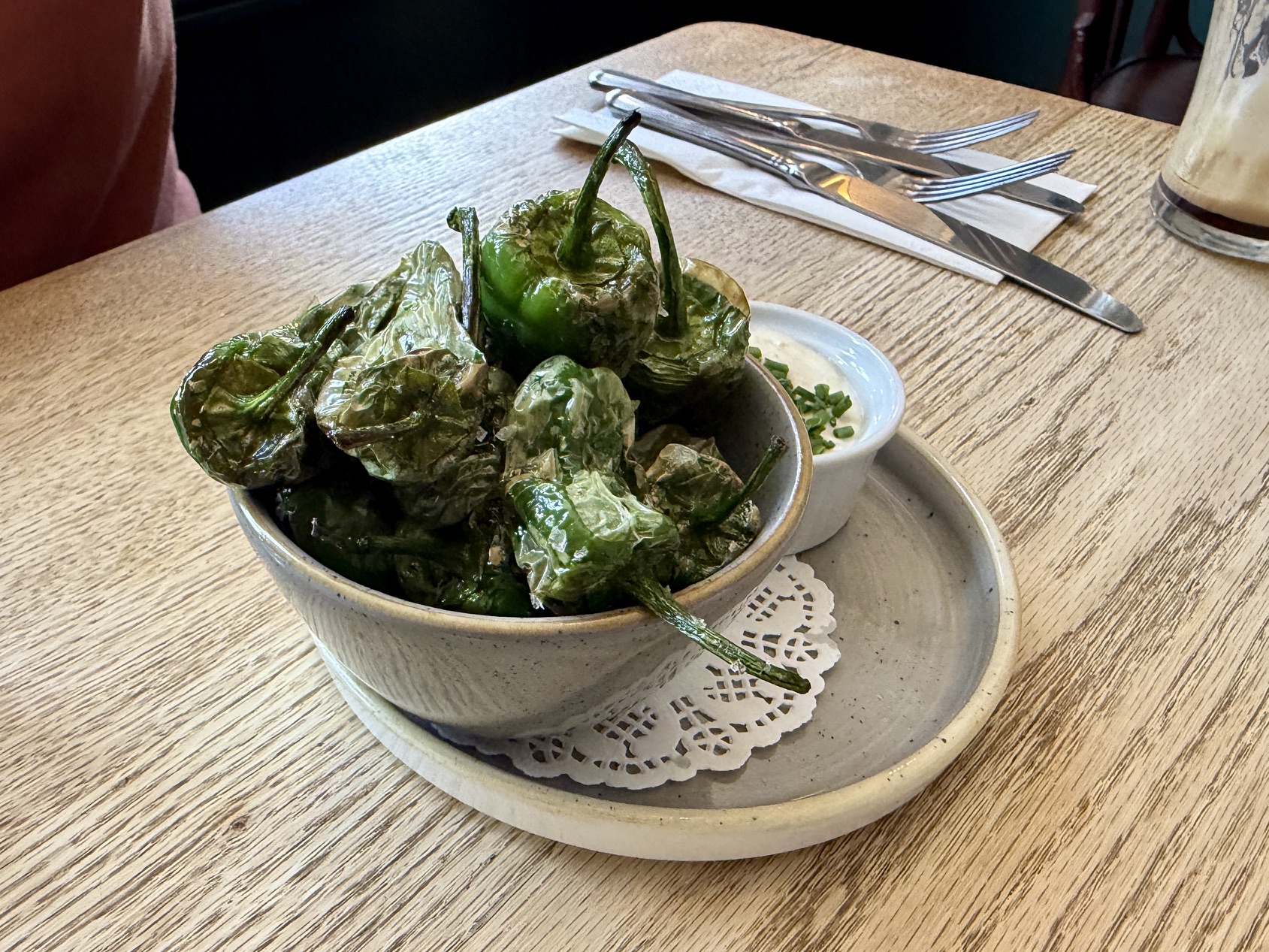
The last of our trio was padron peppers, ordered because Zoë loves them; my stepmother, not unreasonably, said “I can make those at home”, and I’ve always felt I can take or leave them.

But if you do like padron peppers, and plenty of people do, these were as good an example of the genre as you’ll find. I wasn’t sure about the wisdom of serving them with aioli, mainly because I’ve never seen that done before, but the padron pepper expert among us was very happy with them. Also £8.50 for these, which I found a tad strange: the crispy pork felt like a much better return on investment.

I didn’t take a picture of my starter, even though I was sure I had. Can you believe I still make rookie mistakes like that after nearly thirteen years? I’m going to plead extenuating circumstances and tell you that my crispy squid was a knockout, beautifully fried, still tender, plenty of it. You could eat it with a fork, and I started out that way, but once it cooled enough for me to pick it up and dab it in a simple but exquisite dip of honey, soy and garlic I abandoned decorum and did exactly that.

This is a dish you see on pub menus fairly often, but you would struggle to find it executed as well as the Jolly Cricketers do: this would, I discovered, turn out to be a theme. The pub’s menu doesn’t lean too heavily on provenance, but it does say that fish and seafood come from Newlyn’s Flying Fish, a name I recognise which inherently inspires confidence.

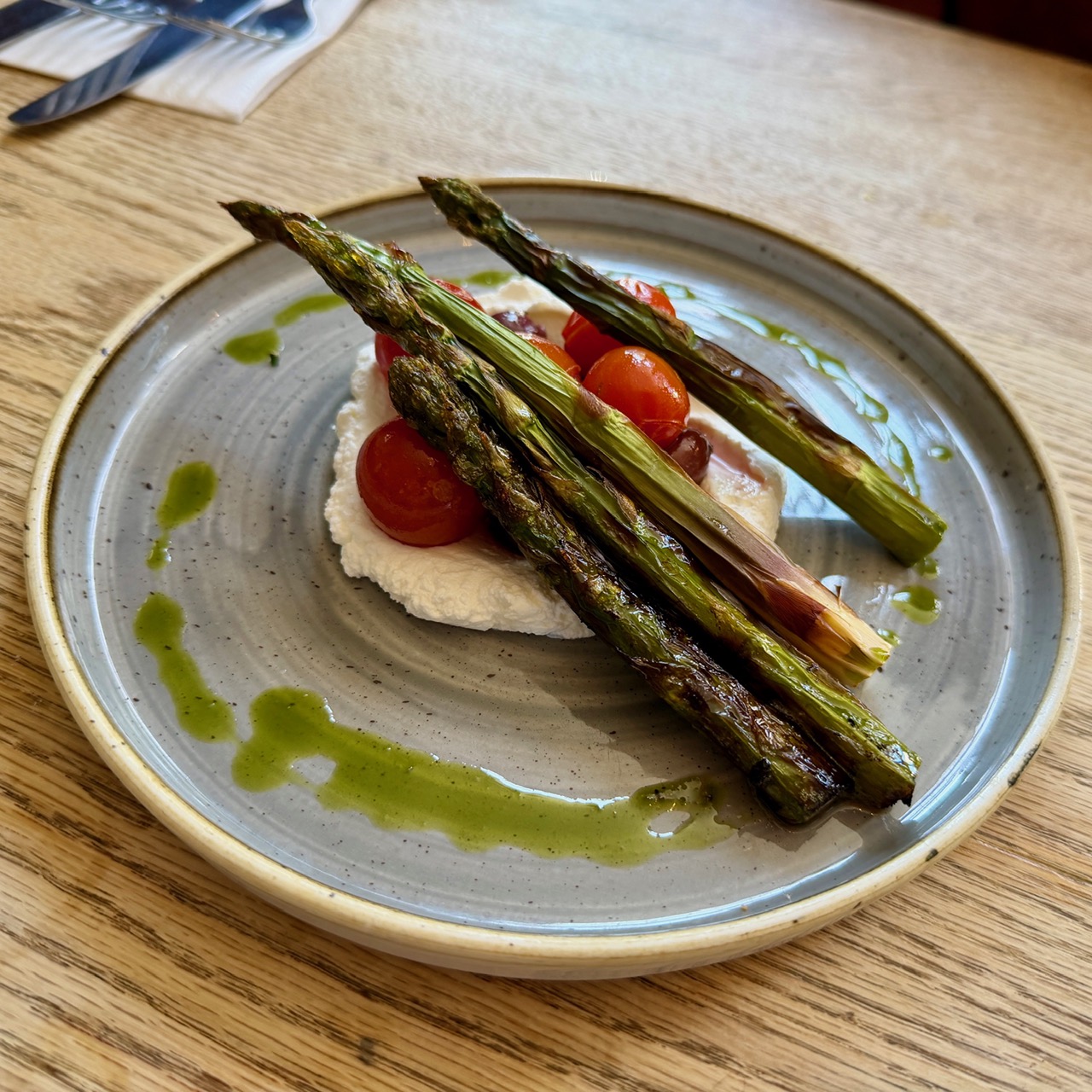
My brother was torn but ended up going for the asparagus. He really enjoyed it, and it had plenty going on with sumac labneh, cherry tomatoes and olives, a moat of the most arresting-coloured extra virgin. I didn’t eat this, so I won’t sit in judgement too much, but just the four spears felt a little underbalanced and it didn’t look like the sourdough crumb made its presence felt. It was the most expensive starter on the menu at £12.50 and I was glad I hadn’t ordered it myself, but for all I know it probably – as wankers like to put it – “ate well”.

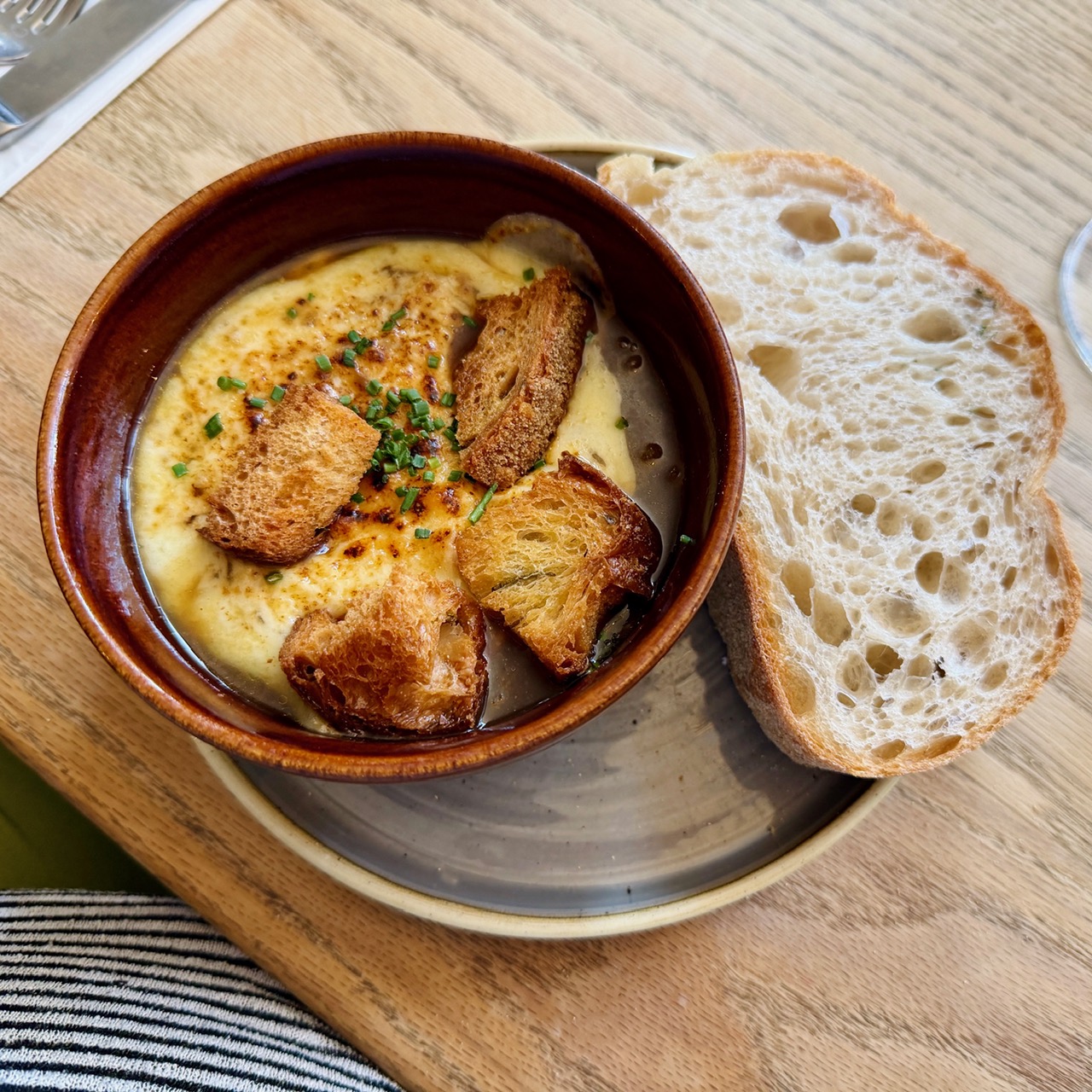
I think the people who really ate well – because repeat after me, dishes don’t eat well, people eat well – were Zoë and my stepmother, who went for the French onion soup. The pub had said recently on Instagram that it was back on the menu by popular demand, and that demand was echoed at my table. It really did look the part, a deep brown panacea packed with onion, topped with a hulking permacrust of molten cheese studded with epic croutons.

And in case that wasn’t enough for you, there was also a thick wodge of excellent bread speckled with caraway seeds: not necessarily that French, but a very welcome interloper. “It was maybe ever so slightly too sweet from the onions” Zoë told me later, “but that’s niggling. Besides, the cheese more than made up for it.”

By this point it looked like we might be the only lunchtime customers in the dining room that day (which goes to explain why the pub also offers a locals set menu lunchtimes and evenings during the week). But if anything, that just made the service even better, without ever being too much. We were always asked if we were happy with each course, just at the moment when we had finished our first mouthfuls and established that yes, we truly were.

Drinks kept coming as we needed them, and we were always asked whether we wanted more just at the point when one of us was thinking that more were in order. There is a real talent to this, especially to do it and make it seem telepathic, and that the Jolly Cricketers’ young and enthusiastic team was so very good at it was one of the many happy discoveries of our lunch.

Pacing was, too: it could be so easy when a kitchen isn’t mega-busy to get into a rat-a-tat rhythm and pepper you with course after course in quick succession. But the pub understood not to do that and actually, on that day of all days, the time and space we were given was one of my many favourite things. By the time our mains arrived, we were ready but not hankering – how could you hanker when we’d been determined to try so much of the menu? – but they were still a happy sight.

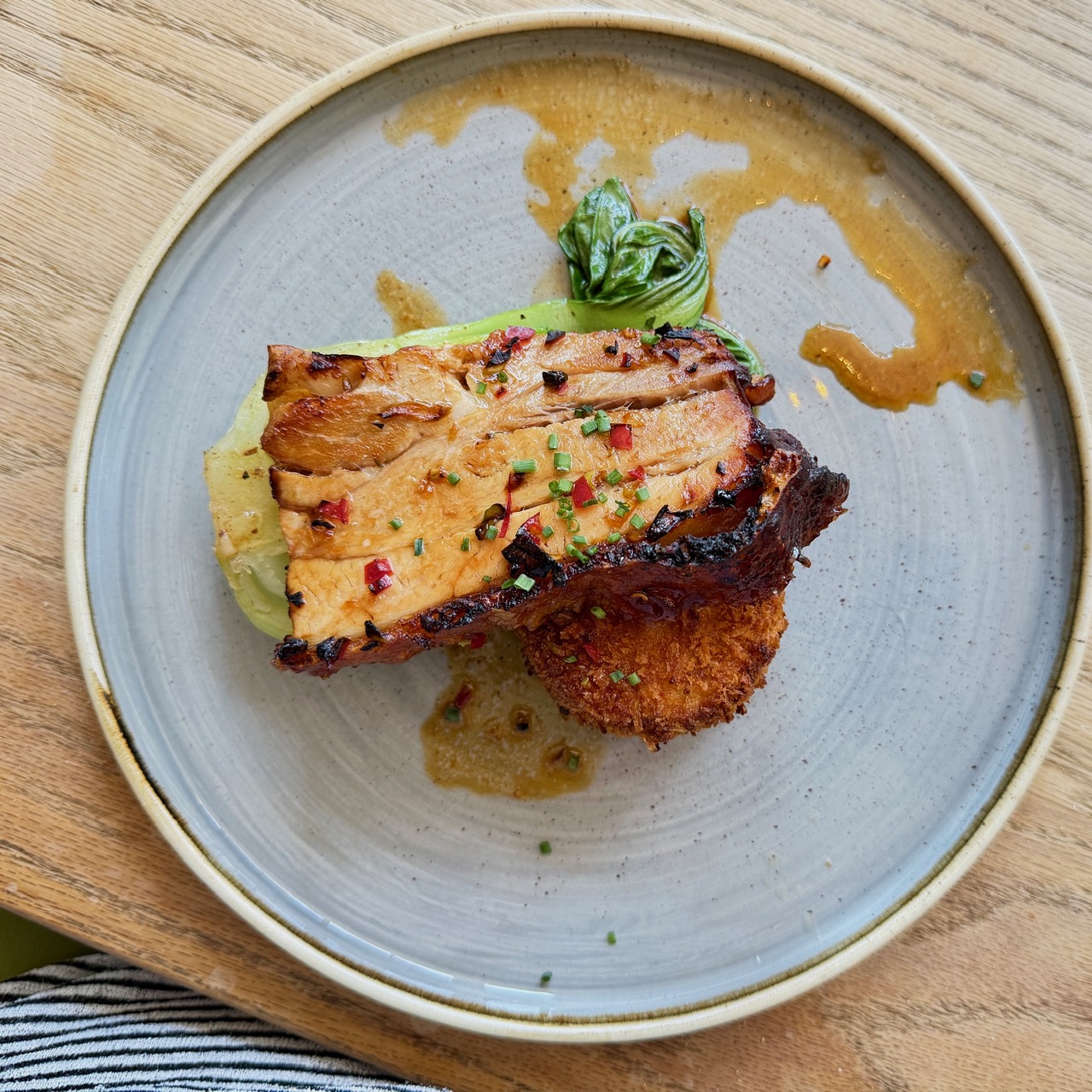
Three of us had chosen the pork belly – from Stockings Farm, less than ten minutes’ drive away – which makes my job far easier than it could have been. On paper it sounded like an unmissable dish: pork belly, crab cake, pak choi and a soy and garlic sauce, so many wonderful things coexisting on a plate. And if it wasn’t quite perfect it was close enough that I couldn’t bring myself to feel anything but indulgent. Because it all worked, it just could have worked slightly better and come together a little more.

The pork was truly magnificent – a whopping striated slab of the stuff, crispy-edged but yielding at its core, some of the best pork belly I’ve had in as long as I can remember (or at least since the crispy pork earlier on). And the pak choi offered an excellent contrast, cooked absolutely bang on. But I would have liked the crab cake to be a little crispier too, a bit less crumbly and to have more of the ginger that was meant to feature. And it needed sauce to bring it together – a proper quantity of it, not a thin trickle that had made its way to the perimeter of the plate, like it was trying to make a break for it.

The crab cake was just a question of preference, but the lack of sauce meant that this dish, made of exceptional parts, didn’t quite cohere into a whole. It made me wish I’d kept the rest of my ramekin of soy, honey and ginger from the squid, because pouring that over this pork and the crabcake would have been the missing piece. Without it, what could have been a perfect dish had to settle for mere excellence.

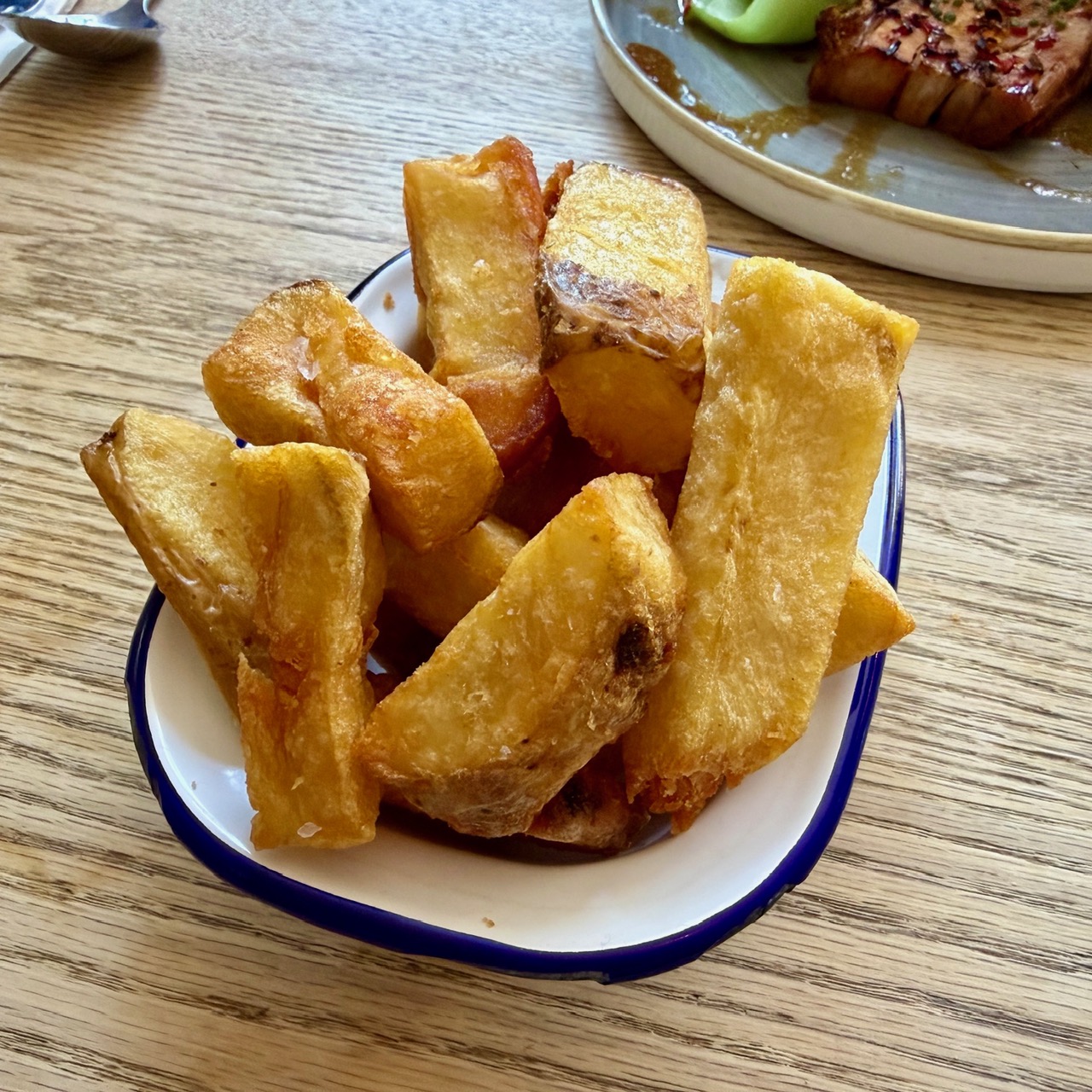
We’d opted for a solitary portion of chunky chips to provide carbs, and in honesty the crabcake was spudded up enough that we probably didn’t need them. But thank goodness we ordered them anyway, because they were textbook: stubby and crunchy, beautifully done with a little side order of rustling scraps in the bottom of the bowl. My stepmother had a couple too, declaring them infinitely better than the fries that came with her main.

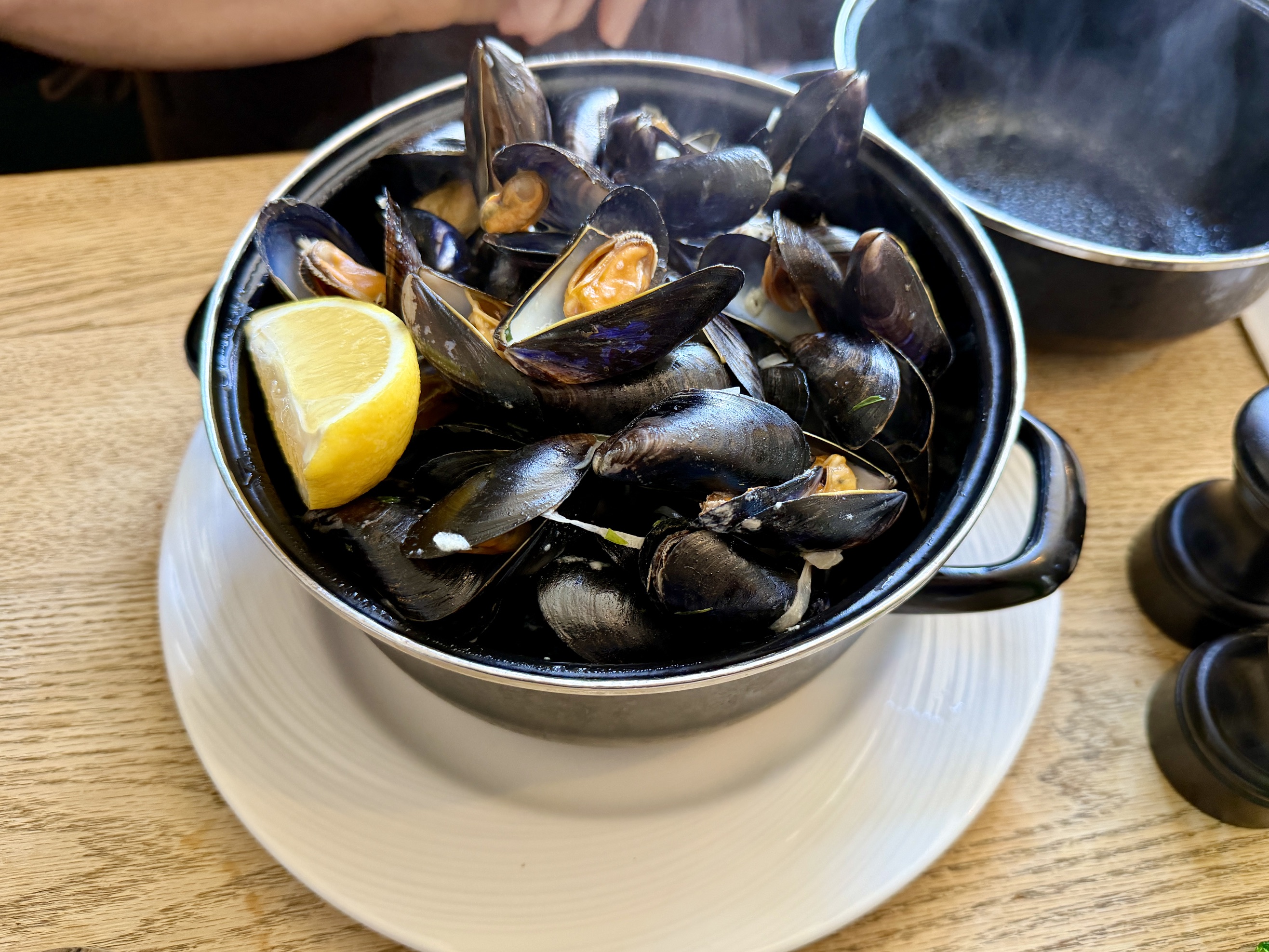
That main was a huge pot of mussels – Welsh, apparently – almost as much still life as treat, gently steaming in their bath of marinière sauce. They were pronounced triumphant and my stepmother worked through them with what looked to me like a combination of diligence and joy. You could have a smaller portion as a starter with what the menu winningly refers to as “mopping bread” or a larger one with fries.

I think, with the benefit of hindsight, my stepmother would have liked the bigger portion with a few slabs of that caraway-speckled bread. But hindsight is always perfect and probably, if we’re being brutally honest, we could all find more laudable uses for it than ordering better at lunch. I said that making mistakes when you order in a restaurant is an essential part of making sure you can find reasons to return and I believe that, even if it’s positively glass half full by my standards.

We split 3-1 on dessert, too, but before that we asked our server about the whole cherry pie thing: why was the village famous for that?

“Do you want the nice answer, or the honest one?” she said. I do love a situation where those two answers are not the same, so of course I asked for the latter. And she told us that Seer Green used to have, for some reason, mass graves and that the cherry orchards were planted on top of those, although the sanitised version was just that the village really loved cherries and had become famous for exporting them to London. She also told us that the cherry pie on the menu was a speciality, and I promise the story behind the village’s nickname was not why we swerved it.

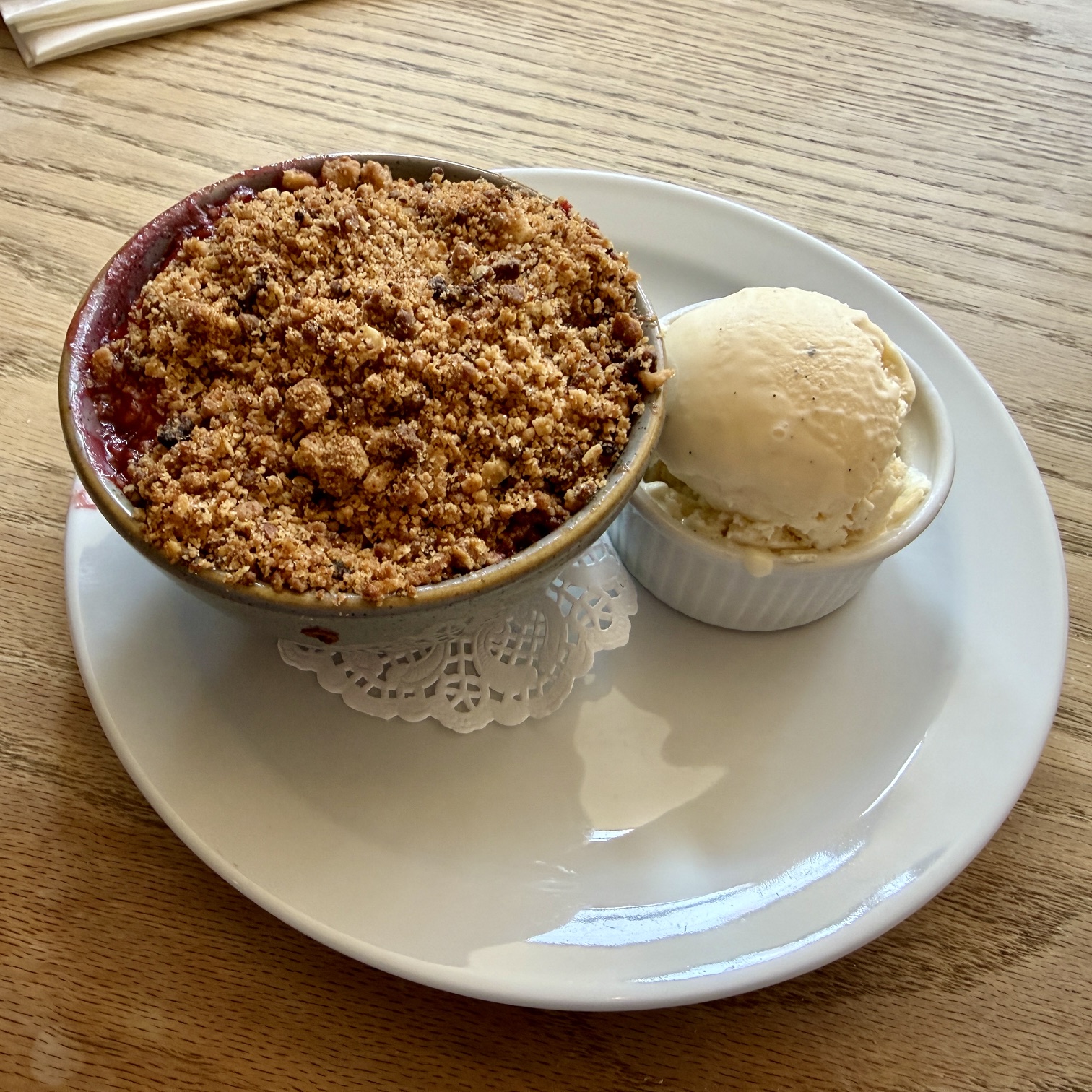
Zoë couldn’t resist crumble, having seen it on the menu, and she rhapsodised about her order. It was apple and blackberry, topped with a gorgeous golden rubble of biscuit, served with an ice cream resplendent with vanilla specks. It prompted a big discussion at the table about the acceptable crumble to fruit ratio: I, conditioned by the Royal Berks no doubt, thought it should be 2:1, while my stepmother would have preferred it the other way round. Zoë, ever the moderate, liked it best 50:50. Which was this, I asked her later? My stepmother would have loved it, she told me.

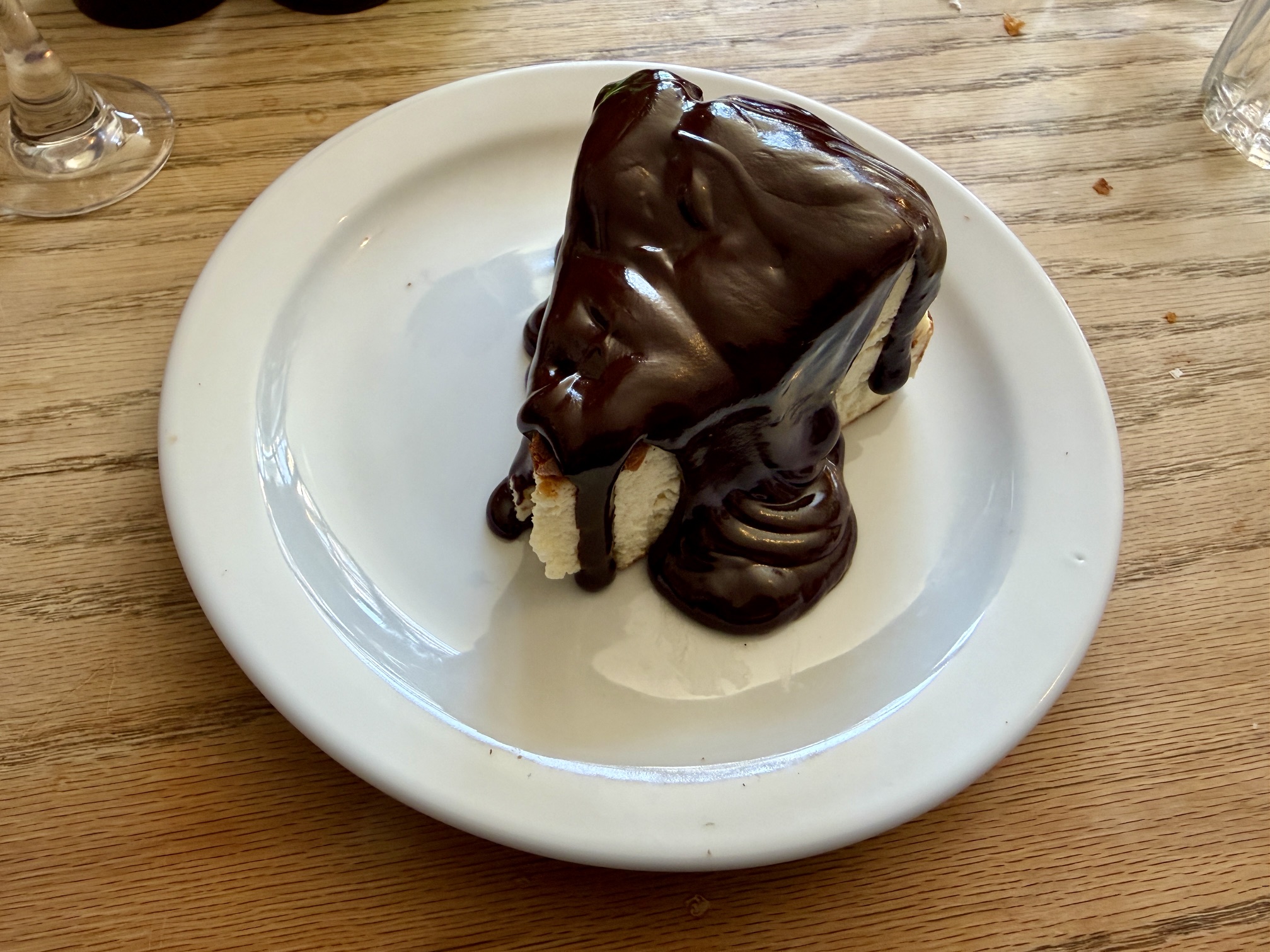
The rest of us had the Basque cheesecake, unusually with chocolate sauce rather than fruit. The slightly warm, exceptionally rich dark chocolate sauce made this dessert, but without it it would have been rather like Snoop Dogg, i.e. slightly too baked for my liking. I like a Basque cheesecake to retain a little wobble, this was a very solid affair. That might have been a conscious choice given the accompaniment, but I wasn’t sure.

Similarly, the menu paired this with a manzanilla, which might have worked if it was just the cheesecake, but the chocolate sauce was crying out for a PX, or a dessert wine of some kind. The menu suggests pairings for all the desserts but none of them are anything sticky: I have struggled to find fault with the Jolly Cricketers, but I’d love it if they fixed that.

We didn’t really want the afternoon to end, in this beautiful pub in this beautiful part of the world on the first day of a strange new phase. So we had coffee – which was extremely good, something I never expected – and eventually, with a heavy heart, we settled up. Lunch for four, pretty much four courses with plenty of drinks and coffee, came to £310 with a 10% service charge thrown in.

I was chatting to our server and she asked where we came from, so I explained that we were from all over, really: Reading, Windsor, New South Wales, and told her why we’d been in the area. And she was so lovely and so sorry for our loss, which happens a lot lately, and I told her not to be sorry. Because I couldn’t think of a better place to be on that day, or better people to be there with.

If I lived near the Jolly Cricketers I would be there all the time, and if a pub like the Jolly Cricketers was near me I might not write a blog any more. It would exert a pull like the Lyndhurst, and you’d find me there whenever I’d had a hard day. And there is a carpe diem message here going back to the very beginning of this: if there’s a restaurant you keep meaning to visit, go there. One day it might not be there, or you might not be. And if there’s a person you keep meaning to call, or take down the pub, or go to that restaurant with, do that too.

My dad would have loved The Jolly Cricketers. It’s a crying shame he wasn’t there that day. But he was, really, wasn’t he? At least in a few of the ways that matter.

The Jolly Cricketers8.8
24 Chalfont Road, Seer Green, HP9 2YG
01494 676308

https://thejollycricketers.co.uk

Since January 2025, Edible Reading is partly supported by subscribers – click here if you want to read more about that, or click below to subscribe. By doing so you enable me to carry on doing what I do, and you also get access to subscriber only content. Whether you’re a subscriber or not, thanks for reading.
Restaurant review: Smoke & Pepper

Could you eat exactly the same thing day in, day out, for weeks on end?

Fifteen years ago I worked in an office, back in the good old days when people actually liked going into the office every day because they had their own desk, their own desktop computer and regular deskmates, not some hotdesking hell optimised for isolation in the name of networking where you locked away your personal effects every evening and had nowhere to hang your coat. I miss those days, sometimes.

Back then, for a time, I sat opposite a chap called Neil who told me that at some point in his past, he ate the Prêt tuna mayo baguette for lunch every working day, without fail, for over a year. Didn’t he get bored, I asked him? He said it was just one fewer decision to make, and I didn’t know whether to be impressed or depressed. Maybe he just didn’t like food all that much. I imagine he stopped when, as was the fashion, our office got moved from the town centre to some misbegotten industrial park, nowhere near a Prêt.

I subsequently discovered that this was a lot more common than you might think. Former Deputy Prime Minister and swivel-eyed wrong ‘un Dominic Raab was in the news for doing exactly that back in 2018, and when the story came to light the Guardian unearthed a poll from the previous year before saying that 1 in 6 people had eaten the same lunch every day for the last 2 years. Not only that, but apparently 77% of workers had eaten the same lunch every day for 9 months. Every day. Nine months. You look at that on paper and can’t believe it could possibly be true.

Who are these people, I wonder? They walk among us, they look like us but – like evangelical Christians – I never expect to come across anybody who owns up to being one in daily life. Perhaps those mind-boggling statistics are no longer correct. It’s possible that the pandemic forced people to introduce some variety to their diets: it would be nice if at least one decent thing had come out of that whole affair.

Somehow, when it comes to dinner, having a regular order is more understandable. Don’t get me wrong, I wouldn’t want to go to Clay’s or Kungfu Kitchen and order the same thing every time, however great it would be, but I do get it, especially if you don’t go somewhere too often.

When Gurt Wings was at Blue Collar Corner, I nearly always ordered their Korean popcorn chicken and, on the occasions where I strayed from the path, I usually wished I hadn’t. I’ve had other pizzas at Paesinos, but the one with olives, anchovies and capers remains my favourite. Sometimes you have a regular order because it’s the only thing you especially like. When I meet my family at Pho, their favourite, I always have the wok-fried rice with chicken and fried shrimp: I find the rest of their menu a bit ho-hum.

And yes, some restaurants have must-order dishes, although we could argue all day about what they are: Bhel Puri House’s chilli paneer, perhaps, Kamal’s Kitchen’s pressed potatoes, the Tuna Turner at Shed. But is there ever truly a universal consensus?

Often, when I’ve visited somewhere lauded by the critics and eaten the thing you must try – saffron risotto with bone marrow at Town, or The Devonshire‘s beef cheek suet pudding – it hasn’t knocked my socks off. Maybe dishes only reach that elevated status over time, rather than by the same three private schoolboy nepo babies – you know which ones – telling you what to order in their newspaper columns a few weeks after the place opens, saying something is an ‘instant classic’.

But is there a level even above that? Are there dishes so good that you must visit the restaurant just to try them, and – one final step beyond – so amazing that you have to revisit the restaurant over and over just to get your fix? Such dishes would be unicorns indeed, but this week’s review is of Smoke & Pepper, the smashed burger and fried chicken spot that opened late last year where greasy spoon institution Munchees used to be, because I had a tip-off that hiding on its menu was exactly such a dish.

Subscribe to continue reading

Become a paid subscriber to get access to the rest of this post and other exclusive content.

Restaurant review: The Royal Berkshire Hospital

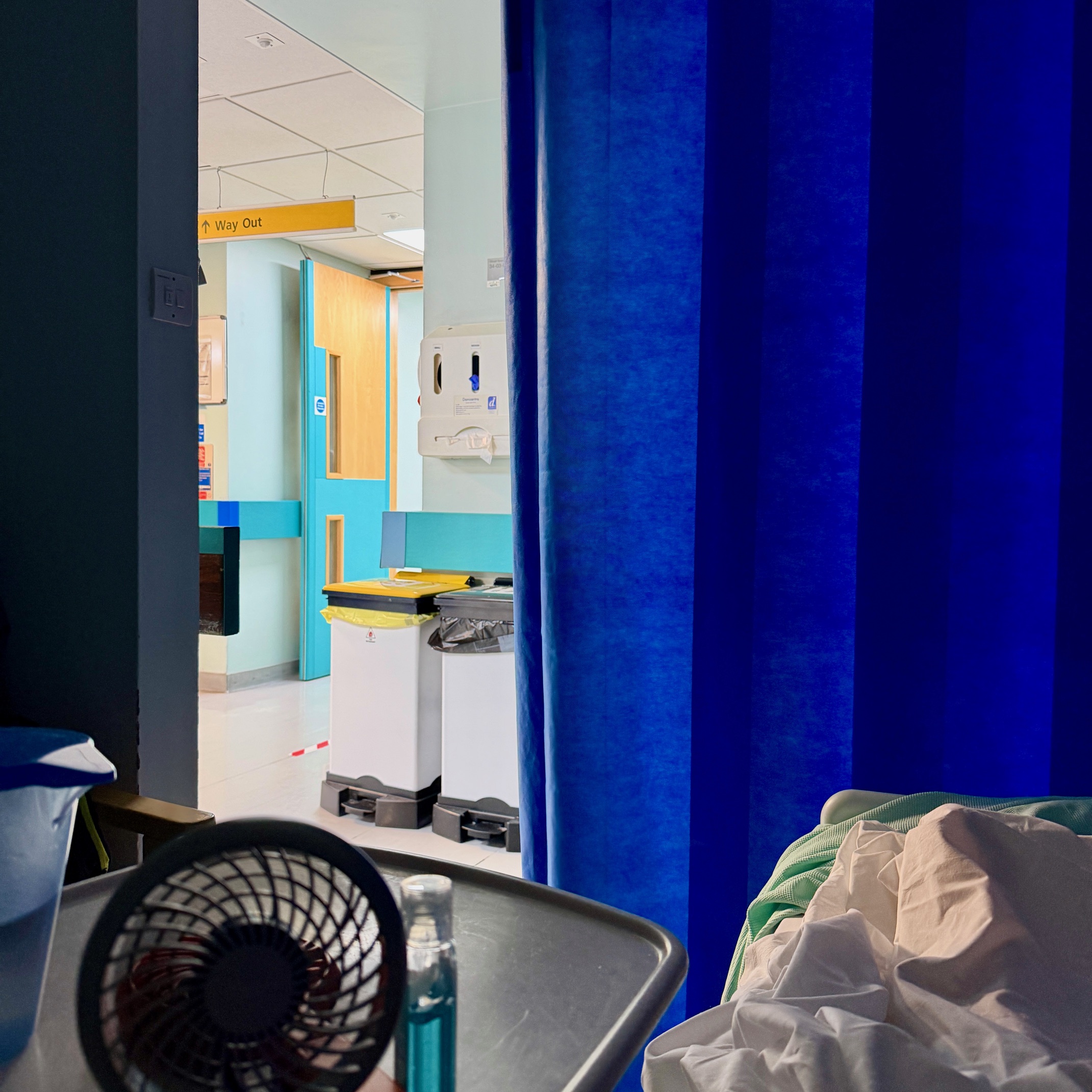
On the Wednesday afternoon, my second full day in hospital after the accident, I put some pictures up on Facebook. Nothing special, just a picture from my bed of Dorrell Ward, my left foot poking out, and a shaky, badly photographed picture of my lunch. Well, I never thought this would be my next forthcoming restaurant review my caption read. I know the English is clumsy but in my defence I was dictating it, because typing was too challenging at that point. Besides, I’d probably just had some morphine.

The comments were immediate, plentiful and properly lovely. A couple of the funny ones stuck with me. Chronicle hitman? said one: I replied that it was more likely to be a whack job by the owners of Vino Vita. Another said that is extreme lengths you’ve gone to to obtain a review. I had the comeback in my mind – no stone left unturned, I thought I would say – but looking at my Facebook page, it seems I never posted it. Perhaps the morphine had kicked in by then: I did spend quite a lot of the time asleep, at the rare times when sleep came easily, because that way everything hurt less.

But the thing is, on some level it is a gap that I’ve never reviewed the Royal Berkshire Hospital. Because you could make an argument that it is Reading’s largest restaurant: the trust employs 7500 people, admittedly across more sites than just the RBH, and has over 800 beds. Put that way, it’s hard to imagine that even Reading’s busiest conventional restaurant feeds more people in a week.

So I suppose, in a funny kind of way, this review is sort of overdue. During my four night stay in a place that doubles as Reading’s busiest restaurant, I begin to get an idea of what an unusual beast it is.

* * * * *

I wasn’t meant to wind up an inpatient in the Royal Berks. A whole chain of things had to go wrong for me to be in the place I was and make the decision I did.

First of all, I shouldn’t have been commuting home that Monday afternoon. The previous week I’ve been off with the cold that everyone has had, the cold that wiped us all out. And I only went into the office to catch up with my boss, only to find when I got there that he’d had to take the day off at short notice. If I’d known I would have worked from home, and never made the fateful journey that led to me coming a cropper.

And my boss’s boss, seeing that I was less than 100%, told me to go home early. That played a part too. So I found myself getting off a train somewhere between four-thirty and five o’clock, cutting through Harris Arcade on my way to pick something up from the supermarket. If I’d been later, the arcade would have been closed and I wouldn’t have used it as a short cut. But all those things happened, one after another, and so a little before five I got to the Friar Street end of the arcade to find the shutter in front of the exit halfway down.

In my mind, I thought two things that weren’t necessarily true. I thought that if I headed back to the other end of the arcade, I might find that shutter down too, and then by the time I returned to where I was I’d be shut in the arcade. I also looked at the shutter in front of me and thought to myself I can squeeze under that. And in that respect, I was sort of right: I did manage to shimmy under the shutter.

The problem was that retaining my footing on the other side was completely beyond me.

I went unceremoniously flying, face first into a parked car. My glasses were smashed to pieces, my face bleeding and grazed. But that wasn’t the first thing I noticed. The first thing I noticed was that my arm, in unbelievable pain, no longer felt like mine. I have had to tell this story more times than I can tell you: to friends, to family, to acquaintances, but also to every single NHS staff member who has spoken to me in any capacity since the accident. The first thing they ask you is to confirm your name and your date of birth. But the second thing they say, without fail, is so how did it happen?

I always start with it’s really embarrassing, followed by do you know the Harris Arcade in town?  My shame is then compounded by the fact that invariably, whoever I’m talking to knows exactly where I’m talking about: I can’t even make it sound less ridiculous an accident than it was. “I’ve never heard that one before” said the very nice man that took my first x-ray after I was discharged from hospital. Many of the reactions have been variations on that theme.

My wife has heard me tell the tale many times, and has given me tips on how to make it more entertaining which I refuse to follow. Stories in her family are currency, and sitting with them watching them trade anecdotes is one of my favourite things to do, an opportunity to relax and enjoy the show. Zoë tells me that to get a big laugh I should pretend that the shutter was literally rolling down as I reached it and that I chose in an instant to slide underneath it. 

But that makes me sound intrepid, or brave, or both. In reality, I’m just a dumb middle-aged man who made a bad decision and went down like an overweight sack of potatoes. The closest I’ve come to taking her advice is this: whenever I tell someone what happened I say I tried to get under the shutter like a shit Indiana Jones. Even that, I’m painfully aware, makes me sound cooler than I really am.

* * * * *

After the accident, in shock and in pain, unable to see, I am peeled off the pavement by Elliott and Alex.

Everyone likes to think that they would stop in circumstances like these, but I think we all know that most people don’t. Elliott and Alex do. They are second year students at the university, who just happen to be in town that afternoon. They ask if I’m okay, and it soon becomes apparent that I’m not. They help me to a bench outside M&S, near the statue of Queen Victoria. They call 999 and put me on the line. The call handler suggests that I should go to the minor injuries unit in Henley. Elliott and Alex are having none of that. I call my wife, still at work, and she picks up because she knows that I never call her when she’s at work.

“Is everything okay?” she asks me. No, I reply. My arm doesn’t work, I say.

Elliott and Alex call me an Uber to get me to the RBH. Getting into it is agony, but they keep talking to me, keep me in the room, keep me distracted. They call their friends and tell them they’re running late, and they ride with me to the hospital and wait with me until my wife arrives, having rushed back from work. These people don’t know me, don’t know anything about me, but they give up two hours of their evening to stay with a stranger, one who’s in excruciating pain and blind as a bat. They only go when they know that Zoë has got home, has picked up some stuff and is in a taxi on her way to me.

We swap phone numbers, and Elliott texts me several times over the weeks ahead. I am yet to persuade him to let me pay for the Uber, but I intend to keep trying. It is the first and probably the biggest kindness I experience, but by no means the last.

After they are gone, I squint at my phone held in my one good hand and wait for Zoë. From down the corridor I hear her at reception. “I’m looking for my husband” she says, and when asked to describe me, she says “he’s big and grey”. I make a mental note never to let her forget this, but I’m just so happy she’s there.

* * * * *

My first experience of the food on the ward, the day after I am admitted, is not the best. Despite the fact that I’m pretty much unable to move, arm in a cast, dosed up with codeine and morphine like clockwork, it hasn’t registered with me that eating with one hand is going to be extremely difficult. I order cornflakes for breakfast, and then realise that sitting up in my bed to eat them is something of which I’m simply not capable. I write that off, because oddly my appetite isn’t what it usually is, and decide I can save myself for lunch.

Lunch is a vegetable risotto, glistening strangely under artificial lights that give it almost an oversaturated look, like a Martin Parr photograph. I push a couple of forkfuls into my mouth and decide these are calories I can do without. Besides, I decide that it looks more like something deposited on a pavement after closing time than the sort of thing I’m used to in pubs and restaurants. At this point, I guess I’m thinking of the Royal Berks as like an all inclusive holiday: you can always sneak in food from elsewhere.

Zoë comes to visit me every day, and between us we soon learn the ecosystem of alternatives in the hospital. The top of the tree is the M&S – “that little Marks & Spencer is a godsend”, Zoë says to me, remembering all the vegetable samosas I smuggled in for her when she spent the best part of a week on the Covid ward. I have a bag of crispy chocolate clouds on my bedside table pretty much most of the time, the challenge being to eat them before the sweltering heat makes them unviable.

And then there’s the hierarchy of coffee. Back when I lived near the hospital I used to walk to AMT for their mochas, and on hot days I’d buy a Froffee, a coffee and ice cream milkshake, and drink it in Eldon Square Gardens, soaking up the sun. I was between jobs back then, and it broke up the afternoons. But AMT’s best days are behind it, and the mocha Zoë brings me one morning is genuinely undrinkable. 

Better, to my surprise, is Pumpkin: one afternoon my dear friend Jerry comes to visit me and fetches me a mocha from Pumpkin which is a hundred times better than AMT’s. He also brings me a copy of Viz and the latest Private Eye, which is the kind of thoughtful thing great friends do. I read them at night, by the light of my bedside lamp, after half nine when visiting hours are over and my knackered wife has gone home to get some rest. She keeps me company for 12 hours, every single day, and she never complains.

We aren’t used to spending nights apart, and of all of the things about this that might be one of the most upsetting. The lights are never completely off in the ward, because they’re always coming round to top up your drugs or check your blood pressure. But with my fan whirring, and the other noise abating, the Yves Klein blue curtains drawn around my bed, we send each other good night messages and pictures, and I try to quieten my mind by reading the magazines that Jerry has brought me.

When it comes to coffee the god tier is Jamaica Blue. I reviewed them, over seven years ago, but somehow I’d forgotten about their existence, or how good they were. On the morning of my discharge from hospital Zoë brings me one of their mochas, and for the first time in almost a week I am reminded of how wonderful a thing great coffee can be. It’s a small, tenuous link to my pre-accident life of little luxuries, of V60s at home or my latte at C.U.P, always at 8am, before hopping on the train to the office.

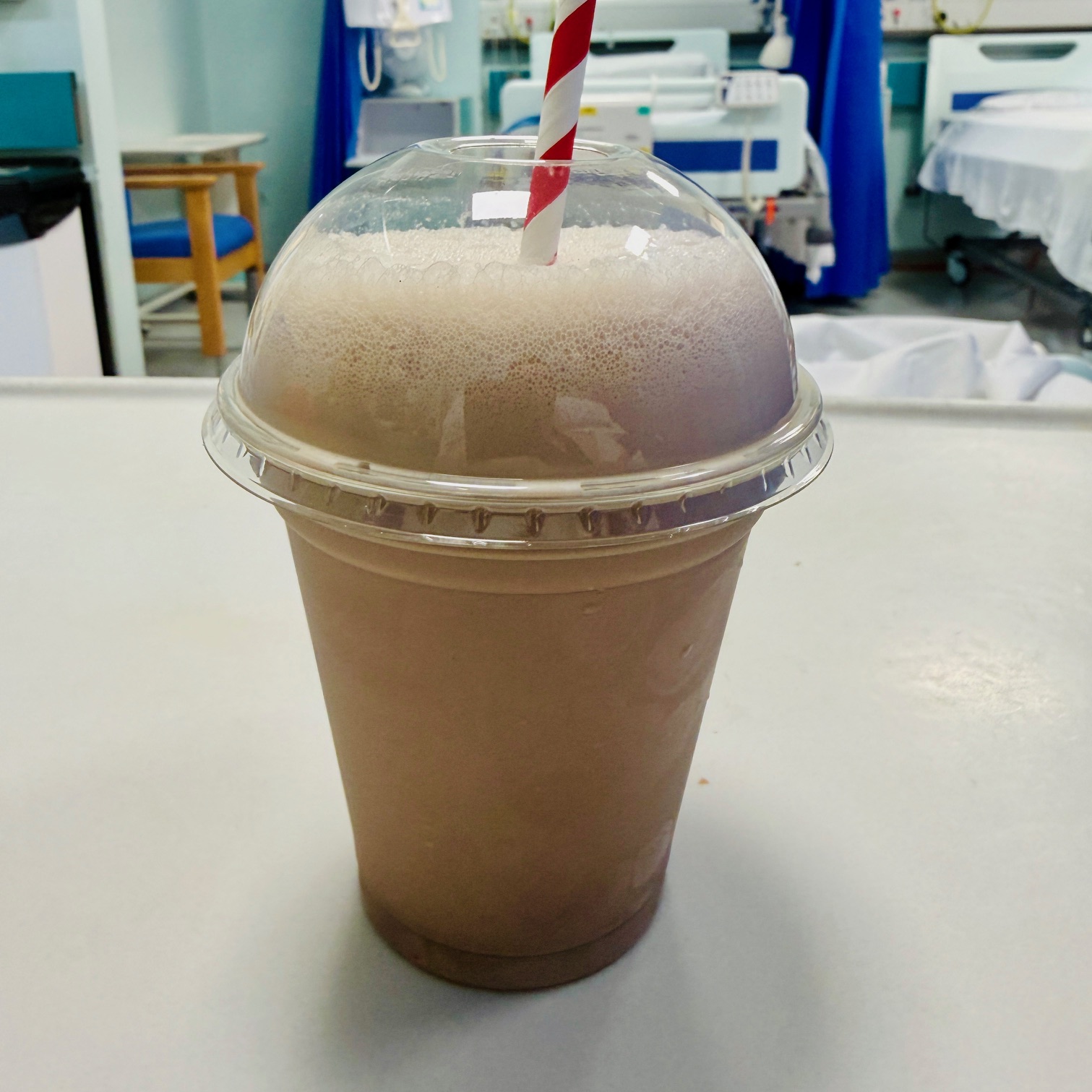
Even better than that, if such a thing is possible, is the milkshake Zoë brought me the previous afternoon from Jamaica Blue, an indulgence so lovely I could almost weep. Thick, cold, chocolatey, more fun than you would ever reasonably expect to have in a hospital. It tastes, to paraphrase Philip Larkin in another context, like an enormous yes.

* * * * *

If I didn’t rely on goodies from the M&S or from the hospital’s cafés as much as I could have done, there was a reason for that. The reason was that the food from the Royal Berks proved to be quite the surprise package.

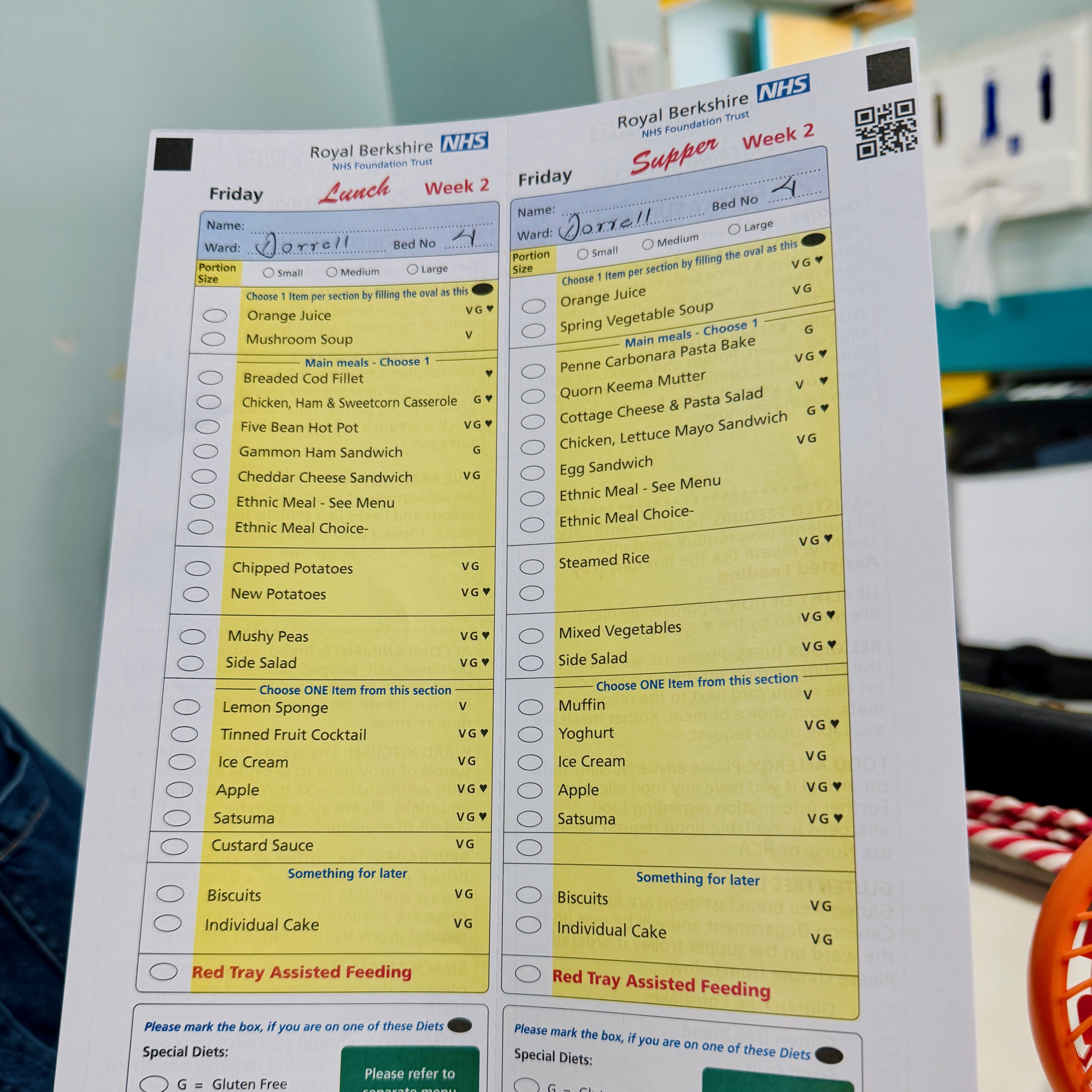
The menus come round every morning, printed each day, a series of boxes and options to tick for the following day’s breakfast, lunch and dinner. The weeks are numbered, and the font at the top of the menu calls them Lunch and Supper, in Mistral, a typeface you know even if you don’t realise you do. It’s the one from the logo of Australian soap Neighbours, designed in the ‘50s, a beautiful cursive script that is simultaneously retro and timeless. I’ve always loved Mistral, and somehow it brings a tiny chink of sunlight into a room shrouded with blinds.

After that disappointing risotto, somehow I never have another entirely bad meal during my time in hospital. For lunch on my second full day, I have a beef curry with rice and chunks of potato and while I’m eating it, I realise that it’s actually quite good. Not just the absence of bad, although I would’ve settled for that, but decent. 

The meat isn’t soft, tender, falling apart as it would be in a Clay’s curry, and the spicing isn’t complex, or even front and centre, but it’s not bouncy, fatty or gristly. The waxy cubes of potato add something, and I find that even with a broken arm, even with a hot uncomfortable cast on me, even with the fan humming and the painkillers wearing off, this is a good meal.

And then, afterwards, an even happier surprise. An apple crumble where the base is sweet, stewed apple but more importantly, the ratio of crumble to fruit is beyond reproach. And by that I mean that it’s easily two thirds crumble, a huge and joyous permacrust of biscuit so thick that I’m fearful, with only one hand, of whether I’ll be able to force my spoon through it. I manage it somehow, and the rewards are considerable.

I include a picture of my lunch with a picture of my ward as I send that first Facebook post mentioning what’s happened to me and where I have found myself. The responses flood in wishing me well, but they also do something interesting that I didn’t expect: a lot of them talk about the food. Because, and I had no idea of this, the hospital makes all of its food from scratch, on the premises, and they serve it in the restaurant as well as serving it to the patients. They could so easily use the likes of Sodexo: how wonderful it is that they choose not to.

One commenter tells me that she used to be the patient services manager for the catering department. The hard work that goes into all of those recipes is outstanding she tells me, and I can well believe it. She also sends me a lovely message with a few tips about what you can and can’t do around the menu, catering life hacks; I thank her for them but decide not to do any of them, because I don’t want to be a diva. The staff start work at 6am every day, she tells me, and work for 14 hours to ensure feeding everybody in the hospital: Reading’s largest restaurant indeed.

So many people comment along those lines, about the food, about the staff, about what a wonderful place the Royal Berks is for people when they need care the most. One of comments says how lovely the hospital’s goulash and spicy lamb are, another recommends the “cultural and religious menu”, a tip that is echoed by Zoë from her time on the Covid ward. The menu just calls it a “ethnic meal”, but I order it multiple times and am never disappointed.

Somebody else tells me that she’s been a patient at the RBH on and off for 18 months. The food is one of the highlights she tells me. It sounds silly, but all these intersecting stories, this universality of experience makes me feel less alone, and less scared. It also reinforces that even if I have very limited experience of this hospital – this is the first time I’ve ever spent the night in a hospital since I was born – the RBH is at the centre of Reading life, and it touches everybody.

It was there when my wife was taken away from our house in an ambulance late at night for a prolonged stay on the Covid ward, in the depths of winter 2021. Both of my sisters-in-law were born there, so were both of my beautiful nieces. It’s the RBH that treated my father-in-law when he had cancer, and again when he had a heart attack. And that’s just my family – but from the pile of comments I got a clear impression that it was central to countless more families than mine.

I never quite get over not hating the food. The following day I have a beef stroganoff which again, is just downright comforting and nice. The little mini packets of biscuits are by Crawfords, and are really enjoyable with a cup of hospital tea; I allow myself two sugars while I’m in hospital, it seems only right. The ice cream is lovely too, despite not resembling any ice cream I would buy for myself on the outside. You almost need to eat it first, because by the time you finished your stroganoff or your keema curry – accompanied by a little pot of dal or vegetable curry – it is a texture almost like foam.

* * * * *

One of the comments on my Facebook page says NHS toast is up there. And there is truth in that, too: every morning my breakfast form requests white toast with butter and Marmite, and there is real comfort in eating that around 8am, when the ward starts to stutter to life and the shifts change over, when you give up hope of getting any more shut eye until the afternoon. 

With only one arm, I have to ask the nurses to butter my toast and put Marmite on it. Every morning I luck out, either getting a nurse who loves Marmite or, equally likely, one who has never tried the stuff. The tub they bring is generous, and it is generously slathered on. I eat it in silent gratitude, and then I attack my sweet white tea, a drink I haven’t had for the best part of a decade.

* * * * *

Everyone says this, but it’s true: the staff at the RBH are uniformly fantastic. From the people who butter my toast to the ones who help me adjust my bed, from John, the helpful nurse on my final morning who walks me to the loo and protects my dignity to the two T-level students who are spending the week helping out on my ward, who take my blood pressure across the four days with gradually increasing proficiency, everybody is amazing. From the porters who wheel me across the hospital in my bed for a CT scan to the staff who somehow managed to roll and transfer me from my bed into the scanner – while again protecting what little dignity I have – it’s impossible to express admiration or gratitude adequately for them. 

And everybody knows everybody, the porters greet each other as they pass in corridors, the way bus drivers do. The staff have an incredible spirit and I can only imagine the strain that is put under, every single day. At the time I’m simply emotional and grateful and full of feelings in a way that suggests that, the rest of the time, they’re probably buried further below the surface than they should be.  I’ve spent more of the last five weeks crying then I have the five years before that.

It’s only later on, when I get home, that I feel angry that things should be so difficult for the people that work there. During the pandemic, I always neglected to stand outside my house and bash a saucepan with a wooden spoon, to clap for carers. I found it performative, I felt like it had been suggested by a government that did not care for that sector one iota, and did nothing to protect it from the virus. I told people that I did my bit for the NHS by voting Labour. But now I realise that’s also performative, only in a different way, and just as bad. I resolve to donate to the Royal Berks’ charity when I get out, to support their extraordinary work.

* * * * *

Around Thursday lunchtime Melinda, one of the nurses looking after us that day, stops by my bed and asks me if I write this blog. She follows me on Facebook, and has seen the picture of my foot in the ward. I’d know that ward anywhere, she tells me. I own up, and we have a little chat about that, a touching little moment of connection which comes out of nowhere. I tell her that if she wants to feel really proud of where she works, she should go to my Facebook page and read the comments.

I mention this anecdote on Facebook a few days later when I’m convalescing at home, and someone else pops up in the comments. Me and that same nurse had this conversation in the staff kitchen and she showed me your post and that’s how I was introduced to your page she says. It’s nice to feel social media bringing people together, because there are so many reminders day in, day out of it doing precisely the opposite.

Later on Thursday afternoon, a doctor comes by to chat to me about my discharge the following day. The junior doctors are on strike tomorrow, and everything is being prepped in advance so I can check out without any undue delays. She asks how my time in hospital has been and as I’ve done here, as I’ve done with everybody who has asked since I got home, I pretty much gush about the amazing work that happens in the Royal Berks.

“I really hope you didn’t mind the food” she tells me. “We get quite a lot of complaints about that.”

“Actually I liked it” I reply. I think about it for a second, decide to blow my cover. “I write a restaurant blog in my spare time and the food here, and the way it is managed here has really impressed me.”

“You’re not Edible Reading, are you? I’m pretty sure I follow you.”

This might be the closest to fame that I’m ever going to get, but really I’m not at the epicentre of this story. The hospital is. Mine is just one of thousands of stories about this institution, one voice straining to be heard in a gigantic choir singing its praises. That is absolutely as it should be.

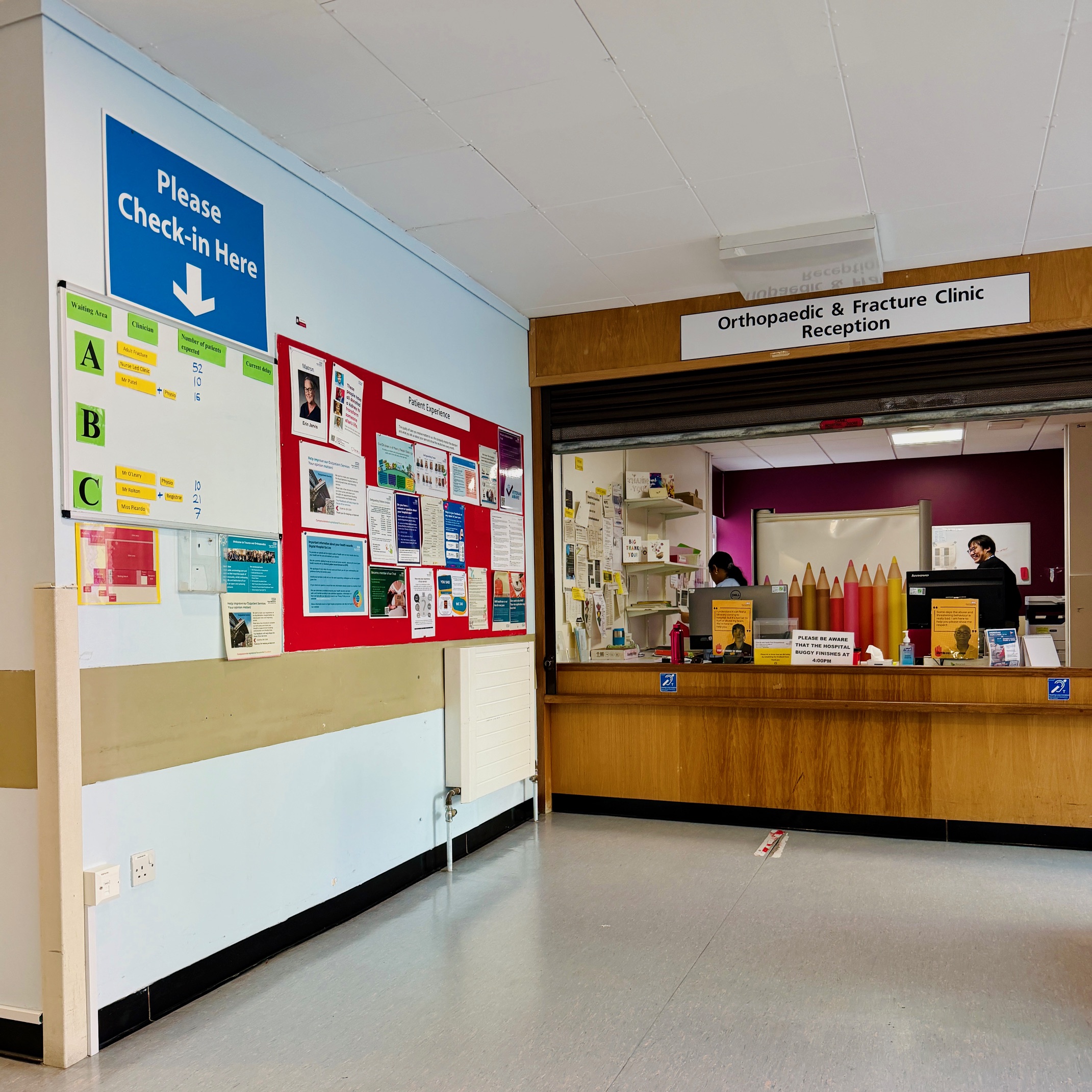
When I finally leave on the Saturday, gingerly shambling out into the daylight with Zoë to the car park where my father-in-law is waiting, my relationship with the RBH is far from over. There will be x-rays, they will fit a brace, they will do more x-rays, they will determine that the brace isn’t enough, and they will decide to operate. The fracture clinic is right next to Jamaica Blue: I grab a coffee to fortify myself before every appointment.

There will be a day when I sit there in the Day Surgery ward for seven hours, starving and anxious, while I watch everyone else go off for their surgery, come back and go home. There will be a conversation with the anaesthetists, where I only remember the beginning and then come round, groggy and in recovery, hours later. There will be that first phone call with Zoë afterwards, when I let her know that I’m still alive and enjoy the miracle of hearing her voice again. 

And there will be one more night in the hospital, back on Dorrell Ward. It might be a happy accident, or it might be deliberate, but they take me to the same ward and park my bed in the same bay. One of the nurses on duty was on duty when I first stayed in hospital. You again, she smiles. The next morning, the wife of the chap in the bed next to me comes over to talk to me and Zoë. “I’m so glad they put him in Dorrell” she tells us. “It’s the best ward in the hospital.”

I don’t know. Perhaps everybody says that. But it was hard not to feel like it was the best ward in the hospital, or that I was the best hospital in the country. Because they and their extraordinary staff took what would have been the most frightening, lonely and anxious week of my life and made it somehow a week of peace, care, healing and – let’s not forget – Marmite. 

So that’s my review of the Royal Berkshire Hospital. A place of peace, care, healing and Marmite. A place that is Reading’s biggest restaurant by accident, not design, and one that happens to be a restaurant many times better than it needs to be. It’s also the most paradoxical place I will ever review. Because obviously I sincerely hope I never eat there again, and I wouldn’t wish a meal there on my worst enemy. But if you do find yourself there, and many people do, every single year, I cannot say enough good things about it. The food’s not bad, either.

The Royal Berkshire Hospital
London Rd, Reading RG1 5AN
0118 3225111

https://www.royalberkshire.nhs.uk

You can support the Royal Berks charity here – I have made a donation, which is the least I can do after all those meals.

Since January 2025, Edible Reading is partly supported by subscribers – click here if you want to read more about that, or click below to subscribe. By doing so you enable me to carry on doing what I do, and you also get access to subscriber only content. Whether you’re a subscriber or not, thanks for reading.
Restaurant review: Oishi

As followers on social media may already know, this will be my last conventional restaurant review for a short while. Last month I broke my arm in a nasty accident, and after a short stay in the Royal Berks, a brace, plenty of x-rays and an operation at the end of November I have been recovering at home.

As I’m currently housebound, with only one working arm, restaurant reviews will have to wait, hopefully not too long. Thank you to everybody for the well wishes I’ve received since the incident: I’m very lucky to have such kind and supportive readers.

I will publish content on the blog in the meantime, my physical condition and the limitations of Apple dictation willing, so stay tuned for that. I will try to spare you a piece on “meals you can eat at home with one hand”, (although I get the impression that genre’s less niche than you might think). For now, I hope you enjoy this review, which is of the last restaurant I visited before the accident: I’m very glad that it was at least a gorgeous meal.

For my money, the saddest words you can find when you Google a restaurant are these: temporarily closed.

They should mean one thing, but they so frequently mean another. You should be able to take them at face value, deduce that the proprietors are taking a well-earned rest, or enjoying their summer holidays. But frequently they mean quite the opposite: the restaurant has closed for good, but it hasn’t been officially confirmed yet. Those two words are like light reaching you from a dead star, a misleading proof of life.

In Reading I’ve seen this happen many times. O Português was marked as temporarily closed for several months, a Facebook post by the restaurant saying something like “be back soon” before it eventually shut for good. The same went for Buon Appetito: people turned up for reservations, only to find the place locked and bolted, no sign up and nothing on social media. The only two-word commentary anywhere? Temporarily closed.

It’s frustrating that so many restaurants fail to announce their own departure. I appreciate that it must be desperately sad when a business fails, that people are out of jobs and in some cases, an independent restaurateur’s dreams have withered and died. Perhaps telling customers, or prospective customers, is the least of their worries. But it’s a shame for customers too, especially if you’ve grown fond of a place: their closure, done that way, denies you closure.

Going temp to perm on your Google listing is the equivalent of leaving a job under a cloud. Far better to close the way the Grumpy Goat did, with one last Saturday to drink the place dry, or as Dough Bros did with its recent announcement, telling punters they had until just before Christmas to get their pizza fix.

It’s especially agonising when it’s somewhere you love. My stepmother’s favourite place to eat is a pub called the Bailiwick, on the edge of Windsor Great Park. It was stricken with the curse of temporary closure last month, with nothing on social media. Worse still, they were listed as permanently closed on OpenTable. When they subsequently posted that they would reopen, with more limited hours, having been “given a second chance” my stepmother was elated. Temporary closure, after all, is so rarely that.

It does happen sometimes in Reading, to be fair. Biryani Mama on St Mary’s Butts looked very shut, claimed they were closed for renovations (an excuse I’ve heard before from restaurants that never reopen) but, true to their word, they’re now trading again. But I have never, in all my days reviewing restaurants, seen a restaurant come back from the dead the way Oishi did.

Subscribe to continue reading

Become a paid subscriber to get access to the rest of this post and other exclusive content.