Pub review: The Port Mahon, Oxford

The conventional wisdom is that food trends start out in London and, like the light from a dying star, by the time they reach Reading they are just memories of something that is no longer there. Something about the eternity it takes them to hobble down the M4 strips them of any interest or novelty value, and it’s the same for restaurant chains: with a few encouraging historical exceptions, like Honest or Pho, by the time anyone opens a branch in the RG1 postcode the Fonz, waterskis strapped on, has well and truly cleared the shark.

The truth is, if anything, more nuanced and even more cheerless than that. First of all, most food trends never become a thing anyway. Every January the broadsheet food Stattos, a wan bunch of gastronomic psephologists, proclaim what the big trends of the next 12 months will be, and the majority of them never come to pass. Just as life is what happens when you’re making other plans, food trends tend to ambush everybody: nobody sees most of them coming.

Secondly, most of them never make it to Reading. You could wait a lifetime for a small plates restaurant, a tapas spot, a natural wine bar, a chop house or anything else for that matter. I don’t know what it is about our mixture of attractive affordable buildings with plenty of outside space that catch the sun, our kindly and philanthropic landlords and our imaginative and not remotely complacent local authority, but for some reason entrepreneurs look at all that and say Nah, you’re all right. What spoilsports they are.

Instead we get a Cosy Club, and a Rosa’s Thai, and a Popeyes, and a Taco Bell, and a regular attack of the glums whenever we set foot inside the IDR. Lucky, lucky us. So it goes: head to Oxford, Swindon or Newbury for tapas, small plates or natural wine, because you’re not getting that stuff in Reading.

As a result we get our own micro trends which often seem to have nothing to do with what’s going on anywhere else, like the year we got a glut of sushi restaurants, or biryani places, or pizza spots. And the funny thing is, the result of everyone trying to jump on those bandwagons is that nothing is sustainable. Biryani Mama closed recently on St Mary’s Butts, and Biryani Boyzzz has been fined shitloads of cash for poor hygiene: perhaps all those Zs are reflective of the fact that they fell asleep at the wheel.

And remember our influx of great pizza restaurants last year? By all accounts Paesinos has sacked its chef, Amò is still closed due to challenges with the building for nearly five months and counting (read into that what you will) and since Dough Bros has changed hands it’s removed all pork and ‘nduja from its menu, leaving you instead with turkey ham and “spicy beef chunks”. Fair play to them, I suppose, but that’s not Dough Bros any more. All that’s left is Zi Tore, which is the gastronomic equivalent of Ringo being the last surviving Beatle.

This year’s Reading trends are, to me at least, profoundly depressing because they reflect a poverty of culinary imagination, of degradation disguised as progress. You might get excited about vans serving jacket potatoes, and Reading now has a couple, but I remember when the Broad Street Mall having a Spud-U-Like made it a figure of fun, not a lifestyle destination. Are we really meant to see this as an improvement? Did people ever really think “fuck an affordable bistro, what this town really needs is a jacket spud loaded with tuna and cheese?” I hope not.

The other Reading food trend this year has been the munch box, a phenomenon with its own Wikipedia page, highlighting its origins in Scotland (“the selection of foods included in some boxes has been criticised for being nutritionally poor” Wikipedia says, with a talent for understatement). So naturally, for the times when a baked potato is too cheap and cheerful and you want to splash out, why not go crazy and buy a munch box? Treat yourself.

“I’ve found the best munch box in Reading” said some goon on Instagram recently, coming to you live from a car park. That’s great: I’m sure the whole town will sleep easier now. It’s all very low rent, but that’s 2026 for you. Nobody can afford rent.

A trend which emerged last year in London was one I would dearly love to see in Reading: rotisserie chicken. The Observer called it about this time last year and, late to the party as ever, the Telegraph chimed in to that effect in January. Both mentioned London venues like Borough Market’s Café François and Shoreditch’s Knave Of Clubs along with Bébé Bob, which so underwhelmed me a couple of years ago. “The rise of luxe rotisserie chicken”, enthused the Observer. “How France’s most famous market food became a cult British hit” was the Telegraph‘s summary.

It’s true, though. Rotisserie chicken is huge on the continent, and nowhere to be seen in Blighty and I personally consider that a terrible pity. When I remember Montpellier, where the twice weekly food market under the aqueduct boasts multiple traders, all selling delectable looking chicken, I think it’s a great shame that it’s never caught on here. And that’s just markets, but the restaurants! When I recall the glories of eating at Montpellier’s Les Freres Poulard or Lisbon’s Bonjardim I wonder what’s taken this movement so long to even consider crossing the water.

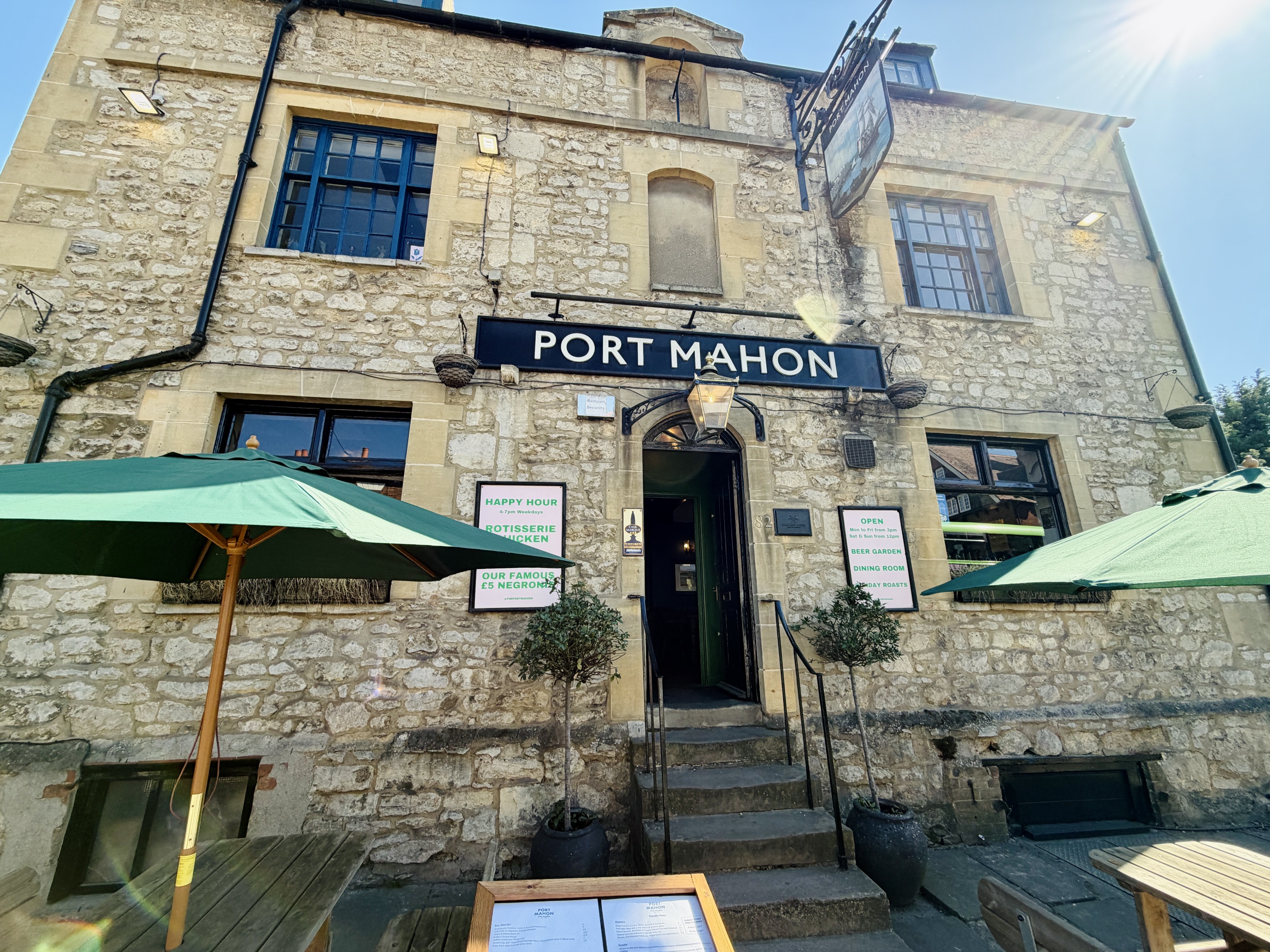
So imagine my surprise earlier in the month when I discovered that this particular trend – with lightning speed, in the scheme of things – had bypassed Reading completely and taken root in Oxford. I’d just had lunch at Cuttlefish with my dear friend Jerry and, on the way to our pub for the afternoon, we walked past another pub, the Port Mahon. I’m incapable of doing that kind of thing without rubbernecking for a menu and there, on a sign out the front, it boasted ROTISSERIE CHICKEN and, come to think of it, OUR FAMOUS £5 NEGRONIS. They had me at the chicken, the negronis were just a bonus: I made a mental note to investigate further.

Back home I did some research and the pub looked promising. Although it’s been around since 1710, it seems that a couple of years ago it came under new ownership and, by the looks of it, decided to focus on food, taking on chef Paolo Cangiano. A new dining room followed last year, as did positive reviews on both of the main Oxford food websites. Although the majority of those visits were comped: Bitten Oxford extracted 3 free meals from the Port Mahon in the space of 7 months but, of course, all views remain their own.

Nonetheless I saw enough to nudge it to the top of my list so last week, on the most glorious Saturday the U.K. has seen so far this year, Zoë and I hopped on a train to investigate, stopping only to collect a lot of cheese in the Covered Market, sample one of Hamblin Bakery’s excellent sausage rolls and grab a pre-lunch coffee in Peloton Espresso’s wonderful back garden. Spring had well and truly arrived, and I’d had my first sunshine pints in the Last Crumb the weekend before, after a brilliant and buzzing readers lunch. So this is what al fresco life in Britain can be like, I remembered thinking.

The pub is actually very handsome. I think it’s a Greene King (although that isn’t necessarily an obstacle to doing amazing food) and the labyrinth of rooms inside, all on slightly different levels, is cosy and attractive, all bentwood chairs, pews and red curtains. On my wander through I managed to somehow miss the dedicated dining room completely, but from the pictures I’ve seen it’s also a lovely, grown-up space.

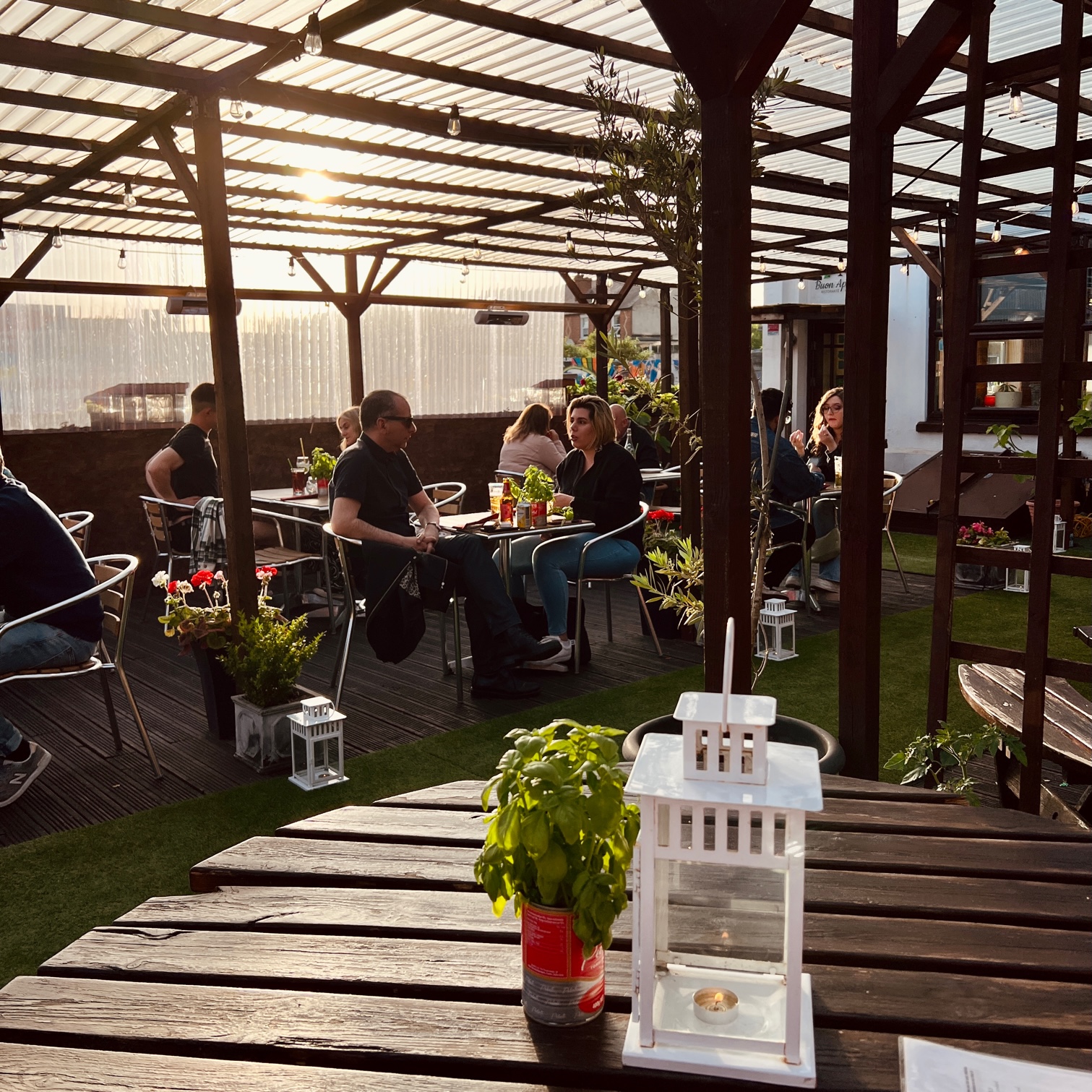
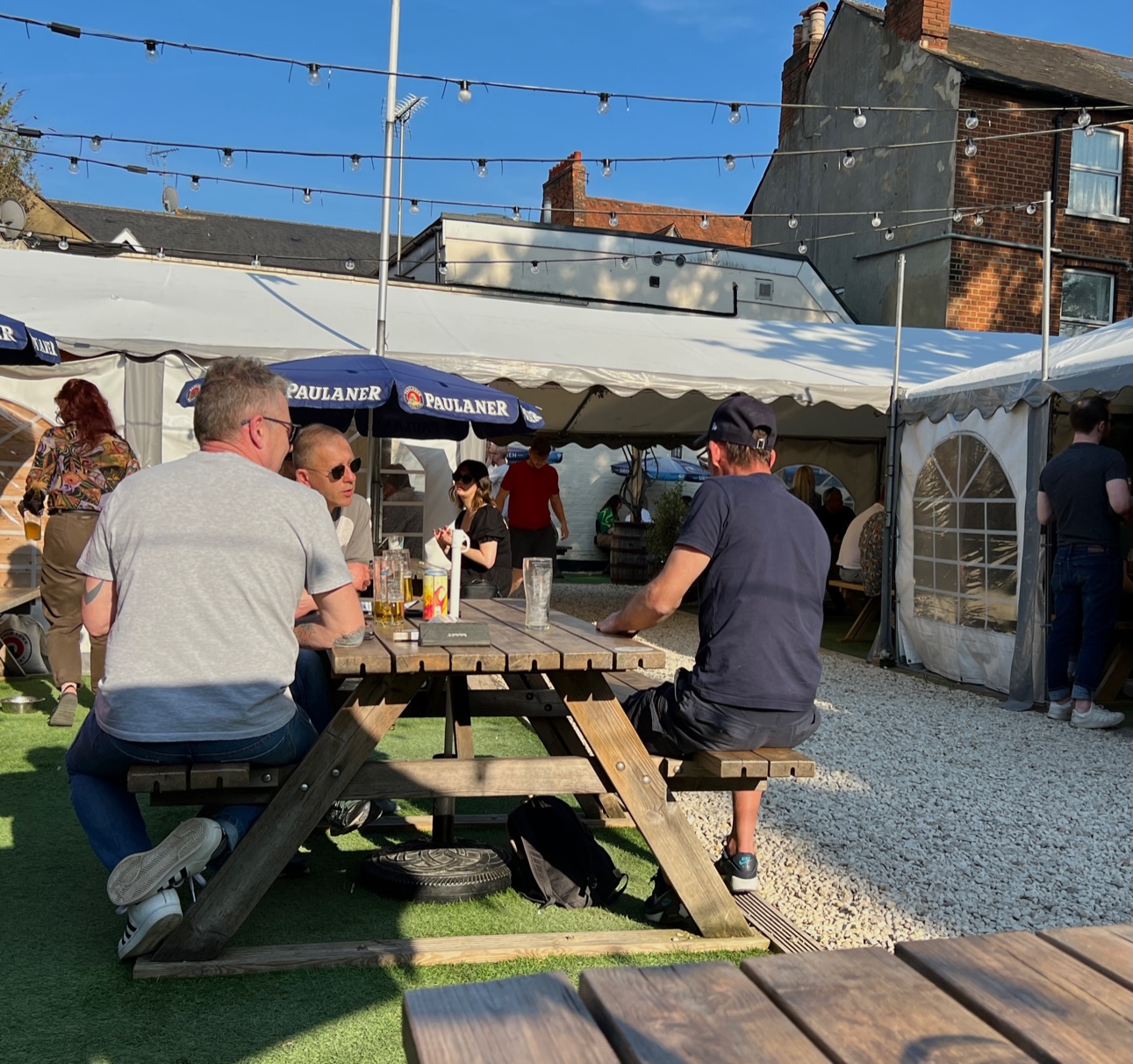
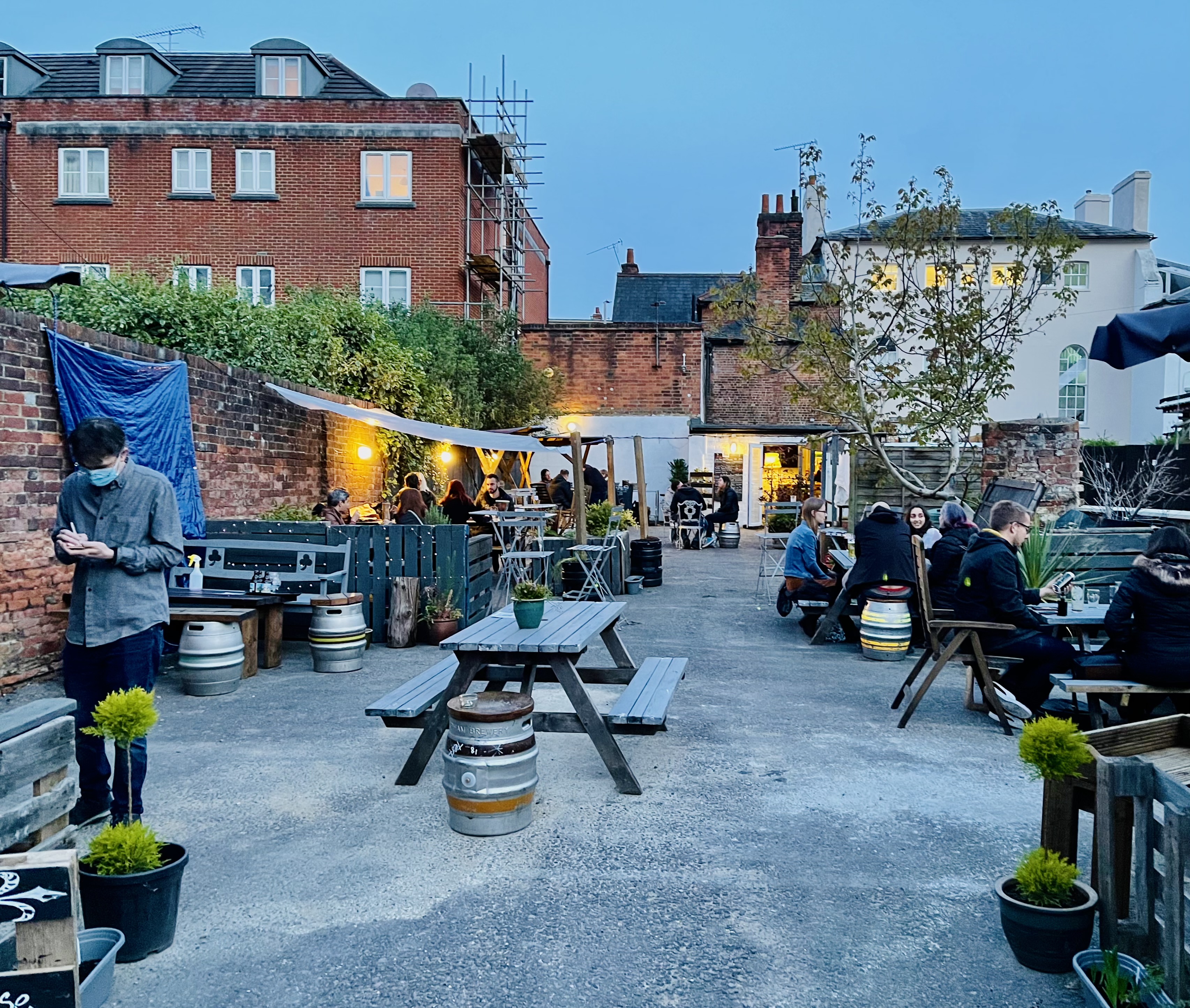
That makes the Port Mahon somewhere you could go for food or just for drinks, and from the interior I could easily imagine doing either. But we were greeted by Cangiano himself and asked where we fancied sitting, and the outside space called to us. Again, it’s surprisingly large and much of it catches the sun, and it was a thoroughly agreeable spot with bunting, covered areas and a real feeling of lightness and buzz.
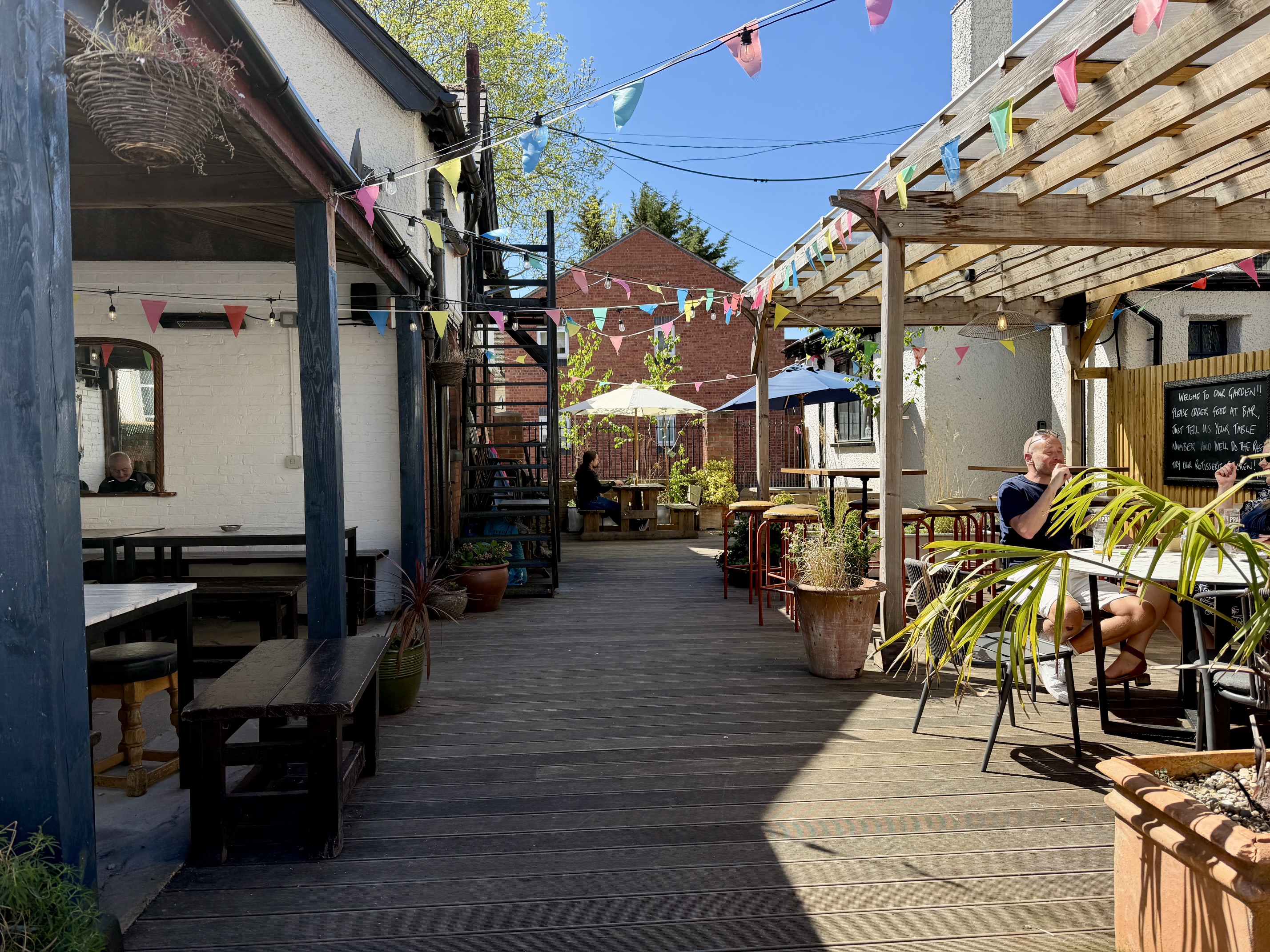
It reminded me – in Oxford terms – of the sadly departed Jam Factory, which used to be one of my favourite spots to stop for a pint before catching a train home: I still miss that place. It also reminded me, to talk about Reading for a moment, that nowhere in Reading boasts outside seating this pleasing where you can also get really good food. The Nag’s has a great beer garden but limited food, Park House is pleasant enough for both but not stellar. That the Rising Sun is as good as it gets rather sums up the state of affairs: I haven’t updated my guide to al fresco dining in Reading since 2022, but perhaps I’ll just put up a page saying Don’t bother.

It was too hot a day for those £5 negronis, and a pint of something cold and refreshing was required. I was pleasantly surprised by the Port Mahon’s selection, so although it had macro lagers and ciders in spades there were just enough pales to make it interesting: the sessionable A Little Faith by Northern Monk and Pale Fire by Pressure Drop. The latter was our choice and it was absolutely what the moment demanded. The sun beat down, and our first sip – this was rather a late kick-off given a happy time at StageCraft the night before – made everything right, all grievances forgotten.

The Port Mahon has, I would say, pulled together a very pleasing menu. A good array of snacks, all of which lend themselves to sharing, five starters and eight mains sent out all the right signals about not trying to do too much, and if I hadn’t gone with rotisserie chicken on my mind I could have tried countless other dishes. Next time, perhaps I’ll try the meatball pappardelle or the butterflied seabream with orange and fennel salad. But it also gave me confidence that next time the menu might well be different: after all, this set of dishes was very different to the one I’d seen online.

You could potentially argue that the pricing was slightly wayward, with some of the snacks coming in more expensive than the starters, but I thought that was to suggest they were bigger portions to share. Again, a pub where you could drink great IPAs in the sunshine and keep yourself topped up on beer snacks sounded like something I would love in Reading. And nothing was expensive, really: starters maxed out at £8.50, only a couple of mains were north of £20.

One dish that seemed to have been on the Port Mahon’s menu since they reopened and Cangione came on board was the pub’s pork belly bites in soy, honey and sesame and, rotisserie chicken aside, they were the first name on the team sheet. They were a winner, a tumble of nicely caramelised cubes, fat rendered enough and the glaze sticky, sweet and potent with a slight building heat. I would have put these in the beer snacks section, personally, but what do I know about menu taxonomy?
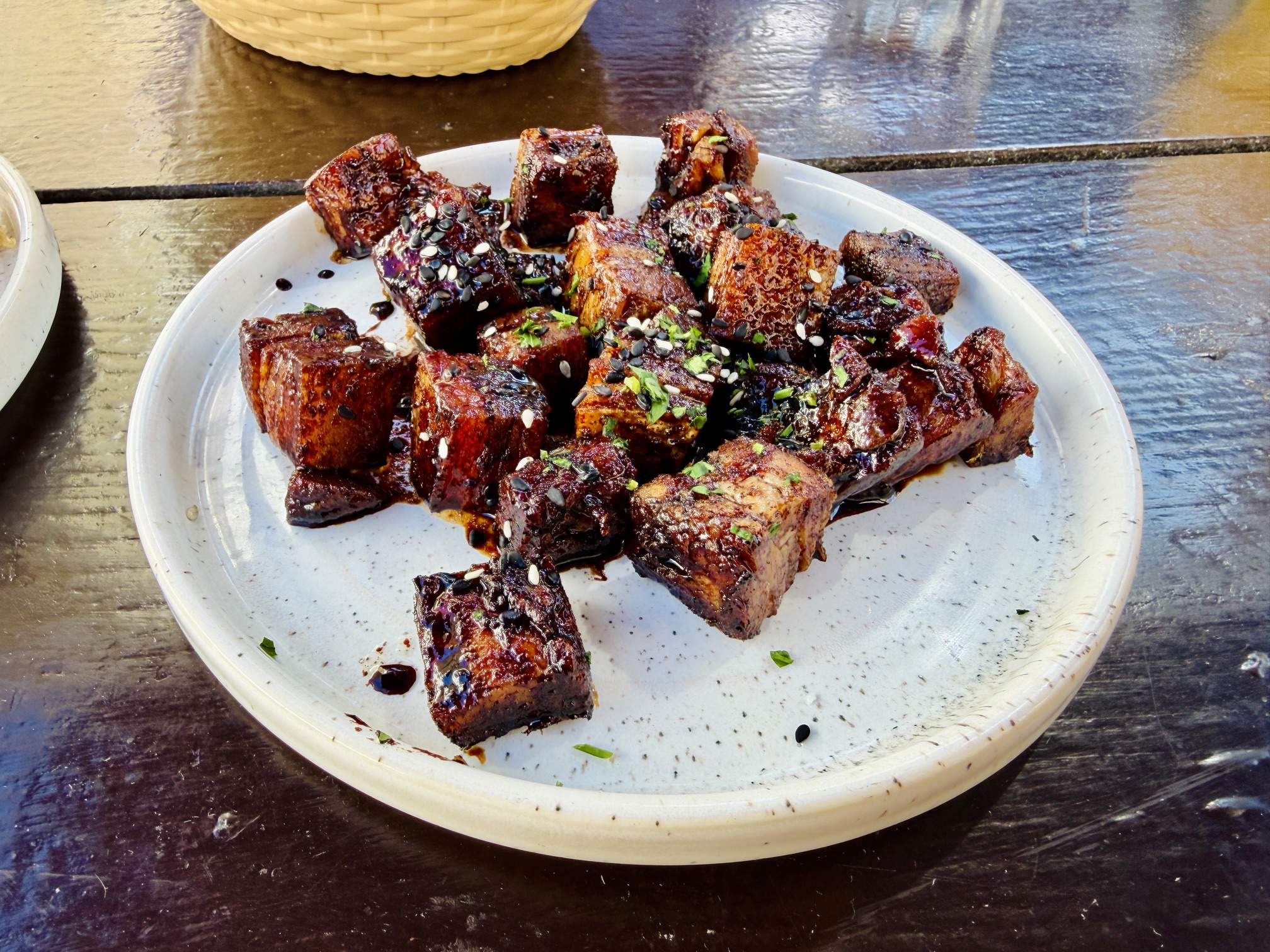
Either way these were a real pleasure and the kind of dish any menu could find room for somewhere: about as different from their siblings last week at the Jolly Cricketers as I am from my sibling but, just like me and my own sibling, equally lovable. Also they were £8.50, so better value than either of us.

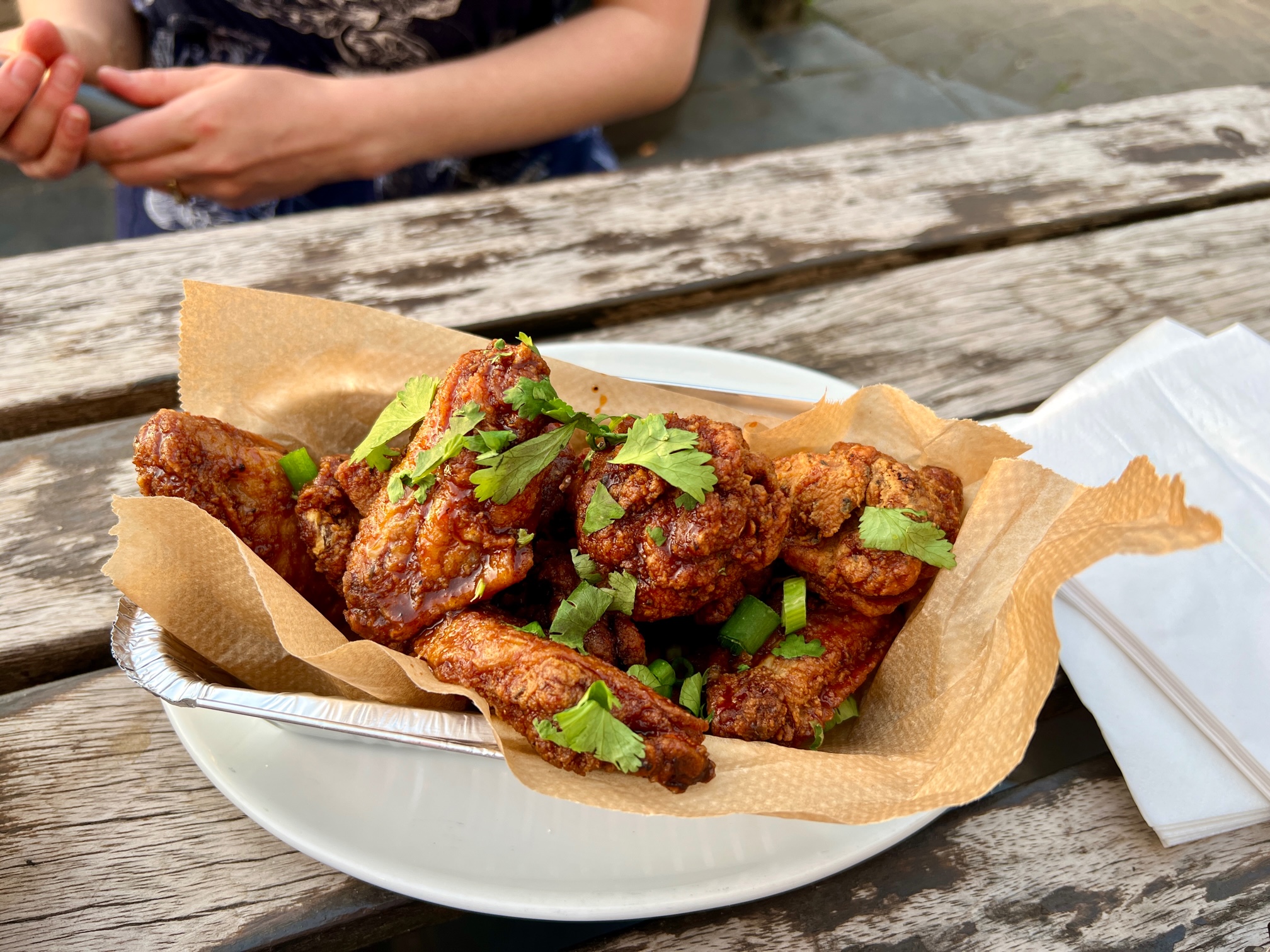
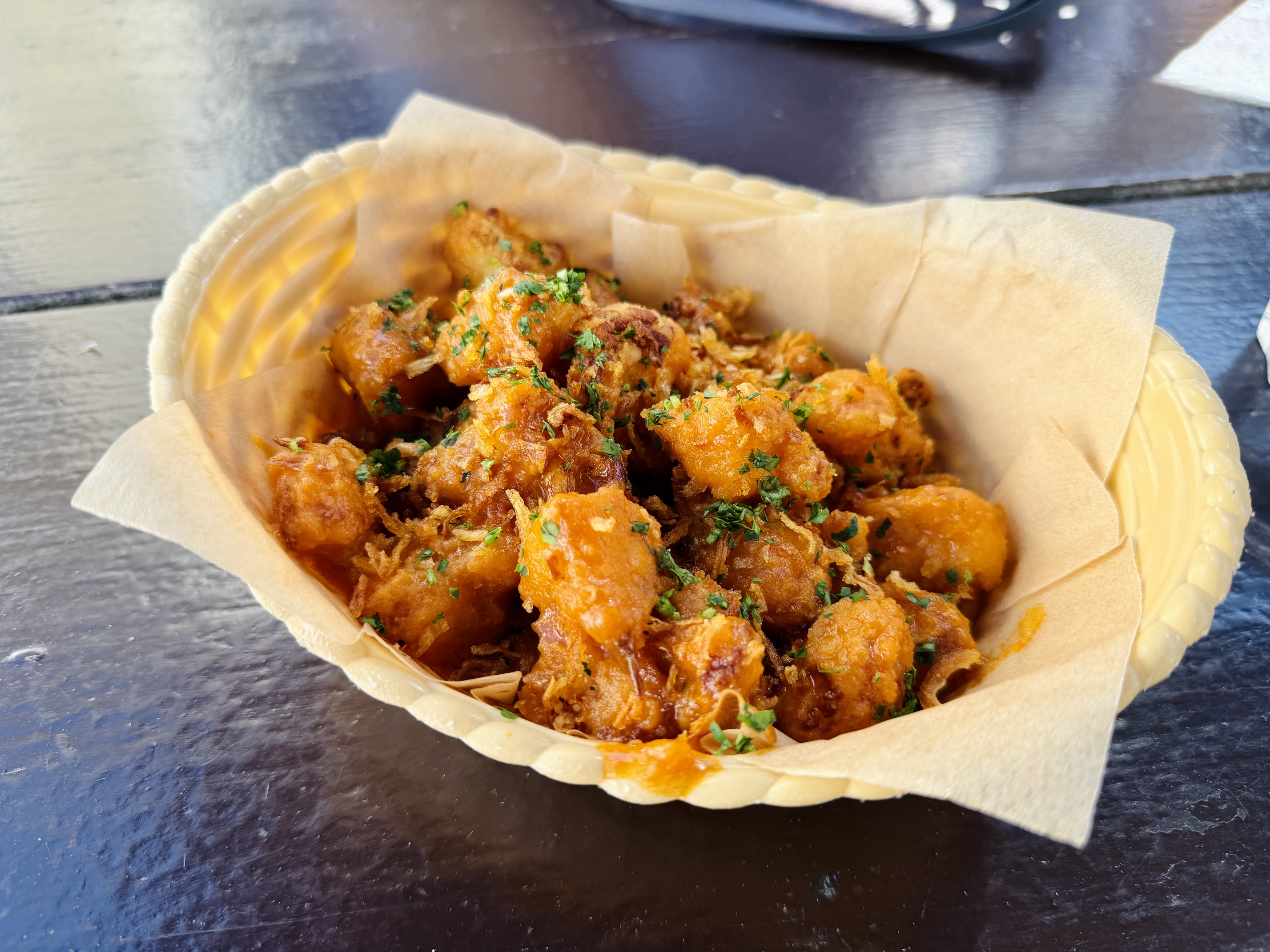
We also went for the buffalo cauliflower wings, from the snack section of the menu. These were a bit pricier at £12.50 but, as I’d suspected, very much sized to share. They were very close to spot on, but with something like this it’s human nature to focus on how they fall short. So I really loved the pub’s buffalo sauce, which had exactly the kind of acrid, vinegary heat I’m looking for. The little bits of what I thought were fried onion on top were a nice touch, along with a little verdant flash of herbs. And the cauliflower was nicely done, not too soft, not too unyielding.

If I’d known in advance that it would be a sort of mulch of cooked cauliflower in a superlative buffalo sauce I might have still ordered it and, as I did, I would have enjoyed it. But I’d like the coating to have crunch and to adhere, and for the whole thing to be tossed in the sauce at the end and brought to me tout suite before everything started to go awry and soggy. That didn’t happen here, I don’t think, and it was the only thing marring what would otherwise have been another perfect beer snack.
The chicken wings, at the same price, might have pulled this off better but I really couldn’t be doing with all the faff. I would have these again in the hope that the pub pulls them off, and if it didn’t I would be a little disappointed but, as I did this time, I would still eat every last morsel.

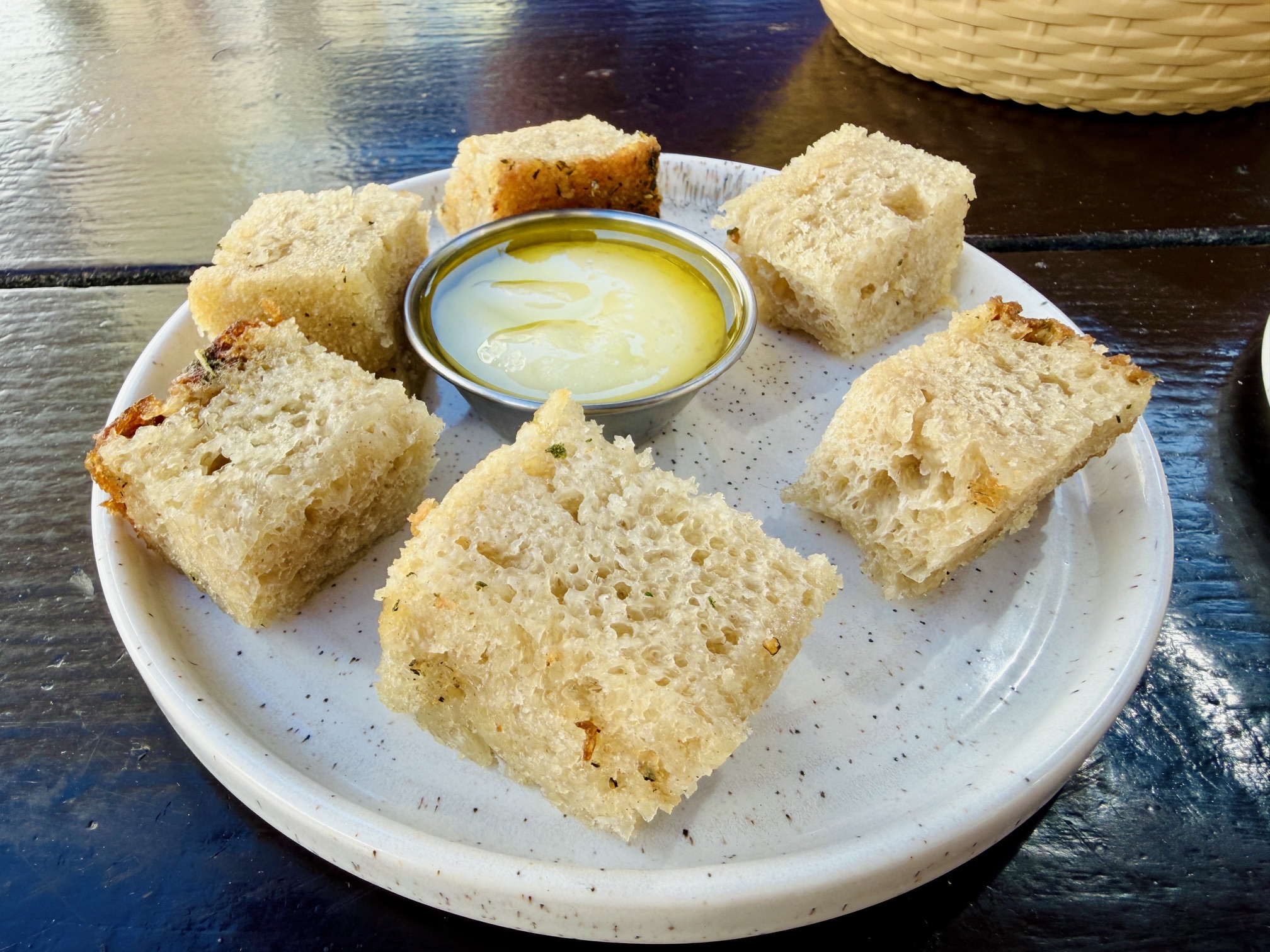
The biggest disappointment, for me, was the focaccia. It was, to be fair, only £4 but it was dense and doughy, no air, no crust and no crackle, just some spongey, cakelike cuboids that were a little bit too much like hard work. I’m not sure what the dip in the middle was: it looked like mayo but had a sizeable whack of vinegar. But the focaccia had a job to do anyway ensuring that not an iota of the buffalo sauce, or the soy and honey glaze, went to waste. No harm done, ultimately.
Service from everybody in the pub, from the chef to the cheery chap behind the bar to the servers who brought our food out, was bright and infectious, and the Port Mahon gave the impression of being a happy little brigade. We were asked whether we wanted our main course straight away or wanted to wait a while and – rather uncharacteristically, I guess – we told them to bring it on. That’s rotisserie chicken for you: it realigns the priorities.

Sometimes, when I eat on duty without Zoë, we play this little game where I send her pictures of my food and ask her to guess whether it was good or not. Let’s play it now: what do you reckon to this?
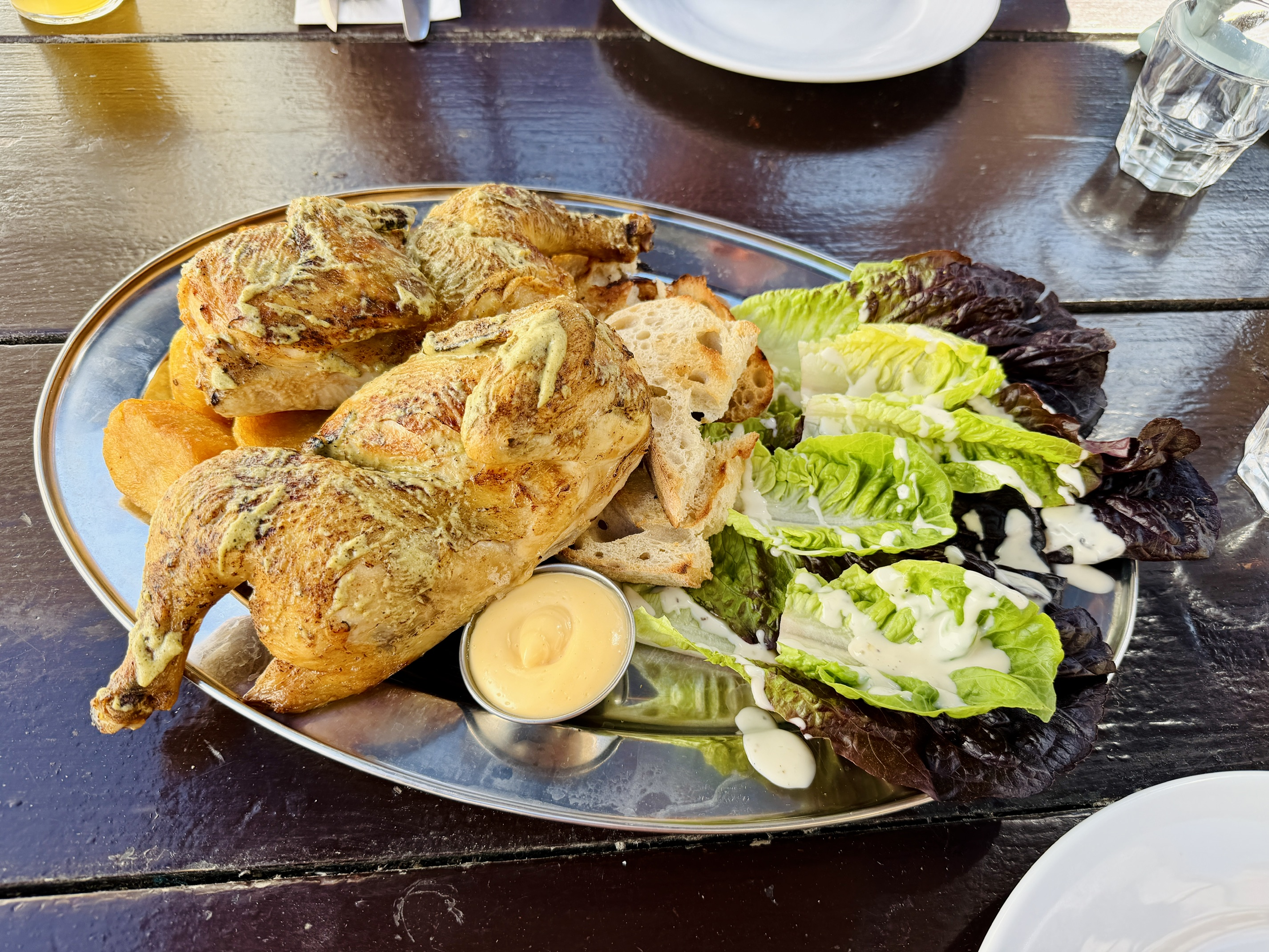
First things first: this is a really generous plate of chicken and gubbins for two people, for just over £32. I think the Port Mahon has taken a tip or two from the Chester Arms’ legendary steak platter without, like Headington’s Six Bells, ripping it off lock, stock and barrel. So you get everything you could possibly want on that steel plate, no need for sides or add-ons.

And everything that goes with it is corking: the big, handsome lettuce leaves pooled with Caesar dressing, the substantial croutons with just enough give, the little sunshine-yellow ramekin of what they call ‘Mahon mayo’ (surely Mahonnaise?), they’re all marvellous. You could almost make yourself a Caesar salad with this, although the menu already boasts one which also includes eggs, bacon and anchovies and a healthy dose of I-almost-wish-I’d-ordered-that.

But the Caesar salad would omit the chicken fat potatoes, and they really are very nice indeed. The texture of them was ideal, the crunch to fluff ratio almost impossible to fault. I’d have liked that chicken fat to make its presence more felt, I’d have liked them saltier, but I’d like many things I won’t get and that, in some way I don’t fully grasp, will eventually make me a better person. Possibly.

That’s all well and good, you’re asking, but what about the chicken? And well you might. Well, like a lot of it, it was a lot of the way there. The leg meat was a tiny bit tough, almost gamey, and there wasn’t perhaps as much of it as I’d hoped. But the succulence of the breast made up for that, and the flavour that had permeated it did too: I don’t know whether the Port Mahon brines it, but I got lemon and I enjoyed the green sauce that had been sparingly drizzled over it. All that was truly serviceable, and then some.

But the other thing it really missed, the thing that makes rotisserie chicken so miraculous, was crispy skin. If you get that right, a lot of the other stuff either falls into place or, more likely, just doesn’t seem so important. It was the single biggest thing that the Port Mahon needs to work on, whether that’s by rubbing with salt and lubricating with butter or any other form of chicken-centric witchcraft, but a rotisserie chicken with slightly elastic skin is one that hasn’t lived up to its potential. Trust me on this: as someone with a lifelong track record of not living up to mine, in the words of Jason Lee in Mallrats, we can smell our own.

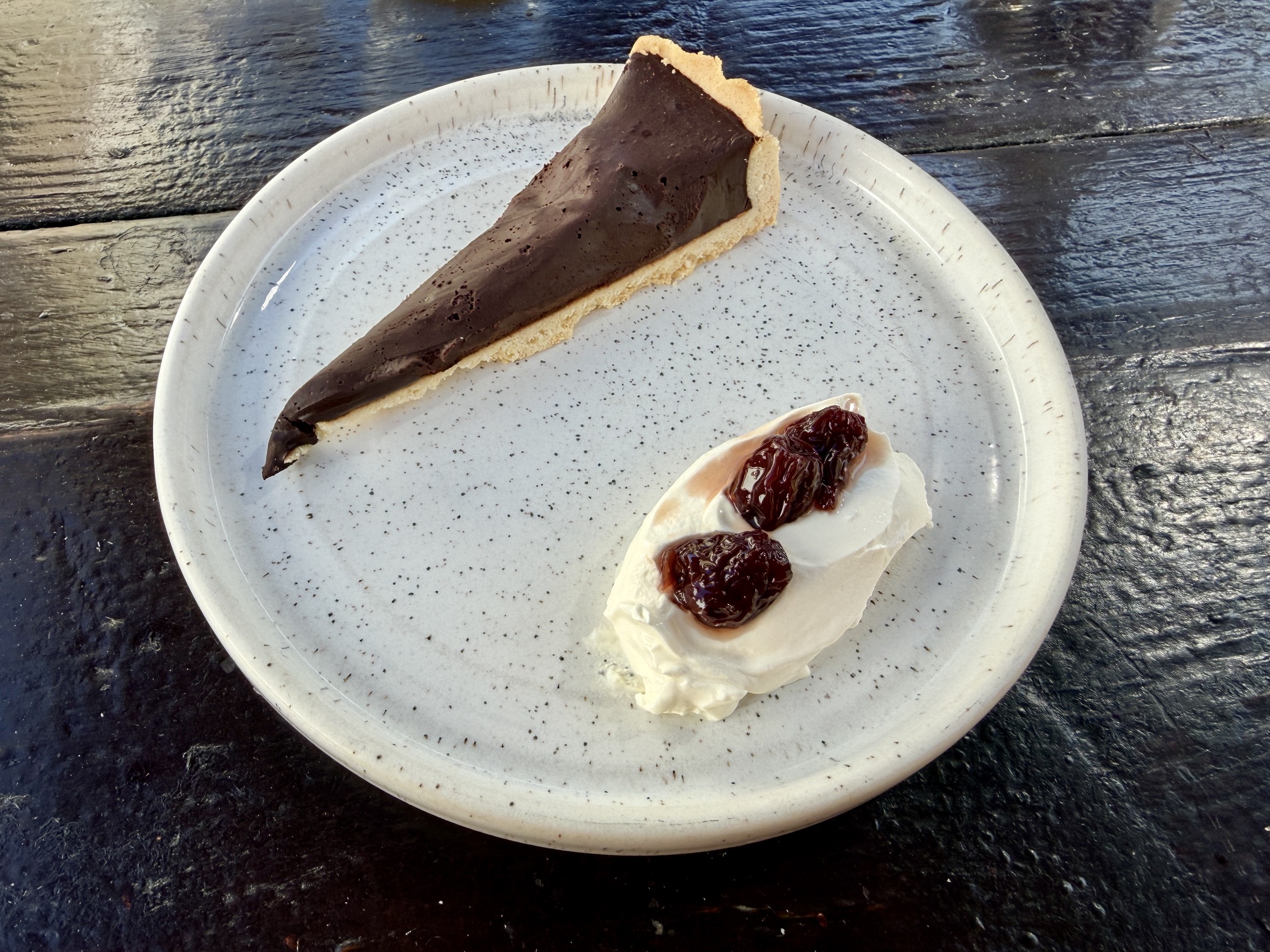
The dessert menu just has three items on it, and despite the retro appeal of a raspberry ripple Arctic Roll, the chocolate tart got both our votes. What a strange dessert it turned out to be! I mean, it was delicious: the ganache rich and pleasingly irregular, the pastry dense if perhaps slightly underbaked. I really loved the boozy cherries, both of them, and the little heap of crème fraîche they perched on: crème fraîche would always be my accompaniment for a dessert this rich.

But the size of it was just so strange, such a thin sliver. I know it was only £6.50, and perhaps that’s how the Port Mahon keeps it at that price, but it felt jarring. Somebody had a protractor in that kitchen, and they liked it slightly more than they liked customers: considering the manifest generosity on display everywhere else on the menu, this felt like a blip.
I might have stayed longer and ordered more drinks but Oxford’s best beer garden, in the shape of the Star on Rectory Road, was beckoning and I was conscious that Zoë had never been there before. So we settled our bill – £95, including service charge – and were on our merry way.

The rest of the day was another reminder of everything that makes Oxford a great city – pints of Steady Rolling Man at the Star, a sneaky Swoon gelato on the way to the station and a beer at Tap Social in the Covered Market when we realised we had time before taking the train we wanted. I am very lucky that my Oxford reviews always do quite well in terms of readership, but then it’s never a chore to write about somewhere with such abundant charm.

Reading’s part-time visiting academic and full time transphobe Julie Bindel recently wrote a laughable article in the Spectator – of course it was the Spectator – about how she couldn’t stand gastropubs. It was so full of bad, inaccurate observations that at first I mistook it for a Michael McIntyre routine, but Bindel’s central assertion, under the sophisticated and nuanced headline I hate gastropubs, was that pubs should stick to cheese sandwiches and Scotch eggs, and of course she had a swipe at sourdough and triple-cooked chips, because apparently it’s still 2010.

Just to generalise further about a world Bindel doesn’t actually live in, these pubs are apparently all staffed by “blokes with sleeve tattoos and beard oil”: it’s a wonder she didn’t throw in the word ‘new-fangled’ while she was at it. To be fair, her article also included the quote “As a rule, I am not a fan of pubs” which rather makes you wonder why the Spectator paid her to write an article that is essentially a big steaming heap of Bean Soup Theory.

Still, it’s nice to know that Bindel can be wrong on multiple topics: I guess the Brexiteer ghouls who read the Speccie lap all that up. The point is, call them pubs or call them gastropubs – who really cares? – but either way they are, in all their forms, a big part of how people eat in this country in 2026. And when they’re done well, they are terrific places to eat and drink, or just drink, or pick at snacks with a really good pint. Getting hung up on what you call them completely misses the point that they’re an essential element of food culture here.

Whether they are the centre of village life, like the Jolly Cricketers, or bravely trying to do something else with a centuries-old boozer like the Port Mahon, they matter. And even if the Port Mahon doesn’t get everything right, it does enough to deserve plenty of support while it works on the rest. I liked it a lot, I’m rooting for it and I’m sad that Reading, for all its pubs, doesn’t have anyone even trying to offer something like this.

That’s another food trend that hasn’t really bothered with our town. I’d love an excellent independent food pub, I would really love somewhere doing rotisserie chicken like the very best of the stuff on the continent. Both of them in a single venue? Don’t be ridiculous: it will never happen.

The Port Mahon – 7.7
82 St Clements St, Oxford, OX4 1AW

https://www.theportmahon.com

Since January 2025, Edible Reading is partly supported by subscribers – click here if you want to read more about that, or click below to subscribe. By doing so you enable me to carry on doing what I do, and you also get access to subscriber only content. Whether you’re a subscriber or not, thanks for reading.
Restaurant review: Sarv’s Slice at The Biscuit Factory

Sarv’s Slice left its Reading premises in May 2025.

Now the thermometer has finally crept over twenty degrees a couple of times, now that the first al fresco pint of the year is in the recent past, now that we’ve had Cheesefeast and Eurovision my mind, like everybody’s in Reading, turns to summer. Back when we had a beer festival every May bank holiday weekend there was a clear demarcation point that said summer was on the way: the failure to hold one for the last few years has left us fending for ourselves.

But never mind – summer is on the way. And that’s got me thinking, lately, about how every summer has its own distinct identity, its own little chapter in the autobiographies we all carry around in our heads. 2016 was a bad year, all angst and anguish. 2018 was about the rush of new things and new happiness. 2020, with the long walks and the first tentative drinks outside, was the pastoral symphony (am I the only person nostalgic for 2020? I bet I’m not).

Not only that but, if you think about food anywhere near as much as I do, summers can also be defined by restaurants. During any phase of your life, the two wind up inextricably linked. For me, the summers of 2005 and 2006 were all about Santa Fe, on the riverside. At the end of the working week my then wife and I would grab a table in the window with our friends, looking out on what felt like the whole of Reading celebrating the weekend.

We would drink cocktails, so many and so frequently that they ended up giving us a silver 2 for 1 card. My drink of choice, horribly basic, was the Mudslide, with, I think, chocolate ice cream in it. It tasted devoid of booze. Eventually we would drift inside, grab a table and eat dinner. That was those two summers in a nutshell. I had only just turned 30, I was carefree, content in my job and when I think about those summers, I always think of Santa Fe.

Similarly, when I remember the summer of 2014, or 2015, it’s indelibly connected to Dolce Vita. By then those friends had become parents, or drifted away, but for me that child-free ritual of marking the end of the working week was still similar: make a beeline to Dolce Vita, order a bottle of wine and see what was on the specials menu. Order it if it looked good, have the saltimbocca or the monkfish if I didn’t fancy it. Whole months passed like this, punctuated by excellent, happy meals.

Fast forward the best part of a decade and last summer, for me, was the summer of Buon Appetito. I would meet Zoë in town after work and, unless either of us had a better idea, we would amble down the Oxford Road, comparing notes about our day. And we would end up sitting outside at Buon Appetito’s welcoming patio, a Negroni for her and an Aperol Spritz for me, and we’d luxuriate in that feeling of work being over, for the time being at least. I say “unless either of us had a better idea”, but of course the best idea of all was to have dinner at Buon Appetito. That’s the siren song a restaurant has when it becomes synonymous with your summer.

I write all that with some sadness, because something funny is going on at Buon Appetito. Their social media lies dormant, the doors shuttered, no signs of life. I’ve heard stories of people turning up, with or without bookings, to find the restaurant abandoned and unlit with no sign or announcement. And I’ve heard various rumours: some say the closure’s a temporary blip, others strongly suggest we won’t see them again. My own Instagram message to them, sent four weeks ago, remains unread.

I guess that’s what led me to the Biscuit Factory on a weekday afternoon last week, to see if Sarv’s Slice offered a viable alternative for al fresco pizza in the sunshine. Sarv’s Slice has an interesting history: Reading first encountered them at Market Place as part of Blue Collar’s weekly events, and when Blue Collar Corner opened last year Sarv’s Slice was one of its four permanent traders on a year’s contract. I think I ate their food once, with my friend Graeme, and was very taken with their carbonara special (maybe it’s heresy to do this on a pizza, but I liked it too much to care).

When their stint at Blue Collar Corner ended they didn’t rest on their laurels, and in March they announced their new home at the Biscuit Factory, where they’re in residence Wednesday to Sunday. On paper it’s a perfect match. The Biscuit Factory has wonderful coffee downstairs by Compound – and, top tip, it’s pretty much the only place in Reading to get decent coffee after 6pm – but the food offering has been a bit patchy. Something casual, the next step up from street food, would seem like the perfect option for eating before one of the Biscuit Factory’s events. And they even have some outside space: the omens were promising.

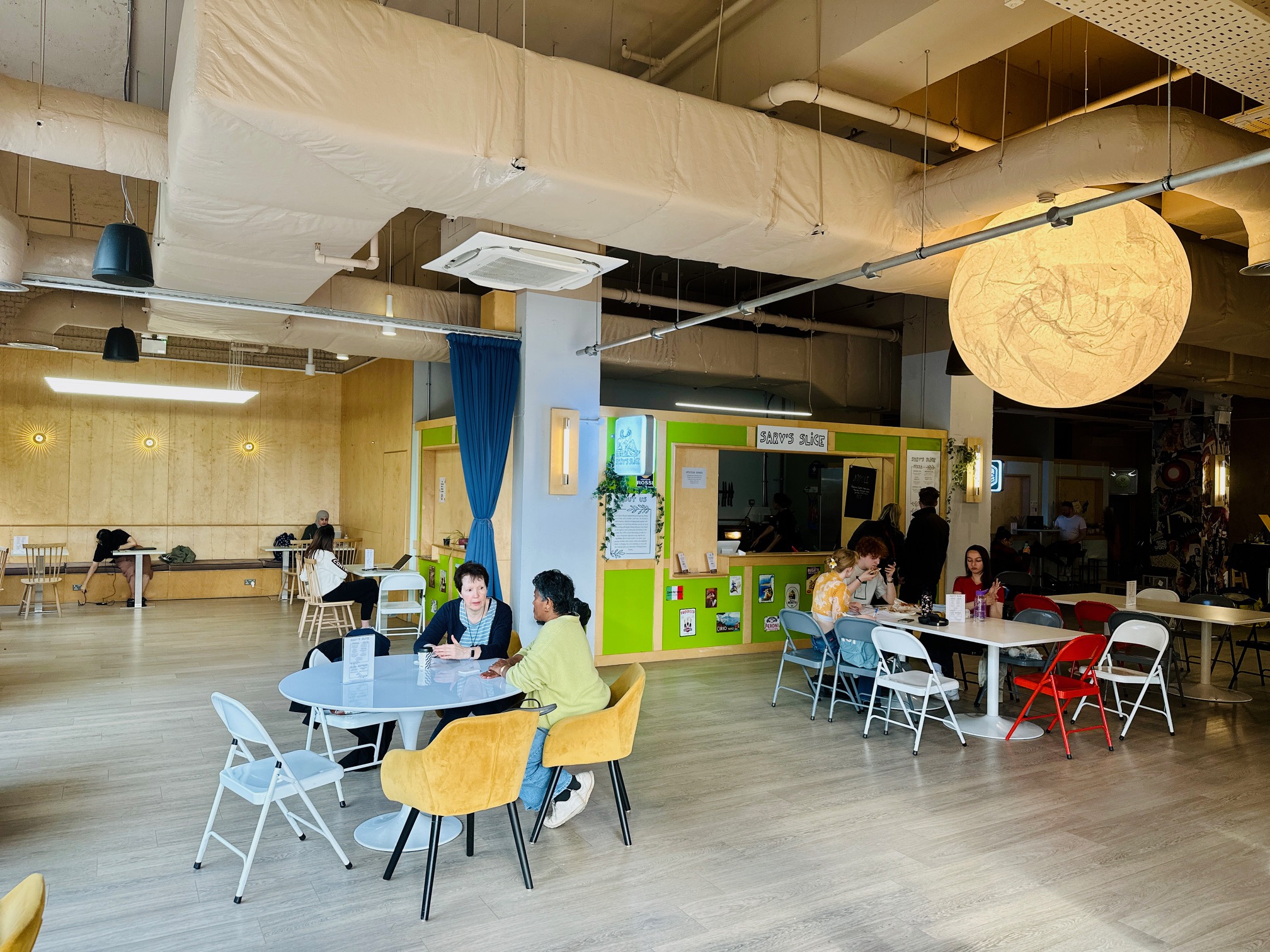
I’ve never actually been to the Biscuit Factory for any of their events – judge away, I know I should have – but I know the upstairs space from the occasional West Reading coffee. It’s a plain, anonymous space, and pretty big, but not unwelcoming for that. There was stand up comedy on the night I went, a table of people who seemed to be doing an art class, and plenty of others still on the banquette that runs along two sides of the back room, tapping away on laptops or, in one case, playing what looked like a fiercely competitive game of Uno.

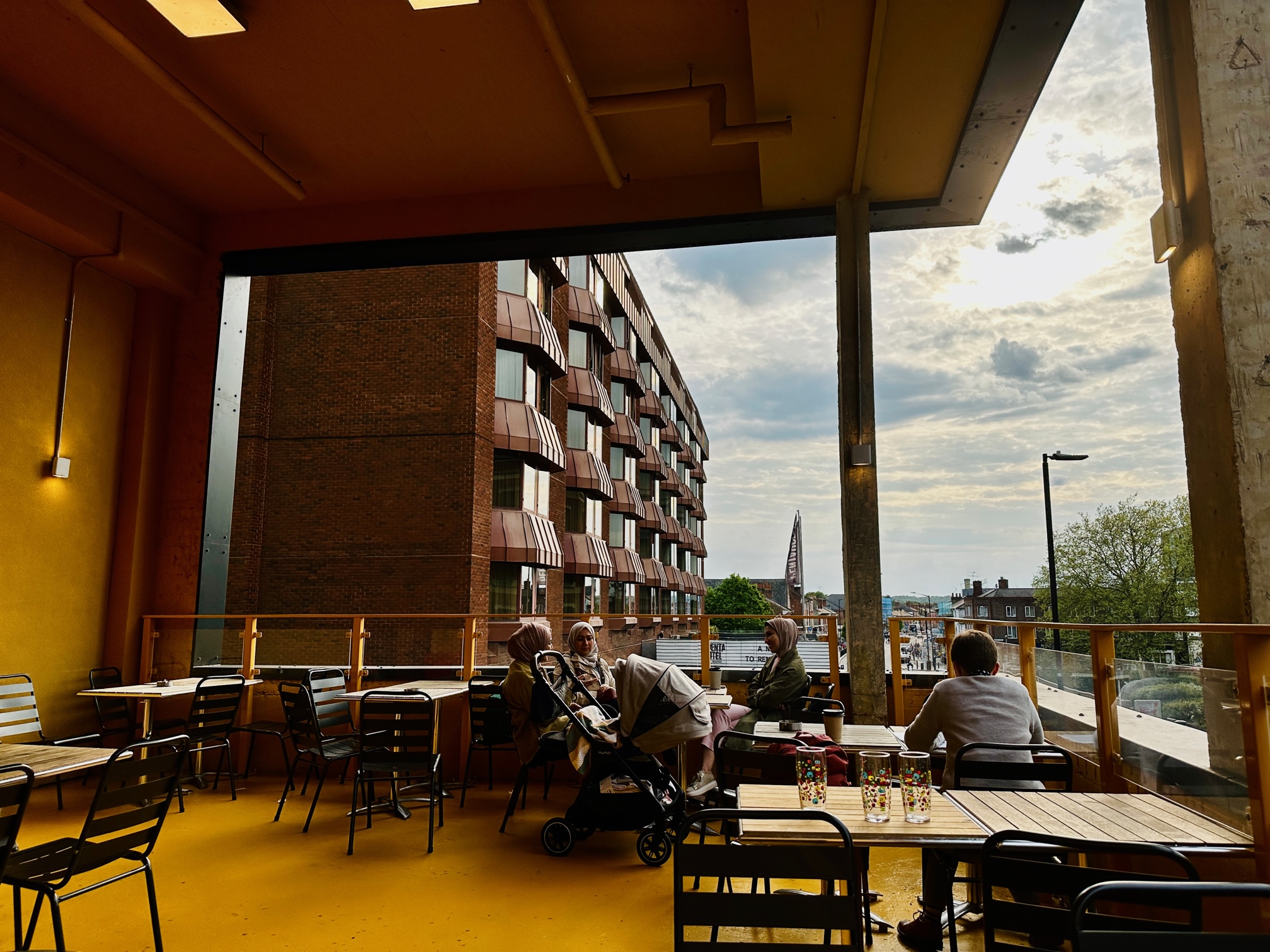
I’ve never set foot in the Biscuit Factory without feeling slightly too old for it, but even so I liked it. It has what old duffers like me refer to as a “lovely energy”, and even the pale birch panelled walls felt nicely neutral rather than cheap. The outside space, where I ate my pizza, is surprisingly attractive, all yellows and burnt orange, with an oddly gorgeous view past the Penta Hotel down the Oxford Road. It reminded me of my sentimental attachment to West Reading: I always think that if you don’t like West Reading, you don’t really like Reading. I do wish it was non-smoking, though: the ashtrays at every table and people sneaking out to clang away on a fag felt jarring.

Sarv’s Slice has a small menu, which is as it should be. Just the seven pizzas without a huge amount of variation, truth be told. You can have a marinara with no cheese, or a margherita with fior di latte, or the same thing with buffalo mozzarella. You can have a pepperoni pizza, or one with both pepperoni and ‘nduja, and you can have a mushroom pizza either with olives or with ham. I admire their stripped-down approach: I could say it reduces the replay value, but I always went to Buon Appetito and ordered one of two pizzas, so I’m the last person to criticise.

Often they have squares of deeper pan Detroit-style pizza on their specials, which seem to be where their more creative side comes out, but on this visit the only special was the Napoli, with olives, capers and anchovies. I was hardly complaining: that’s pretty much my go-to pizza anywhere. Sides are limited to garlic bread – I’ve never understood the appeal of this when you’re about to eat a bread-based main course – and parmesan truffle fries. Naturally I ordered the latter, and my bill came to eighteen pounds fifty. As at Blue Collar Corner, they give you a buzzer which goes off when your food is ready.

I nabbed a table out on the terrace (terrace? balcony?) and made inroads into a beer. You have to buy these from the bar separately, but laudably they had a good local range from the likes of Double-Barrelled and Phantom. Mine was from Phantom, and not up to their usual standard, but it was a warm day and I was sitting outside so I was prepared to overlook a lot.

It was seven pounds fifty. Now that I clearly wasn’t completely prepared to overlook, as I’ve mentioned it here. Is that a lot? I suppose it would be for a pint at the Nag’s, but I’ve never understood how restaurants are allowed to treble the cost of wine but we expect to get beer for less. Who knows what too expensive even means any more, these days? Everything is too expensive, even the electricity you charged your phone with so you could read this; just think, if I was less prolix you’d literally save money.

My buzzer went off in less than ten minutes and carrying my goodies to my table it was hard not to be impressed, on first sight, by the pizza. The crust was suitably bubbled and blistered, and the whole thing had a satisfying irregularity to it. And there was much to like about it – a beautiful base, an excellent sweet tomato sauce, plenty of cheese. The whole thing held together well and was a pleasure to eat. But the devil was in the detail, and if I’m being critical – which it turns out I am – it could have done with more of its star players. The purple, fragrant olives were great but it was light on the capers and, more sadly, one quadrant was an entirely anchovy-free zone.

But none the less it was an excellent pizza, and I spent a bit of time afterwards trying to decide where it ranked in Reading’s pizza pantheon. Nicer than the likes of Franco Manca, if more expensive. Roughly the same price as Buon Appetito had been, but svelte by comparison. Easily as likeable as the pinsa at Mama’s Way, albeit a very different beast, with the advantage that the base wasn’t bought in. Overall? Right up there. More expensive than it used to be at Blue Collar Corner, but I imagine all their costs have soared in the last twelve months.

That said, my advice would be to avoid the fries. They were bought in – which is fine, only a knobber objects to that – but if you’re going to buy in, you have to buy well. This week I had an al fresco dinner at Park House and although the chips were clearly bought in, they totally hit the spot and there was nothing to dislike about them. Sarv’s Slice’s fries, on the other hand, were a tad skanky, too many grey patches and bits I wanted to leave. They’d been given enough truffle oil to smell of truffle but, somehow, not enough to carry through into the flavour.

And the Parmesan: well, I suppose technically there was a little, but almost too little to see, let alone taste. I’m used to Parmesan fries at places like the Last Crumb, where the cheese all falls to the bottom and your challenge is to actually get it on your fries. I expected to reach the bottom of the cup to find a motherlode of Parmesan, like that glorious bit of chocolate at the base of a Cornetto cone, but it wasn’t to be. Not that I finished the fries anyway. They stayed on the table, whiffing away.

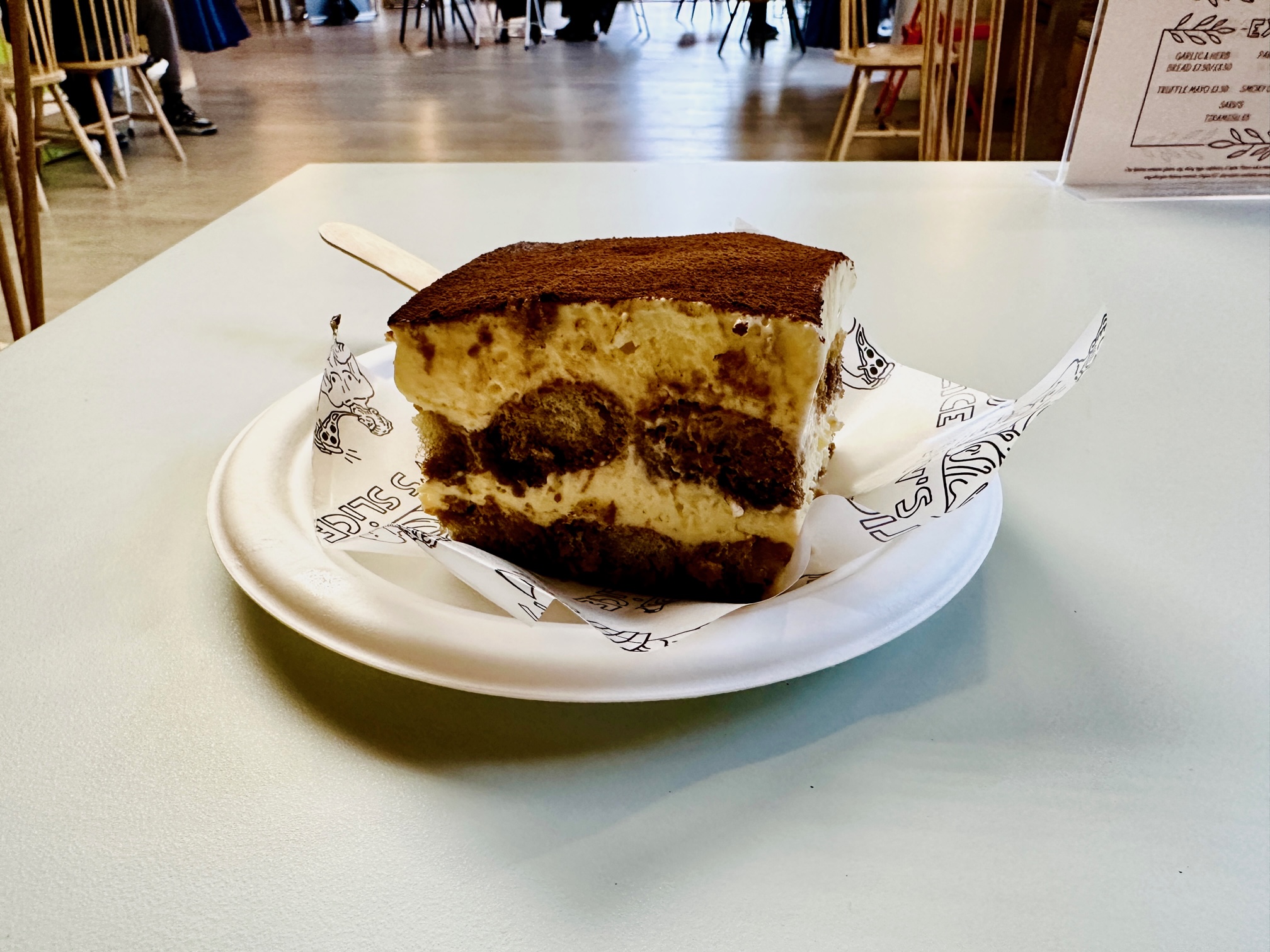
The good news is that with the money you save not buying the fries – six pounds, honesty! – you can get some tiramisu instead. I ordered Sarv’s Slice’s only dessert after finishing my pizza and grabbed a second buzzer. The wait was about five minutes for this too, and worth every second. It was a gorgeous, boozy, thick indulgent slab of the stuff, for only five pounds, and it was probably my favourite thing about the whole meal. It was strange eating it with a wooden spoon – those things are synonymous with failure for a reason – but honestly, it was an utter delight. If I’d known how good it would be I’d have grabbed a coffee from Compound to enjoy with it, but instead I picked one up as I was leaving, strolling home, latte in hand.

As you’ve no doubt gathered, with the exception of those fries I found Sarv’s Slice hugely likeable and I think it has found its perfect home at the Biscuit Factory. The staff are downright lovely and very friendly, and it nicely fills a gap in Reading’s food scene, offering something like Blue Collar’s ultra-casual dining in a different setting. And if I sound like I have reservations, or faint praise, I really don’t. But it’s important to recognise Sarv’s Slice’s limitations – because they do, and they operate within them superbly.

They’re not aiming to be a full on restaurant, at this stage, but instead just offer really good food you can eat informally in a hurry. Perfect pre-theatre dining, if you’re unfortunate enough to go to the Hexagon for something, or a meal you can enjoy before watching a film at the Biscuit Factory itself. So, good for cultured types. For a heathen like me, they fit into the same bracket as, say, ThaiGrr!, as a great way to have an excellent meal before moving on for a few beers at the Nag’s Head.

Back in the day, I used to go for Tuscany for that kind of thing, and then it became Buon Appetito. Sarv’s Slice is a very good successor to those places, and you’ll eat well there. It’s not the widest menu in the world, but for what they aspire to it doesn’t need to be. What Sarv’s Slice isn’t, much as I liked it, is the place that will define my gastronomic summer. But that’s okay, because I’ll keep looking and I’ll find mine in the end. I hope you find yours, too.

Sarv’s Slice – 7.4
Reading Biscuit Factory, Unit 1a Oxford Road, RG1 7QE
07854 892749

https://www.sarvsslice.com/

Feature: Al fresco dining (2022)

This is, believe it or not, the third edition of my guide to the best places to eat al fresco in Reading, and looking back on my previous guides to this subject, it’s safe to say that they’ve not aged as well as I might have liked.

From my Class of 2015, three of my choices have ceased trading and one of the others, the Allied Arms, has lost much of its appeal for al fresco dining since the Pizza Express next door closed down. It only really made the list because of the strangely luxurious experience of having a pint of Thatchers Gold in the beer garden with a Pollo Ad Astra from just down the road; it was, it occurs to me now, a gastronomic moment very much frozen in time and of its time, every bit as much as enjoying cocktails and a burger outside Santa Fe or sitting on the balcony at Dolce Vita.

My more recent version of this list, from 2019, hasn’t fared an awful lot better. Dolce Vita, of course, has closed, and I know some people in Reading mourn its loss as much as I do. But other places have dropped off my list because they’ve been surpassed: take Bhel Puri House, whose food you used to be able to eat in the Workhouse courtyard. And you still can, but the courtyard has been desecrated by the Mercure Hotel, who tore it up with a plan to put in some horrendous decking, were told to cease and desist by the council and left it half-done and completely fucked, one of Reading’s loveliest sunspots turned into a guano-encrusted perpetual building site. 

Some places didn’t make the cut this time because although the surroundings are still excellent, the food no longer lives up to them. Thames Lido is a wonderful place to sit and look at the pool but the food has always been inconsistent and they’ve managed to mislay two head chefs in less than a year (they now have a “restaurant director” instead, whatever that is). After one hit and miss meal too many – which is all the meals I’ve ever had there – it’s no longer a place I can recommend. 

But let’s focus on the positives: for my money there are more, and better, places to eat outside in Reading than ever before. Part of that is down to Covid, I suspect, and places wisely investing in Covid-proofing their restaurants or pubs as best they can. And some of it is just our good fortune that many of our newer establishments have put thought into this, just as many of them have put thought into the delivery experience. Places that have perfected eating in, eating outside and takeaway, which includes a handful of the places on this list, truly represent a triple threat. 

That means I have a bumper selection for you, a baker’s dozen of the best places in Reading to enjoy food and drink outdoors. With one notable exception they all serve their own food, and I think you have a decent span of restaurants, pubs and cafés, and of food at all price points. And best of all, they’ve been picked on merit rather than because they reviewed well on TripAdvisor or paid money to be featured, like other local publications I could name. So without further ado let’s get into it: I have a feeling a list like this could be especially handy this year, and for that matter in the hot summers yet to come.

1. Blue Collar Corner

This list is in alphabetical order, but either way I’m sure it will surprise few people to see Blue Collar Corner at the top of it. In the four short months since it opened, Glen Dinning’s permanent site on Hosier Street has already established itself as a Reading institution. And if claims that “it’s just like being in London” are a little brash and reductive it’s definitely true that the site, with its shipping containers, street food vendors, buzzing tokens telling you your dinner is ready and a well-stocked bar with many excellent Double-Barrelled beers (and the superb lager they brew exclusively for Blue Collar) feels like nowhere else Reading has seen, and like nowhere anywhere near Reading either for that matter.

Blue Collar has picked a mixture of the star players from its weekday markets to run permanent kitchens at the site, which means you can choose from pizza at Sarv’s Slice, bao buns from YouBao or the near-legendary fried chicken from Swindon’s Gurt Wings. The Taco Tree, an offshoot from Vegivores, completes the quartet. In truth when I’ve attended I’ve found it difficult to stay away from Gurt Wings’ incredible JFC (karaage-style fried chicken) with Lost In Translation, their gochujang and sriracha combo sauce. But Sarv’s Slice is also well worth trying – their carbonara pizza, in particular, knocked my socks off.

I suspect I’m far too old and shabby to make a night of it there, but it’s a great place for a sunny lunch at the weekend or an early evening dinner before sloping off to the pub, leaving the young and the beautiful to enjoy their cocktails. I feel I fit in far better at Blue Collar’s Wednesday and Friday markets, which earn an honorary mention on this list – Fink’s mezze box, with chicken shawarma and falafel (because why should you have to choose?) is a go-to there. Or you could join the seemingly infinite queue for Sharian’s jerk chicken: I wouldn’t be surprised if some of the people standing in the line at half-one have been waiting since midday.

Blue Collar Corner, 15 Hosier Street, RG1 7QL
https://www.bluecollarstreetfood.co.uk/blue-collar-corner

2. Buon Appetito

N.B. Buon Appetito closed in April 2023.

I rediscovered Buon Appetito last year, and it turned out to be one of my finds of 2021. But it’s this year that it’s become a proper happy place for me. It has fantastic outside space, and there’s an awful lot to be said for heading there after work, bagging one of their tables and waiting for your pizza to arrive.

It somehow feels, despite being on Chatham Street and a mere stone’s throw from the Oxford Road, that you could be in mainland Europe. Perhaps it’s the luminous orange glow of an Aperol Spritz bathed in sunshine, or maybe it’s the soundtrack of soft easy-listening cover versions of chart hits. Or it could just be the warmth of the welcome or that first bite of my favourite Reading pizza, all bubbled crust, capers and anchovies. Whatever it is, it adds up to something magical.

Best of all, unlike many places on this list, Buon Appetito is truly future-proof. It has cover and powerful heaters, and it will continue to be a great shout later in the year when the weather, as it inevitably will, turns to shit. Come to think of it, I had a distinctly agreeable al fresco meal in Buon Appetito last January, when anywhere else would have been inhospitable. One last thing: if it’s on the specials menu, save room for their brilliant pistachio tiramisu.

Buon Appetito, 146-148 Chatham Street, RG1 7HT
https://www.buonappetitoreading.co.uk

3. Chef Stevie’s Caribbean Kitchen (at the Butler)

N.B. Chef Stevie announced in August 2022 that he was leaving the Butler.

Many years ago, I Love Paella (either at the Horn or during its halcyon days at the Fisherman’s Cottage, before the acrimonious parting of the ways) would have been a shoo-in for a list like this. Chef Stevie’s Caribbean Kitchen is very much its natural successor, a great example of a pub showing some imagination, getting a talented chef in and becoming much more than the sum of its parts.

Sitting under a parasol in the back garden of the Butler – also on Chatham Street, as it happens – nursing a pint of Neck Oil and devouring some jerk chicken dumplings was one of the best al fresco experiences I had last year, or any year for that matter. And that’s before you factor in the chicken wings with a dark rum glaze, the phenomenally deep, smoky jerk chicken or an infernally indulgent slab of macaroni pie. If you want to make someone in your life jealous, go there without them and send them photos: the picture above is from the last time my other half did precisely that. I was green with envy, but I had to applaud her: Bob’s your uncle, Fanny’s your aunt and Stevie’s your chef.

Chef Stevie’s Caribbean Kitchen, The Butler, 85-91 Chatham Street, RG1 7DS
https://www.facebook.com/ChefStevieAnderson

4. The Collective

You might well expect me to put Geo Café on this list – the coffee is fantastic, the pastries are out of this world and the Orangery out the back is a lovely, quirky place to enjoy both those things. But, as I’ve mentioned before on this blog, I class the owners Keti and Zezva as friends so I will have to recuse myself for that reason. But in any event The Collective, at the other end of Caversham’s Church Street, fully deserves a spot on this list.

Their outside space is a beautiful, credible, grown-up piece of work and it creates an atmosphere which positively encourages you to linger, grab another coffee (and maybe one of their superb brownies) and just enjoy the experience of being part of a buzzing café culture not quite like anywhere else in Reading. I just came back from a holiday in Ghent where I went to a couple of fantastic cafés – they take coffee seriously there – with gorgeous, sophisticated outside space, and I can’t think of a higher compliment to pay The Collective than that it very much reminded me of them.

The thing to have there, if you ask me – and maybe you didn’t, but it’s my blog – is the French toast with bacon and maple syrup. But I’m long overdue a return visit to try out the chorizo ‘nduja hash, which sounds like a mixture of all the nicest things.

The Collective, 25 Church Road, Caversham, RG4 7AA
https://www.thecollectivecaversham.co.uk

5. The Last Crumb

Another terrific al fresco venue, the Last Crumb has really cemented its place in Caversham since it opened in 2019 and it has a lovely garden with benches and booths which catches the sun nicely. It might not have as extensive a range of drinks as some of Reading’s other venues, but they’ve done wonders with the outside space and it remains a great spot for a contemplative pint (especially of cider, where their range is a little more fun).

Food at the Last Crumb is not extensive: they’ve decided to do two things, burgers and pizza, and that’s pretty much it. But for what it’s worth they do both of them well and their pizzas are a pretty decent rival for the highly rated Papa Gee just down the hill. I think they still serve them on a metal bin lid which means they go cold quicker than they ought to, but on a scorching hot summer’s day, sitting outside, I imagine that won’t bother many people.

The Last Crumb, 76 Prospect Street, Caversham, RG4 8JN
https://dodopubs.com/locations/the-last-crumb/

6. London Street Brasserie

LSB: the great survivor and what the youth of today might refer to as the “OG” (although what would I know?) of Reading’s al fresco dining scene. It doesn’t have an awful lot of outside space, but what it does have is a classy, tranquil spot by the water and one of the town’s best sun traps. I ate on their terrace a couple of times last year and yes, I know it isn’t as cheap as it used to be. I know the set lunch is no longer the bargain it once was. I also know, believe me, that of any three dishes you eat there one will be great, one will be nice and one will be meh.

And yet it still has something. It still feels special to me, in a way the Lido has never managed, and authentic even when it’s not entirely at its best. It’s where I tend to go with the bits of my family who are even more determined to eat outside than I am, and the place has made several really happy memories for me since the pandemic began. Put it this way – it’s the only restaurant that’s made every single iteration of this list. I wouldn’t bet against it cropping up next time I write a piece like this, too.

London Street Brasserie, 2-4 London Street, RG1 4PN
https://www.londonstreetbrasserie.co.uk

7. The Lyndhurst

N.B The management team referred to here left the Lyndhurst in May 2024.

Will he ever stop going on about the Lyndhurst? you’re probably thinking to yourself. And yes, I’m sure one day I will. When their food stops being incredible and inventive and ridiculously good value. When they stop being curious about other cuisines and other restaurants, when they stop ordering food from other places, taking it apart, putting it back together and adding it to their menu, souped-up and completely unmissable.

True story: the Lyndhurst read my takeaway review of Osaka, ordered the karaage chicken I’d written about, enjoyed it and then decided to make their own version. It was absolutely incredible, some of the best fried chicken I’ve ever had anywhere, and I enjoyed it for months until they took it off their menu. And then they brought it back recently and it’s even better than ever. I’ll stop going on about them when they stop doing things like that. I’ll stop going on about them when I order the same dish there twice and they haven’t improved it, subtly and iteratively, between visits. I’ll stop going on about them when their curry night isn’t the best way to spend a tenner on food and a pint in Reading on a Thursday night.

Until then, I’m afraid you have to put up with stuff like this. The Lyndhurst’s terrace seats maybe fourteen people at a push, but if you get a table there on a warm day – with a pint or a glass of their gorgeous Riesling, and a menu – you honestly feel like you’ve won at life. Next time you’re there, try the monkfish with Bombay potatoes before they take it off the menu. It’s a beauty.

The Lyndhurst, 88 Kings Road, RG1 4DG
https://www.thelyndhurstreading.co.uk/

8. The Nag’s Head

For my money the Nag’s is Reading’s finest beer pub, and for a long time I thought that was all that it was (not that there’s anything wrong with that). And that’s still the case – the keg selection is superb, and there’s always a great spread of beers from our local breweries, let alone fun stuff from further afield. But when I reviewed the food last year I was delighted to find that they’d given a lot of thought to it – a stripped-back, easy to execute menu that doesn’t involve burgers or fish and chips, or microwaves.

So instead you get brisket or pulled pork rolls, from the smoker which starts running early doors. Or toasted sandwiches from the Croque Shop, a Brighton business that the owners of the Nag’s liked so much that they asked them to supply their pub a long way from Sussex. There are sausage rolls, too, although nothing’s stopping you ordering some pork scratchings into the bargain, apart from possibly restraint or dignity. The Nag’s, Buon Appetito and Chef Stevie form a beautiful little triad, proving again that West Reading is where much of Reading’s interesting food developments are taking place.

The Nag’s Head, 5 Russell Street, RG1 7XD
http://www.thenagsheadreading.co.uk/

9. O Portugues

N.B. O Português closed in March 2023.

Just to prove that West Reading and Caversham don’t have the monopoly on great al fresco dining options, the next three choices are all from the east side. O Português, on the edge of Palmer Park, has a decent terrace and a menu that does its best to transport you to Lisbon. The menu can be challenging in places (don’t have the snails) but if you pick well you can be rewarded with some cracking food – from prego steak rolls honking with garlic to a vibrant salt cod salad singing with parsley and red peppers. One of my readers told me that one of the best ways to enjoy O Português is with their octopus salad, some bread to mop up and a cold pint of Super Bock on draft. Put like that, it sounds unimprovable.

O Português, 21 Wokingham Road, RG6 1LE
https://www.facebook.com/OPortuguesInTown

10. Park House

My most recent discovery to make this list is Park House, the University bar on campus. It’s always been one of my favourite places to grab a pint in the sunshine – either before or after a happy amble round the Harris Garden, which has become one of my very favourite parts of Reading. Their beer is ridiculously cheap and Double-Barrelled, Siren Craft, Phantom and Elusive are invariably represented, along with relatively local breweries from slightly further away.

But what’s changed this year is the introduction of a great, compact, sensibly priced menu using local suppliers and beef from the university’s own farm. It transforms it from a nice spot for a drink to somewhere you could happily settle in for a session and have an enjoyable meal into the bargain. The things to pick there are the smoked pork ribs, the excellent, clever and nicely balanced confit duck salad and more of the smoked pork ribs. Possibly with a chaser of the smoked pork ribs.

Park House, Whiteknights Campus, University of Reading, RG6 6UA
https://www.hospitalityuor.co.uk/bars-and-pubs/park-house/

11. Smash N Grab

Smash N Grab closed in January 2024.

Reading’s best burgers, for my money, can be had from a little shack on Cemetery Junction with a handful of outside tables. Husband and wife team Farooq and Uzma run Smash N Grab and despite almost packing it in earlier in the year they’ve decided to stick at it and are working hard on improving their outside space and expanding their menu.

I’m glad they’ve reconsidered, because their smashed burgers really are superb – beautifully done, deeply savoury things with fantastic texture and contrast. Smash N Grab are active on social media and have been frank about the challenge they face, with their neighbours and competitors Fat Twins building a huge structure outside what used to be the Granby Tavern to block their light and the view of the restaurant (seemingly without getting planning permission). So they need all the support they can get – and their burgers really do deserve a far wider audience.

Smash N Grab, 124 London Road, RG1 5AY
https://www.smashngrab.co.uk/

12. Tasty Greek Souvlaki

Another great example of restaurants as travel agents, Tasty Greek Souvlaki has made a huge contribution to Reading’s food scene in a short space of time since opening in 2020. And I really love sitting outside with a cold bottle of Fix (the glasses, frosted, are from the freezer) watching the world go by. The tables are seated side by side looking out on Market Place, which somehow makes the whole thing feel more Continental, and it has that brilliant effect where you know you’re in Reading, but you somehow feel elsewhere.

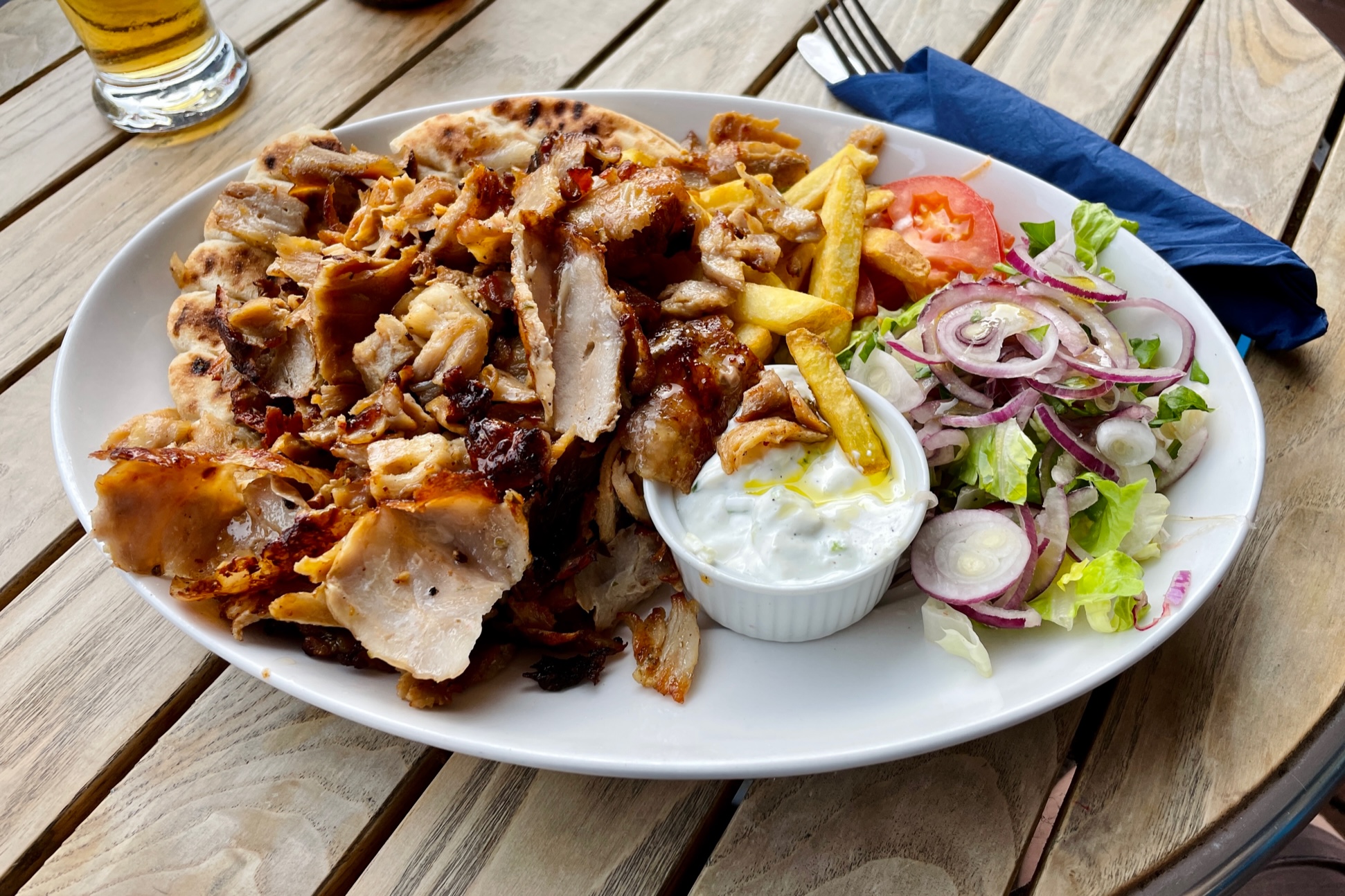
If you’re there in a pair or a four it’s really hard to beat the mixed grill, which is a cornucopia of meat – souvlaki, gyros, keftedes, pork belly and sausage – with something for everybody. But if you’re eating solo, the merida platter of crispy, salty gyros meat with chips, fluffy pitta and tzatziki is one of the best and best value meals for one you can find in Reading. And it’s a great place to dine solo: at some point I’ll put together an updated version of my feature on the best tables for one in Reading. When I do, expect Tasty Greek Souvlaki to be on it.

Tasty Greek Souvlaki, 20 Market Place, RG1 2EG
https://tastygreeksouvlaki.com/

13. The Castle Tap

The Castle Tap doesn’t have a menu per se: I think you can get a cheeseboard there, but that’s it. They have done a great job on their outside space in lockdown, like their neighbours the Nag’s Head, and it’s a brilliant place to enjoy a beer or a cider on a balmy evening (their beer list is compact but always has something interesting on it, and they put a lot of effort into their cider selection).

And yet last year, the Castle Tap was the site of many of my favourite al fresco meals. Because to encourage you to stay there and keep enjoying their wonderful space, rather than sloping off to the likes of Harput Kebab, the management actively encourages you to order from Deliveroo and eat it in their gorgeous garden. They even, if you ask them nicely, give you the postcode for the back of the pub on Anstey Road, so your rider can almost drop it to your waiting table. A tub of chilli chicken from Kokoro or a red pork curry from ThaiGrr!, eaten in the sun with a great beer in front of you and the promise of more to come: little is finer than that.

The Castle Tap, 120 Castle Street, RG1 7RJ
https://thecastletap.co.uk

Restaurant review: Buon Appetito

Buon Appetito closed in April 2023. I’ve left the review up for posterity.

A couple of Mondays ago I was walking through town around lunchtime, and I noticed that every table outside Bill’s was occupied. The sun was shining, and Bill’s has one of the best al fresco spots in Reading, but even so: every single table? Then I walked past Jollibee on Broad Street, with a queue outside, just like every day since it opened. As I looped back down Friar Street I noticed, through the windows, that Wendy’s was packed.  We can congratulate ourselves on promoting an independent, thriving Reading, through the money we spend and the businesses we amplify on social media, but the fact remains that chain restaurants have a huge hold on our town and its customers. 

The struggle is real, and relentless. Recently a branch of Sri Lankan themed chain The Coconut Tree opened, and influencers surfaced on Instagram raving about how good their (free) food was. It is next door to South Indian restaurant Pappadam’s, which has been there for years. Last week Gordon Ramsay opened a restaurant in the Oracle – one of five new burger restaurants coming to Reading – and gave out a thousand free burgers. Berkshire Live ran a breathless story enthusing about the opening. Of course they did, because it’s easier to Ctrl-C, Ctrl-V some guff from a PR company than it is to write a real story (although in Berkshire Live’s defence they subsequently reviewed the burger, and didn’t rate it).

The uncomfortable reality, even if we wish it wasn’t so, is that chain restaurants in general, and American ones in particular, do well in this town. Last month Deliveroo revealed Reading’s five most frequently-ordered dishes. Who made the list? Taco Bell, Wingstop, Shake Shack and Five Guys. The only thing preventing a clean sweep by American chains was the holder of the top spot, from German Doner Kebab. They wouldn’t make my top hundred dishes in Reading, let alone take the crown. Maybe Reading’s favourite illness is dyspepsia. Or dysentery, you never know.

If you’re reading this you probably have at least a passing interest in Reading’s independent restaurants, so perhaps you’re mystified (or depressed) by the continuing popularity of places like Taco Bell. It’s easy to forget, in an echo chamber that buys local, supports indie businesses and slopes off to the farmer’s market a couple of times a month, that most people in Reading would still rather queue for Wendy’s.

Even if you support independent businesses, there are other ways to be out of step. I’ve never quite “got” some of Reading’s fêted indies. I freely admit that Sweeney and Todd is one of them, Quattro is another. A third, the subject of this week’s review, is Buon Appetito. It’s always been highly rated on TripAdvisor, yet when I went there over five years ago I was bemused by the rave reviews. Years later the wonderful Tuscany opened down the Oxford Road and I had another, better pizza option; I never returned to Buon Appetito.

Yet here we are in 2021, Tuscany closed over two ago, and Buon Appetito is still going strong. It’s still highly rated on Trip Advisor. More to the point, the pictures on its Instagram account look a world away from the greasy, cheese-sodden edible cardboard I waded through back in 2016. Flicking through them made me feel decidedly peckish. So I decided to take another look, accompanied by my friend Nick, fresh from his previous appearance in this blog and not put off by the whole experience of being immortalised in print.

Buon Appetito has made the best of an unlovely spot. Like many canny businesses they’ve done great things with their outside space, with plenty of tables and some little booths with circular pub tables and heaters on the wall. Everything was covered by a corrugated plastic roof, and more corrugated plastic formed a partition closing off much of the view of Chatham Street. It will set them up perfectly for winter, and the overall effect made me feel like I was on holiday. That sensation was only accentuated by the soundtrack, which sounded like hotel lobby jazz covers of popular songs. I started out thinking the music was deeply naff, but by the end it had won me over and I’d used Shazam to work out who the band was (The Cooltrane Quartet, since you asked).

Service was bright, friendly and immediate. Rather than relegate it to the end of the review it deserves to be mentioned early and often, because the woman who looked after us all evening was brilliant. Every restaurant should have a front of house like this: warm, enthusiastic, likeable and with opinions about the dishes you ought to try. She brought us a couple of pints of Peroni (the drinks selection isn’t the widest at Buon Appetito) and we began the process of picking through the menu.

“I’m not a fussy eater, but there are four things I won’t eat” said Nick.

“What are they?” I mentally ran through my own list of no-nos, but apart from the obvious ones, like tripe, I could only come up with sweetcorn and dried fruit.

“Blue cheese, obviously. It’s mouldy. You’re literally eating mould.”

I couldn’t help but feel Nick was missing out, but I didn’t interject.

“And raw coriander. It’s awful, it just tastes soapy. It’s genetic, you know.” Having been closely associated with a coriander hater in the past, I’d been told this fact more times than I cared to recall. Can’t you just tell restaurants you’re allergic? I used to ask: apparently not.

“What are the other two?”

“Olives! They just always taste so bitter to me, it doesn’t matter what colour they are. And the last one’s marzipan.”

I could eat marzipan by the block, cutting it like cheese – I have, in my day – but I let that pass. I looked at the menu and mentally struck a virtual red pen through all the items with olives or blue cheese in them: it was more than a few (I was surprised, given our last meal out, that snails hadn’t made the list).

The menu was mainstream but better and more well put together than the one I remembered from my previous visit. It was compact in the right places – only four pasta mains, for instance – and more expansive where that made sense. It’s okay to have many different pizzas because ultimately many of the core ingredients are frequently the same. Pricing was consistent and reasonable – nearly all the pizzas and pasta dishes ranged between ten and fourteen pounds and starters were around the seven pound mark, or more expensive and big enough to share.

Pizzas were a mixture of recognisably Italian combinations – plenty of ‘nduja on there, and the classic Neopolitan pizza with anchovies, capers and olives – and options from further afield. The Honolulu and the Hawaiian, both of which featured pineapple, constituted the lunatic fringe. “I quite like pineapple on pizza” said Nick, “but I won’t order it: you’ll get hate mail from Italians.” I wondered what Italians would make of a vegetarian pizza called “Garden Of Eatin”, but perhaps they’d made their peace with that.

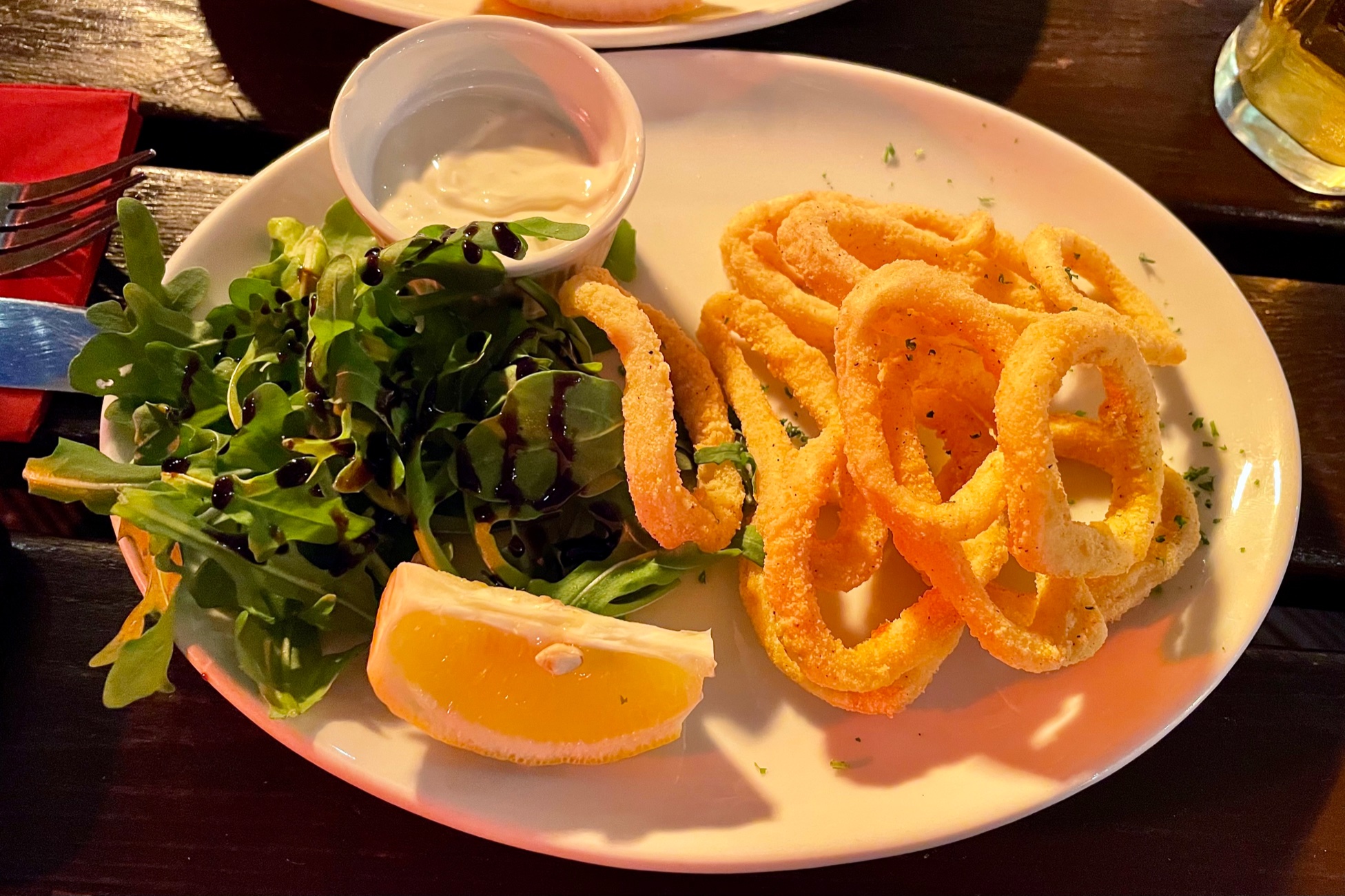
If all of our meal had been like our starters, the rating you’ve already scrolled down to check would have been lower. Calamari was decent, though: it mightn’t have had the tenderness of ultra-fresh squid, but it wasn’t rubbery either. It came with a gentle aioli: a bigger honk of garlic wouldn’t have gone amiss. Even so, it was better than the same dish at the Fisherman’s Cottage a few months back, by which token it was better than most calamari I’ve had in Reading over the years.

The other dish, king prawns with chorizo, was merely pleasant. They were nice plump prawns, three of them, with plenty of sweet flesh once you’d yanked off the head and opened up the shell. The problem was everything else. I know chorizo isn’t Italian, which made the dish potentially slightly incongruous. But worse, this chorizo was nothing special – thick, coarse and bouncy without heat or the terrific crimson oil that colours everything it touches. The menu said that this was cooked with garlic and extra virgin olive oil, but I got little or no garlic, just an anonymous orange puddle under the prawns that didn’t taste of enough.

I began to worry that history would repeat itself: I haven’t doled out a poor rating this year, and I’m somewhat dreading the first time I have an iffy meal on duty. But then our pizzas arrived and those worries, and indeed any other cares I might have had, dissipated in a cloud of carbs. Based on what I’d seen on social media I fully expected Buon Appetito’s 2021 pizzas to be an improvement on the one I had in 2016, but what I wasn’t prepared for is just how improved they would be. They weren’t just better than the previous one I’d eaten at Buon Appetito, they were better than any I’ve had in Reading and many I’ve had further afield.

Now, I can understand you being sceptical: it was only a few weeks ago that I said I might have discovered Reading’s best sandwich, and here I am saying that Buon Appetito does Reading’s best pizza. I couldn’t blame you for thinking I’m busting out hype for the sake of it. But I try hard to be sparing with the superlatives – not everywhere can be the best ever – and by any standards Buon Appetito’s pizza was extraordinary. The base was night and day compared to what I’d eaten before, with a beautifully bubbled, puffy crust with a little leopard-spotting and a deeply satisfying chewiness. 

The toppings – I’d gone for the Napoli, which has always been my ideal pizza – were superb. A great tomato base, just enough cheese, lots of salty anchovies, a judicious helping of sharp, tangy capers and those black olives Nick was so averse to. I think this particular pizza is the choice of salt and vinegar fans everywhere and when it’s perfectly in balance, as it was here, it’s a full-on, sing-at-the-top-of-your-voice truly joyous thing to eat. Better than Papa Gee’s, better than The Last Crumb’s, better even than Tuscany used to be. I loved it, and knowing I could rock up to Buon Appetito any time and order this pizza again for a mere eleven pounds was both a wonderful and a dangerous discovery. 

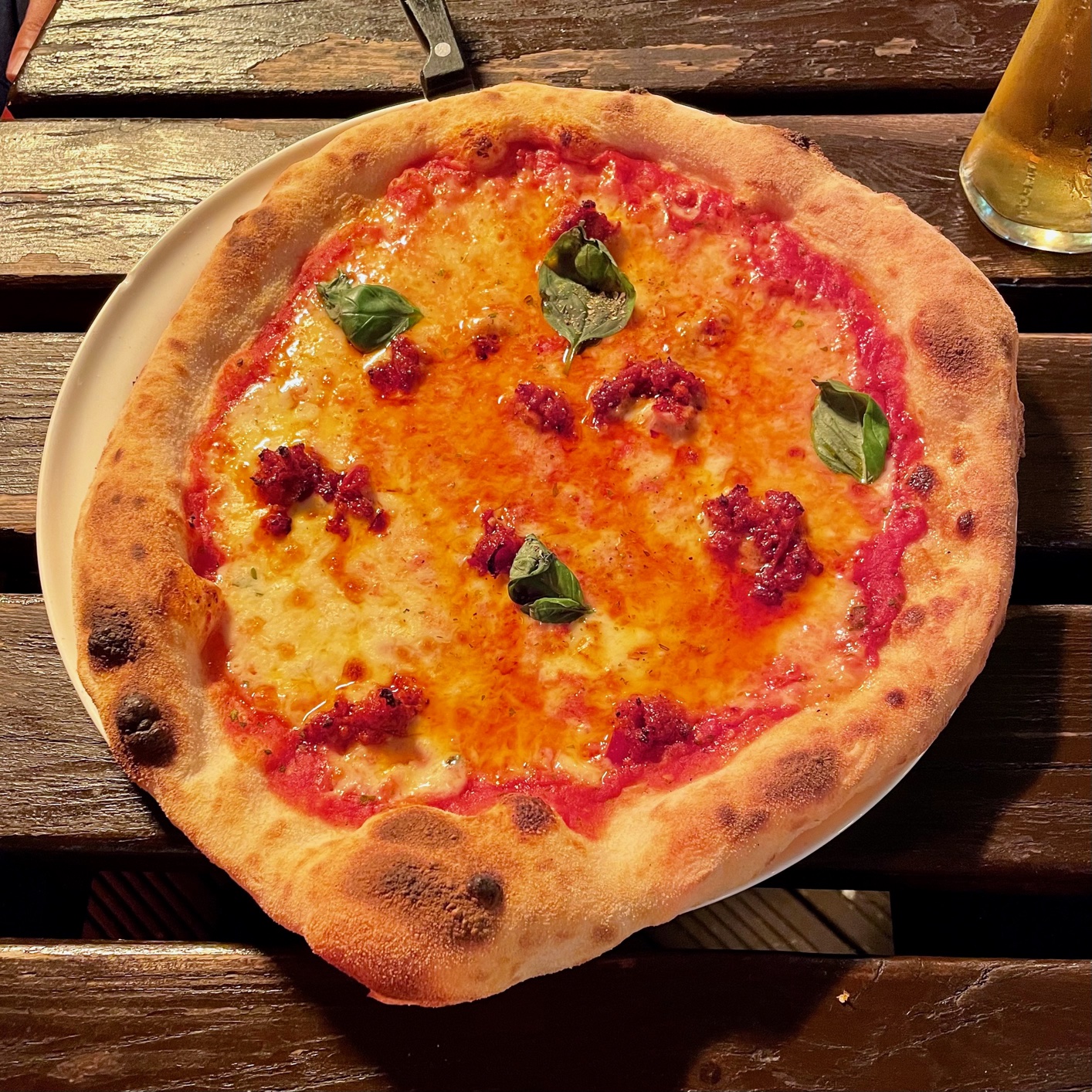
Nick’s pizza showcased that great base in a completely different direction. The “Calabrian” manages to appear on the menu twice, once halfway through and once at the end of the list of pizzas. But it was a masterpiece of pared-down simplicity – tomato sauce, mozzarella, clusters of ‘nduja, basil leaves: nothing else. Nick had never had ‘nduja before – in 2021, can you believe it? – and though he ordered it with abandon, he approached it with trepidation. “Yes, it’s hot, but it’s good” he said, just before our waitress came up and asked, part sympathetically, part playfully, whether he needed a glass of milk. “We have chilli oil, if you want to make it hotter” she added. But Nick was happy with his choice: from where I was sitting it looked a smart one.

“That was good, wasn’t it?” Nick said.

“It really was. Hold on, is that a Latin jazz cover version of Never Gonna Give You Up?”

“Certainly sounds like it.”

We asked for the dessert menu, because I’ve always felt it’s rude not to at least look. It was on the right side of too big, with four desserts and some variations on the theme of gelato and sorbetto, along with an espresso martini which had wandered over from the cocktail menu. “The panna cotta and tiramisu are the best ones” our waitress told us. “Although our banoffee pie is very good too. We import it from Italy, along with our Torta Rocher”. I suspect they come in frozen from a company called DiSotto, which also provides Buon Appetito’s ice cream and sorbet.  

We took our waitress’ advice. Nick’s tiramisu was a hefty helping, on the rustic side with huge, boozy savoiardi biscuits (or lady fingers, as you probably should no longer call them) and loads of mascarpone under a blanket of cocoa powder. He liked it, but was too full to make significant inroads into it. I gallantly stepped up purely so I could tell you what it was like, namely serviceable. Only now, looking at the DiSotto website, do I clock that they sell a defrost-it-yourself tiramisu which looks strikingly like this one. I’d love to think Buon Appetito makes its own, but I wouldn’t bet on it.

The panna cotta was a strange one: I’m used to it turned out and quivering on the plate whereas this one had been imprisoned in a little sundae dish. There was an enjoyable pistachio mousse underneath, the beautiful crunch of a candied pistachio crumb on top. All tasty enough, but it felt more like an upside-down, out-of-kilter cheesecake than a panna cotta. I’m not sure the panna cotta element – hemmed in, unable to wobble freely – worked.

“Pretty good” said Nick, “but not as good as Laura’s panna cotta.” I tried his other half’s panna cotta not long ago: he’s right.

The restaurant had a steady flow of customers throughout our meal without ever seeming busy. But it was a Wednesday evening close to payday: perhaps that was a factor. “Inside is very nice too, you should eat there next time” said our waitress as she brought the bill, along with a couple of shot glasses of a Kermit-green pistachio liqueur like next level Bailey’s. Three courses and two and a half pints each came to seventy-eight pounds, not including tip.

As I said, night and day; I still think that the place I went to five years ago left a lot to be desired, but aside from being in the same building and doing Italian cuisine I don’t see many remnants of the Buon Appetito that left me nonplussed. They’ve created a properly lovely space, the service is spot on and if part of the menu were merely not bad or even so-so, the plusses outweighed that in spades. The biggest of those plusses is the pizza, which for my money is one of the best I can remember.  

I wish there were more sunny days ahead, because few pleasures can match pizza and beer on a sunny day, but those little booths will be very inviting when the nights draw in, especially for those of us who aren’t sure how much indoor dining we plan to do in what remains of 2021. With Buon Appetito, Chef Stevie’s Caribbean Kitchen and the Nag’s Head, that little piece of West Reading is looking like the best gastronomic micro-climate the town has to offer. Chatham Street, a food hub: who’d have thought it?

Buon Appetito – 8.0
146-148 Chatham Street, Reading, RG1 7HT
0118 3276947

https://www.buonappetitoreading.co.uk

Lemoni

It became apparent in early 2021 that Lemoni was not going to reopen after the third national lockdown. I’ve left the review up for posterity.

It is, I think, a universal reaction when we taste something funny, or not quite right, or even plain bad, to seek a second opinion. Whether that’s saying “do you think this milk is still good?” when it’s a day past the use by date or asking “does this taste weird to you?” in a restaurant, we all do it. We like to share delicious food, providing we have enough of it to spare, but it’s when something’s awful that we really feel the need to share the pain.

I say this because I’ve had several people in the last three months ask me if I’ve been to Lemoni, the new Greek restaurant in the Oracle, or when I’m going – and not because they say the food is stellar. One message on Twitter said “OMFG, it was awful. Service took ages every time, when they arrived the flicking of long hair over food was… ugh”. Another, on Instagram, said it was so bad that they refused a discount because they wanted to leave as quickly as possible. “I never thought I’d say this” she added, “but I really miss Jamie’s Italian”. Someone else on Twitter said “I went there last weekend and I’m interested to hear your opinion”: sometimes what isn’t said shouts as loudly as what is.

As a result, despite my best efforts to stay positive, I approached my visit to Lemoni with a gradual mounting dread. On the one hand, people definitely wanted an impartial review. But on the other, looking at their website I had a real feeling of “must I?”. Part of that came from looking at the menu online, because the dishes at Lemoni were undeniably pricey. Sixteen pounds fifty for a moussaka, or for a chicken shish kebab? They’d have to be absolutely faultless to charge that much.

Matters weren’t helped by my other half sending me a picture which had been doing the rounds at her work, taken from Tripadvisor, of the lamb kebabs. They look as if they had been formed not by hand but by the combination of a colon and a sphincter, nature’s piping bag. As if to reinforce the point, one of her colleagues had effortlessly Photoshopped a single kebab into an image of a toilet bowl: it wasn’t even slightly incongruous, bobbing there.

Tripadvisor didn’t help in general, as it seemed polarised between glowing reviews (often from Greek users with very few other TA reviews) and mutinous rumblings from everybody else about poor value, indifferent food, terrible service. Who to believe?

And then there was the wider mystery – who were Lemoni anyway? Hard to tell from social media, that’s for sure: there was a glut of very polished Instagram activity when the restaurant was about to open, but since then the silence has been deafening. Trying to get any background was challenging – the suggestion had been that this was their second restaurant but from what I could glean from Companies House the first restaurant, in Southampton, had gone into liquidation before the Reading branch opened.

How did an independent business with no real footprint come out of nowhere to take on the Oracle’s biggest restaurant site, quite possibly paying an annual rent in the high six figures? How was it going to survive in such a competitive site, even (or especially) charging those prices? There was only one way to get to the bottom of it: I was going to have to go there myself.

I felt bad about asking anybody to accompany me, but in the end my mother and my stepfather gamely agreed to come along: sometimes you really do need the unconditional commitment only family can truly provide. So, despite my stepfather’s wistful looks askance at the entrance to Royal Tandoori, we walked up to Lemoni on a warm summer’s evening to take our chances.

The welcome at the door was bright and friendly, and we walked up through the stairs and through the restaurant to take a table out on the upstairs balcony, one of Reading’s better al fresco spaces. The transformation from when the restaurant was Jamie’s Italian was marked, and very nicely done: the upstairs and downstairs are both very tasteful, airy spaces with plenty of natural light, grown-up looking marble-topped tables and grey tweedy banquettes. I didn’t eat inside, but I liked the look of it – I did wonder though just how much sound would be absorbed on a busy Friday or Saturday night and whether the restaurant would feel quite as welcoming on a darker winter’s evening.

The first big surprise came when the menus arrived, because the prices have been reduced significantly since April (although Lemoni has neglected to change its website to reflect this). Mains in particular had come down by between three and five pounds per dish – badly needed, because many of the dishes skirted around the twenty pound mark which felt very expensive for this kind of food. This means that Lemoni must be the first restaurant I’ve encountered to do a soft opening in reverse: still, at least it showed they were learning from their mistakes.

We ordered a few drinks, namely a Mythos for my stepfather, a Menebrea – the Italian beer which is becoming Peroni for people who think they’re too good for Peroni – for my mother and some sparkling mineral water (don’t judge) for me. Nearly all the waiting staff, all dressed all in black, seemed to be Greek and they certainly looked efficient, darting from table to table; maybe they’d also learned from some of that early criticism.

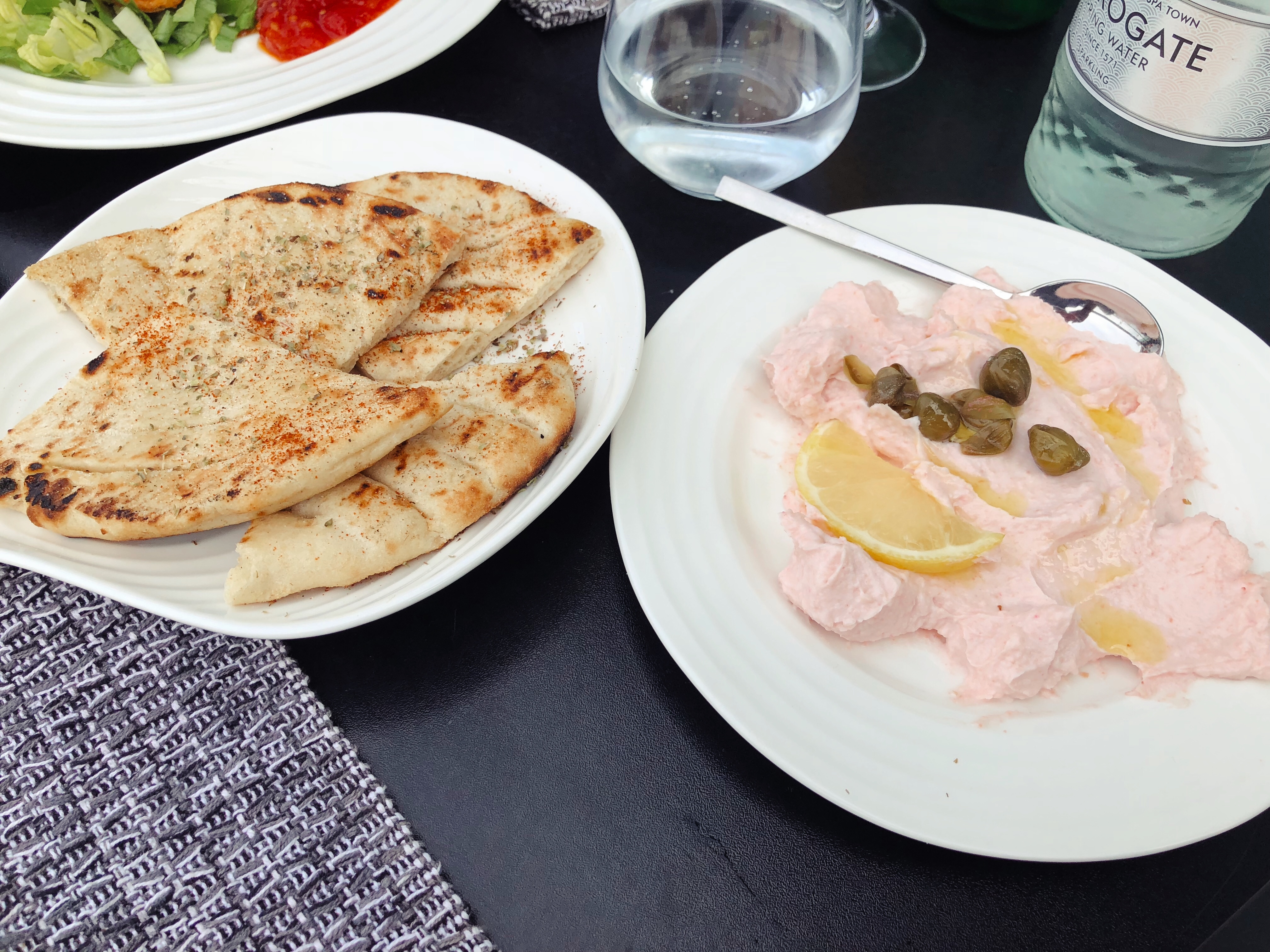
We decided to share some of the starters to begin with – these all vary between about five and eight pounds, although they charge extra for pitta which felt cheeky to me. How else did they expect you to eat houmous or taramasalata, exactly? The taramasalata, incidentally, was one of the best starters we had – brighter pink than I’m led to believe it should be but punchy all the same. I especially liked the addition of some salted capers on top, but I suspect they were more popular with me than with my mother. “It doesn’t taste that fishy” was her feedback – my stepfather and I disagreed, but she had taken against the dish and that was that.

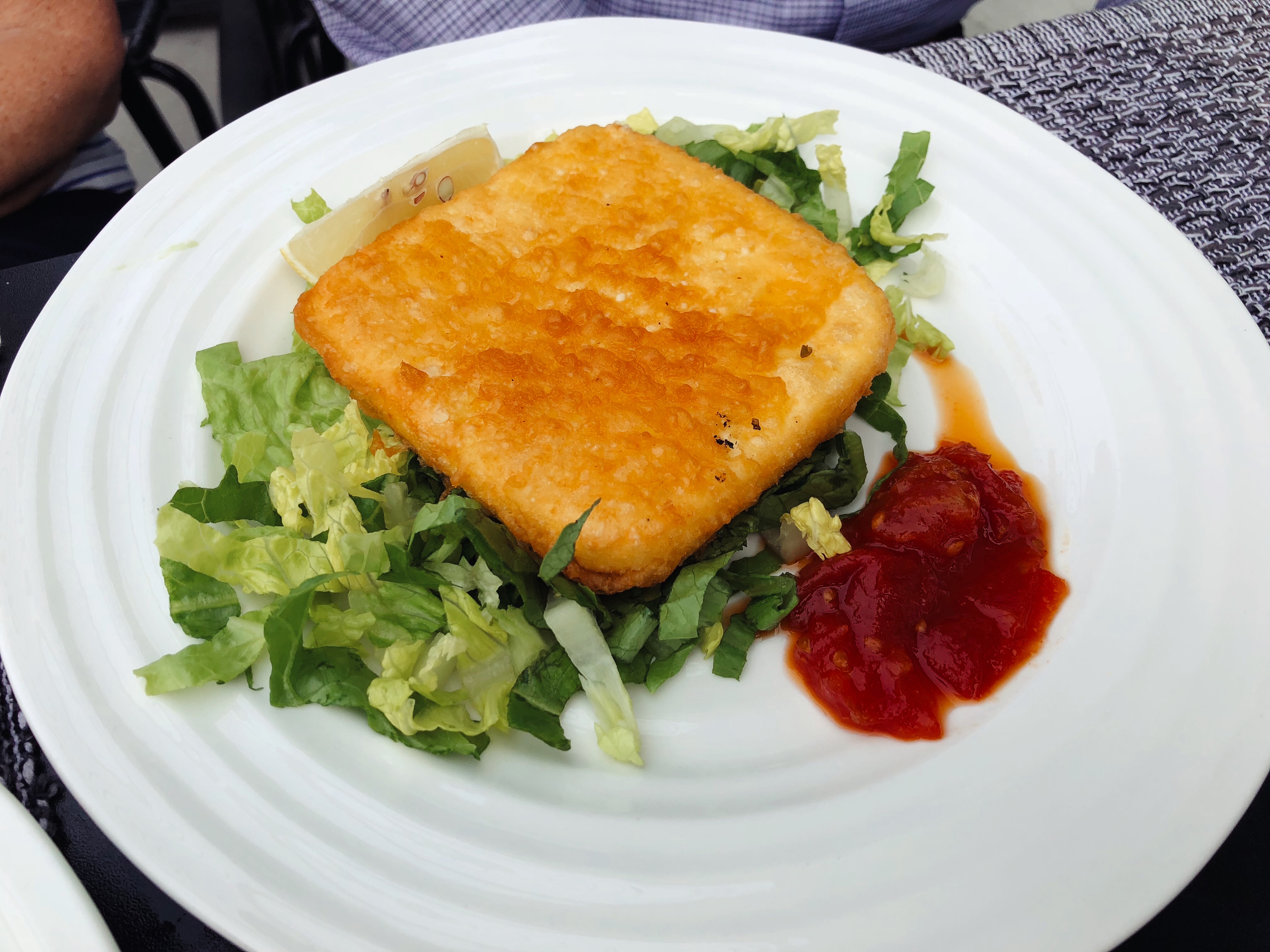
The spanakopita was a hit with all of us – light filo pastry with just enough crunch housing a beautifully molten mixture of feta, spinach and mint. The other two starters, though, were the relative duds. Saganaki is one of my favourite Greek starters and done well it’s a glorious, indulgent thing. The menu chose not to specify which cheese it was (which perhaps should have been a warning bell) but it’s usually feta and this didn’t feel like feta at all. Whatever it was, it was a lukewarm block of cheese with a leathery texture which had no give whatsoever. The “homemade tomato jam” might just have been able to paper over the cracks of this dish, but there was nowhere near enough of it.

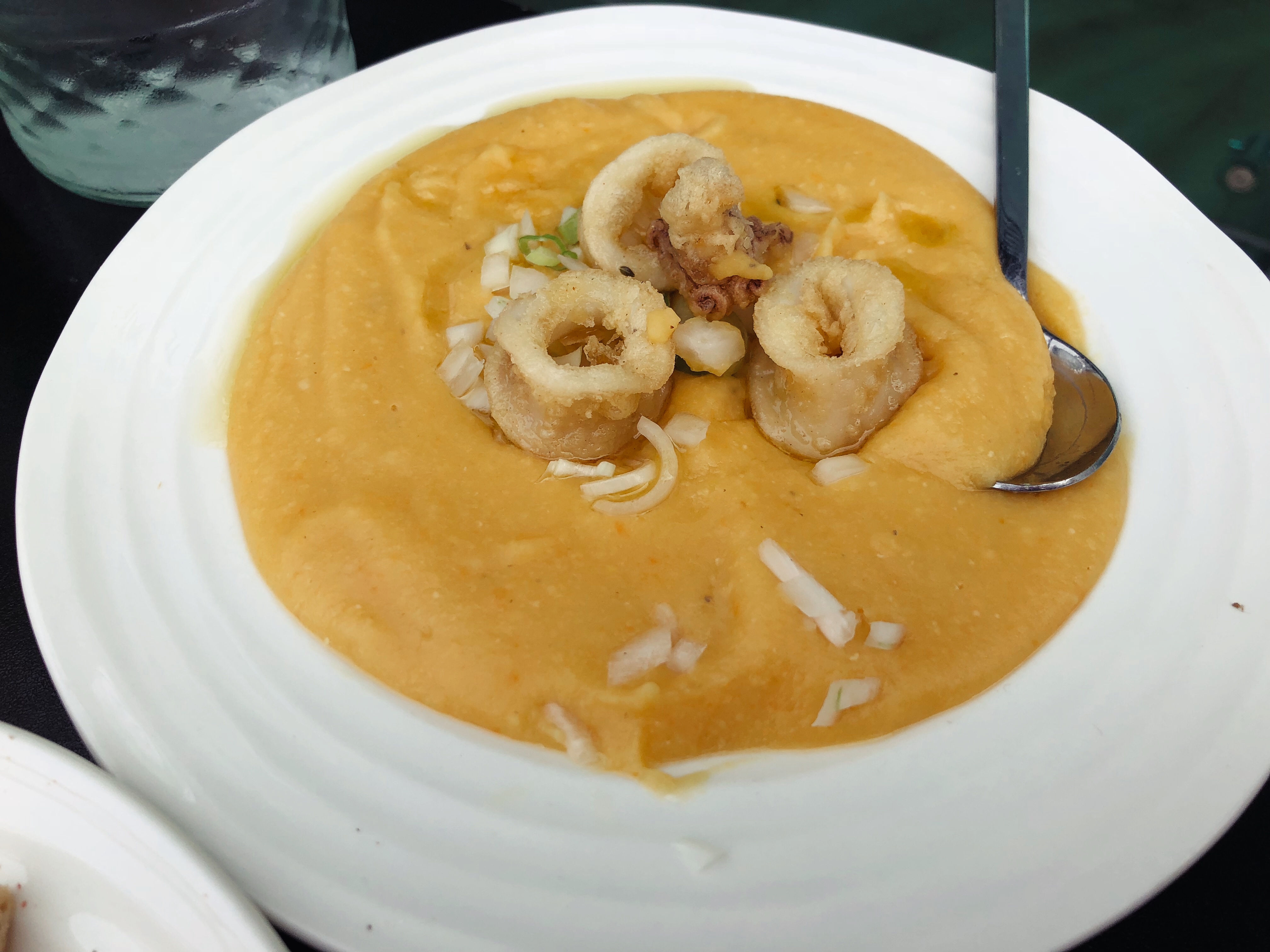
The last starter arrived after the other three, and before the side plates we’d had to ask for twice. Mashed fava beans topped with calamari were a pleasing shade of yellow and had a earthy, if subtle, taste. But I couldn’t help wishing it was hot rather than lukewarm and it also needed some pita to do it justice. Our first helping of pita – tasty, topped with something like cayenne pepper or paprika along with dried oregano but far too little of it – had already vanished by then and it took multiple attempts to flag someone down to ask for more. By the time it arrived we still just about needed it, but the moment had passed.

“That dish is bland” said my mother, pointing accusingly at the fava beans.

“It’s okay – it could do with a bit more seasoning” I said.

“Well, it’s not unpleasant” she added, the implication clearly being that not unpleasant was not good enough. I could see what she meant, but I was more disappointed that paying two pounds extra got your fava bean purée topped with precisely four tiny bits of squid. Maybe I’ve inherited her critical faculties.

Having struggled to get our side plates and struggled to get extra pita bread, we then found we were left alone with our leftovers in front of us for some time. This gave my mother enough time to do some detective work.

“Our placemats are by John Lewis” she said. “They have the tag on them.”

I inspected them. This was indeed the case.

“And the labels are still on the underside of our side plates.”

I wasn’t sure how my mother had clocked this – nothing gets past her – but lifting up my snazzy rippled white plate it was true. Sophie Conran for Portmeiron, no less, and that stuff isn’t cheap; these aren’t plates you’d want to smash at a wedding.

“It’s weird, isn’t it? It’s like they’ve picked this stuff up at a department store because money’s no object.” And again, I found myself wondering where the money came from to open this massive restaurant out of nowhere and kit it out with a lovely new refit, John Lewis placemats and Sophie Conran crockery. At this point my stepfather outlined his theory on the matter: sadly, I’ve had to omit it from the review but I’m sure you could come up with your own ideas.

I was jogged out of this reverie by the fact that as our plates were taken away the main courses were plonked in front of us, supervised by an older man who looked as if he might be the owner. The overall effect was a little menacing, especially as my stepfather had ordered the “chicken skewer” which comes to the table on a long and potentially dangerous skewer fresh from the grill. The skewer was served on a bed of undressed, pointless rocket with some soft-looking roasted potatoes, a cold couscous salad and some kind of dip. I tried some of the chicken and it wasn’t unpleasant but there was no real sign that it had been marinated. At fourteen pounds it was still more expensive than the same dish at Bakery House, with nowhere near the same whistles and bells.

“That dip is salad cream” said my mother, looking none too impressed.

“I think it’s more like burger sauce” I said. “The menu says it’s ‘Lemoni mayonnaise sauce’, apparently.”

“Well it tastes like salad cream to me.”

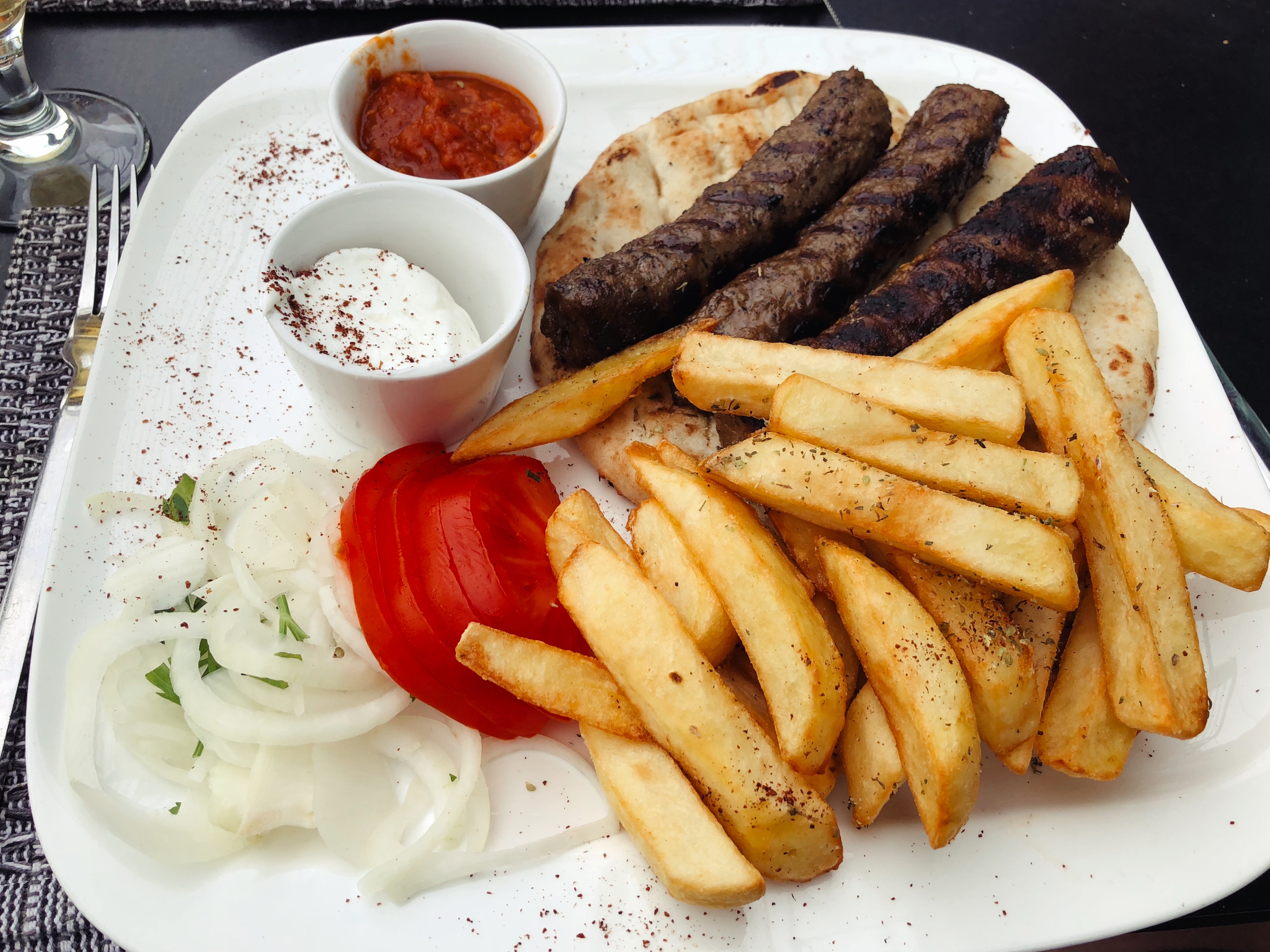
“It’s not going to be a glass half full evening, is it?” said my stepfather philosophically as he attacked the rest of his main, undeterred by any resemblance to Heinz’s finest. I had ordered the classic kebab, and I was delighted to discover that they no longer looked like the Photoshopped horror I’d been sent via Whatsapp. If anything, these were uncannily regular cylinders of meat – a mixture of beef and lamb, apparently – and I wasn’t sure whether I enjoyed them or if I was just relieved that they weren’t worse. They were nicely seasoned and although they were a little on the smooth and homogeneous side for my liking they weren’t unpleasant. They came with a yoghurt thicker and more pointless than Dominic Raab, and a tomato sauce which lacked any spice or heat at all. Nice chips, to be fair, but apart from that this was another dish that Bakery House does miles better for less.

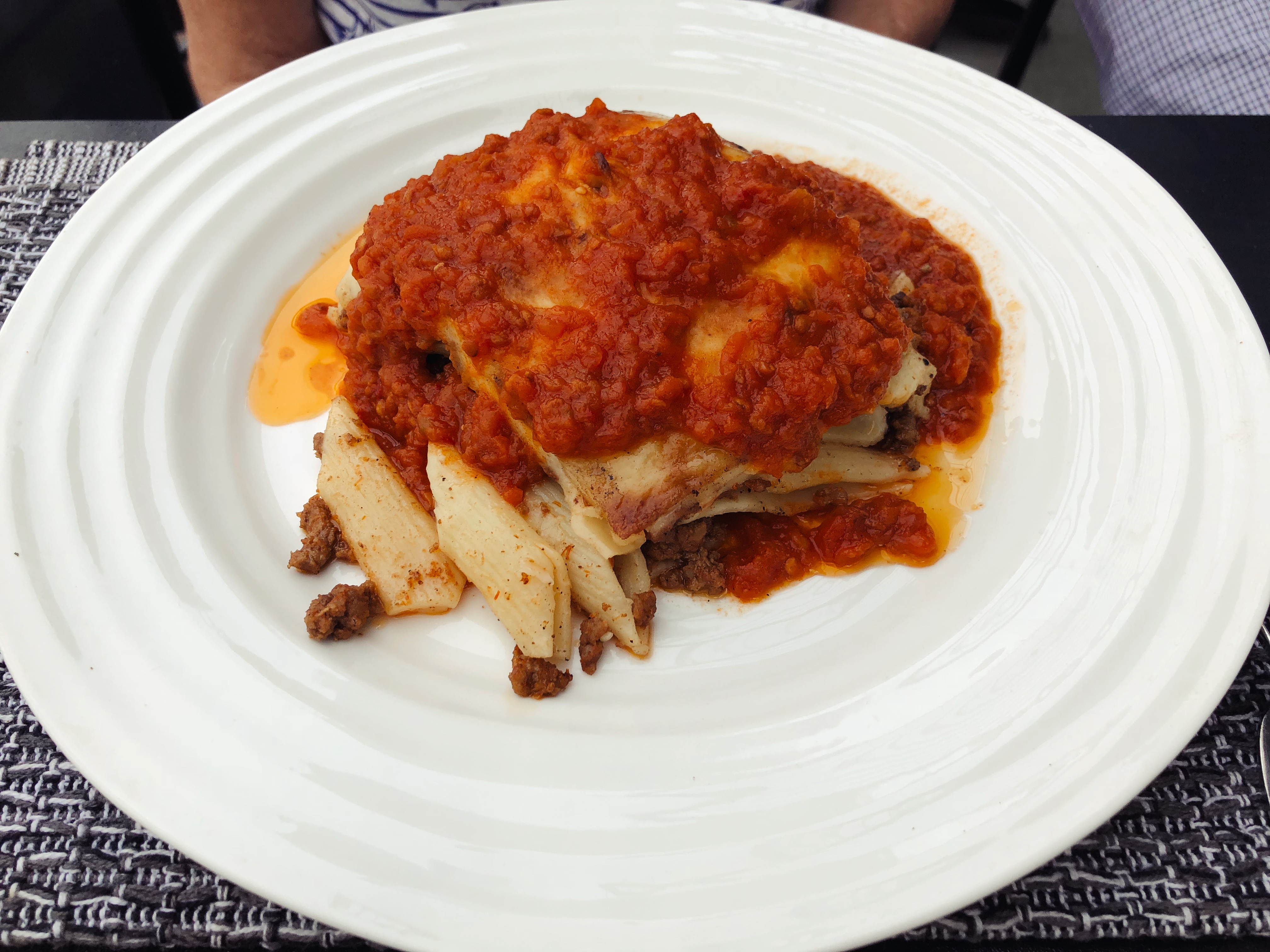
Even if the glass had been half full up to that point, it pretty much emptied when my mum started eating her pastichio, a sort of Greek lasagne which serves as an alternative to moussaka.

“This is sweet. It’s as sweet as a dessert. And there’s nowhere near enough mince. It’s just a sweet tomato sauce and some pasta. And the cheese! Well, it doesn’t taste cheesy.”

I tried some. You couldn’t knock her brevity: it would take me a whole paragraph to say a lot less.

“I think it tastes sweet because there’s definitely cinnamon in that tomato sauce.” I said, trying to put a brave face on it. Who was I trying to kid? The dish was a duffer.

It didn’t help that the accompanying Greek salad also didn’t pass muster. “It’s a nice olive” my mother said, “but it needs company.” A pity, because the feta was lovely and, again, I thought adding capers was a nice touch. But it’s difficult to argue with somebody saying that a Greek salad needs to contain more than one solitary olive.

We stayed for dessert, because I desperately wanted to give Lemoni one more chance. The big thing here is loukoumades, Greek doughnuts, so I ordered them with Greek honey and crushed walnuts. They were nicely irregularly-shaped, so obviously made by hand, but that’s as far as the plusses went. They were heavy, stodgy things, the shell not crisp and the inside a million miles from a fluffy cloud of joy. The honey was in a lake at the bottom rather than drizzled over the doughnuts, and the whole thing was heavy going. We didn’t finish them.

“Doughnuts ought to be a delight” said my mother, who by this point was turning into a one-woman Greek chorus of disapproval. “You should want to race through them.”

My stepfather’s bougatsa, custard in filo pastry, was better but still not right. I liked the custard very much, but this pastry didn’t have the same lightness of touch as our starters had had. Sawing through it with a knife felt like a slog. “It’s a bit tough” said – well, I’m sure you can guess who said that.

It won’t surprise you to hear that we also had to ask for the bill twice. Lemoni was busier than I expected on a Wednesday evening – the sun was still shining, the big screen on the Riverside was showing Wimbledon, people were sitting in the deckchairs on the opposite bank watching it and the beach bar was full of the kind of people who like the beach bar. It was a glorious evening, and if our meal had been better maybe we’d have been happy to sit there and digest and chat away with all the time in the world. All the best Greek food I’ve had – usually on holiday, but also in restaurants like Maida Vale’s scruffy Tsiakkos & Charcoal, or Notting Hill’s upmarket Mazi – is best eaten in a leisurely fashion, while you daydream of being somewhere in the Cyclades. But in this case, we just wanted to settle up and sod off.

Eventually, we flagged someone down and our bill – four starters, three mains, two desserts, two beers and some mineral water – came to ninety pounds, not including tip. Not hugely expensive, in the scheme of things, but when you consider that we barely drank it’s still a fair amount to spend on something so middling.

“You could come here and have quite a good meal” said my stepfather, “if you happen to order just the right things. Or if you ordered badly it would be terrible.” I nodded in agreement: I’d seen huge plates of what looked like home-made crisps turn up at other tables and I was thinking that if I’d just ordered those and some houmous I probably would have had a better, cheaper time.

So, there you have it: Lemoni isn’t the horror show I half expected, which just goes to show that anybody who reviews a new restaurant in the first month is making an error of judgment. But, even after three months of working on the pricing, the menu and the service it’s still deeply unspecial. Not better than Bakery House, not better than The Real Greek, not better than Kyrenia in its heyday. I don’t say that with any joy or any axe to grind – it would be a wonderful thing for the prime pitch in the heart of the Oracle to be occupied by a brilliant, distinctive, smartly-priced and well-run independent restaurant. But Lemoni is not that restaurant.

My closing thought about Lemoni was the saddest of all, because what my visit really did was make me think about Dolce Vita. Dolce Vita paid less rent than Lemoni, it charged more than Lemoni, it was busier than Lemoni, it did better food, it had better service and it closed for good last year. If Dolce Vita couldn’t make a go of it with so much in its favour, who would bet on Lemoni seeing out the year? More to the point: just imagine how wonderful Reading would be if a restaurant like Dolce Vita had occupied a spot like the one Lemoni has. How I wish we lived in a town like that.

Lemoni – 6.2
Unit 1, The Riverside, The Oracle, RG1 2AG
0118 9585247

https://reading.lemoniuk.com/