Standard Tandoori

N.B. Standard Tandoori closed at some point in 2020 with Flavour Of Mauritius set to open in their former premises. I’ve left the review up for posterity.

Reading’s food scene has come on in leaps and bounds in the time since I started writing Edible Reading, nearly three years ago. The Tasting House, The Grumpy Goat, Pop-Up Reading, Tamp Culture, I Love Paella, Roast Dinners Around Reading, C.U.P., Bakery House… hard to believe, perhaps, but back in 2013 Reading was a very different place. It makes me wonder what Reading might be like in 2019, whether people on the Reading Forum will be saying things like “do you remember Nando’s? Those were the days” and “what did that place on Gun Street used to be called? You know, the one that does Korean barbecue-ceviche fusion cuisine and has all those giant 3-D chess sets on the mezzanine floor”.

One thing Reading has always had, though, is iconic dishes. Whether it’s the suckling pig at Pepe Sale (which needs to be eaten to be believed, only on a Friday and Saturday night and only if you order it before they run out) or Kyrenia’s kleftiko, cooked into strands of surrender, whether it’s London Street Brasserie’s fish and chips, the Top Toastie at Shed or Beijing Noodle House’s glorious duck fried noodles there are some items on Reading’s menus that have attained almost mythical status. This week, I went in search of one I had missed.

It all started with a Tweet from regular reader Steven Burns (hi Steven!) a few weeks ago about Standard Tandoori. When I go there, he said, I have to make sure I order the “Standard Super Dry Fry”. Accept no imitations, he told me. But there was more. “It’s quite possibly my favourite thing in the entire Reading food scene. I try to save it for special occasions lest I tire.” That, ladies and gentleman, is an accolade I simply had to investigate. If he was right this could be another culinary Holy Grail to stick in Reading’s already overstocked trophy cabinet, and that was a prospect I simply couldn’t resist.

Standard Tandoori is on the edge of what is colloquially known as “Welshtown”, the warren of streets off the Caversham Road with names like Newport Road, Cardiff Road, Swansea Road, Barry Place. I noticed on my walk there that born again Mexican joint Maracas had closed, and made a mental note to cross it off my list (a lot of people think that’s a difficult spot, but Papa Gee and Standard Tandoori itself are in the same area and have been doing nicely for years, thank you very much). I also spotted a very tasteful Ercol chair in the window of Epoch3 and wished I had space for it in the spare room, but that’s another story.

Standard Tandoori is a bit unlovely on the inside. Standard also describes the tables, and is probably too high praise for the rather tired-looking conference-centre chairs in shabby red velvet. The big room is broken into sections by curious partition walls with a big porthole in the middle and a surprisingly tasteful lightshade filling some of that circular space. The partition walls are covered in wallpaper which is best described as “disco pebbledash”. It’s all a bit odd and I wasn’t sure whether I liked it or not, the restaurant interiors equivalent of modern art.

I hadn’t been for a while and the menu looked more tasteful and well set out than I remembered, in a font and format which pays a knowing nod to House Of Flavours, a place which has rather raised the bar for this sort of thing. I didn’t realise beforehand that Standard Tandoori is ostensibly a Nepalese restaurant, although I didn’t take full advantage of this. After all, I was hunting big game here: the Standard Super Dry Fry. The rest might well have turned out to be also-rans.

I don’t normally mention the poppadoms at Indian restaurants (and I don’t always order them), but these were noteworthy for what was there and what was missing. No mango chutney – which thoroughly discombobulated me – and in place of my beloved lime pickle something really interesting which looked similar but had pieces of what I think was pickled carrot. Sweeter and lacking that acrid sharpness of a really good lime pickle, but a lovely thing to start with. Eating at an Indian restaurant, in my experience, always involves a tactical decision about what food to leave. I finished the poppadoms gladly, even though I knew I was just postponing that decision to the end of the meal.

Starters, which arrived not long after, were a frustrating bunch. Macha pakora was soft white fish in thick, spiced breadcrumbs served with a little dish of tamarind sauce: not offensive by any means, and all done pretty well, but somehow unexciting. The breadcrumbs had a nice flavour and the colour and thick texture I associate with the recently endangered Findus Crispy Pancake. The fish was delicate, and the tamarind sauce was sweet, but somehow it still felt more like the stuff of Iceland than of eating out.

Lamb choila on the other hand, from the Nepalese section of the menu, was plain tough. You could see how the dish could have worked – the little hits of chilli, the curry leaves, the pieces of onion and little crispy ribbons of fried onion on top, all things that really could have enhanced some perfectly done lamb. But this wasn’t that: nearly all of it was edible but some was chewy in a way I didn’t enjoy. Much of it resisted the cutlery, and might have even defeated a steak knife. I left one piece in particular, because sawing through it was an effort beyond me.

StandardStarters

Service was friendly throughout – chatty, friendly, pleasant – but the starter plates were left in front of us for really quite some time. So was that single piece of recalcitrant lamb; I looked at it, wishing I’d left something else to cover it with. It made me wonder how my digestive system would cope with the rest, not at all an enjoyable exercise in mindfulness.

We were asked if we were ready for the mains, and by the time our starter plates were collected we pretty much were. Even so there was still a bit of a wait before they came out – not an unwelcome one, as it happened. It gave us time to drink a bit more of the house white, a pleasant and fruity sauvignon blanc which wasn’t overwhelmed by anything we had ordered.

I wanted to try a dish to benchmark the Standard Tandoori. I was tempted by the chicken achari, a sweet and sour number with mango which sounded right up my alley, but in the end I went for karahi lamb, curious to see if it could compete with Bhoj’s glorious, sticky interpretation of that dish. It was clearly some relation, but perhaps a step-sister: the lamb wasn’t as tough as that in the choila but it didn’t fall apart the way I wanted it to. It wasn’t quite as dry and savoury as at Bhoj, so there was plenty of sauce. Lots of chillies in there too, inviting you to eat them or leave them (I hedged my bets – by this point I’d got quite used to doing so). The taste felt less smoky, less complex, more route one. The fried onions on top were – again – a nice touch, although probably also an exercise in diminishing returns by this point.
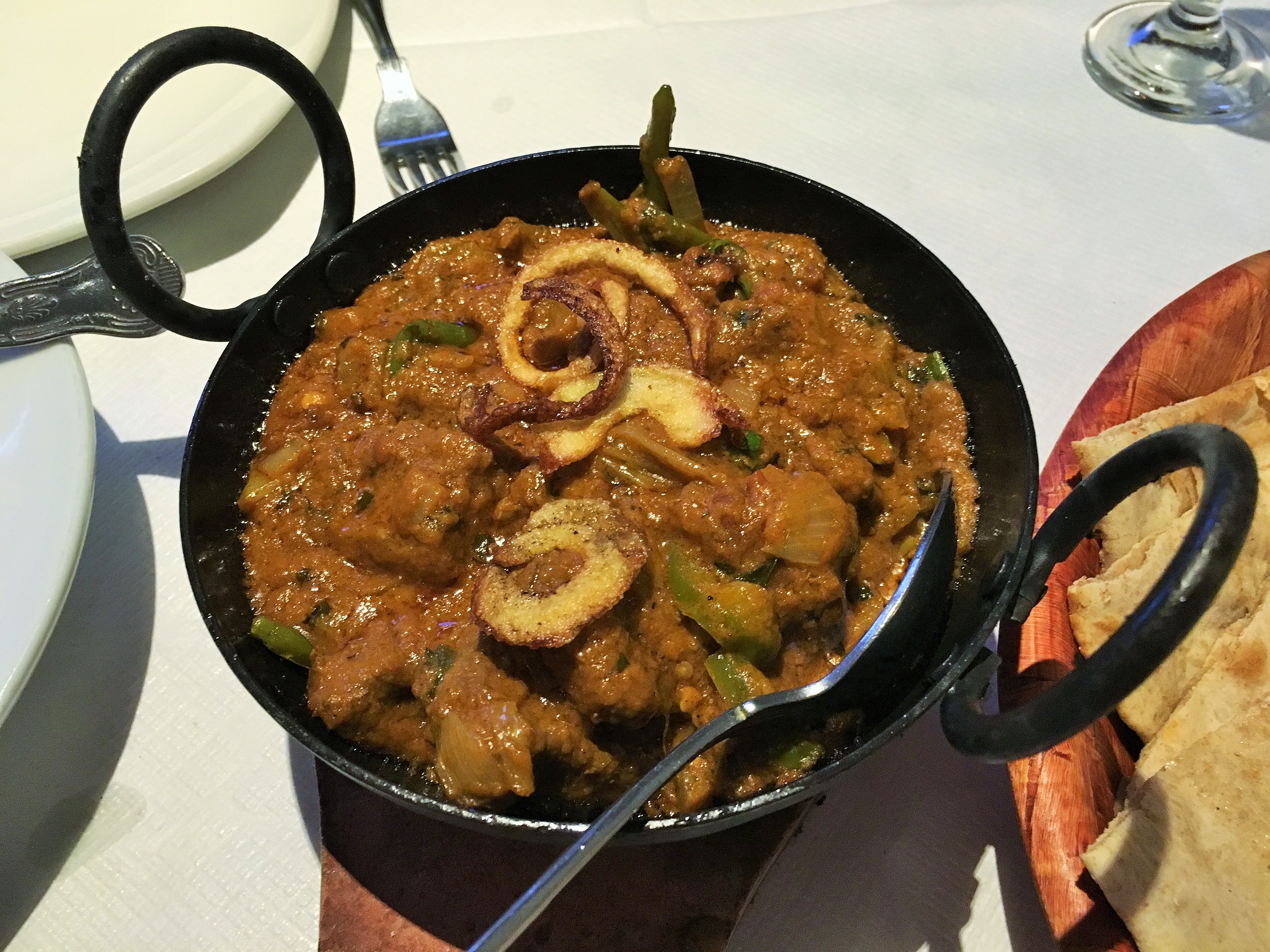
StandardKarahi

The fact that there was plenty of sauce was handy for the pilau rice and the paratha. The rice was good – only so much you can say, really, but nice to see some cardamom pods strewn in there, booby traps though they are. The paratha was a bit of a poor excuse, I thought. I’m used to beautiful, rich, buttery multi-layered paratha, almost like a savoury croissant, whereas this just felt like two wholemeal pitta breads stuck together like limpets. If the sauce had been better, I’d have been sadder; scooping is a beautiful, magical thing, but it just wasn’t happening that night.

Finally, the star of the show: the Standard Super Dry Fry. It was a good example of how appearances can deceive, because when it arrived I did find myself thinking “is that it?” It looked like the kind of Campbell’s Cream Of Tomato Soup based curry I’ve spent my whole life trying to avoid ordering (and failing every single time I set foot in Reading’s now-departed old school Indian restaurants like Khukuri and Gulshan). Well, as it turns out that did it a disservice.

It did what it said on the tin: properly dry, the sauce condensed down to be sticky and intense. The chicken was beautifully cooked – again, on the dry side but perfectly so. And I do agree that there’s something about that sauce. It’s almost the perfect curry, I would say: the balance of spice, nowhere near overpowering, was interesting enough to appeal to people who would normally opt for the beigeness of a korma or a pasanda, while the taste was sufficiently complex that chilli demons too might give it a whirl. More fried onions, too, because that seems to be a hard habit to break. I really liked it, and I’m glad I tried it. Was it alone enough to justify a trip to Standard Tandoori? Yes, probably just about. Would I go back specifically to have it again? Probably not.
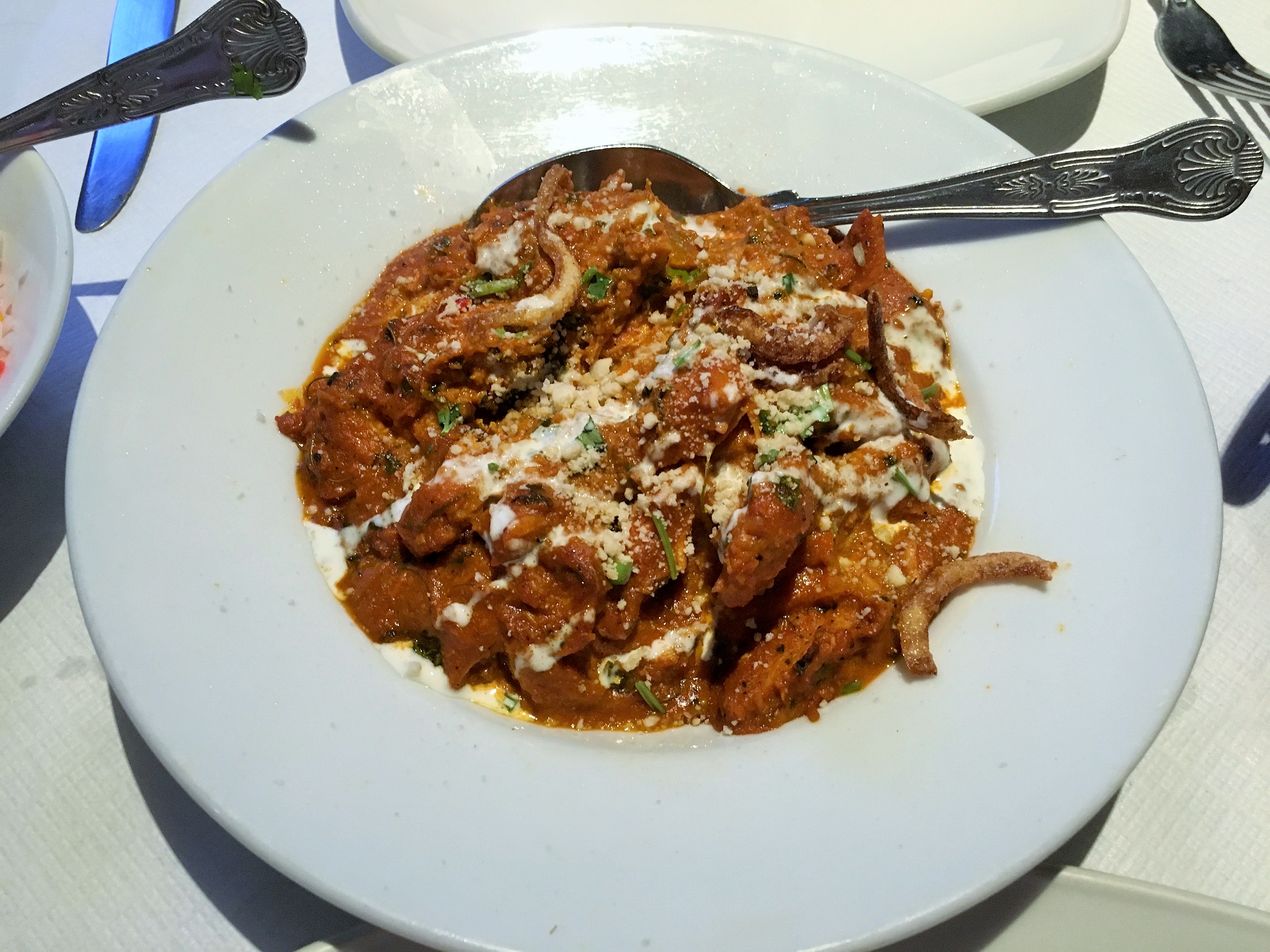
StandardSDF

I would have had a pistachio kulfi for dessert if I hadn’t been so full (and the one I saw at a neighbouring table looked quite lovely) but as I implied earlier, all meals in an Indian restaurant – like all political careers – end in defeat. I waved the white flag with some rice, some karahi sauce and one limp quadrant of paratha in front of me. It probably tells you something that every single morsel of the Standard Super Dry Fry was gone. I found room for the Elizabeth Shaw style mint that came with the bill, though, because if you can’t eat that something has gone badly wrong. The whole thing, with those two glasses of wine, came to forty-two pounds not including tip. I felt full, I felt a little bit underwhelmed, but I certainly didn’t feel ripped off.

Standard Tandoori, like many of Reading’s old stagers (Garden Of Gulab, I’m looking at you here) feels like a restaurant which may well have been amazing once and is now merely good. I’m glad I went, and I’m glad I tried the Super Dry Fry, although it won’t be ending up in my metaphorical trophy cabinet of iconic Reading dishes. But perhaps that misses the point, because the map of Reading will look different for each of us. For me it will always be about the karahi lamb at Bhoj, or the jeera chicken starter at Royal Tandoori, a plate of chicken festooned with toasted cumin seeds which gets more delicious every time I have it. Your mileage will undoubtedly vary, and life would be very boring if we all went to the same places all the time (plus, people would have worked out who I am by now). For me at least, the search for the next big thing continues. But then again, there wouldn’t be much of a blog for you to read if it didn’t.

Standard Tandoori – 7.0
141-145 Caversham Road, RG1 8AU
0118 9590093
http://www.standardtandoori.co.uk/

Chaiyaphum, Cane End

N.B. Chaiyaphum closed at some point over the last few years. I’ve left the review up for posterity.

I have a funny relationship with Thai food, I think. It would never be my first choice when suggesting a meal out with friends but when I go to one I always like it. “Like” is the operative word here, though: I rarely love it. It would probably take a more discerning palate than mine to distinguish between the fishcakes or the pla chu chi I’ve had at all the Thai restaurants around Reading. So instead it comes down to the price and service, arguably the cherry on the cake rather than the cake itself. Sometimes a single dish will stand out, but my meals at Thai restaurants have generally been been solid and respectable – neither stellar nor sad, just somewhere comfortably in the middle.

This all dawned on me, as it happens, when I sat down at Chaiyaphum and started to go through the menu.

The decision to go to an out of town restaurant seems to happen increasingly when I am on a vegetarian week – for those of you new to the blog, my New Year’s resolution last year was to review one vegetarian main course per month – and here I was again, jumping into the car to go and eat tofu (not sarcasm: I was actually looking forward to trying the tofu). Chaiyaphum is up on the A4074 just before the turning for Gallowstree Common, the road towards Oxford which, like hundreds of others across the UK I’m sure, has the nickname “the seven bends of death”. The building itself is an old red brick pub on a crossroads where I can imagine highway robbery used to happen (ironically I once ate at the Pack Horse just down the road, where it was still very much taking place).

Inside, though, you’re under no illusions that you’re in a restaurant not a pub. Goodness, but it’s purple. The walls are purple. The ceiling is purple. We’re talking somewhere between Dairy Milk and Quality Street purple. Properly purple. That makes it sound awful, but actually I rather liked it, and the whole thing is decked out with statues of Buddha, art and artefacts, a picture of the Thai king and queen and, incongruously, a whacking great piano in the bar area. We ate in the room off to the right, a split level affair, with a nice view out onto the garden. A few tables were reserved when we got there, which was encouraging as we were literally the first people to arrive.

I don’t normally talk about background music in a restaurant, but I’m going to make an exception here just to say that Chaiyaphum had managed to get hold of the most surreal easy listening album of all time. I’d never heard hotel lobby soft jazz cover versions of Womaniser, Moves Like Jagger, Sweet Child O’ Mine and The Only Girl In The World before, and I can safely say that if I never do again it might be too soon. It took me right back to the Nineties, when adverts on late night ITV would proudly offer compilation CDs which were “not available in any shops”, usually with good reason.

Anyway, back to the food. The menu was almost identical to every other Thai restaurant menu I’ve read on duty, which made me wonder whether what we get is the anglicised version, watered down just enough to make it seem exotic yet safe. And therein lay the problem for Chaiyaphum, something I was pondering throughout my meal there – because when a restaurant is a little way out of town, especially when you have to drive to get there, being much the same as other local Thai restaurants just isn’t going to be enough. It has to be better, cleverer, more distinctive: otherwise why make the effort?

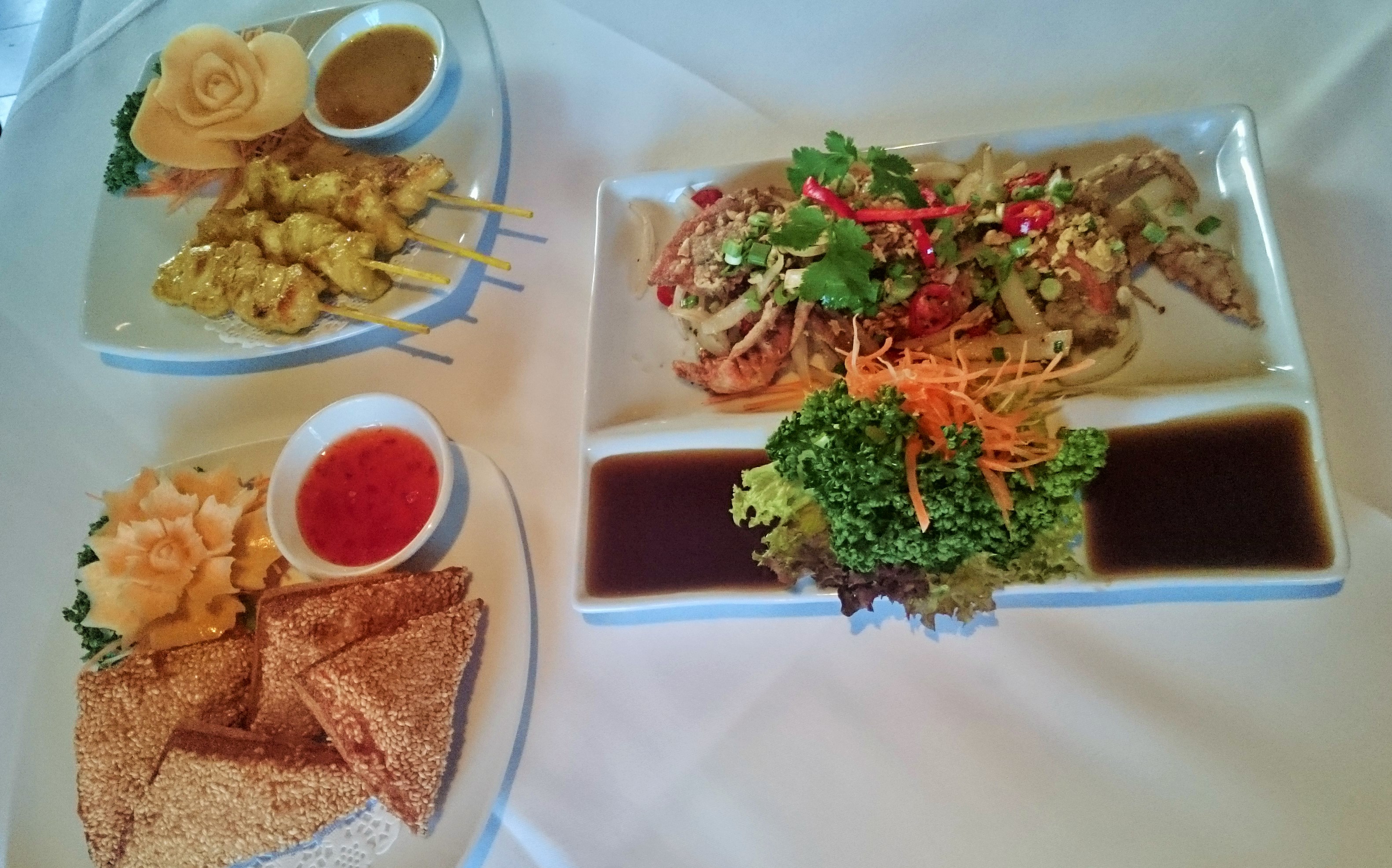
The starters were a mixture of the safe and the unknown. Starting with the safe, the chicken satay was a pretty good example. I think the meat was thigh rather than breast – always a good thing, in my book – but either way it was juicy and well marinated, tender with (I’d guess) some lemon grass. The satay was also good: deep, rich and earthy, although I always wish there was about twice as much sauce. But, and you can see the trend starting to come through loud and clear, it was good but not great. The sesame chicken toasts were just lovely, and eating them made me slightly sad that Thailand has this and we just get fried bread. It’s probably hard to excite anybody writing about these – I mean, you know exactly what they will look like, what they’ll taste like, how they will be, that exquisite balance of crunch and tenderness. And yet they rarely disappoint: these certainly didn’t, covered with sesame, packed with chicken and then fried to the point of decadent filth. I dipped mine in the small pot of chilli sauce (again, wishing there had been a little more) and thoroughly enjoyed it, but I knew I’d hardly taken a risk.

ChaiyaStarters

The third starter was more of a venture into the unknown, mainly because I find it very hard to turn down soft shell crab when it graces a menu with its presence. It came battered and fried, obscured by a cornucopia of other lovely things – lots of finely chopped garlic, fried onion, spring onion and a fair few slices of red chilli. I liked this dish an awful lot – the crab was delicious, the batter was light and delicate and all the gubbins on top really made every mouthful magnificent. It came with two pools of brown sauce – the menu describes both a pepper sauce and a Thai garlic sauce and I have no idea which this was but it really wasn’t needed and didn’t add an awful lot. At the end, after the crab was demolished (and it didn’t take long) we raced round the plate with our forks making sure not a scrap of the nice bits was left: all that remained were the sauces and the ubiquitous vegetable flower.

Main courses continued the trend. Gai pad himmaparm, recommended by the waitress, was a good example of a Thai chicken stir fry. This one had cashews, a few pieces of halved baby corn and plenty of vegetables – why is there always so much onion? – and was decent if not outstanding. The sauce was rich with chilli and especially garlic (nobody has ever gone wrong by giving me too much garlic) and was tasty but not life-changing. As so often with these things, it came in a flat shallow dish which meant that not only wasn’t there enough sauce but what sauce there was was blessedly difficult to get on to your plate, stirred in with the coconut rice where it belonged.

ChaiyaChicken

I’d been looking forward to the massamun tofu. Ordering it was, to some extent, playing percentages: I figured that one of my favourite things about eating Thai food was that glorious mixture of slightly sticky coconut rice and a sweet, spicy sauce, so if the tofu didn’t work out I would still get to enjoy most of the dish. The tofu itself wasn’t bad – you got lots of it, big hefty pieces, and they had some texture and contrast to them. That said, there was a slightly sour taste to it which seemed odd against the massamun sauce. The sauce itself also didn’t quite work – all sweet, no savoury, not enough punch or spice. Perhaps, because it was a vegetarian dish, there wasn’t any fish sauce in it to add that contrasting note. The potatoes in it, weird corrugated edges and all, were soft and floury and not quite right. Ditto for the slices of carrot, again tinned-vegetable soft. There were a few crisped fried onions on top, but not enough. By the time I got to the rice and sauce stage, ostensibly the highlight, my heart just wasn’t in it.

ChaiyaMassamun

We both had coconut rice – the waitress asked if we wanted one between two and we decided against it, but we should have listened to her as one would have been quite enough. It was – bit of a theme here, isn’t there – pleasant: edible but not incredible.

We’d over ordered on the starters (wilfully if I’m honest, in case the whole tofu thing didn’t work out) so there was no chance of having dessert. We both had a glass of house sauvignon blanc – nice, fresh and easy to drink, if perhaps not quite as cold as I’d have liked – to start, and my companion also had a bottle of Tiger, after being told at extensive length about all the beers that were currently out of stock. I had a diet coke and didn’t hugely feel like I’d missed out.

Service was lovely. There seemed to be two waiting staff on and they were looking after quite a lot of tables, but regardless of how busy they were they were friendly, polite and happy to make recommendations. Beautiful uniforms, too – maybe a funny thing to notice, but there you are. The food took just about the right amount of time to come out, and all the other tables looked happy. I saw families with small children, a couple of chaps enjoying dinner together and, just across from me, a birthday celebration (with the exchange of bags from Fortnum & Mason – fancy!). They all looked like they were having a brilliant time, and I wondered why I wasn’t quite so enamoured.

The total bill, including a ten per cent service charge, was sixty-three pounds. Interestingly that service had been pre-added – perhaps the south Oxfordshire red trouser brigade (there was a very eye-catching example right next to my table, a veritable rhapsody in scarlet: I could barely stop gawping at him) aren’t so keen on tipping the staff. Anyway, it all seemed fair enough to me and the service was one of the high points so I wasn’t bothered, though I can imagine it would rankle with some diners.

As we drove away we were discussing whether Chaiyaphum was good enough to merit a drive out of town. As you can probably tell by now, my answer is not really. It’s by no means a bad restaurant: the food was decent, the service was charming, the room managed to be bling and tasteful at the same time, purple paint and all (I did find I left really wanting an individually wrapped hazelnut in caramel: the power of subliminal advertising). But ultimately, there is no USP for Chaiyaphum unless you live round the corner. It’s stylish, but so is Thai Table. The service is friendly, but it’s just as good at Thai Corner. The food is quite nice, but Thai food seems to be quite nice everywhere, and never better than that. Ultimately, it’s just not enough to get me to leave Reading and head for the Chilterns. Maybe this restaurant is for the red trouser brigade and they see it the other way round: because they can go to Chaiyaphum there’s nothing to make them go into town. Each to their own, and thanks but no thanks. Maybe next time I’ll go to Oli’s Thai in Oxford, which I’m told blows them all out of the water.

Chaiyaphum – 6.8
Reading Road, Cane End, RG4 9HE
0118 9722477

http://chaiyaphum.co.uk/

Dhaulagiri Kitchen

To read a more recent takeaway review of Dhaulagiri Kitchen, click here.

I never go anywhere expecting to have a bad meal – I mean, why would you? – but if I’m honest there are occasions where I step through the front door of a restaurant and I get a bad feeling right from the off. The welcome is disinterested, or the furniture is tired, or the menu looks uninspiring or the music is awful. I’ve not even eaten anything yet, but from that point onwards I’m hoping that my preconceptions can be turned around. Sometimes they are, but usually they’re not: for some reason if it looks like an iffy restaurant and it feels like an iffy restaurant, more often than not it turns out to be an iffy restaurant.

Of course, conversely there are times where you just get a good feeling from the moment you take your seat. But this isn’t so straightforward; I’ve been to many places that looked right and felt right, places where the menu makes you hyperactive with indecisive excitement but still, there can come a point in the evening where you realise you’ve settled down to a duff meal. When that happens I chalk it up to experience, I make mental notes, I come home and I write a review where I try to be kind, knowing that most of you will look at the number at the bottom, possibly skim the rest and say – to yourselves, to friends or to other halves, Well I won’t be going there then. Them’s the breaks. They can’t all be hidden gems. They can’t even all be gems, let’s face it.

The reason for all this preamble is that Dhaulagiri Kitchen won me over right from the start. I liked it, I wanted it to succeed, I was rooting for it. And as a result, because I like an underdog and I wanted it to do well, eating there was a surprisingly nervy experience, a bit like walking a culinary tightrope except that I wanted them, rather than me, not to put a foot wrong.

Subscribe to continue reading

Become a paid subscriber to get access to the rest of this post and other exclusive content.

Cosmo

How do I sum up the experience of eating in Cosmo? How can I possibly distil such a complex experience, so many different types of food, into a single review? Well, maybe I should start at the end of the meal. There were four of us round the table (I know: people actually wanted to come with me!), looking at our largely empty plates, feeling a mixture of remorse and queasy fear about how our bodies would cope with what came next. Tim, chosen for this mission because he is one of the biggest gluttons I know, paused for a second and said “I don’t think this place is going to help anybody have a healthy relationship with food.”

There was further silence and the rest of us tried to digest what he had said (trying to digest, it turned out, would be a theme over the next forty-eight hours).

“I don’t really feel like I’ve eaten in a restaurant this evening.” Tim went on. “I just feel like I’ve spent time smashing food into my mouth.”

I looked down at the leftovers on my plate – a solitary Yorkshire pudding stuffed with crispy duck and topped with hoi sin (it was my friend Ben’s idea and it sounded like a brilliant plan at the time) and started to laugh hysterically. It might have been all the sugar in the Chinese food, the sweet white crystals on top of the crispy seaweed, but I felt, in truth, a little delirious.

Subscribe to continue reading

Become a paid subscriber to get access to the rest of this post and other exclusive content.

Royal Tandoori

I sometimes envy other restaurant reviewers. Michelin has its stars, the AA has its rosettes, even the much-maligned TripAdvisor has its Certificates Of Excellence. And what do I have? Just a bunch of ratings nobody really understands which I’ve consistently refused to explain (“What do they mean?” said a friend of mine down the pub recently. “I mean, seven point five, what’s all that about?”). Well let’s not go through all that again but there’s one exception, and that’s what I call the 8+ Club: without giving too many trade secrets away, a rating in that range means a place is really, really good. Go again good, plan your next visit good, evangelise to friends good.

Subscribe to continue reading

Become a paid subscriber to get access to the rest of this post and other exclusive content.