Restaurant review: The French House, Soho

It would be easy to envy London-based restaurant reviewers, I think. Just imagine having such a broad canvas, such an embarrassment of riches, every kind of restaurant at every level, from the plush, spenny Mayfair spots A.A. Gill used to frequent to the unsung cash-only middle-of-nowhere places Vittles has made its speciality – and, I suppose, everywhere in between. Like Samuel Johnson almost said, imagine getting tired of the London restaurant scene! How jaded you would have to be.

And yet… I don’t know. I think there are huge consolations to being a gastronomic tourist in the capital. For a start, everyone writes about London restaurants. All the critics, all the Substackers, all the people jabbering to camera in their weird self-parodying voices on TikTok. It would be exhausting to be in that pack of misfits, let alone trying to keep pace with them.

It’s all about the urge to be first – to get to the new place before everybody else, or to get there at the same time but say it better. We have reached the point where various critics have visited, say, Josephine in Marylebone in recent weeks and come down solemnly on either side of the fence, saying it’s great or bobbins, as if they’re handing down Supreme Court judgments. And really, who cares?

Well, if you’re invested in it I’m sure you do but from a distance it feels like the kind of Inside Baseball stuff that only interests a small number of people. There are at least a couple of Substacks specially for those people, too: I imagine if you fancy a very niche printed word take on Gogglebox they’d be catnip to you.

No, I quite like being free of all that. I get it in Reading, that if a new place opens people want to know what it’s like and that makes me want to get there fairly soon after it opens; if you’re hankering for a review of Nua, or Pho 86 or even Take Your Time, the new spot that’s opened where Dolce Vita used to be, don’t worry. I will get to them, I promise.

But to have that feeling amplified to the max, to see all these hot new places and know you only have so many evenings, so much time, so many spare calories, so much money? I don’t envy any of them that, not even the ones whose decisions are made infinitely simpler by choosing the restaurants that bung them cash, free food or both.

Of course, there’s also the FOMO I always associate with big cities. It’s bad enough when I go on holiday to, say, Lisbon, and the infuriating brain that has unhelpfully held me hostage all my adult life – the one I struggle to quieten – looks at all the places on my narrowed-down shortlist before piping up about every single restaurant that didn’t make the cut. What about all of these?

Don’t get me wrong, I loved Lisbon, I ate well there and people tell me my city guide is very useful. But for each list of places I visit there is always an equal and opposite running order of the ones I didn’t choose, all taunting me with the possibility that they might have been even better. I copy-paste them into a new note entitled Next time when I get home, but mainly to try and fool myself.

So I am very comfortable with my relationship with reviewing London restaurants. I get to places I have always wanted to visit – a real mix of the old and new, no real guiding principle behind them except that I fancy them. Often it means things go brilliantly and I make a favourite new discovery, sometimes I’m underwhelmed by somewhere that has been hyped to high heaven (Chick ‘N’ Sours has since closed). But even that is as it should be: if I loved literally everywhere I went in London I’d be no better than Eating With Tod and the world of food doesn’t need another Toby Inskip. It already has one Toby Inskip too many.

All that explains why Monday morning found me outside Flat White on Berwick Street ahead of a lunch reservation in Soho, at the French House. David Schwimmer – all in black, bags under his eyes, baseball-capped, quiet and polite – had just been in there grabbing a coffee and the staff, who were probably discovering him on Netflix for the very first time, were decent enough not to act starstruck. And then someone even more celebrated crossed my path – my friend Graeme, my lunch companion that day, merrily wandering aimlessly through Soho after a morning spent shopping.

So off we walked to the French House together. Our lunch had been a spur of the moment thing: it was the last Bank Holiday before Christmas, and we were both at a loose end. His wife was away camping, mine was at work so we decided to indulge in one of life’s great joys, a leisurely lunch on a day when you’d ordinarily be at work, a Monday stolen back from the cosmos.

The French House is one of London’s great pubs, which means that it’s one of the world’s great pubs, and it’s been a favourite of mine for many years. I’ve lost count of the number of times I’ve sat downstairs in among the regular churn of Soho types, tourists and people passing through, drinking Breton cider and chatting away to those I already knew and, often, others I didn’t know from Adam.

I’ve introduced a fair few people to it over the years, too – including Graeme, who had never been – and I never tire of seeing them fall for it the way I have. The acclaimed Devonshire is an attempt to manufacture a classic in the laboratory – and don’t get me wrong, the people in that lab are experts and I’m sure they’ve done an outstanding job. But the French House is the real deal.

I won’t bore you with the trivia – all that stuff about de Gaulle getting drunk there in exile, or Dylan Thomas drinking there, or Lucian Freud. You can read about that anywhere, and my interest on that sunny day was mostly about the dining room upstairs. That too has a storied history, by the way.

Fergus Henderson cooked there over thirty years ago with his wife, before leaving to set up some unsung joint called St John. I ate there nearly fifteen years ago back when it was Polpetto, an offshoot of Russell Norman’s Polpo, just after it opened; celebrated chef Florence Knight was in the kitchen, near the start of her career. Then Polpetto moved elsewhere, and went the way of the rest of the Polpo empire, and that room above the pub lay dormant.

But seven years ago chef Neil Borthwick took it over, offering a pared-back menu of French classics, and I’ve pretty much wanted to eat there ever since. I’ve even booked it a couple of times, and then ended up having to cancel, or choosing to go elsewhere. The thing is, the French House is that unusual thing in this day and age: an almost homework-proof restaurant.

You won’t find a current menu online anywhere, and the restaurant’s website directs you to an Instagram feed with pictures of the latest menu. It last posted in May last year, so all you can get is a vague idea of the sort of things you might eat. So Graeme, a man with a sense of adventure, was the perfect wingman for this one. He also quite fancied lunching at venerable Mayfair pub The Guinea Grill (“it serves meat pies with sides of offal” was his rationale), but agreed that the French House would suit him just fine.

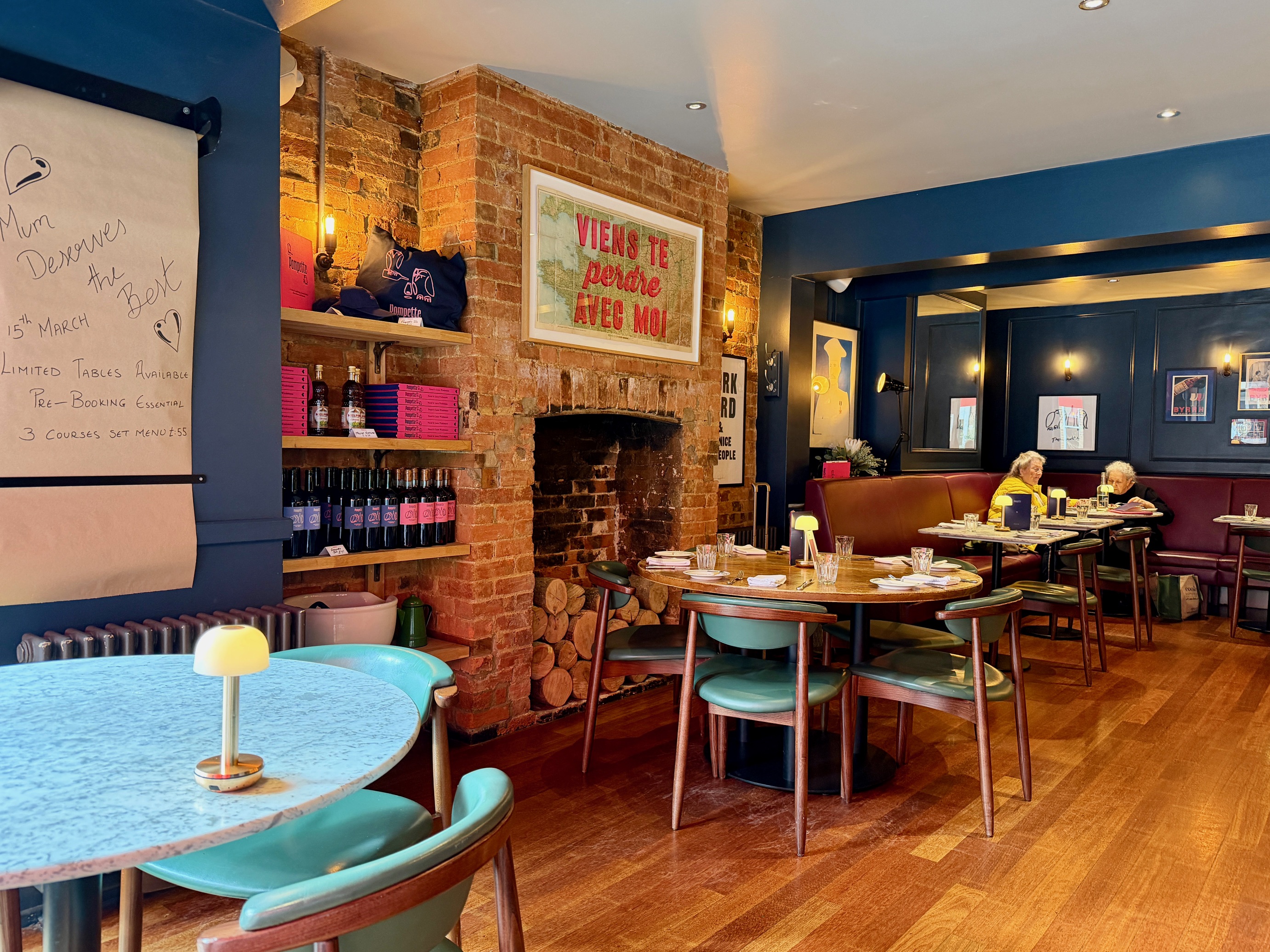
It’s the loveliest dining room, a small and peaceful space above the small and boisterous bar underneath. It has a strange kind of placid calm, all oxblood walls and wood panelling, tasteful black and white prints everywhere paying tribute to the pub’s past. I don’t think it seated more than 16 people and was almost full when we were there, with a second sitting coming along towards the end of our lunch. You could almost be anywhere, but you wouldn’t necessarily think the clamour of Balans, of Bar Italia, of Ronnie Scott’s, Bar Termini and all those branches of Soho House were the other side of those big, handsome windows.

The menu was handwritten and changed daily, another thing the Devonshire probably likes to pretend it invented. Here was a novel experience, my first chance to see an actual French House menu with today’s date on it, let alone one written in 2025. It was a thing of beauty, restrained and limited. Four starters and two mains, bolstered by a blackboard listing specials: two more starters, two more mains and a couple of bigger sharing dishes, a huge pork chop or a cote de bœuf.

When you handwrite a menu every day, I don’t really understand the logic of also having a blackboard, but perhaps the specials were in shorter supply and doing it that way saved them drawing a line through all sixteen menus.

The French House is also, by the way, far from being a prohibitively expensive place to eat. Most of the starters were £12 and the mains, excluding those sharers, were between £28 and £35. But before we were ready to make our choices we had an apéritif, a drink marked on the menu as Today’s Tipple.

I’d never heard of a Pousse Rapière before, but it turned out to be an orange cognac liqueur from Charente mixed with English sparkling wine and it was properly divine, like a Kir royal for ponces. I was very taken with it, and one of the two servers brought the bottle over to show us what was in it. “You can probably buy it in Gerry’s” she said, but sadly the Old Compton Street booze emporium was closed that day.

Although the menu changes every day, I’m not sure I’ve ever seen any version of it that didn’t include Graeme’s starter. Sourdough toast came slathered in goat’s curd but then the pièce de résistance, the thing that propelled this dish into the stratosphere, was the entire bulb of confit garlic crowning the whole affair. You just had to ease out a clove – a process which took minimal effort, as far as I could see – smoosh it on your toast and curd and heaven was a forkful away. I always let my dining companion choose first, and Graeme nabbed this. But if he hadn’t, I would have ordered it and this paragraph would have been even more of a paean of praise.

I on the other hand chose from the specials menu and was rewarded with an equally worthy example of the genre known as great things with toast. The French House’s steak tartare was not only one of the best I’ve had but arguably the most classic. This is a dish I’ve enjoyed all over the place – at Marmo in Bristol, in Paris, Bruges and Montpellier, and usually everyone tries to put their spin on it, whether that’s relying on a fudgy, slow-cooked egg, smoking the beef or spiking the whole thing with gochujang.

But I think it’s at the French House that I had this dish at its most textbook. No whistles and bells, no twists or gimmicks. Just gorgeous beef with plenty of capers and, at a guess, finely chopped cornichons, that stupendous alchemy of salt and sharpness that makes this dish, at its best, an unalloyed pleasure. They did a larger version of this dish with frites, too, but I was happy to have the smaller option, streaked with rays of golden sunshine from that broken yolk, a perfect precursor to what lay ahead.

The French House’s wine list is a curious one in that there’s nothing that cheap on it but, simultaneously, a lot that isn’t ridiculously expensive (it also, refreshingly, contains a reasonable number of half bottles). I wish I’d taken a photo but it did seem like a lot of the bottles were £50, and the one we chose, an Alsatian pinot gris, definitely was.

It was by Famille Hugel, as were many of the other options, and for what it’s worth I found it delightful. It felt like a dangerously easy to drink white that could quite happily smudge the sharp edges of an afternoon, and both Graeme and I were more than in the mood for that.

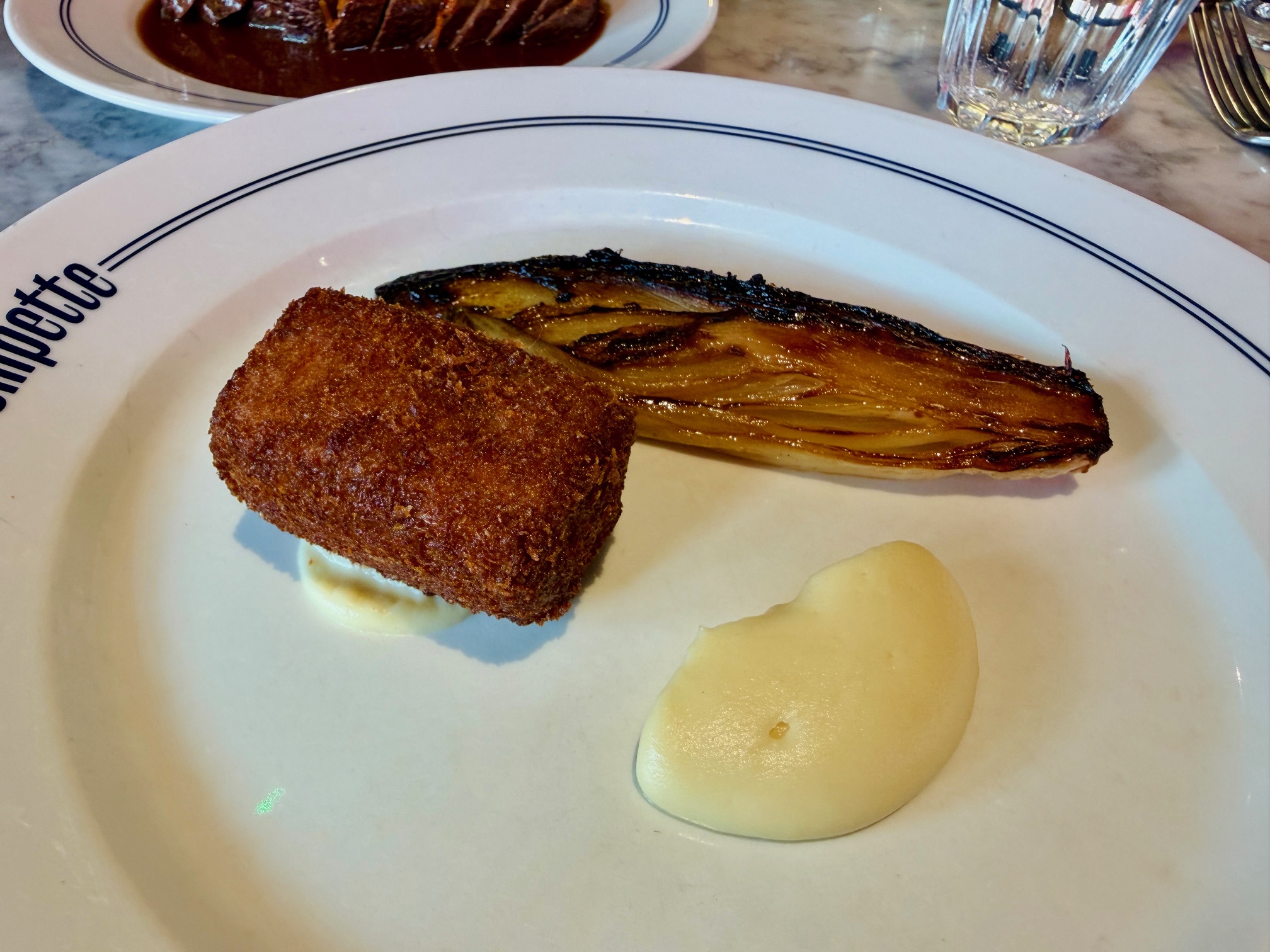
It went superbly, I suspect, with Graeme’s main course which was another masterpiece of simplicity. Three muscular, golden lengths of monkfish tail, mostly off the bone, came resting on a little mat of steamed spinach, served with ribbons of fennel and a glossy purée: the menu suggested it was fennel, too, but Graeme wasn’t so sure about that.

Graeme loved this dish, and rhapsodised about it from start to finish. A bit of a flex, as people younger than me like to say, from someone who had been agitating in favour of a sturdy pie with an offal chaser, but that’s one thing I really like about Graeme: he, more than most people I know, properly contains multitudes.

The words describing my main leapt off the blackboard and onto my lips when the server asked us what we wanted to order. Well, two words did anyway, confit duck. I find it so hard not to order it in restaurants but my lack of imagination is rarely rewarded quite as profoundly as it was at the French House. A huge duck leg came with a bronzed carapace, some of the fat remaining underneath but much of it sacrificed to achieve the happy medium of yielding meat and skin like crackling.

So often confit duck doesn’t quite achieve that balance, or it does but it’s too small, or it doesn’t and it’s too small. Rarely is it as beautiful, and substantial, a wonder as this. I could eat this all the live long day, or perhaps more realistically once a week, but maybe it’s for the best that it’s a far more irregular treat in real life. It came on a rib-sticking pile of lentils shot through with carrot, celery, ambrosial lardons: there might even have been some braised lettuce in there, but that may have been my imagination playing tricks.

This was a complete plate of food in a way many dishes never are, to the point where I didn’t envy the neighbouring table the very attractive portion of frites they took delivery of partway through my eating this. Well, almost: I think I 90% didn’t envy them. 75%, perhaps.

Time spent with a good friend is a bit like a really happy dream, in some respects. When you look back you know you had a wonderful time but you can’t remember the specifics of what you said. So Graeme and I caught up on his house move, our families, the impressive women we’d fluked our way into marrying, his belief that he was still the best Doctor Who we’d never had.

We also shared a firm conviction that summer wasn’t over until it was over, frustrated by the widespread defeatist doom-mongering on social media that it was as good as autumn already. A lunch at the French House felt like a brilliant way to rage against the dying of the light brought about by the impending end of British Summer Time. See? I slipped in a Dylan Thomas reference after all.

I had read everywhere that you had to order the French House’s madeleines, but also that they were baked to order and took fifteen minutes, so I persuaded Graeme that we should order them and another dessert to tide us over while they were prepared. Oh, and a dessert wine to enjoy into the bargain. Again, our server gave us loads of brilliant advice about that section of the drinks menu and we ended up sipping a Petit Prince de Guillevic, which was a bit like a pommeau, made with eau de vie and cider.

It was heavenly, and transported me to the first time I tried pommeau, on a holiday to Normandy with my dad the best part of twenty-five years ago. It also reminded me that I have a bottle of a British equivalent, brought out this year by Herefordshire’s Little Pomona, in my garage and that I really should enjoy it before the clocks go back.

I gave Graeme first choice of desserts, not wanting a repeat of the chocolate mousse incident from three years ago, and he eschewed the chocolate mousse so I felt it was my duty to, well, chew it. It was truly glorious, a dense boozy sphere of the stuff redolent with rum and served with just the right amount of excellent crème fraîche to stop it being too much. By which I mean too much for most people: it was absolutely fine for me, but I loved the crème fraiche all the same.

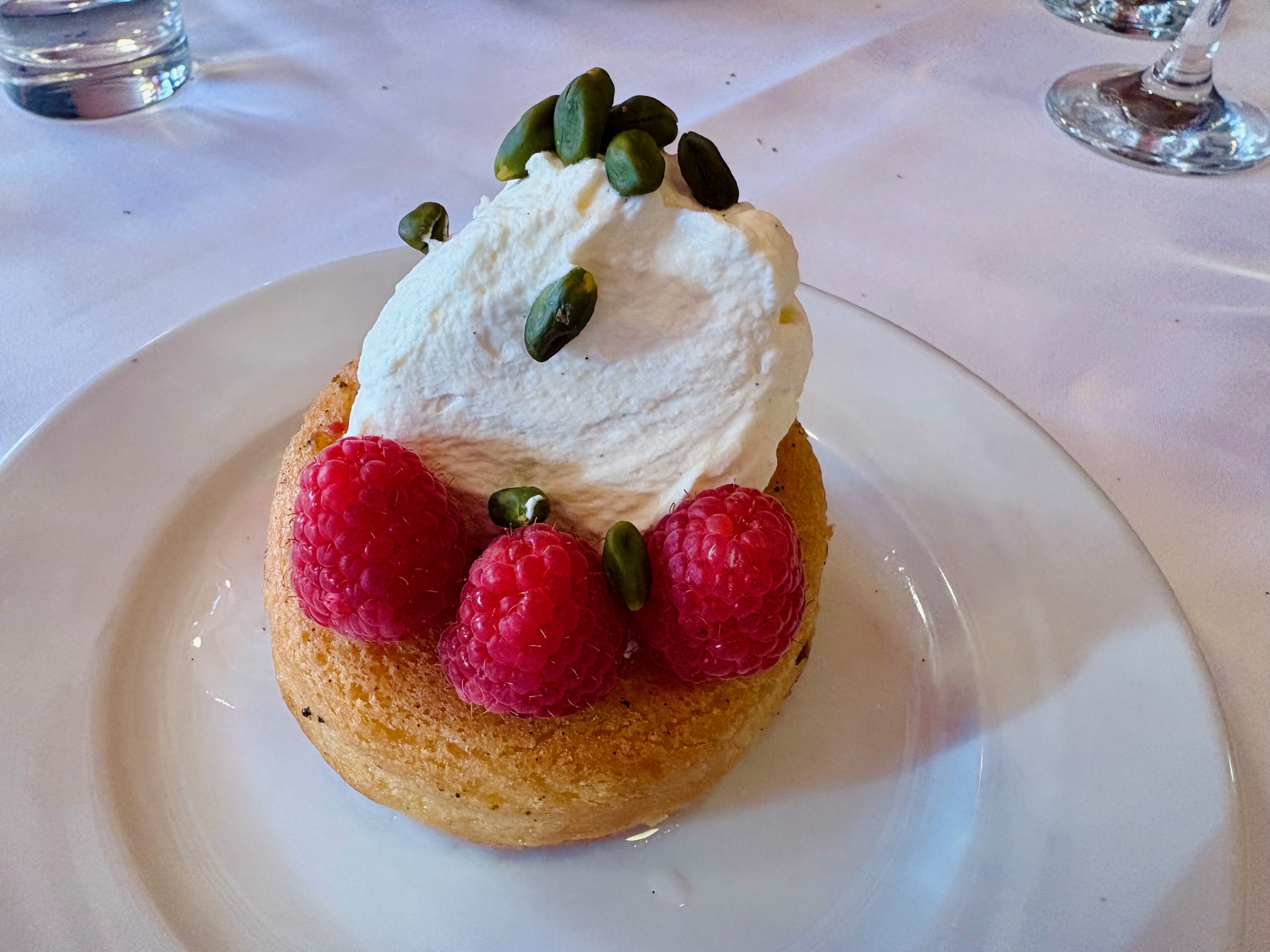
What had prompted Graeme to risk dessert dissatisfaction and swerve that mousse? He was persuaded by our excellent server to try the dessert on the specials, a raspberry savarin. It was sold to him as a bit like a baba au rhum, only with raspberry liqueur instead of rum. I don’t think that necessarily did the dessert justice.

The thing is, a sponge soaked through with booze feels instinctively like it should be sodden, be heavy. That is, you might think, what you’re pricing in when you order this dish. But this was airier than any rum baba I’ve tried, the sponge almost float-away light, but still with raspberry coulis lurking at its epicentre. But before that you had that indulgent sponge, and raspberries ringing a heap of the lightest Chantilly cream.

This dish is absolutely not the kind of thing I would ever order, but after trying a spoonful of Graeme’s I can tell you that if I ever got the chance to eat a whole one of these I’d grab it swiftly with both hands. Maybe this time Graeme had performed a Jedi mind trick on me? You couldn’t say it was undeserved.

By this point most of the people who had started their lunches at the same time as us had settled up and moved on, which I always consider a little moment of triumph. The dating couple at the next table had ordered exactly the same combination of dishes as we had, him my choices and her Graeme’s. “See, you’re the women in this arrangement” I said to Graeme, enjoying the novelty value because, at least half of the time, I’m not even the man in my own marriage.

Most of the other tables left before us because they’d made the mistake of passing on the madeleines. In a meal full of showstoppers we’d left the very best till last, a board with six warm madeleines, all scalloped edges, dusted with icing sugar and served with a little ramekin of lemon curd that was somehow sunnier than the yolk on my steak tartare, sunnier even than the rays pouring in through the windows into that ravishing dining room.

Dipping those madeleines into the curd, biting, tasting, raving and repeating did something wonderful: it perfected a meal that had been pretty close to perfect anyway. These are worth visiting the French House for in their own right, but I’m not sure that’s saying much, because so was everything else.

After we had finished them Borthwick left the kitchen – so he’d been at the stoves that day – and walked past our table and both Graeme and I thanked him and went bananas about the madeleines in a way that was probably more enthusiastic than it was coherent.

Borthwick very graciously, with an air of someone who’d had this conversation many times, told us that they’d originally been the creation of a Kiwi he worked with in the kitchen who had a real genius for baking. Although he had since quit cooking to bring up his kids the madeleines stayed on the menu, kind of his legacy.

I have no idea what the chap’s name was, but I suspect many London diners owe him a debt of thanks. Eating these madeleines I could sort of understand how Proust got all those novels out of them. Graeme said they had ruined Waitrose madeleines for him, which is in its way equally high praise.

I was sad to ask for our bill and to leave, but I knew that you couldn’t stay in that gorgeous room and eat nothing when other people could make excellent use of those tables, and I was also aware that it was London and that other lovely tables lay downstairs and beyond, and that I could drink Breton cider at the ones downstairs and carry on probing Graeme’s credentials to be the next Doctor Who and the first from Middlesbrough (“lots of planets have a North-East”, he proudly told me later).

Our bill, including a 12.5% service charge, came to just over £226. I’m going to stick my neck out and say that this was as good value as any meal I’ve had on duty this year.

The rest of the day was every bit as agreeable: drinks in the French House, an amble through Trafalgar Square and down to the Embankment for a couple of companionable glasses of wine sat outside Gordon’s, while Graeme gazed lovingly at every single dog at every single neighbouring table. And then we headed back to Paddington for – shamefully – a little booze fuelled sustenance at Market Halls before our journeys home.

But the way to best put that lunch in perspective is to think about the messages I got from Graeme the following day. “There isn’t a single course of that meal I’m not still thinking about” he said. “It was so good.” I’ve thought about it, and he’s right: I reckon I’ve thought of every single course at least once a day since Monday and, in the case of those madeleines, several times a day. And I’ve also thought about Graeme’s order, and how I would have been just as happy if it had been mine. And the things neither of us ordered – the rillette, or the tomato and lovage salad, or those frites: I’m pretty sure I’d adore those too.

Best of all, now that I’ve been to the French House and loved it, the fact that I can’t see a menu online goes from a homework-proofing source of anxiety to a matter of constant wonder and delight. I don’t know what I would get there, but I know that I would like it. Put that way, the prospect of going there again, which I’m sure I will, feels like a piece of magic you rarely get in restaurants these days.

So I am very glad I picked the French House this week and that, free from the need to keep up with the Joneses of the London food media, I was completely at liberty to do so. Because the French House has that indefinable feeling of authenticity that was somehow lacking when I visited the likes of Lapin earlier in the year. It feels like the team behind Lapin have been to, and loved, places like the French House. But it feels like the team behind the French House have been to, and loved, France. That’s it. That’s the difference between good and great in a nutshell.

The French House – 9.4
49 Dean Street, London, W1 5BG
020 74372477

https://www.frenchhousesoho.com

Since January 2025, Edible Reading is partly supported by subscribers – click here if you want to read more about that, or click below to subscribe. By doing so you enable me to carry on doing what I do, and you also get access to subscriber only content. Whether you’re a subscriber or not, thanks for reading.

Restaurant review: Paulette, Little Venice

Formosa Street, an enclave in Little Venice less than twenty minutes’ walk from Paddington Station, could be the platonic ideal of a London street. It has a little cafe, a chocolate shop, a ludicrously handsome Victorian pub with wood-panelled walls and glass compartments, with tiny doors linking them together. It has a little Italian restaurant that has been there thirty years, and a craft beer place two doors down, the past and the present coexisting cheerfully.

It doesn’t have a butcher, although there’s one just round the corner on Clifton Road. But tucked away seconds from the Tube station, one stop away from Paddington, a stone’s throw from the strikingly modernist St Saviour’s Church, it is a deeply pretty pocket of London that few people know about. If this was your neighbourhood, you would be very happy indeed. Of course, if this was your neighbourhood you would also be filthy rich.

I’ve frequented this part of the world, on and off, for many years. I think I ate in that Italian restaurant not long after it opened, and I’ve drunk in the handsome Victorian pub a fair few times. Just before lockdown, I tried out the craft beer place a couple of times, and I’ve admired the steeple of that modernist church on more occasions than I can recall. I am no closer to living there, or even pretending that I could do, but it’s nice to try to pretend.

Just before lockdown, five years ago, Zoë and I went for dinner at a small French restaurant on Formosa Street called Les Petits Gourmets. At the time, I had the idea of publishing some London reviews, of places close to Paddington, thinking they might be useful to people wanting somewhere good to eat before grabbing an off peak train home. And it might have been a good plan, if I hadn’t hatched it about a fortnight before people stopped taking trains in general, going to the office or indeed leaving their houses.

So I never wrote a review of Les Petits Gourmets, although that might have been for the best because it was small, eccentric and nuts. On arriving we were told that their oven had packed up, so we could have whatever we liked from the menu as long as it was something they could cook on the hob. The place was dark and atmospheric, our table tiny and cramped. Another table, weirdly shaped and right next to the bar, with a couple of high stools, was so bad that a couple came in, were offered the table, had a shouting match with the staff and stormed out.

I can’t remember anything about what I ate, but I do remember that. And I was tempted to publish a review, if only because it was so surreal, but what would have been the point? It was just a place you would never have heard of, and a review that wouldn’t have sent you rushing there, at a time when you couldn’t have rushed there anyway – even if, for whatever reason, a dingy spot with no working oven and some shocking tables was right up your alley.

I thought no more about Les Petits Gourmets, really, until last summer when I read a rave review in the Standard of a French restaurant in Little Venice called Paulette. I know that area, I thought. I wonder where it is? And then I checked the address, and thought Isn’t that where that weird French place used to be? And then I Googled some more and discovered that it was exactly where that used to be, and opened later in 2020. Les Petits Gourmets was an early casualty of the pandemic: perhaps the cost of fixing that oven was the final straw.

The review I read of Paulette made it sound like everything I had wanted its predecessor to be, so I made a booking there and on a drizzly Saturday morning I caught the train up into London, ready for a long overdue lunch with my cousin Luke, last seen as baffled as I was by supercool Haggerston spot Planque. Fun fact: both Planque and Paulette featured in Conde Nast Traveller‘s listicle last summer of London’s best on-trend French restaurants although, as we will see, they couldn’t be more different.

The walk from Paddington is a lovely one. You start out exiting the station right by the Paddington Basin and cross over it, right by the floating barge restaurants, walking past craft beer and pizza spots and impossibly spenny-looking modern apartment complexes. The route ducks under the grime and bustle of the Westway and then, suddenly, everything is beautiful: the streets widen and are flanked with gorgeous redbrick mansions, huge buildings made up of pinch-me-if-I-live-here flats. And then you’re at the canal, and you wonder how such a fetching residential area can be hiding in plain sight here, in Zone 1.

I stopped for a latte at the brilliant D1 Coffee, a stone’s throw from the waterway, and thought to myself that as usual I was trying to pass myself off as congruous in a neighbourhood far, far above my station. I chatted to the couple next to me about giving up smoking – something I did twenty years ago and still think of as one of my greatest achievements – and as we did, countless cosmopolitan types ambled past, walking dogs or just chatting happily. One was carrying a MUBI tote, and I wondered how it had happened that I’d wound up living in a postcode so far from my tribe. It’s almost as if I just hadn’t tried hard enough to make something of myself.

I got to Paulette before Luke did, and it was unrecognisable from the room I’d eaten unsuccessfully in five years before. Still eccentric, yes: all mismatched patterns on the walls and ceilings, mismatched cloths on the tables, mismatched light fittings, all maximalist and unashamed. But it was bright, cheery and welcoming. Even with the canary yellow awning out, light flooded in from the full length windows and all the tables were full of people who seemed profoundly happy with their life choices. I ordered a kir while I waited for my cousin, and it was sweet sunshine, a liquid escape from rainy London. Even noticing that the gorgeous Victorian boozer opposite was closed for renovations couldn’t dent my joie de vivre.

Nor could the discovery, when Luke turned up and ordered a Meteor Zero, that he was off the sauce. He explained that he’d bust his hip and that alcohol interfered with his rehabilitation regime: news to me, as I’ve always found Dr. Booze an invaluable consultant I’ve involved in my recovery from pretty much anything affecting me.

I thought it would bother Luke, a man who runs more marathons in a year than I’ve eaten Marathon bars in my lifetime, but he was surprisingly sanguine about it. “I figure everything goes through a fallow period” he told me later in the pub, showing a kind of Zen perspective I’d have loved to have twenty years ago when I was his age: come to think of it, I haven’t attained that mindset even now.

That meant that I had to forego the delights and dilemmas of choosing a bottle from the enormous wine list, seemingly covering all of France in compendious detail. But it wasn’t all bad – just under twenty wines were available by the glass, a great spread including half a dozen dispensed using a Coravin. I picked a Sancerre, which was terrific, and we started doing a bad job of making our choices from the menu and a much better job of catching up.

The menu was a tad lopsided, with about a dozen starters and half that of mains, but everything on there was tempting. Many of the things I’d read about in advance and hoped to encounter, like a Roscoff onion tarte tatin with mascarpone, were missing in action, but even so the challenge was very much what you missed out on, as much as what you picked. On another day you would have wound up hearing about the classic onion soup, the scallops or the halibut with sauce Meunière, but I will have to try them next time, assuming they haven’t been whipped off the menu by then.

As it was Luke and I agreed to share a few things to try and cover as much as we could, helped by pricing which encouraged you to try a bit of everything. Starters tended to be at or around the fifteen pound mark, with mains mostly between thirty and forty quid. But everything was so fabulous, and generous, that I didn’t object to that in the slightest.

We kicked off proceedings with a small selection of charcuterie, which was easily enough for both of us. All of it was marvellous, from the bresaola to the pork loin but especially the coppa, dried and intense, and a doozy of a jambon de Bayonne: again, dry and coarse, which very much said tiens ma bière to both Serrano and Parma ham. This came with bread (which should be a given but isn’t always), butter (which was a very welcome surprise) and, best of all, a ramekin containing a deeply acceptable quantity of sharp, tart cornichons.

Fourteen pounds for all that, and for a pound more our second starter was every bit as stellar. I love pâté en croute, and Paulette’s version was the best I’ve tried – a glorious slab of heaven, golden burnished pastry housing coarse pâté, shot through with dark prunes. On occasion I’ve had this kind of dish in Paris and it’s been painfully close to Pedigree Chum, but no such worries here: no dodgy jelly, just densely packed meat – pork and duck in this case – topped with yet more pickles and a quenelle of exceptional whole grain mustard. A very well-dressed salad completed an impeccable plate of food.

I wish I’d had one of these to myself, but to do that I’d have had to go without the charcuterie. This is the problem with sharing food, isn’t it: you always end up wanting twice as much of everything, everywhere, all at once. I was about to start a sentence with Next time, but I’ll try to stop myself or I’ll be doing it for the rest of the review. Truth be told, even by this point the only question in my mind was when exactly that next time would be. It was already a given that it would happen.

I gave Luke first pick of the main courses and, torn between the fillet of beef and the bourguignon, he eventually chose the latter. He chose extremely well. The pan brought to his table was a one-stop shop of pure happiness – a deep, reduced sauce full of wine and care, with a few waxy potatoes, plenty of mushrooms and a transverse beast of a carrot, heftily substantial and yet superbly cooked.

But of course, none of that gets top billing in the name of the dish, and this all comes down to the beef itself. I’m used to having this dish with shin or chuck, but Paulette opted for beef cheeks and, with hindsight, it was an inspired choice. The food writer Harry Eastwood once said that cheek was perfect for this dish as, in her words, “the meat surrenders completely”. I can’t improve on that description, so I’ve nicked it instead.

And it’s true, but only if the kitchen is absolutely on top of its game and the beef is braised to the point where any gelatinous quality is gone, replaced with that terrific stickiness where the beef and the sauce become a symbiotic dream team. That’s what had happened here, and it was a wondrous thing. Trying a forkful I thought back to my friend Graeme’s bourguignon at Côte the previous month, and the difference between good and great. The difference, it turns out, is nine quid and forty miles.

“This is the best French food I can remember eating” said Luke. I’m a relatively frequent visitor to France, but I could see what he meant.

If I had been Luke, I would have wished that I’d saved some bread to mop up that final layer of sauce coating the bottom of the pan. But if I’d been Luke he’d probably have a forty inch waist and far less success online dating and would get over the disappointment of busting his hip (which would be more likely to happen by, say, getting out of bed awkwardly) by medicating with the finest mid-price reds the restaurant had to offer. Instead I offered him some of my frites, and after refusing twice – he is Canadian after all, so awfully polite – he took me up on my offer.

I’ve seen quite a few reviews online talk about how Paulette does the capital’s best frites. They might or they might not: I’ve had nowhere near enough frites in London to be qualified to judge, but they were up there with the best frites I’ve had in this country or any other, irregular, golden, salted and decidedly moreish. They were so good I wasn’t sad that I didn’t get to try the gratin Dauphinois, and frites have to be pretty damned good for that to happen.

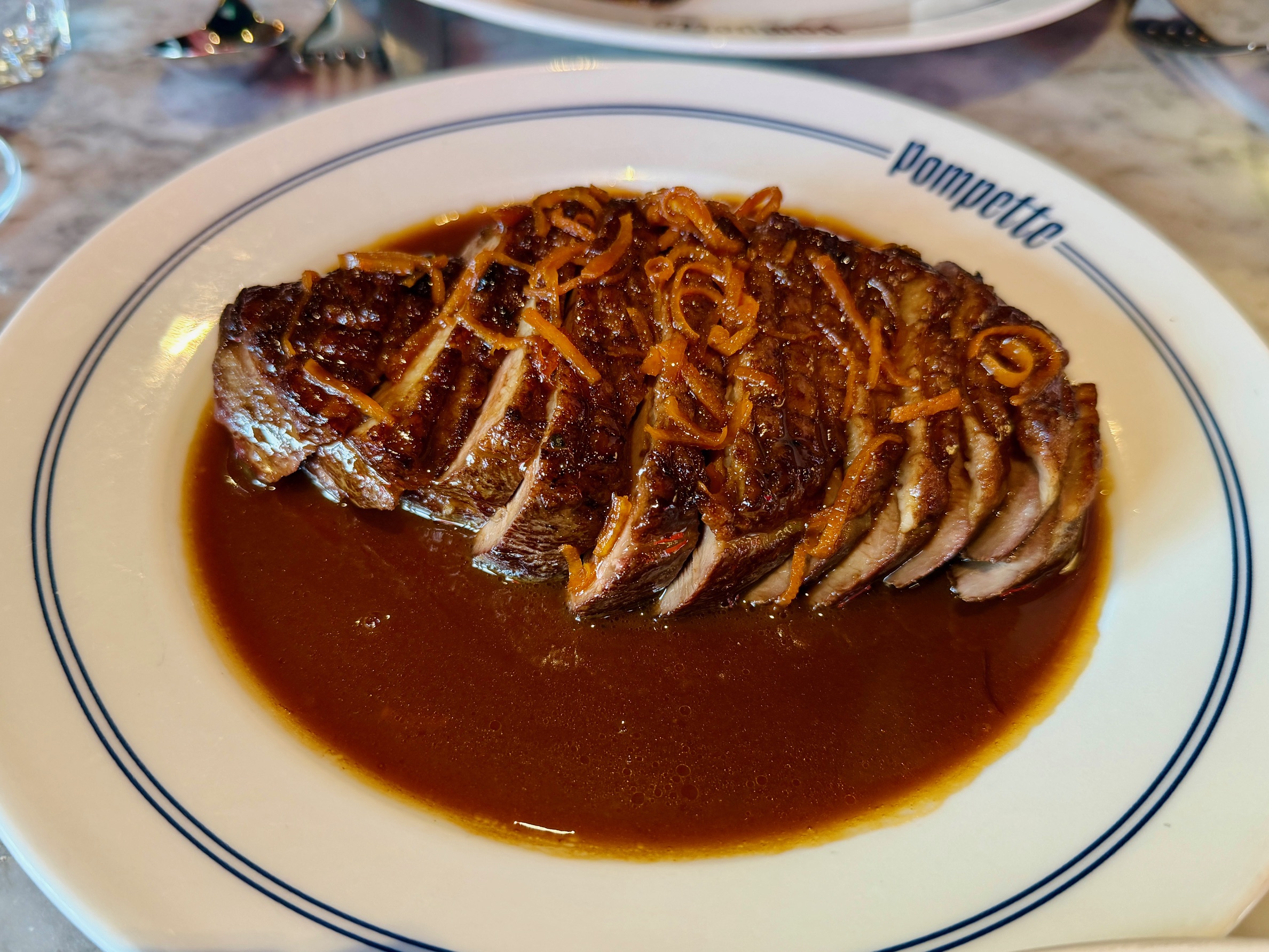
My frites accompanied my order from the specials board, duck breast cooked pink, sliced and served simply with a boat of what was described as a duck velouté, in practice one of those ultra-reduced, fantastically concentrated sauces that French cuisine seems to do better than almost anybody else.

I’ve had duck breast many, many times in my life and a lot of the time, afterwards, I wonder if I’m doing it because I think I should like it rather than because I do. It’s often a tad tough, a smidge fatty, somewhat poorly rested: much like me, most weekday mornings. This was more like me after a full day in Nirvana Spa, utterly relaxed, thoroughly cosseted, treated like a king.

The analogy breaks down at that point, because this duck was also enormously tasty and I imagine most people wouldn’t be able to get enough of it. But it was good while it lasted.

By this point I had moved on to a Saumur, which was perfect with the duck: Paulette has the sort of outstanding staff who will compliment you on each of your wine choices even though you’re the poor schmuck muddling your way through the list of wines by the glass.

Luke and I decided to eat as Frenchly as possible, which meant a cheese course and then some dessert: the wine list distinguishes, winningly, between “cheese wines” and “dessert wines” so I nabbed something from the former section, a 1986 Muscadet. I have no doubt the Coravin was involved here, and the result was stunning, an amber marvel with a hint of sherry sweetness, outstanding complexity and length. A 50ml pour, in this case, was plenty.

Paulette does a small or large assiette de fromages with three or five cheeses respectively, and they are in principle a deli too, so I did wonder whether you could pick which cheeses you had. When our server authoritatively told us you got a Comte, a truffled brie and a Saint Nectaire I realised this was a choice best left to the experts, so that’s what we had.

The picture here probably doesn’t fully convey this, but it was a generous wodge of each, easily enough to share without needing a scalpel and a protractor. They were all outstanding: the Comte with all the crystalline grit you would want, the Saint Nectaire, not a cheese I’d ever seek out, bringing a savoury depth to justify its seat at the table.

But the truffled brie – oh my goodness. Luke and I agreed that we shared a suspicion about truffle being brought out to zhuzh up the ordinary, but in this case it turned a gooey, creamy delight into a total showstopper. As with the charcuterie, this came with a generous helping of bread but once we had finished all of the bread and nearly all of the cheese the twinkliest of our servers returned with a couple more slices, urging us to use them to clean up the very last of the brie. We did as we were told.

Normally I would have a different dessert to my dining companion, but I figured we’d got through a decent range of dishes already and I’d seen the chocolate mousse being carried past to other tables and decided there was no way I was leaving without trying it. I mean, just look at it in the picture below: a stegosaurus of a thing, plump and shiny, with a spine of caramelised hazelnuts sitting in a pastel-green lake of pistachio crème Anglaise. How could I not order that? How could anybody?

And it tasted every bit as beautiful as it looked. By now I’m used to chocolate mousses in fancy Spanish places where they drizzle it with extra virgin olive oil and pop some salt crystals on top, the modish way to revamp a staple. But this had no interest in playing those tricks, so like everything else at Paulette it was a classic rendition of a classic dish, prepared by a kitchen that revered the classics.

Don’t get me wrong – there is a place for deconstructing, reconstructing and reinventing, and I’m a fan of those things as much as anyone. But whatever that place is it isn’t Paulette, I’m very glad to say. This was a dark, glossy miracle – so smooth, almost not aerated at all, and I wished every spoonful could have lasted hours. The final spoonful, as it always does with such dishes, came too soon, and I found myself wishing there was some sweet equivalent of bread I could use to mop up those last bits of crème Anglaise. Maybe that, rather than ruining burgers, is the point of brioche.

When you book lunch at Paulette you get that standard issue we want your table back in X hours gubbins that London restaurants so often do. But none of that happened here, and over three hours after I ordered that kir pretty much every table was occupied by somebody new despite it still being mid-afternoon, the evening service around the corner.

I’ve never understood restaurant reviewers who insist on eating at a place twice before writing a review – mainly because they need to get over themselves – but if I could have eaten at Paulette again that evening I would have seriously considered it. But the craft beer place a couple of doors down was calling to us, and the pub after that, so it was time to reluctantly pay for the wonderful time we had had. Our bill for two, all that food, a couple of beers for Luke and five different glasses of wine for me, came to just over two hundred and ten pounds, including a 13.5% service charge. It felt as much like a bargain as I suspect any meal will this year.

Later on, Luke and I were in the Bear, just around the corner from Paddington, having one last drink and comparing notes before going our separate ways.

“The only thing that stops it getting the highest mark, for me” said Luke, “was that it just lacked that thing that would make it a truly transcendental experience. That and the bread, I guess, the bread could have been better.”

I knew what Luke meant, but I also suspected that looking at Paulette that way missed an important point, which was that Paulette had no interest in being that kind of restaurant or delivering that kind of experience. It was more interested in transporting you completely by delivering something unfussy and unfancy but, in its way, truly outstanding. Paulette was about as good an example of this kind of restaurant as it’s possible to find, and I loved it. Absolutely loved it, unreservedly, from start to finish.

It’s twenty minutes from Paddington, and Paddington is thirty minutes from Reading. Just think about that: you could be at Reading station, and within an hour you could be eating in this place. If I don’t do so a couple more times this year, I will be extremely surprised, not to mention deeply disappointed. I know most of my London reviews, lately, have been of spots in the centre where you hop on the Elizabeth Line to get there, very much a tribute to the march of progress in the capital. But this? Simply timeless.

Paulette – 9.3
18 Formosa Street, London, W9 1EE
020 72862715

https://www.paulettelondon.com

As of January 2025, Edible Reading is partly supported by subscribers – click here if you want to read more about that, or click below to subscribe. Whether you’re a subscriber or not, thanks for reading.

Restaurant review: Pierre Victoire, Oxford

I had to check because I thought my mind might be playing tricks, but there used to be a French restaurant chain called Pierre Victoire, the Côte of its day, thirty years ago. I remember eating in the Nottingham branch when I lived there at the turn of the last century, and I’m pretty sure Reading had one too. Perhaps readers with even longer memories than mine can correct me if I’m wrong, but I seem to recall it was on St Mary’s Butts, where Favourite Chicken is now. Anyway, also around the turn of the century the chain went bust leaving just one outpost, on Little Clarendon Street in Oxford, as the only survivor.

And it’s still going strong.

It’s approaching its thirtieth birthday in a couple of years, and I can’t remember a time in my restaurant-going life, really, when it wasn’t there. It’s been an ever-present across the past two decades, constant as my life has shifted and changed, and I’ve had countless lunches and dinners there, with family and with friends. Back when I didn’t review places outside Reading, it was my venue of choice for eating in Oxford, especially pre-theatre before watching something at the wonderful Oxford Playhouse. But there were more than a few boozy evenings there too: I still remember the horror and confusion of an American friend I lost in the divorce, trying snails for the first time.

Just as my life has changed in that time, the topography of Oxford has too. Little Clarendon Street used to be the epicentre of Oxford, for me, where everything was going on. It had Pierre Victoire, a great little tapas place next door and ice cream café George & Davis opposite, a brilliant interiors shop called Central and another little shop across the way called Ottoman selling cool bits and bobs. At night it was criss-crossed with fairy lights, just a magnificent place to be.

And then the years intervened and other parts of Oxford got more interesting – Jericho just around the corner, Summertown further north, the explosion of interesting restaurants and coffee down the Cowley and Iffley roads. I found myself more likely to have lunch at Arbequina and coffee at Peloton, or to amble down North Parade before a reservation at Pompette. The Westgate, a shopping development that makes the Oracle look sad and tired, altered Oxford’s landscape too. Little Clarendon Street by contrast didn’t really change, both its biggest strength and weakness.

But in recent times the pendulum has swung back, and heading to Pierre Victoire last Saturday for a late solo lunch I was struck by the fact that Little Clarendon Street is having another moment. Central may have closed, but next door social enterprise and excellent café Common Ground was doing a roaring trade. Across the way, The Jericho Cheese Company was full of lactic treats to take home and newish bottle shop and restaurant Wilding, where the Café Rouge of my student days used to be, looked very tempting. And there, familiar and unchanged, was Pierre Victoire: I was surprised by how gladdened I was to see it.

Pierre Victoire only opens for lunch Friday to Sunday nowadays, and it’s a tribute to how popular the place is that when I rang in the week to make a lunch booking pretty much all they had left was a table at quarter to two. And the place was humming with life and conversation when I stepped through the front door. The ground floor dining room goes back a long way and I seem to remember they have another dining room upstairs, or they certainly used to. I’m pretty sure these bare brick walls predate any trend for exposed bricks: it’s that sort of place.

But the tables at the front, with daylight, are the plum ones. Mine, literally tucked behind the front door, had “table for one” written all over it but gave a great view of the room and the happy diners of North Oxford. A table for six was making a meal of settling their bill, and the staff were perfectly attentive and friendly, showing no frustration. A steady stream of diners came in even after me – some with bookings, others chancing their arm on spec. All of the latter were turned away: an establishment this busy at 2pm on a Saturday afternoon has cracked something which eludes many restaurants, including a lot of the ones I review.

Pierre Victoire offers a prix fixe menu for lunch and dinner, and they differ slightly in terms of how much choice you get and the type of dishes: for instance, duck confit is on the lunch menu, while it’s magret de canard for dinner. The price varies too – lunch is about twenty pounds for two courses and twenty-five for three, whereas dinner is closer to thirty and thirty-five. Back when Pierre Victoire was open for weekday lunches I think it was even more affordable, but back when Pierre Victoire was open for weekday lunches literally everything was more affordable: I’m not sure how helpful that comparison is, really.

In any event the menu was full of French classics, many of which I’ve tried over the years – onion soup, chicken liver parfait, moules, escargots, steak frites and so on. I was a little jaded after an evening on the wine with a friend the night before, so I swerved the wine list on this occasion and instead opted for a fortifying Orangina. It came in the classic, original bottle and I wondered, short of Perrier and Fanta Limon, whether any non-alcoholic drink had as great a capacity to transport you as Orangina does. My body needed the sugars, that was for certain. The staff also brought a jug of iced tap water without me having to ask. Either they do this as standard or I looked as off the pace as I felt: either way, it was appreciated.

The other thing they always bring without you having to ask at Pierre Victoire is bread. Not ubiquitous sourdough: sourdough has completely passed Pierre Victoire by, or rather it’s above such things. No, you get a little basket of cheap, plain baguette with some decent butter which came out of the fridge a little too recently. But it’s always ambrosial; like the Orangina, like the hubbub, there’s something of elsewhere about the whole thing. You’re simultaneously mentally very much in Oxford and across the Channel, both of which are pleasant experiences.

My normal order at Pierre Victoire would be the chicken liver parfait, which comes in a little sphere with brioche toast and sweet, sticky, jammy red onion. But I was trying to be less predictable for once, so I chose the one vegan dish on the menu, a fricasée of mushrooms. It came out mere minutes after I’d ordered – I’d forgotten how brisk, how well oiled a machine Pierre Victoire is at lunchtime – and was a lovely and delicate piece of work. The decision to put it in a little chalice of filo pastry was a clever one which added texture, as did resting the whole lot on what I assume was a splodge of butternut squash purée.

I wasn’t sure about the tangle of pea shoots – one or two restaurants I love tend to overuse these as punctuation and I wish they wouldn’t – but overall it worked nicely. The mushrooms themselves, a mixture of wild and button if the menu was to be believed, were in a sauce with cognac and a little sweetness, but I found it slightly thin. It needed the cosseting touch of cream, I reckoned. But then it wouldn’t have been vegan, and that was the box it was ticking on the menu. Even so it was polished off in minutes, and there was just enough bread to mop up the last of the sauce.

If I’d chosen a curveball as a starter, I played safe for the main. I don’t think I’ve ever been to Pierre Victoire for lunch and not seen duck confit on the menu, and it’s rare for me not to order it there. I don’t understand why more places, especially pubs, don’t serve duck confit: it’s so easy to get right and such a joy to eat. There’s always plenty of meat, it always falls off the bone to the point where picking it clean is a meticulous delight and, done well, you get that crispy skin and that subcutaneous, glossy fat. Confit duck, as it happens, is one of the options on the menu for my wedding later in the year, and it will take all my strength not to pick it.

I really love how Pierre Victoire serves duck confit, too, with just the two accompaniments. A brick of rosti, which in this case was maybe a tiny bit too soggy and not crispy enough, and a bitter orange sauce which brought everything together beautifully. Good luck finding duck à l’orange anywhere on a menu these days – it’s one of those relics of the past, at least in this country – but Pierre Victoire’s smart, affordable take on it is all you really need.

It was a perfect, simple pleasure and it made me very glad to be at that table, in that room, in that restaurant, in that city, exactly where I should be. My paperback (an Anne Tyler I’d never read) stayed untouched throughout my meal because when I wasn’t eating, or taking pictures, I was too busy enjoying where I was. Watching the staff, so on it and so harmonious, always in control without being mechanical. And looking at my fellow diners, imagining their stories and their lives outside this little parcel of Saturday afternoon where we all happened to be in the same place.

As I said, Pierre Victoire is nothing if not efficient – I’d be surprised if I was the first customer at that table that lunch service, and I saw other tables turned while I was there. But they never made me feel processed, and I gave the dessert menu serious consideration before deciding to settle up. It’s more compact than the choice for the other two courses, and a crêpe au citron called to me, but not loud enough. My bill for the two courses and that iconic Orangina set me back twenty-two pounds fifty, not including tip. Pierre Victoire maybe isn’t the bargain it once was, but I’m not sure I want restaurants I like to be bargains any more. I want them to survive.

Don’t be fooled by the rating below (I know you’ve probably already scrolled down and checked). Yes, I gave Pierre Victoire a 7.3, but what I would say is that there are 7.3s and then there are 7.3s. There are the expensive restaurants where dinner or lunch costs you the best part of three figures and you think “well, it was okay”, and there are cheap and cheerful places where you come away thinking that your hosts have surpassed, or possibly even transcended, your expectations. And yet Pierre Victoire, would you believe, is neither of those things.

No, what Pierre Victoire is is that rarest of beasts, a truly consistent restaurant. I can honestly say that the last time I went there was every bit as good as this time – and not just that, but every bit as good in exactly the same way. The time before was too, and I dare say the next time will be as well. And there will be a next time, the next instalment in a series of meals that started something like twenty years ago and, if I’m lucky, will go on for many more.

Your mileage may vary, but for my money that’s worth a dozen culinary comets or flashes in the pan. I’d say that every town should have a place like Pierre Victoire, although travelling to Oxford is really no hardship. And I’d almost go one step further and say that every town should have a Pierre Victoire, but that’s dangerous nonsense: it is, as we know, how chains get started. Pierre Victoire doesn’t need that. It’s already been there, done that, got the t-shirt – and then moved on, a long time ago, to far better things.

Pierre Victoire – 7.3
9 Little Clarendon St, Oxford, OX1 2HP
01865 316616

https://pierrevictoire.co.uk

Coppa Club, Sonning

This is my second attempt to review Coppa Club. The first time, I went on a winter night last year only to be escorted to a table for two next to the big French doors, a table so cold that it could turn tomato soup into gazpacho in minutes. I asked to be moved and slack-jawed confusion broke out among the black-shirted serving staff. Minutes later I was told this wasn’t possible, even though I was pretty sure I could see other tables were vacant. When I said thanks but no thanks and voted with my feet, I’m not sure they even noticed me leaving. Perhaps there was nothing they could do, but it would have felt nice if they’d tried, suggested a drink in the bar or pointed out when a suitable table might become available. I couldn’t work out whether they were fazed or unfussed, but either way I was in no hurry to go back.

In the meantime, friends of mine have enthused about the place. More for lunches than dinners, I was told, but even so I got a steady stream of positive feedback which made me think it was time to give it another chance. And it’s the kind of place I see appearing in my Twitter feed all the time – lovely pictures of well-presented dishes, not to mention one of the most attractive dining rooms I’ve seen in a long time. So eventually, now that the days are getting warmer, I decided I could leave it no longer. Besides, after the delights of all you can eat dining I found myself pining for something clever and delicate.

And yes, it really is a beautiful room. It ticks all the boxes without looking studied or cynical – a bit of exposed brickwork, granted, but some lovely furniture in muted greens and blues, button back banquettes and beautiful burnished geometric metal lampshades (no bare swinging hipster bulbs here, thank you very much). It feels like someone has thrown money at this place – how very Sonning – until it started to bounce off, and that prosperity starts out very alluring, although by the end of the evening I could see how it might get a little smug.

Turning up on a Sunday night I was delighted to get one of the booths. There’s a blue banquette running along the middle of the room but the booths, which are closer to the exposed brickwork and the bar, were nicer and cosier. Quite roomy for two people, too, although if there were four of you in one you’d need to get along reasonably well. That seemed a bit of a theme in general, actually – looking at the tables for six I found myself thinking that they’d more sensibly seat four. Perhaps that’s why, on my previous visit, they weren’t prepared to find anywhere else for a table for two to eat. Perhaps, too, packing diners in is how Coppa Club could afford to spend so much money on refurbishing the place (or perhaps I’m being a bit harsh, in which case I’m sure some of you will tell me).

I liked the menu enormously, and it felt like it had just enough things to pick between without being bewildering. It reminded me a lot of places like Jamie’s Italian, so I wasn’t entirely surprised later when doing some research to discover that the chef at Coppa Club has worked there. It’s a more compact menu than at Jamie’s, but still presented a few complicated decisions – to share or not to share, to order pasta, that kind of thing. Horse trading took longer than usual, which was just as well because getting anybody interested enough to take an order did too.

Now, normally I talk about service right at the end of a review as part of wrapping things up but with Coppa Club I really feel I have to make an exception, because it was so uniformly poor every step of the way. Don’t get me wrong – it was friendly and affable, but beyond that they managed to get pretty much everything wrong. You could never get any attention, despite it not being a busy night. The starters turned up immediately after they were ordered, at the same time as the nibbles we’d ordered to tide us over. Getting someone to bring the bill at the end was a challenge, as was paying it once it had been brought to the table. Many of the serving staff seemed to have been trained to completely ignore customers altogether, usually while walking past or near their tables, and when I left after what felt like an eternity settling up I saw one of the waiters chatting to his friends at the bar.

I don’t take any pleasure in saying this, but it was especially jarring considering what a lovely room it was and how good some of the food turned out to be. And that’s not even getting on to some of the things which, although they bugged me, might not be deal-breakers for you. I regularly saw waiters leaning right across diner A to serve diner B, something which (in my book at least) you really should not do. Another thing, which may sound minor to you, was about where we were sitting. The booths were open on one side (the side nearest the other tables) but closed off on the other, and behind them was a little corridor section where the serving staff could get water, wine, glasses and so forth. Our waiter kept taking orders or handing us wine over that barrier, which just felt downright strange, like talking to your neighbour over the garden fence without ever having been introduced. Perhaps this is a new trend in informal dining which has passed me by, but I just didn’t like it: it felt more like laziness.

Let’s move on to the happier subject of the food, because some of this was really pretty good. The nibbles – deep fried gnocchi with parmesan and truffle oil – were pleasant (although I’d have enjoyed them more if they’d arrived some time before the starters – sorry to keep going on about that), little breaded nuggets of tasty starch. The truffle oil, as so often, added an olfactory tease that never followed through when you actually ate the food, but never mind.

CoppaGnocchi

Better was the fritto misto – a very generous helping of squid and white fish, seasoned and dusted in what might have been semolina flour, along with a solitary prawn and a slice of scallop. This was very nice stuff – far better than many places’ efforts at fritto misto – and my favourite bit was the small pieces of squid, all crispy tentacles with that rough, savoury coating, texture triumphing over taste. The tartare sauce it came with was quite nice but maybe a little too sophisticated, too Sonning, for my taste. I reckoned it needed more vinegar and acid, more gherkin or capers or – starting to drool now – both, but I’m a sucker for pickles and it might just be me being a Philistine.

CoppaFritto

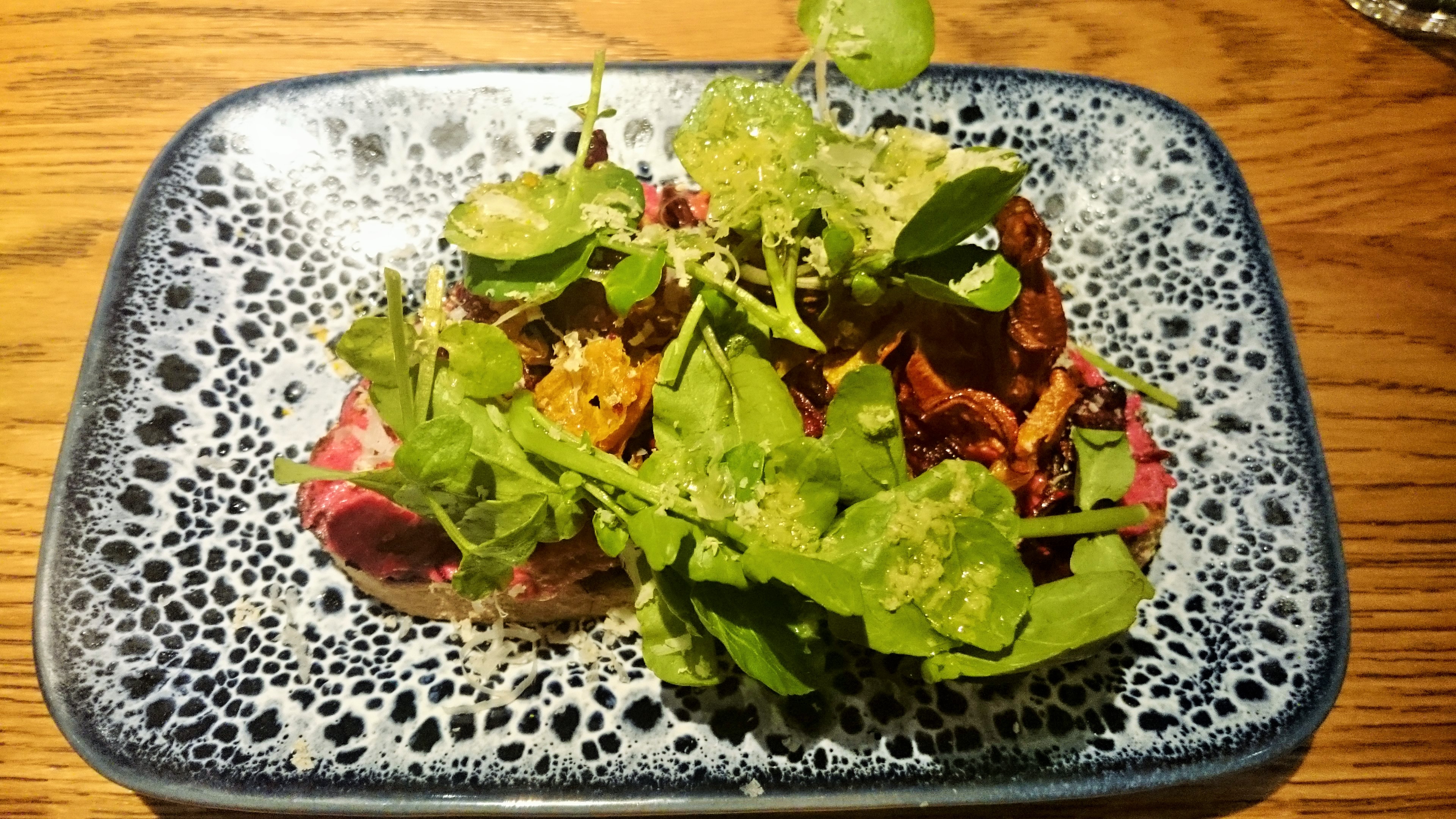
The other starter, “beets and ricotta bruschetta”, was lovely; a single slice of ciabatta-like bread with a layer of bright pink whipped ricotta topped with cubes of beetroot. That alone would have been enough to meet the job description, but there was a little more: wafer thin beetroot crisps in red and gold on top to add another level of texture, then some pretty salad leaves dressed with olive oil (I think) and cheese shavings, because cheese shavings make everything better. I liked it a lot: refreshingly clean but with that earthiness that beetroot brings, all dark and zingy. It was a dish that looked like winter but tasted of spring, and it made me long for longer days.

CoppaBruschetta

The starters had come so quickly that I was worried I would be out of Coppa Club in next to no time, but thankfully they slowed it down for the mains. If anything, this gave me and my companion a chance to play spot the difference between my glass of entry level Syrah and her glass of more expensive Shiraz (we couldn’t really find one, which is maybe why I try not to say too much about wine). It also meant that the mains arrived pretty much when we were ready, probably the only piece of good timing about the whole evening.

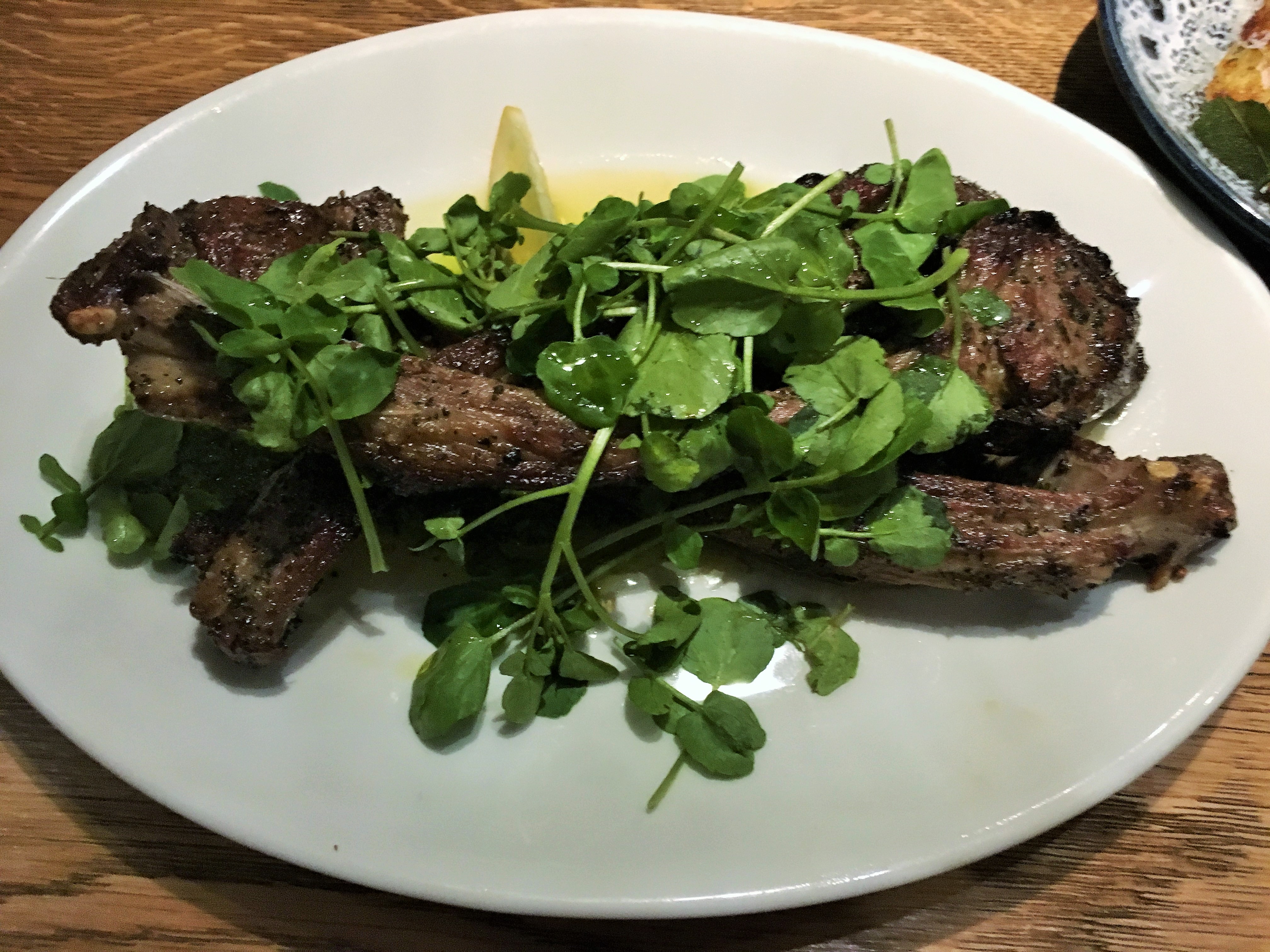
I’d found choosing a main at Coppa Club surprisingly difficult. My companion had already bagged the pizza, having pasta as a main felt a bit too monotonous, ordering the burger felt like it would have been a poor show and I wasn’t in the mood for a whole fish on the bone, lovely though that sounded. So the lamb chops – described as “scorched fingers” on the menu, perhaps that’s a draw for some people – won by default and, in hindsight, I’m delighted that they did. This was a dish for people who like meat and fat – three long, thin, chops with a square of tender meat at the end but, more importantly, rich seams of fatty meat along the bone, caramelised, melting and utterly delicious. I wouldn’t describe myself as the world’s biggest carnivore (although I know several people with a decent shot at that title), but some nights you just want red meat and iron and this was that night and that dish was in the right place at the right time.

CoppaChops

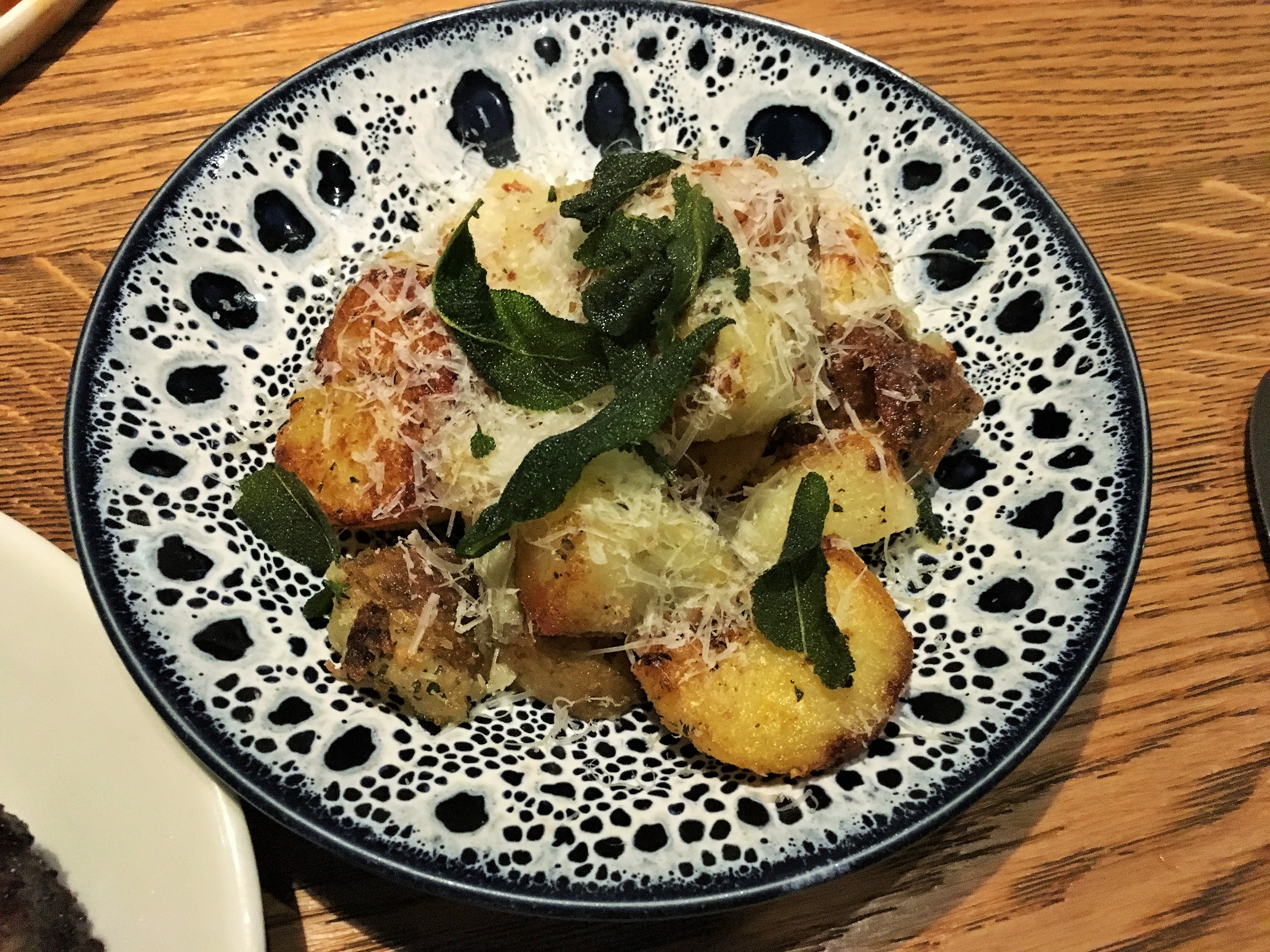
It wasn’t perfect, mind you. The chops were so long and thin that eating them was unwieldy, as was pushing the bone out of the way when you were done. They came with watercress, which I can take or leave, and a salsa verde which fell into the same trap as the tartare sauce. I could admire it, this glossy smear of fresh mint and oil, but I wanted some vinegar in there, some sharpness to stop my mouth being coated with fat (I’m well aware, writing this, that I’ve gone to Coppa Club and said that two of the dishes could have been improved with jars of sauce from Colman’s: judge away). What did improve the lamb, immeasurably, were the “rustic potatoes” – little roasted potatoes, all crunchy corners and fluffy insides, festooned with Parmesan and shot through with green shards of fried sage; if they’d put those on the “nibbles” section of the menu I might have started and stopped right there.

CoppaPots

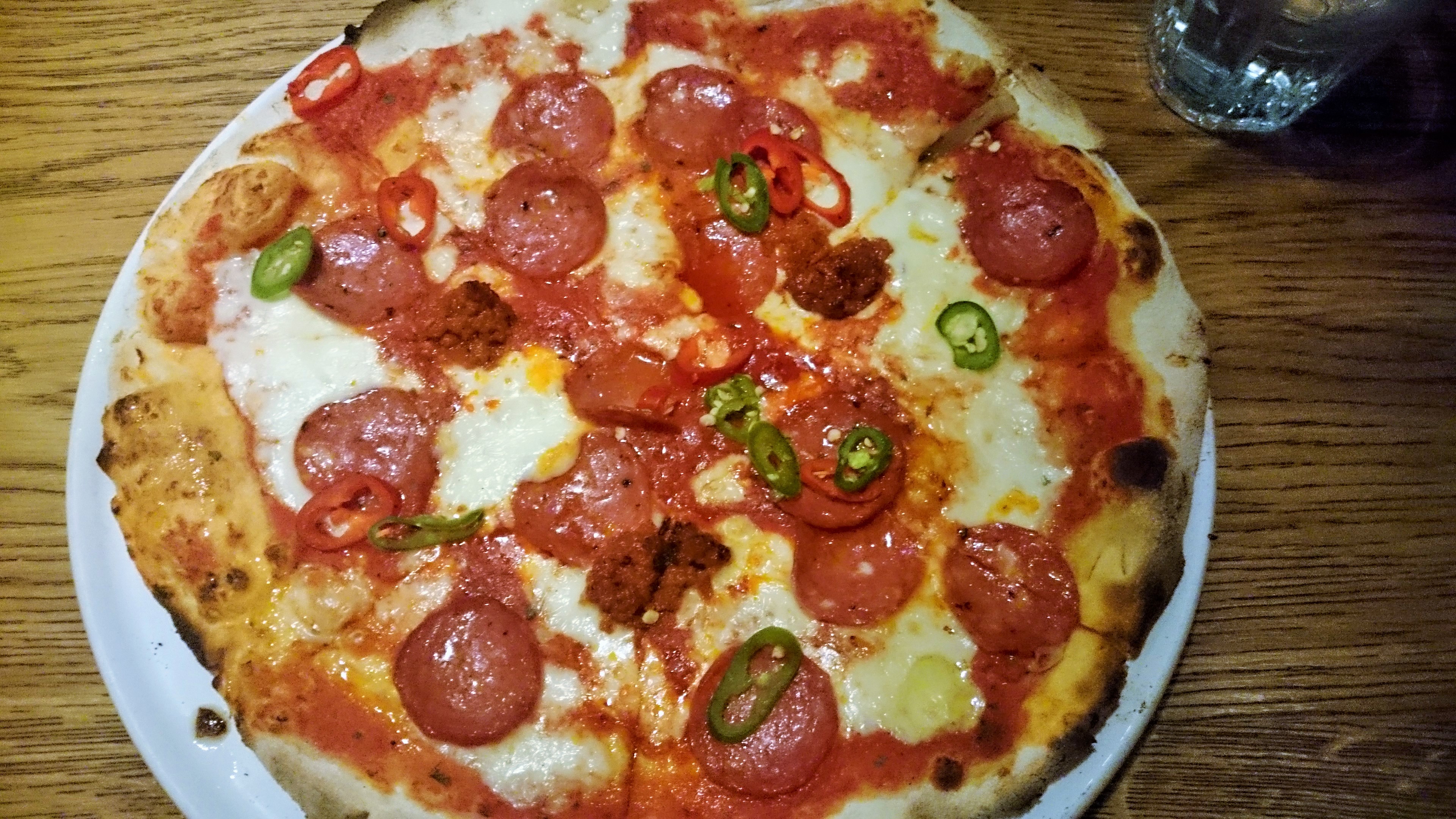
I really wanted to try pizza too, to see if Coppa Club was up there with all those pizzerias I daydream of dropping in Reading, and whether the “slow proved, sourdough base” would live up to billing. Well, sadly not really. The base was too thick in the wrong places, no bubbly edges and a stodgy, rather soggy middle. It tasted decent enough, but it was lacking that chewy, moreish flavour I expected from a sourdough base. There was a bit too much cheese, in my opinion, although I guess that’s better than the alternative. I went for the “Coppa Club Hot” and the ‘nduja on it was delicious, super-intense, punchy, salty, almost acrid. If only there had been more – I know a little goes a long way but three small teaspooned dots of it across the whole pizza still felt a little mean. The spicy salami was less successful, a bit more simple in flavour (although still with loads of heat) but personally I’d have liked it a little more crisp; maybe that would have happened if the pizza hadn’t been so thick. My guest didn’t eat more than half – after three slices I was told that it didn’t seem worth eating the rest of what was essentially a dolled up pepperoni pizza.

CoppaPizza

We didn’t stay for dessert – nothing quite appealed enough and by then I had been sufficiently irritated by my experience that I was quite comfortable leaving. A shame really, as one might have helped to tide me over in the inordinate wait for getting and paying the bill. Even waiting to ask for the bill, dessert menus in front of us, was an odd experience; one of the waiters cleared my folded napkin as he passed our table without actually speaking to us or making eye contact (which is quite hard to do, I think). In the end we had to call out to a passing waiter, who seemed to be cleaning up rather than actually, um, waiting. Dinner for two came to fifty pounds near as damnit and – and I almost never, ever do this – I did not tip.

At the end of the meal my companion and I were discussing Coppa Club, not entirely sure what to make of it. I said I preferred it to Jamie’s Italian, my companion thought Jamie’s was better. We both agreed that if Coppa Club was in an easier location to get to we’d probably go back, but that it wasn’t quite enough to prompt a trip out to Sonning. Above all, the service baffled us both – how can a place work so hard at everything else and get that wrong? Since coming back, mulling it over and sitting down to write this, the power of Google has revealed several enthusiastic reviews of Coppa Club, with a few bloggers going and thoroughly enjoying it. Some of them had some of the dishes I had, so it was strange to read people waxing lyrical over the fritto misto, or the lamb chops. Only one of the reviews specifically said that it was comped, so it might be that people spending their own money really loved Coppa Club and I – with my slight grouchiness about service and seating, with a rustic potato on my shoulder – just took against it. But I wasn’t won over; there’s something irksome about a place that, however nice it might be, isn’t as good as it thinks it is.

Coppa Club – 6.8
The Great House, Thames Street, Sonning, RG4 6UT
0118 9219890

http://coppaclub.co.uk/

Brebis, Newbury

Brebis closed in July 2016. I’ve left this review up for posterity.

Let’s cut to the chase: Brebis is really, really good and you should go there.

It’s nice to have that out of the way. On with the review!

Brebis appeared on my radar a little while ago, though I can’t quite remember how. When I checked out the website, it looked like the real deal – a little unfussy French restaurant that just happened to be slap bang in the middle of Newbury. Now, I haven’t been to Newbury before on duty but after last week’s lukewarm review of a town centre bistro I decided to go double or quits and troll out to West Berkshire, an area I’ve previously rather neglected on the blog.

In my defence it’s been a long time since I’ve been to Newbury (years, I’d say) and I didn’t have fond memories of it; I remembered it, unfairly I’m sure, as a lacklustre market town with little to offer that Reading didn’t have. Well, I was plain wrong (and you can take that to the bank). I had a lovely excursion there of a weekend – it has a decent market (I very much enjoyed the fresh bread I bought), an irascible butcher (sausages for my dinner the following night) and a truly magnificent wine and beer shop that had a selection of gin (Japanese? Colombian? Welsh?) that knocked my socks off. I returned with groaning bags. But, more to the point, it also has an outstanding French restaurant that dished up one of the best meals I’ve had this year.

Brebis is in a pedestrianised bit of Newbury – it’s in an old house but, regrettably, with an unlovely view of the side of the Kennet Centre (think Broad Street Mall, not Oracle). Not terribly scenic but no matter, as the inside is a different affair. The walls are white with the occasional blackboard, the floor is stripped back to boards, the lampshades are all industrial without being faddy and the generously sized tables are smart rustic, with comfy chairs and really good quality linen napkins. Even the cutlery was reminiscent of Parisian restaurants I have known and loved (and there have been a few). So far so chic.

The greeting at the door was incredibly welcoming. We got in without a reservation and were shown to a table in the window and given a brief explanation of the menu (all on chalkboards, because Brebis is trialling the restaurant equivalent of the paperless office). This involved a good nosey around and some really tricky choices. During the day Brebis offers a prix fixe menu, offering a choice of two courses for just under twenty pounds or three for twenty-three. Only a couple of options for each course, and nothing I could see for vegetarians, but there was also a much bigger a la carte menu which repeated some of the prix fixe options. Starters on the a la carte were about eight pounds and mains around eighteen, and a suggested wine pairing was listed with every course, something I didn’t fully appreciate until later.

Fortunately for us, all of the dishes we fancied from the a la carte were also on the prix fixe, so I felt especially pleased as we made our choices, sipped our wine and looked out the window at the passers by (enjoying the “I’m inside having a lovely lunch and you’re not” feeling). They even played Edith Piaf on the Bose sound dock by the door. Really, it was almost too perfect. And before we even got to the starters there was an amuse bouche of beetroot crème fraîche on a wafer thin crouton, with a nasturtium petal on top. It was as tasty as it was pretty, the slightly sweet crouton combining beautifully with the crème fraîche. I’m never sure about edible flowers – they make me feel a bit like Ermintrude from The Magic Roundabout – but they definitely didn’t detract.

BrebisAmuse

The first real glimmers of greatness came with the arrival of the starters, because it was around then that I started to think that everything was going to be quite a lot more than all right. Duck liver and foie gras parfait came with a decent wodge of home made baguette and courgette chutney. Goodness, it was marvellous stuff: rich, smooth and earthy, cool enough to keep its shape but easily spread on the gorgeous bread. And the bread! Crusty and chewy but with that spongey middle, a texture that the French take for granted in their Government-regulated ninety-five cent loaves but which you can’t find here for love nor money. The courgette chutney was spiced with a slight hint of curry which made it seem almost mango-flavoured, and although I liked it, it felt a bit unnecessary. But that’s by the by: I order foie gras and chicken liver parfait quite often, and I nearly didn’t order it here because I wondered if it would be a good test of the kitchen, but this was one of my starters of the year. Even the little touches – a few little flakes of salt on top of the parfait – were right on the money.

BrebisParfait

The other starter was also top-notch: a hefty helping of jambon de bayonne with a pile of celeriac remoulade in the middle. Really, the ingredients did all the work: the ham was terrific, every bit as savoury, coarse-textured and intense as its Italian or Spanish cousins. The celeriac remoulade, everyone’s favourite upmarket coleslaw, was an elegant balance of creamy and crunchy. And one final touch – the tiniest dabs of truffle oil, glistening on the ham. I’ve never had this with charcuterie before, and I’d normally be sceptical, but used sparingly it topped the dish off without overpowering it. A simple, perfect classic.

BrebisHam

When the mains arrived I wasn’t sure which of us had picked better. I’m running out of superlatives already, but butter poached hake with purple potatoes and roast lemon purée was flawless. The chunky piece of hake was cooked through but beautifully moist from being poached (I daren’t think what butter poaching entails, although I have a vague idea: fortunately all meals I eat when reviewing are calorie free). Under that was a disc of crushed potatoes, some purple and some white, all very buttery and just the right texture – yielding but not super soft. On the side was a smear of lemon purée, rich and creamy with a hint of sharpness which was simply beautiful with the fish. I can’t remember when I have eaten something so delicate and harmonious this year, let alone on a set menu. Sometimes on a set menu you can get quite prosaic dishes, but this both looked and tasted dazzling, colour and flavour completely in step.

BrebisHake

The other main was definitely more the stuff of a prix fixe. Confit duck is beginning to get a bit done to death (partly, I suspect, because pubs and restaurants appreciate that it’s quite an easy thing to churn out) but by this stage I was more relaxed because I had a feeling Brebis might do a definitive version. And they pretty much did. The duck was just magnificent – lots of tender meat underneath, parted from the bone with no effort at all, but more importantly on top the crispy, salty skin breaking into delicious shards. The pomme purée it was served on was a fantastic mash, firm rather than gloopy, with thyme and little strands of bacon running through it. The jus was tasty, although I’d personally have liked a little more of it. Finally the only misfire possibly of the whole meal – some distinctly odd batons of beetroot which, for me, just didn’t go. Personally, I’d rather have had something hot and cooked rather than cold and crunchy, though of course, I still ate it.

BrebisDuck

The set menu has a fantastic wine offer – a half litre carafe for the bargain price of nine quid – but instead we went for a bottle of Lirac, a soft, fairly light Rhone Valley red that was a bit of a compromise solution given the two main courses. Even so it was cracking, eminently drinkable and decent value at just over thirty pounds. The wine list at Brebis is all French and everything except the very top end is available by the glass (with the cheapest 125ml wine by the glass at around three quid). I didn’t realise that, or that the way glasses are priced means that it’s just as economical to drink glasses as it is to order a bottle. Still, it’s a lesson learned for next time and there are worse things in life than having a gorgeous red with lunch.

After two excellent courses it would have been a crime not to have dessert. But then we couldn’t decide between the cheeseboard (yes, another cheeseboard) and the dessert menu. So in the end we had a cheeseboard to share followed by dessert. Yes, I know: this is bad and wrong and I certainly wouldn’t expect you to behave so terribly, but I rarely get to eat this well on duty so I went for it.

The holy trinity of local cheeses – Wigmore, Spenwood and Barkham Blue – were all present and correct, along with Woolsery (a Dorset hard goat’s cheese) and, because Brebis is French, after all, some Roquefort. Again, simplicity was key – no overcomplicating apple, celery or walnuts, just good cheeses, a pyramid of slices of the beautiful baguette from before, more courgette chutney and some room temperature butter. I scored it, I’m afraid, as France 1, Berkshire 0: Barkham Blue is one of my favourite cheeses but I think on this occasion the Roquefort just had the edge, being riper, softer and saltier. The cheeses were served cool but not chilled and the Wigmore was ripe enough to making a break for it across the plate. It all went terribly well with a glass of Muscat de Rivesaltes – red, unusually, rather than white, lightly chilled, with a beautiful raisiny flavour, a great foil for the saltier cheeses. All that for eight pounds fifty: miles better, and miles better value, than any other cheeseboard I’ve had this year.

BrebisCheese

The desserts are, thankfully, quite small and chilled (I think a sticky toffee pudding or anything with custard would have killed me at this stage). Green apple bavarois (I had to Google it before ordering, to my shame and even then it wasn’t quite what I was expecting) was a lot easier to eat than it was to pronounce: it was a big quenelle of something halfway between a fool and a mousse. The apple was quite a light, refreshing flavour, which saved it from heaviness. Big chunks of honeycomb added some texture and there was a zigzag of blackberry gel underneath (which wasn’t really needed, if I’m honest, but it did look nice). Delicious, simple, clever: bit of a theme emerging, isn’t there?

BrebisBava

Iced nougat parfait was a lovely way to finish. A small slice of the parfait, with a honeyed taste to it, studded through with fruit and nuts – cold, fresh and clean but with just the right sweetness and texture. Again, there was lots of the blackberry gel on this one – and it was beautifully plated, such a simple, pretty dish – but it felt like it was more of a match with than with the bavarois. In truth it meant the two desserts we ordered were pretty similar and, in honesty, the bavarois was probably a better choice. But the worst of the two desserts here was still better than most desserts I’ve eaten this year, and it cost just over five pounds. We managed to squeeze in a glass of sticky, fragrant Cadillac with the dessert; by this point it seemed pointless to deny anything, being slightly squiffy with happiness.

BrebisDessert

Service was a one man job, namely one man doing a brilliant job. He was charming, chatty and enthusiastic throughout, knew his way round the dishes and the wines, brimmed with passion and was delighted to get good feedback. He was just as charming at the other tables and showed a real interest in his customer (some of our fellow diners were celebrating their anniversary: one of them definitely deserves some brownie points for the choice of venue). There was no superfluous topping up of wine glasses – a real bugbear of mine at the high end – everything was laid back and unfussily spectacular.

Our total bill, for three courses each, a cheeseboard to share, a bottle of wine and two glasses of dessert wine each (it sounds even worse when I put it like that) was just short of one hundred and twenty pounds, not including service. You could, in fairness, spend a lot less: if you didn’t get as carried away as I did, came here on the prix fixe and shared the set wine you could have a meal for two for about half that price. But I have no regrets: this has been one of my meals of the year, and it justifies all those times in 2015 when I’ve drizzled away money on mediocre food, underwhelming wine, indifferent service. Also, did I mention the Edith Piaf?

Normally I don’t talk about the ratings in my reviews, but this time I have to make an exception because, as you’ve probably already seen, this one breaks new ground. When I look at all the places I’ve given good ratings to over the last two years, fantastic though they are there’s always been something missing. The furniture’s a little uncomfortable, the wine selection is a bit uninspiring, the service just a tad too rushed. Or there’s one course that drops the baton, leaving me thinking If only… But Brebis literally didn’t put a foot wrong, and that puts it in another class. By the end of the starter I was wondering who I could take next time. By the end of the main course I was wondering how many visits I could feasibly make to Newbury before the end of the year. By the end of dessert I was wondering why this place wasn’t full and how they would feel about being dismantled brick by brick and forcibly relocated to Reading. Until that happens I urge you to jump on a train and go there. Take someone you either really like or really want to impress, or both. I might be at the next table; my next visit is already in the calendar.

Brebis – 9.1
16 Bartholemew Street, Newbury, RG14 5LW
01635 40527

http://www.brebis.co.uk/