Restaurant review: Sapana Home

I meet Graeme off his train back from London. He is smartly dressed and layered up, because he has come from work and because he knows that it’s autumn. I am slightly parky in shorts and a short-sleeved shirt, because I have the week off and am pretending it’s still summer. He is appropriately dressed, I am trying and failing to make denial a fashion choice: naturally he is too kind to point that out.

Graeme had been keen to grab a bite to eat before we made a beeline for the pub, somewhere nice and quick, and I’d suggested Sapana Home because it was close to the station, en route to the Nag’s Head, cheap and cheerful. Besides, according to the geotagged photos on my phone I’d not eaten there in three and a half years. Never been. Would be up for that came Graeme’s reply, so Sapana Home it was.

Reading has had a Nepalese community for fifty years or so, and I expect it’s always had restaurants serving them. But Sapana Home, which opened in 2012, was the one that broke out and reached a wider audience – offering specifically Nepalese food rather than just being a Nepali take on a curry house like Standard Tandoori. By the time I reviewed Sapana, a couple of years later, it already had a reputation in Reading as somewhere central to go for good, affordable no-frills food.

It was, I expect, where many Reading folk had their first momo: it was certainly where I had mine. And from that seed grew a whole network of Nepalese restaurants. Namaste Kitchen for instance, followed by Namaste Momo and then Kamal’s Kitchen, all propelled by the charm of shy and retiring local legend Kamal Tamrakar. Dhaulagiri Kitchen up on Basingstoke Road, and its street food spin-off Momo Bros.

And that’s just for starters. There are plenty more, like Momo 2 Go, where you can eat in, Just Momo, which doesn’t just do momo, and Yo Momoz on the Wokingham Road, which doesn’t just misspell ‘momos’. What’s the collective noun for Nepalese restaurants? Regional bloggers in other cities lose their shit when they happen upon momo: here in Reading we could become blasé about them.

But it would be revisionist of me to say that it was love at first sight when I reviewed Sapana Home, 12 years ago. Because actually, when I went, I liked the momo but I was unmoved by the rest – the chow mein, the siu mai from over the border, the sukuti with soy beans, the thali and the strangely crispy jeli, deep fried batter in sugar syrup. I gave Sapana Home a pretty low rating: this was back when more people thought I was too harsh, as opposed to now when people tend to reckon I’m too kind. I said to go for the momo, settle up and quit while you’re ahead.

In the intervening years, I went back – always for the momo but often for other dishes – and I realised my view of Sapana Home was more and more unduly negative. In fairness this was before Nepalese food blossomed in Reading, and certainly before I first ate at Namaste Kitchen, but Sapana Home occupied a real place in my affections. I’ve written about it more than once – giving it all kinds of plaudits, nominating it as producing one of Reading’s 50 best dishes, saying it was the perfect place to eat solo. So how had it been over three years since I last walked through those doors?

The room itself hadn’t altered much: same tables, same chairs, same awkward shape on the ground floor with a table in the window, a couple at the back near the counter and one against the wall which felt like it would be nobody’s first choice of somewhere to eat. There is a room downstairs, too, but I’ve only eaten there when there’s been no other choice and I didn’t plan to depart from that habit of a lifetime in the name of research.
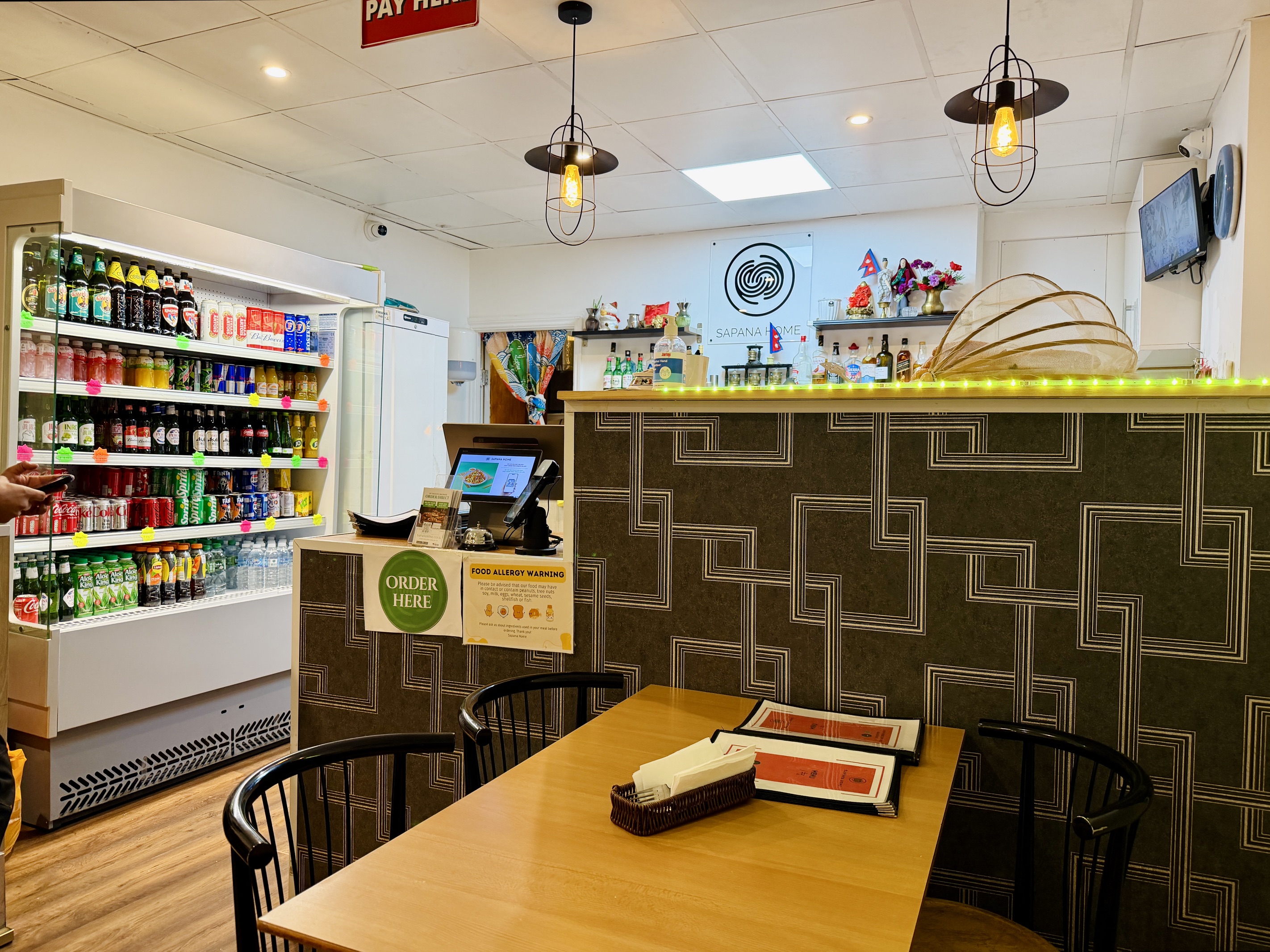
Any changes the restaurant had made, beyond replacing the bright, friendly blue and white frontage with a glossier black and yellow one, were subtle and incremental. You ordered and paid at the counter now, which definitely wasn’t the case when I last ate there, and the loud and incongruous commercial radio – I can honestly say that eating at Sapana was the only time I’d ever willingly listen to Heart FM – seemed to have been axed. The place wasn’t full when we turned up on a Thursday night, but there was a regular trickle of delivery drivers. Perhaps that was where Sapana did much of its trade.

Sapana’s menu was also much the same, which I found oddly comforting. This kind of food is not buffeted around by trends, so it still contained all the classics – momo cooked every which way, chow mein, chaats and puri, curries and thalis. The prices somehow felt frozen in time, too. Not at 2014 rates – ten momo cost a measly £6 then – but nowadays most of the momo max out at a tenner, and have done for years. Very few dishes cost more than that, and even the thalis were only £15.

How an independent restaurant bang in the middle of the town centre had kept prices so low felt like one of Reading’s great mysteries: did they have the luxury of RG1’s only kindly landlord?

The first thing we tried was a curiosity, a misfire and I think a mistake on my part. Graeme was drawn to the sel roti, a sweet rice doughnut. You can have two of them with a portion of alu dum, a slow-cooked potato curry, for just under a tenner but, mindful of how much other food we had ordered, I persuaded him to try one on its own. So essentially it’s thanks to me that we were presented with a doughy hoop that reminded me of a Turkish simit, only sweeter and more incongruous.
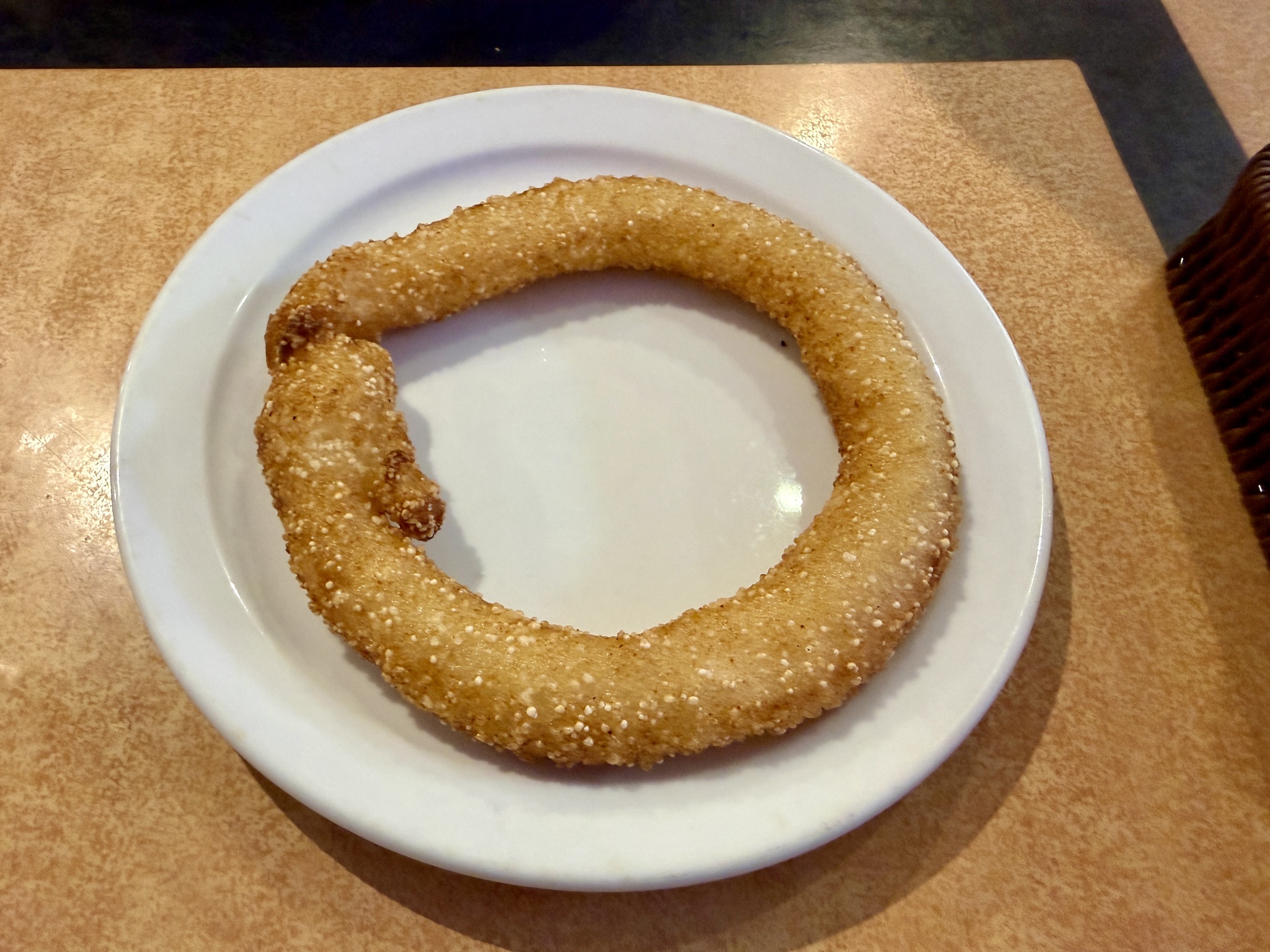
“I’m sorry, this is my fault” I said to Graeme. “This is like having dessert before the main course.”

“It is a bit strange, but I think it needs stuff to go with it, that you can sort of dip it in.”

Like a portion of potato curry, I thought to myself ruefully. Graeme tested the hypothesis by dipping it in a couple of the other dishes we had ordered. It did not seem to go with either, we were to discover. But this is another subversion of the savoury-sweet partition that Western palates are so prone to: this was not in a dessert section, it was in the vegetarian section, and if it’s intended to be eaten alongside other dishes perhaps my finding that strange was more a failure of my imagination.

That misstep aside, the other dishes were unfortunately easier to dislike on their merits. Chilli chicken has been a favourite of mine at Nepalese restaurants for many years, and the benchmark is the one you can get at Kamal’s Kitchen: it’s rich, punchy and will hurt you, in a good way. This was really a very long way from that, the chicken dry and tough, the peppers and onions without char or caramelisation, the sauce watery and one-note. I have absolutely no idea what a lemon wedge is doing on top of this dish, apart from having as little fun as we did eating the bloody thing.
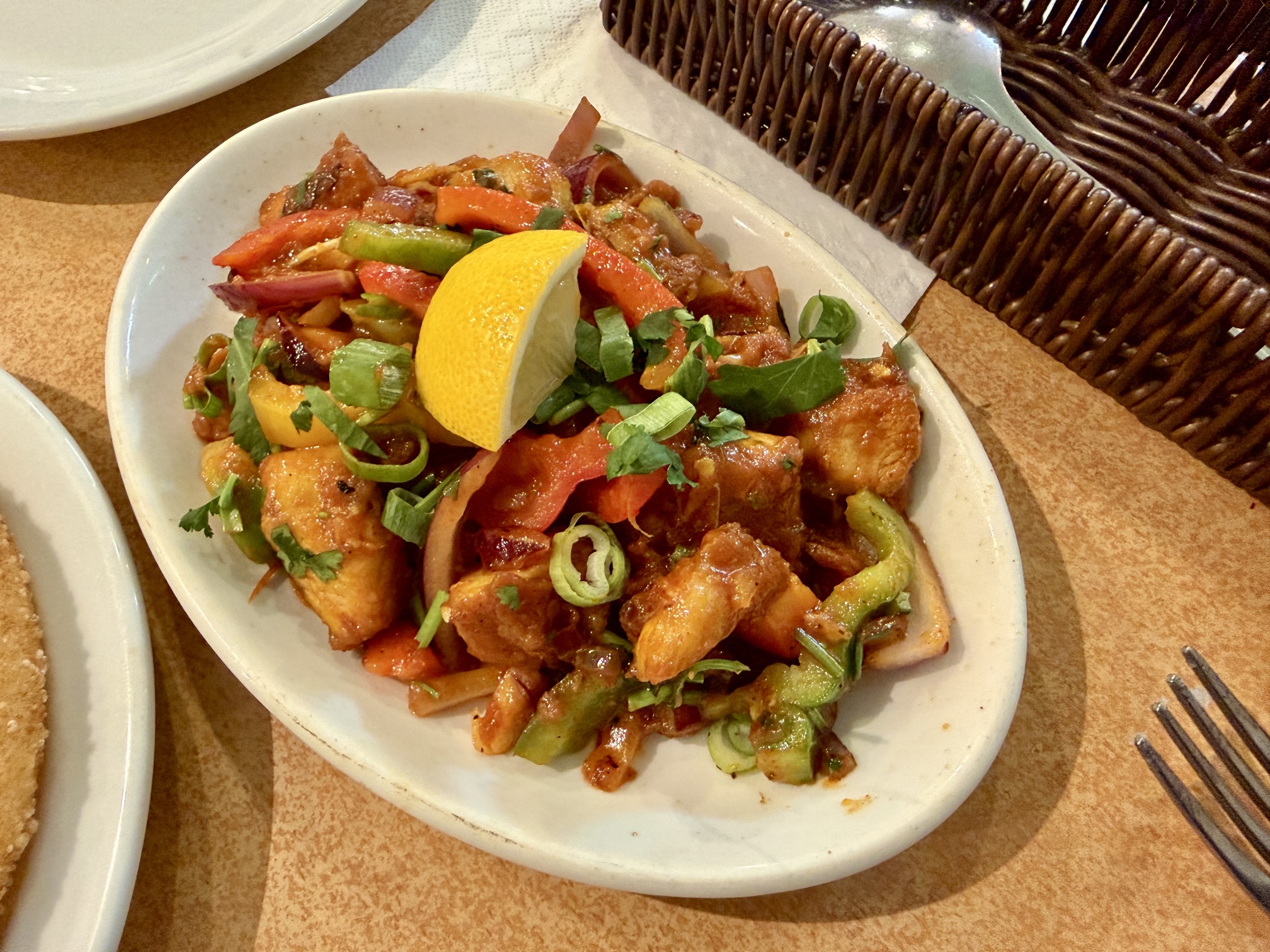
And it’s not just the inevitable comparison with Kamal’s Kitchen’s rendition of chilli chicken. More instructive, though, was comparing it with Sapana Home’s in days gone by: a picture of the same dish, on my phone, ordered back in 2022 was like night and day. In that, the sauce was glossy, thickened, potent, coated everything. That was the kind of dish that would make you fight your dining companion for the last piece of chicken, the last glorious piece of red onion, the last sweet but fiery strip of yellow pepper.

By contrast in 2026, Graeme and I did not finish this dish. Nobody was clamouring to tear off another piece of the sel roti and trawl the depth of the dish for every last molecule of sauce.

Even stranger was a dish I’d never tried before, the sadheko pork. This was meant to be marinated pork belly in a tomato gravy, packed with chilli and spice. What it was instead was big wobbly sections of pork belly: to Sapana’s credit these did feel more like they’d been exposed to a primary heat source than the chicken, with more evidence of textural contrast.

A bit too much textural contrast, actually. It was jarring to find pieces of bone studded throughout the pork belly, and I’m glad that Graeme made that mistake before me, because without him acting as the advance party this was the kind of dish that could cost me £12.50 at the till and considerably more at the dentist.
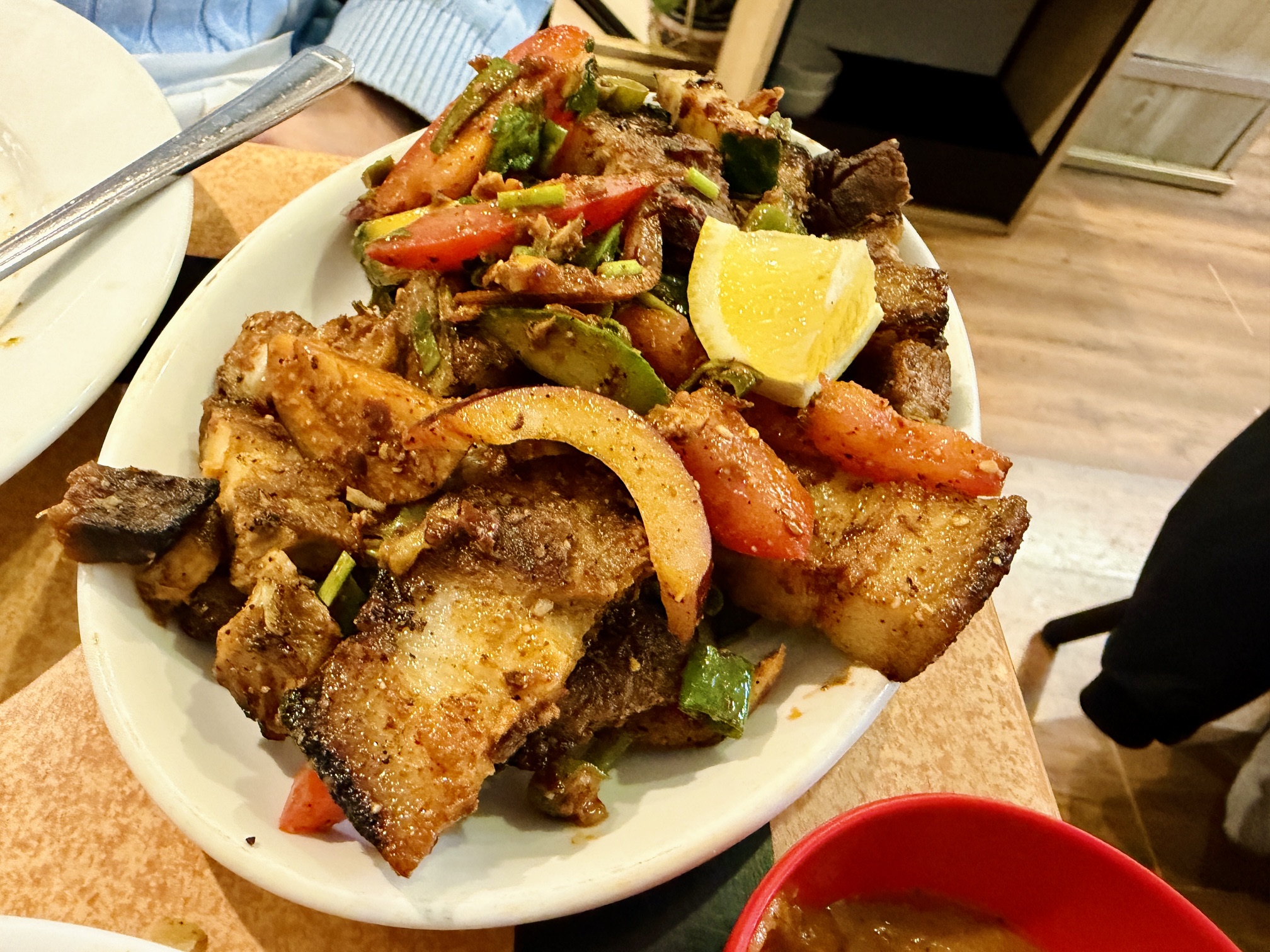
But even without that, the dish was a curious beast. There was no gravy of any kind, making the whole thing more like a dry fry. There was another ornamental lemon wedge, which I found very odd indeed. And I would say that the idea of citrus in this dish didn’t make sense, but if anything it was worse than that because someone had taken a heavy hand to the citrus already. I don’t know what exactly went into the marinade, but that pork tasted so much of lime that it was dangerously close to Toilet Duck territory. Again, we left a fair amount.

The rest of our meal hewed closer to Sapana Home’s traditional strengths, the reassuring carbs that Nepalese food does so well. I really enjoyed the chow mein, tumbled through with really enjoyable nuggets of sukuti (dried buffalo at a guess, although it could have been lamb). Graeme was not sure about the spicy sauce that came with it but to be fair, the first time I tried a Nepalese chow mein neither was I. It was only further down the line that I came to appreciate this spin on a dish that, previously, I had only ever eaten from a Chinese takeaway.
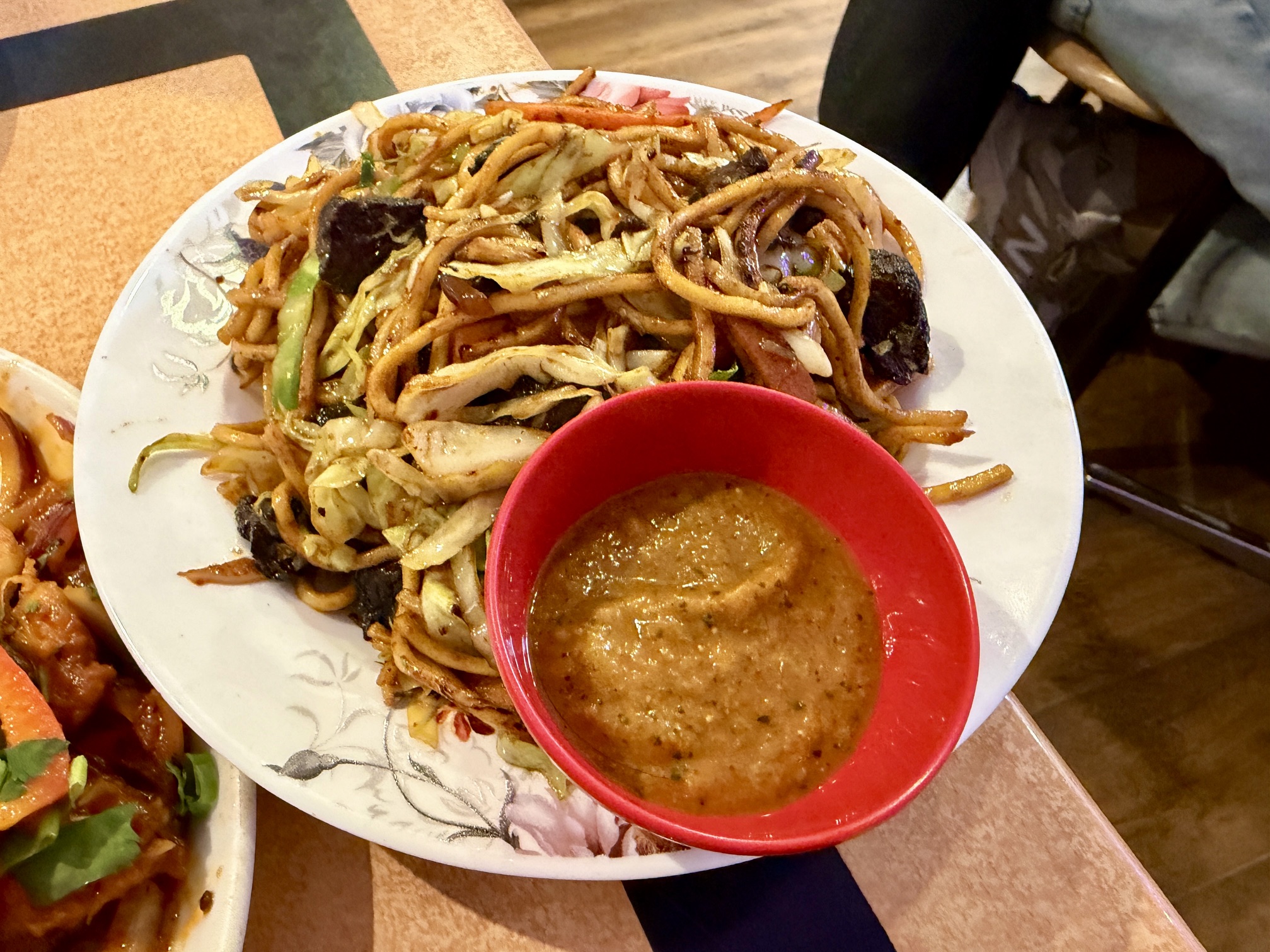
This was the kind of dish you could drop into Sapana Home for after work, to hunker over in the miserable months that are just around the corner. Thinking about it, there have been many times when I did exactly that.

I’ve saved the best ’til last: Sapana Home’s momo are still marvellous. We went for pan fried, as I usually do, stuffed with buffalo and they were easily the highlight of the meal. I really needed them to be good, because at that point my confidence in Sapana Home was wobbling and I didn’t want this to be one of those reviews, where I revisit a place to find that anything I liked about it was gone.

That wasn’t the situation here. The casing was still just the right thickness, with that glowing tan only pan-frying can induce. The filling was still generous, plumping each parcel out, and I think buffalo is worth the extra quid, even if it takes the cost of ten parcels of pleasure over the £9.99 rubicon. Sapana Home’s momo are still up there with the best of Reading’s momo peddlers, and if the chasing pack has caught up with Sapana in the fourteen years since it opened in the centre of town, it is still a tricky proposition to overtake.
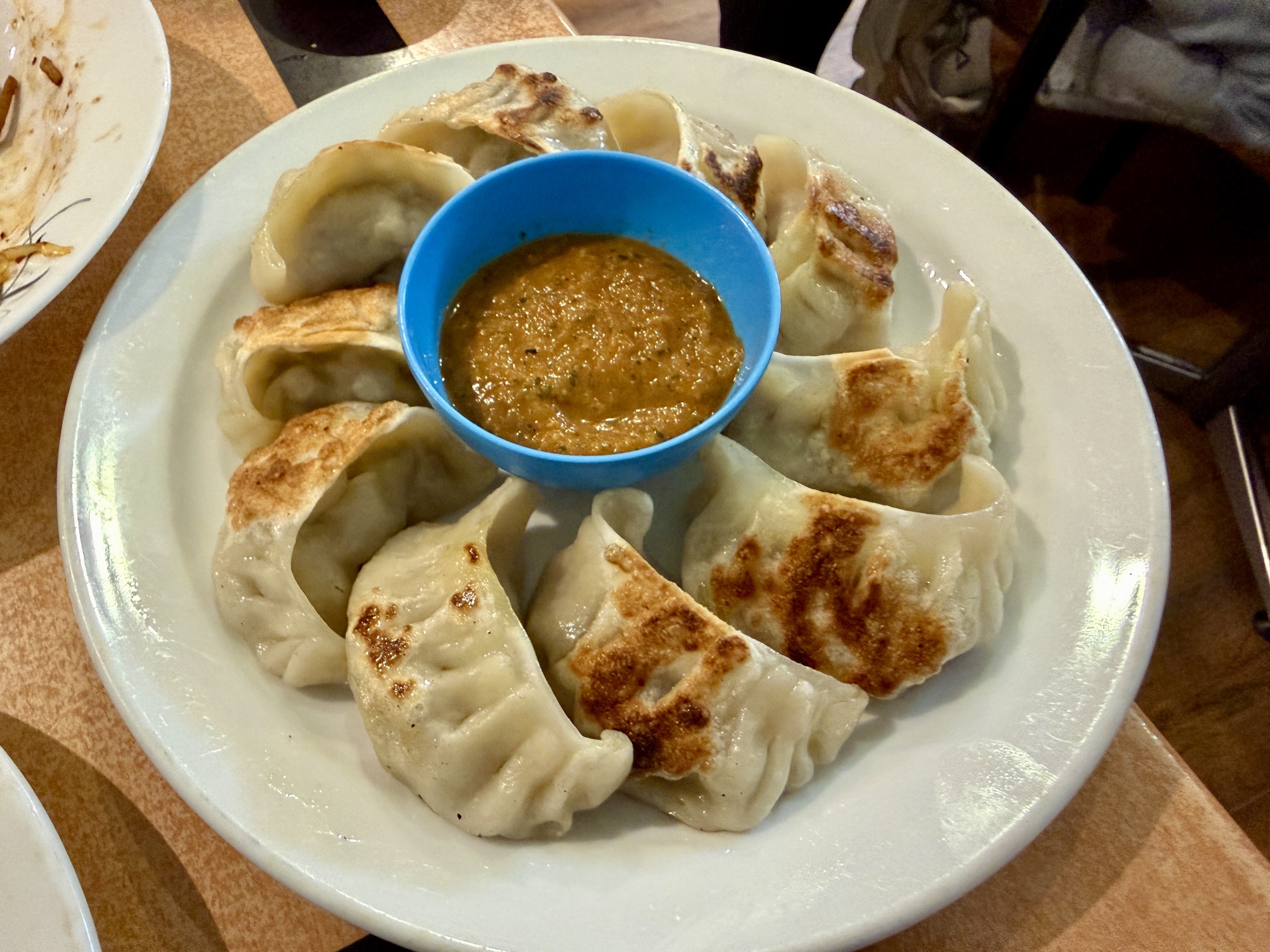
All that, plus a couple of extremely tall and very good mango lassis, came to just shy of £60 including service. Sapana Home is still a relatively inexpensive place to eat fairly well, but I was struck that the two carb-based dishes remained the value propositions: I’m not sure anybody should go there to eat the other dishes we tried.

Over post-dinner pints at the Nag’s Head, I wondered whether I would ever go back to Sapana Home if my first impression of it in 2014 had been the same as Graeme’s that night. But then I realised, thinking more clearly, that that had been my impression the first time I ate at Sapana Home: the carbs were good, the momo were terrific and the rest felt like it wasn’t for me. It was only through returning and persevering that I found the other dishes to like on Sapana’s menu, although it felt sad and unfortunate that they let me down on this occasion.

But that’s the point about restaurants – they neither exist nor change in a vacuum. In 2014 Sapana was the only momo joint in town, and Reading’s gastronomic scene was in its infancy: no pizza explosion, no glut of sushi places, no high end chains like Honest and Pho changing the landscape. So in 2014, a spot like Sapana would get more chances to get it right than it might today, when money is tight and nobody goes to a restaurant – unless they’re an idiot like me – with an appetite for risk.

So in 2014 I visited Sapana Home, I wasn’t sure, and then I grew to love it. I went often for a long time and then I put it to the back of my mind for three years. Going back now I can see the nucleus of what I liked – it’s still there – but time moves on and I wonder whether Sapana might get left behind.

What will be interesting is to see if this sparks Graeme to go again, when he’s straight off the train after a long hard day and keen for carbs, and whether it’s the start of him having the kind of relationship with Sapana that I once had. My guess is that none of that will happen, because Reading is such a different place now. But I’ll ask him, next time we’re down the pub.

Sapana Home – 6.6
8 Queen Victoria St, Reading, RG1 1TG
0118 9509898

https://www.sapanahome.co.uk

Since January 2025, Edible Reading is partly supported by subscribers – click here if you want to read more about that, or click below to subscribe. By doing so you enable me to carry on doing what I do, and you also get access to subscriber only content. Whether you’re a subscriber or not, thanks for reading.
Restaurant review: Namak Mirch

Graeme and I are a fine pair when I meet him on Cemetery Junction for our trip to Namak Mirch. He had an operation on his foot in January and is standing there, crutch in hand, wearing trainers for the first time since being discharged: his wife has given him a lift to our meeting point. My injury is more invisible these days – people can only see the beginning of the cursive scar that flows from my elbow to my shoulder when I wear short sleeves – but I still can’t lift much, not until the man who sliced me open is happy with the x-rays.

I crossed the border into my fifties a couple of years ago, Graeme is not far off it: in the pub after dinner we agree that getting old is no fun, even though a viable alternative is yet to be discovered. Graeme says that it seems as if one minute you don’t feel old and then suddenly the tipping point comes and almost immediately you do; I know what he means, and feel like, for me, that happened at the end of last year. I’ve had one of those tough weeks when you feel far older than you want to be. But still, one benefit of ageing is that over time friends become old friends, and you can meet them for dinner.

Graeme moved back to Reading last year and now lives in a pretty house in Newtown, far from his previous place in Thatcham and the bucolic delights of Paggies Bar, a spot he steadfastly refused to take me to. I picked Namak Mirch for us partly because it is practically the nearest restaurant to his house – well, that or the The Fisherman’s Cottage. In the run-up to Graeme’s big move I recommended Deccan House to him ad nauseam, because I’ve enjoyed its takeaways so much in the past, but I’d received some inside information that Namak Mirch might give it a run for its money.

Namak Mirch has taken over the old spot where Star Karahi, the Pakistani restaurant so beloved of Reading’s black cab drivers, used to be. Not entirely – one of the signs outside still gives the old business’ name – but the place is definitely under new ownership. Last October I got a tip-off from Jacqui, a regular reader of the blog, that a friend of hers who previously ran a takeaway business from home had taken on the site.

Jacqui started out buying her samosas, then her Friday night curries, and then she sent me a couple of pictures of a distinctly attractive looking dinner from Namak Mirch: nothing fancy, just a lamb curry, a bed of rice, some grilled chicken wings and a simple salad. You could go past the restaurant in a car and barely notice it, and in fact I did a couple of times including a drive home from my dad’s on Christmas Day. But a glowing report from Jacqui, who knows her food, was enough to place it on my to do list.

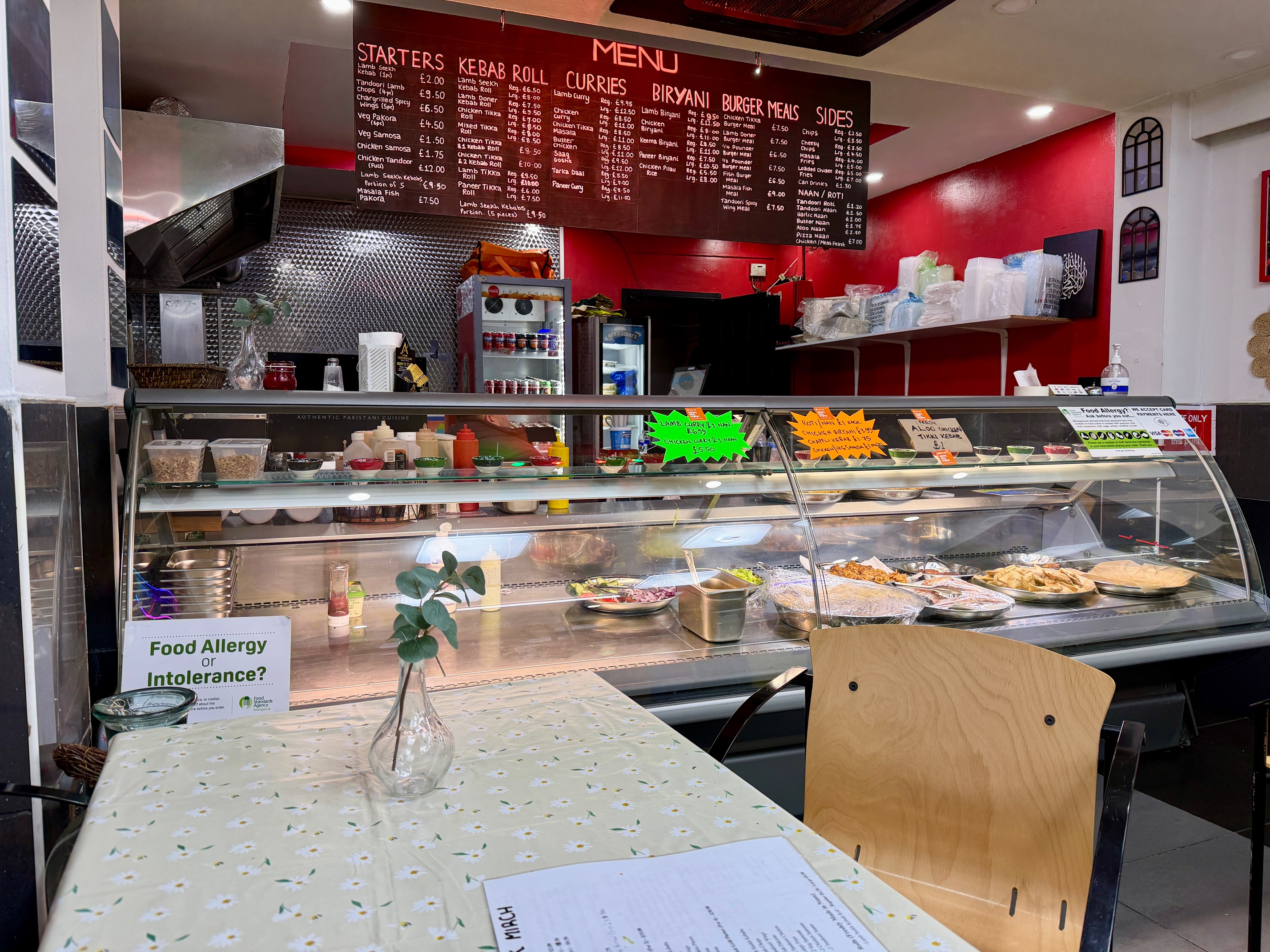
The interior of Namak Mirch is about as no-frills as you can get. Three tables, covered with linoleum tablecloths, seat no more than a dozen people, the chairs mismatched and occasional. On our visit we were the only people there, although this was during Ramadan and a delivery driver or two did turn up while we were eating.

But there was something homely about it nonetheless. Some of the starters, snacks and other dishes were on display under the counter, cardboard starbursts in Day-Glo shades taped to the glass giving names and prices, the whole thing strangely retro. Besides that, the menu was all listed on a board overhead, the aesthetics of the greasy spoon somehow appropriated for a restaurant serving Pakistani dishes.

That menu was pretty compendious, a mixture of starters, kebab rolls, curries and biryanis, most available in multiple sizes. Over on the far right of the menu, fittingly, were the crazy choices, the burgers and cheesy chips for wackos who simply refuse to integrate.

There was also a laminated menu on the table, unbranded except for the restaurant’s name written in Sharpie, which didn’t entirely match the one over the counter, including some mixed grills and other dishes not to be found on the blackboard.

Nothing at Namak Mirch was expensive, with the costliest dishes coming in at £12.50 and most far, far below that. The snacks emblazoned on some of those highlighter coloured pieces of cardboard were the cheapest, coming in at £1 apiece.

We started with those and the friendly chap behind the counter, who told us his wife runs the kitchen and makes everything from scratch, was happy for us to order them and decide on the rest of our meal later. There isn’t really table service per se, more that your plates are plonked on the counter and you take them to the table yourself. I didn’t mind that at all, once I realised that expecting Graeme to do that was insensitive in the extreme. His barely functioning foot trumped my partly functioning arm.

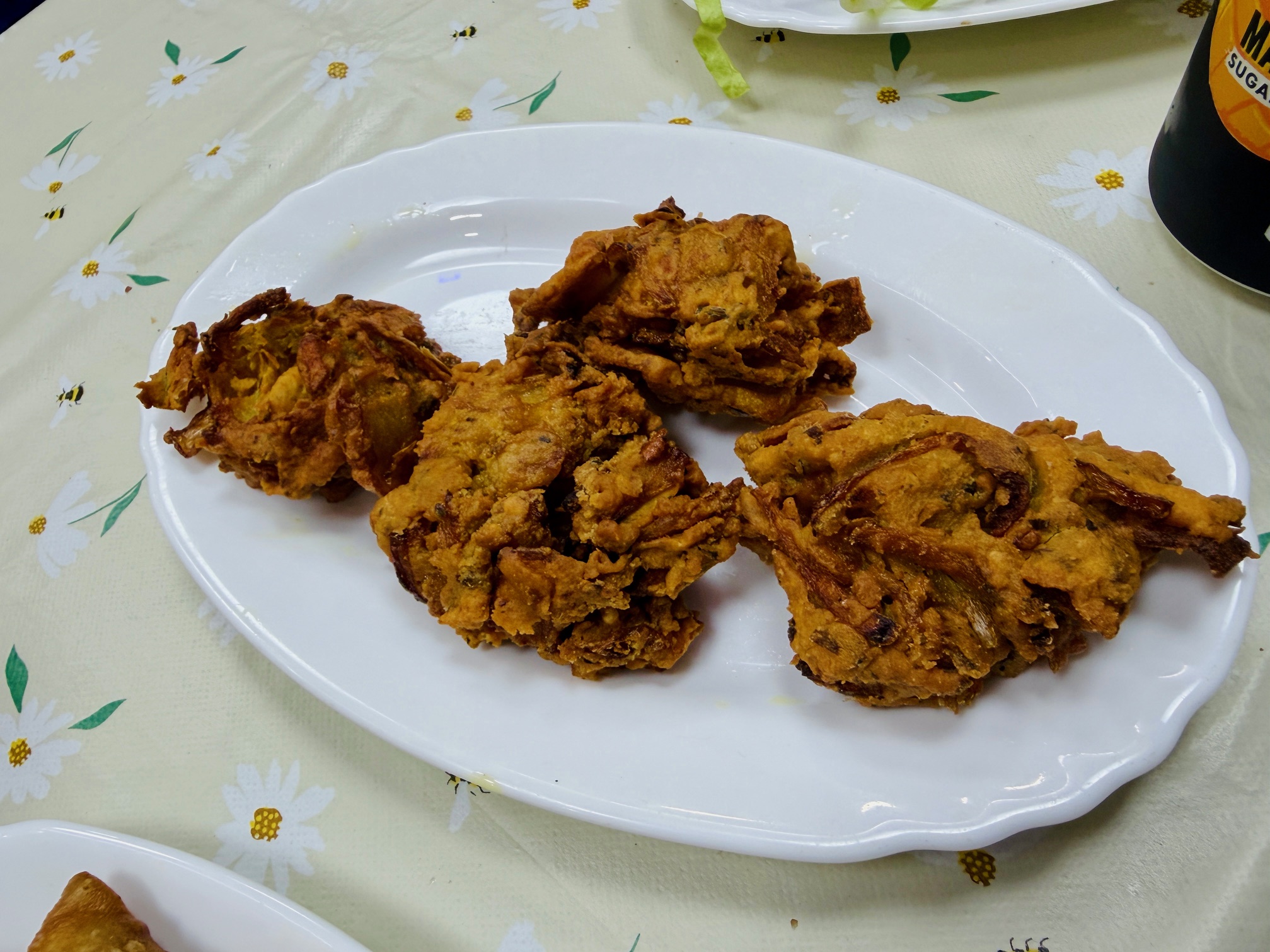
So the first things we ate, along with being among the best, were unbelievably affordable. Namak Mirch’s pricing structure can be a bit chaotic, and what you read on one menu doesn’t necessarily match up with what you end up being charged. So for instance, the menu says you get six vegetable pakoras for £4.50. We didn’t know that, so just ordered the four.

They were crisp but not overdone, utterly greaseless and perfect dipped into the little tub of spicy tomato sauce or the raita on offer. I could easily have ploughed through half a dozen with Graeme, in fact I could easily have ploughed through half a dozen on my own. The four we accidentally ordered showed up on the bill at the end as costing £2. Surely some mistake, to offer terrific food at sweetshop prices?

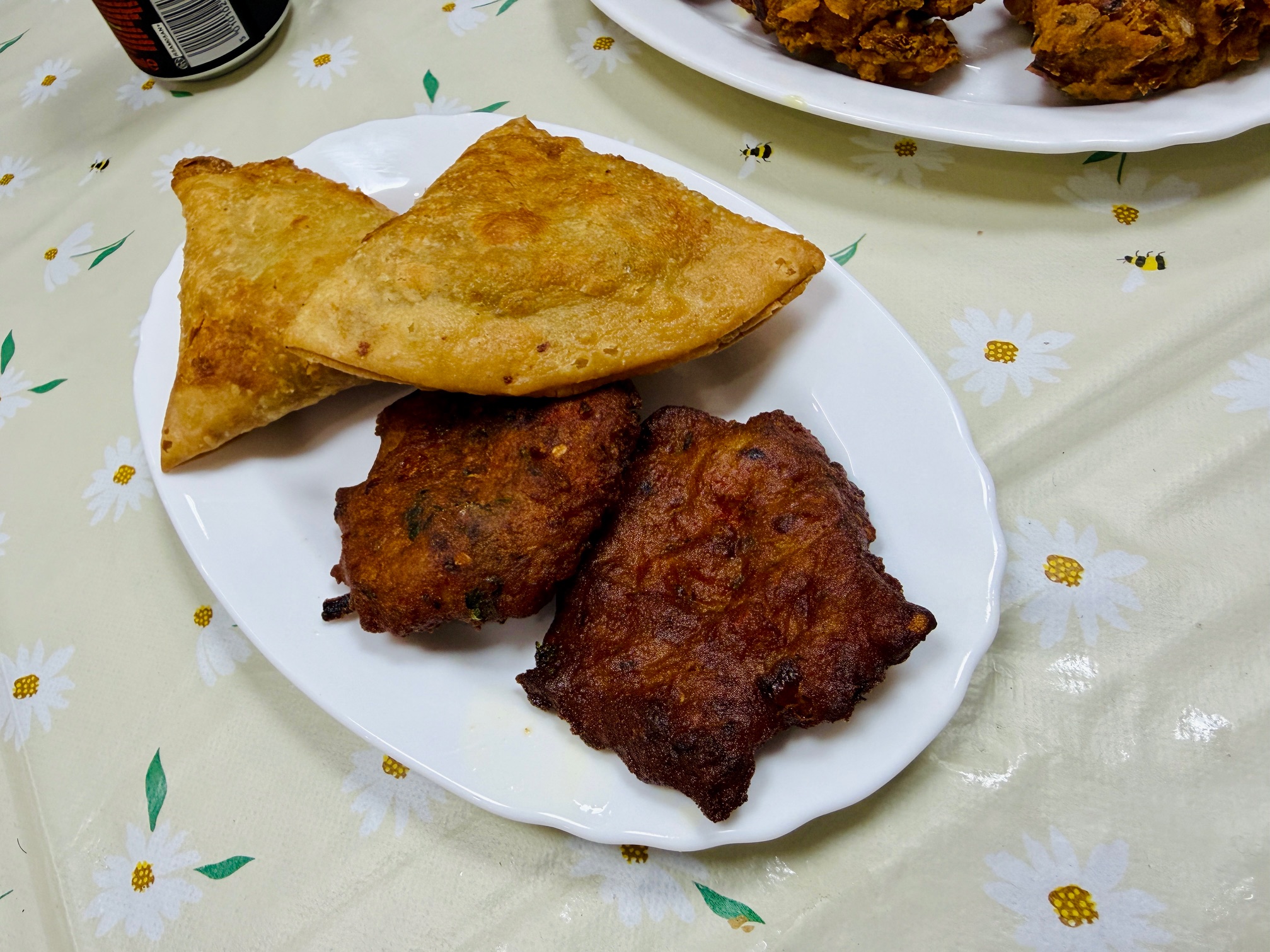
Also costing £2 were a pair of samosas, golden and generous, packed to with minced chicken. These were Graeme’s pick of the snacks, I liked them but I feel I’ve been spoiled by the world-beating vegetable samosas at the Wokingham Road’s legendary Cake & Cream, which last time I went cost something silly like 70p a pop. Despite moving to East Reading, possibly my very favourite part of town, Graeme is yet to try Cake & Cream. I’ll let him off, though: he doesn’t need a doctor’s note for that one.

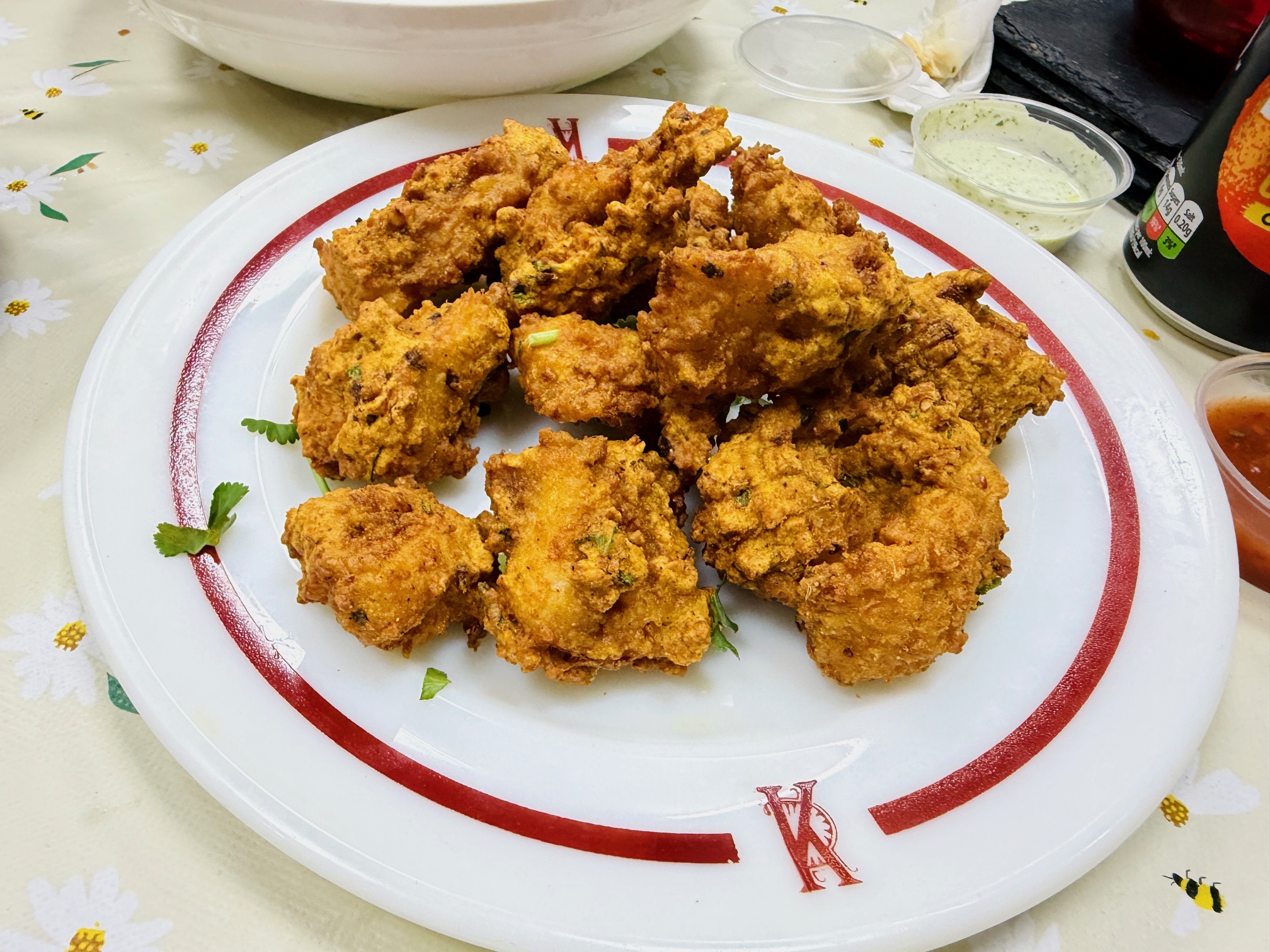
Even better, and for my money my favourite of the snacks, were the chicken aloo tikki. Deep copper-coloured irregular fritters made with chicken and potato, these – to my mind anyway – took everything that was great about the pakora and the samosas and, à la The Fly, merged them into a single unbeatable snackette. And when I say “for my money” I mean “for one pound sterling of my money”. My goodness. I could just come to Namak Mirch and eat these, if it wasn’t for the inconvenient fact that the rest of the menu is equally loaded with winners.

But I didn’t know that at this point. I was catching up with Graeme, congratulating him on his new home, discussing my recent travails and marvelling at how well a can of Tango Mango Sugar Free went with all this gorgeous scran. I already envied Graeme his new house on one of Reading’s prettiest streets, was I going to end up coveting his local restaurant as well? It felt like it was going that way.

After much reflection, an enjoyable spot of picking out our favourite dishes like we were assembling some kind of gastronomic Fantasy Football team and lots of awfully polite “no, you pick your favourite” toing and froing, Graeme and I had assembled a selection of five dishes to let us sample as much of the menu as possible. We thought we might have over-ordered, but Namak Mirch’s pricing is so reasonable, and we so reckoned we were onto a winner, that we both agreed it was a risk worth running.

When I got to the counter, that slight air of lovable chaos set in again around portions and pricing. Now, I should say that I don’t mean you get diddled with hidden expenses: I mean that you believe your dishes are going to be a certain size and cost a certain amount and then you find that actually, they are somehow magically even bigger or even cheaper. It was baffling and benevolent.

A great example is that I wanted to order us a boneless chicken biryani to share, a large dish that – on paper, at least – will set you back £11. And I was about to do exactly that, when the beaming man behind the counter told me, in the style of once famous local lush and Pride Of Reading Awards uber-ligger Chris Tarrant in Who Wants To Be A Millionaire, that he didn’t want to give me that. He said that as a Ramadan special they were doing a chicken thigh biryani, not on the usual menu, for £3.99. Would I like a couple of those instead, he asked me? It was not a difficult question.

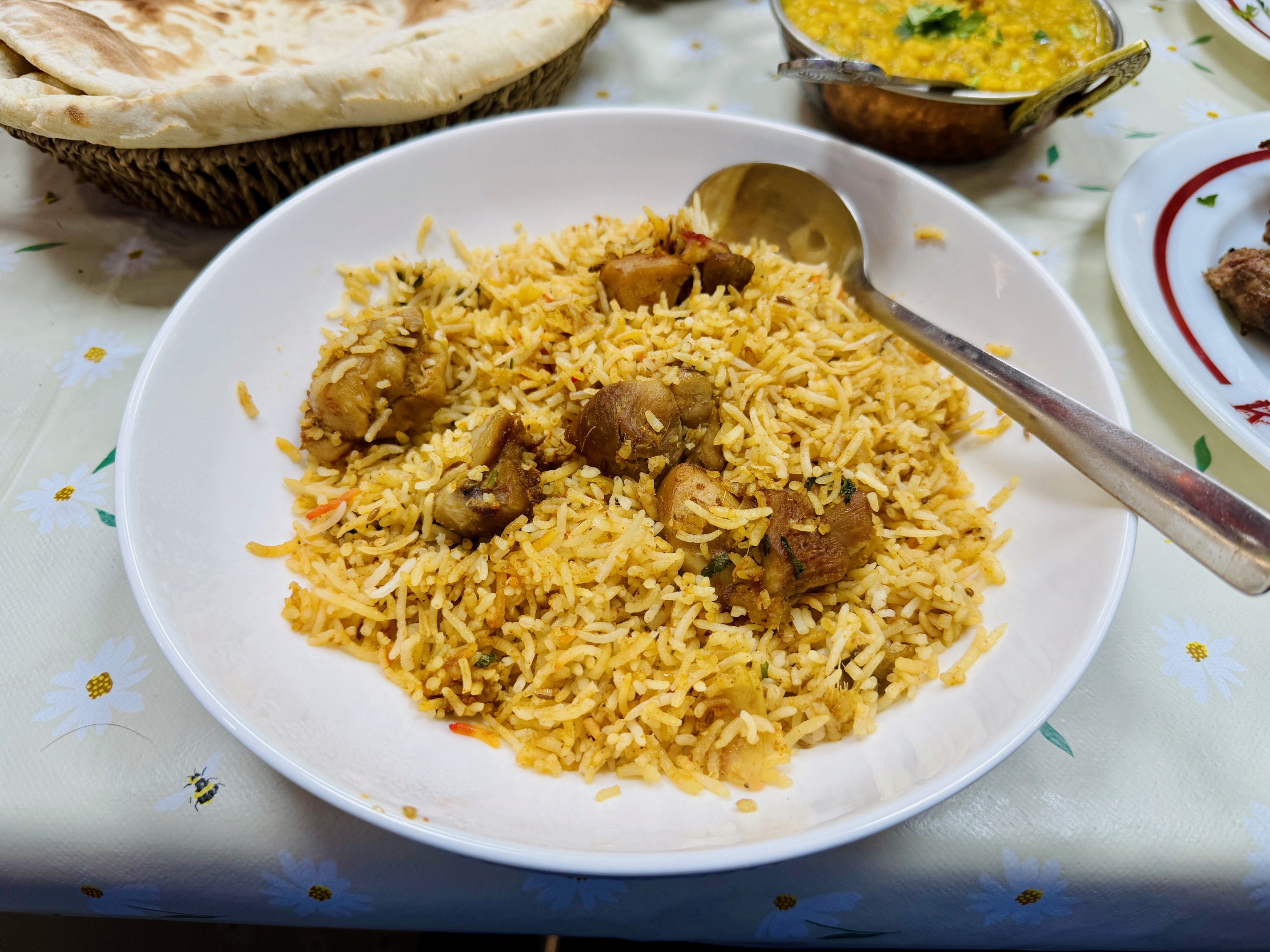
Not only wasn’t it a hard question, but it was an excellent idea. We got two exceptionally generous portions of fragrant rice, studded with tremendous pieces of chicken thigh, the whole thing pungent with cloves. I mightn’t necessarily have wanted to eat this on its own, but as a bed to absorb gravy or curry it was unimprovable. When Ramadan is over I’m sure the chicken biryani will made an excellent alternative – or keema, or paneer, both of which Namak Mirch offers. But really, £3.99? How was Namak Mirch making any money?

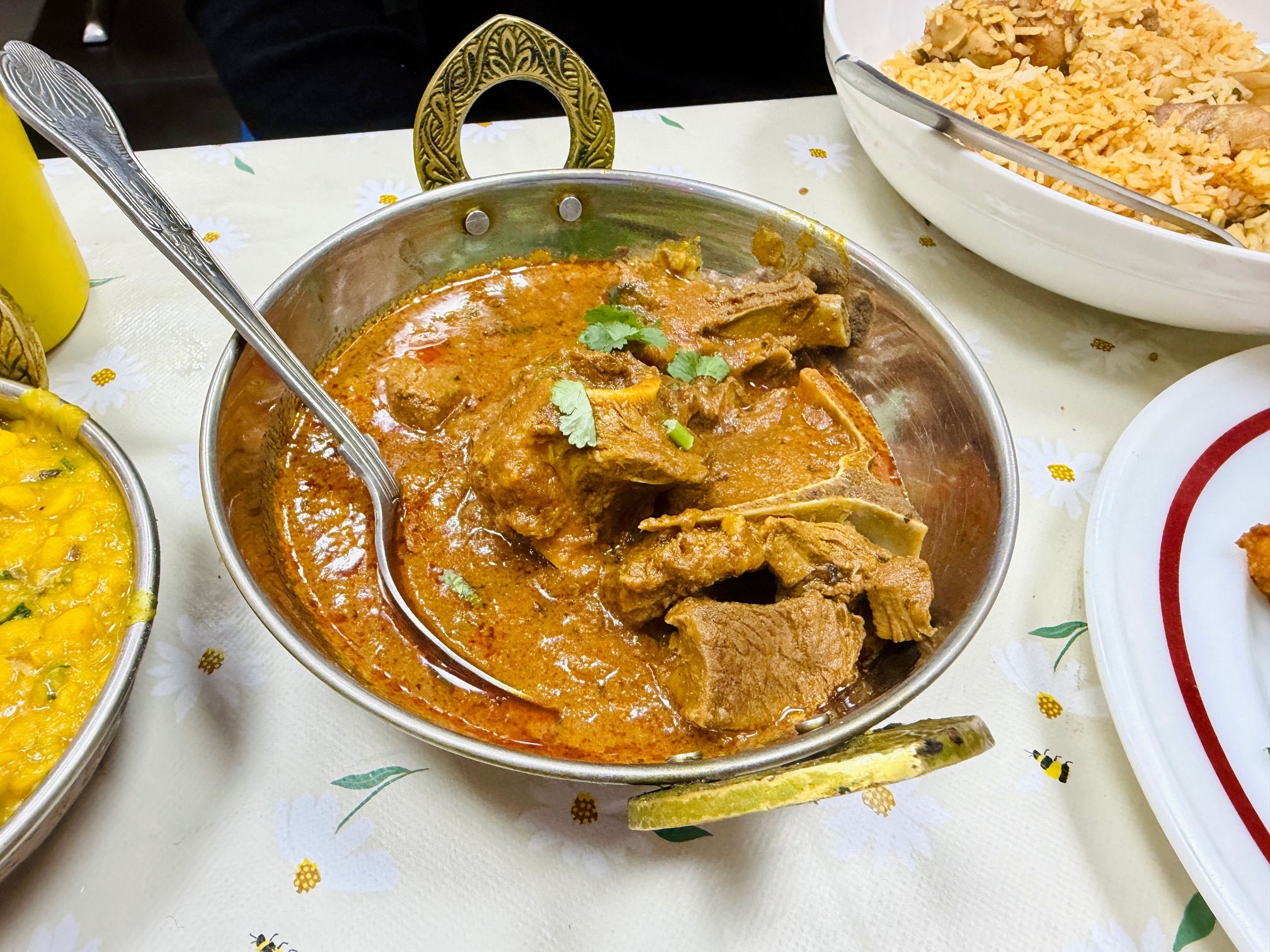
The wayward pricing affected a couple of other things we ordered. Graham was drawn to the lamb curry on the bone, and it was a superb choice. The lamb took minimal persuasion to leave home, so to speak, and properly go for a dip in a sauce which was rich, fruity and comforting, with a gentle heat that had me dabbing my nose only towards the end of the meal. Better still was the marrow, eased and winkled out of the bone and enriching every forkful it came into contact with. Graeme reminded me that this was why curry on the bone was better and, despite us both having all sorts of fun and games with our own bones, I couldn’t disagree.

We asked for a large, were billed for a medium and I suspect a medium is what we got. You could almost believe that they knew we’d ordered a little too much but were too polite to tell us. Still, it was a princely £9.50 and would have more than served one person handsomely. On the menu it’s meant to cost £9.95, but that was Namak Mirch: nothing cost precisely what you expected it to.

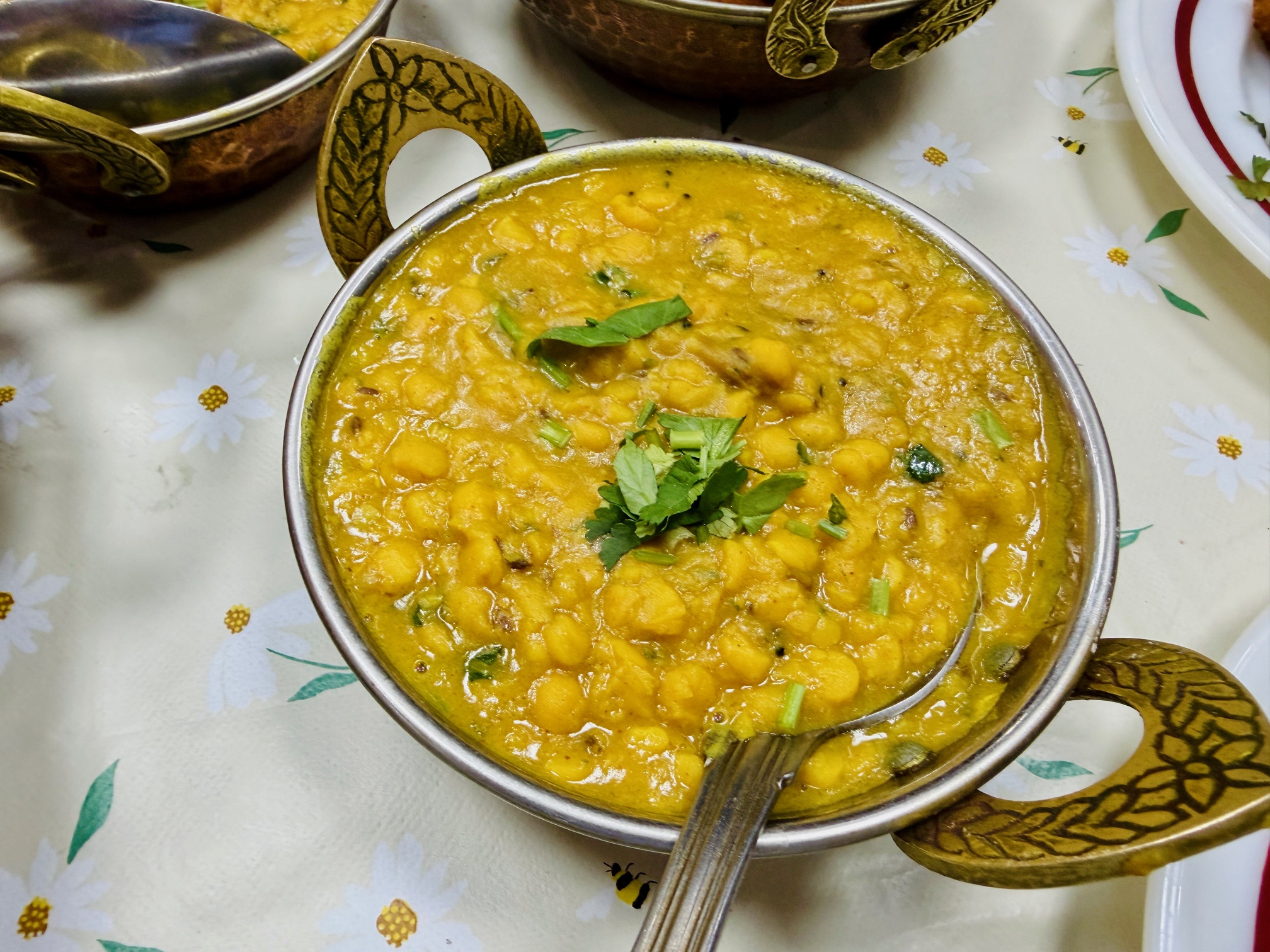
Further confusion reigned with the tarka dal, something Graeme really fancied. When I ordered it, the chap behind the counter told me it came with homemade roti on a special deal – another special deal – and of course we went for that. What arrived was some perfectly credible flatbread, which had the kind of gaps and holes that said it had been made by hand back in the kitchen. I liked it. but we were too full to properly attack it. It did however suggest that Namak Mirch’s kebab rolls – freshly made in naan, according to the printed menu, merited investigation.

But we also got not one but two metal bowls of tarka dal. We said we’d only ordered one and the chap waved it away, saying we could have the second one anyway. We were hardly complaining, and we complained even less after we’d tasted it – the most perfectly soothing bowl of big, floury lentils in a sauce that gently hummed with garlic without bragging about the time and care that had gone into it. Graeme’s wife Amy is a vegetarian: between this and the paneer biryani I suspect Namak Mirch will have her bit of their next takeaway order well and truly covered.

Again, when the bill arrived it was a bit of a case of The Price Is Right. We had allegedly been charged for two portions, at a cost of £8. You could read their menu from now to the end of the day and never find a permutation of tarka dal that cost either £4 each for two or £8 for one. But either way, two bowls of that faultless dal for £8 felt like some kind of misprint, or cosmic error.

That would have been enough food, but there were a couple of other things I really wanted to try. One, the masala fish pakora, was possibly my single favourite dish of the evening, a big pile of irregular golden nuggets of fish, the coating all gram flour and herbs and the inside pearlescent, cooked no more and no less than each piece demanded. This deft touch reminded me of Kungfu Kitchen’s deep fried fish in spicy hot pot, a spiritual sibling even if it originated thousands of miles away in Chengdu.

By this point the staff had just given us a big squirty plastic bottle filled with raita, the kind kebab shops use to anoint your late night purchases, so we didn’t have to exercise restraint. I think they’d worked out that, on that evening at least, restraint simply wasn’t our bag.

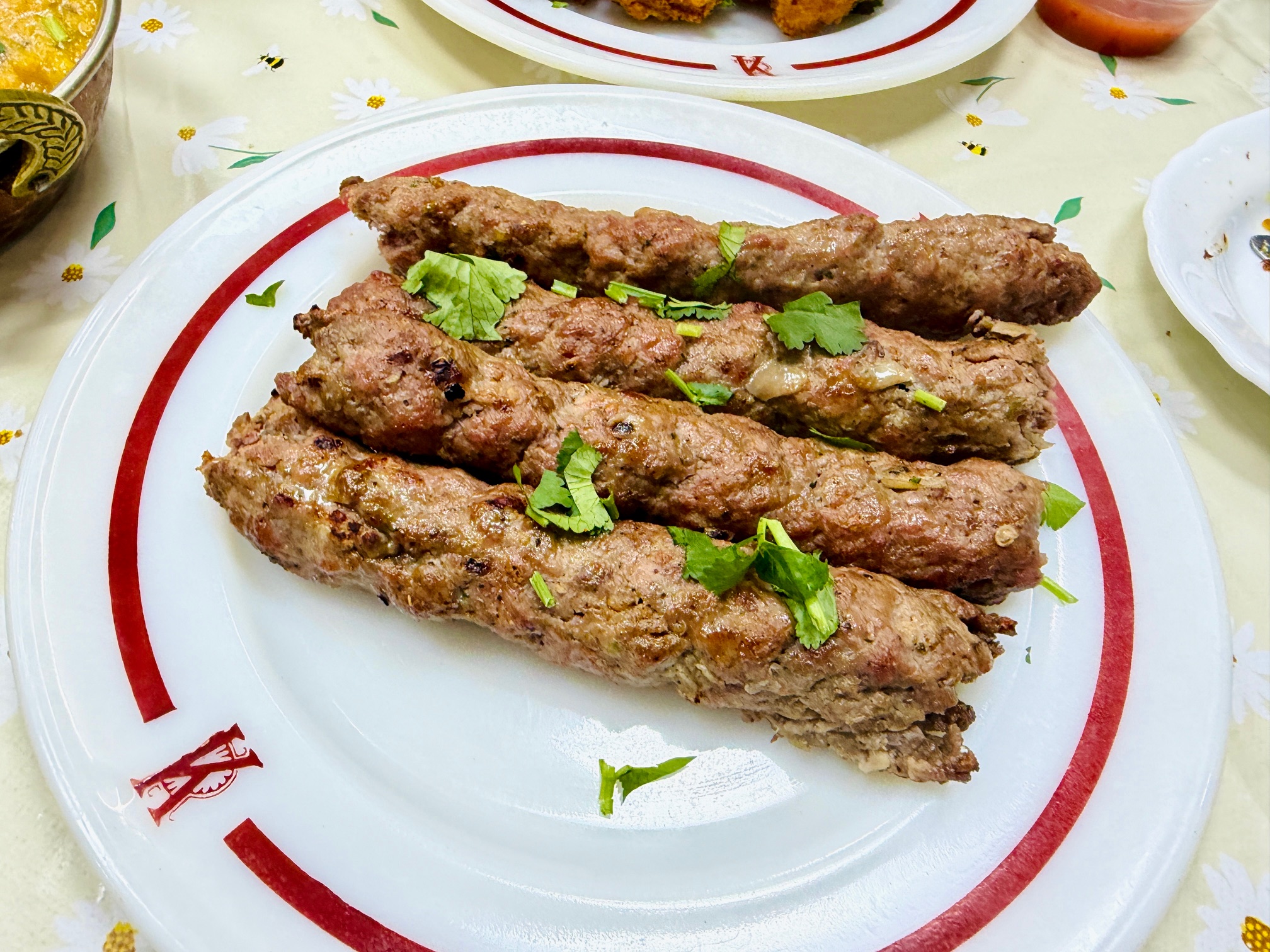
Last of all, we had to try Namak Mirch’s sheekh kebabs (I say had, I mean wanted). These are £2 each or five for £9.50 and when I’d asked for four the owner said he would happily do us five for £9: I’ve never eaten anywhere where the pricing felt quite so optional. I said it would just cause a diplomatic incident if we had to share a fifth one but really, four was plenty.

Again, they looked divine and the lamb in them was superb, the texture impressive, coarse with no bounce or padding. I think they were – almost – some of the best sheekh kebabs I’ve ever had. That almost is because the spicing of these was far more clove heavy than the biryani had been, to the point where it was a little like eating a pomander-flavoured sausage. A liberal trawl through the raita took the edge off it but a slightly gentler hand in the kitchen would turn these into world-beaters to rival – well, to rival the rest of the menu really.

I had no idea what our bill would come to, but when I went up to pay all our food – which may or may not have been part of special offers, Ramadan only deals or spur of the moment decisions by the proprietor – came to just shy of £50, including a couple of soft drinks. That didn’t include a tip, and I insisted on tipping to an extent which surprised the owner. But really, we were the only customers there that night and our food was almost without exception outrageously good, and I worried about how Namak Mirch would survive charging such timid prices.

He told me that they’d only been open a few months, and that things were going well – quiet at times, busy at others, very much impacted by Ramadan, for better and for worse. He seemed delighted that we had so loved our food and reiterated that his wife, out back, made it all from scratch. I told him his friend Jacqui had recommended it to us and he laughed. “That’s my wife’s friend! They’re all my wife’s friends.”

And then, because in my experience some truly hospitable cultures and people feel bad about things like being tipped and immediately try to give you something in return, he insisted that we stop for chai and, about ten minutes later, brought us two beautiful sweetened cups of the stuff. Because that wasn’t enough, we also got a little bowl of dates stuffed with almonds. It was simply lovely: my friend and I sat there sipping our chai as our cups sat on that lino tablecloth, we ate our dates, we watched the traffic hum past, heading into town, and we both reflected on just how good a meal it had been.

Neither of us had missed alcohol at all, either, but that’s because we knew that when we were done we could manage the short walk to the Hope & Bear, which had an acceptable pale for me and an impressive range of single malts for Graeme. We still had plenty to discuss but we did keep coming back to one particular topic, which was just how good Namak Mirch was. On that night, when both of us really needed that kind of warmth and hospitality for our own various reasons, Namak Mirch was a beacon of how things should be, and I was deeply thankful for it.

I hope other people make a pilgrimage there, even if working out the menu and pricing might be beyond even the intellect of Hannah Fry, and that they discover what I discovered. For my part I’m already wondering when I can go back, because I knew before the meal was even over that this one fell into the category of restaurant Zoë likes to describe as why didn’t you take me? Graeme, I have a feeling, might be back even sooner. He lives round the corner after all, the jammy bastard.

Namak Mirch – 8.5
251 London Road, Reading, RG1 3NY
0118 9669492

https://namakmirchonline.co.uk

Since January 2025, Edible Reading is partly supported by subscribers – click here if you want to read more about that, or click below to subscribe. By doing so you enable me to carry on doing what I do, and you also get access to subscriber only content. Whether you’re a subscriber or not, thanks for reading.
Restaurant review: The French House, Soho

It would be easy to envy London-based restaurant reviewers, I think. Just imagine having such a broad canvas, such an embarrassment of riches, every kind of restaurant at every level, from the plush, spenny Mayfair spots A.A. Gill used to frequent to the unsung cash-only middle-of-nowhere places Vittles has made its speciality – and, I suppose, everywhere in between. Like Samuel Johnson almost said, imagine getting tired of the London restaurant scene! How jaded you would have to be.

And yet… I don’t know. I think there are huge consolations to being a gastronomic tourist in the capital. For a start, everyone writes about London restaurants. All the critics, all the Substackers, all the people jabbering to camera in their weird self-parodying voices on TikTok. It would be exhausting to be in that pack of misfits, let alone trying to keep pace with them.

It’s all about the urge to be first – to get to the new place before everybody else, or to get there at the same time but say it better. We have reached the point where various critics have visited, say, Josephine in Marylebone in recent weeks and come down solemnly on either side of the fence, saying it’s great or bobbins, as if they’re handing down Supreme Court judgments. And really, who cares?

Well, if you’re invested in it I’m sure you do but from a distance it feels like the kind of Inside Baseball stuff that only interests a small number of people. There are at least a couple of Substacks specially for those people, too: I imagine if you fancy a very niche printed word take on Gogglebox they’d be catnip to you.

No, I quite like being free of all that. I get it in Reading, that if a new place opens people want to know what it’s like and that makes me want to get there fairly soon after it opens; if you’re hankering for a review of Nua, or Pho 86 or even Take Your Time, the new spot that’s opened where Dolce Vita used to be, don’t worry. I will get to them, I promise.

But to have that feeling amplified to the max, to see all these hot new places and know you only have so many evenings, so much time, so many spare calories, so much money? I don’t envy any of them that, not even the ones whose decisions are made infinitely simpler by choosing the restaurants that bung them cash, free food or both.

Of course, there’s also the FOMO I always associate with big cities. It’s bad enough when I go on holiday to, say, Lisbon, and the infuriating brain that has unhelpfully held me hostage all my adult life – the one I struggle to quieten – looks at all the places on my narrowed-down shortlist before piping up about every single restaurant that didn’t make the cut. What about all of these?

Don’t get me wrong, I loved Lisbon, I ate well there and people tell me my city guide is very useful. But for each list of places I visit there is always an equal and opposite running order of the ones I didn’t choose, all taunting me with the possibility that they might have been even better. I copy-paste them into a new note entitled Next time when I get home, but mainly to try and fool myself.

So I am very comfortable with my relationship with reviewing London restaurants. I get to places I have always wanted to visit – a real mix of the old and new, no real guiding principle behind them except that I fancy them. Often it means things go brilliantly and I make a favourite new discovery, sometimes I’m underwhelmed by somewhere that has been hyped to high heaven (Chick ‘N’ Sours has since closed). But even that is as it should be: if I loved literally everywhere I went in London I’d be no better than Eating With Tod and the world of food doesn’t need another Toby Inskip. It already has one Toby Inskip too many.

All that explains why Monday morning found me outside Flat White on Berwick Street ahead of a lunch reservation in Soho, at the French House. David Schwimmer – all in black, bags under his eyes, baseball-capped, quiet and polite – had just been in there grabbing a coffee and the staff, who were probably discovering him on Netflix for the very first time, were decent enough not to act starstruck. And then someone even more celebrated crossed my path – my friend Graeme, my lunch companion that day, merrily wandering aimlessly through Soho after a morning spent shopping.

So off we walked to the French House together. Our lunch had been a spur of the moment thing: it was the last Bank Holiday before Christmas, and we were both at a loose end. His wife was away camping, mine was at work so we decided to indulge in one of life’s great joys, a leisurely lunch on a day when you’d ordinarily be at work, a Monday stolen back from the cosmos.

The French House is one of London’s great pubs, which means that it’s one of the world’s great pubs, and it’s been a favourite of mine for many years. I’ve lost count of the number of times I’ve sat downstairs in among the regular churn of Soho types, tourists and people passing through, drinking Breton cider and chatting away to those I already knew and, often, others I didn’t know from Adam.

I’ve introduced a fair few people to it over the years, too – including Graeme, who had never been – and I never tire of seeing them fall for it the way I have. The acclaimed Devonshire is an attempt to manufacture a classic in the laboratory – and don’t get me wrong, the people in that lab are experts and I’m sure they’ve done an outstanding job. But the French House is the real deal.

I won’t bore you with the trivia – all that stuff about de Gaulle getting drunk there in exile, or Dylan Thomas drinking there, or Lucian Freud. You can read about that anywhere, and my interest on that sunny day was mostly about the dining room upstairs. That too has a storied history, by the way.

Fergus Henderson cooked there over thirty years ago with his wife, before leaving to set up some unsung joint called St John. I ate there nearly fifteen years ago back when it was Polpetto, an offshoot of Russell Norman’s Polpo, just after it opened; celebrated chef Florence Knight was in the kitchen, near the start of her career. Then Polpetto moved elsewhere, and went the way of the rest of the Polpo empire, and that room above the pub lay dormant.

But seven years ago chef Neil Borthwick took it over, offering a pared-back menu of French classics, and I’ve pretty much wanted to eat there ever since. I’ve even booked it a couple of times, and then ended up having to cancel, or choosing to go elsewhere. The thing is, the French House is that unusual thing in this day and age: an almost homework-proof restaurant.

You won’t find a current menu online anywhere, and the restaurant’s website directs you to an Instagram feed with pictures of the latest menu. It last posted in May last year, so all you can get is a vague idea of the sort of things you might eat. So Graeme, a man with a sense of adventure, was the perfect wingman for this one. He also quite fancied lunching at venerable Mayfair pub The Guinea Grill (“it serves meat pies with sides of offal” was his rationale), but agreed that the French House would suit him just fine.

It’s the loveliest dining room, a small and peaceful space above the small and boisterous bar underneath. It has a strange kind of placid calm, all oxblood walls and wood panelling, tasteful black and white prints everywhere paying tribute to the pub’s past. I don’t think it seated more than 16 people and was almost full when we were there, with a second sitting coming along towards the end of our lunch. You could almost be anywhere, but you wouldn’t necessarily think the clamour of Balans, of Bar Italia, of Ronnie Scott’s, Bar Termini and all those branches of Soho House were the other side of those big, handsome windows.

The menu was handwritten and changed daily, another thing the Devonshire probably likes to pretend it invented. Here was a novel experience, my first chance to see an actual French House menu with today’s date on it, let alone one written in 2025. It was a thing of beauty, restrained and limited. Four starters and two mains, bolstered by a blackboard listing specials: two more starters, two more mains and a couple of bigger sharing dishes, a huge pork chop or a cote de bœuf.

When you handwrite a menu every day, I don’t really understand the logic of also having a blackboard, but perhaps the specials were in shorter supply and doing it that way saved them drawing a line through all sixteen menus.

The French House is also, by the way, far from being a prohibitively expensive place to eat. Most of the starters were £12 and the mains, excluding those sharers, were between £28 and £35. But before we were ready to make our choices we had an apéritif, a drink marked on the menu as Today’s Tipple.

I’d never heard of a Pousse Rapière before, but it turned out to be an orange cognac liqueur from Charente mixed with English sparkling wine and it was properly divine, like a Kir royal for ponces. I was very taken with it, and one of the two servers brought the bottle over to show us what was in it. “You can probably buy it in Gerry’s” she said, but sadly the Old Compton Street booze emporium was closed that day.

Although the menu changes every day, I’m not sure I’ve ever seen any version of it that didn’t include Graeme’s starter. Sourdough toast came slathered in goat’s curd but then the pièce de résistance, the thing that propelled this dish into the stratosphere, was the entire bulb of confit garlic crowning the whole affair. You just had to ease out a clove – a process which took minimal effort, as far as I could see – smoosh it on your toast and curd and heaven was a forkful away. I always let my dining companion choose first, and Graeme nabbed this. But if he hadn’t, I would have ordered it and this paragraph would have been even more of a paean of praise.

I on the other hand chose from the specials menu and was rewarded with an equally worthy example of the genre known as great things with toast. The French House’s steak tartare was not only one of the best I’ve had but arguably the most classic. This is a dish I’ve enjoyed all over the place – at Marmo in Bristol, in Paris, Bruges and Montpellier, and usually everyone tries to put their spin on it, whether that’s relying on a fudgy, slow-cooked egg, smoking the beef or spiking the whole thing with gochujang.

But I think it’s at the French House that I had this dish at its most textbook. No whistles and bells, no twists or gimmicks. Just gorgeous beef with plenty of capers and, at a guess, finely chopped cornichons, that stupendous alchemy of salt and sharpness that makes this dish, at its best, an unalloyed pleasure. They did a larger version of this dish with frites, too, but I was happy to have the smaller option, streaked with rays of golden sunshine from that broken yolk, a perfect precursor to what lay ahead.

The French House’s wine list is a curious one in that there’s nothing that cheap on it but, simultaneously, a lot that isn’t ridiculously expensive (it also, refreshingly, contains a reasonable number of half bottles). I wish I’d taken a photo but it did seem like a lot of the bottles were £50, and the one we chose, an Alsatian pinot gris, definitely was.

It was by Famille Hugel, as were many of the other options, and for what it’s worth I found it delightful. It felt like a dangerously easy to drink white that could quite happily smudge the sharp edges of an afternoon, and both Graeme and I were more than in the mood for that.

It went superbly, I suspect, with Graeme’s main course which was another masterpiece of simplicity. Three muscular, golden lengths of monkfish tail, mostly off the bone, came resting on a little mat of steamed spinach, served with ribbons of fennel and a glossy purée: the menu suggested it was fennel, too, but Graeme wasn’t so sure about that.

Graeme loved this dish, and rhapsodised about it from start to finish. A bit of a flex, as people younger than me like to say, from someone who had been agitating in favour of a sturdy pie with an offal chaser, but that’s one thing I really like about Graeme: he, more than most people I know, properly contains multitudes.

The words describing my main leapt off the blackboard and onto my lips when the server asked us what we wanted to order. Well, two words did anyway, confit duck. I find it so hard not to order it in restaurants but my lack of imagination is rarely rewarded quite as profoundly as it was at the French House. A huge duck leg came with a bronzed carapace, some of the fat remaining underneath but much of it sacrificed to achieve the happy medium of yielding meat and skin like crackling.

So often confit duck doesn’t quite achieve that balance, or it does but it’s too small, or it doesn’t and it’s too small. Rarely is it as beautiful, and substantial, a wonder as this. I could eat this all the live long day, or perhaps more realistically once a week, but maybe it’s for the best that it’s a far more irregular treat in real life. It came on a rib-sticking pile of lentils shot through with carrot, celery, ambrosial lardons: there might even have been some braised lettuce in there, but that may have been my imagination playing tricks.

This was a complete plate of food in a way many dishes never are, to the point where I didn’t envy the neighbouring table the very attractive portion of frites they took delivery of partway through my eating this. Well, almost: I think I 90% didn’t envy them. 75%, perhaps.

Time spent with a good friend is a bit like a really happy dream, in some respects. When you look back you know you had a wonderful time but you can’t remember the specifics of what you said. So Graeme and I caught up on his house move, our families, the impressive women we’d fluked our way into marrying, his belief that he was still the best Doctor Who we’d never had.

We also shared a firm conviction that summer wasn’t over until it was over, frustrated by the widespread defeatist doom-mongering on social media that it was as good as autumn already. A lunch at the French House felt like a brilliant way to rage against the dying of the light brought about by the impending end of British Summer Time. See? I slipped in a Dylan Thomas reference after all.

I had read everywhere that you had to order the French House’s madeleines, but also that they were baked to order and took fifteen minutes, so I persuaded Graeme that we should order them and another dessert to tide us over while they were prepared. Oh, and a dessert wine to enjoy into the bargain. Again, our server gave us loads of brilliant advice about that section of the drinks menu and we ended up sipping a Petit Prince de Guillevic, which was a bit like a pommeau, made with eau de vie and cider.

It was heavenly, and transported me to the first time I tried pommeau, on a holiday to Normandy with my dad the best part of twenty-five years ago. It also reminded me that I have a bottle of a British equivalent, brought out this year by Herefordshire’s Little Pomona, in my garage and that I really should enjoy it before the clocks go back.

I gave Graeme first choice of desserts, not wanting a repeat of the chocolate mousse incident from three years ago, and he eschewed the chocolate mousse so I felt it was my duty to, well, chew it. It was truly glorious, a dense boozy sphere of the stuff redolent with rum and served with just the right amount of excellent crème fraîche to stop it being too much. By which I mean too much for most people: it was absolutely fine for me, but I loved the crème fraiche all the same.

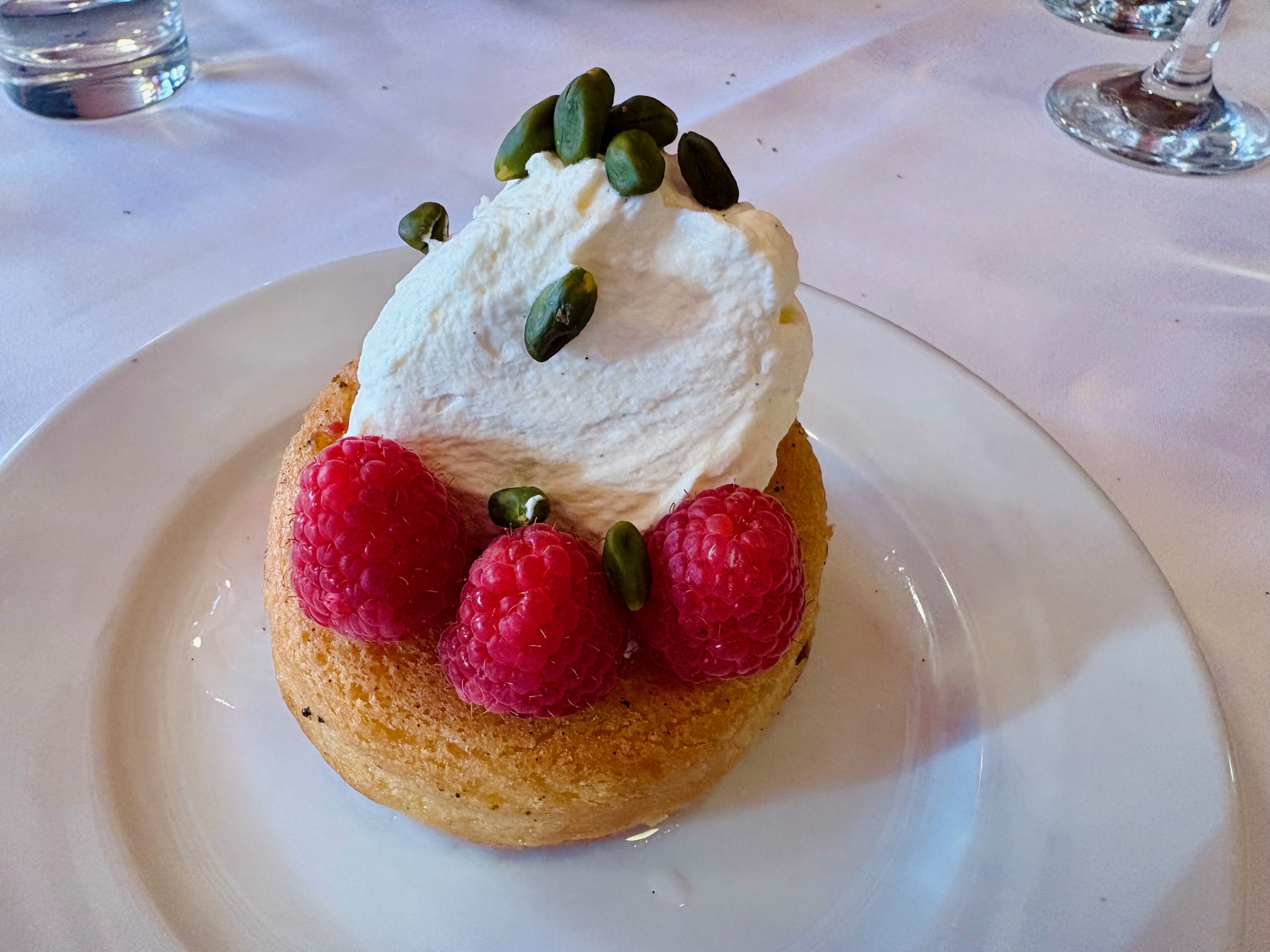
What had prompted Graeme to risk dessert dissatisfaction and swerve that mousse? He was persuaded by our excellent server to try the dessert on the specials, a raspberry savarin. It was sold to him as a bit like a baba au rhum, only with raspberry liqueur instead of rum. I don’t think that necessarily did the dessert justice.

The thing is, a sponge soaked through with booze feels instinctively like it should be sodden, be heavy. That is, you might think, what you’re pricing in when you order this dish. But this was airier than any rum baba I’ve tried, the sponge almost float-away light, but still with raspberry coulis lurking at its epicentre. But before that you had that indulgent sponge, and raspberries ringing a heap of the lightest Chantilly cream.

This dish is absolutely not the kind of thing I would ever order, but after trying a spoonful of Graeme’s I can tell you that if I ever got the chance to eat a whole one of these I’d grab it swiftly with both hands. Maybe this time Graeme had performed a Jedi mind trick on me? You couldn’t say it was undeserved.

By this point most of the people who had started their lunches at the same time as us had settled up and moved on, which I always consider a little moment of triumph. The dating couple at the next table had ordered exactly the same combination of dishes as we had, him my choices and her Graeme’s. “See, you’re the women in this arrangement” I said to Graeme, enjoying the novelty value because, at least half of the time, I’m not even the man in my own marriage.

Most of the other tables left before us because they’d made the mistake of passing on the madeleines. In a meal full of showstoppers we’d left the very best till last, a board with six warm madeleines, all scalloped edges, dusted with icing sugar and served with a little ramekin of lemon curd that was somehow sunnier than the yolk on my steak tartare, sunnier even than the rays pouring in through the windows into that ravishing dining room.

Dipping those madeleines into the curd, biting, tasting, raving and repeating did something wonderful: it perfected a meal that had been pretty close to perfect anyway. These are worth visiting the French House for in their own right, but I’m not sure that’s saying much, because so was everything else.

After we had finished them Borthwick left the kitchen – so he’d been at the stoves that day – and walked past our table and both Graeme and I thanked him and went bananas about the madeleines in a way that was probably more enthusiastic than it was coherent.

Borthwick very graciously, with an air of someone who’d had this conversation many times, told us that they’d originally been the creation of a Kiwi he worked with in the kitchen who had a real genius for baking. Although he had since quit cooking to bring up his kids the madeleines stayed on the menu, kind of his legacy.

I have no idea what the chap’s name was, but I suspect many London diners owe him a debt of thanks. Eating these madeleines I could sort of understand how Proust got all those novels out of them. Graeme said they had ruined Waitrose madeleines for him, which is in its way equally high praise.

I was sad to ask for our bill and to leave, but I knew that you couldn’t stay in that gorgeous room and eat nothing when other people could make excellent use of those tables, and I was also aware that it was London and that other lovely tables lay downstairs and beyond, and that I could drink Breton cider at the ones downstairs and carry on probing Graeme’s credentials to be the next Doctor Who and the first from Middlesbrough (“lots of planets have a North-East”, he proudly told me later).

Our bill, including a 12.5% service charge, came to just over £226. I’m going to stick my neck out and say that this was as good value as any meal I’ve had on duty this year.

The rest of the day was every bit as agreeable: drinks in the French House, an amble through Trafalgar Square and down to the Embankment for a couple of companionable glasses of wine sat outside Gordon’s, while Graeme gazed lovingly at every single dog at every single neighbouring table. And then we headed back to Paddington for – shamefully – a little booze fuelled sustenance at Market Halls before our journeys home.

But the way to best put that lunch in perspective is to think about the messages I got from Graeme the following day. “There isn’t a single course of that meal I’m not still thinking about” he said. “It was so good.” I’ve thought about it, and he’s right: I reckon I’ve thought of every single course at least once a day since Monday and, in the case of those madeleines, several times a day. And I’ve also thought about Graeme’s order, and how I would have been just as happy if it had been mine. And the things neither of us ordered – the rillette, or the tomato and lovage salad, or those frites: I’m pretty sure I’d adore those too.

Best of all, now that I’ve been to the French House and loved it, the fact that I can’t see a menu online goes from a homework-proofing source of anxiety to a matter of constant wonder and delight. I don’t know what I would get there, but I know that I would like it. Put that way, the prospect of going there again, which I’m sure I will, feels like a piece of magic you rarely get in restaurants these days.

So I am very glad I picked the French House this week and that, free from the need to keep up with the Joneses of the London food media, I was completely at liberty to do so. Because the French House has that indefinable feeling of authenticity that was somehow lacking when I visited the likes of Lapin earlier in the year. It feels like the team behind Lapin have been to, and loved, places like the French House. But it feels like the team behind the French House have been to, and loved, France. That’s it. That’s the difference between good and great in a nutshell.

The French House – 9.4
49 Dean Street, London, W1 5BG
020 74372477

https://www.frenchhousesoho.com

Since January 2025, Edible Reading is partly supported by subscribers – click here if you want to read more about that, or click below to subscribe. By doing so you enable me to carry on doing what I do, and you also get access to subscriber only content. Whether you’re a subscriber or not, thanks for reading.
Restaurant review: Côte

Here’s what happened: I was making Friday night dinner plans with my friend Graeme and I said I’d give him some restaurants to choose from, a mixture of places I wanted to review (or re-review) and others I just fancied eating at. My text was all ready to send, and then I stopped for a minute and thought what about Côte? So I added Côte to the list of places I was due to re-review and pinged the message over to Graeme, fully expecting him to pick somewhere else.

Why don’t we do Côte? came the reply. I haven’t been for a while, and it’s such a good chain restaurant.

Appropriately Graeme’s reasons for choosing it were the same as mine for including it in my selection. The last time I went there was something like eighteen months ago, with my family, to celebrate my just having got engaged. But before that? I honestly couldn’t tell you. And yet before the pandemic I used to go an awful lot – it was one of my regular spots.

I do wonder whether the pandemic had something to do with it. Because when Covid struck national Côte did what many restaurants did, diversifying into heat at home options. But Côte did it differently to everybody else, and unlike nearly everybody else they are still doing it years later, when for most restaurants their schemes, entirely born out of necessity, were shelved ages go.

Côte decided to take advantage of the fact that many of its dishes were prepared in a central kitchen and then finished in the restaurant, turning what you could potentially see as a weakness into a Covid-era hidden strength. And it continues today: Côte At Home still offers many of the dishes you can get in their restaurants, portioned for two people, for decidedly less money.

Back when I was reviewing takeaways and meal kits, I reviewed Cote At Home. And the truth was that I didn’t know what to make of it: it was good value, and undeniably polished, and somehow occupied a completely new genre that wasn’t takeaway, wasn’t meal kits, wasn’t eating in restaurants and wasn’t ready meals. What on earth was it, then? I’m still not entirely sure.

But I can’t help feeling that Côte At Home, although it may have saved the chain from going under, slightly changed the way I thought about the restaurant. Because if many of Côte’s dishes were just glorified ready meals you could cook at home, was there still a point to going to the restaurant to eat them there, spending more money in the process? And if that was the case three years ago when the shockwaves from the pandemic started to subside, wasn’t it even more the case now, when eating out is more and more of a luxury?

I didn’t know the answers, and it felt like a return to Côte might provide them. Besides, it was a Friday night at the end of an incredibly long week at work, and I figured I’d earned a good meal, a catch up with a good friend and at least a bottle of wine, and I was hoping for an enjoyable evening irrespective of whether my visit also solved those bigger, thornier questions. After all, nobody can dissect stuff for its deeper meaning 24/7. Not even me.

Subscribe to continue reading

Become a paid subscriber to get access to the rest of this post and other exclusive content.

Restaurant review: Manzano’s Peri Peri

I was meeting my friend Graeme for the first time in a long time last Friday, and we were dead set on getting to the Nag’s in good time to bag a table, get through plenty of great beer and have a very long overdue catch up. But where to eat beforehand? We wanted somewhere quick and casual, not too pricey, and that end of town. And then I realised that this perfectly summed up Manzano’s, the once infamous peri peri chicken restaurant on the side of the Broad Street Mall.

Subscribe to continue reading

Become a paid subscriber to get access to the rest of this post and other exclusive content.