Café review: Mon Chéri Café & Bakery

For childfree people like me, the tail end of August is possibly when you most keenly feel the disconnect between you and the rest of the world. At work everyone’s back from their holidays, preparing for the beginning of the academic year, already mourning their week or fortnight on a sunbed, by a pool or in a villa. My Instagram has been full of holidaymakers squeezing the last few drops out of the month. They have got excited, packed and prepared, touched down, drunk cold beers or glasses of rosé, topped up their tans, raced through some novels. And now they’re all coming back, like migrating birds, refreshed but, most likely, a little sad.

I’ve watched everybody embark and return, seen the Instagram posts and stories, and told myself each time that my time will eventually come. And it will, soon, but not quite yet: by the time you read this I will be hours away from setting my out of office and closing the laptop, but as I write this I’m running on fumes. The rhetoric at work will all be about how everybody is full of beans and ready to go, to close out the year: I am depleted, and ready to go to the airport. Our timelines won’t synchronise until I return, when we all prepare to put the clocks back, put the central heating back on, contemplate the end of the year.

Anyway, the last day of August found me with a day on my tod, feeling a little melancholy and looking for some feeling of escape. So I decided to make my way to Mon Chéri, the Greek café on West Street, to see some Hellenic sunshine might illuminate my mood. It opened at the end of last year, I think, and has been on my list ever since, but it’s taken a little while to reach the top of it.

And when I say Mon Chéri is open, I mean that it’s very open indeed: if Google is to be believed, they start trading at 6am every day, not closing until 8 in the evening. When I commute to work, my bus trundles down West Street around half-seven. Mon Chéri is always open by then, awning out, with some customers in already. Is any hospitality business in Reading open quite that long, with the exception of Gregg’s and Wetherspoons?

So. yes, I partly picked Mon Chéri this week because I’m so very ready for a holiday and, for me, Greece is the place I most powerfully associate with holidays, even now. The first time I ever left this country I was thirteen years old and my parents, heady with the rush of having remortgaged our suburban semi-detached, took us to Corfu to share a villa with some friends. I had never been on a plane, never known sunshine like it, was fascinated by the way Greek lemonade tasted different, couldn’t get enough of the music of the cicadas – when I could tear myself away from a book or my chess set, that is.

Early on in our stay we found a taverna, run by a chap called Tassos, and it was love at first sight. The food took forever to arrive, but nobody cared because we were sitting outside, on those balmy evenings, and my parents had access to a steady supply of Retsina. Tassos had an ancient stereo that played Greek music, but it was on the blink so it was always randomly speeding up or slowing down, some kind of weird bouzouki remix. The overall effect was of an establishment inches from collapse.

Sometimes customers at a neighbouring table would be so angry about the interminable wait that a blazing row would ensue. My parents’ friends Carol and Frank wanted the earth to open up and swallow them; my dad found it hilarious. We went every night, and by the end we were such regulars that after other customers complained, as they often did, Tassos would come to our table and say something to the effect of What was their problem?

As a trip, it had a lasting effect on me. It was the only time I remember my family going out for dinner more than once a year, and I think it made me fall in love with food and restaurants. Specifically, it made me love Greek food. My dad was keen that we enjoy ourselves but not go financially mad, so we were limited to the least expensive things on the menu, the souvlaki, the sofrito – veal in garlic – and the stifado. And I became addicted to the last of those, the rich stew of beef braised to surrender with tomatoes and soft, whole shallots. I can’t remember if it was Tassos’ wife or mother in the kitchen – or even his grandma – but whoever it was, the chef was a genius.

Since then I’ve been to Greece many times. I’ve done Rhodes, which I liked even more than Corfu, although I’ve only once managed to stay in Lindos, the bit of it I adored the most, once. I went to Kefalonia just after the Captain Corelli film, and had dinner with a pre-fame Simon Pegg, sporting a Beckhamesque mohawk, at the next table. I’ve stayed in Mykonos, which I loved despite a nagging feeling that I didn’t see the best of it. I’ve holidayed in beautiful, scruffy Athens, walking among the city’s ruins just before my first marriage went the same way.

And then there’s my very favourite part of Greece – Parga, just around the coast from Preveza airport, a beautiful harbour town full of winding lanes where you can completely forget about the world, sit in one of the many tavernas, eat fresh fish and drink sweet rosé and, for a little while at least, become a twenty-first century lotus eater. One one holiday there I took a boat trip to Corfu Town, strolled the Napoleonic esplanade of the Liston, felt the whole thing coming full circle.

All that said, I’ve not been to Greece in nearly a decade. At first it was Covid’s fault – my trip to Lindos, booked in hopeful ignorance at the start of 2020, was shifted back again and again until we accepted, reluctantly, that it just wouldn’t happen. But the world has gone back to normal since then, something has stopped me returning and I’m not sure what it is.

Analysis paralysis, possibly: I am never able to pick the island, pick the resort, pick the accommodation. I see everyone else going there and I envy their certitude but that magic combination of the right airport, the right flights, the right place to stay has never jumped out at me. I’ve contemplated Chania, or Agios Nikolaos, or going back to Parga, but I’ve always chickened out and booked a city break instead. For many years I wanted to go to Hydra – because Leonard Cohen – and someone I knew on Instagram who went every year even sent me her guide, but the sheer faff of getting there just put me off. You’d need to be there two weeks for that journey to be worth it, and I never take two weeks off.

So the closest I would get, this year at least, was Mon Chéri. It’s always saddened me that Greek food has never really gained a foothold, either in this country or in Reading: we had Kyrenia, which I revered, but since then it’s been Spitiko, which I ought to visit. We had The Real Greek, which left the Oracle before it could be pushed, and we still have Tasty Greek Souvlaki which is indeed tasty, and Greek(ish), but not the full taverna experience.

But Greece is better represented by cafés, with our branches of Coffee Under Pressure and now with Mon Chéri. And I truly love Greek cafés and bakeries – in Parga, most mornings began with breakfast at a place called the Green Bakery, on a sun-dappled terrace with coffee, pastry and a paradisiac, indolent day ahead. When I came in off the drizzle-spattered pavement of West Street, I guess that’s what I was hoping to recapture.
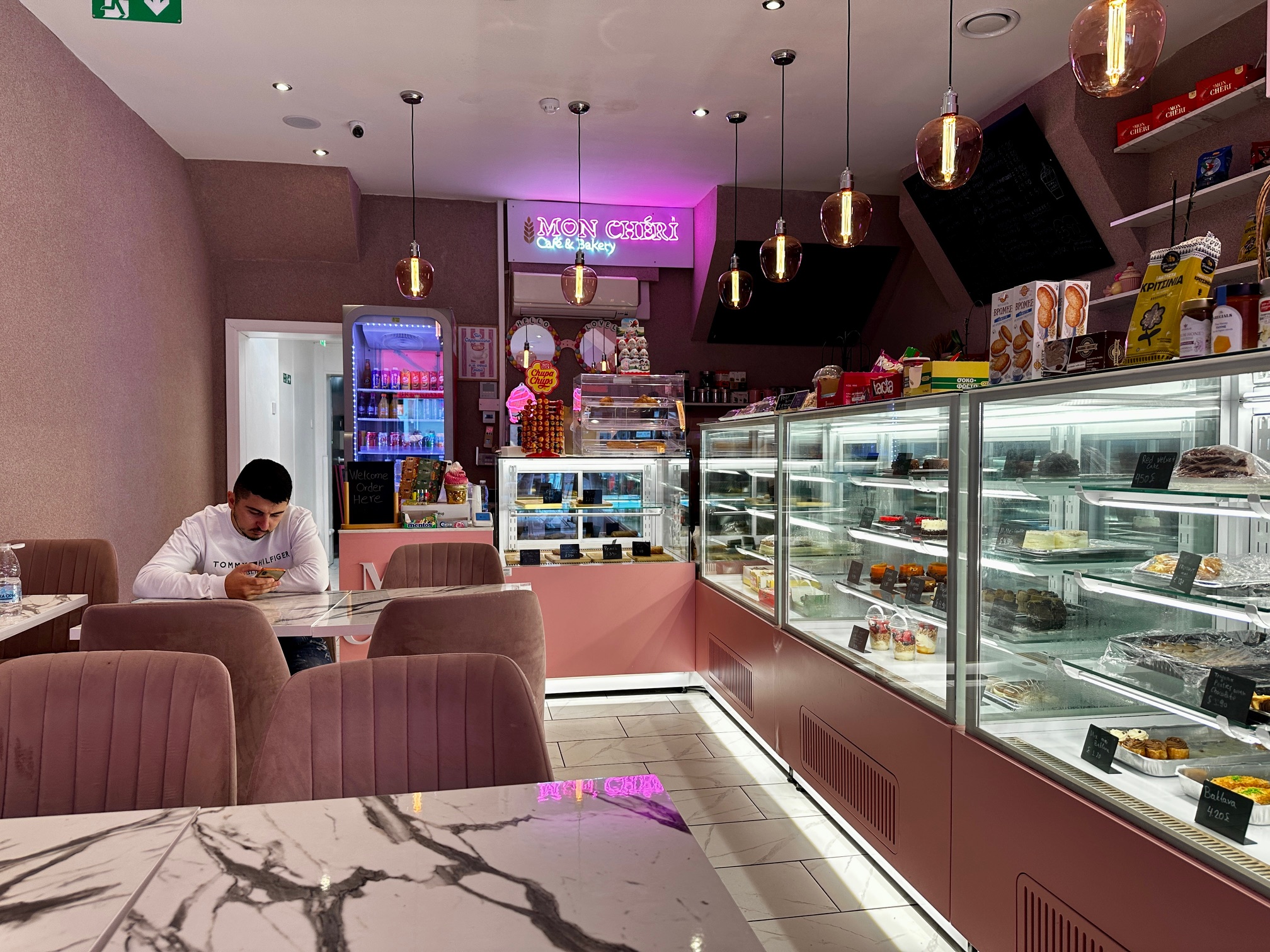
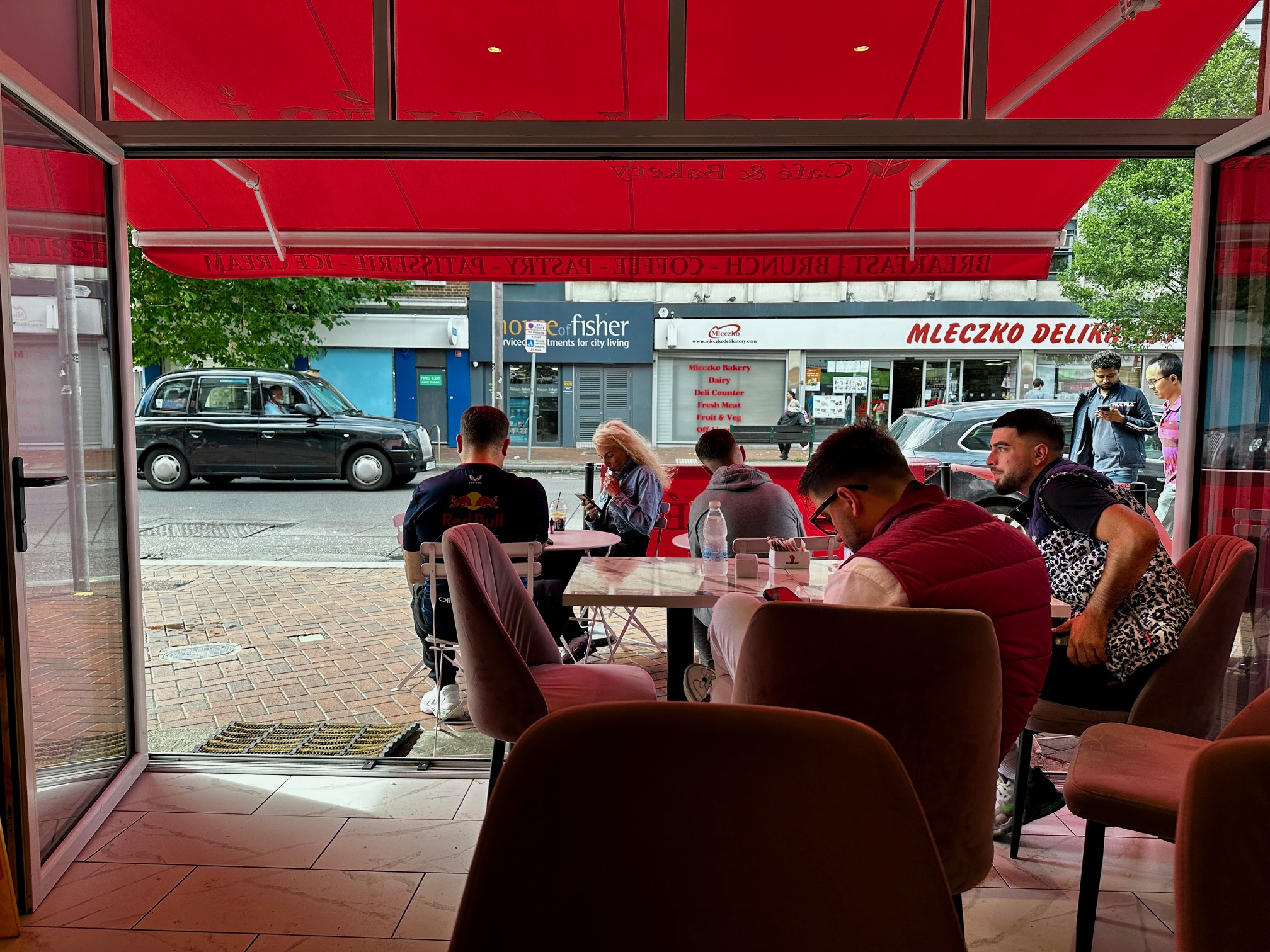
The interior had nothing of the Ionian Sea about it, which wasn’t to say that I disliked it. The plush dusky pink chairs and marble-effect tables were actually quite tasteful, although on a clement day – which this wasn’t – you’d want to be out on the terrace, under the awning, taking it all in. But actually, from the next set of tables back, looking out, you had much the same experience.

So I could see the tables under the shelter of the awning, all smoking and chatting and drinking their freddoes, and beyond that all the comings and goings of West Street, a richer pageant than I’d expected. Did it matter that the horizon had Mleczko Delikatesy on it rather than some cerulean vanishing point where the sea met the sky? It should have done, but I found I didn’t mind. The music was both Greek and relentless, and I rather loved the overall effect.

I asked at the counter if there was a menu and my server pointed to the coffee menu on the wall. Otherwise, it was a case of looking in the cabinets, under the fluorescent lights, and deciding what you fancied. Most of the space was taken up with sweet stuff – some very Greek, like big triangles of baklava sitting in a sticky puddle of honey, or kataifi with its golden combover. Others were more generic – red velvet cake, croissants, individual portions of millefeuille or tiramisu. If you had a sweet tooth, you would feel spoiled for choice.

When I asked about savoury options, she told me it was “Greek breakfast” and pointed to the smaller cabinet in front of her. That was mostly the kind of pastries I used to so love at the Green Bakery all those years ago – cheese pies, sausage pies and the like. I was tempted by a peinirli – a boat-shaped pizza a little like a Turkish pide, or a Georgian acharuli khachapuri – but in the end I decided the right thing to try was the classic, the spanakopita, the spinach and feta filo pie I must have eaten dozens of times on holiday. I asked for a latte with it and prepared for some top notch people watching.
I found it strange that the spanakopita came in a paper bag, with no plate, but I reasoned that it was after all finger food and I didn’t want to be like David Cameron, eating his hot dog with a knife and fork. But actually once I started tucking into it, it made even less sense. The filo pastry is meant to be light stuff – a quick Google found flowery phrases like “shatteringly crisp” and “perfectly flaky”. What it shouldn’t be, which this was, is tough. It’s supposed to release its contents joyously, but this pastry felt like it was trying to protect them. When somewhere describes itself as a café and bakery, that’s not ideal.

I soldiered on with it, but even as you moved past that overly chewy perimeter it didn’t reward perseverance. The filling – and filling suggests more generous contents than were actually the case – was thin, bland stuff. I so wanted to like this, and a good example of this Greek classic would be a very welcome discovery in town, but it was beyond me. So was finishing it. I could feel the slight coating of grease on my fingers and I became very aware of empty calories. I’m almost reluctant to say this, because I don’t want to cause a diplomatic incident, but C.U.P.’s spanakopita is miles better.

Mon Chéri’s coffee can’t match C.U.P.’s either, but on this occasion you aren’t comparing like with like. Mon Chéri has no interest in doing third wave stuff, so instead it offers a more classic option bought in from Hausbrandt, a company I’d never heard of. Would it surprise you to hear that I quite liked it, though? It had that slightly rugged, almost-burnt taste of less fancy coffee, but was perfectly drinkable and I could imagine it giving just the jolt you needed first thing in the morning. It reminded me of the coffee at De Nata, which is not a criticism.

By then I was nicely settled and enjoying myself more than I thought I might, despite that pastry failing to live up completely to either my expectations or my memories. But perhaps that wasn’t important: I had a lovely comfy seat, Europop was wafting through the room and life’s tapestry was parading past. I decided it wouldn’t be right to judge Mon Chéri on a pastry and a coffee alone, so I went up again to get something sweet and – because I was thoroughly getting into the swing of things – a freddo. I remembered sitting out on a square in Athens once, loving how much everyone just sat and chatted and drank coffee seemingly all afternoon long. Maybe the freddo was the way to pull that look off in Reading.

I decided to go for the mosaiko, a chocolate and biscuit confection which reminded me a little bit of tiffin and my server – a different chap this time, friendly and authoritative – told me which kind of freddo I wanted, espresso rather than cappuccino. He was excellent, as was his colleague from earlier on, which made me love the place even more and widen the gulf between how much I liked being there and what I made of the food.

It turns out that mosaiko is effectively a Greek take on chocolate salami, a no-bake slab of dark chocolate and biscuit. You might say that only an idiot goes to a place that describes itself as a café and bakery and orders that, and in my defence I would say that yes, I probably am an idiot but, to be fair, the spanakopita had been baked and that was no great shakes.

Anyway, the mosaiko was everything I should like, on paper. All either chocolate or biscuit and, in theory, more chocolate than biscuit, like those enormous chocolate-coated Bourbons M&S sells that are like Penguins on steroids. But again, the theory and the practice weren’t on the same page. This time you had to use a knife and fork, teasing through the fault lines of the biscuits to find a place to cut, producing a solid wodge to eat without sending the rest careening across the room.

And once you’d done all that, it just felt resolutely unspecial. The biscuit was soft rather than crisp and buttery, as if it had gone a little stale before meeting its fate. And the chocolate was very basic and flat, oddly chewy with no richness at all. The whole thing made for a strangely homogeneous slab of what should have been indulgent but was nothingy instead. I think this cost just shy of a fiver. Those M&S chocolate coated Bourbons are something like three quid.

Again, the irony was that I really enjoyed the freddo. It would put hairs on your chest and was best sipped slowly, but it was a lot of fun and it had been sweetened, as I’d asked, really nicely.

I felt like the most indecisive traitor of all time as I thanked my server, got my bill and settled up. Two coffees, a pastry and that mosaiko cost me £14.20, and whatever you think of the quality you do have to also bear in mind how easy it would be to rack up a bill that size at Picnic, or Gail’s, or any of Reading’s many other more chichi cafés. Was I airbrushing the bad bits of my time at Mon Chéri because I wanted to like them and, even more, because I really wanted to be on holiday in Greece? Or did it have something going for it that the wonky food couldn’t completely outweigh?

I’m still not sure, but I hope this is a salutary counterpoint to the rare times when I go somewhere like Vino Vita and put the boot in. I don’t enjoy going to bad places, writing bad reviews or leaving bad ratings. I especially don’t enjoy it when it’s somewhere that I really wanted to like, that has created a lovely little spot in one of Reading’s less salubrious places which plenty of people clearly love. It feels churlish to say yes, but the cakes and pastries, and I wish I wasn’t doing it, but if I gave it a rave review I’d be leading at least some of you to dietary disappointment.

But if I just say but the cakes and pastries that misses the fact that Mon Chéri has real charm, that I liked it there, and that maybe I could forego eating there just to have a coffee, and enjoy that view, and feel like part of something. Perhaps I need to go back and try some of the other stuff, even if it looks very generic indeed, to give it more of a chance. Sometimes writing reviews is very easy and sometimes, somewhere like this comes along and I wish I hadn’t made the decision, many years ago, to be reductive about restaurants and cafés to one decimal place.

So there you go, that’s Mon Chéri: pick the bones out of that one. I don’t know, maybe I just need a holiday. Where in Greece should I go next year? You strike me as the kind of people who might have some excellent suggestions.

Mon Chéri Café & Bakery – 6.6
18 West Street, Reading, RG1 1TT
0118 3533761

https://www.instagram.com/monchericafebakery/

Since January 2025, Edible Reading is partly supported by subscribers – click here if you want to read more about that, or click below to subscribe. By doing so you enable me to carry on doing what I do, and you also get access to subscriber only content. Whether you’re a subscriber or not, thanks for reading.

Restaurant review: Tasty Greek Souvlaki

Last year, when I emerged from my cocoon and began reviewing takeaways, my first choice was Tasty Greek Souvlaki on Market Place, the thriving restaurant occupying the site where MumMum used to be. It was the natural choice: it was the first (and arguably the most interesting) new restaurant to open in 2020, and one which had quickly embraced delivery as its best chance to ride out an extremely challenging year in hospitality. So I ordered my first on duty takeaway from them, and very nice it was too (you can read about it here). 

Tasty Greek Souvlaki is essentially a carnivore’s paradise, and the menu largely revolves around different quantities of different dead animals cooked in different ways: do you want them cut into cubes, threaded on a skewer and cooked on charcoal, or would you rather go for something a little more primal like chops? Or is your preference to have them pressed into a magical revolving pillar of constantly grilled elephant leg which is then shaved off in thin slivers and fried until crispy? Would you like it in a pitta or a toasted sandwich, with or without chips?

Some people would treat that series of decisions as one disgusted shudder after another. Those people, to be honest, are unlikely to eat at Tasty Greek Souvlaki, although I’m told the falafel wrap is decent (if not massively Greek). Personally, I found it too difficult to choose for a very different reason: I kind of wanted it all, so when I ordered takeaway I went for their mixed grill platter, which gives you exactly that. It was an embarrassment of carnivorous riches, it was a wonderful way of being transported to the Mediterranean without leaving your sofa. It was, not to put too fine a point on it, a cardboard box absolutely crammed with every which kind of meat.

I loved it, and ever since then the Big Box Of Meat has been a regular fixture at my house – not too often, because I didn’t want to kill the magic, but every few months on a night when we couldn’t face the cooking. It was always hot, it always arrived quickly and it never let you down. And it cost something like twenty-six pounds, which was ridiculously affordable.

But it was bound to be far nicer in the restaurant itself, plucked from the grill, loaded on to a plate and brought to the table without delay, and so I’ve been looking forward to a proper on duty visit to Tasty Greek for a long old time. Last Saturday, Zoë and I turned up just after midday for an overdue reunion with possibly Reading’s finest meat feast.

Subscribe to continue reading

Become a paid subscriber to get access to the rest of this post and other exclusive content.

Takeaway review: Smashing Plates

Smashing Plates is no longer on Deliveroo Editions. If you want good gyros, you were always better off going to Tasty Greek Souvlaki.

Last month I had a very nice email from someone who worked as a commercial manager for Deliveroo Editions, telling me all about a new restaurant called Smashing Plates operating from Reading’s dark kitchen. And before we get started, let’s tackle the elephant in the room: I know, the name is a problem. It’s not as if it was my idea, so don’t shoot the messenger. Let’s all get that sigh, that cringe, that facepalm or weary shake of the head out of the way in unison right at the start of proceedings, and move on.

Anyway, the email described Smashing Plates as cool and “unorthodox” – only choosing to put inverted commas around the latter, as if the former was incontrovertible. Did I fancy running a competition for my followers, it asked? I could put a post on my Instagram telling people all about Smashing Plates, and if they liked my post, followed me and the restaurant and Deliveroo and tagged the person they really wanted to share the prize with then one lucky individual could win a £50 Deliveroo voucher to use at the restaurant of their choice. Did that sound like something I would be interested in? I mean, did it?

Did I want to give over my Instagram to pimping some restaurant I’d never even tried and ask my followers to give them and Deliveroo loads of free publicity just so that one solitary reader could win fifty quid? Hell no. Don’t get me wrong, I do run the occasional competition for readers, but I try and pick the partners for them carefully. I’m not that easily bought, or that cheaply. It struck me as especially weird that the prize was vouchers you didn’t even have to spend at the restaurant the competition was meant to promote. Who was doing the benefiting here – Smashing Plates or Deliveroo?

So I declined politely and no doubt they found many other Instagram accounts to team up with. In fact, I know they did: you don’t have to look far to find plenty of #ADs and #invites featuring the restaurant (although at least the social media posts declared them, unlike some prominent restaurant bloggers). But it did make me think about whether Smashing Plates was worth ordering, so I made a mental note to come back to them later. And here we are.

They’re almost a diffusion brand in themselves, launched by Neo Christodoulou, the co-founder of The Athenian (which itself was on Deliveroo in Reading a while back, if memory serves). Smashing Plates has opened in four venues across London, all of them previously branches of The Athenian, and has two dark kitchens, here and in Cambridge. 

I’d like to say that they have a distinct identity from the Athenian, but looking at both websites I’m none the wiser. The Athenian is all about using “the best ingredients, freshly and lovingly made to order”, they “source everything from our partners in Greece and here in the UK” and “environmental concerns are super important to us… we turn our cooking oils into biodiesel and our kitchens are powered by renewable energy”. 

Smashing Plates, on the other hand, says “The menu is seriously fresh and totally traceable. I know where every ingredient in every product has come from”, “our cooking oil… gets collected and turned into bio-diesel” and “everything is fresh, from start to finish”. Seriously – chalk and feta, these two. I wonder if they fell out and Christodoulou thought “I’ll show them… by copying their entire website”?

Smashing Plates’ delivery menu is small and centred on wraps and sides, gyros and souvlaki. It has slightly less range than their restaurant menu, but there’s enough choice that you don’t feel hemmed in. Perhaps significantly, real priority is given to vegetarians and vegans – so, for instance, you can have gyros with chicken, but pork isn’t on the menu and instead you can choose from halloumi, seitan or portobello mushroom. Most of the sides, for that matter, are vegetarian. They also do salads, loaded fries, skepasti (a gyros toastie) and a handful of desserts and if you fancy a Greek beer on the side you can get your Fix, literally and figuratively.

Nothing is too pricey, either – wraps and salads cost between seven and ten pounds, practically all of the sides are less than a fiver. I chose a wrap, a couple of sides and a dessert, which came to just over twenty pounds not including rider tip (they were doing 25% off food that night), sat back and waited.

Are you ready for the obligatory fuss-free delivery paragraph? Okay, here goes: I ordered just before eight o’clock on a weekday night, my driver was on his way twenty minutes later and in just over five minutes he was at my door. How far we’ve come from me obsessively checking the tracker and saying “why is he going down the Orts Road?” to Zoë as she rolls her eyes for the seventh time: perhaps this is what personal growth looks like. I particularly appreciated the fact that my hot food was in one bag and my cold food in another – if I’d known they were going to be that careful I might have ordered that Fix after all. Please drop us a review! was written on the bag in biro. How little they know, I thought.

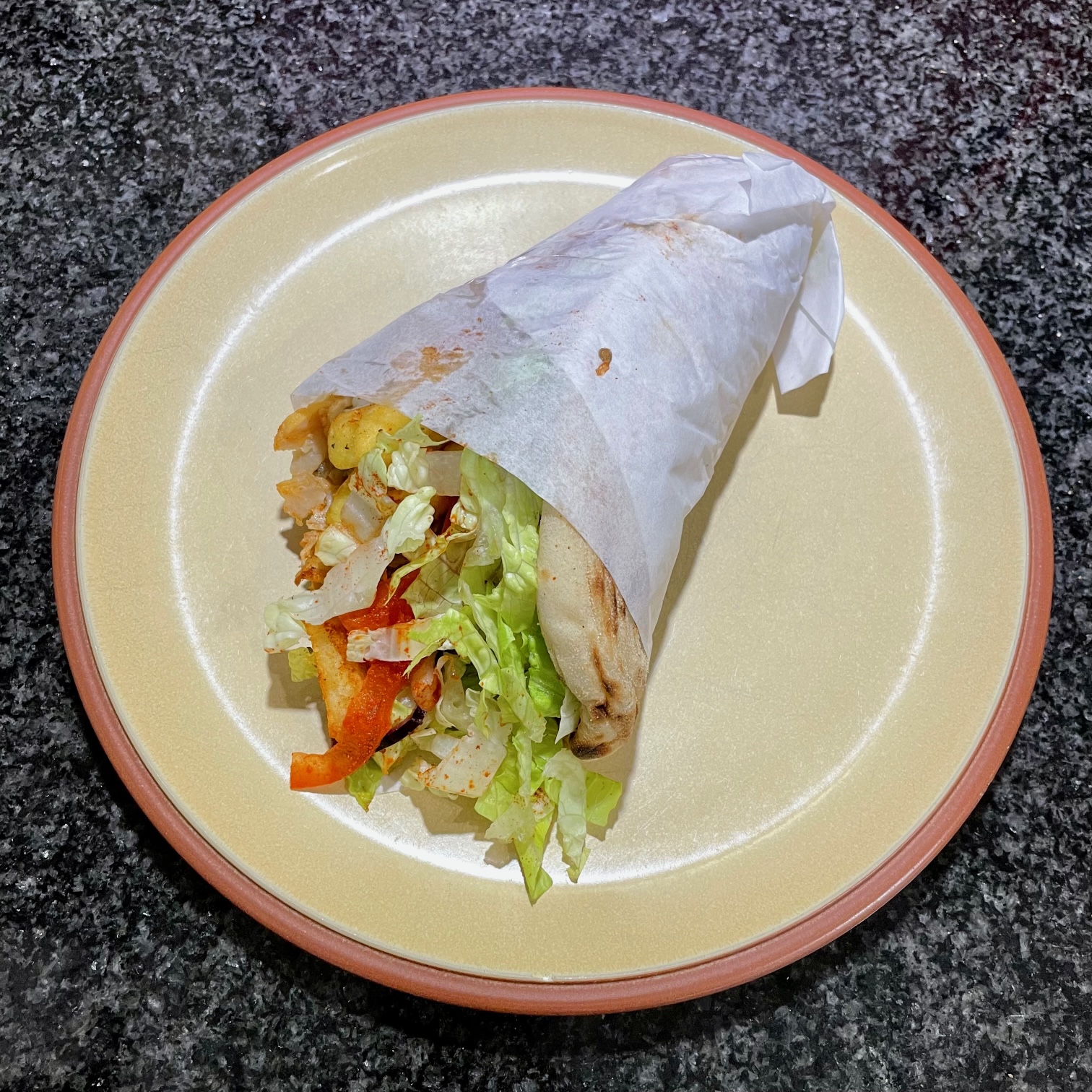
Everything was hot and stayed hot throughout the faff of me taking it out of the bag, photographing it, photographing it again because one of my feet was in one of the photos and so on. The gyros – I’d gone for pork – was good but a little muted for my liking. It’s not possible to eat one without comparing it to Tasty Greek’s gyros wrap, and Smashing Plates’ version wasn’t quite at that level. The meat didn’t have that wonderful crispy caramelisation that comes from being exposed to a naked flame and then thinly sliced, and although it was still decent I knew I’d had better.

What was good though, was their signature smoked aubergine sauce. It made a surprisingly refreshing change not to have tzatziki in a gyros wrap and this supplied some badly needed depth of flavour – more sweet than smoky, in truth, but still welcome. I found myself thinking about Tasty Greek Souvlaki’s set-up and wondering whether an off the shelf dark kitchen on the edge of Caversham could match it. Maybe that’s why the gyros fell short. Perhaps, for that matter, it’s why they only offered one meat option for the gyros. Working within your limitations is all very well – I do it as a writer all the time, god knows – but in an ideal world other people don’t notice your limitations.

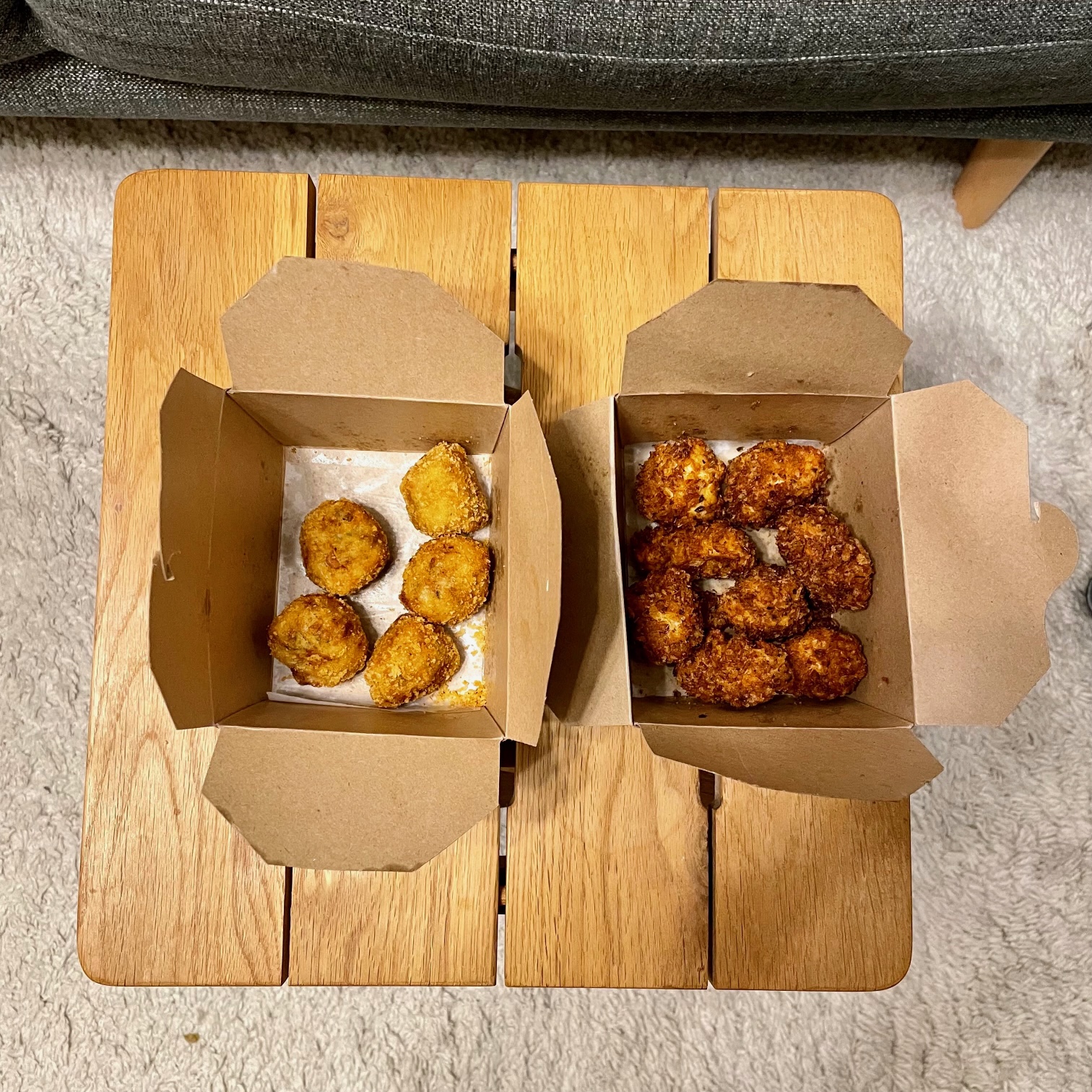
But Smashing Plates was saved by the sides. Panko chicken bites were marinated with oregano and smoked paprika and they really weren’t mucking around when they said that: opening the box you got a wonderful herbal hit of oregano, a refreshing antidote to all the many times I’ve walked through Reading in the slipstream of someone smoking a massive joint.

It was chicken breast rather than thigh but it wasn’t dried out or bouncy and the coating was crunchy and genuinely delicious. You got a hell of a lot of chicken, the tzatziki it came with was pleasant, if underpowered on the garlic front, and I thoroughly enjoyed every bite. Looking in the box afterwards I found loads of little crunchy pieces of coating – yes, I ate them all with my fingers, with no shame – and not a jot of grease. If they could do all this for less than five pounds, what on earth was Wingstop’s excuse for being so crappy?

I also very much liked the courgette and feta bites, although it was a little odd to get only five of these for a fiver as opposed to so much chicken. The blurb calls them “fluffy” which, if anything, does them a slight disservice. The first ones I had, from the box at the start of the meal, almost had the silky texture of croquetas, with a nice tang from the feta. And actually, as they cooled if anything I appreciated them slightly more. The flavour came through better, and they firmed up so you could tell, from a bite, just how much courgette and cheese had been packed into them. 

Oh, and I had dessert too, a vegan chocolate brownie. If you decide to give Smashing Plates a try, give this a wide berth. It felt like supermarket quality at best: no real texture to speak of, no contrast between crumble and squidge, and a salted caramel topping that just felt like badly sunburnt sugar. Three pounds fifty, too – I know that’s the going rate for brownies at the likes of Workhouse or The Collective, but theirs are bigger, and better, than this. What were you thinking ordering a dessert from Deliveroo? you might be thinking. You might have a point.

Despite the brownie, I found I rather enjoyed Smashing Plates. It’s true that you can get slightly better gyros from Tasty Greek Souvlaki, but my chicken bites and halloumi and feta bites were properly enjoyable, and different from anything offered by Tasty Greek. If I ordered again I would have a gyros because I’d feel that I ought to, but it would largely be an excuse to go crazy and order all the sides. They do another that’s halloumi with sesame seeds and maple syrup which is calling to me: I love all three of those things, and I really want to experience the centre of that particular Venn diagram.

It helps, I’m sure, that my meal was better than I expected it to be. On the sofa in my comfies at the end of a forgettable day, waiting for Zoë to come home from a late shift, the weather positively Baltic outside, it brought me a little joy. And that’s the thing about takeaways – they don’t always have to hit the heights. Sometimes you just want one fewer problem. Sometimes it’s just about that little bit of self-care, treating yourself while you sit in front of Bake Off (I’m rooting for Giuseppe to win) or Strictly (Team John and Johannes all the way). That, to me, is a decidedly orthodox pleasure.

And the silliest thing of all is that if I’d taken Deliveroo up on that competition, I might never have written this review. Some of you might have found out about Smashing Plates, if you happened to be on Instagram, and one of you could have won fifty quid. But I expect you’d have spent it elsewhere, because you probably wouldn’t have the foggiest idea whether Smashing Plates was any good. And that’s the point of this blog. I don’t know why influencers do what they do, although naturally I wish them all the best. But I do know why I do this.

Smashing Plates

https://deliveroo.co.uk/menu/reading/reading-editions/smashing-plates-editions-rea
Order via: Deliveroo only

Lemoni

It became apparent in early 2021 that Lemoni was not going to reopen after the third national lockdown. I’ve left the review up for posterity.

It is, I think, a universal reaction when we taste something funny, or not quite right, or even plain bad, to seek a second opinion. Whether that’s saying “do you think this milk is still good?” when it’s a day past the use by date or asking “does this taste weird to you?” in a restaurant, we all do it. We like to share delicious food, providing we have enough of it to spare, but it’s when something’s awful that we really feel the need to share the pain.

I say this because I’ve had several people in the last three months ask me if I’ve been to Lemoni, the new Greek restaurant in the Oracle, or when I’m going – and not because they say the food is stellar. One message on Twitter said “OMFG, it was awful. Service took ages every time, when they arrived the flicking of long hair over food was… ugh”. Another, on Instagram, said it was so bad that they refused a discount because they wanted to leave as quickly as possible. “I never thought I’d say this” she added, “but I really miss Jamie’s Italian”. Someone else on Twitter said “I went there last weekend and I’m interested to hear your opinion”: sometimes what isn’t said shouts as loudly as what is.

As a result, despite my best efforts to stay positive, I approached my visit to Lemoni with a gradual mounting dread. On the one hand, people definitely wanted an impartial review. But on the other, looking at their website I had a real feeling of “must I?”. Part of that came from looking at the menu online, because the dishes at Lemoni were undeniably pricey. Sixteen pounds fifty for a moussaka, or for a chicken shish kebab? They’d have to be absolutely faultless to charge that much.

Matters weren’t helped by my other half sending me a picture which had been doing the rounds at her work, taken from Tripadvisor, of the lamb kebabs. They look as if they had been formed not by hand but by the combination of a colon and a sphincter, nature’s piping bag. As if to reinforce the point, one of her colleagues had effortlessly Photoshopped a single kebab into an image of a toilet bowl: it wasn’t even slightly incongruous, bobbing there.

Tripadvisor didn’t help in general, as it seemed polarised between glowing reviews (often from Greek users with very few other TA reviews) and mutinous rumblings from everybody else about poor value, indifferent food, terrible service. Who to believe?

And then there was the wider mystery – who were Lemoni anyway? Hard to tell from social media, that’s for sure: there was a glut of very polished Instagram activity when the restaurant was about to open, but since then the silence has been deafening. Trying to get any background was challenging – the suggestion had been that this was their second restaurant but from what I could glean from Companies House the first restaurant, in Southampton, had gone into liquidation before the Reading branch opened.

How did an independent business with no real footprint come out of nowhere to take on the Oracle’s biggest restaurant site, quite possibly paying an annual rent in the high six figures? How was it going to survive in such a competitive site, even (or especially) charging those prices? There was only one way to get to the bottom of it: I was going to have to go there myself.

I felt bad about asking anybody to accompany me, but in the end my mother and my stepfather gamely agreed to come along: sometimes you really do need the unconditional commitment only family can truly provide. So, despite my stepfather’s wistful looks askance at the entrance to Royal Tandoori, we walked up to Lemoni on a warm summer’s evening to take our chances.

The welcome at the door was bright and friendly, and we walked up through the stairs and through the restaurant to take a table out on the upstairs balcony, one of Reading’s better al fresco spaces. The transformation from when the restaurant was Jamie’s Italian was marked, and very nicely done: the upstairs and downstairs are both very tasteful, airy spaces with plenty of natural light, grown-up looking marble-topped tables and grey tweedy banquettes. I didn’t eat inside, but I liked the look of it – I did wonder though just how much sound would be absorbed on a busy Friday or Saturday night and whether the restaurant would feel quite as welcoming on a darker winter’s evening.

The first big surprise came when the menus arrived, because the prices have been reduced significantly since April (although Lemoni has neglected to change its website to reflect this). Mains in particular had come down by between three and five pounds per dish – badly needed, because many of the dishes skirted around the twenty pound mark which felt very expensive for this kind of food. This means that Lemoni must be the first restaurant I’ve encountered to do a soft opening in reverse: still, at least it showed they were learning from their mistakes.

We ordered a few drinks, namely a Mythos for my stepfather, a Menebrea – the Italian beer which is becoming Peroni for people who think they’re too good for Peroni – for my mother and some sparkling mineral water (don’t judge) for me. Nearly all the waiting staff, all dressed all in black, seemed to be Greek and they certainly looked efficient, darting from table to table; maybe they’d also learned from some of that early criticism.

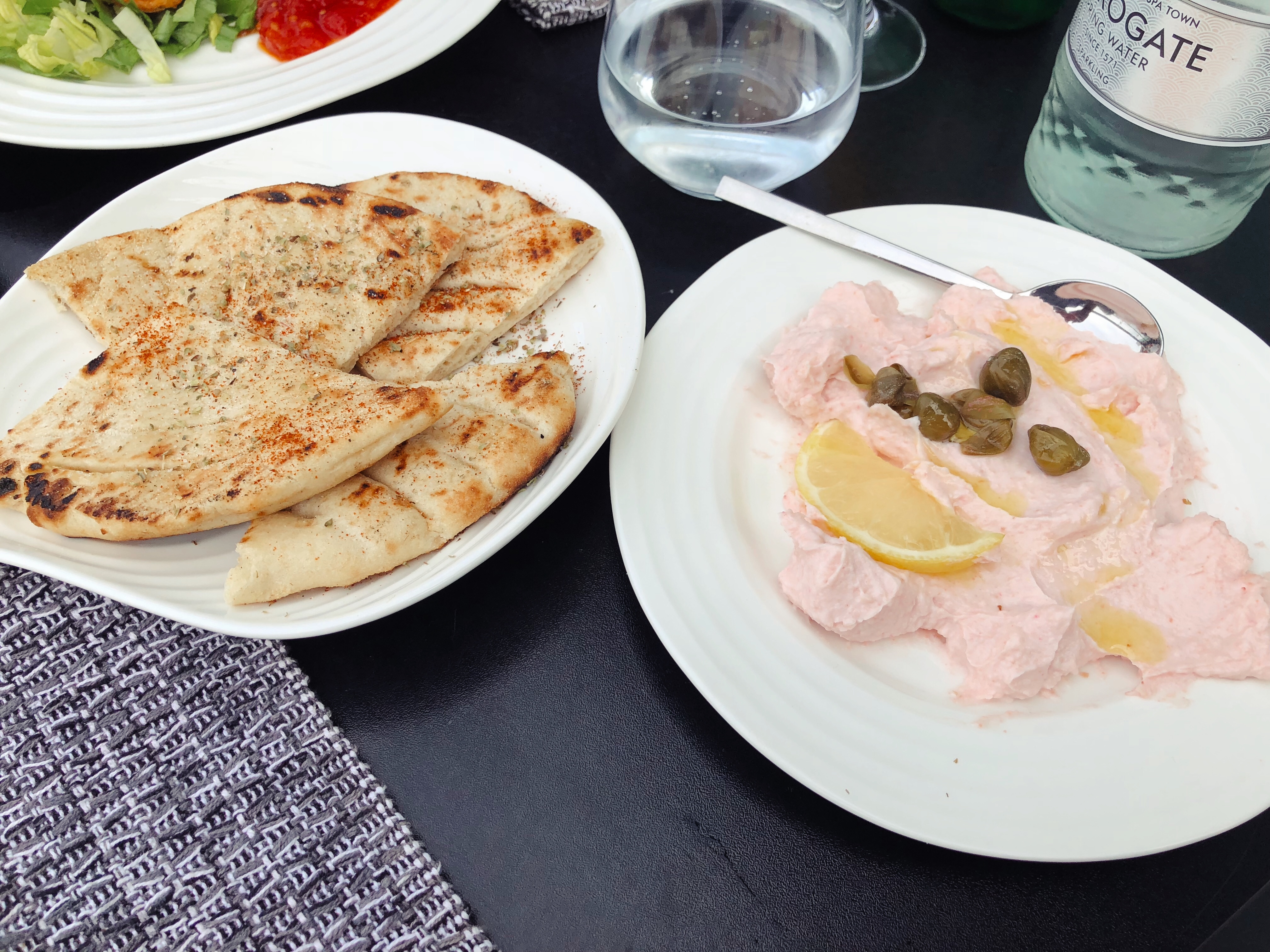
We decided to share some of the starters to begin with – these all vary between about five and eight pounds, although they charge extra for pitta which felt cheeky to me. How else did they expect you to eat houmous or taramasalata, exactly? The taramasalata, incidentally, was one of the best starters we had – brighter pink than I’m led to believe it should be but punchy all the same. I especially liked the addition of some salted capers on top, but I suspect they were more popular with me than with my mother. “It doesn’t taste that fishy” was her feedback – my stepfather and I disagreed, but she had taken against the dish and that was that.

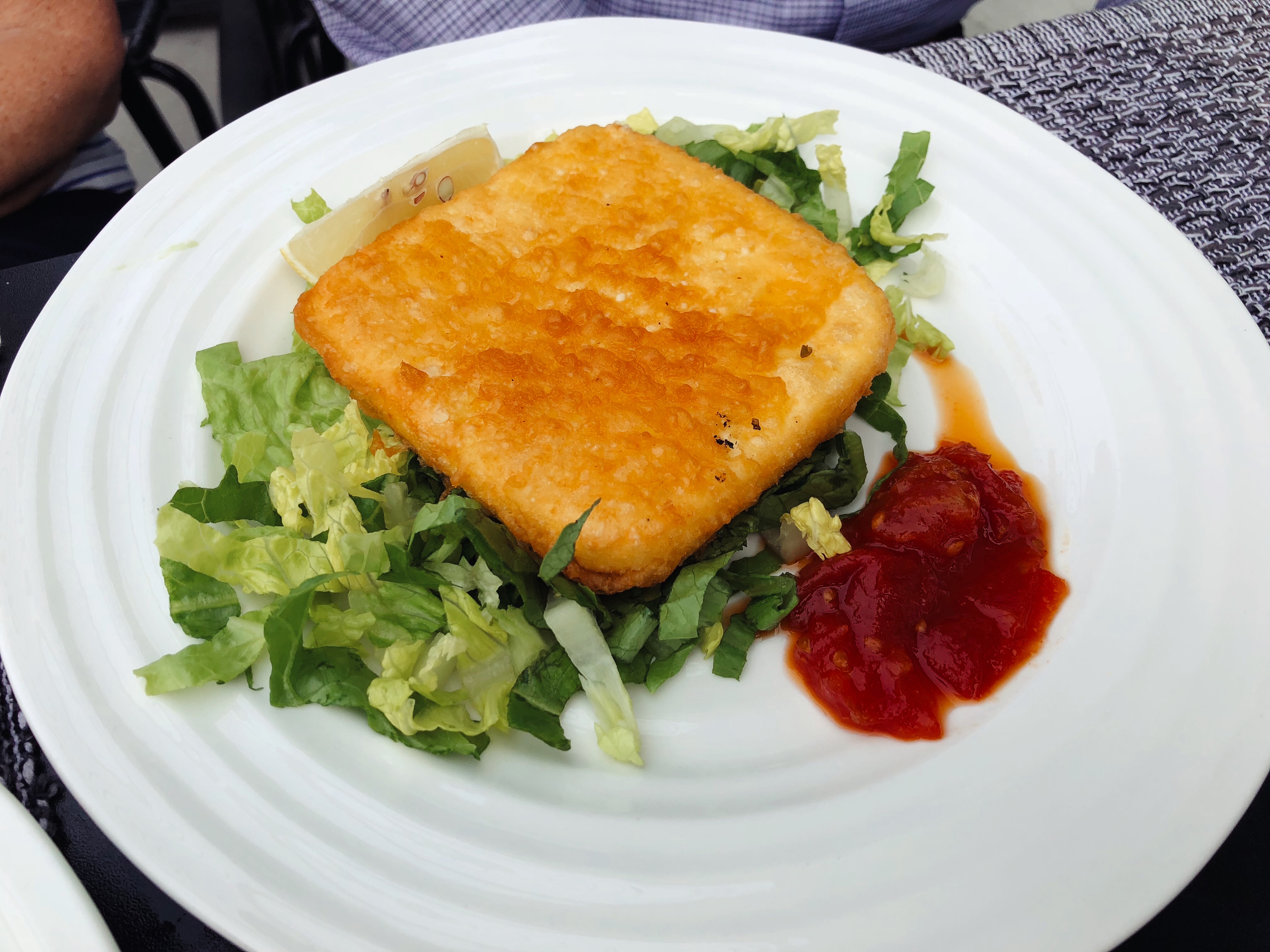
The spanakopita was a hit with all of us – light filo pastry with just enough crunch housing a beautifully molten mixture of feta, spinach and mint. The other two starters, though, were the relative duds. Saganaki is one of my favourite Greek starters and done well it’s a glorious, indulgent thing. The menu chose not to specify which cheese it was (which perhaps should have been a warning bell) but it’s usually feta and this didn’t feel like feta at all. Whatever it was, it was a lukewarm block of cheese with a leathery texture which had no give whatsoever. The “homemade tomato jam” might just have been able to paper over the cracks of this dish, but there was nowhere near enough of it.

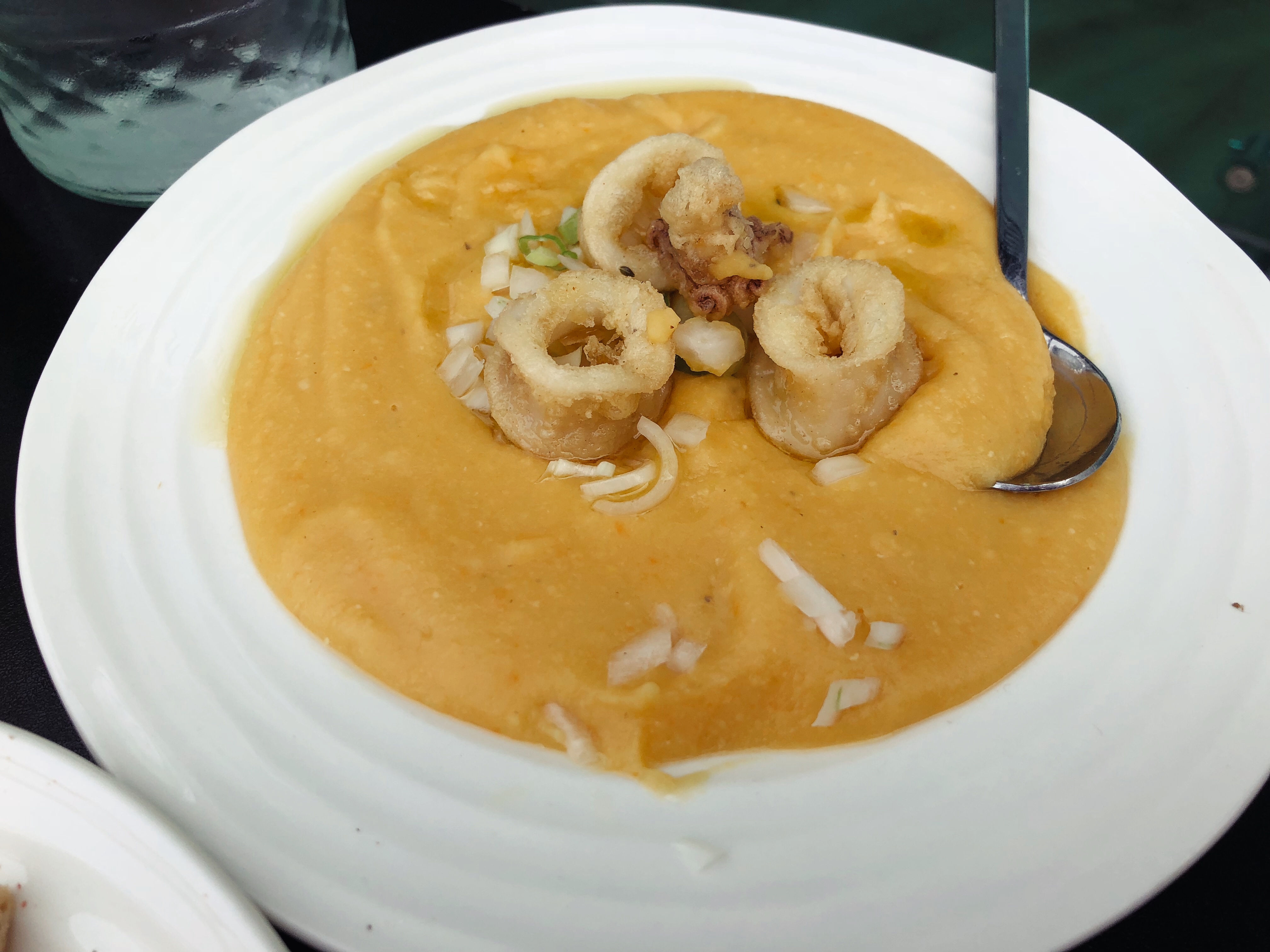
The last starter arrived after the other three, and before the side plates we’d had to ask for twice. Mashed fava beans topped with calamari were a pleasing shade of yellow and had a earthy, if subtle, taste. But I couldn’t help wishing it was hot rather than lukewarm and it also needed some pita to do it justice. Our first helping of pita – tasty, topped with something like cayenne pepper or paprika along with dried oregano but far too little of it – had already vanished by then and it took multiple attempts to flag someone down to ask for more. By the time it arrived we still just about needed it, but the moment had passed.

“That dish is bland” said my mother, pointing accusingly at the fava beans.

“It’s okay – it could do with a bit more seasoning” I said.

“Well, it’s not unpleasant” she added, the implication clearly being that not unpleasant was not good enough. I could see what she meant, but I was more disappointed that paying two pounds extra got your fava bean purée topped with precisely four tiny bits of squid. Maybe I’ve inherited her critical faculties.

Having struggled to get our side plates and struggled to get extra pita bread, we then found we were left alone with our leftovers in front of us for some time. This gave my mother enough time to do some detective work.

“Our placemats are by John Lewis” she said. “They have the tag on them.”

I inspected them. This was indeed the case.

“And the labels are still on the underside of our side plates.”

I wasn’t sure how my mother had clocked this – nothing gets past her – but lifting up my snazzy rippled white plate it was true. Sophie Conran for Portmeiron, no less, and that stuff isn’t cheap; these aren’t plates you’d want to smash at a wedding.

“It’s weird, isn’t it? It’s like they’ve picked this stuff up at a department store because money’s no object.” And again, I found myself wondering where the money came from to open this massive restaurant out of nowhere and kit it out with a lovely new refit, John Lewis placemats and Sophie Conran crockery. At this point my stepfather outlined his theory on the matter: sadly, I’ve had to omit it from the review but I’m sure you could come up with your own ideas.

I was jogged out of this reverie by the fact that as our plates were taken away the main courses were plonked in front of us, supervised by an older man who looked as if he might be the owner. The overall effect was a little menacing, especially as my stepfather had ordered the “chicken skewer” which comes to the table on a long and potentially dangerous skewer fresh from the grill. The skewer was served on a bed of undressed, pointless rocket with some soft-looking roasted potatoes, a cold couscous salad and some kind of dip. I tried some of the chicken and it wasn’t unpleasant but there was no real sign that it had been marinated. At fourteen pounds it was still more expensive than the same dish at Bakery House, with nowhere near the same whistles and bells.

“That dip is salad cream” said my mother, looking none too impressed.

“I think it’s more like burger sauce” I said. “The menu says it’s ‘Lemoni mayonnaise sauce’, apparently.”

“Well it tastes like salad cream to me.”

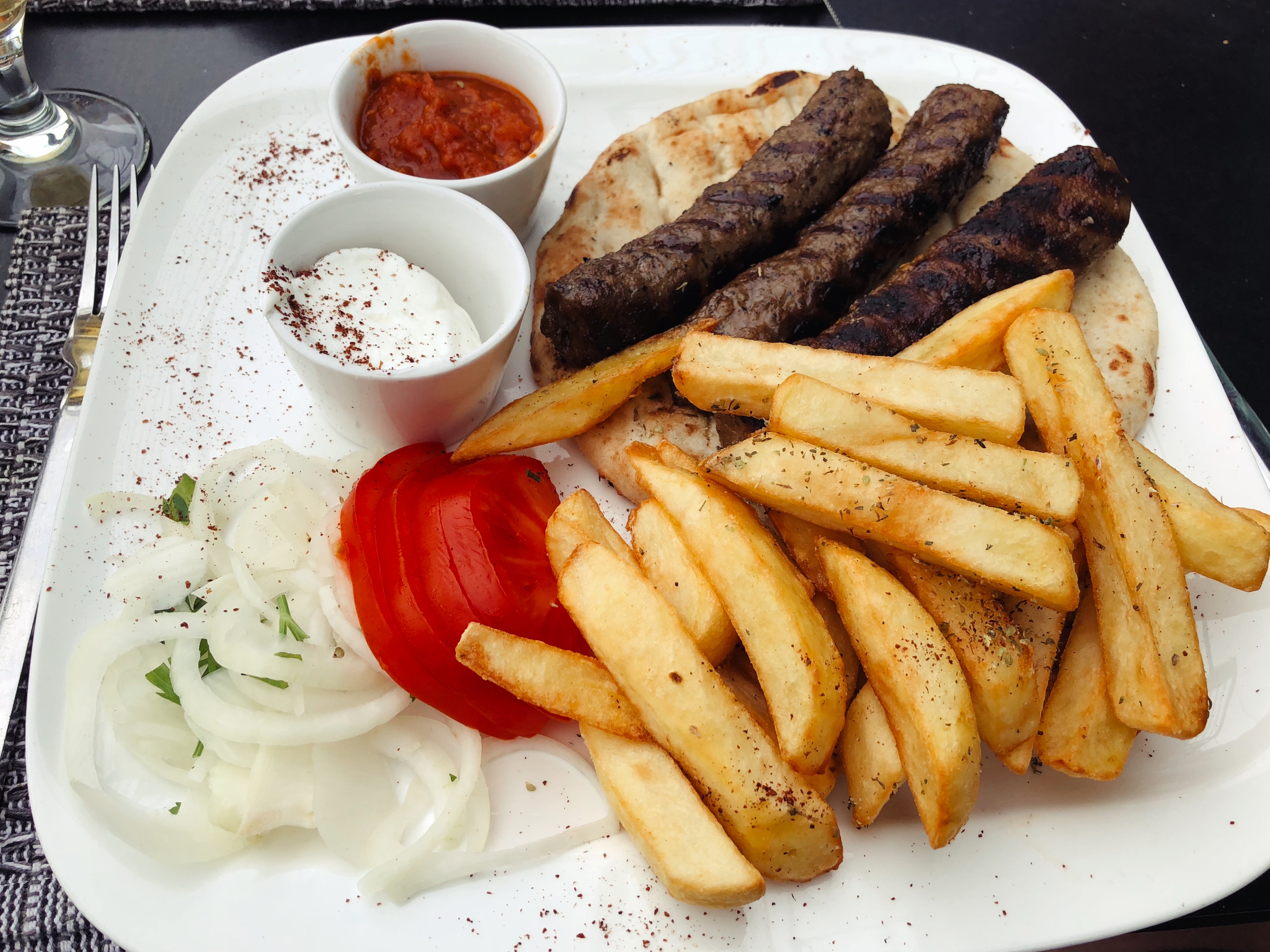
“It’s not going to be a glass half full evening, is it?” said my stepfather philosophically as he attacked the rest of his main, undeterred by any resemblance to Heinz’s finest. I had ordered the classic kebab, and I was delighted to discover that they no longer looked like the Photoshopped horror I’d been sent via Whatsapp. If anything, these were uncannily regular cylinders of meat – a mixture of beef and lamb, apparently – and I wasn’t sure whether I enjoyed them or if I was just relieved that they weren’t worse. They were nicely seasoned and although they were a little on the smooth and homogeneous side for my liking they weren’t unpleasant. They came with a yoghurt thicker and more pointless than Dominic Raab, and a tomato sauce which lacked any spice or heat at all. Nice chips, to be fair, but apart from that this was another dish that Bakery House does miles better for less.

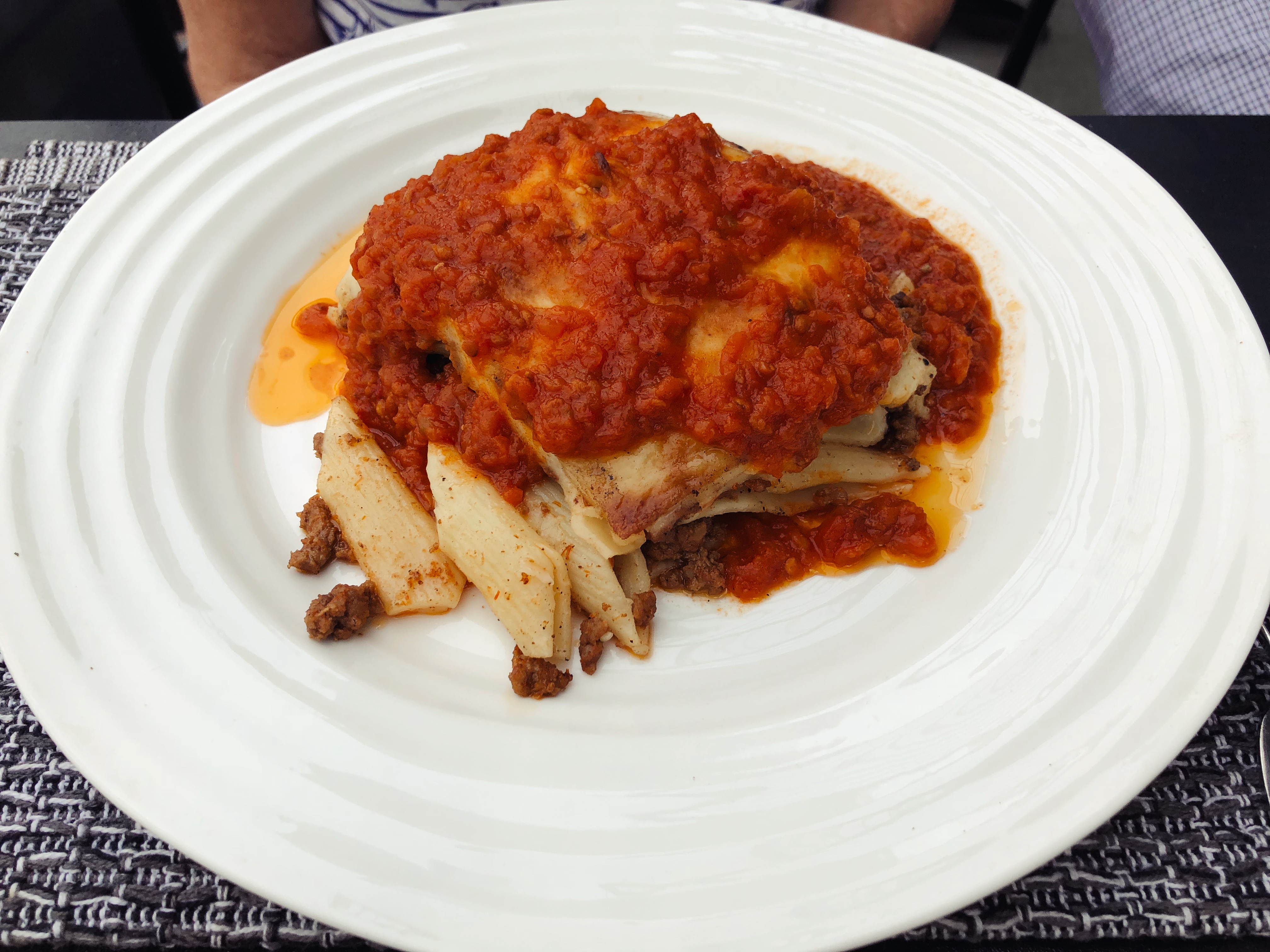
Even if the glass had been half full up to that point, it pretty much emptied when my mum started eating her pastichio, a sort of Greek lasagne which serves as an alternative to moussaka.

“This is sweet. It’s as sweet as a dessert. And there’s nowhere near enough mince. It’s just a sweet tomato sauce and some pasta. And the cheese! Well, it doesn’t taste cheesy.”

I tried some. You couldn’t knock her brevity: it would take me a whole paragraph to say a lot less.

“I think it tastes sweet because there’s definitely cinnamon in that tomato sauce.” I said, trying to put a brave face on it. Who was I trying to kid? The dish was a duffer.

It didn’t help that the accompanying Greek salad also didn’t pass muster. “It’s a nice olive” my mother said, “but it needs company.” A pity, because the feta was lovely and, again, I thought adding capers was a nice touch. But it’s difficult to argue with somebody saying that a Greek salad needs to contain more than one solitary olive.

We stayed for dessert, because I desperately wanted to give Lemoni one more chance. The big thing here is loukoumades, Greek doughnuts, so I ordered them with Greek honey and crushed walnuts. They were nicely irregularly-shaped, so obviously made by hand, but that’s as far as the plusses went. They were heavy, stodgy things, the shell not crisp and the inside a million miles from a fluffy cloud of joy. The honey was in a lake at the bottom rather than drizzled over the doughnuts, and the whole thing was heavy going. We didn’t finish them.

“Doughnuts ought to be a delight” said my mother, who by this point was turning into a one-woman Greek chorus of disapproval. “You should want to race through them.”

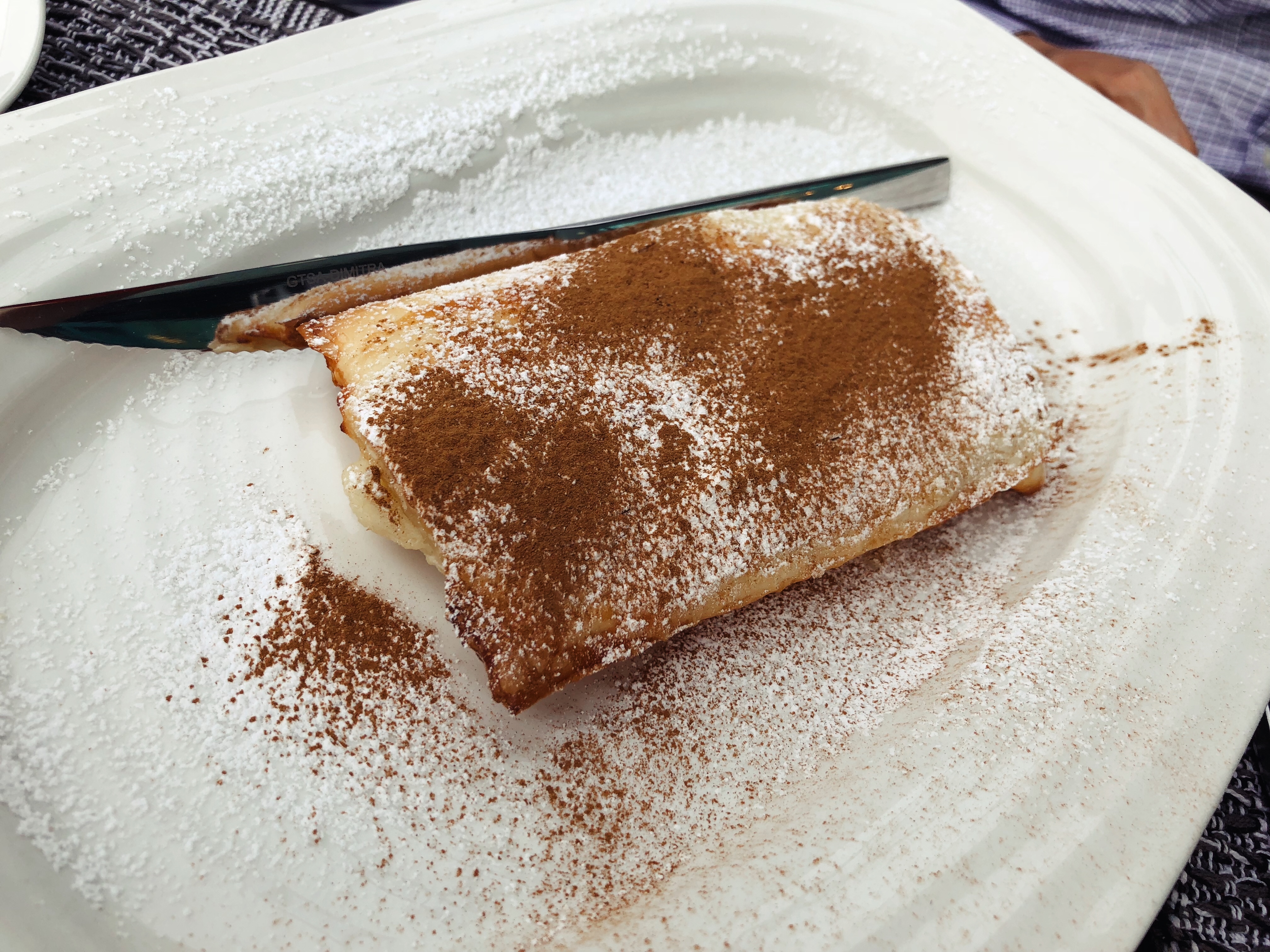
My stepfather’s bougatsa, custard in filo pastry, was better but still not right. I liked the custard very much, but this pastry didn’t have the same lightness of touch as our starters had had. Sawing through it with a knife felt like a slog. “It’s a bit tough” said – well, I’m sure you can guess who said that.

It won’t surprise you to hear that we also had to ask for the bill twice. Lemoni was busier than I expected on a Wednesday evening – the sun was still shining, the big screen on the Riverside was showing Wimbledon, people were sitting in the deckchairs on the opposite bank watching it and the beach bar was full of the kind of people who like the beach bar. It was a glorious evening, and if our meal had been better maybe we’d have been happy to sit there and digest and chat away with all the time in the world. All the best Greek food I’ve had – usually on holiday, but also in restaurants like Maida Vale’s scruffy Tsiakkos & Charcoal, or Notting Hill’s upmarket Mazi – is best eaten in a leisurely fashion, while you daydream of being somewhere in the Cyclades. But in this case, we just wanted to settle up and sod off.

Eventually, we flagged someone down and our bill – four starters, three mains, two desserts, two beers and some mineral water – came to ninety pounds, not including tip. Not hugely expensive, in the scheme of things, but when you consider that we barely drank it’s still a fair amount to spend on something so middling.

“You could come here and have quite a good meal” said my stepfather, “if you happen to order just the right things. Or if you ordered badly it would be terrible.” I nodded in agreement: I’d seen huge plates of what looked like home-made crisps turn up at other tables and I was thinking that if I’d just ordered those and some houmous I probably would have had a better, cheaper time.

So, there you have it: Lemoni isn’t the horror show I half expected, which just goes to show that anybody who reviews a new restaurant in the first month is making an error of judgment. But, even after three months of working on the pricing, the menu and the service it’s still deeply unspecial. Not better than Bakery House, not better than The Real Greek, not better than Kyrenia in its heyday. I don’t say that with any joy or any axe to grind – it would be a wonderful thing for the prime pitch in the heart of the Oracle to be occupied by a brilliant, distinctive, smartly-priced and well-run independent restaurant. But Lemoni is not that restaurant.

My closing thought about Lemoni was the saddest of all, because what my visit really did was make me think about Dolce Vita. Dolce Vita paid less rent than Lemoni, it charged more than Lemoni, it was busier than Lemoni, it did better food, it had better service and it closed for good last year. If Dolce Vita couldn’t make a go of it with so much in its favour, who would bet on Lemoni seeing out the year? More to the point: just imagine how wonderful Reading would be if a restaurant like Dolce Vita had occupied a spot like the one Lemoni has. How I wish we lived in a town like that.

Lemoni – 6.2
Unit 1, The Riverside, The Oracle, RG1 2AG
0118 9585247

https://reading.lemoniuk.com/

The Real Greek

The Real Greek closed in Summer 2023. I’ve left the review up for posterity.

Well, you were meant to get a review of Brewdog this week, but nothing quite went according to plan. I turned up there with Steve, a long time reader of the blog who attended my first readers’ lunch at the start of the year, and right from the off things weren’t promising. We entered the cacophonous main room and found a spare table round to the left which was just about comfortable enough. Just about.

“I wish I’d brought my glasses” said Steve. Steve is wry, wise and silver-haired, knows an awful lot about food, catering and restaurants and he’s had more jobs – and stories about them – than I’ve had hot dinners. “This is the first time I’ve ever been in a restaurant and not been able to read the menu.”

I looked at the menu, all in the sort of distressed font that hints of a typewriter ribbon on its last legs. It was all burgers and dogs and puns (“Cluck Norris”, “Soy Division”) and, I’m afraid, it induced mild to moderate weariness.

“I thought it was table service here. It was when I came here for a drink the weekend it opened, but now I’m not sure.” I said.

Minutes passed.

“I’ll go up to the bar” I said.

As luck would have it, the night I planned to review Brewdog the team from Explore Reading was there to review the drinks and the food. They had a nice booth (not jealous, not at all) and were already a few beers under way. I wondered: did that make Steve and I the Jets or the Sharks? Was Steve nifty on his feet? Should I have brought backup?

At the bar, the Explore delegation told me that there had been a mix-up in the kitchen and they wouldn’t be taking food orders for half an hour. It was already eight o’clock and that, I’m afraid, is where I decided that life was too short. I looked over at the Explore table again. These were Reading’s hip young gunslingers: one of them was in her twenties, for crying out loud. I went back to our table.

“Come on,” I said to Steve, “we’re going.”

That’s how we found ourselves walking back across town as I frantically consulted my list for a Plan B and that’s how we ended up in the Real Greek, on the Oracle Riverside. I turned up, in truth, with no great enthusiasm; I hadn’t heard brilliant reports, unless you include the countless enthusiastic – and comped – blog reviews shortly after it opened last year, back when you couldn’t get in without a reservation.

But going through the doors on a midweek evening I actually found myself thinking how nice it looked – almost like a slightly more upmarket Pizza Express, with biggish tables and handsome chairs along the outside of the room and a section of sort of open booths in the middle. I wouldn’t have fancied one of those, as they seemed to be hard benches with no visible padding. I guess the sort of people who enjoyed an evening in Brewdog might have gone for them, I found myself thinking.

Steve and I persuaded the waiter to give us a round table for three, so as to improve both our views and give us the room to order everything we wanted, and had a look through the menu. It was proper small plates territory, with a range of hot and cold meze and, if you needed some inspiration, a range of suggested set menus down the right.

So far so good, but the menu also meticulously listed the calorie count for every dish on the menu. I really wasn’t a fan of this: it’s bad enough seeing the traffic lights on ready meals in Marks, without it starting to invade restaurants. Surely restaurants were meant to be a haven where you didn’t have to put up with all that? Ironically, it put me off ordering dishes at both ends of the spectrum: I like a bit of taramasalata, but when a portion was just shy of a thousand calories? And I love octopus, but if it’s only 161 calories how much of it do you really get for £7.50?

The menu recommended three to four mezes per person, so naturally – despite my niggles about calories – we ordered nine between us: Steve may run marathons, but I just knew that he was a trencherman beneath that wiry exterior. Our waiter turned up with two cold bottles of Mythos, cracked them open simultaneously and poured them at the same time into our glasses. Like all magic tricks you can’t remember how it’s done, don’t want to and, afterwards, struggle to describe it.

“That’s nicely done, isn’t it?” said Steve, which I rather felt gave me permission to be impressed.

We chatted away about our recent holidays – Porto for Steve, Bologna for me – and the first set of dishes arrived. The other gimmick at The Real Greek is that your sharing plates arrive in a tall stack, like afternoon tea. That might be your bag, it might not: I found it irksome but it was easy to take them off the rack and spread them out on the table as nature intended. If I’d been at a smaller table for two, it might have properly got on my nerves.

We started with some of the cold mezze. Revithia, which looked like a plate of lightly bruised chick peas, were delicious, singing with lemon and mint, a beautifully fresh and bright dish. The dolmades was also very good – light, crumbly and again rich with mint, not remotely claggy or glutinous. Only the Greek flatbread disappointed. It wasn’t piping hot, and it felt like maybe it had been sitting around a little too long before coming to our table. I think if I’d realised just how unlike a dip the revithia was, we wouldn’t necessarily have ordered it, and it seemed a little cheeky to charge an extra three quid for olive oil and dukkah.

Despite that, Steve and I made our way through the whole lot, waiting to be disappointed. By the end, we realised that disappointment had not come and, for the first time, I wondered if this meal was going to outperform my expectations. The waiter brought a bottle of Greek white (Makedonikos, apparently) which was fresh, not sweet and not sharp, and tasted really quite a lot like being on holiday, as some of the best wine does.

“It’s a good atmosphere in here” said Steve, taking in our surroundings. “Everyone seems to be having a nice time.”

It’s a little point, perhaps, but Steve was right. None of the tables seemed to have the grim note of contractual obligation, nobody seemed to be there because they had vouchers or had run out of ideas. Perhaps we’d just stumbled on the place on a really auspicious evening – or perhaps it was euphoria at having escaped from Brewdog – but as I took another sip of my wine I found I was really quite enjoying myself. Steve was telling me about his small granddaughter’s quest to notch up a Michelin star a year (she made one establishment make her a dish completely off menu, which makes her sound far more fearsome than any mere reviewer), and about wife number one and job number sixteen and I thought: how lucky I am that people read the blog and want to come to dinner with me.

The rest of the dishes rather came all at once, which actually was my failing rather than the restaurant’s. It’s weird how when you’re in a chain to some extent you act like you’re in a chain, and you order like you’re in a chain. If The Real Greek had been an independent place, another Namaste Kitchen, I would have ordered some dishes, eaten them, kept the menu and then ordered some more, but because it was a chain and the menu told you how many dishes to order, I ordered them all in one go. With hindsight, that was a mistake, but it didn’t stop everything we ate being good at the very least and often far more than that.

Particular highlights from the hot mezze included the pork belly, cooked so perfectly that you could almost have mistaken it for chicken thigh, all crispy skin and layers of meat, every bit of fat rendered to nothing. Steve and I did a very English equivalent of fighting over it, which involved each of us saying “no, you have the last piece” ad infinitum. We were similarly polite over the halloumi fries, salty and light and pretty close to perfect, especially dipped in the minted yoghurt. The least successful dish was the calamari, which turned up looking so much like octopus that I worried we’d ordered the wrong thing. That wouldn’t have mattered so much, but it wasn’t quite as fresh as promised and that made it harder going than either of us would have liked. When we said “no, you have the last piece”, we actually meant it.

What else? Lamb kefta was more like a single lamb burger than a kebab or meatballs, but it was still delicious and far nicer than it looked. I felt like there was a hint of feta smuggled away in it somewhere, but that could have been a trick of the light, or the white wine slightly skewing matters. Salt cod fritters were also light and delightful, with plenty of fish, not bulked out with spuds. Again, the lemon mayonnaise that came with it was spot on.

Finally, Steve’s favourite, the loukanika: three whacking great slabs of pork and beef sausage with a deep red smoked chilli relish. I had huge reservations about this, mainly because it screamed stealth spam, but it was beautiful – coarse, firm, juicy and with just enough spice. The relish set it off perfectly. Steve liked it so much he sent me a message the next day saying that he was daydreaming about eating it again (and Steve’s one of the only people I know who can send such a message without even the faintest hint of smut).

“This is really good, isn’t it? I can’t find much wrong with it.” I said, giving away I’m afraid that I had fully expected to turn up to an Oracle Riverside chain restaurant and find shitloads of issues, and that I was a tad perplexed that I couldn’t.

“Yes, it is” said Steve. Were we having a shared hallucination? Had they put ayahuasca in our Mythos?

We pressed on with dessert, because we were having too nice an evening to want to bring it to an end. That’s as noble a reason to order dessert as any, but the decision provided probably the meal’s biggest misfire in the shape of my baklava – a big stodgy slab with no real crunch or subtlety, no layers, no sticky sweetness. What you got instead was some faintly damp pastry, and a big claggy layer of crushed nuts, and the whole thing was cold and unimpressive. You got better baklava, back in the day, eating Georgian food at the Turk’s Head and (trade secret alert) I have it on good authority that they bought theirs from Costco. Steve’s chocolate mousse cake was considerably nicer, if not remotely Greek. “Not bad” he said, between mouthfuls, “but they’ve definitely bought this in.”

Service was bright and personable from start to finish. Our waiter was Italian, which led to a long conversation about my recent holiday in Bologna (I took the lead on this), football (obviously Steve took the lead on this) and where a self-respecting Italian eats in Reading (Pepe Sale, unsurprisingly). He was very proud of the food, told us what to order next time and talked with real warmth about The Real Greek, having worked for years in the Windsor branch before transferring to Reading. No smarm, no encouraging us to post reviews on TripAdvisor, just genuine enthusiasm.

Dinner for two, not including service, came to eighty-eight pounds. Not the cheapest meal in the world, and although we probably could have ordered a couple of dishes fewer it was never going to be as cheap as living it up at Brewdog. But I had such an enjoyable meal that I really didn’t mind.

Afterwards, Steve and I compared notes. I rated the meal slightly more highly than he did, and we beetled off to the Allied Arms for a debrief, shivering under the heaters and pretending it was nearly summer. But the next day, he messaged me.

“I think I might have marked it a bit low on reflection. I think you were more on it.”

“It was really decent, wasn’t it? I’m struggling to find fault.”

“The waiter definitely contributed to the whole thing. Lovely to have someone so enthusiastic – I almost thought he was called Sandra.” Steve went on, referring to Zizzi’s legendary waitress, As Seen On TripAdvisor (“the Skripals would never have been poisoned in our branch of Zizzi”, my friend Tim once said to me, “Sandra would never have allowed it.”).

I think that exchange probably sums up the verdict on The Real Greek as well as anything. It wasn’t my first choice, I went there by accident and my expectations were firmly under control. And yet, quietly and unshowily, it did an absolutely cracking job. Irritating gimmicks, iffy bread and so-so desserts aside, we enjoyed a really tasty meal in a lovely, buzzy room. Nearly everything we had was good, much was very good and some was excellent. To my surprise, I would go back again, and I can see the appeal of gathering a group of friends and trying as much of the menu as possible. So I’d encourage you to put your reservations to one side when you read the rating at the bottom, because for a certain kind of evening – with fellow diners who play nicely – The Real Greek is as good an option as anywhere you can find in town. My only tip is to dig your heels in and order little and often: it may be a chain, but that should never stop you being independent-minded.

The Real Greek – 7.7
The Oracle, RG1 2AT
0118 9952270

http://www.therealgreek.com/reading/