Restaurant review: Antica Osteria Bologna, Clapham Junction

For fuck’s sake, it’s Edible Reading, not Edible Clapham Junction.

I know, I know (Happy New Year to you too, by the way). But I found myself in the vicinity of arguably the United Kingdom’s most minging train station one January weekend – on an unsatisfactory excursion spectacle shopping, since you ask – and I always think it’s well worth structuring an expedition like that around lunch. That way if the shopping’s a bust, as it turned out to be, and the station is a hellscape, which it very much was, there’s still an outside chance of salvaging the day.

Not that I was in Clapham, by the way. I was shopping and mooching in an area that isn’t quite Clapham, isn’t quite Battersea, is a ten minute walk from Clapham Junction and is really rather lovely. Northcote Road is a long, prosperous street in the heart of what is apparently called Nappy Valley, and it’s a great place to amble and bimble. I hadn’t been in many years, although I was an occasional visitor in a former life.

I remember eating in this little place called Franco Manca there, once upon a time when there were only a handful of them, before they contracted the disease called private equity. There used to be a splendid tapas restaurant, too, called Lola Rojo, which did an olive oil ice cream I still think about sometimes: if I could have my time over again, I’d have ordered two portions (laugh all you like, but that might make my top 50 of Things I’d Do Differently). But anyway those were simpler times, over ten years ago, and remembering them it’s as if they happened to somebody else.

Returning in 2023, Northcote Road was still as fancy as I remembered. It’s still lined with swish looking cafés, delis and cheesemongers, bakeries, great shops, a branch of Aesop  – always a sign that you’re somewhere spenny – and tons of opticians. There’s even a branch of upmarket wine merchant Philglass and Swiggott (true story: I used to frequent their Richmond branch and I had to have it explained to me that those weren’t in fact their real surnames). 

Northcote Road also has restaurant after restaurant, and is full of those kinds of chains: Rosa’s Thai, Joe And The Juice, Patty & Bun, Ole & Steen, Meatliquor. The ones where simultaneously we’d rather like one in Reading but we know that if we got one, it would be because they’d jumped the shark. Not that you needed to eat in one if you were peckish – one food van sold beautiful-looking pizza, another was flogging porchetta sandwiches which looked so attractive that I almost cursed my foresight in having made a reservation.

But I had made a reservation, and I’d relied on Eater London for a recommendation. It had a list of the best restaurants in Battersea, although they were sparsely spread out and it would have taken you the best part of an hour to walk from one end of their map to the other (some of them, weirdly, also end up in their list of the best restaurants in Clapham, which tells you what a no man’s land it can be). 

There were small plates wine bars and gastropubs, little BYOB Thai joints and a restaurant offering French-Korean fusion, whatever that is. But I was drawn to Osteria Antica Bologna, slap bang on Northcote Road. It had been going for over thirty years, which meant I had probably walked past it countless times a decade ago. And the clincher was this: I love Bologna and I haven’t been there in far too long. So Zoë and I turned up at lunchtime, our tote bag already full of treats for later from the cheesemonger, to see if it could transport me back, in spirit at least, to one of my favourite cities.

It was old school right from the beginning, with a burgundy and orange awning and a big sign at the front saying “DAL 1990”. And stepping inside I was reminded that it can be a fine line between dated and timeless, and sometimes you make it from the former to the latter merely by staying the course. For what it’s worth, I think Osteria Antica Bologna was the right side of the line, with a simple, rustic-looking dining room, a dusky pink banquette running along one side. On the other, tables were separated by a trellis-like partition that no doubt pre-dated the pandemic.
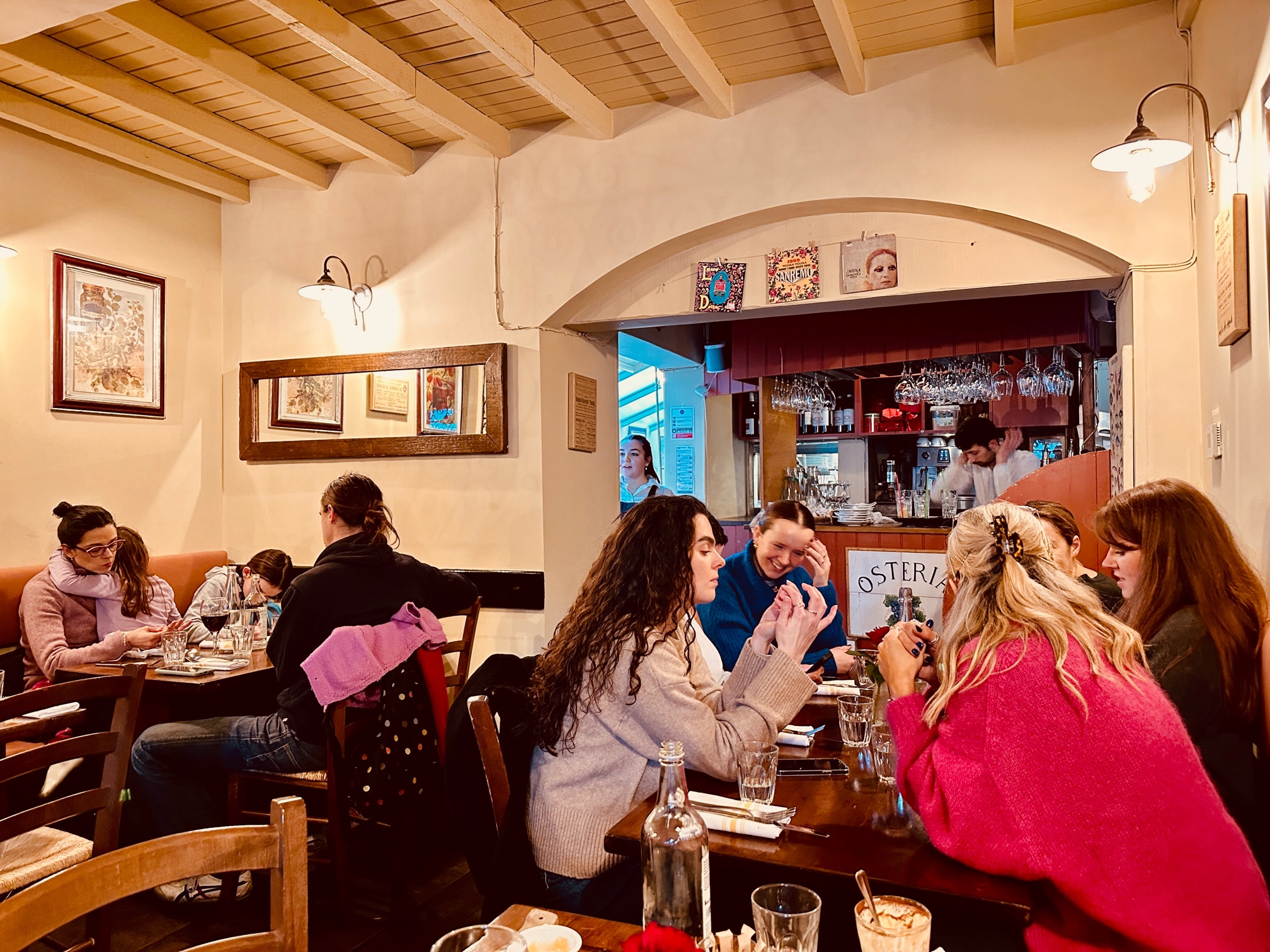
Beyond the archway in front of the bar, out back, was a more modern-looking dining room with a skylight, an extension I imagine, but I was glad they didn’t seat us there. Even the little things, like a circular table at the front with a big bowl of olives and a large bouquet of flowers, felt like something they had done for a very long time. It was a room with a lovely energy, a place harbouring the unspoken promise that you would eat well, and although only a handful of tables were occupied when we arrived at one o’clock, only a couple were empty when we left.

Another sign that the restaurant was resolutely old school came as I drank my – surprisingly bracing – Aperol Spritz and Zoë attacked her negroni. The menu was antipasti, pasta and main courses. If you wanted pizza, you should have headed to the food truck on the other side of the road, or to Franco Manca. But everything sounded marvellous, including the specials which were explained by our personable, enthusiastic waiter. 

I almost tried some of their pasta but, and this was the only real disappointment on the menu, the difference between a starter and main-sized portion of pasta was just two pounds, which said to me that I was effectively choosing between that and a main. But there’s always next time, when the pumpkin and ricotta ravioli with sage will be calling to me – although not necessarily loud enough to drown out the siren song of the wild boar ragu, or the risotto with salsiccia and Barbera. A truly great menu always comes with regret baked in: that’s the nature of these things.

We’d ordered a trio of antipasti to start and if anything they intensified that regret: given just how good these were, what other treasures had we missed on the menu? Arancini were possibly the best I can remember, and simpler than many I’ve had. No thick crust of breadcrumbs here, just a feather-light seasoned shell. No stodge to wade through with a molten core, instead just a neat sphere of rice, cheese and peas retaining a little bite. And to go with it, an arrabiata sauce worthy of the name, just spiky enough. It reminded me of the difference between pretenders, as with my visit last year to Sauce & Flour, and the real deal – unshowy but superb.
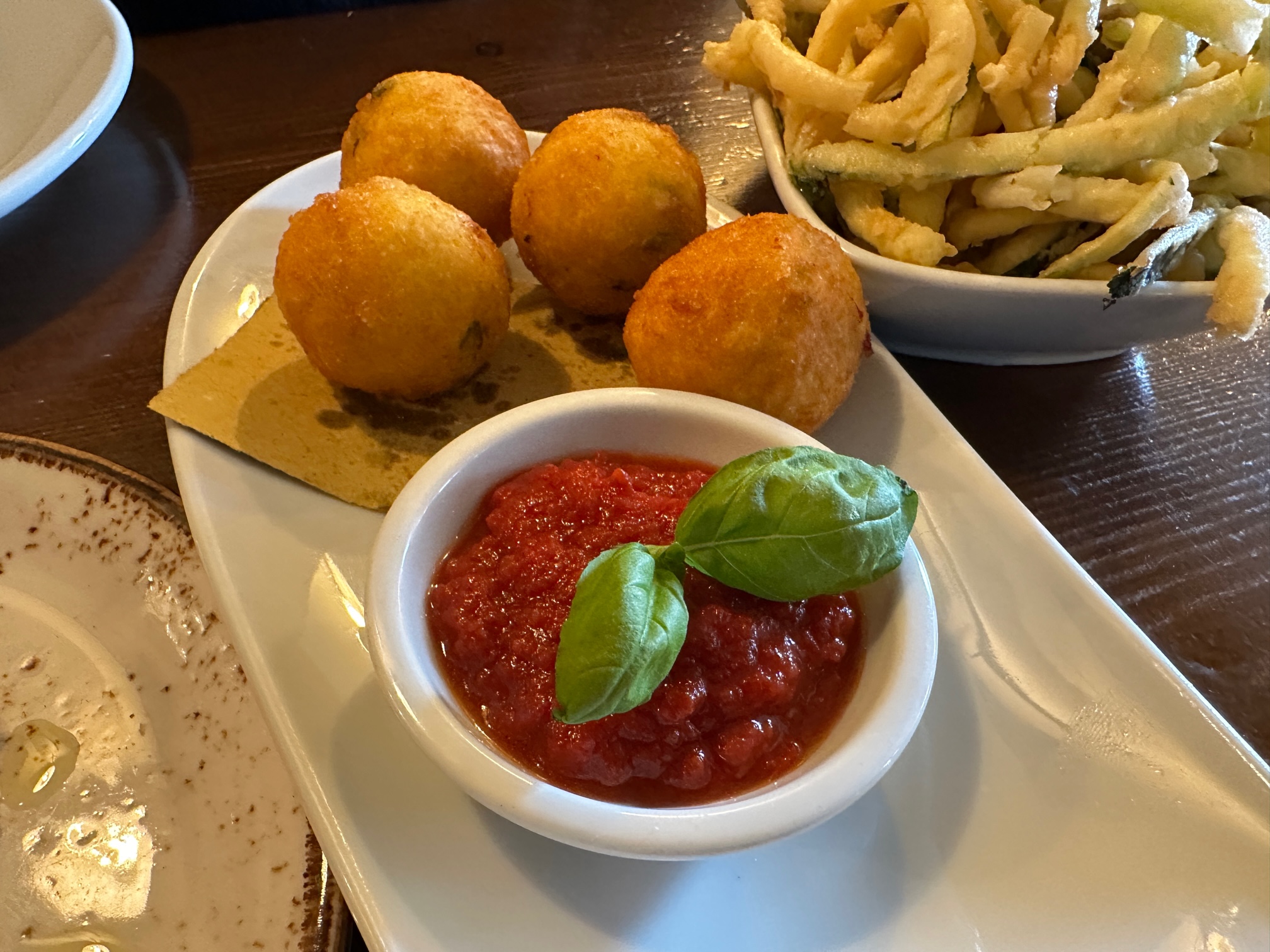
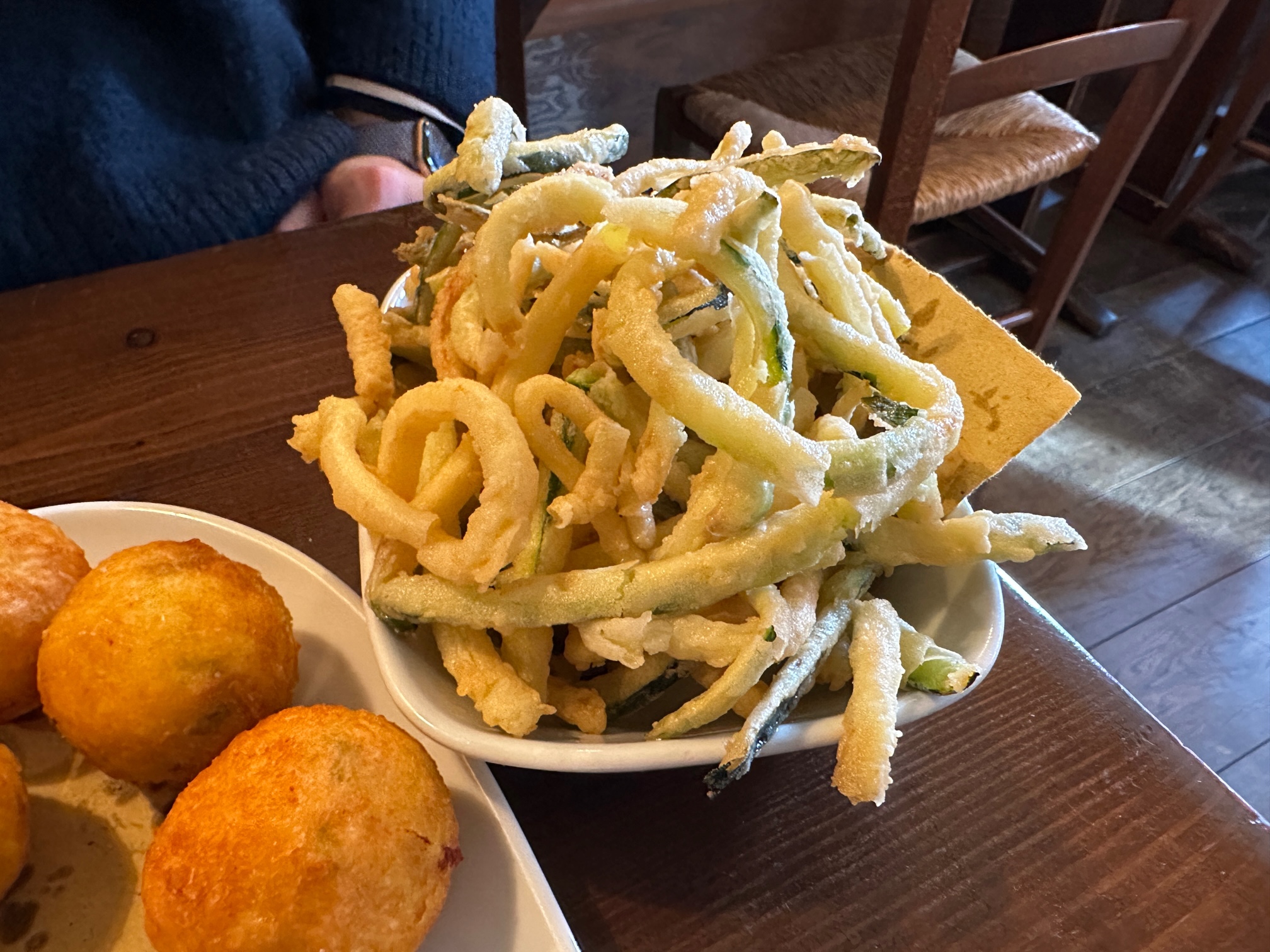
Also as good as I can remember were the zucchini fritti. No, scratch that: they were easily the best I’ve had anywhere. So often, including at a couple of Reading restaurants I actually really like, they can be soggy, limp things and you’re left to redeem them with some kind of dip. Here they were shoestring-thin, almost ethereal yet spot-on crispy, the way this dish always promises to be but somehow never is. And they didn’t need any kind of dip because they were so salty and zippy, so beautifully seasoned and cooked with a real lightness of touch. “The menu should tell you to order these with your drink while you make up your mind” said Zoë who was, as usual, entirely correct.
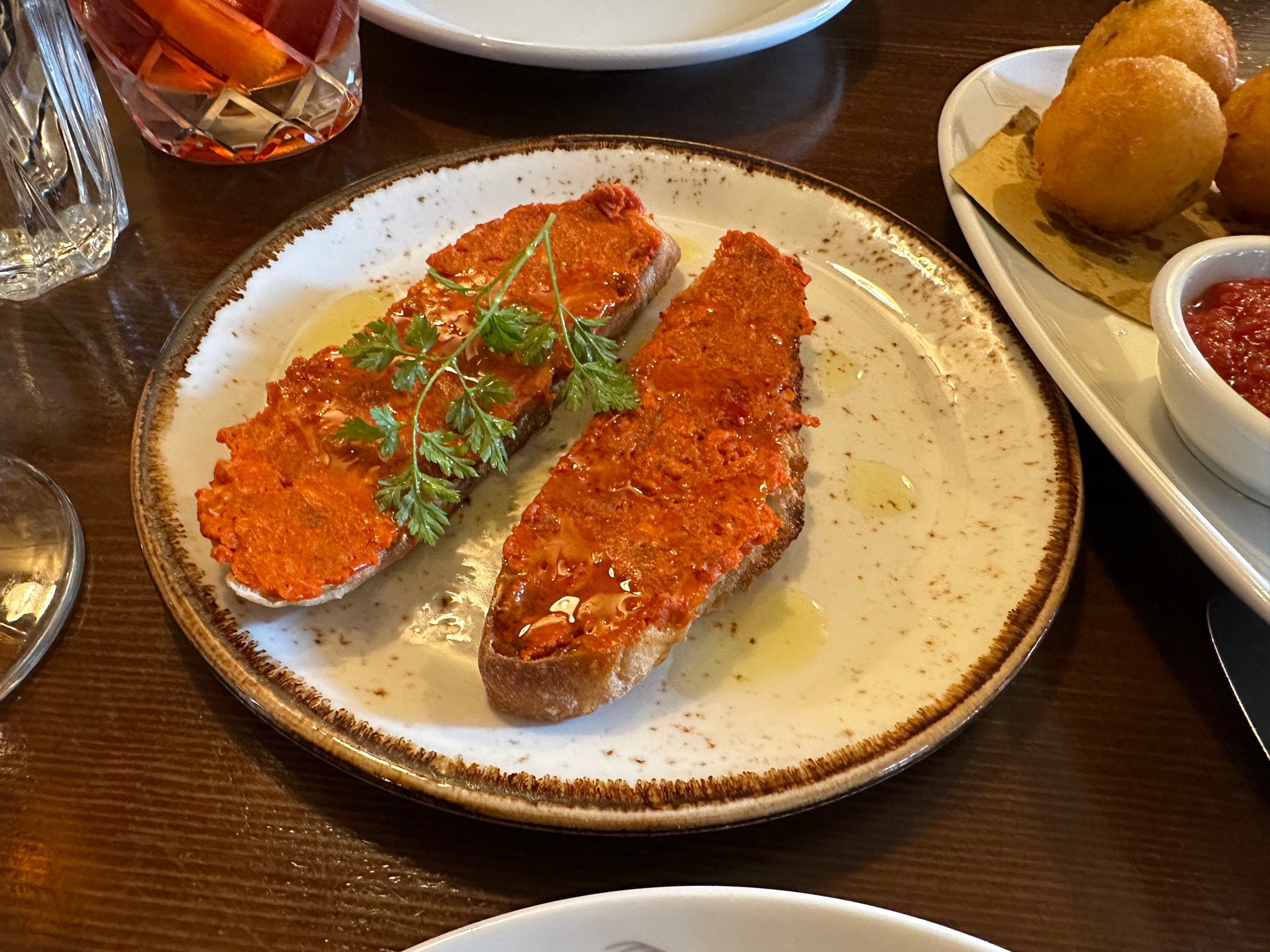
The other small dish we had, bruschetta with ‘nduja, was the least excellent but really, that just means it was still cracking. Two thin slices of toasted bread were loaded with a terrific ‘nduja – not stingily, either – with more depth and earthiness than I’m used to. So often ‘nduja dishes I’ve had are a one-note symphony relying on the acrid heat it can supply; I’ve lost track of the number of restaurants that make lazy use of the stuff. By contrast, this dish just said isn’t our ‘nduja amazing? and, having tasted it, it was impossible to argue. One thing you could potentially quibble, here, was the cost: eight pounds fifty for that. Sounds expensive, but is it 2023-in-London expensive? Your guess is as good as mine.
We grabbed a couple more drinks while we waited for our mains. My gavi, in an endearingly functional wine glass, had a pleasant zing to it and Zoë, sensibly, decided to move to gin and tonic. By this point the restaurant had a real buzz and all the temptations of elsewhere, the porchetta sandwiches and gelato places, had melted into air. All that mattered was the next course, and the course after that.

“This is very promising, isn’t it?” said Zoë. She was right about that too. 

If I had to pick a main course to start my reviewing this year with, it would be hard to choose better than the dish Osteria Antica Bologna served me. A piece of cod with salty, crispy skin and soft, sumptuous flesh, cooked by someone who really understood how to get both those things right at once, perched on a little heap of chickpeas, tomatoes and spinach.

A single forkful was enough for me to know that I was in a happy place. I even turned to Zoë and told the tired joke I reserve for these occasions, I love it when a chickpea’s in my mouth, and she had the decency not to grimace; imagine what sitting opposite me at dinner dozens of times a year must be like. Only the fact that the promised salsa verde, which would have completed the dish perfectly, had been replaced by a smear of something closer to purée slightly blotted the copy book.

The problem is that if I had to pick a main course with which to start my reviewing year, it would be damn near impossible to choose better than the dish the restaurant served to Zoë. The menu called it pork belly with roasted apple, but that prosaic description comes nowhere near capturing what a marvel it was. A gargantuan slab of pork where, like the fish, everything was exactly how it was meant to be. The flesh was tender, the crackling brittle and intensely savoury. Between the two, arguably the best bit, that sticky, moreish layer of subcutaneous fat, rendered to the point where it was gorgeous but not beyond that to the point where it vanished. I was allowed a forkful, and then because of my expression I was allowed another, and another.

“Would you like to try some of my fish?”

“No, you’re all right.”
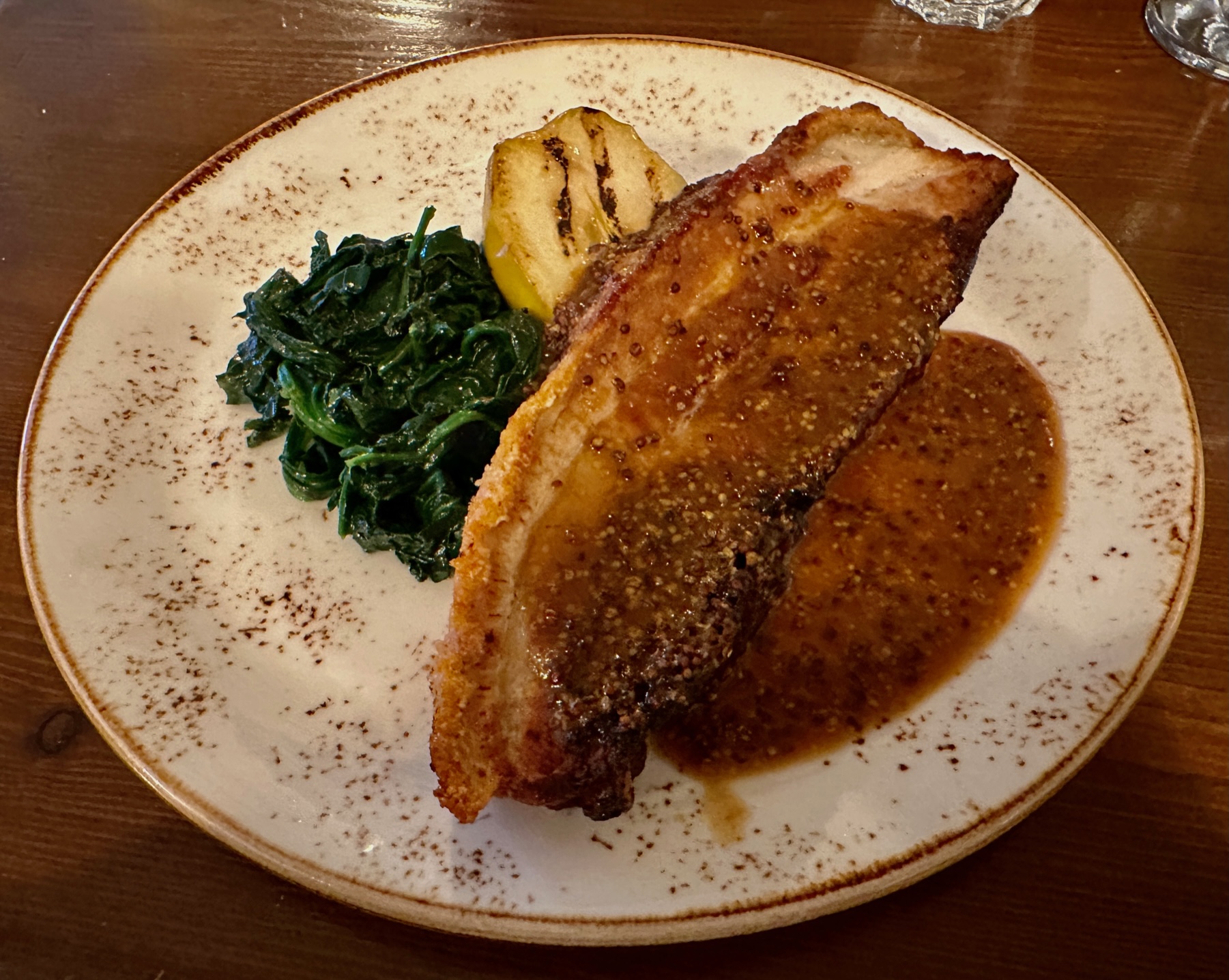
Just as sometimes you can only pick out one face in a crowd, it was hard to remember, eating that pork, that there were other things on the plate. But the gravy, shot through with mustard which never overpowered, was a terrific foil and I imagine the griddled apple was superb with it too. We’d ordered some chips with our dishes, which they really didn’t need, and those were predictably wonderful – light and salty and far too easy to pick at long after we’d cleared our mains. If they buy them in, they buy very well.

The dessert menu was also compact and leant heavily on the classics, and having seen the well-upholstered man and his Sloaney Alice-banded daughter at the next table make their choices simplified things nicely for me. My tiramisu was maybe the weakest link in the whole meal – not bad, per se, but a little too loose and liquid when I’d have liked it a tad more substantial. The slug of coffee and booze as you got to the bottom, though? That was still a wonderful moment in a meal full of them. And at the end of it I had an Amaro di Capo, as much medicine as booze, served without airs, graces, ice cubes or orange in a tall shot glass.

Zoë – here we go again – picked better. Her pear and chocolate tart was another home run, with a few pieces of baked pear, a pleasingly short pastry base and a very thick layer of chocolate; I thought it was a relatively airy ganache, Zoë thought it was a sponge, we had a heated debate about it and agreed to disagree. “That filling definitely has flour in it” were her last words on the subject, but I still say she’s dead wrong. I also managed to talk her out of ordering a Bailey’s and into trying a Frangelico instead. It was not a sponge: trust me on this. 

I haven’t talked about service but it was another of the things that was great rather perfect. The staff are clearly a well-oiled unit, bright and happy, friendly and brilliant. But one thing they also were, slightly, was too efficient. Our plates were cleared away mere moments after we’d cleared them, to the point where it became a little bit too much (“there’s something OCD about it” Zoë said, bemusedly, just after they’d also cleared her G&T away when she hadn’t quite finished it).

But really, that was a small quibble about a magnificent place to eat. I could easily see how Osteria Antica Bologna had held its ground amid all that gentrification, all those pop-ups and top tier chains. At one point I saw one of the waiters leave the restaurant with some plates of food and take them out into the street to the people manning a flower stall outside: that, I thought, said it all. Our meal for two – three courses, three drinks each and an optional 12.5% service charge – came to just over a hundred and fifty pounds, and I thought it was worth every penny.

I’ve complained in the past about Reach plc and its pisspoor habit of saying a restaurant is “just like eating” in a foreign country. My problem with that is twofold. First, the poor unfortunate journalist in question has probably never been to the country in question. But more importantly, 99 times out of 100 they haven’t been to the restaurant either – why bother, when there’s TripAdvisor? But for once I’m going to do it myself: I’ve been to Osteria Antica Bologna, and I’ve been to osterias in the city from which it takes its name. And if I’d stepped out the front door to find myself looking at an orange portico dappled with sunlight, rather than being a two minute walk from a Farrow & Ball and a branch of JoJo Maman Bebe, I wouldn’t have been entirely surprised.

As I paid up, our meal at an end and so many around us barely beginning theirs, I thought about what it means to have a restaurant for over thirty years. To outlast fads and phases, to have ‘nduja and burrata on your menu before everybody discovers them, to steer your course without embracing small plates or no reservations, to serve pasta simply because it’s what you do rather than because suddenly pasta restaurants are in vogue. I thought about the fact that Osteria Antica Bologna was here before Northcote Road was all fancy and well-to-do, that they had sent thousands of customers away replete and happy. That they’d started doing that before I even finished my A levels.

And I thought that even though this restaurant was nowhere near my home town (and, let’s be honest, most of you will probably never go there) it was still the perfect place to kick off my reviews this year. Because to celebrate this restaurant, on some level, is to celebrate all great restaurants. Some people have a nasty tendency to use “neighbourhood restaurant” as a way of patting a place on the head. It’s okay I suppose, if you live there they seem to say. But a great neighbourhood restaurant, especially one that makes you wish it was your neighbourhood, is a truly special thing. Osteria Antica Bologna is every bit that special. I’ll find an excuse to be back near Clapham Junction: when I do, I intend to order everything.

Osteria Antica Bologna – 8.6
23 Northcote Road, London, SW11 1NG
020 79784771

https://osteria.co.uk

Restaurant review: Papa Gee

As a restaurant reviewer, however assiduously you do your research, however good you think you are at reading the runes of a menu to try and figure out whether a Brakes lorry regularly pulls up outside the crime scene, however much you trawl through Tripadvisor or other blogs – good luck finding those, by the way – restaurants always retain the capacity to surprise. 

You can expect somewhere to be good, all the signs can say it will be, but there’s always a possibility that you’ll wind up with an underwhelming meal if you’re lucky, an out-and out-duffer if you’re not. This is especially the case when hype is involved. Or plain gratitude that a place has opened at all, either because a big name is gracing a town with its presence or because the town in question is a wasteland for decent places to eat. 

The more refreshing phenomenon is when it happens the other way round, when you go to an unspecial-looking restaurant with no particular expectations only to discover that you have a proper find on your hands. That realisation that dawns gradually throughout the meal, that sense of hold on, this is really good, is one of my favourite things about restaurants, and about reviewing them. It’s happened to me a fair few times, but one that’s always stayed with me was the March evening over seven years ago when I crossed the threshold of Papa Gee. 

Papa Gee, back in 2015, was an Italian restaurant on the Caversham Road, on the ground floor of the Rainbows Lodge Hotel. I’d never heard of anyone who had been to Papa Gee, and at the time I knew people who lived in Little Wales, the maze of streets on the other side of the Caversham Road named after Cardiff, Swansea, Newport. Every time I walked past Papa Gee, probably en route to a booking at Mya Lacarte, the place seemed closed. 

Inauspicious was putting it lightly. So nobody was more surprised than me when I found Papa Gee wasn’t some kind of white elephant but was instead a hugely creditable little restaurant doing belting pizzas, rather nice pasta and antipasti, a family business with owner and Neapolitan Gaetano Abete, the eponymous Papa Gee, in the kitchen. I had a splendid evening, although arguably the cherry on the cake was not having to stay in the hotel upstairs afterwards.

I walked away with my faith in the world somewhat restored, and it turned out to be one of the most delightful curveballs of the very early days of this blog. And the weird thing is, people definitely went to Papa Gee before I reviewed it. It’s not as if I discovered the place: it had decent writeups on TripAdvisor and had been trading for over ten years. It’s just that I’d never met a Papa Gee customer, back then. Maybe they didn’t want the rest of us finding out.

I was worried about Papa Gee after that, because the owners of Rainbows Lodge sold the building to the Easy Hotel chain a couple of years later and the restaurant was out on its ear. But then they announced what, with the benefit of hindsight, was a perfect move – and in October 2017 they took over the old Mya Lacarte site on Prospect Street, closer to the action in Caversham. 

It was a brave move to open slap bang opposite Quattro, Caversham’s long-serving Italian restaurant, and the conditions got even tougher a couple of years later when the Last Crumb, also offering pizza, opened at the top of the road where the Prince Of Wales used to be. And yet here we are in 2022 and, post-pandemic, Papa Gee is still going. 

And that’s partly why they’re the subject of this week’s review. The thing is, I’d never visited them in their new home and I was starting to feel bad about that; I didn’t want them to be continually on my to do list only to find, one day, that they’d closed before I’d got round to visiting. So I made my way there with Zoë on a Friday evening, post work, the weekend stretching out ahead waiting to be filled with units and calories. Like the very first time I visited Papa Gee, a lifetime ago, I wasn’t entirely sure what to expect.

Subscribe to continue reading

Become a paid subscriber to get access to the rest of this post and other exclusive content.

Restaurant review: Cotto, Bristol

I know, I know, another Bristol review. I’m sorry. This is meant to be Edible Reading, you might say. Why doesn’t he stay in his lane? Or perhaps you’re one of the If you like Bristol so much why don’t you live there brigade. I do understand, and I know a fair few people take a week off reading the blog when they see the name of the new post and realise it has a place name in the title, the name of Somewhere Outside Reading. I get it.

But the problem is that, when you write about food – or even if you don’t – you want to try the very best stuff. And when eating out is a passion you plan your holidays around it, your weekends around it. I’m away in a couple of weeks and the process is always the same: book the flights, book the hotel and then book the restaurants. And then you have to go through the usual dance: how many meals out is too many? Is two in a day overkill? Maybe your holidays aren’t like that, in which case I simultaneously envy you and think that, on some level at least, you’re missing out. You probably go to more galleries and museums than I do on a city break, to be fair.

And the thing about the very best stuff is that you – by which I mean I – actively want to write about it. Take the violet aubergine caponata I had as part of my lunch at Cotto, a restaurant in Bristol’s old city, a stone’s throw from the food market. I’ve had caponata before, but nothing that matched this. Everything was in high definition – the aubergine sweet, sharp and comforting all at once, the basil perfumed, the olive oil grassy and the pine nuts a joyous surprise in every forkful. Each flavour was somehow separated out and distinct, the gastronomic equivalent of listening to a well produced record on very expensive headphones. You might not give a monkey’s, but how could I not review that?

I’m probably getting ahead of myself by starting there, but given that I’m not usually a Bristol reviewer and you’re most likely not a Bristol reader I can probably skip the preamble with all the namedropping. The bit that talks about Cotto being the latest in a group of Bristol restaurants, the Bianchis Group, and mentions all the others (spoiler alert: I’ve not yet been to any of them). And I could tell you the name of the chef – I know some reviewers really start dribbling at that point – but it didn’t mean anything to me and it probably wouldn’t to you either.

I mean, why should you care? I’d heard good things, so I thought I’d check it out for lunch while I was spending a few days in Bristol and I’m writing it up even though it probably won’t interest many of you. I’m selfless like that.

It was a lovely dining room. From the photos I’ve seen it looks lively in the evenings, with a certain convivial glow. But stopping there on a Friday lunchtime, the room less than half-full, it had a wonderful serenity – all muted terra cotta walls, framed cartoons and Robin Day polyprop chairs (they’ve come up in the world since my generation perched on them in double maths back in the Eighties, that’s for certain). 

It bills itself as a wine bar and kitchen, and you could sit up at the bar looking out on St Stephen’s Street with a glass and a small plate, I suppose, although given how good the menu looked that would feel a bit like having half a wank. It was all tempting, to the extent where the difficult part wasn’t choosing what to eat but what to forego; on another day I’d have wound up telling you all about the coppa and pickles, the vitello tonnato, the fermented courgette with hot honey. 

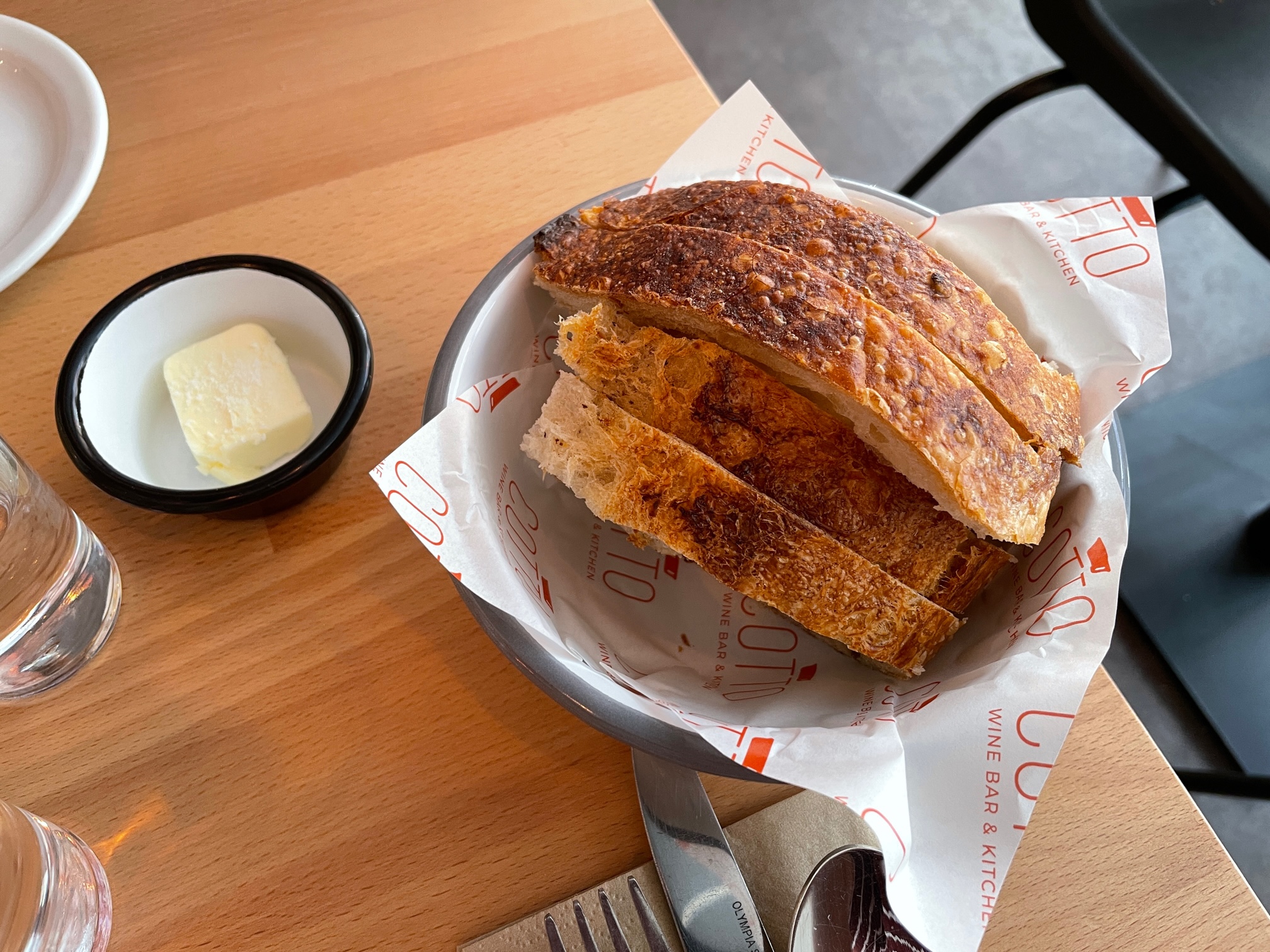
But in this parallel universe I tried that caponata, and I could hardly complain. It cost six pounds fifty, fifty pence of which went to one of the restaurant’s chosen charities. There were three dishes marked as including that contribution and one of the others was the bread and butter – four slices of decent, robust sourdough which maybe felt slightly steep at just over four pounds. It was however vital for sauce moppage (it’s a word now: I say so) so what can you do?

The bread also came in handy for our third starter, from the specials board. I read somewhere that Cotto cures its own charcuterie and makes its own sausages, and on this showing that involves some real talent. Salsiccia came in earthy, hefty pieces and although I didn’t get masses of the advertised soave and chilli, the gremolata that crowned each diabolically delicious diagonal slice made the whole thing positively sparkle. Again, eight pounds felt slightly steep for a solitary sausage – but that might be the curmudgeon in me so by all means just tune this sentence out.

Our starters finished, we sipped our drinks happy in the knowledge that we were in safe hands. Good starters will do that, building up a bank of credit most restaurants know better than to squander. And our drinks were gorgeous, too: Zoë continued her current negroni phase with a negroni sbagliato, a “broken” negroni made with Prosecco rather than gin, and I had a soft and uncomplicated Italian red about which I remember precious little. But the wine list was excellent – nearly all European, covering a good range of price points with a wide selection available by the glass.

Mains came a little quicker than I’d have chosen – about ten minutes after our empty starter plates were taken away – but were a welcome sight all the same. Gnocchi with rabbit is a combination of two of my favourite things, and what turned up in front of me more than lived up to the promise of those words on the menu. The gnocchi managed to steer clear of stodge and were the perfect vehicle for a sauce of tangled strands of rabbit and firm, almost nutty broad beans, the whole thing lifted with a spike of aniseed, from tarragon I expect. A halo of Parmesan was the icing on the cake, and eating it I got that high-definition thing again, that sense of a kitchen conducting things with aplomb so every flavour had its moment in the spotlight.

Zoë’s chicken involtini was even more a thing of wonder. I have a real soft spot for this kind of dish, but I’ve rarely had a version as good as Cotto’s – chicken wrapped in ham, everything cooked just right, in thick rounds with baby gem, the edges blackened and charred, the whole thing liberally dressed with a vibrant, racing green salsa verde. A spot of balsamic and instant sunshine from more of that olive oil completed a beautiful picture. It was unfussy but superb: as usual, Zoë had picked better than me.

Our waiter – who was absolutely brilliant throughout, incidentally, despite seemingly looking after the whole room on his own – had suggested that the chicken dish needed some carbs. And I’m thoroughly glad that he did, because the Jersey royals we’d ordered for backup were an utter delight. Burnished and bronzed, tossed in oil, garlic and oregano they would have been a knockout on their own, but when paired with a generous puddle of aioli I could have gladly eaten these all the live long day. Have a look at the picture below: if it doesn’t make you peckish you’re beyond my help.

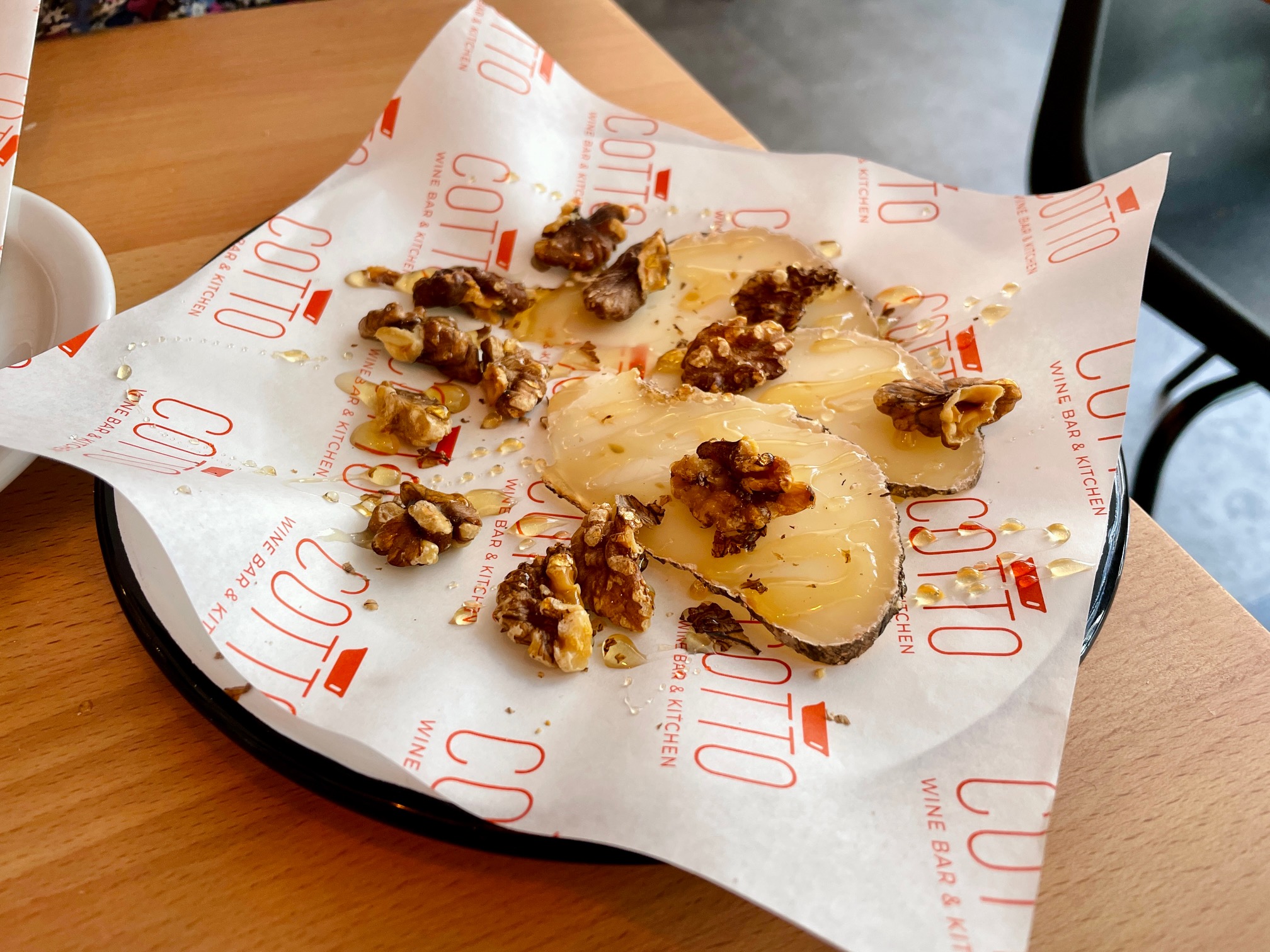
By this point in the meal I was polishing all of my superlatives, so to speak, but my ardour was slightly dampened by the desserts. I would say that they felt like an afterthought, but they were both on the specials board so you couldn’t even say that. We had some Montbrú cheese, which our waiter told us was a goat’s cheese with a texture closer to a Comté or a Gruyère. And that’s true, and a very nice cheese it was too, but three small slices for seven quid felt stingy. This could have done with some carbs: crackers or bread, some or indeed any vehicle for getting the stuff into your gob. That was especially the case because the whole shebang was drizzled with honey which made picking it up a tricky business. And who wants to eat cheese with a knife and fork? You just end up looking like a lemon.

The chocolate truffles were a different kettle of fish. They were excellent – deep and rich and perhaps ever so slightly larger than your average truffle. They were also five pounds fifty. For two. And again, I know this probably sounds a bit like a moan but even so: I know food is getting more expensive, and I didn’t begrudge the price of most of the things we ordered at Cotto. But every now and again the pricing of a dish felt out of whack, and the desserts were where that was more noticeable. Our bill, for three courses and two drinks apiece, came to just over a hundred pounds, which included an optional ten per cent service charge, and all told we were in and out in just over an hour.

Does that matter, in the scheme of things? Well, yes and no – I’ve thought about it a lot since the meal, weighing up the pros and cons. And this is something a lot of restaurant reviewers don’t do – they’ll gush about the dishes but not think about what it was like as a meal, or talk about how much it cost (often because, in their own weasel words, “I didn’t see a bill”). And that’s where Cotto falls down ever so slightly, because despite some truly gorgeous touches and some plates which were up there with anything I’ve eaten this year the whole thing was a little too sharply priced and too briskly paced, especially for lunchtime.

Would I go again? It’s a good question, and one that was thrown into perspective when I realised, walking down St Stephen’s Street, that Cotto was literally two doors down from Marmo, the Bristol restaurant I visited last year that received my highest ever rating. If you picked Cotto up and dropped it in Reading, it would do very well, and I expect from time to time you’d find me there. But as an infrequent visitor to Bristol, it would be difficult to choose it over Marmo: in fact I had dinner at Marmo the night of this visit, and Cotto didn’t quite match it.

That’s how fortunate Bristol is: on one street you can find neighbouring restaurants, either of which would grace a town like Reading with its presence. And it’s not just St Stephen’s Street, you could experience the same phenomenon at Wapping Wharf, on Cotham Hill, in no doubt countless other parts of the city. How do the residents of Bristol not get blasé or complacent, the jammy blighters? But then there’s always someone better off than you, as my friend who lives near Swindon never tires of telling me (usually over Gurt Wings at Blue Collar Corner). Never mind: normal service will be resumed next week with a review back in the ‘Ding, of a place that went a long way towards restoring my faith. Something to look forward to, I hope.

Cotto – 7.9
29-31 St Stephen’s St, Bristol, BS1 1JX
0117 3292560

https://www.cottowinebarandkitchen.co.uk

Café review: Madoo

It’s a fact of life in hospitality that restaurants open and close all the time. There’s an inexhaustible supply of plucky new businesses ready to sign a lease and try their chances, and you can almost measure how long someone has lived in Reading by how far back they remember the history of certain sites. Do you recall when Thai Corner used to be Bistrot Vino, or when the Nando’s on Friar Street was a place called Bistro Je T’aime? You’ve probably been here since the early days of the Oracle, if not longer.

In some cases a restaurant makes such a go of it that you almost completely forget the establishments that went before. Some people have long memories, and remember Mum Mum or that pretzel joint on Market Place, but for many people I imagine it feels like it’s always been Tasty Greek Souvlaki. And although I know rationally, in the back of my mind, that there used to be a great branch of Ha! Ha! on the Kings Road – and that after that it was a Turkish place, and a tapas restaurant, and a weird kind of pub that closed on Sundays – it’s been House Of Flavours so long that it’s jarring to imagine anybody else there. It’s a bit like how, after you’ve been in a relationship with a person long enough, your previous life feels as if it belonged to somebody else.

But there are some sites where you need not only a long memory but a good one, because so many restaurants try and fail to make a go of it on the same premises. The quintessential example of this is the site of the old Warwick Arms, which has been Bali Lounge, the Biscuit & Barrel, Cardamom and King’s Kitchen and currently goes by the name of the Aila. I only reviewed the first two of those, and most of the others closed before I could get round to them.

Or take Cozze’s site on the Caversham Road, which has been Chi’s Oriental Brasserie, La Fontana, Al Tarboush, Casa Roma and Maracas, all of which eventually went pear-shaped. (Incidentally, I heard a fantastic story once that when Casa Roma decided to change to a Mexican restaurant called Maracas they did it mainly because they realised they could reuse all the letters in their sign except the O: I so hope this is true.) But can there really be a god in heaven when the TGI Friday opposite has outlasted them all?

What’s behind these high-churn sites, I wonder? Is it bad judgment, bad luck or bad juju? Are they run by enthusiastic amateurs who bite off more than they can chew, or are some sites simply cursed – by lack of footfall, of parking or of access, or by the presence of better (or better-known) alternatives nearby? Or is it just that they haven’t found their forever home – or rather, their forever homeowner – yet? All that crossed my mind last weekend as I stepped through the front door of Madoo, ready for lunch.

Subscribe to continue reading

Become a paid subscriber to get access to the rest of this post and other exclusive content.

Takeaway review: Mama’s Way

Mama’s Way, the minuscule Italian aperitivo bar and delicatessen on Duke Street, has been on my list to review since it opened earlier this year. In the summer I briefly toyed with trying to grab one of the three tall stools outside, looking out on the shell that used to be Panino and sipping an Aperol Spritz, but it never quite happened. Anyway, reviewing it as a takeaway is a far better bet. After all, it can only seat three people outside and three people inside – up at the window, provided they get on famously – and so your best chance of trying their food would be to get on Deliveroo, as I did this week.

It is a shame, because it’s a wonderful spot. There’s something very continental about a venue so tiny – wander through Bologna and you’d find loads of Aladdin’s caves like Mama’s Way, selling cheese, or pasta, or porchetta sandwiches through a hatch. And if we were in pre-Covid times I’d probably have stood at the bar, elbows at the ready, enjoying that feeling of being somewhere else. But it’s 2021, and I imagine many people wouldn’t want to experience eating in at Mama’s Way for the time being, so here I am to try the food out remotely for us all.

It is a real Aladdin’s cave, by the way – all manner of cheeses and charcuterie, biscuits and breadsticks, pandoro hanging from the ceiling in readiness for the festive season, bottles of wine on one side and an attractive array of digestifs behind the counter (they sell multiple brands of Amaro, one of my favourite drinks). They even stock chinotto, that exquisitely bitter soft drink you can’t get anywhere else. And in my limited experience of buying from Mama’s Way over the counter they have an excellent variety of Parmesan, some of it aged for as long as 72 months: it’s doubtless improved more over the last six years than I have. 

Aside from doing food to eat in, and delivery food, and acting as a deli and wine shop they also have an online store, with free delivery if you spend over £29. Confusingly, they also sell “ready meals”, which include some of the same dishes as the Deliveroo options, so if you like something you’ve had as a takeaway you can, with a little foresight, spend half as much to heat it up at home yourself. This all makes sense – at a time like now you need to have as many hustles on the go as you can – but let’s get back to the point and talk about the takeaway.

The menu is relatively streamlined, and I imagine much of it is cooked up in the kitchen somewhere behind the counter. Starters mostly consist of cheese and/or charcuterie in some configuration or other, there are a couple of “build your own” pasta and sauce combinations and, strangely, four different soups. The rest is largely lasagne and pinsa, the Roman equivalent of pizza which is traditionally oval, made with a slightly different flour and has a slightly crunchier texture. Oh, and they also have a huge selection of their wine on Deliveroo, so if you fancy a forty quid bottle of Nebbiolo with your takeaway there’s nothing to stop you living the dream.

Starters tend to hover close to the ten pound mark, the lasagne and cannelloni are closer to twelve pounds and most of the pinse are between twelve and a rather steep seventeen pounds, although in fairness there are lots of interesting ingredients and combinations in that part of the menu, including lardo honey and walnuts, or Parma ham with the splendidly named squacquerone cheese (I’ve had it: it’s fantastic). I was having a takeaway on my own on a chilly night, so I decided to cover as many bases as possible by ordering pinsa, pasta and dessert. They were doing 20% off all food, so my bill came to twenty-five pounds, not including the rider tip.

Speaking of tips to riders, my main one to the guy who delivered my food would be “don’t store a hot pizza vertically”. Honestly, it was so ridiculous that it was more funny than disappointing: I’ve had many seamless delivery experiences this year, so I’m sorry to have to bring this up, but it does strike me as basic stuff and I’m not sure I’d be doing a decent job of this review if I didn’t mention it. Other than that, it was relatively smooth – I placed my order just after seven o’clock, it was en route twenty-five minutes later and it took about seven minutes to get to the house.

The fact that, say, the pizza was lukewarm or that the chilled dessert had been put in the same carrier bag as the hot lasagne is down to the restaurant, but the fact that my pizza had somewhat drifted in transit and that some of it was stuck irretrievably to the inside of the lid of the box is, sadly, down to the driver alone. Anyway, c’est la vie: I know the traditional curse is “may you live in interesting times” but an equally powerful one would be “may you spend far more of the year than you’d personally choose to trying to describe tepid pizzas on a restaurant blog”. Take it from me.

So, the tepid pizza then: it’s a real shame, because Mama’s Way use good ingredients and it does show in the taste. I’d picked a simple ‘nduja pizza and their ‘nduja is great – savoury, acrid crimson nuggets that pack a huge amount of flavour, far more so than boring supermarket ‘nduja. On this evidence I would buy ‘nduja from Mama’s Way, but I’m not sure that, on this showing I’d order a takeaway pinsa from them again. But I could tell, from what I ate, that if it had been hot it would have been formidable. 

The tomato sauce had a genuinely gorgeous fruity depth and the base, which was far thicker than the Neopolitan pizzas that are in vogue right now, was also excellent. Slightly randomly my order had included a couple of squares of bread in a paper bag: I’m not sure why, because they didn’t go with my lasagne and they sure as hell didn’t go with my tiramisu, but as a “look what you could have won” they were another salutary reminder that the raw materials Mama’s Way is using are promising. Eventually I admitted defeat, stuck the oven on and reheated the rest of my pizza. It was lovely, but if I wanted to heat up a pizza at home I’d probably just buy one from a supermarket at half the price.

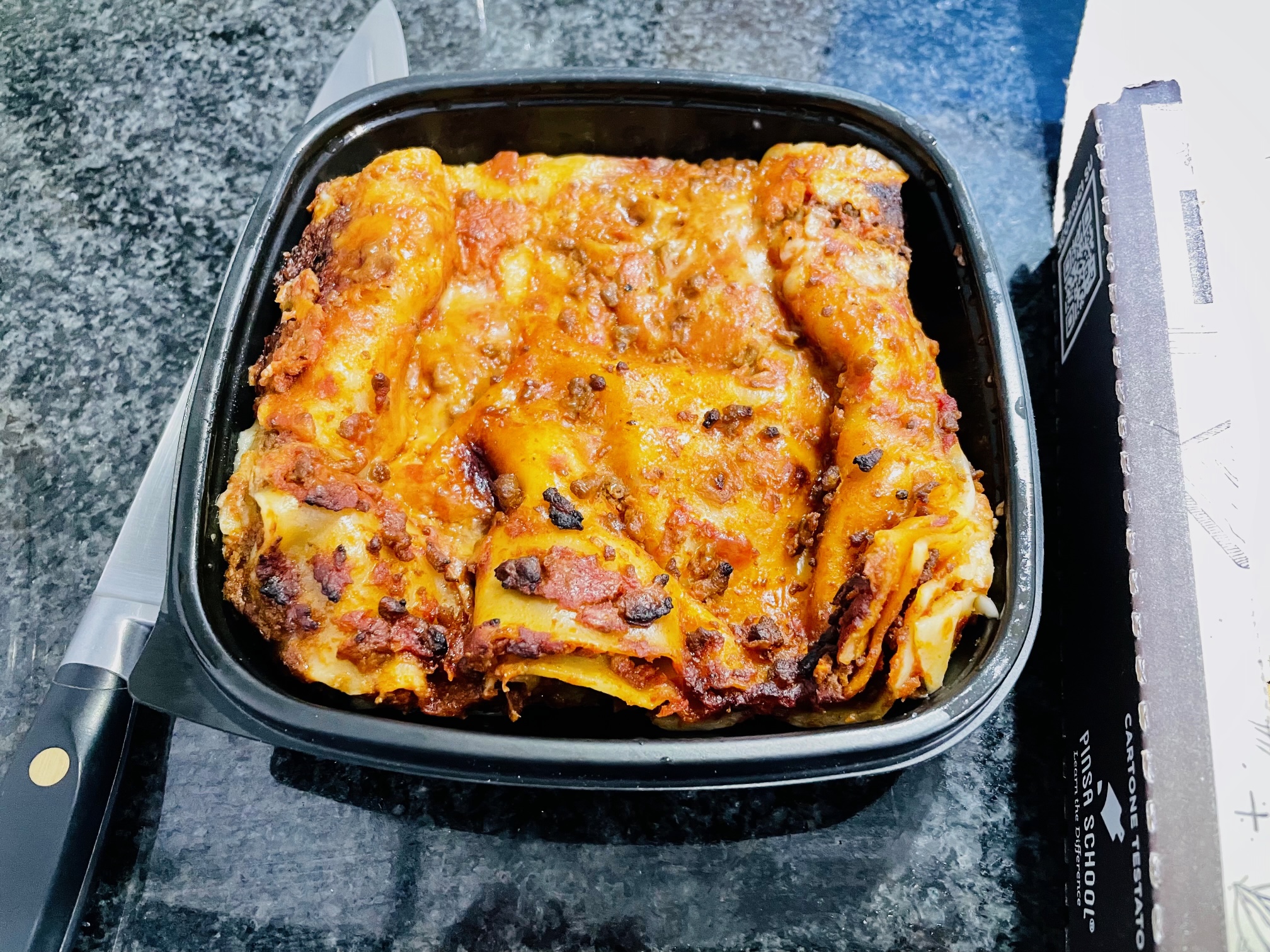
If the pizza was frustrating, the lasagne was outright bad. It looked the part when I got it out of the bag, but what my picture fails to show is just how little ragu was involved in its construction. Have a look at the picture on Mama’s Way’s website, which suggests you’ll get four sheets of pasta with a generous layer of ragu in between each one. By contrast, what I had was, I think, six or seven layers of lasagne with next to no ragu anywhere to be seen. It was an odd kind of pasta millefeuille, which sounds more like a baddie from Harry Potter than anything you might want to eat.

The best bit of a lasagne is that crispy, cheesy bit right at the top – the corners, all caramelised – but that only works if plenty of cheese has been used and there’s hot ragu underneath. This was just a stodgy wedge of pure pasta, and the burnt bits were almost impossible to saw through. I threw half of it away. The sad thing is that what very little ragu there was tasted decent, with good depth of flavour – properly made, with finely chopped carrot in the mix. But when there’s that little of it on display, the fact that it tasted decent only made matters worse.

Deliveroo described this as a “lasagne Bolognese” (and, incidentally, the picture of this dish on Deliveroo also looks like it involves plenty of ragu). But if anybody served this up in Bologna they’d probably die of shame. The margins on this dish, even with a discount, must have been astronomical.

Just to add to the contrariness, one final twist in the tale – my tiramisu was lovely. Everything was in proportion with the perfect interplay of cream and sponge, booze and coffee, exactly as it should be. But again, it was a little on the small side at five pounds – not unreasonable with twenty per cent off, but I still couldn’t help but think of the giant slab of tiramisu you’d get at Buon Appetito for not much more. I think by that stage I was relieved that something was unequivocally good, even if it wasn’t unequivocally good value.

This meal felt like such a pity, and a proper wasted opportunity. You only have to spend a few minutes inside Mama’s Way to see that they have fantastic ingredients and produce, much of it impossible to get anywhere else in town. But somewhere along the way, something has gone wrong in terms of turning that into a menu that works and makes sense – for delivery, anyway. 

If they ever get larger premises, I would rush to eat there and have one of those pinse fresh from the oven, or just enjoy some of their antipasti with a good bottle of red. With the right site, they could be Reading’s equivalent to Bristol’s cracking Bosco Pizzeria. But would I order takeaway from them again? Probably not: the memory of that brick of lasagne, 10% main course, 90% murder weapon, will cast a long shadow.

Never mind. It hasn’t diminished my enthusiasm for what they sell over the counter, or my respect for them trying to do something different and turn a profit from such a tiny spot. And I’ll be back for some of that ‘nduja, and some squacquerone (for the name alone, if nothing else), and I’m long overdue a bottle of chinotto for that matter. They also sell coppa, probably my favourite charcuterie of all time, and I can even see myself picking up some guanciale to use in my own ragu at some point. It might not be as good as theirs, but you get an awful lot more of it. 

Mama’s Way
10-14 Duke Street, Reading, RG1 4RU
0118 3273802

https://mamasway.co.uk
Order via: Deliveroo, Uber Eats