Jamie’s Italian

Reading’s branch of Jamie’s Italian closed on July 2018, I’ve left this review up for posterity.

January, so far, has been the Month of Eating Differently here at Edible Reading. It started with me revisiting the A4074 and discovering that not all “Pack” based pubs are the same (thank goodness). Then I went even further out of town to eat top notch sushi in Windsor. For the third review of the year it seems only right that I come back to Reading and, even more, that I tuck into food at one of our ubiquitous chains – just to prove that it isn’t only about the independent out of town places.

I picked Jamie’s because it feels like a restaurant that cares about ingredients more than your average chain; there’s always been a fair amount of focus on fresh seasonal ingredients and interesting flavours at Jamie’s, and as chains go it’s not huge compared to some of its Oracle neighbours (only 37 branches according to their website, compared to 90 Bella Italias and a whopping 430 Pizza Expresses, for example). On top of that I made a promise, a resolution if you like, that I would eat one vegetarian main every month and it seemed like Jamie’s would be one of the better options for that – after all, good Italian recipes with all those fresh ingredients barely need meat at all, right?

I can’t quite remember what Chili’s, the previous restaurant in this space, looked like. All I really recall is the 6 foot plastic chilli suspended from the ceiling, covered in a thick layer of dust. Jamie’s, in comparison, is clean, smart and very contemporary: the middle of the restaurant is all concrete floors and tin chairs but round the edge of the room it’s much more inviting, with red leather banquettes looking out across the other diners. A bit like being on Dragon’s Den but without Evan Davis’ irritating recaps (why does he sum things up mere seconds after they’ve happened? So annoying! But I digress).

It’s still a dry – and increasingly long – January for me so I tucked into an elderflower and pomegranate pressé while picking from the menu. That was when it dawned on me that I was going to have to go through with the vegetarian thing and that some of you, for any of a variety of reasons, have to look at a menu and mentally cross things out every time you go out to eat (for that I can honestly say that I salute you).

To start I had the baked chestnut mushrooms on crispy music bread with smoked mozzarella, thyme and Parmesan, and in an attempt to stick to the vegetarian side of the menu I swapped out the Parmesan for another hard cheese not made with rennet (although I didn’t check whether the mozzarella was suitable for vegetarians so this might have been a waste of time).

It was a surprisingly hard dish to describe – layers of music bread on the bottom with an intricate mosaic of thinly sliced mushrooms on top, dusted with the cheese, the middle section rich with gooey smoked mozzarella. I’d almost sum it up as middle class nachos, except that Jamie’s Italian has already beaten me to it by describing another dish on their menu as “Italian nachos” (crispy fried ravioli, in fact). But that’s what it resembled most – crispy music bread at the sides and the central section soggy with juices from the mushrooms and softened by the melted cheese.

Did I like it? I’m still not sure even now. It was like a book you admire without enjoying it: more interesting than it was tasty. It was probably a less satisfying way to eat mushrooms than the myriad of other options on the menu – stuffed into arancini, heaped on bruschetta, tumbled into fettucine – options which, as I worked my way through this dish, I couldn’t help wishing I’d ordered instead.

Mushroommusic

The caponata bruschetta, on the other hand, was as pretty as it was tasty. The caponata itself was lovely – the rich, smoky aubergines were diced and mixed in with tomatoes and pine nuts with a sprinkling of grated ricotta on top. I love the earthy, slightly sweet flavour of caponata and this was a very good one. The bread it came on was less of a success, being tough and difficult to cut (I ended up tearing it with my knife and fork instead). A bit more olive oil or less time under the grill might have been better. Sitting on top of the dish were a couple of small red chillis, barely cooked with their tops chopped off. I genuinely couldn’t fathom what they were doing there – they looked small enough to be properly explosive and I couldn’t see how they fitted in at all. I wondered if it might be some kind of homage to Chili’s – that was the only decent explanation I could come up with. I didn’t eat them.
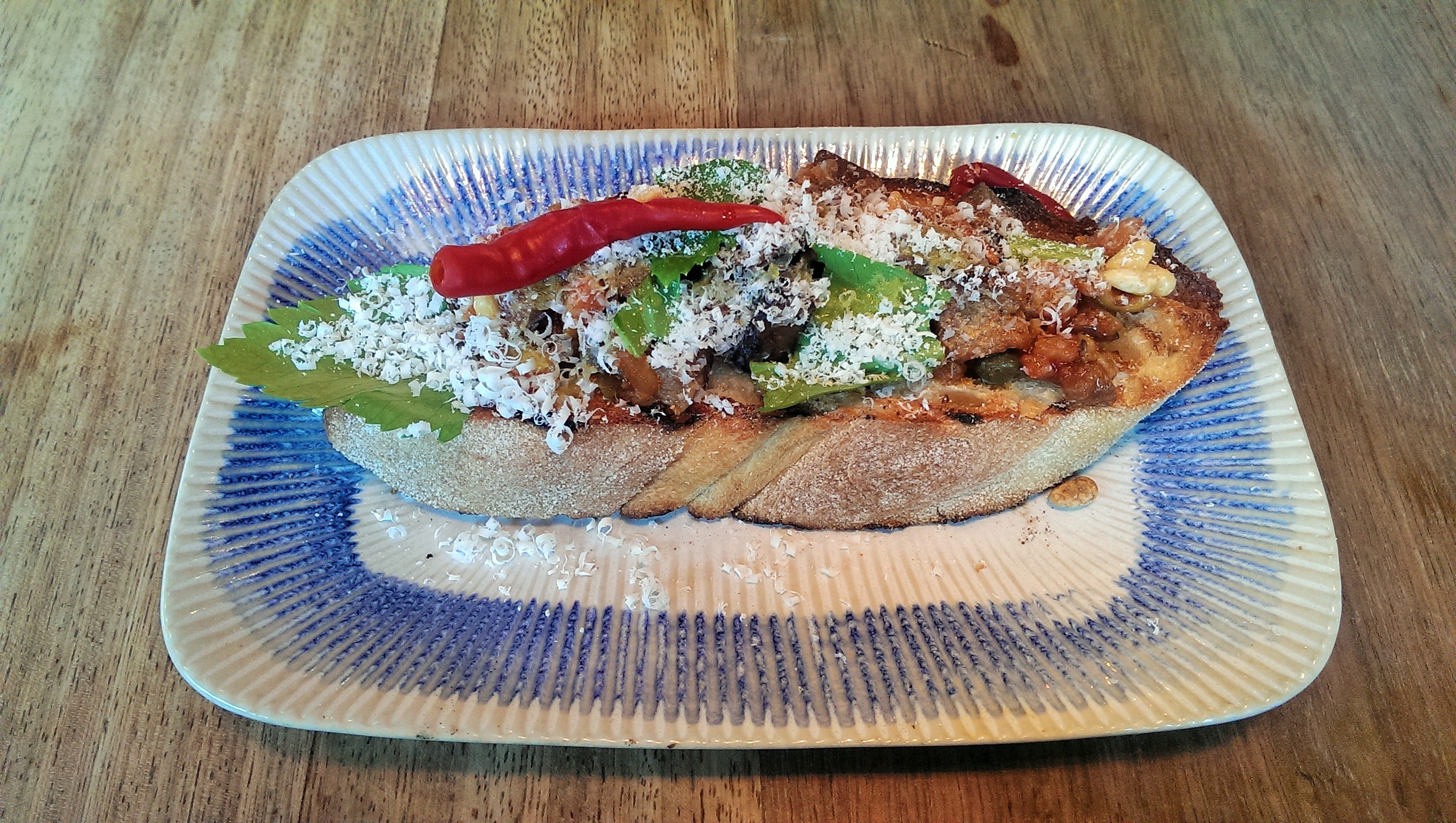
Caponatabruschetta

The vegetarian main courses at Jamie’s, according to their website, amount to two – one pasta, and one salad. There are more if you’re prepared to forego the Parmesan, but the menu doesn’t make that clear so you’re relying on the waiter (“we don’t have a vegetarian menu”, he said, “but I can talk you through it”). Pasta in tomato sauce sounded pretty humdrum, and I’d already had mushrooms, so I went for the superfood salad, thinking that anything with the word “super” in the title couldn’t be all bad. Besides, the menu made it sound like it contained so much stuff: avocado; shaved fennel; candied beetroot; broccoli; cheese; pomegranate; seeds; and a “fennel blossom Sicilian harissa”. It just sounded like a party in a bowl, and I was genuinely interested to see what turned up.

What the menu doesn’t tell you is that that description suggests that all the ingredients get equal billing, and they don’t. So I really enjoyed the sweet chunks of candied beets. They were both delicious. I liked the shaved fennel, although it had been very finely shaved indeed and got a little lost. The two smallish spears of broccoli were just dandy. The avocado, served on top, was very nice – flashed under a grill I’d guess, from the lines on top, and ever so slightly warm. Where the stone had been there was a little reservoir with cottage cheese on it, and the smallest blob of harissa, which may have involved fennel blossom in some way but was just generic hot stuff.

But really, this was about the rest of it, including many things the menu neglected to mention. So yes, there were lentils and some pumpkin and sesame seeds in there, and the occasional bit of pomegranate, and lots of mint leaves (because Jamie’s loves putting mint in everything). But there was also a lot of quinoa, along with plenty of what looked like stubby grains of wild rice but, having researched it, may have been black barley. All that amounted to a big stodgy pile of heavy going, with nowhere near enough flavour to elevate it from chore to treat. When I told a vegetarian friend about this dish, she said “personally, if they’d said there was quinoa in it I’d never have ordered it”, which pretty much hits the nail on the head. Really, it was like the contents of one of those square plastic tubs you buy for lunch from M&S in an attempt to pretend to be a better person than you really are; if this was a party in a bowl, it was the kind where you started looking at your watch half an hour in because all the fun people had already left.

Supersalad

The other main was one of the specials – an “amazing ragu of pork with tomatoes, chilli, garlic and loads of herbs tossed through home made casarecce pasta” (I’m quoting from the blackboard here, so the trumpet blowing is Jamie’s and not mine). I was expecting a bowl of pasta with a thick sauce of tomato and pork in roughly equal measure, but what in fact arrived was a bowl of pasta with a lot of shredded pork in it (and I mean a lot: the meat was generous to a fault). All the other ingredients were present as described, but apart from being slightly watery there was no discernible sauce. This was just a meat and carbs dish: none of your five-a-day here. On top of the heap of pork was a spoonful of herby, lemony breadcrumbs which really did lift the dish but it was just one spoonful, and a little more would have given the dish a lot more oomph. As it was, you couldn’t fault it for quantity but overall I’m afraid it bored me and I couldn’t finish it. Nor could I face dessert afterwards, even if their chocolate brownie is, according to the menu at least, “epic” (I can hear the strains of that trumpet again).

Porkragu

Service was decent. The chap serving us was friendly enough and happy to pick out the vegetarian options but had the disconcerting habit of saying thank you after every single item we ordered, something which started to feel robotic very quickly. I wasn’t feeling a lot of love. I also wasn’t feeling the warmth, as there seemed to be a draught coming from the back of the room, whipping round our ankles. When we asked early on if there was a door open in the kitchen we were told that this was just the colder part of the room and that the other tables they had available wouldn’t be much better. On a freezing winter’s day in January I thought this was a very poor show, especially as it got even chillier by the time our mains came (another homage to Chili’s, perhaps?). The total bill for two courses and a soft drink each for two was forty pounds. That felt like reasonable value for the food, even if the experience wasn’t anything to write home about.

After the last two reviews, writing this feels like a bit of a comedown. I know I don’t need to eat out of town to get good food but when the better chains, which to me includes Jamie’s, let me down it can seem like the Oracle doesn’t have a lot to offer (appropriately the best of the Oracle’s restaurants, Cote and Tampopo, are right at the edge: it’s almost as if they’re trying to break away and escape). I feel especially sad for the vegetarians out there, because I think they should be entitled to expect better from a restaurant like this – so for vegetarians looking at a menu this size and seeing such a short list of suitable options I can only say sorry. I haven’t found an amazing place with loads of attractive meat-free choices that you’ll be rushing to visit. Not yet. But it’s only January.

Jamie’s Italian – 6.7
Unit 1, Riverside, The Oracle, RG1 2AG
0118 9070808

http://www.jamieoliver.com/italian/restaurants/reading

Quattro

One of the drawbacks of this gig is taking the photographs, especially when I visit a restaurant and find myself sitting in a very empty room trying to take sneaky pictures without the staff noticing (this is more of a problem in some places than others: where the service is poor you could probably get on a table and belt out I Will Survive without anybody batting an eyelid). Empty Room Syndrome happens much more often if I’m dining at quiet times, so Quattro immediately had me feeling hopeful when I rocked up on a Monday night to a bustling dining room.

Subscribe to continue reading

Become a paid subscriber to get access to the rest of this post and other exclusive content.

Ruchetta, Wokingham

As of September 2025, Ruchetta is in the process of closing and reopening under the name Angelo’s, to tie in with a second branch of Angelo’s opening in Reading on Station Hill. As a result I’ve marked this as closed, though I’ve kept the review up for posterity.

There are two kinds of expensive meal. There are the ones where you know in advance that they’re going to be expensive, where you look at the menu beforehand, brace yourself, tell yourself it’s a special occasion. Then there are ones where you’re taken by surprise; maybe you order the really pricey main course you weren’t expecting to, or pick a really fancy bottle of wine, or throw caution to the wind and get a second bottle of the less fancy wine. However it happens, there are some meals where you get carried away, it all adds up and you get a little shock when you take that first look at the bill.

Why am I saying this? Because, to begin at the end for once, Ruchetta is the most expensive meal I’ve reviewed so far – and I knew it was going to be costly before I even stepped through the door. And why’s that important? Because when you know a meal’s going to be expensive, lots of things happen. The anticipation is completely different – I get excited about reading the menu, start looking forward to it (something that doesn’t always happen, believe me). But also, price inevitably becomes another dimension, and each dish is assessed not only on whether it’s good, but also on whether it’s worth the money. It’s only natural that the bar is set higher: after all, you can be pleasantly surprised by a ten pound lunch in the middle of nowhere, but it’s harder to be pleasantly surprised by an expensive meal in a beautiful little house in the prosperous market town of Wokingham.

It really is a beautiful house, too. I don’t know Wokingham well but Ruchetta looks very much like the kind of restaurant it ought to have, really standing out (if you think Reading has a lot of chains, you ought to walk round Wokingham some time). It’s slightly off the main drag in a tiny, nicely jumbled building with a mosaic of little rooms. I sat in the conservatory – partly to get better light for photos – and regretted that more and more as the evening went on, feeling rueful that I hadn’t chosen one of the more snug, atmospheric sections at the front of the house. That said it was a pleasant room with crisp white linen and smart white plates, although the tables do feel a little close together; I was glad the one next to us was empty, or else I would have felt very overlooked.

The menu’s one of the most difficult I’ve had to choose from. There is something magical about good Italian food at the best of times, but the menu at Ruchetta really is the kind where you’re aggrieved that you can’t have everything. We tucked into the bread basket (white and a brown which resembled sourdough, with good salted butter) and sipped our Prosecco in the early evening sunlight, haggling and agonising until the decision could be postponed no longer. If the waiter had arrived two minutes earlier, or two minutes later, you’d probably be reading a review of four completely different dishes.

I adore truffles, and I nearly always order them when I get the chance. The distinctive aroma was noticeable the moment I entered the restaurant and I reckon it subliminally influenced both choices of starter. The first was one of the simplest things you could have, truffle ravioli in butter and sage, and it was a delight. The pasta was al dente and richly flavoured with the earthy, dirty truffles. The dish was topped with thin slivers of parmesan and a handful of young sage leaves. But most importantly a whole pencil sharpener tub of those heavenly truffle shavings had been sprinkled on the top of the dish making the flavour even more intense. Eating it was close to an ecstatic experience, the forkfuls close to the end simultaneously magnificent and agonising.

Truffle pastaThe other starter called to me because it was just so unusual that I had to try it: baked white onion in sea salt, filled with truffle fondue with pan-fried foie gras and caramel. The foie gras was just delicious – a generous piece, soft and yielding, perfect with or without the smidge of sweet caramel. The truffle fondue was less successful – it was salty and tasty and rich with truffle, but very liquid and I really had no idea how I was meant to eat it. They didn’t bring a spoon, but I ended up finding one from a neighbouring place setting and improvising. I thought the point of fondue was to dip something in it, and without that something it was more like a very cheesy soup (I briefly pondered whether I was meant to use the foie but surely not: far too expensive to use as a glorified soldier). The quail egg didn’t really add anything and the white onion had been baked just enough that it made an excellent bowl but not enough that it made a sweet and tasty way to mop up the rest of your fondue. I’m glad I can say I’d ordered it, but it felt like was two starters, neither of which quite worked, joined at the hip.

Fondue

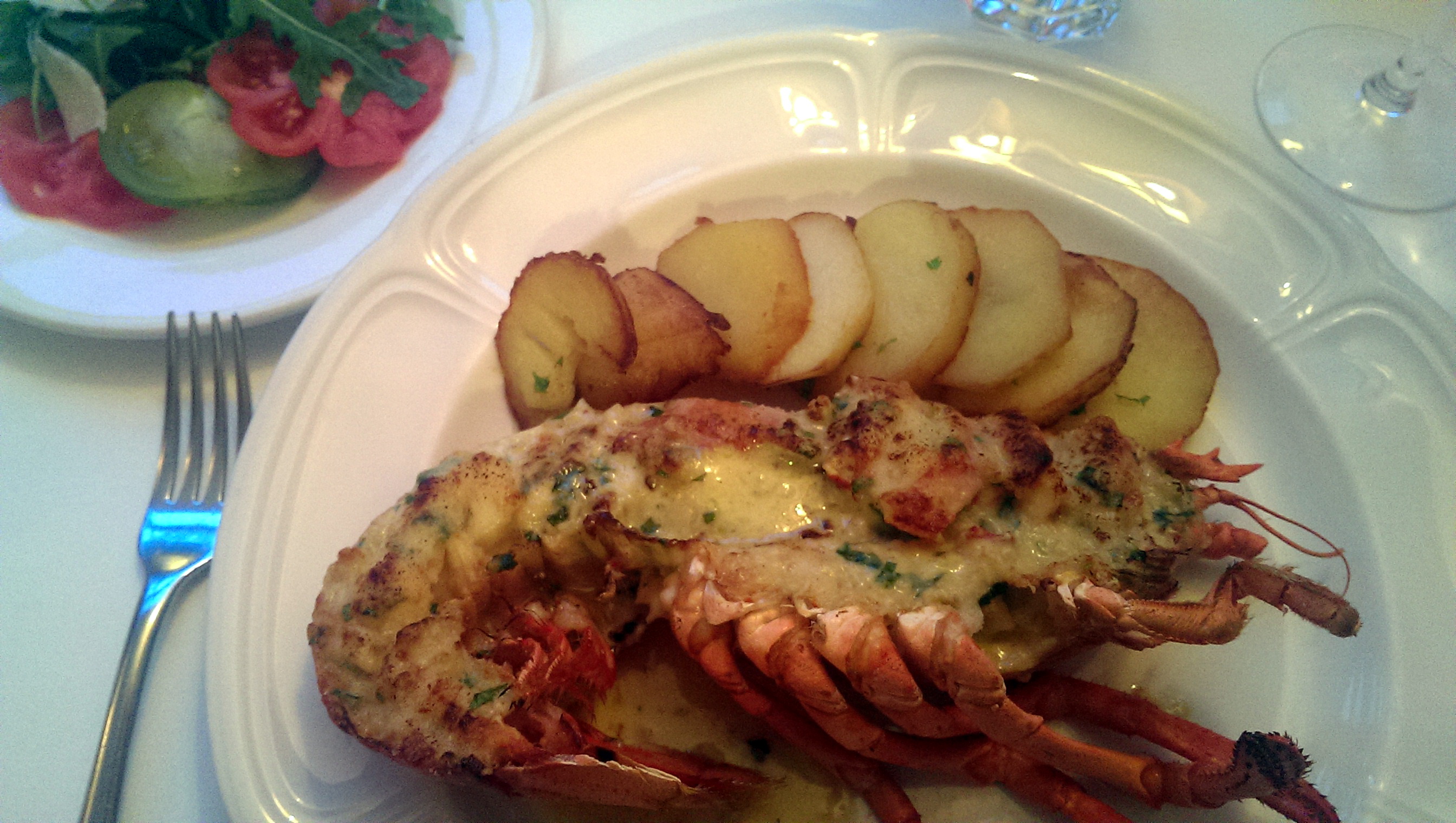
Nearly all the mains at Ruchetta are around the twenty-five pound mark, so it didn’t seem too much of a stretch to order the half lobster thermidor (twenty-eight pounds, and not even the most expensive dish on the menu). It was just lovely. The meat had been removed, cooked in the sauce, returned to the shell and topped with cheese. I loved the note of tarragon in it, which surprised me as I’m usually not a fan and didn’t realise it would be in there (like most people outside the Royal Family, I don’t eat lobster thermidor very often). It came with sauté potatoes, in thick slices rather than cubes, which were cooked well and left plain to keep the lobster as the main event. The side salad seemed lost in all of this: the tomatoes were a mixture of green and red but were pithy and lacking in flavour and was either undressed or underdressed, I’m not quite sure which.

Lobster

The other main, roasted saddle of lamb stuffed with spinach and garlic with lamb sauce and vignole (peas, artichokes, broad beans in mint and pancetta – no, I didn’t know either) was the most disappointing dish of the night. This is going to sound like a stupid thing to say, but the lamb was, well, too lamby. The taste of it was almost overripe, verging on agricultural, and drowned out the lighter flavours of the rest of the dish. It appeared to be stuffed just with spinach, which made for a soggy slog, and if there was any garlic in there I didn’t get it. The peas, artichokes and broad beans, potentially a symphony of spring flavours, were pleasant but bland because there wasn’t enough mint to lift them. Most damningly, it wasn’t particularly hot: the lamb, in particular, felt a bit lukewarm. Also, I know this was a light dish but it felt like it needed carbs of some kind. Not everybody who orders it is going to be lucky enough to be able to pinch some sauté potatoes from another plate, as I was.

Ruchetta is one of very few restaurants that offers wine in carafes; a terrific idea for when it’s hard to decide what wine to pick or if you don’t fancy a whole bottle of something. There are a few affordable wines on the list but nothing under the twenty pound mark, so the carafes aren’t as tempting as they normally would be (they’re also 425ml rather than the regulation 500ml, which somehow seems a little stingy). Because of this we ordered a bottle of Italian viognier (much crisper with more citrus than the French ones I have experienced) and a carafe of Barbera d’Alba which was red, robust and unremarkable. I knew we’d struggle to drink both but a carafe of the Gavi I had my eye on was the same price as the bottle of viognier which made me object to buying it (just because you know the restaurant is going to be expensive doesn’t mean you lose all concept of value, after all).

In the end we finished the red and with only half the white drunk the staff offered to cork it so we could take it home – a nice gesture, I thought. That was fairly typical, as service was excellent throughout. All the waiting staff had that charm which just stays on the right side of over-familiarity, something I associate with good Italian restaurants (and I think all of them were actually Italian, though I may be wrong) and they made sure we never felt hurried. In that respect, it definitely felt like a special occasion – nobody wants to be turned when they’re spending this kind of money.

Desserts, like the mains, were at opposite ends of the spectrum. Lemon posset was a glorious thing, wobbly and zingy, topped with cooked rhubarb and dangerously easy to devour. Everything in it should have been tart and sharp and yet it wasn’t (the grilled figs and little pearls of what looked like fruit caviar on the top did their bit to balance it out). The moist orange cake with citrus mascarpone was more prosaic. It was tasty enough and I was happy to eat it all but compared to the complexity of the lemon posset it seemed a bit basic. All the desserts cost seven pounds – an amount I was happy to pay for the posset but much more grudging to part with for the cake. Funny the calculations you make in your head when you know a restaurant is expensive. We also had a couple of dessert wines with these – a Labrandi and a moscato – and both were beautiful choices.

PossetI said at the start that there were two types of expensive meal. Well, as it turns out Ruchetta is both: the total bill for two people – three courses each, two glasses of prosecco, one bottle of white, a carafe of red, two glasses of dessert wine – was £160. This is the bit where I usually say “but it’s possible to eat far more cheaply”, but I’m not sure it’s entirely true of Ruchetta. Their set lunch during the week is a cheaper, but it’s still £19 for two courses. Sunday lunch is £32.50 for two courses. You could spend less, but I still think it’s the kind of restaurant where the size of your bill is always going to take you somewhat by surprise.

I also said at the start that when a restaurant is expensive the bar is set higher, and that’s why I can’t wholeheartedly recommend Ruchetta. There’s a lot to like: the service is terrific, produce and seasonality is clearly important to them (when I went there were lot of asparagus specials on offer. A lot) and the menu is a tempting, readable mix of classic Italian cooking and more creative, inventive dishes. But I’m not sure which restaurant Ruchetta is meant to be: the unpretentious neighbourhood Italian or the high-end destination restaurant. The pricing suggests the latter, but the execution of some of the dishes (the fondue dish, the lamb) and the way the tables are squeezed together feel more like the former. I was left wondering if someone had got carried away with the calculator when pricing the menu. I went expecting something really special and whilst I really enjoyed it wasn’t quite special enough. If these dishes were priced at the twenty pound mark and there was good wine for, say, eighteen pounds a bottle, I would be making my way to Wokingham again and again. As it is, it will have to wait for the next special occasion and hope that, in the meantime, I don’t find somewhere a little more consistent.

Ruchetta – 7.5
6 Rose Street, Wokingham, RG40 1XU
0118 9788025

http://www.ruchetta.com/

Dolce Vita

In a surprising move, Dolce Vita closed in June 2018. I have left the review up for posterity.

I don’t know how you approach a restaurant review, as a reader, but before I started this blog the first thing I did was check whether I knew the place being reviewed. If I didn’t, the whole process was a voyage of discovery, reading the review thinking Does it sound like my kind of thing? Could I get there? Would I want to? But when I’d already been to the restaurant in question it was a very different test involving a different set of questions which all boil down to one: Do you agree with me? And, of course, we all judge on that basis. I like people who like the things I like, just like everybody else.

This is especially the case when the reviewer has gone to a place you really like, one of your favourite places. Then you feel protective and read the review thinking I hope the restaurant don’t have an off night, or even The reviewer had better not pick on it. One of the things really successful restaurants do is make customers into loyal customers, and make those loyal customers feel like part of a club. At its best, it’s a tribal thing: look at the incredible loyalty inspired by Mya Lacarte, or Tutti Frutti.

Dolce Vita, I think, is another of those places. I’ve had a lot of people telling me I should go there – enthusing about the food and the service, saying that they return again and again. So, if you’re one of those loyal customers, reading this and preparing to bristle protectively on Dolce Vita’s behalf, you can relax: I really liked it.

Of course, you might approach restaurant reviews by going straight to the end and reading the rating first, in which case you already know that and are waiting for me to get on with it (I understand: I ruin some novels that way too).

Despite knowing Dolce Vita by reputation I’ve rarely gone there. It’s another restaurant that feels like it’s always been there, in Kings Walk, perched on that ledge above the outer reaches of the Oracle looking out over all the changes that have happened over the years (personally, I’ve tried to erase all memory of Brannigan’s, with its chilling boasts of “cavorting”). Yet it’s never really crossed my mind when deciding where to eat, because I just couldn’t remember if it was any good; a strange type of amnesia I don’t get about many places in Reading.

The dining room’s big, a long rectangular airy space with lots of light from the skylight and the patio doors leading out onto the balcony. I can imagine that, if the sun ever comes out for long enough, the balcony would be a lovely place to drink rose and eat summery food but there was no chance of that on this visit: it was wet and windy so we grabbed a table by the window and looked out at the rain-spattered furniture, daydreaming about what might have been. Speaking of furniture, this isn’t something most restaurant reviews talk about (maybe with good reason) but Dolce Vita has some of the most handsome dining furniture in Reading: solid oak chairs and tables that make some of the wobbly painted tables in otherwise good restaurants seem rather cheap.

The menu is huge, and makes no pretence at being anything else. You are handed a sheet of A3 and left to wonder how a kitchen can do all of those dishes well. It also feels like a mismatch – there are pizzas and pasta, unsurprisingly, but also several Thai dishes, a couple of Greek dishes (which may have found a home here after Kyklos, Dolce Vita’s sister restaurant closed down in January) and, randomly, a Scotch egg. This all gave me misgivings but I decided to stick to Italian and hope for the best.

The burrata suggested I’d done the right thing. It always looks like a little bag of treasure to me and so it proved, creamy and fresh, well matched by the grilled peppers and aubergines. The whole thing was brought together with a very nice tomato, chilli and mint sauce and worked very well. I did find myself wishing, though, that the vegetables had been freshly grilled and still warm rather than chilled. It was a nice dish, but didn’t involve much in the way of cooking.

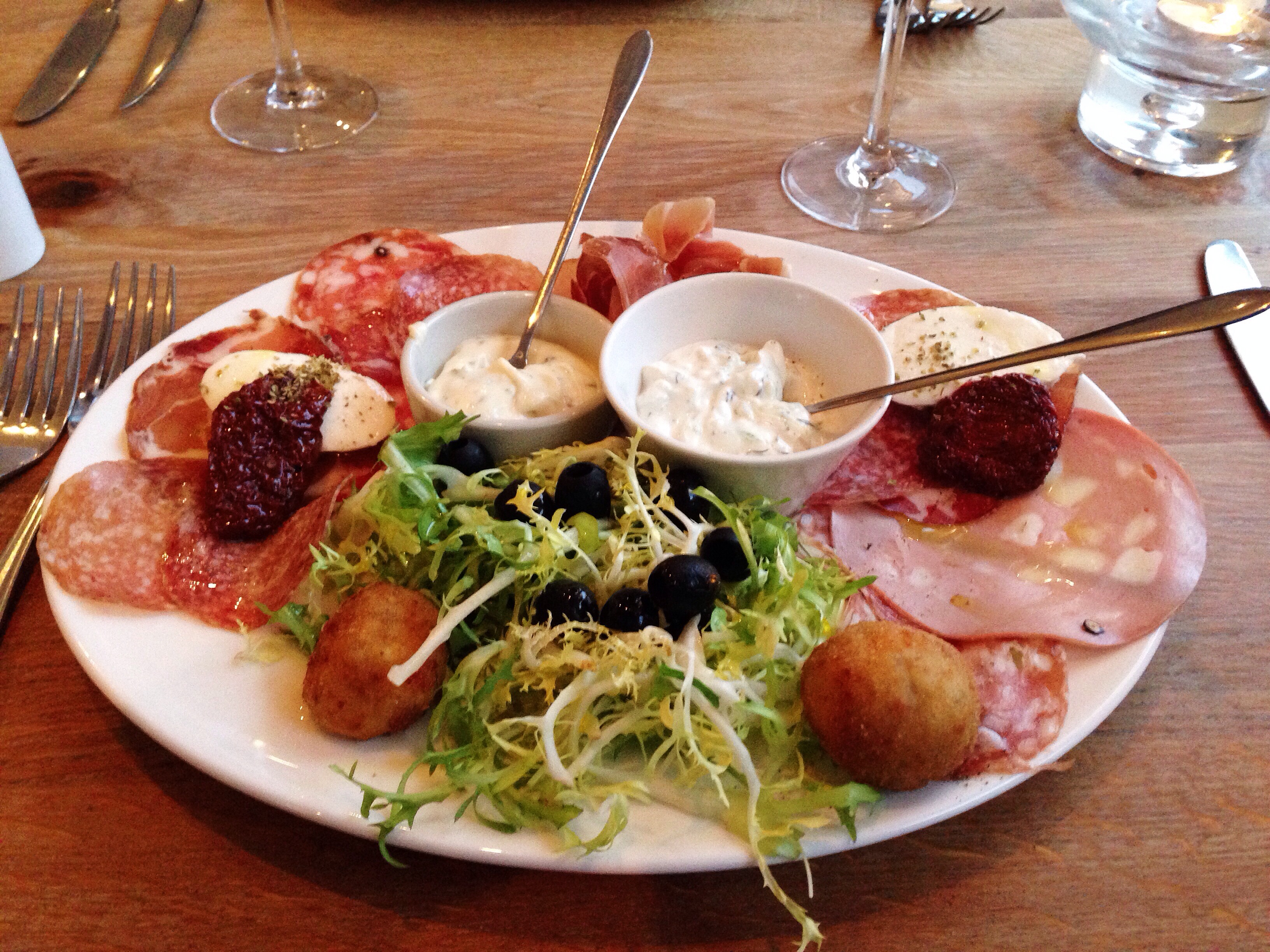
BurrataThe antipasti was a very similar story, a great assortment of salami, pleasingly dry and savoury Parma ham, coppa and mortadella, along with some mozzarella, sundried tomato and two dips, an aioli with a hint of citrus and a very good tzatziki (oh, and some baguette – Did I forget to mention the baguette?) If that makes it sound like a lot of food that’s because it was. In hindsight, for a tenner, it was probably meant to serve two although the menu didn’t make that clear – none the less it was excellent stuff.

AnitpastiThe mains were nicely timed, turning up just at the point when I was ready. The Milan pizza – mozzarella, Italian sausage, wild mushrooms, caramelised onions, fontina and Grana Padano – was recommended by the waitress which made the selection process that bit easier. It makes such a difference going to a restaurant where the staff know what their dishes are and are prepared to state a preference, and that was pretty symptomatic of the excellent service in Dolce Vita in general (I also got great recommendations for wine and, later, for dessert). The pizza base was close to perfect – thin enough to be crisp but with enough thickness to have some flavour of its own and not just feel like transport for cheese and tomato. The Italian sausage was excellent, coarse and herby almost to the point of being fragrant and I loved the caramelised onion with the cheeses. For my taste I thought there were too many mushrooms but that’s probably just me.

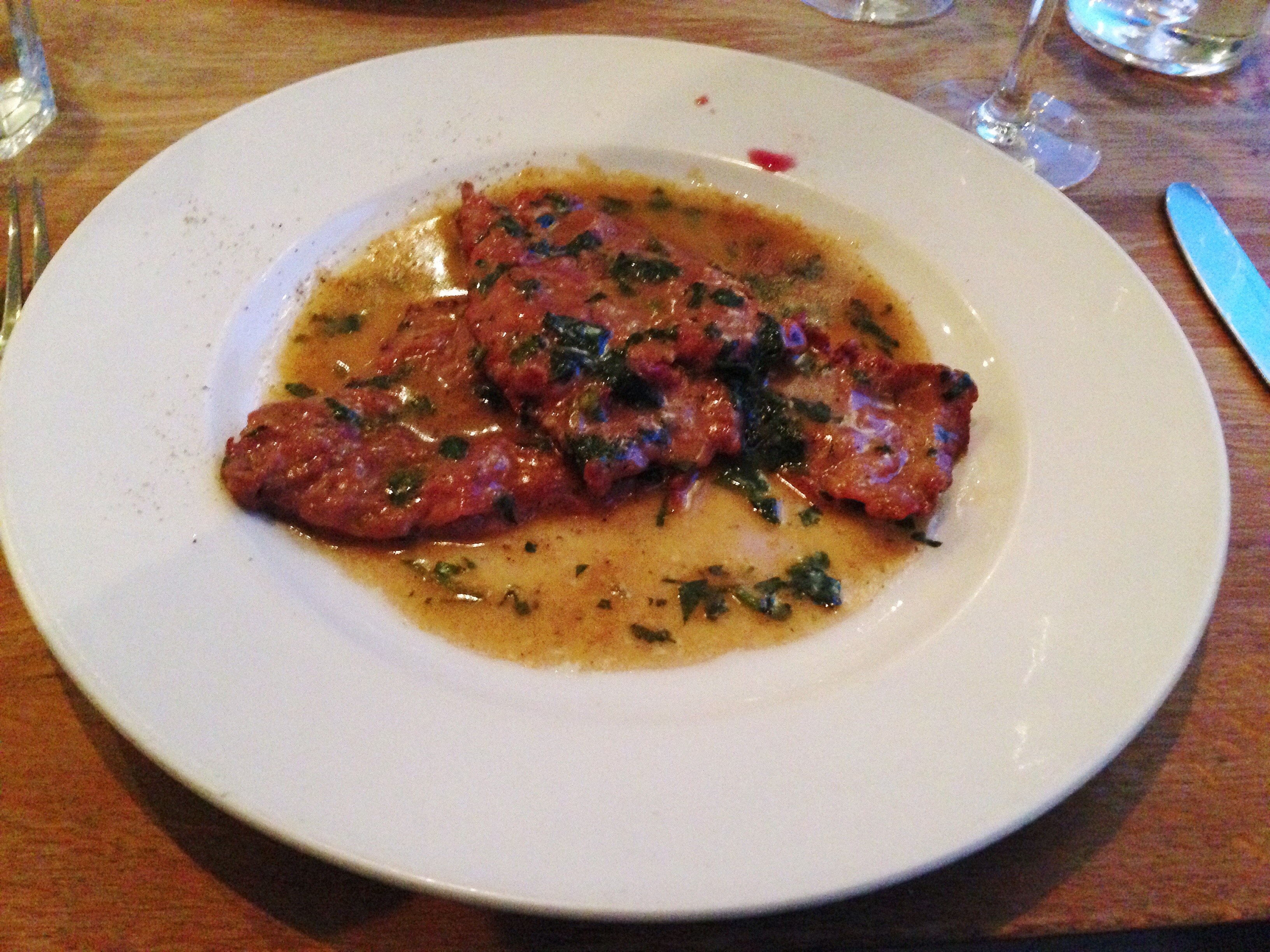
PizzaIf the pizza was good, the veal saltimbocca was great. It was a generous portion of veal, three good-sized pieces, wrapped in Parma ham and perfectly done. The sauce promised Marsala but I didn’t get any of that, just lemon, white wine and lashings of sage: perfection. In any case, Marsala would have made the whole thing too sweet. Similarly, the truffled mash turned up without a hint of truffle and again, I didn’t mind. Too many flavours would have made the dish a mess, instead of the simple classic I got. The French beans, however, did turn up buttered as promised: a lovely contrast to many restaurants, even good ones, that dish up bland and naked vegetables. All that was seventeen pounds – not cheap, but I’ve spent that much on many worse dishes in Reading.

Saltimbocca

The wine, also recommended by the waitress, was a bottle of Montepulciano. I’m no oenophile, which is pretty obvious from my reviews, but I like to kid myself that I got plummy red fruit and a touch of black pepper. Even if I’m wrong, it was dangerously drinkable at just under eighteen pounds (and again, hats off to the waitress for recommending one of their cheapest reds: no sneaky upselling here).

Considering I visited on a weeknight, the restaurant was surprisingly full and buzzy with a real mixture of groups – dates and birthday parties and business dinners, all equally at home. I also heard some Italian being spoken at one table which I took to be a good sign. The service was just excellent all evening, which is something I’ve always heard about Dolce Vita; I felt like I got five star treatment but watching other diners and seeing the easy way the serving staff chatted to them all, it was obvious that everyone else was getting it too.

When you’re having an evening that pleasant it’s a shame to leave without having dessert, so we gave the kitchen another chance to impress. The caramel and Baileys bread and butter pudding (again, recommended by the waitress) was divine. Rich and sticky, studded with sultanas and served with a light vanilla custard, it was a trademark example of those upmarket school dinner puddings I’m so partial to. I couldn’t detect the Baileys and the caramel notes, if they were truly there, were subtle to a fault but even so it was a great way to end the meal. Well, that and a small glass of sweet, fresh Sauternes. The other dessert – Dolce Vita’s hazelnut praline tiramisu – might be my favourite tiramisu in Reading, and I’ve tried a lot. A nice firm slab of indulgence, not too big, with a little layer of crunchy praline hidden inside like a bonus feature. Almost unimprovable (although I did have a go by pairing it with a glass of vin santo).

The total bill for two, for three courses, a bottle of wine and a couple of glasses of dessert wine was ninety pounds – not cheap (although we did have a lot of food) but nothing felt like poor value. I think at least some of that is down to the service, which was up there with any town centre restaurant I’ve been to.

Like I said at the start, if you’re a fan of Dolce Vita you can relax – I had a great evening there. I still have misgivings about the frightening size of their menu (there was also a specials menu adding another set of bewildering options – including roast chicken pie – to the mix) and I’d probably stick to what I know they do well, but on the night I went they didn’t put a foot wrong, and they did it without any of the experience ever seeming mechanical. By the end, I found myself thinking that it would be so easy to come here on another evening later in the year, sit on that patio, soak up the last of the sunshine, have a few beers and a pizza and leave having spent less than twenty pounds. And if the summer ever comes, there’s a strong possibility that you’ll find me there one evening, doing exactly that.

Dolce Vita – 7.6
Kings Walk, RG1 2HL
0118 9510530

http://www.dolcevitareading.com/

Pepe Sale

Pepe Sale closed in June 2024. I’ve left this review up for posterity.

There are some restaurants in Reading where the front of house staff have that very special knack of making every customer feel like a VIP.

It starts with the greeting – effusive enough to make you feel like they’ve really missed you since your last visit, not too over the top to stop it seeming sincere. They might remember your name, or ask you about that holiday you mentioned last time. You just know that they can talk with authority about every on the menu, where the ingredients are from and, if you’re very lucky, they’ll even remember things you don’t like (coriander, perhaps) and make sure they don’t end up in any of your dishes.

Restaurants like this are the diamonds of the food scene; they make you want to go back again and again because you want to support them. They feel like a family that just happens to cook you excellent food. I can think of three places like this in Reading off the top of my head, and it’s no coincidence that the first ever Edible Reading review is at one of these restaurants.

I wanted to make sure we started with the right place – somewhere that lots of people but not everyone will know (so you can judge my writing and opinion), somewhere that doesn’t shout about its credentials, somewhere that can be overlooked by the mass of visiting shoppers and so tends to be a full of locals. Someone on Twitter said “I’d like a recommendation that makes a change from going to Carluccio’s” and I thought, Oh, you should go to Pepe Sale.

The location’s a bit of a problem. Pepe Sale is in an unassuming part of Reading, tucked behind the distinctly retro (not in a good way) Broad Street Mall, snuggled up next to the grotesquely brutal Hexagon Theatre in a wide pedestrian thoroughfare that the council (also in an adjacent concrete monstrosity) won’t let them put tables out onto. If you didn’t know it was there you’d never happen upon it.

The décor is pretty basic, too: pink and grey granite tables with white china and peach cloth napkins are laid out at every table, most bearing a small potted aspidistra and a square dish waiting to be filled with olive oil. The look’s dated but homely, lots of bright, bold pictures on the wall, hanging plants around the room. But when it comes to restaurants, looks aren’t everything. As Marco, the endlessly charming front of house, told me that evening, Italians are much more interested in the food than the room.

I feel I ought to confess from the outset that Pepe Sale serves one of my favourite dishes in Reading. Their crab ravioli is just dreamy but is only ever listed on their specials blackboard, tucked just behind the bar. I can’t resist it so I ordered it as my main course (they do a smaller starter portion, if you prefer that). The starter was more of a problem: I fancied the aubergine and courgette al forno but thought the béchamel sauce and parmesan might make it a touch too heavy before a creamy pasta dish. I thought the grilled aubergine and courgettes on a bed of leaves would solve that problem, but it felt a touch too light (I am quite greedy. Another confession.)

Fortunately, Marco came to my rescue. I explained my dilemma and he said the kitchen could rustle me up a plate of grilled vegetables but served with goat’s cheese. How could I resist the opportunity to eat off menu? Exactly.

We asked for Marco’s help in choosing wine and again, he came up trumps, suggesting one of the cheapest wines on the menu (no mean feat – apparently the wine list has a total of sixty-six wines, all Italian). It’s a wine I hadn’t heard of – Santesu IGT Isola Dei Nuraghi, a blend of vermentino and nuragus (both varieties of grape are typical for Sardinia, where the team at Pepe Sale hail from). I loved it – a fresh, crisp white, dry but not too dry with hints of honey to make it taste of early summer (which is often all the summer you get, in Reading) At just over fifteen pounds a bottle it was hard to drink just the one, although we did. School night and all that. The wine was impressive, but the recommendation was more impressive still – lovely to see a restaurant that doesn’t automatically suggest their most expensive wine (or when you say “I want to spend around £30” immediately recommend a bottle that is £37. Cheeky).

My off menu starter was fabulous. The vegetables were thin verging on translucent, lightly griddled with a generous helping of garlic and a lovely caramelised taste offset beautifully by the salty disc on top: simple food, done well, no whistles and bells. My companion had mozzarella baked in radicchio with anchovies, black olives and cherry tomatoes. Again, the combination was perfect – sweet tomatoes, chewy mozzarella (the polymer of cheeses) and bitter radicchio leaves. Beautiful to look at, tasty and unpretentious.

My main wasn’t a disappointment, although I never expected it to be. The bowl that came out was just right – not too many ravioli (I don’t like a pasta dish that feels like a challenge), all perfectly cooked, just al dente, with fluffy crab inside, in a creamy tomato sauce. My only criticism is that the ravioli was supposed to be with beetroot but the flavour and colour was just of plain pasta. It still tasted wonderful but it was not quite as I expected. Marco did show me the pale pink, raw ravioli when I asked about the absence of beetroot so it was definitely there, just undetectable. It didn’t change how delicious they were, and if I hadn’t been thinking about writing this I mightn’t even have noticed.

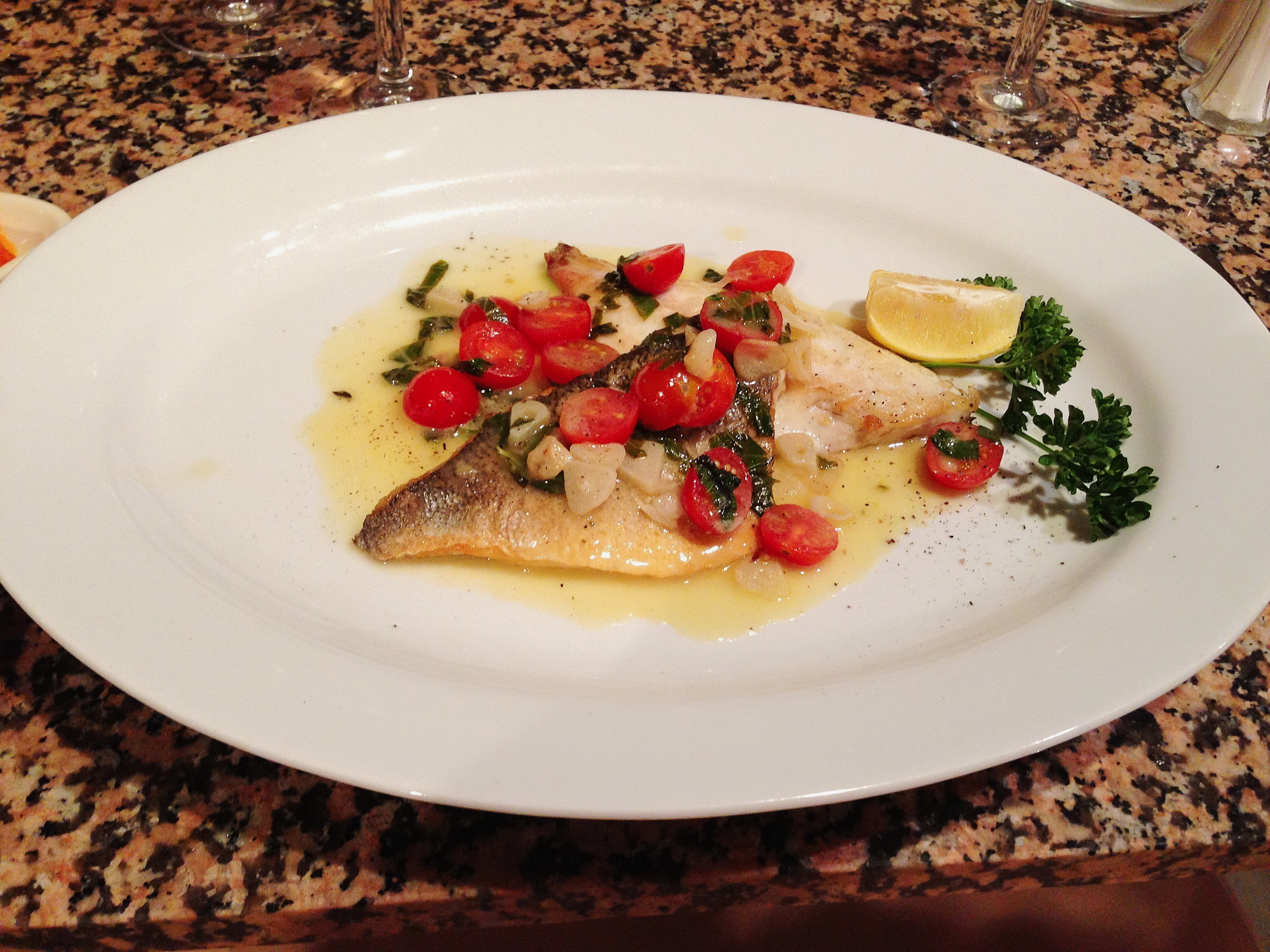
The other main at my table was also on the specials menu – sea bream cooked with white wine, cherry tomatoes, garlic (lots of it which is great if, like me, you’re a fan) and basil. The two fillets of bream were cooked perfectly, with creamy white flesh and crispy skin: just like my starter, simple ingredients treated with respect. The side order of vegetables included potatoes to die for – salty, herby, well worth distracting your companion’s attention to steal, which to my shame is exactly what I did.

FishOf course, many people would go home after two courses but I knew that, in order to write a full review, I would have to grit my teeth and order dessert. It’s a hard life. So, out of duty, I opted for the basil panna cotta with a balsamic reduction and my companion had the sweet ravioli.

The panna cotta is intriguing. Basil’s not a herb often found in sweet food so it feels brave of them to put it on their menu in what is a traditional restaurant. The basil flavour is very gentle. It’s a light aftertaste which, coupled with the balsamic, almost plays tricks on the tastebuds because of what I expect basil to taste like. It was weird and yet exactly right. It goes really well with the creamy sweet pannacotta and the sweet but vinegary balsamic cuts through the flavour nicely to keep it fresh. Lovely and very witty (if I can say that without sounding too much of an idiot).

Similarly, it was a novelty to have sweet ravioli. It’s fried squares of pasta filled with ricotta and orange zest, drizzled with honey and dusted with icing sugar. The pasta becomes like pastry when fried – crisp and sweet – and the centre is incredibly moreish (I could have eaten this dessert as well as mine, if only I’d been allowed).

Ravioli

The food is so good that you almost don’t notice just how good the service is. Throughout the meal Marco was topping up our glasses and chatting to us and the other customers in the restaurant, in that way which looks effortless but is probably bloody hard work. Even when we were the last table in the restaurant I didn’t feel like they were in a hurry for me to leave, that family feeling again.

The food and the service are so good that you almost don’t notice what good value it is, either:  three courses for two with a bottle of wine and an after dinner liqueur each (Pepe Sale does a range of wonderful Italian digestifs, many of which have the bitter taste of dandelion and burdock with attitude – I love it, though it’s not to everyone’s taste) came to eighty pounds. It’s not cheap – granted, Carluccio’s is a lot cheaper – but it’s worth every penny.

So, that’s the first review here at Edible Reading. If you’ve been, you probably know how good it is already. If you haven’t, you ought to check it out. And if, hypothetically speaking, you had just arrived in Reading and were trying to choose a venue for your first ever meal – as I am, I guess, in a virtual sense – you could do an awful lot worse.

Pepe Sale – 8.3
3 Queens Walk, Reading, RG1 7QF
Telephone: 0118 959 7700
http://pepesale.co.uk/