Restaurant review: El Cerdo, Maidenhead

Every year, without exception, you can reliably expect two things to happen in Reading’s hospitality scene. One is that there will be a raft of closures and new openings. Some years that ratio is pretty much one to one, others – like this year – it’s badly out of kilter, with far more places giving up the ghost than newcomers showing up to take their place. It’s tough out there, with no relief in sight. But the other thing that happens, every year without fail, is that none of those new openings will be a tapas bar.

I have complained about this so many times that it’s boring for all of us, so I won’t go on at length. But everywhere you look there’s a tapas bar, it seems, apart from Reading. Swindon has Los Gatos, Oxford has Arbequina. Newbury has Goat On The Roof, and Wokingham has Salty Olive. And Reading? Reading has next to sod all – unless you count Thames Lido, which I don’t, or Alto Lounge, which surely nobody should (Oh wow! Excited for this said the Chronicle‘s Facebook page this week, about the news that Alto Lounge had received permission from the council to double in size: that’s the Chronicle for you, excited about pretty much anything).

No, it’s never a tapas bar. Biryani joints are ten a penny, we went through a phase where we got three sushi restaurants in quick succession and momo are having a moment, but nobody wants to open a tapas bar. It’s a long, long time since La Tasca (which also wasn’t great) and six years since I Love Paella – not a tapas bar, but the closest thing we had – was unceremoniously booted out of the Fisherman’s Cottage. Is it a Brexit thing? Surely somebody feels like getting on the blower to renowned Bristol importer Mevalco and sorting this out, you might think, but every year nobody does.

And that’s what sends me scuttling off to the likes of Swindon, or Oxford, or Wokingham, trying to find the next best thing. Sometimes it works – Los Gatos is a little miracle – and sometimes I find myself somewhere like Sanpa, but I keep on trying because it’s a wonderful way to eat and I am always on the hunt for somewhere that brings a little hint of Granada or Málaga to unsung Berkshire. And that’s why this week I ended up at El Cerdo in Maidenhead, a ten minute walk from the train station, in the company of Katie, last seen last month sampling the glitzy splendour of Calico with me: inexplicably, after a dinner with me, she felt like repeating the experience.

Katie, it turned out, was on a proper journey of discovery, having never been to Maidenhead before. On the stroll through town to the restaurant I gave her a whistle stop tour of everything I knew about Maidenhead, which didn’t take long: former constituency of Theresa May, the infidelity capital of the U.K. (allegedly) and the town that, possibly because it was originally meant to be the terminus of the Elizabeth Line, was getting all the interesting things Reading didn’t.

That last one really is true – Maidenhead has a great independent craft beer bar in A Hoppy Place, wonderful pizza at Knead, an absolutely top notch town centre restaurant in Seasonality. And if some of the misfires, like Sauce and Flour, weren’t amazing, they at least showed that someone was trying. We walked past Sauce and Flour on the way to El Cerdo, and it was rammed, which shows how little I know about anything.

El Cerdo is by the canal, in the new development (the Waterside Quarter, apparently). “This looks so much like the Oracle it’s disconcerting” was Katie’s take, not without justification. The restaurant looked welcoming from the outside, and it wasn’t unpleasant on the inside but it had a feeling of “new build” that it couldn’t quite shake, a functional box rather than a cosy, appealing cocoon.

That’s not entirely their fault – it’s the hand they’ve been dealt with the space, and I liked the giant pig logo on one wall, past the handsome bar. But overall I felt it lacked a little character, in a way I couldn’t put my finger on. After all, Knead has a very similar dining room, but somehow it still has a feeling of bustle and hubbub. I guess the open space with the pizza oven perhaps brought things together in a way that El Cerdo’s bar, attractive though it was, didn’t quite manage. A handful of tables were occupied when we got there, including one large group in the corner, but it was a quiet Tuesday night.
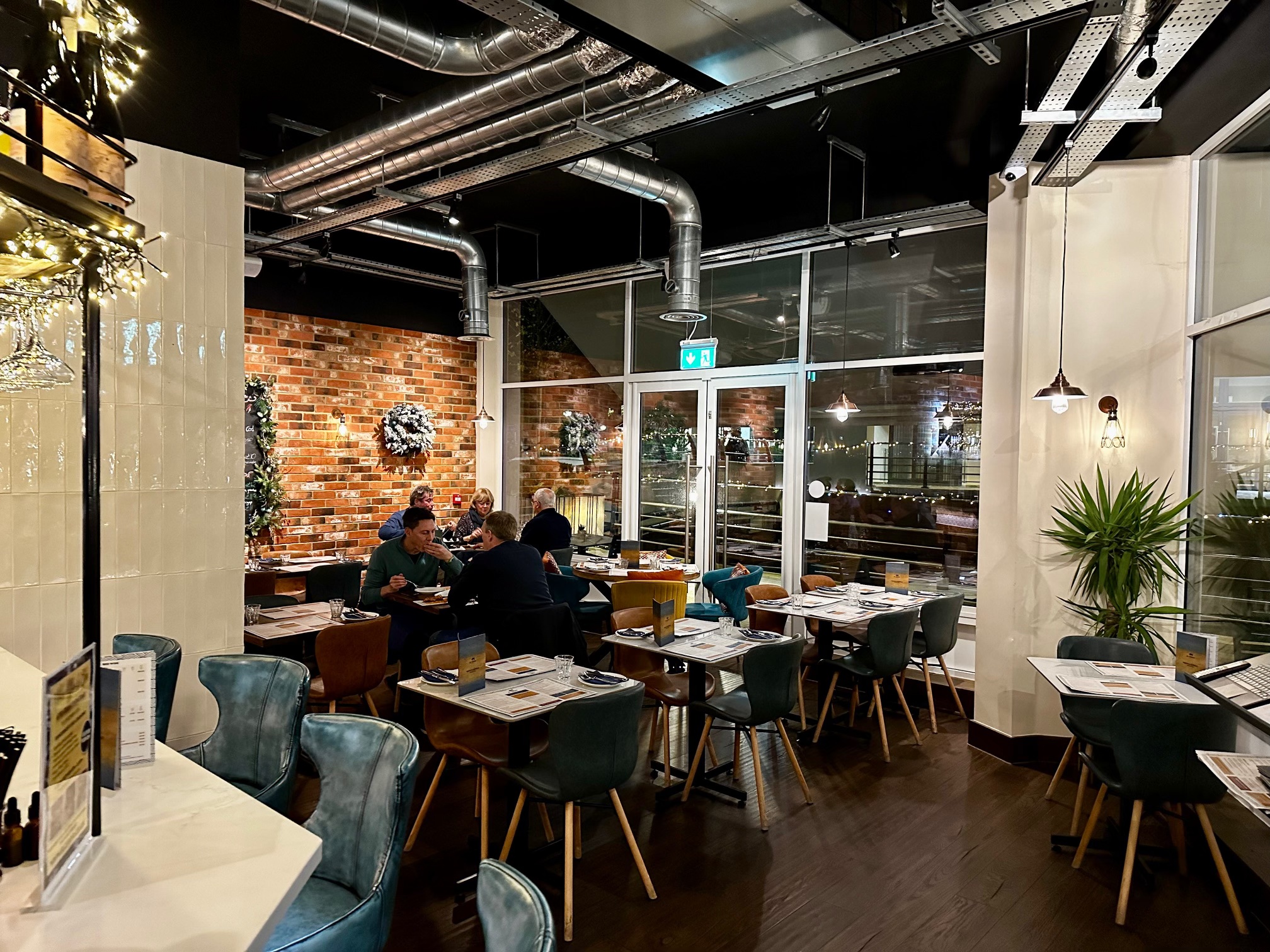
El Cerdo’s menu read well. It wasn’t so big as to be unwieldy, and was divided into logical sections – nibbles, cold tapas, meat, seafood and fish. They hadn’t given in to the temptation to do paella on the side, so there was just the one rice dish and a few types of tortilla. In the run up to my visit I’d looked at the menu at Los Gatos, just to benchmark prices, and El Cerdo was definitely more expensive: nearly everything was north of a tenner, with some dishes nudging twenty.

But the wine list was good, and exclusively Spanish, and although we were tempted by a txakoli – the slightly sparkling Basque white you rarely see on menus – we went for an albariňo. It was an excellent choice – crisp and clean but not bone dry, with a little fruit. Thirty-eight quid for a bottle that’s fifteen online, so not an oppressive mark-up, either.

Now, before we get started on the food – and because tapas is by definition small plates, we have a fair bit to run through – I want to get a couple of things out of the way. One is that I had an absolutely lovely evening, and that makes it far more tempting to see the food through the Albariño-tinted glasses of good company. The other is that your mileage at El Cerdo might very well vary from mine: Katie, I suspect, enjoyed most of the dishes more than I did.

And of course, your take on this kind of food will depend on how and where you’ve had it before. Despite loving tapas and small plates, it turned out that Katie had never been to Spain, although she’s rectifying that with a trip to Barcelona just before Christmas.

I on the other hand go to Andalusia most years – and yes, I know that makes me sound like the pretentious tosspot I am – and unfortunately that means that although I went hoping for the best, I was painfully aware of all the instances where the best simply didn’t materialise. El Cerdo’s website says, pretty plainly, “If a dish doesn’t taste like it does in Spain, then we won’t serve it”. Although it also says that El Cerdo has an “executive chef”, and in my experience very little good comes of having one of those in place of an actual chef.

The first sign that I was going to have to write this kind of review came with the accompaniment to those first sips of wine, a couple of gildas. A gilda is a very simple thing – a skewer of olives and pickled chillis, all brought together with a slim ribbon of salty anchovy. Named in homage to Rita Hayworth, it’s almost a perfect mouthful, and quite hard to get wrong. You could have really amazing olives, and truly best in class Cantabrian anchovies, but even an entry level one is going to be a delight.
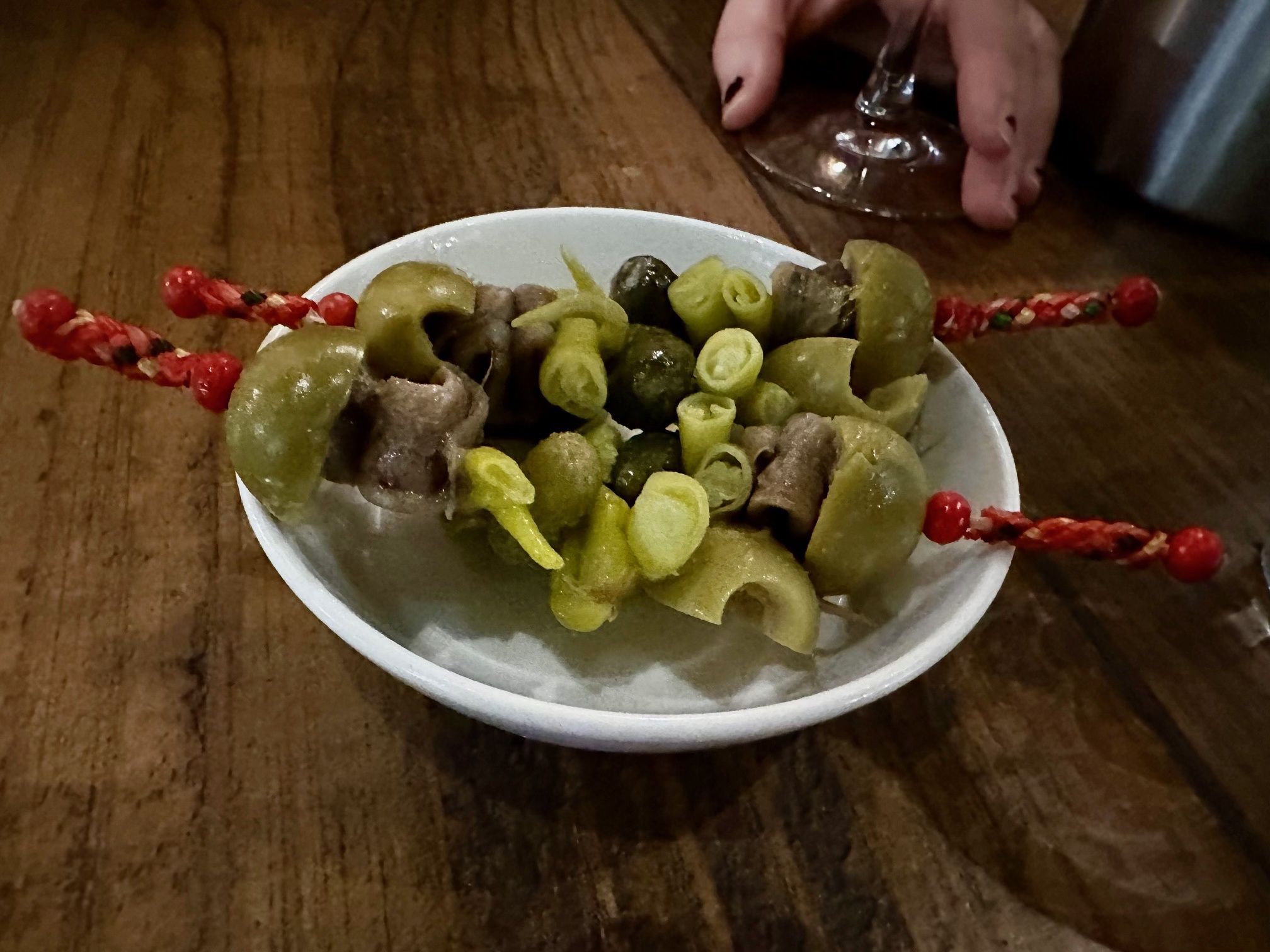
Or it should be, providing you use salty anchovies. But it felt to me like these were made with boquerones, the softer, more vinegary Spanish anchovies without the saline tautness of the good stuff. Which in turn meant they were all out of kilter – all vinegar and no salt, and somehow fishier than they should have been as a result. I felt like a right killjoy thinking this, because Katie seemed to enjoy hers. But I knew it could, and should, have been better.

The jamon croquetas were a similar story. They weren’t terrible – easily better than the deep fried abominations I’d eaten at Sanpa – but nowhere near the quality of anything you would get in Spain. They were a little flabby, a little pale, a little lacking in the crisp shell you needed. And the bechamel inside was lacking silkiness and a proper hit of jamon. Perching a little slice of it on top of each croqueta just showed you, Jim Bowen-style, what you could have won.

Last time I went out with Katie at Calico, she took me out of my comfort zone by ordering more vegetarian dishes than I would personally have chosen, which probably meant that my review was useful to slightly more people than it would ordinarily have been. The same thing happened here, where Katie was stuck between two dishes, broccoli with almonds or hispi cabbage, that I would never have ordered in a million years.

I took against the former for containing coconut ajo blanco in order to be vegan – good luck convincing anybody that they’d serve that in Spain – and so hispi cabbage it was. And actually this turned out to be one of the better things we ordered, although possibly one of the less Spanish ones. The cabbage came topped with a caper and raisin purée, which was heavy on the raisin and light on the caper, and squiggled vigorously with what was apparently a cured egg yolk sauce.

Your guess is as good as mine: I certainly didn’t get cured egg yolk from it, partly because I don’t really know what a cured egg yolk would even taste like. The little pieces of fried kale on top were pleasant too, although it gave me flashbacks to the Lyndhurst, which always makes me sad. There was a real whack of lurking heat in this too, and all in all it was probably the cleverest thing we had. Not massive, and not cheap at just shy of a tenner, but with lots to recommend it.

One of the biggest crimes against Spanish food was what came next, something the menu described as our “lazy” or open tortillas. We picked the eponymous El Cerdo tortilla, with chorizo and black pudding, and it’s difficult to describe how underwhelmed I was by this. Lazy is about right, to the point where maybe the menu should have said “we can’t be arsed to make a tortilla”.

Now in fairness the server, who was excellent, asked us if we wanted it runny or medium, and maybe we should have gone for the former. But whether it was runny or medium, this wasn’t a tortilla. It was an omelette. An underseasoned one that had been cooked through, with four bits of chorizo plonked on top and some black pudding – the British kind, not gorgeous soft Spanish morcilla, lobbed in the middle. No softness, a little onion, no potato that I could discern. This dish frustrated me. I imagine it would have made a Spaniard angry.

We’d ordered dishes in waves, partly because El Cerdo, Wagamama-style, says that everything you order will come out when they feel like it and we didn’t want to be swamped with dishes in one hit only to find the evening over. El Cerdo said that you should aim for two to three dishes each, which we took to mean three each, and actually doing it this way helped because we got to spy on the table next to us – four lads who kept their coats on throughout for some reason – and swap one of our dishes for something they’d ordered.

That dish was another of the relative hits of the evening, pincho de pollo with crispy polenta and mojo rojo. It was a reasonably generous skewer – four substantial enough pieces of chicken with a weird treble clef of red sauce, resting on a rope bridge of crispy sticks of polenta. And again, it wasn’t terrible but I didn’t found myself wowed. The chicken was nicely enough done, but El Cerdo makes much of its charcoal oven and I didn’t feel this had the char I’d expect from such an impressive piece of kit. The polenta added contrast, but if it did indeed have Idiazabal cheese in it it was a whisper, not a shout.
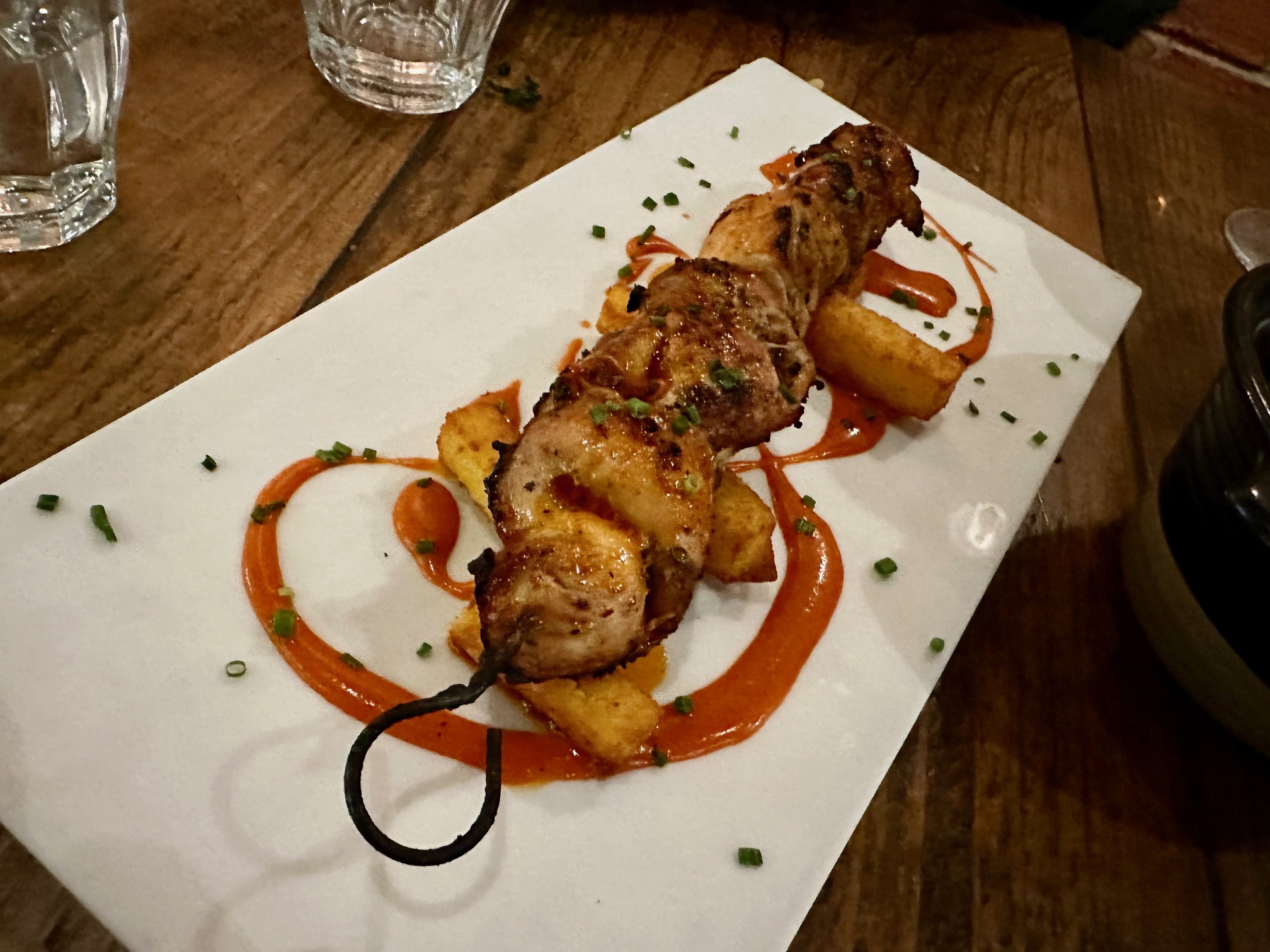
And again, thirteen pounds for this – even by 2024 standards – felt steep. I thought back to the skewer of chicken I had at Kolae, earlier in the year. Different cuisine, of course, but in terms of technique, flavour and value it was worlds away from this. This felt like the kind of dish that might pleasantly surprise you at Alto Lounge, but only because your expectations were on the floor.

If you wanted more evidence that El Cerdo wasn’t capable of delivering a flawless plate of food, their monkfish in tempura with chickpeas was exactly that. Just as at Calico, Katie had talked me into ordering something with chickpeas and they were lovely – nutty, earthy, positively moreish. But what in god’s name was going on with the monkfish? Two slightly forlorn nuggets of the stuff in a batter that was not, by any stretch of the imagination, tempura. It had no crunch, no texture, and when you tried to cut through it it all fell away, leaving a dense little knot of woolly monkfish, a sad savoury parody of a profiterole.

It turned out that Katie had never had monkfish before. “It’s not usually like this” I told her, feeling like I had to do something to rescue monkfish’s reputation. I hope for Katie’s sake that her first visit to Spain is better than her first taste of monkfish. If it’s on a par, that means she’s had her pocket picked on Las Ramblas.

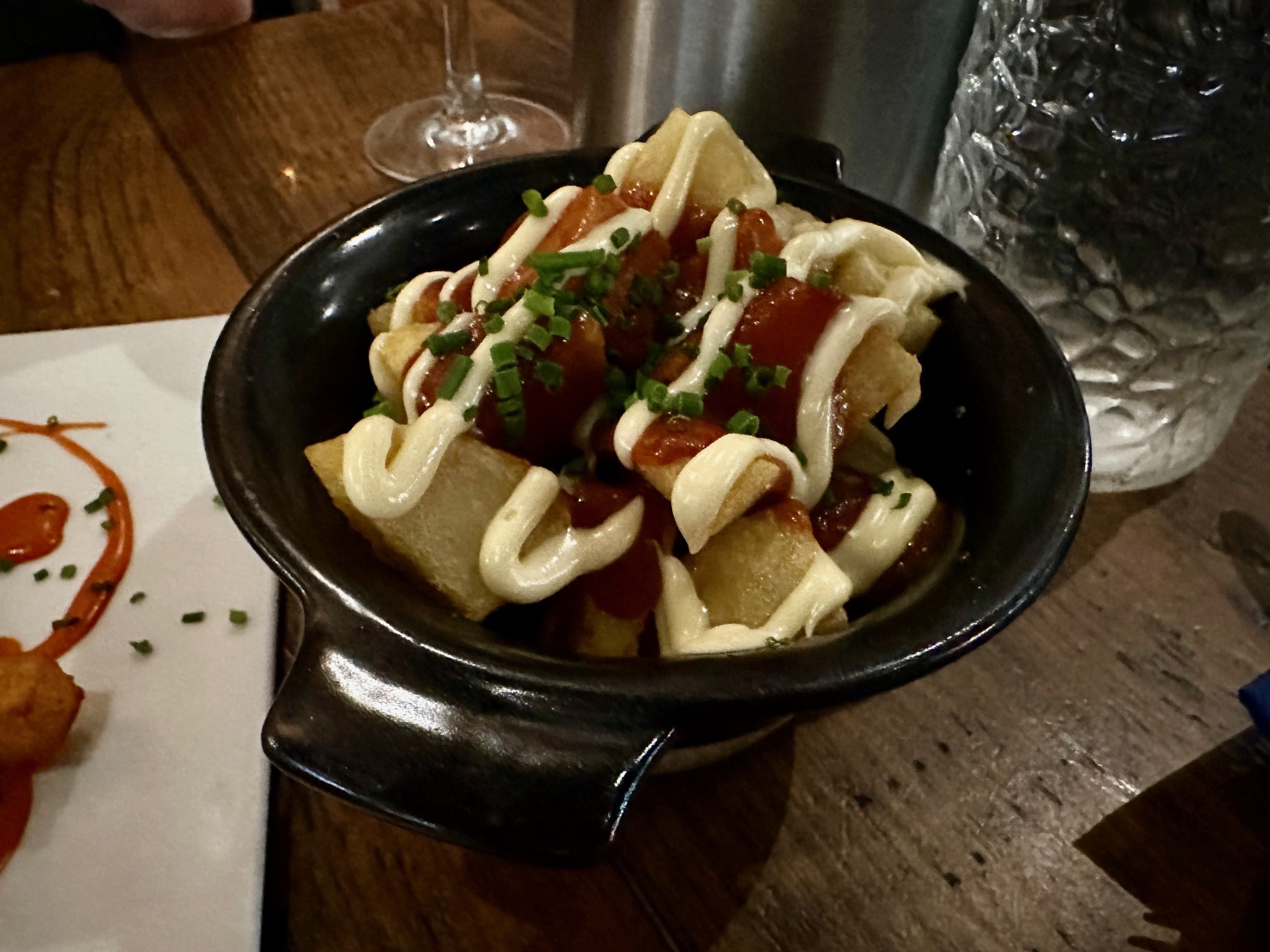
By this point I’m guessing neither of us really wants me to go on, but go on I must because there were a couple more dishes. Again, Katie quite liked the patatas bravas, which I think we’d picked to make sure we felt full at the end. And again, it wasn’t atrocious but I have never, ever had patatas bravas like this in Spain or indeed anywhere decent in the U.K.

The bravas sauce didn’t taste like bravas sauce, it was fruitier and lacked any kind of heat. The alioli, giving the benefit of the doubt and assuming that’s what it was, was not unpleasant. But it needed more of both, and moreover the potatoes were wan specimens, technically cooked but lacking the golden hue and brittle texture that makes this dish a treat.
Writing this, I should let you know, is the weirdest experience. Because I had a really lovely evening but the more I think about the food the more surprised I am by that.

We decided to have a dessert and there was one on the specials menu – a tangerine cake with white chocolate ganache and yuzu sorbet – which our server told us was perfect for sharing. So we also decided to have a dessert wine each, and identified a very nice-looking Pedro Ximenez on the wine list. So we ordered it, and our server came over apologetically. There was only enough left in the bottle for one glass – well, one and a half glasses, really. So what would we like to do?

Of course, as something approximating to a gentleman, I let Katie have that and went instead for a white dessert wine from Rueda. But when they came over, both were in very small glasses, both were the same size, and both looked bigger than they were because each of them had an ice cube lobbed in it.

“They weren’t the coldest, so I put an ice cube in them” explained our server.

This begged so many questions, like why aren’t you keeping your dessert wine in the fridge? or maybe you should have asked first?, let alone is that really what a glass of Pedro Ximenez looks like? or why didn’t you give her the rest of the bottle, were you saving that final half glass for Santa?

It was just baffling, and especially so because otherwise service was lovely all night. She told us they’d been open about a year and that although this week was quiet, things ramped up for the Christmas season after that and business was booming.

Last but not least, the dessert. It looked fancy, it looked cheffy and I can see that it was kind of designed for sharing. And leaving out the question of whether yuzu is remotely Spanish, the yuzu sorbet in the middle was easily the best and most enjoyable thing in the whole dish, resting on a sort of granola crumb. But there was nothing you could really describe as a white chocolate ganache, because neither the quenelles of something or other or the isosceles triangles of white chocolate fitted that bill.

But that wasn’t the most heinous failing: that was the cake. Dense didn’t even begin to describe it. You could work out your upper body trying to drive a spoon through that cube of stodge, and I felt like I did. There’s a chap called David who comes to my readers’ lunches whose job is to build machines that are used to test whether materials can withstand immense pressure. David would take a professional interest in that cake.

Because I seem to have spent most of this review pointing out places that do things better than El Cerdo, this feels like the right time to mention the pistachio cake I had last year at Manteca.

By this point, with the exception of a couple of chaps at the bar, we were the last table there so we settled up and made our way back to the station in the cold. Our meal, including a 12.5% service charge, came to just over a hundred and fifty pounds. Now, I think life in Britain has reached the point where it’s difficult to say “that’s expensive” any more because you’d end up saying that about most meals out.

But instead, we can at least talk about value: that’s more than my recent meals cost at Calico, at The Cellar, or Storia. My meal at Goat On The Roof cost a smidge more, admittedly two years ago, but El Cerdo can’t hold a candle to Goat On The Roof.

Granted, none of those restaurants are an exact match in terms of how many courses, how much booze and all that jazz, but the central point remains: El Cerdo does not feel like value. Not compared to any of those places, not compared to the tapas places you could eat at along the train tracks in Oxford or Swindon. So the search continues, and maybe next year I’ll rock up at Salty Olive having one last stab at finding great Spanish food a very short distance from Reading. Because if there’s one thing we can be fairly sure of, it’s that a tapas bar will not open in Reading next year.

But let’s close by looking on the bright side. For two years now I’ve been taking the train to Maidenhead, trying all these places and bemoaning the fact that Reading doesn’t have them. But actually, now, I’m beginning to think that my head was turned by Seasonality and Knead. Because outside those two, the new places I’ve eaten at in Maidenhead – the likes of Sauce and Flour, Storia and El Cerdo – don’t leave me thinking that we’re missing out. If there’s a market for box-ticking, slightly inauthentic, sterile restaurants and those restaurants want to go to Maidenhead instead, I’m all for it. I’m happy to hold out for something better. Even if experience tells me I might be waiting a very long time.

El Cerdo – 6.3
The Colonnade, Waterside Quarter, Maidenhead, SL6 1QG
01628 617412

https://elcerdo.co.uk/maidenhead/

Restaurant review: Calico

As I’ve said before, when I write a restaurant review I find it helps to have a hook. Why this place this week, out of all the restaurants out there? Why do I think you might want to read about this one? Sometimes it’s easy – with a new place, a change of management or an old place with a new chef, or somewhere that’s been mentioned in dispatches in the local or national press. Other times, it’s about the wider context: for instance the trend for biryani or sushi places in Reading.

But there always, ideally, needs to be something. I never assume I can just plonk a review up on the blog and expect people to read it no matter what: attention, like money, is a scant resource these days. Everybody’s got to earn it.

With Calico this week I was spoilt for choice, because I could think of three angles. The first is that Calico – technically “Calico Bar & Eatery”, but let’s not call it that because ‘Eatery’ is so naff – belongs to that niche club of Reading restaurants where everybody knows it exists, but nobody seems to know anyone who’s been. I’m sure some of you have, don’t get me wrong, but I’ve never heard anybody talking about it. This is possibly the easiest “in” for a restaurant review, because you might want to know whether Calico is any cop; don’t worry, I will eventually get round to telling you that.

I think it may be a hotels thing, because other members of that select group include The Reading Room and, these days, Malmaison; Calico, you see, is the restaurant in the 1843 Hotel, which for as long as I could remember used to be Great Expectations. And that brings us to the second possible angle, because Great Expectations played an enormous part in my adult Reading life and I’ve still not entirely come to terms with the fact that it’s gone. So, does the thing that replaced Great Expectations constitute an upgrade?

Ah, Great Expectations. I spent many a post-work Friday in that pub drinking crappy booze – Crabbie’s Ginger Beer, if memory serves – with friends and colleagues, enjoying the faux Dickensian shopfronts (Mr Crabcrotch The Fishmonger or suchlike) and shooting the breeze. It was almost a sign of the passing seasons in Reading, as reliable as putting your clocks forward and back or going to the beer festival. In the summer you went to the Allied, in the winter Great X.

The cast of characters was different each time, but the location was the same, week after week. Behind that grand façade was a slightly naff, tatty pub, and if it didn’t really do food – except for that period when it served something like a dozen different kinds of cheesy chips – it was still the naff, tatty pub of choice. I knew in theory that it was also a hotel, but I only knew one person who ever stayed there and he told me it wasn’t an experience to repeat. I loved the irony of a place being called Great Expectations, and so comprehensively failing to meet them.

But as a watering hole it holds a special place in my heart, part of a Reading that is now gone forever, along with its former neighbour the Global Café and, further up the hill, the After Dark. And for over ten years I lived on London Street, and so all of those places were my locals, along with the post AD delights of Bodrum Kebab, before it closed, reopened as Chicken Base – which it absolutely was, by the way – and eventually became the first home of Clay’s.

So walking down to Calico on a gloomy October evening, looking up at the glowing windows of my old flat and wondering who lives there now, it felt weird that the world had moved on so very much, even though that’s what the world invariably does, whether you’re paying attention or not.

The third possible angle, by the way, was that this week my dining companion was the published poet, compère of Reading institution Poet’s Café and Caversham resident Katie Meehan, a long-standing reader of the blog who kindly responded to my appeal earlier in the year for people to join me for reviews. A bit of culture at last: as somebody who churns out prose with questionable literary value, I was hoping against hope to become highbrow by association. And at the risk of sounding a bit like Michael Parkinson, Katie’s collection, the splendidly named Dame Julie Andrews’ Botched Vocal Chord Surgery, came out last year and is available from Two Rivers Press and all reputable bookshops.

Katie, it turned out, had been to Calico before, but just for cocktails and snacks before Poet’s Café, which takes place just round the corner at South Street. So there went angle one, because it turned out that I knew someone who had eaten there after all. She told me that they’d just ordered from the side dishes section of the menu, tenderstem broccoli in ginger and chilli, masala fries. The latter are described as “Must Try Masala Fries” on the menu, and there must have been something to that because Katie was keen to order them again.

But before we could get round to the menu, there was the matter of smalltalk and introductions. And before that? Well, I think it takes you at least five minutes to get used to the room. I spent some of those five minutes wondering if it would be as odd an experience if you’d never been to Great Expectations, and on balance I think it pretty much would be.

I’m not sure any word does it justice quite so much as “glitzy”. It was completely unrecognisable from what it used to be, and more than slightly preposterous in a way I partly loved, and which partly made my teeth itch. The zebra crossing-striped floor worked with the dark walls and earth-toned upholstered chairs, but did it all also go with the circular dark green velvet banquetted booths and the neon sign on the wall? And did all that go with the neon-lit archways running through the middle of the room?

You couldn’t say that money hadn’t been spent on the facelift, but you equally couldn’t be sure how much of it was misspent. Of course, we were there on a Tuesday night, one of only four occupied tables, and I’m always struck that the thing most restaurants and bars need is people. That’s what brings spaces to life – literally, I suppose – and lets you see them as they were intended to be, their best self.

And yet I struggled to imagine what a full Calico would have felt like. We were seated at one of those swanky banquettes, because it was available, but I’m not sure how plum some of the tables would have felt if Calico had been heaving. It looked more like a bar than a restaurant, and more like a restaurant where you’d plough through a bottomless brunch in a pack than one where you’d enjoy a meal with a friend. I couldn’t but admire what they’d achieved with the space, but even now I couldn’t tell you whether I like it.

“The menu is kind of nuts” said Katie as we looked at what to order, and she was on the money about that. When I first saw the menu at Calico, a couple of years ago, I wondered if it was trying to be Reading’s first ever successful take on the desi pub concept. The interior partly dispels any illusions about that, and the menu crushes any that are left. It was probably 75% Indian and Indo-Chinese food – tikkas, sheekh kebabs, biryani and butter chicken. But the other 25% was just dishes picked seemingly at random: nachos, arancini, mushroom croquettes, prawn and crab linguini and so on.

“I don’t understand why they have an equivalent of Nando’s on the menu” said Katie, pointing out the roasted half-chicken smothered in garlic and butter.

“And it would have to be pretty good at twenty pounds” I said. The pricing was wayward like that all over the place. The starters were mostly between nine and twelve quid, and the curries went up to about seventeen pounds, but the more Western dishes were generally more expensive. And on the other side of the menu were all the items you sensed that Calico felt it needed to have on a menu – five different burgers, half a dozen naan bread pizzas. The overall effect was confused, and suggested an identity crisis, as if Calico didn’t know what kind of venue it wanted to be or what kind of restaurant it wanted to be, all at once.

Anyway, it took us ages to order because we got a bottle of wine and started nattering about all sorts. Social media is funny, in that you can follow someone for ages and have a sense that you know them, but then when you meet them all the blanks get filled in. So I discovered that Katie was from North Carolina, and had lived in the U.K. for ten years – first in Katesgrove, then out in Oxfordshire and finally back in Caversham. Like many residents north of the river she felt like she’d found her place, so we exchanged stories about all things RG4: Katie was a customer of Geo Café’s veg box scheme during lockdown, like so many.

We talked too about writing, and what her genre and mine might or mightn’t have in common. We agreed that all writing, fundamentally, was about the self: Katie’s poems tell those stories obliquely, partly for fear of offending anyone or appropriating their stories, whereas I tend to put it all out there with reckless abandon. I mean, it’s fundamentally all about the restaurant, but if you’ve been reading an author’s stuff for a while (as Katie had) I guess you pick up snippets of what they’re like.

“Absolutely!” said Katie. “It’s like with Taylor Swift, there’s the Edible Reading lore. I remember years ago, having conversations that said oh my god, Edible Reading is getting divorced!

The idea of there being such a thing as Edible Reading lore was a bit like the interior of Calico: absolutely ridiculous, but that didn’t mean I was averse to it.

We’d agreed to share starters and Katie, who doesn’t eat huge amounts of meat, had zeroed in on the gobi Manchurian, being a fan of that dish in general. I am too, as it happens, so I was very interested to see how Calico fared on this first test. The answer was that they did very well: you got a sizeable portion of cauliflower, coated in sticky sauce, and unlike many renditions I’ve tried this had some crispiness to the coating, the cauliflower cooked but not overdone.

But the best thing was the sauce. It still had that sweetness that I associate with this dish, but also plenty of punch. You didn’t notice it at first, but by the time we’d polished off the lot I was surreptitiously dabbing my nose with my napkin. My benchmarks for this dish were Chilis in town and Clay’s across the river and again, this dish didn’t fall far short of either. “Can you believe I’ve never tried it at Clay’s?” said Katie, who lives just round the corner from it, so has very few excuses. This was a far cry from the cheesy chips of a decade ago, and it introduced another feeling of disconnection, to eat something so good in such an incongruous room.

Katie chose a lot better than I did. I had high hopes for paneer tikka, but what turned up was weirdly cheffy and ineffectual. Three bits of paneer, vaguely stacked à la Jenga, had the requisite colour and tone but the flavour from the marinade had not permeated, which made it feel like heavy going. Or at least it might have been heavy going had there been more of it, but those three pieces were awkward to share and, at twelve pounds, a bit too meagre.

So was the chutney – the menu promised coriander chutney but what you got was an insufficient artful squiggle, bisected with tamarind sauce. This felt like someone had put “Indian fine dining” into Midjourney and then decided to recreate whatever image it coughed out. And you can dump as many microherbs as you like on top of a dish like that, but it won’t save it. It led Katie and I to reminisce about the glory days of Bhoj, which must been not long after she moved to Reading. Their paneer was far from perfect, but it was a darned sight better than Calico’s. “It needs more sauce” was Katie’s pronouncement: I had to concur.

By this time I had seen dishes arrive at the table next to us, five women on one of those banquettes seemingly having a marvellous time and, as with the starters, I was struck that everything looked rather good. I rubbernecked to get a good look, because I can never stop myself doing that in restaurants, and even the naanza which wafted past me looked eminently worth ordering. And again I thought that what this restaurant needed was lighting that was more bright happy venue and less dive bar from Grand Theft Auto: Vice City. That feeling of disconnection, I could tell, was going to stay with me.

Mains took just long enough not to be too quick, something like twenty minutes. We’d decided to stay in the safety zone of the bulk of the menu rather than trying something in its outer reaches, and I think we were rewarded for that. Katie’s chana masala, another of her reference dishes, was a solid, decent choice – comforting, soothing stuff in another dry, reduced gravy. I didn’t think this had an enormous kick of heat, although it might have been hard to tell as our tastebuds might already have been tamed by the gobi Manchurian.

But either way, it was a very pleasing dish. I want to damn it with the faint praise of saying that it was better than it needed to be, or better than I expected, but that’s not it. It’s more that nothing about the Instagrammable glam of Calico really leads you to believe that there’s a creditable Indian restaurant ticking away under the bonnet. Perhaps that’s on me, or perhaps it’s true: it makes me wish I knew people who had been to Calico, apart from Katie, so I could decide if that’s wide of the mark.

Similarly, the lamb bhuna was a profoundly respectable choice. I had some misgivings because the menu gives you your choice of protein with this dish, which rather raises the suspicion that the meat and sauce have made one another’s acquaintance very late in the day. But be that as it may, there was nothing not to like here – the lamb was well cooked, presenting no resistance to the fork, and the sauce was the best kind, that hugs the meat rather than drowns it. In a way the high-sided black bowls Calico serves its curries in almost make it hard to see how much you get, but it was a more generous portion than it appeared at first. We saw all of it off.

Along with an unremarkable pilau rice we ordered Katie’s favourite, the masala fries. Were they really “must try”? I was unsure about that, but I’m glad I tried them. The fries were almost certainly bought in, and tossed in a red-orange sauce that had copious amounts of heat but also sweetness from what tasted, to me at least, like mango chutney.

All a bit baffling: the menu says that the sauce is Szechuan but I didn’t really get that. It felt more to me like a tangier version of the Manchurian sauce that had so lifted that cauliflower. It tasted great, but it borked the texture – somehow, despite being coated rather than drenched, the fries had lost the element of crispness they needed. That said, we still picked at them long after we’d finished the rest of the meal.

“See, this to me is the perfect snack to have with drinks” said Katie. “You order a beer or a cocktail and some of these.”

I could absolutely see where she was coming from, and again I found myself bemoaning – out loud – the fact that Reading has no pubs or bars with top notch beer snacks. Namaste Kitchen used to be that, years ago, and for that matter so was The Lyndhurst, but now the closest we have is Siren RG1, and in this context “closest” still means “nowhere near”. That’s a proper gap in the market, but not one Calico seemed interested in filling.

We ordered another glass of wine each and carried on chatting, and even though our evening was winding down it was still a little odd when the wait staff brought over our bill just before 10pm. I didn’t recall us asking for it, but I guess if nothing else it answered the question of whether Calico does desserts: they don’t. Our bill for two people came to just over one hundred and thirty-six pounds. I think Katie was a little taken aback by that, and so was I – one of those moments where everything adds up but you’re still surprised by just how much it adds up to.

Part of that is because the wine list doesn’t have anything much south of thirty pounds a bottle. It also felt like a list that had been put together without any thought given to what might actually go with the dishes on the menu. Picpoul de Pinet and Italian pinot grigio might be perfectly good wines, although neither’s really to my taste, but with curry? So we ended up on a New Zealand Sauvignon Blanc, which could just about stand up to our food, but was forty pounds a bottle. Maybe they’re more interested in selling cocktails: the drinks menu includes a lot of them

That included an optional 12.5% service charge and, more than usual, I wasn’t sure that the experience we’d had particularly justified that. It was especially surprising that they were so solicitous when it came to bringing the bill because before that, attracting attention sometimes felt something of a challenge on a very quiet night.

I’m writing this review the night after the meal and normally I might take a bit longer, mentally digest the experience and properly mull over what I made of it. But actually, I think even if I pondered the experience of eating at Calico for a couple of weeks I would still be as baffled as I am now. It reminds me of a couple of places in Reading, neither of them amazing. In terms of taking an old, neglected building and trying to give it a new Instagrammable spin, it’s a little like Market House, a spot that feels like it opened before it was ready and hasn’t felt ready ever since. I suppose it’s also, in that respect, similar to Honest Burgers, which shows how to do these things well.

But really, the place it reminded me of most was Masakali. Like the Caversham Road venue, it is trying to be an upmarket spot, almost an Indian brasserie. Like Masakali it has slightly focused, I suspect, on style over substance, and like Masakali it wants to be a place to see and be seen. The enormous cocktail list would tend to bear that out, as would Calico’s Saturday “Bottomluxx Lunch” (I must be too old for that kind of thing, because I read that wording on their website and wordlessly thought kill me now). I guess Coconut on St Mary’s Butts is a bit like that too, with its regular Instagram photo dump of the beautiful people having a phenomenally good weekend.

The problem with all that is that, against all appearances, the food at Calico is rather good. Better than at Masakali, I think, and despite all their attempts to hide the fact with smoke, mirrors, neon signs and curveball menu selections there is a pretty decent Indian restaurant hiding at the heart of the conundrum that is Calico. I’m not even sure they realise that though, because they’re still too busy haring around trying to be all sorts of things to all sorts of customers.

It must be working for them because they’ve been trading for two years now, but I find myself liking Calico despite all those things and partly in spite of them. As Katie said, the menu is nuts. As I’ve said, the room is nuts. I had three different angles to potentially write this review and it shows, because the ending is almost as muddled as that beginning. In the scheme of things, I can’t sum it up any better than this: I have no idea what Calico is all about, really, but it’s almost worth going just to see if you get the measure of it any better than I have.

You might eat surprisingly well in the process. I did.

Calico – 7.4
33 London Street, Reading, RG1 4PS
0118 9503925

https://www.1843reading.com/eat.html