If I asked most Reading residents to name Reading’s most famous restaurant, the chances are the majority of them would say either Kungfu Kitchen or Clay’s Kitchen. And that makes sense because those two, the Lennon and McCartney of Reading’s food scene, are the ones that have broken out into the national consciousness, as much as Reading ever does. If we had a round of Reading restaurants on Family Fortunes, asked 100 people to name a restaurant in Reading, those two would top the leaderboard. God knows what else would be on there – Sweeney Todd, probably, and a rogue vote for Munchees.
But that would only happen if you asked Reading residents, and is indicative of the bubble we live in. Because, last year at any rate, the most nationally known restaurant in Reading was Good Old Days Hong Kong Ltd, a nondescript Cantonese restaurant just the other side of Reading Bridge. And the reason for that is that last February it was reviewed in the Observer by journalist, jazz musician, TV show judge, relentless self-publicist and life president of the Jay Rayner Appreciation Society, Mr Jason Rayner.
He raved about the place, and explained that the chef used to cook at the Hong Kong Jockey Club, and Hong Kong’s Four Seasons Hotel. “It feels like finding a senior chef from the Ritz… doing their own thing in your local caff” he declaimed. The unspoken implication was that this was almost as extraordinary as finding the U.K.’s greatest restaurant reviewer doing his own thing in a Chinese restaurant most Reading folk had never heard of, slumming it for the greater good. Lucky us!
Now, don’t be fooled into thinking Rayner had come to Reading specifically to review Good Old Days. He was in Reading recording an episode of his Radio 4 series, and I suspect he decided to kill two birds with one stone before heading back to London: after all, if there’s one thing people like to moan about below the line on his reviews, it’s how many of them are of London restaurants.
That roving Radio 4 series must be a positive boon, as it gives Rayner an excuse to visit parts of the country he otherwise wouldn’t touch with a barge pole. And I think we can include Reading as one of those, given that he described Caversham as “Reading’s Latin Quarter, as nobody has ever called it”. Such a charmer. But anyway, it was close enough to the station and he had a friend who recommended it, so Good Old Days it was, rather than one of Reading’s more high profile restaurants.
And he did seem to enjoy it, sort of. He said that “if… you happen to live nearby, get the food to go. Because in truth Good Old Days is a takeaway that just happens to have a few tables.” And that’s the funny thing about Rayner’s review – it didn’t make me fall over myself to visit. And I don’t think it galvanised Reading either, because I still know relatively few people who have had a takeaway from Good Old Days and fewer still who have eaten in there. The ones who have, that I’ve spoken to, have told me that it was “nice”, or words to that effect. I’ve never had an oh my god, you really must go – can I come?
Especially that last bit. Despite it being on my to do list for almost a year, every time I mention it to someone in terms of joining me there on duty they ask if we can go somewhere else instead; people just didn’t seem to fancy the place. In that respect, Rayner’s review is a remarkable one – if you can praise food and still leave people lukewarm about going to a restaurant you definitely have some kind of skill, albeit not one most restaurant reviewers would want to develop.
Very few of the comments on the Observer review were from people in Reading, and what ones there were were evenly split between Don’t give the secret away and We went there on your recommendation and it was awful. So it looked like there was a gap in the market for a reliable review of Good Old Days, and I was happy to fill it.
Subscribe to continue reading
Become a paid subscriber to get access to the rest of this post and other exclusive content.
The Cellar closed in June 2025. I’ve left the review up for posterity.
Here’s a question for you: when does a restaurant become a new restaurant?
Is it when the name changes, or when the chef changes, or when the owner does? Celebrated Reading restaurant Mya Lacarte changed chefs many times during its lifetime, but it always remained Mya. But with some restaurants, it can feel like a completely different place. Take Pepe Sale – the name and the room stayed the same, but without Toni in the kitchen and Marco or Samantha running the front of house, it might have been a decent Italian restaurant, on a good day, but it wasn’t Pepe Sale.
One of my favourite restaurants, back in the mists of time, was a place in Cheltenham called Lumiere. It was run by a married couple, a lovely, homely spot that did brilliant food, and I loved it. And then the owners decided to get out of hospitality and sold to another couple, one with a track record and aspirations. Fourteen years later, they won their first Michelin star. I’ve been since it changed hands, and I liked it well enough, but it wasn’t the same place I loved long ago.
I feel like this is especially a problem with pubs. When restaurants change hands, unless the new owners are buying a going concern the name often changes. But pubs can go through good phases and bad phases, new chefs and new concepts, all under the same name. Look at my reviews of all the pubs out on the way to Henley – the Pack Horse, the Pack Saddle, the Crown. Are any of them recognisably the same as they were when I reviewed them all that time ago? Almost certainly not.
The reason I’m starting out talking about this is that the subject of this week’s review also begs this question. Between 1996 and 2008 there used to be a restaurant on Valpy Street called Chronicles, and back then it was very much a peer of London Street Brasserie. It closed, and became an Italian restaurant and then, briefly, a truly woeful place called The Lobster Room. And then in 2015 Chronicles owner Andrew Norman decided to have another bite of the cherry and opened Valpy Street in that spot. New name, new era, new restaurant.
But in August Valpy Street closed after nearly nine years trading. Sadly this hasn’t been an isolated occurrence this year – restaurants have been dropping like flies in 2004 – and the announcement from Valpy Street listed the usual suspects: Covid, the cost of living, wage increases. But there was an additional horseman of the apocalypse in Valpy Street’s case: “accountancy errors”. War, famine, death, shonky accountants. It figures.
And so that was it for Valpy Street, but the following month another restaurant, The Cellar, opened in the same spot. The Chronicle had already reported that this was going to happen, and that some of the existing staff would transfer across to Valpy Street’s successor. And yet, if you have a look on Companies House, the director of The Cellar Ltd. is none other than… yes, it’s Andrew Norman, the proprietor of Valpy Street.
So what’s all that about, and was the Cellar a new restaurant, or just a new name for an old one? I decided it was time to find out, so I booked a table on a week night and headed over to check it out, with my dining companion – and elite level campanologist, would you believe – Liz, last seen experiencing the exotic wonders of Calcot.
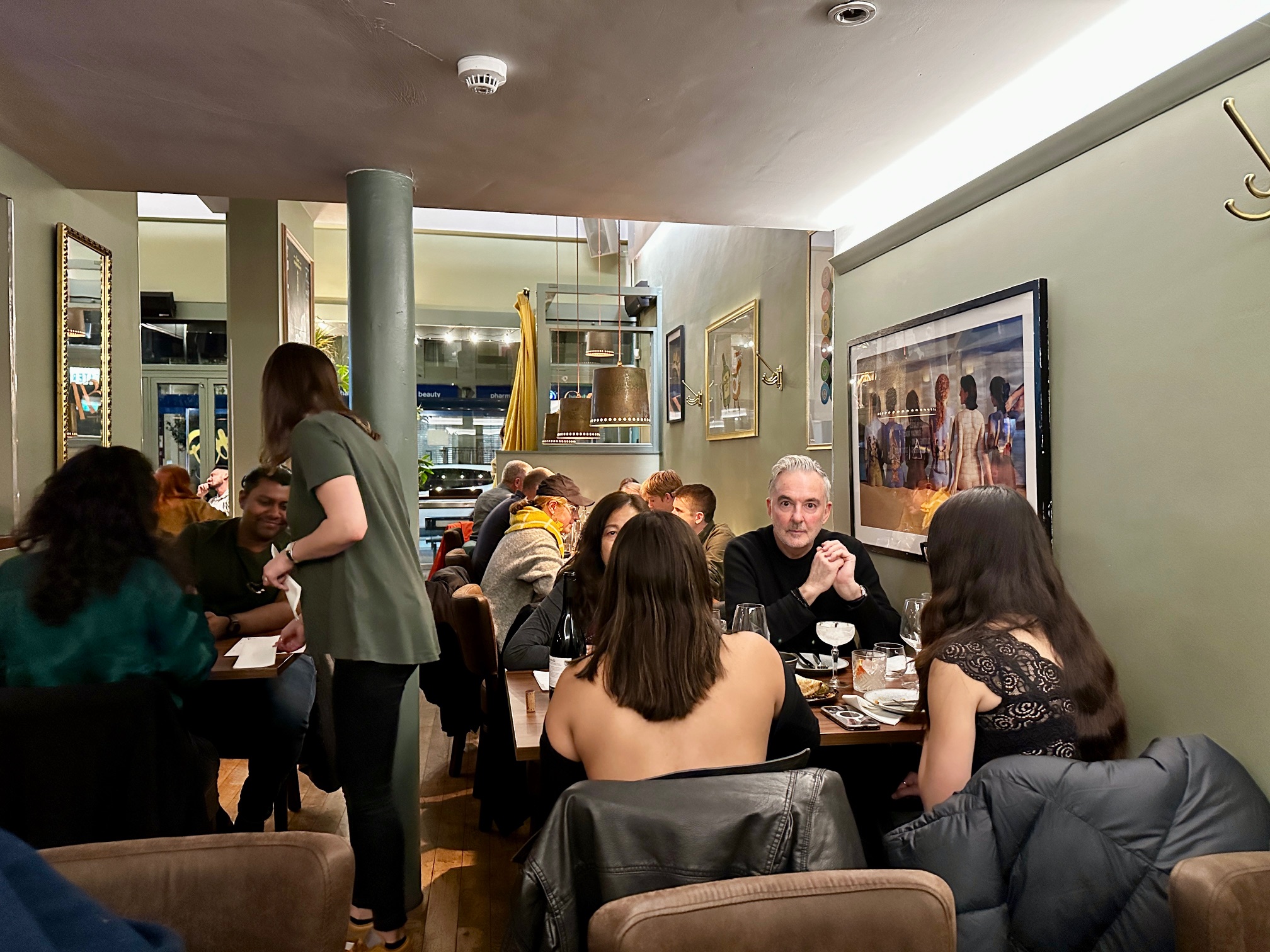
I was a little early for our reservation, so I got a good look at the dining room. I can’t remember what it looked like as Valpy Street, and I didn’t have the sense to take a photo back then, so I couldn’t tell you how much it had changed. But I sense it wasn’t that much, probably because it didn’t need to. Despite being a basement restaurant the dining room was split level with another room, for drinkers, on the other side of the bar.
And everything was nicely done: gorgeous exposed brickwork – the real stuff, not faux nonsense – along with banquettes, muted panelling and comfy dining chairs. There wasn’t much in the way of soft furnishings to absorb the noise, and although it wasn’t busy on a Tuesday night the decibel level was high, mainly from a very chatty table of Americans who were here on business and celebrating, by my reckoning, for the final time for about four years.
Yet if you looked more closely, things about it weren’t quite right. My table, which was a perfectly nice table, had weird sloping edges which meant that when you looked at the wine glasses or jug of water you felt like either you were very drunk or they were about to fall off. The tables in the booths had been spaced out as if social distancing was still a thing, meaning anyone sitting at them risked scraping their elbow on some brickwork.
And speaking of elbows, the table was so sticky that, over the course of the evening, it took the skin off my elbow. If you left a napkin on it and pressed down, you left some of the napkin on the table. All a little strange, although I didn’t fully appreciate that until I got home and had to break out the Elastoplast.
Service was initially a little diffident. I think I spotted three or four servers over the course of the evening, but the young chap who showed me to my table then just leant against the wall and stared into space as I made more and more attempts to attract his attention to say that actually, I’d love a drink while I was waiting for my friend to arrive. He was absolutely lovely, but just seemed a little, well, green. (“Don’t be mean about him in the review, it’s probably his first week” was Liz’s take at the end of the evening.)
My wine arrived just as Liz did, which made me feel rude even though it wasn’t really my fault. The Cellar’s wine list is pretty interesting, partly because I couldn’t work out who they bought from. Some of it at least was available from Majestic, the popular choice with so many Reading restaurants over the years. But others, weirdly, only seemed to be available from a website that does thank you gifts for employees, so your guess is as good as mine.
I know all that, because I could Google it while I waited for Liz to arrive. Because, unusually for a basement restaurant with thick brick walls, there is actually mobile reception. Anyway, the list had a decent mix of old and new world, and if nothing was that cheap – glasses start around nine quid – that’s because nothing is any more. So I had a nero d’avola (Majestic) which I liked very much, and decided that I’d save the pleasures of the Malbec-Viognier blend (Hints of fynbos, rosemary and tobacco leaf, spiced or marinated red meats with a biltong coating, also Majestic) for another day.
I think after eleven years I’ve figured out that when it comes to wine, describing things as jammy or fruity or – if they’re dead expensive, “complex” or “fragrant” – is about as good as I get. I liked it, I ended up having a second glass. Liz ordered something neither of us had ever heard of, a Spanish white made with Airén, a grape that was a new one on me. It was from the weird corporate website, and Liz, who is better at this sort of thing than me, said it was really enjoyable, fruity but not acidic; speaking as someone who is frequently acidic but rarely fruity, I couldn’t really identify with it.
The Cellar’s menu was a bit of a dark horse, with hidden depths. At first sight, it looked pedestrian and safe, but if you kept looking you found all sorts of interesting ingredients and techniques hiding in plain sight. So there was pork rillette, which you might find somewhere like Côte, but they’d panéed it, for reasons which escape me. There was boeuf bourguignon, but repurposed into some kind of cottage pie – gîte pie? – to be different. Baba ganoush came with rum soaked raisins, pavlova with basil sorbet. A little subversion, in with the mainstream.
Small plates came in between eight and twelve pounds, although you could supersize them as large plates by paying more. And then there were main courses – which you’d hope were also large plates, unless they were even larger plates – which cost between eighteen and twenty-five pounds. These were divided into two sections, one of which was marked “classic” which, in this case, translates as “not cheffy”. Fish and chips I can see you might class as a classic, but green Thai curry? Hmm.
Anyway, all that sounds catty when it isn’t meant to. I liked the menu, like I liked the room, but like the room it still felt like a bit of a jumble. The sense of being a work in progress fitted more with it being a new place than just Valpy Street wearing glasses, a fake nose and moustache.
Having said all that, we played it safe with our starters and were maybe not rewarded for that. I chose salt and pepper squid knowing full well that calamari is something I’ve tried in many places over the years, from Vesuvio to Storia and beyond. And the Cellar’s rendition was good – or, at least, not bad. The salt and pepper didn’t come through strongly, but even if they weren’t super-fresh they were far from the nacky rubber bands you get in many places. The chilli was advertised but didn’t make its presence felt, the unadvertised leaves dumped on top were a nuisance.
Pairing this with black garlic aioli (not just any aioli) is seemingly a very now combination – Storia did this too – but I wasn’t sure how this went with a salt and pepper coating. In any case the aioli had a weird sweetness, like salad cream, with no garlic punch. I think I’d rather have had sweet chilli sauce. But the oddest thing, again contributing to that slight jarring feeling, was how this was served, in a high-sided bowl sitting on a board. This made eating it, and dipping it into an even smaller ramekin of aioli, a bit of a palaver.
Liz had gone even more classic, with baked camembert. This is a dish it’s hard to get wrong, in many ways – buy a Camembert, bake it properly and off you go – and the Cellar managed that without missteps. I got to try a bit, and for what it’s worth I thought it was decent – nice to see it scored and generously studded with rosemary, even if the white wine and honey glaze didn’t really made its presence felt. At least they hadn’t adulterated it with onion jam or suchlike. But Liz wasn’t entirely convinced.
“I guess you sort of know what you’re getting with that, though” I said. “What more could they have done?”
“It’s these things” said Liz, pointing to the insubstantial, brittle crostini on the plate. “It needs really good, crusty bread to dip.”
I think she was right. The crostini snapped if you dipped them, couldn’t bear the weight if you loaded molten cheese onto them. They looked bought in, and if they weren’t then they could have saved time by doing that. But Liz was right, this dish was a baguette away from living its best life.
At this point, even though the lighting was lovely, the conversation was absorbing and free-flowing and the Americans had scarpered, I was getting that sinking feeling that my evening was going to be better than my meal. So it gives me huge pleasure, and no small sense of relief, to say that this was where the Cellar turned a corner and the rest of the evening was a little choreographed sequence of successes.
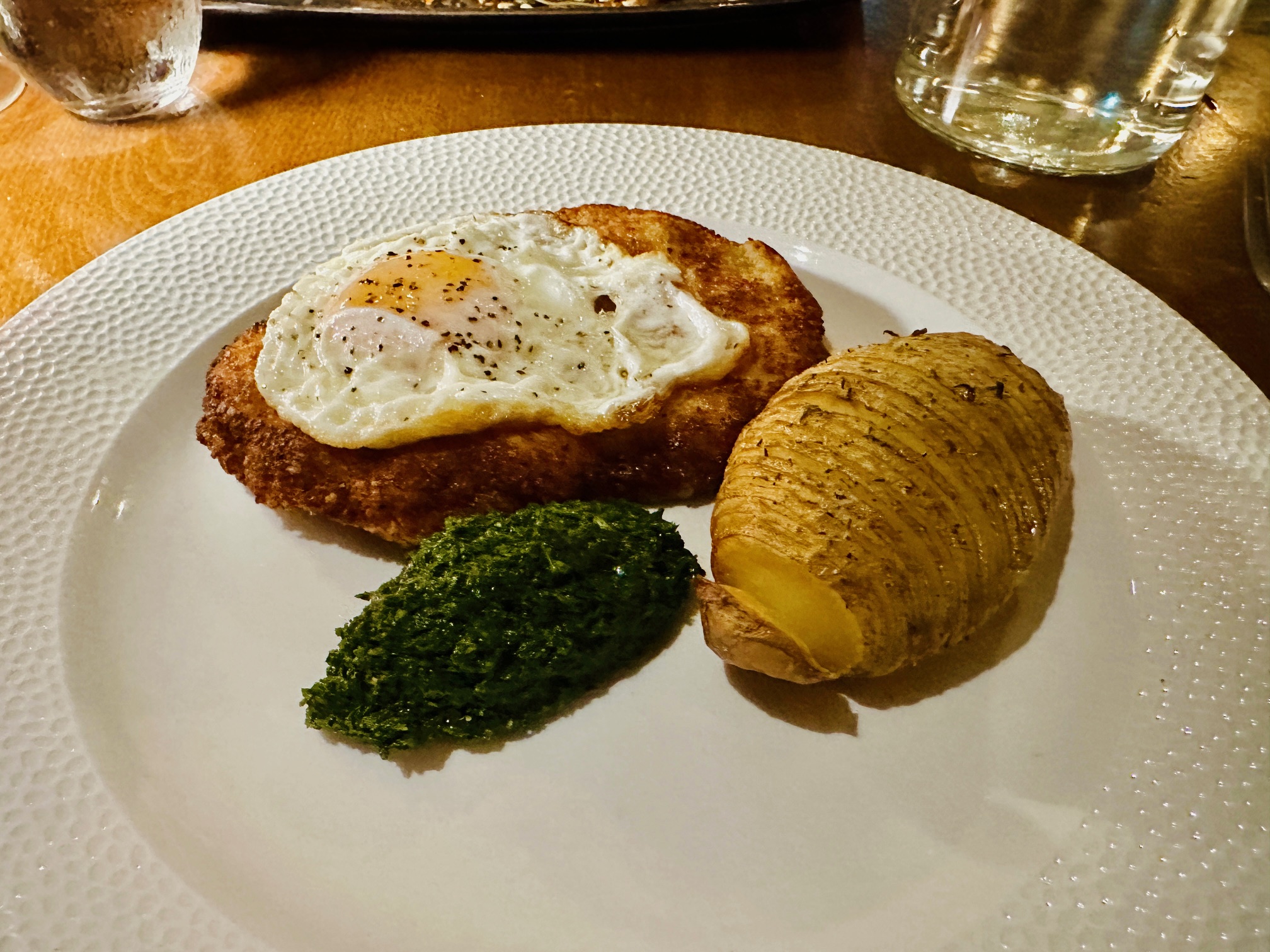
Take my main. I’m not sure what possessed me to order a chicken Milanese, a dish I’ve occasionally ordered but rarely enjoyed and really, only associated with Carluccio’s back when it was good. But it turned up and not only looked the part but was a hugely enjoyable affair all round. There’s not much to this dish but, like the Cellar’s menu, it was full of surprises.
So the chicken was a little thicker than I’d expect, not beaten flat, and was beautifully tender and superbly done. The coating could so easily have been blah old breadcrumbs, but was given a real flash of interest with Parmesan in the mix. The fried egg was absolutely terrific, spilling its yolk the way I spill gossip – freely and with joy.
I wasn’t entirely convinced by the hasselback potato – it didn’t feel like garlic or rosemary had really made their way to the centre of that particular maze – but the gremolata was also a delight. I’m not entirely convinced it was really a sauce, but more of a thick parsley pesto. But it had zing, and you could smear it on a piece of chicken or a sliver of potato, and it made everything better. I don’t mean to damn The Cellar with faint praise, but I’m not sure I’ve been more pleasantly surprised by a dish this year.
And then there was Liz’s dish. Liz doesn’t eat as much meat as I do – few people do, I suspect – and had chosen a vegetarian starter and a vegan main. I’m so glad she did, because that vegan main was a triumph, with loads going on. A slice of baked aubergine (“I really love aubergine”, Liz said, and I remembered that we’d had some at the Coriander Club, too) was served on a slick of butter bean purée.
But that was the Cellar just getting started, because on top of that you had a very good quenelle of baba ghanoush, and others of something I mistook for tapenade but the menu swears blind is mushroom duxelles. So much going on there, so many interesting flavours to mix and match.
But the Cellar understood that the dish still wasn’t complete without some textural contrast. So it was scattered with seeds and dusted with a potent dukkah, and because that still wasn’t enough, the crowning glory – crisp-edged cubes of panisse, chickpea fritters. I love panisse, and I don’t think I’ve ever seen it on a menu in Reading. I was very happy with the Cellar for doing it.
“This is really good” said Liz, offering me a forkful that confirmed that it absolutely was. So much going on, so much work and thought, but without it being overblown or overdone, or all those flavours and textures getting lost in a shouting match. And I thought that this was how you should do vegan food, to make it a destination dish where nobody in their right mind could eat it and miss meat. I was also thinking, in the back of my mind, finally, my vegan readers are going to get something out of a review for once.
Liz had her eye on the madeleines on the dessert menu, possibly because they came with lavender honey, but I managed to talk her into dessert. And perhaps more impressively, because Liz is firmly in the “one glass of wine on a school night, and possibly even a Friday night” school of thought, I managed to talk her into a dessert wine too. They only had one, a late harvest sauvignon/viognier blend, and 50ml is a bit of a stingy pour (if you’re me, or just right if you’re Liz) but it was a beautiful sip of pure sunshine and reminded me how much I love dessert wines, and how rarely I have them.
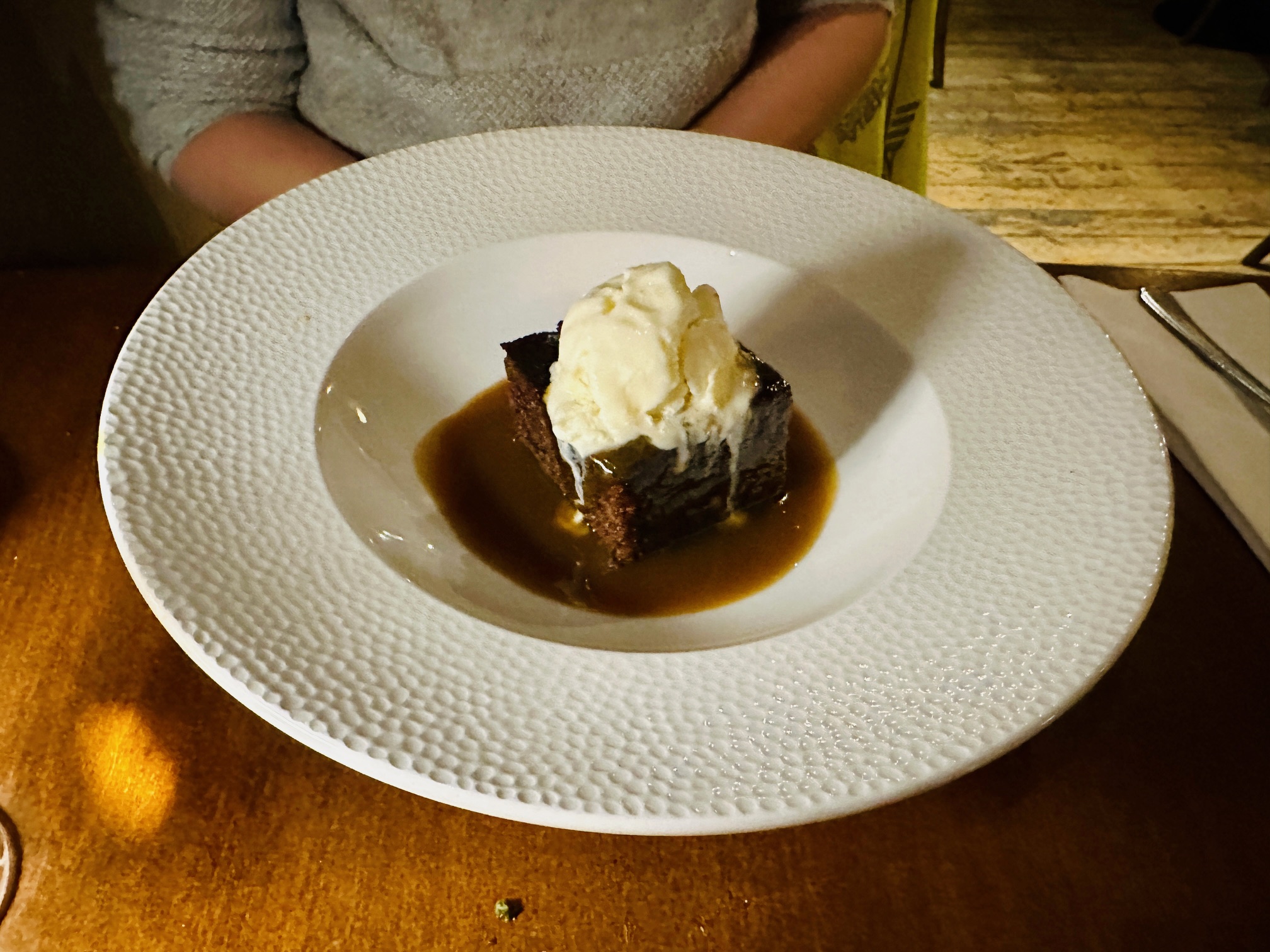
Liz’s head had been turned by the sticky toffee pudding and, again, it was really very nicely done. Reminiscent of the likes of London Street Brasserie, who have been flogging sticky toffee puddings for longer than I’ve been writing about them, it had great texture – how on earth do you describe that now everybody has cancelled the word “moist”? – and a moat of deep, rich sauce. The vanilla ice cream was already giving up the fight, which was inevitable, and I personally would have preferred clotted cream, but that’s my gluttony more than anything. Liz loved it, and my only regret was that after that she didn’t have space to raid those madeleines.
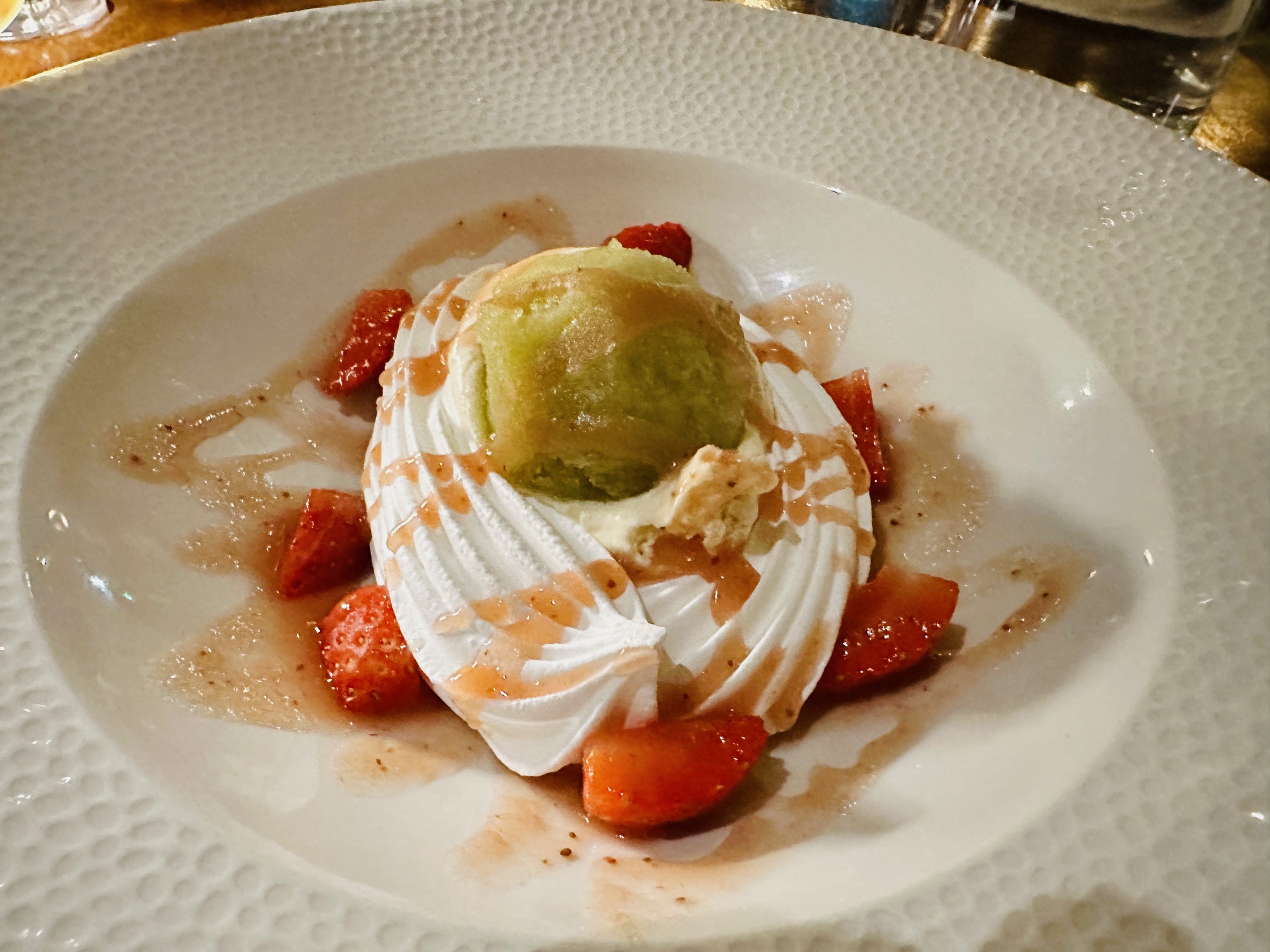
I tried the pavlova. I have a real soft spot for a pavlova – it always says that a restaurant can be arsed in a way that Eton mess never does – and the Cellar’s was a blissful piece of work. An elegant oval of chewy meringue, housing a core of cream and vanilla, ringed with macerated strawberries and syrup. A little reminder of the summer we never had, a gastronomic time capsule of a time that didn’t quite exist. And right at its centre, that verdant sphere of basil sorbet, which was truly extraordinary.
I give out awards every year for Dessert Of The Year, so thank god I went to The Cellar this week or I might have been writing a post next month saying “or you can just pick up a bar of Cadbury’s Top Deck from the corner shop”. I let Liz try a spoonful, and she had dessert envy. I’m so used to being the one that suffers from that that I didn’t even remember to gloat.
By this time everyone else had left, and we were still nattering until it got to about ten o’clock, over three hours after we started, and we both felt guilty about keeping the staff from their homes. All the people who served us were brilliant, and when one of them came over with the card reader I asked her how long they’d been going for.
“It’s just over a month” she said, “but of course we were Valpy Street before that.”
I asked how similar the Cellar was to Valpy Street, and she told me that most of the staff were the same and, crucially, the team in the kitchen was unchanged. She was very good at not saying much more than that, but I sensed again the involvement of the First Accountant Of The Apocalypse.
“How’s business going?” I said, aware that a Tuesday night in November mightn’t be the best yardstick of that.
“It’s okay, we’re getting there. But we were closed for about five weeks, and you worry that people forget about you.”
Our bill for two people – three courses apiece and five glasses of wine in total – came to just over one hundred and thirty-five pounds, including tip. And personally, for a very enjoyable evening in a lovely room with great company and some genuinely interesting dishes, I thought that was more than okay. Because when a restaurant gets a lot of things right, it wins you over. You still remember the other stuff – the glasses on the piss at the edge of the table, the waiter vacantly ignoring me at the start, the plaster I had to put on my elbow at the end of the night – but you don’t care.
The Cellar lived up to the promise of its name, an attractive, intimate, convivial space, tucked away from the bustle of Blagrave Street, of the buses, the commuters and the revellers. And I found myself really rather fond of it. We made our way out into the night, the air now sharp and wintry. Liz liberated her Brompton and headed back to West Reading, and I made my way to Market Place to play my favourite game, Bus Home Roulette: would it be the 5, the 6 or the 21? Did I feel lucky?
I realise, now I’ve got to the end, that I didn’t answer my own question. When does a restaurant become a new restaurant? I can’t help you, in this case: I have a feeling it might take someone who knew Valpy Street a lot better than I did to tell you that. But I can tell you this, instead: the staff might be the same, the owner might be the same, the chef might be the same. For all I know the menu might be the same, and those sticky tables too. But my respect for the place? Now that’s another matter. That definitely is new.
There’s a neat symmetry to proceedings this week. Last week I found myself in London, on a bus to parts unknown and this week, although I’m back in Reading, it was a very similar experience. Because I was on the trusty number 1 bus heading out west to Calcot. Yes, Calcot. Have you ever been there, apart from to visit IKEA, unless you happen to live there? Did you know Calcot has restaurants?
Well, for a long time it didn’t. And then in the summer of 2020, The Avenue Deli opened in a little run of shops. The name was a bit confusing, because from what I could see it was definitely a café and brunch spot, not a deli. But despite that, and despite opening in the worst summer for hospitality since records began, it built up a decent reputation: I suspect that, like Tilehurst’s The Switch, it benefitted from serving a community that doesn’t have anything else remotely like it.
But then last November, The Avenue announced that an Indian restaurant, The Coriander Club, was opening next door. The implication was that the two businesses were connected, a shared owner presumably, and The Coriander Club talked about offering an authentic taste of Punjabi cuisine. And since then the word of mouth has been good, and the restaurant’s well-maintained Instagram feed paints an interesting picture of food very much on the western edge of Reading.
Subscribe to continue reading
Become a paid subscriber to get access to the rest of this post and other exclusive content.
It was a brilliant plan, in theory: I was in Bristol in February visiting my friends James and Liz and I thought that the three of us could go to lunch at Bristol’s hottest new restaurant, 1 York Place. It opened in December and I booked a table at the start of the year, excited about being hot off the press and reviewing it before anybody except Bristol’s local papers. What could possibly go wrong?
I’d have got away with it too, if it wasn’t for those pesky national restaurant reviewers. About two weeks before my visit, William Sitwell wrote about the place in the Telegraph. It was a rave review, and to sum up his 600 words on the subject he said it “felt like being pummelled… by endless waves of gorgeous food”. I assume he thinks that being pummelled is a good thing: after all, he did go to a very different kind of school to me.
To compound that sense of being foiled, the Mail On Sunday‘s Tom Parker Bowles went too, less than a week before my visit. His 400-odd words were another panegyric, even if he managed to avoid being spanked by any of the dishes. “What a menu. What a restaurant” he enthused, splitting a £100 main course of hot roast shellfish with his buddy in the process. About £40 a head (without that shellfish platter) said the text at the end, in case you don’t fancy living it up like the King’s stepson.
It was frustrating that those two got there first but at least it meant I was in for an absolute treat. If a pair of rich, entitled, Eton-educated men were in raptures about the place, surely that boded well for my table for three? We wandered the short distance from Clifton Village hungry and with a healthy level of anticipation.
To give you the background, and explain why this restaurant has been so keenly awaited, it’s the latest venture from chef and restaurateur Freddy Bird. Bird trained in London before opening the Lido in Bristol in 2008, followed by its sibling Thames Lido in 2017. He then struck out on his own at a place called littlefrench in Bristol five years ago. Bird is well connected, and has had glowing reviews at every step of the way, along with TV appearances on the likes of Saturday Kitchen and Sunday Brunch.
His reputation even led to the Guardianreviewing Thames Lido back in 2017: in those days you had to be pretty special to lure the Guardian to Reading, of all places. In fact, the Guardian wrote three articles about Thames Lido in just under two months, which is the middle class equivalent of how excited Berkshire Live got about Wendy’s.
It’s an attractive corner plot which was an Italian restaurant in a former life, double aspect with a small dining room on the ground floor and a bigger one down some narrow spiral stairs. Sitwell sniffily dismissed the upper level as “more balcony than room” but actually, with plenty of natural light, I think I’d preferred to have eaten there than in the basement where we were seated. It wasn’t an unattractive room, but it was beige and a tad bland without managing to emulate Scandi chic. The bare tables were knotty pine, not a nineties trend I’d expected to see make a comeback (“what’s wrong with varnish?” was James’ more uncharitable take).
I tend to agree with Parker Bowles about the menu – it’s not often that I see so many dishes I could gladly order, and it made decisions hard. As with my trip to Quality Chop House the previous weekend, it was a menu with a snack section as well as the three traditional courses and actually it was very reminiscent of the London venue: a few dishes – cod’s roe, sweetbreads, schnitzel – had appeared on the last menu I read on duty. Snacks were mostly six to seven quid, starters between ten and fifteen, mains twenty to thirty.
But to give you an idea of how truly difficult it was, here’s a selection of the dishes we missed out on: salt cured foie gras with spiced quince; confit duck with lentils and salsa verde; grilled squid and squid ink bomba rice with aioli; beef, red wine and bone marrow pie. However Freddy Bird might cook, the man knows how to write a menu that makes life tricky.
Liz is an excellent person to review restaurants with because she picks the kind of lighter, sensible options I never would. James is an equally excellent person to review restaurants with because he will gladly pick something different just to give me plenty to write about. On this occasion he told me that he would gladly share the pie with me and I turned that offer down. Over the course of the meal I would slightly come to regret that decision.
But first, wine. It was a good list at 1 York Place, split into sections so you could pick a fresh white, or an aromatic white or what have you. We were torn between three, all from the “textured whites” section – if you know what a textured white wine is you’re streets ahead of me – and our server, uniformly excellent from start to finish, came straight off the fence and told us what to choose. It was a Provençal white, it cost forty-three pounds against a retail price of nineteen and we all liked it a great deal. It was pale in the glass, so I worried that we’d made the wrong choice, but it was beautiful on the palate and went with enough, if not all, of what we’d ordered.
I know people sometimes moan about the length of my reviews, but looking at the 600 and 400 words of my better paid brethren I think there’s something to be said for talking about food at greater length. A dish from the snacks section was described as Sicilian winter tomatoes, smoked pork belly. Parker Bowles described the tomatoes as “pert and firm”, and Sitwell made an awful joke about how Spaniards would feed the dish to vegetarians (he loves vegetarians), concluding with a “tee-hee-hee” which made me wonder if he was the Beano‘s Lord Snooty.
That’s all well and good, but what neither of them had the word count to convey was that this dish was small and, for my money, mislabelled. This was closer to lardo than pork belly, and I think there’s an implication that dishes billed as snacks should be sharable. This wasn’t, and dividing it in three was fiddly and barely worth the bother. Were the tomatoes pert and firm? Not especially. I mean, it was quite nice and all that but for six pounds fifty it was not much for not much.
Much more like it was the cod’s roe, served with fennel to use as a crudité. I’ve come to cod’s roe quite late in life, having been a taramasalata refusenik for many years, but I really loved this and, if anything, I preferred it to Quality Chop House’s version the previous week. I had never considered using fennel to dip in anything, to be honest, but 1 York Place has quite converted me to it as a concept – sweet and crunchy, the aniseed note rendering the roe less cloying.
William Sitwell loved this dish too, although he said that fennel was “the equivalent of a sensible nanny giving one a bollocking”. That’s Sitwell for you, the classic Everyman. There wasn’t quite enough fennel to scoop up all the roe, so I’m glad our server talked us into ordering some bread to account for the last of it. You got five thick slabs of it and a generous quantity of salted butter, at the right temperature, for just under a fiver. I’m not going to include a photo of that: you know what bread looks like.
For me the standout dish of the meal was what came next, fried lamb sweetbreads. They were heaped like profiteroles onto a puddle of bright, beautiful salsa verde, dressed with thin strips of anchovy and crispy sage leaves. This was pretty much all my favourite things on a plate, and all of it was done exceptionally well – the shell of batter light and delicate, the almost racing green salsa verde deep and delicious.
But it wasn’t just me – or James – that adored this dish, because the critics were wowed by it too. Parker Bowles said he didn’t think he’d taste a better dish this year: I eat far less well than he does, but I might not either. He did describe the salsa verde as “brusque” though, which looks great on paper but is about as meaningful as saying that it had a firm handshake. Sitwell said that it “swirled in the mouth like a whirlpool of discovery”, seemingly unaware of quite how gross that sounds. He obviously wasn’t bollocked by that nanny often enough.
As I said, Liz can be relied on to choose options on the menu which I tend to avoid, the sort I would probably order if I was a better person. A prawn and lobster blini fitted that bill admirably and definitely looked the part, topped with ribbons of fennel and fronds of dill. This wouldn’t have been for me – dill is the one herb I’ve never quite taught myself to like – but Liz, who said it was light and fresh, was a big fan.
I had genuinely been torn between a number of mains, particularly the confit duck or the squid, but my decision was made before we ordered when our excellent server walked past with a couple of plates and slowed down so I could rubberneck, a terrible habit I have in all restaurants. “That’s the schnitzel” he said about one particularly attractive-looking dish, and so I decided to forego the other options.
Was it the right decision? Almost. It looked the part, bronzed and crisp-edged, perched on a heap of celeriac remoulade, a fried egg reclining on top, the whole lot festooned with capers. On paper I should have absolutely loved this dish, and yet it wasn’t quite right. For me the veal was a little too thick, the coating a little too brittle, coming away and not adhering. And yet it was soggy at the bottom, which it really shouldn’t have been. The remoulade was beautiful, and most things are improved with an abundance of capers, but for me this missed the mark.
At £28 it was the most expensive main on the menu, and I couldn’t help remembering that the schnitzel at Quality Chop House the previous week had been almost a tenner cheaper. I wouldn’t have been surprised if it was better than 1 York Place’s version. Then I remembered the schnitzel that occasionally popped up on the Lyndhurst’s lunch menu that cost ten pounds, and that was certainly better.
The other two dishes showed that Bird likes to stick to the tried and tested. Ox cheek in Pedro Ximenez was on Thames Lido’s menu when the Guardian visited over six years ago and it was present here, the only substitution being cavolo nero for kale. Still, the classics are classics for a reason and James had no complaints. “The potatoes are puréed perfection”, he said. I thought this dish was slightly on the small side, but that might just have been me: “they’re generous portions, aren’t they?” said the server as he plonked this down. In case you care desperately by this stage what William Sitwell thought, he liked this too. It was, apparently, “the blackest, richest ox cheek you can imagine”.
Another dish from the textbook was Liz’s choice, hake with potatoes, celeriac and mussels in a saffron and dill broth. I did have a sense of déjà vu about this but didn’t realise until later why this was: it was very similar to a dish Thames Lido served up when I reviewed it six years ago.
Liz liked this version more than I’d liked the 2018 incarnation – the random chickpeas had been taken out and the dill had been dialled down (I’d forgotten how much Freddy Bird likes dill) and overall she was a fan. “Even though I had two fish dishes I didn’t feel there was any repetition” she said. I’m glad she picked this – my reviews don’t always have enough of interest for you pescatarians out there – but it wouldn’t have been my choice.
None of us fancied one of the sides, Castelfranco, which is the kind of thing Nigel Slater refers to airily as “bitter leaves”. So we ordered the other, roast pumpkin with chilli, butter, sage and walnuts. This wasn’t what I was expecting or hoping for: giant wedges of pumpkin with more crispy sage leaves, a heap of what I assume was Parmesan and a cluster of walnuts. It needed more butter, some chilli – the chilli had gone AWOL – more texture and contrast. It felt like a slog. We left some.
I can nearly always go for a dessert, and I imagine I could usually persuade James to have one too, but the dessert menu was where the magic touch had deserted 1 York Place. I’m sure that it would have much to appeal to many, but for me it was too heavily dependent on hot school dinner type affairs – a steamed golden syrup sponge and a rice pudding were both available – so despite being in the mood for something sweet we called it a day. When William Sitwell went earlier in the month he had a chocolate and dulce de leche tart: if that had still been on the menu I’d be telling you all about it now.
It felt strange to bring the meal to a close so sharply, like closing a book a few chapters from the end, but I’ve never been one for finishing novels I’m not enjoying and I don’t believe in forcing myself to have dessert for the sake of it either, not even on duty. Our meal for three, including ten per cent service, was almost bang on two hundred pounds. Just to compound how lovely the staff were, our server told us to have a lovely rest of the day and up on the ground floor, collecting our coats, we were told that again. The staff were fantastic from start to finish – they should up that ten per cent to twelve and a half.
On the walk back to Liz’s car we compared notes. Liz liked it more than James had, and was happy with her choices. I suspect I liked it about as much as James did, but he naturally scores things lower than I do. “Better than anything Wilson’s would produce and a third of the cost” was his analysis, although it might have been heavy on the hyperbole. But then he’s never forgiven Wilson’s, after heading there based on my review, for serving up an expensive, utterly carb free meal and leaving him ravenous; later that evening James admitted that “better than Wilson’s” was an epithet he’d apply to almost anywhere in Bristol, including Greggs.
And what about me, what did I think? Well, I was a little nonplussed by the whole affair. 1 York Place neatly fits into that category of restaurants – there are quite a few of them – where they are better than a lot of what Reading has to offer but, in the wider scheme of Bristol, nothing special. It is a lovely neighbourhood restaurant but I have a sneaking feeling a lot of that is around it being in a lovely neighbourhood. If I lived nearby I’d still probably end up doing the short walk to Bar 44 or trying out The Clifton, which won a Bib Gourmand recently.
But then I think of the exalted company I’m in, by reviewing the same place as Messrs Sitwell and Parker Bowles the same month they went there. They no doubt know their food better than I do, and of course they also know the chef better than I do. If this was somebody else’s restaurant would they have written the same paeans of praise? Would they have even gone there at all? I don’t know, but it makes me glad I didn’t have to sum up the place in a few hundred words. I’m not sure how anyone could capture a restaurant accurately with so little space to play with. I know I couldn’t. But I’m not sure they did, either.
1 York Place – 7.7 1 York Place, Bristol, BS8 1AH 0117 2447775
A.B.O.E. closed in August 2024. I’ve left the review up for posterity.
Last Friday I found myself in Bristol enjoying a badly-needed long weekend away. Our train pulled into Temple Meads, half an hour late, and Zoë and I wheeled our suitcases into the centre, three days of eating, drinking and excellent company ahead of us. But before we checked into our hotel, before we did almost anything, I had lunch on my mind and only one candidate to provide it. We made a pilgrimage to the Apple Cider Barge and there, next door, in its distinctive black and red was Gurtrina, the van belonging to fried chicken supremos and Reading legends Gurt Wings. How could I kick off my minibreak anywhere else?
By my reckoning it’s over six months since Gurt Wings stopped coming to Blue Collar – something to do with the council being difficult, if I remember rightly – and the reunion with their magnificent food was all the sweeter for all that deprivation and delayed gratification. In my time away the buffalo sauce had become just a little more piquant, the blue cheese saltier and tangier. The sun came out, the bench we were perched on positively glowed and we polished off our food in wordless joy. Truly, it would have been worth a trip to Bristol just for that.
Afterwards James Mitchell – the man behind Gurt, also known to his many fans as Uncle Gurty – came over and the three of us caught up and shot the breeze. I told him where we were planning to eat in the city, he mentioned a few places he’d heard were good and then he did something I wasn’t expecting. He went out of his way to tell me somewhere especially good I should check out.
“You need to get yourself to Oboe” he said.
“What, like the musical instrument?”
“No, A.B.O.E. It stands for ‘A Bit Of Everything’. The chef is a guy called Seb Merry who was on Masterchef, and he’s so passionate about his food. The whole team are brilliant. They do the best Bloody Mary I’ve had – it’s not on the menu, but if you ask they’ll make it for you. And they have this fried chicken dish – well, it’s not like our fried chicken but it’s amazing, it’s more like a croquette but you’d have to try it. And they do this incredible dessert, have a look at this.”
He fired up his phone and showed me a picture of a dessert which was all chocolate and caramel, thick slabs of each. I’ve rarely seen a photograph I wanted to eat more.
After our chat we went on our way and stopped in the Small Bar for the first beer of the holiday but that glowing endorsement weighed on my mind. If the man who does the best fried chicken you’ve ever tasted tells you that a restaurant does amazing fried chicken, and more besides… could I really let a trip to Bristol pass without investigating? But anyway, there’s no way they would have a table free the following night, I thought. But then I checked, and they had. So I texted my friends James and Liz, sent them the website.
I know the four of us are booked somewhere else tomorrow night, but Mr Gurt Wings says this place is incredible. What do you reckon, stick or twist?
James, a keen fan of Bristol’s restaurant scene, responded almost immediately. Let’s take a risk and twist, he said, and that was that. Bookings were made and cancelled, and the next night Zoë and I clambered off the bus halfway up the Whiteladies Road, ready to take our chances.
The interior was tasteful, all muted green paint, wall art and pillars. There was a mezzanine floor, although there didn’t seem to be anyone seated there on a Saturday night, and the whole place had a pleasing buzz. It sort of looked as if it could have been part of the Loungers Group in a previous life (I checked: it wasn’t) but none the less it was a pleasant dining room with tables companionably close without being crammed in.
It was also almost completely full and our server whisked us to a table right at the back, far too big for our party of four. He explained that a table for four near the front had slightly outstayed their welcome, and although they’d paid the bill they hadn’t yet left the premises. He told us, quite charmingly I thought, that he didn’t feel like acting the heavy with them given how much they had spent.
Then he asked if Zoë and I wanted a cocktail on the house while we waited. So Zoë had a negroni, made with rosemary vermouth, which she raved about and I asked for that off-menu Bloody Mary. I knew it would be good when the server didn’t ask me how spicy I wanted it: they just did their job and made it, and it was magnificent.
All in all, we were waiting ten minutes with our cocktails, hardly anything to complain about. By then James and Liz had arrived, more drinks had been ordered and we had taken our table nearer to the front of the restaurant, with a good view of other tables, dishes wafting past and the staff – just the two of them, that I could see – working non-stop.
The menu is the kind that makes jaded restaurant bloggers roll their eyes – no starters, no main courses, just snacks and small plates. The menu suggests two snacks and four small plates between two, which I suppose gives you an idea of whether they’re starters or mains. Now, I can be as critical of small plates venues as the next person and I’ve always found it counterintuitive that restaurants tell you to share small plates. I also thought that A.B.O.E.’s pricing was a little out of keeping with the small plates concept – snacks mostly cost just over five pounds, but the small plates ranged from fourteen to twenty-two pounds and that for me, at the risk of doing an accidental Partridge, is the kind of price I expect to pay for a big plate.
But anyway – perhaps it was the charm of the welcome, or the edge-softening effect of that Bloody Mary, but I found I was prepared to suspend my disbelief. So we bartered about the snacks we wanted to ourselves and the small plates we were reluctantly prepared to share, I popped it all down on a note on my phone and when our server came back we ordered with military precision.
“I just need to tell you,” he said, “that the steak tartare is a small portion, so it isn’t really suitable for sharing”.
“That’s okay, that’s for me” said James, in a manner that suggested he had never really considered sharing it with anyone.
That does James a huge disservice because when it arrived, although it was indeed too petite to share, he insisted that I try a forkful of the tartare. It was made with dry-aged bavette, and I have to say it was pretty impressive with plenty of savoury depth. Not the very best tartare I’ve ever had – that honour still goes to Paris’ superlative Double Dragon – but pretty close. Certainly it compared well with a similar dish across town at Marmo, although I wasn’t a hundred per cent sure about the stuff, allegedly taleggio, on top.
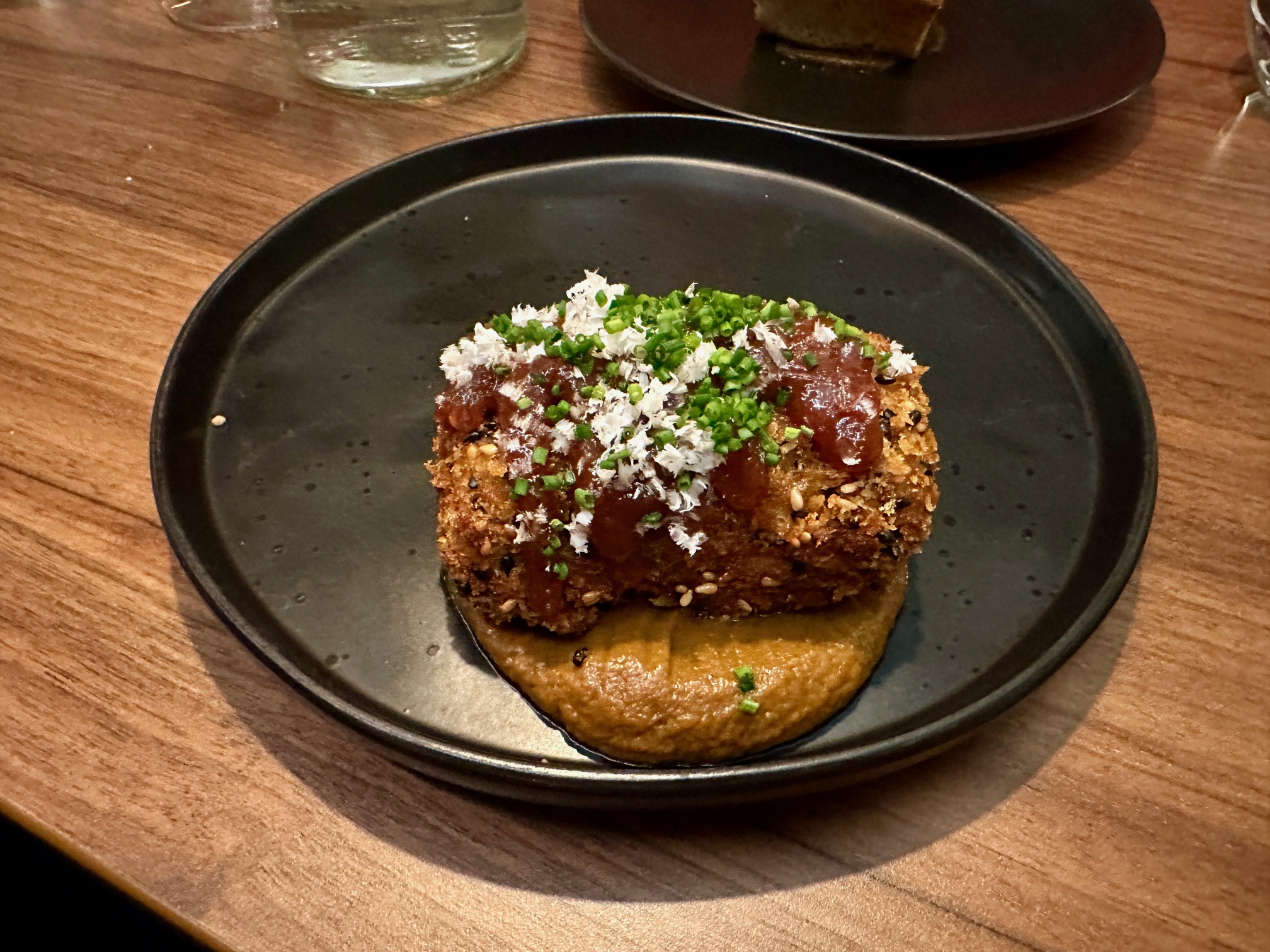
Zoë and Liz both went for the pumpkin croquette: A Bit Of Everything definitely applies geographically if in no other way, with this dish having hints of Japanese korroke. But unlike the croquettes at, say, Caper And Cure where you get four little spheres, A.B.O.E. goes for broke with a single enormo-croquette loaded with cheese and horseradish. Again, I was allowed a forkful and again it induced a reasonable amount of envy. Zoë in particular raved about this dish. I probably would have liked more, smaller croquettes to capitalise on the surface area but I couldn’t deny that the flavour of the thing was outstanding.
To continue the globetrotting, my snack was A.B.O.E.’s take on poutine. Rather than fries, it was cuboids of confit potato, à la Quality Chop House, buried in Parmesan with a jug of thick, intense, almost-sweet jus to trickle over the whole affair. Enormously enjoyable stuff: I imagine dreary types might complain that this wasn’t poutine, but it was a darned sight nicer than most poutine I’ve had. Besides, I knew exactly what it would be like because I’d checked out the restaurant’s Instagram in advance (it’s called research, you know).
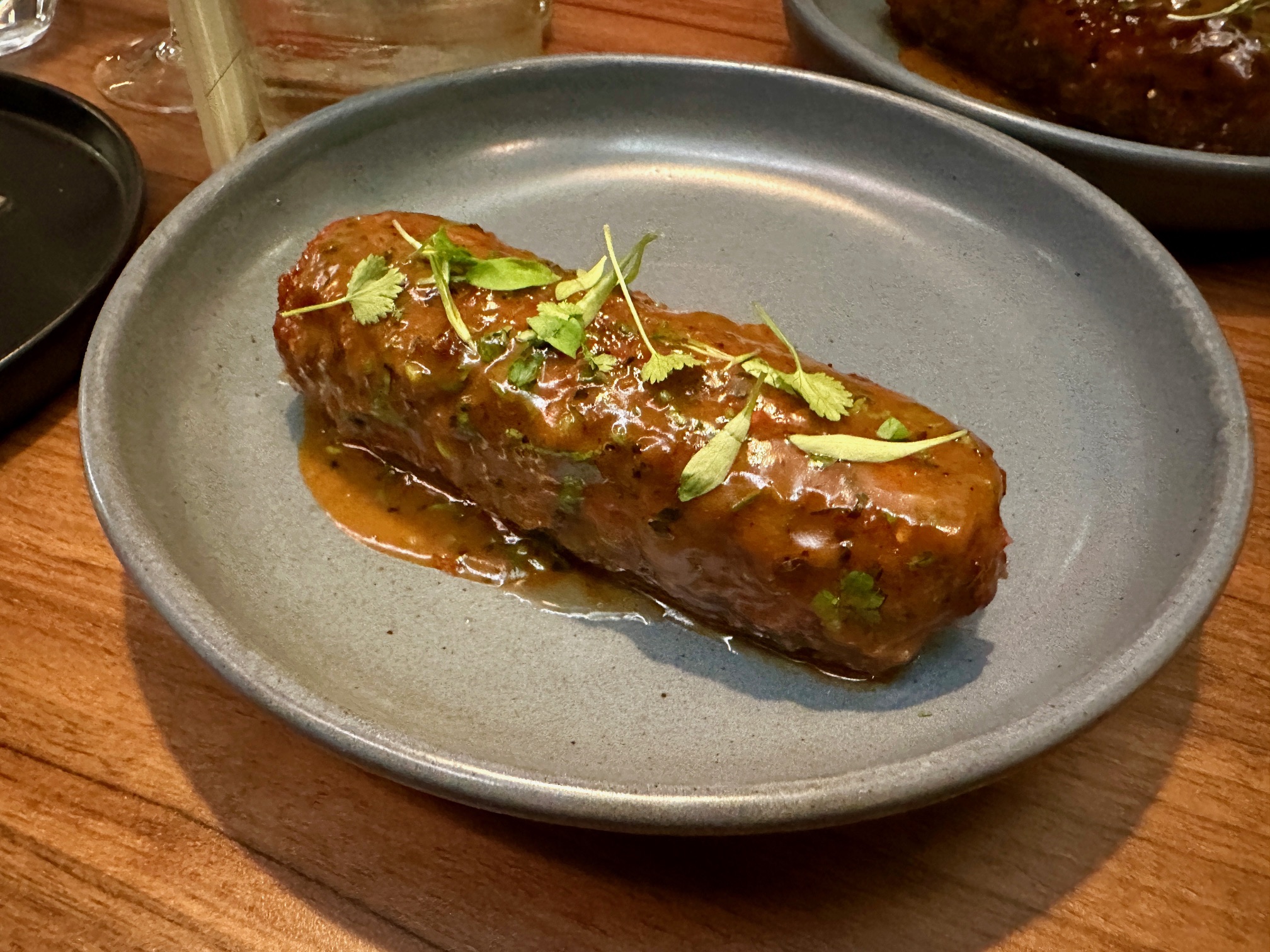
The first of the small plates to come out was that fried chicken dish so beloved by the man behind Gurt Wings – high praise indeed, from an expert in the field. Well, he was right to say that A.B.O.E.’s rendition was nothing like his. It was surprisingly hard to describe, but it’s important to try because otherwise all you have to go on is the photo below, which looks on the scatological side. It was somewhere between a boudin and a ballotine, a cylinder of tightly compressed chicken thigh bound in a crispy coating, the whole thing smothered in a sticky curried sauce.
Did it work? Well, yes, we all thought it did. As with the pumpkin croquette, I personally would rather have had more, smaller pieces to maximise the surface area. The coating didn’t have as much crunch as I’d have liked, and came away under a knife rather than adhering to the chicken beneath. But you couldn’t argue with the flavours, or the note of citrus that danced through it. Uncle Gurty had not steered me wrong – and no, it didn’t look like fried chicken, much in the way that the poutine didn’t look like poutine. That was sort of the whole point.
I’d had my eye on the barbecued squid with galangal, but it became a must-order when our server, the charming Italian chap who had sorted out our welcome cocktails, told me they’d run out of the clams it was meant to come with. Their solution, he told me, was just to give you more squid. That was good enough for me, and the dish was tender and fragrant with a nicely building heat. Another of those dishes you slightly resented sharing, which in hindsight is a decent description of literally everything we ate.
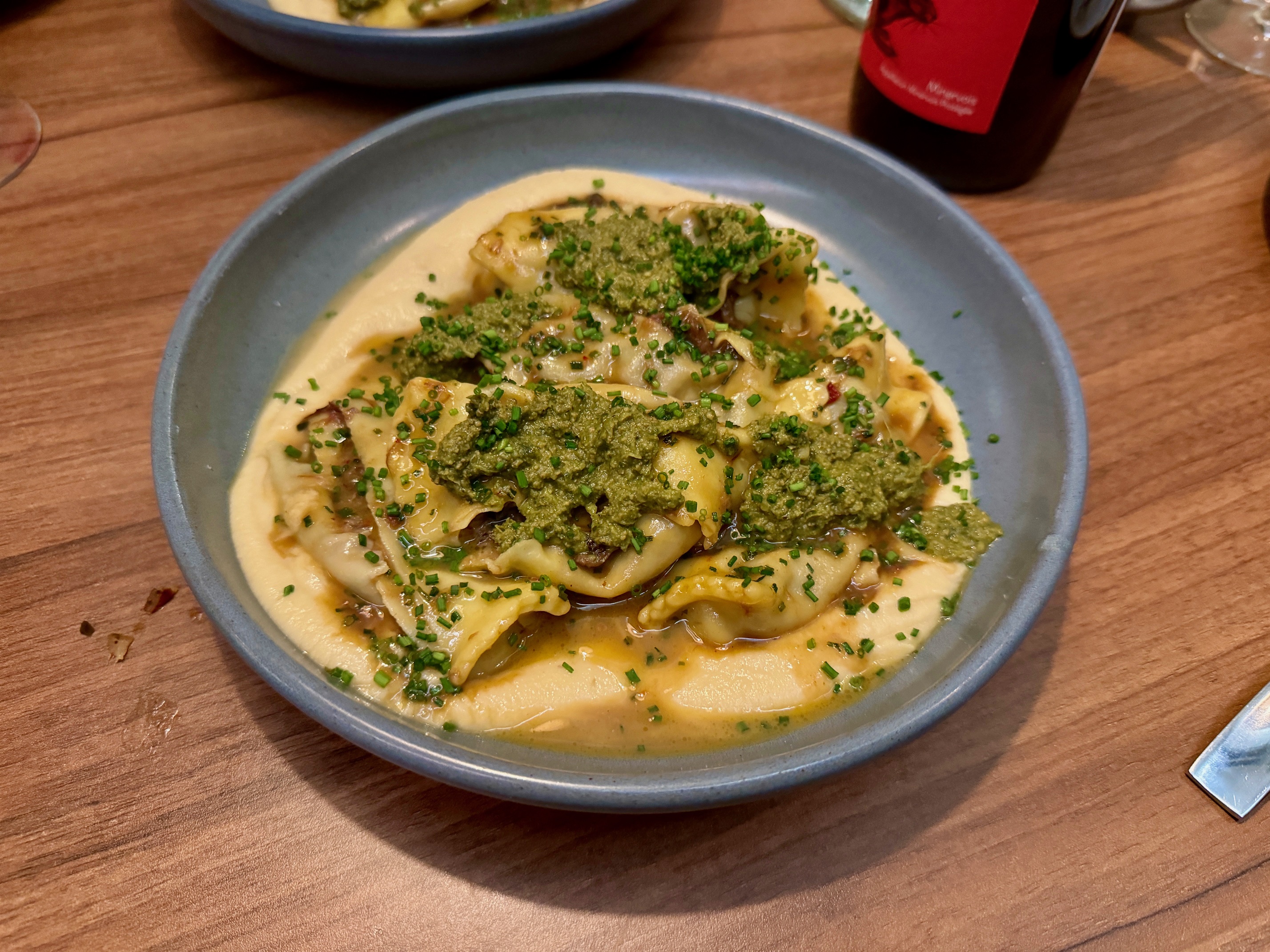
The most expensive dish on the menu – so naturally we ordered two of these – was the short rib beef agnolotti. Nearly twenty-two pounds a portion, and for me a fascinating misfire. My companions all loved it so I was the lone dissenter, but for me the agnolotti themselves were overcooked, which made the whole dish a bit limp and mulchy.
Everything on the plate was good: the celeriac, apparently with aged beef fat, the glorious beef in the filling and a powerful mole verde, although we didn’t get the advertised goats cheese. As with everything else we tried, the flavour was unimpeachable but for me, the texture let this one down. But I may well have been wrong: certainly everybody else thought so.
Red mullet is James’ favourite fish on earth so he had to order a portion of that, and I got enough of a taste to appreciate that it was, like everything else, very skilfully done. I’m a sucker for braised lettuce, a relatively conventional pairing, but putting mustard – a delicious mustard, at that – in the mix was the sort of clever and unexpected touch Merry seems to specialise in.
The last of our small plates was an outrageously delicious one: barbecued cod with leeks wrapped in nori and two sauces – one of which, studded with ultra-salty nuggets of chicken skin, was one of the most compelling things I’ve eaten in some time. Again, this was at the north end of the price list and I can see you could argue it wasn’t an enormous amount of food for twenty pounds. But it was exceptional, one of the best-cooked pieces of fish I can remember served alongside a sauce with a proper, clobbering heft. James and Liz left a bit of theirs, and I waited as long as I could bear it before saying “would you mind if I finish that?”
Although service was brilliant, there were only two people working front of house (and, just as gobsmacking, I understand there were only two people in the kitchen). If there had been more, or they’d been less busy, we might have got to a second bottle of wine but instead we took our time with the one we had, a beautiful Minervois which sort of went with some of the dishes. It’s a small wine list, six white and six red, about half of them available by the glass.
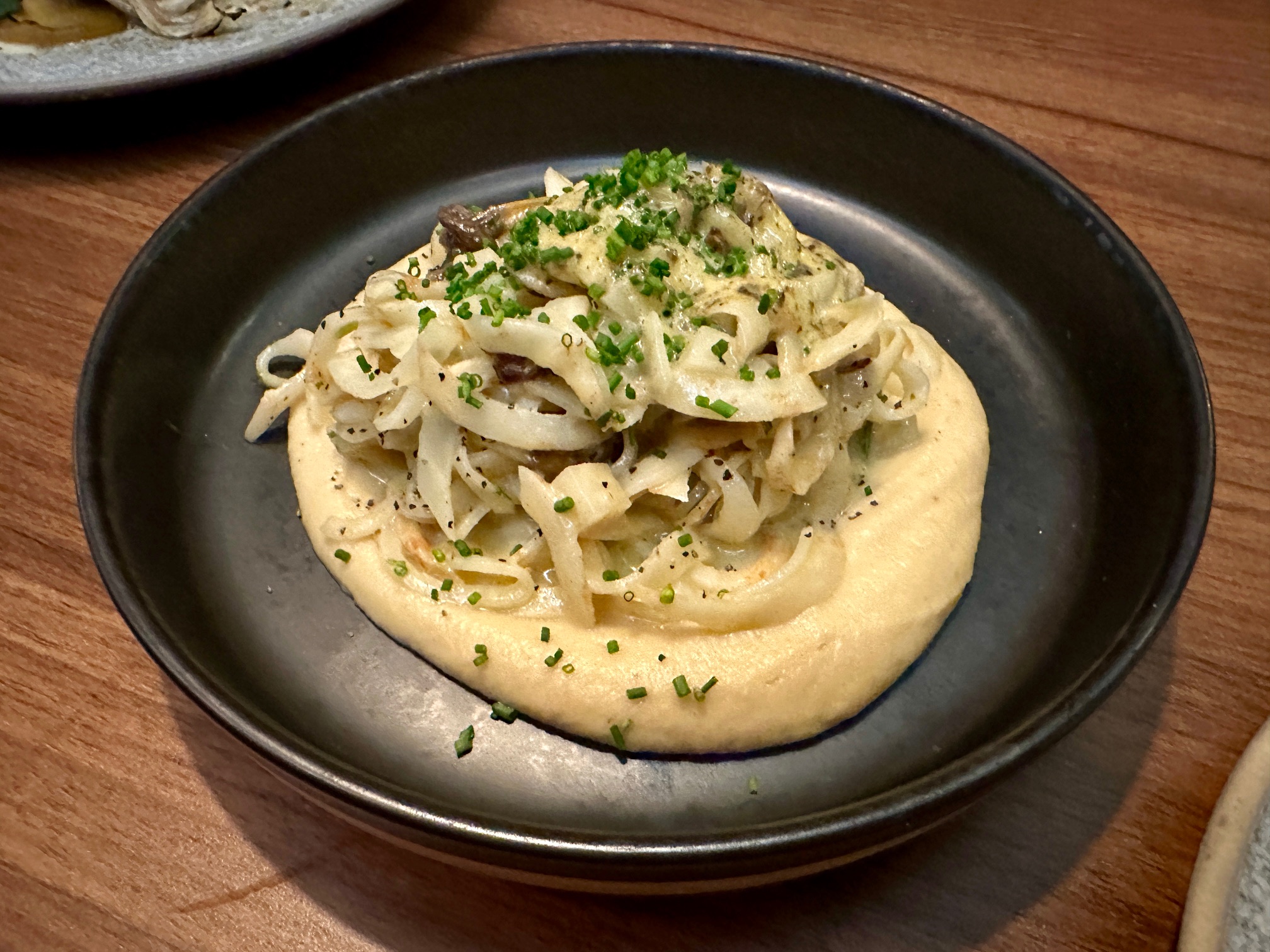
Our server asked what we made of the food and checked what we’d ordered. He said it was a shame we hadn’t gone for the celeriac cacio e pepe and we said that it hadn’t quite made the cut. So he decided to send a plate of it out to us anyway, which was very kind and completely unexpected. It really was a beautiful dish – ribbons of just-cooked celeriac taking the place of pasta, more sweet and comforting cubes of celeriac and little mushrooms dotted throughout. Clever and imaginative, like everything else, and in its way every bit as enjoyable as the cacio e pepe I’d raved about earlier in the year at Manteca.
“Isn’t it great?” said our server as he took the empty plate away. “I shouldn’t like it, because I’m Italian and making this without pasta is, well…” He shrugged at that point to indicate that he knew full well the dish was culinary heresy. “And I’m not just Italian, I’m from Rome. But the chef is right, and it’s just so good.”
The menu also recommends that you share one dessert between two people. I don’t know if it was our greed, or the small plates not being quite big enough, but we disregarded that and ordered one apiece. Mine and Zoë’s was the dish I’d seen in the photo on Uncle Gurty’s phone the previous day. Dubbed the Rolo Finesse, it was about the most high-end Rolo you can imagine – a thick wobbly layer of something partway between caramel and toffee, gloriously indulgent with just the slightest hint of miso. Beneath that, a thick stripe of a chocolate cremeux that was almost more like ganache, and beneath that a crunchy base.
That would have been enough, but malted milk ice cream on the side and more little nubbins of that crunchy chocolate holding it in place elevated this to god tier. If I’ve had a better dessert this year I can’t remember it, and if I have a better one next year I’ll be very surprised indeed. I can’t tell you how delighted I was that this one of the only plates I didn’t have to share.
James and Liz both opted for the tiramisu and again, were generous enough to let me try it. It was – no surprises by now – excellent: light yet moreish, a far more elegant way to finish a meal than the whopping slab I’d just eaten. I’ve tried a few Bristol tiramisu over the last couple of years – Sonny Stores and Little Hollows spring to mind – and for my money this was better than either.
As we sat there in the afterglow of a brilliant meal, ready to pay and slope off to the Good Measure for a post-prandial beer, we discussed A.B.O.E. in the wider context of a city full of phenomenal restaurants. We knew it was good, but just how good was it? James thought it was better than Wilsons, but he’s been burned by going there after my rave review, eating a meal which was almost completely devoid of carbs and leaving hungry: it’s made him an avid detractor. Zoë liked it even more than COR, which is pretty much the most exalted praise you can award in Bristol.
I loved it, but I wasn’t sure how to place it. The flavours had been exceptional, the service some of the best I’ve had this year. But those small plates were priced on the keen side. It required further reflection, I decided. Our bill, not including the two comped cocktails and that extra celeriac dish, came to just over three hundred pounds, including a 12.5% service charge which the staff more than earned. As we paid up, James told our server how much he’d enjoyed it.
“Way better than Wilsons” he said. He always takes pleasure in saying that.
“Thank you!” she replied. And then, before we put on our coats and made our exit, she came back.
“I know this is cheeky, but I passed your compliments on to the chef, and he asked if there was any way you could write a review saying you thought the food was better than Wilson’s? It’s really high praise.”
“Don’t worry” I said, “I’m sure one of us will.”
The funny thing is that since my meal, which I’ve thought about many times, I’ve discovered, while writing this review, that A.B.O.E. has a bit of a controversial reputation. I’ve read a review online, best characterised as a tad sneering, that criticised A.B.O.E., partly for some of the dishes but mainly, it seems, because they linked up heavily with influencers just after they opened around the start of the year. One influencer in particular, a chap the Rolo Finesse is named after as it happens, came in for particular criticism.
Well, I can sort of see both sides of that. I’ve always felt a bit icky about influencers myself, especially ones who don’t declare ads or invites, although that criticism in my experience comes better from people who don’t take free or heavily discounted food themselves.
And looking at the influencer in question’s output, I did feel about three thousand years old. Saying that it’s, and I quote, “non stop grub-a-dubdub” at A.B.O.E. is the kind of expression that makes me want to sigh all the remaining air out of my lungs, as is the observation that “every component on your plate will SLAP so hard you won’t even know what month you were born in”. Let’s not even get into the bit where he described A.B.O.E.’s roast beef as “more tender than your nan’s left arm” or their cauliflower cheese as “so peng I could have cried”.
But the point is, much as it might pain me to admit it, the guy is not wrong (well, except maybe about my nan’s left arm). I, rather, would say that the staff work their socks off and are brilliant at what they do, I would say that every element of every dish has been given serious thought and cooked with enormous skill and that, irrespective of how or whether it slaps, let alone how hard, A.B.O.E. has a very talented kitchen doing fascinating things. I guess if you put what I said into an English-to-influencer Google Translate it might end up as roughly what he said.
I can always tell when I’ve really, really enjoyed my meal because I actively look forward to writing it up, to trying to put into words what I’ve experienced. In that sense A.B.O.E. is a restaurant blogger’s dream, and I feel lucky to be a Bristol outsider because it means that, free of all that infighting and beef I can just judge the food and the experience, and say that both were terrific. The list of places I need to go back to in Bristol gets longer and longer, which makes reviewing restaurants there difficult. But as long as they keep that dessert on the menu – which I suspect they will, if only because it pisses off all the right people – I can very much see myself returning.












 Edible Reading