Some restaurants wind up so indelibly linked with the buildings that become their homes that years later, long after they are gone, you still can’t imagine another menu outside, someone else trading behind those doors. Sometimes, no other restaurant even tries: ever since Dolce Vita left its spot on the top floor of Kings Walk nobody has taken its place, but even if they did, I don’t know how I’d feel eating somewhere that, to me, will always be Dolce Vita.
Sometimes the place stays the same but changes hands, with or without changing its name. At some point I should return to Namaste Kitchen, and people tell me it’s good, but without Kamal running the front of house and that magical menu of Nepalese small plates I’m not sure how I’d overcome the strangeness of dining there. I’ll do it, one day, and when I do the review will have to have a different preamble to this one, because this one’s taken.
Ditto Spitiko, where Kyrenia used to be. The site’s the same, the menu is similar, the furniture might be too, and Spitiko may well be a perfectly decent restaurant. But in my mind it will always be Kyrenia, the place where I celebrated my thirtieth birthday, where I’d always go for mezze and kleftiko, for a bottle of Naoussa Grand Reserva and Ihor’s twinkliest welcome. Its golden age was over fifteen years ago, yet I remember it like it was yesterday.
That’s before we get to the Lyndhurst, now under its third set of new management since they hosted guests for the very last time – my wedding guests, no less. This may sound silly, but I don’t feel ready to eat there again. Perhaps this sentimental streak should disqualify me as a restaurant reviewer. But on balance I don’t think so: these places get into our hearts, occupy a place in our affections, become part of our story. Not to feel that kind of thing is not to be alive.
But of course, nearly every restaurant was once somewhere else. Buon Appetito, that I still miss, may have become Traditional Romanesc, but before that it was Chi Oriental Brasserie. And again, when Chi closed I was devastated. You know where else Chi Oriental Brasserie used to live? The site that’s now Masakali. And I was sad when Chi left that spot on the TGI Friday roundabout, too, but I was equally forlorn when San Sicario, a wonderful restaurant, gave up the fight at that very location.
All these places come and go. They make your day one month and break your heart the next: that’s what getting attached to a restaurant can do to you. Worse still, throughout it all TGI Friday has been plugging away on the other side of that roundabout for as long as I can remember. I wonder if restaurants have their own version of that well-worn maxim that only the good die young.
All this might go some way towards explaining that although new-ish Indian restaurant Tanatan opened on London Street last December, it’s only on a week night in July, months later, that I went there with my oldest friend Mike for dinner. Because even though the site was an empty shell for over two years, before that it was Clay’s Hyderabadi Kitchen, and it’s still hard for me to think of it as anywhere else.
Clay’s, where I ate for the first time before it opened, where I celebrated birthdays – mine and theirs, as it happens – where I went on random evenings because it was just round the corner from my little house, where I ate with friends, family and visitors, where I held lunches for my readers. Few rooms contain as much of my personal history as that one, so I knew it would be odd to eat there again, to eat Indian food there at that, and to know that it was somewhere new.
Tanatan’s story is a curious one, by the way. In the run up to it opening, the Reading Chronicle trumpeted that it was a high end Indian restaurant which very much seemed like the natural successor to Clay’s. Not only that, but they claimed that it was the first U.K. branch of an upmarket Indian group of restaurants with its other branches in India and Dubai.
That all sounds magnificent, and Tanatan’s website contains a menu full of temptations. There’s only one hitch, which is that there’s no evidence at all that Reading’s Tanatan has any connection to that chain at all. It’s not mentioned on their website, and in fact Reading’s Tanatan, for a long time, didn’t have a website of its own. Now it does, but the menu bears about as much resemblance to the other Tanatan’s menu as I do to Jude Law.
It looks suspiciously as if the Chronicle had flagged the name, put two and two together and come up with five, which is a mistake not even the AI that writes most of its articles would make. So, what was this Tanatan, our RG-based restaurant, like? Was it a worthy successor to its precursor, or an attempt to hop on a bandwagon two years after the bandwagon rolled north, over the river? It was time to brave that all too familiar room and find out.
Subscribe to continue reading
Become a paid subscriber to get access to the rest of this post and other exclusive content.
“I bet the word most overused in restaurant reviews is nice,” said my old friend Mike. We were sitting in the Rising Sun’s courtyard, the sun blazing down, drinkers and diners packed into the al fresco space, our empty starter plates in front of us. The starters had been, well, nice.
“I used to have a friend who said that about everything. Yeah, it’s nice. He said that about beers, about restaurants, you name it. And it wasn’t that he liked everything, it’s just that he didn’t have opinions about anything. With hindsight, not a massive surprise that he was a LibDem.”
“You say it when something’s pleasant, but if something’s bad and you don’t want to say so, you’d also call it ‘nice’, wouldn’t you?”
“Maybe, but the word I always overuse is lovely. When I write a review I go back, hit Ctrl-F and find every reference to lovely, try and reduce it to one per review.”
I do, in truth, not always succeed. Our philosophical discourse was interrupted by our very pleasant, distinctly overworked server coming to take our dishes away. “Did you enjoy your starter?” she said.
“Yes, thank you. It was lovely” I said. Mike raised an eyebrow as she walked away.
“See, you’ve used your one lovely up already.”
Subscribe to continue reading
Become a paid subscriber to get access to the rest of this post and other exclusive content.
Pappadams closed in November 2025 and is due to reopen as a new restaurant called Anjappar. I’ve left the review up for posterity.
I got an email from WordPress the other day confirming that they were renewing my domain name for another year and that, more than anything, reminded me that a significant anniversary was coming up: next month my blog turns 10 years old. What started as a little hobby has become, well, a slightly less little hobby but I can’t quite believe that a decade later I’m still reviewing restaurants and that people are still reading those reviews. There will be more about that in the weeks ahead – for which I apologise in advance – but it has left me in rather a reflective mood lately (and I apologise for that, too).
In the first year of the blog, back when Alt Reading and the Evening Post were still a thing, I published a total of 38 reviews of places in Reading. Of those 38 restaurants just over half are still trading today – a statistic which surprised me, although it does include the likes of Zero Degrees, Côte, Five Guys, Mission Burrito, Malmaison, Bel And The Dragon: chains who are still going, many years later.
But when I look back at the independent restaurants I visited in the first year of the blog, the ones that remain open in 2023, there are only three that I’ve never returned to since. Pau Brasil, although I know it has its fans, has never tempted me back. I’ve never got round to Coconut, although I did review their takeaway at the start of last year. And last but not least, there’s Pappadams, the subject of this week’s review.
Subscribe to continue reading
Become a paid subscriber to get access to the rest of this post and other exclusive content.
Adda Hut closed at some point in the summer of 2024. I’ve left the review up for posterity.
This week you get a simple, straightforward review of a simple, straightforward restaurant. But before that, I’d like to apologise to any of my readers in Woodley.
Because I’ve never reviewed anywhere in Woodley, in the best part of ten years. It’s one of those satellites of Reading that has escaped my attention. I made it out to Lower Earley – just the once, back in 2014 – although I can’t see myself going back any time soon. And this year, finally, I reviewed somewhere in Tilehurst, long an omission. But Woodley has never been on my radar. I’ve reviewed more places in Bristol than in Earley, Woodley and Tilehurst put together, a fact I know delights so many of you.
I assure you it’s not because I’ve taken against Woodley. In fact, I’ve always had warm memories of the place. The thing is, I grew up there – or pretended to – and it was the first place I lived when my family moved to Reading in the early Eighties. So I have happy memories of mucking around on the airfield, and walking the dog round Dinton Pastures, of going up the precinct and spending my pocket money in Beatties, the games shop. Of buying my teenage diaries from the Newscentre (and filling them with awful shite) and of buying new pairs of shoes every year from Milwards in time for the start of the school year. (You’d be better off wearing the boxes, my mum said most years: size twelves, you see).
I came back to Woodley after university and lived there until the late nineties and, with my schoolfriends who were also marooned there, we would go to the Bull & Chequers and drink to forget that we were stranded in suburbia. It was forever 1996, and someone in that pub liked to put enough money in the jukebox to play What’s The Story, Morning Glory? in full, from beginning to end. And that was nightlife: if you didn’t like it, you caught a coach to Utopia. Or on summer nights you could walk across Ashenbury Park to drink at the Land’s End and pretend you were in the countryside. And back then, I can’t even say I was that dissatisfied. That was enough, for a while.
Anyway, I thought Woodley’s role in my life was over and done, preserved in aspic, but then something happened which I didn’t expect: I got together with Zoë. She grew up on the same streets as I did, a few years later, and her parents still live there. So my past became, to some extent, my present and I saw Woodley afresh, through different eyes. And actually that was properly lovely. After all, it was an excellent place to grow up, and for all I know it still is. If I could tell eighteen year old me that he’d still be walking home past Bulmershe School in the summer of 2022 he’d probably have been horrified, but life is full of surprises.
One thing that has changed is that, at long last, Woodley has a few potentially interesting restaurants. Not that I ate out in Woodley as a kid – the treat was a takeaway from Hong Kong Garden, and a VHS from the video store next door if you were lucky – and for many years it was that or Red Rose, the solitary Indian restaurant (it’s still going). When the George, a bog standard Chef & Brewer pub, opened on the edge of town it was genuinely a source of excitement.
But nowadays Woodley has the highly rated La’De Kitchen, right opposite the Waitrose. It has a surviving branch of Cozze which has outlived the one in the centre of Reading. There’s a fancy-looking takeaway pizza place that looks a cut above Papa John’s and a dessert shop doing waffles, sundaes and milkshakes. And last but not least there’s Adda Hut, the subject of this week’s review.
I picked it because it just looked different enough to be worth a try – its website talked about serving the food of Kolkata, and its menu was relatively small and focused, a bhuna and dhansak-free zone. My very old friend Mike, a drinking buddy from those Bull & Chequers days, was home staying with his parents for the tail end of the year, so he joined me there on a dismal, sodden evening, the shopping precinct lashed with wind and rain.
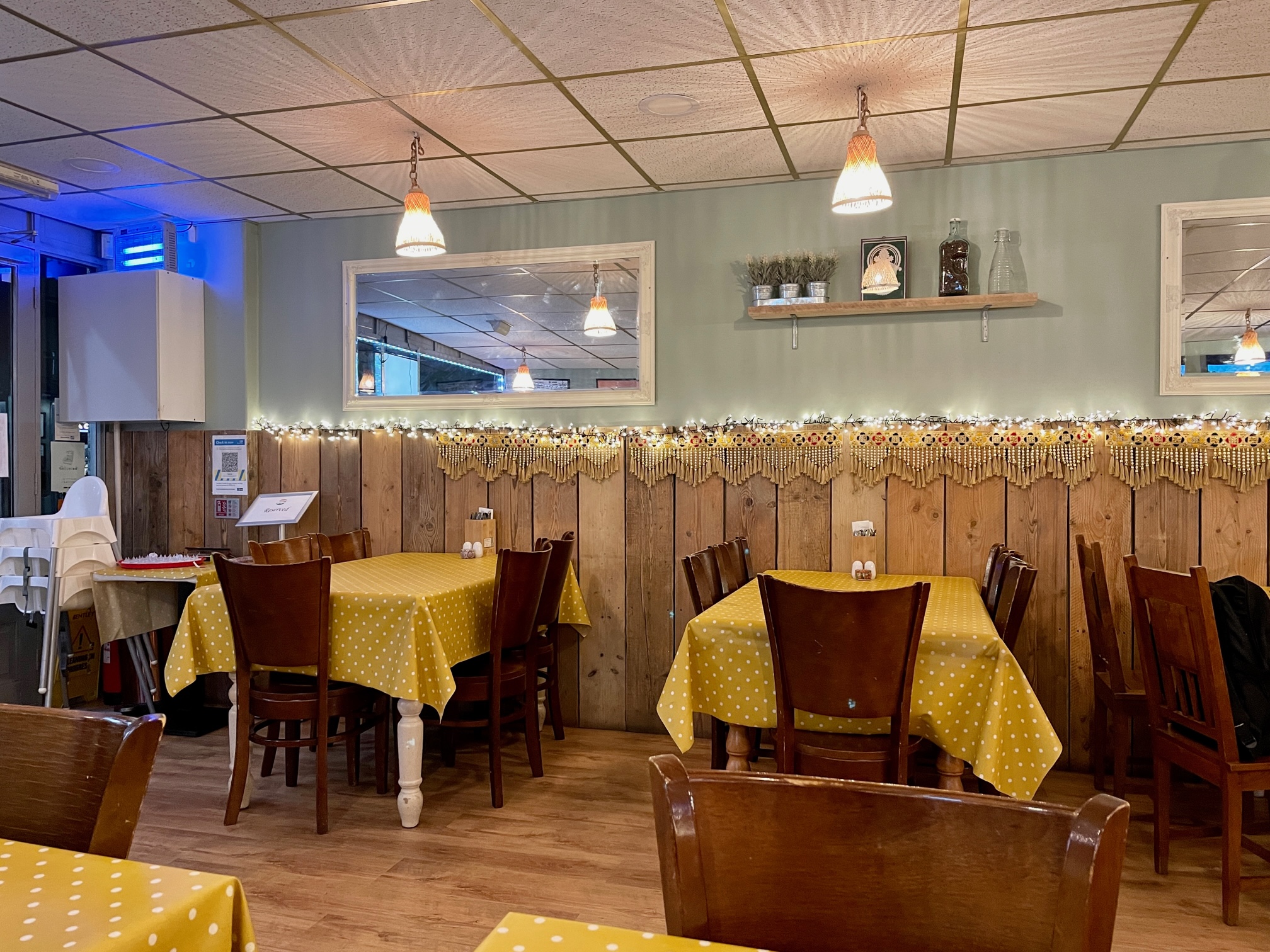
It truly was an inhospitable evening, the kind where nobody in their right mind sets foot out of doors, but even so it was jarring to arrive in an empty restaurant. I mean completely empty: one table was occupied by a couple of members of staff, one tapping away on a laptop and the other staring into space, but otherwise it was as dead as they come. It’s hard to judge a restaurant when it’s completely devoid of atmosphere – especially when it’s not their fault – but for what it’s worth I quite liked the room, all muted colours, wood panels and twinkling lights. We were the only customers all night, although I was relieved to see a steady stream of Deliveroo pickups.
As I said, it’s quite a narrow menu and that’s the first thing that alerted me that it might not be generic stuff. Ten or so starters, labelled “Calcutta Street Food”, a dozen meat and fish curries and a good range of vegetarian dishes. Two biryanis, which by central Reading standards is a starvation diet. But also, everything just looked a little out of the ordinary – lots of meat on the bone, plenty of fish dishes and many things I’ve just not seen anywhere else.
It’s a dry restaurant, although they don’t charge corkage if you want to bring a bottle, so I had a very enjoyable mango lassi and we shared a jug of tap water – the decadence! – while we made up our minds. One of the two staff members, who had the air of being the owner, came over and answered our questions about the menu, making suggestions and recommendations and pointing out specialities. I would say we played it fairly safe but fortune might favour the brave, especially if you like fish on the bone as the menu has rather a lot of that.
I really enjoyed both our starters. Their speciality is Calcutta Fish Fry, but instead we went for the fish pakora and I don’t feel like I missed out at all. It was an impressively generous helping of fish in a light and only slightly spicy coating, with just the right amount of crunch. A crazy amount of food for six pounds, and a real plate of joy. It came with a sort of acrid mustard dip which I started out actively disliking but ended up constantly dabbing more pakora into, unable to make up my mind. Mustard sauce and mustard gravy appear multiple times on the menu, so perhaps that too is a Kolkatan speciality.
Even better, and my star of the night, were the mutton chops. Now, the description here is misleading. The wait staff told me that rather than being chops they were in fact croquettes of minced mutton and potato, breaded and fried. That made me expect something a little more like the mutton rolls I’ve had before but what turned up was bigger, better and nothing like that at all.
Instead they were huge bronzed spheres, looking like arancini on steroids, with a permacrust which gave way under pressure. But if they looked like arancini, what they resembled more than anything was a Scotch egg where the kitchen has dispensed with the annoying faff of including an actual egg. Instead you just got a warming filling of lightly spiced mutton, almost haggis-like, and the whole thing was quietly beautiful. It came with two dips – a thin, red, spicy one which I loved and another which I would put good money on being ketchup.
“That was really good, and just big enough” said Mike. “I’ve got room for the mains.” This is why Mike is thin, and I am not: those starters were generous, but if they’d been twice as big I’d have had no complaints. By this point in the evening we’d spent the princely sum of twelve pounds.
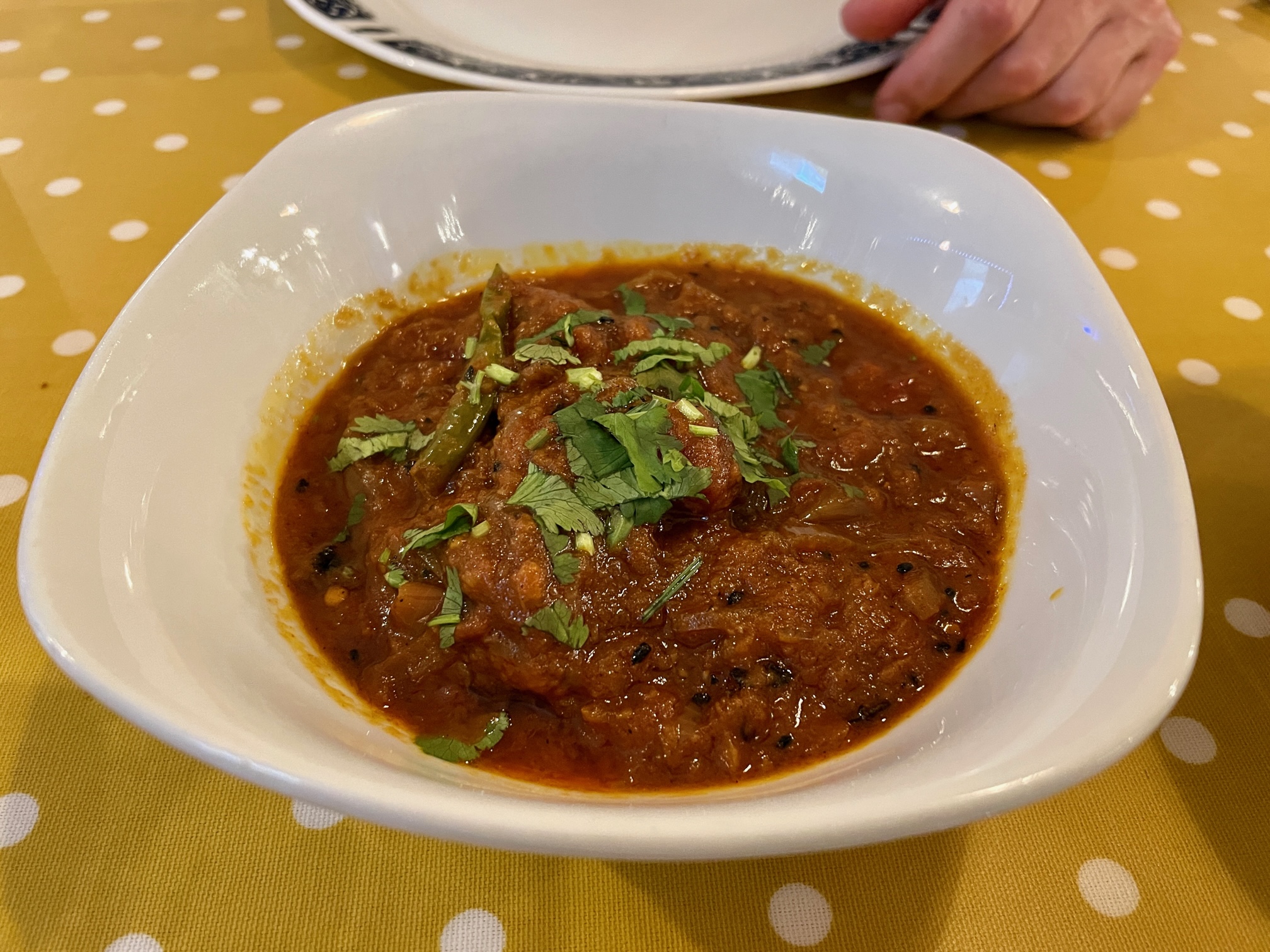
Could mains live up to that? They came pretty close. Mike wanted to try the tawa mutton curry, and it looked the part with a thick, brick red gravy. And the gravy was the absolute best bit. I loved it – deep and sticky, with thin ribbons of slow-cooked onion that suggested someone had taken their time over elements of our meal. If I’d just had that gravy with rice and bread I’d have been a happy camper, and in that respect it reminded me of some of the very best Indian food I’ve had.
And the mutton wasn’t bad, but I was expecting slow-cooked meat that broke into strands whereas this was leaner, more tender but perhaps slightly less interesting. We practically finished it all, though. I left one piece of mutton which was bouncier than I liked, but between us we polished off every molecule of sauce.
What I liked about the fish curry we also ordered was that although it looked decidedly similar to the mutton curry – you might have struggled to pick them apart in a lineup – the taste was distinctly different. This was a thinner, sharper sauce studded with nigella seeds, and big wodges of skin-on filleted fish that easily broke up into smaller pieces. Equally intriguing, although the mutton had the edge, but best of all I honestly felt like these two dishes had different start and end points. Obviously you never really know what goes on in a kitchen, but I didn’t feel like Adda Hut was using gallons of chopped tomatoes and packets of curry powder.
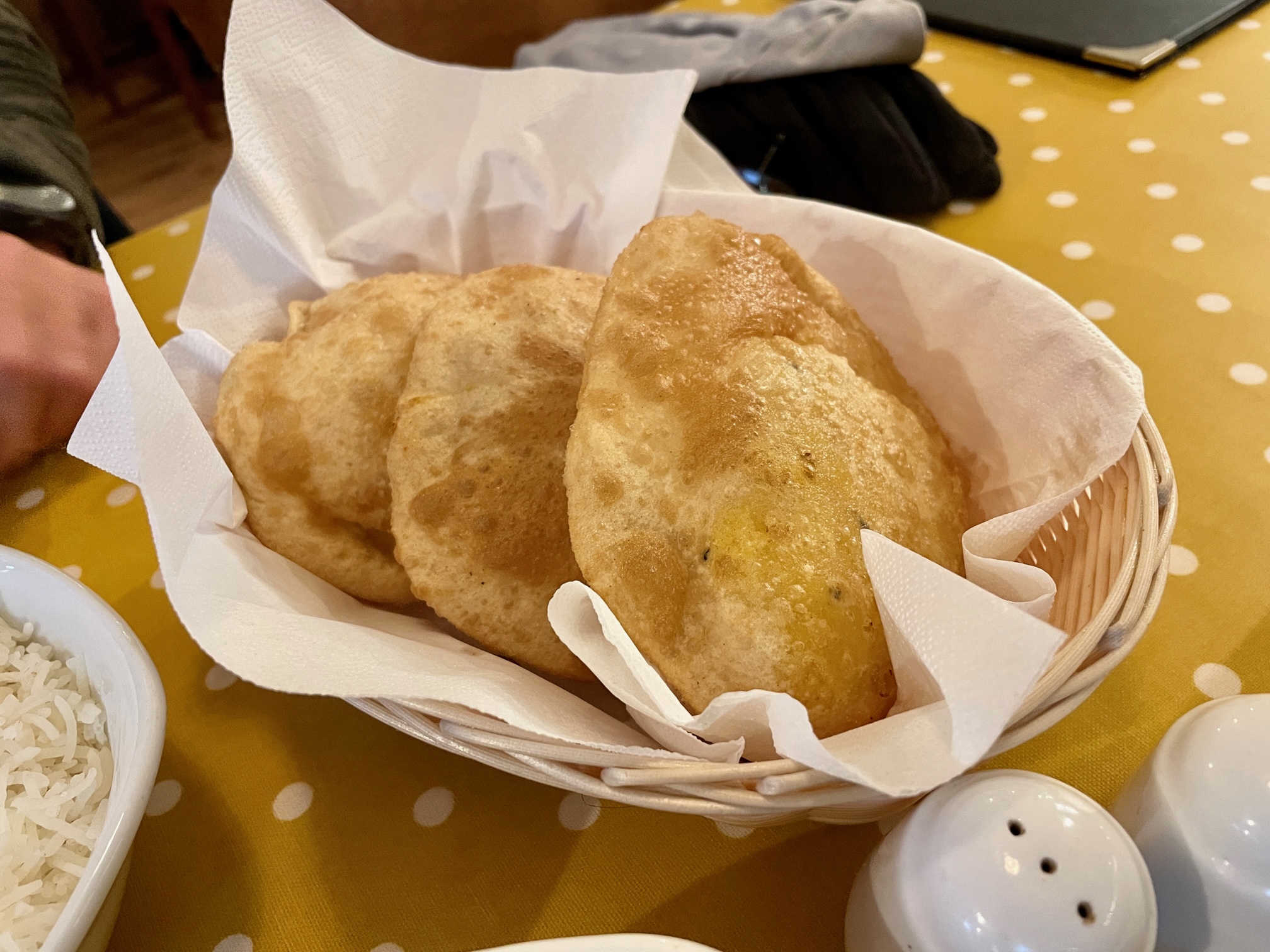
When the sauce is that good, you need to have vehicles for it. Steamed rice was – well, it was steamed rice, you don’t need me to tell you about that – but they also serve an interesting range of breads. No naan here, but paratha and puri stuffed with peas or lentils. We ordered the latter and I absolutely loved it with both curries – just a smear of lentil inside the bubble of bread, but still beautiful torn into pieces and loaded with the last of that gravy. Spice levels were slow and subtle, which is not the same as bland: I was still dabbing my nose by the end.
Our bill for all of that, including a service charge, came to just over forty-five pounds. And when the bill arrived I wished I’d tried more – given their desserts a chance, or ordered a cauliflower curry on the side. I felt bad that their one table of the evening hadn’t spent more money. But I suppose what I’m really saying is that I knew there were things I could order next time.
“How long have you been here?” I asked as the man I thought was the owner came to take our payment.
“Just over a year.”
“And how’s Woodley treating you?”
“Pretty well, actually. The weekends are manic.”
That relieved me, and we headed out into the miserable squall for a post dinner drink at Bosco Lounge – somehow going to the Bull & Chequers would have been a nostalgic step too far. Bosco Lounge was buzzing, still sending food to tables at half eight, and a large group at some nearby tables appeared to be doing some kind of art class. We had a debrief where we both concluded that Adda Hut was rather nice in its quiet, unshowy way and that we’d positively warmed to the place.
Later on I ventured back out into the relentlessly hammering rain to catch my bus, and the lights were still on in Adda Hut, although the chairs were stacked and they were giving up for the night. Bosco Lounge had felt fuller than it deserved to be, and when I passed Cozze it was still doing decent trade. By contrast Adda Hut felt quieter than it should have been, and that didn’t feel right.
I started this review with an apology to my Woodley readers, but I hope I have enough of them to give Adda Hut a try, even if I don’t necessarily manage to persuade the rest of you to head out in the direction of RG5. Because as I rushed past it brolly up, on that miserable evening, I found myself oddly grateful to this little outpost that had served me and my old friend some decent, interesting food on a night when many restaurants would have been eyeing the front door and waiting to close. A hard winter is coming, and not every restaurant will survive it. I very much hope Adda Hut does.
Brewdog closed in March 2026. I’ve left the review up for posterity.
Regular readers might remember that I first attempted to review Brewdog about three months ago, unsuccessfully as it happens. I came, I saw, I was told they couldn’t even take orders for at least thirty minutes and I sodded off. To the Real Greek instead, in fact, where I had a surprisingly enjoyable meal with my friend Steve. He still messages me occasionally just to talk about sausage (the one at the Real Greek I should say, although I think Steve has a soft spot for most sausages, so to speak).
I decided I would leave Brewdog for another day when my frustration had subsided and I’d forgotten some of the faux wackiness which had slightly got my back up – the almost illegible menu and the zany pun-ridden dish names like “Hail Seitan” and “Clucky This Time”. So I turned up with my old friend Mike on a Monday night to check it out, hoping for better luck this time.
Much was different from my last visit. In May, Brewdog had been open less than two months and there was still a huge buzz about the place. It had been fuller and louder, whereas going back now it was definitely a quieter proposition – although that might also be because I went on a Monday. Another difference was that last time I turned up on spec, whereas this time I had had already booked a table.
The site has a chequered history. It’s been the Litten Tree, a properly purgatorial chain pub known to many Reading residents of a certain vintage as the “Shitten Tree”. It’s been RYND, with beautiful interiors, rock-hard cheap seating and bandwagon-chasing knock-off American barbecue food. And most recently it’s been Public, a venue whose selling point – if you see this as a selling point – was to have board games, fussball tables and pool tables. I imagine the trendsetters went there but wouldn’t have been seen dead in the Sun, on the opposite side of the road, with its thoroughly charming bar billiards table: nowhere near ironic enough.
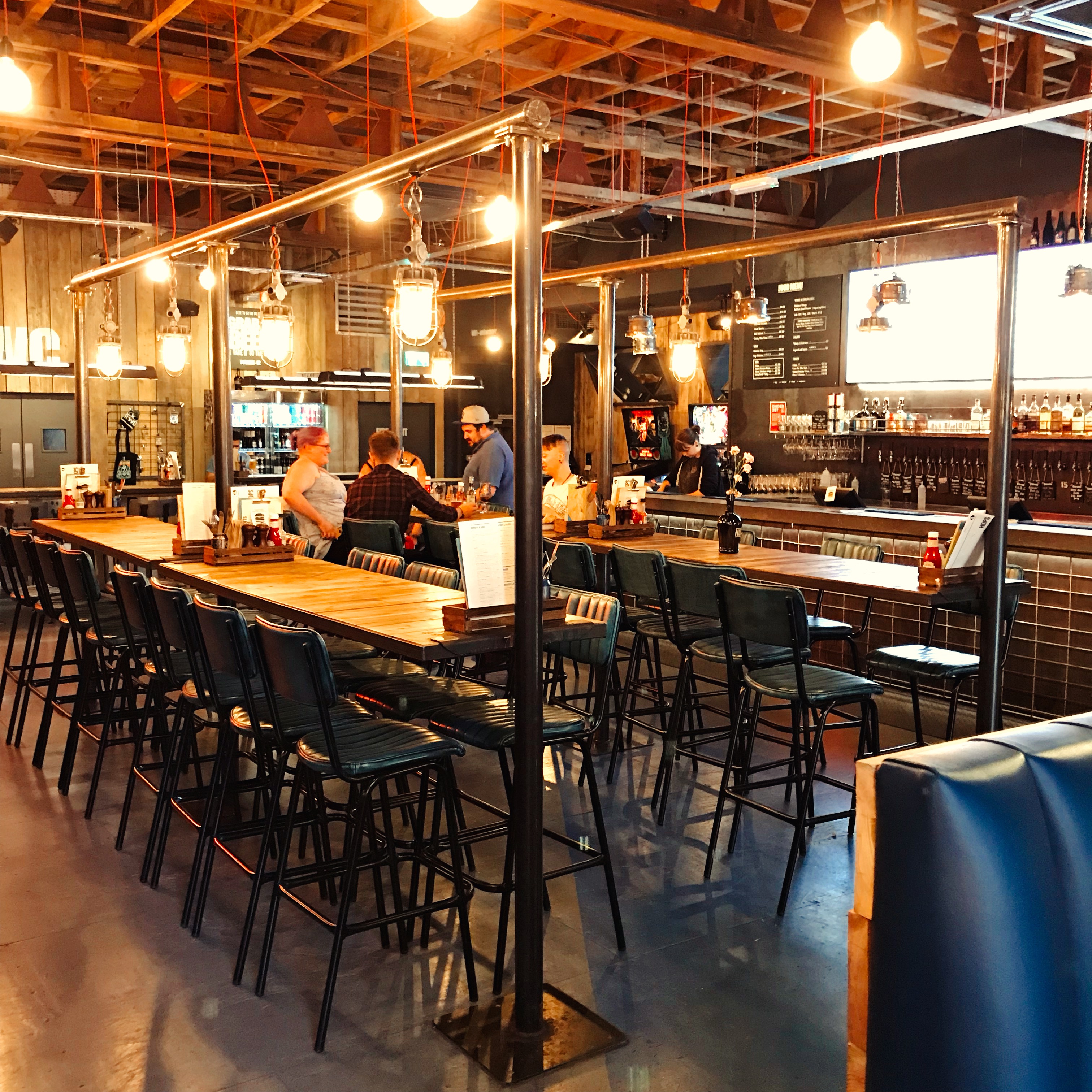
RYND, for all its faults, did a beautiful job of exposing the brickwork and then Public cocked it all up with cheapo tiles and wood panelling, so it was lovely to see that Brewdog had restored the room to something like its former glory. The large central room does feel like a beer hall, with long tables and – no surprises here – industrial light fittings. I’d asked for a booth, and it would have been nice to have been seated at one of the ones in the main room to feel more like part of things, but instead they put us in the smaller area off to the left, very much the overflow car park of the restaurant.
On my last visit, poor Steve and I waited at our table in bewilderment for easily five minutes before realising that nobody was going to come to ask us what we wanted. At the time, I wrote this off as my mistake, thinking that Brewdog was far more like a pub than a restaurant. But another difference with this visit was that a very friendly, smiley waitress came over and asked us what we’d like to drink. I have no idea whether that’s because it was quieter, or because we’d booked a table or for some other reason, and it slightly bugs me that I can’t tell you which of my two visits was more representative.
The menu was, well, burgers and hot dogs. And two salads. I couldn’t help thinking that Brewdog might have put more effort and imagination – albeit misplaced – into the names of the dishes than the dishes themselves. I had my eye on a burger from my extensive research – the “Jackpot”, with its winning combination of black pudding, chorizo and blue cheese – but I was also determined to let Mike pick first. I’m lucky that people want to come out on duty with me, so I always try to make sure they aren’t eating their second choice of starter or main.
“I quite fancy the ‘Chipotle Chorizo’,” said Mike, which made perfect sense: his mum is Spanish, after all.
“That’s fine” I said through gritted teeth, dying slightly inside as the prospect of sampling the Jackpot receded into the middle distance. “I’ll just have one of the chicken burgers instead. I love southern fried chicken.”
My first choice of chicken burger would have been the “Buffalo Chicken”, but we’d also decided to have some of the buffalo cauliflower, so I ended up going for the “Cluck Norris”: southern fried chicken and avocado. I had a sneaking feeling I had picked the menu’s equivalent of a chicken korma at this point, but the die was cast. Besides, why whinge about it to Mike when I could bide my time and instead complain to literally dozens of readers? Think of the delayed gratification, I told myself as I drank my pint.
I suppose I should at least attempt to talk about the beer, so here goes: there are a whole range of Brewdog beers on tap along with others in bottles and a range of other guest beers. Nearly everything crosses the five pound a pint Rubicon which, in fairness, probably stopped being any kind of meaningful threshold at some point last year; nowadays you just pay whatever they charge you and if you wince when they tell you how much your round is, you’re either in the wrong place or pubs just aren’t for you. The menu helpfully made suggestions about which beers paired well with each burger (Mike followed this advice, because he’s that kind of person and I didn’t, because I’m not).
Mike declared himself very satisfied with the Punk IPA and the Dead Pony, the latter specifically chosen to go with his burger. “They sell Brewdog on the continent”, he told me (Mike spends most of the year swanning around Europe running coach tours: I like to think he’s like a twenty-first century Robin Askwith, although the lack of stories of swordsmanship suggests this might be wishful thinking), “but it’s really expensive over there.” The punchline was left hanging in the air: I couldn’t be bothered to claim it.
My beers, from the outer reaches of the list, were more interesting I thought, although that doesn’t guarantee that my descriptions of them will be. I had a pint of Lighthouse by Windswept which I really liked, a “Kolsch style lager” (it means it’s kind of German, apparently – you know, like the Royal Family) which was crisp, clean and just the right side of the dividing line between bland and delicate. The Windswept website says it’s best enjoyed after abseiling or archery, which strikes me as a shame because it means I’ll never get to enjoy it in optimum conditions: never mind, I’ll live.
I followed it up with a pint of “#MashTag2018” which seems to be a beer that’s part crowdsourced through polls every year. The 2018 version, which presumably was chosen by Russian bots, was infused with hibiscus and yuzu and I liked it a great deal; the sharp citrus added by the yuzu made it smarter than the average beer. Mike had a sip and decided to order a pint of himself after he’d lapped me. He then decided that it was more fun to sip a little of it than to wade through a pint of it, which I figured served him right. Karmic payback for stopping me hitting the Jackpot, perhaps.
The burgers at Brewdog cost between nine and ten pounds and fries (or sweet potato fries) are extra, so in terms of price it’s probably largely on a par with Honest. It’s taken me until this point in the review to mention the H word, but they were very much in my mind as I had my dinner because, for better or worse, 2018 is the year that they’ve become the benchmark for all burgers in this town.
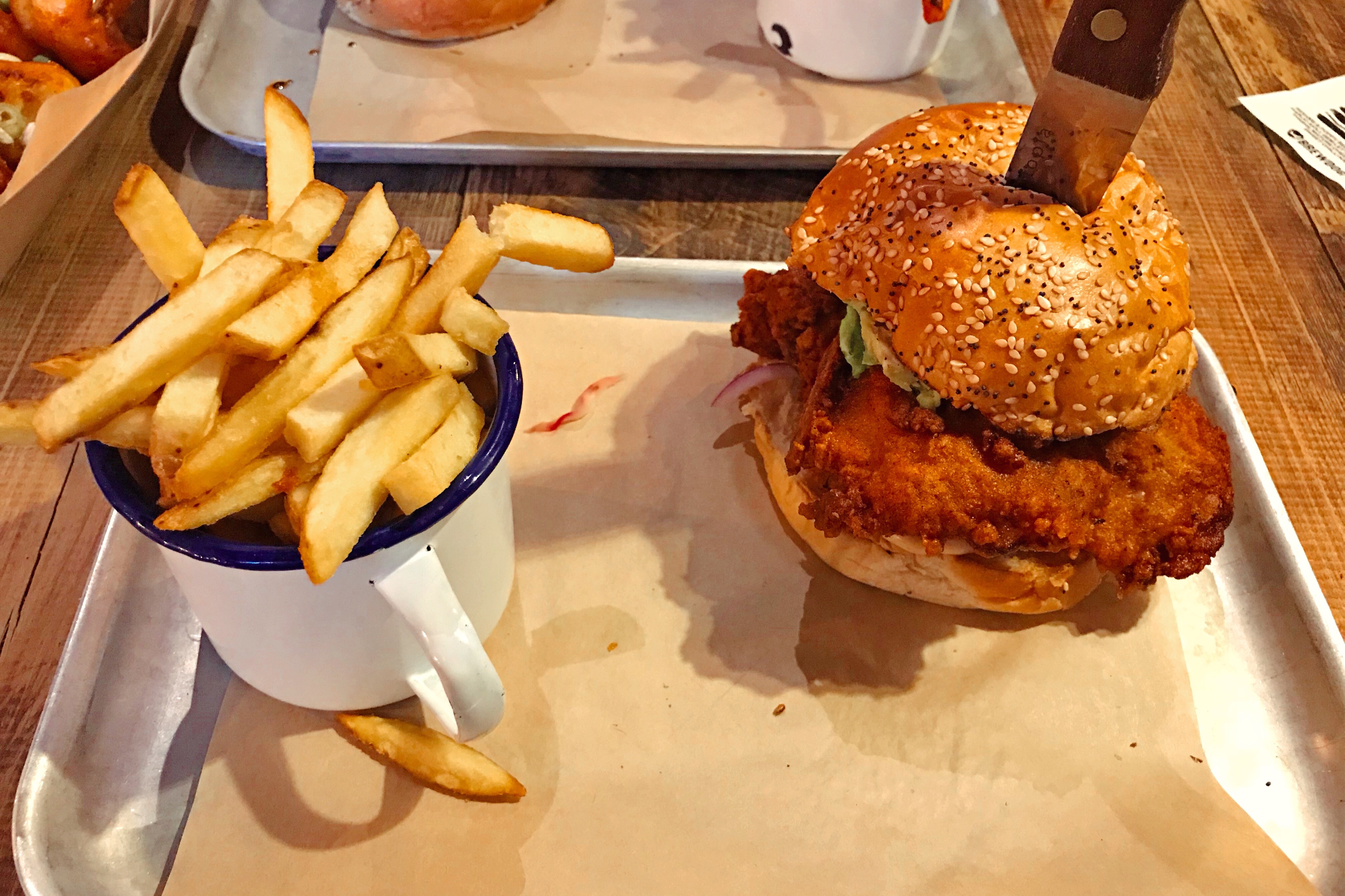
Here’s something you’ll rarely hear me say: the problem with my chicken burger is that it had too much chicken. It’s honestly true – the unremarkable-looking seeded brioche had two large coated chicken breasts in it. That might have been a dream come true if the coating had tasted of anything, but in fact it had almost no flavour at all. A real shame, because it looked the part and the texture was great, but in terms of taste it was like a mirage of KFC. This also meant that the whole thing was unbalanced because the things it really needed – the avocado, the coriander, the Cajun mayo – simply couldn’t put up a fight against all that bland fried chicken. With proper coating, less chicken and more of the rest it could have been world-beating, but as it was I actually left some of it. A knife stuck needlessly out of the top, Excalibur-style, and I couldn’t tell whether it was decoration or punishment.
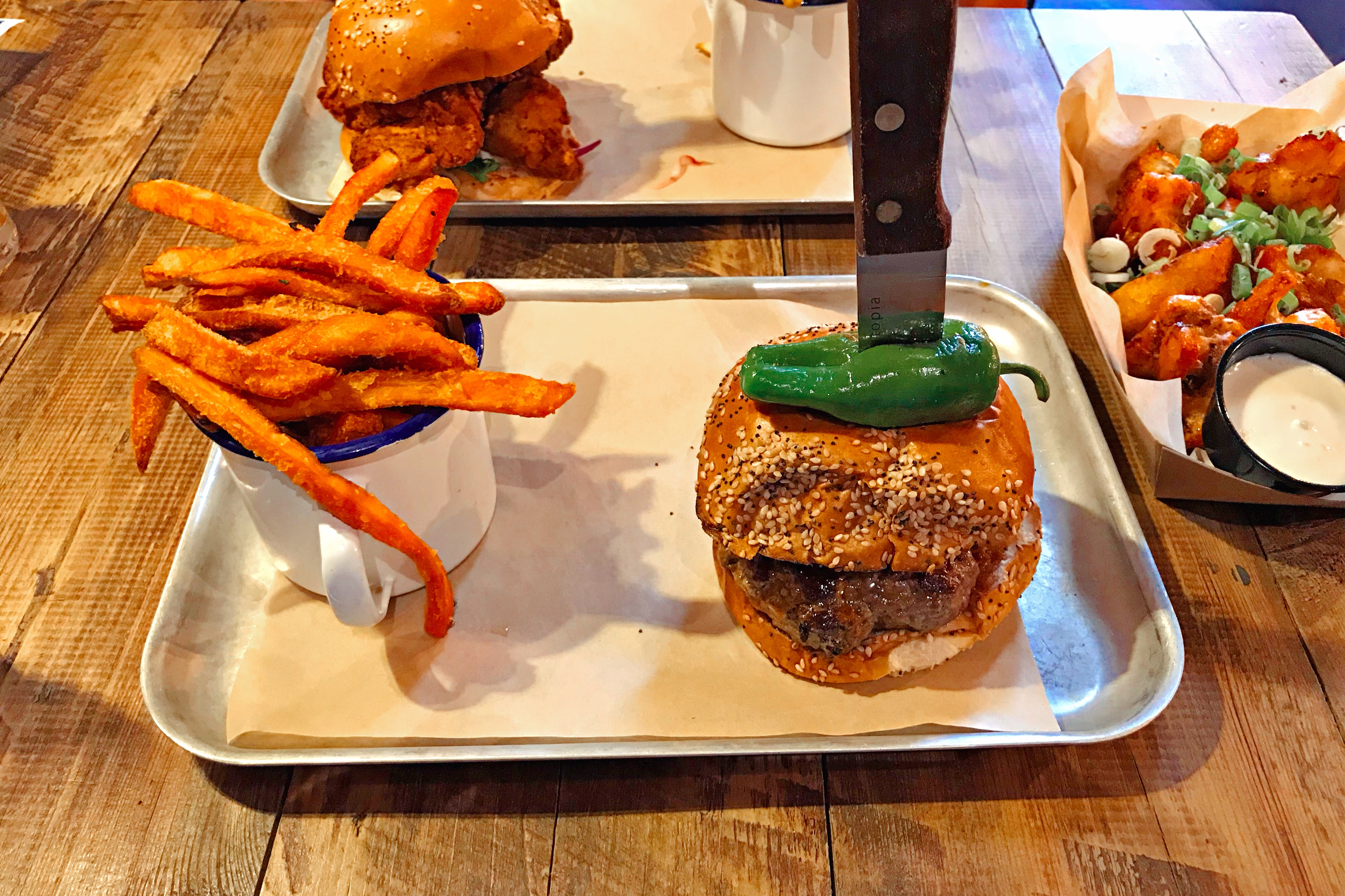
Mike’s “Chipotle Chorizo” was better, but still unspecial. The burger itself – very much cooked medium-well – was crumbly and dry and left me, again, thinking wistfully of Honest at the other end of town. The chorizo was by far the best thing in it – coarse, juicy and piquant – but the chipotle mayo didn’t add a lot and the padron peppers felt a bit random. There was one in the burger and another impaled on top of the bun – that knife trick again. I felt like Mike had got the better deal, but only in terms of shades of meh. Speaking of meh, the fries were wan and disappointing, and I didn’t have any desire to finish them all. Mike had upgraded to the sweet potato fries – they cost fifty pence extra – and this was money well spent, although probably money better spent would have involved not having fries at all.
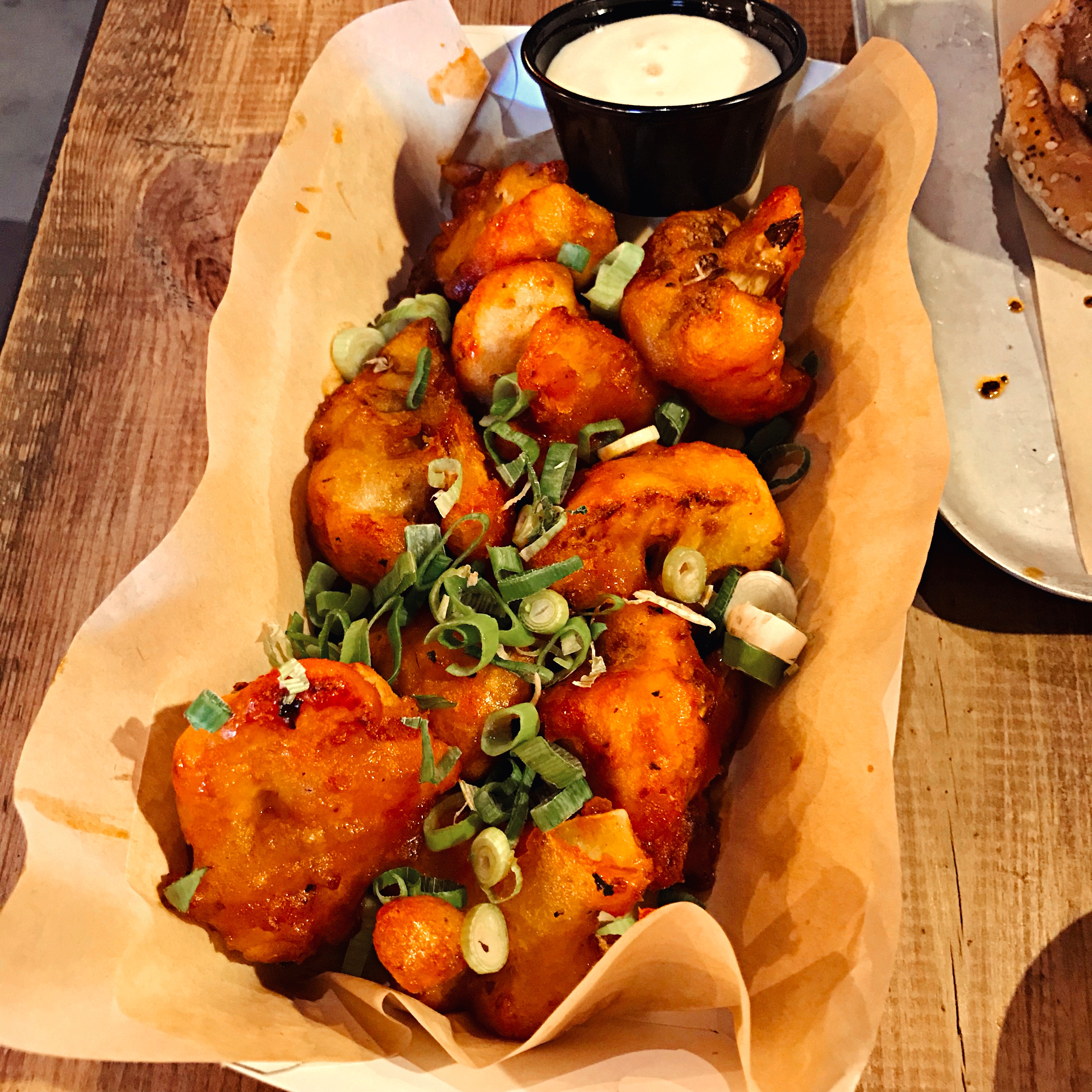
The bright spot was the buffalo cauliflower, which we both agreed was quite the nicest thing we ate all evening. Big firm florets in a hot, sour glaze, and easily more interesting than the feature attraction, a scene-stealing bit part. But even this wasn’t perfect – I liked the coating but I’d have liked it to be crunchier and stick to the cauliflower a bit better. And, when it came to it, we paid eight pounds for it, so it really wasn’t much cheaper than the burgers. Perhaps by this point I’d just run out of magnanimity: it’s distinctly possible. There was a vegan dip with it, which tasted like a photocopy of salad cream and might have appealed, if you were a vegan.
This is all getting a bit crotchety, isn’t it? I should perhaps focus on the service because it was properly lovely. Our waitress (or, according to the bill, “server”) was likeable and cheery without ever seeming fake or making us feel like miserable old shits, not that we needed any help in that department. Our bill for two came to just shy of sixty pounds, excluding service (and the menu, randomly, also gives you the option to buy a pint of Punk IPA for the kitchen: I’m not sure that would have improved matters, but it might have been worth giving it a whirl). At the time that didn’t feel like a lot, but looking back it feels like money extracted somewhat by stealth.
It’s probably obvious by now that Brewdog wasn’t my bag at all, but what surprises me is that I honestly expected it to be better. It has a small menu and I thought sticking to a few things might mean they did them well, especially when you think about how considered their brand is and how much attention to detail they’ve put into the building, and the fit out. So it’s disappointing that the food was so drab; if I wanted that kind of meal I’d go to Honest, and if I wanted that range of beer I’d walk slightly further out of town and make for the Nag’s Head.
Of course, it’s possible that Brewdog was aiming for the sweet spot on the Venn diagram where beer drinkers and food fans meet, but somehow I doubt it. It felt like the food was just there to tick a box rather than to properly complement the beer, and I found that a little sad. It felt a lot like a slightly less corporate Oakford Social Club, but when you strip away the beards the experience is much the same. What Brewdog really highlighted, for me, is one of the big gaps in the market left here in Reading. Since I Love Paella left the Fisherman’s Cottage, punters have been left with a pretty stark choice: you can have a fantastic range of well-kept beer or you can have brilliant food, but – for now at least – you can’t have both.




 Edible Reading