Restaurant review: Sapana Home

I meet Graeme off his train back from London. He is smartly dressed and layered up, because he has come from work and because he knows that it’s autumn. I am slightly parky in shorts and a short-sleeved shirt, because I have the week off and am pretending it’s still summer. He is appropriately dressed, I am trying and failing to make denial a fashion choice: naturally he is too kind to point that out.

Graeme had been keen to grab a bite to eat before we made a beeline for the pub, somewhere nice and quick, and I’d suggested Sapana Home because it was close to the station, en route to the Nag’s Head, cheap and cheerful. Besides, according to the geotagged photos on my phone I’d not eaten there in three and a half years. Never been. Would be up for that came Graeme’s reply, so Sapana Home it was.

Reading has had a Nepalese community for fifty years or so, and I expect it’s always had restaurants serving them. But Sapana Home, which opened in 2012, was the one that broke out and reached a wider audience – offering specifically Nepalese food rather than just being a Nepali take on a curry house like Standard Tandoori. By the time I reviewed Sapana, a couple of years later, it already had a reputation in Reading as somewhere central to go for good, affordable no-frills food.

It was, I expect, where many Reading folk had their first momo: it was certainly where I had mine. And from that seed grew a whole network of Nepalese restaurants. Namaste Kitchen for instance, followed by Namaste Momo and then Kamal’s Kitchen, all propelled by the charm of shy and retiring local legend Kamal Tamrakar. Dhaulagiri Kitchen up on Basingstoke Road, and its street food spin-off Momo Bros.

And that’s just for starters. There are plenty more, like Momo 2 Go, where you can eat in, Just Momo, which doesn’t just do momo, and Yo Momoz on the Wokingham Road, which doesn’t just misspell ‘momos’. What’s the collective noun for Nepalese restaurants? Regional bloggers in other cities lose their shit when they happen upon momo: here in Reading we could become blasé about them.

But it would be revisionist of me to say that it was love at first sight when I reviewed Sapana Home, 12 years ago. Because actually, when I went, I liked the momo but I was unmoved by the rest – the chow mein, the siu mai from over the border, the sukuti with soy beans, the thali and the strangely crispy jeli, deep fried batter in sugar syrup. I gave Sapana Home a pretty low rating: this was back when more people thought I was too harsh, as opposed to now when people tend to reckon I’m too kind. I said to go for the momo, settle up and quit while you’re ahead.

In the intervening years, I went back – always for the momo but often for other dishes – and I realised my view of Sapana Home was more and more unduly negative. In fairness this was before Nepalese food blossomed in Reading, and certainly before I first ate at Namaste Kitchen, but Sapana Home occupied a real place in my affections. I’ve written about it more than once – giving it all kinds of plaudits, nominating it as producing one of Reading’s 50 best dishes, saying it was the perfect place to eat solo. So how had it been over three years since I last walked through those doors?

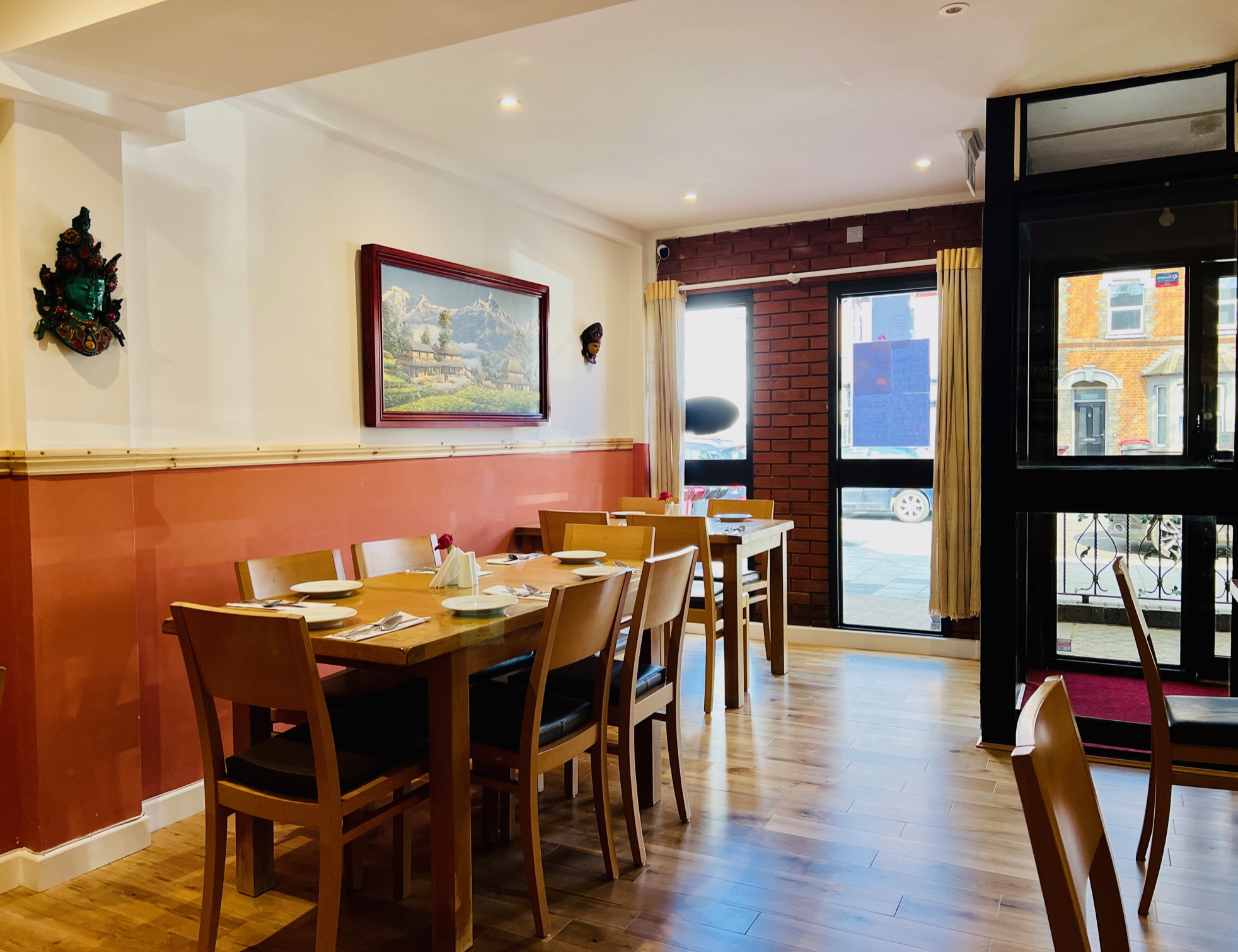
The room itself hadn’t altered much: same tables, same chairs, same awkward shape on the ground floor with a table in the window, a couple at the back near the counter and one against the wall which felt like it would be nobody’s first choice of somewhere to eat. There is a room downstairs, too, but I’ve only eaten there when there’s been no other choice and I didn’t plan to depart from that habit of a lifetime in the name of research.
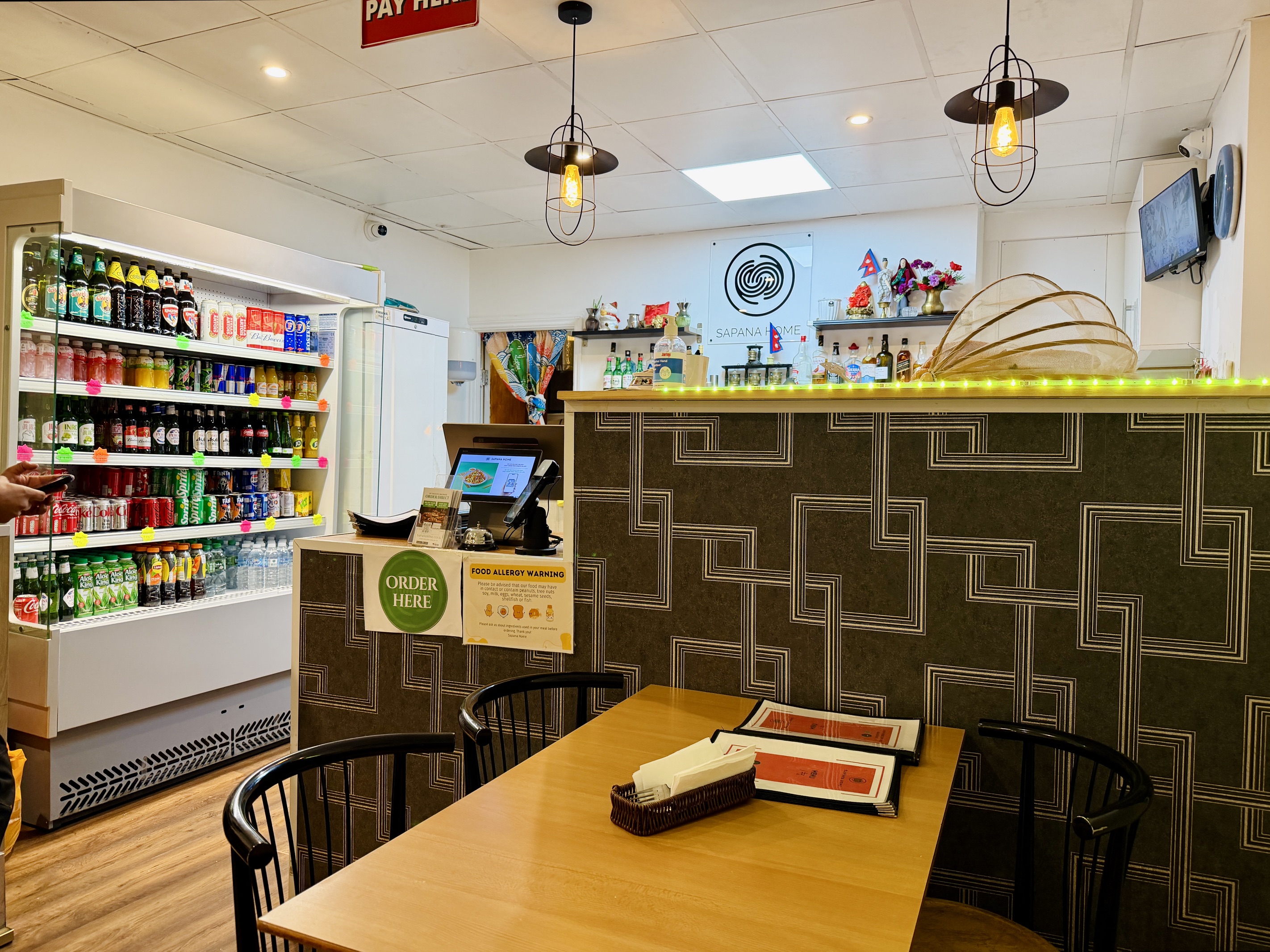
Any changes the restaurant had made, beyond replacing the bright, friendly blue and white frontage with a glossier black and yellow one, were subtle and incremental. You ordered and paid at the counter now, which definitely wasn’t the case when I last ate there, and the loud and incongruous commercial radio – I can honestly say that eating at Sapana was the only time I’d ever willingly listen to Heart FM – seemed to have been axed. The place wasn’t full when we turned up on a Thursday night, but there was a regular trickle of delivery drivers. Perhaps that was where Sapana did much of its trade.

Sapana’s menu was also much the same, which I found oddly comforting. This kind of food is not buffeted around by trends, so it still contained all the classics – momo cooked every which way, chow mein, chaats and puri, curries and thalis. The prices somehow felt frozen in time, too. Not at 2014 rates – ten momo cost a measly £6 then – but nowadays most of the momo max out at a tenner, and have done for years. Very few dishes cost more than that, and even the thalis were only £15.

How an independent restaurant bang in the middle of the town centre had kept prices so low felt like one of Reading’s great mysteries: did they have the luxury of RG1’s only kindly landlord?

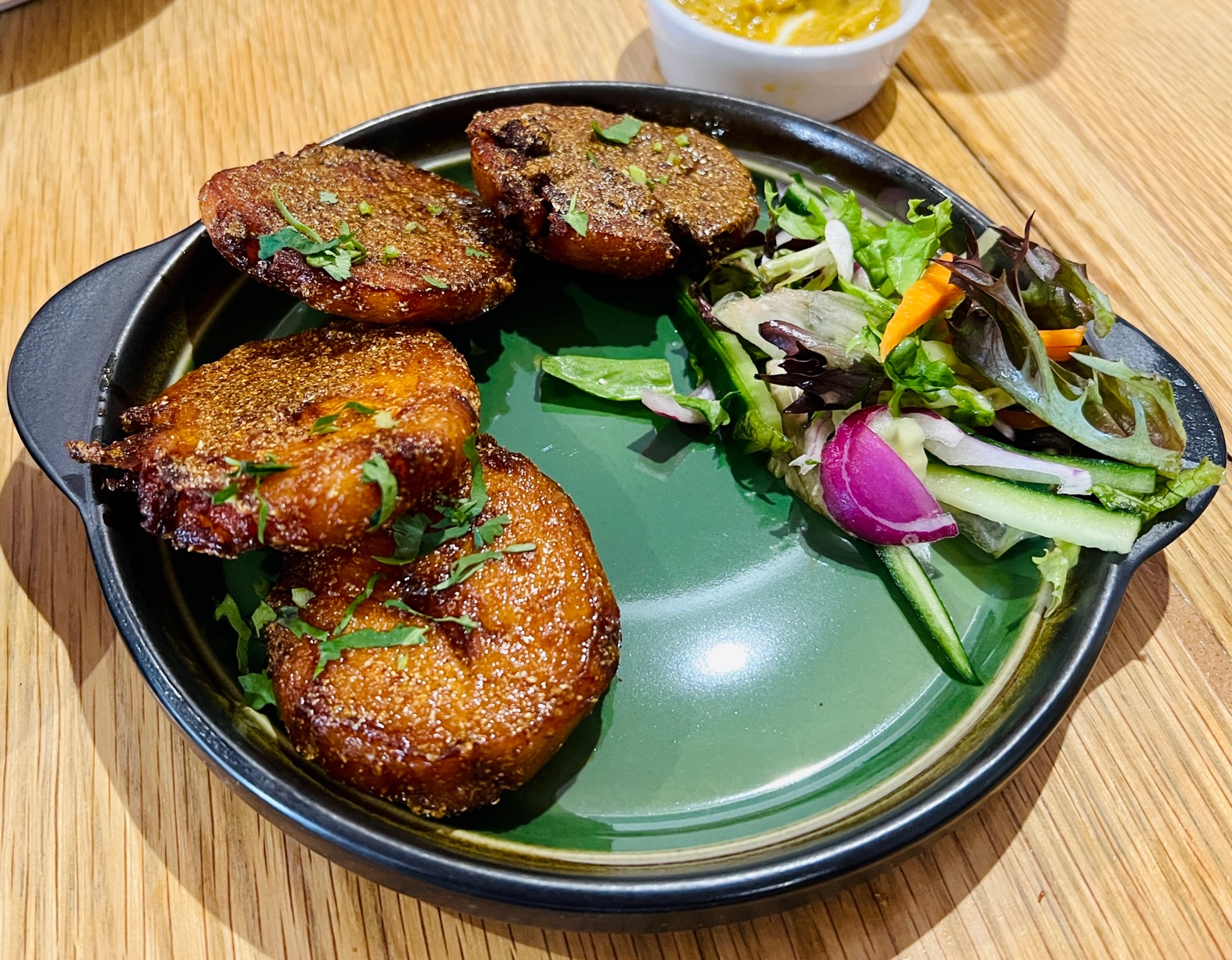
The first thing we tried was a curiosity, a misfire and I think a mistake on my part. Graeme was drawn to the sel roti, a sweet rice doughnut. You can have two of them with a portion of alu dum, a slow-cooked potato curry, for just under a tenner but, mindful of how much other food we had ordered, I persuaded him to try one on its own. So essentially it’s thanks to me that we were presented with a doughy hoop that reminded me of a Turkish simit, only sweeter and more incongruous.

“I’m sorry, this is my fault” I said to Graeme. “This is like having dessert before the main course.”

“It is a bit strange, but I think it needs stuff to go with it, that you can sort of dip it in.”

Like a portion of potato curry, I thought to myself ruefully. Graeme tested the hypothesis by dipping it in a couple of the other dishes we had ordered. It did not seem to go with either, we were to discover. But this is another subversion of the savoury-sweet partition that Western palates are so prone to: this was not in a dessert section, it was in the vegetarian section, and if it’s intended to be eaten alongside other dishes perhaps my finding that strange was more a failure of my imagination.

That misstep aside, the other dishes were unfortunately easier to dislike on their merits. Chilli chicken has been a favourite of mine at Nepalese restaurants for many years, and the benchmark is the one you can get at Kamal’s Kitchen: it’s rich, punchy and will hurt you, in a good way. This was really a very long way from that, the chicken dry and tough, the peppers and onions without char or caramelisation, the sauce watery and one-note. I have absolutely no idea what a lemon wedge is doing on top of this dish, apart from having as little fun as we did eating the bloody thing.
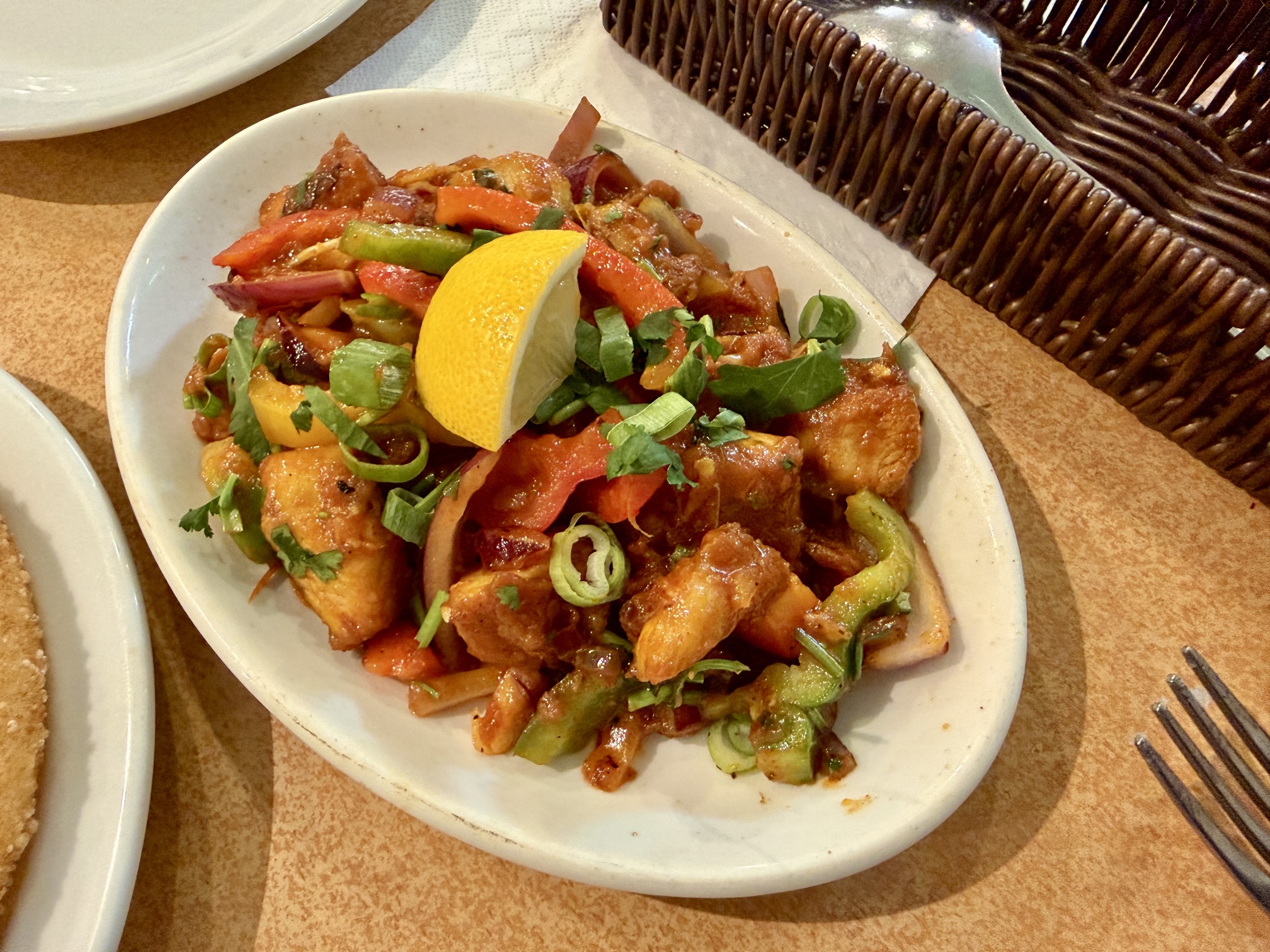
And it’s not just the inevitable comparison with Kamal’s Kitchen’s rendition of chilli chicken. More instructive, though, was comparing it with Sapana Home’s in days gone by: a picture of the same dish, on my phone, ordered back in 2022 was like night and day. In that, the sauce was glossy, thickened, potent, coated everything. That was the kind of dish that would make you fight your dining companion for the last piece of chicken, the last glorious piece of red onion, the last sweet but fiery strip of yellow pepper.

By contrast in 2026, Graeme and I did not finish this dish. Nobody was clamouring to tear off another piece of the sel roti and trawl the depth of the dish for every last molecule of sauce.

Even stranger was a dish I’d never tried before, the sadheko pork. This was meant to be marinated pork belly in a tomato gravy, packed with chilli and spice. What it was instead was big wobbly sections of pork belly: to Sapana’s credit these did feel more like they’d been exposed to a primary heat source than the chicken, with more evidence of textural contrast.

A bit too much textural contrast, actually. It was jarring to find pieces of bone studded throughout the pork belly, and I’m glad that Graeme made that mistake before me, because without him acting as the advance party this was the kind of dish that could cost me £12.50 at the till and considerably more at the dentist.
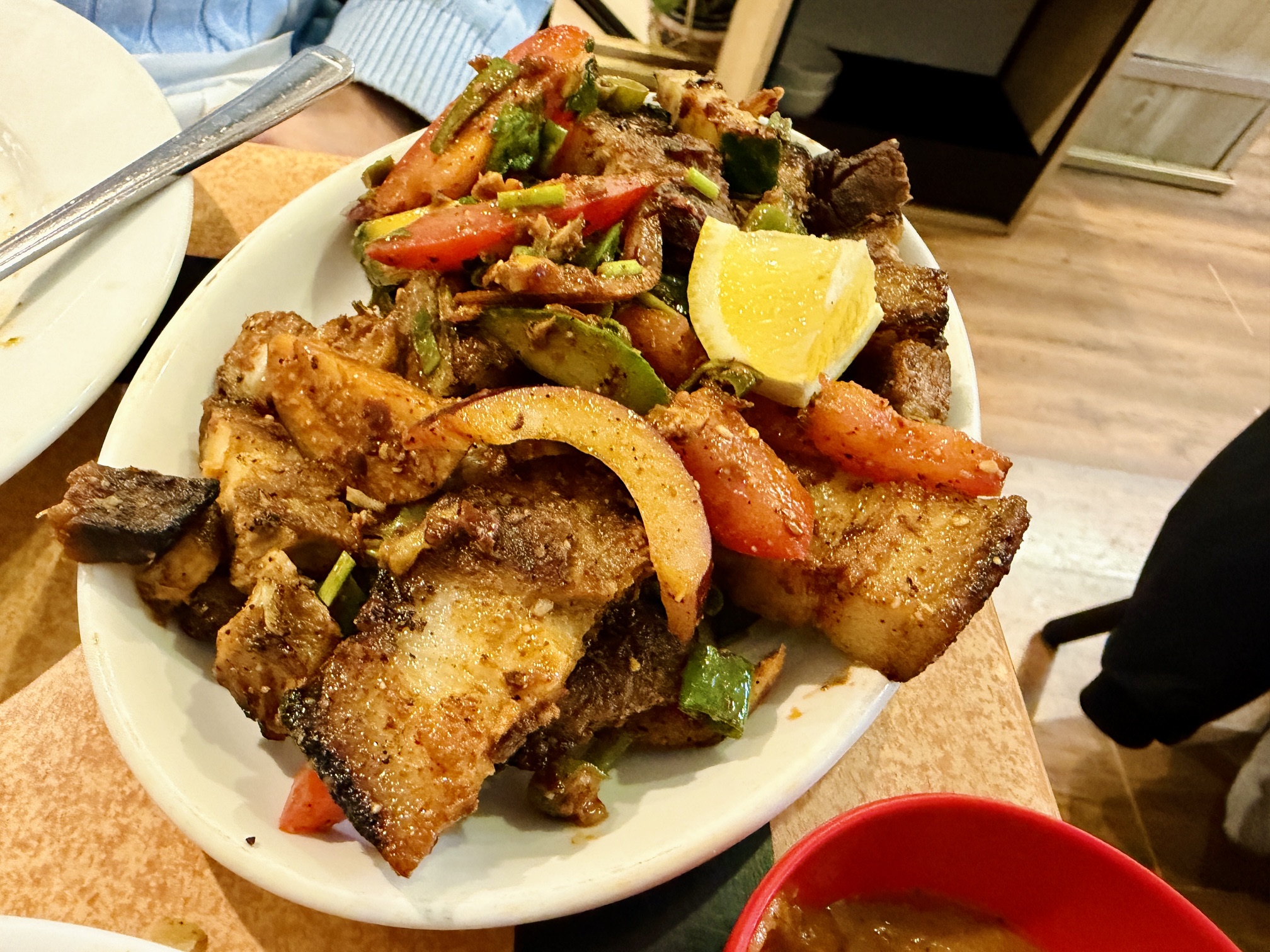
But even without that, the dish was a curious beast. There was no gravy of any kind, making the whole thing more like a dry fry. There was another ornamental lemon wedge, which I found very odd indeed. And I would say that the idea of citrus in this dish didn’t make sense, but if anything it was worse than that because someone had taken a heavy hand to the citrus already. I don’t know what exactly went into the marinade, but that pork tasted so much of lime that it was dangerously close to Toilet Duck territory. Again, we left a fair amount.

The rest of our meal hewed closer to Sapana Home’s traditional strengths, the reassuring carbs that Nepalese food does so well. I really enjoyed the chow mein, tumbled through with really enjoyable nuggets of sukuti (dried buffalo at a guess, although it could have been lamb). Graeme was not sure about the spicy sauce that came with it but to be fair, the first time I tried a Nepalese chow mein neither was I. It was only further down the line that I came to appreciate this spin on a dish that, previously, I had only ever eaten from a Chinese takeaway.
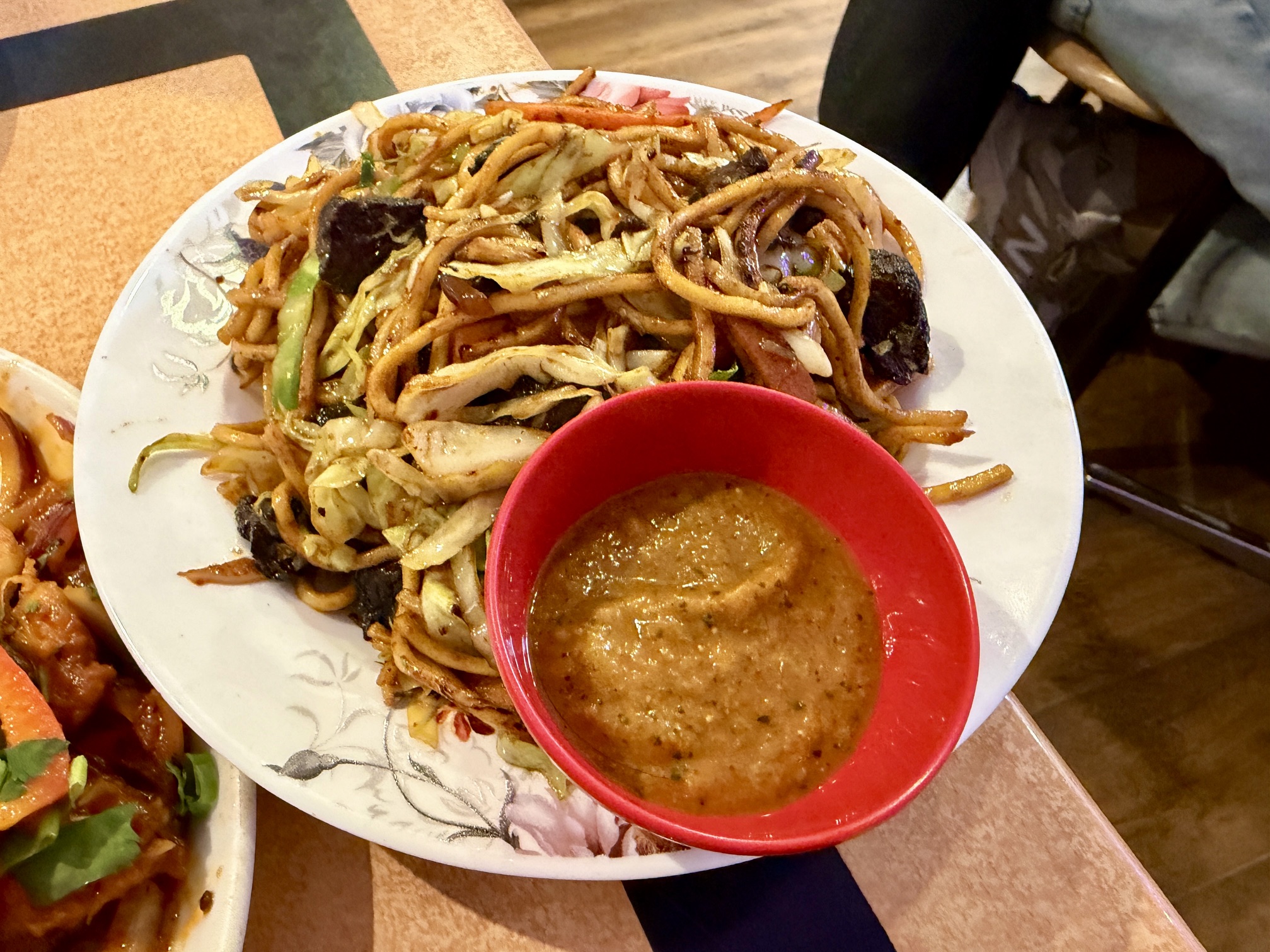
This was the kind of dish you could drop into Sapana Home for after work, to hunker over in the miserable months that are just around the corner. Thinking about it, there have been many times when I did exactly that.

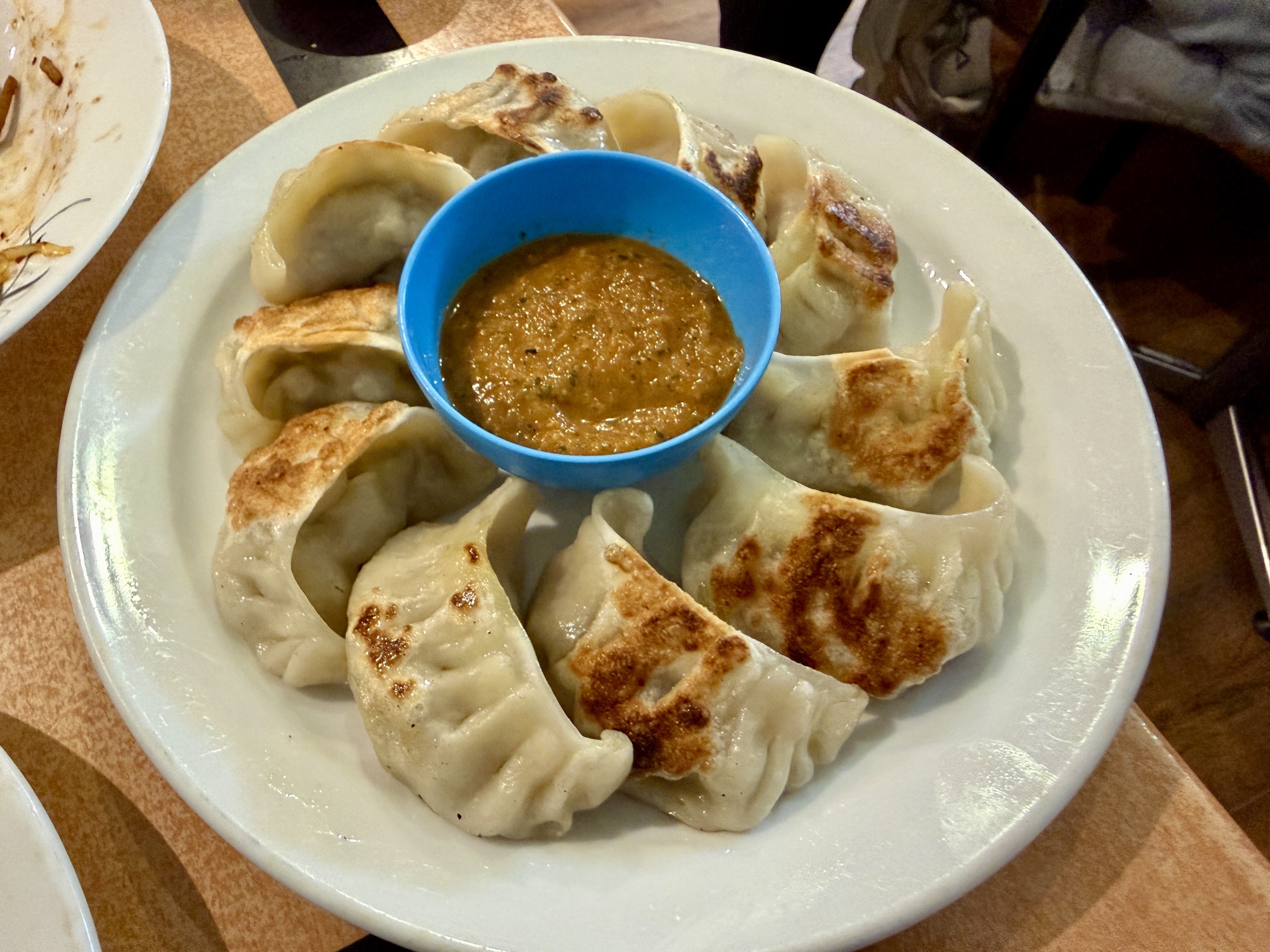
I’ve saved the best ’til last: Sapana Home’s momo are still marvellous. We went for pan fried, as I usually do, stuffed with buffalo and they were easily the highlight of the meal. I really needed them to be good, because at that point my confidence in Sapana Home was wobbling and I didn’t want this to be one of those reviews, where I revisit a place to find that anything I liked about it was gone.

That wasn’t the situation here. The casing was still just the right thickness, with that glowing tan only pan-frying can induce. The filling was still generous, plumping each parcel out, and I think buffalo is worth the extra quid, even if it takes the cost of ten parcels of pleasure over the £9.99 rubicon. Sapana Home’s momo are still up there with the best of Reading’s momo peddlers, and if the chasing pack has caught up with Sapana in the fourteen years since it opened in the centre of town, it is still a tricky proposition to overtake.
All that, plus a couple of extremely tall and very good mango lassis, came to just shy of £60 including service. Sapana Home is still a relatively inexpensive place to eat fairly well, but I was struck that the two carb-based dishes remained the value propositions: I’m not sure anybody should go there to eat the other dishes we tried.

Over post-dinner pints at the Nag’s Head, I wondered whether I would ever go back to Sapana Home if my first impression of it in 2014 had been the same as Graeme’s that night. But then I realised, thinking more clearly, that that had been my impression the first time I ate at Sapana Home: the carbs were good, the momo were terrific and the rest felt like it wasn’t for me. It was only through returning and persevering that I found the other dishes to like on Sapana’s menu, although it felt sad and unfortunate that they let me down on this occasion.

But that’s the point about restaurants – they neither exist nor change in a vacuum. In 2014 Sapana was the only momo joint in town, and Reading’s gastronomic scene was in its infancy: no pizza explosion, no glut of sushi places, no high end chains like Honest and Pho changing the landscape. So in 2014, a spot like Sapana would get more chances to get it right than it might today, when money is tight and nobody goes to a restaurant – unless they’re an idiot like me – with an appetite for risk.

So in 2014 I visited Sapana Home, I wasn’t sure, and then I grew to love it. I went often for a long time and then I put it to the back of my mind for three years. Going back now I can see the nucleus of what I liked – it’s still there – but time moves on and I wonder whether Sapana might get left behind.

What will be interesting is to see if this sparks Graeme to go again, when he’s straight off the train after a long hard day and keen for carbs, and whether it’s the start of him having the kind of relationship with Sapana that I once had. My guess is that none of that will happen, because Reading is such a different place now. But I’ll ask him, next time we’re down the pub.

Sapana Home – 6.6
8 Queen Victoria St, Reading, RG1 1TG
0118 9509898

https://www.sapanahome.co.uk

Since January 2025, Edible Reading is partly supported by subscribers – click here if you want to read more about that, or click below to subscribe. By doing so you enable me to carry on doing what I do, and you also get access to subscriber only content. Whether you’re a subscriber or not, thanks for reading.
Restaurant review: Just Momo

For all the people in Reading and beyond on Ozempic or Mounjaro, despite all the weeks in the last few years when I’ve joined my ever-optimistic wife on the Fast 800 diet, there remain some times when there’s a big hole in your life and only carbs can fill it.

I’m not saying carbs merit their own tier in Maslow’s hierarchy of needs the way, say, wi-fi does, but carbs are the unconditional love of food, the thing that softens the edges: no wonder we talk about lapsing into a coma after eating them. They are the thing that nearly always makes the world feel better, cosier and less harsh. Well, that and ice cream – but even I, an inveterate ice cream lover, would concede that ice cream is chiefly for the brighter months, while carbs are a friend for all seasons.

That said, carbs come into their own during our winters, which seem to take up most of the year once summer ends, with their chilly, dreich, gathering gloom that makes the soul sink. My brother was over from Australia at the start of last month on a short notice family visit and he loved the greyness, the lack of blue skies. But he felt that way because it was summer back home, and hot as balls there.

By contrast, he found shivering on the terraces watching Maidenhead United in his specially bought winter coat and gloves, his newly-purchased polyester scarf costing less than the ticket for the match, somehow magical. Even so, as he drove me home after the match he admitted that he wasn’t sure whether he could hack four months of it. I sometimes wonder how any of us do.

When it comes to epitomising carbs I know people put Italian food on a pedestal, with its twin exemplars of pizza and pasta. But I always think Nepalese food is a bit of a dark horse in this regard; I know it has other jewels, its sukuti and sekuwa, its phenomenal pressed potatoes, but when I think of Nepalese food the thing that comes to mind first is momo. And then, if I can think beyond momo, I also consider Nepalese chow mein, with the hot sauce that separates it from its Chinese sibling.

Reading is extremely lucky to have a significant Nepali community, and it means that we are well represented when it comes to Nepalese food. And that, in turn, means that Nepalese food has been bringing Reading in general, and me in particular, comfort and joy for well over a decade.

For a long time, for me, that meant momo at Sapana Home. Nearly a decade ago, in the depths of my divorce, when my flat was no longer a home I would stop at Sapana Home on my way back from the station and order ten pan-fried parcels of succour, with a mango lassi chaser. There was a specific wistfulness I felt when I finished the sixth momo and knew that the plate, and my respite, were nearly over: the Germans probably have a word for it.

In happier times there was the glorious autumn of 2017 when I discovered Namaste Kitchen, and the hospitality of Kamal, at the foot of Katesgrove. I would walk there from my little house in the Village with the slightest of provocation, any excuse at all really, and self-medicate with cider, momo and chow mein: the rest of that year, gastronomically speaking, was made up of four magnificent months.

And in the depths of the pandemic, when Kamal had moved to his eponymous kitchen on the Caversham Road, it meant delivery bikes scuttling from there to our little house in the Village when only Kamal’s carbs could shut out an attack of the glums. I must have lost count of the number of deliveries from Kamal since he opened, both at the old house and this one, and whatever those orders contain they always feature chow mein and momo: to omit them would be unthinkable. Zoë would mutiny if the former was missing, I couldn’t do without the latter.

Three weeks ago, Zoë and I got off the train at Reading and we knew it was one of those nights. We’d been to see my dad in the hospice, and it was in relative terms a good visit. He had a sheet of exercises and told us he planned to start doing them, that he had been using a walking frame to reach the bathroom in readiness for when he was discharged home. He was so set on getting back to his house and his bed: he asked me what films he should watch when he made it there, talked about the things he was looking forward to doing when his life returned to normal. And we played along, because we didn’t know how else to handle it.

His speech seemed stronger than it had been, and it was a shame to leave. But we knew he was ready for us to go because he asked what we were doing that evening, his coded signal that he wanted to get some rest. I told him we were going on a mini pub crawl with Zoë’s CAMRA compadres, an event I always enjoy, and he appeared to like that answer.

It was an evening when we could believe we’d all had a false alarm, even though the hospice staff tell you, with the wisdom of years of experience, that patients often rally soon after they reach the hospice. It was the last time Zoë would see my dad alive, but none of us knew that then.

Even though my dad was on good form, relatively speaking, those visits take something out of you, make you think, make your mind go to places you’d rather it didn’t. So when we got back into town we only had a little time to decompress before having to go to the Greyfriar, be social, talk beer and pubs and buses with Reading CAMRA’s brilliant bunch. That hole was yawning and carbs could fill it, so I thought of Just Momo.

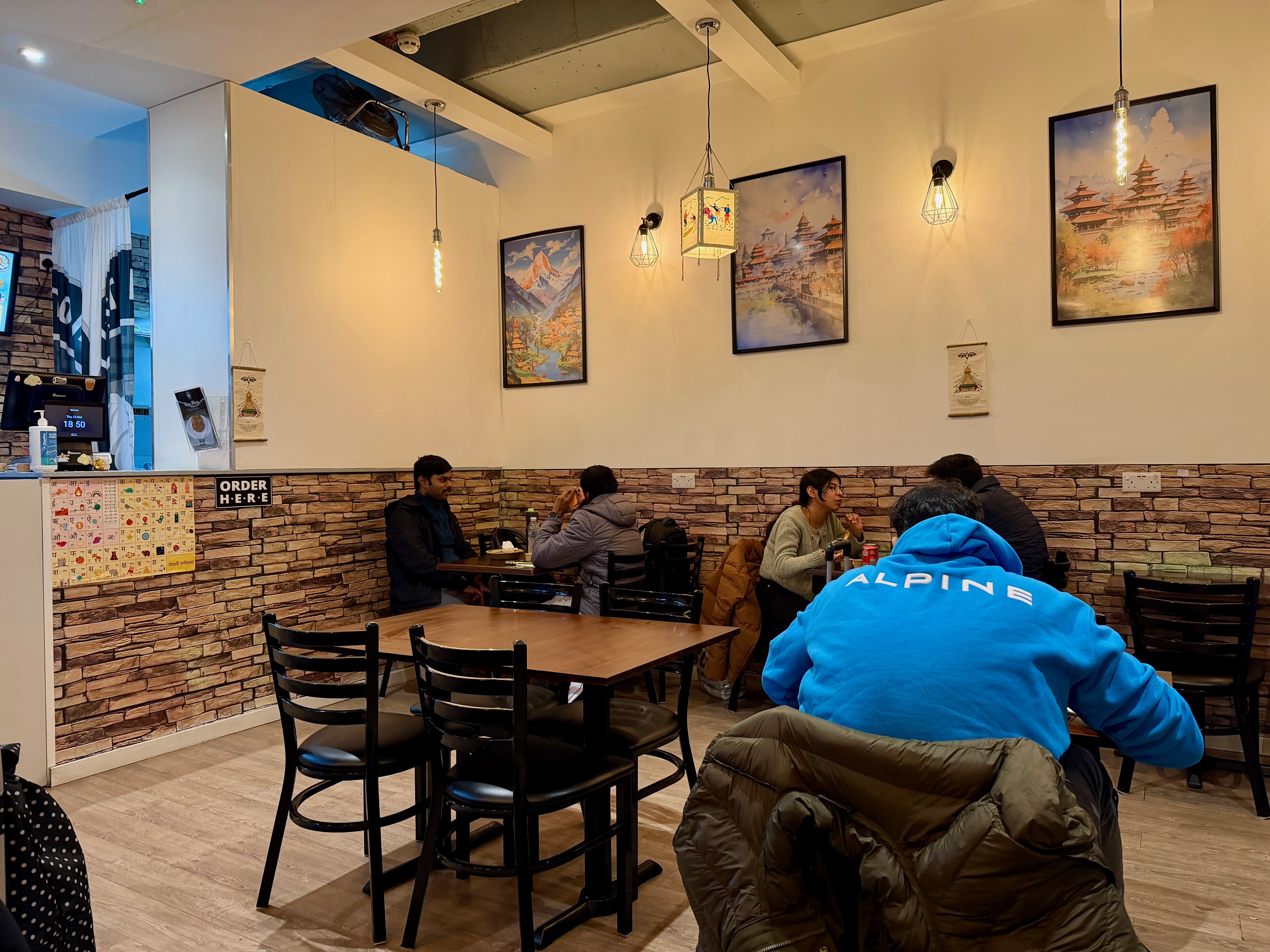
It’s on the same run of restaurants as pizza rivals Paesinos and seemingly permanently closed Amò, but of a slightly older vintage: it opened in winter 2024, the first of those sites to start trading. And the inside is pleasant, generic and featureless: a biggish box of a room with framed pictures on the wall and a real mélange of light fittings, from traditional to modern to bare, illuminating its basic tables and chairs. Only the exposed brickwork effect around the walls was bizarre: made of 3-D vinyl rather than flat wallpaper, and oddly spongy to the touch.

The restaurant was doing well when we arrived just before seven, with a fair few tables occupied. I was going to say that most of the customers were desi, but having had a preemptive Google it seems that Nepali people don’t identify with that term, so I won’t.

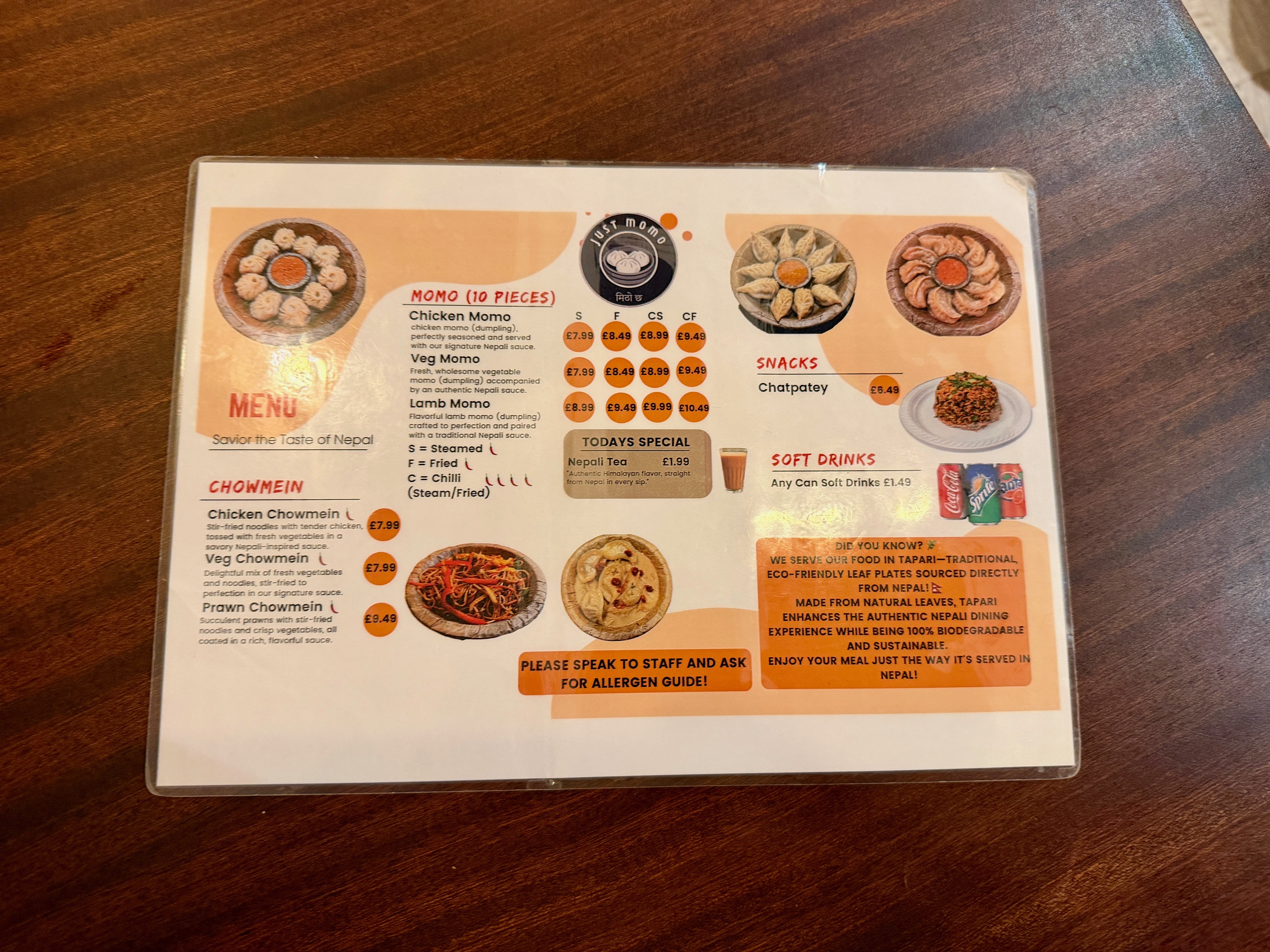
Just Momo is a bit misleading calling itself that, because it also does chow mein and one other dish, chatpate. But that’s hardly grounds to complain and their menu is a visually appealing, stripped down model of simplicity. It takes possibly the two most accessible dishes in Nepalese cuisine and sticks them front and centre: you can have chow mein with the protein of your choice, you can have momo any which way, but you’re going to be eating chow mein or momo or, if you have a hole in your life that only carbs can fill, both.

I say that you can have momo any which way, but that’s not strictly true. They come steamed or fried, in chilli sauce or plain, and they are chicken, vegetable or lamb. So no kothey, or pan-fried, momo, no jhol momo in broth and no buffalo (or buff, as Nepalese menu always term it) momo of any kind. Some momo purists might find that limiting but I didn’t, even though kothey momo are usually my first choice.

I went up and ordered a couple of types of momo, because Zoë shares momo, two portions of chow mein because Zoë likes, as she puts it, personal chow mein, a soft drink for her and a sweet Nepali tea for me. All that set me back just under £40.

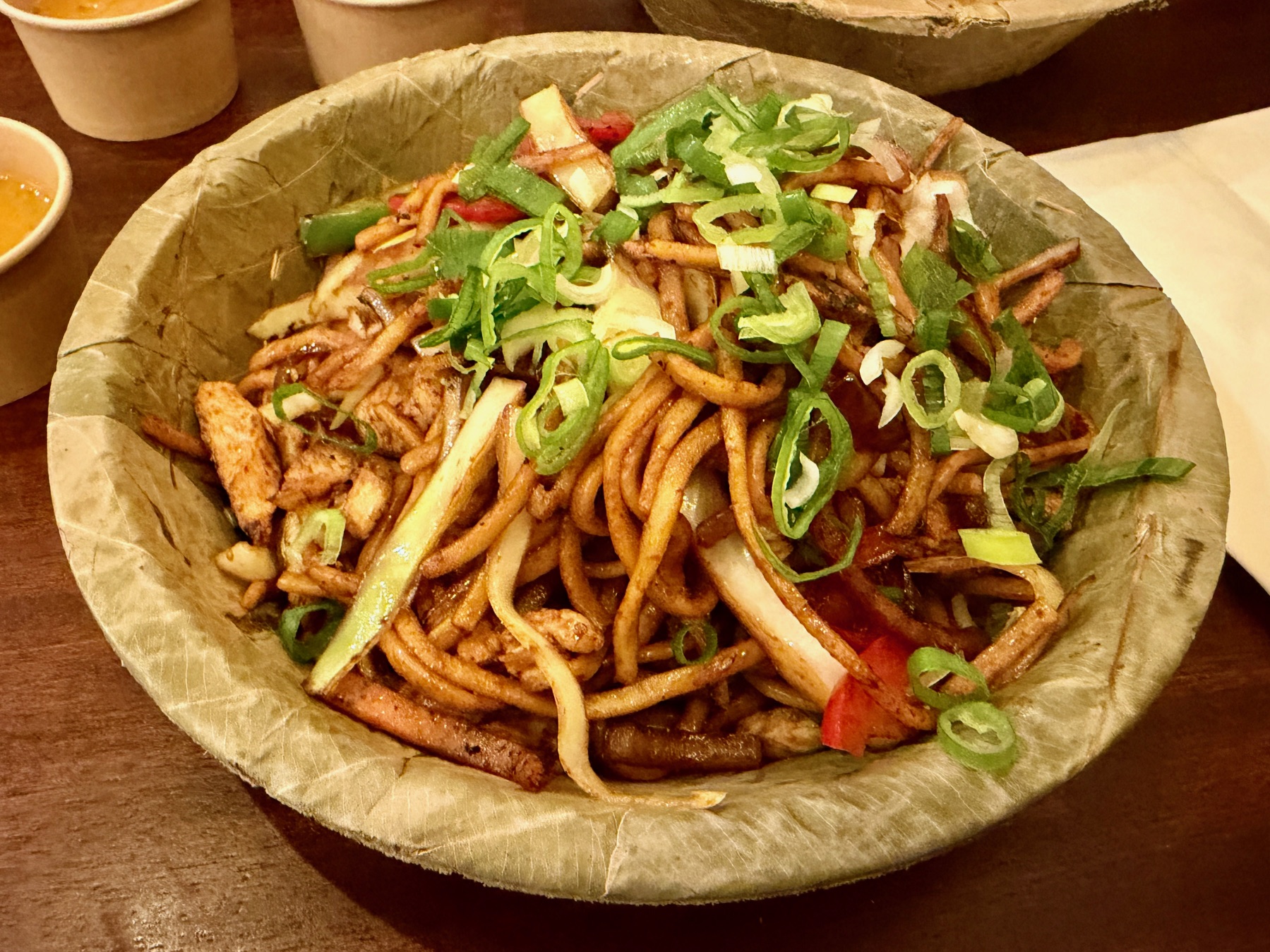
Fifteen minutes later, out it all came and it was extremely gratefully received. The chow mein was more than acceptable, full of veg, topped with herbs and spring onions, tumbled with thick strips of chicken, noodles with plenty of bite. It only took a forkful to remember why this dish can be such a tonic, and if it didn’t quite hit the heights of Kamal’s Kitchen’s rendition it wasn’t far off, and besides Just Momo’s location is a lot more central.

It needed the sauce it came with, but it made me think of how welcome dishes like this can be and set my mind off in a reverie of all the great noodle dishes out there, from Me Kong’s Singapore noodles with their dusting of curry powder to the soy-laced wonders of Oishi’s yaki soba. Three cuisines, one giant gastronomic group hug. The fug dispersed slightly, the spirits began to lift. Everything was working as it should.

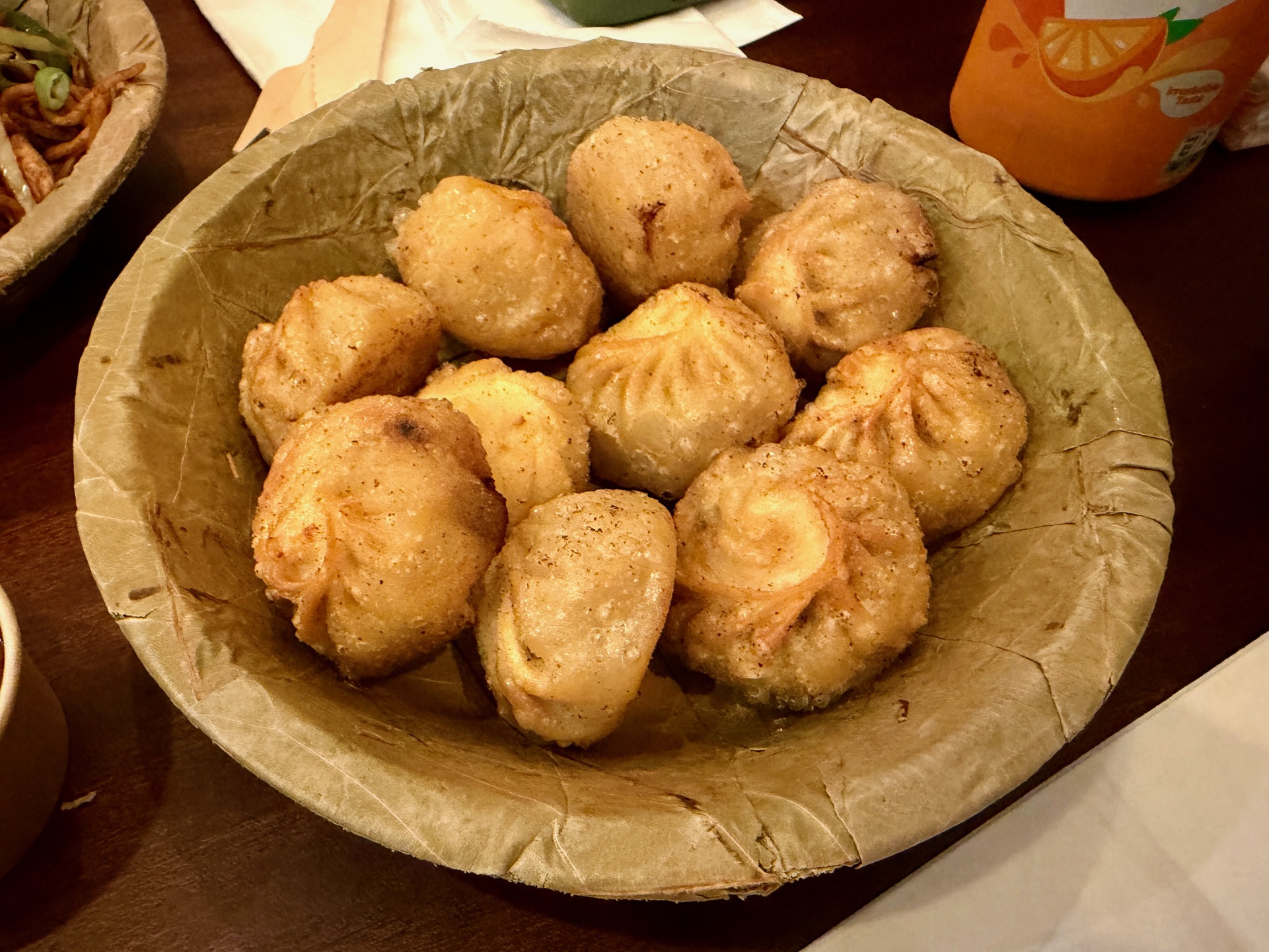
If the chow mein was good, the momo were even better. Just Momo’s Instagram page shows them painstakingly making them by hand and these certainly didn’t feel bulk made and previously frozen. Fried lamb momo were piping hot, beautifully crispy bubbles kept from floating away by a gorgeous ballast of generously filled ground lamb. Having had these at Kamal’s Kitchen and at West Reading’s impressive Momo 2 Go I have to say that Just Momo could give either a run for their money.

Ten for just shy of a tenner still constitutes impressive value inside the IDR, where costs were prohibitive before everything got more expensive on April 1st and are only going to get worse. When I update my guide to solo dining in Reading, this place – and this dish – are going to be in serious contention. I also loved the fact that this, and all of Just Momo’s dishes, come in eco-friendly leaf plates “just the way it’s served in Nepal”, even if the green credentials you get from that are wiped out by flying them over from the motherland. I was less keen on the wooden knife and fork, but never mind.

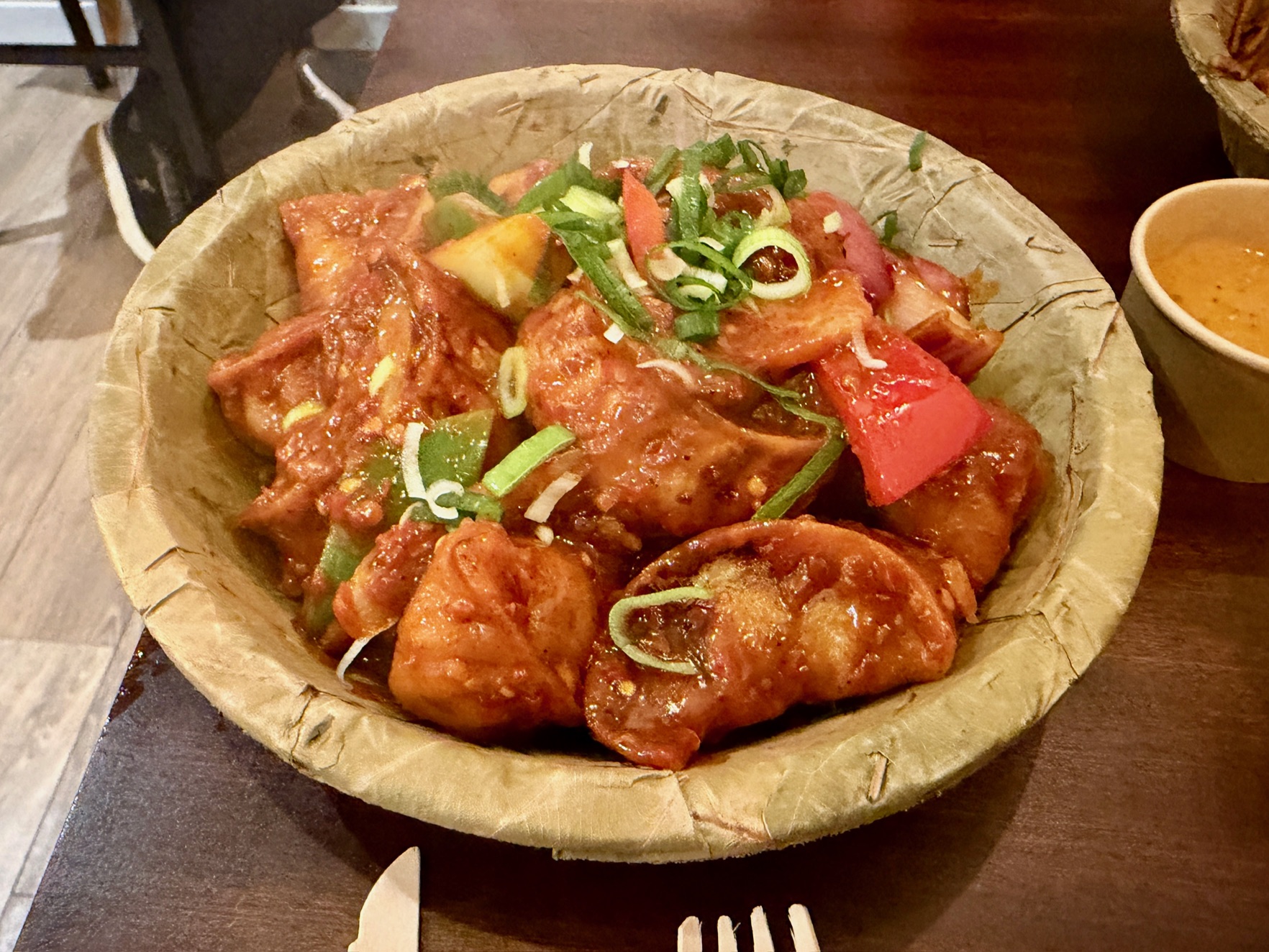
Chilli fried chicken momo were a different permutation of brilliant but no less enjoyable. I loved the chicken filling, although I should really have had the chicken momo unadorned to make a fair comparison with the lamb: that’s next time sorted. But if I couldn’t judge them in isolation from crunchy peppers and a thick, punchy chilli sauce which clung to every crinkle of every dumpling, that was hardly a tragedy.

The overall effect was a plate which rounded out our order rather than just offering more of the same. And again, hats off to Just Momo for not bloating their menu with chilli this and Manchurian that, not trying to offer something for everyone the way restaurants on Reading’s newly dubbed Curry Mile – people are trying to make it A Thing – sometimes do. No Indo-Chinese or South Indian interlopers, just a tightly honed menu that offers a few Nepalese crowd pleasers. If you don’t like them, go elsewhere. But really: if you don’t like them, check yourself before you wreck yourself.

Service was lovely and friendly, as warm and sweet as my very enjoyable Nepali tea. I found myself thinking about the randomness of life as we finished our meal at Just Momo. Presumably they had their pick of the units on that run as the first tenants, and perhaps if they had chosen Amò’s spot and Amó had been forced to take their site Amò would be the ones still trading and Just Momo would have the sign outside their door for three months saying “closed for refurbishment”.

If I hadn’t liked Just Momo, I might have shaken my fist at the skies about that, but much as I miss Amò I loved Just Momo, so I was glad they dodged that bullet.

The rest of the evening was just what I needed after the day I’d had. Zoë and I joined the Reading CAMRA brigade in the pub, drank nice beers, chatted merrily about all sorts and I could almost forget, for a few hours at least, where I had been earlier in the day and what lay ahead. Drinks in a pub might have achieved that on their own, but I don’t know. I think it was the welcome of Just Momo, misnomer and all, and their array of wonderful carbs that proved the turning point. I am grateful to them for that, and I’ll be back to enjoy more of their food, on the flimsy pretext of repaying their kindness.

One little postscript, because I somehow feel I want to say it: I have had the strangest fortnight. Two weeks ago, on the date of my last review, I went to London with Zoë to celebrate my birthday. I had a wonderful lunch at The French House, wandered off to buy fragrance I wanted but did not need, photographed some Brutalism, drank Belgian beers at one of my favourite London pubs. The following morning, unexpectedly, Zoë and I were at the hospice for the last time, my dad’s room silent and cold, him finally at peace and free from pain.

And the day after that, because it had been booked for months and was badly needed, Zoë and I flew to Màlaga for our first holiday in six months. I spent a week in the warmth, happy and sad and guilty, drinking vermouth in my dad’s honour – every single time – my mending arm gently baked by the incessant sunshine. Shorts on, legs out, sandals on, living the best life I could manage, under the circumstances.

It is an incongruous experience to grieve on holiday, to feel like crying in your favourite restaurants and a beautiful hotel room with the nicest view, with your best friend. I can’t say I recommend it. I have no prior experience of this, really, and it’s weird and unsettling that it’s never constant, always intermittent. Right now it feels like it might be constantly intermittent for ever. Having a lovely time, wish you were here: I didn’t send a postcard but I thought it, often.

When we got back last Friday, we turned the heating on and unpacked and sat on the sofa, home at last. The holiday was over and impending reality was looming, nowhere near the horizon. Discussions and decisions awaited, as did conversations and condolences. I felt that hole again, the kind that carbs can pretend to fill, and because I couldn’t think what else to do, Zoë and I ordered takeaway – chow mein and momos, of course. I will say this, though: they were delicious. They almost worked.

Just Momo – 8.0
4 Kings Road, Reading, RG1 3AA
0118 2294634

https://justmomo.uk

Since January 2025, Edible Reading is partly supported by subscribers – click here if you want to read more about that, or click below to subscribe. By doing so you enable me to carry on doing what I do, and you also get access to subscriber only content. Whether you’re a subscriber or not, thanks for reading.
Restaurant review: Taste Tibet, Oxford

Magdalen Road in Oxford is a 20 minute bus ride from the train station, out east, down the High and over Magdalen Bridge. It connects two of the three great thoroughfares of east Oxford, Cowley Road and Iffley Road, and you can walk from one end to the other in under 10 minutes. One side of it, at the Cowley Road end, is fairly unremarkable – a general store advertising Lycamobile, a letting agent, terraced houses of various vintages.

Only a huge shop called The Goldfish Bowl, advertising “EVERYTHING FOR THE FISHKEEPER” in big orange letters has even a hint of quirkiness. But then you reach the halfway mark, cross over to the Iffley Road side, and find yourself in Oxford’s most incongruous gastronomic microclimate.

Suddenly everything is very different, and both sides of Magdalen Road are full of independent outposts for food lovers. There’s Wild Honey, an “organic health store” advertising local produce, next to a little pink-awninged spot called The Magic Cafe. There’s a pub, The Rusty Bicycle, owned by the same group as Reading’s Last Crumb. Further down, there’s a little shop selling Scandinavian homewares – earthenware cups, sheepskin rugs, scented candles and room diffusers.

Just opposite that, plant-based café Green Routes stands next to Elle’s Deli, which used to be home to Oli’s Thai, for a long time Oxford’s most critically acclaimed restaurant (you had to book a table months in advance). The deli still serves Thai food, and people were sitting outside on a coldish Saturday morning eating it, but it also sells Superbon crisps, vermouth and jars of every kind of deliciousness from romesco to gochujang.

Travel a little further and you get to another cafe called the Larder, with attractive-looking loaves on sale in the window: again, on a day that wasn’t the warmest people were already sitting outside. And next to that, there’s the roastery for Oxford’s Missing Bean, who do some of my favourite coffee and supply to Reading’s Coffee Under Pressure. And then finally, at the southern end of Magdalen Road you reach the Magdalen Arms, which has long been one of my favourite places to eat in the city.

That little stretch of Magdalen Road seems to come out of nowhere, a strange and wonderful little oasis. Just imagine: in the space of five minutes, out in east Oxford, you can visit as many independent delis and cafes and bakeries as you can find inside Reading’s IDR. If anything, with its joggers and dog walkers, its air of bourgeois contentment, it was almost like a micro-Caversham.

At one point a mum cycled past me on some kind of cargo trike, a contraption with two wheels up front and a big box between them, her kid standing up in it and looking out on the world; the Cowley Road’s scruff and bustle was simultaneously a few minutes and a world away.

I found myself in this neck of the woods to check out Taste Tibet, a restaurant that’s been on my to do list for some time. It’s a no-reservations Tibetan restaurant, owned by married couple Yeshi Jampa and Julie Kleeman. They met in India, fell in love, and moved back to Oxford where Kleeman had a job with OUP. They started out running a street food stall over ten years ago, and during the pandemic they opened this spot on Magdalen Road. Since then success has followed, with a cookbook in 2022 and an honourable mention in that year’s Observer Food Monthly Awards as one of the best value eats in the South-East.

Not only that, but Taste Tibet also provides dozens of meals to vulnerable people in its community every week and its thoroughly charming website links with an excellent weekly blog, beautifully written by Kleeman, that is very frank about the challenges hospitality in general, and its little restaurant in particular, continue to face. I’d challenge you to read a couple of posts and not find yourself rooting for them: I certainly came away from it surprised by how invested I was in their project. As I got there at noon – because you can’t be too careful – Jampa was opening up and he cheerily told me to come on in.

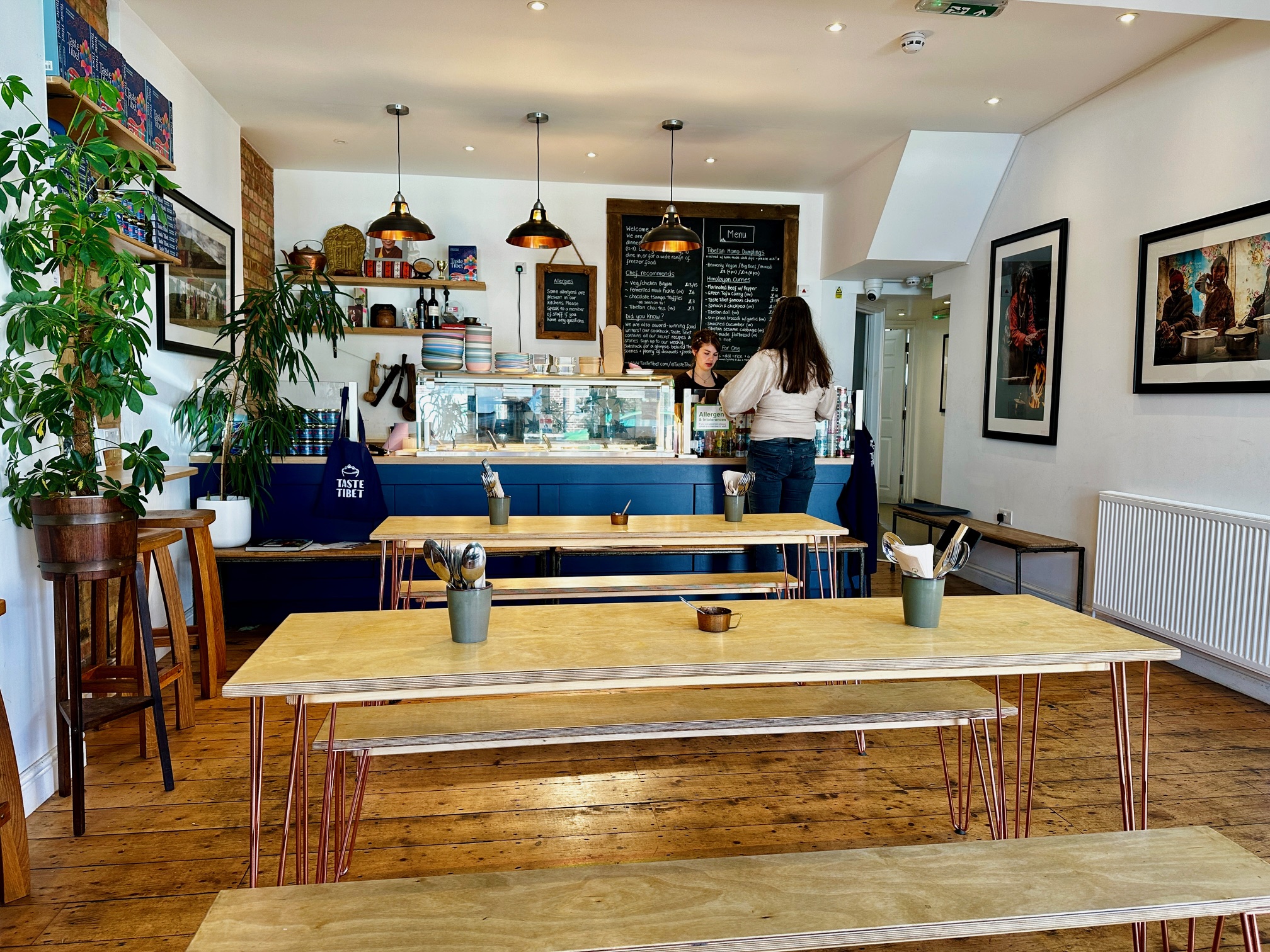
The interior is a lovely, tasteful room but very much in a canteen style, which fits with the lack of reservations. Long tables and benches, which I imagine are communal at busy times, were like a posh reimagining of the furniture you find at every tap room in the land, but the overall effect was very pleasant. There were also seats up at the window, which tempted me, or facing the wall, which didn’t. Jampa told me to hang my coat up on the hooks, which I did at first, but given that the door was left open to attract passing trade I quickly changed my mind and put it back on.

The menu, which changes weekly, is up on a blackboard behind the counter, and many of the dishes are already cooked, in chafing dishes up at the counter. Taste Tibet cannily also offers frozen meals for its customers to enjoy at home, these are in a separate freezer near the front and are a clever way to make sure nothing is wasted. They also had a decent range of drinks, soft and alcoholic, including wines in cans. I was a little disappointed, as always, to see Brewdog as one of the options but I got myself a verbena-infused pale by Earth Ale, a little brewery just outside Abingdon, which I really enjoyed for its fresh citrus and slight bitterness.

On the day I visited, Taste Tibet was offering momo – four or eight, vegan or beef – and four curries, with a mix of sides. They also served a biryani, or a feast option where you got a couple of dishes, dal, rice and a solitary momo for about fifteen pounds. If that pricing sounds keen, it wasn’t unrepresentative -curries weren’t much over a tenner and rice only two pounds fifty. Sides clustered around the five pound mark and momo were four for eight pounds. I ordered some momo, a curry and rice: that, with a tip included, cost me thirty pounds. “I’m in no rush” I said, “so it’s okay to bring the momo out first and the curry after that.”

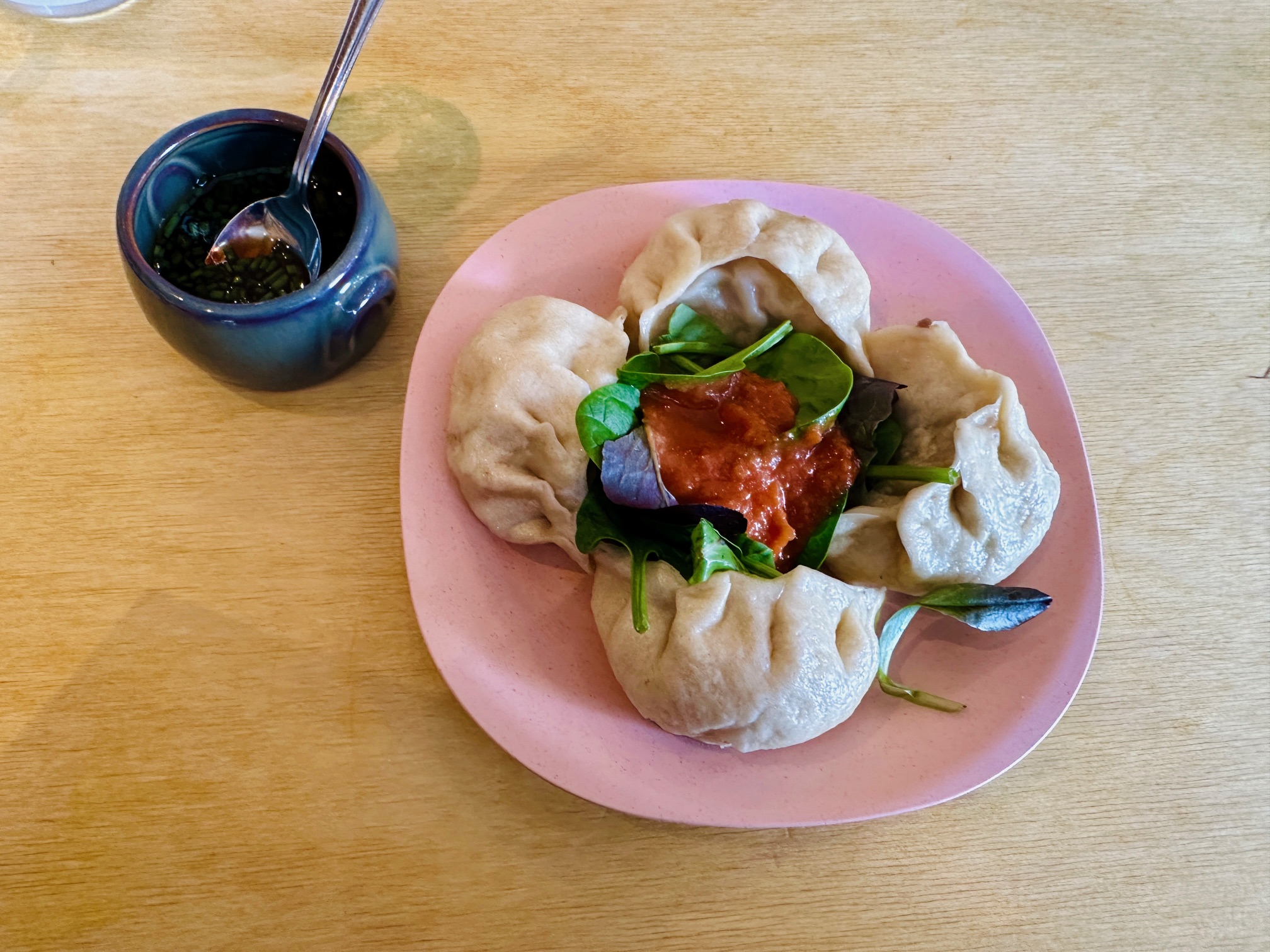
My momo came out five minutes later, and weren’t at all what I was expecting. Although momo apparently originate from Tibet rather than Nepal they’re so prevalent in Nepalese cuisine, and Nepalese cuisine is so prevalent in Reading, that I thought these would be a known quantity. And with that in mind, I thought four for eight pounds felt a bit steep. But Taste Tibet’s momo were a very different beast to the ones I’ve eaten at Sapana Home or Kamal’s Kitchen.

For a start, they were big: impossible to eat in one go, and challenging even in two. Crimped like jiaozi, they were steamed and made with dough that was thick verging on too thick, but that gave them structure and a pleasing, carby solidity. The beef inside – beef, not buffalo, although whether that’s the difference between East Oxford and Reading or Tibet and Nepal I couldn’t tell you – was properly lovely, coarse and delicious.

This came with a little handful of leaves whose main function was to serve as a bowl for a red sauce which was apparently a home-made chilli sauce: I found it a little meek. But what I did love was the bowl of a darker dipping sauce with a kick of soy. Again, I wonder if that’s the influence of Tibet, because I’ve never had Nepalese momo served with that, and it really did make me see the momo in a slightly different light. I can see the appeal of coming to Taste Tibet, as I used to with Sapana Home, and just going to town on the momo.

Later on, as I came to the end of my meal, couples and families were braving the outside tables and I saw big plates of momo going past on their way to the little terrace. Perhaps that was the way to do this place, or to come with a big group and try everything. One of the reasons I hadn’t ordered the “feast for one” was the presence of that single momo. It felt stingy, but looking at what had been put in front of me one would have been plenty, paired with an exploration of more of the menu.

My request that my curry come out after my momo had been taken a little too literally. Perhaps I should have said “after I’ve finished my momo”, although I didn’t think I’d needed to, but instead the rest of the meal arrived when I was halfway through what I thought was my starter. Really, though, that was me misjudging the place and its similarity to a canteen rather than a mistake on the restaurant’s part. Everything is there ready to dish up, and if you order something that’s exactly what they will do.

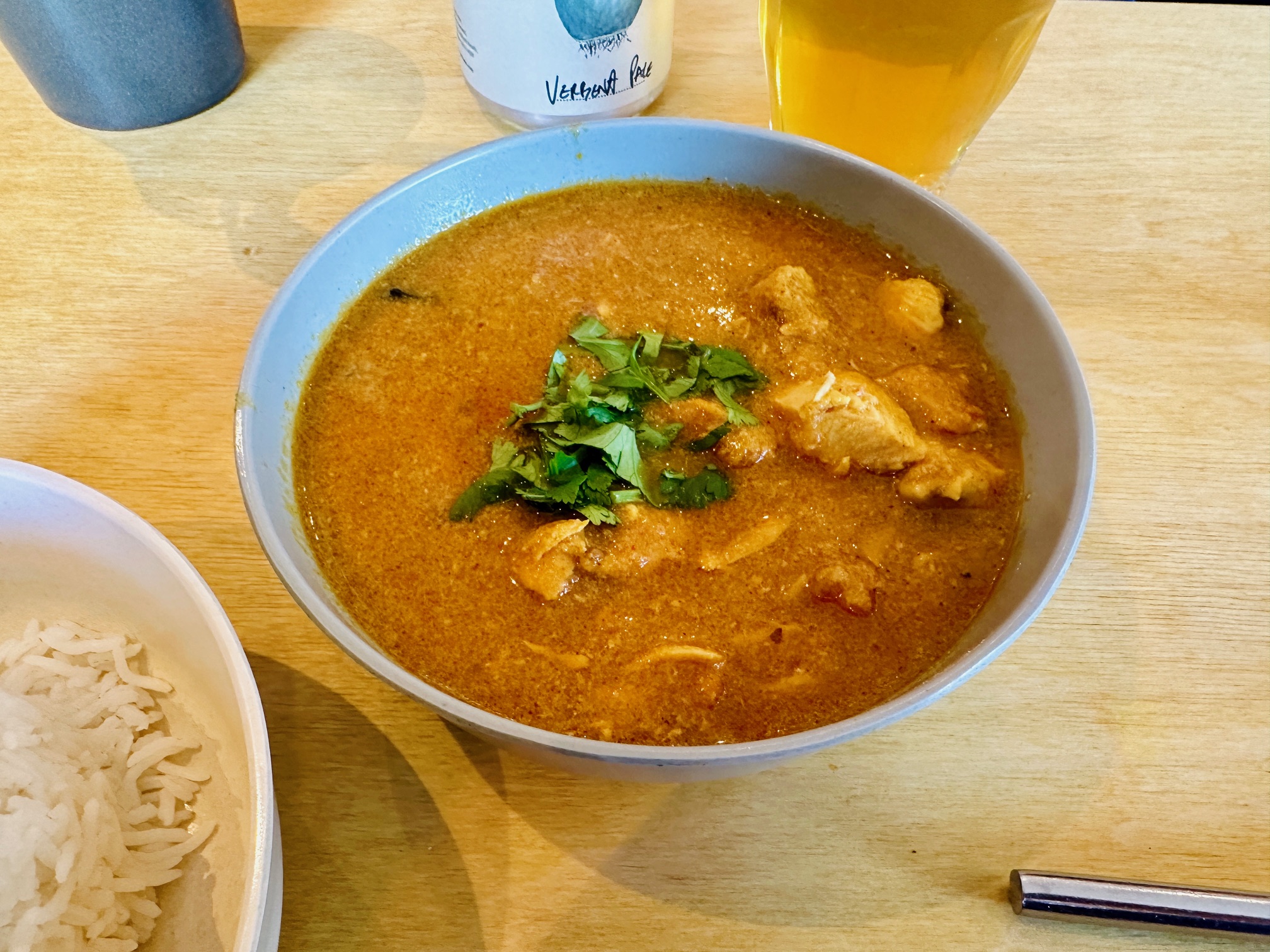
I had chosen Taste Tibet’s “famous chicken” because I took famous to mean signature, and I figured that if I was visiting a restaurant on my own I owed it to myself to check out the signature dish. And having eaten it I suspect it’s the restaurant, rather than the chicken, that is famous. It was a big portion with plenty of chicken, plenty of sauce. The chicken was all good and tender, and it was impossible to take exception to the dish.

But although not being offensive is a good thing, being inoffensive isn’t, and that’s what this was. Perhaps if my expectations had been lower I would have seen this as a comforting bowl of food, and celebrated what it was rather than noticing what it wasn’t. But this was like curry from a bygone age, before we got into regional food, started to discover the difference between Kerala and Hyderabad. It felt a bit like a Vesta curry, from forty years ago, and for something famous I expected more: I expected it to be famous for something.

How to make it more interesting, I wondered? I tried spooning in my perfectly cooked basmati rice – Taste Tibet serves both curry and rice in bowls that are just big enough for each, rather than giving you a plate to dish them up onto – but that bulked it without being transformative. I tried adding a spoonful of the dried chillis in a ramekin out on the table, but it lent an acrid pungency without elevating anything. The difference in heat levels was like the difference between sleeping on one pillow and two, going from not enough to too much.

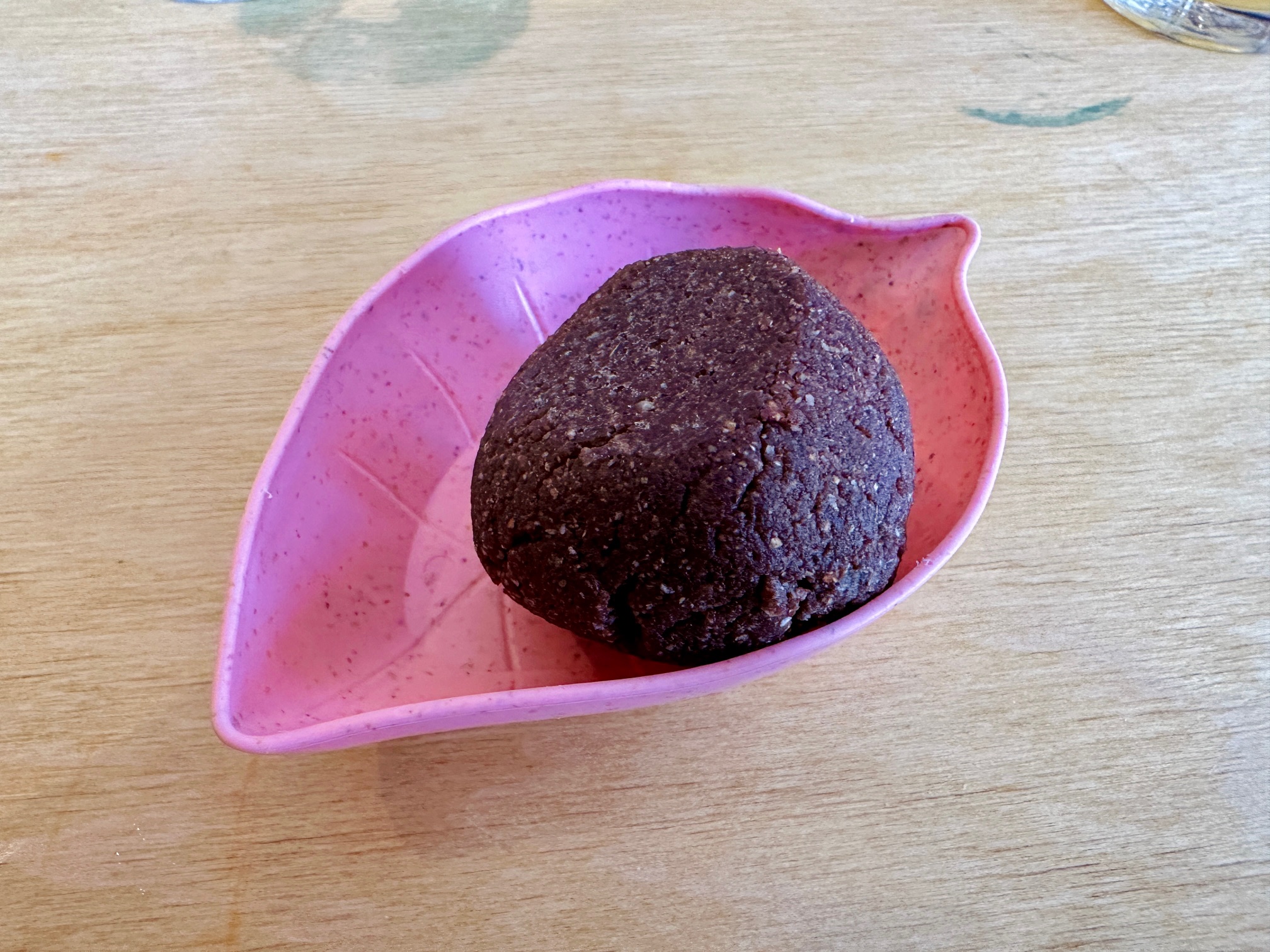
I didn’t want to leave it like that, and I fancied dessert, so I went up to order the only thing on the blackboard that looked like afters. Chocolate tsampa truffles – as seen on TV! sounded absolutely like my sort of thing, and only cost three pounds. I was too full to have the chai that should have accompanied it, but never mind. 

By this point the restaurant was far fuller, with people taking tables outside and the long table opposite me occupied by a group of impossibly young, animated east Oxford types. I looked on them indulgently, remembering a time over thirty years ago when that could have been me: not that I would have had the money to eat in a place like this.

Positively 4th Street was playing over the speakers, and I remembered that thirty years ago I loved that song, and suddenly it was back in vogue. Time can play unkind tricks, and all the things that made me so deeply unfashionable as a student – being a geek, listening to Bob Dylan and Leonard Cohen, playing chess and Dungeons & fucking Dragons – are acceptable now, too late for me. Even some of the shit I wore back then might be in now, I thought.

I felt a little tug of envy and regret, and then I let it go. It was as close to Buddhism as I got in Taste Tibet.

The chocolate tsampa truffles, plural, turned out to be a truffle, singular. A big thing designed, like the momo, to be taken on in multiple bites. I enjoyed it and, again, it wasn’t what I thought it would be. Its texture wasn’t dense or glossy, being more gritty with a feel of granulated sugar to it. Again, that’s down to me for misunderstanding – tsampa was not something that flavoured the truffle, but instead is a kind of flour made from ground, roasted barley, so it was the thing lending that texture.

In any event, the truffle reminded me of the brigadeiros at Minas Café, and I liked it without entirely understanding it. That’s fine, by the way: now I’m in my fifties I realise that provided you like things you don’t always need to understand them.

The rest of my day in Oxford was positively joyous. I stopped at Missing Bean, which was absolutely packed, to buy beans for the weeks ahead; I’m drinking a cup of their coffee as I write this. I strolled down the Cowley Road, past its plethora of Turkish restaurants, past the now closed Gamekeeper that used to meet all my Dungeons & fucking Dragons-related needs as a teenager.

I stopped in Truck Records to get inspiration, I stopped in Peloton Espresso to get caffeination. I bought cheese in the Covered Market, had time for a beer in Tap Social before my train home. It really is a gorgeous city, and it says something about the place that Magdalen Road is one of its little oases but far from its only one.

As you may have gathered by now, although I liked Taste Tibet I wanted to like it an awful lot more than I did. And a bit of me wonders if I’m the one in the wrong. It is a gorgeous spot in a gorgeous neighbourhood in a gorgeous city. It has a great backstory, is clearly loved by the community it’s part of and does tireless and admirable work to support that community. It is run by a committed husband and wife, where he works in the kitchen and she advocates, powerfully and eloquently, online and in the media. They want to tell the stories of where he comes from, through food.

On paper, I should love it: it sounds like other restaurants I love, closer to home.

But perhaps that’s okay. Perhaps Taste Tibet makes perfect sense in its context, in that city, on that little stretch of food and drink heaven. Maybe it doesn’t need people like me travelling to and across Oxford to try it out. It’s a neighbourhood restaurant – its neighbourhood is lucky to have it, and it’s lucky to have found its place in things.

If I lived closer I’m sure I would go back, try other dishes, fill my freezer and become part of their story, as they would become part of mine. But other places have got there first, for me at least. My train home pulled in at Gare du Ding and I thought about Kamal’s Kitchen, my favourite Nepalese restaurant, a short walk from the northern entrance to the station.

Its dining room doesn’t have the stripped-back elegance of Taste Tibet, it doesn’t have a narrative the way Taste Tibet does. I think Kamal and his family do a magnificent job, but much as I’d love them to I can’t imagine them gracing the pages of Observer Food Monthly. They don’t write beautiful blog posts, they have no plans to produce a cookbook that I know of and they won’t be at Hay Literary Festival this year. They let their food do the talking, and for what it’s worth I think their momo beat Taste Tibet’s. A restaurant can succeed in so many ways, but food and service are always king.

Magdalen Road in Oxford is a really fantastic place, and I do dearly wish Reading was a little more like it. But I wouldn’t swap their restaurant with ours.

Taste Tibet – 7.0
109 Magdalen Road, Oxford, OX4 1RQ
01865 499318

https://tastetibet.com

As of January 2025, Edible Reading is partly supported by subscribers – click here if you want to read more about that, or click below to subscribe. Whether you’re a subscriber or not, thanks for reading.
Restaurant review: Momo 2 Go

We’re on the home stretch now: Halloween and Bonfire Night are in the past, Christmas is on the horizon. This review is published on Black Friday, a day many of us would prefer not to acknowledge. It all adds up to one thing – we are close to having survived another year of interesting times, of pay cuts and price rises, of soaring expenses and the spectre of Covid, still lurking in the background. The future is uncertain – for our electricity bills, for our weekly shop, for keeping global warming below 1.5C, for our Twitter profiles – but for now, we’re all still here. Group hug, anybody? Actually, scratch that: who else needs a drink?

The New Year is always a time to look ahead and make great plans, but as a perpetual glass half empty type I find this time of year is when I look back and can see all the things I didn’t achieve over the last twelve months – the pounds I didn’t lose, the money I didn’t save, the books I never finished and the exercises from my physio I always found very good reasons not to do. But I never mope for too long – the sweet release of the socialising season, the festive beers waiting to be drunk and all the people to catch up with soon sweep all of that away. Besides, by Christmas Eve ITV4 (yes, it’s a thing) is pretty much wall to wall Carry On films, and you can’t mope watching one of those. I can’t, anyway.

As we approach the end of the year I also find myself looking at my to do list here at the blog. Forget shopping days: there are only a handful of reviewing Fridays left til Christmas and so many places I’ve not made it to yet. So how do I decide what to prioritise for the tail end of the year? Should I go back and try one of the interesting places that have sprung up in Wokingham, or another of Reading’s new sushi joints? Is the Secret Santa present my readers really want a piece where I go to Jollibee and dutifully endure that weird spaghetti dish with chopped frankfurters in it? And how about that new kebab place on the edge of the Broad Street Mall, immortally described by the Reading Chronicle as “Slow-roast Dubai restaurant Donor and Gyros”?

But there’s a particular subsection of my list that I feel deserves particular attention as 2022 shambles to an end. At the start of this year, when the weather was shite and our booster jabs hadn’t kicked in, I was still reviewing takeaways. But I know that what people really want, especially now life is a little more as it was, are restaurant reviews. And there are a handful of places where I had decent takeaways over the past couple of years but have never returned to try out the full eating in experience, blind spots that I ought to rectify.

In some cases there are reasons for that – Banarasi Kitchen has recently left the Spread Eagle pub to be replaced by a new Indian kitchen called Bagheera, for instance. I probably would have gone to Osaka by now, but for the fact that they had a one star hygiene rating for four months over the summer. Palmyra, which did me a very nice takeaway in the spring of 2021, only takes cash which rules it out of contention. Cash only in 2022, after two years that have all but killed cash as a going concern. “Fuck that” grizzled Zoë, as we walked away from it recently.

But I also had a fantastic takeaway from the subject of this week’s review, little Momo 2 Go down the Oxford Road, back in February – so good, in fact, that I’ve ordered from them several times since. Surely it was time to try it in the flesh? So Zoë and I wandered over on a midweek night to pay it a long overdue visit.

Subscribe to continue reading

Become a paid subscriber to get access to the rest of this post and other exclusive content.

Competition: Kamal’s Kitchen

I’m delighted to announce an ER readers’ competition in partnership with Kamal’s Kitchen.

I can probably count on the fingers of two hands the truly game-changing restaurants that have opened in Reading since I started writing Edible Reading. That’s probably a feature in itself – maybe I’ll write it to mark ten years of the blog – but without question Namaste Kitchen would belong on that list. When I visited it, back in 2017, I knew I had eaten somewhere so good that it changed the terms of reference for what it meant to be a good restaurant in this town.

Namaste Kitchen was one of those fantastic places where everything came together. Operating from the Hook and Tackle in Katesgrove, it was a pub that served great food rather than a gastropub, with a menu of Nepalese small plates that meant you could turn up and eat yourself into a coma or pick at the most incredible bar snacks while watching the football. And it was unapologetically Nepalese too, offering some dishes – like bara, spiced lentil pancakes, or pangra, fried gizzards – that you just couldn’t get elsewhere. It wasn’t watered down, and it was all the better for that.

The chef was amazing, but the icing on the cake was Kamal, the affable front of house who kept everything ticking. He always recommended new things, he always sounded surprised when you loved the food (and you always loved the food) and he always stopped you from ordering too much. That was Kamal in a nutshell, and it’s something so many restaurateurs get wrong: he was more interested in making sure you’d come back next time than he was in making shedloads of money out of you this time.

I’ve written about this before, but that dream team lasted less than a year. Kamal left Namaste Kitchen, the chef went back to Nepal and the restaurant raised its prices and installed a tandoor. A couple of years later, Kamal opened Namaste Momo on the border between Woodley and Earley, this time teaming up with an ex-Royal Tandoori chef. The early signs were good (and the momo were never less than excellent) but the menu, split between Nepalese and conventional Indian food, never quite felt like a cohesive whole. A couple of years later, Kamal left the business.

Anyway, fast forward to 2022 and Kamal has opened his own restaurant on the Caversham Road, next to Flavour Of Mauritius in part of the building where Standard Tandoori used to live. This time, he’s been brave enough to put his name on the door, and this time it’s a family affair: Kamal and his wife are in the kitchen, and Kamal and his equally charming daughter run the front of house. It’s a nice room – stripped back, serene, humble. It feels like this could be the place where Kamal realises the potential that has been there since the Namaste Kitchen days.

The menu goes back to the territory that made Namaste Kitchen great – a range of small plates, momo and chow mein, with a handful of curries and a good vegetarian section. Fans of the bara and chatamari from Namaste Kitchen will find them here too. But there are also some new, really interesting dishes – deep fried lamb breast on the bone, for example, or a truly delectable pork dish with choy sum in a wonderful sauce that totally carries you along with it.

There are also some really interesting touches. On my visit, Kamal served sekuwa made with venison from the farmer’s market, and another beautiful venison dish almost like a tartare, clean, delicate and with a hint of game. If either of those ends up on the menu as a special, you should try them. But I was also very happy to be reunited with the tried and tested – the paneer pakora were as good as I remembered, the chutney fresh, zingy and spiky with heat. Equally delicious was the lamb sukuti, a crunchy plate of umami and spice which I could happily demolish multiple times in any given week.

The biggest surprise, for me, is an unassuming dish you could easily miss. Thhicheko Aalu is described on the menu as “potatoes fried, pressed and tossed with special sauce”. But that just doesn’t do them justice. Forget double cooked or triple cooked chips, this is close to the pinnacle of potato dishes – burnished and caramelised on the outside, all crinkly edges, yet soft and fluffy inside, the whole thing coated in a spice mix that contains a little bit of something like mouth-numbing Szechuan pepper. I’ve not tasted anything quite like this, and it has the makings of an instant classic. I was torn between wanting to know exactly how they did it, and preferring to keep the magic and mystique firmly intact.

That’s quite enough from me, so let’s talk about the competition. First prize is a meal for four people including drinks, up to a maximum value of £120. A runner-up will win a meal for two people, including drinks, up to a maximum of £60. That potato dish is £6, so alternatively you could turn up and keep ordering that until you’re full (that’s what I’d be tempted to do).

All you have to do is this: write me up to 250 words on the Reading institution you miss the most and why. It doesn’t have to be food-related (although it might well be) but this is your chance to wax lyrical about anything from the past, whether it’s the 3Bs, Mya Lacarte, 80s night at the After Dark, the “lovely hot doughnuts, nice and fresh” announcement, the crispy squid man at Blue Collar or even this blog, back in the days before it vanished up its arse. Knock yourself out! Email your entry to me – ediblereading@gmail.com – by 11.30am on Friday 15th April.

As always, to ensure impartiality I don’t judge the competitions myself. And this time I’ve managed to get a big name on board: fresh from her announcement about Clay’s Hyderabadi Kitchen’s forthcoming move to Caversham, Nandana Syamala has agreed to judge this one. Nandana, along with her husband Sharat, runs one of Reading’s most treasured culinary institutions, and I can’t think of anyone better to read all your entries about Reading institutions you have loved and lost.

Entries will be sent to Nandana anonymously and the results will be announced on Friday 29th April. And as always the judge’s decision is final: no correspondence will be entered into. Don’t forget, Nandana has only lived in Reading for four years, so this is your chance to make her envious of some of the Reading gems she may never have experienced! Thanks again to Kamal’s Kitchen for its generosity with the prizes and best of luck to you if you decide to enter this one. I’ll be back next Friday with another feature for you, before normal service resumes and I review some more restaurants. See you then.