Restaurant review: Amò Italian Street Food

In the good old days, where you stood on certain binary debates was simply a way of positioning you in the world. Cream first or jam first? Plain or milk chocolate Bounty? Cheese and onion or salt and vinegar? Were you a fan of the Beatles or the Stones? Blur or Oasis? All these things used just to be a form of triangulation, little points on a chart that, taken together, might give someone an idea of you (and, since you’re asking: cream first; milk chocolate; salt and vinegar; the Beatles; neither).

When did that all change? 2016, I suppose, when we all became Leave or Remain, indelibly stamped, and at every stage from that point forwards. We’re always asked what side we’re on, and now it’s not a useful piece of trivia but a necessary step to place yourself on one side or another of a yawning chasm. Are you pro- or anti-Israel? Do you think J.K. Rowling is a hero or a villain? How about Farage, or Trump? Did you believe in lockdowns, masks, vaccines? Did you leave Twitter or stay? If you left, did you go to Bluesky or Threads?

Like the Tower Of Babel, we’re now all scattered to the four winds, trying to find our tribe and arguing, endlessly, with the others. It’s not a bit of fun, any more. And this is all rich coming from me, because I’m painfully aware that I’m as polarising as most. Happily, Reading faces another tricky choice now that’s potentially just as difficult, but hopefully less divisive: Paesinos or Amò?

The two pizza places opened on Kings Road, two doors and three months apart, the latest in a weird series of rivals in very close proximity, following the example of Pho and Bánh Mì QB in Kings Walk or Iro Sushi and You Me Sushi on Friar Street. What is it with that? You must be very confident in your product to open so near to a direct competitor, like Bánh Mì QB did, but with Paesinos and Amò, Iro and You Me so little time separated both arrivals that it must be an unhappy coincidence. Imagine pouring your heart and soul into a new business only to find that another one a lot like yours is doing exactly the same, a stone’s throw away.

Anyway, regular readers will know that I reviewed Paesinos a month ago with my Italian friend Enza (who is, just to confuse matters, an Amò superfan) and it received a glowing write up from me. But I knew, even as I was eating there, that I needed to prioritise visiting its neighbour, if only because Enza told me that it was as good as, if not better than, the restaurant I had so enjoyed. I couldn’t go with Enza, because she was so far from impartial, and this time I took my friend Jo, also of Italian descent, last seen checking out House Of Flavours with me.

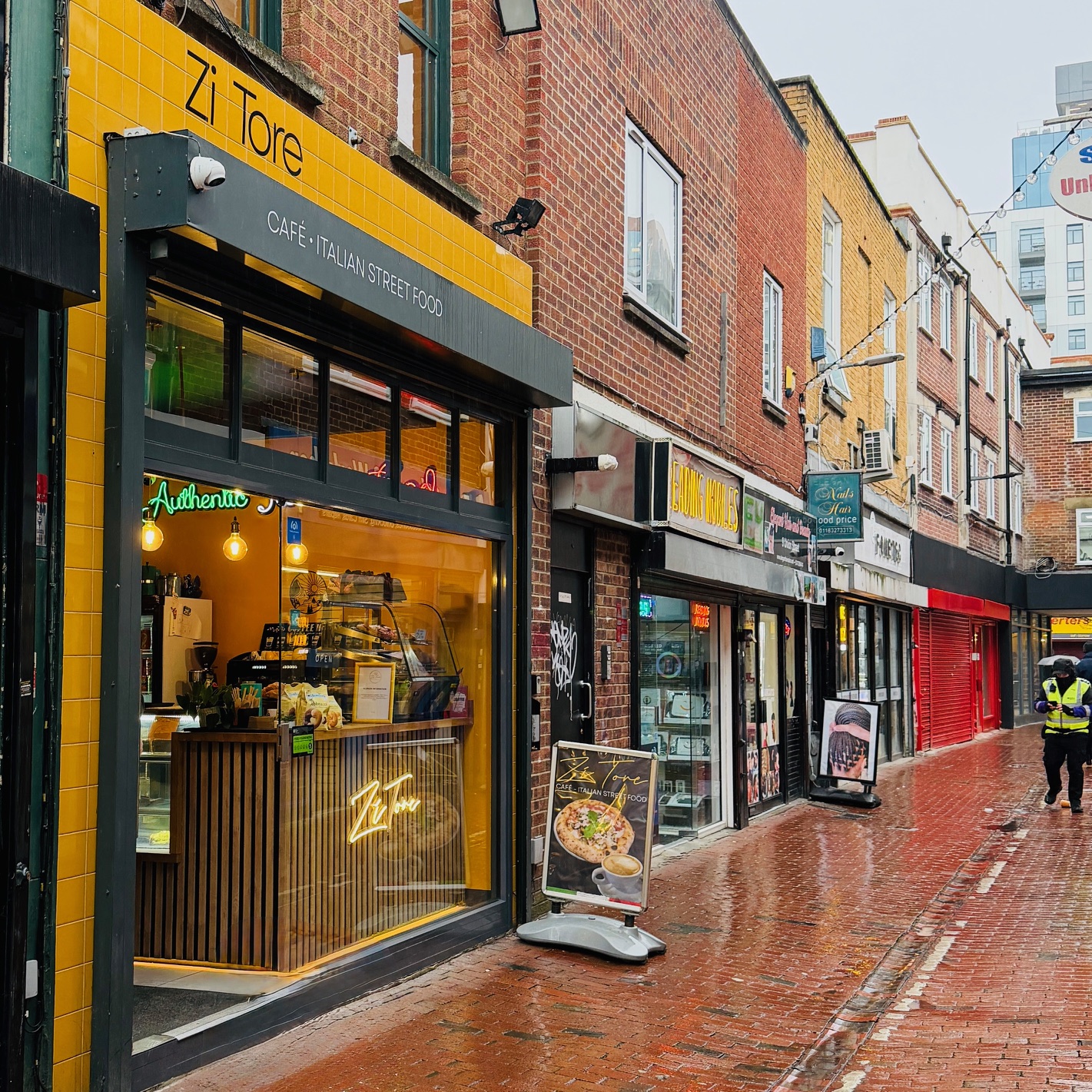
Amò is, as I’ve said before, something of a joint venture between Madoo, the founding father of Reading’s Italian quarter which opened four and a half years ago, and Pulcinella Focaccia, a business that sold pizza and focaccia for delivery from premises out in Earley and has been trading for a couple of years; I’d never had food from the latter, but I’d heard plenty of good things. And arriving at Amò on a weekday evening I was struck that, in terms of branding and decor at least, it felt fully formed in a way that Paesinos didn’t so much, or Madoo for that matter.

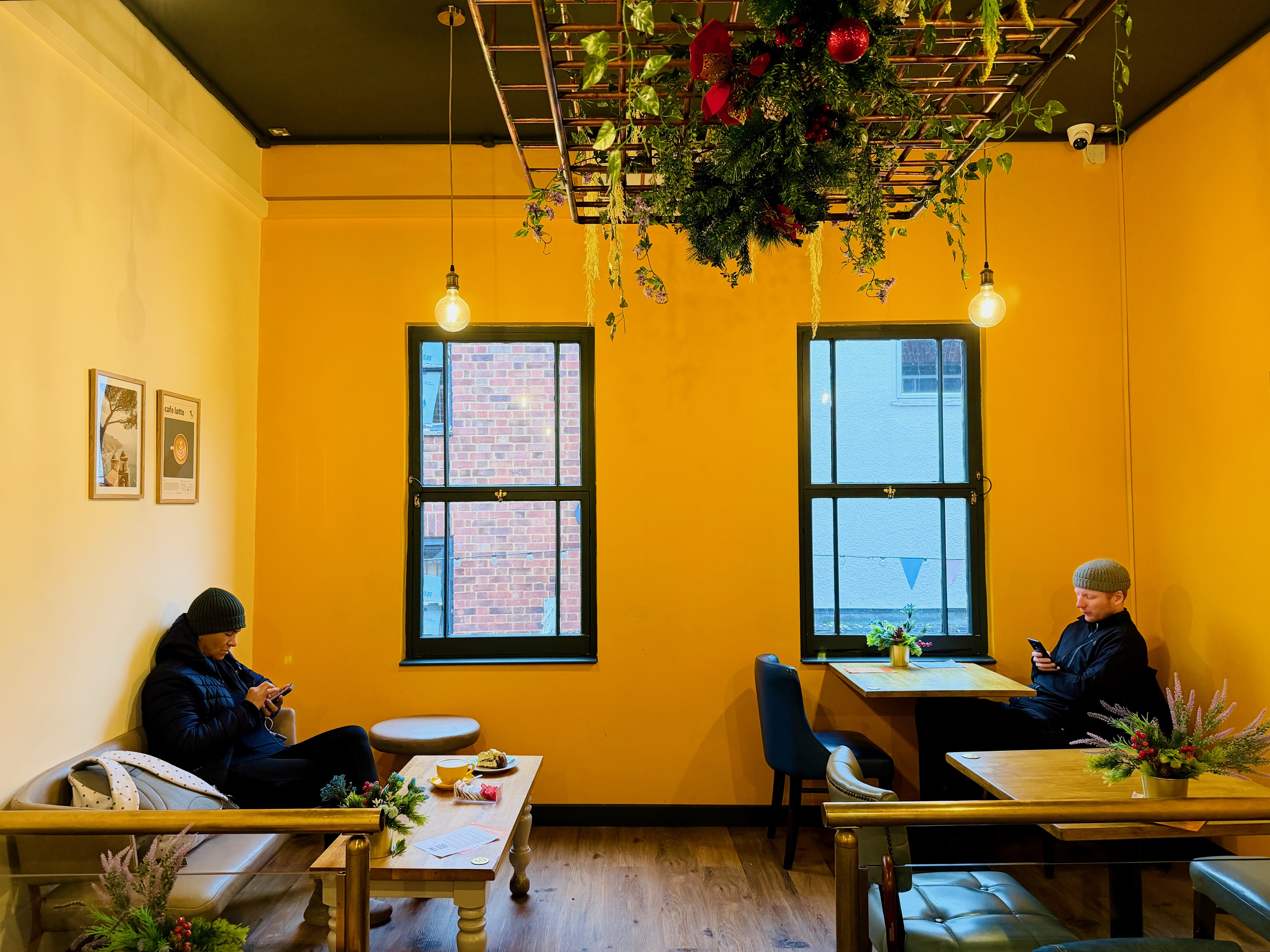
Everything was tasteful and unfussy without being Spartan, with a bare wood floor and tables, seats and benches. It seated somewhere between fifteen and twenty people, so significantly more spacious than the likes of Mama’s Way or Paesinos, and it had a nicely calm feel to it. Amò’s logo was in the middle of a deep red swatch of paint on the wall behind the counter, and resting on that counter was possibly one of the most tempting displays in Reading.

Amò very cleverly changes up its offering around the time people start finishing work, so until 5pm you can try pizza al taglio or something from a changing array of Italian street food. They also, I think, offer focaccia sandwiches during the day, although most of them had gone when Jo and I turned up around half seven. After 5pm the sandwiches drop away but instead, alongside the slices of pizza and street food, you can order a whole pizza from a more varied menu.

The street food was all very tempting, all things that I would challenge anybody not to fancy eating. Arancini, croquettes, mozzarella bites and frittatini – fried pasta – were all tributes to the time-honoured method of coating something in breadcrumbs and frying it until it was golden, crispy and alluring. The lighter side of Amò’s offering is keenly priced, too. Most of the street food dishes are around a fiver, pizza by the slice is less than that and they do multibuys if you want two stuffed focacce or two slices of pizza. Whole pizzas top out at about fifteen pounds, unless you add sausage or Parma ham to one of the options.

And Amò’s pizza menu struck me as very clever, because – either by accident or design – it kept the overlap with its neighbour’s pizzas to a minimum. Amò has a list of the classics, of course, so you can have a margherita, or prosciutto cotto and mushroom, or sausage and friarielli. But on the other side of the small, laminated menu, you find loads of less conventional options, far more interesting than the kind of things you could find at Zia Lucia or even, dare I say it, Amò’s neighbours.

That meant pizza with a purple sweet potato base, topped with cacio e pepe cream, guanciale and sweet potato crisps, or pizza with a pistachio cream base and mortadella. Others had a truffle cream base, or pumpkin cream, or even a cavolo nero base (“it’s the gourmet version of the salsiccia e friarielli”, Enza had told me, when I was looking for recommendations).

You may find all of that a bit leftfield, or it might whet your appetite for wandering off Reading’s beaten pizza track. I think for me, though, it was neither: I chalked those up as things to try once I had road tested the classics.

But first, Jo and I had a chinotto each and ordered some of those smaller dishes to kick things off. And as we waited for them, she told me about her childhood holidays by the coast, near Salerno, buying balls of mozzarella as big as your head from some beachside hut and eating them with bread, nothing else required. It was brilliant, Jo said, but it did slightly ruin the mozzarella you can easily get in this country; like me, Jo considers it a seriously underrated cheese.

As so often I felt a little pang for a childhood I didn’t have, listening to Jo. But then there was something to be said for sitting in a caravan in Devon, rain drilling on the roof, eating hog’s pudding cooked in a frying pan – always with tinned tomatoes on the side – watching Roland Rat on TV-am, knowing that the evening would be spent playing cards and watching reruns of Shogun (the original, not the superb remake). Maybe those memories would sound exotic to an Italian: on balance, though, I guessed not.

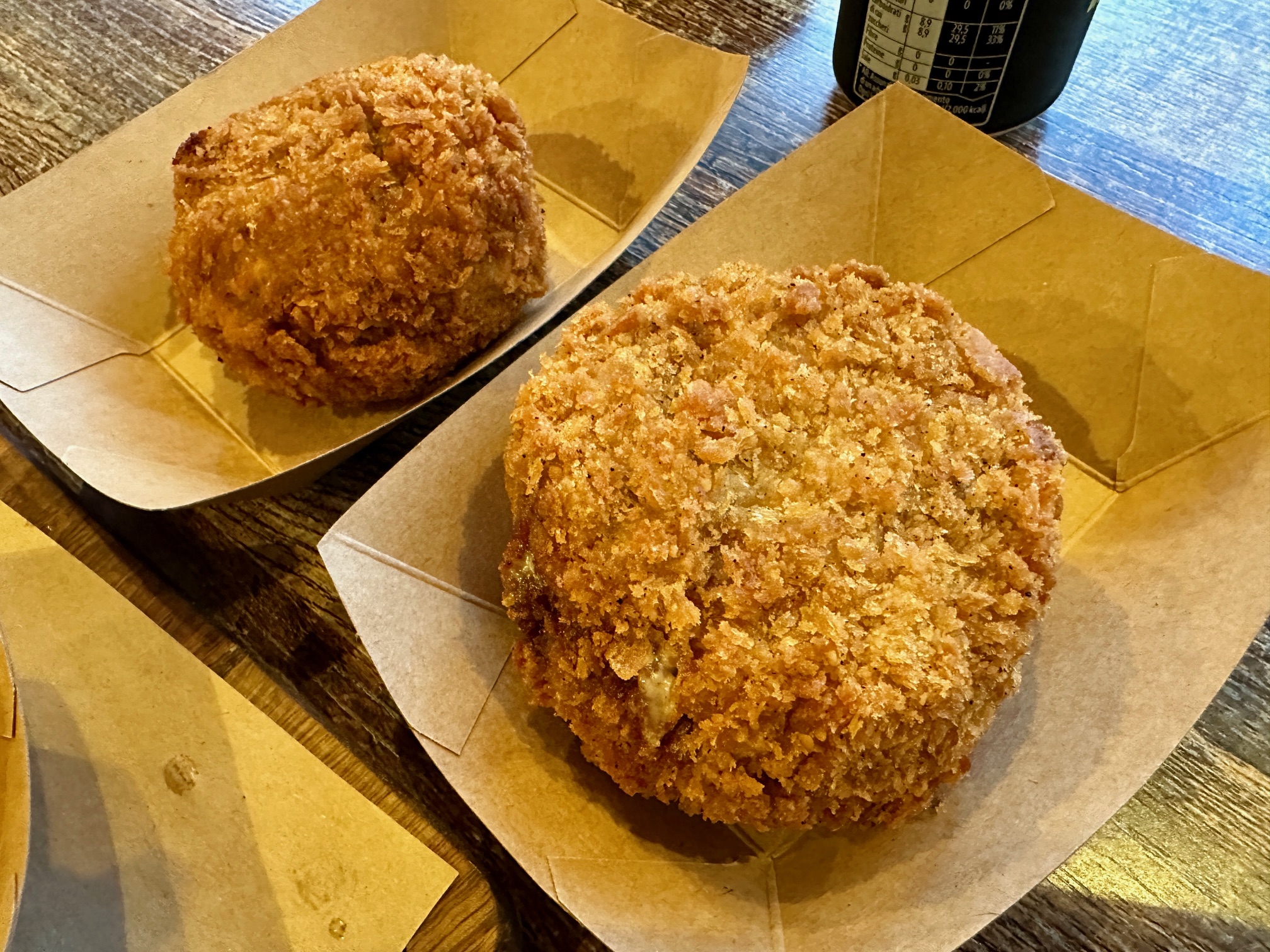
Amò’s mozzarella bites may not have been the size of my head, but they were gorgeous nonetheless. Crisp-crumbed spheres, golden but not overdone, the shell holding just-molten-enough mozzarella, they were a proper delight. I might have had them with something to dip them into, but it was a minor quibble with something so delightful. So was the fact that however carefully I ate them, with my hands at least, a little liquid sprayed out, leaving incriminating marks on my shirt. I was too happy to care, and the attentive staff quickly brought extra napkins.

At five pounds fifty for four, they could have been the bargain of the meal, if not the month, but for the fact that we also ordered two of the frittatini. These are yours for three pounds fifty, or six quid for two, and come in two flavours. If you go to Amò, my advice is to make sure you have one to yourself or, as Jo and I did, order one of each and share. They’re a bit fiddly to break up – that crisp carapace presents resistance when you’re relying on a wooden fork – but they reward the effort, with dividends.

They were beautiful things, and when I sit down in six months or so to write my annual awards it’s hard to imagine they won’t feature in some shape or form. And their form – big, irregular golden pucks – belied just how wonderful they were on the inside.

Picture an arancino, but instead of risotto rice visualise a cluster of little tubes of pasta, and rather than a molten core, imagine the whole thing bound together with sauce. In terms of taste, contrast, texture and sheer tactility I’m not sure I can think of anything finer, and writing this paragraph I am deeply aggrieved that I cannot eat one right this minute, or indeed by the end of the day.

This is where Amò are an especially smart bunch, because during the day you could pitch up, have a chinotto, a slice of pizza or a sandwich crammed with porchetta and provolone, and add one of these for a mere three pounds fifty. That’s almost the price of subscribing to this blog for a month and, although it pains me to say it, it’s even better value.

Jo and I both loved the meaty version but would you believe that the vegetarian option, with fried aubergine and tomato, was even better? Jo described it as like being “slapped in the face with flavour” and believe me, apart from that fried pasta, nothing or nobody would get away with slapping Jo in the face with anything. One of the best things I’ve eaten this year, no notes at all.

Jo was very keen to try one of the pizzas by the slice, with meatballs on it, so that turned up next, thoughtfully cut up to share, a meatball perched precisely in the centre of each quadrant. This too was cracking, although I suspect the base on the pizza al taglio is slightly different to that on the whole pizza. The meatballs, in particular, were excellent – coarse and lacking in suspicious, smooth bounciness. It also, by the looks of it, was only available by the slice so, again, well worth adding to a lunch order.

By this point, as our full-sized pizzas arrived, the carbs were taking their toll, and we were already prepared to ask if some of our leftovers could be boxed up – something that rarely happens to me, because it’s rare that my capacity is defeated by a restaurant.

Jo made it a few slices into hers, the piccantina, which was topped with salami, mushrooms and Gorgonzola. I didn’t try it, and from a cursory glance I thought the porcini were common or garden mushrooms, but Jo had no complaints. She’d told me earlier in the evening that she hadn’t had pizza for a while: Jo is on a monthly treatment regime where anything she eats the next day tastes vile and puts you off whatever you ate for the foreseeable future. One of those next days had involved pizza, and Amò’s piccantina resuscitated her love for the stuff. That in itself is no mean feat.

I on the other hand had deferred to Enza’s judgement and ordered the sausage and friarielli. As so often with white pizza, it had a bit more structural integrity, so less of the Neapolitan droop you might get with other pizzas. And the base was admirable, nicely puffy with plenty going for it. You couldn’t fault the generosity either, with nuggets of crumbled sausage very, very liberally deployed.

There was very little not to like about the pizza, and if I was clutching at straws I might say that I’d have liked the sausage to have more of a whack of fennel, but that’s a minor thing. It was so well orchestrated with the friarielli that it was impossible to argue: this was a pizza without complexity or variety that kept it focused and hit the target.

I managed about half of mine, and the staff were nice as pie about bringing a couple of boxes so we could take our leftovers home. Everything we had ordered – all that food, four cans of soft drink – came to fifty-five pounds, which is a steal, and then we went to the Allied for a debrief. Two pints of forgettable macro fizzy booze at the Allied set us back nearly sixteen pounds, which is very much not a steal.

For once, I can also report back on the leftovers. Jo had hers cold the next day – no slice for her beloved dog Diesel, this time – and sent me an iMessage: tastes even better this morning, cold from the box, outstanding! I on the other hand revived mine in the oven on my lunch break, working from home, and it was the best lunch I’d had in ages. I wasn’t sure if my slight lull that afternoon was down to the carbs or a Teams call that felt especially like a trudge. Let’s put it down to the latter.

Having talked about Amò for all these paragraphs, I know I should return to my opening theme and compare it to its neighbour Paesinos. But it’s not easy to do.

If they were top trumps cards, Amò would win in a number of categories. It’s more versatile, on account of having a focused lunch offering as well as pizzas in the evening. It has arguably a wider range of sides and small plates. It’s bigger, too, with far more potential to eat there in larger groups; if you go to Paesinos as a four, you either won’t get in or you’ll take up two-thirds of the restaurant. Its pizzas are more imaginative and unconventional, so more of a challenge to the Neapolitan hegemony elsewhere in town.

On that basis, you’d have it down as a resounding victory for Amò and, for some of you, that might well be the case. On the other hand, Paesinos sticks to the classics, both for pizza and for its smaller dishes. I think its soft drink selection – and neither is licensed – is better and more interesting. The cannoli and tiramisu are worth the price of admission alone. And, speaking completely as a novice in these things, I think Paesinos’ dough and base may have the edge.

But the main reason why taking a Top Trumps approach doesn’t work is that Paesinos, for me, has a little something extra. There’s no Italian equivalent of je ne sais quoi, as far as I know, but there’s a small dash of magic in the smaller restaurant that means that rationally, although I know Amò has a huge amount going for it, it’s impossible to pick a winner.

So yes, I’ve reflected and reflected and it’s impossible to put a cigarette paper between these two places. The only thing you can put between them, it turns out, is another restaurant – called Just Momo, which helpfully doesn’t just do momo. So the rating down there reflects that: call it a cop out, if you will, but I stand by it.

Let’s not divide ourselves by being Team Amò or Team Paesinos, because as a town we can be better than that. Hopefully enough of you will pick each side that both places will continue to trade for years to come. Because the truth is that there’s one real winner in this contest, and that’s Reading.

Amò Italian Street Food – 8.6
2-4 Kings Road, Reading, RG1 3AA
07500 619775

https://amoitalianstreetfood.co.uk

Since January 2025, Edible Reading is partly supported by subscribers – click here if you want to read more about that, or click below to subscribe. By doing so you enable me to carry on doing what I do, and you also get access to subscriber only content. Whether you’re a subscriber or not, thanks for reading.

Restaurant review: Paesinos

Here’s a tip for you: if you want to discover how many Italians live in Reading just drop innocuously into conversation online, on a local Facebook page or the Reading subreddit, the question of Reading’s best pizza. Because if you do, Reading’s Italian contingent will come out of the woodwork. This calls for opinions, and they have plenty. They don’t fuck about, either.

“Being Italian and of partly Neapolitan descent, I am picky when it comes to pizza. Or better, I eat anything, but I know a good pizza from a bad one, and from a non-pizza” began Luca, on the Edible Reading Facebook page. He went on.

“The only real pizzas in Reading have been Papa Gee’s, for years. Then Sarv came, and Zia Lucia (both ok). I have recently tried Zi’Tore and above all Paesinos, the latter is possibly the best in Reading. The chef and manager is Sicilian and has previously worked at the Thirsty Bear. However, Thirsty Bear make American style pizza, while Paesinos make real pizza.”

Another of my Italian readers, Franz, was more generous about the Thirsty Bear. “It’s just a different style” he said. “Italian pizza purists perhaps will take a bit to adapt (I’m Italian, but open minded). A slice of their TriBeCa, curly fries and a pint is hard to beat. It just makes me happy and satisfied.” Franz also had opinions about Zia Lucia, and its “horrible, plasticky” mozzarella.

After that Luca and Franz ended up having a fascinating conversation about whether you could find good pizza outside Italy. Franz thought it was easy to do, these days. Luca disagreed, but said you could even end up getting what he called “non-pizza” in Italy, unless you were in Campania or Sicily. Just to chuck in a curveball, the best pizza Franz ever had was in the Swedish city of Norrköping. “It was Neapolitan style and was excellent, but then they had a corner in the pizzeria that was all dedicated to Totti so that confused me from an allegiance perspective.”

I could have listened to Luca and Franz discuss these niceties all day: it seemed that if you asked two Italians you were likely to come out of the conversation with at least three opinions. Over on Reddit, other Italians were weighing in. “Zi’Tore in Smelly Alley has taken the crown as the best pizza in town (in my humble, Italian, opinion)” said one. “And the pizza al taglio from Amò is even better.”

This is particularly topical because last week Sarv’s Slice announced that they were leaving the Biscuit Factory, after falling out with the owners both there and in Ealing. The reaction across the internet was one of huge sadness, coupled with genuine fear for the future of the venue. But this happens against a backdrop of Reading’s pizza scene exploding, so Sarv’s Slice might have quit while they were ahead: the market has become saturated since they opened in 2023, and even more so in the last six months or so.

Let’s run through the timeline. Last year Dough Bros opened out on Northumberland Avenue, and in the summer Zia Lucia opened in town. From then, things have only accelerated: at the start of the year Paesinos opened opposite Jackson’s Corner. Then Zi’Tore opened in February, in the old Grumpy Goat site. At the end of April, two doors down from Paesinos, Reading got Amò, a joint venture between the owners of Madoo and Pulcinella Focaccia, a pizza trader who operated from their home address out in Earley.

And believe it or not, last Wednesday another pizza restaurant, Peppito, opened on the first floor of Kings Walk, John Sykes’ restaurant sweatshop. The time between pizza restaurants opening in Reading appears to have some sort of half-life, so by the time this goes to press I wouldn’t be surprised if two more places had started trading, making all this out of date.

So the vexed subject of Reading’s best pizza isn’t something anybody, Italian or not, is going to settle in a hurry. But that’s no reason not to begin this important project, so last week I strolled down the hill from Katesgrove into town to check out Paesinos, the first of this year’s intake to start trading, on the Kings Road. I had a secret weapon, my very own Italian: my friend Enza was joining me to check this one out and see how it compared against Zi’Tore and Amò, both of which she’d researched extensively.

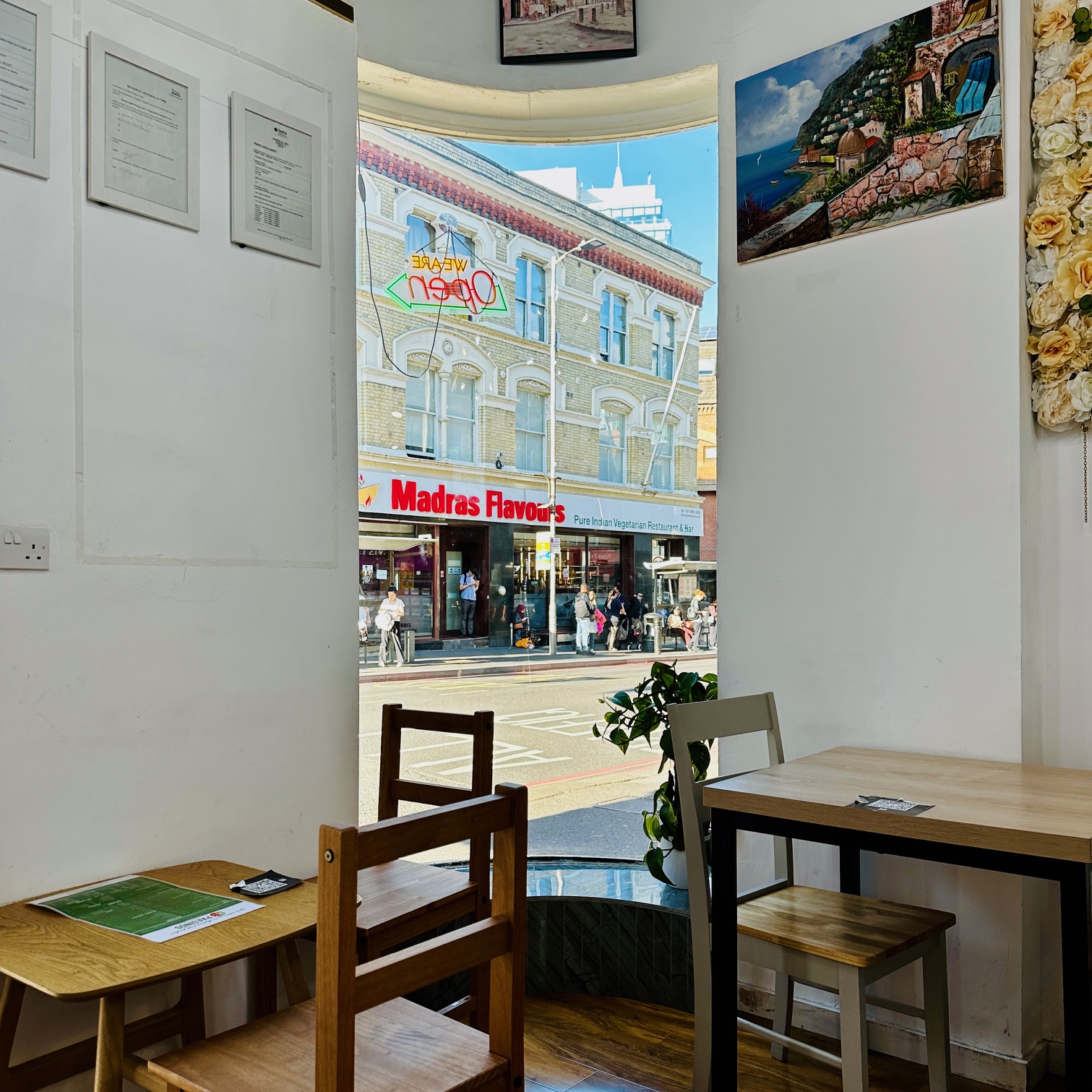
I was early, so I got to take in what must be one of Reading’s smallest dining rooms. Just three tables, each seating two people, although the table closest to the front door was so Lilliputian that it was hard to imagine adults sitting there, except to wait for a takeaway. A fridge hummed next to the counter, holding an interesting selection of soft drinks.

I spotted chinotto, one of my favourite things, and got one, with a plastic cup, while I waited. I’m used to the San Pellegrino version of this drink, that you can pick up in cans in Madoo. It’s dandelion and burdock’s older, more sophisticated cousin, wearing a rollneck and smoking a cigarette. But this bottled version, by Sicilian company Polara, was more nuanced, the rough edges smoothed off. I felt that all-too-familiar sensation, the gradual raising of expectations.

I looked through Paesinos’ menu. It was a single long laminated sheet with pizzas split into categories – classic, premium, signature, fusion – although the taxonomy they’d used was unclear to me. It certainly wasn’t pricing: most of the 13 inch, standard pizzas, were between thirteen and sixteen pounds whatever you ordered, many of them costing random amounts like £12.97, £13.96, £14.86. I liked the capriciousness of that.

They weren’t split into categories using any mindset I could understand. I could see something with “kebab chicken, jalapeños and buffalo sauce” being a fusion – or even a confusion – pizza, but a standard pizza bianca? Paesinos had attracted some commentary around its pizza Americana, topped with french fries and frankfurter: it might well be authentic, or authentically Sicilian, although I’d personally rather drink the bin juice from my food recycling after it’s been strained through Jay Rayner’s y-fronts. But whatever it was, surely it wasn’t “premium”?

All that said, there was something about the lack of polish in this menu that I liked. I could say it was trying to do too much, with its paneer and tandoori chicken, but nobody was making me order that stuff. In the core of it, ignoring the wackiness, there was a solid collection of options, many of them intriguing.

Then Enza arrived, and ordered a chinotto, and we got to catching up. Despite regularly exchanging messages, we realised we hadn’t seen one another in a very long time and there was plenty to discuss – her empty nest, my new house, all the life events and randomness that make you realise that you think you know what’s going on with someone via social media but that, really, you don’t.

The other thing I gathered, gradually, as we got to talking about Reading’s explosion of Italian restaurants, was that I was finally eating with someone even more determined to maintain their anonymity than me. Enza, it transpired, had been to Paesinos once before with her husband and very much enjoyed what they ate – the pizza “al portofoglio” or folded pizza for her (it translates as ‘wallet’), the tuna and red onion for him – but she was a far more frequent visitor to Amò a couple of doors down. So much so that she seemed to be furtively looking around, worried about being discovered, and lowered her voice when she mentioned Paesinos’ neighbours.

“I can’t help it!” she laughed. “I love it there. So much that I want to get involved. I keep telling them they should make the kind of pizzas you can only get in my part of Italy” – Enza’s from Potenza, in the ankle of Italy, halfway between Naples and Bari – “and if they do, I think I should get commission.” I offered to change her name for the purpose of this review, but she decided to let the chips fall where they may. At least they didn’t fall onto a pizza Americana, I suppose.

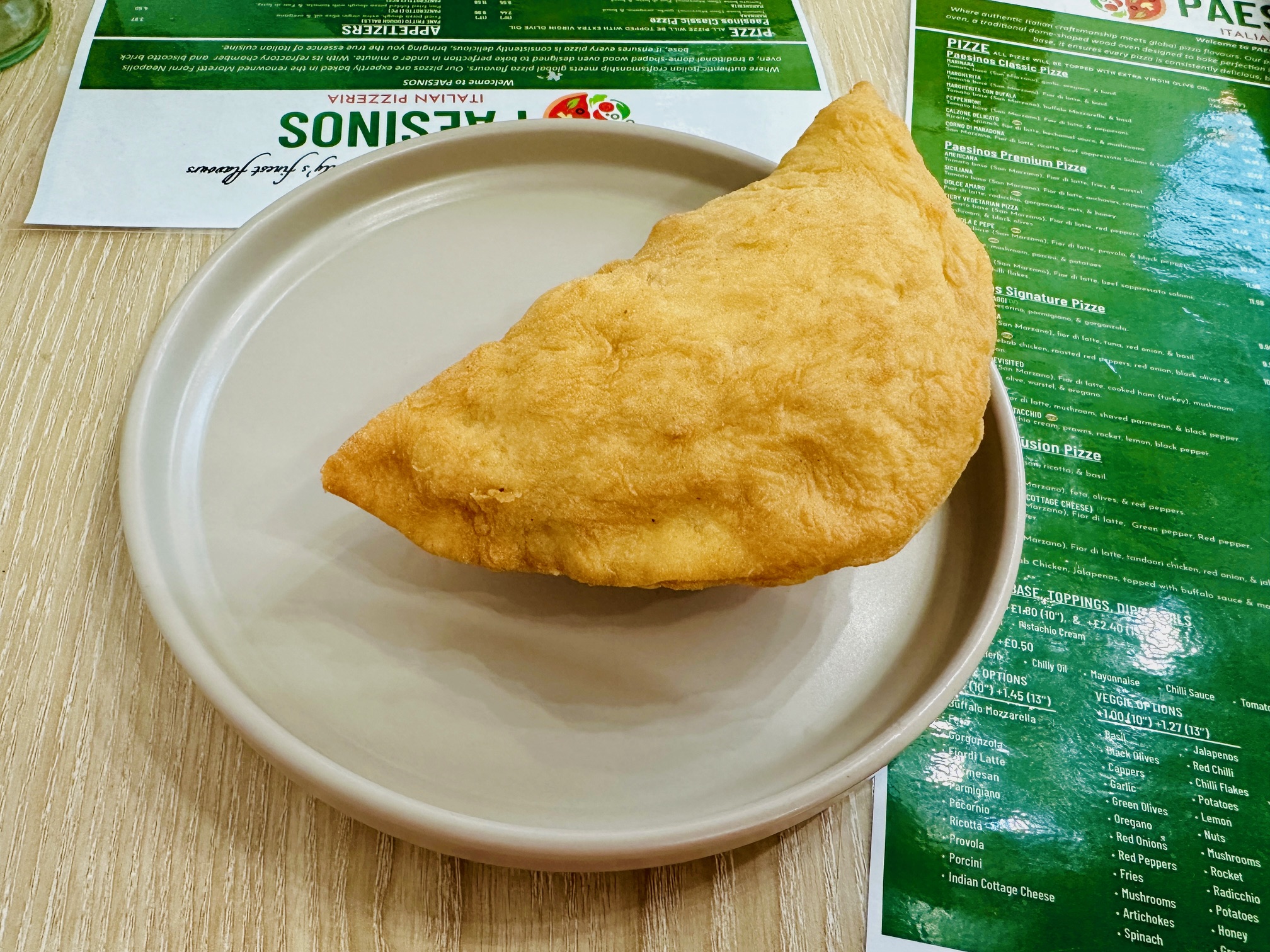
We started with appetisers, which meant a panzerotto each. Franz, on my Facebook page, had particularly recommended these, saying they were a speciality from Bari, where he came from. It was my first experience of Paesinos, and about as good a calling card as you could hope to encounter, a gorgeous crescent of fried dough filled with just enough mozzarella and tomato, too big to eat with your hands but not like a full-sized calzone. You got two for something silly like seven quid, and outstanding just about does them justice. As an introduction to the dough, too, it put down quite a marker. This huge, irregular pocket of joy made me very happy indeed.

“I tell you what, this is a lot bigger than the panzerotto I had in Montpellier” I said to Enza, between mouthfuls. She smiled.

“I wouldn’t say this is big by Italian standards. It is really good, though.”

In my mind I was thinking that I would come here and eat this again, but I was also remembering that the menu boasted pizza fritti, stuffed with ricotta and sopressata, and that I needed to try that. Enza also had a yen to sample the mozzarella in carrozza and maybe we should have tried that too, but I was put off by experiences of having it at Prezzo, many years ago, no doubt straight out of the freezer. I already had a reasonable idea that the only thing coming out of a freezer at Paesinos was the gelato.

“Would you say there’s never been a better time to be an Italian in Reading?”

“Absolutely!” said Enza, and then she told me a lovely story. I knew that she was a big fan of Zi’Tore, on Smelly Alley, and especially their cakes, many of which were ones you just didn’t find in this country. But then Enza told me all about the graffe, a sort of fried doughnut made in a distinctive loop shape, sugared but made out of a mixture of flour and potatoes. They’re specific to Campania, where she was born, and growing up in Salerno they were a regular childhood treat.

And then, some years later, Enza wanders into a cafe hundreds of miles away that’s just opened in her adopted home town, the unlikeliest of places, and finds them there. Graffe. And when she told me about this: maybe it was her excitement, or how well she conveyed it, or perhaps I was just having a lovely time, but even I felt it. I was vicariously moved, and I remembered the power food has to transport and transform.

It’s one reason to envy Italians, because what would I feel nostalgic about? Ice Magic, the chocolate sauce that was no doubt filled with chemicals so it hardened into a shell when you poured it on ice cream? The way Nice N’ Spicy Nik Naks used to taste before they were fucked with? Different permutations of processed food, and the excitement of a Findus Crispy Pancake? No, Britain had nothing to compete with graffe. Little wonder that Enza sounded so full of joy, although it did make me ponder how many privations she’d suffered through years of living here.

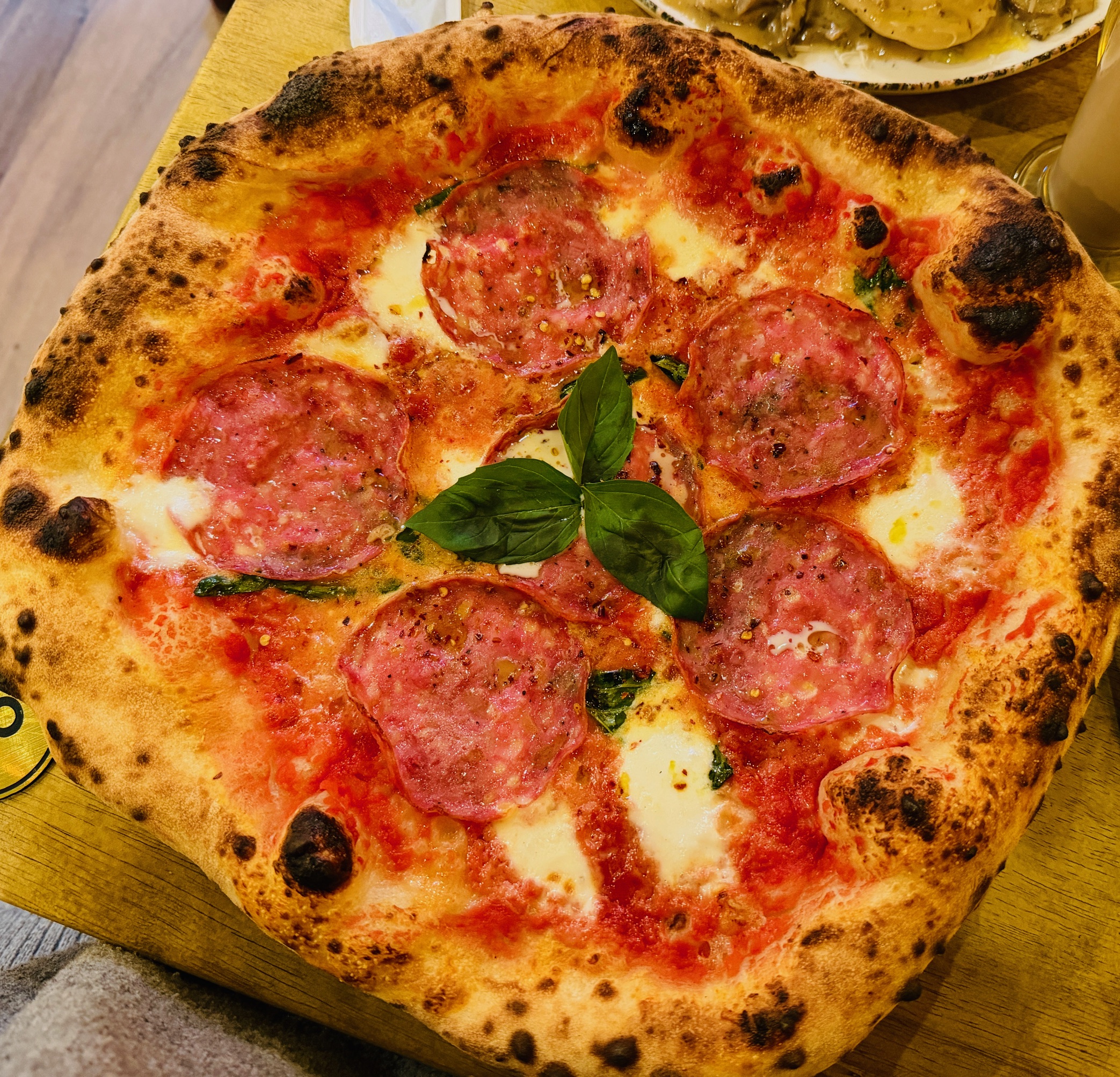
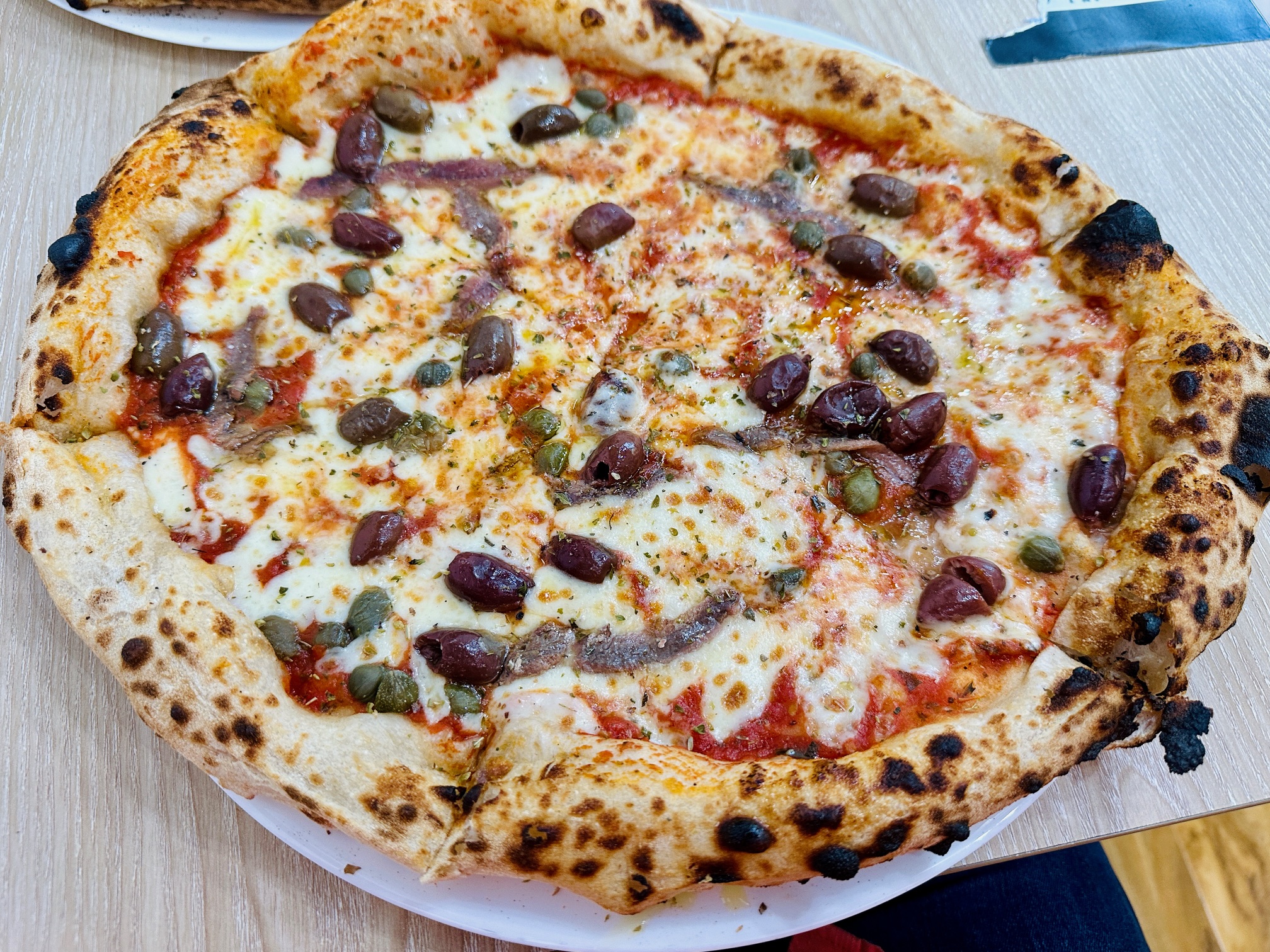
If the panzerotto set up expectations, the pizza fulfilled them. I’d chosen the Siciliana, my reference pizza of olives, anchovies and capers. It’s sometimes called a Neopolitan, presumably because every part of Italy wants to claim the best ever pizza as theirs. Based on what I ate at Paesinos, I can hardly blame them. Everything was exactly as it should be – the right amounts, the right proportions, the right balance. The saltiest of anchovies, generously deployed without being overkill. Purple, perfumed olives. Little clusters of plump, sharp capers (Enza preferred them salted, but give me the vinegary hit any day).

The base was heavenly. Puffed at the rim, beautifully irregular, a proper Neapolitan style pizza that drooped in the middle, although it firmed up as it cooled down. “The dough is completely different towards the end of eating the pizza” said Enza, and she was spot on. I loved the way that she tore a little bit of her crust off and tried it, on its own, before making inroads, a little ritual, almost like a benediction. I followed suit, and again that allowed me to admire Paesinos’ dough before all that other stuff happened to it. It was better after, but pretty much perfect before.

Later on I asked the pizzaiolo, who was indeed Sicilian, whether most of their trade was takeaway and delivery, given Paesinos’ size. He said it was, but that those people, however good his pizza was, missed out ever so slightly. “It’s 100% when it leaves the oven” he said, “but when it gets delivered it can only ever be 90%.” I think he’s right, and explains better than I can why, when you read the rating at the bottom, you need to come here rather than fire up Deliveroo.

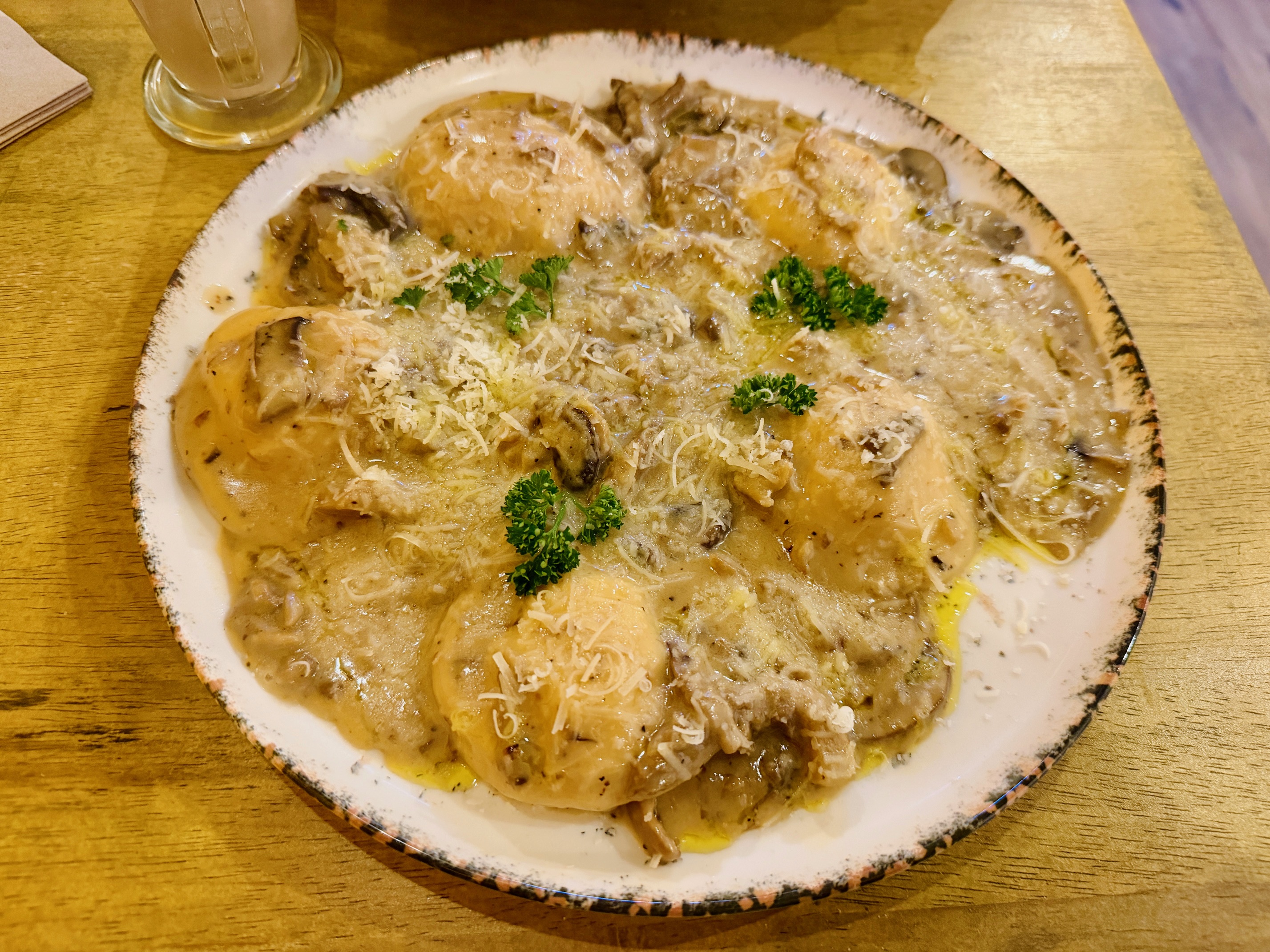
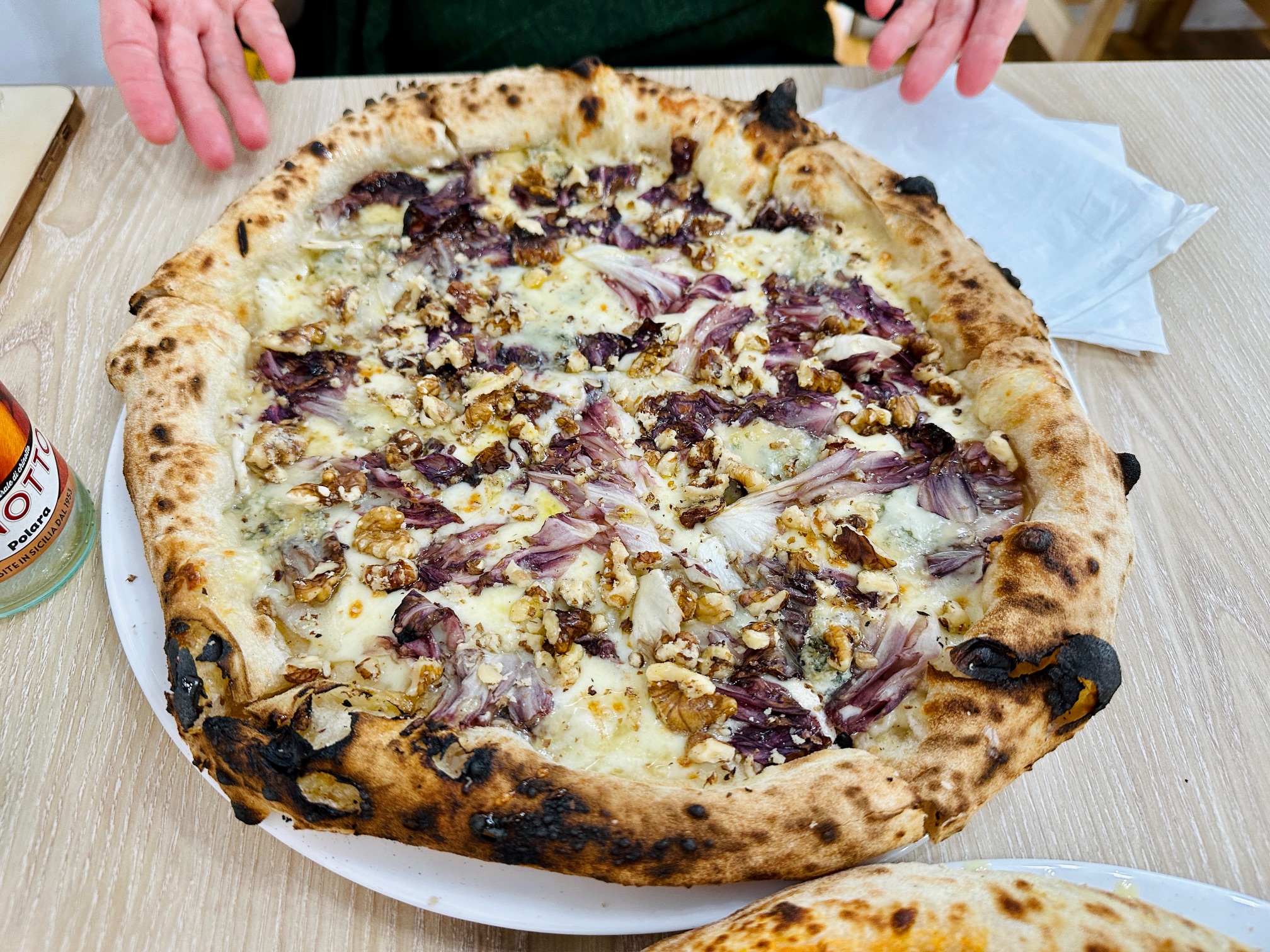
Enza also loved my pizza, and preferred it on balance to hers, which isn’t to say that she didn’t enjoy hers. She went for the “dolce amaro”, a white pizza (premium, not fusion) topped with walnuts, gorgonzola, honey and radicchio. “I know people back in Italy who would disown me for ordering this” she said. Maybe she was right but they ought to try it before they knock it.

This had everything: salty, sweet and bitter in gorgeous harmony. The gorgonzola was so punchy that you smelled it, got that agricultural tang as you lifted a slice up, before you ever took a bite. But the honey – how nice to have honey rather than hot honey on a pizza, for a change – softened its roar. The walnuts lent texture and the final piece of the jigsaw, radicchio with bite and bitterness, was the clinching evidence of intelligent design. All that and, as a white pizza, it was easier and less messy to eat than the Siciliana. I really enjoyed it: Enza thought it a little unbalanced and needing something else, possibly black pepper.

Later on, when we debriefed over a beer in Siren RG1, I asked Enza how authentic that pizza was and she very kindly said something I’d never thought of before that made me feel stupid, in a good way. “Of course it’s authentic” she said. “It’s authentic because somebody has made it.” All these combinations start out as curveballs at some point, but if nobody ever innovated you’d have a cuisine that’s set in aspic. It’s 2025: nobody willingly eats aspic any more.

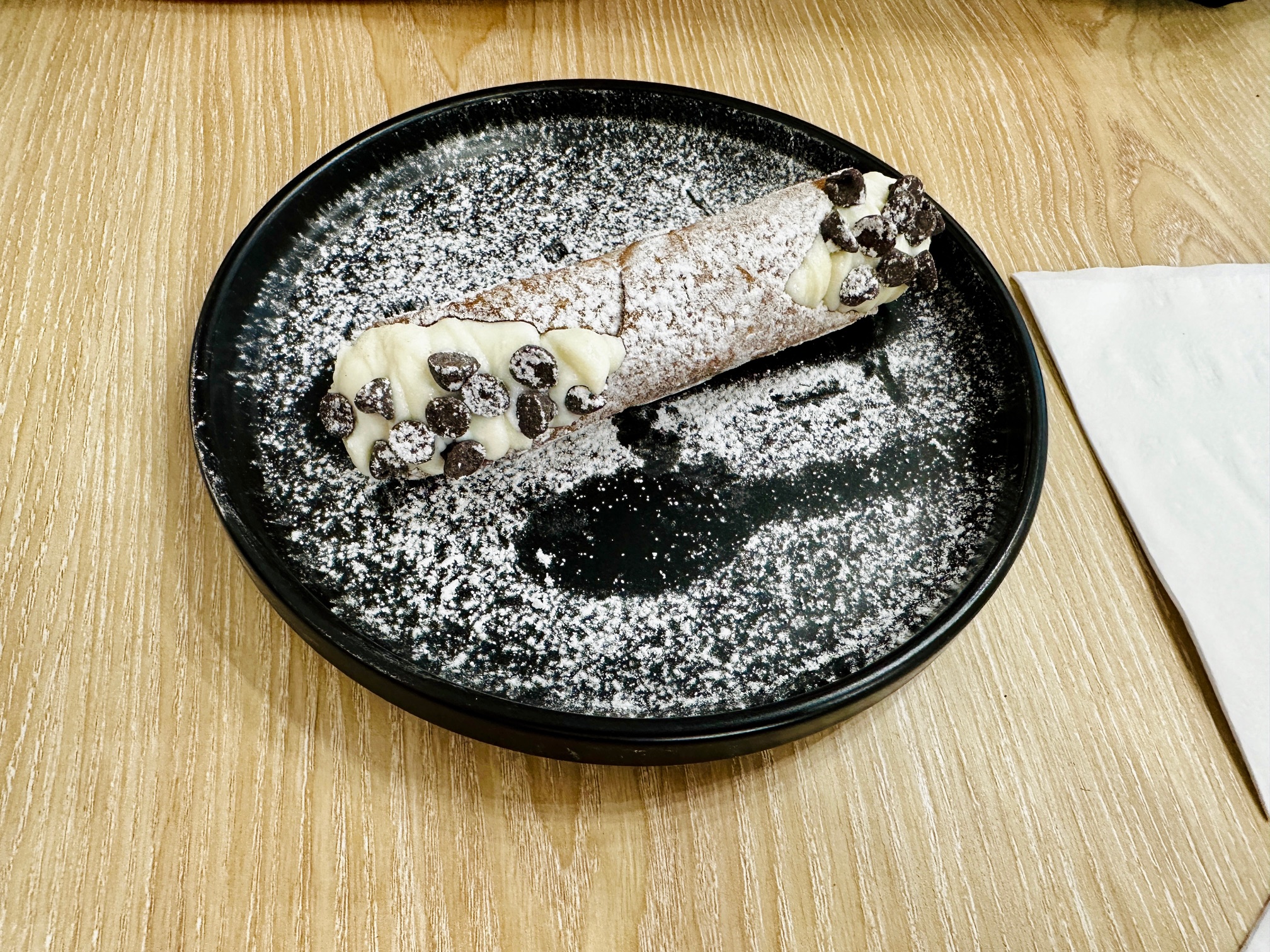
Paesinos has a small section of desserts, plenty of them tempting, and we decided that in the interests of research we ought to try some. Enza’s no slouch, so she asked the pizzaiolo which ones were made by Paesinos. In a flash, without hesitating or deflecting, he told us: just the two, the tiramisu and the cannoli. In the case of the cannoli he bought the shells in, but the ricotta filling was all his own work. That was good enough for us, so Enza decided to road test the cannolo and I – such hardship – ordered the tiramisu.

We also ordered a couple more drinks. The chap who’d prepared our pizzas suggested we try a bottle of something called Spuma, so I did, and it was night and day with the chinotto but equally lovely in its way – sweet and fresh, sunshine in a bottle. I thought it had a taste of grape juice, but online research later suggested it was more complex than that, with rhubarb and elderflower, cloves and caramel. It beat a Fanta Limon, and I say that as a fan of Fanta Limon.

By this point we’d got chatting with our chef, and he told us a little more about the desserts. Normally he imported the cannoli shells from Palermo, he said, but on this occasion he’d had to get them from Catania instead. That meant they’d be more brittle, smoother, less bubbled. He apologised, as if this wasn’t optimal, when discussing the difference between going to the trouble to buy these things from two different Sicilian cities. I admired that focus, that he felt there was an important distinction to be drawn between the best and the merely excellent.

And goodness, but it was exquisite. If this was the second-tier shell, I’d like to try the very best out of sheer curiosity. Beautifully presented – I loved the outline in icing sugar of the wooden spoon, as if at a crime scene – it was an utter joy. Initially Enza tried to press me to have half, using the ultra sharp knife our chef had brought to our table, but I convinced her to just let me try a section from one end. It was so delectable that I almost wished I’d taken up Enza’s offer. The ricotta was so light, so smooth, the chocolate chips it was studded with were so very generous. It made the ones at Madoo, for instance, feel pedestrian.

Everything was imported, we were told, either from Italy or specifically from Sicily. Enza loved it: I’m not making this up, but she honestly did exclaim Mamma mia (I nearly did too, and I was born in Bristol).

There was a story behind the tiramisu, and he told us that too. It was his fiancée’s recipe – she works at the Thirsty Bear – but she only finally let him have it once he opened Paesinos, despite them having been together for twelve years, despite the fact that they were getting married towards the end of the year. Many tiramisu recipes just used egg yolk, he said, but this one included egg white too, to give a lighter texture. The only other tweak was a little vanilla, to offset the flavour of the egg yolk.

It was another tour de force, and he also went to great trouble to tell me it was a bigger portion than you got elsewhere around town. He’d weighed the rival tiramisu you could get in other places, and weighed his, and his was more substantial. It was the best tiramisu I’ve had in Reading, and honestly I can’t remember eating a better one anywhere else. No wonder he was marrying his fiancée: if I had ready access to somebody who could knock one of these out, I’d be the size of a house.

The strangest thing happened after that: we had eaten, we’d drunk (no alcohol, Paesinos is unlicensed) and we ought to have headed straight off to compare notes over a beer. But I was in the company of two Italians, and they talked food, compared notes, discussed recipes, the best places to buy mascarpone, where he sourced his ingredients from. And like that conversation on my Facebook page at the start of this review, I could have listened all night. Being in the company of people whose passion for food verges on obsession – the real meaning of obsession, not that social media meaning that just means “I like this” – was infectious.

In the process I learned a few other things. Paesinos had been open nearly six months, and things were going well. Our chap knew the people at Mama’s Way, loved it there, didn’t see any of this explosion of Italian spots as competition. A rising tide truly did lift all boats, and the slow spread of Reading’s Little Italy round the corner to become a Not So Little Italy felt like a beautiful thing. Eventually we settled up. Our bill for everything came to just under sixty pounds; there was no option to tip – it’s almost as if they just didn’t expect anybody to – so I made a second card payment for that.

If I was giving advice to Paesinos – not that I’m qualified to – it would probably be to lose the things at the periphery of their menu, the pizzas with chicken kebab or paneer, the chicken nuggets, the peri peri fries. I think I saw somewhere online that they had burgers “coming soon”, and a look at their website suggests that they now indeed do a range of burgers. I don’t think they need any of that, but what do I know? Maybe their delivery customers will lap that up.

But actually, if I was giving advice to Paesinos it would be to carry on doing exactly what they’re doing. I cannot think of a pizza I’ve enjoyed so much in a long time, and I can’t think of a Neopolitan-style pizza I’ve liked as much in longer still. What a small, unassuming delight Paesinos is, and what a mind-boggling prospect it is that there’s a healthy debate, under way right now, about whether our town has places to eat pizza that are even better than it is.

I’m not qualified to weigh in on that: I’ve not visited its rivals yet, I’m not a fully paid up pizza obsessive and I’m about as far from Italian as it’s possible to be. So take this as my ill-informed, incomplete, English opinion: this might not be the best pizza in Reading, but if it isn’t, the place that can beat this is going to be one hell of a restaurant. Either way it’s the best pizza I’ve had in Reading, I think. I can’t wait to test out its competition. Even more so, I can’t wait to go back.

Paesinos – 8.6
Unit 4, 2 Kings Road, Reading, RG1 3AA
0118 2068806

https://paesinos.com

Since January 2025, Edible Reading is partly supported by subscribers – click here if you want to read more about that, or click below to subscribe. By doing so you enable me to carry on doing what I do, and you also get access to subscriber only content. Whether you’re a subscriber or not, thanks for reading.
Restaurant review: Bosco Pizzeria, Bristol

Zoë and I wound up in Bristol on the Saturday before Christmas because my friend James was having a barbecue to mark the end of what he refers to as the “grilling season”. Its boundaries are somewhat amorphous, because James likes to barbecue at almost any opportunity, but as far as I can gather the grilling season starts around Easter and ends at some point before New Year’s Eve. I can’t say that with any confidence though, because I wouldn’t put it past James to grill meat in the dead of winter too: it would make more sense to you, if you’d met him.

But anyway it was an evening do, and that left me with one final lunch in Bristol before the year was out. And rather than try the hot new place – assuming I knew where the hot new place was, of course – or one of the Bristol restaurants on my radar like Bank, Native Vine or The Clifton, I decided to go for a safe bet. What can I say: it was the end of the year, my last opportunity to eat on duty in 2024 and, just this once, I wanted a guarantee of what the festive season always promises, comfort and joy. So I chose Bosco Pizzeria, situated near the top of Whiteladies Road, before it meets The Downs.

I first went to Bosco the best part of a decade ago, when it was very much Bristol’s pizza pioneer, and although I hadn’t been back for some time I always had it down as a reliable banker for somewhere good to eat in the city. Since it first opened its fortunes had ebbed and flowed, opening a second branch in Clifton, closing it and reopening it, closing the Whiteladies Road branch due to Covid and then taking a long old time to reopen due to a fire. Other branches in Cheltenham and Bath had followed, and a sister restaurant called Pizzucci offering a more American, less Italian experience down the Gloucester Road.

But I’d always seen it as a sure thing, and a standout even as other pizza restaurants came and went in Bristol. I reckoned it was as good as Flour and Ash – the original one on the Cheltenham Road that Jay Rayner got worked up about that is, not the sanitised relaunched one on Whiteladies Road which I haven’t visited. And for my money it was better than the much-hyped Bertha’s on Wapping Wharf, which wasn’t quite as good as I’d expected it to be. I couldn’t definitively say it was the best pizza in Bristol: after all I don’t live there, and I’m yet to try the likes of Pizzarova or CanCanPizza, but I could say that it took some beating.

And it was a lovely, busy spot the Saturday before Christmas. They’d slightly rejigged it since I was last there, the front section buzzy and full of smaller tables, the one out back made up of booths for larger groups. You could sit up at the bar, which some people were doing, and it had that lovely air of a place where people, like me, were putting their cares to one side for a couple of hours and treating themselves. Christmas decorations were tasteful and muted, wreaths in the window, baubles running along the tops of the banquettes. My wife took a photo of me, sitting there all happy: I liked it enough to use it as a Facebook profile picture.

Bosco’s menu was split into sections – about half a dozen if you count salads, which personally I rarely do. Apart from salads there were cicchetti, a selection of meats and cheeses, plenty of permutations of pizza, a small range of pasta dishes priced as mains and a few bigger dishes (or, as they put it, “large plates”) – ribollita, parmigiana and what have you. It was, I reflected as I tried to make choices, exactly the kind of menu you always hope to see in mainstream Italian chains but never do. It struck me as the sort of place Maidenhead’s Storia was aiming to be. Zoë sipped a very good negroni, I sipped arguably an even better negroni sbagliato and gradually we honed our selection, sequencing them like a mix tape.

The first slight stutter came when we ordered. I said we’d like a couple of cicchetti, then a mixture of meats and cheeses, then our pizzas.

“We’ll bring out all the smaller dishes at the same time, is that okay?” said our server.

Now, I very much wanted to say no, actually, we’re really happy to be here and we’re in no rush so can we have the cicchetti first, then the other bits and then the pizza, like we asked for? And I would have done, but my wife gave me a look which very clearly said could you not be a restaurant reviewer, just this once? so I kept my mouth shut. It hasn’t stopped me mentioning it here, obviously, but it did irk me – what was the rush? It had that feel that Wagamama always has, that the kitchen’s convenience is the primary concern, not your experience.

And it did literally all come out at once, in the space of a couple of minutes, causing not just a sequencing problem but a logistical one too, the table barely big enough to hold five small plates at once. We prioritised the calamari, as the only hot dish we’d asked for, and it was decent but flawed. The thing I’m always watching out for here is the bounce and twang of squid that needed to be fresher, and Bosco avoided that pitfall. But in its place were brittle sticks of squid, almost like Clifton Nik-Naks, which managed to be both pale and overcooked. We squeezed the lemon, dipped in the aioli but neither could totally redeem the raw materials.

The anchovies also misfired. These were billed as coming with salted butter – as they had at Brutto – and focaccia, and almost did but didn’t quite. Instead they came with very good focaccia but swimming in extra virgin, oilier than a Bluesky reply guy, shallot finely diced on top. Is it wrong that I took against them for still having the skin on? Maybe, but it fooled me for a second into thinking these were more like vinegary boquerones than taut, salty anchovies. That wasn’t right – they were intensely salty – but somehow the texture of them didn’t feel quite as I expected.

It was either cognitive dissonance or cognitive disappointment, but I couldn’t work out which. Three anchovies for seven pounds felt a little steep, but I guess you were paying for the focaccia as well. And I liked the focaccia, as I said, and I know it wouldn’t have gone as well with butter as with olive oil. But the whole thing felt a tad disjointed.

Bosco has always excelled for cheese and charcuterie, and the menu gives you an appealing range of both which you can mix and match in the most middle class multibuy of all time. My favourite of the cheeses was the one I neglected to photograph, a gorgeous Robiolo which was soft but not stinky, complex without being overpowering. It was great with the focaccia, which begged the question of how you’d eat it if you hadn’t ordered the anchovies. Almost as good was a Gorgonzola dolce which I liked and Zoë loved – simultaneously sweet and salty and very well balanced.

But again, without the focaccia it might have been messy to eat. I know that this kind of thing – getting in nice cheeses and cured meats, keeping the former well and slicing the latter thinly – is more about buying than cooking, but that doesn’t detract from the fact that many Italian restaurants don’t do this very well. Bosco’s years of experience showed in this respect, in cultivating excellent suppliers, buying the best stuff from them and not mucking it up. It can’t be that easy: if it was, it wouldn’t be so rare.

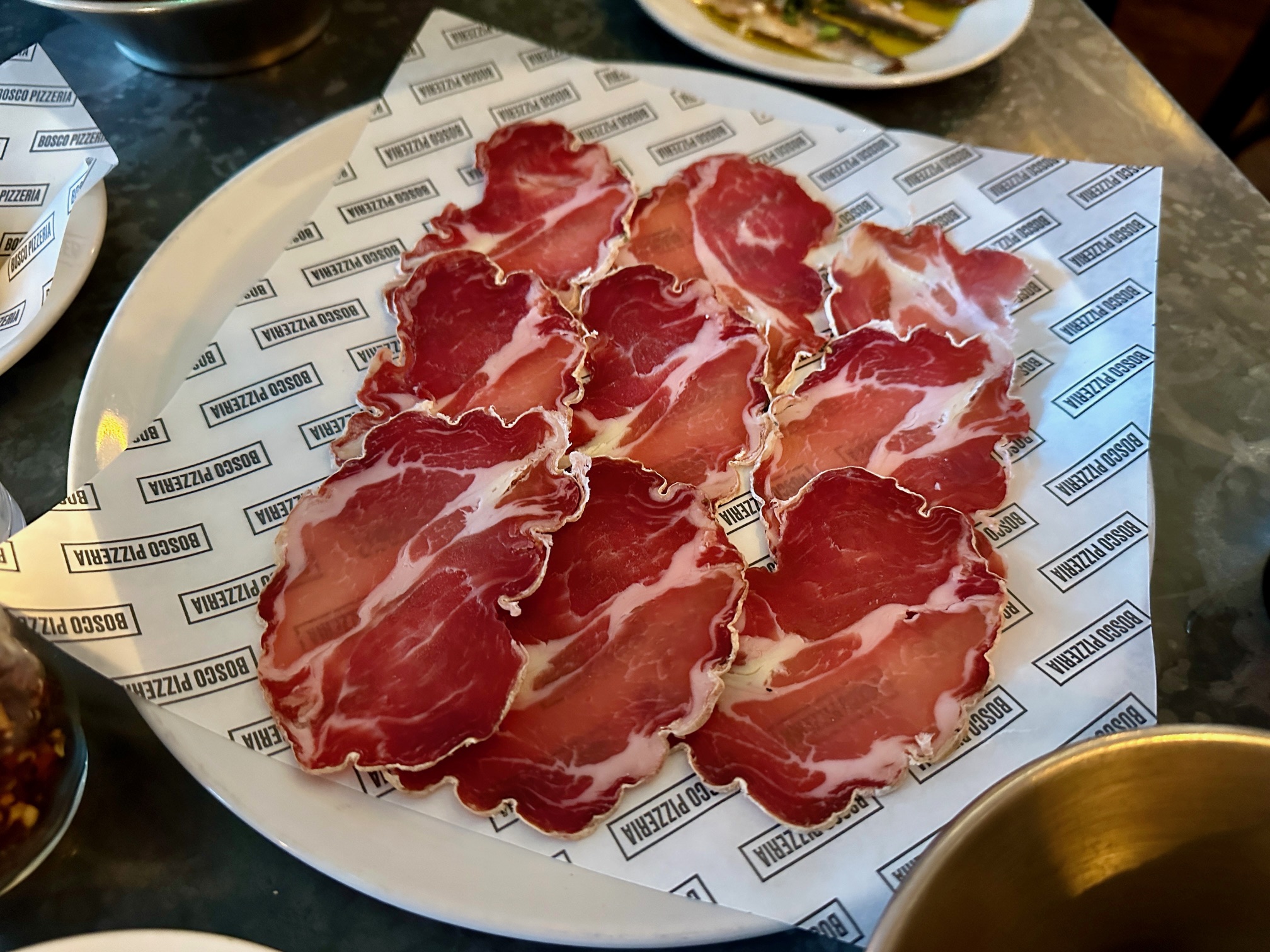
Oh, and the coppa was divine. Clearly sliced there and then, not exhumed from leaves of plastic, with that dryness and nuttiness that marks out the best specimens. This was the one thing that didn’t need bread at all, it just needed to be picked up and polished off, with or without a soupçon of cheese. The natural order had been restored, and I remembered just how good Bosco can be. We flagged someone down for another couple of sbagliatos: even though our reservation had been for a late lunch, the dining room showed no signs of thinning out.

Maybe the staff had got the message that we weren’t in a rush, or maybe they were just too busy to rush us, but there was a decent interval between our plethora of small plates and the main attraction.

Either way I was reminded, during that time, of lots of things: what a nice room it was, and how my many visits there had all been at different stages in my life, during a decade where almost everything about my life – what I did for a living, who I did it for, where I lived and who I lived there with – had changed, the only constant being this blog. I’d never been to Bosco with Zoë, and it made me happy to share this room with her at the end of a year itself full of changes.

I was also reminded, almost as much, just how nice a well made negroni sbagliato can be, but that’s probably beside the point.

Zoë and I reverted to type in ordering our mains, that comfort and joy thing again. Her pizza was the ventricina, a very Zoë choice with spicy salami, chilli oil and honey. She loved it, as I expected she would, and it showcased what Bosco did really well – an exemplary base, a chewy, bubbled crust with plenty of blistering, a deep tomato sauce, winningly fruity. This was as good an advert for Bosco as you could hope for, and at thirteen-fifty I thought it was solid value, especially benchmarked against restaurants closer to home like Zia Lucia.

That I didn’t enjoy my pizza as much just goes to show that you can get the fundamentals bang on and then fluff it with the whistles and bells. I too had asked for my archetypal pizza preference, sometimes called the Neopolitan and sometimes, as here, the Venetian. Either way, it’s the old anchovy, olive, caper trifecta and it’s always my go to when I visit a pizza place, providing it’s on.

The base was still exemplary, so was the sauce, so what went wrong here? A few things, really. The anchovies were unevenly distributed, Franco Manca style, leaving a reasonable amount of surface area salt-free. And the anchovies (skinless this time, to be fair) were too much fish and not enough salt, although that might have been a personal preference.

And what about the capers? Apparently they were fried in this case, which can work brilliantly – Buon Appetito used to do this – but they seemed anonymous. There weren’t enough of them, and what there were didn’t contribute the acetic sharpness I wanted. This pizza is meant to be all about salt and vinegar, but instead it was more fish and mild disappointment.

Hey ho. It wasn’t a bad pizza, it just wasn’t as good as I knew it could be. The slightly haphazard timing, coupled with our gluttony, meant we ate too much too quickly and were too full for dessert, so we settled up. Our meal, including two negronis apiece and an optional 12.5% service charge, came to just over one hundred and six pounds. I didn’t begrudge that: besides, they had Aesop handwash in their very fetching loos, and that stuff doesn’t pay for itself. We called up an Uber and prepared ourselves to have a few drinks with James and Liz ahead of the official end of the grilling season. Well, maybe after a nap to sleep off some of those carbs.

It was a lovely evening, incidentally. The beers flowed thick and fast – James is the man who has turned his garage into a micropub – and the conversation was enormous fun. We got to bed well after midnight, too tired for the traditional couples debrief. But during the gathering somebody who knows that I write this blog asked me if I’d gone anywhere on duty at lunchtime and I said yes, I’d been to Bosco.

“I hear it’s not as good as it used to be, would you agree with that?” I was asked.

And the binary answer, although the world’s always more complicated than binary answers, is yes, I do agree. On my previous visits, Bosco was the place you wish would open near you, the place that could teach every Italian chain a thing or two. On this visit, although it was still good, it was closer in quality to those chains at their very best. The gap had narrowed, and not because the chains have upped their game. This is the point, often combined with expansion, at which independent restaurants need to take care.

But anyway, on that night – and, writing this now – it didn’t seem to matter quite so much. It was a very agreeable lunch, if not a perfect one, tucked away at the end of the year. If you asked me where to go for a rock solid reliable pizza in Bristol, I would still probably pick Bosco; it’s earned that latitude, because we go way back. And if one opened in Reading, all the Sarv’s Slices and Dough Bros in the RG postcode wouldn’t stop me paying it a more than occasional visit. Next time you’re in Bristol, if you want an absolute banker, I think Bosco is still that.

Bosco Pizzeria – 7.6
96 Whiteladies Road, Bristol, BS8 2QX
0117 9737978

https://www.boscopizzeria.co.uk

As of January 2025, Edible Reading is partly supported by subscribers – click here if you want to read more about that, or click below to subscribe. Whether you’re a subscriber or not, thanks for reading.

Restaurant review: Storia, Maidenhead

Six years ago I wrote a piece on the blog, a listicle really, talking about the five things Reading still badly needed. Don’t worry, I won’t send you scurrying off to read it, but the tl:dr version is that, back in 2018, I thought Reading was still missing a proper cooked breakfast place, a tapas restaurant, a gelataria, a cafe that was simultaneously comfy, did good coffee and good food and, for want of a better expression, a “special occasion restaurant”.

Without going into detail, I personally would say that in the intervening six years we haven’t got a great deal closer to having any of those things. But that’s not why we’re talking about Storia in Maidenhead this week: we’re talking about Storia because when I posted about this on Facebook a couple of weeks ago somebody commented saying that, in addition, Reading was lacking a decent independent Italian restaurant. And that comment stopped me in my tracks because – you know what? – that person was right.

Granted, away from the town centre you have the likes of Vesuvio out west and Papa Gee north of the river. And in town you do have pizza options, in the shape of Sarv’s Slice and Zia Lucia. But the demise of Pepe Sale earlier in the year does mean that, for the first time in a very long time, all the Italian restaurants in the town centre are chains: the likes of Zizzi, Carluccio’s and Bella Italia have a stranglehold on central Reading. And the more recent trend of pasta specialists, starting in London with the likes of Padella and Bancone and now cropping up elsewhere, like Little Hollows in Bristol, has also passed Reading by completely: no, town’s short-lived dalliance with Coco Di Mama really doesn’t count.

The one exception, arguably, is Mama’s Way. But although I love it I’m not sure that a restaurant with a capacity of half a dozen (and I’m being generous) is really even in the same ballpark as what we lost when Pepe Sale closed. And the closest thing I can think of to Pepe Sale is miles away to the west – Newbury’s Mio Fiore is a downright lovely spot, but that can be a half hour train journey.

No, that person commenting on my Facebook post was spot on – it’s a big gap in the market in Reading, and it’s striking that nobody has rushed to fill it. Perhaps in the fullness of time Zi Tore, which is going to take over the Grumpy Goat’s site on Smelly Alley, will redress the balance. But it’s hard to get excited about a place boasting Italian street food when the last place to attempt that shtick was Wolf. So this week I decided to check out Maidenhead’s Storia, which had been recommended to me by more than one reader of the blog, in the company of my good friend Jerry (regular readers will be pleased to hear that his digestive issues are now a thing of the past).

The strange thing is that Maidenhead already has a perfectly acceptable if unexciting Italian restaurant in the shape of Sauce and Flour. And Storia is a stone’s throw from that, literally two minutes’ walk away. Not for the first time on a visit to Maidenhead I wondered it if was just rubbing it in that it had some of the things Reading still lacked. Tapas bar El Cerdo was testament to that, as were our very enjoyable pre-dinner drinks at A Hoppy Place. I even had to walk past a branch of Coppa Club on my way to Storia, although that’s maybe less enviable.

That said, Storia is independent but that doesn’t mean it isn’t a chain. It’s the only Berkshire outpost of a group of six restaurants, with others scattered across Surrey, Hertfordshire and, randomly, the edge of Essex. I think that showed in the polish of the place when we arrived – it’s a handsome building which was welcoming from the off and the service was very slick. It was a grown-up space, too, quite classy with good use of mirrors and lighting to make up for what I imagine, in daytime, is a relative lack of natural light.

The tables along the walls were the ones you really wanted, all plush banquettes, but actually I didn’t mind missing out on those because our generous-sized table gave us a great view of the big and buzzing dining room. The whole thing had a feel of affluent happiness about it. It was Friday night, the weekend had arrived and Storia was going to do its damnedest to make sure people thoroughly enjoyed it.

There was very little to dislike about the menu but, simultaneously, I was surprised by how unexciting it was. Storia plays it safe with a menu that very much replicates the likes of Coppa Club down the way with very little sign of quirk or anything especially regional: half a dozen starters, a “raw” section made of up carpaccio and a strangely conspicuous ceviche, some pasta dishes, half a dozen pizzas and as many secondi.

I found it disappointing that all the pasta dishes were priced, and presumably sized, as main courses only – which again, felt more like the stuff of the bigger chain restaurants. And pricing also felt very conventionally done: starters around ten pounds, everything else between fifteen and twenty.

It made me wonder, not for the last time that evening, whether I was just jaded. Because I saw loads of things I could eat but nothing I was dying to try, and that in turn made me think about San Sicario, which closed last year, and what a terrible pity that was. And it also made me think of the interesting, resolutely all-Italian wine lists at San Sicario and Pepe Sale: would they have been seen dead having, as Storia did, an Argentinian Malbec, a Chablis and a Rioja on there?

We ordered a bottle of Valpolicella at £42. They brought a posher bottle by mistake, one twenty pounds more expensive, and I just managed to stop them before they opened it. Our wine was quite nice, but throughout the meal I wondered what the costlier one would have been like.

Jerry loved his starter – a sardine bruschetta with two filleted sardines perched on a pile of roasted peppers and aubergine, punchy with harissa. It was a riot of colour, and ironically one of the best things about it was the bread – properly golden and grilled, the perfect vessel. I got to try a bit and I liked the sardines a lot – in fairness I always do – but the rest of the dish felt a little incongruous, like an attempt to do something North African rather than the more obvious caponata. I quite enjoyed it, but it made me crave caponata more than anything.

“I’m in Lisbon towards the end of the year. Would you like me to bring you back a couple of tins of sardines?”

“That would be marvellous!” beamed Jerry.

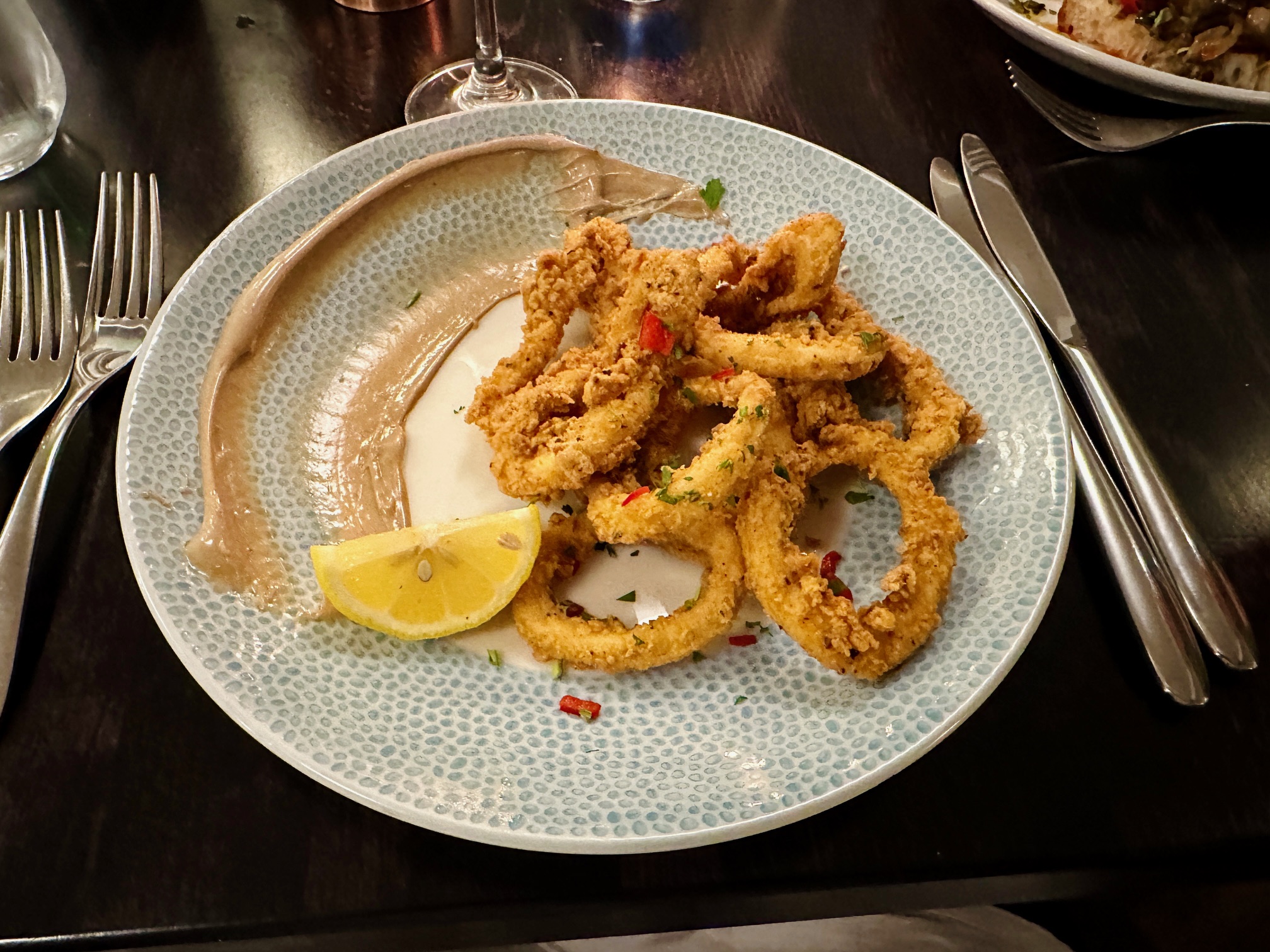
My starter was the best thing I ate all evening. Storia’s calamari was very, very good – fresh, not bouncy, with a crispy, craggy coating which felt like it had some polenta flour in the mix. The whole thing was lightly scattered with red chilli and the decision to serve it with black garlic aioli rather than its more prosaic sibling was an excellent one, even if the smear slightly detracted from the undeniable visual appeal. It made me wish that Storia did a fritto misto, or perhaps it made me wish that Storia was the kind of restaurant that had fritto misto on its menu.

The secondi on Storia’s menu, I’m sorry to say, are really stuff. Forget your lamb rump, your saltimbocca or your suckling pig, because you won’t find them here. Instead there’s a chicken Milanese, a grilled chicken breast dish with marsala, a couple of fish dishes, steak and a risotto. I suspect that, rather than a craving for carbs, is what sent Jerry and I scuttling for the pizza and pasta.

Jerry absolutely adored his pizza salsiccia, a very well-trodden combo of salami, ‘nduja, chilli and basil. Again, he was kind enough to let me try some and I had to agree that it was a very solid effort. Slightly better than Zia Lucia’s – and a darned sight less wet and floppy – and not quite as good as the finest examples from Sarv’s Slice. A bit wayward with the toppings and with a lot of crust, crust that wasn’t quite as puffy, airy or leopard-spotted as the very best examples.

It was a nice pizza, and if I ate in Storia again I might well order one. It was not, however, as good as the one you can get in Knead, a five minute walk away.

I’ve saved possibly the most disappointing until last. When it comes to pasta, I often find myself ordering a carbonara these days. There are probably two reasons for that. One is that it’s a very good benchmark and a sign of whether a kitchen knows its stuff: does it come out glorious and golden, or closer to the magnolia horror of Cozze? But an even better reason – durr! – is that when it’s good it’s one of the happiest, most comforting things you can eat. And now there was a nip in the air I found myself drawn to it, far more than some chicken and pesto concoction that had a whiff of Prezzo about it or a conchiglie dish with yet more of that harissa.

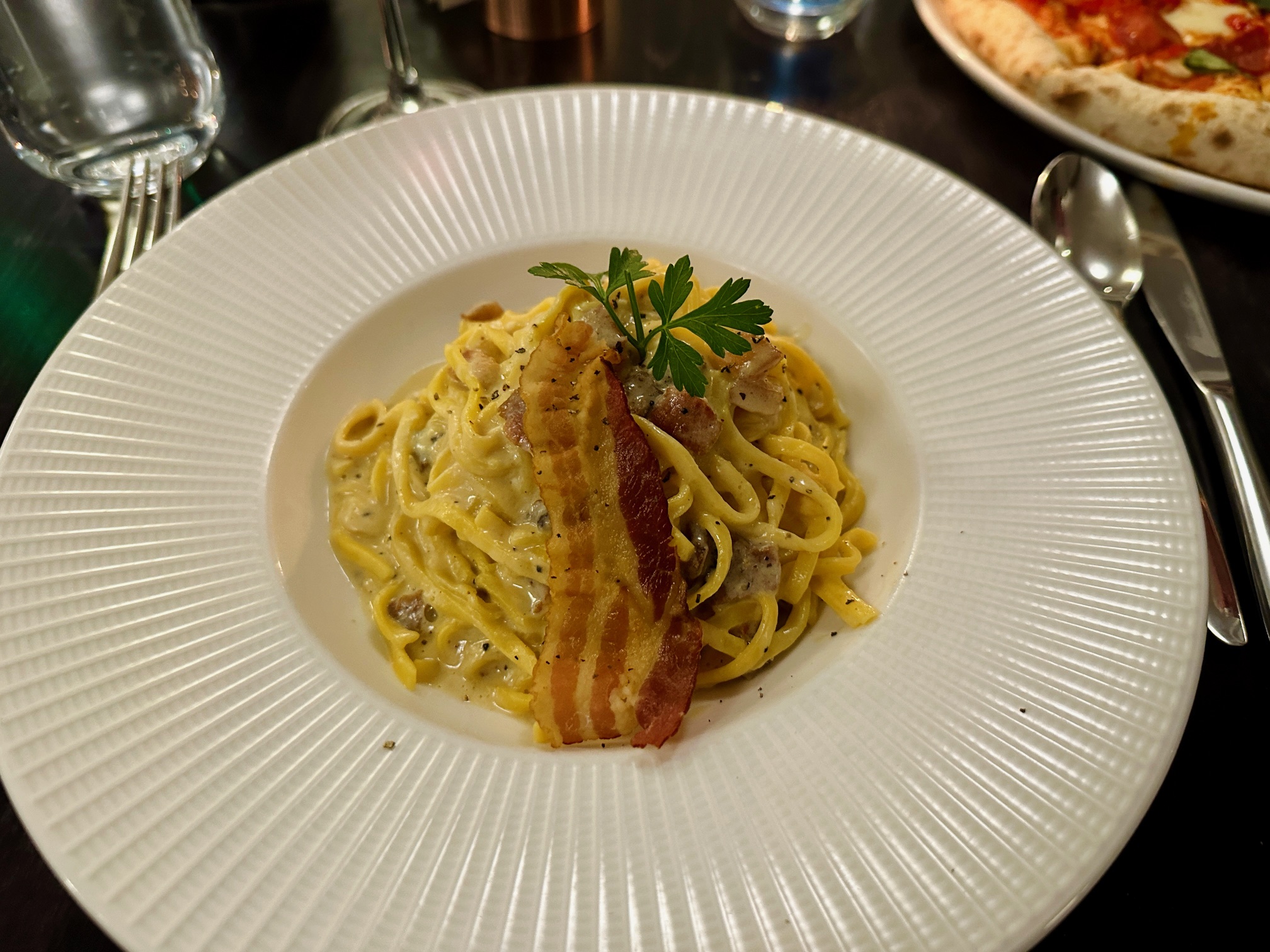
It could have lived up to that promise, and nearly did. The taglioni were beautifully al dente and toothsome, so easy to anchor with a spoon and swirl with a fork, capturing all the sauce you needed. The sauce was good stuff – no adulteration with cream or egg whites here – and topping it with a strip of crispy pancetta was a nice touch, if an obvious one.

But the other star of the show is guanciale, and it needed to be crispy nuggets of the stuff that disrupted all that unctuousness (I mean that in its true sense, by the way) with spikes of smokey salt. And this was underdone, a bit too bouncy, a bit too fatty, falling short. If this dish had been the platonic ideal of a carbonara the rating at the bottom would probably have been a whole point higher and I would be making plans to return before Christmas. But it wasn’t, so the search goes on.

We nearly ordered dessert, but we were that terrible combination of not hungry enough and not fussed enough. But we were having a lovely time, and we had wine left, so we did the next best thing and ordered coffee, just to keep the evening alive that little bit longer. Latte came in a walled glass and was really surprisingly good, so much better than I thought it would be.

Like my old friend, it was sweet without a hint of bitterness, and it made for the perfect end to a brilliant evening. The food had facilitated that, but never even threatened to upstage it; although in fairness I expect I could have a wonderful time with Jerry eating doner meat off a bin lid. Anyway, our meal came to just over a hundred pounds, not including tip: the service very much deserved a tip, so tip we did.

As I said earlier on, I wonder whether I am just jaded about the kind of thing Storia does, even though Storia does it very well indeed. If you want a mid-range, casual dining Italian meal which isn’t going to offend or disappoint anybody, some of which will be good and some of which will be quite nice, you can go to Storia and it will deliver exactly that.

On a good day, so will Coppa Club I imagine, or Zia Lucia. On a good day, Jamie’s Italian used to manage that too. Is that enough? I suppose for many people it will be, and if Storia does that, without fail, time and again, it will no doubt build up a happy and loyal customer base and do extremely well – as it has, I suspect, in Tring and Radlett, in Redhill and Shepperton. History has taught us that there’s definitely a place for that kind of thing.

I guess what Storia reminded me of, strangely, is Strada – remember Strada? – back when Strada only had two branches, before it was possessed by the dread spirit of private equity and went the way some promising small restaurants do. As I think I’ve said before, I used to go to the one in Richmond with an old friend of mine, long since lost in the mists of divorce, and I always loved it. I came away, every single time, wishing Reading had one.

But when it did, it was no longer the Strada I loved but just Zizzi with a different colour scheme. Storia isn’t that, yet it wouldn’t take a lot of imagination to see how it could get there. And maybe that’s what they’re aiming for – I hope not, but everybody needs to make money. Especially nowadays when the bastard stuff seems to be so very thin on the ground.

So it’s not Storia, it’s me. If you’re like me, you would probably enjoy your meal there. But if you’re anything like me, Storia might also leave you feeling that, even though there’s nothing technically wrong with it, you just want something more these days.

Storia – 6.9
11 Bridge Street, Maidenhead, SL6 8LR
01628 769350

https://www.storiarestaurants.co.uk/maidenhead

Restaurant review: Dough Bros

I moved house last week, and suddenly everything changed. My little slice of Reading, my walks, maps, routes and routines were no more. No more waking up in the Village and mooching into town for lunch, no more strolls round Reading Old Cemetery or Palmer Park, no more number 17s and Little Oranges buses, no more Retreat just round the corner. After seven years of East Reading life, it was time for something different.

So on moving day Zoë and I found ourselves standing, sleep-deprived, outside a large house that wasn’t quite ours yet, rented van parked up in the drive, waiting for the agent to arrive and check us in. Meanwhile, across town, movers were loading boxes into a far bigger van from a far smaller house that was no longer ours. The sun was blazing, and I strolled across Cintra Park to Greggs, of all places, to pick up coffee and pastries. This is my neighbourhood now, I thought to myself.

I’m writing this over a week later, after seven days of unpacking and tip slots and IKEA trips (I’d forgotten how depressing that place is) and everything is starting to take shape. A lot of the boxes are unpacked, the kitchen is in some kind of order and, best of all, we finally got a new bed – high off the ground, with a big firm mattress, like climbing on to a cloud at night. The walls are fresh-painted white, the blinds are new and Venetian and the rooms flood with summer sunlight.

And every morning I wake up and can’t quite believe I live here, in this new place.

There’s a clothes line in the garden, and I get to experience the meditative joys of hanging out the washing, taking it in when it’s been dried by the sun and smells of heaven. Let’s not talk about the huge rent hike, or the council tax band of this place, or the fact that I can’t afford to eat out quite so often: let’s just think about the smell of that washing from the line.

On our very first night, exhausted but with the rest of the week off to unpack and settle in, we wandered to pretty much our nearest restaurant, Kungfu Kitchen. Like me they moved recently, although a few doors down Christchurch Green maybe isn’t quite as big a shift as mine. And their new site is lovely and snazzy – especially the light feature projecting fish onto the floor – but it was also reassuring just how like their old place it was. The food was still outstanding, and the welcome was the same, because Jo and Steve do not change: I particularly enjoyed Jo frogmarching customers to the loo, proudly boasting that Kungfu Kitchen has the best toilets in the world. Her words, not mine.

But Kungfu Kitchen is only one of our nearest restaurants, and I popped into one of the others to take something home the following night, just before an England match, fresh from a purgatorial trip to the tip. Dough Bros opened in March at the top of Northumberland Avenue and has built up quite a following in three short months. It’s run by a couple of friends, one of whom also runs the neighbouring barber Short, Back & Vibes.

Subscribe to continue reading

Become a paid subscriber to get access to the rest of this post and other exclusive content.