You can have a great network of informants, but sometimes there’s no substitute for getting out and about, keeping your eyes peeled. It’s a fact that our local journalists – what’s left of them, anyway – have forgotten, working from home. So last Saturday, after a very enjoyable lunch at Blue Collar and a coffee at Compound, my friend Dave and I took a wander down the Oxford Road to be virtuous and get some steps in ahead of a few afternoon beers at the Nag’s Head.
Much of what I saw was as expected. Traditional Romanesc are still there, in the spot where I had so many brilliant meals when it used to be Buon Appetito. Vampire’s Den, too (“is that really the only reference to Romania they thought people would get?” was Dave’s take). Oishi had definitely gone from “temporarily closed” to “never coming back in a million years” and Workhouse had been given a very attractive makeover, although the new store front didn’t seem to contain the name anywhere.
But there were, as there always seem to be, places that were news to me. Near the top of the Oxford Road, a place called AfrikInn was selling fufu, fried yam and jollof rice. SORRY WE’RE CLOSED TODAY SEE YOU TOMORROW said handwritten signs on the door and window. Further down, not far from Momo 2 Go, a place called Agnes’ Coffee Shop was open, selling coffee and Polish street food: the word Zapiekanki ran vertically down the brickwork, in a bigger font than the name of the café. I made a mental note of both.
But the place Dave and I were vaguely ambling to check out was Portuguese café DeNata, which opened in March this year, replacing – and this is where it gets confusing – Portuguese café Time 4 Coffee, which opened last August. It had been on my list for ages and although Dave and I were both full from lunch we figured an expedition to research pasteis de nata was a worthy pre-pint pursuit. Dave’s son has just come back from Lisbon on holiday, and hearing all about it made me very glad I had my own trip booked there later in the year.
We ordered a couple of pasteis, and the proprietor – instantly bright and personable – took great pride in showing me the menu; I chatted away with her for so long that poor Dave had to pay for the egg custard tarts. The owner asked me to follow DeNata on Facebook, and I dutifully promised I would. The place was bustling on a Saturday afternoon, and warm, but I didn’t pay it too much attention. Dave and I had a pub table to bag, after all, and a pastel de nata to inhale.
Anyway, the next day I left the house mid-morning, took a couple of buses and turned up at DeNata just before midday for lunch, to eat the meal you’re about to read about. So why did I do that?
Subscribe to continue reading
Become a paid subscriber to get access to the rest of this post and other exclusive content.
This week’s review came about for a simple reason: I went to Nando’s. Six weeks ago Zoë and I were in town on a slow Sunday lunchtime, neither of us could face cooking that evening and we longed for the comfort of a known quantity. Judge all you like, but when I feel that way Nando’s makes it on to my long list, which means that occasionally it makes the shortlist, and sometimes it winds up on the podium.
I mean the Friar Street branch – no offence if you prefer the one in the Oracle – and my usual order is butterflied chicken, medium, with macho peas, spicy rice, garlic piri-piri sauce on the side. It always delivers, and it did on this occasion: I left sated and happy, putting a picture on Instagram to show that I’m not all preaching and indies. Later that day I got a message from my friend James (last seen on this blog living it up in Marmo).
“I’ve recently cracked how Nando’s do their chicken” it said. This was a very James thing to say: naturally I was intrigued.
“Don’t they just cook it, keep it in a drawer and then finish it on the grill after you’ve ordered it?”
“They slowly cook the chicken at about 90 degrees over a couple of hours, almost poached in a basic marinade.Then they grill and layer on the piri piri multiple times to create a layer of flavour: baste, seal and grill, turn, baste etc.”
Doing this sort of painstaking research was also very James. But better was to come, because when Zoë and I went to stay with him and his partner Liz over Easter weekend, he went a step further. “I’m going to recreate it”, he said. He was true to his word, so one night we sat down to the most glorious slow-cooked, basted and grilled piri piri chicken. James cooked the chicken, Liz made the macho peas, the coleslaw and fries were from the supermarket. The whole affair was even more soothing than the real thing: Nandos-esque rather than just Nandos-ish, if that makes sense.
“The place I keep meaning to try is Casa do Frango.” I said, between mouthfuls. “They started out with one near London Bridge and now they have three across the city.”
“Let’s do it!” said James.“I’d love to accompany you.” So we did: some people might find this eccentric, but James and I booked a Friday off work and headed to London on the train, on a pilgrimage for the best piri piri chicken outside Portugal.
Casa do Frango (the house of chicken: in Portuguese it sounds far more exotic than, say, the hut of pizza) came to my attention five years ago when the original branch got a glowing review in the Observer. And I always intended to go at some point, to see if it could get anywhere near the best piri piri chicken I’ve ever had, in a little Lisbon alleyway. That was at a place called Bonjardim and it remains a real death row food memory, the skin brittle and intense, rubbed with lemon and salt, the meat underneath a yielding feast. Nando’s, much as I like it, has never displaced it in my memory, but perhaps Casa do Frango could.
For this review I decided to visit Casa do Frango’s newest, most central branch. It’s on Heddon Street, just off Regent Street and a stone’s throw from Liberty, and I picked it partly because it’s become their flagship, partly because it fitted better with our plans for the rest of the day but mainly, in truth, with you lot in mind. After all, a decent affordable place to eat not far from from Piccadilly Circus might potentially be of use to a lot of you (although not one of my readers who recently got in touch to tell me that, although he read the blog religiously every week, the recent ones hadn’t been hugely useful given that he was allergic to chicken – sorry Tom!).
On the way in I realised that it must be the best part of three years since I’d set foot in central London, over three years since I’d taken the Tube. That means I’m a tedious Johnny-come-lately when it comes to how game-changing the Elizabeth Line is to Bond Street (although I enjoyed my guided tour of the Elizabeth Line, thanks to James who is quite the public transport enthusiast). It also meant I wasn’t prepared for how quiet it was on a Friday – not Vanilla Sky Times Square levels, but I’d never seen Regent Street so sparsely populated. “Thursday is the new Friday” said James.“Everyone’s working from home today.”
Heddon Street is a little alley literally lined with restaurants – a ramen place, an outpost of Gordon Ramsay’s empire, a pub called The Starman (the cover of Ziggy Stardust was shot outside) and a café called Ziggy Green, because people are nothing if not unimaginative. We walked past Michelin-starred Sabor, which looked gorgeous inside (“I’ve been, it’s great” ventured James) and I wondered if I’d have restaurant regret. But Casa do Frango is a handsome-looking spot, and I loved the tiles outside reading RUA HEDDON. The muggy drizzle said we were in London, but it still had the potential to be transformative.
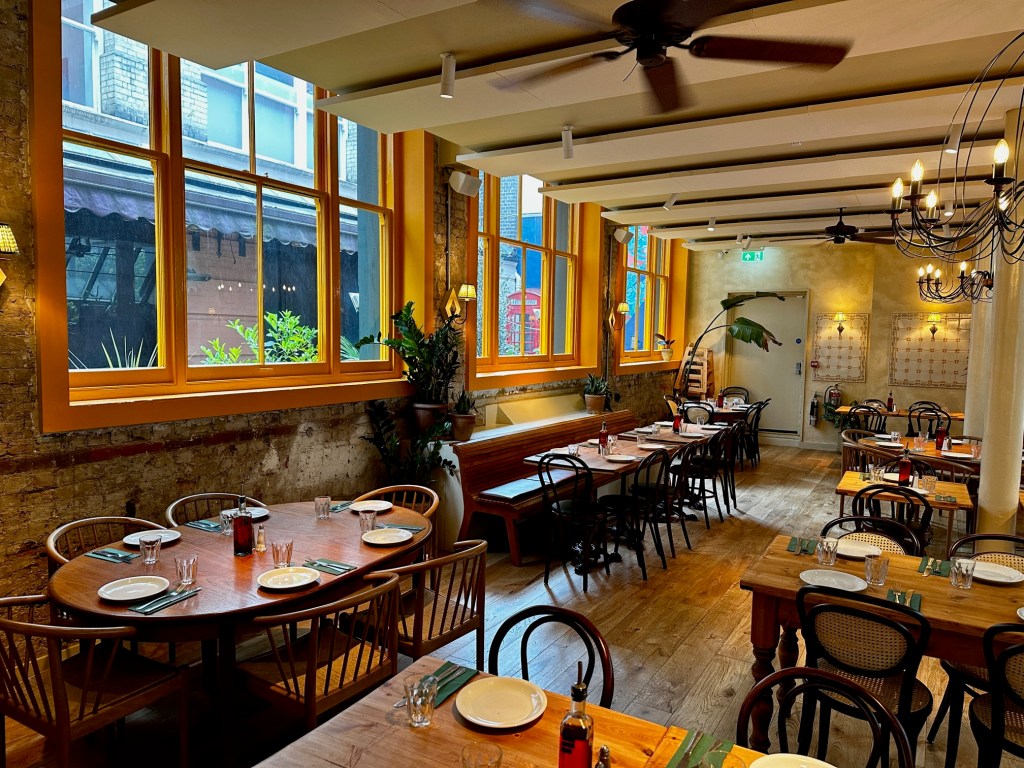
It’s a big site, with two large dining rooms upstairs, some private dining and a very swish-looking speakeasy bar downstairs. We were in the back dining room, their first customers, ultra keen at high noon. It was a great space, ceiling fans whirring, the whole thing surprisingly well lit, tasteful bentwood chairs, brick, tile and warm burnt orange tones. We got a good table up against the wall so we both got a view of the dining room, and it slowly filled up over time. They lunch later in London, the lucky blighters.
The menu only has one main course – that chicken – so it’s all about the starters and sides. The chicken is twelve fifty – back in 2018 when the Observer visited it was still less than a tenner – but most of the small plate starters (billed as “to share”) clocked in between eight and ten. Technically you could eat here as a vegetarian, if you were dragged here, but you’d find it all foreplay and no shagging, so to speak.
I was particularly impressed with the drinks list. The compact selection of cocktails is more than skin deep Portuguese, so licor Beirão and ginjinha both make an appearance: I have happy memories of both. The wine list is one hundred per cent Portuguese, even down to the dessert wines, with a separate section for vinho verde, much of which is available by the glass. Even the port is the lesser-spotted Offley rather than a bigger name. We started with a gorgeous, zesty white port and tonic – I picked up the habit for these in Porto five years ago, they can quite make you forget about G&T – and made our choices.
To begin, that meant trying to eat a representative sample of the small plates. Bacalhau fritters were the best of them – salt cod is one of my favourite things about Portuguese food and these were light-shelled with the perfect balance of carby potato lending bulk and the fish landing the perfect hit of flavour. The aioli, golden and sunny, rounded things off nicely, though I wasn’t sure they needed to glue the croquettes to the dish with more of the stuff.
The pork croquettes were also decent enough, although they lacked the same wow factor. These were served with a mustard bechamel I liked slightly less, and although the flavour of the croquettes was good, the texture suitably silky, I couldn’t help thinking we’d ordered two dishes too similar. The chorizo, grilled with black olive mayo and pickled chillies, might have been a better choice. The croquettes and the fritters, at eight pounds, felt a tiny bit sharp for what you got.
I did love the salgadinhos – little empanadas stuffed with kale, mushroom and onion – though. It’s interesting how the mind can be redirected by pricing: at two pounds each these were technically the same price as a single croquette or fritter, but they felt bigger, better and better value. The salt flakes liberally sprinkled on top gave each mouthful a pleasing little saline spike.
Our final starter promised much but didn’t entirely deliver. A whole head of cauliflower, marinated so effectively in piri piri that its centre had a pinkish tinge, had been charred and then drowned in a vivid green slick of yoghurt and pistachio. Eating this dish felt like reading a well-written novel and not enjoying it as much as I thought I should. Everything worked – the flesh of the cauli firm, the sharp tang of the yoghurt augmented with lime – but by the end it felt like a slog. If the other small plates were a little small, paradoxically this could have benefited from being smaller.
The eponymous chicken arrived as we’d polished off a cold glass of Super Bock. This is where I’d love to dust off my hyperbole but instead, I fear I’ll be delivering some faint praise. There was literally nothing not to like, but perhaps nothing to rhapsodise over either. You get half a chicken per person, and yes, it was juicy and swimming in brick-red juices (“the key is to use smaller chickens” said James, knowingly). But the flip side is that tender though it was, there wasn’t masses of meat and some of it took more persuading off the bone than I’d expected. I was hoping for that hit of crispy skin, too, but the whole thing felt a tiny bit underpowered.
It didn’t compare to my memories of Bonjardim – perhaps the power of nostalgia meant it never could – but I wasn’t sure it was better than the rendition at Casa do James, either. I should add that James liked it more than I did, and he has the added benefit of knowing what he is talking about. We both largely eschewed the little tub of piri piri sauce it came with – “that’s for tourists”, said James – instead trying to get every bit of the glossy, spicy oil coating the bottom of the steel plate.
I should also mention the surprise MVP of our meal, hidden at the back of the photo above. Casa do Frango’s chips are nothing to look at – verging on blond and, on appearances, unlikely to deliver much. In reality they were phenomenal – salty with huge amounts of crunch and staying hot, seemingly, for ages. They didn’t have to be this good, god knows the ones from Nando’s rarely are, and yet this was the dish James and I kept coming back to for the rest of the afternoon. Those fries, though.
Perhaps the reason the chicken was lacking in crispy skin is because Casa do Frango had the genius idea of stabbing huge shards of it into its African rice. This was a phenomenal side, the rice studded with chorizo and sticky plantain and, with the exception of a few clumps, virtually flawless. If they sold a side that was just a bowl of crispy chicken skin I’d have bought several. And taken a doggy bag.
Our final side of Hispi cabbage, though, was too similar to that cauliflower starter, being a brassica charred and festooned with yoghurt. This one was accented with red pepper and a parsley sauce a little like a chimichurri or salsa verde. But even more than the cauliflower, this felt more like a virtuous trudge than an indulgence. The way it was plated was frustrating, too: one wedge of cabbage was perched on top of the other, with the end result that only one of them, really, was properly dressed.
I was ambivalent about dessert, but James had his heart set on one – for research purposes, no doubt – and so we acquiesced. It helped that we accompanied them with a glorious glass each of Moscatel de Setubal: Portugal never gets the credit it deserves for its superb dessert wines and this one was a glowing schooner of sweet, sweet sunshine (I neglected to mention the vinho verde we had with our chicken: superb and ever so slightly effervescent). The service was excellent throughout and our server steered James in the direction of the almond cake which she said was her favourite – she couldn’t eat gluten, which was part of why she loved it so much, but James adored it too.
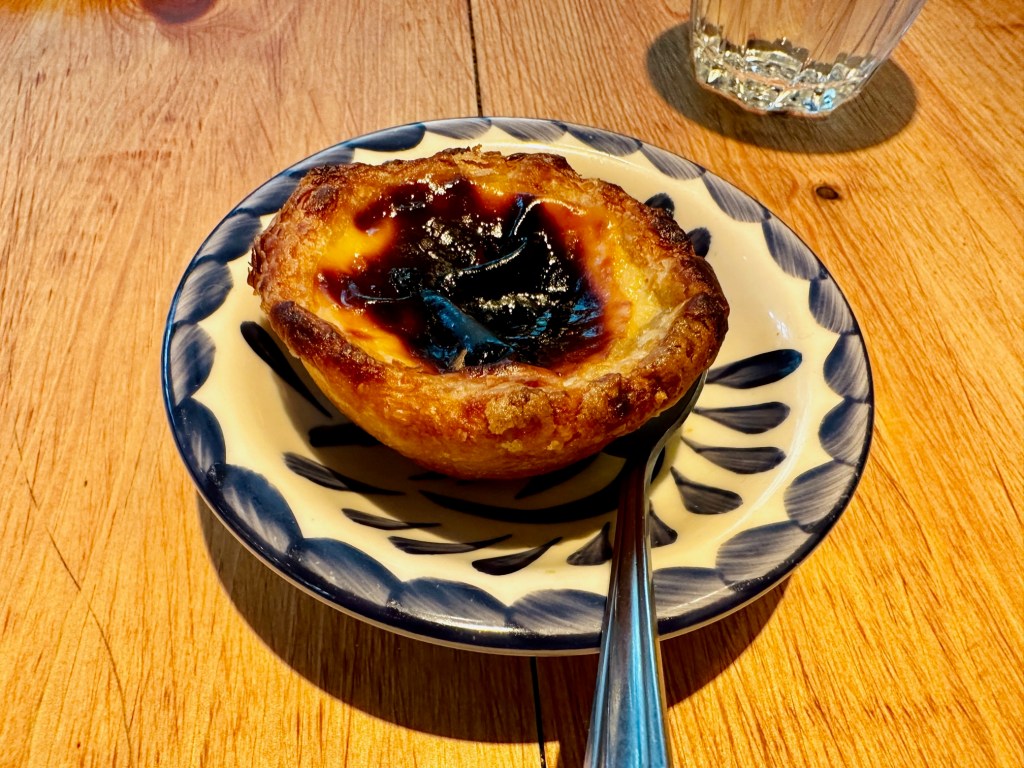
Settling into my role as designated party pooper, I had a pastel de nata. Well, you have to: any coffee without one in Portugal feels like a coffee missing its soulmate. And although Casa do Frango’s looked the part, it was a fascinating study in contrasts where everything was not quite as it should have been – the pastry, which should be ethereally light, was heavy going and the custard, which should be just-firm with a little wobble, was gloopy. I should have seen the warning signs when they brought it with a teaspoon. What kind of egg custard tart needs to be eaten with a teaspoon? This one, it turns out.
So a proper mixed bag, with plenty to celebrate. But, like Joni Mitchell in Both Sides Now, I worry that it’s Casa do Frango’s illusions I recall. So let’s try and focus on the positives – the wine list is fantastic, some of the small plates are delicious, that rice will live long in my memory and I’m still astonished that the fries were so much better than they looked at first blush. The service – attentive, endearingly laconic, properly Portuguese – was a joy and every bit worth the twelve and a half per cent. It’s a beautiful room and, as I discovered on a foray to the basement, the handwash in the gents smells heavenly.
But I do wonder if the things I really enjoyed about this meal were more about the context of the meal than the food itself. I was on a day off, on a Friday with a good friend, with nothing to do but drift from restaurant to shop to bar to restaurant again. I was in London properly for the first time in eons and it almost felt like we had the city to ourselves. In those circumstances, many meals would feel special. It’s important to try and push that slightly to one side and focus on what we ate.
The whole thing – all that food and four different alcoholic drinks apiece – came to a hundred and sixty pounds, including the service charge. And that’s where you have to stop and think. Is the place better than Nando’s? Objectively yes, of course it is. Is it easily three or four times better than the significantly cheaper Nando’s? I’m not so sure about that. Does it command grudging affection like Nando’s? No, I’m afraid it doesn’t.
And, on Heddon Street at least, Nando’s isn’t even its competition. If you’re in this part of town there are plenty of other ways to spend your money at superior reimaginings of nationwide chains – a short walk away off Carnaby Street, for instance, you could stop into Pizza Pilgrims. It may be a step up from the likes of Franco Manca and Pizza Express, but if you manage to spend a hundred and sixty pounds between two there I’d be very surprised.
The strangest thing about my visit is this: even though pedestrian old Nando’s is an identikit recreated across the country, without the beautiful decor and attention to detail of any of Casa do Frango’s sites, I found this visit made me appreciate the former more than the latter. In fact, shameful confession time: I went back to Friar Street in between visiting Casa do Frango and publishing this review, just to check that I wasn’t on mushrooms, and I stand by what I’ve said. Doubtless that will get me excommunicated from the Guild Of Food Snobs, and I know I’m disagreeing with Jay Rayner again. But would you expect any less from me by now?
Casa do Frango – 7.1 31-33 Heddon Street, London, W1B 4BL 020 35355900
O Português closed in March 2023. I’ve left the review up for posterity.
As far as hospitality is concerned, one of the hardest things you can do right now is give somewhere a bad review. For much of last year many reviewers, professional and amateur, thought that you shouldn’t do it at all. If you didn’t like somewhere, they said, you should maintain a dignified silence and write instead about the places you like. I’ve never subscribed to that point of view: it’s somewhat Pollyanna to only talk about the brilliant, and warning people about the iffy is every bit as much of a public service.
Nonetheless, bad reviews remain the trickiest to carry off. I don’t mean a hatchet job. I know those are fun to read – they can be fun to write – but somewhere has to be really awful to justify one of those. For instance, I went to TGI Friday or Taco Bell with an open mind, but both times it soon became apparent that it was going to be one of those nights, and one of those meals. But opportunities to write that kind of review are vanishingly few and far between: I don’t choose anywhere confident that I’ll have a bad time, rubbing my hands at the prospect.
The rest of the time, if you don’t like a meal, you’re putting the boot into an independent business. Somebody’s baby, some people’s livelihoods. It can feel like kicking a puppy. So you try and be constructive, get the tone right, find good stuff to offset the bad. Some of my attempts at this have worked better than others, although I’ve definitely softened over the years. And this year, the review I found the most difficult was when I had takeaway from O Português, the new Portuguese restaurant on the Wokingham Road.
O Português had looked great on paper – I really wanted to like it, but I wanted to like it more than I did. Some dishes showed promise, others were less successful. The one that came in for the most criticism was my other half’s grilled chicken, which she dubbed “a carcass covered in tasty skin” with “more bones than Cemetery Junction” (this is a trick, incidentally, we all use with negative reviews: if you’re quoting someone else, you can at least play the good cop).
I really didn’t enjoy publishing that one, but to their credit the restaurant got in touch with me about it and took my feedback constructively (to my face, anyway: privately they might have called me every name under the sun). They agreed that some of their dishes maybe hadn’t travelled as well as they should, and they hoped I would give them another try once restaurants were allowed to reopen. I told them I would.
I couldn’t help but think of Thames Lido, where I’d eaten in May. I put a few pictures up on Instagram, saying some dishes were good and some could have been better, only to get an unsolicited direct message from the chef there. “May I suggest you don’t go out so much and cook a bit more at home? I’m sure we’d all love to see the photos” The difference in attitude couldn’t have been more stark.
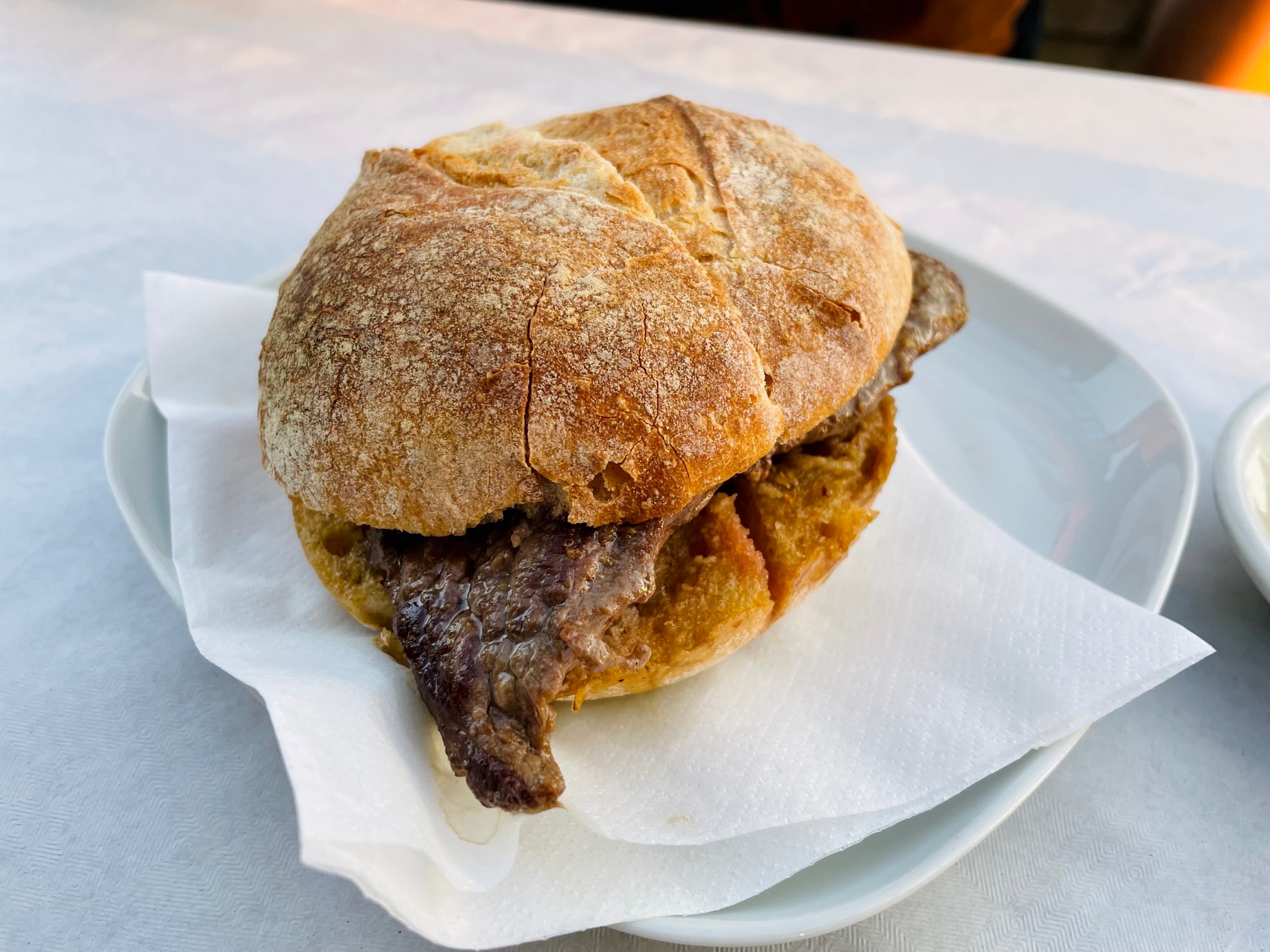
Additionally, one of O Português’ devoted customers got in touch advising me that I should give them another try. She was Portuguese, and was a big fan of their food. She told me that there was nothing better than grabbing a prego steak roll from them and eating it straight away in Palmer Park. Put that way it sounded like a lovely thing to do, so I decided to pay them a midweek visit and try O Português properly, in the flesh. My accomplice this week was my friend Nick, who I met a couple of years ago on Twitter through our mutual admiration for car crash Tory election candidate Craig Morley.
The building that houses O Português used to be Colley’s Supper Rooms, and then Bart’s and a purgatorial-sounding place called Smokey’s House, but it looks somehow right as O Português, on the corner of the Wokingham Road and St Bartholemew’s Road, one of the handsome streets on the perimeter of Palmer Park. They’ve done a good job with their outside space on both sides, and I’ve often walked past over the last few months envying people sitting outside with a cold Super Bock, enjoying dinner with friends.
We asked for a table out front of the restaurant, to make the most of the remaining rays of sun. The interior looks relatively unchanged from when it was Bart’s, with two dining rooms, a bar and a separate counter with cakes and pastries. I got the impression that O Português was a little bit of everything, somewhere you could go for a galao and a cake, lunch, a full on meal or a few drinks and that aforementioned steak roll. The main difference is that indoors it’s table service, whereas if you’re eating outside you go up to the counter, order and pay. Maybe they’ve some people do a runner, but it felt like a strange distinction.
O Português’ menu isn’t available online (except the bits of it that are on delivery apps) but the hard copy we looked at had plenty to tempt at a wide range of price points. The petiscos start at three pounds and go up to around seven, where they overlap with a separate, smaller, section of starters. Main courses start at nine pounds but go all the way up to twenty. Our waitress told us which dishes they didn’t have that day – it’s always strangely reassuring to know that they sell out of some things, and when they’re gone they’re gone.
I’ve been on duty with plenty of different people by now, and they all have different styles. Some seem oblivious to the experience, like my friend Jerry. Some, like my friend Reggie, get self-conscious and worry about being quoted saying something that casts them in a bad light. But few throw themselves into it with quite as much gay abandon as Nick: I always let my companion pick their food first, but I think he took it as a personal challenge.
“Let’s have the snails and the gizzards” he said, a sentence I’ve never heard before and will probably never hear again.
“Have you ever had snails or gizzards before?”
“No. But that’s kind of the point, isn’t it?”
I explained that maybe we should try one or the other but not both, and I scuttled up to the counter to order our starters.
“What are your gizzards like?” I said (a sentence, at a guess, that the woman behind the counter had also never heard before). “I’ve had ones in the past which are really firm and meaty, and others that can be a little rubbery.”
“I don’t really like them much, we have other dishes that are better.” Well, you had to credit her honesty. Our drinks came first, so Nick and I nursed a Super Bock each – not on draft the day we went, sadly, but lovely and refreshing all the same.
“This reminds me of the first beer on holiday” I said, thinking fondly of trips to Porto and Lisbon.
“There’s something about that first beer” Nick concurred, and talked about the relative benefits of Efe, Mythos and Estrella (or more precisely, how much we missed holidays where you can drink those beers) before concluding that, however many IPAs and DIPAs we might clock up on Untappd we probably couldn’t tell any of those Eurolagers apart in a blind taste test.
“It’s funny how every country has its own lager – more than one, usually – but Britain doesn’t have one” said Nick.
“I suppose we have Carlsberg – brewed in the U.K. by Danes. That’s as close as it gets.”
Our first starter to come out was that legendary prego steak roll, cut in half to allow sharing. I’m can confirm that my Portuguese correspondent was right on the money about this, and it was a superb place to begin. The roll seemed to be a cut above the slightly wan one I’d had when I ordered takeaway, and the steak in it was gorgeous – thick, tender and liberally studded with garlic. I could easily have eaten one of these to myself, and at four pounds fifty it was hard to imagine a better value lunch in Reading.
We’d also chosen the salt cod salad, a dish which was just as delicious in a completely different way – firm flakes of bacalhau, with almost no bones, a few bits of it slightly blackened, in a fantastic tangle of sweet peppers, the whole thing strewn with parsley and mixed with oil and vinegar in a way that balanced sharpness and fruitiness perfectly. All it needed was some more of that bread to mop up the last of the dressing, although that was our mistake for not ordering some (“I’d have that cod and peppers starter again right now”, Nick texted me this evening as I was in the middle of writing this).
Still, every rose has its thorn, and in this case our metaphorical thorn was a large bowl of very small snails which looked like it had come from a beachcomber rather than a kitchen. The only times I’ve enjoyed snails they’ve been much bigger, drenched in garlic butter and cooked in such a way that the shell is the only real evidence of what you’re eating. These, by contrast, were still poking out of their tiny houses, feelers glaring at you, which was disconcerting. Getting them out of the shell with a bog standard dinner fork was a challenge, although Nick developed quite an aptitude for it.
“You can’t fault the portion size for three quid” said Nick. “How many do you think are in here?”
“About a hundred? That means each one costs about three pence.”
He soldiered on for a bit – to my shame, I couldn’t go near them – before giving up after he’d eaten about a dozen. “Still, it’s not like we’ve wasted a lot of money. I’m glad I’ve tried them.”
Sitting there on the edge of the park, at a table bathed in sunshine I got that feeling that restaurants are so good at supplying – and which I need more than ever – of being elsewhere. The other table outside was occupied by some young Portuguese chaps, and when I went in to order our mains I waited while a group of people at the counter had a vocal disagreement with the restaurant staff in Portuguese. Goodness knows what it was about, because I couldn’t understand a word. But it was huge fun to watch – Portuguese sounds like Spanish spoken by Sean Connery – and it reminded me of that quote about not caring what language an opera is sung in so long as it’s one you don’t understand.
Eventually one of the wait staff took me over to the bar to place my order. “They didn’t like one of their dishes, so they were claiming it wasn’t fresh” she said, rolling her eyes. I ordered our main courses and a couple of glasses of vinho verde and refreshingly, she downsold me (“the most expensive one is too dry, have this one instead”). She was right, too: it was beautifully fresh with a tiny hint of effervescence on the tongue.
Our mains took half an hour after that – a little on the slow side, though we brought it on ourselves by ordering them after we’d finished our starters. Both were knockout. Nick had chosen the espetade de carne, a whopping skewer of beef and pork which came with rice and chips. The chips were lovely, crispy things – probably from a pack but none the worse for it, and much better than the takeaway chips I’d tried earlier in the year. But of course the meat was the feature attraction, and really nicely done. The pork was good, if slightly on the dry side, but the beef was magnificent – very well seasoned and a little pink in the middle. Nick was happy – and, because he couldn’t finish it, it so was I.
I was delighted with my main course. Octopus doesn’t feature often on menus and when the wait staff told me it was fresh, not frozen, I had to order it. I’m used to eating octopus which has been cooked on the grill (after plenty of marination), but O Portugues’ was exceptionally tender – braised, at a guess – swimming in oil and garlic and covered with a layer of soft, sweet onion. At nineteen pounds this is one of the most expensive main courses they do, but it was such a joy to eat. Only the accompaniments let it down – I liked the garlic roasted baby potatoes, but the array of veg felt a little overcooked and unremarkable. Something roasted, more Mediterranean, would have worked better.
We had one more beer and as I went up to pay I told the staff how much we’d enjoyed our meal. He asked me to put something on Facebook to that effect and I promised I would. Service was excellent all evening, and when I told them that the snails were the only thing we hadn’t loved the waitress who had warned me off the gizzards said “I don’t like snails either”. It was that kind of place: no-nonsense, candid but with plenty to be proud of. Our meal – three starters, two mains and three drinks apiece – came to seventy-six pounds, not including tip, which strikes me as decent value. We dashed to the Weather Station in time for last orders, and found a very strong imperial stout with which to finish a marvellous evening.
I’m so glad I went back to O Português. When I first reviewed their takeaway they’d barely operated as a restaurant, and they were – like many hospitality businesses – just muddling through, getting through one day at a time. I suspected that their food, eaten in, could be markedly different, but even so it really cheered me to see them doing what they do so well.
They remind me of the best of Portuguese food that I’ve had on my travels – completely unpretentious, slightly unsung but, at its best, up there with anything you can eat in Europe. I love what they’ve done creating a little corner of Iberia on that little corner of the Wokingham Road, and I can well imagine sitting outside one lunchtime before the last of the good weather leaves us, steak roll in one hand and Super Bock in the other. What could be finer than that, except braised octopus or that fresh, sharp salt cod salad?
Best of all, because every day is a school day, I learned a valuable lesson by going back to O Português. I paid them a visit because they were so grown up about my feedback last time around – no meltdown on social media, no passive aggressive direct messages, just a quiet determination that they would and could do even better. It’s a salutary reminder: good restaurants are always doing their best, growing, learning and evolving. Fingers crossed that restaurant reviewers never stop doing that, too.
As of March 2023, O Portugues is closed until further notice.
Many years ago, in another life, I was spending a long weekend in Lisbon (remember when we used to have those?) and I had the good fortune to go on a food tour hosted by the journalist and writer Celia Pedroso. Every city – every country too, for that matter – should have an advocate like Pedroso, and anybody who went to Lisbon thinking that Portugal was all peri-peri chicken and egg custard tarts would have had their mind absolutely blown by a few hours in her expert company.
It turned out that Portugal had cheese and ham that could rival anything from Spain, had not only port but also wonderful rich red wines and fresh, almost effervescent vinho verde. We sat in a restaurant called Tagide, looking out over the city, trying petiscos, Portugal’s take on small sharing plates, which were every bit as delicious as any tapas I’d eaten in Andalusia. Then there was ginjinha, a cherry liqueur sometimes served in – just imagine this – an edible chocolate shot glass. Throw the aforementioned chicken and pasteis de nata into the mix, and you have the makings of a wonderful, unsung cuisine.
I came away from that afternoon thinking that Portugal, so often overshadowed by its Iberian cousin, might be the best-kept food secret in Europe. It’s well-kept enough, for some reason, that Portuguese food has never quite made it to these shores; London has never had a Portuguese invasion the way as, say, Peruvian food some years ago and, closer to home, in nearly eight years of writing this blog I’ve only ever reviewed two Portuguese restaurants. Both of them left me a bit baffled, to put it lightly: was it just that the food didn’t travel well?
All of this made me very curious indeed when the old Bart’s Steakhouse site next to Palmer Park, which was Colley’s Supper Rooms for many years, reopened as O Português. All the early signs pointed to a hearty, authentic Portuguese restaurant, and the restaurant’s social media output – all bilingual – suggested a wide and interesting menu, ever-changing daily specials and huge amounts of support from the local Portuguese community. With the exception of Deliveroo-only London imports like Burger & Lobster and Rosa’s Thai, O Português is probably the restaurant most readers have told me they want me to check out. They’re on JustEat, so on a quiet weekday lunchtime I sat down to pore over their menu and decide what to order for dinner.
Researching the menu was an awful lot of fun and involved having JustEat open in one browser tab, Google in another. It was both an education in Portuguese food and a reminder of how little I knew about it. The menu had a selection of just under ten starters, most of them hovering around the seven pound mark, and a wide range of main courses ranging from ten to twenty pounds. Some had descriptions, some didn’t, but I hadn’t heard of much of it and the more I researched the hungrier I got. Did I fancy arroz de marisco, seafood rice that might rival a paella, or bacalhau a bráz, a sort of salt cod scrambled egg dish with matchstick potatoes?
Everywhere I looked a different genre of gastronomic temptation was waving from the menu, shouting “pick me!”. And of course, the problem with looking up all these different Portuguese specialities was that Google always seemed to throw up the platonic ideal of each dish, a picture of every single one as its absolute best self. It partly wanted to make me order from O Português, it very much made me want to hop on the next plane to Porto and, perhaps most of all, it made me hope that ordering from O Português would make me feel less sad about the fact that I couldn’t so much get on the RailAir, let alone fly to Portugal at the drop of a hat.
I deliberated, I horse-traded with my other half Zoë and we placed an order for that evening – two starters and two mains, coming to just over thirty-six pounds, including delivery and service charge. Then we got on with our day, but every now and again, on our afternoon walk, I would remember that I had this takeaway to look forward to and I thought what I always think with these review meals: I hope it’s good.
We’d ordered our food to arrive at seven pm, and the JustEat experience was pretty efficient, painless and slightly early. We were told at just before twenty to seven that our rider was on his way, and he pulled up outside the house barely five minutes later. Most of our food was in foil containers with cardboard lids, all recyclable, and one dish we’d ordered was in polystyrene. At the time I thought nothing of it, but later Zoë said “considering it’s less than ten minutes down the road it’s just not hot enough” and, on reflection, I tended to agree.
O Português’ starters mostly read like unpretentious bar food and I was excited about trying them. The first of them, pica pau, was thinly cut pork or beef in a spicy, beery gravy with pickled vegetables: the name translates as woodpecker, and the idea is that you pick away at it with a cocktail stick while drinking a cold Super Bock (or, in my case that evening, a beautiful bottle of Alhambra 1925, a birthday present from a friend).
That sounds fantastic in theory, but O Português’ version was a bit challenging in practice. There was plenty of beef, most of it reasonably tender, but I didn’t detect any spice and next to nothing you could describe as gravy. Instead, there was a lot of pickled cauliflower and carrot, so much so that the sharp tang of vinegar was the main detectable flavour of the whole lot. I was inclined to give O Português the benefit of the doubt: I suspect this dish was reasonably authentic and probably just not for me. But I love pickles and I still found this a bit acrid; Zoë, who despises vinegar in all its forms, couldn’t cope with even a forkful of this dish. Strangest of all, it was a lot of food for six pounds fifty: if you liked it, you’d describe it as amazing value. If you didn’t, it was just cheap.
Fantastic in theory probably also sums up the other starter we had, another iconic Portuguese dish and again, meant to be robust rather than fancy. I had been tempted by the prego no pau, a “nailed” steak sandwich with garlic – apparently – literally hammered into it, but instead I went for bifana, which is probably the national sandwich of Portugal. And again, some of the problems with it may have derived from the disconnect between reading all about how amazing these could be in theory and then eating O Português’ in practice.
In the wonderful theoretical world of the internet, the pork loin used in a bifana is thin and marinated, soused in flavour. In the real world of the polystyrene container in my living room, the pork was thicker, drier and, it seemed to me, ever so slightly overcooked. There was a good pungent waft of garlic underneath the pork, but it felt like it had been added afterwards rather than cooked alongside it. Perhaps if I’d had this in a tasca somewhere in the Bairro Alto, I’d have loved it, but on my sofa it lacked that power to transport.
Zoë liked it more than me – “thank god for bread and pork” were her exact words, but that might be because she had so little time for her main course. She had gone for the frango grelhado, grilled chicken, thinking that it was a classic Portuguese dish and relatively easy to get right. Now, ordinarily in these takeaway reviews Zoë plays a relatively minor role. On this occasion, however, I’ll have to quote her extensively, because she disliked her dinner so much that I ended up resorting to grabbing my phone, opening the Notes app and taking dictation at numerous points throughout the rest of the evening.
“It’s a mirage” she started. “It looks like it’s going to be a delicious baby chicken, like the ones from Bakery House, but actually it’s just a carcass covered in tasty skin.”
The forkful Zoë had let me have taste indeed have a tasty coating and I’d rather liked it. I wasn’t sure it was better than Nando’s, and it definitely wasn’t better than the best roast chicken I’d had in Lisbon, but it wasn’t terrible.
“You know that bit of chicken I let you try? That was most of the meat there was on the whole thing. It had more bones than Cemetery Junction. And another thing: it tastes to me like it’s been reheated. It feels like a quarter of chicken you’d get from a chicken shop.”
I supposed it was possible. I knew, for instance, that Nando’s precooked its chicken before finishing it on the grill: perhaps O Português did likewise. As if to prove her point, she lifted the whole scrawny thing up. It dangled uselessly from her fork, as if from a gibbet.
“It’s tough in places. I think it’s been reheated. It’s the chicken I feel sorry for. If it’s going to die, it should at least give somebody some pleasure. And the chips are just cold and hard.”
They’d looked pretty decent and home made on the plate, but apparently not.
“What about the rice?”
“It’s okay, but it’s rice. How wrong can you go with rice?”
She had a point.
I’d picked my main having scrolled through O Português’ social media and when it turned up, it definitely looked the part. Arroz con pato, or duck with rice, sounded really promising. And again, it was a huge portion – tons of rice with what looked like shredded duck leg tumbled through it, and crispy slices of chourico and what looked like smoked pork on top. I mean, on paper, how good does that sound? And even looking at the picture below – well, it does look the part.
And yes, in theory, this dish should have been a standout. But there’s that word, theory, again: in reality it somehow managed to be less than the sum of its parts. The chourico was lovely and smoky (you smelled it the instant the lid came off the foil container), there was plenty of duck and even the smoked pork – which I’d normally approach with caution – was salty and tasty. But somehow, none of that flavour had made it into the rice and so the whole thing was heavy going.
And again, portion size and cost made for a confusing combination – this dish was eleven pounds, was far more food than I could physically eat and wasn’t tasty enough that I was remotely disappointed about having to leave some. If you liked it, it would be phenomenal value. It seemed especially odd compared to the chicken dish, which was also eleven pounds but, even by comparison, poor value. Poor value compared to Bakery House’s wonderful boneless baby chicken too, come to think of it.
Later, when we were emptying quite a lot of our dinner into one of Reading Council’s exciting new food recycling caddies, she pointed to a clump of something beige in the foil dish. “See that? That’s where I spat a chip out.” I’ve had some iffy chips in my time, often bad enough that I’ve not bothered finishing the portion, but spitting one out isn’t something I’ve ever had to do. The meal left a disappointment which lingered for the rest of the evening, only slightly redeemed by eating some phenomenal chocolate brownies (another birthday gift, as it happens).
I’ve really not looked forward to writing this review, and I’ve rarely taken less pleasure in saying that somewhere wasn’t my cup of tea. I so wanted to like O Português, and I very much wanted to be reminded of everything I love about Portugal. And I find myself in a difficult position because, despite having visited that country several times, I couldn’t even begin to tell you whether the dishes we ate were authentic. It might be that they were, and that I like Portuguese food less than I thought I did, or that they weren’t.
Or it could just be that the restaurant just had an off day. I don’t even know, really, which is the best case scenario, out of those possible outcomes. I’m sure that O Português has enough of a customer base that this is no skin off their nose, but I still feel sad that I can’t recommend them. I wished that everything I had eaten had been smaller, better and more expensive – and wanting all three of those things from a restaurant, all at once, is just not how it should be.
All I really know is that a small independent restaurant, pretty much the only one of its kind in Reading, cooked a meal I very much struggled to enjoy, and a large part of me dearly wishes this week’s review had reported different news. We still have no tapas restaurant since the sad departure of I Love Paella, and I’m yet to find a Portuguese restaurant in this country that feels like it does their food justice. If you want chicken perfected on a grill, Bakery House remains the place to beat. And if you want the closest thing to Portuguese food here, I’m afraid you’ll have to head to Nando’s. Nando’s isn’t Portuguese either – it’s South African, as a matter of fact – but you probably knew that already, didn’t you?
O Português 21 Wokingham Road, Reading, RG6 1LE 0118 9268949
I like to think, by now, that I’ve got a pretty good idea what people are interested in reading about on ER. You love a hatchet job, you want to hear about restaurants and cafés in the centre of Reading and, perhaps more than anything, you like the discoveries: places you’ve never heard of or would never have considered going to which get good reviews. You’re not so fussed about places that are too far away and you don’t much like wishy-washy reviews where I like somewhere but don’t love it. Am I close?
So, with all that in mind I headed off to Henley (bad) to review somewhere that I was hoping would be a bit of a find (good). Well, to spoil the ending for those of you who don’t scroll down and back up again, it wasn’t a find. But don’t worry, because it was so bafflingly bad that you might stick around anyway to read the rest of the review (good for you, regrettably bad for me).
I almost went to The Square a few months back on my last visit to Henley, but the blinds were ominously drawn. At the time, I worried that it had closed down and I’d missed my chance to try out this attractive looking Portuguese place in a prime location on the market square. It later transpired that I’d worried unduly (they’re just closed on Tuesdays). I took that to be a good sign, signifying that they were doing well enough to give the staff a day off. More fool me: sadly when I went back this time, it was open.
Inside it wasn’t exactly busy – four other tables were occupied when we turned up on Saturday night, peak time for any restaurant. That probably should have rung some alarm bells, as should the fact that when I phoned to book a table at very short notice the chap on the other end of the phone didn’t even need to take a name. I must have been having an off night, because I sat down, Spidey senses resolutely tingle-free. Perhaps I was deceived by the surroundings: it’s actually quite a nice dining room, with dark wood tables and floor, the walls hung with fishing nets filled with shells, sea-themed pictures around the room. That makes it sound like Old Gregg’s boudoir, but in reality it was more rustic fisherman chic.
The menu was bewilderingly big, with large sections for fish, seafood and meat dishes. Again, I took encouragement from one of the waiters coming out with a good-looking platter of fresh fish and shellfish to show what was on offer. There was also a section of speciality dishes for a minimum of two people to share, all described as “rice pots”. I asked one of the waiters to tell me a bit more about those and even now I’m struggling to remember what he told me (a combination of his mumbling and the vagueness of his response). They sounded a bit like paella, and he particularly recommended the lobster version (“we put a lot in”, he said), so in the end we went for that. We were told this would take thirty-five minutes to cook, so he practically sprinted to the kitchen to tell them before coming back to take the rest of our order. Maybe, with hindsight, he was worried that we might change our mind.
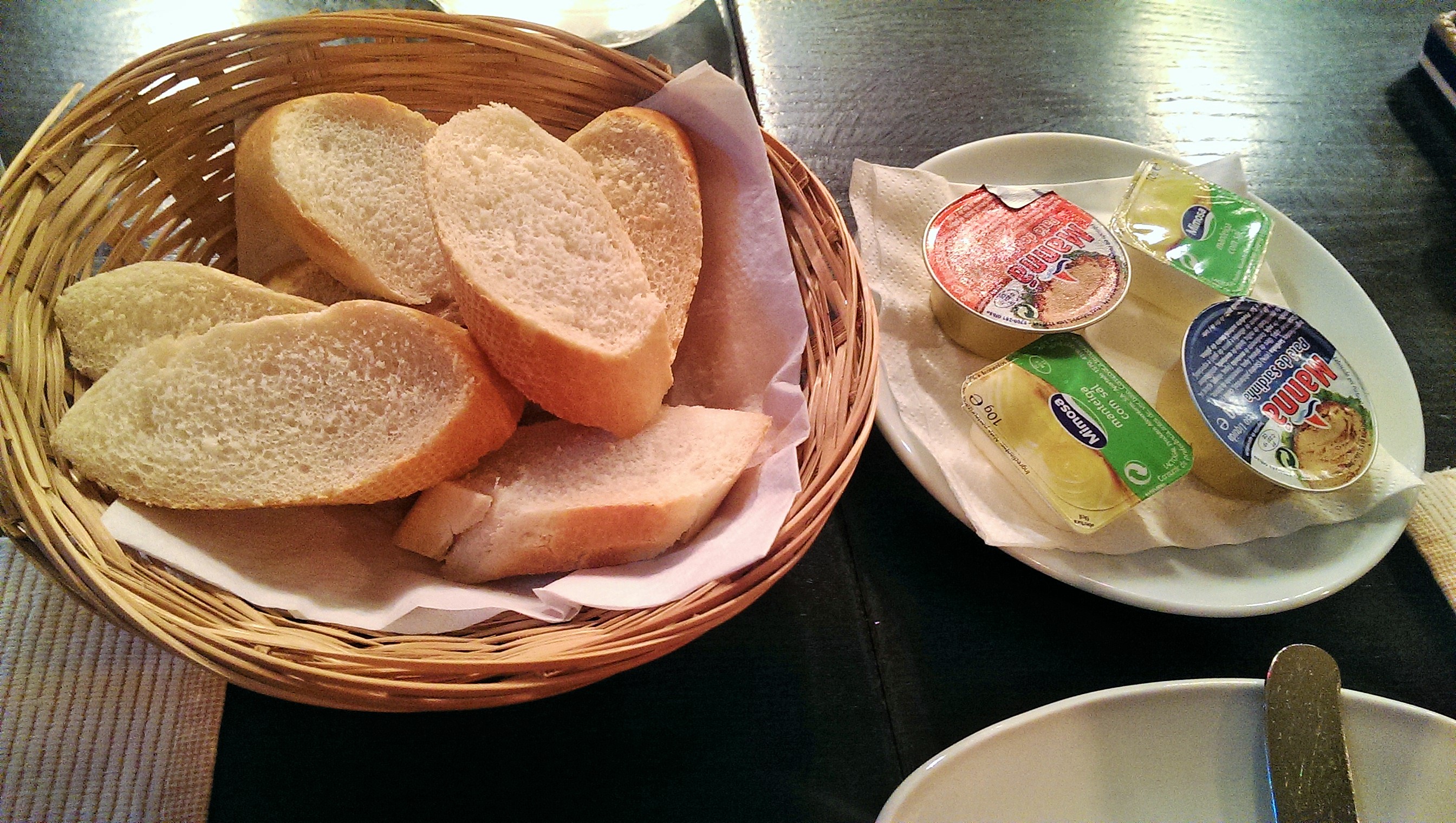
We ordered some bread with sardine and tuna paté to tide us over and this is where it all started to go wrong. I don’t normally photograph the bread, but here I just had to. I was expecting a basket of crusty bread with a couple of small ramekins of paté. What arrived was seven anaemic slices of what looked like part-baked supermarket baguette with some catering packs of butter and paté. The “paté” was Portugal’s answer to Shippam’s (something I’ve not eaten since about 1985), smooth to the point of being unidentifiable. In fairness, even if it wasn’t pleasant I suppose it was authentic: it’s almost exactly what I was served at O Beirão, Reading’s Portuguese restaurant. But there it was free, and here I was paying three pounds for the dubious privilege.
What The Square also seemed to miss was that the bread was completely insufficient for the spreads it came with. I would have minded the three quid less if I could actually have eaten it all but there was so little bread that doing so was impossible without piling the paté ludicrously high. I just hope the restaurant has a cat who could make use of the leftovers. Not terribly appealing: I prayed that the starters were going to be an improvement.
They weren’t. First up was the chouriço assado, described as “flame grilled Portuguese sausage, served in traditional cookware”. I was hoping for something a bit like Spanish chorizo cooked in wine, all salty and coarse with those delicious brick-red juices at the bottom. I was very far from correct. What I got instead was simply awful: a gigantic horseshoe of chorizo, served on a pot in the shape of a rowboat which is quite hard to describe. It sort of rested on the “seat” with some liquid underneath – I dread to think what – which had been set alight to flambée the sausage (flambée the sausage, come to think of it, sounds like a euphemism for something unspeakable) just before it reached the table.
The outside was slightly charred in places but the real problems came when I cut into it. Not that that was easy, because it was served on a flipping boat shaped pot with no suitable surfaces on which to do the deed. I sawed away (trying to rest the sausage on the seat) and chewed a couple of slices for a few minutes, although it felt like longer. It was both grisly and gristly. I inflicted a slice on my companion, who unsurprisingly didn’t thank me for it. The next slice was almost entirely a big white globule of fat and that, I’m sorry to say, is where I gave up. All the metaphors I could use to describe this dish would remind you – very quickly – of whatever you ate last, so let’s leave it at that. I put down my knife and fork and waited to see if anyone came to check on us. They didn’t.
The other dish was king prawns wrapped in Portuguese bacon and pan fried. It was four decent sized prawns cooked nicely and indeed wrapped in bacon. The heads and tails came off cleanly and the prawns tasted of their component parts, no more, no less. There were also a couple of needless sections of red, green and yellow pepper. This wasn’t bad by comparison with the chouriço, but you could say the same about a Fray Bentos. I was hoping for some juices, but there weren’t any. I didn’t mop-up the non-existent juices with the remaining bread they hadn’t given me.
The waiter returned to clear the plates and looked baffled by the almost entirely uneaten sausage. I tried to explain what I hadn’t liked about it. Doing so briefly was something of a challenge. He shrugged. I was worried that I hadn’t explained properly, so I had another go. More shrugging. The plate was taken away, with no apology or offer to take it off the bill or anything else. Then he asked whether I wanted to order something else, but with no indication as to whether I’d be paying for that or not. We then reached a consensus that, as the main course was quite big, I probably wouldn’t need a starter. The whole thing was a truly bizarre interchange. It was rendered even more bizarre by him asking if we wanted to keep our half-finished tubs of tuna and sardine paté: as there was no bread left I’m not sure what he thought we were going to do with them.
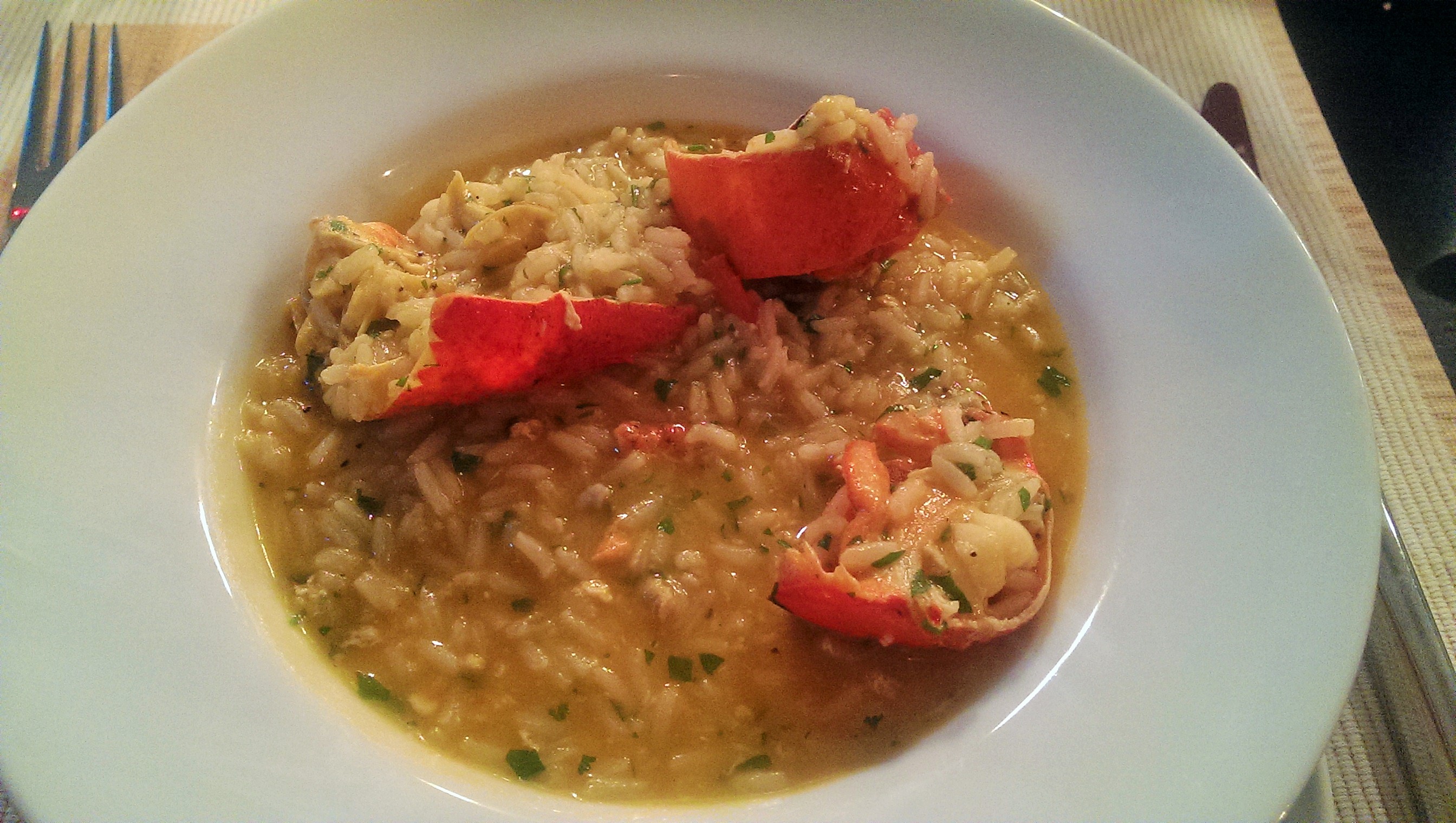
On to the main event then – the lobster rice pot, at forty-five pounds for two one of the priciest things on the menu. We were brought lobster crackers and those little picky-outy-lobster-bit tools (apologies for blinding you with technical terms) and I realised that I had naively expected the kitchen to do some of the hard work for us. My mistake, I suppose. Anyway, the large pot was brought to the table and the waiter ladled out a portion for each of us.
The lobster, admittedly, was good. Very fresh and, when it was eventually possible to pick up the shell (which was as hot as Hades, of course), generally the flesh came away very easily. The meat was tender and delicate and it did look to me like we had a whole lobster between us. That’s where the good news ends. The rice, fluffy long grain, had been cooked for too long so there was no bite there. The sauce was a generic stock with some coriander to try and give it a bit of freshness.
I’m beginning to sympathise with the trouble the waiter had describing it, but I suppose he could hardly have said “it’s a very bland rice dish with some lobster in it”. I can though, because that’s what it was. Was it a forty-five pound dish? Put it this way – at the peerless Bird In Hand in Sonning Common I could have a whole lobster to myself for twenty-seven pounds, so to pay roughly the same for half a (not very big) lobster and some flavourless rice seems cynical. If this is a signature dish, you have to worry about the restaurant’s handwriting.
To drink we had an Appletiser (for the driver) and a very nice smoky glass of Portuguese red. If the restaurant had been good I would have regretted not being able to mount a concerted assault on the wine list. If it had been good we would have had a dessert and I would have wanted a port – a lovely rich vintage, or a sweet, subtle tawny. As it was, much as the meal could only have been improved with alcohol, I was glad we could cut our losses and leave.
As so often, the moment I started to actively dislike the food the waiter tried a little harder to be nice. In the early stages he seemed to struggle to communicate, whether that was describing the menu or explaining what we could do about The Dismal Sausage. After that he was a lot more attentive, asking whether everything was okay with the main course, whether we needed any more drinks, whether we wanted dessert and so on. But of course the damage was done by then – and most of the damage was done in the kitchen rather than front of house. Proof that their intentions were better than their delivery came when the bill arrived; dinner for two came to sixty three pounds (the chouriço had been taken off).
So there you have it: this week I went out of town to a restaurant which I hoped would be a find and turned out to be a disaster. And this is definitely not about Portuguese food, which is probably what frustrates me the most. Portuguese cuisine deserves a better ambassador than The Square: Lisbon is an absolutely incredible city full of great cured meat, fantastic fish and seafood, and magnificent cheeses, not to mention the stunning wine. Having been there I don’t understand why it doesn’t have as good a culinary reputation as any European capital. I can only imagine it’s because of places like The Square. I want to be kind, but everything I ate was either iffy or average. Every average thing I ate was expensive. And worst of all? I’ve just spent two thousand words telling you not to go somewhere you’ve never heard of and wouldn’t visit anyway. That sticks in my throat even more than the chouriço did.








 Edible Reading