Franco Manca closed in Summer 2023. I’ve left the review up for posterity.
I’ve long enjoyed referring to Reading as “Zone 8”, and one of the most significant developments in Reading’s restaurant scene during my time away was this description becoming less and less of a joke. Reading’s always been a chain magnet, but the latest wave of new and imminent arrivals has a distinct whiff of the capital about it: The Real Greek, The Botanist and Comptoir Libanais are already here; Pho, Honest Burger and Byron are on their way. A big Pret has sprung up just opposite the train station, too: by the time Crossrail gets here, people might alight at Reading and be unaware that they’re not in Kansas (or possibly Camden) anymore.
The one I was most excited about was the arrival of Franco Manca. For years I’ve been complaining that Reading could do with a really good pizzeria to rival the likes of Bosco in Bristol or The Hearth in Lewes. Then I discovered Papa Gee and found that I didn’t feel quite so deprived but even so, Franco Manca (along with the likes of Leon and Le Pain Quotidien) remained one of the chains I most wanted to see make it out west to Reading. I’ve been going to Franco Manca, in Brixton and Battersea, for many years and I’ve always loved their sourdough pizzas, gorgeous burrata and short unfussy wine list.
Initially they were going to open in the basement of Jackson’s, which I thought was a magnificent idea and a terrific way to bring a buzz to one of Reading’s most iconic buildings. But I guess they lost patience or got an offer they couldn’t refuse, because instead they have taken the Oracle’s shekel and opened where the Debenham’s restaurant – never reviewed on the blog, due to what I can only describe as a shocking oversight – used to be. It’s right next to The Real Greek, which extends the riverside and creates a little enclave for shoppers and diners to descend upon (it’s working, too: when I tried to book The Real Greek for a Saturday night to take my family out for dinner I was told it was already solidly booked.)
The space outside is nicely used and if the weather had been better I’d have been sorely tempted to eat in the sunshine, but I visited on an inclement weekday so I found myself waiting for a table to become available (in the spirit of another London trend coming our way, Franco Manca doesn’t take bookings). I managed to nab a table in the corner of the room, nearest the window, which gave me a good look at the room. It’s a big space: all square tables, wooden school-effect chairs and bare lightbulbs, the walls covered in what appeared to be upcycled pallets, no soft furnishings and nothing to absorb sound.
What this means is that, even tucked away in a corner, the experience was a cacophonous one. I’d come to Franco Manca with my friend Tim and the whole evening was marked by both of us constantly having to lean across the table and say “What?” “Pardon?” or “I’m really sorry, but I’m going to have to ask you to repeat that. Again.” The irony: here we were in a room full of young chatty diners and I’m not sure I’ve ever felt more geriatric. It’s the first time I’ve seriously considered taking an ear trumpet to a restaurant (although, depressingly, I doubt it will be the last).
The menu is a short one – a small range of starters (or “Bites”) and seven pizzas, two without a tomato base. The specials board lists some extra starters, two special pizzas – one meat, one vegetarian – and an array of extra toppings. I was a bit confused by the flip side of the menu which talks about all of Franco Manca’s ingredients but doesn’t make it clear whether you can order those as extra toppings or not, but maybe I’m just getting old and finding hidden complications in a very simple menu (an unwelcome theme is emerging here: have you noticed?).
While we waited for our order to arrive, Tim and I enjoyed something from the compact and bijou drinks list. There are a handful of wines, two beers and one cider (described as “No Logo”, presumably a tribute to Naomi Klein’s late 90s anti-consumerist classic). I had the cider, which was pleasant – sparkling and cold but with a slightly agricultural hint. The waiter brought it over without a glass and I had to ask him to come back with one, but not before my request was met with a slightly vacant look. Perhaps all the hip gunslingers drink straight from the bottle (and, for that matter, can understand every word spoken by the person opposite them).
Tim, last seen on this blog enduring the culinary Vietnam of a trip to Cosmo, is a Beer Expert. He has forgotten more about beer than I’ve ever known (although that’s not saying a lot: he probably forgets more about beer in a single day than I’ve learned in a lifetime). So I’m well used to him putting on his Serious Beer Tasting Face, taking a sip, knotting his eyebrows, smacking his lips afterwards and pronouncing it “okay, I suppose”, as he did here.
“Of course, they say it’s no logo but it’s by Shepherd Neame”, he added. “It might go better with the food, to be fair.” I nodded sagely, pretending to understand what he was talking about – a look I’ve perfected over many evenings spent hearing Tim wax lyrical about the Citra hop (whatever that is: I thought it was a dance from the Twenties, but apparently not).
My starter was uncomplicated and delicious, a wooden board with four thick, generous slices of coppa and a ball of mozzarella perched on some salad. I yield to nobody in my love of mozzarella served before it’s been ruined by heat – so cold, clean and fresh-tasting! – and this was a pretty joyous example. I also love coppa, beautifully marbled pork shoulder which I’ve always found more interesting than Parma ham (how I miss the days when you could buy it from the deli counter at Carluccio’s). Again, this one was damned fine. And you could quibble about how this was a triumph of buying or assembly rather than of cooking if you really were so minded, but to me it was a triumph of eating, which is far more important. Decent value at six pounds, too.
“You’re going to describe that as ‘generous to a fault’, aren’t you?” said Tim. “You always say that in your reviews.”
“Well I’m not now.” I said; later I looked back, and it appears that I do indeed always say that.
 Tim was faced with something altogether more baffling. The specials board had described it as “Gloucester old spot baked sausage”, which could potentially give you the impression that what turned up might resemble, you know, sausages. But the use of the singular, with hindsight, was a clue. Instead, what Tim got was a slab of sausage meat that had been baked with a tomato sauce and dolloped with what might have been crème fraiche. The sausage meat was lovely – coarse and shot through, I think, with a smidge of fennel. But it was an odd dish and I’m not sure Tim would have ordered it if it had been more accurately described (perhaps as middle class sausage McMuffin only without the muffin, or Millennial meatloaf). Half the fun of sausages is the contrast in texture between outside and inside (I like mine like mummified fingers, personally) and that was missing here. Tim looked enviously at my starter, and I gave him some coppa and mozzarella to apologise for ordering better than him. If anything, I think it made matters worse.
 The pizzas took longer to arrive than I expected, which was no bad thing although it was characterised by a bit more ineffectual service. I’d ordered a dip for my crust (or “cornicione” as the Franco Manca menu likes to call it) and there was some general chaos about which one I’d gone for – pesto, since you asked – which even led to the manager having to come over and ask me what I’d ordered. She was quite brilliant, bright and personable – but if anything, that just highlighted that the rest of the service had been a bit… well… I’m struggling to find a more appropriate word than “gormless”, so let’s just leave that there.
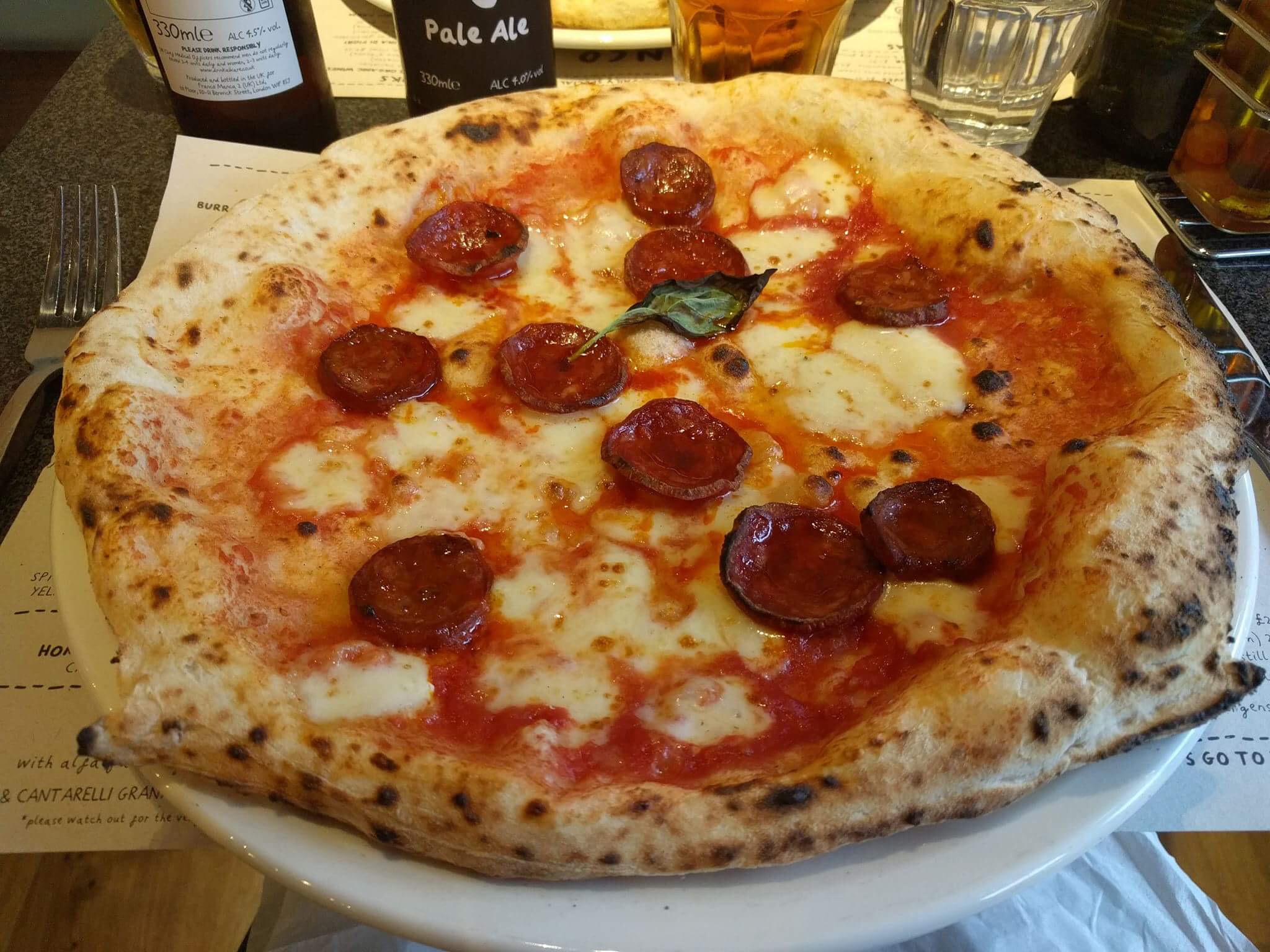
If I won the battle of the starters, I think Tim did better on pizza. His was a pretty classic combination – tomato sauce, mozzarella, and (according to the menu) both dry and semi-dry chorizo. And it looked good, although I did have some reservations; maybe I’m just greedy but it felt a little light on chorizo and what chorizo there was was so unevenly distributed that it looked like it had been dropped onto the pizza from a great height by someone with their eyes shut. Again, I wondered if I just wasn’t cut out for this new devil-may-care attitude and perhaps literally nobody else would be bothered by this. What can’t be denied, though, is that it was tasty: the crust was bubbled, blistered and light, the base top notch.
“Can you tell the difference between the two types of chorizo?” I said to Tim as he hoovered up his final mouthful.
“Yes.” he said. “One of them is short and fat and the other one is wide and thin.”
“Helpful stuff, Tim. I’ll make sure I put that in the review.”
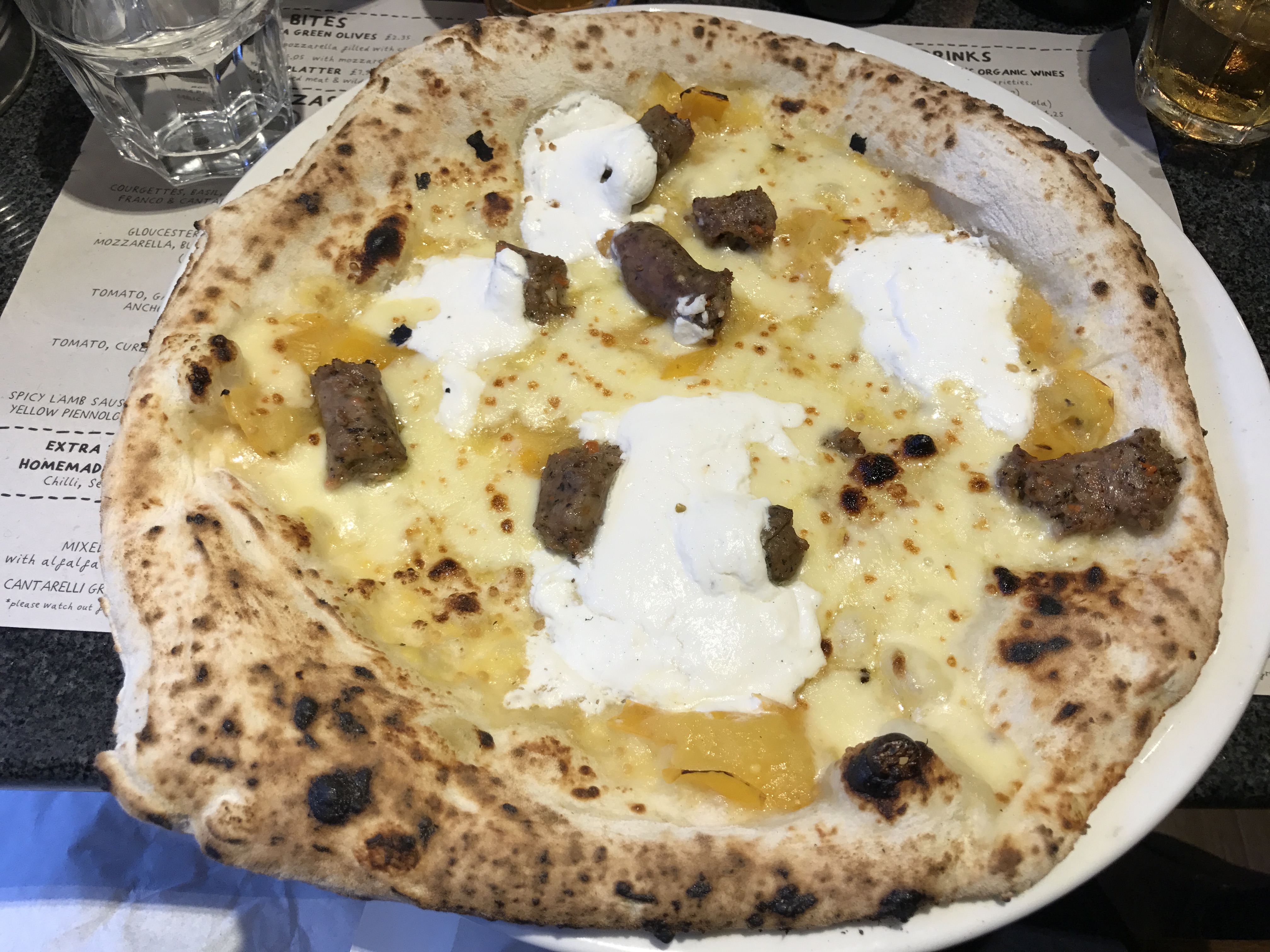
 My pizza, by contrast, just didn’t work. I went for one without a tomato sauce base and instead it came with yellow tomatoes, buffalo ricotta and spicy lamb sausage. It looked unbalanced to me when they put it down in front of me and it tasted unbalanced too: the tomatoes were sweet, the ricotta was sweet and although the sausage – something a bit like merguez – was genuinely fiery and delicious there just wasn’t enough of it to counteract everything else. Again, everything looked assembled at random and in this case it made for quite an unattractive pizza, with the sausage unpleasantly reminiscent of droppings and the ricotta looking disconcertingly like cuckoo spit (hungry yet?). The pesto dip was an excellent idea but in execution it just lacked enough salt and parmesan to offset the oil.
 On a previous trip to Franco Manco just after it opened I had been absolutely enchanted by a lemon and rosemary cake with Greek yoghurt and honey, which has to be one of the nicest things I’ve eaten this year. I tell you this because, in keeping with the rest of the evening, they had taken it off the menu for this visit. So we skipped dessert, cut our losses, paid up and beetled off to the pub. The bill came to just under forty-two pounds for two, without tip. Both pizzas, and this will give you a clue as to Franco Manca’s popularity, clocked in at around eight pounds.
When I go for dinner on duty with a companion, I like to play little game at the end. We text our rating out of 10 to each other simultaneously, like some kind of digital gunfight, and compare notes. Tim’s rating was nothing special: he wasn’t impressed with Franco Manca. He said the food was good but not good enough to overcome the room and the service. He’d sooner go to Papa Gee, he said, and of course I felt a little bit proud of him for that. It quite outweighed his shortcomings when it came to describing chorizo, which after all is a niche skill in anybody’s book.
It might surprise you, based on everything that’s gone before, that I feel a little more kindly disposed to Franco Manco than Tim was. Restaurants are good at different things, and some restaurants can be good despite excelling at something which isn’t necessarily my thing. And there is a lot to be said for Franco Manca if you’re grabbing a quick meal in the centre of town, or you’re on a budget, or if you really like pizza. Or if you’re considerably younger than me (many people are, these days), wear a snapback indoors and don’t mind raising your voice to have even a rudimentary conversation with your mates. Or, now I come to think of it, if you want to eat somewhere good in the Oracle which isn’t Cote. The pizza, as long as you pick the right one, is good enough to overcome a multitude of sins, and next time I go I’ll stick to the tried and tested classic of anchovies, olives, capers and basil. Personally, I can see myself heading there at lunchtime on a sunny day, or having an early dinner there before ambling off to the cinema or Tuesday Music Club at the Global Cafe, full and happy, ear trumpet stowed away in my satchel.
Franco Manca – 6.8
The Oracle, RG1 2AT
0118 9952086