The hardest bit of writing restaurant reviews, I’ve always found, is the start. It’s the bit where you have to find a hook to hang all the other words on. Why this place? Why this week? Why should you care? It’s especially hard when, after the meal, I ask myself some of those questions – or, even worse, what was I thinking? Or you can try to be topical, but I didn’t fancy writing about the week’s events, eating something lettuce-themed or shoehorning in a reference to exploring new pork markets. The news is depressing enough as it is.
I’ve started a couple of reviews in the last few months by talking about the unlikely food trends of 2022, or singing the praises of the number 17 bus. And this week we get the unholy love child of the two, as I delve into the world of Reading’s biryani restaurants. Because yes, it’s a thing, and a comparatively recent one at that. Biryani has always been there, on the fringes of the menu at most Indian restaurants, and I used to go leftfield from time to time and order one: I had a soft spot for Royal Tandoori’s lamb biryani, for instance.
But in 2018, out of nowhere, Clay’s Hyderabadi Kitchen opened on London Street and elevated the dish to signature status. Their clay pot biryanis – meat always on the bone, cooked sealed and ceremoniously opened at the table – became a talking point. Customers could take the pots home with them afterwards, and photos cropped up on social media of them as plant pots, or utensil jars. And then, around the start of this year, not long before Clay’s announced that it was upping sticks and moving to Caversham, biryani restaurants started cropping up all over the place.
Well, not quite everywhere, but certainly in very specific parts of Reading. In West Reading, on the Oxford Road, we have Biryani Boyz – it actually has two zs, but I can’t bring myself to type both of them – and Biryanish. In the centre where ASK used to be, there’s Biryani Mama, which I mainly remember from their ill-advised job advert back in January desperately seeking a “Bartender Cum Waitress”: just imagine that on your cv. And then on the Wokingham Road there’s a second branch of Biryani Boyz and The Biryani Lounge, the subject of this week’s review.
Subscribe to continue reading
Become a paid subscriber to get access to the rest of this post and other exclusive content.
If I asked you to rattle off Reading’s longest-running restaurants, the chances are you’d mention London Street Brasserie. The Bina and Quattro too, over in Caversham. I’d expect you to talk about Pepe Sale, that’s a given. You might get bonus points for remembering McDonalds – the Friar Street one has been going since the Eighties – or for saying “of course, until recently there was also the branch of Pizza Hut in the Oracle”. Perhaps you’d bring up cafés like the Gorge or Rafina: the latter, in particular, is one of the last signs of pre-Oracle Reading, and hasn’t changed a huge amount in the intervening years. And, naturally, many of you might namedrop Sweeney & Todd, which has been trading for an incredible forty-four years, longer than some of you have been alive.
But would you remember Thai Corner?
The reason I ask is that often it slips my mind. It’s one of those places that feels like it has been there forever, and will be there forever, but that means it can fade into the background when you’re deciding what to eat, or talking about what Reading used to be like. By my reckoning it’s been open for nearly twenty years; I remember what was there before, an unspecial French place called Bistrot Vino, and I went there once for a Bohemian Night spinoff, but other than that it’s been Thai Corner for, well, forever.
I reviewed it back in 2014, when my blog was a mere six months old, and even then it was an old stager, having celebrated over a decade at the top of West Street. And by the time I reviewed it, it had probably already achieved that feat of fading into the background. Thai food has always been a reliable go to in this country – probably inauthentic, never amazing, rarely terrible – but it’s never had a moment where it was the hot new thing. And so Thai Corner, for those ten years and the eight that followed, has just carried on doing what it did best, whether you noticed or not.
Back before I started this blog it was a proper happy place for me, as frequently visited as the likes of Dolce Vita, and somewhere I could go on date nights or with friends visiting Reading for dinner. I had my staple dishes I always ordered – weeping tiger, sirloin steak with garlic and coriander, or pla chuchi, salmon steak with red curry sauce – and a red wine I always drank, and I never went away less than full or happy. It was a sure thing, in that way people think chains are, and I loved it there.
Anyway, the years moved on, and by the time I reviewed it for the blog I was a lapsed member of the congregation. I liked it just fine, although it didn’t knock my socks off, and my review at the time was full of faint praise in a way which, with hindsight, looks a tad condescending (so unlike me, I know). Haven’t you done well not to be closed yet? it seems to say. 2014 me had forgotten, I think, how much 2004 me liked the place. And 2022 me looked back at that and thought it was high time to go again.
Subscribe to continue reading
Become a paid subscriber to get access to the rest of this post and other exclusive content.
There’s a new trend in Berkshire Live which drives me absolutely crackers. Having moved on from a steady emetic trickle of “X’s quiet life in [insert name of Berkshire village here]” articles (translation: here’s somebody who used to live in Berkshire and that’s literally all we know about them) their latest form of copy and paste gonzo journalism is one where they knock up madlibs-style reviews of restaurants which – and you could bet your life savings on this – the “journalist” has never visited.
The new trend – or do I mean new low? – is to churn out articles that say “the X restaurant so good you’ll think you’re in [the most famous city in country X]”. It’s so witless it could almost be amusing. So if you eat in l’Ortolan, for instance, you could imagine you’re in Paris (I’ve been to Paris: l’Ortolan is nothing like it). If you have tapas in Wokingham’s Sanpa you could believe you’re in Madrid, allegedly, and never mind the pesky detail that tapas is from Andalusia, miles away to the south.
Oh, and if you eat American barbecue in Blue’s Smokehouse – and it’s great, so maybe you should – guess what? Close your eyes and you could be in the Big Apple. Again, it’s not noted for its barbecue but details are for pedants, apparently. It goes on: Quattro is just like Rome, some Chinese restaurant in Cookham is the spitting image of downtown Beijing, Sapana Home is like dining in the Himalayas (they call out the “momo dumplings” at Sapana, which is like saying I very much enjoyed the chips potatoes). I thought they couldn’t get more laughable but the latest says that afternoon tea at the Forbury Hotel “will make you feel like you’re dining with the King”. Stay classy, Berkshire Live.
But that isn’t enough, so to pad out the article – and to further pull the wool over your eyes – they like to add a bit of bumf from the restaurant’s website and those all important customer opinions. After all, in Berkshire Live’s own immortal words, “Recent years has brought more people online as it gives them an easy way to choose somewhere to eat. One place most of us look is the reviews – what do people really think about where we want to eat? We decided to list the last three reviews all less than a month ago to see what people have said.”
Maybe people are looking online because local papers have died and been replaced by moronic clickbait? Just a thought. But yes, the rest of their extensive research consists of firing up Tripadvisor and copying and pasting the three most recent reviews. But Berkshire Live doesn’t care about that. In their mind, everybody wins: they hit their targets for pumping out meaningless content to sell ad space and you get a “review” which tells you nothing about the restaurant, Ctrl-C and Ctrl-Vd by somebody who has never been there and, for all we know, has never even left their home office (are Reach plc staff affected by the train strikes? It seems unlikely). Bob’s your uncle, Fanny’s your aunt and keema, as they say, is your nan.
So this is what passes for journalism these days and the most insulting thing is that they’re so cretinous they think nobody will notice. How times have changed. In the old days, local newspapers used to sneak ads into the paper and not tell readers that money had changed hands and many people, myself included, were outraged about that. Nowadays they’re so desperate for content that they publish what are effectively full length ads without even being paid for the privilege. It makes you wonder who pumps out more sewage: the water companies or Reach plc?
Anyway, by contrast this week’s feature – no review, because I’m away this week – is one of those lists everyone likes with one crucial difference: they’re my opinions, born of going out there and trying as much of Reading’s food and drink as I can. So this article might come in handy if you can’t be arsed to schlep through any of my lists, or to comb through the blog but just want to know, in my entirely subjective opinion, where to get the best coffee, pizza, sandwich and so much more in Reading. Read, enjoy, share, comment and – of course – disagree, because if you don’t disagree with a single thing on this list I’ll be very surprised indeed.
Apart from my (entirely subjective, don’t forget) guarantee of quality I can promise you one other thing. None of these places will make you feel like you’re in Naples, New York or Nagoya. Because, as we’ve established, that is utter, utter bollocks. Besides, they’ll go one better than that: they’ll make you glad you’re in the Ding.
Reading’s best breakfast – Dee Caf
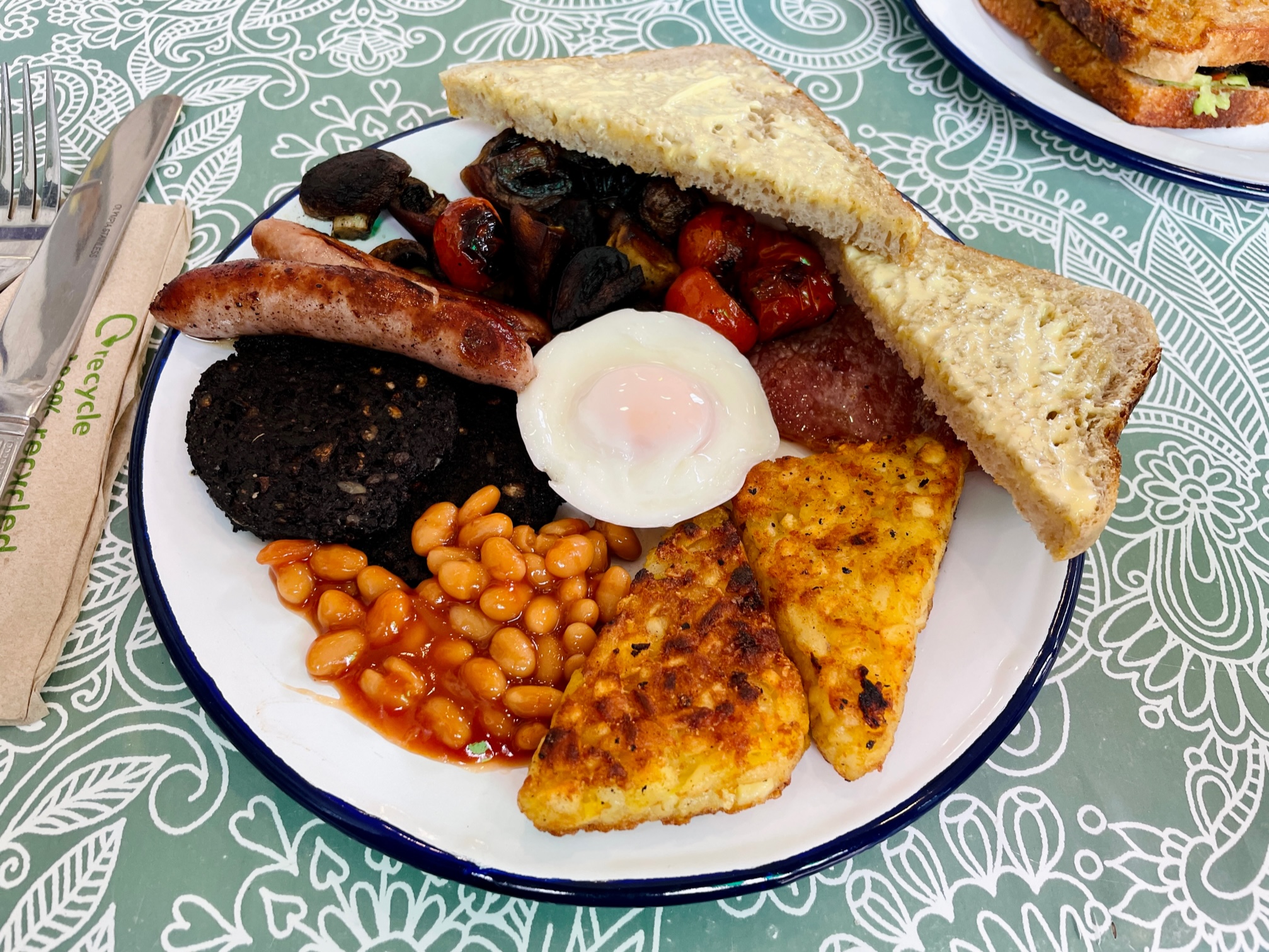
Dee Caf’s breakfast isn’t a looker, and nothing about it is built for Instagram. But in terms of midmorning indulgence on a plate it is probably unparalleled in Reading and well worth a meander out in the direction of Tilehurst. Bacon and sausages AND black pudding, all from a local butcher? Hash browns and properly buttered toast too, on an enamel plate which is only just big enough to contain all that bounty? Count me in. When I went the only drawback was the coffee – they’ve now switched to Anonymous, which is a very smart move. (Montague House, 12 Spey Road, RG30 4DG)
Honourable mention: The Switch
What is it with West Reading and good breakfasts? The smashed avo with bacon at The Switch is unashamedly high-end, and priced accordingly, but shows what a good dish it can be in the right hands. (19 The Triangle, RG30 4RN)
Reading’s best burger – Smash N Grab
Smash N Grab is quietly doing great things down on Cemetery Junction and their inimitable take on smashed burgers easily justifies a trip out of the centre. These are indulgent, overloaded burgers – messy, stuffed, deeply sinful things, and you will feel replete, satisfied and a little ashamed of yourself at the end of one. The chips still need work, and the cake shakes are a little artery-hardening for me, but the burgers are still unbeatable. If it’s on the menu, the MacBook Pro (topped with a slab of breaded, deep-fried macaroni cheese) is every bit as so-wrong-it’s-right as it sounds. (124 London Road, RG1 5AY)
Honourable mention: Honest Burgers
Reading’s branch of the small chain is the best town centre option and very rarely has a bad day at the office. The burger, served pink, is reliably terrific and the monthly specials mix things up nicely. They’ve just added a buffalo fried chicken burger to their menu, if beef isn’t your bag. (1-5 King Street, RG1 2HB)
Reading’s best coffee – C.U.P.
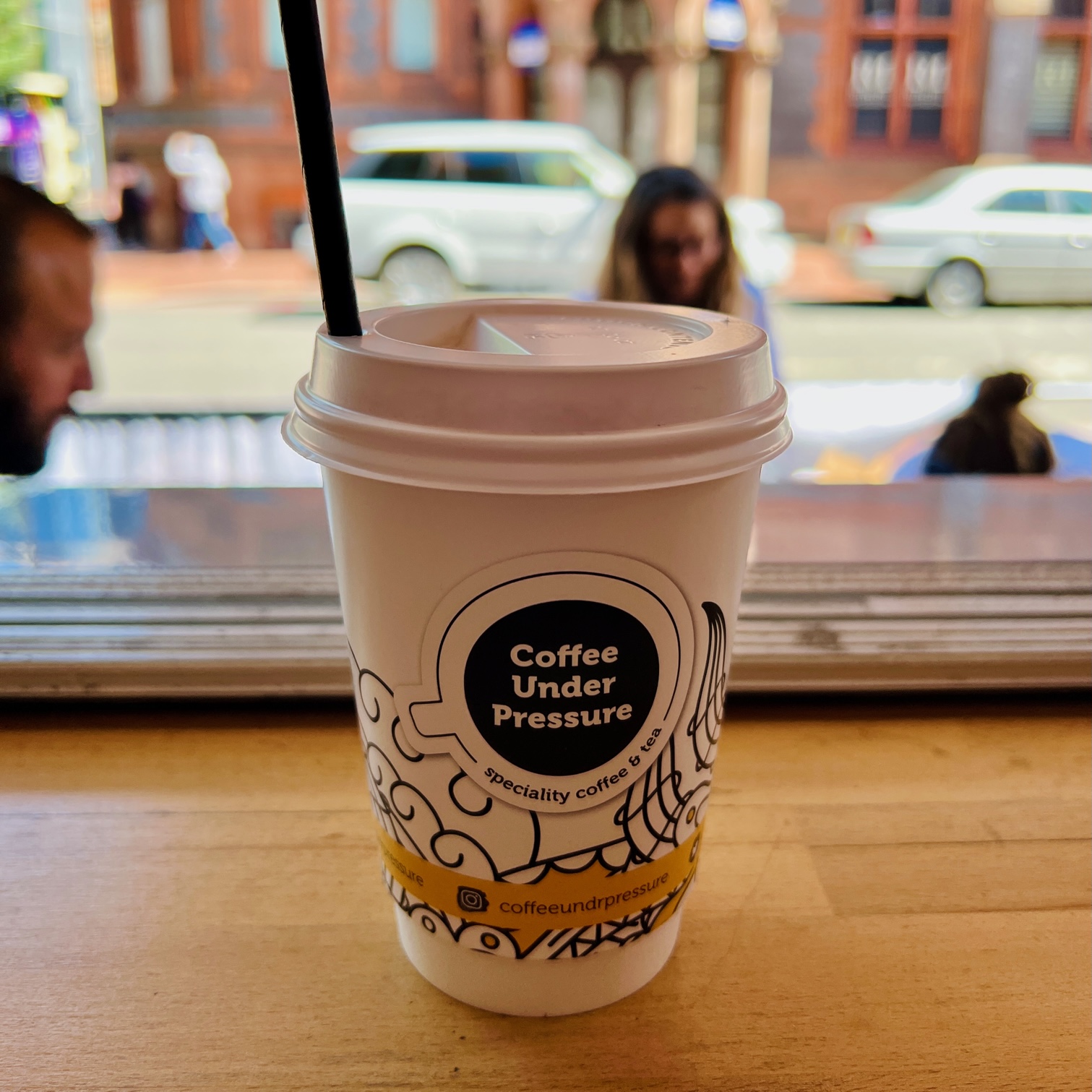
C.U.P. just edges it for me, and both its Blagrave Street and Reading Minster outposts have a lot going for them. Blagrave Street is great for people watching passers-by, and the seats outside Reading Minster are great for people watching your fellow customers. Either way, although the latte is superb the signature here is the mocha, made with an awful lot of real chocolate – a dessert, a pick me up, a treat and a necessity all crammed into a single takeaway cup. (7 Blagrave Street, RG1 1PJ/53 St Mary’s Butts, RG1 2LG)
Honourable mention: Workhouse Coffee
The eminence grise of Reading’s coffee culture, Workhouse is superb and reliable for latte and my espresso-drinking friends swear by their espresso. It’s a shame the greed and neglect of the Mercure Hotel has robbed them of what was one of town’s best and sunniest al fresco spaces, and the interior feels like it needs a bit of love. But the staff are great and the coffee remains top notch. (10-12 King Street, RG1 2HF, also 335 Oxford Road, RG30 1AY)
Reading’s best fish and chips – Finn’s
I know nobody will agree with this unless they live near Finn’s, and I can’t remember the last time I had fish and chips at Wing’s, or Deep Blue, or that other place you like. But I maintain that Finn’s, the pride of east Reading, does wonderful fish and chips with a light, crispy batter and chips that have the perfect balance of floury stodge and crunchy shrapnel. I must work up the courage to try their masala cod one cold winter’s evening. (42b Erleigh Road, RG1 5NA)
Runner-up: The Lyndhurst
The Lyndhurst serves up the epitome of pub fish and chips, an excellent portion of battered leviathan and some of Reading’s very best chips. Those of you who like mushy peas will enjoy these, and those of you who tend to leave them have something in common with me. Spoiler alert: this is not the Lyndhurst’s only appearance on this list, you may not be surprised to hear. (88 Queens Road, RG1 4DG)
Reading’s best fried chicken – The Lyndhurst
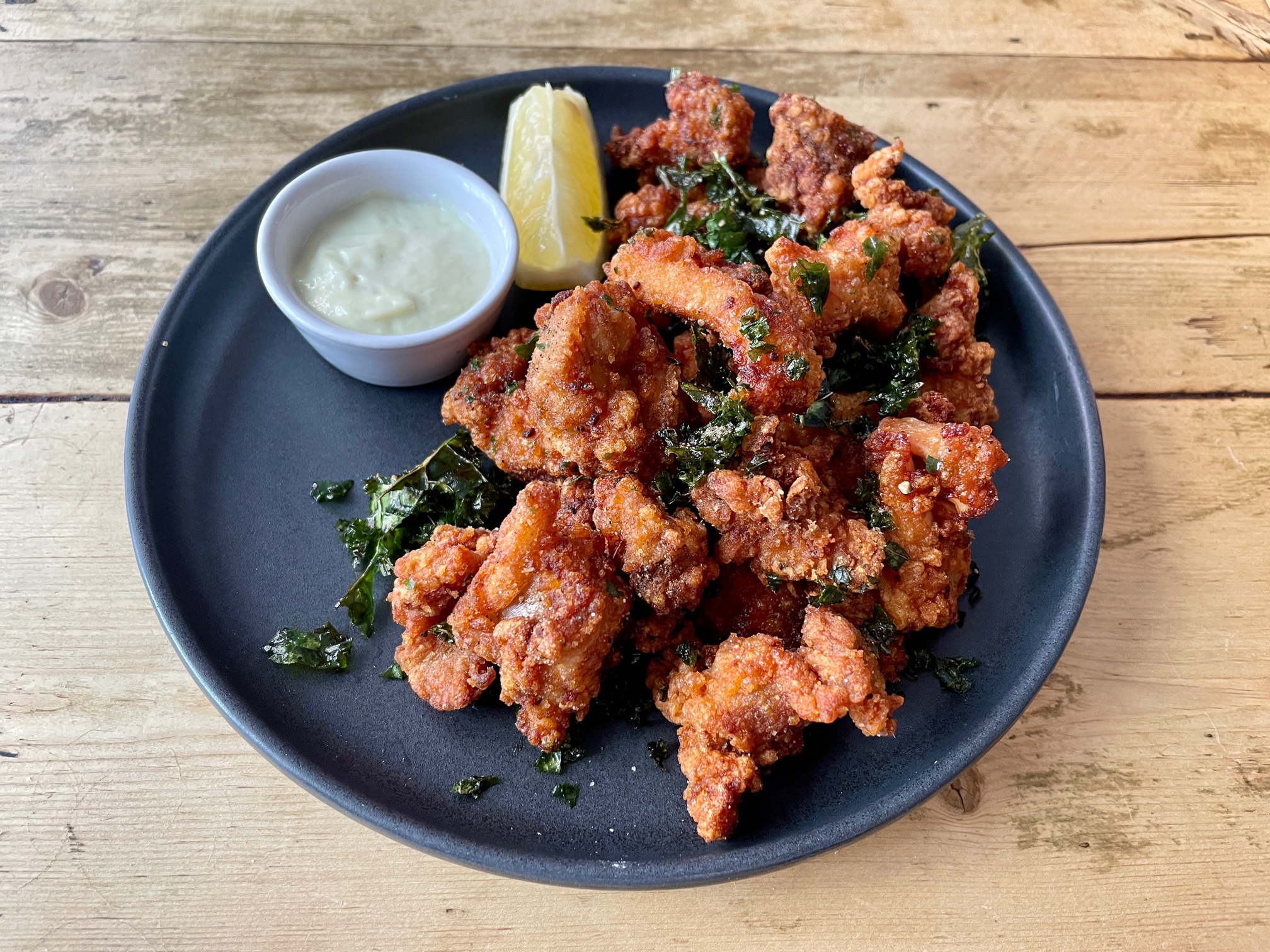
See? Told you. The Lyndhurst’s chicken karaage has been tweaked and tinkered with steadily since it first appeared on their menu last year. They took it off the menu just as I was developing a serious karaage habit (forget ketamine: this is the real K hole) and then this year I was overjoyed when they brought it back. The texture is unbelievably crunchy and gnarly, the portion size is so generous that you won’t mind offering your companions a piece and making them jealous and the little shards of fried kale add an extra savoury note. What was a kewpie mayo has now been swapped – another tweak – for a wasabi mayo which adds just enough sinus-clearing power. (88 Queens Road, RG1 4DG)
Runner-up: ThaiGrr!
You could hold a piece of fried kale between this and the Lyndhurst’s karaage, that’s how little separates them in terms of quality. ThaiGrr’s chicken is a ridiculously generous six jointed pieces on the bone with shatteringly crisp skin, tender meat and little slivers of garlic sprinkled on top. It comes with some very pleasant sweet chilli sauce, and you can spend all six pieces wondering if it needs the dip without ever reaching a conclusion. (1d Queens Walk, RG1 7QF)
Reading’s best pizza – Buon Appetito
N.B. Buon Appetito sadly closed in April 2023, although if you’re on the lookout for pizza Mama’s Way and Sarv’s Slice are both also worth a try.
One of my favourite discoveries of the last year has been the revitalised Buon Appetito at the end of Chatham Street which, for my money, knocks out the very best pizza in town. The base, a puffy-crusted, leopard-spotted delight, is next level good and the range of toppings is just wide enough without getting ridiculous. I am a huge fan of their Napoli which comes strewn with anchovies, olives and crispy fried capers, but there’s also a lot to be said for the Blue Parma, with twenty-four month aged Parma ham and a fair old whack of gorgonzola. It helps that Buon Appetito is one of Reading’s very best al fresco spots: they mix a mean Aperol spritz or negroni, too. (146 Chatham Street, RG1 7HT)
Honourable mention: Papa Gee
The other side of the river on Prospect Street, Papa Gee has nearly twenty years of experience of dough-slinging and it really shows. My latest visit was extremely recent, so I’m delighted to have extremely fresh memories of how good they are. The base maybe doesn’t quite have the quality of Buon Appetito’s, but you can expect pizzas topped by a man who doesn’t enjoy saying “when”. The iconic dish here, the pizza Sofia Loren, comes with pepperoni, beautiful coarse nuggets of sausage, red onions, chilli and my unqualified endorsement. (5 Prospect Street, RG4 8JB)
Reading’s best sandwich: Madoo
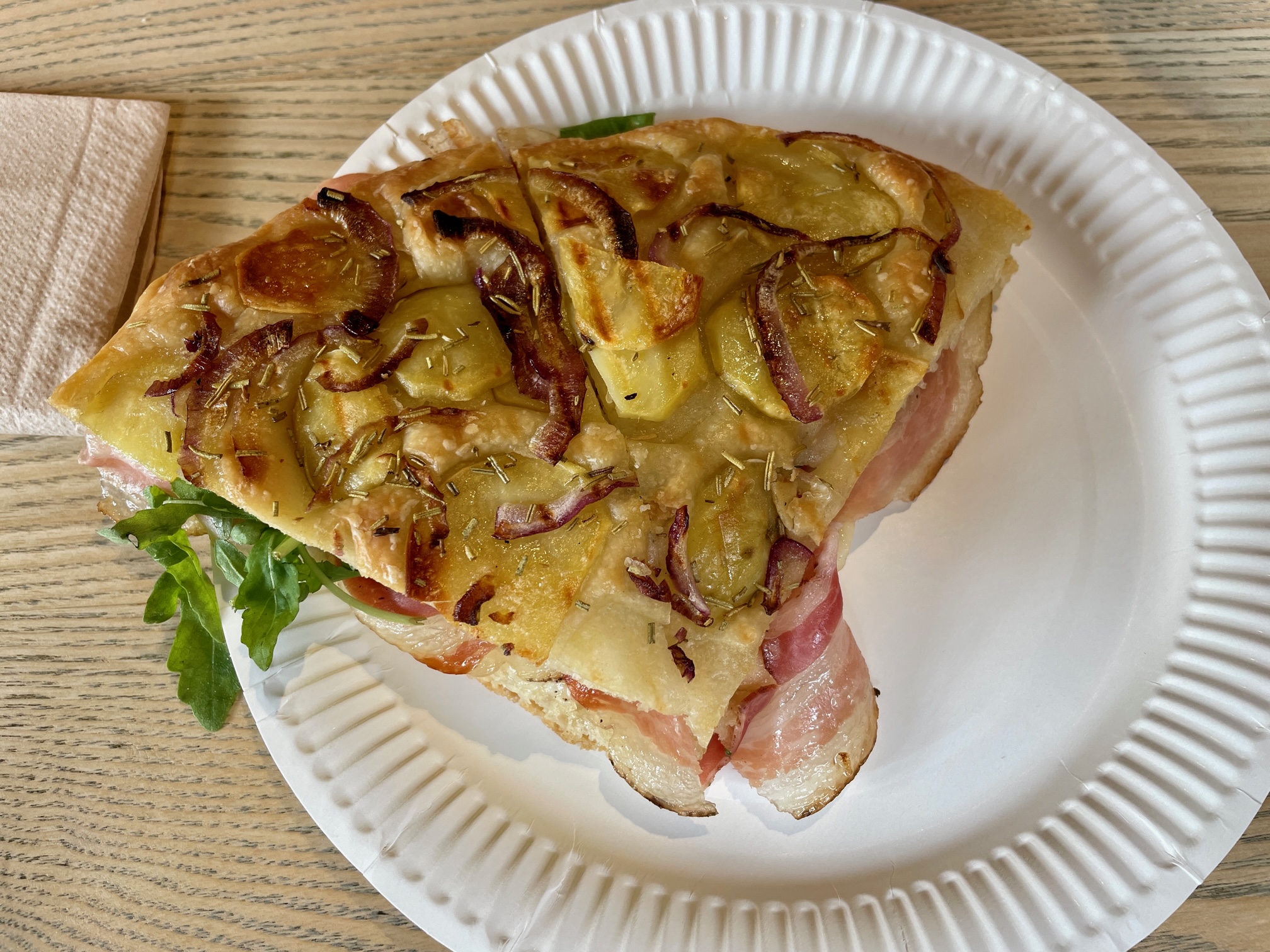
This is an incredibly difficult category, and I think I’ve only been able to narrow it down to two with a little cheating – wraps get their own category, and technically a burger is a sandwich too. But, to get off the fence, at the moment I’m not sure anyone can top the toasties at Madoo. Made with a variety of focaccia and pretty much customisable however you like, they are a carby, cheesy miracle on Duke Street. On my most recent visit, on the day of the big funeral, I had pancetta and scamorza in a focaccia topped with onion and thin slices of potato: try being sad after scoffing one of those. (10-14 Duke Street, RG1 4RU)
Honourable mention: Shed
Shed is still the godfather of Reading’s sandwich scene. Its lunch scene in general, to be honest. Their Tuna Turner – all tuna mayo and oozing cheese, studded with jalapenos, the bread bronzed and burnished – should earn them a blue plaque one day (other sandwiches are, of course, available). (8 Merchants Place, RG1 1DT)
Reading’s best street food: Gurt Wings
Sadly as of July 2023 Gurt Wings is not trading at Blue Collar.
Gurt Wings is a street food player with a national profile and, luckily for us, a soft spot for Reading. From their regular presence at Blue Collar’s Friday markets they took on a permanent pitch at Blue Collar Corner in March, and if the recent announcement that they’re leaving Blue Collar Corner has caused gloom and withdrawal symptoms across the land, the pill has been slightly sweetened by the news that they’re returning to the Friday markets again.
Everything they do is magnificent but the tenders, smothered in hot and sour buffalo and sharpened with a little blue cheese sauce, are truly fantastic. I also absolutely love their JFC – popcorn chicken with a hyper-punchy gochujang sauce and a smidge of sriracha mayo. About once a year they do a chicken burger in an iced doughnut topped with candied bacon – it has to be tried to be believed, but once is probably enough. (Market Place, RG1 2DE, Fridays only)
Honourable mention: Purée
Although Blue Collar is synonymous with street food in Reading, one of Reading’s finest street food options is Purée, the distinctive green van on Broad Street near our smaller, less attractive branch of Boots. Sam Adaci’s van took a sabbatical during Covid and a lot of us were very worried that it might not return, but gladly he is there most lunchtimes dishing up some of the best – and best value – lunches in town. The real winner here is the challoumi wrap – jammed full of glorious chicken and halloumi with hot sauce, garlic sauce, pickles, the works. (Broad Street, RG1 2AA)
Reading’s best sushi – Intoku
I had a rather hit and miss visit to Intoku earlier this year: the service was slapdash in all kinds of ways, but I also saw enough to convince myself that in terms of quality we finally have a restaurant in Reading that can approach the likes of Miyazaki in Maidenhead or my all-time favourite, Windsor’s Misugo. The soft shell crab rolls are an absolute dream, the maki are precise and nicely done and although the sashimi isn’t Reading’s best, it’s good enough. The fact that they also do gorgeous bao and possibly the best crispy squid I’ve had in town is just a bonus. (30a Chain Street, RG1 2HX)
Honourable mention – Sushimania
I know Osaka and Oishi have their fans, but I have a real soft spot for Sushimania, on that slightly grim brutalist corner overlooking the Hexagon. It’s all you can eat but made to order, and you can get most of the core menu that way, an inexpensive treat on a week night with a bottle of Asahi. They ration you on the salmon sashimi and the eel nigiri – make sure you get your full quota of both, because they’re bloody great. (9 Queens Walk, RG1 7QF)
Reading’s best wrap: Cairo Cafe
Sadly, Cairo Café closed in April 2023.
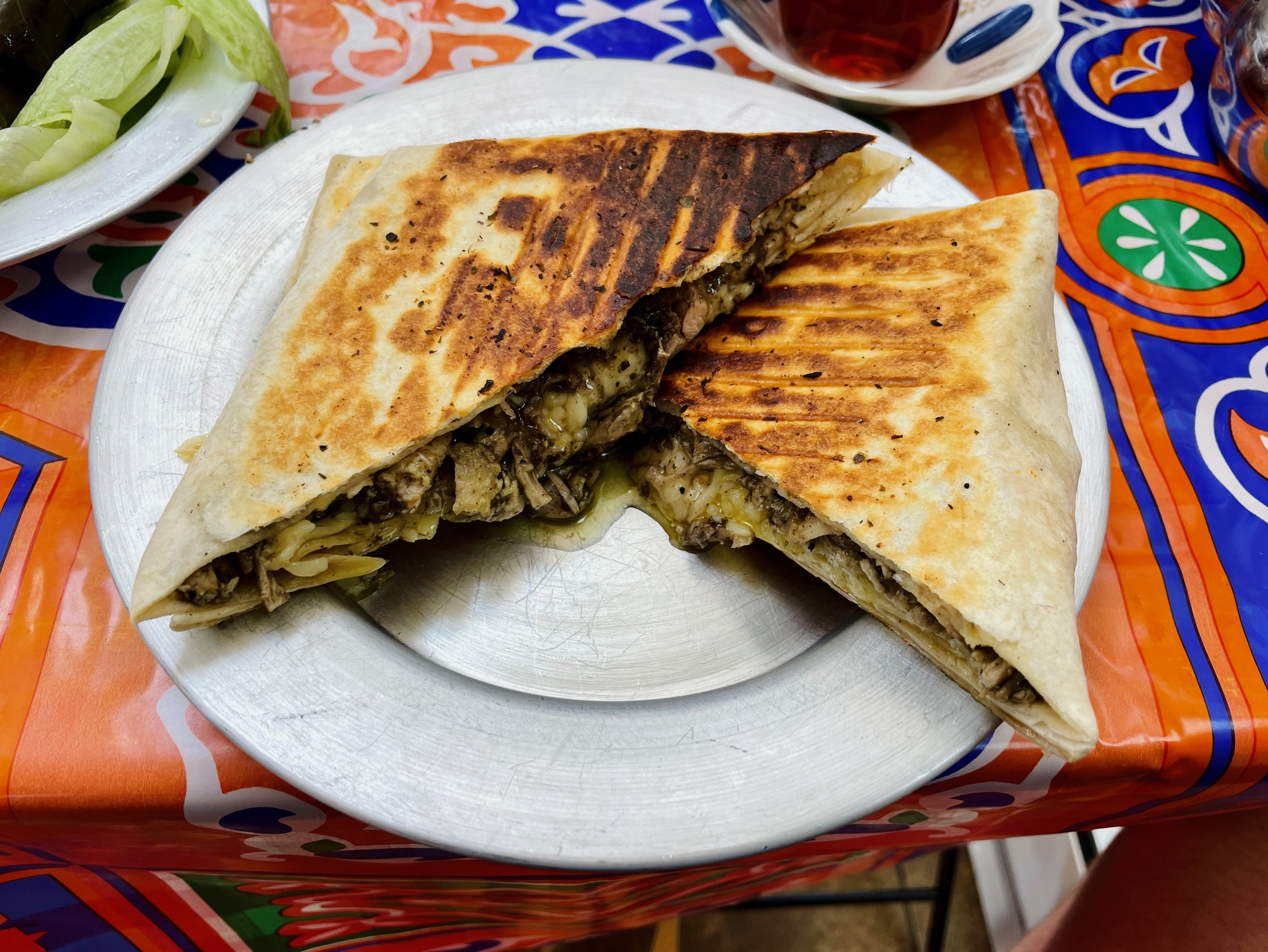
Go to Cairo Cafe and order the chicken shawarma wrap. Marvel at what comes out, hotter than the sun, perfectly assembled, crisped on the outside, gooey with cheese, the meat singing with spices and mint. Eat it in that peaceful place, looking out the window at the comings and goings of the grittier end of town, and tell me there’s a better wrap in Reading. And no, you don’t feel just like you’re in Cairo: you feel like you’re on West Street, because you are.
There’s a lot of chicken in this list, isn’t there? Reading really needs another restaurant reviewer who likes chicken a little less than I do. (13 West Street, RG1 1TT)
Honourable mention: Geo Café
Time for the disclaimer I put up every time I talk about Geo Café – unlike most restaurant owners in Reading, I would class Keti and Zezva as friends, and so you are absolutely free to disregard this, or take it with a pinch of salt, or say I should have picked someone like Mission Burrito instead. But you would be missing out if you hadn’t tried Geo Café’s wraps – either the chicken, pungent with almost acrid ajika and walnut sauce, like nothing you’ve ever tasted, or filled with aubergine, sliced thin, fried and rolled around more of that walnut sauce. Everyone I know who’s tried Georgian food comes away saying Why don’t more people know how good this is? and I couldn’t agree more: it may be the best cuisine you’ve never tried.
So yes, by all means ignore this tip but believe me – if it wasn’t for the fact that they’re my friends, Geo Café might well have topped this category. (10 Prospect Street, RG4 8JG)
As a restaurant reviewer, however assiduously you do your research, however good you think you are at reading the runes of a menu to try and figure out whether a Brakes lorry regularly pulls up outside the crime scene, however much you trawl through Tripadvisor or other blogs – good luck finding those, by the way – restaurants always retain the capacity to surprise.
You can expect somewhere to be good, all the signs can say it will be, but there’s always a possibility that you’ll wind up with an underwhelming meal if you’re lucky, an out-and out-duffer if you’re not. This is especially the case when hype is involved. Or plain gratitude that a place has opened at all, either because a big name is gracing a town with its presence or because the town in question is a wasteland for decent places to eat.
The more refreshing phenomenon is when it happens the other way round, when you go to an unspecial-looking restaurant with no particular expectations only to discover that you have a proper find on your hands. That realisation that dawns gradually throughout the meal, that sense of hold on, this is really good, is one of my favourite things about restaurants, and about reviewing them. It’s happened to me a fair few times, but one that’s always stayed with me was the March evening over seven years ago when I crossed the threshold of Papa Gee.
Papa Gee, back in 2015, was an Italian restaurant on the Caversham Road, on the ground floor of the Rainbows Lodge Hotel. I’d never heard of anyone who had been to Papa Gee, and at the time I knew people who lived in Little Wales, the maze of streets on the other side of the Caversham Road named after Cardiff, Swansea, Newport. Every time I walked past Papa Gee, probably en route to a booking at Mya Lacarte, the place seemed closed.
Inauspicious was putting it lightly. So nobody was more surprised than me when I found Papa Gee wasn’t some kind of white elephant but was instead a hugely creditable little restaurant doing belting pizzas, rather nice pasta and antipasti, a family business with owner and Neapolitan Gaetano Abete, the eponymous Papa Gee, in the kitchen. I had a splendid evening, although arguably the cherry on the cake was not having to stay in the hotel upstairs afterwards.
I walked away with my faith in the world somewhat restored, and it turned out to be one of the most delightful curveballs of the very early days of this blog. And the weird thing is, people definitely went to Papa Gee before I reviewed it. It’s not as if I discovered the place: it had decent writeups on TripAdvisor and had been trading for over ten years. It’s just that I’d never met a Papa Gee customer, back then. Maybe they didn’t want the rest of us finding out.
I was worried about Papa Gee after that, because the owners of Rainbows Lodge sold the building to the Easy Hotel chain a couple of years later and the restaurant was out on its ear. But then they announced what, with the benefit of hindsight, was a perfect move – and in October 2017 they took over the old Mya Lacarte site on Prospect Street, closer to the action in Caversham.
It was a brave move to open slap bang opposite Quattro, Caversham’s long-serving Italian restaurant, and the conditions got even tougher a couple of years later when the Last Crumb, also offering pizza, opened at the top of the road where the Prince Of Wales used to be. And yet here we are in 2022 and, post-pandemic, Papa Gee is still going.
And that’s partly why they’re the subject of this week’s review. The thing is, I’d never visited them in their new home and I was starting to feel bad about that; I didn’t want them to be continually on my to do list only to find, one day, that they’d closed before I’d got round to visiting. So I made my way there with Zoë on a Friday evening, post work, the weekend stretching out ahead waiting to be filled with units and calories. Like the very first time I visited Papa Gee, a lifetime ago, I wasn’t entirely sure what to expect.
Subscribe to continue reading
Become a paid subscriber to get access to the rest of this post and other exclusive content.
No blethering preamble for you this week, talking about the history of Reading’s food scene and putting things In Context (because there always has to be a Context). Things are much simpler this time around, because by the time you read this I’ll be off on my holidays and I just wanted to eat somewhere really nice the weekend before I went.
There’s something magical about the weekend before you go away, right from the moment you close the work laptop on a Friday afternoon: the knowledge that the weekend you’re about to have won’t be bookended by opening the sodding thing again on Monday morning, knowing that instead you’ll be at the airport, putting your phone and house keys in the plastic tray at security, browsing the duty free fragrance, daydreaming about that first holiday beer or glass of wine.
That’s why I found myself in Wallingford on Saturday afternoon with a reservation for Five Little Pigs that evening. Five Little Pigs received national attention earlier in the year when it got a rave writeup in the Observer. And whatever you think of Jay Rayner, his review of the place talked about deep-fried olives, a burnished toastie with cheese from nearby Nettlebed Creamery and a deep, savoury venison ragu. Reading that was enough of an incentive.
And besides, it’s not as if I had to go there with Rayner. Like most people, I have an infinitely better option: in fact, Five Little Pigs was on the list of restaurants I wasn’t allowed to review with anybody but Zoë (or, as she puts it, “not without me you fucking aren’t”).
Wallingford is a sleepy place, although remarkably easy to reach on the evocatively named River Rapids bus. It’s a very agreeable forty-five minute amble through Oxfordshire, out past Cane End, Gallowstree Common, Stoke Row. I expected Wallingford to be a little like Henley, or Witney, but it’s smaller than either with a couple of main streets, a pretty pub by the green and a really lovely wine shop, the neatly named Grape Minds. There’s also one of those antiques centres which is a succession of rooms full of tat and treasure in indeterminate proportions, and a Scandi interiors shop which mostly sells Farrow & Ball. The craft beer scene there is one bar with a fridge full of Phantom and Arbor Ales. That’s not to say I didn’t like Wallingford, but by the time our table was ready I was very much ready for it.
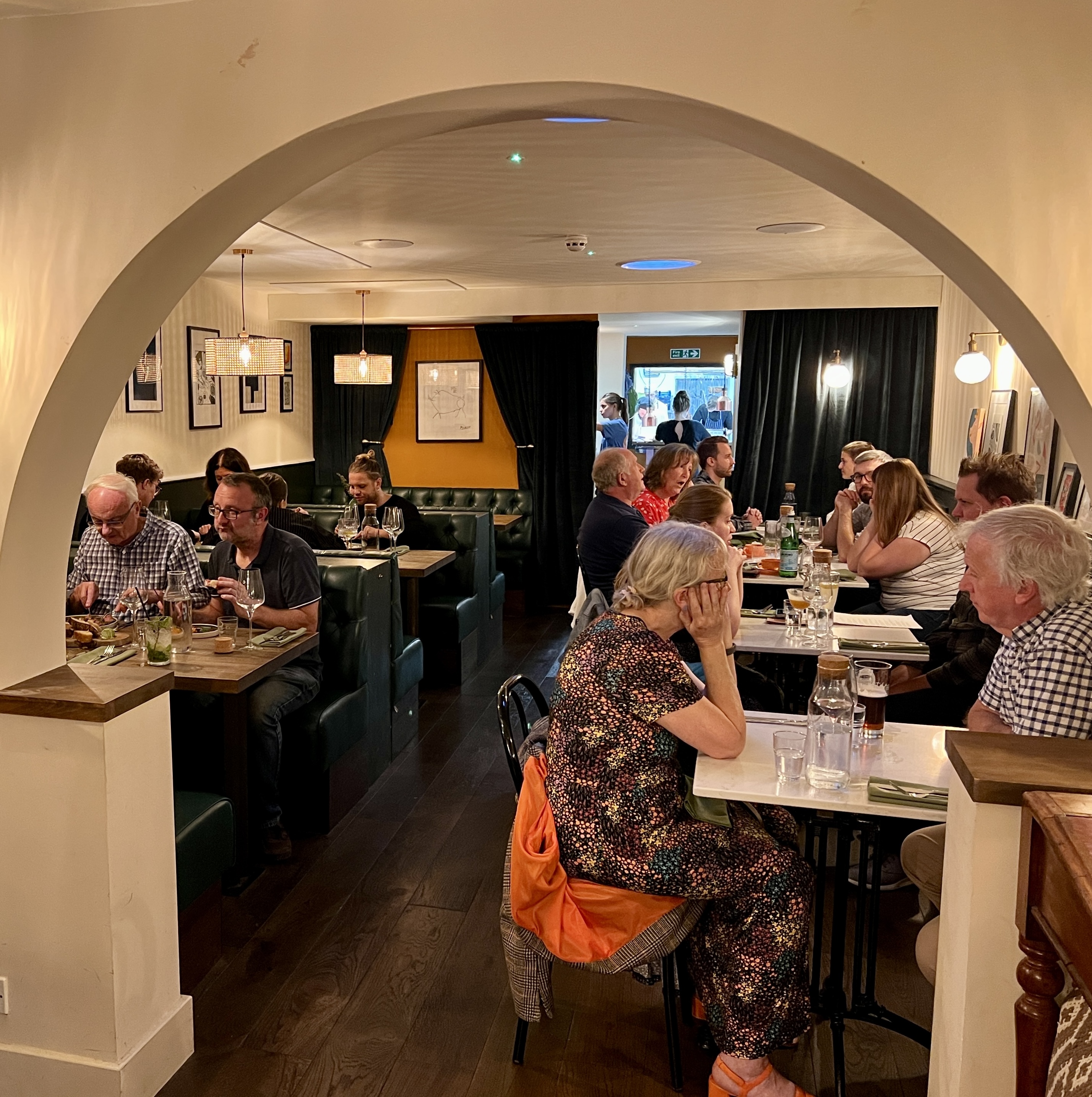
From the review I’d read I thought Five Little Pigs would be small but actually it was much larger than I expected. The front room, with the full length windows out onto St Mary’s Street, was a chic (if slightly chilly) space which was very tastefully done, an interesting mix of deep blues and golds and pastel shades from the art on the wall. It reminded me of places like Coppa Club, which isn’t necessarily a compliment. Further back was a longer, plainer room with banquetted booths. It’s a surprisingly hard space to photograph (as you can probably tell) but it was packed at seven o’clock on a Saturday night: a good review in the Observer will do that for you.
The menu read well and had plenty on it to appeal. Starters clustered around eight or nine pounds, and only a couple of mains were north of twenty. Plenty of it was local, too, with nearby cheesemakers, growers and butchers all namechecked. “We don’t have the pigs cheeks at the moment” said one of the wait staff, “but they may come in later.” I found that a bit confusing – were they being delivered by drone? – but decided it was best not to ask.
By that point a bottle of red had been opened, a really enjoyable organic Rioja, and I was about to reach that happy place where the food has been ordered and you know you’re safely in somebody else’s hands for the next few hours. Every table was full – with date nights, family gatherings and, in one case, an elderly couple who seemed to spend most of the evening glowering at each other. We were all going to have an enchanting evening. The Observer said so.
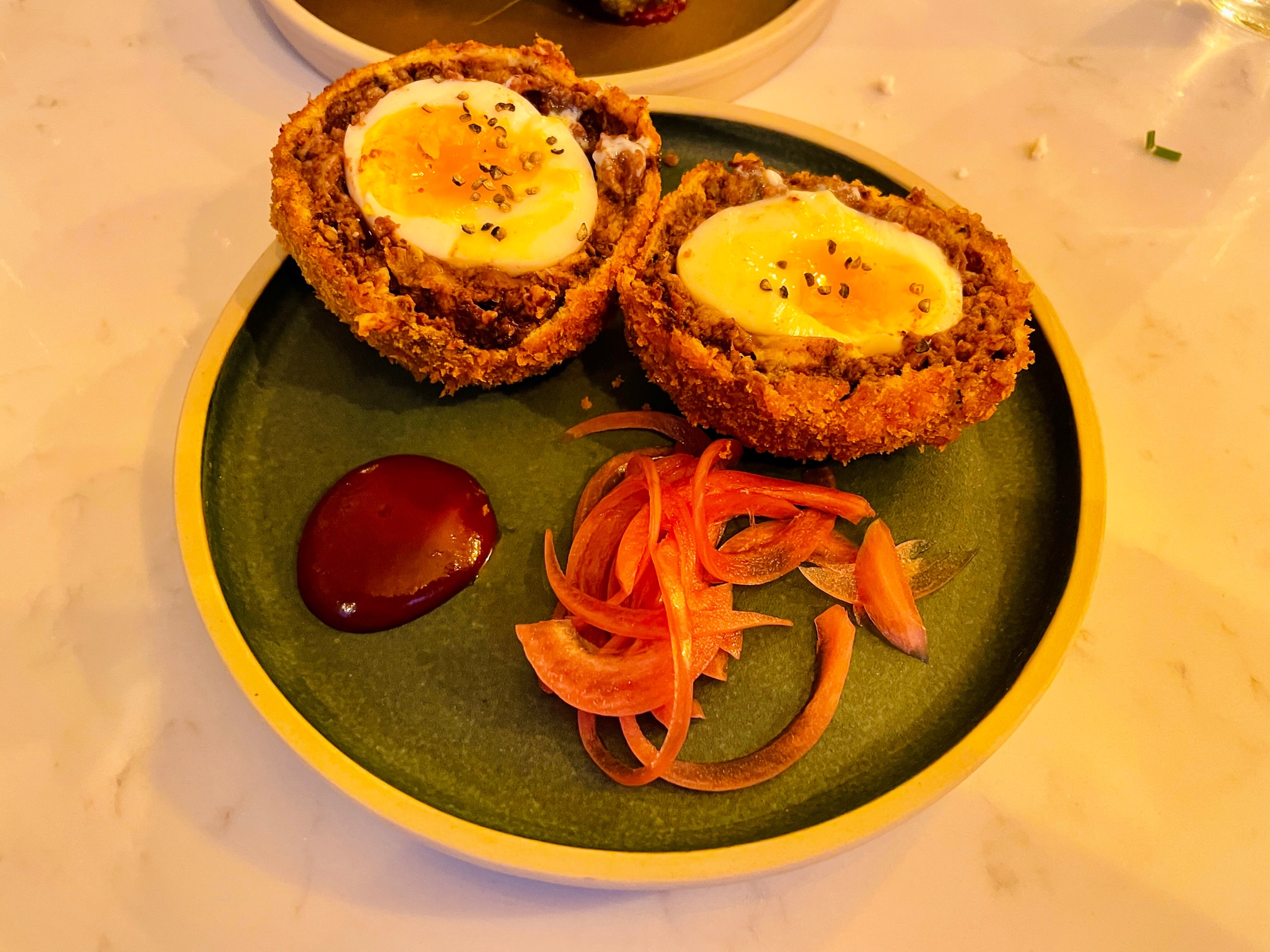
I felt a bit basic ordering the Scotch egg, but I can’t remember the last time I had one so it was calling to me from the menu right from the outset. It was one of the nicest things we ate all evening, so proved to be a happy choice : the sausagement was nicely coarse, with black pudding adding a little earthiness. And if I’d have liked the outside a little crisper, or the whole thing slightly less crumbly, the presence of a small pool of superbly tangy rhubarb ketchup mostly made up for that, as did the pickled pink onions.
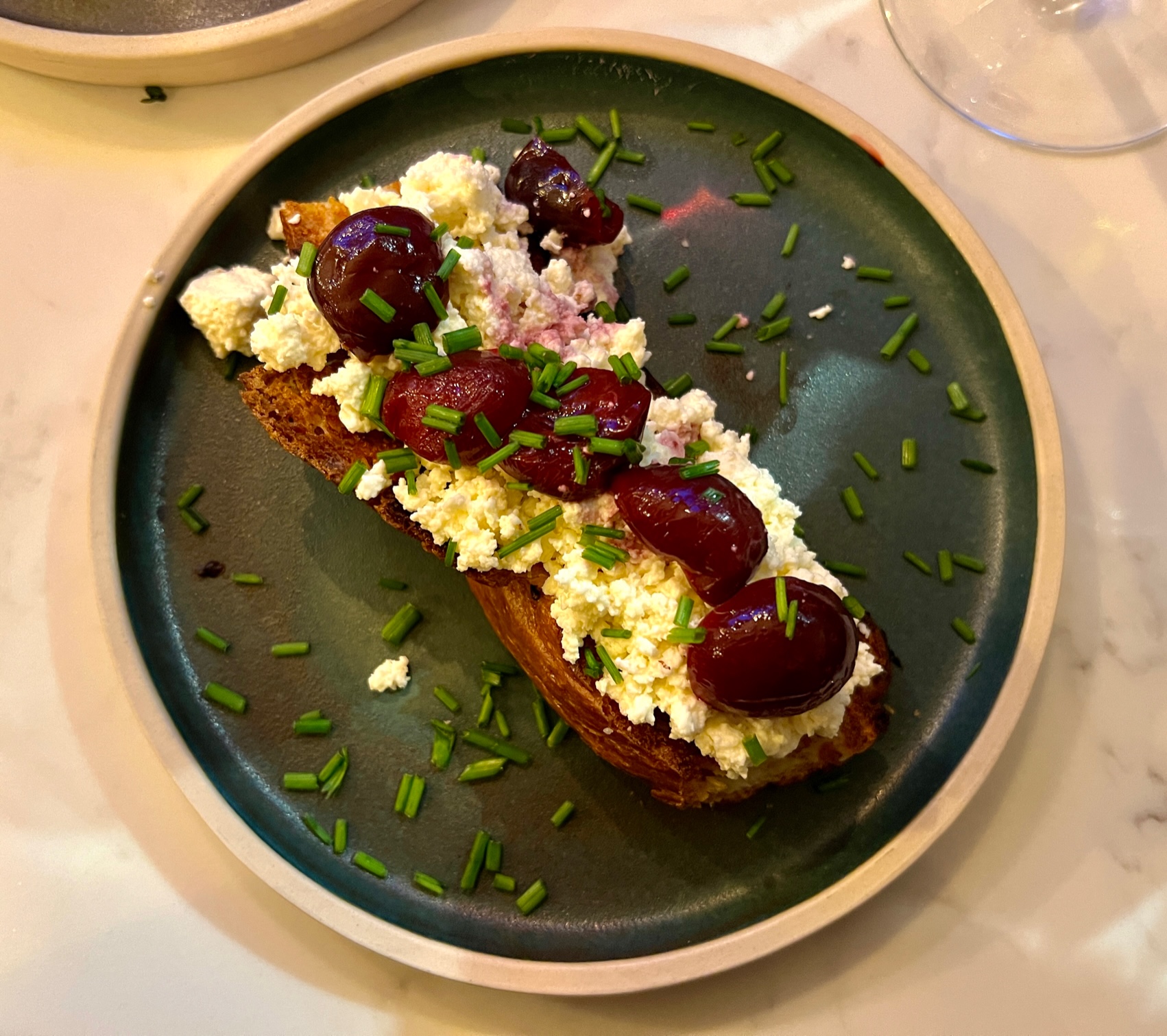
“You win” said Zoë, tackling her ricotta on toast, which sounded great on paper but in reality was disappointing. “It’s all a bit dry” she said, and this is a woman who’s listened to me talking about my favourite Bob Dylan records, so she knows what she’s talking about. For what it’s worth I agreed – the ricotta was dry and anaemic, the cottage cheese of the Chilterns, and although the roasted cherries were an interesting idea they didn’t add enough of the moisture this dish needed. Literal cherries on top, yes, but sadly not figurative ones. “This could have been really nice with honey” was Zoë’s take.
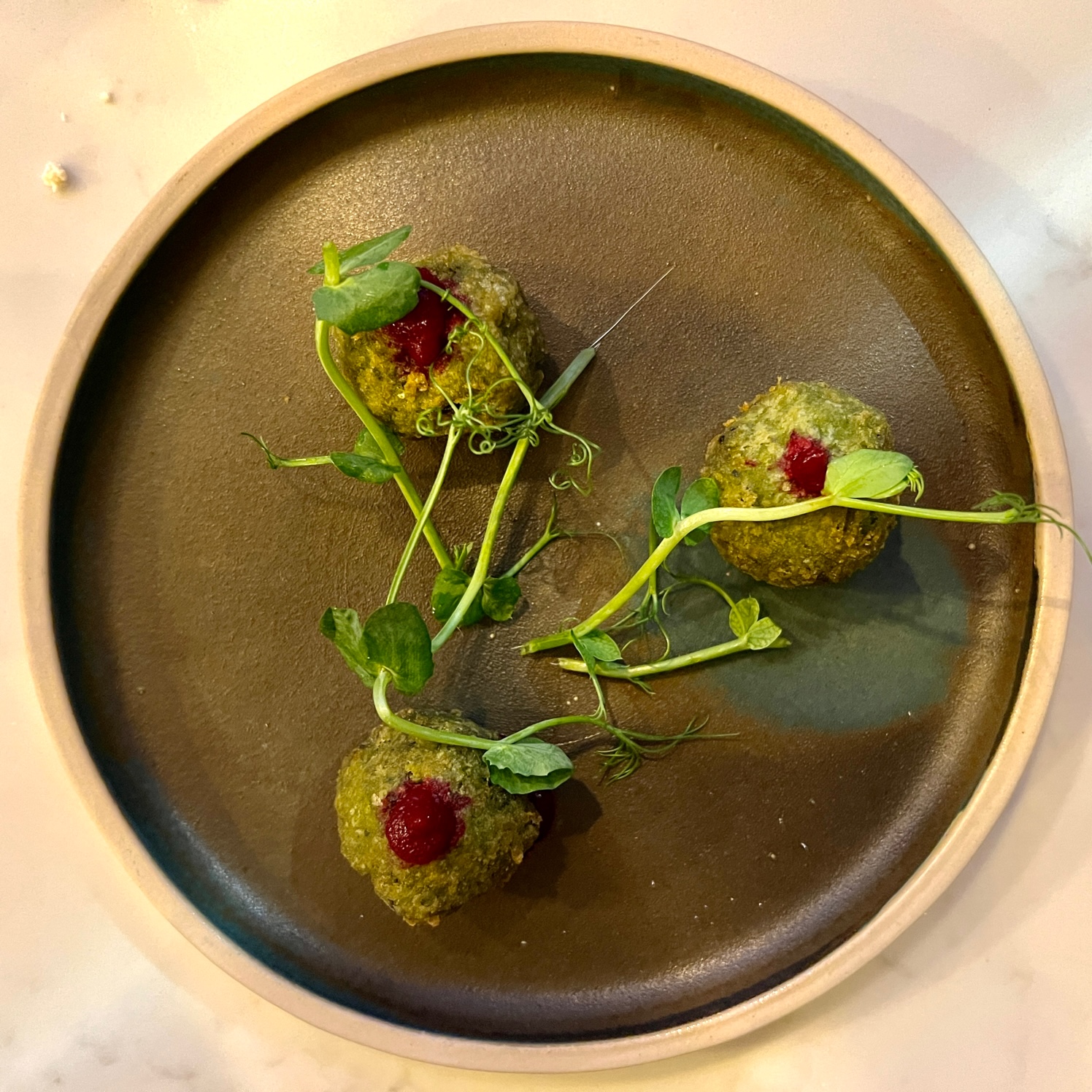
We’d also ordered a third starter, broad bean fritters, because they sounded so magnificent. And they tasted gorgeous, with huge amounts of freshness from the mint and a dab of deep whipped beetroot on top. But plating it up with pea shoots and plenty of negative space couldn’t really conceal the most obvious thing about this dish, which is that it was minuscule; it was one of those times when I wish I’d popped a twenty pence piece on the plate before I took the photo so you could see just how small they were. We had this as an extra dish, but if this had been my starter I’d have been looking at everybody else’s, feeling profoundly robbed.
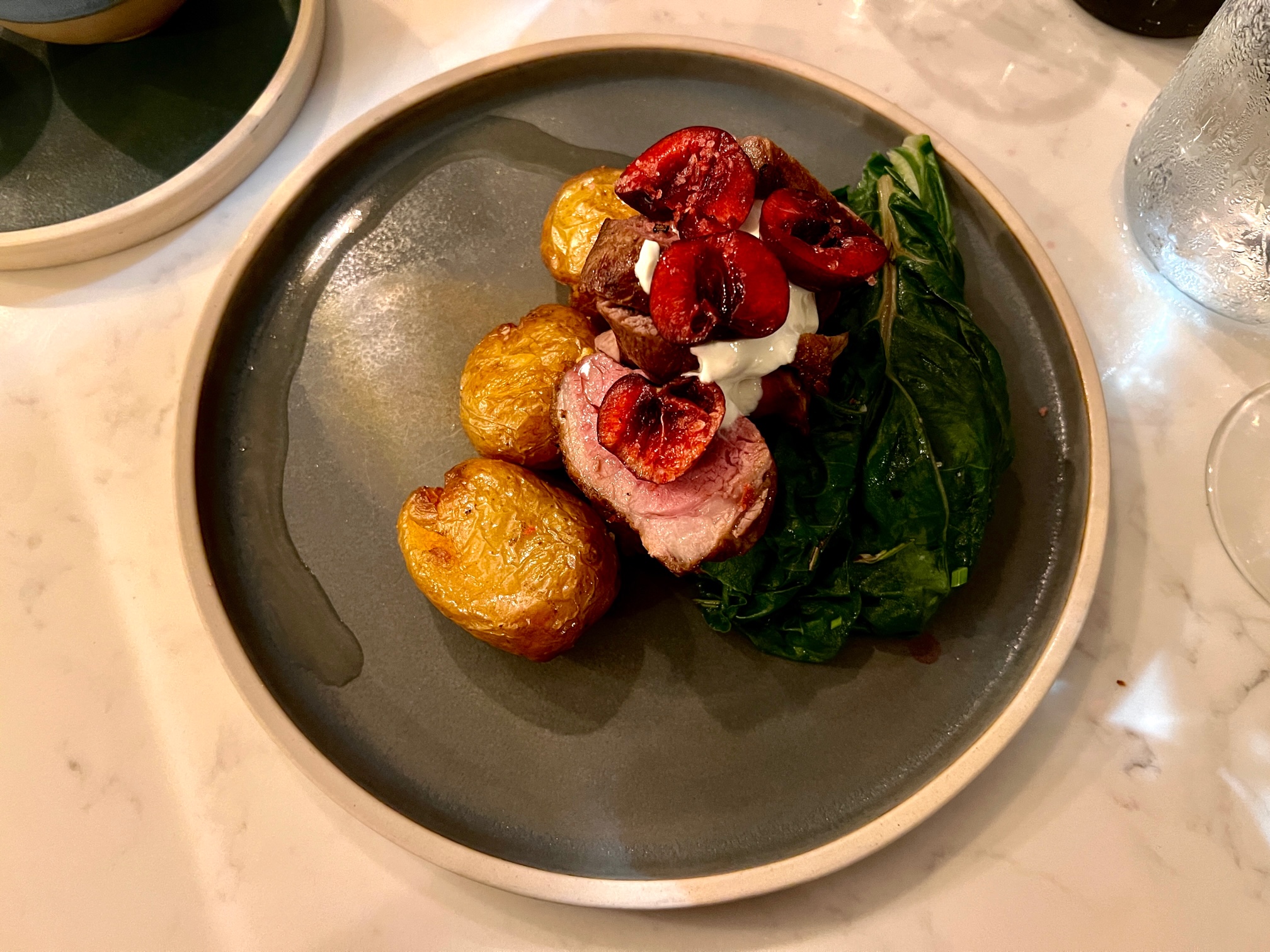
Things were well paced at Five Little Pigs, possibly because it was so busy, because our starter and our mains were about half an hour apart, for me close to the optimum interval between the two. I think Zoë chose better with the mains and her lamb rump with yoghurt, more of those roast cherries and what the menu calls “crispy potatoes” was the pick of the two. But even here, it wasn’t perfect. “Again, it’s dry” said Zoë. “The yoghurt is really good, but if anything it needs more of the cherries. They work better here than they did with the starters.” I agreed with that, although I thought the crispy potatoes were a standout, with a lot more texture than met the eye. But for me, the lamb rump was a little overdone. I found it odd, too, that they brought me a steak knife but not Zoë, when her dish needed it every bit as much as mine.
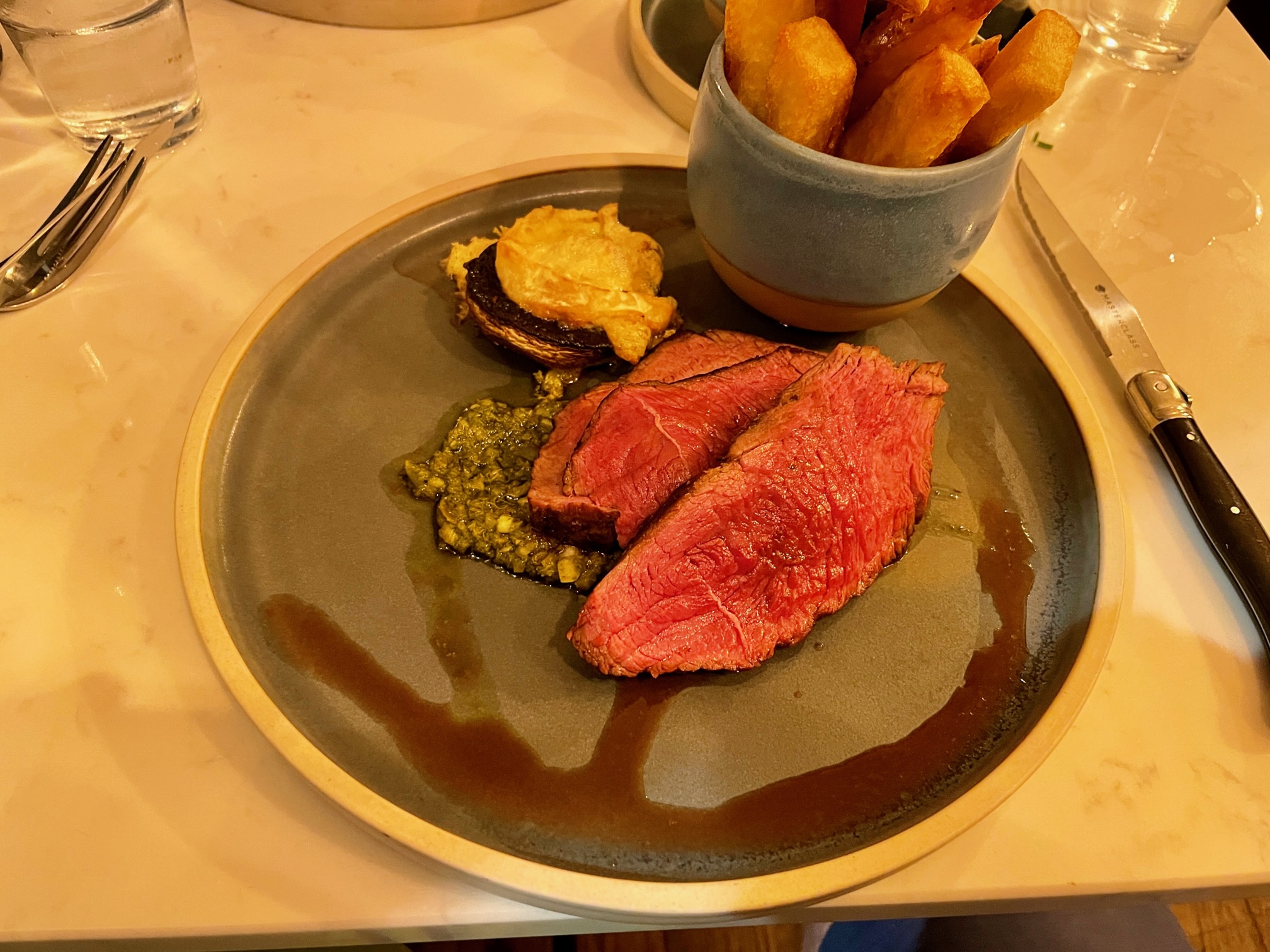
My rump steak was the most expensive dish on the menu, which always adds the potential for it to be the most underwhelming. It was a beautiful piece of beef and the cooking couldn’t be faulted – pretty much medium-rare throughout with beautiful caramelisation outside. But it was underseasoned, and surprisingly bland. The chimichurri underneath it had a pleasing zing, but ran out very quickly indeed. And after that the whole thing became a bit of a slog. There was some kind of puddle of juices at the edge of the plate, but it would be pushing it to call it a jus or a sauce. The best thing on the plate was a solitary mushroom cooked with cheese (again from Nettlebed) until it was salty and crispy, but when the star of the show plays such a brief cameo role, you’ve got problems.
Just to add to the onslaught of dryness, my triple cooked chips had decent texture – and were huge – but, again, they came without anything to add moisture. We’d ordered another portion separately, not knowing that we wouldn’t really need them, and I think in a restaurant with sharper service they might have talked us out of doing that. They came with a very good aioli but, as with the chimichurri or the beetroot ketchup, there was nowhere near enough of it. We asked for some more from a passing member of the wait staff. Five minutes passed and it didn’t materialise. We asked again and some time later, when the chips were nearly at an end, it finally arrived.
We looked at the dessert menu because our bus wasn’t for another forty-five minutes, or at least that’s what I told myself. By this point the couple at the next table had both ordered the hake – which looked nicer than either of our mains – and there was a certain mesmeric quality to watching them push it round the plate in that way that people who don’t really enjoy food seem to do.
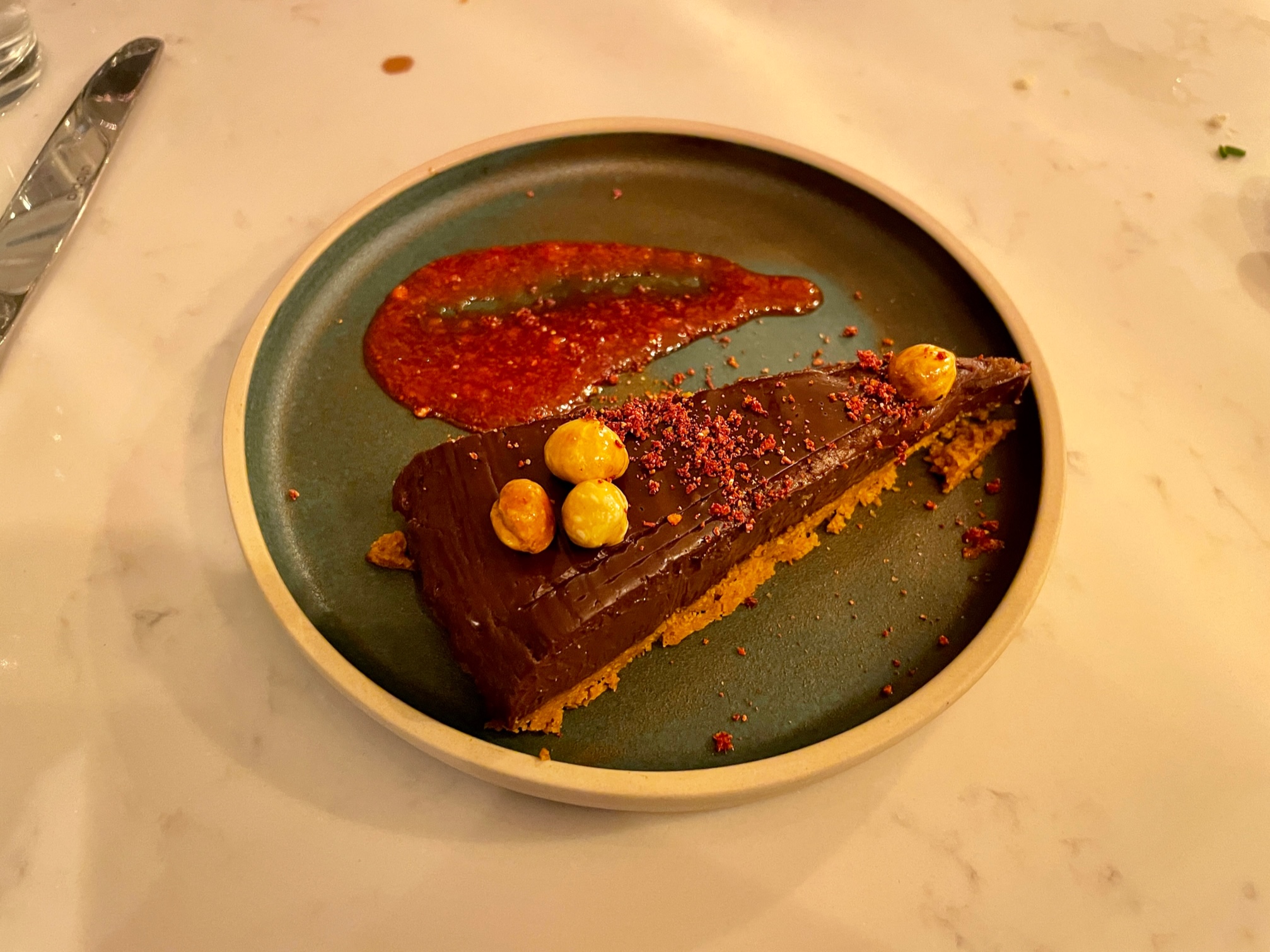
Anyway, desserts represented a slight recovery. My chocolate delice was a brilliant wodge of deep, gooey chocolate with a sweet, almost-sharp smear of bright strawberry purée to cut through. The biscuit base underneath was so crumbly that it barely stayed in one piece, but I didn’t mind that at all. Zoë’s key lime pie had a similarly short base and I thought it was pleasant, but I’d probably describe it as “subtle”, which really isn’t what you’re looking for in a dessert.
Zoë had her dessert with a Cotswold cream liqueur (although it turned up on the bill as Bailey’s, so Christ knows which it really was) and I had a dessert wine – from Graves of all places – which went beautifully. And well done if you’ve made it this far, because the truth about Five Little Pigs is that, sadly, by this point I’m even slightly boring myself. Our bill came to a hundred and forty-six pounds, including service, and then we went outside, got the penultimate bus out of Dodge, got home, had a cup of tea and went to bed. The end.
Last week somebody commented on my Facebook page about the review I did of Sauce And Flour. “I wish you’d stop doing reviews of places outside Reading” he said. “I prefer the Reading reviews. And after all, this blog is called Edible Reading”. I always find it interesting when people pipe up to tell me that this entirely free blog is somehow not delivering value for money, and after I politely told him that I’d review wherever I bloody well liked he deleted his comment. But there’s an important point here, believe it or not. I think it’s good to review places outside Reading because it gives you that all-important context (like I said at the start, there’s usually a Context). Otherwise how do you know if a place is good, or just good for Reading?
And it goes beyond Reading. If I hadn’t been to the likes of Marmo and Caper & Cure maybe I’d have thought about Five Little Pigs very differently. But at the same price point, making similar noises, and even with some similar dishes, the difference is stark. There are better ways to spend a hundred and fifty pounds eating out than to go to Five Little Pigs. One is to go to Marmo, or Caper & Cure. Another, to be honest, is to eat at Tasty Greek Souvlaki four times. Five Little Pigs is probably an absolute boon to Wallingford, and on another night I might well have had a meal there I’d have enjoyed better. But in truth, I can’t see myself going back.
So there you go: it turns out that restaurant reviewers aren’t always right. But as a regular reader of this blog you knew that already, didn’t you?
Five Little Pigs – 7.1 26 St Mary’s Street, Wallingford, Oxfordshire, OX10 0ET 01491 833999






 Edible Reading