Restaurant review: Vino Vita

Last year, in one of the more baffling developments in Reading’s food and drink scene, wine bar Veeno changed its name to Vino Vita. It wasn’t initially clear whether this was because the people running it had bought the business from Veeno or if something else was going on. If you read the details on Vino Vita’s website you’d be none the wiser. “We’ve rebranded, but our commitment to excellence remains unchanged” it said. “Join us as we start an exciting new chapter that expands our offerings and vision.”

More details emerged when the owners spoke to the Chronicle last month. “A big reason why we became independent was so we could have more say over the produce” said the restaurant’s Head Of Sales. “We developed our whole menu, and everything is done on site.” I remember reading the article and thinking that this potentially merited a revisit, but the main thing I took away was They have a head of sales? It felt like a role Veeno, a chain with 5 restaurants across England and Scotland, might need but that Vino Vita, a single spot opposite Forbury Gardens, probably didn’t.

So what were the differences, and had Vino Vita improved on the Veeno formula since taking their destiny into their own hands? The only way to be sure was to eat there – which clearly I did, because you’re reading this – but before that I carried out some research. Because I visited Veeno on duty nearly 8 years ago, not long after they opened, and at the time I would have said that there was plenty of room for improvement.

Vino Vita’s menu does indeed offer a slightly wider selection of dishes than Veeno’s, with more nibbles, bruschette, small plates and so on. It has about as many pasta dishes, although I’d say Vino Vita’s sound less interesting. The big difference, and again this is baffling, is the sheer volume of pizza: between conventional pizzas and Pinsa Romana, Vino Vita offers almost twice as many options as its estranged siblings.

Did Vino Vita move in this direction to compete directly with the likes of Mama’s Way, who clearly have superb access to produce? And if so, wouldn’t you maybe change course given that Reading has seen pizza place after pizza place open this year, at least two of them – Paesinos and Amò – being truly first class? I did wonder.

A couple of other strange things that came out of my homework. One was wine. Veeno’s selling point was that the wine was from their own vineyard: their selection was excellent, the vast majority of it was available by the glass and much of it was affordable. To give you an example, 7 of their 21 reds will set you back £30 or less. By contrast, Vino Vita’s 21 reds were more expensive – the cheapest was £29.95, the remainder all cost more than that.

It wasn’t clear where any of them came from either, because unlike Veeno, Vino Vita didn’t quote producers or vintages. It felt odd to split away from the parent company to offer greater choice, only for that choice to be more expensive and less informative. Like the name change, it had a hint of shadiness about it.

The other odd thing was something I discovered when making a reservation, because booking online with Vino Vita also raised some questions. The thing is, you don’t just book a table. You also have to tell them, and I’ve never seen this before, when you plan to give it back. Not only that, but you also have to say what you’re booking it for – is it for a meal or an Experience?

Yes, an Experience with a capital E, and the booking system asks you which one you want: Quattro Rossi, for example, Trip To Italy or Italian Afternoon Tea, without telling you what they are (they’re on a separate menu, but it’s odd that they don’t tell you as part of the booking Experience – sorry, I mean experience). And all those Experiences? Copied straight from Veeno. The grape didn’t fall very far from the vine, it seemed.

After all that research, I was in two minds about going to Vino Vita. Was it different enough? Was it promising enough? But one thing clinched it. Sometimes people specifically ask if they can join me for particular reviews: so for instance, when I get round to visiting Lebanese Flavours to discover whether the artist formally known as Bakery House has simply changed its name or changed for the worse, my friend Liz has called shotgun on that one.

Similarly, I can’t review Wendy’s unless it’s in the company of Kevin, a long-standing reader, because I promised him, and as he’s moved to the Cotswolds it won’t happen any time soon. In this case it was Zoë, my wife and number one dining companion, who put in a request specifically to go to Vino Vita, so I met her outside at the start of the weekend, to discover whether their commitment to excellence really did remain unchanged.

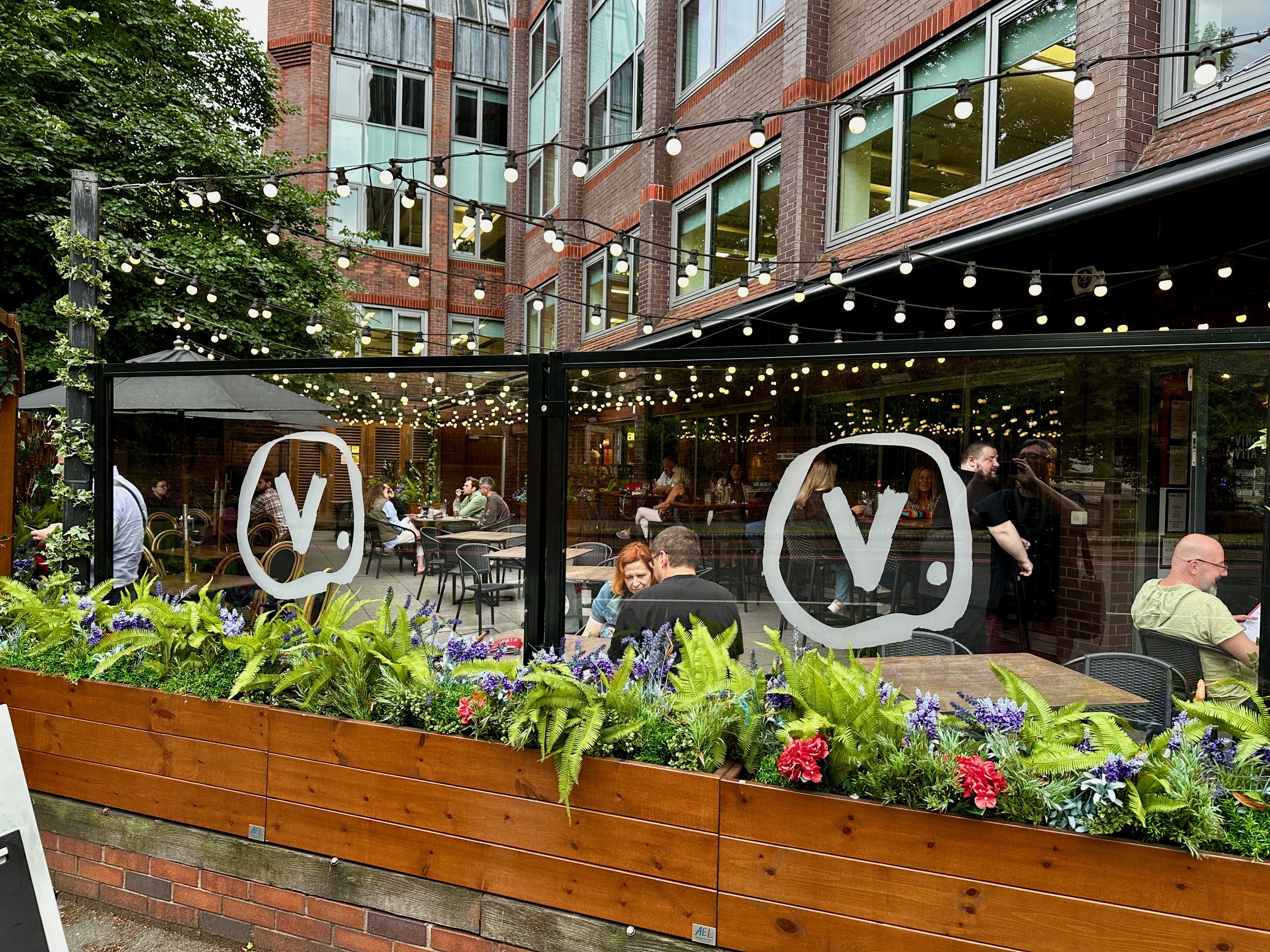
Our table wasn’t ready when we arrived, so we went out to the terrace to have a drink before our meal. It really is one of Reading’s most appealing al fresco spaces, a very pleasant spot opposite the park, strung with lights and convivial on a warm day. It was nice to spend time there before dinner, quitting as the evening became a little nippy, but it does help if you don’t mind passive smoking because there was a fair bit of that. Very Italian, I suppose.

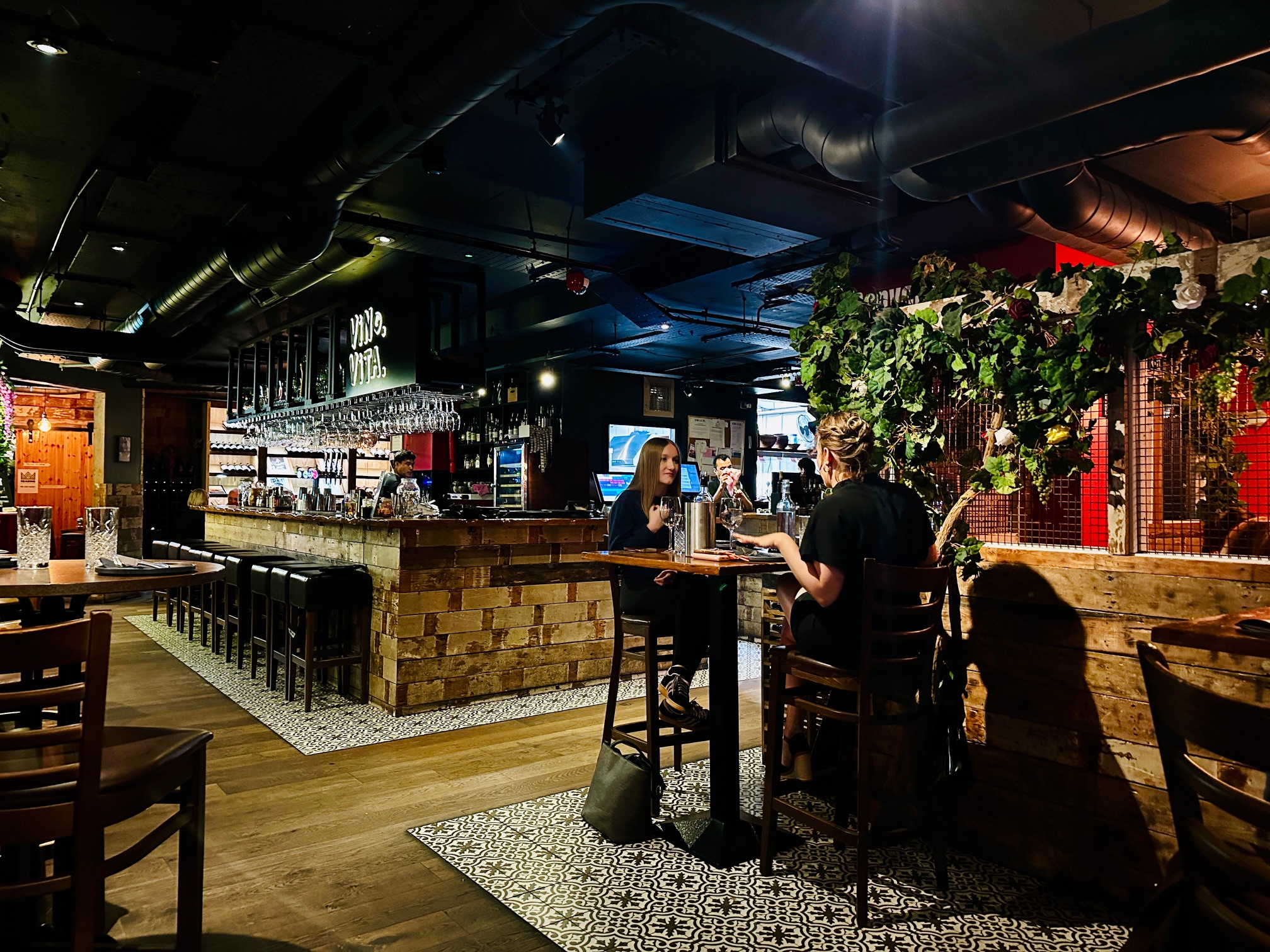
It was, however, difficult to get attention. So by the time we did, and managed to place an order, and the nibbles came out, it was chilly enough that it felt like time to move inside. Vino Vita’s interior didn’t feel any different to when it was Veeno, and I’ve always found it a slightly disjointed set of spaces – some high tables, some low tables, a series of disconnected rooms that don’t entirely feel like they’re all part of the same establishment.

We were taken to a more conventional table to the right of the bar, in the room I’m pretty sure I ate in back in 2017. On a Friday night the place wasn’t rammed, although I suppose many of the customers were outside. Perhaps they seated all the people that had booked a table for an actual meal in the same room, and everyone else was off having their Experiences.

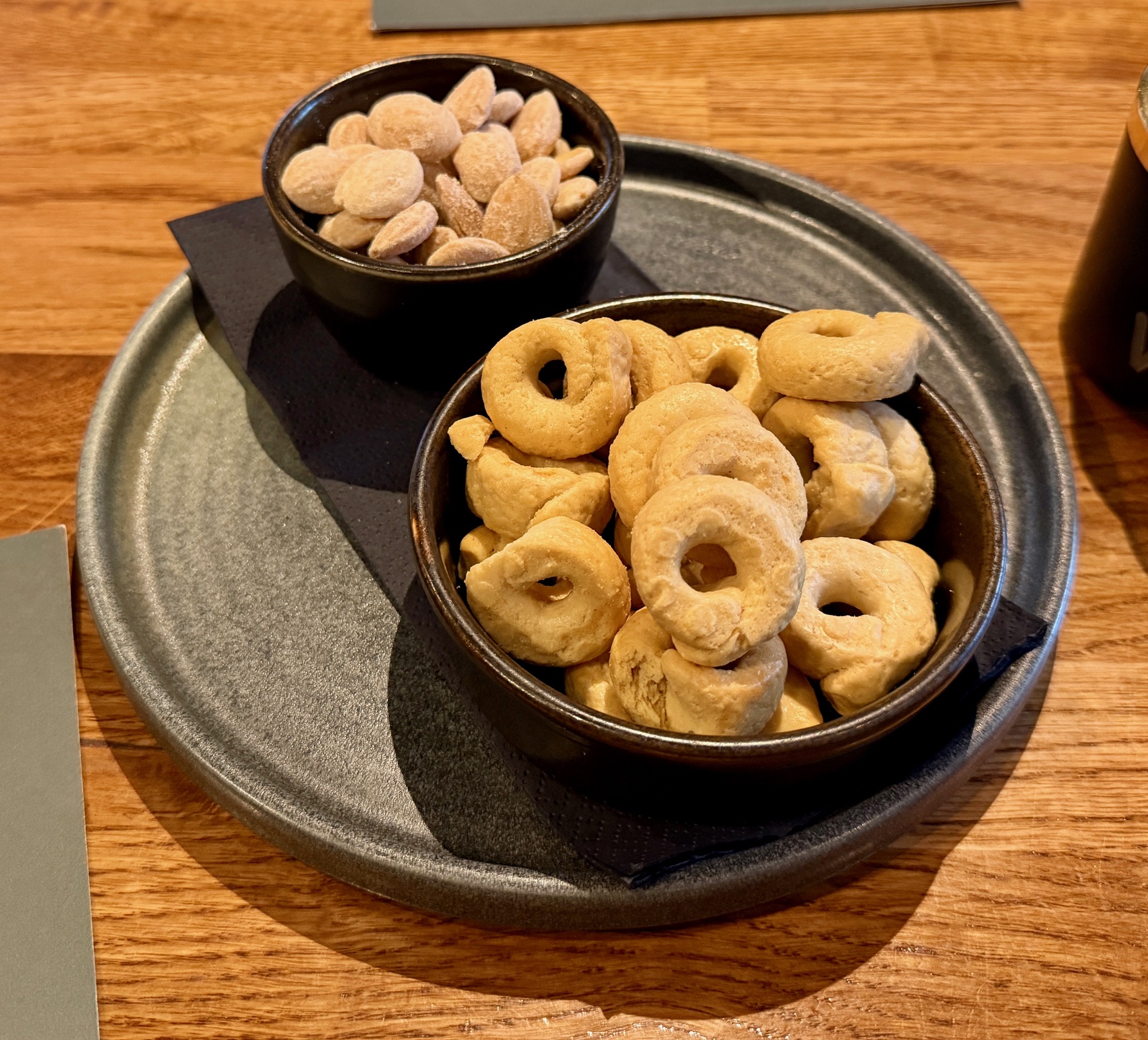
Our nibbles were disappointing, sub-pub stuff. I was hoping that salted almonds would be the kind of treats you get in Andalusia, burnished with oil and speckled with salt. These were out of a packet or a tub, dusty with salt and completely unremarkable. Even more nothingy were the taralli, dense little knots with the texture of sawdust. Really good taralli come spiked with fennel seeds and, with a crisp white wine, can be a delight. These weren’t really good taralli. Eight pounds for two ramekins of blandness.

We had a wine flight with these, the “VINO.VITA.BIO” which was three 70ml glasses of Vino Vita’s organic wines. The first, a verdicchio, was genuinely very enjoyable – and it was just as well that it was, because getting someone to bring some water to accompany those very dry snacks proved difficult. When we finally did manage it one of the staff brought a small bottle of water, a single glass and another glass full to the brim with ice. We had two perfectly good water glasses sitting on the table, which made it all a bit weird. “It’s funny” said Zoe. “They do have enough staff, it just feels like they don’t.”

The other two wines in that flight, by the way, were also quite nice. One, a Nero d’Avola, was decent, perfumed and very enjoyable: it didn’t go with anything we ordered, but that might be because it was tasty and none of the food turned out to be. The third wine was a Frappato, which is a new one on me, and was also perfectly drinkable.

This is sure to be a firm favourite amongst those who enjoy wines on the medium end of the spectrum said the blurb on the piece of paper which accompanied the wine flight: that quote is sure to be a firm favourite amongst those who like their sentences to be completely devoid of meaning. As with the wine list, the piece of paper didn’t give useful details like producers or vintages, and you didn’t get to see the bottles or labels. Did that make for a premium experience, or Experience, when you were paying £17 for 210ml of wine?

We’d also ordered some garlic ciabatta, but our server accidentally brought over the bread selection instead. He was very apologetic, and ran off and made amends, but it was a useful exercise because the bread was a dreary-looking generic selection, none of which looked like it had been baked onsite or indeed anywhere exciting; I made a mental note not to order any of the numerous bruschetta options.

Instead we got what we’d originally ordered, four slightly sad triangles of ciabatta which had been sort of toasted, a little, inconsistently brushed with olive oil and scattered with parsley. There was some garlic there, but nowhere near the industrial quantities Italian food called for. Zoë thought this was okay, but she was being charitable. I thought that for six pounds I was having the kind of thing you could easily pick up at a supermarket.

The real crimes against Italian food, though, were to follow, in a meal where the longer it went on the worse it seemed to get. I can’t think of a better way to demonstrate that than the first of the small plates we’d ordered. The menu promised stuffed courgette flowers, and I thought this would be a real test of whether they truly held all those lofty aspirations. Because a courgette flower, its head stuffed with ricotta and lemon zest, the whole thing fried in an almost translucent, lacy batter is one of the very best things you can eat.

It is serious cooking, and a menu offering it is making a claim to be serious about cooking. I still remember it being served by the Lyndhurst, when I held a readers’ lunch many years ago: Amy, the vegetarian on our table, had it all to herself and every omnivore envied her. It’s taking all my strength not to include a picture of it in this review, so you can see what it’s meant to look like. Instead, just look at that: three beige cylinders bearing no resemblance to courgette flowers at all. No light coating, instead a thick layer of stodge.

Inside, something that definitely wasn’t a courgette flower: I’m prepared to take their word for it that it was courgette, but only just. And inside that, some blend of cheeses that tasted of nothing. This was like some kind of continental reinterpretation of stuffed jalapeños you might pick up at Iceland, an affront to the promise of this dish. Providing some honey, the only thing that actually tasted of anything, didn’t rescue it. The price – £8.50 – rubbed salt in the wound.

The arancini were in the same vein. Veeno only did one kind, filled with ragu, whereas at Vino Vita you can choose between ragu, mushroom and truffle or ham and cheese. The mushroom and truffle ones didn’t taste of truffle in any way, being just claggy stodge with no crunch or crispness to the exterior. Plonking them on a shallow pool of tomato sauce, grating some cheese and unceremoniously dumping some basil in the middle neither elevated them nor disguised their inadequacy.

I’ve used that word, stodge, twice now, because nothing else encapsulates those dishes. Italian food at its best can embrace the wonder and comfort of carbs, but this seemed to prioritise filling the stomach and emptying the wallet with brutal efficiency. In fairness, these were billed as bite-sized and only cost £6, but they still weren’t worth it. When I went to Veeno, 8 years ago, I said that it felt like the kitchen was more interested in margins than food. Hold my beer, said Vino Vita.

Neither Zoë nor I managed to take a picture of one of our small plates, so you’ll have to both imagine it and take my word for it. If you read the title carpaccio of salmon and the description smoked salmon drizzled with a lemon and caper dressing and fresh rocket and think that, based on what you’ve heard so far, this is likely to be a small piece of smoked salmon draped over a hill of the kind of salad you get in a bag at the supermarket, domed to make it look like you’re getting more salmon than you are, meanly scattered with capers, you would be absolutely spot on. Give yourself a pat on the back.

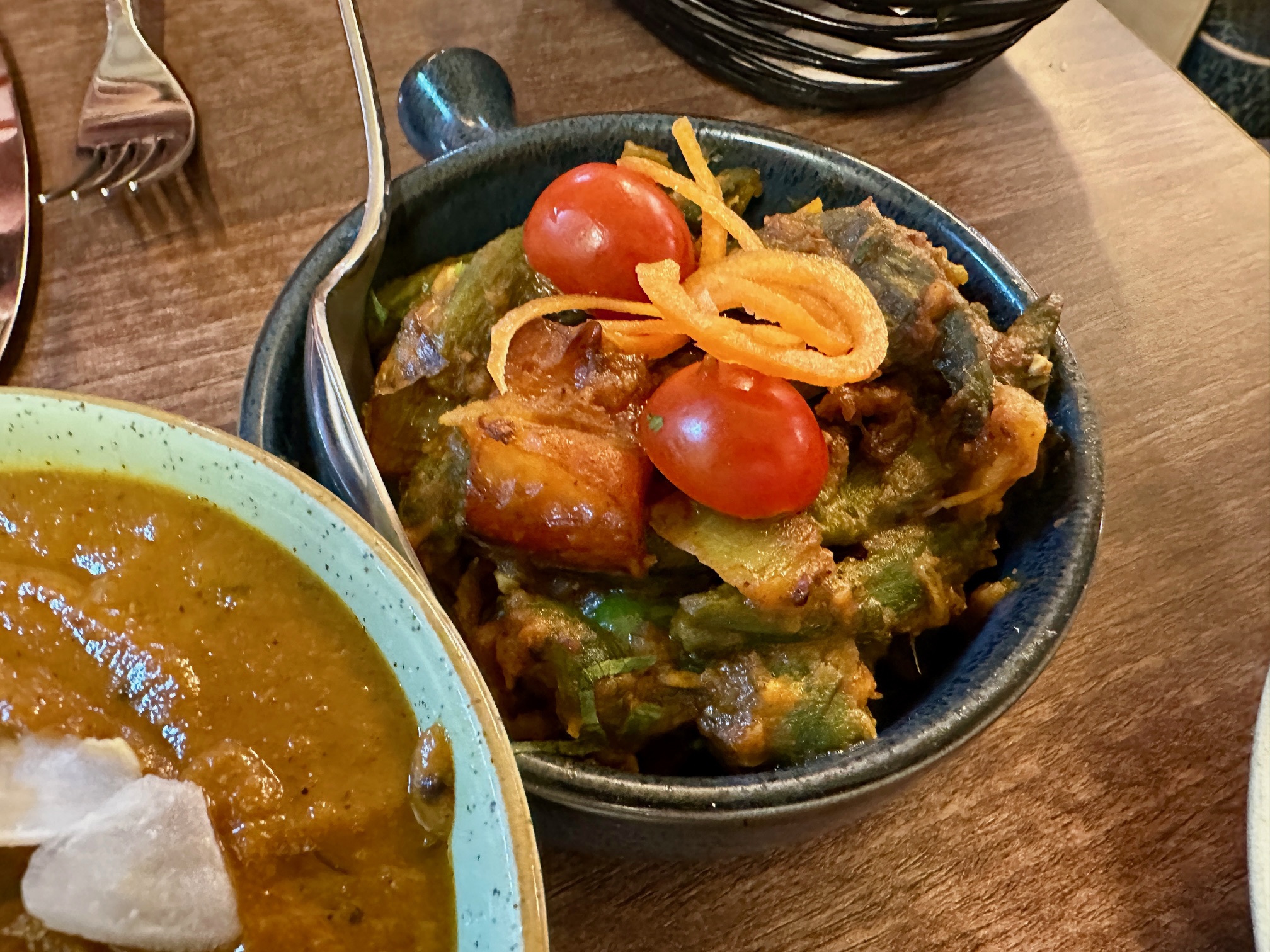
This is me trying to find positives, believe it or not. But I don’t think even Pollyanna could find a positive in the final small plate, the caponata. Caponata is a wonderful thing, a cold, sweet and sour aubergine stew with olives, capers and pine nuts. It has a distinctive taste which I adore. It is not, as it was at Vino Vita, a bland mulch of aubergine and far too many tinned black olives, with no sweetness, sharpness or sourness. It didn’t even look like caponata, didn’t have that depth of colour, although you’d have to whip off all the pointless foliage that had been dumped on it to be absolutely sure.

You know who used to do a very enjoyable caponata, back in the day? Carluccio’s, of all places. You know who does the worst caponata I’ve ever tasted? That would be Vino Vita.

Now, you might just think I’m being curmudgeonly, so I have to say this in my defence: Zoë thought all of this was awful. Zoë, the woman who is able to tolerate me. Even she – especially she – found all these dishes unforgivably bad.

“There’s somebody in that kitchen who really hates Italy” was her conclusion.

“It definitely doesn’t feel like anybody in the kitchen’s ever been there.”

“What we’ve just had,” she added, “was a crap-paccio. A crap-paccio and a craponata.”

Irony of ironies, the bottle of white wine we were on by now was really very nice, with fruit and structure and, to my mind, even a little hint of licorice. And by this point we had a server who was really good and very personable, checking in on us and taking away our empties. At just over fifty pounds you’d want that bottle to be good – Vivino suggested its mark up was something like three times retail price – but however pleasant it was, I wasn’t sure how much of it you’d need to drink to make the food seem like a good idea. I was sure, though, that I wasn’t capable of putting that much wine away.

The food up to that point had been so poor that it became partly about cutting our losses. The couple at the next table had paid up and gone leaving behind the best part of a bowl of anaemic-looking pasta – the mushroom tagliatelle, at a guess – and a blond, bland pizza. So we decided to try a Pinsa Romana, the airier Roman variant as popularised in Reading by Mama’s Way. In a way, I was trying to give Vino Vita one last chance, aware that if I had a conventional pizza and was comparing it to Amò or Paesinos it would be the final nail in the coffin.

But the final nail in the coffin was the Pinsa Romana. The Piccante promised, if the menu were to be believed, ‘nduja and oil, roasted peppers, burrata, rocket and basil. Like all the other promises, it was an empty one. The base was crunchy, dry as a bone with no airiness or give: Mama’s Way may buy their pinsa bases in, but they were miles better than this.

The pinsa had been pre-cut into eight miserly squares, and good luck finding ‘nduja on every one, because you wouldn’t. “Nigel Farage turns up to vote more often than ‘nduja turns up to this pizza” was Zoë’s verdict. Bland unlovely bits of burrata had been placed here and there – no oil, no discernible basil and no rocket.

In the rocket’s place, obscuring just how atrocious this pinsa was – which surely must have been the prime objective – somebody had thrown random salad on top of the whole affair. This was the last straw for Zoë. “It’s meant to have rocket on it, not the contents of a fucking bag of Florette”. The whole thing was so subpar that we followed our neighbours’ example.

It’s not even that this pinsa didn’t compare well to what you could get a short walk away at Paesinos or Amò, although it didn’t. It’s that it didn’t compare well to what you could get at Zia Lucia, or Zizzi, or Pizza Express. Or Marks, or Tesco, or Aldi, or the Co-Op. And if you bought one from a supermarket and took it home, you could dot it with ‘nduja yourself and even if it was from the chiller cabinet, heated up in your oven, it would be dozens of times better than this effort. It wouldn’t cost you £15.50, either, and for that money you can enjoy the best pizza Reading currently has to offer, minutes away on Kings Road.

Our server came over to check how our food was. We said “it was fine” almost in unison, the universal English euphemism for It was bad, but I can’t face a conversation about that. Our bill came to £166, including a 12.5% service charge. A bit of me wants to say that in Vino Vita’s defence, nearly ninety of that was on wine. But even if I do say that in their defence, the rest was indefensible.

Can you tell I wasn’t a fan? I don’t think I’ve written a review like this in ages, and certainly not of somewhere independent, and I don’t take pleasure in doing it. I’m reassured that Zoë, who is positivity personified, disliked it even more than I did – because yes, it turns out that’s possible. And I don’t know what offends me most about the place. The mediocrity is bad enough, the mediocrity coupled with the laziness is worse. To combine both those things with really iffy value, at a time when Reading’s Italian scene is having something of a renaissance, is woeful.

Worse still, it made me feel like that rebrand from Veeno to Vino Vita had something else behind it. A desire to make more from less, to cut corners and conceal charging a premium. Even some of the dishes that have been tweaked from Veeno’s menu to Vino Vita’s display this – Veeno does a bruschetta with capers and Sicilian dark tuna, Vino Vita’s boasts a tuna paté. What’s the Italian for Shippams?

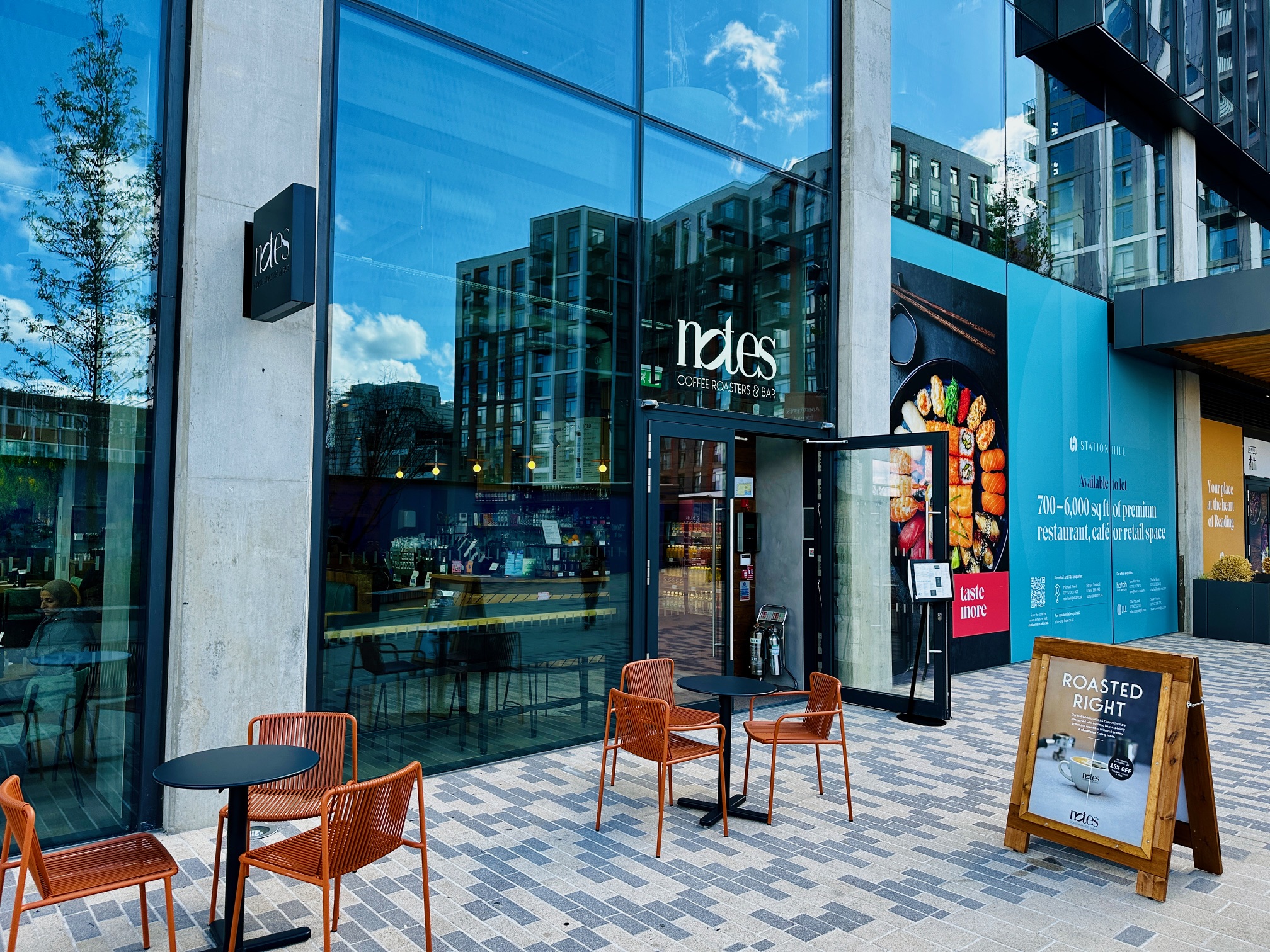
But just as sad is this: with the Cellar gone and Vino Vita, well, like this, Reading still doesn’t have the wine bar with excellent food that has been missing ever since the Tasting House closed after lockdown. That gap in the market remains, and on this evidence Vino Vita isn’t even trying to fill it. Maybe Notes, just opened on Station Hill, will do better: it’s not as if it could do much worse. It is bad luck for Vino Vita that I review them the week after I had one of my meals of the year – also Italian, but miles better – at RAGÙ, but Vino Vita would be bad whoever you were comparing them to.

It might have been a little different if the service had been better – Apo, formerly of Dolce Vita and Pho, and one of Reading’s great front of house operators – works at Vino Vita, although he wasn’t on duty the night I went there. But the problems are squarely on the menu and in the kitchen, not elsewhere: you could forgive the slightly disjointed interior or the relatively expensive wine if everything else was firing on all cylinders, but it didn’t even get started.

If Paesinos or Amò had more space and an alcohol license, I’m not sure what the point of Vino Vita would be. In fact, if either of them did I think it would spell curtains for Vino Vita. I might be wrong, of course, because it seemed to be doing reasonably well the night I was there and that puff piece in the Chronicle made it sound like they were going from strength to strength. Be that as it may Vino Vita achieved something I would never have thought possible, despite nearly twelve years in the reviewing game. It made me miss Veeno, and that’s not a good thing.

Vino Vita – 4.6
Minerva House, 20 Valpy Street, Reading, RG1 1AR
0118 9505493

https://vinovita.bar

Since January 2025, Edible Reading is partly supported by subscribers – click here if you want to read more about that, or click below to subscribe. By doing so you enable me to carry on doing what I do, and you also get access to subscriber only content. Whether you’re a subscriber or not, thanks for reading.

Restaurant review: Tanatan

Some restaurants wind up so indelibly linked with the buildings that become their homes that years later, long after they are gone, you still can’t imagine another menu outside, someone else trading behind those doors. Sometimes, no other restaurant even tries: ever since Dolce Vita left its spot on the top floor of Kings Walk nobody has taken its place, but even if they did, I don’t know how I’d feel eating somewhere that, to me, will always be Dolce Vita.

Sometimes the place stays the same but changes hands, with or without changing its name. At some point I should return to Namaste Kitchen, and people tell me it’s good, but without Kamal running the front of house and that magical menu of Nepalese small plates I’m not sure how I’d overcome the strangeness of dining there. I’ll do it, one day, and when I do the review will have to have a different preamble to this one, because this one’s taken.

Ditto Spitiko, where Kyrenia used to be. The site’s the same, the menu is similar, the furniture might be too, and Spitiko may well be a perfectly decent restaurant. But in my mind it will always be Kyrenia, the place where I celebrated my thirtieth birthday, where I’d always go for mezze and kleftiko, for a bottle of Naoussa Grand Reserva and Ihor’s twinkliest welcome. Its golden age was over fifteen years ago, yet I remember it like it was yesterday.

That’s before we get to the Lyndhurst, now under its third set of new management since they hosted guests for the very last time – my wedding guests, no less. This may sound silly, but I don’t feel ready to eat there again. Perhaps this sentimental streak should disqualify me as a restaurant reviewer. But on balance I don’t think so: these places get into our hearts, occupy a place in our affections, become part of our story. Not to feel that kind of thing is not to be alive.

But of course, nearly every restaurant was once somewhere else. Buon Appetito, that I still miss, may have become Traditional Romanesc, but before that it was Chi Oriental Brasserie. And again, when Chi closed I was devastated. You know where else Chi Oriental Brasserie used to live? The site that’s now Masakali. And I was sad when Chi left that spot on the TGI Friday roundabout, too, but I was equally forlorn when San Sicario, a wonderful restaurant, gave up the fight at that very location.

All these places come and go. They make your day one month and break your heart the next: that’s what getting attached to a restaurant can do to you. Worse still, throughout it all TGI Friday has been plugging away on the other side of that roundabout for as long as I can remember. I wonder if restaurants have their own version of that well-worn maxim that only the good die young.

All this might go some way towards explaining that although new-ish Indian restaurant Tanatan opened on London Street last December, it’s only on a week night in July, months later, that I went there with my oldest friend Mike for dinner. Because even though the site was an empty shell for over two years, before that it was Clay’s Hyderabadi Kitchen, and it’s still hard for me to think of it as anywhere else.

Clay’s, where I ate for the first time before it opened, where I celebrated birthdays – mine and theirs, as it happens – where I went on random evenings because it was just round the corner from my little house, where I ate with friends, family and visitors, where I held lunches for my readers. Few rooms contain as much of my personal history as that one, so I knew it would be odd to eat there again, to eat Indian food there at that, and to know that it was somewhere new.

Tanatan’s story is a curious one, by the way. In the run up to it opening, the Reading Chronicle trumpeted that it was a high end Indian restaurant which very much seemed like the natural successor to Clay’s. Not only that, but they claimed that it was the first U.K. branch of an upmarket Indian group of restaurants with its other branches in India and Dubai.

That all sounds magnificent, and Tanatan’s website contains a menu full of temptations. There’s only one hitch, which is that there’s no evidence at all that Reading’s Tanatan has any connection to that chain at all. It’s not mentioned on their website, and in fact Reading’s Tanatan, for a long time, didn’t have a website of its own. Now it does, but the menu bears about as much resemblance to the other Tanatan’s menu as I do to Jude Law.

It looks suspiciously as if the Chronicle had flagged the name, put two and two together and come up with five, which is a mistake not even the AI that writes most of its articles would make. So, what was this Tanatan, our RG-based restaurant, like? Was it a worthy successor to its precursor, or an attempt to hop on a bandwagon two years after the bandwagon rolled north, over the river? It was time to brave that all too familiar room and find out.

Subscribe to continue reading

Become a paid subscriber to get access to the rest of this post and other exclusive content.

Restaurant review: Amò Italian Street Food

In the good old days, where you stood on certain binary debates was simply a way of positioning you in the world. Cream first or jam first? Plain or milk chocolate Bounty? Cheese and onion or salt and vinegar? Were you a fan of the Beatles or the Stones? Blur or Oasis? All these things used just to be a form of triangulation, little points on a chart that, taken together, might give someone an idea of you (and, since you’re asking: cream first; milk chocolate; salt and vinegar; the Beatles; neither).

When did that all change? 2016, I suppose, when we all became Leave or Remain, indelibly stamped, and at every stage from that point forwards. We’re always asked what side we’re on, and now it’s not a useful piece of trivia but a necessary step to place yourself on one side or another of a yawning chasm. Are you pro- or anti-Israel? Do you think J.K. Rowling is a hero or a villain? How about Farage, or Trump? Did you believe in lockdowns, masks, vaccines? Did you leave Twitter or stay? If you left, did you go to Bluesky or Threads?

Like the Tower Of Babel, we’re now all scattered to the four winds, trying to find our tribe and arguing, endlessly, with the others. It’s not a bit of fun, any more. And this is all rich coming from me, because I’m painfully aware that I’m as polarising as most. Happily, Reading faces another tricky choice now that’s potentially just as difficult, but hopefully less divisive: Paesinos or Amò?

The two pizza places opened on Kings Road, two doors and three months apart, the latest in a weird series of rivals in very close proximity, following the example of Pho and Bánh Mì QB in Kings Walk or Iro Sushi and You Me Sushi on Friar Street. What is it with that? You must be very confident in your product to open so near to a direct competitor, like Bánh Mì QB did, but with Paesinos and Amò, Iro and You Me so little time separated both arrivals that it must be an unhappy coincidence. Imagine pouring your heart and soul into a new business only to find that another one a lot like yours is doing exactly the same, a stone’s throw away.

Anyway, regular readers will know that I reviewed Paesinos a month ago with my Italian friend Enza (who is, just to confuse matters, an Amò superfan) and it received a glowing write up from me. But I knew, even as I was eating there, that I needed to prioritise visiting its neighbour, if only because Enza told me that it was as good as, if not better than, the restaurant I had so enjoyed. I couldn’t go with Enza, because she was so far from impartial, and this time I took my friend Jo, also of Italian descent, last seen checking out House Of Flavours with me.

Amò is, as I’ve said before, something of a joint venture between Madoo, the founding father of Reading’s Italian quarter which opened four and a half years ago, and Pulcinella Focaccia, a business that sold pizza and focaccia for delivery from premises out in Earley and has been trading for a couple of years; I’d never had food from the latter, but I’d heard plenty of good things. And arriving at Amò on a weekday evening I was struck that, in terms of branding and decor at least, it felt fully formed in a way that Paesinos didn’t so much, or Madoo for that matter.

Everything was tasteful and unfussy without being Spartan, with a bare wood floor and tables, seats and benches. It seated somewhere between fifteen and twenty people, so significantly more spacious than the likes of Mama’s Way or Paesinos, and it had a nicely calm feel to it. Amò’s logo was in the middle of a deep red swatch of paint on the wall behind the counter, and resting on that counter was possibly one of the most tempting displays in Reading.

Amò very cleverly changes up its offering around the time people start finishing work, so until 5pm you can try pizza al taglio or something from a changing array of Italian street food. They also, I think, offer focaccia sandwiches during the day, although most of them had gone when Jo and I turned up around half seven. After 5pm the sandwiches drop away but instead, alongside the slices of pizza and street food, you can order a whole pizza from a more varied menu.

The street food was all very tempting, all things that I would challenge anybody not to fancy eating. Arancini, croquettes, mozzarella bites and frittatini – fried pasta – were all tributes to the time-honoured method of coating something in breadcrumbs and frying it until it was golden, crispy and alluring. The lighter side of Amò’s offering is keenly priced, too. Most of the street food dishes are around a fiver, pizza by the slice is less than that and they do multibuys if you want two stuffed focacce or two slices of pizza. Whole pizzas top out at about fifteen pounds, unless you add sausage or Parma ham to one of the options.

And Amò’s pizza menu struck me as very clever, because – either by accident or design – it kept the overlap with its neighbour’s pizzas to a minimum. Amò has a list of the classics, of course, so you can have a margherita, or prosciutto cotto and mushroom, or sausage and friarielli. But on the other side of the small, laminated menu, you find loads of less conventional options, far more interesting than the kind of things you could find at Zia Lucia or even, dare I say it, Amò’s neighbours.

That meant pizza with a purple sweet potato base, topped with cacio e pepe cream, guanciale and sweet potato crisps, or pizza with a pistachio cream base and mortadella. Others had a truffle cream base, or pumpkin cream, or even a cavolo nero base (“it’s the gourmet version of the salsiccia e friarielli”, Enza had told me, when I was looking for recommendations).

You may find all of that a bit leftfield, or it might whet your appetite for wandering off Reading’s beaten pizza track. I think for me, though, it was neither: I chalked those up as things to try once I had road tested the classics.

But first, Jo and I had a chinotto each and ordered some of those smaller dishes to kick things off. And as we waited for them, she told me about her childhood holidays by the coast, near Salerno, buying balls of mozzarella as big as your head from some beachside hut and eating them with bread, nothing else required. It was brilliant, Jo said, but it did slightly ruin the mozzarella you can easily get in this country; like me, Jo considers it a seriously underrated cheese.

As so often I felt a little pang for a childhood I didn’t have, listening to Jo. But then there was something to be said for sitting in a caravan in Devon, rain drilling on the roof, eating hog’s pudding cooked in a frying pan – always with tinned tomatoes on the side – watching Roland Rat on TV-am, knowing that the evening would be spent playing cards and watching reruns of Shogun (the original, not the superb remake). Maybe those memories would sound exotic to an Italian: on balance, though, I guessed not.

Amò’s mozzarella bites may not have been the size of my head, but they were gorgeous nonetheless. Crisp-crumbed spheres, golden but not overdone, the shell holding just-molten-enough mozzarella, they were a proper delight. I might have had them with something to dip them into, but it was a minor quibble with something so delightful. So was the fact that however carefully I ate them, with my hands at least, a little liquid sprayed out, leaving incriminating marks on my shirt. I was too happy to care, and the attentive staff quickly brought extra napkins.

At five pounds fifty for four, they could have been the bargain of the meal, if not the month, but for the fact that we also ordered two of the frittatini. These are yours for three pounds fifty, or six quid for two, and come in two flavours. If you go to Amò, my advice is to make sure you have one to yourself or, as Jo and I did, order one of each and share. They’re a bit fiddly to break up – that crisp carapace presents resistance when you’re relying on a wooden fork – but they reward the effort, with dividends.

They were beautiful things, and when I sit down in six months or so to write my annual awards it’s hard to imagine they won’t feature in some shape or form. And their form – big, irregular golden pucks – belied just how wonderful they were on the inside.

Picture an arancino, but instead of risotto rice visualise a cluster of little tubes of pasta, and rather than a molten core, imagine the whole thing bound together with sauce. In terms of taste, contrast, texture and sheer tactility I’m not sure I can think of anything finer, and writing this paragraph I am deeply aggrieved that I cannot eat one right this minute, or indeed by the end of the day.

This is where Amò are an especially smart bunch, because during the day you could pitch up, have a chinotto, a slice of pizza or a sandwich crammed with porchetta and provolone, and add one of these for a mere three pounds fifty. That’s almost the price of subscribing to this blog for a month and, although it pains me to say it, it’s even better value.

Jo and I both loved the meaty version but would you believe that the vegetarian option, with fried aubergine and tomato, was even better? Jo described it as like being “slapped in the face with flavour” and believe me, apart from that fried pasta, nothing or nobody would get away with slapping Jo in the face with anything. One of the best things I’ve eaten this year, no notes at all.

Jo was very keen to try one of the pizzas by the slice, with meatballs on it, so that turned up next, thoughtfully cut up to share, a meatball perched precisely in the centre of each quadrant. This too was cracking, although I suspect the base on the pizza al taglio is slightly different to that on the whole pizza. The meatballs, in particular, were excellent – coarse and lacking in suspicious, smooth bounciness. It also, by the looks of it, was only available by the slice so, again, well worth adding to a lunch order.

By this point, as our full-sized pizzas arrived, the carbs were taking their toll, and we were already prepared to ask if some of our leftovers could be boxed up – something that rarely happens to me, because it’s rare that my capacity is defeated by a restaurant.

Jo made it a few slices into hers, the piccantina, which was topped with salami, mushrooms and Gorgonzola. I didn’t try it, and from a cursory glance I thought the porcini were common or garden mushrooms, but Jo had no complaints. She’d told me earlier in the evening that she hadn’t had pizza for a while: Jo is on a monthly treatment regime where anything she eats the next day tastes vile and puts you off whatever you ate for the foreseeable future. One of those next days had involved pizza, and Amò’s piccantina resuscitated her love for the stuff. That in itself is no mean feat.

I on the other hand had deferred to Enza’s judgement and ordered the sausage and friarielli. As so often with white pizza, it had a bit more structural integrity, so less of the Neapolitan droop you might get with other pizzas. And the base was admirable, nicely puffy with plenty going for it. You couldn’t fault the generosity either, with nuggets of crumbled sausage very, very liberally deployed.

There was very little not to like about the pizza, and if I was clutching at straws I might say that I’d have liked the sausage to have more of a whack of fennel, but that’s a minor thing. It was so well orchestrated with the friarielli that it was impossible to argue: this was a pizza without complexity or variety that kept it focused and hit the target.

I managed about half of mine, and the staff were nice as pie about bringing a couple of boxes so we could take our leftovers home. Everything we had ordered – all that food, four cans of soft drink – came to fifty-five pounds, which is a steal, and then we went to the Allied for a debrief. Two pints of forgettable macro fizzy booze at the Allied set us back nearly sixteen pounds, which is very much not a steal.

For once, I can also report back on the leftovers. Jo had hers cold the next day – no slice for her beloved dog Diesel, this time – and sent me an iMessage: tastes even better this morning, cold from the box, outstanding! I on the other hand revived mine in the oven on my lunch break, working from home, and it was the best lunch I’d had in ages. I wasn’t sure if my slight lull that afternoon was down to the carbs or a Teams call that felt especially like a trudge. Let’s put it down to the latter.

Having talked about Amò for all these paragraphs, I know I should return to my opening theme and compare it to its neighbour Paesinos. But it’s not easy to do.

If they were top trumps cards, Amò would win in a number of categories. It’s more versatile, on account of having a focused lunch offering as well as pizzas in the evening. It has arguably a wider range of sides and small plates. It’s bigger, too, with far more potential to eat there in larger groups; if you go to Paesinos as a four, you either won’t get in or you’ll take up two-thirds of the restaurant. Its pizzas are more imaginative and unconventional, so more of a challenge to the Neapolitan hegemony elsewhere in town.

On that basis, you’d have it down as a resounding victory for Amò and, for some of you, that might well be the case. On the other hand, Paesinos sticks to the classics, both for pizza and for its smaller dishes. I think its soft drink selection – and neither is licensed – is better and more interesting. The cannoli and tiramisu are worth the price of admission alone. And, speaking completely as a novice in these things, I think Paesinos’ dough and base may have the edge.

But the main reason why taking a Top Trumps approach doesn’t work is that Paesinos, for me, has a little something extra. There’s no Italian equivalent of je ne sais quoi, as far as I know, but there’s a small dash of magic in the smaller restaurant that means that rationally, although I know Amò has a huge amount going for it, it’s impossible to pick a winner.

So yes, I’ve reflected and reflected and it’s impossible to put a cigarette paper between these two places. The only thing you can put between them, it turns out, is another restaurant – called Just Momo, which helpfully doesn’t just do momo. So the rating down there reflects that: call it a cop out, if you will, but I stand by it.

Let’s not divide ourselves by being Team Amò or Team Paesinos, because as a town we can be better than that. Hopefully enough of you will pick each side that both places will continue to trade for years to come. Because the truth is that there’s one real winner in this contest, and that’s Reading.

Amò Italian Street Food – 8.6
2-4 Kings Road, Reading, RG1 3AA
07500 619775

https://amoitalianstreetfood.co.uk

Since January 2025, Edible Reading is partly supported by subscribers – click here if you want to read more about that, or click below to subscribe. By doing so you enable me to carry on doing what I do, and you also get access to subscriber only content. Whether you’re a subscriber or not, thanks for reading.
Café review: Pau Brasil

It was a muggy Saturday, the longest day of the year in fact, the mercury was nudging close to 30 degrees and, sipping my mocha outside C.U.P., I felt like the Only Living Boy In The Ding.

Scrolling Instagram all I could see was holiday snaps – people just back from Malaga and Cordoba, newlyweds honeymooning on a Greek island, someone I know on his annual holiday to Kalkan, spending three weeks in a little Turkish piece of paradise. The world had its out of office on, or at least it felt that way, and there I was, fresh from my haircut, halfway through a C.U.P. mocha, a little on the outside of things, looking in.

I wandered round town, but nothing lifted that feeling of dislocation. Station Hill was holding a mini festival to celebrate it opening – notwithstanding that it opened over four months ago – and the whole cut through from the station to Friar Street was lined with food stalls, drink stalls, music and crafts and hubbub. London coffee spot Notes, not yet open, had a stand selling coffee and another selling Aperol spritzes, and everywhere you looked there was someone else offering street food, largely vendors I’d not heard of.

The place was buzzing, although I put a picture up on Facebook and person after person said “if only they’d advertised it”. Still, it felt like everyone I know had somehow been spirited away out of town, and there I was, surrounded by people but alone. I thought of my wife, at the far end of the M4 busy at work, and all my friends dotted across this country and others, my brother on the other side of the world (this, by the way, is why I shouldn’t spend too much time on my own).

I could have grabbed lunch from one of the stalls, fetched a drink from Siren or the Purple Turtle’s pop-up bar, I could have participated. But something stopped me. It felt a little like a glossy celebration of house prices in Reading inching slightly further out of reach, it had a slight feeling of forced fun about it. But that’s just me: I’m not much of a joiner-in. Anyway, I had a lunch appointment to go to, one for which I was several years late. Time to get going.

Normally I ride the number 5 or 6 bus all the way up the hill, along Whitley Street and past the Whitley Pump roundabout, getting off at the nearest stop to my house and strolling home from there. But this time, in the sweltering, almost oppressive heat I alighted halfway up, where Silver Street becomes Mount Pleasant, and walked the rest of the way. And there it was, Pau Brasil, with its pretty cobalt blue door and its awning out. It had been a long, long time.

Back in 2004, over 20 years ago, long before Reading got Minas Café or De Nata, Brazilian café Pau Brasil opened on Mount Pleasant. It’s been trading there ever since, the culinary capital of Katesgrove before Katesgrove even got other restaurants. Back then the only nearby place I knew was a Chinese takeaway on Whitley Street called Tung Hing which I revered – it’s long since closed – and the closest I got to Pau Brasil was glorious scuzzy indie gigs at the Rising Sun Arts Centre, at the bottom of the hill.

I reviewed Pau Brasil in 2014, over ten years ago, and it’s safe to say that I didn’t completely get it, or love it the way I expected to. It’s one of my oldest reviews not to have been superseded, and I’ve wondered many times over the years whether I’d missed something about the place. I remember going with my ex-wife and leaving feeling like we just hadn’t grasped what made it special. She was indifferent about a banana and cheese toasted sandwich, I found the feijoada a tad wobbly.

We both wanted to like it, and came away still wanting to but not convinced that we’d managed it. “I’m not going to say that Pau Brasil is a bad restaurant” the conclusion said. “Sometimes I really regret choosing to give restaurants a rating, and this is one of those times.” This was back in 2014, when the end of one of my reviews arrived a lot sooner than it does nowadays.

Since I moved house last year, and Pau Brasil is a short downhill walk from my new abode, the place has been in my thoughts. I’ve caught myself musing, more than once, that a lunchtime visit was long overdue. Somehow this strangely stifling Saturday, with more than a hint of saudade about it, was the day to do it. If not then, when?

The welcome was warm and immediate, making me feel like I wasn’t a stranger. Pau Brasil has a deli, the counter and the kitchen downstairs and all its seating upstairs, and the first indication I had that the place has a devoted following was that I was asked if I had a reservation (there is no way to do so online, so I suspect regulars just do this when they stop in). Despite not having one, they managed to find room for me, so I headed up the stairs and was given the option of a couple of tables.

It’s a gorgeous room, far more homely and attractive than I remembered. It has a huge blue-shuttered window looking out on Mount Pleasant, letting in loads of light, and art all over the walls. One is painted a very fetching shade of red, one which made me think Why isn’t there an equivalent of Shazam for colours? only to find that firstly, there is, and secondly, I found it too fiddly to use. The furniture was simple and unpretentious, but nothing detracted from a certain serene energy.

A couple of tables were occupied when I got there, the big one with the plum view out of that window was already reserved. What I would say is that Pau Brasil has decided to prioritise space over packing diners in, which is to their credit, but it does make a couple of the tables on offer eccentric. I was given the option of a corner table where both seats faced the wall or a corner table where both seats faced the banister at the top of the stairs, and went for the latter because it had more natural light. Another option was to sit on a high stool up at a counter facing the wall – that fetching deep red wall, granted, but a wall nonetheless.

Back in 2014 I found Pau Brasil’s menu very tempting, and in 2025 that had not changed. It offered a range of salgadinhos, bite-sized snacks, for less than three pounds each, sandwiches for four pounds or a very compact selection of main courses for fourteen pounds (although you could have a smaller size for less). Just to spell out how remarkable that is, in ten years the mains have gone up from ten to fourteen pounds, I suspect the smaller dishes have barely budged in price: Pau Brasil seemed largely to be the land that inflation forgot.

I started out by asking my server – who I think, though I might be wrong, was half of a husband and wife team – whether they were in any danger of running out of pasteis de nata, having seen only a handful on display out front. He told me it was a risk and so I asked him to put one aside for me, for later. That potential pitfall swerved, I started out by ordering a couple of salgadinhos and a very cold beer.

And what a beer! On my bus out of town I’d texted Zoë saying I tell you what, if they have Super Bock I’m fucking having one. I arrived, I saw both it and Sagres in the fridge and my heart positively sang with joy. That iconic bottle came to my table, with a small, chilled glass, and those first malty sips made me feel less agitated, less irritated, somehow much happier to be solitary. Now I could settle down to people watching and relaxing, even if I had to crane my neck to do it.

Everything was unhurried, and my salgadinhos arrived about half an hour after I first took my seat. They looked so pretty on their plate, a symphony of blue, terra cotta, gold and red, and I found myself immediately wishing I had ordered more. I expected to like the salt cod fishcake, and it was no surprise that I did, but I was perhaps more surprised to find myself enjoying it every bit as much as I had its equivalent at De Nata.

Enjoy doesn’t even do it justice, I liked it an enormous amount. It had just enough comfort, just enough bite, it had a beautiful hit of salt from the bacalhau and it was golden, greaseless and a tactile pleasure to eat without cutlery. This kind of food is a proper gastronomic happy place for me and I could easily have inhaled two or three of them. Why had I spent the best part of a year with this on my doorstep without eating it?

My server had also brought some of Pau Brasil’s homemade chilli sauce and warned me, just as I had been warned in 2014, to use it extremely sparingly. My chilli tolerance has improved a lot in the last 11 years, so I was a little more cavalier than I would have been back then. It’s really very hot; my ability to take good, well-intentioned advice has probably not improved as much as it should have done over the same period.

The real star, though, was the chicken coxinha, a dome of airy dough stuffed with shredded chicken. I’d only ever had this dish at Minas Café, and I thought it was good. Eating it at Pau Brasil was to realise it could be superb. The rendition out in Whitley is a dense, solid affair, best tackled with cutlery. This by contrast was an ethereal gasp of a thing, the dough so light and the chicken at its core quite miraculous. Again, I could have easily eaten more and, again, I resolved to do so in the not too distant future.

From there, the pace slowed. Time seemed to pass slowly on Mount Pleasant, and in truth I was in no hurry. Tables came and went, and a group of three took the reserved table in the window. I watched as a giant plate of salgadinhos was brought over to them and they went to work, chatting and biting, dabbing chilli sauce and laughing. My portable fan whirred on the table, time became a trickle and I thought that all things considered, there were many worse places to be on a Saturday afternoon.

It proved a little tricky at that point to get attention to order more food, but eventually I did. The weekend special, which involved dried shrimp and sounded magnificent, had all but run out, and although it was tempting to order the feijoada I was determined for this meal not to be a carbon copy of my 2014 one. So I asked for the frango à Milanese and a Guaraná, Brazil’s national soft drink, having seen a can of it arrive at a neighbouring table.

This was where the gaps in the service felt a little bit more obvious, as we drifted past the lunch rush and into the afternoon. My beer was done and dusted, my glass of water had nearly run out too, but the soft drink showed no signs of arriving. Not only that, but my water had come with no ice, but then I saw the server bringing a load of ice to the bigger table. Half an hour in I was starting to feel a bit parched, so I got my server’s attention and asked if I could possibly have my drink before the food.

He apologised, clearly distracted rather than indifferent, and brought it over, and within five minutes my food had arrived too. The Guaraná, incidentally, was lovely: I would definitely drink it again on a hot day. I have a soft spot for slightly medicinal soft drinks, from chinotto to root beer, and this felt in the same family. It was also a splendid thirst quencher, and by then I was in need of one.

Did I like my main course as much? Well, yes and no. You couldn’t fault it for value, really: fourteen pounds for a complete, well-balanced plate of food felt like pretty good going. And it certainly had variety, too: a big, flattened, breaded chicken breast fillet had just enough crunch, and the coating adhered nicely.

There was plenty going on, from a well-dressed stripe of salad topped with tomatoes and very finely diced peppers to a little haystack of shoestring fries, from fortifying white rice to a heap of toasted cassava flour which added more interest and texture than I expected. Best of all were the beans, sticky and savoury with little nuggets of pork studded through them, I liked those a lot.

And yet I felt like something was missing, and I’m not sure what. It was wholesome, homely, hearty stuff but it perhaps didn’t wow me the way those salgadinhos had done. It was ever so slightly out of balance – there was a fair amount of rice left at the end, with nothing to pair it with – and the flavours were muted, subtle, well-mannered stuff. They brought more of the chilli sauce, but it ramped up the heat without necessarily lending another dimension.

I think overall, this is just how the Brazilian (and Portuguese) food I’ve had can sometimes be. It’s sturdy, and reliable, but it won’t knock your socks off – well, everything apart from the chilli sauce perhaps, although that’s too busy blowing your head off. The thing is, though, that I might never rave about a dish like Pau Brasil’s frango a Milanese, but in that moment, it was just what I was after. Also, I finished every scrap of my salad – which I never do – so that must count for something.

My main course done, there was one thing left to try. A coffee and a nata, just to test drive whether this was a coffee spot as much as a lunch spot or a snacks and beer spot. My coffee – I’d asked for a latte – arrived in one of those tall conical glasses I tend to associate with coffee before it got wanky, and it was pleasant, if slightly burnt-tasting. The table of regulars had theirs in smaller glasses, and at the end I asked my server what I should have asked for to get one of those. A media, he said, and I made a note. It wasn’t on the menu, so it paid to have the inside track for next time.

I’d asked my server whether they actually had a couple of nata handy and he did, so he brought me two. They weren’t flawless, but I did find myself wondering if this was the best day to judge them. The custard in them, although set, burst its banks somewhat when you tried to eat them, which I think was down to the heat of the day.

They were close enough, though, to remind me how much I love pasteis de nata, and dusted with cinnamon they made me feel very happy indeed, saudade banished for the time being. I’ll go back and try them in more clement weather. You may have noticed by now that I’ve mentioned going back a few times: I’m definitely going back.

All that remained was to go downstairs and pay at the counter, and at that point I saw another little example of brilliant service that endeared me to Pau Brasil. When I went to pay, my server told me that they’d put one extra nata aside for me, just in case I had two and decided it wasn’t enough. As it was I was replete and I passed on the offer, but I was oddly touched that they’d thought to do that.

My bill for all that food came to just under thirty-two pounds, not including tip. I’d been there pretty much two hours, unrushed and, by my standards, carefree. I couldn’t help but think of all of the places in the last eleven years that had chivvied me or made me feel like an inconvenience, taken far more of my money and given me far less of their time. I walked up the hill, in search of the relative coolness of my house, happy that I knew my neighbourhood just a little better.

It’s funny writing reviews and coming back to them many years later, some kind of weird Prisoner Of Azkaban wrinkle where you can see the past you, retrace your steps, watch yourself with fondness or embarrassment. You can both agree with and disagree with yourself all at once.

When I reviewed Pau Brasil in 2014 I said I could see myself going back there for a coffee and a nata, or a drink and some salt cod fishcakes. Although that wasn’t enough, apparently. “Too much of the food just wasn’t to my taste, and however nice a room is, however great the service is, the food is always going to be centre stage”, 2014 me said.

What on earth was his problem? I highly doubt Pau Brasil has changed that much in the last 11 years. A new lick of paint, perhaps, and art on the walls, but otherwise I expect it’s pretty close to the place I went in 2014. The prices are pretty close to 2014 prices, too. And yet I must have changed, because I look at past me and think that he missed the point in a big way.

A little oasis of otherness there halfway up Mount Pleasant, where you can have a coffee and a nata, or a cold Super Bock and the most terrific chicken cozinha. All that and it also does a hearty main, if you decide you want one. But you could never eat that, there, and still see it as a gem. What more did he want?

It is one of the marvellous things about being alive that you can change your mind, or realise you were wrong. I do each of those more often than you might think. It’s hard to tell, over a decade on, which has happened here, and I wouldn’t bet against it being a bit of both. Really, I have no idea.

But here’s something I do know. On a close, sticky Saturday afternoon, on the longest day of the year, when I felt like the only living boy in the ‘Ding, that little spot in the heart of Katesgrove gave me a happy, meditative couple of hours, with some enjoyable food and a delicious, badly-needed and much-anticipated cold beer. And for those two hours, as if by magic, I felt lucky, well looked after and reconnected: to the world in general and my home town in particular.

Money can’t buy that, as plenty of places in Reading prove. But choosing well where to spend it, it turns out, can.

Pau Brasil – 7.6
89 Mount Pleasant, Reading, RG1 2TF
0118 9752333

https://paubrasil.co.uk

Since January 2025, Edible Reading is partly supported by subscribers – click here if you want to read more about that, or click below to subscribe. By doing so you enable me to carry on doing what I do, and you also get access to subscriber only content. Whether you’re a subscriber or not, thanks for reading.
Restaurant review: Dolphin’s Caribbean Restaurant & Bar

Believe it or not, some restaurants have opened in Reading this year that aren’t pizza restaurants. Granted, so far the culinary landscape has been dominated by Paesinos, Amò, Zi Tore and Peppito’s (the latter last seen rounding up Reading’s influencers to gush away on Instagram), but there are still other things happening in town. Not masses, because it’s 2025, hospitality is on a knife edge and everybody is struggling to make money, but some nonetheless.

So we have national chain Rosa’s Thai on Jackson’s Corner, and Blue Collar Corner has taken on two permanent tenants in the form of Burger Society and Gurt Wings. Later in the year we are promised London coffee chain Notes, Japanese restaurant Kawaii from the people behind Osaka, a new café from the owners of Café Yolk and an Italian sister restaurant to Wokingham’s Ruchetta, all on Station Hill.

And of course, how could anybody forget our other big money arrival Cosy Club, which opened last month on the edge of the Oracle in the old Lakeland site? The Reading Chronicle went there, without paying of course, and admired it so much that they wrote an ‘honest food review’ that waited until the very end to admit that their food was gratis. “Before anyone starts moaning yes, this was a gifted experience,” concluded the article, “and like many other journalists who work for numerous publications, I was invited to try the food at a new restaurant.” Elton John was wrong: #AD seems to be the hardest word.

All that is going on in the centre, but there isn’t much of note out in the suburbs: Woodley has welcomed somewhere called “Woodley Food Stasian”, which specialises in dishes from Hong Kong and Vietnam and, at a guess, misspelling the word ‘station’.

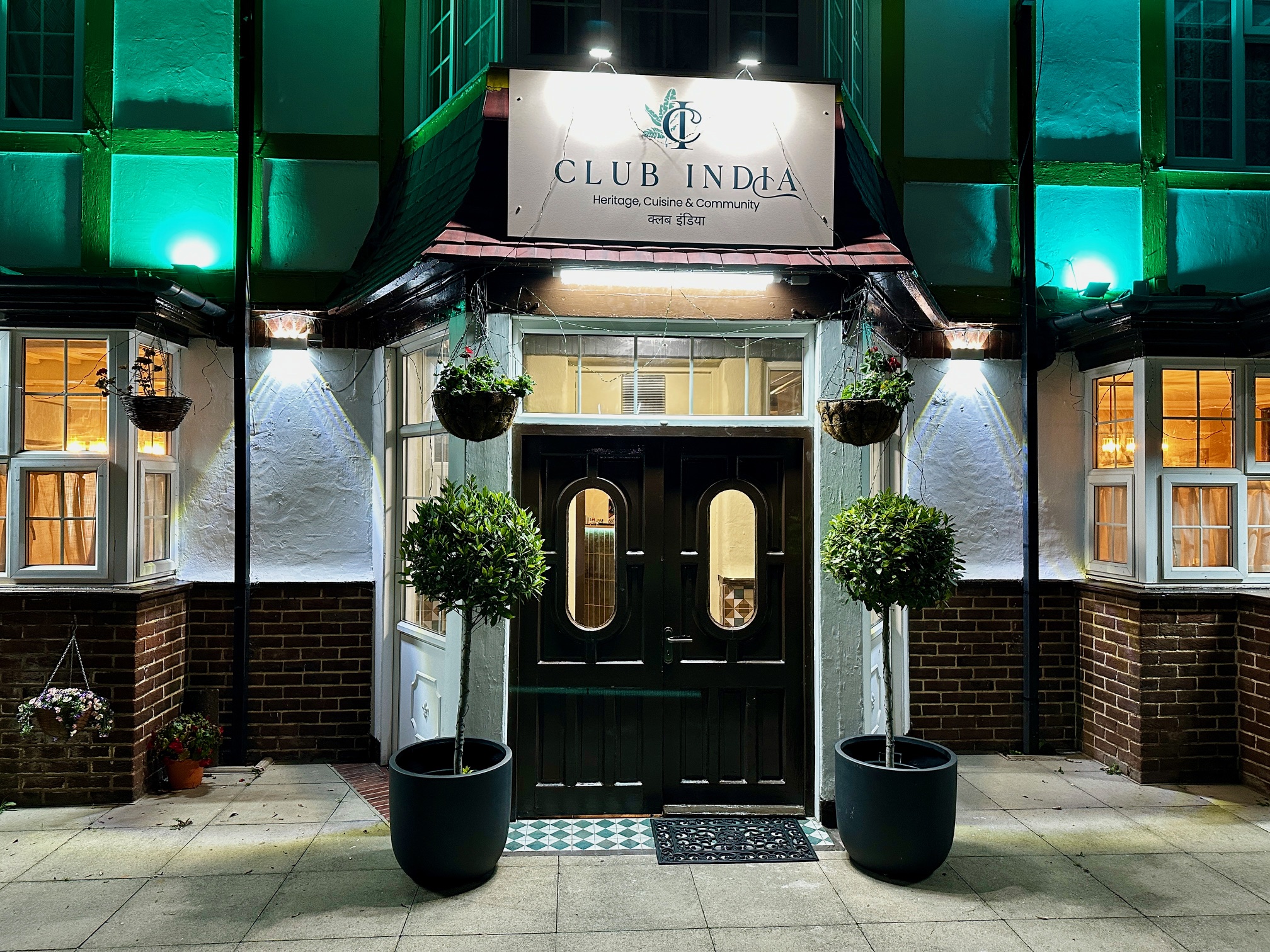
More randomly still, Winnersh is about to welcome something called Club India where the Pheasant pub used to be, run by a chef who formerly worked at Wokingham’s Bombay Story and Sultan. It also boasts some kind of consultancy role for another chef who apparently held two Michelin stars in San Francisco and had another restaurant in Palo Alto. How involved he’ll be is anybody’s guess: San Francisco/Palo Alto/Winnersh isn’t a triumvirate you find on many websites.

Of course, both Woodley Food Stasian and Club India might be good, and at some point I might check them out. But so far, this year, it’s slim pickings: restaurateurs are not feeling like taking the plunge, and you can hardly blame them.

Last but not least, that brings us to the subject of this week’s review: Dolphin’s Caribbean Kitchen, which opened two months ago in the old 7Bone site on St Mary’s Butts. It takes its name from the nickname of owner Randolph Bancroft, who has run a catering business for about twenty years: I’m pretty sure I saw Dolphin’s with a gazebo at the street food markets in Bracknell, when I worked there what feels like a lifetime ago.

This restaurant in the town centre, though, is his first ever permanent site, and when he spoke to the local press about it you could sense his excitement. Reading had never had anything like Dolphin’s, he said, and although the climate was tough in hospitality, he added that he hoped good old-fashioned community spirit would help his restaurant to thrive. “By the grace of god, I will make it” he concluded.

Well, he’s right about one thing if nothing else – Reading hasn’t had a proper, sit-down Caribbean restaurant in as long as I can remember. We had Chef Stevie cooking out of the Butler for a glorious year or so, we have a place called Da Spottt – yes, three Ts, don’t act like it’s my fault – on the Oxford Road which apparently has erratic opening times, and we have Seasons doing takeaway nearby, their Cemetery Junction site having closed long ago.

And of course we have the OG – Perry’s, which has been trading next to Market Place for eons. It clearly has its fans, because when I re-reviewed it earlier in the year they all came out of the woodwork to say it was my fault for turning up an hour before it closed. Whatever you think of the rights and wrongs of that, it tells its own story: Perry’s shuts at 7 and is unlicensed, so although it is a restaurant, it’s not a full on evening restaurant.

It’s weird, really: Reading has one of the biggest Bajan communities outside Barbados. When Sharian’s Jamaican Cuisine used to cook at Blue Collar Corner the queue stretched almost to Chancellors Estate Agents every Friday. People would wait over half an hour for that jerk chicken: I know, I was one of them. And most of the time, I almost didn’t begrudge those thirty minutes in line. Their food was that good.

So the demand is there, but for some reason nobody has ever really tried to capitalise on it, before Dolphin’s came along. It felt well worth investigating, so I met Zoë off the train on Monday night and we went along to see if Bancroft had managed to fill that gap in the market.

Subscribe to continue reading

Become a paid subscriber to get access to the rest of this post and other exclusive content.