Restaurant review: Creperie Doux Sourire

I’ve written before about the factors that make a restaurant perfect for solo dining: a good table that doesn’t face a wall or, worse still, the bogs; a great view to enable people watching; a menu that doesn’t make you feel like you’re missing out – no small plates or other “everything has to be shared” formats – and staff that respect rather than judge the choice made by solo diners.

Get all that right and, whether you’re up at the window at Mama’s Way or tucked away in a corner of London Street Brasserie, you’ll have a brilliant time. Take a book, if you want to pretend you’re not going to scroll your phone, order a glass of wine, sit back and enjoy. I really like solo dining these days: so much so, in fact, that I was even quoted to that effect in the Independent. Fancy, right?

The criteria for picking a restaurant to review on your own, though? That’s another kettle of fish.

The thing is, reviewing restaurants is about giving readers a representative picture of what a place is like to eat at. Some of that – the room, the service, the view, the background music – is largely the same whether you have a table for 1 or 11, this is true. But it falls down when you come to the food, because in many restaurants you want to see a decent range of what the kitchen can do. With two of you, that can be six dishes – more, if you’re greedy. On your tod it risks giving a lopsided perspective.

What that means is that when I review solo, I think some kinds of restaurants lend themselves especially well to that. Places where most of the dishes – be they pizza, tacos, momo or biryani – are variations on a single theme are ideal: I may like or love my pizza, for instance, but the one someone else might have eaten with me will share a lot of its DNA. It’s a safer bet that my view of that restaurant will be a typical one.

Casual places tend to be better too, because people are more likely to eat at those alone, possibly in a rush – although it’s a hill I will die on that an unhurried solo meal is one of life’s great joys. And some restaurants are particularly unsuited to reviewing solo, and here’s where the overlap with the opening paragraph comes in: anywhere with small plates or dishes designed for sharing, for instance, is a bust.

I always think of my poor friend Jerry, who went on a solo holiday to Valencia determined to try paella, only to find that the restaurants there would only serve it for two people; he came home with a paella pan but no first hand experience of the city’s most famous dish. Personally I’d have ordered for two, got them to box up the leftovers and eaten them in my hotel room the next day, but Jerry is far less gluttonous than I am (and awfully nice and polite, for that matter).

The reason I tell you all this is that this week’s review was meant to be of a fancy food pub out in the sticks, the kind of place that as a non-driver I don’t review anywhere near as often as you might like. But my dining companion, who has a lovely car and enjoys giving it a run-out, cancelled on me at fairly short notice, leaving me looking at my to do list and scratching my head, trying to work out the best option.

So this week you nearly got a review of Paesinos, the new pizza place that has opened opposite Jackson’s Corner, a perfect candidate because one pizza will tell you if the dough, the base and the tomato sauce are good. And I nearly dropped in next door instead to Just Momo: even the name suggests they only do one thing, although they offer chow mein too. I also considered Biryani Mama, although their name is misleading as biryani is a fraction of the dozens of dishes on their menu: they do more different kinds of chicken starter than biryanis, for crying out loud.

I swerved all those places because I had a better option in mind. Creperie Doux Sourire (it translates as “sweet smile”, and if you thought it meant “two mice” you and that Duolingo owl need to have a word) has been open since late last year in the glass-fronted site on the Oracle Riverside next to Vue Cinema. It’s their second branch: the first opened last May in the salubrious surroundings of Windsor station, although it looks like it was either a replacement or a rebrand for a wine bar called Gregory & Tapping that used to occupy that pitch.

I thought it merited a visit if only for being unique: after all, if you did want pizza, momo or biryani those places I mentioned are hardly trailblazers, but opening a creperie in a funny little spot that was previously home to a Starbucks for what felt like forever struck me as a brave move. And I was right: when it first opened there was a slightly withering response online, both in comments on the Reading Chronicle‘s Facebook page, where you’d expect such things, and the Reading subreddit, where you might not. The general feeling was that it was a lot of money to spend on a pancake, along with a suspicion that it was something of a gimmick.

But actually, I thought it had potential. I remember eating buckwheat galettes in the Marais, with an earthenware cup of Breton cider, and thinking it was faintly marvellous. On many stays in Bristol I’d walked past the gloriously Gallic Chez Marcel, in the heart of the old city, and bemoaned the fact that I already had lunch plans. Besides, Doux Sourire’s website made many encouraging noises, talking about local ingredients and, if the menu was to be believed, buying the best from both home and abroad, the likes of Ogleshield and Tunworth rubbing shoulders with Serrano ham.

So Creperie Doux Sourire was idiosyncratic, it was slap bang in the middle of Reading and, with the recent demise of Mission Burrito, it was the only independent restaurant on the Oracle Riverside. I figured that alone had to make it worth a shot so on a weekday, on my ownsome, I turned up early evening to take my table for one.

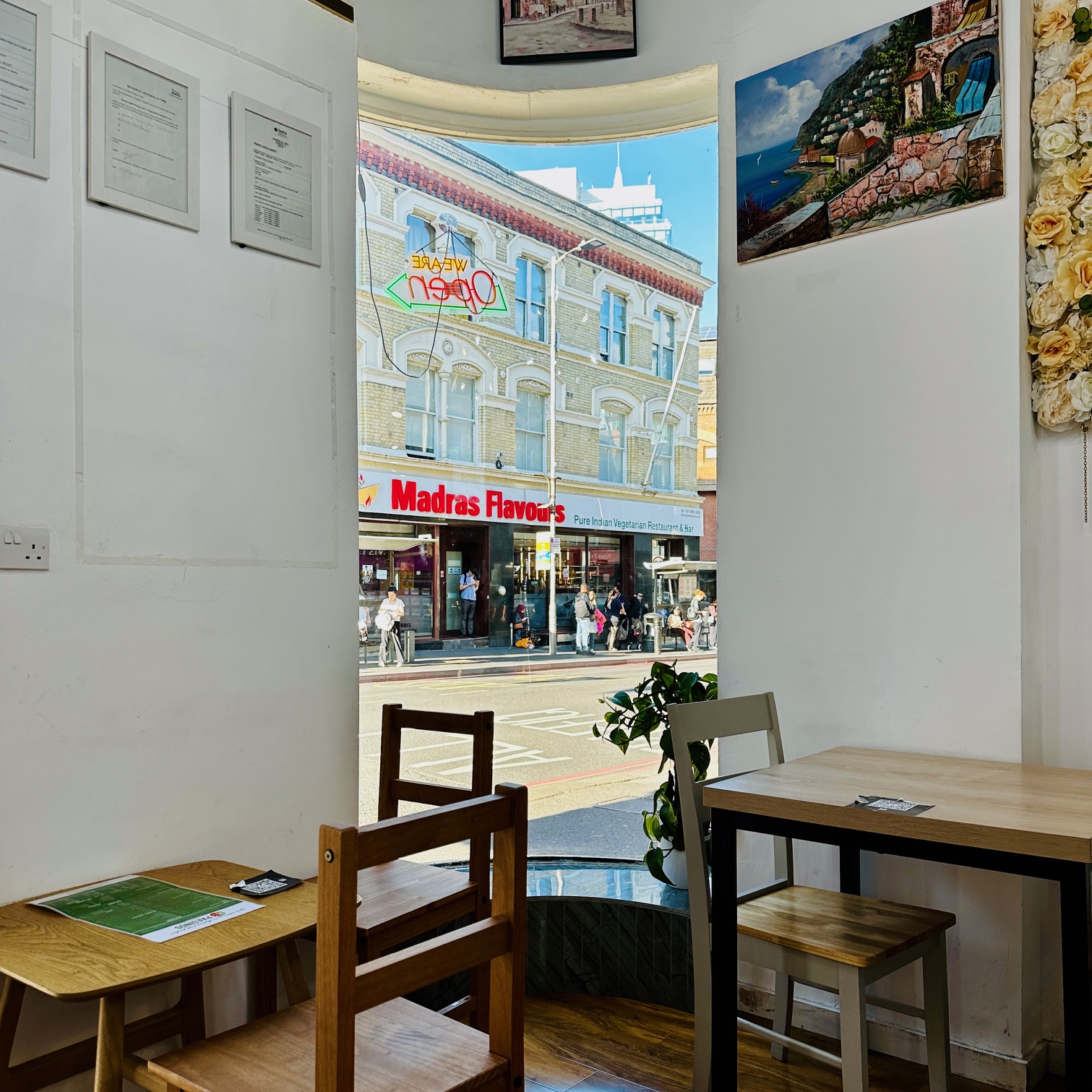
When you consider what a sterile space this could be, I think Doux Sourire has done a good job of making it homely. It felt much more spacious than the Starbucks used to be, and lining so many tables against the full length windows meant you had a fighting chance of looking into the room rather than out on the rainswept Riverside. They had one of those glass fireboxes by the entrance and, pleasingly, French music was playing.

My table was tucked away in the corner. It gave me a good look into the room, and I liked it – the tables were rustic without being rudimentary, and you could see dozens of bags of flour stacked away behind the counter. The shelves on either side, with creepy dolls looking down from them, were less successful: I’m not sure what the thought processes behind that were. French farmhouse is a very winning aesthetic, haunted French farmhouse less so.

But the welcome was warm and immediate, and my server brought over a couple of blackboards with a handful of specials on them – a salad and a soup on one, a couple of crêpes on the other. Doux Sourire’s menu overall felt more to me like a lunch menu than a dinner one, a sentiment arguably reinforced by the fact that the place shuts at 9pm. There were a handful of toasties, a cheeseboard, a baked Tunworth and hand carved jamon, or otherwise you had one of the crêpes. Toasties came in just under a tenner and the crêpes ranged from twelve to sixteen, more if you wanted your crêpe made with buckwheat flour.

So it was tricky to take a starters, mains, desserts approach to the place, although I did my best: it’s the responsibility you bear when you dine on your own, you see, to try and cover as many bases as you can. But first, wine. I expected this to be a strong point, given Doux Sourire’s origins as a Windsor wine bar, and the list was compact – five whites, three reds, an orange and a rosé, all available both by the glass and the bottle. I was a little disappointed not to see any Breton cider, a traditional accompaniment to this sort of thing, and the beer selection was limited too, although it had a couple from Marlow brewery Rebellion.

My red, a pinot noir, came out in a chunky, rustic, stemless bowl of a glass, and as the strains of C’est Si Bon floated through the restaurant I thought that this, on paper, had the potential to be absolutely my kind of place. A warm welcome, a good glass of wine, non-stop chansons and galettes, the kind of bubble of Francophile otherness Reading hadn’t quite had since Forbury’s closed. Sign me up, I thought.

My starter didn’t offer conclusive proof that Doux Sourire would be that sort of place. I’d gone for the special, the cauliflower soup with truffle oil. I never order soup, but I had a feeling that a toastie then a galette would have been too samey, so soup it was. And bits of it worked – the texture was velvety, and the squiggle of truffle oil offered something without overpowering everything. I am as dismissive of truffle oil as a quick cheat as the next person, but it had its place here.

The problem wasn’t what was there, it’s what wasn’t: the truffle offered a little contrast but otherwise the soup was all sweetness without anything to offset it and make it interesting. When my soup was brought over I also took custody of a little salt and pepper mill. I think in all the years I’ve been reviewing restaurants I have never seasoned anything I’ve eaten, unless it’s chips, but about halfway through this soup I broke out the salt mill. As I did so I couldn’t help wishing the kitchen had taken care of this for me.

The thing that redeemed the soup was the sourdough bread that came with it, and a brilliant accident. The menu talked about the soup and bread and said ADD CHEESE £2.00. Now, I assumed this meant I’d get some to top the soup with, but that was my happy mistake. Because what I got instead was a thick slab of sourdough completely enveloped in cheese, toasted until golden and brown-spotted. And it was absolutely divine. Somehow the bread was almost totally smothered in cheese – practically on both sides – and the whole thing was a treat.

It didn’t go with the soup, you couldn’t really eat it with the soup. But for two quid, your fair to middling soup was accompanied by a magical slice of cheese on toast. I couldn’t decide whether this reflected well or badly on Doux Sourire, so it was probably a bit of both. It also made me think that coming here for a toastie at lunchtime was a good idea: if they could do this with one slice of bread, imagine what they could do with two! But Doux Sourire’s menu is funny in this respect: for toasties it trots out Paysan Breton brie or a nameless goats cheese, whereas elsewhere on the menu cheese royalty – especially Ogleshield – is left unable to achieve its full potential.

My pinot noir, by the way, was disappointing. It wasn’t unpleasant, but for a tenner I thought it was a little thin and unremarkable, a rather one-dimensional mixture of cherry and oak. I ordered a viognier to follow up, and again although I liked it enough I thought it was unspecial. I’d obviously been ruined for wine in general and French wine in particular by my recent visit to Paulette, but I expected a bit more from a place which was at least slightly wine-led, very proudly French and descended from a wine bar. Je Ne Regrette Rien was playing in the background, and I wasn’t sure I could completely identify with the blessed Edith.

One of the specials, a rather avant-garde combination of crêpe filled with ragu, was off the menu but never mind – with my unerring ability to sniff out the most expensive thing on the menu I’d ordered something called the Spaniard. It was sort of Spanish, but on paper it was more like an advert for European unity, incorporating as it did Serrano ham, a buckwheat galette, pesto, sundried tomato and cheddar. I make that easily four nations on one plate.

I’d picked it because Doux Sourire makes much of its hand-carved jamon, and I don’t think I know of anywhere in Reading, with the possible exception of Thames Lido, that has ever done this. And god knows I’ve moaned about it enough over the years, so when it did crop up on a menu I felt duty bound to order it. The chap proudly told me that they carve it themselves, and told me there’d be a slight delay as they had just finished a ham. So I saw him take another one out of – I’m not making this up – a cardboard box, place it in the jamonera (the fancy stand thing with the clamps) and, with great ceremony, take the first slices off it.

I took a picture of the ham being carved and sent it to Zoë, having dinner up in London on a rare night away with work. I’m popping this ham’s cherry, I said.

Fucking hell came the response. It might just be the best thing in the Oracle since I left. You can quote me on that.

And again, the theory was so good but the practice is what counts, because you can’t eat theory. My buckwheat galette turned up looking the part, and you couldn’t argue with the sheer quantity of jamon – a big heap of it on top and an awful lot stuffed inside, so much that it could actually be hard to cut. But I wasn’t entirely sure that this mishmash of ingredients showed anything off to its best effect. The ham was, and I can’t believe I’m saying this, overkill, and although it was better than the clammy packet stuff you so often get in the U.K. it didn’t have that melting, savoury quality you get in the best of the Spanish stuff. Maybe it would be better served on its own – you can get a platter of it for eighteen pounds – but in a galette it just got lost.

And again, the mixture of the good and the ordinary was a problem here. So the ham was decent, if not the best, but the pesto felt shop-bought, with that vinegary note that suggested it wasn’t just made of basil, pine nuts, parmesan and really good oil. The cheese was decent enough, but the sundried tomatoes had that feeling too, of being entry-level supermarket fare. And although the balsamic glaze wasn’t as overkill as it could have been, it felt unnecessary. Doux Sourire drizzles it on all of their savoury crêpes, and if you ask me they shouldn’t. I’m not sure a pile of leaves, also drizzled but not dressed, added much.

All of this detracted from what could have been a very enjoyable, buttery galette, which should have been the feature attraction. And just to add to the onslaught of constructive criticism, in most of the places I’ve eaten or seen crêpes, they are assembled by folding the edges in, creating a square shape. For this one, Doux Sourire just folded the whole thing in half, and what that meant was that the filling was very unevenly distributed, with a lot of it in the middle and none of it at the edges.

This reads like a demolition of something I didn’t mind, but it’s more motivated by frustration that it could have been better. Doux Sourire has a limited menu, most of which consists of permutations of a couple of things, so it stands or falls on the quality of its ingredients, and that’s where I felt like there were mixed messages throughout. And the other reason why this is important is that my crêpe cost eighteen pounds fifty. Some of the challenges I’ve heard about Doux Sourire’s pricing feel a little misjudged – after all, we think nothing of paying fifteen quid for pizza – but even I thought this was a lot of money for something that didn’t quite hit the target.

I felt a moral responsibility to stay for dessert, so I had the baked cheesecake. You get to pick your toppings, and one of them was caramel sauce, so I went for that. The menu said that all Doux Sourire’s desserts were home-made – most of them are sweet crêpes or waffles – and I could believe this was true. But again, I noticed the flaws more than I should have. The texture of it didn’t feel especially baked, and the biscuit base was so thick that getting a fork through it felt like a series of high risk manoeuvres.

I had gone for caramel sauce, hoping to get a caramel au beurre salé, but it was more like the generic butterscotch syrup you so often see instead, and there was too much of it. Little nubbins of what could have been toffee had been strewn on top. It was my mistake to pick this, as it detracted from what could have been a perfectly serviceable cheesecake with a hint of lemon, notwithstanding the huge plate of baked biscuit it was standing on. I suspect a better option would be a sweet crêpe, but that’s the other thing about Doux Sourire’s menu: limited replay value, you see. Speaking of replay, I was pretty sure we were on to our second rendition of La Vie En Rose coming through the speakers by then.

I was by no means the last customer, but as I settled up – sixty quid including tip – I spoke to both my servers. They were absolutely lovely and really attentive throughout, and told me that they’d been open since October and things were going well. They have regular jazz nights which are booked out in advance, and I can see they could be a lot of fun.

I found myself really pleased that their brave experiment was succeeding, so far, and as I paid my bill and thanked them and told them I’d had a nice time I did also find myself wondering, before it was even begun, how I would end this review. The Oracle was a bleak place at half past eight, and two people in quick succession asked me if I had any change. I walked to my bus stop past Côte, still doing a very brisk trade on the Wednesday before payday. What would sixty pounds have bought you there?

So yes, this is hard. The romantic in me wants to give Doux Sourire a higher mark because I want it to be good and brilliant, the combination of the wine bar Reading still needs and the French bubble it hasn’t had for too long. And I want to give them a higher mark because they really seem to care, and the service was excellent. I want to give them a higher mark than this for lots of reasons, but if I did I would be awarding the rating they might have one day, rather than the one they have now.

I hope that as they settle in they sort out their inconsistencies and find a place in Reading’s affections. If it was in my gift, which it isn’t, I would get them to stock more and better wine, and exclusively French wine at that. I would look at a menu that feels too narrow, and find a way to make better use of their produce, and for that matter I would get better produce. I’d maybe lose the creepy dolls from the shelves, while we’re at it, but I’d keep the music and the service. But am I talking now about what Doux Sourire could be, or am I, like James Stewart in Vertigo, trying to just shape it into what I really want?

Perhaps they’ll do perfectly fine as they are. I do sort of hope so. I may well drop in for a toastie one lunchtime, and a coffee – they have a big Victoria Arduino espresso machine, a serious piece of kit – and when I do I hope to see them prospering. I might go on my own, though. It’s that kind of place.

Creperie Doux Sourire – 6.8
Unit R19, The Riverside, RG1 2AG
0118 2294645

https://www.creperiedouxsourire.co.uk

As of January 2025, Edible Reading is partly supported by subscribers – click here if you want to read more about that, or click below to subscribe. Whether you’re a subscriber or not, thanks for reading.

Restaurant review: Paulette, Little Venice

Formosa Street, an enclave in Little Venice less than twenty minutes’ walk from Paddington Station, could be the platonic ideal of a London street. It has a little cafe, a chocolate shop, a ludicrously handsome Victorian pub with wood-panelled walls and glass compartments, with tiny doors linking them together. It has a little Italian restaurant that has been there thirty years, and a craft beer place two doors down, the past and the present coexisting cheerfully.

It doesn’t have a butcher, although there’s one just round the corner on Clifton Road. But tucked away seconds from the Tube station, one stop away from Paddington, a stone’s throw from the strikingly modernist St Saviour’s Church, it is a deeply pretty pocket of London that few people know about. If this was your neighbourhood, you would be very happy indeed. Of course, if this was your neighbourhood you would also be filthy rich.

I’ve frequented this part of the world, on and off, for many years. I think I ate in that Italian restaurant not long after it opened, and I’ve drunk in the handsome Victorian pub a fair few times. Just before lockdown, I tried out the craft beer place a couple of times, and I’ve admired the steeple of that modernist church on more occasions than I can recall. I am no closer to living there, or even pretending that I could do, but it’s nice to try to pretend.

Just before lockdown, five years ago, Zoë and I went for dinner at a small French restaurant on Formosa Street called Les Petits Gourmets. At the time, I had the idea of publishing some London reviews, of places close to Paddington, thinking they might be useful to people wanting somewhere good to eat before grabbing an off peak train home. And it might have been a good plan, if I hadn’t hatched it about a fortnight before people stopped taking trains in general, going to the office or indeed leaving their houses.

So I never wrote a review of Les Petits Gourmets, although that might have been for the best because it was small, eccentric and nuts. On arriving we were told that their oven had packed up, so we could have whatever we liked from the menu as long as it was something they could cook on the hob. The place was dark and atmospheric, our table tiny and cramped. Another table, weirdly shaped and right next to the bar, with a couple of high stools, was so bad that a couple came in, were offered the table, had a shouting match with the staff and stormed out.

I can’t remember anything about what I ate, but I do remember that. And I was tempted to publish a review, if only because it was so surreal, but what would have been the point? It was just a place you would never have heard of, and a review that wouldn’t have sent you rushing there, at a time when you couldn’t have rushed there anyway – even if, for whatever reason, a dingy spot with no working oven and some shocking tables was right up your alley.

I thought no more about Les Petits Gourmets, really, until last summer when I read a rave review in the Standard of a French restaurant in Little Venice called Paulette. I know that area, I thought. I wonder where it is? And then I checked the address, and thought Isn’t that where that weird French place used to be? And then I Googled some more and discovered that it was exactly where that used to be, and opened later in 2020. Les Petits Gourmets was an early casualty of the pandemic: perhaps the cost of fixing that oven was the final straw.

The review I read of Paulette made it sound like everything I had wanted its predecessor to be, so I made a booking there and on a drizzly Saturday morning I caught the train up into London, ready for a long overdue lunch with my cousin Luke, last seen as baffled as I was by supercool Haggerston spot Planque. Fun fact: both Planque and Paulette featured in Conde Nast Traveller‘s listicle last summer of London’s best on-trend French restaurants although, as we will see, they couldn’t be more different.

The walk from Paddington is a lovely one. You start out exiting the station right by the Paddington Basin and cross over it, right by the floating barge restaurants, walking past craft beer and pizza spots and impossibly spenny-looking modern apartment complexes. The route ducks under the grime and bustle of the Westway and then, suddenly, everything is beautiful: the streets widen and are flanked with gorgeous redbrick mansions, huge buildings made up of pinch-me-if-I-live-here flats. And then you’re at the canal, and you wonder how such a fetching residential area can be hiding in plain sight here, in Zone 1.

I stopped for a latte at the brilliant D1 Coffee, a stone’s throw from the waterway, and thought to myself that as usual I was trying to pass myself off as congruous in a neighbourhood far, far above my station. I chatted to the couple next to me about giving up smoking – something I did twenty years ago and still think of as one of my greatest achievements – and as we did, countless cosmopolitan types ambled past, walking dogs or just chatting happily. One was carrying a MUBI tote, and I wondered how it had happened that I’d wound up living in a postcode so far from my tribe. It’s almost as if I just hadn’t tried hard enough to make something of myself.

I got to Paulette before Luke did, and it was unrecognisable from the room I’d eaten unsuccessfully in five years before. Still eccentric, yes: all mismatched patterns on the walls and ceilings, mismatched cloths on the tables, mismatched light fittings, all maximalist and unashamed. But it was bright, cheery and welcoming. Even with the canary yellow awning out, light flooded in from the full length windows and all the tables were full of people who seemed profoundly happy with their life choices. I ordered a kir while I waited for my cousin, and it was sweet sunshine, a liquid escape from rainy London. Even noticing that the gorgeous Victorian boozer opposite was closed for renovations couldn’t dent my joie de vivre.

Nor could the discovery, when Luke turned up and ordered a Meteor Zero, that he was off the sauce. He explained that he’d bust his hip and that alcohol interfered with his rehabilitation regime: news to me, as I’ve always found Dr. Booze an invaluable consultant I’ve involved in my recovery from pretty much anything affecting me.

I thought it would bother Luke, a man who runs more marathons in a year than I’ve eaten Marathon bars in my lifetime, but he was surprisingly sanguine about it. “I figure everything goes through a fallow period” he told me later in the pub, showing a kind of Zen perspective I’d have loved to have twenty years ago when I was his age: come to think of it, I haven’t attained that mindset even now.

That meant that I had to forego the delights and dilemmas of choosing a bottle from the enormous wine list, seemingly covering all of France in compendious detail. But it wasn’t all bad – just under twenty wines were available by the glass, a great spread including half a dozen dispensed using a Coravin. I picked a Sancerre, which was terrific, and we started doing a bad job of making our choices from the menu and a much better job of catching up.

The menu was a tad lopsided, with about a dozen starters and half that of mains, but everything on there was tempting. Many of the things I’d read about in advance and hoped to encounter, like a Roscoff onion tarte tatin with mascarpone, were missing in action, but even so the challenge was very much what you missed out on, as much as what you picked. On another day you would have wound up hearing about the classic onion soup, the scallops or the halibut with sauce Meunière, but I will have to try them next time, assuming they haven’t been whipped off the menu by then.

As it was Luke and I agreed to share a few things to try and cover as much as we could, helped by pricing which encouraged you to try a bit of everything. Starters tended to be at or around the fifteen pound mark, with mains mostly between thirty and forty quid. But everything was so fabulous, and generous, that I didn’t object to that in the slightest.

We kicked off proceedings with a small selection of charcuterie, which was easily enough for both of us. All of it was marvellous, from the bresaola to the pork loin but especially the coppa, dried and intense, and a doozy of a jambon de Bayonne: again, dry and coarse, which very much said tiens ma bière to both Serrano and Parma ham. This came with bread (which should be a given but isn’t always), butter (which was a very welcome surprise) and, best of all, a ramekin containing a deeply acceptable quantity of sharp, tart cornichons.

Fourteen pounds for all that, and for a pound more our second starter was every bit as stellar. I love pâté en croute, and Paulette’s version was the best I’ve tried – a glorious slab of heaven, golden burnished pastry housing coarse pâté, shot through with dark prunes. On occasion I’ve had this kind of dish in Paris and it’s been painfully close to Pedigree Chum, but no such worries here: no dodgy jelly, just densely packed meat – pork and duck in this case – topped with yet more pickles and a quenelle of exceptional whole grain mustard. A very well-dressed salad completed an impeccable plate of food.

I wish I’d had one of these to myself, but to do that I’d have had to go without the charcuterie. This is the problem with sharing food, isn’t it: you always end up wanting twice as much of everything, everywhere, all at once. I was about to start a sentence with Next time, but I’ll try to stop myself or I’ll be doing it for the rest of the review. Truth be told, even by this point the only question in my mind was when exactly that next time would be. It was already a given that it would happen.

I gave Luke first pick of the main courses and, torn between the fillet of beef and the bourguignon, he eventually chose the latter. He chose extremely well. The pan brought to his table was a one-stop shop of pure happiness – a deep, reduced sauce full of wine and care, with a few waxy potatoes, plenty of mushrooms and a transverse beast of a carrot, heftily substantial and yet superbly cooked.

But of course, none of that gets top billing in the name of the dish, and this all comes down to the beef itself. I’m used to having this dish with shin or chuck, but Paulette opted for beef cheeks and, with hindsight, it was an inspired choice. The food writer Harry Eastwood once said that cheek was perfect for this dish as, in her words, “the meat surrenders completely”. I can’t improve on that description, so I’ve nicked it instead.

And it’s true, but only if the kitchen is absolutely on top of its game and the beef is braised to the point where any gelatinous quality is gone, replaced with that terrific stickiness where the beef and the sauce become a symbiotic dream team. That’s what had happened here, and it was a wondrous thing. Trying a forkful I thought back to my friend Graeme’s bourguignon at Côte the previous month, and the difference between good and great. The difference, it turns out, is nine quid and forty miles.

“This is the best French food I can remember eating” said Luke. I’m a relatively frequent visitor to France, but I could see what he meant.

If I had been Luke, I would have wished that I’d saved some bread to mop up that final layer of sauce coating the bottom of the pan. But if I’d been Luke he’d probably have a forty inch waist and far less success online dating and would get over the disappointment of busting his hip (which would be more likely to happen by, say, getting out of bed awkwardly) by medicating with the finest mid-price reds the restaurant had to offer. Instead I offered him some of my frites, and after refusing twice – he is Canadian after all, so awfully polite – he took me up on my offer.

I’ve seen quite a few reviews online talk about how Paulette does the capital’s best frites. They might or they might not: I’ve had nowhere near enough frites in London to be qualified to judge, but they were up there with the best frites I’ve had in this country or any other, irregular, golden, salted and decidedly moreish. They were so good I wasn’t sad that I didn’t get to try the gratin Dauphinois, and frites have to be pretty damned good for that to happen.

My frites accompanied my order from the specials board, duck breast cooked pink, sliced and served simply with a boat of what was described as a duck velouté, in practice one of those ultra-reduced, fantastically concentrated sauces that French cuisine seems to do better than almost anybody else.

I’ve had duck breast many, many times in my life and a lot of the time, afterwards, I wonder if I’m doing it because I think I should like it rather than because I do. It’s often a tad tough, a smidge fatty, somewhat poorly rested: much like me, most weekday mornings. This was more like me after a full day in Nirvana Spa, utterly relaxed, thoroughly cosseted, treated like a king.

The analogy breaks down at that point, because this duck was also enormously tasty and I imagine most people wouldn’t be able to get enough of it. But it was good while it lasted.

By this point I had moved on to a Saumur, which was perfect with the duck: Paulette has the sort of outstanding staff who will compliment you on each of your wine choices even though you’re the poor schmuck muddling your way through the list of wines by the glass.

Luke and I decided to eat as Frenchly as possible, which meant a cheese course and then some dessert: the wine list distinguishes, winningly, between “cheese wines” and “dessert wines” so I nabbed something from the former section, a 1986 Muscadet. I have no doubt the Coravin was involved here, and the result was stunning, an amber marvel with a hint of sherry sweetness, outstanding complexity and length. A 50ml pour, in this case, was plenty.

Paulette does a small or large assiette de fromages with three or five cheeses respectively, and they are in principle a deli too, so I did wonder whether you could pick which cheeses you had. When our server authoritatively told us you got a Comte, a truffled brie and a Saint Nectaire I realised this was a choice best left to the experts, so that’s what we had.

The picture here probably doesn’t fully convey this, but it was a generous wodge of each, easily enough to share without needing a scalpel and a protractor. They were all outstanding: the Comte with all the crystalline grit you would want, the Saint Nectaire, not a cheese I’d ever seek out, bringing a savoury depth to justify its seat at the table.

But the truffled brie – oh my goodness. Luke and I agreed that we shared a suspicion about truffle being brought out to zhuzh up the ordinary, but in this case it turned a gooey, creamy delight into a total showstopper. As with the charcuterie, this came with a generous helping of bread but once we had finished all of the bread and nearly all of the cheese the twinkliest of our servers returned with a couple more slices, urging us to use them to clean up the very last of the brie. We did as we were told.

Normally I would have a different dessert to my dining companion, but I figured we’d got through a decent range of dishes already and I’d seen the chocolate mousse being carried past to other tables and decided there was no way I was leaving without trying it. I mean, just look at it in the picture below: a stegosaurus of a thing, plump and shiny, with a spine of caramelised hazelnuts sitting in a pastel-green lake of pistachio crème Anglaise. How could I not order that? How could anybody?

And it tasted every bit as beautiful as it looked. By now I’m used to chocolate mousses in fancy Spanish places where they drizzle it with extra virgin olive oil and pop some salt crystals on top, the modish way to revamp a staple. But this had no interest in playing those tricks, so like everything else at Paulette it was a classic rendition of a classic dish, prepared by a kitchen that revered the classics.

Don’t get me wrong – there is a place for deconstructing, reconstructing and reinventing, and I’m a fan of those things as much as anyone. But whatever that place is it isn’t Paulette, I’m very glad to say. This was a dark, glossy miracle – so smooth, almost not aerated at all, and I wished every spoonful could have lasted hours. The final spoonful, as it always does with such dishes, came too soon, and I found myself wishing there was some sweet equivalent of bread I could use to mop up those last bits of crème Anglaise. Maybe that, rather than ruining burgers, is the point of brioche.

When you book lunch at Paulette you get that standard issue we want your table back in X hours gubbins that London restaurants so often do. But none of that happened here, and over three hours after I ordered that kir pretty much every table was occupied by somebody new despite it still being mid-afternoon, the evening service around the corner.

I’ve never understood restaurant reviewers who insist on eating at a place twice before writing a review – mainly because they need to get over themselves – but if I could have eaten at Paulette again that evening I would have seriously considered it. But the craft beer place a couple of doors down was calling to us, and the pub after that, so it was time to reluctantly pay for the wonderful time we had had. Our bill for two, all that food, a couple of beers for Luke and five different glasses of wine for me, came to just over two hundred and ten pounds, including a 13.5% service charge. It felt as much like a bargain as I suspect any meal will this year.

Later on, Luke and I were in the Bear, just around the corner from Paddington, having one last drink and comparing notes before going our separate ways.

“The only thing that stops it getting the highest mark, for me” said Luke, “was that it just lacked that thing that would make it a truly transcendental experience. That and the bread, I guess, the bread could have been better.”

I knew what Luke meant, but I also suspected that looking at Paulette that way missed an important point, which was that Paulette had no interest in being that kind of restaurant or delivering that kind of experience. It was more interested in transporting you completely by delivering something unfussy and unfancy but, in its way, truly outstanding. Paulette was about as good an example of this kind of restaurant as it’s possible to find, and I loved it. Absolutely loved it, unreservedly, from start to finish.

It’s twenty minutes from Paddington, and Paddington is thirty minutes from Reading. Just think about that: you could be at Reading station, and within an hour you could be eating in this place. If I don’t do so a couple more times this year, I will be extremely surprised, not to mention deeply disappointed. I know most of my London reviews, lately, have been of spots in the centre where you hop on the Elizabeth Line to get there, very much a tribute to the march of progress in the capital. But this? Simply timeless.

Paulette – 9.3
18 Formosa Street, London, W9 1EE
020 72862715

https://www.paulettelondon.com

As of January 2025, Edible Reading is partly supported by subscribers – click here if you want to read more about that, or click below to subscribe. Whether you’re a subscriber or not, thanks for reading.

Restaurant review: Shawarma Reading

This week’s review came about because of a comment on the Edible Reading Facebook page. I’d posted a link to my do list, as I regularly do, asking if there was anywhere on it that I should prioritise. Somebody chipped in and told me I should check out Shawarma Reading on West Street. “Their mixed shawarma with rice is great on a cold day”, their comment said.

That was all well and good, but the comment wasn’t from just anybody. It was from Mansoor.

Mansoor has been a reader of my blog for as long as I can remember, an early and vocal supporter of what I do. He came to the very first readers’ lunch at Namaste Kitchen, over seven years ago, bringing a blue Toblerone because I’d enthused about them on the blog. He told me that when he was first courting his wife, he used my blog for tips; despite that, it seems to have worked out nicely for him.

He was also one of my very first subscribers, when I launched that last month. “Lifetime subscription please” he said, which moved me more than I can say. And that’s despite the fact that Mansoor, his wife and his beautiful daughter have moved to Bristol now, which makes him one of my few readers who avidly looks forward to reviews from that part of the world rather than ones from the ‘Ding (don’t worry Mansoor, you’ll get some later in the year).

But that’s not why I give Mansoor’s words such weight. Back when he lived in Reading, Mansoor tipped me off about all kinds of places which went on to be favourites. He was the one who told me to check out La’De Kitchen, out in Woodley, and Rizouq on the Wokingham Road. And perhaps most life-changing of all, Mansoor told me once about a little spot doing samosas, also on the Wokingham Road, that I ought to investigate. Years later I still stop by Cake & Cream regularly for their epic samosas and pakoras, and have recommended them to countless others.

So when Mansoor says somewhere is good, I pay attention. And he first mentioned Shawarma to me at a readers’ lunch about eighteen months ago. “Give it six months, and I think it will be worth you reviewing it”, he said. Well, that six months had more than elapsed, and Mansoor’s initial “you might want to try it out” had morphed into a “go here”.

That alone would have been incentive enough, but then I saw a thread on this exact subject on the Reading sub-Reddit. Somebody had posted specifically asking whether Shawarma was good, and where else you might go for its eponymous speciality. The usual suspects – Bakery House, Hala Lebanese and Monty’s – all came up, and their relative merits were debated. But as for Shawarma itself? Well, most people hadn’t gone there. Of those that had, one person said it was good shit, another said it was not good and, the implication seemed to be, shit.

It was time to pitch in on the debate, so I hopped off the train after work on a Monday evening, keen to make up my own mind. But before I got to Shawarma Reading, I went on a little expedition through the very newest part of Reading. Because that evening the pedestrian route had finally been opened up from Station Hill to Friar Street, past all the new apartments. I think it might have been the first night you could cut through, and I kept on walking, along with a handful of other dazed pedestrians, half expecting to find a dead end at any moment.

But it never came, so there I was in this brave new world, checking out the tasteful lighting and no doubt exorbitantly priced flats, seeing the spots where London coffee chain Notes and new Japanese restaurant Kawaii – from the team behind Coconut and Osaka – would be setting up shop. And it was all very agreeable; it certainly beat walking past Zorba’s and Wendy’s, and Siren RG1‘s location made a lot more sense now you can reach it quickly and directly from the station. So did the writing at the front saying that they offered ‘Train Beers’, come to think of it.

Nursing a pre-dinner IPA there I found myself thinking that, for the first time ever, it felt like I’d walked through the Reading of the future, the Reading that the excellent Reading-on-Thames always writes about. In the time I’ve been writing this blog Oxford has opened the Westgate, Newbury has acquired a fancy shopping quarter and Maidenhead is awash with flats and new restaurants, its very own Waterside Quarter. And what has Reading got in that time?

A little bit skankier, I’d say. And looking out from Siren RG1 on the likes of McDonalds, Lola Lo, garish convenience stores and 99p shops, knowing that a bookie and an amusement arcade were just down the road, it did feel like the dividing line between the old and new couldn’t have been much starker. My beer finished, I walked past the Hope Tap, where I imagine you can get two pints for what I spent in Siren. That shawarma was calling to me.

On my way there, I realised that this was probably the year that I would have to revisit a number of sites that held bittersweet memories for me. Many places, once they close, stay vacant for some time – take the spot where Dolce Vita used to be, for example, a long-empty monument to John Sykes’ avarice. But this year I need to try Tanatan, where Clay’s used to live, and at some point go back to the Lyndhurst. Now I live in Katesgrove it’s long overdue that I visit Namaste Kitchen again. It’s been under different management, after all, for nearly six years.

In many of these cases, I’ve put off returning because I know that however good the food is, it might be tinged with sadness, and I don’t want to let that colour my judgment. And of course, that’s the case with Shawarma Reading, because before it was Shawarma it was Cairo Café, a little spot which I liked a great deal. But I last went to Cairo Café over two years ago, and it’s been Shawarma for over eighteen months. Time to lay the ghost.

I was surprised at first that it managed to feel even smaller than Cairo Café had. Part of that is because of all the kit and caboodle Shawarma has, the two vertical spits revolving inexorably at the front, behind the counter, one for chicken and one for lamb. Cairo Café did its cooking out back, so more of the front room was given over to tables. By contrast, Shawarma had two tables for two, and I was lucky that one was vacant when I was there.

This was far more utilitarian than homely – they’d kept Cairo Café’s dove grey metro tiles, but the rest was chrome and bland ash effect panels. In fairness, when you have the capacity for four people, it would almost be rubbing it in to look like a place where people would want to linger. I heard the distinctive tone of Deliveroo and Just Eat orders landing while I was there, and I suspect that most of Shawarma’s trade is takeaway.

What was surprising about the interior was that it didn’t quite chime with the menu. Because aside from the feature attraction, Shawarma offers a reasonably full Lebanese menu at prices very close to those you’d pay at Bakery House. Shawarma features heavily, as you’d expect, but there are also shish kebabs, mixed grills, koftas, wraps, hot and cold mezze. Main courses were just under fifteen pounds, wraps closer to seven and the starters between five and eight. It felt a little jarring to have this big menu crammed, TARDIS-like, into this small room, but it also intrigued me. And besides, Mansoor rarely steered me wrong.

I ordered a starter and a main and, of course, they came virtually at the same time. And again, this highlighted that you were somewhere that was more quick and cheerful than a place for a drawn-out meal. And again, I thought that this fitted the room but maybe not the prices. Because I simultaneously felt like I had to benchmark Shawarma against the likes of Bakery House but also somewhere like King’s Grill, and it felt like a bit of neither and both.

Anyway, enough comparisons: let’s talk about the food. I loved my falafel – I saw them being formed and fried in front of me so they were as fresh as you like. And they really were gorgeous: light rather than dense, with an excellent sesame-studded shell. The garlic sauce, in a little paper hospital pill cup, was gentle rather than honking, but nice enough: I might have preferred something tahini-based with them, but I wasn’t complaining. And best of all, a decent accompaniment of pickles, including those almost unreal purple ones that I particularly love: they always look photoshopped in pictures, but I assure you they weren’t.

Okay, I haven’t given up comparisons. These were as good a set of falafel as I’ve had anywhere in Reading, and up there with the likes of those at Sam Adaci’s excellent green van Purée, always a welcome sight on Broad Street. Ideally I’d have enjoyed them before my main turned up, but you can probably tell by now that all that tells you more about me, and my inability to get a read on this place, than it does about Shawarma.

I had to go for shawarma as a main, because of Mansoor’s tip off and because – durr – it’s literally the name of the restaurant, even if the logo is a very cheery-looking bow-tied chicken tipping a top hat, seemingly unaware that its friends and family are being served up to punters on a daily basis. I would have had rice with it, but they were inexplicably out of rice, so chips it was. I had a good view of all the ceremony of shawarma, the careful slicing and shaving, collecting it all in that little pan, and it did make me peckish. I guess even that adjective, most likely, is a little insensitive to chickens.

I’d asked for a mix, and it gave me a good picture of Shawarma’s strengths and weaknesses. Generally with shawarma I tend to prefer lamb to chicken: I’d certainly say that Bakery House’s lamb is stronger than its chicken, for instance, as is Hala Lebanese’s. But with Shawarma it was the other way round. Now that could be entirely psychological, because I’ve seen videos on Shawarma’s Instagram showing them painstakingly layering marinated chicken thigh upon thigh, creating a monumental column of meat, and it’s hard not to be impressed by that.

But in reality, both it and the lamb were very serviceable indeed. Both were piles of shredded meat, glistening in a way that seemed entirely unnecessary – could have been oil, could have been a little pomegranate molasses, could have just been sheer juiciness – and both were very enjoyable loaded onto a fork and then speared onto a chip. The chips, by the way, were about as good as bought-in chips get, fried there and then and decanted onto a plate, all brittle rustling, dusted in something I imagined was sumac.

In that sense, Mansoor was absolutely right. Working through a plate of that meat and those chips, dipping in more of that garlic sauce and a chilli sauce that again was pleasant but not especially pungent was a fun, almost meditative experience. It was cold and dark outside, and I found myself thinking again about old Reading and new Reading. Because West Street used to have Vicar’s on it, and Reading’s original branch of Primark, and a Fopp I loved visiting on the way back from the farmer’s market, back when Fopp was a thing. I’d go there and buy CDs and DVDs, back when CDs and DVDs were a thing too.

But now the centre of gravity has changed, and that end of town is a very different place. Two peri-peri establishments a couple of doors apart, a fishmonger and that butcher that got closed down by the council’s environmental health team, much to the delight of the gammons and ghouls that haunt the comments section of the Reading Chronicle. I’m not for a second saying that this part of town is worse or better than it was, but the gulf between this Reading and the Reading of Station Hill, of urban tap rooms and branches of Notes feels so big you could be in two different towns. And I do miss Beijing Noodle House, come to think of it: still, we’ll always have Rafina.

But none of that detracts from the fact that Shawarma is an asset to West Street, and that it would have been at any time in West Street’s history. If I was being ultra-critical, I’d say that I personally like my shawarma sliced more thinly, a little more caramelised and crisp-edged than this was. But I didn’t feel like being ultra critical, and anyway Mansoor was right, as he often is: a plate of their mixed shawarma is a positive tonic on a cold evening. I did it, as he said I should, so I speak from experience.

That said, I actually think the trick is to have what I saw the owner preparing for a takeaway order. ‘Shawarma bites’ was a wrap packed with shawarma, very carefully rolled and assembled, crisped up in a sandwich press and then cut into slices, a bit like a Turkish beyti without the tomato and yoghurt plonked on top. I mentally made a note to have that next time, and I also made a mental note that there had to be a next time so I could eat it.

The owner, by the way, was lovely. When I settled up – twenty pounds, not including tip – I told him I’d really enjoyed it and that I would be back. He asked me to leave a review on Google, in a way that seemed well practiced, and I said “don’t worry, I’ll write you a review”. That’s well practiced too: I just don’t put it on Google.

As you’ve probably gathered, I couldn’t work out what to make of Shawarma: looks like a takeaway, priced like a restaurant, something somewhere between the two that either has something for anyone or nothing for everybody. And yet I liked it nonetheless. I will go there again on a cold evening, or avail myself of one of the tables they put outside when the weather improves.

And the contrarian in me, the person that loves the underdog, feels like we all have a responsibility to make sure that even if Reading does become awash with gleaming apartments and plush chains, there’s always room for something different. For the Sheds, the Sapana Homes and the Sarv’s Slices: and that’s just the Ss. And I really hope there is always space for places like Shawarma – another S – a tiny shawarma joint, doing its thing quietly and thoughtfully. Just around the corner from all that jazz, yet somehow a world away.

Reading is better for keeping hold of that, I reckon. It’s no good gaining all those shiny things, after all, if you end up losing your soul.

Shawarma Reading – 7.2
13 West Street, Reading, RG1 1TT
0118 9505625

https://shawarmareading.co.uk

As of January 2025, Edible Reading is partly supported by subscribers – click here if you want to read more about that, or click below to subscribe. Whether you’re a subscriber or not, thanks for reading.

Restaurant review: Côte

Here’s what happened: I was making Friday night dinner plans with my friend Graeme and I said I’d give him some restaurants to choose from, a mixture of places I wanted to review (or re-review) and others I just fancied eating at. My text was all ready to send, and then I stopped for a minute and thought what about Côte? So I added Côte to the list of places I was due to re-review and pinged the message over to Graeme, fully expecting him to pick somewhere else.

Why don’t we do Côte? came the reply. I haven’t been for a while, and it’s such a good chain restaurant.

Appropriately Graeme’s reasons for choosing it were the same as mine for including it in my selection. The last time I went there was something like eighteen months ago, with my family, to celebrate my just having got engaged. But before that? I honestly couldn’t tell you. And yet before the pandemic I used to go an awful lot – it was one of my regular spots.

I do wonder whether the pandemic had something to do with it. Because when Covid struck national Côte did what many restaurants did, diversifying into heat at home options. But Côte did it differently to everybody else, and unlike nearly everybody else they are still doing it years later, when for most restaurants their schemes, entirely born out of necessity, were shelved ages go.

Côte decided to take advantage of the fact that many of its dishes were prepared in a central kitchen and then finished in the restaurant, turning what you could potentially see as a weakness into a Covid-era hidden strength. And it continues today: Côte At Home still offers many of the dishes you can get in their restaurants, portioned for two people, for decidedly less money.

Back when I was reviewing takeaways and meal kits, I reviewed Cote At Home. And the truth was that I didn’t know what to make of it: it was good value, and undeniably polished, and somehow occupied a completely new genre that wasn’t takeaway, wasn’t meal kits, wasn’t eating in restaurants and wasn’t ready meals. What on earth was it, then? I’m still not entirely sure.

But I can’t help feeling that Côte At Home, although it may have saved the chain from going under, slightly changed the way I thought about the restaurant. Because if many of Côte’s dishes were just glorified ready meals you could cook at home, was there still a point to going to the restaurant to eat them there, spending more money in the process? And if that was the case three years ago when the shockwaves from the pandemic started to subside, wasn’t it even more the case now, when eating out is more and more of a luxury?

I didn’t know the answers, and it felt like a return to Côte might provide them. Besides, it was a Friday night at the end of an incredibly long week at work, and I figured I’d earned a good meal, a catch up with a good friend and at least a bottle of wine, and I was hoping for an enjoyable evening irrespective of whether my visit also solved those bigger, thornier questions. After all, nobody can dissect stuff for its deeper meaning 24/7. Not even me.

I always forget how nice Côte’s dining room is. You could be forgiven, eating at one of its former neighbours – Brown’s, or TGI Friday – for thinking that these deep, largely windowless rooms are uniformly unlovely spaces. But Côte’s has always been both a luxe and comforting spot. The tables at the front, that catch the daylight when there is some, are great if you’re having brunch or lunch.

But the rest is equally agreeable once the sun’s gone down. It has a certain je ne sais quoi, there’s something about its banquettes, bentwood chairs, booths and clever lighting that makes it feel like a little oasis amid the Oracle Riverside’s brashness and bluster. I don’t think the room has changed in the ten plus years that I’ve been going there. It’s never needed to.

Graeme was already at a table when we got there, but otherwise the restaurant was close to empty.

“It’s worrying, isn’t it?” he said. “When I went past the burger place I thought it was closed, and even Nando’s was dead. Nando’s!”

“I guess January’s a very long month, and it’s the weekend before payday for most people.”

“I’m so glad we picked Côte though. Wine, meat and cheese – all the main food groups.”

We ordered a drink and began catching up while I tried to work out which of the items on the menu were least likely to have been produced in a central kitchen. I was looking forward to a cider – Côte always stocked proper, old-school Breton cidre – so I was disappointed to see that they’d switched to a brand called, of all things, “Sassy”. I had a beer instead.

If I’d looked at their website, which says that ‘SASSY brings a naughty nature to the world of Cider and sets out to premiumise this wonderful drink,’ with ‘one foot in the traditions of Normandy and the other striding towards the future of cider’ it would have made me doubly unlikely to try it. Apparently it’s “inspired by the cider served at Château de Sassy” which is, to my astonishment, a real place. Unlike premiumise, which is absolutely not a real verb.

The menu at Côte hasn’t changed significantly in over a decade, which again I find oddly comforting. Not for them attempts to modernise, introduce fusion flavours, or provide low calorie options. Prices are definitely higher than they used to be, which mainly signifies that it’s 2025: starters are between seven quid and a tenner, the mains approach the twenty pound mark but are careful, for the most part, not to overstep that.

All that said, Côte’s prix fixe is available all evening on weekdays, which I’m not sure was always the case. At eighteen pounds for two courses or twenty-two pounds for three, it’s roughly the price that LSB’s set menu used to be back in the day, another barometer of how eating out has got more costly in recent years. Côte was also offering some Alpine specials, a range of small plates which sorely tempted Graeme – especially the tartiflette, combining the holy trinity of spuds, bacon and cheese.

I was impressed by how resolutely French the wine list was. With the exception, of port, you won’t find a single wine on it from any other country. The one concession to modishness was a solitary orange wine, which seems also to be an Alpine special. Graeme gave to job of choosing to me and I was delighted to see a Alsatian producer on there, Trimbach, that I liked. I’ve always had their whites before, but their pinot noir was a real treat, with plenty of depth. At thirty-seven pounds, it was something like twice the retail value, a relative bargain.

People started trickling in and taking up tables as we had those beautiful first sips and carried on setting the world to rights. Graeme told me that the last time he’d been to Côte was something like a couple of years ago for his daughter’s eighteenth birthday, and I told him that I too had been here last for a family event.

“But that’s the thing about Côte” said Graeme. “I’ve been here for family events and with a big group of friends, or just with Amy, and it’s really, really good for all of them.”

I thought about it and I realised that it was true for me too. I’d been here with big groups and small groups, with a partner or on my own. I’d descended on it with a gang for a pre-beer festival brunch, back when Reading had a beer festival, and I’d taken up a sunlit table outside with the prix fixe, a bottle of cidre and a good book, back in the days when I lived in the centre and had a spouse who was overseas with work. It was hard, really, to think of an occasion which I hadn’t marked at Côte.

“Back in the early days of the blog when I first started doing features I did one about the best place for al fresco dining, and another about the best place for solo dining. And Côte ended up on both of them. Actually, with pretty much any feature I wrote – al fresco, solo, pre-theatre – it was hard not to pick Côte.”

This was the point when I began to worry. Because the review I really didn’t want to write was the one where the overarching narrative was this: Reading’s favourite chain used to be Côte, but then Honest and Pho came to town and everything changed. What we wanted from a chain became different, and Côte got sadder and sadder, a shadow of its former self, all on its own on the Oracle Riverside as each of its neighbours gradually gave up the ghost.

Don’t get me wrong, I still would have written that review if it had turned out to be that kind of meal. But my relief began when the starters arrived, and gradually became replaced with something else – if not euphoria, then definitely delight. I’m sorry if that removes the element of suspense, but I didn’t feel like leaving you hanging. And besides, I know a lot of you scroll down and look at the rating at the bottom first anyway, don’t you?

Graeme was set on the tartiflette from the moment he saw it on the menu, and it didn’t disappoint him. Côte’s menu says that its Alpine specials are small plates, but there was nothing small about this. It was an enormous bowl, filled with a brick of potatoes, cheese, onions and bacon and looking at it I was simultaneously sad I hadn’t ordered it and worried about how far I’d have made it through the meal if I had. 

That said, the forkful I tried was excellent.Everything was how you wanted it to be, from firm, almost waxy potatoes to the liberal quantities of Comte and Tomme de Savoie in the mix. Now, I’m always a bit dubious about people who refer to a single dish, especially a starter, as a “meal in itself”. Partly because I’ve never felt that way about any single dish, and partly because I feel it lacks ambition. But if you were ever going to say that about something that was supposed to be a starter, you’d say it about this.

“And the bacon is amazing” said Graeme. “Really smoky.”

I had chosen an old favourite of mine, the calamari, mindful that I wanted at least one thing you couldn’t eat from the Côte At Home menu. This is a dish I feel like I’ve ordered a lot in recent months and often, at the likes of Maidenhead’s Storia or Reading’s The Cellar, my main reaction to it has been relief that it wasn’t as bad as calamari can sometimes be. And when these arrived I wondered whether I’d be talking in those terms again – they seemed too big, too regular and homogeneous to be anything more than adequate.

And then I tasted them, and I felt bad about doubting Côte. Because they were far and away the best calamari I’ve had in a long time, belying their unassuming appearance. They were properly tender, no rubberiness whatsoever, cooked so the coating adhered, a real joy to eat and dip in what was apparently Provençal mayonnaise. Fair play to them for not pairing it with aioli like literally everybody else, but I seem to remember that Côte used to serve them with tartare sauce, which I always liked.

Graeme smiled, as did I. Any fears I had appeared to be unfounded: we were still in safe hands. And I wondered what was going on here – I must have had Côte’s calamari many times over the years, so was it that it had improved, or had I forgotten that it had always been this good?

Although the menu is extensive, Graeme had warned me in advance that it was pretty narrow for him, as far as main courses were concerned (“I only ever order the beef bourguignon or the Breton chicken”). That gave me a free hand, but I saw duck confit on the menu and I always find that hard to resist. Virtually impossible on a chilly winter evening miles from your last payday, so my choice was made.

When it arrived, a well-paced half hour or so after our starters, it was good but still the only misstep of the meal. The duck itself was beautiful – duck confit is one of my favourite things in the world (I ate it on my wedding day, after all) and I’ll never understand why more restaurants and pubs don’t offer it. And I liked the red cabbage it was served on: it probably wouldn’t ever have been my choice of accompaniment, but it went just fine. “It looks a bit forlorn, doesn’t it?” said Graeme, and he had a point, but that’s because the potato gratin came separately in a little cast iron casserole. It was a bit like a Tesco Value version of the tartiflette, but I liked it all the same.

But where this fell down was those plain weird orange segments that felt like they’d escaped from a tin. The menu talks about the whole thing being served with a bitter orange sauce, but there wasn’t a drop of sauce to be seen. Three bits of citrus fruit is no substitute for a sauce. It’s the rail replacement bus of sauces. It was irksome, but I still loved the duck.

Graeme, true to form, chose the bourguignon and, as with the tartiflette, I think he picked not only the thing that was perfect for him but the dish that was perfect for the occasion. A single slab of beef, an enormo-quenelle of mash and a sea of rich sauce, the kind of dish that keeps winter properly at bay. I didn’t try a forkful of this, but Graeme had no regrets about his choice.

It did mean that in one evening Graeme probably ate more potato than most people get in a week, but I imagine that suited him just fine. The man’s from Middlesbrough, for goodness’ sake, and he hasn’t lost the accent: so much so, in fact, that when he told me that last time he’d been to Côte I honestly thought he’d said the last time I went to court, which raised all sorts of interesting questions. Graham has not, as far as I know, been in court.

“It’s mental” said Graeme. “This is a main course, and I swear it’s about the same size as my tartiflette was.”

Graeme’s spud consumption was not helped by the fact that both of us saw confit potatoes on the menu as a side order and decided we needed to have some. I was wondering whether this would be anything like the legendary potatoes at Quality Chop House, much in vogue in recent years, and I made the mistake of describing them to Graeme, which meant that anything which turned up could only disappoint.

And they slightly did: there was no layering or pressing involved. Instead you got four cuboids of potato, nicely fried and golden, with a pot of serviceable béarnaise for dipping. They were like hash browns for Guardian readers, which meant that I rather liked them. Just over a fiver for these, and I should add that Graeme’s and my mains were the two most expensive on the menu. But crucially, nothing felt like bad value.

You could tell we were having a good time, because we threw caution to the wind when it came to dessert. They had a few traditional options on there – a Paris-Brest, or a crème caramel – although they also attracted Graeme’s ire with an piste macaron (“I’m not eating anything with yuzu in it”, he said). But perhaps more interesting was Côte’s cheese selection.

I remember back when I ate at Côte pre-pandemic and the cheese selection was a bit of an afterthought, three or four of them to choose from, which meant that I almost never had it. But nowadays Côte has really pushed the bâteau out when it comes to fromage – an impressive ten to choose from, all French, with the option to assemble a cheeseboard for sharing.

We did exactly that, and carried away by just how enjoyable Côte was we also ordered a bottle of dessert wine to go with it, a muscat from the Languedoc. I’d had it before, so I thought it was probably a banker but even so, it was so straw-coloured that I was relieved when it turned out to be just the thing, sweet and zippy. Fearing for the worst and ending up delighted seemed to be the theme of the evening, so it shouldn’t have come as a surprise.

I won’t list all the cheeses, because Côte’s website does that, but you have a great range of soft and hard, of blue and goat, and it’s hard to go wrong. We ended up choosing eight of the ten, so we got an excellent selection. Highlights for me included both of the blues – we got Roquefort and Fourme d’Ambert, and our otherwise impeccable server didn’t tell us which was which – and the Delice de Bourgogne. I love a triple cream cheese, and always order one if spot it on a menu. It also gave me an opportunity to enlighten Graeme about one of my favourite life hacks, namely that a slab of triple cream cheese atop a ginger biscuit knocks the socks off many cheesecakes.

It also meant we got to enjoy a few slices of Côte’s baguette, which – at the risk of repetition – was also as good as I remembered. When my blog celebrated its first birthday, I wrote a list of the ten best things I’d eaten in that first year. Côte’s baguette made the list: like I said, Côte always seemed to nab a space on my lists.

“It’s funny, looking at that cheese down there and thinking about how much was on my cheeseboard over Christmas” said Graeme.

“I know what you mean. This is probably how much cheese you’re meant to have.”

All that cost seventeen pounds, which to me felt like a very reasonable thing for two people to share. By this point a couple of very companionable hours had passed, and all the nagging fears had been dispelled. Côte was doing very nicely on the last Friday before payday on the longest month of the year, and people were at most of the tables – a big group just behind me, the booths in front of me all occupied with people celebrating the weekend.

“It’s still a really good restaurant, isn’t it?” I said to Graeme as we contemplated getting the bill.

“Such a good restaurant.”

Our bill came to one hundred and seventy pounds, including tip. Now, I know that isn’t cheap – and by way of illustration, three courses, a bottle of wine and a couple of glasses of dessert wine would set you back roughly half that when I reviewed Côte eleven years ago. But we did go for it, and it is 2025, and you could eat there more cheaply if you wanted to. I know some people will see that number and just think it’s too expensive, but nowadays everything is. I had a lovely meal, I had brilliant company, I was in a gorgeous room looked after by very good, very hard-working people and I strongly believe that the people who make that happen should be recompensed for that.

I started this review wondering if Côte’s lockdown diversification had somehow cheapened what they do. But actually, I should have paid more attention – specifically to my own review of Côte At Home, where I said that although the food was nice at home, something was missing. And eating here again, after too long, I understood that. Because Côte truly fulfils the promise that many nationwide restaurants make but so few keep, and a meal here reminds you that restaurants are never just about the food.

I can’t tell you how glad I am that this review is that kind of review, and that I can remind myself, if not any of you, that Côte is a little special, in its way. This felt like the latest in a long chain of happy evenings in a restaurant for which I feel a surprising amount of affection.

And the truth is that Côte’s fate is far from certain: as I said earlier, its neighbours on either side of the canal have gradually turned out the lights and shut the doors as their leases have come up, conscious that the Oracle is going to be redeveloped and much of it turned into flats. That might well happen to Côte before too long.

It’s a good argument for eating there while we can. Nice though they are, it would be sad to have to travel to Newbury or Wokingham to be reminded of this place.

Côte – 8.0
9 The Riverside, The Oracle, Reading, RG1 2AG
0118 9591180

https://www.cote.co.uk/restaurant/reading

As of January 2025, Edible Reading is partly supported by subscribers – click here if you want to read more about that, or click below to subscribe. Whether you’re a subscriber or not, thanks for reading.
Restaurant review: Good Old Days Hong Kong Ltd

If I asked most Reading residents to name Reading’s most famous restaurant, the chances are the majority of them would say either Kungfu Kitchen or Clay’s Kitchen. And that makes sense because those two, the Lennon and McCartney of Reading’s food scene, are the ones that have broken out into the national consciousness, as much as Reading ever does. If we had a round of Reading restaurants on Family Fortunes, asked 100 people to name a restaurant in Reading, those two would top the leaderboard. God knows what else would be on there – Sweeney Todd, probably, and a rogue vote for Munchees.

But that would only happen if you asked Reading residents, and is indicative of the bubble we live in. Because, last year at any rate, the most nationally known restaurant in Reading was Good Old Days Hong Kong Ltd, a nondescript Cantonese restaurant just the other side of Reading Bridge. And the reason for that is that last February it was reviewed in the Observer by journalist, jazz musician, TV show judge, relentless self-publicist and life president of the Jay Rayner Appreciation Society, Mr Jason Rayner.

He raved about the place, and explained that the chef used to cook at the Hong Kong Jockey Club, and Hong Kong’s Four Seasons Hotel. “It feels like finding a senior chef from the Ritz… doing their own thing in your local caff” he declaimed. The unspoken implication was that this was almost as extraordinary as finding the U.K.’s greatest restaurant reviewer doing his own thing in a Chinese restaurant most Reading folk had never heard of, slumming it for the greater good. Lucky us!

Now, don’t be fooled into thinking Rayner had come to Reading specifically to review Good Old Days. He was in Reading recording an episode of his Radio 4 series, and I suspect he decided to kill two birds with one stone before heading back to London: after all, if there’s one thing people like to moan about below the line on his reviews, it’s how many of them are of London restaurants.

That roving Radio 4 series must be a positive boon, as it gives Rayner an excuse to visit parts of the country he otherwise wouldn’t touch with a barge pole. And I think we can include Reading as one of those, given that he described Caversham as “Reading’s Latin Quarter, as nobody has ever called it”. Such a charmer. But anyway, it was close enough to the station and he had a friend who recommended it, so Good Old Days it was, rather than one of Reading’s more high profile restaurants.

And he did seem to enjoy it, sort of. He said that “if… you happen to live nearby, get the food to go. Because in truth Good Old Days is a takeaway that just happens to have a few tables.” And that’s the funny thing about Rayner’s review – it didn’t make me fall over myself to visit. And I don’t think it galvanised Reading either, because I still know relatively few people who have had a takeaway from Good Old Days and fewer still who have eaten in there. The ones who have, that I’ve spoken to, have told me that it was “nice”, or words to that effect. I’ve never had an oh my god, you really must go – can I come?

Especially that last bit. Despite it being on my to do list for almost a year, every time I mention it to someone in terms of joining me there on duty they ask if we can go somewhere else instead; people just didn’t seem to fancy the place. In that respect, Rayner’s review is a remarkable one – if you can praise food and still leave people lukewarm about going to a restaurant you definitely have some kind of skill, albeit not one most restaurant reviewers would want to develop.

Very few of the comments on the Observer review were from people in Reading, and what ones there were were evenly split between Don’t give the secret away and We went there on your recommendation and it was awful. So it looked like there was a gap in the market for a reliable review of Good Old Days, and I was happy to fill it.

Gladly, at the start of this year I finally found an accomplice for my review. It was Liz, Reading’s elite level bellringer – her words, not mine – last seen exploring The Cellar with me the night Trump won re-election and the world turned to (even more) shit. I’m beginning to think Liz might be a lucky charm as I’m yet to have a bad meal with her on duty, so I made my way to Good Old Days at the appointed time with high hopes.

I should add, because unlike broadsheet critics I like to offer some practical help, that you can book online through their website, although it’s a little convoluted and you’re never sure it’s actually worked. You then get an email and texts which tell you that if you want to change your booking you have to call their mobile number, because you can’t amend it online. On the Wednesday night when we went, there was one other table with diners, who left shortly after I arrived at seven, and one other table seated that evening. So you may be able to turn up on spec: for some reason the Observer review doesn’t seem to have precipitated a tidal wave of demand.

It is indeed a very basic space, if not necessarily an inhospitable one. With just over a dozen covers, and most of the tables seating four people, it’s compact and resolutely unfancy. The walls were a mixture of municipal white tiling and faux wood panelling with just a few flashes of identity – a handful of framed pictures of dishes on one wall, and a framed copy of Rayner’s review on the other. It meant that he glared balefully down at us during our meal. Like the new President, it’s hard to find a photograph of Rayner where he’s smiling. Maybe he never does, or perhaps he thinks it gives him gravitas. At least the eyes didn’t follow you round the room.

I’d checked in advance and there was no alcohol licence, so I’d brought a bottle of white from home. When I asked we got two very basic tumblers, which did just fine. I was however glad that I’d also brought a corkscrew, because I wasn’t sure we’d otherwise have laid our hands on one. The menu was big – just under a hundred dishes – but somehow managed to feel compact, perhaps because they’d crammed it onto two sides of A4.

By Reading 2025 standards the prices were so reasonable that I wondered if I’d fallen through a timewarp – the vast majority of the dishes cost less than ten pounds, which meant that without an alcohol licence you could eat a lot of food for not much money. Maybe it was predominantly priced for takeaway but, not for the last time that evening, it made me think that Rayner was wrong and that this was a positive argument for bums on seats and eating close to the kitchen.

The menu leaned more Cantonese than Szechuan, so no offal and more of the dishes that, for me, bring back memories of my childhood in Woodley, of weekend treats at Hong Kong Garden in the shopping precinct coupled with the latest release from Blockbuster Video. It evoked those feelings of familiarity and wonder, because when you’re twelve these things are exotic and different, and a pancake with crispy duck is a magical world away from a Findus Crispy Pancake.

“Can you believe I’d never had Chinese food until I lived in China for a year?” said Liz. I knew she’d grown up in Cheltenham but even so, this surprised me; imagine doing it in reverse, having all the authentic stuff and then coming home to the Anglicised version.

We had plenty to natter about, and the wine was very nice, so before we got to haggling over our order we ordered some crispy dumplings with pork and vegetables. These were a neat, compact treat and they made me happy with anticipation for what was to follow – deep-fried, brittle, remarkable easy to pick up with the stainless steel chopsticks and dip in a little pot of sweet chilli sauce. Well, that’s what Liz did anyway, with her far more evolved chopstick skills: I on the other hand tended to drop mine in the sauce and then mount a cack-handed rescue mission.

We spent so long chatting while we ate our dumplings – about our respective Christmases and New Years, about the vicissitudes of Reading Buses which had made getting to the restaurant harder than it needed to be – that it took quite a while before we got down to the serious business of choosing our order. And that’s when it became apparent that Liz and I had certain philosophical differences when it came to food.

Getting to know someone is always a gradual thing; you try to be your best self and promote the version of you that you’d like to be all the time. And then, over successive meetings, you slowly reveal your true nature, if only because it’s too hard not to. What I’ve discovered, going on duty with different dining companions, is that this also happens in restaurants.

On my first meal with Liz we went to The Coriander Club, where we shared a couple of starters but then had our own personal mains. For the follow up we went to The Cellar, very much a starters/mains/desserts model. So it was only on this third meal, at a place where we would order and share several dishes, that I realised I had unwittingly gone to dinner with someone who regarded a plate of broccoli as a feature attraction.

“I have to have the broccoli with garlic sauce” said Liz. And actually, that made sense – this was a woman who had snuck aubergine, somehow, into both of our previous visits to restaurants. I mentally ticked off at least one of the carnivorous delights I’d spotted on the menu.

“And… how do you feel about tofu?”

“Well, it’s not my favourite. I like Jo’s salt and pepper tofu at Kungfu Kitchen, but that’s probably as far as it goes.”

I looked on the menu, which had a very similar dish. Would Liz go for it?

“I’d really like the mapo tofu, if you don’t mind. I have such fond memories of it from China.”

The irony is that I know, rationally, that this is good for me. Because going for dinner with people who eat the same stuff as you is like recruiting in your image – it makes the world very homogeneous, and I’m occasionally conscious that I should introduce more variety into the things I order when I’m reviewing restaurants. I also know that probably, a proportion of you might be reading this and thinking at last, he’s actually going to talk about the kind of things I like. So I accepted my part vegetarian, part-tofu driven meal with good grace. Besides, it had been Liz’s birthday the day before, so I figured she was entitled to call the shots.

I did insist on sweet and sour chicken, though, which I suspect was to Liz what broccoli in garlic sauce would be to me. We placed our order, with a beef and black bean ho fun thrown in, and our server wandered off with the order, came back, and asked me to confirm it. Which I did, absolutely certain that they had captured everything we’d ordered.

The first dishes to arrive were the ones Liz had been craving. I don’t know whether it was the lighting, or the cooking, or the slightly recherché lino on the tables, but everything seemed to have an almost hypersaturated, Martin Parr feel about it. That definitely showed in the broccoli – enormous emerald-green florets, really only just cooked, glazed in a thickened, pungent sauce which coated every irregularity and lurked in a pool at the bottom of the bowl. Dragging a floret through the sauce and eating it I realised that, although I had to unhook my jaw, I was enjoying myself against my better judgement. Liz was beaming.

“This is exactly how I wanted it to be.”

The tofu, on the other hand – I’m not sure you’ll ever get a glowing writeup of a tofu dish from me, and this was not the occasion to change that habit of a lifetime. I’m yet to find anything with tofu in it that isn’t all wobble and no flavour, and although I know people talk about mapo tofu in glowing terms I still don’t understand why. You couldn’t fault the generosity, though. This dish was huge, in the way that things you have to wade through, like bad novels or to do lists at work, so often are.

“This isn’t quite as I expected” said Liz. “It should be much redder, and much hotter.”

And I got that – instead it was a sort of glossy ruddy-brown. And although there was minced pork in it, and little bits of mushroom, nothing really made its presence felt. And yet, as we worked through it I found it exerted a strange kind of hypnotic power. I liked it more and more, appreciated its subtleties more and more.

I remember when I reviewed The Imperial Kitchen there was a suggestion from some people that I just hadn’t “got” Cantonese food, that I had expected the crash-bang-wallop flavours of, say, Kungfu Kitchen and judged it harshly when they never turned up. Well, this may count as personal growth but maybe, just maybe, there’s something to that. I would never have ordered this dish in a million years, but I was perhaps quietly pleased that somebody had.

Now, having said all that I can wax lyrical about the dish I insisted on, because Good Old Days’ sweet and sour chicken made me very happy indeed. It’s hard to explain why it was so good, but I shall try nonetheless.

My memories of this dish, my good ones anyway, are all fuelled entirely by nostalgia. And nostalgia is wonderful, but these things only really taste amazing in the past, in your mind, inextricably linked to who you were back then. If you eat a Wagon Wheel now of course you’ll say they’ve shrunk, which they have, but you’ll also think they’re rubbish. Nice N’ Spicy NikNaks, these days, are neither nice nor spicy. Maybe they never were, but when I was sixteen I thought they were. I thought they were the shit.

Late last year I had a Chinese takeaway from a place near me and I chose sweet and sour chicken. And it was dreadful. All sweet, no sour, chicken smothered in jam and pineapple, a gloopy saccharine monstrosity. And Good Old Days’ rendition was completely unlike that. Beautifully coated chicken – thigh, not breast, in a sauce which looked the same as that but had subtlety and nuance, peppers with crunch, pineapple a welcome surprise.

But the thing is, if I had to guess, the sweet and sour chicken I had from that takeaway in December was probably exactly like the stuff I’d loved as a teenager at suburban Hong Kong Garden. Whereas that dish at Good Old Days tasted how I’d wanted to remember it tasting, even though it probably never had. I’d never eaten the real deal, and Good Old Days served the real deal. The difference wasn’t colossal, and yet it was everything.

I’m also delighted to confirm that this dish had the same effect on Liz that her sodding tofu and broccoli had on me. She liked it in the way she hadn’t expected to, and I was simultaneously delighted to have gained a convert and disappointed that I couldn’t scoff the lot myself. As we ate dishes the other had picked and talked about TV (she loved Taskmaster, I’ve never watched it, I am hooked on The Traitors, she hasn’t seen a minute) I wondered if we were a very middle-class take on the Guardian’s “Dining Across The Divide” feature.

I’d love to tell you about the beef and black bean ho fun, but despite ordering and checking, it wasn’t what we got. First we discovered that they’d brought us a dish that was all beef and no noodles, then we discovered that it wasn’t black bean but black pepper. sauce

I was so taken aback that I didn’t get a photo, and so English that I didn’t say anything about it. But that’s me in general – on a recent holiday we swapped accommodation partway through because we really didn’t like our B&B, but rather than have it out with the owner we waited until he was out, got our luggage, legged it to another hotel and then sent him a long WhatsApp message apologising. It was excruciating; I told people at work that I’d accidentally done an escape room.

Anyway, that’s a round the houses way of saying we ate our beef in black pepper sauce and bloody liked it, because I’m not the strident type. And, again, it had the same subtle potency as Good Old Days’ other dishes – the sauce had a slow and steady depth, where I started out thinking “I wish this was black bean sauce” and ended up thinking “isn’t it nice to try something different?” I wasn’t so convinced by the texture of the beef – more sponge than fibre – but it was still a worthwhile discovery.

It also meant that, because our meal would otherwise have been carb free, we ordered some egg fried rice. Our meal badly needed that to bring it together, and I adored Good Old Days’ egg fried rice – fresh as you like, packed with golden egg and spring onion, a simple restorative pleasure. As with everything else you might associate with takeaway food, this showed that an elevated version did exist.

Again, it made me think that Jay Rayner was wrong – why have something glorious like this and pack it in a foil container, walk home with it or get someone to bring it to your house on a moped? This was how it should be eaten, there and then.

From that point onwards our meal was a companionable delight, spooning the rice into our bowls, deciding which of our mains to top it with and repeating until nearly everything was gone. We gave a thoroughly decent account of ourselves and I thought that this was Good Old Days’ quiet power, that the meal was so much more than the sum of its parts. Taken alone, any dish was decent, combined they made for something special – all humility, no boastfulness.

By the time we’d stopped eating and were ready to leave, a couple of the staff were having their post service meal at the table behind me, and the place was serene. I headed to the Siberian loo out back – disused shower in the corner, banana-shaped wet floor sign blocking it off – and on my way back I saw a table behind the counter with kids at it. We’d kept this family business waiting long enough for the evening to end, so we settled up. All in all, it cost fifty pounds, including tip.

On the walk back across Reading Bridge, Liz and I compared notes. She loved the place, would have rated it in the 9s, wanted to go back with a bigger group. I was more circumspect, thinking that this was one I’d need to reflect on. And as I have, I’ve decided that I liked Good Old Days more than I expected, that something about it transcended the individual dishes, that even when they weren’t quite my thing they deserved respect. There was something intangible about it which I very much liked.

Does that mean it made sense that, just over a year ago, it surprised almost everybody in Reading by finding itself in a national Sunday newspaper? Honestly, no. And honestly, I’m sure Good Old Days was as surprised by that as anybody else. Is Good Old Days Reading’s best restaurant, or Reading’s best Chinese restaurant? Probably not, although that’s not the be-all and end-all. But is it a strangely lovely thing that because a man with a weekly national newspaper column happened to be in Reading recording a radio programme and he decided, maybe perversely, to try a complete curveball Good Old Days found itself known about by thousands of people? Yes, actually. It is.

My face will never glower from the wall of a restaurant, on the byline of a printed, framed review. That’s not my fate. But for what it’s worth, I liked Good Old Days too.

Good Old Days Hong Kong Ltd. – 8.2
66 George Street, Reading, RG4 8DH
07840 180080

https://goodolddayshongkongltd.com

As of January 2025, Edible Reading is partly supported by subscribers – click here if you want to read more about that, or click below to subscribe. Whether you’re a subscriber or not, thanks for reading.