Earlier this year, the legendary London restaurant St John celebrated its 30th birthday, and to mark the occasion it went back in time, offering its 1994 menu on weekdays at, and perhaps this is the crucial part, 1994 prices. Reservations were snapped up in no time, no doubt by people who could easily afford the 2024 prices.
A similar thing happened closer to home in September when the Nag’s Head, mindful that it was about to increase its prices for the first time in a while, decided to take its customers back to 2007, when it first opened. For one night, ale, lager and cider were £2.50 a pint: I imagine they shifted a lot of booze that night, even if punters mostly paid for it the next day.
So the whole retro thing is very on trend, I thought to myself. How could I jump on this bandwagon? And then I realised – I could do something to mark the inception of my blog too, and combat rising inflation into the bargain.
I don’t mean money, because nobody was going to charge me 2013 prices. The only people paying the same amount for food now as they were eleven years ago are influencers, or “content creators” as they now like to call themselves. You know, the ones who ought to be using the hashtag #grifted. “I didn’t see a bill”, they frequently brag.
No, the inflation I’m talking about is word count: it’s no secret that my reviews nowadays are significantly longer and more detailed than they once were. I’m reminded of the quote attributed to Mark Twain, when he said that if he’d had more time he’d have written a shorter letter. There’s worse company to be in, as a writer. So how could I take you back to 2013 when this blog first began?
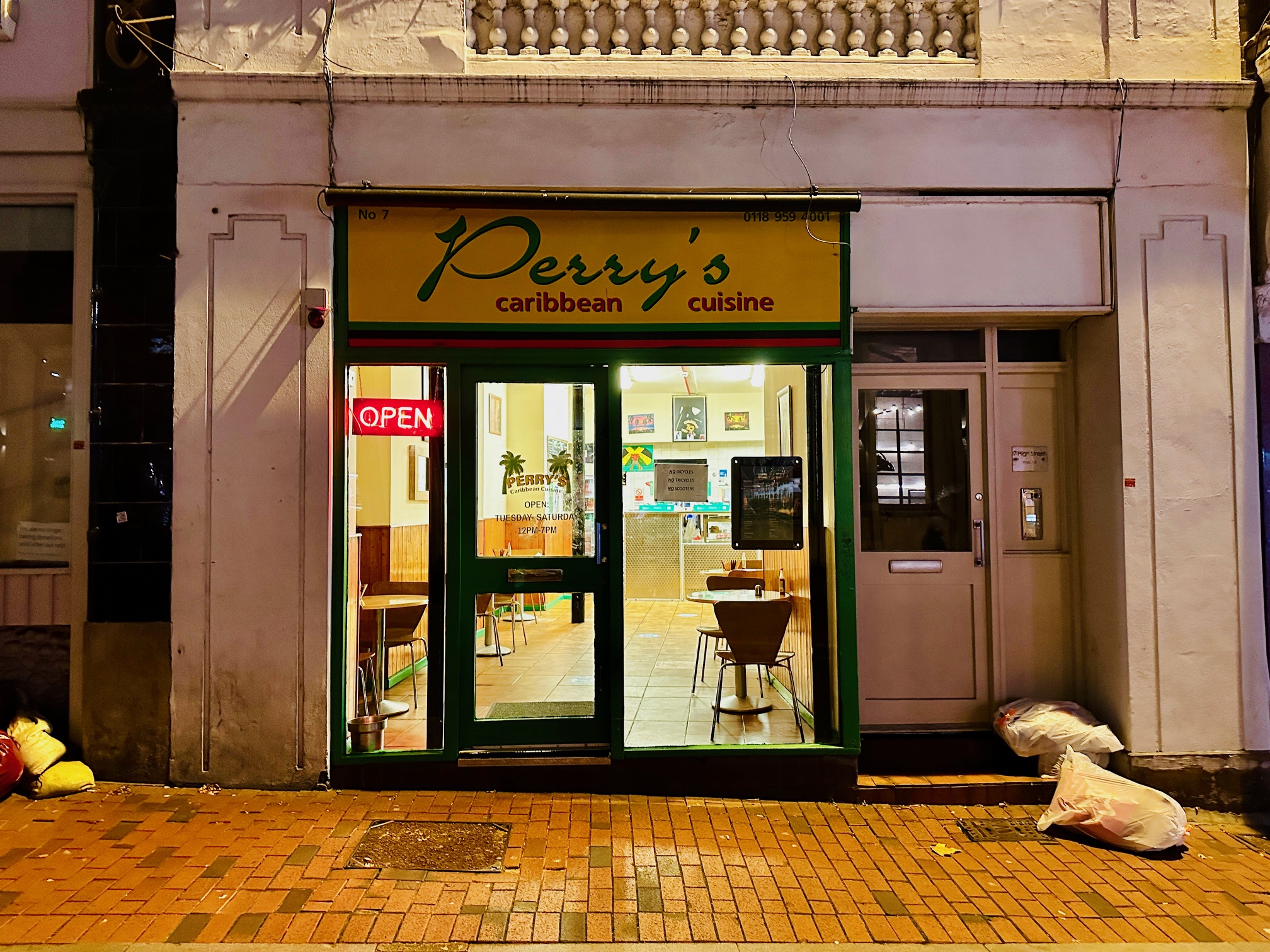
And then I decided: this week I would review Perry’s, one of the final 2013 venues I’m yet to revisit for the blog. And I’d ensure my review was no more than 1634 words, the magic number I used back in 2013. So I’d better get started, hadn’t I, because I’ve used 363 of them already.
Subscribe to continue reading
Become a paid subscriber to get access to the rest of this post and other exclusive content.
As I’ve said before, when I write a restaurant review I find it helps to have a hook. Why this place this week, out of all the restaurants out there? Why do I think you might want to read about this one? Sometimes it’s easy – with a new place, a change of management or an old place with a new chef, or somewhere that’s been mentioned in dispatches in the local or national press. Other times, it’s about the wider context: for instance the trend for biryani or sushi places in Reading.
But there always, ideally, needs to be something. I never assume I can just plonk a review up on the blog and expect people to read it no matter what: attention, like money, is a scant resource these days. Everybody’s got to earn it.
With Calico this week I was spoilt for choice, because I could think of three angles. The first is that Calico – technically “Calico Bar & Eatery”, but let’s not call it that because ‘Eatery’ is so naff – belongs to that niche club of Reading restaurants where everybody knows it exists, but nobody seems to know anyone who’s been. I’m sure some of you have, don’t get me wrong, but I’ve never heard anybody talking about it. This is possibly the easiest “in” for a restaurant review, because you might want to know whether Calico is any cop; don’t worry, I will eventually get round to telling you that.
Subscribe to continue reading
Become a paid subscriber to get access to the rest of this post and other exclusive content.
I was meeting my friend Graeme for the first time in a long time last Friday, and we were dead set on getting to the Nag’s in good time to bag a table, get through plenty of great beer and have a very long overdue catch up. But where to eat beforehand? We wanted somewhere quick and casual, not too pricey, and that end of town. And then I realised that this perfectly summed up Manzano’s, the once infamous peri peri chicken restaurant on the side of the Broad Street Mall.
Subscribe to continue reading
Become a paid subscriber to get access to the rest of this post and other exclusive content.
Six years ago I wrote a piece on the blog, a listicle really, talking about the five things Reading still badly needed. Don’t worry, I won’t send you scurrying off to read it, but the tl:dr version is that, back in 2018, I thought Reading was still missing a proper cooked breakfast place, a tapas restaurant, a gelataria, a cafe that was simultaneously comfy, did good coffee and good food and, for want of a better expression, a “special occasion restaurant”.
Without going into detail, I personally would say that in the intervening six years we haven’t got a great deal closer to having any of those things. But that’s not why we’re talking about Storia in Maidenhead this week: we’re talking about Storia because when I posted about this on Facebook a couple of weeks ago somebody commented saying that, in addition, Reading was lacking a decent independent Italian restaurant. And that comment stopped me in my tracks because – you know what? – that person was right.
Granted, away from the town centre you have the likes of Vesuvio out west and Papa Gee north of the river. And in town you do have pizza options, in the shape of Sarv’s Slice and Zia Lucia. But the demise of Pepe Sale earlier in the year does mean that, for the first time in a very long time, all the Italian restaurants in the town centre are chains: the likes of Zizzi, Carluccio’s and Bella Italia have a stranglehold on central Reading. And the more recent trend of pasta specialists, starting in London with the likes of Padella and Bancone and now cropping up elsewhere, like Little Hollows in Bristol, has also passed Reading by completely: no, town’s short-lived dalliance with Coco Di Mama really doesn’t count.
The one exception, arguably, is Mama’s Way. But although I love it I’m not sure that a restaurant with a capacity of half a dozen (and I’m being generous) is really even in the same ballpark as what we lost when Pepe Sale closed. And the closest thing I can think of to Pepe Sale is miles away to the west – Newbury’s Mio Fiore is a downright lovely spot, but that can be a half hour train journey.
No, that person commenting on my Facebook post was spot on – it’s a big gap in the market in Reading, and it’s striking that nobody has rushed to fill it. Perhaps in the fullness of time Zi Tore, which is going to take over the Grumpy Goat’s site on Smelly Alley, will redress the balance. But it’s hard to get excited about a place boasting Italian street food when the last place to attempt that shtick was Wolf. So this week I decided to check out Maidenhead’s Storia, which had been recommended to me by more than one reader of the blog, in the company of my good friend Jerry (regular readers will be pleased to hear that his digestive issues are now a thing of the past).
The strange thing is that Maidenhead already has a perfectly acceptable if unexciting Italian restaurant in the shape of Sauce and Flour. And Storia is a stone’s throw from that, literally two minutes’ walk away. Not for the first time on a visit to Maidenhead I wondered it if was just rubbing it in that it had some of the things Reading still lacked. Tapas bar El Cerdo was testament to that, as were our very enjoyable pre-dinner drinks at A Hoppy Place. I even had to walk past a branch of Coppa Club on my way to Storia, although that’s maybe less enviable.
That said, Storia is independent but that doesn’t mean it isn’t a chain. It’s the only Berkshire outpost of a group of six restaurants, with others scattered across Surrey, Hertfordshire and, randomly, the edge of Essex. I think that showed in the polish of the place when we arrived – it’s a handsome building which was welcoming from the off and the service was very slick. It was a grown-up space, too, quite classy with good use of mirrors and lighting to make up for what I imagine, in daytime, is a relative lack of natural light.
The tables along the walls were the ones you really wanted, all plush banquettes, but actually I didn’t mind missing out on those because our generous-sized table gave us a great view of the big and buzzing dining room. The whole thing had a feel of affluent happiness about it. It was Friday night, the weekend had arrived and Storia was going to do its damnedest to make sure people thoroughly enjoyed it.
There was very little to dislike about the menu but, simultaneously, I was surprised by how unexciting it was. Storia plays it safe with a menu that very much replicates the likes of Coppa Club down the way with very little sign of quirk or anything especially regional: half a dozen starters, a “raw” section made of up carpaccio and a strangely conspicuous ceviche, some pasta dishes, half a dozen pizzas and as many secondi.
I found it disappointing that all the pasta dishes were priced, and presumably sized, as main courses only – which again, felt more like the stuff of the bigger chain restaurants. And pricing also felt very conventionally done: starters around ten pounds, everything else between fifteen and twenty.
It made me wonder, not for the last time that evening, whether I was just jaded. Because I saw loads of things I could eat but nothing I was dying to try, and that in turn made me think about San Sicario, which closed last year, and what a terrible pity that was. And it also made me think of the interesting, resolutely all-Italian wine lists at San Sicario and Pepe Sale: would they have been seen dead having, as Storia did, an Argentinian Malbec, a Chablis and a Rioja on there?
We ordered a bottle of Valpolicella at £42. They brought a posher bottle by mistake, one twenty pounds more expensive, and I just managed to stop them before they opened it. Our wine was quite nice, but throughout the meal I wondered what the costlier one would have been like.
Jerry loved his starter – a sardine bruschetta with two filleted sardines perched on a pile of roasted peppers and aubergine, punchy with harissa. It was a riot of colour, and ironically one of the best things about it was the bread – properly golden and grilled, the perfect vessel. I got to try a bit and I liked the sardines a lot – in fairness I always do – but the rest of the dish felt a little incongruous, like an attempt to do something North African rather than the more obvious caponata. I quite enjoyed it, but it made me crave caponata more than anything.
“I’m in Lisbon towards the end of the year. Would you like me to bring you back a couple of tins of sardines?”
“That would be marvellous!” beamed Jerry.
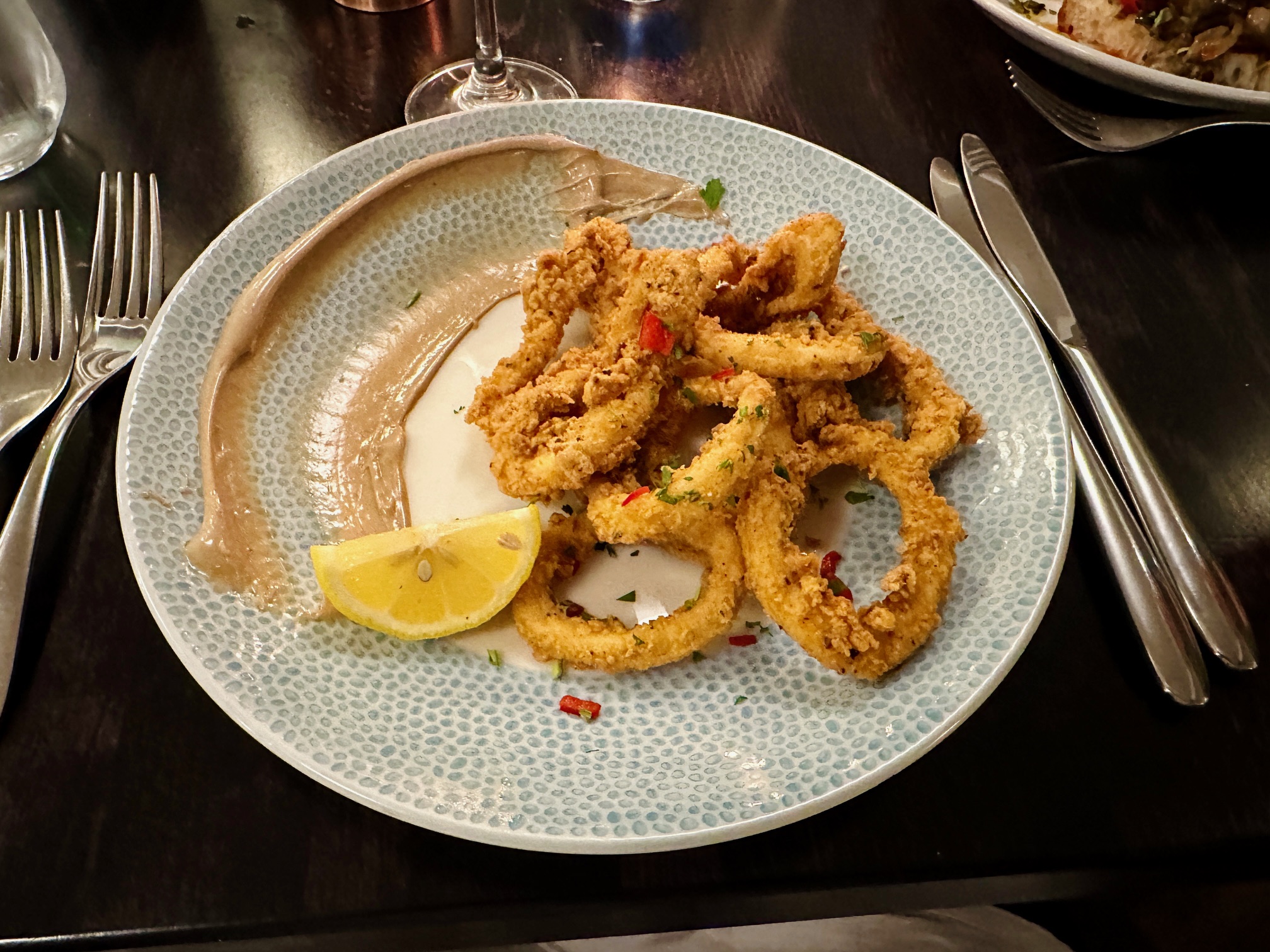
My starter was the best thing I ate all evening. Storia’s calamari was very, very good – fresh, not bouncy, with a crispy, craggy coating which felt like it had some polenta flour in the mix. The whole thing was lightly scattered with red chilli and the decision to serve it with black garlic aioli rather than its more prosaic sibling was an excellent one, even if the smear slightly detracted from the undeniable visual appeal. It made me wish that Storia did a fritto misto, or perhaps it made me wish that Storia was the kind of restaurant that had fritto misto on its menu.
The secondi on Storia’s menu, I’m sorry to say, are really stuff. Forget your lamb rump, your saltimbocca or your suckling pig, because you won’t find them here. Instead there’s a chicken Milanese, a grilled chicken breast dish with marsala, a couple of fish dishes, steak and a risotto. I suspect that, rather than a craving for carbs, is what sent Jerry and I scuttling for the pizza and pasta.
Jerry absolutely adored his pizza salsiccia, a very well-trodden combo of salami, ‘nduja, chilli and basil. Again, he was kind enough to let me try some and I had to agree that it was a very solid effort. Slightly better than Zia Lucia’s – and a darned sight less wet and floppy – and not quite as good as the finest examples from Sarv’s Slice. A bit wayward with the toppings and with a lot of crust, crust that wasn’t quite as puffy, airy or leopard-spotted as the very best examples.
It was a nice pizza, and if I ate in Storia again I might well order one. It was not, however, as good as the one you can get in Knead, a five minute walk away.
I’ve saved possibly the most disappointing until last. When it comes to pasta, I often find myself ordering a carbonara these days. There are probably two reasons for that. One is that it’s a very good benchmark and a sign of whether a kitchen knows its stuff: does it come out glorious and golden, or closer to the magnolia horror of Cozze? But an even better reason – durr! – is that when it’s good it’s one of the happiest, most comforting things you can eat. And now there was a nip in the air I found myself drawn to it, far more than some chicken and pesto concoction that had a whiff of Prezzo about it or a conchiglie dish with yet more of that harissa.
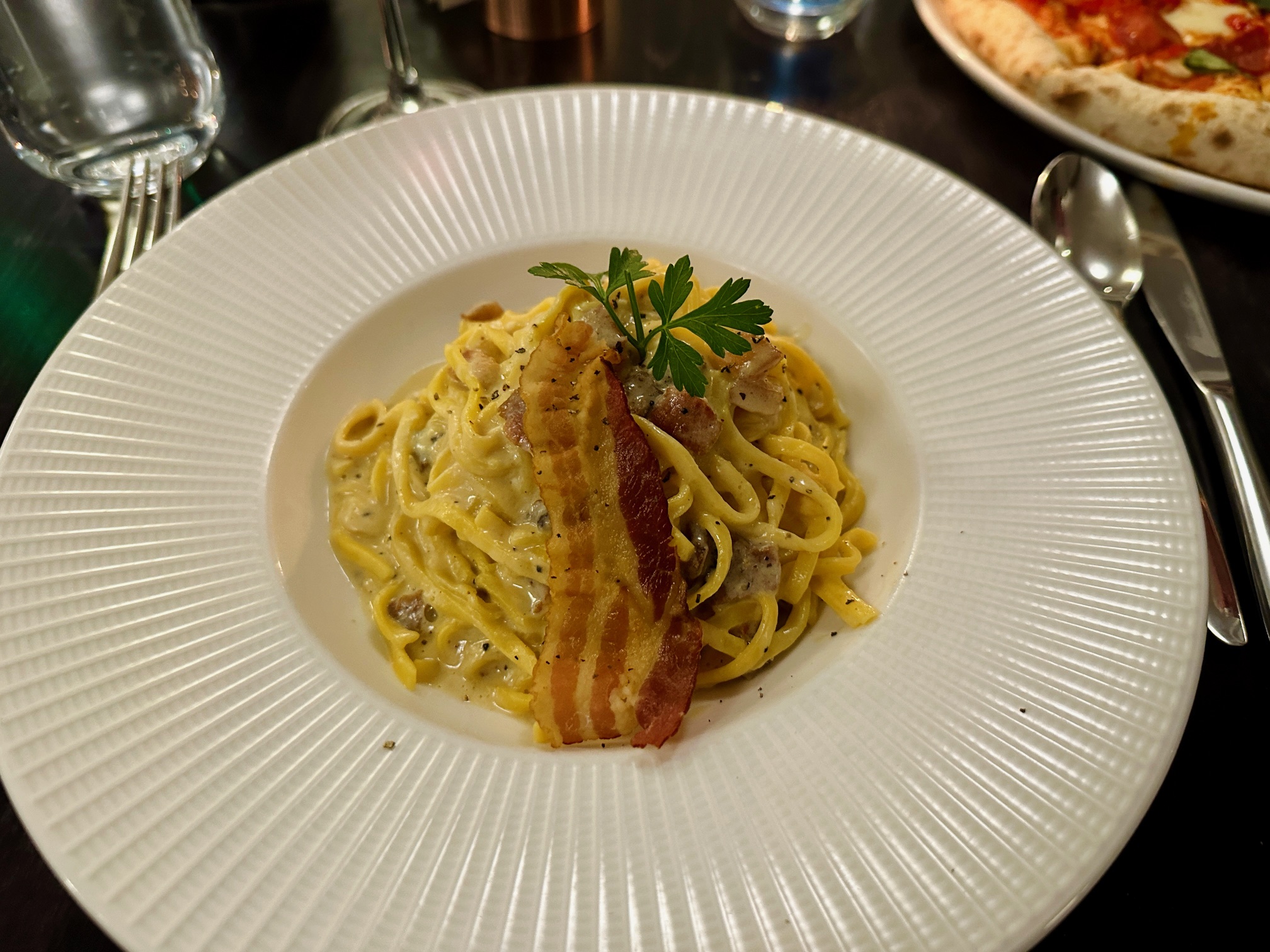
It could have lived up to that promise, and nearly did. The taglioni were beautifully al dente and toothsome, so easy to anchor with a spoon and swirl with a fork, capturing all the sauce you needed. The sauce was good stuff – no adulteration with cream or egg whites here – and topping it with a strip of crispy pancetta was a nice touch, if an obvious one.
But the other star of the show is guanciale, and it needed to be crispy nuggets of the stuff that disrupted all that unctuousness (I mean that in its true sense, by the way) with spikes of smokey salt. And this was underdone, a bit too bouncy, a bit too fatty, falling short. If this dish had been the platonic ideal of a carbonara the rating at the bottom would probably have been a whole point higher and I would be making plans to return before Christmas. But it wasn’t, so the search goes on.
We nearly ordered dessert, but we were that terrible combination of not hungry enough and not fussed enough. But we were having a lovely time, and we had wine left, so we did the next best thing and ordered coffee, just to keep the evening alive that little bit longer. Latte came in a walled glass and was really surprisingly good, so much better than I thought it would be.
Like my old friend, it was sweet without a hint of bitterness, and it made for the perfect end to a brilliant evening. The food had facilitated that, but never even threatened to upstage it; although in fairness I expect I could have a wonderful time with Jerry eating doner meat off a bin lid. Anyway, our meal came to just over a hundred pounds, not including tip: the service very much deserved a tip, so tip we did.
As I said earlier on, I wonder whether I am just jaded about the kind of thing Storia does, even though Storia does it very well indeed. If you want a mid-range, casual dining Italian meal which isn’t going to offend or disappoint anybody, some of which will be good and some of which will be quite nice, you can go to Storia and it will deliver exactly that.
On a good day, so will Coppa Club I imagine, or Zia Lucia. On a good day, Jamie’s Italian used to manage that too. Is that enough? I suppose for many people it will be, and if Storia does that, without fail, time and again, it will no doubt build up a happy and loyal customer base and do extremely well – as it has, I suspect, in Tring and Radlett, in Redhill and Shepperton. History has taught us that there’s definitely a place for that kind of thing.
I guess what Storia reminded me of, strangely, is Strada – remember Strada? – back when Strada only had two branches, before it was possessed by the dread spirit of private equity and went the way some promising small restaurants do. As I think I’ve said before, I used to go to the one in Richmond with an old friend of mine, long since lost in the mists of divorce, and I always loved it. I came away, every single time, wishing Reading had one.
But when it did, it was no longer the Strada I loved but just Zizzi with a different colour scheme. Storia isn’t that, yet it wouldn’t take a lot of imagination to see how it could get there. And maybe that’s what they’re aiming for – I hope not, but everybody needs to make money. Especially nowadays when the bastard stuff seems to be so very thin on the ground.
So it’s not Storia, it’s me. If you’re like me, you would probably enjoy your meal there. But if you’re anything like me, Storia might also leave you feeling that, even though there’s nothing technically wrong with it, you just want something more these days.
Last year, a couple of gentlemen called Jez and Ken came to a readers’ lunch I held at Clay’s, and they’ve been to every lunch I’ve organised since. They are great company, clearly great friends, both a little older than me. Jez has a line in impressively busy shirts and the personality to carry them off, which is something I envy.
My most recent readers’ lunch was also at Clay’s, and Jez mailed me to express his regret that he couldn’t make it. It was his birthday that day, he said and his wife was organising something for him. What he didn’t know was that his wife had organised something on another day, and had asked Ken to take him to the readers’ lunch as a birthday surprise. Ken asked me if I could find space for them both and happily I could, so he got to celebrate his birthday with sixty or so equally hungry Reading food fans. I love it when things like that come together.
Anyway, the reason I’m telling you this is that earlier in the year – about six months ago – I got messages from Jez and Ken, independent of one another, urging me to put Deccan House on my radar. It’s a little place on Cemetery Junction between the stained glass shop and Ye Babam Ye, ostensibly doing Hyderabadi food: Jez and Ken had gone for dinner there, and both of them were impressed. Jez said it was the first time he’d tried dosa (he sent me a picture, “with my glasses included for scale”). Ken said that although it was a very different proposition to Clay’s he had really enjoyed the food.
Subscribe to continue reading
Become a paid subscriber to get access to the rest of this post and other exclusive content.





 Edible Reading