Over the last nine months or so, every time I’ve posted my to do list on social media and asked where people would like me to prioritise for a review the answer invariably comes back: Flavour Of Mauritius, please. That’s understandable, I think. First of all, there’s the inevitable air of novelty: Reading is excited about new places at the best of times (it’s a town, after all, that managed to get aerated about Jollibee’s) but the prospect of a Mauritian restaurant is bound to arouse the curiosity of the town’s gastronomic adventurers. What’s Mauritian food like, anyway?
Subscribe to continue reading
Become a paid subscriber to get access to the rest of this post and other exclusive content.
I’ve always liked Côte’s food. And I’m a big fan of eating nice meals at home, especially when the wind is howling outside and the garden is relentlessly battered with rain. So this week, I thought I’d see whether it’s possible to appreciate both at the same time.
Côte’s always been arguably my favourite of Reading’s chains and if the last two years had been anything like the two before that, I’ve no doubt that I’d have eaten there a fair few times. Grabbing one of their outside tables on a sunny day for their prix fixe when I couldn’t be arsed to cook, for example, or having a weekend brunch there and enjoying their soft, crumbly boudin noir. And if they’d been on delivery apps, you can bet you’d have read a review of that last year.
But Côte chose a different path, an interesting one that differs from most other chains – and most other restaurants, come to that. Instead of doing takeaways, in the summer of 2020 Côte launched Côte At Home, offering a subsection of their menu that can be easily heated at home. It makes sense, when you think about it: Côte prepared some of their meals in a central kitchen and finished them in the restaurant as it was, and this model converted what you could see as a pre-pandemic weakness into a distinct advantage after Covid-19 struck.
My experiences of heat at home restaurant kits, especially this year, usually left me thinking that I’d eaten a glorified ready meal at inflated prices. Côte offers a simplified version at far closer to ready meal prices, so I wanted to see if they made a case for a better heat at home model. And pricing isn’t the only difference between Côte’s model and operators like Dishpatch. They clearly benefit from scale because they deliver every day, with free delivery if you spend over forty pounds. You have to order forty-eight hours in advance, although some items qualify for express delivery, which means they reach you quicker.
It isn’t difficult to spend forty quid. Everything is crazily affordable – think five pounds for starters, ten to fifteen for mains, and a fiver for dessert – but they also sell a good range of French cheeses, plenty of wine and beer, steak, sausages and confit duck. The latter comes in at an astonishing four pounds fifty a leg, making it miles better value than my meh-fest at Andrew Edmunds. I picked up a three course meal for two, and added a couple of bottles of Meteor to nudge it over the forty pound threshold (it’s a shame they don’t add their Breton cidre to the website: they’re missing a trick there).
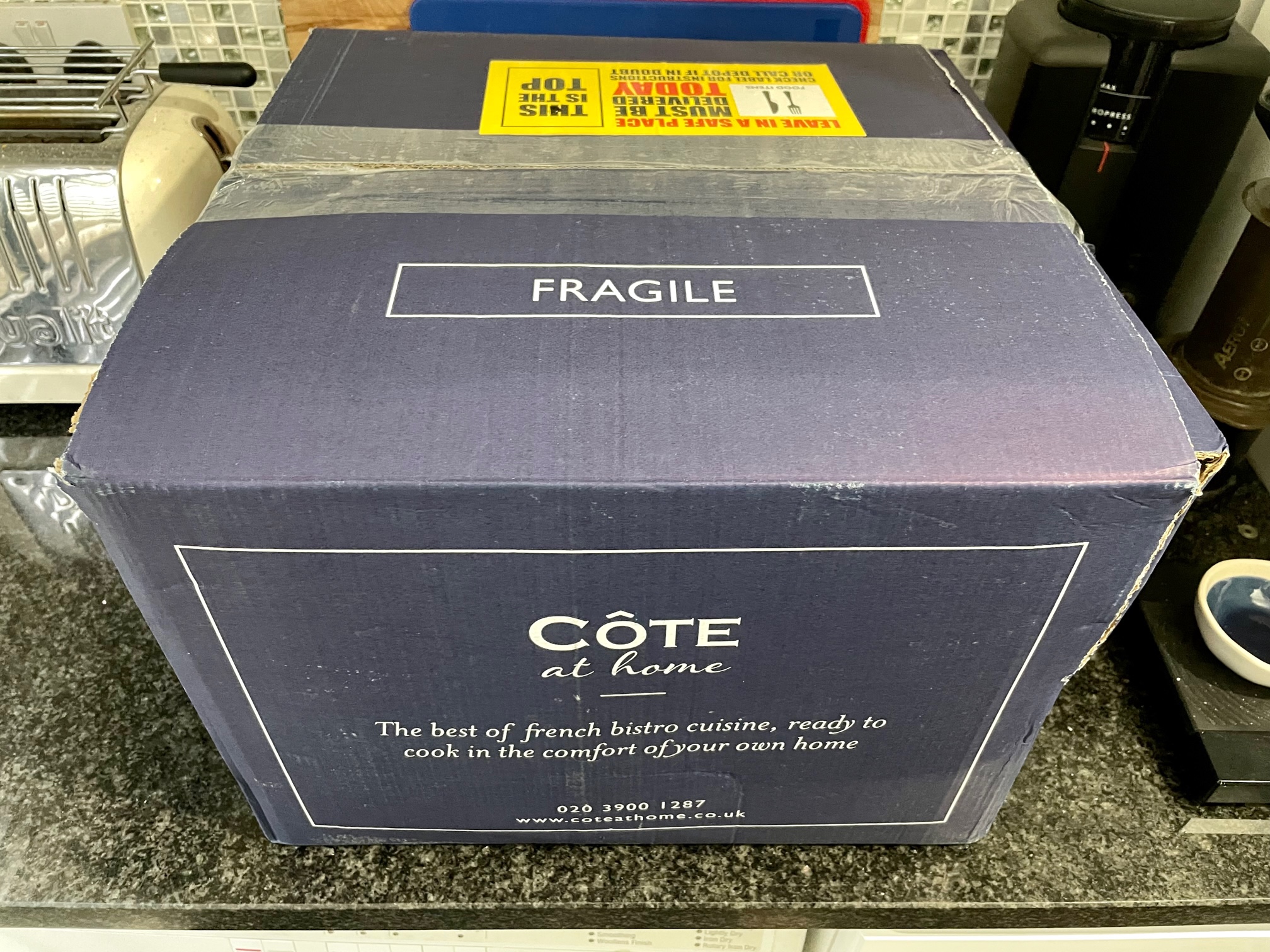
Another contrast between my previous restaurant DIY kit experiences and Côte At Home was how user-friendly delivery was. With the others, you pay over ten pounds for delivery and essentially, they reserve the right to turn up at any point during the day. With Côte At Home, if you pay five pounds they’ll make sure it reaches you before noon. So lo and behold, it was with me first thing in very natty packaging. Inside the box there were an impressive four ice packs, and everything was fetchingly branded. A slip inside explained that literally all of the packaging was recyclable, too. Stowing it all away in the fridge I felt properly curious and excited about the meal that lay ahead, even if it’s the hope that kills you.
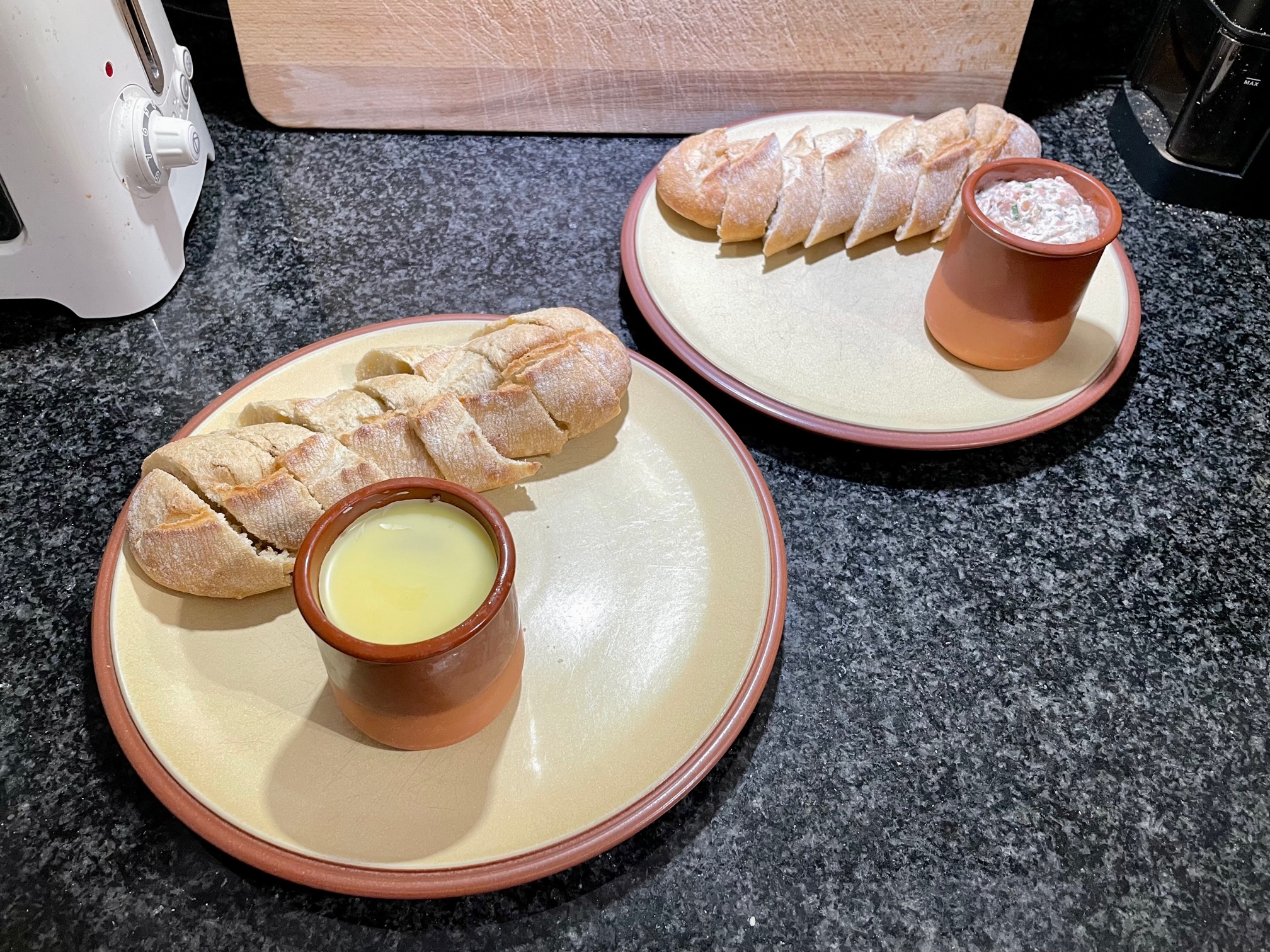
This meal gave me an excuse to try out Côte At Home’s bread, which you finish off in the oven. Back in the day – by which I mean 2014 – I thought that Côte’s bread was the best in Reading, and although many bakers, artisan and otherwise, have wafted through town in the last eight years I still think Côte’s beats most restaurants round here, so I wanted to see how the heat at home stuff compares. And the answer was reasonably well – not up there with, say, Geo Café’s sourdough baguette straight out of the oven that morning (not much hits that exalted standard) but far better than the pasty part-baked baguettes you pick up from a supermarket. They throw in some salted French butter: a nice touch, but really we’d bought the bread to pair with our two starters.
Of the two, as so often, Zoë’s was better. Smoked salmon rillette was properly lovely stuff, a very generous portion in a handsome ceramic pot (“that will be handy for olives”, she said later) with just enough smoked salmon in the mix to give it a wonderfully wintry taste without overpowering matters. It was a model of simplicity – fish, crème fraîche, capers, shallots and herbs – and extremely good value at four pounds fifty. Most of the Côte at home starters are chilled, with a couple you either heat up on the hob or in the oven, but this one struck me as the pick of the bunch.
It was certainly nicer than my chicken liver parfait, also served in one of those pots. And don’t get me wrong, it was earthy, smooth and reasonably indulgent. But it was hidden under a permacrust of clarified butter that was a little too thick and too much like hard work. And fundamentally it just wasn’t the smoked salmon rillette: food envy had set in at that point, and nothing would redeem it. It did make me wish I’d ordered some cornichons to accompany it – a snip at two pounds – or better still, had the foresight to have some in the cupboard.
But again, to put this in perspective, if I’d been served this dish in a restaurant I’d have been quite happy with it. And in a restaurant it wouldn’t have cost five pounds. With all the restaurant kits I’d ordered so far it felt like the price was inflated for what you got – I’m sure Côte At Home benefit greatly from economies of scale, and having that central kitchen, but it does give you an idea just how cheaply you can deliver this model.
I’d like to say that the main course lived up to that promise, but it didn’t quite. Again, it was impressive value: a beef bourguignon for two people, with potato purée thrown in, set you back fifteen pounds, less than you’d pay for a single portion in a restaurant. But there was some inconsistency, both in how you cooked it and how it tasted. Some of Côte At Home’s dishes, like the potato purée, only come with instructions for microwave cooking and for those of us without a microwave that can be frustrating: you’d think they’ve had figured out alternative instructions by now.
That said, the potato puree – which I had to improvise, decant and heat up in the oven – was really very good. It was rich, silky and buttery: in short, far better than anything I could rustle up at home and streets ahead of anything you can buy in supermarkets. More expensive than an M&S “ultimate mash” (though not by much) but easily worth the money.
The problem was the bourguignon. In fairness, when I looked at it there in its plastic tray, brown sludge at the bottom and highlighter-pen-pink nuggets of bacon on top, I thought Oh dear, this just looks like a ready meal. And I was partly wrong, because some lovely alchemy happened in the oven and it came out thoroughly looking the part. And the taste was decent – the onions had softened and sweetened beautifully and the sauce, if thinner than I’d have liked, had all the right notes in the right order.
But a dish like this stands or falls on the star ingredient, and the beef was variable at best. One bit was so tough and fibrous that I gave up trying to cut through it, another was so unpleasantly gristly that I had to abort mid-chew. A dish like this about the right cuts of meat slow-cooked into submission, and there’s no excuse for something this bouncy or unpleasant. “I don’t know what you’re talking about” said Zoë. “All of mine was fine”. So it’s not all bad: if you order this you might get lucky, but don’t be surprised if your other half pulls faces.
We’d gone for a vegetable side of minted peas with baby onions and baby gem lettuce – and again, it only came with instructions for microwave cooking. It reheated just fine on the hob, though, and I liked the dish a lot – the peas still slightly nutty, the mint and garlic butter playing nicely together – but it was a tad annoying that they’d not thought about non microwave users. And the website could do more, I think, to highlight dishes that are microwave only than have a little sentence squirrelled away that says cooking instructions, ready to microwave. But again, a minor irritation in a pleasant, perfectly serviceable meal.
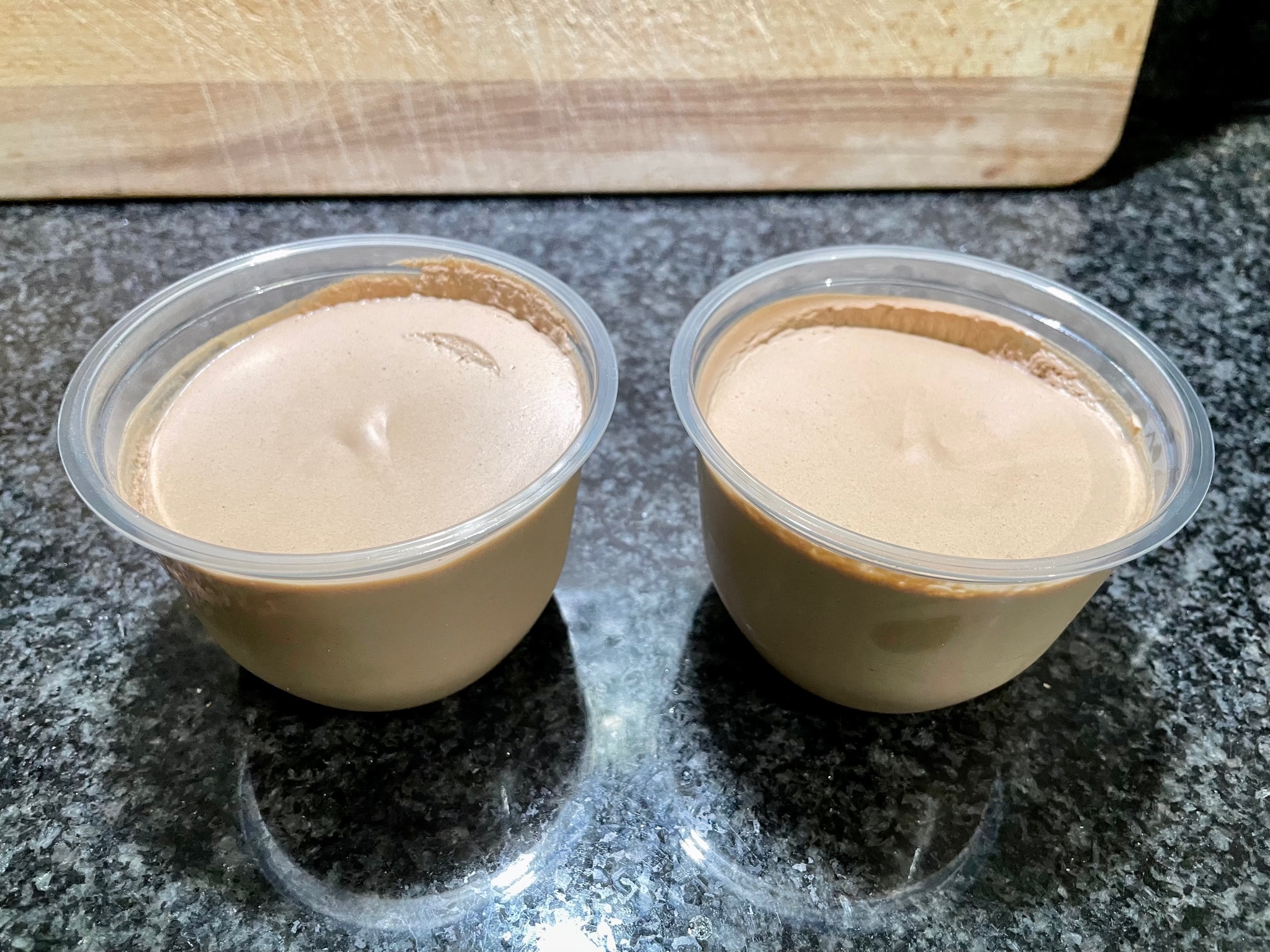
Although Côte At Home sells a tarte aux pommes – which you definitely don’t have to bung in a microwave – and a very tempting lemon posset, along with a cracking selection of cheese including Morbier, Roquefort and one of my very favourites, Saint Marcellin, Zoë and I both found it impossible to stay away from the chocolate mousse. And again, this was close to the restaurant experience at a far lower cost: for three pounds seventy-five you got a dish that would cost you one pound fifty more if you dined in.
And again, it was difficult to distinguish from the mousse I’ve eaten many times over the years at Côte. It was incredibly smooth and glossy, with either very fine bubbles or no bubbles at all, and if I had one criticism it would be that what’s described as a dark chocolate mousse feels about as dark as an episode of The Repair Shop. But looking back at my review of Côte eight years ago I ordered the chocolate mousse for dessert and said almost exactly the same thing. So you can hardly fault them for consistency.
So, with the exception of that unforgivably bouncy meat, Côte At Home was hard to fault. Incredibly generous portions, a routinely high level of quality, a supremely convenient delivery experience and great packaging. And of course you can add cheese, or wine, or confit duck to your order and suddenly it goes from a single meal in to a combination of a brilliant midweek supper and a trip to the deli. So why do I feel like there’s a slight underlying note of being underwhelmed in this week’s review? Do you feel that too?
I’ve been pondering that all week, and I think it comes down to the fact that a restaurant is so much more than its food. Part of they joy of eating in Côte, of what a treat it is, is how convivial it can be – the hubbub, the people watching – and that it can be done on the spur of the moment. It is, as eating out always should be, a bit of a special event. And takeaways can be like that too. I’m sure that at their best – although I’m yet to experience this myself – restaurant DIY kits also feel like a treat. And Côte At Home’s genius is also their biggest drawback: something about it feels unspecial. It really does sit in a new space between ready meals and takeaways, and it’s such a new space that I don’t really know how I feel about it.
And if you need any more evidence that this is an evolving area, you don’t have to look any further than Ocado. Because if you fire up your computer to place an order with Ocado (and if you do, I recommend the M&S “Our Best Ever Steak Pie”: it’s miles better than this week’s bourguignon) you’ll find some dishes from Côte At Home in there. You’ll also find options from Pasta Evangelists, another of the earliest ventures delivering restaurant quality food to your doorstep. And if they don’t appeal, you could just pick up a steak from Hawksmoor.
The lines are getting blurred, and with that come plusses and minuses; you can get fancier versions of the convenience you’re used to, but the experience of treating yourself might lose some of its magic. Convenience, I’m increasingly starting to think, often has that effect. So I would cautiously say that you should give Côte At Home a try. I’m sure I’ll use them again, if only to enjoy confit duck and potato gratin one midweek evening (with a selection of cheese for later on). But I do worry that we’ll reach a stage, to paraphrase George Orwell, where we’ll look from ready meal to DIY kit, and from DIY kit to ready meal, and from ready meal to DIY kit again, but already it will be impossible to say which is which.
There is a parallel universe in which this week’s review is of ThaiGrrr!, the Thai place in Queens Walk whose takeaway I so enjoyed earlier in the year. I’d had a tip-off that the place was almost deserted early in the evening, and so I fully intended to pay it a visit and write it up properly. I’d like to live in that parallel universe. But in that parallel universe I didn’t walk into it and think “what in Christ’s name is that smell?”
And it wasn’t just me – Zoë looked at me and said “this place smells like our old cat’s litter tray”. We waited a minute and the stench – no other word would do – did not abate. And it didn’t feel like an odour to which one could, or would want to, acclimatise. I bumped into the person who’d suggested ThaiGrr! the following day at Blue Collar and told him of our experience. “That’s such a shame, it’s never smelled like that when I’ve gone there” he said. Maybe they were having problems with their drains: I imagine at some point I’ll go back and give it another try. A couple of tables were occupied, possibly by people who hadn’t yet realised that they had Covid.
There’s another parallel universe where, having passed on ThaiGrrr!, we walked home and ordered a takeaway for me to review this week. I’d rather like to live in that parallel universe too, but I’m afraid on the way back we walked past Zero Degrees and Zoë, not unreasonably, said “that place has been on your list to re-review for some time”. And looking in the window it was practically deserted. That made it a safe place to review but, with hindsight, I should have taken the hint; when a restaurant that’s been trading for nearly fifteen years is dead on a school night, there’s probably a reason for that.
Subscribe to continue reading
Become a paid subscriber to get access to the rest of this post and other exclusive content.
Gordon Ramsay Street Burger closed in March 2025 for the foreseeable future. I’ve left the review up for posterity.
“What’s your angle for this one?” said Zoë when I told her this week I was going to review Gordon Ramsay Street Burger – or just Street Burger, because they use both interchangeably, but not Ramsay Street Burger which conjures up images of Lou Carpenter, a man a million miles away from being a beefcake. “You can’t go on about burgers again, because you did that a few weeks ago.”
“There’s only one thing for it, I’ll have to talk about Gordon Ramsay.”
Ah yes, Gordon Ramsay. What’s left to say about him, with his curiously line-free forehead, the gratuitous shirtless shots in Ramsay’s Kitchen Nightmares, the countless omelettes contemptuously tossed in the bin and all those expletive-laden meltdowns (he may be one of the only people alive who swears more than my other half). And that’s before we get on to his complicated life: the man’s father in law went to prison for hacking into his emails, for goodness’ sake.
And yet, I don’t really have an opinion on Ramsay. I dimly remember Kitchen Nightmares being watchable and full of good sense: don’t do too much, have a compact menu you can actually execute, advice many restaurants would do well to follow today. And I watched some of his American shows, which were usually plain nuts, but after that I never gave him much thought, except to vaguely think he was gradually becoming a parody of himself, as so many of us do. Describing Gordon Ramsay: done.
I knew that Ramsay had a vast restaurant empire, that his eponymous restaurant in Chelsea still had three Michelin stars, and I knew he had trained under Marco Pierre White before fostering the talents of Marcus Wareing, Angela Hartnett and Clare Smyth, all now Michelin starred themselves. But I didn’t see Ramsay as a chef these days, any more than I did Jamie Oliver. Crucially, I doubted he had an awful lot to do with Street Burger, which opened last month in the Oracle.
But looking at TripAdvisor before my visit, I was struck by how many reviewers held him personally responsible for their meal. “Sorry Gordon, I won’t be rushing back!” said one, followed by “Sorry Gordon, I wanted nothing more than to enjoy your place today… but today’s food didn’t reflect you or your food at all”. I was reminded of the types who reply to celebrities on Twitter, blissfully unaware that their bons mots will never be read. “My wife and I were very excited to be going to Gordon Ramsay’s, albeit a Street Burger” said a third. And then the coup de grâce: “We had high expectations as it has Gordon Ramsay’s name attached” said a disappointed diner.
Come off it. Gordon Ramsay’s probably never even set foot in the kitchen of his Reading restaurant – hadn’t these people been to Jamie’s Italian? Yet other TripAdvisor writeups painted a positive picture: many praised the service, and a lot did that thing where they name-checked a particular server (Sam and Lauren seemed especially legendary). So, a curate’s egg: I reckoned that alone made it interesting enough to visit.
“I’ve read the TripAdvisor reviews” said Nick as we took our table, and I realised I might finally have found a dining companion who did more homework than me. “They’re surprisingly good, although people seem unimpressed by the bottomless soft drinks.”
We sat outside – a combination of my caution and a temperate evening – so we definitely didn’t get the best of the restaurant, because the inside looks good. It’s more reminiscent of an upmarket steakhouse than a burger restaurant: it’s how Miller & Carter ought to look, instead of resembling an airport Wetherspoons with its whiff of bad carpet and pre-vacation despair. Street Burger had booths and banquettes, fake brick-effect wall panelling and faintly abstract wall art and struck me as an agreeable place to spend an hour eating a burger. Maybe that’s why it was doing so well.
The menu purported to be a model of simplicity: any burger with fries and the aforementioned bottomless soft drink for fifteen pounds. A bit random, because it meant that their basic cheeseburger (the “O.G.R.”) cost exactly the same as the even more dismally named “#BAE Burger” – yes, it honestly has a hashtag in the name – which is the same, but with bacon and a fried egg.
Names aren’t the restaurant’s strong point – their lamb burger is called the “Where’s The Lamb Burger?”, which strongly implies that it doesn’t contain any lamb. It does (a sharp-eyed reader has since pointed out that this is an in-joke referring to a much-memed moment: if you’re explaining, you’re losing). But what do you expect from a restaurant that calls itself “Street Burger” when it’s neither street food nor even – in the case of the Reading branch – on a street?
It’s a more limited menu than at Ramsay’s original burger restaurant in Vegas. There you choose from eleven different burgers (including the “UK Burger” made with something called “Dubliners’ Cheese”: geography’s not a strong point either). But in Reading there are just three beefburgers, that lamb burger, a chicken burger, one vegetarian and one vegan option. They don’t say anything about gluten, so I can’t say whether they offer gluten free buns.
The devil was in the detail because it’s all about the extras. If you want to swap your bottomless fizzy drink for something alcoholic – two beers and just over half a dozen wines are on offer – or a milkshake, that will be four pounds. Sweet potato fries? An extra two pounds fifty. And you can “wagyu up” – because that’s a verb now, I’m afraid – for a fiver (“the reviews on TripAdvisor say it’s worth it, so I’ll definitely do that” said Nick). There’s also an extra called a “cheese skirt”, which sounds like something half of Buck’s Fizz would wear but is in fact an extra slab of grilled cheese.
We placed our order, with various add-ons and extras, and waited to see whether our mild to moderate cynicism would be justified. I should add that we had Lauren looking after us and she was unreservedly lovely all evening: bright, friendly and enthusiastic about the food (between us we ordered her favourite shake, her favourite burger and her favourite add-ons – and if she says that to everyone, she’s at least very plausible). We were one of only two groups sitting outside, but never felt forgotten or neglected.
Both Nick and I have a weakness for milkshakes so we went large, so to speak; I have the build of someone who likes milkshakes, while Nick has the build of someone who likes milkshakes but does lots of running so he doesn’t end up looking like me. He loved his sticky toffee pudding milkshake (“it’s got nuggets of toffee all the way through it, exactly what I was hoping for”), I thought my Oreo milkshake was okay: clearly made with ice cream, and beautifully, head-freezingly cold, but I’d have liked it to be slightly bigger. I could have done without the squirty cream, which makes it look larger without bringing anything to the table. On the menu shakes cost six pounds fifty: both that, and the four pound upgrade, felt a bit sharp.
“I miss the milkshakes at Ed’s Easy Diner.” said Nick. You’d be surprised how many Reading residents have said this to me. “There’s nothing like a malted shake.”
Our food came out relatively quickly, and this was the point where we had to start eating both our meals and our words. Because really, there was lots to like. I’d chosen the fried chicken burger and was pleasantly surprised. It had good spice and crunch, a slightly soggy hash brown underneath, a good whack of cheese and a piquant bright orange sauce, much of which had seeped out onto the tray. The hash brown felt like padding, and the whole thing was almost well-behaved and prim – you didn’t quite have to unhook your jaw to eat it – but what was this strange feeling? Could it be that I was… enjoying it?
As if he was reading my mind, Nick spoke.
“You know what? This really isn’t bad at all.”
Nick had gone for the hashtag burger (I can’t type its real name out again, and you can’t make me) and again, it looked pretty decent – a sensible size with a glorious-looking fried egg and nicely crispy bacon in the mix (“it’s streaky”, he confirmed). A good firm brioche bun, too, which didn’t go to pieces the way, say, Honest’s sometimes can. Nick seemed to be thoroughly enjoying it.
“It’s not as hot as it could be” he said, “because they’ve used these stupid trays.”
“Tell me about it, mine too. It’s like the hubcaps they use at the Last Crumb that mean your pizza’s cold by the time you’ve finished your first slice.”
“But that aside, it’s really good. These chips are good too – they’ve got proper crunch to them.” I agreed with him, and even as they got a little lukewarm they were still well worth dipping in ketchup and dispatching.
“Was it worth upgrading to the wagyu?”
“Not really, but then I’ve not had their normal beefburger.”
“But how does the wagyu compare to, say, a normal burger from Honest?”
“I can’t say I notice enough difference.”
We’d also ordered onion rings and, just as with the rest of our meal, they were well executed, but with just enough shortcomings to irk you. Laying them all out flat on one of those thin trays, in a weird homage to the Olympic logo, just meant they went cold quicker (and exposed how few you got). But even so, they were worth ordering – they held their shape well and the batter had seeds in it which gave an excellent texture and an extra dimension. They were great with both the dips they came with and again, even as they cooled we still wanted to polish them off.
“I prefer these to Honest’s onion rings” said Nick. “With those, some of them feel like they’re practically all batter.”
Having unexpectedly won us over with the food, reality bit when our bill arrived. All those extras mount up, and our bill – for two burgers, fries and milkshakes with a portion of onion rings – came to just shy of forty-eight pounds, not including service. But another feature of Gordon Ramsay Street Burger, which has attracted a fair bit of ire online, is that the “optional” service charge is a whopping fifteen per cent.
That’s one thing, but the way it’s presented on the bill is disingenuous. Nowhere on the bill does it tell you what percentage they’re using, but because the service charge appears directly below the line breaking down VAT at 12.5% it felt to me like some deliberate misdirection was taking place. I paid it happily, because Lauren was excellent, but if I’d had a burger and fries and spent some time serving myself refills of bottomless soft drinks I might have felt peeved about being stung for fifteen per cent.
We left discombobulated and in need of a drink – and even now when I reflect on Street Burger I’m not entirely sure what I thought, because it confounded my expectations in almost every way. The interior was nicer than I thought it would be, the service was excellent, the food is well done. I could say that the menu isn’t the widest, but I can hardly blame them for following that advice on Kitchen Nightmares from all those years ago.
It’s undeniably expensive, though, and that’s probably the single biggest thing counting against it. For forty-eight pounds I could eat more, and better, food at many other restaurants in Reading. If I wanted a burger, fries and a shake I’d probably spend around the same at Honest. And Honest always crops up when you discuss burger places in town: that’s how good it is, and how far above the rest of the pack it remains after all these years. Street Burger’s pricing structure is weird and expensive, and Honest offers a better range and better drinks (although I prefer Street Burger’s chicken burger, believe it or not).
So would I go back? Actually, yes. Possibly. At some point. Because the other surprise for me is that this was pretty much the antithesis of greasy, sloppy hipster joints like 7Bone. Portions were restrained – not small per se, but not the kind of overload you might be used to at other places. And I found I rather liked that, against my better judgment. You could almost call it demure, which makes it even weirder that customers have convinced themselves that it’s somehow built in the image of Gordon Ramsay. To paraphrase the great man himself, like fuck it is.
Gordon Ramsay Street Burger – 7.1 Riverside, The Oracle, RG1 2AG 0207 3529558
Over the last eighteen months, the story of Reading’s restaurants has been more about trying to protect what we have than celebrating the arrival of bright, shiny new things. With a few notable exceptions, the significant restaurants to open recently in town have been chains: Wendy’s, The Coconut Tree, Gordon Ramsay’s Profanity Burger. Further afield, however, it’s a different story.
Henley, for instance, now has a big posh-looking place called Crocker’s which contains no less than three different restaurants. The front page of their website carries a photograph of people assembling identical small plates with long stainless steel tweezers, which tells you more than enough about the kind of food you can expect. Henley also has a new steak and seafood place called Shellfish Cow (I know), the second link in a little chain which started in Wallingford. Both these venues are fancy, both look like they’ve had dough chucked at them, both are independent.
But there’s even more of a marked transformation in Wokingham, driven by the ongoing regeneration of the town and the completion of Peach Place. The earliest sign of gentrification was back at the end of 2018 when Gail’s opened there, followed by craft beer bar Sit N’ Sip the following spring. And now Wokingham is starting to attract some noteworthy restaurants, so much so that when I looked at everywhere that had opened since I last visited, I wasn’t sure where to go first.
Should I try Indian restaurant Bombay Story, which inexplicably changed its name from Dabbawalla Indian Kitchen at some point over the last year? Or RYND, which used to be a hipster-milking burger joint on Castle Street and is reborn in Wokingham Town Hall offering “Californian inspired tapas-style dining”? Or Chalk, an independent restaurant that opened at the end of last year in the old Prezzo building on Broad Street?
Well, you know I didn’t pick any of those because here you are, reading a review of Hamlet. I decided on Hamlet, which opened back in May, partly because the menu seemed to have a little more about it. But I also chose it because of the pedigree of the owners: Nick Galer, from the Miller Of Mansfield, told me that they were two old colleagues of his from his days working for the Fat Duck Group. “The early reports are good”, he said, “although I’m never sure about all day dining.”
Hamlet is also on Peach Place with a fair amount of outside space, some of it under cover, and a few heaters which I imagine will need to be switched on around a week from now for approximately the next five months. The outside was doing a roaring trade, although it felt a tad soulless. The inside, though, is quite stunning in its way, all Hans Wegner Wishbone Chair lookalikes and bleached wood tables. There are baked goods on display at the counter and a little deli area where you can buy wine, cheese and charcuterie. It’s all very Scandi, very stylish, but again, ever so slightly sterile.
Anyway, we sat outside because it was a warm Saturday afternoon and I’m a risk-averse wuss. It wasn’t initially clear whether it was table service or if you were meant to order at the counter, but that was partly because when we got there the serving staff were a bit all over the place: they settled down as the first wave of the lunchtime rush subsided.
Casting my eye over the menu, I began to see Nick Galer’s point. Hamlet is open daytimes all week and evenings Thursday to Saturday, and its menu tries to cover every single base. The overall effect is something like a cross between Gail’s and an upmarket version of Wokingham’s Sedero Lounge: so there are brunches until 1pm, sandwiches available until 4pm and small and large plates available from midday until 4pm. So if you’re there between noon and one in the afternoon you can choose between four different sections, you lucky so-and-so. Brunches run from six to ten pounds, sandwiches from seven fifty to a tenner, small plates range widely in price between five and twelve pounds and most of the large plates are between ten and fifteen pounds.
So yes, the menu was even busier than the staff and felt a little confused. I should add that if you go in the evening the small and large plates on offer look a lot more like a conventional restaurant, so it would be easier to treat it as a starters and mains kind of place. Anyway, we ordered a couple of sandwiches to start with a view to moving on to some other dishes afterwards, aiming to cover as many of the sections as we could. I would have loved to try the sausage, egg and Comte muffin, but because we placed our order at quarter past one the brunch section was out of bounds. Rules are rules.
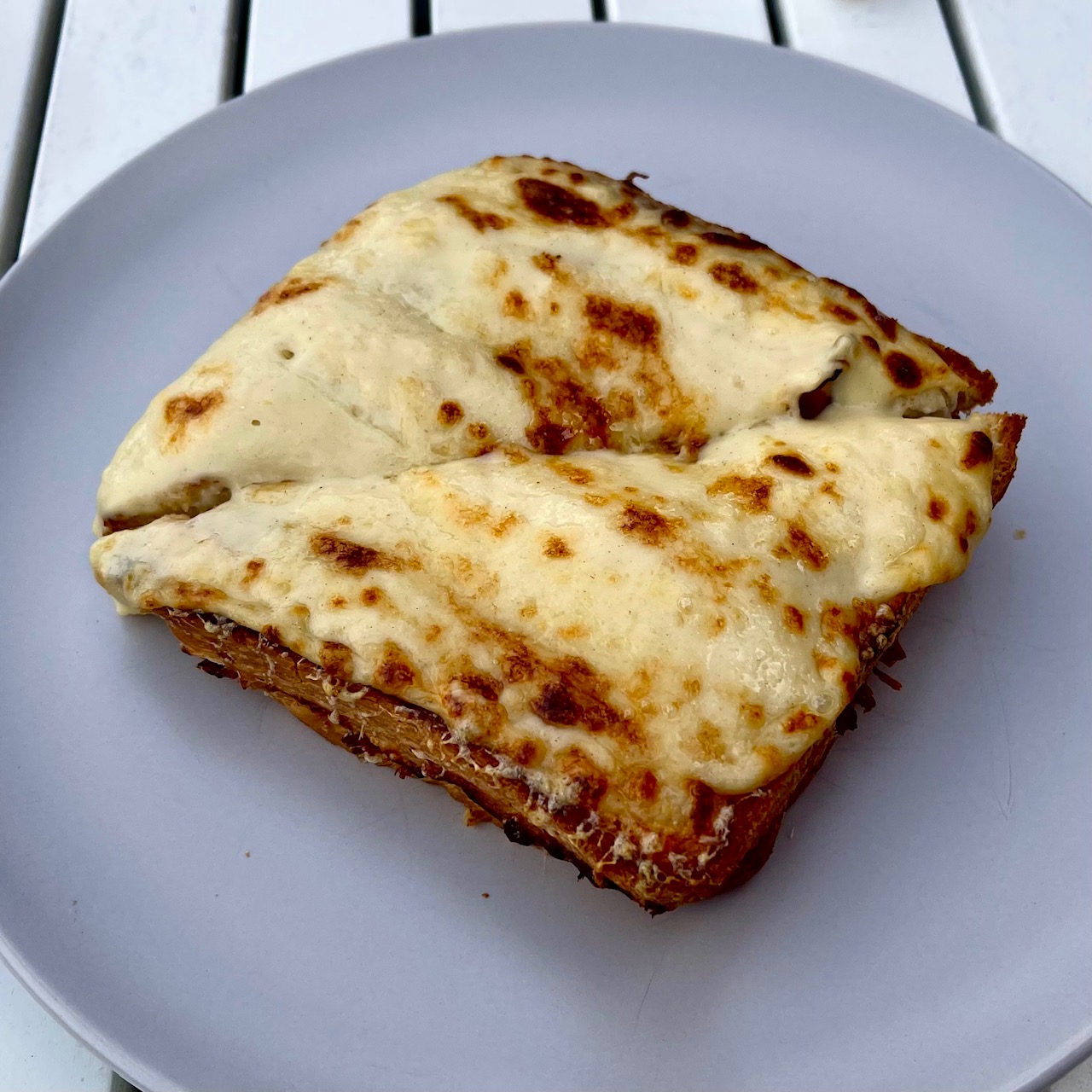
Zoë had chosen Hamlet’s croque monsieur – an excellent choice, and possibly what I would have ordered if I’d had first dibs. It was attractively burnished, covered in that molten, slightly-caramelised topping and with beautiful ham – shredded hock, rather than slices of the stuff – in the middle. The mouthful I got was pretty good, although (and this might be a bit of a trend for the rest of the review) I wasn’t sure it was nine pounds fifty’s worth of pretty good.
“I liked it, but I think it needed mustard” was Zoë’s verdict.
“Didn’t it have mustard in it?”
“If it did, it needed more.”
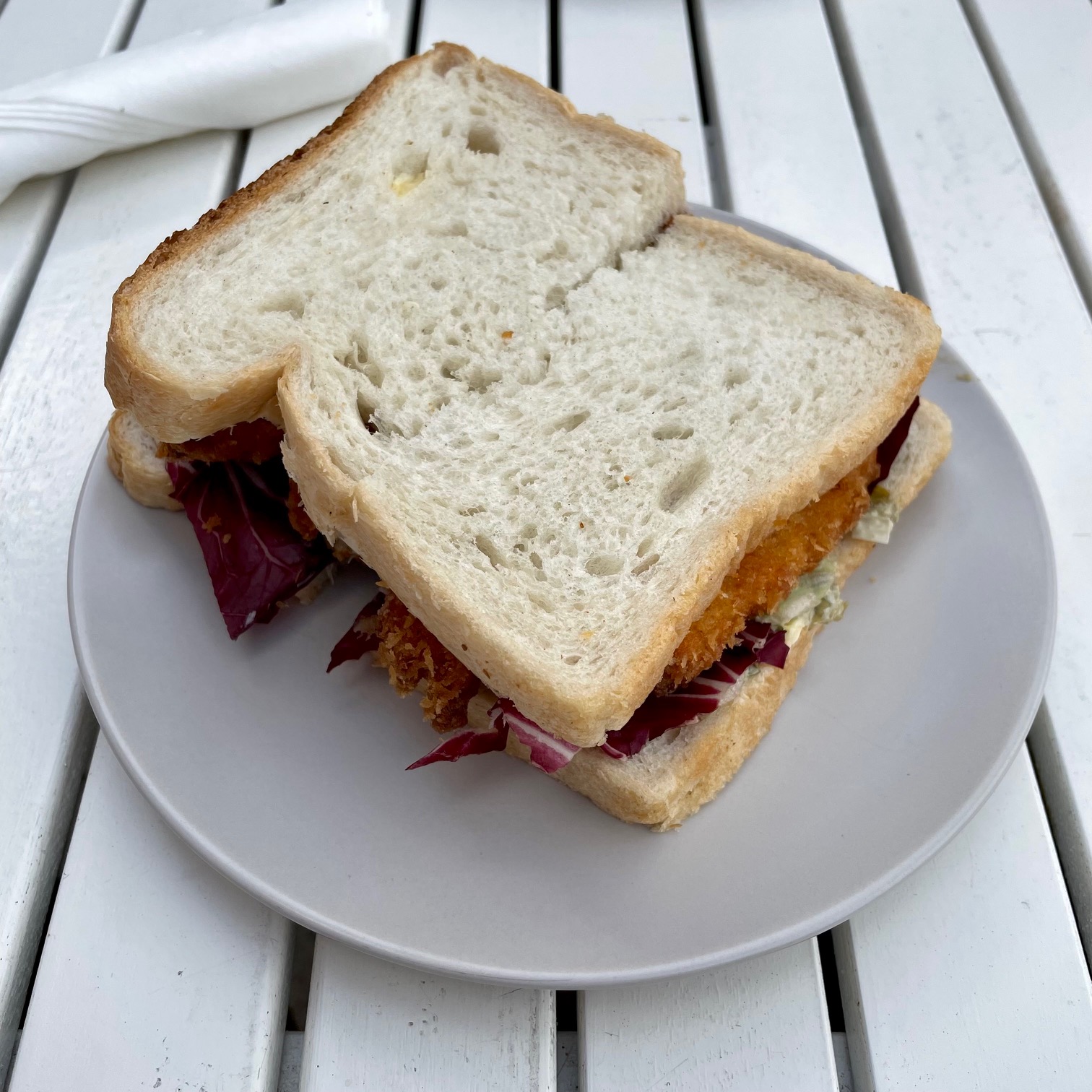
Zoë picked better than me, and my fish finger sandwich was close but not quite there. You could see all the things they’d got right: the goujons were well done, handsome things with deeply pleasing breadcrumbs. And the tartare sauce, made by Hamlet at a guess, was fantastic with plenty of crunch and acidity from the gherkins. But as a sandwich, it didn’t work – the unremarkable white bread just got soggy from all the tartare and fell apart. Putting it in a bun, or at least toasting the slices of bread, would have helped it hold together a lot better. And the decision to put bitter, chewy radicchio in there felt cheffy for cheffy’s sake – iceberg on its own would have been fine.
Was this worth nine pounds fifty? The long answer involves telling you all about Hook & Cook, who are at Blue Collar most weeks. The short answer is no.
If we’d stopped there you’d have got a lukewarm review which might have suggested you’d be better off going elsewhere in Wokingham – and even without the choices I mentioned earlier in this review you could have stopped at the busy food market outside the Town Hall and tried something by Krua Koson, another Blue Collar regular. But fortunately we went on to order some dishes from the other sections of the menu and, to some extent, it was like eating in a different restaurant.
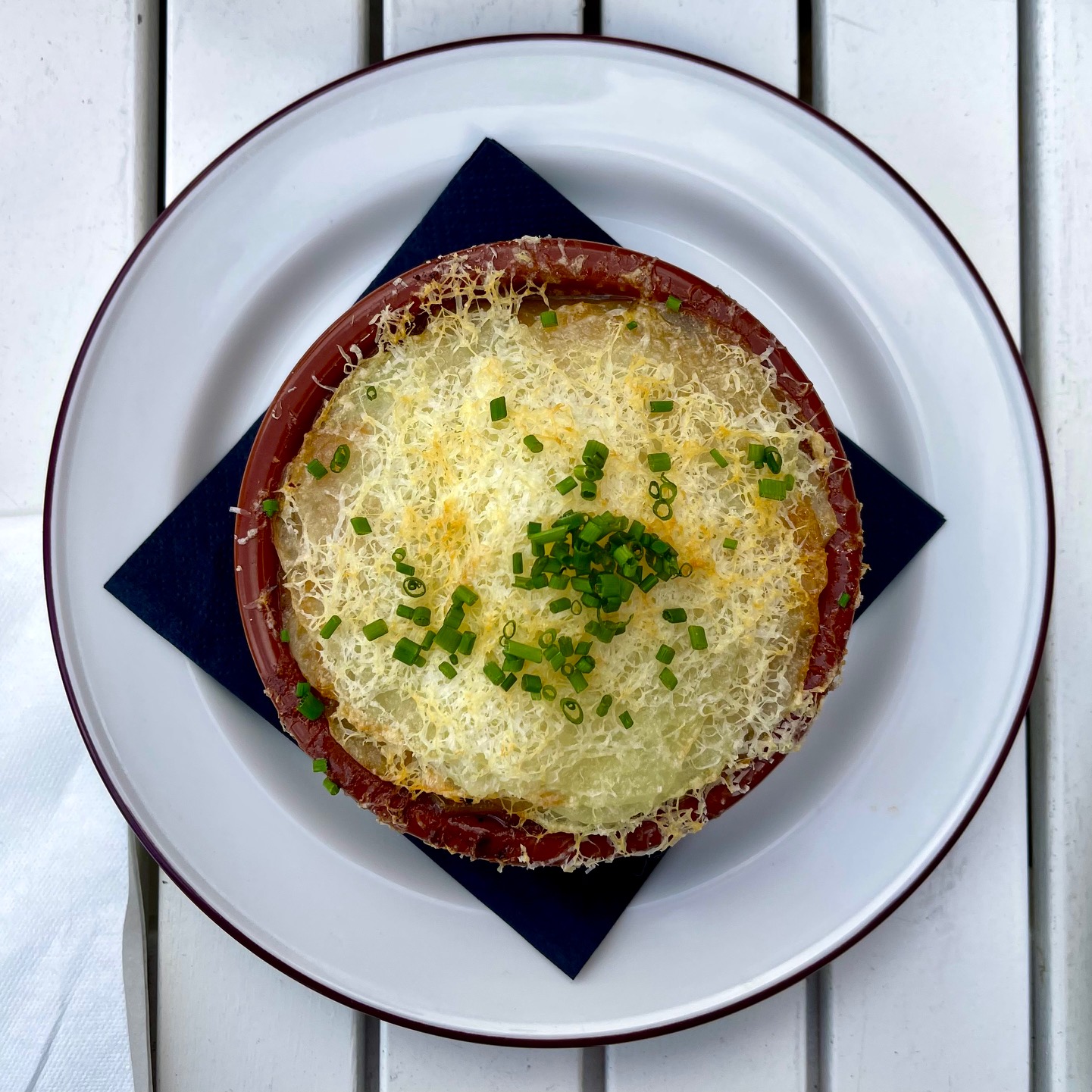
Take the beef boulangère we had, from the small plates menu. A nice-looking dish, with strands of slowly-braised beef in a nearly-sweet tomato sauce, reminiscent of a stifado, and topped with layer upon layer of thinly sliced potato, the whole thing dusted with cheese and chives. A terrific dish – and, although technically a small plate, not too difficult to divide up between two people. Yours for five pounds. Five pounds! You could get two of these for the price of either of those sandwiches, and I think it would be the better choice.
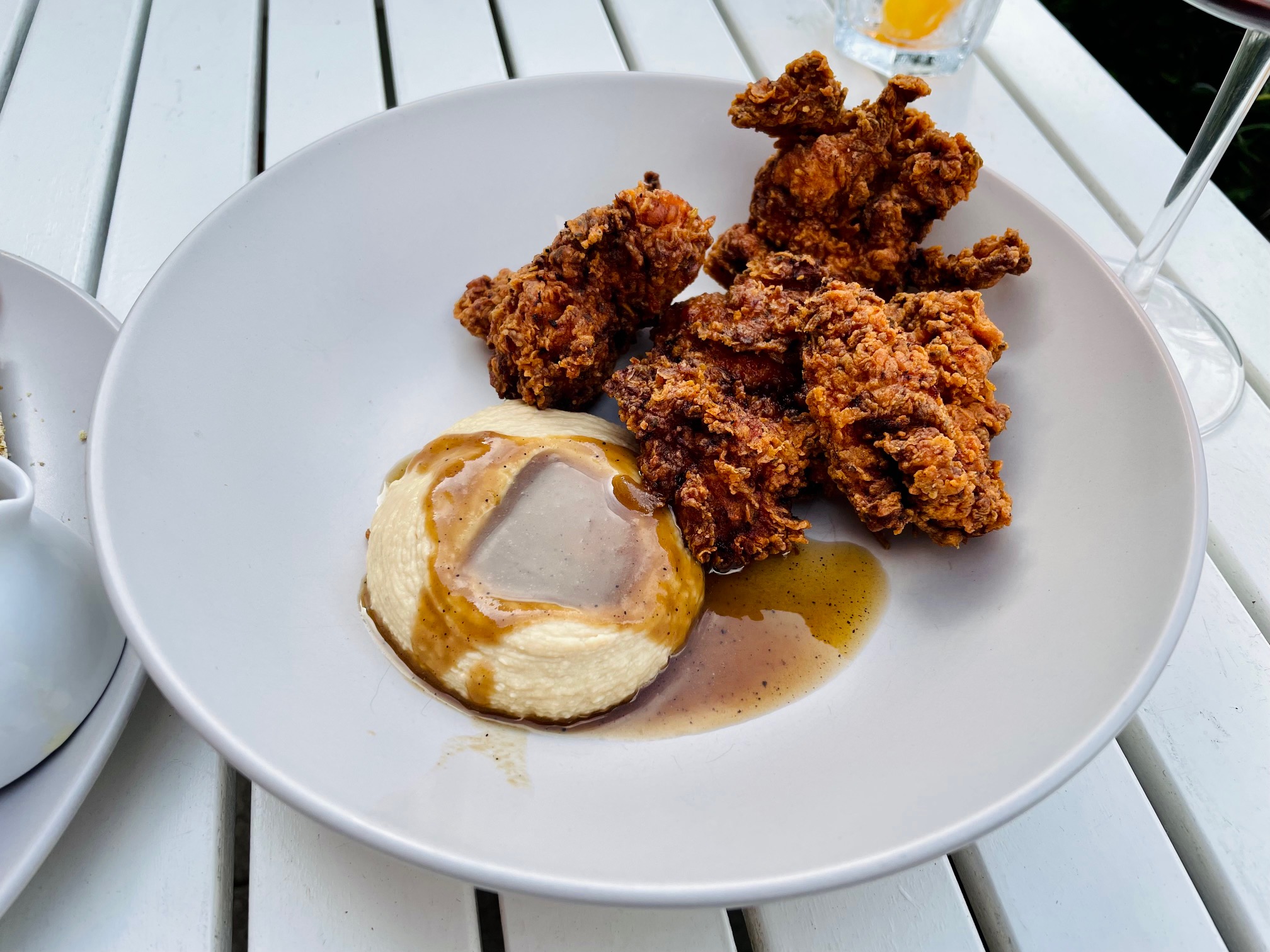
But then, also from the small plates menu, we also ordered fried chicken with beurre noisette houmous. Again, this was a fetching dish – four pieces of gorgeous chicken, all gnarly and crunchy, tender under that coating. Pairing them with houmous isn’t something that would have occurred to me, and pairing the houmous with the almost-caramel silkiness of brown butter certainly wouldn’t have: I’m so used to seeing a bright green well of extra virgin olive oil in the middle of a mound of houmous that I’d never have thought of using anything else.
All those ideas could have come a cropper when combined, but in practice the dish was a revelation. But pricing rears its ugly head again: this lovely dish was twelve pounds. Were you paying for the produce, the idea, the skills involved or the location of the restaurant? And did it matter? I’m not averse to dropping twelve pounds on a small portion of fried chicken from time to time, but will enough people feel likewise?
Last but not least, we’d also nabbed a charcuterie board to share. This is largely about buying rather than cooking, but Hamlet buys its charcuterie from Trealy Farm so they’d bought wisely. Chorizo, a couple of different types of salami (the nicest, for my money, with fennel), some cracking air dried ham and, usually my favourite, a superb coppa. The menu suggested there would also be some lamb carpaccio, but that seemed to have gone missing somewhere.
Personally I like something acidic with charcuterie – gherkins or caperberries – but Hamlet instead added some wonderfully sweet cherry tomatoes, little slices of soda bread and olive oil infused with rosemary. I’d have liked the bread to be a little more substantial, but it was still a great selection. Fifty pence more expensive than the fried chicken, which did make me think – not for the first time – that Hamlet’s pricing was all over the shop.
I haven’t talked about our drinks, but there was a good, compact wine list covering all sensible price points along with around half a dozen cocktails and a handful of beers and ciders, all bottled. Zoë had a negroni, because that negroni habit is coming along nicely, and I had a small glass of a red burgundy which was the costliest wine on the menu. I liked it a lot, but I liked the fancy glasses even more.
Our meal – two sandwiches, two small plates, a large plate, a couple of drinks and a bottle of mineral water – came to just under seventy pounds, not including service. You’re probably thinking “ouch” at this point, and ordinarily this is where I would say “but you could spend a lot less”. But unless you’re just coming to Hamlet for a sandwich and a coffee – and possibly even then – I think you’re going to feel a little stung when the bill arrives.
As I said earlier, table service did feel a little haphazard at the beginning of our meal, but as it went on service got stronger and far more personable. And Hamlet was pretty busy – even later on as we wandered back through Peach Place the restaurant was still doing a pretty consistent trade.
Afterwards we went for a drink at Sit N’ Sip, the craft beer place where, oddly, nobody sitting out front was drinking beer. It wasn’t really my glass of IPA, despite some excellent people watching opportunities. So instead we found our way to the brilliant Outhouse Brewery, which has only been open for three months, and sat outside drinking their very own excellent oatmeal stout. I couldn’t resist trying one of their sausage rolls – made by Blue Orchid Bakery, another Peach Place business – and it was phenomenal, with great pastry and a coarse, dense sausagemeat filling (the fact that I had room for it perhaps isn’t the most glowing endorsement of Hamlet).
I think Nick Galer was right about the challenges of all day dining. Hiding in Hamlet’s menu, a maze of breakfasts, brunches, sandwiches and plates of varying size, there’s a very good restaurant, making itself frustratingly hard to find. I’m sure they’re doing what works for them, and certainly looking on Instagram their lunch menu has been a work in progress since they opened, but for me it felt muddled. Maybe they feel they need to compete with Gail’s during the day and places like Chalk at night. But although the execution might have been uneven, you couldn’t deny that the ideas were there, and along the right lines.
I’m far more tempted to go back in the evening and treat Hamlet more as a traditional restaurant, and when I do I can easily imagine that I’ll have an excellent meal. But even so, they deserve credit for lots of things – for some of the imagination involved, for the stylish space they have created and, perhaps more than anything, for giving it a go during such an awful, challenging time. So there you have it: a polished-looking, high spec, unashamedly high quality restaurant selling interesting, creative food. And a great town centre taproom just around the corner for when you’re finished, into the bargain. In Wokingham. It’s interesting that, for all our chains and burger places, restaurants like Hamlet don’t choose to open in Reading.







 Edible Reading