Kyrenia

Bit of a weird one, this: Kyrenia changed its name in January 2016 to Ketty’s Taste Of Cyprus as it was under new ownership. They never changed the facade, just the website and menu. In Summer 2020 it reopened under a completely new name as Spitiko. I’ve marked this restaurant as closed, and kept the review up for posterity.

I’m sorry, but I’ve got a confession to make. I’m burned out. Running on empty. This whole business of going to a restaurant every week takes its toll, you know (I’m not expecting sympathy, don’t worry). And it’s the end of the year – Christmas party season is fast approaching and I’ve got very little left in the tank. So this week, rather than go somewhere that would be a voyage of discovery for all of us, I went somewhere I know well: I’ve been going to Kyrenia, Caversham’s Greek Cypriot restaurant, for as long as I can remember. I love it – and I’m going to spend this review telling you why, because when I visited it on duty it was as terrific as always.

Besides, it’s been a bit of a bad run recently, hasn’t it? So think of this week’s review as a present to me (because I bet you haven’t got me anything, not even a box of Toffifee).

Kyrenia’s dining room hasn’t really changed in all the time I’ve been going, because it doesn’t need to. It’s perfect, simple but smart – no exposed brickwork and bare bulbs here – with clean white tablecloths, crisp cloth napkins and comfortable unfussy chairs. There are black and white photos on the walls and not much else. The greeting is warm and friendly and Ihor, who runs the front of house, is charm personified (in an endearingly apologetic way, truth be told). Kyrenia has a number of different menu options – they do a la carte, it’s two for one on Tuesdays, there’s a smaller set menu some of the week, but the thing to do here is order the meze, especially if it’s your first visit. I can’t stress this strongly enough: for twenty four pounds a head you get an incredible array of courses and variety (that’s your first tip, right there).

The first thing to arrive were the cold meze, a range of familiar friends and a very easy way to be led astray. Houmous was rich and smoky with a touch of garlic, a world away from the contents of a plastic supermarket tub. Taramasalata – something I avoid anywhere else because it’s often too oily and fishy – was light and delicate. Tzatziki was zingy and fresh, just the right side of tart, the flavour softened with cucumber. All of these came with a basket of warm, griddled, slightly charred pitta bread. That alone would be a feast, that alone would be enough but the other cold dishes were equally delicious. Beetroot, apple and walnut salad was fragrant and sweet rather than sharp and astringent, and potato salad was light and simple, just potato, good oil and parsley.

If I’m being critical (and it’s hard, where Kyrenia’s concerned) the tabouleh wasn’t as vibrant – in colour or flavour – as I’ve had elsewhere, and the olives felt like a space filler, but they were minor issues. This was a wonderful range of dishes, and the nature of it means it works equally well if you’re dining a deux or part of a much bigger group (here’s your second tip: I’ve been in those groups and watched people make the classic mistake – overdoing it on pitta bread and filling up ahead of the other courses. Don’t do this, because the best is yet to come).

Meze1

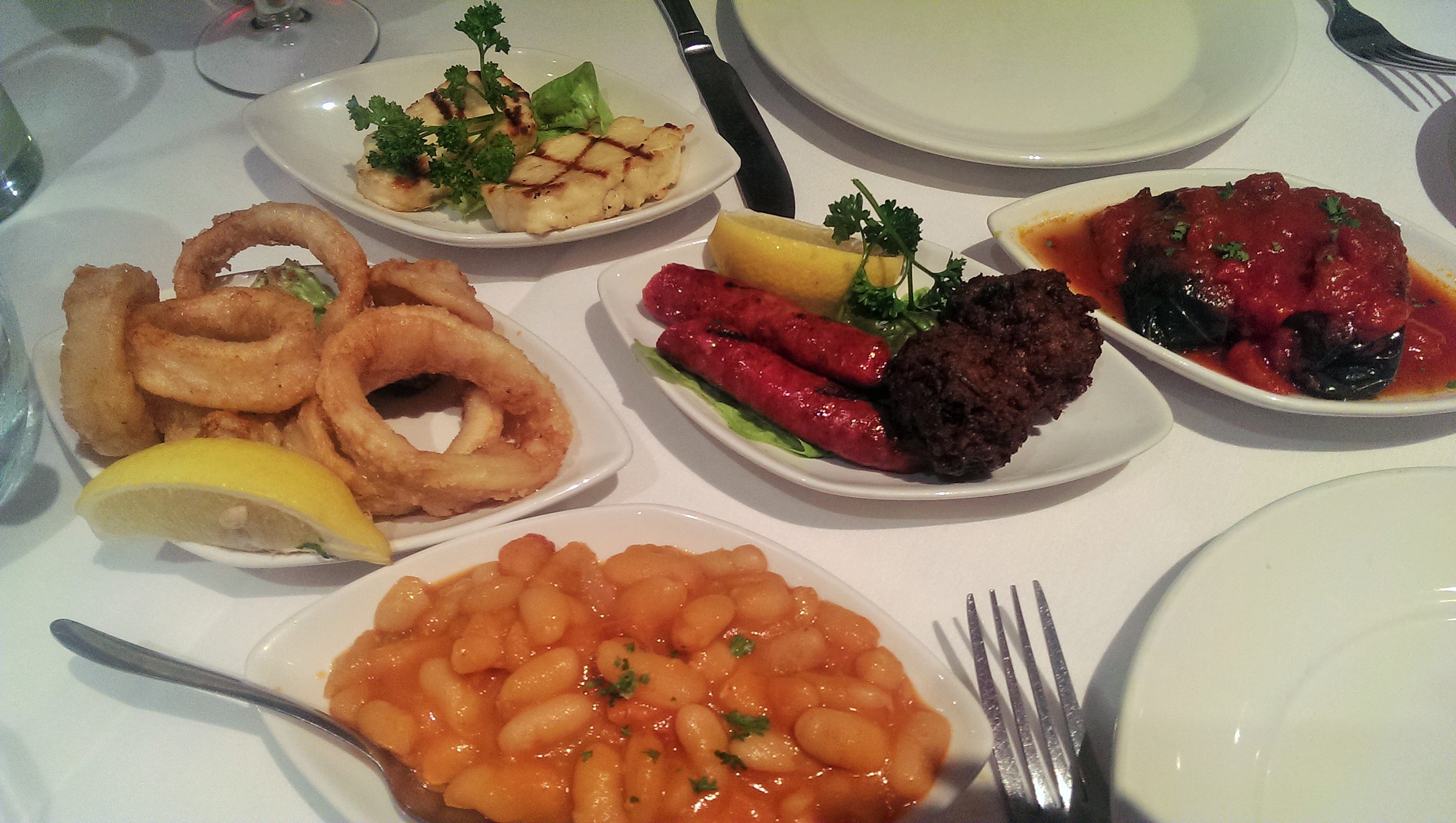
The hot meze only came out when the staff had checked that we were ready – a lovely touch, I thought – and when they did, as always, it became time to reassess how hungry I really was. Meze is about playing the long game, but the problem was that again, everything was too delicious to leave. Some of the classics – halloumi and calamari – were present and correct. The halloumi was unsurprising (halloumi in restaurants is pretty much always the same, everywhere) but still gorgeous, but the calamari was spot on – no hint of rubber, just light batter and fresh squid. They’re classics for a reason, after all.

Most of the other dishes were every bit as good. Lamb meatballs were possibly the pick of the bunch – juicy, coarse and savoury, studded with herbs and onions and a touch of garlic. Loukanika (Greek sausage) was Peperami’s glamorous continental cousin, warm with cinnamon, almost perfumed rather than one-dimensionally spicy. Dolmades had more of that delicious minced lamb folded into them, though there was probably too much leaf and not enough stuffing. The beans in tomato sauce were the only real disappointment – big, bland and filling, they were soon abandoned. Those six dishes may only merit a sentence or so each, but add that to the seven that came before and it starts to become clear: this is a marathon, not a sprint.
Meze2

Of course, I knew from personal experience to keep something in reserve for what came next: although again, only when the staff knew I was ready. The souvlaki – grilled skewers of pork and beef – were pleasant enough (possibly a tad on the dry side), but they weren’t the main attraction here because that was indisputably the kleftiko. I’ve had this dish countless times in Greece on holiday trying to find anyone who can match Kyrenia’s version, and I’ve given up now because what Kyrenia does to lamb is a work of utter genius: the almost godlike kitchen knows how to slow cook it until mere mortals like me struggle to describe how good it is.

It came on a large piece of bone but the merest whisper of effort soon sorted that out, leaving me with an awful lot of the most tender lamb I’ll probably ever eat. It broke into moist, sticky shreds, almost like confit, perfect for smooshing into the juices on the bottom of the plate before eating in nodding, smiling, euphoric silence. Again, because I feel I ought to be critical, the Greek salad it came with was a little underwhelming – but it’s only salad, isn’t it, and a cubes of feta is the perfect partner for a piece of lamb (that’s your third tip, if you’re counting).

Meze3

I also know from personal experience that if you’ve made the rookie mistake of filling up on pitta and tzatziki, Ihor will bag up all your leftover meat in a little foil parcel for you to take home and enjoy the next day. I also know from personal experience that it’s almost as good cold the next day, but take it from me if you go: pace yourself and eat it on the night.

One of the only other disappointing things about Kyrenia is the wine list. Greek wine can be absolutely fantastic, and is much underrated, but Kyrenia only sells a handful of bottles. None the less, the ones they do are lovely – we had a bottle of Naoussa Grande Reserve which was nicely balanced against both the meat and fish in the meal, far too easy to drink on a school night and not at all unreasonable at £23.50.

The last course at Kyrenia, the fruit salad, is really just a palate cleanser. I would be astonished if anyone could eat a “proper” dessert after all those meze so it seems apt that the meal ends with a plate of orange, melon, grapes and strawberry. It worked, though: fresh, bright, sweet and healthy (like Miley Cyrus before it all went so horribly wrong). It didn’t redeem the sins of all that lamb but it helped me fool myself, and very few desserts achieve that.

I’ve mentioned Ihor a few times, but service in general was perfect. All of the staff are so good at what they do, getting all the little touches right. Asking if you’re ready for the next set of courses, finding time to chat, knowing when to offer you extra pitta (although if you’ve read this far, you’ll know to turn that offer down – trust me on this). Again, to be critical I’d say that you should ask to be seated downstairs: sitting upstairs, in a smaller less buzzy room, far from the bar and the kitchen you can sometimes feel a little overlooked. That’s your fourth and final tip – ask for a table downstairs when you book, because they get busy at weekends. Dinner for two – all those dishes and a bottle of wine – came to £71 excluding service. It’s probably the best £71 meal I’ve had all year.

I recommend Kyrenia all the time – to friends and on Twitter – and it was getting to the point where not having reviewed it was looking like a glaring oversight. I went on duty hoping that they had a good night, but I really needn’t have worried because I’m not sure they know how to be anything but brilliant. There’s loads of stuff on the a la carte that I haven’t tried (I’d love to have a go at their stifado, or their monkfish souvlaki) and I know for a fact that their octopus is out of this world, but all of the best evenings I’ve had here have all involved the meze. Unlike most restaurants in Reading, Kyrenia feels like it’s perfect for everything – small intimate evenings, big raucous evenings and everything in between. It’s only a matter of time before I go back – in fact, on the way out I looked in the front door, still shining with that cosy welcoming light, and saw that they’re offering their standard menu on New Year’s Eve. See you there? I’ll be wearing the white carnation and the gold party hat and drinking the Greek red. Yamas (and Merry Christmas!).

Kyrenia – 8.6
6 Prospect Street, Caversham, RG4 8JG
0118 9476444

http://www.kyreniarestaurant.com/
Kei’s

Apologies to any vegetarians reading this, but there are few things in life more joyous than crispy duck pancakes. There’s something about that combination of flavours and textures – crunchy cucumber, soft duck, the particularly prized crispy bits, all salt and skin and the intense, sweet yet savoury hoi sin – all almost visible through the paper thin translucent pancake, rolled up as tightly as your greed will allow and crammed into a hungry mouth. And yet Chinese has to be one of the most under-represented cuisines in Reading. We have Indian restaurants all over the place, we have Italians coming out of our ears, as it were, but where can you go in this little town to overfill on prawn crackers, starters and crispy duck only to be defeated by the main courses?

Nowhere, as far as I can tell. China Palace doesn’t fit the bill, for me at least: possibly because it’s too authentically Chinese and possibly because it’s just not that good. Furama (I have friends who still call it Futurama, which gets annoying after a while) has never impressed me. Reading’s best Chinese restaurant, Chi, closed ages ago after trying three different venues in town. I still miss Wayne Wong’s charming if haphazard service and his delicious food – prawns coated in light, brittle batter with a sticky, sweet chilli sauce, pristine cod smothered in garlic-laden black bean sauce… (I could go on, but I might cry).

So out into Lower Earley, then, where the mini-precinct at Maiden Place has had something of a makeover. Instead of an off licence called simply “Bargain Booze” there is a spanking new WHSmith and some other shops have morphed into a shiny Sainsbury’s Local. On the edge of the precinct sits Kei’s, a restaurant I tried to review once before but left after I was offered a woefully dark and forgotten corner table, despite booking. I’ve got over this now: six months seems long enough to hold that particular grudge. Besides, people do say it’s the best Chinese restaurant in Reading.

Entering a buzzy restaurant on a cold and drizzly midweek night always lifts the spirits, and stepping into Kei’s was no different. The dining room is quite cleverly laid out with the smaller tables grouped together and the bigger, potentially louder, tables at a slight distance. It was so busy that I didn’t even mind waiting for a suitable table to become free (sitting on the squishy three piece suite in reception felt a bit like being back in 1979: I rather liked it). The waiter offered the a la carte or the “eat as much as you like” (which they do Monday to Thursday). At first I picked the former, feeling a little snooty about the latter, but a quick inspection of the all you can eat menu revealed that it had pretty much all of the dishes I’d been salivating over on the website. Plus – and this was the crucial factor – the food is cooked to order rather than sitting on a buffet; Cosmo this ain’t.

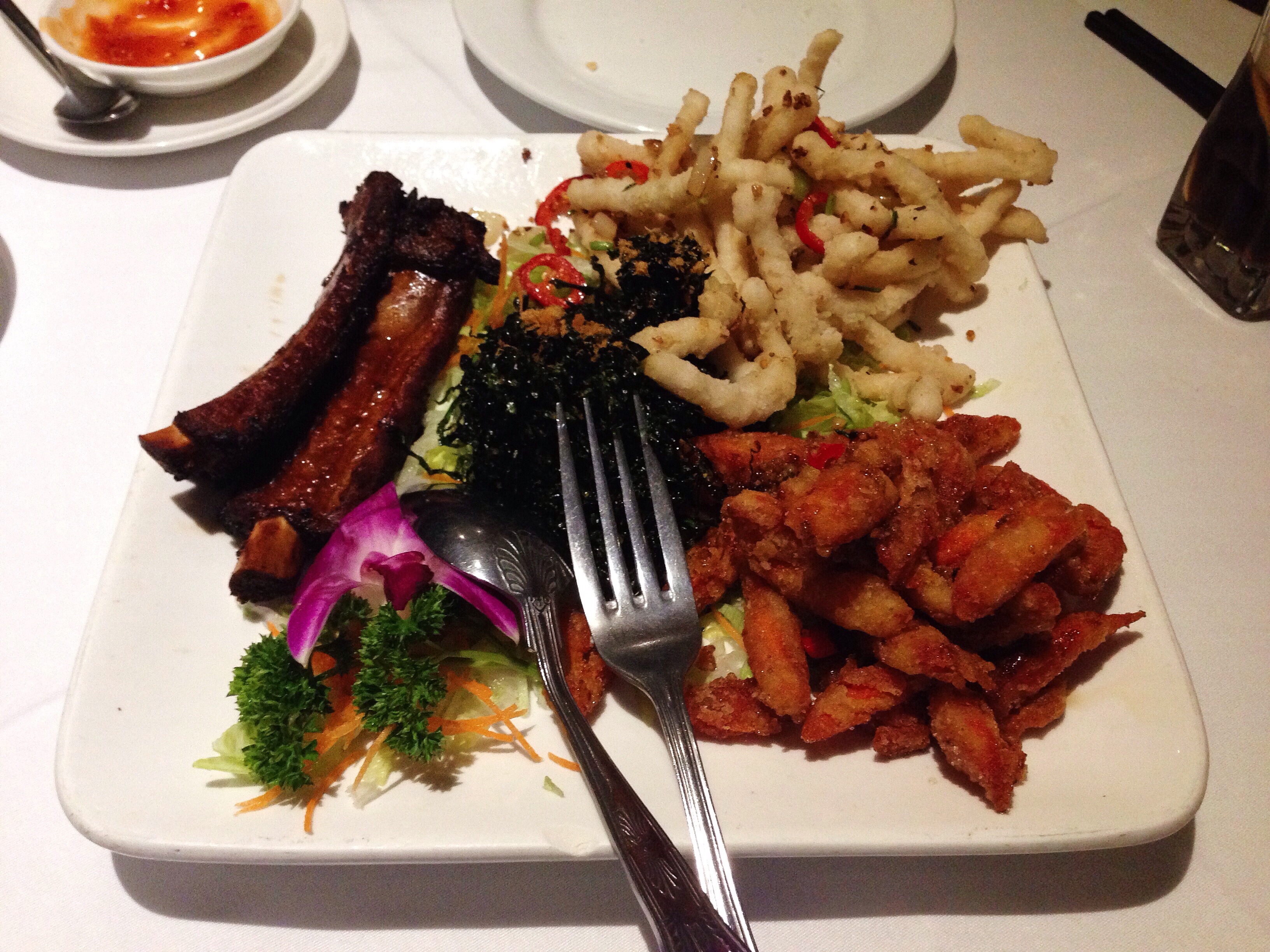
The first dilemma was how many starters to order: I didn’t want to take “eat as much as you like” as a personal challenge, but on the other hand I wanted to try as much as possible. How many would you have picked, between two? Well, if you answered “four” you win a gold star. Of them, the dry spare ribs were the first to go; imagine your favourite spare ribs with nicely spiced meat falling easily off the bone but none of that sticky sauce that winds up all over your fingers and face and you’ll have a pretty good idea what these were like. The salt and pepper five spiced squid was less successful. The squid was nice enough – thin strips, tender rather than bouncy – but they were underseasoned and bland, with nowhere near enough salt and more sugary sweetness than five spice.

The Thai style smoked chicken (the menu at Kei’s seems quite happy to wander from China to Thailand and even onwards to Vietnam – it’s almost as if it’s on a gap year) was rather similar to the squid, just a little darker and much sweeter. There was no discernible smoky taste but there was some nicely mashed garlic and spring onion at the bottom of the heap that balanced the sweetness a little. And finally, one of my favourites, the crispy fried seaweed. I know it’s not seaweed and I bet it has more fat than I’d want to know about but I love the crispy, salty, sweet taste of it and I wasn’t disappointed. I know it’s a staple but I loved it.

keistarter

Only after the plate was taken away did I realise how little variety there was in the starters – largely sweet, crunchy, fried things. Probably not the cleverest idea, but I was starving and I’m afraid I must have been subliminally influenced by the smells wafting from the kitchen; sometimes you order with your belly rather than your head.

Can you guess what came next? Oh yes, the crispy duck. I was surprised this was on the “eat as much as you like menu” but when it turned up I saw how they managed this: perhaps it’s churlish to complain but the duck was a little on the skimpy side, especially compared to the big bamboo steamer of pancakes (I think we counted 12). Have you ever ordered crispy duck and run out of duck before you ran out of pancakes? No, me neither, so Kei’s was very much a first in that respect. What there was, though, was as good as ever – it’s a measure of how good this dish is that it’s impossible to eat it in silence (maybe it was just as well that it didn’t last that long).

keiduck

Having eaten all that, how many main courses would you have ordered between two? This time, gold stars for those of you who guessed “three”. I was concerned that this would be a greedy mistake but actually, all of them felt like scaled down versions of what you’d have got if you ordered from the a la carte.

Sizzling king prawns in black bean sauce, for instance, were tasty – but you got four prawns. Serving this on a sizzling cast iron platter seemed strange when in reality the dish could probably have fitted in a ramekin. I enjoyed it, but the sauce was a bit thin on the ground (as were the black beans: I didn’t count many). Lamb in satay sauce, another sizzling platter, was a bit more generous. The sauce itself was smooth and shiny, with a texture a bit like egg yolk and not particularly peanutty. Ironically, given how shiny it was, it was distinctly lacklustre – and when it started to cool the gelatinous nature made it slightly gloopy, stringy and reminiscent of things I’d rather not describe. That said, the lamb was lovely and tender – I just wished I’d had it in “Vietnamese plum sauce” (whatever that is) instead. Oh, and if you’re looking at the picture below: yes, it’s a solitary giant piece of tenderstem broccoli, yes it’s as random as it looks and no, I have no idea what it’s doing there either.

keimain

The third main, chicken and cashew nuts in yellow bean sauce, had the best flavour and texture but went cold incredibly quickly. I didn’t check the dish when it arrived but I wonder if it was served in a chilled bowl. Maybe I should have tried it before the two sizzling dishes, but either way it shouldn’t have got this cold this quickly. Again, the sauce was tasty but – as with the other two dishes – you didn’t get enough of it to make the rice interesting (the plain steamed rice, also a bit claggy and lukewarm in next to no time, needed all the help it could get).

We had a couple of diet cokes and a colossal 250ml glass of sauvignon blanc, the only white they offer by the glass and the only size glass they serve it in. Often, house wine tastes like it’s punching slightly above its weight – this one tasted very much like a house wine, and 175ml would have been plenty (hark at me, it’s not as if I let any go to waste). Service throughout was pleasant and attentive: staff were friendly, efficient and patient when it took us some time to pick our food.

Having said that all the dishes were on the small side, it’s only fair to say that the quantities I’d ordered worked out well – we were both nicely full without being stuffed which often isn’t the case in a Chinese restaurant. Just as well, though, as I wouldn’t have felt like I’d have been able to go back and ask for more dishes if I’d under-ordered. The all you can eat option is just under twenty pounds per head and our total bill, including a semi-optional service charge of 10%, came to fifty three pounds.

Is Kei’s Reading’s best Chinese restaurant? Yes, it probably is (unless Happy Diner in Caversham turns out to be stellar) but that didn’t make me feel like hopping on a bus to Lower Earley any time soon to pay it a return visit. Instead, it made me wish that Reading had something better that could compete with the delights of Chinatown, or even some of the offerings just down the train tracks in Oxford. If Kei’s was on my doorstep, or if I had a friend visiting who really, really fancied Chinese food then I’d go – it’s a solid, reliable restaurant and those are qualities a lot of people value. But most of all, it made me miss the charismatic chaos of Chi: if you never sat at a table in Chi while someone in a rhinestone jumpsuit who doesn’t look or sound remotely like Elvis serenades you with “Devil In Disguise” you haven’t lived, take it from me. Maybe we’ll see its like again at some point: until then, Kei’s might have to do.

Kei’s – 6.7
Maiden Place Centre, Lower Earley, RG6 3HD
0118 9263133

http://www.keis.co.uk/reading/

Tutu’s Ethiopian Table

As of April 2019 the Global Café has a new vegetarian menu and Tutu cooks at her new café in Palmer Park. I’ve kept this review up for posterity but the restaurant it describes no longer exists. The Global Café is reviewed here, and Tutu’s new café is reviewed here.

Usually, when I eat at a restaurant I have a pretty good idea whether I’ll enjoy it fairly early on. First impressions are important – the welcome, the service, the room, the menu – but even if they aren’t good, you normally know by the time you taste those first few forkfuls of your starter. Not to say there aren’t still chances to save the day: a knockout main course can redeem all sorts of prior disappointments, although by that stage it’s increasingly unlikely. And if everything else has underwhelmed you up to that point, a dessert (if you order one) is only going to be damage limitation, however magnificent it might be.

Tutu’s Ethiopian Table was a huge puzzler for me, because it didn’t fit that pattern at all. I was undecided from the moment I sat down to the moment I finished, and even afterwards I found myself mulling it over and weighing it up for quite some time. This in itself puts me out of step with most of Reading: Twitter is regularly awash with people raving about Reading’s well-established Ethiopian restaurant, not to mention the string of awards and mentions in the national media (one of my friends, ever the curmudgeon, was the solitary voice of dissent – “good luck with that, it’s just slop” he said when I mentioned that I was planning to pay it a visit).

Perhaps it would be easier to talk about what I liked and didn’t like. So for instance, I liked the room. I wasn’t expecting to, but the section of the Global Café at the front of the building is a lovely, bright, buzzy place, full of people and with lovely old jazz playing in the background. It may be a bit scruffy, but it’s so likeable that it didn’t matter. (I wouldn’t have felt the same, however, if I’d been stuck in the back room – long, windowless and distinctly cold and uninviting.)

I liked the service at the counter, too – no table service which makes sense as Tutu’s is only part of the Global Café which also does coffee, tea and all sorts of interesting alcoholic and non-alcoholic drinks, some of them Fairtrade. Everyone was friendly, engaging and genuinely funny (“I’m going to blow your mind now,” said one of the bar staff to another customer, “I’ve accidentally dished up your cappuccino in a latte cup and your latte in a cappuccino cup”). I wasn’t so convinced about the unsmiling, functional service from the staff at Tutu’s, who just plonked the plates on the table and left.

The menu gave a choice of seven vegetarian dishes and four meat dishes, with a choice of rice or injera (a thick, flat pancake), or you could opt for a platter – one meat dish and two vegetable dishes – for the same price. We went for platters, partly out of indecision and partly to try as much of the menu as possible. The indecision was strangely appropriate, because if I couldn’t make up my mind about the experience of eating at Tutu’s, it turned out that I couldn’t make up my mind about the food either.

So I liked the doro wot, chicken on the bone in a rich spiced sauce. I liked that an awful lot, in fact. The chicken was so soft, so tender and so well cooked that taking it off the bone was no challenge at all, and once I’d done that I was struck by how much of it there was. The sauce was magnificent too, sticky and delicious with a heat which gradually, subtly developed without ever being too much. By the end of the dish my mouth had a wonderful, warm glow; if I went back to Tutu’s, I think I’d just order this dish, as nothing else I tasted came anywhere close to it.

I didn’t like the keya sega wot – beef in a remarkably similar sauce – anywhere near so much. The beef was everything the chicken wasn’t. It needed a lot more cooking; none of it passed the two forks test and one piece was downright wobbly in a way best not remembered, let alone written about. There also wasn’t much of it – I counted less than half a dozen pieces, none of them huge.

I liked the injera, like a thick flat sourdough crumpet you could tear off and use to eat your food, almost an edible plate (and who among us has never fancied one of those?). It was a bit of a soggy experience, perhaps, but still a fun one – and the slight vinegary note in it worked better with the sauce than I expected. I was less keen on the rice – a little dome of yellow rice with what looked suspiciously like frozen vegetables in it, it didn’t feel like it added an awful lot to proceedings.

Tutu

This, I’m afraid, is where I largely ran out of likes. The vegetable dishes were bland variations on a theme, and it’s hard to be positive about any of them. Fosolia, described as “a dish of subtly flavoured fried green beans and carrots” was a mulch of green beans and what looked like tinned or frozen carrots which tasted of beans, carrots and nothing else (so very subtly flavoured, then). I couldn’t see how this could possibly have been fried, either, because fried food doesn’t normally wind up this damp.

White cabbage and potatoes and collard greens and potatoes were very close relations and again, were basically soggy brassica with cubes of potato. One was apparently cooked with exotic herbs and spices, but it reminded me of my school dinners and trust me, there was nothing exotic about those. The other featured garlic, in theory at least (I could barely tell the two dishes apart). Last of all, the difen misr wot, green lentils in sauce, was impossible to either like or dislike. The lentils had a nice bite but it was just a puddle of brown blandness. Maybe nothing could live up to the sauce which came with that chicken and beef, or perhaps my palate just isn’t developed enough to pick up both ends of the spectrum in Tutu’s food. I’m not sure I could tell which it was by that stage, and worse still I’m not sure I cared.

I’d rather end on a positive, so I will say that my Ubuntu Cola – a fairtrade African version that is never going to appear on a tacky red festive truck outside the Oracle – was very tasty indeed. But then, like much of what I enjoyed in my visit, this had more to do with the Global Café than it did with the restaurant. The whole bill came to around twenty-three pounds, and to my shame I left really, really wanting a big slice of cake somewhere else.

So, did I like Tutu’s Ethiopian Table? I should have, I wanted to, but did I? I don’t know, what do you think?

Tutu’s Ethiopian Table – 5.7
35-39 London Street, RG1 4PS
0118 9583555

Quattro

One of the drawbacks of this gig is taking the photographs, especially when I visit a restaurant and find myself sitting in a very empty room trying to take sneaky pictures without the staff noticing (this is more of a problem in some places than others: where the service is poor you could probably get on a table and belt out I Will Survive without anybody batting an eyelid). Empty Room Syndrome happens much more often if I’m dining at quiet times, so Quattro immediately had me feeling hopeful when I rocked up on a Monday night to a bustling dining room.

Subscribe to continue reading

Become a paid subscriber to get access to the rest of this post and other exclusive content.

Bill’s

If you’re surprised that I’ve written a review of Bill’s the main thing I can say is this – me too. I had written it off: it’s always struck me as a chain trying its damnedest to convince people that it isn’t one, the rustic reclaimed school chairs and blackboards full of homespun quotes a sleight of hand concealing a respectable-sized chain (over fifty restaurants and growing), backed by Richard Caring, who also owns or has owned parts of Strada, Carluccio’s and Cote. So I was surprised when someone suggested I review the place, but he made some interesting points; it wasn’t a chain when it came to Reading, he said, and it offers something different to other Reading restaurants.

My first instinct was to say thanks but no thanks, but then I thought about it a bit more. I’ve always said that not all independents are good and not all chains are bad, and one of the plusses of writing Edible Reading has been eating at restaurants I’d otherwise never have considered. Why shouldn’t that apply to Bill’s, too? So I found myself sitting in Bill’s on a weekday night, at one of those reclaimed chairs (are they reclaimed, I wonder, or do they have a supplier who makes all these distressed-looking chairs, tables and defeated-looking leather armchairs for them?) reading the menu, not entirely sure what I was doing there.

Subscribe to continue reading

Become a paid subscriber to get access to the rest of this post and other exclusive content.