Restaurant review: Storia, Maidenhead

Six years ago I wrote a piece on the blog, a listicle really, talking about the five things Reading still badly needed. Don’t worry, I won’t send you scurrying off to read it, but the tl:dr version is that, back in 2018, I thought Reading was still missing a proper cooked breakfast place, a tapas restaurant, a gelataria, a cafe that was simultaneously comfy, did good coffee and good food and, for want of a better expression, a “special occasion restaurant”.

Without going into detail, I personally would say that in the intervening six years we haven’t got a great deal closer to having any of those things. But that’s not why we’re talking about Storia in Maidenhead this week: we’re talking about Storia because when I posted about this on Facebook a couple of weeks ago somebody commented saying that, in addition, Reading was lacking a decent independent Italian restaurant. And that comment stopped me in my tracks because – you know what? – that person was right.

Granted, away from the town centre you have the likes of Vesuvio out west and Papa Gee north of the river. And in town you do have pizza options, in the shape of Sarv’s Slice and Zia Lucia. But the demise of Pepe Sale earlier in the year does mean that, for the first time in a very long time, all the Italian restaurants in the town centre are chains: the likes of Zizzi, Carluccio’s and Bella Italia have a stranglehold on central Reading. And the more recent trend of pasta specialists, starting in London with the likes of Padella and Bancone and now cropping up elsewhere, like Little Hollows in Bristol, has also passed Reading by completely: no, town’s short-lived dalliance with Coco Di Mama really doesn’t count.

The one exception, arguably, is Mama’s Way. But although I love it I’m not sure that a restaurant with a capacity of half a dozen (and I’m being generous) is really even in the same ballpark as what we lost when Pepe Sale closed. And the closest thing I can think of to Pepe Sale is miles away to the west – Newbury’s Mio Fiore is a downright lovely spot, but that can be a half hour train journey.

No, that person commenting on my Facebook post was spot on – it’s a big gap in the market in Reading, and it’s striking that nobody has rushed to fill it. Perhaps in the fullness of time Zi Tore, which is going to take over the Grumpy Goat’s site on Smelly Alley, will redress the balance. But it’s hard to get excited about a place boasting Italian street food when the last place to attempt that shtick was Wolf. So this week I decided to check out Maidenhead’s Storia, which had been recommended to me by more than one reader of the blog, in the company of my good friend Jerry (regular readers will be pleased to hear that his digestive issues are now a thing of the past).

The strange thing is that Maidenhead already has a perfectly acceptable if unexciting Italian restaurant in the shape of Sauce and Flour. And Storia is a stone’s throw from that, literally two minutes’ walk away. Not for the first time on a visit to Maidenhead I wondered it if was just rubbing it in that it had some of the things Reading still lacked. Tapas bar El Cerdo was testament to that, as were our very enjoyable pre-dinner drinks at A Hoppy Place. I even had to walk past a branch of Coppa Club on my way to Storia, although that’s maybe less enviable.

That said, Storia is independent but that doesn’t mean it isn’t a chain. It’s the only Berkshire outpost of a group of six restaurants, with others scattered across Surrey, Hertfordshire and, randomly, the edge of Essex. I think that showed in the polish of the place when we arrived – it’s a handsome building which was welcoming from the off and the service was very slick. It was a grown-up space, too, quite classy with good use of mirrors and lighting to make up for what I imagine, in daytime, is a relative lack of natural light.

The tables along the walls were the ones you really wanted, all plush banquettes, but actually I didn’t mind missing out on those because our generous-sized table gave us a great view of the big and buzzing dining room. The whole thing had a feel of affluent happiness about it. It was Friday night, the weekend had arrived and Storia was going to do its damnedest to make sure people thoroughly enjoyed it.

There was very little to dislike about the menu but, simultaneously, I was surprised by how unexciting it was. Storia plays it safe with a menu that very much replicates the likes of Coppa Club down the way with very little sign of quirk or anything especially regional: half a dozen starters, a “raw” section made of up carpaccio and a strangely conspicuous ceviche, some pasta dishes, half a dozen pizzas and as many secondi.

I found it disappointing that all the pasta dishes were priced, and presumably sized, as main courses only – which again, felt more like the stuff of the bigger chain restaurants. And pricing also felt very conventionally done: starters around ten pounds, everything else between fifteen and twenty.

It made me wonder, not for the last time that evening, whether I was just jaded. Because I saw loads of things I could eat but nothing I was dying to try, and that in turn made me think about San Sicario, which closed last year, and what a terrible pity that was. And it also made me think of the interesting, resolutely all-Italian wine lists at San Sicario and Pepe Sale: would they have been seen dead having, as Storia did, an Argentinian Malbec, a Chablis and a Rioja on there?

We ordered a bottle of Valpolicella at £42. They brought a posher bottle by mistake, one twenty pounds more expensive, and I just managed to stop them before they opened it. Our wine was quite nice, but throughout the meal I wondered what the costlier one would have been like.

Jerry loved his starter – a sardine bruschetta with two filleted sardines perched on a pile of roasted peppers and aubergine, punchy with harissa. It was a riot of colour, and ironically one of the best things about it was the bread – properly golden and grilled, the perfect vessel. I got to try a bit and I liked the sardines a lot – in fairness I always do – but the rest of the dish felt a little incongruous, like an attempt to do something North African rather than the more obvious caponata. I quite enjoyed it, but it made me crave caponata more than anything.

“I’m in Lisbon towards the end of the year. Would you like me to bring you back a couple of tins of sardines?”

“That would be marvellous!” beamed Jerry.

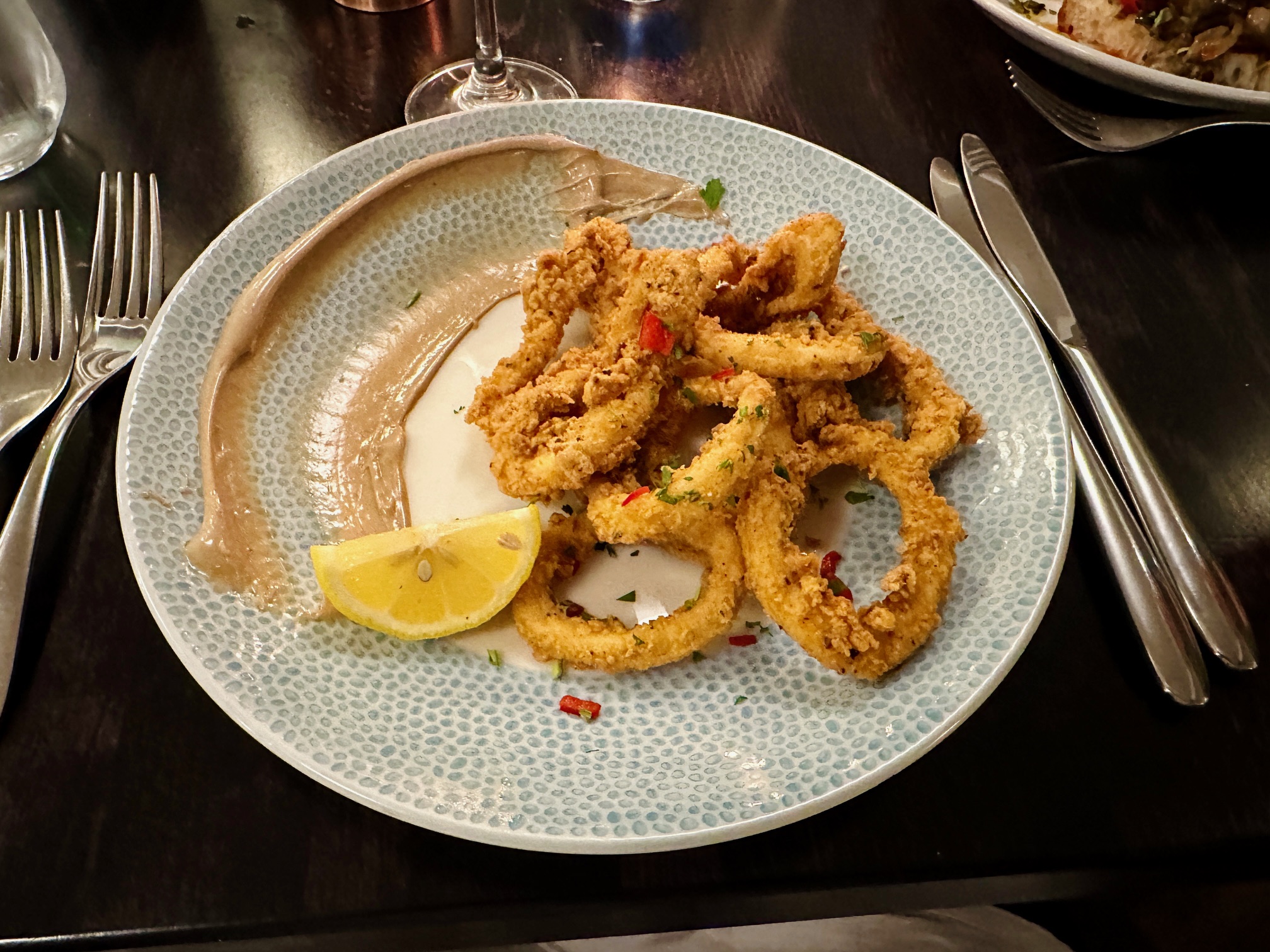
My starter was the best thing I ate all evening. Storia’s calamari was very, very good – fresh, not bouncy, with a crispy, craggy coating which felt like it had some polenta flour in the mix. The whole thing was lightly scattered with red chilli and the decision to serve it with black garlic aioli rather than its more prosaic sibling was an excellent one, even if the smear slightly detracted from the undeniable visual appeal. It made me wish that Storia did a fritto misto, or perhaps it made me wish that Storia was the kind of restaurant that had fritto misto on its menu.
The secondi on Storia’s menu, I’m sorry to say, are really stuff. Forget your lamb rump, your saltimbocca or your suckling pig, because you won’t find them here. Instead there’s a chicken Milanese, a grilled chicken breast dish with marsala, a couple of fish dishes, steak and a risotto. I suspect that, rather than a craving for carbs, is what sent Jerry and I scuttling for the pizza and pasta.

Jerry absolutely adored his pizza salsiccia, a very well-trodden combo of salami, ‘nduja, chilli and basil. Again, he was kind enough to let me try some and I had to agree that it was a very solid effort. Slightly better than Zia Lucia’s – and a darned sight less wet and floppy – and not quite as good as the finest examples from Sarv’s Slice. A bit wayward with the toppings and with a lot of crust, crust that wasn’t quite as puffy, airy or leopard-spotted as the very best examples.

It was a nice pizza, and if I ate in Storia again I might well order one. It was not, however, as good as the one you can get in Knead, a five minute walk away.

I’ve saved possibly the most disappointing until last. When it comes to pasta, I often find myself ordering a carbonara these days. There are probably two reasons for that. One is that it’s a very good benchmark and a sign of whether a kitchen knows its stuff: does it come out glorious and golden, or closer to the magnolia horror of Cozze? But an even better reason – durr! – is that when it’s good it’s one of the happiest, most comforting things you can eat. And now there was a nip in the air I found myself drawn to it, far more than some chicken and pesto concoction that had a whiff of Prezzo about it or a conchiglie dish with yet more of that harissa.

It could have lived up to that promise, and nearly did. The taglioni were beautifully al dente and toothsome, so easy to anchor with a spoon and swirl with a fork, capturing all the sauce you needed. The sauce was good stuff – no adulteration with cream or egg whites here – and topping it with a strip of crispy pancetta was a nice touch, if an obvious one.

But the other star of the show is guanciale, and it needed to be crispy nuggets of the stuff that disrupted all that unctuousness (I mean that in its true sense, by the way) with spikes of smokey salt. And this was underdone, a bit too bouncy, a bit too fatty, falling short. If this dish had been the platonic ideal of a carbonara the rating at the bottom would probably have been a whole point higher and I would be making plans to return before Christmas. But it wasn’t, so the search goes on.
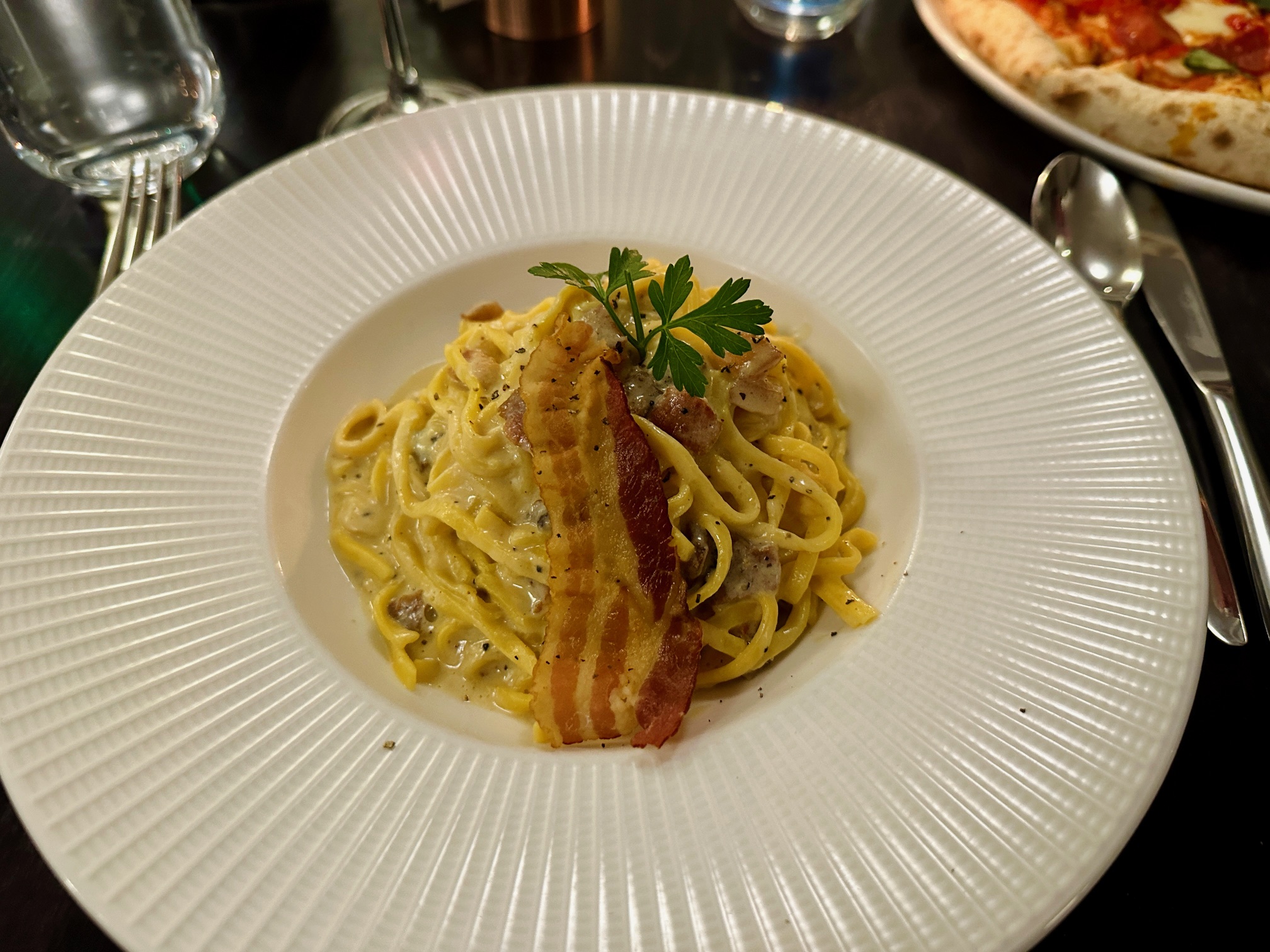
We nearly ordered dessert, but we were that terrible combination of not hungry enough and not fussed enough. But we were having a lovely time, and we had wine left, so we did the next best thing and ordered coffee, just to keep the evening alive that little bit longer. Latte came in a walled glass and was really surprisingly good, so much better than I thought it would be.

Like my old friend, it was sweet without a hint of bitterness, and it made for the perfect end to a brilliant evening. The food had facilitated that, but never even threatened to upstage it; although in fairness I expect I could have a wonderful time with Jerry eating doner meat off a bin lid. Anyway, our meal came to just over a hundred pounds, not including tip: the service very much deserved a tip, so tip we did.

As I said earlier on, I wonder whether I am just jaded about the kind of thing Storia does, even though Storia does it very well indeed. If you want a mid-range, casual dining Italian meal which isn’t going to offend or disappoint anybody, some of which will be good and some of which will be quite nice, you can go to Storia and it will deliver exactly that.

On a good day, so will Coppa Club I imagine, or Zia Lucia. On a good day, Jamie’s Italian used to manage that too. Is that enough? I suppose for many people it will be, and if Storia does that, without fail, time and again, it will no doubt build up a happy and loyal customer base and do extremely well – as it has, I suspect, in Tring and Radlett, in Redhill and Shepperton. History has taught us that there’s definitely a place for that kind of thing.

I guess what Storia reminded me of, strangely, is Strada – remember Strada? – back when Strada only had two branches, before it was possessed by the dread spirit of private equity and went the way some promising small restaurants do. As I think I’ve said before, I used to go to the one in Richmond with an old friend of mine, long since lost in the mists of divorce, and I always loved it. I came away, every single time, wishing Reading had one.

But when it did, it was no longer the Strada I loved but just Zizzi with a different colour scheme. Storia isn’t that, yet it wouldn’t take a lot of imagination to see how it could get there. And maybe that’s what they’re aiming for – I hope not, but everybody needs to make money. Especially nowadays when the bastard stuff seems to be so very thin on the ground.

So it’s not Storia, it’s me. If you’re like me, you would probably enjoy your meal there. But if you’re anything like me, Storia might also leave you feeling that, even though there’s nothing technically wrong with it, you just want something more these days.

Storia – 6.9
11 Bridge Street, Maidenhead, SL6 8LR
01628 769350
https://www.storiarestaurants.co.uk/maidenhead

Restaurant review: The Drapers Arms, Islington

I was meeting Aileen, a very dear old friend, in London for lunch and she gave me carte blanche to pick wherever I wanted. “You’re the food expert”, her message said. “You choose.” And I have to say, that was more difficult than usual; I have a list of London places I want to get round to, but lots of them didn’t seem right for this. I didn’t want us to sit at a cramped table somewhere in Soho, elbows battling, or up at a bar watching an open kitchen. I might go to the edgy places with my cousin Luke, but lunch with Aileen required somewhere in the image of our friendship: comfortable, classy, unrushed with a long history. Somewhere worth celebrating.

Aileen and I, you see, have been friends for well over a decade. Long before I started writing this blog I used to write another – not about restaurants, about something else – and somehow Aileen chanced upon it. And somehow, I’m not even sure how, we went from writer and reader to firm friends. I don’t think I could possibly have appreciated at the time how fortunate I was about that. Because a few years later my marriage and my life imploded and things got almost impossibly hard and Aileen, arguably more than anyone, was the person who kept me together.

In the dark moments when nobody else was there, or (more likely) they had all gone to sleep, Aileen showed up for me time and time again. She always had the same mantra, which I railed against but over time discovered was true: this is a phase. It’s a phase, and it will pass. And it was, and it did, and she never once said I told you so, even though she could have done.

I like to tell people that she saved my life, and she likes to reply that I’m talking nonsense. She might be right, because she nearly always is, but if we hadn’t become friends I don’t know who or where I would be now: I almost certainly wouldn’t be here.

It was a huge honour for me that she was at my wedding earlier in the year, a wedding that might not have happened had I not met her. Late in the evening, when the guests were thinning out, we sat together outside the Lyndhurst and had a good old gas, as if the intervening months had never happened. And the next morning I managed to catch her in the hotel bar before she headed home to Milton Keynes, and that easy, joyous conversation was one of my highlights of the whole weekend. I told her we should do lunch in London soon. So we agreed to, and all I had to do was find somewhere suitable for the occasion.

I ended up choosing the Drapers Arms in Islington, because it just felt right. It’s been going for well over twenty years, one of the generation of London gastropubs that includes the celebrated Anchor & Hope near Waterloo, and in that time it has become an institution. It held a Bib Gourmand from Michelin for much of the last decade, losing it in 2018, but it still featured in this year’s list of the U.K.’s top 100 gastropubs. But the thing that most cements its status as an institution is that nobody talks about it online, because nobody needs to. You won’t find a recent review of it online, and the London restaurant bloggers stopped name checking it a long time ago.

All that meant that although I’ve always wanted to go, I didn’t have a very clear idea what to expect. Aileen and I wandered there, strolling up Camden Passage and looking at all the stalls and boutiques, before heading across to Upper Street and then ambling off the main drag, onto side streets filled with houses you wished you lived in. On the way I went past various restaurants I’d heard of – the likes of Bancone clone Noci, Alsatian brasserie Bellanger and regional specialists Hainan House – all of which have been reviewed by somebody a darned sight more recently than the Drapers Arms has.

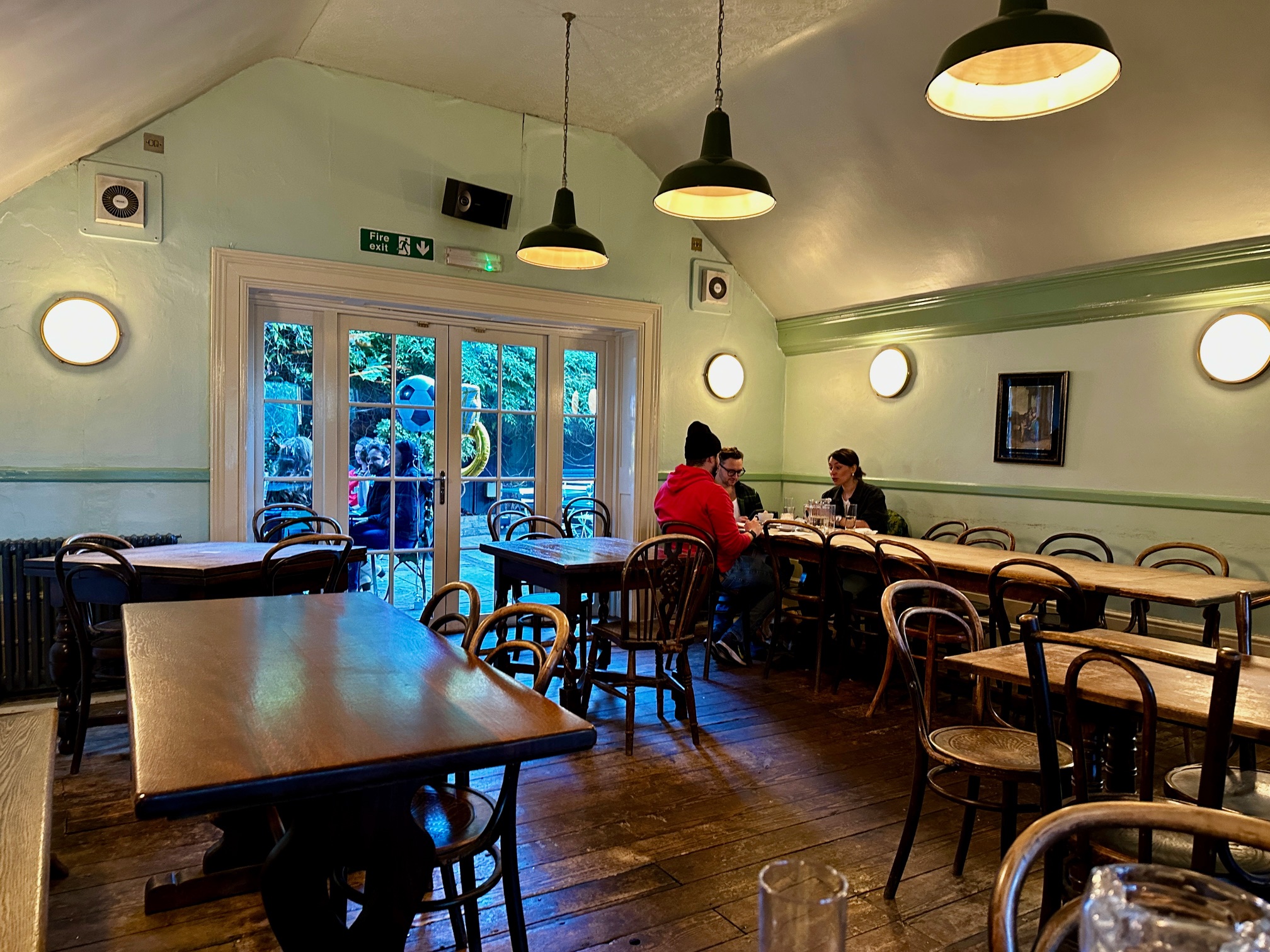
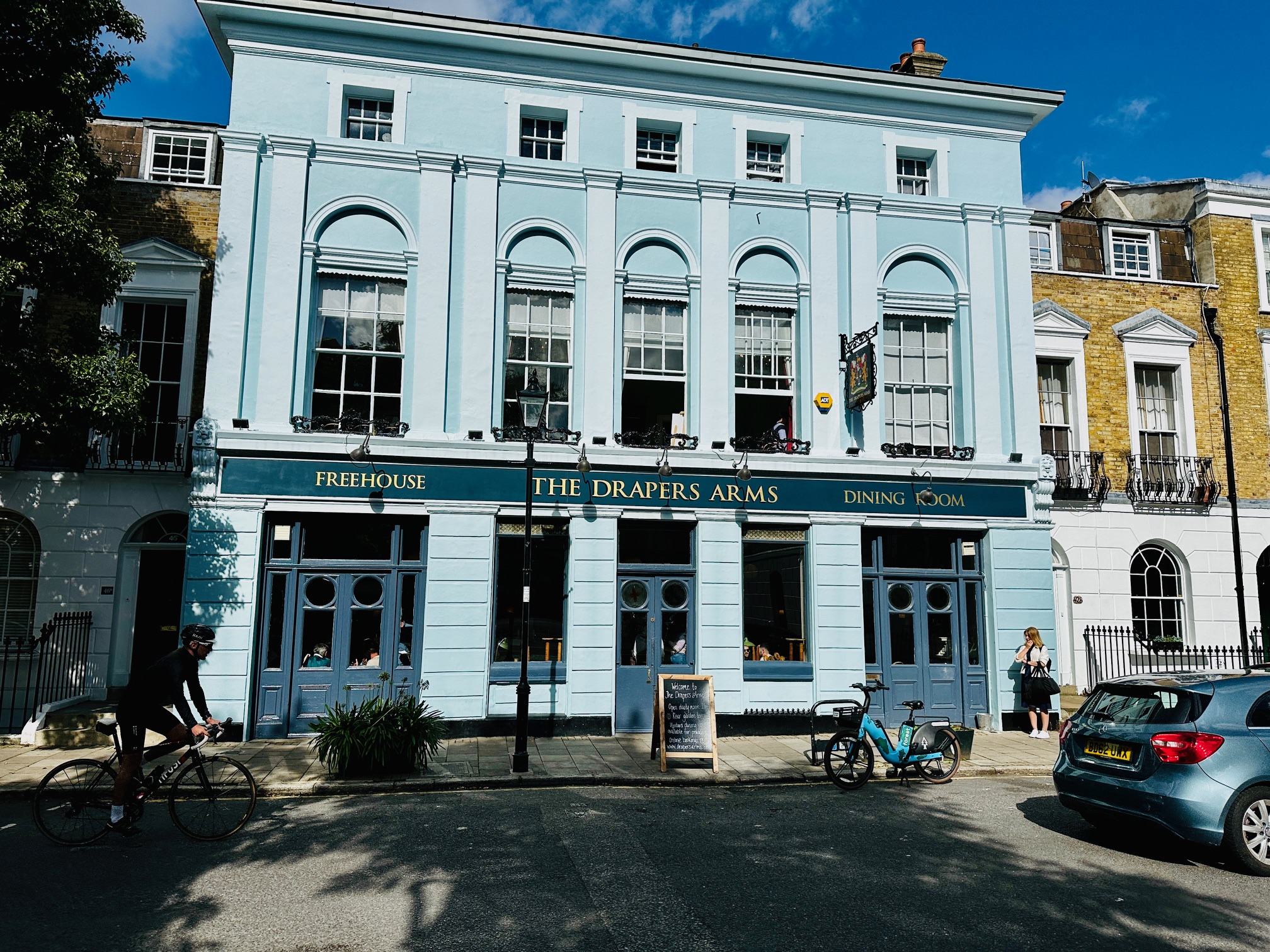
It’s a handsome, imposing building, a three-storey, powder blue beauty, and going in the front room was flooded with sunshine from the windows and glass-panelled doors. There were unoccupied tables at the front, and I was hoping our reservation was at one of them, but instead we were led to a room further back which was dingier and less agreeable. Almost every table was taken, and we were seated at possibly the worst one there – equidistant from the terrace at the back or those big windows out front, starved of sunshine.

I plonked myself on a Thonet-style bentwood chair that didn’t entirely feel as if it could deal with my weight at the start of the meal, let alone the end. Around us all the tables were packed with loud, lively, chattering groups, and there was nothing to soak up the sound. I took a picture of the room much later on, which makes it look nicer than it was.

But maybe all that is a tad grumpy. After all it was busy, which you want somewhere to be, and the fact remained that it was an extremely attractive pub, even if we had the restaurant equivalent of the worst house on a good street. I especially loved the emerald-coloured bar, and a print on the wall advertising HP Sauce in the proper bottles.

“Mark brought some home from the supermarket recently in a squeezy plastic bottle and I made him take it back” said Aileen, talking about her husband. “It doesn’t taste the same when it’s not in a glass bottle. I reckon it’s thinner, too.” This, I realised, was one of many reasons why I loved the woman.

The menu changes every day and they publish it on the website, so it was much as I’d expected. It’s curious how some menus present you with very difficult choices while some, despite making all the right noises, are devoid of dilemmas. I would say that, however well it read, the Drapers Arms menu was the latter. Nine starters, all of which seemed to be either gutsy and rustic or, for my money, a little too virtuous. It was all a tad binary for me. You had the same number of mains, although four of them – the fun ones – were to be shared between two.

That made the whole thing a little more restrictive than I’d have liked and if you didn’t like offal or bone marrow, both of which made an appearance, I think you might have found things trickier still. Starters generally clustered between eight and fifteen pounds, mains started just shy of twenty but climbed, for the sharing dishes, up to ninety quid.

While we weighed things up Aileen ordered a negroni and I asked for a Bloody Mary, we clinked glasses and celebrated the prospect of a long lunch with a great friend. They didn’t ask me how spicy I wanted the Bloody Mary, which gave me confidence that it would be good. It was both spicy and very, very good.

It had been far too long since I’d had lunch with Aileen, and I didn’t realise that she was excited about featuring in the blog. “I’ve wanted to do this for ages!” she said. “And I don’t want you using a pseudonym for me, either.” Chatting away, I realised that we both had many of the same criteria when it came to restaurants getting a gold star or nul points. When our bread turned up, it turned out we both had a bugbear about fridge cold butter (Aileen checked it and thought it was okay, for my money it was still a little on the cold side).

My starter was a bisque, and Aileen rested her hand briefly against the outside of the bowl. “I don’t like it when hot food comes in a cold dish” she said. I hadn’t ever considered it, but she had a point.

The problem with the bisque, though, wasn’t one of temperature per se. It was a tasty dish where almost everything worked, but it wasn’t quite the sum of its parts. I loved the depth of the bisque and the crab meat tumbled through it. Spiking the whole thing with dots of deep green oil and red flecks of espelette pepper gave the whole thing contrast and depth.

The problem, and I never thought I’d hear myself saying this, was the octopus: there were a few pieces in the bisque and I just wasn’t sure, in terms of flavour or texture, whether they added enough to be worth it. This dish was fifteen pounds, and I couldn’t help thinking it might have been better, and been better value, without the octopus.

“Another thing that annoys me, while we’re at it” I said to Aileen, “is dishes like soup appearing in shallow bowls like this. It just means it’s really hard to get to all of it, and it goes cold quicker.”

“I agree with that” said Aileen. I cleaned up the rest of my bisque with some of the bread, which was fulfilling one of its most noble purposes: the edible jay cloth for sauce removal. The bread was okay, by the way: two big slices of sourdough and two pieces of baguette is hardly highway robbery for three pounds, but it wasn’t the most exciting.

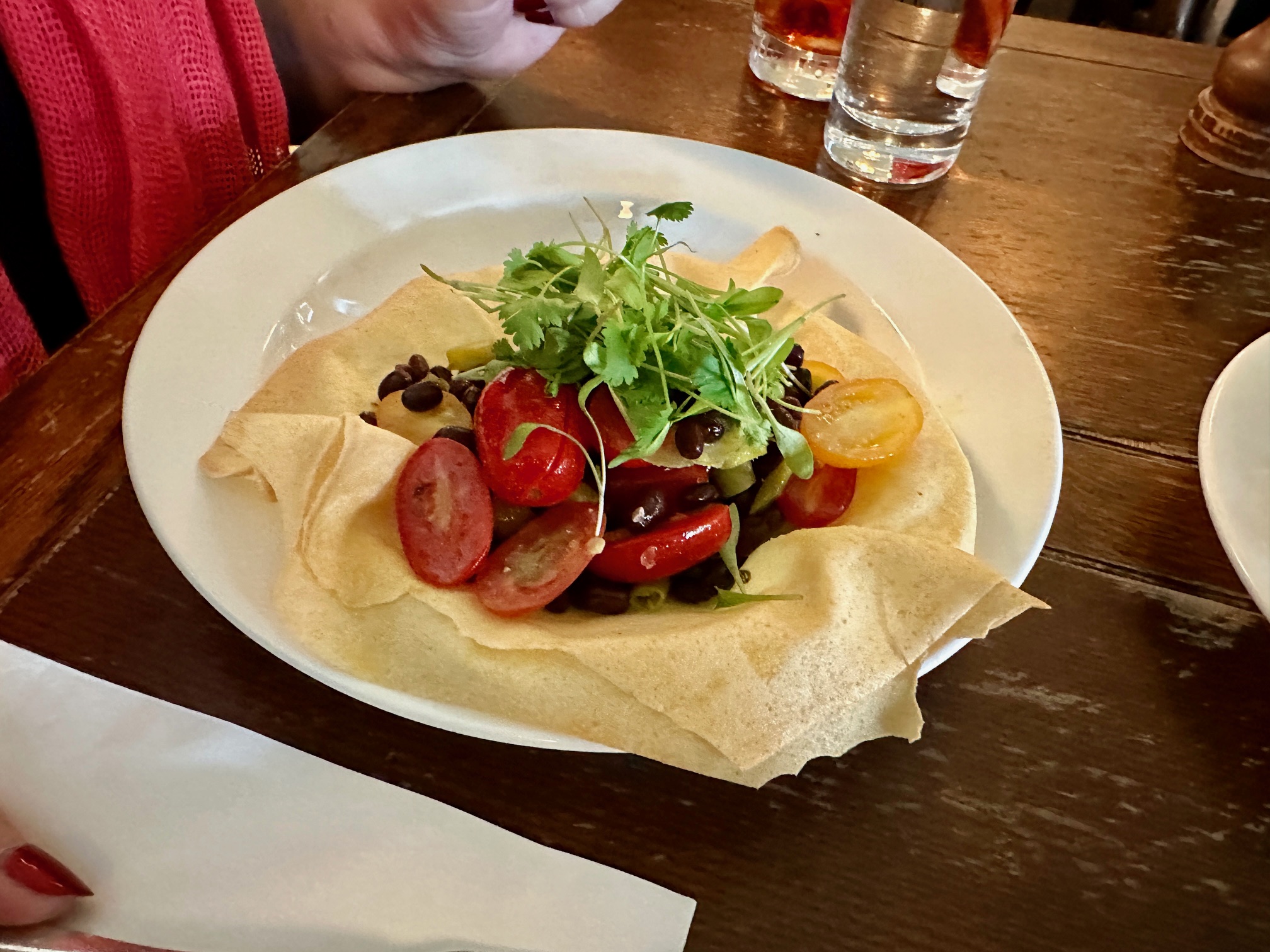
Aileen’s starter was the kind of dish I would never order in a million years, and a great advert for bringing people with you to review restaurants whose tastes are not the same as yours. It was a bean salad with coriander, chillies and datterini tomatoes, served in a sort of filo pastry basket. Aileen loved it – the flavours worked well and the beans had a nice amount of bite. I had a forkful, which confirmed that it was indeed the kind of dish I would never order in a million years. I didn’t feel like there was anything bringing a fun factor to the plate, but that probably tells you more about me. It also felt steep at eleven quid.

Aileen is planning to retire at the end of the year, and was telling me how she plans to take over more of the cooking from her husband. This dish struck me as having a hint of Ottolenghi about it, and Aileen said she’d tried making some of his recipes. I’ve never followed her example: in my experience, they always seem to involve lots of ingredients and hours of processes, so perhaps they’re best left to the retired.

“Have you ever been to an Ottolenghi?” she said.

“Yes, just the once. I was at this event to commemorate the eightieth anniversary of the Cable Street Riots, because my then girlfriend knew someone who was in a Yiddish marching band.” This sentence, by the way, sums up perfectly how very strange my life was in the latter half of 2016.

“There was a march, and a demonstration, and lots of placards and Jeremy Corbyn was one of the people making a speech. It was so boring that we sloped off to the Ottolenghi in Spitalfields and they managed to fit us in. It was all right, but it felt like a glorified salad bar.”

This starter, to me, felt like the kind of thing you’d have at a glorified salad bar.

But no matter. Both of us had chosen far more substantial mains and had ordered a bottle of Gamay to go with them: initially I thought Aileen might have insisted on just having wines by the glass, but that negroni had persuaded her to throw caution to the wind. It was thirty-one pounds, so very much at the shallow end of the wine list, but the list went deeper than at many restaurants.

“That one said 300, and for a moment I thought it was the price” said Aileen.

“No, that is the price.”

“But this is a pub!”

“Well, yes. And no.”

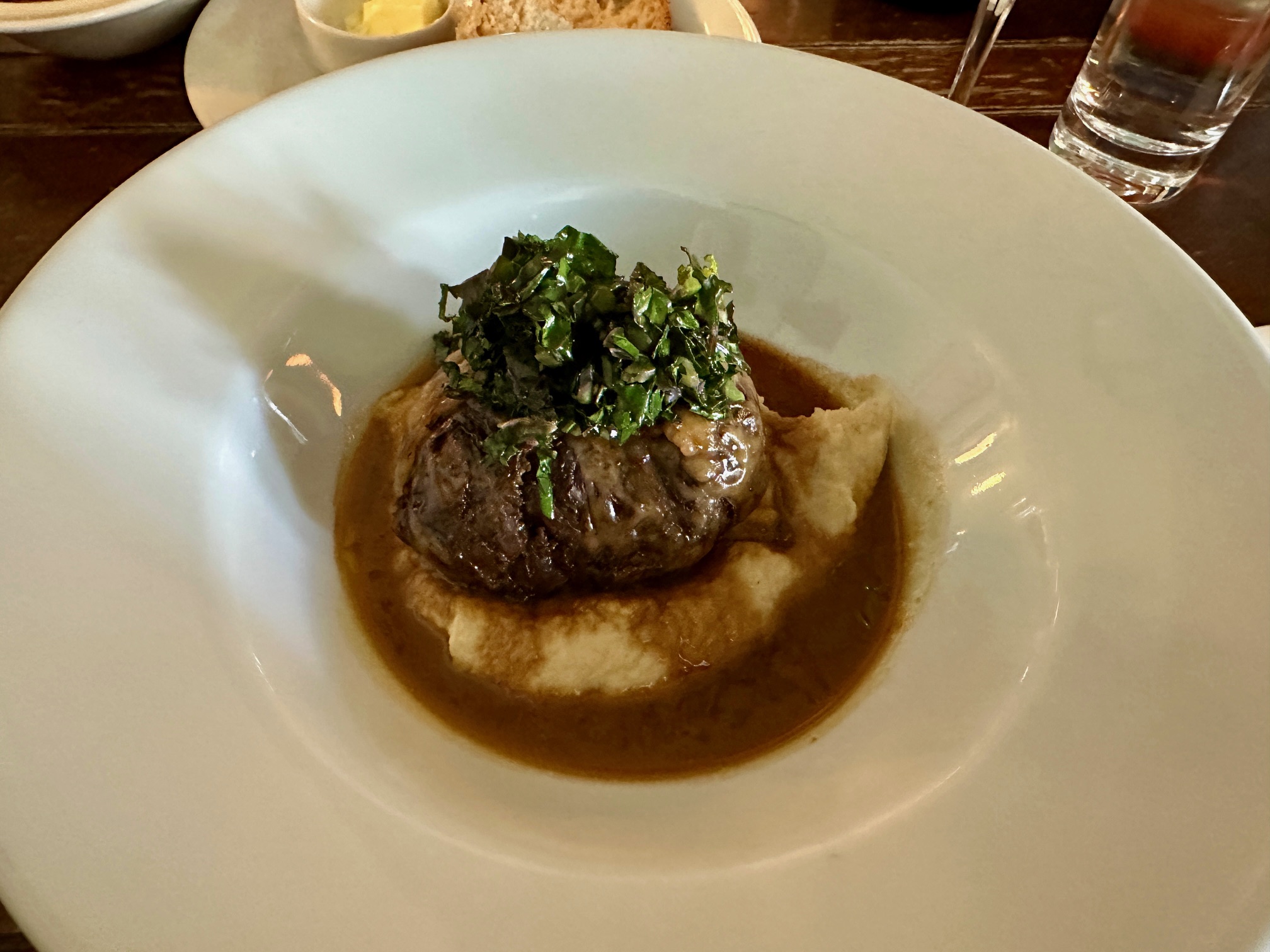
My main course was a sure sign that summer was long gone and that winter, as Leonard Cohen once put it, was tuning up. Lamb faggot and celeriac purée sounded like a glorious, fortifying treat and I was very glad Aileen hadn’t stuck a pin in it, because I always let my dining companions choose first. On paper it was beautiful, and at first sight it was every bit as appealing – a huge faggot, a splodge of mash, a moat of sticky gravy and one accent of not-beige, a crowning garnish of kalette tops. It was a dish to be enjoyed in a cosy pub, even one with three hundred pound bottles of wine on offer.

Things only went slightly awry when I ate the damned thing. The faggot had a terrific, coarse, crumbly texture and the celeriac purée was one of the nicest, silkiest ones I can remember. The kalette was a revelation – still firm, with a zip of mint that the dish badly needed. But the faggot was really heavy on the offal, to the point where it was a little too intense, a bit much even for me. I liked it at the time, and I finished it, but it sort of stayed with me for the rest of the day, in the way you don’t want.

Aileen had gone for my second choice from the menu, a beef and mushroom pie with a suet crust – or, for the purists among you, a stew with a lid. It came without accompaniments, so I was glad we’d also ordered chips and veg. It was placed on the table, and Aileen asked if it came with gravy (she is from Nottingham, after all). We were told, very nicely, that it did not.

At first, Aileen wasn’t sure about the whole affair but I think she warmed to it – the beef was all at the bottom but there was a fair amount of it, tender and breaking into strands. There was carrot and mushroom in there too, and she loved the green beans she’d ordered on the side, just-cooked and topped with crispy shallots. But even though this wasn’t a pie for sharing it was strange that it didn’t come with anything, including a plate to dish it up onto.

It reminded me very much of some of the great gastropub pies I’ve tried in the past, at Hackney’s The Marksman or The Magdalen Arms in Oxford, but it didn’t look quite as alluring as either of those. Still, it was eighteen pounds, one of which goes to Action Against Hunger, so you couldn’t really complain.

“That was lovely” said Aileen. “It needed gravy though.”

I’ve realised I didn’t get any pictures of the green beans or the chips. The chips were skin on (I thought that might be one Aileen’s list of restaurant no-nos, but apparently not) and clearly made in-house. And they were pleasant, but perhaps a little limp and unremarkable. I wanted that contrast of brittle crunch and fluff – and I didn’t care how many times they had to be cooked in order to achieve it – but these weren’t quite there. They were a decent vehicle for the last of my gravy, even so.

Our meal had been a little haphazardly timed – we didn’t get our bottle of wine almost until our mains turned up, so once they’d been eaten we had a lot of wine left. And service was brilliant at this point, leaving us in peace while we finished it and continued our epic conversation. I saw pictures of Aileen’s twins at their prom and wondered, as I’m sure she did, where the time had gone and how the little girls I’d first met all those years ago were suddenly sixteen.

Aileen in turn saw pictures of my wedding, and in between flicking through them and chatting about all sorts we caught up in the way that is such a tonic – a proper state of the nation natter encompassing work, family, friends, the past and the future. And I loved the Drapers Arms for this if for nothing else, for enabling this kind of afternoon.

Eventually, the wine was polished off and the dining room almost empty: I felt strangely proud of the fact that we’d outlasted all our fellow diners. So we got round to ordering dessert, along with a tea for Aileen and a bitter, middling latte for me. That section of the menu was very compact – a duo of cheeses and three desserts – and again, catered to people with different preferences to mine (I’ll eat most things, but I’ve never warmed to custard). So we both went for the lime posset and, like so much of what I’d eaten, it was nearly there.

As with my main course, almost everything was how you would want it to be. The strawberries on top were plump and sweet, the syrup they were in sticky and ambrosial. The shortbread was reassuringly irregular and crumbly: I saved mine to the very end. And the sharpness of lime in the posset worked so well, a welcome variation on a theme. But here’s the problem: the posset wasn’t properly set. Some of it was, but the rest was just liquid and hard to eat tidily, part dessert and part drink. So at the end of proceedings, you got a dish that was something like a synecdoche, a pretty good summary of the meal as a whole.

Our meal for two, including service charge, came to pretty much bang on one hundred and eighty pounds. And if that sounds like a lot, I’d say it could easily have been more. Our wine was distinctly entry level and we had, by accident rather than design, ordered the two cheapest mains on the menu. You could easily come away with a far more dented wallet than we did, although if you had an afternoon as terrific as the one I’d had you’d be fortunate indeed.

We wandered, full and happy, back to Angel tube station to go our separate ways. I could have talked for hours, but the idea of eating another mouthful or drinking another drop was more than either of us could contemplate (“I’m not sure I’ll even eat tomorrow” was Aileen’s verdict, although if she’s anything like me I’m sure she managed it). London looked beautiful in the autumn sun, and all around us Islington was gearing up for a busy Saturday night. We, on the other hand, were both dead set on being installed on our respective sofas by the time Strictly began.

When I think about the Drapers Arms, the thing I keep coming back to is that everything was good, and some of it was very good, but none of it was spot on. I imagine they have better days than they did the day I visited, I imagine there are nicer tables than the one we sat at, and iterations of that menu that would have suited me better. But I’ve had many far worse experiences, too, in countless places. So where does that leave you?

Yes, it was good but not perfect. And when it turns out like that you have to resort to your gut feel, try and weigh up all those almost intangible incidentals that define a meal. Because restaurant reviewers may not always tell you this – in fact many never talk about it at all – but there’s so much more to a meal than food, the room, or even service. I wish I’d liked everything a little more, and yet at the same time I know it will be hard to top as one of my favourite lunches of the year. So the Drapers Arms could have been better, but nonetheless I’m still really glad I went there. Happy that I ticked it off my list, and delighted that I chose it to host such a brilliant afternoon.

The Drapers Arms – 7.5
44 Barnsbury Street, London, N1 1ER
020 76190348

https://www.thedrapersarms.com

Restaurant review: Deccan House

Last year, a couple of gentlemen called Jez and Ken came to a readers’ lunch I held at Clay’s, and they’ve been to every lunch I’ve organised since. They are great company, clearly great friends, both a little older than me. Jez has a line in impressively busy shirts and the personality to carry them off, which is something I envy.

My most recent readers’ lunch was also at Clay’s, and Jez mailed me to express his regret that he couldn’t make it. It was his birthday that day, he said and his wife was organising something for him. What he didn’t know was that his wife had organised something on another day, and had asked Ken to take him to the readers’ lunch as a birthday surprise. Ken asked me if I could find space for them both and happily I could, so he got to celebrate his birthday with sixty or so equally hungry Reading food fans. I love it when things like that come together.

Anyway, the reason I’m telling you this is that earlier in the year – about six months ago – I got messages from Jez and Ken, independent of one another, urging me to put Deccan House on my radar. It’s a little place on Cemetery Junction between the stained glass shop and Ye Babam Ye, ostensibly doing Hyderabadi food: Jez and Ken had gone for dinner there, and both of them were impressed. Jez said it was the first time he’d tried dosa (he sent me a picture, “with my glasses included for scale”). Ken said that although it was a very different proposition to Clay’s he had really enjoyed the food.

Subscribe to continue reading

Become a paid subscriber to get access to the rest of this post and other exclusive content.

Pub review: The Bell, Waltham St Lawrence

This week’s review hasn’t quite gone according to plan. Originally I was going to review The Lyndhurst, which came under new management back in May. It’s fair to say that it’s had a chequered time since then, with the new landlords complaining vociferously to the Reading Chronicle, more than once, about what they said were false claims that they planned to turn the place into a sports bar.

The way they refuted that was interesting, I thought. We’re just installing a fruit machine, just like every other pub, they said. We’re just putting in a jukebox, like every other pub. Nuts, really. They’d replaced the managers of the best food pub Reading had ever seen, and their mission was to be just like everybody else. They missed the obvious point: if you’re just like everybody else, why should we drink at yours?

Anyway, I largely stayed out of it – because I know I could easily be seen as partial – but from their Facebook page they looked a lot like a sports bar to me. During Euro 2024 it was all badly generated AI images of three lions wearing England shirts and drinking pints of lager in a generic pub, or one especially tasteless – and arguably xenophobic – picture of a lion mauling a bull to coincide with the England-Spain match. But I’m probably just a woke snowflake, because I also winced when the pub described the rumours flying around as “Chinese whispers”.

They then decided to do food, so they put a menu up on Facebook and a few people – not me, I should add – were critical of it. “Please keep your comments to yourself” the pub said. Then they closed for nearly a week, not the first time they’d shut at very short notice. As previously, they blamed having work carried out, but it looked suspiciously like a sulk. All very strange, and I’ve lost track of the number of people who have messaged me saying what the fuck is going on at the Lyndhurst? My reply is invariably the same: God only knows.

But then at the end of July they announced that they’d taken on a new chef, Chef Roots. Now, I’ve never had his food but I know of him by reputation – he cooked for a while at the Roebuck, and at the Three Tuns, and in lockdown he ran a street food business called Pattie N’ Pulled which had its fans. I thought this was a very smart move by the new management – take on a known chef and try to recapture your reputation as a food pub. It all sounded very promising.

I was even prepared to overlook just how weird the menu the pub put out was. If anything in it was correct it was by accident, and every time you looked you spotted a different clanger. Some items were in a completely different font for no particular reason. The pricing was random – £11.96 here, £24.97 there, £4.60 somewhere else. And the spelling mistakes – oh my goodness. Buttet milk chicken, paremsan fries, oniom rings, triple cooled chips. It was all a bit Officer Crabtree.

So once I found out that Chef Roots was cooking at the Lyndhurst I was interested in going back, and I had a volunteer to come with me. That was none other than Matt, who made the very wise decision of proposing to my sister in law recently, which means he’s as good as family. So we agreed a date, when I was back from holiday. I was looking forward to it.

Then it all went tits up when I discovered that Chef Roots had barely lasted a week before moving on from the Lyndhurst, a development which the Lyndhurst decided not to report. And then more weirdness emanated from the pub. A recent Google review – one star, of course – was posted by a guy who was just verbally abused by the regulars as he walked past the smoking area with a friend and his dog. He put up footage from his phone which appeared to bear this out: it was a really uncomfortable watch.

And then someone posted on Reddit about the Lyndhurst’s Sunday lunch was, and she wasn’t pulling her punches. “Unseasoned. Small portions. Cold vegetables. Misleading menu. Said ‘homemade’ Yorkshire puddings and when I inquired about allergens the waitress brought out a frozen bag of Aldi’s own Yorkshire pudding” she said. “Actually speechless at how bad the food was.”

So I sent Matt a WhatsApp: Looks like we won’t be reviewing the Lyndhurst, the chef has already sacked it off. And Matt replied. Anywhere else we can review? Well, I can ride shotgun while you do it. And that’s when I thought of the Bell at Waltham St Lawrence, a cosy pub I had loved when I first reviewed it nine years ago. I’d been back since, but not for a long time, and it felt ripe for a revisit. So this week Matt picked me up and we headed off down the A4 in search of dinner. It was the first time I’ve ever been chauffeured to a review in a Porsche, and I very quickly decided that I could get used to it.

Much what I said when I visited the Bell in 2015 is equally true today, on face value at least: Waltham St Lawrence is still a pretty village and the pub is the jewel in its crown. It’s almost the platonic ideal of a village pub, and you got a whiff of woodsmoke as you walked in. But the one thing that was different was a slight change of the guard – back then it was run by twin brothers Iain and Scott Ganson, but last year Iain left to become the new head chef at Thames Lido. So was it business as usual at the Bell, or had things changed?

Paying it a visit on a Tuesday night it was almost empty with just a few regulars at the bar. “You can sit anywhere you like” said the chap after I told him we had a reservation, and although the front room was tempting we decided to go for the dining room, a less casual space up some stairs. Even so, that was stripped back and neutral – I seem to remember on a previous visit that there was feature wallpaper of some kind, but instead it was a calm, tasteful room. We were the only people in it, which gave my dinner date with my future brother-in-law a strangely intimate feel, like they’d opened just for us.

Still, we both enjoyed getting a word in edgeways for a change. I love my in-laws dearly, but the men in the family are like the men in Sex And The City: you might enjoy it when they crop up, but everybody knows they aren’t the feature attraction. It’s all about the women, one-upping one another with their increasingly funny stories, and the best thing you can do is enjoy the ride (or, if you’re my father-in-law, tidy up after everybody and/or hide in the garage). So here Matt and I were, talking for a whole evening in some strange inversion of the Bechdel Test.

The menu the night we visited was decidedly compact: four starters, three mains (one meat, one fish, one vegetarian) and three desserts. I seemed to remember from past experience that there used to be more on offer, and although I may have been wrong the evidence suggested we’d been unlucky that night: a picture on Instagram later in the week showed an additional main course that would have expanded the options a little. But no matter, although the menu was almost narrow enough to be constricting we both found things to order. Starters hovered around a tenner, mains were scattered more widely around the twenty pound mark.

But first, drink – and the first indication of interesting things at the Bell. They won Reading CAMRA Cider Pub Of The Year this year, and it showed, with a blackboard listing plenty of interesting choices including Tilehurst’s Seven Trees Cider. And the wine list was full of temptation, all of it available by the glass. I couldn’t choose between a couple and Ganson, who was behind the bar that night, kindly let me try some of each (even if the locals heckled him, saying that this was uncharacteristic generosity for a Scot). He even didn’t complain when I decided to go for a third instead, although they were all gorgeous, and let me try some of that. It was a Priorat, from Catalunya – Priorat is always worth trying, if you find it on a list – and I thought it was terrific at ten pounds a glass.

I seem to remember years ago having a conversation with the Bell on Twitter saying that more places should bring back the 125ml glass of wine, or the 250ml carafe. Well, although they do serve 125ml glasses they’ve gone one step further by using a Coravin for seemingly all of the bottles on the list. “It means we can offer about forty wines by the glass” said Ganson, which for me would almost be reason enough to visit the Bell on its own, especially if you have a nice chap driving you home in a Porsche.

“I’d also like a pint of bitter shandy please, which bitter do you recommend?”

“Hoppit” said Ganson without hesitation, and so Matt got a shandy made with Loddon’s finest, which he seemed to like.

Matt had the best of the starters, and I didn’t realise until much later that it was essentially the starter I’d ordered and enjoyed nine years ago. A slab of pigeon terrine came bound in bacon, served with a couple of beautifully burnished slices of griddled toast and – always the clincher – a trio of cornichons. Matt enjoyed this, but because his manners were impeccable he let me try some and I thought it was knockout – slightly gamey, the texture spot on, no hint of bounce or jelly to be seen. Matt also let me have all of his cornichons, but I think that was because he didn’t like them, rather than down to his impeccable manners.

I did less well, but only by a whisper. My selection of charcuterie from Cotswold-based Salt Pig had nearly everything you could hope for, and most of it was very enjoyable. Coarse rounds of chorizo, fatty ribbons of pancetta, superb pork collar. Only the spiced pork loin underwhelmed, and although I had enough cornichons, that was partly because I’d inherited Matt’s.

But it felt like something was missing, and I wasn’t sure what it was. I think a little griddled toast would have lifted this, or even some caperberries, or even more cornichons (although more cornichons, like more cowbell, is just my answer to many of life’s problems). WIthout that, it felt a little unbalanced. Looking back at the Bell’s menu I saw that it included something I’d missed, whipped lardo – also from Salt Pig, I presume – on toast. I wish I’d noticed that, because it would have been delicious. Especially if it came with cornichons.

By this point I was on to a second glass of wine. Ganson had suggested another Spanish red, this time from Bierzo, a single varietal Mencia, and it was every bit the equal of the Priorat. I found myself thinking that even though the same time last week I’d been in Granada, in thirty degree heat, sitting outside a bar enjoying cold beer and tapas there were consolations to autumn – red wine, woodsmoke and cosy pubs not least. Besides, Strictly was back on the telly.

My main course bridged the gap between my week in Andalusia and the increasingly autumnal feel of things back home. I rarely order risotto, and I almost never make it myself – who has the time to stand at a stove for thirty minutes? – but the Bell’s version was made with Isle Of Wight tomatoes and Spenwood, and better British ingredients are hard to imagine. I had been spoiled by the exceptional tomatoes you get on the continent, but the ones that come out of the Isle Of Wight are absolutely the next best thing.

And it was mollifying comfort on a plate, a rich dish of sticky, nutty rice, topped with tomatoes that had been roasted and slightly dried, liberally dusted with one of my favourite cheeses which just so happens to be made down the road in Spencer’s Wood, the closest thing Blighty gets to Parmesan. On paper, this was the perfect thing to make you happier about the nights drawing in and being able to see your breath in the air – a gentle but insistent bear hug of a dish.

It was almost perfect, but not quite. I would have liked it to have been a little more seasoned, for a bit more salt to balance out the sweetness of the tomatoes. But I only decided that in hindsight, looking at a completely denuded plate, and hindsight is always a wonderful thing. I can’t remember the last time I ordered a risotto in a restaurant, but I won’t be able to say that next time I do.

Matt chose the Bambi Burger, a dish which has been on the Bell’s menu every single time I’ve visited. He wasn’t sure about it, which is how Matt discovered that he maybe wasn’t wild about venison. That meant I got to try a fair amount of it, and for what it’s worth I really loved it. Venison is a challenging meat to make burgers with, on account of it being so lean and lacking in fat, so to make something so delicious that didn’t fall into the trap of being dry and crumbly was no mean feat.

And again, hats off to the Bell for having a decent, sturdy bun and griddling it to give it the extra heft it needed. If I came back to the Bell, and hopefully I will before too long, I would make a beeline for this. The skinny chips, I suspect, were bought in: it might have been nice to have something chunkier, but they did the job.

Both of us felt like we had permission to order dessert: Matt because his main hadn’t hit the spot and me because mine had. We both gravitated towards the sticky toffee pudding – not something I’d normally order, but as the other two choices were cheese and oatcakes or an affogato I did feel my hand had been forced. I was sorry not to see the beer ice cream the Bell always used to make, which for me was one of the most intriguing and idiosyncratic things they did, but you can’t win them all.

It’s another nice echo of my original visit, because sticky toffee pudding was on the table then too. I think that the Bell has spent the last nine years perfecting it, because I loved this. It was a deep, dense delight, swathed in a cracking toffee sauce and crowned with a sphere of glossy ice cream – no clotted cream or the like here – and it made me wonder how many great sticky toffee puddings I might have missed out on over the years because of my vague prejudice against hot desserts. It was fantastic, and it helped, as the whole evening had, make me feel a little less sad about the changing of the seasons.

I could have stayed and drunk wine and chatted away until they chucked us out. But I’m not sure how much fun that would have been for Matt, who was on the Diet Coke by then. Besides, he had to be in London for work the next day so I settled up and we were on our way. Our dinner – three courses and two drinks apiece – came to ninety-six pounds, not including tip, which I thought was as good value as anything is these days in 2024. We shared trade secrets on how to manage our in-laws all the way home, and if any of them happen to be reading this I absolutely promise I’m kidding.

I was so happy to find the Bell still close to its best self, and if I’d have liked a little more breadth to the menu that was easily outweighed by the pluses – the service, that beautiful spot, the woodsmoke and the exceptional range of wine and cider. For many years, when people have asked me where they could have dinner a little drive away from Reading, the Bell has made my list – a list which shrunk when the Miller Of Mansfield closed, grew when I so enjoyed The Plough earlier in the year.

But we were getting to the point where I was recommending the Bell without having any recent experience to go on, and I felt like a fraud doing that. I’m very happy to have sorted that, and pleased that I can renew my endorsement. That I had a properly agreeable evening and a ride in a Porsche just added to my joy. Reading may have one fewer pub that does really great food and makes you feel welcome. But there are consolations to be found elsewhere, just as there are with the end of summer.

The Bell – 8.0
The Street, Waltham St Lawrence, RG10 0JJ
0118 9341788

https://thebellwalthamstlawrence.co.uk

Restaurant review: Kopitiam, Oxford

Here’s a question for you – if you had decided to have lunch at a restaurant, and you knew for a fact that it didn’t take reservations, when would you get there, all things being equal? Would you turn up when it opened, bang on noon, or would you arrive early and be at the front of the queue? Or would you aim for about half one, to capitalise on the end of the lunch rush? Would it bother you, or make you anxious, or would you be blasé about the whole thing? Would you have a backup plan?

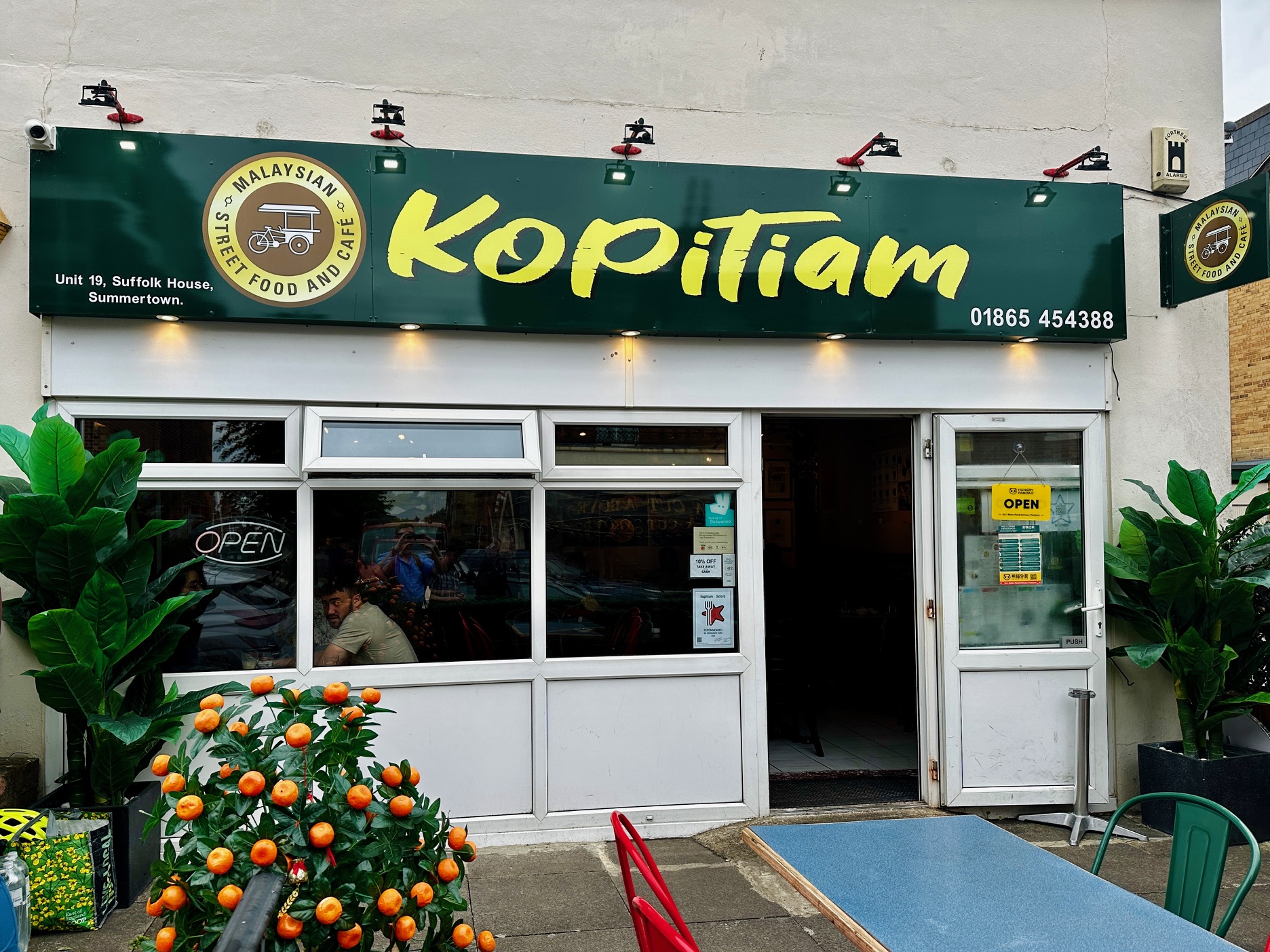
This wasn’t a hypothetical situation, because last weekend I was in Oxford with my old friend Dave and his son Leo, and I was set on having lunch at Kopitiam, a Malaysian restaurant in Summertown that received a glowing review from Tom Parker Bowles in the Mail On Sunday last December. But it didn’t take bookings, and Summertown is about a forty minute walk from the centre, so what to do?

This highlighted something of a philosophical schism between Dave and me. He would gladly have been there before the clock struck noon, ready to take the first table in the whole restaurant. “I prepare for things precisely so I don’t get anxious” he explained, although I suspected we both did equal amounts of worrying about stuff, just at different times. For my part, I thought turning up around half twelve would be more than sufficient. I knew it was Saturday lunchtime, but how busy could the place be?

It grieves me to admit that Dave was right and I was wrong: turning up bang on half past, we found every table occupied and the restaurant heaving. There were two tables out front, both with the standard-issue Tolix chairs in place, but it wasn’t quite warm enough for that kind of thing. So we went over the road to the excellent Colombia Coffee Roasters, sipped a latte and I kept a restless eye on the footfall heading to and from Kopitiam.

“It’s okay mate, if it’s still full we can always just go to Pompette a few doors down, or the pizza place on this road” said Dave equably. I didn’t understand what was going on: why was he so chilled about this after he’d been proven right? Why wasn’t he saying I told you so, the way I would have done had our roles been reversed? Honestly, you’re friends with someone for over thirty years but some days it’s like you just don’t know them at all. Leo, just turned 18 and off to Durham at the end of the month to start his history degree, sensibly stayed out of this one, and got to work on his mocha instead.

Anyway, it all worked out in the end. Half an hour later we went back and a number of tables were unoccupied, so we ensconced ourselves. The fact that so many tables had cleared so quickly suggested this was a functional lunch spot, not somewhere to linger, but we were too happy to have found space to be bothered by that.

The room was functional too – but in a way that worked, with plain, standard issue chairs and tables, faux exposed brickwork wallpaper and brightly lit pictures of all the dishes up on the wall. Now normally this would set alarm bells ringing, but somehow Kopitiam pulled it off – the saturated photos had an almost Martin Parr feel to them. And equally importantly, they all looked like food you’d actually want to eat.

Kopitiam’s menu was a tad confusing. Or really I should say menus, because you got two with no real indication of the relationship between them. The smaller one looked more Malaysian, the larger more Chinese, but the titles of the two printed menus didn’t exactly explain why this was. The smaller menu had some pictures of the food, the bigger, more generic menu, did not.

Malaysian Street Food And Cafe said the bigger menu, incongruously above the prices for crispy duck, Thai green papaya salad, sesame prawn toasts and edamame. And the same dishes, appeared on both menus in some cases – but where they did, the pricing was not the same. Anyway, on examination the smaller menu looked to be the lunch menu, the larger one the dinner menu – Kopitiam’s website spelled this out, but at the time it was a head-scratcher.

That’s partly because nothing at Kopitiam was expensive, whichever menu you ordered from and whatever it was calling itself. Few starters cost more than eight pounds, most mains on the lunch menu didn’t get north of twelve. Even on the main menu dishes tended to jostle around the ten pound mark, although rice cost extra. It did prompt a lot of discussions and plea bargaining, though, around how to try the best of the menu and what might or might not be representative. I felt, in the back of my mind, like having the Chinese dishes would be copping out.

“Are we having starters as well?” asked Dave.

“You do remember who you’re having lunch with, don’t you?” I said. Honestly, you’re friends with someone for over thirty years and some days it’s like they don’t know you at all: I don’t think the words if it’s okay with you can we skip starters have ever left my lips in all the time I’ve known Dave. And Leo is an enthusiastic eater himself: I remember going to Dolce Vita with him and his dad, back when he was something like ten years old, and watching him charm the socks off the waiters by ordering the monkfish with squid ink pasta and finishing the lot (“we have many adults who don’t try that dish” said our server, rightly impressed).

Our starters came out as we sipped a fiery and enjoyable ginger beer apiece: Kopitiam has no alcohol licence, which didn’t bother me, but also didn’t have any Sarsi (a Malaysian take on root beer), which bothered me far more. They also do a plethora of other Malaysian drinks – kopi, teh tarik and Ying Yang, a blend of coffee and tea which I was tempted to order out of morbid curiosity alone.

First to arrive were lok bak, minced pork wrapped in bean curd skin and then fried until crispy. These were a tactile delight, little brittle-coated nuggets of joy crying out to be dipped in sweet chilli sauce and scoffed. Perfect for sharing, perfect for social eating, perfectly enjoyable. And if I’d never had anything like this before, as I suspect Dave and Leo hadn’t, I would have been waxing lyrical.

But the best can be the enemy of the good, and I kept casting my mind back to a very similar dish at Lucky Lychee the previous month. There the pork was coarse and crumbly, the sweet chilli sauce was home made rather than out of a bottle and I got more of the spicing: Lucky Lychee boasts a ten spice mix, compared to the five spices deployed by Kopitiam. It showed: the Winchester restaurant’s rendition was easily twice as good.

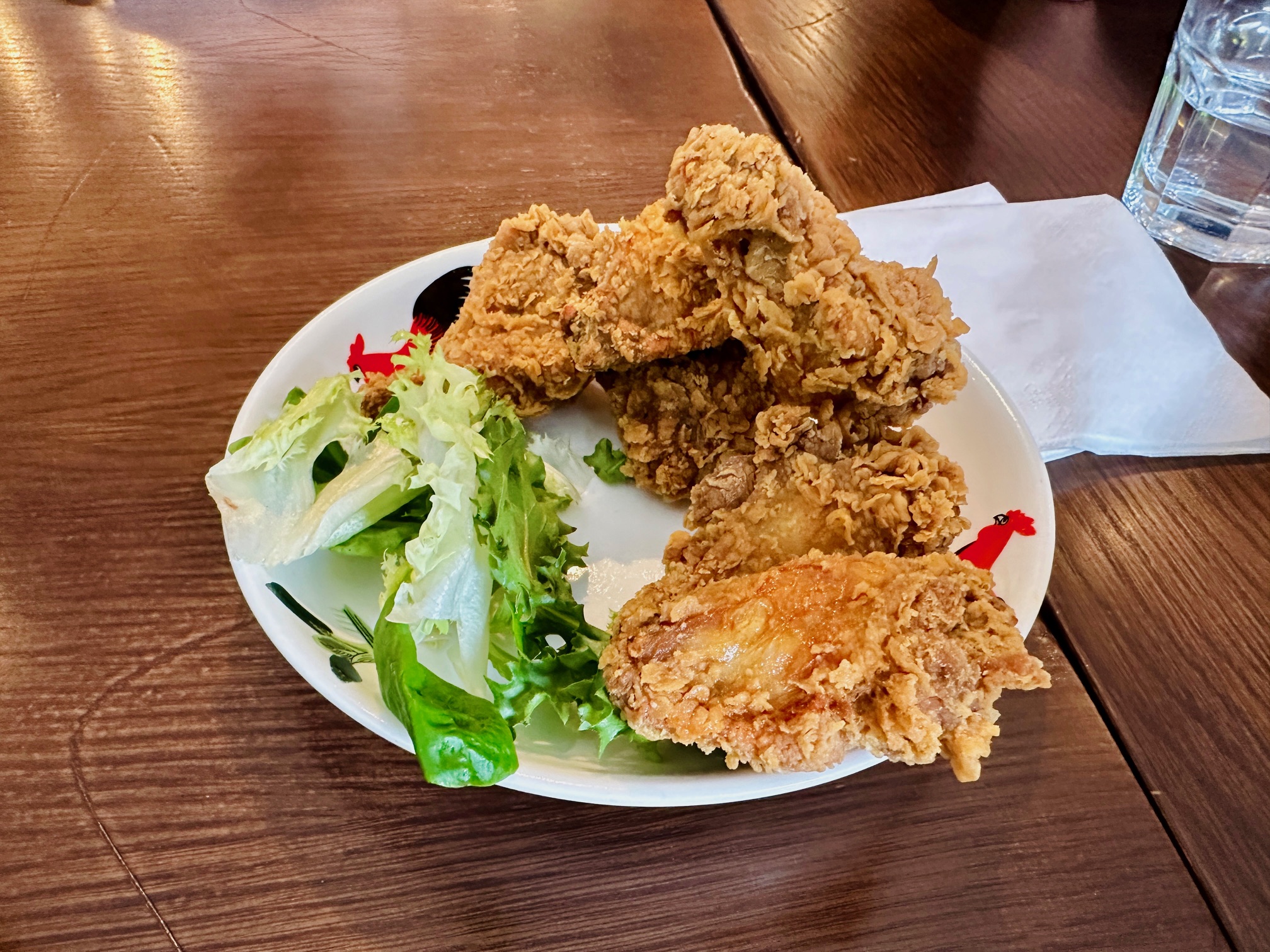
By far the single best thing we ordered was chosen because we saw it at the next table and had to have a piece of the action. It was impossibly rugged-looking fried chicken, and our neighbours somehow had the superhuman (or inhuman, depending on how you view such things) restraint to leave it there, in full view, for something like five minutes without making inroads into it.

I swear that our portion arrived and was dispatched before they finished theirs, and I wasn’t sure whether to be proud or ashamed of that. But it was so, so good. It was half a dozen wings, in a crunchy, gnarled coating which had just the slightest hint of funk from the shrimp sauce used in the marinade. Now, I’m not the biggest fan of wings, especially when they’re sauced or tossed, because for me the reward to faff ratio is out of kilter. But these were an absolute joy to rend and gnaw, to the extent where I wondered if I was giving wings an unduly hard time.

“I think these are the crispiest wings I’ve ever had” said Dave. “I wish we’d ordered a portion each.”

“There’s nothing to stop us ordering more” I said. “We could have them for dessert. Did you know there’s a fish restaurant in Lisbon where you have a steak roll for dessert?”

Dave gave me an indulgent look that said, ever so nicely, why are you like this? But I knew I’d planted the seed about dessert chicken, so I left it at that.

Last of all, we tried a Malaysian staple, the roti canai. Now, I had high hopes for this after reading Tom Parker Bowles’ review. He said they were charred, chewy and as delicate as silk handkerchiefs. Leaving aside the fact that I’m not sure something can be all three of those things at once, Kopitiam’s roti were delicious but more like rolled-up balls of tissue – sorry for the image – than silk handkerchiefs. I liked them, and they were definitely greaseless, but in little clumps they weren’t the easiest to dip into a little bowl of an admittedly delicious curry sauce, with plenty of brooding depth.

Our mains came out while we were still eating our starters. Now, this has happened to me before in a Malaysian restaurant, one called Wau in Newbury that I visited five years ago. And I complained about it in the review, and a few people told me I was being culturally ignorant and that in Malaysian cuisine everything tends to arrive at once. So I won’t moan about that again, even though it wouldn’t be my preferred way to eat. And I suppose it explains why a restaurant that’s full at noon can find room for you thirty minutes later, so swings and roundabouts.

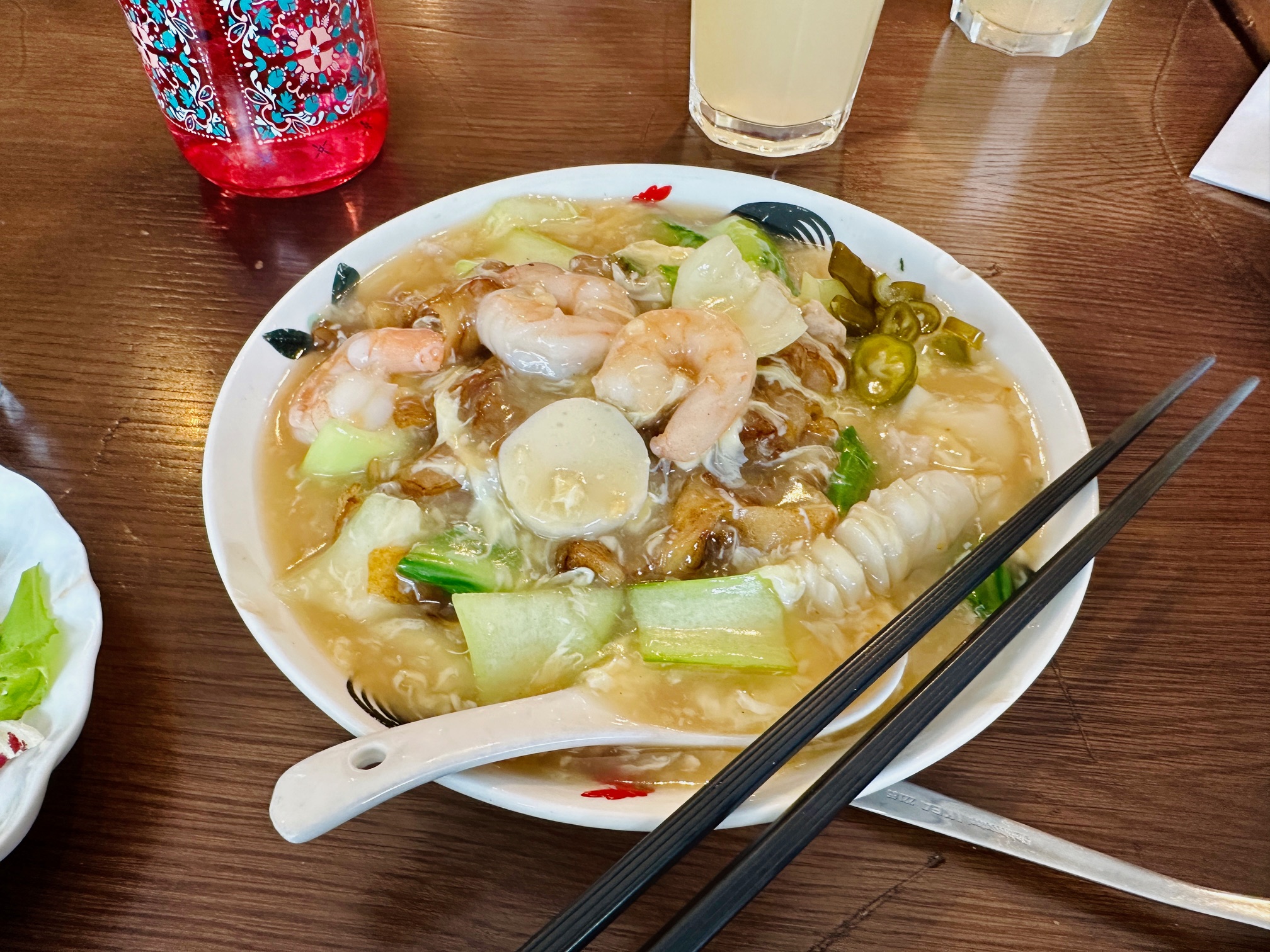
Dave and Leo had both chosen noodle dishes, but more different noodle dishes would be hard to imagine, despite having some of the same ingredients. Dave ordered Kopitiam’s special ho fun with not one, not two, but all of the following: prawns, squid, fish cake and pork. All that and what the menu described as an “egg gravy” on top. Something was surely lost in translation, because the words “egg” and “gravy”, next to one another, don’t scream take my money to me. But Dave seemed to enjoy it.

“The texture is a little… well… it’s kind of like mucus.”

“You can’t say that! I can’t put that in the review.” I said, fully intending to put it in the review.

“Well, it’s tasty mucus.”

“This is the thing, though, with some cuisines I think” I pontificated. “It’s just about us not having frames of reference. So we are generally a bit put off by gelatinous food, but I guess that’s because we associate that texture with sweet stuff. And nobody eats things in savoury jelly any more, apart from pork pies. It’s a tricky one with this kind of food – and it will make this review difficult to write. If you rave on it’s cultural appropriation, if you sound like you don’t understand it you just come across like Nigel Farage.”

“Anyway, I’m not sure if that is a fishcake. It has the same texture as a scallop. Anybody who promises a fishcake and gives you a scallop is okay in my book.”

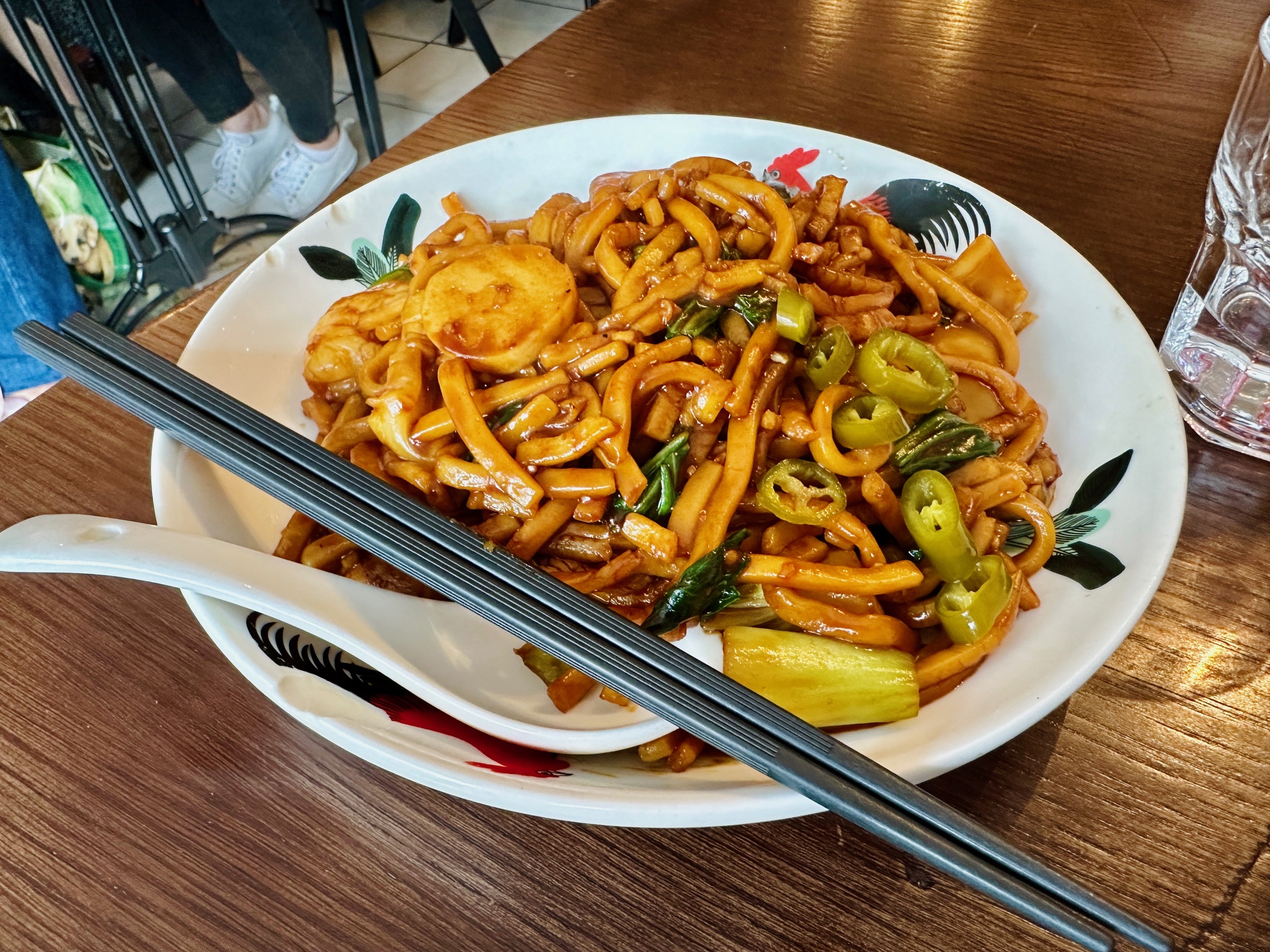
If Dave’s dish was our one Cantonese foray into the menu, Leo had chosen a Malaysian classic. Hokkien mee was wheat noodles rather than rice noodles, cooked in a darker, stickier sauce with the same mix of surf and turf and with, allegedly, the addition of fried pork lard, although that wasn’t visible to the naked eye. This looked more like it, and Leo polished it off without complaint. I didn’t try it, but I was struck that the noodles were broken and short, and I was grateful that I hadn’t ordered it because with my rudimentary chopstick skills I might well have ended up wearing half of it.

This is where, if I was a proper restaurant reviewer, I’d probably wank on about wok hei, whatever that is. But none of us are kidding ourselves that I am, so I won’t.

Originally I was going to have the beef rendang, because Dave had planned to order the Marmite chicken. But when he changed his mind it was up for grabs, and having enjoyed this dish so much at Lucky Lychee I wanted another bite of the cherry. And really, it was a similar experience to the lok bak – if I’d never had this dish before I probably would have loved it, but I knew how good it could be and so I knew that this fell short.

The texture was magnificent – we’d already established that Kopitiam could fry chicken like nobody’s business – so it wasn’t that. But the sauce was more honey than Marmite, more one note sweetness than harmonised salt and sugar. And there wasn’t a lot of it – what there was coated the chicken, and the chicken had all the crannies and crevices to make that happen, but that was your lot. What that meant was a few bites of reasonably enjoyable but dryish chicken, rendered drier by plain white rice, and not much else.

Partly my fault, perhaps, for ordering it from the lunch menu, and perhaps if I’d ordered a separate helping and a separate bowl of rice I wouldn’t have felt so diddled. But I don’t know, I still think at the end I would have had a whole expanse of naked rice, desperate to be covered with anything. I poured the rest of the sauce from the roti canai onto a little patch of rice and ate that. I left the rest.

“Are you okay mate? You haven’t eaten much of your rice” said Dave.

“There’s nothing to eat it with” I said, gesturing at my plate. Tell a lie: there was a little mound of undressed salad on the plate fighting it out with the rice to be the least appealing, like Robert Jenrick versus Kemi Badenoch. To my mind it was a dead heat.

Once we’d finished our mains I watched the seed I’d planted earlier playing out in Dave’s mind. He still wanted more chicken wings, but he also didn’t want to look like it was his idea.

“So I suppose we aren’t going to have more chicken wings now, are we.”

“We can have more chicken wings if you want them. Do you want more wings, Dave?”

“Well, I’ll have some if somebody else wants some.”

This is the dance you have to do with some people, and my dear old friend is one of them. Fortunately Leo is eighteen and slim and likes food and has no compunctions about it, so he said that yes, he would very much like more of the delicious chicken wings. So Dave flagged down our server, asked for some more and they arrived and we fell on them with no less gusto than the first portion. It was the perfect end to a thoroughly agreeable lunch.

I do have to say too that the service at Kopitiam is absolutely brilliant – I would say the majority of the customers in there were Chinese or Malaysian, but I didn’t feel like a sore thumb, or ever less than extremely well looked after. I guess once you’ve had the King’s stepson in there, you can easily manage plebs like me, one of my oldest friends and the apple of his eye. We settled up – our meal came to just over seventy-five pounds, not including service – and we headed off in the direction of the Rose And Crown on North Parade for a pint and a debrief.

Kopitiam, by the way, is on South Parade, which is further north than North Parade, one of those wonderful paradoxes you sometimes find, like Gary Oldman being younger than Gary Numan.

Whenever I travel a bit further for the blog, I’m aware that the stakes are higher and I try to pick places where I’m pretty certain I’ll have a great meal. “Hey, come and read about this place miles from Reading that isn’t really worth going to!” is not much of a sales pitch, and believe me, I know it. Generally I’ve had decent luck when I’ve travelled to Oxford on duty, and I’ve never reviewed a dud in the city. And I wish I could offer a more ringing endorsement of Kopitiam, but I don’t think I can.

Not that I’m saying Kopitiam is a dud. It’s not a bad restaurant, the service is brilliant and some of what I ate was excellent, but I don’t know that it’s worth travelling to Oxford to try unless you are really passionate about Malaysian food. And perhaps Malaysian food isn’t where they’re at their strongest: I saw items from the more Cantonese side of the menu turning up at other tables and the roast duck, skin all lacquered, invoked particular regret.

But also, if you do like Malaysian food and you’re taking a trip away from Reading I would say to take the train south-west, stop at Winchester and make your weekend by eating at Lucky Lychee. And if you’re in Oxford, better options exist. One of them, in the shape of Pompette, is literally the other side of the road. And you can book a table for whenever you like, which some people – and it turns out I’m one of them – seem rather to like. So there you have it. Kopitiam may not take reservations, but I’m afraid I had enough for the both of us.

Kopitiam – 7.0
Suffolk House, 19 South Parade, Summertown, Oxford, OX2 7HN
01865 454388

https://kopitiamoxford.co.uk