Bar review: Bigfoot, Oxford

This might be the first time I’ve been able to say this in over 30 years of working for a living, but my boss – he doesn’t read this blog, so I can get away with admitting this – is one of my favourite people. He’s a few years older than me, but I suspect he’s hired in his image and our politics, our cultural references, our general outlook on life and our regular Guardian reading match up nicely. I couldn’t help but think of him the evening I stopped by Bigfoot, a little spot on Oxford’s Cowley Road specialising in cocktails and tacos.

The thing is, my boss – like me – is a big music fan, always on the hunt for new bands to listen to. Unlike most people I know, his taste in music didn’t stop in an arbitrary year, preserved in aspic, leaving him just listening to old favourites. His Spotify Unwrapped is interesting every December, and we often swap recommendations: without him I wouldn’t have discovered the loping lo-fi jangle of Talking Kind, or the weird and wonderful 70s Algerian funk (I’m not making this up) of Ahmed Malek.

Unlike me, my boss is still a regular gig-goer, especially in Oxford where he watches all sorts of bands in all kinds of ramshackle venues. He took his wife to see a band called Shit Present last year on her actual birthday, without a shred of irony, and she joined him without complaint. That’s quite some marriage, I imagine.

My boss reports a consistent phenomenon at those gigs. The band is invariably young, lean and hungry, in the foothills of its twenties and having the time of its life. And the audience? “They’re all 6 Music dads like me” he says, ruefully. It happens when he goes to see Bar Italia, or Stick In The Wheel, or some band I’ve never heard of playing music you could describe without irony as a soundscape. His ears like a challenge.

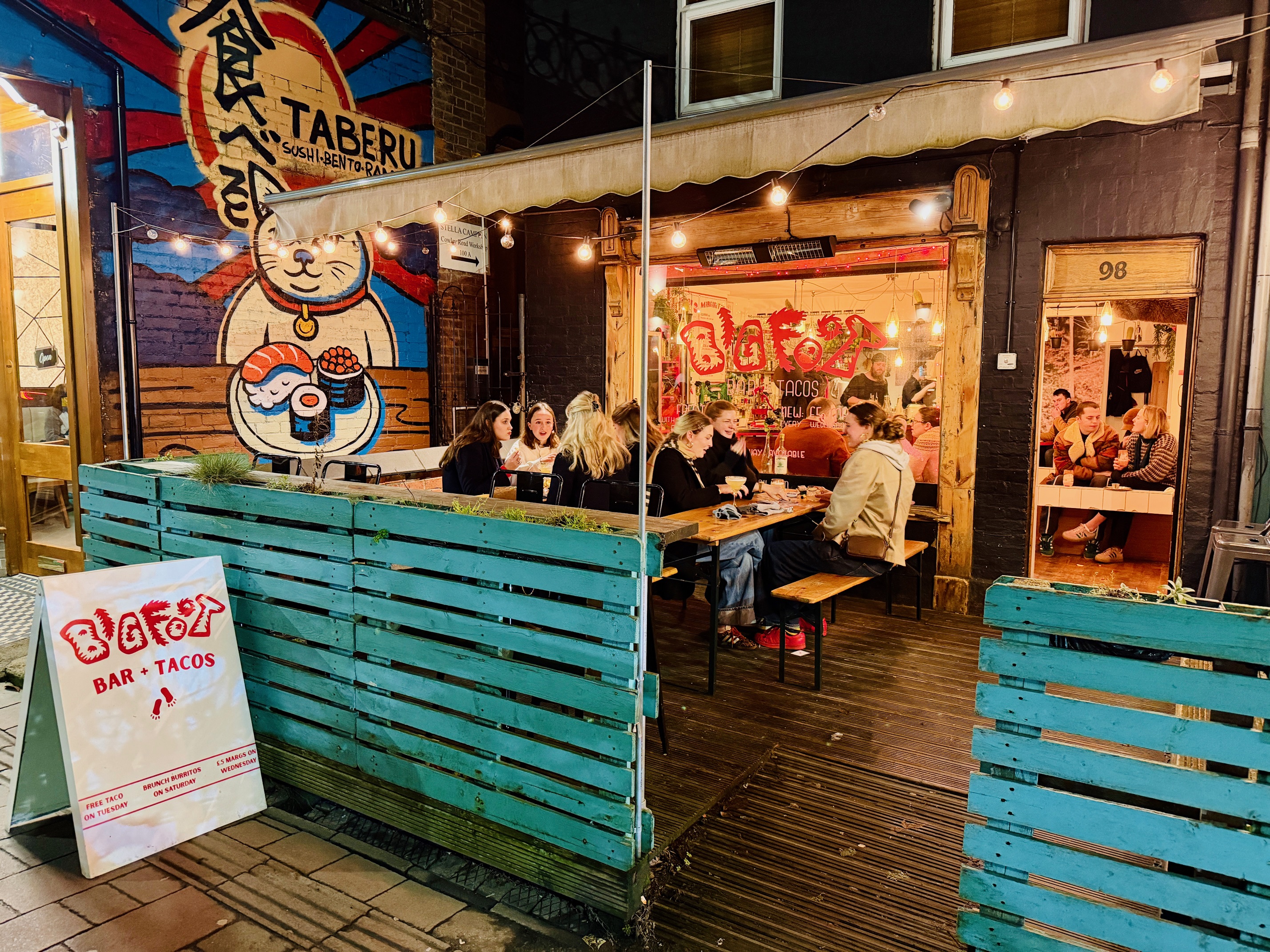
When I stopped in Bigfoot, I got an inkling of how he must feel. Because everybody in there was young, from the head honcho behind the bar with his beard/beanie/fisherman’s jumper combo to the friends catching up at the table in the window, to the chaps behind me who were mansplaining to one another about “the societal pressures on women” without any women at their table, as if they had a fucking clue. Outside, in the January cold, a table of four young women directed subtle evils towards me, the mouldy old fiftysomething nabbing one of the only spots inside all to myself.

Bigfoot opened in December 2023 and has consistently offered cocktails in general, and margaritas in particular, ever since, along with tacos. It has slightly bowed to market forces since, adding beer and wine to its menu, but otherwise has continued to plough this admirable, idiosyncratic furrow. I was in Oxford with some free time for a solo meal so I thought, Why not? I forewent a table for one at somewhere more obvious and slipped into the no reservation spot early doors to snag a table.

It helps that I love that part of Oxford so much. I occasionally read some rabid panic on Facebook from someone still complaining about 15 minute cities, and I think the main problem is their lack of imagination. Because on the Cowley Road, if you stand outside Bigfoot, you are within a 15 minute walk of the Magdalen Arms or the Chester Arms. Arbequina and Spiced Roots are mere minutes away. You can buy Oxford’s best coffee at The Missing Bean, or drink in Peloton Espresso, my favourite Oxford café. What’s to dislike?

Not only that, but just across the road is the Ultimate Picture Palace, the arthouse cinema where I saw stuff like Le Samourai, Betty Blue and Paris, Texas, over thirty years ago. You can browse music in Truck Records nearby, which also happens to do good coffee.

And a very short walk from Bigfoot there’s also the Star Inn on Rectory Road, where Oxford’s best beer garden is hibernating, waiting for spring, and DEYA’s Steady Rolling Man is always on tap. I had very much enjoyed Peloton and the Star before ambling into Bigfoot, as it happens, and I was hoping that Bigfoot would complete a beautiful OX4 trifecta.

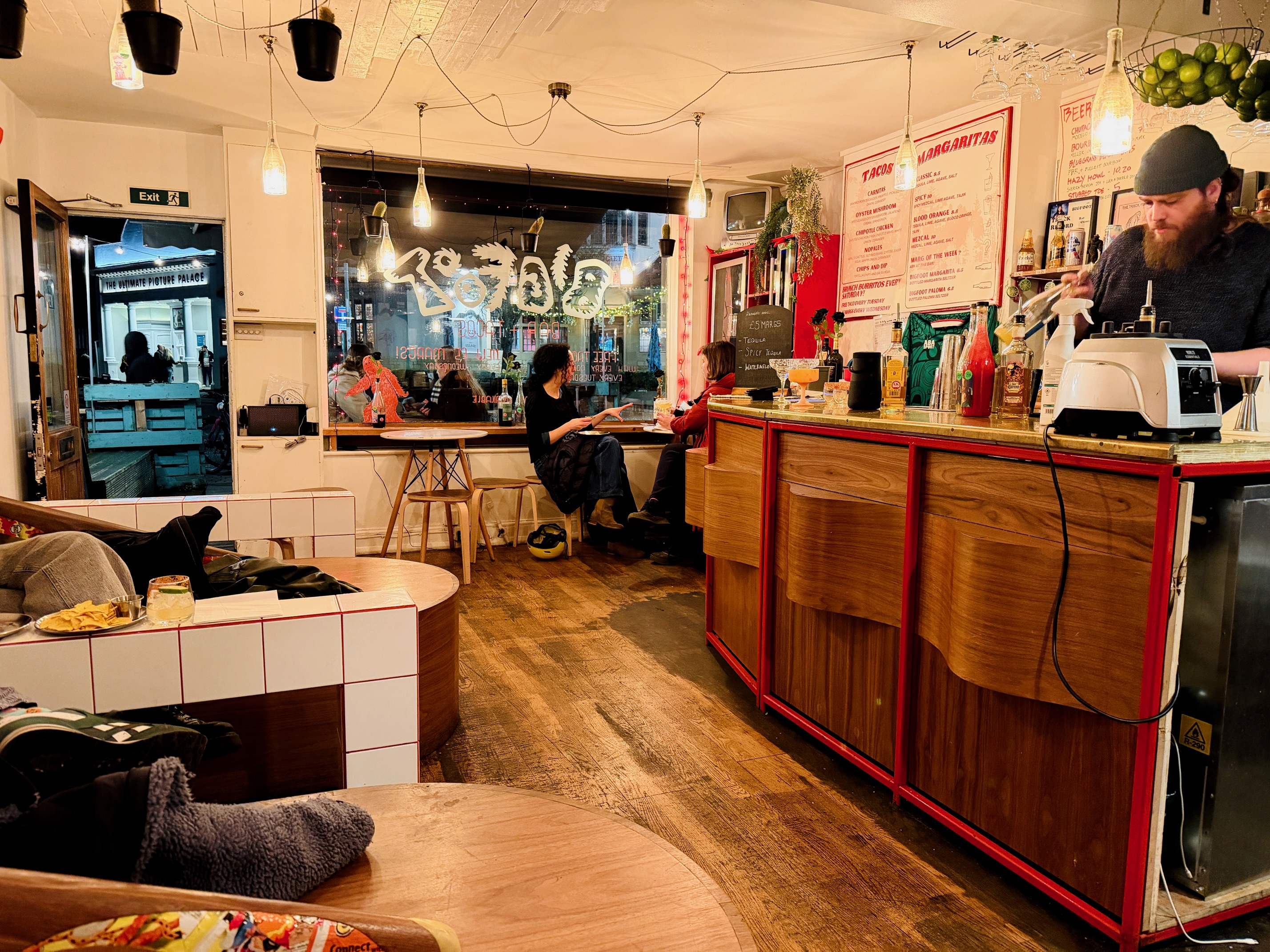
I loved the interior, all scruffy and ineffably cool, spider lights and baskets of limes hanging from the ceiling, art on the walls. A couple of cramped tables in the window had bentwood stools, and along one side of the room were what looked like bespoke benches with narrow tile partitions between them serving as tables, just deep enough to accommodate a glass or a plate of tacos.

Their curves matched the undulations of the bar, and the whole thing had a feeling of otherness that I loved. I felt like I could be in Bairro Alto, the Realejo or the 11th arrondisement, somewhere far cooler than me or, in all honesty, most of prosperous Oxford. That’s the great thing about the Cowley Road, it’s the metaphorical two fingers up that says the rest of this city might be like a supersized version of Henley on Thames but not us, buster.

The red on white menu by the bar screamed simplicity: four tacos, two of them vegetarian, all of them £2.80 a pop. They also do chips and dip, and burritos on Saturday but that’s your lot. Similarly, there were five margaritas, a couple of bottled boozy seltzers and a slightly confusing menu of what seemed to be beer and chaser combos. The beer choice was limited but considered: Modelo, the Mexican classic; the iconic American Pabst Blue Ribbon; and – this was an inspired choice – Mash Gang’s Chug IPA, one of the best AF beers made in the U.K. To complete a general feeling of bounty, the evening I was there three of the margaritas on offer were a fiver each.

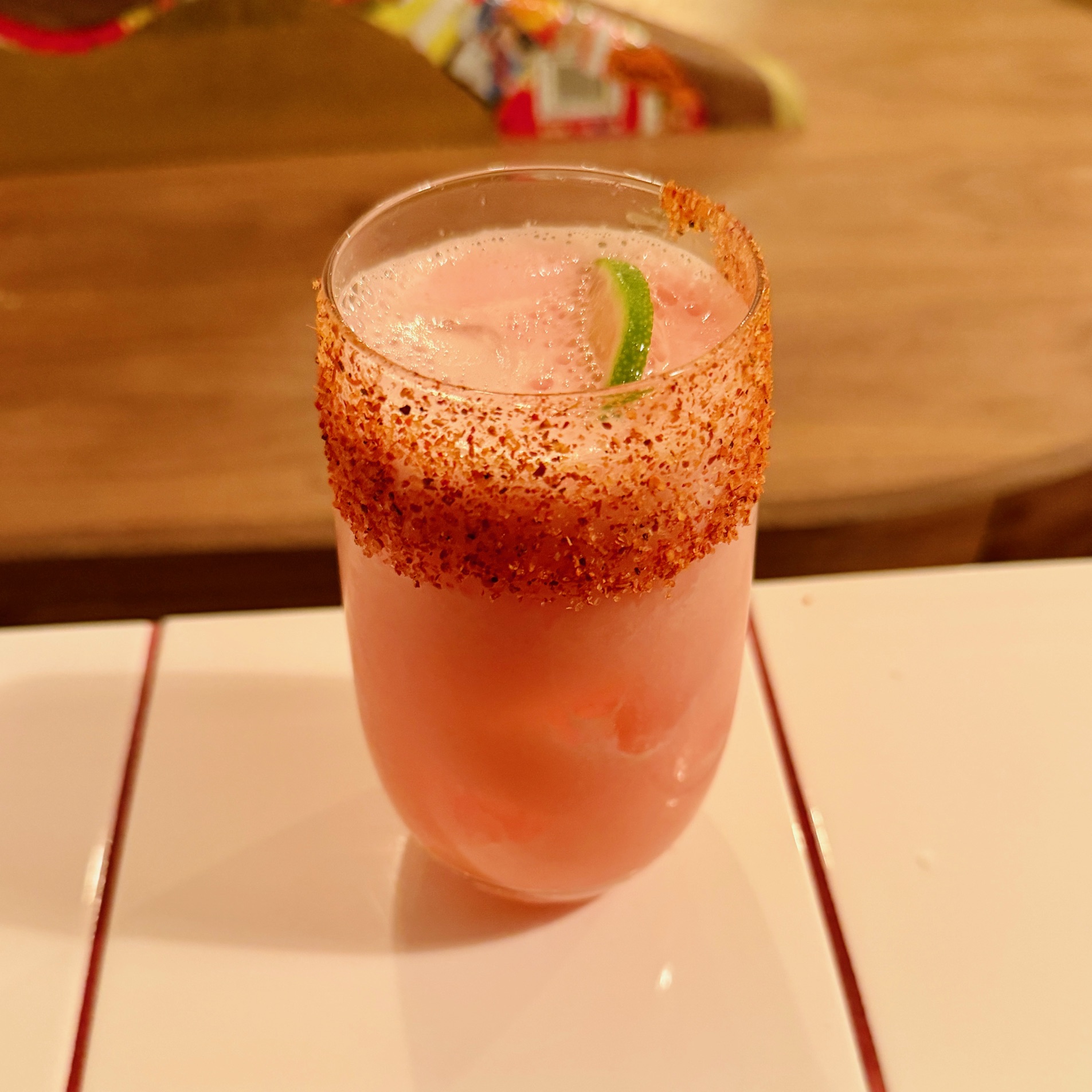
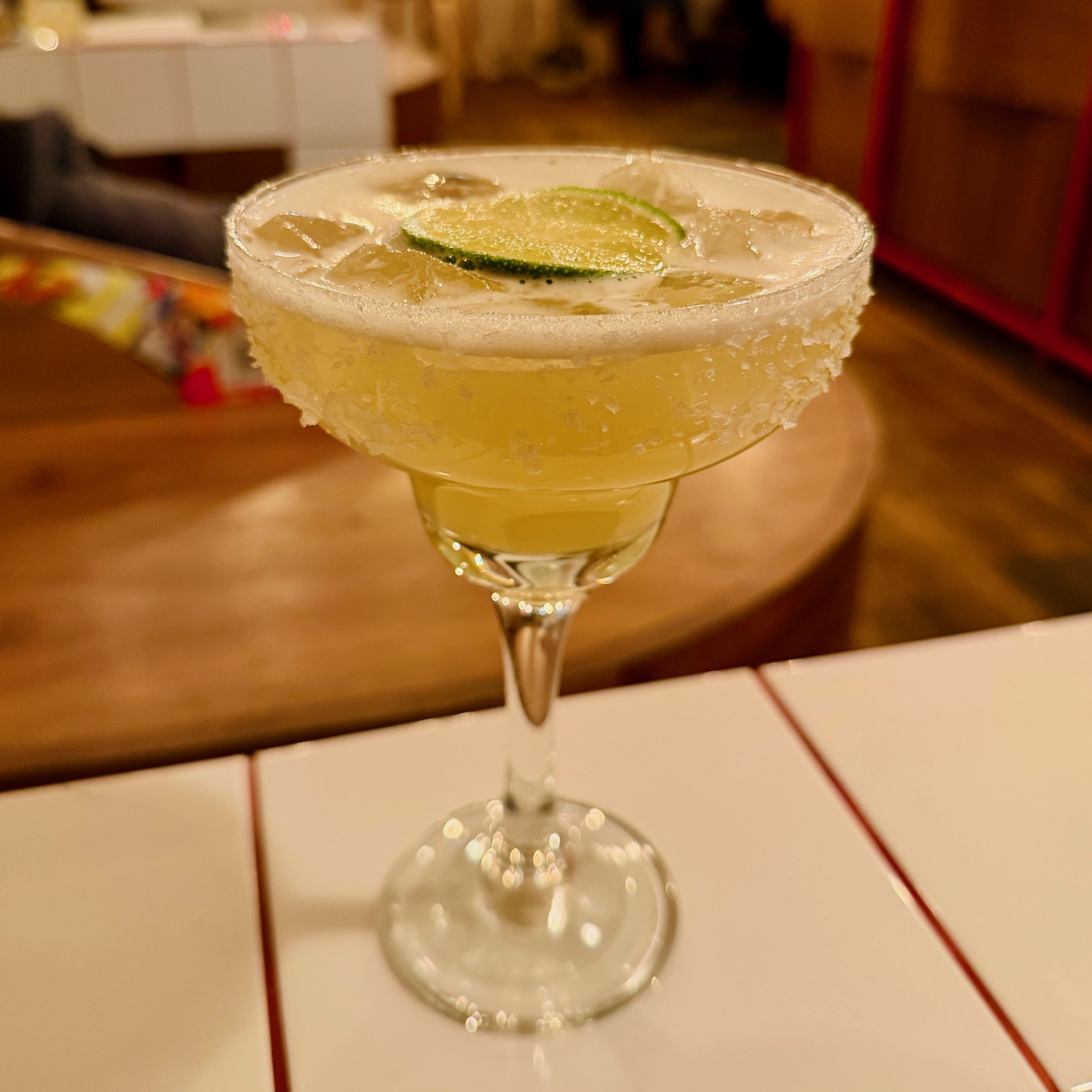
I’m not a margarita aficionado but when in Rome and all that, so I gladly left my comfort zone and ordered Bigfoot’s classic, the textbook combination of tequila, agave, lime and salt. It came on the rocks – crisp, bracing and tasting every bit as boozy as I suspect it was. I don’t know which brand of tequila Bigfoot uses – I saw El Tequileño behind the bar, there might have been others – but this was the sort of cocktail I could easily see becoming habitual. Each sip, sharpened with a jag from that salted rim, was a delight.

Next time I’d be tempted to try a mezcal margarita; a look behind the bar revealed an impressive array, from multiple variants of Ojo de Tigre to La Higuera. The folks at Bigfoot are serious about being good at the narrow range of things they do.

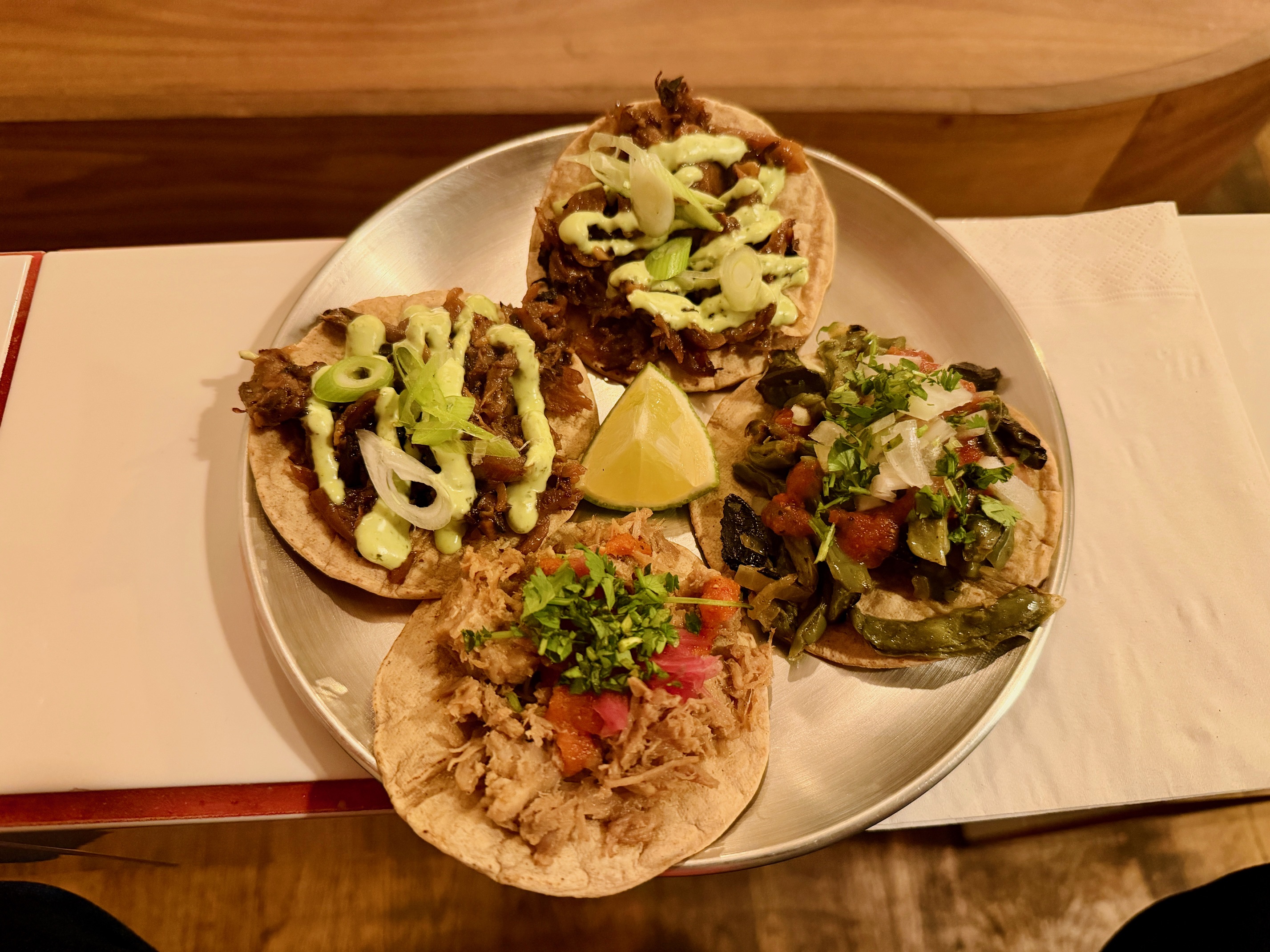
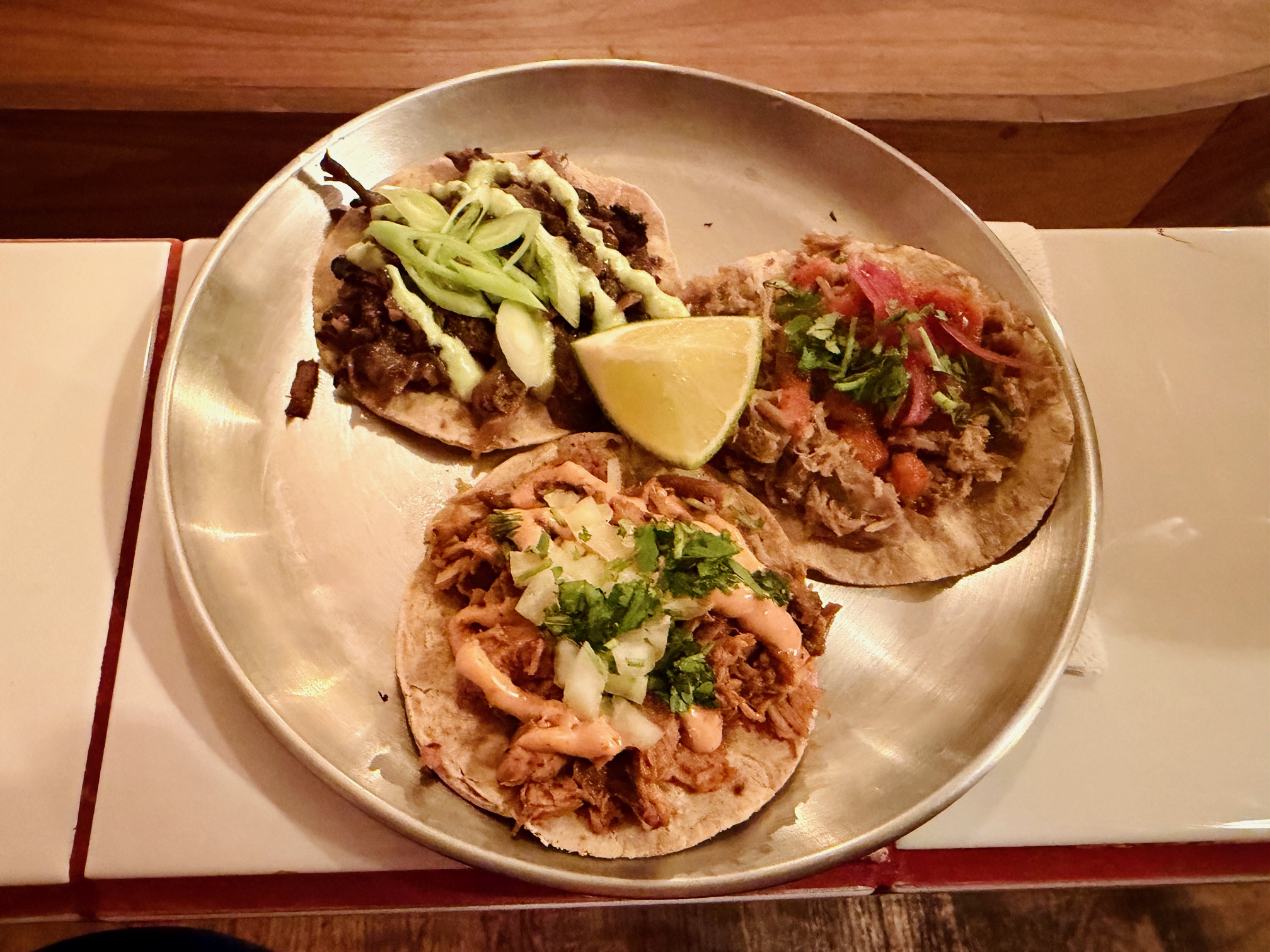
The tacos didn’t so much subvert expectations as invert them. I expected my favourite to be the chicken thigh, but it was the most underpowered of the lot, the chipotle a little quiet, the mayo on them equally muted. White onion, too, felt like it was there to make up the numbers. But that’s not the same as saying it was bad, and if it hadn’t been outperformed by everything else on the menu maybe I would have been perfectly happy with it.

Far better were the carnitas tacos, with so much more going on: pork shoulder braised to a tangle, along with pickled red onion which provided the contrast missing from the chicken. The finishing touch – only knobbers call it a hero ingredient – was the pineapple, which made everything pop; you can argue about whether it belongs on a pizza if you want, not without justification, but it does belong in a taco. These were the wettest and messiest of the tacos, however carefully you fold them up and however precise your bite: more napkins might have been helpful.

The one I expected to like least and liked the best was the curveball, the oyster mushroom taco. Miso glazing gave it a very pleasing savoury depth and a meatiness that stopped me missing birria, or ropa vieja, or beef in any other guise; Bigfoot’s Instagram suggests they have been offering birria tacos as a special, but they weren’t on the night I visited. Of all the tacos I tried these were my favourites, with a zigzag of relatively subtle jalapeño crema and spring onion in a pick-up-sticks formation.

The tortillas were thick and soft, up to the task of holding everything in and piled high enough to introduce, nonetheless, an element of jeopardy. I don’t know if Bigfoot makes them, but a bowl of tortilla chips with salsa at a neighbouring table looked bought in: I decided not to give them a try.

I was having so much fun that I didn’t want to leave. The air was humming with the kind of great music that makes you reach for Shazam – or would do, if this part of Oxford wasn’t a mobile reception blackspot that somehow catapults you back to 1996. Outside the table of young women was playing cards, and I made a mental note to add card games to the list of things that became hip far too late for me, despite all my many hours playing cribbage on holiday after holiday in my thirties. One of the women peered balefully through the window at me. When is grandpa fucking off? the gaze seemed to say.

By this point, all the tables inside were occupied and the outside tables, too, were filling up. Where were these places when I was in my twenties, I wondered? When I was the right age to drink in these kinds of places either they didn’t exist or they did and I didn’t drink in them, most likely because I didn’t know about them.

The only place I could think of in Reading terms that had a feel anything like this was Bar Iguana, in the early Noughties. I remember going there once, nearly twenty-five years ago, and the bar staff were too busy kicking around a hacky sack to serve me. Even then I was too old for that bar, but I didn’t know it at the time.

Bigfoot was far more inclusive to the advanced in years, and the barman told me about a drink I’d eyed up heading to another table: the watermelon margarita, also on the specials menu. So naturally I had one and it was possibly more perilous than the classic margarita because it carried its alcohol content far less ostentatiously.

A chap at one of the other tables, trying to impress his date, asked the barman if it had cinnamon and star anise in it, and was very pleased with himself when it turned out that it did. I didn’t get any of that, but it was sweet and incapable of giving offence and probably dangerously boozy. The watermelon came through to the exclusion of anything else, but I quite liked that. At the end of the meal, I did dainty little watermelon burps all the way down the Cowley Road.

And I had more tacos, of course. I could claim this was to flesh out my research, but in truth it was because I liked them and to test the only one on the menu I hadn’t eaten. Nopales tacos came with cooked prickly pear cactus, refried beans, cheese and salsa roja and oddly, in some ways, they felt the most traditional ones I tried. The presence of cheese was welcome, and it turned out that cactus – or this cactus, anyway – had a texture a little like soft green peppers. I was glad I could say I’d tried it, but it didn’t outperform anything else on my little plate.

All that – seven tacos and two £5 margaritas – came to just under £34 including tip. I thanked the chap with the beard and the beanie effusively: far too effusively, probably, because I will never be cool. I expect he was grateful for my custom in the way the members of Bar Italia are grateful that my boss turns up to their Oxford gigs.

It felt like that embarrassing bit in In Bed With Madonna where Kevin Costner tells Madonna backstage on her Blonde Ambition tour that he thought her show was ‘neat’ and, after he leaves, she pretends to stick her fingers down her throat. At least I didn’t say Bigfoot was neat, or at least I don’t remember using those words.

Bigfoot doesn’t do dessert, but you have ice cream café George & Delila a few doors down – see what I mean about 15 minute cities – or you can, as I did, cross Magdalen Bridge, waft down The High and end up in Swoon Gelato. I sat at the front, in the window, with a salted caramel gelato feeling, as you do when you hit the OX1 postcode, a little less old and unhip. I didn’t mind all that anyway, but if I had the gelato would have made it all better.

I’m conscious that this review might be even more niche than usual for my Reading based readers. If you go to Oxford, you probably want a proper meal as part of a trip to the city, and stopping at a small, scuzzy bar that happens to do tacos may not really suit your purposes, unless you’re off to a gig nearby at the O2 Academy. They do lunch, I suppose, but only on Saturdays. So this one might have more appeal to locals, or that small section of my readership that lives in Oxford (or the Oxford subreddit, which is always so kind about my work).

But I thought all that and then thought sod it and decided to write it anyway. Because I keep coming back to what I said earlier on – if this bar was in Paris, or Lisbon, or Granada, and I’d visited it on a trip to one of those cities it would appear in the city guide I subsequently wrote. I would say that the place is charming and likeable, the tacos are very good and that it’s a fun place to hang out for a few drinks even if you then go on somewhere else.

I really loved it: admittedly, that was after two margaritas, and it’s possible that after three I’d have loved everyone and everything. Even so, I heartily recommend Bigfoot, if you’re anywhere near that area and in anything like the mood for what it does, especially if you combine it with Peloton and the Star, the other elements of that holy trinity. Getting old is no fun but, as friends always tell me, it beats the alternative. Finding spots like Bigfoot, however – even if it makes me feel a 6 Music dad at a happening gig – never, ever gets old.

Bigfoot – 8.1
98 Cowley Road, Oxford, OX4 1JE

https://bigfootoxford.com

Since January 2025, Edible Reading is partly supported by subscribers – click here if you want to read more about that, or click below to subscribe. By doing so you enable me to carry on doing what I do, and you also get access to subscriber only content. Whether you’re a subscriber or not, thanks for reading.
Restaurant review: Me Kong

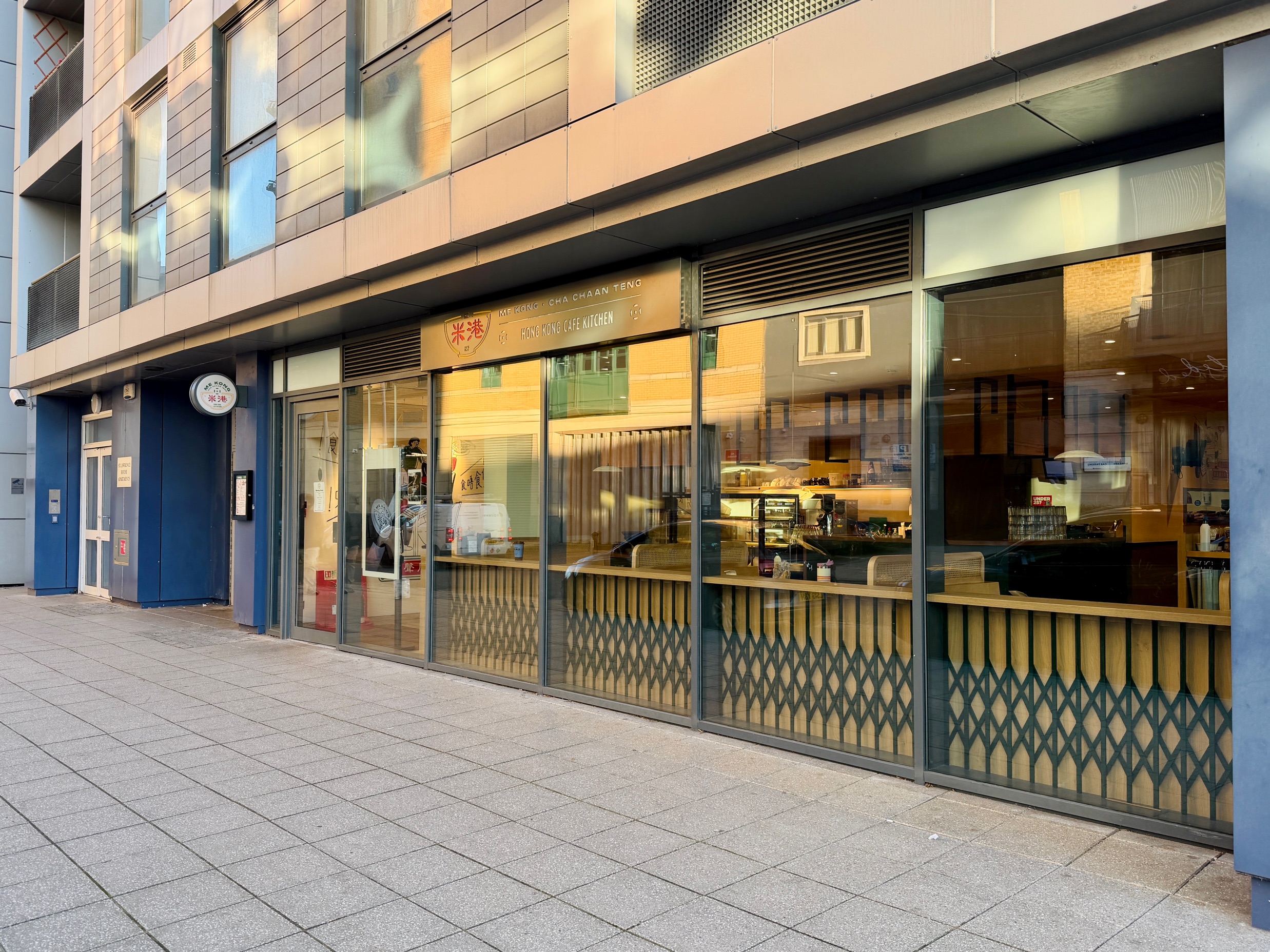
When I ran through the trends in Reading’s food scene last year, two stood out: the proliferation of new, casual pizza restaurants and a similar blossoming of restaurants to cater to Reading’s Hongkonger community. Last week I explored the former at Smelly Alley’s Zi Tore so it only seemed fair, this week, to dive into the latter at Me Kong, the newest of these restaurants to open.

I identified some of these spots opening in 2025 – Woodley Food Stasian out in Woodley, Take Your Time where Dolce Vita used to be and the subject of this week’s review, which is tucked away behind Reading Library just down from The Blade next to the retro classic that is the Abbey Baptist Church. It’s a spot which somehow didn’t feel like it existed before Me Kong sprang up there: I can’t remember what, if anything, was there before.

But even that undersells the increase in restaurants catering to this market. After all Good Old Days Hong Kong, which I reviewed around this time last year, has been around since late 2023. Worse still, I missed out a couple of developments last year – YL Restaurant for one, which opened in the back of the supermarket that used to be the Warwick Arms a long time ago. And then there’s Soul Chill, a cafe that opened right opposite where I used to live on the corner of London Street and South Street. Its Google listing initially made it look like a bubble tea spot, but it boasts breakfast and lunch options.

All this, of course, springs from the introduction in January 2021 of the BNO Visa for Hongkongers, giving them the right to settle in the U.K. with a path to citizenship. Reading – always a multicultural, well-educated, polyglot place – has as a result both developed and embraced a significant Hongkonger community. With that come all the advantages of vibrancy, including – selfishly, for me – new and interesting places to eat.

Me Kong is a particular type of establishment, a cha chaan teng. These are “tea restaurants” that originated in Hong Kong in the Fifties, following on from the bing sutt, or ice room. Cha chaan tengs are often likened in print to the British greasy spoon or the American diner, but I think that’s more to try and find a term of cultural reference readers might understand. In reality they are a creature all their own, and a very eclectic one at that.

Food at a cha chaan teng is often described almost as a fusion of Chinese and European – another term often used is ‘soy sauce western’ – with dishes including Chinese ones with which you’d be familiar and more esoteric options like baked pork chop with ketchup, or macaroni soup topped with char siu. In Hong Kong cha chaan tengs are a great gastronomic leveller – swift, efficient and frequented by blue and white collar workers alike.

Plenty of my research suggested that cha chaan tengs are on the wane in Hong Kong, as for that matter greasy spoons are here, but it’s somehow fitting that a wave of them is opening in the U.K. Because I’ve read that when they first sprung up in Hong Kong in the Fifties it was because Hong Kong, run by the British, welcomed Chinese refugees. There are echoes of that, I suppose, in the situation now, seventy years later.

A taste of home, or nostalgia, makes perfect sense if you settle somewhere so far away from your roots, and last month I saw a few photos of customers queuing round the block to try Me Kong for the first time. But did this food also have the potential to win over a wider customer base?

Someone thought so ten years ago, when a restaurant literally called Cha Chaan Teng opened in Holborn, but the reviews were not good. Marina O’Loughlin, then writing in the Guardian, said the food gave her “the kind of clammy shame I’d feel if I woke up post-bender to find myself the fifth Mrs Gregg Wallace”, adding that “cha chaan tengs aren’t renowned for their cuisine”: what’s the opposite of a white saviour?

There is a difference, though. That restaurant was geared at customers of European descent, while Me Kong promises to be the real thing. So on a Tuesday lunchtime I pootled over with my great friend Jerry, who was especially interested in Me Kong because it’s probably the closest restaurant to his gorgeous, incredibly tasteful flat. Forget whether I liked it or not: I also wanted to see if Jerry could find a brilliant new local.

We got there around twenty past twelve and the place was already packed with a queue for tables, albeit one that hadn’t moved out onto the street. I will say though that although we as a nation like to think we’ve invented queuing, Me Kong has perfected it – quickly assessing each table size needed and gradually corralling us into different spots in the waiting area.

At the front there were counters showing off all of Me Kong’s baked goods – buns, pastries and the like – and so some of the people joining the queue were simply buying that stuff to take away. Nothing fazed Me Kong’s front of house, and after no more than five minutes we were ushered to a table.

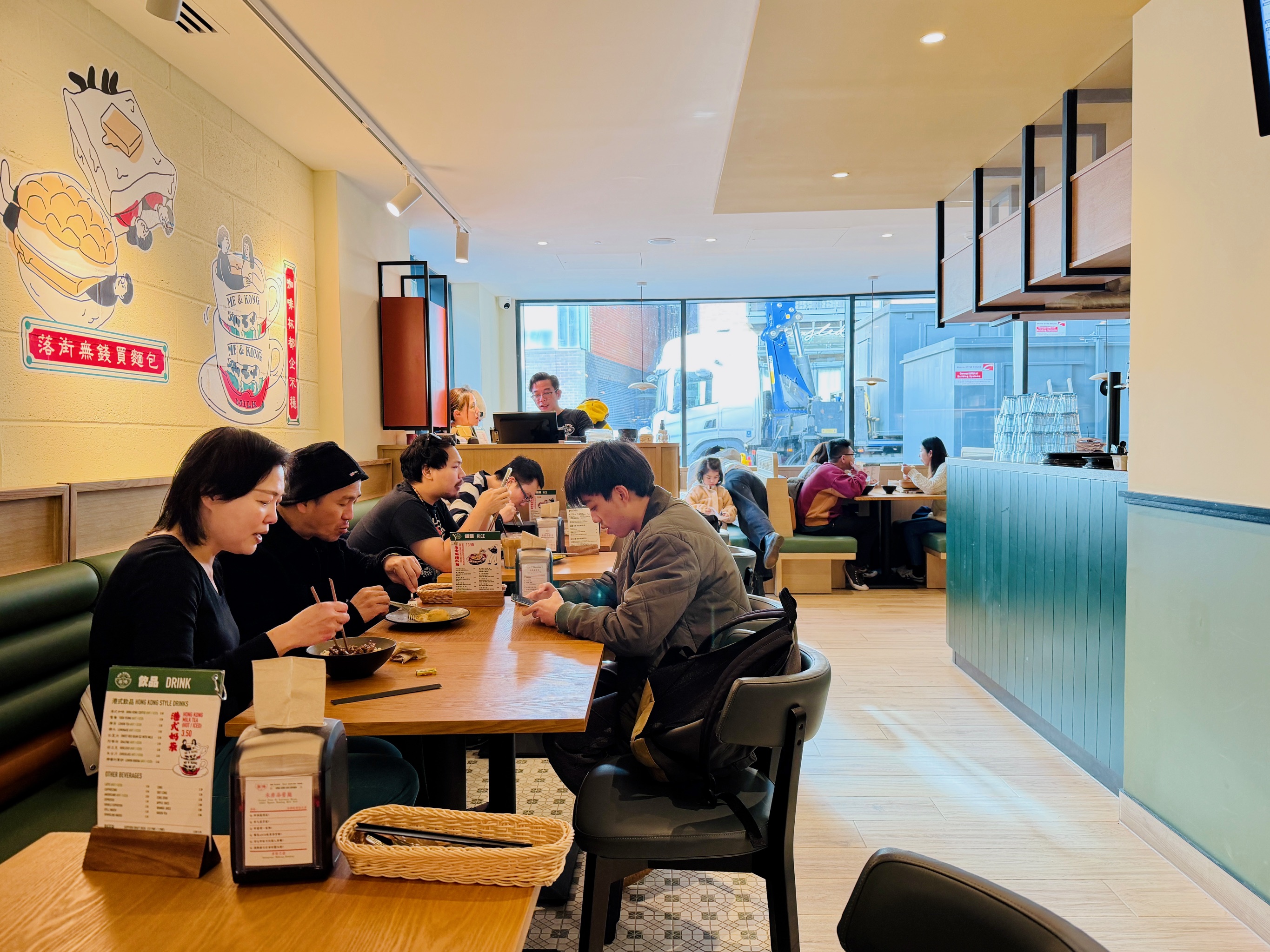
Me Kong’s interior is really rather impressive, I think. On one level it’s a front room with booths, a back room with tables and a corridor connecting them. But that doesn’t even begin to do it justice, on many levels. They’ve gone all the way through the building, so the front looks out on Abbey Square and the back onto the Holybrook, and that results in a really lovely space where everything feels airy and beautifully lit.

Not only that, but it felt polished and finished in a way new establishments so often don’t: the colour of the wood panelled counter; the tasteful banquettes; the bright line drawings on the wall, everything seemed really considered. And the branding, from the menus to the cups to the napkin dispensers, was extremely well thought out. I got the impression this wasn’t their first rodeo: I’d be surprised if it was their first restaurant, for that matter. It felt fully formed.

I should also mention that Jerry and I were, at the point when we sat down, the only customers of European descent in the place. But I never felt conspicuous, because the staff were just so terrific from start to finish. One server explained to us that they really wanted to promote this kind of food, and I got that impression throughout the meal.

In fact, I’m jumping the gun by saying this but I’ve never been to a restaurant where the staff were quite so keen to tell you what the gorgeous-looking dish that had turned up at another table was (“that’s the braised eggplant with garlic sauce” one of them told me, as I admired a delectable-looking pot on my left).

Me Kong’s menu, on a ring-bound set of cards with that impressive branding, was a proper box of delights with an awful lot going on. One section featured noodles, either dry or in soup, along with five set meals, another common feature in a cha chaan teng. These gave you the option of some Hong Kong classics – ham macaroni soup, say, or char siu macaroni soup – paired with a bun and either fried egg or omelette.

A large section of rice dishes again led with a staple of the cha chaan teng, baked pork chop with cheese and tomato sauce on rice. Many of these dishes were more on the fusion side, so were perhaps more for purists. Another page of the menu featured four clay pot dishes and five stir fries, and another page of snacks offered dishes like deep fried chicken leg with curly fries – again, an authentic cha chaan teng choice – along with a full range of options from the bakery.

I would say that with the exception of that aubergine dish, which looked like it might have had minced pork in it, there wasn’t much for vegetarians here. The page marked Vegetables featured various green veg with garlic or oyster sauce, but would feel limited if that was your lot. There was, however, plenty here for the cost-conscious. The most expensive dish on the menu was south of £15, those set meals were less than a tenner.

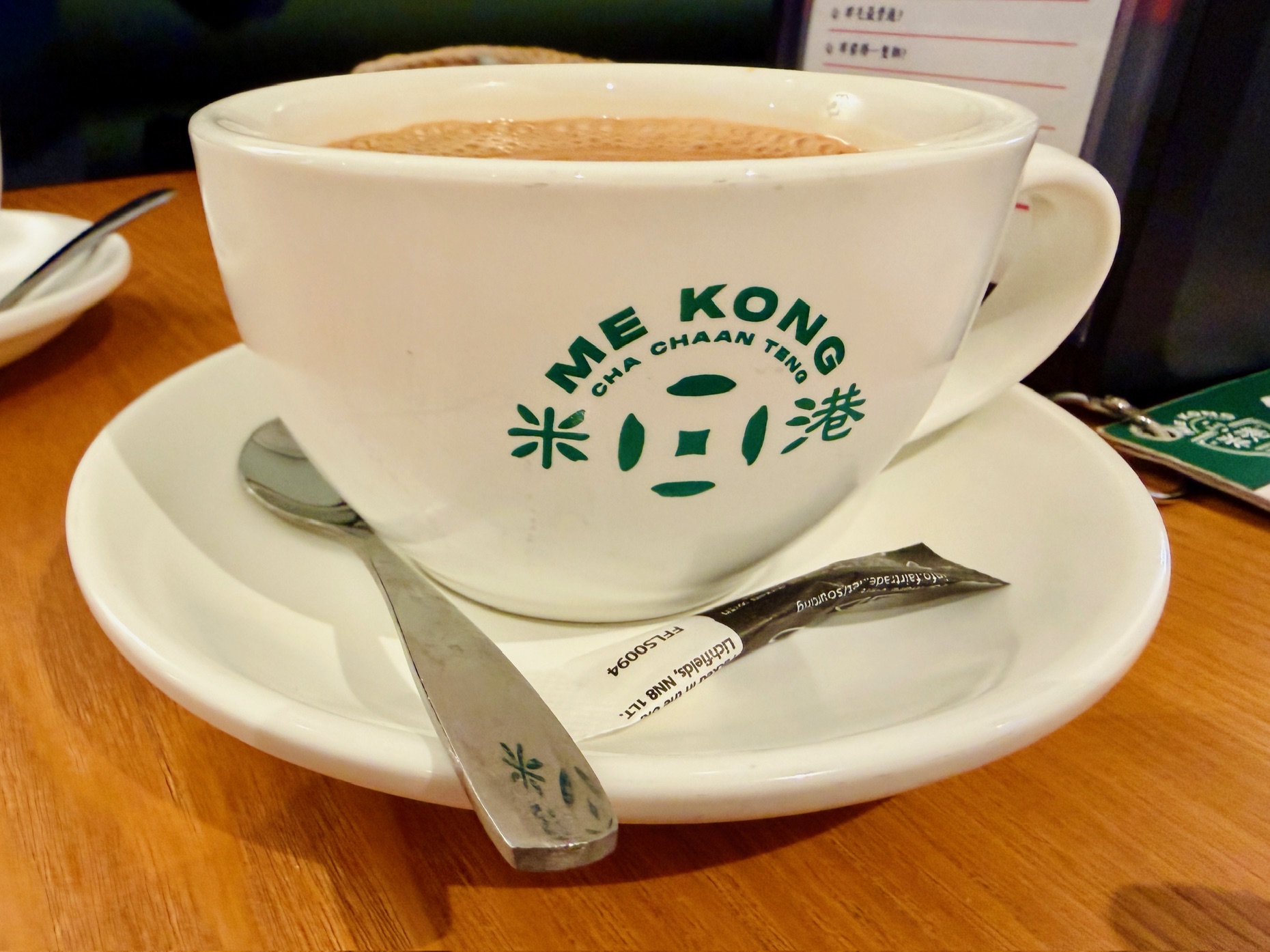
Plenty of decisions for Jerry and I to make – but first, tea. Me Kong does sell alcohol (Sapporo on draft, or Guinness) but I really wanted to try the Hong Kong milk tea, another speciality of this kind of restaurant. It’s hard to describe but imagine a very strong cup of PG Tips, souped-up builder’s tea, served with condensed milk, a very pleasing shade of deep amber, and you wouldn’t be far off. I put a sugar in it, but on reflection wished I’d added more.

I don’t normally put a picture of a cup up on the blog, especially one where you can see so little, but: see what I mean about the branding?

I’d read online that Hong Kong milk tea is strained through a sock, or something like it (hopefully one exclusively used for this purpose), often multiple times, to achieve a particular level of smoothness. I can’t say whether a hosiery department was involved, but it did have a certain pleasing consistency. Maybe it was the note of Carnation, or the power of imagination, but whatever it was I enjoyed it.

Jerry originally wanted to try a yuen yueng, a blend of coffee and tea also particular to cha chaan tengs, but they didn’t have any Hong Kong coffee so he joined me in a tea. He liked it, but less than me: when we had a follow up drink I opted for more of the same, and he had an iced lemon tea – specifically requested as slightly less sweet on the excellent advice of the table next to me.

Before I talk about the food, I did want to say something about that. I’ve already said that the staff were really keen to explain other dishes and illuminate us on the cuisine of Hong Kong. But I’ve never eaten in a restaurant where that evangelism so extended to the other customers, too. During our meal the tables on either side of us were occupied by multiple parties – restaurants like this tend to be brisk – and so we got to rubberneck all manner of delights. Not only that, but the people ordering them were more than happy to tell us what they were.

All that meant that although we played it relatively safe with our order we saw more than enough to work out what to have next time. That macaroni soup topped with satay beef looked like an interesting, comforting order, but I was even more intrigued by a dome of rice crowned with an omelette draped over it, the whole thing then decorated with vertical strips of char siu. The traditional pork chop baked with cheese came in an earthenware dish, the kind you might associate with a lasagne, and I got a sufficiently good look to decide I’d leave that one to the experts.

Nicest of all were the lovely pair of civil engineers on my left. They worked in Thames Tower and had found out about the place and one, whose family were from Hong Kong, had decided to bring her colleague along to see if it recaptured the food of her memories.

She ordered a clay pot dish that I considered but been put off ordering because of the mystery meat component of “Chinese sausage”, and she even kindly let me sample a bit. It was delicious, with a sort of air dried texture like salami and a complex, fragrant flavour. I made a note not to let it deter me next time.

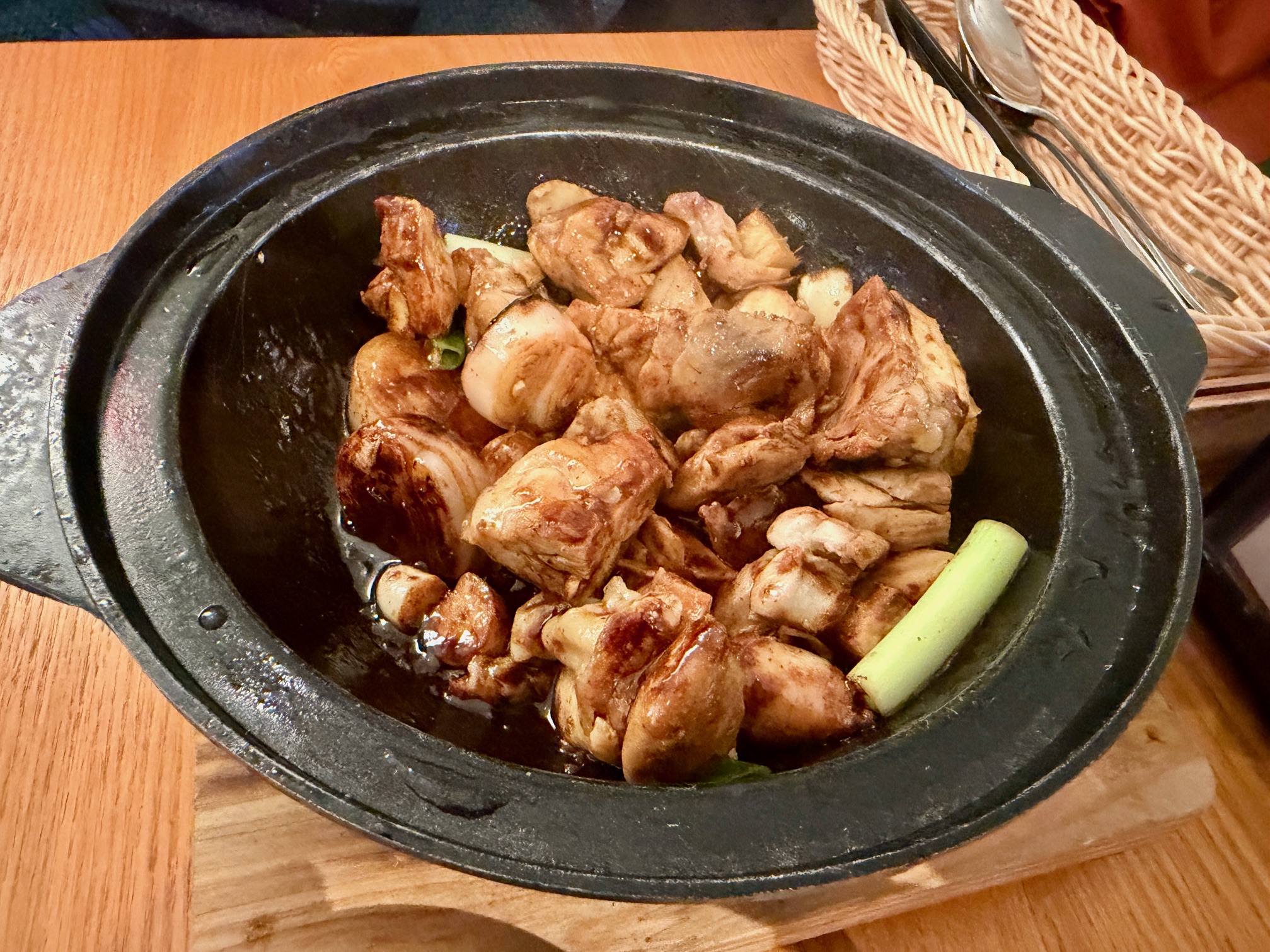
So yes, I chose the conventional option, the black bean chicken pot. But I am so happy that I did, because it was simply outstanding. A hefty pot full to bursting with boneless chicken thigh, skin on, cooked absolutely bang on so it was firm but had just enough give, no evidence of the velveting that can sometimes make chicken off-putting. Huge bits of spring onion, caramelised until heavenly, coexisted with all that chicken and extra goodies: little cubes of potent ginger and plenty of equally burnished nubbins of garlic.

But all that would be nothing without the sauce, a black bean sauce of ridiculous savoury depth, a glossy number with notes of Marmite which clung to everything: to the pot, to every crevice of chicken, to each layer of onion, each piece of ginger and garlic, every grain of steamed rice. This was deliciously viscous stuff, and I made it a mission to ensure that I left as little of it gleaming at the bottom of that black pot as I possibly could.

There is a part of me that is very tempted, just after noon on Friday when this review goes up, to find myself in that place again eating exactly this dish: it was that good.

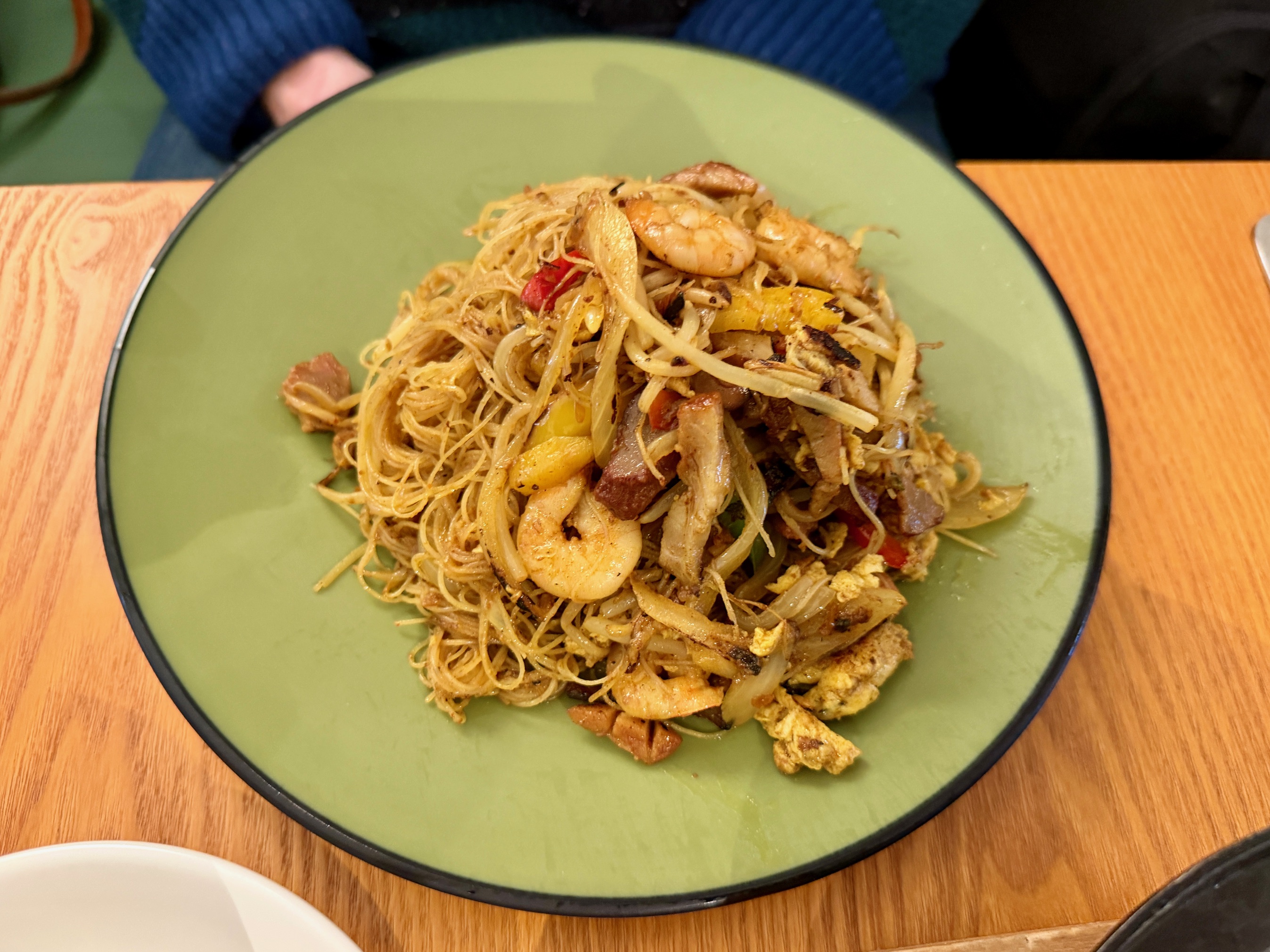
Jerry had chosen every bit as well as me, going for the Singapore vermicelli with char siu and prawn. This was a magnificent one-stop shop, a very generous tangle of rice noodles tumbled through with chilli, prawns, strips of pork, beansprouts and fried egg. The menu described it as spicy, our server said it wasn’t so hot. Having tried a few forkfuls, I’d probably split the difference and say it was nicely challenging.

What saved it from chilli overload was a certain nuttiness, although I’m not sure where it came from. Perhaps it was the curry powder, an essential component of this dish which gives it its ochre hue. Professor Wikipedia advises me, pleasingly, that Singapore noodles have nothing to do with Singapore but are also a post-war Hong Kong creation.

The thing that made me happiest about these noodles was how much Jerry loved them. He told me he could happily see himself coming here of an evening, ordering these and sitting there taking it all in: he added that previously his go to had been the pad thai at Rosa’s Thai but that this was easily a rival for it. Getting people to eat at Me Kong instead of Rosa’s Thai is, I suppose, as good a mission statement for this blog as any: I’m glad it had that effect on my friend if nothing else.

But I can also see exactly what he meant about it being a space where you’d want to spend time. It was so busy, so beautifully efficient and well run, and so popular – with friends, with couples, with families. Small children were everywhere, but for a moment you could forget you were in the U.K. because they were, without exception, impeccably behaved.

The word that jumps out at me – that restaurants don’t always aim for and in any case don’t hit often enough – is fun. Everything about Me Kong was a riot, from its cheerful, charming staff to its delighted, curious kind customers. How could anybody experience that and not want to be part of it again?

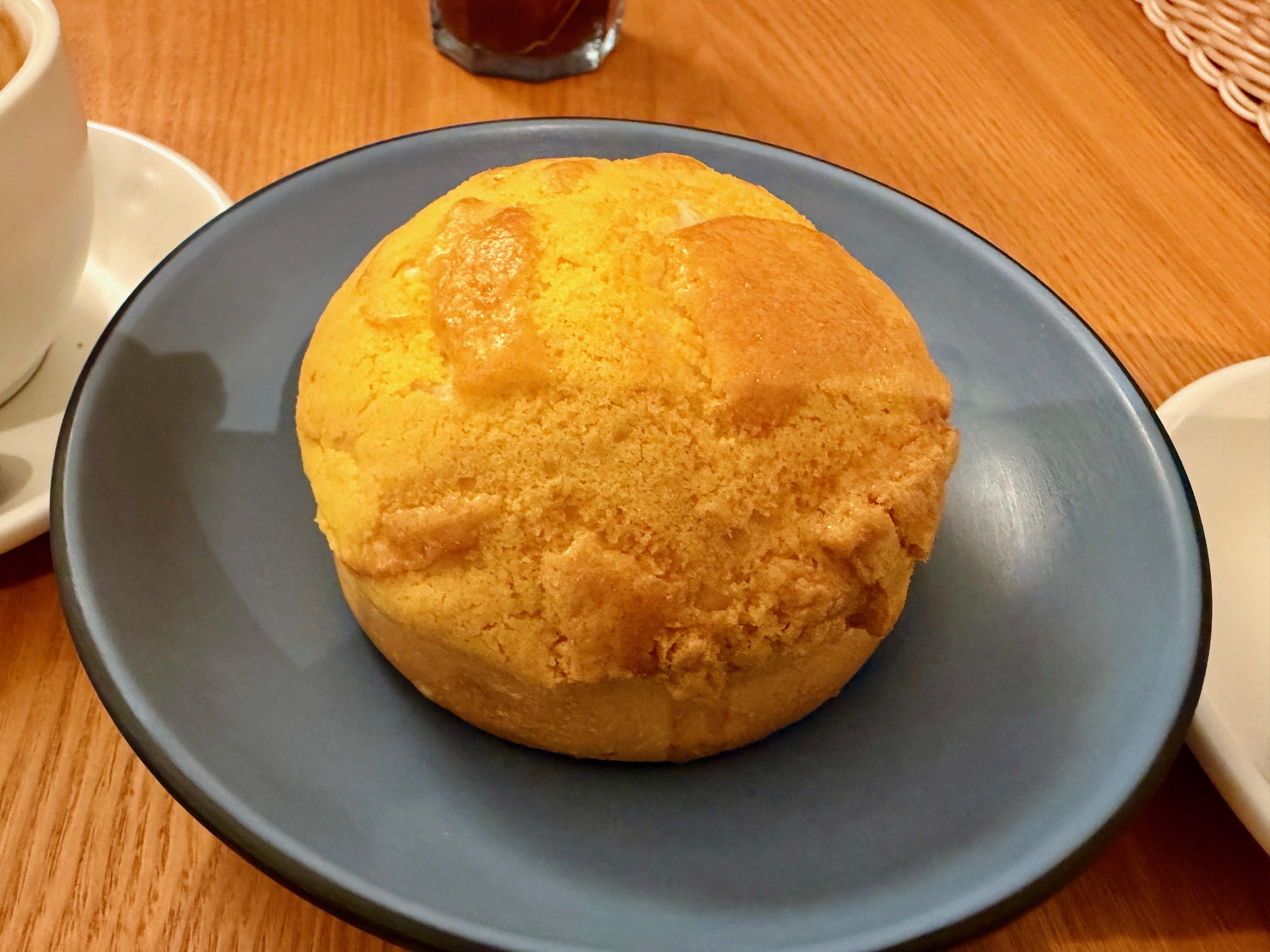
Determined to cover as much of the menu as possible we stayed for some sweet treats and this was when, maybe, Me Kong’s sure touch faltered ever so slightly. I wanted to try the real staples here, so we started with a pineapple bun: no pineapple is involved, but it got the name because the sugar crust on top can, apparently, vaguely resemble a pineapple. I rather liked this – it reminded me of an iced bun, but with a crust rather than icing on top. Worth trying so you can say you’ve tried it, absolutely, but I don’t know when I’d feel a hankering for one again.

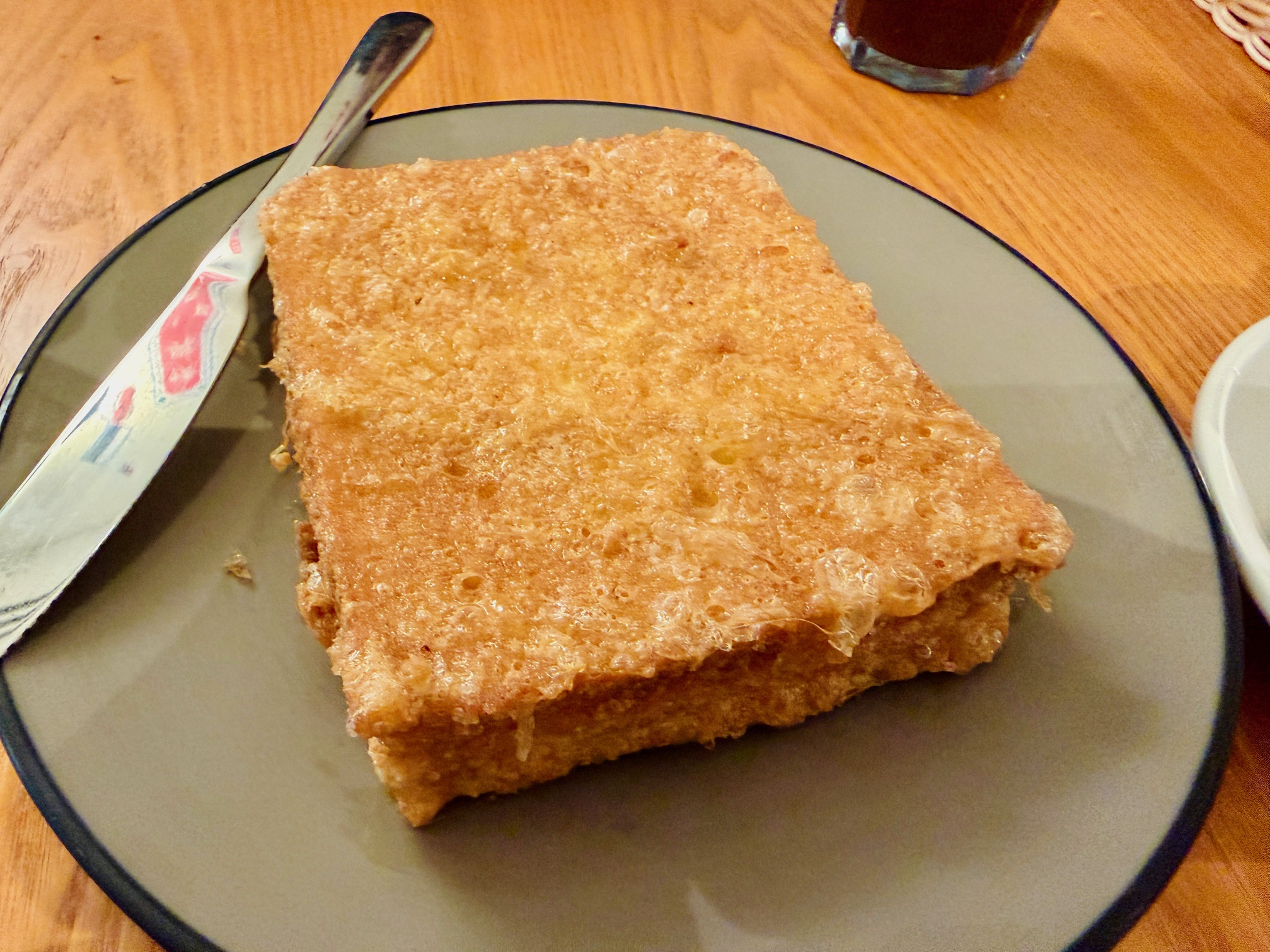
I really expected to love the French toast, another Hong Kong signature, but it didn’t quite hit the spot. Two slices of white bread, joined together with a thin mortar of punchy peanut butter, came fried and brought to the table with a little pack of Anchor butter to melt on top. Jerry said that those cultural references – Anchor butter, builder’s tea – added to that feeling of nostalgia, and I could see where he was coming from.

But for me this was just a little too stodgy, a little too light on the fun considering how many calories were involved. Ironically it needed to be more indulgent: the very nice civil engineer at the next table told me that often this was served with maple syrup, which would have utterly transformed it, but the server told me that they didn’t do tweaks or customisation for anybody, which I respected.

We didn’t finish it, because as an experience it was just a tad too grubby: I didn’t feel, as Marina O’Loughlin did, shame equivalent to waking up married to Gregg Wallace, but perhaps something comparable, like having a mucky dream about Nadine Dorries.

The last of our trio of desserts was a similar experience: I’d asked for an egg tart and been told that we’d have to wait twenty minutes for a fresh batch to come out of the oven. So we did, and when it came it was still warm and the pastry, buttery and short, was truly exemplary.

And yet I wanted to like the filling so much more than I did. I don’t know whether I was expecting the appealing wobble of a pastel de nata, or the nutmeg-dusted propriety of its English relative, but this was more egg white than egg yolk, somewhat lacking in richness and far more like blancmange that had found itself a very nice house. Again I wouldn’t order it again but I’m glad I tried it and for £1.70, only 10p less expensive than the pineapple bun, it was not an expensive mistake.

Our bill for everything came to just over £54, and there were two remarkable things about it. One is that if you order food they knock a very specific 51p off the price of each of your drinks, so they each cost £2.99. The second is that the service charge they add is only 8%: I questioned this with our server saying it wasn’t enough, and he laughed. “Next time you can tip a hundred pounds!” he said.

He also told me – and this might be useful to you, though it wasn’t to me – that if you spend over £40 they have a deal where you can get free parking at the Queens Road Car Park.

I hope the tip is so low because the staff there don’t need to rely on it to be fairly paid, because they very much deserve that. All of them were just terrific, and I know this has a strong whiff of and everyone stood up and clapped, but it’s true: practically every one of them said thank you to Jerry and I as we walked through the restaurant on our way out. I sent the pictures of our food to Zoë later as I was relaxing at Jerry’s with a cup of tea and a medicinal glass of red, and got exactly the reply I was expecting: perhaps you’ll take me some time soon.

This is precisely the kind of review, and the sort of restaurant, I wanted to kick off the year with. Me Kong is an absolute blast, brilliantly run and happens to do some excellent food, and I scoped out enough options on my first visit to give me plenty of food for thought on my second, third and fourth – if I can tear myself away from that chicken in black bean sauce, that is. It is already incredibly busy in a way most Reading restaurants in January would kill for, but I can see that continuing even after the novelty value has died off.

But what I also loved about it was how inclusive it was, how keen it was to tell its story far and wide. That spirit deserves to be returned in kind by Reading’s restaurant-goers. And it also made me a little proud of Reading: that our diverse, happy, tolerant town can still attract people like that and businesses like this, despite all the naysayers and bigots in the comments section of the Reading Chronicle.

I think if you read this blog you’re not like those people, and I think you’d find an awful lot to like at Me Kong. I wouldn’t be at all surprised if, in the months ahead, I see some of you there. I certainly won’t be in Rosa’s Thai, that’s for sure.

Me Kong – 8.4
St Laurence House, Abbey Square, Reading, RG1 3AG
0118 3431543

https://www.facebook.com/MeKongReadingUK/

Since January 2025, Edible Reading is partly supported by subscribers – click here if you want to read more about that, or click below to subscribe. By doing so you enable me to carry on doing what I do, and you also get access to subscriber only content. Whether you’re a subscriber or not, thanks for reading.
Restaurant review: Oishi

As followers on social media may already know, this will be my last conventional restaurant review for a short while. Last month I broke my arm in a nasty accident, and after a short stay in the Royal Berks, a brace, plenty of x-rays and an operation at the end of November I have been recovering at home.

As I’m currently housebound, with only one working arm, further restaurant reviews will have to wait, hopefully not too long. Thank you to everybody for the well wishes I’ve received since the incident: I’m very lucky to have such kind and supportive readers.

I will publish content on the blog in the meantime, my physical condition and the limitations of Apple dictation willing, so stay tuned for that. I will try to spare you a piece on “meals you can eat at home with one hand”, (although I get the impression that genre’s less niche than you might think). For now, I hope you enjoy this review, which is of the last restaurant I visited before the accident: I’m very glad that it was at least a gorgeous meal.

For my money, the saddest words you can find when you Google a restaurant are these: temporarily closed.

They should mean one thing, but they so frequently mean another. You should be able to take them at face value, deduce that the proprietors are taking a well-earned rest, or enjoying their summer holidays. But frequently they mean quite the opposite: the restaurant has closed for good, but it hasn’t been officially confirmed yet. Those two words are like light reaching you from a dead star, a misleading proof of life.

In Reading I’ve seen this happen many times. O Português was marked as temporarily closed for several months, a Facebook post by the restaurant saying something like “be back soon” before it eventually shut for good. The same went for Buon Appetito: people turned up for reservations, only to find the place locked and bolted, no sign up and nothing on social media. The only two-word commentary anywhere? Temporarily closed.

It’s frustrating that so many restaurants fail to announce their own departure. I appreciate that it must be desperately sad when a business fails, that people are out of jobs and in some cases, an independent restaurateur’s dreams have withered and died. Perhaps telling customers, or prospective customers, is the least of their worries. But it’s a shame for customers too, especially if you’ve grown fond of a place: their closure, done that way, denies you closure.

Going temp to perm on your Google listing is the equivalent of leaving a job under a cloud. Far better to close the way the Grumpy Goat did, with one last Saturday to drink the place dry, or as Dough Bros did with its recent announcement, telling punters they had until just before Christmas to get their pizza fix.

It’s especially agonising when it’s somewhere you love. My stepmother’s favourite place to eat is a pub called the Bailiwick, on the edge of Windsor Great Park. It was stricken with the curse of temporary closure last month, with nothing on social media. Worse still, they were listed as permanently closed on OpenTable. When they subsequently posted that they would reopen, with more limited hours, having been “given a second chance” my stepmother was elated. Temporary closure, after all, is so rarely that.

It does happen sometimes in Reading, to be fair. Biryani Mama on St Mary’s Butts looked very shut, claimed they were closed for renovations (an excuse I’ve heard before from restaurants that never reopen) but, true to their word, they’re now trading again. But I have never, in all my days reviewing restaurants, seen a restaurant come back from the dead the way Oishi did.

Subscribe to continue reading

Become a paid subscriber to get access to the rest of this post and other exclusive content.

Café review: Mac’s Deli

What were you doing when you were 21? If you’re a regular reader of this blog I imagine that, like me, you’ll have to cast your mind back to answer that question. In this sense I envy the generations after me, everything digitised, lives captured in hundreds of smartphone photos, people who can probably tell you exactly what they were doing on nearly every day of their twenty-second year.

Personally I was in my last year at university, frantically cramming for final exams I would dream about for years afterwards, navigating fraught relationships and sticking my head firmly in the sand about What Came Next and What I Would Do With My Life (thirty years of that now and counting, thank you very much).

My life was about to lose what little comfort and structure it had and, for me at least, most of the rest of that decade made up my wilderness years. I’m not sure I’d go back to being 21 if you paid me, despite all the people my age who will say “if only I knew then what I know now”. All they really mean is that they regret not getting laid more often, but we nearly all regret that.

I’ll tell you what I wasn’t doing when I was 21: I wasn’t starting my very first hospitality business, taking a massive gamble in a post-pandemic climate where the cards are stacked against restaurants, cafés and bars. But, nearly 30 years after I turned 21, that’s exactly what a chap called Mac Dsouza did.

That business was Filter Coffee House, on Castle Street, and it’s fair to say that it was an immediate success. I stopped by a couple of weeks after it opened, sampled its banana bun and was instantly smitten. So much so that about a week later, when I wrote a piece about Reading’s 50 best dishes to make 10 years of the blog, I managed to sneak that banana bun in there. I might have been relatively early on the bandwagon, but people were already talking about Dsouza’s café. By the time I reviewed it early in the New Year, its place in Reading’s affections was secured.

Dsouza, though, was not the sort to rest on his laurels. So even as the café kept trading, evolving, taking away its seating and moving to takeaway only he was working like a Trojan elsewhere. So he cropped up at Caversham’s Sunday markets to sell more coffee and treats, converting the RG4 crowd to his astonishing masala hot chocolate.

By then Filter Coffee House’s menu had expanded to include a range of affordable sandwiches, although I was more drawn to the specials they did at weekends. However you looked at it, what Dsouza achieved in a couple of years was quite something.

And what were you doing when you were 23, do you remember? I was back at my family home in a suburban terraced house in Woodley, temping in the cashier’s department of the insurance company where my brother worked. It was boring, and this was an office before smartphones, email and the internet so it’s hard to adequately convey quite how boring it was. But Labour had just put an end to eighteen years of Tory rule, and the joy was so extreme that it was almost tangible.

Despite earning fuck all, I always seemed to have enough money, possibly because my main aim at that point was to get drunk at the Bull & Chequers – midweek or weekends, back then nothing ever resulted in a hangover – and go clubbing. I was still impersonating an ostrich with reckless abandon, while my contemporaries became management consultants, solicitors and barristers. I was writing cheques for other people, putting files in alphabetical order and pretending to care what had happened in EastEnders when talking to Maureen or Eileen; everybody in my department was in their sixties, about to retire on the cusp of the information age.

When Mac Dsouza was 23 he opened his second business, Mac’s Deli. It’s not a deli at all, but a café squirrelled away on an industrial estate about a twenty minute walk from Theale station. It opened just over two months ago, and seemed to be a continuation of what he was offering at Filter Coffee House: coffee and a variety of sandwiches, this time mostly involving his own shokupan – Japanese milk bread – baked on the premises.

Dsouza documented every aspect of setting up his new business on Mac’s Deli’s Instagram page, so followers got to see the place coming together – logo first, then the fit out, then the countdown to opening. Since then Instagram has depicted an extraordinary-looking business where everything is made onsite, with even the sauces created by Dsouza rather than bought in. Weekend specials have run the gamut from 6 hour pulled pork to honey butter toast, a little nod to the legendary dish at London’s famous Arôme Bakery.

The menu at Mac’s Deli reminded me of all sorts of things. It was reminiscent of specialist sandwich slingers overseas like Montpellier’s Bravo Babette and Deli Corner, It felt a little Hackney, too, which I should add is a compliment. But it didn’t feel very Theale, which I should also add isn’t necessarily an insult. The location felt incongruous compared to everything else, and when people asked me if I planned to review Mac’s Deli I always said the same thing: “it looks very nice, but it’s a bit out of the way”.

What changed is that a couple of weeks ago my boss and I, on a Friday in the office not far from Mac’s Deli, decided to go scout out the place. So we went, we had lunch, we both absolutely loved it and I decided that I had to find a way to go back and visit on duty. I mentioned it to Zoë when I got home, showed her a photo of my sandwich and an executive decision was made: I was going back, in a couple of Saturdays time, and she was coming with me.

I doubt most people get to Mac’s Deli by taking the train to Theale and doing the flat, featureless 20 minute walk to the industrial estate. But we did, and if I didn’t already have some idea what the food would be like I might have given up halfway there. But at around that point, because Dsouza is no slouch, the signs for Mac’s Deli began appearing on fences with its distinctive winking sandwich logo and endearing font, a chequered stripe underneath, everything in blue and white.

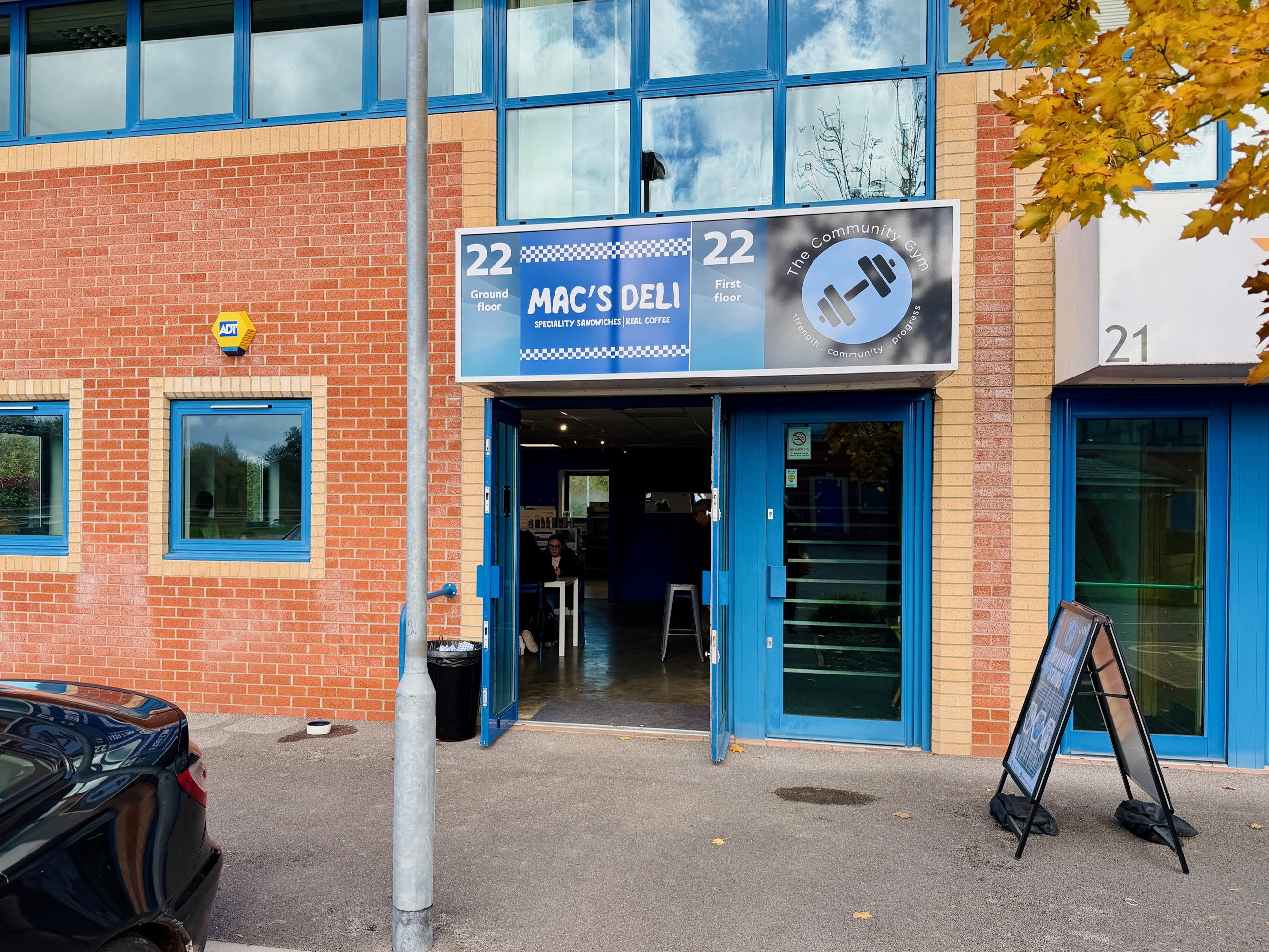
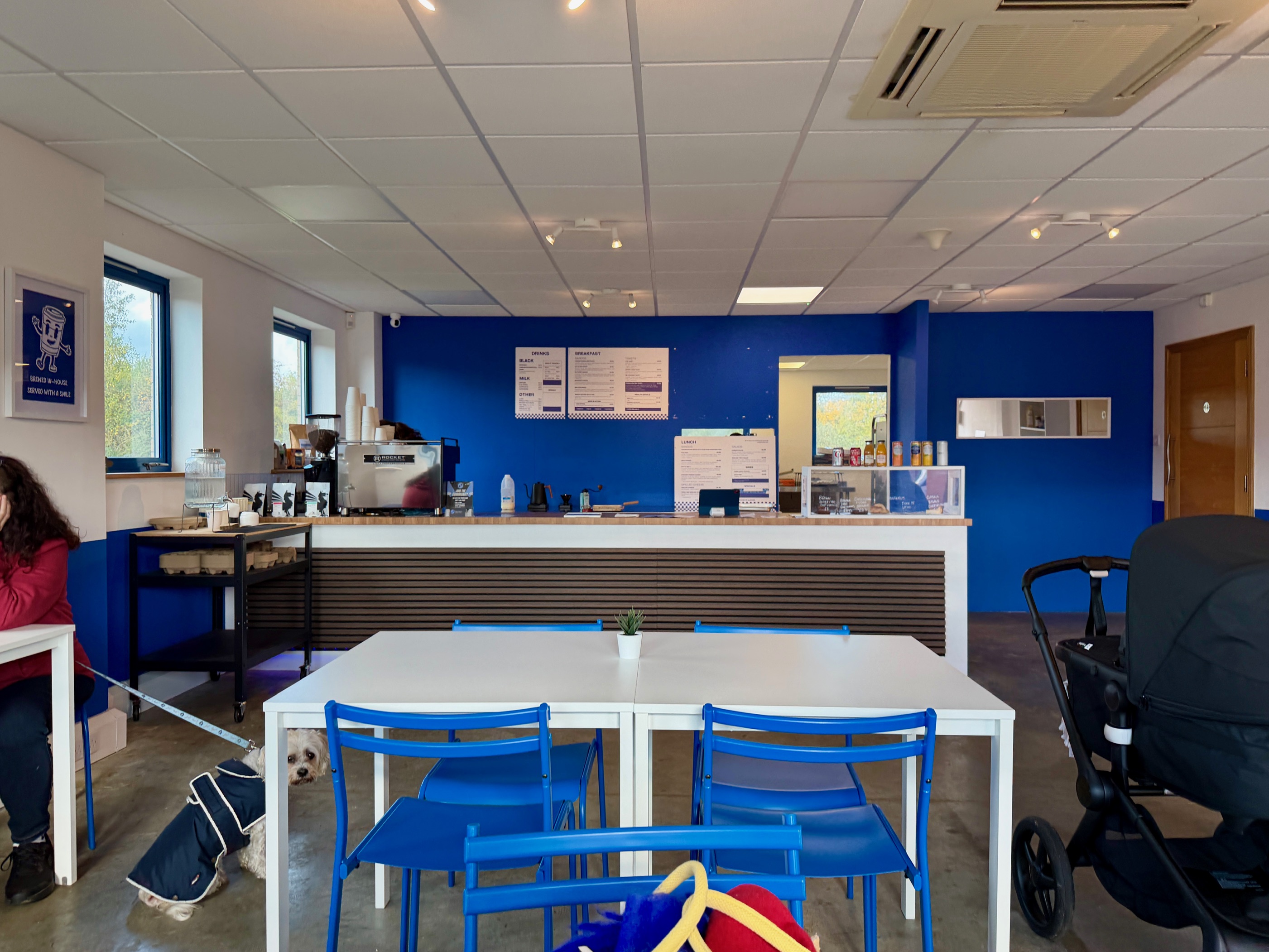
This might sound like a silly thing to pick up on, but Mac’s Deli’s branding is so brilliantly done. Everything is that blue and white, from the billboards to the signage outside Unit 22 of the business park, to the framed prints on the walls. It’s so impressive, so fully-formed, and that branding and language even follows through to the tables and chairs and the beautiful striking wall, a solid block of Majorelle blue, behind the counter.

Don’t be fooled by the photo below, by the way: I took it after the lunch rush had gone but when we arrived, just after 1 o’clock, every single table was occupied. The room inside seats 18 people, and we only got in by squeezing on the end of the last table that wasn’t completely full. I hope the very nice couple who let us perch there have a great time on their trip to Bruges next Easter, whether they end up using my city guide or not.

Mac’s Deli’s menu largely revolves around bread, and making the most of that shokupan. So unless you want a salad or a “health bowl” (overnight oats and the like) you are picking between sandwiches or things on toast. The breakfast menu is half a dozen sandwiches, available all day, and the lunch menu adds another four, along with a couple of grilled cheese sandwiches. The lunch sandwiches cost between £9 and £11 and come with home-made shoestring fries, the breakfast ones cost roughly £3 less and are a fries-free zone. I guess I can see the logic behind that.

The lady who took our order – service throughout was brilliant, by the way – apologised and said that we would be waiting a while. I expected that, to be honest, because the place was rammed and everyone there had arrived before us, so we waited patiently on our half of a table for four, rubbernecking as sandwich after sandwich arrived at neighbouring tables or, indeed, were brought to the couple at our table. They’d ordered two of the sandwiches we’d chosen, so Zoë got a very good idea of her impending good fortune.

The only slight quibble I had was that it would have been nice for our coffees to arrive while we were waiting on the sandwiches, but it was no biggie. They were really, really busy and I could see staff in the kitchen out back, including Mac himself. It was a veritable hive of activity.

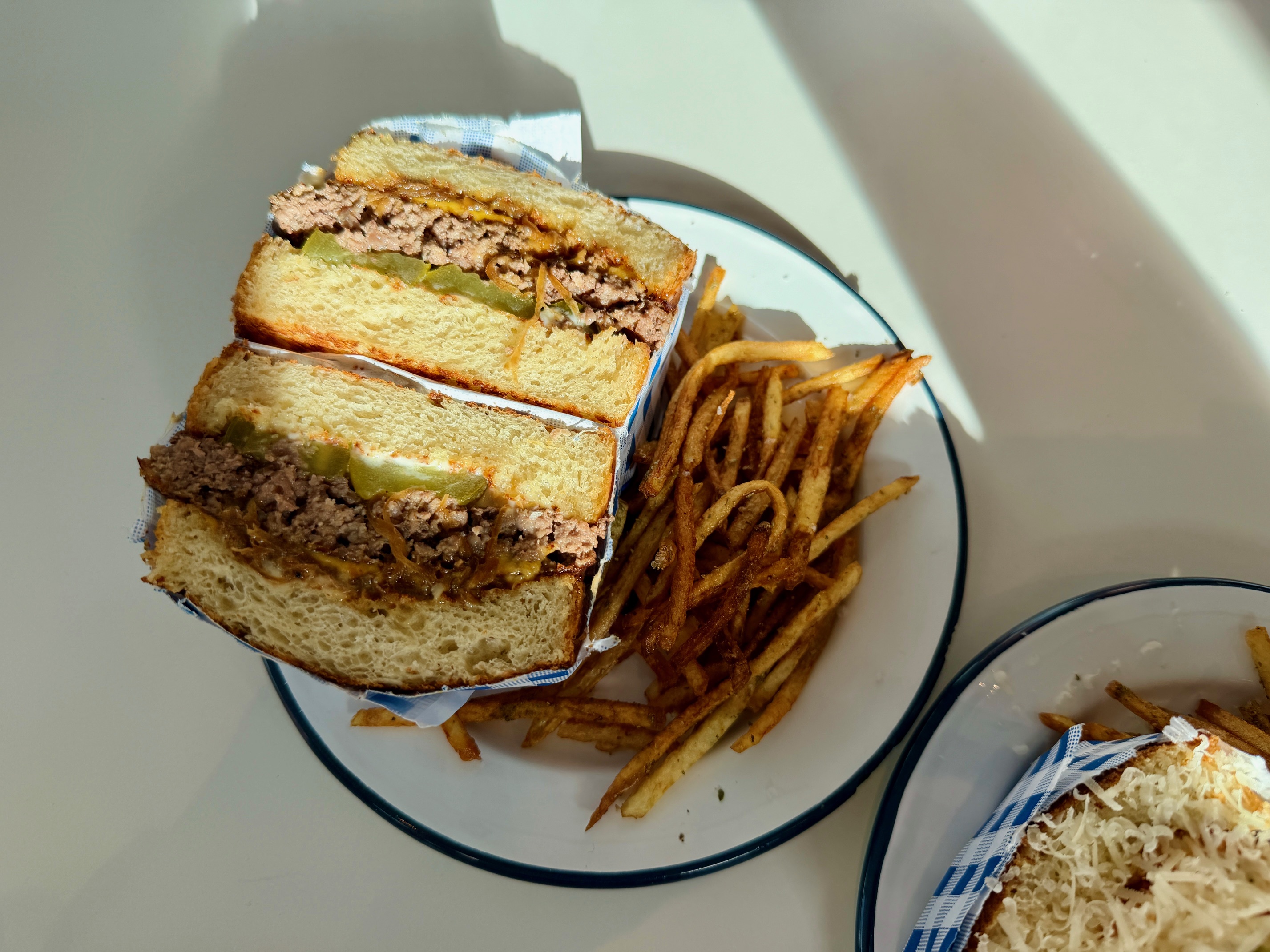
Zoë had chosen the sandwich I tried on my previous visit to Mac’s Deli, the patty melt. Which is handy, because it means I can tell you what it’s like: otherwise I wouldn’t be able to, because it was so good that Zoë had no intention of sharing it with me. I’ve been saying for as many years as I can remember that a burger, ultimately, is just a sandwich. Well, that’s what this was, but saying it was just a sandwich was a bit like saying that Guernica was just a doodle.

So yes, the burger was outrageously good: a thick, crumbly patty of dry-aged beef, not pink in the middle but not needing to be either. Mac’s Deli buys its meat from Aubrey Allen – audaciously ambitious for a caff on an industrial estate – and that came across loud and clear. Remember all those debates about whether brioche is the right thing to contain a burger? Turns out the answer is to make excellent, almost-fluffy Japanese milk bread and then toast the outside so it holds everything together.

But there was still more, in the form of a sublime layer of caramelised onions, some American cheese and a house mayo with truffle and garlic which managed not to overpower everything else going on. Zoë, a lifelong vinegar hater, was not best pleased at the thick slabs of gherkin in the mix, mostly because they weren’t mentioned on the menu, but she picked every single one out and devoured everything else. “It’s okay” she told me, “there’s no contamination.”

She adored the patty melt, and having tried it on my exploratory trip to Mac’s Deli I could completely see why. For my money, this is not only the best burger you can buy in and around Reading but a ludicrous steal at £10.95, impeccable shoestring fries thrown in (more if you add bacon, which of course Zoë did). It was better than Honest, better than 7Bone, better than Monkey Lounge. In fairness the burgers may come close at Stop & Taste, or at Tilehurst newcomers Blip Burgers – owned by the people behind Zyka and The Switch – but Mac’s Deli’s patty melt will take some beating.

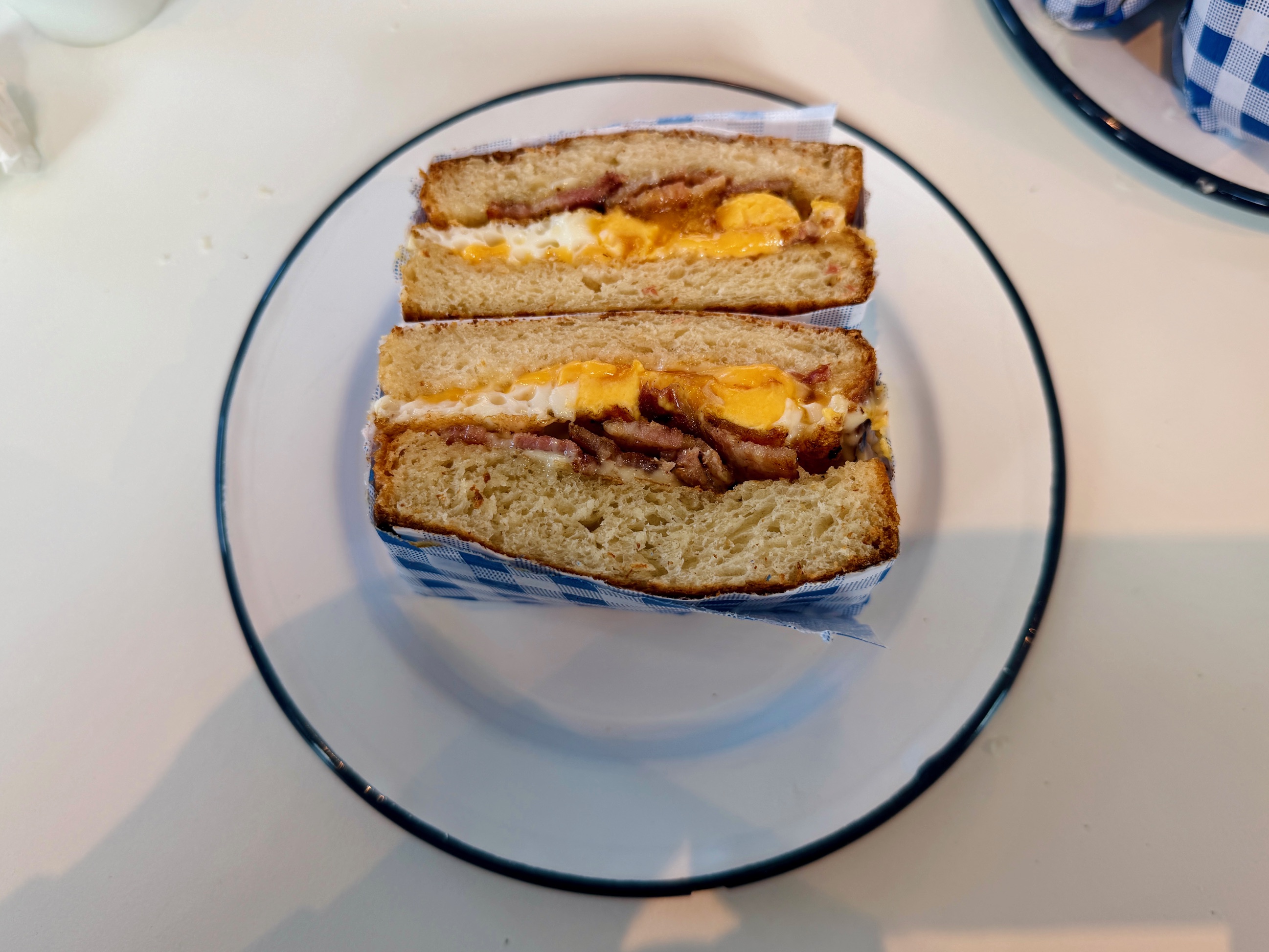
I had chosen the bacon (or Bae-Con, according to the menu) sando, and if it wasn’t quite as successful that doesn’t mean it wasn’t excellent. It was a much simpler affair, deploying the cheese and the garlic truffle mayo, swapping out the burger for a fried egg and bacon and omitting the shoestring fries. If you ate this sandwich and were then told that for an extra three quid you could have had the patty melt, I think you’d be filled with regret.

But some of the things that meant I wasn’t as wild about this sandwich were on me, not Mac’s Deli. They were up front that they were going to use that mayo and American cheese, and if I found the sandwich slightly claggy and one-note as a result, they weren’t to blame for that. I would sooner have had a slightly more conventional bacon sandwich – I’d love to see Mac’s take on brown sauce – or even one with something like gochujang that could provide the clichéd cut through slightly missing from this sando.

I’d also have liked smoked streaky bacon, and plenty of it, rather than back. But again, that’s more about me. I will say though that the egg was cooked exactly how I like it, the yolk fudgy rather than runny. Given that the menu promises the egg sunny side up, that might have been a happy accident.

One of the benefits of the sandwiches at Mac’s Deli is how sharable they are, coming in that blue gingham wrap – that colour scheme again – and sliced neatly into halves. That meant that for research purposes we could share another sandwich, the chicken caesar. There was an awful lot to like about this too, especially the chicken which was in craggy, fried tenders a million miles away from a sad, pale supermarket goujon.

So it was very much my kind of thing but again, the precise balance of flavours meant it wouldn’t be for everybody. Zoë found the caesar dressing too vinegary and, for what it’s worth, I agreed with her: that didn’t put me off it, but it did mean it slightly lacked the saltiness Caesar dressing should bring to the table. Part of that, I think, was because instead of being incorporated into the sandwich and the dressing the 30 month old Parmesan had been cropdusted over the whole shebang.

I get that this looks the part, makes for a very pleasing contribution to anybody’s Instagram grid, but for me it’s a little bit style over substance. Not only is it hard to stop the stuff going everywhere, but it meant that the flavour wasn’t completely integrated. It was however a very good advert for Mac’s Deli’s chicken caesar salad, which has all of that and bacon as standard, and the option to add extra fried chicken if you yourself are also feeling extra.

By this point the coffee had turned up, although we mostly drunk it at the end when we’d polished everything off. In my case that also included a pair of revelatory hashbrowns which I suspect had been bought in but which were elevated with a liberal dusting of rosemary salt which had a positively transformative effect. I’d love to see Mac make his own hash browns at some point: maybe that will be another weekend special, one day.

Coffee, by the way, was gorgeous – both my latte and Zoë’s flat white were impressively smooth. Bags of coffee by Square Mile, the roastery founded by patron saint of coffee James Hoffman, were on display next to the machine, although it was unclear whether they were also available to buy. But all this is a huge statement of intent – coffee by Square Mile, eggs by Beechwood Farm, meat by Aubrey Allen – and you have to hand it to Dsouza for that.

I didn’t want to leave without trying something sweet and was torn between the cookie, the brownie and the Basque cheesecake. The lady behind the counter steered me in the direction of the brownie and I’m so glad she did. I have no idea whether these are made on the premises or, as with Filter Coffee House, Mac’s Deli takes advantage of Berkshire’s network of excellent suppliers and bakers.

But whoever made that brownie knew exactly what they were doing: an outstanding brittle surface giving way to a dense, ganache-like core, the whole thing adding up to the best brownie I’ve had anywhere near Reading since the Grumpy Goat closed down. £2.50 for that, and I can’t remember the last time I spent £2.50 anywhere near so well anywhere else. The whole lunch – and bear in mind we shared three sandwiches between two – cost us £41.35.

On the walk back to Theale station, which felt nowhere near as long as the walk there had been, Zoë and I compared notes and enthused about our lunch. I have no idea why Dsouza picked that location, of all locations, for his sophomore album. Perhaps he knew something nobody else did about the demand for weapons grade sandwiches in Theale, or maybe the catering and storage facilities on that industrial estate allow him to supply to Filter Coffee House and leave the way open for further expansion.

But a smart person would put money on Dsouza knowing exactly what he’s doing, because the place was full when I went on a weekday and full when I turned up on a Saturday. Full of people who, like me during my visit, seemed unable to quite believe their good fortune. Mac’s Deli still feels like a bit of a mirage in that location – a sort of step-sibling to Stop & Taste in that respect – but if anybody eating there is pinching themselves it’s not because they want to wake up from a wonderful dream. They simply can’t believe it’s that good.

If Mac’s Deli was in the centre of Reading it would wipe the floor with many of its peers, so it might be better for all of them that it’s not. But perhaps the next one will be, because from the ambition Dsouza has displayed so far it’s hard to believe he’ll look at Filter Coffee House and Mac’s Deli and decide that such a small empire is enough for him.

Can you remember what you were doing when you were 25? Me neither. But I’m very interested to see what Mac Dsouza does in a couple of years, when he reaches that age. Until that day comes, he’s already given us an awful lot to enjoy.

Mac’s Deli – 8.5
Unit 22, Moulden Way, Calcot, RG7 4GB

https://www.instagram.com/macsdeli.uk/

Since January 2025, Edible Reading is partly supported by subscribers – click here if you want to read more about that, or click below to subscribe. By doing so you enable me to carry on doing what I do, and you also get access to subscriber only content. Whether you’re a subscriber or not, thanks for reading.
Restaurant review: Club India

This week’s review partly came about because of a gentleman called Andy Hayler. Now, you might not know who Hayler is, but in terms of food he’s something of a phenomenon.

The shadowy world of Michelin exists behind an impenetrable curtain, with nobody sure how they work or what dictates who gets listed, is awarded Bib Gourmands and stars – or, sometimes, has them taken away. Andy Hayler is the closest thing we have to a Michelin inspector working in plain sight. He has a blog, which has been around since the 90s, in which he has documented hundreds of meals in restaurants, giving each restaurant – and every dish – a mark out of 20.

I’ve rarely seen anything get lower than a 10, and very little approaches the top of his scale, but that’s because a fair amount of what Hayler has reviewed is at the highest end of dining. There was a time when he had eaten at every three starred restaurant in the entire world, although he stopped keeping up with Michelin when, as he puts it, they devalued what three stars should signify by giving them out in some territories to restaurants that were nowhere near the standards he had experienced elsewhere.

Hayler has a sort of cult, niche status in food. I’ve read a couple of pieces about him in recent years, both verging on hagiographies. He’s been described as “the best living food writer”, and I’ve read interviews that gush about his effortless recall and the esteem in which he is held by chefs and restaurateurs. He is the cognoscenti’s critic of choice and no mistake.

I think he attracts some of those plaudits because of what his reviews both are and aren’t. They don’t, in some senses, read like reviews at all, more like audits from someone scrupulous and meticulous who has forgotten more good meals than most of us will ever have. Although it doesn’t sound like he forgets many of them: why would you, when you document them all in such extensive detail?

I think the respect also comes from his refreshing lack of ego; Hayler would be the first to draw a distinction between himself and many restaurant reviewers. “I wouldn’t ever pretend I was any sort of fantastic prose master. I’m not trying to throw in a load of stuff about my journey to the restaurant and the trendy people on the table to the left” he has said, subtly throwing shade on half the piffle I come out with every week.

Don’t worry, there’s no way he meant me personally: in fact, he once described one of my pieces, about Maida Vale’s Paulette, as a “lovely review” which I found surprisingly touching. “Most of the newspaper critics want to be writers first, I want to focus on the food” he said more recently. I suspect the people who read him admire that purity of approach, and it does mean that when he thinks somewhere is dismal or overrated, which happens occasionally, it’s really very amusing.

What’s also admirable is that Hayler goes where he likes, reviews wherever he wants: money seems to be no object, and he doesn’t follow the fads. You won’t find him, for instance, reviewing Brasserie Constance, a restaurant operating out of Fulham FC’s Craven Cottage, unlike nearly every broadsheet critic over the last few weeks. Instead, his two or three reviews each week involve him going wherever he pleases, in London and abroad.

His two main weaknesses seem to be eating at the Ritz in particular and eating Indian food in general. Hayler is a regular visitor to Epsom’s Dastaan, and the little group of restaurants it has spawned in Surbiton, Richmond and Leeds. He’s also a frequent diner in Southall, and when he gave a warm review to Hounslow’s review of Crispy Dosa last November it caused a Mexican wave of regional bloggers checking out their nearest branch to touch the hem of his virtual garment (been there, done that – four years ago).

“If Mr Hayler thinks it is OK, it is a fair bet I will probably like it” one said. “You can be assured that if Andy says a restaurant is worth visiting then it really will be” said another. That’s proper soft power, and all from the opinion of a chap you mightn’t have heard of.

Hayler even came all the way west to Caversham last year to review Clay’s, something I’ve been waiting for him to do for a very long time. He gave it 14/20, which may not sound like a big deal but actually is. “Clays is a very impressive family-run restaurant, the food shows a lot of care, and the chefs are clearly putting some real effort into reproducing an authentic taste of India” he concluded, after paying particular tribute to Clay’s cabbage pakora, lamb chops and, of course, bhuna venison (Hayler also tried methi chicken, a dish he seems particularly to favour).

Seeing Clay’s reviewed by Hayler was like watching somebody you know being interviewed in the national news, and it made me proud. It didn’t make the local paper the way Grace Dent’s write-up had, but in its way it was every bit as significant. Hayler, as he said, is all about the food.

Now, by this point even my most supportive readers are probably thinking this is an even more circuitous intro than usual, what has this got to do with anything?’ Well, I’ll tell you: every week Andy Hayler does a roundup on his blog, and every week the byline gives a couple of destinations. From South Kensington to Mayfair one might read, or From Piccadilly to Rome. Fancy restaurants and/or jetsetting are invariably involved. And then, at the start of the month, one made me do a double take. From Winnersh to West London, it said.

Winnersh? Our Winnersh?

It was not a misprint. Andy Hayler had come all the way to Winnersh to try out Club India, an Indian restaurant that opened back in July where the old Pheasant pub used to be. I mentioned that development when I reviewed Dolphin’s Caribbean, back in June, What I said, looking back, feels a little graceless, especially as they sent me a lovely email inviting me to a pre-launch event. I read the blurb and thought it sounded potentially interesting, but then again: Winnersh?

Andy Hayler had no such compunctions. Club India’s consultant chef had held two Michelin stars at his restaurant in San Francisco, although Hayler’s verdict on that place was that if a chef had gone there trying to pick up tips “he or she would either burst out laughing maniacally or seek to throttle any passing Michelin inspectors; possibly both”. But the head chef had headed up the kitchens at a couple of London restaurants Hayler really rated. So he went, he enjoyed it, he dished out scores out of 20 for all the dishes and, of course, he ordered methi chicken.

Overall he gave it the same rating, 14 out of 20, as Clay’s. “Club India was a thoroughly enjoyable experience, the food and service excellent, and at an affordable price. I wish I could say that more often these days” was his conclusion. That was good enough for me, so on a Friday night after a couple of pre-prandial beers in town Zoë and I hopped on the number 4 bus to go and see if Reading really did have a rival to Clay’s Kitchen, tucked away in – this may not be the last time I say this word slightly incredulously – Winnersh.

You can tell it’s a former pub, but the glow up is nice and, on the inside, pretty subtle and tasteful. The room I was in, at the front, was muted wallpaper and leather banquettes, but every room was slightly different and the one the other side of the bar from mine, with its tiled floor, was my favourite. When we got there around 7.30 it was already very busy with big groups and couples on dates, in full swing with a busy service ahead. Hayler said it could seat 70, which sounded about right, with outside space too.

I guess it’s easier to have more space than you need in this part of Reading than it is in Caversham, but in any case it was bustling on a Friday evening. The tables were more Winnersh than desi when I arrived, although I would say that balance shifted as the evening went on. It certainly felt like a restaurant that wanted to attract both demographics, and anybody else besides.

Our table had a good view of the room and of the very strong service. The man who seemed to be running the show, sporting an impressive man bun, thick white stripe right down the middle of his dark luxuriant beard, was a class act, but in fairness everyone who looked after us all evening was lovely, polite and enthusiastic, even the ones who seemed a little nervous. It had the swagger of a restaurant that had been there a lot longer than three months.

We started, as you might, with apéritifs and poppadoms – and if that seems like an incongruous pairing, Club India does a good job of making them feel like they go together. Zoë liked her negroni, although she wasn’t sure it tasted quite like a negroni and couldn’t put her finger on why. I had something called an Amber Signal, which I suspect featured in the Johnny Depp defamation case a few years back. It was a blend of Aperol, whisky and Drambuie and felt surprisingly grown up by my standards, something to sip slowly and mindfully. Both cocktails came in glam, exceptionally heavy-bottomed glasses that could have doubled as a paperweight or a murder weapon.

The poppadoms were splendid, by the way – warm, thin, greaseless and very hard to stop at just the one each, which is probably why we didn’t. But the chutneys were the thing: you pay £3.50 or so for these but they were all made by hand and far more interesting than the usual fare. The mango chutney was thick and rich with nigella, the raita so robust that I thought Greek yoghurt must have been involved. There was a mixed berry number which surprised, possibly mostly through novely value, and best of all an inspired shrimp chutney which we managed, being our best selves, to equitably divide despite the unworthy temptation to hog the lot.

The menu at Club India takes a long time to go from first read to decision, because you want to order most of it. It is the only restaurant I can think of in Reading with a tasting menu, at a very reasonable £45 a head, or £70 if you throw in the wine pairings, and if it had contained the dishes I’d really fancied from the à la carte you’d be reading about it right now: nevertheless, it sounded like really solid value.

But the à la carte was just too tempting – about a dozen starters, the same number of curries, some biryani dishes and plenty of vegetarian dishes which you could downsize to try as a side dish. They also had a separate vegan menu, so they could definitely make many of the vegetarian dishes without ghee. Starters ran the gamut from £5.50 to £15.95 and the most expensive main would set you back £18. Pricing, put that way, looked pretty reasonable – and although the obvious reference point for this restaurant, given my preamble, is Clay’s I also had Masakali in the back of my mind. Club India’s menu is far more streamlined than Masakali’s, and to my mind less expensive.

From this point on, you might find yourself wishing I adopted Andy Hayler’s much more concise method, because I’m afraid we very much went wild in the aisles picking a lot of dishes, ordering like the place might close down tomorrow. Andy Hayler might have said curry leaf calamari was good, the apricot glaze giving an extra dimension (13/20). I would say that I really loved this jumble of sticky ribbons of squid, somehow crispy and caramelised without succumbing to bounce or toughness. The menu says that it’s grandma’s recipe: I loved my grandmother very much, but I might have sacrificed her to the devil himself in return for one who could cook like this.

Just as terrific were the lamb chops, two glorious inverted commas of meat, best end blackened from the tandoor but still blushing on the inside. Up there with the best lamb chops I’ve had, and I’ve tried them at Clay’s, and at Didcot’s extraordinary Zigana’s Turkish Kitchen. At sixteen pounds you’d need them to be, but for me they delivered in spades and I was very glad we ordered them.

If you believed the menu, these came with coriander chutney and a smoked aubergine raita: it didn’t feel, from my recollection or looking at this photo, like that’s exactly what was going on. There was allegedly beetroot in the marinade, it felt like it had escaped into the smear on the plate. But to be honest whatever smudge of sauce you add, whatever spiralised veg and leaves you artfully zhuzh on top this stands or falls on the meat and the meat alone. Zoë, far more primal about these things than me, picked it up by the bone and gnawed until she could gnaw no more.

Completing our trio of starters was the only dish, apart from those poppadoms, that Andy Hayler and I both tried on our visits. 12 hour braised, spiced pulled pork rested, in a beautiful tangle, on an uttapam, a thicker, slightly spongy variant on dosa. I really wanted to try this dish for so many reasons – because it’s just absolutely up my alley, because Hayler raved about it, giving it a rare 15/20 and because I’d had something similar at a beer pairing lunch at Clay’s Kitchen last year, and that dish had been one of the best things I ate in 2024.

Did it come close? Yes. You would have struggled to put a poppadom between them, in terms of interest and quality. Clay’s version used minced pork rather than pulled pork, and there was something deeply texturally satisfying about Club India’s slow-perfected strands. Club India’s rendition had more whistles and bells, a coconut chutney, microshoots and fripperies. But if you stripped all that away, you just ended up with a small plate – from either restaurant – that would grace any starter menu, anywhere.

The spicing was a beaut, the coconut chutney went perfectly, I loved it from start to finish. We shared this, as we did the other two dishes, but I could gladly have polished one of these off solo. I could equally have said that about the other two dishes, too.

At this point the restaurant was at its liveliest, I had a gorgeous glass of New Zealand sauvignon blanc on the go and I had that warm feeling that comes from knowing I’m eating at a discovery – no, not a hidden gem, but a find. The starters we’d eaten, for my money, were up there with most Indian restaurants I’d dined at, and at or around the quality I’d come to love at Clay’s.

Could Reading finally have another contender for the crown? I found myself, mid-meal, daydreaming about the rave review I would scurry home and write. Zoë was thinking that this was a place, not a million miles from Woodley, that she could persuade her parents to visit. And that wasn’t all. “Are you thinking this would be a suitable venue for one of your readers’ lunches?” she asked me. I had been doing exactly that.

So it saddens me to piss on the proverbial chips and say that the rest of the meal was a gentle descent from that summit. It didn’t end up in the slough of despond, but it settled somewhere that felt more like settling. And although that’s a shame, in the wider scheme, it doesn’t mean that anything we ate from there on in was bad, it just wasn’t quite as extraordinary.

Take the kadaknath chicken curry we’d ordered. One of the things I really liked about Club India’s range of curries was that it mixed up stuff you’d heard of – butter chicken, rogan josh, methi chicken and so on – with dishes I wasn’t familiar with. Kadakhath is a particular breed of Indian chicken that the menu says is particularly known for its gamey flavour, and Club India uses black leg chicken to get as close to that as possible. From that, I was hoping this would be a bit like Northern Spain’s pitu caleya, but this was pretty unremarkable. Breast rather than thigh, too, which reminded me how Clay’s approach to chicken curries is so different from everywhere in Reading.

That’s not to say I didn’t like it, or that I didn’t like the gravy, made with fenugreek and crushed peppercorn. I actually very much enjoyed its savoury, almost perfumed depth, those slight wintry hints of leather about it. But everything felt out of kilter. The chicken was submerged in a lake of the gravy, slightly unbalanced, and the gravy wasn’t quite interesting enough to carry things on its own, even dolloped onto some perfectly nice saffron and cumin pulao.

I’m sorry to keep mentioning Clay’s, but it was inevitable that I would in trying to benchmark somewhere like Club India. The gravies at Clay’s, each of those distinct, exceptional sauces, is so captivating that the meat is merely, in many cases, a vehicle. You clean up every last molecule in the bowl with your rice, with some bread, with your spoon, with a finger if you must. Club India didn’t quite reach that standard, which meant that the curries were just a little too wet.

Better, although still not quite there, was a curry described simply as Champaran meat. This was my favourite thing from this section of the meal, and the sauce again had depth and complexity. But what elevated this was the really terrific lamb, marinated overnight and with an almost unbeatable texture, leg at a guess, slow-cooked until it could cleave like kleftiko; this dish is cooked over charcoal in a sealed pot, which probably contributed greatly to how wonderful it was.

Again, I’d have liked it a little more sticky and a little less swimming, but that didn’t stop it being head and shoulders above most curries you’d get in Reading.

We ordered a couple of vegetable side dishes, one because I insisted and one because Zoë did. Mine was baby aubergine in a sauce with jaggery and tamarind, two of my very favourite things. And yes, a sauce that combined them was as sweet and tangy as you would expect, and I loved that. But I didn’t want a bowl of the stuff with two – just two – baby aubergines bobbing in it. And that, slightly unfortunately, is what I got.

Zoë on the other hand had put in a request for Club India’s okra stir fried with peppers and onions. If she was writing this review she would tell you that she really liked it, and for that matter that she really likes okra. But you are stuck with me, I’m afraid, and Clay’s thinly sliced, crispy take on okra is, I think, the only variant of this ingredient I have ever enjoyed. I feigned generosity telling Zoë she could finish this but she knew, deep down, that it was because I wasn’t a fan.

I will say this, though, Club India’s keema naan is the best I have ever had. This is another to file under ‘Zoë always orders it, and I nibble a bit without any great enthusiasm’. I’ve lost count of the number of times I’ve taken a bite and been confronted by weirdly scarlet, oddly bouncy mystery meat. That fate does not befall you at Club India: the meat lurking in the middle of a deliciously airy naan is properly belting stuff.

It made me want to try their sheekh kebab next time – and credit to Club India, not only do they list the provenance of some of their ingredients but the lamb for the Champaran meat comes from one place, namely North Wales, while the lamb for the sheekh kebab comes from Romney Marsh, completely the other end of the U.K. You do have to at least slightly admire that.

By this point we had checked the timetable for the bus back into town and realised that neither of the options – namely leaving in ten minutes or lingering at Club India for over an hour – were going to happen. So we embraced the concept of a taxi and rewarded ourselves with dessert. I was hoping the gajar halwa that Andy Hayler had rather enjoyed would be on the menu, but the compact selection of four had already moved on since then. It was the one area where Club India’s imagination felt like it had run out, because when one of the four options is a chocolate brownie with vanilla ice cream I think, as an upmarket Indian restaurant, that you’re playing it far too safe.

Playing it safe rather defined my dessert, too. A mango cheesecake, a small dainty cylinder, was genuinely quite charming and went nicely with the diddy glass of dessert wine I’d ordered with it (a 50ml pour is on the small side, but it was £5 so it didn’t matter so much). But again, the menu promised a hint of chilli and if it was a hint it was too subtle for me. I’d have preferred a clanger of chilli, if we were picking between extremes, and it rather appeared that we were.

I think Zoë ordered better, although she mightn’t have agreed. Rasmalai tiramisu was, for me, far more imaginative and more in keeping with the rest of the menu. I’m not sure it was really reminiscent of either, more like the two had been put in separate machines and teleported into a blend, like something out of The Fly. But I liked it and envied Zoë, and the pleasingly squeaky sort-of-cheese in the base made it something you’d eat to experience, let alone to taste. For me that fusion, that experiment worked.

Zoë seemed to feel differently, but she does like okra and me, so there are already a couple of valid question marks against her judgment.

At the end of the night, Uber on the way, I settled the bill and found myself thinking it was generally decent value. We had a couple of aperitifs, a couple of dessert wines, I had a glass of white and then there was that onslaught – of poppadoms, of three starters, of curries and side dishes and rice and naan and dessert. We’re not going to play The Price Is Right, but when it came to £170, including a modest 10% service charge, I felt like I’d had a lot of evening for my cash. We were there nearly two and a half hours, enough time to watch multiple sittings come and go, and to watch the staff properly earning their money.

So where do you benchmark Club India, after a meal like that? Well, first of all: Winnersh and Woodley, that eastern edge of Reading, is very fortunate to have it on their doorstep. I think it will do very well, partly because it is indeed good and partly because nothing around there even comes close to it.

In terms of the kind of place it is, the most obvious comparison, for me, is Masakali; they are trying to be similar restaurants, but Club India far surpasses its predecessor on the Caversham Road.

Club India is the restaurant Masakali hopes to be when it grows up, and an illustration of the difference between having your menu dreamt up by a head chef, with some advice from a decorated chef in an advisory capacity on the one hand, and having your menu mechanically assembled by some kind of offshore committee slash agency on the other. Quality will out: Club India is way ahead of that competitor.

But as for the others? If everything else had managed to sustain the extraordinary quality of those starters, the arrival of Club India would be one of the big Reading food events of 2025. That it doesn’t is a pity, but it doesn’t change the fact that even Club India’s more ordinary dishes still feel like a cut above most places.

So if they don’t quite reach the level of Clay’s Kitchen, they should console themselves by knowing that they are in good company there, in a support group made up, pretty much, of every restaurant in Reading. But if you are comparing them to the next level down, the likes of Chilis, I think they can give a very good account of themselves.

So there you have it. I guess if I was Andy Hayler, I would have summed this up by saying, in his inimitable style, 12/20. But I’m not Andy Hayler, I’m me, and so I’ll conclude this review with that slightly enigmatic score below. It’s the only way I know.

Club India – 8.1
355 Reading Road, Winnersh, RG41 5LR
0118 3048701

https://www.clubindia.co.uk

Since January 2025, Edible Reading is partly supported by subscribers – click here if you want to read more about that, or click below to subscribe. By doing so you enable me to carry on doing what I do, and you also get access to subscriber only content. Whether you’re a subscriber or not, thanks for reading.