Restaurant review: COR, Bristol

For once, I turned up for lunch in Bristol moderately ahead of the curve. COR, a cosy small plates restaurant in Bedminster, has only been open since October and, so far, has mostly been Bristol famous rather than nationally famous. Not completely, though: Tom Parker Bowles raved about it in the Mail On Sunday on a recent visit. And last month, when Square Meal listed its top 100 restaurants for 2023 COR made the list: not too shabby for a restaurant that’s been trading for about four months. Even so, stepping through the front door with my old friend Al for lunch during a weekend trip to my favourite city, I felt slightly closer to the zeitgeist than usual.

They’ve got a lovely site. It’s a corner plot, double aspect with big windows letting in plenty of light and despite being on the compact side all the space is used superbly. There are relatively few tables, but there are also excellent, comfy-looking stools up at the window letting you look out on the painfully cool passers-by, on their way to a café, the terrific looking natural wine bar or a smashing chocolate shop. The seats at the bar look like fun too, and some of them give you a view out back to the open-ish kitchen. The restaurant is passionate about always saving some room for walk-ins at the window or at the bar: like so much else about it, it’s admirable.

COR’s menu read extraordinarily well. I know small plates aren’t for everybody, but these were grouped and flowed effortlessly, from nibbles to charcuterie, on to seafood, to a selection of vegetarian and meat dishes and then a handful of larger, more conventional plates. Just the three, in fact. The nibbles and charcuterie were close to a fiver, the small plates generally hovered just under ten pounds and the bigger ones were around fifteen quid.

Now some people will look at that and think “ugh”, probably put off by bad experiences with the small plates concept in the past. I get that – I’ve had many of those too – but to me this just read like a dream, an edible Choose Your Own Adventure with no bad endings. Our waitress, who was positively brilliant throughout, told us roughly how many dishes people ordered per head, although I must say that she probably meant customers built like her, or Al, rather than built like me. We may have disregarded her sterling advice. She also told us they were down to their last portion of mojama, air-dried tuna, on the specials board, and nodded approvingly when we asked to bag it.

That turned out to be an outstanding decision, although in fairness so was practically everything we ordered. So was booking the place for lunch in the first place, come to think of it. I’m used to eating mojama up at the bar in Granada, thick slabs of coarse, salty tuna sprinked with almonds and drizzled with olive oil, as simple as they come. This, by contrast, was gossamer-light, with a judicious single almond, beautifully toasted, per slice and little segments of sweet, sharp orange to improve things still further. My mind may have been playing tricks on me, but I think the whole lot rested on a smudge of houmous. Every mouthful was delightful, and it never lost that sense of surprise: small plates, in fairness, find that easier.

As we rhapsodised Al sipped his white vermouth, I my Asturian cider – yes, we’re those kinds of wankers – and all my cares dissolved; Bedminster wasn’t Granada, not by a long chalk, but it had already earned twin city status, and we’d just gotten started.

Finocchiona, fennel salami, was more about buying well. But COR definitely bought well, and if their menu had listed where they’d got the stuff from I’d have ended up buying well too. It had a wonderful whack of aniseed and I liked it very much – it also wasn’t too ridiculously priced at a fiver. As you will discover, I had trouble finding fault with nearly anything that COR did so I might as well take my opportunity here: only two cornichons? Really? Have a word with yourselves.

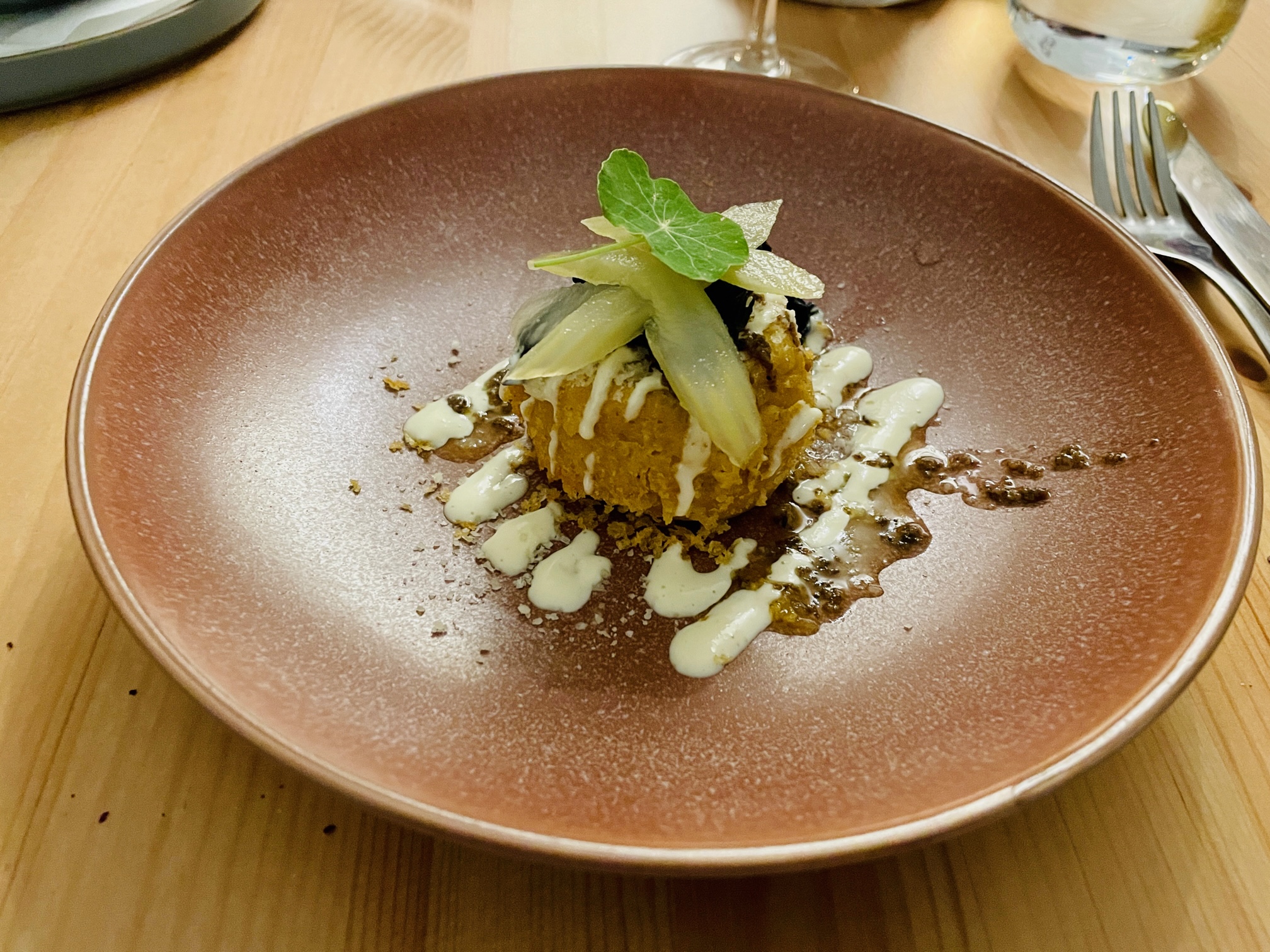
That minor disappointment out of the way, the last of our first wave of dishes was also on the specials board and if I eat anything as small but perfectly formed again this year I’ll have done very well for myself. The last time I was in Bristol I was wowed by a canelé rich with honey, whisky and smoke. This time, I was even more dumbfounded by COR’s savoury canelé which came drizzled with a grassy olive oil, tarragon and thinly sliced mushroom. Cutting vertically through it prompted the reveal, that the whole thing had been filled with a creamy, savoury mushroom duxelles which made me beam. This was emphatically not for sharing: Al and I scoffed one each, and I had half a mind to order another after dessert.

Another thing I really loved about COR was that they took our orders and artfully sequenced them almost like a gastronomic mixtape. None of this “your dishes will come out when they’re ready” bollocks that treats you to feast or famine, instead we got things in a carefully structured order that showed every dish off to its best advantage. Take this for example, Jerusalem artichokes fried until golden and sticky-edged and served on an earthy pool of artichoke velouté. It was simply magnificent, and if I couldn’t really detect much truffle in the truffled pecorino I was having far too much fun to give a shit. I have to really fancy Jerusalem artichoke to order it in a restaurant because of its legendary side effects. Here I did it anyway, and the side effects never materialised. That’s what I call winning at life.

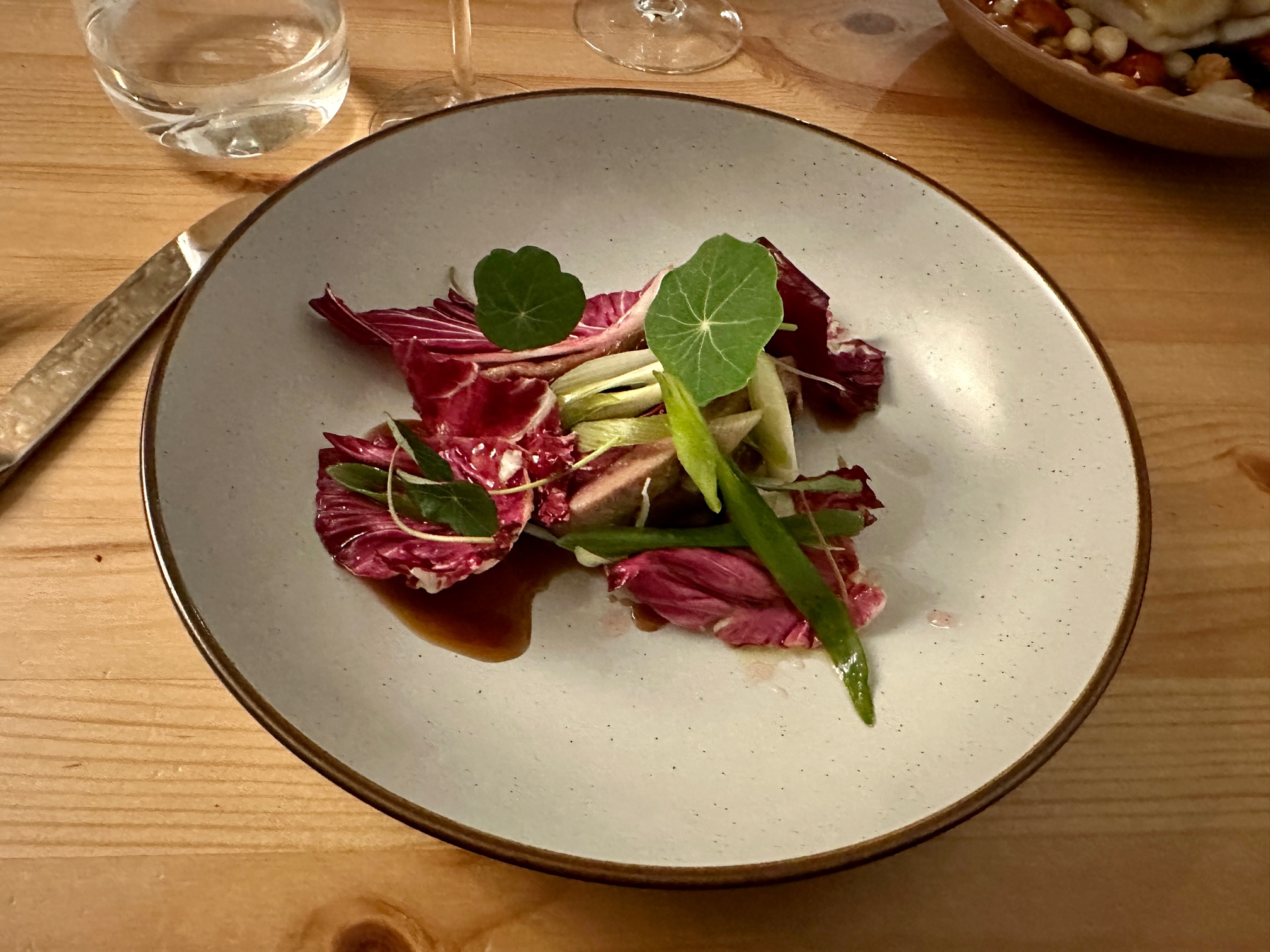
Equally delicious was the next dish, slow-cooked pork shoulder crammed into radicchio and topped with ribbons of pickled fennel (and some slightly pointless dill). The pork was splendid, with the texture ignorant people are prone to describe as unctuous. This vegetation-as-taco concept seems to be a Bristolian one: I had something very similar, albeit far smaller, at Wilson’s late last year. But this was the size you actually wanted it to be – and well portioned for sharing. Did I wish I was eating them both to myself? I like to think I’m a decent friend, but yes. Yes I did.

By this point, Al and I were suffused with a warm glow, catching up for the first time in months, enjoying glasses of surprisingly fruity and accessible Cataratto (“do you know, that’s the only wine I like?” said our waitress, charm personified without necessarily realising it). And we got to talking about superlatives: Al has the misfortune to spend some of his time surrounded by people from Gen Z who only ever use one superlative – “stunning” – and use it all the time. About everything. Everything, he told me, is their “new favourite dish”, whether it’s a special occasion or some spaghetti hoops out of a tin. Even hearing about this perpetual state of wide-eyed wonder, I’m afraid, made me want to kick something very hard.

But we were both rather running out of adjectives by the time our next dish arrived. Tropea onions, cooked to soft, caramelised wonder, drizzled with a hazelnut beurre noisette and crispy sage leaves was another knockout, even without the three dollops of goats cheese (Ragstone, apparently) providing a little agriculture to offset the sweetness. I gave Al the spare onion: I told you I was a good friend, although he did let me have the extra Jerusalem artichoke, and I thought that one of the nicest things about sharing dishes is that you can both have virtually the same superlative experience. If there’s a better thing to do with an old friend than go to an excellent restaurant, I’m not sure I know what it is: I know some people like watching the football, or playing squash, or bloody golf, but for me this is as good as it gets.

“Would you describe it as stunning?” I asked. Al grinned.

“Definitely. New favourite dish.”

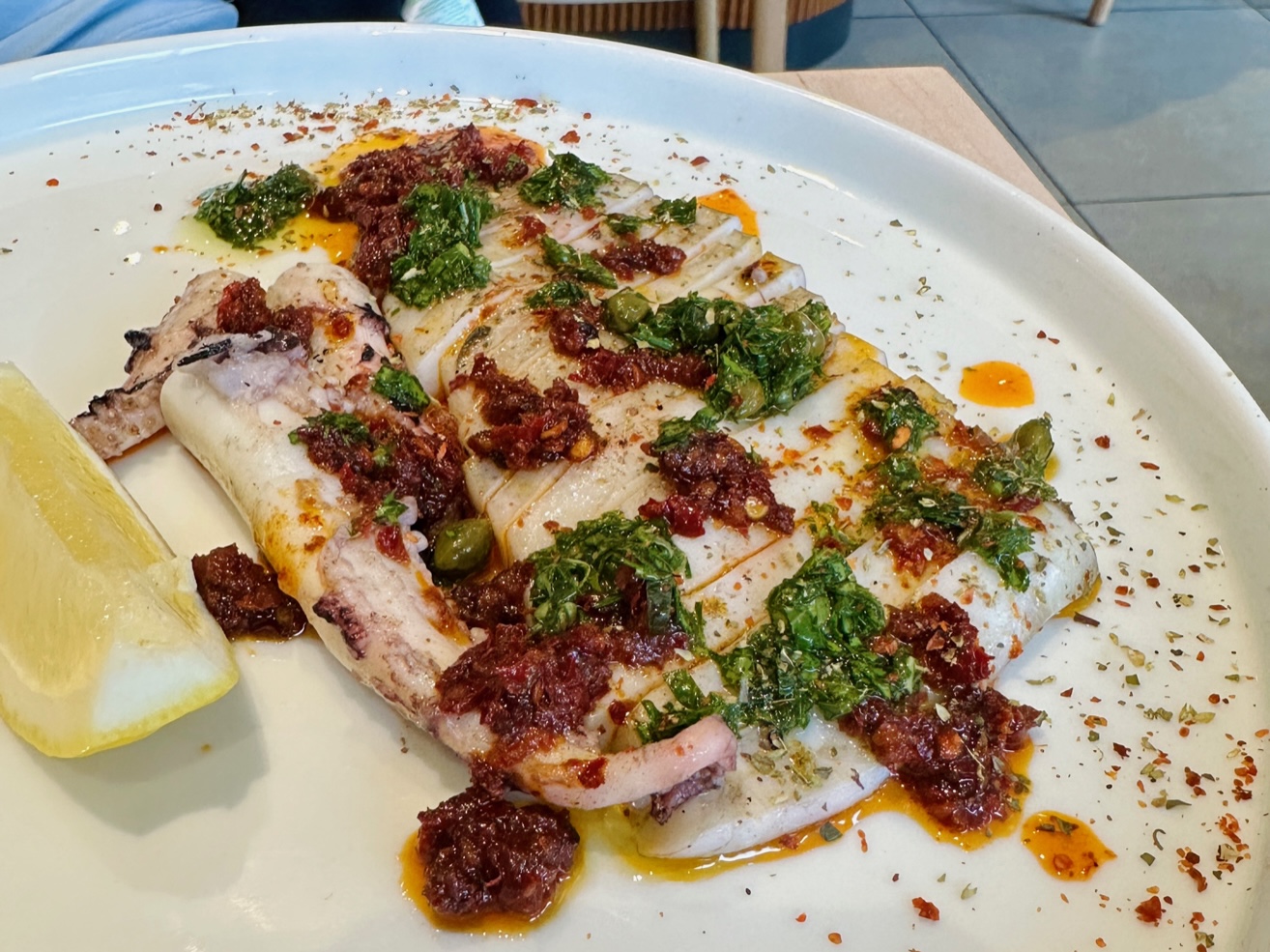
My new favourite dish – and in fact it stayed that way for the rest of the meal – was the next one. A really generous portion of cuttlefish, cooked sous vide and then finished on the grill I believe, was ludicrously tender and came already sliced into ribbons. I could imagine serving this with ‘nduja, or with salsa verde, but matching it with both, along with some capers, in a dazzling, dizzying tricolore was a stroke of genius. This dish would be at the apex of nearly any meal, and if I could find anywhere closer to home that served something like this I’d be there all the time, even if it was only half as good.
Our main courses involved the only misstep, and by “misstep” I mean “eight out of ten dish”. Al had decided to try the manicotti, a pasta dish, and he was encouraged in this by our waitress when he told her he was torn.

“It’s one of my favourite dishes, it’s like something your grandmother would make.”

“Your grandmother must be a better cook than mine was” I said, fighting back memories of wan fish, floured and fried, served on the kind of brown smoked glass plate every household had in the seventies. Still, she did at least cook proper chips in a chip pan, something nobody does now.

I think the dish was better than anything Al’s grandmothers could have conjured up either, but it wasn’t as much a tour de force as everything else had been. Manicotti are big sleeves of pasta, thicker and bigger than canelloni but the same kind of thing. Whereas this was a single giant tube, folded rather than rolled, and the overall look of it was somewhere between canelloni and some kind of pasta calzone, if I haven’t mixed my metaphors to death by saying that. It was stuffed with ricotta, topped with braised tomato, parmesan and rocket and it managed to look hearty, well-done and somehow unspecial.

“It’s okay” said Al. “It just doesn’t match everything that’s gone before. The braised tomatoes are fantastic, though. I just should have ordered the same thing as you.”

I mean, he should have. Because while I watched him eat a big sheet of pasta with some cheese in it pretending to be a Mobius strip, I was diving into a marvellous piece of onglet, as yielding as you like, with lashings of intense jus and – the icing on the cake – a dauphinoise of interlayered potato and celeriac, all topped with quite a lot of gruyere. It was just the most incredible thing, and when I saw on the menu that it clocked in at under sixteen pounds I thought there must have been a typo.
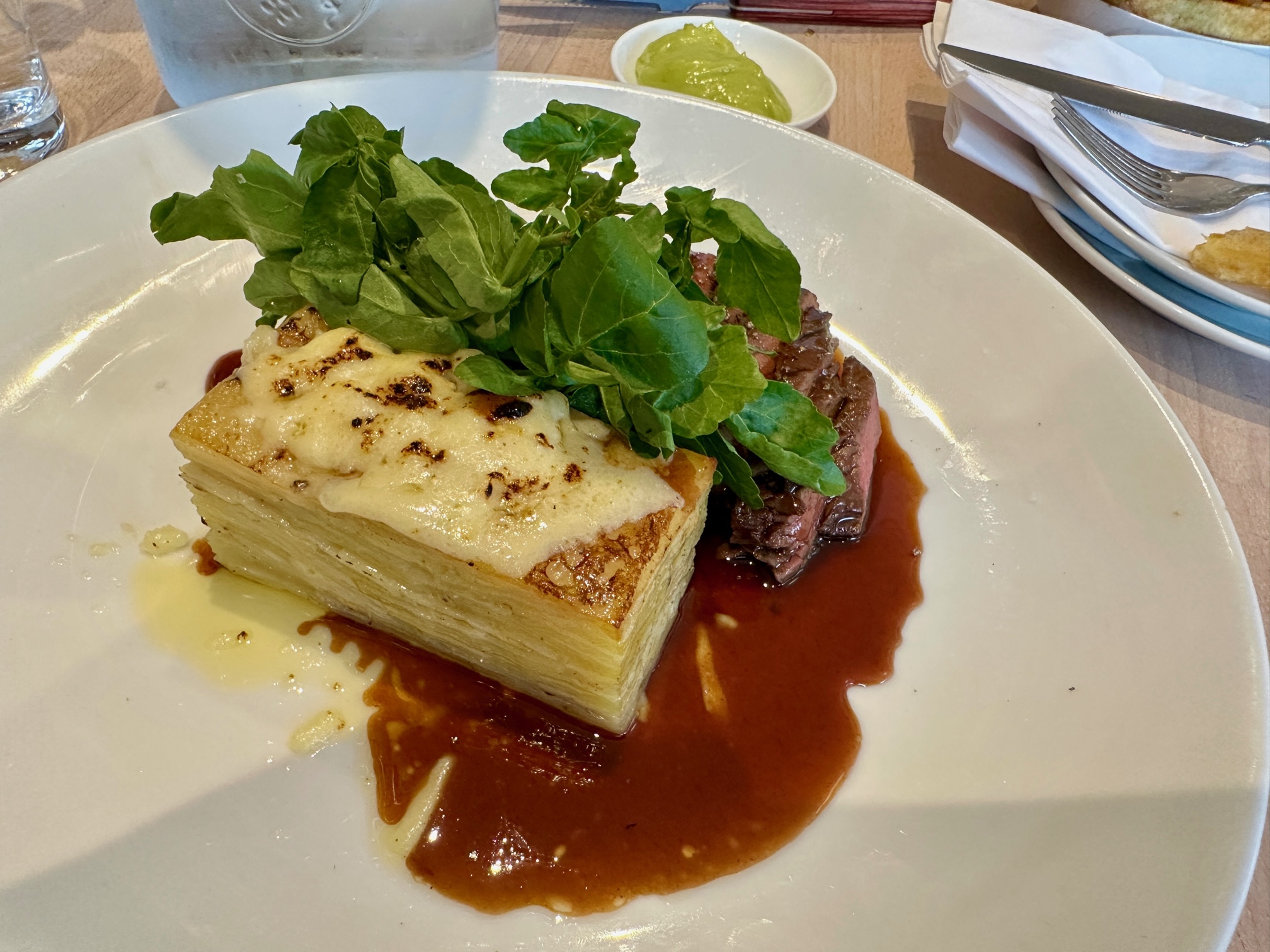
But there wasn’t. That whole plate of food for sixteen pounds was outrageously generous, charitable even. And speaking of charitable, even this dish had been served in a way that encouraged sharing, with the steak cut into substantial slices. I let Al have as many as he wanted to dull the food envy, because I’m not a monster: I suspect he would have had more, but it would have made the envy worse, not better. He consoled himself with some exceptional hand cut chips, dipped in a tarragon mayonnaise so herb-heavy it was the colour of guacamole. I had some too. Of course I did, it was world-beating.

We’d come all this way, so not having dessert would have been madness. The dessert menu is nicely compact – although they also have a selection of eight different cheeses – and Al had clearly learned from his mistake because, like me, he opted for the chocolate mousse. I think it’s an underrated dessert at the best of times, but this was at the very best of times – a hulking scoop of the stuff, dense yet airy, studded with plates of almond dentelle like the spines of a stegosaurus. That enough would have made it exquisite, but sprinkling it with flakes of sea salt and drizzling it with olive oil was the final touch.

“That chocolate mousse was so good” I told our waitress as she took our bowls away and we sipped our dessert wines (like I said, those kind of wankers), fighting the almost primal urge to order a savoury canelé for the road.

“Thank you so much! I actually made that yesterday, I spend some shifts in the kitchen as a pastry chef. I can’t actually eat it myself, it’s a bit too rich for me.”

I can’t imagine the level of self-restraint involved in being able to make something like that and not eat it, but then that’s why some people are slim and I’m not. Al, on the other hand, eats like a horse and is still as skinny as he was when I first met him about thirty years ago; this is why some people are jammy bastards and I’m not. But anyway, despite being thin, talented and impossibly young our waitress was a class act. All the people who served us throughout lunch were, actually: friendly, passionate about the food, with opinions on all of their favourite dishes, they were a real credit to the restaurant. How does anywhere get this good after just four months? It was quite miraculous.

Our waitress asked where we were from, and I mentioned Reading, and she proudly told us she’d been there. Once. Then of course the truth came out, that she’d passed through it recently on a train to London to watch a gig. It was the first time she’d ever been to London on her own, she said, at the tender age of twenty. And suddenly Al and I felt very old indeed, and seized with a sneaking suspicion that we should hightail it out of Bedminster and find an old man pub to hunker down in to carry on our gossiping session. The natural wine bar would just have to wait for another time. Our meal for two, with a very richly deserved service charge included, came to just under a hundred and ninety pounds. There was literally nothing to begrudge, except any of their punters who only paid ten per cent service.

As I was writing this review, I messaged Al, mainly to reminisce about what a phenomenal meal it was. What a stunning array of dishes I sent him, hoping to get a cheap laugh.

“One of my objections to the S word is the cognitive dissonance” he replied. “Stunning implies losing your senses, but with food that good your senses are very much alive. Sorry, you can tell I’ve thought about this too much.”

He’s right, though. What I loved about COR the most was having my senses awakened and reawakened time and again over the course of such a glorious lunch – old favourites, new combinations but always real integrity and imagination. Nothing was boring or humdrum, which I can say because I didn’t have that pasta dish, and in terms of the sheer number of hits I think it ranks as one of the best meals I can remember, at home or abroad.

I’m sure you know the drill by now with this kind of review. Bristol, Bristol, Bristol, hyperbole hyperbole hyperbole. But I like to think I’ve been here enough to sift the hypebeasts from the real contenders. The last time I was in Bedminster I ate at Sonny Stores, which was raved about by literally everybody but left me cold. And the last time I was in Bristol I went to Wilsons, which I raved about to literally anybody who’d listen.

And positioning COR relative to those two is pretty easy – it is miles better than Sonny Stores, a neighbourhood restaurant with a touch of the Peter Principle about it. But actually, although the number at the bottom is marginally lower than the one I gave to Wilsons, if you’re only having one meal in Bristol I would go here instead. Wilsons is a take it or leave it menu, a set seven courses, and when it’s on form it’s incredible. But I have friends who went there off the back of my review and although they loved the flavours, they found it a carb free zone and, I’m sorry to say, they left hungry. That will never happen to you at COR, and you will have an awful lot of fun deciding exactly how you want to become full. That’s what restaurants should all be about.

And how does COR compare to Reading restaurants? There’s nowhere in Reading even remotely like it. That is, and continues to be, the problem. You might get bored of hearing me say so, but it’s important to have goals. Reading’s should be to attract at least a couple of restaurants in approximately the same ballpark as this. I really hope it happens. It’s starting to get a tiny bit embarrassing.

COR – 9.5
81 North Street, Bedminster, BS3 1ES
0117 9112986
https://www.correstaurant.com

Restaurant review: Antica Osteria Bologna, Clapham Junction

For fuck’s sake, it’s Edible Reading, not Edible Clapham Junction.

I know, I know (Happy New Year to you too, by the way). But I found myself in the vicinity of arguably the United Kingdom’s most minging train station one January weekend – on an unsatisfactory excursion spectacle shopping, since you ask – and I always think it’s well worth structuring an expedition like that around lunch. That way if the shopping’s a bust, as it turned out to be, and the station is a hellscape, which it very much was, there’s still an outside chance of salvaging the day.

Not that I was in Clapham, by the way. I was shopping and mooching in an area that isn’t quite Clapham, isn’t quite Battersea, is a ten minute walk from Clapham Junction and is really rather lovely. Northcote Road is a long, prosperous street in the heart of what is apparently called Nappy Valley, and it’s a great place to amble and bimble. I hadn’t been in many years, although I was an occasional visitor in a former life.

I remember eating in this little place called Franco Manca there, once upon a time when there were only a handful of them, before they contracted the disease called private equity. There used to be a splendid tapas restaurant, too, called Lola Rojo, which did an olive oil ice cream I still think about sometimes: if I could have my time over again, I’d have ordered two portions (laugh all you like, but that might make my top 50 of Things I’d Do Differently). But anyway those were simpler times, over ten years ago, and remembering them it’s as if they happened to somebody else.

Returning in 2023, Northcote Road was still as fancy as I remembered. It’s still lined with swish looking cafés, delis and cheesemongers, bakeries, great shops, a branch of Aesop  – always a sign that you’re somewhere spenny – and tons of opticians. There’s even a branch of upmarket wine merchant Philglass and Swiggott (true story: I used to frequent their Richmond branch and I had to have it explained to me that those weren’t in fact their real surnames). 

Northcote Road also has restaurant after restaurant, and is full of those kinds of chains: Rosa’s Thai, Joe And The Juice, Patty & Bun, Ole & Steen, Meatliquor. The ones where simultaneously we’d rather like one in Reading but we know that if we got one, it would be because they’d jumped the shark. Not that you needed to eat in one if you were peckish – one food van sold beautiful-looking pizza, another was flogging porchetta sandwiches which looked so attractive that I almost cursed my foresight in having made a reservation.

But I had made a reservation, and I’d relied on Eater London for a recommendation. It had a list of the best restaurants in Battersea, although they were sparsely spread out and it would have taken you the best part of an hour to walk from one end of their map to the other (some of them, weirdly, also end up in their list of the best restaurants in Clapham, which tells you what a no man’s land it can be). 

There were small plates wine bars and gastropubs, little BYOB Thai joints and a restaurant offering French-Korean fusion, whatever that is. But I was drawn to Osteria Antica Bologna, slap bang on Northcote Road. It had been going for over thirty years, which meant I had probably walked past it countless times a decade ago. And the clincher was this: I love Bologna and I haven’t been there in far too long. So Zoë and I turned up at lunchtime, our tote bag already full of treats for later from the cheesemonger, to see if it could transport me back, in spirit at least, to one of my favourite cities.

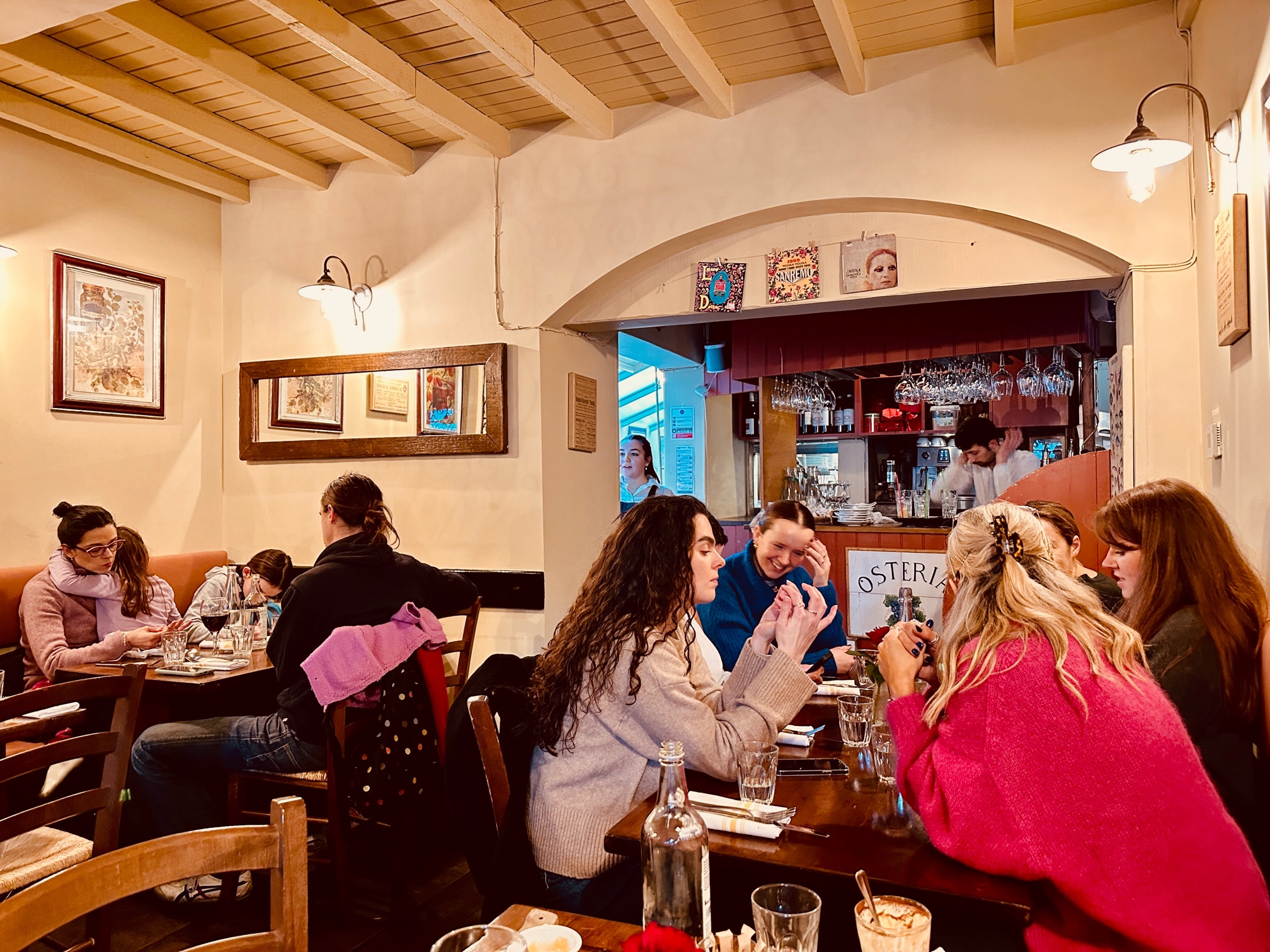
It was old school right from the beginning, with a burgundy and orange awning and a big sign at the front saying “DAL 1990”. And stepping inside I was reminded that it can be a fine line between dated and timeless, and sometimes you make it from the former to the latter merely by staying the course. For what it’s worth, I think Osteria Antica Bologna was the right side of the line, with a simple, rustic-looking dining room, a dusky pink banquette running along one side. On the other, tables were separated by a trellis-like partition that no doubt pre-dated the pandemic.

Beyond the archway in front of the bar, out back, was a more modern-looking dining room with a skylight, an extension I imagine, but I was glad they didn’t seat us there. Even the little things, like a circular table at the front with a big bowl of olives and a large bouquet of flowers, felt like something they had done for a very long time. It was a room with a lovely energy, a place harbouring the unspoken promise that you would eat well, and although only a handful of tables were occupied when we arrived at one o’clock, only a couple were empty when we left.

Another sign that the restaurant was resolutely old school came as I drank my – surprisingly bracing – Aperol Spritz and Zoë attacked her negroni. The menu was antipasti, pasta and main courses. If you wanted pizza, you should have headed to the food truck on the other side of the road, or to Franco Manca. But everything sounded marvellous, including the specials which were explained by our personable, enthusiastic waiter. 

I almost tried some of their pasta but, and this was the only real disappointment on the menu, the difference between a starter and main-sized portion of pasta was just two pounds, which said to me that I was effectively choosing between that and a main. But there’s always next time, when the pumpkin and ricotta ravioli with sage will be calling to me – although not necessarily loud enough to drown out the siren song of the wild boar ragu, or the risotto with salsiccia and Barbera. A truly great menu always comes with regret baked in: that’s the nature of these things.

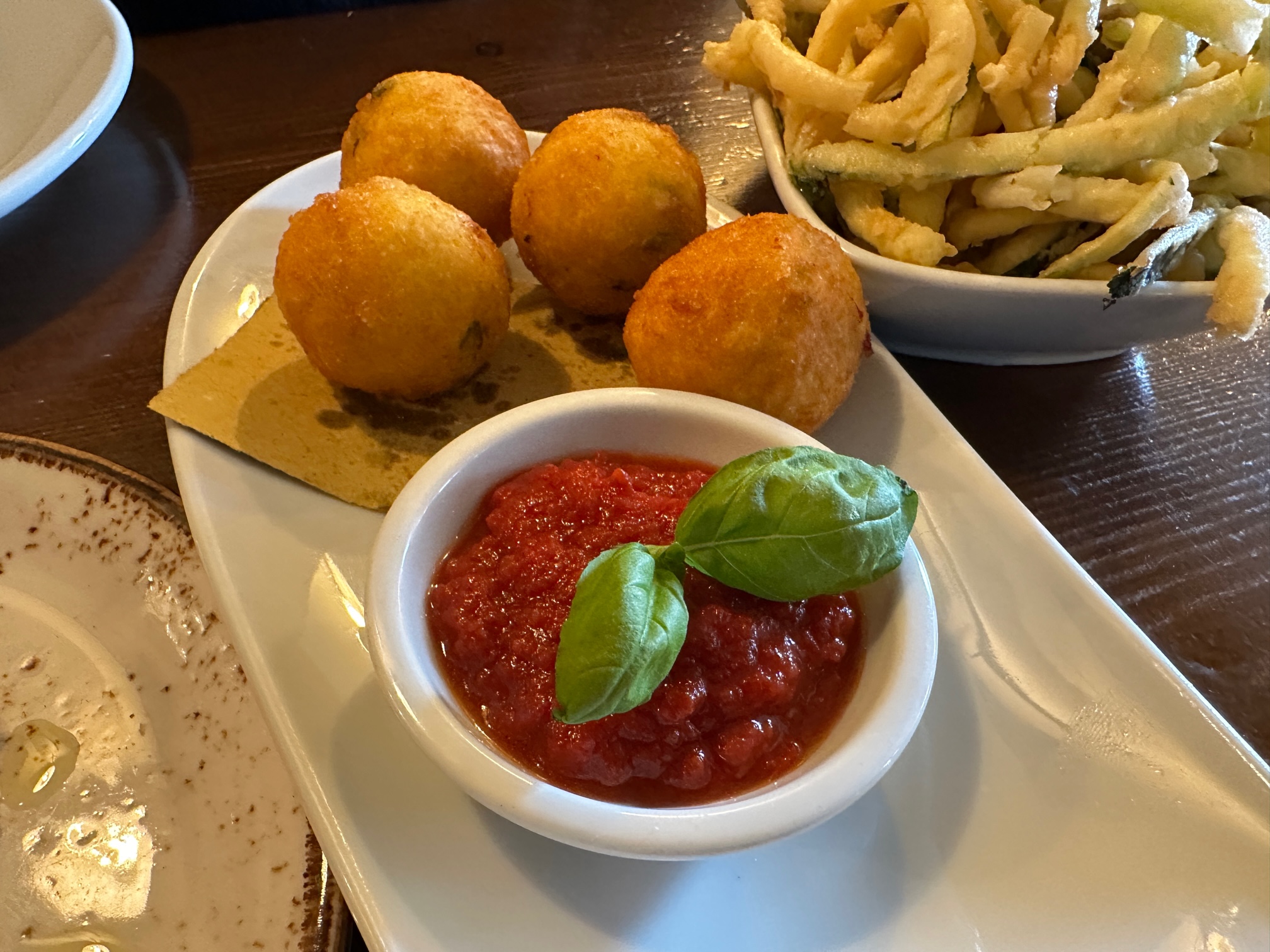
We’d ordered a trio of antipasti to start and if anything they intensified that regret: given just how good these were, what other treasures had we missed on the menu? Arancini were possibly the best I can remember, and simpler than many I’ve had. No thick crust of breadcrumbs here, just a feather-light seasoned shell. No stodge to wade through with a molten core, instead just a neat sphere of rice, cheese and peas retaining a little bite. And to go with it, an arrabiata sauce worthy of the name, just spiky enough. It reminded me of the difference between pretenders, as with my visit last year to Sauce & Flour, and the real deal – unshowy but superb.

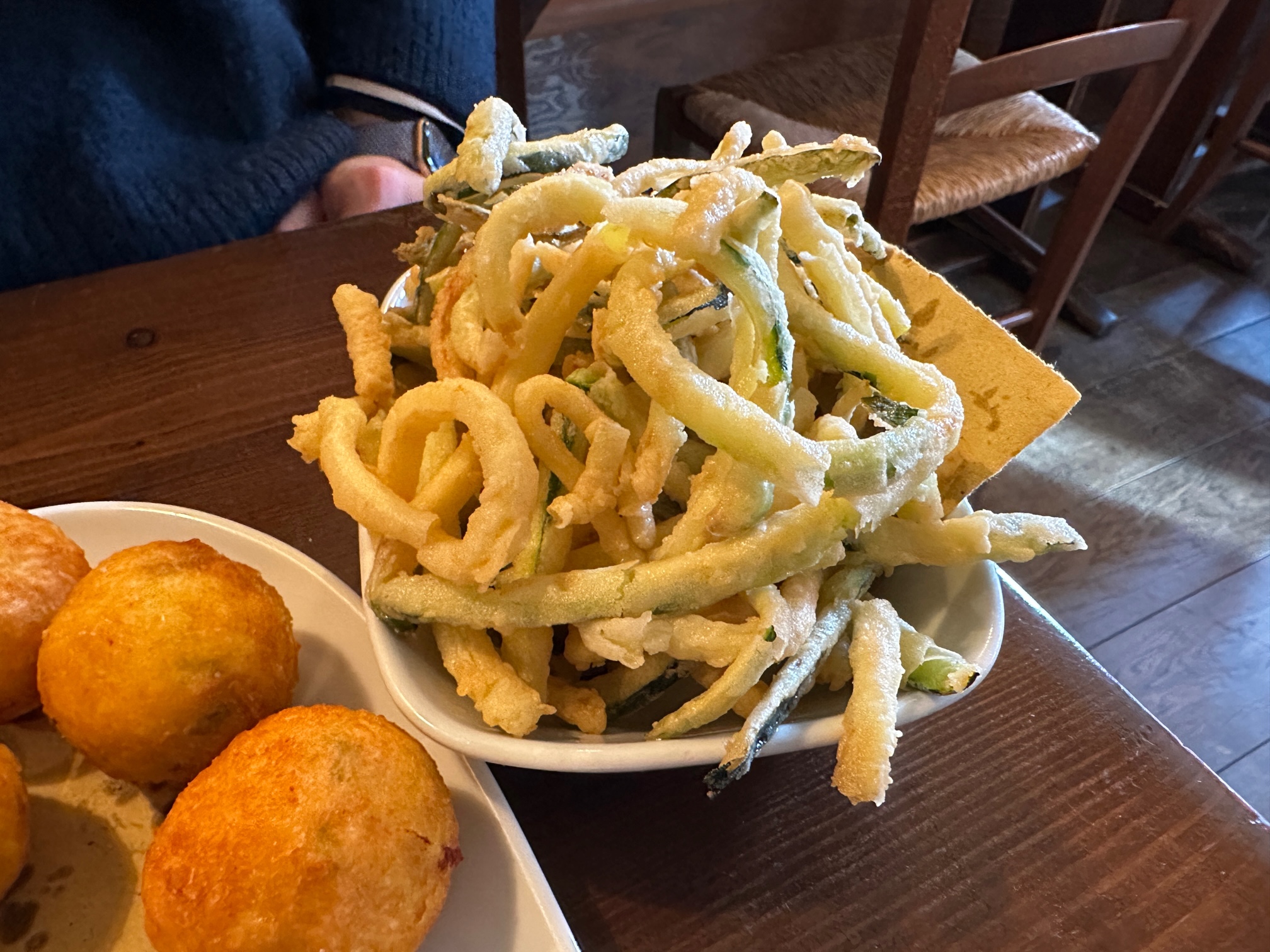
Also as good as I can remember were the zucchini fritti. No, scratch that: they were easily the best I’ve had anywhere. So often, including at a couple of Reading restaurants I actually really like, they can be soggy, limp things and you’re left to redeem them with some kind of dip. Here they were shoestring-thin, almost ethereal yet spot-on crispy, the way this dish always promises to be but somehow never is. And they didn’t need any kind of dip because they were so salty and zippy, so beautifully seasoned and cooked with a real lightness of touch. “The menu should tell you to order these with your drink while you make up your mind” said Zoë who was, as usual, entirely correct.

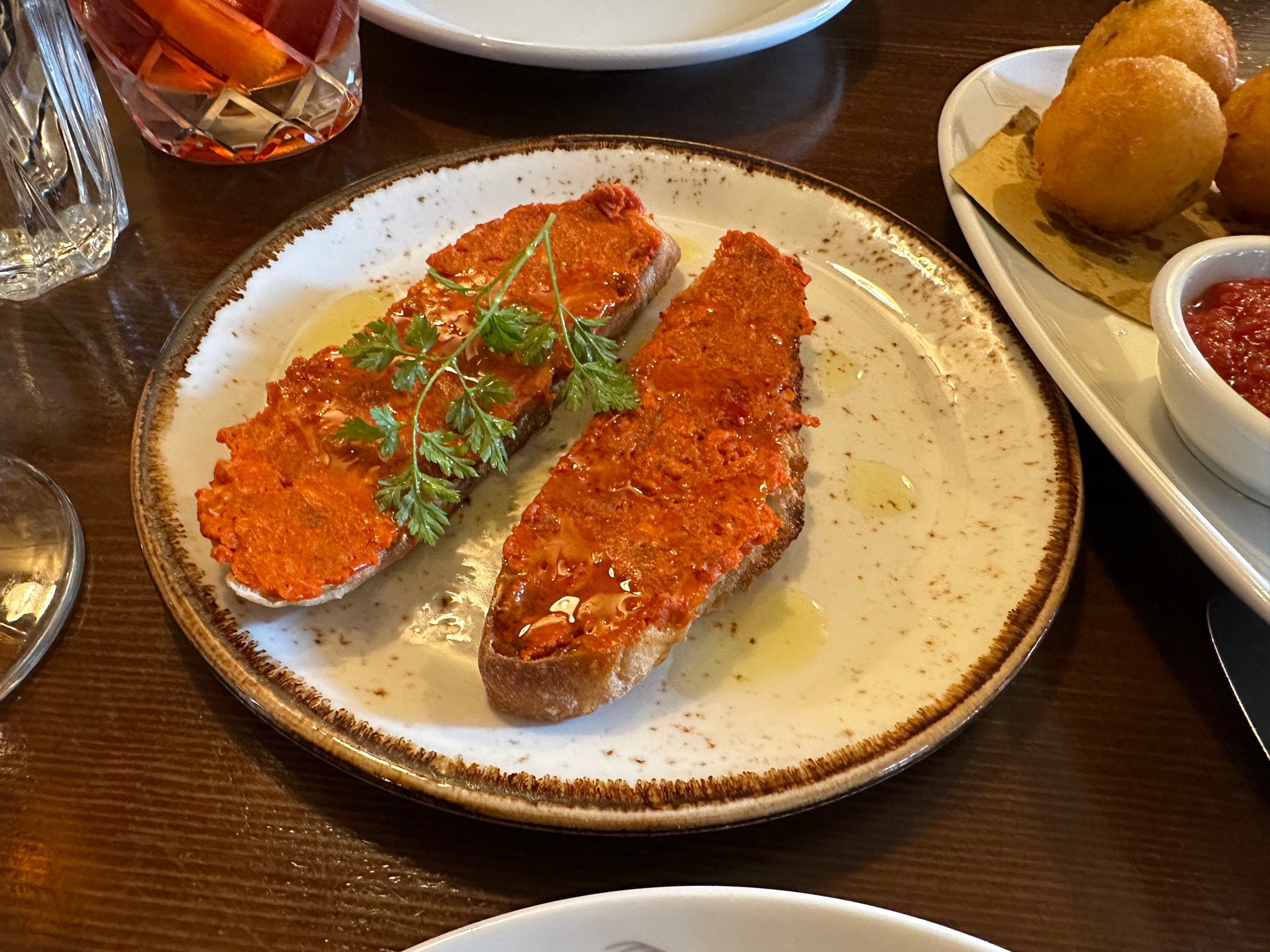
The other small dish we had, bruschetta with ‘nduja, was the least excellent but really, that just means it was still cracking. Two thin slices of toasted bread were loaded with a terrific ‘nduja – not stingily, either – with more depth and earthiness than I’m used to. So often ‘nduja dishes I’ve had are a one-note symphony relying on the acrid heat it can supply; I’ve lost track of the number of restaurants that make lazy use of the stuff. By contrast, this dish just said isn’t our ‘nduja amazing? and, having tasted it, it was impossible to argue. One thing you could potentially quibble, here, was the cost: eight pounds fifty for that. Sounds expensive, but is it 2023-in-London expensive? Your guess is as good as mine.

We grabbed a couple more drinks while we waited for our mains. My gavi, in an endearingly functional wine glass, had a pleasant zing to it and Zoë, sensibly, decided to move to gin and tonic. By this point the restaurant had a real buzz and all the temptations of elsewhere, the porchetta sandwiches and gelato places, had melted into air. All that mattered was the next course, and the course after that.

“This is very promising, isn’t it?” said Zoë. She was right about that too. 

If I had to pick a main course to start my reviewing this year with, it would be hard to choose better than the dish Osteria Antica Bologna served me. A piece of cod with salty, crispy skin and soft, sumptuous flesh, cooked by someone who really understood how to get both those things right at once, perched on a little heap of chickpeas, tomatoes and spinach.

A single forkful was enough for me to know that I was in a happy place. I even turned to Zoë and told the tired joke I reserve for these occasions, I love it when a chickpea’s in my mouth, and she had the decency not to grimace; imagine what sitting opposite me at dinner dozens of times a year must be like. Only the fact that the promised salsa verde, which would have completed the dish perfectly, had been replaced by a smear of something closer to purée slightly blotted the copy book.

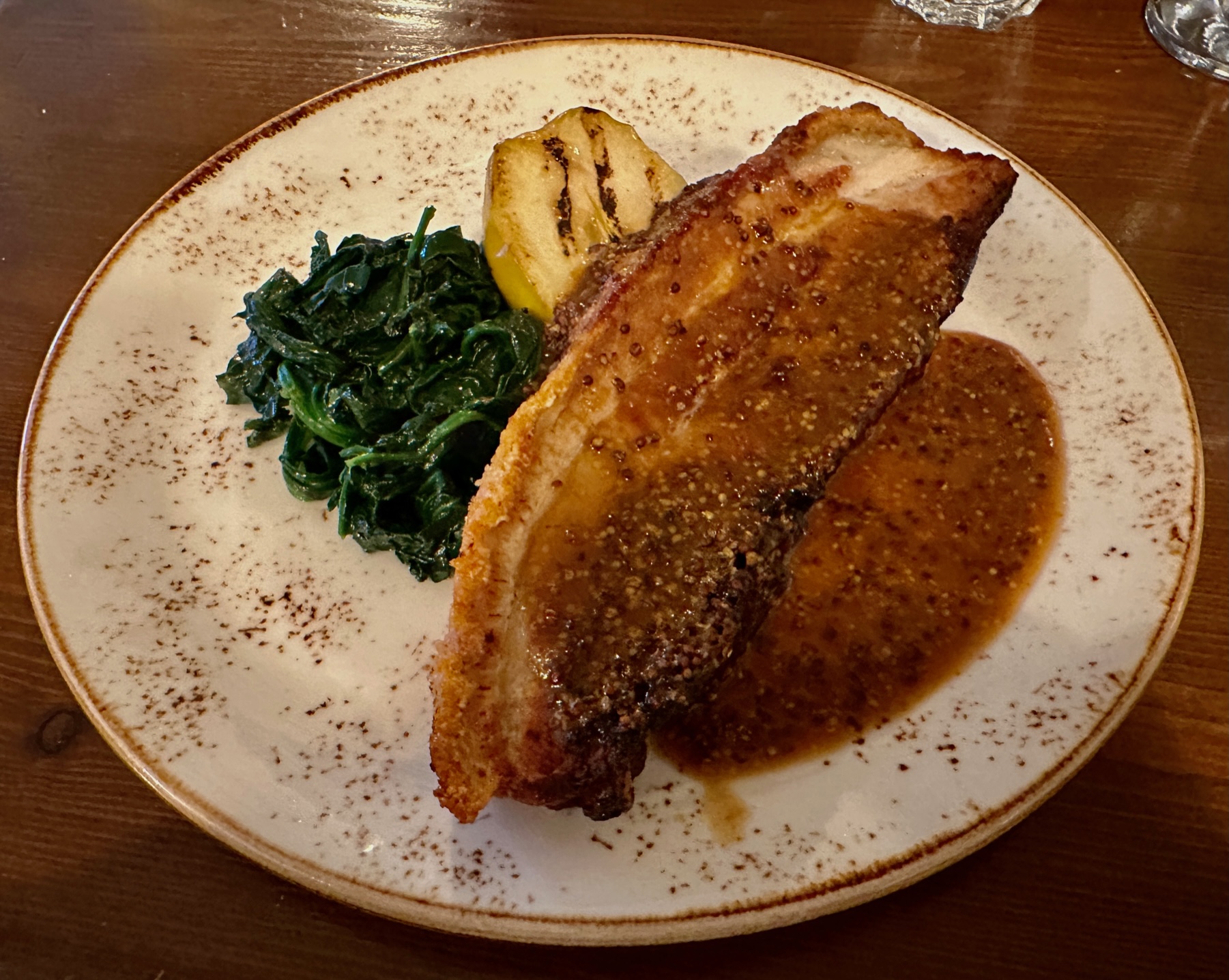
The problem is that if I had to pick a main course with which to start my reviewing year, it would be damn near impossible to choose better than the dish the restaurant served to Zoë. The menu called it pork belly with roasted apple, but that prosaic description comes nowhere near capturing what a marvel it was. A gargantuan slab of pork where, like the fish, everything was exactly how it was meant to be. The flesh was tender, the crackling brittle and intensely savoury. Between the two, arguably the best bit, that sticky, moreish layer of subcutaneous fat, rendered to the point where it was gorgeous but not beyond that to the point where it vanished. I was allowed a forkful, and then because of my expression I was allowed another, and another.

“Would you like to try some of my fish?”

“No, you’re all right.”

Just as sometimes you can only pick out one face in a crowd, it was hard to remember, eating that pork, that there were other things on the plate. But the gravy, shot through with mustard which never overpowered, was a terrific foil and I imagine the griddled apple was superb with it too. We’d ordered some chips with our dishes, which they really didn’t need, and those were predictably wonderful – light and salty and far too easy to pick at long after we’d cleared our mains. If they buy them in, they buy very well.

The dessert menu was also compact and leant heavily on the classics, and having seen the well-upholstered man and his Sloaney Alice-banded daughter at the next table make their choices simplified things nicely for me. My tiramisu was maybe the weakest link in the whole meal – not bad, per se, but a little too loose and liquid when I’d have liked it a tad more substantial. The slug of coffee and booze as you got to the bottom, though? That was still a wonderful moment in a meal full of them. And at the end of it I had an Amaro di Capo, as much medicine as booze, served without airs, graces, ice cubes or orange in a tall shot glass.

Zoë – here we go again – picked better. Her pear and chocolate tart was another home run, with a few pieces of baked pear, a pleasingly short pastry base and a very thick layer of chocolate; I thought it was a relatively airy ganache, Zoë thought it was a sponge, we had a heated debate about it and agreed to disagree. “That filling definitely has flour in it” were her last words on the subject, but I still say she’s dead wrong. I also managed to talk her out of ordering a Bailey’s and into trying a Frangelico instead. It was not a sponge: trust me on this. 

I haven’t talked about service but it was another of the things that was great rather perfect. The staff are clearly a well-oiled unit, bright and happy, friendly and brilliant. But one thing they also were, slightly, was too efficient. Our plates were cleared away mere moments after we’d cleared them, to the point where it became a little bit too much (“there’s something OCD about it” Zoë said, bemusedly, just after they’d also cleared her G&T away when she hadn’t quite finished it).

But really, that was a small quibble about a magnificent place to eat. I could easily see how Osteria Antica Bologna had held its ground amid all that gentrification, all those pop-ups and top tier chains. At one point I saw one of the waiters leave the restaurant with some plates of food and take them out into the street to the people manning a flower stall outside: that, I thought, said it all. Our meal for two – three courses, three drinks each and an optional 12.5% service charge – came to just over a hundred and fifty pounds, and I thought it was worth every penny.

I’ve complained in the past about Reach plc and its pisspoor habit of saying a restaurant is “just like eating” in a foreign country. My problem with that is twofold. First, the poor unfortunate journalist in question has probably never been to the country in question. But more importantly, 99 times out of 100 they haven’t been to the restaurant either – why bother, when there’s TripAdvisor? But for once I’m going to do it myself: I’ve been to Osteria Antica Bologna, and I’ve been to osterias in the city from which it takes its name. And if I’d stepped out the front door to find myself looking at an orange portico dappled with sunlight, rather than being a two minute walk from a Farrow & Ball and a branch of JoJo Maman Bebe, I wouldn’t have been entirely surprised.

As I paid up, our meal at an end and so many around us barely beginning theirs, I thought about what it means to have a restaurant for over thirty years. To outlast fads and phases, to have ‘nduja and burrata on your menu before everybody discovers them, to steer your course without embracing small plates or no reservations, to serve pasta simply because it’s what you do rather than because suddenly pasta restaurants are in vogue. I thought about the fact that Osteria Antica Bologna was here before Northcote Road was all fancy and well-to-do, that they had sent thousands of customers away replete and happy. That they’d started doing that before I even finished my A levels.

And I thought that even though this restaurant was nowhere near my home town (and, let’s be honest, most of you will probably never go there) it was still the perfect place to kick off my reviews this year. Because to celebrate this restaurant, on some level, is to celebrate all great restaurants. Some people have a nasty tendency to use “neighbourhood restaurant” as a way of patting a place on the head. It’s okay I suppose, if you live there they seem to say. But a great neighbourhood restaurant, especially one that makes you wish it was your neighbourhood, is a truly special thing. Osteria Antica Bologna is every bit that special. I’ll find an excuse to be back near Clapham Junction: when I do, I intend to order everything.

Osteria Antica Bologna – 8.6
23 Northcote Road, London, SW11 1NG
020 79784771

https://osteria.co.uk

Restaurant review: Asado, Bristol

The venue for this week’s review was partly chosen as a result of circumstances: our train back from Bristol left mid-afternoon on Sunday, so we needed somewhere that would do a good lunch but not necessarily a leisurely one. For me this is where casual dining so often comes into its own, when you want something decent but not too expensive, briskly paced but not fast food. And this being Bristol, even that sector of the market is awash with attractive, interesting options so you never have to opt for the comfort zone of a chain restaurant. Could Asado, a burger restaurant at the top of the Christmas Steps, be the answer?

That arguably undersells Asado’s standing though, as if I’d merely looked at a map of the city and tried to find something affordable within walking distance. In fact, it has built a formidable reputation since it opened five years ago, with many people thinking it arguably does Bristol’s best burger (a title awarded to it last September – although only by the local Reach plc website, so perhaps not carrying that much cachet after all).

Its pedigree is decent too – the owner is an alumnus of Patty & Bun, who for my money served probably the best burger I’ve ever had. He moved to Bristol determined to offer something a little different, and Asado’s selling point when it opened was that the burgers were cooked over a wood-fired grill. The menu also had a mixture of traditional and South American influences, and the hype was considerable: this was back when Bristol had quite a few restaurant blogs, although the last review of Asado I can find from anywhere is nearly four years old.

Having survived the pandemic Asado made a properly leftfield move when it came to expansion – the owner decided to move to Barcelona, so they just opened a second branch there. As you do. There’s something quite admirable about that – I know we often look at restaurants outside Reading and wish they’d expand in our direction, but given a choice between, say, the Ding and Barcelona who can blame them for heading south?

Anyway Asado seemed to be thriving in its original branch, and although we were the first customers there when it opened at one by the time we left plenty of the tables were occupied with groups, big and small, working their way through the menu (and drinking cocktails in many cases, which made me feel about a hundred years old).

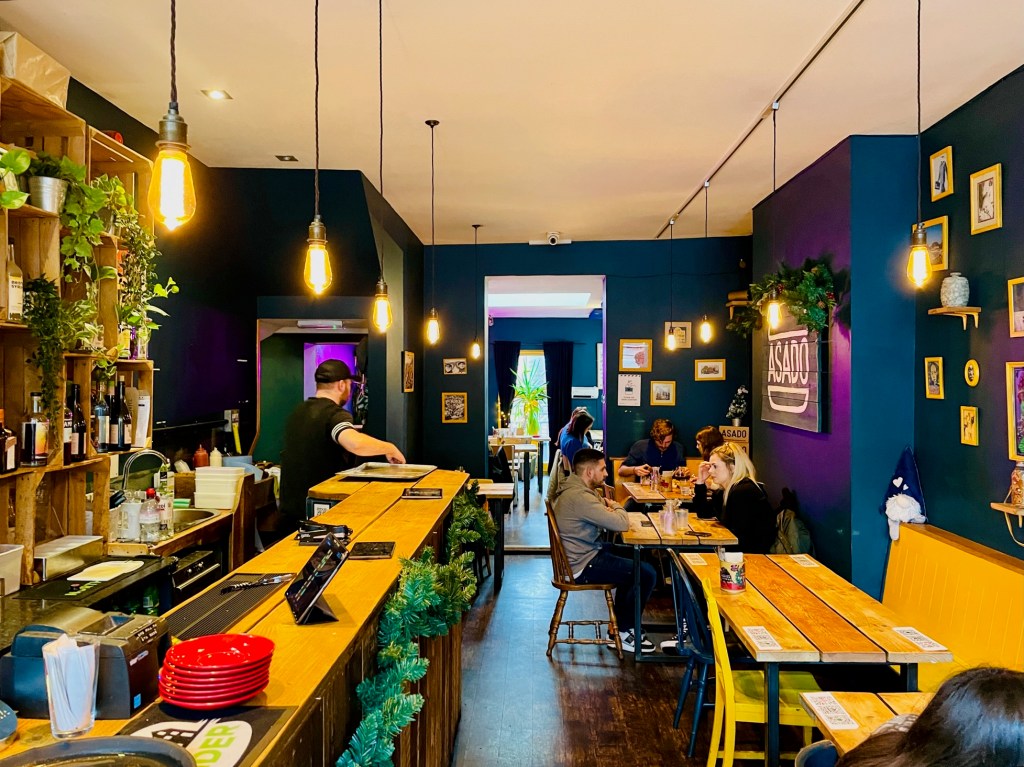
The restaurant is made up of two rooms – a narrow front room, also home to the bar, which has a snugger, more conspiratorial air and a back room which feels more open and spacious due to a lovely big skylight. Furniture was the kind of standard-issue mixture of distressed chairs and what looked like old school chairs, and the overall effect was a little like a classier version of Bluegrass BBQ. We sat in the back room, and what it gained in natural light it lost because of a certain lingering chilliness.

The menu was encouragingly concise, with a limited number of variations on a theme. So you can have the beef burger as it comes, or enhanced with pulled beef, pastrami or skirt steak. The chicken burger either comes with guacamole and chipotle mayo or with hot sauce (Warning! Hot is very hot, the menu said) and blue cheese dressing. There are two options for vegetarians, with the burgers made by Huera – from pea protein, as far as I could tell by Googling – with pulled jackfruit if you fancy it.

Both of those can be made vegan by request, although you miss out on the West Country cheddar: Asado makes much of using proper local cheese rather than plastic American slices. Burgers tend to range from fourteen to eighteen pounds and come with fries and slaw, and you can double up anything apart from the chicken burgers for three quid.

As is generally the case with this kind of restaurant the smaller dishes were labelled as sides rather than starters, although the woman serving us did give us the option of having them separately as starters if we wanted, a nice touch. Service, incidentally, was superb, bright and enthusiastic; she started out by complimenting Zoë’s make up, which is a great way of getting anybody on side. From what I could tell she was bilingual as well, because the Spanish names of our dishes were pronounced flawlessly and I’m pretty sure I heard her talking to a neighbouring table in Spanish.

She brought over a couple of beers for us – the draft beer here is by local New Bristol Brewery – and from that point onwards I felt in very capable hands. We tried the table beer, Three Falling (it’s three per cent ABV, you see) and I thought it did a great job of packing a lot of flavour into a pretty sessionable strength. By that point in the weekend I was simultaneously sworn off drinking for quite some time and thinking three per cent is hardly booze at all: it’s surprisingly easy to hold both those ideas in your head at the same time.

If I had a fiver for every time I’ve written Zoë ordered better than me on this over the last four years, I could probably review quite a few restaurants in 2023 without putting my hand in my pockets. And so it proved here, because the Pollo Libre, Asado’s (more) basic chicken burger, was fantastic. A lot of hefty chicken thigh, fried in a nicely seasoned, crunchy and craggy coating, would have been pretty unimprovable even on its own, but the extras took it just that little bit further. “This guacamole is great” said Zoë, “and it’s positively singing with lime”. I was allowed a bite, which was enough to confirm that she was right and to make me slightly regret my own choice.

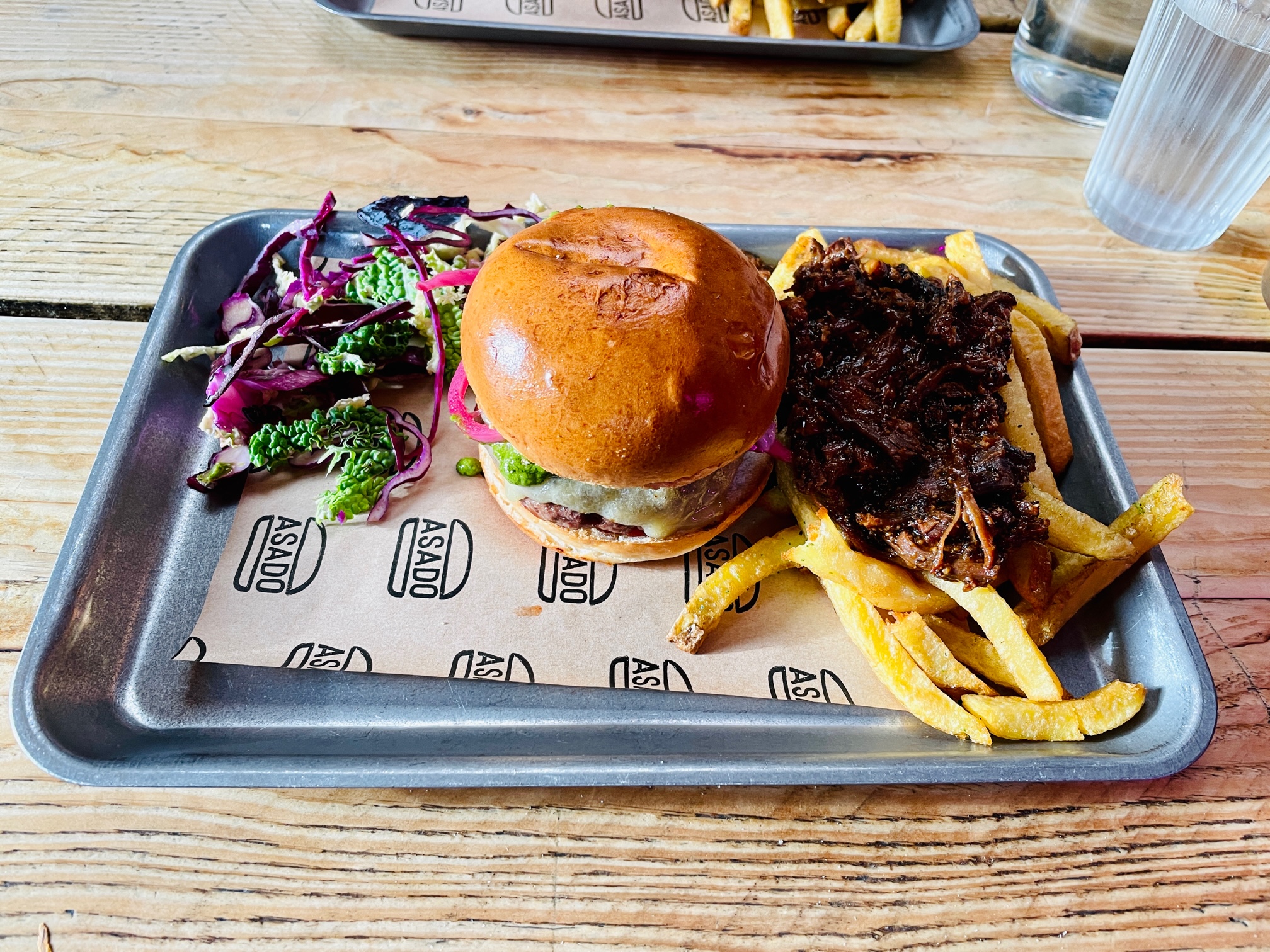
I’d decided to go for the entry level burger, the eponymous Asado. It’s the most stripped-down one they do but it still has plenty going on with the patty, that West Country cheddar and plenty of different sauces – chimichurri, confit garlic mayo and ketchup and some pickled red onions on top. And I liked it just fine, but it didn’t blow me away as I’d hoped. Part of that might just be expectation management: I thought that the burger itself would have a wow factor from having been grilled over fire but I didn’t get a huge amount of char or caramelisation, or the smokiness I was expecting. And it didn’t feel to me like all those sauces were working in harmony – less might have been more, in that respect. I liked it, but I didn’t love it.

Credit to them, though, for making a burger that you could just about eat without unhooking your jaw, in a not-too-sweet brioche that had the structural integrity to keep it together. Perhaps I should have had it with extras, but I wanted to think that the burger could stand on its own two feet without that. Instead I had some of the smoky pulled beef on top of my rosemary fries and it was positively transformative – a beautiful tangle of savoury, smoky and sweet strands of slow-cooked beef that quite made my afternoon. You can have these on your burger if you order the El Don, and next time I probably would. The slaw, which was dressed rather than with mayo, felt a little underdressed and felt like it was there mainly for appearances. It did look pretty, though.

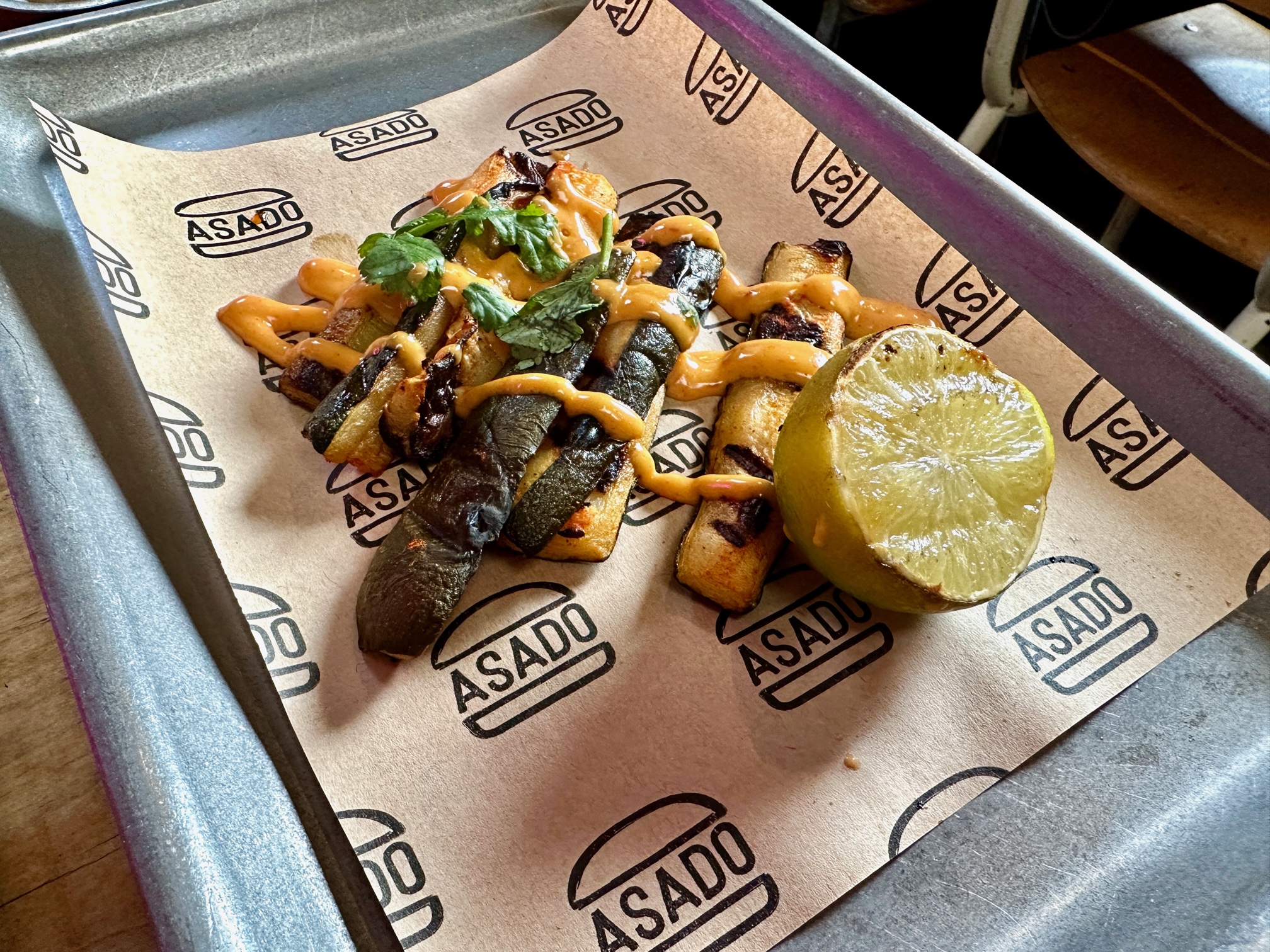
If that was the whole story, it might have been a little underwhelming but it was the sides and the extras that lifted Asado into more interesting territory. I’ve already raved about the pulled beef, but I also adored our grilled courgettes. Asado used to do courgette fritti but this was much more vibrant and interesting – batons of courgette just-cooked but blackened on the outside, striped with a well-balanced sriracha mayo. More virtuous than yet more fried stuff, but still indulgent. I could have eaten a bucketload more of this.

Speaking of fried stuff, the sides and bar snacks section of the menu featured croquetas with more of that pulled beef in them and morcilla nuggets – breadcrumbed spheres of black pudding fried until crispy and dished up with a chimichurri mayo. The latter are three pounds each or four for eight pounds fifty, and when we only asked for a couple the waitress asked if we were sure. And when we said we were she took our order, although I wish with hindsight that she’d said “Seriously, you should reconsider: they’re fucking amazing”. Because they were – the perfect snacking size, possibly two bites maximum of deep, delicious black pudding only slightly lightened by the mayo. If I’d known how manageable they were, I’d have ordered four. To myself.

And if I’d known how small they were, I would have made room for the four morcilla nuggets by passing on the chicken wings. They were decent enough, although again the smoke didn’t really come through on them at all, and I loved the sweetness of the pineapple and agave glaze, with a little heat. But they reminded me of everybody I’ve ever worked with who had short man syndrome: small and stubborn, to the point where however nice they might be you did find yourself thinking is this worth the effort? On balance, perhaps not. I could have had some of those pulled beef croquetas instead, or saved room for dessert. There’s only one on the menu, a passion fruit cheesecake, but I bet it’s marvellous.

With us done and dusted, all that remained was to settle up. Our meal for two with a couple of pints, probably more sides than we needed and including a needlessly low ten per cent optional tip, came to just over seventy six pounds. We were out the door more quickly than planned, so we wandered across to Bristol’s branch of C.U.P. on Park Street, a little slice of home from home, and sat outside with one of their peerless mochas, looking down the hill and imagining what it would be like to live in Bristol. Would it still be so amazing then, or is the grass always greener at the other end of the M4?

Summing up this review is difficult. My Bristolian readers (and it seems I have more than I thought) will probably already know about Asado and have firm opinions about it. Especially if they also read Bristol’s Reach plc website, which looks almost as trashy as ours. And for the rest of you, it’s a little more difficult. If you are absolutely mad about burgers I would say yes, you should definitely go. One of the best burger restaurants in Bristol is very likely, on paper, to be one of the best in the country. And if you happen to be in Bristol and you want a quick meal, not far from the train station, it’s very easy to give Asado an unqualified recommendation.

Is it enough to build a visit to Bristol around the way that, say, Wilsons, Marmo or Caper and Cure are? No, probably not. But that’s no bad thing. Not every restaurant can be Lionel Messi. Somebody has to be Luke Shaw, and there’s no shame in that. And it’s definitely a level above Honest, which is most people’s Reading benchmark.

“I saw you went to Wings Diner” said Gurt Wings’ James when I went to Blue Collar the following Friday for my regular dose of his Japanese fried chicken. That figured: Mr Gurt always has an eye out on Instagram and never misses a trick so he’d seen all my meals in Bristol, even the ones I didn’t write about.

“Yeah, it was really pretty good. Especially the Korean dip.”

“You know where you should go in Bristol? There’s a place called Seven Lucky Gods and their Korean fried chicken is out of this world.”

See? It never ends. Nonetheless, I made a note for next time.

Asado – 8.2
90 Colston Street, Bristol, BS1 5BB
0117 9279276

Restaurant review: Wilsons, Bristol

Wilsons was awarded a Michelin star in February 2025.

I’m sorry to start proceedings with what looks suspiciously like a humblebrag, but last month I was on holiday in Belfast and as a treat, we booked a table at Ox, one of the city’s Michelin starred restaurants. But it was a hugely disappointing evening, which will please those of you who don’t like humblebrags. Everything was not quite right; nothing was actively terrible, but the whole thing felt far from optimal. We left underwhelmed, slightly peckish and feeling as if our wallets had been mugged in a dark alley, and wandered away from the scene of the crime in search of a pint.

I’ve never understood people who collect Michelin starred restaurants – too humblebraggy even for me – or restaurant bloggers who loftily describe meals they’ve had as “easily one star food”, as if somebody died and promoted them to inspector. Get over yourselves: it’s just one set of opinions, from an organisation so shrouded in secrecy and obscurity that they make the Freemasons look like the Good Law Project. For what it’s worth, I’ve always thought the Bib Gourmand is a better indicator that you’ll have a good and interesting meal.

The subject of this week’s review is Wilsons, a little restaurant in Bristol which doesn’t have a Michelin star per se (it has a green star, which is something different) but which served me one of the very best meals I’ve had in the last five years. Not only did it get everything right that Ox got wrong, but it made me think about what excellence in restaurants really means – and how little of it has anything to do with being fancy.

Take the room, for example. At Ox, we walked past the lovely, twinkly, atmospheric downstairs room – which had free tables in it – only to be walked up the stairs to an unlovely mezzanine floor, all hard surfaces and dead air, the overflow car park of hospitality. It was boiling hot, the aircon stayed resolutely switched off and even blowing out the candles didn’t seem to alert the staff to what a stuffy, unpleasant place it was in which to have a meal. Wilsons has just the one dining room. It’s plain, simple, dignified and stylish with nothing on the walls except chalkboards and a lovely stained glass sign hanging in the full-length window. Good restaurants, ideally, have no shit tables. Wilsons has no shit tables.

This extended through to the menus. Ox doesn’t have a menu, so you are surprised on the night. Instead, they hand you a rather pretentious-looking sheet of paper which lists all the elements and ingredients that will feature in your meal, without telling you how or where. The menu is on their website, so even as gimmicks go, it’s pointless. Wilsons also offers a single menu but it’s written on the chalkboard each day for everybody to see. You can have the whole lot for sixty pounds – twenty pounds less than Ox – or a stripped-down version at lunch for twenty five quid (I read a review where someone said “that’s less than you’d spend on a pair of socks”: I’m as fond of conspicuous consumption as the next person, but what a knobber).

A mystery menu wouldn’t be a problem if the service brought the meal to life. Again, Ox was disappointing: everything was mechanical and muted, and much of it was hard to hear in that unforgiving and joyless space. Detail was scant, and there was more warmth in the room than in the welcome. And again, Wilson’s was outstanding. All the staff abandoned zonal marking for the hospitality equivalent of total football, which meant that our dishes were brought by a huge variety of friendly faces.

All of them could talk with huge knowledge and enormous enthusiasm about every single detail of every single dish: a better reviewer than me would have taken notes. On another night in Belfast we went to Edo, an incredible tapas restaurant and our waiter, almost immediately after we took our seats, said “well obviously I know the menu inside out so I can answer any questions you have”: that’s how you do it.

The food at Ox was also muted and bland, but that’s quite enough talking about restaurants other than Wilsons. Let’s talk about their food instead, because everything was stunning, more or less. We went for the full monty, and it started with a beautiful, clever piece of work – a gorgeous feather-light gougère packed with cheddar and leek and topped with a little beret of pickled onion purée. The whole thing imploded in the mouth leaving nothing but joy, an accomplished disappearing act.

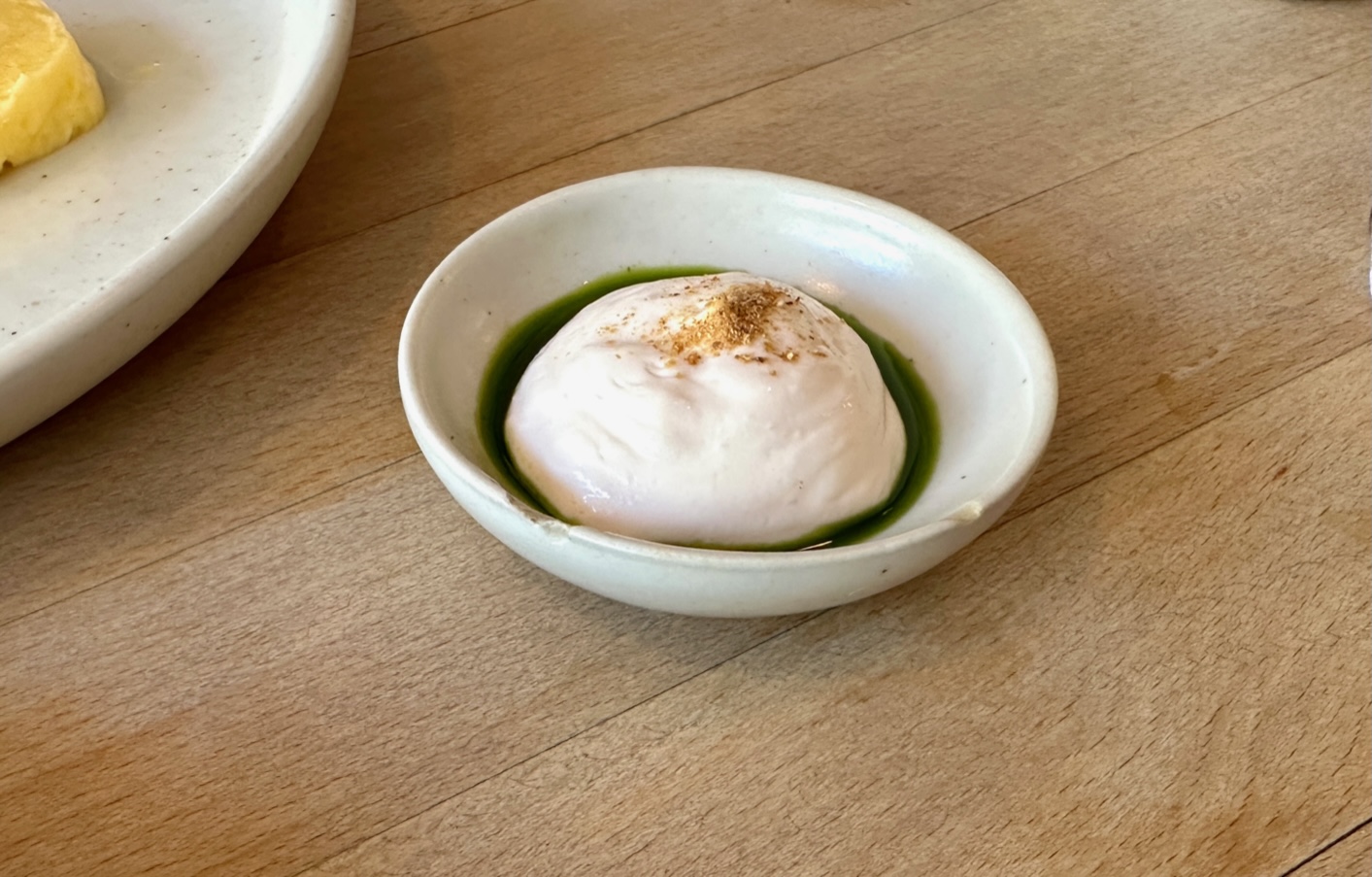
Bread was made by the restaurant and came to the table still warm with a puck of butter which the restaurant cultures itself. This was accompanied with a vivid little dish of cod roe, pastel pink with a little iris of bright herb oil. There was powdered something-or-other on top, and if I’d made notes I’d be able to tell you what it was. All of this was lovely, incidentally, although the bread was sliced a tad too thick which made it difficult to use all the butter and cod roe. Zoë ran her finger along the bowl, and I pretended to be shocked.

At the same time, we had one final snack which the wait staff playfully described as a taco – a chicory leaf with chicken liver parfait, preturnaturally smooth, topped with powdered beetroot and the pop of toasted pearl barley. So much effort gone into making something so small, gone in an instant but remembered for days: truly magical stuff.

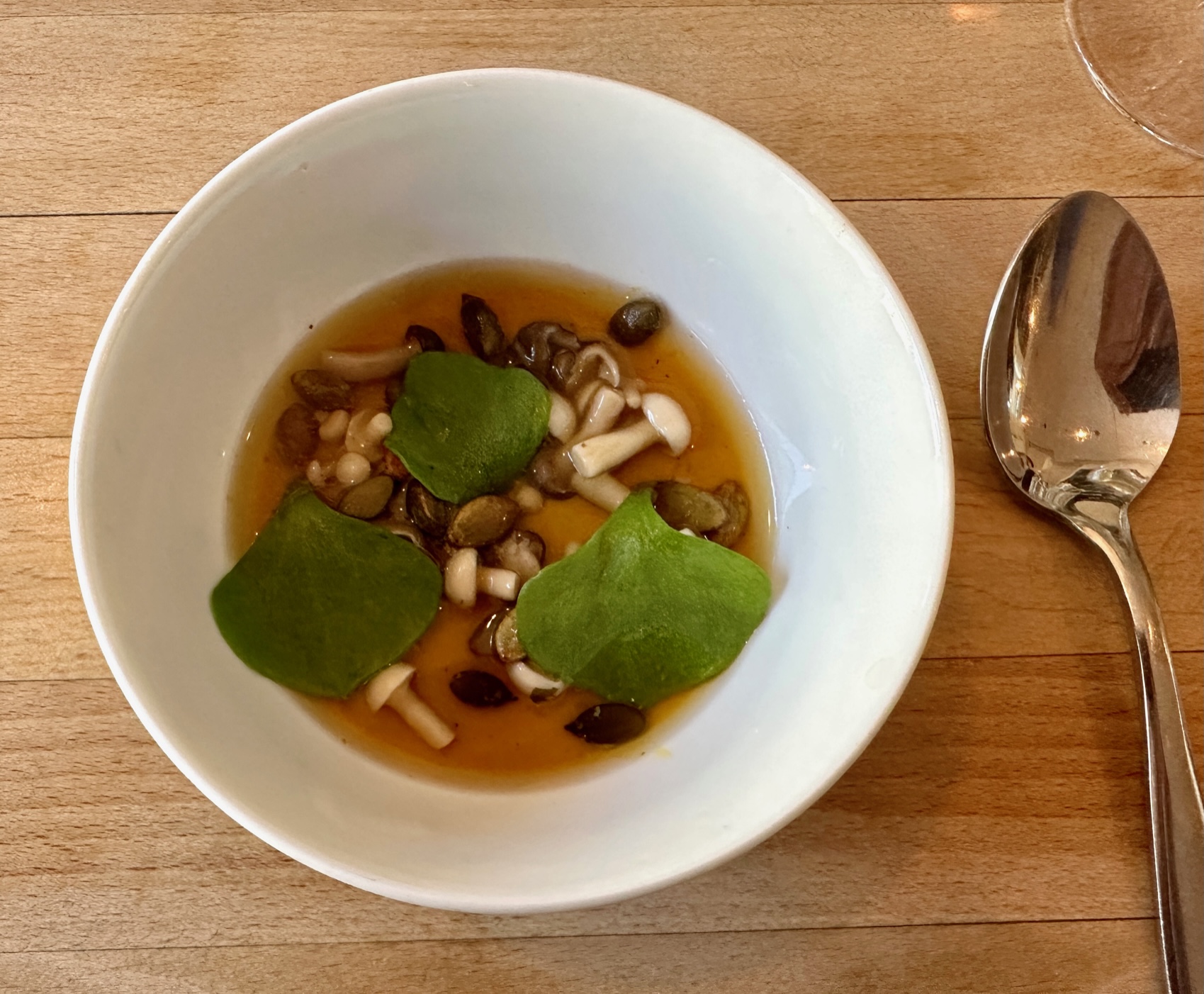
The next dish was one of the best things I ate that day, which makes it one of the best things I’ve eaten full stop. A savoury custard made with squash was sweet, glossy and perfectly spiced. Again, texture and pop was beautifully added with seeds, toasted in some of the same spice mix. But then the other elements added layer on layer of complexity and cleverness – tiny shimeji mushrooms, pickled in sherry vinegar, and a mushroom consommé poured over at the table, submerging the custard under something phenomenally savoury. Again, if I’d made better notes I could tell you what the leaves were: sorry about that.

By this point we were a couple of glasses into a fantastic bottle of natural Gruner Veltliner (the same one, actually, that I’d had at Goat On The Roof: it’s far more attractively priced at Wilsons) and I was already beginning to realise that this food was like very little I’ve eaten in other restaurants. I couldn’t recall anywhere I’ve eaten where the flavours were so pinpoint, where things had been so refined and perfected to make everything taste of its truest, best self. And as it turned out, I hadn’t seen anything yet.

Next to come was possibly the most disappointing course. Jigged squid – I have no idea what jigging is, and this time it’s not because I didn’t take notes – came in a rich and salty broth with rainbow chard. The squid, cut into ribbons to resemble udon, was among the freshest I’ve had and this dish made me love rainbow chard, something beyond the talents of most kitchens. The broth bringing it together had absolutely everything, and again it was that precise, super-concentrated hit that makes you sit up and pay attention, eat more slowly, take it all in. But this was the first time a portion felt stingy and doubt crept in: four ribbons of squid, and it’s not a good sign that I counted them.

Was it enough to dumbfound your tastebuds if you left a restaurant hungry? And yet my tastebuds were so dumbfounded – not least by a little tuile made from squid ink, as black as night and dotted with herb emulsion (I probably should have mentioned that much of the produce Wilsons use comes from their garden). It was a perfect mouthful, in a meal full of perfect mouthfuls and in a world where the word perfect is much devalued, not least by me. “It’s like the best crisp ever” said Zoë, who usually sums these things up better than I do.

More was to come, and the fish course proper was a proper marvel. A little cylinder of pollock, a notoriously recalcitrant fish, was cooked bang on and topped with another symphony of herbs, alongside a silky parsnip puree, the whole thing bound together with a superb vin jaune sauce which delivered more salt and less funk than I was expecting. I’ve talked about the half-life of dishes before and this had a long one – each forkful carefully calibrated to prolong the enjoyment. But again, the lack of carbs troubled me. What was the point of these beautiful sauces, dips and oils when there wasn’t always the substance to transport them into your gob?

I should have trusted in the process, because the next course made everything right. Crown of pheasant, cooked and then, I think, finished on the barbecue, glazed with some kind of emulsion and dotted with the smallest, punchiest capers I’ve ever eaten was a thing of rapture, as was the pheasant sauce and the wedge of just-cooked cabbage (there was also something called Tokyo turnip, but I thought that was a Steven Seagal film so what do I know?)

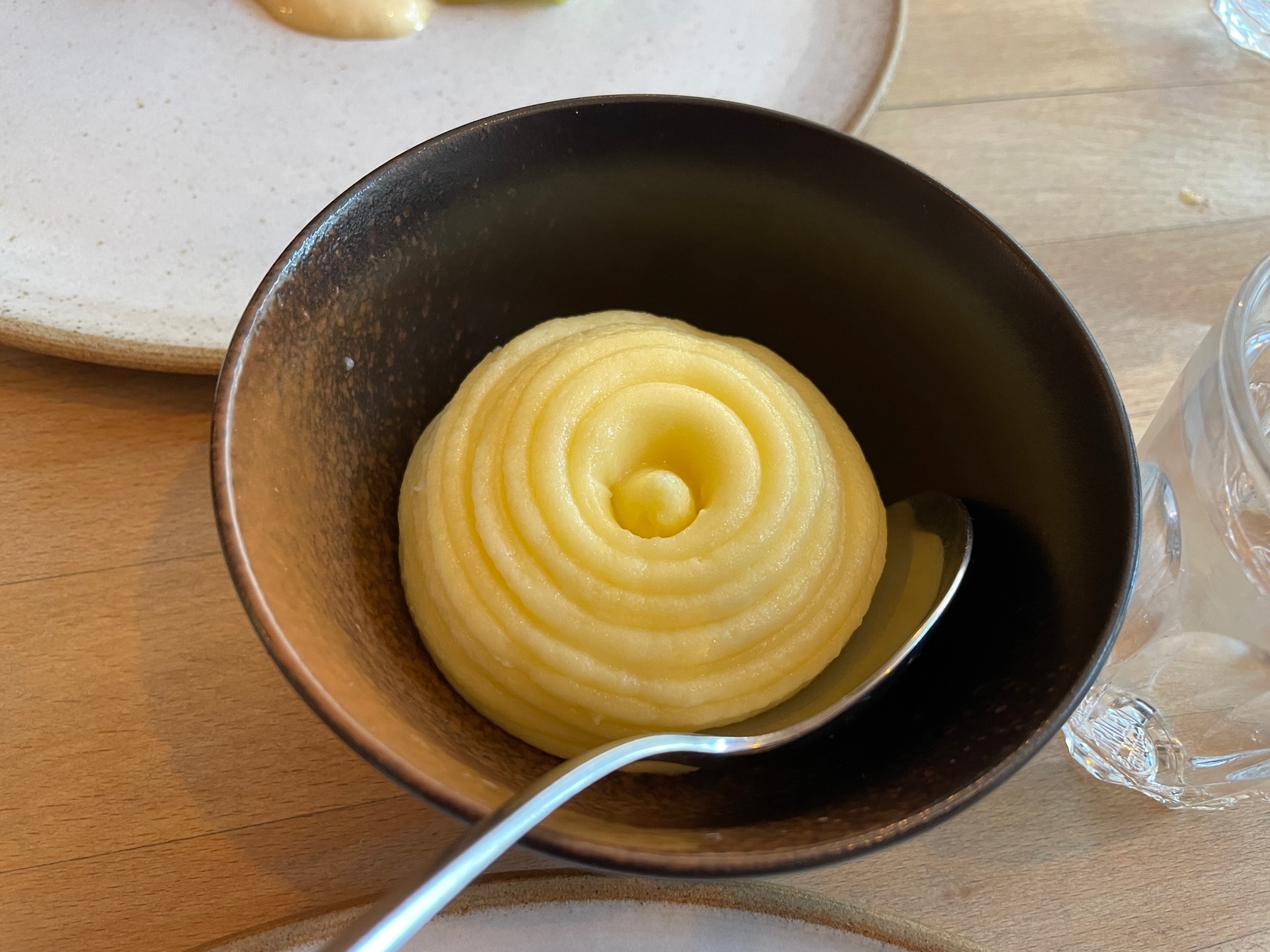
But where are the carbs? you might ask. But this is where Wilsons completely won me over by bringing a bowl of the best mash I’ve ever eaten. It was, the waiter told us, fifty per cent potato and fifty per cent butter. He also told us this is the only way to have mash, and I fear he might be right. It’s profoundly ruined me for other mash: I’ve already used the words ‘silky’ and ‘glossy’ in this review, so to save me reaching for the thesaurus let’s just settle for ‘exceptional’ here.

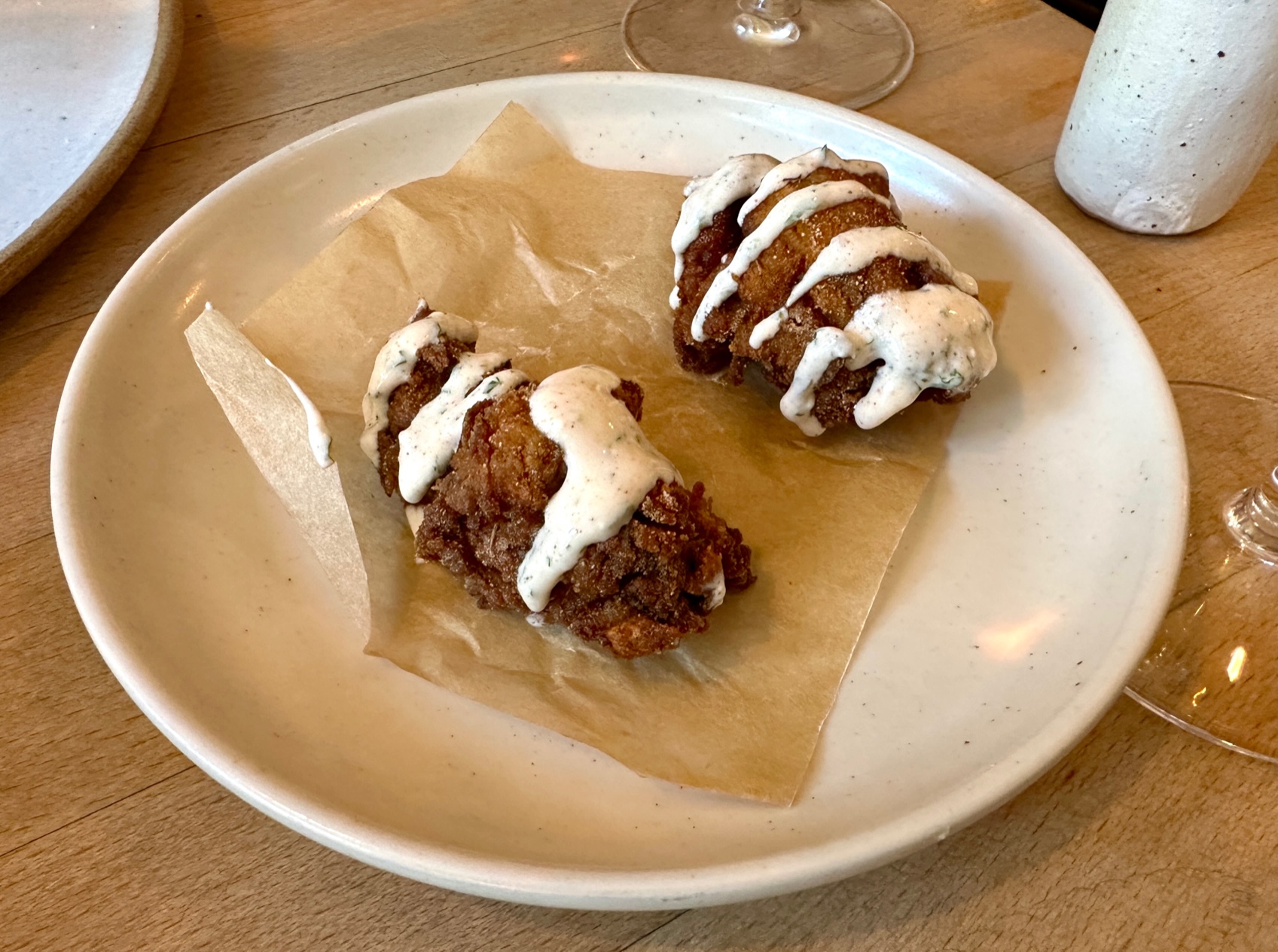
And there was still time for one more extra, one more whistle and bell to show that the kitchen left no stone unturned. We were also brought two pieces of what the waiter called “Kentucky Fried Pheasant”, little nubbins of pheasant thigh coated in the restaurant’s secret blend, deep fried and then drizzled with a ranch dressing including some of the same spices. You might wonder who goes to all that trouble, and I wouldn’t blame you. Wilsons do, that’s who. I may never get to try Eton Fried Swan (once we have a republic I really think this is a franchise that could take off) but until then this will tide me over nicely.

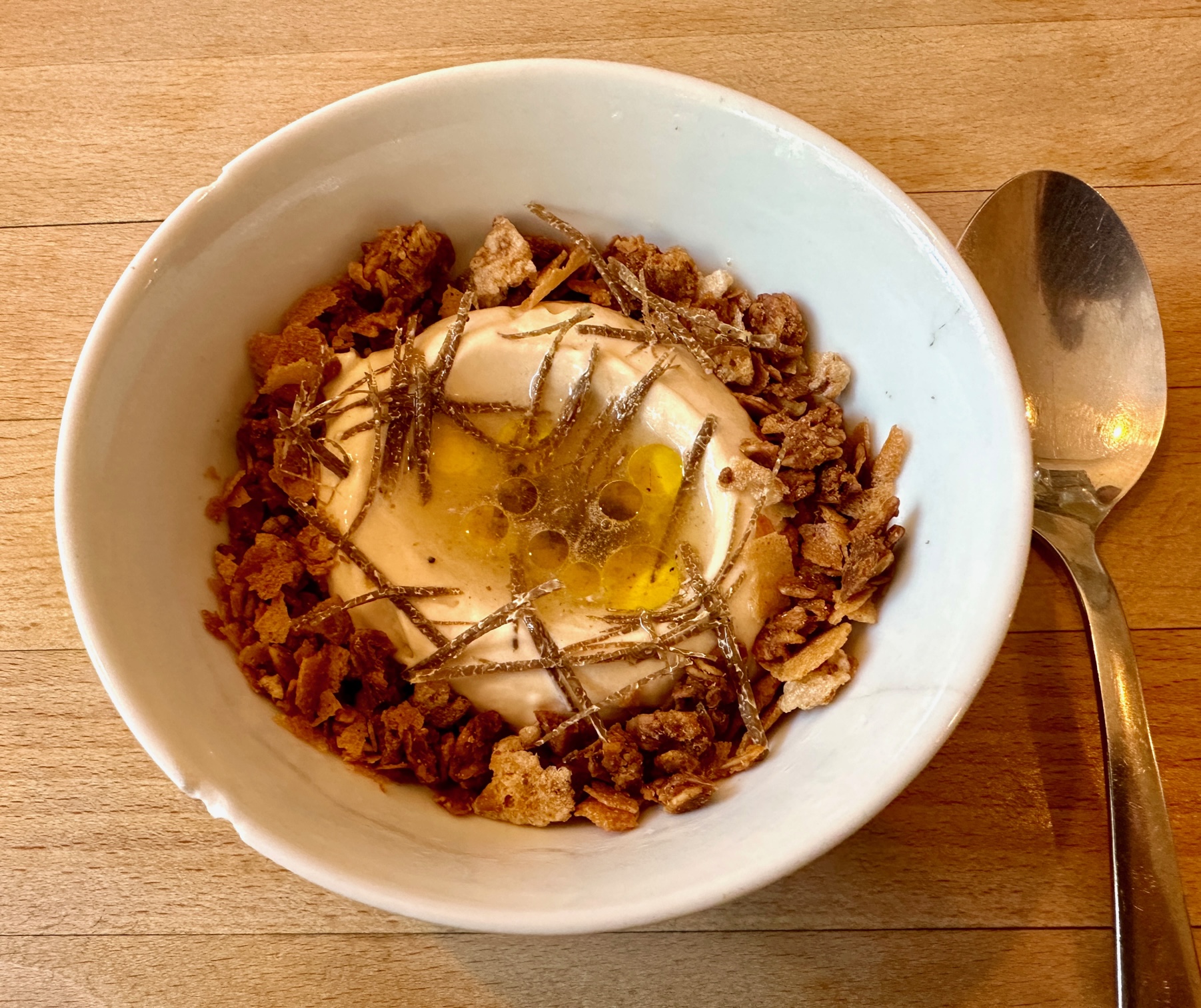
Having had some of the best, most interesting courses of my restaurant-going life, presumably things would dip for dessert, right? They so often do, after all. Well, think again: Wilsons’ dessert was also a desert (or even dessert) island dish. On paper it just sounded weird – celeriac, fermented honey and truffle. And it might not have been to everyone’s taste, but it absolutely knocked my socks off. The celeriac was an ice cream, more a semifreddo really, with a pool of fermented honey lurking in its hollow. All around it were toasted grains adding crunch and sweetness, and then on top were little truffle shavings.

I don’t know who thinks to put all those flavours together, and it’s a highwire act where any of them could have backfired. But none of them did, and this is the dish, more than any other, that I’ve thought about since that meal. I’ve had parsnip ice cream before but never celeriac, and it worked better than I thought it would. But what I loved was the harmony. Truffle isn’t a team player, nor is anything fermented. But the kitchen deftly drew all of that together into something delicious, remarkable and perhaps slightly mad. And yet not a note was out of place.

Now in Michelin-land, if they haven’t given you a minuscule pre-dessert they tend to send you on your way with some petits fours. They’re not big but they are clever, and they’re another way of making you feel like you’ve had something for free even though all of that luxe is very much priced in. So I adored Wilsons for instead bringing over a hulking great canélé de Bordeaux for each of us.

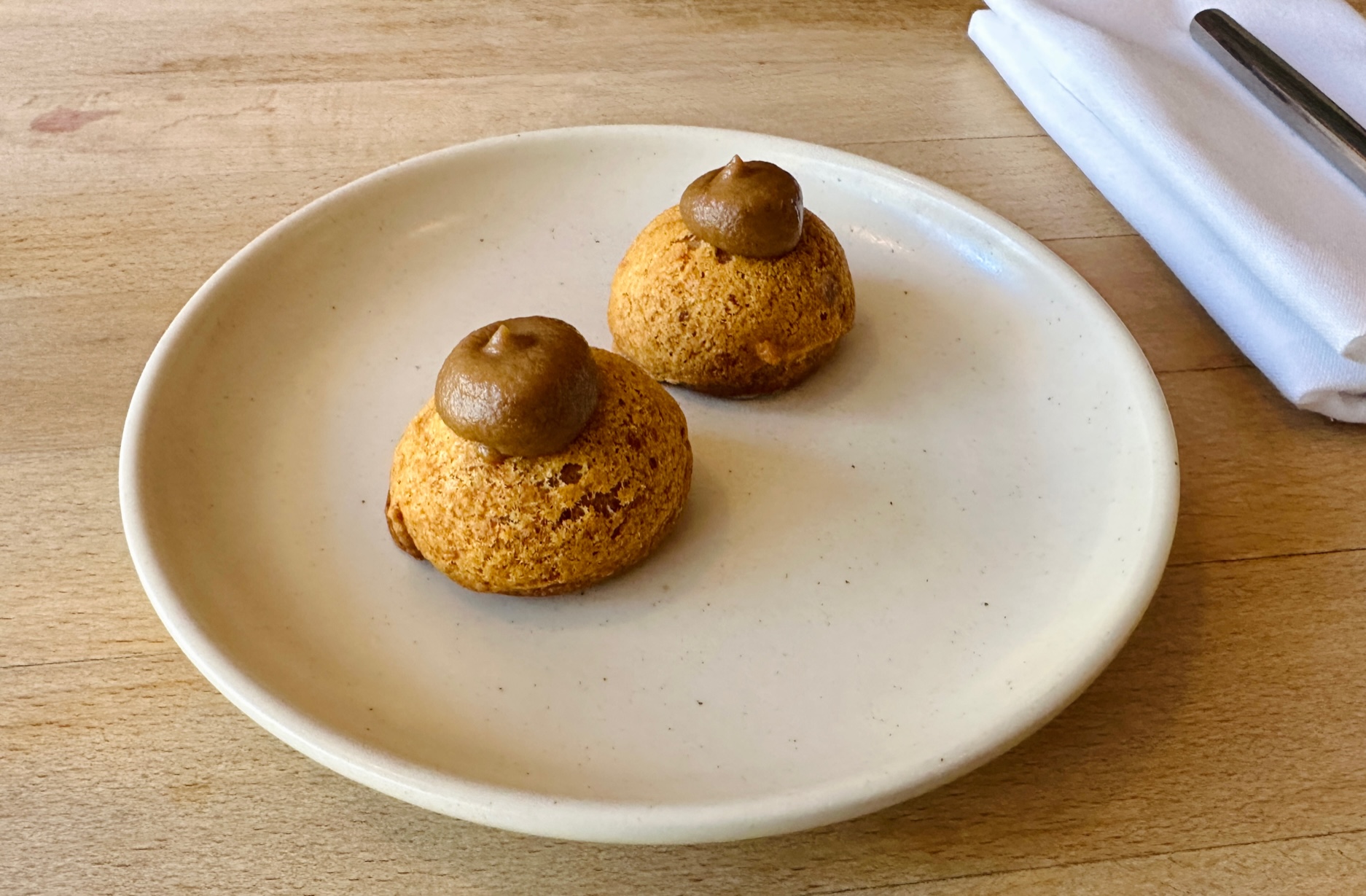
Now, I’ve had these many times because Reading is lucky enough to have Davy of Wolseley Street Bakery fame, and this is one of his specialities which he supplies to various places, most notably Geo Café. I like a canélé. But this was a completely different beast, and I wasn’t in Kansas – or Caversham – any more. This had been elevated with whisky and tonka, and the sweetness and richness was like little I’ve experienced. This level of sensory opulence is something I associate more with fragrance than with food, and I can’t put it more strongly than this: if somebody sold an eau de parfum that smelled how that canélé tasted, I’d buy a bottle. They were so good I can even forgive Wilsons for putting the napkin underneath them, although I still think that’s baffling.

My meal – two aperitifs, a bottle of wine and all those terrific experiences and memories – came to two hundred pounds including service, and I’d do it all over again in a heartbeat. If Wilsons did vouchers I’d just ask for some for Christmas, and as it is I’m struggling to imagine going to Bristol without eating there again. More to the point, I’m wondering how quickly I can justify going back. As it was, we left knowing it would take a while to process just how good our meal was, and fell into a beautiful nearby pub called the Good Measure which, as luck would have it, was doing a tap takeover by our very own Siren Craft. It was Friday afternoon, I was full and happy and I’d had a miraculous lunch. Life rarely gets much better.

I’m sorry-not-sorry for putting you through this catwalk show of beautiful dishes and purple prose. Sorry because it’s a lot to rattle through, and also arguably sorry if I’ve made you hungry (although, also, not sorry: this is what restaurant reviews should do). Sorry that I’ve rhapsodised about a restaurant that’s a train and bus trip from Reading. But also not sorry, because this is one of the best restaurants I’ve been to in years of trying, and that deserves to be mentioned. I’m sorry because Reading doesn’t have somewhere to match Wilsons and, in fact, I don’t think it ever has. But I’m also not sorry because when people ask me what Reading needs I might stop talking about tapas restaurants, ice cream cafés and good wine bars and just say: it needs somewhere like Wilsons.

Wilsons – 9.6
24 Chandos Road, Redland, Bristol, BS6 6PF
0117 9734157

https://www.wilsonsbristol.co.uk

Restaurant review: Seasonality, Maidenhead

I get a fair few requests to recommend somewhere to eat in Reading. And when I do, I can usually come up with something: if you tell me how central it needs to be, your budget, what kind of food you like and how many of your party are vegans, or vegetarians, or coeliacs, I can find you somewhere suitable. It’s very rare that I’m completely stumped. 

But there is an exception to that, which I suppose you could best describe as the Special Occasion Restaurant. It used to be called fine dining, before that phrase became a term of abuse. But special occasion restaurant probably sums it up better – somewhere you want to go to spoil yourself, or treat someone, or celebrate anniversaries, birthdays, engagements or exam results. Yet even describing it that way makes me realise what a niche and endangered species it might be.

The thing is, a lot of restaurants can make an occasion feel special. It’s what they’re meant to do – the good ones, anyway. And isn’t special occasion dining a concept that has outlived its usefulness, as eating out becomes a special occasion, full stop? After all, we’ve staggered through two and a bit years of Bad Times, and summer has come to an end just in time for Even Worse Times to hove into view. I mark a special occasion these days by bunging the central heating on.

That said, it’s too early to say whether the latest coming storm will hit all of hospitality, or whether parts of the sector will fare better than others. Casual dining might be protected, in terms of demand, although it will have less of a buffer against rising costs. Chains may have enough of a war chest to see them through, as they did in the pandemic. But what about the top end? Is this a luxury people will forego, or will people ring-fence those kinds of meals? I imagine many restaurants, both new and well-established, are asking themselves those questions with some anxiety, especially with their peak trading period a month away.

I have to say, though, that even before the pandemic Reading never really boasted that sort of restaurant. In the town centre, the closest we had were places like Forbury’s (which, back when it was good, was very good), Cerise and London Street Brasserie. Only the latter is still going, although it’s not always felt quite special enough, I think. Further out of town we had Mya Lacarte which, in its early years, was terrific but faded away and closed. And I suppose we have Thames Lido. The location is special, if nothing else.

So for that kind of meal, people have always gone further afield – to London, which isn’t far in the scheme of things, or to one of the pretty pubs between here and London that trouble the Michelin and the Good Food Guides. Or out Henley way, for dinner at somewhere like Orwell’s: not Henley itself, mind you, as its upmarket restaurant Crockers closed its doors for the last time last month. “People won’t pay for fine dining but restaurants like Côte Brasserie do really well here” said the owner. “I have never been so badly disrespected as I was in Henley”: someone’s not going to get tapped up by the tourist board any time soon.

So where do I recommend, these days? Well, my go to used to be the Miller Of Mansfield in Goring – very pretty, terrific food and accessible by train if you all want to drink – but then it closed at the start of January: the cause of death was a greedy landlord, as usual (N.B. it’s since reopened under very different management). Since then I’ve struggled a bit, telling people there are better options further afield; the last time someone asked me, I suggested Goat On The Roof.

So that’s the thinking behind this week’s review – could Maidenhead’s Seasonality be a suitable option? The compact family-owned restaurant, run by husband and wife team Wesley and Francesca Smalley, got a rave review in the Guardian back in July and that, combined with the short sample menu on their website, made it look like an intriguing prospect. I never need much persuasion to hop on the Elizabeth Line, stopping only for a pre-prandial pale at A Hoppy Place, so I booked a table for Friday night with some anticipation. Could I finally find somewhere of a standard similar to places like Marmo and Caper & Cure without having to trek over to Bristol?

Seasonality was a short walk from the train station and, at first glance at least, was pretty unassuming. The dining room’s best feature were the big windows that I imagine let plenty of light in, but by nightfall, without that glow, the place was neutral and a little spartan. The only exception to the muted furniture was a weird-looking marble bar area, a little like a kitchen island, where you could perch side by side on bar stools and stare at the wall together: they tried to seat us there but I politely asked if perhaps we could have a conventional table instead.

The evening improved from there, and Seasonality do one thing of which I approve heartily, seating couples at adjacent corners rather than opposite one another so you both get a good view of the space. The place was quiet when we arrived, but by the end of our meal every table was occupied (except that weird kitchen island – another couple was seated there but made a break for a real table the moment one became vacant).

“It’s a bit dark” said Zoë, who is always better at critiquing the decor than I am. “I don’t understand why none of the lights are on over the window seats.”

The menu was a mixed bag – attractive but small. Based on the name (not a huge fan of the name, incidentally) I imagine the menu changes at least four times a year but I hope they tinker with it more frequently than that because otherwise it has decidedly limited replay value. Three starters, three mains, three desserts. A few snacks to start you off and a couple of sides. Starters just under a tenner, most mains twenty-five quid, desserts the same price as the starters. That’s your lot. 

On the plus side, that means that in this review you’ll read about the majority of what was on offer, but the minus is that if you enjoy the delicious agony of narrowing it down, or if you’re a vegetarian or a vegan, or find that the menu happens to contain one of your flat-out no-nos this might not be for you. I gave Zoë the first pick of each course, because manners, and I was delighted that in at least one case she went for the option I fancied least, giving me at least the illusion of choice.

The wine list was small and perfectly formed too – something like four reds and four whites, maxing out at forty quid. Ironically this is an area where I often think less is more, so I was happy with that and our bottle of Morgon, which was about thirty two pounds, had plenty of fruit and just enough about it to bridge the gap between the mains we went for. But before all that we started with a couple of things from the “snacks” section of the menu. The bread was lovely: two quadrants of a little loaf, still warm from a little gentle toasting and spot on with a pat of cultured butter (from Ampersand, who used to supply butter to Geo Café).

Better still was the other snack – sheets of lardo dotted with figs, grapes, sunflower seeds and micro herbs. This was the moment when I realised the evening would be nothing if not interesting. The salty whack of that lardo tempered and toyed with by a whole palette of other flavours and influences – the bright sweetness of fruit, the freshness of little leaves of mint – was a true delight, and unlike anything else I’ve tried this year. Besides, look at it: it’s like an edible Kandinsky. 

More fascination was to follow, not least because Zoë’s starter, which I’d dismissed as very much not my bag, knocked it out of the park. “Tunworth Cheese Soup” hadn’t appealed to me – a soup, made of cheese? – but more fool me: what turned up was a soothing bowl of lactic lusciousness, comforting but not too heavy, scattered with the crunchiest croutons and finished with verdant spots of olive oil. I used to have a friend who said she never ordered soup in a restaurant because every mouthful was exactly the same. Ordinarily I would have agreed with her, but with this masterpiece that was rather the point.

By comparison my starter felt like a good idea not executed right. On paper a potato and Jerusalem artichoke fondant with mushroom ketchup sounded right up my alley, but the flavours and textures of this dish were out of whack. Maybe it was the balance of the potato and the artichoke, but the whole thing had an oddly spongey feel to it without any crunch or crispness. The outside had no upside.

That made it feel a bit like a vegetarian fishcake, and there was nowhere near enough umami punch from the underpowered mushroom ketchup to lift it. Only the fennel, which I thought might be pickled, broke up the beige and reminded me of Bristol’s lovely Caper & Cure where I last had it. The starter we didn’t try was bergamot cured trout with oyster custard: only three options on the menu and I’d picked the wrong one.

Mains reassured me that my starter was a blip. Mine was a beautifully cooked piece of hake topped with tightly curled, muscular brown shrimp and served on top of a ribbolita of coco beans, croutons and cavolo nero – more broth than sauce but still absolutely bewitching stuff. I thought I detected more of that fennel chucked into the mix, which I found a little strange – the dish didn’t need it and with a menu so small it seemed odd to have duplication.

Similarly the “Cookham greens” we ordered as a side – a tranche of cabbage a bit like a hot wedge salad – was drizzled with a dressing or sauce that looked very similar to the one that had adorned my starter. But even with those minor quibbles, the hake was a great dish. Could I think of anywhere in Reading that served food like this? Not really.

Zoë’s main showed more of that imagination and skill and again, had one truly impressive component. Venison was really nicely done, although pairing it with radicchio made it feel, and look, surprisingly insubstantial. But what saved the day was the other element of the dish, a bowl of salty, savoury, spiced venison keema topped with – another genius touch – something called “crispy potato” which, to me, had the feel of puffed rice (unless of course it was meant to be puffed rice, in which case the potato had gone AWOL).

The forkfuls of this I was allowed might have been my absolute high point of the meal, yet even so those two separate parts, the fillet and the keema, didn’t cohere into a single dish so in that sense, enthralling though it was in places, it didn’t entirely work. Seasonality does a set lunch Wednesday to Friday for a ridiculously reasonable £18 and when I last checked it included a roe deer keema pie and hispi cabbage: now that I could eat every week for the rest of my life.

The wine list included a few dessert wines so once we’d finished our mains and our bottle of red we grabbed a Sauternes and a Pedro Ximenez (both impeccable) and ordered dessert. Again, Zoë had first choice and again she chose better – a slab of cake studded with hazelnuts, surrounded by a moat of deep chocolate sauce and crowned with a sphere of smooth, indulgent nut butter ice cream was just a superb plate of food. I wouldn’t necessarily thank you for a sticky toffee pudding but I might well beg you for one of these.

Despite seeing them mangled on Bake Off the other week (they’re a favourite of Brexiteer ghoul Prue Leith) I didn’t really fancy îles flottantes so I opted for the other option – the vicissitudes of a tiny menu again – the crème brûlée. Now, I must say that this is something I almost never order because I can nearly always find something I’d rather eat. 

It’s a blessing that I did, though, because it was the nicest I’ve had in ages. It had perfect texture, a wonderful note of tonka and a little freshness from the fig leaf – so much more to it than plain old vanilla – and a caramelised lid with a perfect snap and a wonderful burnt sweetness. I’d forgotten how enjoyable that first tap of the spoon can be, and everything that comes after. I also liked the palmier unceremoniously dumped on top of it but, again, it didn’t really go and felt like two desserts uneasily merged into one.

I haven’t talked much about service, but it was good and friendly if perhaps slightly lacking in polish. Little things like not taking cutlery away, or not bringing it out, along with just a general feeling that they were very agreeable but slightly on the green side. At one point the chef came out and talked to a few tables, which was wonderful to see, and I got the impression that a fair few of Seasonality’s customers are regulars. I can see why, too. 

Our bill – for four courses, a bottle of wine and a couple of dessert wines – came to a hundred and seventy pounds, which included a twelve and a half per cent service change. Grace Dent’s review in the Guardian said that a meal including drinks and service at Seasonality costs around forty pounds a head: either prices have rocketed in just over three months, or Grace Dent is on mushrooms. I know which my money’s on.

So does Seasonality do enough to become a serious prospect for Reading residents wanting to treat themselves? Yes and no. There are a fair few things in the latter column. The service needs more polish, the room is a little unspecial. The narrowness of the menu is going to be a big problem for some people, and I saw lots of little quirks that need ironing out – dishes that didn’t completely work, or didn’t come together, a certain amount of duplication which felt jarring across such a small menu.

Yet despite that Seasonality has a real charm and real skill that thoroughly won me over and made me want to come back sooner rather than later. There is imagination and talent on display in spades across that menu – in that phenomenal lardo dish, in the depths of that Tunworth soup, in my majestic hake or Zoë’s wonderful hazelnut cake. Those real highs, those fireworks, make me think that it would definitely do you a turn if you wanted to go somewhere different to celebrate – especially if you were getting there by train.

So although it’s not yet the finished article, I think Seasonality has more than enough showstoppers and jawdroppers to merit a visit. I keep thinking about the very best of what we had and trying to imagine anywhere in Reading that can quite match it, and the answer is that I can’t. The high points reminded me far more of places in Bristol than in Reading, and anybody that reads the blog will know how much of a compliment that is. So I will be recommending this a lot in future, because it proves something I’ve long suspected. You don’t need a special occasion to eat at some restaurants. Some restaurants are the special occasion in their own right, all by themselves.

Seasonality – 8.7
26 Queen Street, Maidenhead, SL6 1HZ
07507 714087

https://www.seasonality.co.uk