Restaurant review: A.B.O.E., Bristol

A.B.O.E. closed in August 2024. I’ve left the review up for posterity.

Last Friday I found myself in Bristol enjoying a badly-needed long weekend away. Our train pulled into Temple Meads, half an hour late, and Zoë and I wheeled our suitcases into the centre, three days of eating, drinking and excellent company ahead of us. But before we checked into our hotel, before we did almost anything, I had lunch on my mind and only one candidate to provide it. We made a pilgrimage to the Apple Cider Barge and there, next door, in its distinctive black and red was Gurtrina, the van belonging to fried chicken supremos and Reading legends Gurt Wings. How could I kick off my minibreak anywhere else?

By my reckoning it’s over six months since Gurt Wings stopped coming to Blue Collar – something to do with the council being difficult, if I remember rightly – and the reunion with their magnificent food was all the sweeter for all that deprivation and delayed gratification. In my time away the buffalo sauce had become just a little more piquant, the blue cheese saltier and tangier. The sun came out, the bench we were perched on positively glowed and we polished off our food in wordless joy. Truly, it would have been worth a trip to Bristol just for that.

Afterwards James Mitchell – the man behind Gurt, also known to his many fans as Uncle Gurty – came over and the three of us caught up and shot the breeze. I told him where we were planning to eat in the city, he mentioned a few places he’d heard were good and then he did something I wasn’t expecting. He went out of his way to tell me somewhere especially good I should check out.

“You need to get yourself to Oboe” he said.

“What, like the musical instrument?”

“No, A.B.O.E. It stands for ‘A Bit Of Everything’. The chef is a guy called Seb Merry who was on Masterchef, and he’s so passionate about his food. The whole team are brilliant. They do the best Bloody Mary I’ve had – it’s not on the menu, but if you ask they’ll make it for you. And they have this fried chicken dish – well, it’s not like our fried chicken but it’s amazing, it’s more like a croquette but you’d have to try it. And they do this incredible dessert, have a look at this.”

He fired up his phone and showed me a picture of a dessert which was all chocolate and caramel, thick slabs of each. I’ve rarely seen a photograph I wanted to eat more.

After our chat we went on our way and stopped in the Small Bar for the first beer of the holiday but that glowing endorsement weighed on my mind. If the man who does the best fried chicken you’ve ever tasted tells you that a restaurant does amazing fried chicken, and more besides… could I really let a trip to Bristol pass without investigating? But anyway, there’s no way they would have a table free the following night, I thought. But then I checked, and they had. So I texted my friends James and Liz, sent them the website. 

I know the four of us are booked somewhere else tomorrow night, but Mr Gurt Wings says this place is incredible. What do you reckon, stick or twist?

James, a keen fan of Bristol’s restaurant scene, responded almost immediately. Let’s take a risk and twist, he said, and that was that. Bookings were made and cancelled, and the next night Zoë and I clambered off the bus halfway up the Whiteladies Road, ready to take our chances.

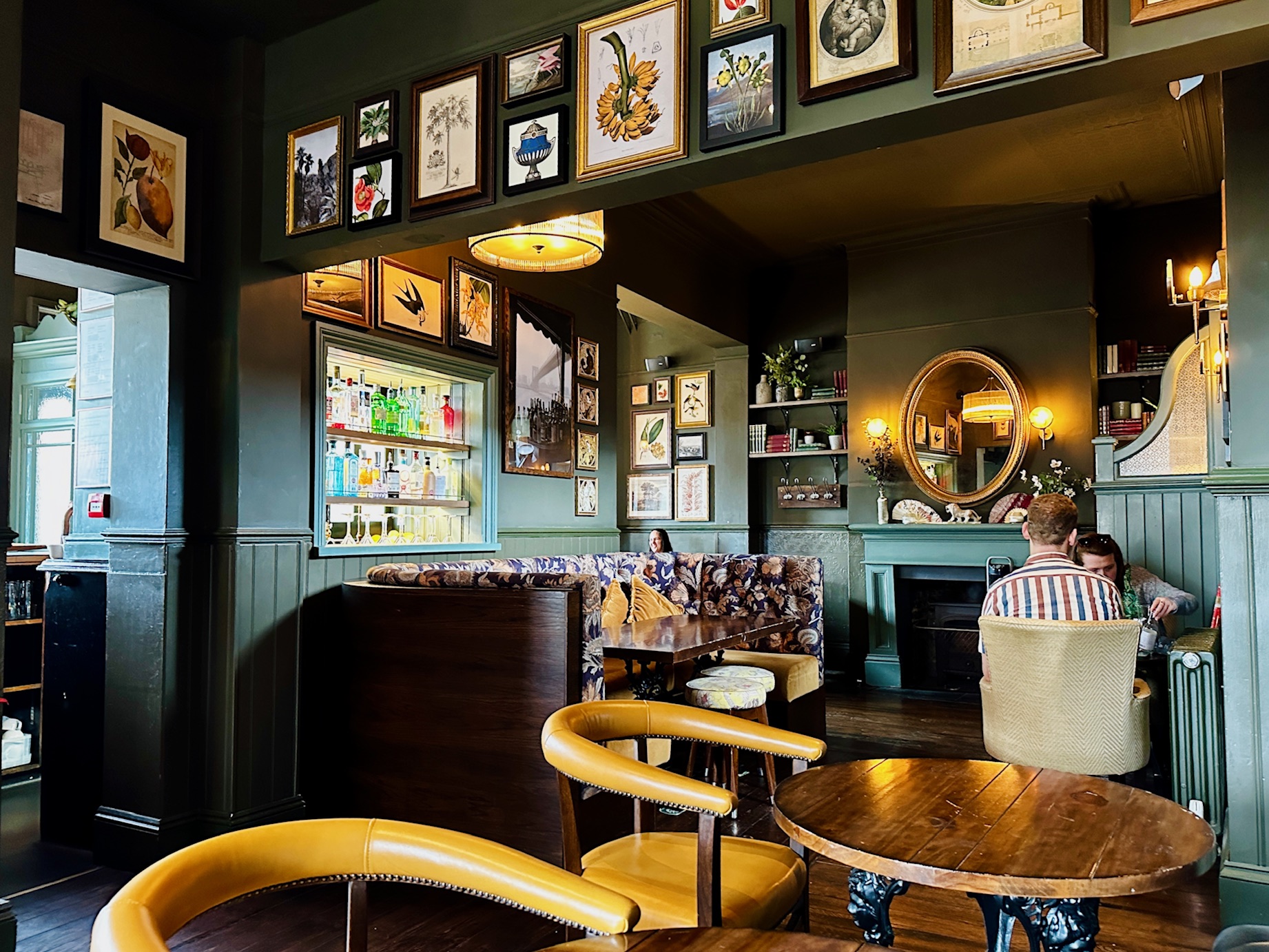
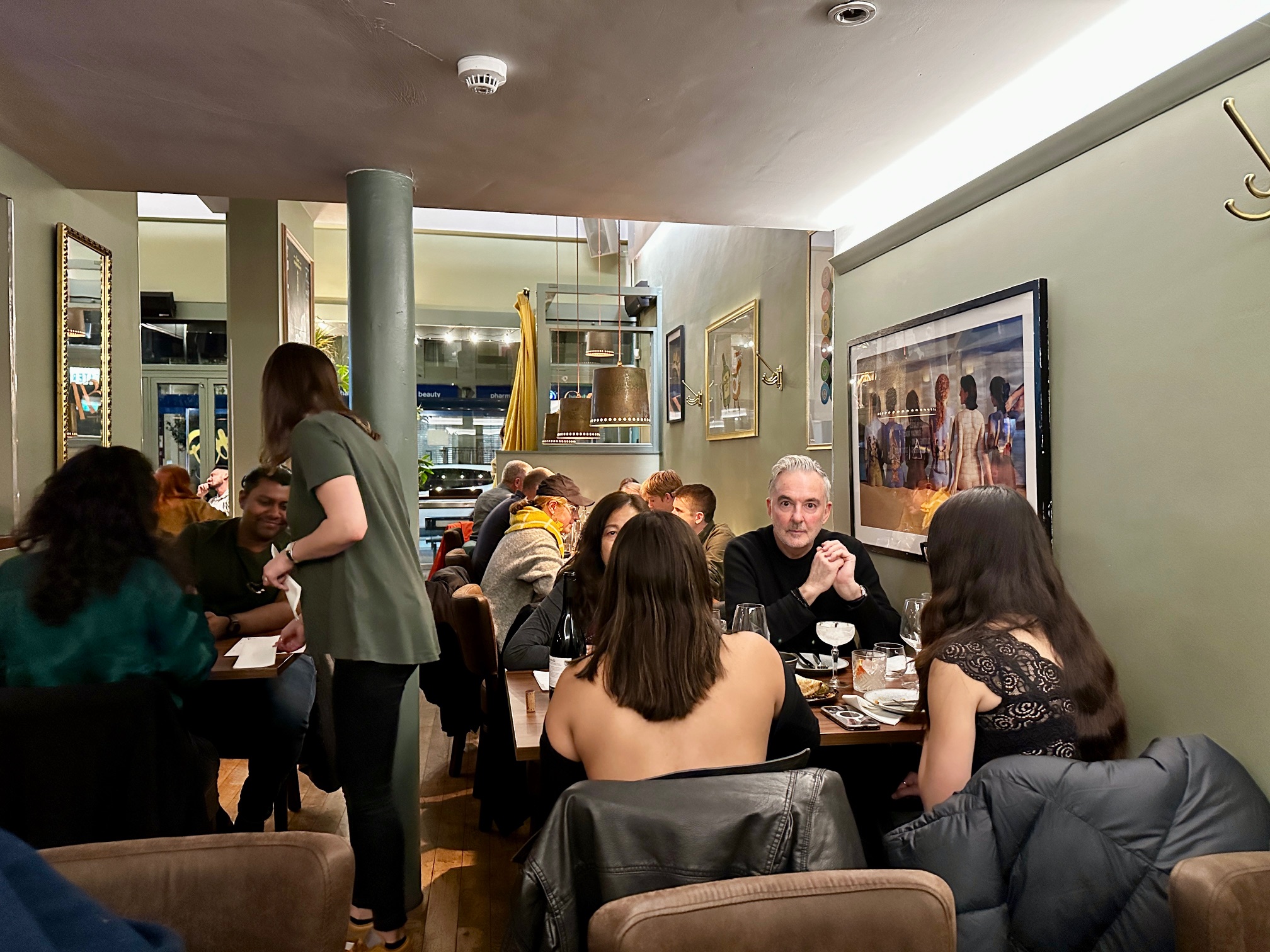
The interior was tasteful, all muted green paint, wall art and pillars. There was a mezzanine floor, although there didn’t seem to be anyone seated there on a Saturday night, and the whole place had a pleasing buzz. It sort of looked as if it could have been part of the Loungers Group in a previous life (I checked: it wasn’t) but none the less it was a pleasant dining room with tables companionably close without being crammed in.

It was also almost completely full and our server whisked us to a table right at the back, far too big for our party of four. He explained that a table for four near the front had slightly outstayed their welcome, and although they’d paid the bill they hadn’t yet left the premises. He told us, quite charmingly I thought, that he didn’t feel like acting the heavy with them given how much they had spent.

Then he asked if Zoë and I wanted a cocktail on the house while we waited. So Zoë had a negroni, made with rosemary vermouth, which she raved about and I asked for that off-menu Bloody Mary. I knew it would be good when the server didn’t ask me how spicy I wanted it: they just did their job and made it, and it was magnificent.

All in all, we were waiting ten minutes with our cocktails, hardly anything to complain about. By then James and Liz had arrived, more drinks had been ordered and we had taken our table nearer to the front of the restaurant, with a good view of other tables, dishes wafting past and the staff – just the two of them, that I could see – working non-stop.

The menu is the kind that makes jaded restaurant bloggers roll their eyes – no starters, no main courses, just snacks and small plates. The menu suggests two snacks and four small plates between two, which I suppose gives you an idea of whether they’re starters or mains. Now, I can be as critical of small plates venues as the next person and I’ve always found it counterintuitive that restaurants tell you to share small plates. I also thought that A.B.O.E.’s pricing was a little out of keeping with the small plates concept – snacks mostly cost just over five pounds, but the small plates ranged from fourteen to twenty-two pounds and that for me, at the risk of doing an accidental Partridge, is the kind of price I expect to pay for a big plate.

But anyway – perhaps it was the charm of the welcome, or the edge-softening effect of that Bloody Mary, but I found I was prepared to suspend my disbelief. So we bartered about the snacks we wanted to ourselves and the small plates we were reluctantly prepared to share, I popped it all down on a note on my phone and when our server came back we ordered with military precision.

“I just need to tell you,” he said, “that the steak tartare is a small portion, so it isn’t really suitable for sharing”.

“That’s okay, that’s for me” said James, in a manner that suggested he had never really considered sharing it with anyone.

That does James a huge disservice because when it arrived, although it was indeed too petite to share, he insisted that I try a forkful of the tartare. It was made with dry-aged bavette, and I have to say it was pretty impressive with plenty of savoury depth. Not the very best tartare I’ve ever had – that honour still goes to Paris’ superlative Double Dragon – but pretty close. Certainly it compared well with a similar dish across town at Marmo, although I wasn’t a hundred per cent sure about the stuff, allegedly taleggio, on top.

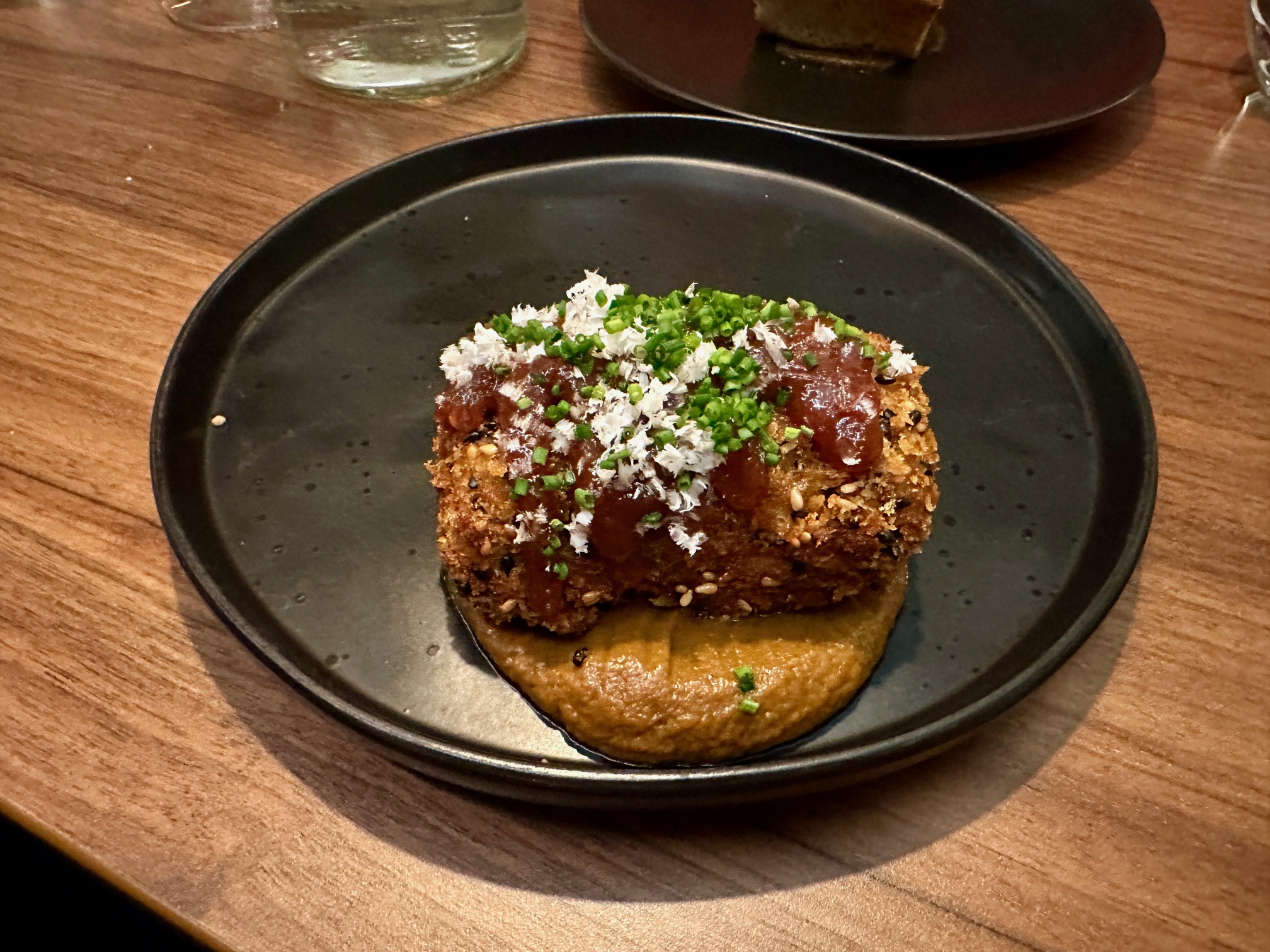
Zoë and Liz both went for the pumpkin croquette: A Bit Of Everything definitely applies geographically if in no other way, with this dish having hints of Japanese korroke. But unlike the croquettes at, say, Caper And Cure where you get four little spheres, A.B.O.E. goes for broke with a single enormo-croquette loaded with cheese and horseradish. Again, I was allowed a forkful and again it induced a reasonable amount of envy. Zoë in particular raved about this dish. I probably would have liked more, smaller croquettes to capitalise on the surface area but I couldn’t deny that the flavour of the thing was outstanding.

To continue the globetrotting, my snack was A.B.O.E.’s take on poutine. Rather than fries, it was cuboids of confit potato, à la Quality Chop House, buried in Parmesan with a jug of thick, intense, almost-sweet jus to trickle over the whole affair. Enormously enjoyable stuff: I imagine dreary types might complain that this wasn’t poutine, but it was a darned sight nicer than most poutine I’ve had. Besides, I knew exactly what it would be like because I’d checked out the restaurant’s Instagram in advance (it’s called research, you know).

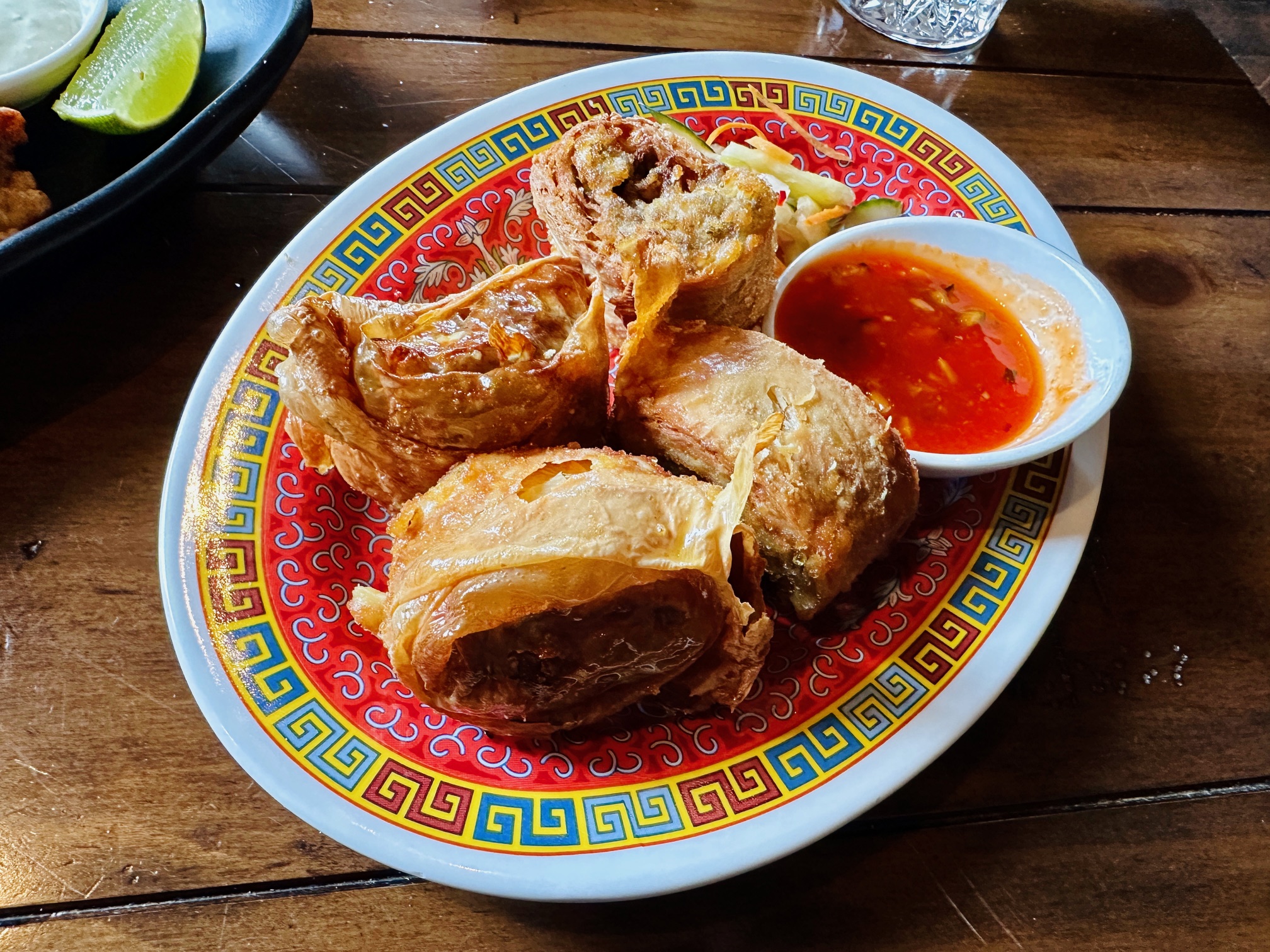
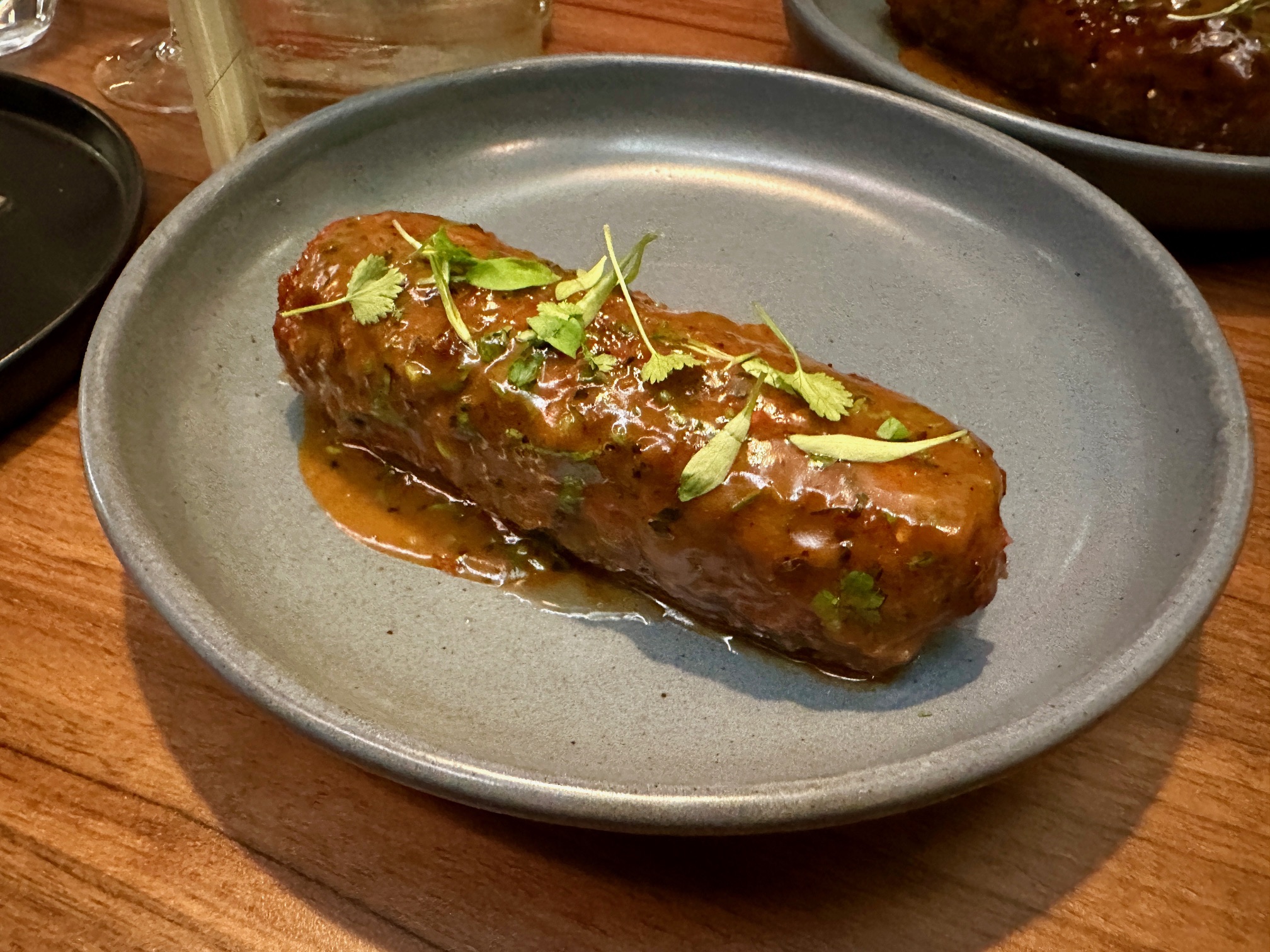
The first of the small plates to come out was that fried chicken dish so beloved by the man behind Gurt Wings – high praise indeed, from an expert in the field. Well, he was right to say that A.B.O.E.’s rendition was nothing like his. It was surprisingly hard to describe, but it’s important to try because otherwise all you have to go on is the photo below, which looks on the scatological side. It was somewhere between a boudin and a ballotine, a cylinder of tightly compressed chicken thigh bound in a crispy coating, the whole thing smothered in a sticky curried sauce.

Did it work? Well, yes, we all thought it did. As with the pumpkin croquette, I personally would rather have had more, smaller pieces to maximise the surface area. The coating didn’t have as much crunch as I’d have liked, and came away under a knife rather than adhering to the chicken beneath. But you couldn’t argue with the flavours, or the note of citrus that danced through it. Uncle Gurty had not steered me wrong – and no, it didn’t look like fried chicken, much in the way that the poutine didn’t look like poutine. That was sort of the whole point.

I’d had my eye on the barbecued squid with galangal, but it became a must-order when our server, the charming Italian chap who had sorted out our welcome cocktails, told me they’d run out of the clams it was meant to come with. Their solution, he told me, was just to give you more squid. That was good enough for me, and the dish was tender and fragrant with a nicely building heat. Another of those dishes you slightly resented sharing, which in hindsight is a decent description of literally everything we ate.

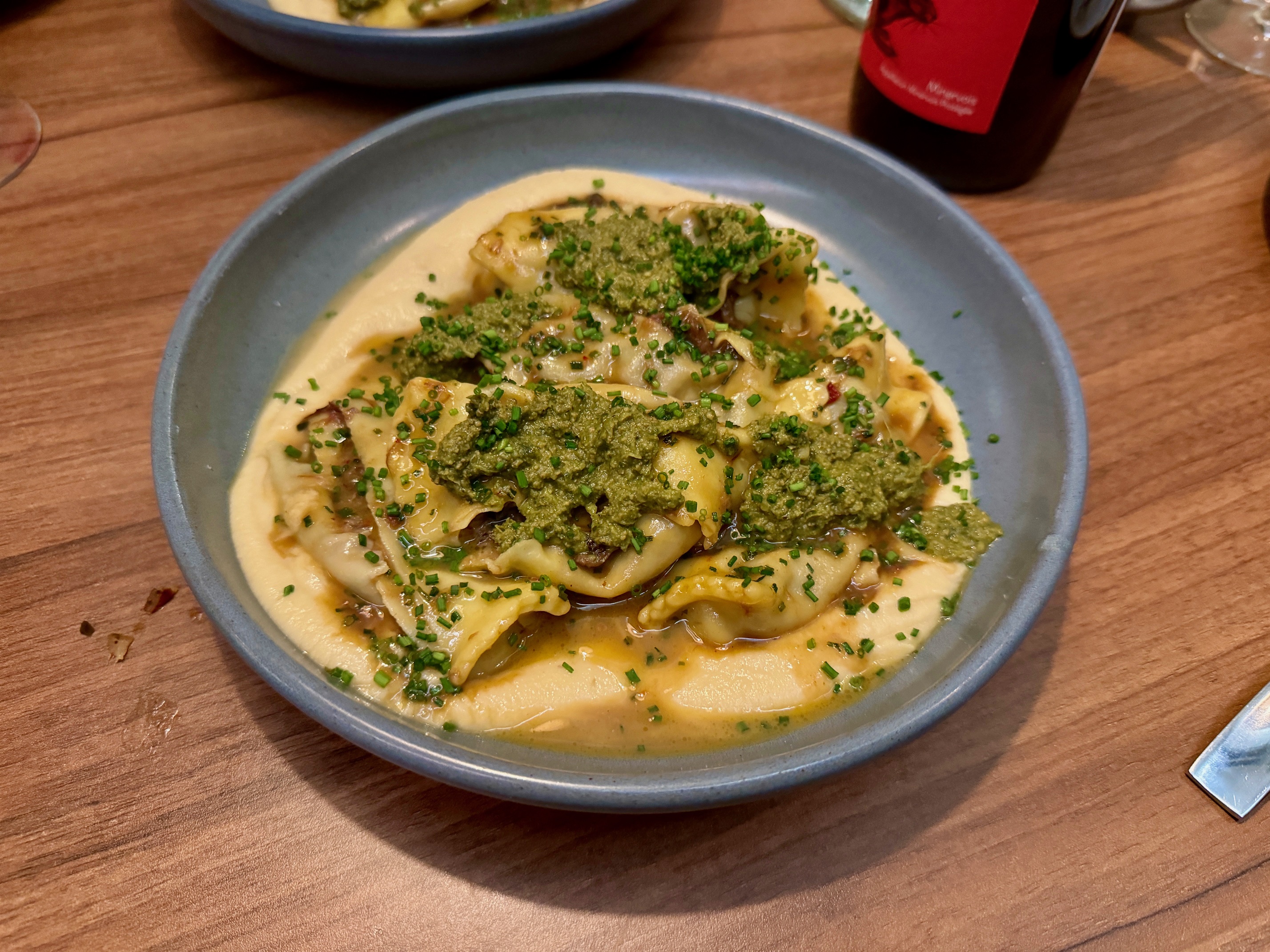
The most expensive dish on the menu – so naturally we ordered two of these – was the short rib beef agnolotti. Nearly twenty-two pounds a portion, and for me a fascinating misfire. My companions all loved it so I was the lone dissenter, but for me the agnolotti themselves were overcooked, which made the whole dish a bit limp and mulchy.

Everything on the plate was good: the celeriac, apparently with aged beef fat, the glorious beef in the filling and a powerful mole verde, although we didn’t get the advertised goats cheese. As with everything else we tried, the flavour was unimpeachable but for me, the texture let this one down. But I may well have been wrong: certainly everybody else thought so.

Red mullet is James’ favourite fish on earth so he had to order a portion of that, and I got enough of a taste to appreciate that it was, like everything else, very skilfully done. I’m a sucker for braised lettuce, a relatively conventional pairing, but putting mustard – a delicious mustard, at that – in the mix was the sort of clever and unexpected touch Merry seems to specialise in.

The last of our small plates was an outrageously delicious one: barbecued cod with leeks wrapped in nori and two sauces – one of which, studded with ultra-salty nuggets of chicken skin, was one of the most compelling things I’ve eaten in some time. Again, this was at the north end of the price list and I can see you could argue it wasn’t an enormous amount of food for twenty pounds. But it was exceptional, one of the best-cooked pieces of fish I can remember served alongside a sauce with a proper, clobbering heft. James and Liz left a bit of theirs, and I waited as long as I could bear it before saying “would you mind if I finish that?”

Although service was brilliant, there were only two people working front of house (and, just as gobsmacking, I understand there were only two people in the kitchen). If there had been more, or they’d been less busy, we might have got to a second bottle of wine but instead we took our time with the one we had, a beautiful Minervois which sort of went with some of the dishes. It’s a small wine list, six white and six red, about half of them available by the glass.

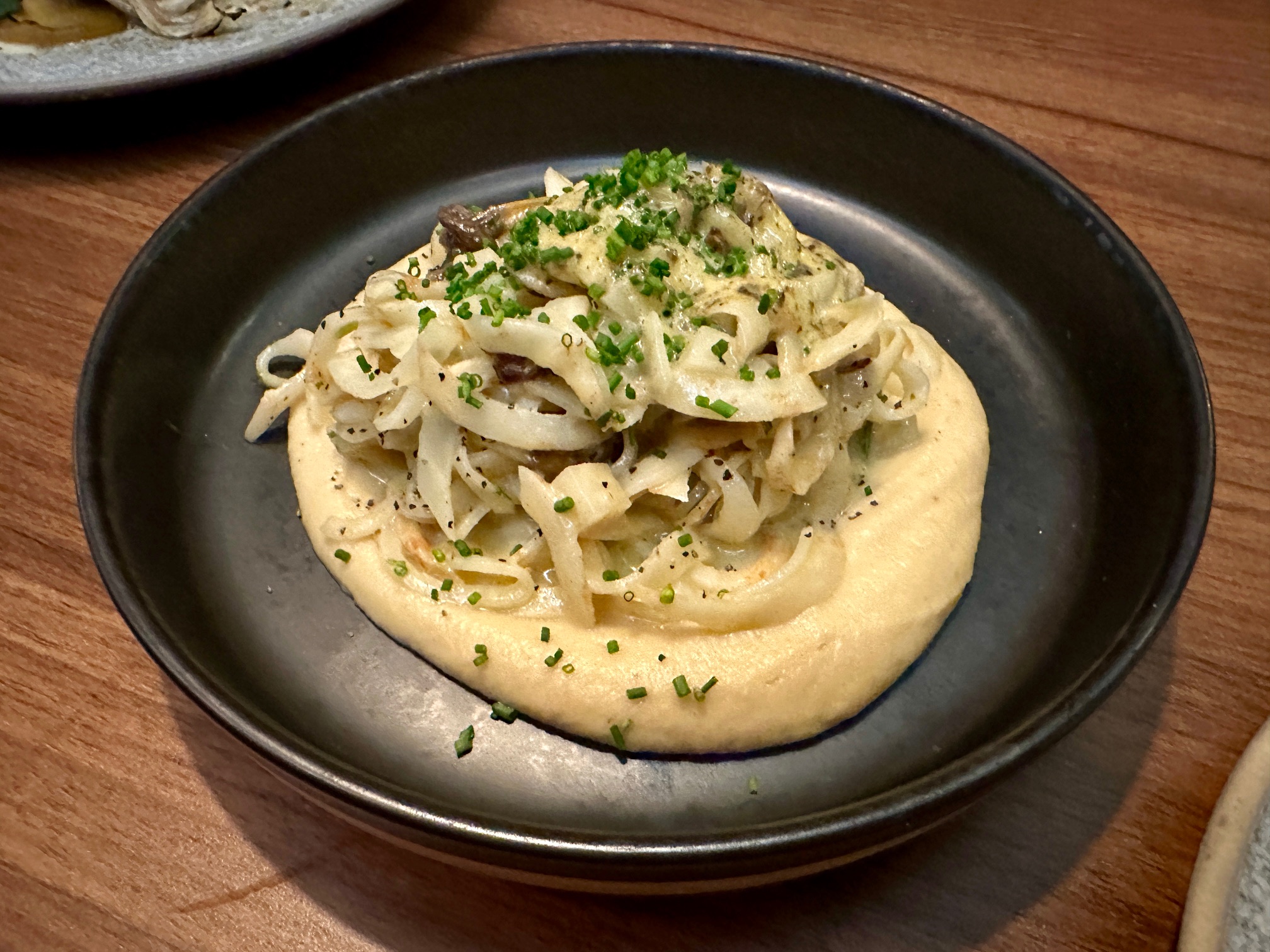
Our server asked what we made of the food and checked what we’d ordered. He said it was a shame we hadn’t gone for the celeriac cacio e pepe and we said that it hadn’t quite made the cut. So he decided to send a plate of it out to us anyway, which was very kind and completely unexpected. It really was a beautiful dish – ribbons of just-cooked celeriac taking the place of pasta, more sweet and comforting cubes of celeriac and little mushrooms dotted throughout. Clever and imaginative, like everything else, and in its way every bit as enjoyable as the cacio e pepe I’d raved about earlier in the year at Manteca.

“Isn’t it great?” said our server as he took the empty plate away. “I shouldn’t like it, because I’m Italian and making this without pasta is, well…” He shrugged at that point to indicate that he knew full well the dish was culinary heresy. “And I’m not just Italian, I’m from Rome. But the chef is right, and it’s just so good.”

The menu also recommends that you share one dessert between two people. I don’t know if it was our greed, or the small plates not being quite big enough, but we disregarded that and ordered one apiece. Mine and Zoë’s was the dish I’d seen in the photo on Uncle Gurty’s phone the previous day. Dubbed the Rolo Finesse, it was about the most high-end Rolo you can imagine – a thick wobbly layer of something partway between caramel and toffee, gloriously indulgent with just the slightest hint of miso. Beneath that, a thick stripe of a chocolate cremeux that was almost more like ganache, and beneath that a crunchy base.

That would have been enough, but malted milk ice cream on the side and more little nubbins of that crunchy chocolate holding it in place elevated this to god tier. If I’ve had a better dessert this year I can’t remember it, and if I have a better one next year I’ll be very surprised indeed. I can’t tell you how delighted I was that this one of the only plates I didn’t have to share.

James and Liz both opted for the tiramisu and again, were generous enough to let me try it. It was – no surprises by now – excellent: light yet moreish, a far more elegant way to finish a meal than the whopping slab I’d just eaten. I’ve tried a few Bristol tiramisu over the last couple of years – Sonny Stores and Little Hollows spring to mind – and for my money this was better than either.

As we sat there in the afterglow of a brilliant meal, ready to pay and slope off to the Good Measure for a post-prandial beer, we discussed A.B.O.E. in the wider context of a city full of phenomenal restaurants. We knew it was good, but just how good was it? James thought it was better than Wilsons, but he’s been burned by going there after my rave review, eating a meal which was almost completely devoid of carbs and leaving hungry: it’s made him an avid detractor. Zoë liked it even more than COR, which is pretty much the most exalted praise you can award in Bristol.

I loved it, but I wasn’t sure how to place it. The flavours had been exceptional, the service some of the best I’ve had this year. But those small plates were priced on the keen side. It required further reflection, I decided. Our bill, not including the two comped cocktails and that extra celeriac dish, came to just over three hundred pounds, including a 12.5% service charge which the staff more than earned. As we paid up, James told our server how much he’d enjoyed it.

“Way better than Wilsons” he said. He always takes pleasure in saying that.

“Thank you!” she replied. And then, before we put on our coats and made our exit, she came back.

“I know this is cheeky, but I passed your compliments on to the chef, and he asked if there was any way you could write a review saying you thought the food was better than Wilson’s? It’s really high praise.”

“Don’t worry” I said, “I’m sure one of us will.”

The funny thing is that since my meal, which I’ve thought about many times, I’ve discovered, while writing this review, that A.B.O.E. has a bit of a controversial reputation. I’ve read a review online, best characterised as a tad sneering, that criticised A.B.O.E., partly for some of the dishes but mainly, it seems, because they linked up heavily with influencers just after they opened around the start of the year. One influencer in particular, a chap the Rolo Finesse is named after as it happens, came in for particular criticism.

Well, I can sort of see both sides of that. I’ve always felt a bit icky about influencers myself, especially ones who don’t declare ads or invites, although that criticism in my experience comes better from people who don’t take free or heavily discounted food themselves.

And looking at the influencer in question’s output, I did feel about three thousand years old. Saying that it’s, and I quote, “non stop grub-a-dubdub” at A.B.O.E. is the kind of expression that makes me want to sigh all the remaining air out of my lungs, as is the observation that “every component on your plate will SLAP so hard you won’t even know what month you were born in”. Let’s not even get into the bit where he described A.B.O.E.’s roast beef as “more tender than your nan’s left arm” or their cauliflower cheese as “so peng I could have cried”.

But the point is, much as it might pain me to admit it, the guy is not wrong (well, except maybe about my nan’s left arm). I, rather, would say that the staff work their socks off and are brilliant at what they do, I would say that every element of every dish has been given serious thought and cooked with enormous skill and that, irrespective of how or whether it slaps, let alone how hard, A.B.O.E. has a very talented kitchen doing fascinating things. I guess if you put what I said into an English-to-influencer Google Translate it might end up as roughly what he said.

I can always tell when I’ve really, really enjoyed my meal because I actively look forward to writing it up, to trying to put into words what I’ve experienced. In that sense A.B.O.E. is a restaurant blogger’s dream, and I feel lucky to be a Bristol outsider because it means that, free of all that infighting and beef I can just judge the food and the experience, and say that both were terrific. The list of places I need to go back to in Bristol gets longer and longer, which makes reviewing restaurants there difficult. But as long as they keep that dessert on the menu – which I suspect they will, if only because it pisses off all the right people – I can very much see myself returning.

A.B.O.E. – 9.4
109 Whiteladies Road, Bristol, BS8 2PB
0117 9466144

https://www.aboebristol.com

Restaurant review: Manteca, Shoreditch

I have a note on my phone which is just a list of London restaurants. I mean, doesn’t everyone?

Strictly speaking, it would be more accurate to say that I have a note on my phone which is two lists of London restaurants. The first is a set of restaurants near Paddington, and dates from the time early in 2020 when I thought it might be a good idea to branch out. I figured that many of us end up having to drag our feet in London to take an off peak train home and that some reliable restaurants people could visit in the meantime might prove a godsend.

It was a good idea in theory, but I only managed one before suddenly all of us were taking far fewer trains, and heading to London became a pipe dream. But the list’s still there, and one day I may get back on it, exploring the Malaysian restaurants around Paddington, the Lebanese joints on the Edgware Road, or just revisiting my favourite little side street Greek place in Maida Vale.

The second list is of all the London restaurants I’ve always wanted to review but never got round to. Some, like Rules and Noble Rot, I’ve been to before. But others are ones I’ve read about in newspapers or in blogs and told myself I’ll visit one day. Like the Wes Anderson-esque French stylings of Otto’s in Clerkenwell, or the little dining room above Soho’s French House where Neil Borthwick,  Angela Hartnett’s husband, cooks a small menu of Gallic classics. They’re not all French, I should add: Smoking Goat, Kiln, Quality Chop House all get a look in. Even with all the casualties in hospitality, I know this list will only ever increase in size. One day, it will see me out.

Manteca has been on that second list for quite a while. It started with a brief spell on Heddon Street (not far from where Casa do Frango is now) before spending some time in Soho and then relocating to Shoreditch’s Curtain Road in late 2021. At every step critics and bloggers have had nothing but praise for it, and looking at the menu in the run-up to my visit it was easy to see why. They make their own pasta on site – so far, so Padella and Bancone – but also specialise in nose to tail eating and make their own salumi, so nothing gets wasted.

The acclaim was so universal that this felt as close to a sure thing as you could get, so I made a lunch reservation for the Saturday of May’s last long weekend, so Zoë and I could try it out after a shopping expedition. Arriving a little late – finding your way there from Liverpool Street can be a bit of a horror show if you get lost in the Broadgate Centre – the welcome was warm and forgiving.

It’s a sizeable site, although you’d never know it was a Pizza Express in a previous life, and they pack them in, with the overall effect that you can barely hear yourself think (would-be restaurant inspector and all-round gastro-spod Andy Hayler complained that it was “like eating in a nightclub” – as if he’d know), and once you’re wedged into your table you’re going nowhere in a hurry. Our server initially tried to seat us at a dingy, unloved table right at the back, far from daylight, and when I asked if we could instead have a nicer table near the window she seemed taken aback, as if the idea had never occurred to her.

The menu’s brilliant at creating agonising dilemmas, more than nearly any restaurant I can remember. There are snacks and nibbles, small plates and a handful of pasta dishes – fewer than you might expect. Small plates are around a tenner, pasta closer to fifteen. Finally, there were some bigger dishes which came in at thirty pounds plus.

Our server explained that pretty much everything was designed for sharing. She also talked us out of ordering two of the large plates once she’d taken the rest of the order, a fact for which I was very grateful further down the line. I sipped a gorgeous cocktail made with Amaro and lemonade – how did I not know that was a thing? – while Zoë, as is her habit these days, tried (and loved) her negroni.

We started with a few snacks while we made up our mind and they contained the only dud of the meal. Focaccia was, to my mind, nothing of the kind, being dry and stodgy and only having a whisper of oil in it. The top crust was great, but that was the tip of the iceberg. And the iceberg was dense and heavy going. I should add that Zoë loved it, but she’d spent the week on a carb-free diet so she might just have been euphoric to be eating bread again.

Much better were the fried olives, little breaded spheres of sausage meat and olives that I could have eaten all the live long day. At three pounds each, though, you might be broke before you were full. Nonetheless, this was the first hint that something special was in store, a hint which quickly gathered momentum, becoming a firmly held conviction.

I’d seen the first of our starters on Manteca’s very distracting Instagram page, along with a caption that said it was only on the menu when they had the right cuts to make it. Ciccioli was lean pork, braised in rendered fat and then pressed into a cake and fried to a burnished crisp. It fell apart under the fork, eager to be dabbed with the sweet-sharp apple mostarda on the side. More than just the acceptable face of mystery meat, this was a symphony of flavour and texture and I wish I’d had one all to myself: if you go, and it’s on the menu, order it.

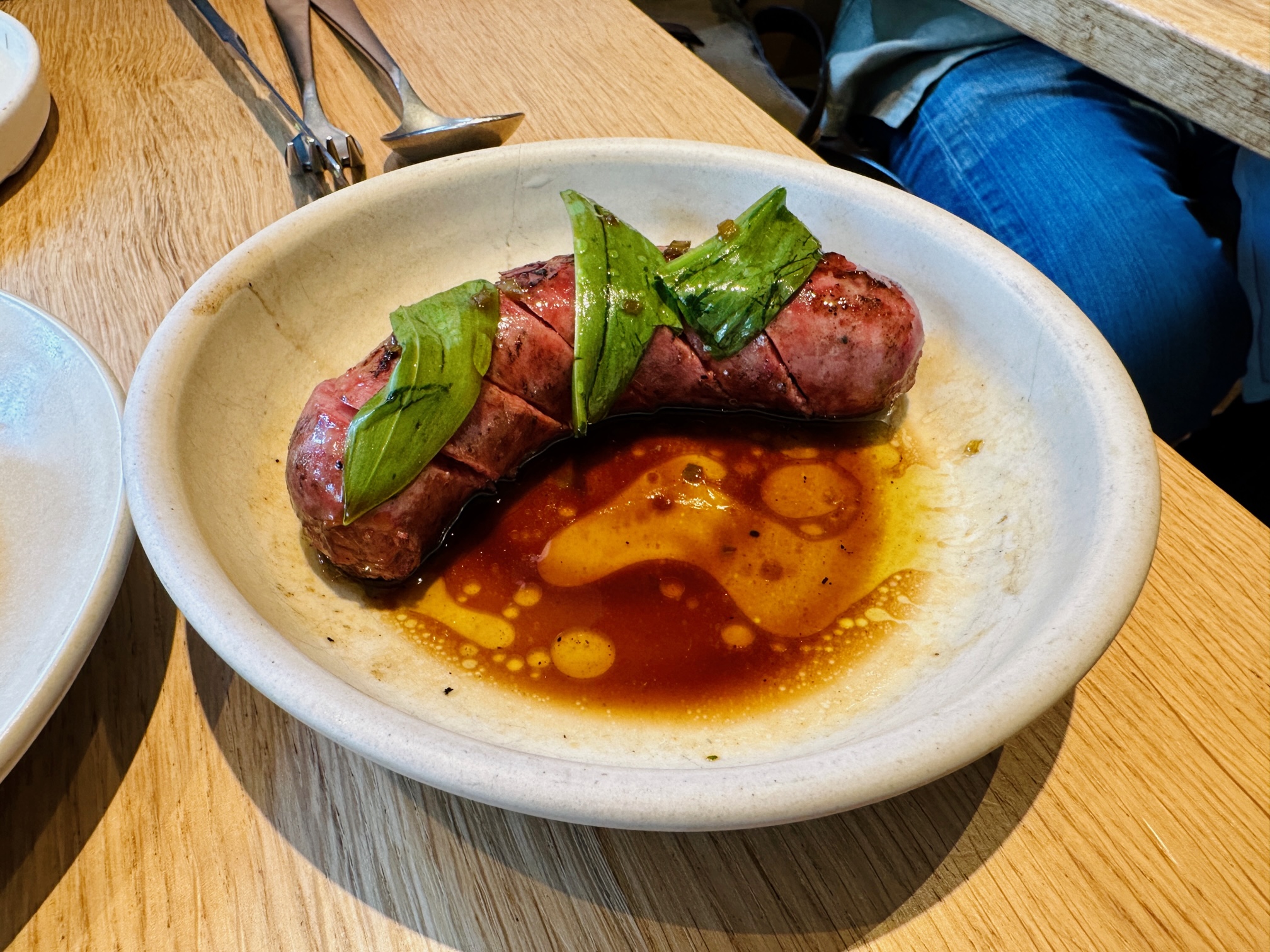
Less successful, possibly because it’s a dish that happens to share my porn star name, was hogget sausage. I liked but didn’t love it: knowing that Manteca does all its butchery on site reassured me that this was packed with the good stuff, but the texture was still smoother and closer to saveloy than I’d personally choose. The flavour more than made up for it, the whole thing draped in wild garlic leaves, because ’tis the damn season. Probably should have kept some of that slab of bread to mop up the juices – maybe that’s what the restaurant had in mind for it.

I think I read somewhere that Manteca used to do their pasta courses in a small and large, but they’ve done away with that now and a portion is very respectable size – enough for you to eat as a main, if you’re no fun, or a beautiful stepping stone between the smaller and larger plates. Manteca’s brown crab cacio e pepe is so fêted that it might be the closest thing the restaurant has to a signature dish, so naturally I ordered it.

It was a gorgeous, simple plate of soothing sustenance which didn’t outstay its welcome. The pasta – strozzapreti in this instance – was terrific, al dente almost to the point of squeakiness. And the crab didn’t dominate, playing nicely with the cheese and pepper to create something beautifully emulsified and far greater than the sum of its parts: if anything, the foremost note was a brilliant tingle of lemon that prevented it from cloying. Like most of my experience, it thoroughly justified the hype.

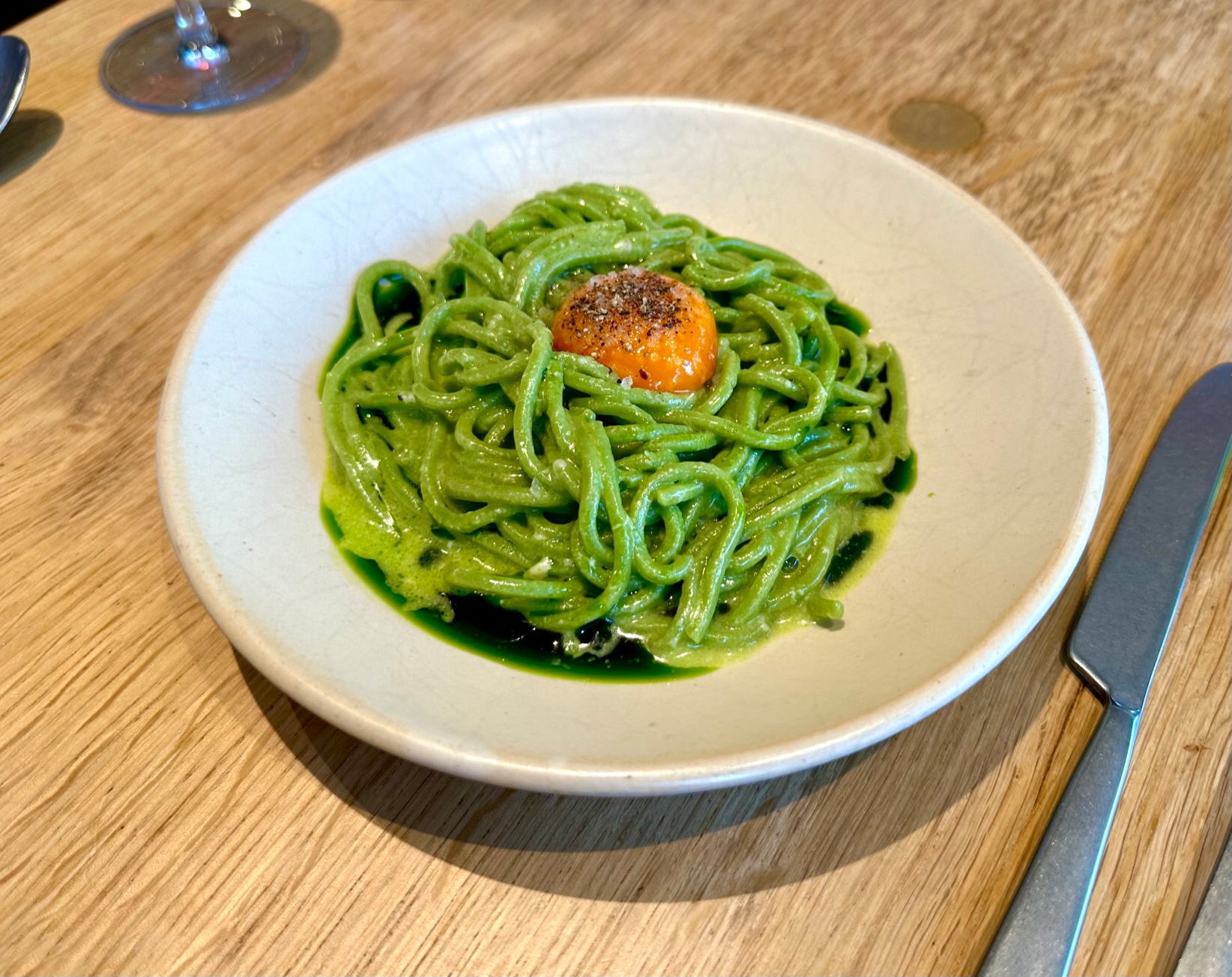
Wild garlic made another appearance in Zoë’s pasta. Chitarra, a sort of square spaghetti, if you can imagine that, was positively luminous with wild garlic, its edges fringed with racing green wild garlic olive oil. An egg yolk nested in the centre and although it looked slow-cooked and fudgy, once nudged with a knife sunrise spread across the plate. I didn’t try any, because it struck me as a messy thing to reach across the table and eat, but Zoë loved it. She tasted citrus in this too – lime, she thought, although that might have been synaesthesia because it was just so very green.

The one thing that doesn’t tell you about those two pasta dishes – one of the few frustrations of eating at Manteca – is that they came to the table ten minutes apart. When Manteca said their dishes were intended to be shared I assumed they couldn’t mean the pasta because nobody shares pasta, except in Lady And The Tramp. Perhaps they honestly thought we’d share the first pasta dish and then share the second, but they’d also said, in a Wagamama-esque spiel, that dishes from the same section of the menu would come out together.

Does it matter? On many levels, not really. We were having a lovely time, by this point we’d ordered a beautiful bottle of an Australian pinot noir/syrah blend and all was well with the world. But it’s always weird to sit there while your dining companion watches you eat and then have your roles reversed: it’s why I so rarely send steak back in a restaurant. More to the point, we only had the table for two hours – less, because we’d showed up a little late, so you’d think they’d be tighter on time. As it was, because they didn’t rush us through the pasta, which they should have done, things got more frantic at the end.

But this was the only misstep in a meal where even if we were slightly processed, it never felt like it. Manteca’s front of house team were quite fantastic from start to finish, working in one of the busiest, buzziest restaurants I’ve eaten in for a very long time. Also, given the acoustics, their hearing must be exceptional – for the first half of the meal Zoë and I probably had to repeat almost fifty per cent of everything we said.

Arguably, the best way to deal with the challenging noise levels is to dish up food so good it renders customers speechless. I think that might have been Manteca’s plan, and they achieved it admirably with the next set of dishes. Grilled duck breast, pink and tender underneath caramelised skin, was superb, and pairing it with sausage – I think also made from duck, but I might be wrong – was a masterstroke. But the thing that made the dish, for me, was the preserved quince that came with it: fruity, ever so slightly chewy, a fantastic foil for all that meat. It reminded me, ever so slightly, of Georgian fruit leather (don’t knock it til you’ve tried it) and I’d choose it over red cabbage any day. We were approaching full by the end of this dish, but we heroically soldiered on.

The accompaniments were a mixed bag. Grilled greens were a wan medley of cauliflower and chard, and although they tasted decent the texture was too limp for my liking. A thousand times better – and again, almost reason to visit on its own – were the pink fir potatoes, cooked until golden and crispy and smothered in something the restaurant calls “salumi brown butter” – little crunchy nuggets of meat, herbs and fat. I could have eaten these on their own and left the restaurant a happy man, but being able to pair them with duck, or sausage, or use them to soak up the pool of juices at the bottom of the plate, was nothing short of heavenly.

By this point we were decidedly full but still up for attacking the dessert menu, possibly with something from the restaurant’s extensive list of amaros, once we’d finished our bottle of red. Our minds were concentrated wonderfully by our server telling us we had less than twenty-five minutes before they needed the table, so we were forced to accelerate matters.

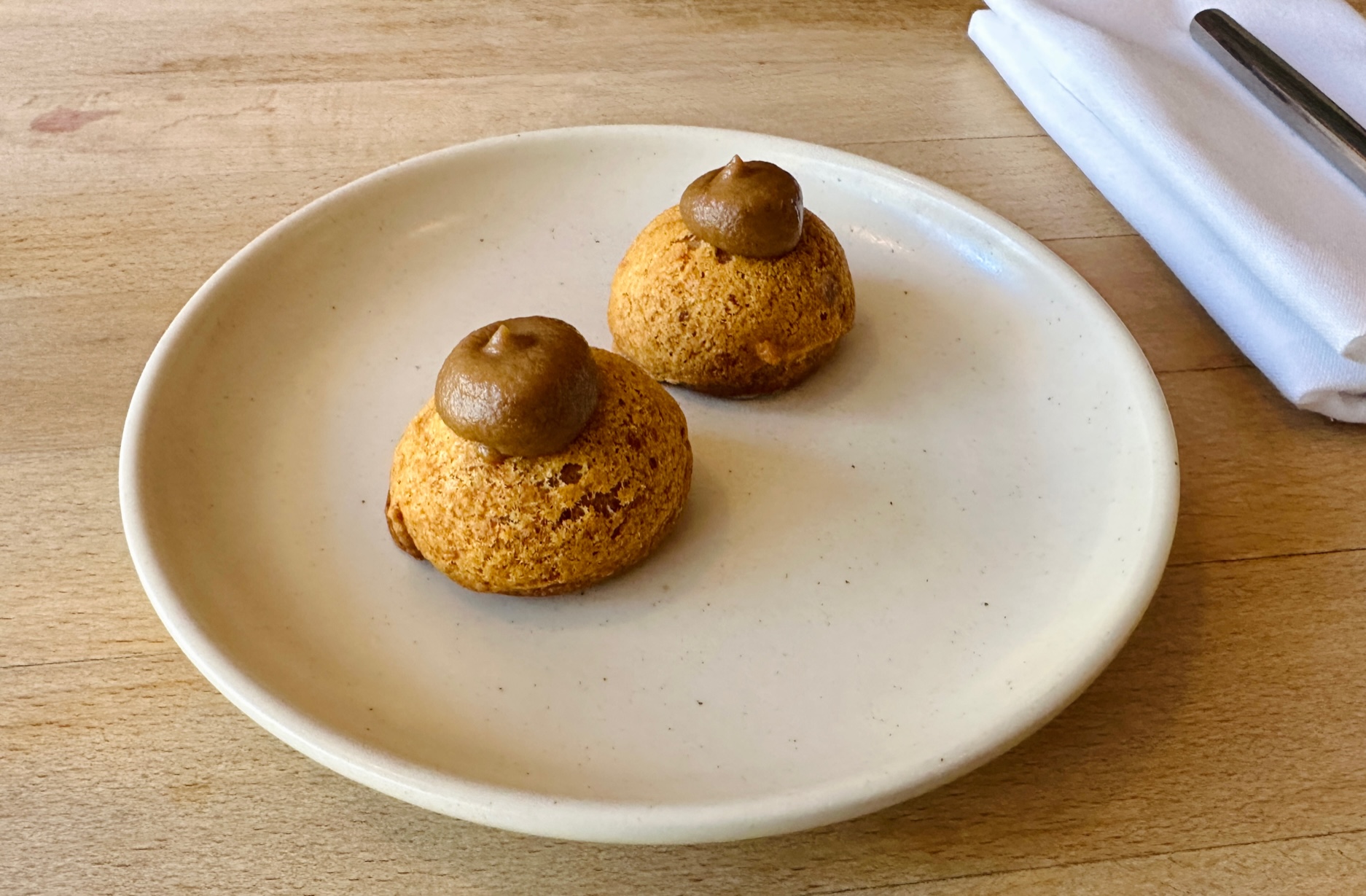
The dessert menu is skeletal, with just three options. Zoë’s choice, a chocolate choux bun filled with chocolate cremoso, tasted very nice indeed but I was delighted I hadn’t ordered it because I’m not sure I could have pretended to you that I could taste the “whey caramel” it apparently contained, or even for that matter tell you what whey caramel tastes like.

I’m also delighted I didn’t order it because the dish I did order, pistachio cake, was one of the finest desserts I’ve ever had. There was an awful lot going on here, all of it good on its own yet better together. The cake, which could so easily have been stodgy or unremarkable, had a beautifully dense texture with flashes of salt and pistachio in every spoonful. The ribbons of candied, pickled fennel on top added a fragrant sweetness that never overpowered: I’d have liked more of them, but fennel always has that effect on me. And the preturnaturally smooth pistachio ice cream was as good as anything I’ve had in Italy – or for that matter at Clay’s, who do a mean pistachio ice cream these days. Resting the sphere on a handful of salted, roasted pistachios, though, was an inspired touch.

Zoë had a spoonful, and her reaction was immediate: “you win”. If we’d had our table for longer, I think she’d have ordered one as a second dessert. It’s rare for me to rave about dessert, rarer still to do it about a dessert with no chocolate in it, but I’ve thought about this every day since my lunch at Manteca, wondering quite how they elevated something seemingly so everyday to a dessert so extraordinary.

As we were tight for time, there was no digestif. But there was still room for one last delight, so along with the bill we asked for a couple of pieces of beef fat fudge to send us on our way. I’m not always sure about beef fat in desserts – I still remember a beef fat caramel I had at an otherwise excellent restaurant in Cardiff for which no word other than “minging” will do – but this lent a certain glossiness while omitting the overtly bovine notes. It was one pound fifty for a generous cube, deftly sprinkled with salt, and it took all my strength not to ask them to make me up a box. I wasn’t hungry any more, but I knew I would be later. Or rather, I wouldn’t be hungry but I’d have made enough room for more of that fudge. Another time, perhaps.

Our bill for all that food, a couple of aperitifs and that gorgeous bottle of red – which I liked so much that before the end of the meal I’d tracked it down and ordered a few bottles online – came to just over two hundred and fifteen pounds, including service charge. You could eat there for less, and have less fun, but honestly, when you have a meal this good it costs what it costs, and you don’t give a shit. We emerged blinking into the Shoreditch sunshine, and made a beeline for the Mikkeller bar for a beer and a post match debrief. Our ratings are usually a gnat’s crotchet apart, but for this one they were identical.

You can see that rating just a few paragraphs below, but what’s more important is to talk about just how good Manteca was. Because the truth is, back when I used to eat in London more often – but wasn’t reviewing those restaurants – they never quite lived up to my expectations. To the point where I worried that I was becoming semi-professionally underwhelmed. So I did the likes of St John or Quo Vadis, the places everybody likes, and I wondered what I was missing.

I sometimes think that London has to survive on a bubble of hype because if it wasn’t for that, people would wonder why they’re paying such unsustainable amounts of money to live and work there. And indeed my two recent visits to highly rated London restaurants, Casa do Frango and Chick ‘N’ Sours, left me equally ambivalent. So I can’t tell you how happy I was to eat somewhere that not only justified the hype but made me want to add to it, to lend my voice to the chorus of voices shouting about how special Manteca is. Though hopefully you’ve been reading my blog long enough to know that I don’t really do hype. I’m just as likely to walk away from somewhere critically acclaimed feeling nonplussed as I am delirious with joy, if not more so.

So there you have it: Manteca served up one of my favourite lunches of the last ten years and is well and truly one restaurant ticked off my “places I must get to in London” list. Although it doesn’t make matters easier because now, when I try and work through the other restaurants on it, I’ll always be thinking, in the back of my mind, or I could just go back to Manteca. Anyway, hopefully you’ve read this and might add it to your own version of that list. I’m still kidding myself that everyone has one, because in my echo chamber they probably do.

Manteca – 9.0
49-51 Curtain Road, EC2A 3PT
020 71395172

https://www.mantecarestaurant.co.uk

Restaurant review: COR, Bristol

For once, I turned up for lunch in Bristol moderately ahead of the curve. COR, a cosy small plates restaurant in Bedminster, has only been open since October and, so far, has mostly been Bristol famous rather than nationally famous. Not completely, though: Tom Parker Bowles raved about it in the Mail On Sunday on a recent visit. And last month, when Square Meal listed its top 100 restaurants for 2023 COR made the list: not too shabby for a restaurant that’s been trading for about four months. Even so, stepping through the front door with my old friend Al for lunch during a weekend trip to my favourite city, I felt slightly closer to the zeitgeist than usual.

They’ve got a lovely site. It’s a corner plot, double aspect with big windows letting in plenty of light and despite being on the compact side all the space is used superbly. There are relatively few tables, but there are also excellent, comfy-looking stools up at the window letting you look out on the painfully cool passers-by, on their way to a café, the terrific looking natural wine bar or a smashing chocolate shop. The seats at the bar look like fun too, and some of them give you a view out back to the open-ish kitchen. The restaurant is passionate about always saving some room for walk-ins at the window or at the bar: like so much else about it, it’s admirable.

COR’s menu read extraordinarily well. I know small plates aren’t for everybody, but these were grouped and flowed effortlessly, from nibbles to charcuterie, on to seafood, to a selection of vegetarian and meat dishes and then a handful of larger, more conventional plates. Just the three, in fact. The nibbles and charcuterie were close to a fiver, the small plates generally hovered just under ten pounds and the bigger ones were around fifteen quid.

Now some people will look at that and think “ugh”, probably put off by bad experiences with the small plates concept in the past. I get that – I’ve had many of those too – but to me this just read like a dream, an edible Choose Your Own Adventure with no bad endings. Our waitress, who was positively brilliant throughout, told us roughly how many dishes people ordered per head, although I must say that she probably meant customers built like her, or Al, rather than built like me. We may have disregarded her sterling advice. She also told us they were down to their last portion of mojama, air-dried tuna, on the specials board, and nodded approvingly when we asked to bag it.

That turned out to be an outstanding decision, although in fairness so was practically everything we ordered. So was booking the place for lunch in the first place, come to think of it. I’m used to eating mojama up at the bar in Granada, thick slabs of coarse, salty tuna sprinked with almonds and drizzled with olive oil, as simple as they come. This, by contrast, was gossamer-light, with a judicious single almond, beautifully toasted, per slice and little segments of sweet, sharp orange to improve things still further. My mind may have been playing tricks on me, but I think the whole lot rested on a smudge of houmous. Every mouthful was delightful, and it never lost that sense of surprise: small plates, in fairness, find that easier.

As we rhapsodised Al sipped his white vermouth, I my Asturian cider – yes, we’re those kinds of wankers – and all my cares dissolved; Bedminster wasn’t Granada, not by a long chalk, but it had already earned twin city status, and we’d just gotten started.

Finocchiona, fennel salami, was more about buying well. But COR definitely bought well, and if their menu had listed where they’d got the stuff from I’d have ended up buying well too. It had a wonderful whack of aniseed and I liked it very much – it also wasn’t too ridiculously priced at a fiver. As you will discover, I had trouble finding fault with nearly anything that COR did so I might as well take my opportunity here: only two cornichons? Really? Have a word with yourselves.

That minor disappointment out of the way, the last of our first wave of dishes was also on the specials board and if I eat anything as small but perfectly formed again this year I’ll have done very well for myself. The last time I was in Bristol I was wowed by a canelé rich with honey, whisky and smoke. This time, I was even more dumbfounded by COR’s savoury canelé which came drizzled with a grassy olive oil, tarragon and thinly sliced mushroom. Cutting vertically through it prompted the reveal, that the whole thing had been filled with a creamy, savoury mushroom duxelles which made me beam. This was emphatically not for sharing: Al and I scoffed one each, and I had half a mind to order another after dessert.

Another thing I really loved about COR was that they took our orders and artfully sequenced them almost like a gastronomic mixtape. None of this “your dishes will come out when they’re ready” bollocks that treats you to feast or famine, instead we got things in a carefully structured order that showed every dish off to its best advantage. Take this for example, Jerusalem artichokes fried until golden and sticky-edged and served on an earthy pool of artichoke velouté. It was simply magnificent, and if I couldn’t really detect much truffle in the truffled pecorino I was having far too much fun to give a shit. I have to really fancy Jerusalem artichoke to order it in a restaurant because of its legendary side effects. Here I did it anyway, and the side effects never materialised. That’s what I call winning at life.

Equally delicious was the next dish, slow-cooked pork shoulder crammed into radicchio and topped with ribbons of pickled fennel (and some slightly pointless dill). The pork was splendid, with the texture ignorant people are prone to describe as unctuous. This vegetation-as-taco concept seems to be a Bristolian one: I had something very similar, albeit far smaller, at Wilson’s late last year. But this was the size you actually wanted it to be – and well portioned for sharing. Did I wish I was eating them both to myself? I like to think I’m a decent friend, but yes. Yes I did.

By this point, Al and I were suffused with a warm glow, catching up for the first time in months, enjoying glasses of surprisingly fruity and accessible Cataratto (“do you know, that’s the only wine I like?” said our waitress, charm personified without necessarily realising it). And we got to talking about superlatives: Al has the misfortune to spend some of his time surrounded by people from Gen Z who only ever use one superlative – “stunning” – and use it all the time. About everything. Everything, he told me, is their “new favourite dish”, whether it’s a special occasion or some spaghetti hoops out of a tin. Even hearing about this perpetual state of wide-eyed wonder, I’m afraid, made me want to kick something very hard.

But we were both rather running out of adjectives by the time our next dish arrived. Tropea onions, cooked to soft, caramelised wonder, drizzled with a hazelnut beurre noisette and crispy sage leaves was another knockout, even without the three dollops of goats cheese (Ragstone, apparently) providing a little agriculture to offset the sweetness. I gave Al the spare onion: I told you I was a good friend, although he did let me have the extra Jerusalem artichoke, and I thought that one of the nicest things about sharing dishes is that you can both have virtually the same superlative experience. If there’s a better thing to do with an old friend than go to an excellent restaurant, I’m not sure I know what it is: I know some people like watching the football, or playing squash, or bloody golf, but for me this is as good as it gets.

“Would you describe it as stunning?” I asked. Al grinned.

“Definitely. New favourite dish.”

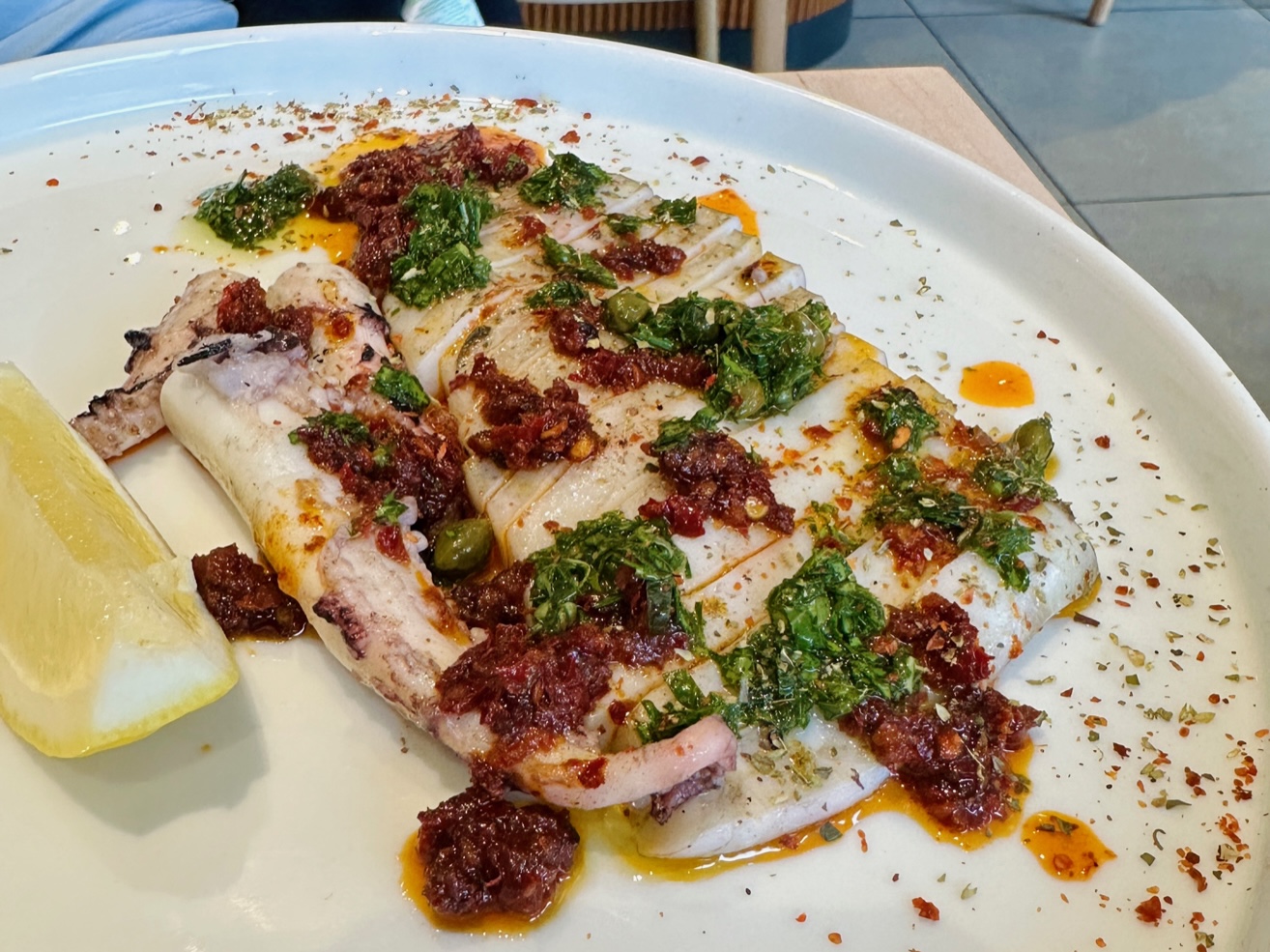
My new favourite dish – and in fact it stayed that way for the rest of the meal – was the next one. A really generous portion of cuttlefish, cooked sous vide and then finished on the grill I believe, was ludicrously tender and came already sliced into ribbons. I could imagine serving this with ‘nduja, or with salsa verde, but matching it with both, along with some capers, in a dazzling, dizzying tricolore was a stroke of genius. This dish would be at the apex of nearly any meal, and if I could find anywhere closer to home that served something like this I’d be there all the time, even if it was only half as good.

Our main courses involved the only misstep, and by “misstep” I mean “eight out of ten dish”. Al had decided to try the manicotti, a pasta dish, and he was encouraged in this by our waitress when he told her he was torn.

“It’s one of my favourite dishes, it’s like something your grandmother would make.”

“Your grandmother must be a better cook than mine was” I said, fighting back memories of wan fish, floured and fried, served on the kind of brown smoked glass plate every household had in the seventies. Still, she did at least cook proper chips in a chip pan, something nobody does now.

I think the dish was better than anything Al’s grandmothers could have conjured up either, but it wasn’t as much a tour de force as everything else had been. Manicotti are big sleeves of pasta, thicker and bigger than canelloni but the same kind of thing. Whereas this was a single giant tube, folded rather than rolled, and the overall look of it was somewhere between canelloni and some kind of pasta calzone, if I haven’t mixed my metaphors to death by saying that. It was stuffed with ricotta, topped with braised tomato, parmesan and rocket and it managed to look hearty, well-done and somehow unspecial.

“It’s okay” said Al. “It just doesn’t match everything that’s gone before. The braised tomatoes are fantastic, though. I just should have ordered the same thing as you.”

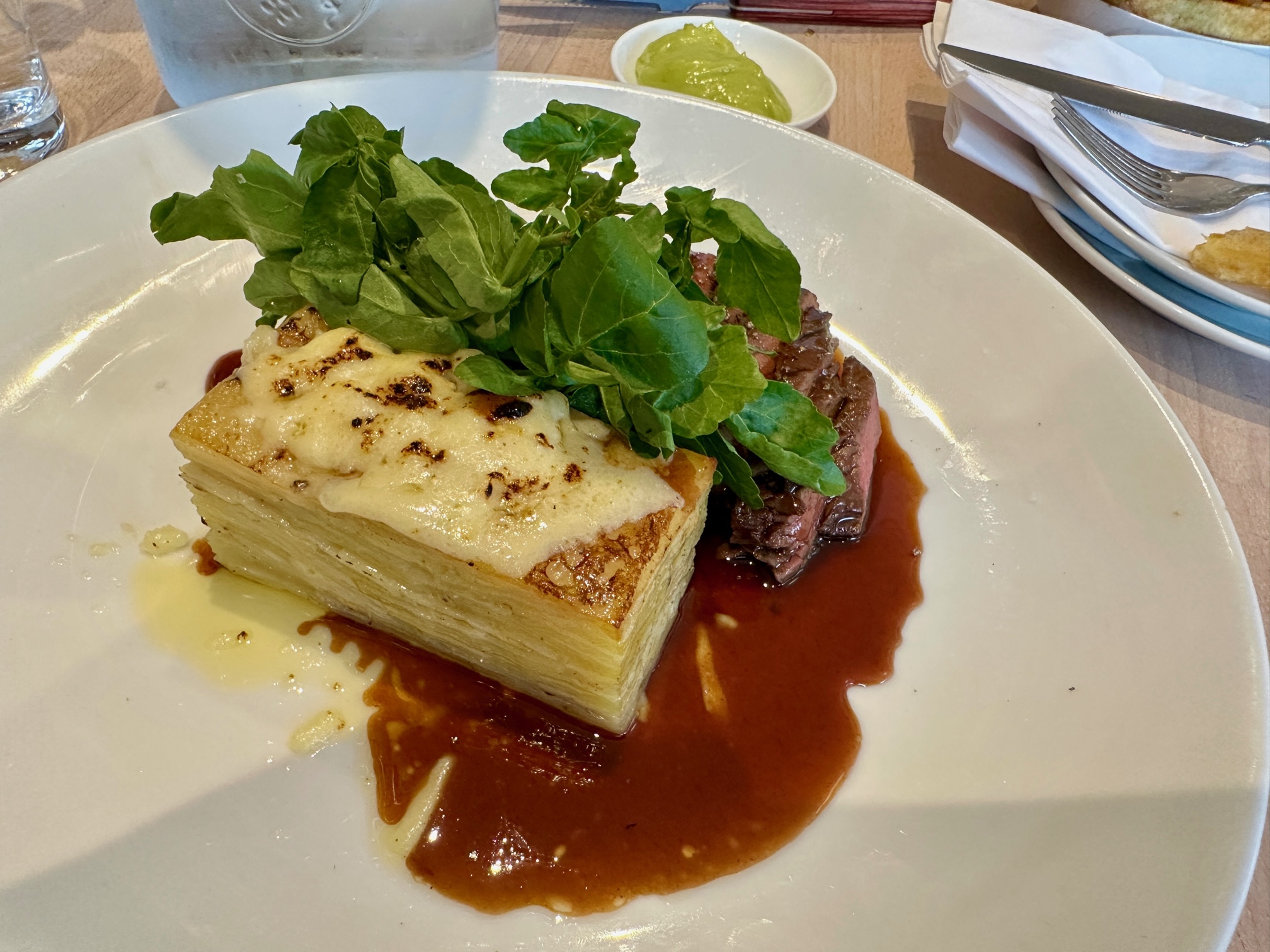
I mean, he should have. Because while I watched him eat a big sheet of pasta with some cheese in it pretending to be a Mobius strip, I was diving into a marvellous piece of onglet, as yielding as you like, with lashings of intense jus and – the icing on the cake – a dauphinoise of interlayered potato and celeriac, all topped with quite a lot of gruyere. It was just the most incredible thing, and when I saw on the menu that it clocked in at under sixteen pounds I thought there must have been a typo.

But there wasn’t. That whole plate of food for sixteen pounds was outrageously generous, charitable even. And speaking of charitable, even this dish had been served in a way that encouraged sharing, with the steak cut into substantial slices. I let Al have as many as he wanted to dull the food envy, because I’m not a monster: I suspect he would have had more, but it would have made the envy worse, not better. He consoled himself with some exceptional hand cut chips, dipped in a tarragon mayonnaise so herb-heavy it was the colour of guacamole. I had some too. Of course I did, it was world-beating.

We’d come all this way, so not having dessert would have been madness. The dessert menu is nicely compact – although they also have a selection of eight different cheeses – and Al had clearly learned from his mistake because, like me, he opted for the chocolate mousse. I think it’s an underrated dessert at the best of times, but this was at the very best of times – a hulking scoop of the stuff, dense yet airy, studded with plates of almond dentelle like the spines of a stegosaurus. That enough would have made it exquisite, but sprinkling it with flakes of sea salt and drizzling it with olive oil was the final touch.

“That chocolate mousse was so good” I told our waitress as she took our bowls away and we sipped our dessert wines (like I said, those kind of wankers), fighting the almost primal urge to order a savoury canelé for the road.

“Thank you so much! I actually made that yesterday, I spend some shifts in the kitchen as a pastry chef. I can’t actually eat it myself, it’s a bit too rich for me.”

I can’t imagine the level of self-restraint involved in being able to make something like that and not eat it, but then that’s why some people are slim and I’m not. Al, on the other hand, eats like a horse and is still as skinny as he was when I first met him about thirty years ago; this is why some people are jammy bastards and I’m not. But anyway, despite being thin, talented and impossibly young our waitress was a class act. All the people who served us throughout lunch were, actually: friendly, passionate about the food, with opinions on all of their favourite dishes, they were a real credit to the restaurant. How does anywhere get this good after just four months? It was quite miraculous.

Our waitress asked where we were from, and I mentioned Reading, and she proudly told us she’d been there. Once. Then of course the truth came out, that she’d passed through it recently on a train to London to watch a gig. It was the first time she’d ever been to London on her own, she said, at the tender age of twenty. And suddenly Al and I felt very old indeed, and seized with a sneaking suspicion that we should hightail it out of Bedminster and find an old man pub to hunker down in to carry on our gossiping session. The natural wine bar would just have to wait for another time. Our meal for two, with a very richly deserved service charge included, came to just under a hundred and ninety pounds. There was literally nothing to begrudge, except any of their punters who only paid ten per cent service.

As I was writing this review, I messaged Al, mainly to reminisce about what a phenomenal meal it was. What a stunning array of dishes I sent him, hoping to get a cheap laugh.

“One of my objections to the S word is the cognitive dissonance” he replied. “Stunning implies losing your senses, but with food that good your senses are very much alive. Sorry, you can tell I’ve thought about this too much.”

He’s right, though. What I loved about COR the most was having my senses awakened and reawakened time and again over the course of such a glorious lunch – old favourites, new combinations but always real integrity and imagination. Nothing was boring or humdrum, which I can say because I didn’t have that pasta dish, and in terms of the sheer number of hits I think it ranks as one of the best meals I can remember, at home or abroad.

I’m sure you know the drill by now with this kind of review. Bristol, Bristol, Bristol, hyperbole hyperbole hyperbole. But I like to think I’ve been here enough to sift the hypebeasts from the real contenders. The last time I was in Bedminster I ate at Sonny Stores, which was raved about by literally everybody but left me cold. And the last time I was in Bristol I went to Wilsons, which I raved about to literally anybody who’d listen.

And positioning COR relative to those two is pretty easy – it is miles better than Sonny Stores, a neighbourhood restaurant with a touch of the Peter Principle about it. But actually, although the number at the bottom is marginally lower than the one I gave to Wilsons, if you’re only having one meal in Bristol I would go here instead. Wilsons is a take it or leave it menu, a set seven courses, and when it’s on form it’s incredible. But I have friends who went there off the back of my review and although they loved the flavours, they found it a carb free zone and, I’m sorry to say, they left hungry. That will never happen to you at COR, and you will have an awful lot of fun deciding exactly how you want to become full. That’s what restaurants should all be about.

And how does COR compare to Reading restaurants? There’s nowhere in Reading even remotely like it. That is, and continues to be, the problem. You might get bored of hearing me say so, but it’s important to have goals. Reading’s should be to attract at least a couple of restaurants in approximately the same ballpark as this. I really hope it happens. It’s starting to get a tiny bit embarrassing.

COR – 9.5
81 North Street, Bedminster, BS3 1ES
0117 9112986

https://www.correstaurant.com

Restaurant review: Wilsons, Bristol

Wilsons was awarded a Michelin star in February 2025.

I’m sorry to start proceedings with what looks suspiciously like a humblebrag, but last month I was on holiday in Belfast and as a treat, we booked a table at Ox, one of the city’s Michelin starred restaurants. But it was a hugely disappointing evening, which will please those of you who don’t like humblebrags. Everything was not quite right; nothing was actively terrible, but the whole thing felt far from optimal. We left underwhelmed, slightly peckish and feeling as if our wallets had been mugged in a dark alley, and wandered away from the scene of the crime in search of a pint.

I’ve never understood people who collect Michelin starred restaurants – too humblebraggy even for me – or restaurant bloggers who loftily describe meals they’ve had as “easily one star food”, as if somebody died and promoted them to inspector. Get over yourselves: it’s just one set of opinions, from an organisation so shrouded in secrecy and obscurity that they make the Freemasons look like the Good Law Project. For what it’s worth, I’ve always thought the Bib Gourmand is a better indicator that you’ll have a good and interesting meal.

The subject of this week’s review is Wilsons, a little restaurant in Bristol which doesn’t have a Michelin star per se (it has a green star, which is something different) but which served me one of the very best meals I’ve had in the last five years. Not only did it get everything right that Ox got wrong, but it made me think about what excellence in restaurants really means – and how little of it has anything to do with being fancy.

Take the room, for example. At Ox, we walked past the lovely, twinkly, atmospheric downstairs room – which had free tables in it – only to be walked up the stairs to an unlovely mezzanine floor, all hard surfaces and dead air, the overflow car park of hospitality. It was boiling hot, the aircon stayed resolutely switched off and even blowing out the candles didn’t seem to alert the staff to what a stuffy, unpleasant place it was in which to have a meal. Wilsons has just the one dining room. It’s plain, simple, dignified and stylish with nothing on the walls except chalkboards and a lovely stained glass sign hanging in the full-length window. Good restaurants, ideally, have no shit tables. Wilsons has no shit tables.

This extended through to the menus. Ox doesn’t have a menu, so you are surprised on the night. Instead, they hand you a rather pretentious-looking sheet of paper which lists all the elements and ingredients that will feature in your meal, without telling you how or where. The menu is on their website, so even as gimmicks go, it’s pointless. Wilsons also offers a single menu but it’s written on the chalkboard each day for everybody to see. You can have the whole lot for sixty pounds – twenty pounds less than Ox – or a stripped-down version at lunch for twenty five quid (I read a review where someone said “that’s less than you’d spend on a pair of socks”: I’m as fond of conspicuous consumption as the next person, but what a knobber).

A mystery menu wouldn’t be a problem if the service brought the meal to life. Again, Ox was disappointing: everything was mechanical and muted, and much of it was hard to hear in that unforgiving and joyless space. Detail was scant, and there was more warmth in the room than in the welcome. And again, Wilson’s was outstanding. All the staff abandoned zonal marking for the hospitality equivalent of total football, which meant that our dishes were brought by a huge variety of friendly faces.

All of them could talk with huge knowledge and enormous enthusiasm about every single detail of every single dish: a better reviewer than me would have taken notes. On another night in Belfast we went to Edo, an incredible tapas restaurant and our waiter, almost immediately after we took our seats, said “well obviously I know the menu inside out so I can answer any questions you have”: that’s how you do it.

The food at Ox was also muted and bland, but that’s quite enough talking about restaurants other than Wilsons. Let’s talk about their food instead, because everything was stunning, more or less. We went for the full monty, and it started with a beautiful, clever piece of work – a gorgeous feather-light gougère packed with cheddar and leek and topped with a little beret of pickled onion purée. The whole thing imploded in the mouth leaving nothing but joy, an accomplished disappearing act.

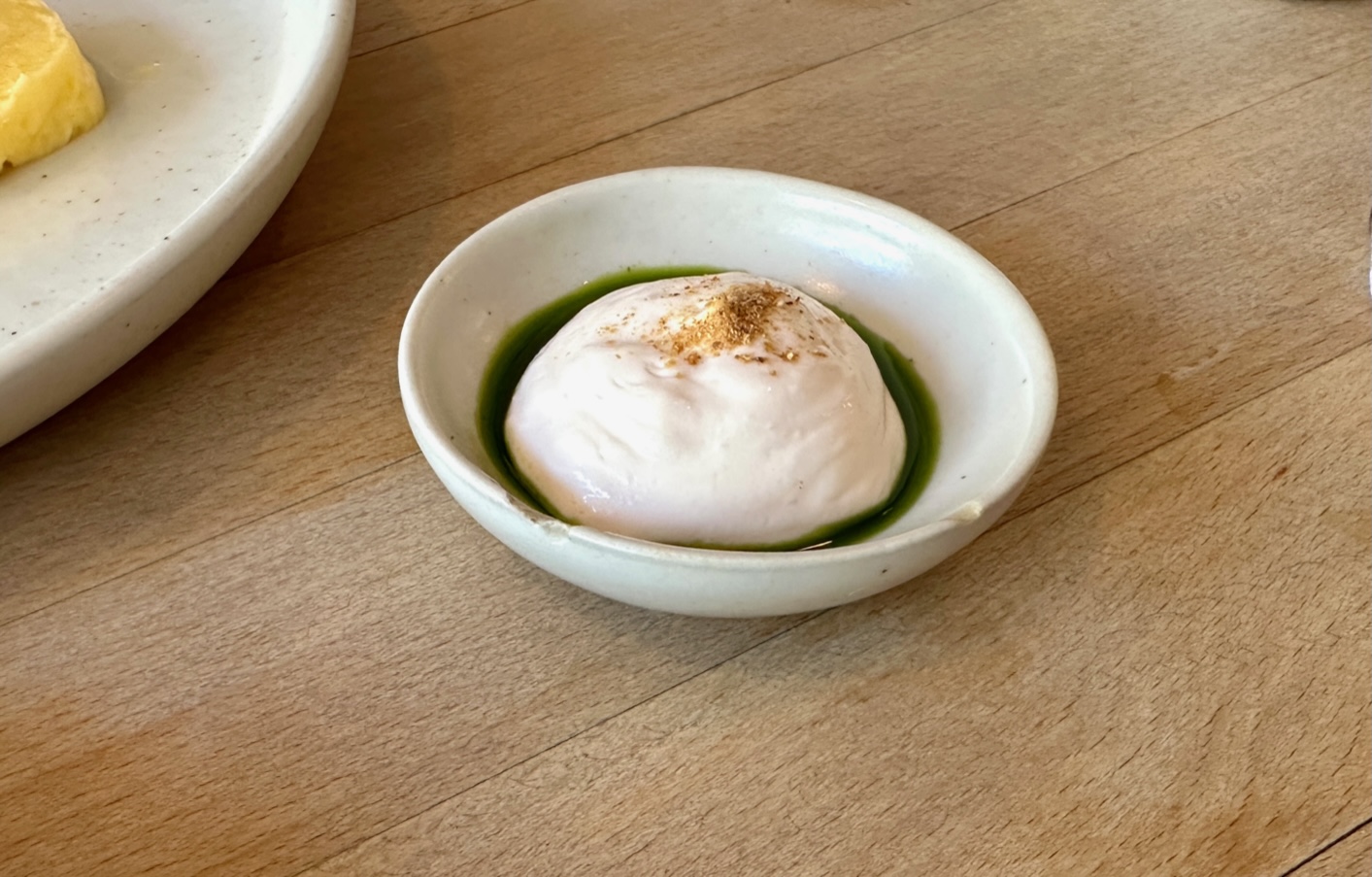
Bread was made by the restaurant and came to the table still warm with a puck of butter which the restaurant cultures itself. This was accompanied with a vivid little dish of cod roe, pastel pink with a little iris of bright herb oil. There was powdered something-or-other on top, and if I’d made notes I’d be able to tell you what it was. All of this was lovely, incidentally, although the bread was sliced a tad too thick which made it difficult to use all the butter and cod roe. Zoë ran her finger along the bowl, and I pretended to be shocked.

At the same time, we had one final snack which the wait staff playfully described as a taco – a chicory leaf with chicken liver parfait, preturnaturally smooth, topped with powdered beetroot and the pop of toasted pearl barley. So much effort gone into making something so small, gone in an instant but remembered for days: truly magical stuff.

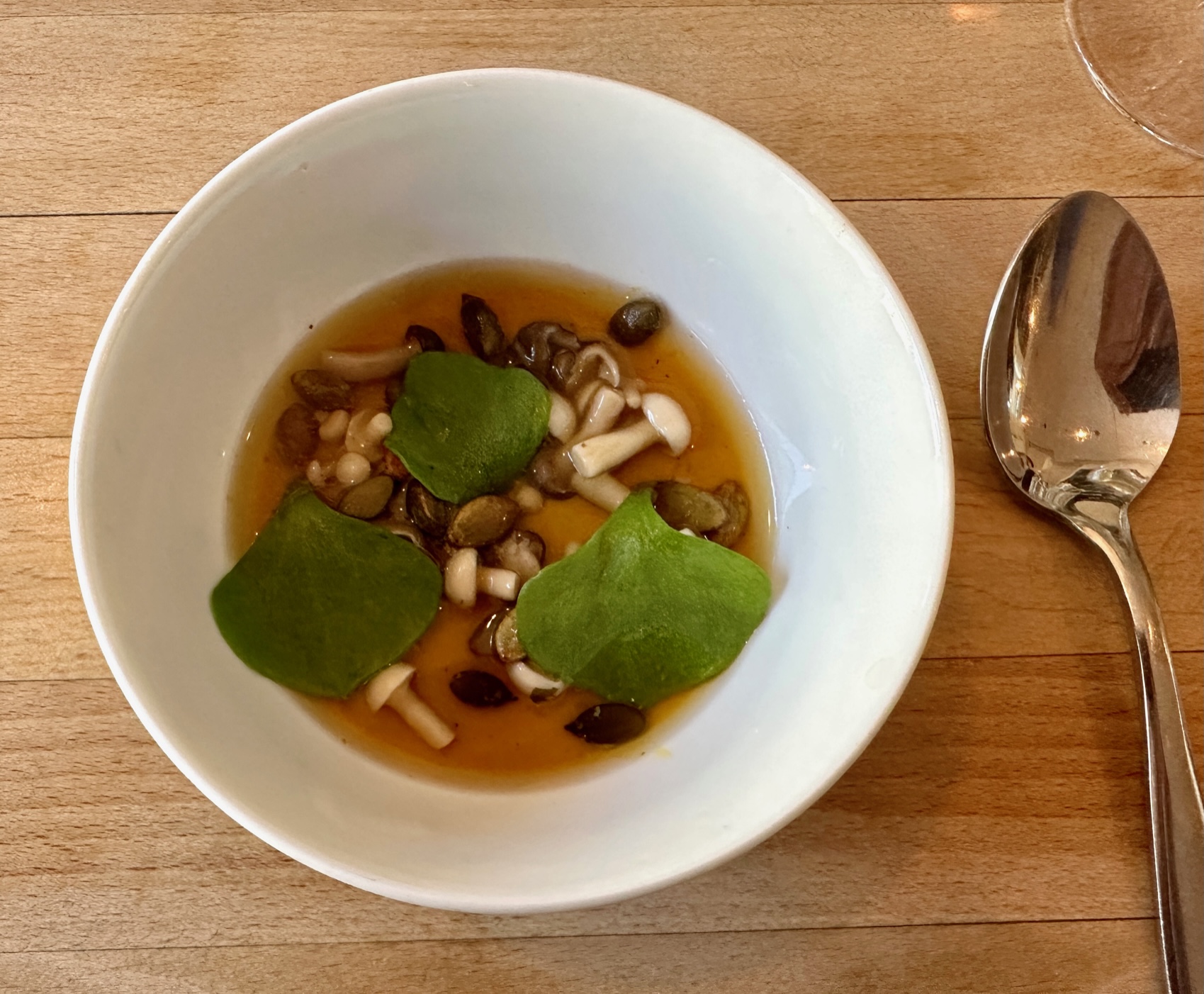
The next dish was one of the best things I ate that day, which makes it one of the best things I’ve eaten full stop. A savoury custard made with squash was sweet, glossy and perfectly spiced. Again, texture and pop was beautifully added with seeds, toasted in some of the same spice mix. But then the other elements added layer on layer of complexity and cleverness – tiny shimeji mushrooms, pickled in sherry vinegar, and a mushroom consommé poured over at the table, submerging the custard under something phenomenally savoury. Again, if I’d made better notes I could tell you what the leaves were: sorry about that.

By this point we were a couple of glasses into a fantastic bottle of natural Gruner Veltliner (the same one, actually, that I’d had at Goat On The Roof: it’s far more attractively priced at Wilsons) and I was already beginning to realise that this food was like very little I’ve eaten in other restaurants. I couldn’t recall anywhere I’ve eaten where the flavours were so pinpoint, where things had been so refined and perfected to make everything taste of its truest, best self. And as it turned out, I hadn’t seen anything yet.

Next to come was possibly the most disappointing course. Jigged squid – I have no idea what jigging is, and this time it’s not because I didn’t take notes – came in a rich and salty broth with rainbow chard. The squid, cut into ribbons to resemble udon, was among the freshest I’ve had and this dish made me love rainbow chard, something beyond the talents of most kitchens. The broth bringing it together had absolutely everything, and again it was that precise, super-concentrated hit that makes you sit up and pay attention, eat more slowly, take it all in. But this was the first time a portion felt stingy and doubt crept in: four ribbons of squid, and it’s not a good sign that I counted them.

Was it enough to dumbfound your tastebuds if you left a restaurant hungry? And yet my tastebuds were so dumbfounded – not least by a little tuile made from squid ink, as black as night and dotted with herb emulsion (I probably should have mentioned that much of the produce Wilsons use comes from their garden). It was a perfect mouthful, in a meal full of perfect mouthfuls and in a world where the word perfect is much devalued, not least by me. “It’s like the best crisp ever” said Zoë, who usually sums these things up better than I do.

More was to come, and the fish course proper was a proper marvel. A little cylinder of pollock, a notoriously recalcitrant fish, was cooked bang on and topped with another symphony of herbs, alongside a silky parsnip puree, the whole thing bound together with a superb vin jaune sauce which delivered more salt and less funk than I was expecting. I’ve talked about the half-life of dishes before and this had a long one – each forkful carefully calibrated to prolong the enjoyment. But again, the lack of carbs troubled me. What was the point of these beautiful sauces, dips and oils when there wasn’t always the substance to transport them into your gob?

I should have trusted in the process, because the next course made everything right. Crown of pheasant, cooked and then, I think, finished on the barbecue, glazed with some kind of emulsion and dotted with the smallest, punchiest capers I’ve ever eaten was a thing of rapture, as was the pheasant sauce and the wedge of just-cooked cabbage (there was also something called Tokyo turnip, but I thought that was a Steven Seagal film so what do I know?)

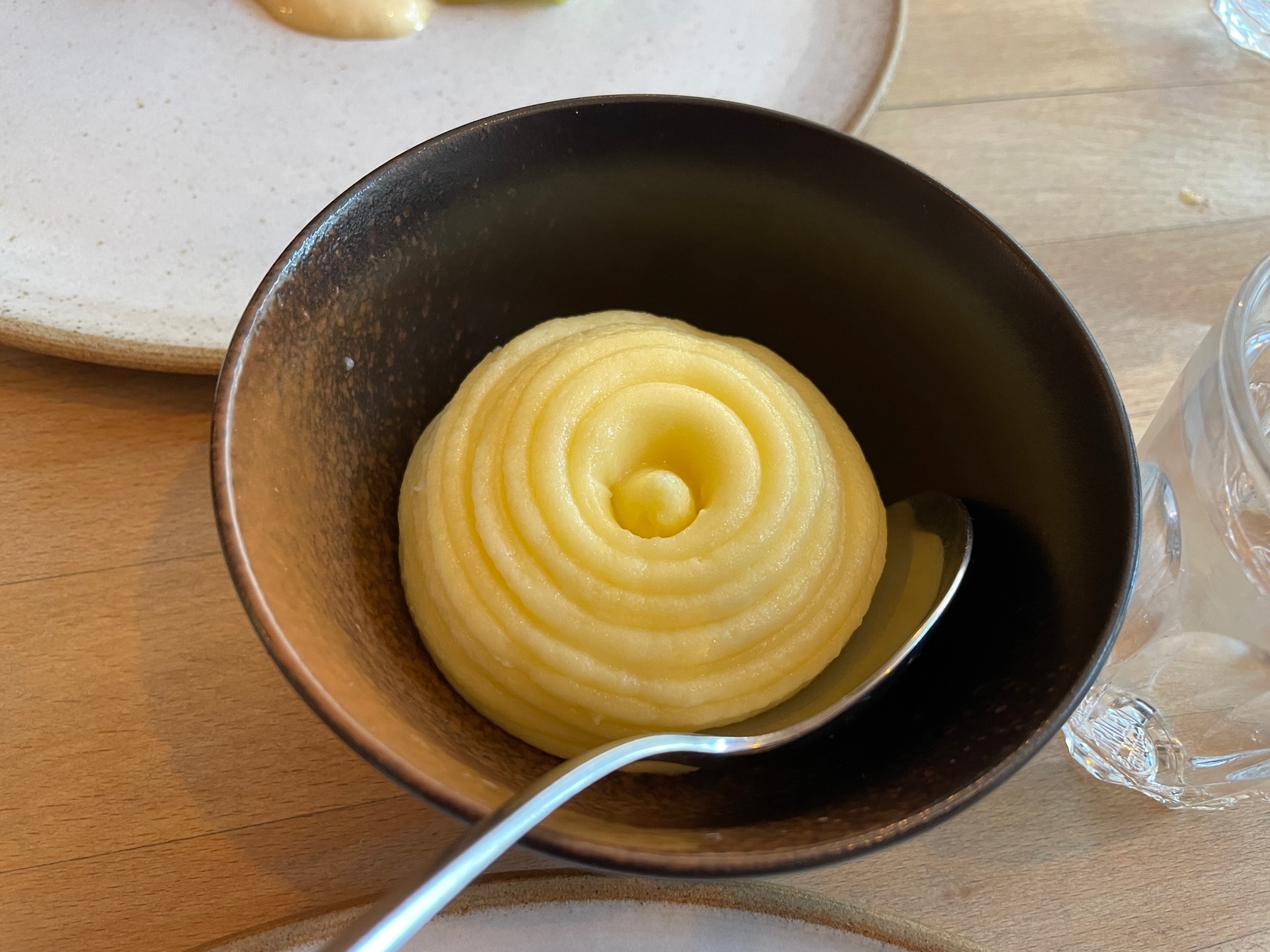
But where are the carbs? you might ask. But this is where Wilsons completely won me over by bringing a bowl of the best mash I’ve ever eaten. It was, the waiter told us, fifty per cent potato and fifty per cent butter. He also told us this is the only way to have mash, and I fear he might be right. It’s profoundly ruined me for other mash: I’ve already used the words ‘silky’ and ‘glossy’ in this review, so to save me reaching for the thesaurus let’s just settle for ‘exceptional’ here.

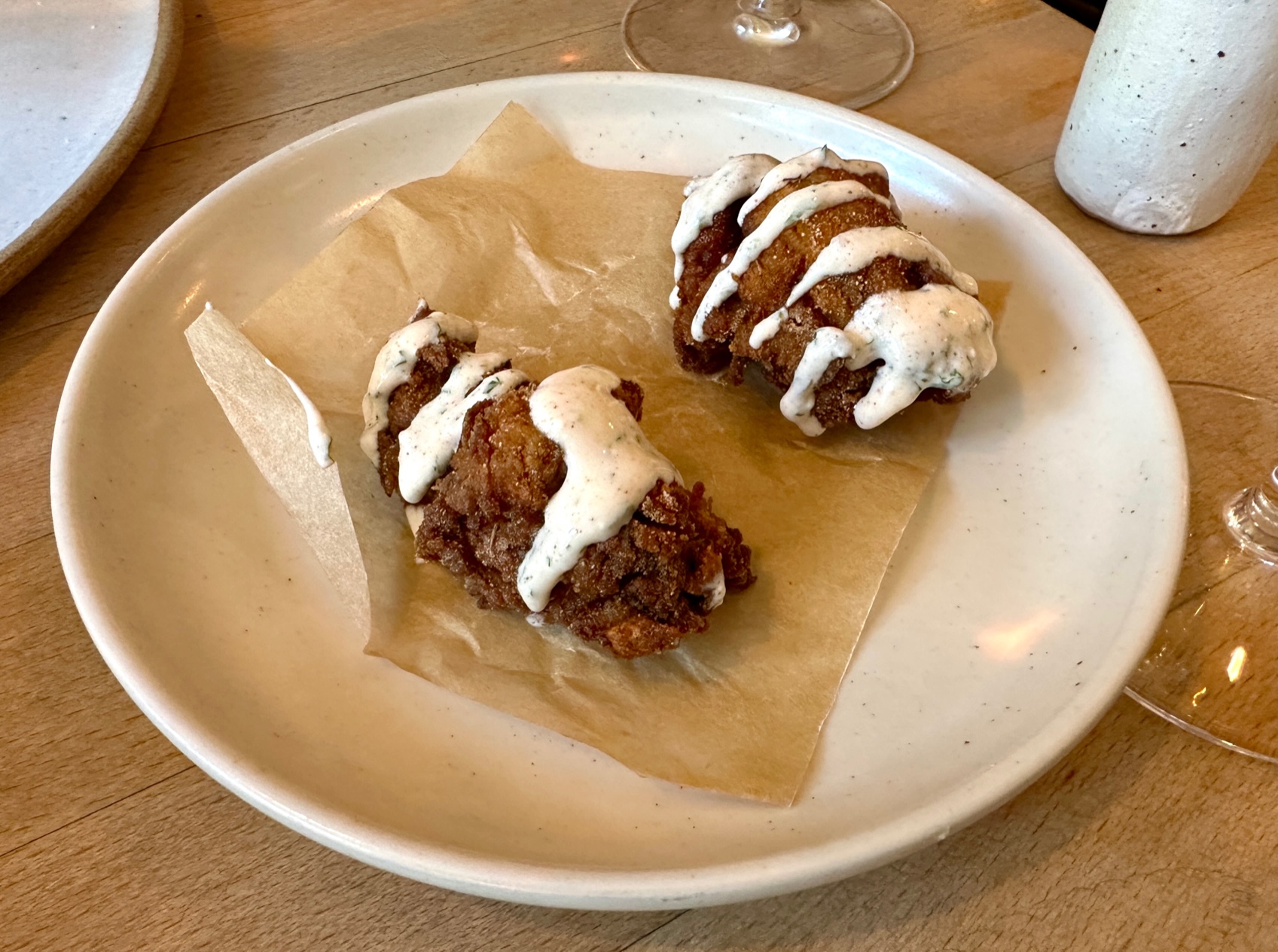
And there was still time for one more extra, one more whistle and bell to show that the kitchen left no stone unturned. We were also brought two pieces of what the waiter called “Kentucky Fried Pheasant”, little nubbins of pheasant thigh coated in the restaurant’s secret blend, deep fried and then drizzled with a ranch dressing including some of the same spices. You might wonder who goes to all that trouble, and I wouldn’t blame you. Wilsons do, that’s who. I may never get to try Eton Fried Swan (once we have a republic I really think this is a franchise that could take off) but until then this will tide me over nicely.

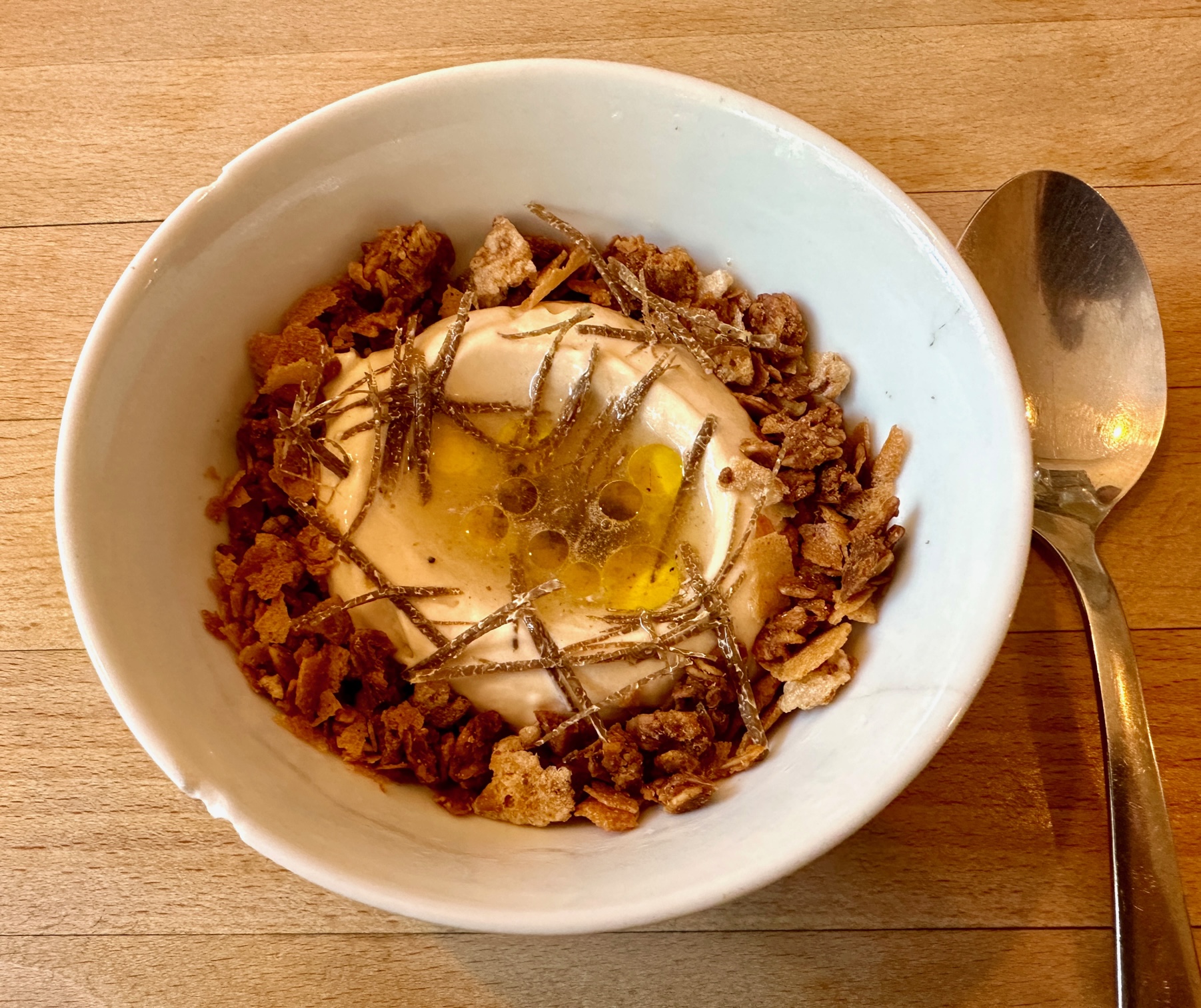
Having had some of the best, most interesting courses of my restaurant-going life, presumably things would dip for dessert, right? They so often do, after all. Well, think again: Wilsons’ dessert was also a desert (or even dessert) island dish. On paper it just sounded weird – celeriac, fermented honey and truffle. And it might not have been to everyone’s taste, but it absolutely knocked my socks off. The celeriac was an ice cream, more a semifreddo really, with a pool of fermented honey lurking in its hollow. All around it were toasted grains adding crunch and sweetness, and then on top were little truffle shavings.

I don’t know who thinks to put all those flavours together, and it’s a highwire act where any of them could have backfired. But none of them did, and this is the dish, more than any other, that I’ve thought about since that meal. I’ve had parsnip ice cream before but never celeriac, and it worked better than I thought it would. But what I loved was the harmony. Truffle isn’t a team player, nor is anything fermented. But the kitchen deftly drew all of that together into something delicious, remarkable and perhaps slightly mad. And yet not a note was out of place.

Now in Michelin-land, if they haven’t given you a minuscule pre-dessert they tend to send you on your way with some petits fours. They’re not big but they are clever, and they’re another way of making you feel like you’ve had something for free even though all of that luxe is very much priced in. So I adored Wilsons for instead bringing over a hulking great canélé de Bordeaux for each of us.

Now, I’ve had these many times because Reading is lucky enough to have Davy of Wolseley Street Bakery fame, and this is one of his specialities which he supplies to various places, most notably Geo Café. I like a canélé. But this was a completely different beast, and I wasn’t in Kansas – or Caversham – any more. This had been elevated with whisky and tonka, and the sweetness and richness was like little I’ve experienced. This level of sensory opulence is something I associate more with fragrance than with food, and I can’t put it more strongly than this: if somebody sold an eau de parfum that smelled how that canélé tasted, I’d buy a bottle. They were so good I can even forgive Wilsons for putting the napkin underneath them, although I still think that’s baffling.

My meal – two aperitifs, a bottle of wine and all those terrific experiences and memories – came to two hundred pounds including service, and I’d do it all over again in a heartbeat. If Wilsons did vouchers I’d just ask for some for Christmas, and as it is I’m struggling to imagine going to Bristol without eating there again. More to the point, I’m wondering how quickly I can justify going back. As it was, we left knowing it would take a while to process just how good our meal was, and fell into a beautiful nearby pub called the Good Measure which, as luck would have it, was doing a tap takeover by our very own Siren Craft. It was Friday afternoon, I was full and happy and I’d had a miraculous lunch. Life rarely gets much better.

I’m sorry-not-sorry for putting you through this catwalk show of beautiful dishes and purple prose. Sorry because it’s a lot to rattle through, and also arguably sorry if I’ve made you hungry (although, also, not sorry: this is what restaurant reviews should do). Sorry that I’ve rhapsodised about a restaurant that’s a train and bus trip from Reading. But also not sorry, because this is one of the best restaurants I’ve been to in years of trying, and that deserves to be mentioned. I’m sorry because Reading doesn’t have somewhere to match Wilsons and, in fact, I don’t think it ever has. But I’m also not sorry because when people ask me what Reading needs I might stop talking about tapas restaurants, ice cream cafés and good wine bars and just say: it needs somewhere like Wilsons.

Wilsons – 9.6
24 Chandos Road, Redland, Bristol, BS6 6PF
0117 9734157

https://www.wilsonsbristol.co.uk

Restaurant review: Caper and Cure, Bristol

I don’t know how many restaurant reviewers you read – apart from yours truly, naturally – but the shocking truth is that I don’t really bother with any of them. I’ve no interest, for instance, in reading Giles Coren wanking on in his Corenesque way about another country pub near his house in the Cotswolds, peppering it with his usual contrarian casual racism. If I want to be bored shitless by an edgelord, I’ll just fire up Twitter.

That’s rich coming from me, I know. The irony isn’t lost on me, and if everybody thought the way I do I’d probably have the grand total of about three readers. But there you go: with some of the big names I have a peek to see where they’ve reviewed, and I might scan through to see if they liked it – if it’s somewhere I might one day go – but beyond that I don’t really pay much attention. 

So for instance I know that Grace Dent from the Guardian had a meal in Maidenhead not too long ago that she really enjoyed. As a result I’ve added the venue to my to do list, but I won’t be poring over her deathless prose line by line before I go. Similarly the subject of this week’s review, Caper and Cure, received rave reviews in the Sunday Times and the Financial Times recently. I didn’t read them (because paywall, Rupert Murdoch etc.), but when I happened to be in Bristol for the weekend I made a beeline there to see what the fuss was about.

And yes, that means another Bristol review, which in turn means that some of you will look away now – or, more likely, didn’t click on the link in the first place. But I make no apologies, because for many years now Bristol has had, for my money, the most interesting food scene in the U.K. Cities and towns like Brighton (back in the day) and Margate always strike me as trying to be London-on-Sea, but what I love about Bristol is that it ploughs its own furrow, with no interest in being anything other than itself. 

Places that want to develop a food culture, like Reading, could learn a lot from that: if we got even a fraction of the kind of restaurants in our town centre that Bristol seems to say hello to every month, we’d be a much richer place for it. Besides, it’s just over an hour away by train. 

So Zoë and I turned up on a Saturday lunchtime to check it out. Caper and Cure is in Stokes Croft, a short stroll from Cabot Circus, the city’s main mall, at the point where Bristol starts to get properly lively and interesting. Beyond Caper and Cure, Stokes Croft becomes the Cheltenham Road and then the Gloucester Road, a fascinating indie-land of bars and restaurants, shops selling every kind of beer or wine and charcuterie (and a special prize surely has to go to the splendidly named Bristanbul, a Turkish bakery).

On the walk to the restaurant I saw the parts of this area that have defeated gentrification: the patch of land called Turbo Island still sports a couple of shabby sofas whose best days were decades ago, and the people sitting on them were already a few cans of lager to the good by early afternoon. The last time I was here I had a fantastic brunch at nearby Jamaica Street Stores: it closed last month after five years, partly because of growing issues with Turbo Island.

But Caper and Cure, a handsome blue and gold fronted restaurant on the corner, still felt relatively genteel; Stokes Croft institution Café Kino is next door, and the gorgeous Elemental Collective sells coffee and pastries the other side of the road. The building Caper and Cure is in used to be a chemist, back in the Twenties, and the room retains exceptional bones – generously proportioned floor to ceiling windows letting in tons of light, and a compact, almost-triangular dining room with about twenty covers. 

A fetching button-backed banquette ran along one side – we were seated at the slightly less attractive tables on the other side of the room, but it didn’t feel like there were any truly duff seating choices. There was a small counter at the back, the open kitchen beyond, and along one wall was a map of Europe showing the provenance of some of the ingredients used in the kitchen: a nice touch. Why was Bristol so good at making excellent dining rooms and kitchens out of such modest spaces, and why had none of that genius ever made it down the M4 to us?

For that matter, why were Bristol restaurants so good at putting a menu together which was simultaneously compact but where you wanted to order everything? Four starters, five mains, three desserts, a cheeseboard and a couple of specials. Starters around a tenner, mains fifteen to twenty quid, desserts maxing out at eight pounds. Absurdly streamlined, really, compared to the overkill of so many restaurants, and yet I could have ordered any combination of dishes (I should mention, too, that this being Stokes Croft vegetarians and vegans also had decent, imaginative choices). There’s a real talent to assembling a menu like this, to hitting all the bases and keeping it lean and appealing, and I for one wish more restaurants had it.

But before we made those agonising yet enjoyable decisions, we tried a couple of things from the snacks section of the menu. Cauliflower cheese croquetas were a real piece of wizardry, with spot on crunch and the smoothest, glossiest core, tangy with cheese and the sweetness of cauli. Each of them sat under a little Johnsonian toupée of Parmesan, each was stupendous. A ridiculous five pounds for these, and it took all my strength not to order more. 

But even better was the sourdough with jamon butter. The words “jamon butter” rather sell short what you got, a quenelle of salty, savoury spreadable jamon with a texture somewhere between whipped butter and rillette. It was one of the most moreish things I’ve eaten in years, and if they’d sold it over the counter I’d have walked out of the restaurant at the end of my meal with a tub of the stuff the size of my head, knowing full well that it wouldn’t survive the rest of the weekend. 

The bread that came with it was decent enough, but its one role was to provide a vehicle for eating the jamon butter that was more civilised than just devouring the stuff with your bare hands. If I’m being ultra-critical, one of the slices of bread was as much air as bread and if I’d been in the kitchen I wouldn’t have served it. But it upped the jamon butter to bread ratio, so it wasn’t all bad.  

A high standard had been set, and the starters just vaulted over that as if it was nothing. I’d chosen the sweetbreads, because I love them and they don’t turn up on menus in this country anywhere near often enough. Caper and Cure’s might well be the best I’ve ever had: pert and tender, in a dish where they played the starring role but with excellent support. That meant fresh, nutty peas, translucent slices of radish and some braised baby gem, but more importantly it meant a chicken butter sauce bringing the whole thing together triumphantly. It supplied another intense umami hit, fortified with little nuggets of pancetta just in case you weren’t having enough fun already. 

As we discovered over this and our other dishes, Caper and Cure specialises in those high-gloss, super-reduced sauces that speak of patience and expertise. Having finished my starter I was frustrated to see far too much sauce still in the high-sided bowl, but without prompting one of the wait staff asked if I needed some more bread. I didn’t think twice, and Caper and Cure’s bread with the remnants of my chicken butter sauce was, on its own, tastier than ninety per cent of the starters I’ve eaten in nine years of writing this blog.

Zoë was equally happy with her decision to order the burrata. It’s an ever-present on menus now, but I doubt many restaurants pair it with tomatoes quite as good as these (from the Isle Of Wight, of course). And more importantly I doubt many restaurants plonk the whole thing on their own exemplary tapenade, with the perfume of deep purple olives. I had a forkful of this, and although I couldn’t have not ordered the sweetbreads it also had much to admire.  

By this point I knew beyond doubt that we were in very good hands, and the only remaining question was just how special the rest of the meal might be. Our main courses answered that question emphatically. Hake, one of the two market fish on the blackboard, was cooked just right and perched on top of an absolutely glorious layer of pickled fennel, just sweet enough and just sharp enough: I’ve never had pickled fennel before, and now I’m just counting the days until the next time. 

A tangle of samphire heaped on top added a little saltiness and if the skin wasn’t as crispy as I’d have chosen, that was probably because the whole thing was swimming in a superbly glacé lobster sauce. It wasn’t all perfect, mind you; I’d personally have liked the orzo, the base of the dish, a little closer to al dente and the lobster sauce was more muted than it could have been. But those would have been minor niggles at the best of times: on such a successful plate of food, coming in at a ludicrous twenty-one pounds, they were just the only things I could find that fell short of flawless. It was still one of the most marvellous dishes I’ve eaten all year.

Zoë had absolutely no reservations about her rump of beef, and the couple of forkfuls I had were easily enough evidence to understand why. It was a beautiful piece of meat, cooked medium-pink but with a nice crust, but again it was all about how that ingredient played nicely with the delightful company it was keeping. In this case that meant another sticky, glossy sauce – peppercorn this time – little puddles of onion purée and banana shallots, also with a little char. And to add a little ballast, a perfect slab of Pommes Anna, as enticing and multi-layered as a great novel. This might have been one of the most marvellous dishes I didn’t eat all year, but at least it went to a truly deserving home

We had some Parmesan and truffle fries with our mains – completely unnecessary but also impossible to resist – and they were themselves a fascinating experience. It’s a dish that crops up on menus a lot lately, from Buon Appetito to the Last Crumb and beyond, but in most places it’s a way to tart up bought-in French fries and flog them for a fiver. Here they were the real deal, and when we’d finished our mains and used the fries to clean up the last of our respective sauces we picked at the rest with slightly oily fingers and glad hearts.  

Dessert was the point at which things stopped being spectacular and settled for merely being rather good: technically there are only really two desserts on the menu along with a couple of cheeses and chocolate sorbet with coffee liqueur which felt like a distant cousin of the affogato. I rather liked my panna cotta, which had a pleasing wobble, tons of crumbled pistachio on top and a moat of strawberries and sweet syrup. But the advertised wild honey was the quietest of whispers, and without it the whole thing felt a little run of the mill.

I thought Zoë chose better than me, but she wasn’t wild about her choice either. A rum brûlée was served denuded of a ramekin – how often does that happen? – with plenty of pineapple and coconut sorbet. I liked it, although again the rum was a little muted, and I thought it all worked well together. Zoë was less convinced, and I think on another day would have had the chocolate sorbet. But we were both being restrained, with a boozy evening ahead and (in my case) a gin sodden one behind me, so we steered clear of booze.

That means I can’t tell you anything about the wine list, which is a matter of some regret for me as it had plenty to appeal – and three special wines available by the glass, including a Georgian orange wine by Tbilvino which sounded well worth trying. But instead I’m afraid we were well behaved – I had a very good alcohol free pale ale by local Bristol Beer Factory and Zoë had soft drinks. Next time I go, which I anticipate will be the next time I visit Bristol, I’ll try it properly.

I haven’t really talked about service, but it was very much of a piece with everything else: smooth, efficient, friendly and good at making everything look easy. Offering me some bread with my starter was a great example, but really the whole thing seemed effortless. Caper and Cure wasn’t as busy as I expected but it had a real mixture of tables and types of diners, with more people coming in for lunch as we were leaving, and the whole thing had a nice flow and rhythm to it. I imagine it would be a truly enchanting place to have a boozy evening meal with friends, and next time I go there that’s exactly what I plan to do.

Our bill came to a hundred and twelve pounds, including a twelve and a half per cent service charge, and when the owner came to take our payment I pointed out that they’d slightly undercharged us. Before we left he asked where we came from, and if he was fazed that people had come all the way from Reading he concealed it well; I looked him up afterwards, and it turns out he’s also a professional actor (“you can just tell” said Zoë as we ambled up the Cheltenham Road in search of caffeination).

This is the second critically acclaimed Bristol restaurant I’ve visited this year, and the contrast with Sonny Stores couldn’t have been more marked. Restaurant critics like to talk about Bristol growing these restaurants – small, unpretentious places with short, magnificent menus and interesting wine lists – as if in a laboratory. And it’s true that the place is a Petri dish for culinary creativity, more than anywhere I know.

But I think it doesn’t do Caper and Cure justice to make it sound like just the latest place to fall off some gastronomic assembly line. There’s something uniquely special about it, and re-reading this review I’m not sure I’ve truly captured it in what I’ve written. It’s worth going to these places, even if they’re an hour and a quarter away by train, to remember what we have to aim for in Reading and that for all the Kungfu Kitchens, the Bakery Houses, the Lyndhursts and the Clay’s we still have some distance to travel.

If a restaurant like Caper & Cure opened in Reading it would be packed to the rafters every night and lauded as far as the eye can see. And yet in all the time I’ve been writing this blog, the best part of a decade, nowhere even slightly like Caper and Cure has opened here. At some point, we might all have to stop and think about why that is. Reading has the money, it has the prosperity and it has a discerning demographic. Why don’t we have the restaurants?

Caper and Cure – 9.2
The Old Chemist, 108a Stokes Croft, Bristol, BS1 3RU
0117 9232858

https://www.caperandcure.co.uk