Nirvana Spa, Sindlesham

I’ve never reviewed the French Horn in Sonning, for one specific reason. Not the prices, although when starters hover around the twenty pound mark and main courses edge closer to thirty it does get harder and harder to say “hang the expense”, convincingly at least. It’s not the faffiness of the menu, although the French Horn’s Habit of Capitalising Pretty Much Every Word does lend Proceedings a Weirdly Dickensian Feel. It’s not even the fact that the menu seems to have an asparagus with hollandaise sauce on it all year round at twenty quid (is it flying first class from Peru?).

No, the reason I haven’t gone to the French Horn is that I’m reliably informed it has a dress code, and I just don’t do dress codes. It feels like a throwback, and something about getting into my glad rags just really rankles. I mean, I’m the customer aren’t I? And it’s not like I’d turn up in a crop top or a string vest, hot pants or swimming shorts; I’ve eaten at lots of lovely restaurants just the right side of well turned out and never been turned away, but when somewhere pompously announces they have a Dress Code (those Dickensian capital letters again)? Count me out.

What that means is that Nirvana Spa is probably the only place I will ever review which does have a dress code. And when I say dress code, I mean that you eat your lunch or dinner in a lovely white fluffy robe, your towel nonchalantly draped over the back of your chair and – in my case – your trashy paperback perched on the table. And if you go on a warm day, like I did, you get to do all of this outside, beaming at everybody else, similarly attired. This must be a bit like how it feels to be in a cult, or live in California (or both), I’ve always thought.

Sometimes I review restaurants and I’ve had a bad day first. I love writing reviews, but it’s a bit like a job – admittedly a job I adore – and there are times when you go and your heart isn’t one hundred per cent in it. Things are crap at the office, or the car failed its MOT, or you’re out of sorts with a friend, or Britain has voted to leave the EU and you still have to go out, eat with an open mind, take photos and write hundreds of words about what it was like. Hopefully you can’t tell in the words or the rating, if I’ve done it properly.

Nirvana is the other way round, if anything – it’s hard not to be happy when your most difficult decisions that afternoon are whether to read Hello! or OK!, whether to have the honeycomb tiffin or the salted caramel ice cream in the Roman Room, whether to go to the hydrotherapy pool or snooze on the heated terra cotta loungers. How can you have a bad meal under those circumstances?

On the other hand, I went on a long-booked visit the Sunday after the referendum result, when there was a weird atmosphere across the country. That weekend was like waking up hungover with The Fear, not entirely sure what you’d said or done or to whom. To complete the irony, Nirvana’s owner had sent a controversial mail to members only that week “offering them the opportunity to read” an article he’d written about how Brexit was a very good thing (I half expected to arrive to find bunting everywhere). So, a happy place at a sad time: what would lunch be like?

The menu at Nirvana has two options – either all you can eat from the salad bar (which also features a number of hot options) for fourteen quid or the a la carte menu which has starters, sandwiches, salads and main courses. The salad bar is included if you visit as a day guest rather than a member and really, I ought to have eaten from it to give you a representative view. But I’m afraid I was in need of cheering up so I didn’t, although I can tell you from past experience that it’s not half bad (and especially impressive for vegetarians and vegans where it gives a range of choice you’d struggle to match elsewhere).

Instead I stuck to the menu, deciding to kick things off with a selection of artisan (everyone’s favourite ubiquitous, meaningless word) breads for two. I was denied the opportunity of doing this when they turned up at exactly the same time as the starters, but none the less they weren’t half bad, especially at less than two pounds. All warm, some slightly toasted, a good array with the dark malted one, studded with seeds, my particular favourite. Butter was at room temperature (which always helps) and it was nice to have olive oil and balsamic although, as so often, nowhere near enough.

NirvanaBread

The starters were less impressive. We’d both gone for salads and I wonder whether they had decided to prioritise virtue over taste. Smoked chicken salad was presented in a way almost deliberately calculated to underwhelm – a fan of smoked chicken on one side of the plate, your salad on the other. Not mixed at all, and the salad also appeared to be barely dressed at best. What’s a real shame about this is that it had potential to be a lovely starter if done better – the salad was full of firm peas and crunchy beans and would have been beautiful with a bit more dressing and the smoked chicken, although a tad wan and floppy, did set it all off nicely. I seem to recall that the menu at Nirvana specifically says that you can ask for your salad dressing to be left off completely; it’s a pity it doesn’t also give you the option to ask for it be glugged on with abandon.

NirvanaChicken

Similarly, the baked smoked salmon salad was an exercise in restraint. A handful of salad leaves lightly dressed, topped with a thinly sliced radish (singular, I’m guessing) with a few chunks of salmon dotted round the edge. I was expecting a tangible piece of salmon rather than these chilly fragments and considering it was the most expensive starter on the menu (nine quid, since you ask) it felt miserly. It came with a wedge of lemon, just in case you weren’t feeling bitter enough, and a few de-seeded slices of chilli, mixed in as an afterthought. If I’d made this myself with bits from M&S it would have cost half as much and been twice as big. A shame, because what there was was nice, refreshing and light. I was just glad we ordered the bread.

NirvanaSalmon

After all that the main course was a beautiful, delicious surprise. Fillet steak came with a delicious, nutty pearl barley risotto which I adored. I’ve had pearl barley risotto quite a lot in Prague for some reason but it doesn’t seem to crop up on menus here much, a shame because it has much more about it than conventional risotto often does. There was also a solitary carrot – fair enough, I suppose – and two beautifully sweet, shallots which had been cooked into softness. The fillet itself was rare, exactly as requested (I went back to CAU recently and they, a specialist steak restaurant, still seem unable to get this right: Nirvana 1, CAU 0) and although I would have liked it to have a little more flavour, the texture was terrific. Finally, drawing everything together, what the menu described as “oxtail sauce”, rich strands of oxtail strewn on top of the fillet and all over the pearl barley risotto. Sixteen pounds fifty for that lot, and one of the most interesting ways I’ve had fillet steak for a very long time; if this dish had been on the menu at a restaurant near me I’d already be trying to contrive an excuse to go back.
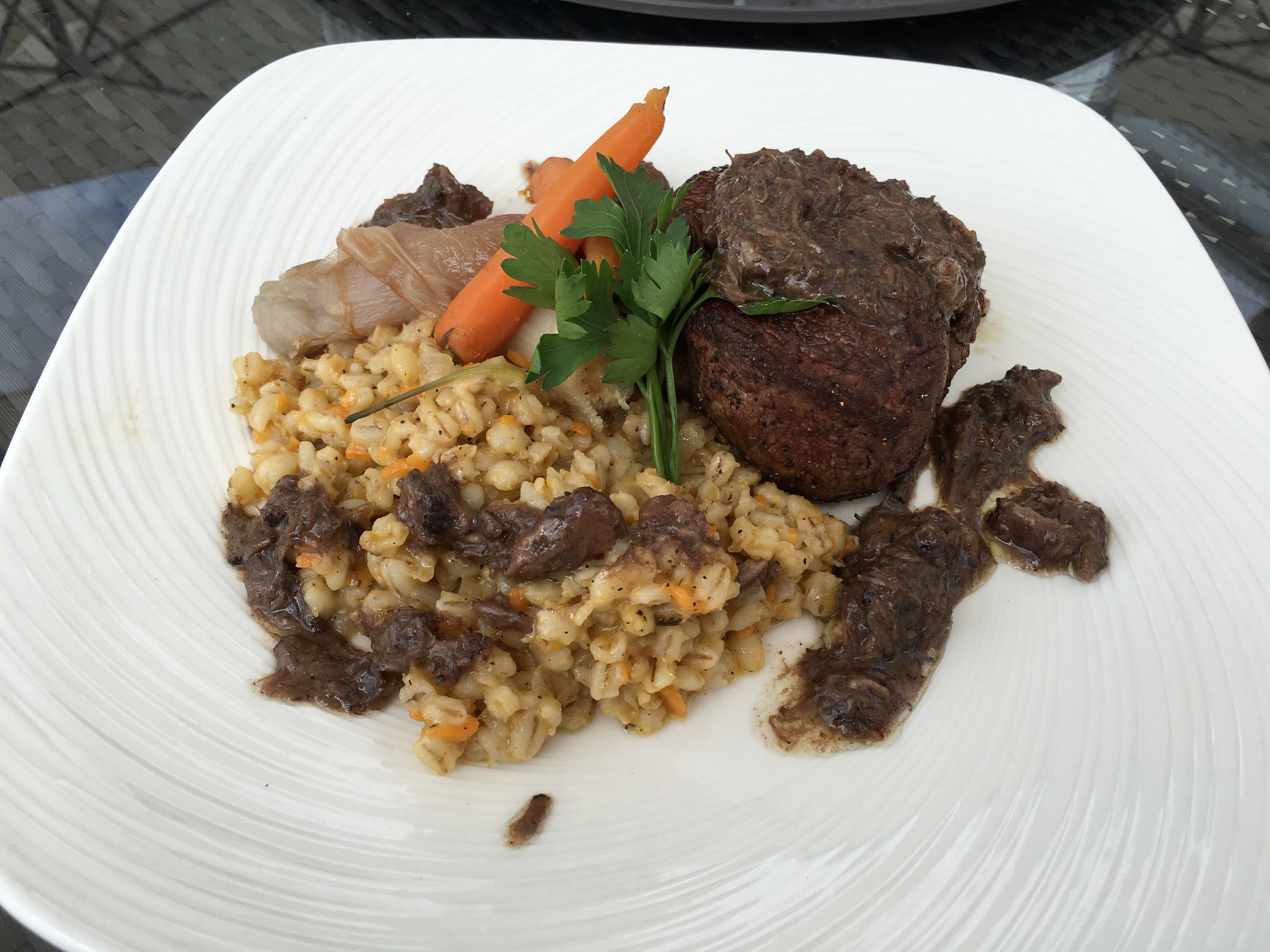
NirvanaBeef

I also wanted to check out the lighter options on the menu, so we ordered a pulled pork wrap. This was just lovely: the thin flour tortilla was rammed full of really good pulled pork (smoky and sweet without being sugary as it so often is) with fresh, crisp, contrasting coleslaw. I liked the fact that it was served warm, too – so different from a cold claggy sandwich. It cost as much as the salmon starter, but felt like considerably better value. It came with a small leafy salad I didn’t much care for with a squiggle of creamy dressing, but perhaps I was just saladed out by that point, if such a verb exists. It might not have looked much in comparison to the fillet steak, but I thoroughly enjoyed it all the same.
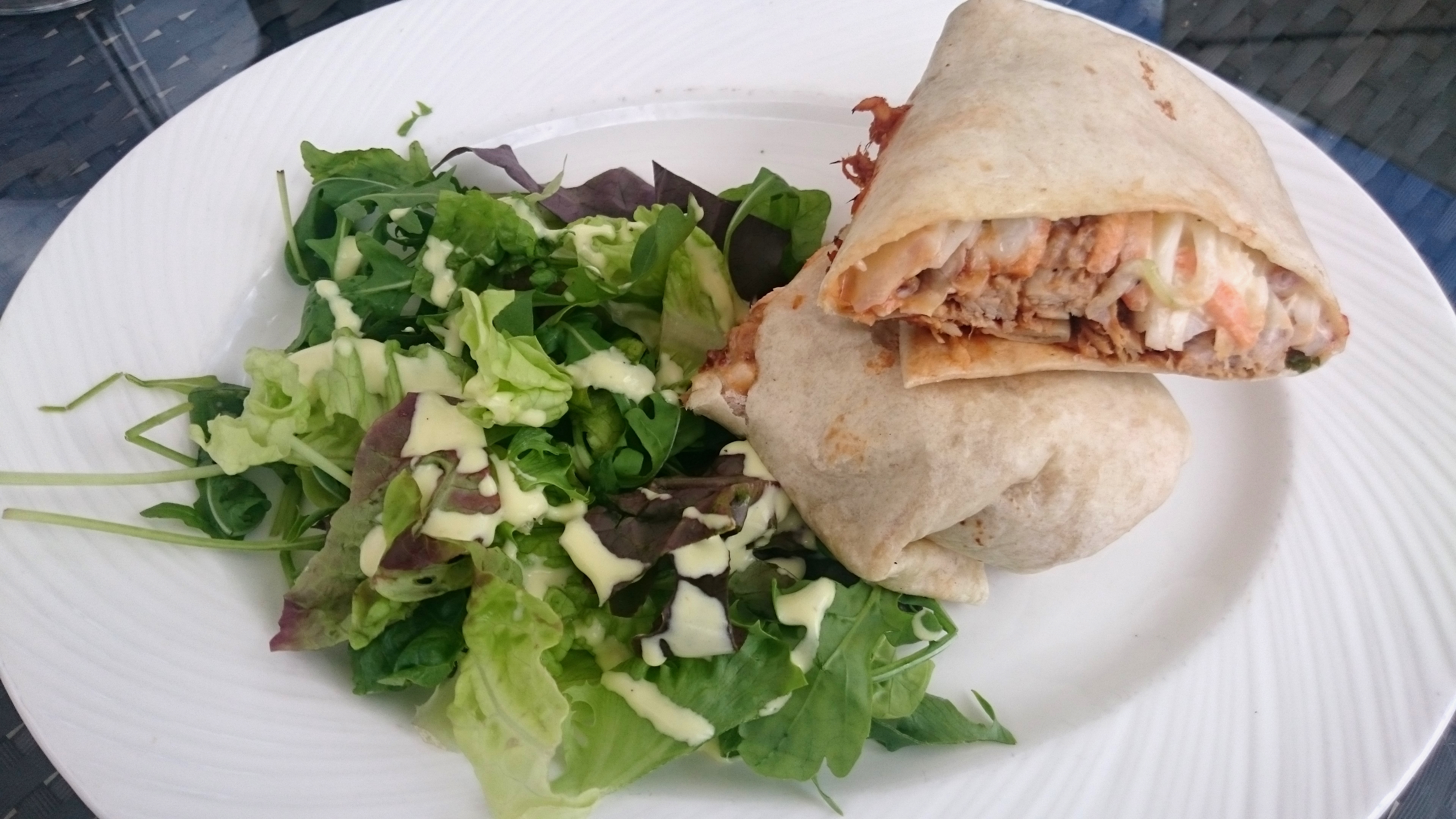
NirvanaPork

Nirvana isn’t the place to order a dessert; you’re there all day after all, and saving some room for an afternoon snack is one of the only ways to break up the delirious monotony of being a modern-day lotus eater. So we finished our drinks (a decent glass of New Zealand sauvignon blanc for me and a rose cava for my companion), charged the meal to a membership card and ambled off in the direction of an outdoor jacuzzi. Two courses, that bread selection and a couple of drinks came to a smidge under fifty-five pounds. That doesn’t include service at Nirvana, but all the service there is smiley and friendly, on the informal side but none the worse for that. If they were elated or devastated about Brexit, they certainly didn’t give it away.

As I sat in the outdoor jacuzzi, wishing they let you drink bubbly in there, I did briefly wonder about whether you could separate Nirvana’s food from the overall experience of being at a spa for the day. I’m not sure. If you picked the restaurant up and plonked it somewhere else, aside from being perturbed that all your fellow diners were in robes, I think you would like but not love the food. Not just that, but some of the pricing seems strangely generous (that fillet steak main), some arbitrarily expensive (the smoked salmon starter). As so often, I wonder about the wisdom of giving a rating; I love being at Nirvana, I love eating there and yet eating there isn’t quite the point. But then I decided I’d thought about it quite long enough – the world outside appeared to be either taking back control or falling to pieces, depending on who you believe – and before long I would have to leave my hermetically sealed bubble and go back to it. I was glad my phone, with access to constant news, was stowed away in a locker.

Later on I did go to the hydrotherapy pool, by the way. Some of the massage jets weren’t working, and many of the handles you use to cling to the side were broken off. It’s been that way since the start of the year: it’s a shame the owner feels like he has better things to do than fix it.

Nirvana Spa – 7.3
Mole Road, Sindlesham, RG41 5DJ
0118 989 7500

https://nirvanaspa.co.uk/

The Little Angel, Henley

I was really sad when I heard the news a few weeks back that the Lyndhurst had closed down, another casualty in the ongoing battle between landlords and pubcos. One thing Reading still lacks is a decent range of town centre pubs that do good food. It’s not all terrible: we have the Moderation (although it’s hit and miss, and a bit out of town); the Nag’s Head (just for the pulled pork rolls really, but they’re dead good); and of course I Love Paella at The Horn, but I had high hopes that the Lyndhurst might be that place. Well, it turns it out it wasn’t. Even before it closed it never quite got there, it lost its chef and despite its shiny refurbishment the last couple of times I went I felt like it had stopped trying.

I daydream that one day Reading could get an establishment like Bristol’s brilliant Bank Tavern, a place that still looks like a well-worn boozer but does a small range of beautiful dishes. But days like today that seems a long way off, so this week I headed to Henley, home of the wonderful Three Tuns, to see if lightning really could strike twice in the same place.

The Little Angel is not to be confused with the more well-known Angel on the Bridge in the centre of town (the one with the tourists, plastic cups and a nerve shredding seating area suspended over the river). The Little Angel is just the other side of that bridge, where the road forks between Wargrave and Remenham, yards from the boat clubs and the areas where most of the Henley Regatta excitement happens (if you class that sort of thing as exciting).

The pub itself is an attractive white building with a large conservatory painted in a muted olive green. We originally decided to sit in the conservatory – it was a hot day, and the open doors were very welcome – but eventually decided to move because it was such an ugly room. Maybe at night, filled with people and with the Moroccan lanterns hanging from the ceiling it might have been a lovely place, but daylight didn’t improve it. Instead you saw the mismatched tables and chairs, the scruffy unattractive tablecloths and got a slight sense of decline. It wasn’t inviting.

Back in the main pub itself things were much nicer, although still rather empty, and we got to have a good look at the menu. It had just enough flashes of variation – turmeric, cardamom and cinnamon spiced rice, aromatic duck broth, harissa marinated chicken – to lift it from the usual pub fare of pork belly, burgers, sausage and mash. Annoyingly, in the couple of weeks since I visited the menu has now changed completely: frustrating to experience as a reviewer, but good to see as a diner (although really, you ought to change your menu more than once every five months if your website is going to talk about your love of seasonal food). There were, in the pub’s defence, a couple of specials up on the board.

Originally we were tempted to start with a sharing platter but neither of them quite grabbed us enough, because they seemed to be one or two nice things from the starters section with a lot of padding (houmous, baby chipolatas, the kind of stuff you find in the “picnic” section of Marks & Sparks).

Instead I went for one of the more interesting-sounding starters on the menu. Spiced squash and goat’s cheese samosa was nice if not wildly exciting: two small samosas which tasted mainly of goat’s cheese, possibly because squash is too delicate a flavour to compete with all that salt. The pastry was thin and crisp with the sort of fluffy cheesiness inside that you’d expect from hot goat’s cheese. I was really expecting this to be lifted by the accompanying curried cauliflower purée, served as an arty smear on the side. Sounds lovely, doesn’t it? Unfortunately it didn’t bring enough punch to be worth adding – not enough spice, not enough flavour, lacking the courage of its convictions. Toasted almond flakes, always a welcome addition, brought a bit of much needed texture but even so it was hard to feel enthusiastic about the whole thing.

LAParcels

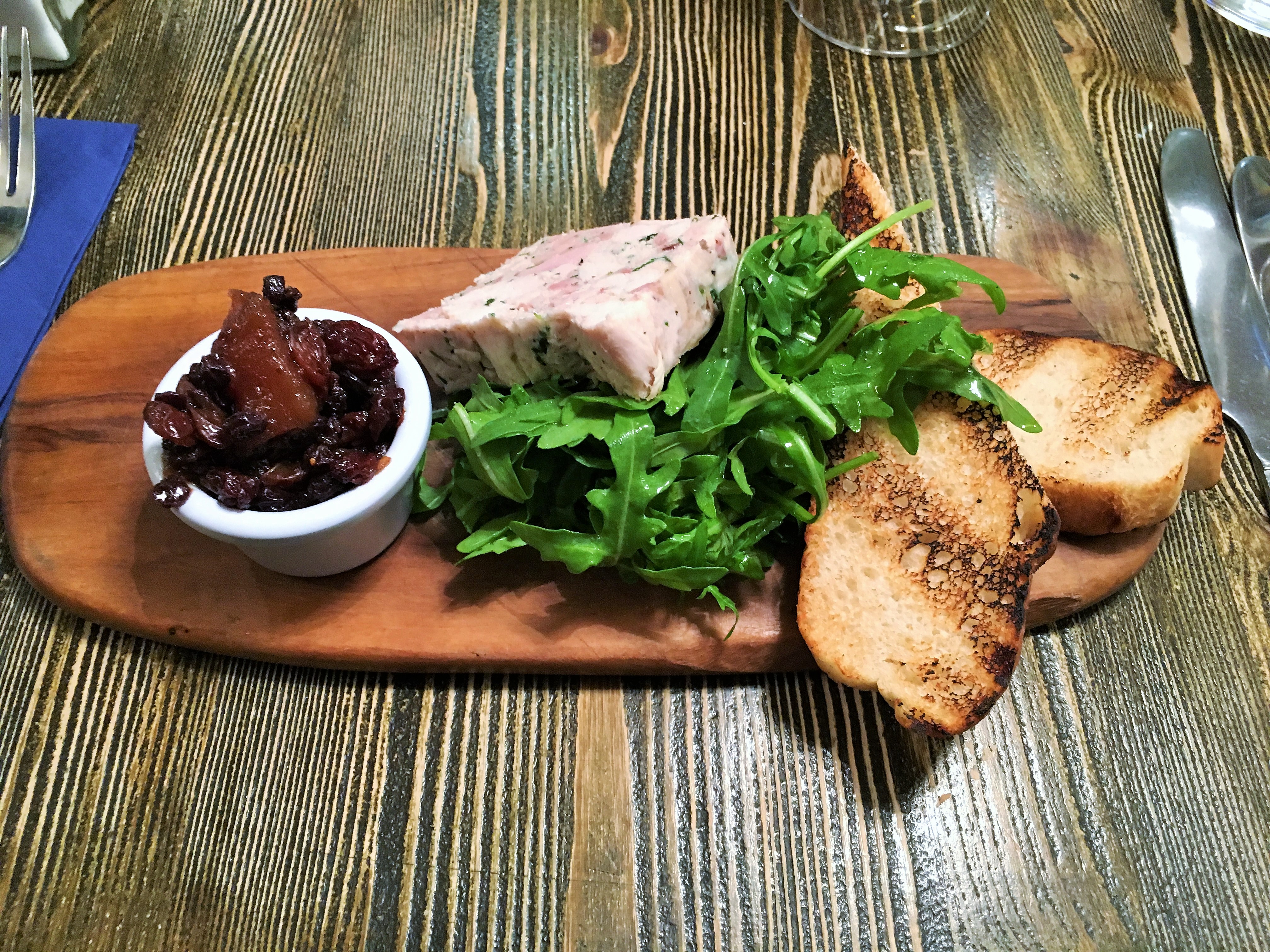
The chicken and guinea fowl terrine was also a dish beset with problems. There’s a fine line between subtle and clean-tasting on the one hand and bland on the other. I’m still not entirely sure which side of it the terrine fell on – there was a bit of tarragon, which I loved, but overall it was still a bit dry and softly-spoken for me. Drier still because the advertised focaccia really wasn’t focaccia. None of that moist, cakelike feel, no drizzled oil, no lovely oozy toasted texture. It was just bread. The last possible salvation, the balsamic fruit chutney, wasn’t really chutney. It was a small ramekin almost exclusively full of raisins (which I personally don’t like).

Also, I don’t normally complain about how dishes are served – slates, boards, they’re all fine with me – but I do like to have enough space to actually eat the blasted thing. No such joy here – all of it was crammed on to a small board as if it had been forced to walk the plank, and it was difficult to press your dry terrine on to your dry toast before sprinkling it with dry raisins without getting some overboard. If that doesn’t sound like a lot of fun, it’s because it wasn’t.

LATerrine

I’ve been to many restaurants where the starters were amazing, my hopes got raised and then a mediocre main turned up. That’s the nature of starters, it’s easier for them to leave you wanting more. But I’ve rarely experienced it the other way round, where an iffy starter gives way to an outstanding main, so by this stage it felt like our hopes had been way too high. We got as far as checking the train timetable to make sure we wouldn’t be caught in Henley for too long and planned a quick exit ready to be back in Reading for a digestif (well, pint) in the Allied before last orders. It felt like the Little Angel was going to be another lacklustre out of town pub no one would bother to go to, a review no one would want to read.

Then something remarkable happened: our mains arrived.

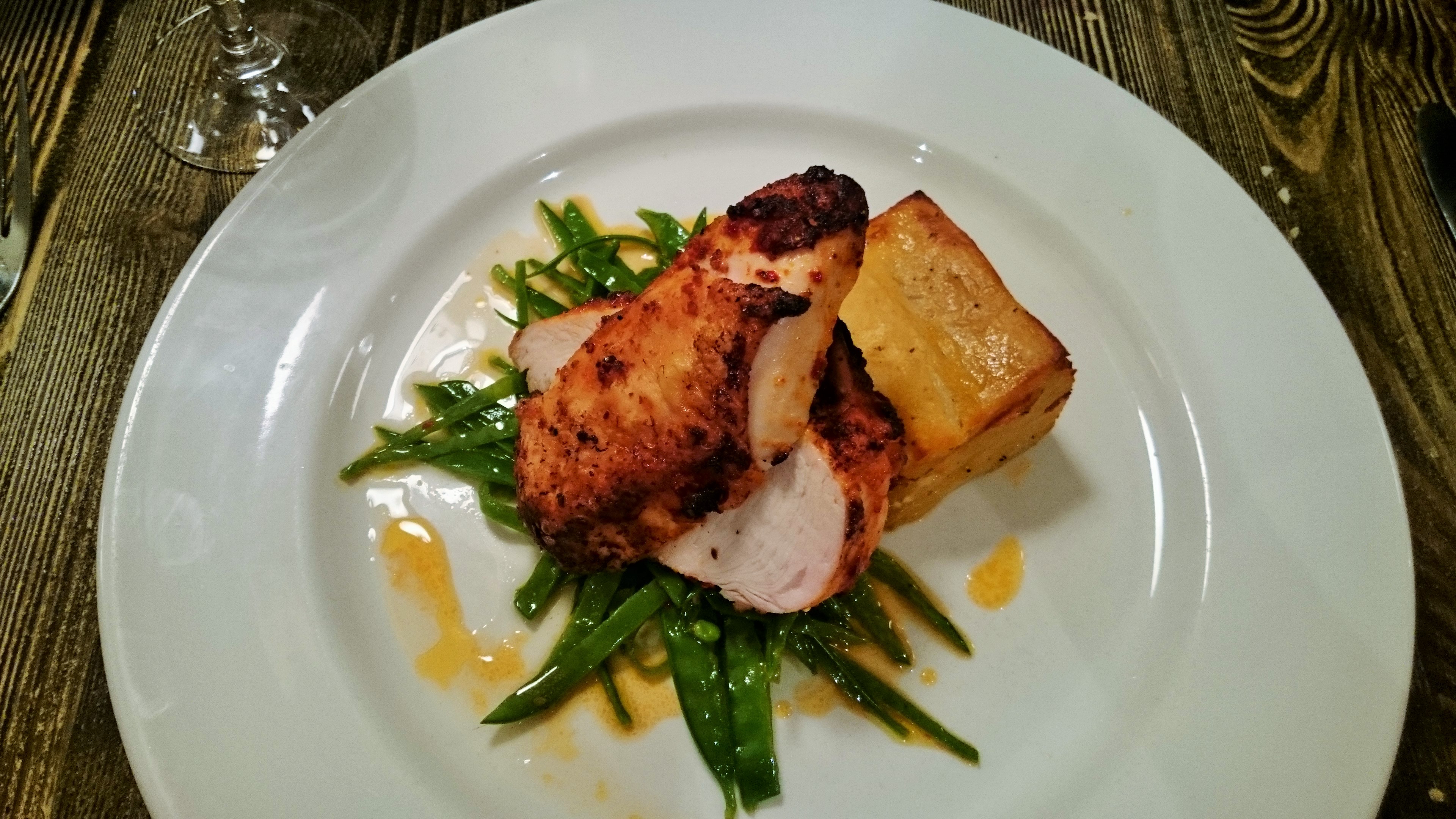
Harissa chicken was an interesting alternative to piri piri chicken, a supreme of chicken, juicy and yielding, the skin crisp but not overly so and the coating tasty but not fiery. A deceptively simple, nice thing. It came with chorizo dauphinoise, a new one on me and a salutary lesson in how to do something useful and tasty with the thin slices of catering chorizo that can so often feel like a let down. Here, discs of it were slipped between the layers of the dauphinoise, releasing their brick-red juices and adding an extra dimension. The potatoes were still a little dry (maybe the whole thing needed a tad more cream) but I liked it. Shredded mange tout, sitting underneath the whole affair, were really lovely – barely cooked, lots of crunch and sweetness and coated in something like chilli oil to add some heat (a side dish, of more mange tout with beans, shallot and chilli, was very similar). Not a hugely sophisticated dish, and possibly something you could recreate easily at home, but well thought out and well balanced.

LAChicken

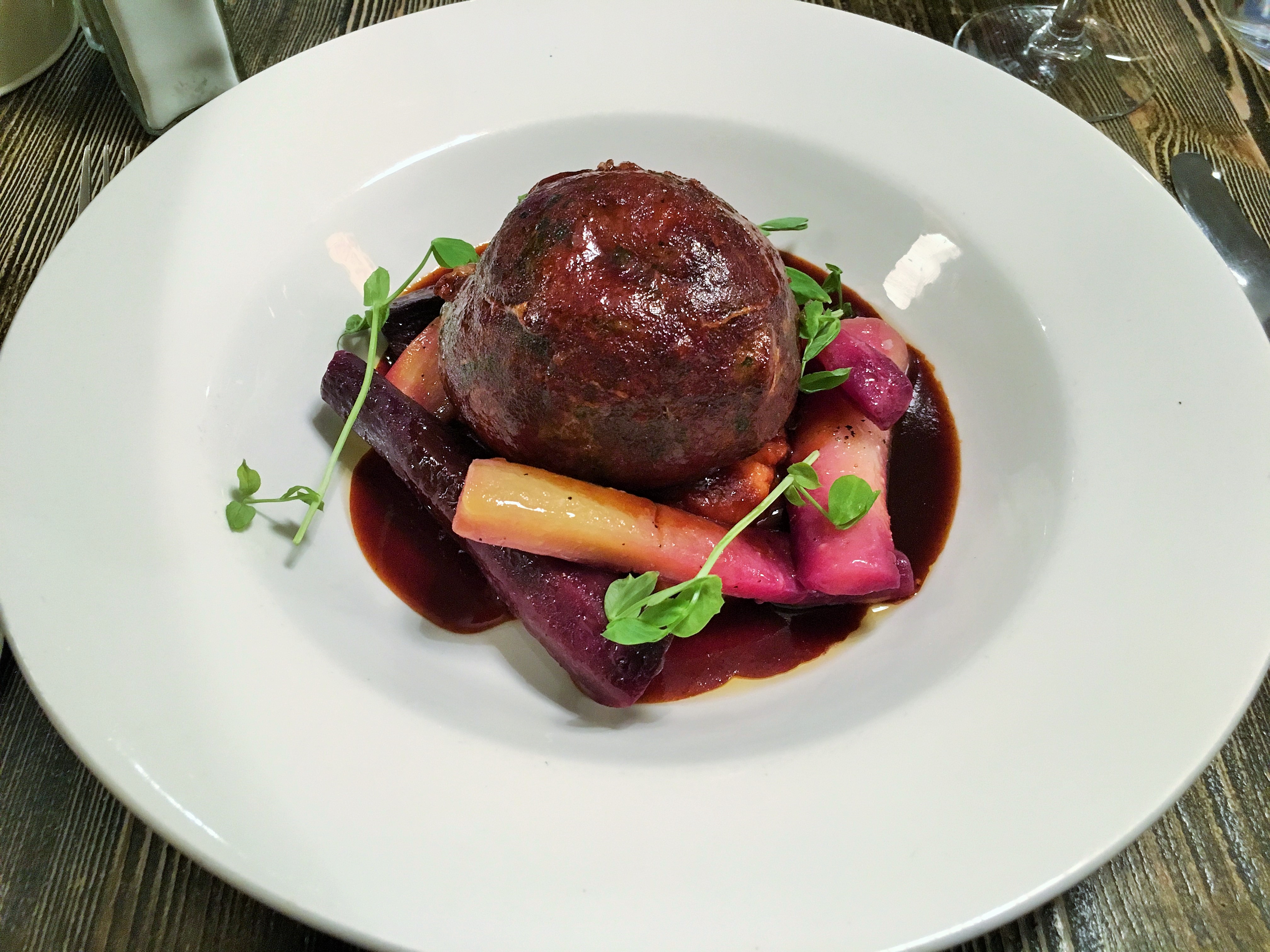
The other dish was the find of the whole meal, and nothing like what I expected from the menu. “Braised, shredded lamb and rosemary parcel” was the description, and if that wasn’t entirely accurate I have some sympathy because I too find this dish incredibly hard to describe. Parcel suggests it’s wrapped in something (generally pastry, I suppose), but what I got instead was a big dome of shredded lamb (shoulder, I’d guess), rosemary, potatoes and vegetables, bounded by itself. What was it? I still don’t know. Not quite a faggot, not quite a steamed pudding, not quite a meatball, not quite like anything I’ve ever eaten. What it was, though, was delicious. Huge, hearty, tasty and utterly bewildering. It came with a lovely, rich, sticky jus, a sweet smudge of puréed carrot and plenty of heritage carrots – thick, perfectly cooked, a riot of orange and purple to stop the dish being relentlessly brown. I’m sometimes critical of websites like Alt Reading for reviewing plays you can no longer see, so I feel a bit bad about enthusing about this dish: again I find myself cursing the Little Angel for changing their menu so recently, because I wish some of you could have tried this.

LALamb

So, iffy starters, terrific mains… and the desserts? Well, I’m afraid we’ll never know: I chickened out. I almost wanted to retain that element of suspense, and I couldn’t quite bear the idea that the lamb parcel might turn out to have been a gorgeous fluke. A shame in some ways, as again the desserts looked more interesting than run of the mill; I was especially pleased to see no chocolate brownie on there, always such a lazy choice for kitchens (although guess what? They’ve since added one on the new menu). So we settled up – dinner for two, two courses and a glass of wine each was fifty-three pounds, excluding tip. The wines in question were a Chilean chardonnay – perfect for the sunny evening; cold, crisp and easy to drink – and a cherry-packed Malbec. Service was respectable, with a very chatty, friendly bar manager and a slightly shy waitress actually doing the fetching and carrying.

If the Little Angel was in Reading, it would be a lovely place to go on a weekday evening or a Friday night. Reasonably priced (starters around the seven pound mark, mains for thirteen), comfy, a menu showing signs of imagination. Forming a relationship with a regular restaurant is like a friendship – the first impression is good, you enjoy that first meeting, you want to know more and then eventually you’re prepared to overlook an off night. And I can see that if the Little Angel was nearby that could definitely happen: yes, the starters were a little disappointing, but inconsistency isn’t the worst thing to level at a kitchen when it’s also capable of moments of magic like that lamb parcel. Even out of town, I can see that it would be worth a trip if you’re out that way (and you like the look of their new menu, of course). Most of all, this makes me sad that Reading doesn’t have that kind of place quite yet: casual dining is still too much a market cornered by the chains. So next time I have a weekday evening free, off duty, and I want to eat out you’ll probably find me at The Horn. Eating paella. Doing my bit.

The Little Angel – 7.0
Remenham Lane, Henley-on-Thames, RG9 2LS
01491 411008

http://www.thelittleangel.co.uk/

The Royal Oak, Paley Street

The Royal Oak appears to have closed at some point in late 2021. I’ve left the review up for posterity.

In nearly three years this is only the second time I’ve reviewed an establishment with a Michelin star. Part of that is because they’re all a little way outside Reading, and part of it is that I’ve never been entirely convinced they’re my cup of tea. I’ve eaten in a fair few, here and overseas, and they’re such a mixed bag that I’m not entirely sure what a star means any more. I’ve had beautiful meals in the Cotswolds and truly ordinary meals in London in starred establishments, and I’ve had wonderful evenings in many places bafflingly untroubled by Michelin.

My opinion has also been coloured, I think, by l’Ortolan (which describes itself as “Reading’s Michelin starred restaurant”). It’s a classic example of what you used to have to do to get a star – a beautiful old building in the countryside with a mind-boggling wine list, efficient but soulless service and a fiddly, precise menu of dishes which look better than they taste and where, even if you order well, there’s always a sense that you’re left with a dent in your wallet which doesn’t quite correspond to the amount of fun you’ve had.

My favourite Michelin starred restaurant was a place called Medlar at the unfashionable end of the Kings Road in Chelsea. Three courses during the week was a crazy twenty-five pounds, the service was lovely and friendly, the wine list didn’t feel like it was packed full of booby traps… and the food? Well, the food was plain delicious. When it lost its star (and I have no idea why it did) rather than making me think any less of it it reinforced my feeling that the Michelin inspectors and I were not fated to get along. But I’ve always been on the lookout for somewhere like Medlar closer to home, and that’s why I ended up making the half hour drive to Paley Street, not far from Maidenhead, to give the Royal Oak a try.

One thing I liked about the Royal Oak from the start was that it still looked like a pub. Some pubs with aspirations aren’t really pubs, but there was still a bar and a front room and some cosy seats. I’m not sure how many people would go there just for a drink, but I appreciated the pretence – even if it was just pretence – that you could. I also liked the fact that we were seated in the pub proper, handsome high-backed chairs and a beamed ceiling, rather than in a sterile extension (I’ve been to the Hind’s Head and the Wellington Arms, similar establishments you could say, and had exactly that experience).

The menu was extensive, attractive and reasonable – two courses for twenty-five pounds or three courses for thirty. Slightly cheaper than, say, l’Ortolan, but more importantly the menu was full of good ideas and hard choices. It nodded more to being a pub than you might expect, so there were Scotch eggs and pies alongside the lobster and turbot.

The wine list was attractive, too. I have no doubt that there were plenty of eye-watering options on there but there were also wines by the 125ml glass or by the 500ml carafe, lots of easy ways to drink with your meal without being stung. By contrast, when I went to l’Ortolan I actually ordered a bottle knowing I would leave some of it because it was still a better deal than wine by the glass. At half-one on a Saturday afternoon the place was pretty full, with a varied clientele (one chap, getting ready to leave, ordered a taxi to Sunningdale which gives you a good idea that there’s money sloshing round these parts).

We started off with a couple of things from the pre-starters menu – again, I liked the more honest pricing that you pay for these if you want them rather than being given an amuse bouche and having the cost concealed elsewhere. The selection of bread was gorgeous – the highlight was a glazed brioche packed full of cheese and a flatbread with fennel and salt crystals which was deceptively light and airy (the other two, with rosemary and onion and with caraway seed, were less impressive but still very good). One pound fifty for that little lot, which puts most Reading restaurants I can think of to shame. The Scotch egg was good but not incredible – firm coarse sausagemeat wrapped round a quail’s egg for three pounds fifty. I’m probably a Philistine to say so, but Dolce Vita’s is better.

OakNibbles

One thing these establishments always get right is timing. You’re never turned or rushed, and they have an almost intuitive grasp of when you would like your next course to turn up. When it did, it featured one of the highlights of the meal. Lobster raviolo was a stunning thing. Normally I’d potentially feel cheated by a solitary raviolo, but not here – packed all the way to the perimeter with beautiful lobster meat, the pasta just the right thickness, no padding. The small quenelle of chilli jam on top added just enough kick.

But underneath was arguably the real treasure of the dish – samphire and still slightly squeaky leeks (no fennel I could detect, despite what the menu said) in a bisque which was partway between a sauce and a somewhat knobby foam. It reminded me of that wonderful moment at the end of moules marinière when all that’s left is the sauce and a spoon and I always find myself wondering how much of it I can guzzle before I look very greedy indeed. No such problem here with this super-intense, super-concentrated sauce, so I got all of the ecstasy and none of the shame. There was a two pound supplement for this dish, which is so little that I almost didn’t bother mentioning it.

OakLobster

I make no apologies for ordering something as prosaic as chicken liver parfait as the other starter. I love it, and whilst I know it’s the stuff of set menus everywhere I really enjoy its earthy dirtiness. And so it was with this version – the parfait itself was rich and slightly filthy, sprinkled with the ubiquitous sea salt crystals (at last! A restaurant fashion I actually approve of). It came with a decent amount of toasted brioche – so nice, for a change, to be given enough bread rather than facing those final few mouthfuls where the only way to finish it off is to pile it an inch thick. The pear chutney added a welcome hint of sweetness, although my companion did tell me if she hadn’t been driving she’d have ordered a Sauternes with it. Quite right too.

Waiting long enough for the mains to turn up meant that I saw all the dishes I nearly ordered floating past my table, a little conveyor belt of potential regrets. I had been sorely tempted to go for the rabbit and ham hock pie, but I instead chose the iberico pork chop. It was a beautiful-looking dish, but somehow it didn’t quite work for me. The pork was cooked through – too well for my liking, no pinkness at all – and completely encrusted in herbs, which felt like a needless distraction. It was a bit like it had been mugged by a jar of Schwartz. The soft caramelised apples underneath were lovely but the celeriac puree didn’t feel like it added much and the fennel looked scorched rather than braised, so the sweetness didn’t quite come out. It felt like it was crying out for greenery, and I was relieved to have ordered some chips with it (they, incidentally, were exemplary). A five pound supplement for this dish, which if anything just added to my wish that I’d gone for the pie instead.

OakChop

Turbot on the other hand was a delight. It was described on the menu as “roast turbot with peas and broad beans” and was almost (not quite) as simple as that description makes it sound. A firm piece of turbot, served on a beautiful mix of peas, broad beans, parsley, cabbage and cream. Nothing mucked around with or overdressed, just the right ingredients in the right ratio. It felt like a dish halfway between spring and summer – much like most of the last month, come to think of it. I was glad they brought a spoon so I could polish off the last of the delicious sauce, although it did make me wish I’d saved some bread (a lesson I have never learned, despite eating in restaurants for years).

OakTurbot

The dessert menu was the only place where I didn’t feel spoiled for choice. There was one standout dish, but because I wasn’t driving and had wandered more extensively round the wine list I gave way and found myself desperately looking for a Plan B. When it arrived it looked pretty and tasted pleasant, but it didn’t feel like it lived up to some of what had gone before. Crème fraiche mousse was light and clean, the strawberries were bright and sweet and the little discs of shortbread were pleasant. It was all pleasant, I suppose, but I wanted more than pleasant. I felt like I was eating a cheesecake that had been deconstructed to the point of inoffensiveness, and that wasn’t really what desserts should be about. Only the mint sorbet on top – tasting every bit as green and fresh as it looked – held my interest.

OakMousse

To make matters worse, while I ploughed through this I had to watch my companion eating the “Snicker”. This was not your usual Snickers bar (just look at that photo! Oh my goodness). It wasn’t straightforward working out what each layer was but it seemed to be (concentrate!) toffee sponge, peanut mousse, piped chocolate mousse, toffee sauce, peanuts and peanut ice cream, all topped off with a slightly over the top slice of tempered dark chocolate. Listing all that rather misses the main point which was that it was utterly, utterly delicious. My guest ate it with a mixture of gusto and gloating, although she helpfully allowed me a couple of spoonfuls for quality control purposes (and, quite possibly, to stop me whining). That blend of sweet and salt will stay with me for a long time, possibly even after I can no longer remember anything else about the meal. What I struggled to understand was how a half-eaten one went back from one of the tables. What kind of monster would order that and not be able to finish it?

OakSnicker

We’ve come to the bit where I’d usually talk about the wine. Now, my knowledge of wine is pretty limited and the benefit of having a bottle is that you only have to inadequately describe one wine. Here, regrettably, I’m going to have to do that with – count them – four different wines. So, here goes: the Australian Riesling was just fruity and sweet enough to get me through the wait for my starter, and much less intimidating than its pale colour led me to fear it might be. The Chablis was crisp and clean and played a similar role, although my companion had to nurse it for longer. The New Zealand sauvignon blanc I had with my raviolo was punchier and more metallic, but still very tasty. Finally, the salice salentino I chose to go with the iberico chop was a splendid balance of fruit and smoke and did me very nicely indeed. The first two were around seven pounds for a 125ml glass, the second two closer to a fiver. Like I said, a good wine list to get lost in.

Service was actually quite reminiscent of more obviously starred establishments, to the extent that it was almost incongruous. So everyone was pleasant and efficient but ever so slightly aloof. I didn’t mind that, but it still felt the wrong side of the fine dining divide for my liking. Lunch for two – snacks, a three course meal and four glasses of wine – came to one hundred and thirteen pounds, which includes one of those optional-but-only-if-you-are-prepared-to-make-a-scene 12.5% service charges. I often read reviews saying “yes, it’s Michelin starred but it’s possible to eat cheaply”. Don’t believe those people. It’s just not. Not without going and having a miserable time.

Did I have a miserable time? No. I had a nice time. I had a nice time in a nice pub eating nice food, and maybe as so often with restaurants that do well in the guidebooks the problem is one of preconceptions. I’m reminded of Skye Gyngell, who won a Michelin star at Petersham Nurseries and wished she could give it back because it meant that punters started turning up with Expectations. If I had gone without expectations I might have really liked the Royal Oak. I managed to steer clear of having expectations with a capital E, but I still thought I’d be ever so slightly more impressed. Maybe this is just further evidence that me and Mr Michelin are never going to be bosom buddies. Still, no matter: a beautiful drive in the country, an attractive pub, a thoroughly decent meal at the end of it. If you go you’ll probably enjoy yourself. For myself, I’m just sitting here thinking about the road less travelled. The pie less ordered. So it goes.

The Royal Oak – 7.7
Paley Street, Littlefield Green, Maidenhead, SL6 3JN
01628 620541

http://www.theroyaloakpaleystreet.com/

Standard Tandoori

N.B. Standard Tandoori closed at some point in 2020 with Flavour Of Mauritius set to open in their former premises. I’ve left the review up for posterity.

Reading’s food scene has come on in leaps and bounds in the time since I started writing Edible Reading, nearly three years ago. The Tasting House, The Grumpy Goat, Pop-Up Reading, Tamp Culture, I Love Paella, Roast Dinners Around Reading, C.U.P., Bakery House… hard to believe, perhaps, but back in 2013 Reading was a very different place. It makes me wonder what Reading might be like in 2019, whether people on the Reading Forum will be saying things like “do you remember Nando’s? Those were the days” and “what did that place on Gun Street used to be called? You know, the one that does Korean barbecue-ceviche fusion cuisine and has all those giant 3-D chess sets on the mezzanine floor”.

One thing Reading has always had, though, is iconic dishes. Whether it’s the suckling pig at Pepe Sale (which needs to be eaten to be believed, only on a Friday and Saturday night and only if you order it before they run out) or Kyrenia’s kleftiko, cooked into strands of surrender, whether it’s London Street Brasserie’s fish and chips, the Top Toastie at Shed or Beijing Noodle House’s glorious duck fried noodles there are some items on Reading’s menus that have attained almost mythical status. This week, I went in search of one I had missed.

It all started with a Tweet from regular reader Steven Burns (hi Steven!) a few weeks ago about Standard Tandoori. When I go there, he said, I have to make sure I order the “Standard Super Dry Fry”. Accept no imitations, he told me. But there was more. “It’s quite possibly my favourite thing in the entire Reading food scene. I try to save it for special occasions lest I tire.” That, ladies and gentleman, is an accolade I simply had to investigate. If he was right this could be another culinary Holy Grail to stick in Reading’s already overstocked trophy cabinet, and that was a prospect I simply couldn’t resist.

Standard Tandoori is on the edge of what is colloquially known as “Welshtown”, the warren of streets off the Caversham Road with names like Newport Road, Cardiff Road, Swansea Road, Barry Place. I noticed on my walk there that born again Mexican joint Maracas had closed, and made a mental note to cross it off my list (a lot of people think that’s a difficult spot, but Papa Gee and Standard Tandoori itself are in the same area and have been doing nicely for years, thank you very much). I also spotted a very tasteful Ercol chair in the window of Epoch3 and wished I had space for it in the spare room, but that’s another story.

Standard Tandoori is a bit unlovely on the inside. Standard also describes the tables, and is probably too high praise for the rather tired-looking conference-centre chairs in shabby red velvet. The big room is broken into sections by curious partition walls with a big porthole in the middle and a surprisingly tasteful lightshade filling some of that circular space. The partition walls are covered in wallpaper which is best described as “disco pebbledash”. It’s all a bit odd and I wasn’t sure whether I liked it or not, the restaurant interiors equivalent of modern art.

I hadn’t been for a while and the menu looked more tasteful and well set out than I remembered, in a font and format which pays a knowing nod to House Of Flavours, a place which has rather raised the bar for this sort of thing. I didn’t realise beforehand that Standard Tandoori is ostensibly a Nepalese restaurant, although I didn’t take full advantage of this. After all, I was hunting big game here: the Standard Super Dry Fry. The rest might well have turned out to be also-rans.

I don’t normally mention the poppadoms at Indian restaurants (and I don’t always order them), but these were noteworthy for what was there and what was missing. No mango chutney – which thoroughly discombobulated me – and in place of my beloved lime pickle something really interesting which looked similar but had pieces of what I think was pickled carrot. Sweeter and lacking that acrid sharpness of a really good lime pickle, but a lovely thing to start with. Eating at an Indian restaurant, in my experience, always involves a tactical decision about what food to leave. I finished the poppadoms gladly, even though I knew I was just postponing that decision to the end of the meal.

Starters, which arrived not long after, were a frustrating bunch. Macha pakora was soft white fish in thick, spiced breadcrumbs served with a little dish of tamarind sauce: not offensive by any means, and all done pretty well, but somehow unexciting. The breadcrumbs had a nice flavour and the colour and thick texture I associate with the recently endangered Findus Crispy Pancake. The fish was delicate, and the tamarind sauce was sweet, but somehow it still felt more like the stuff of Iceland than of eating out.

Lamb choila on the other hand, from the Nepalese section of the menu, was plain tough. You could see how the dish could have worked – the little hits of chilli, the curry leaves, the pieces of onion and little crispy ribbons of fried onion on top, all things that really could have enhanced some perfectly done lamb. But this wasn’t that: nearly all of it was edible but some was chewy in a way I didn’t enjoy. Much of it resisted the cutlery, and might have even defeated a steak knife. I left one piece in particular, because sawing through it was an effort beyond me.

StandardStarters

Service was friendly throughout – chatty, friendly, pleasant – but the starter plates were left in front of us for really quite some time. So was that single piece of recalcitrant lamb; I looked at it, wishing I’d left something else to cover it with. It made me wonder how my digestive system would cope with the rest, not at all an enjoyable exercise in mindfulness.

We were asked if we were ready for the mains, and by the time our starter plates were collected we pretty much were. Even so there was still a bit of a wait before they came out – not an unwelcome one, as it happened. It gave us time to drink a bit more of the house white, a pleasant and fruity sauvignon blanc which wasn’t overwhelmed by anything we had ordered.

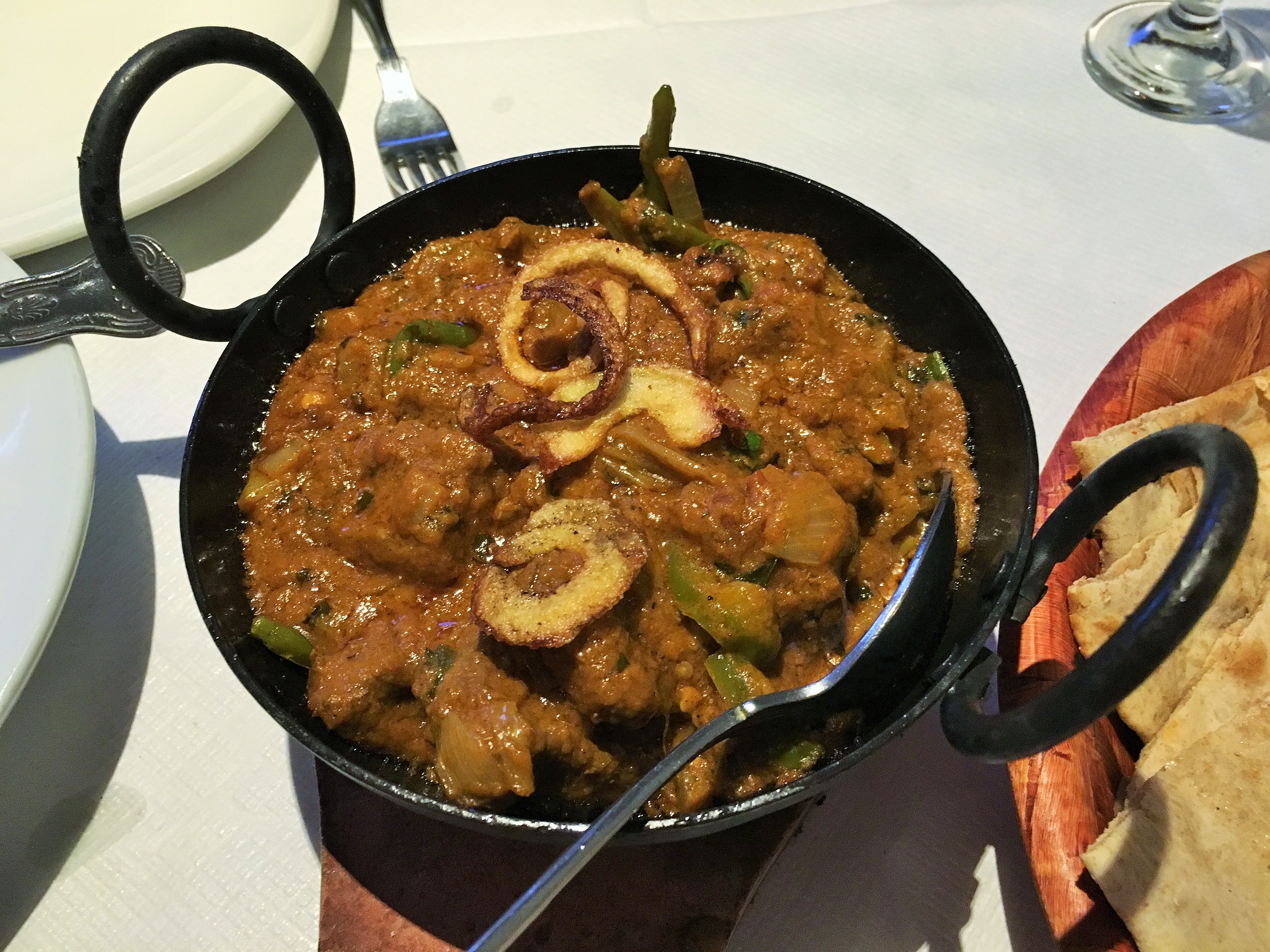
I wanted to try a dish to benchmark the Standard Tandoori. I was tempted by the chicken achari, a sweet and sour number with mango which sounded right up my alley, but in the end I went for karahi lamb, curious to see if it could compete with Bhoj’s glorious, sticky interpretation of that dish. It was clearly some relation, but perhaps a step-sister: the lamb wasn’t as tough as that in the choila but it didn’t fall apart the way I wanted it to. It wasn’t quite as dry and savoury as at Bhoj, so there was plenty of sauce. Lots of chillies in there too, inviting you to eat them or leave them (I hedged my bets – by this point I’d got quite used to doing so). The taste felt less smoky, less complex, more route one. The fried onions on top were – again – a nice touch, although probably also an exercise in diminishing returns by this point.

StandardKarahi

The fact that there was plenty of sauce was handy for the pilau rice and the paratha. The rice was good – only so much you can say, really, but nice to see some cardamom pods strewn in there, booby traps though they are. The paratha was a bit of a poor excuse, I thought. I’m used to beautiful, rich, buttery multi-layered paratha, almost like a savoury croissant, whereas this just felt like two wholemeal pitta breads stuck together like limpets. If the sauce had been better, I’d have been sadder; scooping is a beautiful, magical thing, but it just wasn’t happening that night.

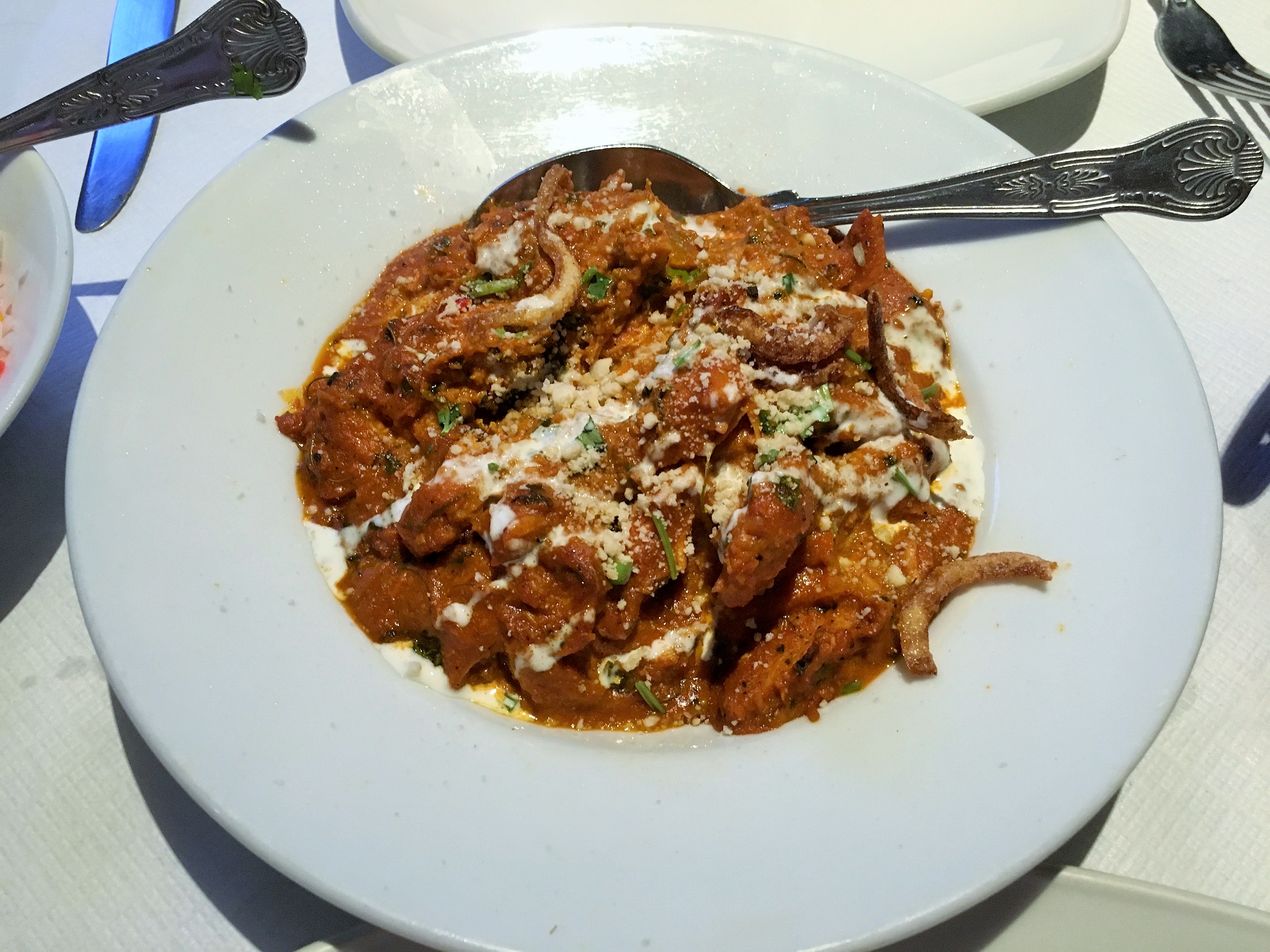
Finally, the star of the show: the Standard Super Dry Fry. It was a good example of how appearances can deceive, because when it arrived I did find myself thinking “is that it?” It looked like the kind of Campbell’s Cream Of Tomato Soup based curry I’ve spent my whole life trying to avoid ordering (and failing every single time I set foot in Reading’s now-departed old school Indian restaurants like Khukuri and Gulshan). Well, as it turns out that did it a disservice.

It did what it said on the tin: properly dry, the sauce condensed down to be sticky and intense. The chicken was beautifully cooked – again, on the dry side but perfectly so. And I do agree that there’s something about that sauce. It’s almost the perfect curry, I would say: the balance of spice, nowhere near overpowering, was interesting enough to appeal to people who would normally opt for the beigeness of a korma or a pasanda, while the taste was sufficiently complex that chilli demons too might give it a whirl. More fried onions, too, because that seems to be a hard habit to break. I really liked it, and I’m glad I tried it. Was it alone enough to justify a trip to Standard Tandoori? Yes, probably just about. Would I go back specifically to have it again? Probably not.

StandardSDF

I would have had a pistachio kulfi for dessert if I hadn’t been so full (and the one I saw at a neighbouring table looked quite lovely) but as I implied earlier, all meals in an Indian restaurant – like all political careers – end in defeat. I waved the white flag with some rice, some karahi sauce and one limp quadrant of paratha in front of me. It probably tells you something that every single morsel of the Standard Super Dry Fry was gone. I found room for the Elizabeth Shaw style mint that came with the bill, though, because if you can’t eat that something has gone badly wrong. The whole thing, with those two glasses of wine, came to forty-two pounds not including tip. I felt full, I felt a little bit underwhelmed, but I certainly didn’t feel ripped off.

Standard Tandoori, like many of Reading’s old stagers (Garden Of Gulab, I’m looking at you here) feels like a restaurant which may well have been amazing once and is now merely good. I’m glad I went, and I’m glad I tried the Super Dry Fry, although it won’t be ending up in my metaphorical trophy cabinet of iconic Reading dishes. But perhaps that misses the point, because the map of Reading will look different for each of us. For me it will always be about the karahi lamb at Bhoj, or the jeera chicken starter at Royal Tandoori, a plate of chicken festooned with toasted cumin seeds which gets more delicious every time I have it. Your mileage will undoubtedly vary, and life would be very boring if we all went to the same places all the time (plus, people would have worked out who I am by now). For me at least, the search for the next big thing continues. But then again, there wouldn’t be much of a blog for you to read if it didn’t.

Standard Tandoori – 7.0
141-145 Caversham Road, RG1 8AU
0118 9590093

http://www.standardtandoori.co.uk/

Chaiyaphum, Cane End

N.B. Chaiyaphum closed at some point over the last few years. I’ve left the review up for posterity.

I have a funny relationship with Thai food, I think. It would never be my first choice when suggesting a meal out with friends but when I go to one I always like it. “Like” is the operative word here, though: I rarely love it. It would probably take a more discerning palate than mine to distinguish between the fishcakes or the pla chu chi I’ve had at all the Thai restaurants around Reading. So instead it comes down to the price and service, arguably the cherry on the cake rather than the cake itself. Sometimes a single dish will stand out, but my meals at Thai restaurants have generally been been solid and respectable – neither stellar nor sad, just somewhere comfortably in the middle.

This all dawned on me, as it happens, when I sat down at Chaiyaphum and started to go through the menu.

The decision to go to an out of town restaurant seems to happen increasingly when I am on a vegetarian week – for those of you new to the blog, my New Year’s resolution last year was to review one vegetarian main course per month – and here I was again, jumping into the car to go and eat tofu (not sarcasm: I was actually looking forward to trying the tofu). Chaiyaphum is up on the A4074 just before the turning for Gallowstree Common, the road towards Oxford which, like hundreds of others across the UK I’m sure, has the nickname “the seven bends of death”. The building itself is an old red brick pub on a crossroads where I can imagine highway robbery used to happen (ironically I once ate at the Pack Horse just down the road, where it was still very much taking place).

Inside, though, you’re under no illusions that you’re in a restaurant not a pub. Goodness, but it’s purple. The walls are purple. The ceiling is purple. We’re talking somewhere between Dairy Milk and Quality Street purple. Properly purple. That makes it sound awful, but actually I rather liked it, and the whole thing is decked out with statues of Buddha, art and artefacts, a picture of the Thai king and queen and, incongruously, a whacking great piano in the bar area. We ate in the room off to the right, a split level affair, with a nice view out onto the garden. A few tables were reserved when we got there, which was encouraging as we were literally the first people to arrive.

I don’t normally talk about background music in a restaurant, but I’m going to make an exception here just to say that Chaiyaphum had managed to get hold of the most surreal easy listening album of all time. I’d never heard hotel lobby soft jazz cover versions of Womaniser, Moves Like Jagger, Sweet Child O’ Mine and The Only Girl In The World before, and I can safely say that if I never do again it might be too soon. It took me right back to the Nineties, when adverts on late night ITV would proudly offer compilation CDs which were “not available in any shops”, usually with good reason.

Anyway, back to the food. The menu was almost identical to every other Thai restaurant menu I’ve read on duty, which made me wonder whether what we get is the anglicised version, watered down just enough to make it seem exotic yet safe. And therein lay the problem for Chaiyaphum, something I was pondering throughout my meal there – because when a restaurant is a little way out of town, especially when you have to drive to get there, being much the same as other local Thai restaurants just isn’t going to be enough. It has to be better, cleverer, more distinctive: otherwise why make the effort?

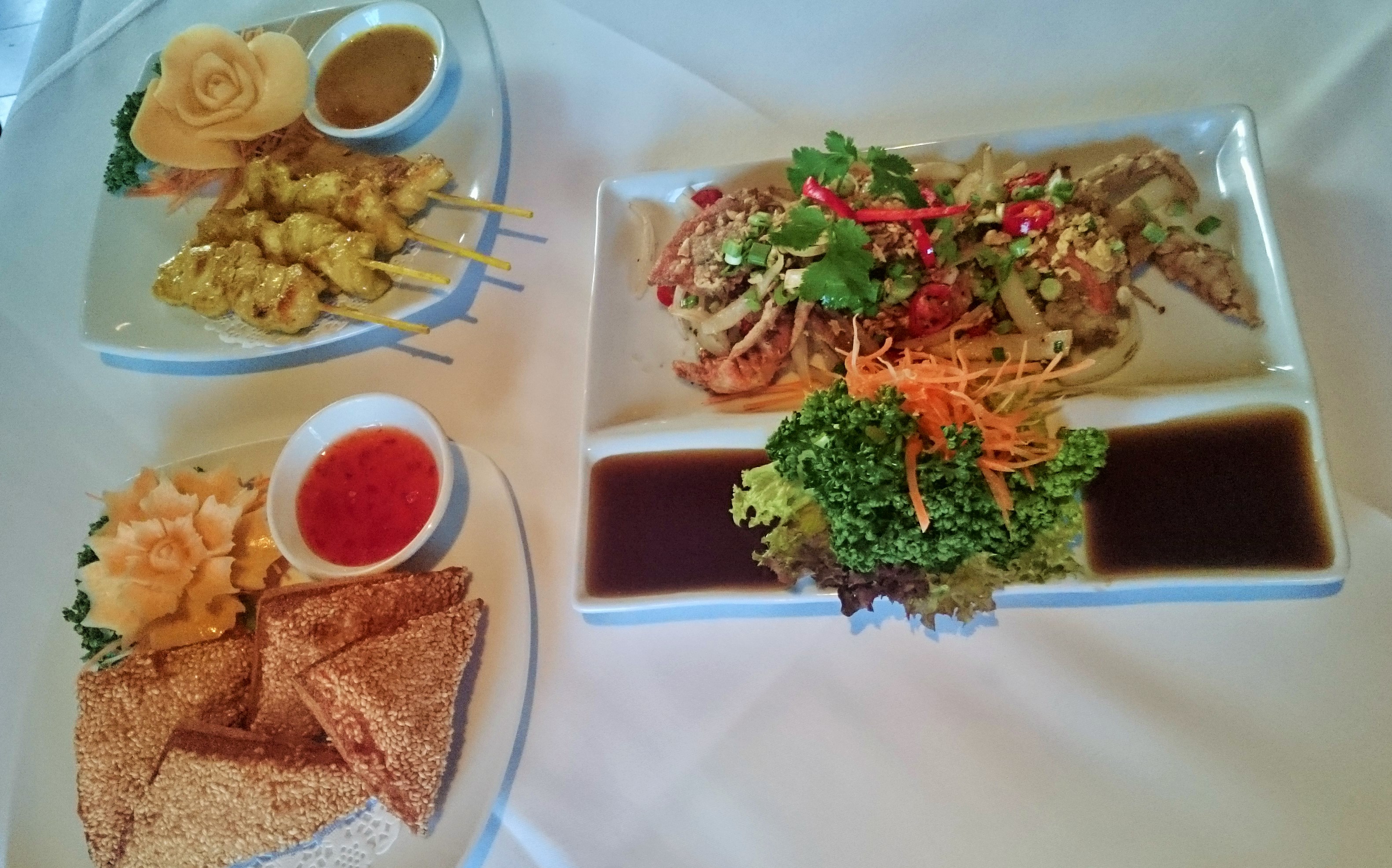
The starters were a mixture of the safe and the unknown. Starting with the safe, the chicken satay was a pretty good example. I think the meat was thigh rather than breast – always a good thing, in my book – but either way it was juicy and well marinated, tender with (I’d guess) some lemon grass. The satay was also good: deep, rich and earthy, although I always wish there was about twice as much sauce. But, and you can see the trend starting to come through loud and clear, it was good but not great. The sesame chicken toasts were just lovely, and eating them made me slightly sad that Thailand has this and we just get fried bread. It’s probably hard to excite anybody writing about these – I mean, you know exactly what they will look like, what they’ll taste like, how they will be, that exquisite balance of crunch and tenderness. And yet they rarely disappoint: these certainly didn’t, covered with sesame, packed with chicken and then fried to the point of decadent filth. I dipped mine in the small pot of chilli sauce (again, wishing there had been a little more) and thoroughly enjoyed it, but I knew I’d hardly taken a risk.

ChaiyaStarters

The third starter was more of a venture into the unknown, mainly because I find it very hard to turn down soft shell crab when it graces a menu with its presence. It came battered and fried, obscured by a cornucopia of other lovely things – lots of finely chopped garlic, fried onion, spring onion and a fair few slices of red chilli. I liked this dish an awful lot – the crab was delicious, the batter was light and delicate and all the gubbins on top really made every mouthful magnificent. It came with two pools of brown sauce – the menu describes both a pepper sauce and a Thai garlic sauce and I have no idea which this was but it really wasn’t needed and didn’t add an awful lot. At the end, after the crab was demolished (and it didn’t take long) we raced round the plate with our forks making sure not a scrap of the nice bits was left: all that remained were the sauces and the ubiquitous vegetable flower.

Main courses continued the trend. Gai pad himmaparm, recommended by the waitress, was a good example of a Thai chicken stir fry. This one had cashews, a few pieces of halved baby corn and plenty of vegetables – why is there always so much onion? – and was decent if not outstanding. The sauce was rich with chilli and especially garlic (nobody has ever gone wrong by giving me too much garlic) and was tasty but not life-changing. As so often with these things, it came in a flat shallow dish which meant that not only wasn’t there enough sauce but what sauce there was was blessedly difficult to get on to your plate, stirred in with the coconut rice where it belonged.

ChaiyaChicken

I’d been looking forward to the massamun tofu. Ordering it was, to some extent, playing percentages: I figured that one of my favourite things about eating Thai food was that glorious mixture of slightly sticky coconut rice and a sweet, spicy sauce, so if the tofu didn’t work out I would still get to enjoy most of the dish. The tofu itself wasn’t bad – you got lots of it, big hefty pieces, and they had some texture and contrast to them. That said, there was a slightly sour taste to it which seemed odd against the massamun sauce. The sauce itself also didn’t quite work – all sweet, no savoury, not enough punch or spice. Perhaps, because it was a vegetarian dish, there wasn’t any fish sauce in it to add that contrasting note. The potatoes in it, weird corrugated edges and all, were soft and floury and not quite right. Ditto for the slices of carrot, again tinned-vegetable soft. There were a few crisped fried onions on top, but not enough. By the time I got to the rice and sauce stage, ostensibly the highlight, my heart just wasn’t in it.

ChaiyaMassamun

We both had coconut rice – the waitress asked if we wanted one between two and we decided against it, but we should have listened to her as one would have been quite enough. It was – bit of a theme here, isn’t there – pleasant: edible but not incredible.

We’d over ordered on the starters (wilfully if I’m honest, in case the whole tofu thing didn’t work out) so there was no chance of having dessert. We both had a glass of house sauvignon blanc – nice, fresh and easy to drink, if perhaps not quite as cold as I’d have liked – to start, and my companion also had a bottle of Tiger, after being told at extensive length about all the beers that were currently out of stock. I had a diet coke and didn’t hugely feel like I’d missed out.

Service was lovely. There seemed to be two waiting staff on and they were looking after quite a lot of tables, but regardless of how busy they were they were friendly, polite and happy to make recommendations. Beautiful uniforms, too – maybe a funny thing to notice, but there you are. The food took just about the right amount of time to come out, and all the other tables looked happy. I saw families with small children, a couple of chaps enjoying dinner together and, just across from me, a birthday celebration (with the exchange of bags from Fortnum & Mason – fancy!). They all looked like they were having a brilliant time, and I wondered why I wasn’t quite so enamoured.

The total bill, including a ten per cent service charge, was sixty-three pounds. Interestingly that service had been pre-added – perhaps the south Oxfordshire red trouser brigade (there was a very eye-catching example right next to my table, a veritable rhapsody in scarlet: I could barely stop gawping at him) aren’t so keen on tipping the staff. Anyway, it all seemed fair enough to me and the service was one of the high points so I wasn’t bothered, though I can imagine it would rankle with some diners.

As we drove away we were discussing whether Chaiyaphum was good enough to merit a drive out of town. As you can probably tell by now, my answer is not really. It’s by no means a bad restaurant: the food was decent, the service was charming, the room managed to be bling and tasteful at the same time, purple paint and all (I did find I left really wanting an individually wrapped hazelnut in caramel: the power of subliminal advertising). But ultimately, there is no USP for Chaiyaphum unless you live round the corner. It’s stylish, but so is Thai Table. The service is friendly, but it’s just as good at Thai Corner. The food is quite nice, but Thai food seems to be quite nice everywhere, and never better than that. Ultimately, it’s just not enough to get me to leave Reading and head for the Chilterns. Maybe this restaurant is for the red trouser brigade and they see it the other way round: because they can go to Chaiyaphum there’s nothing to make them go into town. Each to their own, and thanks but no thanks. Maybe next time I’ll go to Oli’s Thai in Oxford, which I’m told blows them all out of the water.

Chaiyaphum – 6.8
Reading Road, Cane End, RG4 9HE
0118 9722477

http://chaiyaphum.co.uk/