Restaurant review: Snobby’s, Bristol

Snobby’s, a wine bar and Italian small plates spot in Redland, has everything going for it, on paper. It is on one of Bristol’s most decorated gastronomic streets, opposite the critically acclaimed Dongnae and a few doors down from freshly Michelin starred Wilsons and Little Hollows, itself the holder of a Bib Gourmand. It’s received an approving write-up in the Financial Times and floppy-haired grifters Topjaw have featured the place.

It is, you would think, a safe bet. And yet it was at Snobby’s last week that I had arguably the worst – and definitely one of the strangest – experiences at any restaurant in nearly 12 years of eating out and writing about it. So, to channel my inner John Oliver, this week, let’s have a look at that. Because in the process I suspect we’ll find out a lot about what restaurants are supposed to be for, and what happens when they start to forget that.

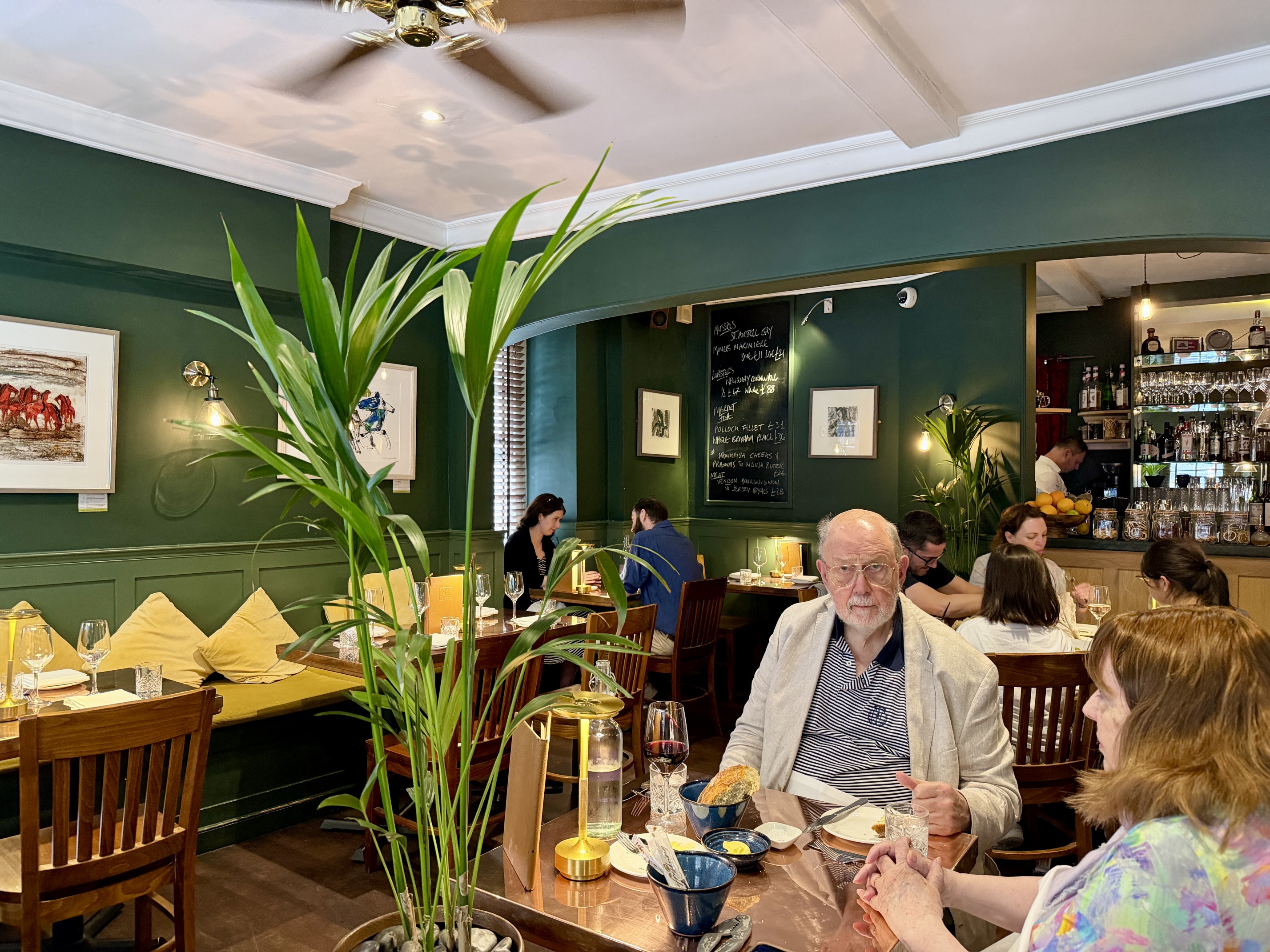
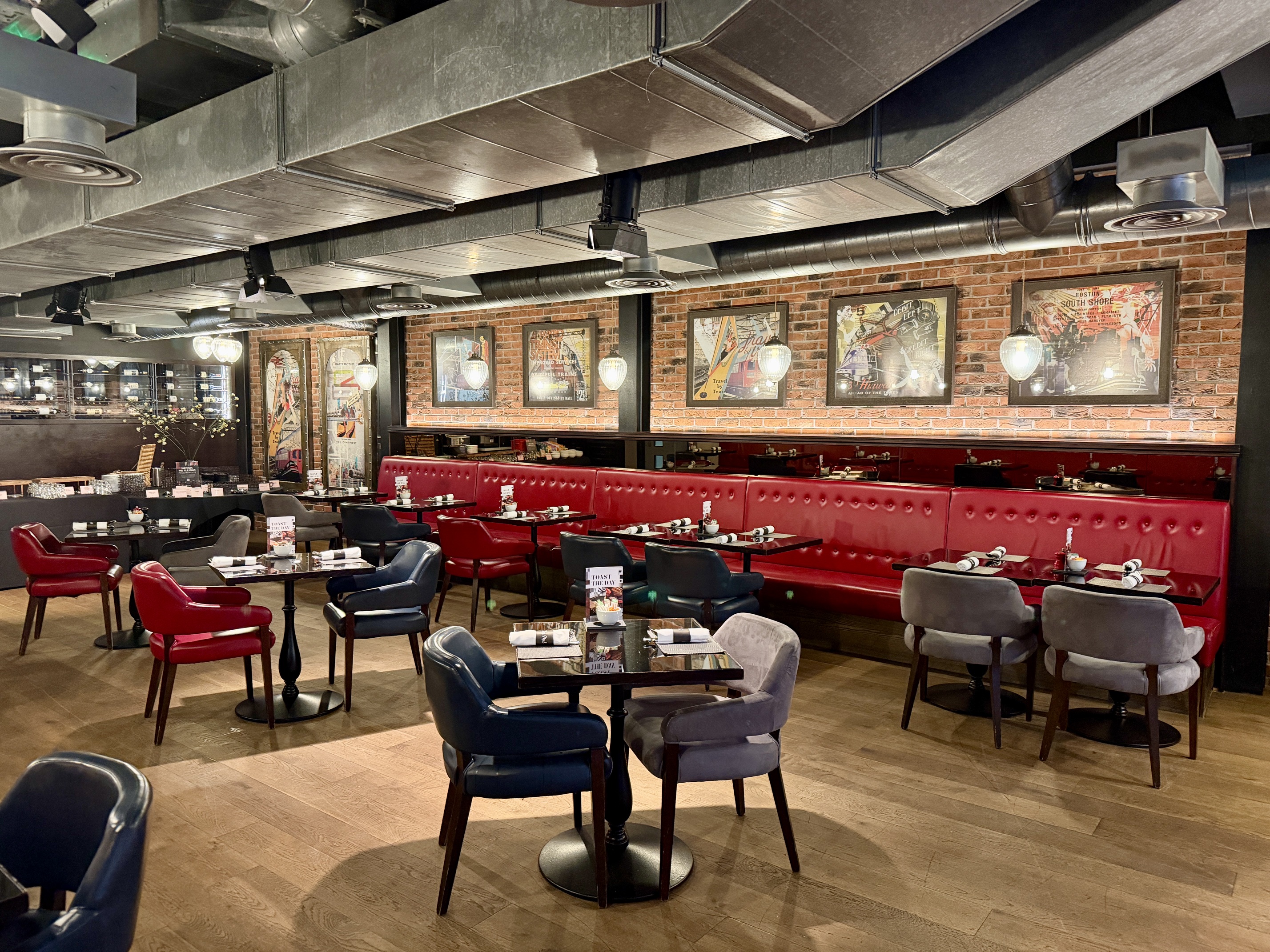
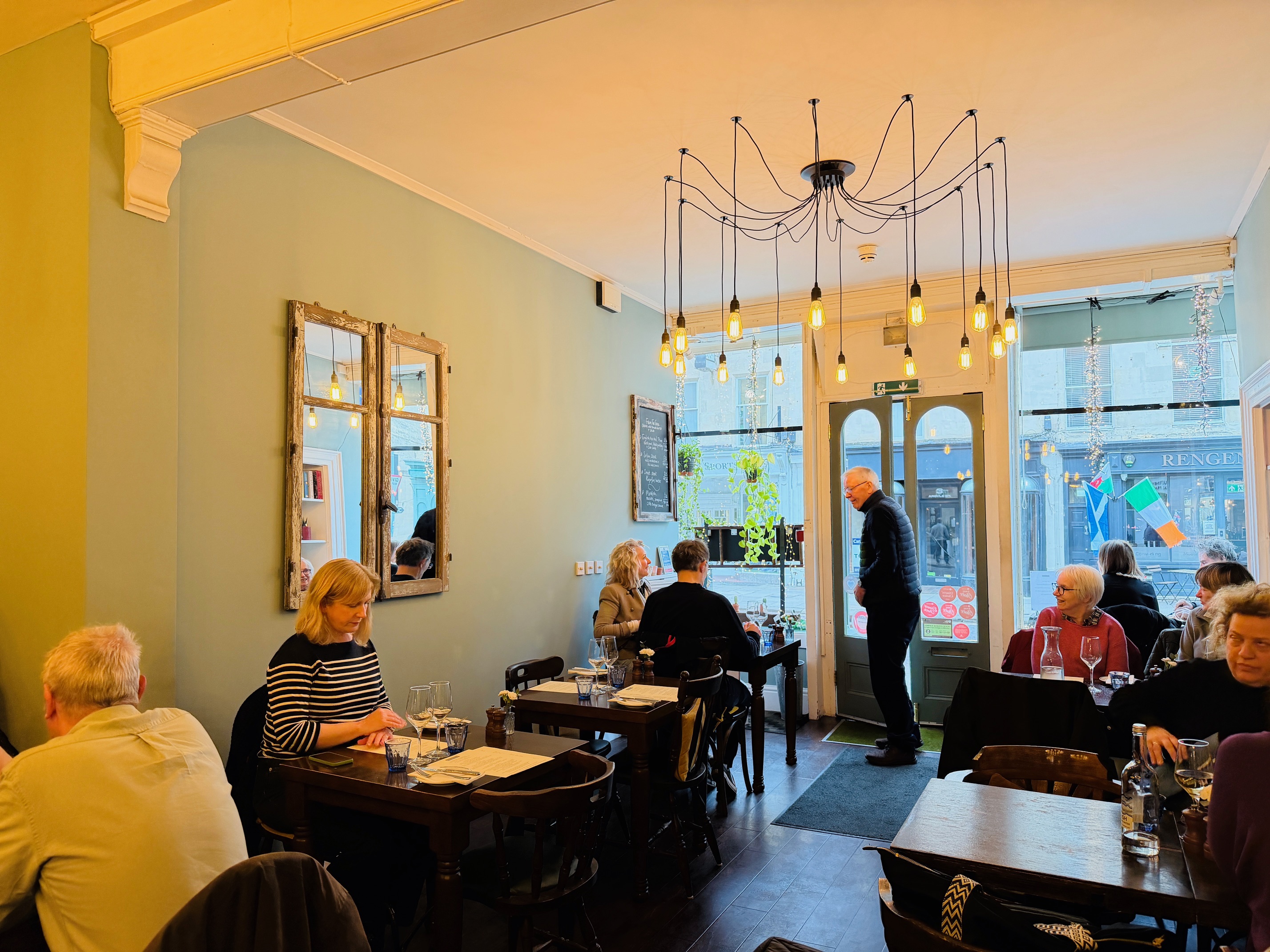
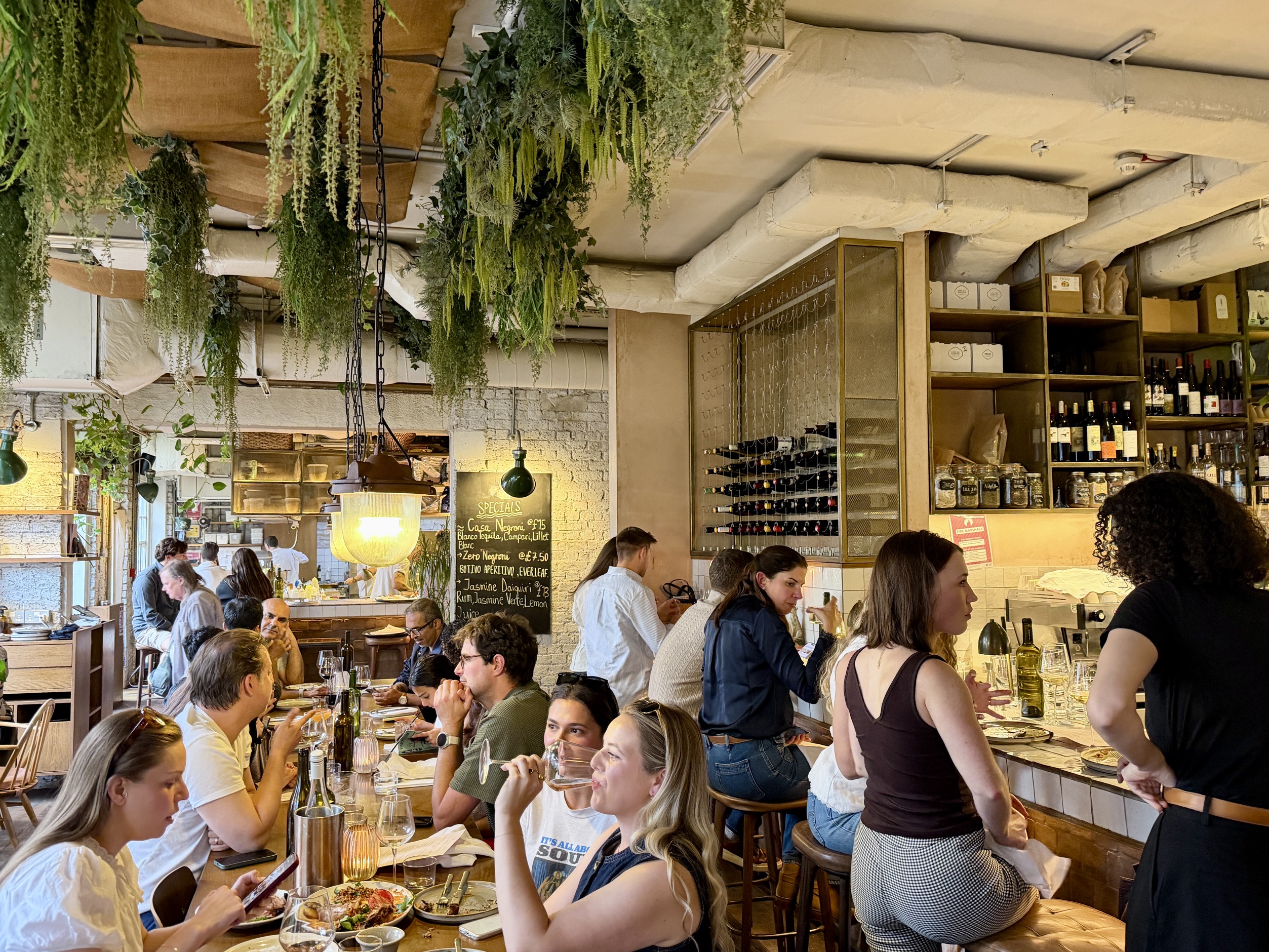
So what went wrong? Well, it wasn’t the room, which is a really lovely space, all pale wood tables, Hans Wegner wishbone chairs and deep green wood panelling. You enter the dining room through a buzzy terrace, and it feels like a lovely spot to while away a couple of hours.

Zoë pointed out that the banquette sat a little too high, like it had been put in by a contestant on Interior Design Masters who never ate in restaurants, but it was a minor quibble. We arrived just after 8 and although many diners were al fresco there were still plenty in the dining room.

The problem wasn’t with the menu, either. It was a compact affair with a handful of nibbles and then seven dishes, priced between nine and twenty quid. The menu recommended two plates per person, adding Don’t forget to share!

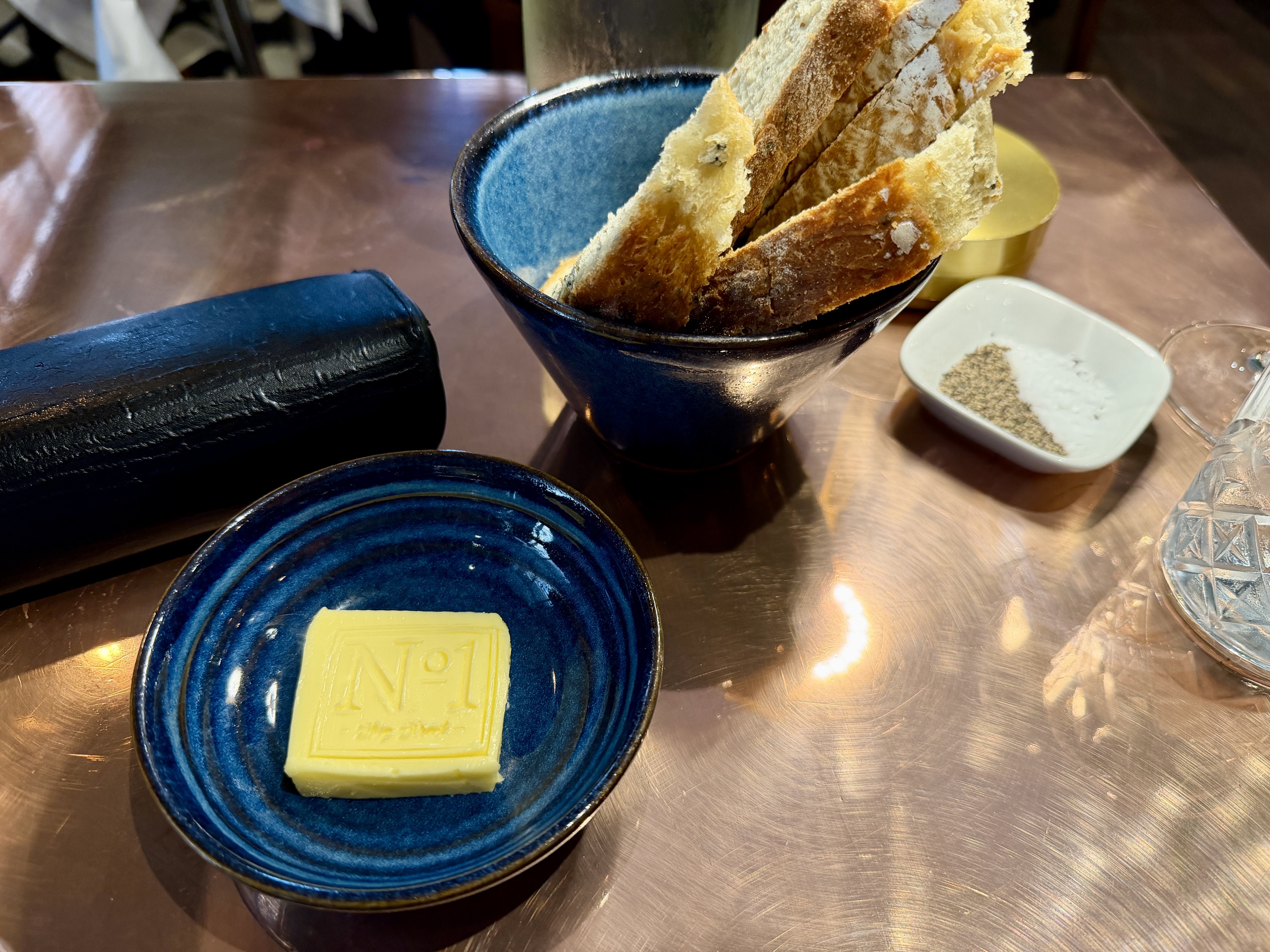
As we were trying to decide our server kindly pointed out that they were running low on focaccia, so we decided to nab a portion before any more diners took their tables and snagged the last of it. It was delicious, salty stuff cut into cuboids, brilliant dipped in olive oil and balsamic. The salted almonds, glossy with oil, were equally good. This was a promising start, we thought, five minutes in. It was, with hindsight, the last point at which any of this felt normal.

So, by then it was time to order proper food; it must have been something like twenty past eight by then. Feeling like trying as much of the menu as we could, and being in no rush, we asked our server if we could order a few dishes to be going on with, and more after that.

“I’m afraid not” he said. “It’s just that the kitchen is closing soon.”

The exact time it shut was not specified, and we were too taken aback to ask for details. Was there no wiggle room on that, we asked? Apparently not – the thing was, he said, we were their last customers of the night. At twenty past eight. What happened to we might run out of focaccia?

Never mind, we thought. We could order everything we wanted to try and at least control the order that our dishes came out in, so we could still experience something like the evening we had in mind. Would that be possible, we asked? Ah, that would happen naturally, the server said. The lamb dish we’d ordered was the thing that took most time to cook, about twelve minutes, whereas a couple of the small plates, served cold, would come out faster.

Now, you could take this to mean one of two things. One might be that the kitchen, being in the business of hospitality, understanding how to pace and sequence dishes to give diners an enjoyable meal, would space things out to maximise the enjoyment of their customers. Or it could mean that the first couple of small plates would come out almost immediately and the lamb dish twelve minutes after that. Can you guess which one happened here?

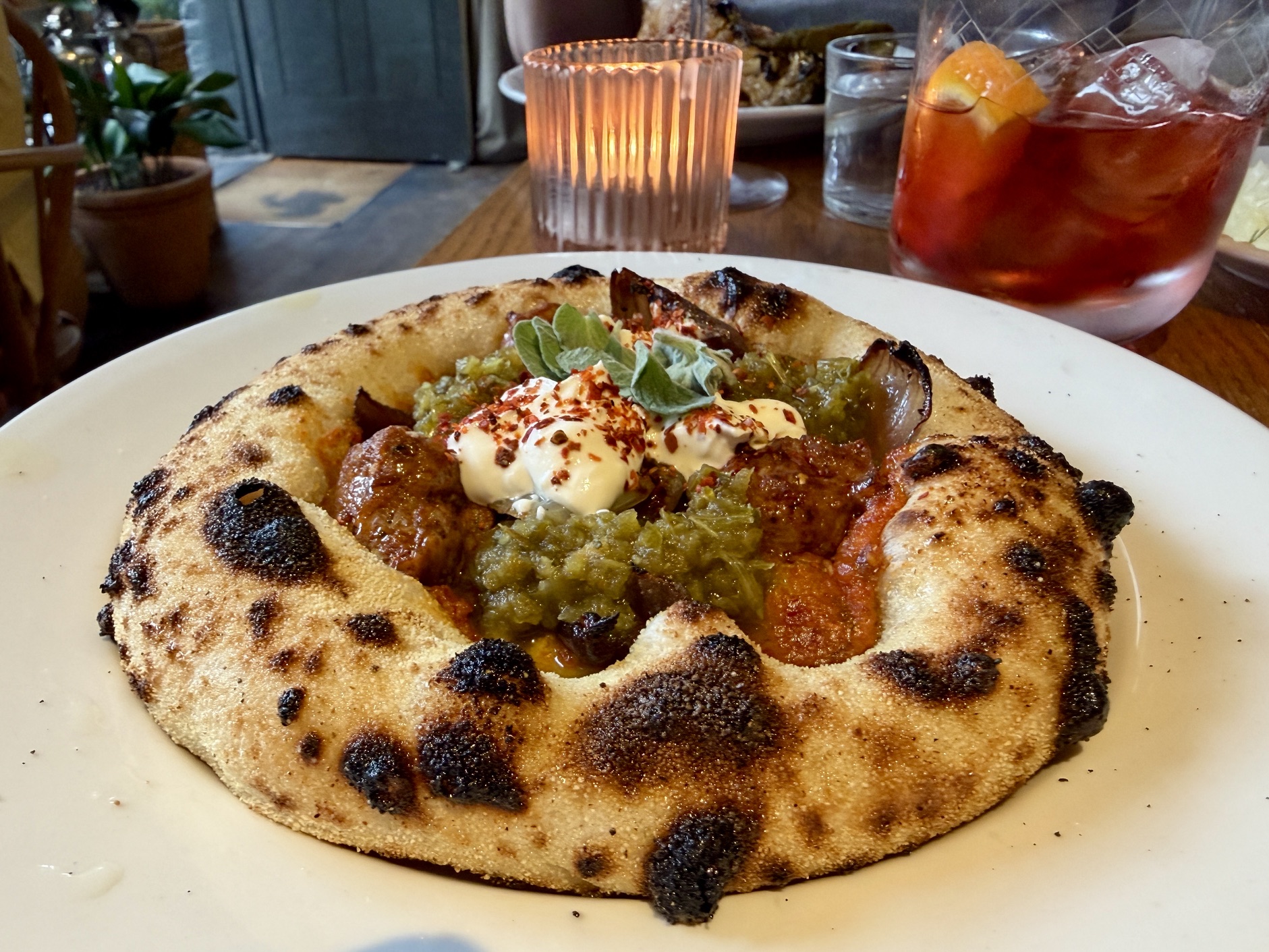
So yes, Zoë enjoyed her burrata dish, which arrived something like five minutes after we’d placed our order. It was more about buying than cooking, as this kind of dish often is, but everything was present, correct, nicely bought and displayed to its best advantage. The tomatoes, a bright array of red, yellow and green, were lovely and scattering the dish with more of those fried almonds was a nice touch, as was the slick of lush pesto anointing the whole shebang.

At exactly the same time, out came the monkfish crudo, which was less successful. It looked like a limpid pond of the stuff, micro coriander and thinly sliced radish floating on its surface, and I quite liked the orange and soya dressing and little spikes of some kind of seeds or peppercorns. But the monkfish felt too thick, coarse and meaty for the crudo treatment, and this, to me, just didn’t work.

I think it needed something more slight, translucent and refined, like the sea bass crudo I saw on the menu of another Bristol restaurant the following evening. But then maybe monkfish justified the price tag, at nearly seventeen pounds. At the price of a main in many restaurants you got a small plate here, whisked out mere minutes after we ordered it. Still, these two dishes had arrived close together, and the menu’s instructions said that we should remember to share, so perhaps it was okay.

Or it would have been if the next plate, a hot dish, hadn’t arrived literally two minutes later. Ricotta and parmesan gnudi – dumplings – came as a trio in an asparagus cream with more asparagus, petits pois and, allegedly, a miso butter.

I am not entirely sure that three dumplings encourages sharing, and I’m not sure it’s worth the best part of seventeen quid. But I’m equally sure that bringing it out at the same time that there are two other dishes already on the table hardly encourages sharing either. By the time Zoë got to trying any of this, it was lukewarm at best, as was her enthusiasm for the whole thing.

I nearly didn’t mention this, because it all happened so fast, but with all this going on and dishes turning up faster than we could make inroads into the dishes that preceded them, we also tried ordering some wine. The initial choice we’d gone for, we were told, was not cold enough, and so – amid the flurry of plates – we were also brought a possible alternative, which we didn’t massively like.

So we asked for an albariño, and the server who eventually brought it over was absolutely brilliant – enthusiastic about the wine, positive about the producer with loads of detail that brought it to life. It was the only example of great service we had all evening: Snobby’s should hang on to that person, and clone them if they can.

Meanwhile, with three dishes on our table and us struggling to eat them, along came the lamb dish we’d been told took twelve minutes to cook, approximately ten minutes after our first dishes turned up. You couldn’t fault the kitchen for efficiency, just for other things like understanding how meals are meant to work and the difference between a lovely meal out and Man v. Food.

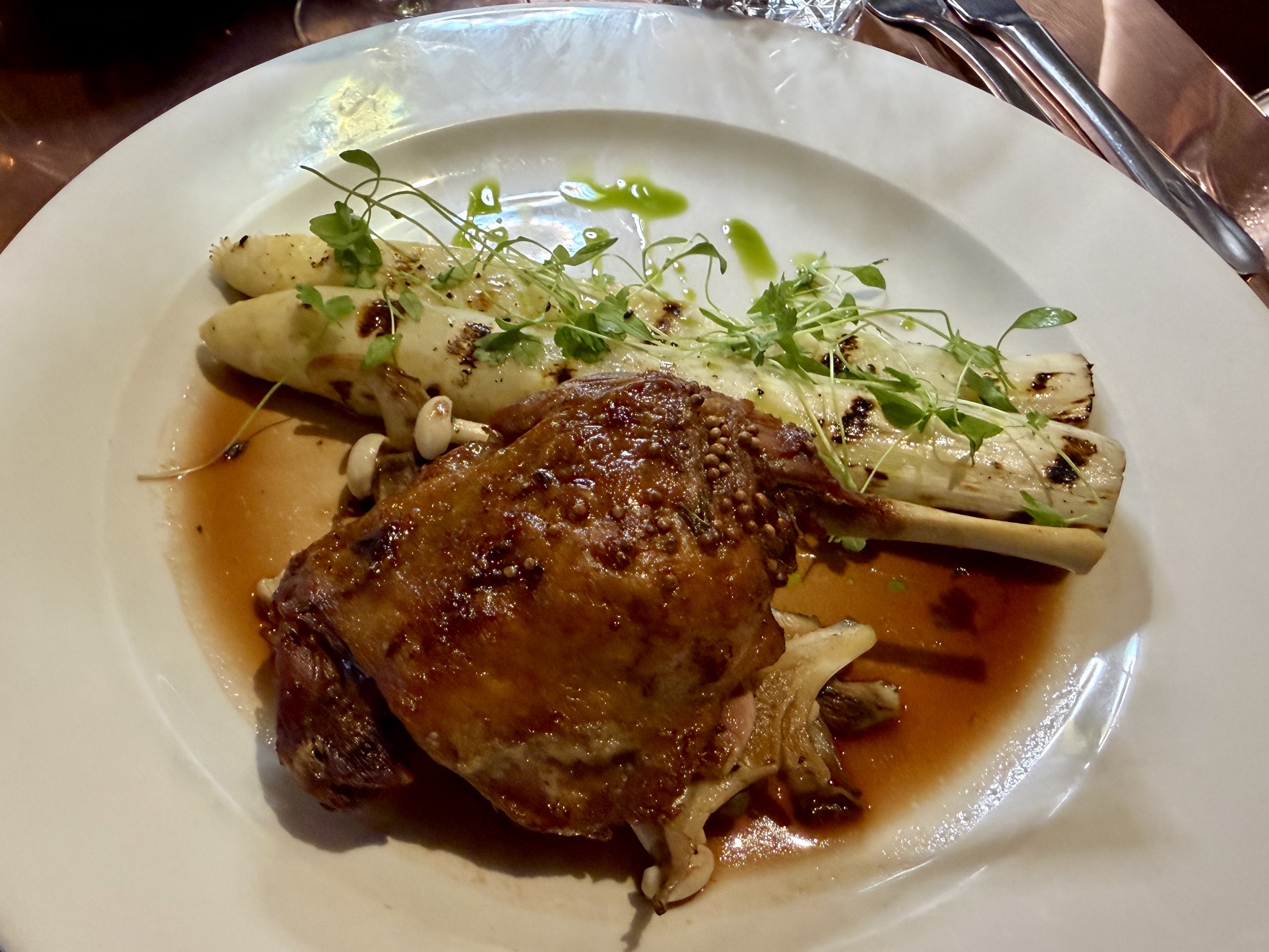
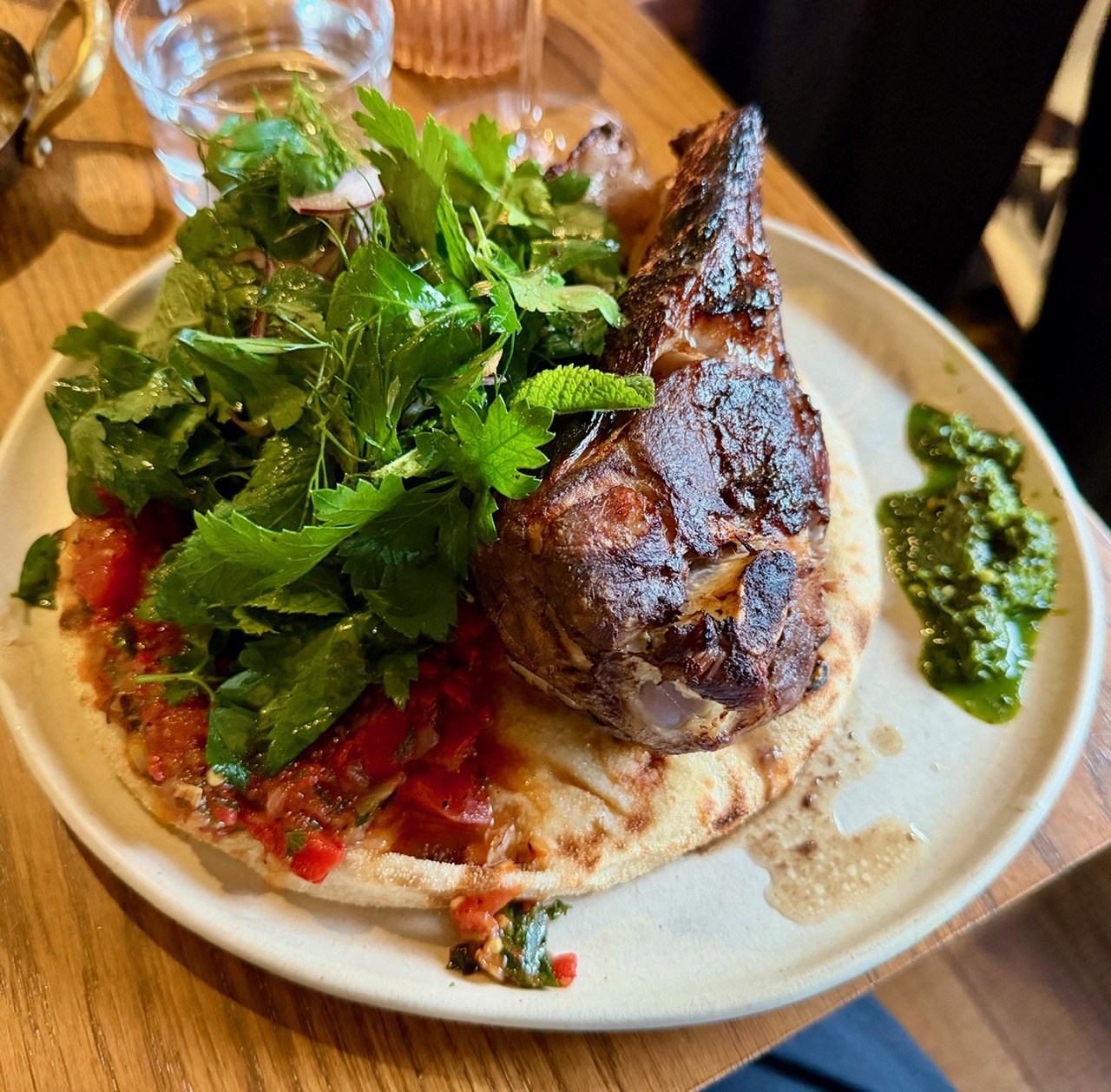
And it’s such a pity, because the lamb dish showed, too, that you couldn’t fault the kitchen for talent. It was the nicest dish I had that night and one of the best things I ate all week – a slow-cooked, sticky, sumptuous cylinder of shoulder and leg, crying out to be pulled apart with a fork, resting on a moat of puréed cannelini beans and swimming in a decadent, reduced jus. Such a lovely dish, ruined by bringing it out as part of some kind of deranged conveyor belt.

Restaurant bloggers like to come out with a particularly wanky cliché where they say that restaurants take quality ingredients and “treat them with respect”. It’s empty nonsense, as if the alternative is to take them out, buy them a few drinks and then ghost them until the end of time.

But quite aside from that, treating ingredients with respect isn’t only about making a good dish out of them. It’s also about treating that dish with respect, serving it in a way that enables it to have its moment in the sun. That wasn’t happening here. And when you don’t treat your dishes with respect, guess what? You’re not really treating your customers with respect, either.

At the same time as the lamb, the arancino – that ideally we would have eaten closer to the start of the meal – had also materialised. Half an hour after we sat down, about fifteen minutes after we’d ordered, our five not that small dishes had all been brought to the table, leaving us scrambling to eat them before they went cold and moving our empties to the neighbouring unoccupied table for four (a minor gripe, but if they were going to bring it all out at once they could at least have put us on a table that could accommodate all that crockery: they had no other customers after all).

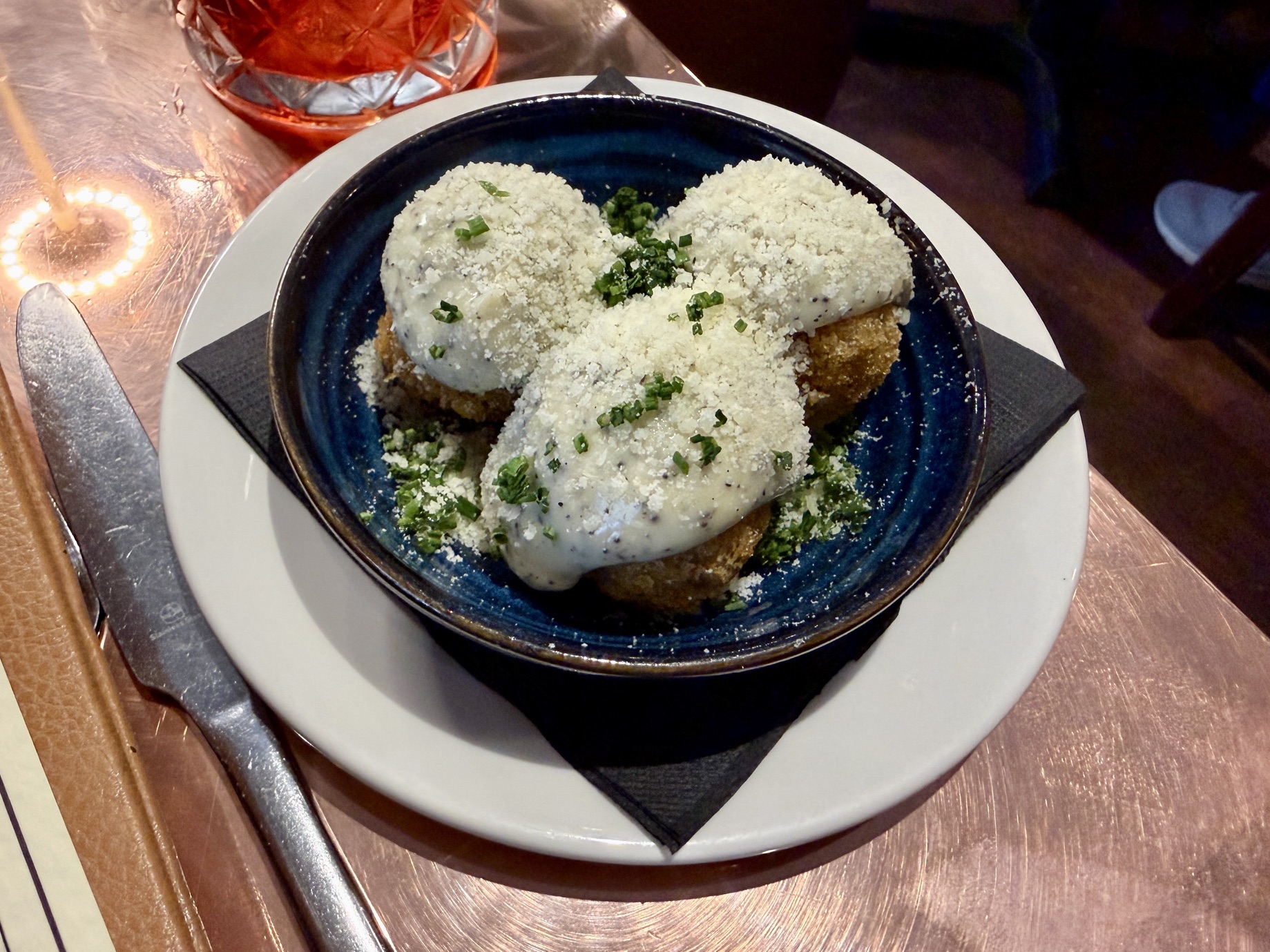
As for the arancino, Zoë had some and thought it was pleasant if unexceptional. It had scamorza in the middle, and a honk of truffle oil, but it was slightly big, stodgy and lacking in texture. She could only tackle a little of it and I decided that I’d rather eat the lamb, which I loved, than make inroads into the arancino.

Here’s the other thing: when a restaurant brings out five dishes – seventy-five pounds’ worth of food – in the space of ten minutes, not making any real effort to sequence them, you get too full to eat it all very quickly.

To emphasise how farcical this was, it was only around the point that the lamb and the arancino arrived that we finally got our bottle of wine. I thought it was rather nice, Zoë thought it too wasn’t quite cold enough. But we made up for that, because any residual warmth we had towards Snobby’s had well and truly vanished by then.

We struggled through some of the food, left half of the gnudi and half of the arancino, on account of it being too cold and our being too full. The plates were taken away without any questions in a strangely incurious fashion.

Normally this stage, when your empty dishes are taken away, is one for quiet and happy reflection. But instead, we both just gently fumed. You might expect that from me, but Zoë is as good-natured as they come, and this meal left her feeling positively aggrieved. It takes some going to piss her off, as her seven years and counting shacked up with me proves beyond reasonable doubt.

Chatting away about it, we couldn’t quite believe that we had been rushed through all those dishes at breakneck speed so that the kitchen could close – at twenty to nine, no less. And if the kitchen really did close early, perhaps Snobby’s should mention that to people making bookings at 8.15? Because they seemed quite happy to tell people making earlier bookings online that they only had the table for an hour and three quarters: it wasn’t as if this kind of communication was beyond them.

It got more ridiculous after that. Our food gone, and with a feeling that the wait staff were studiously avoiding asking us how it had been, we were left with the best part of a bottle of wine, with notes of stone fruit, citrus and… bleach? Yes, bleach: because at this point a strong waft of the stuff was emanating from the kitchen, obliterating any subtlety or enjoyment in the rest of our Albariño. Did the staff have a bus to catch?

Enough was enough, so we flagged down our server – the same chap who had told us the kitchen was closing and the food would come out as and when – to pay the bill and he asked us, in a perfunctory way, how it was. And that loosened the lid for both Zoë and I to say that no, actually, it hadn’t been all right. So we explained that we’d felt rushed, and not listened to, and that we couldn’t really understand how either the serving staff or the kitchen could have thought our evening was an experience anyone would willingly choose.

Zoë asked him, given that he’d previously told us the kitchen was closing, when exactly the kitchen shut. He said that it closed when the last customers had ordered. But, Zoë said, we were the last customers and we’d asked not to order all our food at once, so why were we railroaded into doing so? He had no answer to that.

Fair play to him: he listened, a little like a rabbit in the headlights, and at the end of it agreed to knock off our service charge. Which felt slightly like missing the point to me, because some of the service – especially the person who brought our wine – was excellent and really the problems were more fundamental than that. When two dishes had gone back to the kitchen half-finished, because the timing had been so completely out of kilter, a better step might have been to knock those off the bill.

And bless him, I’m sure he meant well when he said that he appreciated the feedback and that actually, it would help him in an ongoing debate he had been having with the kitchen. But what I took from that was that this had been an issue for a while, that it hadn’t been fixed, and that our crummy meal was collateral damage in the process of eventually resolving those problems.

I was delighted for their future customers who might benefit from that piece of learning, but it didn’t help us at all with our wasted evening. Our bill, with service knocked off, came to just short of one hundred and thirty-five pounds, for a meal that was over in something like thirty-five minutes. I know there is a risk, when you complain about an experience like this,that you might sound entitled. But really: would you have been happy with that?

The following day, I got an email from the owner of Snobby’s. I’d booked online and, having been tipped off by the staff, he contacted me via my email address. I explained to him what had gone wrong and, to his credit, he said that he needed to pick these points up with his staff. He said that he’d not been as close to the business in recent weeks, and that this was a timely reminder that he needed to do something about it. He didn’t refund anything, but did send me a voucher for the cost of the two dishes which we didn’t finish.

And that’s very decent, but I’m not sure I’d use that voucher, potentially throwing good money after bad. He said that he was sure I understood the pressure hospitality was under right now, and that the feedback would help them to survive in a competitive industry. I know that’s right, but the converse is also true: customers have less disposable income than ever before, and they simply won’t want to spend it on an experience like that. Eating out is more costly, so people do it less often, and when they do they don’t want to spend that kind of money and have an experience that feels sub-Wagamama.

The Bristol restaurateur Dan O’Regan (the owner of Lapin) writes a blog about running restaurants. In a recent piece he talked about kindness, saying that it’s “the only thing that’s ever made restaurants work”. He said that customers deserve warmth, and a feeling that they’re welcome, however much they are spending or whatever kind of meal they want to have.

I don’t say any of this out of unkindness myself. I could have not written this review, which is after all telling you not to go somewhere you might well not have gone anyway. But I did, not to vent my spleen – fun though that might be – but because this experience encapsulates something of what restaurants are supposed to do and how jarring it can feel when they drift from their purpose.

And it felt to me like Snobby’s had completely forgotten what the purpose of restaurants was, namely to look after customers, to make them feel welcome and cared for, and to prioritise their convenience over the convenience of the kitchen. Because if a restaurant’s aim is to minimise inconvenience to its staff, or even if it comes across that way, I can’t help but feel that somebody, somewhere, has put the cart before the horse.

A restaurant that does that, I think, has forgotten what restaurants are for and what makes them such wonderful places. They betray the promise that great restaurants make, the covenant they have with the customers that love them. And a meal is never just the food. It’s the food, the room, the service, the timing. In restaurants, as in comedy, timing is everything. Get that wrong and it’s closer to tragedy.

Anyway, fingers crossed that future customers benefit from the disappointing evening I had. I would really like to see Snobby’s turn things around, because it’s a lovely spot and it’s capable of cooking some excellent food. They might be redeemed, and I really hope that they are. But my voucher, I suspect, won’t be any time soon.

Snobby’s – 5.9
6 Chandos Road, Redland, Bristol, BS6 6PE
0117 9070934

https://www.snobbys.co.uk

Since January 2025, Edible Reading is partly supported by subscribers – click here if you want to read more about that, or click below to subscribe. By doing so you enable me to carry on doing what I do, and you also get access to subscriber only content. Whether you’re a subscriber or not, thanks for reading.
Restaurant review: Orwells, Shiplake

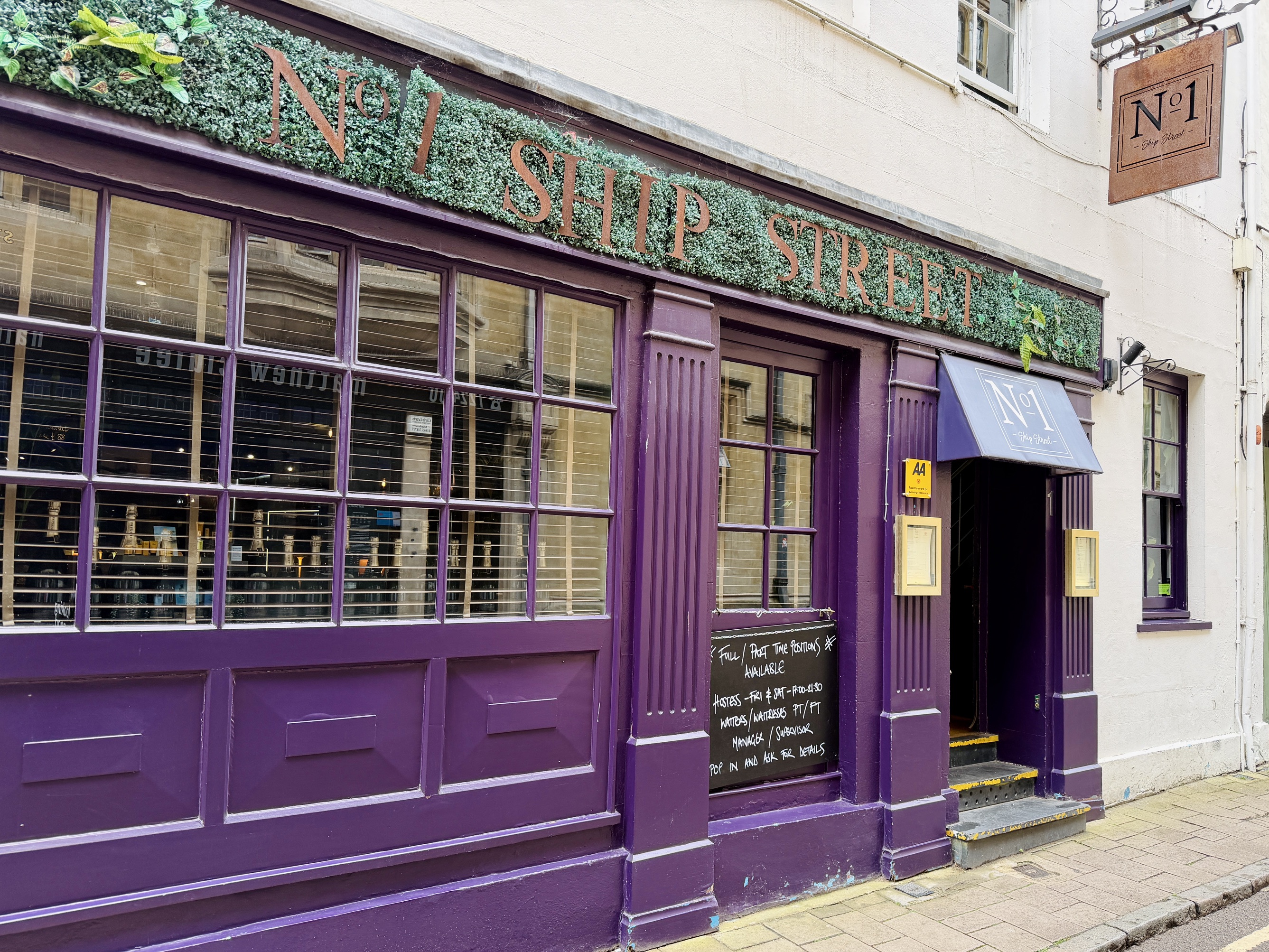
The exterior of Orwells

Writing about food – or, more specifically, writing about restaurants – is an enormous privilege. It costs money, and you need money to do it. It is absolutely no coincidence that most of the national broadsheet restaurant critics, nearly all men of course, are either descended from the aristocracy or other journalists. To the point where there isn’t much difference, to be honest: I heard Giles Coren described once as a “hereditary columnist” and, like my vague feelings of revulsion towards Coren, it has always stayed with me.

So how do people afford it? The most frequent route, for Instagrammers at least, is to accept free food in return for content. I’ve talked about that recently, so I won’t do it to death, but what surprises me is how little people on Instagram follow the ASA guidelines and declare things as #ADs or #gifted. Sometimes it’s down to ignorance, others down to wilful ignorance. Often it’s hard to tell. “I thought that was just a courtesy thing” said a content creator I swapped messages with recently. Err, well, how about giving your audience the courtesy of knowing that you didn’t pay for the food you just raved about?

“What if I went intending to pay and they wouldn’t let me?” he followed up, an oblique take on the eternal if a tree falls in the forest and there’s nobody around to hear it question. It doesn’t matter what you intended, it matters whether you put your hand in your pocket. I’m afraid it really is that simple.

But restaurant bloggers do this too, usually while criticising influencers and content creators, seemingly for the crime of being less subtle. They take free stuff all the time, and often don’t declare it either. They certainly wouldn’t break out the hashtags of shame, because that would let the cat out of the bag, so instead they resort to weasel words like “I didn’t see a bill”. Some restaurant bloggers are positively myopic where bills are concerned, but they still have good enough eyesight to say the food looks phenomenal. What are the chances?

But this is the problem: writing about food is an expensive business, so unless you are fantastically independently wealthy you need to find a way to keep doing it – whether that’s wealthy friends, or a patron, or in-laws you can stiff, or some other route. It’s why many restaurant bloggers drift into doing PR for restaurants they like on the side, so the line between the writer and the subject gets hopelessly blurred.

Again, I do kind of understand: I have made a few friends in the business since I started writing this blog (although, and this probably says something about my winning personality, not many) but I don’t review their restaurants. Stay in this game long enough though, and of course you risk compromising yourself. But what I don’t understand, given all the privilege entailed in being able to do this, is how little restaurant bloggers seem prepared to check or acknowledge their privilege.

Instead, you just get tin-eared humblebragging from people who aren’t even pretending to be relatable. “I eat out more often than you, so I know what I’m talking about” says one restaurant blogger who routinely promotes businesses he has worked for. “My lunch is better than yours” repeatedly boasts a second, who rarely sees a bill and appears to be about six months from a cirrhosis diagnosis. Classic car crash.

“I’m especially interested in submissions from writers who identify as working class” says a third, a double barrelled type who is currently in the twelfth week of a jaunt round Asia. Nice work, gang: keep on keeping it real!

So at this point, I should acknowledge my own privilege: I am extremely lucky that I can afford to do this, and very glad that I’ve never gone down the route of accepting free food from restaurants and reviewing it. At the start of this year, I asked if readers wanted to support the costs of what I do, and I was very fortunate that the response was positive. I said at the time that it would hopefully enable me to cover some of the costs of running this blog, and that it might allow me to write more, or different content. It has definitely done the former, and enabled me to get rid of ads on the blog, but what about the latter?

The reason I’m talking about this, today of all days, is because this week’s review is of Orwells, the widely acclaimed Shiplake restaurant that features in the Michelin guide, has received multiple accolades from the Good Food Guide and has been pursuing excellence for something like fifteen years. Its chef owners, married couple Ryan and Liam Simpson-Trotman, are regulars on James Martin’s ITV show Saturday Morning. It is probably the best, nearest restaurant I have never reviewed in nearly twelve years of doing this, and in honesty I would probably not have reviewed it if it wasn’t for the support this blog receives from subscribers.

That’s not to say that I couldn’t have afforded to, but I publish a review every week and in the old days, I could have reviewed two or three places, easily, with the money it would cost me to eat at Orwells. I try to cover a variety of places, at a variety of price points, and eating at Orwells would have scuppered that. So it has never made it to the top of my list – because I’m not one of those reviewers who “didn’t see a bill” – and it’s only now that I felt, on a Thursday night during a well-earned week off, that Zoë and I could hop in a taxi and head out to Binfield Heath to see what the fuss was about.

Incidentally, that’s also why this review is behind a paywall. It was made possible by people who subscribe to the blog, so being able to read it is the least they should get in return for their generous support. But also, be honest: if you’re thinking of going to Orwells and you want an opinion you can trust on whether it’s any good, you can afford to subscribe to this blog, for a month at least. If you can afford to eat at Orwells, you can afford that.

Subscribe to continue reading

Become a paid subscriber to get access to the rest of this post and other exclusive content.

Restaurant review: The Pot Kiln, Frilsham

As of 30th March 2026 the Pot Kiln has scrapped its Basque concept and reverted to offering pub food. Nick Galer is still in the kitchen, and I may revisit in the future but this review is no longer current.

One of the big gaps in my coverage of restaurants, given the name of this blog, is my failure to review the plethora of highly-rated gastropubs in the countryside around Reading. Berkshire is a funny-shaped county, long and thin, and that means you can strike out into Oxfordshire to the north or Hampshire to the south as easily as you can head east towards Maidenhead or west to Newbury staying within county lines. And one of the reasons, I suspect, why central Reading has never attracted many special occasion restaurants is the embarrassment of riches to be found a short drive away.

I’ve done some of them in my time of course, like the Bell or the Bottle & Glass, but the vast majority remain on my to do list, or at least they would if I were able to drive. And that means that when Britain’s Top 50 Gastropubs publishes its annual list, as it did early this year, I scan it for pubs nearby and realise, ruefully, that I’m unlikely to review them. This year The Loch & The Tyne in Old Windsor, Tom Kerridge’s two pubs in Marlow and The Crown in Burchett’s Green remain on my “maybe one day” list.

Another strange phenomenon in the gastropubs nearby is a tendency for musical chairs where highly rated chefs move from one pub to another. So for instance Dominic Chapman, who earned a Michelin star at the Royal Oak at Paley Street, which I reviewed, then moved on to the Beehive in White Waltham, which I have visited but not reviewed (it was, by the way, not bad at all).

And then, nine years later, he sold up: by that time he had taken on The Crown at Burchett’s Green, which he took over from Michelin starred Simon Bonwick. Again, I ate at The Crown once under Bonwick and thought it was quite good and extremely expensive. Bonwick then pitched up at The Dew Drop Inn in Hurley, managing eighteen months there before moving on again: he now cooks upstairs at a pub in Marlow three times a week.

This happens all over: The Loch & Tyne in Old Windsor is run by Michelin starred Adam Handling, but before that it was called the Oxford Blue and run by a chap called Steven Ellis. Ellis has moved on to another spot, The Bailiwick in Englefield Green which just so happens to be my stepmother’s favourite restaurant in the whole world. Again, I’ve been and it’s really rather nice, especially the venison bon bons; if you ever go, get a portion to yourself.

So maybe one good reason not to review pubs in this part of the world is the amount of toing and froing that goes on, with almost as much transfer activity as the Premiership: even The Plough, which I loved, is on to another head chef since I visited, its third in two years.

One of the benefits of this phenomenon, though, is that sometimes you see welcome, familiar faces pop up in new places. And that brings us to the Pot Kiln in Frilsham, out in West Berkshire, nestled in the Yattendon Estate. This bit of the world, too, has always been sprinkled with good food pubs: the Royal Oak in Yattendon and the Bladebone Inn in Bucklebury are just two more to add to the list of Places I Like But Have Never Reviewed.

The Yattendon Estate now owns the Pot Kiln, as it does nearby Renegade Brewery and Vicar’s Game in Ashampstead. Before that, for a long time under chef Mike Robinson – who held a Michelin star at Fulham’s Harwood Arms – the Pot Kiln was already synonymous with game, all caught on the estate. I ate there once, when Robinson was at the helm, and thought it was rather enjoyable, the surroundings idyllic. But then Robinson got divorced, and his wife got custody of the pub, running it with her musician partner, the magnificently named Rocky Rockliff.

For whatever reason the Estate subsequently snapped up the pub and installed new management. But rather than pick one of the merry-go-round of local chefs and get them to do what the pub had always done, the Pot Kiln took a more interesting course of action. It decided that instead of offering mainstream pub fare or more generic modern British food it was going to serve a Basque-infused menu. A three quarters of a million pound refurb was carried out, including a new open kitchen and a parilla grill, and it reopened last summer.

The other interesting thing they did was appoint chef Nick Galer. Now, I knew Galer’s food from his very successful spell at the Miller Of Mansfield, a lovely pub I did manage to review six years ago, out in Goring. He left the pub three years later, when our old friends Stonegate decided to nearly double the rent, and after that he had an incongruous spell cooking at a nearby golf club, but the move to the Pot Kiln made sense. It’s been on my list ever since, and as my future brother-in-law Matt drove us through the winding lines of West Berkshire in the gathering gloom I realised that I had a real sense of curiosity about the meal that lay ahead.

The thing is, I loved the Miller, and had some really successful meals there. But there were also a couple of times, especially one Christmas Day set meal, when I left somewhat peckish, and I’d heard similar reports from other people who had acted on my recommendation. A pub in the countryside offering tapas and the heartier food of Northern Spain, making good use of cooking over fire, could be an intriguing second act for Galer’s cooking.

In the summer, I imagine a review of the Pot Kiln would talk about just how beautiful its surroundings are, and what good outdoor space it has. But in grim, largely sunless March, before the clocks went forward, all I can say is how glad I was to be in the passenger seat next to an extremely competent driver and navigator. The pub itself looks classy and cosy – definitely one of those gastropubs that still operates as a pub – but the dining room of the restaurant, next to the open kitchen, was a little harder to love.

I couldn’t quite put my finger on why, because the tables were generous and the chairs comfy, but the lighting was a tad cold and the whole place had a certain feeling of sterility. It wasn’t for the lack of diners, because the room was reasonably well-occupied on a Monday night, including a large group which sang Happy Birthday later in the evening. But we grabbed a table for two with our back to all of that, both looking out on the open kitchen, and perhaps that was an error. Galer was not in the kitchen that night, although that didn’t seem to remotely affect the bustle of the staff beavering away.

The Pot Kiln’s menu read really well. There were ten tapas dishes, ranging in price from just over four to just over ten pounds, and eight mains, two of which were sharers. They started around twenty pounds and climbed from there. Half a dozen vegetable dishes, appearing out of sequence before the mains, completed the picture, although they appeared more to be sides than tapas. And actually, although I found plenty to potentially order on it, this menu wouldn’t suit vegetarians or vegans. Only one main for them, baked rice with cauliflower and capers, and four tapas options. In that sense, I suppose you could say it was quite authentically Spanish.

All that being the case, the drinks list surprised me. The local beers on offer highlight the owner’s connection to Renegade, the brewery formerly known as West Berks. But I thought there might be some Spanish sidra on offer, or at the very least some txakoli, the slightly sparkling wine which is one of the Basque country’s best exports. Not only wasn’t there any, but the wine list was dominated by other countries: less than half of the whites and about a third of the reds on offer came from Spain. It felt like some bet hedging was going on.

I decided to stick to the two Spanish whites available by the glass, starting with a Macabeo which was fresh, if slightly astringent. The Verdejo I moved on to later in the evening, not significantly more costly at eight pounds a glass, was much better: fuller, rounder, more interesting. Matt stuck to an alcohol free Asahi before then trying a mocktail with elderflower and ginger which he rated.

So, how many tapas dishes would you have ordered to share between two, not knowing how big they were or how large the mains after them would turn out to be? We opted for three, which I worried might be over-ordering: I suspect my appetite is bigger than Matt’s, or possibly it’s just that his manners are better than mine. But I needn’t have worried, because these were definitely tapa rather than media or racions.

First up, two mushroom croquetas, each topped with a thin slice of raw mushroom – this seems to be in vogue at the moment, although I’m not sure it added anything – resting on a puddle of thick mushroom ketchup.

I have to say, the taste of these was extraordinary. The concentration of savoury notes at the heart of those breadcrumbed spheres was something else, but better still was the depth of the ketchup. It had an awful lot going on – yet more umami, but also a very pleasant acetic spike in the mix. These were two really lovely croquetas. Two really lovely, rather small croquetas. Two really lovely, rather small croquetas that cost seven pounds fifty.

If you wanted any proof that the Pot Kiln, whatever else it might be good at, could do ketchup, the next tapa amply demonstrated this too. A pair of empañadas, with pleasingly dense pastry, had a filling of slow-cooked short rib and came with a blob of Kermit-coloured gherkin ketchup. The star of the show here was the ketchup – even Matt, who had been suspicious from the moment he spotted the word “gherkin”, tried some and declared himself a convert.

This dish was worth ordering for the ketchup alone, such a clever piece of work, something which captured the taste of gherkins in an almost photorealistic way despite being a puddle of green. It redeemed a multitude of sins, but did it redeem the fact that the two empañadas weren’t exactly bursting at the seams with strands of beef? Maybe.

Did it also redeem the fact that a pair of empañadas set you back eleven pounds? Maybe not. The philosophical struggle I had detected in the menu was between Spanish cuisine sending you away very full indeed and Galer’s cooking sometimes rarefying things to the point where they were a perfect, but tiny, distillation of themselves. On this evidence, the latter was winning out.

I minded all that less with the third tapa, but the fact remained that it too was small and perfectly formed. Two titchy triangular toasts, topped with tomato, finely chopped onion, oil, herbs and, from somewhere, a gorgeous supporting note of citrus. These too were this kind of thing – so often in Spain a huge piece of bread amply covered in their peerless tomatoes and salt – miniaturised to a lovely, exceptionally high end version of the same.

Getting tomatoes this good in March is itself, after all, quite an achievement. If elevation was the intention, mission accomplished. But although I could well believe you wouldn’t get a better rendition in San Sebastian, I could imagine you wouldn’t get a smaller one, either. Six pounds fifty for this.

At this point I was, in truth, a little concerned that it would be one of those meals, where everything tasted amazing but you had to seriously over-order or leave without feeling replete.

But Matt and I had ordered the 12-hour lamb shoulder, intended for two or three people, and we’d been warned in advance that it took a while, so we moved on to our second drink and caught up – his job, my job, his household adjusting to the arrival of my second niece, the ins and outs of the family we were both lucky enough to have found ourselves part of. Matt has the sort of senior job that means you have to be good at talking to anyone and everyone, which makes him an excellent conversationalist, although it did leave me hoping his evening with me didn’t feel like work.

From our vantage point I could see that the lamb shoulder had spent most of its 12 hours cooked sous vide, so it was rescued from a plastic cocoon and finished in the oven. And when it was eventually brought to our table, bronzed, with a thick layer of crispy, salted fat, I thought it looked about as wonderful as could be. It was accompanied with a little pot of anchovy and garlic sauce, which had also been artfully squiggled around the plate in an unnecessary fashion. Our server – all the people who looked after us that night were excellent, by the way – started the process of testing the lamb off the bone and shredding it, doing just enough for us to dish up and leaving the rest of us to explore for ourselves.

It was absolutely glorious. Lamb is one of my favourite meats, and this must be one of my favourite ways to have it. I’ve had slow cooked shoulder before where the fattiness is to the fore, where it’s slicked with the stuff, a little too much. But this was gorgeous, almost like the best kleftiko there is, and the texture was spot on, with enough of everything: crispy shards, plenty of supremely tasty fat, both crunchy and wobbly, and piece after piece of shredded lamb, some moist, some dry, all brilliant.

The salt studded along the edge of the fat made those pieces an especially savoury delight, and although it didn’t slump off the bone the way some slow-cooked lamb can, it didn’t take an awful lot of persuasion. For some reason we’d been brought quite dinky plates, which meant that we had to keep coming back for more, but that was very far from an ordeal.

Matt wasn’t sure about the sauce, but I suspect he’s less of an anchovy fan than I am. Even being a huge lover of anchovies, I thought this was salty overkill: I’ve read other reviews that say this used to be served with a mint sauce, and I can see that, or salsa verde, offering the counterpoint this needed. It also worked out fortuitously, I think, that the bits I were drawn to, especially the fatty ones, were naturally the ones Matt might have passed on. We were a regular Jack and Mrs Sprat, and between us we polished off the lot.

At seventy pounds, I think this served two nicely but might have been stretched between three. But I liked it so much that for even for two I thought it represented agreeable value.

Meat requires potatoes, whether you’re in Thatcham or Bilbao, and torn between the enigmatically described “Spanish potatoes” and the Pot Kiln’s chips we went for the latter. Very good chips came speckled with crispy flecks of jamon and under a light dusting of Idiazabal, a Basque cheese. There was also, apparently, “Bravas seasoning”, which I imagine was another piece of refinement and deconstruction. Too much refinement, I fear, because nothing was really detectable. Still, good chips with cheese and jamon on them are always going to go down well with me, and these did.

All that was an overload of saltiness, and much as I loved that I was glad we had some contrast in the form of some carrots. These were beautiful, fresh, just-cooked things dusted in something which apparently contained chives but, to both of us, tasted strikingly of aniseed. The fact that these, really, were the only vegetable of the evening was Matt’s and my fault for ordering the way we did, but also felt quite authentically Spanish: finding anything with vegetables in it can often be a challenge there, in my experience. Not that I’ve ever tried that hard.

By this point, things had quietened down in the restaurant and we were almost the last people there. I almost felt guilty about keeping them by ordering dessert, but I also felt like we ought to try that part of the menu out.

The dessert menu is compact – five dishes and a selection of cheeses, and one of them, turron at five pounds fifty a piece, felt more like something to accompany a coffee than a dessert in its own right. Matt was tempted by the apple tart with apple sorbet and calvados syrup, but unsure: he liked apple, but did he like it that much?

I told him you couldn’t have too much of a good thing, so he went for it and I think he was rewarded with the better dessert. My spoonful, again, pointed to the kitchen’s technical gifts and command of flavours: each element a slightly different iteration of apple, prioritising sweetness, sharpness or booziness. I would have been happy, had I ordered this. But had I ordered it – and even though I didn’t – I would say it was more a cake than a tart.

My choice, on the other hand, was one of those disappointing examples of how a menu can say one thing and mean another. Rhubarb sorbet, gingerbread, cava paints a picture of those three elements in harmony, maybe equivalent amounts of each, and I was expecting that to be the case. Instead, in the Pot Kiln’s standard issue terra cotta pots, I got a dollop of (admittedly very good) rhubarb sorbet with a scattering of gingerbread crumbs, like snow that would not settle.

Cava was then poured over it, but the terra cotta pot wasn’t the right vessel for a dish like this. It just meant that you got a thin lake of booze at the bottom that you couldn’t spoon up. So essentially this was a rhubarb sorbet with whistles and bells that didn’t blow or ring. At eight pounds fifty, this felt like a lot to spend on a dish that didn’t entirely cohere.

All told we’d been enjoying the Pot Kiln’s hospitality for over two hours, and I was increasingly conscious that we were probably preventing them from shutting up shop in the restaurant. At this point the open kitchen was less of a selling point: it’s one thing when you see activity, vitality, prep, flames, dishing up, but perhaps another entirely when they are mopping the floor with one eye on the service after this one, the following day.

So we settled up and Matt prepared to effortlessly work wonders with his satnav, ease us out of deepest darkest West Berkshire and take us back to the bright lights of Reading. Our meal – three tapas dishes, that lamb and side dishes, a couple of desserts and a couple of drinks apiece – cost about one hundred and sixty-five pounds, which included an optional ten per cent service charge. Overall I thought that was reasonable value – fair in parts, good in others, questionable in a few.

That was something I pondered and weighed up in the week I took to mentally digest, between eating this meal and writing it up here. Because after those tapas dishes I was all ready to write my oh-so-slighly disappointed not-quite-a-peroration, in which I gently pointed out that “perfect for sharing” should translate as “this dish is big enough for two people to enjoy” rather than “this dish is made up of two individual, rather small, morsels”.

But then the main course completely subverted all that – it wasn’t cheap, but it was outrageously good. It was the kind of food I had been expecting to find at the Pot Kiln, but I don’t think I was expecting it to be bookended by things so different – by tapas dishes that worked wonders with flavour but left you wanting more in all the wrong ways on one side, by desserts that were a tad pedestrian on the other.

In the run up to this visit I wondered which would prevail – the big portions and big flavours of the Spanish food I’ve enjoyed in the past (notwithstanding that I’m yet to go to the Basque country, sadly) or the precise, distilled, excellent cooking that Nick Galer is so good at. And the answer, based on this visit, is that the Pot Kiln, not quite open a year yet, is still resolving that identity crisis.

There is plenty to enjoy here, and I enjoyed plenty of it, but “let’s open a Basque inn in the middle of beautiful countryside just outside Newbury” is a concept I can get behind. “Let’s do the most beautiful portions of tapas that take a classic idea and produce it in its smallest, purest form” is perhaps not.

So if you want tapas, I think you might be better off heading just down the road to Goat On The Roof. If you want ludicrously good meat cooked beautifully on an amazing piece of kit, you should go here. Because that’s the part of this meal I’ll still be thinking about in the months ahead, the part I’d passionately recommend to others, the part I am remembering now, with a grateful smile on my face. For what it’s worth, I hope that side of this particular see-saw gains the upper hand.

The Pot Kiln – 7.5
Chapel Lane, Frilsham, RG18 0XX
01635 201366

https://thepotkiln.co.uk

As of January 2025, Edible Reading is partly supported by subscribers – click here if you want to read more about that, or click below to subscribe. Whether you’re a subscriber or not, thanks for reading.
Restaurant review: Creperie Doux Sourire

I’ve written before about the factors that make a restaurant perfect for solo dining: a good table that doesn’t face a wall or, worse still, the bogs; a great view to enable people watching; a menu that doesn’t make you feel like you’re missing out – no small plates or other “everything has to be shared” formats – and staff that respect rather than judge the choice made by solo diners.

Get all that right and, whether you’re up at the window at Mama’s Way or tucked away in a corner of London Street Brasserie, you’ll have a brilliant time. Take a book, if you want to pretend you’re not going to scroll your phone, order a glass of wine, sit back and enjoy. I really like solo dining these days: so much so, in fact, that I was even quoted to that effect in the Independent. Fancy, right?

The criteria for picking a restaurant to review on your own, though? That’s another kettle of fish.

The thing is, reviewing restaurants is about giving readers a representative picture of what a place is like to eat at. Some of that – the room, the service, the view, the background music – is largely the same whether you have a table for 1 or 11, this is true. But it falls down when you come to the food, because in many restaurants you want to see a decent range of what the kitchen can do. With two of you, that can be six dishes – more, if you’re greedy. On your tod it risks giving a lopsided perspective.

What that means is that when I review solo, I think some kinds of restaurants lend themselves especially well to that. Places where most of the dishes – be they pizza, tacos, momo or biryani – are variations on a single theme are ideal: I may like or love my pizza, for instance, but the one someone else might have eaten with me will share a lot of its DNA. It’s a safer bet that my view of that restaurant will be a typical one.

Casual places tend to be better too, because people are more likely to eat at those alone, possibly in a rush – although it’s a hill I will die on that an unhurried solo meal is one of life’s great joys. And some restaurants are particularly unsuited to reviewing solo, and here’s where the overlap with the opening paragraph comes in: anywhere with small plates or dishes designed for sharing, for instance, is a bust.

I always think of my poor friend Jerry, who went on a solo holiday to Valencia determined to try paella, only to find that the restaurants there would only serve it for two people; he came home with a paella pan but no first hand experience of the city’s most famous dish. Personally I’d have ordered for two, got them to box up the leftovers and eaten them in my hotel room the next day, but Jerry is far less gluttonous than I am (and awfully nice and polite, for that matter).

The reason I tell you all this is that this week’s review was meant to be of a fancy food pub out in the sticks, the kind of place that as a non-driver I don’t review anywhere near as often as you might like. But my dining companion, who has a lovely car and enjoys giving it a run-out, cancelled on me at fairly short notice, leaving me looking at my to do list and scratching my head, trying to work out the best option.

So this week you nearly got a review of Paesinos, the new pizza place that has opened opposite Jackson’s Corner, a perfect candidate because one pizza will tell you if the dough, the base and the tomato sauce are good. And I nearly dropped in next door instead to Just Momo: even the name suggests they only do one thing, although they offer chow mein too. I also considered Biryani Mama, although their name is misleading as biryani is a fraction of the dozens of dishes on their menu: they do more different kinds of chicken starter than biryanis, for crying out loud.

I swerved all those places because I had a better option in mind. Creperie Doux Sourire (it translates as “sweet smile”, and if you thought it meant “two mice” you and that Duolingo owl need to have a word) has been open since late last year in the glass-fronted site on the Oracle Riverside next to Vue Cinema. It’s their second branch: the first opened last May in the salubrious surroundings of Windsor station, although it looks like it was either a replacement or a rebrand for a wine bar called Gregory & Tapping that used to occupy that pitch.

Subscribe to continue reading

Become a paid subscriber to get access to the rest of this post and other exclusive content.

Restaurant review: Paulette, Little Venice

Formosa Street, an enclave in Little Venice less than twenty minutes’ walk from Paddington Station, could be the platonic ideal of a London street. It has a little cafe, a chocolate shop, a ludicrously handsome Victorian pub with wood-panelled walls and glass compartments, with tiny doors linking them together. It has a little Italian restaurant that has been there thirty years, and a craft beer place two doors down, the past and the present coexisting cheerfully.

It doesn’t have a butcher, although there’s one just round the corner on Clifton Road. But tucked away seconds from the Tube station, one stop away from Paddington, a stone’s throw from the strikingly modernist St Saviour’s Church, it is a deeply pretty pocket of London that few people know about. If this was your neighbourhood, you would be very happy indeed. Of course, if this was your neighbourhood you would also be filthy rich.

I’ve frequented this part of the world, on and off, for many years. I think I ate in that Italian restaurant not long after it opened, and I’ve drunk in the handsome Victorian pub a fair few times. Just before lockdown, I tried out the craft beer place a couple of times, and I’ve admired the steeple of that modernist church on more occasions than I can recall. I am no closer to living there, or even pretending that I could do, but it’s nice to try to pretend.

Just before lockdown, five years ago, Zoë and I went for dinner at a small French restaurant on Formosa Street called Les Petits Gourmets. At the time, I had the idea of publishing some London reviews, of places close to Paddington, thinking they might be useful to people wanting somewhere good to eat before grabbing an off peak train home. And it might have been a good plan, if I hadn’t hatched it about a fortnight before people stopped taking trains in general, going to the office or indeed leaving their houses.

So I never wrote a review of Les Petits Gourmets, although that might have been for the best because it was small, eccentric and nuts. On arriving we were told that their oven had packed up, so we could have whatever we liked from the menu as long as it was something they could cook on the hob. The place was dark and atmospheric, our table tiny and cramped. Another table, weirdly shaped and right next to the bar, with a couple of high stools, was so bad that a couple came in, were offered the table, had a shouting match with the staff and stormed out.

I can’t remember anything about what I ate, but I do remember that. And I was tempted to publish a review, if only because it was so surreal, but what would have been the point? It was just a place you would never have heard of, and a review that wouldn’t have sent you rushing there, at a time when you couldn’t have rushed there anyway – even if, for whatever reason, a dingy spot with no working oven and some shocking tables was right up your alley.

I thought no more about Les Petits Gourmets, really, until last summer when I read a rave review in the Standard of a French restaurant in Little Venice called Paulette. I know that area, I thought. I wonder where it is? And then I checked the address, and thought Isn’t that where that weird French place used to be? And then I Googled some more and discovered that it was exactly where that used to be, and opened later in 2020. Les Petits Gourmets was an early casualty of the pandemic: perhaps the cost of fixing that oven was the final straw.

The review I read of Paulette made it sound like everything I had wanted its predecessor to be, so I made a booking there and on a drizzly Saturday morning I caught the train up into London, ready for a long overdue lunch with my cousin Luke, last seen as baffled as I was by supercool Haggerston spot Planque. Fun fact: both Planque and Paulette featured in Conde Nast Traveller‘s listicle last summer of London’s best on-trend French restaurants although, as we will see, they couldn’t be more different.

The walk from Paddington is a lovely one. You start out exiting the station right by the Paddington Basin and cross over it, right by the floating barge restaurants, walking past craft beer and pizza spots and impossibly spenny-looking modern apartment complexes. The route ducks under the grime and bustle of the Westway and then, suddenly, everything is beautiful: the streets widen and are flanked with gorgeous redbrick mansions, huge buildings made up of pinch-me-if-I-live-here flats. And then you’re at the canal, and you wonder how such a fetching residential area can be hiding in plain sight here, in Zone 1.

I stopped for a latte at the brilliant D1 Coffee, a stone’s throw from the waterway, and thought to myself that as usual I was trying to pass myself off as congruous in a neighbourhood far, far above my station. I chatted to the couple next to me about giving up smoking – something I did twenty years ago and still think of as one of my greatest achievements – and as we did, countless cosmopolitan types ambled past, walking dogs or just chatting happily. One was carrying a MUBI tote, and I wondered how it had happened that I’d wound up living in a postcode so far from my tribe. It’s almost as if I just hadn’t tried hard enough to make something of myself.

I got to Paulette before Luke did, and it was unrecognisable from the room I’d eaten unsuccessfully in five years before. Still eccentric, yes: all mismatched patterns on the walls and ceilings, mismatched cloths on the tables, mismatched light fittings, all maximalist and unashamed. But it was bright, cheery and welcoming. Even with the canary yellow awning out, light flooded in from the full length windows and all the tables were full of people who seemed profoundly happy with their life choices. I ordered a kir while I waited for my cousin, and it was sweet sunshine, a liquid escape from rainy London. Even noticing that the gorgeous Victorian boozer opposite was closed for renovations couldn’t dent my joie de vivre.

Nor could the discovery, when Luke turned up and ordered a Meteor Zero, that he was off the sauce. He explained that he’d bust his hip and that alcohol interfered with his rehabilitation regime: news to me, as I’ve always found Dr. Booze an invaluable consultant I’ve involved in my recovery from pretty much anything affecting me.

I thought it would bother Luke, a man who runs more marathons in a year than I’ve eaten Marathon bars in my lifetime, but he was surprisingly sanguine about it. “I figure everything goes through a fallow period” he told me later in the pub, showing a kind of Zen perspective I’d have loved to have twenty years ago when I was his age: come to think of it, I haven’t attained that mindset even now.

That meant that I had to forego the delights and dilemmas of choosing a bottle from the enormous wine list, seemingly covering all of France in compendious detail. But it wasn’t all bad – just under twenty wines were available by the glass, a great spread including half a dozen dispensed using a Coravin. I picked a Sancerre, which was terrific, and we started doing a bad job of making our choices from the menu and a much better job of catching up.

The menu was a tad lopsided, with about a dozen starters and half that of mains, but everything on there was tempting. Many of the things I’d read about in advance and hoped to encounter, like a Roscoff onion tarte tatin with mascarpone, were missing in action, but even so the challenge was very much what you missed out on, as much as what you picked. On another day you would have wound up hearing about the classic onion soup, the scallops or the halibut with sauce Meunière, but I will have to try them next time, assuming they haven’t been whipped off the menu by then.

As it was Luke and I agreed to share a few things to try and cover as much as we could, helped by pricing which encouraged you to try a bit of everything. Starters tended to be at or around the fifteen pound mark, with mains mostly between thirty and forty quid. But everything was so fabulous, and generous, that I didn’t object to that in the slightest.

We kicked off proceedings with a small selection of charcuterie, which was easily enough for both of us. All of it was marvellous, from the bresaola to the pork loin but especially the coppa, dried and intense, and a doozy of a jambon de Bayonne: again, dry and coarse, which very much said tiens ma bière to both Serrano and Parma ham. This came with bread (which should be a given but isn’t always), butter (which was a very welcome surprise) and, best of all, a ramekin containing a deeply acceptable quantity of sharp, tart cornichons.

Fourteen pounds for all that, and for a pound more our second starter was every bit as stellar. I love pâté en croute, and Paulette’s version was the best I’ve tried – a glorious slab of heaven, golden burnished pastry housing coarse pâté, shot through with dark prunes. On occasion I’ve had this kind of dish in Paris and it’s been painfully close to Pedigree Chum, but no such worries here: no dodgy jelly, just densely packed meat – pork and duck in this case – topped with yet more pickles and a quenelle of exceptional whole grain mustard. A very well-dressed salad completed an impeccable plate of food.

I wish I’d had one of these to myself, but to do that I’d have had to go without the charcuterie. This is the problem with sharing food, isn’t it: you always end up wanting twice as much of everything, everywhere, all at once. I was about to start a sentence with Next time, but I’ll try to stop myself or I’ll be doing it for the rest of the review. Truth be told, even by this point the only question in my mind was when exactly that next time would be. It was already a given that it would happen.

I gave Luke first pick of the main courses and, torn between the fillet of beef and the bourguignon, he eventually chose the latter. He chose extremely well. The pan brought to his table was a one-stop shop of pure happiness – a deep, reduced sauce full of wine and care, with a few waxy potatoes, plenty of mushrooms and a transverse beast of a carrot, heftily substantial and yet superbly cooked.

But of course, none of that gets top billing in the name of the dish, and this all comes down to the beef itself. I’m used to having this dish with shin or chuck, but Paulette opted for beef cheeks and, with hindsight, it was an inspired choice. The food writer Harry Eastwood once said that cheek was perfect for this dish as, in her words, “the meat surrenders completely”. I can’t improve on that description, so I’ve nicked it instead.

And it’s true, but only if the kitchen is absolutely on top of its game and the beef is braised to the point where any gelatinous quality is gone, replaced with that terrific stickiness where the beef and the sauce become a symbiotic dream team. That’s what had happened here, and it was a wondrous thing. Trying a forkful I thought back to my friend Graeme’s bourguignon at Côte the previous month, and the difference between good and great. The difference, it turns out, is nine quid and forty miles.

“This is the best French food I can remember eating” said Luke. I’m a relatively frequent visitor to France, but I could see what he meant.

If I had been Luke, I would have wished that I’d saved some bread to mop up that final layer of sauce coating the bottom of the pan. But if I’d been Luke he’d probably have a forty inch waist and far less success online dating and would get over the disappointment of busting his hip (which would be more likely to happen by, say, getting out of bed awkwardly) by medicating with the finest mid-price reds the restaurant had to offer. Instead I offered him some of my frites, and after refusing twice – he is Canadian after all, so awfully polite – he took me up on my offer.

I’ve seen quite a few reviews online talk about how Paulette does the capital’s best frites. They might or they might not: I’ve had nowhere near enough frites in London to be qualified to judge, but they were up there with the best frites I’ve had in this country or any other, irregular, golden, salted and decidedly moreish. They were so good I wasn’t sad that I didn’t get to try the gratin Dauphinois, and frites have to be pretty damned good for that to happen.

My frites accompanied my order from the specials board, duck breast cooked pink, sliced and served simply with a boat of what was described as a duck velouté, in practice one of those ultra-reduced, fantastically concentrated sauces that French cuisine seems to do better than almost anybody else.

I’ve had duck breast many, many times in my life and a lot of the time, afterwards, I wonder if I’m doing it because I think I should like it rather than because I do. It’s often a tad tough, a smidge fatty, somewhat poorly rested: much like me, most weekday mornings. This was more like me after a full day in Nirvana Spa, utterly relaxed, thoroughly cosseted, treated like a king.

The analogy breaks down at that point, because this duck was also enormously tasty and I imagine most people wouldn’t be able to get enough of it. But it was good while it lasted.

By this point I had moved on to a Saumur, which was perfect with the duck: Paulette has the sort of outstanding staff who will compliment you on each of your wine choices even though you’re the poor schmuck muddling your way through the list of wines by the glass.

Luke and I decided to eat as Frenchly as possible, which meant a cheese course and then some dessert: the wine list distinguishes, winningly, between “cheese wines” and “dessert wines” so I nabbed something from the former section, a 1986 Muscadet. I have no doubt the Coravin was involved here, and the result was stunning, an amber marvel with a hint of sherry sweetness, outstanding complexity and length. A 50ml pour, in this case, was plenty.

Paulette does a small or large assiette de fromages with three or five cheeses respectively, and they are in principle a deli too, so I did wonder whether you could pick which cheeses you had. When our server authoritatively told us you got a Comte, a truffled brie and a Saint Nectaire I realised this was a choice best left to the experts, so that’s what we had.

The picture here probably doesn’t fully convey this, but it was a generous wodge of each, easily enough to share without needing a scalpel and a protractor. They were all outstanding: the Comte with all the crystalline grit you would want, the Saint Nectaire, not a cheese I’d ever seek out, bringing a savoury depth to justify its seat at the table.

But the truffled brie – oh my goodness. Luke and I agreed that we shared a suspicion about truffle being brought out to zhuzh up the ordinary, but in this case it turned a gooey, creamy delight into a total showstopper. As with the charcuterie, this came with a generous helping of bread but once we had finished all of the bread and nearly all of the cheese the twinkliest of our servers returned with a couple more slices, urging us to use them to clean up the very last of the brie. We did as we were told.

Normally I would have a different dessert to my dining companion, but I figured we’d got through a decent range of dishes already and I’d seen the chocolate mousse being carried past to other tables and decided there was no way I was leaving without trying it. I mean, just look at it in the picture below: a stegosaurus of a thing, plump and shiny, with a spine of caramelised hazelnuts sitting in a pastel-green lake of pistachio crème Anglaise. How could I not order that? How could anybody?

And it tasted every bit as beautiful as it looked. By now I’m used to chocolate mousses in fancy Spanish places where they drizzle it with extra virgin olive oil and pop some salt crystals on top, the modish way to revamp a staple. But this had no interest in playing those tricks, so like everything else at Paulette it was a classic rendition of a classic dish, prepared by a kitchen that revered the classics.

Don’t get me wrong – there is a place for deconstructing, reconstructing and reinventing, and I’m a fan of those things as much as anyone. But whatever that place is it isn’t Paulette, I’m very glad to say. This was a dark, glossy miracle – so smooth, almost not aerated at all, and I wished every spoonful could have lasted hours. The final spoonful, as it always does with such dishes, came too soon, and I found myself wishing there was some sweet equivalent of bread I could use to mop up those last bits of crème Anglaise. Maybe that, rather than ruining burgers, is the point of brioche.

When you book lunch at Paulette you get that standard issue we want your table back in X hours gubbins that London restaurants so often do. But none of that happened here, and over three hours after I ordered that kir pretty much every table was occupied by somebody new despite it still being mid-afternoon, the evening service around the corner.

I’ve never understood restaurant reviewers who insist on eating at a place twice before writing a review – mainly because they need to get over themselves – but if I could have eaten at Paulette again that evening I would have seriously considered it. But the craft beer place a couple of doors down was calling to us, and the pub after that, so it was time to reluctantly pay for the wonderful time we had had. Our bill for two, all that food, a couple of beers for Luke and five different glasses of wine for me, came to just over two hundred and ten pounds, including a 13.5% service charge. It felt as much like a bargain as I suspect any meal will this year.

Later on, Luke and I were in the Bear, just around the corner from Paddington, having one last drink and comparing notes before going our separate ways.

“The only thing that stops it getting the highest mark, for me” said Luke, “was that it just lacked that thing that would make it a truly transcendental experience. That and the bread, I guess, the bread could have been better.”

I knew what Luke meant, but I also suspected that looking at Paulette that way missed an important point, which was that Paulette had no interest in being that kind of restaurant or delivering that kind of experience. It was more interested in transporting you completely by delivering something unfussy and unfancy but, in its way, truly outstanding. Paulette was about as good an example of this kind of restaurant as it’s possible to find, and I loved it. Absolutely loved it, unreservedly, from start to finish.

It’s twenty minutes from Paddington, and Paddington is thirty minutes from Reading. Just think about that: you could be at Reading station, and within an hour you could be eating in this place. If I don’t do so a couple more times this year, I will be extremely surprised, not to mention deeply disappointed. I know most of my London reviews, lately, have been of spots in the centre where you hop on the Elizabeth Line to get there, very much a tribute to the march of progress in the capital. But this? Simply timeless.

Paulette – 9.3
18 Formosa Street, London, W9 1EE
020 72862715

https://www.paulettelondon.com

As of January 2025, Edible Reading is partly supported by subscribers – click here if you want to read more about that, or click below to subscribe. Whether you’re a subscriber or not, thanks for reading.