I’m not sure there’s any such thing as the perfect pub, but I’m lucky to live near three that each embody different aspects of the platonic ideal of a public house.
The Retreat is arguably Reading’s best “classic” pub, even if its refurb last year made the toilets disconcertingly classy. The story goes that when the landlord of the Alehouse visited and saw the work the Retreat had carried out in lockdown he turned to Brian, the landlord, and said “thanks a bunch – now I really do have the shittest pub toilets in Reading” (apparently the Alehouse has done some work on them since). The Retreat lacks outside space, and the small beer selection is a little too cask-led for my personal taste, but it remains a wonderful place with a welcome like no other.
Then there’s the Lyndhurst, which does Reading’s best pub food, without question. It hosts burger nights on Mondays and curry nights on Thursdays, and boasts a menu full of staples like chilli beef nachos and katsu chicken burgers. And then there’s the icing on the cake: dazzling specials that tend to go on the menu Fridays and Saturdays and match any restaurant food anywhere in Reading. One week it’s skate wing topped with capers and crunchy croutons soaked in a sauce Grenobloise, another it’s lamb rump with an enormous slab of shredded lamb shoulder, breadcrumbed and fried, on the side.
To round off the holy trinity, the Weather Station boasts a superb selection of beers, the vast majority of which are on keg, has a nice little courtyard out back where you can drink them and has really gone from strength to strength in 2021. It always has at least one sticky, strong, indulgent imperial stout on the list and some of the DIPAs and pales on tap are truly terrific (a special mention to Wild Weather’s Orange Lazarus, which is as refreshing a summer drink as you could hope to find).
Having said all that, over the last twelve months I’ve spent a fair amount of pub time on the edge of West Reading, where the Castle Tap and the Nag’s Head have done an exemplary job of adjusting to Covid and providing great converted spaces for al fresco drinking. When I finally emerged from the cocoon of that first ever lockdown for an al fresco alcoholic drink, it was the Nag’s Head I made a beeline for. But the Nag’s Head always had two drawbacks.
One is that you couldn’t book a table, whereas at the Castle Tap they’ll gladly reserve you one outside. The other was that they never really had much of a food offering. That needn’t be be a problem. The Castle Tap is more than happy for you to order from Deliveroo and eat it at your table – they’ll even give you the postcode for the beer garden out back to use as a delivery address – but the Nag’s has always taken a dim view of that.
On one hand, it meant that the Nag’s Head didn’t bother trying to adapt to the constantly changing landscape of substantial meals, this tier and that tier. Life was simpler, if less lucrative – although the Nag’s also reopened later than its peers last year, sensibly spending extra time sprucing up their beer garden, so perhaps they could absorb those losses. But it also meant that they were closed for longer than some of Reading’s other pubs with outside space when they could have put together a menu, or invited a street food trader over, and continued to trade.
Anyway, when they reopened in April this year they were sporting a brand new food menu and a new smoker for pork and brisket. The menu was compact – not big enough to necessarily make the Nag’s a food destination in its own right, but aiming to offer enough choice that you wouldn’t have to face the invidious choice between leaving the pub to grab a meal or staying, getting shitfaced on an empty stomach and accidentally falling into Harput Kebab on the way home (and I’m not judging, because I speak from experience). And that kind of menu works: Zoë and I were having an early evening beer in the sunshine during her week off, and neither of us could face going home and cooking, which is why you get this review this week.
Subscribe to continue reading
Become a paid subscriber to get access to the rest of this post and other exclusive content.
What’s your favourite restaurant? Your absolute favourite, I mean. I ask because a couple of weeks ago I was sitting in my friends James and Liz’s back garden in Bristol, drinking white wine on a sunny afternoon and having exactly that conversation. The wedding we’d been to the day before – on a Wednesday, no less – was that miraculous thing, a wedding where you’re not hung over the morning after, and so the day stretched out in front of us, feeling partly like a Sunday, partly like something else.
James refused to take part: he didn’t believe in picking a single favourite. So we talked instead about possibly allowing everyone to choose three. But if anything, that made it more difficult, because then you had to pick at least one from your home town and then you were forced to choose just the two restaurants from everywhere else you have ever been.
Liz said that you couldn’t pick somewhere you’d only been the once, but that didn’t help either. Zoë started waxing lyrical about Eetkaffee De Lieve, a little gem in the sidestreets of Ghent, and I daydreamed about sitting outside at Uvedoble in Malaga, demolishing a little brioche stuffed with suckling pig. But which restaurant in Bologna to pick? And how could you leave out Paris? It was just too much of a puzzler.
“I think my favourite restaurant right now is Marmo” said Liz – with a hint of trepidation, because we had a table booked there that evening. And I understood that nervousness better than most, because there’s little as nerve-wracking as telling people that somewhere is good, knowing they’ve gone there because of you and then sitting there waiting to find out whether they’ve lost all faith in your good opinion. I get that all the time.
We went to Marmo with Liz and James’ friends Ed and Ben, a very entertaining couple they’d been telling me about for some time. It was clear straight away, as we took our seats at a Belgian beer bar in the old city, that they liked the finer things in life, which always makes me feel like I’ve found my tribe but also brings out the imposter syndrome.
On our walk to the restaurant Ed and Ben asked me which restaurants I liked in Bristol, and I couldn’t help but feel that this was a test. I didn’t go to Bristol often enough to be on top of the latest developments, but then I mentioned my love of the sadly departed Wallfish, a little neighbourhood restaurant a stone’s throw from Clifton Suspension Bridge, and there was a tacit nod that indicated that I might have just about scraped a pass.
Marmo is a single, buzzy room – all handsome white wood panelling and framed prints on the walls that you daydream about nicking (I also would have loved one of the branded wineglasses, come to think of it). There’s a tiny kitchen at the back, clearly in view, where all the magic happens. Our table was in the heart of things, close to the bar, and I tried to remember what this place had looked like in its previous incarnation as Bar Buvette, a wine bar I’d loved that made you feel like you were somewhere in the eleventh arrondisement.
The menu made you want to order everything, and was compact enough that we nearly did. There were a few snacks and then a 3-4-2 formation of starters, mains and desserts respectively, with one fish dish and one vegetarian dish on offer for each course. The menu looked carb light, but the waiting staff explained that you could have an intermediate pasta course to fix that, as the Italians do, or just have some bread. Starters were around nine pounds, the most expensive main was eighteen pounds fifty. The wine list – of which Marmo seems particularly proud – had a superb selection of red, white and orange wines, with a few producers I’d heard of and many I fancied trying.
In short, it was a menu to get lost in, and we did that while drinking glasses of Muz vermouth, served properly with ice and a wedge of orange. I loved it, and said that the tangy, fruity note in it was strangely reminiscent of brown sauce. There was an awful moment while I waited for someone to tell me I was talking bollocks, and then to my huge relief there was agreement around the table (Zoë didn’t enjoy the rest of the vermouth from that point onwards: “I tried”, she told me later, “but all I could taste was the vinegars”).
Aperitivi deserve accompaniment, so we kicked off with Marmo’s textbook sourdough. It came with butter, which no doubt would have been fantastic, but we were all more keen to dip it in smoked cod roe, perfectly salty and pastel pink, with a pool of olive oil at its centre. Also pastel pink was the mortadella, draped over gnocco fritto, little fried parcels of joy. I’ve never liked mortadella, not even in Bologna, but I loved it here; Marmo, like the best restaurants, can make you enjoy ingredients you wouldn’t normally look at twice.
We’d been torn between a couple of white wines – one from Jura which would have had more funk, and a more conventional Riesling from Staffelter Hof, a producer I recognised because one of their wines crops up on Clay’s fancy new wine list. I tried to palm the casting vote off to Ed, who clearly knew his wine, and he eventually plumped for the Riesling (I’m sure the fact that it was called “Little Bastard” was an unintended bonus).
But then the staff came over and said that they only had one bottle of Riesling left, so we went for one of each. Those of us who tried the Riesling were delighted by its cleanness, the slight effervescence on the tongue. Those who decided to drink the Jura were pleased to have picked something so unusual, with agricultural notes of scrumpy and sherry knocking about harmoniously in the same glass. We all changed ends at half time, tried the other white wine and in the end decided that they were both terrific.
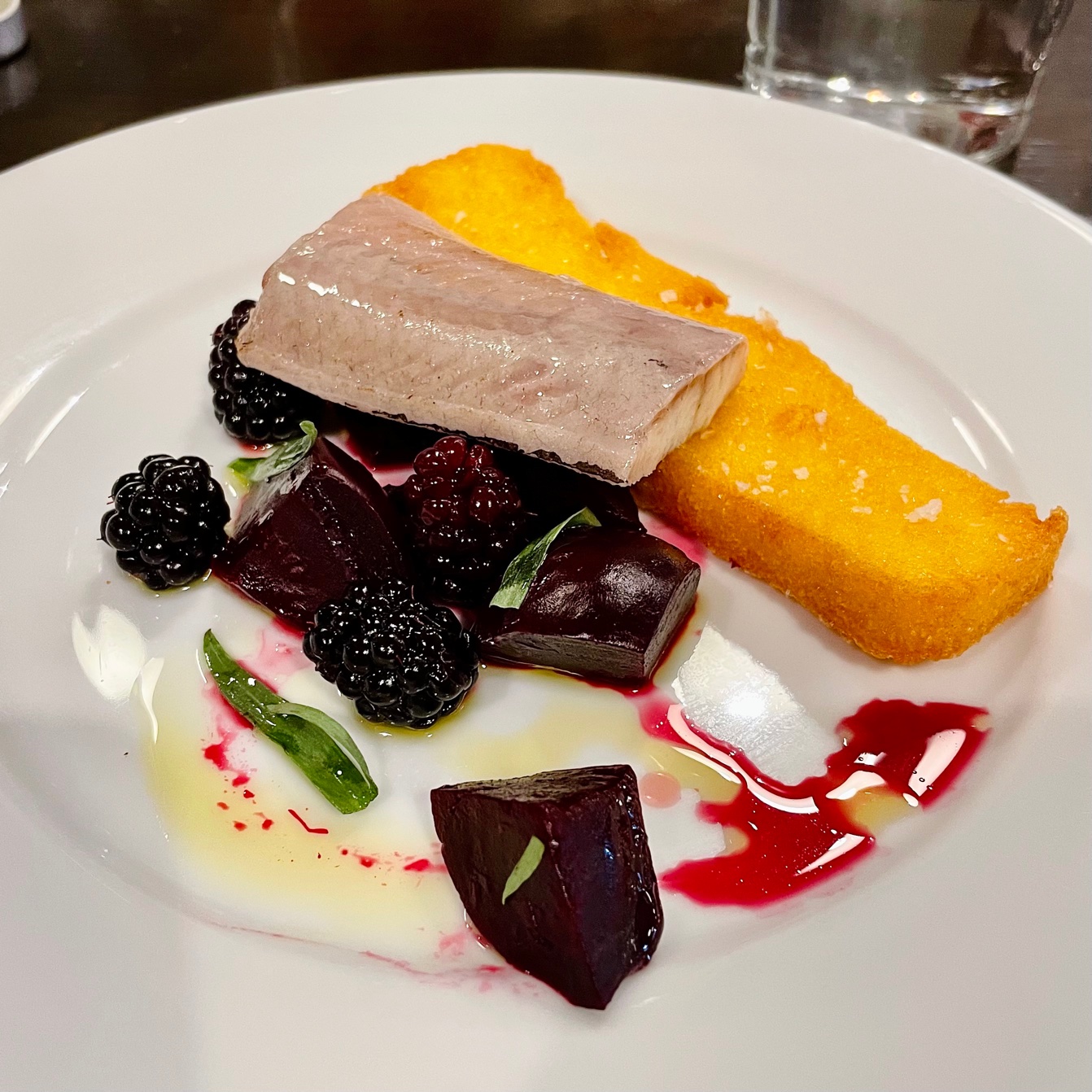
By this time the starters had turned up, and I got my first sign that I was in for an evening of sustained brilliance. I had gone for smoked eel, beautifully muscular and only lightly smoked, on an oblong of crunchy fried polenta. So far so delicious, but teaming it up with bright cubes of beetroot and blackberries with a balsamic sweetness was a killer blow. I could have eaten this all the live long day, and it left me wanting more – or, to be more specific, another portion. That’s what great starters do.
Although it was the most popular starter, a couple of us tried something else. Liz spoke highly of her marinated peppers, buried under an avalanche of Ticklemore, and I could see that I would have been equally happy with that. Ed had chosen the beef tartare, topped with chives and a slow-cooked egg yolk, flavour soaking into the bread below. How could you have food envy when you’d enjoyed your own starter so much?
I was sitting between Ed and Ben – the kind of civilised couple who don’t have to sit next to one another all evening – and, being a civilised couple, they passed plates back and forth across me, or behind me, or through me so that neither of them felt left out. But I was having such a good evening that I was more than happy to be the proverbial dumb waiter.
They were in the holiday mood – Ed’s mother was visiting their cottage in the Chew Valley over the weekend and then they were off to Cornwall for a well-earned break eating and drinking their way around that part of the world. They would spend much of the following week in their own favourite restaurants. I recognised kindred spirits, the kind of people – like me – who plan a holiday entirely around lunches and dinners, who enjoy going to places they know and love, experiencing the comfort, familiarity and total relaxation that comes with a pilgrimage like that. At the tail end of my own holiday, I couldn’t help but feel envious.
Given that Marmo was at least nominally Italian, I felt like we should have at least one Italian wine with our meal, so I chose a Tuscan red called Infraded, a deep, velvety Syrah. Ordering wine had been delegated to me by this point, but I was almost merry enough to be happy with that. Again, I felt like I’d committed a faux pas when the waiter told us this one was best served chilled, but Ed reacted with delight and I decided that on balance, I’d got away with it. It was, as you can probably guess by this point, predictably wonderful, and I made a mental note to see if there was anywhere you could buy some when I got home and Bristol was just a distant, happy memory.
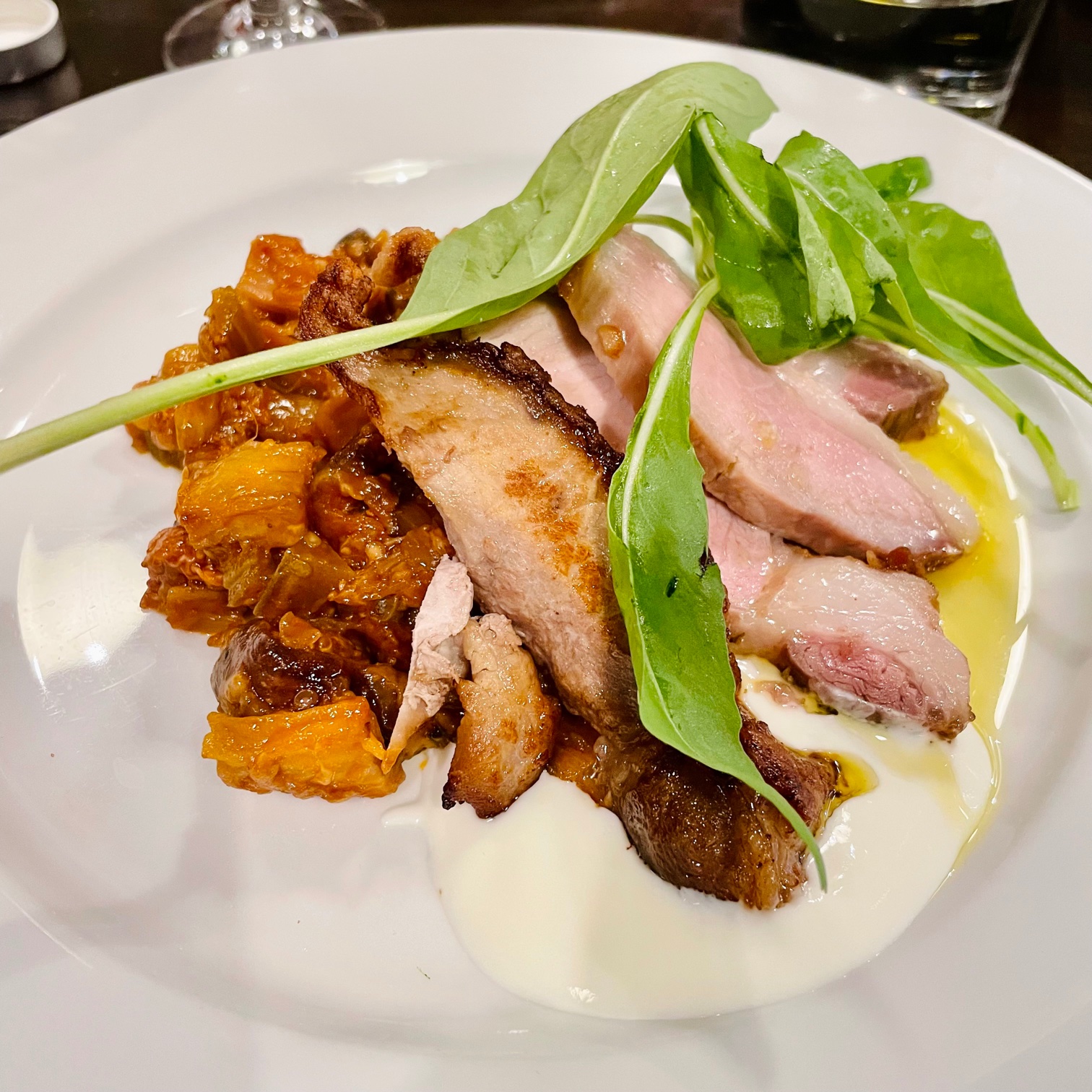
The main courses brought more fireworks. I’ve always heard Mangalitza pork spoken of in hushed tones as the Kobe beef of the pork world, but I’d never tried it before so I was keen to pick it off the menu. It came in glorious marbled slabs, just-pink and tender with the most beautiful melting fat: eating it I could understand why the Italians got so excited about lardo, and the idea of eating fat on its own. It was served simply with a handful of other elements, a wonderful caponata given a fresh edge with the judicious addition of fig, some good oil and a little slick of yoghurt. It was as good a single dish as I’ve eaten this year: I looked over at James, who had ordered the same thing, and saw him lost in a reverent silence.
That silence was eventually broken by Ed telling a story from the time when he used to manage a bookshop in Oxford.
“We had lots of celebrities in while I was there, but the best rider we ever had was from Roger Moore. And Roger Moore only asked for two things.”
“Really?” I tried to imagine exactly what vintage of Château Mouton Rothschild would feature in Sir Roger’s demands. “What were they?”
“A bottle of Jacob’s Creek and a Pret crayfish sandwich. That was all, every time. And by the end of a signing he was always absolutely fucked.”
This couldn’t help but make me warm to the great man. And of course, Ed had a picture on his phone of him with Jacob’s Bond, although it wasn’t clear how much wine had been taken by that point. Ed’s main course was a very attractive-looking pollock dish with mussels, and although he was taken with it, it it didn’t give me any buyer’s remorse about the Mangalitsa pork. Liz had chosen the vegetarian option, a very accomplished spinach and ricotta ravioli dish. Again, although it looked the part, missing out on it didn’t fill me with regret.
There were only two desserts on the menu and we all fancied the same one, the chocolate and hazelnut fritter, so five of us went for that while Ed nursed a grappa. It was an exemplary way to end the meal, a deep, smooth chocolate mousse, sharpened with cream and sandwiched between layers of the lightest of batters. Looking at the picture, it resembles nothing more than a witty dessert take on the ubiquitous burger: would that it was anywhere near as easy to get hold of, but it seems you have to travel to Bristol. We accompanied this with a sweet, fresh and generous glass of Coteaux de Layon (always a better bet than Sauternes, if you ever see it on a menu) – although Zoë had a negroni, because she’s developing a taste for them.
If I haven’t talked much about service it’s because they were so good. Completely unobtrusive but always there when you needed them, really friendly and enthusiastic and very good at what they did. We needed to pay at the same time as ordering our dessert so Ed and Ben could make their taxi on time, and all of that was no trouble and very efficiently sorted.
Our meal for six, including a discretionary ten per cent service charge, came to just over four hundred and ninety pounds, or something like eighty-two pounds a head. That might sound like a lot, but we really went for it – aperitifs, snacks, a three course meal, plenty of wine and dessert wine. You could spend less and I have no doubt you’d still have a superb meal, and if you find yourself in Bristol at lunchtime they have a set menu which is even more impressive value. But either way I had no regrets – a couple of nights before I’d eaten at Paco Tapas, Bristol’s Michelin starred tapas restaurant, where I spent significantly more, eaten and drunk considerably less and not had quite as much fun. You pay for a meal, but you pay for memories too.
Even as I was eating at Marmo, I knew that the marker had been set down for the rest of this year and probably most of the next: as complete, satisfying and perfect three course meal as I could imagine. I would go to Bristol to eat here again, and I would plan trips to Bristol just so I could. It’s not my favourite restaurant – if only because you can’t give that accolade to somewhere you’ve only eaten at once – but it was my favourite meal for a long time. And if you ever wonder why I don’t give out higher ratings more often, this is why. I save the big guns for the great meals, and this is the kind of standard Reading restaurants need to aspire to, slowly but surely. I still hope we’ll get there. But in the meantime, we’ll just have to hop on a train.
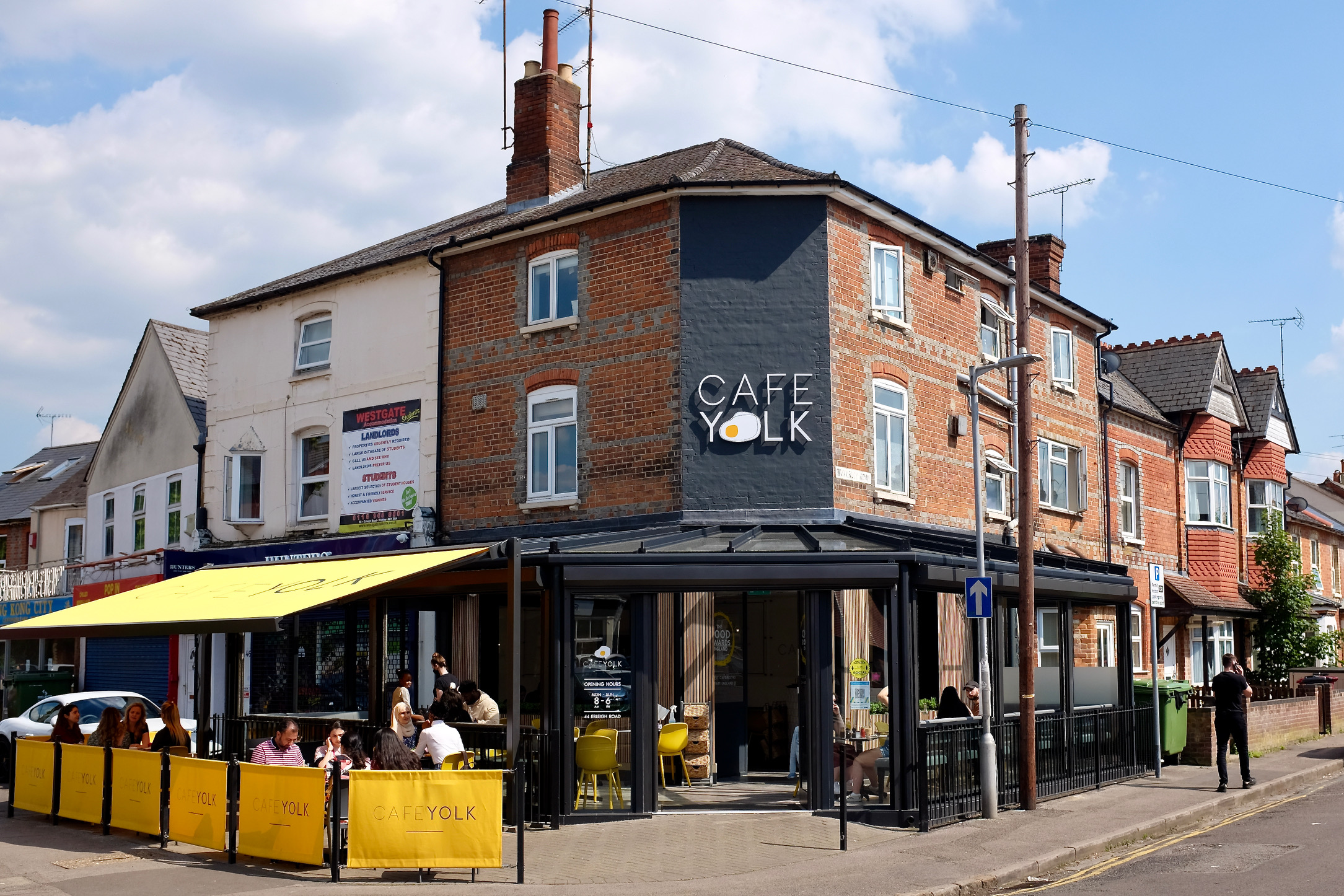
N.B. As of March 2022, Café Yolk no longer uses Anonymous Coffee as a supplier and their coffee now isn’t as good. That was a factor in the rating I gave them, so it’s probably worth bearing in mind.
When I started to re-review venues this month, I had a couple of criteria in mind when deciding where to go. The older the review the more sense it made to return, to see whether things had changed. But also, the stronger my feelings at the time the more I thought I should try a restaurant again. With the places I liked, like Pepe Sale, I wanted to see whether they had stood the test of time. But even more interesting, I think, were the ones I’d enjoyed less.
If they’d survived all this time then either they’d fixed whatever the issues were, or – and this is more likely – I was plain wrong about them at the time. And this brings us neatly to Café Yolk, which I first visited in November 2013. At that time I didn’t get the appeal, and I said so, and it generated the first controversy on this blog as a number of people lined up in the comments to tell me how very wrong I was (one of them, it turned out, worked for Café Yolk, a fact he neglected to mention at the time).
I didn’t do it to be controversial – clickbait was barely a thing in 2013 – but it was my first experience of putting my head above the parapet, and it prepared me well, for example, for saying, a couple of months later, that I reckoned Sweeney & Todd wasn’t much cop. This was before culture war was a thing, back in the mists of time when you could express opinions on the internet without being hit with a tidal wave of bile. They were more innocent days.
Anyway, nearly eight years has passed, and in that time Yolk has expanded, thrived and embraced social media. It has a dedicated fan base, many of whom would no doubt read my review from 2013 and not recognise the place I described back then. In the intervening years a friend of mine raved about Yolk, so I went there with her and had some far happier meals. And more recently, a number of people have told me on social media that I really ought to give it another go on duty, so I headed there on a sunny weekday for lunch with my other half Zoë in order to check it out.
Subscribe to continue reading
Become a paid subscriber to get access to the rest of this post and other exclusive content.
Pepe Sale closed in June 2024. I’ve left the review up for posterity.
“I’m looking forward to the full Edible Reading experience” James said when I met him at the station. He made it sound as if joining me to review a meal was some kind of theme park. The Edible Reading Experience: you have to be this smug to ride.
“It’s nothing special. There are just two rules – don’t mention the blog when we’re in the restaurant and take photos of everything you eat. Zoë’s meeting us there. Do you want to know where we’re going?”
“Don’t tell me, I don’t want to spoil it.”
“I’ve saved a good one for you. And it’s the perfect one to review this week – it’s a revisit of the first place I ever reviewed, and it came under new management last year. And it’s an Italian restaurant, which is topical after last night. Let’s hope they don’t gloat too much.”
“Sounds perfect” said James, and we ambled through town, past the side of the Broad Street Mall. James is unflappable, but he almost did a double take. “Ah, you have a Taco Bell.”
“I’m afraid so. Its popularity is a continuing mystery to me.”
Later James told me that Taco Bell’s beef is only technically 88% beef because it contains so much other gubbins. He’s full of useful information like this – with hindsight I don’t know why I didn’t invite him to come with me on duty before. He likes the finer things in life: this is a man who flew to Korea for a weekend just to learn how to cook Korean barbecue, a man who has converted his garage into a micropub. Just the person to bring along to bolster my “man of the people” credentials.
He was also the perfect person to take to Pepe Sale, the subject of this week’s review: he’d joined Zoë and me on holiday in Bologna two years ago and we’d rhapsodised together over ragu and porchetta, each meal as superb as the last. Our last holiday before lockdown was with James and his other half Liz in Copenhagen, eating magnificent food, attending a wild beer festival out in the docklands, stumbling out of brewpub after brewpub, enjoying the driverless subway trains and being too smudged to appreciate the Design Museum. We talked about coronavirus on that holiday, but with no real appreciation of what was coming, unaware of the gathering storm.
Although Pepe Sale changed hands last year the buyers kept that news quiet, presumably because they wanted a smooth transition and to retain as many regulars as possible (perhaps wisely: I remember the panic a couple of years ago when Pepe Sale showed up as for sale on a listings website). It became more apparent this year, as previous owner Toni Sale set up his “Pasta Academy”, running classes out of his gorgeous-looking kitchen, and the new owners made a small but significant change by opening on Sundays. Prior to that, Pepe Sale only opened on one Sunday every year, namely Mother’s Day.
A few people told me last year, after visiting Pepe Sale, that it didn’t feel the same: not necessarily better or worse, but that something had changed. And that made sense, really. Toni was a big presence in the kitchen, his wife Samantha ran front of house superbly: with both of them gone, it was bound to be a different experience. When I looked at all the restaurants I’ve reviewed, trying to gauge which ones needed a repeat visit, Pepe Sale was high on the list. And so, nearly eight years after my previous review, Zoë, James and I went on a Monday lunchtime to see how different it was.
Visually, you’d barely notice the restaurant has changed hands. The decor is unaltered, all high-backed chairs and marble-topped tables. The restaurant is split-level, with the smaller space up top looking out on Queens Walk and the lower level a bigger room that I’ve always found harder to like. The only real difference was that the space by the front door where Toni used to roll fresh pasta every day has been replaced by another table. No specials menu either, that I could see, which was a shame – although it might have been because we were there on a Monday lunchtime.
I might find myself saying “it might just have been that we were there on a Monday lunchtime” many times during this review, so let’s take it as read from now on. The three of us were the only customers that afternoon, and there was a nicely sleepy pace to things with our waiter (the only staff member that I saw) giving us plenty of time to sip our water, read our menus, catch up and eventually get round to making our choices.
“Were you celebrating last night?” James asked him, ever the diplomat.
“I had four Peronis and a bottle of pinot grigio” he said, his eyes smiling, even if you couldn’t see a grin behind his mask. “But I wanted England to win. I’ve lived here for so long, and my kids were born here. My little boy was devastated this morning.”
The menu hasn’t been changed one iota under the new management, so it’s virtually identical to the one I ordered from back in 2013 and probably much the same as it was when they opened. The wine list, though, printed on the other side of the menu, was far smaller than the one I’m used to. Pepe Sale’s wine list was always a selling point – a huge range, across all price points, the majority of it coming from Sardinia. It’s now a one pager, although it’s all still Italian. Perhaps Pepe Sale has a separate, bigger wine list but if so, I wasn’t shown it and I didn’t think to ask; I can well believe, though, that the events of Brexit might have reduced the amount of wines the restaurant can economically import.
In any event, we had a very nice red from Piedmont called Otto Bucce, which was peppery and smokey and felt like good value at around twenty-seven pounds. We took those first happy sips, we broke off pieces of rosemary-studded pane carasau and we began the serious business of chatting and gossiping. Italian music was playing in the background – another change, I think – and even though James, technically, was the only person who was on holiday, somehow we all felt like we were. I love it when restaurants do that to you.
Before our starters arrived, there was a spanner in the works: our waiter materialised to let us know that they were out of avocados. Would we like to order something different, or wait ten minutes while they nipped out to get some new ones? We opted for the latter, and all I can say is that I’d like to know where they bought them from. It certainly wasn’t a supermarket – I’ve lost count of the number of times a “perfectly ripe” avocado meant “perfectly ripe in a couple of weeks” – so I’m guessing they nipped round the corner and got some from the kerbside cornucopia of the Oxford Road’s magnificent Best Foods.
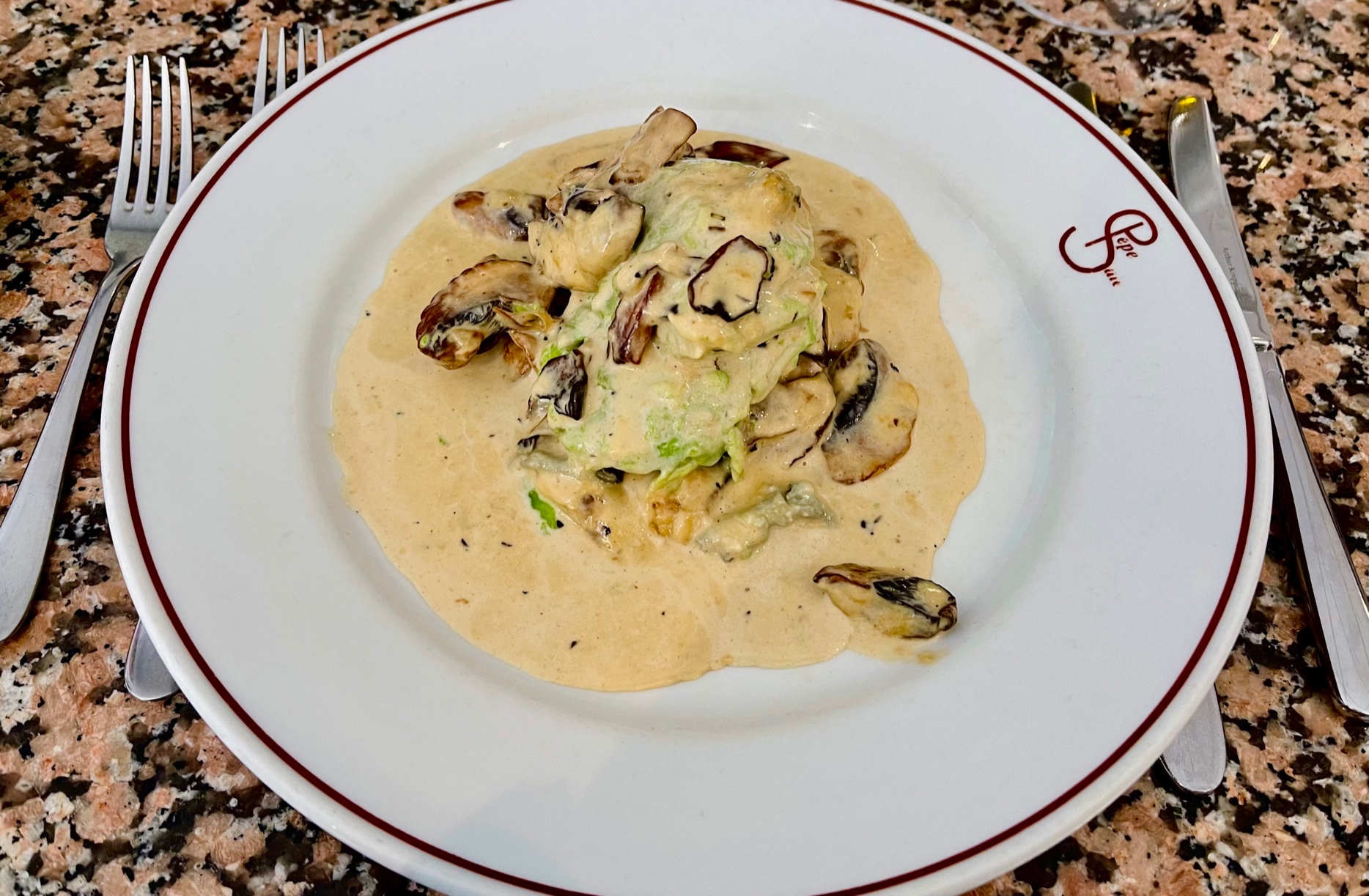
Anyway, Zoë’s starter of avocado and mushrooms in a dolcelatte sauce was a marvellous, indulgent thing and easily worth the additional wait. The avocado was ripe and buttery and the sauce, which added just enough salt and funk, was so good that Zoë looked ruefully over at the empty bread basket and wished she’d saved a couple of pieces to mop it up.
James ordered a starter I ate on my visit all those years ago, mozzarella baked in radicchio with anchovies, olives and cherry tomatoes (if you want a pointer that Pepe Sale resolutely resists trends, here it is: burrata is nowhere to be seen on the menu). James enthused about it and although I didn’t try any, it looked as good as I remembered. As a rule I think the worst thing you can do to mozzarella is heat it up, but there’s something about those precious parcels of molten cheese and bitter leaf that’s properly charming, especially teamed with the hit of anchovy and the sweetness of little tomatoes.
If that description makes you think I was suffering from starter envy, you’re probably right. I had gone for malloreddus, a Sardinian pasta speciality, which are best described as halfway between gnocchi and conchiglie, tightly curled shells, in a spicy tomato sauce with chunks of sausage. Everything worked, on paper – the sauce had a good heat, it clung nicely to the pasta and the sausage tasted decent. But somehow, it started to feel like a chore by the end, a tiny bit one-note compared to the other starters at the table. Perhaps I’d have felt differently if the sausage meat had been crumbled, finer in texture, rather than big slices of the stuff.
There was a nicely civilised pause between courses, and our mains arrived just as we were ready for them – a relief, as kitchens without much to do often rattle off the next set of dishes quicker than you’d like. Zoë picked an absolute banker from the menu, chicken breast, stuffed with mozzarella and sage and wrapped in pancetta. Again I found myself gazing in envy at a pool of molten mozzarella and wishing I’d played it safer: I was allowed a forkful which reminded me what a solid, classic dish it was (it also made me miss the saltimbocca at sadly-departed Dolce Vita, halfway across town and many years ago).
James chose a dish I’ve never ordered, wild boar cutlet in a tomato sauce. It looked the part – a handsome slab of meat cut into three in a deep sauce with plenty of cherry tomatoes (“I’ve picked the two tomato-lovers’ dishes” said James). But he wasn’t wild about the texture – “it’s not a soft meat, put it that way” – and found it tougher and chewier than he’d have liked; a sharp steak knife would have helped matters along.
My dish, sea bream, was also close but not quite there. The fish was beautifully cooked, two lovely fillets with tender flesh and crisp skin, and it’s hard to go wrong with anchovies and olives (and beautifully chopped shallots). But the thing I always loved about Pepe Sale’s fish dishes was the sauce, a rich fish fumet fragrant with wine, and this felt a little thinner than I remembered. It wasn’t a bad dish by any means, but lacking a little oomph. Had it changed, or had I?
All of us went for a selection of vegetables and these were well-judged – nicely crunchy potatoes sauteed with rosemary and perfectly al dente carrots and broccoli; Pepe Sale, more than any place I can think of, taught me the virtues of not overcooking your veg.
The dessert menu is also unchanged, and is a mixture of Italian, generic and Sardinian dishes, all reasonably priced. I was tempted by the basil panna cotta, another old favourite, but James and I both went for the sweet ravioli. They were every bit as delicious as my happy memories of them, fried squares packed with gooey ricotta and orange zest, the whole thing drizzled with sweet syrup and topped with more strips of fried pastry and a little snowdrift of icing sugar. Looking back at my picture of this dish from 2013, and the mozzarella starter for that matter, I’d say this kitchen puts more effort into plating now: the camera loved it as much as I did.
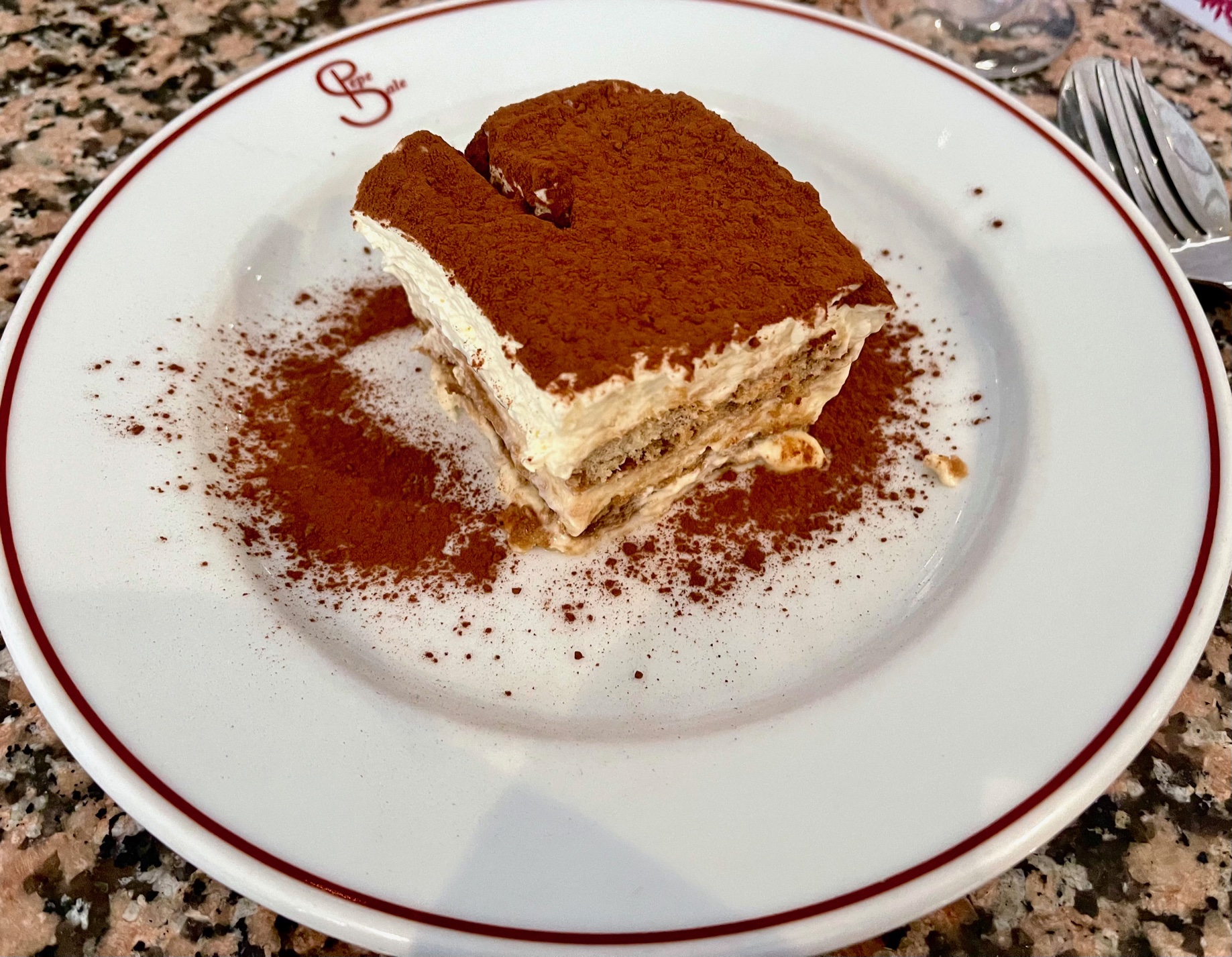
Zoë’s choice was the tiramisu, and again I was allowed just enough of it to wonder if she ever ordered a bad dish. I suppose there are no surprises with tiramisu – you know it will be boozy and rich, all cream and coffee and chocolate, and this one was no exception. “I liked it a lot, but it did make me cough” she said later. “It’s the dust of the cocoa powder and my dodgy lungs. That’s why I was never allowed Dib Dabs as a kid”.
Our meal – three courses each, some bread, a bottle of wine and a trio of amaros to help our desserts go down – came to just over a hundred and thirty pounds, not including tip. Pepe Sale is currently running a promotion where you get 20% off your food bill Mondays to Thursdays, and without that it would have been over a hundred and fifty pounds. Looking back at my 2013 visit a similar meal for two came to eighty pounds, so prices have definitely crept up – although that’s only to be expected and our meal still felt like good value.
As we settled up, I asked our waiter how business had been since they reopened in May. He told us that they were busy at weekends, solidly booked in fact, but things were still sluggish during the week – an experience I suspect is shared by many of Reading’s restaurants. He added that having Reading’s ill-advised quarantine hotel at the end of Queens Walk had hardly helped matters, although things were recovering now.
It did make me think about whether people would feel comfortable eating inside on a busy evening – the tables are reasonably spaced but there are no screens, and although the front of the restaurant has big double doors which could be opened for ventilation they stayed resolutely closed during our visit. It’s a shame they’ve never put any tables outside, as their neighbours ThaiGrr! and Bierhaus have chosen to, but I guess that part of town can be a bit of a wind tunnel at times.
We carried out a debrief over beers in the garden of the Nag’s Head, and there was less consensus than I expected. Zoë was the most positive about her food, but I think she ordered better than the rest of us (“that starter was great, but you know I love the ‘shrooms”). James was more equivocal, put off slightly by the toughness of that wild boar. I was somewhere in the middle, but in the back of my mind I was thinking that the food was almost exactly as it always was, and I couldn’t decide whether that was a good thing or not. We discussed it a little further, but then we were interrupted by a positively operatic fart from a shaven-headed gentleman at the table behind us which sounded like Brian Blessed molesting a tuba. We dissolved into fits of laughter, and that was that.
I feel a bit for Pepe Sale’s new owners. Talk about a no-win situation: if they make sweeping changes they’ve have messed with an institution, if they don’t they risk preserving it in aspic. And yet the restaurant barely changed in many years, so you can understand them not wanting to muck up a winning formula. I think it misses the specials and that wider wine list, and I sincerely hope they’re still making their pasta on the premises, but all in all it feels like the new owners are worthy custodians of the food: everything I had felt up to the standards of previous visits, and if anything the focus on presentation is stronger now.
And yet there’s so much more to a restaurant than the food. Aside from how Covid-cautious customers would feel eating in Pepe Sale, it’s safe to say that the real test of a restaurant is how it copes on busier evenings, whether the service and the kitchen can step up a gear to deal with the demands of a packed dining room. But not just that: it also depends whether that magical transmutation happens, where instead of just being a room full of people it becomes a wonderful buzzy place, a club where you’re lucky enough – if only for one evening – to be a member. At its best, Pepe Sale always did that. The new owners will face far sterner challenges in the months ahead than our chatty table of three on a Monday lunchtime. My fingers are crossed that they are up to them.
This week’s review marks a new first for the blog, the first time I’ve re-reviewed a restaurant. Well, sort of: I’ve re-reviewed places before, but normally it’s because they’ve changed hands, even though the name has remained the same. This is often the case with pubs – so, for instance, I’ve reviewed the Lyndhurst three times, the Fisherman’s Cottage twice. The room and furniture were identical on all my visits, but the management, the team in the kitchen were completely different. So of course you’d view it as a separate business – just as, at some point, I’ll review the Corn Stores again, because what it offers now is a world away from what I ate when I went there last.
But some restaurants, particularly ones that stand the test of time, go through phases under the same ownership. The menu shifts and changes, the personnel in the kitchen will too, front of house stars will come and go and, over time, a restaurant can become the hospitality equivalent of Trigger’s broom. There are golden ages and doldrums. The best example I can think of is Mya Lacarte – in its prime, with Matt and Alex running the front of house and Remy Joly in the kitchen, it was an unbeatable place, but no incarnation after that managed to match those halcyon days.
When you’ve been at this lark as long as I have, the odds get shorter that places will change so much that a fresh look is overdue. Many places I’ve reviewed have since closed – correlation rather than causation, I promise – but many have made a go of it and flourished. Take Coconut, for example, or Valpy Street: are they really the same restaurant as they were when I first went there, not long after they opened? Is another visit in order?
I can’t think of a better example of this than London Street Brasserie, the subject of the third review I ever wrote. Even by then, the restaurant had been going for more than ten years – now, in 2021, it’s over twenty years old. Many chefs and front of house have passed through its doors since 2000 and some have gone on to open or work in other restaurants, in Reading and beyond. It’s still probably the town’s best-known restaurant and the Reading venue people are most likely to consider a special occasion restaurant.
It’s also, as I discovered recently, a restaurant about which many people in Reading have an opinion. I went there in May with family, not long after it reopened, and when I posted pictures of my food on social media plenty of people had something to say. “I ate there recently and enjoyed it so much that we went again last week. Have the poached pear next time you go!” said one person. “I’m heading straight for the sticky toffee pudding once we’re double-vaxxed” said another. But it wasn’t unanimous: “I’ve never had a decent plate in all the times I’ve been” was a third opinion. My previous review is nearly eight years old – a lifetime ago, in so many ways – so it felt like the right time to head back, on a weekday lunchtime, with my other half Zoë.
Subscribe to continue reading
Become a paid subscriber to get access to the rest of this post and other exclusive content.






 Edible Reading