

Magdalen Road in Oxford is a 20 minute bus ride from the train station, out east, down the High and over Magdalen Bridge. It connects two of the three great thoroughfares of east Oxford, Cowley Road and Iffley Road, and you can walk from one end to the other in under 10 minutes. One side of it, at the Cowley Road end, is fairly unremarkable – a general store advertising Lycamobile, a letting agent, terraced houses of various vintages.
Only a huge shop called The Goldfish Bowl, advertising “EVERYTHING FOR THE FISHKEEPER” in big orange letters has even a hint of quirkiness. But then you reach the halfway mark, cross over to the Iffley Road side, and find yourself in Oxford’s most incongruous gastronomic microclimate.
Suddenly everything is very different, and both sides of Magdalen Road are full of independent outposts for food lovers. There’s Wild Honey, an “organic health store” advertising local produce, next to a little pink-awninged spot called The Magic Cafe. There’s a pub, The Rusty Bicycle, owned by the same group as Reading’s Last Crumb. Further down, there’s a little shop selling Scandinavian homewares – earthenware cups, sheepskin rugs, scented candles and room diffusers.
Just opposite that, plant-based café Green Routes stands next to Elle’s Deli, which used to be home to Oli’s Thai, for a long time Oxford’s most critically acclaimed restaurant (you had to book a table months in advance). The deli still serves Thai food, and people were sitting outside on a coldish Saturday morning eating it, but it also sells Superbon crisps, vermouth and jars of every kind of deliciousness from romesco to gochujang.
Travel a little further and you get to another cafe called the Larder, with attractive-looking loaves on sale in the window: again, on a day that wasn’t the warmest people were already sitting outside. And next to that, there’s the roastery for Oxford’s Missing Bean, who do some of my favourite coffee and supply to Reading’s Coffee Under Pressure. And then finally, at the southern end of Magdalen Road you reach the Magdalen Arms, which has long been one of my favourite places to eat in the city.
That little stretch of Magdalen Road seems to come out of nowhere, a strange and wonderful little oasis. Just imagine: in the space of five minutes, out in east Oxford, you can visit as many independent delis and cafes and bakeries as you can find inside Reading’s IDR. If anything, with its joggers and dog walkers, its air of bourgeois contentment, it was almost like a micro-Caversham.
At one point a mum cycled past me on some kind of cargo trike, a contraption with two wheels up front and a big box between them, her kid standing up in it and looking out on the world; the Cowley Road’s scruff and bustle was simultaneously a few minutes and a world away.
I found myself in this neck of the woods to check out Taste Tibet, a restaurant that’s been on my to do list for some time. It’s a no-reservations Tibetan restaurant, owned by married couple Yeshi Jampa and Julie Kleeman. They met in India, fell in love, and moved back to Oxford where Kleeman had a job with OUP. They started out running a street food stall over ten years ago, and during the pandemic they opened this spot on Magdalen Road. Since then success has followed, with a cookbook in 2022 and an honourable mention in that year’s Observer Food Monthly Awards as one of the best value eats in the South-East.
Not only that, but Taste Tibet also provides dozens of meals to vulnerable people in its community every week and its thoroughly charming website links with an excellent weekly blog, beautifully written by Kleeman, that is very frank about the challenges hospitality in general, and its little restaurant in particular, continue to face. I’d challenge you to read a couple of posts and not find yourself rooting for them: I certainly came away from it surprised by how invested I was in their project. As I got there at noon – because you can’t be too careful – Jampa was opening up and he cheerily told me to come on in.
The interior is a lovely, tasteful room but very much in a canteen style, which fits with the lack of reservations. Long tables and benches, which I imagine are communal at busy times, were like a posh reimagining of the furniture you find at every tap room in the land, but the overall effect was very pleasant. There were also seats up at the window, which tempted me, or facing the wall, which didn’t. Jampa told me to hang my coat up on the hooks, which I did at first, but given that the door was left open to attract passing trade I quickly changed my mind and put it back on.
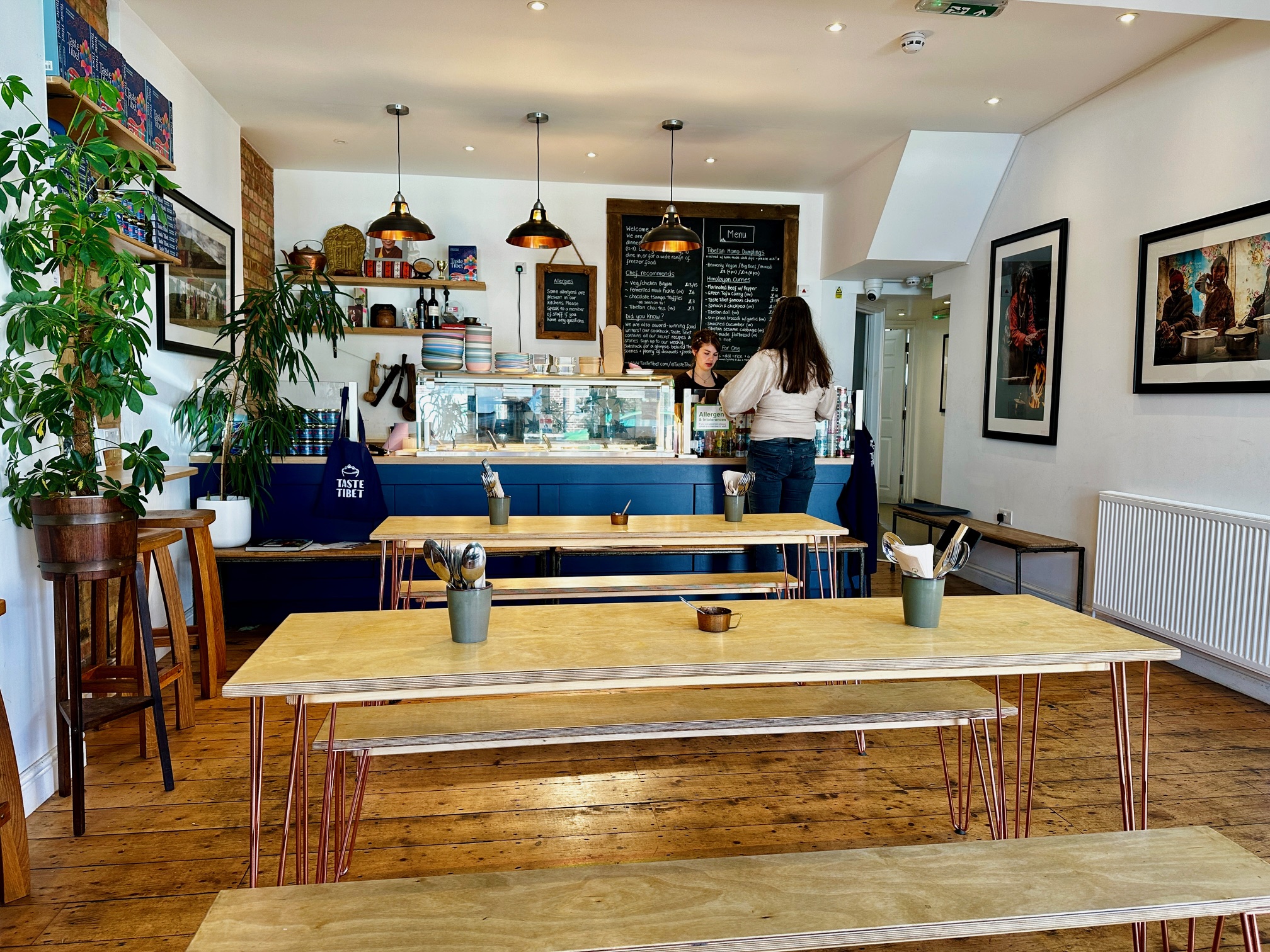
The menu, which changes weekly, is up on a blackboard behind the counter, and many of the dishes are already cooked, in chafing dishes up at the counter. Taste Tibet cannily also offers frozen meals for its customers to enjoy at home, these are in a separate freezer near the front and are a clever way to make sure nothing is wasted. They also had a decent range of drinks, soft and alcoholic, including wines in cans. I was a little disappointed, as always, to see Brewdog as one of the options but I got myself a verbena-infused pale by Earth Ale, a little brewery just outside Abingdon, which I really enjoyed for its fresh citrus and slight bitterness.
On the day I visited, Taste Tibet was offering momo – four or eight, vegan or beef – and four curries, with a mix of sides. They also served a biryani, or a feast option where you got a couple of dishes, dal, rice and a solitary momo for about fifteen pounds. If that pricing sounds keen, it wasn’t unrepresentative -curries weren’t much over a tenner and rice only two pounds fifty. Sides clustered around the five pound mark and momo were four for eight pounds. I ordered some momo, a curry and rice: that, with a tip included, cost me thirty pounds. “I’m in no rush” I said, “so it’s okay to bring the momo out first and the curry after that.”
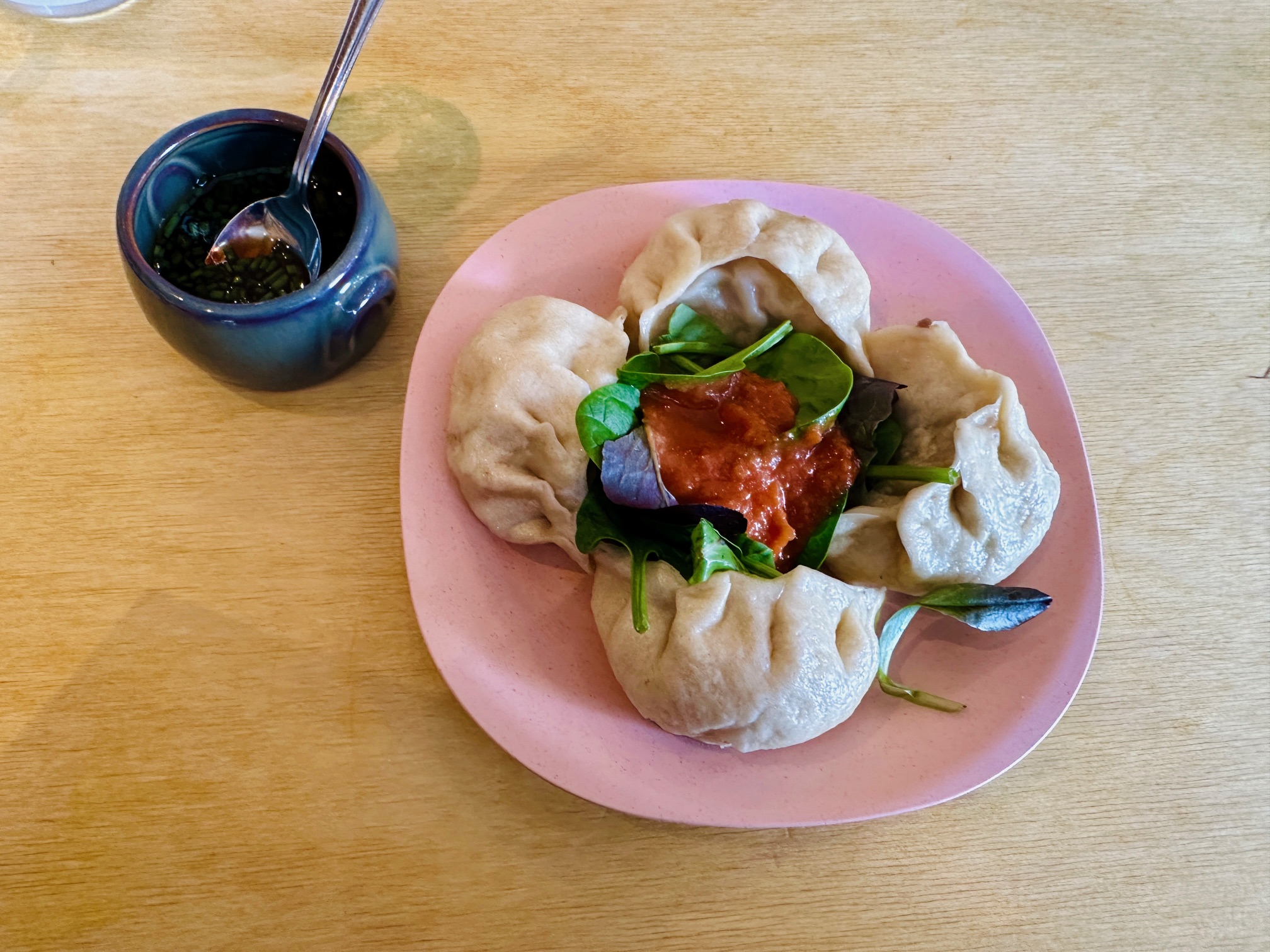
My momo came out five minutes later, and weren’t at all what I was expecting. Although momo apparently originate from Tibet rather than Nepal they’re so prevalent in Nepalese cuisine, and Nepalese cuisine is so prevalent in Reading, that I thought these would be a known quantity. And with that in mind, I thought four for eight pounds felt a bit steep. But Taste Tibet’s momo were a very different beast to the ones I’ve eaten at Sapana Home or Kamal’s Kitchen.
For a start, they were big: impossible to eat in one go, and challenging even in two. Crimped like jiaozi, they were steamed and made with dough that was thick verging on too thick, but that gave them structure and a pleasing, carby solidity. The beef inside – beef, not buffalo, although whether that’s the difference between East Oxford and Reading or Tibet and Nepal I couldn’t tell you – was properly lovely, coarse and delicious.
This came with a little handful of leaves whose main function was to serve as a bowl for a red sauce which was apparently a home-made chilli sauce: I found it a little meek. But what I did love was the bowl of a darker dipping sauce with a kick of soy. Again, I wonder if that’s the influence of Tibet, because I’ve never had Nepalese momo served with that, and it really did make me see the momo in a slightly different light. I can see the appeal of coming to Taste Tibet, as I used to with Sapana Home, and just going to town on the momo.
Later on, as I came to the end of my meal, couples and families were braving the outside tables and I saw big plates of momo going past on their way to the little terrace. Perhaps that was the way to do this place, or to come with a big group and try everything. One of the reasons I hadn’t ordered the “feast for one” was the presence of that single momo. It felt stingy, but looking at what had been put in front of me one would have been plenty, paired with an exploration of more of the menu.
My request that my curry come out after my momo had been taken a little too literally. Perhaps I should have said “after I’ve finished my momo”, although I didn’t think I’d needed to, but instead the rest of the meal arrived when I was halfway through what I thought was my starter. Really, though, that was me misjudging the place and its similarity to a canteen rather than a mistake on the restaurant’s part. Everything is there ready to dish up, and if you order something that’s exactly what they will do.
I had chosen Taste Tibet’s “famous chicken” because I took famous to mean signature, and I figured that if I was visiting a restaurant on my own I owed it to myself to check out the signature dish. And having eaten it I suspect it’s the restaurant, rather than the chicken, that is famous. It was a big portion with plenty of chicken, plenty of sauce. The chicken was all good and tender, and it was impossible to take exception to the dish.
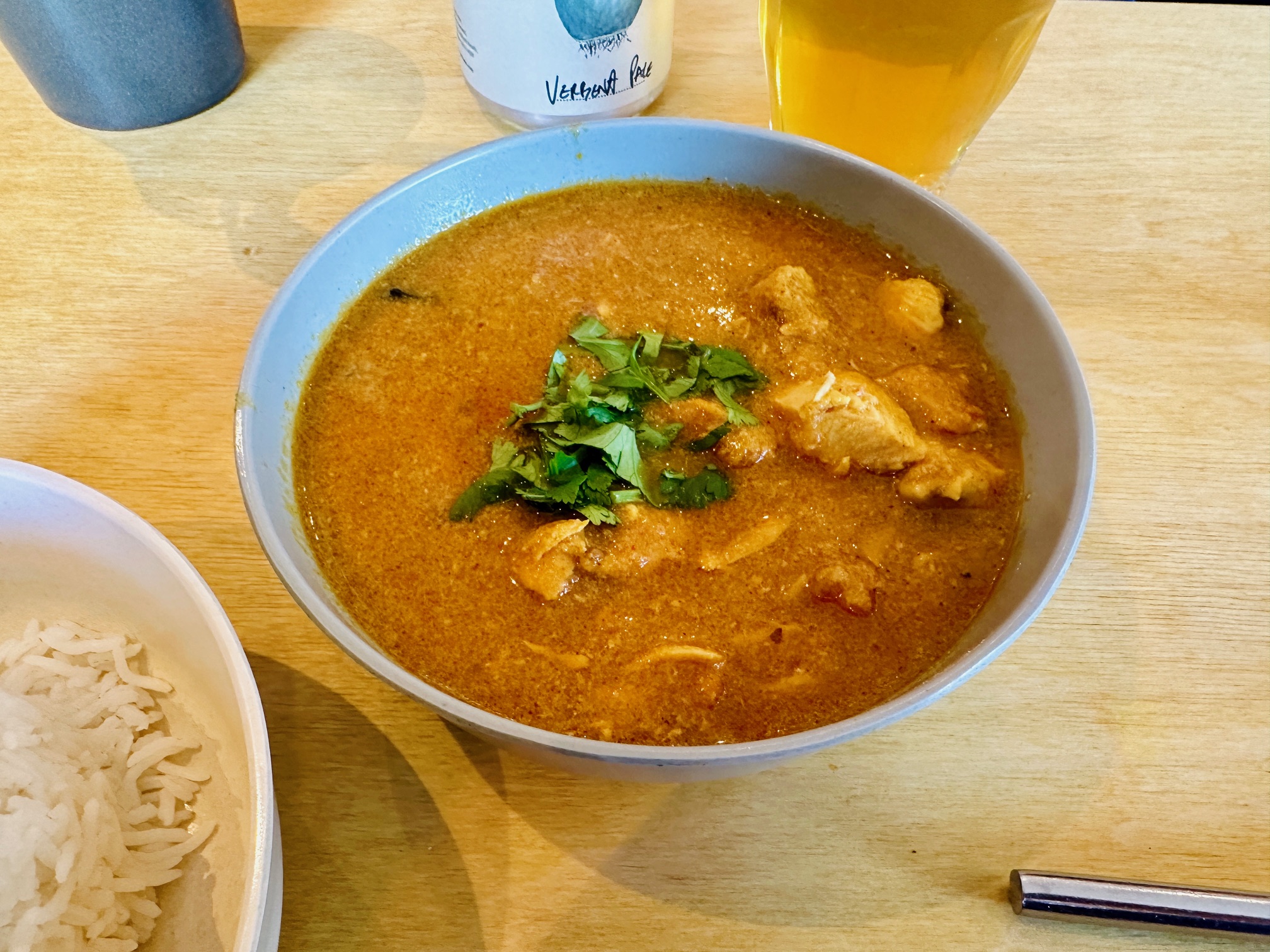
But although not being offensive is a good thing, being inoffensive isn’t, and that’s what this was. Perhaps if my expectations had been lower I would have seen this as a comforting bowl of food, and celebrated what it was rather than noticing what it wasn’t. But this was like curry from a bygone age, before we got into regional food, started to discover the difference between Kerala and Hyderabad. It felt a bit like a Vesta curry, from forty years ago, and for something famous I expected more: I expected it to be famous for something.
How to make it more interesting, I wondered? I tried spooning in my perfectly cooked basmati rice – Taste Tibet serves both curry and rice in bowls that are just big enough for each, rather than giving you a plate to dish them up onto – but that bulked it without being transformative. I tried adding a spoonful of the dried chillis in a ramekin out on the table, but it lent an acrid pungency without elevating anything. The difference in heat levels was like the difference between sleeping on one pillow and two, going from not enough to too much.
I didn’t want to leave it like that, and I fancied dessert, so I went up to order the only thing on the blackboard that looked like afters. Chocolate tsampa truffles – as seen on TV! sounded absolutely like my sort of thing, and only cost three pounds. I was too full to have the chai that should have accompanied it, but never mind.
By this point the restaurant was far fuller, with people taking tables outside and the long table opposite me occupied by a group of impossibly young, animated east Oxford types. I looked on them indulgently, remembering a time over thirty years ago when that could have been me: not that I would have had the money to eat in a place like this.
Positively 4th Street was playing over the speakers, and I remembered that thirty years ago I loved that song, and suddenly it was back in vogue. Time can play unkind tricks, and all the things that made me so deeply unfashionable as a student – being a geek, listening to Bob Dylan and Leonard Cohen, playing chess and Dungeons & fucking Dragons – are acceptable now, too late for me. Even some of the shit I wore back then might be in now, I thought.
I felt a little tug of envy and regret, and then I let it go. It was as close to Buddhism as I got in Taste Tibet.
The chocolate tsampa truffles, plural, turned out to be a truffle, singular. A big thing designed, like the momo, to be taken on in multiple bites. I enjoyed it and, again, it wasn’t what I thought it would be. Its texture wasn’t dense or glossy, being more gritty with a feel of granulated sugar to it. Again, that’s down to me for misunderstanding – tsampa was not something that flavoured the truffle, but instead is a kind of flour made from ground, roasted barley, so it was the thing lending that texture.
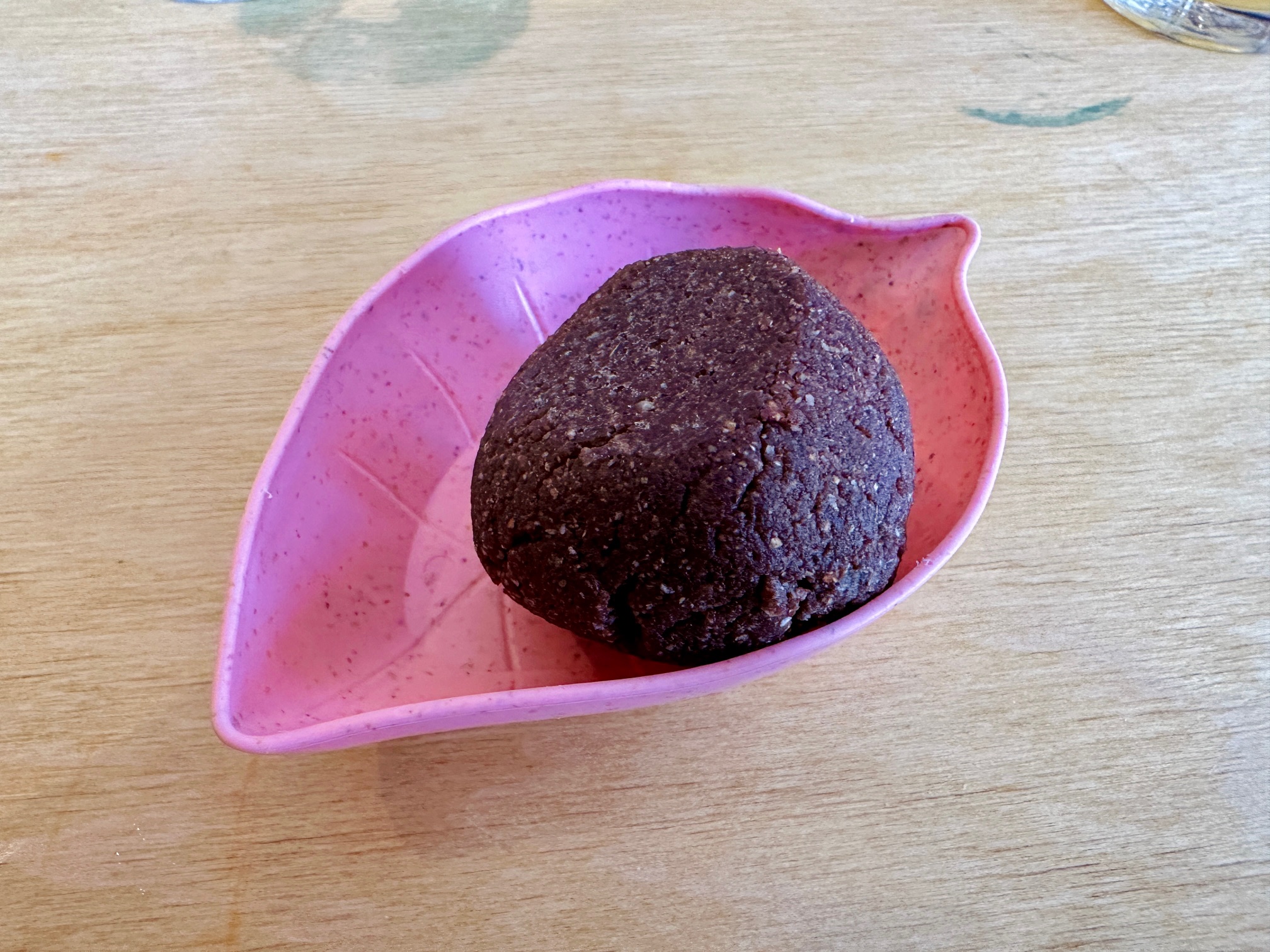
In any event, the truffle reminded me of the brigadeiros at Minas Café, and I liked it without entirely understanding it. That’s fine, by the way: now I’m in my fifties I realise that provided you like things you don’t always need to understand them.
The rest of my day in Oxford was positively joyous. I stopped at Missing Bean, which was absolutely packed, to buy beans for the weeks ahead; I’m drinking a cup of their coffee as I write this. I strolled down the Cowley Road, past its plethora of Turkish restaurants, past the now closed Gamekeeper that used to meet all my Dungeons & fucking Dragons-related needs as a teenager.
I stopped in Truck Records to get inspiration, I stopped in Peloton Espresso to get caffeination. I bought cheese in the Covered Market, had time for a beer in Tap Social before my train home. It really is a gorgeous city, and it says something about the place that Magdalen Road is one of its little oases but far from its only one.
As you may have gathered by now, although I liked Taste Tibet I wanted to like it an awful lot more than I did. And a bit of me wonders if I’m the one in the wrong. It is a gorgeous spot in a gorgeous neighbourhood in a gorgeous city. It has a great backstory, is clearly loved by the community it’s part of and does tireless and admirable work to support that community. It is run by a committed husband and wife, where he works in the kitchen and she advocates, powerfully and eloquently, online and in the media. They want to tell the stories of where he comes from, through food.
On paper, I should love it: it sounds like other restaurants I love, closer to home.
But perhaps that’s okay. Perhaps Taste Tibet makes perfect sense in its context, in that city, on that little stretch of food and drink heaven. Maybe it doesn’t need people like me travelling to and across Oxford to try it out. It’s a neighbourhood restaurant – its neighbourhood is lucky to have it, and it’s lucky to have found its place in things.
If I lived closer I’m sure I would go back, try other dishes, fill my freezer and become part of their story, as they would become part of mine. But other places have got there first, for me at least. My train home pulled in at Gare du Ding and I thought about Kamal’s Kitchen, my favourite Nepalese restaurant, a short walk from the northern entrance to the station.
Its dining room doesn’t have the stripped-back elegance of Taste Tibet, it doesn’t have a narrative the way Taste Tibet does. I think Kamal and his family do a magnificent job, but much as I’d love them to I can’t imagine them gracing the pages of Observer Food Monthly. They don’t write beautiful blog posts, they have no plans to produce a cookbook that I know of and they won’t be at Hay Literary Festival this year. They let their food do the talking, and for what it’s worth I think their momo beat Taste Tibet’s. A restaurant can succeed in so many ways, but food and service are always king.
Magdalen Road in Oxford is a really fantastic place, and I do dearly wish Reading was a little more like it. But I wouldn’t swap their restaurant with ours.
Taste Tibet – 7.0
109 Magdalen Road, Oxford, OX4 1RQ
01865 499318
As of January 2025, Edible Reading is partly supported by subscribers – click here if you want to read more about that, or click below to subscribe. Whether you’re a subscriber or not, thanks for reading.







 Edible Reading