
For my money, there are a few finer things in life than a long, leisurely Saturday lunch with a very good friend. Especially when you’re in a fetching room, in a beautiful city, faced with a cocktail, an appealing menu and excellent people watching opportunities. In fact, one of the only things finer than that is to do exactly what I’ve described above, but on a Friday, with four whole days off stretching out in front of you. So I was very happy indeed to find myself sitting in Gees’ gorgeous conservatory on Good Friday with my dear friend Jerry, Easter weekend only just beginning.
By this point, the day had already got off to a magnificent start. The train to Oxford was quiet, deserted almost, and it was the first time in as long as I could remember that it only took a couple of minutes to exit the station, a station whose abysmal design doesn’t seem to have significantly changed in the thirty or more years that I’ve been making that journey. We had a bimble round the Covered Market, we bought bread and cheese for later on, we had a beautiful latte in the Missing Bean on Turl Street, chatting away non-stop.
Jerry and I had never been to Oxford together before, so we compared our experiences of the city over coffee, looking at the connections between his mental map of the place and mine. I thought how nice it was to introduce him to some of my favourite spots, particularly as if it wasn’t for Jerry (it’s a long story) I might not know Oxford half as well as I do. The weather could’ve been nicer – the day was dry yet overcast, which never paints Oxford’s buildings in their best light – but the company was unimprovable.
I had chosen Gees for our lunch because it had been on my to-do list for quite some time. A glorious spot on the Banbury Road mainly famous for its conservatory slash greenhouse dining room, there’s been a restaurant on the site for nearly forty years, a mind-boggling record. It started out as Raymond Blanc’s restaurant, with John Burton Race in the kitchen, then five years later it became Gees and has stayed that way ever since. It’s now part of The Oxford Collection, a small and exclusive group including The Old Bank and Old Parsonage hotels, and their respective restaurants.
That length of tenure means that Gees was already trading when I turned up at Oxford in 1992, sporting terrible spectacles and even worse clothes, to study my degree alongside some of the brightest people I have ever met (and some of the thickest too, would you believe). Not, of course, that I would’ve eaten there then. As I’ve said before, my meals out were limited to regular trips to the fish and chip shop on Carfax, and the rest of the time I was either heating up an M&S chili con carne in the microwave of our communal kitchen, or enjoying – and I use that word as loosely as humanly possible – the food in my college halls.
Many Oxford colleges have an excellent reputation for food, as it happens. They also have shitloads of land and investments, and in one case their own deer park. My college had none of those things, which is probably why they accepted the likes of me: the food there was purgatorial. So Gees was for a long time a kind of mythical place, the sort of restaurant other people went to, people with wealthy parents and substantial allowances. It wasn’t until much later, probably twenty years or so later, that I went there, just once.
That too was in another life, with my then wife and a bunch of our friends who turned out, when push came to shove, to be her friends. I don’t remember much about that meal, except that it was deeply convivial, but I do remember following it up with a lot of drinks in one place or another and stopping on the way to the station for a shameful KFC. I always intended to return to Gees, but somehow I never did.
I was quickly reminded, as we stepped through the door, what an attractive place it is. Most of the seating is indeed in that big conservatory, with its banquettes, leather-backed chairs and handsome tiled floor, and it makes for a great place to eat. Even on a cloudy day the room fills with light, and something about that light, the room’s airiness, the bustle of its supremely efficient staff and the chatter from prosperous neighbouring diners created a truly brilliant atmosphere. If I gave out ratings for rooms alone, Gees would take some beating.

Gees’ menu is sort of modern European, with something from everywhere. Oysters and in-season Wye Valley asparagus were on offer, as were Serrano ham croquetas and braised octopus with romesco. But Italian dishes and ingredients tend to dominate – pizzetta, pasta, burrata, aubergine parmigiana, the list goes on. It’s as tempting a menu as any I’ve seen on my travels for a while, and on another day I could have ordered almost anything on it.
I think I read somewhere that Gees was influenced by the River Cafe, and I could imagine that in both the menu and the surroundings. Not that I’ve ever been to the River Cafe: for all the rave reviews I’ve read, paying nearly forty pounds for an asparagus starter has always been beyond my means; that said, I’m sure some of my Oxford contemporaries have been more than once. Gees’ asparagus was perhaps more keenly priced at under twelve pounds. Starters more generally weighed in at between ten and twenty pounds, pasta dishes close to twenty and main courses between eighteen and thirty-five. Not River Cafe levels, but not cheap either.
Another thing to love about an unhurried lunch is the possibility of an aperitif. So Jerry had something which the bill described as a “Bergamont Spritz”. It’s not in the drinks menu online, so I’m assuming it contained gin, some kind of sparkling wine, bergamot and – surely – a typo. I had something called a Contessa Negroni which swapped out Campari for Aperol in the classic, simple, three ingredient cocktail. You might wonder why this has never been done before, and now I can tell you: because it doesn’t taste as nice as a proper negroni.
That was all forgivable, though, because the bar snack we ordered to go with them was a real cracker – little dabs of anchovy sandwiched between two sage leaves, battered and fried. These were outrageously good, salty little treats and a really excellent idea. A far better idea than putting Aperol in a negroni, anyway. I wasn’t to realise, at that point, that my bar snack would be far and away the best thing either of us ate all day, so instead I sipped my cocktail, enjoyed the surroundings and felt pleased with the course the day was taking. At all the tables around me, people were doing much the same.

The problem is that after that, despite the room being lovely and our bottle of txakoli being cold, fresh and zippy it felt to me like Gee’s menu delivered wobble after wobble. Take my starter, which was described as venison tonnato. Now, I thought that sounded like an interesting idea: a vitello tonnato swapping our the veal for venison could, after all, possibly work. And it might still be an interesting idea, but it wasn’t in a million years what this dish was.
Instead of thinly sliced venison, you got a piece of venison fillet, cooked through without pinkness, thickly sliced and drizzled with a pale sauce that contained absolutely no tuna. Not the slightest hint of it, not even a whisper of tuna. I don’t know what it tasted of – not a lot, really – but it meant that both the main ingredients of vitello tonnato were missing, replaced with things that were damage not homage. And then there was a big pile of salad, because this starter cost fifteen pounds and they had to find ways to distract a paying customer from realising that this wasn’t in any way what they had ordered.

Ordering a salad by mistake seemed to be quite an Oxford thing: I was reminded of a similar incident at Branca when I went there earlier in the year. I didn’t mind that then, because my stealth salad at Branca was still an excellent dish. This, not so much. If it had been called “venison salad with tonnato dressing”, while not 100% accurate, I’d have had fewer quibbles. Of course, if it had been called that I’d have ordered something else.
The problem is that not only is stealth salad seemingly an Oxford thing, it’s also – to paraphrase Dr Dre – a Gees thing. Jerry’s soft shell crab with saffron aioli was nice enough, but you get an idea even from the picture below of how diddy it was. Again, salad appeared mainly to be there to fill negative space, a kind of gastronomic find the lady deception. A different salad to that accompanying my starter, with shaved fennel and olive oil. Again, not mentioned on the menu but, in truth, a large part of proceedings. Jerry gave me a forkful of his crab. There was so little that I felt guilty taking it.
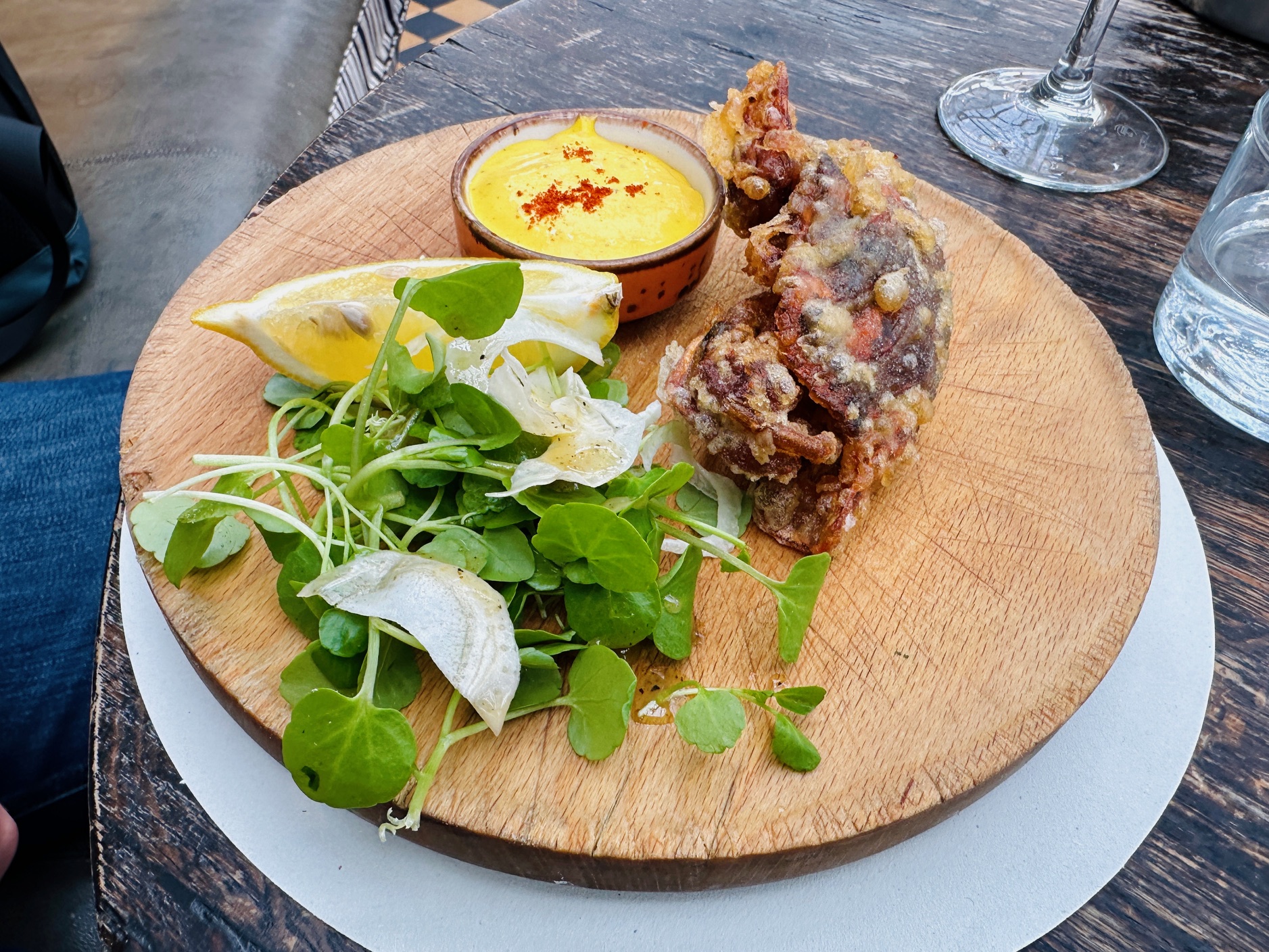
Jerry is on some kind of medication that reduces his appetite (although, gladly, not where booze is concerned). He quite enjoyed this, but I think you’d have to be on that medication to find it enough. And Jerry’s drug regime came in even handier with his main course: butterflied sardines, which apparently came with tomato, sumac pickled onions and chermoula.
I try not to talk about value much in restaurant reviews these days: things cost what they cost, and restaurants need to make money. So for me to mention it, pricing has to verge on the egregious and, at twenty-two pounds, that’s why I’m bringing it up here. Here they are in their glory, all five of them. This, to me, looks like a starter. Is that all there is? you might ask. Where’s the tomato?
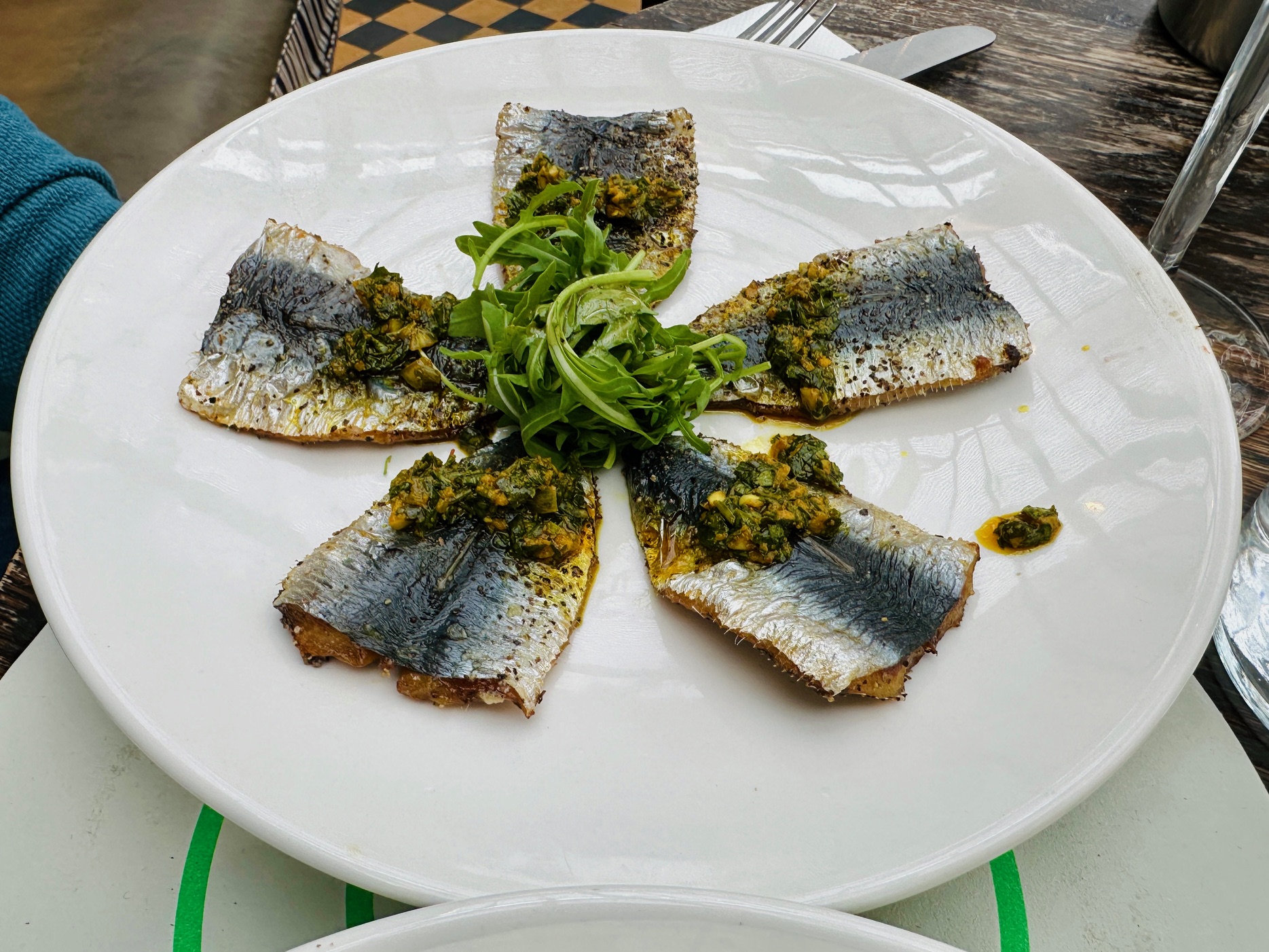
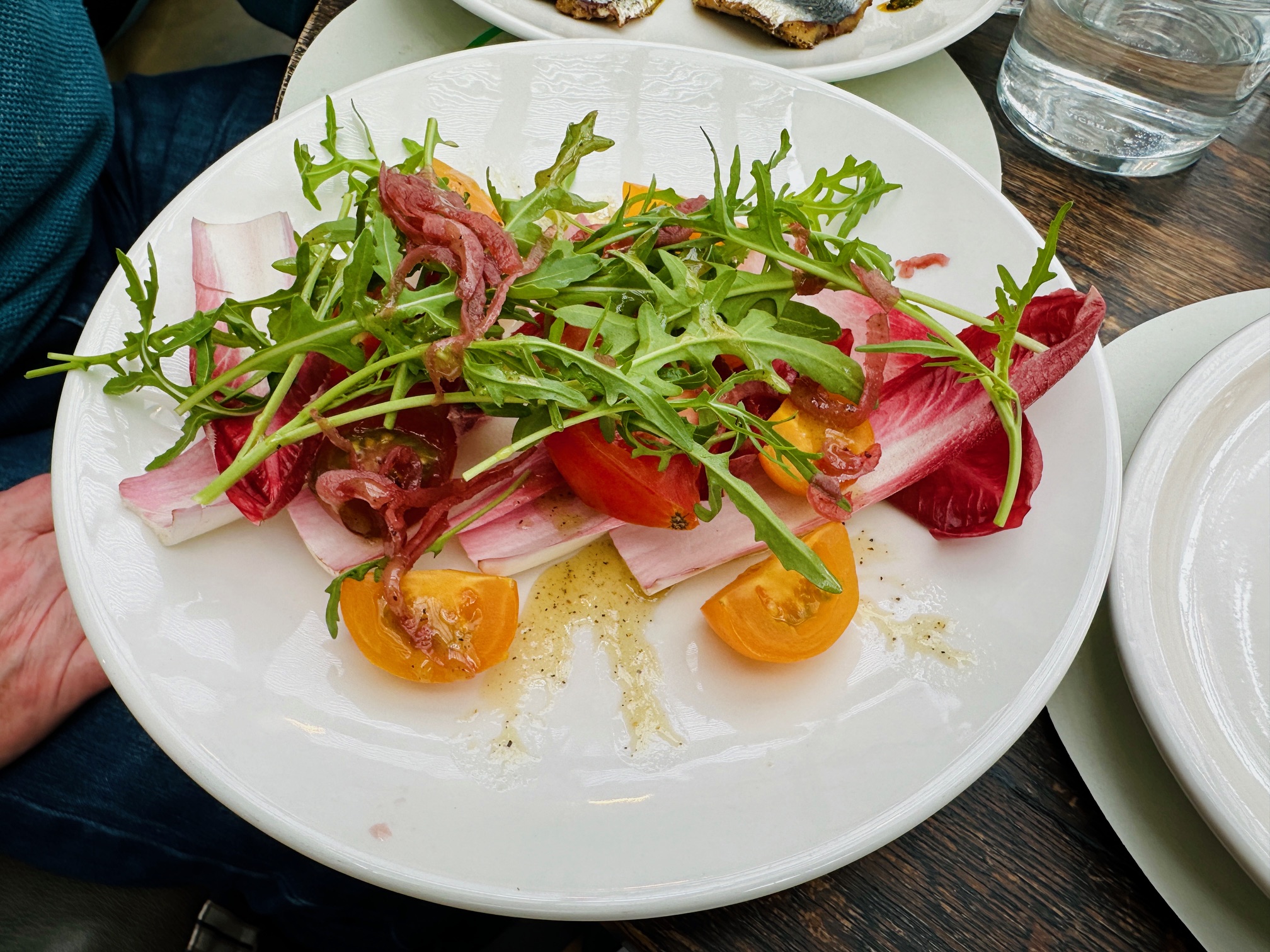
Well have no fear, because this dish – the generosity never starts – came with tomatoes and radicchio. Rocket, too, to match the rocket dumped in the centre of the Maltese Cross of disappointment that was those sardines. Double rocket, the treat nobody ever asked for: still, it beats pea shoots, I suppose. Why did the menu not mention that this was yet another salad? Was Gees just a glorified salad bar, and nobody had told us? Was it north Oxford’s upmarket tribute to Harvester, Gregg Wallace’s favourite restaurant? It was a puzzle and no mistake.
Yet I couldn’t help feeling that really we had just ordered exceptionally badly, because the dishes arriving at other tables looked more like actual food. A tall, substantial burger was brought to one of our neighbours, with a decent-looking portion of chips. Lamb cutlets piled high on a plate were put in front of the chap next to him, although in fairness they were on top of some little gem lettuce and peas. See? Another salad.
My main gave Gees one last chance to dish up something more convincing. And I’ll say this for my chicken cacciatore: it was not a salad. But it wasn’t great either. The pool of stretchy polenta was pleasant enough: I would probably always choose mash over polenta, but the menu clearly advertised it, so I couldn’t complain. And I did really love the sauce my chicken came in: rich with tomato, sharp with capers, studded with judiciously-cooked carrots and celery, a vegetable I always think is underrated in this context.
The chicken was the problem. I’m really partial to chicken thighs on the bone, but you have to achieve one of two things and ideally both. A crispy skin, if you can get that right, is a truly wondrous thing. But I would pass on that if the chicken is so well cooked that it flees the bone at speed, and breaks into strands. That’s when chicken thighs become properly magical. If Gees had achieved that the chicken, with that sauce and some of the polenta (if you must) would have made for splendid mouthful after splendid mouthful.

But to get both of those wrong, to have flaccid skin and firm, almost rubbery meat that needed to be prized away from the bone? That’s really not great. And to charge twenty-eight pounds for two undercooked chicken thighs that weren’t fit to grace the sauce they came in? Cheeky doesn’t even come close.
No side dish could rescue this sorry affair, though in Gees’ defence their braised leeks in feta and dill, served warm, were delightful. I’m no fan of dill, generally, yet I loved this dish and at six pounds it was better, and better value, than nearly anything else we ate. About the same size as those sardines too, come to think of it. It was a beautiful lipstick – applied to a pig, yes, but a beautiful lipstick nonetheless.

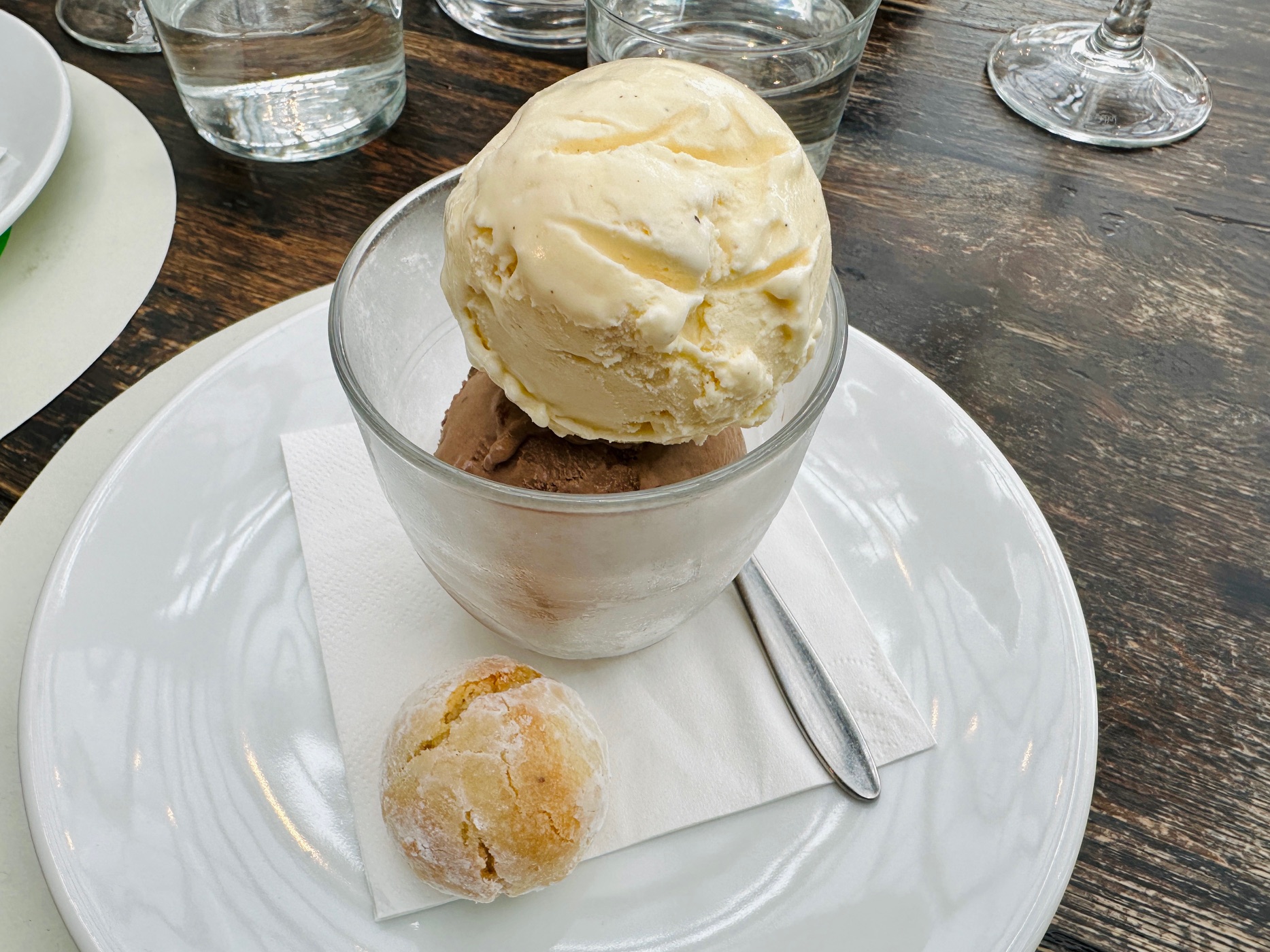
Would you have stayed for dessert? We nearly didn’t but felt like we had to see it through, like a disappointing box set. To Gees’ credit I asked who they bought their ice cream from and was told they made it in house. That probably swung it, and Jerry was delighted with his affogato, served with Pedro Ximenez.
I mean, again, if I’m being a stickler (which I am), if you swap the espresso for PX then what you have might be lovely but it’s no longer an affogato, just as the negroni wasn’t a negroni, the tonnato not a tonnato. Gees seemed to have taken Lewis Carroll, another Oxford type, very seriously when he wrote in Through The Looking Glass that “When I choose a word, it means just what I choose it to mean”. Words, salad, word salad: it was all the same to Gees. Let’s call the whole thing off.

To close on a damp squib of faint praise, Gees’ ice cream is pleasant stuff. I tried vanilla and chocolate – don’t expect any leftfield flavours – and both were very good. Smooth, no ice crystals, plenty of specks in the vanilla and an excellent balanced depth in the chocolate. Two scoops for eight pounds didn’t feel like highway robbery, although it made the nine quid Gees charged for Jerry’s single scoop with a slug of Pedro Ximenez seem decidedly impudent.
What else is there to say? The whole meal, service included, came to two hundred pounds between the two of us, including an optional 13.5% service charge. The cognitive dissonance is strong in this one, because I had a lovely time and the best of company, the room is hard to fault and the service is excellent. You almost enter some kind of trance where despite the preponderance of foliage on the plate and the underwhelming nature of so much of what you eat, you still have a very nice time.
It was, food aside, as enjoyable a lunch as I’ve had this year. Just think how much of a riot we’d have had if the food was at the standard of somewhere like Upstairs At Landrace, a restaurant considerably more reasonably priced than Gees! And there’s the elephant in the conservatory, the question of cost and value. Because when the bill arrives the spell is broken, and you think about what a hundred pounds could buy you anywhere else.
I have to hand it to Gees because they are very popular and an awful lot of people have become very taken with the place. But unless we ordered very poorly, I do have to ask myself: how on earth did Gees manage that? I’m starting to feel bad for Jerry because whenever he comes out with me on duty, however nice a time we have, the food seems to be pricey and middling. Take Zia Lucia, or Storia in Maidenhead: the poor guy can’t catch a break. I will have to think much more carefully about our next meal out, because Jerry deserves some food as brilliant as he is.
To make amends, after we finished our lunch I took Jerry to the Rose & Crown on North Parade, my very favourite Oxford pub. We sat in the back room and polished off a couple of pints, and I told him how I used to drink there thirty years ago, and how it almost felt like it hadn’t changed a bit. A lovely international group – three French, one Slovenian – perched on the end of our table and we ended up in conversation about all sorts of things: the English; Brexit (always Brexit); where to eat in Montpellier; Oxford’s best restaurants, you name it. None of them mentioned Gees in that context, and I can’t say I blame them.
It was only later that I realised that the Rose & Crown, like Gees, has been under the same management since the Eighties, which means that those first drinks I had there, fresh out of university, were under the same landlords looking after me and my very good friend over thirty years later. That gave me a warm feeling in a way that nothing I ate that day managed, however lovely Gees seemed on paper. Forty years, whatever way you look at it, is one hell of an achievement, even in a city which has a track record of keeping establishments alive for many, many centuries. I am glad there are still institutions like Gees and the Rose & Crown in Oxford. But when I go back, only one of them is on my list for a return visit.
Gees – 6.5
61-63 Banbury Road, Oxford, OX2 6PE
01865 553540
https://www.geesrestaurant.co.uk
Since January 2025, Edible Reading is partly supported by subscribers – click here if you want to read more about that, or click below to subscribe. By doing so you enable me to carry on doing what I do, and you also get access to subscriber only content. Whether you’re a subscriber or not, thanks for reading.
 Edible Reading
£28 for 2 rubbery, flaccid thighs? I don’t have a particularly discerning palate – I do really like more ‘cheffy’ food, but buying the expensive wine is a waste of both the wine and the money on my taste buds. If I’d been eating those thighs, though, I’d have been thinking about the 4 boneless thighs with a decent skin I could’ve got from Nandos for a tenner, and I’d be hurting. And their mash I’m pretty sure is those frozen pellets whapped in a microwave until forkable, but I have a soft spot for it in the right time and place.
Thank you, that made me properly laugh out loud. I absolutely love a salad but not for two hundred pounds I don’t. That’s immediately become one of my favourite reviews.
I’ve always struggled to get excited about Gees, despite its reputation, and I’m now glad I’ve never managed to get there!