Restaurant review: The French House, Soho

It would be easy to envy London-based restaurant reviewers, I think. Just imagine having such a broad canvas, such an embarrassment of riches, every kind of restaurant at every level, from the plush, spenny Mayfair spots A.A. Gill used to frequent to the unsung cash-only middle-of-nowhere places Vittles has made its speciality – and, I suppose, everywhere in between. Like Samuel Johnson almost said, imagine getting tired of the London restaurant scene! How jaded you would have to be.

And yet… I don’t know. I think there are huge consolations to being a gastronomic tourist in the capital. For a start, everyone writes about London restaurants. All the critics, all the Substackers, all the people jabbering to camera in their weird self-parodying voices on TikTok. It would be exhausting to be in that pack of misfits, let alone trying to keep pace with them.

It’s all about the urge to be first – to get to the new place before everybody else, or to get there at the same time but say it better. We have reached the point where various critics have visited, say, Josephine in Marylebone in recent weeks and come down solemnly on either side of the fence, saying it’s great or bobbins, as if they’re handing down Supreme Court judgments. And really, who cares?

Well, if you’re invested in it I’m sure you do but from a distance it feels like the kind of Inside Baseball stuff that only interests a small number of people. There are at least a couple of Substacks specially for those people, too: I imagine if you fancy a very niche printed word take on Gogglebox they’d be catnip to you.

No, I quite like being free of all that. I get it in Reading, that if a new place opens people want to know what it’s like and that makes me want to get there fairly soon after it opens; if you’re hankering for a review of Nua, or Pho 86 or even Take Your Time, the new spot that’s opened where Dolce Vita used to be, don’t worry. I will get to them, I promise.

But to have that feeling amplified to the max, to see all these hot new places and know you only have so many evenings, so much time, so many spare calories, so much money? I don’t envy any of them that, not even the ones whose decisions are made infinitely simpler by choosing the restaurants that bung them cash, free food or both.

Of course, there’s also the FOMO I always associate with big cities. It’s bad enough when I go on holiday to, say, Lisbon, and the infuriating brain that has unhelpfully held me hostage all my adult life – the one I struggle to quieten – looks at all the places on my narrowed-down shortlist before piping up about every single restaurant that didn’t make the cut. What about all of these?

Don’t get me wrong, I loved Lisbon, I ate well there and people tell me my city guide is very useful. But for each list of places I visit there is always an equal and opposite running order of the ones I didn’t choose, all taunting me with the possibility that they might have been even better. I copy-paste them into a new note entitled Next time when I get home, but mainly to try and fool myself.

So I am very comfortable with my relationship with reviewing London restaurants. I get to places I have always wanted to visit – a real mix of the old and new, no real guiding principle behind them except that I fancy them. Often it means things go brilliantly and I make a favourite new discovery, sometimes I’m underwhelmed by somewhere that has been hyped to high heaven (Chick ‘N’ Sours has since closed). But even that is as it should be: if I loved literally everywhere I went in London I’d be no better than Eating With Tod and the world of food doesn’t need another Toby Inskip. It already has one Toby Inskip too many.

All that explains why Monday morning found me outside Flat White on Berwick Street ahead of a lunch reservation in Soho, at the French House. David Schwimmer – all in black, bags under his eyes, baseball-capped, quiet and polite – had just been in there grabbing a coffee and the staff, who were probably discovering him on Netflix for the very first time, were decent enough not to act starstruck. And then someone even more celebrated crossed my path – my friend Graeme, my lunch companion that day, merrily wandering aimlessly through Soho after a morning spent shopping.

So off we walked to the French House together. Our lunch had been a spur of the moment thing: it was the last Bank Holiday before Christmas, and we were both at a loose end. His wife was away camping, mine was at work so we decided to indulge in one of life’s great joys, a leisurely lunch on a day when you’d ordinarily be at work, a Monday stolen back from the cosmos.

The French House is one of London’s great pubs, which means that it’s one of the world’s great pubs, and it’s been a favourite of mine for many years. I’ve lost count of the number of times I’ve sat downstairs in among the regular churn of Soho types, tourists and people passing through, drinking Breton cider and chatting away to those I already knew and, often, others I didn’t know from Adam.

I’ve introduced a fair few people to it over the years, too – including Graeme, who had never been – and I never tire of seeing them fall for it the way I have. The acclaimed Devonshire is an attempt to manufacture a classic in the laboratory – and don’t get me wrong, the people in that lab are experts and I’m sure they’ve done an outstanding job. But the French House is the real deal.

I won’t bore you with the trivia – all that stuff about de Gaulle getting drunk there in exile, or Dylan Thomas drinking there, or Lucian Freud. You can read about that anywhere, and my interest on that sunny day was mostly about the dining room upstairs. That too has a storied history, by the way.

Fergus Henderson cooked there over thirty years ago with his wife, before leaving to set up some unsung joint called St John. I ate there nearly fifteen years ago back when it was Polpetto, an offshoot of Russell Norman’s Polpo, just after it opened; celebrated chef Florence Knight was in the kitchen, near the start of her career. Then Polpetto moved elsewhere, and went the way of the rest of the Polpo empire, and that room above the pub lay dormant.

But seven years ago chef Neil Borthwick took it over, offering a pared-back menu of French classics, and I’ve pretty much wanted to eat there ever since. I’ve even booked it a couple of times, and then ended up having to cancel, or choosing to go elsewhere. The thing is, the French House is that unusual thing in this day and age: an almost homework-proof restaurant.

You won’t find a current menu online anywhere, and the restaurant’s website directs you to an Instagram feed with pictures of the latest menu. It last posted in May last year, so all you can get is a vague idea of the sort of things you might eat. So Graeme, a man with a sense of adventure, was the perfect wingman for this one. He also quite fancied lunching at venerable Mayfair pub The Guinea Grill (“it serves meat pies with sides of offal” was his rationale), but agreed that the French House would suit him just fine.

It’s the loveliest dining room, a small and peaceful space above the small and boisterous bar underneath. It has a strange kind of placid calm, all oxblood walls and wood panelling, tasteful black and white prints everywhere paying tribute to the pub’s past. I don’t think it seated more than 16 people and was almost full when we were there, with a second sitting coming along towards the end of our lunch. You could almost be anywhere, but you wouldn’t necessarily think the clamour of Balans, of Bar Italia, of Ronnie Scott’s, Bar Termini and all those branches of Soho House were the other side of those big, handsome windows.

The menu was handwritten and changed daily, another thing the Devonshire probably likes to pretend it invented. Here was a novel experience, my first chance to see an actual French House menu with today’s date on it, let alone one written in 2025. It was a thing of beauty, restrained and limited. Four starters and two mains, bolstered by a blackboard listing specials: two more starters, two more mains and a couple of bigger sharing dishes, a huge pork chop or a cote de bœuf.

When you handwrite a menu every day, I don’t really understand the logic of also having a blackboard, but perhaps the specials were in shorter supply and doing it that way saved them drawing a line through all sixteen menus.

The French House is also, by the way, far from being a prohibitively expensive place to eat. Most of the starters were £12 and the mains, excluding those sharers, were between £28 and £35. But before we were ready to make our choices we had an apéritif, a drink marked on the menu as Today’s Tipple.

I’d never heard of a Pousse Rapière before, but it turned out to be an orange cognac liqueur from Charente mixed with English sparkling wine and it was properly divine, like a Kir royal for ponces. I was very taken with it, and one of the two servers brought the bottle over to show us what was in it. “You can probably buy it in Gerry’s” she said, but sadly the Old Compton Street booze emporium was closed that day.

Although the menu changes every day, I’m not sure I’ve ever seen any version of it that didn’t include Graeme’s starter. Sourdough toast came slathered in goat’s curd but then the pièce de résistance, the thing that propelled this dish into the stratosphere, was the entire bulb of confit garlic crowning the whole affair. You just had to ease out a clove – a process which took minimal effort, as far as I could see – smoosh it on your toast and curd and heaven was a forkful away. I always let my dining companion choose first, and Graeme nabbed this. But if he hadn’t, I would have ordered it and this paragraph would have been even more of a paean of praise.

I on the other hand chose from the specials menu and was rewarded with an equally worthy example of the genre known as great things with toast. The French House’s steak tartare was not only one of the best I’ve had but arguably the most classic. This is a dish I’ve enjoyed all over the place – at Marmo in Bristol, in Paris, Bruges and Montpellier, and usually everyone tries to put their spin on it, whether that’s relying on a fudgy, slow-cooked egg, smoking the beef or spiking the whole thing with gochujang.

But I think it’s at the French House that I had this dish at its most textbook. No whistles and bells, no twists or gimmicks. Just gorgeous beef with plenty of capers and, at a guess, finely chopped cornichons, that stupendous alchemy of salt and sharpness that makes this dish, at its best, an unalloyed pleasure. They did a larger version of this dish with frites, too, but I was happy to have the smaller option, streaked with rays of golden sunshine from that broken yolk, a perfect precursor to what lay ahead.

The French House’s wine list is a curious one in that there’s nothing that cheap on it but, simultaneously, a lot that isn’t ridiculously expensive (it also, refreshingly, contains a reasonable number of half bottles). I wish I’d taken a photo but it did seem like a lot of the bottles were £50, and the one we chose, an Alsatian pinot gris, definitely was.

It was by Famille Hugel, as were many of the other options, and for what it’s worth I found it delightful. It felt like a dangerously easy to drink white that could quite happily smudge the sharp edges of an afternoon, and both Graeme and I were more than in the mood for that.

It went superbly, I suspect, with Graeme’s main course which was another masterpiece of simplicity. Three muscular, golden lengths of monkfish tail, mostly off the bone, came resting on a little mat of steamed spinach, served with ribbons of fennel and a glossy purée: the menu suggested it was fennel, too, but Graeme wasn’t so sure about that.

Graeme loved this dish, and rhapsodised about it from start to finish. A bit of a flex, as people younger than me like to say, from someone who had been agitating in favour of a sturdy pie with an offal chaser, but that’s one thing I really like about Graeme: he, more than most people I know, properly contains multitudes.

The words describing my main leapt off the blackboard and onto my lips when the server asked us what we wanted to order. Well, two words did anyway, confit duck. I find it so hard not to order it in restaurants but my lack of imagination is rarely rewarded quite as profoundly as it was at the French House. A huge duck leg came with a bronzed carapace, some of the fat remaining underneath but much of it sacrificed to achieve the happy medium of yielding meat and skin like crackling.

So often confit duck doesn’t quite achieve that balance, or it does but it’s too small, or it doesn’t and it’s too small. Rarely is it as beautiful, and substantial, a wonder as this. I could eat this all the live long day, or perhaps more realistically once a week, but maybe it’s for the best that it’s a far more irregular treat in real life. It came on a rib-sticking pile of lentils shot through with carrot, celery, ambrosial lardons: there might even have been some braised lettuce in there, but that may have been my imagination playing tricks.

This was a complete plate of food in a way many dishes never are, to the point where I didn’t envy the neighbouring table the very attractive portion of frites they took delivery of partway through my eating this. Well, almost: I think I 90% didn’t envy them. 75%, perhaps.

Time spent with a good friend is a bit like a really happy dream, in some respects. When you look back you know you had a wonderful time but you can’t remember the specifics of what you said. So Graeme and I caught up on his house move, our families, the impressive women we’d fluked our way into marrying, his belief that he was still the best Doctor Who we’d never had.

We also shared a firm conviction that summer wasn’t over until it was over, frustrated by the widespread defeatist doom-mongering on social media that it was as good as autumn already. A lunch at the French House felt like a brilliant way to rage against the dying of the light brought about by the impending end of British Summer Time. See? I slipped in a Dylan Thomas reference after all.

I had read everywhere that you had to order the French House’s madeleines, but also that they were baked to order and took fifteen minutes, so I persuaded Graeme that we should order them and another dessert to tide us over while they were prepared. Oh, and a dessert wine to enjoy into the bargain. Again, our server gave us loads of brilliant advice about that section of the drinks menu and we ended up sipping a Petit Prince de Guillevic, which was a bit like a pommeau, made with eau de vie and cider.

It was heavenly, and transported me to the first time I tried pommeau, on a holiday to Normandy with my dad the best part of twenty-five years ago. It also reminded me that I have a bottle of a British equivalent, brought out this year by Herefordshire’s Little Pomona, in my garage and that I really should enjoy it before the clocks go back.

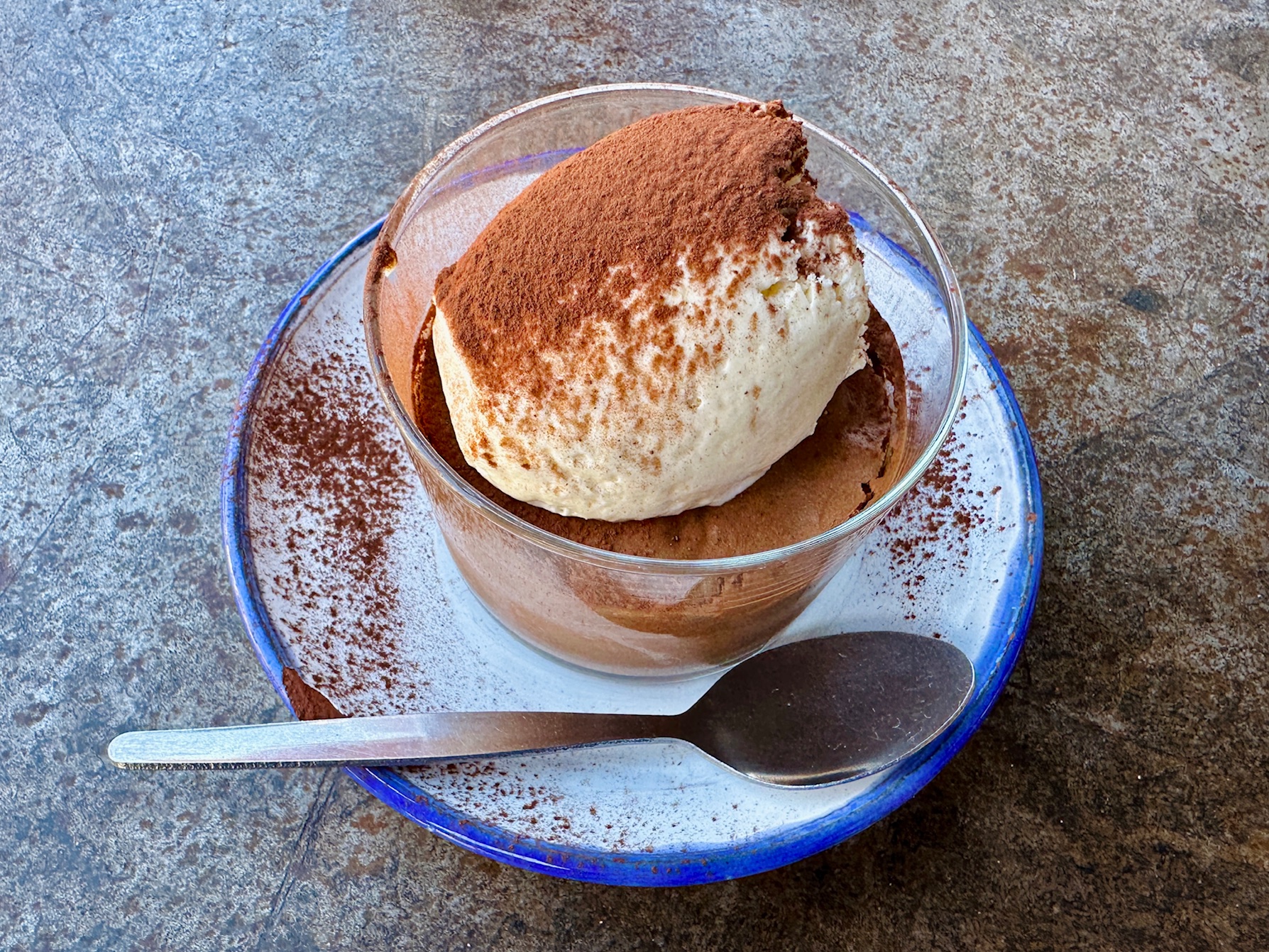
I gave Graeme first choice of desserts, not wanting a repeat of the chocolate mousse incident from three years ago, and he eschewed the chocolate mousse so I felt it was my duty to, well, chew it. It was truly glorious, a dense boozy sphere of the stuff redolent with rum and served with just the right amount of excellent crème fraîche to stop it being too much. By which I mean too much for most people: it was absolutely fine for me, but I loved the crème fraiche all the same.

What had prompted Graeme to risk dessert dissatisfaction and swerve that mousse? He was persuaded by our excellent server to try the dessert on the specials, a raspberry savarin. It was sold to him as a bit like a baba au rhum, only with raspberry liqueur instead of rum. I don’t think that necessarily did the dessert justice.

The thing is, a sponge soaked through with booze feels instinctively like it should be sodden, be heavy. That is, you might think, what you’re pricing in when you order this dish. But this was airier than any rum baba I’ve tried, the sponge almost float-away light, but still with raspberry coulis lurking at its epicentre. But before that you had that indulgent sponge, and raspberries ringing a heap of the lightest Chantilly cream.
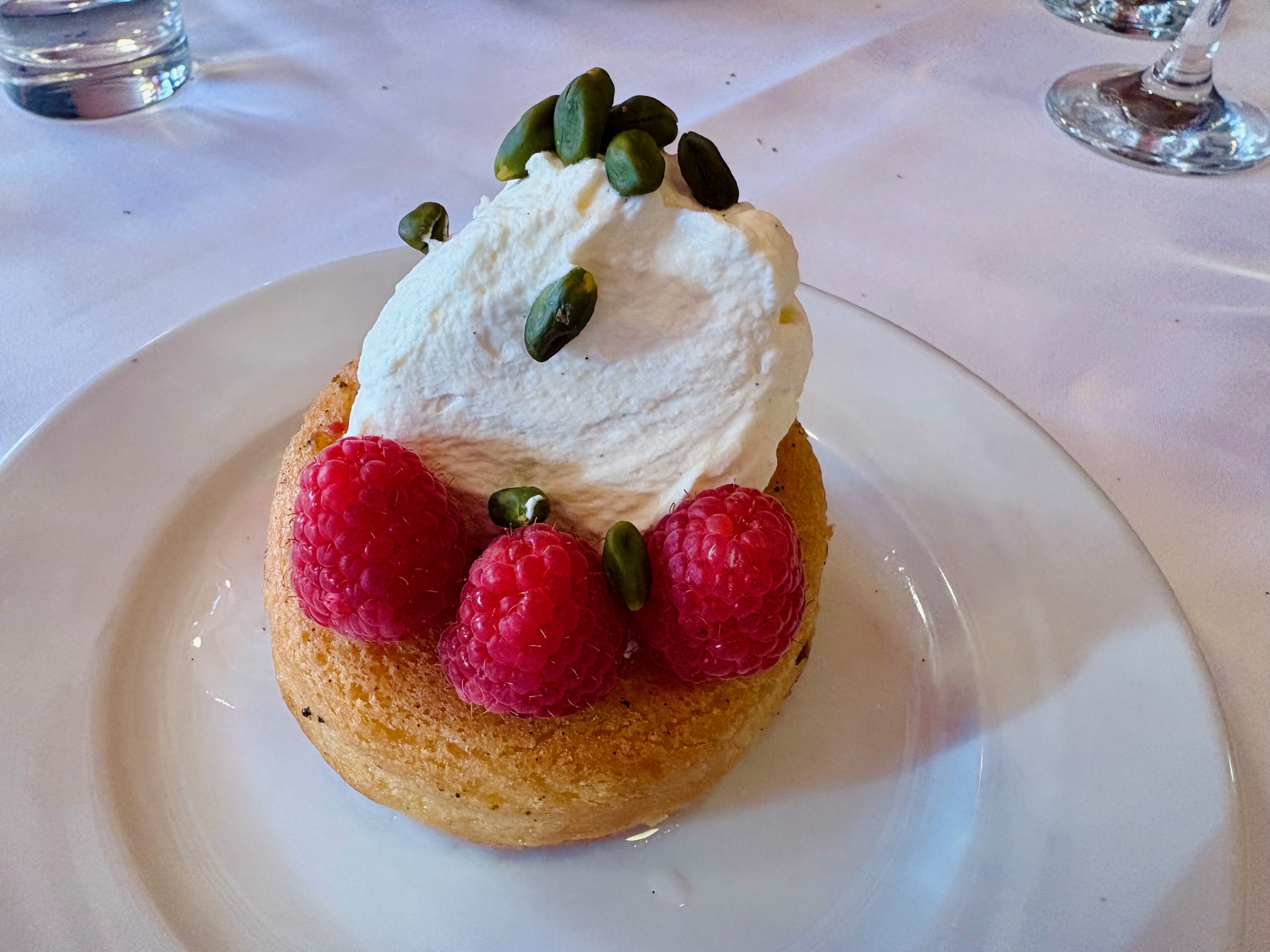
This dish is absolutely not the kind of thing I would ever order, but after trying a spoonful of Graeme’s I can tell you that if I ever got the chance to eat a whole one of these I’d grab it swiftly with both hands. Maybe this time Graeme had performed a Jedi mind trick on me? You couldn’t say it was undeserved.

By this point most of the people who had started their lunches at the same time as us had settled up and moved on, which I always consider a little moment of triumph. The dating couple at the next table had ordered exactly the same combination of dishes as we had, him my choices and her Graeme’s. “See, you’re the women in this arrangement” I said to Graeme, enjoying the novelty value because, at least half of the time, I’m not even the man in my own marriage.

Most of the other tables left before us because they’d made the mistake of passing on the madeleines. In a meal full of showstoppers we’d left the very best till last, a board with six warm madeleines, all scalloped edges, dusted with icing sugar and served with a little ramekin of lemon curd that was somehow sunnier than the yolk on my steak tartare, sunnier even than the rays pouring in through the windows into that ravishing dining room.

Dipping those madeleines into the curd, biting, tasting, raving and repeating did something wonderful: it perfected a meal that had been pretty close to perfect anyway. These are worth visiting the French House for in their own right, but I’m not sure that’s saying much, because so was everything else.

After we had finished them Borthwick left the kitchen – so he’d been at the stoves that day – and walked past our table and both Graeme and I thanked him and went bananas about the madeleines in a way that was probably more enthusiastic than it was coherent.

Borthwick very graciously, with an air of someone who’d had this conversation many times, told us that they’d originally been the creation of a Kiwi he worked with in the kitchen who had a real genius for baking. Although he had since quit cooking to bring up his kids the madeleines stayed on the menu, kind of his legacy.

I have no idea what the chap’s name was, but I suspect many London diners owe him a debt of thanks. Eating these madeleines I could sort of understand how Proust got all those novels out of them. Graeme said they had ruined Waitrose madeleines for him, which is in its way equally high praise.

I was sad to ask for our bill and to leave, but I knew that you couldn’t stay in that gorgeous room and eat nothing when other people could make excellent use of those tables, and I was also aware that it was London and that other lovely tables lay downstairs and beyond, and that I could drink Breton cider at the ones downstairs and carry on probing Graeme’s credentials to be the next Doctor Who and the first from Middlesbrough (“lots of planets have a North-East”, he proudly told me later).

Our bill, including a 12.5% service charge, came to just over £226. I’m going to stick my neck out and say that this was as good value as any meal I’ve had on duty this year.

The rest of the day was every bit as agreeable: drinks in the French House, an amble through Trafalgar Square and down to the Embankment for a couple of companionable glasses of wine sat outside Gordon’s, while Graeme gazed lovingly at every single dog at every single neighbouring table. And then we headed back to Paddington for – shamefully – a little booze fuelled sustenance at Market Halls before our journeys home.

But the way to best put that lunch in perspective is to think about the messages I got from Graeme the following day. “There isn’t a single course of that meal I’m not still thinking about” he said. “It was so good.” I’ve thought about it, and he’s right: I reckon I’ve thought of every single course at least once a day since Monday and, in the case of those madeleines, several times a day. And I’ve also thought about Graeme’s order, and how I would have been just as happy if it had been mine. And the things neither of us ordered – the rillette, or the tomato and lovage salad, or those frites: I’m pretty sure I’d adore those too.

Best of all, now that I’ve been to the French House and loved it, the fact that I can’t see a menu online goes from a homework-proofing source of anxiety to a matter of constant wonder and delight. I don’t know what I would get there, but I know that I would like it. Put that way, the prospect of going there again, which I’m sure I will, feels like a piece of magic you rarely get in restaurants these days.

So I am very glad I picked the French House this week and that, free from the need to keep up with the Joneses of the London food media, I was completely at liberty to do so. Because the French House has that indefinable feeling of authenticity that was somehow lacking when I visited the likes of Lapin earlier in the year. It feels like the team behind Lapin have been to, and loved, places like the French House. But it feels like the team behind the French House have been to, and loved, France. That’s it. That’s the difference between good and great in a nutshell.

The French House – 9.4
49 Dean Street, London, W1 5BG
020 74372477

https://www.frenchhousesoho.com

Since January 2025, Edible Reading is partly supported by subscribers – click here if you want to read more about that, or click below to subscribe. By doing so you enable me to carry on doing what I do, and you also get access to subscriber only content. Whether you’re a subscriber or not, thanks for reading.

Restaurant review: Cosy Club

On paper at least, you wouldn’t expect me to think much of Cosy Club.

It’s Reading’s second significant chain opening of the year, following Rosa’s Thai back in January. Like Rosa’s Thai, Cosy Club is a smaller chain: just shy of 40 restaurants in total, the first of which opened all the way back in 2010. Unlike Rosa’s Thai, Cosy Club is a spin-off from a much larger chain – the Loungers group, which has in the region of 250 sites, 2 of which are in Caversham and Woodley.

Cosy Club’s thing is to be a more upmarket cousin of the likes of Alto Lounge, and its aim, at first, was to operate out of historic or listed buildings. So you could picture them pitching up in Reading sites like the one hopelessly wasted on Bill’s, but perhaps less so the spot they eventually chose, premises on the very edge of the Oracle previously occupied by Lakeland and before that, if your memory stretches back far enough, The Pier.

So, a chain which is the sequel to a pretty bang average chain, operating out of a site where I used to buy scented candles and, more recently, carpet cleaner or LocknLocks for my leftovers. It could be more auspicious, couldn’t it? And that’s before we get on to the coverage Cosy Club has received – or, to be more accurate, has paid for – from what you might generously describe as Reading’s media.

Subscribe to continue reading

Become a paid subscriber to get access to the rest of this post and other exclusive content.

Restaurant review: Arbequina, Oxford

Late last Saturday morning I was sitting outside Missing Bean on Turl Street with my great friend Jerry, drinking a gorgeous latte in the summer sun, about to tuck into a pain au chocolat with impeccable lamination; I remember thinking that, on a day like that, there felt like no better place to be than Oxford in the sunshine. The train up from Reading had been packed, and we’d stood in the vestibule making conversation with our fellow captives, two young polite Swedes with perfect teeth and an Australian who had fought her way there to the loo and, realising how spacious it was, was tempted to lock herself in there for the rest of the trip.

And when we got to Oxford – well, it was a Saturday in August and the weather was fine, so naturally the city was packed. A curious blend, throngs of tourists swarming round Radcliffe Square, the Bodleian and the Covered Market but also packs of graduands, in their gowns, on their way to the Sheldonian Theatre for their final rite of passage. The Oxford year isn’t like the calendar year and this all happened on the very outskirts of it – one academic year ended, another not quite ready to begin, the city reclaimed by residents before the whole thing started again in October.

Nonetheless, from where we were sitting the view was gorgeous, the food and drink were excellent and the people watching was close to unparalleled. I’d asked Jerry if he was free on the off chance at very short notice and had been delighted that he was, and at this point we were barely an hour into what would turn out to be another effortless nine hour chinwag, punctuated by this walk or that, this spot of shopping or another, lunch, coffee, beer garden, train home. Even at the start of the day, I knew it would be a good one: with Jerry, it always was.

But would it be a good lunch? I’d thought carefully about this, because although I always have a wonderful time with Jerry when he joins me for a review I cannot say, hand on heart, that we usually have a good meal. I’m not saying that he’s a jinx, far from it, but I feel guilty that he’s joined me for some of the most middling meals I’ve had for the blog in the last few years. He was the person I took to Zia Lucia for pizza that was nothing more than pleasant, and then he also came with me to Maidenhead’s Storia for much the same experience.

Then to cap it all, the last time we lunched it was in Oxford – at Gee’s, where £200 got you a lot of disappointment. Because Jerry is so lovely, he never resents us marring our time together with mediocre food, which makes him a far better person than me. But I still feel bad about it, and I decided after that lunch in Gee’s that Jerry, more than anyone who comes out on duty with me, deserved a nice one. But where to take him?

The thing is, places I review for the blog probably fall into three categories. There are the ones I expect in advance will be good: these are more likely to happen in places like Oxford, London or Bristol that support a large and thriving restaurant scene. And then there are the places I merely hope will be good, and that hope can run the whole spectrum from reckless optimism to wishful thinking. Don’t get me wrong: I always hope for the best but sometimes, especially in Reading, that hope can border on the blinkered or forlorn.

Originally I was going to take Jerry to the Chester Arms, out off the Iffley Road, which falls into the first category. It’s famous for one thing and one thing only – its enormous steak platter, which comes groaning with handmade chips, cabbage and streaky bacon and béarnaise sauce, which they have been serving up for over fifteen years. I’ve heard about it so many times but never managed to make it there, but as we were deciding where to go Jerry dropped the bombshell: he’d just had a dental implant, so needed something a little less taxing on the molars. Would I mind if we went somewhere else?

So the subject of this week’s review falls into the rarer third category: places I have been, that I remember liking, where the mixture of hope and expectation is more of a balancing act. You don’t so much expect they’ll be good, you more hope that they’re as good as you remember. And Arbequina, the tapas restaurant down the Cowley Road, definitely falls into that category. It’s been there nine years, very much blazing the trail in that part of Oxford, and after getting a rave review in the Guardian the year after it opened it’s stayed out of the limelight, even though it’s one of only two Oxford restaurants to be mentioned in the Michelin guide.

It’s quietly done its thing. No cookbook, no appearance on Saturday Kitchen or Great British Menu, just keeping going and keeping afloat. Growth has been steady and incremental: first it expanded into the neighbouring unit four years ago and then, earlier this year, it announced that it was crowdfunding to open a second site in Oxford’s Covered Market, The council had approached them with an offer – not something that would ever happen here in Reading – and so far the crowdfunder is just over half the way there, with the restaurant still hoping to open the new site later this year.

So yes, Arbequina has history. And I have history with it too, because I’ve been eating there, on and off, for the last eight years or more. Plenty pre-COVID, when I always adored it, but only once, for some reason, since the pandemic ended. That was three and a half years ago, and it sowed seeds of doubt that maybe Arbequina wasn’t the restaurant it used to be. But I should have checked in on it long before now, and ambling across Magdalen Bridge with Jerry, in good time for our lunch reservation, I found myself getting excited about a reunion with somewhere that used to be one of my favourite places.

It’s in the fun part of the Cowley Road, past the restaurants Florence Pugh’s dad used to own, past Spiced Roots, but just before brilliant café Peloton Espresso, or Truck Records, or – far further up – the turning into the food enclave of Magdalen Road. It’s a lovely site that has kept the old shop fronts from the chemist and watchmaker who used to trade there, the tasteful writing in orange sans serif on the glass the only sign of Arbequina’s name. The room inside is lovely, with unpretentious decor, a handful of tables, both low and high, and a long zinc bar where you can sit and watch all the work in the very small open kitchen.

But it was a Saturday in August, and the awning was out, and neither of us could think of anything finer than sitting out on the pavement watching the Cowley Road live and breathe, so we did exactly that. I ordered a rebujito from their cocktail menu – a drink I grew to love in lockdown but which I had for the first time at Arbequina, rather than in Andulusia – and Jerry joined me. It was fresh and zippy, a harmonious blend of the lemon, mint and that savoury note of fino.

The other thing we had right from the off, while we made up our minds about the rest, was Arbequina’s tortilla. I remembered it well enough to know that you simply had to order it, and I also knew from repeated personal experience that sharing a slice felt like a good idea right up to the point where it turned up and you could only eat half of it. So I insisted that we got a couple, and Jerry agreed – partly because he’s just a very agreeable cove and partly because I sold it as about as kind on his teeth as it’s possible to get.

But ‘kind’ undersells it, because it’s a positively indulgent treat and, however good anything else you eat at Arbequina might be, it always sets the standard for other dishes to beat. I had forgotten, over the last three and a bit years, just how good it is, but it was magnificent: so soft, only just structured on the outside and a glorious mess within.

Egg, potato, onions, thyme – that’s all there is to it, but of course that’s a hopelessly reductive way to describe a masterpiece. Jerry did better, dubbing it sumptuous. Why do I never use that word in reviews? Maybe I was waiting for this dish.

Because you could have tortilla in dozens of places, in Spain and in this country, and not approach the brilliance of this. Every forkful but the last was wonderful, and the last was wonderful yet heartbreaking. But I knew that at least not sharing it meant that last forkful took longer to arrive. It was so sweet, so exquisite that I thought I tasted things in it – maybe nutmeg, maybe cinnamon – that weren’t there.

When Ben, the manager who looked after us that day, took our empty dishes away he explained that there really was nothing else in there. The sweetness came from the onions, which were cooked for a mind-blowing twelve hours. When Jerry heard that he said “I don’t envy your gas bill” and the manager smiled. Jerry had accidentally hit on one of the reasons hospitality is so thankless right now, and he meant no harm by it.

That tortilla under our belts, it was time to take a serious look at the menu and plan our assault on it. Many of the dishes I remembered from previous visits – chicken thighs with romesco, or toast thickly spread with ‘nduja and honey – were no longer there, but the menu still read nicely. Just shy of twenty dishes, most of them at or adjacent to a tenner: only one approaching twenty quid and a last, Iberico tenderloin to share, closer to forty.

It didn’t break into sections, or flow quite the way that the menu at, say, RAGÙ did, but it had plenty of potential and so Jerry and I did what I’d done countless times before – made a list of things we definitely wanted to eat, broke it up into waves and decided to order and graze, little and often. And along with that we had a gorgeous white, an Asturian albariño blend with a certain bracing saline quality: I’d chosen it for no other reason than that I’m on holiday in Asturia soon, and fancied getting a sneak preview.

My verdict? Roll on next month. At £45 it was the most expensive white on a very compact list – four reds and four whites, mostly from Spain, and a bigger selection of natural wines from all over. But the markup was far from harsh, because I reckon it would cost you about £20 retail.

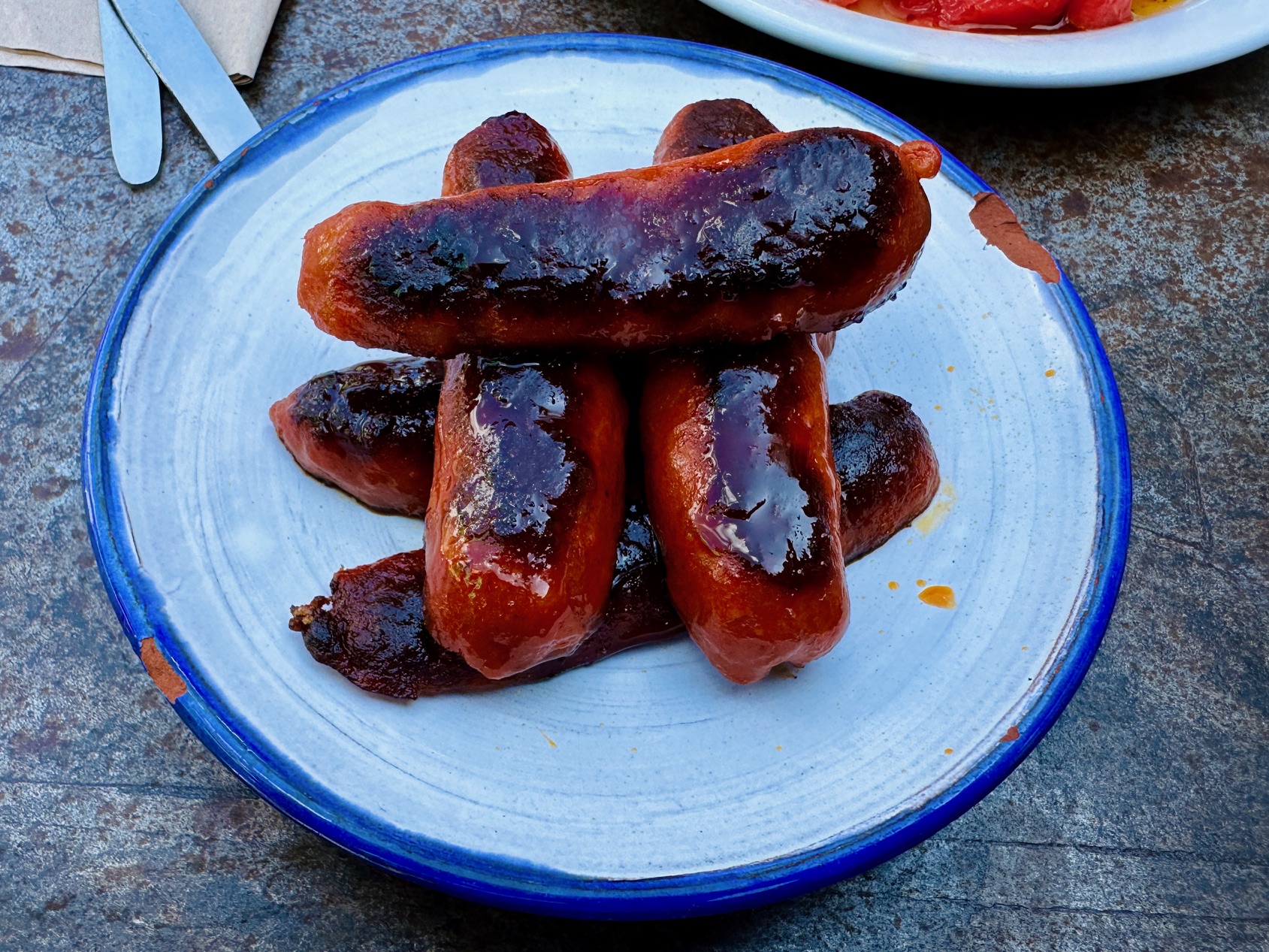
Sometimes things can be delicious because they’re simple, and Arbequina’s chorizo was a classic example. Sliced lengthways and cooked on the plancha until the outsides were caramelised and blackened, it was superlative stuff. Not cooked in wine or cider, not sliced and fancified, just cooked and served. I’d love to know where Arbequina buys it – it’s certainly not Brindisa, because theirs can be a bouncy horror compared to this.

It irked me that they gave you five of them, though, because that’s an especially tricky number to share. Well, with anybody but Jerry, anyway. “Go on, you have the last one” he said. He’s just lovely like that.

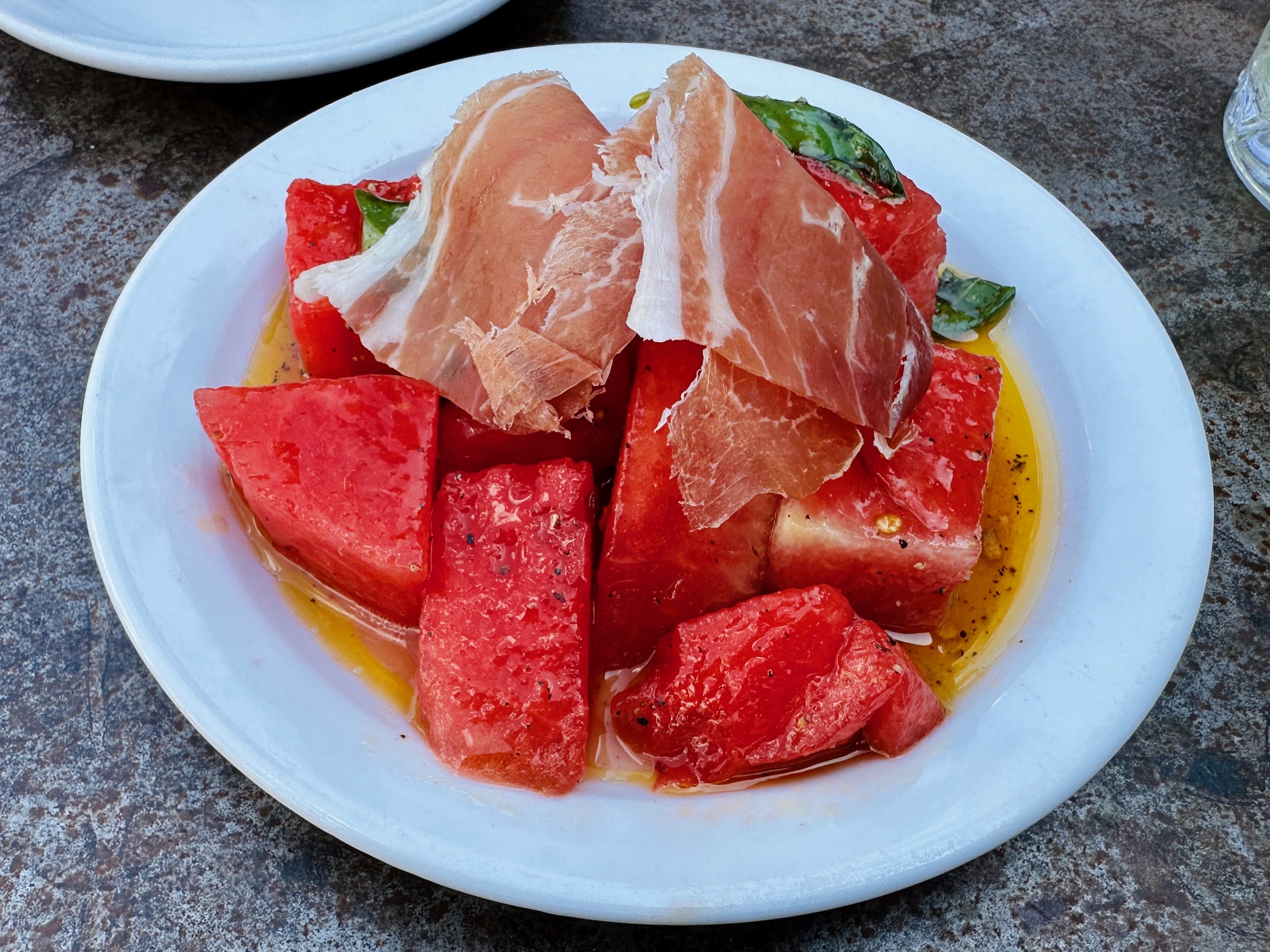
Almost as simple, even more beautiful to look at – and perfect for a sunny al fresco afternoon – Arbequina’s watermelon with jamon was a joyous dish. The melon was plump, sweet and vibrant, and very much the star of the show. But where it wasn’t quite as successful as, say, the similar dish I had at RAGÙ recently, was that the supporting players were perhaps hiding their lights under a bushel somewhat. The two bits of jamon folded on top felt slightly meagre, the honey and chilli rather lurked at the bottom of the plate, shunning the limelight.

But to be fair, if you’re comparing this with the dish at RAGÙ it’s only fair to also note that this was £8, and the Bristol restaurant’s version was over 50% more expensive.

Jerry was in no rush – I always forget that he’s not a trencherman like I am – so at this point we asked the manager if we could hold fire, sip our wine and come back to the menu. And he let us do exactly that, keeping us posted on when the kitchen would take last orders so we could have the leisurely lunch we had in mind. Jerry and I had plenty to catch up on, so we nattered about all sorts, only punctuated by Jerry having an almost Tourettes-like reaction to every single electric scooter going past. I love the multitudes people contain: Jerry is possibly the most affable person I know, but he really hates those electric scooters.

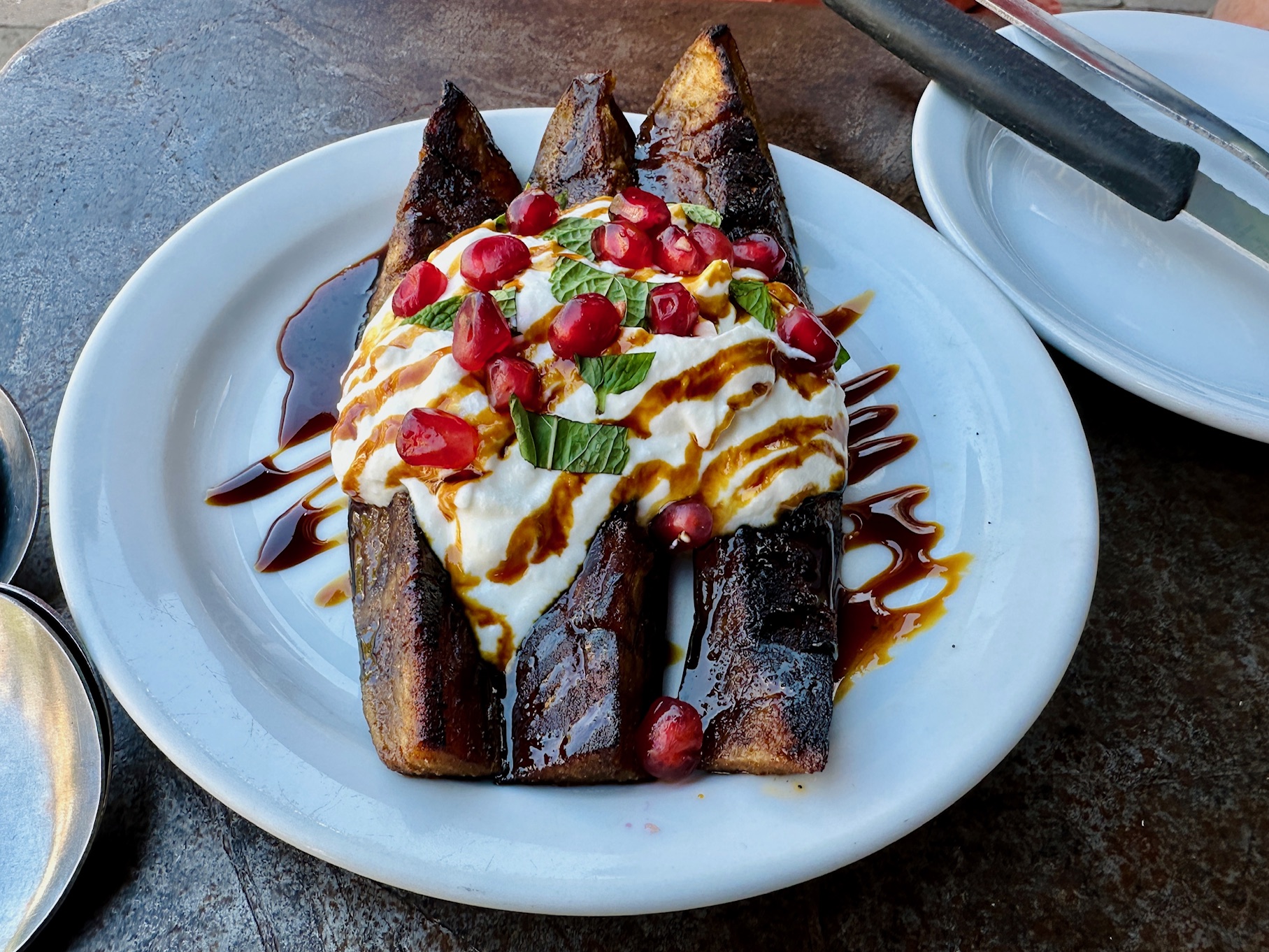
The one dish Jerry really wanted from the menu was Arbequina’s take on an Andalusian classic, berenjanas con miel, or fried aubergine with honey. Now, I wouldn’t have ordered this because I’ve never liked it in Spain – usually the aubergine is sliced thin and fried in a crispy batter, and drizzled in a dark sticky molasses that is a million miles from honey. It takes some doing, in my book, to make aubergine a good thing and this dish, whenever I’ve had it abroad, doesn’t pull it off.

But Arbequina’s version takes everything that could be good about that dish and junks the rest. So we got three soft, caramelised wedges of aubergine, drizzled with an ambrosial molasses without any sour, burnt note, the whole thing bathed in a mild whipped feta – almost more yoghurt than feta – and scattered with pomegranate and torn mint. Have I sold it to you? I hope so. Arbequina sold it to me, both literally and metaphorically. One to add to the vanishingly small list of aubergine dishes I actually like, most of which are on the menu at Kungfu Kitchen.

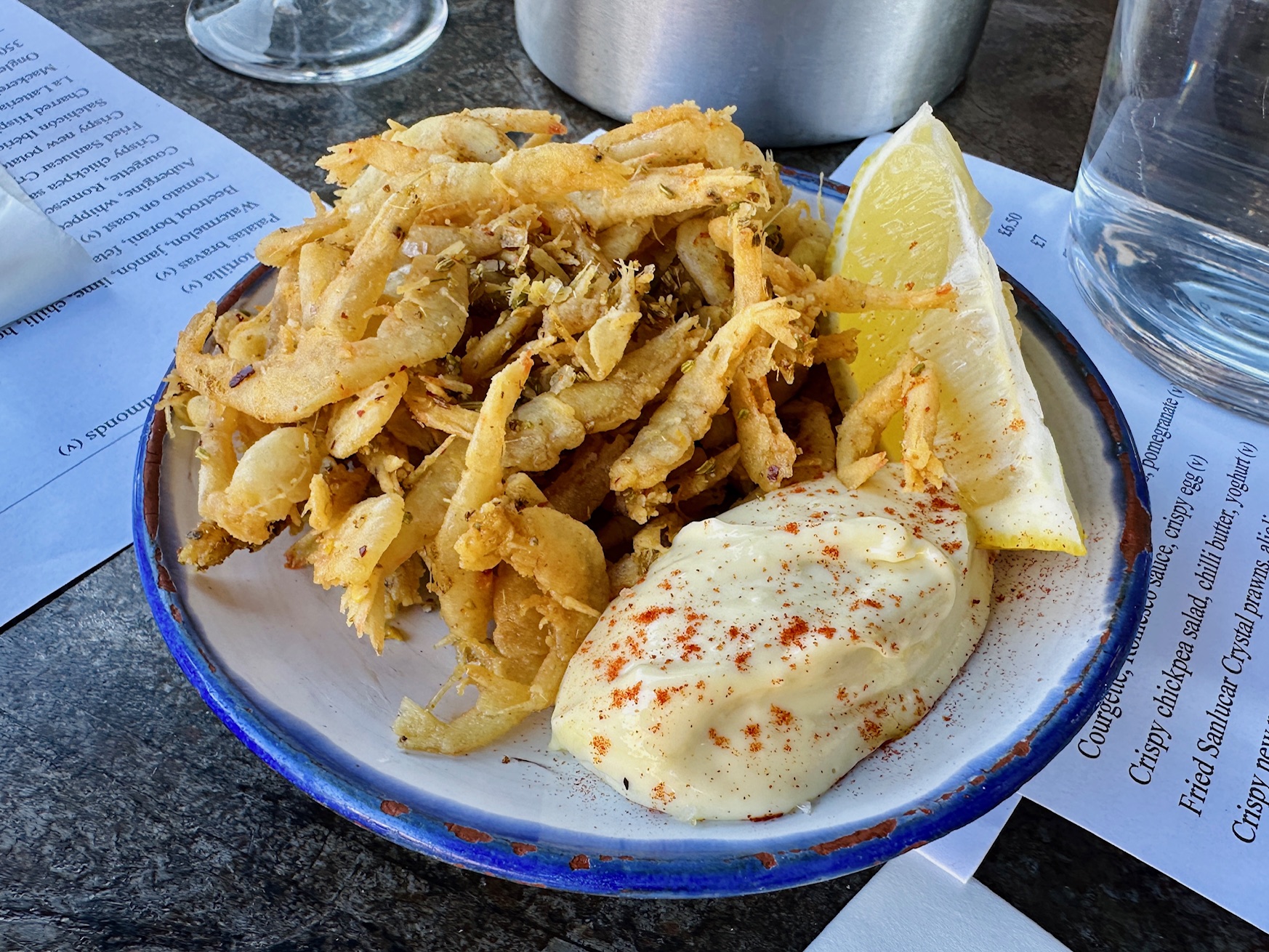
Our last two savoury dishes were, apart from the tortilla, the highlights of the whole thing for me. I am a terrible rubbernecker in restaurants and I kept seeing a dish go past to other tables which looked eminently snackable, a giant heap of fried, crispy, golden things. But I wasn’t sure what it was, and when I asked the manager I couldn’t explain it well enough – I blame the wine – to get him to tell me what the dish was. But then Jerry wanted the prawns, so it turns out we ordered it by accident.

So these, it turns out, are Sanlucar Crystal prawns – little critters, soft shell, fried in a golden coating, dusted with chilli and served with a generous dollop of alioli. Never had them in my life, now fully wondering where they’ve been for the last fifty-one years.

And again the funny thing is that like the aubergine, this wouldn’t normally be in my wheelhouse at all. I don’t like whitebait, can be squeamish about eating things whole. I’m not one of those macho restaurant bloggers who likes to wank on about sucking the head of a prawn – they try to channel Bourdain, but really they’re Swiss Toni – and, with the exception of one meal in Kolae I’ve managed to convince myself that I really don’t want to munch on a prawn’s brains.

So why did I love these so much? I really don’t know, but I did. I keep using the word fresh in this review, or it feels like I do, but that’s what they were – so fresh, so light, so simple, with that spritz of citrus, that whisper-quiet crunch and the ozonic tang of the sea. On the Cowley Road. Now, I love the Cowley Road but I’m not going to pretend for a minute that eating these prawns there was in any way a congruous thing to do.

I hadn’t especially wanted Arbequina’s patatas bravas – I often think they’re a way to needlessly bulk up meals in tapas restaurants – but I was drawn to their more exotic sibling on the menu. And it was another really wise choice: billed as crispy new potatoes with tonnato and salsa verde, it was a real humdinger. The slices of potato, thicker than crisps but very much sharing that lineage, were stellar, a triumph of texture.

The thick slick of tonnato was perfect for dipping and dredging: I didn’t get an enormous amount of tuna from it but I did get plenty of savoury saltiness, so I’m guessing anchovies played a part. And I don’t think salsa verde showed up to this dish at all. In its place, I suppose they had deconstructed it by instead scattering everything with salt, parley and lemon zest. I probably would have preferred a salsa verde, because I love the stuff. But I’d forgotten about the salsa verde when this dish turned up so instead I just thought isn’t adding lemon zest to this clever? They knew better than I did.

By this point we’d been there the best part of an hour and a half, in which time tables had come and gone but the restaurant had kept a happy trickling momentum of customers in the sunshine. The Americans at the table next to us ordered some of that tortilla, and inexplicably left some of it: we decided, on balance, that we didn’t know them well enough to offer to take it off their hands.

We both fancied something from the dessert menu, and I talked Jerry into a red dessert wine which came in a wide, low tumbler and was like nectar. I didn’t catch the name, and my bill doesn’t give the detail, but red dessert wines are always worth a try if you find one, and I suspected it would go better with the chocolate mousse even than a Pedro Ximenez.

Other desserts are available, of course. Arbequina was offering a panna cotta, a Basque cheesecake or the almond-rich wonder that is a Tarta de Santiago. But I think chocolate mousse should be on far more menus than it is, so whenever I see one I order it – and Jerry, being kind to his vulnerable gob, followed suit. It was, as so often, the perfect way to finish a meal.

I’ve had Arbequina’s chocolate mousse plenty of times, often enough to track its evolution. It used to be a dense quenelle of the stuff – drizzled with olive oil, scattered with coarse salt, served with a torta de aciete for good measure. But over time, Arbequina’s version of this dish has changed, become less uncompromising, dropped the olive oil and become, on the outside at least, more conventional.

But don’t be fooled: it might come in a glass, the torta de aciete may have been replaced with a dome of crème fraîche but the mousse is still theirs, and still sublime. The salt now runs through the whole thing rather than just finishing it off, and it works beautifully.

It was the right way to end a lunch that had been unassailable in its rightness. Our bill came to just under £175, including tip, and nothing about it had felt out of kilter or anything short of marvellous. We settled up with glad hearts, and were on our way – the grand total of a couple of doors down to have a post-lunch coffee outside Peloton Espresso.

But then another delightful discovery lay in store – a short walk down the Cowley Road and we came to Rectory Road and the Star, the best Oxford pub I’d never been to and another long overdue discovery. It was like a cross between the best things about the Retreat and the Nag’s Head, with a huge handsome beer garden and Steady Rolling Man on tap.

So we grabbed a table, carried on chattering, beers passed, tables of people – and the people watching opportunities they presented – came and went. We had nowhere to be, and every reason to linger. Really it was the best afternoon, and one of the best things about it was knowing that at last, Jerry had got the excellent meal he deserved. Finally, I got him a nice one.

Much later on, we retraced our steps, walking east to west through Oxford, the sun setting in the distance. The pavement outside Arbequina was even busier, with people about to have one kind of outstanding dinner or another. The Cowley Road was alive, the antithesis to the stuffiness we’d encountered right in the centre. “It’s bit like the Oxford Road isn’t it?” said Jerry as we sloped back towards Magdalen Bridge. And I replied that it’s what the Oxford Road could be like, with better landlords and more imaginative restaurateurs. Still, it’s nice to dream.

Arbequina – 8.9
72-74 Cowley Road, Oxford, OX4 1JB
01865 792777

https://arbequina.co.uk

Since January 2025, Edible Reading is partly supported by subscribers – click here if you want to read more about that, or click below to subscribe. By doing so you enable me to carry on doing what I do, and you also get access to subscriber only content. Whether you’re a subscriber or not, thanks for reading.

Restaurant review: Vino Vita

Last year, in one of the more baffling developments in Reading’s food and drink scene, wine bar Veeno changed its name to Vino Vita. It wasn’t initially clear whether this was because the people running it had bought the business from Veeno or if something else was going on. If you read the details on Vino Vita’s website you’d be none the wiser. “We’ve rebranded, but our commitment to excellence remains unchanged” it said. “Join us as we start an exciting new chapter that expands our offerings and vision.”

More details emerged when the owners spoke to the Chronicle last month. “A big reason why we became independent was so we could have more say over the produce” said the restaurant’s Head Of Sales. “We developed our whole menu, and everything is done on site.” I remember reading the article and thinking that this potentially merited a revisit, but the main thing I took away was They have a head of sales? It felt like a role Veeno, a chain with 5 restaurants across England and Scotland, might need but that Vino Vita, a single spot opposite Forbury Gardens, probably didn’t.

So what were the differences, and had Vino Vita improved on the Veeno formula since taking their destiny into their own hands? The only way to be sure was to eat there – which clearly I did, because you’re reading this – but before that I carried out some research. Because I visited Veeno on duty nearly 8 years ago, not long after they opened, and at the time I would have said that there was plenty of room for improvement.

Vino Vita’s menu does indeed offer a slightly wider selection of dishes than Veeno’s, with more nibbles, bruschette, small plates and so on. It has about as many pasta dishes, although I’d say Vino Vita’s sound less interesting. The big difference, and again this is baffling, is the sheer volume of pizza: between conventional pizzas and Pinsa Romana, Vino Vita offers almost twice as many options as its estranged siblings.

Did Vino Vita move in this direction to compete directly with the likes of Mama’s Way, who clearly have superb access to produce? And if so, wouldn’t you maybe change course given that Reading has seen pizza place after pizza place open this year, at least two of them – Paesinos and Amò – being truly first class? I did wonder.

A couple of other strange things that came out of my homework. One was wine. Veeno’s selling point was that the wine was from their own vineyard: their selection was excellent, the vast majority of it was available by the glass and much of it was affordable. To give you an example, 7 of their 21 reds will set you back £30 or less. By contrast, Vino Vita’s 21 reds were more expensive – the cheapest was £29.95, the remainder all cost more than that.

It wasn’t clear where any of them came from either, because unlike Veeno, Vino Vita didn’t quote producers or vintages. It felt odd to split away from the parent company to offer greater choice, only for that choice to be more expensive and less informative. Like the name change, it had a hint of shadiness about it.

The other odd thing was something I discovered when making a reservation, because booking online with Vino Vita also raised some questions. The thing is, you don’t just book a table. You also have to tell them, and I’ve never seen this before, when you plan to give it back. Not only that, but you also have to say what you’re booking it for – is it for a meal or an Experience?

Yes, an Experience with a capital E, and the booking system asks you which one you want: Quattro Rossi, for example, Trip To Italy or Italian Afternoon Tea, without telling you what they are (they’re on a separate menu, but it’s odd that they don’t tell you as part of the booking Experience – sorry, I mean experience). And all those Experiences? Copied straight from Veeno. The grape didn’t fall very far from the vine, it seemed.

After all that research, I was in two minds about going to Vino Vita. Was it different enough? Was it promising enough? But one thing clinched it. Sometimes people specifically ask if they can join me for particular reviews: so for instance, when I get round to visiting Lebanese Flavours to discover whether the artist formally known as Bakery House has simply changed its name or changed for the worse, my friend Liz has called shotgun on that one.

Similarly, I can’t review Wendy’s unless it’s in the company of Kevin, a long-standing reader, because I promised him, and as he’s moved to the Cotswolds it won’t happen any time soon. In this case it was Zoë, my wife and number one dining companion, who put in a request specifically to go to Vino Vita, so I met her outside at the start of the weekend, to discover whether their commitment to excellence really did remain unchanged.

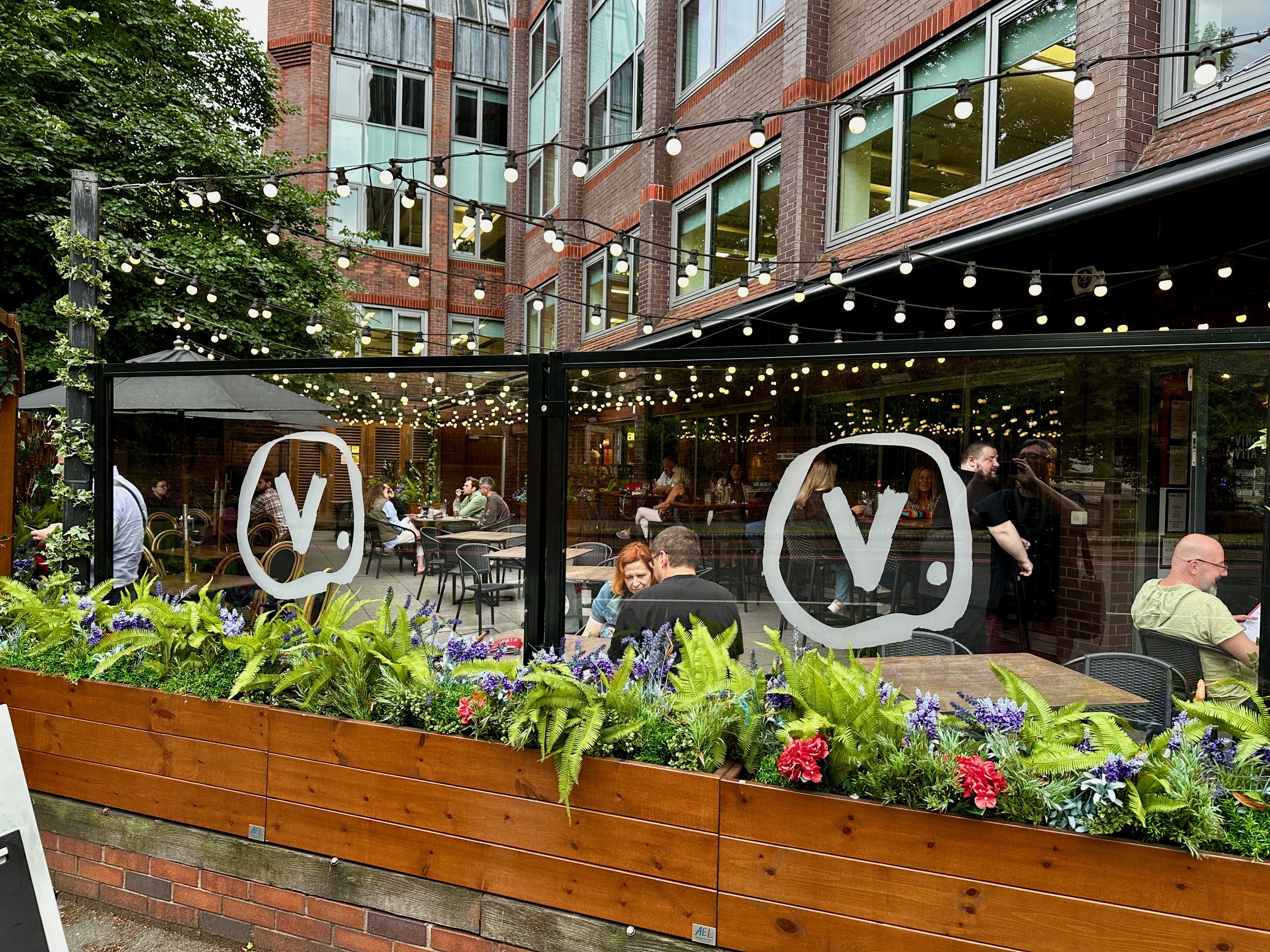
Our table wasn’t ready when we arrived, so we went out to the terrace to have a drink before our meal. It really is one of Reading’s most appealing al fresco spaces, a very pleasant spot opposite the park, strung with lights and convivial on a warm day. It was nice to spend time there before dinner, quitting as the evening became a little nippy, but it does help if you don’t mind passive smoking because there was a fair bit of that. Very Italian, I suppose.

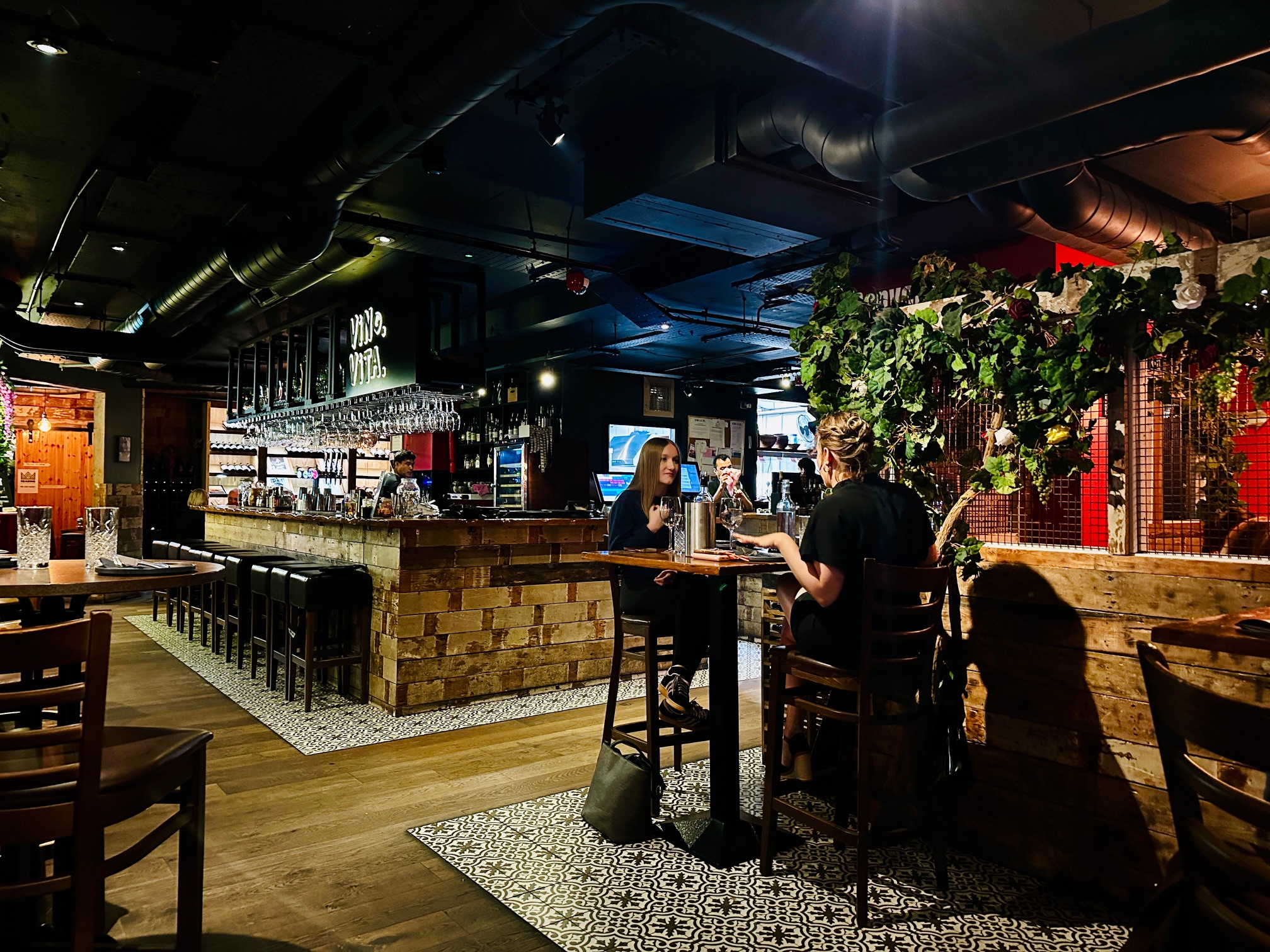
It was, however, difficult to get attention. So by the time we did, and managed to place an order, and the nibbles came out, it was chilly enough that it felt like time to move inside. Vino Vita’s interior didn’t feel any different to when it was Veeno, and I’ve always found it a slightly disjointed set of spaces – some high tables, some low tables, a series of disconnected rooms that don’t entirely feel like they’re all part of the same establishment.

We were taken to a more conventional table to the right of the bar, in the room I’m pretty sure I ate in back in 2017. On a Friday night the place wasn’t rammed, although I suppose many of the customers were outside. Perhaps they seated all the people that had booked a table for an actual meal in the same room, and everyone else was off having their Experiences.

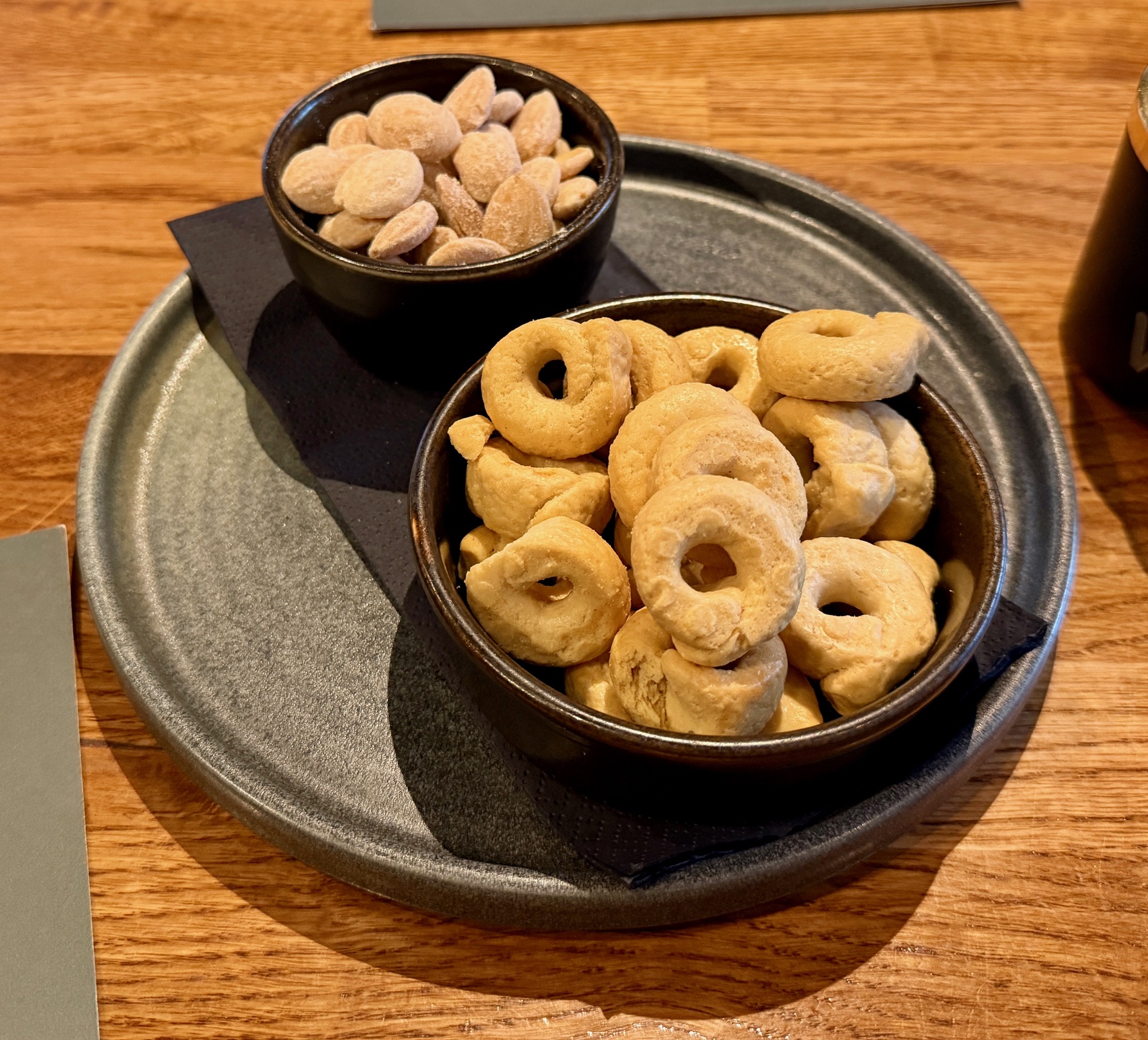
Our nibbles were disappointing, sub-pub stuff. I was hoping that salted almonds would be the kind of treats you get in Andalusia, burnished with oil and speckled with salt. These were out of a packet or a tub, dusty with salt and completely unremarkable. Even more nothingy were the taralli, dense little knots with the texture of sawdust. Really good taralli come spiked with fennel seeds and, with a crisp white wine, can be a delight. These weren’t really good taralli. Eight pounds for two ramekins of blandness.

We had a wine flight with these, the “VINO.VITA.BIO” which was three 70ml glasses of Vino Vita’s organic wines. The first, a verdicchio, was genuinely very enjoyable – and it was just as well that it was, because getting someone to bring some water to accompany those very dry snacks proved difficult. When we finally did manage it one of the staff brought a small bottle of water, a single glass and another glass full to the brim with ice. We had two perfectly good water glasses sitting on the table, which made it all a bit weird. “It’s funny” said Zoe. “They do have enough staff, it just feels like they don’t.”

The other two wines in that flight, by the way, were also quite nice. One, a Nero d’Avola, was decent, perfumed and very enjoyable: it didn’t go with anything we ordered, but that might be because it was tasty and none of the food turned out to be. The third wine was a Frappato, which is a new one on me, and was also perfectly drinkable.

This is sure to be a firm favourite amongst those who enjoy wines on the medium end of the spectrum said the blurb on the piece of paper which accompanied the wine flight: that quote is sure to be a firm favourite amongst those who like their sentences to be completely devoid of meaning. As with the wine list, the piece of paper didn’t give useful details like producers or vintages, and you didn’t get to see the bottles or labels. Did that make for a premium experience, or Experience, when you were paying £17 for 210ml of wine?

We’d also ordered some garlic ciabatta, but our server accidentally brought over the bread selection instead. He was very apologetic, and ran off and made amends, but it was a useful exercise because the bread was a dreary-looking generic selection, none of which looked like it had been baked onsite or indeed anywhere exciting; I made a mental note not to order any of the numerous bruschetta options.

Instead we got what we’d originally ordered, four slightly sad triangles of ciabatta which had been sort of toasted, a little, inconsistently brushed with olive oil and scattered with parsley. There was some garlic there, but nowhere near the industrial quantities Italian food called for. Zoë thought this was okay, but she was being charitable. I thought that for six pounds I was having the kind of thing you could easily pick up at a supermarket.

The real crimes against Italian food, though, were to follow, in a meal where the longer it went on the worse it seemed to get. I can’t think of a better way to demonstrate that than the first of the small plates we’d ordered. The menu promised stuffed courgette flowers, and I thought this would be a real test of whether they truly held all those lofty aspirations. Because a courgette flower, its head stuffed with ricotta and lemon zest, the whole thing fried in an almost translucent, lacy batter is one of the very best things you can eat.

It is serious cooking, and a menu offering it is making a claim to be serious about cooking. I still remember it being served by the Lyndhurst, when I held a readers’ lunch many years ago: Amy, the vegetarian on our table, had it all to herself and every omnivore envied her. It’s taking all my strength not to include a picture of it in this review, so you can see what it’s meant to look like. Instead, just look at that: three beige cylinders bearing no resemblance to courgette flowers at all. No light coating, instead a thick layer of stodge.

Inside, something that definitely wasn’t a courgette flower: I’m prepared to take their word for it that it was courgette, but only just. And inside that, some blend of cheeses that tasted of nothing. This was like some kind of continental reinterpretation of stuffed jalapeños you might pick up at Iceland, an affront to the promise of this dish. Providing some honey, the only thing that actually tasted of anything, didn’t rescue it. The price – £8.50 – rubbed salt in the wound.

The arancini were in the same vein. Veeno only did one kind, filled with ragu, whereas at Vino Vita you can choose between ragu, mushroom and truffle or ham and cheese. The mushroom and truffle ones didn’t taste of truffle in any way, being just claggy stodge with no crunch or crispness to the exterior. Plonking them on a shallow pool of tomato sauce, grating some cheese and unceremoniously dumping some basil in the middle neither elevated them nor disguised their inadequacy.

I’ve used that word, stodge, twice now, because nothing else encapsulates those dishes. Italian food at its best can embrace the wonder and comfort of carbs, but this seemed to prioritise filling the stomach and emptying the wallet with brutal efficiency. In fairness, these were billed as bite-sized and only cost £6, but they still weren’t worth it. When I went to Veeno, 8 years ago, I said that it felt like the kitchen was more interested in margins than food. Hold my beer, said Vino Vita.

Neither Zoë nor I managed to take a picture of one of our small plates, so you’ll have to both imagine it and take my word for it. If you read the title carpaccio of salmon and the description smoked salmon drizzled with a lemon and caper dressing and fresh rocket and think that, based on what you’ve heard so far, this is likely to be a small piece of smoked salmon draped over a hill of the kind of salad you get in a bag at the supermarket, domed to make it look like you’re getting more salmon than you are, meanly scattered with capers, you would be absolutely spot on. Give yourself a pat on the back.

This is me trying to find positives, believe it or not. But I don’t think even Pollyanna could find a positive in the final small plate, the caponata. Caponata is a wonderful thing, a cold, sweet and sour aubergine stew with olives, capers and pine nuts. It has a distinctive taste which I adore. It is not, as it was at Vino Vita, a bland mulch of aubergine and far too many tinned black olives, with no sweetness, sharpness or sourness. It didn’t even look like caponata, didn’t have that depth of colour, although you’d have to whip off all the pointless foliage that had been dumped on it to be absolutely sure.

You know who used to do a very enjoyable caponata, back in the day? Carluccio’s, of all places. You know who does the worst caponata I’ve ever tasted? That would be Vino Vita.

Now, you might just think I’m being curmudgeonly, so I have to say this in my defence: Zoë thought all of this was awful. Zoë, the woman who is able to tolerate me. Even she – especially she – found all these dishes unforgivably bad.

“There’s somebody in that kitchen who really hates Italy” was her conclusion.

“It definitely doesn’t feel like anybody in the kitchen’s ever been there.”

“What we’ve just had,” she added, “was a crap-paccio. A crap-paccio and a craponata.”

Irony of ironies, the bottle of white wine we were on by now was really very nice, with fruit and structure and, to my mind, even a little hint of licorice. And by this point we had a server who was really good and very personable, checking in on us and taking away our empties. At just over fifty pounds you’d want that bottle to be good – Vivino suggested its mark up was something like three times retail price – but however pleasant it was, I wasn’t sure how much of it you’d need to drink to make the food seem like a good idea. I was sure, though, that I wasn’t capable of putting that much wine away.

The food up to that point had been so poor that it became partly about cutting our losses. The couple at the next table had paid up and gone leaving behind the best part of a bowl of anaemic-looking pasta – the mushroom tagliatelle, at a guess – and a blond, bland pizza. So we decided to try a Pinsa Romana, the airier Roman variant as popularised in Reading by Mama’s Way. In a way, I was trying to give Vino Vita one last chance, aware that if I had a conventional pizza and was comparing it to Amò or Paesinos it would be the final nail in the coffin.

But the final nail in the coffin was the Pinsa Romana. The Piccante promised, if the menu were to be believed, ‘nduja and oil, roasted peppers, burrata, rocket and basil. Like all the other promises, it was an empty one. The base was crunchy, dry as a bone with no airiness or give: Mama’s Way may buy their pinsa bases in, but they were miles better than this.

The pinsa had been pre-cut into eight miserly squares, and good luck finding ‘nduja on every one, because you wouldn’t. “Nigel Farage turns up to vote more often than ‘nduja turns up to this pizza” was Zoë’s verdict. Bland unlovely bits of burrata had been placed here and there – no oil, no discernible basil and no rocket.

In the rocket’s place, obscuring just how atrocious this pinsa was – which surely must have been the prime objective – somebody had thrown random salad on top of the whole affair. This was the last straw for Zoë. “It’s meant to have rocket on it, not the contents of a fucking bag of Florette”. The whole thing was so subpar that we followed our neighbours’ example.

It’s not even that this pinsa didn’t compare well to what you could get a short walk away at Paesinos or Amò, although it didn’t. It’s that it didn’t compare well to what you could get at Zia Lucia, or Zizzi, or Pizza Express. Or Marks, or Tesco, or Aldi, or the Co-Op. And if you bought one from a supermarket and took it home, you could dot it with ‘nduja yourself and even if it was from the chiller cabinet, heated up in your oven, it would be dozens of times better than this effort. It wouldn’t cost you £15.50, either, and for that money you can enjoy the best pizza Reading currently has to offer, minutes away on Kings Road.

Our server came over to check how our food was. We said “it was fine” almost in unison, the universal English euphemism for It was bad, but I can’t face a conversation about that. Our bill came to £166, including a 12.5% service charge. A bit of me wants to say that in Vino Vita’s defence, nearly ninety of that was on wine. But even if I do say that in their defence, the rest was indefensible.

Can you tell I wasn’t a fan? I don’t think I’ve written a review like this in ages, and certainly not of somewhere independent, and I don’t take pleasure in doing it. I’m reassured that Zoë, who is positivity personified, disliked it even more than I did – because yes, it turns out that’s possible. And I don’t know what offends me most about the place. The mediocrity is bad enough, the mediocrity coupled with the laziness is worse. To combine both those things with really iffy value, at a time when Reading’s Italian scene is having something of a renaissance, is woeful.

Worse still, it made me feel like that rebrand from Veeno to Vino Vita had something else behind it. A desire to make more from less, to cut corners and conceal charging a premium. Even some of the dishes that have been tweaked from Veeno’s menu to Vino Vita’s display this – Veeno does a bruschetta with capers and Sicilian dark tuna, Vino Vita’s boasts a tuna paté. What’s the Italian for Shippams?

But just as sad is this: with the Cellar gone and Vino Vita, well, like this, Reading still doesn’t have the wine bar with excellent food that has been missing ever since the Tasting House closed after lockdown. That gap in the market remains, and on this evidence Vino Vita isn’t even trying to fill it. Maybe Notes, just opened on Station Hill, will do better: it’s not as if it could do much worse. It is bad luck for Vino Vita that I review them the week after I had one of my meals of the year – also Italian, but miles better – at RAGÙ, but Vino Vita would be bad whoever you were comparing them to.

It might have been a little different if the service had been better – Apo, formerly of Dolce Vita and Pho, and one of Reading’s great front of house operators – works at Vino Vita, although he wasn’t on duty the night I went there. But the problems are squarely on the menu and in the kitchen, not elsewhere: you could forgive the slightly disjointed interior or the relatively expensive wine if everything else was firing on all cylinders, but it didn’t even get started.

If Paesinos or Amò had more space and an alcohol license, I’m not sure what the point of Vino Vita would be. In fact, if either of them did I think it would spell curtains for Vino Vita. I might be wrong, of course, because it seemed to be doing reasonably well the night I was there and that puff piece in the Chronicle made it sound like they were going from strength to strength. Be that as it may Vino Vita achieved something I would never have thought possible, despite nearly twelve years in the reviewing game. It made me miss Veeno, and that’s not a good thing.

Vino Vita – 4.6
Minerva House, 20 Valpy Street, Reading, RG1 1AR
0118 9505493

https://vinovita.bar

Since January 2025, Edible Reading is partly supported by subscribers – click here if you want to read more about that, or click below to subscribe. By doing so you enable me to carry on doing what I do, and you also get access to subscriber only content. Whether you’re a subscriber or not, thanks for reading.

Restaurant review: RAGÙ, Bristol

I was on a run of bad luck when we turned up for dinner at RAGÙ, situated in a shipping container in Wapping Wharf, on the last night of our trip to Bristol. It’s not that I hadn’t eaten well, because I had in places, but I hadn’t eaten consistently well. My lamb kofte wrap from Matina, always a staple, felt a little under-sauced and under-seasoned, my vegetarian pizza sandwich at the Left Handed Giant brewpub was bland and stodgy.

There was a meal at a gastropub in Clifton so middling I didn’t end up writing it up, because even I can’t spend 3,500 words just saying meh, and of course there was my very brief, rather expensive dinner at Snobby’s. In that sense, it wasn’t a vintage trip.

That’s not to say that there hadn’t been some good things to eat. That rolled lamb dish at Snobby’s was magnificent, even if it stuck out like a sore thumb in the wider context of a hapless meal. The fried potatoes with truffle mayo at Left Handed Giant almost made up for that sandwich by Pizza Is Lovely, which wasn’t.

I sat outside Panunzio’s on Cotham Hill on a blazing afternoon and enjoyed a tub of the most incredible chocolate gelato (they make everything onsite), and possibly preferred it even to Swoon, the bigger name at the foot of Park Street. There were bright spots, but most of them were isolated dishes, or the highlight of a disappointing meal.

The one exception was brunch at OddShop on Whiteladies Road, eating outrageously good crumpets topped with fried chicken, chilli jam, bacon and coffee maple syrup, accompanied by the hash browns of the gods; I liked this so much I was prepared to overlook the fact that I discovered the place by virtue of Bristol’s most prominent influencer. Still, at least I paid for my meal: maybe if it had been free I also would have described it as “proper unhinged naughty scran”, but somehow I doubt it.

So the stakes were relatively high for our final dinner in the city, but I suspected RAGÙ could handle it. Back at the start of 2023, before everybody and anybody discovered it, I reviewed a little spot in Bedminster called COR, and adored it. I said at the time that I was ahead of the zeitgeist, for once, and it turned out that I was; Michelin gave it a Bib Gourmand, bloggers hopped on the bandwagon, and in the meantime COR carried on thriving, doing what they did well. I watched their progress with happiness and pride, just glad I knew them before they were famous.

Anyway, two years later they opened their second restaurant, RAGÙ, on Wapping Wharf. Where COR’s menu ranged across much of southern Europe, RAGÙ’s was very deliberately Italian, and prior to it opening COR’s head chef Vyck Colsell and some of her team went on a fact finding trip to Emilia Romagna: I remember seeing the photos on Instagram and feeling profound envy of her time in Bologna.

As it happens, Colsell has a Reading connection, having started out in Caversham’s very own, much-missed Mya Lacarte. When RAGÙ opened in March Colsell got a promotion, being confirmed as executive chef of both restaurants: to think that it all began on Prospect Street.

I was not ahead of the curve with RAGÙ, sadly. Despite booking my table back in May, by the time I got there earlier this month – as with Town – a national critic had beaten me to it. Grace Dent this time, making the most of a trip to Bristol to visit both RAGÙ and Lapin. She loved them both, although RAGÙ was the one she dubbed her new favourite restaurant of 2025. Still, only one review of consequence to measure mine against counted as pretty good going.

Whether it was the Dent factor or just a Thursday night in Bristol, the restaurant was buzzing when we turned up. RAGÙ felt much smaller than Lapin – it’s just the one shipping container, I think – and had something like half a dozen tables, the rest of the covers being up at the bar with a great view of a very open kitchen. It shares the terrace outside with its neighbour, and it was a warm enough day, but I loved being inside with all that life.

I recognised Colsell in the kitchen and one of the servers as the one who had looked after me so brilliantly on my first ever trip to COR, and taking it all in I started to get whatever the opposite of a sinking feeling is. Could one meal redeem an entire mini break? You wouldn’t have bet against it.

RAGÙ’s menu, like COR’s, is broadly structured in sections, from nibbles to smaller plates, to bigger plates you might share to the largest that you perhaps wouldn’t. This is something both restaurants are really good at, and it’s all about flow. It’s one thing to just stick dishes of varying size and cost on a menu and leave you to fend for yourself, and even some very good places are prone to doing that. But with RAGÙ’s menu you get a clear picture of how it all hangs together and how you might – wanky word alert – curate a meal.

And actually all the tables around me were doing that different ways, shuffling plates in different orders, sharing things I might not have, all finding different ways to configure a list of dishes where you would struggle to find good reasons not to order all of it. That said, I doubt there were many duos in the restaurant that night who tried quite as many of the dishes as we did. What can I say? We were greedy, hungry, delighted to be there and we had an underwhelming trend to buck. Time to roll our sleeves up and get into it.

Our first wave of dishes came, nicely spaced and paced, as it should be, to accompany aperitivi. Zoë’s negroni, which was leftfield but not heretical, was made with local Psychopomp gin and coffee-infused Campari, and received rave reviews. I had something called a Scialla which was made with Moscato d’Asti – which I’ll always unapologetically love, however unfashionable it might be – with mint and lime. A little like a rebujto, and a lot like something I could easily rustle up at home. A light whisper of a drink, gone too soon, but also, because Moscato d’Asti is something like 5%, gone without doing significant damage to the liver.

That feeling of being in safe hands began with the first thing we ate. An opening gambit of beautifully done focaccia, studded with salt and rosemary, would have been fine on its own or even better with bright extra virgin olive oil to dip. But whipped butter topped with bottarga? Utterly exquisite. My friend Al brought me some bottarga back from a recent trip to Italy: now I know exactly what to do with it.

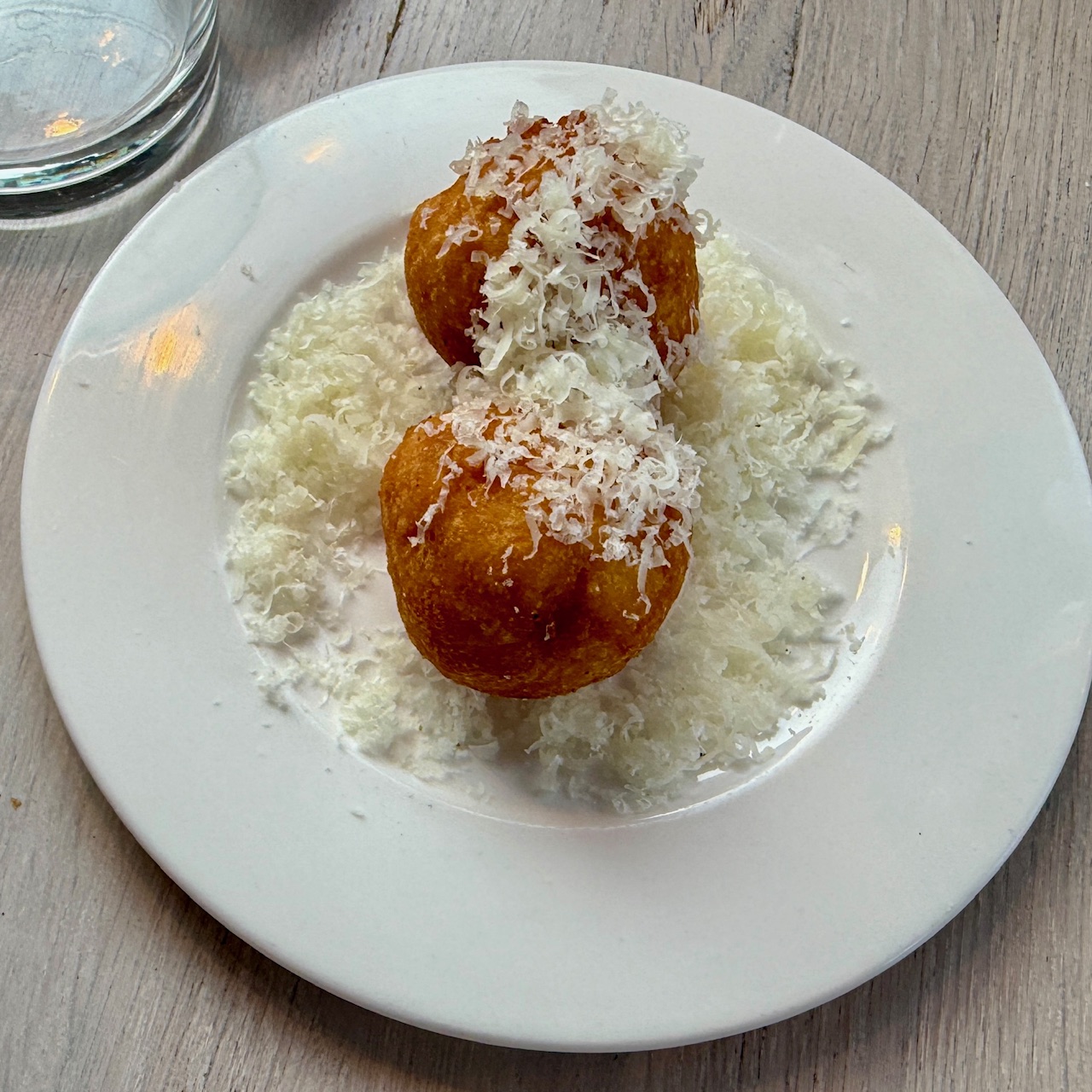
Slightly less successful, for me, was the one thing we had from the specials board. Crocche were little balls of fried, mashed potato, served carpeted with cheese. And as an exercise in texture they were a masterclass – such a light crunch, so ethereal inside. But texture isn’t everything, and for me these lacked the oomph I would have liked, especially at seven pounds fifty for a pair.

As it was when I ate at RAGÙ’s neighbours Lapin, I mentally compared this dish to the worldbeating cheese fritters at Upstairs At Landrace, and wasn’t convinced RAGÙ’s came out on top. I keep getting told off for comparing restaurants – some random said I spent too much of the last review talking about Clay’s – but how do you work out whether something is great or merely good without comparing it to other stuff you’ve had? Honestly, some people.

My absolute favourite of the small plates we shared was what came next. Prosciutto and melon could easily be seen as a throwback, the kind of thing we all thought we should be eating forty years ago. And I’m not sure when I saw it last on a menu, mainly because I suspect it’s the province of very trad Italian restaurants and, Reading not having any of those, I never visit that kind of place. But this dish, one of the best things I ate in the meal, was 100% comeback and 0% throwback.

First of all, the prosciutto was undeniably first rate – coarse and thick, the good stuff, free from the sheen that is the clearest tell that it had spent the last few weeks incarcerated in plastic. This stuff sang, and it wasn’t alone in doing so: the hunks of Charentais melon it was draped over were deeply sweet and fragrant, soft and unmissable. That alone might have made for a knockout dish, but RAGÙ knew when to add and, crucially, when to stop. So the Sorrento tomatoes in the mix added a different kind of sweetness, another dimension, and torn basil (and, I think, some more finely chopped mint) perfected matters.

It felt like a supercharged summer from the first mouthful to the last, the kind of thing you’d love to eat at home but, because you don’t have RAGÙ’s access to ingredients, you know you never will. That said, RAGÙ’s Instagram suggests they get produce from extra-fine greengrocer Hugo’s, a few doors down from COR in Bedminster. So if you live in Bristol, you at least have a fighting chance of recreating it.

The final dish in this phase of our assault on the menu was probably my least favourite, although I should say in fairness that Zoë loved it. I now realise I’ve not had friggitelli peppers before and I didn’t realise that they were dark, green, slightly bitter things, not a million miles away from padron peppers, which I’ve always been able to take or leave. They were served with confit tomato, which was actually a thin pool of liquid, and topped with grated, salted, aged ricotta.

So the fact that I didn’t like this might have been on me. Every component of it was well done – the peppers in particular were cooked nicely and slightly blackened – but I do think that its three elements didn’t cohere into a single dish. Something you sort of have to eat with a fork, sort of have to eat with a spoon, is sort of hot and sort of cold left me sort of both. But as the one outlier, it probably says more about my tastes than anything else.

That was all the sharing either Zoë or I felt like doing, so from that point onwards there was her dish and my dish all the way through to paying the bill. I don’t know whether everyone does that or not, but I remain unconvinced that some dishes – especially things like pasta – are really sharable anyway, unless you change ends at half-time, so to speak.

One thing we did share, though, was a beautiful bottle of Gavi which cost just shy of fifty pounds and felt worth it. It didn’t necessarily go with everything we ate, but having a lovely time did and it contributed its fair share to that.

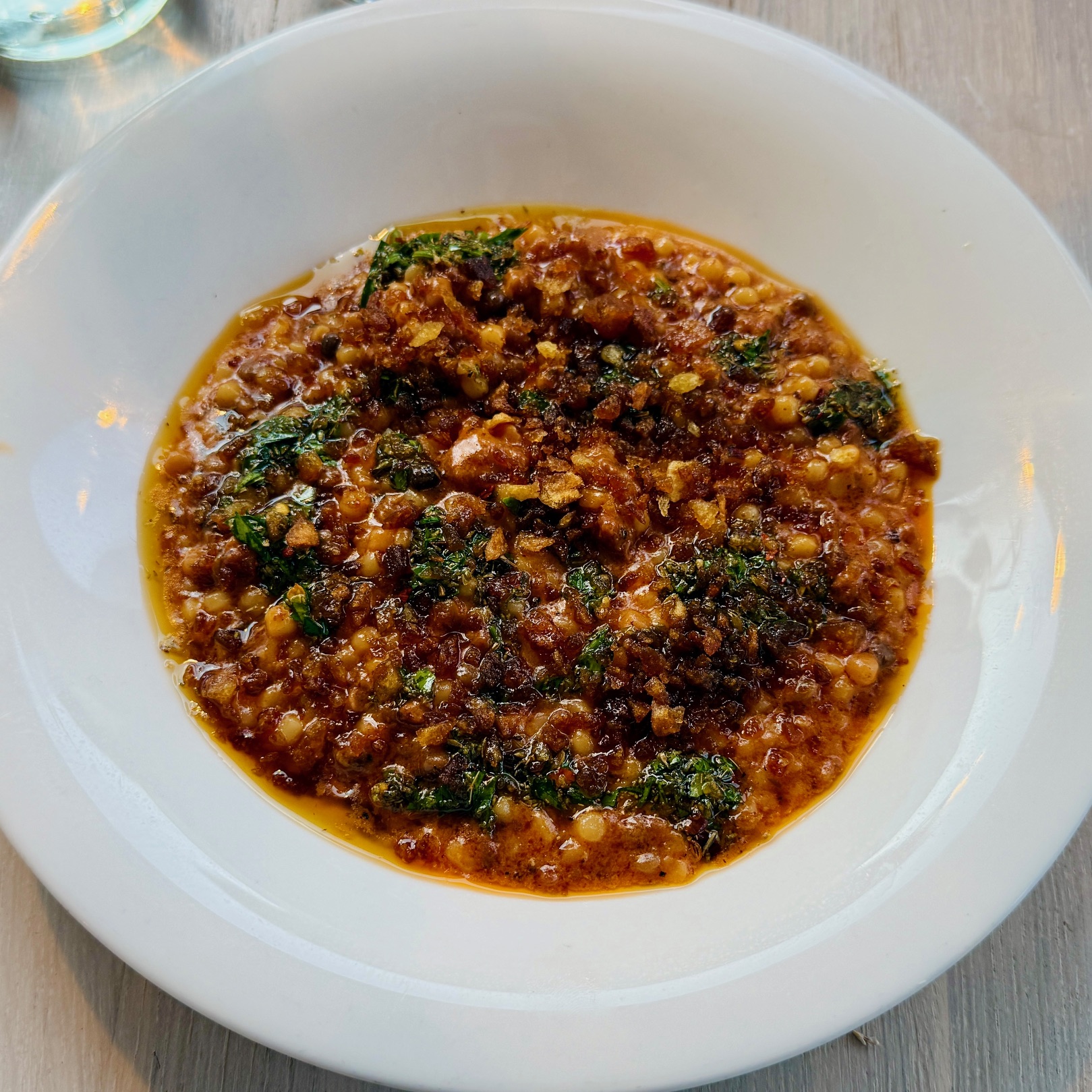
Zoë, for me, ordered the other dish of the meal. Billed as fennel sausage with fregola it was really so much more than that, a bowl of the most tremendous, intense, savoury joy. I’m not used to associating fregola with comfort rather than virtue, but here it was deployed as a supporting player with crumbled sausage, a painterly swathe of gremolata and a potato crumb.

And you could look at the picture down there and not really get all that, but this was entirely about surpassing the sum of the dish’s parts. Our friends James and Liz went to RAGÙ a couple of weeks ago, partly after hearing how much we’d enjoyed our meal, and I told James that this was the one dish he should make sure he ordered. He ordered it. He loved it.

Liz’s highlight, on their visit, was the dish I had next and which, to be fair, I knew she would also love. An exceedingly generous portion of tagliolini was possibly the platonic ideal of a comforting bowl of pasta, with not a strand out of place. The pasta was thin and fine, golden with egg and carrying just the right amount of bite, the crab delicious and cossetting.

But the whole thing was offset with lemon and a little spike of chilli, because RAGÙ understood that even cosiness is improved with a touch of something waspish. And the crowning glory was a beneficent scattering of pangritata, to add that textural cherry on top. As elsewhere in the meal, RAGÙ’s genius was an understanding of just how many components to load on a dish before saying “when”, and to make that hard work and judgment look free, easy and natural.

After this we had a lovely, leisurely pause before attacking our final two savoury picks of the evening. And this one was a score draw, with both of us admiring one another’s candidates but secretly thinking we had chosen better. Mine involved what I honestly think is one of the finest things you can eat, slow-cooked shoulder of lamb, pressed into a dense, cylindrical puck, where you know that every indulgent forkful will contain nothing but the epitome of this meat at its finest.

So far so Snobby’s, you could say, but RAGÙ, as at every point in proceedings, went one step further, finishing the lamb over fire to caramelise the outside. This dish gave me almost unseemly amounts of joy, and pulling apart those shreds, loading a fork with them, along with a ragu of peas and carrots and a delirium-inducing salsa verde was a voyage of blissful discovery that could never have lasted long enough.

A meal that contained this dish, or that crab tagliolini, or the sausage and fregola combo, would have been a meal to be reckoned with. To go to a restaurant with all three on the menu, where if you arrived hungry enough and paced things just right you could eat more than one of them, was close to nirvana. And all three of the dishes I’ve mentioned clocked in at less than twenty pounds: I’ve not found many dishes offering such impressive value this year.

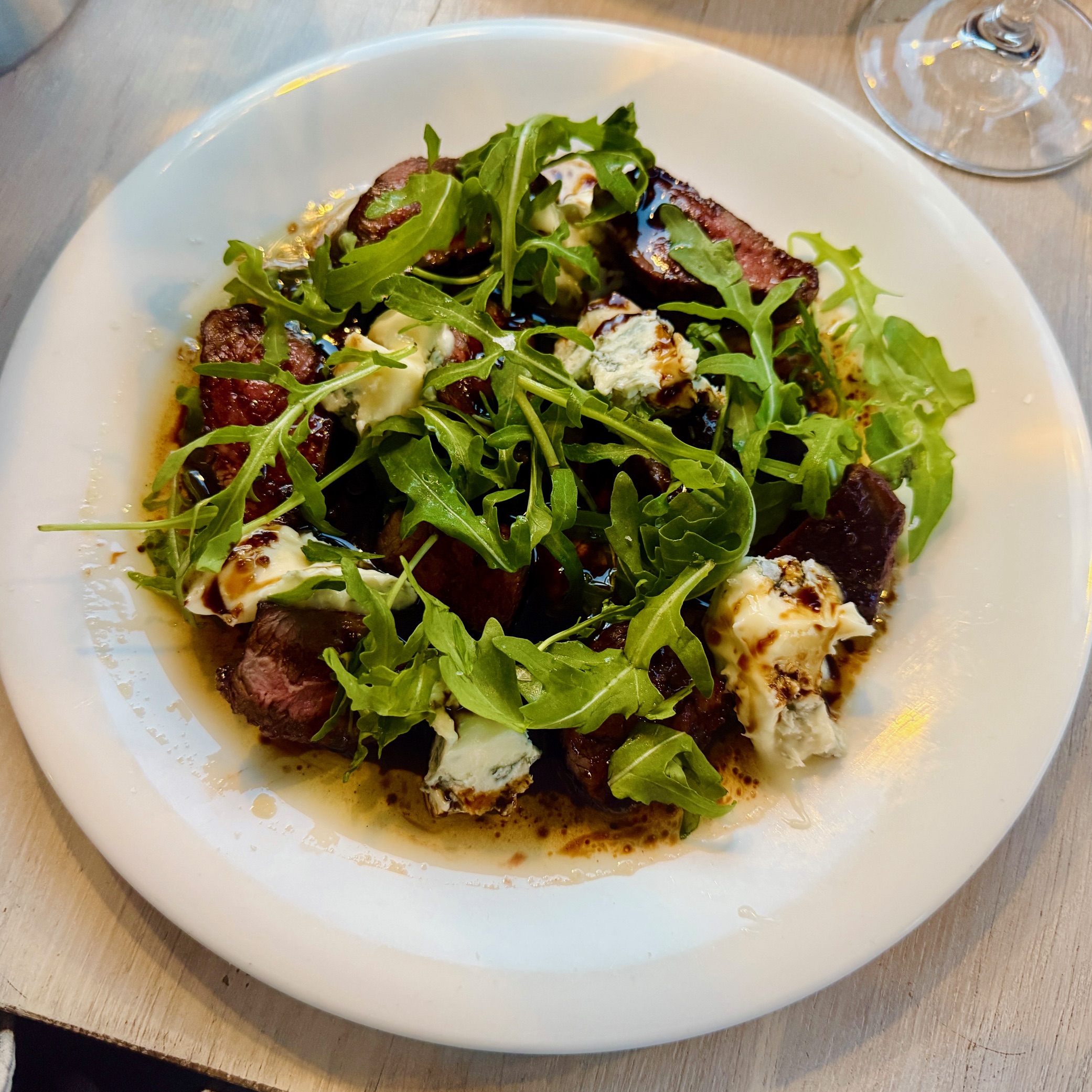
Zoë would argue that her main – just shy of thirty pounds, this one – was even better. Enormous, butter-soft pieces of venison came strewn with splodges of sweet Gorgonzola, the whole thing bathed in bone marrow butter and aged balsamic vinegar. Almost like a tagliata, if every single ingredient in it had been amped up to be its absolute best. Venison, so often at risk of being dry, is very rarely like this. The cheese was perfectly judged – so yes, there was salt and funk in there but not just that.

And again, the artistry of how to finish the dish was right on the money – adding the depth of the bone narrow and all the complexity that aged balsamic can bring to a dish. A bit of a theme here: RAGÙ always knows when to stop, but they don’t stop until a dish is just right, unequivocally on the money.

Now, you might look at that dish – brilliant though it is – and think this is another example of the phenomenon I observed earlier in the year at Gee’s, of being given salad in disguise. Because I’m a heathen, I might even agree with you on that, but we had a solution: more carbs (because heaven knows, the meal so far had been so lacking in them) in the form of patate schiaccate, boiled, crushed and fried potatoes which are a speciality of Calabria, or Trieste, depending on which Google result you believe.

I quite liked these, and that combination of boiling, bashing and frying made for sheer crunchy, crispy textural delight. I didn’t get masses of the rosemary or garlic, but when the potatoes have that many sharp, golden corners you overlook that completely, in my experience.

By this point, enjoying the last of our wine at our leisure, the restaurant was a calmer but equally lovely place to be. The best part of a couple of hours had passed since we took our seats, and the tables indoors had thinned out, although the terrace still hummed with a slightly more subdued energy. The sky was growing inky beyond the windows, and the staff were winding down slightly.

If anything I enjoyed watching the kitchen even more then than I had when they were busy and cooking: many writers better than me have tried to capture the camaraderie of a kitchen at many different periods in a restaurant’s day, using a variety of tools, but all I can say is that it seemed to me that I was looking at a brigade who genuinely liked one another, and that warmth and joie de vivre had permeated the whole evening. 

Service throughout my meal was brilliant, from all the people who looked after us, and it managed to nail the sweet spot where it was eager to please rather than oversolicitous, enthusiastic and informal rather than slapdash or chummy. After a series of meals that had disappointed me – both in Bristol and beyond, on duty and off – it was nice to be reminded: this is what it’s supposed to be like. A night like that can make you fall back in love with restaurants.

But there was time for one last thing to eat, accompanied by nectar of a glass of dark, sticky Recioto della Valpolicella in a very generous 100ml pour. Zoë, adhering to our unwritten law that if tiramisu is on a menu at least one of us needs to order it, lucked out with a delectable wodge of the stuff, carpet bombed with cocoa. It’s had a fair amount of attention online – the influencer I referred to earlier said it was “proper unruly” and “has got edges”, the latter of which is true of pretty much anything you eat, anywhere, ever. I’m sure he knew what he meant.

But yes, it was one of the best I’ve tried, and I’ve tried quite a lot. Influencer-speak described this tiramisu as “hit” with orange and nutmeg, which to the rest of us means it had orange and nutmeg in it. It didn’t bang, it didn’t slap – why are these half-wits always so drearily percussive about things? – but it was outstanding.

I, on the other hand, couldn’t resist the gelati. The two options were fior di latte gelato with aged balsamic or peach and basil sorbet, and I let you down by having two scoops of the former and none of the latter. But I couldn’t resist: I don’t think I’ve ever seen fior di latte gelato on a menu outside Italy, ice cream with the confidence to just taste of itself, no adjuncts or gimmicks, so I wanted to sample it.

I say that, but of course the adjunct was the balsamic vinegar, and it was transformational. Forget the humdrum pairing of having it with strawberries, forget tipping some Pedro Ximenez on your vanilla ice cream, this was the combination I’d been missing out on my whole life. You could try to recreate this at home, too, but everything you used would have to be unmistakably top notch, and I know that if I did it would fall short. Better to remember it here, this way, transcending sweet, salt, sour and savoury to create something that would persist in the memory.

I wish they’d brought it in a single bowl, mind you, rather than these two slightly bizarre individual portions. There, right at the end: something that looks like a criticism.

Our bill for two people – for all that food, a couple of aperitivi, an excellent bottle of wine and two glasses of dessert wine – came to just shy of two hundred and seventy pounds, including a 12.5% tip which was earned many times over. You may say that’s expensive. I say it’s exceptional value for what we had, and for an evening that I’ll remember as one of the best meals of this or any year. Only one dish – that venison – came in north of twenty pounds.

It’s funny seeing RAGÙ getting the attention that COR did not. For me, it feels like reading rave reviews of the sophomore album when you bought the debut (an experience, to be fair, I’ve also had more than once). But I’m delighted that Colsell and owners Karen and Mark Chapman are getting their moment in the sun, better late than never, because RAGÙ is as good a restaurant as you could hope to find. Despite being only a few months old, it already feels like a destination restaurant in the making.

Some people will prefer COR’s more spacious homeliness, many will make a beeline to RAGÙ for its more compact, more clamorous buzz. I can honestly say, though, that you wouldn’t go wrong with either, and you could read either’s menu and struggle mightily deciding what you could come to terms with leaving without eating. Such restaurants are rare, and any town is lucky to have one. A city with two, run by the same team, is fortunate indeed.

So it turns out a meal can redeem a holiday, after all.

RAGÙ – 9.5
Unit 25, Cargo 2, Museum Street, Bristol, BS1 6ZA
0117 9110218

https://www.ragurestaurant.com

Since January 2025, Edible Reading is partly supported by subscribers – click here if you want to read more about that, or click below to subscribe. By doing so you enable me to carry on doing what I do, and you also get access to subscriber only content. Whether you’re a subscriber or not, thanks for reading.