Picasso

Picasso closed in October 2019. I’ve left the review up for posterity.

One of the editorial decisions I had to make when I started Edible Reading sounds like a minor one, but it prompted much deliberation. Not where to eat, or which font to use, or whether to put captions underneath my terrible pictures, but something more basic: where do you put the mark out of 10? I quite liked the idea, like Pitchfork for example, of putting the mark right at the top so you knew before reading whether I thought the restaurant was any good. In the end, I went with the conventional method of putting it at the bottom. The idea is that people read on to the end, curious about whether I’m going to turn out to be a fan of Pepe Sale, ZeroDegrees, London Street Brasserie etc.

Most of the time this works out fine, but the only exception is when you give a bad review. People love bad reviews, and I’m no exception; there’s a certain pleasure to be had from reading one. So I think I should warn you from the outset that this is a bad review. Picasso is not a good restaurant. I won’t go again, and I’d actively encourage you to follow my example. Got that? Right, on we go then.

I started out reviewing places I’ve been before – not new places, not unknowns – partly because I wanted to find my feet and partly because I wanted to pick places you might have been, so you could get an idea whether we liked the same stuff and you trusted my judgment. But this couldn’t go on forever, so I asked for suggestions about where I should go next. “Try Picasso”, someone said on Twitter, “I’ve heard mixed reviews and I’ve never been able to bring myself to try it.” Good idea, I thought. What’s the worst that can happen?

It turns out the worst that can happen is eating dinner at Picasso.

It’s one of those places, ironically, that ought to fill a gap in the market. Reading has never had a decent tapas restaurant, unless you count La Tasca (and, having eaten there before it closed, I don’t). Picasso has been going a long time, tucked away in a quiet little spot just over Caversham Bridge, so it must be doing something right. So I booked a table for 8 o’clock on a Saturday night and wandered across town, stopping in the Moderation for a pre-prandial gin and tonic. Eating somewhere you’ve never been before always has that feeling of excitement and anticipation, like that point at Christmas when you sit on the sofa, ready to unwrap a present in front of all your relatives.

The inside of Picasso, I would guess, hasn’t changed in over thirty years; basic furniture in a long thin room, pictures on the walls, cloth napkins, tables not too close together. A few tables were in dark corners, and I carefully avoided being led to one of those. Although it was unprepossessing I was determined not to judge the book by its cover: after all, Pepe Sale does great food and is never going to feature in Elle Decoration. The interior Picasso reminded me most of was the recently departed Nino’s, in Market Place, in fact, another old school restaurant where I’ve somehow never managed to have an inspiring meal.

Everything started well: the service in Picasso is very good, authoritative, old-fashioned service. The waiter recommended a Ribero Del Duero which was not on the wine list, was only £22 and was probably the best thing about the whole evening. He also – and this has to be a first – cautioned us against ordering too much food. Two tapas per person was enough for an evening meal, he said, so we should go easy on them.

In hindsight, I should have known at this point that something was amiss. Tapas are not meant to be big. That’s the whole point of them, and their whole appeal because it means you can try dozens of little things without being stuck with a giant portion of anything. After all, if you wanted that you’d go to a restaurant that served starters and main courses, wouldn’t you? A look at the menu proved that either the tapas were far too big or they were far too expensive: most of them were between eight and ten pounds. This is definitely the point where alarm bells began to ring, just as other couples started to take their tables. A lot of them had clearly been here before, though, so I must just have been worrying unduly. Mustn’t I?

When the tapas turned up it became apparent that they were both too big and too expensive, and worse still just not very good. A plato combinado of jamon serrano and chorizo was limp and insipid. The chorizo was barely an evolutionary step up from luncheon meat with a sun tan, bouncy and tasteless. The jamon serrano was even more of an insult, with the shiny dampness of something that had spent the previous few hours in a plastic catering pack of some description, each slice sandwiched between leaves of plastic. I wasn’t expecting them to have a leg of jamon hanging over the bar (hoping maybe, but certainly not expecting) but I did at least want to feel like this was good quality stuff. I could have walked back into town, gone to Marks & Spencer and got more, better, jamon for under three pounds. I finished it out of sheer stubbornness and almost immediately regretted it.

If the jamon was sub-M&S, the mushrooms with garlic butter were sub-Iceland, and even then I am probably being kind. A huge bowl of breadcrumbed mushrooms with a few visible patches of melted garlic butter was plonked in front of us, with a wedge of lemon in case you had pretensions about that kind of thing. Cutting them open they were flabby and damp, and the whole thing had the feel of party food at a party you wished you didn’t have to attend. A funeral, perhaps. We didn’t eat them all.

I looked again at the red wine. It was good, but it wasn’t that good.

Picasso 1

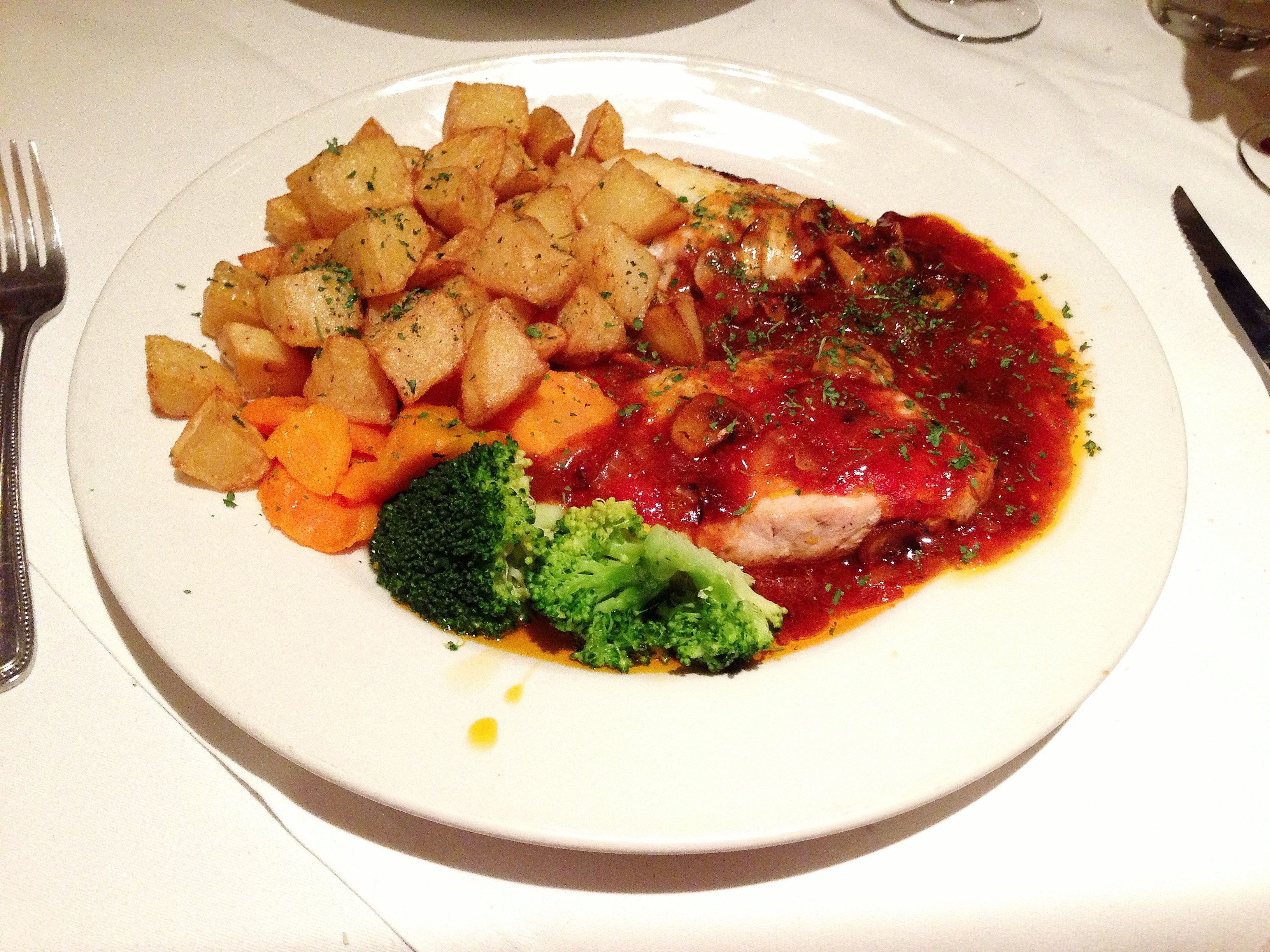
The mains came almost as quickly as the starters had done, and were no better. Cerdo Asturiano was billed as pork fillet cooked in cider and cheese sauce. I was hoping for tenderloin, what I got was two thick slabs of steak with another slab of cheese melted on top of them. The sauce had no evidence that either cider or cheese had been used in it at all, it was the sort of anonymous red sauce that used to be made by Homepride and is now made by Dolmio. For all I know it could well have been. Accompanying it was a gigantic pile of fried cubed potatoes (presumably exactly the same thing you’d get if you ordered patatas bravas), some carrots which either came from a tin or had been cooked to closely resemble those that do, and some broccoli. It was clear that nobody left Picasso hungry, but that it was unlikely they left it satisfied either.

Swordfish in a cream, onion and mushroom sauce was just as disappointing. The swordfish was bland and flavourless and the sauce managed, if anything, to be less than the sum of its parts – thin, watery, with a hint of dill that might well have come out of a Schwartz jar. Swordfish, done well, is a beautiful thing but this was just boil in the bag cod in parsley sauce with delusions of grandeur. It came with the same piles of forgettable vegetables as the pork; in fact, I only took a photograph of one of the main courses but they were virtually identical, the single difference being which inadequate protein and sauce combination you’d been unlucky enough to plump for. The only things worth finishing in the whole restaurant, it seemed, were the wine and the experience.
Picasso 2

It’s worth stressing what bad value Picasso is. Most of the tapas, as I said, were just shy of a tenner. The two mains were eighteen and sixteen pounds respectively. You can eat better for the same money in Reading without having to try very hard, and I’ve already reviewed two places where you can do exactly that. I couldn’t quite believe all the other diners in the restaurant didn’t appreciate this, to the extent where I wanted to stop by their tables on the way out and actively encourage them to go somewhere else next time. As I didn’t do that, I’ll have to console myself by doing it here instead.

I’ll say one thing for Picasso, it was mercifully quick. From sitting down to deciding to pass on the dessert menu took an hour and twenty minutes, on a Saturday night, a peak time for restaurants when people want to sit down and have an enjoyable, leisurely meal. The high point of the weekend when we want to sit in lovely cosy room somewhere, escaping from X-Factor and the contents of our fridge and being spoiled and taken care of by other people. There were lots of things about Picasso that were very very wrong, but the worst of all is how it betrayed that promise that every restaurant implicitly makes, that it will whisk you away from all that. It was like eating in a friend’s house, if your friend wasn’t a very good cook, had gone to about four downmarket supermarkets to get all the ingredients and tried to charge you eighty quid for the privilege. If you had a friend like that, you’d stop seeing them. If you knew a restaurant like that, you’d stop going. Believe me, Picasso is that restaurant.

Picasso – 4.1
6 Bridge Street, Caversham, RG4 8AA
Telephone 0118 9484141

http://www.picasso-tapas.co.uk/

London Street Brasserie

Click here to read a more recent review of London Street Brasserie, from July 2021.

London Street Brasserie was almost the first restaurant reviewed for Edible Reading. In many ways it would have been the perfect choice, because it’s hard to imagine Reading without it. As Old Orleans has been replaced by Miller & Carter, as Ma Potter, Yellow River Café, Chili’s and Ha! Ha! have opened and shut and been replaced, it’s always been there, dragging the rest of the restaurant scene in Reading up in quality, year by year. It’s hard to believe that it only opened in 2000 (I had to check, and even then I did a bit of a double take).

It’s always done a roaring trade – not just locals, but also shoppers and the occasional celebrity, too. I don’t mean Paul Daniels and The Lovely Debbie McGee, either – apparently Prince Harry was there on Sunday night, mere hours after we’d checked it out at lunchtime, and rumour has it he very much enjoyed the crab (presumably he then dashed off to the casino next door, if past form is anything to go by). Even so, it feels remiss not to review it even if it is one of Reading’s most well known restaurants. After all, does that necessarily mean it’s any good?

The set menu at LSB has always been a good deal, so three of us went along for Sunday lunch with the very best of intentions. Three people, two courses, £16 a head: should be a bargain, right? Well. It always starts like that, but the problem is that then you have to have a quick look at the rest of the menu (the “here’s what you could have won” element of visiting a restaurant) and the next thing you know there is some complicated horse trading going on – I’ll have a starter off the set menu if I can have a main from the a la carte and what have you. So we wound up ordering a bit of everything, and convincing ourselves that it was for the good of the review.

The winner among the starters, in fact, was from the set menu: halloumi and rosemary with a rocket, peanut and mint salad. This was the one we all wished we’d ordered – the salty halloumi set off perfectly by the mint, not a combination any of us had tried before. The others, though, were less successful. The foie gras ballotine seemed in some places to be more butter than foie gras (some of which had started to melt, possibly because it had been left out too long), and lacked any real complexity. The Sauternes sultanas accompanying it were little unremarkable sugary pellets and the cocoa nibs added more texture than taste. Each section of ballotine was topped with an inadequate triangle of toasted brioche, and the whole thing was a little underwhelming. At just under a tenner, it was disappointing stuff – you can argue about whether foie gras is cruel or a delicious necessary evil, but one thing it should never be is empty calories, and this came rather close to that.LSB1

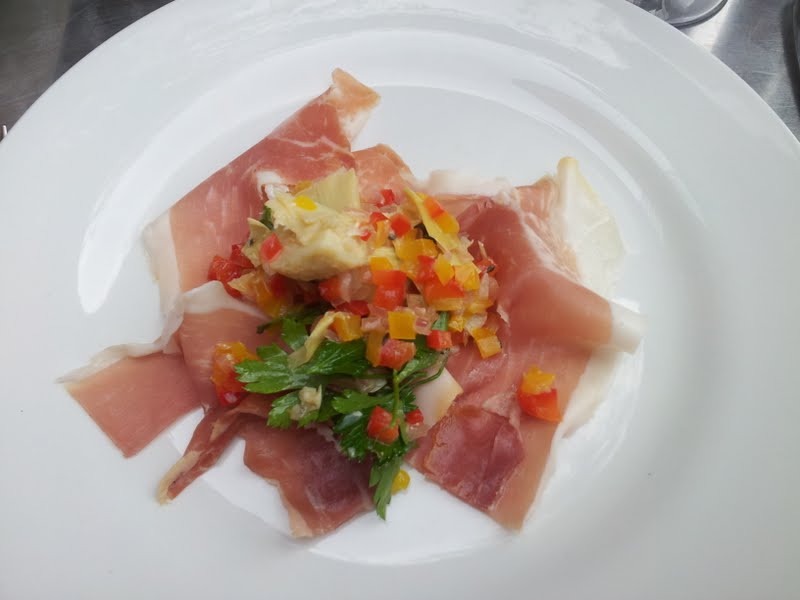
The Parma ham with artichoke and parsley salad, also on the set menu, might have been even less exciting – the ham, despite being air dried, was somehow smooth, wet and fatty and the accompanying artichoke and parsley salad, with finely chopped red and yellow peppers wasn’t anything to write home about. Having used up a large part of my adjective quota on the foie gras, let’s just use one – boring – for this and leave it at that.

LSB6

The mains, happily, were a much better bunch. The fish and chips was a generously sized piece of haddock with a perfect, light crispy batter, along with chips served in one of those little frying baskets that seem to be all the rage at the moment (and which are very popular with me too, as they’re very easy to steal from). The mushy peas must have been good because I didn’t get to try any – you try stealing mushy peas without being spotted some time. The tiny jars of fresh sauces (a red pepper ketchup and tartare sauce) were a nice touch, though the vinegar came in a faddish bottle too, and personally I don’t see what’s wrong with a proper shaker.

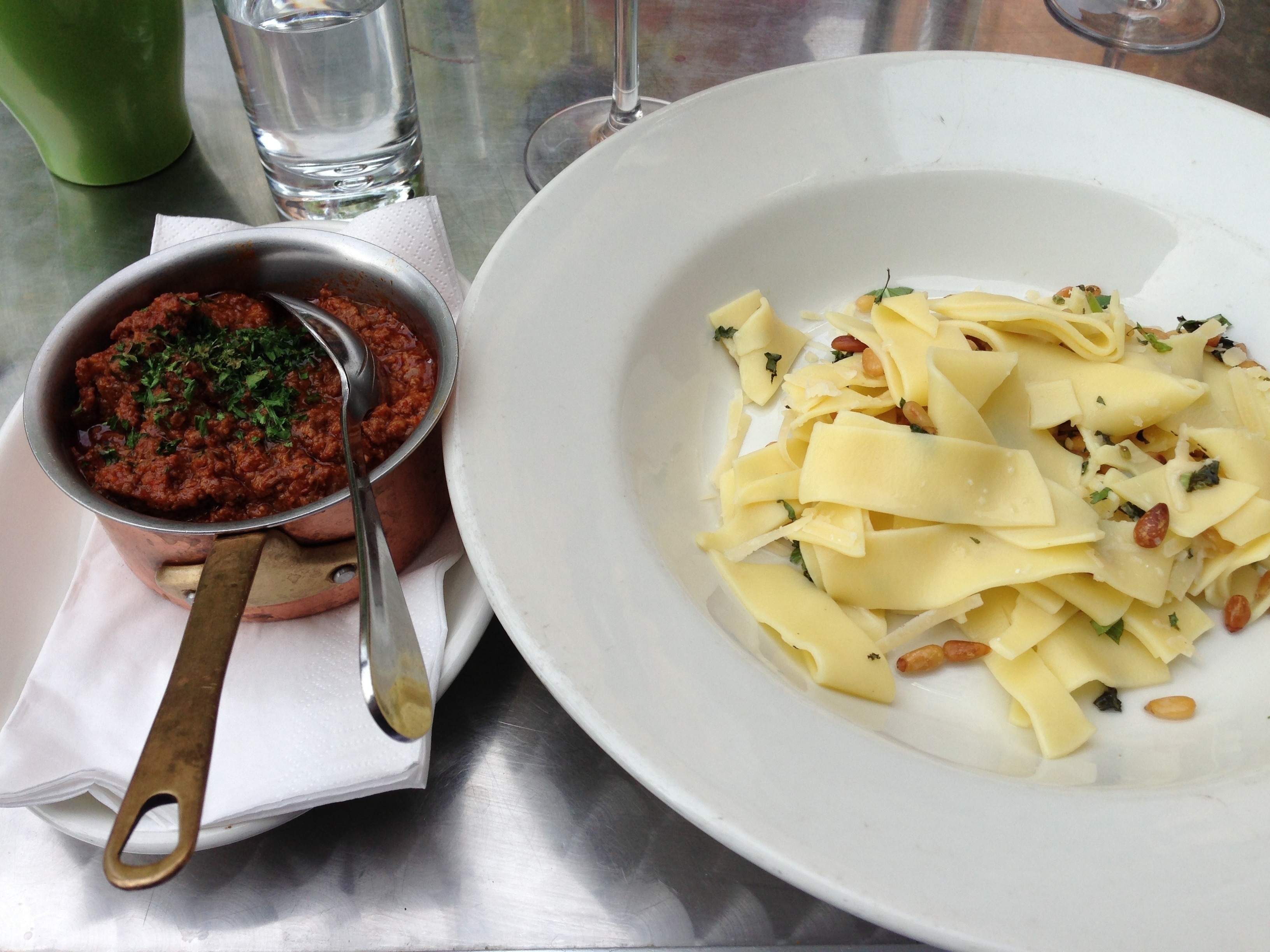
The Tuscan venison ragu with pappardelle was also very nice, or at least it was when it came out second time around; first time round the ragu was aspiring to warm, although it never quite got there. We did the English thing of apologising for being given lukewarm food and the waiter did the equally English thing of not really apologising but sending it back to the kitchen.  When the replacement arrived – fortunately quite quickly – it was delicious; rich, intense, just the right size, and the pine nuts studded through the pappardelle were also an interesting surprise. I was a bit dubious about the self-assembly element of this – you are brought a bowl of naked pasta and a small saucepan of ragu and left to put it together yourself. Maybe some diners quite like being involved in the process, but I thought plating up really should be the kitchen’s job.

LSB2.1

My main, garlic and sage marinated monkfish, was lovely. Three mini fillets of monkfish served with sweet potatoes, cabbage and a red wine jus. It sounds simple but it was definitely more than the sum of its parts. It was really delicious – quite light and compact but not stingy which is quite a challenge with an expensive ingredient like monkfish.

All this was washed down by two bottles of the Surani Costarossa, a primitivo at a very primitive £27.50 a bottle. The second bottle was a little harder work than the first but we’d already had a aperitif in the bar so things were starting to reach the stage where restraint is a wonderful, if somewhat distant, concept. By this point, the sun had come round to the terrace and a few more barges had gone past so it seemed a shame to leave our table (although naturally, if we’d known Prince Harry would turn up in a few hours maybe we’d have taken things a bit more slowly). So we finished our red in the mellow afternoon sun and looked at the dessert menu, because it never does any harm to look.

The desserts on the set menu are a fiver each, a quid or two less than those on the a la carte, so we decided to look at both menus and pick what we fancied. I had the sticky toffee pudding, from the set. So indulgent (although my main was on the lighter side so I felt I could get away with it): a simple square of moist suet pudding, served in a glorious little lake of butterscotch sauce with a quenelle of clotted cream to cut through the sweetness a little. Just divine; done well, nothing fancy, thank you very much. The caramelised lemon tart with stem ginger ice cream appeared on my left, and I’m told it was lovely but I never got to try it. I was told, between mouthfuls, that the caramelised topping in particular was a big hit.

The showpiece dessert, however, was the orange and Grand Marnier soufflé with hot chocolate sauce. A full inch taller than the soufflé dish, this had more fluff on top than Donald Trump in a windstorm. It looked magnificent, but like Donald Trump what lay beneath didn’t quite live up to the impressive topping – undercooked to the point of being damp, it didn’t quite feel right. On the other hand, once the dark chocolate sauce got poured in, the whole thing transformed into a big edible puddle and apparently it stopped mattering so much after that. Of course, that might also have been to do with the bottle of dessert wine we’d ordered. I’m a little ashamed to admit that we washed them down with a bottle of Tokaji (5 puttanyos for those who know their wine) which was incredible, even if it probably contained enough sugar to be a dessert on its own. At £42 a bottle it really isn’t cheap, though in fairness the mark-up on it isn’t unreasonable.

LSB3.1

The dessert wine didn’t turn up until after the desserts had arrived, and we needed to give the waiter a nudge for it. Service was a bit like that all afternoon – slightly hit and miss but always cheekily apologetic, as if they’d been caught winging it. The whole thing was slightly reminiscent of people at work (and every office has one) who rely heavily on their charm to make sure they’re never quite found out for not delivering things. On a Sunday afternoon, a few bottles of wine to the good, with the sun on the terrace and the barges floating past on the canal, this was all fine, but with hindsight it could have and probably should have been a little sharper.

So, it’s been a staple of the Reading restaurant scene since the turn of the century, Prince Harry eats there and it’s always packed, but is it any good? Well, as you can probably tell from the above, the answer – frustratingly – is yes and no. But over the years I keep coming back here. The food is hit and miss, and so is the service – not all of the waiting staff have the finesse that the food deserves – but the riverside setting, the buzz and the sheer range of the dishes (especially on the set menu which I think was a much better deal on the day) mean that it has enough interesting things going on to make me return. Carried away by the summer and the sheer recklessness of exploring the menu our bill for three, for three courses, three aperitifs and three – yes, three – bottles of wine came to £195, but I would say do as I say not as I do, go for lunch or an early evening meal and it’s still a decent place to eat. In 2000 LSB was head and shoulders ahead of almost everywhere else you could eat in Reading. In 2013, it should maybe be a bit less confident about retaining that status.

London Street Brasserie – 6.8
2 – 4 London Street, RG1 4PN
Telephone 01189 505036

http://www.londonstbrasserie.co.uk/

ZeroDegrees

Click here to read a more recent review of Zero Degrees, from November 2021.

I remember being quite excited when ZeroDegrees opened in Reading, around five years ago. My father raved about the Bristol branch, and he knows good food when he sees it. And yet when I went there, shortly after it opened, I remember a few disappointing visits. It ought to be good. As a family run mini chain of “brewpubs” with an emphasis on good food and innovation (according to their website) it should fit right in to the Reading restaurant scene in the same way that Bill’s (for good or bad) has been welcomed with open arms.

Despite this I decided to give it another try for the blog. Maybe I’d been too harsh on the place in the past. And after all, if I ruled out everywhere that had given me a dodgy salad once upon a time there wouldn’t be many places left to review.

The interior of the restaurant is light industrial – bare redbrick walls, blown up vintage photos of the brewing process and on the balcony above the kitchen you can see the brewery itself, all steel vats, pipes and glass. Nice. The tables themselves had a weird, slightly tacky feel, like they had been refinished with the wrong varnish. No matter, the waiter was friendly enough and we ordered a couple of drinks (a glass of sauvignon blanc for me and a pint of wheat beer for my guest) while we looked over the menu. For an empty restaurant it took a long time for the drinks to arrive but at least it gave us time to pick some food. The sauvignon was, well, fine. Nice enough: although I did have to send back the first glass as it was cracked, something the waiter didn’t notice. The wheat beer was served with a slice of orange and was, I’m told, light and refreshing. (I didn’t ask to try it, beer really isn’t my thing.)

The menu at ZeroDegrees is a strange beast: it’s almost exclusively pizza, pasta and mussels. So far so good, you might say, but it’s almost as if they found these limitations frightening and decided to offer as many different pizzas as possible. I counted almost twenty on the menu, seemingly carrying out a world tour through the medium of pizza. So there’s a thai green chicken pizza (topped with glass noodles), a crispy duck pizza (topped with crispy tortillas, naturally), “Mexican sausage”, whatever that is, and teriyaki chicken. The mussels had slightly less of an identity crisis, although even then a Thai green curry option was available.

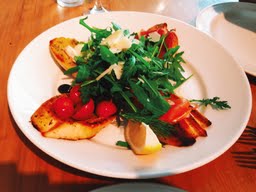
The crostini starter (to share) was nice enough: sort of a garlic bread version of a four seasons pizza. The four slices of bread were thickly sliced, crispy on the edges and generously topped with “bruschetta” (which turned out to be cherry tomatoes, black olives and garlic), parma ham (which was generous to a fault), smoked salmon with mascarpone, and a very small strip of goat’s cheese. This came with a big pile of rocket and some parmesan which was slightly tough, as if it had been sliced then left out to dry. The rocket was a sad thing which seemed to be there for no other reason but to fill space: undressed and a little dishevelled, a few brown bits, a few tough leaves. I like rocket as much as the next person, but the next person would have left this rocket, and so did I.

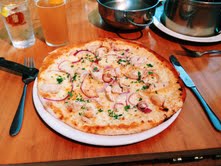
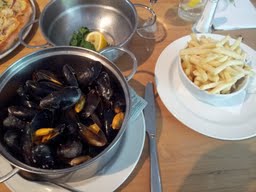
I tried to get the waiter’s attention to ask for some dressing, but he was busy elsewhere. In fact, despite there only being about three or four tables occupied on a Bank Holiday lunchtime, service was best described as omni-absent: always lurking behind a pillar or in the kitchen when you wanted someone. When he came to take the plate away I noted that he didn’t ask how it was. I never know whether this is a lack of training or a conscious decision not to ask a question you might not like the answer to. Still, this was only a £7 starter and it went between two well.crostiniMy guest’s main was the roasted garlic chicken pizza (“garlic chicken, red onions, parsley, white wine garlic sauce”). The dough was not unpleasant, if a little on the thick side, and the chicken was tasty although it wasn’t at all what either of us was expecting: roasted garlic chicken somehow suggests chicken that has been torn in some way, whereas these were pale chunky blocks of chicken that looked like they had been fried in a pan. The flavour of the sauce was nice, if incongruous – you don’t realise how integral tomato sauce is to a pizza until you order a pizza without it. He didn’t finish it, which is something of an accolade for ZeroDegrees as I’ve never seen him leave pizza before.pizzaTo contrast I had the moules mariniéres, one of their signature dishes; a kilo pot served with fries, mayonnaise and ketchup. This is one of my favourite things, when it’s done right. I like a big bowl of mussels, plump and juicy and then the delicious soup at the bottom filled with shallots and cream and herbs that you can’t help but keep eating even though you know it’s a big bowl of cholesterol, salty and fatty. I love the bit towards the end, when all the shells have been discarded and there’s just you, the sauce, a spoon, some bread to dip and some skinny frites to pour in, even though you know you should probably stop.mussels

Just typing that paragraph makes me realise how far from that ideal the ZeroDegrees mussels fell. They were fine. Fine. Nothing more. I dug around with my spoon and could find nothing, no shallots, no herbs, just a salty, creamy liquor with no real depth to it. If I contrast this with the moules served at Côte, another chain, on the riverside (which they only serve when in season) they came out sadly lacking. I managed to flag down my waiter and asked about the absence of onions and herbs and was told that the garlic and onions are ground into a paste and cooked with the mussels. This might have been true, but if it was there was little evidence in how it all tasted. I ate half, in the end, and a fair few frites, but I left the rest. I just didn’t see the point – as a dish it was like a novel where someone had torn out the final chapter.  Even the mayonnaise and ketchup came in those little paper cups I associate with much cheaper restaurants.

I grabbed my cleansing towelette (no finger bowl here), cleaned up and asked for the bill. I couldn’t even muster the enthusiasm for a dessert, especially considering that just one item says “home made” on it, suggesting the rest are shipped in frozen from Brake Brothers or suchlike. When the waiter took away half a bowl of mussels and half a portion of frites, his curiosity once again deserted him.

So, I think I’m pretty much in the same place with ZeroDegrees as I was just after it opened. It should be marvellous, but it isn’t. Reading could do with an independent place that serves pizza and moules, but Zero Degrees isn’t it: the ethos behind the chain is great but it just doesn’t carry through to the food. The waiter seemed a little out of his depth (he was so young and innocent that I wanted to look after him rather than be served by him, which is all very sweet but really not how it should be) and in a big open restaurant with only four occupied tables, good service should be easier than this.

I think the best I can say is that ZeroDegrees is OK. The food (one shared starter, two mains, one drink each) came to £45, including the “optional” 10% service charge they add on. I’m not sure I’d have tipped otherwise, and I doubt I’ll pay it another visit.

ZeroDegrees – 5.4
9 Bridge Street, RG1 2LR
Telephone 0118 959 7959

Pepe Sale

Pepe Sale closed in June 2024. I’ve left this review up for posterity.

There are some restaurants in Reading where the front of house staff have that very special knack of making every customer feel like a VIP.

It starts with the greeting – effusive enough to make you feel like they’ve really missed you since your last visit, not too over the top to stop it seeming sincere. They might remember your name, or ask you about that holiday you mentioned last time. You just know that they can talk with authority about every on the menu, where the ingredients are from and, if you’re very lucky, they’ll even remember things you don’t like (coriander, perhaps) and make sure they don’t end up in any of your dishes.

Restaurants like this are the diamonds of the food scene; they make you want to go back again and again because you want to support them. They feel like a family that just happens to cook you excellent food. I can think of three places like this in Reading off the top of my head, and it’s no coincidence that the first ever Edible Reading review is at one of these restaurants.

I wanted to make sure we started with the right place – somewhere that lots of people but not everyone will know (so you can judge my writing and opinion), somewhere that doesn’t shout about its credentials, somewhere that can be overlooked by the mass of visiting shoppers and so tends to be a full of locals. Someone on Twitter said “I’d like a recommendation that makes a change from going to Carluccio’s” and I thought, Oh, you should go to Pepe Sale.

The location’s a bit of a problem. Pepe Sale is in an unassuming part of Reading, tucked behind the distinctly retro (not in a good way) Broad Street Mall, snuggled up next to the grotesquely brutal Hexagon Theatre in a wide pedestrian thoroughfare that the council (also in an adjacent concrete monstrosity) won’t let them put tables out onto. If you didn’t know it was there you’d never happen upon it.

The décor is pretty basic, too: pink and grey granite tables with white china and peach cloth napkins are laid out at every table, most bearing a small potted aspidistra and a square dish waiting to be filled with olive oil. The look’s dated but homely, lots of bright, bold pictures on the wall, hanging plants around the room. But when it comes to restaurants, looks aren’t everything. As Marco, the endlessly charming front of house, told me that evening, Italians are much more interested in the food than the room.

I feel I ought to confess from the outset that Pepe Sale serves one of my favourite dishes in Reading. Their crab ravioli is just dreamy but is only ever listed on their specials blackboard, tucked just behind the bar. I can’t resist it so I ordered it as my main course (they do a smaller starter portion, if you prefer that). The starter was more of a problem: I fancied the aubergine and courgette al forno but thought the béchamel sauce and parmesan might make it a touch too heavy before a creamy pasta dish. I thought the grilled aubergine and courgettes on a bed of leaves would solve that problem, but it felt a touch too light (I am quite greedy. Another confession.)

Fortunately, Marco came to my rescue. I explained my dilemma and he said the kitchen could rustle me up a plate of grilled vegetables but served with goat’s cheese. How could I resist the opportunity to eat off menu? Exactly.

We asked for Marco’s help in choosing wine and again, he came up trumps, suggesting one of the cheapest wines on the menu (no mean feat – apparently the wine list has a total of sixty-six wines, all Italian). It’s a wine I hadn’t heard of – Santesu IGT Isola Dei Nuraghi, a blend of vermentino and nuragus (both varieties of grape are typical for Sardinia, where the team at Pepe Sale hail from). I loved it – a fresh, crisp white, dry but not too dry with hints of honey to make it taste of early summer (which is often all the summer you get, in Reading) At just over fifteen pounds a bottle it was hard to drink just the one, although we did. School night and all that. The wine was impressive, but the recommendation was more impressive still – lovely to see a restaurant that doesn’t automatically suggest their most expensive wine (or when you say “I want to spend around £30” immediately recommend a bottle that is £37. Cheeky).

My off menu starter was fabulous. The vegetables were thin verging on translucent, lightly griddled with a generous helping of garlic and a lovely caramelised taste offset beautifully by the salty disc on top: simple food, done well, no whistles and bells. My companion had mozzarella baked in radicchio with anchovies, black olives and cherry tomatoes. Again, the combination was perfect – sweet tomatoes, chewy mozzarella (the polymer of cheeses) and bitter radicchio leaves. Beautiful to look at, tasty and unpretentious.

My main wasn’t a disappointment, although I never expected it to be. The bowl that came out was just right – not too many ravioli (I don’t like a pasta dish that feels like a challenge), all perfectly cooked, just al dente, with fluffy crab inside, in a creamy tomato sauce. My only criticism is that the ravioli was supposed to be with beetroot but the flavour and colour was just of plain pasta. It still tasted wonderful but it was not quite as I expected. Marco did show me the pale pink, raw ravioli when I asked about the absence of beetroot so it was definitely there, just undetectable. It didn’t change how delicious they were, and if I hadn’t been thinking about writing this I mightn’t even have noticed.

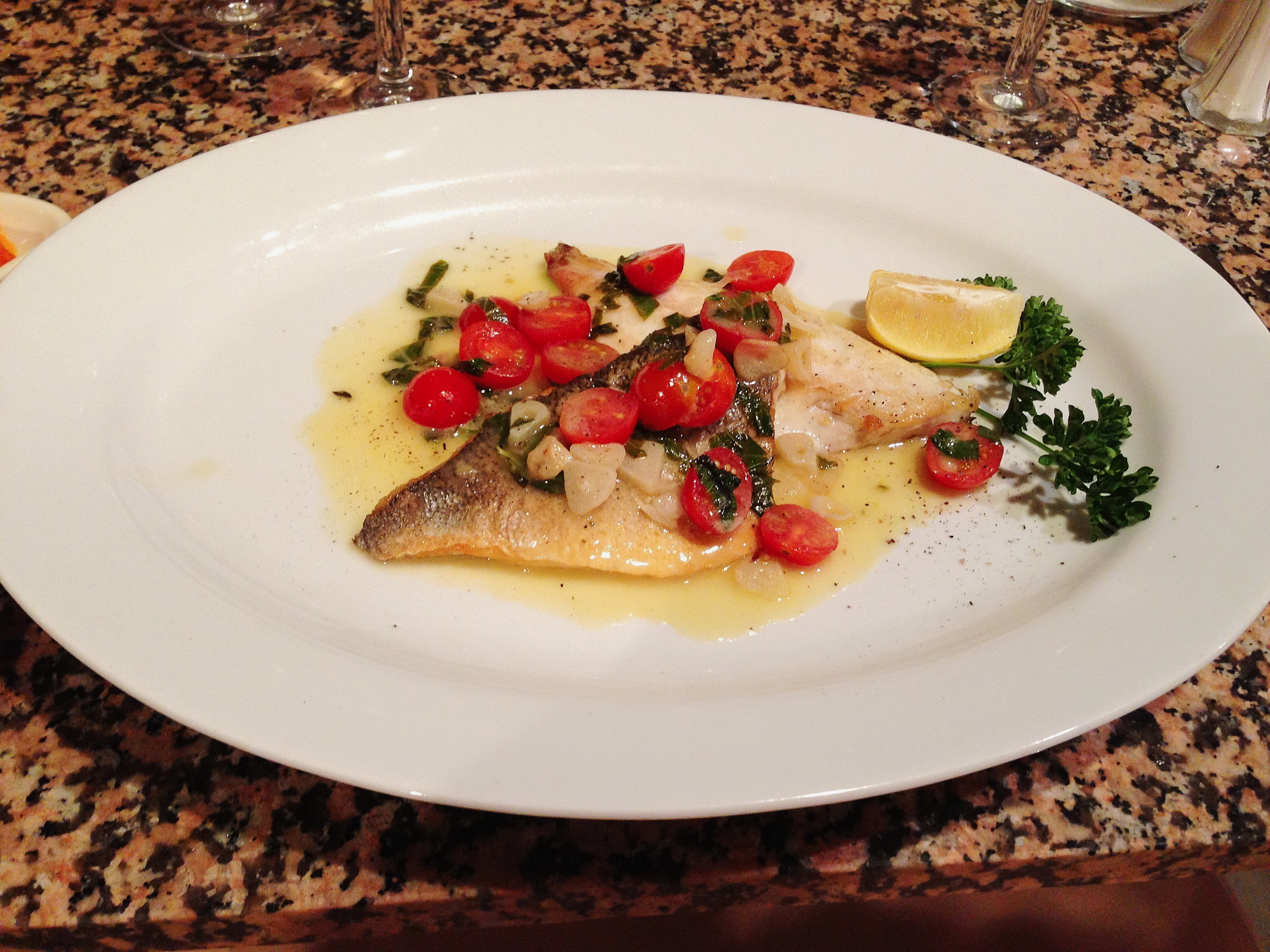
The other main at my table was also on the specials menu – sea bream cooked with white wine, cherry tomatoes, garlic (lots of it which is great if, like me, you’re a fan) and basil. The two fillets of bream were cooked perfectly, with creamy white flesh and crispy skin: just like my starter, simple ingredients treated with respect. The side order of vegetables included potatoes to die for – salty, herby, well worth distracting your companion’s attention to steal, which to my shame is exactly what I did.

FishOf course, many people would go home after two courses but I knew that, in order to write a full review, I would have to grit my teeth and order dessert. It’s a hard life. So, out of duty, I opted for the basil panna cotta with a balsamic reduction and my companion had the sweet ravioli.

The panna cotta is intriguing. Basil’s not a herb often found in sweet food so it feels brave of them to put it on their menu in what is a traditional restaurant. The basil flavour is very gentle. It’s a light aftertaste which, coupled with the balsamic, almost plays tricks on the tastebuds because of what I expect basil to taste like. It was weird and yet exactly right. It goes really well with the creamy sweet pannacotta and the sweet but vinegary balsamic cuts through the flavour nicely to keep it fresh. Lovely and very witty (if I can say that without sounding too much of an idiot).

Similarly, it was a novelty to have sweet ravioli. It’s fried squares of pasta filled with ricotta and orange zest, drizzled with honey and dusted with icing sugar. The pasta becomes like pastry when fried – crisp and sweet – and the centre is incredibly moreish (I could have eaten this dessert as well as mine, if only I’d been allowed).

Ravioli

The food is so good that you almost don’t notice just how good the service is. Throughout the meal Marco was topping up our glasses and chatting to us and the other customers in the restaurant, in that way which looks effortless but is probably bloody hard work. Even when we were the last table in the restaurant I didn’t feel like they were in a hurry for me to leave, that family feeling again.

The food and the service are so good that you almost don’t notice what good value it is, either:  three courses for two with a bottle of wine and an after dinner liqueur each (Pepe Sale does a range of wonderful Italian digestifs, many of which have the bitter taste of dandelion and burdock with attitude – I love it, though it’s not to everyone’s taste) came to eighty pounds. It’s not cheap – granted, Carluccio’s is a lot cheaper – but it’s worth every penny.

So, that’s the first review here at Edible Reading. If you’ve been, you probably know how good it is already. If you haven’t, you ought to check it out. And if, hypothetically speaking, you had just arrived in Reading and were trying to choose a venue for your first ever meal – as I am, I guess, in a virtual sense – you could do an awful lot worse.

Pepe Sale – 8.3
3 Queens Walk, Reading, RG1 7QF
Telephone: 0118 959 7700
http://pepesale.co.uk/

Welcome to Edible Reading!

Reading is a place where it’s easy to get a meal, but not always easy to get a good one.

It’s not that we don’t have restaurants; we have loads. Just head to the Oracle, stand on the arching bridge that connects the shops to the cinema and look – every chain you care to name, on either side of the canal. But that’s the problem, really. We have, it can’t be denied, a lot of chains – from the well-established to the just starting up. We are in the forefront of expansion for chains, too: the first Bill’s outside Brighton was here, the first Five Guys outside London is opening in the Oracle soon.

In some cases we have more chains than anybody could ever need; right now Reading has two branches of Bella Italia (is this really necessary? you might wonder), two branches of Pizza Express. And that’s before we get on to the cafes and fast food joints – two McDonalds, three Burger Kings (there used to be four), four Caffe Neros (there used to be three, before they took over one of the four branches of Burger King), four branches of Costa Coffee (two of them in the Oracle, one a stone’s throw from the Oracle) and four branches of Starbucks.

One reason why people go to the chain restaurants so much is that they’re a known quantity. A Pollo Ad Astra at Pizza Express on the Riverside is going to be much the same as a Pollo Ad Astra on St Mary’s Butts or in Bristol, Bath, Banbury or Birmingham. This is especially true in Reading, because if you’re looking for help or guidance in terms of where to eat, well, there isn’t much.

You can consult the local paper, of course. But the reviews in there are all comped and the editorial policy appears to be not to publish a critical review. What that means in practice is that the same places come up again and again – a high-end freebie here, another trip to a suburban curry house there – and the bland write-ups mean you come away with no idea whether, if you were spending your own money, you would be wasting it.

This doesn’t deter them from their other editorial policy: make sure the cost of every item is clearly listed. I had the burger (what is it about burgers which so fascinates the local paper?) which at £9.95 was juicy and good value. My partner had the mushroom risotto (£8.95), which he thought was slightly underseasoned. It can feel a bit like reading a shopping list, half the time, instead of a review.

So, you can’t trust the local paper, because it likes all the places it reviews, can tell you the price of everything and the value of nothing. Where else can you go, then? TripAdvisor?

TripAdvisor is a curious one, and there’s a big debate in general about how trustworthy it is for restaurants: many bloggers, and restaurant reviewers for that matter, are not fans. Partly this is motivated by distrust about the democratic nature of TripAdvisor – it is the ultimate expression of Web 2.0 in some ways, just like Goodreads and Amazon reviews – and an elitist view that people as a whole don’t know best. That said, there’s some validity to the criticism. Sometimes, a restaurant’s success on TripAdvisor isn’t always about the food, or the service, but about how good they are at mobilising support on TripAdvisor (on a recent meal out, I thanked the waiter and he specifically asked me to leave a good review on TripAdvisor if I’d enjoyed my meal).

Is TripAdvisor a good guide for restaurants in Reading? Well, yes and no. A quick look at the site illustrates the problem neatly. At the time of writing, the top three restaurants in Reading are (and have been for a while) Whittington’s Tea Barge, Café Yolk and Tutti Frutti. All of them are establishments with something going for them but are they restaurants? Some of the restaurants in the top ten – Mya Lacarte, Kyklos, the Bladebone – are very good places, but it’s hard to escape the fact that TripAdvisor feels very hit and miss.

So the local paper can’t help you and TripAdvisor is a bit of a lottery, but never mind, because there are always blogs, right? Well, no again. Reading has never had a restaurant blog that I know of – well, not until now, because that’s what I’m here for. Welcome to Edible Reading.

Reading’s isn’t a stagnant restaurant scene by any means. We don’t have the regular turnover of restaurants you’d get in a bigger city, but there is still enough change that there’s something to write about. Kyklos, the new Greek restaurant in King’s Walk, opened earlier this year. So did The Lobster Room on Valpy Street. House Of Flavours, in the old Mangal spot on Kings Road, has been open for a month or so. Five Guys – which may or may not turn out to be terrible, depending on who you read – opens later this year. None of the new places, so far, have been reviewed anywhere. So I reckon there’s a gap in the market for a restaurant blog.

I don’t claim to be an expert – and I’m not sure I’d trust anybody who told you they were – but I eat out fairly often, I love food and, crucially, when I have a bad meal it’s my own money I’m wasting. What you can expect here is weekly, unbiased reviews of all kinds of restaurants in Reading (and possibly the surrounding area) and – if past experience is anything to go on – some very shoddy photographs of food. All comments and debate are encouraged, here or on the Twitter feed (@EdibleReading, of course) and if you have any suggestions for places you recommend, or have always wanted to go to but aren’t sure about, do leave a comment, Tweet at me or send me an email (EdibleReading@gmail.com).

Should be fun, shouldn’t it?