House Of Flavours

Click here to find a more recent review of House Of Flavours, from May 2025.

I’d always told myself that I wouldn’t review curry houses, for lots of reasons. Reading has a lot of them, all over the place, for one. For another thing, the local papers cover them extensively and frequently. I’m not sure how they do it, after all it must be difficult to review an Indian restaurant every month. I mean, it’s all just different meats in different orange sauces most of the time, isn’t it? And who really cares which place does the best korma/bhuna/biryani anyway, especially when people tend to have a curry house that they go to out of habit and comfort.

So why is this week’s review of House Of Flavours? Well, people kept recommending it. It got mentioned on Twitter a lot. A few people asked me to go review it, and more than one said “you really should go”. So the contrarian in me thought “why not?” and that same contrarian quite liked the idea of going in December, when most people’s thoughts are turning to slightly more traditional warming food.

House Of Flavours is a little bit out of the centre, not far from the library, in a spot that has seen mixed fortunes over the years. It used to be Ha! Ha! (which I still miss, believe it or not), and then it was some tapas restaurant whose name escapes me, then an ill-fated pub that closed on Sunday afternoons, and then Mangal, the Turkish place which has gone up in the world and relocated to St Mary’s Butts.

Despite that, when I visited on a Saturday lunchtime (the December diary being what it is) I was impressed to see that the front room of this admittedly sizeable restaurant was pretty much full, almost exclusively with Indian families. I nearly left again when I thought this might be due to the all you can eat buffet they were offering (and nobody needs a review of one of those, in my opinion), but to my relief they were also offering their full menu so the very polished waiters talked me into staying. I’m glad they did.

The House Of Flavours’ menu is an intimidating tome. If you look at it on their website you get some idea of this; twenty-four pages long, and you don’t get to the a la carte menu until page fourteen. Before that it’s all drinks – a lot of drinks – and the set menus (at the moment a “Christmas menu”, though god knows how different that is to their usual set menu – I didn’t see any stuffing bhajis or turkey jalfrezi, thank goodness). The set menu featured a lot of the familiar dishes you could get anywhere else, but wading through to the a la carte things started to get a lot more interesting – a wide range of regional specialities, very well described, along with a range of vegetarian dishes so impressive I even considered ordering some of them.

We got the clichéd poppadoms while waiting for our starters and even these made me begin to feel like I was in a restaurant that happened to serve Indian food rather than an Indian restaurant. Two of the poppadoms were plain and delicate but the third was studded with nigella seeds and the taste and texture were something else. The raita was thick and fresh, not the insipid liquid you usually get. The mango chutney was also speckled with cumin and nigella, probably the best I can remember eating, and the onions (offered instead of the usual lime pickle) were finely diced and spiced, as tasty as they were antisocial. So often this is just a way to eat something, anything, while you’re waiting for your starters to arrive but these felt like they had a purpose all their own. It was a promising beginning.

The starters, by and large, lived up to that. The lahsooni chicken tikka was just gorgeous – three sensibly sized pieces of chicken, marinated in yoghurt and spices and cooked beautifully. Everything about the flavour and texture of these worked perfectly – the spicing came through with the right intensity at the right speed and the meat was so tender. I was simultaneously sorry they were over so quickly and delighted that they were perfect – always the way with a truly great starter.

Lahsooni Chicken Tikka

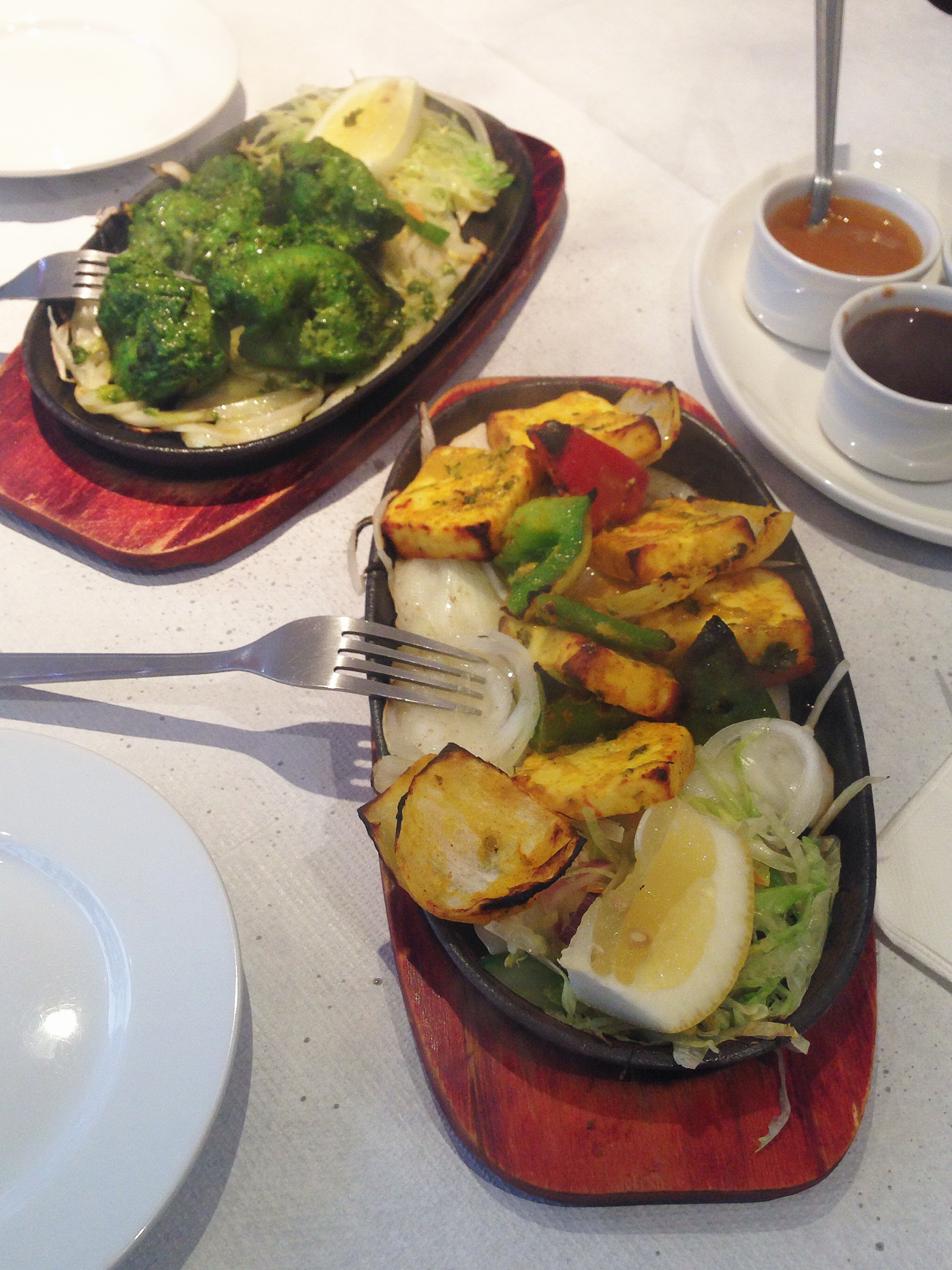
The other starter was maave ki seekh, which is described on the menu as “root vegetables and cottage cheese flavoured with ginger and cooked in a clay oven”, and it was delicious if not entirely what I was expecting. The texture was rather like partially cooked gingerbread, cooked on a skewer; the outside was slightly firm and the inside was a delicious warming paste. If it had any vegetables in it I couldn’t truly tell but it was still very tasty, especially with a squirt of lemon juice and a few sprigs of – properly dressed – salad on the side. I keep thinking about what I can compare it to and falling short. Was it like falafel? Not really. Like a bhaji? No, that’s not right either. Maybe this is another reason why I shy away from reviewing Indian restaurants, because I don’t have the vocabulary to do them justice.

Maave Ki Seekh

By this stage I thought I was probably onto a winner, although I’ve been disappointed at that stage many times (how many restaurants have you been to where you’ve thought I wish I’d stopped at the starters? For me it’s hundreds). But the mains didn’t let the standard drop. Shahi chicken tak-a-tak (named, according to the very informative menu, after the noise it makes popping away on the skillet) is one of those sizzling griddled dishes you always get jealous of when someone else at your table orders it. This one was no exception: so much more than just a pile of meat and onions, it came with a rich hot sauce with plenty of tomato. How hot? Well, I didn’t lose all feeling in my mouth but tissues had to come out at the table – I hope that’s not too much information, but until someone comes up with a Richter Scale of food heat it’s the best I can do. I loved it.

Shahi Chicken Tak-a-TakAgain the heat was really clever; it built up slowly, in layers, rather than pulverising you from the start. I’m not going to say “oh, it was genuine Indian food” because I’m not Indian and I wouldn’t know, but I’ve been to India once and it reminded me of the food I had when I went – that intelligent, calculated use of spice. Again, the chicken was soft and tender, not firm and unyielding, although after the starters I wouldn’t have expected anything less.

Having said all of that, the other dish was indeed chunks of meat in an orange sauce. Well, almost anyway – the mahi dum anari was sizeable chunks of fish, soft to the point of falling apart, in a silky sauce. This sauce was much more delicate, almost sweet but again the spice worked brilliantly. I wish I could do it justice by describing it better, but I might try and improve my skills in this area by going back to House Of Flavours. The other delight in this dish was the pomegranate on top – I was sceptical about this but its sweet pop under the teeth went superbly with the dish. According to the menu, this dish was served to Barack Obama on his last state visit to India; I wasn’t moved to take a selfie, but I did take a picture of the dish (it doesn’t do it justice any better than this paragraph does).

Mahi Dum AnariNormally in a curry house this would be accompanied with some pilau rice and a big fluffy naan but again, I was moved to try different things. The mutter pulao was rice rich with peas and with just the right amount of cumin, another revelation in a meal packed with revelations. The paratha was even better, buttery, chewy and soft at the same time and layered in a way which somehow reminded me – I don’t know why – of the pastry on the bottom of a tarte tatin.

ParathaNobody goes to an Indian restaurant for the drink, but I feel I should mention it because the wine list has three Indian wines on it. I tried two: the sauvignon blanc was decent if slightly thin on flavour but the cabernet sauvignon was spot on – properly hearty and feisty enough to stand up to the spices in my meal (I might have had a bottle, but it was all Kingfisher on the opposite side of the table to me, which is fair enough I guess). They also have two pretty creditable dessert wines – a Sauternes and a Californian red muscat – at very reasonable prices, albeit not for a full glass.

The reason I know about the dessert wines is that I couldn’t stay away from the desserts. I have a real penchant for gulab jamun so I was thrilled to see them on the menu. If you have a sweet tooth and you’ve never tried them, you’re missing out; they’re doughy balls – made from curdled milk, but don’t let that put you off – deep fried and then served soaked in a sugar syrup tinged with cardamom and rose water. The portion here is only small (two balls – no jokes, please) but that turned out to be plenty, especially if you don’t share them with anyone, as I didn’t.

The total bill for two people, for three-ish courses with a couple of drinks each came to £65. You could eat more cheaply than that if you stuck to one of their set menus but even so I felt this was very good value. I mentioned the service in passing at the beginning of the review but it is worth another mention too – very polished, very smooth and only there when you needed it. The whole experience felt very different to most Indian restaurants I’ve visited in Reading.

How to sum this place up? Well, how about doing it like this: I remember when I first found out that this place was opening, and I remember walking past the sign and reading the name. House Of Flavours? I thought. That’s a ridiculous name. It’s just going to be an Indian restaurant, and Reading needs another one of those like it needs another Italian. Now I’ve been, I know how wrong I was; it’s the perfect name for the restaurant and it sums up exactly what they offer – more than anything, the flavours are what I remember. I can’t think of many higher compliments for a restaurant than this, but even before I’d left I was already planning my return. Thinking about what flavours I’d like to sample next.

House of Flavours – 8.3
32 – 36 Kings Road, RG1 3AA
0118 950 3500

www.house-of-flavours.co.uk

The Moderation

Click here to see a more recent review of The Moderation, from April 2024.

One thing restaurant bloggers often get criticised for is their obsession with the new. You especially see this in London, where new restaurants open all the time. It’s partly because some bloggers get invited to soft openings (a phrase which sounds wrong – wrong on paper, wrong in my head) and partly because it’s too difficult not to in a city where there is always a new trend to embrace or a new cuisine to explore. I can understand how seductive that must be, and here in Reading I can’t help but feel a pang of envy. Reading gets a handful of new restaurants every year. Edible Reading publishes a weekly review, and if I only visited places that had just opened I’d run out of material before you’d finished your leftover turkey and broken your first resolution of 2014.

But also, I don’t believe in it. I like to give places a chance to settle down and bed in, to iron out inconsistencies, for the kitchen and the front of house to gel. I wasn’t always like that – I remember going to Brown’s just after it opened and sitting upstairs, with no natural light while the waiter stumbled over his words and my feet and my forgettable food arrived, was eaten and forgotten. It might be brilliant now, but I’ve never gone back.

On paper, this week’s review should be of the Queen’s Head, the revamped pub on Christchurch Green. It used to be called the Nob, was full of students and was skanky, scruffy and the home to a few of my disgraceful Saturday nights a long time ago. It’s just been done up by Spirit House, who also own the Warwick and the Moderation and have realised that students don’t buy food whereas the people in the gorgeous roads around Christchurch Green (I personally daydream about living on New Road) probably will. I went, and I quite enjoyed my meal, but when push came to shove, I couldn’t review it. So instead, I went to its daddy (or perhaps uncle), the Moderation, this week with a couple of friends.

The Moderation also used to be a grim boozer but you wouldn’t know that now. Refurbished, it’s a handsome building from the outside, slightly incongruous so close to the curry houses, kebab joints, little hotels and undertakers of the Caversham Road (not to mention “Papa Gee”, a strange little Italian restaurant I’ve walked past dozens of times without spotting a single diner). Inside, it was buzzing and all sorts of groups were there, from raucous parties to small gatherings of friends to what looked suspiciously like dates. We were lucky to get a table, which on a school night in a location out of town is no mean feat.

The Moderation’s menu is a funny mix of food. Indonesian, Malaysian and Thai food rubs shoulders with classic pub food, pork belly and black pudding juxtaposed with nasi goreng. I like that range, but it raises a bit of a concern too: could it be equally good at both, or was one what they truly loved and the other something they put on to attract a wider range of punters? I resolved to find out, or get uncomfortably full in the attempt.

We began with the time-honoured sharing platter of mixed starters: I know, so unimaginative. We should have picked three different dishes, and if I went again I would, but the variety was too hard to resist (looking back I’m ashamed to remember that when I reviewed the Warwick, the Moderation’s sister pub, I also went for the mixed starters; I think I’ve let you down.)

It was, in fairness, a good choice and also gave a reasonable idea that the kitchen could handle both east and west. The spring rolls were delicately spiced and eminently dippable, subtly different from those at the Warwick but equally good. The salt and pepper squid, though not quite up to the standard of somewhere like London Street Brasserie, was tasty and avoided the worst fate of all, that of rubberiness (though I’d have liked more crispiness). The prawn crackers were inoffensive and probably not worth the sentence I’ve just given them. The chicken satay was, again, better than the Warwick I thought – a skewer of tender flesh and a gorgeous chunky satay sauce to slather over it.

The most interesting of the starters was the kedgeree arancini – balls of smoked haddock risotto breaded and fried with half a hard-boiled quail’s egg pinned to them, a little dab of curried mayonnaise on top. I loved this; sophisticated party food, and cleverer than all the other staples (no doubt next year Jason Donovan will be wandering past with a tray full of them in the ad breaks on I’m A Celebrity).

Starter

The wine list, though not enormous, had enough to keep us occupied. The sauvignon blanc was decently fresh and easy to drink and the chianti was fruity without being inoffensive and peppery without being brutish. The advantage of having dinner in a pub is that if you go out for a meal with someone who likes beer there’s something for them too; I’m told the Black Sheep was very nice, although my friend had it in a shandy, and even I know that means she probably wasn’t qualified to judge.

Initially I tried to order a 125ml glass of wine, but the waiter turned up with what looked suspiciously like 175ml. I was about to quibble when he said “It’s the same price for 125ml, so I brought you a bigger glass. Leave some if you like”. I liked that; I’ve been to places where they would have brought the smaller glass and trousered the cash, so it was nice to be told. Service was like that in general – a tad brusque (they were busy all night, in their defence) but helpful and prompt. Considering how much they had going on, and the size of some of the other tables, I was impressed to get served at all.

For the mains we decided to give both halves of the Moderation’s menu a chance. In the red corner, representing pub food, was a mutton and onion suet pudding with mashed potato and roast root veg. It was nowhere near perfect, but just close enough to it that I could have wept. The jus that came with it was rich, the soft sticky roasted carrots and parsnips were delicious, and the sauce inside the pudding was a cracking jumble of slightly sweet onion and tangy tomato. But the errors were glaring. The mash had big chunks of what felt like uncooked spud lurking in it. The suet pastry didn’t have the slightly soggy, gooey feel I was looking for and, if anything, was more like a pie in pudding’s clothing.

Most unforgivably, the mutton was undercooked and unappealing – bouncy in places, sinewy in others. None of it fell apart under the fork the way it should have done, and most of it resisted a knife in a way it really shouldn’t have. The moment the first chunk twanged under my molars I knew the rest of the meal would be spent prodding and chopping, when a meal dish this should be about scoffing with carefree, reckless abandon. The gulf between what you think you’re getting and what you end up with has rarely felt so cruel, or so huge.

Mutton

The beef rendang, in the blue corner, suggested that I’d have been better off sticking to the eastern half of the menu. This was a bowl of beef in a rich, spicy coconut sauce with enough of a kick to balance out the creaminess but not so much that your lips tingled. On the side was a dome of white rice and a couple of those decent enough prawn crackers which have now taken up an undeserved sentence and a half of this review. All good, you might think, and it almost was, but for one thing: the beef had the same problem as the mutton. The first few mouthfuls were properly boast-to-your-friends-good, but then followed a piece of beef the consistency of jelly that made me swallow quickly to avoid having to come to terms with the texture. Such a shame that such a great dish can be ruined by only a few chunks of beef, but there you have it: if only the kitchen had been a little pickier about the pieces of meat that went in the dish versus what went in the bin (or cooked it for longer, or both).

Rendang

We skipped dessert and dinner for three people, including three drinks each, came to a fairly reasonable £83.

Another reason to envy bloggers who only go to restaurants just after they’ve opened is that it’s easier to review those places because you have no preconceptions. You can compare them to other, similar restaurants but that’s as far as you can go because ultimately, you’ve only visited that restaurant once. I on the other hand have been to the Moderation many times before and always really enjoyed it. And I so wanted them to have a good night the night I visited on duty, because what they do in Reading isn’t quite like any other independent and it’s admirable that they are expanding, albeit slowly, and rolling out a set of attractive pubs across Reading where you can drink nice wine or (I’m told) good beer and eat interesting, inexpensive food.

I want to rate them well for that, and for being brave enough to try something different, and I’d like people to go there and order the nasi goreng, which I happen to know they do really well. But, on another level, I can only review the meal I had on the night I went and, on that basis, it just wasn’t up to scratch. So it gets the rating it gets, and a suggestion from me to approach with caution. I know that might seem a bit harsh, but that’s the way the meat bounces.

The Moderation – 6.6
213 Caversham Road, Reading, RG1 8BB
0118 3750767

http://www.spirit-house.co.uk/moderation/

The Plowden Arms, Shiplake

The team at the Plowden Arms left the pub at the start of April 2017. The pub reopened under new management with a different menu, but then closed for good. As of spring 2024 it is now open as The Plough, reviewed here.

This week’s review is the first ever of a restaurant outside the RG1 postcode; scandalous I know, but there’s more to living in this little town than easy access to the Oracle, Friar Street and Broad Street. So rather than try another city centre restaurant I hopped in the car on a chilly weekday evening and made for the Plowden Arms, a proper little old pub on the road from Reading to Henley. I have to say, I love a good pub; it’s one of the things (along with queuing, not to mention sighing and shooting evil looks at queue jumpers) that Britain does better than anywhere else in the world.

The Plowden Arms has everything you expect from a classic English country pub: low beams, an open fire and a freezing loo (the better the pub, the worse the toilet in my experience). The fire was lit when we arrived, and the room was cosy, if a tad empty. There were only three occupied tables, and it was a bit sad to see they weren’t busier. Some pubs are really restaurants in disguise – all posh furniture and pretensions – and some pubs don’t really know what they want to be, like boozers going through a midlife crisis. The Plowden isn’t like that; for better or worse it is a pub that serves food, and the dark furniture and slightly uncomfortable banquettes were testimony to that.

We were greeted warmly and given menus but they only tell half the story at the Plowden. The blackboard up by the bar listed loads of specials – four starters and four mains, almost as many dishes as were on the printed menu. Our waitress – who was nothing short of charming all evening – told us that these change every couple of days. I can’t tell you what a good signal this sends out. It says that the chef is using what’s fresh and seasonal, being inventive, always changing and always improving things. Why don’t more restaurants do this? Even the most high end restaurants in the centre of Reading rarely offer more than one special.

Overall, it was one of those menus where you want to order everything and know you can’t. It’s worth pointing out how reasonable it is too – the starters hover around the £7.50 mark, few mains are over £15. Looking at the flip side of the printed menu made the choice even more difficult – a whole extra section of “Drinking accompaniments and simple dishes”, all of which were just as tempting again.

Whilst agonising over the menu we ordered one of the drinking accompaniments, a salt cod scotch egg, to give us something to snack on as we made up our minds. This was a lovely amuse bouche, if you like, nice runny yolk with a soft layer of fish and a tart, fresh tomato sauce underneath. A good start, although I confess I prefer a sausagemeat scotch egg for juiciness, and the salt cod (ironically) didn’t taste that strongly seasoned.

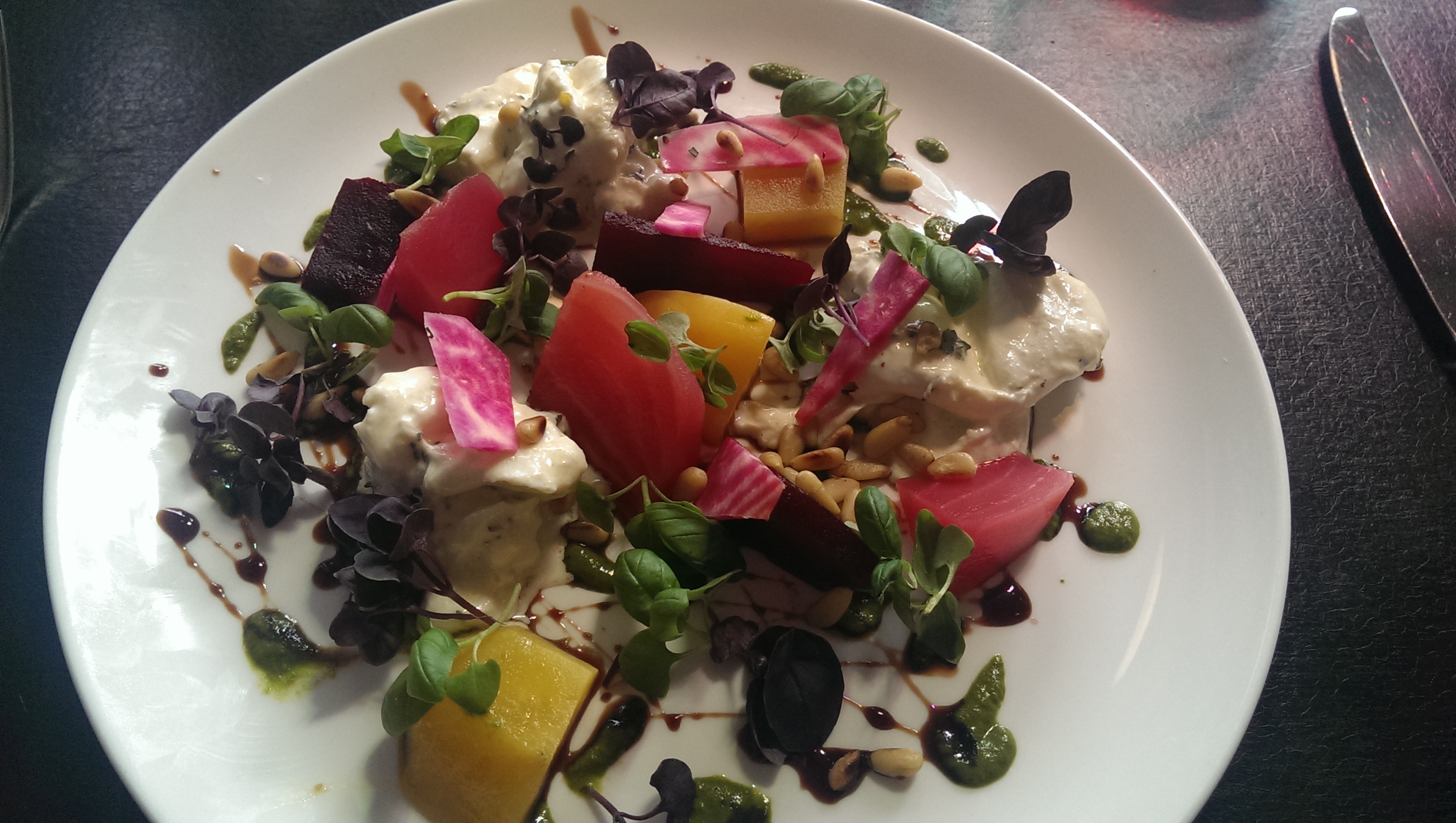
When the starters arrived there was definitely a bit of food envy and I also fancied stealing the vintage plates. The beetroot and blue cheese pithivier, from the specials menu, was the favourite. I know beetroot and goat’s cheese has become a menu cliché across the country, but pairing beetroot with blue cheese was a masterstroke – the sweet beetroot against the salty tang of the blue cheese was a fantastic combination, and one I wasn’t used to. The pastry was crumbly and buttery, and I simultaneously wished the dish had been twice as big and knew that the flavours were so rich and intense that more would have been overwhelming.

PithivierThe other starter, from the a la carte menu, was billed as “hashed lamb with charred bread” and is apparently based on a dish by Mrs Beeton. It was less successful, although that might be partly because I didn’t quite know what to expect. What I got was a Kilner jar of slow cooked pieces of lamb in a rich dark gravy with what looked like haricot beans. The charred bread was toast, for better or for worse. The lamb was topped by tiny fronds of little salad which didn’t add much. All in all it was more interesting than it was delicious, though I didn’t mind it. I was expecting something a little less sloppy and more spreadable, so maybe the mistake was mine. It was probably the only misfire of the evening.

Lamb

The mains were also a study in contrasts. The slow cooked ham hock with mashed potatoes and a sherry and mushroom sauce (from the a la carte) was huge. I mean, absolutely enormous. The ham hock was a whole hock, bone and all, the size of a lamb shank – so big that it was almost intimidating when set down in front of me. The meat was perfect – soft, pink, no hint of grim wobbliness – and it fell away from the bone with convenient cleanness. The mash was one of the best I’ve tasted – rich, creamy and smooth, the texture just right. The sauce was equally impressive, somehow both sweet and salty, bringing the whole dish together. It was all very substantial but also the kind of dish you can’t bring yourself to stop eating, even if you’re ready to pop by the end.

HockThe other main, from the set menu, was sea trout with celeriac pureé, samphire, new potatoes and a clam and chive cream sauce. Sounds like a lot of different things going on but it was as delicate and precise as the ham hock was hearty and primitive. Every component was perfect, and every component worked with the rest – the sizeable fillet fresh, subtle and falling into flakes, the little bundle of samphire underneath it with just enough crunch, the sauce again creamy and intense – powerful enough to set off against the trout without drowning what can be quite an understated fish. This is a kitchen that knows how to do sauces so good that you slightly regret the fact that this is a restaurant that doesn’t bring you bread to mop up the rest with. That’s about the only criticism I can come up with about the mains, which tells you a lot.

Sadly driving meant we couldn’t make the most of the wine list. The wines by the glass – between us we had a Chilean merlot and a French pinot noir – were safe and tasty but not wildly exciting. It’s not by any means a big wine list and this did seem a little jarring given the undoubted quality of the food they are serving. Perhaps this is another sign that this is a pub that serves food rather than a restaurant, but I still felt a little disappointed by that.

When the first two courses are that good, dessert is inevitable. As I’ve said previously, I do like a school dinner dessert and that made it impossible to resist the jam roly poly. It was exactly how you would want it to be – a classic example of the genre, only ever so slightly refined. So the slice was lovely and dense, the poly (the roly? where does the name come from anyway? I bet the Plowden Arms probably knows) was beautifully jammy and not overly sweet, but the slice was also just the right size and the custard surrounding it was wonderfully light, almost like a crème anglaise. This was like a school dinner at a school much better than the one I’d gone to.

Rolypoly

Again, the other dessert was about as different as you can get. It was described as chocolate mousse and gingerbread biscuit with hazelnut and orange cream but it was so much more than that. The cream was between layers of ginger biscuit, like a dense millefeuille, and gave me the hugely satisfying experience of whacking it with a spoon until the biscuit (not too dense, not too delicate) broke up into bits small enough to eat. The chocolate mousse wasn’t really mousse. Instead it was a dark quenelle of what seemed more like ganache – intense, smooth, glossy. Like the pithivier it was a portion which looked too small before you started it but which you realised was just right once you’d finished it. This is no mean feat in a kitchen, every bit as much of a talent as changing your menu several times a week or making sauces that knock people’s socks off.

I haven’t said enough about the service, which was lovely: friendly and informal but also knowledgeable and polished. Everything about how we were looked after was spot on – from laying and relaying the table to serving from one side without leaning over you (it might sound like a small thing but it’s one of my pet hates). By the end I was sorry to leave and faintly aggrieved that there were so few diners that night.

The bill for three courses for two people (plus that scotch egg), three glasses of wine and numerous soft drinks was £80. I don’t know anywhere in town where I could eat that quality (and quantity!) of food for that amount, though of course it’s tempered a little by the effort of getting out into the sticks. That said, by the end of the meal I was itching to come back and already planning a return visit – it’s the sort of place where I could easily see myself settling in by the open fire with the Sunday papers.

When I think back on it, more than anything, I think the most impressive thing about the Plowden was the sheer range of cooking on display. I felt like we almost sampled two different meals – one hearty, warming and enormous, one clever, dainty and delicate. To find a restaurant that can do one of those things is a wonderful discovery, to find a cosy pub that can manage both is verging on miraculous. So yes, I loved the Plowden Arms. Can you tell? Food this good, this reasonably priced, this clever and this well served should be eaten by a lot more people, and I hope if nothing else my review might help to do something about that.

The Plowden Arms – 8.7
Shiplake Cross, Henley On Thames, RG9 4BX
0118 9402794

http://www.plowdenarmsshiplake.co.uk/

Café Yolk

Click here to read a more recent review of Café Yolk, from July 2021.

Café Yolk stands apart from all the other places I’ve reviewed so far in one important respect: it’s the first establishment I’ve visited that was completely full. When I arrived, at Saturday lunchtime, practically every table was occupied (except for the ones outside which seemed a bit hopeful on a crisp November afternoon) and it took a little while before I could sit down and peruse the menu, written out, blackboard-style, on the back wall.

To understand why, you need to look beyond this little, attractive-looking café, tucked away on the edge of Reading’s leafy university area, and wander into the altogether more weird and wonderful world of the internet. Yolk, you see, is incredibly popular. Active and engaging on social media, they are (at the time of writing) ranked second in the whole of Reading on TripAdvisor: a glowing review goes up every few days, all praising the breakfasts, which are said to be the best in Reading. How could I resist going to see what the fuss was about?

The first thing I noticed, apart from how busy it was, was just what a loud room it is. It’s all hard chairs and bare walls, and that many tables of people chattering away creates an almost deafening cacophony. Yolk has definitely made the most of its location, and most of the clientele are students; skulking in the corner I felt a bit like I’d wandered into an episode of Skins by mistake. The tables are bog-standard café issue (mine hadn’t been wiped when I sat down – always a nice first impression, that) and the chairs were the kind of rigid stacking kind you wouldn’t want to spend too much time on, but all of that is beside the point, right? Because it’s all about the breakfast.

There are no paper menus, but looking at the blackboard the emphasis was definitely on breakfasts and burgers, the latter described as the “lunch menu”. Once the queue had cleared away (which, bizarrely, took some time – where were they all sitting? Was there a secret basement I didn’t know about?) I went up and placed my order; full English with well done bacon and a Swiss cheese and Portobello mushroom without toast. I had to repeat my order, as if I’d asked for something extremely complicated.

There was no coffee because the machine was broken that day, so I got two large teas. This gives me an opportunity to indulge in my first rant of this review, because Café Yolk charges extra for a large tea. You might think I’m a bit odd for objecting to this, but I think this is nothing short of a scandal. It’s hard to imagine a product cafés make more money on than tea. I know how much it costs to buy a box of teabags, and how much it costs to boil a kettle; charging one pound fifty for the privilege is verging on extortion at the best of times. But an extra twenty pence for a little more water? Really, it’s taking liberties with a good proportion of your customer base. Anyway, I took my two cups of hot water with a teabag in them, each costing me the best part of two pounds, and walked all the way to the other side of the café to put milk in them.

I know, I know, I’m whinging. But it’s beside the point, right? It’s all about the breakfast.

Our food took a reassuringly long time to turn up – nobody wants to feel the ping of a microwave is involved in the most important meal of the day – and the chap delivering the food was cheery and keen to bring over any extras (butter, sauces etc.) which was a nice contrast to the counter service.

The full English, which costs five pounds ninety-five, contained all the staples: a rasher of bacon, a sausage, a fried egg, half a tomato, a mushroom, some baked beans, toast and sautéed potatoes. For me, the quality of a breakfast stands or falls on the meat products and these were middling at best. My rasher of back bacon (why is it never streaky?) wasn’t well-done in either sense of the word, although looking at the bacon arriving at other tables it wasn’t quite as pink and flaccid as theirs. The sausage had the smooth bounciness of cheap supermarket produce – although at least there were some herbs in there so the taste was good, even if the texture wasn’t. The baked beans were good (school dinner style, cooked in a pan so they’re a little bit mushed, exactly how beans should be, in my opinion), although it shouldn’t be difficult to get baked beans right. The toast was thinner, whiter and cheaper than Miley Cyrus. Overall it was edible and sufficient but there’s no pleasure in eating that many calories with so little flavour. I didn’t find myself, at any stage, thinking “My! I am literally eating the best breakfast in Reading.”

Cafe Yolk 1The omelette, though, was really poor. A good omelette is thick, seasoned, gooey in the middle, folded over and full of wonderful things. What I got instead was a thin frittata, no seasoning, cooked completely through and rolled into some kind of surreal egg spliff. The Portobello mushrooms were in the middle, gently staining everything a murky grey. And the cheese? Rather than grate cheese into the omelette mixture, which might have made it taste of something, three slices had instead been draped on top of the whole affair, seemingly minutes before dishing it up. The irony of a place called Café Yolk doing something so awful to eggs wasn’t lost on me. Apparently their eggs are free range, and from a local farm; it’s a pity they don’t treat them better than this.

Cafe Yolk 2They should thank their lucky stars they aren’t called Café Mushroom, because the mushrooms were even worse. They seemed to have been prepared by someone who liked neither mushrooms nor cooking. Well cooked mushrooms are an amazing thing – all dark and sticky and savoury, salted, peppered, buttery, maybe with some Worcester sauce in there to complete the magic. These, instead, were flabby, drippy things, a limp parody of what I’d been hoping for. They were “cooked”, in the sense that they weren’t raw, but not cooked in the sense of having been prepared by a chef. If it wasn’t for the overpowering taste of vegetable oil I would have thought they’d been microwaved.

My omelette came with the toast I told them I didn’t want. I didn’t eat it.

I think I must be missing something about Café Yolk. It’s a lovely spot, with loads of potential, and it clearly knows what it’s doing. It’s identified a market, it’s got a strategy, and it is doing very nicely out of it. Maybe if I was a student this would be my favourite place in the world. But it’s many years since those happy days, and for me this was just a greasy spoon pretending to be something better. I left it wanting better: better ingredients, better service and above all better cooking. You can get better breakfasts at Bill’s or Carluccio’s, and you can get more honest breakfasts at dozens of cafes across Reading. I think Café Yolk is best summed up by the bacon that came with my Full English – they class that as well done, and maybe they believe it, but I don’t. If that puts me out of step with the rest of Reading, so be it.

Café Yolk – 5.2
44 Erleigh Road, RG1 5NA
0118 3271055

https://www.facebook.com/cafeyolk

Forbury’s

To everybody’s surprise, Forbury’s closed in April 2019. I’ve left the review up for posterity.

It’s hard to believe that Forbury’s is less than 10 years old; it’s integral to the Reading restaurant scene and one of the few serious challengers to established restaurants like London Street Brasserie and Pepe Sale, both of which I’ve already reviewed. It’s always been a conservative, if reliable, place and, despite chefs coming, going and (in one case) coming back again it feels like the food on offer hasn’t hugely changed from one year to the next – good, technically proficient French food in one of Reading’s most sophisticated rooms, and a wine list full of opulent treats and slightly more economical delightful surprises.

All that has changed though, recently, with the arrival of new head chef Tom Kneale. Based on Tom’s Twitter feed – which also gives a fascinating insight into just how hard running a kitchen can be – it looks like he is determined to shake up Forbury’s and add some edge to all that Gallic sophistication. First, in the culinary equivalent of Tony Blair scrapping Clause Four, he took the salt and pepper off the tables (apparently only three diners asked for them to be returned). Then pictures of all sorts of interesting new creations began to appear. An amuse bouche of black pudding with chocolate and crab on crispy chicken skin? A starter of raw tuna, crispy pork skin and lemon emulsion? I was sold: nowhere in Reading is doing anything quite that imaginative so I reckoned I owed it to myself (and you, of course) to go and check it out.

I really like the outside space at Forbury’s. Obviously it truly comes into its own in the summer but as the dark evenings draw in the outside lights twinkle like an early Christmas tree and the restaurant looks properly inviting. On stepping inside it seemed like nothing and everything had changed; the decor and layout were all exactly as they’d always been, but nearly all the front of house staff were new faces. A clean sweep from the new broom?

The menu had definitely changed, too. It sounds like a minor thing but the set price “market menu” is now on a separate piece of paper, giving the a la carte a little more prominence. In the starters, there were some signs of the new dishes making it through onto the menu – the “63c duck egg with onion broth, compote and foraged wild mushrooms”, for instance – but the mains still seemed very similar to the Forbury dishes of old. Perhaps, I thought, it would all be about the execution. Although I was sorely tempted to order everything off the a la carte, I thought it was only fair to try out both menus to give you an idea what to expect at either price point. Besides, the market menu has always struck me as a good deal if you’re looking for fine dining in Reading: the price has, naturally, slowly risen over the years (it’s now £23 for three courses) but it’s still great value and, unlike Forbury’s closest natural competition (Mya Lacarte, London Street Brasserie) the set menu is available all week, the only restriction being that you can’t order off it after 7.30pm on a Saturday.

The amuse bouche didn’t betray any signs of the new approach. Sweet white onion and apple velouté was pleasant, and an interesting combination, but it was very much the kind of amuse bouche Forbury’s has always done. It was also one of the starters on the market menu, so it didn’t feel like anything out of the ordinary – in fact I’d have felt a bit cheated if I’d ordered it from the set. Perhaps it was my fault; based on those Twitter pictures I’d been expecting black pudding, chocolate, crispy skin, all kinds of miniature treats and nothing in an espresso cup is going to match up to that.

They do manage the timing of a meal superbly at Forbury’s, and the starters arrived just when you wanted them to – not so soon that you felt turned, not so late that you were considering asking nicely for more bread. It sounds like something you should be able to take for granted, but so many restaurants get it wrong. “Home-made pork pie with house pickles and salad” from the set menu was lovely, if exactly what you would expect. The meat was perhaps a little coarser than I’d personally like (no jelly though, which is always a relief) the pastry somehow lacked the lardy crispness of a properly great pork pie. The smear of English mustard was a nice touch, if a tad generous, and the little thicket of salad leaves was really delicious – lightly dressed and sweet, which was a lovely contrast to the pie. The pie managed to both be heavy and small, which made me feel a little ungrateful on several levels all at once. Cornichons had a nice crunch but were largely indistinguishable from the ones in a jar in my fridge (maybe that’s why they were called “house pickles”).

From the a la carte the “Brixham crab, dill oil, shallot ketchup and watercress” looked less appealing. I was expecting something like a tian but this was altogether soggier, claggier and less delicate. There were little blobs of what was billed as shallot ketchup but my palate must have been playing tricks on me because I got a lot of citrus and not much dill or shallot. This all sounds very harsh, so I should add that although it wasn’t what I was expecting it was very tasty indeed. The small heap of watercress on top, though, added little to the experience.

At this point it’s worth mentioning the one obvious big difference at Forbury’s: the staff. Forbury’s has always offered that wonderful, unobtrusive service that the French, when they get it right, are so brilliant at. You know the sort: the waiting staff are right on hand whenever you want anything, top up your glass when it’s getting low but the rest of the time you don’t even notice them. It’s this last bit that’s the real skill, and it’s also where the new team have a bit of work to do: our glasses, for instance, were regularly topped up, whether we wanted that done or not.

Unfortunately, the solicitousness didn’t end there. To give you another example, two minutes after our starters arrived we were asked if we were enjoying them. Fair enough, although waiters always seem to appear to do this when you have your mouth full. Less than two minutes later we were asked again about our starters by a different person. That same person asked again as she was taking our empty plater away, just in case she had forgotten our original reply. The overall effect was more of neediness than service. What doesn’t help is that the waiting staff didn’t seem to be divided into sections: everyone seemed to cover every table, so they didn’t know what you had or hadn’t already been asked. Maybe this is exceptional as we were there on a week night, maybe it just shows how keen the staff are: either way it needs to be toned down a little.

We weren’t asked about the mains quite so frequently, thank goodness. “Haunch of venison with swede, purple kale, mushrooms and cherries” (from the a la carte) was simple, well executed and delicious. The venison was a generous portion, pink and tender, resting on a bed of pureed swede with a few kale leaves in between. The cherries were cooked into a jam-like state and then reformed into tiny perfect domes on the plate, a lovely piece of technique on what was otherwise quite a straightforward dish. This nearly brought out the best in the venison, although overall I found the whole thing a little on the sweet side. Luckily the waitress had suggested some duck fat chips, served in the ubiquitous little frying basket, which made the meal feel complete.Venison

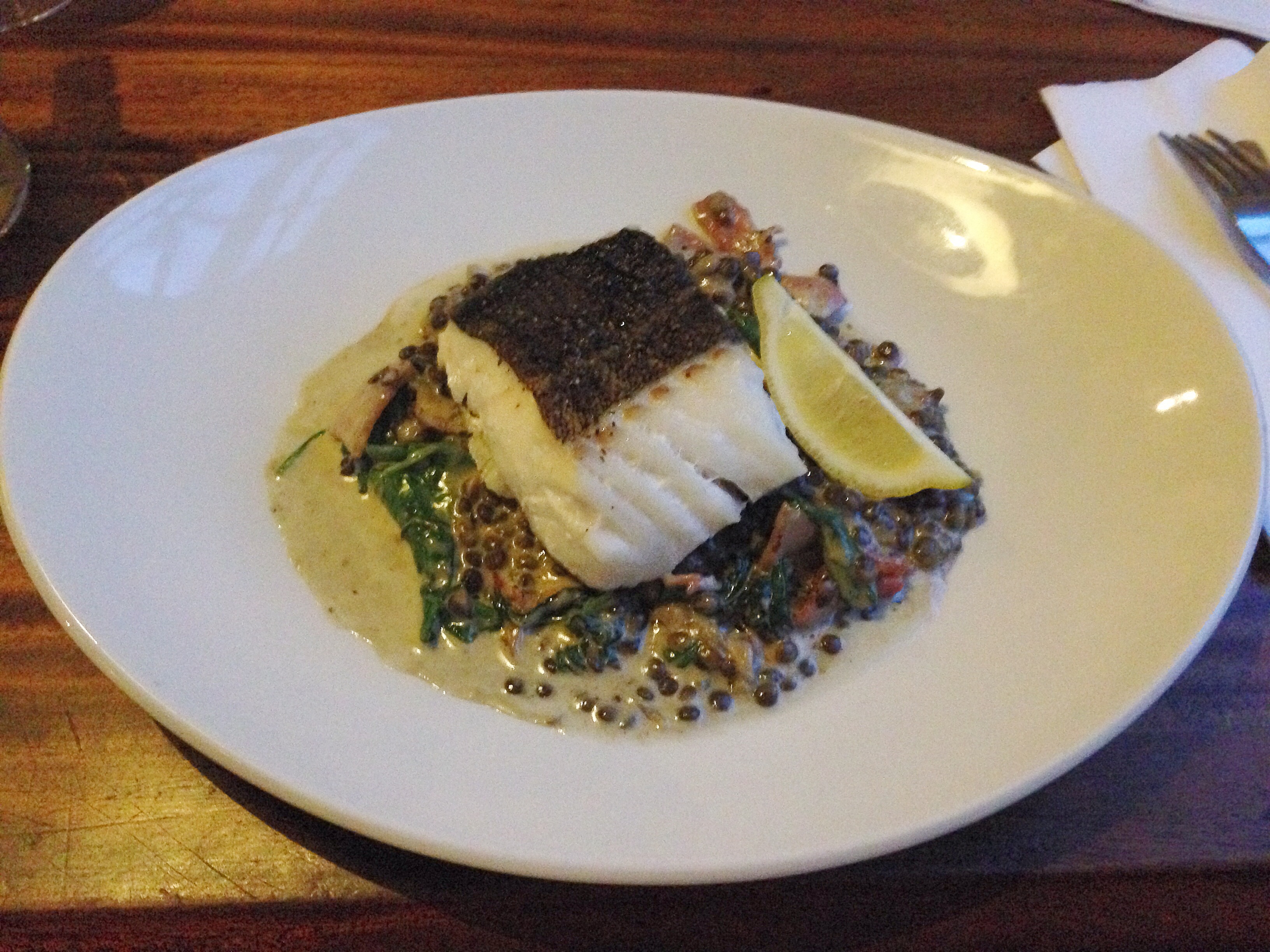
Pan fried sea bream with herb crushed potatoes, salsa verde and green beans, from the market menu, was less successful. The fish was a beautiful fat piece of bream, cooked so the flesh flaked under a fork and the skin crackled under a knife. The rest of the dish didn’t give it the support it so deserved. The potatoes appeared to have resisted the crushing process largely unscathed, the promised salsa verde just didn’t show up at all and overall it felt like a dish that could have been so much more with only a few little changes.

All of this was washed down with a very reasonable bin end – an Australian pinot noir at £35, “Cruel Mistress”, which was gorgeous. It had more complexity to it than some of its New Zealand siblings and just about worked with most of what we had ordered – enough substance to stand up to the venison without drowning out the bream (yes, I know people say you shouldn’t drink red with fish, but I’m a heathen about this sort of thing).

For dessert we didn’t fancy anything off the set menu so we went wild and ordered from the a la carte. This turned out to be a very good idea; the desserts were the high point of the meal.

The fig and honey tart with vanilla ice cream was delightful. It was served in a deep bowl and the topping was part bakewell, part macaroon – lovely, light, chewy and meringue-like, it had me scraping the edges of the bowl with my spoon. The honey was almost undetectable but that didn’t take anything away from what was essentially a very well done school dinner type dessert. I love a hot pudding (although I’m not sure I was expecting one from Forbury’s) so this was perfect for me.

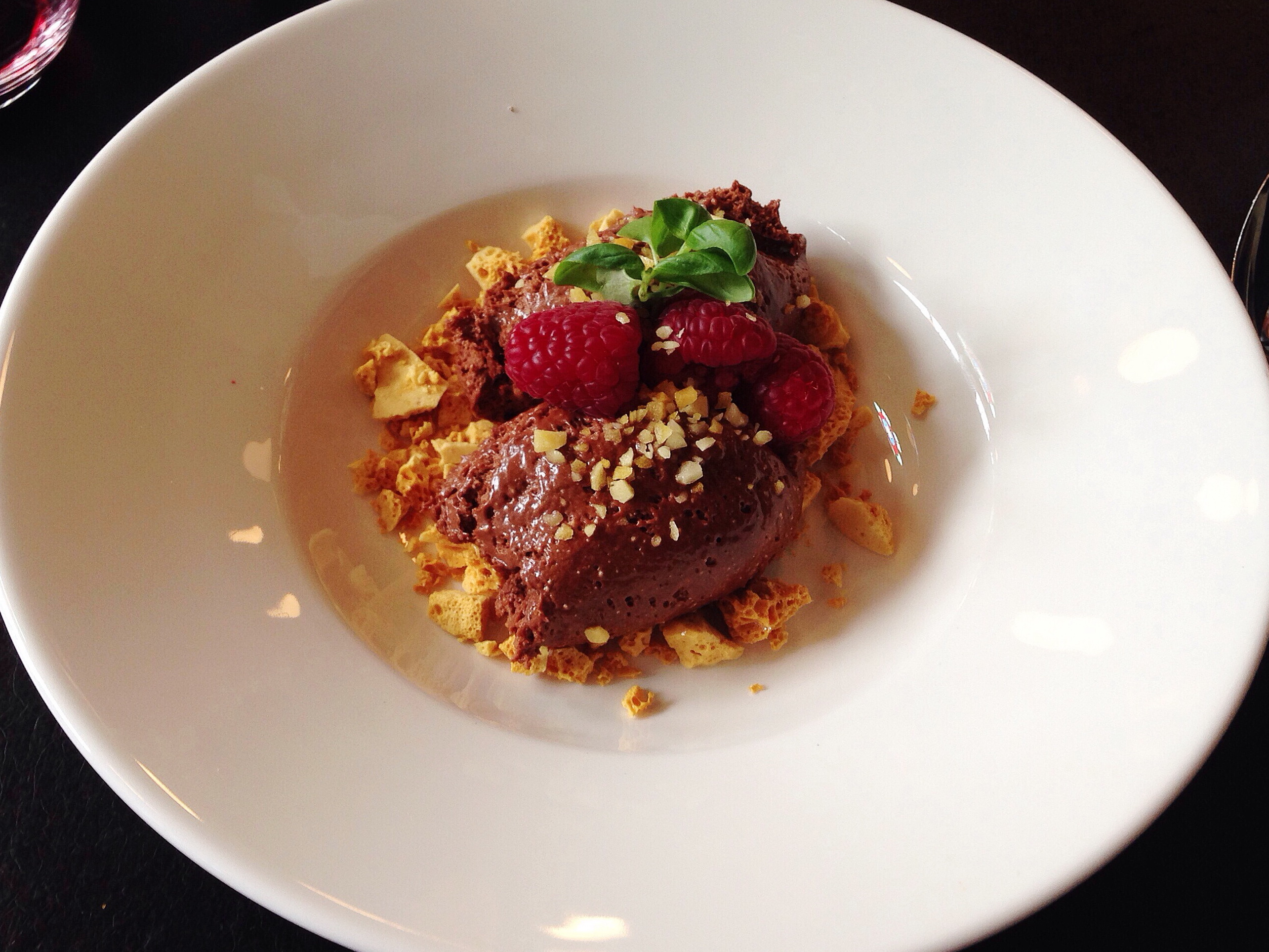
The Valrhona chocolate mousse with mango sorbet and chocolate soil was glorious – deep, dark, rich and bitter, and completely transformed by the gritty crunch of the chocolate soil. It didn’t need the mango sorbet, although it was so green and fresh that I wasn’t going to turn it down. The only slightly bum note was the microshoots of coriander strewn across it. I tried enough to decide it didn’t work and left the rest, but it didn’t detract from one of the best desserts I’ve had this year.

Mousse

I sense, from my visit, that Forbury’s is still a work in progress. Dinner for two, including one bottle of wine, came in just shy of £100 and I thought it was good value. The thing is, I had a lovely meal, with more hits than misses, but it wasn’t the meal I was expecting. There’s a sense of nervousness about the service and a little bit of risk averseness about the food. I can understand why – it must be difficult, stepping into a local institution like Forbury’s, and getting the balance right between evolution and revolution – and I saw enough to think that they’ll get there, but my overriding impression was frustration that they haven’t moved a little bit quicker.

The most telling thing about the meal? Just after I paid, I spotted something on the table which I’d previously missed: the salt and pepper mills were there in front of me. Next time I go, and there will be a next time, I hope they’re gone for good.

Forbury’s – 7.1
1 Forbury Square, RG1 3BB
01189 574044

http://forburys.co.uk/