This week’s review hasn’t quite gone according to plan. Originally I was going to review The Lyndhurst, which came under new management back in May. It’s fair to say that it’s had a chequered time since then, with the new landlords complaining vociferously to the Reading Chronicle, more than once, about what they said were false claims that they planned to turn the place into a sports bar.
The way they refuted that was interesting, I thought. We’re just installing a fruit machine, just like every other pub, they said. We’re just putting in a jukebox, like every other pub. Nuts, really. They’d replaced the managers of the best food pub Reading had ever seen, and their mission was to be just like everybody else. They missed the obvious point: if you’re just like everybody else, why should we drink at yours?
Anyway, I largely stayed out of it – because I know I could easily be seen as partial – but from their Facebook page they looked a lot like a sports bar to me. During Euro 2024 it was all badly generated AI images of three lions wearing England shirts and drinking pints of lager in a generic pub, or one especially tasteless – and arguably xenophobic – picture of a lion mauling a bull to coincide with the England-Spain match. But I’m probably just a woke snowflake, because I also winced when the pub described the rumours flying around as “Chinese whispers”.
They then decided to do food, so they put a menu up on Facebook and a few people – not me, I should add – were critical of it. “Please keep your comments to yourself” the pub said. Then they closed for nearly a week, not the first time they’d shut at very short notice. As previously, they blamed having work carried out, but it looked suspiciously like a sulk. All very strange, and I’ve lost track of the number of people who have messaged me saying what the fuck is going on at the Lyndhurst? My reply is invariably the same: God only knows.
But then at the end of July they announced that they’d taken on a new chef, Chef Roots. Now, I’ve never had his food but I know of him by reputation – he cooked for a while at the Roebuck, and at the Three Tuns, and in lockdown he ran a street food business called Pattie N’ Pulled which had its fans. I thought this was a very smart move by the new management – take on a known chef and try to recapture your reputation as a food pub. It all sounded very promising.
I was even prepared to overlook just how weird the menu the pub put out was. If anything in it was correct it was by accident, and every time you looked you spotted a different clanger. Some items were in a completely different font for no particular reason. The pricing was random – £11.96 here, £24.97 there, £4.60 somewhere else. And the spelling mistakes – oh my goodness. Buttet milk chicken, paremsan fries, oniom rings, triple cooled chips. It was all a bit Officer Crabtree.
So once I found out that Chef Roots was cooking at the Lyndhurst I was interested in going back, and I had a volunteer to come with me. That was none other than Matt, who made the very wise decision of proposing to my sister in law recently, which means he’s as good as family. So we agreed a date, when I was back from holiday. I was looking forward to it.
Then it all went tits up when I discovered that Chef Roots had barely lasted a week before moving on from the Lyndhurst, a development which the Lyndhurst decided not to report. And then more weirdness emanated from the pub. A recent Google review – one star, of course – was posted by a guy who was just verbally abused by the regulars as he walked past the smoking area with a friend and his dog. He put up footage from his phone which appeared to bear this out: it was a really uncomfortable watch.
And then someone posted on Reddit about the Lyndhurst’s Sunday lunch was, and she wasn’t pulling her punches. “Unseasoned. Small portions. Cold vegetables. Misleading menu. Said ‘homemade’ Yorkshire puddings and when I inquired about allergens the waitress brought out a frozen bag of Aldi’s own Yorkshire pudding” she said. “Actually speechless at how bad the food was.”
So I sent Matt a WhatsApp: Looks like we won’t be reviewing the Lyndhurst, the chef has already sacked it off. And Matt replied. Anywhere else we can review? Well, I can ride shotgun while you do it. And that’s when I thought of the Bell at Waltham St Lawrence, a cosy pub I had loved when I first reviewed it nine years ago. I’d been back since, but not for a long time, and it felt ripe for a revisit. So this week Matt picked me up and we headed off down the A4 in search of dinner. It was the first time I’ve ever been chauffeured to a review in a Porsche, and I very quickly decided that I could get used to it.
Much what I said when I visited the Bell in 2015 is equally true today, on face value at least: Waltham St Lawrence is still a pretty village and the pub is the jewel in its crown. It’s almost the platonic ideal of a village pub, and you got a whiff of woodsmoke as you walked in. But the one thing that was different was a slight change of the guard – back then it was run by twin brothers Iain and Scott Ganson, but last year Iain left to become the new head chef at Thames Lido. So was it business as usual at the Bell, or had things changed?
Paying it a visit on a Tuesday night it was almost empty with just a few regulars at the bar. “You can sit anywhere you like” said the chap after I told him we had a reservation, and although the front room was tempting we decided to go for the dining room, a less casual space up some stairs. Even so, that was stripped back and neutral – I seem to remember on a previous visit that there was feature wallpaper of some kind, but instead it was a calm, tasteful room. We were the only people in it, which gave my dinner date with my future brother-in-law a strangely intimate feel, like they’d opened just for us.
Still, we both enjoyed getting a word in edgeways for a change. I love my in-laws dearly, but the men in the family are like the men in Sex And The City: you might enjoy it when they crop up, but everybody knows they aren’t the feature attraction. It’s all about the women, one-upping one another with their increasingly funny stories, and the best thing you can do is enjoy the ride (or, if you’re my father-in-law, tidy up after everybody and/or hide in the garage). So here Matt and I were, talking for a whole evening in some strange inversion of the Bechdel Test.
The menu the night we visited was decidedly compact: four starters, three mains (one meat, one fish, one vegetarian) and three desserts. I seemed to remember from past experience that there used to be more on offer, and although I may have been wrong the evidence suggested we’d been unlucky that night: a picture on Instagram later in the week showed an additional main course that would have expanded the options a little. But no matter, although the menu was almost narrow enough to be constricting we both found things to order. Starters hovered around a tenner, mains were scattered more widely around the twenty pound mark.
But first, drink – and the first indication of interesting things at the Bell. They won Reading CAMRA Cider Pub Of The Year this year, and it showed, with a blackboard listing plenty of interesting choices including Tilehurst’s Seven Trees Cider. And the wine list was full of temptation, all of it available by the glass. I couldn’t choose between a couple and Ganson, who was behind the bar that night, kindly let me try some of each (even if the locals heckled him, saying that this was uncharacteristic generosity for a Scot). He even didn’t complain when I decided to go for a third instead, although they were all gorgeous, and let me try some of that. It was a Priorat, from Catalunya – Priorat is always worth trying, if you find it on a list – and I thought it was terrific at ten pounds a glass.
I seem to remember years ago having a conversation with the Bell on Twitter saying that more places should bring back the 125ml glass of wine, or the 250ml carafe. Well, although they do serve 125ml glasses they’ve gone one step further by using a Coravin for seemingly all of the bottles on the list. “It means we can offer about forty wines by the glass” said Ganson, which for me would almost be reason enough to visit the Bell on its own, especially if you have a nice chap driving you home in a Porsche.
“I’d also like a pint of bitter shandy please, which bitter do you recommend?”
“Hoppit” said Ganson without hesitation, and so Matt got a shandy made with Loddon’s finest, which he seemed to like.
Matt had the best of the starters, and I didn’t realise until much later that it was essentially the starter I’d ordered and enjoyed nine years ago. A slab of pigeon terrine came bound in bacon, served with a couple of beautifully burnished slices of griddled toast and – always the clincher – a trio of cornichons. Matt enjoyed this, but because his manners were impeccable he let me try some and I thought it was knockout – slightly gamey, the texture spot on, no hint of bounce or jelly to be seen. Matt also let me have all of his cornichons, but I think that was because he didn’t like them, rather than down to his impeccable manners.
I did less well, but only by a whisper. My selection of charcuterie from Cotswold-based Salt Pig had nearly everything you could hope for, and most of it was very enjoyable. Coarse rounds of chorizo, fatty ribbons of pancetta, superb pork collar. Only the spiced pork loin underwhelmed, and although I had enough cornichons, that was partly because I’d inherited Matt’s.
But it felt like something was missing, and I wasn’t sure what it was. I think a little griddled toast would have lifted this, or even some caperberries, or even more cornichons (although more cornichons, like more cowbell, is just my answer to many of life’s problems). WIthout that, it felt a little unbalanced. Looking back at the Bell’s menu I saw that it included something I’d missed, whipped lardo – also from Salt Pig, I presume – on toast. I wish I’d noticed that, because it would have been delicious. Especially if it came with cornichons.
By this point I was on to a second glass of wine. Ganson had suggested another Spanish red, this time from Bierzo, a single varietal Mencia, and it was every bit the equal of the Priorat. I found myself thinking that even though the same time last week I’d been in Granada, in thirty degree heat, sitting outside a bar enjoying cold beer and tapas there were consolations to autumn – red wine, woodsmoke and cosy pubs not least. Besides, Strictly was back on the telly.
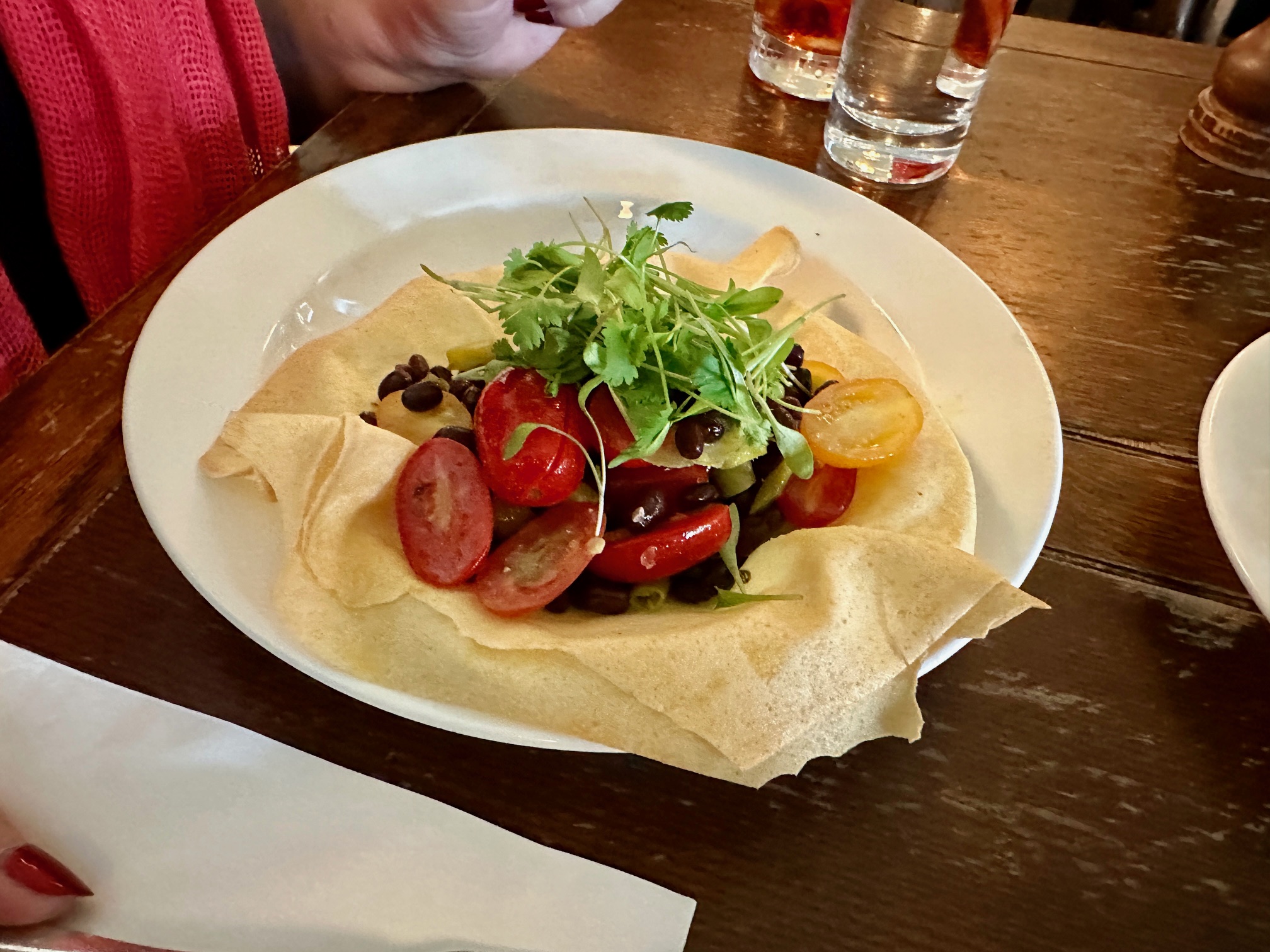
My main course bridged the gap between my week in Andalusia and the increasingly autumnal feel of things back home. I rarely order risotto, and I almost never make it myself – who has the time to stand at a stove for thirty minutes? – but the Bell’s version was made with Isle Of Wight tomatoes and Spenwood, and better British ingredients are hard to imagine. I had been spoiled by the exceptional tomatoes you get on the continent, but the ones that come out of the Isle Of Wight are absolutely the next best thing.
And it was mollifying comfort on a plate, a rich dish of sticky, nutty rice, topped with tomatoes that had been roasted and slightly dried, liberally dusted with one of my favourite cheeses which just so happens to be made down the road in Spencer’s Wood, the closest thing Blighty gets to Parmesan. On paper, this was the perfect thing to make you happier about the nights drawing in and being able to see your breath in the air – a gentle but insistent bear hug of a dish.
It was almost perfect, but not quite. I would have liked it to have been a little more seasoned, for a bit more salt to balance out the sweetness of the tomatoes. But I only decided that in hindsight, looking at a completely denuded plate, and hindsight is always a wonderful thing. I can’t remember the last time I ordered a risotto in a restaurant, but I won’t be able to say that next time I do.
Matt chose the Bambi Burger, a dish which has been on the Bell’s menu every single time I’ve visited. He wasn’t sure about it, which is how Matt discovered that he maybe wasn’t wild about venison. That meant I got to try a fair amount of it, and for what it’s worth I really loved it. Venison is a challenging meat to make burgers with, on account of it being so lean and lacking in fat, so to make something so delicious that didn’t fall into the trap of being dry and crumbly was no mean feat.
And again, hats off to the Bell for having a decent, sturdy bun and griddling it to give it the extra heft it needed. If I came back to the Bell, and hopefully I will before too long, I would make a beeline for this. The skinny chips, I suspect, were bought in: it might have been nice to have something chunkier, but they did the job.
Both of us felt like we had permission to order dessert: Matt because his main hadn’t hit the spot and me because mine had. We both gravitated towards the sticky toffee pudding – not something I’d normally order, but as the other two choices were cheese and oatcakes or an affogato I did feel my hand had been forced. I was sorry not to see the beer ice cream the Bell always used to make, which for me was one of the most intriguing and idiosyncratic things they did, but you can’t win them all.
It’s another nice echo of my original visit, because sticky toffee pudding was on the table then too. I think that the Bell has spent the last nine years perfecting it, because I loved this. It was a deep, dense delight, swathed in a cracking toffee sauce and crowned with a sphere of glossy ice cream – no clotted cream or the like here – and it made me wonder how many great sticky toffee puddings I might have missed out on over the years because of my vague prejudice against hot desserts. It was fantastic, and it helped, as the whole evening had, make me feel a little less sad about the changing of the seasons.
I could have stayed and drunk wine and chatted away until they chucked us out. But I’m not sure how much fun that would have been for Matt, who was on the Diet Coke by then. Besides, he had to be in London for work the next day so I settled up and we were on our way. Our dinner – three courses and two drinks apiece – came to ninety-six pounds, not including tip, which I thought was as good value as anything is these days in 2024. We shared trade secrets on how to manage our in-laws all the way home, and if any of them happen to be reading this I absolutely promise I’m kidding.
I was so happy to find the Bell still close to its best self, and if I’d have liked a little more breadth to the menu that was easily outweighed by the pluses – the service, that beautiful spot, the woodsmoke and the exceptional range of wine and cider. For many years, when people have asked me where they could have dinner a little drive away from Reading, the Bell has made my list – a list which shrunk when the Miller Of Mansfield closed, grew when I so enjoyed The Plough earlier in the year.
But we were getting to the point where I was recommending the Bell without having any recent experience to go on, and I felt like a fraud doing that. I’m very happy to have sorted that, and pleased that I can renew my endorsement. That I had a properly agreeable evening and a ride in a Porsche just added to my joy. Reading may have one fewer pub that does really great food and makes you feel welcome. But there are consolations to be found elsewhere, just as there are with the end of summer.
The Bell – 8.0 The Street, Waltham St Lawrence, RG10 0JJ 0118 9341788
Here’s a question for you – if you had decided to have lunch at a restaurant, and you knew for a fact that it didn’t take reservations, when would you get there, all things being equal? Would you turn up when it opened, bang on noon, or would you arrive early and be at the front of the queue? Or would you aim for about half one, to capitalise on the end of the lunch rush? Would it bother you, or make you anxious, or would you be blasé about the whole thing? Would you have a backup plan?
This wasn’t a hypothetical situation, because last weekend I was in Oxford with my old friend Dave and his son Leo, and I was set on having lunch at Kopitiam, a Malaysian restaurant in Summertown that received a glowing review from Tom Parker Bowles in the Mail On Sunday last December. But it didn’t take bookings, and Summertown is about a forty minute walk from the centre, so what to do?
This highlighted something of a philosophical schism between Dave and me. He would gladly have been there before the clock struck noon, ready to take the first table in the whole restaurant. “I prepare for things precisely so I don’t get anxious” he explained, although I suspected we both did equal amounts of worrying about stuff, just at different times. For my part, I thought turning up around half twelve would be more than sufficient. I knew it was Saturday lunchtime, but how busy could the place be?
It grieves me to admit that Dave was right and I was wrong: turning up bang on half past, we found every table occupied and the restaurant heaving. There were two tables out front, both with the standard-issue Tolix chairs in place, but it wasn’t quite warm enough for that kind of thing. So we went over the road to the excellent Colombia Coffee Roasters, sipped a latte and I kept a restless eye on the footfall heading to and from Kopitiam.
“It’s okay mate, if it’s still full we can always just go to Pompette a few doors down, or the pizza place on this road” said Dave equably. I didn’t understand what was going on: why was he so chilled about this after he’d been proven right? Why wasn’t he saying I told you so, the way I would have done had our roles been reversed? Honestly, you’re friends with someone for over thirty years but some days it’s like you just don’t know them at all. Leo, just turned 18 and off to Durham at the end of the month to start his history degree, sensibly stayed out of this one, and got to work on his mocha instead.
Anyway, it all worked out in the end. Half an hour later we went back and a number of tables were unoccupied, so we ensconced ourselves. The fact that so many tables had cleared so quickly suggested this was a functional lunch spot, not somewhere to linger, but we were too happy to have found space to be bothered by that.
The room was functional too – but in a way that worked, with plain, standard issue chairs and tables, faux exposed brickwork wallpaper and brightly lit pictures of all the dishes up on the wall. Now normally this would set alarm bells ringing, but somehow Kopitiam pulled it off – the saturated photos had an almost Martin Parr feel to them. And equally importantly, they all looked like food you’d actually want to eat.
Kopitiam’s menu was a tad confusing. Or really I should say menus, because you got two with no real indication of the relationship between them. The smaller one looked more Malaysian, the larger more Chinese, but the titles of the two printed menus didn’t exactly explain why this was. The smaller menu had some pictures of the food, the bigger, more generic menu, did not.
Malaysian Street Food And Cafe said the bigger menu, incongruously above the prices for crispy duck, Thai green papaya salad, sesame prawn toasts and edamame. And the same dishes, appeared on both menus in some cases – but where they did, the pricing was not the same. Anyway, on examination the smaller menu looked to be the lunch menu, the larger one the dinner menu – Kopitiam’s website spelled this out, but at the time it was a head-scratcher.
That’s partly because nothing at Kopitiam was expensive, whichever menu you ordered from and whatever it was calling itself. Few starters cost more than eight pounds, most mains on the lunch menu didn’t get north of twelve. Even on the main menu dishes tended to jostle around the ten pound mark, although rice cost extra. It did prompt a lot of discussions and plea bargaining, though, around how to try the best of the menu and what might or might not be representative. I felt, in the back of my mind, like having the Chinese dishes would be copping out.
“Are we having starters as well?” asked Dave.
“You do remember who you’re having lunch with, don’t you?” I said. Honestly, you’re friends with someone for over thirty years and some days it’s like they don’t know you at all: I don’t think the words if it’s okay with you can we skip starters have ever left my lips in all the time I’ve known Dave. And Leo is an enthusiastic eater himself: I remember going to Dolce Vita with him and his dad, back when he was something like ten years old, and watching him charm the socks off the waiters by ordering the monkfish with squid ink pasta and finishing the lot (“we have many adults who don’t try that dish” said our server, rightly impressed).
Our starters came out as we sipped a fiery and enjoyable ginger beer apiece: Kopitiam has no alcohol licence, which didn’t bother me, but also didn’t have any Sarsi (a Malaysian take on root beer), which bothered me far more. They also do a plethora of other Malaysian drinks – kopi, teh tarik and Ying Yang, a blend of coffee and tea which I was tempted to order out of morbid curiosity alone.
First to arrive were lok bak, minced pork wrapped in bean curd skin and then fried until crispy. These were a tactile delight, little brittle-coated nuggets of joy crying out to be dipped in sweet chilli sauce and scoffed. Perfect for sharing, perfect for social eating, perfectly enjoyable. And if I’d never had anything like this before, as I suspect Dave and Leo hadn’t, I would have been waxing lyrical.
But the best can be the enemy of the good, and I kept casting my mind back to a very similar dish at Lucky Lychee the previous month. There the pork was coarse and crumbly, the sweet chilli sauce was home made rather than out of a bottle and I got more of the spicing: Lucky Lychee boasts a ten spice mix, compared to the five spices deployed by Kopitiam. It showed: the Winchester restaurant’s rendition was easily twice as good.
By far the single best thing we ordered was chosen because we saw it at the next table and had to have a piece of the action. It was impossibly rugged-looking fried chicken, and our neighbours somehow had the superhuman (or inhuman, depending on how you view such things) restraint to leave it there, in full view, for something like five minutes without making inroads into it.
I swear that our portion arrived and was dispatched before they finished theirs, and I wasn’t sure whether to be proud or ashamed of that. But it was so, so good. It was half a dozen wings, in a crunchy, gnarled coating which had just the slightest hint of funk from the shrimp sauce used in the marinade. Now, I’m not the biggest fan of wings, especially when they’re sauced or tossed, because for me the reward to faff ratio is out of kilter. But these were an absolute joy to rend and gnaw, to the extent where I wondered if I was giving wings an unduly hard time.
“I think these are the crispiest wings I’ve ever had” said Dave. “I wish we’d ordered a portion each.”
“There’s nothing to stop us ordering more” I said. “We could have them for dessert. Did you know there’s a fish restaurant in Lisbon where you have a steak roll for dessert?”
Dave gave me an indulgent look that said, ever so nicely, why are you like this? But I knew I’d planted the seed about dessert chicken, so I left it at that.
Last of all, we tried a Malaysian staple, the roti canai. Now, I had high hopes for this after reading Tom Parker Bowles’ review. He said they were charred, chewy and as delicate as silk handkerchiefs. Leaving aside the fact that I’m not sure something can be all three of those things at once, Kopitiam’s roti were delicious but more like rolled-up balls of tissue – sorry for the image – than silk handkerchiefs. I liked them, and they were definitely greaseless, but in little clumps they weren’t the easiest to dip into a little bowl of an admittedly delicious curry sauce, with plenty of brooding depth.
Our mains came out while we were still eating our starters. Now, this has happened to me before in a Malaysian restaurant, one called Wau in Newbury that I visited five years ago. And I complained about it in the review, and a few people told me I was being culturally ignorant and that in Malaysian cuisine everything tends to arrive at once. So I won’t moan about that again, even though it wouldn’t be my preferred way to eat. And I suppose it explains why a restaurant that’s full at noon can find room for you thirty minutes later, so swings and roundabouts.
Dave and Leo had both chosen noodle dishes, but more different noodle dishes would be hard to imagine, despite having some of the same ingredients. Dave ordered Kopitiam’s special ho fun with not one, not two, but all of the following: prawns, squid, fish cake and pork. All that and what the menu described as an “egg gravy” on top. Something was surely lost in translation, because the words “egg” and “gravy”, next to one another, don’t scream take my money to me. But Dave seemed to enjoy it.
“The texture is a little… well… it’s kind of like mucus.”
“You can’t say that! I can’t put that in the review.” I said, fully intending to put it in the review.
“Well, it’s tasty mucus.”
“This is the thing, though, with some cuisines I think” I pontificated. “It’s just about us not having frames of reference. So we are generally a bit put off by gelatinous food, but I guess that’s because we associate that texture with sweet stuff. And nobody eats things in savoury jelly any more, apart from pork pies. It’s a tricky one with this kind of food – and it will make this review difficult to write. If you rave on it’s cultural appropriation, if you sound like you don’t understand it you just come across like Nigel Farage.”
“Anyway, I’m not sure if that is a fishcake. It has the same texture as a scallop. Anybody who promises a fishcake and gives you a scallop is okay in my book.”
If Dave’s dish was our one Cantonese foray into the menu, Leo had chosen a Malaysian classic. Hokkien mee was wheat noodles rather than rice noodles, cooked in a darker, stickier sauce with the same mix of surf and turf and with, allegedly, the addition of fried pork lard, although that wasn’t visible to the naked eye. This looked more like it, and Leo polished it off without complaint. I didn’t try it, but I was struck that the noodles were broken and short, and I was grateful that I hadn’t ordered it because with my rudimentary chopstick skills I might well have ended up wearing half of it.
This is where, if I was a proper restaurant reviewer, I’d probably wank on about wok hei, whatever that is. But none of us are kidding ourselves that I am, so I won’t.
Originally I was going to have the beef rendang, because Dave had planned to order the Marmite chicken. But when he changed his mind it was up for grabs, and having enjoyed this dish so much at Lucky Lychee I wanted another bite of the cherry. And really, it was a similar experience to the lok bak – if I’d never had this dish before I probably would have loved it, but I knew how good it could be and so I knew that this fell short.
The texture was magnificent – we’d already established that Kopitiam could fry chicken like nobody’s business – so it wasn’t that. But the sauce was more honey than Marmite, more one note sweetness than harmonised salt and sugar. And there wasn’t a lot of it – what there was coated the chicken, and the chicken had all the crannies and crevices to make that happen, but that was your lot. What that meant was a few bites of reasonably enjoyable but dryish chicken, rendered drier by plain white rice, and not much else.
Partly my fault, perhaps, for ordering it from the lunch menu, and perhaps if I’d ordered a separate helping and a separate bowl of rice I wouldn’t have felt so diddled. But I don’t know, I still think at the end I would have had a whole expanse of naked rice, desperate to be covered with anything. I poured the rest of the sauce from the roti canai onto a little patch of rice and ate that. I left the rest.
“Are you okay mate? You haven’t eaten much of your rice” said Dave.
“There’s nothing to eat it with” I said, gesturing at my plate. Tell a lie: there was a little mound of undressed salad on the plate fighting it out with the rice to be the least appealing, like Robert Jenrick versus Kemi Badenoch. To my mind it was a dead heat.
Once we’d finished our mains I watched the seed I’d planted earlier playing out in Dave’s mind. He still wanted more chicken wings, but he also didn’t want to look like it was his idea.
“So I suppose we aren’t going to have more chicken wings now, are we.”
“We can have more chicken wings if you want them. Do you want more wings, Dave?”
“Well, I’ll have some if somebody else wants some.”
This is the dance you have to do with some people, and my dear old friend is one of them. Fortunately Leo is eighteen and slim and likes food and has no compunctions about it, so he said that yes, he would very much like more of the delicious chicken wings. So Dave flagged down our server, asked for some more and they arrived and we fell on them with no less gusto than the first portion. It was the perfect end to a thoroughly agreeable lunch.
I do have to say too that the service at Kopitiam is absolutely brilliant – I would say the majority of the customers in there were Chinese or Malaysian, but I didn’t feel like a sore thumb, or ever less than extremely well looked after. I guess once you’ve had the King’s stepson in there, you can easily manage plebs like me, one of my oldest friends and the apple of his eye. We settled up – our meal came to just over seventy-five pounds, not including service – and we headed off in the direction of the Rose And Crown on North Parade for a pint and a debrief.
Kopitiam, by the way, is on South Parade, which is further north than North Parade, one of those wonderful paradoxes you sometimes find, like Gary Oldman being younger than Gary Numan.
Whenever I travel a bit further for the blog, I’m aware that the stakes are higher and I try to pick places where I’m pretty certain I’ll have a great meal. “Hey, come and read about this place miles from Reading that isn’t really worth going to!” is not much of a sales pitch, and believe me, I know it. Generally I’ve had decent luck when I’ve travelled to Oxford on duty, and I’ve never reviewed a dud in the city. And I wish I could offer a more ringing endorsement of Kopitiam, but I don’t think I can.
Not that I’m saying Kopitiam is a dud. It’s not a bad restaurant, the service is brilliant and some of what I ate was excellent, but I don’t know that it’s worth travelling to Oxford to try unless you are really passionate about Malaysian food. And perhaps Malaysian food isn’t where they’re at their strongest: I saw items from the more Cantonese side of the menu turning up at other tables and the roast duck, skin all lacquered, invoked particular regret.
But also, if you do like Malaysian food and you’re taking a trip away from Reading I would say to take the train south-west, stop at Winchester and make your weekend by eating at Lucky Lychee. And if you’re in Oxford, better options exist. One of them, in the shape of Pompette, is literally the other side of the road. And you can book a table for whenever you like, which some people – and it turns out I’m one of them – seem rather to like. So there you have it. Kopitiam may not take reservations, but I’m afraid I had enough for the both of us.
Eight years ago I wrote a piece listing my 20 favourite things about Reading. I felt a little grubby at the time, but in my defence this was back in the day, when listicles were mainly the province of Buzzfeed and hadn’t yet become the basis of so much of what we now call journalism,
Anyway, it took me by surprise, becoming by far the most popular thing I wrote all year: even my miserable experience at Cosmo didn’t attract quite as many readers. With hindsight, I can understand why – it’s nice to celebrate some of the brilliant things about this quirky place, the U.K.’s biggest town, that we call our home and so many of us have grown to love. I followed it up with a new version in 2019, which was equally popular, and now, five years on, here’s the third edition.
It’s a fascinating exercise to pull together a list like this every few years and a real indicator, on a personal level, of the shifting psychogeography of Reading. My view of the place has been changed by lots of things – I lived in the town centre in 2016, and in the Village in 2019. And now I live out by the university, and that changes your cat paths through town and the things you see and experience every day.
The pandemic, which happened not long after the second edition of this list, also had an effect, as it did on everything. I really appreciated living where I did during lockdown, and just how many green spaces were nearby. A couple of the places that are new on this list in 2024 are entirely down to how I came to experience Reading very differently during that period.
And, of course, the passage of time has other effects. Places close, or change to the extent that they’re no longer what they were. Or you outgrow them. The circle of life can change a place like Reading in a couple of years. In eight years it can alter it hugely, for better and for worse.
Dolce Vita, Tutti Frutti and the After Dark, that I used to love so very much, are gone. Pepe Sale is, too. The Harris Arcade is not the special place it was when the Grumpy Goat was there, and the Workhouse courtyard is now a guano-spattered graveyard: Greg Costello, like Elvis, has left the building.
So this list, like all such lists, can only really be a snapshot of your relationship with a place at any given time in your life. This is my fifty year old, remarried, content snapshot, and so it’s different from those other two versions. The next one, if I keep writing, will no doubt be different still.
And of course this won’t exactly match your list, which is as it should be. But try not to be annoyed that I didn’t find room for the river, or Reading Football Club (or even Reading City), Readipop, or Reading Pride, watching the half marathon, Thames Lido, or even that suburb north of the river.
Sorry-not-sorry about that. Because if this makes you appreciate those things, or others, even by being irked at me, or if it makes you construct your own list, or even if it makes you feel lucky to live in a town where so many lists can exist simultaneously – and simultaneously be true – then it’s done its job.
One last thing before I start. Food and drink feature in this list, of course, because I’m the one writing it. But if you want a more granular list of the very best food in Reading, you could start here.
1. The architecture
An ever-present on every iteration of this list, Reading’s architecture continues to amaze me and I’m always discovering something new. The obvious highlights are all well known like the Town Hall, Queen Victoria Street or our fetching branch of Waterstones. But you could look slightly further afield and see so many other beauties: Foxhill House, the Rising Sun Arts Centre, the Palmer Building, the site occupied by Honest Burgers. Or the McIlroy Building – still magnificent above ground level, even if the ground level houses the likes of Tesco, Creams and the British Heart Foundation. I still miss the Brutalist charms of the Metal Box Building, and I’ll miss the concrete car park above the Broad Street Mall, but I recognise I’m probably in the minority there.
But beyond those buildings there are also so many attractive streets that show that Reading’s architectural treasures weren’t completely wiped out by the IDR. This may also form a bingo card of Places I’d Love To Live, but in no particular order there’s Eldon Square, New Road, The Mount, the alms houses off Castle Street, the handsome houses of Jesse Terrace, Alexandra Road, Hamilton Road and Eastern Avenue. A few months ago I was walking back into town after acupuncture on the Bath Road and, heading down Baker Street, I saw a run of houses I’d never noticed before that looked like they’d been dropped there, incongruously, from Bath or Cheltenham, or from a Jane Austen novel.
These little treasures are scattered throughout the town – the cliché is to say you have to look up, but sometimes you have to look around, too.
2. Blue Collar Corner
Glen Dinning’s permanent site on Hosier Street was a very long time coming and, for quite some time, felt like it might never make it through the machinations and bureaucracy of Reading Council (just to spoil the suspense, Reading Borough Council doesn’t make this list, along with the undignified behaviour of some of its councillors, Jason Brock’s grinning mugshot, Reading BID and so many other things). But eventually in March 2022 the dream finally became a reality and Reading has never quite been the same since.
It’s easy to forget how lucky we are in Reading, or to think that our town is just like everywhere else. But Blue Collar Corner is a great example of how that’s just not true: you don’t get a purpose built, town centre showcase for great street food nearly anywhere else. You certainly don’t get one as high quality as Blue Collar Corner, with excellent local beer, a regularly changing roster of street food traders and some excellent events – WingJam and the British Street Food Awards not least.
When Euro 24 was on it felt like Blue Collar Corner really came into its own as a focal point in town, and sitting there pre-match with a pint and something excellent to eat I found myself reflecting on how much Glen’s long-held pipe dream had transformed the options in town – for places to eat, to drink al fresco and to celebrate. Of course, I was partly there because Gurt Wings was in town – like I said, Blue Collar runs excellent events, but Gurt Wings being in the house is an event in itself.
3. The Castle Tap
Possibly Reading’s most idiosyncratic pub, I really grew to love the Castle Tap in Covid. They put time and effort into their outside space (after, I think, some kind of Kickstarter appeal) and it was just a splendid place to sit and while away hours on a warm Saturday afternoon. For people like me, who still weren’t comfortable eating and drinking indoors, that was a real boon. So was their determination that you shouldn’t have to leave the pub just because you were feeling peckish: they encouraged you to order Deliveroo and eat it at your table, and even gave you the postcode for the entrance to the beer garden so your driver could quickly and easily drop you your food.
Back then they were on Untappd, so you always knew what they had on tap and in their compendious beer fridge. Although that has changed – being a verified venue doesn’t come cheap – it remains a great place to drink. It always has something interesting on keg, it regularly stocks top notch cider if that’s your bag and even their range of gins is spot on. But more importantly, as the epicentre of a lot of Reading’s diverse scenes it feels like something is always going on there.
On my last visit, fresh from dinner at Zia Lucia on a Saturday night, there was a band rocking out the front room, a joyous, raucous party in the back room and groups of people dotted across the tables outside, making the most of a gloriously random Reading evening. And when it comes to having a random Reading evening, few better places exist.
4. Clay’s Kitchen
I’m sure it will come as no surprise that Clay’s makes this list, as easily one of the most influential restaurants Reading has ever seen. They made my 2019 list, too. But what they’ve achieved in the last five years has, if anything, taken the restaurant to another level still – crowdfunding a move to a far bigger site over the river, creating a big buzzy space and receiving a glowing review in the Guardian, one of the only times a Reading restaurant has troubled the national press.
I do slightly miss their cosy little site on London Street, even if the orange walls and lack of natural light there made my food photos glow in a slightly post-apocalyptic Ready Brek-style, But it can’t be denied that the spot on Prospect Street is luxe, hugely well done and has given Clay’s the scope to experiment more with dishes, widen their menu, run events, get an excellent selection of Siren Craft beer in and become the all grown up best version of themselves they always wanted to be. And when Nandana is offering her peerless front of house service, however big the site is, it still feels as cosy and welcoming as the original London Street days.
5. C.U.P.
Still with two branches going strong in the centre of town, C.U.P. is Reading coffee’s great survivor, having outlasted Workhouse on King Street, Tamp Culture outside the Oracle and Anonymous Coffee on Chain Street.
These days, it’s unquestionably my first choice for coffee in town. Much has been made of how brilliant their mocha is, not least by me, but everything they do is excellent, including their little sesame petit fours which make an excellent accompaniment to the first coffee of the day – to any coffee, for that matter.
I know many people love the original branch next to Reading Minster, where people sit outside and chat long into those summer afternoons. But my favourite is the branch on Blagrave Street, which opens at 8 on weekdays. It’s where I grab a pre-commute coffee on the days I’m in the office but at weekends I love sitting up at the window and watching the world go by (it’s a particularly good vantage point when the half marathon is on, incidentally).
And of course, you can see the Town Hall, so at weekends you can also see the newlyweds emerging and being showered with confetti. And that always makes me think that earlier in the year that was me, which makes it an even sweeter spot. On my wedding day, after we’d set up the venue but before the getting dressed, the fetching of the flowers, the ceremony and celebration, my friend Jerry and I stopped for a mocha at C.U.P., the contemplative calm before the storm. It remains one of my favourite memories from the day.
6. Double-Barrelled Brewery
I know now Reading has Phantom, and Siren, and they are both perfectly nice places to drink craft beer. But my loyalties are with Double-Barrelled, who opened here first, back in 2018, and have been in the vanguard of Reading’s beer scene ever since.
You could argue that the tap room aesthetic is a tried and tested, generic model. Find a big site on an unpretty industrial estate, pop your standard issue folding benches and tables outside and in, book the occasional street food trader and off you go. But to me that understates Double-Barrelled’s achievement, which is to create something quite lovely at the end of the Oxford Road.
It’s a really good option for a lazy Saturday (or Sunday) afternoon pint, and a great spot for hosting birthday parties or just impromptu gatherings. I was even there on New Year’s Eve for their 90s themed party, which was rather marvellous. I lived through the 90s the first time around: you had nowhere half as good as Double-Barrelled back then.
Add in the fact that by stocking at least three other venues on this list they improve the quality of beer across the town, and you have a local business to really be proud of. There’s no room for improvement, except that the tap room is lacking truly first-rate beer snackery (Deya stocks Torres truffle crisps, just saying).
7. Forbury Gardens
The Forbury Gardens is a priceless spot, so close to the centre of town: god bless the Victorians, who thought about this kind of thing. It plays host to some of Reading’s best events – the Blue Collar cheese festival, the quirkiness of our annual Bastille Day Celebrations, WaterFest (when it nearly always rains). But it’s also just a brilliant place just to loaf, to picnic, to read a book, or to have a wander. It’s quite something at the start of spring, when the trees are in blossom, and come summer it really comes into its own.
But I also think about what Forbury Gardens represents. In the summer of the pandemic it became a symbol of the town and the town’s unity after that horrendous attack that affected Reading so deeply, and there was something pure and true about that. All sorts of opportunists wanted to use what happened to stoke up division and hate – can you imagine Katie Hopkins talking about Reading for any other reason? – and Reading was having none of it.
And when an image did the rounds on social media earlier in the year suggesting that a far right demonstration was going to go through Forbury Gardens, many of us felt defiled, offended at the very thought. I think that’s because everybody has their own precious memories of the place. For me it’s where I first met my wife, when we wandered through it and chatted, briefly, under that bandstand. Six years later, it was where we, along with all our wedding guests, stood under the Maiwand Lion as our photographer snapped and snapped. I will always love it for that, even if for nothing else.
8. Geo Café
This is the point where I always have to put a disclaimer: owners Keti and Zezva are friends of mine and so you could easily discount my recommending this place as biased. But I don’t know: I reckon Keti and Zezva have created an environment where all of their regulars feel like friends, and that’s part of its magic. Besides, I think it would be hard objectively to deny that Geo Café is a truly special place.
Knockout pastries, made by Zezva in the little bakery upstairs. Some of Reading’s best, and best made, coffee, that never quite gets the credit it deserves. Moreish cakes, bought from a network of nearby bakers. Terrific produce, including local honey and some of the best butter you can get anywhere near Reading. Cracking bacon and eggs on toast, with a little smear of green ajika to add an acrid punch. Keti’s unimprovable Georgian wrap, with fabulous chicken thighs, red ajika and walnut sauce, one of the finest sandwiches Reading has ever seen.
And, out the back, Geo Cafe’s Orangery – sheltered in the rain, but magnificent in the sunshine, one of my favourite places to drink coffee, ruminate, waste time on my phone, pretend to read a paperback or do some gold standard people watching. Sometimes on hot days Keti wanders through, hosing down the floor to cool the place down, and you could be on the continent. You definitely don’t feel like you’re in Caversham.
And the best thing is that this has all almost happened by accident. When Keti and Zezva took over the spot previously occupied by Nomad Bakery I don’t think they intended to end up here, let alone to do so well that they opened a second branch in Henley. But somehow, even if not by design, through all the decisions they’ve made, good and bad, and despite (or because of) any mistakes along the way they have somehow, without realising, created the perfect café.
9. The Harris Garden
My discovery of 2020, the Harris Garden is one of my very favourite places in the whole of Reading. Only accessible from a single gate close to the edge of the campus, it is a fabulous, peaceful place full of botanical wonder, expertly looked after so there is always something new to see and to admire. You could be in the middle of nowhere, somehow insulated from the hum of traffic from Wilderness Road and Pepper Lane.
For an idea of how carefully and thoughtfully the place is tended, look at their website. But even walking round the place, as I’ve done many times, that comes across. You feel like you are in the middle of somewhere that sings with that care and love, and whether you’re horticulturally inclined or, like me, just happy to be there, it is among the loveliest experiences Reading has to offer. It is also true that in the summer of 2020 I had a few happily smudged sunny afternoons on a bench with my friend Jerry polishing off a bottle of red from plastic beakers, but that’s entirely beside the point.
10. John Lewis
Five of the things on this list have been on every version I’ve written of this list, and there’s a reason for that. They are in the permanent collection, things that have made Reading great for a very long time and will hopefully continue to do so for years to come. So I’m trying to think what I can say about Reading institution John Lewis that I haven’t said before, or others have said even more clumsily. I like to say it’s the closest thing Reading has to a cathedral, and I still think that’s true.
The town had something close to an existential crisis when, in the aftermath of Covid, there were rumours that Reading might lose its branch of John Lewis – as places both bigger (Birmingham) and smaller than us (Newbury) did. Saying goodbye to Woolworths or Clas Ohlson is one thing, and I know people mourned the passing of Wilko, but John Lewis is a different level to that. If it closed, Reading would despair: the only other shop I can think of that would provoke similar feelings is our remaining branch of Waterstones.
So instead, I’ll say one other thing about John Lewis: when I moved house, in the summer, we bought a new bed. Two six foot adults sharing a cosy double bed for six years is not a recipe for nighttime bliss and comfort, so we decided to finally upgrade using some of the money we got as a wedding present. And there was never really any question: we would buy it in John Lewis. We went in, we looked at beds, we lay on mattresses and then we got proper, superb, personal service from someone a good thirty years younger than me.
It was a reminder that retail, done well, is special. I know that a lot of what I buy from John Lewis is probably stuff like ironing board covers and towels, gadgets from the lower ground floor. But they are there for the important stuff, and have been for all of my adult life. I hope that’s always the case.
11. Kungfu Kitchen
One of only two Reading restaurants to feature in the national press in living memory, Kungfu Kitchen is very much the Stones to Clay’s Kitchen’s Beatles. A lot of that is down to the exceptional food but a lot is also down to the formidable duo, Jo and Steve, who run the place. When people describe someone as a “force of nature” they are talking about someone like Jo, who takes no nonsense, tells you what she thinks – whether you’ve asked or not – and often also tells you what to do, what to eat, what you want. It’s part dinner, part dinner theatre, and I love it.
But if you’re reading this, the chances are you already know all of that. Their new home, a few doors down from the old one, is very snazzy, with overhead lights giving a pattern of koi carp swimming on the floor, Double-Barrelled on tap and random water features that Jo will switch on next to your table. This may send you scurrying to the loo: Jo is very proud of the loos. And once they finish converting the first floor of their new home to a karaoke suite, well, I dread to think.
I go to Kungfu Kitchen with my dad, who is pushing eighty and is devoted both to the salt and pepper squid and tofu and, to be honest, to Jo. Jo always refers to my dad as ‘Daddy’, saying things like What would Daddy like? and What shall I bring Daddy?. I half want to explain to Jo that there’s only one context in which it’s appropriate for her to call my dad Daddy, and to tell her that this context is also very much not appropriate. But truth be told I’m enjoying it too much. And, from the twinkle in my dad’s eye when we eat there, he definitely is.
12. The Nag’s Head
There is simply no better pub in Reading. There are few better pubs in the U.K., I suspect. It’s cosy and buzzy, it’s brilliantly run, it has superb beer and excellent snacks, the inside is a great place to booze in the winter and the beer garden is the perfect spot in the summer. We are so lucky to have the Nag’s, and it’s only when you go elsewhere that you fully appreciate that. I’m off to Oxford this weekend for the day, and it has some very good pubs. But it has nowhere quite like the Nag’s. Nearly nowhere does.
13. The number 17 bus
Few things in Reading are truly iconic, a word that is bandied around far too much by people who don’t know what it means, the kind of people who misuse words like literally and unique. The Maiwand Lion, definitely. Jackson’s Corner, back in the day, probably. Reading Elvis? Absolutely nailed on. The Purple Turtle? Perhaps. But for me, the 17 bus route is genuinely worthy of the epithet. I’ve said before that, more than the Thames, it is Reading’s great tributary and I stand by that – from the Water Tower to the Three Tuns, it runs west to east, and vice versa, and is the closest thing Reading has to Lisbon’s legendary Tram 28 (especially if you’re lucky enough, on a summer’s day, to hop on Fernanda, Reading Buses’ open top number 17).
Not only does it connect up both ends of Reading but it connects up restaurants, pubs and cafés. You could go from Hala Lebanese to the Retreat, from House Of Flavours to the Nag’s, from DeNata to Double-Barrelled without ever straying more than a minute from a bus stop. I recently did a section of the 17 bus route as a pub crawl with Reading CAMRA, from the Retreat to the Alehouse, and it was brilliant fun – and a reminder that there are an awful lot of pubs on that bus route (I might pass on the Wishing Well, mind you).
Martijn Gilbert, the former CEO of Reading Buses, once told me that if the number 17 hadn’t already existed it would never have been invented. It made simply no sense, he said, to have a single bus route that length, on a loop: it you’d been starting from scratch you’d have had one route from the Three Tuns to town, and another from the Broad Street Mall to Tilehurst. And yet it already existed, and it would be a brave CEO who fucked with it now. Tutts Clump Cider – run by Tim Wale, a Reading Buses driver who will only get behind the wheel of a 17 – named a cider after it. Double-Barrelled named a beer after it. But Is It Art sells merchandise describing it as the backbone of Reading. Quite right too.
14. The Oxford Road
If I was making a list of the things I like least about Reading, I think it would include people who slag off the Oxford Road. I always think there’s a certain lazy bigotry about some people on social media who have it in for one of Reading’s great thoroughfares, I suspect partly because of the presence of the mosque. And I don’t want to damn the Oxford Road with faint praise or patronise them with the word “vibrant”, so often a middle-class euphemism for scruffy.
So instead I will say that the Oxford Road is the real crucible of culinary imagination in Reading, and invariably where interesting things begin. It was the original home of Workhouse Coffee, and in time it has played host to the likes of I Love Paella, Bhoj, Oishi, Tuscany and countless more: Momo 2 Go and Kobeda Palace still grace it with their presence. Near the top you used to be a short walk from the Nag’s and from the sadly departed Buon Appetito, at the bottom you have Double Barrelled.
For a while I was worried that its glory days might be behind it, but a recent visit to DeNata restored my faith, and it has a clutch of restaurants and cafés I still need to explore. West Reading folk are rightly proud of their hood even if, unlike Caversham residents, they don’t feel the need to tell you they live there within five minutes of meeting you.
(Only kidding, Caversham residents. You know I love you really.)
15. Park House
I could have put Reading University campus in this list, quite easily – it’s a brilliant open space and Whiteknights Lake is a great spot for an amble – but instead I’ve selected the two jewels in its crown, the Harris Garden and this spot, Park House.
It is almost the perfect watering hole. In winter it has wood panelling and comfy sofas, a clubbable and conspiratorial feel. In summer, it has plenty of open space and big sturdy tables and is a sun trap for hours. And whatever the weather, it has a superb range of craft beer – mostly keg, nearly all from a plethora of local breweries – at prices that are either ridiculous, or subsidised, or both. The food’s not bad either. This summer I discovered that if I took the number 21 bus home from work and simply stayed on it for a handful more stops, I would find myself dangerously close to Park House. It was a very fortunate discovery.
16. Progress Theatre
One of Reading’s true gems, I don’t go to Progress anywhere near often enough and every time I do I wonder why I’ve left it so long. It has a varied programme of events, stages some interesting plays, supports youth theatre and local writers. I was at one of their stand-up comedy nights one Friday before Christmas and had an absolutely marvellous evening, despite attending on my own and sitting at the back like a sad sack.
A lot of people only know Progress Theatre because of their annual open air productions in the Abbey Ruins – and don’t get me wrong, they’re a highlight of the Reading year – but I do think people who haven’t made it to the Mount to experience the cosy loveliness of one of their other productions are really missing out. When I moved house in the summer I found myself a lot nearer to Progress: I plan to take full advantage of that.
17. Reading Library
I’m not the biggest fan of change, and I’m not the biggest fan of our council. So it won’t surprise you to hear that I’m very sad that the council is looking to move Reading Library from its current location to the council buildings on Bridge Street, a decision which I’m sure is partly led by the availability of funding and partly led by an awareness of how much the Kings Road site could fetch on the market. The new library will have fewer books in it, because apparently that’s what progress looks like.
But partly I’m also sad about it because I have a real soft spot for the current site in all its dated glory. A Saturday morning wander round the library, picking up things I’ve reserved or just idly browsing, is a very happy way to while away an hour, and Reading Library’s staff are always really excellent. I’ve found myself far more attached to the concept of libraries, as I’ve got older, and whenever I bimble round Reading Library I feel very lucky that the town has access to it. I will probably feel the same about the new site, eventually, once I stop grizzling – even if it won’t have the Holybrook running under it.
18. Reading Museum
Reading Museum has been in every iteration of this list, to the point where I’ve probably run out of things to say about it. Yes, we’re lucky to have a full size replica of the Bayeux Tapestry. And yes, I adore the devotion the place has to biscuits – all that information about Huntley & Palmers, and the display cabinet full of intricate, decorative biscuit tins. And of course, Waterhouse’s building is Victorian red and grey brick perfection. But more than that, it really captures the spirit of the place and manages to do it without being dry or dusty. That it does so in such a fabulous building is the icing on the cake.
I also have a particular fondness for Reading Museum because I walked through it on my wedding day, on the way to its serene and tasteful ceremony room. But I do acknowledge that that’s just me.
19. The Reading subreddit
In my first ever version of this list, I included the Reading Forum, which used to be a brilliant outlet to chat shit about Reading and enjoy all sorts of asides and rabbit holes, usually from people who had lived here for donkey’s years. But it fell into disuse, and got taken over by a series of trolls who just wanted to post about how much they hated Reading. They talked about a grubby crime-riddled dystopia that didn’t remotely resemble the town I love: in truth, I think they just didn’t like Reading’s diversity. Or the mosque. Over time it changed from the Reading Forum to the “makes for ugly reading forum”, and I sacked it off.
As the latest adopter of all time, I joined Reddit’s Reading subreddit earlier in the year and it reminds me of how the internet used to be, when people weren’t such arseholes (see also: Threads). Yes, you see the same topics come up again and again: where in Reading you should live, where’s good to go out and so on, but the tone is always upbeat and positive. Nice stuff gets upvoted, bad stuff gets downvoted and the mods handle the rare offender. It’s Twitter 2009 all over again (they also put up with me posting links to my Reading reviews without running me out of Dodge, which is a relief).
A recent example was quite wonderful, I thought. It’s Reading Pride this weekend and someone posted saying that it was their first one in Reading but that they didn’t know whether to go on their own and thought they’d feel awkward. People descended on the post with offers of help, moral support or even just saying that the poster could hang out with them and their friends. Blimey, I thought. This is very different from the comments section on the Chronicle website.
20. “Via del Duca”
Call it Via del Duca, call it – as someone did recently – Very Little Italy, but whatever you call it the little stretch made up of Madoo and Mama’s Way is one of my very favourite gastronomic microclimates in town. The two businesses have an almost symbiotic relationship – similar but not the same, with the dividing line that Madoo sells coffee but not booze and Mama’s Way sells booze but not coffee.
But both of them feel like a happy slice of Italy plonked down, almost at random, opposite the likes of Rymans and the Oxfam Music Shop. Madoo is great for toasted sandwiches and salads, for grabbing a quick lunch, listening to Italian spoken all around you, European music on the radio, and feeling transported (you also can’t beat their cannoli). Mama’s Way is perfect in the evenings for sitting up at that window ledge with a glass of wine and an array of meats and cheeses before making inroads into a pinsa. They do a mean spritz, too, and I hear their barrel aged negroni is worth trying.
Just as importantly, for people who complain that Reading doesn’t have a good delicatessen any more, Mama’s Way is a positive cornucopia, an Italo TARDIS which contains more goodies on the inside than it looks like it could ever house from the outside. Their pork and fennel sausages are a particular weakness of mine, although the sadist that decided to put five of them in a packet has a lot to answer for.
Since January 2025, Edible Reading is partly supported by subscribers – click here if you want to read more about that, or click below to subscribe. By doing so you enable me to carry on doing what I do, and you also get access to subscriber only content. Whether you’re a subscriber or not, thanks for reading.
There’s a neat symmetry to proceedings this week. Last week I found myself in London, on a bus to parts unknown and this week, although I’m back in Reading, it was a very similar experience. Because I was on the trusty number 1 bus heading out west to Calcot. Yes, Calcot. Have you ever been there, apart from to visit IKEA, unless you happen to live there? Did you know Calcot has restaurants?
Well, for a long time it didn’t. And then in the summer of 2020, The Avenue Deli opened in a little run of shops. The name was a bit confusing, because from what I could see it was definitely a café and brunch spot, not a deli. But despite that, and despite opening in the worst summer for hospitality since records began, it built up a decent reputation: I suspect that, like Tilehurst’s The Switch, it benefitted from serving a community that doesn’t have anything else remotely like it.
But then last November, The Avenue announced that an Indian restaurant, The Coriander Club, was opening next door. The implication was that the two businesses were connected, a shared owner presumably, and The Coriander Club talked about offering an authentic taste of Punjabi cuisine. And since then the word of mouth has been good, and the restaurant’s well-maintained Instagram feed paints an interesting picture of food very much on the western edge of Reading.
Subscribe to continue reading
Become a paid subscriber to get access to the rest of this post and other exclusive content.
Our story this week starts with your narrator sitting outside an achingly hip café called Batch Baby in De Beauvoir Town, a part of London I’d never heard of, gulping down a latte before heading to a lunch reservation at Planque, an achingly hip restaurant in Haggerston, another part of London to which I had never been. It was a Saturday lunchtime, the sun was out – so were my legs, for that matter – and I felt very old and very fat, but mostly very old.
I had taken the Elizabeth Line to Liverpool Street and then hopped on a bus from Moorgate, wending its way past the horrendous roundabout at Old Street and out towards the North Circular, into the bits of London that are Vittles territory, rather than the province of broadsheet critics or restaurant bloggers. I had no idea what to expect of De Beauvoir Town but you couldn’t say it wasn’t interesting – handsome mansions one side of the road, stark and forbidding tower blocks on the other, presumably the legacy of a little light wartime bombing.
Those contrasts went further than the architecture. Up one side street, past a big red sign advertising TheSun, an establishment called the Happy Café offered a full English, and a “Sunday Roast Diner” (sic) with three veg, potatoes and gravy. Round the corner, Batch Baby was tasteful in an artfully yet carelessly thrown together sort of way, on the ground floor of a handsome building which apparently serves as a “community space and creativity hub”. The coffee was immaculate, and some of it was roasted by Sweven, the equally hip café in Bristol’s Bedminster. Do these places have a twinning scheme?
I sat outside, and I felt every year of my fifty years, and every stone of my no-I’m-not-telling-you-how-many stones. Everybody was thin and young and stylish and wearing dungarees and the sort of clothes you used to be able to buy in Shakti. And I remembered when they were first cool, back when I was at university, and then I realised that they were probably first cool in the seventies, before I was born, and that my parents probably looked at people wearing them in the nineties and felt how I felt in that moment, and that only served to make me feel older and wearier still.
Never mind. I loved the coffee, I took a picture, I applied my best filter, put it on Instagram, pretended I wasn’t fifty. And then I checked the time and scurried to the restaurant, just in time for my lunch reservation. On my way I passed a handsome old boozer, a cute Japanese canal by the towpath, a plant-based wine bar and bottle shop, a small plates restaurant with a sideline in sake. There was no denying it: I might not be in Dalston, but I was definitely Dalston-adjacent.
Planque is an exceptionally voguish spot which was recently listed as the 97th best restaurant in the U.K. by the National Restaurant Awards. I felt like I had seen it in dispatches everywhere and when my cousin Luke, who moved to London from Toronto a couple of years ago, suggested we should have lunch in town some time it turned out it was on both our lists. The chef was previously at P Franco, another legendary small plates and natural wine spot in Lower Clapton – another cool part of London to which I had never been – but Planque was meant, by all accounts, to be a step up even from that.
I’d seen reviews that had raved about the food, and others that had waxed lyrical about the interior. And to add to the exclusivity, although they allowed people like me to book tables in the restaurant there was also some kind of private members’ club element where you could cellar wine there, get discounted corkage rates and so on.
My swiftly grabbed photos of the room don’t do it justice but it is indeed a coolly attractive space. It’s built into two railway arches, but this has been lavished with funds and the interior, designed by a Danish studio, does have that very Scandi feel to it. Actually, it reminded me of many places I’ve eaten in on the continent, in Ghent or Copenhagen, but few in Blighty. But that also made me realise that in Europe, nobody would bat an eyelid about a dining room like this but here in England you can rely on people to lose their shit about it.
All that said, it was more a place to admire than necessarily enjoy eating in. The long communal table – again, something I feel like I’ve seen more in Europe than here – was very striking, and the wooden booths for four were attractive (although when Giles Coren reviewed Planque for the Times he complained about his arse going to sleep: now he knows how his dining companions must feel). But if you’re at a table for two, I think you do get a little diddled: those three tables were right at the start of the dining room, near the front door, close together and slightly unloved.
By this point Luke had arrived and we’d ordered a few aperitifs – a negroni for me and a Chartreuse and tonic for him. Luke is in his early thirties and lives in Clapton in an apartment which he assures me is slightly bigger than a studio. He runs multiple marathons a year, and his Instagram is a positive advert for being young and happy and living in London: if he isn’t jetting off to Australia or back to Canada, attending this wedding or that, running a marathon in one European capital or another he is in a beer garden or at a house party somewhere in London, surrounded by equally young and attractive people, living their halcyon days.
As if I didn’t feel old and fat enough already! Just once I’d like to see a picture of him heating up a depressing ready meal or watching Love Island, but it’s impossible to hold it against him. Too likable, you see.
At weekends Planque serves a set lunch only, which is yours for thirty-nine pounds and includes four small plates, your choice of main course and a set dessert. There are a few additional dishes in the bottom section, and with a little light questioning our server gave us a view on where in the meal they might turn up – so some would precede your small plates, some accompany your mains and a couple of cheeses which would come before your dessert (if you’re doing things right) or after it (if you’re not).
All pretty straightforward, but Luke and I couldn’t decide between the two mains. Steamed skate wing managed to combine one of my favourite ingredients with possibly the drabbest cooking technique there is, veal sweetbreads had undergone a similar experience by being turned into some kind of sausage and served with coco beans. Was Planque’s superpower taking the fun out of things? In the end, Luke said we should order both and share, which in most restaurants would be a perfectly viable option.
Wine first, though, and another reason to feel the exclusivity of Planque – and by exclusive I mean expensive. The cheapest wines at Planque are around sixty pounds, and the majority of the list comes in at three figures. My original choice was a Maccabeu from the Languedoc, but our server quickly and firmly told me it was very wild, and that I might well regret ordering it (why is it on the menu then? might be your question: I might have had that question in my mind too).
So instead he steered us towards a Corsican white which was a blend of Muscat, Vermentino and Bianco Gentile, an indigenous Corsican grape I’d never heard of. And, in fairness, it was a beautiful white wine. At eighty-four quid, you’d really want it to be. You can’t easily buy it elsewhere, which I guess is kind of the point, but what research I did manage to do suggested the mark-up was steep.
From this point onwards, though, concepts of value and its relationship to quality, and quantity, became foggier and harder to grasp. A good illustration was our opening dish – scallop tartelettes were divine, dimples of clean, pure, subtle high-grade scallop sheltering the crunch and sharpness of sea lettuce, like the tiniest gherkins. An exquisite couple of mouthfuls, one of the nicest amuses-bouches you could possibly imagine. Nine pounds, for the pair of them.
Then came the four small plates, pretty much at the same time as the tartelettes. I didn’t take a picture of the bread because I don’t think I’d clocked that it was one of the small plates in question. That felt a little cheeky, especially as it was literally the only ballast in the entire meal. Decent bread, gorgeous butter that spread at room temperature. Is that a course in its own right? Not convinced.
Far, far better was a little bowl of consommé, made with lardo and more scallop. If Planque had a gift for removing the fun, this was the most playful reversal of that. Consommé never looks like it’s going to be the most exciting thing you eat during a meal, but it can pack a massive punch that belies its unprepossessing appearance. That was definitely the case here, with that wonderful concentration of salt, sea and smoke. If there had been more of this kind of thing, I’d have been a happy man. I used some of the unremarkable bread to dab up the rest of the remarkable consommé.
The other two small plates also had that Nordic, beige feel to them. I guess using turbot is one way to make a roe dish seem luxe, but I wasn’t sure it delivered disproportionately well. Fish roe seems to be everywhere this year, and I’ve had something like this at Quality Chop House and 1 York Place. The former served it with salt and vinegar doughnuts, which were marvellous, and the latter with fennel, which was interesting.
Here instead you had mange tout which I believe the restaurant grows itself, crudités without the crudeness. It was okay, but I felt like it was trying to improve me. Many people have tried to do that over the years, always without success.
To me the very best of the small plates, and the single best thing I ate in my meal, was just described as lettuce, hazelnuts and Cora Linn. It was a salad, and when I say salad I mean two lettuce leaves scattered with hazelnuts, dressed and festooned with Cora Linn, which is apparently a Scottish take on Manchego. Again, if it sounded like it could be fun, Planque could make it plod. And if it sounded workaday, Planque could elevate it. I suppose that’s a skill of sorts, although not one I’m sure a restaurant should cultivate.
As you can probably tell, the small plates were small. But I was unconcerned, because our mains were on the way and I was counting on them to redeem matters. I was mistaken about that.
So first up, that veal sweetbread sausage. A single disc of it, with coco beans and some wilted greens draped on top. The sausage was, I do have to say, truly delicious – glossy, almost silky, rich stuff, and as far from mystery meat as you could hope to be. The beans were like many people I’ve worked with over the years – firm, nutty and a little boring. There was a meagre puddle of insipid jus. I dutifully bisected the sausage and doled out half of the coco beans onto a separate plate for my cousin, a properly joyless experience. Who wants to eat at a restaurant that literally turns you into a bean counter?
This was a small plate, not a main course, and it followed what had been billed as small plates but were in fact even smaller plates. I was getting a bad feeling about this.
Was the skate wing better? No, not really. When you get so little skate that you can obscure it with two cherry tomatoes, for my money you have a problem. As we ate this dish, after Luke had put precisely half of it on a side plate for me, I explained to him how much fun skate wing can be. How enjoyable it was to have a big fat skate wing in front of you, littered with capers, and to slowly ease the flesh off the cartilage.
Here, the restaurant had done that for you, it just so happened that they’d done it on a fraction of a skate wing, after steaming it – the optimum way of ensuring that something is technically cooked but hasn’t been introduced to anything that could enhance its flavour. Here the flavour enhancement came from three or four perfectly pleasant little tomatoes, two leaves and a lobster sauce which was thin and not exactly honking of crustacean. Was this really the ninety-seventh best restaurant in the country?
Feeling a tad peckish, we decided to interpose a cheese course between our small savoury plates and our no doubt small sweet plate. 24 month aged Comté was truly brilliant, with plenty of umami and grit to it. I thoroughly enjoyed it, and perhaps my expectations had been brutally crushed by this point but I didn’t even think it represented relatively poor value at nine pounds.
“Would you like some bread with that?” asked our server and, desperate for carbs, we said yes. Two more slices, four more quid.
Last of all, our dessert. If dessert isn’t fun a restaurant might as well give up and go home, and gladly Planque did rise to the occasion right at the end. The menu just called it sheep’s curd, plum and raspberry which doesn’t do justice to one of the best dishes of the day – a fantastic, well orchestrated collection of flavours that came together beautifully. The raspberry, lurking within, was the sharp surprise that brought it all together. I was frustrated, because this showed that the restaurant could do crowd-pleasing: it felt like they chose not to.
We decided that having a coffee or a digestif would be throwing good money after bad so, about an hour and a half after we first sat down, we got our bill. It came to two hundred and seven pounds, not including tip, and it’s to Planque’s credit that they don’t sneak in a twelve and a half per cent service charge but let you decide all that for yourself. And service, I should add, was very good – hushed but quietly authoritative, and I was very glad that our server saved us from what sounded like an exceptionally challenging wine.
But here’s the thing – even though the service was good, I didn’t get any warmth. And ironically that was absolutely in keeping with everything else. Planque felt like a cerebral restaurant, rather than somewhere to love, and when London has so many restaurants out there I do wonder who would go to Planque, decide it was absolutely their cup of tea and become a regular. Very thin people, I suppose.
I enjoyed some of what I ate, very much, but I couldn’t help feeling, at multiple times during my meal, where’s the rest? And that reinforced in my mind the vague presentiment that Planque was a restaurant to see and be seen in, more than it was a place in which to drink and be fed. So on that cerebral level I know that the kitchen can cook, I know the wines are good and I know the space they’ve created is very well executed. But I feel like they have missed something about hospitality, because all of that – even all of that – is just not enough.
When you leave a good restaurant, you should feel lots of things. You should feel like you’ve been privileged to have someone cooking for you, you should feel looked after. You should feel a rosy glow, and know that you’ve banked a happy memory. You should feel like telling people about it, and ideally you should feel like going back. This next bit might mark me out as not just old, not just fat, but also a bit of a Philistine, but here goes. Leaving a good restaurant should make you feel so many things. But you shouldn’t leave it, I’m sorry to say, feeling like you could murder a KitKat Chunky.