Restaurant review: Sonny Stores, Bristol

I found myself in Bristol, every restaurant blogger’s second favourite place, for a couple of days last week and, as with any other city break, in the run up to my trip I devoted myself to the serious business of deciding where to eat. As with city breaks in all my favourite places, it involved balancing difficult considerations: how many proper, sit-down meals and how many more casual, lighter lunches on the move did I want? How many old favourites and how many new prospects? Which areas did I want to amble through and explore, before or after?

Sonny Stores, although new to me, was an obvious candidate, having received a lot of attention in the couple of years since it opened. It’s been reviewed by a fair few of the national restaurant critics and a handful of bloggers – the good, the bad and the ugly – and so, along with the fantastic Marmo, is one of the Bristol restaurants most often given the status of destination restaurant. That’s even more impressive, when you consider the destination: unlike Marmo, on the edge of the old city, Sonny Stores is in up and coming Southville, the other side of the river. 

Zoë used to rent round there, back when she worked in Bristol, and a wander through the area involved her saying “it was never this good when I lived here” at regular intervals as we passed another boutique shop, another amazing piece of street art, another good-looking café or natural wine bar. And it was crowded – thronged with people, probably the busiest place I’d visited in the last two and a bit years. Where had all these people come from? (I later discovered it was for Upfest, which explained the carnival feel).

Anyway, Sonny Stores is on a residential sidestreet, away from all that. It’s an attractively neutral, almost Scandi restaurant on the corner – double aspect, with big windows and plenty of natural light. The thing that really struck me about it, which is a very Reading thing to think, is that the building reminded me of Caversham’s sadly-departed Siblings Home: if only we could find an ex-River Café chef to swoop in and open a restaurant there. But, for now at least, people like that settle in Bristol and open their restaurants there, so if you want to try them you have to hop on a train.

Inside it was an equally pleasing dining room. It showed that you don’t have to go to town on the decor to create a really appealing space, although I did like the Blue Note-style framed prints on the wall advertising past and upcoming collaborations with other chefs. A few tables were already occupied when we turned up, but not long into our lunch the place was almost completely full: a glowing writeup in the Observer will do that for you. By then it had that atmosphere every restaurant aims for, a little private members’ club of people profoundly satisfied with their life choices.

The menu is on a blackboard on the wall, so I suspect it changes very frequently. It had a great range – a few snacks, half a dozen starters and a mixture of pizzas, pasta dishes and assorted mains. Narrowing it down proved difficult, and at times I wondered whether I’d be shirking my responsibilities if I steered clear of the fried sand eels or the “Cornish earlies” (new potatoes, apparently: I had to Google that). But first we had a drink – a negroni for Zoë, an Aperol spritz for me, both of which were on the agreeably medicinal side of strong. The drinks menu was a little haphazard: there was a printed wine list, and a blackboard behind the counter listed the cocktails. There were three taps for beer, but the menu omitted to mention what was on them.

“This table wobbles” said Zoë as we took our introductory sips.

“Is that going to be a problem?”

“No, we’ll just make the best of it. I don’t think they can do anything about it, and they’re going to be too full to move us anyway. Besides, this is a good spot up by the counter.”

The first signs that I was going to have to write this kind of review came with the starters. Zoë’s was a joy – a beautifully photogenic pizzette with pungent taleggio and crispy pancetta. I was allowed one mouthful, which was enough to explain why she wasn’t letting me have any more. I thought it was perhaps sharply priced at a tenner, but Zoë thought it was faultless. I saw the full-sized pizzas being carried to other tables later in the afternoon and they also looked terrific, but it’s a nice idea to be able to have one and still have room for your main.

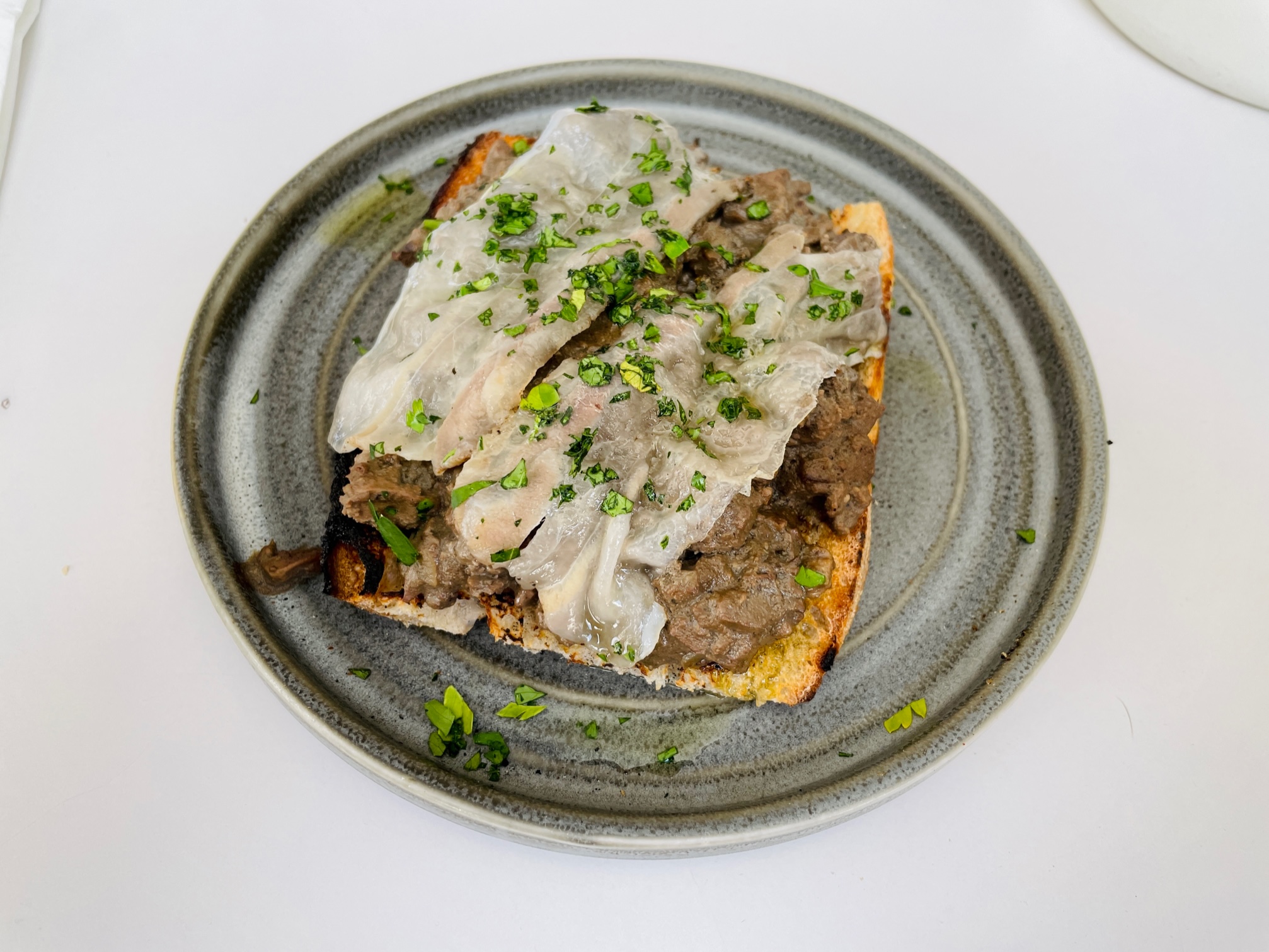
My starter, chicken livers on bruschetta, was more problematic. I know looks aren’t everything, but this dish really wasn’t a looker. It wasn’t even a jolie laide: I usually adore chicken livers, but these were a sludgy mulch and after a few forkfuls it felt like heavy going. What the dish needed was something to cut through, but instead it had a few strips of lardo draped on top, just to add to the general clagginess. On paper, I’d had a very similar dish at the Lyndhurst earlier in the year but they’d served the livers perfect and pristine, with a pesto to add contrast. You got a far better, cheaper dish at the Lyndhurst than at the nationally acclaimed Sonny Stores, where this cost twelve pounds. It was the first underwhelming thing I’d eaten during three days in Bristol, which tells you a lot about the city.

The wine list at Sonny Stores, by the way, was really good – it was especially welcome to see so many wines available in 125ml glasses, as that’s always my favourite way to try several. I had a zippy French rosé with my starter, which provided some badly-needed sharpness, and Zoë’s white was also great: she’d asked for the Argentinian riesling, but they’d run out so they suggested an alternative whose name escapes me. But flagging people down was difficult – the previous day I’d had lunch at a restaurant in the centre of Bristol where there was one waiter doing the work of five people. By contrast, Sonny Stores had five wait staff and they were lovely when you got their attention, but that was a challenge. The chap behind the bar, who made the cocktails, was equally lovely, but if you asked him for help he just directed you to the wait staff. It all felt disjointed, and a little odd.

Oh, and to carry on whinging, that wobbly table was really wobbly. Wobbly enough that I feared for our drinks. Wobbly enough that ideally, while one of you was sawing away at a pizzette the other of you would stop eating your starter and hold it steady. “I can’t believe nobody has pointed this out before”, said Zoë, and I could kind of see where she was coming from. To be fair to the wait staff, one of them clearly noticed and came over to try and fix it between courses – he did his best, but to paraphrase the great Roy Walker, it was good but still not right.

We ordered more wine to go with our mains. Mine sat up on the bar, and I watched it for the best part of five minutes waiting for them to pour the second. By this point I was wondering: is it just me? Was I just out of sorts because of the hot crowded bus ride over the river, or was I a little hung over from the night before? Everyone was having such a marvellous time: what right did I have to feel any different?

My main course did much to soothe my mood. This was the dish which gave me a glimpse of what others had seen in the place. Two huge, gorgeous lamb chops, cooked bang on, sat on a jumble of roasted peppers and coco beans. Again, this wasn’t the most photogenic plate of food I’d ever had but when it tasted this good, when there were so many combinations, so many forkfuls to curate it didn’t matter a jot. It came with dragoncello, which I’ve never heard of but is apparently a sort of salsa verde made with tarragon. I adore tarragon, and I know it goes perfectly with lamb – Geo Café does a wonderful lamb and tarragon dish, on its Georgian nights – but I must be some kind of heathen because this tasted very much like a conventional salsa verde to me.

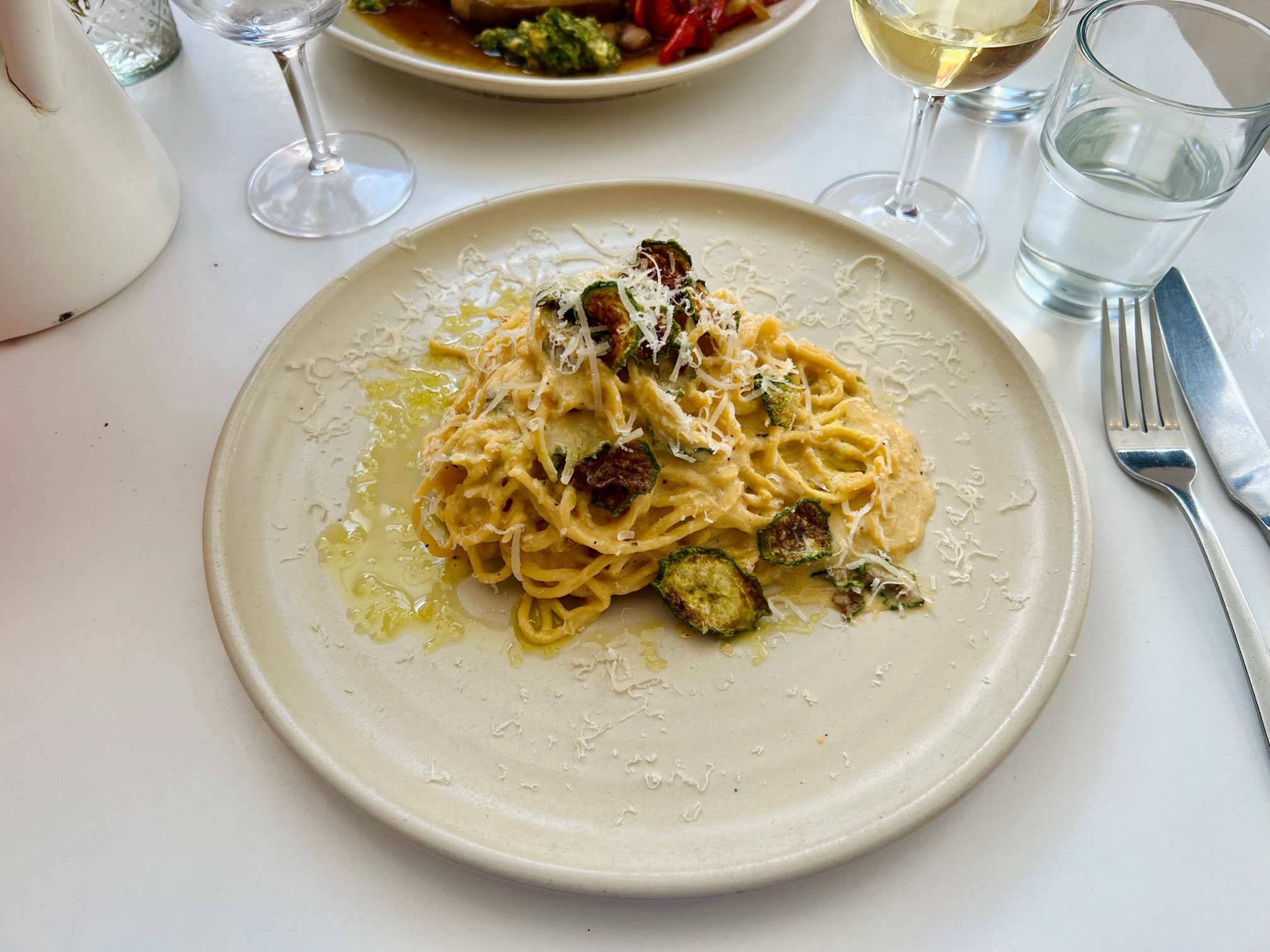
I saw less of my main than I’d have liked, though, because Zoë’s was so underwhelming that I had to keep giving her some of my lamb to prevent a diplomatic incident. It was a problem of expectation management, and we’d done our best to avoid it: the menu said “tagliarini, fried zucchini carbonara”. So before Zoë ordered it, we tried to decipher what that meant.

“So the tagliarini carbonara, how does that come?”

“Well, it’s a carbonara, but with some fried zucchini on top.”

I know there’s a debate about carbonara. I know people dispute whether you should add cream, or whether it should be egg yolks alone. But what I thought was beyond dispute was that it always contains dead animal. You know, pancetta or guanciale: a pig has to die for it to be carbonara. And the impression the wait staff had given was that this was a carbonara with added courgette, but when the dish turned up it was clear this wasn’t the case. At least when vegan restaurants call something “cheeze” or “chickn” they’re giving you a hint in mile high letters that it’s not the real deal, but here there was no such thing: maybe they should have called it a carb-no-nara or something.

“It doesn’t even have that many courgettes in it” said Zoë, who started her main course disillusioned and went downhill from there. First she conducted some kind of search with a fork, desperately looking for the slightest hint of caramelised corpse. Then with a sigh she settled down to making the best of it. I tried some, and immediately resigned myself to having to donate rather a lot of my own, infinitely superior dish.

“It’s just monotonous” said Zoë, for once not talking about me. “Every mouthful is the same. It’s so disappointing.”

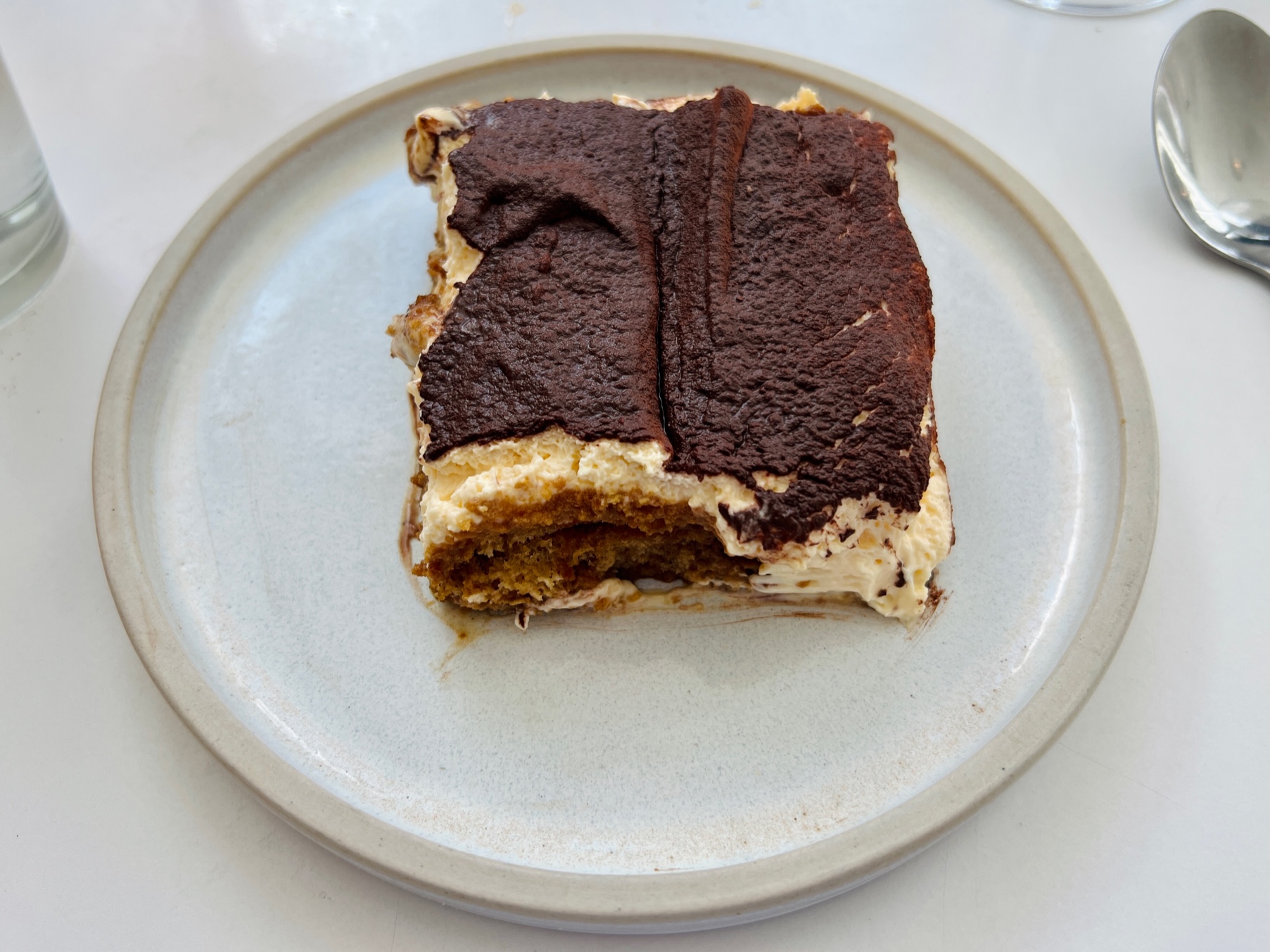
We had desserts, to try and rescue the situation, and again the hit rate was fifty per cent. This time, Zoë was the winner, with a cracking slab of tiramisu – although slab makes it sound like a heavy, weighty thing and this was far more ethereal than that. I had a spoonful for quality control but didn’t push it, well aware of how fortunate I’d been with my main course.

My dessert, on the other hand, kept up the middling work. A chocolate salted almond cake sounds like a beautiful prospect, and this was made with Pump Street chocolate which I adore. But what turned up felt like an unremarkable brownie passing as a cake – the shape was different, but the overall effect was the same. In fact it lacked that textural contrast that makes a great brownie so joyous, the juxtaposition of brittle and fudgy. This was, and I don’t enjoy saying it, another little slice of meh. I loved the crème fraîche that came with it, but when crème fraîche is doing that much heavy lifting it doesn’t say much about the dessert.

Our bill came to one hundred and ten pounds, not including tip. On the bill, Zoë’s main was just billed as Veggie Pasta (“the final insult”, she muttered darkly when I told her). We settled up and headed for the bustling chaos of Bedminster, to do a spot of shopping and pass by the peerless Zara’s Chocolates to buy some bits and pieces for later on. I took a look back at Sonny Stores as we left and thought again about Siblings Home. That site was crying out to be a beautiful neighbourhood restaurant, if only somebody would take a chance on it. And one thing some of my favourite restaurants, like Marmo, or even Oxford’s Arbequina, prove is that you don’t need a gigantic kitchen to offer a really interesting menu.

I know lots of people don’t read my Bristol reviews – they’re a tad niche, and not all of you want to go to Bristol to eat. So thank you, if you’ve made it this far. I also know that any of you reading this, if you do take a trip out west, are unlikely to go to Sonny Stores on the basis of this. So let’s draw things to a conclusion so you can get on with the rest of your day. There is a terrific meal to be had there, if you were to order the pizzette, the lamb and the tiramisu: that’s the Doctor Jekyll. But the equal and opposite Mr Hyde is those chicken livers, that non-carbonara and the chocolate cake. That batting average isn’t enough to elevate it from the other wonderful places to eat in Bristol, let alone options closer to home.

“It just wasn’t quite there” was Zoë’s verdict. “The service was a little off, and that wobbly table did my swede in.” And I think, sadly, that she’s right. It’s a decent – if slightly pricey – neighbourhood restaurant but not, in my book, a destination in itself. That’s hype for you; I liked it in parts but I’m afraid that, like some of the reviews I’ve read of Sonny Stores, it’s not quite as good as it thinks it is.

Sonny Stores – 7.4
47 Raleigh Road, Southville, Bristol, BS3 1QS
0117 9660821

https://www.sonnystores.com

Café review: Cairo Café

Cairo Café closed in April 2023. I’ve left the review up for posterity.

Something I often bang on about often in restaurant reviews is that feeling of being elsewhere, of the power some places have to completely transport you, in mind if not in body. Restaurants as travel agents, taking you somewhere else without having to rack up a huge hotel bill or get to the airport two hours early, or feel that sense of gloom about no longer being able to join the “arrivals from the EU” queue.

Last Saturday evening I had dinner on the sunlit terrace at Buon Appetito, and I felt like I could have been anywhere on the continent but nowhere near Reading. My Aperol spritz shone a luminous orange, soft jazz was playing on the speakers and my pizza was speckled with savoury bombs of gorgonzola left, right and centre. At the end of the meal the manager brought over a couple of amaros for us to try – one from Sicily, rich and sweet, the other from Calabria, medicinal with rosemary and mint. Could I really be a stone’s throw from the Oxford Road? It felt hard to credit.

I had a similar feeling the following day, pretty much from the moment Zoë and I walked through the front door of Cairo Café. It’s where Beijing Noodle House used to be, in a site they’ve bizarrely divided into two not side by side, as usual, but front and back: you walk down a corridor to get to Nepalese restaurant Chillim Kitchen out back, but at the front, with a much smaller bright yellow sign advertising its presence, is Cairo Café.

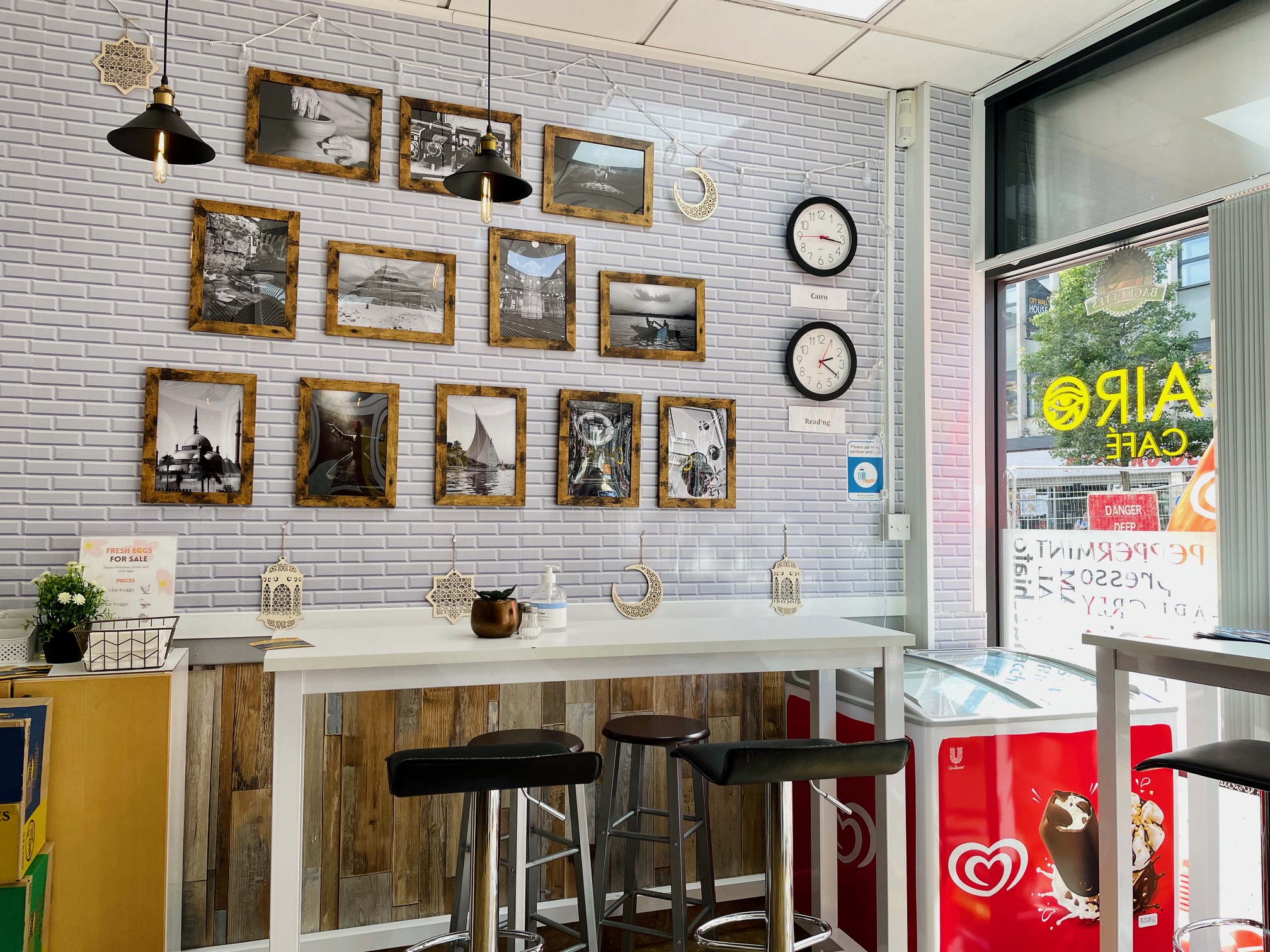
Inside is a little room that could maybe seat ten people, if they knew each other extremely well. Two small tables for two are on the left, all vibrant tablecloths, and on the right is a high table seating four. A couple more stools are up at the window staring out onto West Street, which offers a characterful viewing experience. It’s tiny, but I loved it, with all the little touches like the black and white photos on the wall and a couple of clocks showing Cairo and Reading time.

Like many places serving lunch in town, the menu – in bright yellow above the counter betrays a certain amount of bet hedging. You can have a conventional panini or baguette, if that’s what you want, and the menu gives you all the mainstream choices – tuna mayo, brie and bacon, chicken tikka and so on. And at the counter you can see all the steel dishes with those fillings, if you want to try the same sort of thing you could easily get somewhere like Pierre’s. But the middle of the menu, marked “Cairo Street Food”, is the reason I went: a range of Egyptian dishes, some of which I’d tried and some I’d never heard of. And the kitchen, just about visible out back, is where all of these are conjured up.

“I’m sorry, but we don’t have any falafel” said the owner, aproned and smiling. “It’s been a crazy morning.” Undeterred I asked him to explain a few things on the menu I hadn’t heard of before, and discovered that warak enab was what I would recognise as dolmades, stuffed vine leaves. He went on to explain that sakalans was an iconic Egyptian dessert, a sandwich made with halva, cream and honey: I made a mental note not to leave without trying it. 

I placed my order – this is a venue where you pay at the end – and took a seat. The room had a strangely serene calm, and despite knowing that all the noise of the less salubrious end of town was just the other side of the door, I had that feeling of being transported, of not being in Kansas any more. I could see the owner up at the counter plucking fresh mint leaves for our tea and I had that dangerous feeling that comes from time to time, the slowly building hope that I might have discovered a gem. The tea, by the way, was cracking: fresh and fragrant.

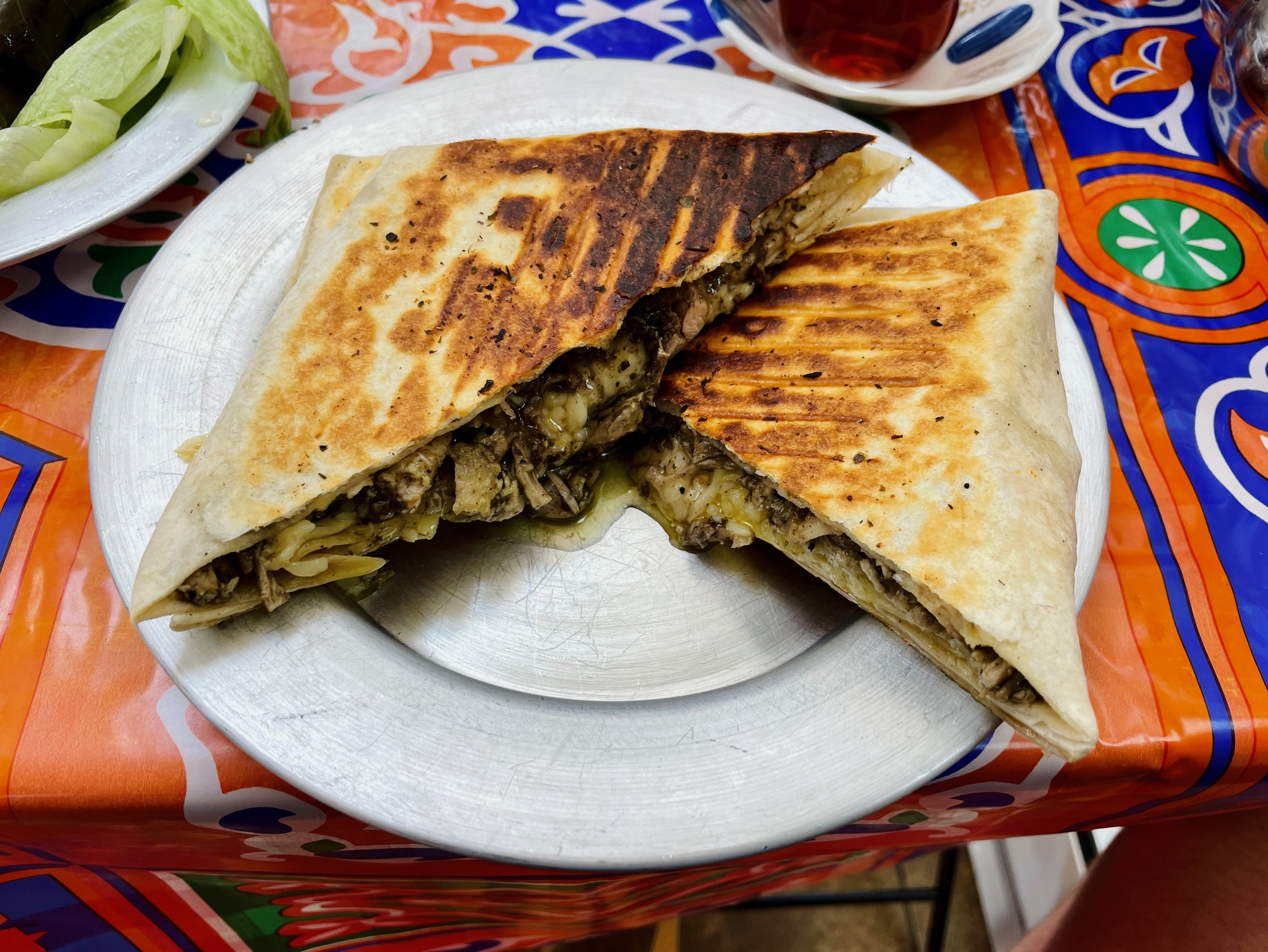
Things improved still further when the chicken shawarma wraps arrived on their little tin plates. So many places don’t know how to assemble a wrap so it can be eaten, so instead either all of it falls out of the end or you get a giant indigestible clove hitch of tortilla. You wouldn’t want these people rolling you a joint, put it that way. By contrast Cairo Cafe’s wrap was a stunner, carefully assembled as a square and flattened under a grill – neat, no wasted space, and the crisped exterior almost reminiscent of a pastilla. 

And the chicken inside was terrific: the whole filling was, in fact, with some kind of beautiful alchemy of chicken, cheese, mint and (this might have been my imagination) a hint of something like cinnamon. I ate it slowly, partly because it was hot but mostly because I didn’t want it to end. This cost a ridiculous – and in all honesty, unsustainable – four pounds fifty. You should go and try it, before he puts his prices up. He should put his prices up.

While we ate our wraps, in a sort of wordless euphoria, something lovely happened. A couple of gents came in to the café looking for a late lunch, but clearly in a rush. The owner explained that he was preparing our dishes and that it would take him a while to put some baguettes together. Were they willing to wait? It transpired that they weren’t, and so they scarpered and as the owner came over to take our plates away he was splendidly unapologetic.

“I’m not making food in a hurry. I want to give people something they’ll remember” – a quiet smile at this point, because the two chaps in question looked like they might have struggled to recall what they did the night before – “even if only for a little while.”

I was happy that we’d been prepared to wait, because our remaining choices, from the more resolutely Egyptian section of the menu, all came together and largely kept up a very high standard. Possibly the weakest thing were the waraq enab: I love stuffed vine leaves, but these weren’t quite the best I’ve had, a little too saccharine. I don’t know if they’re made on the premises – they might be, because they felt a little ragged and slightly loosely wrapped – but I’ve had better, both at Bakery House and at Blue Collar, from Fink as part of their superb mezze boxes. A good example of wayward pricing, too: these cost as much as a shawarma wrap. I know which I’d rather have.

But the other two dishes we’d chosen returned to the high standard of those wraps. Moutabal was a bright, zingy thing shot through with parsley, perfect loaded on to pitta (the pitta, again, was a slight weakness: a little hard, and not quite enough of it, although I’m inclined to be more forgiving than it was). It didn’t have the smokiness I associate with some examples – this was a light and happy dish, not a dark and brooding one – but I didn’t like it any the less for that. Dark and brooding gets boring, doesn’t it.

Even better was the sojuk, a marvellous surprise and one of the nicest things I’ve eaten this year. I was expecting something like Bakery House’s maqaneq – sausages cooked and served simply with onion and lemon juice – but what I got instead was wonderful pieces of coarse, caramelised sausages, punchy and brick-red inside, in a thick, spiced gravy (if I didn’t know better, I’d have likened it to a curry). Slow-cooked, soft pieces of green pepper and green chilli were in the mix, giving the potential for every mouthful to be a gorgeous sunburst of heat. 

Again, this was four pounds fifty and again I worry about the owner’s ability to make money charging so little. I ate forkful after forkful in beaming delight: Zoë loaded some on to a piece of pitta, dolloped some moutabal on top and said something to the effect of “this is really fucking good” between mouthfuls. It was, simply put, one of my favourite discoveries of 2022 so far, and I’m not sure I’m capable of going back and not ordering it.

As we reached the end, and sipped what was left of our mint tea, there was a moment of perfect peace. The hubbub of West Street had died away, no customers came in, the owner was out back. The clocks on the wall ticked away the advancing seconds, in Reading and Cairo, and I thought to myself: there’s something slightly magical about this place.

When the owner took these plates away, I asked him a little about Cairo Café. He’d been trading for four months, he said, and things were going well.

“Do you sell more stuff from the Egyptian side of the menu than the conventional dishes? It would be sad if most people who came here didn’t try this.”

Another grin.

“Yes, we do. But I try hard to convince people – we give out little samples, too.” I was reminded again of this man’s spiritual family here in Reading: people like Jo at Kungfu Kitchen, Nandana at Clay’s, Keti at Geo Café and Kamal at his eponymous new restaurant. People who believe in the narrative power of food, of telling stories, of welcoming you into their home with the food they grew up with.

“I’m glad customers don’t just come here for an English breakfast.”

“We don’t do one! We do that stuff in a baguette but we don’t do a full English. We sell an Egyptian breakfast instead” (it comes with falafel and shakshuka, by the way, and it sounds excellent).

“What should I order next time I come here?”

“I know we’ve sold out, but our falafel are really good. And you should try the beef livers.” I made a mental note: the menu says they come ‘all the way from Alexandria’.

The sojuk had a wonderful building heat, so I wanted something cooling and I’d left room for dessert so we ordered a couple more things. Again, the owner apologised that they would take a while but by that point I thought the prospect of another half an hour in Cairo Café was a positive boon, so I wasn’t complaining. First to arrive was a cooling drink which had rather been misplaced in the “Fresh juices” section, a drink made with yoghurt, milk and honey. I absolutely adored this – as a dairy fiend it’s right up my alley at the best of times, but what I loved about it the most was how light and delicate it was. It didn’t have that thick stubbornness a lassi can have, and the sweetness was almost floral, complementing things rather than beating you round the head. To add to the random pricing, this was four pounds but, for me, worth every penny.

Last of all, I had to try the sakalans. This took a while to prepare and I can honestly say I’ve never had anything like it – a warm, almost-crunchy baguette split lengthways and crammed with cream, honey and huge wedges of halva. I’ve loved halva for years – ironically, since my mother brought some back from a holiday in Egypt, and as a huge fan of sesame in all its forms this dish had a huge amount to appeal to me. The idea of sticking it in a sandwich had never occurred to me, but eating this I was delighted that it had occurred to someone. Zoë was a little less convinced by it, I suspect, but she was also either fuller, or more restrained, than me.

Our bill, for all that food and an hour and a half of serene, unmitigated delight, came to forty-five pounds, not including tip. I felt a compulsion to keep telling the owner how much I’d enjoyed everything, but eventually I realised I’d have to button it and stop thanking him. Besides, I have the opportunity to tell all of you instead, so it’s not as if I’m going to get an ulcer from suppressing anything. I went on my way absolutely convinced that I would be back, and positively evangelical about making sure some other people went there too.

My overwhelming feeling when I discover somewhere like Cairo Café is to think: how lucky are we in Reading? How lucky are we that despite the best efforts of the unholy trinity of Messrs Brock, Sykes and Horton-Baker, that cabal of the unimaginative, avaricious and dim-witted, people still come here to open their restaurants and their cafés, to battle away against the misguided focus of our public bodies and the bleak indifference of our local media. How lucky are we that we still get a gem like Cairo Café defying all of that inertia and doing their damnedest to get a foothold in this town?

It reminds me, many years ago, of another café only a few doors down from where Cairo Café is now: Cappuccina Café, a modest little place serving banh mi and pasteis de nata. I visited it, I rather liked it, I wrote a review and within a month it was closed. It remains, even now, one of the Reading closures I’m saddest about – more so, in a funny kind of way, than all the Mya Lacartes and Dolce Vitas out there; everybody misses them, but when I think of Cappuccina Café I sometimes think it’s mourned by me and me alone. I’m determined to do my bit to ensure that Cairo Café doesn’t go the same way. So please, go there and try the food: it has, I think, a little spark of magic. And heaven knows, we all need to keep that alive in Reading, as much as we possibly can.

Cairo Café – 8.3
13 West Street, Reading, RG1 1TT
07862 200055

https://www.instagram.com/cairocafe11/

Restaurant review: Shree Krishna Vada Pav

When it comes to food and drink, Reading is an especially interesting place. You may find this hard to believe at times, but it’s true.

I don’t mean all the stuff that’s obvious to you, especially if you’re a regular reader of this blog. I don’t mean our coffee culture, or our street food scene that’s the envy of towns for miles around. I don’t mean our two local breweries with taprooms, or excellent pubs like the Nag’s and the Castle Tap selling fantastic craft beer and cider. I don’t mean the jewels in our restaurant crown – places like Clay’s, the Lyndhurst, Kungfu Kitchen or Vegivores. I’m not even talking about our network of local producers and the independent shops, like Geo Café and the Grumpy Goat, which sell their stuff. You know all that already, although I suspect a lot of people who live here still don’t. 

No, I mean interesting in terms of the world outside our food-loving, indie-supporting echo chamber. Because a lot of businesses have clocked that Reading – with its university, its prosperous populace and its tech employers, just the right distance from London – is the perfect place for them to open another branch of their restaurant chain and make pots of cash. They have us down, mistakenly I like to think, as something of an Everytown, the perfect testbed for their particular flavour of the hospitality experience.

In fact, two very different types of businesses have Reading in their sights. The first, tapping into that affluent, well-educated demographic, are smaller, more targeted chains. They’ve often seen Reading as their first attempts to expand west (Honest, Pho) or east (The Coconut Tree), or just picked it as one of the first stops on a journey to nationwide ubiquity (Itsu). And this still continues, albeit to a lesser extent: we’re getting a Leon and a Wasabi this year, don’t forget.

But the second type is more interested in Reading as Everytown, and often we are the lucky Petri dish they squirt their pipette into before deciding whether to open branches elsewhere. And this is, I’m afraid, often an American thing. It’s no coincidence that Reading got one of the first Five Guys, got a Chick-Fil-A, albeit briefly, got a Taco Bell and a Wingstop and a Wendy’s and has a Popeyes on the way. Such is life: newly added to the Tube map, but somehow equidistant between London and the good ol’ United States. 

These big American chains with plenty of money are aided and abetted in their mission to slightly worsen Reading by our local media – which posted dozens of stories about Wendy’s, mainly because they were too dumb to think critically for even a split second about whether Reading getting the first Wendy’s in the U.K. was actually a Good Thing. But it also points to just how much is going on in Reading, and how interesting the battle will be between all these factions fighting it out for your money. No wonder Jonathan Nunn, the editor of Vittles, called our town a “fascinating anomaly”.

“Why is this the subject of your interminable preamble this week?”, I hear you say. I thought you’d never ask. The reason I talk about all of this is that the subject of this week’s review is that rare thing, a chain choosing to plonk a branch near the centre of town that people can get genuinely excited about. Because Shree Krishna Vada Pav, a small chain selling vegetarian Maharashtrian street food which started out in Hounslow and only has three branches outside the M25, comes here with an excellent reputation.

Subscribe to continue reading

Become a paid subscriber to get access to the rest of this post and other exclusive content.

Café review: Madoo

It’s a fact of life in hospitality that restaurants open and close all the time. There’s an inexhaustible supply of plucky new businesses ready to sign a lease and try their chances, and you can almost measure how long someone has lived in Reading by how far back they remember the history of certain sites. Do you recall when Thai Corner used to be Bistrot Vino, or when the Nando’s on Friar Street was a place called Bistro Je T’aime? You’ve probably been here since the early days of the Oracle, if not longer.

In some cases a restaurant makes such a go of it that you almost completely forget the establishments that went before. Some people have long memories, and remember Mum Mum or that pretzel joint on Market Place, but for many people I imagine it feels like it’s always been Tasty Greek Souvlaki. And although I know rationally, in the back of my mind, that there used to be a great branch of Ha! Ha! on the Kings Road – and that after that it was a Turkish place, and a tapas restaurant, and a weird kind of pub that closed on Sundays – it’s been House Of Flavours so long that it’s jarring to imagine anybody else there. It’s a bit like how, after you’ve been in a relationship with a person long enough, your previous life feels as if it belonged to somebody else.

But there are some sites where you need not only a long memory but a good one, because so many restaurants try and fail to make a go of it on the same premises. The quintessential example of this is the site of the old Warwick Arms, which has been Bali Lounge, the Biscuit & Barrel, Cardamom and King’s Kitchen and currently goes by the name of the Aila. I only reviewed the first two of those, and most of the others closed before I could get round to them.

Or take Cozze’s site on the Caversham Road, which has been Chi’s Oriental Brasserie, La Fontana, Al Tarboush, Casa Roma and Maracas, all of which eventually went pear-shaped. (Incidentally, I heard a fantastic story once that when Casa Roma decided to change to a Mexican restaurant called Maracas they did it mainly because they realised they could reuse all the letters in their sign except the O: I so hope this is true.) But can there really be a god in heaven when the TGI Friday opposite has outlasted them all?

What’s behind these high-churn sites, I wonder? Is it bad judgment, bad luck or bad juju? Are they run by enthusiastic amateurs who bite off more than they can chew, or are some sites simply cursed – by lack of footfall, of parking or of access, or by the presence of better (or better-known) alternatives nearby? Or is it just that they haven’t found their forever home – or rather, their forever homeowner – yet? All that crossed my mind last weekend as I stepped through the front door of Madoo, ready for lunch.

Subscribe to continue reading

Become a paid subscriber to get access to the rest of this post and other exclusive content.

Kamal’s Kitchen Competition: the results!

I’m delighted to announce the results of the competition I ran last month with Kamal’s Kitchen. As ever, this was a writing competition and I asked entrants to give me 250 words on the Reading institution they missed the most – and this clearly triggered a tidal wave of nostalgia, not only in the competition entries but also in the feedback I got on Instagram.

Unsurprisingly, some names came up again and again – so if, for instance, you miss Dolce Vita or Mya Lacarte rest assured that you’re far from alone. But there were also a few cafés and pubs that were mentioned in despatches – Tamp Culture and the Tasting House, obviously, and Tutti Frutti come to think of it. And then there were the more niche choices that marked you out either as having distinctive taste or a long memory (or both). So award yourself a handful of internet points if you find yourself missing Sardar Palace, or Brett’s, or Café Iguana. And you get bonus points if you remember Cartoons (although, like the Sixties, if you can remember Cartoons you probably weren’t there).

I found myself thinking about all the places I miss that nobody mentioned. Bhoj, back when it was down on the Oxford Road, the proof of concept that the people of Reading were very happy with the idea of eating excellent Indian food in a room with orange walls. Ha! Ha! when it was where House Of Flavours is now: it did a chicken and chorizo pasta dish which probably offended several national cuisines at once, but back in the early Noughties I couldn’t get enough of it. Cappuccina Café on West Street with its beautiful bành mì. Santa Fé on the Riverside, with its boozy 2 for 1 cocktails and its beefburgers served in a tortilla wrap. The 3Bs. Sahara. I could go on, but if I do I’ll just get sad.

I’m delighted that I wasn’t the judge for this one, and that dubious honour went to Nandana Syamala, co-owner of Clay’s Hyderabadi Kitchen. Nandana runs one of the restaurants people in Reading would most miss if it vanished off the map tomorrow, but also as a relative newcomer to Reading judging the entries gave her that Bullseye “look what you could have won” feeling. I asked Nandana how she felt about judging this competition, and here’s what she had to say:

The majority of the entries talked about the hospitality industry, and I’m really glad about that. I’ve always believed that a vibrant independent food and drink scene is what gives a town its identity, and makes it a much more fun place to live. All of us in hospitality aim to make a mark the way Dolce Vita or Mya Lacarte have, and be remembered with fondness many years after closing down.

But for me personally, what I miss the most is Tuscany on the Oxford Road. During the short time they were open, we developed a ritual of going to them with a bottle of wine after closing our restaurant by 10pm on a Sunday night. And honestly, that’s where we had some of the best pizzas in the U.K. Sometimes, when it was their closing time, they would bring in their not so secret stash of some of the best Italian charcuterie, and we’d share wine and our experiences. In fact, I may have been guilty of closing the kitchen early a few times, just so I could get there and have my favourite meal of the week.

Nandana is spot on: I miss Tuscany too. Anyway, without any further ado, here are the results. Oh, and the picture below is of a takeaway I had recently from Kamal’s Kitchen: he’s on delivery apps now, and those extraordinary pressed potatoes travel surprisingly well.

WINNER: Derek Goodridge

From the 1980s through to the early 2000s, Reading had an excellent delicatessen, County Delicacies, situated on St Mary’s Butts. At this time the store was really the only place in town that you could rely on for interesting food purchases. I was a regular visitor on Saturday mornings, along with pretty much anyone else wanting to stock up on cheese, charcuterie, excellent breads from DeGustibus bakery and lots more. Almost every visit ended with purchases that I hadn’t planned but were too good to resist: perhaps Italian fennel sausages, fresh rum babas, slices of proper cheesecake or possibly a cheese I hadn’t tried before but was persuaded to try.

The store was presided over at the time by the late Chris Rogers, who managed to keep the large queue of customers happy even though sometimes on Saturday it was several deep. He was assisted by “Saturday job” part timers, one of whom I discovered later was the young Kate Winslet. I recall that each purchase would be weighed and priced, then added up by hand on the edge of the wrapping paper, possibly the last store in the town to do so. The store changed hands in 2001 and Chris retired, finally closing permanently in 2010.

I’m obviously pleased that new independent food vendors are established in the town, so it would be wonderful if they were joined once again by a quality delicatessen run by knowledgeable people. Maybe one day!

Nandana says: I had no idea Reading had such a place! Reading this has reminded me about places like that I’ve visited in Italy, some even at highway service stations, and remembering the hours spent exploring the wonderful produce they stock. It makes me imagine how wonderful it would be to have a place like this in Reading (it made me crave a good rum baba too). The town’s changing: I hope we get a great delicatessen too very soon.

RUNNER-UP: Lucy Manners

I miss Fisherman’s Cottage. I miss the cod croquettes, I miss the potatas bravas with the right amount of smoke, the plump prawns in the paella, oh the paella, and everything with a lick of punchy aioli. 

I went with friends and we laughed, grazed, chatted, grazed, gossiped and grazed some more. I walked down along the river to Fisherman’s Cottage several times with my first post divorce date for lazy sunny lunches and we talked about tapas in Spain and the future. I know why I miss it though. Not just missing the food, but the me I was when I was eating the food. After all, it wasn’t all good. I never quite ‘got’ the faux beach huts out back, and the calamari had more than a hint of elastic band the times I tried it.

Since Fisherman’s Cottage closed my then date is now by my side raising our two young children and juggling life. Lunches are often an exercise in eating quickly before a child needs you to cut more up, replenish the dip-dip, fetch another drink or asks for the bite from your plate you were saving for last. Rare meals ‘out’ just the two of us are a fiercely planned thing – on the calendar weeks in advance, locations debated with links, recommendations and menus WhatsApped during night feeds and quiet moments at the desk. I think if it was still open, Fisherman’s Cottage and a stroll down memory lane would be a contender. 

Nandana says: This is one place in Reading we were lucky enough to experience! We went a couple of times before they closed and always had really enjoyable meals. This piece captures what a great restaurant can do – trigger memories of a place, of what you were at that time, and create a longing to go back and experience or feel that all over again. I can imagine I Love Paella doing exactly that: it’s dearly missed by many, including us.

Amen to that. Huge congratulations to Derek, who wins a meal for four including drinks up to a maximum of £120, and to Lucy who wins a meal for two, also including drinks, up to a maximum of £60. And many thanks to everybody who entered – and, last but not least, to Kamal’s Kitchen for being so generous.