Restaurant review: The Royal Berkshire Hospital

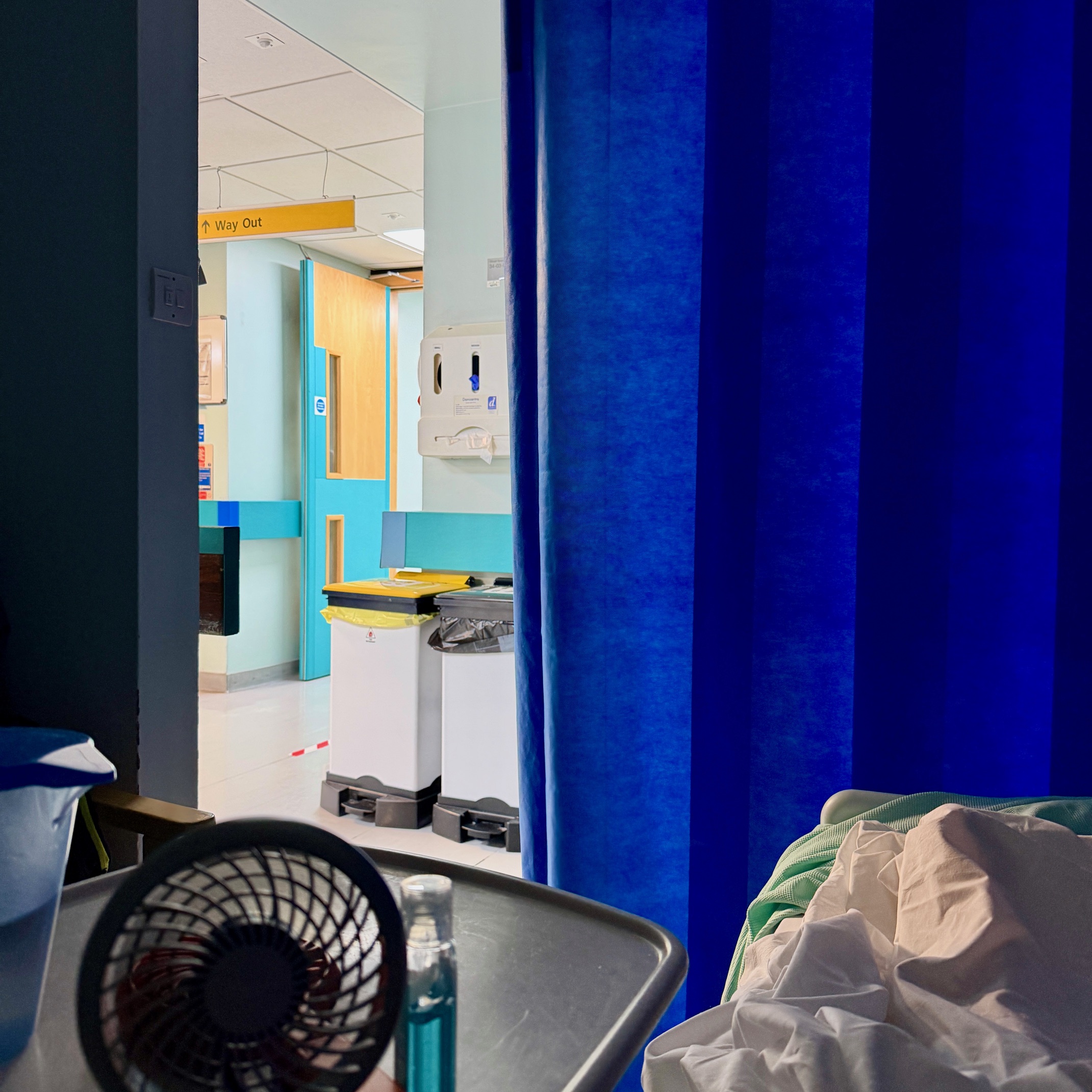
On the Wednesday afternoon, my second full day in hospital after the accident, I put some pictures up on Facebook. Nothing special, just a picture from my bed of Dorrell Ward, my left foot poking out, and a shaky, badly photographed picture of my lunch. Well, I never thought this would be my next forthcoming restaurant review my caption read. I know the English is clumsy but in my defence I was dictating it, because typing was too challenging at that point. Besides, I’d probably just had some morphine.

The comments were immediate, plentiful and properly lovely. A couple of the funny ones stuck with me. Chronicle hitman? said one: I replied that it was more likely to be a whack job by the owners of Vino Vita. Another said that is extreme lengths you’ve gone to to obtain a review. I had the comeback in my mind – no stone left unturned, I thought I would say – but looking at my Facebook page, it seems I never posted it. Perhaps the morphine had kicked in by then: I did spend quite a lot of the time asleep, at the rare times when sleep came easily, because that way everything hurt less.

But the thing is, on some level it is a gap that I’ve never reviewed the Royal Berkshire Hospital. Because you could make an argument that it is Reading’s largest restaurant: the trust employs 7500 people, admittedly across more sites than just the RBH, and has over 800 beds. Put that way, it’s hard to imagine that even Reading’s busiest conventional restaurant feeds more people in a week.

So I suppose, in a funny kind of way, this review is sort of overdue. During my four night stay in a place that doubles as Reading’s busiest restaurant, I begin to get an idea of what an unusual beast it is.

* * * * *

I wasn’t meant to wind up an inpatient in the Royal Berks. A whole chain of things had to go wrong for me to be in the place I was and make the decision I did.

First of all, I shouldn’t have been commuting home that Monday afternoon. The previous week I’ve been off with the cold that everyone has had, the cold that wiped us all out. And I only went into the office to catch up with my boss, only to find when I got there that he’d had to take the day off at short notice. If I’ve known I would have worked from home, and never made the fateful journey that led to me coming a cropper.

And my boss’s boss, seeing that I was less than 100%, told me to go home early. That played a part too. So I found myself getting off a train somewhere between four-thirty and five o’clock, cutting through Harris Arcade on my way to pick something up from the supermarket. If I’d been later, the arcade would have been closed and I wouldn’t have used it as a short cut. But all those things happened, one after another, and so a little before five I got to the Friar Street end of the arcade to find the shutter in front of the exit halfway down.

In my mind, I thought two things that weren’t necessarily true. I thought that if I headed back to the other end of the arcade, I might find that shutter down too, and then by the time I returned to where I was I’d be shut in the arcade. I also looked at the shutter in front of me and thought to myself I can squeeze under that. And in that respect, I was sort of right: I did manage to shimmy under the shutter.

The problem was that retaining my footing on the other side was completely beyond me.

I went unceremoniously flying, face first into a parked car. My glasses were smashed to pieces, my face bleeding and grazed. But that wasn’t the first thing I noticed. The first thing I noticed was that my arm, in unbelievable pain, no longer felt like mine. I have had to tell this story more times than I can tell you: to friends, to family, to acquaintances, but also to every single NHS staff member who has spoken to me in any capacity since the accident. The first thing they ask you is to confirm your name and your date of birth. But the second thing they say, without fail, is so how did it happen?

I always start with it’s really embarrassing, followed by do you know the Harris Arcade in town?  My shame is then compounded by the fact that invariably, whoever I’m talking to knows exactly where I’m talking about: I can’t even make it sound less ridiculous an accident than it was. “I’ve never heard that one before” said the very nice man that took my first x-ray after I was discharged from hospital. Many of the reactions have been variations on that theme.

My wife has heard me tell the tale many times, and has given me tips on how to make it more entertaining which I refuse to follow. Stories in her family are currency, and sitting with them watching them trade anecdotes is one of my favourite things to do, an opportunity to relax and enjoy the show. Zoë tells me that to get a big laugh I should pretend that the shutter was literally rolling down as I reached it and that I chose in an instant to slide underneath it. 

But that makes me sound intrepid, or brave, or both. In reality, I’m just a dumb middle-aged man who made a bad decision and went down like an overweight sack of potatoes. The closest I’ve come to taking her advice is this: whenever I tell someone what happened I say I tried to get under the shutter like a shit Indiana Jones. Even that, I’m painfully aware, makes me sound cooler than I really am.

* * * * *

After the accident, in shock and in pain, unable to see, I am peeled off the pavement by Elliott and Alex.

Everyone likes to think that they would stop in circumstances like these, but I think we all know that most people don’t. Elliott and Alex do. They are second year students at the university, who just happen to be in town that afternoon. They ask if I’m okay, and it soon becomes apparent that I’m not. They help me to a bench outside M&S, near the statue of Queen Victoria. They call 999 and put me on the line. The call handler suggests that I should go to the minor injuries unit in Henley. Elliott and Alex are having none of that. I call my wife, still at work, and she picks up because she knows that I never call her when she’s at work.

“Is everything okay?” she asks me. No, I reply. My arm doesn’t work, I say.

Elliott and Alex call me an Uber to get me to the RBH. Getting into it is agony, but they keep talking to me, keep me in the room, keep me distracted. They call their friends and tell them they’re running late, and they ride with me to the hospital and wait with me until my wife arrives, having rushed back from work. These people don’t know me, don’t know anything about me, but they give up two hours of their evening to stay with a stranger, one who’s in excruciating pain and blind as a bat. They only go when they know that Zoë has got home, has picked up some stuff and is in a taxi on her way to me.

We swap phone numbers, and Elliott texts me several times over the weeks ahead. I am yet to persuade him to let me pay for the Uber, but I intend to keep trying. It is the first and probably the biggest kindness I experience, but by no means the last.

After they are gone, I squint at my phone held in my one good hand and wait for Zoë. From down the corridor I hear her at reception. “I’m looking for my husband” she says, and when asked to describe me, she says “he’s big and grey”. I make a mental note never to let her forget this, but I’m just so happy she’s there.

* * * * *

My first experience of the food on the ward, the day after I am admitted, is not the best. Despite the fact that I’m pretty much unable to move, arm in a cast, dosed up with codeine and morphine like clockwork, it hasn’t registered with me that eating with one hand is going to be extremely difficult. I order cornflakes for breakfast, and then realise that sitting up in my bed to eat them is something of which I’m simply not capable. I write that off, because oddly my appetite isn’t what it usually is, and decide I can save myself for lunch.

Lunch is a vegetable risotto, glistening strangely under artificial lights that give it almost an oversaturated look, like a Martin Parr photograph. I push a couple of forkfuls into my mouth and decide these are calories I can do without. Besides, I decide that it looks more like something deposited on a pavement after closing time then the sort of thing I’m used to in pubs and restaurants. At this point, I guess I’m thinking of the Royal Berks as like an all inclusive holiday: you can always sneak in food from elsewhere.

Zoë comes to visit me every day, and between us we soon learn the ecosystem of alternatives in the hospital. The top of the tree is the M&S – “that little Marks & Spencer is a godsend”, Zoë says to me, remembering all the vegetable samosas I smuggled in for her when she spent the best part of a week on the Covid ward. I have a bag of crispy chocolate clouds on my bedside table pretty much most of the time, the challenge being to eat them before the sweltering heat makes them unviable.

And then there’s the hierarchy of coffee. Back when I lived near the hospital I used to walk to AMT for their mochas, and on hot days I’d buy a Froffee, a coffee and ice cream milkshake, and drink it in Eldon Square Gardens, soaking up the sun. I was between jobs back then, and it broke up the afternoons. But AMT’s best days are behind it, and the mocha Zoë brings me one morning is genuinely undrinkable. 

Better, to my surprise, is Pumpkin: one afternoon my dear friend Jerry comes to visit me and fetches me a mocha from Pumpkin which is a hundred times better than AMT’s. He also brings me a copy of Viz and the latest Private Eye, which is the kind of thoughtful thing great friends do. I read them at night, by the light of my bedside lamp, after half nine when visiting hours are over and my knackered wife has gone home to get some rest. She keeps me company for 12 hours, every single day, and she never complains.

We aren’t used to spending nights apart, and of all of the things about this that might be one of the most upsetting. The lights are never completely off in the ward, because they’re always coming round to top up your drugs or check your blood pressure. But with my fan whirring, and the other noise abating, the Yves Klein blue curtains drawn around my bed, we send each other good night messages and pictures, and I try to quieten my mind by reading the magazines that Jerry has brought me.
When it comes to coffee the god tier is Jamaica Blue. I reviewed them, over seven years ago, but somehow I’d forgotten about their existence, or how good they were. On the morning of my discharge from hospital Zoë brings me one of their mochas, and for the first time in almost a week I am reminded of how wonderful a thing great coffee can be. It’s a small, tenuous link to my pre-accident life of little luxuries, of V60s at home or my latte at C.U.P, always at 8am, before hopping on the train to the office.

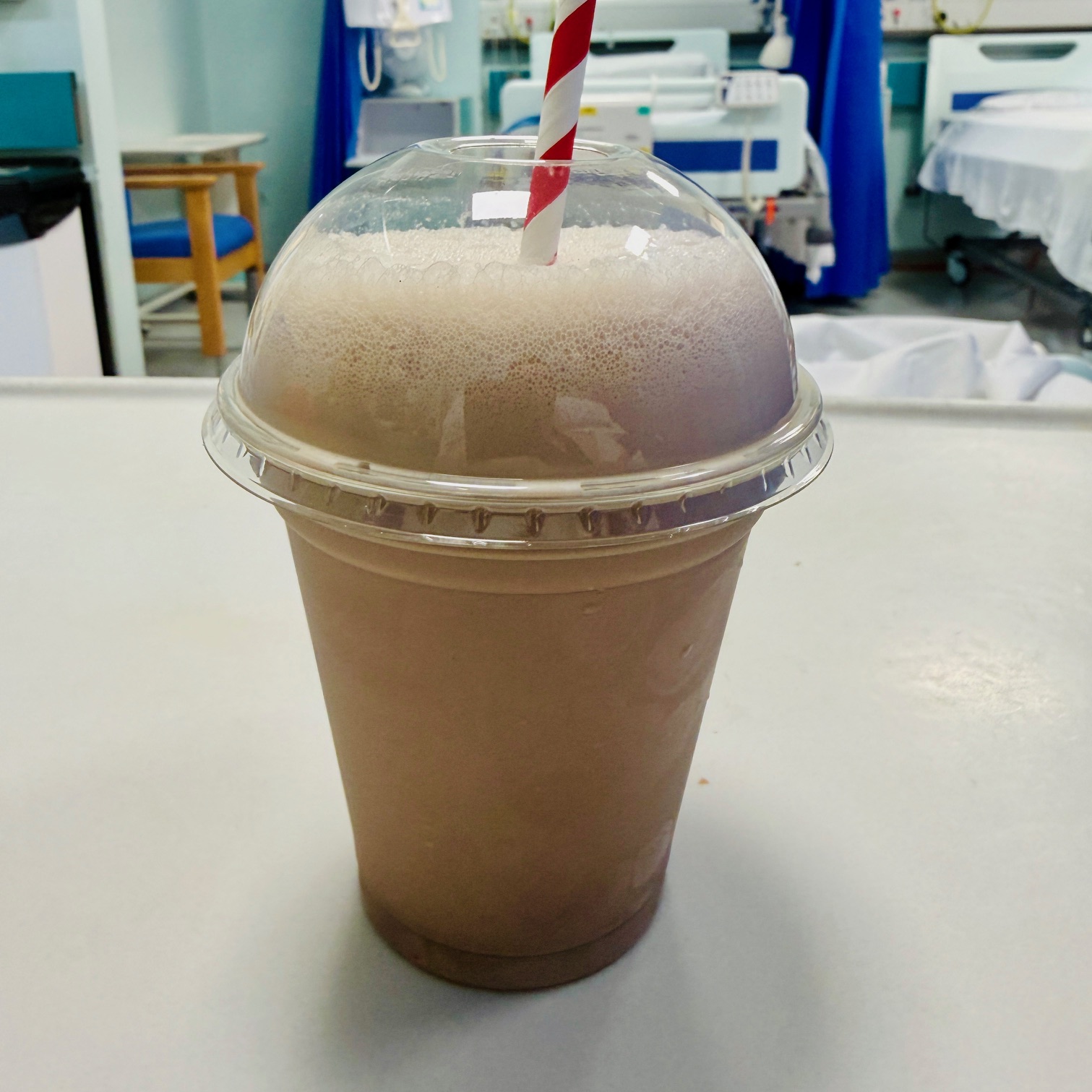
Even better than that, if such a thing is possible, is the milkshake Zoë brought me the previous afternoon from Jamaica Blue, an indulgence so lovely I could almost weep. Thick, cold, chocolatey, more fun than you would ever reasonably expect to have in a hospital. It tastes, to paraphrase Philip Larkin in another context, like an enormous yes.
* * * * *

If I didn’t rely on goodies from the M&S or from the hospital’s cafés as much as I could have done, there was a reason for that. The reason was that the food from the Royal Berks proved to be quite the surprise package.

The menus come round every morning, printed each day, a series of boxes and options to tick for the following day’s breakfast, lunch and dinner. The weeks are numbered, and the font at the top of the menu calls them Lunch and Supper, in Mistral, a typeface you know even if you don’t realise you do. It’s the one from the logo of Australian soap Neighbours, designed in the ‘50s, a beautiful cursive script that is simultaneously retro and timeless. I’ve always loved Mistral, and somehow it brings a tiny chink of sunlight into a room shrouded with blinds.
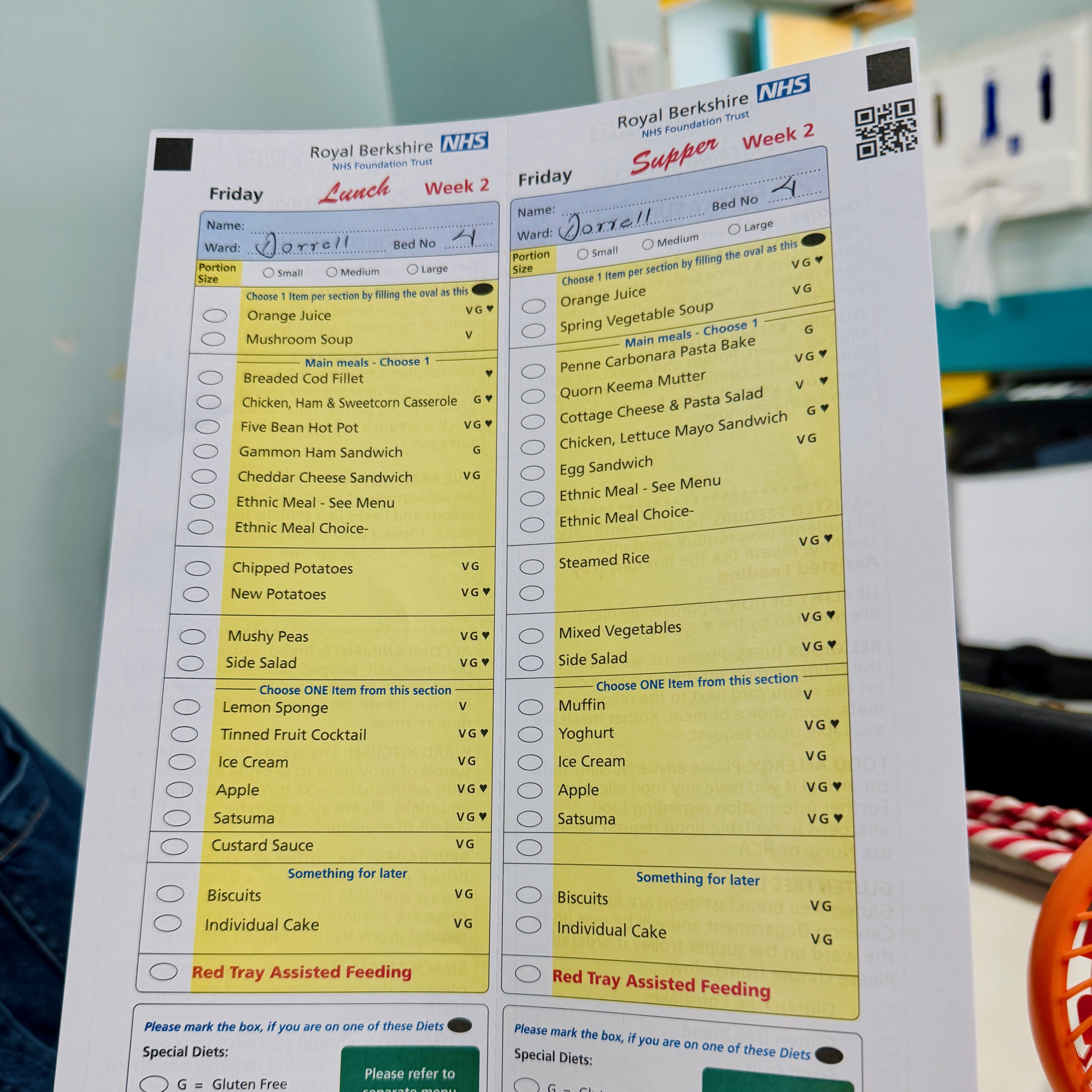
After that disappointing risotto, somehow I never have another entirely bad meal during my time in hospital. For lunch on my second full day, I have a beef curry with rice and chunks of potato and while I’m eating it, I realise that it’s actually quite good. Not just the absence of bad, although I would’ve settled for that, but decent. 

The meat isn’t soft, tender, falling apart as it would be in a Clay’s curry, and the spicing isn’t complex, or even front and centre, but it’s not bouncy, fatty or gristly. The waxy cubes of potato add something, and I find that even with a broken arm, even with a hot uncomfortable cast on me, even with the fan humming and the painkillers wearing off, this is a good meal.

And then, afterwards, an even happier surprise. An apple crumble where the base is sweet, stewed apple but more importantly, the ratio of crumble to fruit is beyond reproach. And by that I mean that it’s easily two thirds crumble, a huge and joyous permacrust of biscuit so thick that I’m fearful, with only one hand, of whether I’ll be able to force my spoon through it. I manage it somehow, and the rewards are considerable.

I include a picture of my lunch with a picture of my ward as I send that first Facebook post mentioning what’s happened to me and where I have found myself. The responses flood in wishing me well, but they also do something interesting that I didn’t expect: a lot of them talk about the food. Because, and I had no idea of this, the hospital makes all of its food from scratch, on the premises, and they serve it in the restaurant as well as serving it to the patients. They could so easily use the likes of Sodexo: how wonderful it is that they choose not to.

One commenter tells me that she used to be the patient services manager for the catering department. The hard work that goes into all of those recipes is outstanding she tells me, and I can well believe it. She also sends me a lovely message with a few tips about what you can and can’t do around the menu, catering life hacks; I thank her for them but decide not to do any of them, because I don’t want to be a diva. The staff start work at 6am every day, she tells me, and work for 14 hours to ensure feeding everybody in the hospital: Reading’s largest restaurant indeed.

So many people comment along those lines, about the food, about the staff, about what a wonderful place the Royal Berks is for people when they need care the most. One of comments says how lovely the hospital’s goulash and spicy lamb are, another recommends the “cultural and religious menu”, a tip that is echoed by Zoë from her time on the Covid ward. The menu just calls it a “ethnic meal”, but I order it multiple times and am never disappointed.

Somebody else tells me that she’s been a patient at the RBH on and off for 18 months. The food is one of the highlights she tells me. It sounds silly, but all these intersecting stories, this universality of experience makes me feel less alone, and less scared. It also reinforces that even if I have very limited experience of this hospital – this is the first time I’ve ever spent the night in a hospital since I was born – the RBH is at the centre of Reading life, and it touches everybody.

It was there when my wife was taken away from our house in an ambulance late at night for a prolonged stay on the Covid ward, in the depths of winter 2021. Both of my sisters-in-law were born there, so were both of my beautiful nieces. It’s the RBH that treated my father-in-law when he had cancer, and again when he had a heart attack. And that’s just my family – but from the pile of comments I got a clear impression that it was central to countless more families than mine.

I never quite get over not hating the food. The following day I have a beef stroganoff which again, is just downright comforting and nice. The little mini packets of biscuits are by Crawfords, and are really enjoyable with a cup of hospital tea; I allow myself two sugars while I’m in hospital, it seems only right. The ice cream is lovely too, despite not resembling any ice cream I would buy for myself on the outside. You almost need to eat it first, because by the time you finished your stroganoff or your keema curry – accompanied by a little pot of dal or vegetable curry – it is a texture almost like foam.

* * * * *

One of the comments on my Facebook page says NHS toast is up there. And there is truth in that, too: every morning my breakfast form requests white toast with butter and Marmite, and there is real comfort in eating that around 8am, when the ward starts to stutter to life and the shifts change over, when you give up hope of getting any more shut eye until the afternoon. 

With only one arm, I have to ask the nurses to butter my toast and put Marmite on it. Every morning I luck out, either getting a nurse who loves Marmite or, equally likely, one who has never tried the stuff. The tub they bring is generous, and it is generously slathered on. I eat it in silent gratitude, and then I attack my sweet white tea, a drink I haven’t had for the best part of a decade.

* * * * *

Everyone says this, but it’s true: the staff at the RBH are uniformly fantastic. From the people who butter my toast to the ones who help me adjust my bed, from John, the helpful nurse on my final morning who walks me to the loo and protects my dignity to the two T-level students who are spending the week helping out on my ward, who take my blood pressure across the four days with gradually increasing proficiency, everybody is amazing. From the porters who wheel me across the hospital in my bed for a CT scan to the staff who somehow managed to roll and transfer me from my bed into the scanner – while again protecting what little dignity I have – it’s impossible to express admiration or gratitude adequately for them. 

And everybody knows everybody, the porters greet each other as they pass in corridors, the way bus drivers do. The staff have an incredible spirit and I can only imagine the strain that is put under, every single day. At the time I’m simply emotional and grateful and full of feelings in a way that suggests that, the rest of the time, they’re probably buried further below the surface than they should be.  I’ve spent more of the last five weeks crying then I have the five years before that.

It’s only later on, when I get home, that I feel angry that things should be so difficult for the people that work there. During the pandemic, I always neglected to stand outside my house and bash a saucepan with a wooden spoon, to clap for carers. I found it performative, I felt like it had been suggested by a government that did not care for that sector one iota, and did nothing to protect it from the virus. I told people that I did my bit for the NHS by voting Labour. But now I realise that’s also performative, only in a different way, and just as bad. I resolve to donate to the Royal Berks’ charity when I get out, to support their extraordinary work.

* * * * *

Around Thursday lunchtime Melinda, one of the nurses looking after us that day, stops by my bed and asks me if I write this blog. She follows me on Facebook, and has seen the picture of my foot in the ward. I’d know that ward anywhere, she tells me. I own up, and we have a little chat about that, a touching little moment of connection which comes out of nowhere. I tell her that if she wants to feel really proud of where she works, she should go to my Facebook page and read the comments.

I mention this anecdote on Facebook a few days later when I’m convalescing at home, and someone else pops up in the comments. Me and that same nurse had this conversation in the staff kitchen and she showed me your post and that’s how I was introduced to your page she says. It’s nice to feel social media bringing people together, because there are so many reminders day in, day out of it doing precisely the opposite.

Later on Thursday afternoon, a doctor comes by to chat to me about my discharge the following day. The junior doctors are on strike tomorrow, and everything is being prepped in advance so I can check out without any undue delays. She asks how my time in hospital has been and as I’ve done here, as I’ve done with everybody who has asked since I got home, I pretty much gush about the amazing work that happens in the Royal Berks.

“I really hope you didn’t mind the food” she tells me. “We get quite a lot of complaints about that.”

“Actually I liked it” I reply. I think about it for a second, decide to blow my cover. “I write a restaurant blog in my spare time and the food here, and the way it is managed here has really impressed me.”

“You’re not Edible Reading, are you? I’m pretty sure I follow you.”

This might be the closest to fame that I’m ever going to get, but really I’m not at the epicentre of this story. The hospital is. Mine is just one of thousands of stories about this institution, one voice straining to be heard in a gigantic choir singing its praises. That is absolutely as it should be.

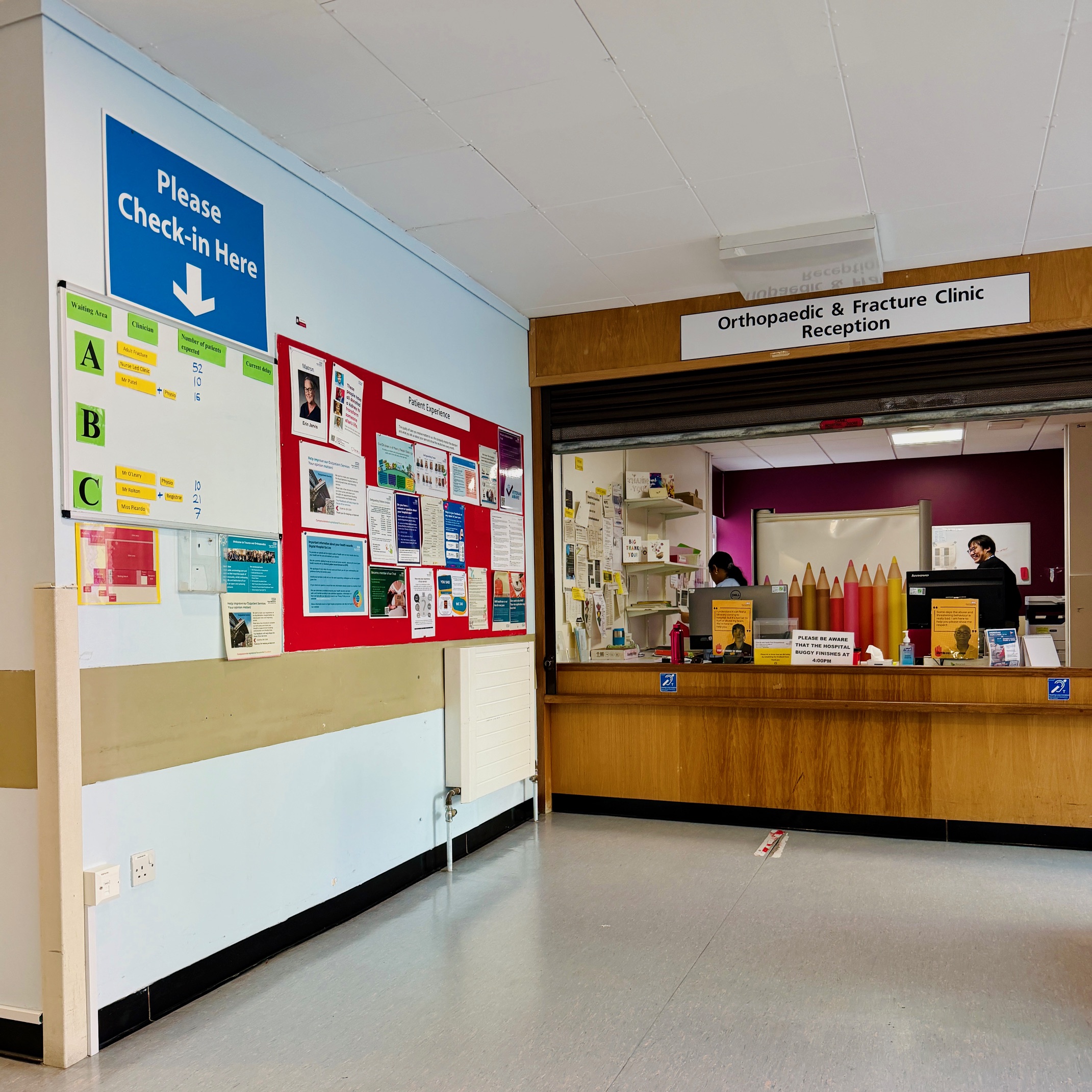
When I finally leave on the Saturday, gingerly shambling out into the daylight with Zoë to the car park where my father-in-law is waiting, my relationship with the RBH is far from over. There will be x-rays, they will fit a brace, they will do more x-rays, they will determine that the brace isn’t enough, and they will decide to operate. The fracture clinic is right next to Jamaica Blue: I grab a coffee to fortify myself before every appointment.
There will be a day when I sit there in the Day Surgery ward for seven hours, starving and anxious, while I watch everyone else go off for their surgery, come back and go home. There will be a conversation with the anaesthetists, where I only remember the beginning and then come round, groggy and in recovery, hours later. There will be that first phone call with Zoë afterwards, when I let her know that I’m still alive and enjoy the miracle of hearing her voice again. 

And there will be one more night in the hospital, back on Dorrell Ward. It might be a happy accident, or it might be deliberate, but they take me to the same ward and park my bed in the same bay. One of the nurses on duty was on duty when I first stayed in hospital. You again, she smiles. The next morning, the wife of the chap in the bed next to me comes over to talk to me and Zoë. “I’m so glad they put him in Dorrell” she tells us. “It’s the best ward in the hospital.”

I don’t know. Perhaps everybody says that. But it was hard not to feel like it was the best ward in the hospital, or that I was the best hospital in the country. Because they and their extraordinary staff took what would have been the most frightening, lonely and anxious week of my life and made it somehow a week of peace, care, healing and – let’s not forget – Marmite. 

So that’s my review of the Royal Berkshire Hospital. A place of peace, care, healing and Marmite. A place that is Reading’s biggest restaurant by accident, not design, and one that happens to be a restaurant many times better than it needs to be. It’s also the most paradoxical place I will ever review. Because obviously I sincerely hope I never eat there again, and I wouldn’t wish a meal there on my worst enemy. But if you do find yourself there, and many people do, every single year, I cannot say enough good things about it. The food’s not bad, either.

The Royal Berkshire Hospital
London Rd, Reading RG1 5AN
0118 3225111

https://www.royalberkshire.nhs.uk

You can support the Royal Berks charity here.

Since January 2025, Edible Reading is partly supported by subscribers – click here if you want to read more about that, or click below to subscribe. By doing so you enable me to carry on doing what I do, and you also get access to subscriber only content. Whether you’re a subscriber or not, thanks for reading.
The Lyndhurst

I don’t normally write reviews that are of places that have closed. It has that same whiff of smugness as reviewing drinks nobody can buy or plays that have finished their run: I’m going to make you feel bad about what you missed, they seem to say. My life is better than yours. It’s all very “if you know, you know” – another phrase I hate – only more “if you didn’t know, now you never will”.

But I’m making an exception to write about the Lyndhurst, which closed under the management of Dishon Vas and Sheldon Fernandes a couple of weeks ago, one final time. Because I don’t think anywhere that’s closed in Reading in all the time I’ve lived here – not the 3Bs, not Dolce Vita, not Mya Lacarte or the Grumpy Goat – has had this kind of effect on me, and I feel like trying to explain why. So I suppose this is for anyone who has been to the Lyndhurst in the last five years, which I expect might include a decent proportion of the people who read my blog.

Part of this is because I am feeling sentimental: as anyone who follows me on social media will know, because I haven’t stopped banging on about it, I got married a couple of Fridays ago. It was simply a perfect day. The sun shone for the first time in ages, the ceremony room in the Town Hall was serene and calm, my dear friend Jerry gave the most beautiful reading, and when I kissed my brand new bride the crowd packed into that room made a disproportionate amount of gleeful noise.

We turned round and there were our favourite people, the biggest small congregation you’ve ever seen in your life. My parents, my step-parents, my brother, his wife and his children. My boisterous, fantastic in-laws. Friends I had known for thirty or forty years, and people that had known my wife since she was at school. Newer friends, and friends who had been there since the very start of my relationship with Zoë. The friend that saved my life, time and again, in the darkest moments of my divorce. There was nothing but love and joy in that beautiful room.

A lot of the rest was a daze. An eruption of confetti on Blagrave Street, standing in a pack under the Maiwand Lion as our photographer corraled and marshalled us into groups, snapping and cajoling. Sipping a crisp glass of bubbly from nearby Veeno, being congratulated by passers-by. Everyone congratulates newlyweds, I’ve found: it’s a moving, life-affirming thing. A Reading Buses driver stopping us in the park to tell us it brought back memories of his own wedding – also in the Town Hall, also photographs in Forbury Gardens.

My wife, grinning and clutching her beautiful bouquet, as happy as I was. Wandering round the Forbury desperately seeking shade, finding spots for photos. “Look into Zoë’s eyes” said the photographer, such easy and enjoyable instructions to follow. And then, at the end of all that, all of us marching to Friar Street to hop on a vintage Reading bus, driven by Tim Wale, the legend behind Tutts Clump cider. Reading institution Paul King turned up out of nowhere and took pictures before all of us, laughing and merry, were driven away to the venue for our celebration.

When I told people I was getting married a lot of people – especially on social media – said “no pressure for your venue, right?” or “I bet the food will have to be really good”. But I never worried about it, because my celebration was being hosted by the Lyndhurst. Of all the Is to dot and Ts to cross in the run up to the big day, of all the things that blindsided us on the home stretch, I never worried once about the food. The Lyndhurst was doing it: that was all I needed to know.

I was at the Lyndhurst for their first night under new ownership, back in the summer of 2019. I’d really liked the previous management and their clever, precise food, and when they left – because the pubco hiked the rent, I imagine – I wasn’t entirely sure the new landlords would be able to match that standard. I remember there being a crowd on the first night, all the regulars happy that their community pub was open again, and the place was packed and chaotic.

There was a rabbit in the headlights feel about it, and I had my gin and tonic with slight misgivings and no idea that I was spending my first evening in what would prove to be one of my favourite places on earth. I remember they put a sign up that suggested they were only serving dinner on Friday and Saturday nights, and I called it out on Twitter. Some random local online prat had a go at me for pointing it out, but the pub just said Thanks for letting us know, we’ll change it.

I didn’t know then that that was their style all over – humble, apologetic, unfailingly polite and always, always getting shit done. The sign got changed. And then I went back to try the food, and had quite the wake-up call. A beautiful Scotch egg, a very accomplished plate of pork belly, pig’s cheek and black pudding bonbons and perhaps most significantly, a bowl of chilli nachos, everything made from scratch, from the tortillas to the guacamole. These people really knew what they were doing, I realised.

The menu changed many, many times over the next five years. They even refreshed it in April, with barely a month remaining, because they never stopped tweaking and improving. But those nachos, which over time became emblematic of the Lyndhurst, never came off the menu, not once.

I read an article in the Guardian in the run-up to my wedding about how much weddings cost these days: one couple, American needless to say, spent five thousand dollars alone on their rehearsal dinner. I liked to joke as my wedding approached that Zoë and I had taken a less conventional approach to rehearsal dinners by instead going to the Lyndhurst pretty much every week for years. And for that matter, I also had a few rehearsals of the Lyndhurst’s mass catering skills: three readers’ lunches, each one more assured, if anything, than the last.

And all that was lovely in principle, but in practice it made decisions about the menu almost impossible. Looking back through the photos on my and Zoë’s phone, of every dish captured at the bottom of Watlington Street over the course of nearly five years, made it even more difficult. So many beautiful plates of food, from which to select just nine. How could you possibly choose?

But of course it also brought back so many happy memories. Braised oxtail, wrapped up in cabbage, enjoyed when they’d barely been open a month. Saddle of rabbit, stuffed with liver and rolled in Parma ham, the equal of anything you could get in Bologna. Their crispy-skinned supreme of chicken with soft leeks and the shiniest, most comforting morel sauce. The legendary – and enormous – porchetta sandwich which graced their menu in the spring of 2021. Their confit duck poutine, which occupied an exalted place on the menu, and in my affections, around the same time.

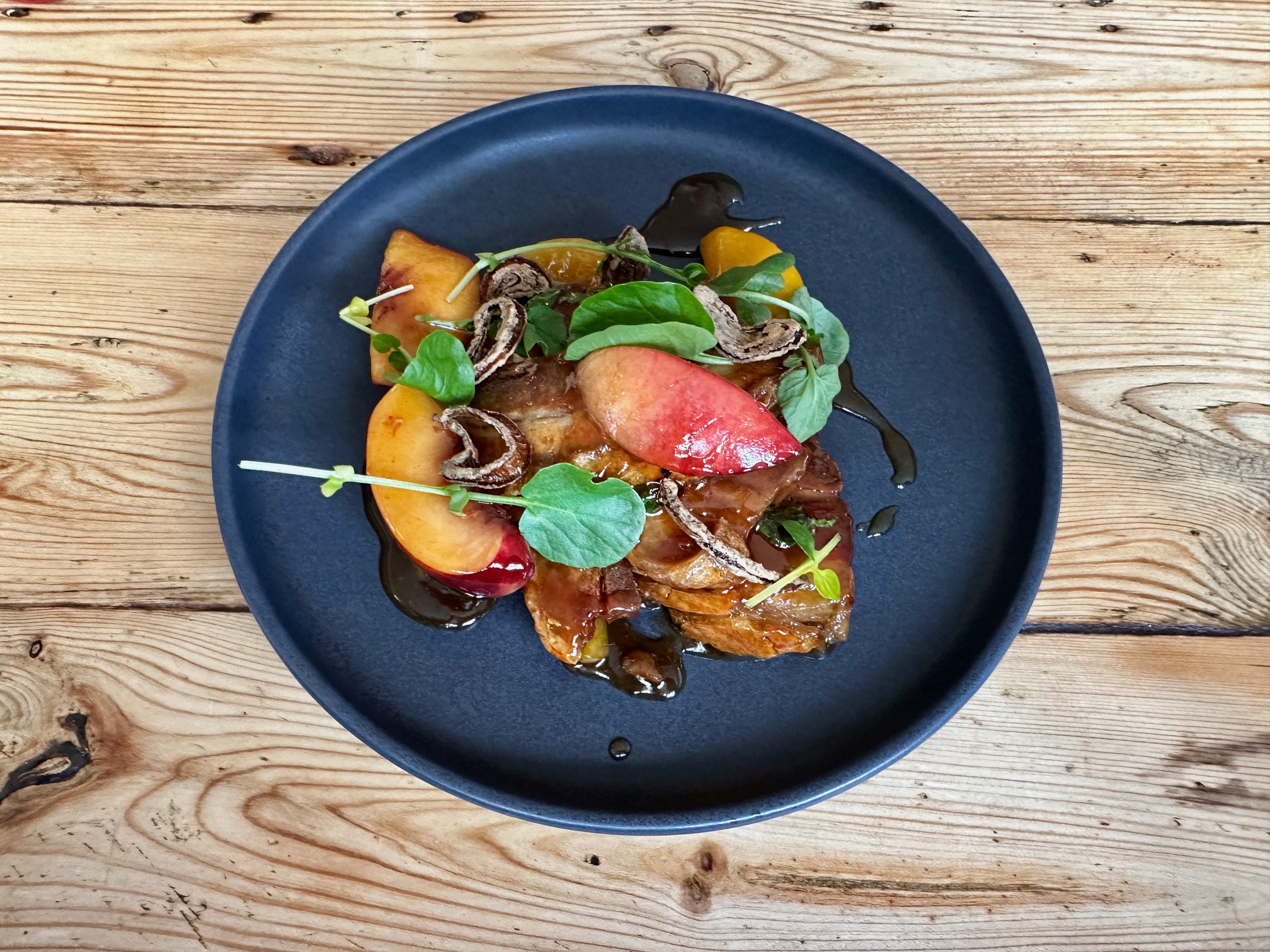
Even towards the end new classics took their place, making life even more difficult. The monkfish tacos, which became one of the Lyndhurst’s signature dishes – so delicious, so generous, so very difficult to roll up and eat, so crammed were they with perfectly executed monkfish. The Korean chicken thigh burger, seemingly invented to make it impossible for me to cook my own dinner ever again on a Monday. Or perhaps best of all, the pork belly with plums and fried onions, in a deep, glossy sauce redolent of hoi sin. It only arrived on the menu around the start of this year, but even so I lost track of the number of times I ordered it. Even now, writing this and thinking about it I get a pang of sadness that I won’t get to eat that dish again.

I’ve made a point of trying to take almost everyone I know to the Lyndhurst at some time or another over the last five years. My family, local friends, friends from out of town, colleagues on one occasion, even my brother on his last trip to the U.K. from the other side of the world (he insisted on trying the monkfish with Bombay potatoes, and left in raptures). So I had done my level best to make sure as many people as possible at the wedding already knew how good the Lyndhurst’s food was.

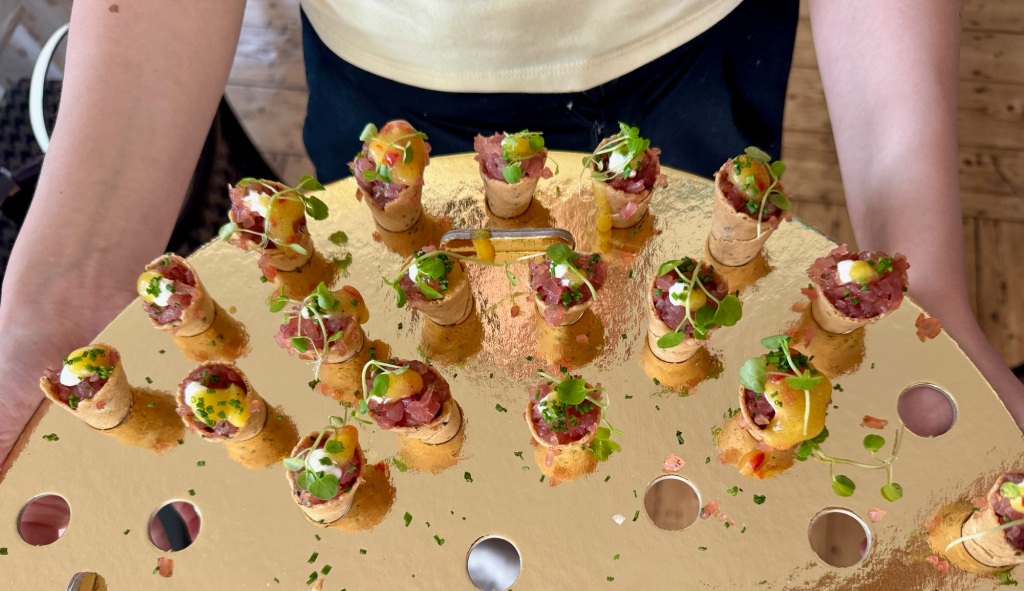
But my new in-laws had never been there, and nor had some of the other wedding guests, and I couldn’t help but feel happy and proud of the pub as the canapés came round. Little cones packed with tuna, crowned with a dab of mango. Black pudding croquettes which seemed super-dense, as if they were made of more black pudding than their shell could contain: my father-in-law, not always an easy man to please with food, devoured quite a lot. Little choux buns filled with mushroom, for the vegetarians, and polenta squares topped with butternut squash, for the vegans.

And a treat I first sampled at a reader’s lunch the previous year, beetroot macarons, sweet yet salty, with a judiciously chosen core of goats cheese. “Holy shit”, my Canadian cousin Luke said to me later. “I think those might be the best things I’ve ever tasted.” And Luke eats out a lot.

I think some of our guests kept expecting the canapés to run out, because they didn’t know the Lyndhurst, but wave after wave passed through the room: no need to stand near the kitchen and grab them before they were demolished by others. No need to worry about that, or anything else. The Lyndhurst, their brilliant, well-oiled team, were completely in control. Why on earth would I worry?

The Lyndhurst opened in 2019, but within nine months or so they were plunged into the awful event we all now remember as 2020. Everywhere closed, from March to July, and when places reopened they faced a nervy, uncertain future. Many people, me included, were reluctant to go out. And then of course there was the superspreading folly of Eat Out To Help Out, followed by the many-tiered madness of various restrictions, all of which fell far short of what was really required.

I sometimes wonder how Sheldon and Dishon must have felt, celebrating the end of their first year in charge not knowing whether there would be a second. But if they ever lost hope it never showed, and although I liked the Lyndhurst a lot in 2019, it was in lockdown that I came to love them; I am lucky enough to live round the corner from the pub, and they carried on delivering to me, to my doorstep, throughout the winter of 2020.

It became a wonderful, comforting Saturday night ritual – place the order, transfer the money and then just as Strictly was about to begin there would be a knock at the door and there was Piotr holding a bag for us. If there were specials on we would invariably order them, but there was always a treat of some kind. I remember the asparagus in batter with romesco sauce, one of the best snacks of all time. I remember first the pork and then the lamb tacos, although any time the Lyndhurst did tacos was a time to cherish. I remember the beer can chicken, and the phenomenal ancho chile relish: I think I ended up with a jar of it in the fridge at one point, and used it on everything.

And I remember – how could I not? – the occasions when they had skate wing on. Classically cooked, golden and bathed in beurre noisette, scattered with capers and croutons, just waiting to be clumsily decanted on a plate and scoffed, with the simple joy of flipping the wing over at the halfway point. It might have been movie week on Strictly, or perhaps Halloween week or Blackpool week. But it was always, always Lyndhurst week.

One story I never told at the time, although I suppose I can now that Sheldon and Dishon have moved on, is that in the spring of 2021 I published a review of the Lyndhurst’s takeaway menu. I loved nearly everything I tried, but I did express a few reservations about a dish they’d just added to the menu, a chicken tikka naanza. Later that afternoon I got a message from them on Twitter: they’d been thinking about the feedback and they’d made a few tweaks as a result. Would I mind if they dropped one over so I could let them know what I thought?

Naturally I said yes, and just after five there was that knock at the door again. I split it in half and took half of it up to Zoë, who was in the spare room finishing her last conference call of the day. They’d pretty much made every change I’d suggested in the review and I know it’s me saying this, but it was damn near perfect.

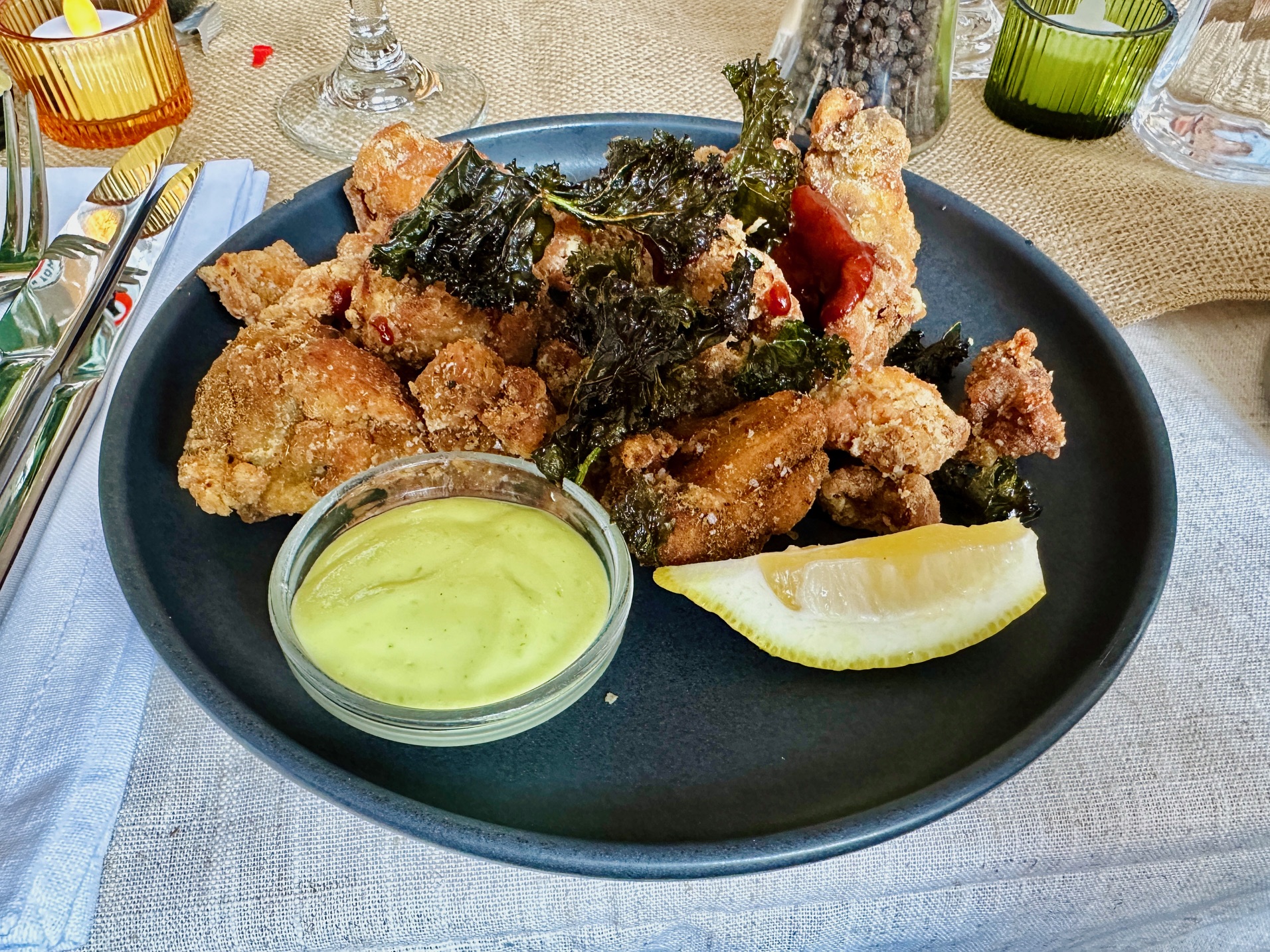
One dish that the Lyndhurst never needed to change, not from day one, was their karaage chicken. I first had it in the spring of 2021 and to this day, however hard I’ve looked – and trust me, I’ve looked hard – I’ve never found a karaage anywhere else that matched it. It was my starter of choice, my first starter as a married man, and although it wasn’t the single best choice I had made that day it could well have been the second.

Although I was a takeaway customer of the Lyndhurst for quite some time, even after lockdowns eased and a lot of people went back into the pubs and restaurants, I wasn’t their last takeaway customer. That honour belonged to a chap at my office, who loves their curry night. He lives round the corner from the pub too, but with small kids he couldn’t eat in, much as he might have wanted to. So without fail every Thursday he would check Instagram, find out what the three curries on offer were, place his order and then go and collect it that evening.

Often I would be eating in and I would see him, we’d acknowledge each other, compare notes on which curry we were going for. I think he had the pint of beer that came with the curry – an outrageous bargain for twelve pounds, all in – but I can’t remember. But every week he was there, getting his curries, taking them. home. And every week the Lyndhurst was there, letting him: most other places would have said that the pandemic was over and they didn’t do that kind of thing any more, but not the Lyndhurst. Forget Eat Out To Help Out, they were helping him to stay home.

The last night that the Lyndhurst traded was a Thursday night, curry night. I wasn’t there because it was the night before my wedding: my fiancée (for one last night) and I went to London Street Brasserie, on the early bird set menu special, and had our first carbs and calories for quite some time. I drank English fizz and ate LSB’s excellent fish and chips, although I couldn’t finish the chips. So I didn’t make it to the Lyndhurst, but I’m pretty sure I know one person who did, one final time, for his family’s habitual takeaway.

And yes, what that also means is that my wedding day was the last day that the Lyndhurst was sort-of, kind-of open. I’d known that they were still trying to agree the rent with the pubco, and I knew that those negotiations didn’t look like they would end happily, but the Lyndhurst told me that one way or the other they would cater our wedding. The fact that they did means more to me than you can imagine, and it really felt like they were celebrating with us too. The pub, and the team, were such a big part of the wedding day that it was impossible to imagine it without them.

I found it equally impossible to pick main courses for our wedding meal. In the end we went for three options, any of which would have suited me down to the ground. Mine on the day was confit duck, the skin burnished, the meat underneath slumping helpfully from the bone, with Sarladaise potatoes, a smooth parsnip purée and the jus of the gods (the Lyndhurst had told me they could easily do a more cheffy duck dish, but this was the one I wanted).

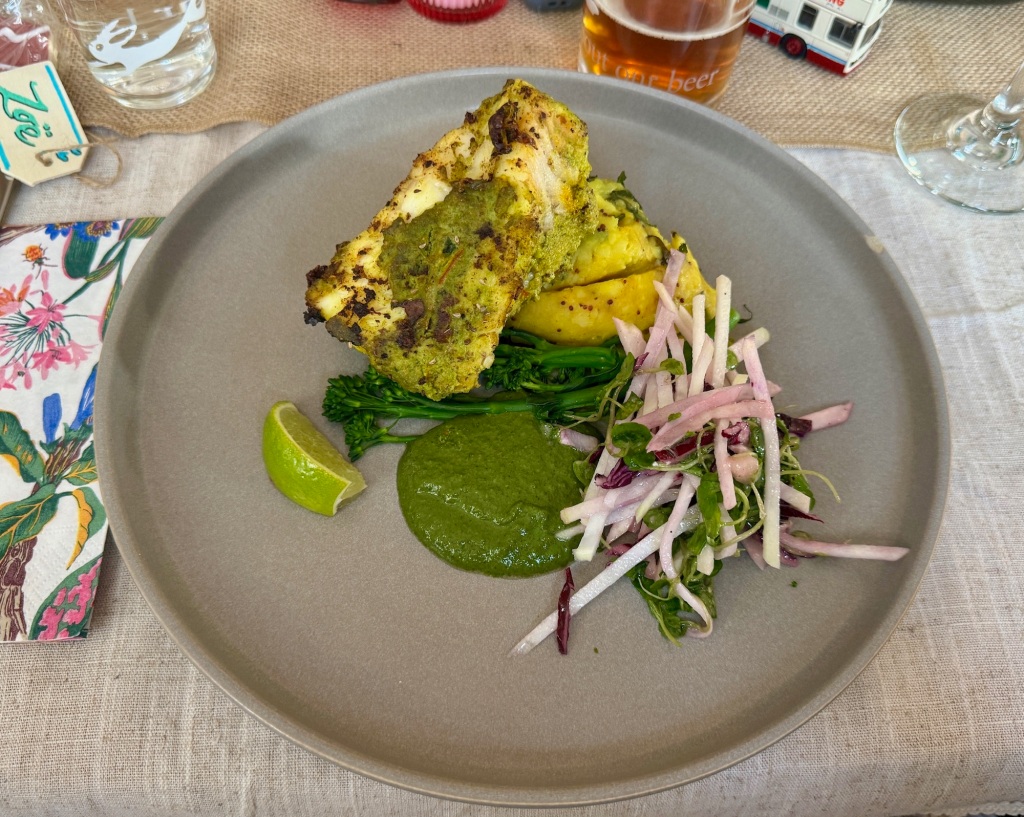
But the main I almost wish I’d had, one final time, was that monkfish – a huge tranche of it, served on a heap of those addictive Bombay potatoes, a bright herb chutney and salad on the side. My wife had that, and I just looked on in awe and envy. My brother had it too, a wonderful gastronomic connection between his first and last meals at the Lyndhurst. So did my father-in-law: he cleaned his plate.

A couple of days after the wedding, I got a message on Facebook from a reader of my blog. He wanted to tell me something about the Lyndhurst.

He said that he’d recently gone to the Royal Berks and been told that he needed to be admitted for an emergency operation. But they said that he had just enough time to grab a meal before they would take him in. And so he went to the Lyndhurst, not far from RBH, and it just so happened that he was there in the week before they closed, eating there – just like I did – one final time. “It was a really meaningful experience” he said, “and I wouldn’t have done it without your review.”

It made me think of all the evenings that pub had made, and the fact that they probably didn’t know the half of it. Just for me alone, they had filled a very special place in my life for five years, in a way I’m not sure I’ve managed to explain. Don’t fancy cooking? Go to the Lyndhurst. Celebrating the start of a holiday? Dinner at the Lyndhurst. Back from holidays and feeling blue? The Lyndhurst it is. Finishing work at the same time as your other half, meeting in town and thinking “isn’t it burger night on Mondays?” Off to the Lyndhurst. Your brother’s last night in the country? Go on then.

But my reader’s story made me think of something else too. December 2021, when after over eighteen months on the run, playing it safe, not going into shops, not eating in restaurants, working from home, only socialising outdoors, waiting for the vaccine and the second vaccine and with the booster in touching distance, Zoë tested positive for Covid. And then she too spent time in the Berks, four fraught nights, and when she came out, after I met her outside the ward and slowly took her home, the Lyndhurst delivered me a simple order that night – just two beefburgers and chips. That was the beginning of the road to recovery, and one of my most meaningful experiences.

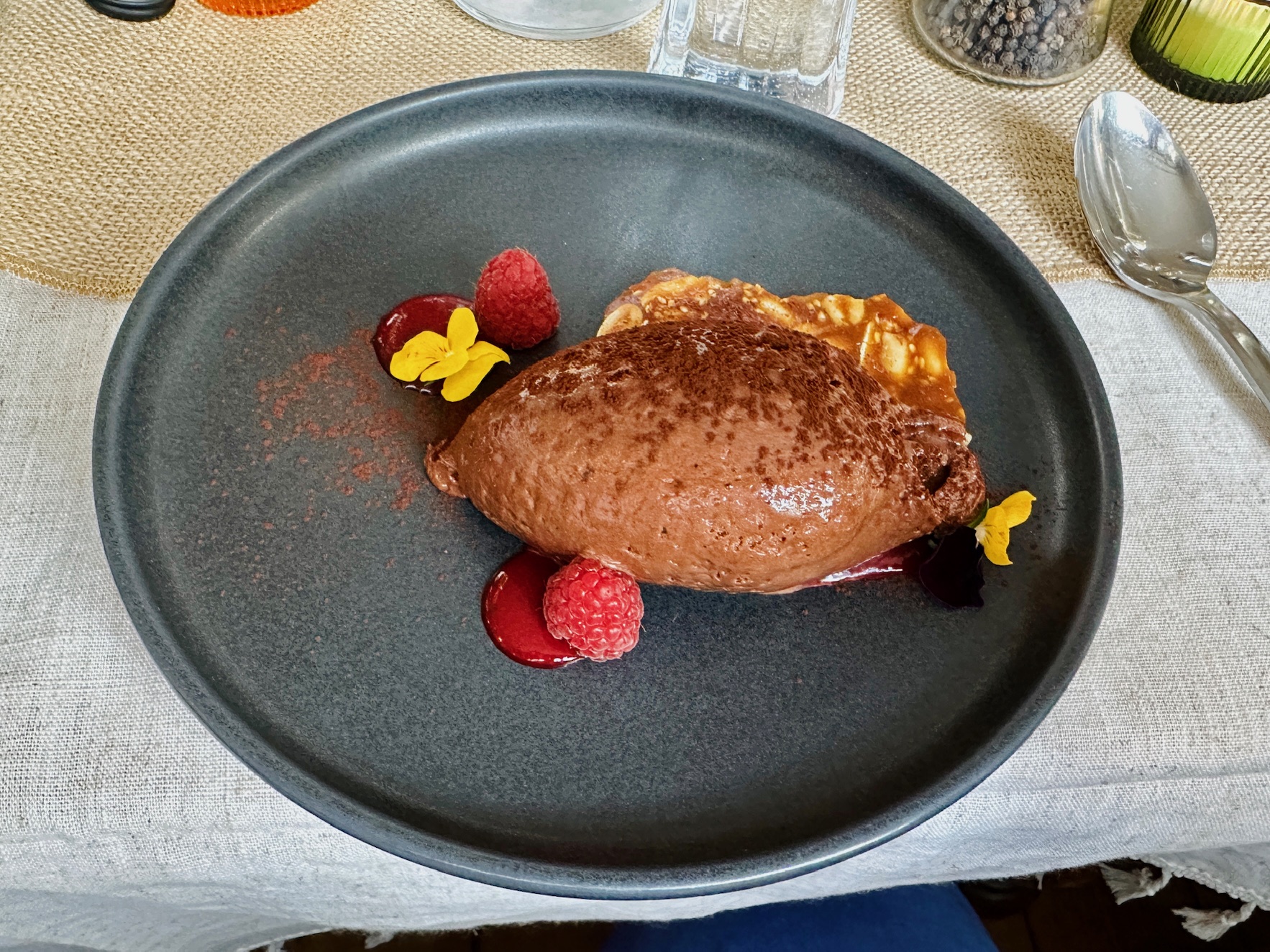
There was no way, though, that the beefburger was going to feature on the wedding menu. The Lyndhurst’s chocolate mousse, though, was another story. The first time it was on their menu, the first time we ordered and ate it, Zoë had that look in her eye. “We’re having that at our fucking wedding” she said. And so we did.

The rest of the evening was a riot – of my friend James’ home-brewed beer, of gin and tonic, of conversations with old friends out on the Lyndhurst’s patio. The heat and sun of the day had faded, the crowd had slightly thinned and everyone was sitting outside, chatting and mingling. My stepmother caught up with my schoolfriends, who she hadn’t seen in over thirty years. We took a last family photo before my brother and my sister-in-law headed off, their next flight a day away.

And there was more food – a buffet, of more food than I could conceive of eating. Thinking about it now, I wish I’d had more room for the charcuterie, for the chicken pakora, for every manner of bite-sized savoury delight. And because I’d asked them to, the Lyndhurst did a slider of their legendary Korean chicken burger, the dish they’d introduced in February which had made losing weight in the run-up to the wedding so challenging. I made sure I had one of those. A few people did: my mother-in-law took one home and had it the following morning for breakfast.

The next morning, town seemed to be an even more beautiful place than usual. I went and got a couple of coffees from C.U.P. to take them to our hotel, and the man behind the counter shook my hand and congratulated me. I told the hotel receptionist that my wife would be checking us out shortly – the first time I said “my wife”, the first of many. And we got to the Lyndhurst to take down the decorations, to find that the process of getting the pub ready to hand back was already taking place. A man was painting woodwork, the party was over.

Well, almost over. On the Saturday night there was a little farewell party for the pub and Zoë and I went in to say one last goodbye. Many of the regulars were there, faces I recognised from curry nights, or burger nights, or Friday nights. So many different stories intersecting with the pub the way mine had, so many different people who would miss Sheldon, Dishon and the team every bit as much as I would. When people talk about how pubs can be community hubs, they never mention how difficult it actually is to do, to manage that and still be inclusive, not some gammon pubman’s boys’ club. But the Lyndhurst did it.

And all the staff were there relaxing and chatting. Sheldon and Dishon, too, and I realised that I’d rarely seen them in the same place at once. Usually Dishon was running the front of house, Sheldon tucked away in the kitchen. But here they both were, casually dressed, laughing and, I hope, feeling the love. Dishon is moving back to Northamptonshire to be with his family, with a baby on the way. Sheldon told me he was looking forward to a break, to visiting his family in Mumbai, and after that who knows? Both of them looked like they were ready for a long rest, but proud of what they’d achieved. They should be.

I may have rarely seen Sheldon and Dishon together, but one of my favourite pictures is of the two of them, taken by a chap called Antonio, a local Instagrammer and neighbour who also loves the pub. It captures a moment, during service, of the two of them putting their heads together, of the front of house and kitchen meeting right at the point where the former ends and the latter begins. It captures something of the wonderful partnership that Reading was lucky to enjoy and, for me, something of what made the pub so magical. Neither of them had run a pub before that fateful day in the summer of 2019. Well, what a debut.

(Photo by @simple_living_in_berkshire)

2024 is shaping up to be a year of changes. I got married, the Lyndhurst did a beautiful job of hosting our celebration and now they have moved on. Things happen quickly, and last Friday the Lyndhurst reopened under new management, a lady who previously ran a pub in Theale. There’s talk of it being more of a sports bar than it was in previous incarnations; locals have wished her well, and I’m sure they will all be in to check it out. I will too, and I’m conscious that when Sheldon and Dishon took the pub over I would have been the first to say they had big shoes to fill.

But fill them they did, and life moves on. And now it’s time for me and Zoë to move on, too: next month we’ll be leaving the Village, where I’ve lived so happily for seven years. So it wasn’t just greeting married life, or bidding farewell to the Lyndhurst, but the start of a period of loving living here, with all its quirks, but knowing that it will come to an end.

Everything does eventually, I suppose, but it’s important to recognise how good things are while you’re living them, rather than only later when you look back. But I will always remember the Village, and those five halcyon years when it had the best village pub anybody could hope for. I’ll remember the two men that made it happen, and that brilliant sunny day in May when the whole world was at its absolute best.

Corona diaries: Week 16

Sometimes, on my almost-daily walk through the streets of east Reading, I still have to stop and remind myself of where we are now and how we got there. I make myself remember that the people on the opposite side of the road to me, or the couples who dutifully change formation into single file as I approach, have also been going home to houses that they generally don’t otherwise leave. Their social circles have been limited the way mine has, and they too have made do with Zoom calls and, more recently, chats in gardens, constantly mentally calibrating and re-calibrating whether they are two metres, or the fuzzier, less useful “one metre plus” apart from loved ones.

It’s the stuff of science fiction, even now. And not even good, ray guns and rocket ships science fiction, more the chilling, low budget John Wyndham stuff. Imagine if a virus had come along that forced you to keep your distance from everybody you know and everybody you meet. If someone had said that to me a year ago, I wouldn’t have believed it. But now it’s how we’ve lived for some time and, increasingly, it gets foggier when you try to remember how it all used to be.

Six months ago, when we all thought our biggest problems would be cutting down on our drinking and surviving the hundred days until the January pay cheque, the world was completely unlike this one and we lived so very differently. It was a world of, in no particular order: seeing friends and family; “pub tonight?” “yeah, why not”; being inside a building that wasn’t your home; getting on trains and buses and going elsewhere; hugging people; not scrubbing your hands like Lady Macbeth when you take delivery of a parcel; saying no to a social engagement because the sofa was just too alluring; going out for dinner whenever you couldn’t be arsed to cook. The latter, for me at least, happened frequently.

It was a world of holidays and flights and hotels and conspicuous consumption, a world where we could more easily kid ourselves that our decisions didn’t really have consequences. It was a world of blasé complacency too, where we could take our safety and security, relatively speaking, for granted. And we could be equally confident about the security of our loved ones, our families and friends and our favourite institutions.

Remember how older people used to talk about the past as some halcyon bygone era, even though deep down we all suspected it was every inch as grim and dodgy in its way as the present day? We may be the first generations to be able to talk about the good old days with any degree of authority. Of course, it’s still too soon to say.

But, at the same time, there’s a prevailing view that we can’t go back to exactly how things were before all this began, a lifetime ago in 2019. And that’s also true: the challenge for everybody, in the years ahead, will be to knit together a new life that contains all of the advantages of pre-Covid life and all the valuable lessons we’ve learned in the intervening months. It sounds laudable. I’d love to do that, I imagine we all would. But the thing is, self-improvement is exhausting. I should know: I saw a counsellor for years (if you can’t see much evidence of that, thank your lucky stars you didn’t know me before).

There are many things I will want to keep from this strange, upside-down time. I will want to have a more structured life, of weekly shops and meal plans. I’ll probably want to drink better booze at home rather than go to the pub for the sake of it. I’ll want to spend money with the right businesses, instead of frittering it away on things I don’t care for or meals I largely won’t remember.

I’ll continue to make coffee at home – a huge, unforeseen boon of lockdown, breaking a latte habit that was probably more born of boredom than addiction. And, having spent four months finding out who my friends are in a way eerily reminiscent of going through a divorce, I want to spend more of my time and energy on them and less on all the distraction and noise.

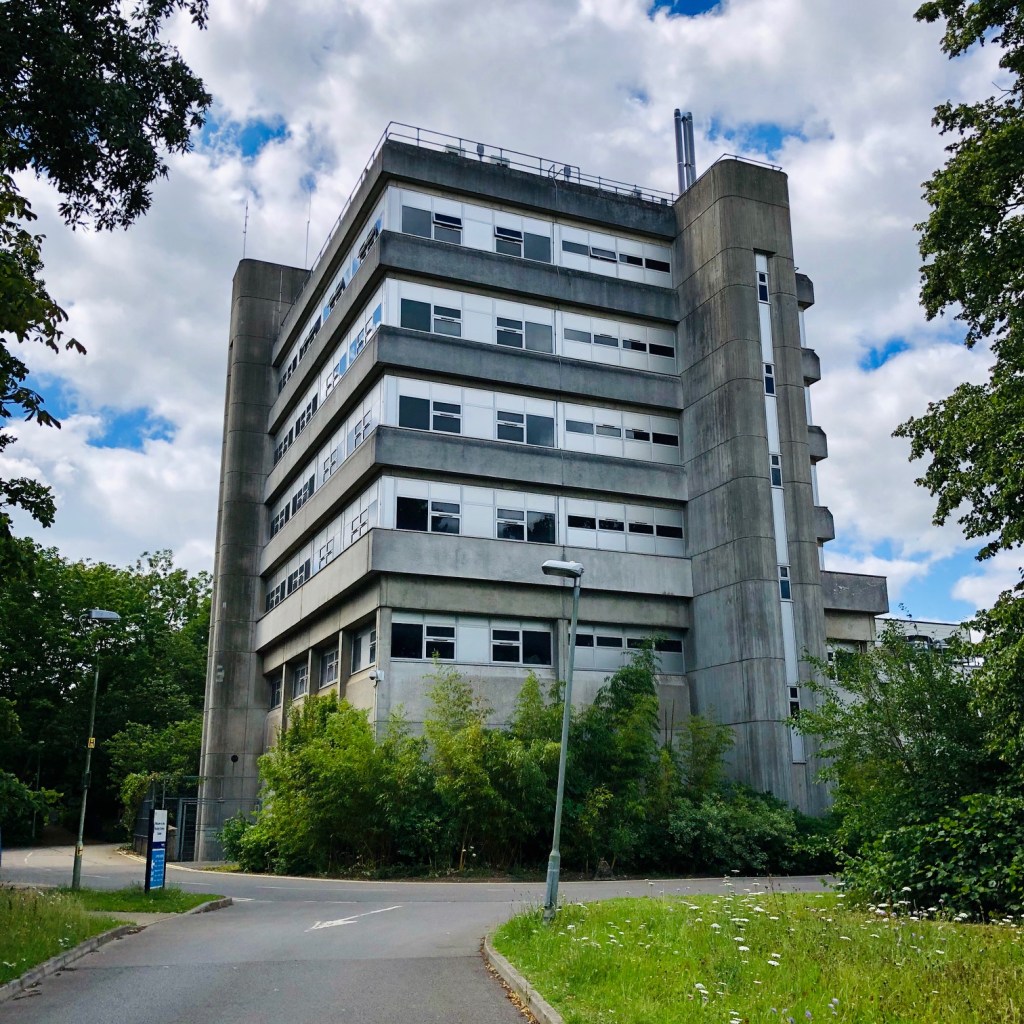
More mundane, but every bit as important, I will want to keep going to the Harris Garden. It might be my favourite discovery of lockdown. I think I had only visited it once, a couple of years ago, before lockdown began, but since everything changed I tend to go there most weeks. It’s tucked away in a distant corner of Whiteknights Campus, and to reach the only entrance you have to walk past a bleak, forbidding Brutalist building, a sort of Trellick Tower mini-me. But once you get there, it’s the most fantastic oasis of peace and calm.

I’m no horticulturalist – the overgrown foliage of my back garden is ample evidence of that – and I couldn’t tell you almost anything about the plants, flowers and trees in the Harris Garden. I was going to research it to sound like I knew what I was talking about, but when I Googled and found out that one of the first trees you come across is called the “Caucasian Wingnut” I found that so entertaining that I abandoned my efforts. “The dogwoods and willows are coppiced regularly” the website goes on: who knew that “coppice” could be a verb?

Even a cursory read, though, reveals just how much thought has been put into making the Harris Garden beautiful all year round. And it truly is beautiful, whether you wander among the trees, gaze at the flowers or just grab a bench overlooking the meadows that have only recently burst into life. On the hot days which feel like they happened months ago, I would slope off there with a paperback. After an amble, I’d find somewhere to sit while doing exactly what I would have done in a previous life when I sat at a table outside Workhouse Coffee, namely leaving my book unread while I wasted time (and my battery) trying to read the whole of the internet on my phone.

I blame my reading material: at the moment I’m reading a book by the author of my favourite novel but it’s nowhere near as good as that. It’s such a slog, with so much unnecessary detail, that every time I pick it up I have to go back about ten pages to remind myself of what happened before I lost interest. At this rate, by the end of August I’ll be on page minus ten (the irony of me saying all this in today’s diary is not lost on me: I’m sure you’d all rather I was telling you whether the new souvlaki joint on Market Place is any cop).

More recently, I’ve been going to the Harris Garden for socially distanced meetings with friends. Last week I wandered round it with Reggie (last seen reviewing the Lyndhurst with me). In lockdown Reggie and I would chat over the phone once every couple of weeks, and then we progressed to Facetime, both banished to the other room while our other halves were working and being important in the living room while we took part in a twenty-first century reboot of The Likely Lads. During lockdown our hair got more and more unkempt, we compared notes on good days and bad days, we chatted about all sorts and, I suppose, we became more like friends and less like pub buddies.

Seeing him in the flesh for the first time, one of the first friends I’d seen in four long months, was surprisingly emotional. It’s not as if there was anything that different about it, really, but there we were on opposite ends of a long bench shooting the breeze as if everything was as it was. No pints of cider in front of us, no bag of snacks opened out on a table, but it turns out it didn’t matter.

Reggie has had a mixed lockdown, like most of us, but he moved in with his girlfriend at the start of the year and it sounds like, by and large, they’ve had a very harmonious time. “Even though it hasn’t been that long, because we’ve spent so much time together it feels like we’re at the two year mark” he told me, and as someone not far from the two year mark myself I knew exactly how that felt. When you’re happy with somebody, getting to spend this long with them in lockdown – despite the occasional niggle – feels like stealing time from the universe. Stolen time, I’ve always thought, is the best time of all, like when you wake up an hour before the alarm goes off feeling completely refreshed.

“If you could pick any PM to lead us through this crisis, who would it be?” Reggie asked me during a conversation about one of our favourite topics, the state of the country.

“Definitely Gordon Brown.” I said. “If you hear him on the news now he still sounds completely on top of the detail of everything going on.”

“Nah mate, it has to be Tony Blair.” I’d almost forgotten what a torch Reggie carries for Blair. It’s right up there with my friend James, who bought Habit Rouge by Guerlain solely because it was the former prime minister’s signature fragrance, and still refers to it as ‘Eau de Blair’.

“But look at how he handled the financial crisis!”

“Yeah, but if you go for Blair you get Brown thrown in. Two for one. Picking Brown is a schoolboy error.”

I enjoyed the conversation so much that I couldn’t bring myself to challenge him. Besides, and he took great pleasure from me telling him this, I knew in my heart that he was probably right. Sitting there with Reggie, one of the first people I’ve seen face to face in what feels like an eternity, proved something I’d probably always known deep down but not fully understood, that the company is what matters and the venue is secondary. I told him that and he suggested, ever so nicely, that of course we’d have had an even better time if we were in the Nag’s Head. I didn’t challenge him on that either, but I’m not sure he was right twice in a row.

This week my Harris Garden stroll was with Jerry, the man who popped his sushi cherry when I took him to Oishi. Technically Jerry and I met when he had the thankless task of teaching me GCSE English, but really our friendship began thirty years later when we both found ourselves having a pre-theatre drink in the bar ahead of Reading Rep’s fantastic production of A Little History Of The World, five years ago. We caught up over drinks in the interval, then we ended up having a post-theatre pint or two in the Retreat and we’ve been beetling off for regular trips to the pub ever since.

Now thoroughly enjoying his retirement, Jerry has an impeccably tasteful flat in the town centre and before lockdown, I would often head over with a bottle of red only to find that the conversation flowed as fast as the wine. Usually, around midnight, we were cracking open bottle number three with no danger of running out of things to say: I always tried to make sure I was working from home the day after a chinwag with Jerry.

Jerry knows that I write this blog but doesn’t read it – smart man – and despite that he is a regular guest at my readers’ lunches, where he effortlessly charms whoever has the good fortune to sit opposite him. I am very lucky with all my friends, but Jerry is the one my other friends would all love to adopt: most of them don’t even make any secret of it.

It’s funny how friends have fallen into different categories in lockdown. I have friends who want to talk on the phone but not do FaceTime or Zoom, and friends who only think that the only purpose of WhatsApp or Messenger is to arrange face to face calls. I have friends who check in with occasional messages and, just as I think the conversation is getting started, will say “well, it was great speaking to you”. One of my oldest friends, after four months of sporadic WhatsApp, grudgingly agreed to a Zoom call for the first time a few weeks ago. “I know what you’re up to anyway” he says. “I follow you on Twitter.”

Jerry is properly old school – no pun intended – in that sense, and so I knew that we would eventually graduate from WhatsApp to meeting up properly with nothing in between. And yet when he bounds up to me it’s as if no time has passed, and I can’t tell you how lovely that is. It quite makes up for not being able to give him a hug. We compare haircuts (his) and lack thereof (mine), new sunglasses (both of us) and then we are on our way, chatting and gossiping as if it’s mid-March and not mid-July. I recommend meeting your friends in this way, because feeling as if it’s mid-March is quite the wonderful experience.

“My Fitbit told me recently that I’ve walked the equivalent of the length of Italy in lockdown.” Jerry tells me as we approach the entrance to Harris Garden. “I wish it had been the actual Italy instead.” I know exactly what he means, even if I haven’t quite managed Jerry’s regulation ten thousand steps a day. He is a man, after all, who walks from the centre of town to the Waitrose at the end of the Oxford Road to do his shopping.

Jerry has had a good lockdown, although like me he happily owns up to having had the occasional blue day. When it all started a neighbour offered to do his shopping for him – he has diabetes and blood pressure – and it amuses me how horrified he was at the suggestion, given that I am twenty years younger and have had no such qualms. Instead he shops for a friend of his who lives with her elderly parents, and uncomplainingly buys her six packs of Emmental or two dozen bottles of wine from Lidl (“because they’re on offer”, he tells me). Jerry is that kind of man: if you need two dozen bottles of vino in a hurry, he is the chap for you.

When they announced that you could form a bubble with another household, Jerry was the subject of a keen bidding war. He accepted an offer from a couple he is friends with, and ten minutes later the phone rang with another friend keen to make the arrangement. This makes him the social equivalent of the kid who is always picked first in games and I, as a man in a more self-contained bubble, can’t help but feel a bit envious.

“So who did you choose to be in a bubble with?” I ask him.

“Oh, it’s an ex-pupil of mine! He stayed in touch after he left, and now I go and see him and his wife once a week. They live in those flats by the big Tesco, the ones with the blue roofs.”

“Oh really? Didn’t he fancy going through the conventional route of waiting twenty years and bumping into you at the theatre?”

“No, not at all. He’s directed me in the theatre, actually.” Jerry laughs. Jerry does a lot of amateur dramatics: he’s such a lovely man that when he played Gloucester in King Lear last year my friends were visibly upset when Cornwall gouged his eyes out.

“Do you stay over there?”

“Heavens no!” That makes sense. Jerry has far too attractive a flat to spend the night at somebody else’s, a short walk out of town.

I have such a marvellous time sitting at the other end of a bench from Jerry, chattering away, that I quite lose track of time and I’m genuinely sad when I have to draw things to a close and rush home before my online supermarket shop arrives. As we head for the exit, we can see people sitting on the grass talking and gesturing, enjoying the sunshine. It’s funny: a few weeks ago I would have been judging them, silently auditing their living arrangements and social distancing, but on an afternoon like this I can only say good for them.

“Do you know, I nearly brought a bottle of wine?” said Jerry. “But then I wasn’t sure, and I didn’t want to spring it on you.”

“That would have been terrific.” I say. “Let’s do that next time.”

We make our way back into town, keeping our regulation distance apart, and as we say goodbye outside my house I realise how much I have needed my afternoon with him, and my afternoon with Reggie. A couple of days later I go for a stroll in Christchurch Meadows with my mother, and again I am reminded how, after a couple of difficult weeks, seeing people feels ever so slightly like coming out of hibernation. It isn’t quite normal but rather than depressing me with that fact, it encourages me that it’s still miles better than what strict lockdown felt like.

When I knit together my pre and post-Covid lives, when I try to construct the best of both worlds, I hope that this is something I can keep: I hope I’m always as pleased to see the people in my life as I have been over the past week.

My mother and I end our walk by strolling round View Island, passing the fantastic wooden sculpture carved with a chainsaw. We thread our way across Caversham Lock and out onto Kings Meadow, cutting past the blue-roofed flats where Jerry’s bubble-mates (is that what they’re called?) live. I tell her the story about the twenty-four bottles of wine and my mother, who probably drinks a handful of bottles of wine a year, is suitably shocked. From there we head through the tunnel under the railway bridge and I walk her back to her apartment, near Bel and the Dragon.

It really is strange, after this hiatus, that things are nearly as they always were. I didn’t see her for months, and this is my fourth walk with her in just over a fortnight. Truth be told, I worried about her getting Covid – far more than she did, as she carried on going to Waitrose, going to Marks, frustrated that so little was open. “If I get it I get it” she said, clearly more relaxed about that eventuality than I was. I realise that, more than anything, she reminds me of Jerry – it’s no surprise that she kept bumping into him on her travels in lockdown, while I was cooped up at home. I wonder whether she has walked the length of Italy, too.

“Shall we do next week?” I ask her.

“Yes, please. Wednesday works for me – I see your Aunty Mary on Thursdays.”

There’s a pause, and then she says “It will be nice when we can hug again”. I wish she wouldn’t say things like that, because they always set me off. But instead I wave goodbye – a wave always feels so inadequate – and make my way home, thinking that an awful lot of hugs and hellos, a lot of conversations on benches and drinks on picnic blankets are very long overdue. I really, really can’t wait for them to happen.

Corona diaries: Week 15

One of the strangest things lockdown has done is to literally shrink my world. Like everyone, I imagine, I’ve got heartily sick of doing the same walks every week, tracing the same routes time and again with only minor variations. For the last three months, the perimeter of my world has changed completely, and Reading has become a tiny place. It’s bounded to the west by Watlington Street, and I’ve only crossed the river to the north a couple of times for walks.

Like so much of what we’re living through, the effect is downright weird. I know rationally that the scruffy charm of Katesgrove, the grandeur of the Bath Road and the Stepford roads of Kennet Island still exist, but to me they might as well be Oxford, Bristol or even Prague. They’re now just places I don’t visit, places where other people live. It’s a sad consequence of four months of isolation, to feel disconnected from much of your home town, especially during a time when it has felt under attack, literally and figuratively.

Most of my strolls have been around east Reading, around the Old Cemetery and the university during the day, or doing circuits of Palmer Park closer to sundown. I’m lucky to have so much green space near me, so many options to choose from – I imagine it’s a very different matter in west Reading, where you mostly have Prospect Park – but even so the monotony and the constant house envy get a bit much after a while. It’s always nice to accidentally run into someone you know on walks like that. You aren’t allowed to visit them, or go for a walk with them, but if you chance upon them it’s okay to stand awkwardly, two metres apart, and catch up for a while, leaving joggers to circumnavigate your impromptu bubble.

Last week Zoë had a week’s holiday, so we finally stretched the northern and eastern edges of the map, crossing the Thames and wandering up Prospect Street, across to Balmore Rise to look out over a Reading full of landmarks I haven’t visited in such a long time.

Then we skirted the edge of Emmer Green, with its almost-fancy Budgens. We passed the whitewashed Grace Church, an oddity which looks like it has been picked up from Andalusia and plonked on the Peppard Road. We cut through the beautiful private roads of Caversham, gorgeous houses with just the faintest whiff of smugness, before wandering home through Sonning and down the Thames Path. Twenty-thousand steps later I was exhausted, happy to be home and craving a beer, although I didn’t have one because I didn’t want to undo all my good work.

On another day we did the Thames Path in the other direction before crossing the A4 and making our way into Woodley, over the bridge impossibly high over the railway tracks, Brunel’s handiwork visible in both directions.

Was this really where my brother, my grandfather and I clambered down to the side of the tracks, the best part of forty years ago, and my grandfather threw a two pence piece onto the tracks just before a train hurtled over it? I remember it when he picked it off the rails minutes later, all flattened and warped, a Dali creation, or at least I tell myself I do, but it feels like it happened to somebody else. Nowadays, there’s no easy way down and signs everywhere, with the Samaritans’ number on them, discourage people from taking the difficult route.

This week, on a warm evening, we finally headed west for the first time. We made our way down South Street, crossing on to London Street where I lived for many years. The blinds my ex-wife and I had so much trouble getting fitted all that time ago still hovered close to the bottom of the big sash windows, like tired eyelids. Outside Bakery House, Mohamad was talking to a customer and I could see, walking past it, that there were customers inside. It was strange, though, and I didn’t know whether to be happy they had so many customers, or uncomfortable that they had so many customers, or sad that there weren’t more. In truth, I was probably all three at the same time – but that’s nobody’s fault, and just the way things are.

It still seemed too strange to walk down Broad Street and the heart of town, so instead we cut down Church Street, past the Quaker Meeting House and the Church of St Giles. Jesus looked downcast, gazing down from his wooden cross, but he was bathed in evening sunlight all the same, as if he was giving Katesgrove his blessing. On another, happier evening we would have turned left and gone up the hill for a pint or two sitting on the tables outside the Hop Leaf, but now it’s by no means certain that the Hop Leaf will reopen at all. We may have done quite a few things for the last time, without even knowing it.

We walked up Bridge Street and I saw the Oracle for the first time, still almost as deserted as it had been the week before lockdown. Further up, just past the council offices, an enterprising food van was selling Madeiran food, all bolo de caco and chouriço. I wasn’t prepared for the sight of every table outside Zero Degrees being occupied, and I found it jarring. That’s not me judging people who are going to pubs at the moment – everyone has to make their own choices about the risks they’re happy to take – but it was strange to see a scene I hadn’t witnessed in a long time, people out and enjoying themselves. Not normality, but something that could pass for it, from a distance.

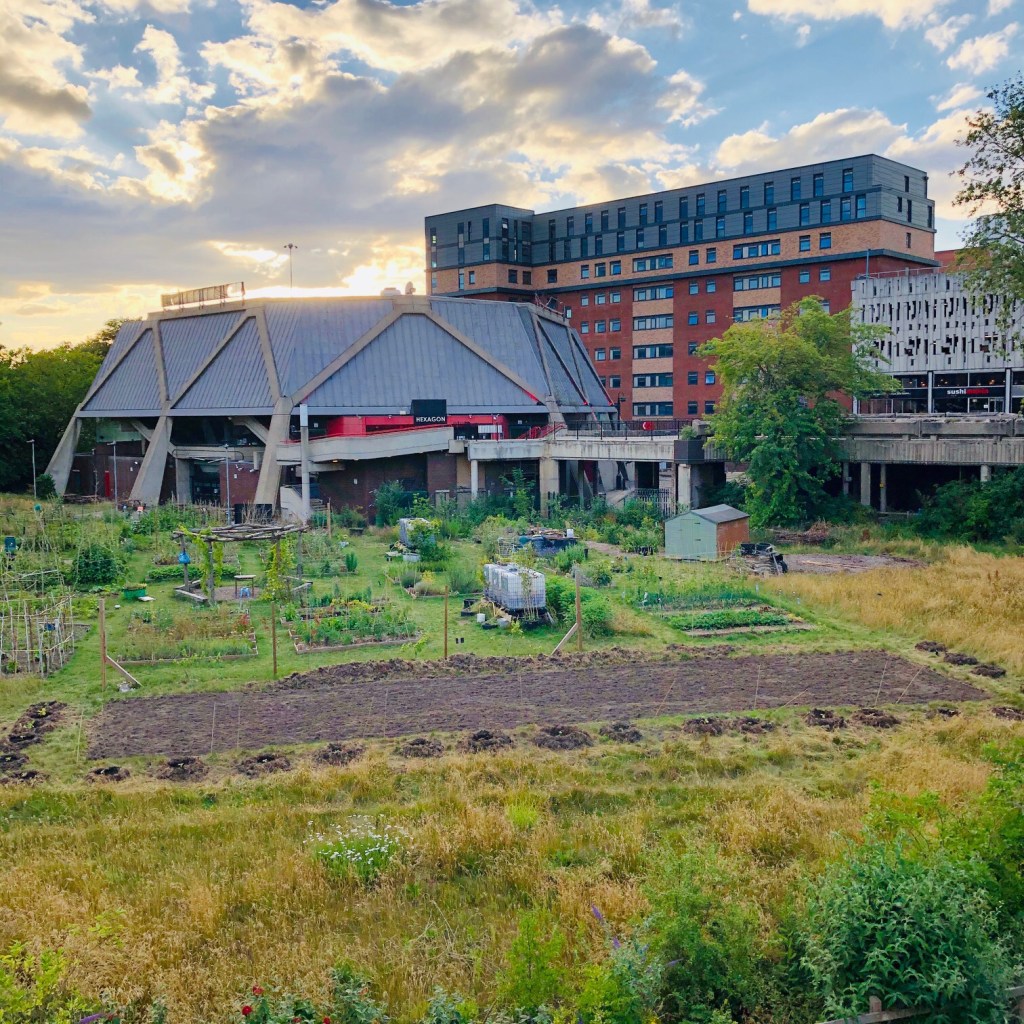
It was a similar situation in The Horn, Brewdog and The Sun, and then we cut right, looking at the Hexagon and the bizarre allotments where the Civic used to be. That end of town has always looked a little bit post-apocalyptic, which maybe means it’s less incongruous right now than, say, the Oracle. The new open-air Union Square street food market was boarded up that evening, and looked like something out of Mad Max.

There were a fair amount of diners in Sushimania, the waiting staff all masked up, and the signs were up announcing Pepe Sale’s opening on Thursday. The tables in the front window had bottles of Birra Moretti stacked on them, and I thought how nice it would be to be at a window seat with a crisp bottle of beer, trying to work out which of Pepe Sale’s specials was the most tempting. You can easily get through a whole beer doing that, without quite making up your mind. I miss evenings like that.

From there our route took us down the Oxford Road, and I’ve never been so pleased to see the Oxford Road in my whole life. Even if I wasn’t on my way to the Nag’s, it was just nice to see something that resembled bustle and normality. But even then it was a little too normal for my liking: too much bustle, too much crossing sides, or walking in the road. Before long we cut up a sidestreet and went up Brunswick Hill, another road full of irritatingly attractive houses, before reaching the tree-lined boulevard of the Bath Road. Florida Court looked as beautiful and as deco as always, green roofs tastefully lit by the last of the evening sun.

It was surprisingly emotional – happy and sad – seeing all these parts of my hometown that had been beginning to fade in my mind. Zoë and I kept stopping and taking pictures, even though they were of things and places we knew well, because it was just nice to be taking photos at all, of something new. Zoë is the first person I’ve gone out with who takes photographs, and at the end of a walk you get to compare shots. We both usually think the other’s pictures are better. Generally hers are better.

I’ve been thinking about this a lot, and I know it’s a bit melancholy, but I think this time is more difficult than when we were in strict lockdown. I liked lockdown, once I got past the worries about catching the virus and where my next supermarket shop was coming from. Like many people I relax better within a bit of structure, and it was good to have clear rules, clear dos and don’ts.

But this? This is something different.

I envied my friends who ventured out at the weekend, to pubs and restaurants and taprooms, but I wonder whether they felt as if life was going back to normal or whether it just clarified how far away from normal we are. Because walking round parts of my town made me realise that things aren’t back to normal, and they never will be. All that is a thing of the past. The sooner we all get used to that the better, although as a notoriously change-averse individual I fully expect to find it harder than most.

It brought home everything I was banging on about last week: that Reading, and the country, will be changed forever by what has happened this year. Some of the places you love won’t make it, some of the shops you like to visit will be shuttered, some of the cafés you drink in will close and some of the smiling faces that have served you will have to find work somewhere else.

I wonder whether all of the investment planned in the town will happen, whether we really will get a bowling alley or a decent swimming pool or lots of whizzy shit where the Broad Street Mall is now. Perhaps parts of it will become like the Bristol & West Arcade, tangible evidence that not every egg becomes a bird. I wonder if our landlords will step up, or sink even further in the town’s estimation. Only time will tell.

What I hope doesn’t change is the people. I put something mopey on Twitter on the way home from my walk and before long I realised that I wasn’t alone. It was quite all right and perfectly natural to find this period more difficult than lockdown, people told me. Now you could see other people going on holidays you didn’t want to take or drinking in pubs you didn’t want to visit – at least not yet – it was the end of furlough for FOMO. Someone else described it as “fake lockdown”: “It adds the feeling that I should be doing more”, he said.

The irony. Recently my friend Mike told me that he felt he had wasted his lockdown, not reading any of the books he wanted to read, or watching all the films you must watch before you die, or learning another language. And now we all have to worry that we’re wasting our fake lockdown, too. You have to hand it to us: as a species, we really are so good at sabotaging ourselves.

I wish I could wrap up a piece like this in a pretty bow that sends everybody away happy, but it doesn’t always work that way. Right now, it shouldn’t: life for many people is still hard and it’s going to be difficult for quite a while. Glossing over that insults everybody’s intelligence. The struggle for our independent businesses is just beginning, and the worst thing we could do is fall into a complacent groupthink that everybody is out of the woods. The best thing we all have is one another, and we need to hang on to that. Maybe life online is all about building an echo chamber or a virtual group hug, but perhaps it’s up to you to decide which one you want it to be.

“The things we enjoy and the way we enjoyed them are still out of reach” was how somebody put it to me on Twitter, and I think that’s a wise way to sum it up. I saw my mum and my stepfather on Sunday, on adjacent benches in Harris Garden. It was emotional to see them in three dimensions, not just flat images on a Facetime call, with occasional lag or jitter, but I still couldn’t hug them goodbye. That says it all: still out of reach, indeed.

When I got home from my expedition, I went to the freezer and fetched myself a Solero. I maintain that a Solero is about the best way to eat a hundred calories there is – all mango and ice cream, like a portable lassi. They’re just the right size, so sweet and so satisfying, and unlike many happy gastronomic memories – Nice ‘N’ Spicy Nik Naks, or shrinkflation-adjusted chocolate bars – they’re still every bit as lovely as they used to be.

I’d love to say that they serve as some kind of metaphor – that some things are always good, and cannot become jaded, or that you can always find a moment of sweetness amid the gloom. But that’s probably overselling it, because sometimes a Solero is just a Solero. Even if it’s not the most uplifting conclusion I’ve ever written, it’s still one of the best pieces of advice I can give you: have one next time you get the chance. Kindness, community and Soleros. You could do a lot worse, you know, if you’re looking for guiding principles in the months ahead.

Corona diaries: Week 14

We made it, everybody! Clap yourself on the back, congratulate yourself on your pluck and guts and book that table in the Allied for tomorrow, because lockdown is over. The pubs are starting to reopen – with the exception of killjoys like the Retreat with no gardens and selfish buzzkill merchants like the Purple Turtle – and although quite a lot of restaurants are yet to announce their plans, the good times are clearly just around the corner. I may not have got my holiday to Greece this year (I should have done a Stanley Johnson and just flown to Bulgaria before smuggling myself in: another trick missed) but who cares? The summer of fun is just about to begin.

Except. Except. Except I think we all know it isn’t really like that, and this stage of proceedings feels especially febrile. Hundreds of people are still dying every day – only in England, mind you, not in our more sensible regional cousins – my friends in Leicester (hi Adele, hi Mark!) are right back at square one and I don’t know about you, but the triumphalism coming out of some sections of the national press feels jarringly at odds with how I feel. I’ve spent nearly four months at home and I don’t remotely feel like the end is in sight; instead I have a growing, nagging suspicion that we’ll look back on lockdown, comparatively speaking, as the golden age.

Personally I’ll be at home tomorrow night, drinking some fantastic beers (I recently finally joined Untappd, which makes me a late adopter in much the same way as Mark Zuckerberg has lately adopted scruples about hate speech) and eating a takeaway from Namaste Momo. They do open for customers tomorrow as it happens, and I wish Kamal the best of luck, but I’d still rather get my fix delivered to my front door.

I’ve been thinking about the road ahead a lot this week, and some of this feels especially difficult for me to say. I love restaurants, I miss restaurants and I want nothing more than for restaurants to do well – especially the ones to which I’ve become rather attached. I wish I could be excitedly announcing all the reopenings, saying “see you there!” and racing you for that early table. I wish this was a diary post about that – it takes me back to nearly three months ago when I was writing about where we’d all go for our first post-lockdown meals. With hindsight, we all knew so little about how painful this would be: perhaps that’s for the best.

I can’t be that jingoistic cheerleader, because I think our restaurants are being hung out to dry. The decision to let them reopen is like the decision in March to tell people not to visit them (without actually closing them, of course). It is all about the government withdrawing support and leaving them to fail on their own two feet, and creating the illusion that life is going back to normal rather than the reality that it will. No more grants to fend off those greedy landlords, no more furlough payments for staff: restaurants are on their own now. It’s even worse – if that’s possible – in the arts: but that’s another story, albeit one closely linked to hospitality.

When I asked about this on social media, at least half of my followers said they didn’t plan to go into a restaurant for the time being. Couple that with the huge limitations that social distancing will impose on seating, and the admin involved in managing your customers, not to mention the risk that you will have to shut down when one of your customers or members of staff – probably from weeks ago – tests positive for Covid and the picture looks fraught with difficulty. Restaurants might feel they can’t say this publicly, so all the rhetoric is about how they can’t wait to have you back and see your faces (which I’m sure, by the way, is true) but could you blame them if, privately, they were shitting themselves?

This raises questions for all of us. Restaurants may have plenty of head scratching ahead about how they change their practices, but I think we also have to do some thinking about how we plan to support restaurants. Shrinking violet Jay Rayner started a debate about it this week when he grandly announced on Twitter that he was no longer going to publish negative restaurant reviews. He wasn’t prepared to kick anyone in hospitality at a difficult time like this, so if he didn’t have anything nice to say he wouldn’t say anything at all: if he went somewhere and didn’t like it he just wouldn’t write about it.

Would I do likewise? It’s a moot point right now, but an interesting one nonetheless. It’s different for Jay Rayner – he writes reviews that can genuinely boost or close restaurants (and has the ego to match) and I can see he might feel that with great power comes responsibility. But if you don’t tell people to avoid somewhere bad, isn’t there a risk that they’ll go there instead of all the lovely places you know about? And is thinking that literally everybody in hospitality is wonderful and doing their best to give you a fantastic evening a dewy-eyed act of self-deception? I’m sure, post-Covid, there will still be shysters and chancers, people ripping off trends or exploiting diners.

A lively debate on the subject on the ER Facebook page was fascinating but left me little clearer about my own views. Some people thought that a positive outlook like Rayner’s was just what was needed for the times ahead, others reckoned that there was a world of difference between an honest, constructive opinion and a hatchet job. One person very nicely said that my negative reviews tended to be nuanced (thanks Lucy, cheque’s in the post) – I wish that was true, but even I know that I can sometimes put the boot in. Would that be acceptable, post lockdown? Or would I just get told off because, ultimately, those restaurants pay wages and contribute to the economy, even if the food is bobbins?

Whether the state of affairs changes my habits as a reviewer, there’s no question that it can, will and (arguably) must change all of our habits as eaters. I’ve read a lot about how the age of the influencer is over, with bloggers (including local bloggers) rethinking their position on PR opportunities and gifted meals. And that’s right, I think, because it comes with a growing awareness that the restaurants that can still afford to do that are the chains. If you read my blog, you probably at least slightly share my values around independent businesses. If you do, I think there’s a lot to be said for thinking hard about your attitude to chains – especially big chains – from now on.

Make no mistake, the battle for market share in the months ahead will resemble a war zone, and the chains are going to do their best to kill independent businesses right out of the blocks. When Prêt announces that you can prepay £20 for 20 coffees, it wants to survive by clambering over the corpses of all the CUPs and Workhouses in towns across the country. When Camden Town Brewery – owned by giant multinational brewery AB InBev – gallantly offers to give free beer to pubs, they are trying to establish a stranglehold that forces smaller breweries out of business. We’re going to see this trend over and over again for the rest of this year.

In “peacetime”, I’m as partial to a Pizza Express or sitting at the belt at Yo! Sushi or drinking a Prêt mocha as the next person (unless, of course, the next person’s Prince Andrew). But we’re not in peacetime any more, and the luxury of having this plethora of choices is one we no longer have. In honesty, it was never one we really needed.

Everybody has to make their own choices, but I look at it this way: only so many businesses will survive all this, so you have to spend every pound with the businesses you want to survive. That was always true, even before Covid – especially with margins in hospitality as slender as they are – but it’s quadruply so now.

I had a conversation on Twitter a few weeks ago with someone about the mighty Kungfu Kitchen. “I like the look of their menu, but I’ll wait until I can eat in” she said. I had to point out, with the best will in the world, that if everybody takes that attitude your opportunity to eat in might be – to put it euphemistically – limited. I felt a bit like Bob Geldof at LiveAid, banging the table, saying “give us your fucking money”. But it’s true, and it’s important.

I think people’s mindsets are maybe slow to catch up. You see that in the recent news that Reading might well get a branch of Wendy’s at some point next year, news which caused an entirely disproportionate amount of buzz. “It will be nice to have another option”, said someone I follow on Twitter.

With respect, no. We have enough options already, more options than we need. We are going to lose a lot of those options as things stand, without a big faceless American chain coming in and selling everybody square donkey burgers. “But the jobs”, people say. Well, there is that. But those twenty or so jobs are a drop in the ocean when you think of all the companies and retailers making thousands of redundancies, and I bet you our independent restaurants and cafés treat – and pay – their staff miles better.

Of course, as sure as night follows day, Berkshire Live published an excitable article about Wendy’s (and promoted it five times in one day on Twitter) in the same week that they pretended to care about independent businesses with their bare minimum Twitter campaign. “Tweet to us about your business and we’ll share it with our 93,000 followers” said an organisation that has spent over twelve weeks publishing practically nothing about the independent businesses we already have.

It would be funny if it wasn’t so serious. But of course, a proper outfit with links to the community would have followed people and businesses, engaged and would know this stuff already. They wouldn’t have to launch a desperate campaign which involves you doing all the legwork so they can just Retweet it.

What have they been doing in lockdown, exactly? Not their podcast, that’s for sure: they recorded an episode about “our pivoting independents” at the start of April which they couldn’t even be bothered to promote on social media. And since then? Complete radio silence. Perhaps Berkshire Live, part of what used to be Trinity Mirror but is now the disingenuously named “Reach Plc”, is another organisation that people don’t really need any more, like those other big chains with genuinely no interest in the communities they serve.

The response to their Twitter appeal, incidentally, was exactly what you’d expect from a company with zero interest in its audience: a wedding video company in Essex and an organisation called “The Dick Incider” (I suspect the latter isn’t real, but I’m surprised they didn’t just Retweet it anyway).

Speaking personally, I plan to pick the businesses I want to survive and relentlessly support them where I can. I hope everybody does the same. If you split your spend between, say, fifteen different restaurants the grim reality is that some or all of them may fail. There are no guarantees in what lies ahead, but if you zero in on a smaller number you give them the best possible chance of making it through all this.

That doesn’t mean you want the rest to go under, merely that there are limits to what anybody can do. I would be sad if, say, the Prêt outside the Oracle closed: it’s a favourite of my family’s, so I’ve been there far more often than I might from entirely personal choice. But I would be devastated if we lost Anonymous, or Tamp, or Nibsy’s.

Every town will be faced with these choices, and it will be a real opportunity for Reading to show what many of us have always said, that it’s more than a chain town. Imagine if everyone had the tacos at the Lyndhurst instead of Taco Bell, ate at Pepe Sale instead of Prezzo, went to Bakery House instead of Comptoir Libanais. It’s always been important, but it won’t ever be as important as this.

I don’t know if it’s much of an exaggeration to say that it’s a battle for the soul of Reading, and you need to pick which side you’re on. You can sneer and run the town down, if that’s your thing: god knows you’ll find an audience that shares what passes for your values. Alternatively, you can play an active part in making it the place we all know it can be. Which would you rather?

Of course, that leaves me with the difficult decision about what I do next. I won’t be reviewing restaurants, not for now anyway, and I’ve already ruled out takeaways. I’ve really enjoyed writing during lockdown, and I hope that alternating the diary posts with the weekly interviews has given everybody something to read (and possibly something to skip, or take exception to). I’ve been hugely encouraged by the response to the diary posts – especially the many kind comments, Tweets, messages and emails – and I know that the interview posts have had a fantastic reception.

So the interviews will continue for the foreseeable future, and I’m open to carry on writing some kind of diary for as long as people want to read it. But blogs are no different to all the restaurants, pubs, breweries, cafés and bars out there: if you want them to be around in the months ahead you have to use them and promote them. Otherwise you’ll end up in a town of Wetherspoons and Caffe Neros, of Taco Bells and Berkshire Lives. I lived in a town like that, once. It was Reading in 2013, before we got some self-belief and a lot of brave, risk-taking entrepreneurs. I don’t personally want to go back there. Do you?