Restaurant review: Gees, Oxford

In 2026 Gees appointed Nick Galer, formerly of The Miller Of Mansfield, as its new head chef which means this review is no longer current. I have kept it up for posterity and will re-review Gees in due course.

For my money, there are a few finer things in life than a long, leisurely Saturday lunch with a very good friend. Especially when you’re in a fetching room, in a beautiful city, faced with a cocktail, an appealing menu and excellent people watching opportunities. In fact, one of the only things finer than that is to do exactly what I’ve described above, but on a Friday, with four whole days off stretching out in front of you. So I was very happy indeed to find myself sitting in Gees’ gorgeous conservatory on Good Friday with my dear friend Jerry, Easter weekend only just beginning.

By this point, the day had already got off to a magnificent start. The train to Oxford was quiet, deserted almost, and it was the first time in as long as I could remember that it only took a couple of minutes to exit the station, a station whose abysmal design doesn’t seem to have significantly changed in the thirty or more years that I’ve been making that journey. We had a bimble round the Covered Market, we bought bread and cheese for later on, we had a beautiful latte in the Missing Bean on Turl Street, chatting away non-stop. 

Jerry and I had never been to Oxford together before, so we compared our experiences of the city over coffee, looking at the connections between his mental map of the place and mine. I thought how nice it was to introduce him to some of my favourite spots, particularly as if it wasn’t for Jerry (it’s a long story) I might not know Oxford half as well as I do. The weather could’ve been nicer – the day was dry yet overcast, which never paints Oxford’s buildings in their best light – but the company was unimprovable.

I had chosen Gees for our lunch because it had been on my to-do list for quite some time. A glorious spot on the Banbury Road mainly famous for its conservatory slash greenhouse dining room, there’s been a restaurant on the site for nearly forty years, a mind-boggling record. It started out as Raymond Blanc’s restaurant, with John Burton Race in the kitchen, then five years later it became Gees and has stayed that way ever since. It’s now part of The Oxford Collection, a small and exclusive group including The Old Bank and Old Parsonage hotels, and their respective restaurants.

That length of tenure means that Gees was already trading when I turned up at Oxford in 1992, sporting terrible spectacles and even worse clothes, to study my degree alongside some of the brightest people I have ever met (and some of the thickest too, would you believe). Not, of course, that I would’ve eaten there then. As I’ve said before, my meals out were limited to regular trips to the fish and chip shop on Carfax, and the rest of the time I was either heating up an M&S chili con carne in the microwave of our communal kitchen, or enjoying – and I use that word as loosely as humanly possible – the food in my college halls.

Many Oxford colleges have an excellent reputation for food, as it happens. They also have shitloads of land and investments, and in one case their own deer park. My college had none of those things, which is probably why they accepted the likes of me: the food there was purgatorial. So Gees was for a long time a kind of mythical place, the sort of restaurant other people went to, people with wealthy parents and substantial allowances. It wasn’t until much later, probably twenty years or so later, that I went there, just once.

That too was in another life, with my then wife and a bunch of our friends who turned out, when push came to shove, to be her friends. I don’t remember much about that meal, except that it was deeply convivial, but I do remember following it up with a lot of drinks in one place or another and stopping on the way to the station for a shameful KFC. I always intended to return to Gees, but somehow I never did.

I was quickly reminded, as we stepped through the door, what an attractive place it is. Most of the seating is indeed in that big conservatory, with its banquettes, leather-backed chairs and handsome tiled floor, and it makes for a great place to eat. Even on a cloudy day the room fills with light, and something about that light, the room’s airiness, the bustle of its supremely efficient staff and the chatter from prosperous neighbouring diners created a truly brilliant atmosphere. If I gave out ratings for rooms alone, Gees would take some beating. 

Gees’ menu is sort of modern European, with something from everywhere. Oysters and in-season Wye Valley asparagus were on offer, as were Serrano ham croquetas and braised octopus with romesco. But Italian dishes and ingredients tend to dominate – pizzetta, pasta, burrata, aubergine parmigiana, the list goes on. It’s as tempting a menu as any I’ve seen on my travels for a while, and on another day I could have ordered almost anything on it.

I think I read somewhere that Gees was influenced by the River Cafe, and I could imagine that in both the menu and the surroundings. Not that I’ve ever been to the River Cafe: for all the rave reviews I’ve read, paying nearly forty pounds for an asparagus starter has always been beyond my means; that said, I’m sure some of my Oxford contemporaries have been more than once. Gees’ asparagus was perhaps more keenly priced at under twelve pounds. Starters more generally weighed in at between ten and twenty pounds, pasta dishes close to twenty and main courses between eighteen and thirty-five. Not River Cafe levels, but not cheap either.

Another thing to love about an unhurried lunch is the possibility of an aperitif. So Jerry had something which the bill described as a “Bergamont Spritz”. It’s not in the drinks menu online, so I’m assuming it contained gin, some kind of sparkling wine, bergamot and – surely – a typo. I had something called a Contessa Negroni which swapped out Campari for Aperol in the classic, simple, three ingredient cocktail. You might wonder why this has never been done before, and now I can tell you: because it doesn’t taste as nice as a proper negroni.

That was all forgivable, though, because the bar snack we ordered to go with them was a real cracker – little dabs of anchovy sandwiched between two sage leaves, battered and fried. These were outrageously good, salty little treats and a really excellent idea. A far better idea than putting Aperol in a negroni, anyway. I wasn’t to realise, at that point, that my bar snack would be far and away the best thing either of us ate all day, so instead I sipped my cocktail, enjoyed the surroundings and felt pleased with the course the day was taking. At all the tables around me, people were doing much the same.

The problem is that after that, despite the room being lovely and our bottle of txakoli being cold, fresh and zippy it felt to me like Gee’s menu delivered wobble after wobble. Take my starter, which was described as venison tonnato. Now, I thought that sounded like an interesting idea: a vitello tonnato swapping our the veal for venison could, after all, possibly work. And it might still be an interesting idea, but it wasn’t in a million years what this dish was.

Instead of thinly sliced venison, you got a piece of venison fillet, cooked through without pinkness, thickly sliced and drizzled with a pale sauce that contained absolutely no tuna. Not the slightest hint of it, not even a whisper of tuna. I don’t know what it tasted of – not a lot, really – but it meant that both the main ingredients of vitello tonnato were missing, replaced with things that were damage not homage. And then there was a big pile of salad, because this starter cost fifteen pounds and they had to find ways to distract a paying customer from realising that this wasn’t in any way what they had ordered.

Ordering a salad by mistake seemed to be quite an Oxford thing: I was reminded of a similar incident at Branca when I went there earlier in the year. I didn’t mind that then, because my stealth salad at Branca was still an excellent dish. This, not so much. If it had been called “venison salad with tonnato dressing”, while not 100% accurate, I’d have had fewer quibbles. Of course, if it had been called that I’d have ordered something else.

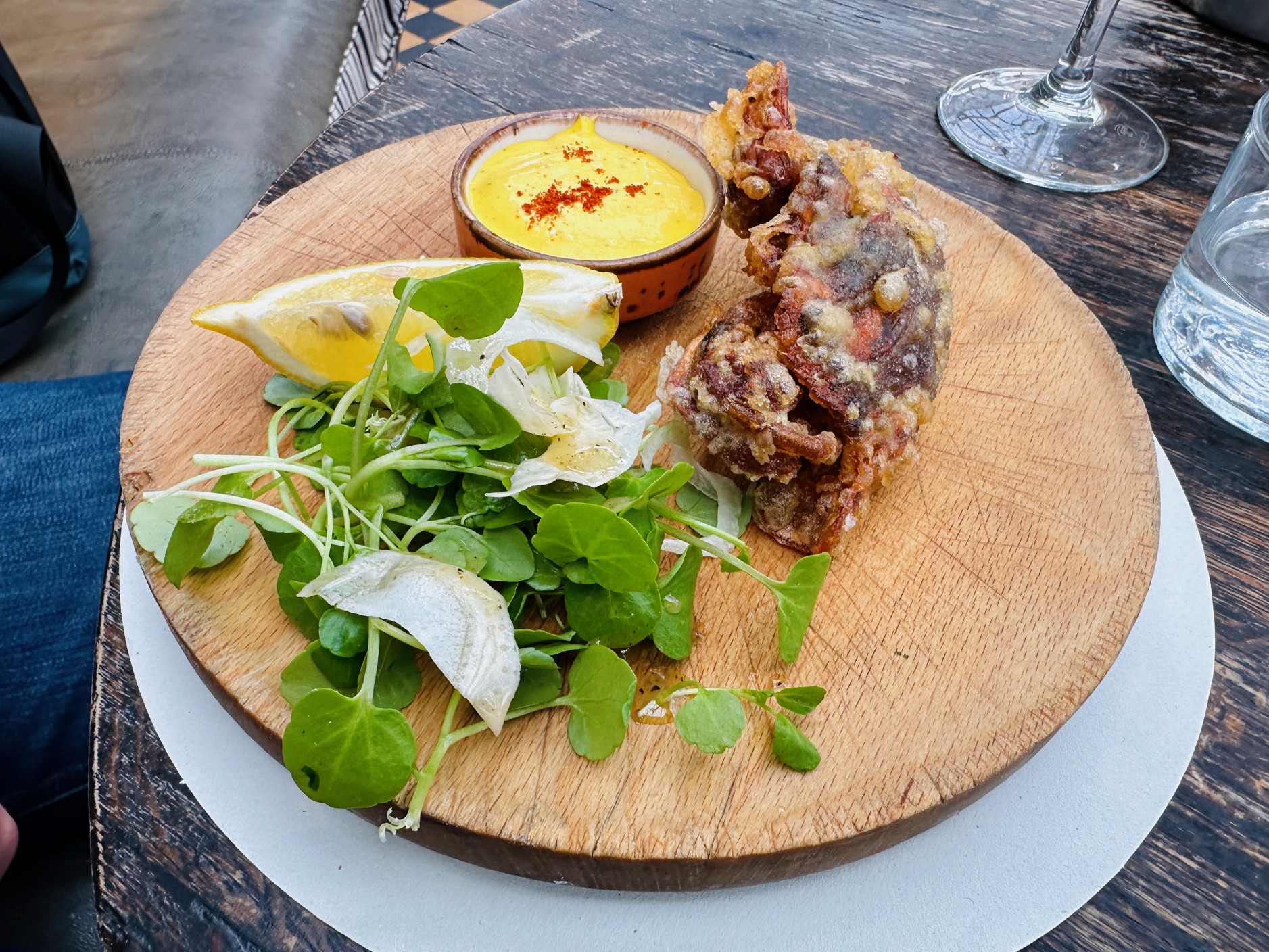
The problem is that not only is stealth salad seemingly an Oxford thing, it’s also – to paraphrase Dr Dre – a Gees thing. Jerry’s soft shell crab with saffron aioli was nice enough, but you get an idea even from the picture below of how diddy it was. Again, salad appeared mainly to be there to fill negative space, a kind of gastronomic find the lady deception. A different salad to that accompanying my starter, with shaved fennel and olive oil. Again, not mentioned on the menu but, in truth, a large part of proceedings. Jerry gave me a forkful of his crab. There was so little that I felt guilty taking it.
Jerry is on some kind of medication that reduces his appetite (although, gladly, not where booze is concerned). He quite enjoyed this, but I think you’d have to be on that medication to find it enough. And Jerry’s drug regime came in even handier with his main course: butterflied sardines, which apparently came with tomato, sumac pickled onions and chermoula.

I try not to talk about value much in restaurant reviews these days: things cost what they cost, and restaurants need to make money. So for me to mention it, pricing has to verge on the egregious and, at twenty-two pounds, that’s why I’m bringing it up here. Here they are in their glory, all five of them. This, to me, looks like a starter. Is that all there is? you might ask. Where’s the tomato?
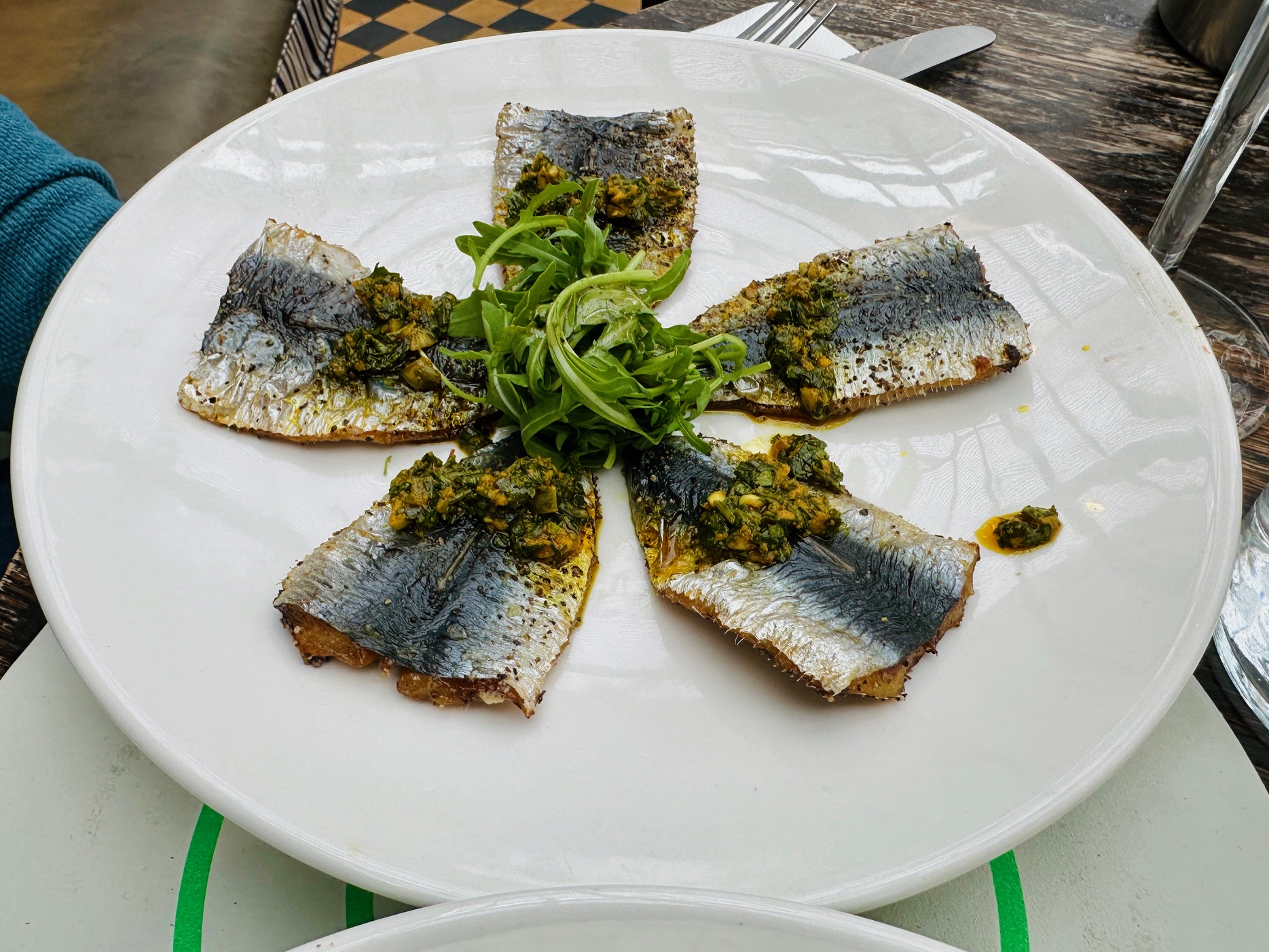
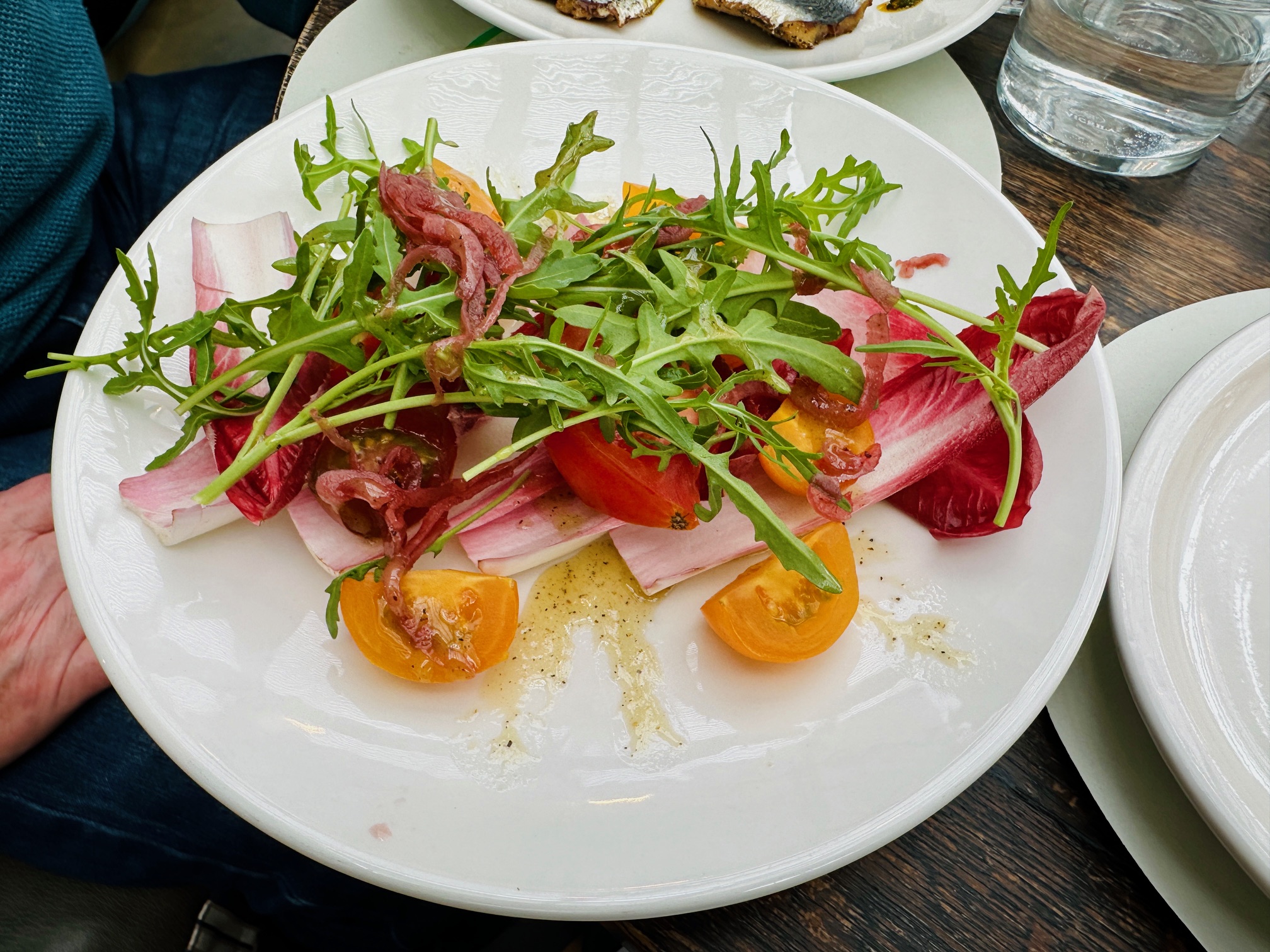
Well have no fear, because this dish – the generosity never starts – came with tomatoes and radicchio. Rocket, too, to match the rocket dumped in the centre of the Maltese Cross of disappointment that was those sardines. Double rocket, the treat nobody ever asked for: still, it beats pea shoots, I suppose. Why did the menu not mention that this was yet another salad? Was Gees just a glorified salad bar, and nobody had told us? Was it north Oxford’s upmarket tribute to Harvester, Gregg Wallace’s favourite restaurant? It was a puzzle and no mistake.

Yet I couldn’t help feeling that really we had just ordered exceptionally badly, because the dishes arriving at other tables looked more like actual food. A tall, substantial burger was brought to one of our neighbours, with a decent-looking portion of chips. Lamb cutlets piled high on a plate were put in front of the chap next to him, although in fairness they were on top of some little gem lettuce and peas. See? Another salad.
My main gave Gees one last chance to dish up something more convincing. And I’ll say this for my chicken cacciatore: it was not a salad. But it wasn’t great either. The pool of stretchy polenta was pleasant enough: I would probably always choose mash over polenta, but the menu clearly advertised it, so I couldn’t complain. And I did really love the sauce my chicken came in: rich with tomato, sharp with capers, studded with judiciously-cooked carrots and celery, a vegetable I always think is underrated in this context.

The chicken was the problem. I’m really partial to chicken thighs on the bone, but you have to achieve one of two things and ideally both. A crispy skin, if you can get that right, is a truly wondrous thing. But I would pass on that if the chicken is so well cooked that it flees the bone at speed, and breaks into strands. That’s when chicken thighs become properly magical. If Gees had achieved that the chicken, with that sauce and some of the polenta (if you must) would have made for splendid mouthful after splendid mouthful.

But to get both of those wrong, to have flaccid skin and firm, almost rubbery meat that needed to be prized away from the bone? That’s really not great. And to charge twenty-eight pounds for two undercooked chicken thighs that weren’t fit to grace the sauce they came in? Cheeky doesn’t even come close.

No side dish could rescue this sorry affair, though in Gees’ defence their braised leeks in feta and dill, served warm, were delightful. I’m no fan of dill, generally, yet I loved this dish and at six pounds it was better, and better value, than nearly anything else we ate. About the same size as those sardines too, come to think of it. It was a beautiful lipstick – applied to a pig, yes, but a beautiful lipstick nonetheless.

Would you have stayed for dessert? We nearly didn’t but felt like we had to see it through, like a disappointing box set. To Gees’ credit I asked who they bought their ice cream from and was told they made it in house. That probably swung it, and Jerry was delighted with his affogato, served with Pedro Ximenez.

I mean, again, if I’m being a stickler (which I am), if you swap the espresso for PX then what you have might be lovely but it’s no longer an affogato, just as the negroni wasn’t a negroni, the tonnato not a tonnato. Gees seemed to have taken Lewis Carroll, another Oxford type, very seriously when he wrote in Through The Looking Glass that “When I choose a word, it means just what I choose it to mean”. Words, salad, word salad: it was all the same to Gees. Let’s call the whole thing off.

To close on a damp squib of faint praise, Gees’ ice cream is pleasant stuff. I tried vanilla and chocolate – don’t expect any leftfield flavours – and both were very good. Smooth, no ice crystals, plenty of specks in the vanilla and an excellent balanced depth in the chocolate. Two scoops for eight pounds didn’t feel like highway robbery, although it made the nine quid Gees charged for Jerry’s single scoop with a slug of Pedro Ximenez seem decidedly impudent.
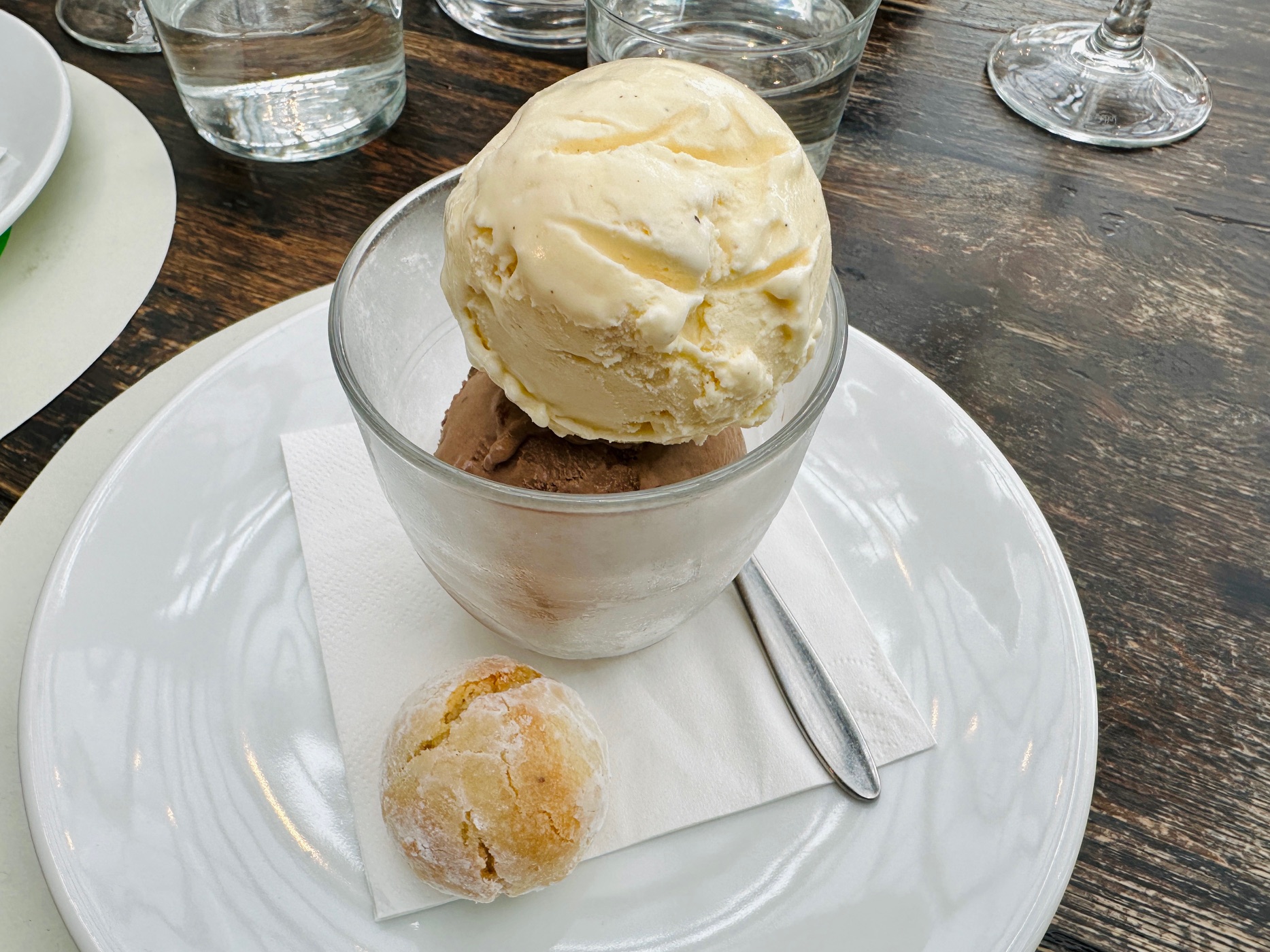
What else is there to say? The whole meal, service included, came to two hundred pounds between the two of us, including an optional 13.5% service charge. The cognitive dissonance is strong in this one, because I had a lovely time and the best of company, the room is hard to fault and the service is excellent. You almost enter some kind of trance where despite the preponderance of foliage on the plate and the underwhelming nature of so much of what you eat, you still have a very nice time.

It was, food aside, as enjoyable a lunch as I’ve had this year. Just think how much of a riot we’d have had if the food was at the standard of somewhere like Upstairs At Landrace, a restaurant considerably more reasonably priced than Gees! And there’s the elephant in the conservatory, the question of cost and value. Because when the bill arrives the spell is broken, and you think about what a hundred pounds could buy you anywhere else.

I have to hand it to Gees because they are very popular and an awful lot of people have become very taken with the place. But unless we ordered very poorly, I do have to ask myself: how on earth did Gees manage that? I’m starting to feel bad for Jerry because whenever he comes out with me on duty, however nice a time we have, the food seems to be pricey and middling. Take Zia Lucia, or Storia in Maidenhead: the poor guy can’t catch a break. I will have to think much more carefully about our next meal out, because Jerry deserves some food as brilliant as he is.

To make amends, after we finished our lunch I took Jerry to the Rose & Crown on North Parade, my very favourite Oxford pub. We sat in the back room and polished off a couple of pints, and I told him how I used to drink there thirty years ago, and how it almost felt like it hadn’t changed a bit. A lovely international group – three French, one Slovenian – perched on the end of our table and we ended up in conversation about all sorts of things: the English; Brexit (always Brexit); where to eat in Montpellier; Oxford’s best restaurants, you name it. None of them mentioned Gees in that context, and I can’t say I blame them.

It was only later that I realised that the Rose & Crown, like Gees, has been under the same management since the Eighties, which means that those first drinks I had there, fresh out of university, were under the same landlords looking after me and my very good friend over thirty years later. That gave me a warm feeling in a way that nothing I ate that day managed, however lovely Gees seemed on paper. Forty years, whatever way you look at it, is one hell of an achievement, even in a city which has a track record of keeping establishments alive for many, many centuries. I am glad there are still institutions like Gees and the Rose & Crown in Oxford. But when I go back, only one of them is on my list for a return visit.

Gees – 6.5
61-63 Banbury Road, Oxford, OX2 6PE
01865 553540

https://www.geesrestaurant.co.uk

Since January 2025, Edible Reading is partly supported by subscribers – click here if you want to read more about that, or click below to subscribe. By doing so you enable me to carry on doing what I do, and you also get access to subscriber only content. Whether you’re a subscriber or not, thanks for reading.

Restaurant review: House Of Flavours

It’s incredibly frustrating, in this day and age, when a restaurant doesn’t have a website. How are you supposed to figure out what you’re going to have, when you can’t spend at least fifteen minutes poring over the menu in advance of your visit?

And how can you tell when it opens and closes? You can try Google for that, of course, but different restaurants report trading hours in different ways – does closing at 8pm mean it closes at 8 sharpish, or that the kitchen closes at 8? If only they had a website you could use.

This all occurred to me last week, when I was going to visit Zi Tore, the newish Italian place on Smelly Alley that has taken the place of the much lamented Grumpy Goat. It has no website, although you can track down the menu if you try hard enough; an Italian friend of mine has been a few times and really rated it, not only encouraging me to visit but telling me all the best things to pick on the menu.

Google says that it shuts at 8, but I had done my homework here, too. Another friend was looking for somewhere quick and easy to eat in Reading a few weeks ago, prior to attending the quiz at the Allied and I suggested Zi Tore. “I wish they’d publish their opening hours somewhere” she said, not unreasonably. “I’d like to be assured that there will be delicious things available at 7pm.” But then she went (“it was completely dead”) and enjoyed the food. So that settled it.

I arranged to go there with Jo – who made a cameo appearance in this blog five years ago – safe in the knowledge that it would all work out fine. We met at Siren RG1 for a couple of beers, which was enough to persuade me that they hadn’t fixed their pricing issues from last year, and mooched over to Smelly Alley ready for pizza and pasta. Jo’s family is Italian, too, and she has strong opinions about Italian food: I was looking forward to seeing what happened when those views came into contact with Zi Tore’s dishes.

Can you see where this is going? Of course you can. We arrived at 7pm to find Zi Tore dead and the guy behind the counter turned us away. “Sorry, we close at half seven”, he said. Exasperating, really: if you want to just be a lunch place, be a lunch place. If you want to be a lunch place that does coffee in the afternoon, fair enough. But why offer pizza and pasta and close at half-seven, a full half hour earlier than you claim you do? I took a menu, so now I know exactly what they serve. It didn’t have opening times on it, either.

So there Jo and I were, standing on Union Street a couple of beers to the good like a prize pair of limoncellos. Where to go? Fortunately, I keep my to do list online, so it only took a few minutes poring over it on Union Street before we were on our way.

Some places, like Dolphin’s Caribbean Cuisine, haven’t been open long enough yet. Others, although high on my list of priorities, were already scheduled in with other people. And some, the likes of Jollibee or Biryani Mama, may even close before an evening comes where I consider dinner there and think “oh, go on then”. But there was a place I’d been keeping in my back pocket to to do this year, and Zi Tore downing tools gave me the perfect opportunity: back to House Of Flavours it was.

Subscribe to continue reading

Become a paid subscriber to get access to the rest of this post and other exclusive content.

Restaurant review: Upstairs At Landrace, Bath

I go to Bath too rarely to know it well, but often enough to wish I knew it better. Winding through the sun-bathed stone on a gorgeous Saturday afternoon with my old friend Dave, very much following his lead, I realise how rare it is for me to walk round a city with virtually no idea where I’m going. But Dave has been coming here for years, going all the way back to the best part of thirty years ago when he first met his wife and she was living here, so I put myself in his hands for a change and just enjoy the views, all of which are sensational.

I only have a vague understanding of the city – I know where the Royal Crescent is, and the train station, and Pulteney Bridge, sort of, but beyond that my inner satnav of how all these places join together is fuzzy at best. I’ve probably been to Bath something like four times in ten years, so I follow along like a clueless tourist while Dave takes me to his favourite coffee spot, a little off the beaten track, and a very good beer shop. And then we have a bit of a wander in the growing warmth of the day, and Dave tells me about all the green space in the city, the bookshops we could visit later and, crucially, where we might drink after lunch.

Eventually we walk up Walcot Street, one of the few parts of Bath I know a little better. I would say it’s one of Bath’s most beautiful streets, but in my experience they all are. But I know it from the cheese shop, which feels like it’s been there forever, and Picnic, a café I drank at last time I visited the city. Beyond that, I mostly navigate it by memories of places that are no longer there – a Scandi interiors store I shopped at a lifetime and a marriage ago, a craft beer bar called Brewed Boy that I drank at with Zoë and her friends James and Liz, before they became my friends too.

As we stroll, Dave points out landmarks from his memories in the city, places that have survived better than the ones I recall. One, Schwartz Bros, is a burger place that looks to have been trading for the best part of fifty years – Dave remembers it from courting his wife, and that was so long ago you probably still would have called it courting. But our destination for lunch is a place neither of us has been before: Upstairs at Landrace, the restaurant that sits, as its name suggests, on top of the city’s highly esteemed Landrace Bakery.

I’d wanted to go for ages, and when Dave and I were deciding where to meet up he picked Bath over Oxford or Reading, so I saw my chance. I gave him a few options, half expecting him to go for the wine and small plates of Corkage, or the Basque tapas of Pintxo, but was very pleasantly surprised when he plumped for Upstairs at Landrace, a place I’d always liked the look of.

It received some attention in the national press three years or so ago – I get the feeling national critics pick Bath for a review every couple of years when they fancy expensing a genteel day out – but had since settled back down to just doing its business. All the reviews I’d read talked about a simple, compact, beautifully executed menu and really, what more could you ask for when lunching with a very old friend? The menu changed daily, in fact, and both Dave and I kept an eye on it in the run-up to our trip, identifying dishes we would like to eat and hoping they’d still be on offer when the weekend came.

The restaurant is a wonderfully haphazard place. You go up the stairs and although the two dining rooms are both technically on the first floor they aren’t quite on the same level. You sense that everything in the building is higgledy-piggledy, few straight lines or right angles. We were given a table in the cosier of the two rooms, near the open kitchen, all sloping ceilings and sunlight squeaking in through the windows.

It was doing nicely when we got there, on a bright spring afternoon, and it got busier during our time there. It felt like a very agreeable place for lunch, and the fact that my seat gave me a prime opportunity to snoop on plates being whizzed from the kitchen to other tables didn’t exactly do any harm.

The menu was compact and, although a continuous list of dishes, was clearly designed, by price point, to be broken up into smallest, smaller and bigger. Our excellent server, who did a brilliant job all afternoon, talked us through the whole “small plates for sharing and bigger plates for you to have to yourself” concept and we listened to it the way you listen to the safety demonstration on an airplane, being respectful although we’d both heard it dozens of times before. After all, I suppose this plane might have varied from others we’d flown on in the past. It didn’t, though. It never does.

What that meant, in practice, was the compact menu all the critics had talked about – a couple of snacks, six artists formerly known as starters, three big plates for you to have on your own and one even bigger one for sharing. Just the one side dish, “Fairy Hill mixed leaf salad”, from a place whose leaves are apparently so good the provenance deserved to be listed: we didn’t try it to find out. The small plates were between eight and fourteen pounds, the bigger ones between twenty-four and thirty, the biggest fifty-eight.

All the versions of this menu Dave and I had tantalised ourselves with in the run-up, I can safely say, had more options I fancied on them than this one did. One of the most appealing dishes – involving duck, I think – had been replaced with a “Pembrokeshire cockle vongole”, which I’m sure many people would have loved but appealed to me about as much as the mixed leaf salad. Dave, who treats eating out as a chance to indulge, wanted a bit more red meat on there, but pretty much the only dish that fitted that bill was the ribeye, and we didn’t fancy it enough.

We contemplated our relatively bad fortune while eating an excellent slice each of the bakery’s bread – a nice touch that this was complimentary – with very good, golden room temperature butter and a drink. Dave told me on the walk to the restaurant that he had pretty much given up on wine in favour of beer (and I had mentally scratched a couple of bars off my list of places we could drink later on) so he had a bottled IPA from Gilt & Flint, a Devon brewery I’d never heard of who also, apparently, supply to triple Michelin starred The Ledbury. I had a sip: it was nice enough.

I, a little jaded from a session the previous evening at the Nag’s, was tempted by a wine from Wiltshire of all places but instead had a glass of table perry from Wilding. I know next to nothing about perry except that it’s apparently the best booze we all aren’t drinking yet, and unworthily I’d picked it mostly because it was a small glass of something alcoholic that wasn’t too strong. I don’t think that’s a slogan perry makers are going to scramble to adopt, but on this showing it didn’t have enough about it to generally make me choose it over a crisp white wine. I must try harder.

The first of our sharing plates was a study in simplicity. Four very good anchovies – by Pujadó Solano apparently, seventeen quid per pack online – came glimmering in a pool of unbeatable olive oil, sprinkled with oregano, the whole affair beautified with lemon zest. “Why do I never think of having anchovies with lemon zest?” said Dave. “I’m definitely doing that at home from now on”. Otherwise this was just about buying the best of everything and putting it together, and in that sense you could say that although it was special – and at twelve pounds you’d want it to be – it somehow wasn’t out of the ordinary.

What was out of the ordinary, though, was our server coming back with a basket of little cubes of sourdough so we could personally mop up every last soupçon of that bright, herby olive oil: that I loved.

Anyway, the anchovies were the last – the only – thing we ate that was merely quite good rather than extremely good. I had seen mentions of Upstairs’ cheddar curd fritters in other reviews, I seem to recall, and I’d seen enough of them on their way to other diners before I even placed an order that I knew I had to try them.

I wasn’t quite sure, even after eating them, how they managed to make fried cheese so airy, so ethereal and yet somehow they did. They were stupendous clouds of joy – as if someone had decided to make Wotsits entirely out of cheese, serve them piping hot and cover them in yet more cheese. Eight pounds for these, and I think Upstairs At Landrace needs to rethink this whole “small plates for sharing” concept, or expressly make an exception for the fritters. I otherwise couldn’t fault our server, but she should have said “have you considered having one of those each?” Shame on her.

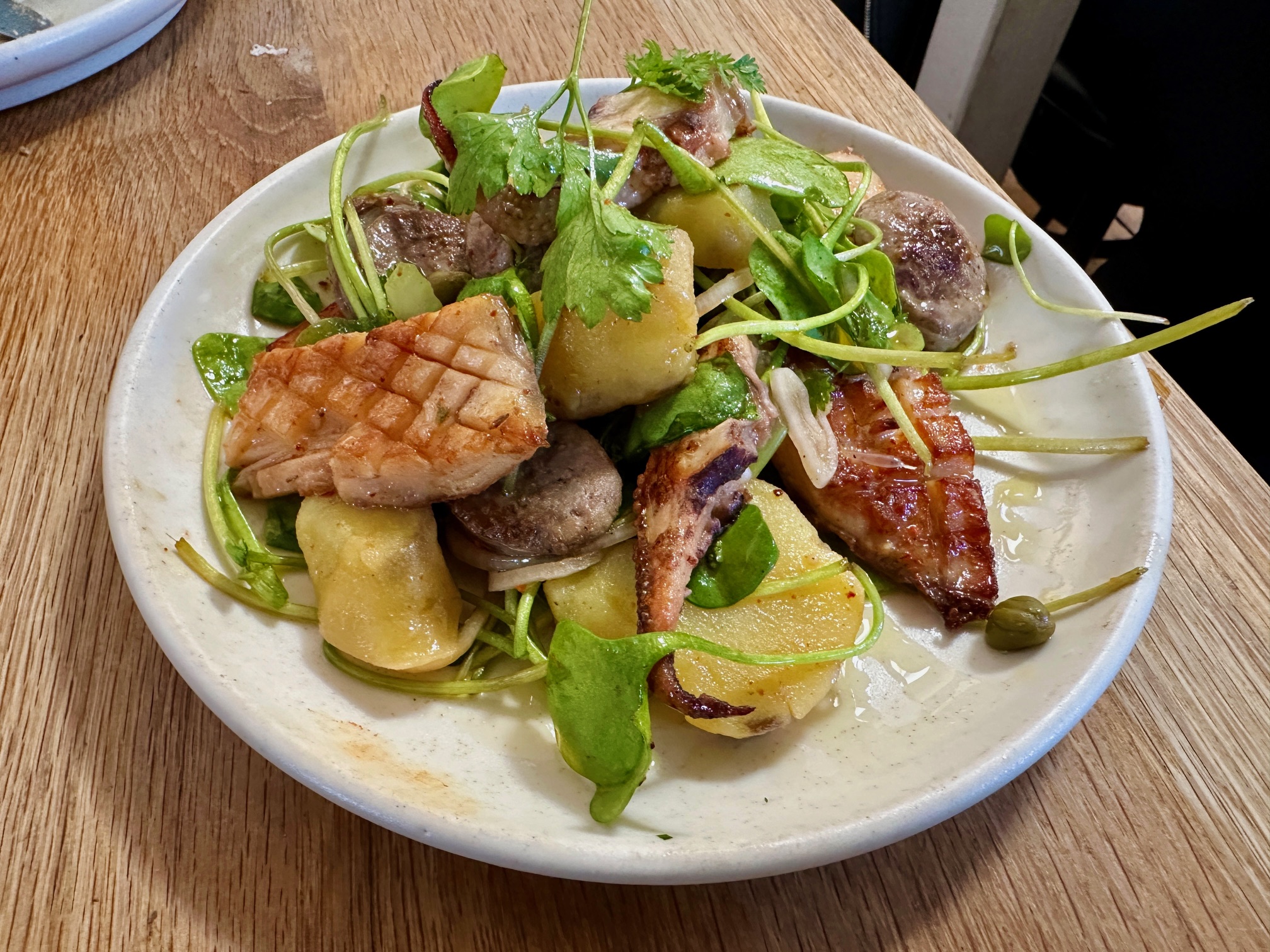
Although you could just as easily have said the same about the third dish we shared, the cuttlefish and sausage salad. Rarely have four words so comprehensively undersold a dish as they did on the menu. I mean, yes, it was a salad and yes, it contained cuttlefish and sausage. But that didn’t begin to do justice to what I’m already sure will be one of the most enjoyable dishes I eat all year.

I suppose there isn’t room on a menu to say “huge quantities of precisely scored, superbly cooked, tender cuttlefish”, and no room to say “the warm, slightly caramelised discs of sausage, with the tiniest hint of offal, bring a welcome hint or earthiness and, let’s face it, red meat, to proceedings”. The menu didn’t go on to add “by the way, you’ll also have warm bits of waxy potato, and while we’re at it the dressing will be impeccable, with the sharpness of capers thrown in, into the bargain”.

I know Upstairs At Landrace’s menu is in the still fashionable Ingredient A, Ingredient B, Ingredient C format that seems to annoy me more than most, but even at its most fulsome it wouldn’t capture that detail. I suppose that’s what restaurant reviewers are for.

But my goodness, how I loved this. If all salads were like this, or even half as good, I would eat salad all the time. I’ve always loved a warm potato salad, or any potato salad dressed with vinaigrette rather than drowned in mayonnaise, and I really adore cuttlefish, which you don’t see on menus anywhere near often enough. To find all of that coalescing in one glorious plate made me very happy indeed: forget JK Rowling’s recent lamentable cigar-based bigotry: this is what happens when a plan comes together. And the company was so good that I didn’t even resent sharing it.

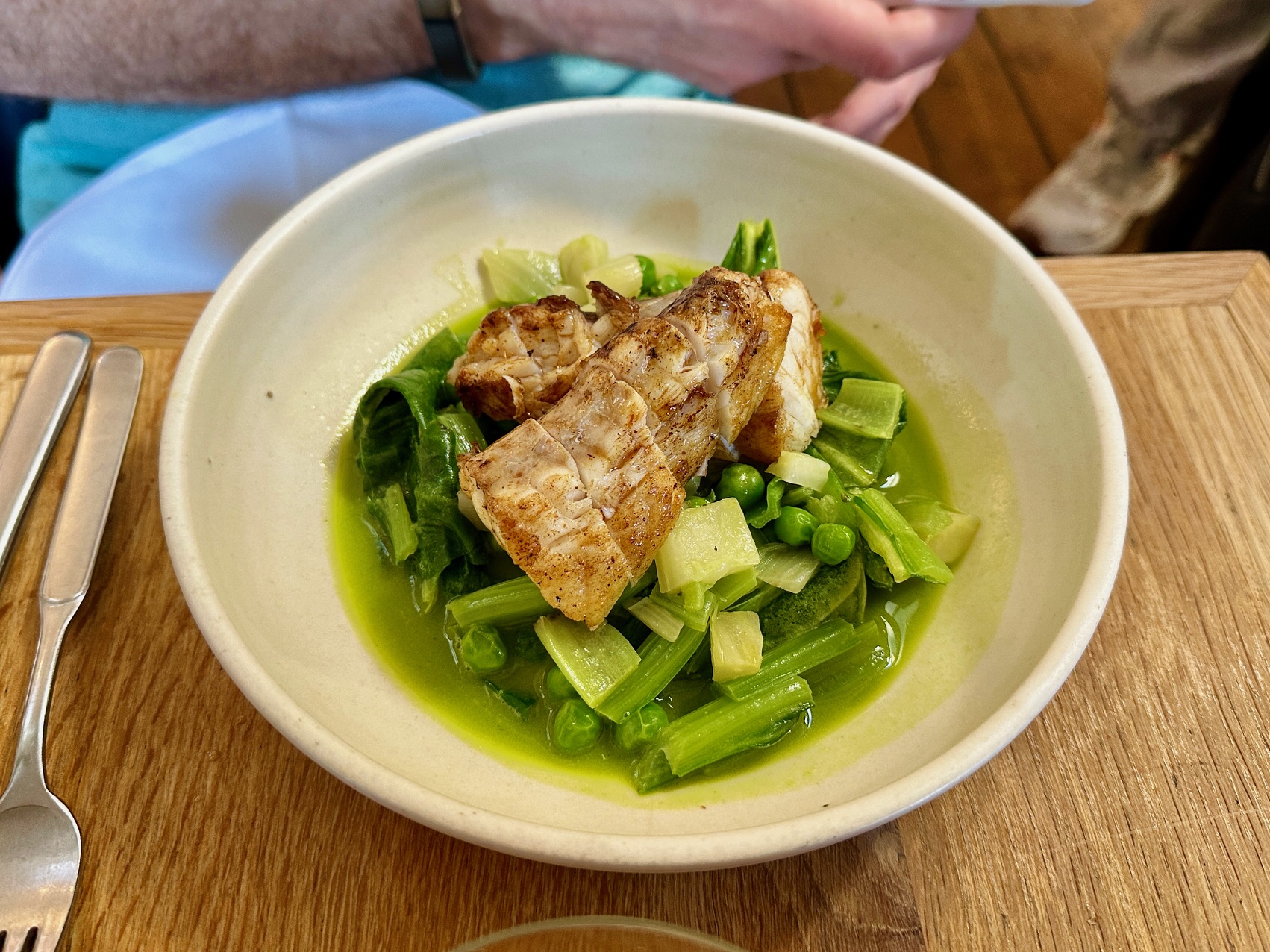
Although Dave was a little sad about the paucity of meat on the menu, those nubbins of sausage aside, he did console himself with monkfish, one of the meatiest denizens of the sea. And again, trust in Upstairs At Landrace was richly rewarded: this was a phenomenally cooked, very generous piece of monkfish with a beautiful colour, effectively cut into medallions. It came on top of a primavera riot – leeks, peas, celery, all the good stuff, bathed in what was apparently a pastis butter.

I can’t verify that: I did try a little of the monkfish, which I thought was exceptional, but left the shrubbery to Dave. He adored this dish though, and didn’t feel like he had missed out one bit. This was possibly a dish you wished you’d held back bread for, although I’m sure our server would have brought a little more if Dave had asked nicely.

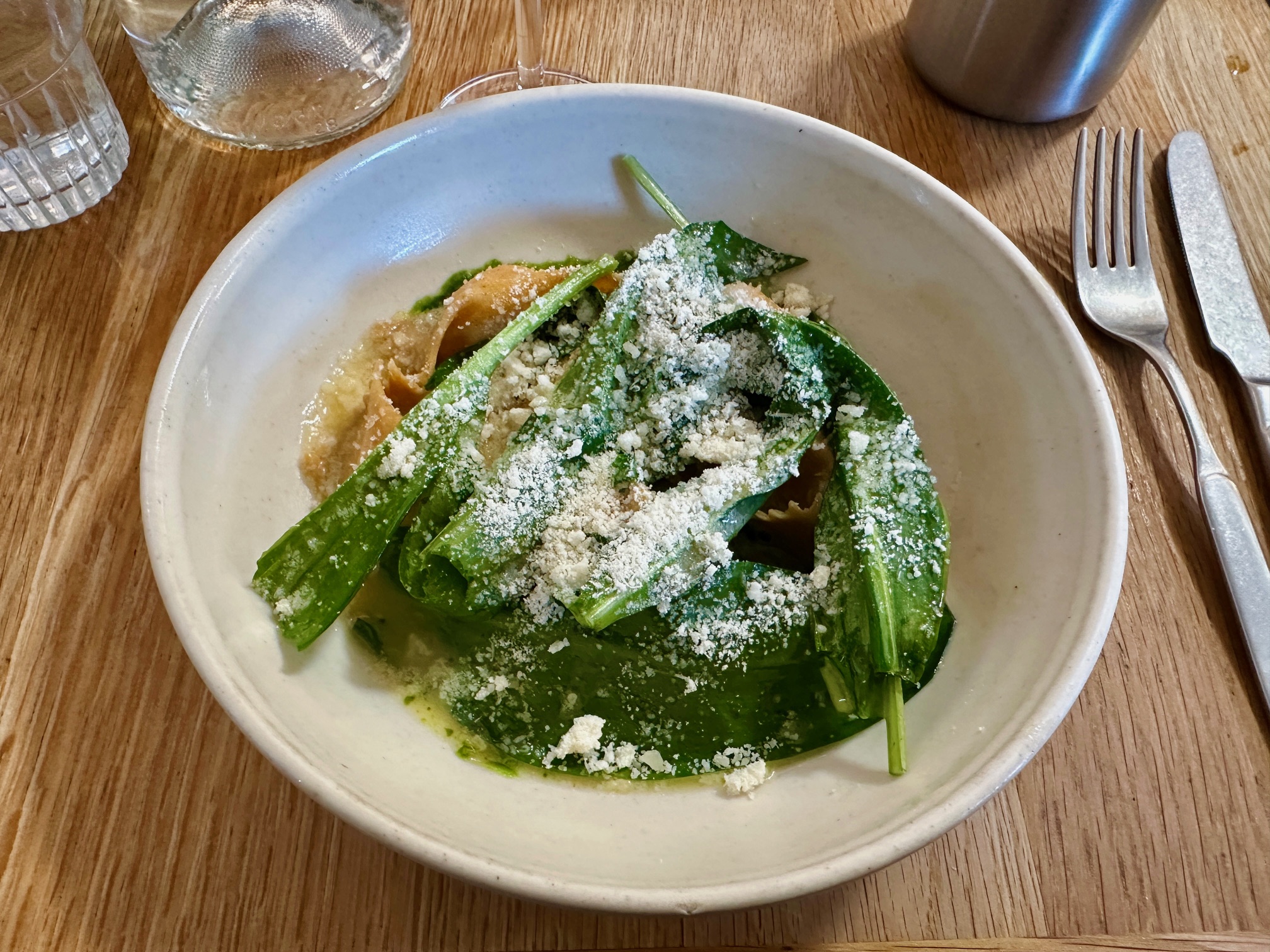
My main, on the other hand, was a symphony of a dish. Agnolotti filled with Jersey Royals could have been starch on starch overkill, but instead were little pockets of silky comfort, the pasta with just enough bite and the filling, pleasingly, with no bite at all. The whole shebang was positively awash with brown butter and wild garlic pesto, because of course it’s the season now, and if that wasn’t enough there was more wild garlic on top. And if that wasn’t enough there was a mountain of cheese, and if that wasn’t enough a dish with more of it was left at the table for you to sprinkle with abandon.

And it was, all in all, enough, and teetering on the brink of too much. But that brink, provided you stay on the right side of it, is where legendary dishes live, and this was one of my favourite things I’ve eaten in a long time. It was so well-judged, so well done, just the right size, everything in the right proportions, everything in exactly the right place. The pesto was so beautiful that I’d have bought a jar the size of my head if I could, the pasta so well done that it’s now, for me, the best thing you could possibly do with Jersey Royals.

I’ve had a few instances recently where the menu, on turning up at a restaurant, wasn’t quite the one I would personally have chosen and yet everything was amazing. I will make the most of those, because I know there’s some Newtonian law of dining whereby, when I review somewhere in the future, the menu will have loads of things I fancy on it, I’ll order them and they won’t be anywhere near as good as I wanted them to be. Buy now, pay later.

Dave and I were fuller but not stuffed, very happy indeed and I was on my second glass of perry, as my hangover became too distant a memory to stop me acquiring another one. The tables about us had ebbed and flowed, but the place had always seemed just comfortably less than rammed. Dave and I got to talking about the times he’s joined me on a review.

“What I find weird is when we go out and have a lovely meal and then weeks later I read your review and you weren’t blown away by the food. Because then I think: are you sitting there having lunch with me and not having that good a time?”

“It’s not that at all! I always enjoy having lunch with you but then when I look back on it, and weigh it all up, the food isn’t the best part of the experience.” I probably won’t be able to convince Dave, even after over thirty years of friendship, that however good the food is his company is usually the best bit.

“I suppose it’s better this way round, though” he replied. “I wouldn’t want you telling me during the meal that you don’t rate it that much.”

“Exactly! Nobody needs someone speaking their truth that way during dinner, it just ruins the whole event.”

“But so when you say this is a really good meal, do you mean that?” Dave wondered. “Or when you eventually write this one up am I going to find it’s got a middling mark?”

“Trust me, Dave. This is going to be a really good review.” There was a pause, and I knew that my old friend wouldn’t completely believe me until he saw it. Nonetheless, I said it again for emphasis. “It’s a really good meal.”

The other thing that happened before we made our assault on dessert was that Dave asked our server where the loos were and was directed towards a door on the same floor as us. He returned eager to share something.

“Mate, before we go you have to try that toilet.”

This was not something I heard every day.

“What’s so special about it?”

“You know how normally if a loo is up some stairs you go up the stairs and then open the door? In this place you open the door, and right in front of you is a staircase. A really steep one. And the loo is at the top and, well, you’re quite close to the edge of the stairs when you do your business.”

“Really?”

“You wouldn’t want to do that after a few drinks, trust me. I expected to see a boulder coming down the stairs at me like something out of Indiana Jones And The Temple Of Doom.”

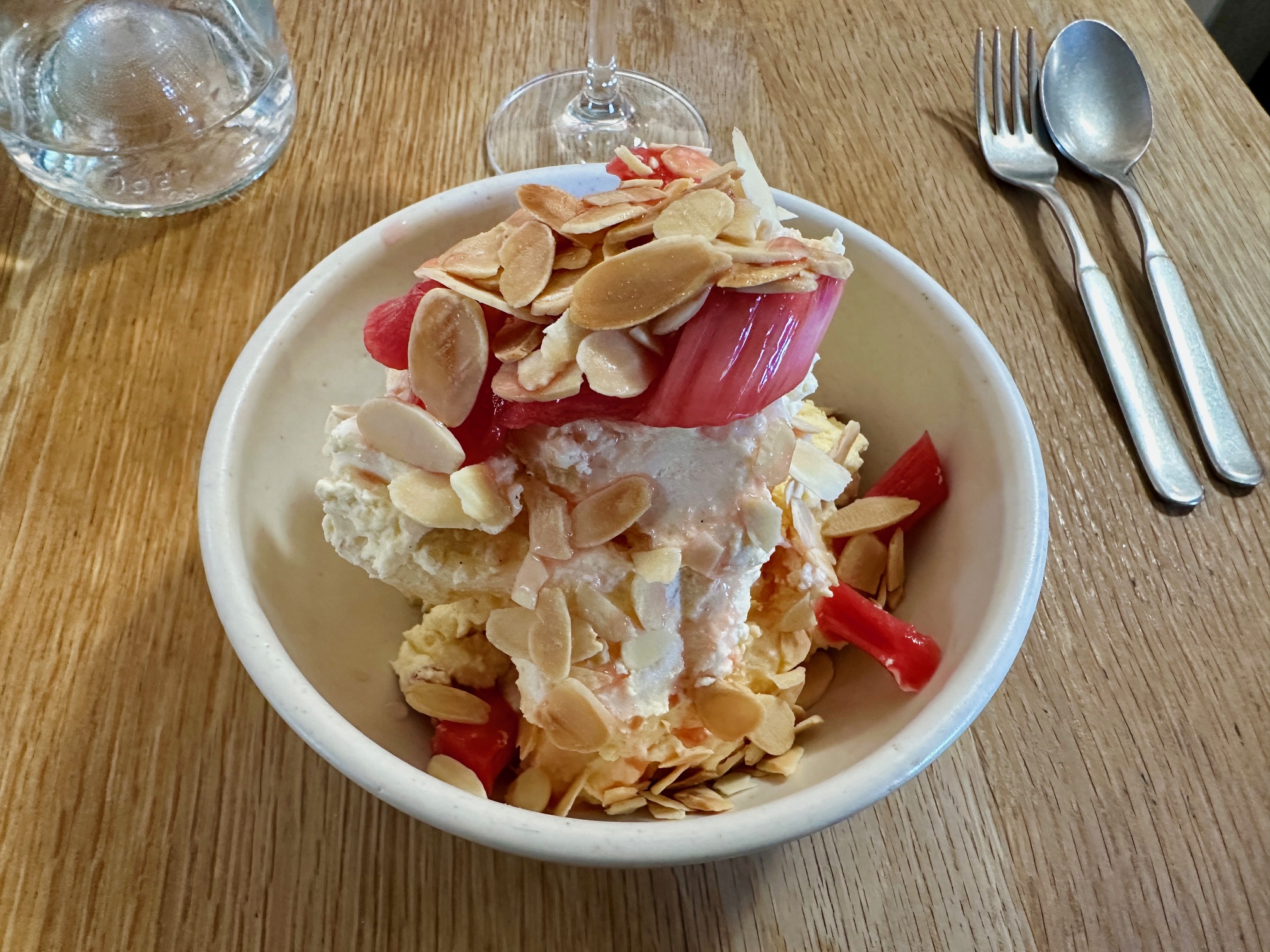
Upstairs At Landrace’s menu is at its most compact at the end: two desserts and a cheese course is your lot. We’d already had cheese to begin with and one of the desserts, the walnut tart, was a no-go – for me, because I’m generally not wild about walnuts and for Dave because, being allergic, he takes that one step further. That just left us with one option, rhubarb, meringue and cream. Maybe Upstairs At Landrace didn’t call it an Eton mess because they’d like to cancel Eton, in which case I sympathise entirely. Maybe it was a pavlova that had done a bad job of tackling those stairs.

Whatever the explanation was, though, it was a really terrific dessert which brought matters to a close in masterful fashion. The cream, from Ivy House Farm, near Bath, was thick and ambrosial, the rhubarb still had bite, and hadn’t been stewed into sticky submission. The meringue was just the right level of chewiness and the extra touch, toasted, flaked almonds, was the icing on the cake. Twelve pounds for this, so again not cheap but ultimately worth every penny. When I looked back on the meal, now that it was done, I didn’t think there had been a single misstep. That rarely happens.

After we’d finished, I took my life in my hands and ascended the staircase to the loo, which was every bit as vertiginous as Dave had warned me it would be: the very fancy hand soap was almost worth the climb in its own right. We thanked our server and chatted briefly to her about what a good meal it was, and she said that they had a lovely mixture of locals and regulars and out of towners like us who treated it as a destination restaurant.

We both did our best to be enthusiastic and grateful without coming across as creepy uncles, but ultimately as she went to fetch the card machine we knew, as always happens, that she was probably just wondering which of those pleasant middle-aged men was the top and which was the bottom. Our lunch for two came to one hundred and twenty-eight pounds, not including service: we didn’t have a lot to drink, but without alcohol it would have been fifty-five pounds a head.

Bath seemed even lovelier, if that were possible, after such a good lunch and so we did some more ambling, including a brief browse for books at Topping & Co, before having a couple of beers outside at Kingsmead Street Bottle, discovering in the course of drinking them, that it was nowhere near warm enough to sit outside. So we headed back across town and lucked out with a great table at The Raven, one of my favourite Bath pubs. I didn’t realise they had a beer brewed specifically for them by Bristol’s Arbor Ales, a really likeable pale, but once I discovered it I knew I was staying on that for the rest of the day. As my friendship with Dave taught me many moons ago, when you find something you really like, you stick with it.

So it turns out that, like the national restaurant critics I lightly ribbed at the start of this review, I have come to Bath twice in just under two years and both times I’ve had a very good, rather genteel time of it. But I think Upstairs At Landrace is worth going to Bath for all by itself – with or without the shopping, or the coffee, or the beers, or the old friend – because it’s supremely good at what it does.

I read an article about Upstairs At Landrace ages ago, in the Financial Times, that lumped it in with the Bristol restaurant Sonny Stores and breezily dismissed them both as part of a trend of a certain kind of restaurant that’s everywhere just now. Well, the main thing that writer was eating, it seems to me, is mushrooms. Because in reality, away from generic broadsheet sighing or sneering, restaurants as good and as clever as Upstairs At Landrace, places that manage to be sleek and refined without being sterile or soulless, are vanishingly rare. Maybe they’re ten a penny in somebody’s parallel universe, but they certainly aren’t in mine.

Oh, and for the benefit of Dave – who I know occasionally reads this – see that mark below? Told you. It was a really good meal.

Upstairs At Landrace – 8.8
59 Walcot Street, Bath, BA1 5BN
01225 424722

https://landrace.co.uk

As of January 2025, Edible Reading is partly supported by subscribers – click here if you want to read more about that, or click below to subscribe. Whether you’re a subscriber or not, thanks for reading.

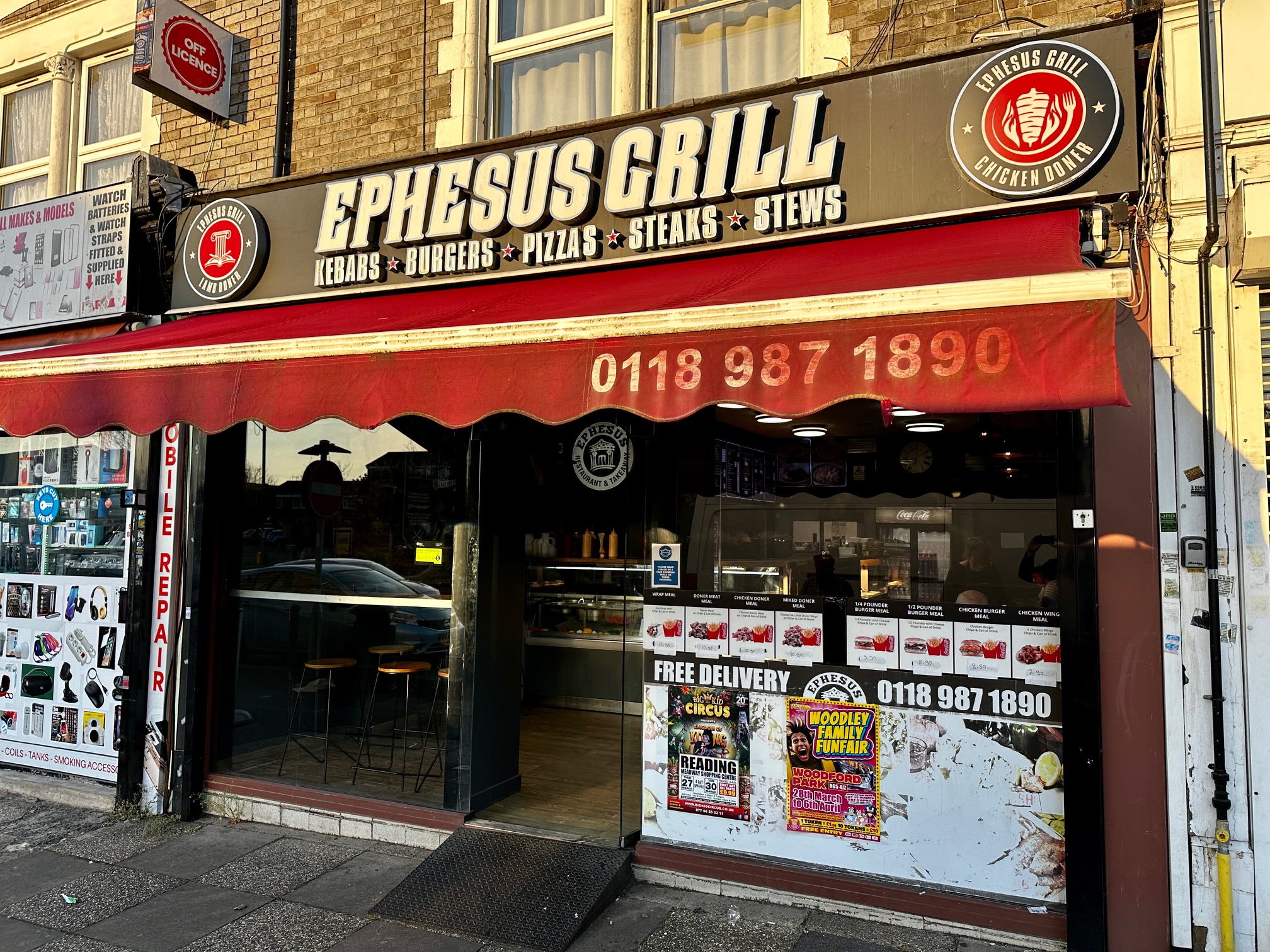
Restaurant review: Ephesus Grill

A couple of Mondays back I was on the train home from work and Zoë and I had the “can’t be arsed to cook” conversation where gradually, one or the other of you oh-so-casually floats the topic of scrapping whatever’s in the weekly meal plan and doing something more interesting instead. Do you ever do this, either with a partner or just with yourself?

In my case, I always have to at least try and make it look like it’s Zoë’s idea, every bit as much as she’s trying to make it appear to be mine. I would say I’m more successful when I know it’s Zoë’s turn to cook: she no doubt would dispute that. But I usually get an impression, in those exploratory messages, that there’s potential to chuck the plans and structure out of the window and live a little. You have to celebrate these small wins, especially as the world continues to go from bad to worse.

In the olden days, by which I mean this time last year, the options were plentiful on a Can’t Be Arsed To Cook Day. Town was on my doorstep, and Zoë worked in the centre, and even more crucially to get home both of us had to walk past the Lyndhurst, God rest its soul, and – and this was the difficult part – not go in. So a year ago, the “can’t be arsed to cook” conversation was more straightforward, and often ended on Watlington Street with a Korean chicken burger, or some monkfish tacos.

Nowadays, in that strange no-man’s land that isn’t Katesgrove, isn’t Whitley and isn’t quite the university area, life is trickier. And it’s especially compounded by the fact that my poor wife is stuck at home again with a fractured bone in her foot – different bone, same foot – and so leaving the house together is a vanishingly rare occurrence, even with her immensely fetching moon boot on. Some of the gastronomic opportunities presented by our new neighbourhood, like Curry Rasoi down the way or Meme’s Kitchen down the hill on the Basingstoke Road, remain unexplored.

That means we have to resort, in the most part, to takeaways. And living further out from the centre we have, after a process of trial and error, got this down to something approaching a fine art. I’ve been disappointed by enough orders from the wrong side of the town centre to abandon those as options, because even if Google Maps says something is a nine minute drive away it can be far longer, and more painful, when Deliveroo in its infinite wisdom chooses to lump your order in with someone else’s and deliver theirs, halfway across town, first.

No, with the exception of sushi, which does not go cold – Iro Sushi and You Me Sushi have both done pretty well out of me since I moved house – we tend to keep it relatively local. That means the piping hot wonders of Dough Bros, just round the corner, or Gooi Nara, whose takeaway is so good I gave them an award. It means Bakery House or Hala Lebanese when hot grilled meat or baby chicken are the subject of the hankering, or Kungfu Kitchen if we’re really treating ourselves.

And on the nights when we want something spicy, it means a delivery from Deccan House on the junction, whose chicken pakora and chicken biryani make me very happy indeed, badly in need of a glass of milk and, for a few minutes at least, unable to see clearly through my watering eyes. Sometimes I miss the myriad of opportunities presented by town centre life, but actually having fewer options is fine provided you like them and you have enough. Besides, it’s a first world problem.

Anyway, that Monday could have been a Can’t Be Arsed To Cook Night like any other, but as I was standing on the platform waiting for my train home I had an idea and texted Zoë. How about you hop on the bus and meet me halfway at Ephesus Grill? I’d had good reports of the Turkish place on Whitley Street – I seem to remember somebody told me about it when I reviewed Shawarma earlier in the year – and it had been on my to do list for a while.

Subscribe to continue reading

Become a paid subscriber to get access to the rest of this post and other exclusive content.

Restaurant review: Orwells, Shiplake

The exterior of Orwells

Writing about food – or, more specifically, writing about restaurants – is an enormous privilege. It costs money, and you need money to do it. It is absolutely no coincidence that most of the national broadsheet restaurant critics, nearly all men of course, are either descended from the aristocracy or other journalists. To the point where there isn’t much difference, to be honest: I heard Giles Coren described once as a “hereditary columnist” and, like my vague feelings of revulsion towards Coren, it has always stayed with me.

So how do people afford it? The most frequent route, for Instagrammers at least, is to accept free food in return for content. I’ve talked about that recently, so I won’t do it to death, but what surprises me is how little people on Instagram follow the ASA guidelines and declare things as #ADs or #gifted. Sometimes it’s down to ignorance, others down to wilful ignorance. Often it’s hard to tell. “I thought that was just a courtesy thing” said a content creator I swapped messages with recently. Err, well, how about giving your audience the courtesy of knowing that you didn’t pay for the food you just raved about?

“What if I went intending to pay and they wouldn’t let me?” he followed up, an oblique take on the eternal if a tree falls in the forest and there’s nobody around to hear it question. It doesn’t matter what you intended, it matters whether you put your hand in your pocket. I’m afraid it really is that simple.

But restaurant bloggers do this too, usually while criticising influencers and content creators, seemingly for the crime of being less subtle. They take free stuff all the time, and often don’t declare it either. They certainly wouldn’t break out the hashtags of shame, because that would let the cat out of the bag, so instead they resort to weasel words like “I didn’t see a bill”. Some restaurant bloggers are positively myopic where bills are concerned, but they still have good enough eyesight to say the food looks phenomenal. What are the chances?

But this is the problem: writing about food is an expensive business, so unless you are fantastically independently wealthy you need to find a way to keep doing it – whether that’s wealthy friends, or a patron, or in-laws you can stiff, or some other route. It’s why many restaurant bloggers drift into doing PR for restaurants they like on the side, so the line between the writer and the subject gets hopelessly blurred.

Again, I do kind of understand: I have made a few friends in the business since I started writing this blog (although, and this probably says something about my winning personality, not many) but I don’t review their restaurants. Stay in this game long enough though, and of course you risk compromising yourself. But what I don’t understand, given all the privilege entailed in being able to do this, is how little restaurant bloggers seem prepared to check or acknowledge their privilege.

Instead, you just get tin-eared humblebragging from people who aren’t even pretending to be relatable. “I eat out more often than you, so I know what I’m talking about” says one restaurant blogger who routinely promotes businesses he has worked for. “My lunch is better than yours” repeatedly boasts a second, who rarely sees a bill and appears to be about six months from a cirrhosis diagnosis. Classic car crash.

“I’m especially interested in submissions from writers who identify as working class” says a third, a double barrelled type who is currently in the twelfth week of a jaunt round Asia. Nice work, gang: keep on keeping it real!

So at this point, I should acknowledge my own privilege: I am extremely lucky that I can afford to do this, and very glad that I’ve never gone down the route of accepting free food from restaurants and reviewing it. At the start of this year, I asked if readers wanted to support the costs of what I do, and I was very fortunate that the response was positive. I said at the time that it would hopefully enable me to cover some of the costs of running this blog, and that it might allow me to write more, or different content. It has definitely done the former, and enabled me to get rid of ads on the blog, but what about the latter?

The reason I’m talking about this, today of all days, is because this week’s review is of Orwells, the widely acclaimed Shiplake restaurant that features in the Michelin guide, has received multiple accolades from the Good Food Guide and has been pursuing excellence for something like fifteen years. Its chef owners, married couple Ryan and Liam Simpson-Trotman, are regulars on James Martin’s ITV show Saturday Morning. It is probably the best, nearest restaurant I have never reviewed in nearly twelve years of doing this, and in honesty I would probably not have reviewed it if it wasn’t for the support this blog receives from subscribers.

That’s not to say that I couldn’t have afforded to, but I publish a review every week and in the old days, I could have reviewed two or three places, easily, with the money it would cost me to eat at Orwells. I try to cover a variety of places, at a variety of price points, and eating at Orwells would have scuppered that. So it has never made it to the top of my list – because I’m not one of those reviewers who “didn’t see a bill” – and it’s only now that I felt, on a Thursday night during a well-earned week off, that Zoë and I could hop in a taxi and head out to Binfield Heath to see what the fuss was about.

Incidentally, that’s also why this review is behind a paywall. It was made possible by people who subscribe to the blog, so being able to read it is the least they should get in return for their generous support. But also, be honest: if you’re thinking of going to Orwells and you want an opinion you can trust on whether it’s any good, you can afford to subscribe to this blog, for a month at least. If you can afford to eat at Orwells, you can afford that.

Subscribe to continue reading

Become a paid subscriber to get access to the rest of this post and other exclusive content.