Sarv’s Slice left its Reading premises in May 2025.
Now the thermometer has finally crept over twenty degrees a couple of times, now that the first al fresco pint of the year is in the recent past, now that we’ve had Cheesefeast and Eurovision my mind, like everybody’s in Reading, turns to summer. Back when we had a beer festival every May bank holiday weekend there was a clear demarcation point that said summer was on the way: the failure to hold one for the last few years has left us fending for ourselves.
But never mind – summer is on the way. And that’s got me thinking, lately, about how every summer has its own distinct identity, its own little chapter in the autobiographies we all carry around in our heads. 2016 was a bad year, all angst and anguish. 2018 was about the rush of new things and new happiness. 2020, with the long walks and the first tentative drinks outside, was the pastoral symphony (am I the only person nostalgic for 2020? I bet I’m not).
Not only that but, if you think about food anywhere near as much as I do, summers can also be defined by restaurants. During any phase of your life, the two wind up inextricably linked. For me, the summers of 2005 and 2006 were all about Santa Fe, on the riverside. At the end of the working week my then wife and I would grab a table in the window with our friends, looking out on what felt like the whole of Reading celebrating the weekend.
We would drink cocktails, so many and so frequently that they ended up giving us a silver 2 for 1 card. My drink of choice, horribly basic, was the Mudslide, with, I think, chocolate ice cream in it. It tasted devoid of booze. Eventually we would drift inside, grab a table and eat dinner. That was those two summers in a nutshell. I had only just turned 30, I was carefree, content in my job and when I think about those summers, I always think of Santa Fe.
Similarly, when I remember the summer of 2014, or 2015, it’s indelibly connected to Dolce Vita. By then those friends had become parents, or drifted away, but for me that child-free ritual of marking the end of the working week was still similar: make a beeline to Dolce Vita, order a bottle of wine and see what was on the specials menu. Order it if it looked good, have the saltimbocca or the monkfish if I didn’t fancy it. Whole months passed like this, punctuated by excellent, happy meals.
Fast forward the best part of a decade and last summer, for me, was the summer of Buon Appetito. I would meet Zoë in town after work and, unless either of us had a better idea, we would amble down the Oxford Road, comparing notes about our day. And we would end up sitting outside at Buon Appetito’s welcoming patio, a Negroni for her and an Aperol Spritz for me, and we’d luxuriate in that feeling of work being over, for the time being at least. I say “unless either of us had a better idea”, but of course the best idea of all was to have dinner at Buon Appetito. That’s the siren song a restaurant has when it becomes synonymous with your summer.
I write all that with some sadness, because something funny is going on at Buon Appetito. Their social media lies dormant, the doors shuttered, no signs of life. I’ve heard stories of people turning up, with or without bookings, to find the restaurant abandoned and unlit with no sign or announcement. And I’ve heard various rumours: some say the closure’s a temporary blip, others strongly suggest we won’t see them again. My own Instagram message to them, sent four weeks ago, remains unread.
I guess that’s what led me to the Biscuit Factory on a weekday afternoon last week, to see if Sarv’s Slice offered a viable alternative for al fresco pizza in the sunshine. Sarv’s Slice has an interesting history: Reading first encountered them at Market Place as part of Blue Collar’s weekly events, and when Blue Collar Corner opened last year Sarv’s Slice was one of its four permanent traders on a year’s contract. I think I ate their food once, with my friend Graeme, and was very taken with their carbonara special (maybe it’s heresy to do this on a pizza, but I liked it too much to care).
When their stint at Blue Collar Corner ended they didn’t rest on their laurels, and in March they announced their new home at the Biscuit Factory, where they’re in residence Wednesday to Sunday. On paper it’s a perfect match. The Biscuit Factory has wonderful coffee downstairs by Compound – and, top tip, it’s pretty much the only place in Reading to get decent coffee after 6pm – but the food offering has been a bit patchy. Something casual, the next step up from street food, would seem like the perfect option for eating before one of the Biscuit Factory’s events. And they even have some outside space: the omens were promising.
I’ve never actually been to the Biscuit Factory for any of their events – judge away, I know I should have – but I know the upstairs space from the occasional West Reading coffee. It’s a plain, anonymous space, and pretty big, but not unwelcoming for that. There was stand up comedy on the night I went, a table of people who seemed to be doing an art class, and plenty of others still on the banquette that runs along two sides of the back room, tapping away on laptops or, in one case, playing what looked like a fiercely competitive game of Uno.
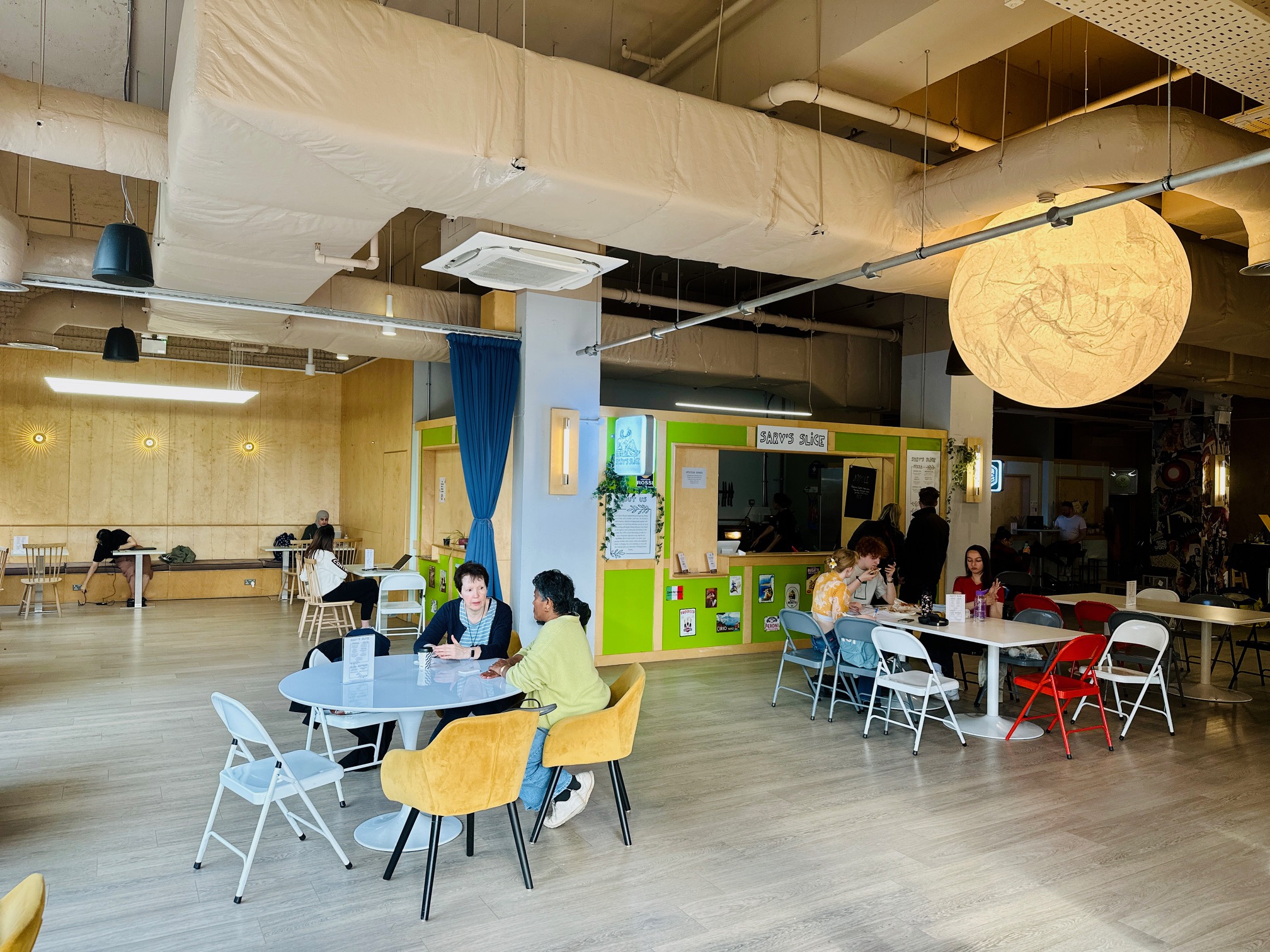
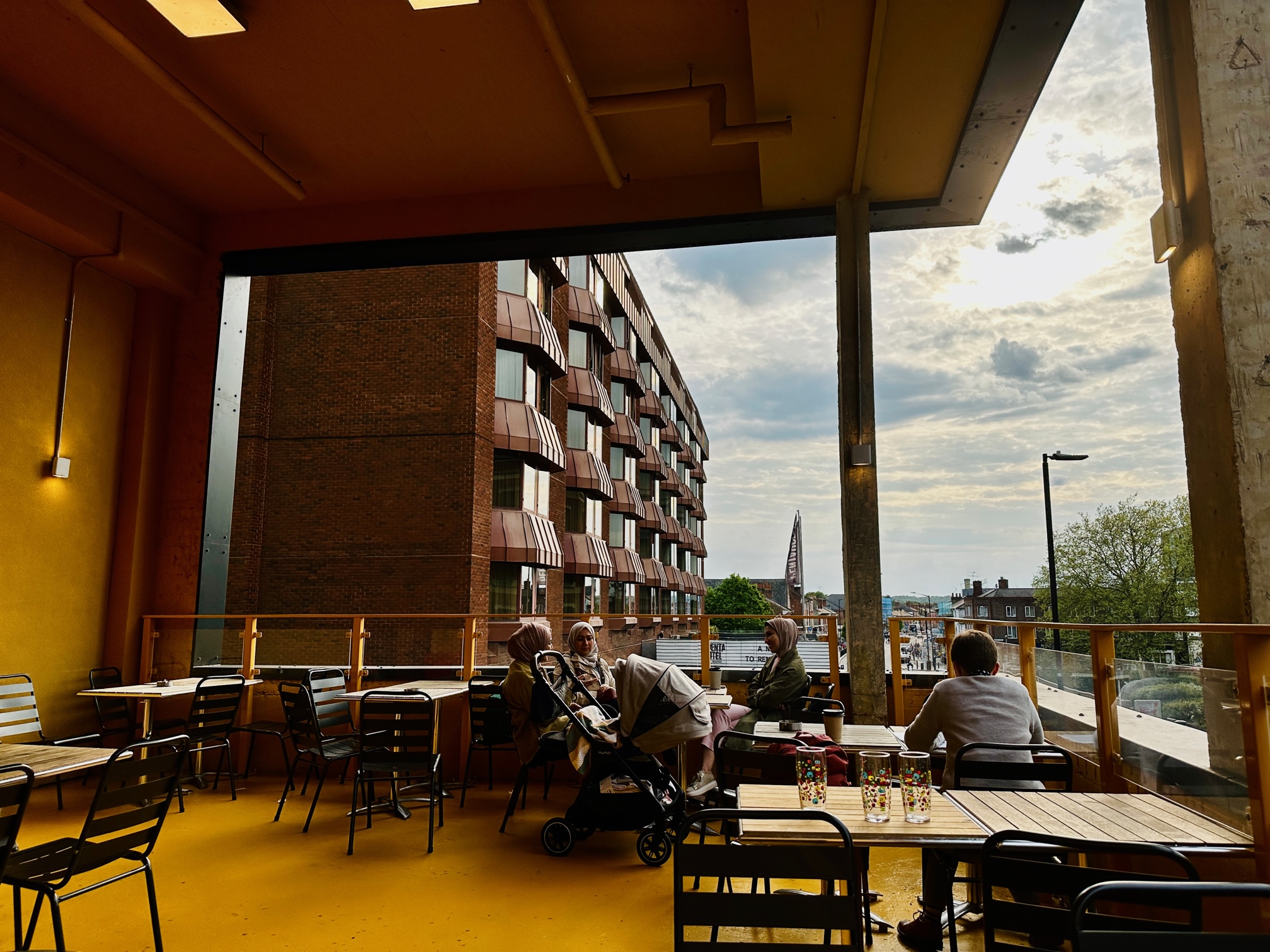
I’ve never set foot in the Biscuit Factory without feeling slightly too old for it, but even so I liked it. It has what old duffers like me refer to as a “lovely energy”, and even the pale birch panelled walls felt nicely neutral rather than cheap. The outside space, where I ate my pizza, is surprisingly attractive, all yellows and burnt orange, with an oddly gorgeous view past the Penta Hotel down the Oxford Road. It reminded me of my sentimental attachment to West Reading: I always think that if you don’t like West Reading, you don’t really like Reading. I do wish it was non-smoking, though: the ashtrays at every table and people sneaking out to clang away on a fag felt jarring.
Sarv’s Slice has a small menu, which is as it should be. Just the seven pizzas without a huge amount of variation, truth be told. You can have a marinara with no cheese, or a margherita with fior di latte, or the same thing with buffalo mozzarella. You can have a pepperoni pizza, or one with both pepperoni and ‘nduja, and you can have a mushroom pizza either with olives or with ham. I admire their stripped-down approach: I could say it reduces the replay value, but I always went to Buon Appetito and ordered one of two pizzas, so I’m the last person to criticise.
Often they have squares of deeper pan Detroit-style pizza on their specials, which seem to be where their more creative side comes out, but on this visit the only special was the Napoli, with olives, capers and anchovies. I was hardly complaining: that’s pretty much my go-to pizza anywhere. Sides are limited to garlic bread – I’ve never understood the appeal of this when you’re about to eat a bread-based main course – and parmesan truffle fries. Naturally I ordered the latter, and my bill came to eighteen pounds fifty. As at Blue Collar Corner, they give you a buzzer which goes off when your food is ready.
I nabbed a table out on the terrace (terrace? balcony?) and made inroads into a beer. You have to buy these from the bar separately, but laudably they had a good local range from the likes of Double-Barrelled and Phantom. Mine was from Phantom, and not up to their usual standard, but it was a warm day and I was sitting outside so I was prepared to overlook a lot.
It was seven pounds fifty. Now that I clearly wasn’t completely prepared to overlook, as I’ve mentioned it here. Is that a lot? I suppose it would be for a pint at the Nag’s, but I’ve never understood how restaurants are allowed to treble the cost of wine but we expect to get beer for less. Who knows what too expensive even means any more, these days? Everything is too expensive, even the electricity you charged your phone with so you could read this; just think, if I was less prolix you’d literally save money.
My buzzer went off in less than ten minutes and carrying my goodies to my table it was hard not to be impressed, on first sight, by the pizza. The crust was suitably bubbled and blistered, and the whole thing had a satisfying irregularity to it. And there was much to like about it – a beautiful base, an excellent sweet tomato sauce, plenty of cheese. The whole thing held together well and was a pleasure to eat. But the devil was in the detail, and if I’m being critical – which it turns out I am – it could have done with more of its star players. The purple, fragrant olives were great but it was light on the capers and, more sadly, one quadrant was an entirely anchovy-free zone.
But none the less it was an excellent pizza, and I spent a bit of time afterwards trying to decide where it ranked in Reading’s pizza pantheon. Nicer than the likes of Franco Manca, if more expensive. Roughly the same price as Buon Appetito had been, but svelte by comparison. Easily as likeable as the pinsa at Mama’s Way, albeit a very different beast, with the advantage that the base wasn’t bought in. Overall? Right up there. More expensive than it used to be at Blue Collar Corner, but I imagine all their costs have soared in the last twelve months.

That said, my advice would be to avoid the fries. They were bought in – which is fine, only a knobber objects to that – but if you’re going to buy in, you have to buy well. This week I had an al fresco dinner at Park House and although the chips were clearly bought in, they totally hit the spot and there was nothing to dislike about them. Sarv’s Slice’s fries, on the other hand, were a tad skanky, too many grey patches and bits I wanted to leave. They’d been given enough truffle oil to smell of truffle but, somehow, not enough to carry through into the flavour.
And the Parmesan: well, I suppose technically there was a little, but almost too little to see, let alone taste. I’m used to Parmesan fries at places like the Last Crumb, where the cheese all falls to the bottom and your challenge is to actually get it on your fries. I expected to reach the bottom of the cup to find a motherlode of Parmesan, like that glorious bit of chocolate at the base of a Cornetto cone, but it wasn’t to be. Not that I finished the fries anyway. They stayed on the table, whiffing away.
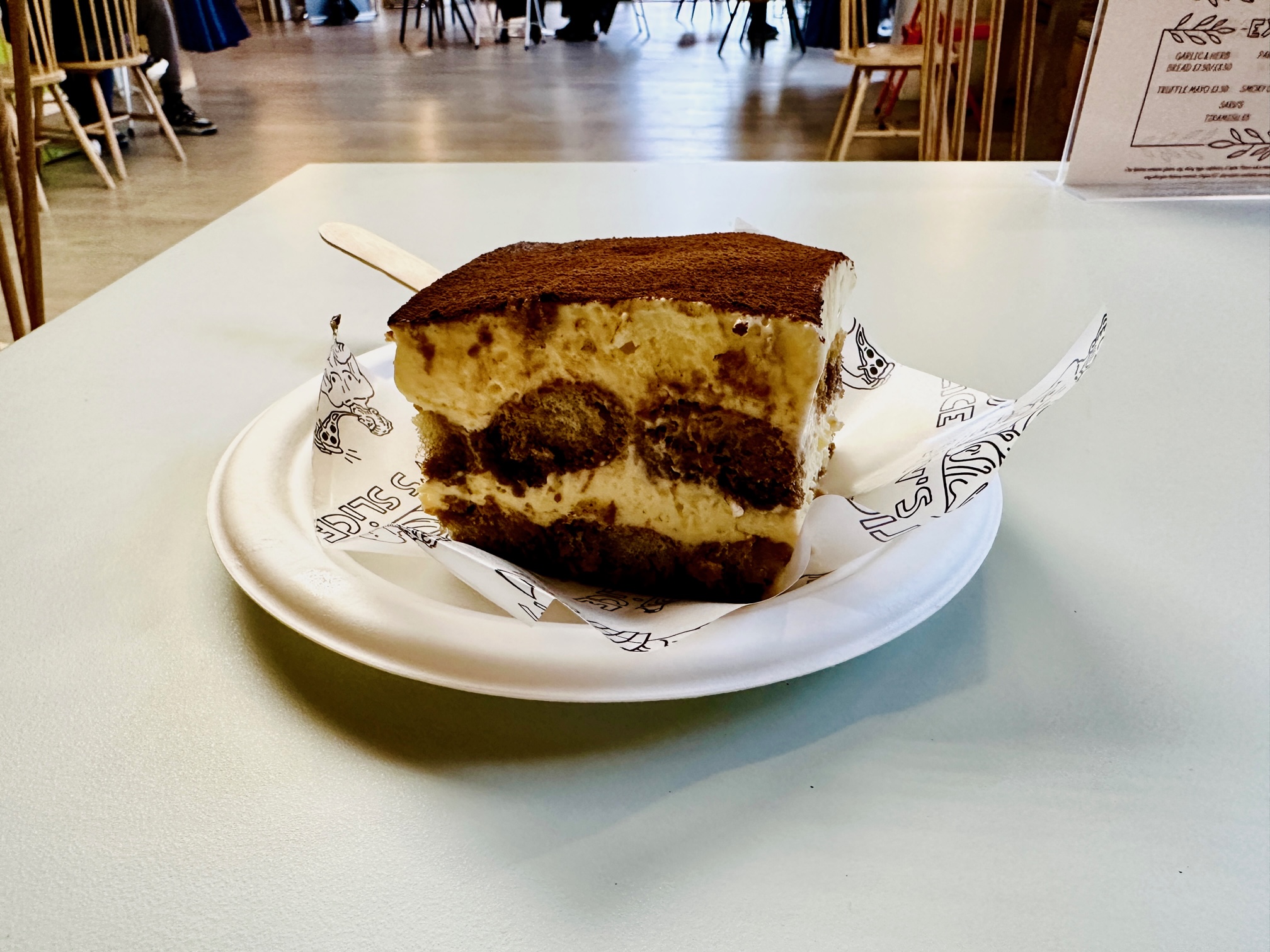
The good news is that with the money you save not buying the fries – six pounds, honesty! – you can get some tiramisu instead. I ordered Sarv’s Slice’s only dessert after finishing my pizza and grabbed a second buzzer. The wait was about five minutes for this too, and worth every second. It was a gorgeous, boozy, thick indulgent slab of the stuff, for only five pounds, and it was probably my favourite thing about the whole meal. It was strange eating it with a wooden spoon – those things are synonymous with failure for a reason – but honestly, it was an utter delight. If I’d known how good it would be I’d have grabbed a coffee from Compound to enjoy with it, but instead I picked one up as I was leaving, strolling home, latte in hand.
As you’ve no doubt gathered, with the exception of those fries I found Sarv’s Slice hugely likeable and I think it has found its perfect home at the Biscuit Factory. The staff are downright lovely and very friendly, and it nicely fills a gap in Reading’s food scene, offering something like Blue Collar’s ultra-casual dining in a different setting. And if I sound like I have reservations, or faint praise, I really don’t. But it’s important to recognise Sarv’s Slice’s limitations – because they do, and they operate within them superbly.
They’re not aiming to be a full on restaurant, at this stage, but instead just offer really good food you can eat informally in a hurry. Perfect pre-theatre dining, if you’re unfortunate enough to go to the Hexagon for something, or a meal you can enjoy before watching a film at the Biscuit Factory itself. So, good for cultured types. For a heathen like me, they fit into the same bracket as, say, ThaiGrr!, as a great way to have an excellent meal before moving on for a few beers at the Nag’s Head.
Back in the day, I used to go for Tuscany for that kind of thing, and then it became Buon Appetito. Sarv’s Slice is a very good successor to those places, and you’ll eat well there. It’s not the widest menu in the world, but for what they aspire to it doesn’t need to be. What Sarv’s Slice isn’t, much as I liked it, is the place that will define my gastronomic summer. But that’s okay, because I’ll keep looking and I’ll find mine in the end. I hope you find yours, too.
Sarv’s Slice – 7.4
Reading Biscuit Factory, Unit 1a Oxford Road, RG1 7QE
07854 892749