Café Yolk

Click here to read a more recent review of Café Yolk, from July 2021.

Café Yolk stands apart from all the other places I’ve reviewed so far in one important respect: it’s the first establishment I’ve visited that was completely full. When I arrived, at Saturday lunchtime, practically every table was occupied (except for the ones outside which seemed a bit hopeful on a crisp November afternoon) and it took a little while before I could sit down and peruse the menu, written out, blackboard-style, on the back wall.

To understand why, you need to look beyond this little, attractive-looking café, tucked away on the edge of Reading’s leafy university area, and wander into the altogether more weird and wonderful world of the internet. Yolk, you see, is incredibly popular. Active and engaging on social media, they are (at the time of writing) ranked second in the whole of Reading on TripAdvisor: a glowing review goes up every few days, all praising the breakfasts, which are said to be the best in Reading. How could I resist going to see what the fuss was about?

The first thing I noticed, apart from how busy it was, was just what a loud room it is. It’s all hard chairs and bare walls, and that many tables of people chattering away creates an almost deafening cacophony. Yolk has definitely made the most of its location, and most of the clientele are students; skulking in the corner I felt a bit like I’d wandered into an episode of Skins by mistake. The tables are bog-standard café issue (mine hadn’t been wiped when I sat down – always a nice first impression, that) and the chairs were the kind of rigid stacking kind you wouldn’t want to spend too much time on, but all of that is beside the point, right? Because it’s all about the breakfast.

There are no paper menus, but looking at the blackboard the emphasis was definitely on breakfasts and burgers, the latter described as the “lunch menu”. Once the queue had cleared away (which, bizarrely, took some time – where were they all sitting? Was there a secret basement I didn’t know about?) I went up and placed my order; full English with well done bacon and a Swiss cheese and Portobello mushroom without toast. I had to repeat my order, as if I’d asked for something extremely complicated.

There was no coffee because the machine was broken that day, so I got two large teas. This gives me an opportunity to indulge in my first rant of this review, because Café Yolk charges extra for a large tea. You might think I’m a bit odd for objecting to this, but I think this is nothing short of a scandal. It’s hard to imagine a product cafés make more money on than tea. I know how much it costs to buy a box of teabags, and how much it costs to boil a kettle; charging one pound fifty for the privilege is verging on extortion at the best of times. But an extra twenty pence for a little more water? Really, it’s taking liberties with a good proportion of your customer base. Anyway, I took my two cups of hot water with a teabag in them, each costing me the best part of two pounds, and walked all the way to the other side of the café to put milk in them.

I know, I know, I’m whinging. But it’s beside the point, right? It’s all about the breakfast.

Our food took a reassuringly long time to turn up – nobody wants to feel the ping of a microwave is involved in the most important meal of the day – and the chap delivering the food was cheery and keen to bring over any extras (butter, sauces etc.) which was a nice contrast to the counter service.

The full English, which costs five pounds ninety-five, contained all the staples: a rasher of bacon, a sausage, a fried egg, half a tomato, a mushroom, some baked beans, toast and sautéed potatoes. For me, the quality of a breakfast stands or falls on the meat products and these were middling at best. My rasher of back bacon (why is it never streaky?) wasn’t well-done in either sense of the word, although looking at the bacon arriving at other tables it wasn’t quite as pink and flaccid as theirs. The sausage had the smooth bounciness of cheap supermarket produce – although at least there were some herbs in there so the taste was good, even if the texture wasn’t. The baked beans were good (school dinner style, cooked in a pan so they’re a little bit mushed, exactly how beans should be, in my opinion), although it shouldn’t be difficult to get baked beans right. The toast was thinner, whiter and cheaper than Miley Cyrus. Overall it was edible and sufficient but there’s no pleasure in eating that many calories with so little flavour. I didn’t find myself, at any stage, thinking “My! I am literally eating the best breakfast in Reading.”

Cafe Yolk 1The omelette, though, was really poor. A good omelette is thick, seasoned, gooey in the middle, folded over and full of wonderful things. What I got instead was a thin frittata, no seasoning, cooked completely through and rolled into some kind of surreal egg spliff. The Portobello mushrooms were in the middle, gently staining everything a murky grey. And the cheese? Rather than grate cheese into the omelette mixture, which might have made it taste of something, three slices had instead been draped on top of the whole affair, seemingly minutes before dishing it up. The irony of a place called Café Yolk doing something so awful to eggs wasn’t lost on me. Apparently their eggs are free range, and from a local farm; it’s a pity they don’t treat them better than this.

Cafe Yolk 2They should thank their lucky stars they aren’t called Café Mushroom, because the mushrooms were even worse. They seemed to have been prepared by someone who liked neither mushrooms nor cooking. Well cooked mushrooms are an amazing thing – all dark and sticky and savoury, salted, peppered, buttery, maybe with some Worcester sauce in there to complete the magic. These, instead, were flabby, drippy things, a limp parody of what I’d been hoping for. They were “cooked”, in the sense that they weren’t raw, but not cooked in the sense of having been prepared by a chef. If it wasn’t for the overpowering taste of vegetable oil I would have thought they’d been microwaved.

My omelette came with the toast I told them I didn’t want. I didn’t eat it.

I think I must be missing something about Café Yolk. It’s a lovely spot, with loads of potential, and it clearly knows what it’s doing. It’s identified a market, it’s got a strategy, and it is doing very nicely out of it. Maybe if I was a student this would be my favourite place in the world. But it’s many years since those happy days, and for me this was just a greasy spoon pretending to be something better. I left it wanting better: better ingredients, better service and above all better cooking. You can get better breakfasts at Bill’s or Carluccio’s, and you can get more honest breakfasts at dozens of cafes across Reading. I think Café Yolk is best summed up by the bacon that came with my Full English – they class that as well done, and maybe they believe it, but I don’t. If that puts me out of step with the rest of Reading, so be it.

Café Yolk – 5.2
44 Erleigh Road, RG1 5NA
0118 3271055

https://www.facebook.com/cafeyolk

Forbury’s

To everybody’s surprise, Forbury’s closed in April 2019. I’ve left the review up for posterity.

It’s hard to believe that Forbury’s is less than 10 years old; it’s integral to the Reading restaurant scene and one of the few serious challengers to established restaurants like London Street Brasserie and Pepe Sale, both of which I’ve already reviewed. It’s always been a conservative, if reliable, place and, despite chefs coming, going and (in one case) coming back again it feels like the food on offer hasn’t hugely changed from one year to the next – good, technically proficient French food in one of Reading’s most sophisticated rooms, and a wine list full of opulent treats and slightly more economical delightful surprises.

All that has changed though, recently, with the arrival of new head chef Tom Kneale. Based on Tom’s Twitter feed – which also gives a fascinating insight into just how hard running a kitchen can be – it looks like he is determined to shake up Forbury’s and add some edge to all that Gallic sophistication. First, in the culinary equivalent of Tony Blair scrapping Clause Four, he took the salt and pepper off the tables (apparently only three diners asked for them to be returned). Then pictures of all sorts of interesting new creations began to appear. An amuse bouche of black pudding with chocolate and crab on crispy chicken skin? A starter of raw tuna, crispy pork skin and lemon emulsion? I was sold: nowhere in Reading is doing anything quite that imaginative so I reckoned I owed it to myself (and you, of course) to go and check it out.

I really like the outside space at Forbury’s. Obviously it truly comes into its own in the summer but as the dark evenings draw in the outside lights twinkle like an early Christmas tree and the restaurant looks properly inviting. On stepping inside it seemed like nothing and everything had changed; the decor and layout were all exactly as they’d always been, but nearly all the front of house staff were new faces. A clean sweep from the new broom?

The menu had definitely changed, too. It sounds like a minor thing but the set price “market menu” is now on a separate piece of paper, giving the a la carte a little more prominence. In the starters, there were some signs of the new dishes making it through onto the menu – the “63c duck egg with onion broth, compote and foraged wild mushrooms”, for instance – but the mains still seemed very similar to the Forbury dishes of old. Perhaps, I thought, it would all be about the execution. Although I was sorely tempted to order everything off the a la carte, I thought it was only fair to try out both menus to give you an idea what to expect at either price point. Besides, the market menu has always struck me as a good deal if you’re looking for fine dining in Reading: the price has, naturally, slowly risen over the years (it’s now £23 for three courses) but it’s still great value and, unlike Forbury’s closest natural competition (Mya Lacarte, London Street Brasserie) the set menu is available all week, the only restriction being that you can’t order off it after 7.30pm on a Saturday.

The amuse bouche didn’t betray any signs of the new approach. Sweet white onion and apple velouté was pleasant, and an interesting combination, but it was very much the kind of amuse bouche Forbury’s has always done. It was also one of the starters on the market menu, so it didn’t feel like anything out of the ordinary – in fact I’d have felt a bit cheated if I’d ordered it from the set. Perhaps it was my fault; based on those Twitter pictures I’d been expecting black pudding, chocolate, crispy skin, all kinds of miniature treats and nothing in an espresso cup is going to match up to that.

They do manage the timing of a meal superbly at Forbury’s, and the starters arrived just when you wanted them to – not so soon that you felt turned, not so late that you were considering asking nicely for more bread. It sounds like something you should be able to take for granted, but so many restaurants get it wrong. “Home-made pork pie with house pickles and salad” from the set menu was lovely, if exactly what you would expect. The meat was perhaps a little coarser than I’d personally like (no jelly though, which is always a relief) the pastry somehow lacked the lardy crispness of a properly great pork pie. The smear of English mustard was a nice touch, if a tad generous, and the little thicket of salad leaves was really delicious – lightly dressed and sweet, which was a lovely contrast to the pie. The pie managed to both be heavy and small, which made me feel a little ungrateful on several levels all at once. Cornichons had a nice crunch but were largely indistinguishable from the ones in a jar in my fridge (maybe that’s why they were called “house pickles”).

From the a la carte the “Brixham crab, dill oil, shallot ketchup and watercress” looked less appealing. I was expecting something like a tian but this was altogether soggier, claggier and less delicate. There were little blobs of what was billed as shallot ketchup but my palate must have been playing tricks on me because I got a lot of citrus and not much dill or shallot. This all sounds very harsh, so I should add that although it wasn’t what I was expecting it was very tasty indeed. The small heap of watercress on top, though, added little to the experience.

At this point it’s worth mentioning the one obvious big difference at Forbury’s: the staff. Forbury’s has always offered that wonderful, unobtrusive service that the French, when they get it right, are so brilliant at. You know the sort: the waiting staff are right on hand whenever you want anything, top up your glass when it’s getting low but the rest of the time you don’t even notice them. It’s this last bit that’s the real skill, and it’s also where the new team have a bit of work to do: our glasses, for instance, were regularly topped up, whether we wanted that done or not.

Unfortunately, the solicitousness didn’t end there. To give you another example, two minutes after our starters arrived we were asked if we were enjoying them. Fair enough, although waiters always seem to appear to do this when you have your mouth full. Less than two minutes later we were asked again about our starters by a different person. That same person asked again as she was taking our empty plater away, just in case she had forgotten our original reply. The overall effect was more of neediness than service. What doesn’t help is that the waiting staff didn’t seem to be divided into sections: everyone seemed to cover every table, so they didn’t know what you had or hadn’t already been asked. Maybe this is exceptional as we were there on a week night, maybe it just shows how keen the staff are: either way it needs to be toned down a little.

We weren’t asked about the mains quite so frequently, thank goodness. “Haunch of venison with swede, purple kale, mushrooms and cherries” (from the a la carte) was simple, well executed and delicious. The venison was a generous portion, pink and tender, resting on a bed of pureed swede with a few kale leaves in between. The cherries were cooked into a jam-like state and then reformed into tiny perfect domes on the plate, a lovely piece of technique on what was otherwise quite a straightforward dish. This nearly brought out the best in the venison, although overall I found the whole thing a little on the sweet side. Luckily the waitress had suggested some duck fat chips, served in the ubiquitous little frying basket, which made the meal feel complete.Venison

Pan fried sea bream with herb crushed potatoes, salsa verde and green beans, from the market menu, was less successful. The fish was a beautiful fat piece of bream, cooked so the flesh flaked under a fork and the skin crackled under a knife. The rest of the dish didn’t give it the support it so deserved. The potatoes appeared to have resisted the crushing process largely unscathed, the promised salsa verde just didn’t show up at all and overall it felt like a dish that could have been so much more with only a few little changes.

All of this was washed down with a very reasonable bin end – an Australian pinot noir at £35, “Cruel Mistress”, which was gorgeous. It had more complexity to it than some of its New Zealand siblings and just about worked with most of what we had ordered – enough substance to stand up to the venison without drowning out the bream (yes, I know people say you shouldn’t drink red with fish, but I’m a heathen about this sort of thing).

For dessert we didn’t fancy anything off the set menu so we went wild and ordered from the a la carte. This turned out to be a very good idea; the desserts were the high point of the meal.

The fig and honey tart with vanilla ice cream was delightful. It was served in a deep bowl and the topping was part bakewell, part macaroon – lovely, light, chewy and meringue-like, it had me scraping the edges of the bowl with my spoon. The honey was almost undetectable but that didn’t take anything away from what was essentially a very well done school dinner type dessert. I love a hot pudding (although I’m not sure I was expecting one from Forbury’s) so this was perfect for me.

The Valrhona chocolate mousse with mango sorbet and chocolate soil was glorious – deep, dark, rich and bitter, and completely transformed by the gritty crunch of the chocolate soil. It didn’t need the mango sorbet, although it was so green and fresh that I wasn’t going to turn it down. The only slightly bum note was the microshoots of coriander strewn across it. I tried enough to decide it didn’t work and left the rest, but it didn’t detract from one of the best desserts I’ve had this year.

Mousse

I sense, from my visit, that Forbury’s is still a work in progress. Dinner for two, including one bottle of wine, came in just shy of £100 and I thought it was good value. The thing is, I had a lovely meal, with more hits than misses, but it wasn’t the meal I was expecting. There’s a sense of nervousness about the service and a little bit of risk averseness about the food. I can understand why – it must be difficult, stepping into a local institution like Forbury’s, and getting the balance right between evolution and revolution – and I saw enough to think that they’ll get there, but my overriding impression was frustration that they haven’t moved a little bit quicker.

The most telling thing about the meal? Just after I paid, I spotted something on the table which I’d previously missed: the salt and pepper mills were there in front of me. Next time I go, and there will be a next time, I hope they’re gone for good.

Forbury’s – 7.1
1 Forbury Square, RG1 3BB
01189 574044

http://forburys.co.uk/

Sushimania

When Neneh Cherry released her debut album back in 1989 I don’t think she realised quite how much damage she would do to the sushi industry; there’s still a common misconception that sushi equals raw fish, and that puts lots of people off it completely. Perhaps in light of that, the inappropriately named Sushimania has a large koi carp mural on the wall with the words “so much more than just sushi” above it. This, along with the bright red bar and red and black furnishings make the most of what could otherwise be an uninspiring spot, opposite the Hexagon Theatre (surely one of the foremost contenders for Reading’s ugliest building, along with the Civic Centre next to it). It’s taken over from the equally inappropriately named Thai Nine, which used to do all you can eat Thai, and… err… sushi.

Subscribe to continue reading

Become a paid subscriber to get access to the rest of this post and other exclusive content.

The Lobster Room

N.B. The Lobster Room closed in March 2014. I’ve left the review up for posterity.

Sometimes, when you’re out in a restaurant, you get a certain kind of sinking feeling when you just know that you’re going to have a bad meal. I expect you know exactly what I’m talking about. Sometimes it happens when you’re greeted and seated, sometimes it’s when you look at the menu, sometimes when the first dish arrives. Whenever it is, though, it’s a terrible feeling because it nearly always comes too late for you to leave; all you can do is sit there, endure it, minimise the damage and chalk it up to experience.

I’ve been wondering at what point in my experience in The Lobster Room I first got that sinking feeling. There are a number of candidates.

It might be when I looked at the website, before I’d even made up my mind definitely to go there. There was something about the menu that flashed warning lights, although I couldn’t put my finger on what it was. Perhaps it was the spelling mistakes (calamari was accompanied with sweet chilly sauce, which sounded a little, well, cold). Perhaps it was the slightly bizarre choice of words: Goan prawn curry came in a spicy coastal gravy, crab was served on an aromatic and flavourful hill of tagliatelle.

Or maybe the sinking feeling came in when I entered and went down the stairs to the cellar restaurant. The greeting was marked more with surprise than warmth and the waiter – voluminous white shirt tucked into Status Quo jeans – responded to the request for a table for two with a terse “sure”. You could see why, going in, and perhaps understand his amazement; at prime time on a Saturday night we were only the fourth table in there. The room, back when it was Chronicles, was a lovely subterranean space. There’s a certain illicit appeal about cellar restaurants, or should be, but The Lobster Room was empty and charmless. The furniture didn’t all match and the worn, tired-looking tables looked as if they had been inherited from Valentino’s, the previous restaurant to fail in this spot.

If it wasn’t then, I might have got the sinking feeling when our wine and water turned up. The wine glasses were chunky numbers with no delicacy at all and their contents were nothing to write home about. The sauvignon blanc was featureless, if inoffensive, but the Orvieto was just terrible – so watery and thin that I couldn’t be sure it hadn’t in fact been watered down. Both were almost cold. We asked for water and the same waiter – the only waiter we saw all evening, although he was hardly busy – wandered off out back and returned with two giant Stella Artois goblets full of water. One had ice in it, one didn’t; no explanation for this was offered.

You hear a lot of conversation in restaurants when there’s almost nobody in there. It soon became apparent that, apart from the couple having what seemed to be an extremely tedious date in the alcove opposite us, everyone else in the restaurant seemed to be there because they were friends with someone who appeared to be the owner, a blazered man who wandered randomly round the restaurant from time to time.

I had definitely got the sinking feeling by the time the starters arrived (no bread, despite the attractive picture of fresh-baked bread on the website). What was billed as lobster ravioli with lemon butter and caper cream was in fact ravioli buried under a huge wobbling mound of what looked and tasted like hot mayonnaise with a couple of capers strewn across it. At first I thought it was a generous serving of ravioli underneath a thin coating of sauce, but in fact the primary purpose of this gelatinous Hellman’s substitute was to conceal how few ravioli you got. It was, in fact, only one raviolo away from being lobster raviolo with lemon butter and caper cream, which means that each raviolo cost just over five pounds. By the time I realised there were only two of them I’d given half of one of them away, and even then I can hardly say I was cheated. The pasta was thick and rubbery and the thin smear of meat in the middle could have been Shippam’s Paste for all the difference it would have made, so overpowered was it by the hideous sauce. I seriously considered cancelling the mains and leaving after that; it’s hard to imagine any restaurant in Reading where you could so comprehensively waste ten pounds of your money on a single dish.

Ravioli

The other starter – the aforementioned calamari with “sweet chilly sauce” was, by comparison, stellar stuff, by which I mean that it was still not very good. A little dish of wan looking battered calamari, not unacceptably springy but certainly not tender enough to be fresh, with a ramekin of standard issue supermarket chilli sauce, it was the pick of the bunch mainly by virtue of not being such shocking value. But even then: this might have been excusable in a chain restaurant, but a place called The Lobster Room specialising in seafood? No, it was just nowhere near good enough.

The waiter approached the table with a Fonz-style double thumbs up as he came to take the plates away, but he didn’t actually ask if the food was any good. Maybe he was too smart to do so, or maybe the gesture was to congratulate himself for having shifted the most exorbitant ravioli in Britain; sadly I’ll never know.

Anyway, by this stage it really was a question, like watching the Royal Variety Performance, of how bad things were going to get before the end. This seems as appropriate a time as any to mention the background music, which was truly purgatorial. I’ve now heard lounge jazz cover versions of, among other things, China Girl by David Bowie, Sowing The Seeds Of Love by Tears For Fears, Don’t You Want Me by The Human League and – my personal favourite – Sultans Of Swing by Dire Straits. It was more old hat than nouvelle vague; I’ve left a restaurant for less, and I wish I’d had that much sense on this occasion.

The mains were no better. Fillet of monkfish with wild mushroom and pernod sauce was in fact three small pieces of monkfish tail, as much bone as flesh. Having endured the ravioli I can safely say that I was a lot wilder than the mushrooms accompanying this dish. The sauce tasted of cream and salt and the note of Pernod struggled and failed to break through. In the middle was a little heap (certainly not a “flavourful hill”) of vegetables – a few potatoes, some peppers which were just about cooked and some raw carrots. The closest these carrots had come to being cooked was having sat on a plate with something warm for a couple of minutes before being served up. That dish was sixteen pounds fifty and the best thing I can say is that it wasn’t the biggest rip-off of the evening.

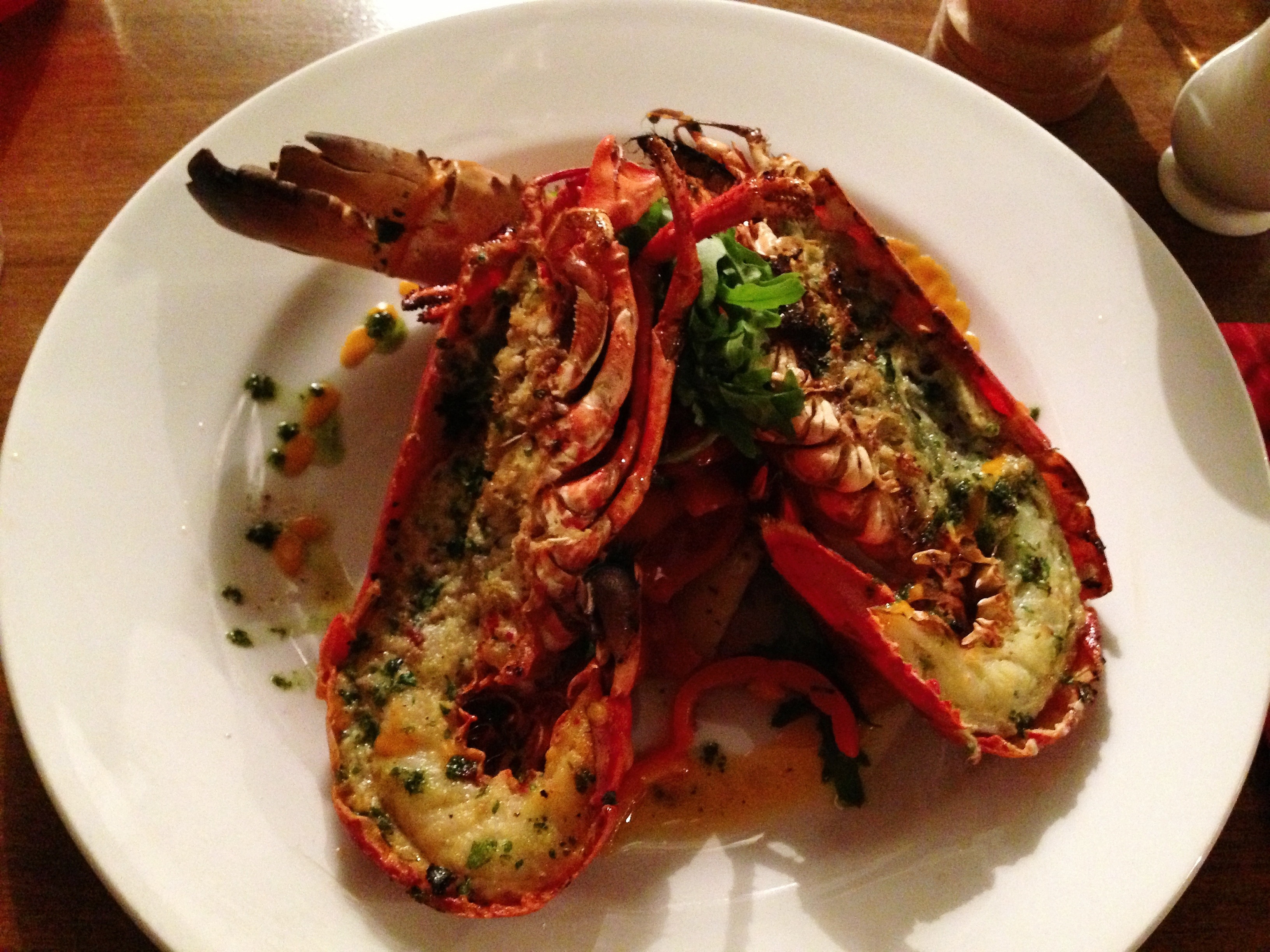
The lobster looked attractive enough, but disappointed at the same speed as everything else. The crustacean, neatly halved, sat on a similar pile of vegetables as those that came with the monkfish. The tail meat was reasonable – if a little tough, which suggested it had been overcooked. The “butter garlic sauce” was almost non-existent, so I never got to work out whether this was meant to be garlic butter, garlic sauce or some novel hybrid of the two. There were a few stray flecks of green which had probably been parsley once upon a time and the meat in the single claw (this is news to me, but I seemed to have been served a lobster amputee) had shrunk back a lot, which also suggested that it may have been overcooked. The lobster crackers were wholly unnecessary as the shell was soft and bendy – I’m no expert on lobster but this struck me as wrong. Perhaps it had been left after cooking for too long or maybe there had been a microwave involved, I dread to think. At eighteen pounds this dish was – and I’m really sorry to put it this way – simply not worth shelling out for. It was very quick to eat, too, and so anaemic that I didn’t even need to roll up my sleeves; no wonder they didn’t bring a finger bowl to the table.

LobsterI’ve missed out so many sinking feelings. In fact, sitting in a basement restaurant having that many sinking feelings it’s a wonder I didn’t reach the Earth’s core. Here’s another one; we arrived at eight-thirty, and ordered. Our starters arrived at eight forty-five. Our mains arrived at nine. It’s almost as if they were in a hurry to serve us quickly so that we didn’t have the opportunity to come to our senses and leave. I’ve had slower meals in Nando’s, and better ones too for that matter. Anyway, it didn’t work because we did come to our senses, albeit too late: as you can probably guess, we didn’t stay for dessert.

All in all two glasses of wine, two starters and two mains came to sixty-two pounds. That amount doesn’t include service (which is appropriate, as neither did my evening). I can’t imagine The Lobster Room surviving in that location, with that service, with that food at those prices for much longer. You can get better lobster at Côte or at Brown’s, you can get better service pretty much anywhere, and if you’re going to spend that kind of money Reading has dozens of better alternatives. By the end of my time in The Lobster Room I began to think that the restaurant might just be a convenient tax deduction, or some kind of gastronomic equivalent of Springtime For Hitler. If that’s the purpose, it’s succeeding admirably, but as a place which serves good food at a fair price to customers it’s a very different story.

The Lobster Room – 3.3
17 – 19 Valpy Street, RG1 1AR
0118 9588108
http://www.thelobsterroom.com/

Kyklos

N.B. Kyklos closed in January 2014. I’ve left the review up for posterity.

One thing I’ve learned so far in my – admittedly limited – experience of reviewing restaurants is that some reviews are easier to write than others. Let’s say, for example, that I have a good meal in a good restaurant (or a restaurant that I think is good, anyway). To some extent that review writes itself, and my main worry is doing it justice so that you’ll think it sounds good and hopefully want to eat there yourself. Going to a bad restaurant and having a bad meal also makes for an easy review – less fun to eat, but more fun to write and often more enjoyable to read. But the tricky one is when you go to a restaurant that, in so many ways, is “good” – the room, the service, the little touches – but the food just isn’t up to scratch. But hold on – isn’t a good restaurant a place that serves you good food and a bad restaurant one that serves you bad food? Is it possible to have a bad meal in a good restaurant?

All very Carrie Bradshaw I know, and perhaps I’m showing my cards too soon, but I’ve been thinking about this a lot this week because of my visit to Kyklos. So many things about it work, it should be a good restaurant on paper, but the food doesn’t quite live up to expectations.

I’ve been to Kyklos a few times since it opened. It’s in that spot that’s a bit of an elephant’s graveyard for restaurants, above Burger King in King’s Walk, having at various times been Topo Gigio, Mari E Monti and the Himalayan Momo House. They’ve done a nice job on refurbishing it; it used to be quite a sterile, unappealing space but looks much better now with smart white walls and very fetching white shutters overlooking the Walk itself. The long, thin room has been broken up (with some lit glass partitions with an olive motif which are, I’ve discovered, surprisingly hard to describe) so it doesn’t have the chilly air that its predecessors had, and the bar area at the front has some welcoming seating for those waiting for a table.

The greeting at the entrance is incredibly warm – I’ve only been a couple of times, and not for a while, but I was welcomed by the waitress as if I was a friend rather than a customer. This was definitely the shape of things to come, too; Kyklos does service very well.

Sitting down we were given three menus; food with a wine list on the back, a set meze menu and a short Greek wine list – three whites, three reds, nothing over twenty-five pounds. This was a bit of a disappointment in itself, actually; Greek wine can be very good and is much underrated, and I was hoping central Reading’s only Greek restaurant might do more to show that off. On a recommendation from the waiter we ordered a bottle of Greek white, a Malagouzia which I’d never heard of, let alone tried. We couldn’t decide who should taste it so the waiter poured a little for each of us, which was a nice gesture. Their range of Greek wines may be a bit narrow, but this was gorgeous – fresh, light, floral, not too dry (very dry whites have never really done it for me) and good value at £23.

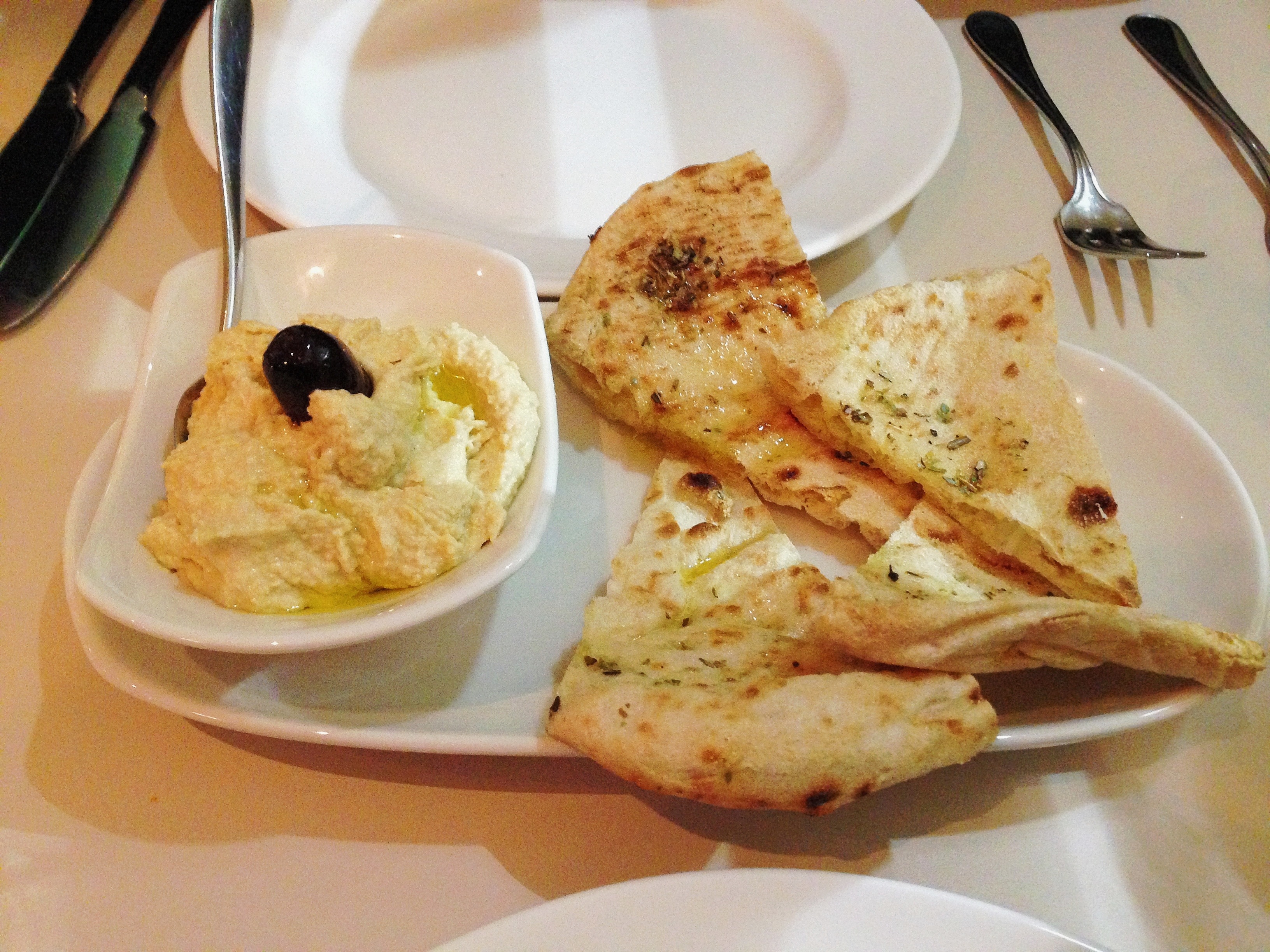
Our starters, a selection of meze, were the first indication that we might be about to have a middling meal in a good restaurant. Houmous was very tasty – often they have a strong smoky taste or are pungent with garlic, but this one was rich with tahini and somehow tasted lighter and cleaner. The pitta, though, was stingy – one warmed pitta slices into triangles, drizzled with oil and sprinkled with herbs. Loading all that houmous onto a single pitta was a challenge, although of course we managed it – heaven forbid that anything went to waste.

Salted cod in beer batter with skordalia was equally frustrating and inconsistent. The batter on the three fingers of fish was light and perfectly done, but the flesh underneath was uncomfortably chewy. The skordalia was plain disappointing; it’s meant to be the kind of garlic mashed potato that can make enemies on public transport the following morning, but this was a lumpy school dinner effort and finding garlic in it was completely beyond me.

The best of the bunch was the soutzoukakia – beef and lamb meatballs with aromatic mash and cinnamon oil. These were lovely – coarse without being bouncy, three generous meatballs in rich tomato sauce on a bed of gorgeous, smooth mash. I couldn’t quite believe that the same kitchen could dish up two such different examples of mashed potato, but the one that came with the meatballs was far superior, if a little runny (dishing up was fun, put it that way). The flavours, though, were great – and the hint of cinnamon in a savoury dish, so often a feature of Greek food, worked beautifully.

The mains were further evidence of an inconsistent kitchen that was either terrified of, or had run out of, garlic. We went for the chargrilled whole sea bass with French fries and aioli, mainly because I’d had plenty of grilled fish on holiday in Greece at the start of the year, and wanted to relive happy memories from what felt like a lifetime ago. It arrived whole – which was my choice, although I did have the option for the kitchen to fillet it – and was underwhelming. Grilled fish on holiday is a wonderful thing partly because of the crispy skin; almost burnt but not quite, beautifully salty, dressed with lemon and oil. This however didn’t look like it had gone anywhere near a grill – it looked baked at best, and the skin was soft and slippery. Once I’d filleted it there wasn’t much left – and I’m no slouch at filleting, even if I do say so myself. The starters at Kyklos are quite big so this wasn’t the tragedy it could have been, but the fact remained that this dish cost sixteen pounds and felt like very little fish for the money.

The French fries were also false advertising, being nothing of the kind – they were very respectable chunky chips, the right blend of crunchy and fluffy – but they weren’t what I was expecting. I was hoping to have a sheaf of skinny crispy fries to dip in my rich aioli, and I didn’t get that. And, as you can probably guess by now, I didn’t get aioli either. It didn’t taste remotely of garlic – if anything, what I got was tarragon which wouldn’t have gone with the fish at all.

The other main, the moussaka, was a generous slab of béchamel sauce with a distinctly ungenerous layer of meat, aubergine and potatoes at the bottom. My photo isn’t brilliant, but it gives you a good idea just how much béchamel we’re talking about. For twelve pounds, or indeed for less, I would have liked a smaller slab of béchamel sauce with a more generous layer of meat, aubergine and potatoes at the bottom. It tasted nice enough but my companion said that towards the end he felt as if he was eating it for no reason other than stubbornness, and that’s never good. The “feta mousse” which was meant to accompany it, as promised on the menu, failed to appear; perhaps it too was supposed to contain garlic.

Between us we only had room for one dessert. I asked the waitress to help me pick between the panna cotta with rose water (which I thought might be quite light) and the walnut cake (which I thought would be quite Greek). She instead recommended the vanilla custard in filo pastry with cinnamon and mango ice cream as it’s home made in the restaurant. What this means for the other desserts, I don’t know but I’m easily led so I accepted her suggestion. This was a good plan, as it turned out. The dessert is known as galaktoboureko in Greece, though I’ve never found it outside of Crete, and it’s delicious; layers of filo pastry filled with smooth semolina custard with a light syrup poured over the top (similar to how baklava is served), all warm and inviting. The curl of ice cream on the side, on the other hand, was completely superfluous and didn’t taste of cinnamon at all, just mango.

I think, on reflection, that the dessert I had is representative of Kyklos as a whole. The core elements are really good: an attractive room, excellent, friendly service, some delicious ingredients and some authentic Greek flavours. But some things miss the mark completely: the flaccid fish, the lumpy mash, the lack of garlic in the skordalia or seemingly anywhere else, the pointless ice cream. I kept thinking if only: if only I’d ordered different dishes, the kleftiko perhaps, or the octopus stew with chick peas. But if it’s a good restaurant, it shouldn’t be possible to order badly – right?

So all in all, I’ve found this a difficult review to write. I want Kyklos to do well; a good Greek restaurant in the middle of town would be a wonderful thing. I really wanted to love it and to score it highly, but on the night I went there were too many let-downs and too many mistakes. You might have a different experience, and I wouldn’t entirely want to discourage you from finding out, but I do want to warn you. I suppose the last thing to add is that Kyklos is not a cheap place: our total bill was £75 for three starters, two mains, one bottle of wine and one dessert. I know I could go to Kyrenia in Caversham for the same money and have a considerably better meal. But then that’s a different review.

Kyklos – 6.3
Kings Walk, 19 – 23 Kings Street, RG1 2HG
0118 9500070

http://www.kyklosreading.com/