Bierhaus

Bierhaus closed in December 2025. I’ve left the review up for posterity.

I felt at a disadvantage going to Bierhaus, the German restaurant on Queens Walk, with Ian, my stepfather. I don’t know a huge amount about beer – as anyone who’s ever read my reviews already knows – whereas he knows his way round a pilsner and a pale ale and used to work for one of the world’s biggest brewers, travelling all over the world and sampling all sorts. More significantly, he had been to Germany and I hadn’t. My knowledge of German stops at being able to ask my way to the town hall, proudly proclaim that I own a guinea pig or explain that my pen is broken (kaput, such a beautiful word). Oh, and I know how to tell people that my favourite pop group is Johnny Hates Jazz – although it never actually was, not even back then.

I’ve had friends tell me how wonderful Germany is, how clean and beautiful, how everyone is handsome and polite and speaks beautiful English. It sounds like somewhere one could quite happily live, let alone visit, and yet Munich, Berlin and Cologne have never quite made it to the top of the city break shortlist (Berlin, in particular, crops up regularly with people I know, usually in the sentence Oh my god, you absolutely must go to Berlin: I don’t much like being told what to do, so I never have).

I’m not sure why I’ve never made it out there. It could be repressed horror from those three years studying “Deutsche Heute” which mainly consisted of my schoolfriends making Franzi the Pig do awful, awful things through the medium of graffiti. But really I think it’s the food, which has never hugely appealed. I’ve never fallen over myself to try it, even to the point where I’ve always steered clear of the bratwurst place that crops up on the Oracle riverside every bloody year. Mystery meat? Nein danke. And the same goes for pork knuckle: who willingly eats a knuckle?

Subscribe to continue reading

Become a paid subscriber to get access to the rest of this post and other exclusive content.

Alona

Alona closed around June 2019. I’ve left the review up for posterity.

I used to think the cardinal sin when eating in a restaurant was to take out a calculator when the bill arrived. You might know someone like this, someone who tots up exactly what they had and wants to pay for exactly that and not a penny more (strangely they’re often the same kind of people who neglect to add ten per cent to exactly what they spent – and not a penny more – when it comes to tipping). I don’t know anyone like that, or at least I don’t go to dinner with them. Paying for meals is like paying for rounds in pubs: sometimes you’re ahead, sometimes you’re behind, but the only real way to be a loser is to keep count.

For years, I thought that was the worst thing you could do when eating out – well, that and being rude to the people serving you – and then an incident took place which changed my mind. I was on a double date at Comptoir Libanais, and we were meeting the other couple there at seven o’clock. There was some kind of mix-up and our dining companions got to the restaurant fifteen minutes early, and my date and I arrived at the appointed hour to find them halfway through eating their starters.

I was aghast. If you arrive early, ordering a drink is practically compulsory. Ordering bread and olives, if you’re peckish, is optional if you really can’t wait fifteen minutes. But starters? And this wasn’t just pitta and dips: the chap was ploughing his way through a portion of chicken wings as we took our seats. It was the first time I’d ever met these people so I could hardly say anything, but I spent the rest of the meal thinking Why is everybody acting like this is normal, acceptable behaviour? My date told me later on that I was being unnecessarily fussy, but I’ve never told another person who wasn’t shocked: if I’m ever elected to high office I might ensure that such conduct attracts a custodial sentence.

Anyway, company aside, the meal at Comptoir Libanais was forgettable. The service was comically bad, the food average at best and indifferent value to boot. My tagine (nothing like a nice authentic Lebanese tagine – as if there’s any such thing) was miserly and lukewarm, the couscous in huge clumps like only faintly edible asteroids. I hadn’t even wanted to go – it wasn’t my choice – and I felt like a traitor eating there when Bakery House was a couple of minutes away. It might not have a snazzy location on the Riverside, there might be no option to have alcohol with your meal (and the experience at Comptoir did rather make me want a drink) but Bakery House is the kind of independent restaurant Reading needs and deserves. I made a mental note to never go back to Comptoir Libanais on duty.

For a long time Reading only had those two Lebanese restaurants, and then I spotted Alona one Sunday afternoon as my taxi trundled up the Wokingham Road on the way to Nirvana. No website, no Facebook, but then I got reports on Twitter that Reading’s newest Lebanese restaurant was decent and might be up there with Bakery House; I needed no further incentive to hop on the 17 bus one evening and go there before word got out.

My companion this week was John Luther, who is responsible for programming at South Street and has done more most to shape Reading’s cultural scene. I’d wanted to take John with me on a visit ever since he judged my Honest Burgers competition last year – not only because I knew I’d be guaranteed stimulating conversation about all things artistic but also because I got a clear picture from John’s Twitter feed that he loves good food and craft beer. He was instrumental in bringing Craft Theory to Reading; he might be Bakery House’s most loyal patron (it’s effectively South Street’s staff canteen by now); he was Clay’s Hyderabadi Kitchen’s first customer: these things might not feature in John’s CV but they made him an ideal candidate to join me on duty.

It may be because Alona had been open little more than a month when we visited, but it looks pretty stripped-down. You walk in across the incongruous astroturf (they also offer shishas outside, apparently) and the counter on the right looks like standard kebab shop stuff with a brightly illuminated menu overhead. The dining room is on the left and is really very bare – plain tables, attractive tiles and not a lot else except a line of beaded lights at head height while changed colour throughout the meal like a hyperactive day-glo disco dado rail.

I asked whether we ordered at the table or at the counter and the answer was either or both: in the end we sat at the table nearest to the counter and asked nicely from there. The menu was like a pared down version of the Bakery House menu and prices were very similar, so you pay around a fiver for starters and mains hover near the twelve pound mark. Alona also does a range of wraps, presumably to eat off the premises. In fact, I saw more people turn up for takeaway than to eat in during our visit and only two other tables were occupied while we were there; eating under the functional lighting in such a stark place took on an increasingly Edward Hopperesque feel as the evening went on.

John and I valiantly did our best to try as many dishes on the menu as we could, and that meant rolling our sleeves up and tackling four starters. The first few arrived on a blue plastic tray, and we had to ask nicely for plates. The houmous kawrmah – one of two houmous options on the menu involving lamb – was very much a curate’s egg. The houmous itself was rather tasty and was clearly elevated by tons of tahini, if somewhat lacking in garlic.

“The olive oil with this is fantastic” said John. “Really fruity. But the lamb could do with more char.”

He was right: the lamb seemed appealing when it turned up but the look of it wrote a cheque that neither the taste nor the texture could cash. As happens too often on duty, I’d rather have had less and better. The pittas that came with it felt thin and almost stale, and weren’t a lot of help when scooping up houmous.

Grape leaf rolls (stuffed vine leaves, effectively) have long been a favourite of mine – I blame Corfu in the summer of 1987 – but these were unremarkable. The menu said they had meat in them (I was expecting minced lamb) but they were completely meat free. Excitement free too, really: you can get better ones in the chiller cabinet of M&S or the Co-Op, let alone in restaurants. I ate them because they were there, which is no real reason to eat anything.

The falafel on the other hand were decent, if not exciting (by this stage “decent, if not exciting” was starting to feel like a recurring theme). We’d ordered them partly to compare them against the Bakery House version (“a reference dish”, said John sagely) and they didn’t win out in that comparison: a bit too heavy, not enough texture on the outside and certainly no scattering of sesame seeds. But in fairness that’s a high bar, and these were passable falafel (“passable falafel”: a tongue twister up there with “day-glo disco dado rail”). I was more excited about the intense, shrivelled black olives and the sharp, salty pickles, which is probably not how it should be.

Chicken wings began the meal at an impressive £2 a portion, although as we were ordering them the man behind the counter stuck a 3 over the 2 up on the menu overhead. That was a little surreal. I managed to get over the whopping fifty per cent markup, but the chicken wings were also underwhelming – or, to put it another way, decent if not exciting. “There’s no sign that they’ve been marinated” said John, and that would probably have been forgivable if they had the beautiful, blackened char of a close encounter with a charcoal grill. But that hadn’t really happened either. We blamed the quantity of food we’d ordered for leaving some of these, but the truth is that we couldn’t really be arsed.

It was some time before we got round to ordering mains, partly because we were getting full and partly because the service at Alona was so relaxed you sensed it was all the same to them whether you were there or not. But mainly it was because the conversation was just so interesting and wide ranging: from family and friends to Reading’s cultural scene (“yes, we had Mumford And Sons at South Street before they made it big. They were pretty awful”) to the town’s rather interesting approach to awards, as exemplified by the decision to crown the Oracle as Reading’s premium cultural space (although I maintain that the beach bar, on a weekend night, is best viewed as some kind of performance art piece).

John moved to Reading fifteen years ago to work at South Street, and it was obvious talking to him that he loves our town every bit as much as I do. And I wondered for a second, probably fancifully, if we weren’t that different after all: trying to introduce the people of Reading to new stuff, promoting the plucky, the emerging and the up and coming, doing our bit to make the community we love a better place. But the parallels probably aren’t exact: I did have a swipe at the Hexagon at one point and he ever so nicely reminded me that without the Hexagon there could be no South Street, and that a good town needed both. Would I be so magnanimous about the likes of Bill’s or TGI Friday? I wondered. It seemed unlikely.

But then there might be something in it after all: “When people go to a Hexagon show, they know what they’re getting”, John said, “but when they come to South Street I hope they go away having been made to feel, or think, in a different way”. I still like to believe that food culture can be like that, even if you’re comparing Pepe Sale to Zizzi or Clay’s Hyderabadi Kitchen to Bina Tandoori. But what do I know? I’m just a restaurant reviewer.

Anyway, back to the food: we decided to share a couple of dishes from the grill, so we went for a mixed grill for one and a lamb shawarma. The former was so huge that although we were charged for a single portion I can’t believe they didn’t bring us a mixed grill for two by mistake. The highlight of this was the chicken shish, which got the balance just right, perfectly soft without sacrificing the texture outside, although there was still little evidence of marination. I was more dubious about the lamb kofte, which was a little bouncy for my liking (it was one of those kebabs where you’re wary of looking at the cross-section, put it that way). John raved about – and finished off – the lamb shish but I would have liked it more tender. We were agreed, though, on the lamb chops, which were unnecessarily tough and far from a highlight. Mixed grill? Mixed bag, more like.

All that paled into insignificance, though, compared to the experience of Alona’s lamb shawarma. You know that feeling when a dish is plonked in front of you and you actively don’t want to eat it? The last time I had it was in Paris last year when I was dished up a slice of terrine, jelly and all, which looked exactly like it had been extracted from a tin of Pedigree Chum. This lamb shawarma was a very similar experience – a plate full of wobbly, gelatinous meat which required a scalpel more than a knife and fork.

“I’m not sure that fat has rendered properly” said John, displaying a masterful talent for understatement. I felt like just saying “that looks repulsive” (which might also have been an understatement) but I thought better of it. We both gingerly picked through it, trying to find bits which required minimal dissection. It didn’t taste as bad as it looked – not much would, in honesty – but it was all cloves and no subtlety, a bit like drinking HP sauce from a shot glass and eating chewing gum at the same time.

After a couple of forkfuls I became extremely grateful both that John and I had already eaten a lot of food and that we’d ordered main courses to share. Imagine having ordered a helping of this to yourself and having to eat it in front of friends or loved ones: it didn’t bear thinking about. We left almost all of it, and I had my “oh, but I’m so full!” speech (complete with patting belly) prepared, but fortunately we weren’t asked about it. That’s not to criticise the service, which was actually really friendly and enthusiastic – and they generally did seem to want to know what we thought of everything – but service alone just isn’t enough.

Both mains came with a choice of rice or chips, so for completeness’ sake we had both. For completeness’ sake I’m also telling you that but really, they weren’t anything to write home about. There’s no alcohol licence at Alona either so we went crazy and had a bottle of water each, too. We settled up, paying the princely sum of forty-two pounds without service, and headed to the Hope & Bear for a pint and a debrief. That basically consisted of discussing Michelin starred restaurants we’d both enjoyed: it’s almost as if we were trying to take our minds off the shawarma. We were like Terry Waite and John McCarthy, chained to that culinary radiator.

Finishing by describing one of the worst dishes I’ve eaten this year probably puts an unnecessary downer on this review. To pull things back slightly: you could have a reasonable meal at Alona. If I’d had the houmous beiruty and the chicken shish, I probably would have thought it a pleasant, if unspecial, dinner. But even then I would have been struck by the mediocre pitta, and the standard issue chips, and I would have known deep down that I could have had a better, cheaper meal at Kings Grill. But based on what I had, the consistency just wasn’t there, and the range ran the gamut from “just above average” to “God, no”.

I really hoped not to end the review this way, but I can’t not say this: I can’t see a single reason why you’d go to Alona when Bakery House exists. When I think of the lamb shawarma at Bakery House, crispy, intense, generous and delicious (and I’ve done so many times, trying to wipe memories of Alona’s version from my mind), I realise there’s no comparison at all. They’re both lamb shawarma, but only in the way that Barack Obama and Jim Davidson are both humans. Alona isn’t Jim Davidson, not by any means, but my terrific evening there was down to the company, not the food. I hope Alona picks up and improves: with such an obvious, direct and superior competitor in the centre of town it needs to. Fast.

And, since someone will almost certainly ask: if I had to choose between Alona and Comptoir Libanais? I’d go to Comptoir Libanais – with somebody who waited until I got there before ordering.

Alona – 6.1
133 Wokingham Road, RG6 1LW
0118 9667000

(No website)

Brewdog

Brewdog closed in March 2026. I’ve left the review up for posterity.

Regular readers might remember that I first attempted to review Brewdog about three months ago, unsuccessfully as it happens. I came, I saw, I was told they couldn’t even take orders for at least thirty minutes and I sodded off. To the Real Greek instead, in fact, where I had a surprisingly enjoyable meal with my friend Steve. He still messages me occasionally just to talk about sausage (the one at the Real Greek I should say, although I think Steve has a soft spot for most sausages, so to speak).

I decided I would leave Brewdog for another day when my frustration had subsided and I’d forgotten some of the faux wackiness which had slightly got my back up – the almost illegible menu and the zany pun-ridden dish names like “Hail Seitan” and “Clucky This Time”. So I turned up with my old friend Mike on a Monday night to check it out, hoping for better luck this time.

Much was different from my last visit. In May, Brewdog had been open less than two months and there was still a huge buzz about the place. It had been fuller and louder, whereas going back now it was definitely a quieter proposition – although that might also be because I went on a Monday. Another difference was that last time I turned up on spec, whereas this time I had had already booked a table.

The site has a chequered history. It’s been the Litten Tree, a properly purgatorial chain pub known to many Reading residents of a certain vintage as the “Shitten Tree”. It’s been RYND, with beautiful interiors, rock-hard cheap seating and bandwagon-chasing knock-off American barbecue food. And most recently it’s been Public, a venue whose selling point – if you see this as a selling point – was to have board games, fussball tables and pool tables. I imagine the trendsetters went there but wouldn’t have been seen dead in the Sun, on the opposite side of the road, with its thoroughly charming bar billiards table: nowhere near ironic enough.

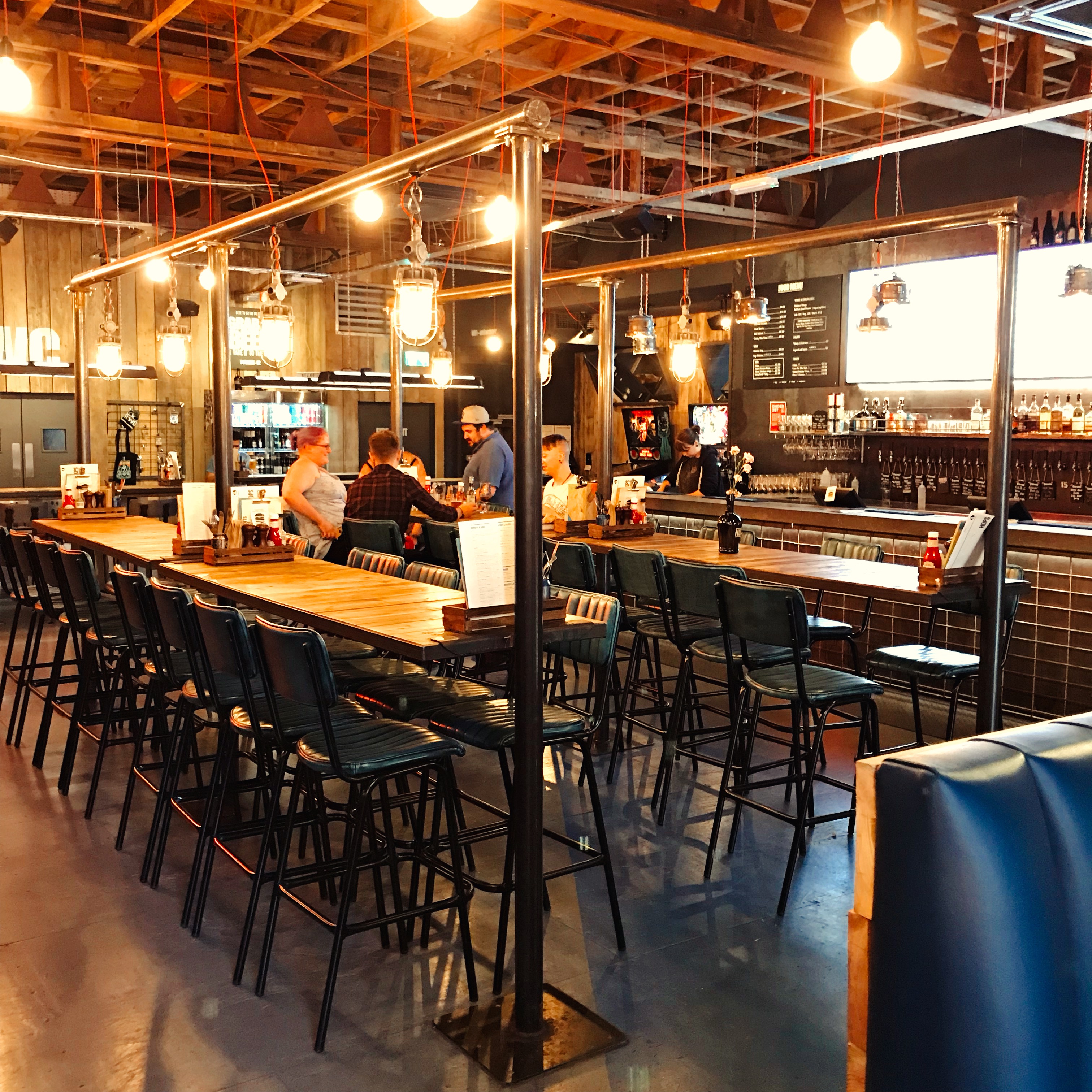
RYND, for all its faults, did a beautiful job of exposing the brickwork and then Public cocked it all up with cheapo tiles and wood panelling, so it was lovely to see that Brewdog had restored the room to something like its former glory. The large central room does feel like a beer hall, with long tables and – no surprises here – industrial light fittings. I’d asked for a booth, and it would have been nice to have been seated at one of the ones in the main room to feel more like part of things, but instead they put us in the smaller area off to the left, very much the overflow car park of the restaurant.

On my last visit, poor Steve and I waited at our table in bewilderment for easily five minutes before realising that nobody was going to come to ask us what we wanted. At the time, I wrote this off as my mistake, thinking that Brewdog was far more like a pub than a restaurant. But another difference with this visit was that a very friendly, smiley waitress came over and asked us what we’d like to drink. I have no idea whether that’s because it was quieter, or because we’d booked a table or for some other reason, and it slightly bugs me that I can’t tell you which of my two visits was more representative.

The menu was, well, burgers and hot dogs. And two salads. I couldn’t help thinking that Brewdog might have put more effort and imagination – albeit misplaced – into the names of the dishes than the dishes themselves. I had my eye on a burger from my extensive research – the “Jackpot”, with its winning combination of black pudding, chorizo and blue cheese – but I was also determined to let Mike pick first. I’m lucky that people want to come out on duty with me, so I always try to make sure they aren’t eating their second choice of starter or main.

“I quite fancy the ‘Chipotle Chorizo’,” said Mike, which made perfect sense: his mum is Spanish, after all.

“That’s fine” I said through gritted teeth, dying slightly inside as the prospect of sampling the Jackpot receded into the middle distance. “I’ll just have one of the chicken burgers instead. I love southern fried chicken.”

My first choice of chicken burger would have been the “Buffalo Chicken”, but we’d also decided to have some of the buffalo cauliflower, so I ended up going for the “Cluck Norris”: southern fried chicken and avocado. I had a sneaking feeling I had picked the menu’s equivalent of a chicken korma at this point, but the die was cast. Besides, why whinge about it to Mike when I could bide my time and instead complain to literally dozens of readers? Think of the delayed gratification, I told myself as I drank my pint.

I suppose I should at least attempt to talk about the beer, so here goes: there are a whole range of Brewdog beers on tap along with others in bottles and a range of other guest beers. Nearly everything crosses the five pound a pint Rubicon which, in fairness, probably stopped being any kind of meaningful threshold at some point last year; nowadays you just pay whatever they charge you and if you wince when they tell you how much your round is, you’re either in the wrong place or pubs just aren’t for you. The menu helpfully made suggestions about which beers paired well with each burger (Mike followed this advice, because he’s that kind of person and I didn’t, because I’m not).

Mike declared himself very satisfied with the Punk IPA and the Dead Pony, the latter specifically chosen to go with his burger. “They sell Brewdog on the continent”, he told me (Mike spends most of the year swanning around Europe running coach tours: I like to think he’s like a twenty-first century Robin Askwith, although the lack of stories of swordsmanship suggests this might be wishful thinking), “but it’s really expensive over there.” The punchline was left hanging in the air: I couldn’t be bothered to claim it.

My beers, from the outer reaches of the list, were more interesting I thought, although that doesn’t guarantee that my descriptions of them will be. I had a pint of Lighthouse by Windswept which I really liked, a “Kolsch style lager” (it means it’s kind of German, apparently – you know, like the Royal Family) which was crisp, clean and just the right side of the dividing line between bland and delicate. The Windswept website says it’s best enjoyed after abseiling or archery, which strikes me as a shame because it means I’ll never get to enjoy it in optimum conditions: never mind, I’ll live.

I followed it up with a pint of “#MashTag2018” which seems to be a beer that’s part crowdsourced through polls every year. The 2018 version, which presumably was chosen by Russian bots, was infused with hibiscus and yuzu and I liked it a great deal; the sharp citrus added by the yuzu made it smarter than the average beer. Mike had a sip and decided to order a pint of himself after he’d lapped me. He then decided that it was more fun to sip a little of it than to wade through a pint of it, which I figured served him right. Karmic payback for stopping me hitting the Jackpot, perhaps.

The burgers at Brewdog cost between nine and ten pounds and fries (or sweet potato fries) are extra, so in terms of price it’s probably largely on a par with Honest. It’s taken me until this point in the review to mention the H word, but they were very much in my mind as I had my dinner because, for better or worse, 2018 is the year that they’ve become the benchmark for all burgers in this town.

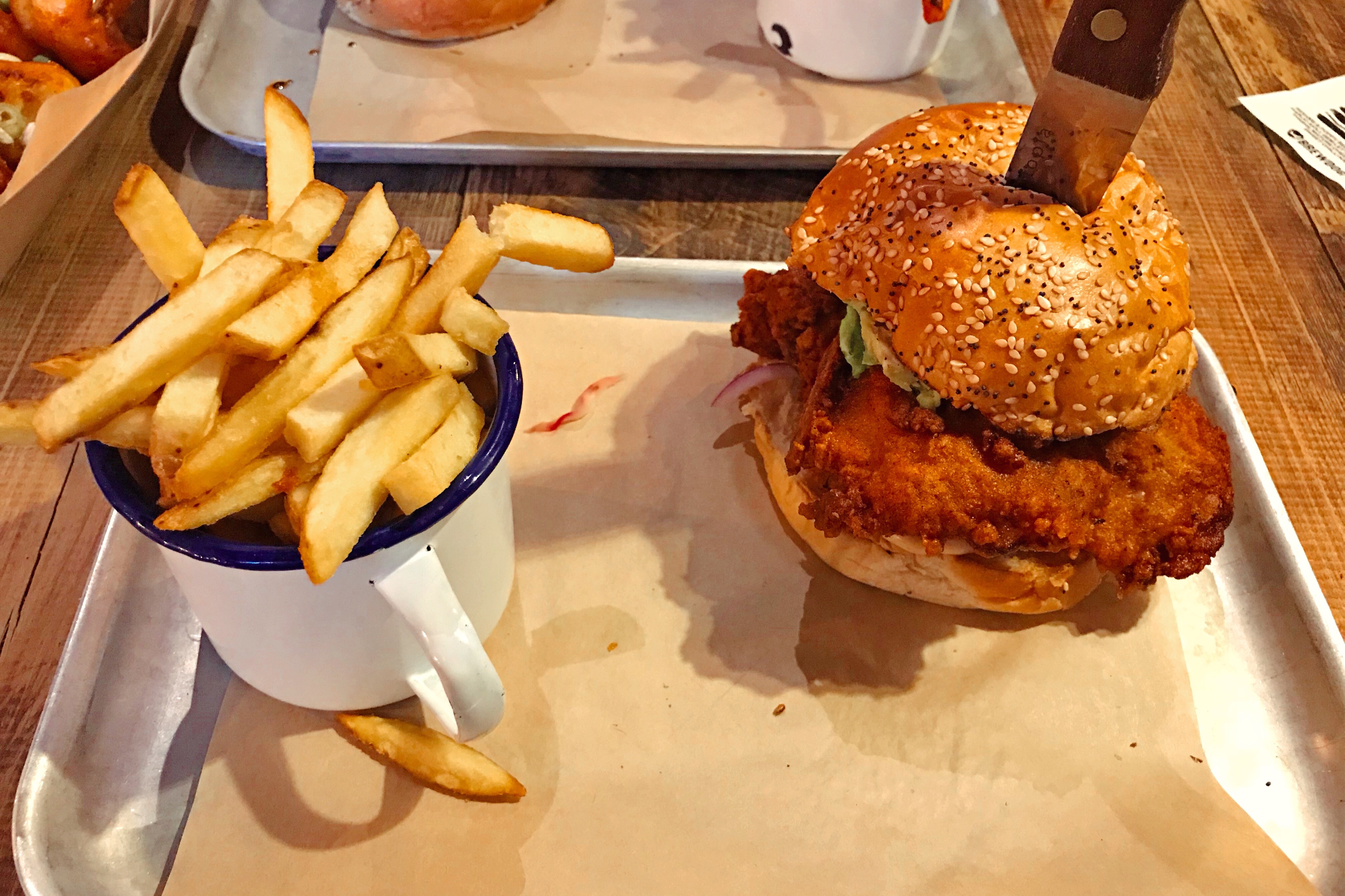
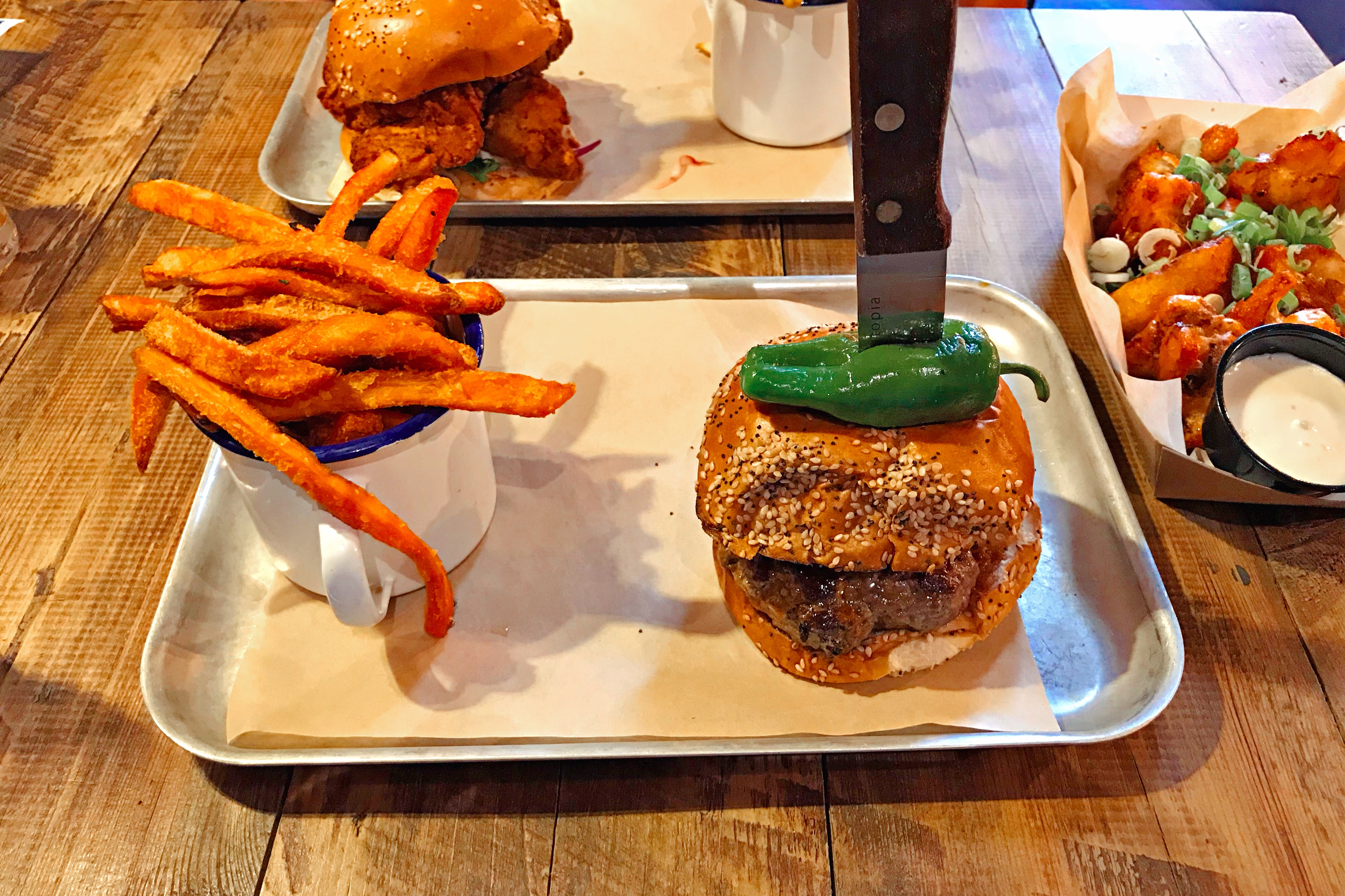
Here’s something you’ll rarely hear me say: the problem with my chicken burger is that it had too much chicken. It’s honestly true – the unremarkable-looking seeded brioche had two large coated chicken breasts in it. That might have been a dream come true if the coating had tasted of anything, but in fact it had almost no flavour at all. A real shame, because it looked the part and the texture was great, but in terms of taste it was like a mirage of KFC. This also meant that the whole thing was unbalanced because the things it really needed – the avocado, the coriander, the Cajun mayo – simply couldn’t put up a fight against all that bland fried chicken. With proper coating, less chicken and more of the rest it could have been world-beating, but as it was I actually left some of it. A knife stuck needlessly out of the top, Excalibur-style, and I couldn’t tell whether it was decoration or punishment.

Mike’s “Chipotle Chorizo” was better, but still unspecial. The burger itself – very much cooked medium-well – was crumbly and dry and left me, again, thinking wistfully of Honest at the other end of town. The chorizo was by far the best thing in it – coarse, juicy and piquant – but the chipotle mayo didn’t add a lot and the padron peppers felt a bit random. There was one in the burger and another impaled on top of the bun – that knife trick again. I felt like Mike had got the better deal, but only in terms of shades of meh. Speaking of meh, the fries were wan and disappointing, and I didn’t have any desire to finish them all. Mike had upgraded to the sweet potato fries – they cost fifty pence extra – and this was money well spent, although probably money better spent would have involved not having fries at all.

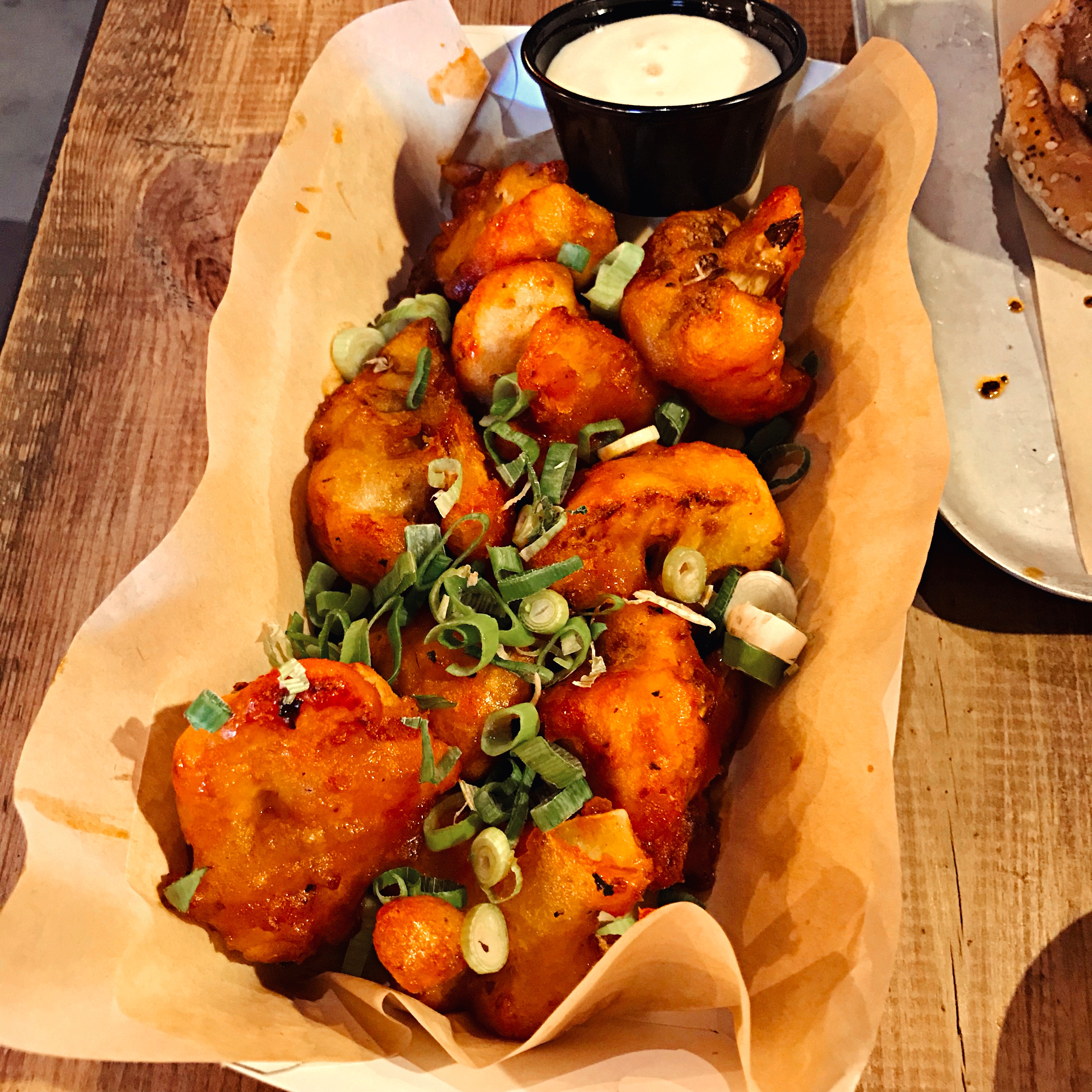
The bright spot was the buffalo cauliflower, which we both agreed was quite the nicest thing we ate all evening. Big firm florets in a hot, sour glaze, and easily more interesting than the feature attraction, a scene-stealing bit part. But even this wasn’t perfect – I liked the coating but I’d have liked it to be crunchier and stick to the cauliflower a bit better. And, when it came to it, we paid eight pounds for it, so it really wasn’t much cheaper than the burgers. Perhaps by this point I’d just run out of magnanimity: it’s distinctly possible. There was a vegan dip with it, which tasted like a photocopy of salad cream and might have appealed, if you were a vegan.

This is all getting a bit crotchety, isn’t it? I should perhaps focus on the service because it was properly lovely. Our waitress (or, according to the bill, “server”) was likeable and cheery without ever seeming fake or making us feel like miserable old shits, not that we needed any help in that department. Our bill for two came to just shy of sixty pounds, excluding service (and the menu, randomly, also gives you the option to buy a pint of Punk IPA for the kitchen: I’m not sure that would have improved matters, but it might have been worth giving it a whirl). At the time that didn’t feel like a lot, but looking back it feels like money extracted somewhat by stealth.

It’s probably obvious by now that Brewdog wasn’t my bag at all, but what surprises me is that I honestly expected it to be better. It has a small menu and I thought sticking to a few things might mean they did them well, especially when you think about how considered their brand is and how much attention to detail they’ve put into the building, and the fit out. So it’s disappointing that the food was so drab; if I wanted that kind of meal I’d go to Honest, and if I wanted that range of beer I’d walk slightly further out of town and make for the Nag’s Head.

Of course, it’s possible that Brewdog was aiming for the sweet spot on the Venn diagram where beer drinkers and food fans meet, but somehow I doubt it. It felt like the food was just there to tick a box rather than to properly complement the beer, and I found that a little sad. It felt a lot like a slightly less corporate Oakford Social Club, but when you strip away the beards the experience is much the same. What Brewdog really highlighted, for me, is one of the big gaps in the market left here in Reading. Since I Love Paella left the Fisherman’s Cottage, punters have been left with a pretty stark choice: you can have a fantastic range of well-kept beer or you can have brilliant food, but – for now at least – you can’t have both.

Brewdog – 6.2
11 Castle Street, RG1 7SB
0118 9568755

Tuscany Pizzeria

Very sadly, Tuscany closed in May 2019. I’ve left the review up for posterity.

I don’t know how involved a review this will be; it’s hard to complicate a restaurant as simple as Tuscany Pizzeria.

I first had it drawn to my attention by regular reader Eleanor back in April: a pizzeria on the Oxford Road, she said, adding that it was “a choose your own toppings place I think”. I made a mental note to put it on my list and then a couple of months later Eleanor went there and Tweeted the kind of pictures that can’t help but make you hungry – huge pizzas with irregular bubbled crusts, plenty of cheese and all the toppings a person could hope for, the whole thing strewn with rocket. One of the pictures showed the front of the restaurant, with a blackboard on an easel outside saying that a twelve inch pizza was seven pounds, a fourteen inch pizza a tenner.

Surely it couldn’t be quite that straightforward, I thought, as I ambled down the Oxford Road in the sunshine with my very good friend Zoë, fresh from having enjoyed a sharp sour beer in the sunshine of the Nag’s Head, still Reading’s finest beer pub by some distance. But actually, when we arrived it did look just as no-frills as the pictures I’d seen had suggested: one table out the front, the word “TUSCAN” in block capitals above the big window, in a style which had probably aimed for rustic but had to settle for makeshift. The decal taking up much of that window promised “Gourmet Delicious Pizza Top Quality Italian Style”. Hmm, I thought.

Inside, the room had deep red walls with stuff on them best described as Italy by numbers: a picture of some Parma ham here, a drawing of the Leaning Tower Of Pisa there. The whole place couldn’t have seated more than ten people – well, more if you took one of the window seats, but when I was there somebody had helpfully leaned their bicycle against the window counter, making that impossible (in any case a laptop was open there, with the Tuscany Facebook page prominently visible on the screen). The pizza boxes on display made it clear that not all Tuscany’s customers chose to eat in. The tables were a strange sort of multi-coloured hue that looked like something Linda Barker might have dreamt up on Changing Rooms circa 1999.

Anyway, I liked it: it was small and intimate although, with no soft furnishings and most of the tables occupied, it also happened to be astonishingly loud. Most of what I heard, I think, was Polish: the owner of Tuscany is Polish, I believe, and so were most of the customers there on the evening I went (many of the reviews on Facebook are in Polish, too). Some might have been staff, all seemed to be friends of the owners. At the table next to me the group of four seemed to be tucking into something that looked like antipasti, even though I couldn’t see anything of the kind on the menu.

Come to think of it, I couldn’t see a menu anyway, just the counter where you went up and placed your order, which basically consisted of telling the chap how big a pizza you wanted and what toppings you wanted on it. Behind him, you could make out the place where he rolled out the dough and topped the pizza before sticking it in the oven (I didn’t spot whether there was a wood fired oven, but I suspected not). Zoë and I took it in turns to go up and place our orders and sat back down with a can of aranciata apiece: no alcohol licence here, although again, I think I might have spotted one of the chaps at a neighbouring table with a can of beer bought from one of the nearby shops. Again, I felt like I was in a restaurant where I just didn’t know the rules, or the rules differed depending on who you were, and I didn’t entirely enjoy that.

The toppings, incidentally, were a pretty wide range. The owner talked us through them – or the ones on display, anyway – at the counter . Most were reliably standard stuff: peppers, mushrooms, onion, olives, pepperoni, parma ham and so on. The only slight hints of the exotic were some artichoke hearts and friarielli, which is sometimes described as broccoli but is closer to turnip tops, a pizza topping I’d never heard of until I visited Papa Gee but which now seems to be everywhere. I noted, with disappointment, that I couldn’t see any anchovies or capers.

Tuscany’s Facebook page says that all of their ingredients come from Italy. I couldn’t judge that, and I certainly didn’t check any travel documents, but the olive oil was by Filippo Berio (whose Wikipedia page suggests they aren’t quite as Italian as you might think). Anyway, I didn’t care if the pizza wasn’t entirely Italian, here on the Oxford Road being served by a chap from Poland. I wouldn’t have cared if the artichokes were Spanish or the ham Albanian for that matter, provided the pizza was delicious. I didn’t vote to stay in the EU only to quibble about nonsense like that.

While we waited, I saw a pizza carried to one of the other tables and I found myself wishing it had been mine. It looked every bit as good as the pictures I’d looked at months before, with the added advantage of being both three dimensional and edible. But I also saw another dish arrive at another table, what looked like chicken with little strips of baked pizza dough. The chef had been cooking the chicken in a pan when I went up to choose the toppings for my pizza, and I wondered at the time what the dish was given that it wasn’t on the menu (and, of course, given that there was no menu for it not to be on) but I was too timid to ask. Soon after that our pizzas were ready and in turn we were asked whether we wanted rocket and parmesan on them. This was a nice touch, as was the fact that the parmesan was freshly grated onto the pizza before it was cut into slices and brought to the table (the only real element of table service at Tuscany).

Zoë had a twelve inch pizza and I, rather greedily as it turned out, had a fourteen inch pizza. If I was trying to describe the main differences I’d say there were two. First of all, the twelve inch pizza is put on a massive wooden board, cut into slices and then dished up onto a plate barely big enough to contain it. The fourteen inch pizza is just brought to your table on the massive wooden board. The second main difference is that the fourteen inch pizza is actually too big for most right-minded folk to finish, and that includes me. “I knew to just order a twelve inch,” said Zoë sensibly, “because I knew that was the size of an LP and that felt quite big enough.” Trust her to slip in a reference to music and be in the right, I thought.

The base was very good – properly thin, although the edges were more brittle and crispy than charred and bubbled. Not quite on a level with, say, Franco Manca but still pretty decent. What couldn’t be denied, though, was that Franco Manca looked properly stingy compared to this lot. Mine had sundried tomatoes, pitted black olives, artichoke hearts, mushrooms, parma ham and pancetta and although none of the ingredients could be described as exceptional (I’d have liked the olives, for instance, to be the wrinkly, salty kind that I truly love) the sum of the parts was still very good indeed. I drizzled basil oil on one half, garlic oil on the other and ate until I was full. Then I ate some more, then I reluctantly stopped.

Before that, I traded a piece with Zoë and apart from having – an unusual experience, this – envy that her portion was a little smaller than mine, it meant I got to enjoy hers, with lovely sweet shreds of red onion, pepperoni and mozzarella. Her pizza was basically mine without the airs and graces, a more robust meat feast you could say, and none the worse for it. “This is really good” she said between mouthfuls and, as so often, I found her rather difficult to disagree with.

As we were finishing the last of our slices, the people at the table next to me got up to leave and I took the opportunity to ask about the off-piste dish one of them had ordered.

“It’s chicken stuffed with cheese and wrapped with Parma ham” said the man. “He cooks it specially, if you ask him. He gets the chicken in fresh from just down the road – and I know it’s fresh because if he served me frozen chicken he knows I’d kick his ass!”

He chuckled, and I laughed along, wondering if ass-kicking was ever an appropriate thing to reference in a restaurant review. On TripAdvisor, perhaps.

That’s pretty much all there is to say about our meal at Tuscany Pizzeria. Once we’d finished, I settled up at the counter where our meal came to just under twenty pounds. The other diners had cleared out by then, so the owner came over and chatted to us a bit more. Tuscany had been open three months, he said, and they stayed late so they had quite a lot of takeaway trade when people headed home from the pubs.

“My landlord laughed when I told him I wanted to open a pizza place! He said that there were lots of pizza places on the Oxford Road, and I told him this wouldn’t be that kind of pizza place.”

He went on to tell us that business was good and that all their ingredients (“except the mushrooms, spinach and onions”) did indeed come from Italy. He showed us pictures of some of the dishes we hadn’t ordered – a pizza wrap (“lots of customers like this”) and pizza ripiena, essentially a pizza sandwich, like a calzone but without the fold. He sounded so proud of what he did that I started to think that he was right: this wasn’t that kind of pizza place. It was a different beast, and all the better for it. And then something occurred to me.

“Do you have anchovies and capers?”

He smiled.

“Of course I do. Next time you come in, ask.”

Smart guy: it’s precisely at that point that I decided there would be a next time. I could easily have been intimidated or deterred by Tuscany, and by the idea that other people could order different dishes and combinations, like unlocking secret levels in an arcade game. On another night, perhaps I might have been; I can definitely see that other diners might be, and this place won’t be for everybody. If you don’t live in West Reading, you might feel there are better choices closer to home, if you’re in the centre there’s Franco Manca and if you’re privileged enough to live north of the river you have Papa Gee (or, if you like that sort of thing, Quattro – or, I suppose, the Fox And Hounds).

But all that said, something about Tuscany actively made me want to fit in, to go again and to take advantage of all the other options. To try the anchovies and capers, have the ripiena, discover the secret password that lets you order the stuffed chicken or drink a cold beer at the table, brought in from elsewhere. I could see myself playing out my evening in reverse: going back with Zoë, having a pizza and then stopping by the Nag’s on the way home to enjoy more of their superb selection. That’s me, though: I can be that kind of stubborn so-and-so, and I like a kindred spirit. Even one who bloody-mindedly sets up a rather lovely, slightly incongruous Polish pizzeria slap bang in the middle of the Oxford Road.

Tuscany Pizzeria – 7.8

399 Oxford Road, RG30 1HA
07586 095400

https://www.facebook.com/Tuscany-Pizzeria-1971426149852568/

Afghan

Afghan closed following a fire in January 2020. I’ve kept the review up for posterity.

My dining companion this week is Martijn Gilbert, the outgoing (in every sense) CEO of Reading Buses. I realised Martijn wasn’t going to be your usual dining companion relatively early on in our meal at Afghan, just after we took our seats in one of the booths at the back of the room and began looking at our menus. I was looking at the menu, anyway: Martijn, on the other hand, was peering intently through the big windows out on to the Wokingham Road.

“What’s that doing there?”

“What do you mean?” I said, assuming he was talking about the presence of houmous on the menu of an Afghani restaurant.

“That bus that just went past. It’s a 14 – they go to Woodley – and this is the 17 route. If there’s a diversion in place I don’t know about it.”

“Is that a problem?”

Martijn gave me a kindly, indulgent look, as if he’d just heard something crashingly stupid but was far too nice to correct it, and said something about low bridges. It all sounded very convincing, although my mind was also whirring with other thoughts, mainly about how many main courses we could snaffle between the two of us. After all, Martijn had specifically told me he only had a salad for lunch to ensure he was in peak dining condition.

“If you don’t mind, I just need to phone the control room.”

So he did, and it turned out it was a known diversion and not some bus driver having a funny five minutes or, worse still, about to recreate Speed just outside the Early Café. But even that incident gave me an idea about what Martijn was like in work mode, and it was impressive stuff: the sort of perfectionism I also see in some restaurant owners, where they know everything about everything when it comes to their business. I aspire to that, which is why I re-read my reviews countless times before they are published on the blog – scanning for typos and needless commas, mostly – but I’m small time compared to this.

The irony about Martijn’s intervention was that I’d deliberately chosen Afghan to review with him because it was on the 17 bus route; just like the tote bag they sell in But Is It Art? says, the number 17 route is the backbone of Reading. Sometimes it seems like all human life joins and leaves that great thoroughfare at some point – whether it’s the leafy gentility of the Earley borders, the icon that is Cemetery Junction or the fleshpots of the Oxford Road. I used to commute to work on the 17, many moons ago at the dog end of the 90s, from a shared house on Talfourd Avenue where I was the only person not doing drugs, and I’ve always had a big soft spot for it; to me, as much as the River Thames, it defines the town.

It pleased me, too, that Martijn caught the number 17 to the restaurant – as did I. Martijn told me previously, during a boozy night in the Retreat, that if the number 17 route hadn’t already existed, nobody would have invented it: it simply made no sense to join up the far East and West of Reading in this way, and in any other town it would have been two separate routes. But Reading had it, and it worked, and people seemed to like it, so nobody has ever messed with it. “Our data shows us it isn’t always heavily used during the day” said Martijn, “but we’re not changing the timetable. It goes every seven minutes, without fail. That’s the 17 for you”. I loved that, another of many things to love about Reading.

Of course, I don’t just pick restaurants because of their public transport links and Afghan had come highly recommended by a number of people in the run up to my visit. One friend told me they had a real talent for cooking lamb, another friend enthused about her trip there a couple of days before my visit. My regular reader Mansoor – an expert in these things – recommended one dish in particular, telling me his wife had ordered it three times in two weeks. All that and independent and in an area somewhat lacking in decent restaurants: how could I not give it a whirl?

The room was pretty much unchanged from its previous incarnation as Lazeez – a big square, booths and banquettes around the edge and tables in the middle (I know that, because I looked up the old review for Lazeez and was struck by how much of it I could have just copied and pasted). Martijn and I were at one of the booths, which could have generously seated four but turned out to be just right for the quantity of food we ordered. The menu reminded me very much of the menu at Kobeda Palace, the Afghan restaurant at the other end of the 17 route, only a little wider and far more polished-looking: at Kobeda Palace you could be forgiven for thinking you were in a kebab house, with the preparation and cooking front and centre, whereas Afghan was more obviously a restaurant. Some dishes were more expensive, but many weren’t.

I managed to persuade Martijn to order a starter and three mains to share, and as nobody at Afghan tried to deter us I assumed that our order was deemed plucky rather than foolhardy. The first thing to arrive was a dish I’d been very excited about trying, the chapli kebab. This was the dish Mansoor’s wife had so admired, and it’s been described as the best thing to come out of the Khyber. As a die hard Carry On fan I found this difficult to believe, so I was determined to see what the fuss was all about.

A chapli kebab is quite hard to describe, but here goes: it’s sort of like a spiced lamb kofte but instead of being in your traditional cylindrical shape it comes as a flat patty more like a burger, cooked in fat and packed with onion and green chillies. When it arrived I thought it looked rather like a pair of smokers’ lungs, but from the very first mouthful I knew this was a dish to be reckoned with. How did they get the contrast between the almost crunchy outside and the juicy inside so bang on? It went beautifully with all three dips at the table – a green one full of coriander, a red number which looked like it would be diabolically hot but was more like a sweet chilli sauce, and a cooling yoghurt with mint.

“This is good” said Martijn, wasting no time setting out demolishing one of the kebabs, and I couldn’t disagree. The naan it was supposed to come with didn’t arrive until later, one of many oddities about the timing which slightly marred matters. Instead, we got the only conventional starter we’d ordered: bourani banjan, aubergine with tomato and yoghurt. Aubergine isn’t everybody’s cup of tea – often it isn’t mine – but this was a properly lovely dish and astonishingly good value at three pounds. The aubergine was sweet, sticky and beautifully cooked with none of that spongey boredom it all too often presents.

In an ideal world we’d have been left to finish that little lot before more food turned up, but that was not to be. Instead, a groaning dish of lamb biryani was brought over when we were barely halfway through. How much you’ll like Afghan’s biryani, to some extent, will depend on how you feel about meat on the bone – most of it slid off, but there was a bit of a variation in texture. I didn’t mind it, and I know that lamb on the bone is far more authentic for these things, but it wouldn’t be for everyone. The rice was well spiced (if not the best example I’ve tasted) but there was a lot of it, so the ratios felt a little off. On the other hand, this dish was nine pounds, so that feels like a quibble.

At the risk of inducing déjà vu, in an ideal world we’d have been left to finish that (not especially) little lot before more food turned up, but that too wasn’t to be. So we were partway through pretty much everything we’d ordered when a big dish of charsi lamb karahi was deposited at the table, along with our naan bread which, by that point, I’d pretty much forgotten about. The lamb karahi is ordered in multiples of half a kilo, so we’d ordered the entry level five hundred grams. When it arrived, I told myself it was okay because much of it would be bone: and, again, how you feel about this dish will partly depend on where you stand on meat on the bone. I found this a little trickier and less enjoyable – the sauce was deep, thick and peppery but lacked some of the spice and fragrance of, say, Kobeda Palace’s quite extraordinary karahi.

We had an ordinary-sized naan bread (which was meant to arrive at the same time as the chapli kebab) but we’d also ordered an “Afghan naan”, because I’d been told these were quite the talking point. And it really was – a huge thing which turned up vertically, impaled on some metal stand and brought to the table. It was so big it blotted out some of the remaining daylight outside, so big in fact that Martijn took a selfie with it for sheer novelty value. But the novelty value was the main value, I think. Getting it off its makeshift gallows was a faff, and it was a little rigid and crispy rather than soft and yielding – you could load stuff onto it, but it was much more difficult to use it for scooping. That said, the karahi was a relatively dry curry, so perhaps scooping was a bit hopeful anyway.

“It’s great that Reading has independent restaurants like this and not just lots of chains” said Martijn, grabbing another mouthful of the karahi and I sensed, not for the first time that evening, perhaps a little bit of regret at leaving his adopted town. I could see why – I mean, he might be able to actually buy a house in the North East but would he ever find an equivalent of the Maiwand Lion, or Smelly Alley, or the Nag’s Head?

“That’s the whole point” I said, pontificating on as usual before returning to more important matters. “Try some more of the chapal kebab now it’s cooled down. If anything, it’s even more delicious.”

Like quite a few of Reading’s more interesting restaurants Afghan is unlicensed, so Martijn had something fizzy and I ordered my beloved mango lassi. It was three pounds for a glass or six pounds for a jug, so I got a jug and Martijn helped me out with it, although we left a little. It never disappoints, but it did have the slightly gloopy and sweet taste of stuff that might not have been freshly made.

Dinner for two came to fifty-two pounds, not including tip, which really isn’t half bad when you consider that what we ordered probably would have easily fed three less gluttonous people. I haven’t mentioned the service, but that’s because it was pretty unobtrusive: pleasant enough, just attentive enough but nothing to write home about. The restaurant wasn’t busy on the night we went, but there were a few families and bigger groups. As so often, I was struck between the contrast of the quieter, more polished interior of Afghan and the scruffy, more boisterous Kobeda Palace. Your mileage may well vary, but I think I prefer the latter.

That comparison has weighed on my mind a lot since my visit because if you’re comparing like for like, for me at least, I think Kobeda Palace would win every time. With the exception of the chapli kebab – a delicious, intriguing dish I could gladly revisit – I thought Kobeda Palace won on points at every level. I preferred the ambience, I preferred the karahi, I preferred the naan. In fairness, Martijn was a big fan of Afghan, but I did wonder if that was because he just hadn’t been to Kobeda Palace. Perhaps just using that comparison isn’t fair, because Afghan is also in competition with Miah’s Garden Of Gulab a few doors down, or Vel, or any of Reading’s countless Indian restaurants. And on that level perhaps it fares a little better – the food I had was good, and interesting, and I saw enough on the menu to want to go back, to try the samosas, or something else from the grill.

And, of course, you also have to bear in mind that East Reading has a dearth of good restaurants: Garden Of Gulab is no great shakes, the Hope & Bear is another Mitchell & Butler pub, “Smokey’s House” looks best avoided and I Love Paella has, perhaps sensibly, left the Fisherman’s Cottage. In the kingdom of the blind, the one-eyed man is king and Afghan is very far from one-eyed. Maybe it has a bit of a squint, but it’s still possibly the best option in that neck of the woods.

After the meal Martijn and I wandered to the Hope & Bear for a gossip and a debrief, which gave me the opportunity to confirm my suspicions that the facelift it received when it rebranded from the Abbot Cook largely consisted of painting the whole thing green and putting new furniture in the garden. On our walk there, Martijn spotted a bus stop which wasn’t to his satisfaction, and took a photo.

“Do you think your staff will miss you randomly sending them photos of bus stops on your travels?” I said. He smiled.

“They know I keep them on their toes.”

The employees of Reading Buses might not miss it, but actually I will, and I suspect Reading might too: it’s nice to have somebody in charge who cares. We sat in the garden, pretending it was warm enough for a couple of pints, and discussed Martijn’s plans to get through all ten of the dishes on my list of Reading’s most iconic meals. I don’t think anything from Afghan will make the second edition, although the chapli kebab might scrape an honorary mention.

At the end of our evening we took the 17 together from outside the pub.

“This timetable is wrong too!” said Martijn, taking another photo. “It lists every single departure time from the stop, when our new timetables say they go every seven minutes. That’s the whole point, because we can’t be precise about exactly when a bus will go past.”

“And the newer timetables will look much cleaner, too.” I said, finally feeling like I was getting the hang of it. Martijn’s enthusiastic reaction suggested that maybe I was.

The bus pulled up and the driver let us both on, and if he was anxious about the prospect of driving the head honcho into town he kept a magnificent poker face. “I like to think they see me as one of the gang” Martijn told me, as we sat at the back and watched the Kings Road hurtle past, riding Reading’s greatest thoroughfare again. How many times have I taken this bus in my life? I wondered. It felt like the 17 had always been there, and I found myself hoping it always would be. And best of all, I got to travel back to the Village for nothing because I was taking the bus with the boss. I reflected later that it might be the only freebie I’ve ever received on duty: a freebie of which I’m strangely proud.

Afghan – 7.2
146 Wokingham Road, RG6 1JL
0118 9668802

https://www.facebook.com/afghanrestaurantreading/