Restaurant review: Cuttlefish, Oxford

“This should be lovely” said my dear friend Jerry as we took a table in the window at Cuttlefish, a couple of minutes’ walk away from the far side of Oxford’s Magdalen Bridge. “A fish restaurant!”

I was spending Good Friday with Jerry, in what I rather hoped would become an annual tradition – last year we spent it lunching at Gees – and as is habitual I had given him a range of options to choose from in advance. He passed on the London candidates I gave him: only the smaller plates appealed at Andrew Edmunds and The Hero, and the offal-heavy selection at Borough Market’s Camille was dismissed in a split second. That left Oxford, where Jerry was tempted by No. 1 Ship Street but thought, on balance, that Cuttlefish had more to tempt him.

All this worked out rather well, in truth. People have been bemoaning the lack of a fish restaurant in Reading for a long time – the easily pleased since Loch Fyne closed eight years ago and the more exacting since long before that. The nearest thing to it we have, I suppose, is Henley’s Shellfish Cow, but it always feels to me like a restaurant where they chose the name because they liked the pun and everything else followed from there.

Given that lacuna in Reading’s food scene a short hop to Oxford to see if there was anything suitable sounded like an excellent idea. Besides, after my last Oxford review there was a request to install Jerry as my permanent Oxford correspondent for all long boozy lunches: let it not be said that I never, ever give the people what they want. So Jerry and I rocked up at the start of the long weekend, the sun finally out, ready to investigate.

My preliminary research, however, had given me a bit of a sinking feeling, not that I told Jerry that. The fanciest thing about the website was Cuttlefish’s fetching logo, but lurking beyond that was a menu that seemed a little bit strange, a little bit cheap, a little too large and somewhat lacking in fish. Sure, they sold oysters and caviar and seafood platters, but for a fish and seafood place there appeared to be little fish on the menu.

Perhaps, I told myself, it was all in the daily specials depending what they could get that day. But it also felt a little all over the place, with classic fish and chips sitting uneasily next to squid ink spaghetti and “mixed seafood and chicken paella”.

Maybe some of that could be explained away as overlap with the La Cucina, the Italian restaurant next door under the same ownership. But that was before you got on to the five different types of burger, the steak frites, the brunch menu featuring eggs benedict and chorizo tortilla. Nothing about it shouted that Cuttlefish was a restaurant which had decided to focus on doing a few things very well.

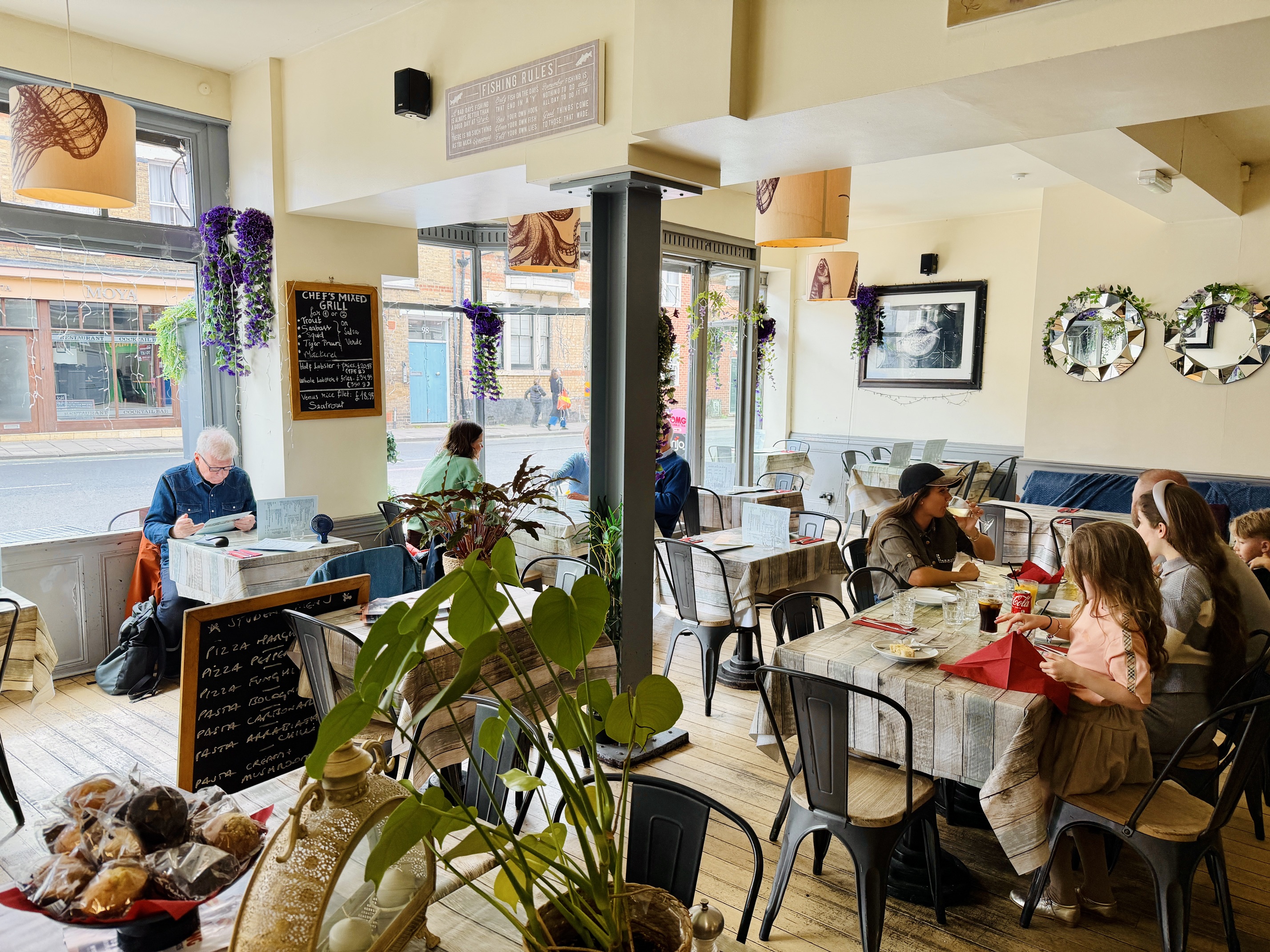
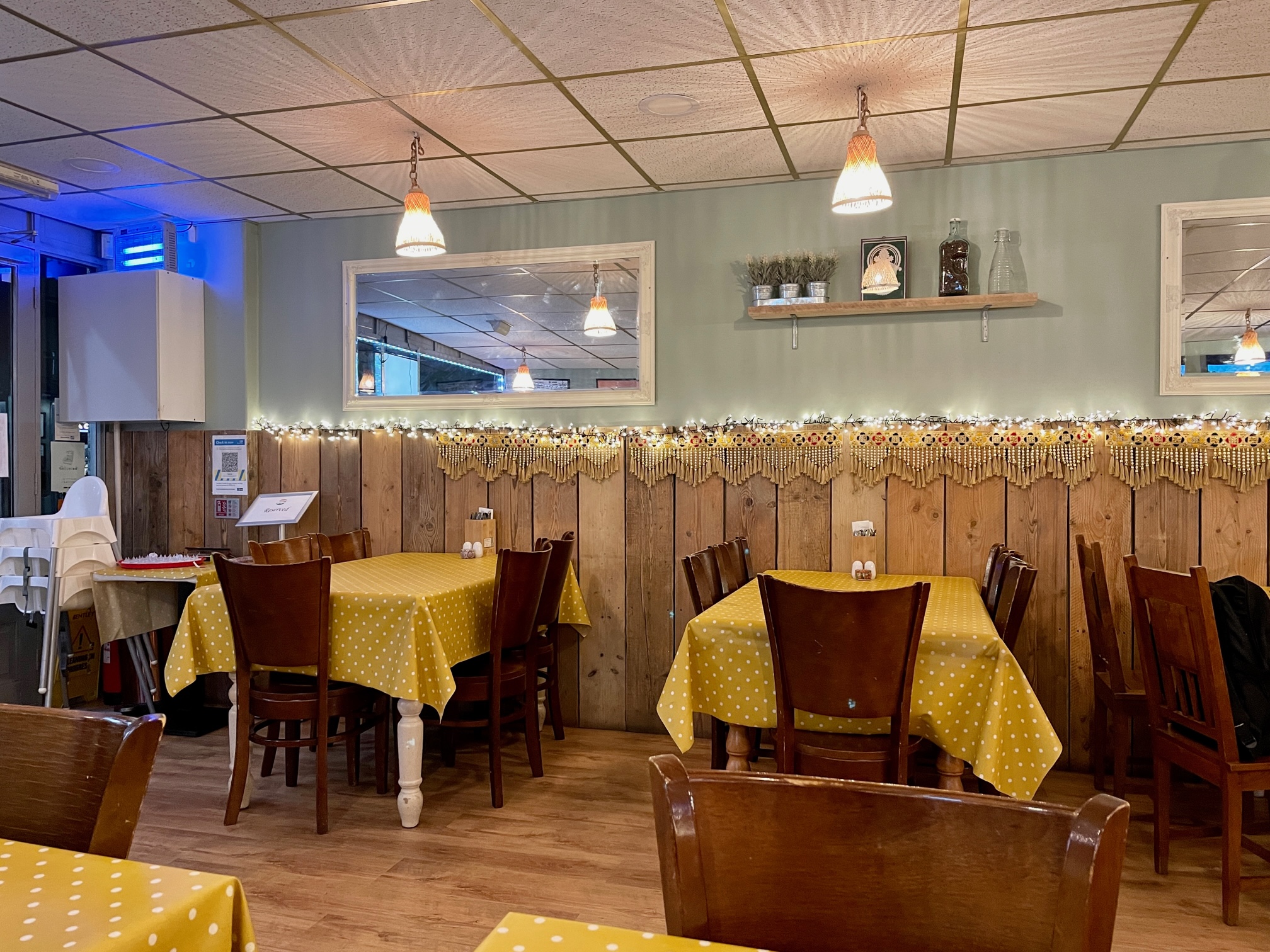
That was sort of borne out by the dining room. It didn’t boast loads of jarring nauticalia, and the pictures on the walls were tasteful black and white numbers. But the Tolix chairs – would that I could go back in time and buy shares – felt low rent, as did the vinyl tableclothes meant, seemingly, to imitate planks of driftwood, which rather clashed with the attractive bare wooden floorboards. Never mind: we took a nice spot in the window and I wedged my arse into a Tolix. Behind Jerry, I could see that the paintwork of the bay windows was a little tired.
Service was lovely and friendly, but it started off shakily and never quite recovered. Jerry is a lovely and self-effacing man who always puts other people first, the kind who volunteers to take the crappy single bed in a communal Airbnb. Maybe it’s his Irish Catholic upbringing, but he is congenitally predisposed not to want his own way, to the point where he sometimes apologises even for having a preference.

I discovered this at lunch because, given that we were at a fish and seafood restaurant, I rather assumed that we’d be attacking a Picpoul de Pinet or an albariño, a riesling or a Chablis. Cuttlefish’s wine list, as you would expect, boasts all of those things, although it never gives a vintage and, in some cases, also neglects to mention the producer. But it was on this day, after years of friendship and several meals on duty, that I discovered that Jerry doesn’t especially care for white wine.

“I’m really sorry” he said, getting that apology in early. “But we can have white if you want.”

I stopped and thought. This was news to me, and I’ve been out for lunch with Jerry numerous times – including twice in Oxford – where I’ve pressed on and ordered a bottle of white without ever realising that Jerry only really enjoys red.

“No, don’t be silly! I’m not a purist about drinking white with fish.”

So we asked our server for help and that’s where our problems began. It felt like there was an unbridgeable language barrier between us, because I was unable to explain, somehow, that we wanted tips on which the lightest and fruitiest of the reds on the wine list was. It didn’t give many clues and there were no obvious candidates like, say, a Fleurie. It didn’t help that this part of East Oxford is a mobile reception not spot: no Vivino to come to the rescue.

“Do you mean the red wine that’s the least strong?” she said.

“No, I mean – which is the fruitiest. You know, not heavy. Which one would go best with fish?”

You’d expect the reds on this list to have been selected with this eventuality in mind, but perhaps not.

“Well, there is the Picpoul de Pinet” she said.

“No, I mean reds. That’s a white wine.”

There was a pause, and I wondered if I was expressing myself exceptionally poorly (if you’ve read enough of my reviews, you’ll know that sometimes happens). The pause lengthened into a silence, and I wondered if time was standing still. No: Jerry was still moving.

“I will get my colleague.”

By the time he arrived we’d given up and settled on a French malbec. This server smirked slightly as we ordered it, as if it was a bad choice, but really, by that point we’d done quite enough deciding and wanted to do some drinking.

It was called Beauté du Sud and the markup on it was reasonable to the point of baffling: £32 for a wine that will apparently set you back £25 retail. If I’d paid £25 for it retail I’d be beyond disappointed, but in a restaurant it wasn’t bad: not too heavy but perhaps a little jammy. Tom Gilbey would probably have had something to say about the sugar levels.

So by this point my hopes were not high, and that was compounded by another cardinal sin: our starters must have come out about five minutes after we ordered them, and you probably know by now how much I love that i.e. not very. But that’s almost the last bit of criticism you will hear from me, because from this point onwards – against all the signs and much to my bemused pleasure – nearly everything was rather good.

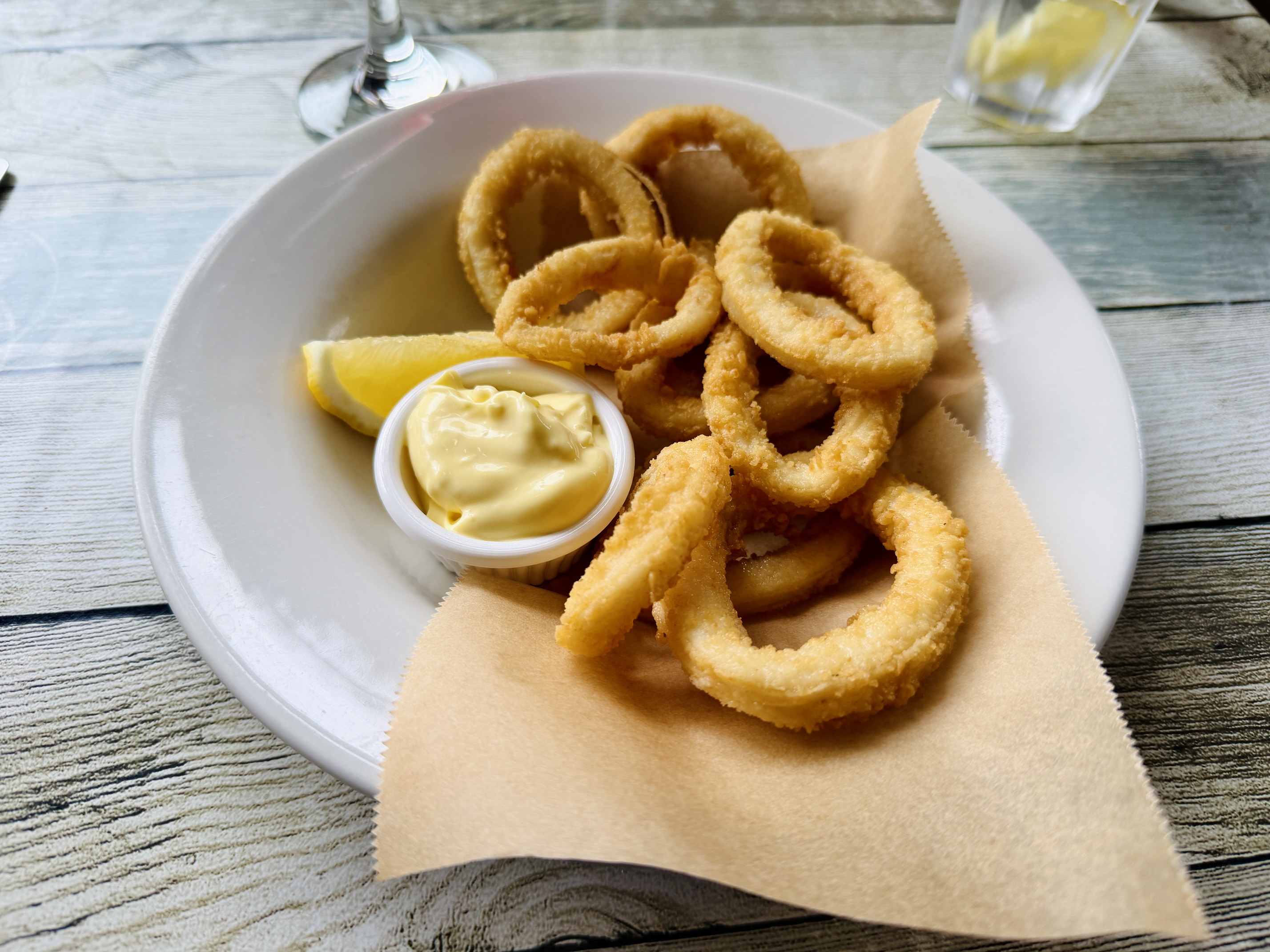
Take my calamari, for instance. They even looked pedestrian, and I was half expecting to wade my way through a bowl of breaded rubber bands. So imagine my surprise when I found they were delicious, lightly dusted with a coating that adhered, had crispness, and that they were tender without the slightest twang of elastic.

Dressed with liberally squeezed lemon and then dipped into a ramekin of golden aioli, they were the kind of dish the idea of this restaurant promised, a promise the reality of the restaurant looked as if it would renege on. It wasn’t the hugest portion for £9, but I liked it too much to care about that.
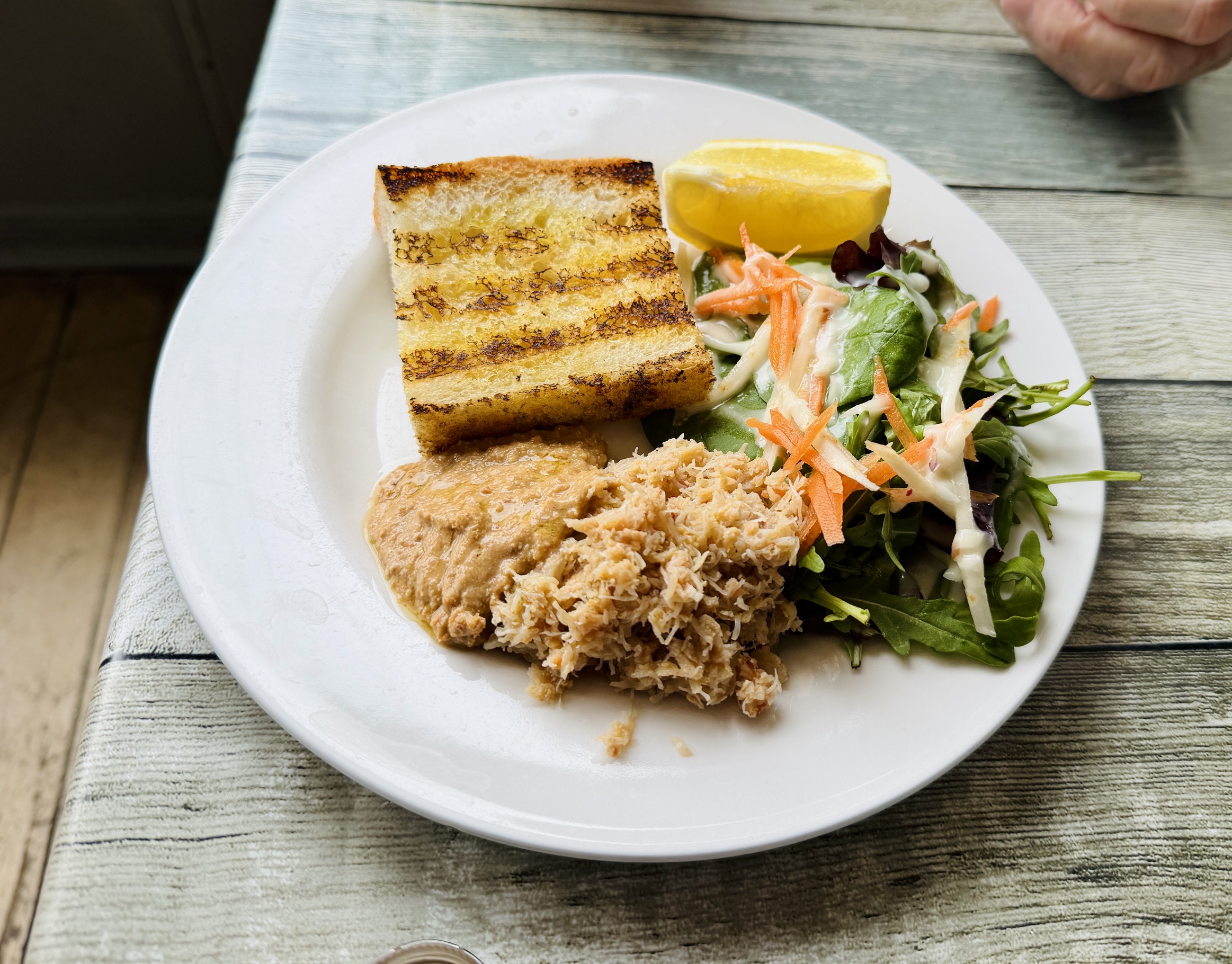
And would you believe that Jerry’s starter was equally good? He’d ordered crab, white and brown, with toast, and it was a simple and surprising – that word again – dish.

“This is so much nicer than those meagre pots you get at the supermarket” enthused Jerry, and he was right. I love the purity of white crabmeat but the dark meat is where the flavour is and this was rich and thought through, with a slowly building heat in the mix which, again, you might not expect. Even the tiger-striped block of toast was considered, was the perfect thing to load the stuff onto. I always think salads are padding in a dish like this, and this one definitely was, but even without it this felt like a very creditable way to spend £11.
By this point the restaurant was still less busy than you’d hope it to be on a long weekend, but there was a regular, if small, trickle of customers arriving and leaving. The people watching potential couldn’t match a spot in North Oxford, or down the Cowley Road, but Jerry and I had plenty to catch up on, so that didn’t matter.

We were having such a good natter that I didn’t even spend my time worrying that our mains would turn up as quickly as our starters did, so I was pleasantly surprised – yes, surprise once more – when they turned up a very agreeable half hour or so later.

That said, I wish they’d given mine a little longer. The blackboard propped up outside the restaurant had promised two specials but one had already gone by the time we turned up at half-one, so I chose the other, the octopus. And on paper this dish had everything I could have wanted: firm, roasted baby new potatoes with a flash of bronzed skin, a little carpet of still-crunchy samphire, a beautiful sauce with plenty of sweet cherry tomatoes.

It almost was, and could have been, a taste of the Mediterranean (of Greece, where the octopus is usually previously frozen because stocks have never quite recovered from all that madcap dynamite fishing they used to do).
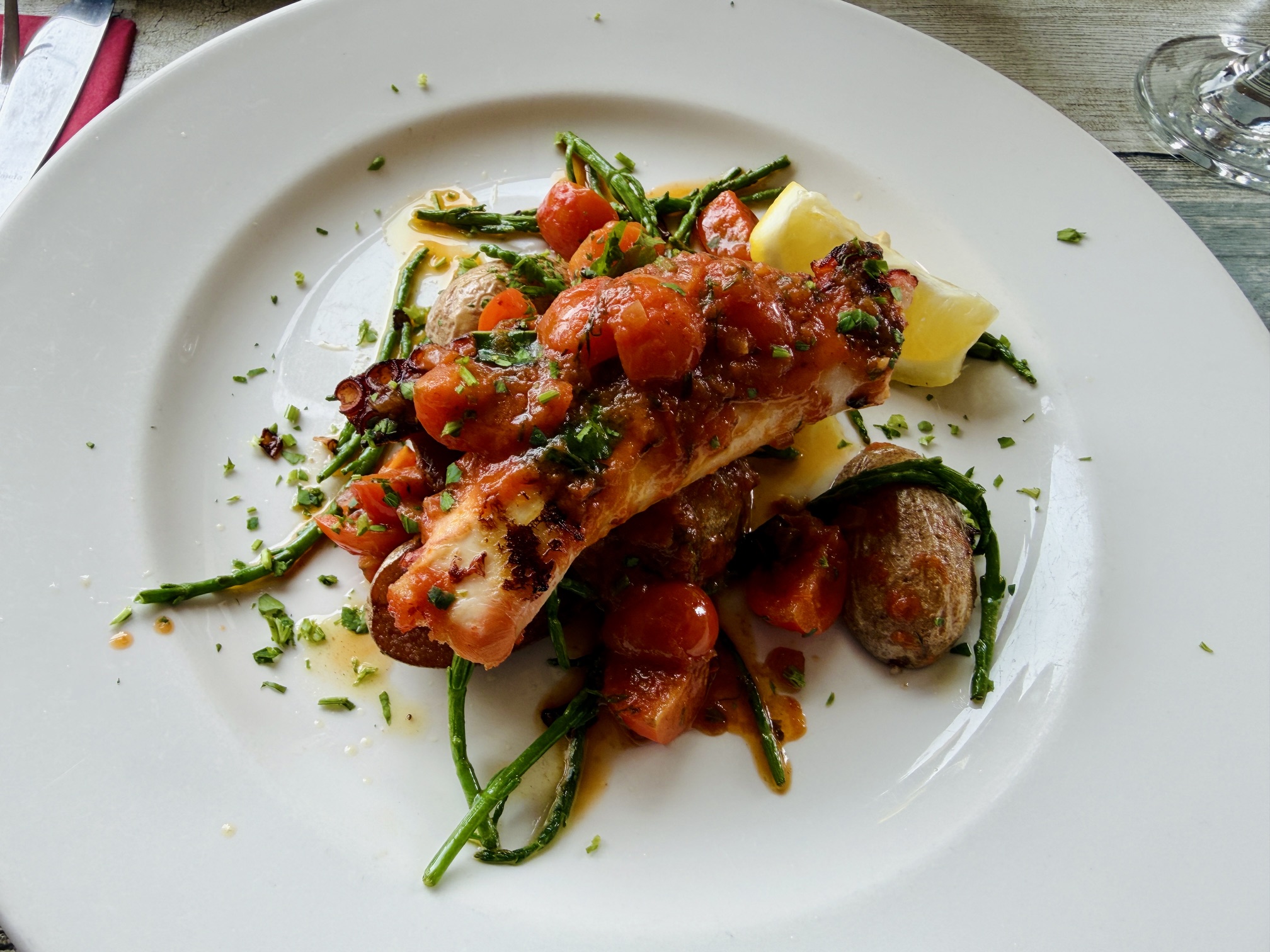
But the problem was that octopus is a tricky beast to get right and, unlike everything else the kitchen tried, their sure touch deserted them here. It was a proper chewy workout for the jaws, more than I would have liked, and it made me apprehensive about my forthcoming dental appointment and the inevitable top up of masseter botox which would follow. If I showed my dentist a picture of this octopus, perhaps he’d give me slightly more this time.

Only the narrow end of the octopus, blackened and crispier, was easy to eat. Even having said all that, I liked the dish so much that I was prepared to be forgiving: to get so close to the perfect dish, somehow, made me celebrate the 90% they had achieved rather that the 10% where they had fallen short. The whole thing sang with summer flavours, made the crummy weather of the previous week feel like an optical illusion, and for £18 I thought that was no mean feat.

Jerry very much enjoyed his fritto misto, although I think it was more his thing than mine. One element, the calamari, was shared with my starter, but the other components were a couple of enormous prawns, some pieces of whiting and a lot of whitebait. You might, as Jerry does, like whitebait rather a lot, in which case I’m delighted for you, but I personally never eat anything that can beat me in a staring content. And whiting might be a perfectly worthy fish – the bit I had tasted decent enough – but somehow it felt a little basic to me.
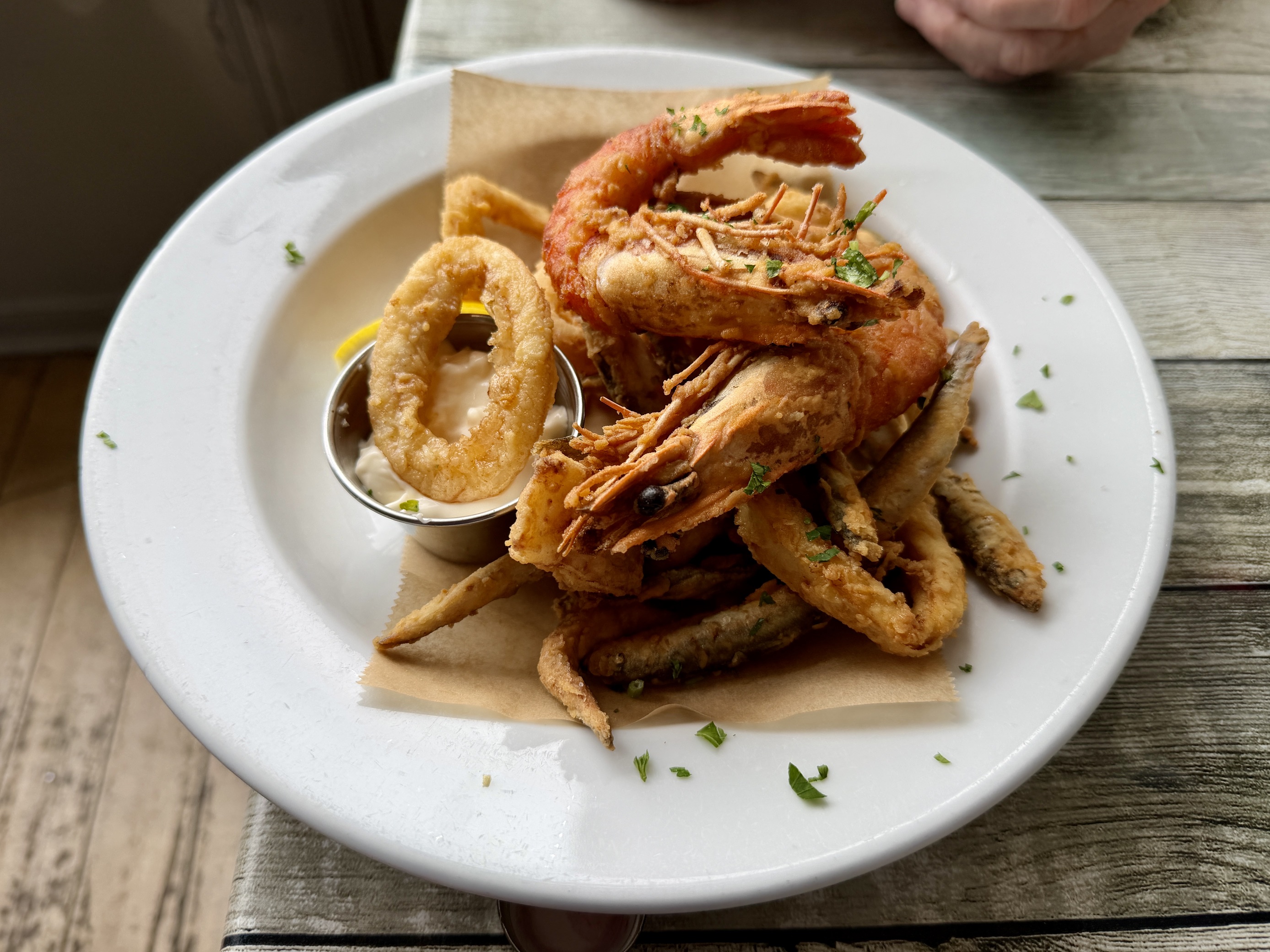
Then again, this fritto misto was £15, so can you complain? Pricing at Cuttlefish was a little erratic, with many of the mains costing little more than some of the starters. I guess I had been conditioned to think it should have been more expensive, but then again it’s not like they were dishing up whole Dover soles or thick steaks of swordfish. I’d have liked it a little better, I think, if they had been.

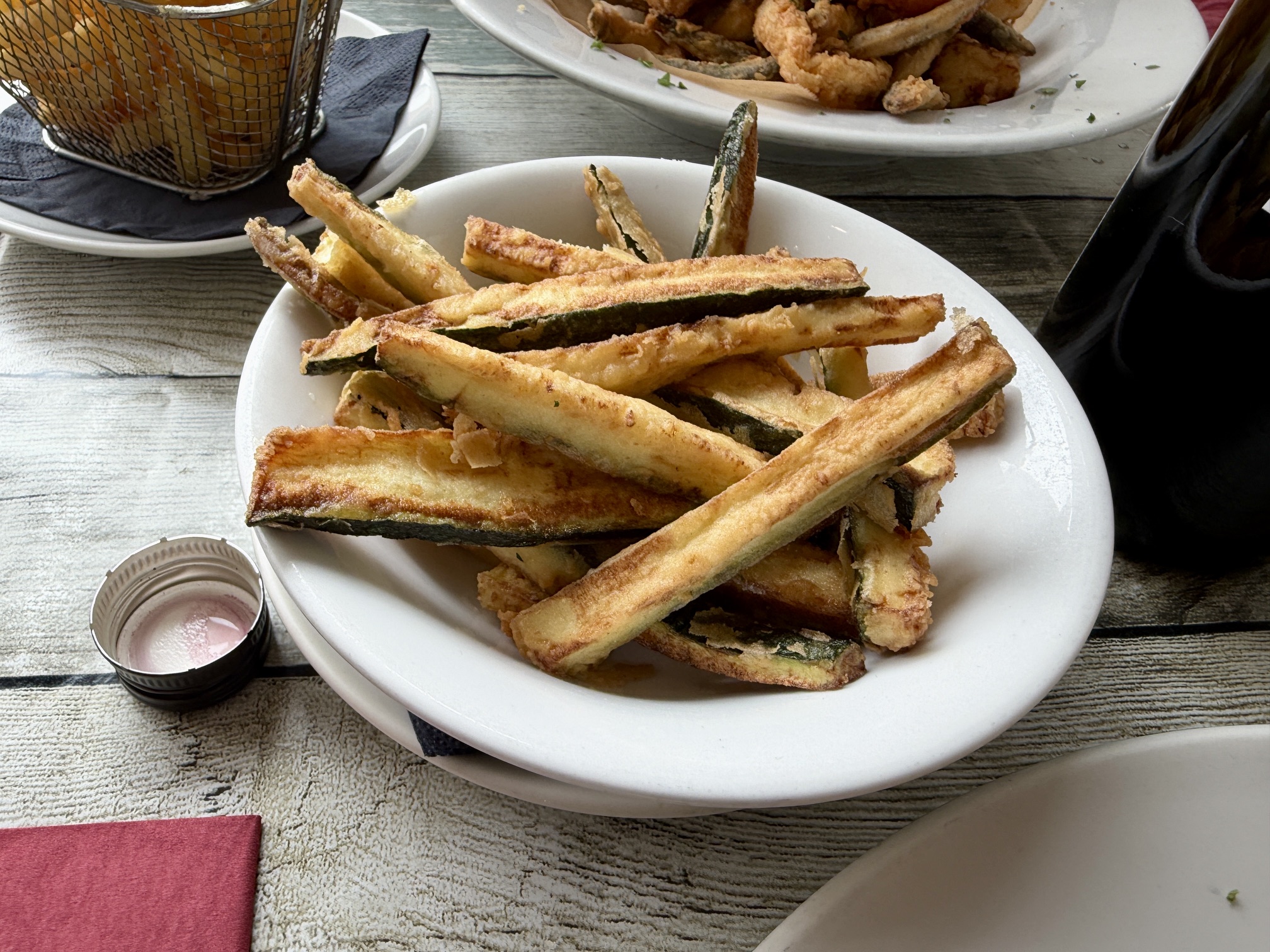
We had a couple of side dishes – Jerry because his main needed one and me because I’m greedy. My zucchini fritti were thick, soggy and under-battered, lacking salt or fun. Jerry’s french fries almost certainly came out of a packet and were served in the sort of miniature frying basket that dreary observational comics on Twitter used to slag off ad infinitum. I didn’t finish my courgette fries because they felt like empty calories. Jerry didn’t finish his frites because he just didn’t have room: I half expected him to apologise to our server for that.
After an impressive run I guess it was always a risk that the weird service would return and cause a dip, and so it did. We were asked if we wanted to order dessert, we asked if we could finish our wine first and were told “well, the kitchen is closing”. Nothing on Cuttlefish’s website says that it does that and, indeed, people were still taking tables shortly before that. But never mind: the dessert menu was full of staples like brownies, cheesecake and sticky toffee pudding and they did offer a glass of an unspecified Sauternes if you wanted to push the boat out, no pun intended.

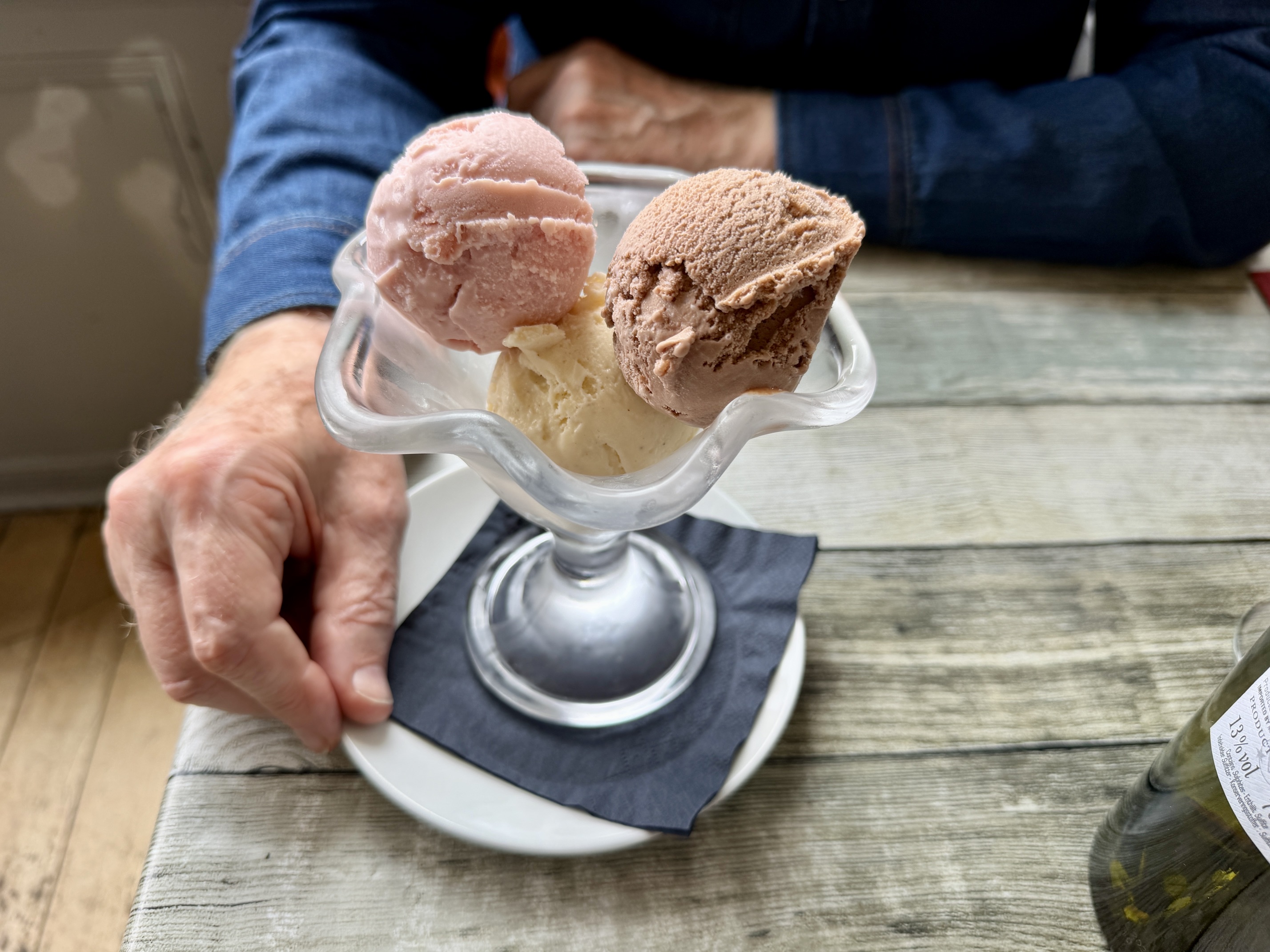
Jerry went for ice cream, a classic Neapolitan trio of chocolate, strawberry and vanilla. I don’t know if they were supplied by others or made by the restaurant, but they were as pleasing as their pastel shades might lead you to believe they would be. A couple of the scoops had ice crystals in them, which strangely left me with the impression they were less likely to be bought in, but either way it was a solidly nice and thoroughly unexciting dessert.
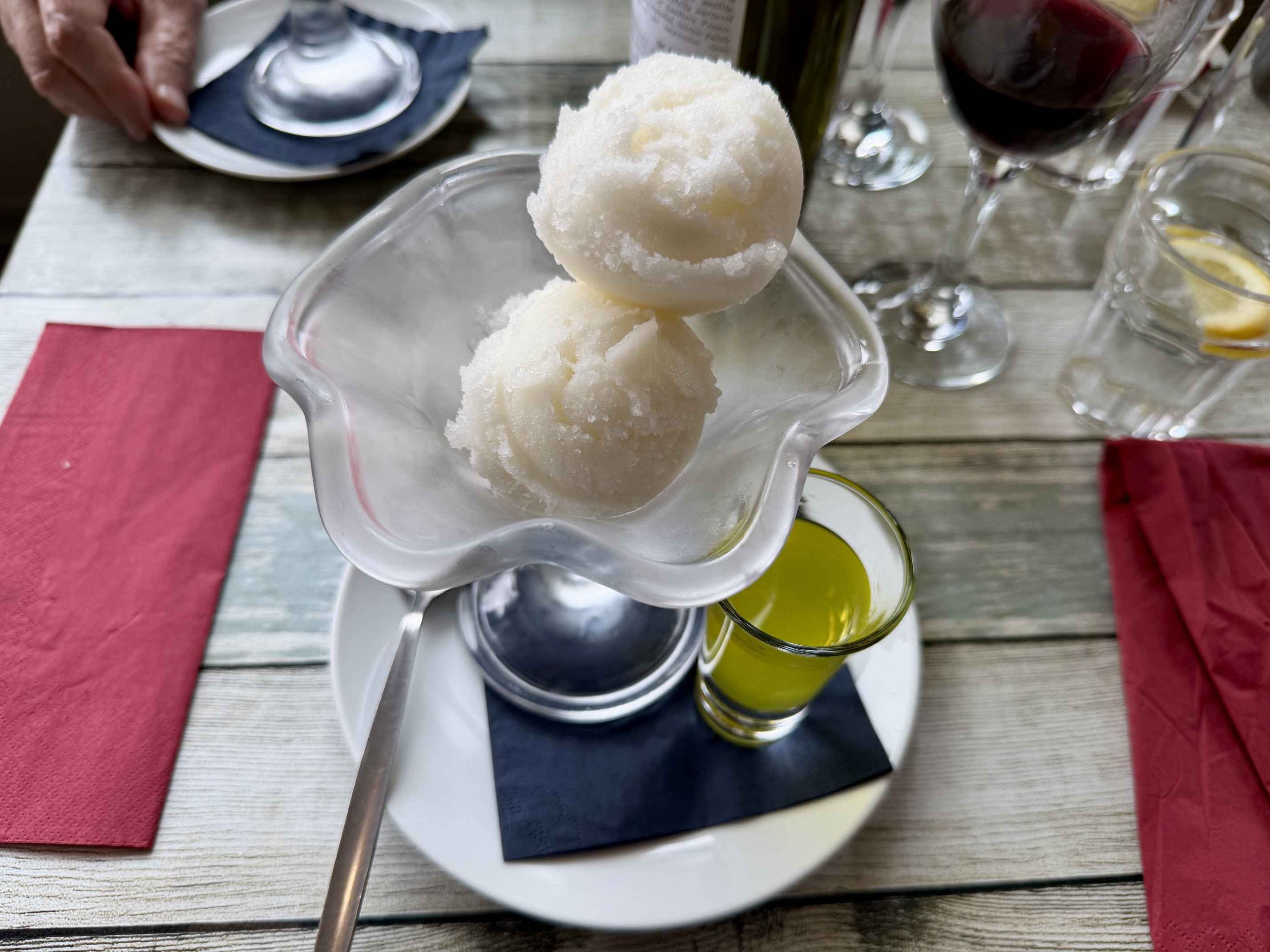
I picked from the specials, most of which were dessert with extra booze, be it a pastel de nata with a glass of port or an affogato with Frangelico on the side. I genuinely loved my two spheres of lemon sorbet with limoncello, and thoroughly enjoyed anointing the former with the latter. It felt like the kind of dessert you don’t see on menus much these days, a resolutely old school, tried and tested combo.

As it gradually melted to become the kind of Slush Puppy Oliver Reed would have considered a decidedly good time, I started to feel increasingly well disposed to Cuttlefish, despite its repeated efforts to stop me becoming so. £10 for this, and despite somehow costing more than the larger £7 selection of ice creams I couldn’t say I felt begrudging.

“This has been so nice” said Jerry. “So much better than those snouts and bollocks and trotters in London would have been.”
When our bill arrived it was only £113, not including tip, which did nothing at all to dissipate our collective goodwill. I think Jerry liked Cuttlefish more than I did, but Jerry is also a man who will take the single bedroom in an Airbnb to make his friends happy. In short, he’s just a spectacular human being. And yet I liked Cuttlefish too: I may be a crabby sod who needs to be worn down or won over, but I get there in the end. Once I do I’m as much of an advocate as anybody.

After that our afternoon took a happy, well-rehearsed trajectory. We wound our way to the Star Inn on Rectory Road, one of my two favourite Oxford pubs. Jerry sipped Asahi and I glugged Steady Rolling Man and, despite the utter lack of mobile reception, we got by the way people did in the days before smartphones, by simply chatting and gossiping and not looking things up when we didn’t know them, because there was no way of doing so.

We got into a chat with the academic at the next table, mainly because Jerry fell slightly in love with Nico, her greyhound, but he told himself it was okay that he couldn’t get away with dognapping Nico. “Greyhounds don’t lick”, he said to me. “I need a dog that’s going to show me proper affection.”

Nico’s owner told us stories about the fates faced by ex-racing greyhounds – she adopted him after an unsuccessful month-long career as a racing dog – and both of us came away from the conversation bitterly opposed to racing in all its forms. I have become a cat person in my middle age, but I’ll always make an exception for greyhounds.

It was in short a textbook Oxford outing, the kind to which I’ve become extraordinarily attached. I’m already looking forward to the next one, especially now I have a mandate from my readership to take Jerry out for lunch in the dreaming spires at every available opportunity.

I am increasingly aware lately that happiness can be fleeting, and you have to appreciate it as it happens, rather than simply realising further down the tracks with the benefit of hindsight. I had a brilliant time, and I don’t want these trips to Oxford – on Good Friday or otherwise – to ever come to an end. Fortunately, the city seems to have plans to keep me more than occupied.

En route to the Star I spotted a pub, the Port Mahon, which has decided to specialise in rotisserie chicken and mentally I made a note to put it near the top of my to do list. Once we got to the Star I couldn’t help but notice that they now have a permanent pizza trader. One who also serves a pint of dough balls in garlic butter and Parmesan: I saw them turn up at a neighbouring table, and it took all my strength not to order some. Next time. Or the time after that.

Cuttlefish – 7.4
36 St Clement’s Street, Oxford, OX4 1AB
01865 243003

https://www.cuttlefishoxford.co.uk

Since January 2025, Edible Reading is partly supported by subscribers – click here if you want to read more about that, or click below to subscribe. By doing so you enable me to carry on doing what I do, and you also get access to subscriber only content. Whether you’re a subscriber or not, thanks for reading.
Restaurant review: Adda Hut

Adda Hut closed at some point in the summer of 2024. I’ve left the review up for posterity.

This week you get a simple, straightforward review of a simple, straightforward restaurant. But before that, I’d like to apologise to any of my readers in Woodley.

Because I’ve never reviewed anywhere in Woodley, in the best part of ten years. It’s one of those satellites of Reading that has escaped my attention. I made it out to Lower Earley – just the once, back in 2014 – although I can’t see myself going back any time soon. And this year, finally, I reviewed somewhere in Tilehurst, long an omission. But Woodley has never been on my radar. I’ve reviewed more places in Bristol than in Earley, Woodley and Tilehurst put together, a fact I know delights so many of you.

I assure you it’s not because I’ve taken against Woodley. In fact, I’ve always had warm memories of the place. The thing is, I grew up there – or pretended to – and it was the first place I lived when my family moved to Reading in the early Eighties. So I have happy memories of mucking around on the airfield, and walking the dog round Dinton Pastures, of going up the precinct and spending my pocket money in Beatties, the games shop. Of buying my teenage diaries from the Newscentre (and filling them with awful shite) and of buying new pairs of shoes every year from Milwards in time for the start of the school year. (You’d be better off wearing the boxes, my mum said most years: size twelves, you see).

I came back to Woodley after university and lived there until the late nineties and, with my schoolfriends who were also marooned there, we would go to the Bull & Chequers and drink to forget that we were stranded in suburbia. It was forever 1996, and someone in that pub liked to put enough money in the jukebox to play What’s The Story, Morning Glory? in full, from beginning to end. And that was nightlife: if you didn’t like it, you caught a coach to Utopia. Or on summer nights you could walk across Ashenbury Park to drink at the Land’s End and pretend you were in the countryside. And back then, I can’t even say I was that dissatisfied. That was enough, for a while.

Anyway, I thought Woodley’s role in my life was over and done, preserved in aspic, but then something happened which I didn’t expect: I got together with Zoë. She grew up on the same streets as I did, a few years later, and her parents still live there. So my past became, to some extent, my present and I saw Woodley afresh, through different eyes. And actually that was properly lovely. After all, it was an excellent place to grow up, and for all I know it still is. If I could tell eighteen year old me that he’d still be walking home past Bulmershe School in the summer of 2022 he’d probably have been horrified, but life is full of surprises.

One thing that has changed is that, at long last, Woodley has a few potentially interesting restaurants. Not that I ate out in Woodley as a kid – the treat was a takeaway from Hong Kong Garden, and a VHS from the video store next door if you were lucky – and for many years it was that or Red Rose, the solitary Indian restaurant (it’s still going). When the George, a bog standard Chef & Brewer pub, opened on the edge of town it was genuinely a source of excitement.

But nowadays Woodley has the highly rated La’De Kitchen, right opposite the Waitrose. It has a surviving branch of Cozze which has outlived the one in the centre of Reading. There’s a fancy-looking takeaway pizza place that looks a cut above Papa John’s and a dessert shop doing waffles, sundaes and milkshakes. And last but not least there’s Adda Hut, the subject of this week’s review. 

I picked it because it just looked different enough to be worth a try – its website talked about serving the food of Kolkata, and its menu was relatively small and focused, a bhuna and dhansak-free zone. My very old friend Mike, a drinking buddy from those Bull & Chequers days, was home staying with his parents for the tail end of the year, so he joined me there on a dismal, sodden evening, the shopping precinct lashed with wind and rain.

It truly was an inhospitable evening, the kind where nobody in their right mind sets foot out of doors, but even so it was jarring to arrive in an empty restaurant. I mean completely empty: one table was occupied by a couple of members of staff, one tapping away on a laptop and the other staring into space, but otherwise it was as dead as they come. It’s hard to judge a restaurant when it’s completely devoid of atmosphere – especially when it’s not their fault – but for what it’s worth I quite liked the room, all muted colours, wood panels and twinkling lights. We were the only customers all night, although I was relieved to see a steady stream of Deliveroo pickups.

As I said, it’s quite a narrow menu and that’s the first thing that alerted me that it might not be generic stuff. Ten or so starters, labelled “Calcutta Street Food”, a dozen meat and fish curries and a good range of vegetarian dishes. Two biryanis, which by central Reading standards is a starvation diet. But also, everything just looked a little out of the ordinary – lots of meat on the bone, plenty of fish dishes and many things I’ve just not seen anywhere else. 

It’s a dry restaurant, although they don’t charge corkage if you want to bring a bottle, so I had a very enjoyable mango lassi and we shared a jug of tap water – the decadence! – while we made up our minds. One of the two staff members, who had the air of being the owner, came over and answered our questions about the menu, making suggestions and recommendations and pointing out specialities. I would say we played it fairly safe but fortune might favour the brave, especially if you like fish on the bone as the menu has rather a lot of that.

I really enjoyed both our starters. Their speciality is Calcutta Fish Fry, but instead we went for the fish pakora and I don’t feel like I missed out at all. It was an impressively generous helping of fish in a light and only slightly spicy coating, with just the right amount of crunch. A crazy amount of food for six pounds, and a real plate of joy. It came with a sort of acrid mustard dip which I started out actively disliking but ended up constantly dabbing more pakora into, unable to make up my mind. Mustard sauce and mustard gravy appear multiple times on the menu, so perhaps that too is a Kolkatan speciality.

Even better, and my star of the night, were the mutton chops. Now, the description here is misleading. The wait staff told me that rather than being chops they were in fact croquettes of minced mutton and potato, breaded and fried. That made me expect something a little more like the mutton rolls I’ve had before but what turned up was bigger, better and nothing like that at all. 

Instead they were huge bronzed spheres, looking like arancini on steroids, with a permacrust which gave way under pressure. But if they looked like arancini, what they resembled more than anything was a Scotch egg where the kitchen has dispensed with the annoying faff of including an actual egg. Instead you just got a warming filling of lightly spiced mutton, almost haggis-like, and the whole thing was quietly beautiful. It came with two dips – a thin, red, spicy one which I loved and another which I would put good money on being ketchup.

“That was really good, and just big enough” said Mike. “I’ve got room for the mains.” This is why Mike is thin, and I am not: those starters were generous, but if they’d been twice as big I’d have had no complaints. By this point in the evening we’d spent the princely sum of twelve pounds.

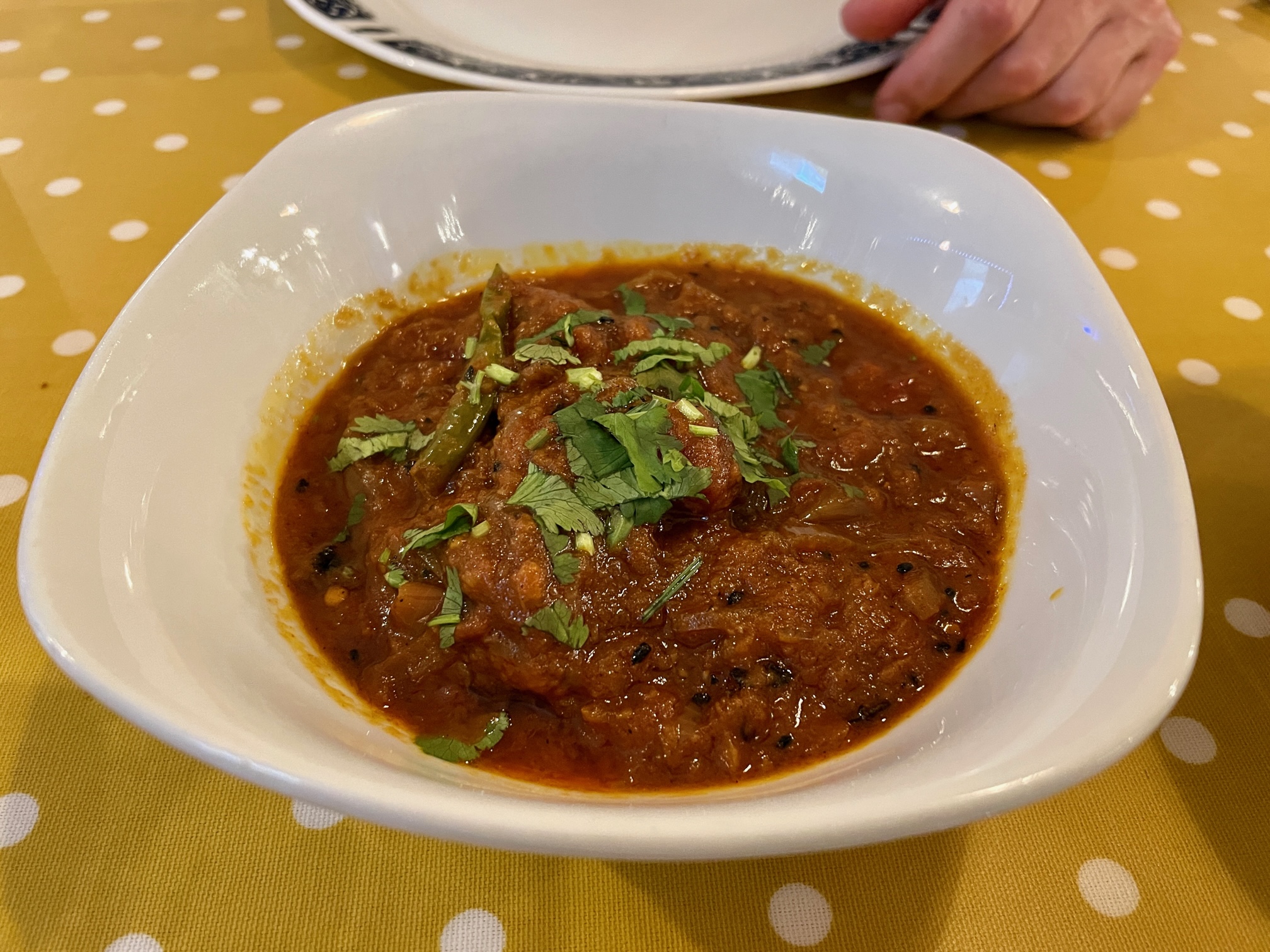
Could mains live up to that? They came pretty close. Mike wanted to try the tawa mutton curry, and it looked the part with a thick, brick red gravy. And the gravy was the absolute best bit. I loved it – deep and sticky, with thin ribbons of slow-cooked onion that suggested someone had taken their time over elements of our meal. If I’d just had that gravy with rice and bread I’d have been a happy camper, and in that respect it reminded me of some of the very best Indian food I’ve had.

And the mutton wasn’t bad, but I was expecting slow-cooked meat that broke into strands whereas this was leaner, more tender but perhaps slightly less interesting. We practically finished it all, though. I left one piece of mutton which was bouncier than I liked, but between us we polished off every molecule of sauce.

What I liked about the fish curry we also ordered was that although it looked decidedly similar to the mutton curry – you might have struggled to pick them apart in a lineup – the taste was distinctly different. This was a thinner, sharper sauce studded with nigella seeds, and big wodges of skin-on filleted fish that easily broke up into smaller pieces. Equally intriguing, although the mutton had the edge, but best of all I honestly felt like these two dishes had different start and end points. Obviously you never really know what goes on in a kitchen, but I didn’t feel like Adda Hut was using gallons of chopped tomatoes and packets of curry powder.

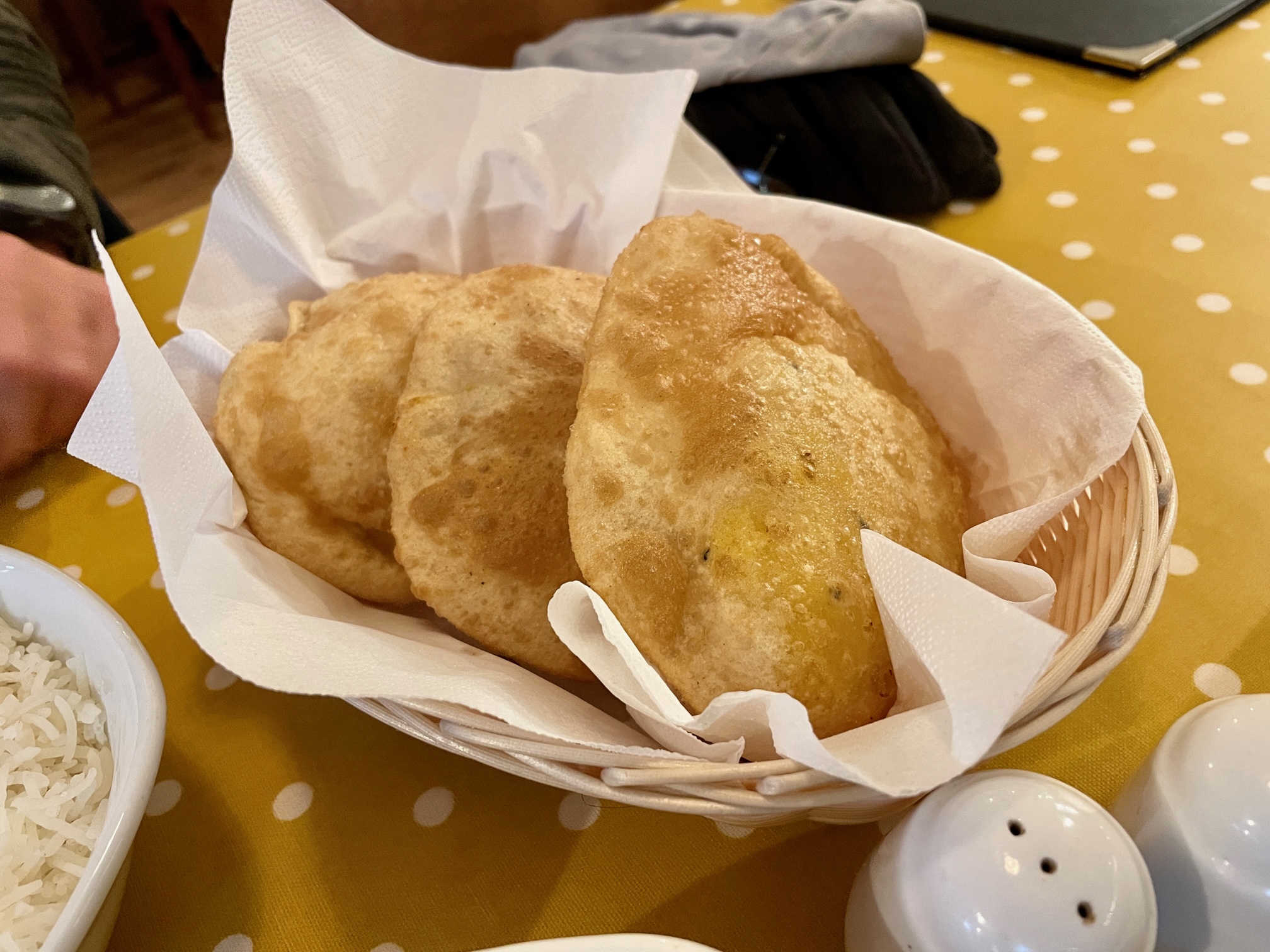
When the sauce is that good, you need to have vehicles for it. Steamed rice was – well, it was steamed rice, you don’t need me to tell you about that – but they also serve an interesting range of breads. No naan here, but paratha and puri stuffed with peas or lentils. We ordered the latter and I absolutely loved it with both curries – just a smear of lentil inside the bubble of bread, but still beautiful torn into pieces and loaded with the last of that gravy. Spice levels were slow and subtle, which is not the same as bland: I was still dabbing my nose by the end.

Our bill for all of that, including a service charge, came to just over forty-five pounds. And when the bill arrived I wished I’d tried more – given their desserts a chance, or ordered a cauliflower curry on the side. I felt bad that their one table of the evening hadn’t spent more money. But I suppose what I’m really saying is that I knew there were things I could order next time.

“How long have you been here?” I asked as the man I thought was the owner came to take our payment.

“Just over a year.”

“And how’s Woodley treating you?”

“Pretty well, actually. The weekends are manic.”

That relieved me, and we headed out into the miserable squall for a post dinner drink at Bosco Lounge – somehow going to the Bull & Chequers would have been a nostalgic step too far. Bosco Lounge was buzzing, still sending food to tables at half eight, and a large group at some nearby tables appeared to be doing some kind of art class. We had a debrief where we both concluded that Adda Hut was rather nice in its quiet, unshowy way and that we’d positively warmed to the place.

Later on I ventured back out into the relentlessly hammering rain to catch my bus, and the lights were still on in Adda Hut, although the chairs were stacked and they were giving up for the night. Bosco Lounge had felt fuller than it deserved to be, and when I passed Cozze it was still doing decent trade. By contrast Adda Hut felt quieter than it should have been, and that didn’t feel right.

I started this review with an apology to my Woodley readers, but I hope I have enough of them to give Adda Hut a try, even if I don’t necessarily manage to persuade the rest of you to head out in the direction of RG5. Because as I rushed past it brolly up, on that miserable evening, I found myself oddly grateful to this little outpost that had served me and my old friend some decent, interesting food on a night when many restaurants would have been eyeing the front door and waiting to close. A hard winter is coming, and not every restaurant will survive it. I very much hope Adda Hut does.

Adda Hut – 7.5
101 Crockhamwell Road, Woodley, RG5 3JP
07447 552987

https://www.addahut.co.uk

Restaurant review: Pepe Sale

Pepe Sale closed in June 2024. I’ve left the review up for posterity.

“I’m looking forward to the full Edible Reading experience” James said when I met him at the station. He made it sound as if joining me to review a meal was some kind of theme park. The Edible Reading Experience: you have to be this smug to ride.

“It’s nothing special. There are just two rules – don’t mention the blog when we’re in the restaurant and take photos of everything you eat. Zoë’s meeting us there. Do you want to know where we’re going?”

“Don’t tell me, I don’t want to spoil it.”

“I’ve saved a good one for you. And it’s the perfect one to review this week – it’s a revisit of the first place I ever reviewed, and it came under new management last year. And it’s an Italian restaurant, which is topical after last night. Let’s hope they don’t gloat too much.”

“Sounds perfect” said James, and we ambled through town, past the side of the Broad Street Mall. James is unflappable, but he almost did a double take. “Ah, you have a Taco Bell.”

“I’m afraid so. Its popularity is a continuing mystery to me.”

Later James told me that Taco Bell’s beef is only technically 88% beef because it contains so much other gubbins. He’s full of useful information like this – with hindsight I don’t know why I didn’t invite him to come with me on duty before. He likes the finer things in life: this is a man who flew to Korea for a weekend just to learn how to cook Korean barbecue, a man who has converted his garage into a micropub. Just the person to bring along to bolster my “man of the people” credentials. 

He was also the perfect person to take to Pepe Sale, the subject of this week’s review: he’d joined Zoë and me on holiday in Bologna two years ago and we’d rhapsodised together over ragu and porchetta, each meal as superb as the last. Our last holiday before lockdown was with James and his other half Liz in Copenhagen, eating magnificent food, attending a wild beer festival out in the docklands, stumbling out of brewpub after brewpub, enjoying the driverless subway trains and being too smudged to appreciate the Design Museum. We talked about coronavirus on that holiday, but with no real appreciation of what was coming, unaware of the gathering storm.

Although Pepe Sale changed hands last year the buyers kept that news quiet, presumably because they wanted a smooth transition and to retain as many regulars as possible (perhaps wisely: I remember the panic a couple of years ago when Pepe Sale showed up as for sale on a listings website). It became more apparent this year, as previous owner Toni Sale set up his “Pasta Academy”, running classes out of his gorgeous-looking kitchen, and the new owners made a small but significant change by opening on Sundays. Prior to that, Pepe Sale only opened on one Sunday every year, namely Mother’s Day. 

A few people told me last year, after visiting Pepe Sale, that it didn’t feel the same: not necessarily better or worse, but that something had changed. And that made sense, really. Toni was a big presence in the kitchen, his wife Samantha ran front of house superbly: with both of them gone, it was bound to be a different experience. When I looked at all the restaurants I’ve reviewed, trying to gauge which ones needed a repeat visit, Pepe Sale was high on the list. And so, nearly eight years after my previous review, Zoë, James and I went on a Monday lunchtime to see how different it was.

Visually, you’d barely notice the restaurant has changed hands. The decor is unaltered, all high-backed chairs and marble-topped tables. The restaurant is split-level, with the smaller space up top looking out on Queens Walk and the lower level a bigger room that I’ve always found harder to like. The only real difference was that the space by the front door where Toni used to roll fresh pasta every day has been replaced by another table. No specials menu either, that I could see, which was a shame – although it might have been because we were there on a Monday lunchtime.

I might find myself saying “it might just have been that we were there on a Monday lunchtime” many times during this review, so let’s take it as read from now on. The three of us were the only customers that afternoon, and there was a nicely sleepy pace to things with our waiter (the only staff member that I saw) giving us plenty of time to sip our water, read our menus, catch up and eventually get round to making our choices.

“Were you celebrating last night?” James asked him, ever the diplomat.

“I had four Peronis and a bottle of pinot grigio” he said, his eyes smiling, even if you couldn’t see a grin behind his mask. “But I wanted England to win. I’ve lived here for so long, and my kids were born here. My little boy was devastated this morning.”

The menu hasn’t been changed one iota under the new management, so it’s virtually identical to the one I ordered from back in 2013 and probably much the same as it was when they opened. The wine list, though, printed on the other side of the menu, was far smaller than the one I’m used to. Pepe Sale’s wine list was always a selling point – a huge range, across all price points, the majority of it coming from Sardinia. It’s now a one pager, although it’s all still Italian. Perhaps Pepe Sale has a separate, bigger wine list but if so, I wasn’t shown it and I didn’t think to ask; I can well believe, though, that the events of Brexit might have reduced the amount of wines the restaurant can economically import. 

In any event, we had a very nice red from Piedmont called Otto Bucce, which was peppery and smokey and felt like good value at around twenty-seven pounds. We took those first happy sips, we broke off pieces of rosemary-studded pane carasau and we began the serious business of chatting and gossiping. Italian music was playing in the background – another change, I think – and even though James, technically, was the only person who was on holiday, somehow we all felt like we were. I love it when restaurants do that to you.

Before our starters arrived, there was a spanner in the works: our waiter materialised to let us know that they were out of avocados. Would we like to order something different, or wait ten minutes while they nipped out to get some new ones? We opted for the latter, and all I can say is that I’d like to know where they bought them from. It certainly wasn’t a supermarket – I’ve lost count of the number of times a “perfectly ripe” avocado meant “perfectly ripe in a couple of weeks” – so I’m guessing they nipped round the corner and got some from the kerbside cornucopia of the Oxford Road’s magnificent Best Foods. 

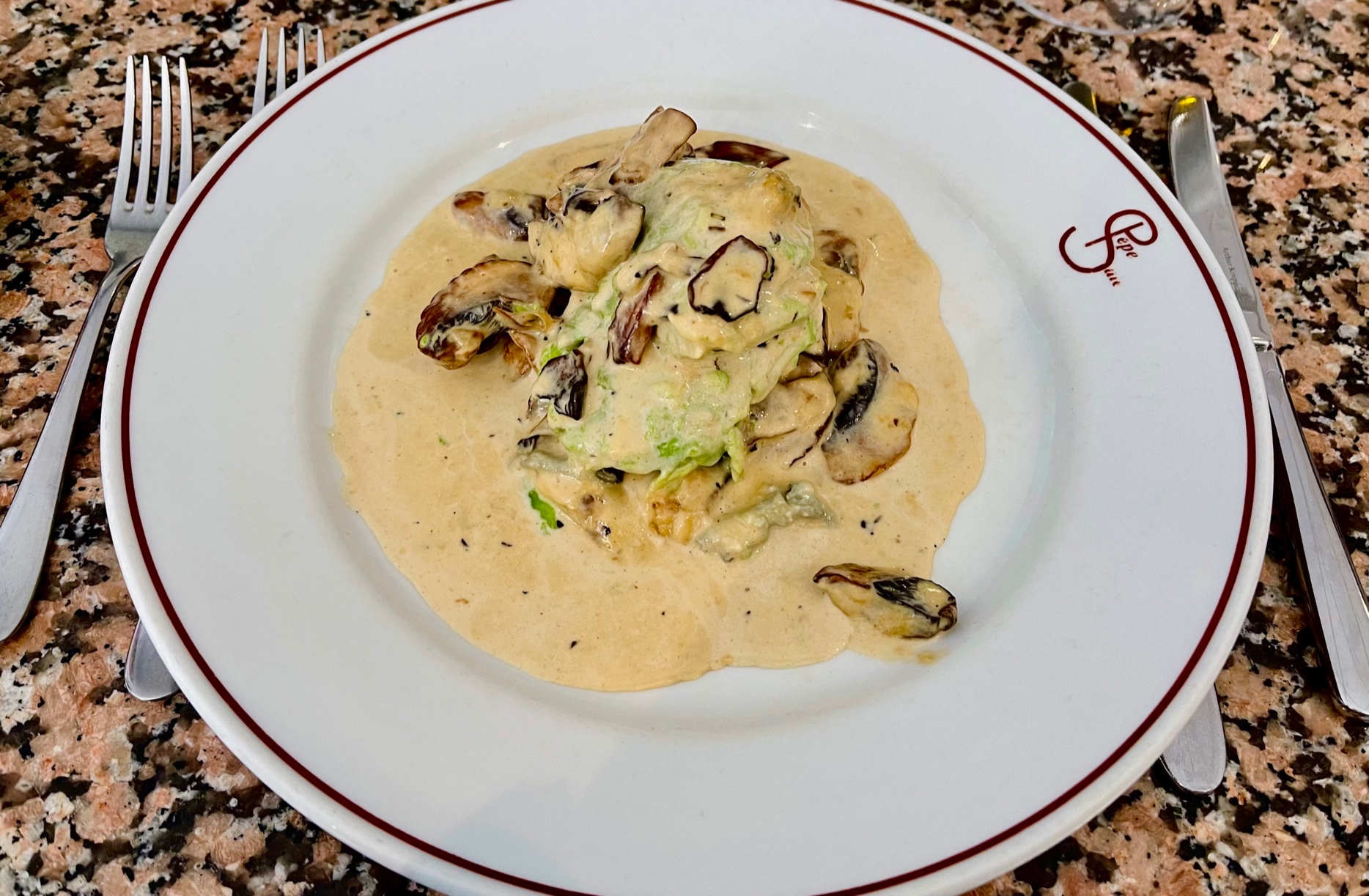
Anyway, Zoë’s starter of avocado and mushrooms in a dolcelatte sauce was a marvellous, indulgent thing and easily worth the additional wait. The avocado was ripe and buttery and the sauce, which added just enough salt and funk, was so good that Zoë looked ruefully over at the empty bread basket and wished she’d saved a couple of pieces to mop it up.

James ordered a starter I ate on my visit all those years ago, mozzarella baked in radicchio with anchovies, olives and cherry tomatoes (if you want a pointer that Pepe Sale resolutely resists trends, here it is: burrata is nowhere to be seen on the menu). James enthused about it and although I didn’t try any, it looked as good as I remembered. As a rule I think the worst thing you can do to mozzarella is heat it up, but there’s something about those precious parcels of molten cheese and bitter leaf that’s properly charming, especially teamed with the hit of anchovy and the sweetness of little tomatoes. 

If that description makes you think I was suffering from starter envy, you’re probably right. I had gone for malloreddus, a Sardinian pasta speciality, which are best described as halfway between gnocchi and conchiglie, tightly curled shells, in a spicy tomato sauce with chunks of sausage. Everything worked, on paper – the sauce had a good heat, it clung nicely to the pasta and the sausage tasted decent. But somehow, it started to feel like a chore by the end, a tiny bit one-note compared to the other starters at the table. Perhaps I’d have felt differently if the sausage meat had been crumbled, finer in texture, rather than big slices of the stuff.

There was a nicely civilised pause between courses, and our mains arrived just as we were ready for them – a relief, as kitchens without much to do often rattle off the next set of dishes quicker than you’d like. Zoë picked an absolute banker from the menu, chicken breast, stuffed with mozzarella and sage and wrapped in pancetta. Again I found myself gazing in envy at a pool of molten mozzarella and wishing I’d played it safer: I was allowed a forkful which reminded me what a solid, classic dish it was (it also made me miss the saltimbocca at sadly-departed Dolce Vita, halfway across town and many years ago).

James chose a dish I’ve never ordered, wild boar cutlet in a tomato sauce. It looked the part – a handsome slab of meat cut into three in a deep sauce with plenty of cherry tomatoes (“I’ve picked the two tomato-lovers’ dishes” said James). But he wasn’t wild about the texture – “it’s not a soft meat, put it that way” – and found it tougher and chewier than he’d have liked; a sharp steak knife would have helped matters along.

My dish, sea bream, was also close but not quite there. The fish was beautifully cooked, two lovely fillets with tender flesh and crisp skin, and it’s hard to go wrong with anchovies and olives (and beautifully chopped shallots). But the thing I always loved about Pepe Sale’s fish dishes was the sauce, a rich fish fumet fragrant with wine, and this felt a little thinner than I remembered. It wasn’t a bad dish by any means, but lacking a little oomph. Had it changed, or had I?

All of us went for a selection of vegetables and these were well-judged – nicely crunchy potatoes sauteed with rosemary and perfectly al dente carrots and broccoli; Pepe Sale, more than any place I can think of, taught me the virtues of not overcooking your veg.

The dessert menu is also unchanged, and is a mixture of Italian, generic and Sardinian dishes, all reasonably priced. I was tempted by the basil panna cotta, another old favourite, but James and I both went for the sweet ravioli. They were every bit as delicious as my happy memories of them, fried squares packed with gooey ricotta and orange zest, the whole thing drizzled with sweet syrup and topped with more strips of fried pastry and a little snowdrift of icing sugar. Looking back at my picture of this dish from 2013, and the mozzarella starter for that matter, I’d say this kitchen puts more effort into plating now: the camera loved it as much as I did.

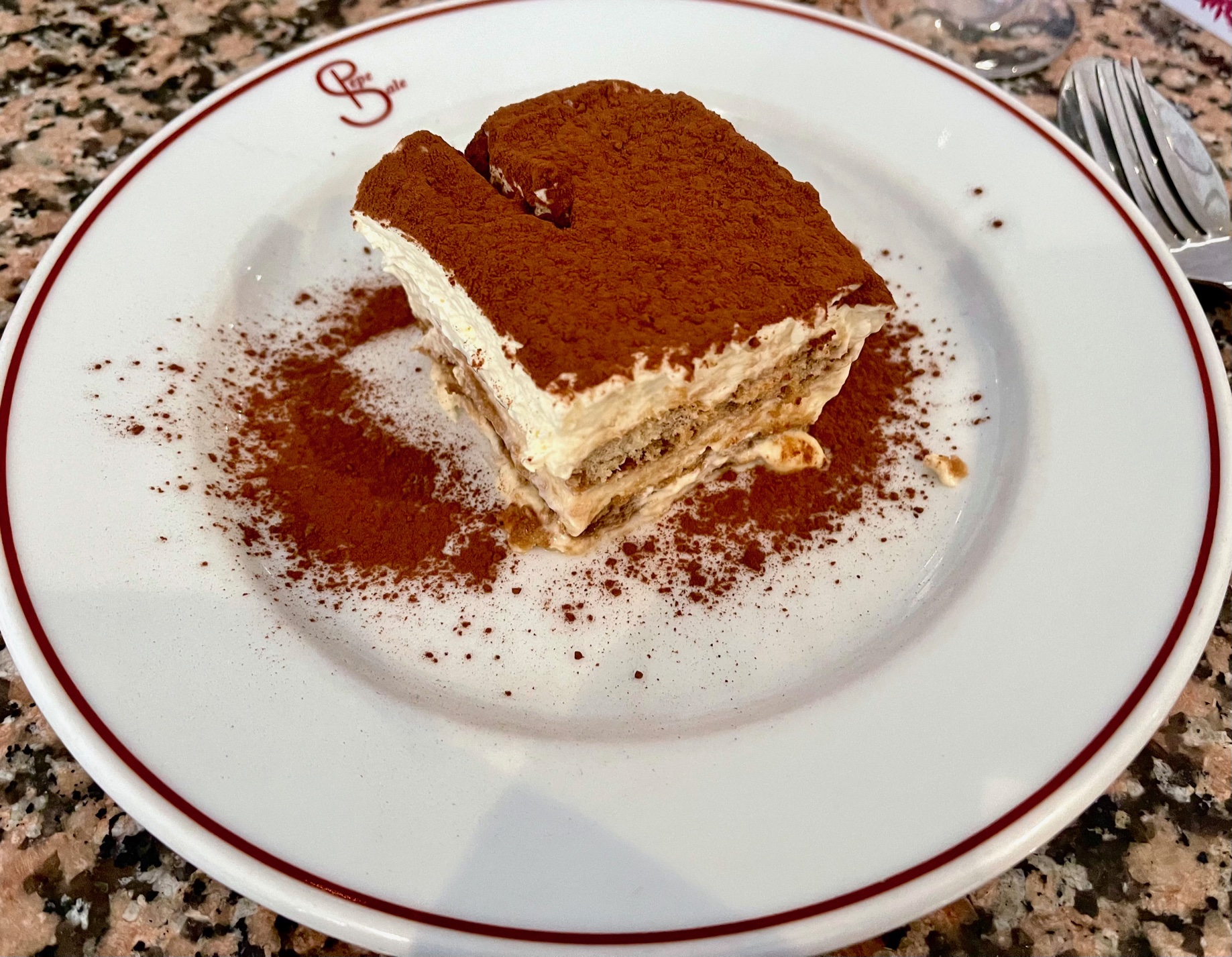
Zoë’s choice was the tiramisu, and again I was allowed just enough of it to wonder if she ever ordered a bad dish. I suppose there are no surprises with tiramisu –  you know it will be boozy and rich, all cream and coffee and chocolate, and this one was no exception. “I liked it a lot, but it did make me cough” she said later. “It’s the dust of the cocoa powder and my dodgy lungs. That’s why I was never allowed Dib Dabs as a kid”. 

Our meal – three courses each, some bread, a bottle of wine and a trio of amaros to help our desserts go down – came to just over a hundred and thirty pounds, not including tip. Pepe Sale is currently running a promotion where you get 20% off your food bill Mondays to Thursdays, and without that it would have been over a hundred and fifty pounds. Looking back at my 2013 visit a similar meal for two came to eighty pounds, so prices have definitely crept up – although that’s only to be expected and our meal still felt like good value.

As we settled up, I asked our waiter how business had been since they reopened in May. He told us that they were busy at weekends, solidly booked in fact, but things were still sluggish during the week – an experience I suspect is shared by many of Reading’s restaurants. He added that having Reading’s ill-advised quarantine hotel at the end of Queens Walk had hardly helped matters, although things were recovering now. 

It did make me think about whether people would feel comfortable eating inside on a busy evening – the tables are reasonably spaced but there are no screens, and although the front of the restaurant has big double doors which could be opened for ventilation they stayed resolutely closed during our visit. It’s a shame they’ve never put any tables outside, as their neighbours ThaiGrr! and Bierhaus have chosen to, but I guess that part of town can be a bit of a wind tunnel at times. 

We carried out a debrief over beers in the garden of the Nag’s Head, and there was less consensus than I expected. Zoë was the most positive about her food, but I think she ordered better than the rest of us (“that starter was great, but you know I love the ‘shrooms”). James was more equivocal, put off slightly by the toughness of that wild boar. I was somewhere in the middle, but in the back of my mind I was thinking that the food was almost exactly as it always was, and I couldn’t decide whether that was a good thing or not. We discussed it a little further, but then we were interrupted by a positively operatic fart from a shaven-headed gentleman at the table behind us which sounded like Brian Blessed molesting a tuba. We dissolved into fits of laughter, and that was that.

I feel a bit for Pepe Sale’s new owners. Talk about a no-win situation: if they make sweeping changes they’ve have messed with an institution, if they don’t they risk preserving it in aspic. And yet the restaurant barely changed in many years, so you can understand them not wanting to muck up a winning formula. I think it misses the specials and that wider wine list, and I sincerely hope they’re still making their pasta on the premises, but all in all it feels like the new owners are worthy custodians of the food: everything I had felt up to the standards of previous visits, and if anything the focus on presentation is stronger now.

And yet there’s so much more to a restaurant than the food. Aside from how Covid-cautious customers would feel eating in Pepe Sale, it’s safe to say that the real test of a restaurant is how it copes on busier evenings, whether the service and the kitchen can step up a gear to deal with the demands of a packed dining room. But not just that: it also depends whether that magical transmutation happens, where instead of just being a room full of people it becomes a wonderful buzzy place, a club where you’re lucky enough – if only for one evening – to be a member. At its best, Pepe Sale always did that. The new owners will face far sterner challenges in the months ahead than our chatty table of three on a Monday lunchtime. My fingers are crossed that they are up to them.

Pepe Sale – 7.8
3 Queens Walk, Reading, RG1 7QF
0118 9597700

http://pepesale.co.uk

Nirvana Spa, Sindlesham

I’ve never reviewed the French Horn in Sonning, for one specific reason. Not the prices, although when starters hover around the twenty pound mark and main courses edge closer to thirty it does get harder and harder to say “hang the expense”, convincingly at least. It’s not the faffiness of the menu, although the French Horn’s Habit of Capitalising Pretty Much Every Word does lend Proceedings a Weirdly Dickensian Feel. It’s not even the fact that the menu seems to have an asparagus with hollandaise sauce on it all year round at twenty quid (is it flying first class from Peru?).

No, the reason I haven’t gone to the French Horn is that I’m reliably informed it has a dress code, and I just don’t do dress codes. It feels like a throwback, and something about getting into my glad rags just really rankles. I mean, I’m the customer aren’t I? And it’s not like I’d turn up in a crop top or a string vest, hot pants or swimming shorts; I’ve eaten at lots of lovely restaurants just the right side of well turned out and never been turned away, but when somewhere pompously announces they have a Dress Code (those Dickensian capital letters again)? Count me out.

What that means is that Nirvana Spa is probably the only place I will ever review which does have a dress code. And when I say dress code, I mean that you eat your lunch or dinner in a lovely white fluffy robe, your towel nonchalantly draped over the back of your chair and – in my case – your trashy paperback perched on the table. And if you go on a warm day, like I did, you get to do all of this outside, beaming at everybody else, similarly attired. This must be a bit like how it feels to be in a cult, or live in California (or both), I’ve always thought.

Sometimes I review restaurants and I’ve had a bad day first. I love writing reviews, but it’s a bit like a job – admittedly a job I adore – and there are times when you go and your heart isn’t one hundred per cent in it. Things are crap at the office, or the car failed its MOT, or you’re out of sorts with a friend, or Britain has voted to leave the EU and you still have to go out, eat with an open mind, take photos and write hundreds of words about what it was like. Hopefully you can’t tell in the words or the rating, if I’ve done it properly.

Nirvana is the other way round, if anything – it’s hard not to be happy when your most difficult decisions that afternoon are whether to read Hello! or OK!, whether to have the honeycomb tiffin or the salted caramel ice cream in the Roman Room, whether to go to the hydrotherapy pool or snooze on the heated terra cotta loungers. How can you have a bad meal under those circumstances?

On the other hand, I went on a long-booked visit the Sunday after the referendum result, when there was a weird atmosphere across the country. That weekend was like waking up hungover with The Fear, not entirely sure what you’d said or done or to whom. To complete the irony, Nirvana’s owner had sent a controversial mail to members only that week “offering them the opportunity to read” an article he’d written about how Brexit was a very good thing (I half expected to arrive to find bunting everywhere). So, a happy place at a sad time: what would lunch be like?

The menu at Nirvana has two options – either all you can eat from the salad bar (which also features a number of hot options) for fourteen quid or the a la carte menu which has starters, sandwiches, salads and main courses. The salad bar is included if you visit as a day guest rather than a member and really, I ought to have eaten from it to give you a representative view. But I’m afraid I was in need of cheering up so I didn’t, although I can tell you from past experience that it’s not half bad (and especially impressive for vegetarians and vegans where it gives a range of choice you’d struggle to match elsewhere).

Instead I stuck to the menu, deciding to kick things off with a selection of artisan (everyone’s favourite ubiquitous, meaningless word) breads for two. I was denied the opportunity of doing this when they turned up at exactly the same time as the starters, but none the less they weren’t half bad, especially at less than two pounds. All warm, some slightly toasted, a good array with the dark malted one, studded with seeds, my particular favourite. Butter was at room temperature (which always helps) and it was nice to have olive oil and balsamic although, as so often, nowhere near enough.

NirvanaBread

The starters were less impressive. We’d both gone for salads and I wonder whether they had decided to prioritise virtue over taste. Smoked chicken salad was presented in a way almost deliberately calculated to underwhelm – a fan of smoked chicken on one side of the plate, your salad on the other. Not mixed at all, and the salad also appeared to be barely dressed at best. What’s a real shame about this is that it had potential to be a lovely starter if done better – the salad was full of firm peas and crunchy beans and would have been beautiful with a bit more dressing and the smoked chicken, although a tad wan and floppy, did set it all off nicely. I seem to recall that the menu at Nirvana specifically says that you can ask for your salad dressing to be left off completely; it’s a pity it doesn’t also give you the option to ask for it be glugged on with abandon.

NirvanaChicken

Similarly, the baked smoked salmon salad was an exercise in restraint. A handful of salad leaves lightly dressed, topped with a thinly sliced radish (singular, I’m guessing) with a few chunks of salmon dotted round the edge. I was expecting a tangible piece of salmon rather than these chilly fragments and considering it was the most expensive starter on the menu (nine quid, since you ask) it felt miserly. It came with a wedge of lemon, just in case you weren’t feeling bitter enough, and a few de-seeded slices of chilli, mixed in as an afterthought. If I’d made this myself with bits from M&S it would have cost half as much and been twice as big. A shame, because what there was was nice, refreshing and light. I was just glad we ordered the bread.

NirvanaSalmon

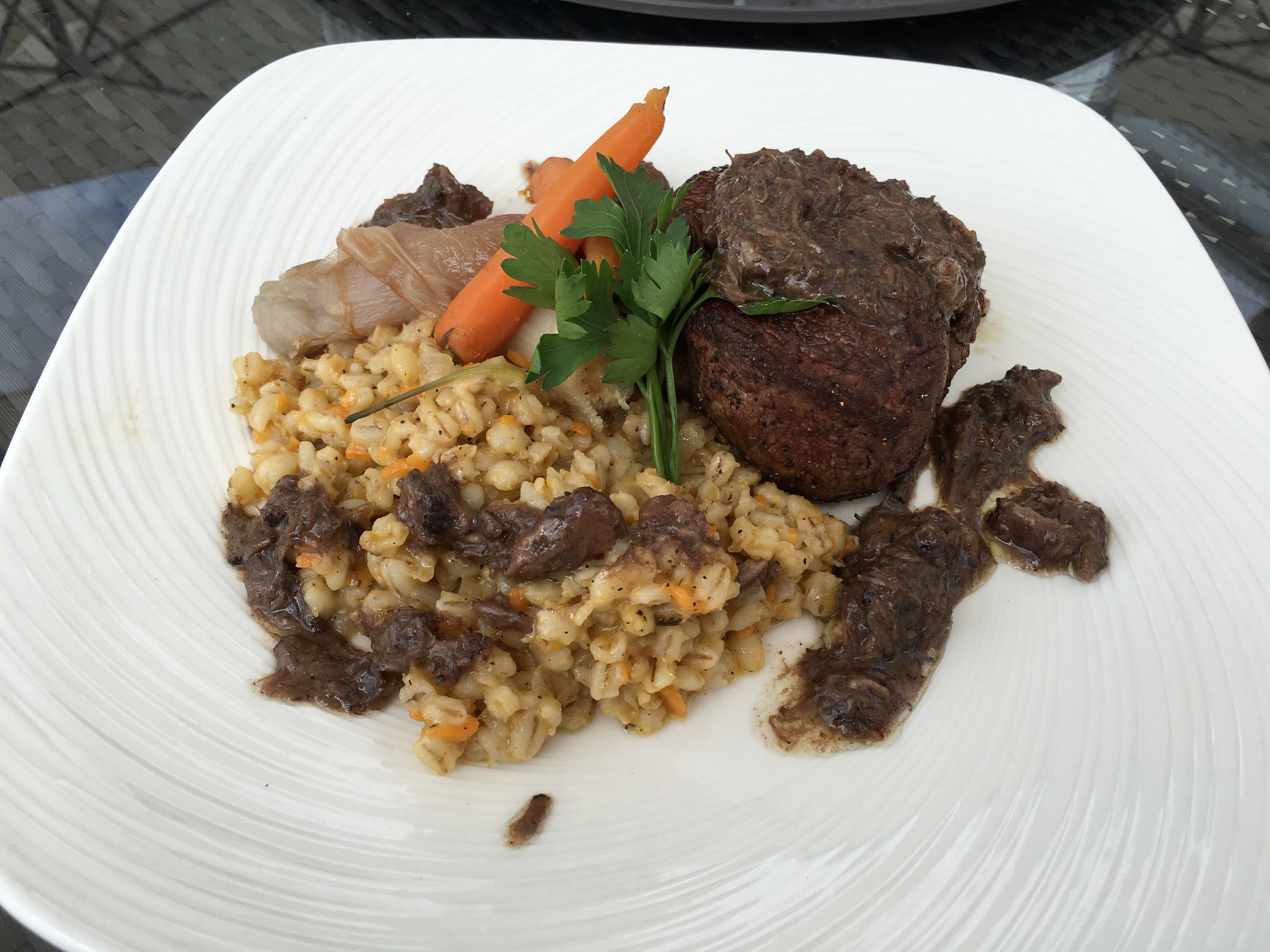
After all that the main course was a beautiful, delicious surprise. Fillet steak came with a delicious, nutty pearl barley risotto which I adored. I’ve had pearl barley risotto quite a lot in Prague for some reason but it doesn’t seem to crop up on menus here much, a shame because it has much more about it than conventional risotto often does. There was also a solitary carrot – fair enough, I suppose – and two beautifully sweet, shallots which had been cooked into softness. The fillet itself was rare, exactly as requested (I went back to CAU recently and they, a specialist steak restaurant, still seem unable to get this right: Nirvana 1, CAU 0) and although I would have liked it to have a little more flavour, the texture was terrific. Finally, drawing everything together, what the menu described as “oxtail sauce”, rich strands of oxtail strewn on top of the fillet and all over the pearl barley risotto. Sixteen pounds fifty for that lot, and one of the most interesting ways I’ve had fillet steak for a very long time; if this dish had been on the menu at a restaurant near me I’d already be trying to contrive an excuse to go back.

NirvanaBeef

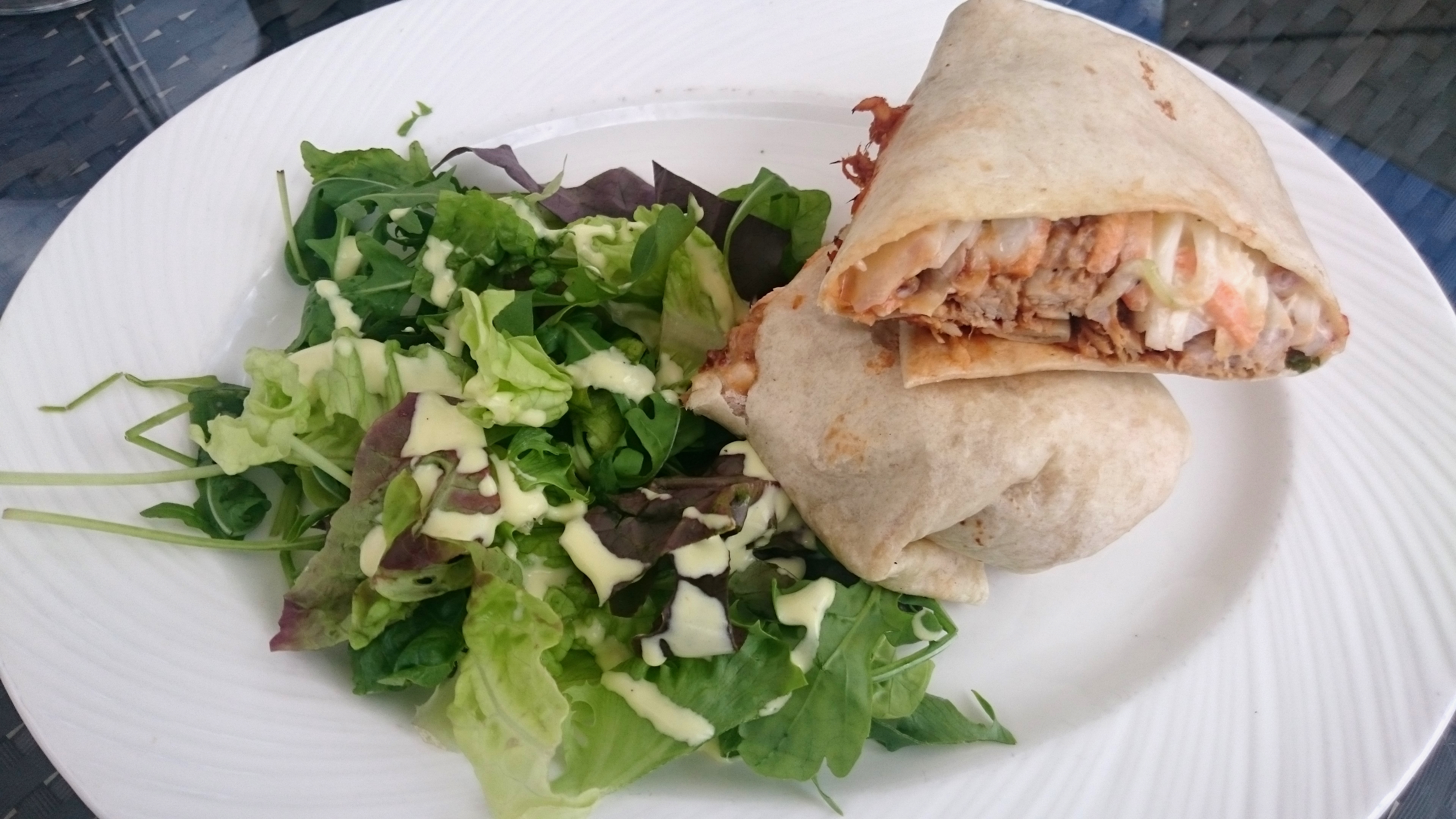
I also wanted to check out the lighter options on the menu, so we ordered a pulled pork wrap. This was just lovely: the thin flour tortilla was rammed full of really good pulled pork (smoky and sweet without being sugary as it so often is) with fresh, crisp, contrasting coleslaw. I liked the fact that it was served warm, too – so different from a cold claggy sandwich. It cost as much as the salmon starter, but felt like considerably better value. It came with a small leafy salad I didn’t much care for with a squiggle of creamy dressing, but perhaps I was just saladed out by that point, if such a verb exists. It might not have looked much in comparison to the fillet steak, but I thoroughly enjoyed it all the same.

NirvanaPork

Nirvana isn’t the place to order a dessert; you’re there all day after all, and saving some room for an afternoon snack is one of the only ways to break up the delirious monotony of being a modern-day lotus eater. So we finished our drinks (a decent glass of New Zealand sauvignon blanc for me and a rose cava for my companion), charged the meal to a membership card and ambled off in the direction of an outdoor jacuzzi. Two courses, that bread selection and a couple of drinks came to a smidge under fifty-five pounds. That doesn’t include service at Nirvana, but all the service there is smiley and friendly, on the informal side but none the worse for that. If they were elated or devastated about Brexit, they certainly didn’t give it away.

As I sat in the outdoor jacuzzi, wishing they let you drink bubbly in there, I did briefly wonder about whether you could separate Nirvana’s food from the overall experience of being at a spa for the day. I’m not sure. If you picked the restaurant up and plonked it somewhere else, aside from being perturbed that all your fellow diners were in robes, I think you would like but not love the food. Not just that, but some of the pricing seems strangely generous (that fillet steak main), some arbitrarily expensive (the smoked salmon starter). As so often, I wonder about the wisdom of giving a rating; I love being at Nirvana, I love eating there and yet eating there isn’t quite the point. But then I decided I’d thought about it quite long enough – the world outside appeared to be either taking back control or falling to pieces, depending on who you believe – and before long I would have to leave my hermetically sealed bubble and go back to it. I was glad my phone, with access to constant news, was stowed away in a locker.

Later on I did go to the hydrotherapy pool, by the way. Some of the massage jets weren’t working, and many of the handles you use to cling to the side were broken off. It’s been that way since the start of the year: it’s a shame the owner feels like he has better things to do than fix it.

Nirvana Spa – 7.3
Mole Road, Sindlesham, RG41 5DJ
0118 989 7500

https://nirvanaspa.co.uk/

The Royal Oak, Paley Street

The Royal Oak appears to have closed at some point in late 2021. I’ve left the review up for posterity.

In nearly three years this is only the second time I’ve reviewed an establishment with a Michelin star. Part of that is because they’re all a little way outside Reading, and part of it is that I’ve never been entirely convinced they’re my cup of tea. I’ve eaten in a fair few, here and overseas, and they’re such a mixed bag that I’m not entirely sure what a star means any more. I’ve had beautiful meals in the Cotswolds and truly ordinary meals in London in starred establishments, and I’ve had wonderful evenings in many places bafflingly untroubled by Michelin.

My opinion has also been coloured, I think, by l’Ortolan (which describes itself as “Reading’s Michelin starred restaurant”). It’s a classic example of what you used to have to do to get a star – a beautiful old building in the countryside with a mind-boggling wine list, efficient but soulless service and a fiddly, precise menu of dishes which look better than they taste and where, even if you order well, there’s always a sense that you’re left with a dent in your wallet which doesn’t quite correspond to the amount of fun you’ve had.

My favourite Michelin starred restaurant was a place called Medlar at the unfashionable end of the Kings Road in Chelsea. Three courses during the week was a crazy twenty-five pounds, the service was lovely and friendly, the wine list didn’t feel like it was packed full of booby traps… and the food? Well, the food was plain delicious. When it lost its star (and I have no idea why it did) rather than making me think any less of it it reinforced my feeling that the Michelin inspectors and I were not fated to get along. But I’ve always been on the lookout for somewhere like Medlar closer to home, and that’s why I ended up making the half hour drive to Paley Street, not far from Maidenhead, to give the Royal Oak a try.

One thing I liked about the Royal Oak from the start was that it still looked like a pub. Some pubs with aspirations aren’t really pubs, but there was still a bar and a front room and some cosy seats. I’m not sure how many people would go there just for a drink, but I appreciated the pretence – even if it was just pretence – that you could. I also liked the fact that we were seated in the pub proper, handsome high-backed chairs and a beamed ceiling, rather than in a sterile extension (I’ve been to the Hind’s Head and the Wellington Arms, similar establishments you could say, and had exactly that experience).

The menu was extensive, attractive and reasonable – two courses for twenty-five pounds or three courses for thirty. Slightly cheaper than, say, l’Ortolan, but more importantly the menu was full of good ideas and hard choices. It nodded more to being a pub than you might expect, so there were Scotch eggs and pies alongside the lobster and turbot.

The wine list was attractive, too. I have no doubt that there were plenty of eye-watering options on there but there were also wines by the 125ml glass or by the 500ml carafe, lots of easy ways to drink with your meal without being stung. By contrast, when I went to l’Ortolan I actually ordered a bottle knowing I would leave some of it because it was still a better deal than wine by the glass. At half-one on a Saturday afternoon the place was pretty full, with a varied clientele (one chap, getting ready to leave, ordered a taxi to Sunningdale which gives you a good idea that there’s money sloshing round these parts).

We started off with a couple of things from the pre-starters menu – again, I liked the more honest pricing that you pay for these if you want them rather than being given an amuse bouche and having the cost concealed elsewhere. The selection of bread was gorgeous – the highlight was a glazed brioche packed full of cheese and a flatbread with fennel and salt crystals which was deceptively light and airy (the other two, with rosemary and onion and with caraway seed, were less impressive but still very good). One pound fifty for that little lot, which puts most Reading restaurants I can think of to shame. The Scotch egg was good but not incredible – firm coarse sausagemeat wrapped round a quail’s egg for three pounds fifty. I’m probably a Philistine to say so, but Dolce Vita’s is better.

OakNibbles

One thing these establishments always get right is timing. You’re never turned or rushed, and they have an almost intuitive grasp of when you would like your next course to turn up. When it did, it featured one of the highlights of the meal. Lobster raviolo was a stunning thing. Normally I’d potentially feel cheated by a solitary raviolo, but not here – packed all the way to the perimeter with beautiful lobster meat, the pasta just the right thickness, no padding. The small quenelle of chilli jam on top added just enough kick.

But underneath was arguably the real treasure of the dish – samphire and still slightly squeaky leeks (no fennel I could detect, despite what the menu said) in a bisque which was partway between a sauce and a somewhat knobby foam. It reminded me of that wonderful moment at the end of moules marinière when all that’s left is the sauce and a spoon and I always find myself wondering how much of it I can guzzle before I look very greedy indeed. No such problem here with this super-intense, super-concentrated sauce, so I got all of the ecstasy and none of the shame. There was a two pound supplement for this dish, which is so little that I almost didn’t bother mentioning it.

OakLobster

I make no apologies for ordering something as prosaic as chicken liver parfait as the other starter. I love it, and whilst I know it’s the stuff of set menus everywhere I really enjoy its earthy dirtiness. And so it was with this version – the parfait itself was rich and slightly filthy, sprinkled with the ubiquitous sea salt crystals (at last! A restaurant fashion I actually approve of). It came with a decent amount of toasted brioche – so nice, for a change, to be given enough bread rather than facing those final few mouthfuls where the only way to finish it off is to pile it an inch thick. The pear chutney added a welcome hint of sweetness, although my companion did tell me if she hadn’t been driving she’d have ordered a Sauternes with it. Quite right too.

Waiting long enough for the mains to turn up meant that I saw all the dishes I nearly ordered floating past my table, a little conveyor belt of potential regrets. I had been sorely tempted to go for the rabbit and ham hock pie, but I instead chose the iberico pork chop. It was a beautiful-looking dish, but somehow it didn’t quite work for me. The pork was cooked through – too well for my liking, no pinkness at all – and completely encrusted in herbs, which felt like a needless distraction. It was a bit like it had been mugged by a jar of Schwartz. The soft caramelised apples underneath were lovely but the celeriac puree didn’t feel like it added much and the fennel looked scorched rather than braised, so the sweetness didn’t quite come out. It felt like it was crying out for greenery, and I was relieved to have ordered some chips with it (they, incidentally, were exemplary). A five pound supplement for this dish, which if anything just added to my wish that I’d gone for the pie instead.

OakChop

Turbot on the other hand was a delight. It was described on the menu as “roast turbot with peas and broad beans” and was almost (not quite) as simple as that description makes it sound. A firm piece of turbot, served on a beautiful mix of peas, broad beans, parsley, cabbage and cream. Nothing mucked around with or overdressed, just the right ingredients in the right ratio. It felt like a dish halfway between spring and summer – much like most of the last month, come to think of it. I was glad they brought a spoon so I could polish off the last of the delicious sauce, although it did make me wish I’d saved some bread (a lesson I have never learned, despite eating in restaurants for years).

OakTurbot

The dessert menu was the only place where I didn’t feel spoiled for choice. There was one standout dish, but because I wasn’t driving and had wandered more extensively round the wine list I gave way and found myself desperately looking for a Plan B. When it arrived it looked pretty and tasted pleasant, but it didn’t feel like it lived up to some of what had gone before. Crème fraiche mousse was light and clean, the strawberries were bright and sweet and the little discs of shortbread were pleasant. It was all pleasant, I suppose, but I wanted more than pleasant. I felt like I was eating a cheesecake that had been deconstructed to the point of inoffensiveness, and that wasn’t really what desserts should be about. Only the mint sorbet on top – tasting every bit as green and fresh as it looked – held my interest.

OakMousse

To make matters worse, while I ploughed through this I had to watch my companion eating the “Snicker”. This was not your usual Snickers bar (just look at that photo! Oh my goodness). It wasn’t straightforward working out what each layer was but it seemed to be (concentrate!) toffee sponge, peanut mousse, piped chocolate mousse, toffee sauce, peanuts and peanut ice cream, all topped off with a slightly over the top slice of tempered dark chocolate. Listing all that rather misses the main point which was that it was utterly, utterly delicious. My guest ate it with a mixture of gusto and gloating, although she helpfully allowed me a couple of spoonfuls for quality control purposes (and, quite possibly, to stop me whining). That blend of sweet and salt will stay with me for a long time, possibly even after I can no longer remember anything else about the meal. What I struggled to understand was how a half-eaten one went back from one of the tables. What kind of monster would order that and not be able to finish it?

OakSnicker

We’ve come to the bit where I’d usually talk about the wine. Now, my knowledge of wine is pretty limited and the benefit of having a bottle is that you only have to inadequately describe one wine. Here, regrettably, I’m going to have to do that with – count them – four different wines. So, here goes: the Australian Riesling was just fruity and sweet enough to get me through the wait for my starter, and much less intimidating than its pale colour led me to fear it might be. The Chablis was crisp and clean and played a similar role, although my companion had to nurse it for longer. The New Zealand sauvignon blanc I had with my raviolo was punchier and more metallic, but still very tasty. Finally, the salice salentino I chose to go with the iberico chop was a splendid balance of fruit and smoke and did me very nicely indeed. The first two were around seven pounds for a 125ml glass, the second two closer to a fiver. Like I said, a good wine list to get lost in.

Service was actually quite reminiscent of more obviously starred establishments, to the extent that it was almost incongruous. So everyone was pleasant and efficient but ever so slightly aloof. I didn’t mind that, but it still felt the wrong side of the fine dining divide for my liking. Lunch for two – snacks, a three course meal and four glasses of wine – came to one hundred and thirteen pounds, which includes one of those optional-but-only-if-you-are-prepared-to-make-a-scene 12.5% service charges. I often read reviews saying “yes, it’s Michelin starred but it’s possible to eat cheaply”. Don’t believe those people. It’s just not. Not without going and having a miserable time.

Did I have a miserable time? No. I had a nice time. I had a nice time in a nice pub eating nice food, and maybe as so often with restaurants that do well in the guidebooks the problem is one of preconceptions. I’m reminded of Skye Gyngell, who won a Michelin star at Petersham Nurseries and wished she could give it back because it meant that punters started turning up with Expectations. If I had gone without expectations I might have really liked the Royal Oak. I managed to steer clear of having expectations with a capital E, but I still thought I’d be ever so slightly more impressed. Maybe this is just further evidence that me and Mr Michelin are never going to be bosom buddies. Still, no matter: a beautiful drive in the country, an attractive pub, a thoroughly decent meal at the end of it. If you go you’ll probably enjoy yourself. For myself, I’m just sitting here thinking about the road less travelled. The pie less ordered. So it goes.

The Royal Oak – 7.7
Paley Street, Littlefield Green, Maidenhead, SL6 3JN
01628 620541

http://www.theroyaloakpaleystreet.com/