Takeaway review: Tortilla

When it comes to deliveries, all dishes may be equal but some dishes are more equal than others. I got to thinking about this after last week’s disappointing meal at Dhaulagiri Kitchen, when somebody replied on Twitter and said “I guess moving to takeaway has been tough for them”. I thought that was a curious take, because all of the problems with that meal had been in the kitchen, not on the journey from the kitchen to my house: everything was packed just fine, and arrived hot enough, it just didn’t taste that special. 

It is true, though, that some dishes and cuisines lend themselves better to delivery than others. You’re on a hiding to nothing with pizza from the minute it leaves the oven, for example. And the more components you have to dish up separately, the more likely you’ll have a lukewarm plate at the end of it. With dishes where everything comes in one pot, you have a better chance that the whole thing will stay hot. This is why Kokoro is always such a good bet for delivery, and why restaurants like Zizzi and Pizza Express have set up separate brands on Deliveroo selling macaroni cheese or other pasta dishes in a tub. 

It also explains the relative popularity of sandwiches – burgers, wraps and burritos – on delivery apps, and that in turn explains why I decided to give Tortilla a try this week. Burrito restaurant Tortilla is one of those smaller chains where the blurb on the website makes it sound like a small indie business (“we’re not part of a multi-franchise nor some big soulless restaurant group”) but my cursory research suggested a slightly different picture. 

They had nearly forty branches, and had benefited from financial backing from the private equity group that controlled Yo! Sushi and from Santander – because if there’s one thing big business still seems to love, it’s the casual dining sector. Tortilla’s chairman used to run Pizza Express and had a proud track record of joining or founding hospitality businesses and then selling them off for pots of cash – more John Sykes than Jamie Oliver. So Tortilla maybe wasn’t a Taco Bell, but it certainly wasn’t a Mission Burrito either.

Tortilla was first announced as coming to Reading last February, although for obvious reasons it took a fair old while to open, not throwing its doors open until the end of October. It made the news last year, because it had to overcome objections from a neighbouring business, the dentist Reading Smiles, who were concerned about them having an alcohol licence, and about the risk of smells drifting into the dental practice. Tortilla’s response was that there was no risk of that, as almost no cooking actually took place on the premises – their beef and pork are “braised off-site”, which also enables them to open in smaller premises, like the Reading branch, without the need for extraction. 

It’s funny: this sort of thing, cooking dishes in a central kitchen, goes on throughout chain restaurants and I’m sure we’ve all eaten those kinds of meals without necessarily being aware of it. But I had to work hard not to let this prejudice me against Tortilla. After all, I had a fantastic meal when I ordered a kilo of pre-cooked rib meat from The Rib Man and heated it up on my hob at home: potentially, surely this was no different? 

And Tortilla seemed to be doing a tidy trade – every time I’d walked past the restaurant since lockdown relaxed in April the tables outside had people at them, taking part in our new national sport of gamely pretending the weather wasn’t shite. I couldn’t quite make up their mind about them on paper, so it was time to place an order with them and try to make up my mind about them in reality.

Tortilla is on all three delivery apps, although in typical fashion I only realised that once I had placed my order with Deliveroo. The menu is identical across all of them, and it largely revolves around burritos, naked burritos – that’s the contents of a burrito in a bowl, in case you have a thing against tortillas – and a few taco options. They don’t sell quesadillas or nachos for delivery, although they will sell you a DIY kit if you want to make them at home: I can’t imagine these are that popular, but life is full of surprises.

The process for ordering a burrito is remarkably like going down the line in Mission Burrito, so you have various tick boxes to pick which rice, beans, salsa and so on you want. We ordered on a Sunday evening, and they had run out of their coriander and lime rice and their guacamole, which slightly limited the options. Guacamole, incidentally, is one of the only things Tortilla makes on the premises, so it’s a particular shame they had run out. (Is it as bad as a pub running out of chips? Answers on a postcard.)

Tortilla offers the traditional fillings – carnitas, barbacoa beef and grilled chicken – along with grilled vegetables. The latter costs the same as a chicken burrito, which feels cheeky. They also serve a“vegan chilli no carne” – which has tempeh in it, although you have to go to Tortilla’s website to find that out. We ordered a couple of burritos and some tacos to share – I might have tried the tortilla chips too if they’d had any guacamole to go with them – and our meal came to just shy of thirty pounds, not including the rider tip. Tortilla’s burritos come in medium and large, with the large costing about the same as the one size offered by Mission Burrito.

Deliveries from the town centre always seem quicker and more reliable, and often come on a bike rather than in a car. This was no exception, and everything was pretty brisk: we ordered at twenty past seven, the rider was en route twenty minutes later and he took four minutes to reach our front door. When he did, he cheerfully told us that he was carrying two orders from Tortilla and so we’d have to give him our order number – that struck me as a little strange, but it hardly held things up. I wonder, if I’d been his second delivery, if I’d have been quite as happy.

Anyway, everything was hot and it was all present and correct. A number had been scrawled on one of the foil-packed burritos with a Sharpie, nothing on the other. It’s only after the meal, looking at the ticket in the bag, that I realised he had written numbers against each burrito so we could work out which was which. P for pork and B for beef might have been simpler.
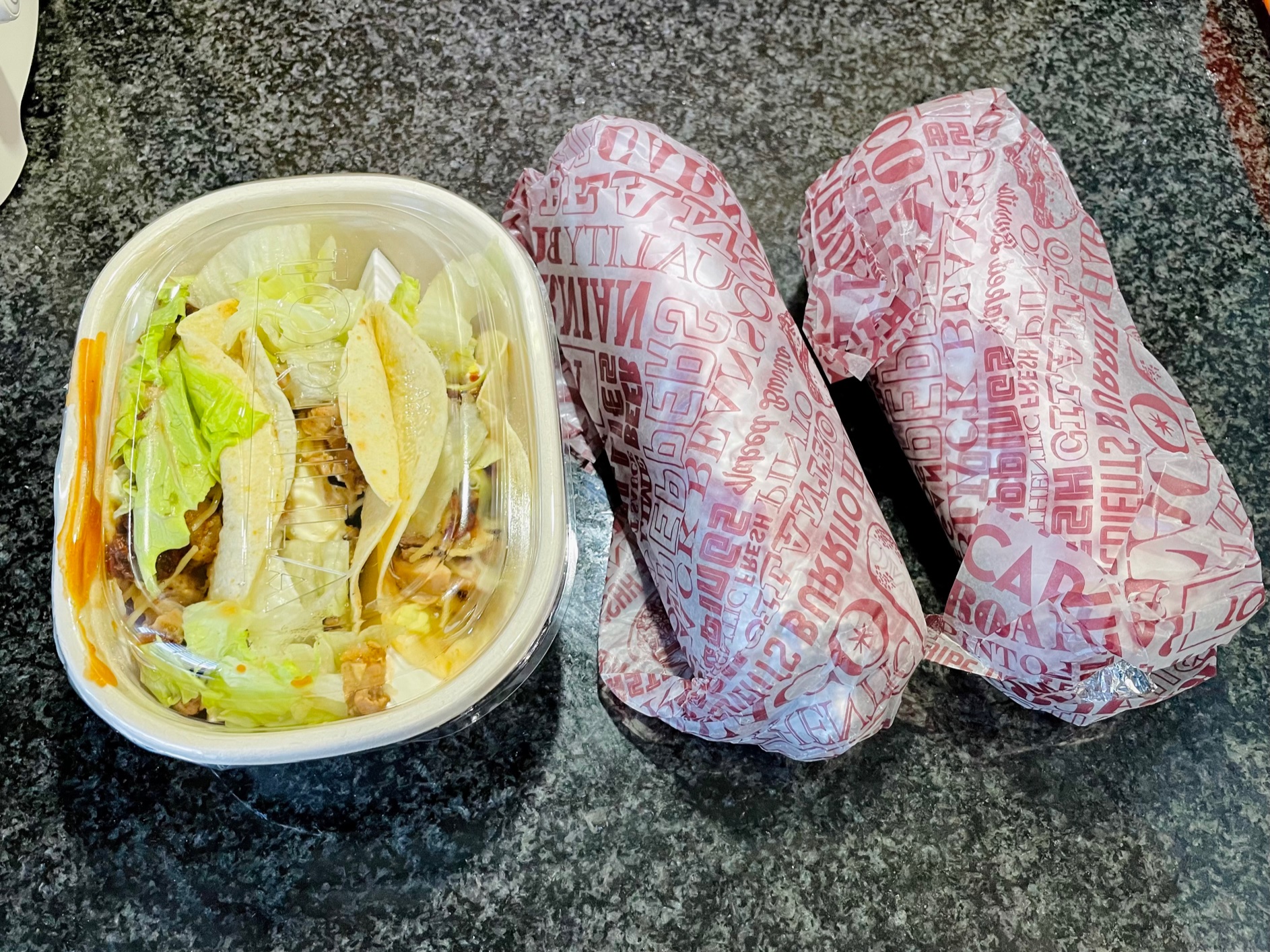
This is where I also have to make a sad confession. Partly to work out which burrito was which and partly to make this review more photographically interesting, I cut my burrito in half, artfully arranged it on a plate so you could see the filling, placed it under a spotlight in the kitchen and took a picture of it. Or at least I thought I did, but looking at my camera roll it simply isn’t there. This puts a greater emphasis on my descriptive powers than any of us would like, and makes this review even less visually interesting than normal: I can only apologise. I asked for advice on Twitter, but it ranged from the impractical (courtroom style drawing please) to the sadistic (another thousand words, presumably?). I’ll spare you either option.

On to the burrito then. Mine was pulled beef with black beans, tomato rice and all the trimmings – cheese, sour cream, salsa verde, jalapeños and pickled red onions. Looking at all that, you’d have thought the biggest risk would be the flavours clashing, or being too much, but in reality the struggle was to get it to taste of anything. Really, it was almost symphonically bland. It was well packed – almost as if done by a machine, the meat firmly in the centre, so different to the haphazard arrangement of a Mission burrito – but nothing tasted of very much. 

The beef had the texture but couldn’t back it up with the taste. The red onions were still crunchy and felt like they’d had only a passing acquaintance with vinegar. If there were any jalapeños in it, they’d been picked for their inoffensiveness. The list goes on: the tomato rice had a real feeling of Bachelor’s about it, and if the salsa verde, cheese and sour cream were even in there (and having eaten it, I’m not sure they were) they added even less to proceedings than Dido Harding. Or Dido herself, for that matter. When the best case scenario is that your meal is boring because they got your order wrong, and the worst case scenario is that it’s plain boring, matters are problematic.

The carnitas burrito was a subtly different shade of meh, but meh nonetheless. I actually liked the pork more – it was saltier and just more interesting – but it had its work cut out shining in a sea of mediocrity. When I have a burrito from Mission it’s a glorious mess – it drips, it’s tricky to tackle, it’s always a challenge, but it tastes of something. You get the highs and the lows. This, by contrast, was tidy and dull, a burrito on Prozac, all the edges neatly knocked off until you barely felt anything. Maybe that was the intention, and maybe the aim is to take customers away from Taco Bell: Tortilla is better than Taco Bell, but so’s eating corrugated cardboard topped with spam.

Only the tacos showed a hint of something better. Tortilla’s chicken is grilled rather than pulled, in little pieces – I actually quite enjoyed this, although it wouldn’t be everybody’s cup of tea. But the real winner here was the salsa roja – hot and punchy and adding a dimension of flavour that had been lacking everywhere else. But even the tacos, though they were better than the burritos, weren’t better than their peers. 

The portion size was still a little underwhelming, especially when you compare it to the Lyndhurst’s outstanding chicken tinga tacos: there, you get four tacos for nine pounds, all so piled high with chicken that you can’t physically close them, and there is always plenty of guacamole. At Tortilla you get three barely-filled tacos for seven pounds fifty – I got the odd one, but mostly because Zoë had no interest in fighting me for it.

When I look at Tortilla’s footprint, I can see that it might do well in many of the locations where they’ve opened up. If it didn’t exist, it might be necessary to invent it. But this, I’m very proud to say, is Reading, and we do things differently here. We’re not like some of the identikit malls Tortilla has opened in, or the likes of Guildford; if they’d done their homework, they might have realised that Reading, of all places, doesn’t need a Tortilla. 

And although there were a couple of things at Tortilla I didn’t mind – the grilled chicken, the salsa roja, the fact that it isn’t Taco Bell – the fact remains that it will never be close to the best option for Reading residents. A few weeks ago I went to Blue Collar and tried pork and charred pineapple tacos from their new vendor El Contador, and they were miles better than anything I had from Tortilla. 

Likewise, if tacos are your thing, be they carnitas or jackfruit, you really do need to make a beeline for the Lyndhurst when they reopen. If you’re a burrito fan I think that Mission, in terms of quality, value and integrity, is streets ahead of Tortilla; writing this review has quite made me crave a Mission Burrito to remember how it’s done. And if you’re at home, and you want to order something delicious that will stay hot, cost around a tenner and make its way to your door in next to no time, a little bucket of Kokoro’s sweet chilli chicken hits the spot every time. 

I do feel a little sad for Tortilla: it’s not exactly as if they’ve done anything wrong, but they’re not quite good enough. It’s not them, you see. It’s us.

Tortilla
4-6 Broad Street, Reading, RG1 2BH
https://www.tortilla.co.uk/locations/reading/

Order via: JustEat, Deliveroo or Uber Eats

Takeaway review: Palmyra

One of the defining moments in the evolution of Reading’s restaurant scene happened in summer 2015 when a new place opened halfway up London Street, where a Nepalese restaurant used to be. I lived nearby at the time, and when I heard it was going to be called “Bakery House” I was excited: finally, Reading was going to get a decent bakery in the town centre! I was a bit nonplussed when it turned out instead to be a Lebanese restaurant, but then I saw that they baked all their own pitas and the name made more sense. And then I ate there, on duty for this blog, and I knew I was trying something special.  

It wasn’t Reading’s first Lebanese restaurant: the ill-fated La Courbe, in Kings Walk, had that honour. And La Courbe’s food was very good indeed, but the whole approach was different. La Courbe looked like a grown-up restaurant, albeit a dated one, with square plates and sharp-edged furniture, where you effectively ate in a glass box and tried to ignore the smoke coming from the open kitchen. It had an extensive list of terrific wines from the Lebanon, and was determined to showcase that every bit as much as the food. 

But Bakery House – although from the front it might have resembled a standard kebab joint – was a very different animal. It was more functional, and it had no alcohol licence, but it had infinitely more more heart and soul. It was often busy, with a hugely varied clientele, and remains one of my favourite places to go for a sit down lunch or have dinner with friends. Some of their dishes, like their boneless baby chicken, their lamb shawarma and their chicken livers, have pretty much attained iconic status. 

One of my most enjoyable pre-Corona rituals – one I very much look forward to resuming, one day – was to spend the day in Nirvana Spa and then take a taxi to Bakery House for dinner. It sounds so decadent, over a year down the line. And before I started reviewing takeaways, that restaurant was the only reason I had the Deliveroo app on my phone.

Anyway, poor La Courbe was Betamax to Bakery House’s VHS: it closed less than a year after its rival opened, whereas Bakery House is still going strong (my 2015 review of the place remains one of the most widely read reviews on the blog). And since then, various restaurants have sprung up to try and take advantage of the increasing popularity of Lebanese food, without significant success. We still have Comptoir Libanais on the Oracle Riverside (I ate there once: never again), but Alona down the Wokingham Road barely made it to a year before closing down. Having eaten their shawarma, I can see why.

More recently, two more Lebanese restaurants have opened further from the town centre. Late in 2019 Lebanese Village opened just over Caversham Bridge, in the site that was previously occupied by Spanish non-tapas restaurant Picasso. I never got round to reviewing them before lockdown, although that’s largely because for much of that time their hygiene rating left something to be desired (they’ve fixed that now). And then in February 2020, possibly the worst imaginable time to open a restaurant, Palmyra opened at the top of the Oxford Road, opposite the Broad Street Mall.

The stories I’ve heard about Palmyra since then definitely suggested that it was worth investigating. A reliable source told me when they opened that the chefs were ex-Bakery House employees, and later that year I heard suggestions that the owners of Kobeda Palace might have a financial interest in the restaurant. That alone was enough of a pedigree to pique my interest, and then a reader told me on Twitter that she’d been a regular takeaway customer of Palmyra. “Brilliant customer service, food really tasty, gives Bakery House a run for their money” she said. “I know that’s fighting words” she added. Fighting words indeed, and only one way to find out if they were justified: time to fire up the phone and place an order.

Palmyra is on all the delivery apps (or you can order through their website which goes through Foodhub) but, as so often, the experience is slightly different through each one. I got as far as building a basket on JustEat, which offered 20% off on the night I was ordering, only to find that it wasn’t that specific about some of the dishes. So for instance, you could order shawarma but it wouldn’t let you specify lamb, chicken or mixed. It also wasn’t clear about what everything came with, so when you check out and it asks you whether you need rice, chips et cetera the only honest answer is I really don’t know. So if you like surprises, or getting 20% off is more important to you than knowing what shawarma you’re eating, JustEat is the one for you.

I instead went for Deliveroo where I could specify what I wanted, although I did order some garlic and chilli sauce because I couldn’t tell whether they came as standard (it turns out they did, so I wound up with far more than I needed). That aside, the menu had plenty of old favourites that fans of Lebanese food would recognise: cold mezze, including houmous, moutabal and baba ghanoush; hot mezze such as chicken livers, falafel and kibbeh; dishes from the charcoal grill (shish and the like); shawarma and wraps. There were also a few burgers, which felt slightly incongruous.

Prices were very reasonable, with most starters stopping short of a fiver and main courses costing less than twelve pounds: on a par with Bakery House and slightly cheaper than Lebanese Village. I didn’t spot many dishes that I hadn’t seen before, but I decided to take a two-pronged approach, ordering starters I hadn’t heard of and main courses I knew and loved, trying to do a mixture of discovery and benchmarking against the tried and tested. Two starters and two mains, along with Deliveroo charges, came to thirty-six pounds, not including tip. And Palmyra look after the deliveries themselves, so you tip the restaurant rather than the rider (and you should always tip the rider, if you ask me).

Because Palmyra do the deliveries, Deliveroo tells you that the order has been received and when the rider is on their way, but beyond that you don’t get to track the delivery. I wasn’t even sure if they even confirmed that at first, because the food took a fair old while to leave the restaurant: I ordered at 7.15 and the app said it would be with me in forty minutes, but in reality the driver was on his way about an hour after I placed the order and it took him less than ten minutes to reach me.

He was lovely and friendly and apologised that it had taken a while. “We’ve been snowed under”, he said, and it wasn’t until later that I realised we’d ordered on the first day of Ramadan, about half an hour before the sun was due to set. No wonder they had their hands full. That made me prepared to overlook a lot – similarly our food wasn’t exactly piping hot, but I thought it was well worth making allowances. Everything came in recyclable foil and plastic, and portions looked like they’d be pretty generous.

Palmyra’s starters were probably the weakest part of the meal – not bad per se, but maybe not as exciting as they sounded on paper. Lamb sambusek were meant to be deep fried pastries filled with minced lamb, but they felt as if they had been baked rather than fried, pasties rather than pastries. Not that that’s a bad thing: I enjoyed the slightly doughy pastry, but the meat inside felt bland, especially considering the sheer amount of flavour Lebanese cuisine can usually get out of lamb. Maybe I have nobody to blame but myself; with hindsight, I look at some of the starters I order – these and samosas in particular – and I think I ought to be more versatile. Anyway, Zoë liked them more than I did, and so I didn’t fight her for the fifth one.

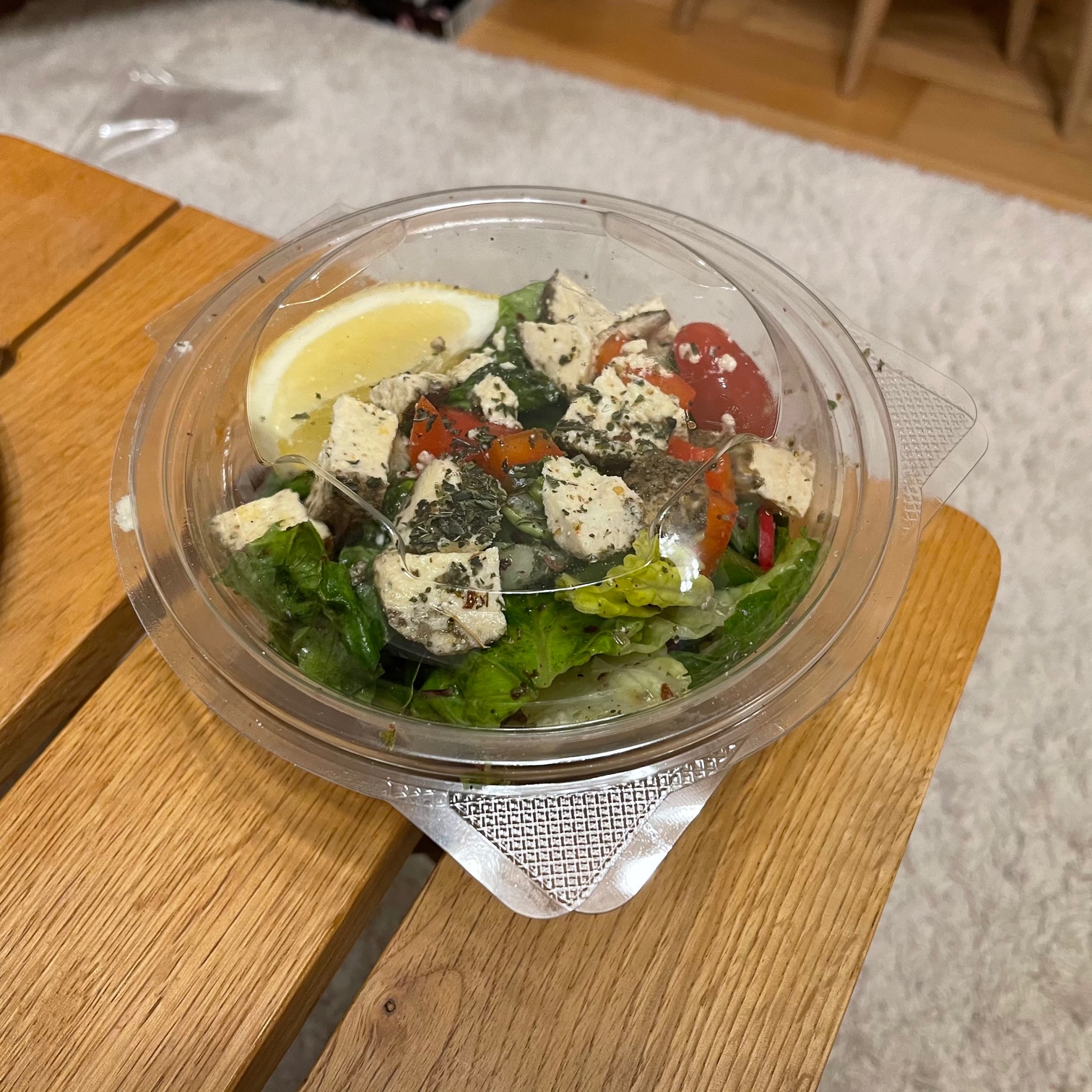
Similarly, I’d never seen shanklish on a menu, so I was intrigued. The menu described it as goats cheese topped with thyme and mixed with onion, pepper and tomato. I’m not sure what I was expecting, but it was pretty close to a Greek salad in practice, with cubes of cheese, onion, tomato and plenty of lettuce. If I’d known it was a salad, I mightn’t have ordered it. But more to the point,  the cheese – the headliner – didn’t knock my socks off. It didn’t have a strong taste of goat, and the herb coating was very fine and a bit too mouth-coatingly gritty. It felt a lot more like feta, but with the salt mysteriously removed. 

Having now done my research, I suspect that this was pretty authentic (with the exception of the iceberg lettuce), so just not my bag. But the salad itself was also carpet-bombed with herbs, to an extent where I found it offputting. You got salads with your main courses as well and these had the same problem, without the cheese to redeem matters: Bakery House’s salad accompaniment, always so well dressed, is far better.

The mains we ordered – boneless baby chicken and lamb shawarma – were definitely picked to compare with the market leader. Palymyra’s boneless chicken was close in standard, but fell ever so slightly short in a few respects: a little smaller, not quite as moist and without that wonderful smell of the chargrill when you took the lid off. But these are minor quibbles, and if it came second it certainly wasn’t second rate, with good flavour and plenty of evidence of marination. I’m also aware, too, that many people aren’t quite as greedy as I am and on the “enough is as good as a feast” principle Palmyra’s baby chicken is definitely a feast.

You didn’t get a choice of rice or chips with the meat, so comes served with some lovely buttery rice speckled with wild grains, which had a subtle hint of something sweet and comforting, almost like vanilla. The rice was particularly good with the lamb shawarma, which was my favourite dish of the meal. This was a really hefty portion of lamb, in beautiful slices with just the right blend of meat, of fat and of wonderful caramelisation. There was quite a bit of clove on the nose, which brought on unwelcome flashbacks of the wobbly version at Alona, but once you started eating it the flavours all came together harmoniously, and the whole thing was pretty damned wonderful. Even slightly more warm than hot, it was a winner. 

“It’s really good, but imagine eating a whole portion to yourself” said Zoë, unaware that I was imagining exactly that and making a mental note for next time. I also thought briefly that any leftovers would make for a fantastic sandwich filling before ruefully realising that I never have leftovers and that if I did, I might have a less depressing waist measurement. Leaving food, like going camping or overpaying your mortgage, just seemed to be something other people did: I knew from social media that there were people like that out there, in a better, more virtuous tribe than me. 

Never mind, I thought, looking down at my plate, empty except for a little smudge of the (very good) chilli sauce and a few stray grains of rice. I hadn’t eaten much of the salad, but that wasn’t to my credit: I knew that was the bit you were meant to polish off. In fairness, we didn’t finish the pita breads either. They were pleasant enough, although I wouldn’t necessarily have put money on them being made in house. I should probably face the fact that La’De Kitchen’s wonderful balloon bread has ruined me for other pitas. 

The thing I almost feel guilty about, in writing this review, is that I’ve mentioned Bakery House as many times as I’ve mentioned Palmyra. They were the spectre at this particular feast. But that’s what happens when a restaurant becomes the benchmark, the standard for others to reach. That’s the way of things, just as every Italian restaurant in Reading will be compared to Pepe Sale, or every street food venture will be weighed up against Blue Collar. The trailblazers are there to give the newcomers something to aim for, and to want to surpass. 

Success breeds imitators: it’s always been the sincerest form of flattery. It proves you are good, and it tells you to be better. Because that’s the other thing: Bakery House will be looking at this newcomer, the way Bette Davis looks at Anne Baxter in All About Eve, not wanting to be superseded. After all, La Courbe was the future once, and look what happened to them. The tension between the established and the new is what drives everybody forward, stops people from resting on their laurels. Restaurants need that, or they get stale: I like to say that a rising tide lifts all boats, and being shaken from your complacency is no bad thing.

And I think Palmyra has enough about it to generate that tension: if we were playing Top Trumps I’d say that Bakery House won on the starters and edged it on one of the main courses, but Palmyra’s shawarma is a thing of beauty and worth the price of admission alone. But anyway, that binary way of looking at things does nobody any favours. If I lived in West Reading I would be absolutely delighted that Palmyra were at the top of the Oxford Road, and I would take full advantage of them being so well located for my end of town. Besides, you’re bound to avoid my rookie mistake of ordering from them on one of the busiest nights of the year. Even though I fell into that trap I have no complaints, and I imagine they made a lot of households very happy that night. They definitely did mine.

Palmyra
40 Oxford Road, Reading, RG1 7LA
0118 3277546

https://palmyralebanese.co.uk/index.php
Order via: Direct through the website, via Deliveroo, JustEat or Uber Eats

Takeaway review: Rizouq

I don’t think I realised, back in January when I started reviewing takeaways, just how it could widen the scope of my blog. Initially, I focused on reviewing restaurants that had opened since we all went into our first lockdown a year ago, which is why I’ve looked into the likes of Banarasi Kitchen, La’De Kitchen and O Português. But now that I’ve been doing this for a few months, and the number of shiny new restaurants on my to do list begins to diminish, I can see that reviewing meals at home opens up all sorts of establishments that I simply couldn’t review before. 

Some are places that don’t have physical premises here like Rosa’s Thai or Burger & Lobster, London restaurants testing the water by running dark kitchens in Reading and partnering with Deliveroo. Others are chefs who deliver in a specific area – these can often be hyperlocal and specialised, like Caversham’s Pielicious or West Berkshire’s The Iberian (which sadly doesn’t deliver to my address: I’ve already checked).

Then of course there are heat at home options offered by established, high profile restaurants – frequently more expensive but aiming to offer a restaurant experience in the comfort of your own home. The most famous of these, locally, is of course our very own Clay’s, but plenty of well-known restaurants offer something like this, for now at least, either through their own website or via a third party like Dishpatch (a company surely named by a Sean Connery fan). 

Whether restaurants continue to offer heat at home options beyond April or May is a fascinating question, and one I suspect many restaurants are wrestling with right now. Is it a useful additional revenue stream, or an exhausting side hustle that will be dropped when restaurants can open again? Most likely nobody really knows the answer to that, just as nobody knows what the shape of hospitality, our social lives, the world of work and, more broadly, life itself will be like over the rest of this year and beyond. 

Will we still want to eat out, or will we just be delighted that the quality of TV dinners has improved a thousandfold? Will we still want to go to pubs in large groups only to get stuck in a conversation with that person who bangs on non-stop about their job, or your one friend who never buys a round, or will we decide we’d just rather stay home drinking better beer, wine and spirits in our comfies?

Your guess is as good as mine. But either way, the overwhelming feedback from readers of the blog has been that you don’t want takeaway reviews to come to an end next Friday, so it may well be that you see more of these kinds of meals in the weeks ahead. And, as always, if there’s somewhere you’re particularly interested in (or somewhere you especially recommend) you should let me know.

The other type of restaurants I can review now that I couldn’t back at the start of 2020 are those that are almost exclusively takeaway. Firezza, which I sampled in January, falls into this category and so, pretty much, does Rizouq, the subject of this week’s review. 

Rizouq bill themselves as a family-run Pakistani takeaway, and pre-Covid their site on the Wokingham Road had the grand total of one table in the window: you could technically eat in, it implied, but nobody did. One table is almost as discouraging as no tables at all, I tend to think, with the notable exception of Harput Kebab, just round the corner from the Nag’s Head. There’s a certain magic, if you ask me, about sitting next to a fogged up window, a warm glow behind you, Edward Hopperesque on the Oxford Road, half-cut and devouring a chicken shish.

Rizouq has been on my radar for the best part of four years, though, because of my regular reader Mansoor (last seen tipping me off about La’De Kitchen). He’s been telling me for as long as I can remember that I needed to give Rizouq a try and even gave me a list of the best dishes to try. “The chicken samosa is up there with the chilli paneer from Bhel Puri for loveliness”, he told me once. On another occasion he said that I should try the snacks in general and the shami kebab in particular (“we have a regular order of frozen shami kebabs for quick meals during the week”). 

More recently, he told me to try the curries and the chicken tikka sizzler (“that’s my wife’s favourite”, he said), and I thought that I’d gone quite long enough without taking Mansoor’s expert advice. So I went back through his Tweets to me, I made notes and, on Wednesday night, I sat down with my phone to put as many of Mansoor’s recommendations as I could into action. 

This turned out to be trickier than I expected, and I’m afraid it means you now have to sit through some of the dullest paragraphs I’ve written in a long time – dull but sadly, probably necessary. So here goes: I managed to find Rizouq on Deliveroo and Uber Eats. Most of the dishes are nearly a pound cheaper on Uber Eats, and the delivery charge is a pound less too, so if you’ve had good experiences with them then knock yourself out. I am not using Uber Eats, because they’re shite, so I stuck to Deliveroo. 

However, while researching this review I found that Rizouq are also on JustEat – on desktop but not, it seems, on the app. Go figure. The dishes are cheaper on JustEat than on Deliveroo, too. And, it turns out, you can also order on Rizouq’s website, although the website isn’t easy to find – it’s fairly low down in the Google search results. It is listed on Rizouq’s Facebook page, but if you try and access it that way it’s blocked because it apparently goes against Facebook’s community standards. Given all the offensive dross Facebook refuses to take down, all the hatemongering and anti-vaxxing, that’s even more baffling. 

What’s also baffling – sorry, we’re not done yet – is that the menu is subtly different across all of the platforms. I’m boring myself writing this, but in for a penny, in for a pound: if you order via JustEat, for example, you have a choice of a “vegetable curry” or a “non-vegetable curry”. If you order on Deliveroo you can choose lentil, vegetable, chicken or lamb curry. And if you order on Rizouq’s website they have five different curries, which come in two different sizes. Confused? Me too. So if Rizouq is a well-kept secret, it might be because they make it more complicated than it needs to be. Just a thought.

For those of you who are still awake, the menu is so wide that you could easily struggle to work out what to order if you didn’t have a sherpa like Mansoor to guide you. It covers a lot of bases, so there are starters and snacks, curries and biryani (I think the biryani used to be a weekend only thing, but it seems they now sell it every day). But there are also burgers and wraps, many of which feel much more conventional in nature. So a seekh kebab wrap sits alongside a Southern fried chicken wrap, a tikka sizzler burger is in the same section as a minted lamb burger. There are samosas, but also mozzarella sticks and garlic mushrooms. It’s clearly a modern menu designed to cover all bases in the community it serves, with a few adjustments made for that purpose – no beefburgers, turkey bacon instead of regular bacon and so on. 

Even at Deliveroo prices, nearly everything is either reasonably priced or plain cheap. You’ll struggle to find a dish costing over ten pounds, starters are all less than a fiver and the burgers range between five and eight pounds. We ordered two starters and two mains with sides and our meal came to thirty pounds, not including tip. Everything was very efficient, too. We placed our order at six o’clock, and half an hour later our rider was on his way. He got to us in less than five minutes – an impressive feat – so in next to no time we were taking everything out of the carrier bag and dishing it up. It came in a mixture of recyclable plastic and foil and more problematic polystyrene, but everything was perfectly hot.

Mansoor’s tip about Rizouq’s starters was a good one, as these were definitely the best things I ate. You got three chicken samosas, each one bigger than my hand, for four pounds fifty (or even less if you order through someone else) and they were magnificent things. The pastry was maybe harder, oilier and more brittle than it is at Cake&Cream up the road, but the filling was beautiful – nothing but shredded chicken, potato, spice and a slowly building heat. I loved these, although I have failed to sum them up as succinctly as my other half Zoë. “It’s fried, it’s fresh as fuck and it’s full of meat” she said. All the Fs. “What’s not to like?”

I also loved the shami kebab. I wouldn’t have ordered this without the recommendation from Mansoor – I’d have been far more likely to stay in my comfort zone and have seekh kebab instead – but these were a real revelation, fiery yet comforting patties with shedloads of strands of mutton. I expected them to keep their shape a little better and have a bit of a crust, but in reality they were so soft they fell apart dishing them up from their foil container. Whether they’re meant to be quite that soft is for someone better informed to say, but the taste was so good that I really couldn’t have cared less. Again, all this just cost four pounds fifty.

If the mains were less successful, it’s possibly because the snacks had set a high standard. My chicken tikka sizzler was perfectly enjoyable but a little unremarkable – a nicely spiced fillet in the sort of soft floury bap you don’t see too often these days, with some mayo and iceberg lettuce. That was it: done pretty well, but on the basic side. I think I’ve been ruined by the Lyndhurst’s katsu chicken burger, the size of which made Rizouq’s burger look a bit anaemic by comparison. On the other hand, Rizouq’s costs five pounds fifty. 

I don’t know why I thought having a side of hash browns was a good idea, but I did anyway. They were shop-bought and perfectly enjoyable, if a little limp and floppy. Next time I’ll have fries or, most likely, order something different, although I still polished them off with my new gastronomic obsession, Johnny Hot Stuff’s “Hot Date” sauce, picked up from Geo Café. It was only after the meal that I realised I’d neglected to take a picture of my main but trust me – even if I had, I don’t think it would have sent you running to order one.

Zoë had gone for the daily lamb curry which was in a relatively dry sauce and served on the bone. She really enjoyed it, despite usually being a little suspicious of meat on the bone. I wasn’t quite so sure – the meat I tried was delicious and tender, but with rice thrown in this dish came to eleven pounds, and I couldn’t help thinking that better options were available, from Banarasi Kitchen, from Clay’s or from Kobeeda Palace. That’s the curse of reviewing, as I said to someone on Twitter recently: you are always comparing, whether you’re comparing to your expectations, to your hopes, or to a similar dish you’ve tried elsewhere.

So, that’s Rizouq: a menu, hidden in a riddle, wrapped in a mystery inside an enigma, strewn across four different websites. But if you look beyond that, it happens to be a great example of a restaurant that knows exactly what it wants to be, understands its customer base and serves it admirably. Mansoor aside, I expect a fair amount of ER readers either haven’t heard of Rizouq or wouldn’t consider giving it a try. Did my meal put it on my radar, and would I recommend it to you? 

It’s a cautious yes from me on that score. I do think that the experience – the menus and the myriad of delivery options – is needlessly confusing, but at the core of it, when you strip away the distraction, there’s a good, authentic and crazily reasonably priced menu in there waiting to be discovered. When I go back, which I definitely will, it will be to try more of the snacks, and maybe a seekh kebab wrap, or I’ll have a crack at Rizouq’s biryani to see how it compares. 

Or, better still, perhaps I’ll follow up on another recommendation from my insider. On Saturday and Sunday mornings, Rizouq offers a desi breakfast, and looking at the menu, I can just imagine myself tucking into a Lahori chickpea curry, spiced potatoes, halwa and buttery puri. Mansoor speaks very highly of it, and that’s good enough for me. After all, he hasn’t steered me wrong so far.

Rizouq
117 Wokingham Road, Reading, RG6 1LH
0118 9668899

https://rizouqtakeaway.co.uk/order-now
Order via: Rizouq’s website, Deliveroo, JustEat or Uber Eats

Takeaway review: O Português

As of March 2023, O Portugues is closed until further notice.

Many years ago, in another life, I was spending a long weekend in Lisbon (remember when we used to have those?) and I had the good fortune to go on a food tour hosted by the journalist and writer Celia Pedroso. Every city – every country too, for that matter – should have an advocate like Pedroso, and anybody who went to Lisbon thinking that Portugal was all peri-peri chicken and egg custard tarts would have had their mind absolutely blown by a few hours in her expert company.

It turned out that Portugal had cheese and ham that could rival anything from Spain, had not only port but also wonderful rich red wines and fresh, almost effervescent vinho verde. We sat in a restaurant called Tagide, looking out over the city, trying petiscos, Portugal’s take on small sharing plates, which were every bit as delicious as any tapas I’d eaten in Andalusia. Then there was ginjinha, a cherry liqueur sometimes served in – just imagine this – an edible chocolate shot glass. Throw the aforementioned chicken and pasteis de nata into the mix, and you have the makings of a wonderful, unsung cuisine.

I came away from that afternoon thinking that Portugal, so often overshadowed by its Iberian cousin, might be the best-kept food secret in Europe. It’s well-kept enough, for some reason, that Portuguese food has never quite made it to these shores; London has never had a Portuguese invasion the way as, say, Peruvian food some years ago and, closer to home, in nearly eight years of writing this blog I’ve only ever reviewed two Portuguese restaurants. Both of them left me a bit baffled, to put it lightly: was it just that the food didn’t travel well?

All of this made me very curious indeed when the old Bart’s Steakhouse site next to Palmer Park, which was Colley’s Supper Rooms for many years, reopened as O Português. All the early signs pointed to a hearty, authentic Portuguese restaurant, and the restaurant’s social media output – all bilingual – suggested a wide and interesting menu, ever-changing daily specials and huge amounts of support from the local Portuguese community. With the exception of Deliveroo-only London imports like Burger & Lobster and Rosa’s Thai, O Português is probably the restaurant most readers have told me they want me to check out. They’re on JustEat, so on a quiet weekday lunchtime I sat down to pore over their menu and decide what to order for dinner.

Researching the menu was an awful lot of fun and involved having JustEat open in one browser tab, Google in another. It was both an education in Portuguese food and a reminder of how little I knew about it. The menu had a selection of just under ten starters, most of them hovering around the seven pound mark, and a wide range of main courses ranging from ten to twenty pounds. Some had descriptions, some didn’t, but I hadn’t heard of much of it and the more I researched the hungrier I got. Did I fancy arroz de marisco, seafood rice that might rival a paella, or bacalhau a bráz, a sort of salt cod scrambled egg dish with matchstick potatoes? 

Everywhere I looked a different genre of gastronomic temptation was waving from the menu, shouting “pick me!”. And of course, the problem with looking up all these different Portuguese specialities was that Google always seemed to throw up the platonic ideal of each dish, a picture of every single one as its absolute best self. It partly wanted to make me order from O Português, it very much made me want to hop on the next plane to Porto and, perhaps most of all, it made me hope that ordering from O Português would make me feel less sad about the fact that I couldn’t so much get on the RailAir, let alone fly to Portugal at the drop of a hat. 

I deliberated, I horse-traded with my other half Zoë and we placed an order for that evening – two starters and two mains, coming to just over thirty-six pounds, including delivery and service charge. Then we got on with our day, but every now and again, on our afternoon walk, I would remember that I had this takeaway to look forward to and I thought what I always think with these review meals: I hope it’s good.

We’d ordered our food to arrive at seven pm, and the JustEat experience was pretty efficient, painless and slightly early. We were told at just before twenty to seven that our rider was on his way, and he pulled up outside the house barely five minutes later. Most of our food was in foil containers with cardboard lids, all recyclable, and one dish we’d ordered was in polystyrene. At the time I thought nothing of it, but later Zoë said “considering it’s less than ten minutes down the road it’s just not hot enough” and, on reflection, I tended to agree.

O Português’ starters mostly read like unpretentious bar food and I was excited about trying them. The first of them, pica pau, was thinly cut pork or beef in a spicy, beery gravy with pickled vegetables: the name translates as woodpecker, and the idea is that you pick away at it with a cocktail stick while drinking a cold Super Bock (or, in my case that evening, a beautiful bottle of Alhambra 1925, a birthday present from a friend). 

That sounds fantastic in theory, but O Português’ version was a bit challenging in practice. There was plenty of beef, most of it reasonably tender, but I didn’t detect any spice and next to nothing you could describe as gravy. Instead, there was a lot of pickled cauliflower and carrot, so much so that the sharp tang of vinegar was the main detectable flavour of the whole lot. I was inclined to give O Português the benefit of the doubt: I suspect this dish was reasonably authentic and probably just not for me. But I love pickles and I still found this a bit acrid; Zoë, who despises vinegar in all its forms, couldn’t cope with even a forkful of this dish. Strangest of all, it was a lot of food for six pounds fifty: if you liked it, you’d describe it as amazing value. If you didn’t, it was just cheap.

Fantastic in theory probably also sums up the other starter we had, another iconic Portuguese dish and again, meant to be robust rather than fancy. I had been tempted by the prego no pau, a “nailed” steak sandwich with garlic – apparently – literally hammered into it, but instead I went for bifana, which is probably the national sandwich of Portugal. And again, some of the problems with it may have derived from the disconnect between reading all about how amazing these could be in theory and then eating O Português’ in practice. 

In the wonderful theoretical world of the internet, the pork loin used in a bifana is thin and marinated, soused in flavour. In the real world of the polystyrene container in my living room, the pork was thicker, drier and, it seemed to me, ever so slightly overcooked. There was a good pungent waft of garlic underneath the pork, but it felt like it had been added afterwards rather than cooked alongside it. Perhaps if I’d had this in a tasca somewhere in the Bairro Alto, I’d have loved it, but on my sofa it lacked that power to transport.

Zoë liked it more than me – “thank god for bread and pork” were her exact words, but that might be because she had so little time for her main course. She had gone for the frango grelhado, grilled chicken, thinking that it was a classic Portuguese dish and relatively easy to get right. Now, ordinarily in these takeaway reviews Zoë plays a relatively minor role. On this occasion, however, I’ll have to quote her extensively, because she disliked her dinner so much that I ended up resorting to grabbing my phone, opening the Notes app and taking dictation at numerous points throughout the rest of the evening.

“It’s a mirage” she started. “It looks like it’s going to be a delicious baby chicken, like the ones from Bakery House, but actually it’s just a carcass covered in tasty skin.”

The forkful Zoë had let me have taste indeed have a tasty coating and I’d rather liked it. I wasn’t sure it was better than Nando’s, and it definitely wasn’t better than the best roast chicken I’d had in Lisbon, but it wasn’t terrible.

“You know that bit of chicken I let you try? That was most of the meat there was on the whole thing. It had more bones than Cemetery Junction. And another thing: it tastes to me like it’s been reheated. It feels like a quarter of chicken you’d get from a chicken shop.”

I supposed it was possible. I knew, for instance, that Nando’s precooked its chicken before finishing it on the grill: perhaps O Português did likewise. As if to prove her point, she lifted the whole scrawny thing up. It dangled uselessly from her fork, as if from a gibbet.

“It’s tough in places. I think it’s been reheated. It’s the chicken I feel sorry for. If it’s going to die, it should at least give somebody some pleasure. And the chips are just cold and hard.”

They’d looked pretty decent and home made on the plate, but apparently not.

“What about the rice?”

“It’s okay, but it’s rice. How wrong can you go with rice?” 

She had a point.

I’d picked my main having scrolled through O Português’ social media and when it turned up, it definitely looked the part. Arroz con pato, or duck with rice, sounded really promising. And again, it was a huge portion – tons of rice with what looked like shredded duck leg tumbled through it, and crispy slices of chourico and what looked like smoked pork on top. I mean, on paper, how good does that sound? And even looking at the picture below – well, it does look the part.

And yes, in theory, this dish should have been a standout. But there’s that word, theory, again: in reality it somehow managed to be less than the sum of its parts. The chourico was lovely and smoky (you smelled it the instant the lid came off the foil container), there was plenty of duck and even the smoked pork – which I’d normally approach with caution – was salty and tasty. But somehow, none of that flavour had made it into the rice and so the whole thing was heavy going. 

And again, portion size and cost made for a confusing combination – this dish was eleven pounds, was far more food than I could physically eat and wasn’t tasty enough that I was remotely disappointed about having to leave some. If you liked it, it would be phenomenal value. It seemed especially odd compared to the chicken dish, which was also eleven pounds but, even by comparison, poor value. Poor value compared to Bakery House’s wonderful boneless baby chicken too, come to think of it.

Later, when we were emptying quite a lot of our dinner into one of Reading Council’s exciting new food recycling caddies, she pointed to a clump of something beige in the foil dish. “See that? That’s where I spat a chip out.” I’ve had some iffy chips in my time, often bad enough that I’ve not bothered finishing the portion, but spitting one out isn’t something I’ve ever had to do. The meal left a disappointment which lingered for the rest of the evening, only slightly redeemed by eating some phenomenal chocolate brownies (another birthday gift, as it happens).

I’ve really not looked forward to writing this review, and I’ve rarely taken less pleasure in saying that somewhere wasn’t my cup of tea. I so wanted to like O Português, and I very much wanted to be reminded of everything I love about Portugal. And I find myself in a difficult position because, despite having visited that country several times, I couldn’t even begin to tell you whether the dishes we ate were authentic. It might be that they were, and that I like Portuguese food less than I thought I did, or that they weren’t. 

Or it could just be that the restaurant just had an off day. I don’t even know, really, which is the best case scenario, out of those possible outcomes. I’m sure that O Português has enough of a customer base that this is no skin off their nose, but I still feel sad that I can’t recommend them. I wished that everything I had eaten had been smaller, better and more expensive – and wanting all three of those things from a restaurant, all at once, is just not how it should be.

All I really know is that a small independent restaurant, pretty much the only one of its kind in Reading, cooked a meal I very much struggled to enjoy, and a large part of me dearly wishes this week’s review had reported different news. We still have no tapas restaurant since the sad departure of I Love Paella, and I’m yet to find a Portuguese restaurant in this country that feels like it does their food justice. If you want chicken perfected on a grill, Bakery House remains the place to beat. And if you want the closest thing to Portuguese food here, I’m afraid you’ll have to head to Nando’s. Nando’s isn’t Portuguese either – it’s South African, as a matter of fact – but you probably knew that already, didn’t you?

O Português
21 Wokingham Road, Reading, RG6 1LE
0118 9268949

https://www.facebook.com/OPortuguesInTown
Order via: JustEat

Takeaway review: Thai Table

Can you believe it’s two months since I announced that I was going to start reviewing takeaways? January properly dragged – even more than most Januaries, and that’s saying a lot – but the weeks feel like they’ve whipped by since I settled into my regular routine of research, ordering, eating, digesting and writing. As we sit on the cusp of the next phase of whatever this year will turn out to be, I realise I’m running out of time to review takeaways before restaurants (or, at least, those restaurants lucky enough to have sufficient outside space to be vaguely profitable) open again. And after that, you might be off eating in those, or you might still want to read about takeaways. Who knows? The future has never felt harder to predict.

My original plan was to try and check out places that had opened since I stopped writing reviews last March, and places that I’d never had a chance to review because they only did takeaway. And it’s been a real journey of discovery since then – square pizzas from the Shinfield Road, beautiful dal from West Reading, stunning grilled meats from suburban Woodley, not to mention woeful burgers from a hotel that ought to know better. And, because they deserve to be shouted about, I also found time to sample delicious and imaginative food from the pub just round the corner from my house

But I realise there’s one category of takeaway I’ve not managed to cover so far, and that’s places that have always done takeaway but that, for whatever reason, just never occur to people as an option. Under the radar restaurants.

This time last year, when the restaurants had just been told to close, because I really wanted to do something to help, I started a Twitter thread listing local businesses and how they were adapting. It took off, and I was constantly updating it: this business was doing free delivery, that business had moved to call and collect. Things changed on a daily basis as restaurants, cafés, pubs and breweries were forced to adapt and fight for survival. I bet they all look back, reflect on the fact that was a year ago, and feel incredibly tired.

When I did the thread, I got a reply from Thai Table, the Thai restaurant in Caversham just down from the Griffin. They delivered to a wide range of Reading postcodes, they said. Thai Table does takeaway, I thought. Who knew? So I added them to the thread and they very politely thanked me. They’ve only ever written four Tweets, and half of them were either asking me for help or thanking me for it. 

They stuck out like a sore thumb in the thread – everybody else was pivoting here and there, setting up webshops, looking at new ways of doing business. By contrast, the mention of Thai Table wasn’t about innovation, it was just a quiet reminder. We’re still here, it said. Don’t forget about us. So Thai Table crossed my mind last weekend when I was deciding what to eat and review this week. I’d always enjoyed their food when I ate in the restaurant, and I remembered their awfully nice Tweet from a year ago. 

The other thing that occurred to me is that, with takeaways, geography is key. When I reviewed restaurants where I’d eaten in, the chances are you could probably get to them, but with deliveries it all hinges on whether you’re in the catchment area. And so far I’ve covered central Reading, and south east and west, but I hadn’t reviewed anywhere north of the river. So it was high time I got a delivery from Caversham: it felt like the very least I could do for my many avid readers there.

Thai Table’s menu is a classic Thai menu with few surprises and lots of old favourites, and although a handful of dishes are marked as specialities I didn’t see anything on there I haven’t seen on menus elsewhere. There is a star rating for heat where one star means mild, three stars means hot and so on: a fair few have zero stars, and it wasn’t clear whether that meant extra mild or bland. I suspected it wouldn’t be the kind of scorchingly hot authentic Thai food you might get at Oli’s Thai in Oxford, Som Saa in Spitalfields or The Heron in Paddington, but that didn’t bother me – sometimes menus like this are about comfort and familiarity, rather than trailblazing and sinus razing. There’s also a gluten free and vegetarian menu, which I assume means they omit fish sauce for the latter.

Thai Table handles deliveries itself, covering a relatively wide range of RG postcodes, and isn’t on any delivery apps, so you can either order on their website or go fully old school and ring them up. I decided to phone, mainly because my browser told me that their website wasn’t secure, and because their website warned of potentially long waiting times on Friday and Saturday nights I put my call in just after six o’clock. It was clearly a well-oiled machine, and after I had placed my order I was told someone would call me back in a few minutes to take my payment – no doubt freeing up the hotline for the next takeaway order. 

We ordered two mains, two portions of rice and three starters and the whole thing came to just over fifty pounds, which included a delivery charge. Our food would be about fifty minutes, they said, and everything about the process made me feel like I was in safe hands.

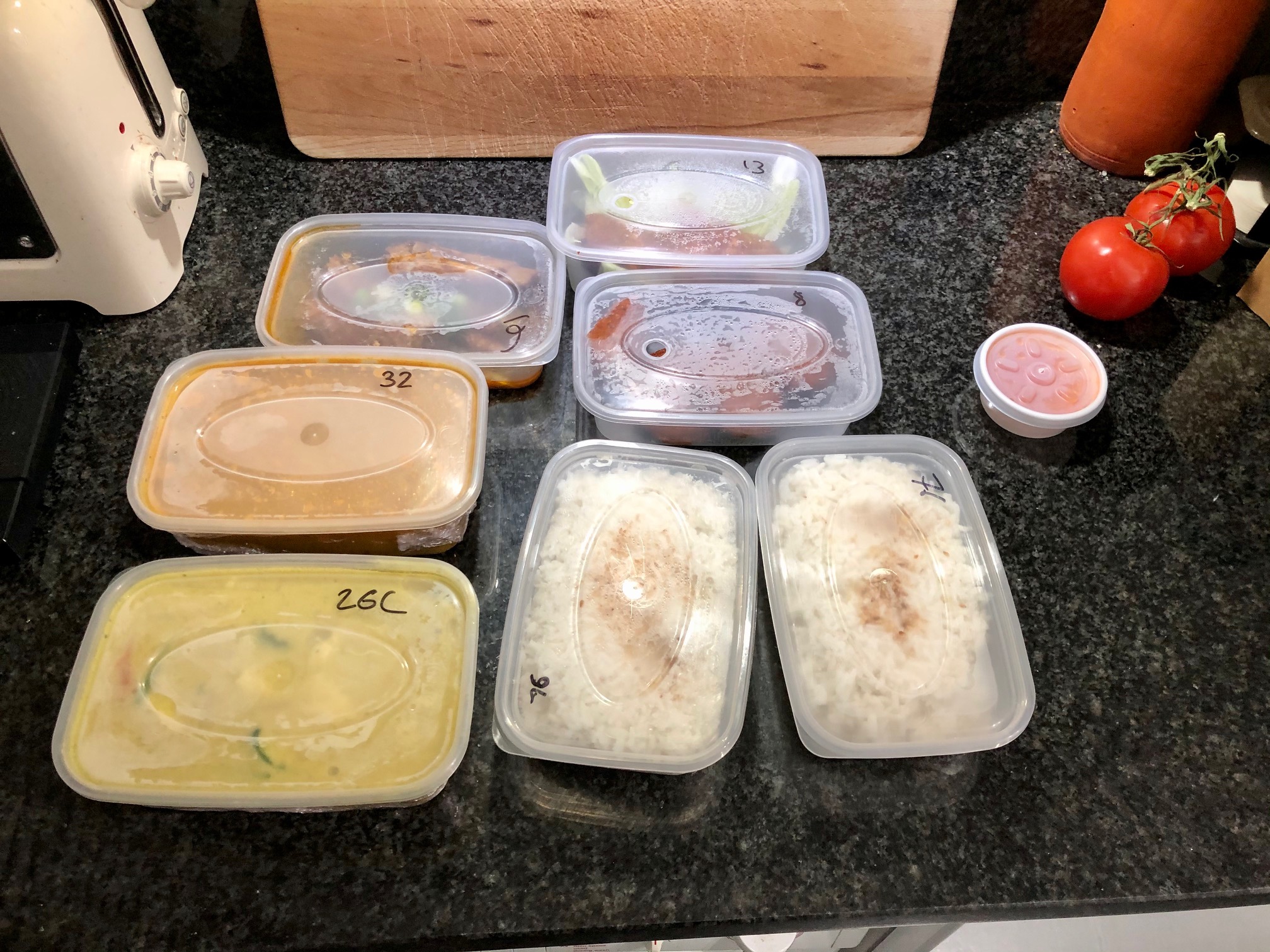
It’s no coincidence that every time I’ve ordered direct from the restaurant delivery has worked like a charm, and this was no exception. Around forty minutes after placing my order, there was a ring on the doorbell and a friendly driver handed over my branded carrier bag. Everything was perfectly hot, and everything came in recyclable plastic tubs. Another sign that Thai Table know what they’re doing with this stuff: they had put clingfilm over the tubs before snapping on the lids, just an extra precaution to prevent any disasters. It sounds like a small thing, but I appreciated the thoughtfulness, just as I loved the little slip in my bag detailing, with little infographics, all the extra steps the restaurant had taken to ensure the safety of its employees and its customers.

I reviewed Thai Table back in 2015, but one of its dishes, the massaman beef, made such an impression on me that three years later, when I published a list of Reading’s 10 must-try dishes, it made the cut. I felt it was incumbent on me to try it again, so I made a beeline for it when I placed my order. It was a ridiculously generous portion of beef, wavy-cut chunks of waxy potato and sweet onion in a glossy sauce, so much that it almost spilled over the high sides of my bowl. 

It had stuck in my memory as an indulgent, cossetting dish but actually, if anything, it was more interesting than I remembered. So of course every forkful of fragrant coconut rice soaked in that silky sauce was gorgeous, but the whole thing was shot through with star anise, giving it an extra dimension that stopped it being cloying. I thought it could do with ever so slightly more chilli heat, but it was so luxurious (and faintly soporific) that I couldn’t complain. I’d been concerned that the colossal hunks of beef bobbing in the sauce might be too tough, but every single one passed the two forks test with flying colours. And I’d forgotten how much I love coconut rice, too, right up until the moment when I took the lid off the container and that wonderful aroma rapidly came into focus.

Zoë had stayed traditional with a green chicken curry, and I was allowed a forkful (“but that’s all, I’m not sharing”). It had considerably more punch from the chilli and crunch from the bamboo shoots, and the chicken was tender, but I didn’t feel like I was missing out by sticking with my choice. It was a decent effort, and probably healthier by virtue of containing more veg (the courgettes had the same crenellations as the potato in my curry), but I would have liked it to have a little more richness and oomph. I was graciously permitted to approach the bowl again with my fork to try some of the rice and sauce – for me, always the best bit of eating Thai food – and that was enjoyable enough to make me think I might have judged it harshly.

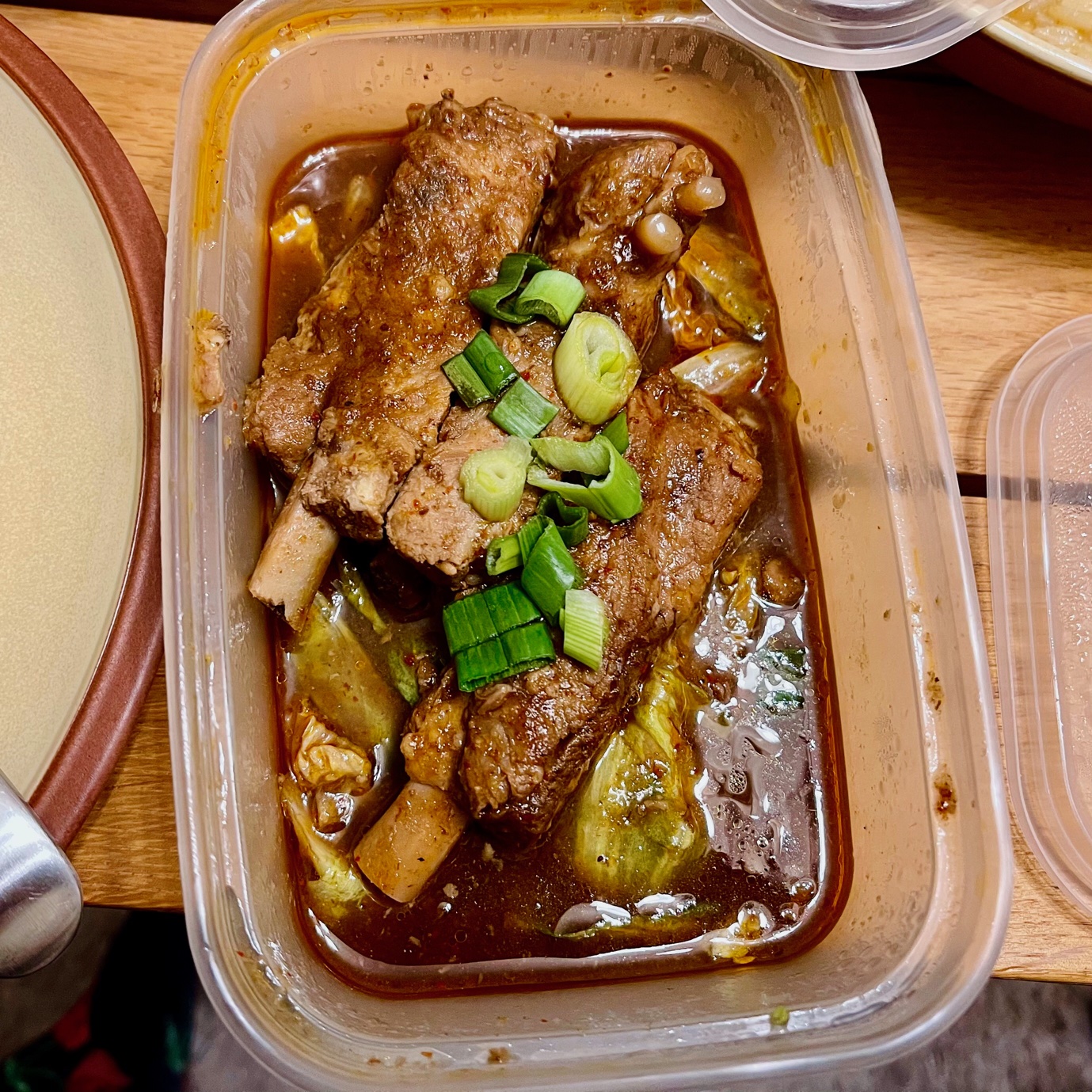
The problem with takeaways, as I’ve said before, is that it isn’t that practical to eat two separate courses – you’re bound to have one of them past its best, or kept warm when it should have been eaten there and then – so often starters find themselves promoted to side dishes, as happened here. The first of the starters was ribs, which came in a deep, dark sauce without much chilli heat but with a hint of peanut and what felt like braised lettuce swimming around at the bottom. The meat fell cleanly off the bone with three of the ribs, while the fourth was a distinctly more cartilaginous affair. 

“The ribs definitely win the starters”, said Zoë: I, saddled with that slightly gristly fourth one, was less certain. The ribs were definitely better, though, than the fish cakes. I know their slightly squeaky, rubbery texture isn’t for everyone but they really do need to be eaten piping hot for it not to be disconcerting. I like fishcakes, or at least I seem to remember that I always have, but these didn’t really do it for me.

My pick of the starters was probably the Northern Thai sausage, which was a single sausage (homemade, apparently) cut into diagonal slices. It was more fragrant than hot, with a good whack of lemongrass. I enjoyed it, although three starters definitely turned out to be a starter too many, especially with such generous mains. 

But I couldn’t help comparing it to the Thai sausage cooked up by street food traders Porco at the Blue Collar-hosted final of the UK Street Food Awards last year. That – so aromatic, coarse and perfectly spiced – was one of the most magnificent things I’d ever tasted, whereas this was slightly diminished even by its memory. But that’s Blue Collar for you: they excel at gradually making conventional restaurant food suffer by comparison, cuisine by cuisine and dish by dish. It would be easy to hold it against them, if they weren’t so good.

This week’s meal, as much as any takeaway I’ve had, has been truly educational when it comes to the difference between eating in and eating at home. Because if I had eaten this food on duty in a restaurant, in some parallel world where the pandemic never happened, I might have spent my time looking at what was missing. I might have said that the food wasn’t particularly inventive or revolutionary, or that it didn’t bowl me over. I might say, as I’ve said reviewing many Thai restaurants in and around Reading over the last seven years, that it all felt somewhat much of a muchness. 

But here’s the thing: in this world, in March 2021, I found it all really quite lovely. It’s nice, sometimes, to play it safe. It’s fun to enjoy a meal without surprises, good or bad, and to know exactly what you’re getting. In a world where so much has changed, some of it beyond recognition, it can be hugely reassuring to be reminded that not everything has. And on that Saturday night, I felt grateful that Thai Table were there, still doing what they’d always done, working their socks off (and taking all those extra precautions) so I could sit there in my comfies and be transported by the alchemy of coconut, beef and star anise. 

So there you have it – they’re not on Deliveroo or Uber Eats, they’re not gurning away on Instagram Stories, they’re not doing anything but cooking very pleasant food and driving it round to your house. If you live in their catchment area, and you fancy taking a night off juggling what’s in the fridge and the cupboards, checking your best before dates, you could do an awful lot worse than giving them a call. They probably won’t ever see this review, and they may never Tweet again, but I’m strangely delighted that they contacted me a year ago with that simple message: We’re still here. Please don’t forget about us. I’m glad, too, that I didn’t.

Thai Table
8 Church Road, Reading, RG4 7AD
0118 9471500

https://www.thaitable.co.uk
Order via: Direct with the restaurant, online or by phone