The Real Greek

The Real Greek closed in Summer 2023. I’ve left the review up for posterity.

Well, you were meant to get a review of Brewdog this week, but nothing quite went according to plan. I turned up there with Steve, a long time reader of the blog who attended my first readers’ lunch at the start of the year, and right from the off things weren’t promising. We entered the cacophonous main room and found a spare table round to the left which was just about comfortable enough. Just about.

“I wish I’d brought my glasses” said Steve. Steve is wry, wise and silver-haired, knows an awful lot about food, catering and restaurants and he’s had more jobs – and stories about them – than I’ve had hot dinners. “This is the first time I’ve ever been in a restaurant and not been able to read the menu.”

I looked at the menu, all in the sort of distressed font that hints of a typewriter ribbon on its last legs. It was all burgers and dogs and puns (“Cluck Norris”, “Soy Division”) and, I’m afraid, it induced mild to moderate weariness.

“I thought it was table service here. It was when I came here for a drink the weekend it opened, but now I’m not sure.” I said.

Minutes passed.

“I’ll go up to the bar” I said.

As luck would have it, the night I planned to review Brewdog the team from Explore Reading was there to review the drinks and the food. They had a nice booth (not jealous, not at all) and were already a few beers under way. I wondered: did that make Steve and I the Jets or the Sharks? Was Steve nifty on his feet? Should I have brought backup?

At the bar, the Explore delegation told me that there had been a mix-up in the kitchen and they wouldn’t be taking food orders for half an hour. It was already eight o’clock and that, I’m afraid, is where I decided that life was too short. I looked over at the Explore table again. These were Reading’s hip young gunslingers: one of them was in her twenties, for crying out loud. I went back to our table.

“Come on,” I said to Steve, “we’re going.”

That’s how we found ourselves walking back across town as I frantically consulted my list for a Plan B and that’s how we ended up in the Real Greek, on the Oracle Riverside. I turned up, in truth, with no great enthusiasm; I hadn’t heard brilliant reports, unless you include the countless enthusiastic – and comped – blog reviews shortly after it opened last year, back when you couldn’t get in without a reservation.

But going through the doors on a midweek evening I actually found myself thinking how nice it looked – almost like a slightly more upmarket Pizza Express, with biggish tables and handsome chairs along the outside of the room and a section of sort of open booths in the middle. I wouldn’t have fancied one of those, as they seemed to be hard benches with no visible padding. I guess the sort of people who enjoyed an evening in Brewdog might have gone for them, I found myself thinking.

Steve and I persuaded the waiter to give us a round table for three, so as to improve both our views and give us the room to order everything we wanted, and had a look through the menu. It was proper small plates territory, with a range of hot and cold meze and, if you needed some inspiration, a range of suggested set menus down the right.

So far so good, but the menu also meticulously listed the calorie count for every dish on the menu. I really wasn’t a fan of this: it’s bad enough seeing the traffic lights on ready meals in Marks, without it starting to invade restaurants. Surely restaurants were meant to be a haven where you didn’t have to put up with all that? Ironically, it put me off ordering dishes at both ends of the spectrum: I like a bit of taramasalata, but when a portion was just shy of a thousand calories? And I love octopus, but if it’s only 161 calories how much of it do you really get for £7.50?

The menu recommended three to four mezes per person, so naturally – despite my niggles about calories – we ordered nine between us: Steve may run marathons, but I just knew that he was a trencherman beneath that wiry exterior. Our waiter turned up with two cold bottles of Mythos, cracked them open simultaneously and poured them at the same time into our glasses. Like all magic tricks you can’t remember how it’s done, don’t want to and, afterwards, struggle to describe it.

“That’s nicely done, isn’t it?” said Steve, which I rather felt gave me permission to be impressed.

We chatted away about our recent holidays – Porto for Steve, Bologna for me – and the first set of dishes arrived. The other gimmick at The Real Greek is that your sharing plates arrive in a tall stack, like afternoon tea. That might be your bag, it might not: I found it irksome but it was easy to take them off the rack and spread them out on the table as nature intended. If I’d been at a smaller table for two, it might have properly got on my nerves.

We started with some of the cold mezze. Revithia, which looked like a plate of lightly bruised chick peas, were delicious, singing with lemon and mint, a beautifully fresh and bright dish. The dolmades was also very good – light, crumbly and again rich with mint, not remotely claggy or glutinous. Only the Greek flatbread disappointed. It wasn’t piping hot, and it felt like maybe it had been sitting around a little too long before coming to our table. I think if I’d realised just how unlike a dip the revithia was, we wouldn’t necessarily have ordered it, and it seemed a little cheeky to charge an extra three quid for olive oil and dukkah.

Despite that, Steve and I made our way through the whole lot, waiting to be disappointed. By the end, we realised that disappointment had not come and, for the first time, I wondered if this meal was going to outperform my expectations. The waiter brought a bottle of Greek white (Makedonikos, apparently) which was fresh, not sweet and not sharp, and tasted really quite a lot like being on holiday, as some of the best wine does.

“It’s a good atmosphere in here” said Steve, taking in our surroundings. “Everyone seems to be having a nice time.”

It’s a little point, perhaps, but Steve was right. None of the tables seemed to have the grim note of contractual obligation, nobody seemed to be there because they had vouchers or had run out of ideas. Perhaps we’d just stumbled on the place on a really auspicious evening – or perhaps it was euphoria at having escaped from Brewdog – but as I took another sip of my wine I found I was really quite enjoying myself. Steve was telling me about his small granddaughter’s quest to notch up a Michelin star a year (she made one establishment make her a dish completely off menu, which makes her sound far more fearsome than any mere reviewer), and about wife number one and job number sixteen and I thought: how lucky I am that people read the blog and want to come to dinner with me.

The rest of the dishes rather came all at once, which actually was my failing rather than the restaurant’s. It’s weird how when you’re in a chain to some extent you act like you’re in a chain, and you order like you’re in a chain. If The Real Greek had been an independent place, another Namaste Kitchen, I would have ordered some dishes, eaten them, kept the menu and then ordered some more, but because it was a chain and the menu told you how many dishes to order, I ordered them all in one go. With hindsight, that was a mistake, but it didn’t stop everything we ate being good at the very least and often far more than that.

Particular highlights from the hot mezze included the pork belly, cooked so perfectly that you could almost have mistaken it for chicken thigh, all crispy skin and layers of meat, every bit of fat rendered to nothing. Steve and I did a very English equivalent of fighting over it, which involved each of us saying “no, you have the last piece” ad infinitum. We were similarly polite over the halloumi fries, salty and light and pretty close to perfect, especially dipped in the minted yoghurt. The least successful dish was the calamari, which turned up looking so much like octopus that I worried we’d ordered the wrong thing. That wouldn’t have mattered so much, but it wasn’t quite as fresh as promised and that made it harder going than either of us would have liked. When we said “no, you have the last piece”, we actually meant it.

What else? Lamb kefta was more like a single lamb burger than a kebab or meatballs, but it was still delicious and far nicer than it looked. I felt like there was a hint of feta smuggled away in it somewhere, but that could have been a trick of the light, or the white wine slightly skewing matters. Salt cod fritters were also light and delightful, with plenty of fish, not bulked out with spuds. Again, the lemon mayonnaise that came with it was spot on.

Finally, Steve’s favourite, the loukanika: three whacking great slabs of pork and beef sausage with a deep red smoked chilli relish. I had huge reservations about this, mainly because it screamed stealth spam, but it was beautiful – coarse, firm, juicy and with just enough spice. The relish set it off perfectly. Steve liked it so much he sent me a message the next day saying that he was daydreaming about eating it again (and Steve’s one of the only people I know who can send such a message without even the faintest hint of smut).

“This is really good, isn’t it? I can’t find much wrong with it.” I said, giving away I’m afraid that I had fully expected to turn up to an Oracle Riverside chain restaurant and find shitloads of issues, and that I was a tad perplexed that I couldn’t.

“Yes, it is” said Steve. Were we having a shared hallucination? Had they put ayahuasca in our Mythos?

We pressed on with dessert, because we were having too nice an evening to want to bring it to an end. That’s as noble a reason to order dessert as any, but the decision provided probably the meal’s biggest misfire in the shape of my baklava – a big stodgy slab with no real crunch or subtlety, no layers, no sticky sweetness. What you got instead was some faintly damp pastry, and a big claggy layer of crushed nuts, and the whole thing was cold and unimpressive. You got better baklava, back in the day, eating Georgian food at the Turk’s Head and (trade secret alert) I have it on good authority that they bought theirs from Costco. Steve’s chocolate mousse cake was considerably nicer, if not remotely Greek. “Not bad” he said, between mouthfuls, “but they’ve definitely bought this in.”

Service was bright and personable from start to finish. Our waiter was Italian, which led to a long conversation about my recent holiday in Bologna (I took the lead on this), football (obviously Steve took the lead on this) and where a self-respecting Italian eats in Reading (Pepe Sale, unsurprisingly). He was very proud of the food, told us what to order next time and talked with real warmth about The Real Greek, having worked for years in the Windsor branch before transferring to Reading. No smarm, no encouraging us to post reviews on TripAdvisor, just genuine enthusiasm.

Dinner for two, not including service, came to eighty-eight pounds. Not the cheapest meal in the world, and although we probably could have ordered a couple of dishes fewer it was never going to be as cheap as living it up at Brewdog. But I had such an enjoyable meal that I really didn’t mind.

Afterwards, Steve and I compared notes. I rated the meal slightly more highly than he did, and we beetled off to the Allied Arms for a debrief, shivering under the heaters and pretending it was nearly summer. But the next day, he messaged me.

“I think I might have marked it a bit low on reflection. I think you were more on it.”

“It was really decent, wasn’t it? I’m struggling to find fault.”

“The waiter definitely contributed to the whole thing. Lovely to have someone so enthusiastic – I almost thought he was called Sandra.” Steve went on, referring to Zizzi’s legendary waitress, As Seen On TripAdvisor (“the Skripals would never have been poisoned in our branch of Zizzi”, my friend Tim once said to me, “Sandra would never have allowed it.”).

I think that exchange probably sums up the verdict on The Real Greek as well as anything. It wasn’t my first choice, I went there by accident and my expectations were firmly under control. And yet, quietly and unshowily, it did an absolutely cracking job. Irritating gimmicks, iffy bread and so-so desserts aside, we enjoyed a really tasty meal in a lovely, buzzy room. Nearly everything we had was good, much was very good and some was excellent. To my surprise, I would go back again, and I can see the appeal of gathering a group of friends and trying as much of the menu as possible. So I’d encourage you to put your reservations to one side when you read the rating at the bottom, because for a certain kind of evening – with fellow diners who play nicely – The Real Greek is as good an option as anywhere you can find in town. My only tip is to dig your heels in and order little and often: it may be a chain, but that should never stop you being independent-minded.

The Real Greek – 7.7
The Oracle, RG1 2AT
0118 9952270

http://www.therealgreek.com/reading/

Thames Lido

Click here to read a more recent review of Thames Lido, from December 2024.

Here’s something that happens quite a lot: I have friends who read the blog and some have been known to put in a request to accompany me on particular reviews. “Anyone coming with you to Taberu?” one will say, or “Next time I visit you for lunch, shall we go to Comptoir Libanais? You could write it up for your blog.”

Not that I mind: it’s nice that people take an interest, and better to be spoiled for choice with dining companions than to have to ask nicely or, worse still, beg. But some reviewing opportunities are more prized than others, and none more so than Thames Lido. It opened last year, after years of money-no-object, it-takes-as-long-as-it-takes restoration work, extensively catalogued online in a series of beautiful pictures (whatever else you might think of Thames Lido, they get social media right in a way which puts other Reading restaurants to shame).

In the run-up, there were glossy pictures and features in the broadsheets, and after it opened it received a blandly positive review in the Guardian (which described it as “just off the Reading ring road” – thanks for that). This is no surprise – the original Lido in Clifton is well-established and well-reviewed and has impeccable connections – but the overall effect is that Thames Lido is probably Reading’s first ever destination restaurant. Just don’t tell anybody it’s in Reading, is the implication, in case it puts them off.

So who to take? The decision was made for me when Kat told me, in no uncertain terms, that she was accompanying me. I said yes, because I owe Kat a favour, but she was – on paper at least – an unlikely candidate. Kat has an interesting diet which involves eating sweet and sour chicken balls in the bath, and she’s partial to a battered sausage or a Tesco all day breakfast sandwich.

“Are you sure the Lido is for you?”

“Don’t be silly, I’ve eaten at hoity-toity places before.”

The way this was said reminded me of Rizzo The Rat from Muppet Christmas Carol. Oh well, I had my angle: the irresistible force meets the immovable object, Reading’s destination restaurant meets one of Reading’s most unreconstructed diners. What could possibly go wrong?

My misgivings were exacerbated in the run-up to the visit when Kat sent me a message.

“I’ll also be packing a Gregg’s sausage roll, in case the portions are too puny” she said. “I won’t whack it out on the table or anything, don’t worry. Although, practically speaking, a Ginsters chicken and mushroom slice is more appropriate. A sausage roll doesn’t have the necessary structural integrity.”

What have I let myself in for? I thought to myself as I approached the restaurant with Kat, emergency pasty presumably stowed away in her handbag for later.

When I say “approached the restaurant” that makes it sound like an easier process than it was, on foot on a gloomy March evening. It’s a little tricky to find an entrance – down the side road without signposts or the main road without pavement? – and one of the entrances takes you in to the restaurant while the other one, the main one I suppose, takes you in to the Lido proper. Even picking the right entrance, it was a bit confusing finding our way to the restaurant (and that flair for signposting, or lack thereof, extends to the bit partway through the meal where you try to find the loo). A minor thing, I know, which only applies the first time you go, but first impressions and all that.

The restaurant itself was – as so often – a long thin room, a shape that’s mandated by its position running alongside the pool. The view was spectacular, with steam rising from the heated pool, the fetchingly retro changing booths beyond. The occasional intrepid swimmer bobbed past and, like no doubt everybody who has visited Thames Lido, I was very impressed by the quality of the restoration. It carried through into the furniture – sturdy, handsome tables, generous and roomy for two people, and the kind of chairs you could imagine settling into. It’s a high-ceilinged, airy space and thought had even been put into that, with fabric panels hanging from the ceiling to absorb noise.

If you get a table alongside the pool, that’s great. The other tables – like the one we were given – feel far less special and force one of you to forego the view and stare at the bare brick walls. We asked to move as a poolside table came available and they moved us without complaint. The menus didn’t come with us and it took a fair amount of flagging down staff before they reappeared at our table.

We started by hitting the gin menu, which is divided up on the good/better/best principle with some at £7, some at £9 and some at £11.50. Yes, you read all those right, and tonic is extra. Only two tonics are available, so you get Schweppes for £1.50 or Fever Tree for £2. That makes most of the gins more expensive than the Lido’s cocktails, and some of the gins are also very oddly priced. I was surprised, for example, to see Gin Mare, readily available in supermarkets and pubs like the Fisherman’s Cottage, on sale for £11.50. Each of the gins had modish tasting notes made up of three adjectives, although how Gordon’s tastes of “historic” is anybody’s guess.

Do I sound cross? It’s probably because I was, a little. I’ve been to lots of establishments with gin lists, from pubs to Michelin starred places, and they all make great effort to pair the gins with different mixers, different garnishes, serve them in big balloons so you can almost breathe in the botanicals. Not so at the Lido, where both gins turned up in a highball with ice and lime, nothing more. The Jinzu with Fever Tree (total cost thirteen pounds fifty) was pleasant, light, sweet and floral, but the main thing I thought with each mouthful was just how expensive it was. “Hotel prices”, murmured Kat disapprovingly. The Psychopomp Woden with Schweppes was punchier, a brutal mixture of fennel and grapefruit, and a relative snip at ten pounds fifty. You only got 125ml of Schweppes as opposed to 200ml of Fever Tree, another thing the menu neglected to mention.

The gin took a while to arrive, so we grazed on the complementary bread with olive oil. Again, I had heard great things but this was tough going – nicely seasoned but dense and heavy with no light, crispy crust, more murder weapon than appetite whetter. “I was here for the set lunch earlier in the week and the bread was so much nicer” said Kat. “It was warm, soft inside and the crust was brilliant.” I couldn’t help wondering if this was the same loaf, a few days later.

The menu managed that rare feat of being interesting and nice to look at without having anything on it that you absolutely had to order. I was expecting some kind of plea bargaining with Kat (and if they’d still had the slow cooked ox cheek in Pedro Ximenez on the menu that might have happened) but as it was, neither of us had a first choice to go into battle for. We eventually placed our orders with the waiter, a rather disengaged man who spent much of his time serving us looking around, as if hoping to speak to someone more interesting (“he’s like a really rude date” was Kat’s observation).

I was in the mood for a leisurely evening, but even so I was pleased when the starters made their way to our table. They represented the high water mark of the meal. Kat’s wood roasted asparagus with almond sauce and cecina looked like the kind of dish to provoke full-on food envy: a generous sheaf of asparagus, thinnish spears, with the almond sauce and what looked like jamon, and a hoard of toasted almonds, little grenades of flavour, hidden underneath. I assume the asparagus was very early season – although it was odd that the menu didn’t mention this – and it was terrific stuff. Kat waxed lyrical about the almond sauce, saying it was salty but with a sweet edge, in a manner which suggested I might have misjudged her after all. If I was being pedantic, I’d say that cecina is normally beef rather than ham, but that hardly detracted from how delicious the dish was.

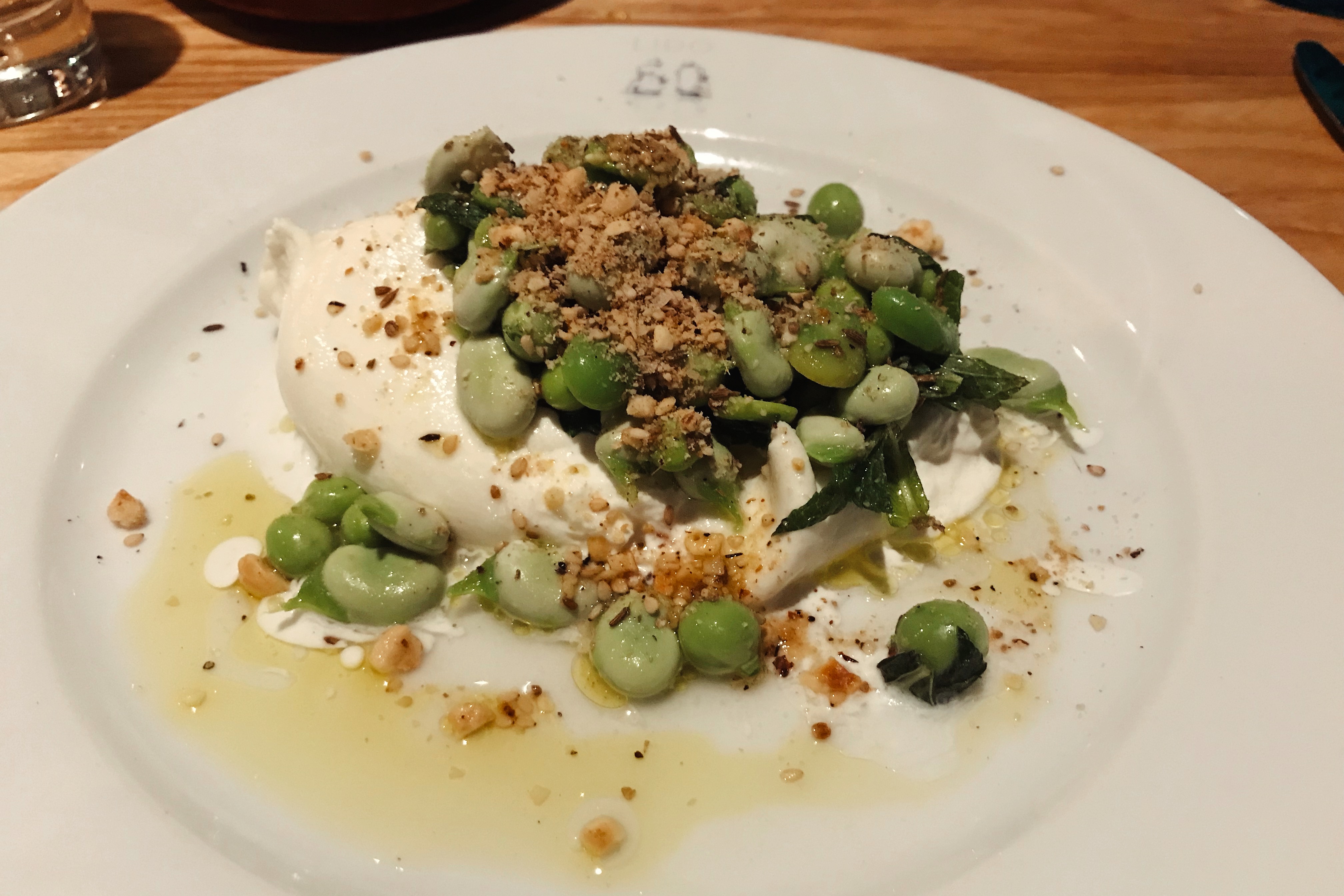
Burrata, if not as good, was still thoroughly enjoyable. Serving it with heaps of broad beans and peas, if anything, made it even cleaner and fresher, a little reminder that spring was just round the corner, even if it didn’t quite feel like it yet. A slightly funkier note was introduced with the liberal dusting of dukkah, which added spice and edge and saved the whole lot from being just a little too nice. I didn’t get the promised yuzu, but it didn’t feel like the end of the world.

Our wine arrived almost immediately after I uttered the words “do you know what, I’d really like my wine now” to Kat. The gins were nearly finished (well, you want to take your time on something that expensive), the starters had long since been dispatched and the main courses were about to turn up. It felt truly odd that the wine hadn’t materialised by that point. The waitress who brought them – and served us from that point forward – was considerably more likeable, chatty, knowledgeable and clued up than the chap we’d been talking to before, a clear reminder of the difference between being served and being looked after. We’d gone for a Jeune Musar, a pretty entry level Lebanese red at £33 (although still about a three times markup from retail price) – I liked it, it was nicely balanced and although it started out a little tannic it opened out nicely given a little time. A shame it wasn’t given more time, really.

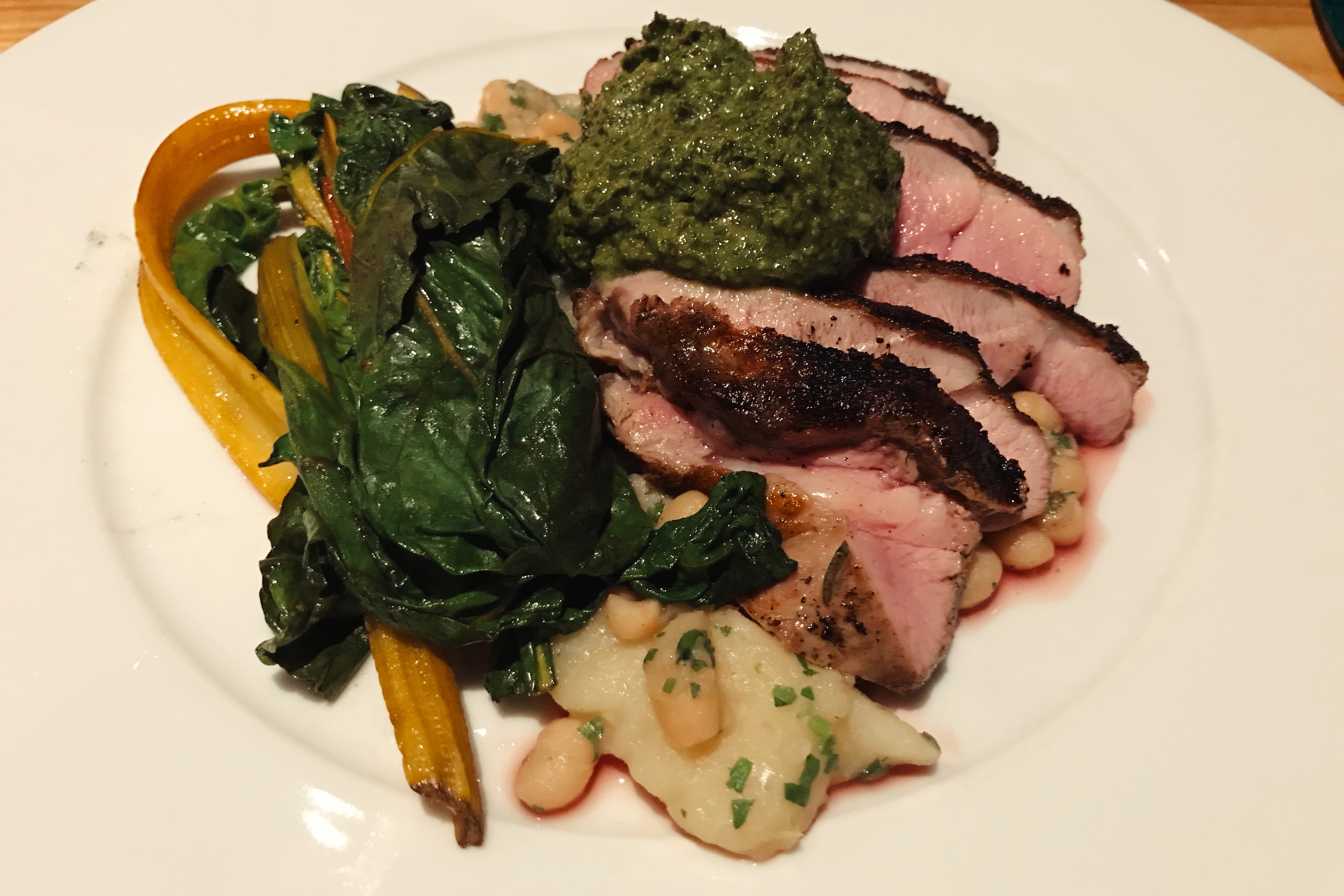
I’d gone for the lamb leg (Pyrenean, no less) and was generally pleased with my choice. The lamb was cooked beautifully – I could have stood it a little pinker, but it was close enough – with a lovely layer of fat and a beautiful salty char on the outside. The beans, some of which I think were pureed or mashed, added a nice earthiness. The salsa verde was packed with parsley and mint and absolutely made the meal; I could have eaten it with pretty much anything. Only the rainbow chard – pretty but tough going – misfired, it felt like it had been added for betterment rather than enjoyment.

Kat, on the other hand, picked the dud: hake, with mussels, celeriac and saffron broth. The fish was a nice piece but it was underseasoned, with only half the skin crispy. “It’s all a bit bland except the broth”, she said “and that just gets saltier the more you have of it”. I had a taste and couldn’t disagree. Weirder still was the marriage of chickpeas – which you’d absolutely expect in this kind of dish – and lashings of dill, which you just wouldn’t. Dill is a distinctive enough taste that you’d expect it to be mentioned in the menu, but no joy. Kat left some, and Kat – as you can probably tell from the emergency pasty – is not someone to leave food.

The side dish I really fancied – cauliflower with lemon and zata’ar – was sold out so we went for the crispy fried potatoes with rosemary and garlic. The taste was good, but the texture felt neither crispy nor fried. It was almost like someone had just lobbed them in a baking tray for half an hour, and there was certainly no evidence that they’d ever seen hot fat. I couldn’t help thinking how much better Honest’s rosemary fries were. I couldn’t even be sure these were significantly better than Café Yolk’s fried potatoes, and they came out of a packet. Again, we didn’t finish them. “If they’d actually been crispy you’d have had to fight me for them” said Kat.

The reputation of the Lido’s ice creams precedes it – they make up most of the dessert menu, after all – so it felt almost compulsory to order some to round off the meal. It’s six pounds for two scoops, and although many of the flavours were tempting Kat and I fancied the same ones so we decided to just go for it (with hindsight, the tasting flight to share would only have cost a little more and would have made a better option). They came in beautiful little bowls, and bringing each flavour in a separate bowl was a lovely little touch, because this is an area where you really don’t want to cross the streams.

Of the two, the chocolate and beer ice cream was by far the best, a clever thing where the chocolate hit you first and then the malty darkness of the Estrella “Black Coupage” snuck in at the end. The salted butter caramel I found less impressive – it seemed to lack much in the way of salt. Kat liked the caramel shards, I found them a tad unnecessary. Overall I quite liked the ice cream although I wasn’t entirely sure whether I six pounds liked it. The texture, although free of crystals, was gritty rather than smooth and maybe not quite special enough.

“It’s okay” said Kat, “but, like everything else, it feels about a couple of pounds too expensive. Also, and I know this sounds silly, my ice cream is too cold.”

“I know the way to fix that. You just wait.”

The glass of dessert wine we had with it – a Banyuls, like a slightly sweeter take on port – was terrific. Lovely, if a little pricey, and consequently both an excellent and fitting way to bring the meal to a close. Dinner for two, including an optional ten per cent service charge, came to one hundred and sixty-six pounds. It’s possible to eat for less, but even if you skipped the gin and the dessert wine it would still have clocked in at over a hundred pounds.

This has been a tricky review to write, and it’s a particularly difficult review to conclude. It can’t be denied that the Lido is a fantastic restoration project. What they’ve done with the building is amazing, it looks beautiful and it does make you feel a little prouder of Reading just to see it. And I can easily see that it’s an expensive labour of love, and those costs need to be recovered somehow – whether that’s through swimming, or massages, or packages, or through the restaurant.

I’m also aware that practically everything I’ve read about the Lido has been glowing praise, so I stick my head above the parapet with no great enthusiasm to say that, good though it is in places, it’s not quite good enough. The building has a wow factor the food can’t live up to, and everything feels just a little bit too expensive. The service didn’t match the surroundings either. Maybe it would have been different on a night where the dream team of Matt Siadatan (previously of Mya Lacarte) and James Alcock (from London Street Brasserie) were on duty, but as it was everything felt patchy. The restaurant was far from packed, but from the wayward service you’d think they were run ragged.

I might consider going again for the set lunch, and I can see that jumping off the train on a summer afternoon and having tapas at the poolside bar could be hugely enjoyable, but as a standalone restaurant it didn’t leave me in any hurry to return. “It’s a real pity, isn’t it?” said Kat. “I was hoping to find THE place in Reading, and I really thought the Lido could be that, but it isn’t.” Let’s not leave the last word to Kat though, let’s leave it to Kat’s pasty. I have it on good authority that she consumed it for a late breakfast at around half-ten the next morning. As a review of the Lido it’s a lot more succinct than what you’ve just read, but it’s as good a summary of the verdict as the number at the bottom.

Thames Lido – 6.9
Napier Road, RG1 8FR
0118 2070640

http://www.thameslido.com/

Fidget & Bob

Owners Shu and Breege sold Fidget & Bob at the end of August 2026. The new owners have kept the name, but the business may well change over time. I’ve marked this review as closed, and will be back in due course to check it out now it’s in new hands.

One of the saddest events of last year was when Tutti Frutti (Reading station’s terrific ice cream café) closed abruptly back in October. I found out while on holiday: on the Monday morning I grabbed my regular latte from Paul before jumping on the RailAir – a holiday ritual I’ve always loved – and the next thing I knew I was drinking in a plaza in Andalucia and hearing troubling reports from Blighty that Tutti Frutti was no more. They were correct; I’d had my last latte there and I hadn’t even known it. By the time I got back to Reading all the kit had been taken out; five months later, the signs still say a new store is “coming soon”.

This is why we can’t have nice things, I ranted on Twitter for what may have been a week but, to many, probably felt like longer. I was cross with Network Rail for not treating Tutti Frutti better. I was cross with our local media for not celebrating the place more (the piece they eventually ran about the closure was an apology of a thing). I was cross with the people of Reading for going to Costa or Starbucks instead, when brilliant coffee and service were a stone’s throw away.

After I’d got over it – and, I suppose, myself – I realised the truth was more complicated. There was another reason why nobody had seemed to know Tutti Frutti was there. Several other reasons, in fact: no website; limited Facebook presence and a Twitter feed which made it look like the place closed a long time ago (the last Tweet dated from June 2015). Could anybody rely solely on word of mouth in this day and age? Was it enough to expect your customers to do your advertising for you?

In my head, I composed a long (and pompous) feature, explaining where all these restaurants were going wrong. I decided it wasn’t hard to run a good Twitter feed without pouring huge amounts of time into it. Just be chatty and engaging. Follow back and reply. Tweet a few times a day at the very least. Put pictures up of your food that made people want to come in and eat it. Use hashtags. Make sure followers got an idea of the personality of your brand. Could it be that difficult?

Perhaps it was, because I struggled to think of Reading restaurants and cafés that pulled it off. Shed and the now-departed Mya Lacarte got the tone right, but couldn’t manage the frequency. Workhouse had the opposite problem. Thames Lido was good at it, but then they did it with the sort of polish that suggested that it was somebody’s Actual Job.

Nowadays it’s much easier: all I have to do is say look at Fidget & Bob’s Twitter feed, because they get this stuff right in a way many bigger establishments could learn from. They started Tweeting even before they began trading, and followers could see the establishment coming together – counters being built, dishes being tried, suppliers being chosen. By the time they opened their doors, you already felt invested in this little café/bar/restaurant out in the wilds of Kennet Island (or I did, anyway) and I wanted them to do well. Over the last couple of months they’ve built on that, to the extent where I can honestly say that without their Twitter feed I might not have hopped in my mum’s car and made the trip out of town on a cold, crisp night, the threat of impending snow hanging in the air.

Truth be told, the last time I’d visited Kennet Island was to have a colonoscopy at the Circle Hospital, so I was looking forward to something going in the right end for a change. That anatomical detail aside, I liked Kennet Island, and the piazza was incongruously nice: not Andalucia nice, perhaps, but still a surprisingly pleasant open space. I could imagine a pleasant summer afternoon sitting outside, taking in the sun. There was free parking on the square and an inviting glow coming from the windows, although the place was almost empty when we walked in.

Essentially, it was a big rectangular space with a number of tables – one large one with benches for communal dining and a number of smaller ones for groups of two or four. The furniture was all mismatched without seeming twee or quirky, and a wall was plastered with kids’ drawings. I liked the long counter and bar at the back of the room, and the industrial-but-not-pretentious light fittings. We grabbed a table by the window, feeling a little spoilt for choice.

Service, from the co-owners, was terrific from start to finish, although I hadn’t really expected anything less. I ordered a latte to warm up and a glass of wine to drink while we looked at the menu. I was told that the coffee was from Clifton Roasters in Bristol – a decision they had obviously taken time over – and it paid off, being smooth and complex. My red wine – nero d’avola – came in an attractive stemless glass and had lovely hints of smoky cherry. Fidget & Bob make no secret of buying their wine in boxes and, on this basis, it seemed like another excellent decision (also, it means they can offer 500ml carafes – how I wish more places would do this).

My mum fancied a gin and tonic and one of the co-owners talked us through the options, which included Toad, from The Oxford Artisan Distillery. She wasn’t persuaded at over five pounds for a single to see if it was as good a gin as it was an acronym, but the Plymouth and tonic went down well. Kudos to Fidget & Bob for only charging eighty pence for Fever Tree tonic, although the overall effect was slightly marred by only adding a solitary ice cube; it wasn’t that cold out there.

The menu was small and perfectly formed, in more ways than one: not only were they all small plates, but the range was on the narrow side. A few nibbles, a cheeseboard, a soup, four different “pizza” (inverted commas theirs) in two sizes and two specials, both bao, steamed buns. I could see a fair few things I fancied trying, but I couldn’t help but feel I’d end up ordering most of the menu – partly to sample a decent range, but mainly because otherwise I’d leave hungry.

I had reckoned without my mother, the woman who orders half sandwiches at Pret and has the discipline to have a couple of squares of chocolate a night (discipline, needless to say, I haven’t inherited).

“You know me, I don’t have that big an appetite.”

I cast my mind back: I was sure I could remember occasions where she’d ordered three courses in a restaurant, but try as I might, I couldn’t bring them to mind. In any case, my mum is not a woman to be trifled with. We settled for one each of the two bao and a pizza to share (small rather than large: my mum insisted, and the co-owner agreed, sagely telling us that a large would be too much). I was tempted to order a cheeseboard, too, but I decided I already knew that Fidget & Bob bought well: the question now was whether they cooked well too.

Much is made of restaurants with a “chef’s table” where you can see everything going on around you. Well, you get that experience at Fidget & Bob without having to brag about it – they go about their business chopping and steaming and topping and cooking and frying just the other side of the counter, seeming to have a lovely and companionable time as they do it. Another couple of tables were occupied by the time our food began to arrive, and I saw chicken wings arrive at another table looking, as they always do, nice enough to make me wish I could be bothered with chicken wings. A little enamel cup full of salted popcorn – a nice touch – helped the time pass until our food arrived and, not for the first time since I arrived at Fidget & Bob, I found myself thinking there really was no rush. My mother and I chatted away: despite her lack of appetite the popcorn inexplicably disappeared in no time.

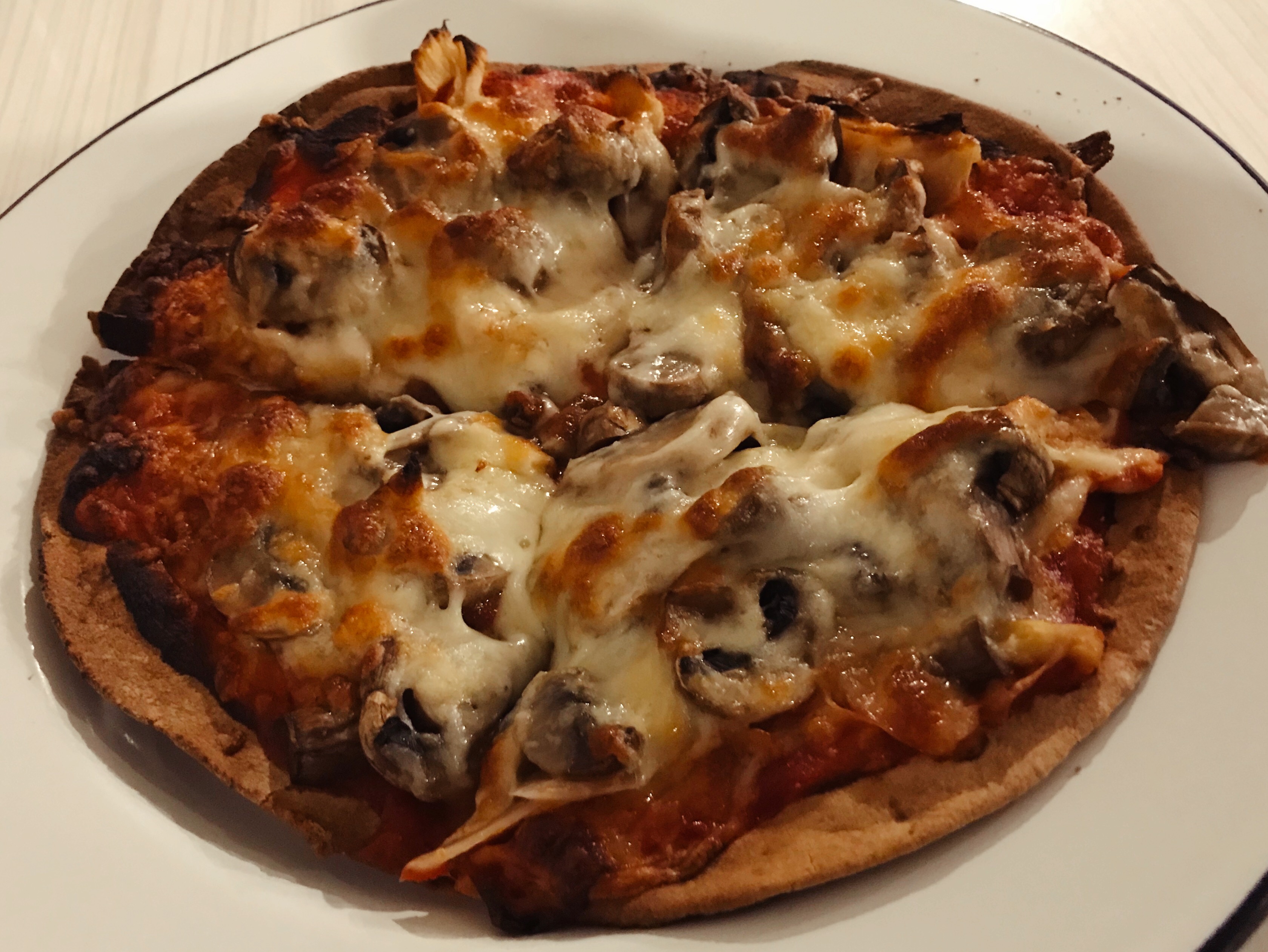
I had been dubious about Fidget & Bob’s pizzas, having seen pictures on their Twitter feed. The inverted commas were because it was served on a flatbread rather than a traditional base, and somehow that felt like a way you might cheat at home rather than cook in a restaurant. But what won me over and made me order it was another Twitter picture of onions, slow roasting in the oven, realising their sweet, golden potential. I wasn’t disappointed when my onion and mushroom pizza arrived. It may have looked makeshift, but it was very tasty and didn’t stint on mushrooms, onion or nicely bubbled cheese. Well done, too, in that you didn’t take a bite and find the whole topping sliding away as can sometimes happen. The onions had just the right sweetness, the mushrooms added a beautiful roasted nuttiness. A small pizza was dessert-plate sized and cost six pounds fifty – this felt ever so slightly on the pricey side, but that may have been god’s way of telling me I should have ordered a large one. It would have all been eaten, put it that way.

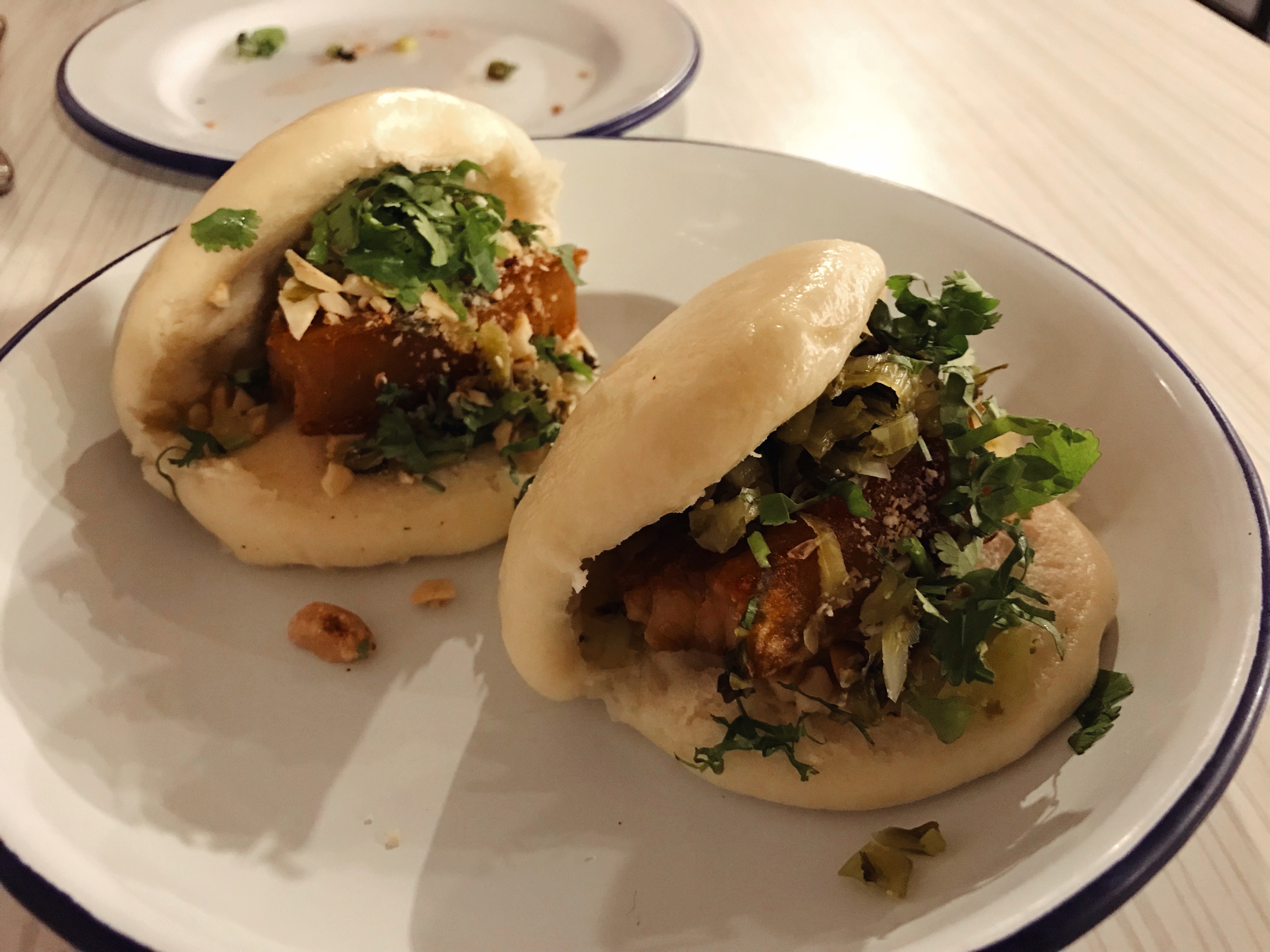
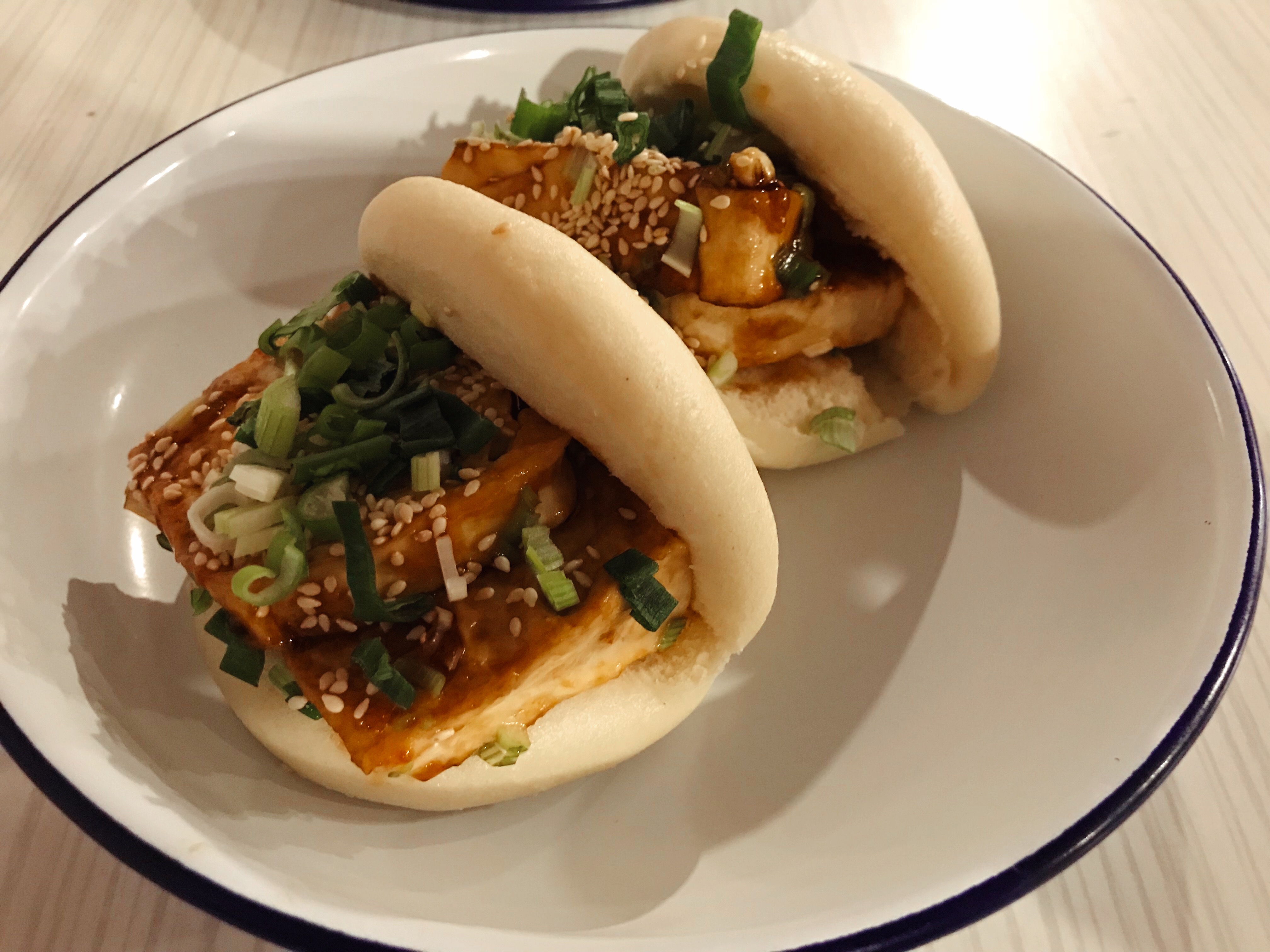
The bao were another matter. Like Fidget & Bob, I felt invested because I’d seen them assembled, gradually, from a distance. I saw the buns gradually rise in the steamer, I saw the pork belly on the pan. And when they turned up, both the pork and tofu bao, I wanted them to be great but they were near misses – good near misses, but near misses all the same. The pork belly was very well cooked with just enough crispy texture and no wobbly fat, and the chopped spring onion, coriander and peanut on top was lovely stuff. But it was too delicate, and it needed a sauce to bring it all together.

The tofu would have been superb if it had had some crispiness, but it was lacking that element which meant the whole thing was too soft and pillowy. The advertised wood ear and shiitake mushrooms were missing, replaced instead with an additional slab of tofu, and although there was oyster sauce on top it needed more. Only the scattering of sesame seeds rescued it from being just too softly spoken. I thought they needed more oomph, while my mum – who talks about having a very indelicate palate almost as it proud of it – found them bland. This is a shame, because it’s a fantastically brave and creative thing for a little café in Kennet Island to do. They were close enough to how I imagined they could be that I still fancied giving them a whirl another time.

I would have had a dessert – the “gooey chocolate croissant pudding” was calling to me – but my mum pronounced herself full (or, more precisely, only having room for a couple of squares of chocolate later) so we settled up. Dinner for two came to £35, not including tip. As we were paying we chatted to one of the owners and again, it was lovely to see her so enthusiastic about what they were building here.

“We have these charging points set up”, she said, pointing to the counter up at the window, “so that people can log in and work from the wi-fi here. We get quite a few people during the day, and you get a little stir crazy working from home.” I could imagine it would be a very nice place to take a break from a solitary day cooped up in the house, and for a moment I wished there was a place like that near me.

I think even the owners of Fidget & Bob would never pretend for a minute that they’re the finished article. In fact, to their credit, I think they probably don’t see the journey they’re on as one that has a defined end anyway. It is a lovely place, with a certain something you can’t fake or make on an assembly line which is all about love and passion. And although not all the food I had was brilliant, and some things on the menu need a bit of tinkering, I really hope they keep up the good work and that they get a loyal clientele which goes with them.

One of the big questions in my mind about Fidget & Bob was: is it good, or just Kennet Island good? I’m still not entirely sure, but put it this way: the next day I was snowed in and working from home and looking at my Twitter I saw a picture from Fidget & Bob of their chalkboard, surrounded by the snowy piazza. On it, it told people to come in and wait out of the cold for the bus into town. “No purchase necessary”, it said. And I thought: You know what? Even just reading that makes me want to come and eat with you again. Sometimes we all forget the social in social media, and eating too, done properly, is a social thing. Fidget & Bob get this so right that, even on a bitter winter’s day, it’s impossible not to warm to them.

Fidget & Bob – 7.0
The Piazza, Kennet Island, RG2 0GX
0118 931 0271

Pho

To read a more recent takeaway review of Pho, click here.

“You never go on a review with two other people, do you?” said Reggie as he, Claire and I took our seats at Pho. I’d been due to go on duty just with Reggie, but Claire and I were having a quick drink after work when Reggie came to join me and we had one of those “let’s put on the show right here” moments. Looking across at my two friends, side by side like an interview panel, I realised that they might well spend much of the evening taking the piss out of me. Oh well, at least I’d get to try more starters.

“Well, not recently. I mean, I have in the past. It’s not like I have a legion of friends to choose from.”

Reggie smiled. “Three people, I like it. It might be a bit quirky.” Reggie is a big fan of Tony Blair and, like Tony Blair, I sometimes think he’s a little too worried about his legacy. Claire did a face I recognise, where she looked like she was rolling her eyes without actually doing so: it’s a neat trick, if you can manage it. I resolved to write a review as lacking in quirks as possible: that’ll teach him, I thought.

Subscribe to continue reading

Become a paid subscriber to get access to the rest of this post and other exclusive content.

Honest Burgers

I’m no expert on Where Reading Is Going. I read our “Vision For 2050″ (which seemed to have precious little to do with Reading) and was none the wiser. I don’t understand what “Reading UK CIC”, “Living Reading” and the “Business Improvement District” actually are, or what they’ve achieved, and what with having an actual job I never get to attend cultural talks at 6pm on campus or the First Friday Club in Brown’s listening to the movers and shakers.

I’ve never been to the Reading Cultural Awards or the Pride Of Reading Awards (Danyl Johnson’s one guaranteed gig every year). I wasn’t on the bus to Tate Modern recently to join a discussion about the arts in Reading, almost exclusively peopled by Reading folk, in London. I have no idea why we keep appointing people from out of town to run our cultural events instead of our excellent home grown talent. Answers on a postcard for all of the above, please, to the usual address.

It does strike me though, in my ill-informed way, that Reading’s at a bit of a crossroads. What kind of town do we want to be? We could try to emulate somewhere like Bristol, with its blossoming cultural scene, superb market, brilliant food scene and countless independent shops. I love Bristol partly because it doesn’t try to be a lesser clone of anywhere. It ploughs its own furrow and – this is something Reading could really learn from – is fiercely proud of its culture, its history, its traditions, even the accent.

Alternatively, we could simply become Zone 8 – added to the Tube network through Crossrail, with all the London chains expanding here and all the trends eventually arriving here too, a few years after they’ve stopped being hot. With the snazzy new Westgate Centre up the road in Oxford, we finally have some local competition. We may have a Franco Manca, but they have a Pizza Pilgrims. Oh, and Oxford has a Leon and a Thali Kitchen, neither of which currently operate here. The big brains of Reading must worry about how to guarantee their supremacy (it all reminds me of the legendary Reading On Thames take on Downfall).

Where does Honest Burgers fit into that narrative? Not another chain, said some people when they announced they were coming to Reading. Not another burger restaurant, said others. But Honest is a more interesting beast than that. For a start, if it is a chain it’s a very small one – predominantly in London apart from a branch here and in Cambridge. The expansion seems slow, careful and considered rather than the result of a huge injection of capital and a relentless business plan (the way that all chains tarnish).

Subscribe to continue reading

Become a paid subscriber to get access to the rest of this post and other exclusive content.