The Eldon Arms

N.B. The Eldon Arms stopped serving food in May 2014. I’ve left the review up for posterity.

This week, not for the first time, I found myself thinking about how different the restaurant scenes are in Reading and London.

For the last few years London has been obsessed with burgers (a fixation it’s only just starting to recover from now) but Reading has never quite been gripped by burger fever in the same way. There was a slight frisson of excitement when Five Guys opened, but now it’s just part of the furniture and not even particularly full when I’ve walked past. The only people who got into the swing were one of our local papers. For a while it was a running joke that whatever restaurant it reviewed, one of the diners would order a burger – whether it was in a pub, an Italian restaurant or a brasserie. If an Indian restaurant had put a burger on the menu I expect they would have ordered it there, too (can you even imagine what that would look and taste like? I shudder to think).

Personally, I’ve never understood the appeal: a burger is all well and good, but ultimately it’s just a burger. A glorified sandwich, and by and large, I get enough of those at lunchtime not to want another one in the evening. Also, I’ve never really understood why people would order a burger in a restaurant which offers so many other things. I’ve never looked at a menu and thought You know what? I think I’ll go for the burger today. When I’m in the mood for a burger, I know that before even leaving the house.

Anyway, all this is just preamble to the surprising fact that I went to the Eldon Arms and, without ever intending to, may have ordered the best burger in Reading.

I’d heard encouraging things about the food at the Eldon Arms and remembered thinking “Really?” It’s not somewhere that’s ever stood out in my mind, a little backstreet pub tucked behind Eldon Square, a slightly scruffy old man pub which never quite had the range of drinks or the eccentricity to compete with the Retreat, or the polish to match the Abbot Cook. But I was told that it was under new management and that the food was worth a visit, so I figured a wander across town was in order.

The pub looks good – recently redecorated, it’s all clean white walls, although the furniture is still the classic pub chairs and tables that were there before. There is a good range of real ales on draught along with a couple of real ciders if you prefer still and rustic to fizzy and cold. The menu is a small affair: burgers on one side, pizzas, wraps and sandwiches on the other. I’d heard stories about the food being made from scratch and about the chef going out to get extra chickpeas from the supermarket because he’d run out of falafel (to be honest, that’s the story that made me decide to try the Eldon Arms).

This won’t be a long review, because we both had burgers and chips. So I can’t tell you whether the wraps are good, or the chicken and chorizo pizza (although I’m tempted to go back and give it a whirl). I can’t even tell you whether the falafel merited that dash to the supermarket. But I can tell you about the burgers.

Although they’re not served pink they’re delicious all the same – a healthy size without being freakishly huge, clearly decent meat, properly seasoned, hand-made in appearance. Everything about them was good quality without being faddish: no over the top brioche, just a good firm bun strong enough to stand up to its contents with what looked like a little dusting of semolina flour on top. The cheese was grated mature cheddar – I expected not to enjoy this, being a devotee of the cheap plastic orange American slice, but actually that strong flavour worked very well with the beef. The iceberg was thinly sliced, crisp rather than limp translucent ribbons of window dressing. The onion rings, tucked under the lid, were outstanding – so huge I had to take them out and eat them separately. The batter was light and crispy without being greasy, and when you bit into the ring the rest of the onion stayed in place (so often not the case, sadly, with inferior onion rings). A cheeseburger cost six pounds, and felt like good value at that price.

The other burger was the same but with pulled pork added, which cost two pounds more. Pulled pork, like beefburgers, has become devalued by its increasing popularity. M&S does pulled pork sandwiches now, a cold claggy parody of really good pulled pork. Everywhere seems to serve it with burgers nowadays and often it’s an underwhelming piece of edible bandwagon jumping. But the pulled pork at the Eldon is the real deal – slow-cooked for twenty-four hours until it’s just a mass of sticky, savoury strands in that barbecue sauce, sweet but not cloying. The menu also has a pulled pork roll which skips the beef and cheese completely and concentrates on the star of the show (and when I go back, I think I might have it).
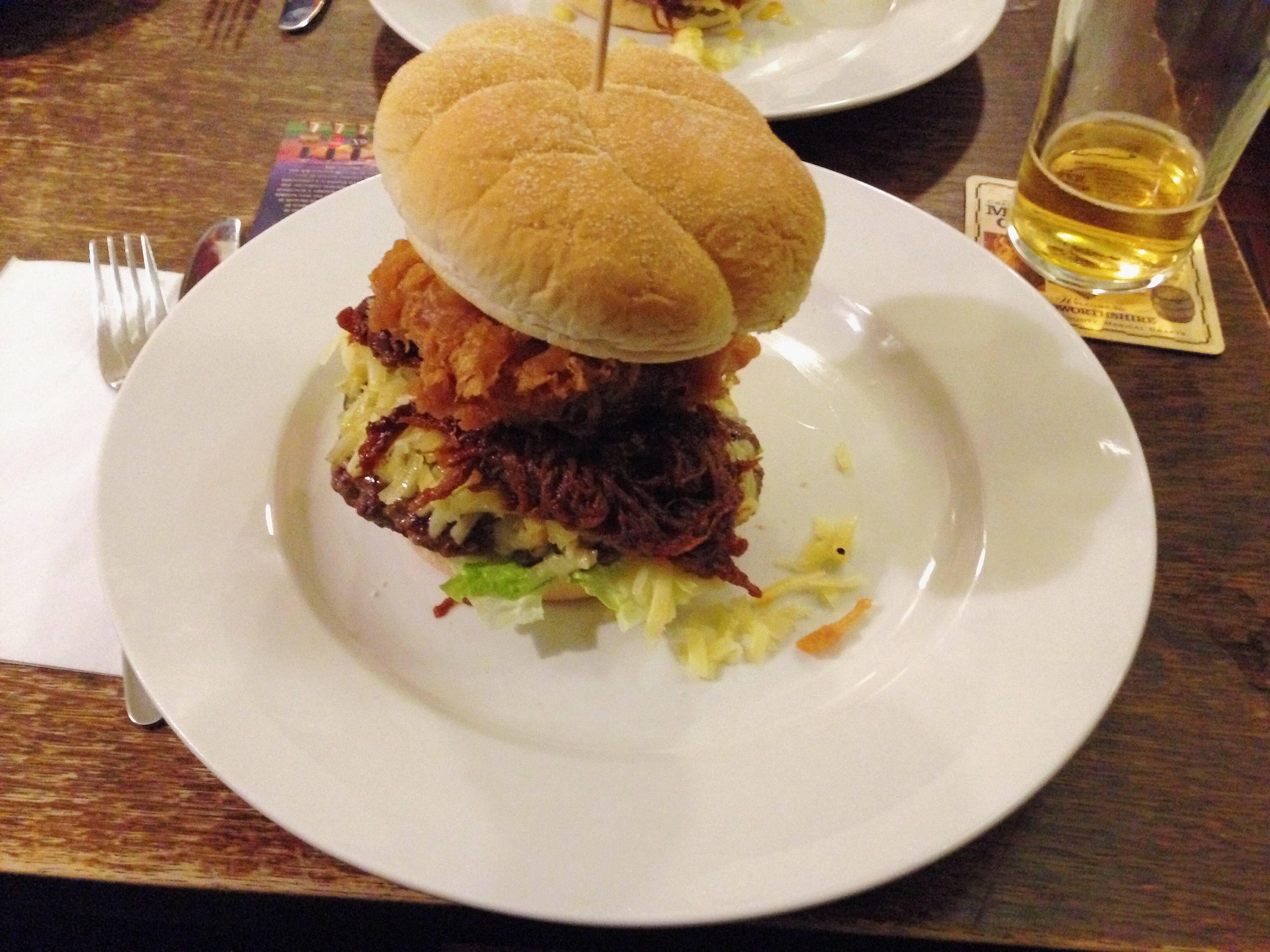
Eldon - burgerI could be critical and say that some relish or a few gherkins might have been nice, but that’s only a minor quibble with the benefit of hindsight. At the time I was eating, I can honestly say there wasn’t a single thing I’d change. And that doesn’t happen very often.

The chips also merit a mention as they are probably the best pub chips I can remember having in Reading. Chips have also been ruined by food fad after food fad: skin on, fat, skinny, “hand cut”, dusted in parmesan and covered in truffle oil like cheap perfume, chefs have put potatoes through all manner of terrible things in the name of dining trends. The Eldon just does really good chips that don’t need to sing and dance about how impressive they are: crispy where they should be, fluffy where they should be, salty and tasty and unbelievable value at two pounds for a bowl big enough to easily serve two. And I love the fact that the menu doesn’t feel the need to tell me whether they’re double cooked or triple cooked – because they’re well cooked, and that’s all I need to know. They also come with the pub’s home-made mayonnaise, which is to Hellman’s what The West Wing is to The Only Way Is Essex.

There’s no need here for the staff to overdo things but they are lovely all the same – friendly, welcoming and happy to chat. The food is served on chunky white plates with paper napkins and fuss free cutlery because this is, essentially, fuss free food, no messing about. It just happens to be bloody good fuss free food.

Two burgers, chips and a couple of pints came to twenty-four pounds, although the potential ongoing costs of returning to the Eldon Arms can’t be entirely ignored. So yes, it was just a sandwich. And yes, it’s a trend whose moment has passed, a culinary hurricane that almost missed Reading completely. Despite that, I loved this place. I said at the start of the review that I know I’m in the mood for a burger before I even leave the house, and that’s still true. But thanks to the Eldon Arms, that might be happening a lot more often – and, when it does, I know exactly where I’ll be going.

The Eldon Arms – 8.0
19 Eldon Terrace, RG1 4DX
0118 9573857
http://www.eldonarmsreading.co.uk/

The Pack Horse, Mapledurham

This week’s review was meant to be of Kei’s, the Chinese restaurant in Lower Earley. I took the bus, past streets called things like Parsley Drive and Clove Close (it must be hard to be inspired when you have to name so many streets; back in the day it was the largest housing development in Europe) and reached the restaurant only to find that we’d been given the only table left. By the door. With the spotlight overhead gone. In pitch blackness.

Were there no other tables, we asked. Apparently not. Could they do anything about it? After some shaking of heads, a waitress returned with an ineffective-looking candle that had seen better days. And I, I’m afraid to say, turned round and left. I’ve been sat at many tables so awful that I’ve asked to move, and some so bad that I’ve accepted them reluctantly and complained all night, but only one so terrible that I refused to sit there at all, and that was the one at Kei’s. It was hardly a table at all, more a badly-lit symbol of their determination to make money out of two extra diners. So never mind, Kei’s. Maybe another time.

Instead, the following night I went to the Pack Horse at Mapledurham and something very similar happened.

This time, it was the opposite problem. The spotlight was working – too well, which meant that the person in one of the seats looked like they were competing on Who Wants To Be A Millionaire? (picking a main course is difficult, but never that difficult). We asked if we could be moved. It shouldn’t have been a problem; there were loads of vacant tables for two.

“I’m sorry, those tables are reserved.” said the waitress, casually dressed in what might have been a dress or just a very long t-shirt.

“This table was reserved too. And they’re not here yet anyway. Can’t you just swap them over?”

This was apparently a very difficult question (I didn’t realise at this stage but that was the shape of things to come from the service at the Pack Horse) but after much deliberation she moved us. Our reservation was at 8, the table they swapped was at 7.30. They never turned up. The table next to us was reserved from 7, and they never turned up either. I can only imagine that some people in Mapledurham have invented a time machine, travelled into the future and read this review.

Before that it all looked promising. The Pack Horse is a gorgeous pub on the A4074, about fifteen minutes out of Reading. The main bar is all beautiful wooden beams and brass over the fireplace, snug and cosy. The wine list has a default glass size of 125ml, and everything is attractively priced, encouraging you to drink as many different things as possible. The dining room is handsome, even if the tables are a little bit too small for two. But from the moment we took our seats, nothing else went right.

We started with some rustic bread, butter and rosemary oil, although we needed to order this twice before it actually turned up. It was unremarkable – the butter was unsalted and only just soft enough to spread, the bread heavy and hard work (maybe this is what “rustic” means). Only the oil was worth the trouble – sharp, fresh and green with a good whack of flavour from the rosemary. The bread came on a board big enough that they had to remove our pointless place mats; that’s how small the table was.

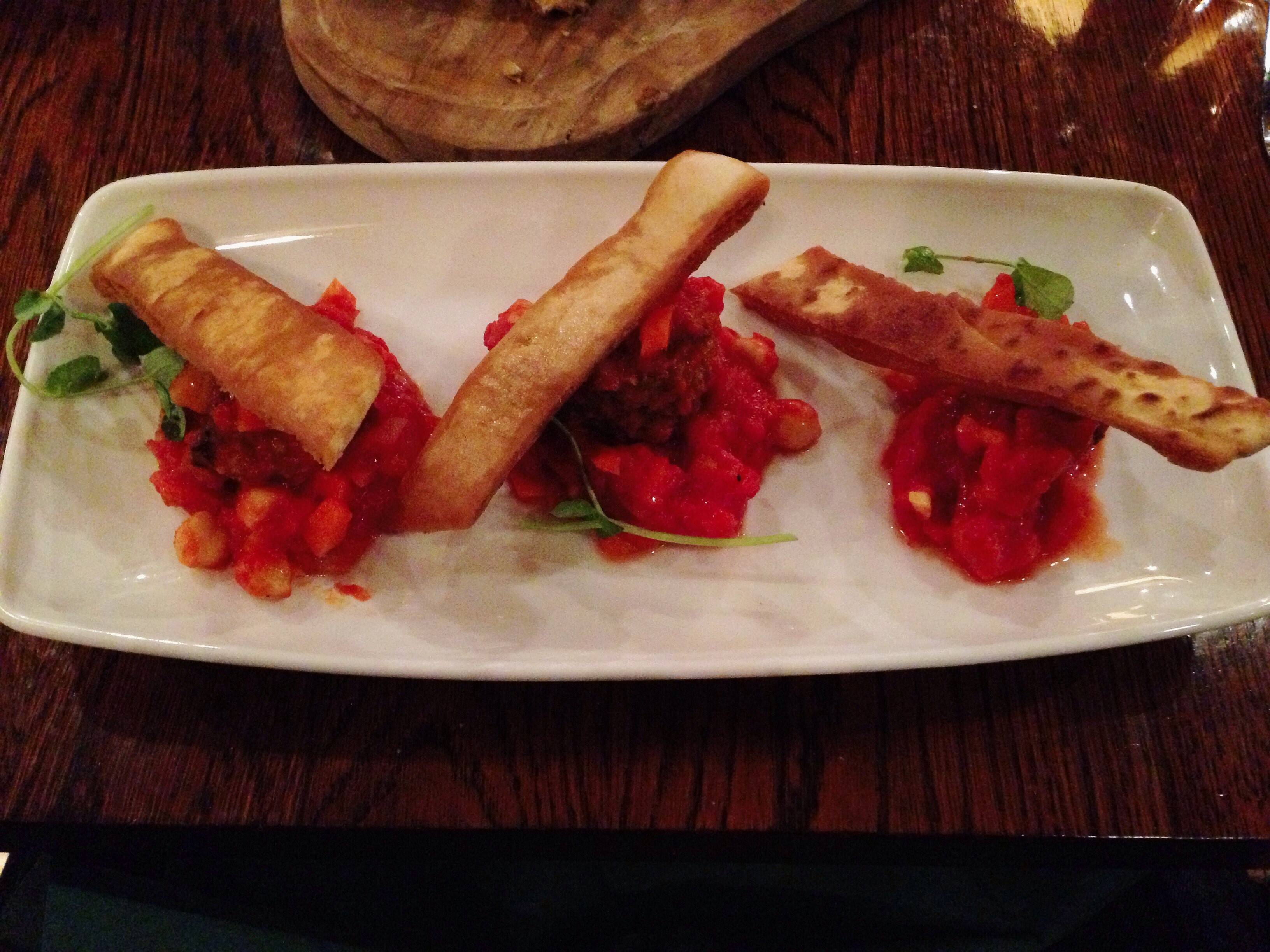
Our starters arrived about two minutes after the bread, another warning sign. What was called spiced lamb faggots with chick peas and tomato stew on the menu was a job for Trading Standards. Faggots should be big, coarse, earthy things; these were three tiny meatballs, with no spice in them. The chickpea and tomato stew was all chopped tomato and very little chick pea. I wanted a hearty bowl of food but instead I got a needlessly cheffy oblong plate with three puddles of underwhelming tomato on it, each topped with a minuscule sphere of meat-flavoured indifference. On top of each of those was a piece of deep fried pitta bread, for reasons which escape me. Worst of all, though, the whole thing was lukewarm. By the time I’d finished it, so was I.

Pack Horse - Lamb

Fig and thyme tarte tatin with goats cheese, pickled walnut, radish and pea shoot salad was equally misleading, so much so that I thought I had misread the menu. What I actually got was a goats cheese tart with a couple of big slices of pickled walnut on top. There was no thyme that I could detect, and no fig either. It was all salt and vinegar and no sweetness to offset it all (unless you count the drizzle of generic red jam around the edge of the plate: I don’t). The radish and pea shoot salad was just a nest of pea shoots, no sign of the radish. When I read the menu at the Pack Horse it was so huge that I had reservations about whether they could cook it all. It turns out they couldn’t: perhaps they had run out of some of the ingredients, or maybe the way they cook those dishes has evolved over time. The wording on the menu certainly hasn’t, though, and either way I felt short changed.

In a good restaurant, the starter makes you feel excited: I can’t wait to see what my main is like. At the Pack Horse, it was quite the opposite. I found myself wishing we’d ordered more straightforward mains, dishes a kitchen couldn’t mess up. As they took the starters away I ordered another glass of wine and we took bets on how quickly the mains would turn up; after all, everything so far had been so disappointing that surely this was the logical next step (one of us guessed five minutes, the other ten).

Our mains arrived roughly ten minutes later, both of them slouching towards mediocrity and barely getting there. The braised shoulder of lamb was like a bad cover version of kleftiko where you could make out the words but the melody was all wrong. It wasn’t quite cooked well enough or long enough, so bits of it fell apart but most of it was a struggle against wobbliness, and I do enough of that already. The rosemary jus was thin, watery and flavourless. The dauphinoise potato managed to be sinful without being any fun – all cream and no seasoning, the worst kind of empty calories. The spring vegetables had an air of supermarket stir fry about them. All in all, it was a depressing way to spend sixteen pounds – not inedible by any means, but stirring up bittersweet memories of this kind of thing done far better pretty much anywhere else.

The roasted cod with chorizo, tomato and white bean stew and basil lemon pesto dressing was equally uninspiring. The cod itself was a decent sized chunk, well cooked but also underseasoned. I was expecting the stew to be a hearty bean-filled affair but it seemed to be the twin of the tomato stew from the faggot starter, with a few small chunks of chorizo and beans added in. It had a little hint of chilli but not enough to make it interesting. On top of the cod was yet another nest of pea shoots and a single slice of chorizo, cooked until it resembled a tax disc holder. I tried to eat some, for the record, but gave it up as a bad job. There was a drizzle of pesto round the edge of the plate, cheffy style again, but it didn’t stand a chance against the chilli tomato stew so I can’t tell you if it was lemony or basilly, or if those are even real words. There was also some random fennel, so little that you couldn’t tell if it was deliberate.

Pack Horse - Cod

The final insult was twofold. First of all, they left our plates in front of us for well over ten minutes after we’d finished eating. Having to look at couple of plates with the leftovers of a disappointing meal, for that long, is almost as bad as having to eat it in the first place. We figured out that it took roughly as long to get rid of those plates as it had to bring them to our table. The irony: so quick to take our order, so quick to bring our starters, so quick to bring our mains. And yet the one time you actually want the serving staff to get their skates on they couldn’t be found for love nor money. It was the only slow element of the entire evening: from taking our seats to finishing our main courses took under an hour.

Better still, a waiter then came over with the glass of wine I’d ordered when they took our starters away. (Had you forgotten about that? You’re not alone: so had they.)

“I’m sorry, I ordered this some time ago. I don’t want it now.” I said.

The waiter put the glass of wine on the table. There was no obvious sign of a hearing aid.

“No, I’m sorry, I need to send this back.”

He shambled off with the wine glass, without saying a word. They still billed us for it, mind you, and we had to ask to get it taken off the bill. The bill, for two people, for bread, two starters, two mains and a total of five drinks, came to £63. We didn’t stay for dessert, because I had some chocolate in the fridge at home and a pretty good idea that they weren’t going to manage anything half as tasty as that. Service wasn’t included, and I didn’t tip; I think failing to tip, by and large, is deplorable but on this occasion there was literally nothing to reward. The waiting staff were there when you didn’t want them, nowhere to be seen when you did, knew little about the food and, with the exception of the literal, brought nothing to the table.

You’ll notice that I haven’t talked in detail about the wine, and there’s a reason for that: it wasn’t good enough to justify going to the Pack Horse. It wouldn’t have been even if they were selling magnums of Margaux for a tenner.

What I’ve realised, over the past six months, is that Saturday nights seem to be cursed for me. I went to Picasso on a Saturday night, and the Lobster Room, and in the Pack Horse the curse of Saturday night seems to have struck again. It’s an absolutely beautiful pub, but the menu is all wrong. They should either live up to the promise of those surroundings and cook skilful, imaginative food, or stick to a small menu of tried and tested pub classics. What they’ve done is neither: the food here isn’t actively bad, but it’s possibly even worse than that – a mediocre photocopy of good food, a menu which makes all the right noises ruined by execution which is totally out of tune.

The perfect punchline only came later when I was writing this review: I found out on the Internet that the pub used to be part of the Blubeckers chain, before they were subsumed into something called “Home Counties Pub Restaurants”. I went to a Blubeckers a few times – it was cheap, cheerful and nothing to write home about, a Harvester with ideas above its station. And yet, thinking about the meal I’d had at the Pack Horse it managed something I wouldn’t have thought possible: it made me nostalgic for Blubeckers. Any restaurant that can do that really isn’t much of a restaurant.

The Pack Horse – 5.1
Woodcote Road, Chazey Heath, Mapledurham, RG4 7UG
01189 722140

http://www.homecountiespubs.co.uk/packhorse/

Cerise

N.B. Although it’s hard to get a clear picture from the Roseate Hotel’s website, it seems that Cerise closed in early 2020 and has since reopened as The Reading Room. I will review that in due course – I reviewed their delivery offering here – but I’ve left this review up for posterity.

Cerise has been on my list to review for quite some time – mainly by reputation. And yet, in the run-up to visiting the strangest thing happened: I couldn’t find anyone who had eaten there. Everyone knew about it, of course, and some people had even had cocktails in the opulent basement bar, or a sneaky summertime glass of white in their secret garden. But the restaurant? A total blank. So I did some Googling, only to find the same thing: no reviews, not in blogs, not in guides, not in the papers. Apart from TripAdvisor, there was no evidence that anybody had been at all. I guess it’s always been awkward for them: the restaurant of the Forbury Hotel, right opposite a restaurant called Forbury’s, with the unfortunate consequence that people always think you’re talking about somewhere else. So, a restaurant everyone thinks is good but nobody has been to, the lesser-known member of Reading’s high end club. How could I resist a visit?

Actually, on arrival we spent more time in the opulent basement bar than I was expecting. Despite only two tables being seated in the whole restaurant we were asked to wait in the bar “for around ten minutes”, for reasons which weren’t made clear. We sat on the banquette, flicked through the wine list and ended up going for a Crozes Hermitages for £38. It was good, peppery and not too tannic – although given the dishes we eventually ordered, I rather wish we’d picked something more capable of standing up to them. We ended up staying there while we got the menus, read the menus, plea-bargained and made our choices, only taking our seats when they were close to serving our starters. I enjoyed that – I’m usually so wedded to the idea that you sit at the table, you give the waiter your order and you sit at the high-backed chair sipping your wine until the food arrives. It was nice to loaf, although I was still a bit incredulous that the waiting staff didn’t seat us right away.

The dining room in Cerise is in two halves – a small room along from the bar and a bigger room further through (opening out onto that secret garden I mentioned). On a quiet Monday night, they’d only opened the smaller room which can’t seat more than twenty people. I liked it – tasteful, well-lit, good chairs and nice big tables – although if I’d been at that table on a busy Saturday night I might have felt like I was sitting in a corridor. As it was, it worked well, giving the feeling of being in a smaller, more intimate place. There was bread at the table when we sat down and it was nice if not wildly exciting – two slices of granary, one of something poppy-seeded and (the most interesting) a sweeter onion bread. The butter was at the right temperature to spread, a small thing but something a depressingly large number of restaurants get wrong.

It’s a pet hate of mine when people say something is too beautiful to eat: nothing is too beautiful to eat, and if you really feel that way you should be in the Tate, not a restaurant. Having said that, the braised lamb shank terrine really was pretty – pieces of lamb, cubes of carrot, peas and big pieces of sweet leek, with another strip of leek around the outside. I did feel apprehensive about eating it, though, because I was expecting something coarser and all those chunks (such an unattractive word), bound together with jelly felt like a Damian Hirst starter at best and Pedigree Chum for poshos at worst.

All those fears dissipated with the first mouthful. Really there was very little jelly in it, just tender tasty meat and firm, fresh vegetables. The mint dressing drizzled around the perimeter was sweet and perfect and what I’d mistaken for cucumber were in fact little cubes of green waxy potato. Potato, lamb, vegetables, mint sauce… it was only by the end that I realised that what I was eating was a high end distillation of the kind of Sunday lunch enjoyed across the country every weekend. I won’t say it was deconstructed – because that’s a word nobody should see in a restaurant review – but I will say that it was delicious, which is far more important anyway.

Cerise - terrine

The crab and salmon sausage was equally delicious (although, somehow, I found myself wishing they’d called it a “boudin”, because ‘salmon sausage’ just sounds plain wrong). Whatever you called it, it was delightful once you got your head round something with the texture of a sausage and the taste of fish. It came halved and resting on a little pile of cabbage which in turn was in a pool of dill sauce, peppered with tiny cubes of carrot. The sauce had a deep, salty flavour – so different from the sometimes insipid taste of dill paired with fish. On top was a little nest of salad shoots which didn’t really add anything to the dish (they never do, in my opinion) but looked pretty just the same.

The mains were an altogether more robust affair. What was described as “roasted crown of partridge, Brussels sprout’s and saffron risotto” had a lot more going on than that – so much so, in fact, that it was almost possible to forgive the wayward apostrophe. So there was partridge – gamey, nicely cooked on the outside, if ever so slightly tough – and there was a gorgeous risotto, strands of saffron visible in it, with just enough bite in the rice. But there was also what looked like a potato croquette, and there were smoky lardons, and smudges of pea pureé and a generous and intense jus. I was really impressed by just how many things were on the plate, all done well, without it becoming incoherent or too busy. It was, however, a very rich dish, and I can easily imagine that it would defeat someone less gluttonous than me.

Cerise - partridge

The duck confit “with mixed bean and wild mushroom cassoulet, orange essence” was also not for the faint-hearted, another big bold dish. The duck itself was exactly as you’d expect duck confit to be (though personally I prefer the skin to be crispier). The cassoulet base was a beautiful jumble of beans, lardons and wild mushrooms in another gloriously savoury, expertly reduced jus, a wonderful wintry stew. As with the duck skin I would have preferred the lardons to be crispy and, as with the partridge, I did find the dish a little overwhelming towards the end. Amongst all those deep flavours the orange essence was lost to me; maybe it was overpowered, although it didn’t feel as if the dish missed it.

The side dishes, with hindsight, were a mistake. Not because they were bad – the chips were good, with the right balance of crispiness and fluffiness and the honey roasted root vegetables were even better; sweet, slightly spiced with that slightly fuzzy stickiness that comes from cooking them properly. But they weren’t needed, and maybe the waitress should have pointed that out (in fairness, we were hungry and insistent and I’m not sure we would have taken no for an answer). Even so, service just wasn’t like that. I was surprised that it didn’t quite match up to the food – the waitress was polite and pleasant but her English didn’t seem brilliant and it didn’t feel like she knew her way round the menu. That side of the experience wasn’t as polished as you might expect, given everything the restaurant had got right.

I was nearly too full for dessert, but in the end the prospect of brown bread parfait, with caramelised pears and peanut brittle was too tempting to resist. Again, that spare description didn’t quite do it justice: the parfait was in a cylinder, the outside studded with tiny nuggets of peanut brittle. The caramelised pear was terrific, served in an espresso cup with a buttery crumble topping. But the thick toffee sauce alongside the parfait was what made it special – rich, decadent, thoroughly wicked (much, I like to think, like most of the people checking into the hotel upstairs).

Pricing at Cerise is remarkably consistent – most of the starters hover around the ten pound mark, most of the mains are twenty pounds and all the desserts are just under a tenner. The bill was £110 for two and a half courses each, two side dishes we really should have gone without and a bottle of very nice wine. I know that’s a lot, but I didn’t leave feeling cheated.

Special occasion prices, then. But was the food special occasion quality? I think, on balance, the answer to that is yes. The room could be a little nicer, the service needs to be a little more impressive but the food makes up for much of that. The word that keeps jumping out of the review is “rich” and I think that does it justice. It’s properly indulgent, over the top, powerful food – not too clever, but just clever enough to feel slightly different – and for that kind of meal, I can’t think of anywhere in Reading that offers anything similar. I can see myself going again – more readily than I can see myself going back to London Street Brasserie or Forbury’s – but I can also see myself not eating much the lunchtime before and rushing home afterwards to undo the top button on my jeans. But everyone needs a meal like that from time to time. Don’t they?

Cerise – 7.9
The Forbury Hotel, 26 The Forbury, RG1 3EJ
0118 9527770

http://www.theforburyhotel.co.uk/dine/cerise

The Bull On Bell Street, Henley

Regular readers (hello!) may recall that there’s very little I like more than a proper old pub, one of the many things Britain does exceptionally well. In fact, one of the only things I like more than a proper old pub is a proper old pub that does brilliant food. Berkshire has lots of these, tucked away in little hamlets, scattered away from the centre of Reading like electrons orbiting a nucleus, but every now and again you find one tucked away in a town centre too.

I had high hopes for The Bull On Bell Street, in the middle of Henley, when I chanced upon it last year. I’d stopped in there one Saturday for a decadent mid-afternoon snifter and been wowed by it; the refurbishment had been extremely tastefully done (all comfy old chairs and lashings of Farrow and Ball), the list of wines by the glass was very tempting and the wintry waft of woodsmoke was wonderful. I wanted to curl up in a chair with a good book (or, better still, a trashy one) and never leave, and I made a mental note to come back and try the food another time. And so, a weeknight in January, shortly after the payday that had felt so long in coming, I did.

We wound our way through the bar to the restaurant area at the back, and in doing so marvelled at the sheer size of the pub. It’s made up of two or three generously sized rooms which comprise the bar, but the two rooms at the back for dining were also both really big with beautiful tiled floors. The whole thing looked a bit like a posher, less tired Hotel Du Vin – nicely spaced tables on the right, appealing looking booths on the left, attractively lit with plush banquettes. We took one of those and the waitress handed us the suitably rustic looking menus (printed on rough brown paper, a restaurant cliché which has taken a surprisingly long time to reach us from London). She also brought some bread (with butter, sadly still hard from the fridge, and some oil and balsamic glaze) and tap water (in a nice big jug with a sprig of mint and a slice of lemon) without being asked, which I thought was a nice touch.

The menu was also promising. It wasn’t too big that you doubted their ability to cook it all, or so small that you felt hemmed in and without choice. I know you only need to find one dish to eat on a menu to make a place worth a visit but it’s one area where it’s nice to have difficult choices and both of us had trouble narrowing each course down from three or four likely candidates.

First things first, though: we ordered some wine from the list I’d found so appealing on my previous visit. Because one of us was driving we were limited to wines by the glass but, even so, the choices were good. The South African cabernet merlot was soft and eminently drinkable (if not the most complex red in the world) but the Chilean sauvignon blanc was lovely – zesty and very slightly sweet with hints of peach (it reminded me of a viognier, one of my favourite whites). Neither of them cost more than a fiver.

If you stopped reading there, you’d probably reach the conclusion that I’d had a fantastic evening. And, if I’d left the restaurant after the wine, I probably would have done. Regrettably though, however nice your furniture or tasty your wine, a restaurant stands or falls on its food and – for all the superficially promising signs – food turned out not to be the Bull’s strong suit.

The starters were both squarely on the border between underwhelming and downright disappointing. The “smoked haddock pot, rosemary and garlic” was not at all what I expected. I thought it was going to be a type of potted haddock affair, all butter and spices. Instead, I got a miniature fisherman’s pie, with a thick layer of haddock, mashed potato and a cheesy topping. There was no sign of rosemary or garlic anywhere, or indeed any seasoning. Or flavour, save for the smokiness of the haddock. The board (it’s always on a board these days, isn’t it?) had a little white jug with a cream coloured sauce in it. I dipped the tines of my fork in to try and taste it and it tasted of nothing. When I asked the waitress to remind me what it was she revealed it to be “butter sauce”. No sign of the rosemary or garlic there, either, more beurre blank than beurre blanc. It was almost too bland to criticise – a fitting accompaniment to the Mumford And Sons, Coldplay and Adele being pumped through the speakers at a volume I wasn’t personally happy with (although, in my case, that’s any volume above “muted”).

Haddock pot

The other starter was described as “smoked duck ragu” but, when it arrived, betrayed the delicious promise of those three words. I’m not sure how it could be described as a ragu: no tomato, no finely chopped meat, no glorious sticky consistency. Instead, it was pasta, slices of smoked duck, some kind of bland jus and some finely diced courgettes. It was simultaneously exactly the sum of its parts and miles, miles less than that. When I’d asked the waitress told me the pasta was pappardelle and maybe some of it was meant to be, but some of it was definitely tagliatelle. To avoid any complications which might have been caused by the varying widths, all of it had been boiled into flaccid submission. I’d never really considered having smoked duck in pasta before my meal at the Bull, and I can confidently say that thanks to the kitchen there I never will again.

Duck

The mains were no better. “Pan fried chicken breast, parsnip mash potato, St James cabbage, cauliflower cheese and cream chicken sauce” was pretty much exactly that. The chicken (as you can see from my picture) was massive – I think it had been working out – with a limp skin and no signs of any seasoning. The cabbage was nicely cooked, in fairness, and did indeed have creamy sauce but it didn’t taste of chicken. I’m not sure the chicken did either. The parsnip mash potato was bland and lumpy, neither mashed nor containing any discernible parsnip. All in all, the overall effect was that of eating average food with a heavy cold: nothing tasted of anything.

I should exempt the cauliflower cheese from that criticism, because it was terrific – the cauliflower cooked but still firm, the sauce rich and cheesy with a delicious slightly chewy crust on the top. But it wasn’t enough to redeem such a forgettable dish. I didn’t finish it: there didn’t seem any point, when every mouthful was the culinary equivalent of the One Show.

Chicken

The other dish sounded interesting: seared salmon with roasted fennel, chestnut mushroom, salt baked celeriac and watercress. What turned up, as so often that evening, was anything but. It takes real skill to cook salmon so it’s still slightly pink but the skin is salty and crispy, and on this evidence it’s skill that the Bull’s kitchen just doesn’t possess. Again, there was no real sign of seasoning at all. But worse still, the vegetables were woeful. I did catch a bit of mushroom, and a plenty of watercress, and some celery – quite a lot of celery, in fact – but the salt baked celeriac and fennel were harder to find. I got an occasional sliver of celeriac, a momentary flash of fennel, but in reality it was almost as if the kitchen had put just enough of each in there to tantalise you with what the dish could have tasted like if it had been done properly. Again there was no sauce, no flavour, nothing to excite any palate. I’m a long way from the best cook in the world, but if I wanted a badly cooked salmon steak on top of an indifferent underseasoned stir fry even I could knock that up at home, and it would cost a lot less than fifteen pounds.

“Shall I bring you the dessert menu?” said the waitress, taking away the two plates and scrupulously failing to notice how much food was left.

“No thanks, we’ll just get the bill.”

This was not queried, which sums up the service in general. Our waitress was pleasant enough, although she got increasingly brusque as the restaurant got more and more busy; the place was packed, especially for a Tuesday night (I can only assume most of the diners had heavy colds already). She was however very robotic, something I only noticed when I saw another waiter serving the table opposite us; he seemed to understand what the dishes were and how to sell them, whereas she was just reading off a shopping list. Her lack of enthusiasm made a lot more sense once I’d eaten the food, but by then it was too late. Two courses for two people, including one glass of wine each, cost us fifty-six pounds and two hours of my life.

I’m cross that I went to the Bull. I’m cross that I left Reading for such a nothingy meal, and disappointed with myself for picking so badly – because ultimately, reviewing somewhere out of town that isn’t worth going to is almost like no review at all. If I review a restaurant in Reading and say it’s good, maybe you’ll go. If I say it’s bad, perhaps you’ll stay away. But a bad restaurant in Henley? Effectively I’m telling you not to go somewhere that you probably wouldn’t have visited anyway, and this review is all any of us have to show for it. Never mind, I’ll learn from this so as to serve you better: next time I won’t be taken in by beautiful pubs with new paint jobs, and I’ll remember that if a kitchen doesn’t know how to season its food then the whole place is simply not worth its salt.

The Bull On Bell Street – 5.3
57-59 Bell Street, Henley-on-Thames, RG9 2BA
01491 576554

http://www.bullonbell.co.uk/home