Restaurant review: Arbequina, Oxford

Late last Saturday morning I was sitting outside Missing Bean on Turl Street with my great friend Jerry, drinking a gorgeous latte in the summer sun, about to tuck into a pain au chocolat with impeccable lamination; I remember thinking that, on a day like that, there felt like no better place to be than Oxford in the sunshine. The train up from Reading had been packed, and we’d stood in the vestibule making conversation with our fellow captives, two young polite Swedes with perfect teeth and an Australian who had fought her way there to the loo and, realising how spacious it was, was tempted to lock herself in there for the rest of the trip.

And when we got to Oxford – well, it was a Saturday in August and the weather was fine, so naturally the city was packed. A curious blend, throngs of tourists swarming round Radcliffe Square, the Bodleian and the Covered Market but also packs of graduands, in their gowns, on their way to the Sheldonian Theatre for their final rite of passage. The Oxford year isn’t like the calendar year and this all happened on the very outskirts of it – one academic year ended, another not quite ready to begin, the city reclaimed by residents before the whole thing started again in October.

Nonetheless, from where we were sitting the view was gorgeous, the food and drink were excellent and the people watching was close to unparalleled. I’d asked Jerry if he was free on the off chance at very short notice and had been delighted that he was, and at this point we were barely an hour into what would turn out to be another effortless nine hour chinwag, punctuated by this walk or that, this spot of shopping or another, lunch, coffee, beer garden, train home. Even at the start of the day, I knew it would be a good one: with Jerry, it always was.

But would it be a good lunch? I’d thought carefully about this, because although I always have a wonderful time with Jerry when he joins me for a review I cannot say, hand on heart, that we usually have a good meal. I’m not saying that he’s a jinx, far from it, but I feel guilty that he’s joined me for some of the most middling meals I’ve had for the blog in the last few years. He was the person I took to Zia Lucia for pizza that was nothing more than pleasant, and then he also came with me to Maidenhead’s Storia for much the same experience.

Then to cap it all, the last time we lunched it was in Oxford – at Gee’s, where £200 got you a lot of disappointment. Because Jerry is so lovely, he never resents us marring our time together with mediocre food, which makes him a far better person than me. But I still feel bad about it, and I decided after that lunch in Gee’s that Jerry, more than anyone who comes out on duty with me, deserved a nice one. But where to take him?

The thing is, places I review for the blog probably fall into three categories. There are the ones I expect in advance will be good: these are more likely to happen in places like Oxford, London or Bristol that support a large and thriving restaurant scene. And then there are the places I merely hope will be good, and that hope can run the whole spectrum from reckless optimism to wishful thinking. Don’t get me wrong: I always hope for the best but sometimes, especially in Reading, that hope can border on the blinkered or forlorn.

Originally I was going to take Jerry to the Chester Arms, out off the Iffley Road, which falls into the first category. It’s famous for one thing and one thing only – its enormous steak platter, which comes groaning with handmade chips, cabbage and streaky bacon and béarnaise sauce, which they have been serving up for over fifteen years. I’ve heard about it so many times but never managed to make it there, but as we were deciding where to go Jerry dropped the bombshell: he’d just had a dental implant, so needed something a little less taxing on the molars. Would I mind if we went somewhere else?

So the subject of this week’s review falls into the rarer third category: places I have been, that I remember liking, where the mixture of hope and expectation is more of a balancing act. You don’t so much expect they’ll be good, you more hope that they’re as good as you remember. And Arbequina, the tapas restaurant down the Cowley Road, definitely falls into that category. It’s been there nine years, very much blazing the trail in that part of Oxford, and after getting a rave review in the Guardian the year after it opened it’s stayed out of the limelight, even though it’s one of only two Oxford restaurants to be mentioned in the Michelin guide.

It’s quietly done its thing. No cookbook, no appearance on Saturday Kitchen or Great British Menu, just keeping going and keeping afloat. Growth has been steady and incremental: first it expanded into the neighbouring unit four years ago and then, earlier this year, it announced that it was crowdfunding to open a second site in Oxford’s Covered Market, The council had approached them with an offer – not something that would ever happen here in Reading – and so far the crowdfunder is just over half the way there, with the restaurant still hoping to open the new site later this year.

So yes, Arbequina has history. And I have history with it too, because I’ve been eating there, on and off, for the last eight years or more. Plenty pre-COVID, when I always adored it, but only once, for some reason, since the pandemic ended. That was three and a half years ago, and it sowed seeds of doubt that maybe Arbequina wasn’t the restaurant it used to be. But I should have checked in on it long before now, and ambling across Magdalen Bridge with Jerry, in good time for our lunch reservation, I found myself getting excited about a reunion with somewhere that used to be one of my favourite places.

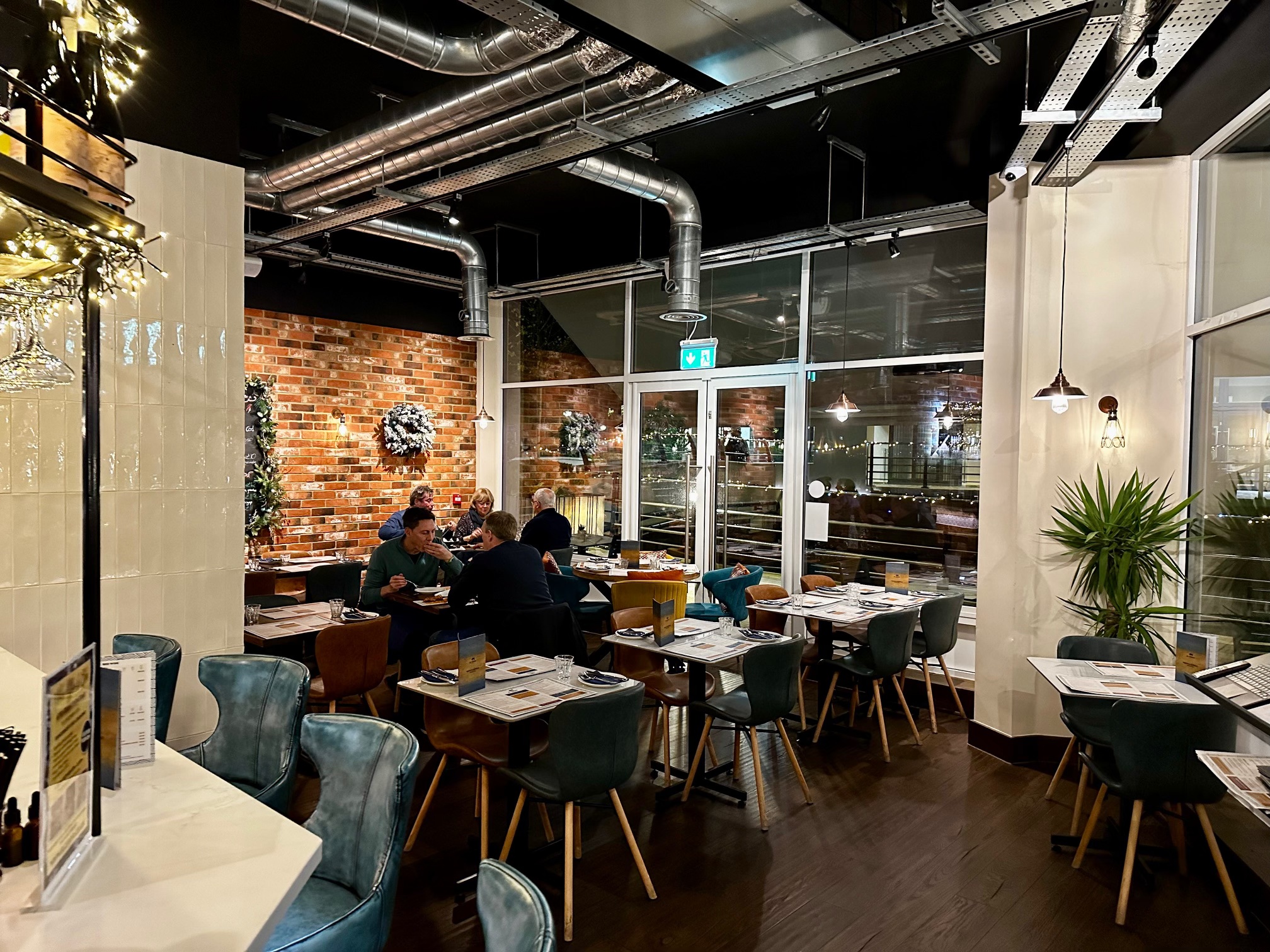
It’s in the fun part of the Cowley Road, past the restaurants Florence Pugh’s dad used to own, past Spiced Roots, but just before brilliant café Peloton Espresso, or Truck Records, or – far further up – the turning into the food enclave of Magdalen Road. It’s a lovely site that has kept the old shop fronts from the chemist and watchmaker who used to trade there, the tasteful writing in orange sans serif on the glass the only sign of Arbequina’s name. The room inside is lovely, with unpretentious decor, a handful of tables, both low and high, and a long zinc bar where you can sit and watch all the work in the very small open kitchen.

But it was a Saturday in August, and the awning was out, and neither of us could think of anything finer than sitting out on the pavement watching the Cowley Road live and breathe, so we did exactly that. I ordered a rebujito from their cocktail menu – a drink I grew to love in lockdown but which I had for the first time at Arbequina, rather than in Andulusia – and Jerry joined me. It was fresh and zippy, a harmonious blend of the lemon, mint and that savoury note of fino.

The other thing we had right from the off, while we made up our minds about the rest, was Arbequina’s tortilla. I remembered it well enough to know that you simply had to order it, and I also knew from repeated personal experience that sharing a slice felt like a good idea right up to the point where it turned up and you could only eat half of it. So I insisted that we got a couple, and Jerry agreed – partly because he’s just a very agreeable cove and partly because I sold it as about as kind on his teeth as it’s possible to get.

But ‘kind’ undersells it, because it’s a positively indulgent treat and, however good anything else you eat at Arbequina might be, it always sets the standard for other dishes to beat. I had forgotten, over the last three and a bit years, just how good it is, but it was magnificent: so soft, only just structured on the outside and a glorious mess within.

Egg, potato, onions, thyme – that’s all there is to it, but of course that’s a hopelessly reductive way to describe a masterpiece. Jerry did better, dubbing it sumptuous. Why do I never use that word in reviews? Maybe I was waiting for this dish.

Because you could have tortilla in dozens of places, in Spain and in this country, and not approach the brilliance of this. Every forkful but the last was wonderful, and the last was wonderful yet heartbreaking. But I knew that at least not sharing it meant that last forkful took longer to arrive. It was so sweet, so exquisite that I thought I tasted things in it – maybe nutmeg, maybe cinnamon – that weren’t there.

When Ben, the manager who looked after us that day, took our empty dishes away he explained that there really was nothing else in there. The sweetness came from the onions, which were cooked for a mind-blowing twelve hours. When Jerry heard that he said “I don’t envy your gas bill” and the manager smiled. Jerry had accidentally hit on one of the reasons hospitality is so thankless right now, and he meant no harm by it.

That tortilla under our belts, it was time to take a serious look at the menu and plan our assault on it. Many of the dishes I remembered from previous visits – chicken thighs with romesco, or toast thickly spread with ‘nduja and honey – were no longer there, but the menu still read nicely. Just shy of twenty dishes, most of them at or adjacent to a tenner: only one approaching twenty quid and a last, Iberico tenderloin to share, closer to forty.

It didn’t break into sections, or flow quite the way that the menu at, say, RAGÙ did, but it had plenty of potential and so Jerry and I did what I’d done countless times before – made a list of things we definitely wanted to eat, broke it up into waves and decided to order and graze, little and often. And along with that we had a gorgeous white, an Asturian albariño blend with a certain bracing saline quality: I’d chosen it for no other reason than that I’m on holiday in Asturia soon, and fancied getting a sneak preview.

My verdict? Roll on next month. At £45 it was the most expensive white on a very compact list – four reds and four whites, mostly from Spain, and a bigger selection of natural wines from all over. But the markup was far from harsh, because I reckon it would cost you about £20 retail.

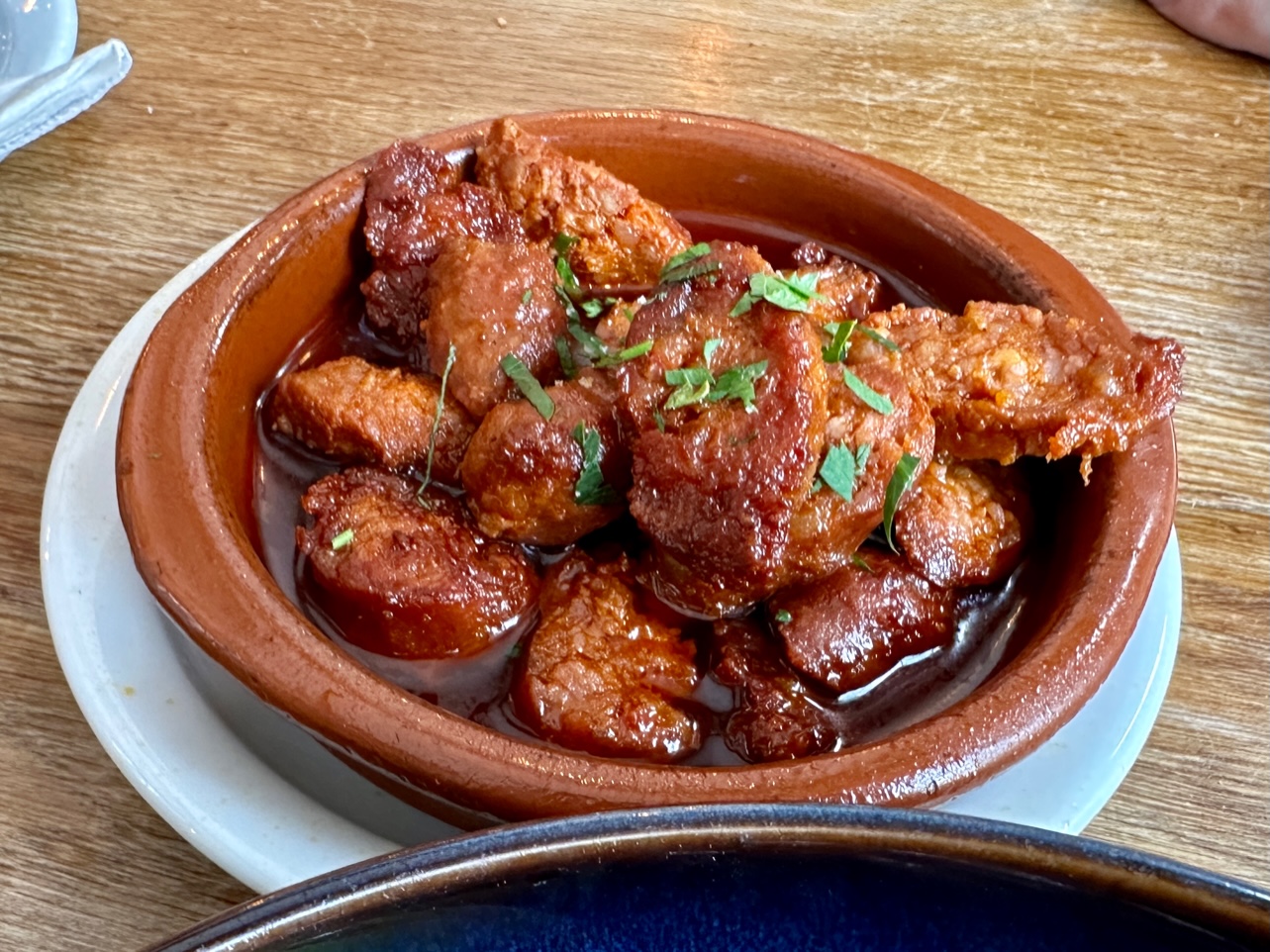
Sometimes things can be delicious because they’re simple, and Arbequina’s chorizo was a classic example. Sliced lengthways and cooked on the plancha until the outsides were caramelised and blackened, it was superlative stuff. Not cooked in wine or cider, not sliced and fancified, just cooked and served. I’d love to know where Arbequina buys it – it’s certainly not Brindisa, because theirs can be a bouncy horror compared to this.
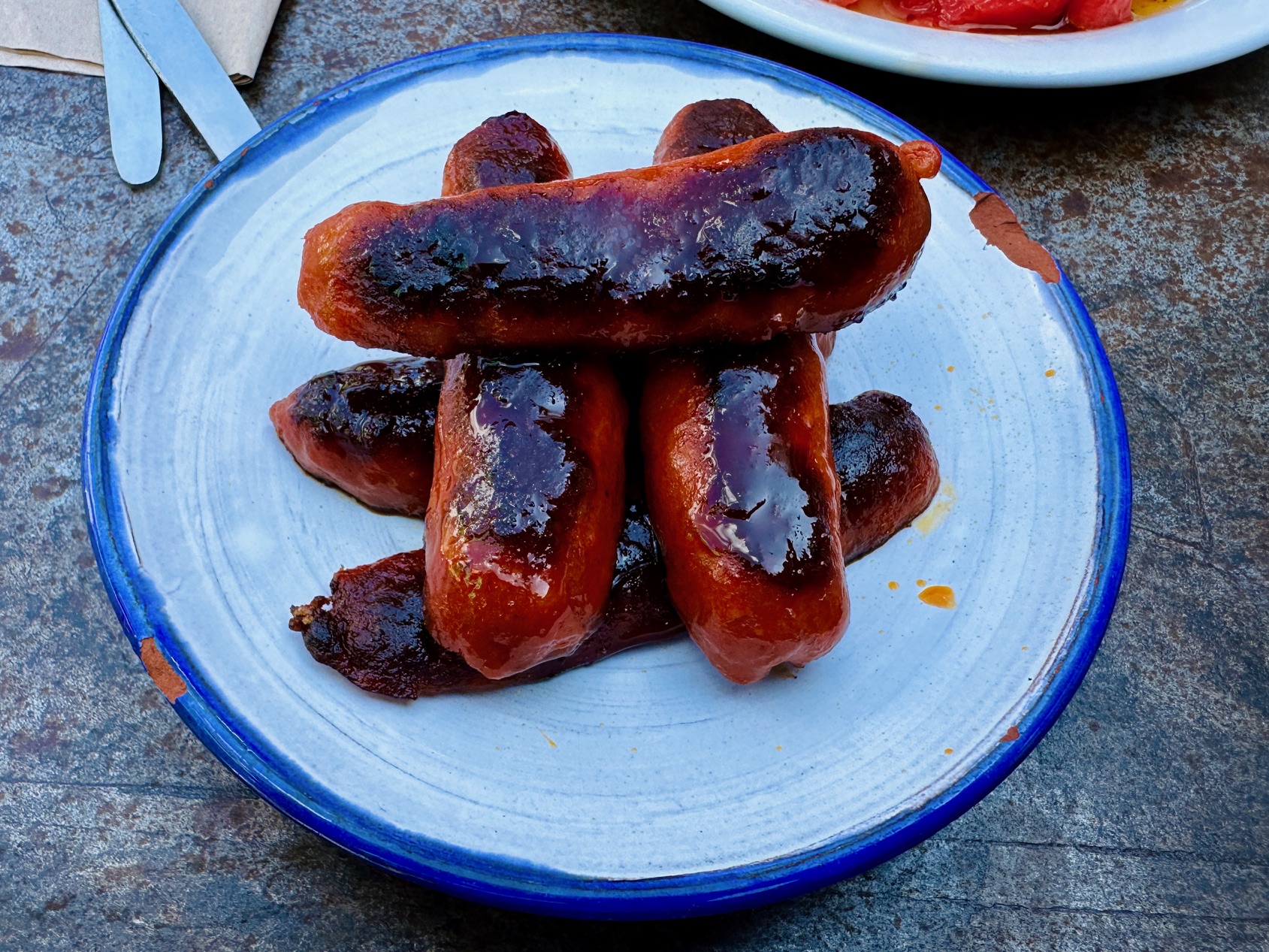
It irked me that they gave you five of them, though, because that’s an especially tricky number to share. Well, with anybody but Jerry, anyway. “Go on, you have the last one” he said. He’s just lovely like that.

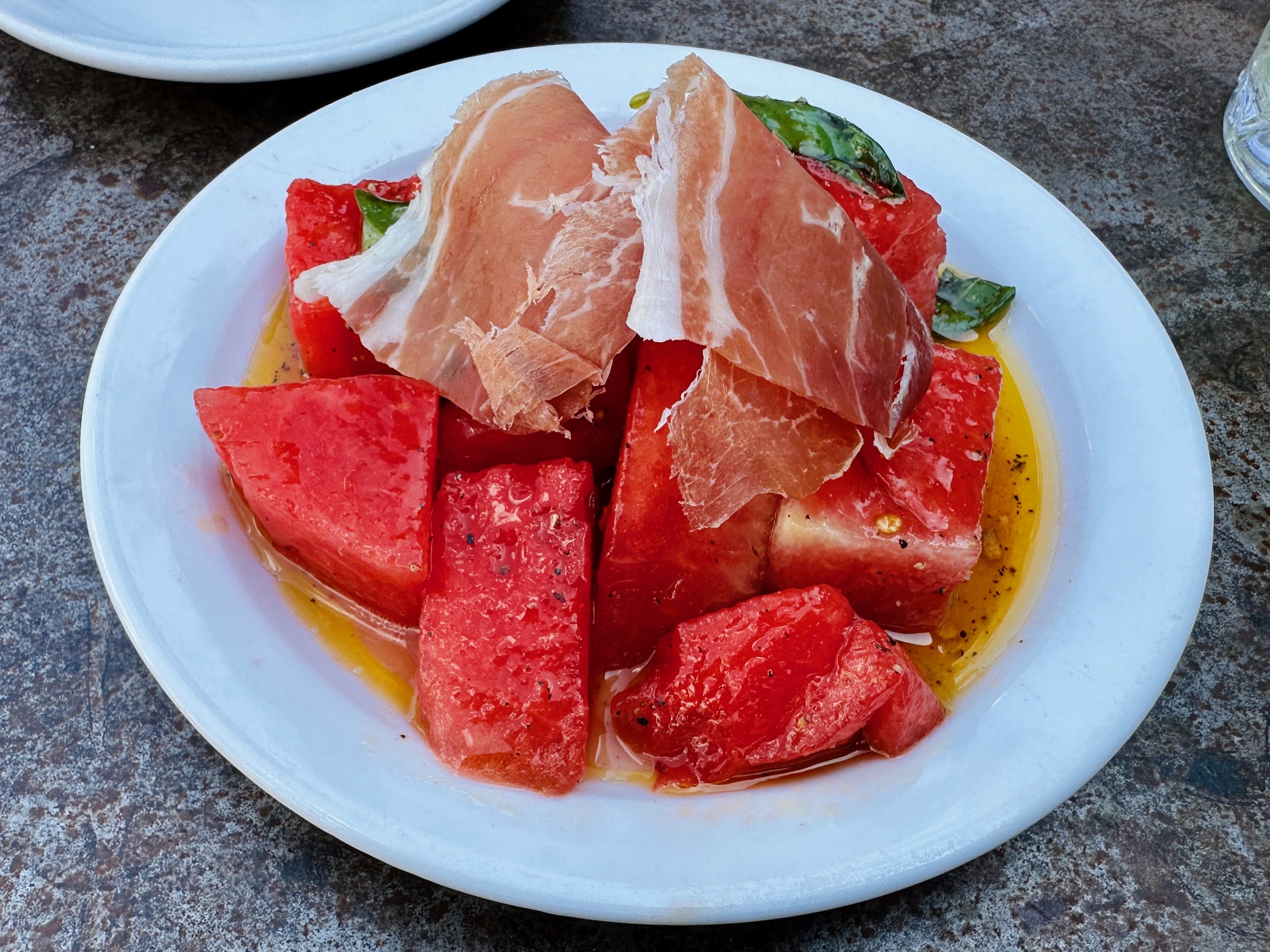
Almost as simple, even more beautiful to look at – and perfect for a sunny al fresco afternoon – Arbequina’s watermelon with jamon was a joyous dish. The melon was plump, sweet and vibrant, and very much the star of the show. But where it wasn’t quite as successful as, say, the similar dish I had at RAGÙ recently, was that the supporting players were perhaps hiding their lights under a bushel somewhat. The two bits of jamon folded on top felt slightly meagre, the honey and chilli rather lurked at the bottom of the plate, shunning the limelight.

But to be fair, if you’re comparing this with the dish at RAGÙ it’s only fair to also note that this was £8, and the Bristol restaurant’s version was over 50% more expensive.
Jerry was in no rush – I always forget that he’s not a trencherman like I am – so at this point we asked the manager if we could hold fire, sip our wine and come back to the menu. And he let us do exactly that, keeping us posted on when the kitchen would take last orders so we could have the leisurely lunch we had in mind. Jerry and I had plenty to catch up on, so we nattered about all sorts, only punctuated by Jerry having an almost Tourettes-like reaction to every single electric scooter going past. I love the multitudes people contain: Jerry is possibly the most affable person I know, but he really hates those electric scooters.

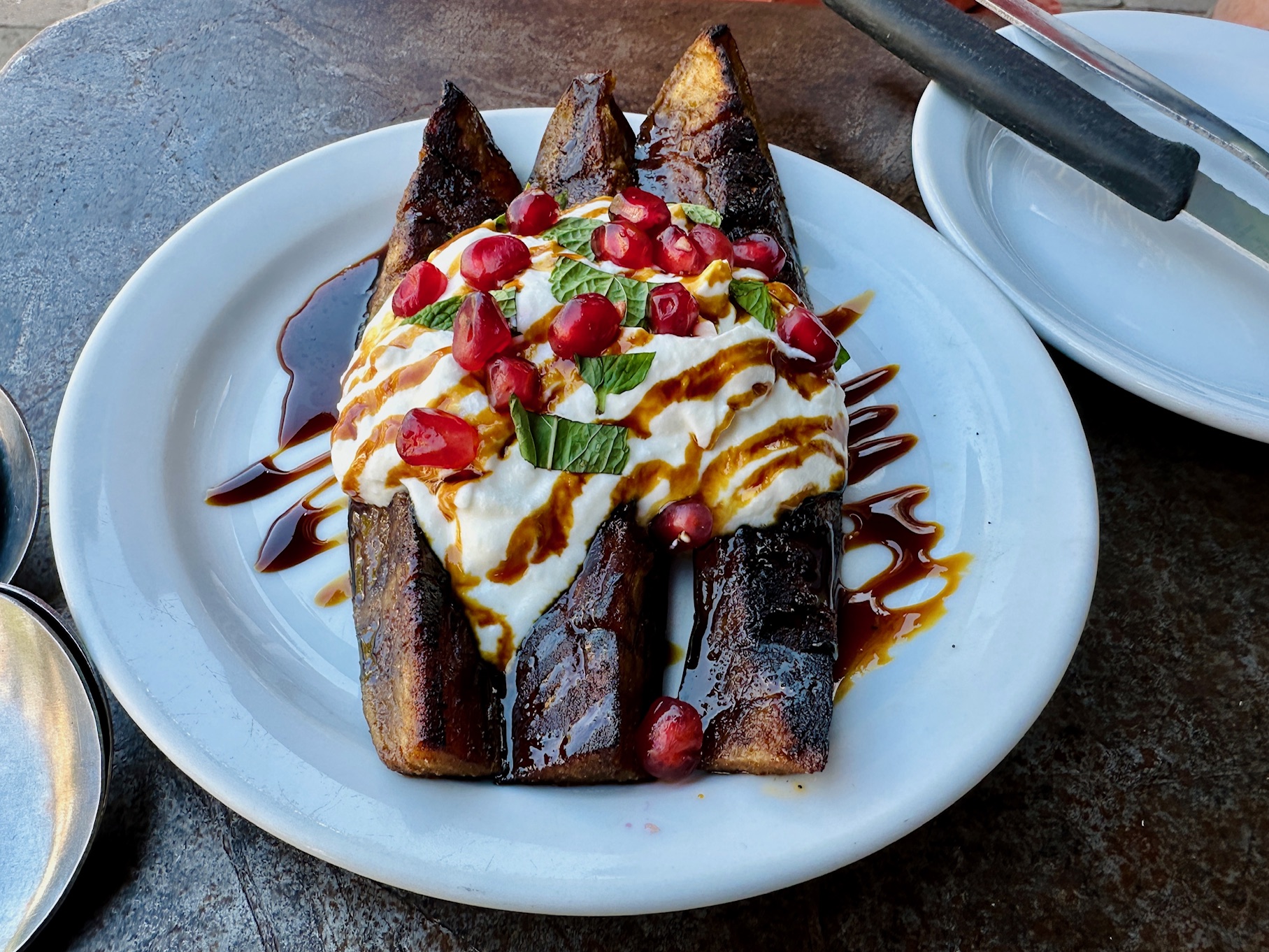
The one dish Jerry really wanted from the menu was Arbequina’s take on an Andalusian classic, berenjanas con miel, or fried aubergine with honey. Now, I wouldn’t have ordered this because I’ve never liked it in Spain – usually the aubergine is sliced thin and fried in a crispy batter, and drizzled in a dark sticky molasses that is a million miles from honey. It takes some doing, in my book, to make aubergine a good thing and this dish, whenever I’ve had it abroad, doesn’t pull it off.

But Arbequina’s version takes everything that could be good about that dish and junks the rest. So we got three soft, caramelised wedges of aubergine, drizzled with an ambrosial molasses without any sour, burnt note, the whole thing bathed in a mild whipped feta – almost more yoghurt than feta – and scattered with pomegranate and torn mint. Have I sold it to you? I hope so. Arbequina sold it to me, both literally and metaphorically. One to add to the vanishingly small list of aubergine dishes I actually like, most of which are on the menu at Kungfu Kitchen.
Our last two savoury dishes were, apart from the tortilla, the highlights of the whole thing for me. I am a terrible rubbernecker in restaurants and I kept seeing a dish go past to other tables which looked eminently snackable, a giant heap of fried, crispy, golden things. But I wasn’t sure what it was, and when I asked the manager I couldn’t explain it well enough – I blame the wine – to get him to tell me what the dish was. But then Jerry wanted the prawns, so it turns out we ordered it by accident.

So these, it turns out, are Sanlucar Crystal prawns – little critters, soft shell, fried in a golden coating, dusted with chilli and served with a generous dollop of alioli. Never had them in my life, now fully wondering where they’ve been for the last fifty-one years.

And again the funny thing is that like the aubergine, this wouldn’t normally be in my wheelhouse at all. I don’t like whitebait, can be squeamish about eating things whole. I’m not one of those macho restaurant bloggers who likes to wank on about sucking the head of a prawn – they try to channel Bourdain, but really they’re Swiss Toni – and, with the exception of one meal in Kolae I’ve managed to convince myself that I really don’t want to munch on a prawn’s brains.
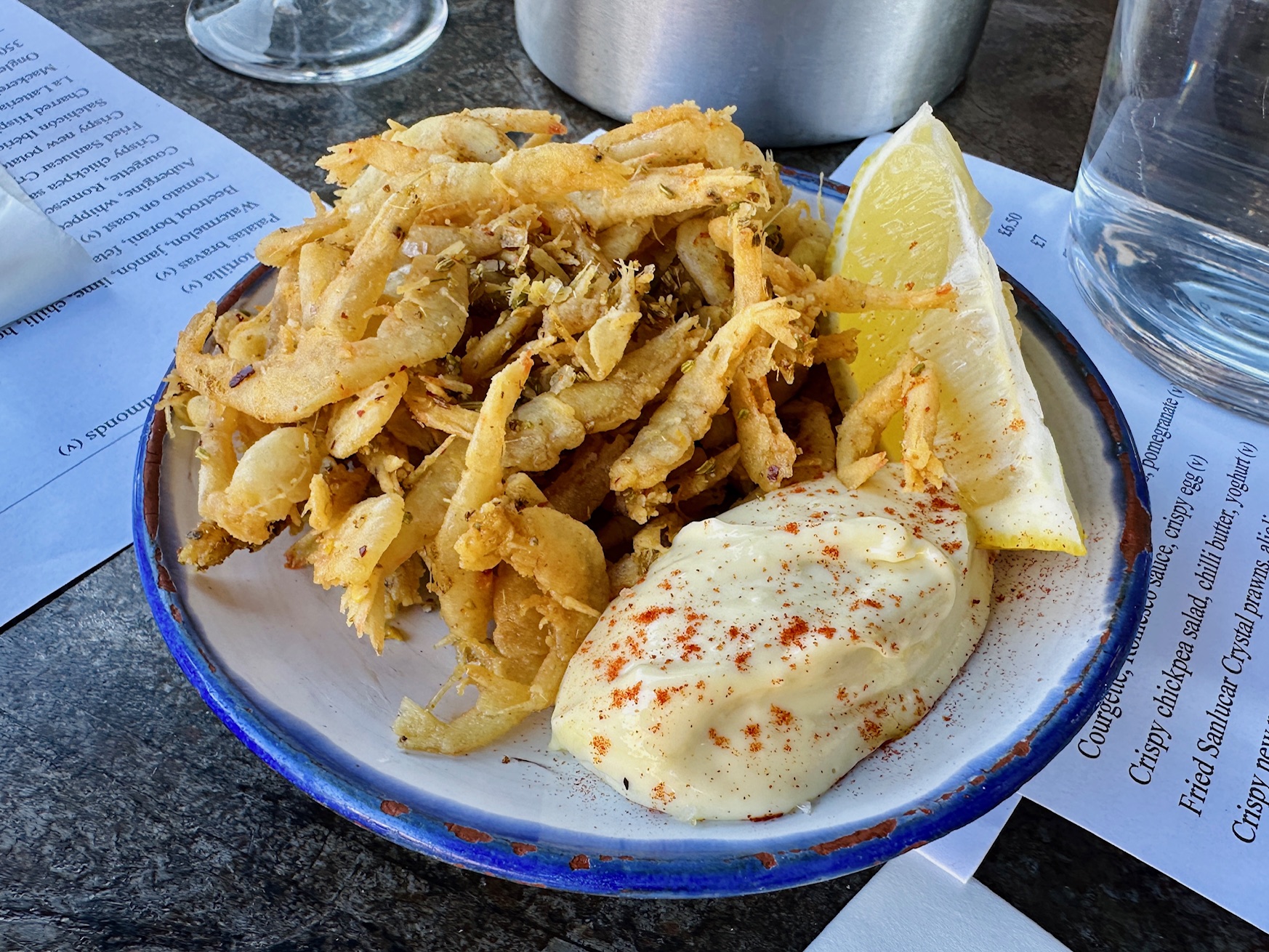
So why did I love these so much? I really don’t know, but I did. I keep using the word fresh in this review, or it feels like I do, but that’s what they were – so fresh, so light, so simple, with that spritz of citrus, that whisper-quiet crunch and the ozonic tang of the sea. On the Cowley Road. Now, I love the Cowley Road but I’m not going to pretend for a minute that eating these prawns there was in any way a congruous thing to do.

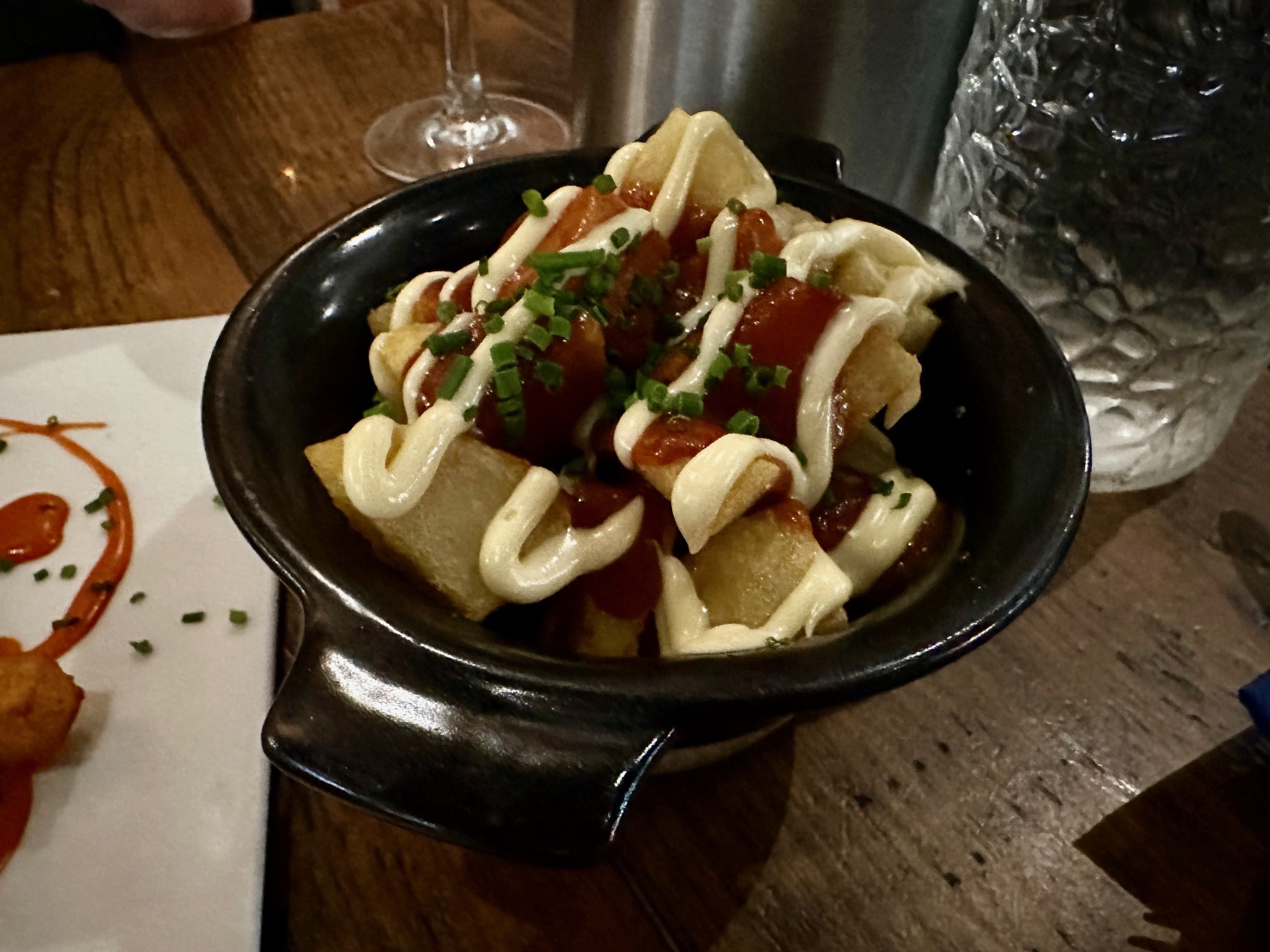
I hadn’t especially wanted Arbequina’s patatas bravas – I often think they’re a way to needlessly bulk up meals in tapas restaurants – but I was drawn to their more exotic sibling on the menu. And it was another really wise choice: billed as crispy new potatoes with tonnato and salsa verde, it was a real humdinger. The slices of potato, thicker than crisps but very much sharing that lineage, were stellar, a triumph of texture.

The thick slick of tonnato was perfect for dipping and dredging: I didn’t get an enormous amount of tuna from it but I did get plenty of savoury saltiness, so I’m guessing anchovies played a part. And I don’t think salsa verde showed up to this dish at all. In its place, I suppose they had deconstructed it by instead scattering everything with salt, parley and lemon zest. I probably would have preferred a salsa verde, because I love the stuff. But I’d forgotten about the salsa verde when this dish turned up so instead I just thought isn’t adding lemon zest to this clever? They knew better than I did.

By this point we’d been there the best part of an hour and a half, in which time tables had come and gone but the restaurant had kept a happy trickling momentum of customers in the sunshine. The Americans at the table next to us ordered some of that tortilla, and inexplicably left some of it: we decided, on balance, that we didn’t know them well enough to offer to take it off their hands.

We both fancied something from the dessert menu, and I talked Jerry into a red dessert wine which came in a wide, low tumbler and was like nectar. I didn’t catch the name, and my bill doesn’t give the detail, but red dessert wines are always worth a try if you find one, and I suspected it would go better with the chocolate mousse even than a Pedro Ximenez.

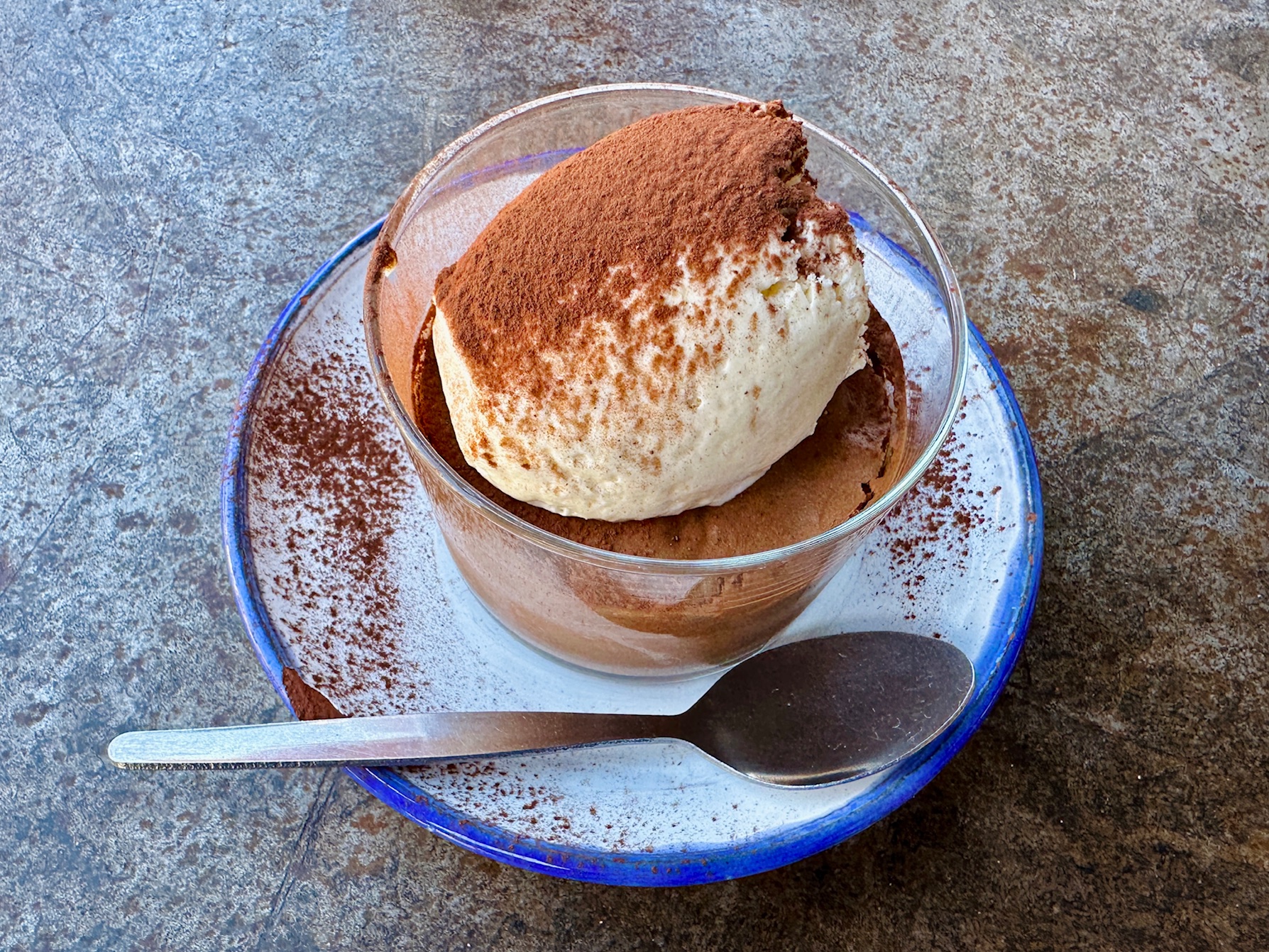
Other desserts are available, of course. Arbequina was offering a panna cotta, a Basque cheesecake or the almond-rich wonder that is a Tarta de Santiago. But I think chocolate mousse should be on far more menus than it is, so whenever I see one I order it – and Jerry, being kind to his vulnerable gob, followed suit. It was, as so often, the perfect way to finish a meal.

I’ve had Arbequina’s chocolate mousse plenty of times, often enough to track its evolution. It used to be a dense quenelle of the stuff – drizzled with olive oil, scattered with coarse salt, served with a torta de aciete for good measure. But over time, Arbequina’s version of this dish has changed, become less uncompromising, dropped the olive oil and become, on the outside at least, more conventional.

But don’t be fooled: it might come in a glass, the torta de aciete may have been replaced with a dome of crème fraîche but the mousse is still theirs, and still sublime. The salt now runs through the whole thing rather than just finishing it off, and it works beautifully.
It was the right way to end a lunch that had been unassailable in its rightness. Our bill came to just under £175, including tip, and nothing about it had felt out of kilter or anything short of marvellous. We settled up with glad hearts, and were on our way – the grand total of a couple of doors down to have a post-lunch coffee outside Peloton Espresso.

But then another delightful discovery lay in store – a short walk down the Cowley Road and we came to Rectory Road and the Star, the best Oxford pub I’d never been to and another long overdue discovery. It was like a cross between the best things about the Retreat and the Nag’s Head, with a huge handsome beer garden and Steady Rolling Man on tap.

So we grabbed a table, carried on chattering, beers passed, tables of people – and the people watching opportunities they presented – came and went. We had nowhere to be, and every reason to linger. Really it was the best afternoon, and one of the best things about it was knowing that at last, Jerry had got the excellent meal he deserved. Finally, I got him a nice one.

Much later on, we retraced our steps, walking east to west through Oxford, the sun setting in the distance. The pavement outside Arbequina was even busier, with people about to have one kind of outstanding dinner or another. The Cowley Road was alive, the antithesis to the stuffiness we’d encountered right in the centre. “It’s bit like the Oxford Road isn’t it?” said Jerry as we sloped back towards Magdalen Bridge. And I replied that it’s what the Oxford Road could be like, with better landlords and more imaginative restaurateurs. Still, it’s nice to dream.

Arbequina – 8.9
72-74 Cowley Road, Oxford, OX4 1JB
01865 792777

https://arbequina.co.uk

Since January 2025, Edible Reading is partly supported by subscribers – click here if you want to read more about that, or click below to subscribe. By doing so you enable me to carry on doing what I do, and you also get access to subscriber only content. Whether you’re a subscriber or not, thanks for reading.

Restaurant review: The Pot Kiln, Frilsham

One of the big gaps in my coverage of restaurants, given the name of this blog, is my failure to review the plethora of highly-rated gastropubs in the countryside around Reading. Berkshire is a funny-shaped county, long and thin, and that means you can strike out into Oxfordshire to the north or Hampshire to the south as easily as you can head east towards Maidenhead or west to Newbury staying within county lines. And one of the reasons, I suspect, why central Reading has never attracted many special occasion restaurants is the embarrassment of riches to be found a short drive away.

I’ve done some of them in my time of course, like the Bell or the Bottle & Glass, but the vast majority remain on my to do list, or at least they would if I were able to drive. And that means that when Britain’s Top 50 Gastropubs publishes its annual list, as it did early this year, I scan it for pubs nearby and realise, ruefully, that I’m unlikely to review them. This year The Loch & The Tyne in Old Windsor, Tom Kerridge’s two pubs in Marlow and The Crown in Burchett’s Green remain on my “maybe one day” list.

Another strange phenomenon in the gastropubs nearby is a tendency for musical chairs where highly rated chefs move from one pub to another. So for instance Dominic Chapman, who earned a Michelin star at the Royal Oak at Paley Street, which I reviewed, then moved on to the Beehive in White Waltham, which I have visited but not reviewed (it was, by the way, not bad at all).

And then, nine years later, he sold up: by that time he had taken on The Crown at Burchett’s Green, which he took over from Michelin starred Simon Bonwick. Again, I ate at The Crown once under Bonwick and thought it was quite good and extremely expensive. Bonwick then pitched up at The Dew Drop Inn in Hurley, managing eighteen months there before moving on again: he now cooks upstairs at a pub in Marlow three times a week.

This happens all over: The Loch & Tyne in Old Windsor is run by Michelin starred Adam Handling, but before that it was called the Oxford Blue and run by a chap called Steven Ellis. Ellis has moved on to another spot, The Bailiwick in Englefield Green which just so happens to be my stepmother’s favourite restaurant in the whole world. Again, I’ve been and it’s really rather nice, especially the venison bon bons; if you ever go, get a portion to yourself.

So maybe one good reason not to review pubs in this part of the world is the amount of toing and froing that goes on, with almost as much transfer activity as the Premiership: even The Plough, which I loved, is on to another head chef since I visited, its third in two years.

One of the benefits of this phenomenon, though, is that sometimes you see welcome, familiar faces pop up in new places. And that brings us to the Pot Kiln in Frilsham, out in West Berkshire, nestled in the Yattendon Estate. This bit of the world, too, has always been sprinkled with good food pubs: the Royal Oak in Yattendon and the Bladebone Inn in Bucklebury are just two more to add to the list of Places I Like But Have Never Reviewed.

The Yattendon Estate now owns the Pot Kiln, as it does nearby Renegade Brewery and Vicar’s Game in Ashampstead. Before that, for a long time under chef Mike Robinson – who held a Michelin star at Fulham’s Harwood Arms – the Pot Kiln was already synonymous with game, all caught on the estate. I ate there once, when Robinson was at the helm, and thought it was rather enjoyable, the surroundings idyllic. But then Robinson got divorced, and his wife got custody of the pub, running it with her musician partner, the magnificently named Rocky Rockliff.

For whatever reason the Estate subsequently snapped up the pub and installed new management. But rather than pick one of the merry-go-round of local chefs and get them to do what the pub had always done, the Pot Kiln took a more interesting course of action. It decided that instead of offering mainstream pub fare or more generic modern British food it was going to serve a Basque-infused menu. A three quarters of a million pound refurb was carried out, including a new open kitchen and a parilla grill, and it reopened last summer.

The other interesting thing they did was appoint chef Nick Galer. Now, I knew Galer’s food from his very successful spell at the Miller Of Mansfield, a lovely pub I did manage to review six years ago, out in Goring. He left the pub three years later, when our old friends Stonegate decided to nearly double the rent, and after that he had an incongruous spell cooking at a nearby golf club, but the move to the Pot Kiln made sense. It’s been on my list ever since, and as my future brother-in-law Matt drove us through the winding lines of West Berkshire in the gathering gloom I realised that I had a real sense of curiosity about the meal that lay ahead.

The thing is, I loved the Miller, and had some really successful meals there. But there were also a couple of times, especially one Christmas Day set meal, when I left somewhat peckish, and I’d heard similar reports from other people who had acted on my recommendation. A pub in the countryside offering tapas and the heartier food of Northern Spain, making good use of cooking over fire, could be an intriguing second act for Galer’s cooking.

In the summer, I imagine a review of the Pot Kiln would talk about just how beautiful its surroundings are, and what good outdoor space it has. But in grim, largely sunless March, before the clocks went forward, all I can say is how glad I was to be in the passenger seat next to an extremely competent driver and navigator. The pub itself looks classy and cosy – definitely one of those gastropubs that still operates as a pub – but the dining room of the restaurant, next to the open kitchen, was a little harder to love.

I couldn’t quite put my finger on why, because the tables were generous and the chairs comfy, but the lighting was a tad cold and the whole place had a certain feeling of sterility. It wasn’t for the lack of diners, because the room was reasonably well-occupied on a Monday night, including a large group which sang Happy Birthday later in the evening. But we grabbed a table for two with our back to all of that, both looking out on the open kitchen, and perhaps that was an error. Galer was not in the kitchen that night, although that didn’t seem to remotely affect the bustle of the staff beavering away.

The Pot Kiln’s menu read really well. There were ten tapas dishes, ranging in price from just over four to just over ten pounds, and eight mains, two of which were sharers. They started around twenty pounds and climbed from there. Half a dozen vegetable dishes, appearing out of sequence before the mains, completed the picture, although they appeared more to be sides than tapas. And actually, although I found plenty to potentially order on it, this menu wouldn’t suit vegetarians or vegans. Only one main for them, baked rice with cauliflower and capers, and four tapas options. In that sense, I suppose you could say it was quite authentically Spanish.

All that being the case, the drinks list surprised me. The local beers on offer highlight the owner’s connection to Renegade, the brewery formerly known as West Berks. But I thought there might be some Spanish sidra on offer, or at the very least some txakoli, the slightly sparkling wine which is one of the Basque country’s best exports. Not only wasn’t there any, but the wine list was dominated by other countries: less than half of the whites and about a third of the reds on offer came from Spain. It felt like some bet hedging was going on.

I decided to stick to the two Spanish whites available by the glass, starting with a Macabeo which was fresh, if slightly astringent. The Verdejo I moved on to later in the evening, not significantly more costly at eight pounds a glass, was much better: fuller, rounder, more interesting. Matt stuck to an alcohol free Asahi before then trying a mocktail with elderflower and ginger which he rated.

So, how many tapas dishes would you have ordered to share between two, not knowing how big they were or how large the mains after them would turn out to be? We opted for three, which I worried might be over-ordering: I suspect my appetite is bigger than Matt’s, or possibly it’s just that his manners are better than mine. But I needn’t have worried, because these were definitely tapa rather than media or racions.

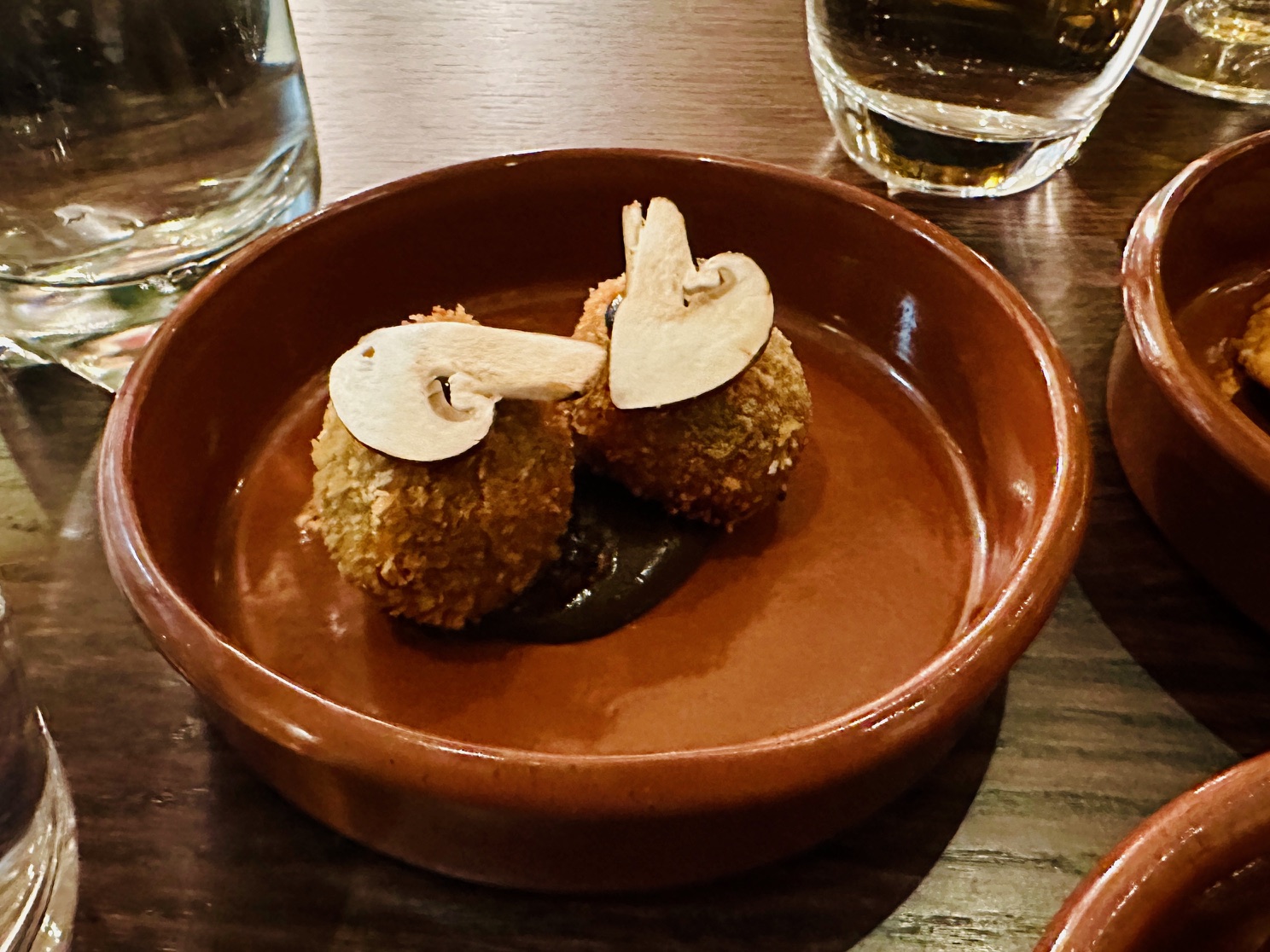
First up, two mushroom croquetas, each topped with a thin slice of raw mushroom – this seems to be in vogue at the moment, although I’m not sure it added anything – resting on a puddle of thick mushroom ketchup.

I have to say, the taste of these was extraordinary. The concentration of savoury notes at the heart of those breadcrumbed spheres was something else, but better still was the depth of the ketchup. It had an awful lot going on – yet more umami, but also a very pleasant acetic spike in the mix. These were two really lovely croquetas. Two really lovely, rather small croquetas. Two really lovely, rather small croquetas that cost seven pounds fifty.

If you wanted any proof that the Pot Kiln, whatever else it might be good at, could do ketchup, the next tapa amply demonstrated this too. A pair of empañadas, with pleasingly dense pastry, had a filling of slow-cooked short rib and came with a blob of Kermit-coloured gherkin ketchup. The star of the show here was the ketchup – even Matt, who had been suspicious from the moment he spotted the word “gherkin”, tried some and declared himself a convert.

This dish was worth ordering for the ketchup alone, such a clever piece of work, something which captured the taste of gherkins in an almost photorealistic way despite being a puddle of green. It redeemed a multitude of sins, but did it redeem the fact that the two empañadas weren’t exactly bursting at the seams with strands of beef? Maybe.

Did it also redeem the fact that a pair of empañadas set you back eleven pounds? Maybe not. The philosophical struggle I had detected in the menu was between Spanish cuisine sending you away very full indeed and Galer’s cooking sometimes rarefying things to the point where they were a perfect, but tiny, distillation of themselves. On this evidence, the latter was winning out.

I minded all that less with the third tapa, but the fact remained that it too was small and perfectly formed. Two titchy triangular toasts, topped with tomato, finely chopped onion, oil, herbs and, from somewhere, a gorgeous supporting note of citrus. These too were this kind of thing – so often in Spain a huge piece of bread amply covered in their peerless tomatoes and salt – miniaturised to a lovely, exceptionally high end version of the same.

Getting tomatoes this good in March is itself, after all, quite an achievement. If elevation was the intention, mission accomplished. But although I could well believe you wouldn’t get a better rendition in San Sebastian, I could imagine you wouldn’t get a smaller one, either. Six pounds fifty for this.

At this point I was, in truth, a little concerned that it would be one of those meals, where everything tasted amazing but you had to seriously over-order or leave without feeling replete.

But Matt and I had ordered the 12-hour lamb shoulder, intended for two or three people, and we’d been warned in advance that it took a while, so we moved on to our second drink and caught up – his job, my job, his household adjusting to the arrival of my second niece, the ins and outs of the family we were both lucky enough to have found ourselves part of. Matt has the sort of senior job that means you have to be good at talking to anyone and everyone, which makes him an excellent conversationalist, although it did leave me hoping his evening with me didn’t feel like work.

From our vantage point I could see that the lamb shoulder had spent most of its 12 hours cooked sous vide, so it was rescued from a plastic cocoon and finished in the oven. And when it was eventually brought to our table, bronzed, with a thick layer of crispy, salted fat, I thought it looked about as wonderful as could be. It was accompanied with a little pot of anchovy and garlic sauce, which had also been artfully squiggled around the plate in an unnecessary fashion. Our server – all the people who looked after us that night were excellent, by the way – started the process of testing the lamb off the bone and shredding it, doing just enough for us to dish up and leaving the rest of us to explore for ourselves.

It was absolutely glorious. Lamb is one of my favourite meats, and this must be one of my favourite ways to have it. I’ve had slow cooked shoulder before where the fattiness is to the fore, where it’s slicked with the stuff, a little too much. But this was gorgeous, almost like the best kleftiko there is, and the texture was spot on, with enough of everything: crispy shards, plenty of supremely tasty fat, both crunchy and wobbly, and piece after piece of shredded lamb, some moist, some dry, all brilliant.

The salt studded along the edge of the fat made those pieces an especially savoury delight, and although it didn’t slump off the bone the way some slow-cooked lamb can, it didn’t take an awful lot of persuasion. For some reason we’d been brought quite dinky plates, which meant that we had to keep coming back for more, but that was very far from an ordeal.

Matt wasn’t sure about the sauce, but I suspect he’s less of an anchovy fan than I am. Even being a huge lover of anchovies, I thought this was salty overkill: I’ve read other reviews that say this used to be served with a mint sauce, and I can see that, or salsa verde, offering the counterpoint this needed. It also worked out fortuitously, I think, that the bits I were drawn to, especially the fatty ones, were naturally the ones Matt might have passed on. We were a regular Jack and Mrs Sprat, and between us we polished off the lot.

At seventy pounds, I think this served two nicely but might have been stretched between three. But I liked it so much that for even for two I thought it represented agreeable value.

Meat requires potatoes, whether you’re in Thatcham or Bilbao, and torn between the enigmatically described “Spanish potatoes” and the Pot Kiln’s chips we went for the latter. Very good chips came speckled with crispy flecks of jamon and under a light dusting of Idiazabal, a Basque cheese. There was also, apparently, “Bravas seasoning”, which I imagine was another piece of refinement and deconstruction. Too much refinement, I fear, because nothing was really detectable. Still, good chips with cheese and jamon on them are always going to go down well with me, and these did.

All that was an overload of saltiness, and much as I loved that I was glad we had some contrast in the form of some carrots. These were beautiful, fresh, just-cooked things dusted in something which apparently contained chives but, to both of us, tasted strikingly of aniseed. The fact that these, really, were the only vegetable of the evening was Matt’s and my fault for ordering the way we did, but also felt quite authentically Spanish: finding anything with vegetables in it can often be a challenge there, in my experience. Not that I’ve ever tried that hard.

By this point, things had quietened down in the restaurant and we were almost the last people there. I almost felt guilty about keeping them by ordering dessert, but I also felt like we ought to try that part of the menu out.

The dessert menu is compact – five dishes and a selection of cheeses, and one of them, turron at five pounds fifty a piece, felt more like something to accompany a coffee than a dessert in its own right. Matt was tempted by the apple tart with apple sorbet and calvados syrup, but unsure: he liked apple, but did he like it that much?

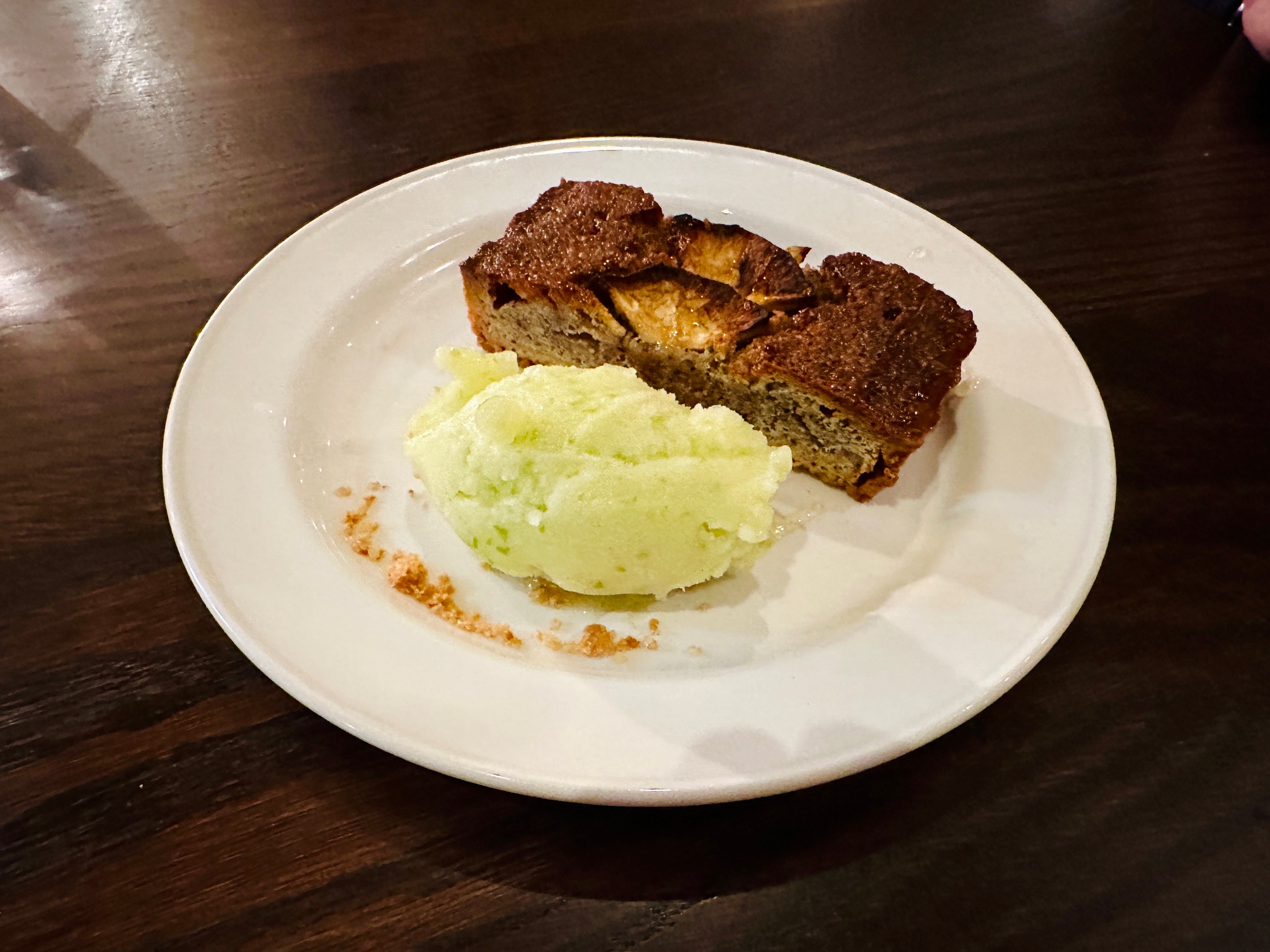
I told him you couldn’t have too much of a good thing, so he went for it and I think he was rewarded with the better dessert. My spoonful, again, pointed to the kitchen’s technical gifts and command of flavours: each element a slightly different iteration of apple, prioritising sweetness, sharpness or booziness. I would have been happy, had I ordered this. But had I ordered it – and even though I didn’t – I would say it was more a cake than a tart.

My choice, on the other hand, was one of those disappointing examples of how a menu can say one thing and mean another. Rhubarb sorbet, gingerbread, cava paints a picture of those three elements in harmony, maybe equivalent amounts of each, and I was expecting that to be the case. Instead, in the Pot Kiln’s standard issue terra cotta pots, I got a dollop of (admittedly very good) rhubarb sorbet with a scattering of gingerbread crumbs, like snow that would not settle.

Cava was then poured over it, but the terra cotta pot wasn’t the right vessel for a dish like this. It just meant that you got a thin lake of booze at the bottom that you couldn’t spoon up. So essentially this was a rhubarb sorbet with whistles and bells that didn’t blow or ring. At eight pounds fifty, this felt like a lot to spend on a dish that didn’t entirely cohere.

All told we’d been enjoying the Pot Kiln’s hospitality for over two hours, and I was increasingly conscious that we were probably preventing them from shutting up shop in the restaurant. At this point the open kitchen was less of a selling point: it’s one thing when you see activity, vitality, prep, flames, dishing up, but perhaps another entirely when they are mopping the floor with one eye on the service after this one, the following day.

So we settled up and Matt prepared to effortlessly work wonders with his satnav, ease us out of deepest darkest West Berkshire and take us back to the bright lights of Reading. Our meal – three tapas dishes, that lamb and side dishes, a couple of desserts and a couple of drinks apiece – cost about one hundred and sixty-five pounds, which included an optional ten per cent service charge. Overall I thought that was reasonable value – fair in parts, good in others, questionable in a few.

That was something I pondered and weighed up in the week I took to mentally digest, between eating this meal and writing it up here. Because after those tapas dishes I was all ready to write my oh-so-slighly disappointed not-quite-a-peroration, in which I gently pointed out that “perfect for sharing” should translate as “this dish is big enough for two people to enjoy” rather than “this dish is made up of two individual, rather small, morsels”.

But then the main course completely subverted all that – it wasn’t cheap, but it was outrageously good. It was the kind of food I had been expecting to find at the Pot Kiln, but I don’t think I was expecting it to be bookended by things so different – by tapas dishes that worked wonders with flavour but left you wanting more in all the wrong ways on one side, by desserts that were a tad pedestrian on the other.

In the run up to this visit I wondered which would prevail – the big portions and big flavours of the Spanish food I’ve enjoyed in the past (notwithstanding that I’m yet to go to the Basque country, sadly) or the precise, distilled, excellent cooking that Nick Galer is so good at. And the answer, based on this visit, is that the Pot Kiln, not quite open a year yet, is still resolving that identity crisis.

There is plenty to enjoy here, and I enjoyed plenty of it, but “let’s open a Basque inn in the middle of beautiful countryside just outside Newbury” is a concept I can get behind. “Let’s do the most beautiful portions of tapas that take a classic idea and produce it in its smallest, purest form” is perhaps not.

So if you want tapas, I think you might be better off heading just down the road to Goat On The Roof. If you want ludicrously good meat cooked beautifully on an amazing piece of kit, you should go here. Because that’s the part of this meal I’ll still be thinking about in the months ahead, the part I’d passionately recommend to others, the part I am remembering now, with a grateful smile on my face. For what it’s worth, I hope that side of this particular see-saw gains the upper hand.

The Pot Kiln – 7.5
Chapel Lane, Frilsham, RG18 0XX
01635 201366

https://thepotkiln.co.uk

As of January 2025, Edible Reading is partly supported by subscribers – click here if you want to read more about that, or click below to subscribe. Whether you’re a subscriber or not, thanks for reading.

Restaurant review: El Cerdo, Maidenhead

Every year, without exception, you can reliably expect two things to happen in Reading’s hospitality scene. One is that there will be a raft of closures and new openings. Some years that ratio is pretty much one to one, others – like this year – it’s badly out of kilter, with far more places giving up the ghost than newcomers showing up to take their place. It’s tough out there, with no relief in sight. But the other thing that happens, every year without fail, is that none of those new openings will be a tapas bar.

I have complained about this so many times that it’s boring for all of us, so I won’t go on at length. But everywhere you look there’s a tapas bar, it seems, apart from Reading. Swindon has Los Gatos, Oxford has Arbequina. Newbury has Goat On The Roof, and Wokingham has Salty Olive. And Reading? Reading has next to sod all – unless you count Thames Lido, which I don’t, or Alto Lounge, which surely nobody should (Oh wow! Excited for this said the Chronicle‘s Facebook page this week, about the news that Alto Lounge had received permission from the council to double in size: that’s the Chronicle for you, excited about pretty much anything).

No, it’s never a tapas bar. Biryani joints are ten a penny, we went through a phase where we got three sushi restaurants in quick succession and momo are having a moment, but nobody wants to open a tapas bar. It’s a long, long time since La Tasca (which also wasn’t great) and six years since I Love Paella – not a tapas bar, but the closest thing we had – was unceremoniously booted out of the Fisherman’s Cottage. Is it a Brexit thing? Surely somebody feels like getting on the blower to renowned Bristol importer Mevalco and sorting this out, you might think, but every year nobody does.

And that’s what sends me scuttling off to the likes of Swindon, or Oxford, or Wokingham, trying to find the next best thing. Sometimes it works – Los Gatos is a little miracle – and sometimes I find myself somewhere like Sanpa, but I keep on trying because it’s a wonderful way to eat and I am always on the hunt for somewhere that brings a little hint of Granada or Málaga to unsung Berkshire. And that’s why this week I ended up at El Cerdo in Maidenhead, a ten minute walk from the train station, in the company of Katie, last seen last month sampling the glitzy splendour of Calico with me: inexplicably, after a dinner with me, she felt like repeating the experience.

Katie, it turned out, was on a proper journey of discovery, having never been to Maidenhead before. On the stroll through town to the restaurant I gave her a whistle stop tour of everything I knew about Maidenhead, which didn’t take long: former constituency of Theresa May, the infidelity capital of the U.K. (allegedly) and the town that, possibly because it was originally meant to be the terminus of the Elizabeth Line, was getting all the interesting things Reading didn’t.

That last one really is true – Maidenhead has a great independent craft beer bar in A Hoppy Place, wonderful pizza at Knead, an absolutely top notch town centre restaurant in Seasonality. And if some of the misfires, like Sauce and Flour, weren’t amazing, they at least showed that someone was trying. We walked past Sauce and Flour on the way to El Cerdo, and it was rammed, which shows how little I know about anything.

El Cerdo is by the canal, in the new development (the Waterside Quarter, apparently). “This looks so much like the Oracle it’s disconcerting” was Katie’s take, not without justification. The restaurant looked welcoming from the outside, and it wasn’t unpleasant on the inside but it had a feeling of “new build” that it couldn’t quite shake, a functional box rather than a cosy, appealing cocoon.

That’s not entirely their fault – it’s the hand they’ve been dealt with the space, and I liked the giant pig logo on one wall, past the handsome bar. But overall I felt it lacked a little character, in a way I couldn’t put my finger on. After all, Knead has a very similar dining room, but somehow it still has a feeling of bustle and hubbub. I guess the open space with the pizza oven perhaps brought things together in a way that El Cerdo’s bar, attractive though it was, didn’t quite manage. A handful of tables were occupied when we got there, including one large group in the corner, but it was a quiet Tuesday night.

El Cerdo’s menu read well. It wasn’t so big as to be unwieldy, and was divided into logical sections – nibbles, cold tapas, meat, seafood and fish. They hadn’t given in to the temptation to do paella on the side, so there was just the one rice dish and a few types of tortilla. In the run up to my visit I’d looked at the menu at Los Gatos, just to benchmark prices, and El Cerdo was definitely more expensive: nearly everything was north of a tenner, with some dishes nudging twenty.

But the wine list was good, and exclusively Spanish, and although we were tempted by a txakoli – the slightly sparkling Basque white you rarely see on menus – we went for an albariňo. It was an excellent choice – crisp and clean but not bone dry, with a little fruit. Thirty-eight quid for a bottle that’s fifteen online, so not an oppressive mark-up, either.

Now, before we get started on the food – and because tapas is by definition small plates, we have a fair bit to run through – I want to get a couple of things out of the way. One is that I had an absolutely lovely evening, and that makes it far more tempting to see the food through the Albariño-tinted glasses of good company. The other is that your mileage at El Cerdo might very well vary from mine: Katie, I suspect, enjoyed most of the dishes more than I did.

And of course, your take on this kind of food will depend on how and where you’ve had it before. Despite loving tapas and small plates, it turned out that Katie had never been to Spain, although she’s rectifying that with a trip to Barcelona just before Christmas.

I on the other hand go to Andalusia most years – and yes, I know that makes me sound like the pretentious tosspot I am – and unfortunately that means that although I went hoping for the best, I was painfully aware of all the instances where the best simply didn’t materialise. El Cerdo’s website says, pretty plainly, “If a dish doesn’t taste like it does in Spain, then we won’t serve it”. Although it also says that El Cerdo has an “executive chef”, and in my experience very little good comes of having one of those in place of an actual chef.

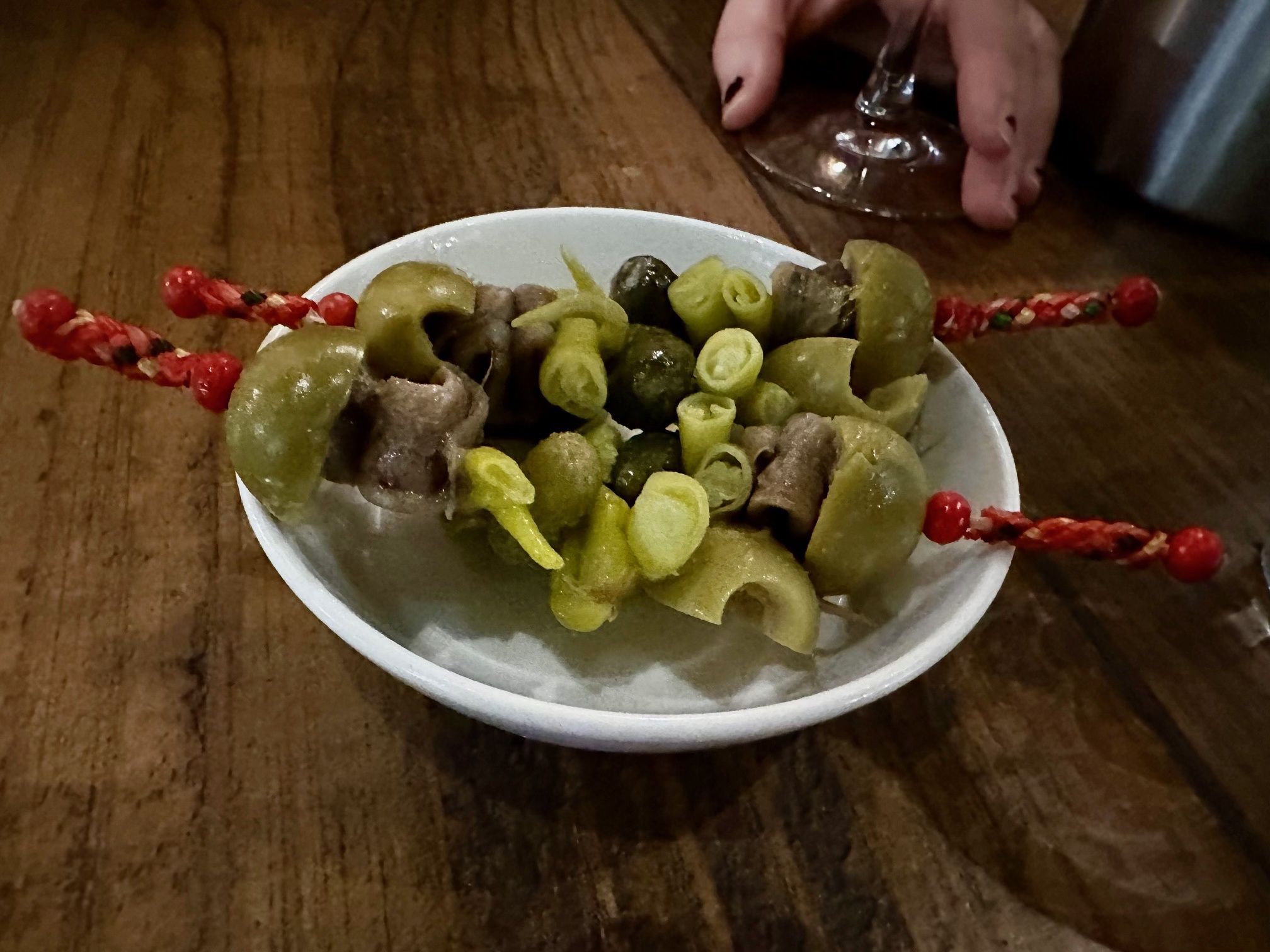
The first sign that I was going to have to write this kind of review came with the accompaniment to those first sips of wine, a couple of gildas. A gilda is a very simple thing – a skewer of olives and pickled chillis, all brought together with a slim ribbon of salty anchovy. Named in homage to Rita Hayworth, it’s almost a perfect mouthful, and quite hard to get wrong. You could have really amazing olives, and truly best in class Cantabrian anchovies, but even an entry level one is going to be a delight.

Or it should be, providing you use salty anchovies. But it felt to me like these were made with boquerones, the softer, more vinegary Spanish anchovies without the saline tautness of the good stuff. Which in turn meant they were all out of kilter – all vinegar and no salt, and somehow fishier than they should have been as a result. I felt like a right killjoy thinking this, because Katie seemed to enjoy hers. But I knew it could, and should, have been better.

The jamon croquetas were a similar story. They weren’t terrible – easily better than the deep fried abominations I’d eaten at Sanpa – but nowhere near the quality of anything you would get in Spain. They were a little flabby, a little pale, a little lacking in the crisp shell you needed. And the bechamel inside was lacking silkiness and a proper hit of jamon. Perching a little slice of it on top of each croqueta just showed you, Jim Bowen-style, what you could have won.

Last time I went out with Katie at Calico, she took me out of my comfort zone by ordering more vegetarian dishes than I would personally have chosen, which probably meant that my review was useful to slightly more people than it would ordinarily have been. The same thing happened here, where Katie was stuck between two dishes, broccoli with almonds or hispi cabbage, that I would never have ordered in a million years.

I took against the former for containing coconut ajo blanco in order to be vegan – good luck convincing anybody that they’d serve that in Spain – and so hispi cabbage it was. And actually this turned out to be one of the better things we ordered, although possibly one of the less Spanish ones. The cabbage came topped with a caper and raisin purée, which was heavy on the raisin and light on the caper, and squiggled vigorously with what was apparently a cured egg yolk sauce.

Your guess is as good as mine: I certainly didn’t get cured egg yolk from it, partly because I don’t really know what a cured egg yolk would even taste like. The little pieces of fried kale on top were pleasant too, although it gave me flashbacks to the Lyndhurst, which always makes me sad. There was a real whack of lurking heat in this too, and all in all it was probably the cleverest thing we had. Not massive, and not cheap at just shy of a tenner, but with lots to recommend it.

One of the biggest crimes against Spanish food was what came next, something the menu described as our “lazy” or open tortillas. We picked the eponymous El Cerdo tortilla, with chorizo and black pudding, and it’s difficult to describe how underwhelmed I was by this. Lazy is about right, to the point where maybe the menu should have said “we can’t be arsed to make a tortilla”.

Now in fairness the server, who was excellent, asked us if we wanted it runny or medium, and maybe we should have gone for the former. But whether it was runny or medium, this wasn’t a tortilla. It was an omelette. An underseasoned one that had been cooked through, with four bits of chorizo plonked on top and some black pudding – the British kind, not gorgeous soft Spanish morcilla, lobbed in the middle. No softness, a little onion, no potato that I could discern. This dish frustrated me. I imagine it would have made a Spaniard angry.

We’d ordered dishes in waves, partly because El Cerdo, Wagamama-style, says that everything you order will come out when they feel like it and we didn’t want to be swamped with dishes in one hit only to find the evening over. El Cerdo said that you should aim for two to three dishes each, which we took to mean three each, and actually doing it this way helped because we got to spy on the table next to us – four lads who kept their coats on throughout for some reason – and swap one of our dishes for something they’d ordered.

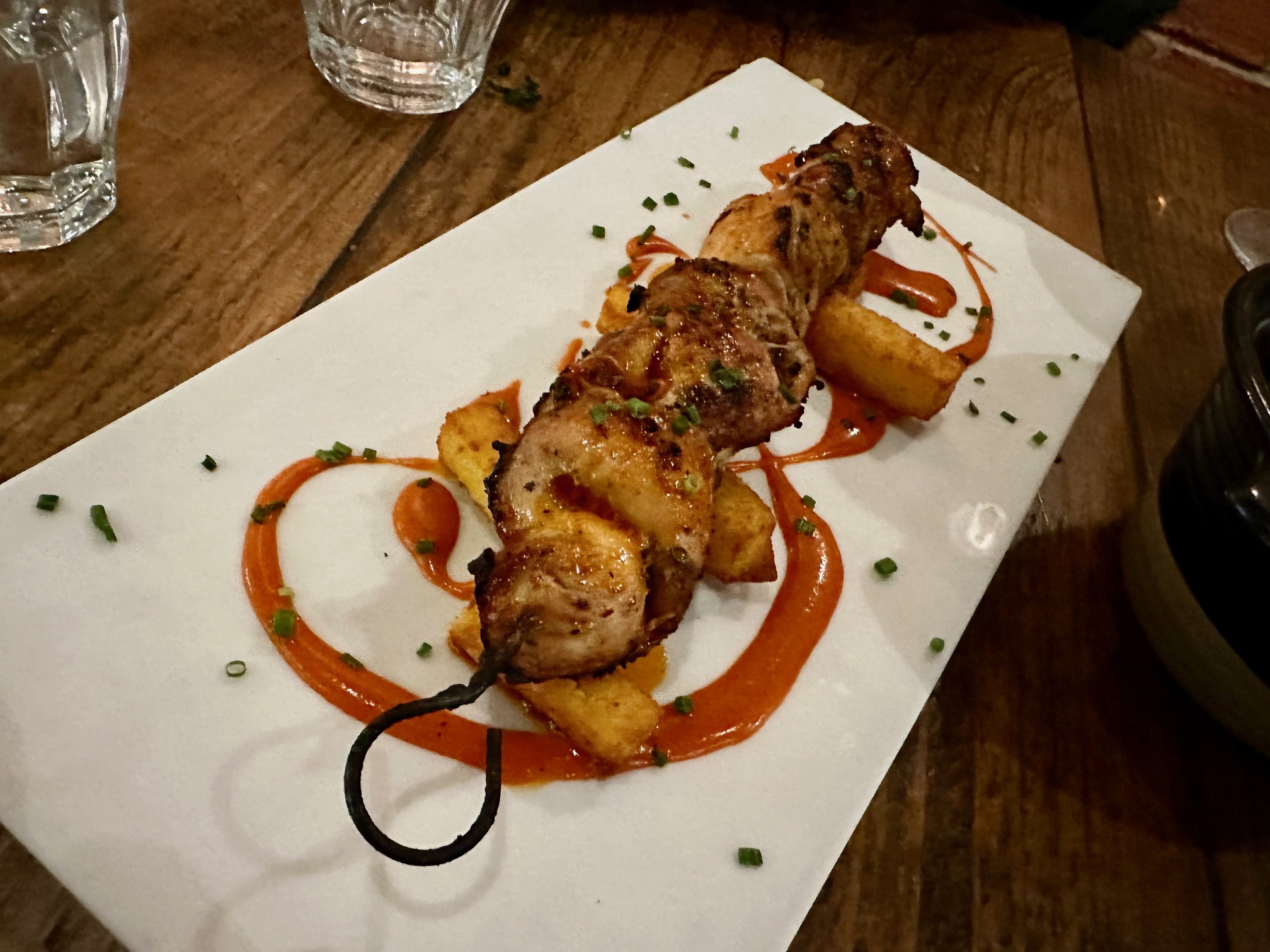
That dish was another of the relative hits of the evening, pincho de pollo with crispy polenta and mojo rojo. It was a reasonably generous skewer – four substantial enough pieces of chicken with a weird treble clef of red sauce, resting on a rope bridge of crispy sticks of polenta. And again, it wasn’t terrible but I didn’t found myself wowed. The chicken was nicely enough done, but El Cerdo makes much of its charcoal oven and I didn’t feel this had the char I’d expect from such an impressive piece of kit. The polenta added contrast, but if it did indeed have Idiazabal cheese in it it was a whisper, not a shout.

And again, thirteen pounds for this – even by 2024 standards – felt steep. I thought back to the skewer of chicken I had at Kolae, earlier in the year. Different cuisine, of course, but in terms of technique, flavour and value it was worlds away from this. This felt like the kind of dish that might pleasantly surprise you at Alto Lounge, but only because your expectations were on the floor.

If you wanted more evidence that El Cerdo wasn’t capable of delivering a flawless plate of food, their monkfish in tempura with chickpeas was exactly that. Just as at Calico, Katie had talked me into ordering something with chickpeas and they were lovely – nutty, earthy, positively moreish. But what in god’s name was going on with the monkfish? Two slightly forlorn nuggets of the stuff in a batter that was not, by any stretch of the imagination, tempura. It had no crunch, no texture, and when you tried to cut through it it all fell away, leaving a dense little knot of woolly monkfish, a sad savoury parody of a profiterole.

It turned out that Katie had never had monkfish before. “It’s not usually like this” I told her, feeling like I had to do something to rescue monkfish’s reputation. I hope for Katie’s sake that her first visit to Spain is better than her first taste of monkfish. If it’s on a par, that means she’s had her pocket picked on Las Ramblas.

By this point I’m guessing neither of us really wants me to go on, but go on I must because there were a couple more dishes. Again, Katie quite liked the patatas bravas, which I think we’d picked to make sure we felt full at the end. And again, it wasn’t atrocious but I have never, ever had patatas bravas like this in Spain or indeed anywhere decent in the U.K.

The bravas sauce didn’t taste like bravas sauce, it was fruitier and lacked any kind of heat. The alioli, giving the benefit of the doubt and assuming that’s what it was, was not unpleasant. But it needed more of both, and moreover the potatoes were wan specimens, technically cooked but lacking the golden hue and brittle texture that makes this dish a treat.

Writing this, I should let you know, is the weirdest experience. Because I had a really lovely evening but the more I think about the food the more surprised I am by that.

We decided to have a dessert and there was one on the specials menu – a tangerine cake with white chocolate ganache and yuzu sorbet – which our server told us was perfect for sharing. So we also decided to have a dessert wine each, and identified a very nice-looking Pedro Ximenez on the wine list. So we ordered it, and our server came over apologetically. There was only enough left in the bottle for one glass – well, one and a half glasses, really. So what would we like to do?

Of course, as something approximating to a gentleman, I let Katie have that and went instead for a white dessert wine from Rueda. But when they came over, both were in very small glasses, both were the same size, and both looked bigger than they were because each of them had an ice cube lobbed in it.

“They weren’t the coldest, so I put an ice cube in them” explained our server.

This begged so many questions, like why aren’t you keeping your dessert wine in the fridge? or maybe you should have asked first?, let alone is that really what a glass of Pedro Ximenez looks like? or why didn’t you give her the rest of the bottle, were you saving that final half glass for Santa?

It was just baffling, and especially so because otherwise service was lovely all night. She told us they’d been open about a year and that although this week was quiet, things ramped up for the Christmas season after that and business was booming.

Last but not least, the dessert. It looked fancy, it looked cheffy and I can see that it was kind of designed for sharing. And leaving out the question of whether yuzu is remotely Spanish, the yuzu sorbet in the middle was easily the best and most enjoyable thing in the whole dish, resting on a sort of granola crumb. But there was nothing you could really describe as a white chocolate ganache, because neither the quenelles of something or other or the isosceles triangles of white chocolate fitted that bill.

But that wasn’t the most heinous failing: that was the cake. Dense didn’t even begin to describe it. You could work out your upper body trying to drive a spoon through that cube of stodge, and I felt like I did. There’s a chap called David who comes to my readers’ lunches whose job is to build machines that are used to test whether materials can withstand immense pressure. David would take a professional interest in that cake.

Because I seem to have spent most of this review pointing out places that do things better than El Cerdo, this feels like the right time to mention the pistachio cake I had last year at Manteca.

By this point, with the exception of a couple of chaps at the bar, we were the last table there so we settled up and made our way back to the station in the cold. Our meal, including a 12.5% service charge, came to just over a hundred and fifty pounds. Now, I think life in Britain has reached the point where it’s difficult to say “that’s expensive” any more because you’d end up saying that about most meals out.

But instead, we can at least talk about value: that’s more than my recent meals cost at Calico, at The Cellar, or Storia. My meal at Goat On The Roof cost a smidge more, admittedly two years ago, but El Cerdo can’t hold a candle to Goat On The Roof.

Granted, none of those restaurants are an exact match in terms of how many courses, how much booze and all that jazz, but the central point remains: El Cerdo does not feel like value. Not compared to any of those places, not compared to the tapas places you could eat at along the train tracks in Oxford or Swindon. So the search continues, and maybe next year I’ll rock up at Salty Olive having one last stab at finding great Spanish food a very short distance from Reading. Because if there’s one thing we can be fairly sure of, it’s that a tapas bar will not open in Reading next year.

But let’s close by looking on the bright side. For two years now I’ve been taking the train to Maidenhead, trying all these places and bemoaning the fact that Reading doesn’t have them. But actually, now, I’m beginning to think that my head was turned by Seasonality and Knead. Because outside those two, the new places I’ve eaten at in Maidenhead – the likes of Sauce and Flour, Storia and El Cerdo – don’t leave me thinking that we’re missing out. If there’s a market for box-ticking, slightly inauthentic, sterile restaurants and those restaurants want to go to Maidenhead instead, I’m all for it. I’m happy to hold out for something better. Even if experience tells me I might be waiting a very long time.

El Cerdo – 6.3
The Colonnade, Waterside Quarter, Maidenhead, SL6 1QG
01628 617412

https://elcerdo.co.uk/maidenhead/

Restaurant review: Los Gatos, Swindon

When I announced on social media last month that I’d had a very enjoyable day eating and drinking my way round Swindon there was (admittedly a limited amount of) complete and utter astonishment. What? said one person, no doubt thinking I had been hacked. Good Lord! Where? said another.

A third, regular reader Trudy, was particularly interested, having recently moved to Swindon where, as fas as I’m aware, they don’t have a friendly neighbourhood restaurant blogger. I met Trudy at the recent ER readers’ lunch at Clay’s so I gave her a sneak preview of what this review is about to tell you: yes, there are places to eat and drink in Swindon, and they’re a lot better than you might expect.

I’m not kidding – Swindon has enough about it to justify a trip out west on the train. You have to do a thirty minute walk from the station, up a hill, but you are rewarded with Swindon’s Old Town which is a small but perfectly formed district full of nice shops, restaurants, cafes, pubs and bars. There’s an arts centre, and the Town Gardens, a beautiful Victorian park with a listed bandstand and a cafe (it also, according to the council’s website, hosts something called the “My Dad’s Bigger Than Your Dad Festival”: I love my dad dearly, but I’m not entering him in this any time soon).

Where had all this been hiding? You could almost imagine you were in a little town on the outskirts of the outskirts of the Cotswolds, and then I realised that I sort of almost was. And truly, I had a wonderful afternoon eating and drinking and making merry in the company of my friends Dave, who lives in Wootton Bassett but I suspect wishes he lived in Cirencester, and Al, who lives in Cirencester and so doesn’t have to.

We started out with a couple of outstanding coffees from the small, difficult to find but deeply charming Pour Bois – which I pronounced to Dave as if it was French before realising that of course it was pronounced poor boyz because we were in Swindon, not Montparnasse. My mistake: it’s not easy being Frasier Crane in a town full of Bob “Bulldog” Briscoes.

After lunch we wandered over to Ray’s, an ice cream parlour which is an Old Town institution, and sat on the wall opposite eating our ice creams in mute contentment. And then we wandered over to the Town Gardens, which – don’t hate me for saying this – slightly puts Forbury Gardens to shame, not least because it has a lovely little cafe serving superb coffee which was miles better than anything you could get from the equivalent kiosk in Reading. The beans are by local Light Bulb Coffee, and I also picked some up to try at home (it’s marvellous stuff).

After ice cream and coffee there was nothing for it but to try some beer. Did you know that Swindon has a nascent craft beer scene? I didn’t either, but it turns out it does, with several great venues dotted along the Old Town’s Devizes Road. We started out in Tap & Brew, local brewery Hop Kettle’s Swindon tap room, which served some stonking beers: my favourite was Kepler, a proper fruit explosion of a NEIPA so good that I bought a bottle to stash in my bag (it didn’t make it to the following weekend, that’s how good it was).

After that we had a short stumble to the Tuppenny, a lovely pub with an impressive selection of beer on keg – including both Double-Barrelled’s Parka and DEYA’s stupendous Steady Rolling Man as permanent fixtures – and a belting can fridge. I had some splendid pales, made a detour into sweet, indulgent stouts that tasted, by pure witchcraft, of battenburg or chocolate orange, and I rolled out to catch my train home totally convinced that Swindon’s Old Town could match any enclave Reading had to offer when it came to the finer things in life.

That’s all well and good, but I maintain that any day trip away has to be anchored around a meal, whether that’s dinner or lunch. And for Swindon, for me, that destination was never in doubt. So after our coffees at Pour Bois, and before our ice cream at Ray’s, Dave, Al and I headed to Los Gatos, in the heart of Old Town, to see if it still lived up to the billing it had in my mind as The Restaurant Worth Visiting Swindon For.

Los Gatos is a tapas restaurant, and it’s been going for nearly twenty years. I don’t get to Swindon often, but whenever I do I make sure I have lunch there. I’ve said before that tapas restaurants in this country tend to either be run by Spaniards, with mixed results, or by evangelical Brits who are trying to reimagine a tapas bar as its best possible self. Oxford’s Arbequina, Bristol’s Bar 44 and Bravas definitely fall into that category.

But Los Gatos, for me, feels more like it’s trying to recreate than perfect – and there’s nothing at all wrong with that, because some days a recreation of Malaga or Granada in England would be a wonderful thing in its own right. Despite that it, too, was founded and run by Brits and named in tribute to the legendary Malaga bar of the same name. Originally they had a site round the corner, but they moved to their current site a minute down the road and then, during lockdown, they sold up.

The new owners have expanded by taking the site next door, and this was my first visit since the pandemic so I was a tad discombobulated by it not looking how I remembered. But the fact remains that it’s really nicely done, and it helps that our table was in the original room, where I’ve eaten before. It is a really lovely space, with tasteful terrazzo marble-effect tables and – as there should be – stools up at the bar. The room had plenty of natural light, attractive dark beams and a blackboard full of wines and sherries by the glass.

I’m not going to go all Berkshire Live and tell you it was just like being in Malaga, but I have to say the overall effect wasn’t a million miles off. We started with a crisp glass of fino apiece – turns out there were three Frasier Cranes in town after all – and enjoyed the building buzz of a restaurant turning a very healthy trade at lunchtime. Again, I stopped to remind myself that I was in Swindon. In honesty, I did that more than once during the meal.

The joy of a place like Los Gatos is looking at the menu, wanting to order nearly everything and then realising that in a tapas restaurant, provided there are enough of you, you can have a decent stab at it. And Los Gatos’ menu is very much that kind of menu with most dishes around the seven pound mark, all of them tempting.

There’s plenty of cooking on display too, rather than an over-reliance on buying and slicing, so although you can get jamon or queso they’re a very small section of a large and diverting selection. Typical Andulucian dishes are well represented, like spinach with chickpeas or fried aubergine with honey, and I suspect you could quite happily bring a vegetarian here: perhaps one of the main indicators that you’re not in Spain is that they even make a little effort to accommodate vegans.

But Dave, Al and I were neither of those things, so as Dave sipped an Alhambra and Al and I tackled a beautifully fresh, fruity white from Jumilla – decent value at just over thirty pounds – we did one of the most enjoyable things you can do in a tapas restaurant. We chatted away, picked out our favourite dishes, haggled and scheduled, putting them in our first and second wave. As we did, I thought about how much I’d missed this kind of sociable eating, with these two. Of course, I didn’t tell them that then, because we’re men in the last gasps of our forties, but writing it here will have to suffice.

Our first set of dishes were all, without exception, winners – so much so that my usual anal urge to photograph everything pretty much deserted me. That’s bad news for both of us – me because I’ll have to rely on my immortal prose and you because you’ll have to read it. The very pick of the dishes was the hake in beer batter – it’s a fish beloved of the Spanish but Los Gatos bring as much out of it as anywhere I’ve been in Spain. Three huge chunks of the stuff, in the lightest batter, sprinkled liberally with flakes of salt was the perfect reintroduction to their food, and a deep, golden saffron mayo played nicely with it, perhaps more gently than a honking alioli would have done.

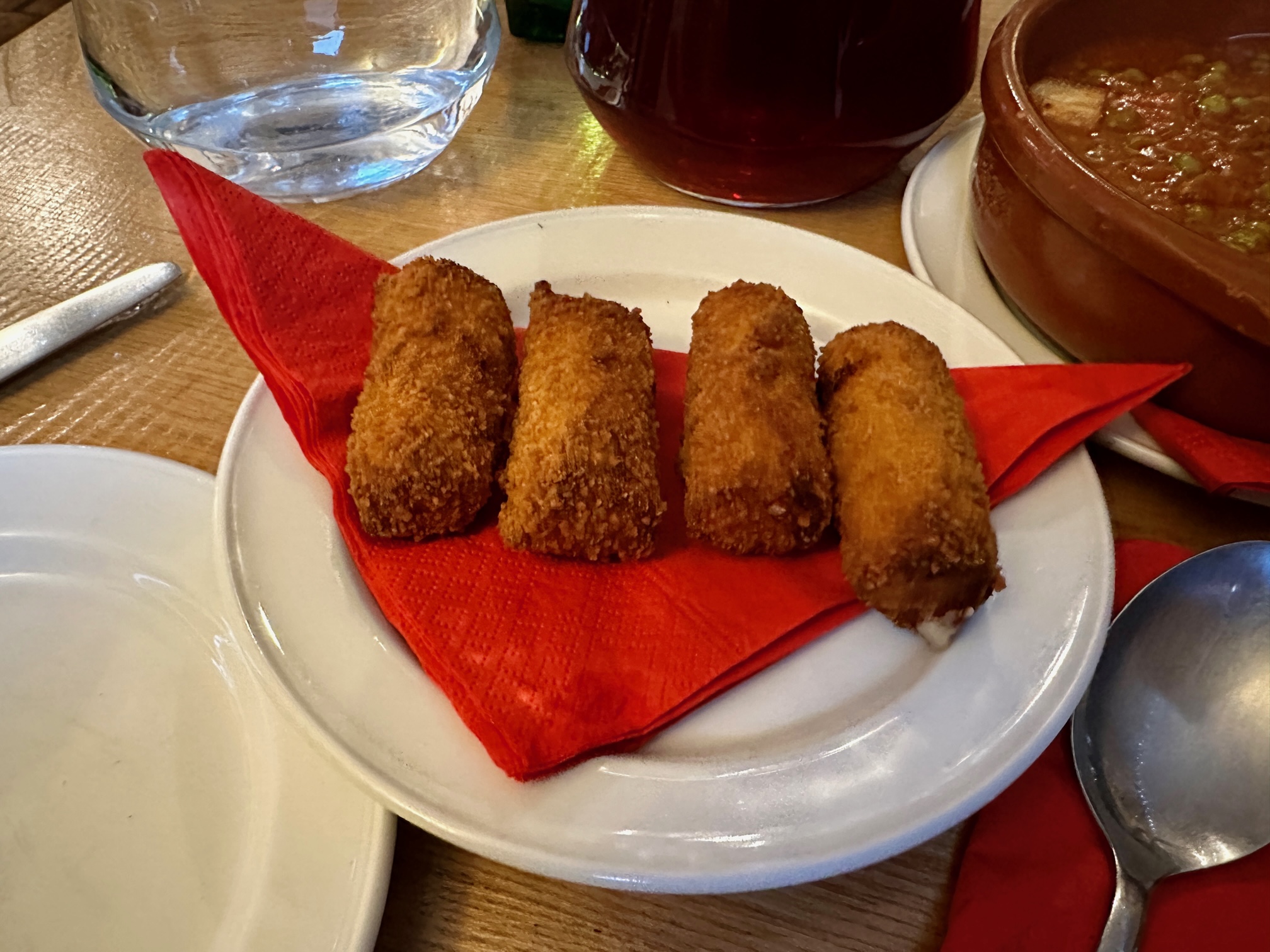
Everything seemed geared for three to share because we also got three superb croquetas – much more dense and substantial than I’m used to with more heft and less bechamel. That might not suit everyone, but it really suited me. If you came to Los Gatos as a pair or a four those two dishes would cause you serious problems, but the three of us felt very fortunate.

Jamon – Serrano rather than anything fancier – was decent and hand carved, with a good umami note and a nice marbling of fat. It didn’t perhaps have the really intensely savoury quality, or melting fat of the very best Spanish hams, but it was eight quid or so and far from stingy, so I wasn’t in the mood to complain. By that point in the lunch I wasn’t in the mood to complain about anything, not even Dave’s jokes.

I also loved the mushrooms in a cream and sherry sauce, achieving a precarious balance between glossy sweetness and the underlying savoury note just peeking through thanks to the oloroso. We didn’t order any bread for the sauce, though, which was a mistake. I’ve been doing this gig for ten years and I still make schoolboy errors like that.

Our greed was such that there were still two other dishes in our first order, and one was a dish I’ve loved at Los Gatos for a long time. Morcilla de Burgos came beautifully presented, two discs of earthy, fragrant black pudding sandwiching a glorious middle layer of sweet piquillo peppers, quail’s egg perched on top. The prettiest thing we ate all day, so naturally the one I didn’t photograph, but a really gorgeous morsel. Also possibly the hardest to share – or perhaps I just didn’t want to – so if you go to Los Gatos order your own personal portion. For my sake, if not for yours.

And last of all, because we had been carb-free up to that point – we ordered an arroz con pollo. I seem to recall that Los Gatos serves paella at the weekends, and this was a miniature version of that. I quite liked it, and I was glad to see it topped with beautifully done chicken thigh, but again it was probably one of the less shareable things we ordered. The rice did come in handy though, because that sherry and cream sauce had a very agreeable habit of sticking to every single grain, if you crossed the streams.

And then, not at all sated but the edges knocked off our hunger, we regrouped. We looked at our list of outstanding dishes and made our decisions – did we still want them? Was it enough? Was it too much? If I’d just been with Dave, a slim man who very much intends to stay that way, it might have been tricky to get them all past the committee stage, but Al – whippet thin despite eating like a horse – has been known to have two desserts, just because, so I knew I’d be safe.

If the second round of tapas wasn’t quite as impressive as the first, that was partly because we were no longer ravenous. Also, the dishes you absolutely cannot bear to miss out on always end up in the first round, so the bar is meant to be lower when you go back to the menu.

And probably the two weakest dishes were in this section, although I’m not sure either would have made my must-order list in the first place. Calamares were decent but unspecial, and not a patch on the ones you can get in Spain, and the black beans with pancetta and chorizo were surprisingly bland for a dish including two of the greatest cured meats known to man. I found my mind drifting to the cannelini beans at Bristol’s COR, zippy with lemon and topped with breadcrumbs, achieving so much more with fewer ingredients.

We’d also ordered a classic dish, chorizo cooked simply in wine, and it was the kind of thing that restored your faith in a restaurant, both in terms of their ability to buy the right stuff and then cook it spot on. If I knew where they got their chorizo from I’d place an order, because I’m fed up of trying to rustle dishes up with the slightly gristly nonsense you get from Brindisa these days. We could easily have ordered a second dish of this, and I rather wish we had.

We also ordered chicken livers, again in a sherry and cream sauce, and although I didn’t mind it I didn’t think, with hindsight, that it was different enough from the mushrooms to justify ordering both.

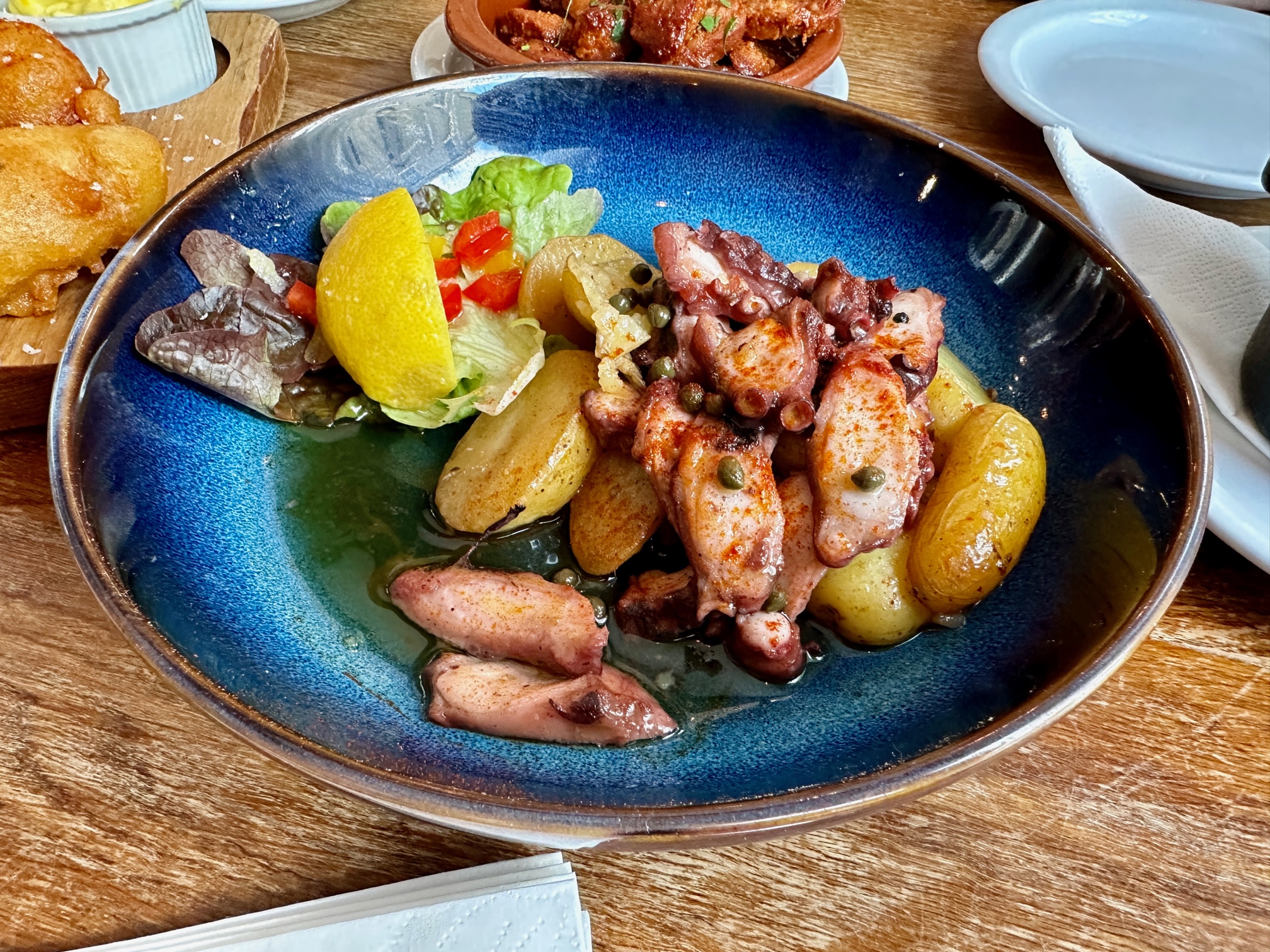
And our penultimate dish was the most expensive thing I found on the menu, Galician-style octopus. When I’ve had this in Spain it’s just octopus, heavy on the paprika – and the octopus for that matter – and although octopus is always a joy, it can be a tad one note. I really liked what Los Gatos did with the dish, serving it with new potatoes and capers almost as a hot salad. And the octopus was beautiful – tender and tasty with no bounce or toughness, which is by no means a given abroad, let alone here. I think Dave and Al let me have more than my fair share of this dish. They’re good like that.

And the final thing we ordered? Another portion of that hake. Take a look at the picture below and tell me you wouldn’t have done the same.

Service was great. In the course of researching this review I chanced upon some online reviews that said that it wasn’t the same since the restaurant expanded, that a staff of two or three had become a legion and that something magical had been lost. Well, I guess we all sometimes feel that way when our favourites get big and successful but personally I thought the staff were terrific, very efficient, just friendly enough and I was quite happy with them not being overworked. I’m a bit of a pinko like that.

We might well have had dessert, but knowing that there was an ice cream parlour literally on the other side of the road curtailed any ambitions we had in that regard. I couldn’t talk either of them into a Pedro Ximenez either, because beer was calling too. Our meal came to just under fifty pounds a head, not including tip, which I thought was a steal for everything we had.

Ordinarily I start every review of a tapas restaurant by complaining that Reading doesn’t have a tapas restaurant and never really has. You could set your watch by it. So this time, for novelty value, I thought I could shoehorn it in at the end. But rather than say that, I just want to say that this kind of restaurant, and this kind of eating, is among my very favourite kind. Ordering everything, trying everything, sharing your joy and diminishing any disappointments – it really is one of the best ways to eat there is. And when you find somewhere that does it well, you’ll gladly travel to it.

In my case, that does seem to involve flying to Andalucia at least once a year, but I am really delighted that Los Gatos, a mere half hour train ride away, remains more than good enough as a substitute for that. The fact that around it has sprung up this magnificent little ecosystem of coffee, craft beer, green space and ice cream is the icing on the cake. Old Town, square mile for square mile, is arguably a lovelier spot than anywhere in Reading, I think – and, yes, that includes Caversham.

So if Spanish food is even remotely of interest to you, I highly recommend that you make your way to Swindon – despite the incredulity of everybody you tell at work – because it very much merits the journey. I think I prefer Los Gatos to Oxford’s Arbequina, much as I love Arbequina, and it edges out Newbury’s Goat On The Roof, too. I still need to make it to El Cerdo in Maidenhead, at some point, but I doubt somehow that I’ll love it quite the way I love Los Gatos. 

And in terms of our closest Spanish restaurant, Wokingham’s Sanpa, put it this way: when I went back there earlier in the year I worried that the rating I gave it was far too harsh. Having now eaten at Los Gatos and seen what commited Brits can create as a temple to Spain, in an unfashionable town, I think that if anything I was far too generous. Go to Los Gatos instead: have a sherry, order that morcilla, send me a photo. I doubt I’ll enjoy many lunches more this year than the one I had there.

Los Gatos – 8.7
1-3 Devizes Road, Swindon, SN1 4BJ
01793 488450

https://www.losgatos.uk

Restaurant review: Sanpa, Wokingham

I’ve been writing this blog for nearly ten years, and I’ve been moaning that Reading needs a good tapas restaurant for most of them. Certainly I was saying that from the moment, back in September 2013, when I had the misfortune of visiting Picasso just off Caversham Bridge (“one tapas is enough for two people” was the warning sign, looking back). Surely, given the popularity of small plates in general and tapas in particular, someone would give it a bash?

That said, there was a halcyon period, between 2015 and 2018, when Reading was graced with I Love Paella, first in Workhouse Coffee down the Oxford Road, then at The Horn in town, and finally at the Fisherman’s Cottage by the canal. But the owners of the pub decided to let them go, so they could offer their own menu which looked disconcertingly like I Love Paella’s. It didn’t work: the pub closed and changed hands.

And what have we had since then? Numerous restaurants that do good small plates, but only one place, Thames Lido, for tapas (their “poolside bar menu”). I know the Lido has its fans, but having had nothing but inconsistent meals there – and having watched them churn through chefs like it’s nobody’s business – for me that tapas itch remains unscratched.

It’s baffling, because it’s a style of eating that has readily taken root elsewhere. In Bristol you can choose between Bravas, Gambas, Bar 44 or Paco Tapas. London options include Barrafina, Brindisa, Salt Yard and Iberica, and I’ve barely got started. Closer to home Goat On The Roof opened in Newbury last year (I liked it, when I went) and more recently El Cerdo has started trading in Maidenhead, part of its ongoing explosion of interesting-looking new restaurants. And this kind of restaurant keeps coming – Salty Olive, a pintxo restaurant, is opens soon in Wokingham. Yet Reading’s tapas market remains resolutely untapped.

In my experience, great tapas restaurants in this country tend to be run by Brits fanatical about Spain, Spanish culture and Spanish food. Often, rather than recreating what you would get in Andalusia, they set about building a superior re-imagining of it. The 44 Group, run by the Morgan family, is a great example, completely obsessed with produce and producers. Arbequina, down Oxford’s Cowley Road, is another.

Even tapas restaurants which feel more authentically Spanish, more an attempt to create a traditional tapas bar in this country, are often set up by Brits. I’ve always had a huge soft spot for Los Gatos, easily the best restaurant in Swindon, perched up in the Old Town: it’s only in the process of writing this week’s review that I discovered that it, too, was founded by a British couple and named after Malaga’s legendary bar of the same name.

So really, I should have ventured out to Maidenhead this week to try El Cerdo. It fits the bill I’ve just described: the website talks about a love of Spain and Spanish flavours, the menu makes all the right noises. Muddy Stilettos raved about their (no doubt free) food, and it appears – from a look at Companies House – to be owned by Brits. That would be the obvious choice, but who likes obvious choices anyway?

Instead I decided to revisit the one tapas restaurant I can think of that appears, from what I can gather, to be owned by a Spaniard, Wokingham’s Sanpa. It’s been running since 2012, and I visited it back in 2016, when I loved the place. They then moved to a new house (as did I – twice) and our paths diverged. But people get too hung up on the shiny and new, so before I reviewed the shiny and new I decided it was time to get myself to Wokingham with Zoë and see whether the intervening years had been kind to Sanpa.

It’s one of the town’s older buildings, two conjoined cottages, all beams, white walls and cosy, farmhouse-style chairs and tables. The two dining rooms are separated by a hearth and the second gives a view into the open-ish kitchen. It looked homely, not unpleasant but also, in honesty, not drastically different to when I visited this building last in 2016, back when it was home to a restaurant called Jessy’s.

It was also, and this never flatters a dining room, empty. Marie Celeste empty. Not with a few tables settling up, not with reserved signs marking the space of the diners yet to come. Just empty. I don’t know about you, but I always feel guilty if it seems like I’m the only thing standing between staff and an early night.

Despite that the welcome was warm and immediate and it felt like a nice, if cavernous, place to stop on a midweek evening. And looking at the menu I could see plenty of reasons to settle in for a few waves of small plates. Most of it very much looked the part, although a couple of dishes – bacalhau à bras and chicken fajitas – did seem to have wandered across from other restaurants.

Pricing for tapas was all clustered around the eight pound mark – although some dishes were £7.95 and others £7.59 for reasons which seemed capricious at best. The bigger plates – steak, lamb shank, three different kinds of paella – were grouped together under a section endearingly entitled “Other things to order”, even though that literally describes everything on a menu, if you think about it.

My favourite part – and I’ve never seen anything like this before – was a sternly worded box in the bottom left. It said, and I’m quoting verbatim here, Please make sure that you know what this dish looks like or taste (sic) like. Due to the level of controversy and the cost of this dish, we regret to inform you that we will not be able to refund this dish of (sic) your bill if you’re not comfortable with the outcome of your order.

I followed the asterisk, expecting it to be something contentious like octopus, or sweetbreads, but instead found a rib-eye with blue cheese and Rioja sauce. Is steak and potatoes really controversial, or were they playing it safe because it was just shy of twenty-four pounds?

The wine list was okay, if not hugely tempting. I was in the mood for a Spanish beer – always so enjoyable with tapas – but all they had was San Miguel by the bottle. So we decided to grab a jug of sangria and that turned out to be an excellent choice. It was expertly put together to taste as if it had no alcohol in it, even though you knew it did, and if it contained a slug of rum or brandy it was nicely blended and concealed. It tasted, to be honest, like holidays – and what’s not to like about any drink capable of that?

Our first wave of dishes was a decent reflection of the strengths and weaknesses of the kitchen. Bread was bought in but serviceable enough, and the allioli tottered under the weight of an industrial quantity of garlic. But the colour was Hellmans-pale not golden, the consistency woolly, closer to fridge-cold butter than the good stuff. Chorizo in cider came, not as an earthenware dish full of slices of chorizo, caramelised at the edges, rich with juices, but rather as two hulking sausages, plain and unadorned. This didn’t fill me with hope but actually they were terrific, the kind of quality you can’t easily get your hands on in this country.

If that dish didn’t give the bread much to do by way of moppage the next more than made up for it. I’d loved Sanpa’s prawns in garlic on my visit seven years ago and was keen to reacquaint myself with them. They were still very nice indeed, sizzling away in a little skillet surrounded by nuggets of garlic somewhere between golden and crunchy.

This, more than the allioli, felt like the bread’s destiny, to dive and scoop and play in that pool of oil and garlic. I remembered halfway through that I was in the office next day, and felt bad for my colleagues. But if you wanted an illustration of what’s happened over the last seven years you couldn’t find a better one – the dish cost about a pound more than last time, but contained roughly half as many prawns.

Then there was the dish for which I had the highest hopes: panceta a la parilla, described in the menu as “ideal as finger food”. From that I was hoping for little cubes of pork belly, something close to chicharrones. Instead we got three slabs of belly, plainly grilled, without much accompaniment. It wasn’t quite cooked to the point where the fat starts to render and everything gets gloriously sticky, and I found a couple of shards of bone in my piece.

I found myself thinking about what this dish would have been like in the market at Malaga, the whole thing dressed with a little herbs, the tomatoes thicker and tasting properly of tomatoes, as they always do abroad. Abroad they would have been bright with grassy olive oil and scattered with rock salt. Did I think the chef was running on autopilot because he hadn’t bothered to do any of that here, or had I decided that because I could see, through in the open kitchen, that he was cooking with his headphones on?

A meal like this is definitely a game of two halves, and as we cogitated and fine-tuned our next selection of dishes the staff – who were absolutely brilliant throughout, by the way – took our dishes away. I asked our server if she had any recommendations – “you’ve already had quite a few of my favourites” she said, which I liked.

By this point another couple had come in and were sitting the other side of the room, which had the advantage of making me feel like less of a lemon. Again, I worried about all the good restaurants unable to pack them in on a midweek evening; I doubt, back in Reading, Popeyes was having this problem. I felt a moral responsibility to order more dishes – and another jug of sangria, although there was nothing moral about that.

Our second wave of dishes showed the same inconsistency but, if anything, were more disappointing. I’d decided against the patatas bravas, our server’s recommendation, instead picking the patatas con crema de Cabrales. This was the same cheese, by the way, that featured in that Absolutely No Refunds Ribeye. The possible reason for that is that Cabrales is stinky. It is one of the most agricultural blue cheeses there is, perfect with Asturian cider, though pretty good on its own. This potato dish should have been salty and funky – a handful, no less.

And yet the surprisingly dark sauce just didn’t have the oomph, and there wasn’t enough of it. What there was had slipped through the cracks and landed in a pool at the bottom of the dish, rather than coating each crunchy cube of spud. A real shame, because the potatoes themselves were excellent. A good opportunity squandered: was it down to those headphones again?

Albondigas were another recommendation and, again, just missed the mark. The meatballs themselves were genuinely lovely – a coarse mix of pork and beef, clearly handmade and as good as most I’ve tried. But drowning them in a gloopy sauce of tomatoes and peas coated the accomplishment in an emulsifying layer of blah. And I didn’t see the point of putting more cubes of potato at the bottom where they just wound up bedraggled and soggy. The meatballs should have been the star of the show – again, my mind wandered to Malaga and to its marvellous Uvedoble, where the meatballs come perched on a bed of shoestring fries, the meaty juices soaking in, the whole thing unimprovable.

Croquetas were probably the most disappointing thing I ate. These were apparently made with Serrano ham, though good luck finding much of it. They’d been fried to the point where the shell was a permacrust, the inside again woolly rather than silky. Had they been previously frozen? I wouldn’t have bet against it. Just over six pounds for these tiddlers didn’t feel like amazing value (and these days, things being how they are, I don’t talk about value as much as I once did).

Last but not least, a round of goats cheese with tomato jam. This, again, is a dish I remember fondly – this time from I Love Paella – but Sanpa’s was a pale imitation. Maybe it’s because we ate it last of all, but it didn’t have that almost brûlée crust – instead it was a little like cardboard. Underneath the goats cheese was still decent, although I like pretty much any goats cheese, and the tomato jam was a classic, if sweet, combo. But again I felt underwhelmed; I knew Sanpa could get their hands on decent ingredients – the chorizo showed as much – but I didn’t feel like they always did enough with them.

I feel bad saying all this, partly because I wanted so badly to like them and also because, as I said, service was brilliant all night. It takes real skill to be that happy and engaged on a Wednesday in the middle of spring, looking after a restaurant of precisely four customers. But the staff did exactly that, and I imagine they come into their own on a bustling weekend night, when I sincerely hope Sanpa is packed with happy diners. But also, much as I wanted to like them, I couldn’t imagine a Saturday night where I would be among them.

Our meal came to just shy of ninety pounds, not including tip, and tempting though it was to have a pint and a debrief in the Crispin next door, we headed for the station. I found myself simultaneously hoping that Sanpa continued to prosper – I’m sentimental like that – and wondering, if my meal had been representative, how they really could.

“I bet the people who run that restaurant have never been to Arbequina or Bar 44” said Zoë as we boarded our train home.

“No, probably not. But why would they? They’re Spanish, they probably feel they have authenticity on their side.”

“But that’s the point, you have to adapt or die: if they don’t, they might get left behind. Last time you gave them a rating of 8 or something, this time it’s going to be much lower. What will it be like in another five years? And some of the touches in our meal tonight just felt dated. Like that squiggle of balsamic glaze under the goat’s cheese, who does that any more?”

I nodded silently in agreement at my other half, easily a better restaurant critic than I am these days, as the train trundled back to Reading.

Sanpa – 6.9
37-39 Denmark Street, Wokingham, RG40 2AY
0118 9893999

https://www.sanpa.co.uk